Spring Sale: Get 1 Year, Save 58%

Flooded subways in NYC are perfect example why climate is key for infrastructure plans

Footage of New Yorkers struggling to wade through filthy, waist-deep water at a Manhattan subway station as heavy rainfall engulfed the city’s aging and long-neglected infrastructure on Thursday added fuel to progressive demands for a robust federal spending package that confronts the climate crisis—which is making such extreme weather more frequent and destructive.

“It’s been raining for two hours and our infrastructure is flooding and overwhelmed,” tweeted Rep. Jamaal Bowman (D-N.Y.). “Our infrastructure package must address the climate change crisis with the urgency it deserves—with massive investments in decarbonization and clean energy.”

“The impacts of climate change are already here,” Bowman added. “It is urgent that our infrastructure package makes significant investments to prepare for and mitigate future emergency weather events.”

One New Yorker who witnessed the scene at Manhattan’s 157th Street Station told Gothamist that “people were pacing back and forth deliberating whether they were going to brave the waters or not.” The person described the water as “real disgusting.”

Other videos posted to social media on Thursday showed cars nearly halfway submerged in water as commuters attempted to navigate through the storm. One person was seen driving a jet ski on a badly flooded street.

“A ‘bipartisan’ infrastructure bill isn’t big enough to stop climate change,” said Rep. Mondaire Jones (D-N.Y.), referring to a $579 billion White House-endorsed package that includes hardly any climate funding—an omission progressives are attempting to remedy with a separate multitrillion-dollar bill that will move through the budget reconciliation process.

The fierce rainfall and heavy winds came as Tropical Storm Elsa made its way up the East Coast of the U.S., sparking tornadoes in Georgia and North Carolina and prompting warnings of additional flooding in the Northeast on Friday.

“Flash flood watches were in effect for parts of New York, New Jersey, and Connecticut until noon on Friday, as Elsa was expected to deliver heavy rain across the area,” the New York Times reported. “Transit officials, already girding for Elsa’s arrival, said they had crews out across the city addressing the flooding problems as quickly as possible and warned against entering stations that might still be inundated.”

The tropical storm hammered the Eastern U.S. as the Pacific Northwest grapples with a heatwave that experts have characterized as “the most extreme in world weather records.” The historic temperatures, which reached as high as 121°F in British Columbia, killed hundreds of people—and more than a billion intertidal animals—in the U.S. and Canada.

On Wednesday, officials in Multnomah County, Oregon deemed the devastating heatwave a “mass casualty event” as the death toll in the state rose to 107.

A rapid-response analysis published earlier this week by a group of more than two dozen scientists found that the heatwave “would have been virtually impossible” in the absence of the human-caused climate crisis, and warned that such extreme events will become increasingly common without a major reduction in greenhouse gas emissions.

“Firenados in northern California. Ocean fires in the Gulf of Mexico. Subway waterfalls in New York City. A heat dome in the Northwest melting power cables, killing hundreds, and frying marine animals,” Sen. Bernie Sanders (I-Vt.), chair of the Senate Budget Committee, tweeted Friday. “I have been told that combating climate change is expensive. Compared to what?”

Giuliani went on profanity-filled tirade against RNC counsel for questioning Trump election lies

According to a report from Business Insider, former New York City mayor Rudy Giuliani had a major meltdown after Republican National Committee chief counsel Justin Riemer sent out a note calling into question Donald Trump’s claims of election fraud.

Reporting on excerpts taken from Michael Wolff’s upcoming “Landslide: The Final Days of the Trump Presidency,” the report states that Giuliani was given the note by fellow lawyer Jenna Ellis which stunned Trump insiders and set off a torrent of cursing.

“In the note, Riemer reportedly wrote to his RNC colleagues asking why they were backing Trump’s unfounded claims of election fraud, while also expressing that the organization raised more cash battling Democrats than challenging election results,” Business Insider reports. “Ellis, who was having dinner with Rudy Giuliani and former New York City police commissioner Bernie Kerik, passed her phone around for everyone to view the message, which reportedly left them ‘stunned.'”

“Can you f*cking believe this,” Giuliani reportedly exclaimed. “They are backdooring us … doing everything in their power not to help us,” with Kerik adding “that the note was akin to saying ‘f*ck Trump’ and ‘f*ck Giuliani.'”

Wolff reports in his book, “The mayor, sitting in the restaurant but in full battle mode (and with a few drinks in him), damn well got Riemer himself on the phone: ‘Who the f*ck do you you think you are? How can you be going against the president? … You need to resign and resign tonight … because you are going to get fired.” He then reportedly called RNC head Ronna McDaniel to demand that Riemer be fired.

Business Insider adds that Riemer still serves as counsel to the RNC.

You can read more here.

The 20 best states for a summer road trip in 2021

With the pandemic winding down, many people are looking forward to getting back to “normal” as soon as possible. And in the summer months, that typically means a vacation. According to the financial advice experts at WalletHub, more than two-thirds of Americans are planning to take a vacation this summer. While many countries around the world are opening their borders back up to international visitors, a lot of Americans are looking to stay closer to home. For those would-be travelers who might see a road trip in their future, WalletHub conducted a survey to break down the pros and cons of taking a vehicular tour of all 50 states, then ranked them from best to worst.

The survey looked at three areas: cost, safety, and the number of activities. Using a scale of 100 points, with 100 being the highest possible score, the weighed each category while considering several factors like average gas prices, population density, and even the number of attractions per state. They then averaged the weighted scores to get their rankings—and determined that New York had the makings to top the list of the best states to take a road trip (with Texas and Louisiana following close behind). 

Because there were winners, there were also losers. Based on WalletHub’s criteria, Rhode Island is the worst state for road trip—with Delaware and Connecticut just barely squeaking past Little Rhody. The data provides some interesting insights, including the fact that Louisiana has the lowest gas prices in the country while California has the highest. If you’re looking for some wallet-friendly camping options, Mississippi is the place to be and you’ll want to steer clear of Illinois if you’re looking to spend the bulk of your time exploring the country’s national parks. All these factors played a role in the final rankings.

Check out the top 20 states below, and if you want to see the full list, including the worst states for hitting the road, head on over to WalletHub’s site.

  1. New York
  2. Texas
  3. Louisiana
  4. Maine
  5. North Carolina
  6. Minnesota
  7. Utah
  8. Illinois
  9. Michigan
  10. Wisconsin
  11. Washington
  12. Idaho
  13. Nevada
  14. Vermont
  15. Florida
  16. Georgia
  17. Ohio
  18. Pennsylvania
  19. Colorado
  20. Nebraska

Vaping on film looks less glamorous than the Hollywood smoking of yesteryear

The murder investigation hits another dead end. Tired and frustrated, the detective stomps out of the station. She stares into the middle distance, forcefully sucking on a vape and expelling smoky puffs. Actor Kate Winslett has smoked on screen before, but not like this.

The tobacco and entertainment industries have long and tangled histories — including product placement in movies, television sponsorships and promotional relationships with glamorous Hollywood stars. In 2012, the U.S. Surgeon General’s report found “a causal relationship between depictions of smoking in the movies and the initiation of smoking among young people.”

Now new forms of nicotine consumption are being reflected in popular culture. Is vaping in movies and television merely a case of history repeating or something else entirely?

Smoking exits stage left

From Humphrey Bogart’s hardboiled detective roles in the 1940s through teen rebels like James Dean and Olivia Newton-John in Grease to Sharon Stone’s femme fatale in the 1990s, smoking was a constant sight for cinema-goers until recently. Then attitudes and policies began to change in line with health warnings and government regulations.

While some major tobacco companies state they no longer pay for or allow their tobacco brands to appear on screen, depictions of smoking remain relatively common, including in global streaming service content with high youth viewership.

Equally, entertainment content creators, such as Disney, have stated they will no longer include smoking depictions in content aimed at children. But policy exceptions mean smoking depictions on screens continue.

Now vaping is also being depicted in films and on television.

Researched since the 1930s but first commercialised in 2003, e-cigarettes were designed to look like cigarettes, cigars, pipes, pens or memory sticks. As told in the podcast The Vaping Fix, battery-operated products like Juul were proposed as a safer form of smoking. They are emerging as far from harmless. In Australia it is illegal to sell e-cigarettes containing nicotine.

Vaping hits the big time

The increasing popularity of e-cigarettes, vaping devices, and heated tobacco has seen these products appear in popular movies and television shows.

One of the earliest on-screen examples of e-cigarette use is from the 2010 film, “The Tourist,” which features Johnny Depp’s character using an electronic cigarette on a train.

Kevin Spacey’s character vapes in a luxe room in the second season of “House of Cards.”

In 2014, a Canadian e-cigarette company reportedly paid for its product to be used by the female lead, played by Milla Jovovich, in the film adaption of “Cymbeline.”

At first glance it seems the vaping industry is simply repeating the highly successful tobacco marketing strategies of the past.

Since these early examples of e-cigarette use on screen, the global tobacco industry has become heavily invested in vaping products and their promotion. Exposure to vaping depictions and imagery on social media platforms is rife and includes paying high profile users to promote e-cigarettes and tobacco products.

On 29 June 2021, e-cigarette maker Juul, of which tobacco giant Altria (parent company of Philip Morris USA) has a 35% share, agreed to pay the US state of North Carolina $40 million for allegedly marketing to teenagers.

From glamour to gritty

In contrast to early cinematic cigarette smoking, vaping in the critically acclaimed and popular television series, “Mare of Easttown,” is depicted as less than glamorous.

Kate Winslet stars as the titular character. Mare is a small-town detective who is haunted by family tragedy and is part of a community affected by drug use, violence, limited health and social services, and poverty. She vapes in scenes of high stress and to escape conflict situations.

While Mare is a highly sympathetic character, her vaping is depicted as an addiction, not as an aspirational activity. (Insiders say the vape was a prop only and didn’t contain nicotine or tobacco.)

Mare also smokes a cigarette in the series which is a realistic portrayal, as nearly 40% of U.S. adult e-cigarette users also smoke. Her smoking is not depicted as desirable or fashionable and the series’ themes make it decidedly adult viewing.

This stands in stark comparison to previous Winslet roles. In the 1997 film “Titanic,” her Rose character smokes using a slender cigarette holder while in the elegant dress and surrounds of the luxury cruise liner.

Other high-profile recent portrayals of vaping on screen include Rosamund Pike’s character, Marla, in the film, “I Care a Lot.” Her character has previously run a failed vape business.

There is no evidence or suggestion the vaping in “Mare of Easttown” or “I Care a Lot” is directly sponsored by the vaping or tobacco industry. These particular depictions may accurately reflect the reality of vaping and its growing popularity.

Can we regulate it?

Given Australia’s strict regulation of vaping products, including advertising restrictions and a ban on the retail sale of any devices that contain nicotine, no paid vaping product placement would be permissible in content that is produced in Australia. However, much of the media and entertainment content viewed in Australia is not made here.

Similarly, while paid tobacco placement or sponsorship of media content produced within Australia would be a violation of the Tobacco Advertising Prohibition Act 1992 Act, it does not prevent content made overseas, that may contain paid promotions, from being distributed here.

Tobacco depictions, even those that glamorise or promote smoking, are permissible provided these is no support or payment by the tobacco industry. Tobacco use may be considered though by the Australian Classification Board when assigning a classification rating.

Several policy solutions have been proposed to reduce smoking depictions on screens and these could equally apply to vaping depictions. They include adult ratings on content that depicts use, certifying that no payoffs were received for vaping depictions and not making vaping brands identifiable on screen.

With the smoking and media landscape changing, it is critical Australia keeps pace with a ban on the advertising and promotion of all tobacco and vaping products.

Becky Freeman, Associate professor, University of Sydney and Christina Watts, , University of Sydney

This article is republished from The Conversation under a Creative Commons license. Read the original article.

An A-Z guide of the most common types of apples

Apples and peanut butter are the ultimate energizing snack, and a steaming cup of cider makes us wish for days spent on a hayride, wrapped in a flannel blanket. Come fall, I’m all about apple pies, cobblers, crisps, galettes, pandowdies, cakesapplesauce, apple butter…do I sound like Forrest Gump yet? While a few apple varieties are accessible year-round, the full bounty is at its peak between late August and early November. Depending on factors such as the climate and growing conditions in a particular area, the specific time when these apple varieties are in season can vary year to year. There are hundreds (HUNDREDS!) of varieties of apples, with many that you and I have probably never even heard of because they are cultivated independently by small farmers. I could never adequately cover each and every variety, so here I’m focusing on the most common types of apples that you can find in grocery stores and pick each fall at your favorite orchard.

In each description, I share when exactly you can find these varieties at their peak. But if you’re out for an autumnal day of family fun at an apple orchard and find that some types of apples are a little past their prime, don’t just pass them up. Instead, grab a few of those slightly smooshed ones that other pickers are sure to ignore, bring them home, and make your own applesauce or mulled cider (the riper the better for these recipes!).

* * *

Types of apples

Braeburn

This popular commercial apple dates back to the 1950s in New Zealand but is wildly popular stateside. Braeburn apples have a very thick skin that is a vibrant red-to-orange hue. It’s a great apple for baking and works well as a substitute for Pink Lady or Honeycrisp apples for pies, galettes, and other fall desserts.

Cortland

Cortland apples are known for their rosy-blush skin, crisp texture, and white flesh. Bonus: They’re slower to brown than other varieties, which makes them suitable for just about everything (snacking, baking, cooking, applesauce, and salads are all ideal). Once you take a bite, you’ll fall in love with their slightly tart and tangy flavor. If you can, pick them at their peak in mid-September.

Cosmic Crisp

It’s not the oldest variety or even the most popular, but it is certainly the most talked about in recent years. The Cosmic Crisp apple is a crossbreed of Honeycrisp and Enterprise apples that was first cultivated in 1997 by researchers at Washington State University. More than 20 years later, this apple, which was bred to have a remarkably sweet, juicy bite, is out of the lab and available in the produce department of grocery stores nationwide.

Empire

The definitive big apple, Empires are delicious, sweet apples that are just as enjoyable for snacking as they are for baking and cooking. One bite and you’ll be transfixed by their texture, which is somehow both a little creamy and a little crispy. Their skin is a deep red that looks stunning fresh or cooked down and baked into a pie.

Fuji

These sweet, slightly tangy apples are firm in texture but have a slightly grainy quality. They’re great for snacking and can work for some sweet and savory recipes, but they tend to become a little mushy when cooked. When you’re making applesauce, choose Fuji apples, but for some other baking projects like pies and cobblers, stick to a variety that is more likely to hold its shape in the oven.

Gala

This early fall riser is juicy and firm with a slightly sweet, tangy flavor. In the last few years, Gala apples have become one of the most popular and highly cultivated varieties, though they have been around since the 1930s.

Golden Delicious

The first yellow apple that you probably ever tried—and certainly the most common that you’ll find in grocery stores—is Golden Delicious. The vibrant yellow skin is like sunshine on a produce shelf, and the flavor is sweet as can be. Use Golden Delicious apples for any and all recipes, plus snacking, too. Fun fact: This variety dates back to 1890!

Granny Smith

Love them or hate them, everyone is familiar with Granny Smith apples. This super-tart, crisp variety features a bright green skin and mouth-puckering flavor. They’re best for baking, as their acidic quality is offset by plenty of butter and sugar. They’re one of the last apple varieties to peak; pick them at the end of October.

Honeycrisp

Honeycrisp apples have a complex flavor that is both sweet and juicy. The crunchy flesh is fabulous when eaten fresh, but you can also bake with this apple variety. Applesauce, apple cakes, pies, roasted apples, and more are all up for grabs.

Ida Red

Despite its name, Ida Red apples do not have an incredibly bright red skin. It’s somewhere in between a pale red and green hue. Inside, the flesh is firm and crisp and tastes sweet and tart when you eat it fresh.

Jonagold

Jonagold apples are an underrated variety that are a cross between Golden Delicious and Jonathan apples. They were cultivated in 1953 at Cornell University’s College of Agriculture and Life Sciences and feature a smooth thin skin that is light pink.

Macoun

Macoun is a cultivated apple that’s a cross between the classic McIntosh apple and Jersey Black, the latter of which is an heirloom variety that dates back to 1817. Macoun apples were later introduced in 1923, and today, they are widely known as a popular eating apple that offers hints of warm, spiced flavor in its sweet-tart flesh. They’re generally at their peak in late September.

McIntosh

One of the most popular apple varieties, McIntosh is prized for its ability to transform into applesauce, but its sweet, aromatic flavor is fabulous in pies, salads, and other savory recipes, too. It was discovered by its namesake, John McIntosh, back in 1811 and still reigns supreme. Look for them in early-mid September (though they’re available year-round in grocery stores, too).

Mutsu

Also known as Crispin apples, this super-tart green apple is similar to Granny Smith apples and is the best choice for salads and slaws due to its crisp texture and tangy flavor. It’s native to Japan but can be found among orchards across the United States come October.

Pink Lady

Pink Lady apples, aka Cripps Pink, are prized by bakers for their sweet-tart flavor, crisp texture, and thick skin that holds up well when cooked in the oven with sugarcinnamon, and lemon juice (you know, the works) for the perfect old-fashioned apple pie.

Red Delicious

Red Delicious apples have a varied red color and a round shape that becomes particularly plump when grown in the eastern region of the United States. It dates back to 1872 and remains one of the most popular varieties of apples. You’ll know it by its thick, shiny skin that’s a deep red color—a standout among some more muted red-green apples. PIck it in early October.

Matt Gaetz allies promoted “official” CPAC speech. Conference officials tell a different story

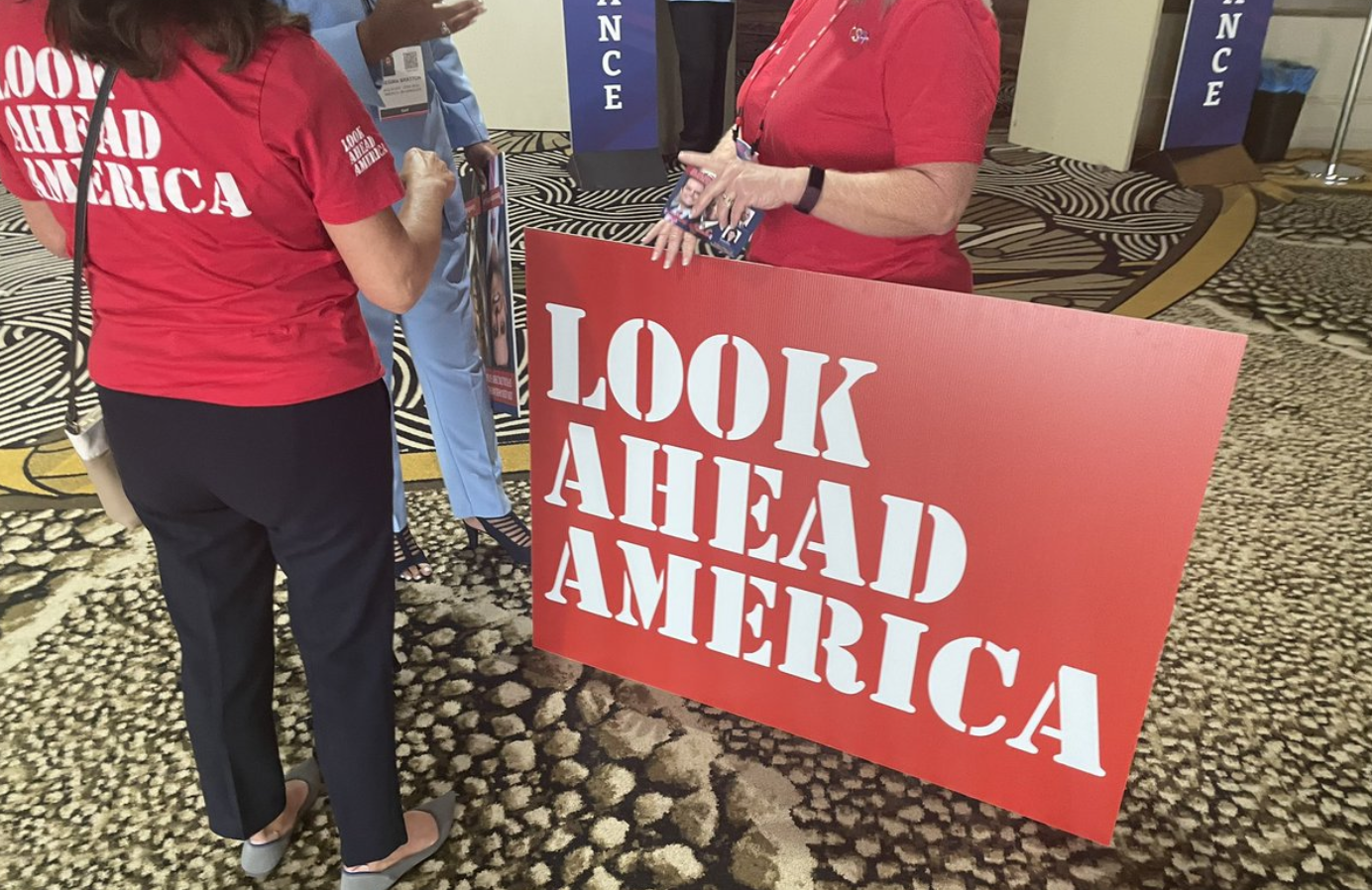
DALLAS — Volunteers for a right-wing organization at the Conservative Political Action Conference spent Sunday morning promoting an “official” event featuring a speech Rep. Matt Gaetz, R-Fla., posting signs sponsored by a group called “Look ahead America” — though a CPAC official told Salon the event was never sanctioned at all.

The conference sought to distance itself from the embattled Congressman by confiscating several signs and handouts for the speech, which read “join Look Ahead America’s official CPAC event featuring Representative Matt Gaetz and Colonel Allen West.” 

A CPAC official (middle) confiscates a “Look Ahead America” sign at the Conservative Political Action Conference Sunday. (Zachary Petrizzo/Salon)

The conference took action against the unsanctioned event, which was being held in a different section of the Dallas Hilton Anatole than the rest of the conference, after a self-identifying CPAC executive director said she received questions from Secret Service agents preparing for an appearance by former President Trump.

“We can’t have these signs because people are asking about it,” the official stated. “This is not an official event, so if I can have the sign, all is well…this is not an official event.” 

The whole debacle kicked off just before noon on Sunday, when security personnel approached a “Look Ahead America” volunteer holding a sign which read, “Matt Gaetz & Allen West Event,” with a large arrow pointing attendees outside of CPAC’s security checkpoint and into a second-floor ballroom at the hotel.

Moments later, “Look Ahead America” organizers left their booth area at the conference only to have another one of their signs promoting the event seized.

A Look Ahead America official brushed off the signs being taken, telling Salon they hadn’t had previous contact with any CPAC officials. In a subsequent tweet, Matt Braynard, the executive director of “Look Ahead America” called CPAC’s statement a “100% lie.”

“It is an official #CPACTX event. @LookAheadOrg is a CPAC sponsor and the room/event was part of our sponsor package. Secret Service said we couldn’t have signs near the main ball room due 2 security. @mattgaetz and @AllenWest gave great speeches!”

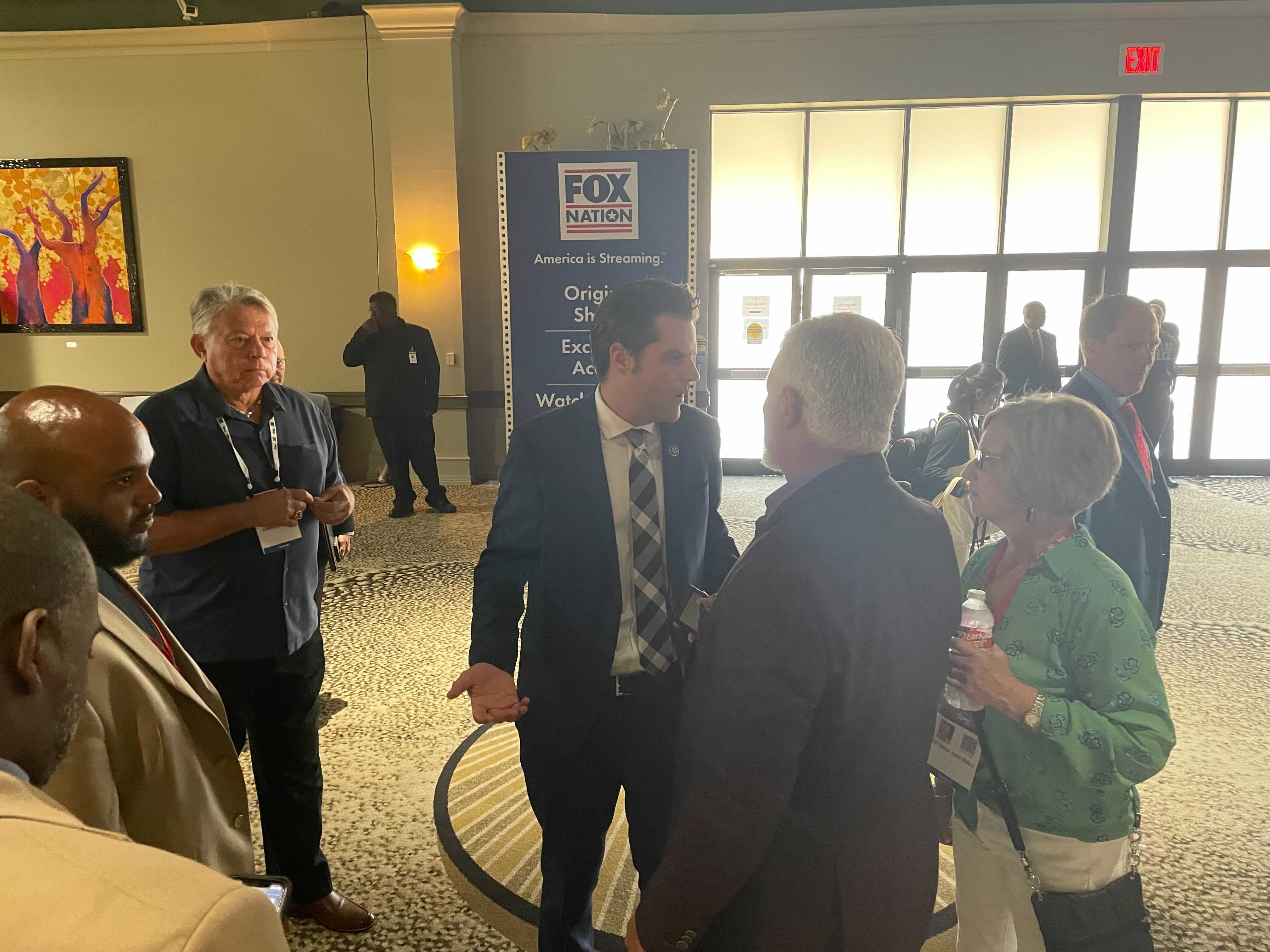
The unsanctioned event was headlined by Gaetz, who is under investigation by the FBI over allegations he violated federal sex trafficking laws and maintained a sexual relationship with a minor. He was, notably, not listed as a speaker on any official CPAC schedule, though Salon spotted the embattled lawmaker palling around the conference all weekend long.  

Gaetz, when approached about the conference claiming it did not recognize his event, said, “Well, I spoke at noon,” adding, “there were a lot of people there, I spoke.” 

Matt Gaetz greeting supporters at the Conservative Political Action Conference. (Zachary Petrizzo/Salon)

The dust-up isn’t the first time Gaetz has found himself persona non grata by event organizers recently — earlier this week a hotel in California canceled an event the Congressman was planning with fellow Rep. Marjorie Taylor Greene, R-Ga.

“As soon as we found out who the speakers were we immediately canceled it,” the hotel’s manager told the Orange County Register. “We just thought it would be best for our facility to cancel.”

Look Ahead America also has a history of thumbing its nose at CPAC organizers — in February, the organization promoted and attended white nationalist Nicholas Fuentes’ far-right gathering, “America First Political Action Conference (AFPAC),” which was created as a separate, rival conference to CPAC.

Following publication, Braynard disputed that it wasn’t an official event. “I dispute that it was not official,” he told Salon. “They assigned us the room for our event. It is part of our sponsor package.”

A CPAC official on July 21st provided Salon additional comment: 

CPAC has a long-standing policy that prohibits pamphleteering or handing out of materials in the areas outside the ballrooms or common areas at the event. Groups that formally partner with CPAC acquire booths that serve as their patch of real estate for the duration of the event and they are welcome to hand out and promote whatever they like from that location. Occasionally, another benefit of formally partnering with CPAC is the use of a room to host an event for a limited amount of time. Generally, CPAC is not concerned with how that room is used and the partner group may use it however they think benefits their and our attendee’s experience. However, those sponsored rooms/events are not considered “official” CPAC programming.   

This story has been updated with additional comment. 

Scared for in-person work to return in the COVID-19 era? You’re not alone.

After more than a year of working from home, many people are finally preparing for a return to the office — and not all of them are happy about it.

Vanessa Cuddeford is a communication and career coach who helps professional women develop communication skills to more effectively advance their careers. Speaking to Salon by email, she described how many of her clients embraced the opportunity to “hide” behind a Zoom screen during the past year’s COVID-19 lockdowns because they are naturally introverted — and now they are anxious about being compelled to resume in-person meetings.

“They feel it’s easier to speak in virtual meetings, rather than have to compete with their louder colleagues in in-person meetings,” Cuddeford said. “They like being able to keep the camera turned off and find it easier to signal their intention to speak with a virtual ‘hands up’ sign, rather than making their voices physically heard.”

The anxiety is not limited to in-person meetings, either. Many live events were also delayed by the lockdown, and now one client is left dreading a keynote presentation she needs to deliver in three months.

“She told me that if she could do it virtually she’d be fine, but she’s already losing sleep at the thought of standing up on stage,” Cuddeford said.

There is little question that COVID-19 radically altered how Americans work. Employees are reportedly asserting their economic rights with increased fervor and basic concepts about the nature of work itself are being challenged. A generation that already felt economically disenfranchised by the 2008 crash felt the economy’s foundations crumble beneath their feet for the second time in less than a dozen years. Unlike the Great Recession, however, this calamity didn’t merely shed jobs and lead to a so-called K-shaped recovery — one that generally benefits the wealthy at the expense of everyone else — it also changed the fundamental nature of how we work when fortunate enough to be employed.

“Experts stress that the transition back to work is just that: an adjustment period best approached with an open mind,” Dr. Holly Schiff, a licensed clinical psychologist, told Salon. “I have also noticed through my work that people’s negative reactions are very strong and they are quite adamant about how they feel. This makes sense given that we have never experienced a situation like this before and people are unsure how to handle being told to come back to the office after being in lockdown through the pandemic. They also note feeling like they are losing some of their discretion and ability to choose how and where they work, which most employees are not happy about.”


Want more health and science stories in your inbox? Subscribe to Salon’s weekly newsletter The Vulgar Scientist.


And, of course, these developments are not happening within a vacuum — Schiff notes that the last year has been defined by the anxiety we’ve felt over every new change to our version of “normal”: social distancing guidelines, habitually using video chat to communicate, wearing masks during in-person interactions that made it hard to read facial expressions and generally not exercising their socialization skills.

Making matters worse, we lived in a climate of fear due to anxiety about germs and contamination. The issue is not that people were wrong to do these things — all of them were necessitated by the pandemic. Nevertheless, they took a toll.

“We haven’t completely lost our social skills, they just haven’t been put into daily practice and not in the same ways they were prior to the pandemic,” Schiff said.

All of this change over such a short time span can impact people’s mental health — something Clara Monroe, a Licensed Professional Counselor Supervisor (LPC-S), said that she believes people need to be especially mindful of as they, again, prepare to change their day-to-day routines.

“All of us could learn how to better take care of ourselves and listen to what our bodies, hearts, and minds are telling us,” Monroe said. “Taking time to slow down, be aware of the now, and taking time for ourselves and our wellbeing is always a positive step. This could be in the form of exercising, enjoying a hobby, practicing yoga, doing meditation, or visiting a life coach or therapist.”

This isn’t to say that all the responsibility for employee well being should be placed in the hands of employees — businesses should also strive to foster an open dialogue with their workers to explore stressors they may be experiencing during this transitional phase and alleviate their anxiety as much as possible, says Dr. Doreen Marshall, Vice President of Mission Engagement at the American Foundation for Suicide Prevention.

She also added that seeking out help from mental health professionals should be encouraged — and new forms of therapy and counseling that emerged during the pandemic can be expanded on to build a better network of support for people who are feeling overwhelmed by the rapid switch back to some semblance of pre-pandemic life.

But, most importantly, workers have stressed the importance of employers investing in well-defined (and more importantly, well communicated) health and safety protocols — especially in light of recent reports about the spread of a contagious Delta variant of the COVID-19 virus.

“Employers have a responsibility in three key ways: safety, sanitation, and sanity,” said Dr. Tammy Lewis Wilborn, a board-certified licensed professional counselor-supervisor and owner of a New Orleans-based tele-mental health private practice. “First, it is critical that employers prioritize employees feeling safe to return to work. This may include communicating policies and new practices beforehand to ensure that employees know that their safety is of primary concern. They should also consider identifying a return-to-work plan based on employee concerns and employer needs which might include a hybrid model or staggered return.”

Wilborn added that employers must enforce sanitation and hygiene rules as well as clearly communicate why basic cleanliness and COVID-19 guidelines should be followed.

“Employers should also anticipate hesitancy and anxiety about returning back to work and be prepared to address those concerns informally and formally,” she said.

Anxiety, of course, makes perfect sense from an evolutionary perspective — to our prehistoric forebears, it often meant the difference between life and death. But modern life has largely removed the myriad threats to our immediate survival — and made lingering anxiety more of a hindrance than a help.

“Our ancestors who survived were the ones who overestimated the danger and therefore reacted and kept themselves safe,” Cuddeford said. “If our ancestors heard a rustle in the bushes and assumed it was a sabre-toothed tiger … they survived. Even if nine times out of 10 it wasn’t a sabre-toothed cat, but merely the wind rustling the bushes, it still paid off to overestimate the danger, because on the 10th occasion it might actually be a sabre-toothed tiger.”

The problem, of course, is that today our dangers are more chronic.

“Work stress and financial concerns are stressors that keep us on high-alert for long periods, hence we have an epidemic of anxiety conditions in the modern world,” she said.

Our successful return to pre-pandemic life will largely hinge on our ability to overcome that anxiety — and the ways we can use it to create more inclusive and safe workplaces for the future.

Garden overrun with cucumbers? Use them to make midori-zu, a vibrant Japanese green vinegar

I am not a great gardener. While I wouldn’t say I have a brown thumb, there are only a few things I can reliably grow and they tend to be the kind of plants people regard as nearly indestructible: mint, dill, leafy greens and jalapeños. That’s why I vividly remember my delight when, several summers ago, small cucumbers began to pop up on the vines I’d carefully tended and watered. 

When I finally bit into the first fully-formed cucumber — the crisp outer skin giving way to a slightly bitter, watery center that burst like a vegetal gusher — I felt like I’d made it. I was ready to nominate myself for the imaginary series “The Great American Garden Off” and promptly made plans for how I’d use my eventual bounty as quick pickles and the base of pints of tzatziki

But then the cucumbers kept coming. 

Because my gardening track record was so shoddy, I went into that season over-prepared. I planted rows and rows of cucumber seedlings hoping to ensure that I’d at least get a few good plants. There must have been something in the water because as the summer progressed, my small Kentucky yard became a tangle of cucumber vines. I couldn’t keep up with the harvest. I pickled, I grated, I made salads, and eventually begged friends to take them. That was the year that my signature housewarming or hostess gift became a basket of fresh cukes. 


Want more great food writing and recipes? Subscribe to Salon Food’s newsletter.


I no longer have that problem — a bittersweet result of shifting to an apartment with no room for anything other than a balcony garden — but cucumbers are still a mainstay of my summer diet. They are omnipresent in CSA boxes and at the farmer’s market stand, and I knew I needed some additional uses for them other than my stand-by salads and sauces. 

Chef Sho Boo of Maki Kosaka in New York City recommends using them as the base for midori-zu, a refreshing Japanese condiment made with cucumbers, rice vinegar, dashi, light soy sauce and mirin. 

According to Boo, “the proportion of cucumber versus the dashi mix is totally flexible; more cucumber will make the sauce thicker, and less cucumber will make the sauce looser.” She also encourages home cooks to experiment with the proportions at play in the sauce. If you prefer a little extra bite, feel free to up the vinegar. 

To maintain the fresh green color of the sauce, Boo freshly grates the cucumber right before serving, but the tosazu — the vinegar, dashi, soy sauce and mirin mixture — can be made days ahead of time and stored in the refrigerator. 

“Having cucumber not mixed into the dashi will prevent it from losing its vivid green color, so it is recommended to plate them separately, and to have guests mix them up,” she said. 

At Maki Kosaka, Boo uses the midori-zu as a vibrant sauce for sashimi-grade fish. The balanced flavors would also pair beautifully with pan-fried chicken, grilled eggplant or even a simple salad of sugar snap peas, thinly-sliced white onion and radish. 

* * *

Recipe: Midori-Zu (緑酢) 
Serves approximately 4

Ingredients

  • 5 oz. dashi broth 
  • 1 oz. rice vinegar 
  • 1 oz. light soy sauce 
  • 1 oz. mirin 
  • 1 Japanese cucumber 

Directions 

1. In a bowl, mix dashi, vinegar, soy sauce and mirin and place in the refrigerator until ready to use. 

2. Grate or finely chop one whole cucumber. If Japanese cucumbers are unavailable, use English cucumbers instead. Place in a separate bowl if not serving immediately. Combine with dash mixture when ready to serve. 

Read More Saucy:

Take a break from the summer heat with this chilled soba noodle salad

Soba noodles have a chewy texture and nutty flavor, and are as enjoyable chilled as they are hot. For a refreshing cold noodle salad, we cooked soba noodles in unsalted boiling water in a Dutch oven until tender but still resilient and rinsed them under cold running water to remove excess starch and prevent sticking. We then tossed the soba with a miso-based dressing, which clung to and flavored the noodles. We also cut a mix of raw vegetables into varying sizes so they’d incorporate nicely into the noodles while adding crunch and color. Sprinkling strips of toasted nori over the top added texture and a subtle briny taste. Yellow, red, or brown miso can be substituted for the white miso, if desired. We prefer the subtle flavor and crisp texture that freshly toasted nori brings to this dish; however, plain pretoasted seaweed snacks can be substituted. For a spicier dish, use the greater amount of arbol chiles. If dried arbol chiles are unavailable, you can substitute ¼ to ½ teaspoon red pepper flakes.

***

Recipe: Chilled Soba Noodle Salad
Serves 4/Total Time 45 minutes

Ingredients

  • 3 tablespoons white miso
  • 3 tablespoons mirin
  • 2 tablespoons toasted sesame oil
  • 1 tablespoon sesame seeds
  • 1 teaspoon grated fresh ginger
  • 1—2 dried arbol chiles (each about 2 inches long), stemmed and minced
  • 8 ounces dried soba noodles
  • ⅓ English cucumber, quartered lengthwise, seeded, and sliced thin on bias
  • 4 ounces snow peas, strings removed, cut lengthwise into matchsticks
  • 4 radishes, trimmed, halved, and sliced thin
  • 3 scallions, sliced thin on bias
  • 1 (8-inch-square) sheet nori, toasted and cut into 2-inch-long matchsticks (optional)

Directions 

1. Whisk miso, mirin, oil, sesame seeds, 1 tablespoon water, ginger, and arbol chiles in large bowl until smooth.

2. Meanwhile, bring 4 quarts water to boil in large pot. Add noodles and cook, stirring occasionally, until cooked through but still retain some chew. Drain noodles and rinse under cold water until chilled. Drain well and transfer to bowl with dressing. Add cucumber, snow peas, radishes, scallions, and nori, if using, and toss to combine. Season with salt to taste. Serve.

If you like this recipe as much as we do, check out “The Complete Salad Cookbook” by America’s Test Kitchen.

HBO’s “The White Lotus” satirizes the oddly funny, mutually exploitative side of luxury vacations

Mike White’s TV writing filmography isn’t long, but it is notable for his work’s specific way to striking a cultural nerve – hard. A decade ago he gave us “Enlightened,” a show in which the honestly intentioned if misguided spiritual seeker Amy Jellicoe, played by Laura Dern, personified the kind of flighty New Age spiritualism derided by virtually everyone who isn’t a coastal dweller.

Dern’s character in that show is timeless, and her performance still gets social media shoutouts from time to time all these years later. “Enlightened” was underappreciated in its time, canceled after only two seasons. It’s also an acquired taste. Looking back, though, Amy’s clumsy, dimwitted efforts to impose her will to self-actualize upon an office that could not care less about its worker drones told us a lot about the ways we were fooling ourselves in 2011.

She was convinced that her life had potential that it didn’t, and back then we fooled ourselves into believing the world was better than it actually was.

No such illusions blur our vision in 2021, which informs the entertainingly cruel streak in White’s new six-episode HBO limited series “The White Lotus.”  This time White trades the joy-deficient corporate world for a tropical Shangri-La where the entitled rich swim with sea turtles and work the last nerves of resort workers whose lot it is to cater to their every whim. Nearly everyone in this series is some version of odious, and the ones who aren’t are some version of trapped. That’s life on an island for everyone, visitors and residents alike.

The visitors get to leave, which the eponymous Hawaiian resort’s manager Armond (Murray Bartlett), takes advantage of by surreptitiously torturing them. But they give as good as they get, which is the larger point. White understands the nuances of class struggle and how manicured paradises have a way of relaxing the unsuspecting into dropping their masks.

He also gets the way that travel and luxury can bring out the worst in people, especially powerful people with time on their hands.  “The White Lotus” derives its tension from reminding us at every turn that nobody is entirely innocent. Certainly not the rich-boy Shane Patton (Jake Lacy) and his meagerly earning journalist wife, Rachel (Alexandra Daddario), honeymooners who almost immediately find reasons to be unhappy and make Armond miserable.

The spat between Bartlett’s Armond and Lacy’s Shane is a bit more typical in the way it makes the most of Bartlett’s prickliness and Lacy’s aptitude for portraying frat-bro snobbery. Still, it’s extraordinary to witness the actors and White convincingly extend Shane’s nitpicky dissatisfaction with his fine suite through most of the series, to the point that he calls in his cheerily affectless mother (a brilliant Molly Shannon) to assist him with flogging the help.

They have that in common with hyper-successful businesswoman Nicole Mossbacher (Connie Britton), a woman who can’t cede control of any situation, including the furnishing arrangements in her hotel suite. Nicole’s husband Mark (Steve Zahn) despises her slightly less than he fears her, and neither is entirely respected by their children.

But that doesn’t make them special, since their awkward, moody teenaged son Quinn (Fred Hechinger) exists at the mercy of their daughter, Olivia (Sydney Sweeney) and her best friend Paula (Brittany O’Grady), a pair of college-age cynics newly indoctrinated into the teachers of Nietzsche and academic analysis of gender relations. They inflict their newfound sense of intellectual superiority on the adults around them, and each other, never letting anyone get the better of them.

Discomfort is the core commodity of “The White Lotus,” in case you can’t tell; braiding wealth, power and plenty creates a heady narcotic, and the plot is drunk with it. It’s almost a relief knowing that somebody is going to die, one of the first reveals in a premiere that drops us in near the end the story before yanking us back to the beginning like the day’s fresh catch.

Examining the transactional patterns between guests and staff, and guests of richer guests, allows White to dig into class inequities more effectively than racial dynamics or issues of cultural advantage. This works best in the purchased friendship between spa manager Belinda (Natasha Rothwell) and the lonely, depressed Tanya McQuoid (Jennifer Coolidge), a clingy woman mourning the loss of her mother and grabbing at Belinda as if she were a life preserver.

Belinda is the exception among the staff and other islanders who work at the hotel and call Hawaii home in that we get a sense of her desires of a life beyond serving people who see her worth as proportionate to what they need in any given moment. Beyond her and Desmond we don’t learn much about The White Lotus staff, which could have added a bit more humanity to an overall chemistry that can feel hamstrung by its studied view of human behavior.

The Mossbacher mealtime conversations are blasé right-wing blurt fests about cancel culture and other conservative talking points presented as a Darwinian defense of their privilege. The callow meanness of these speeches is the point, but they’re also draining.

Regardless of that, White has a talent for gifting each of his characters with some true humanity, even the emotionally cannibalistic ones. Nicole is absolutely awful, but there are times when she peels back the armor to show us where the damage is, why she carries it and how it is necrotizing her marriage, and Britton is one of the rare performers who can nail such vulnerability with dead-eyed accuracy.

Coolidge makes Tanya a wonderful tide of sadness with a dangerous undertow, but she and Belinda are such a marvelously “bad for each other” pair of convenience that it’s tough to look away. That’s a true accomplishment in an era of HBO defined by shows about horrible rich people.

But next to “The Undoing” and “Big Little Lies,” and the crazy, operatic substance of “Succession,”  “The White Lotus” is a destination event, a safe, controlled daytrip into disquiet. Some will love the airy cringe that White purveys here, which intensifies as this series goes deeper into its run. Even if the agita gets to be too much to handle, you can still take relief knowing that like all good vacations, it comes to an end exactly how it should, and when it should.

“The White Lotus” premieres Sunday, July 11 at 9 p.m. on HBO. 

Trump embraces Capitol rioters, rewrites Jan. 6 history during Fox appearance

Donald Trump used a Sunday morning appearance on Fox News to rewrite the history of Jan. 6 and speculate wildly on the identity of the officer who fatally shot Ashli Babbitt, with almost no pushback from host Maria Bartiromo. 

The segment came just hours before Trump is slated to headline the Conservative Political Action Conference (CPAC) in Dallas, Texas, and featured a nod to the former president’s 2024 ambitions. 

“I absolutely know my answer, and we’re going to do very well and people are going to be very happy,” he said when asked about whether he was officially running, noting that he couldn’t officially announce anything due to campaign finance regulations.

Trump’s appearance was supposed to cover his recent (and likely futile) lawsuit against several social media companies, though the conversation quickly shifted to Trump’s demonstrably false claims of a “rigged” election — claims that Bartiromo fueled by suggesting Georgia’s 2020 election results would soon be overturned, citing one article in the far-right publication The Federalist. Georgia has already conducted a full hand recount of its election results and completed an audit, making any changes to its already-certified results incredibly unlikely.

During the call-in interview, the former president also offered a full-throated defense of the rioters who breached the U.S. Capitol building and incited violent clashes with police and security forces, evoking memories of his defense of the white nationalist protesters who gathered in Charlottesville, Virginia, in 2017. Rather than a violent insurrection, Trump instead sought to recast the day as one of “peace” and “love” following his “mild-mannered” speech. 

“There was such love at that rally,” he said, “They were peaceful people, these were great people, the crowd was unbelievable and I mentioned the word love, the love in the air I’ve never seen anything like it.”

Both Bartiromo and Trump worked during the segment to cast Ashli Babbitt, the rioter who was shot and killed by a Capitol police officer on Jan. 6 while climbing through a broken window, as an innocent victim. In recent weeks the Air Force veteran and conspiracy theorist has become a cause célèbre in far-right circles, as pundits and politicians attempt to paint her as a martyr whose death must be avenged. 

Trump also parroted his supporters’ calls for the officer who shot Babbitt to be identified — after an investigation found the shooting was justified and prosecutors declined to file any charges in the case.

“Who is the person who shot an innocent, wonderful, incredible woman?” Trump bellowed. “Who shot Ashli Babbitt? People want to know. And why?”

Bartiromo then began a particularly wild diatribe in which she appeared to insinuate that the head of Chuck Shumer’s security detail was the officer in question.

“There is speculation that this was the security detail and a leading member of Congress security detail, a Democrat,” Bartiromo said. “I want you to know that my team reached out to Sen. Chuck Shumer’s office to check on what he may know about who shot Ashli Babbitt.”

The longtime Fox host also asked Trump about his widely reported phone call with Kevin McCarthy on Jan. 6, in which the House Minority Leader was reportedly “furious” with Trump for refusing to call off the rioters and denounce the violence. Trump, for his part, replied that he was comfortable not answering Bartiromo’s question because McCarthy will likely be called to testify in front of Congress’ select committee investigating the insurrection.

“No, I don’t have to, because Kevin will speak and I’m sure Kevin will be very good from that standpoint,” Trump said.

Trees are dying of thirst in the Western drought — here’s what’s going on inside their veins

Like humans, trees need water to survive on hot, dry days, and they can survive for only short times under extreme heat and dry conditions.

During prolonged droughts and extreme heat waves like the Western U.S. is experiencing, even native trees that are accustomed to the local climate can start to die.

Central and northern Arizona have been witnessing this in recent months. A long-running drought and resulting water stress have contributed to the die-off of as many as 30% of the junipers there, according to the U.S. Forest Service. In California, over 129 million trees died as a consequence of a severe drought in the last decade, leaving highly flammable dry wood that can fuel future wildfires. 

Firefighters are now closely watching these and other areas with dead or dying trees as another extremely dry year heightens the fire risk.

What happens to trees during droughts?

Trees survive by moving water from their roots to their leaves, a process known as vascular water transport.

Water moves through small cylindrical conduits, called tracheids or vessels, that are all connected. Drought disrupts the water transport by reducing the amount of water available for the tree. As moisture in the air and soil decline, air bubbles can form in the vascular system of plants, creating embolisms that block the water’s flow.

The less water that is available for trees during dry and hot periods, the higher the chances of embolisms forming in those water conduits. If a tree can’t get water to its leaves, it can’t survive.

A dyed cross section of a ponderosa pine sapling shows the water transport tissue and conduits. Raquel Partelli Feltrin

Some species are more resistant to embolisms than others. This is why more pinon pines died in the Southwest during the drought in the early 2000s than juniper – juniper are much more resistant.

Drought stress also weakens trees, leaving them susceptible to bark beetle infestations. During the 2012-2015 drought in the Sierra Nevada, nearly 90% of the ponderosa pines died, primarily due to infestations of western pine beetles. 

Fire damage + drought also weakens trees

Although fire is beneficial for fire-prone forests to control their density and maintain their health, our research shows that trees under drought stress are more likely to die from fires. During droughts, trees have less water for insulation and cooling against fires. They may also reduce their production of carbohydrates – tree food – during droughts, which leaves them weaker, making it harder for them to recover from fire damage.

Trees that suffer trunk damage in a fire are also less likely to survive in the following years if drought follows. When trees have fire scars, their vascular conduits tend to be less functional for water transport around those scars. Traumatic damage to the vascular tissue can also decrease their resistance to embolisms.

So, burned trees are more likely to die from drought; and trees in drought are more likely to die from fire.

What does this mean for future forests?

Trees in Western forests have been dying at an alarming rateover the past two decades due to droughts, high temperatures, pests and fires. As continuing greenhouse gas emissions warm the planet and drive moisture loss, increasing the frequency, duration and intensity of droughts, research shows the U.S. and much of the world will likely witness more widespread tree deaths.

The impact that changing drought and fire regimes will have on forests farther in the future is still somewhat unclear, but several observations may offer some insight.

There is evidence of a transition from forests to shrublands or grasslands in parts of the Western U.S. Frequent burning in the same area can reinforce this transition. When drought or fire alone kills some of the trees, the forests often regenerate, but how long it will take for forests to recover to a pre-fire or pre-drought condition after a large-scale die-off or severe fire is unknown.

In the past decade, the Western U.S. has witnessed its most severe droughts in over 1,000 years, including in the Southwest and California. A recent study found subalpine forests in the central Rockies are more fire-prone now than they have been in at least 2,000 years

If there is no change in greenhouse gas emissions, temperatures will continue to increase, and severe drought stress and fire danger days will rise as a result.

Daniel Johnson, Assistant Professor of Tree Physiology and Forest Ecology, University of Georgia and Raquel Partelli Feltrin, Postdoctoral Scholar in Botany, University of British Columbia

This article is republished from The Conversation under a Creative Commons license. Read the original article.

“Blindspotting” is a “truly American story” about living in a country addicted to imprisoning people

My uncle Jay went to jail when I was a kid –– and I remember how everybody made a big deal about visiting him, making sure he was okay, constantly talking about his sanity and preparing something good for him to come home to. I think all of this was extremely important, but it was strange how my aunt was just left out of the conversation. Jay went to jail, taking his income with him, and our family had to band together to make sure my aunt and his kids were taken care of while he was away –– and that is the part of the criminal justice system that is too often left out of the conversation.

We create so much language around the people who are incarcerated and don’t focus enough on the families trying to piece their lives together. That other side of incarceration is captured beautifully in the new Starz series “Blindspotting.” 

“Blindspotting,” written and produced by Daveed Diggs and Rafael Casal, follows Ashley (Jasmine Cephas Jones) who, after her longtime partner Miles (Casal) is incarcerated, must move in with Miles’ mother (Helen Hunt) and half-sister Trish (Jaylen Barron). The series takes a deep dive into the Oakland family struggling in a society quickly changing through rapid gentrification and offering little to no opportunity to Black and brown people. Casal detailed the importance of using art and his platform to bring awareness to what the families of incarcerated people go through on a recent episode of “Salon Talks.”

You can watch my “Salon Talks” episode with Rafael Casal here, or read a Q&A of our conversation below to hear more about the challenges of making a television show during a global pandemic, the magic that develops when you form a writers room full of poets and his hopes of telling more authentic Bay Area stories.  

The following conversation has been lightly edited for length and clarity.

I love “Blindspotting” the movie. I feel like with this show, you guys took it to the next level. How you been holding up?

Been good man. I mean we shot this thing during the pandemic so I think we’re all just happy that the release of the show is coinciding with people starting to be outside and get back to their lives again. It feels like it’s a part of the celebration of everything opening back up. It’s been a labor of love but yeah, It was a tough year making the show. I’m happy that it’s done and people can see it.

What were some of the challenges of shooting during the pandemic?

Man, it affects every facet of filmmaking and storytelling. From who’s available, how they can be in the right area. We couldn’t get indoor shooting permits for the Bay Area for the first three months of production. We had to move all of our exterior to end of the shoot just in hopes that we’d be able to shoot up there. We had to build our sets so that there could be constant airflow and you could take walls off. If somebody sneezed on set, you got to stop for an hour. I have no idea how people make TV normally because I’ve only ever been a cast member on something but the logistical challenges alone, I mean, you saw people shut down. A lot of shows that didn’t even come back. It wasn’t even worth it. But we’re new hungry filmmakers, and they gave us a shot to make a show so while some other people slept, we were like all right, we’ll do it. We’ll try it.

And then you’re just praying for a few things. One, obviously we don’t want to get shut down. But then also every day you’re reminded of what a shutdown actually means. It’s somebody has COVID, and they’re going to have to deal with that and their family. We had staff members who are living with parents that are not necessarily healthy or they have kids or whatever. It really was never lost on us that people were actually risking their lives to come to work. And for us too, I think we then had to make the show extra worth it. We really got to love what we’re doing and believe in it to ask people to do that.

Did you guys ever think about making the pandemic a part of that original storyline? Did that conversation come up?

Yeah. I think that was the question for anybody who’s making art this year. How do you want to interface with this moment in time? But I think “Blindspotting” in a lot of ways, the world that we built is really about reflection and seeing ourselves from different angles and having a new perspective on the way in which we engage with the world. And the pandemic was happening in real time and we’re still trying to figure out who we are in it and have some hindsight on it. And so for us, I think it made it really easy to go, you know what? Let’s set this in 2018, six months after the movie so that if we ever get the chance to have the show run a couple of seasons and we want to interface with the pandemic, we have some insight into what that was like and we can make some commentary on it as opposed to just trying to like represent it and chase it accurately while we’re still in the midst of it.

And some penitentiaries were letting people out, letting them do it at home. Some were really trying to contain it and pretend as though COVID wasn’t running rampant through the prison industrial complex. That was the big thing right? If we were going to do a COVID thing that involved the prison system, we’ve got to see it all the way out first and see how different states are responding to it because the California Prison System is very specific in how they dealt with it and how much it was spreading and the amount of people that were infected with COVID in the penitentiary. To me, that’s a whole season in itself, just dealing with that.

What does the term “Blindspotting” mean to you since the film has graduated into a television series? Has it taken on more of a meaning or a different meaning?

I think it just becomes so pervasive through my life, right? I do think for us, it’s a North Star about the way in which we’re willing to have certain conversations about things, right? In the movie, it’s really about the way people see Collin, right? Some people look at Collin and look at his rap sheet and see a particular kind of person that is worthy of guilt and punishment and other people who see somebody who is trying to survive a corrupt system. And that’s true for all the characters. There’s a number of different dualities at play. And “Blindspotting” really was to give some language to what does it mean to look at something or someone or a community and go, “Am I framing this in the correct way to afford everyone their greatest level of humanity?”

And I think what that’s become for me now since the movie and really working up to the movie and really just our practice as artists, has been to look at everything that way and go all right. Well, I’m so sure that it is this. Am I doing the work to turn this around and look at it another way? And I think when we’re making a TV show with a bunch of other writers and a bunch of other characters, we all come in with our preconceived notions of who they are and how they should be, based on the people we know in our lives. And even the show has forced us to look at people in our own lives who we love, who we look at firmly, and think about the complexities of who they are from as many different vantage points as possible to fully communicate their humanity. The movie’s only 90 minutes. The first season is four hours. There’s more time to live with people. There’s more complexity afforded to it.

For our readers and viewers who never got a chance to see the movie, can you give them like a glimpse into the world that they would come into?

What’s great is that the show really doesn’t require that you have seen the movie, although I think eventually you’ll want to go back and see it as like a prequel now, but we really tried to Marvel Universe this thing. It’s a different plot, but it’s within the same world, right? It’s within the same universe. But this film is really about Ashley Rose, who’s just creeping up on a middle-class life with her partner Miles and their son Sean.

And on New Year’s Eve, Miles is getting yanked out of the house and then dragged off to jail. And it’s not entirely clear why. We give some hints. And it’s really about her having to move back to a neighborhood she grew up in, into his mom and half sister’s house, because that’s the easiest place for them to go and re-acclimate herself with a bunch of people that I think in a lot of ways, she was moving away from or felt that she needed to move away from and figure out how to raise their son on her own while dealing with him being a part of this system.

And we really wanted to tell a story that was not about what it’s like in prison but what it’s like for everybody else affected by the country’s prison industrial complex. And it’s funny as hell and it’s beautiful because we have all this movement and poetic verse. So it does have these abstract art elements to it that I think really set it apart from anything I’ve ever seen before.

It’s like if we can keep the issue on the guilt of the inmate, of the person who is incarcerated, of the human being who is being incarcerated, if we can keep the conversation on whether or not they’re deserving of compassion, it’s so easy for the pile on to happen. “Well, what did they do?” We love doing that as a country. We did that with George Floyd. “What did he do?” All this assumed guilt, which of course is always like more so on Black and brown bodies than anybody else, but that’s the pile on. And I think when we start looking at incarceration and going well, all right, there’s 2 million people incarcerated in this country. That’s an insane amount of people. The amount of people that affects on the outside, maybe at first glance isn’t worthy of like one of those crime documentaries that’s like, look at how crazy it is in an Angola prison. But the relatable story, that if there’s 2 million incarcerated people in this country, the relatable story is like the 30 people in each one of those people’s lives that have had to reconcile with the disappearance of somebody that they love. Guilty or not. And I think that then becomes an unfortunately, a truly American story of what does it mean to be in a country that is so addicted to incarcerating people?

I think of artists often as merchants of empathy. Our job is to create empathy where there seems to be a void of compassion. And there’s already so many nonprofits and organizations both locally and nationally that actually already have all the information, already have the plans for how we can deconstruct the prison industrial complex and have it be much more of a restorative justice system as opposed to a punitive justice system. That already exists. What’s missing is the compassion and the love and the fire lit under our asses to actually make that shift. I think our job is just that. Just like, look at how it affects people, look at the people that you will grow to love and relate to, that this is affecting. And if that’s true, then shouldn’t we do something about it? This system, we actually don’t need it to be this way. There’s all these amazing resources that people can go check out and participate in on a local level to start to move the needle.

The last time I spoke to you, I remember we were talking about how the Bay Area is changing, right? The prices of homes and how difficult it is to live and people being pushed out. And I wanted to ask you, what is the climate like right now? Has it changed for the better any?

It’s not. Not at all. Not from what I’ve seen. I mean, even on the block we were shooting on, man. What was beautiful was like we were shooting in the west and a lot of the people who live on that block would just come out and sit on their porches all day and watch us shoot and so I was talking to folks the whole time we were there and you’re just talking about how hard it’s been during the pandemic and the pressure that they have for people to come and try to buy their houses and flip them and push them out of the neighborhood. And that gentrification process is brutal. And the pandemic just I think made it even harder because so many people were out of work, that there’s even a bigger need for like well, I just need a big chunk of money to sustain and so no, I think if anything, the tension between the new folks and the locals is high.

It’s the first time I’ve ever seen my community feel particularly angry in this way? I can feel the weight of the fury of what’s happened to the area and I think that those moments when we can celebrate Bay Area culture and Bay Area history become really important and so there has been a lot of rallying and love around our show in the last few days. I hope that maintains because I also know that cynicism is right there too because of how it’s been. But I believe in the Bay and I believe in the resilience of the people there. Especially the local community that has been there for a while and I think they know how to amplify the beautiful parts of what makes the Bay area what it is. And I think our job as a show is just like shine light on that and be like no, this is what the Bay is. You can’t make it something else because this is why it’s dope. And everybody needs to get on board with preserving these reasons of why it is what it is, not trying to make it something new.

Sometimes when we get pushed into different areas, we are forced to develop new community. And even though going through the process has been ugly, there has been times, especially where I’m from and where I live in Baltimore, we’ve been pushed out of areas and we’ve migrated into new pockets and created something even more beautiful and more brand new and something that we can even take more ownership in. Is there a place in the Bay like that? 

There’s a lot of that. I don’t know if the regional pride has shifted to those areas yet in the same way. But I think it’s on the way, right? I think of Stockton and Tracy and Antioch and some of the cities that are a little bit further out, right? I haven’t spent a ton of time in Atlanta but when I go out there, we always talk about like well, the Atlanta suburbs spread pretty far out – 30, 40 minutes outside of the city. And there’s a lot of transfer of every 10 years or so. All the Black and brown people are in the city and then back to the suburbs and there is this transfer of where everybody congregates. And I think Ben Turner, again, on our staff, he’s from Antioch. And a growing population of people from Oakland and from Berkeley and San Leandro and Richmond that are out in Antioch now, are out at Stockton now, are out in Tracy now and there was a new community building out there. Everyone I know who’s out that far is still like yeah, but I’m from Oakland or I’m from Berkeley or I’m from Richmond. The pride is still centered in a different city. I do have that optimistic lens on it. Sometimes where I’m like well, but there is also something really beautiful brewing out there and I wonder what will come of that. I wonder what kind of resilience and beauty will come out of the hardship of losing this particular place.

But I think all of that unfortunately does come to the detriment of this idea that like, that’s what the Bay Area was. The Bay Area was the first and second great migration from the South to the Port City of Oakland and San Francisco as a safe haven from people trying to leave the South. I think those are the things that a lot of local folks are wrestling with. Is like, but this was going to be that and even now we’re getting pushed out of that and going somewhere else and like when do we get to have something that’s just like, this is it. This gets to stay.

We’re here to support any art and creativity that comes out of that pain because that’s what we got to do. What’s next for you?

I’m hoping we get a Season 2 man. There’s a lot of stuff in Season 1 that we didn’t get to do because of time and honestly, inexperience and the pandemic right? This is the first time we’d ever done TV. We learned a lot. I’m like man, I want another crack at it now that I know so much better how to do it. And there’s other projects that I’m doing and me and Daveed are doing and all of that but I think the thing that I’m most excited about honestly, is that I know a lot of screenwriters, storytellers back home from where we grew up and “Blindspotting” is not like the Oakland story or the Bay Area story. It can’t be. It’s just one little tiny story among thousands of stories that that region has to offer.

And I’m really just excited to see the show that comes out. It’s like an answer to it or a variant of it. That’s a totally different story. And we were doing the Oakland block party for the premiere. And I’m looking out at this crowd of people, a lot of people I know and love, it’s like a 1,000 people on the street and I’m like, man. How crazy would it be if in 10 years there was 10 other shows that were totally different from our show. About the same place, totally different. There’s so many interesting variations of what the Bay Area is. And the way that I look at New York and I’m like, man, New York has a thousand movies about it. A thousand movies. And even that’s not enough. There’s even a hell of communities there that don’t have s**t.

The Bay Area needs that. We need just like a bunch of movies and shows to just try to articulate what it’s like to be from there and I’m literally just sitting like this. We did our little show and I’m like all right, who got next? I can’t wait and I want to help whoever that is any way that I can.

Congratulations on everything and I want you to tell everybody when and where they can see the show?

“Blindspotting” is on Sundays at Starz, on the Starz App. If you’re outside of the U.S., it’s on StarzPlay. And it’s every Sunday for the next eight weeks. We’re so excited for everybody to watch it so please come tune in.

19 pulled pork recipes that go beyond sandwiches

Pulled pork is a staple at summer cookouts, game day parties, and hole-in-the-wall barbecue joints. It’s a year-round crowd-pleaser that’s a comfort food in the winter and an essential part of summer holiday celebrations, too. There are a few different ways to cook pulled pork, but our favorite (and the three most common!) methods are in an Instant Pot, slow-cooker, or Dutch oven. As the pork butt or shoulder cooks low and slow, the meat becomes fork-tender and super shreddable. After several hours, it will pull apart into thin strands of juicy meat. Toss with your favorite barbecue sauce and pile it high atop a potato bun.

If you have leftovers, make pulled pork pizza, enchiladas, egg rolls, burritos, or tacos. After all, pulled pork tastes better after it has had time to really marinate in barbecue sauce for a day or two. Ahead, we’re sharing some of our favorite ways to make use of leftover pulled pork before diving in to our best pulled pork recipes.

* * *

Leftover Pulled Pork Ideas

Make A Pizza

Barbecue pizza hits all the marks. Start with your favorite recipe or store-bought pizza dough and top it off with a smoked mozzarella or Gouda cheese (the smoky flavor works extremely well with barbecue), leftover pulled pork, fresh herbs like parsley and cilantro, and something cool and crunchy, like sliced red onions. If the shredded pork isn’t already tossed with barbecue sauce, use your favorite BBQ saucein place of the usual marinara.

Top A Rice Bowl

If you are looking for a quick and easy protein-packed meal, top precooked grains (think white or brown rice, farro, or quinoa) with leftover pulled pork, plus a variety of colorful veggies like shredded carrots, pickled red onions, thinly shaved cucumbers, and corn kernels.

Fill A Taco Or Burrito

Have leftover pulled pork? Pile it into a taco or wrap it up in a tortilla with lettuce, beans, sour cream, cotija cheese, and a sprinkle of lime juice. It’s a delicious way to feed yourself, family, or friends while eliminating food waste.

Stuff A Quesadilla

A quesadilla can easily be enjoyed anytime of day. Breakfast and brunch are fair game, as are lunch and dinner when you want an easy, breezy bite. Layer leftover pulled pork with a sharp, slightly spicy cheese like Pepper Jack, sliced red onions, and chile peppers if you’re craving something with a kick.

* * *

Our Best Pulled Pork Recipes

1. Pulled Pork

When you are looking for a classic pulled pork recipe, look no further than this version, which is cooked in a Dutch oven. Boneless, skinless pork butt is dressed up with brown sugar, ground coriander, smoked paprika, and cider vinegar for a smoky, sloppy bite.

2. Pulled Pork Sandwiches

If you have leftover pulled pork that was slow-roasted in an oven, toss it with our homemade three-ingredient barbecue sauce and place a generous portion of the meat atop pillowy potato buns (the only bun worthy of pulled pork, in our opinion). Take the biggest bite you can, followed by a sip of a cold draft beer or hard cider, and embrace the good life.

3. Crispy Pulled Pork Shoulder

The secret to extra-crispy pulled pork is seasoning it with salt and pepper and letting it sit out at room temperature for about an hour. This method will dry the skin out (we promise it’s a good thing!), allowing for the exterior of the meat to get a beautiful sear when it’s cooked in a roasting pan in the oven.

4. Homemade Red Wine Barbecue Sauce

Traditional? No. Delicious? Yes. This barbecue sauce is made from a sweet combination of full-bodied red wine, molasseshoney, applesauce, and red wine vinegar, plus a genius blend of spices.

5. Garlic-Studded Pork Shoulder With Anchovies & Calabrian Chiles

This pulled pork recipe is not for the faint of heart, thanks to its salty-spicy combination of anchovies and Calabrian chiles. Food52 Resdient Sohla El-Wallyrecommends making this a day or two in advance, letting it sit in its braise to absorb all the wonderful flavors, and then serving it on a bun, over mashed potatoes, or with thick slices of toast.

6. Slow-Cooked Pork Tacos

Aside from a deep Dutch oven and a hot oven, our favorite method of cooking pulled pork is in a slow-cooker for a few hours. Recipe developer (and Food52 co-founder!) Merrill Stubbs agrees, and has a take that certainly doesn’t skimp on flavor. Open your pantry and grab cumin and coriander seeds, dried oregano, two kinds of chili powder, and two kinds of chile peppers—you’ll need it all.

7. Instant Pot (Or Not) Soy-Ginger Pork With Noodles & Greens

Pulled pork in under an hour? It’s not only possible, but it’s completely doable with this all-star recipe. Instead of barbecue sauce, the meat gets tossed with a savory combination of soy sauce, fish sauce, rice vinegar, red chile paste, and fresh ginger.

8. Memphis-Style Pulled Pork Nachos

There are a few things that make these nachos spectacularly over-the-top good. We’re talking leftover pulled pork, a homemade Memphis-style barbecue sauce, shredded romaine lettuce, shredded mozzarella, two kinds of onions (red and green), and a cheese sauce made from heavy cream and Kraft American singles (oh yeah, the good stuff).

9. Slow-Cooker Citrus Pulled Pork Tacos

Lighter and brighter are the two words to describe this pulled pork recipe sans barbecue sauce. Serve it with a citrus cabbage slaw that uses store-bought, precut coleslaw mix.

10. Banana Bread Sandwiches With Pulled Pork

Don’t question it, just do it. That means using slices of banana bread as the “bun” for these sweeter-than-ever pulled pork sandwiches. Take a bite and thank us later.

11. Slow-Cooker Carolina Pulled Pork Barbecue

“This recipe gives you fork-tender pulled pork barbecue with just 10 minutes of effort,” say our editors. Plus, it only calls for six ingredients including the pork shoulder, so there’s really no reason to not make it for your next meal (even if that meal is breakfast).

12. Chinese Pulled Pork Sandwiches With Kale & Apple Slaw

Making pulled pork doesn’t automatically mean you have to serve it with a sticky sweet barbecue sauce. This recipe is proof of that. The meat is cooked with dried shiitake mushrooms, soy sauce, mirin, and toasted sesame oil; once it’s fork-tender and fully cooked, serve it on buns with a hearty winter slaw.

13. Pulled Pork Sandwich With Vinegar Slaw

Good barbecue usually requires a good rub. Our trick here is seasoning the meat with a generous blend of salt and brown sugar and letting it “marinate” for 24 hours uncovered. This ensures that the meat is not only flavorful, but also gets properly crispy when it cooks low and slow.

14. Smoked Pork Salad

Unless you’re hosting a large party, you can pretty much guarantee that there will always be leftover pulled pork simply because most recipes make such a large amount. If you’re sitting on day-old pork, use it as the main protein for this basic romaine and carrot salad that’s perfect for lunch or dinner.

15. Pig Pulled Over

When you’re making dinner for a big group (and we mean BIG), this should be your go-to, crowd-friendly pulled pork recipe. Keep things simple with a store-bought barbecue sauce or make your own and add a generous dose of mango juice for just the right amount of sweetness.

16. Peach, Bacon & Bourbon BBQ Sauce

We’re hard-pressed to call any one recipe perfect…frankly, we love them all. But this barbecue sauce recipe for pulled pork is practically perfect, thanks to its well-balanced proportions of salty, sweet, and spicy ingredients.

17. Cheesy BBQ Pulled Pork Bombs

We want to start every meal with these pulled pork bites, which fall somewhere in between a slider and a dinner roll. Keep things simple by using leftover pulled pork, store-bought biscuit dough, and super sharp cheddar cheese.

Lauren Boebert campaigns against all government benefits during CPAC speech

Controversial Rep. Lauren Boebert (R-CO) excited the left on Saturday after a clip from her speech to the Conservative Political Action Conference (CPAC) provided fodder heading into the 2022 midterm elections.

While Republicans have largely avoided talking about policy while instead focusing on manufactured culture wars outrages, Boebert laid out her vision.

“We’re here to tell government we don’t want your benefits. We don’t want your welfare,” she said.

“Don’t come knocking on my door with your Fauci ouchie,” she said, probably referring to the effort to go door-to-door in with information about where to get a coronavirus vaccine.

“You leave us the hell alone,” the GOP congresswoman said.

The idea of cutting Medicare and Social Security has often been called the “third rail” of American politics in reference to the electoral lethality of going after the popular programs.

Democrats were ecstatic, Rep. Alexandria Ocasio-Cortez urged Boebert on.

“Tell ’em loud and proud girl! GOP will strip your unemployment protections and dismantle any semblance of a public safety net we have left!” Ocasio-Cortez posted to Twitter.

Occasional New York Daily News columnist Brandon Friedman noted how harshly cutting benefits would impact veterans.

“Republican congresswoman wants to end VA healthcare, VA disability payments and the GI Bill for America’s veterans. Can’t wait till the vets in her district find out!” he said.

Democratic strategist Jesse Ferguson looked at how Democrats could exploit Boebert’s speech for political gain.

“GOP wants to repeal the rescue plan and take back your $1,400 checks,” Ferguson said.

“Lauren Boebert’s restaurant received a $233,305 PPP check and she receives a $174,000 taxpayer-funded salary,” podcaster Brian Tyler Cohen wrote.

“This is one step removed from promising to get the government’s hands off of Medicare,” said The Washington Post‘s Helaine Olen.

Georgetown Prof. Don Moynihan noted a 2011 poll showing that 70% of Tea Partiers did not want to cut Medicare.

“One thing that has proven true again and again is that people actually like and want the government benefits that they get,” he wrote.

Chef Andrew Zimmern said, “Dangerous, uninformed, naive, … someone should show the congressperson who in her district uses fed benefits of all kinds.”

MSNBC’s Mehdi Hasan questioned if Boebert’s plan would work.

Could genocide really happen here? Leading scholar says America is on “high alert”

Even the title of Alexander Laban Hinton’s new book provides a chilling summary of the current danger facing this nation: “It Can Happen Here: White Power and the Rising Threat of Genocide in the U.S.”

Hinton is one of the world’s leading authorities on genocide and atrocity crimes. He is the author of 12 books on the subject and directs the Center for the Study of Genocide and Human Rights at Rutgers University. He testified as an expert witness, at the trial of Nuon Chea, who was prime minister of Cambodia during the genocidal tyranny of the Khmer Rouge in the 1970s.

With sober analysis and in assiduous detail, Hinton explores the ways the United States is “simmering at a low boil,” and evinces every risk indicator for widespread mass atrocity crimes. White supremacist organizations and armed militias are mobilized for political action, the Republican Party has declared war on multiracial democracy and right-wing voters have become increasingly radical and hostile, falling into the personality cult of Donald Trump and the apocalyptic cult of QAnon.

As historian Timothy Snyder, philosopher Jason Stanley and former Republican insider Mike Lofgren have also warned, the U.S. is teetering at the edge of fascism. With “It Can Happen Here,” Hinton brings his knowledge and experience to bear on a dynamic history of the Trump administration — taking his readers inside his classroom, to white power rallies and to his own testimony at the Chea trial. One of the book’s strengths is its accessibility. Written with literary style rather than in dry academic prose, it makes for fascinating, albeit deeply disturbing, reading. 

Alarming but never alarmist, Hinton provides a chilling introduction to genocide studies through a chronicle of his travails during the Trump years. The echoes of historical genocide are impossible to miss in contemporary American politics.

Most Americans undoubtedly prefer to think of the United States as immune to the forces of history, and above the various forms of political violence and societal collapse that have affected every populated continent on the planet at one time or another. Hinton is here to tell us that kind of passivity and apathy is all too likely to create the conditions for historic catastrophe.

I recently interviewed Hinton by phone. This transcript has been edited for length and clarity.

You gave your book the title, “It Can Happen Here.” You are, of course, playing off Sinclair Lewis’ classic novel, “It Can’t Happen Here.” Like Lewis, you are combating the illusion of American exceptionalism, the idea that freedom, democracy and progress toward equality are almost like laws of nature. In fact, you make the argument that “it” has already happened here. Can you explain how the belief that “it can’t happen here” is historically wrong?

I think of two contextual blockages that prevent us from grappling with our past, and the present that is informed by it. One is what you just named, “American exceptionalism,” the “not us” idea. You know, “this is America and it can’t happen here.” We get this over and over again. The corollary to that is “not me.” That’s the idea, “Oh, it’s a bunch of crazy racists over there. I have nothing to do with that.” From “not me,” we get the “bad apples” idea. I spend a lot of time in the book addressing the fallacy of “bad apples” and “the hater” — the isolated villain. The danger of these concepts is that if we allow people to believe that “not us” and “not me,” they will soon think, “Well, then it’s not my problem.”

To the second part of your question, that was how the project began. I was testifying in the trial of Nuon Chea right as Trump was riding into power. Many people were making analogies between Trump and genocidal leaders. As someone who studies these things, I am always wary of direct historical analogies. I think of them more as echoes, or patterns that take place, and we can look for a manifestation. For example, if we look at the history of fascist ultra-nationalism, there are many echoes with the Trump administration. I started noting the echoes, and then we got to Charlottesville. That was when I felt it was necessary to take it on, and bring to bear an analysis of the risk and danger of mass violence. 

That begins with a long journey through the specific lens of genocide studies, and a genocide-driven revisionist look at the United States, which leads us through settler colonialism and the connection between the need for land and need for labor, which sets everything in motion. I also teach about atrocity crimes. We’re talking about Hiroshima and Nagasaki, the Indian Exclusion Act, what happens when we push Native Americans further and further west and, of course, systemic white supremacy. Oddly, now the latter is being pushed through the frame of “critical race theory.” I don’t use that language, but I’m certainly familiar with the literature. When I began writing the book, few people were having these conversations, and now they are commonplace. The speed with which the discourse has changed is remarkable. 

When it comes to the writing itself, you made an interesting choice. Rather than writing this book as an academic treatise, you use literary techniques to establish a chronicle, taking us inside your classroom as your students react to events such as Charlottesville. You take us to your testimony, and even attend a white power rally, reporting on it almost as a journalist. Why did you decide to approach the book that way? 

I was trained to do academic writing, but over time, I grew increasingly dissatisfied with that form of writing. With this particular book, however, it wasn’t so much a pre-planned strategy as much as it emerged out of the context of what I was writing about. I wanted to directly confront the issues, in one sense. The classroom was an effective setting, because what is teaching about, if not critical thinking and searching for the truth? Here we are in the midst of a time when the very basis of truth is called into question, which is another echo of genocide studies, especially if you think about Holocaust denial. Also, with the students I am teaching at Rutgers, this is their lived reality. Most of them are Black and brown, and the events of the Trump years were having a powerful effect on them. That was another aspect that made me think I should take the readers into the classroom.

I also wanted to write a ground-level history of the Trump administration, while we were facing the risk of atrocity crimes. Little did I know that it would get even worse, because I finished the book before Jan. 6. So I wanted to capture what it was like to live in the middle of this heightened crisis, and not from the White House or another institution of power, as most history is told, but at the ground level. Through reporting on the classroom and my students, I could also write an accessible history of white power mass atrocities in the United States, and that became the narrative thread.

My goal was to write a book that could actually be used by high school students in genocide education. To write with narrative engagement and clarity makes it more accessible to that audience. Many states, including mine, which is New Jersey, mandate some Holocaust or genocide studies. The chapter I write on the Charlottesville teach-in, for example, could be pulled out and used in a high school classroom.

Yes, and you consistently make excellent use of Theodor Adorno’s admonition: “The premier demand upon all education is that Auschwitz not happen again.” You’re attempting to rise to that challenge, bringing your analytical apparatus to bear on the Trump administration and the radical right-wing movement within the United States, offering your expertise as a genocide scholar and anthropologist. The ultimate question, then, is about the current threat of the United States descending into mass atrocity crimes. How do you assess that, and on what do you base that assessment?

The United Nations has a good means of risk assessment, using a few key clusters of risk indicators. One factor is a history of mass atrocities. Well, that hasn’t gone away. That’s always there. If you think about it as a kettle on a stove, there’s always a little bit of heat with that risk factor.

Another risk factor is “upheaval,” and before I get into that, because it is really important, you have these other things that the UN calls “buffers.” Well, Trump eroded the buffers throughout his administration. You can read about what he did to the Justice Department, and how he marginalized anyone who tried to push back on him. Many democratic practices and norms, which we thought were really strong in the United States, were quickly eroded.

Then, you have “catalyst.” OK, guns. The U.S. is awash in guns, and we have armed groups becoming more active throughout the country. 

Now, back to “upheaval.” We had a pandemic. Then you bring in economic collapse. Then you bring in presidential incitement of militias and armed groups. Then you bring in increasing polarization. We have this incredible mix of factors.

The book finishes in July 2020, and to return to the kettle on the stove, we were at a high boil at that point. I wrote an op-ed around that time, headlined, “Trump’s Helter Skelter,” warning that we were in a really high-risk situation. Other experts began issuing the same warning.

If we look at Jan. 6, it is almost remarkable that there wasn’t a lot more violence. If there had been, it would have sparked more violence across the country. Also, if we didn’t have Jan. 6, and Trump was still on Twitter and social media platforms — he’s a master at using these mediums — we would have gone right up to the inauguration with Trump potentially inciting mobs and hate groups, and who knows what would have happened? Trump losing Twitter was a defusing of the situation.

So, moving forward, Biden comes in. We have a strengthening of the buffers, the pandemic is improving and the economy is improving. That takes things down from the rapid simmer, but what is worse is the lingering polarization and the belief that Biden is illegitimate. This overlaps with the GOP now having white grievance as its default issue.

We have the high-alert danger posed by extremist groups — white power groups, militias. Now, let’s imagine that Trump gets access to Twitter, or another dynamic social media platform and things can move in a very dangerous direction, very quickly.

On the subject of buffers, the Republican Party, along with its propagandists in right-wing media, are waging a war on electoral politics.

Of course. That’s incredibly dangerous, and you have the potential for counterprotesters directly confronting white power extremists. We have gone from Charlottesville, which was a collection of small extremist organizations gathering together, with the militias claiming they were there only to keep order, and then we move to Trump announcing, “Stand by, Proud Boys.” With that comment, the militias are highly agitated and mobilized, and move from “keeping order,” or so they claimed, to becoming directly active. 

You also have white Christian fundamentalists, which we saw clearly during the January insurrection, agitated and mobilized. You also have the “Stop the Steal” people very upset and feeling increasingly desperate. Then, we have QAnon, which went from barely existent at the time of Charlottesville to a movement of millions strong. To add one more piece, we have this long documentary record showing that, among the general public, 10 to 15 percent have white supremacist sympathies. That’s a lot of people. Then, we have Fox News increasingly taking the white nationalist line in their broadcast. Even today, CNN and MSNBC are talking about COVID-19, and Fox is talking about Black and brown crime in the inner cities, and the “invasion” of immigrants that everyone should fear.

In January 2021, the risk was really high. It has subsided with the Biden administration, but we are still at a low boil. It’s not a good place to be. 

How crucial was it that Trump, using the bully pulpit of the presidency and with the full support of the Republican Party, provided encouragement to these hate groups? It seems to have functioned in two ways. It strengthened them. But also it ushered them into the mainstream of right-wing politics, and allowed average Republican voters to excuse or even embrace them. Robert Pape, one of the country’s leading researchers on terrorism, found that most of the participants in the insurrection of Jan. 6 were not connected to hate groups.

That’s exactly what I’m talking about. At the time of Charlottesville, it is a small group of extremists. They are savvy on social media, but appear as if they are on the fringe. By the time we get to January of 2021, the white nationalist movement is millions and millions strong. So what was a shock to some people, when you look at Pape’s study, was not a surprise, because it had been a trend for a long time. The swelling of support for Trump has not gone away. Perhaps it has dissipated at the edges, but it is still tens of millions of people who are enraged, and that includes far-right extremists, but also QAnon, which is a lot of things, but a key piece is “Deep State,” globalists, antisemitic tropes. So QAnon can have synergy with far-right movements, and it is massive.

Think back to Sinclair Lewis. He looked around in the 1930s, and he saw that millions of people were listening to Father Charles Coughlin. There were the Silver Shirts, which were the U.S. equivalent of Brownshirts. If we look around now, it is very similar to what Lewis saw.

We are in a different cycle, but one that is highly volatile. If Trump can return to a dynamic social media platform, or if his former campaign strategist, Jason Miller, can succeed with the social media platform that he has created, that is the ingredient that can escalate the crisis. 

Returning for a moment to Trump, Fox News and the “white nationalist line,” you make Trump’s appropriation of the snake parable central to “It Can Happen Here,” even placing that image on the cover of the book. It tells the story of a woman who accepts a wounded snake with “colored skin” into her home, nurtures it to health, only to have it kill her with a venomous bite. As she is dying, the snake mocks her: “You knew I was a snake when you took me in.” Trump recites this story to audiences at nearly every rally. Why do you view this story as pivotal to understanding Trump, the white power movement and right-wing politics more broadly?

It embodies the idea of “white genocide.” It embodies the idea of Black and brown invaders. Before Trump would recite it, he would frame it as saying, “I’m talking about immigration.” In the 2016 cycle through his presidency, this is a clear metaphor of “white genocide” invasion. The snake traverses the domestic boundary of the home, manipulates the innocent woman, who symbolizes white purity. There is a big trope in white-power discourse that is very patriarchal, with white women in need of protection by white men from the dangers of other races. So, in the story, the woman is bitten and dies. The Black and brown invaders kill whiteness, according to the metaphor.

Trump recited the snake parable the same day that I testified in the Nuon Chea trial, and this is the exact same language that he used, and that authoritarian leaders, demagogues and hate leaders use, about external enemies threatening the body politic. There are notions of contamination, and that the body politic will be destroyed if they don’t take extreme action. 

I was stunned to learn that the Khmer Rouge discussed nearly the same story, about a crocodile.

Yes, the crocodile, which was the metaphor for the Vietnamese. Also linked to Trump, and common in these regimes, is language of “enemies lurking within.” If you remember, former Sen. Jeff Flake, Republican from Arizona, to his credit, took to the Senate floor to point out that Hitler, Stalin and Mao all derided journalists and critics as “enemies of the people.” Donald Trump, as president of the United States, did the exact same thing.

There is also an antisemitic thread that runs through all this, because Jewish allies of Black and brown people are often the “enemies of the people.” In terms of the snake, there are many depictions in white power literature of the Jewish people as snakes. A big part of Trump’s constituency is Christian fundamentalists, and of course in the Bible the snake is representative of Satan. So the snake has many different valences. 

This is why the book begins with the snake, but ends with Toni Morrison’s bird. Morrison tells the story in her Nobel Prize address of an old, blind woman confronted by young men. One of them taunts her by saying, “I hold in my hand a bird. Tell me whether it is living or dead.” The woman takes a long pause, and then answers, “It is in your hands.” Morrison explains that the blind woman “shifts attention away from assertions of power to the instrument through which that power is exercised.” 

Rather than distilling everything down to the snake point of view, which is overwhelming, hegemonic terms of power, we have to listen to multiple voices, and consider multiple possibilities.

Fox host grills Texas Gov. Greg Abbott over racist election laws

Fox News host Chris Wallace on Sunday grilled Texas Gov. Greg Abbott (R) about new voting restrictions that reportedly could suppress Black voters.

During an interview on Fox News Sunday, Wallace noted that a Republican-backed law would ban 24-hour voting and drive-through voting.

“There was no indication of fraud in either of those,” the Fox News host said. “Harris County employed both of those and more than half of the voters who showed up were people of color.”

“So you say you want to make it easier to vote,” Wallace continued. “That’s going to make it harder to vote. And then the question is why make it harder for some Texans to vote unless the point is suppress voting by people of color?”

Abbott argued that Texas has a right to place voting restrictions on counties.

“Why not let it go on?” Wallace asked. “If 24-hour voting worked, why not continue it?”

Abbott deflected by claiming that the state had instituted voter ID without impacting minority voters.

“It was not harder to go vote,” he said. “It was easier to go vote. And the same thing applies here. And that is with 24-hour voting, one thing we want to make sure we have is integrity in the ballot box system and we need to have poll watchers and monitors and, candidly, it’s hard even for a county to get people to be watching the polls 24 hours a day.”

Watch the video below from Fox News:

New “Gossip Girl” offers unapologetic male bisexual representation

Bisexuality remains widely stigmatized and erased, either exoticized and hypersexualized, or denied and erased altogether, pending the gender of someone’s current partner. Recent shows and movies, from Loki (Tom Hiddleston) in “Loki” to Eleanor Shellstrop (Kristen Bell) in “The Good Place,” have offered light representation of bisexual characters living their best, most chaotic lives. But in HBO Max’s “Gossip Girl” reboot, we see our most unapologetic representation of a male, bisexual character yet.

The updated series takes place nine years later at the same elite private school and the same Upper East Side stomping grounds as its predecessor — with the caveat of social media, influencers, and this time, exorbitantly wealthy teens who appear to show some level of guilt and forced, scripted flickers of social consciousness. Among the tightly knit group of troubled rich kids is Max (Thoams Doherty), who appears to be the roguish “Chuck Bass” of this iteration. Max is certainly as promiscuous, darkly charismatic, arrogant, and reckless as Chuck, but his myriad sexual conquests include both girls and boys. 

Within the first half hour of the show’s pilot, Max is in the middle of a threesome with male and female classmates, and appears to have palpable sexual tension with two others in his squad, the elegant Audrey (Emily Alyn Lind ) and her diplomatic boyfriend Aki (Evan Mock). No one seems even vaguely uncomfortable or put off by Max’s lifestyle, which isn’t to say everyone in their obscenely privileged circle is a good person. But, for all the show’s great many other storytelling flaws and blunders, the casual acceptance and welcoming of Max’s sexual identity is refreshing.

It could easily be argued that the emphasis on Max’s promiscuity is problematic, contributing to the general hypersexualization of bisexual people. But, specific to bisexual men, his character’s tendencies subvert a prevalent stereotype that depicts bisexuality for men as a mere gateway to being gay. Bisexual men might sometimes eventually identify as gay, but contrary to biphobic stereotypes, they may also just be bisexual. 

The erasure of bi men is particularly rampant. Bisexuality among women is often hypersexualized and treated as porn for the straight, male gaze. As problematic and dehumanizing as this framing is, there is, at the very least, often more recognition that bisexual women exist, whereas bi men are treated as nonexistent and simply gay. Bi men and women share the same heteronormative marginalization, and sorely need more and better representation on screen. That said, what’s refreshing about Max’s character on “Gossip Girl” is the powerful simplicity of its reminder that bisexual men do, in fact, exist. 

Max also counters the stereotype that bi people are just straight or gay people who are struggling to choose. Rather, he simply isn’t choosing, and isn’t wrestling with any sort of internal conflict about who he should or shouldn’t be with. Although plenty of bi people of all genders have preferences for the gender of their partners, Max seems equally attracted to boys and girls, which is entirely valid, too.

The most tiresome and irritating parts of the rebooted “Gossip Girl,” so far, have been its strained and scripted dialogues about social justice between wildly privileged kids, who could arguably do a lot more good for society by just giving up some of their money than co-opting activist language to feel good about themselves. Julien Calloway’s (Jordan Alexander) lines about being an empowering, girlboss-like influencer, and Obie (Eli Brown) and Zoya’s (Whitney Peak) misplaced, awkwardly acted conversations about YIMBY-ism and economic injustice are some of the most unpleasant scenes to sit through. 

In contrast, the painless and uncomplicated queer representation of Max’s bisexuality has been a bright spot of the show, because of the lack of needless, overkill explanations to soothe and appease straight people. Max is bi — people who care about him get it, and people who don’t care about him don’t matter. His character is a celebration of queer self-acceptance, self-love, and steamy, sexual chaos. 

The new “Gossip Girl” may not exactly pave the way to queer liberation, which necessarily centers the poorest and most marginalized queer folks. But so far, it’s an unapologetically bisexual joyride. Where the rest of the show descends rapidly into complicated, heterosexual nonsense, its queer storylines are simple and fun, as queer representation should be.

“Good enough” parenting starts with avoiding these 13 abusive behaviors

It’s all well and good to tell overworked and overwhelmed parents to eschew perfectionism in favor of “good enough” parenting. But what, exactly, does that mean? We suggest using the process of elimination: “Good enough” is what’s left after ruling out anything that has been well-documented to cause kids significant harm. Our approach leaves things like screen-time rules up to parents, and focuses instead on the line between authority and abuse. 

Psychological abuse is a dark topic that most of us would rather avoid. But shining a mental light on it will help you parent effectively, regardless of whether you’ve crossed a line with your kids in the past or are likely to do so in the future.

So what do you picture? Spittle flying and a child shrinking in upon themselves? The truth is that emotional abuse can be more subtle, with much of it occurring outside the frame of that mental image. With the help of two experts, we isolated 13 modes of verbal abuse that fall under three general umbrellas: focusing on character rather than behavior, prioritizing intimidation and control over connection, and choosing punishment rather than discipline.

“I don’t think somebody plops down and goes, ‘Tomorrow I’m going to call my kids stupid and lazy,'” said psychologist Sheryl Ziegler, Psy.D., who has treated thousands of children and families as the founder and managing director of The Child & Family Therapy Center at Lowry in Denver. It’s usually automatic, unthinking. Maybe you talk to your kids the way you were spoken to as a child, or maybe your filter has disintegrated in the flames of overwhelm. In most circumstances, Ziegler said, “Parents are not doing this to be abusive.” And it’s important to keep in mind that good parents have bad moments.

At the same time, too many bad moments leave kids more predisposed to behavior problems, mental health issues (including obsessive-compulsive disorder, dissociation, PTSD, depression, and suicidal ideation), and — as adults — chronic illness, heart issues, and even difficulty connecting with their own children. That’s true not just when a child is the target of verbal abuse, but also when they witness a sibling’s mistreatment. Attempts to repair after losing it with your kids are absolutely the right thing to do, but, Dr. Martin Teicher, M.D., Ph.D., an associate professor of psychiatry at Harvard Medical School, said, research indicates that “you cannot make up for verbally aggressive parenting by being verbally affectionate.” Few realize that verbal abuse is “one of the very most potent forms of maltreatment,” Teicher said. Its effects can be on par with those of extra-familiar sexual abuse in terms of depression and anxiety, and there’s some indication in his research and that of others that emotional maltreatment may be even more closely associated with psychological distress than physical abuse. 

The good news? Though maltreatment impacts kids differently at different ages, researchers have identified a “dose-response relationship” between exposure and harm. Translation: Stopping these 13 behaviors now will help. 

1. Name-calling

When doctors and researchers try to suss out childhood maltreatment, they often start by asking about insults, particularly statements that make one feel incapable or worthless. Think, “You’re stupid,” Teicher said. When therapists talk to adult clients and conduct surveys, they find that kids hold onto “things like that, that cut to the quick,” ruminating over them well into their adolescent and adult years. 

Calling your kid a brat or a screw-up may not seem like a big deal, but these labels, Teicher said, “wind up as voices inside your head or the monkey on your back saying, ‘You can’t do this. You’re stupid. You’re always going to be a failure.'” Ziegler said this type of internalization can translate to surrender: “Like, ‘If I am that in your eyes, then I guess I have permission to act like that, to really go there.'” Parents who insult their kids also send a dangerous message: It’s unsafe to rely on them for caregiving. Children’s ability to depend on others and ask for help thus takes a hit right alongside their self-esteem.

So what’s the solution? The obvious answer is to just knock it off, but that advice works for pretty much no one. Sometimes name-calling happens when you project unconscious hostile feelings onto your kid. In other words, you think internal distress is coming from the outside, and you lash out at what feels like the source. Sometimes paranoia is to blame. Vulnerable narcissism is another common culprit. Only therapy has been shown to work for helping parents sort out where tendencies like these come from and how to overcome them. That said, some tips can help those who only occasionally name-call. In calm moments, try asking yourself, “What is the voice I want in my child’s head?” And then, Ziegler said, when you’re fired up, instead of saying, “You are lazy,” say, “I’m concerned that you haven’t done your chores today.” The goal is to get rid of labels and instead describe concerns. Then you’re talking about actions, not character. What I did, not who I am. “It’s processed very, very differently,” she said.

2. Using “you always” and “you never” 

Even when a parent starts off on the right track with “it’s frustrating for me that you didn’t take the garbage out,” sometimes, Ziegler said, “the very next thing they say is, ‘See? You always forget. I always have to remind you.’ And then they start rolling.”

“You always” and “you never” can have the same psychological effect on motivation, self-esteem, and well-being as name-calling. If I always suck and I never do things right, why bother trying? Kids wind up with a “fixed mindset,” something that’s been tied to everything from unhappiness to lower academic performance. Instead, Ziegler explained, “You want to inspire your child that they can grow, that they can change.” If you notice an undesirable pattern in your kid’s behavior, lead with curiosity. She recommended the following phrasing: “I’m wondering if you’ve noticed ….” 

But here, too, it’s hard for a parent’s behavior to change without introspection. Ask, “Why do I see things in black and white? During stressful moments, why do I assume the worst in people?”

3. Deflecting

Deflecting (a.k.a. diversion) is basically bringing up unrelated issues or past offenses during an argument. Let’s say your child comes to you and says, “Mom, it hurt my feelings when you called me a sloth because I never help out.” A parent’s first instinct might be to say, “Well, you also borrowed my shirt without asking last week. You have no respect for anyone or anything.” Ziegler explained what’s going on with that parent’s subconscious: “I’m just going to bring something up—that I’m going to say is somewhat related, but really is offtrack—so we can stop focusing on the fact that I said this terrible thing to you this morning.” 

When you load a conversation with historical transgressions, a couple things happen. First, you’re fanning the flames of your own anger, causing it to swell. Deflecting also backfires by not only preventing your kid from having the clean slate necessary for a growth mindset, but also alienating them. Who wants to spend time with a person who constantly reminds them of the worst things they’ve ever done? 

4. Other negative character generalizations 

Other negative generalizations about your child’s character or worth include counterfactuals and comparisons. Teicher said some of the most abusive statements are “telling them you wish they were never born or that [your] life would have been so much better if they were never born. Or saying, ‘You’re never going to be as good as your brother or your cousin.'” Or, “you’ll turn out just like your deadbeat dad.” 

During intense moments, parents who generalize about character tend to see their children as all good or all bad. That’s another thing therapy can address. In the meantime, try to muddy those waters by focusing on your child’s strengths. Strength-based parenting is a whole thing, but the gist is that every strength (e.g., persistence) has a flip-side (e.g., pestering) and most things that look like fatal flaws (e.g., vanity) can be reconceptualized and tapped as a strength (e.g., appreciation of beauty). “Being a strength-based parent is not something that comes naturally to a lot of people, but it works wonders,” Ziegler said. 

5. Gaslighting 

Though the term “gaslighting” has been around for the better part of a century, its use has skyrocketed in recent years. Still, not everyone is familiar with it. Ziegler explained, “Gaslighting is a type of mental manipulation, where a person makes someone else question their sanity, their decisions, their recollection of an event, even their own reality.” If a parent is gaslighting their child, she said, “That’s a pretty huge red flag.”

Common examples include “I didn’t say that” and “I didn’t shove you; I just moved you out of the way.” Like deflection, gaslighting can be a way to dodge a mea culpa. Let’s say I called my kid “a disrespectful ingrate.” They said it hurt their feelings. If I reply, “You’re just always so sensitive,” Ziegler said, “that would be an example of gaslighting.” She thinks it often comes from a parent fearing a loss of authority. But validating your child’s feelings and apologizing can actually increase your pull with them. 

You can also ask why you feel the need to demonstrate that you hold all the power and your actions aren’t to be questioned. Where is that coming from? Could you be projecting your shame onto those around you, giving others a sense of worthlessness and powerlessness in order to have company feeling that way?

6. Condescension and belittling

In this same vein, being condescending, “really is a hallmark of needing to be in control and to actually exert your power in the form of shaming your child,” Ziegler said. Your subconscious goal “essentially is to make … yourself look quicker, brighter, and smarter.” It hurts them and undermines the parent-child relationship. “If you are sarcastic, if you are condescending, if you trivialize their experiences, kids are not going to talk to you about hard things … because there’s not safety in a relationship that’s like that.”

7. Blaming and shaming 

When Teicher and his colleagues assess people for childhood maltreatment, they also ask how often their parent blamed them for things, scolded them, ridiculed or humiliated them in front of others, criticized them, and made them “feel as though you were incapable or worthless.” 

“Discipline in and of itself is a good thing,” Ziegler said, “Your challenge is to be able to do that in a way … that doesn’t make them feel bad about themselves.” Constant reprimands and accusations pile up, diminishing a child’s self-construct and, often, their potential to live a fulfilling life. 

She said, “When you engage in any one of these gaslighting kinds of styles of parenting for long enough — not once in a blue moon, but consistently — what’s going to happen is, when you are told it enough, you believe it.”

8. Frequent yelling

Also on Teicher’s list are “raise her/his voice with you,” “scream at you for no apparent reason,” and “yell at you.” We’re not talking about kind or neutral words in a booming baritone, and we’re not talking about a one-off explosion. 

Ziegler said, “Every family I work with at some point says, ‘Yeah, I really lost it, and I yelled. It wasn’t my finest moment.” That’s not abuse. But berating is. Creating a threatening environment is. Frequency is. And not just for the obvious reasons. In “How to Stop Losing Your Sh*t with Your Kids: A Practical Guide to Becoming a Calmer, Happier Parent,” Carla Naumburg, Ph.D., wrote, “The more you lose it with your kids, the stronger and more connected your ‘lose it’ neuronal pathways will become, allowing your brain to freak out more quickly and easily in the future.”

That’s a problem because, as Ziegler put it, “All the research shows that yelling doesn’t work as an ongoing parenting strategy…. Yelling equals fear, and fear is the opposite of love.” 

She urges parents to get heard in other ways. “Learn to change your tone, learn how to even change your face and your body language — not to be intimidating, to be serious.” 

Parents who yell often have trouble regulating their own emotions; building “distress tolerance” resources can change that. The underlying problem can really just be a lack of tools: the ability to understand their own triggers, the ability to take space when they need it, and more. Naumburg’s easy-to-digest book contains several additional strategies for remedying that situation.

9. Intimidation and invasion of personal space

When Ziegler first said infrequent yelling isn’t abusive, she checked herself: “I mean, I guess if you did it one time but you’re in their face, and you’re trying to intimidate them, that’s different.” She said parents tend to forget how big they seem and how vulnerable kids feel. “Think about your height, think about your weight, think about the depth of your voice.” Even if you’re now the same physical size as your teen, your past (and current) parental power makes you loom large in their estimation. If you use your proximity to get what you want, by hovering over them or backing them up against a wall, “that’s bullying type behavior,” Ziegler said.

Find another way. As Naumburg put it, when you’re triggered, “You have two choices: You can either lose it or do Literally Anything Else.” 

10. Cornering 

Another common strategy to control and intimidate is getting your target alone. That looks like waiting for an older sibling to get out of the car before ripping into your youngest or insisting on getting someone on the phone, off speaker, to berate them one-on-one. “If you find that you behave in a different way whether there is another adult around or not,” Ziegler said, “then it might be a sign that you shouldn’t be doing it.”

11. Withholding affection

An academic paper offered a summary of what it means to live in a controlling environment: “[T]he person is pressured to think, act, or feel a certain way.” We’ve already covered “[d]ismissing, minimizing, and invalidating another person’s feelings and ideas, criticising and inducing guilt.” But there’s another piece to it: “creating an environment in which acceptance and love are contingent on the other person’s behavior.”

The other term for emotional withholding is “avoidant abuse,” and it basically looks like running hot and cold — warm so long as your kid does what they’re asked or expresses concordant opinions but icy (think the cold shoulder and the silent treatment) when discrepancies arise. Children end up destabilized, believing their parent’s regard — and their own worth — is conditional.

12. Swearing at

Swearing around your kids is very different than swearing at your kids. Kids know that cursing is often associated with anger, frustration and disapproval. Ask them, and they’ll say, “It’s bad.” Swearing at them takes all those negative associations and dumps them on the kid. To them it can feel like another way to say, “You’re bad.” That’s likely why it’s on Teicher’s list.

13. Threatening

Most of us understand that threatening to harm your kid physically is wrong, but not all parents know that threatening non-physical harm is also abusive. If you find yourself promising — if they won’t do things your way — to call the cops on your kid, stop paying their school tuition, put their father in jail, or move them away from their friends, stop. Just stop. For alternatives, Google the phrases “warnings not threats parenting” and “parenting logical and natural consequences.”

Ziegler sees commonalities in these 13 behaviors. “One of them is being pain-triggered, being triggered to be angry, and not slowing down enough to think about what you’re trying to say.” 

But it’s important to keep in mind that although this list is long, it’s not comprehensive, and other forms of psychological abuse aren’t as in-the-heat-of-the-moment. For example, another total mind-f**k is laying traps or creating scenarios designed to test how much your kid loves you. While you’re at it, watch out for “non-verbal emotional abuse,” which is characterized by, among other things, a parent being very difficult to please or causing a minor to prematurely shoulder adult responsibilities (a.k.a., “parentification“).

If you realize you do any of these things, Ziegler said you can share your personal or cultural history with your child: “Gosh, I realized what I’ve been saying and doing to you for years, and I think I was also raised that way, and I thought that was acceptable, and I now realize it’s not.” Try to connect in unrelated ways, too (“Just ask them: ‘What would you like to do?'”), because a strong bond is better than control for your kid and for your bottom line. The more connected your child feels, the better alternative discipline strategies, like a tone shift, will work, and the less you’ll feel you need intimidation and punishment to create the home life you want.

She mentioned one last overarching principle: consistency. “You can’t say, ‘Oh, gosh, I read this article … I’m going to stop doing this one thing, but I’m still going to do nine other things.” Your commitment has to be full-throated. 

And it has to hold up over time. “Abusive relationships feel like, when somebody who is the abuser says, ‘I’m not going to do this anymore, and I really realize how wrong it is,’ and the other person is on edge. They are waiting for you — they are expecting you — to do that thing that you just said you’re not going to do. And when you do it just once after a proclamation that you are not, you are just starting all over again with the trust. It gets harder and harder to believe somebody like that.”

Subjecting kids to that cycle just isn’t good enough parenting. Still, engaging in these 13 behaviors doesn’t mean you’re not a good enough parent. As with our kids, it’s about actions, not character, and a growth mindset wins the day. “The sooner they stop,” Teicher said, “the better it’s going to be on how much you can reverse it.” 

A new way to protect the Amazon: COVID vaccines

Since 2018, a land area six times the size of New York City has been destroyed by loggers and miners operating illegally along the Xingu River in Brazil’s Amazon region. The recently cleared land — slashed mainly to make room for cattle ranching and timber collection — is poised to contribute to an especially destructive fire season when combined with a historic drought

The strongest counterweights to this looming destruction are the dozens of Indigenous and traditional communities who call this land their home. Across the globe, these sorts of communities manage nearly 25 percent of the world’s lands — and those lands are home to about 80 percent of the Earth’s biodiversity, which is a crucial bulwark against climate change.

The COVID-19 pandemic, however, has called attention to the precarity of those who protect these lands as well as their rapidly disappearing ways of life; across the world, Indigenous languages have been threatened with extinction over the past year. Brazil has been particularly hard hit by the virus, experiencing 13 percent of the world’s COVID-19 deaths despite being home to just 2.7 percent of the global population.

Since the coronavirus vaccine was made available to Brazil in March, Indigenous peoples have been vaccinated at a much slower pace than all other groups, which means they still face existential threats from the virus even as they continue to have standoffs with land-grabbers and miners. This dual threat adds to the sense that Brazil’s Indigenous lands are under siege during the presidency of Jair Bolsonaro, who has enabled the development of formerly protected lands in the Amazon.

But a team of physicians, nurses, and volunteers sponsored by the U.S.-based nonprofit Health In Harmony, or HIH, is trying to combat the slow and potentially deadly pace of the vaccine rollout by offering traditional and Indigenous land protectors a helping hand. On May 27, a team from HIH, Brazil’s Federal University of Pará Medical School, and the Indigenous rights organization Instituto Socioambiental, or ISA, embarked on a three-week journey to more than 70 communities in the vicinity of the Iriri River, Xingu River, and Riozinho do Anfrisio Harvesting Reserve, a land conservation area. The team packed food, water, sleeping bags, and two boats filled with ice and 1,400 doses of the AstraZeneca COVID-19 vaccine. Almost all of those doses made it into arms over the next three weeks.

The expedition was made possible by donations and support from local environmental and Indigenous rights groups, including ISA and Respira Xingu, who conducted outreach and raised funds to procure the vaccines and supply the expedition. It was an initiative, representatives from HIH say, that shows that public health interventions can directly address the climate crisis and environmental injustice. 

“Health care and access to health care have been deliberately weaponized in forest communities where it’s just inaccessible,” HIH program director Ashley Emerson told Grist. “And in Brazil, there is a direct tie between lack of access to health care and deforestation, so by helping to uplift community health we can also combat this environmental injustice.” 

There’s research supporting the link between health care access in Indigenous communities and the ecological health of their land: A 2020 case study by Stanford researchers published in the Proceedings of the National Academy of Sciences found that “deforestation in an Indonesian national park declined 70 percent, equivalent to an averted carbon loss worth more than $65 million,” over a decade following the opening of a health clinic for the local community. Emerson argues that by providing these communities protecting the rainforest with health care in the places where they live, they won’t have to leave their land to receive life-saving treatment; doing so could leave their unguarded land susceptible to deforestation by cattle ranchers and loggers.

Dr. Érika Pellegrino, a Brazil program coordinator for HIH and participant in the expedition, emphasized that the program’s success was dependent on a lot more than just having the ability to vaccinate people and offer health care. “We couldn’t just go in and assume we knew what people needed and wanted,” she told Grist. “We had to listen.”

That meant working to understand people’s hesitation around the vaccine, which could stem from religious beliefs, anti-government attitudes, or skepticism of the motives of an American organization like HIH. According to Pellegrino, some community members were hesitant of American aid due to the “enabling” relationship between Brazilian President Bolsonaro and former U.S. President Donald Trump, who often signaled support for Bolsonaro’s lax deforestation prevention strategies in the Amazon.

“It’s a very colonial concept to just go in and think that we’re going to make a difference without having a relationship that has existed there for a long time,” said Emerson. That’s why it was important for the group to partner with Brazilian universities and organizations, including inviting at least one nurse or health worker from each rainforest community to be a part of the vaccination process. 

It also meant being okay with vaccine doses being turned down. 

“There was an older man,” Pellegrino said, ” who — three or four days after we vaccinated him and his wife — died suddenly, probably from a heart attack. But the word spread fast from community to community, and a lot of people got scared that it was because of the vaccine.” 

To combat these fears, Pellegrino used her training as a psychiatrist and mental health specialist. Most of the hesitation was unquestionably valid, she said, because it was rooted in fear that side effects could force people to miss work needed to feed their families. However, in total, only 31 people out of more than 1,000 turned down shots during the expedition, according to Pellegrino. The group hopes to travel back to provide second doses later this summer, but Pellegrino said it could take a month or more to obtain enough doses, due to the speed of Brazil’s overall vaccine rollout.

By the end of May, only 0.3 percent of all vaccine doses worldwide had been administered in low-income countries. At that time, less than 20 percent of Brazilians had received at least one shot, while more than half of Americans had received their first dose.

“As members of a global community that has contributed to ‘vaccine apartheid’ and global environmental injustices, it is the least that can be done,” Emerson said of her group’s work.

How “Sex/Life” fails in its miscarriage portrayal while other shows succeeded with compassion

“Sex/Life,” the raunchy Netflix dramedy focuses on the unraveling of a picture-perfect, suburban marriage when Billie (Sarah Shahi), a stay-at-home mom, develops a sexual obsession with her toxic ex Brad (Adam Demos). While the show tries to wrap its arms around a number of modern feminist issues, ranging from sexual agency to breaking free of societal norms, unfortunately it does so with little success. One such topic brushed upon later in the season is Billie’s miscarriage, losing the pregnancy she shared with Brad, which ultimately seems to trigger the end of their torrid, years-long relationship.

Often, on screen representation of miscarriage can be the closest many people who have lost a pregnancy come to connecting with others. But if anyone seeks connection in the disappointing, subtly stigmatizing portrayal of miscarriage in “Sex/Life,” they won’t find it. The opportunity to examine how Billie’s pregnancy loss does — or doesn’t — affect her is entirely passed up to instead explore Brad’s recurring daddy issues, which he frequently invokes as an excuse to treat Billie and other women with nasty cruelty that she and audiences are expected to forgive every time. Brad becomes just one more example of storytelling that treats women as collateral damage in problematic men’s often catastrophic journeys to self-improvement. 

Shortly after Billie loses their pregnancy, Brad leaves her alone, cheats on her, begs for her to take him back, only to unceremoniously dump her and force her out of their apartment just days after the miscarriage when she pushes him to find and meet his estranged father. Miscarriage may not be a devastating tragedy to every person who experiences it, but “Sex/Life” offers no consideration of the physical or mental toll miscarriage has on Billie, solely so it can instead focus on Brad’s father issues. There is also undeniable, subliminal blame placed on Billie for losing the pregnancy, and subsequently causing the downfall of their relationship. 

This sort of blame and stigma probably wasn’t intentional from “Sex/Life,” but it’s the impact nonetheless. The word “miscarriage” is controversial in itself, with many people who have experienced it and advocates pointing out its blaming implications, insinuating the pregnant person who lost their pregnancy “failed” to carry their pregnancy to term. Actor James Van Der Beek, who has opened up about facing three miscarriages with his wife has said of the term, “‘Mis-carriage,’ in an insidious way, suggests fault for the mother — as if she dropped something, or failed to ‘carry’.” The word in itself implies carelessness, irresponsibility, a moral or character failure from the person who loses their pregnancy.

The subtle and overt shaming of people who experience pregnancy loss is inseparable from a greater culture that treats pregnant people as incubators rather than people, tying their worth and existence to their pregnancy, and valuing the fetus over the pregnant person. People who lose their pregnancies are punished and policed both on a legal and cultural level. In several documented cases, they’re treated as criminal suspects for supposedly intentionally harming their fetus or trying to induce an abortion, or they’re treated with scrutiny and scorn over how they react to losing their pregnancy.

Just last fall, when Chrissy Teigen and John Legend announced the death of their wanted baby, Jack, from severe pregnancy complications, Teigen and Legend were harassed by an army of hateful internet trolls for taking professional photos to commemorate their loss. This, of course, is a common practice among people who experience similar loss, and often keep mementos to remember their lost or unborn child. And of course, even if it weren’t a common practice, grieving, pregnancy and childbirth are highly personal experiences, and no one has the right to dictate how others should weather and move through these experiences. 

From start to finish, pregnancy is frequently treated as public spectacle and public domain, with onlookers who feel entitled to updates about this inherently personal and private experience, and certainly feel entitled to sharing their critiques, observations and opinions at every turn. One could make the argument that this cultural entitlement extends from policies that treat pregnancies and their outcomes as government-owned. And of course, in addition to this, pregnancy loss and miscarriage have long been mystified by poor or lacking on screen representation. Case in point: “Sex/Life,” and the throwaway inclusion of a miscarriage as a segue to focus on the convoluted sob story of a toxic, emotionally abusive man.

That said, pregnancy, pregnancy loss, infertility and similar issues have received more and more thoughtful representation in recent years. From the devastating yet deeply human arc of Charlotte’s (Kristin Davis) struggles with losing a wanted pregnancy and being unable to conceive on “Sex and the City,” to the candid conversation on the second season of “This Is Us” exploring the impact of pregnancy loss on a male partner. 

Just last year, Freeform’s “The Bold Type” explored how Sutton’s (Meghan Fahy) miscarriage brought her mixed emotions, ultimately revealing to her that she didn’t want to have kids, ever. British comedy “Fleabag” also shows the spectrum of emotions someone who has a miscarriage can experience, when Fleabag’s (Phoebe Waller-Bridge) sister Claire (Sian Clifford) has a miscarriage in a bathroom, and rejects Fleabag’s company and support. “No, just get your hands off my miscarriage. It’s mine. It’s mine,” Claire says.

In 2019, Dr. Bailey (Chandra Wilson) on “Grey’s Anatomy” offered a heartbreaking and resonant monologue on her miscarriage and the helplessness it evoked in her. “Everyone I touched today, everyone I held in my hands or gave to another surgeon to put back together again — fine,” Bailey says. “But I made that fine. I made that work. This . . . this . . . this, I . . . I am not fine. [My baby] isn’t fine. And I can’t even hold her in my hands. Or put her in someone else’s hands who can put her back together again. She just was! And now she isn’t. And I can’t do anything but just stand here — stand here and lose her.”

There’s no right or wrong way for a would-be parent to feel or react to a miscarriage, and far too often, people who lose a pregnancy face judgment, punishment and isolation. Miscarriage can be a famously lonely and isolating experience, as many who are impacted keep their stories to themselves out of shame, and are unable to connect with others who have also lost wanted pregnancies. It’s estimated between 10-20% of pregnancies end in miscarriage, yet many who face this pregnancy outcome are left feeling alone, without people with whom they can share their stories.

More representation, and more wide-ranging representation of miscarriage, at that, is essential to destigmatize the experience, and remind those who lose their pregnancies that they’re not alone. With “Sex/Life,” we had the opportunity to bridge some of these gaps and shine light on a marginalized experience. We were instead treated to the spiraling of a toxic man who found a way to make his partner’s miscarriage an excuse to punish her.

Ashli Babbitt as the 21st-century Horst Wessel: Symbolic martyr to the fascist cause

Ashli Babbitt, the 35-year-old QAnon supporter and Trump superfan who was killed in the U.S. Capitol building on Jan. 6, is already far more famous in death than she ever was in life. Her fate reminded me of a famous 1963 episode of "The Twilight Zone," "He's Alive," in which Adolf Hitler's ghost (Curt Conway) returns from the grave to teach a young neo-Nazi named Peter Vollmer (Dennis Hopper) how to manipulate a crowd. Hitler explains that exploiting the death of an obscure follower transforms that individual into a heroic martyr. "This is an act of friendship," says the spectral Führer. "We are allowing him to serve the cause."

Whether or not Donald Trump and his movement think they are doing Babbitt a favor by lionizing after her death, she has clearly become a sacrifice to the ex-president's ego and glory. Trump's supporters are eager to uncover the name of the police officer who shot Babbitt, but much less eager to remember that she died after Trump urged an angry right-wing mob to storm the Capitol. The video of her shooting, which makes clear that Babbitt and other members of the mob were literally trying to break into the House chamber and attack members of Congress, is likewise swept under the rug. That's without even mentioning the obvious fact that Babbitt died in service of the bogus cause of Trump's Big Lie about the 2020 election.

Fox News host Tucker Carlson has sided with Vladimir Putin in questioning Babbitt's shooting. Rep. Paul Gosar of Arizona, the leading insurrectionist in Congress, has staged a spectacular performance of outrage over her death. Her name has repeatedly been a trending topic on Twitter. Even those outside the Trump cult have been bowed: CNN, a frequent target of Republican abuse and outrage, published a piece about Babbitt last month that omitted many damaging facts and seemed infected with terminal both-sides-ism.

Trump recently told a crowd of his supporters in Florida that he wanted to know the identity of the police officer who had shot Babbitt, suggesting there was something sinister at work. "We all saw the hand, we saw the gun," Trump said. "You know, if that were on the other side, the person that did the shooting would be strung up and hung. OK? Now they don't want to give the name. … It's a terrible thing, right? Shot. Boom. And it's a terrible thing."

There's a disturbing historical echo behind Trump and his supporters' effort to manipulate Babbitt's death this way, an echo also clearly referenced in Rod Serling's script for the "Twilight Zone" episode. That would be the case of Horst Wessel, who became for Hitler and the Nazi Party what Babbitt may now be for Trump.

Born in the German city of Bielefeld in 1907, Wessel was a law school dropout who joined the SA or "brownshirts," the Nazi Party's paramilitary organization, during the waning days of the Weimar Republic in the late 1920s. He was perhaps more like a member of the contemporary Proud Boys or Oath Keepers; we still don't know how deeply Ashli Babbitt was involved with right-wing extremism. At any rate, Wessel impressed future Nazi propaganda minister Joseph Goebbels, helped organize the Nazi youth movement in Vienna and staged or led numerous violent street clashes in Berlin with Communists — the antifa of their day, more or less. Wessel fancied himself as a tough guy and sought out situations where he could act out his macho impulses. Given that, his death almost had elements of farce. After a dispute with his Communist landlady — which was likely over unpaid rent, not politics — Wessel was shot on the street by two other Communists on Jan. 14, 1930. He died in a hospital a few weeks later, three years before the Nazis took power in Germany.

Wessel looks like a distinctly mediocre individual in the historical rear-view mirror, but the Nazis transformed his life and death into legend. In a campaign approved by Hitler and led by Goebbels, Nazi propaganda outlets depicted him as a hero. His funeral procession was viewed by 30,000 people who lined the streets of Berlin. He become the subject of a major motion picture and was honored by numerous monuments and books. A song Wessel had written for the SA the year before he died, later universally known as the "Horst Wessel Song," became an unofficial anthem of the Third Reich: According to a 1934 law, every German citizen had to give the "Hitler greeting" upon hearing it. 

As far as we know, Ashli Babbitt didn't write a song and had no previous history of right-wing violence. But like Wessel, she cannot be described as a peaceful protester or even an overzealous advocate for a dubious cause. She died in a violent attack against democracy, as part of the first serious effort in American history to overturn an election by force. She died based on the lies of a would-be authoritarian dictator, the first American president to resist leaving office after losing an election. Her death was a personal tragedy, no doubt. But now the cynical movement that sent her to die in the Capitol wants to exploit that tragedy by turning her into a martyr for fascism. We've seen that before, and we've seen where that can lead — to a place even darker than the Twilight Zone.

CPAC conference shows why America is failing to vaccinate Republicans

The far-right is gathering this weekend in Dallas for the 2021’s second, annual Conservative Political Action Conference.

Put on by the American Conservative Union, the event features some of the biggest names in right-wing politics, with Donald Trump scheduled to speak on Sunday.

In addition to pushing Trump’s “Big Lie” about election fraud, hindering America’s response to the coronavirus pandemic was a major theme.

One panel featured Alex Berenson, who was labeled “The Pandemic’s Wrongest Man” by The Atlantic.

“Cleary, they were hoping — the government was hoping — that they could sort of sucker 90% of the population into getting vaccinated,” Berenson said.

“And it isn’t happening,” he said as the crowd applauded people rejecting the safe, effective, and free vaccines.

On Friday, Rep. Madison Cawthorn (R-NC) suggested at CPAC that vaccine outreach could be used to confiscate guns and Bibles.

The problem isn’t just right-wing activists, it’s also right-wing media.

“Anti-vaccination propaganda has become much stronger than it was let’s say six or nine months ago,” CNN’s Brian Stelter reported. “What I hear on right-wing radio and television is much more assertive and ridiculous. It’s not just hesitancy, it’s outright rejection of the vaccines.”

Watch below via CNN:

California hotel boots Matt Gaetz, MTG rally: “We just want to stay clear of that”

Reps. Matt Gaetz (R-FL) and Marjorie Taylor Greene (R-GA) represent East Coast states in Congress, but their reputations are so notorious that they are having trouble finding a venue that will take them on the West Coast.

The Pacific Hills Banquet & Event Center in Laguna Hills canceled an “America First” rally after learning the controversial Republicans would be speaking, the Orange County Register reports.

“As soon as we found out who the speakers were we immediately canceled it,” general manager Javad Mirtavoosi told the newspaper. “We just thought it would be best for our facility to cancel.”

The two are still selling tickets for the event while searching for a new venue, Greene campaign spokesperson Nick Dyer told the newspaper on Friday afternoon.

“We’re very close to securing a location that will proudly host our America First Rally with Congresswoman Greene and Congressman Gaetz,” said Dyer.

The newspaper noted the context in which the event was canceled.

“Along with supporting the controversial former president and many of his policies, the pair have faced controversies of their own. Gaetz is under investigation for accusations of having a sexual relationship with a minor, while Green was booted from her House committees in February over her comments supporting far right extremists,” the newspaper noted. “Earlier this year, both were linked to plans to create a political caucus that would espouse the idea that the United States is an ‘Anglo-Saxon’ culture and that mass immigration is supplanting white culture — ideas previously espoused by white nationalists. Plans to start the caucus were dropped after negative public response and pushback from some in the GOP.”