Spring Sale: Get 1 Year, Save 58%

J.D. Vance apologizes for calling Trump “reprehensible” and vowing not to vote for him

J.D. Vance, the bestselling author of “Hillbilly Elegy” and now a Republican candidate for U.S. Senate in Ohio, has apologized for his past comments about Donald Trump, following revelations that Vance had strongly opposed Trump’s 2016 candidacy. 

“Like a lot of people, I criticized Trump back in 2016,” Vance told Fox News on Monday. “And I ask folks not to judge me based on what I said in 2016, because I’ve been very open that I did say those critical things and I regret them, and I regret being wrong about the guy.”

He added: “I think that’s the most important thing, is not what you said five years ago, but whether you’re willing to stand up and take the heat and take the hits for actually defending the interests of the American people.”

The controversy stems from recent reporting by CNN’s Andrew Kaczynski, who unearthed a series of Vance’s old tweets condemning the former president. In one tweet, Vance called Trump’s views on Muslims and immigrants “reprehensible.” In another, the lawyer-turned-author signaled that in the 2016 general election he planned to vote for independent conservative candidate Evan McMullin, a former CIA officer and avowed never-Trumper. McMullin has continued to criticize Trump, writing in December 2019 that the then-president’s actions in office were “consistent with the authoritarian playbook.”

After Vance’s tweets surfaced, Rep. Tim Ryan, a Democrat also running for the open Senate seat in Ohio (which is being vacated by retiring Republican Sen. Rob Portman), tweeted that he and Vance “have exactly one thing in common — neither of us voted for Donald Trump.”

Since deciding to enter politics, Vance has clearly tried to mend fences with Trump, as Politico has noted. Recently, Vance traveled to Mar-a-Lago, the nexus of Trump’s post-presidential operations, reportedly hoping for an endorsement from the former president. 

Over the past year, Vance has come under increasing criticism from all parts of the political spectrum, while signing on to the Republican crusade against “wokeness,” identity politics and critical race theory. 

Last month, Vance voiced his concerns over HBO’s new “Gossip Girl” reboot when the program’s showrunner made clear that the characters will wrestle with their privilege — a marked change from the original. Vance, who has no known expertise in show business or scripted TV, responded by declaring: “Wokeness will make everything boring and ugly.”

Vance has also been criticized for accepting campaign donations from billionaire venture capitalist Peter Thiel, as well as other Silicon Valley heavy hitters. In April, he briefly struck a pose of anti-tech populism, tweeting: “Establishment Republican apologies for our oligarchy should always come with the following disclaimer: ‘Big Tech pays my salary.'” Many online were quick to remind him that his career in business and politics has been closely aligned with Big Tech. 

Last year, Vance made headlines by describing himself as a “nationalist who worries about America’s low fertility.” Many viewed this as a subtle nod to the “great replacement” theory, which is seen as preying on racist fears that white Americans will soon be outnumbered by voters of color. 

Vance faces a crowded Republican primary race in Ohio, with former state treasurer Josh Mandel and former state GOP chair Jane Timken seen as the leading candidates to this point. Vance presumably stands to benefit from higher name recognition than his opponents, and has already raked in tens of millions from a number of high-profile donors.

“Win, whatever the cost”: Interview sheds light on Mitch McConnell’s ruthless partisan goals

A key part of defeating a political opponent is understanding them, and bearing that in mind, one Atlantic article that a lot of Democratic strategists are no doubt reading this week is Peter Nicholas’ interview with Senate Minority Leader Mitch McConnell. Nicholas’ article, published July 6, sheds light on what makes the hard-right, fiercely partisan Republican tick at 79.

Nicholas explains, “I’d asked for the interview but was somewhat surprised it happened. Page 1 of McConnell’s memoir lays out his unsentimental view of the news media: ‘I only talk to the press if it’s to my advantage.’ Editorial cartoonists heap disdain on him. In cheeky defiance, McConnell has framed copies of their work hanging on his office walls. He seems to relish the attention.”

McConnell, Nicholas notes, is a “proud partisan” who will “nod to the possibility of working with Democrats, though he’s clearly not interested in compromise for its own sake.”

Two of McConnell’s main goals are pushing back against as much of President Joe Biden’s agenda as he can and becoming Senate majority leader again after the 2022 midterms. McConnell and Biden go way back, serving in the U.S. Senate together for decades.

McConnell, during his interview with Nicholas, said of Biden, “I like him a lot; we’re friends. The only reason we haven’t had much conversation this year is because Joe has decided to go hard left. If he were ever to shift (to) a more centrist position, I’d expect we’d be talking more.… It’s not personal. He’s not mad at me, and I’m not mad at him. It’s just that as long as he’s trying to do these kinds of things, there’s not much for us to talk about. We don’t have any personal problems; this is business.”

McConnell, Nicholas explains, views politics as a sport. The Senate minority leader told Nicholas, “If you’re a football fan, it’s like the difference between being the offensive coordinator and a defensive coordinator. The offensive coordinator has a better chance to score.”

And McConnell is clearly on the offensive in the Biden era. Nicholas points out that after McConnell pushed back against former President Donald Trump in late 2020 and early 2021 — refusing to go along with Trump’s bogus election fraud claims and slamming him for the January 6 attack — he was as partisan as ever when Biden’s presidency began.

“Maybe McConnell isn’t so very hard to understand,” Nicholas writes. “Why did he condemn the attempt to overturn the election and decry the assault on the Capitol, only to return to business as usual? The answer, I suppose, lies in his affection for political combat. The rioters were attacking the arena in which McConnell loves to compete, hastening the country ‘down a poisonous path where only the winners of the election actually accept the results,’ just as he had warned earlier that day. And McConnell wasn’t about to let them destroy the game he loves. Some senators come to Washington prepared to lose their seats in the defense of their principles. McConnell came to win, whatever the cost, for as long as he possibly can.”

Remember the Alamo? Actually, Texas Republicans would rather you didn’t

An event for a book that discusses the little-known impact of slavery in the 1836 Battle of the Alamo — was canceled in Texas last Thursday amid pressure from Republican state lawmakers who felt that the book was a “rewriting of history.”

The event was scheduled at the Bullock Texas State History Museum in Austin, and was supposed to feature the authors of “Forget the Alamo: The Rise and Fall of An American Myth,” published last month by Penguin, as the Texas Tribune reports. About 300 people were expected to attend.

But the affair was nixed hours before its scheduled start, amid pressure from Texas Gov. Greg Abbott, Lt. Gov. Dan Patrick and Texas House Speaker Dade Phelan — all Republicans who have expressed strong opposition to the use of “critical race theory” in education system. 

Patrick, who has long been identified with the right-wing fringe of the Texas Republican Party, took personal credit for the event’s cancellation, tweeting on Friday: “As a member of the Preservation Board, I told staff to cancel this event as soon as I found out about it. Like efforts to move the Cenotaph, which I also stopped, this fact-free rewriting of TX history has no place at the Bob Bullock Museum.”

Bryan Burrough, Chris Tomlinson and Jason Stanford, the book’s co-authors, have responded by saying that the move was blatant political censorship, and that Texas Republicans were cracking down on speech they found distasteful. “Lt. Gov, Dan Patrick takes credit for oppressing free speech and policing thought in Texas,” wrote Tomlinson on Twitter. “@BullockMuseum proves it is a propaganda outlet. As for his fact-free comment, well, a dozen people professional historians disagree.” 

Penguin Random House, publisher of “Forget the Alamo,” issued a statement on Friday confirming that the governor had a hand in the event’s cancellation. The company wrote: “The Bullock was receiving increased pressure on social media about hosting the event, as well as to the museum’s board of directors (Gov Abbott being one of them) and decided to pull out as a co-host all together.”

Texas historical orthodoxy has long maintained that the Battle of the Alamo was about valiant Texas rebels fighting and dying to defending the short-lived independence of the Lone Star State from Mexican tyranny. “Forget the Alamo” challenges that characterization, reframing the conflict as at least partly about Texas’ desire to preserve slavery, which Mexico had ended in 1829.

“Just as the site of the Alamo was left in ruins for decades, its story was forgotten and twisted over time, with the contributions of Tejanos — Texans of Mexican origin, who fought alongside the Anglo rebels — scrubbed from the record, and the origin of the conflict over Mexico’s push to abolish slavery papered over,” the publisher’s official summary of the book puts it. “As uncomfortable as it may be to hear for some, celebrating the Alamo has long had an echo of celebrating whiteness.”

The Austin event’s cancellation comes amid a broad Republican attack against “wokeness” and critical race theory across the nation. Last month, the Texas legislature passed a bill restricting what could be taught in public school classrooms, specifically targeting the New York Times’ 1619 Project, a reporting endeavor that reframes slavery as a linchpin of U.S. history.

Biden didn’t “fall short” of July 4 vaccination goal — he was sabotaged by Republican trolls

By most measures, President Biden got surprisingly close to his goal of 70% national vaccination by July 4 that he set early on in his administration’s fight against the COVID-19 pandemic. We’re reportedly now at 67%, which is pretty darn good, especially considering how little of a plan Donald Trump even pretended to have before leaving office. But the mainstream media, always eager to prove to conservatives (who will never believe them) that they’re just as hard on Democrats as Republicans, pounced eagerly on this minor shortfall, running headlines focusing on this “failure” rather than the much bigger story of success. 

“U.S. falls short of Biden’s July 4 COVID-19 vaccine goal,” read the headline at CBS News

“Biden misses July 4 vaccine target as nation’s ‘independence’ from virus remains elusive,” echoed a similar headline at ABC News.

“Biden heralds U.S. emergence from the pandemic, but he risks celebrating too soon,” warns a headline at the Washington Post

As the ABC News piece admits, this dour framing conceals a lot of genuine progress made against COVID-19, including “a 90% drop in deaths and hospitalizations since January.” On July 5, the number of new reported transmissions was slightly more than 5,000, a small fraction of the cases seen at the January apex of the pandemic, when those numbers sometimes topped 250,000 a day


Want more Amanda Marcotte on politics? Subscribe to her newsletter Standing Room Only.


Despite this success, however, it is indisputable that after months of watching the virus seemingly fade from the landscape, cases are starting to creep back up again. While many are eager to blame the CDC for rolling back mask-wearing and social distancing recommendations for vaccinated people, those who’ve gotten the shot are not the ones spreading this disease. The real problem is that the highly contagious Delta variant of the virus is tearing through parts of the country where people clearly would rather die than get an inoculation they associate with a Democratic president. 

There are many reasons for vaccine hesitancy, of course, including conspiracy theories that are dissuading folks of all political persuasions. But if we pull back and look at the bigger picture, it’s clear is that the main driver of vaccine rejection, by far, is plain old right-wing trolling. Trump supporters are so angry and bitter at Biden that they have weaponized their own bodies to sabotage his efforts to end the pandemic. Maybe it feels to them as if refusing vaccination is a good way to stick it to the liberals — who admittedly are exasperated by this behavior — the main result is that the pandemic is raging out of control in “red” areas of the country, while blue states and regions are getting back to normal. 

Some sobering statistics: A new Washington Post/ABC News poll shows that while 86% of self-identified Democrats have gotten at least one shot, only 45% of Republicans have done the same. If it weren’t for the high rates of inoculation among seniors, in fact, the proportion of vaccinated Republicans would be even lower. As it is, most of the unvaccinated Republicans currently say that they have no plans to get the shot. 

The result, as Dr. Anthony Fauci, director of the National Institute of Allergy and Infectious Diseases, said on NBC on Sunday, is that the pandemic surge is a “regional” problem.  A new report from Johns Hopkins about geographical rates of COVID-19 underscores his point.

“States with below-average vaccination rates have almost triple the rate of new Covid-19 cases compared to states with above-average vaccination rates,” CNN reports. In Arkansas, “where less than 35% of residents were fully vaccinated,” the rate of transmission is roughly five times higher than the national rate. As the Washington Post reported over the weekend, only 3% of outbreaks are occurring in counties where more than half the population is fully vaccinated. 

“To put it bluntly: Polarization is killing people,” as German Lopez of Vox wrote on Tuesday. 

To put it even more bluntly, Republicanism is killing people. On the Democratic side of the aisle, polarization is not a problem. If anything, it probably saved lives, because many Democratic voters made it a point of pride to get vaccinated as soon as possible. All 18 of the states that have surpassed Biden’s 70% goal voted for him in the 2020 election. 


Want more Amanda Marcotte on politics? Subscribe to her newsletter Standing Room Only.


The rising caseload of the last couple of weeks has caused some panic on liberal social media, with some folks clamoring for a return to lockdown restrictions and mask mandates. But considering that the only places with the political will to do such a thing are also the places where vaccination rates are high and virus transmission is low, that’s probably not the answer. Returning to such restrictions in blue areas, while many red states continue to ignore the problem, is a little like putting a bandage on your left hand when the wound is on your right. It might feel like you’re doing something, but it’s basically useless. 

Conservatives no doubt feel that refusing the vaccine feels like a good way to give the finger to liberals, a message that Fox News reinforces regularly and enthusiastically. But even some Republican governors are now admitting that actually, their own voters are the ones paying the price for valuing liberal-triggering over their lives, their health and their families. 

“Politics is becoming religion in our country,” complained Gov. Spencer Cox of Utah, a Republican, in a Saturday appearance on CBS, adding that “it’s caused us to make bad decisions during this pandemic.”

The Republican governor of West Virginia, Jim Justice, was even blunter on ABC, accusing people who aren’t vaccinated of being in a “death lottery.” He admitted that the reason people aren’t getting the shot is they “are very, very conservative in their thinking,” but added that “they’re not thinking right.”

Of course there’s nothing inherently “conservative” about refusing to protect yourself and other people by getting vaccinated. This is only a problem because Donald Trump somehow convinced his supporters that refusing to take the pandemic seriously was central to their identity. To make things worse, Fox News, eager to find a way to sabotage Biden’s pandemic efforts (and his entire presidency), has convinced its viewers that only hated liberals get the shot. So the vaccines have become aligned with vegan cookery, “critical race theory” or driving a Prius: Something Republicans are convinced is sinister and will somehow infect them with socialism. 

As long as vaccination rates are tied up with media assessments of Biden’s success as president, Republican voters — and the propagandists of right-wing media — will have an incentive to keep refusing the vaccine. They weren’t quite able to steal the election for Donald Trump, but they can offer their own bodies up as sacrifices to keep the virus circulating in an effort to make Joe Biden look bad. But this problem falls outside Biden’s power to fix. If anything, the harder he pushes people to get vaccinated, the more Republicans will dig in their heels and refuse. So it’s time for the media to stop blaming Biden and put the blame where it squarely belongs: On Trump, on spiteful, embittered Republicans and on the right-wing media, which would rather kill off its own viewers than give a Democratic president a legitimate win. 

Colonial America was divided over smallpox inoculation, but Benjamin Franklin championed science

Exactly 300 years ago, in 1721, Benjamin Franklin and his fellow American colonists faced a deadly smallpox outbreak. Their varying responses constitute an eerily prescient object lesson for today’s world, similarly devastated by a virus and divided over vaccination three centuries later.

As a microbiologist and a Franklin scholar, we see some parallels between then and now that could help governments, journalists and the rest of us cope with the coronavirus pandemic and future threats.

Smallpox strikes Boston

Smallpox was nothing new in 1721. Known to have affected people for at least 3,000 years, it ran rampant in Boston, eventually striking more than half the city’s population. The virus killed about 1 in 13 residents – but the death toll was probably more, since the lack of sophisticated epidemiology made it impossible to identify the cause of all deaths.

What was new, at least to Boston, was a simple procedure that could protect people from the disease. It was known as “variolation” or “inoculation,” and involved deliberately exposing someone to the smallpox “matter” from a victim’s scabs or pus, injecting the material into the skin using a needle. This approach typically caused a mild disease and induced a state of “immunity” against smallpox.

Even today, the exact mechanism is poorly understood and not much research on variolation has been done. Inoculation through the skin seems to activate an immune response that leads to milder symptoms and less transmission, possibly because of the route of infection and the lower dose. Since it relies on activating the immune response with live smallpox variola virus, inoculation is different from the modern vaccination that eradicated smallpox using the much less harmful but related vaccinia virus.

The inoculation treatment, which originated in Asia and Africa, came to be known in Boston thanks to a man named Onesimus. By 1721, Onesimus was enslaved, owned by the most influential man in all of Boston, the Rev. Cotton Mather.

Known primarily as a Congregational minister, Mather was also a scientist with a special interest in biology. He paid attention when Onesimus told him “he had undergone an operation, which had given him something of the smallpox and would forever preserve him from it; adding that it was often used” in West Africa, where he was from.

Inspired by this information from Onesimus, Mather teamed up with a Boston physician, Zabdiel Boylston, to conduct a scientific study of inoculation’s effectiveness worthy of 21st-century praise. They found that of the approximately 300 people Boylston had inoculated, 2% had died, compared with almost 15% of those who contracted smallpox from nature.

The findings seemed clear: Inoculation could help in the fight against smallpox. Science won out in this clergyman’s mind. But others were not convinced.

Stirring up controversy

A local newspaper editor named James Franklin had his own affliction – namely an insatiable hunger for controversy. Franklin, who was no fan of Mather, set about attacking inoculation in his newspaper, The New-England Courant.

One article from August 1721 tried to guilt readers into resisting inoculation. If someone gets inoculated and then spreads the disease to someone else, who in turn dies of it, the article asked, “at whose hands shall their Blood be required?” The same article went on to say that “Epidemeal Distempers” such as smallpox come “as Judgments from an angry and displeased God.”

In contrast to Mather and Boylston’s research, the Courant’s articles were designed not to discover, but to sow doubt and distrust. The argument that inoculation might help to spread the disease posits something that was theoretically possible – at least if simple precautions were not taken – but it seems beside the point. If inoculation worked, wouldn’t it be worth this small risk, especially since widespread inoculations would dramatically decrease the likelihood that one person would infect another?

Franklin, the Courant’s editor, had a kid brother apprenticed to him at the time – a teenager by the name of Benjamin.

Historians don’t know which side the younger Franklin took in 1721 – or whether he took a side at all – but his subsequent approach to inoculation years later has lessons for the world’s current encounter with a deadly virus and a divided response to a vaccine.

Independent thought

You might expect that James’ little brother would have been inclined to oppose inoculation as well. After all, thinking like family members and others you identify with is a common human tendency.

That he was capable of overcoming this inclination shows Benjamin Franklin’s capacity for independent thought, an asset that would serve him well throughout his life as a writer, scientist and statesman. While sticking with social expectations confers certain advantages in certain settings, being able to shake off these norms when they are dangerous is also valuable. We believe the most successful people are the ones who, like Franklin, have the intellectual flexibility to choose between adherence and independence.

Truth, not victory

What happened next shows that Franklin, unlike his brother – and plenty of pundits and politicians in the 21st century – was more interested in discovering the truth than in proving he was right.

Perhaps the inoculation controversy of 1721 had helped him to understand an unfortunate phenomenon that continues to plague the U.S. in 2021: When people take sides, progress suffers. Tribes, whether long-standing or newly formed around an issue, can devote their energies to demonizing the other side and rallying their own. Instead of attacking the problem, they attack each other.

Franklin, in fact, became convinced that inoculation was a sound approach to preventing smallpox. Years later he intended to have his son Francis inoculated after recovering from a case of diarrhea. But before inoculation took place, the 4-year-old boy contracted smallpox and died in 1736. Citing a rumor that Francis had died because of inoculation and noting that such a rumor might deter parents from exposing their children to this procedure, Franklin made a point of setting the record straight, explaining that the child had “receiv’d the Distemper in the common Way of Infection.”

Writing his autobiography in 1771, Franklin reflected on the tragedy and used it to advocate for inoculation. He explained that he “regretted bitterly and still regret” not inoculating the boy, adding, “This I mention for the sake of parents who omit that operation, on the supposition that they should never forgive themselves if a child died under it; my example showing that the regret may be the same either way, and that, therefore, the safer should be chosen.”

A scientific perspective

A final lesson from 1721 has to do with the importance of a truly scientific perspective, one that embraces science, facts and objectivity.

Inoculation was a relatively new procedure for Bostonians in 1721, and this lifesaving method was not without deadly risks. To address this paradox, several physicians meticulously collected data and compared the number of those who died because of natural smallpox with deaths after smallpox inoculation. Boylston essentially carried out what today’s researchers would call a clinical study on the efficacy of inoculation. Knowing he needed to demonstrate the usefulness of inoculation in a diverse population, he reported in a short book how he inoculated nearly 300 individuals and carefully noted their symptoms and conditions over days and weeks.

The recent emergency-use authorization of mRNA-based and viral-vector vaccines for COVID-19 has produced a vast array of hoaxes, false claims and conspiracy theories, especially in various social media. Like 18th-century inoculations, these vaccines represent new scientific approaches to vaccination, but ones that are based on decades of scientific research and clinical studies.

We suspect that if he were alive today, Benjamin Franklin would want his example to guide modern scientists, politicians, journalists and everyone else making personal health decisions. Like Mather and Boylston, Franklin was a scientist with a respect for evidence and ultimately for truth.

When it comes to a deadly virus and a divided response to a preventive treatment, Franklin was clear what he would do. It doesn’t take a visionary like Franklin to accept the evidence of medical science today.

Mark Canada, Executive Vice Chancellor for Academic Affairs, Indiana University Kokomo and Christian Chauret, Dean of School of Sciences, Professor of Microbiology, Indiana University Kokomo

This article is republished from The Conversation under a Creative Commons license. Read the original article.

Yellowstone is losing its snow as the climate warms — a new report details the changes

When you picture Yellowstone National Park and its neighbor, Grand Teton, the snowcapped peaks and Old Faithful Geyser almost certainly come to mind. Climate change threatens all of these iconic scenes, and its impact reaches far beyond the parks’ borders.

A new assessment of climate change in the two national parks and surrounding forests and ranchland warns of the potential for significant changes as the region continues to heat up.

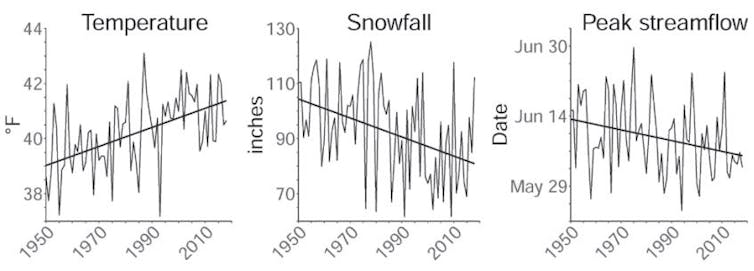
Since 1950, average temperatures in the Greater Yellowstone Area have risen 2.3 degrees Fahrenheit (1.3 C), and potentially more importantly, the region has lost a quarter of its annual snowfall. With the region projected to warm 5-6 F by 2061-2080, compared with the average from 1986-2005, and by as much as 10-11 F by the end of the century, the high country around Yellowstone is poised to lose its snow altogether.

The loss of snow there has repercussions for a vast range of ecosystems and wildlife, as well as cities and farms downstream that rely on rivers that start in these mountains.

Broad impact on wildlife and ecosystems

The Greater Yellowstone Area comprises 22 million acres in northwest Wyoming and portions of Montana and Idaho. In addition to geysers and hot springs, it’s home to the southernmost range of grizzly bear populations in North America and some of the longest intact wildlife migrations, including the seasonal traverses of elk, pronghorn, mule deer and bison.

The area also represents the one point where the three major river basins of the western U.S. converge. The rivers of the Snake-Columbia basin, Green-Colorado basin, and Missouri River Basin all begin as snow on the Continental Divide as it weaves across Yellowstone’s peaks and plateaus.

How climate change alters the Greater Yellowstone Area is, therefore, a question with implications far beyond the impact on Yellowstone’s declining cutthroat trout population and disruptions to the food supplies critical for the region’s recovering grizzly population. By altering the water supply, it also shapes the fate of major Western reservoirs and their dependent cities and farms hundreds of miles downstream.

Rising temperatures also increase the risk of large forest fires like those that scarred Yellowstone in 1988 and broke records across Colorado in 2020. And the effects on the national parks could harm the region’s nearly US$800 billion in annual tourism activity across the three states.

A group of scientists led by Cathy Whitlock from Montana State University, Steve Hostetler of the U.S. Geological Survey and myself at the University of Wyoming partnered with local organizations, including the Greater Yellowstone Coalition, to launch the climate assessment.

We wanted to create a common baseline for discussion among the region’s many voices, from the Indigenous nations who have lived in these landscapes for over 10,000 years to the federal agencies mandated to care for the region’s public lands. What information would ranchers and outfitters, skiers and energy producers need to know to begin planning for the future?

Shifting from snow to rain

Standing at the University of Wyoming-National Park Service Research Station and looking up at the snow on the Grand Teton, over 13,000 feet above sea level, I cannot help but think that the transition away from snow is the most striking outcome that the assessment anticipates – and the most dire.

Today the average winter snowline – the level where almost all winter precipitation falls as snow – is at an elevation of about 6,000 feet. By the end of the century, warming is forecast to raise it to at least 10,000 feet, the top of Jackson Hole’s famous ski areas.

The climate assessment uses projections of future climates based on a scenario that assumes countries substantially reduce their greenhouse gas emissions. When we looked at scenarios in which global emissions continue at a high rate instead, the differences by the end of century compared with today became stark. Not even the highest peaks would regularly receive snow.

In interviews with people across the region, nearly everyone agreed that the challenge ahead is directly connected to water. As a member of one of the regional tribes noted, “Water is a big concern for everybody.”

As temperature has risen over the past seven decades, snowfall has declined, and peak streamflow shifted earlier in the year across the Greater Yellowstone Area. 2021 Greater Yellowstone Climate Assessment, CC BY-ND

Precipitation may increase slightly as the region warms, but less of it will fall as snow. More of it will also fall in spring and autumn, while summers will become drier than they have been, our assessment found.

The timing of the spring runoff, when winter snow melts and feeds into streams and rivers, has already shifted ahead by about eight days since 1950. The shift means a longer, drier late summer when drought can turn the landscape brown – or black as the wildfire season becomes longer and hotter.

The outcomes will affect wildlife migrations dependent on the “green wave” of new leaves that rises up the mountain slopes each spring. Low streamflow and warm water in late summer will threaten the survival of coldwater fisheries, like the Yellowstone cutthroat trout, and Yellowstone’s unique species like the western glacier stonefly, which depends on the meltwater from mountain glaciers.

Preparing for a warming future

These outcomes will vary somewhat from location to location, but no area will be untouched.

We hope the climate assessment will help communities anticipate the complex impacts ahead and start planning for the future.

Fortunately, as the report indicates, we have choices. Federal and state policy choices will determine whether the world will see optimistic scenarios or scenarios where adaption becomes more difficult. The Yellowstone region, one of the coldest parts of the U.S., will face changes, but actions now can help avoid the worst. High-elevation mountain towns like Jackson, Wyoming, which today rarely experience 90 F, may face a couple of weeks of such heat by the end of the century – or they may face two months of it, depending in large part on those decisions.

The assessment underscores the need for discussion. What choices do we want to make?

Bryan Shuman, Professor of Paleoclimatology and Paleoecology, University of Wyoming

This article is republished from The Conversation under a Creative Commons license.

Dr. Justin Frank: Laughing at Trump is “unhealthy,” and it won’t “protect us from reality”

Last Wednesday, Donald Trump accidentally told the truth. During a visit to the U.S.-Mexico border, Trump actually said, “We have a sick country.” That was true, but not at all in the way he intended. America is sick all right, with authoritarianism and white supremacy — a disorder that Trump and the Republican Party have made much worse.

American is sick with conspiracy theories, lies, anti-intellectualism and a widespread disregard for truth, reason and empirical reality. Once again, Trump and his movement have made this sickness much worse.

America is literally sick with the coronavirus pandemic, which has now killed more than 600,000 people in this country alone. Most of those deaths and much of the other human misery caused by the pandemic was preventable. Trump and his regime, through sabotage, indifference and overall incompetence, turned a potentially manageable public health crisis into an outright disaster. 

The Age of Trump made America sicker with right-wing political violence and terrorism. Law enforcement and other experts warn that the U.S. may experience a sustained right-wing insurgency or even widespread civil conflict because of the ways Trumpism and the Jim Crow Republicans have undermined and degraded the country’s democratic institutions and political community.

America is sick in many other ways as well, and in virtually every instance the Republican Party and the right-wing movement have made both the cause and the symptoms incalculably worse. That’s why Noam Chomsky has described today’s Republican Party as “the most dangerous organization on Earth.”

America’s sickness is collective and manifests in the emotional and psychological lives of the American people, who largely remain in a state of denial and trauma resulting from the Age of Trump and the ongoing and escalating dangers presented by Trump and his followers. Ultimately, the American people understand that something is deeply wrong with this country — and that Joe Biden and the Democrats are not equipped to fix it.

In response, many liberals have retreated to a fantasy world in which Trump and other members of his regime will somehow be punished for their crimes against the country. Those most desperate for justice and a return to “normalcy” have even convinced themselves that Trump will be tried, convicted and sent to prison — an outcome that, almost to an absolute certainty, will not happen. Others choose to laugh at Trump and his followers as though mockery will somehow stop ascendant fascism and prevent the imminent demise of America’s multiracial democracy.

In an effort to better understand the power of denial and fantasy in this moment, I recently spoke with Dr. Justin Frank, a former clinical professor of psychiatry at the George Washington University Medical Center and a physician with more than 40 years of experience in psychoanalysis. He has been the subject of many previous Salon interviews and is the author of the bestselling books “Bush on the Couch,” “Obama on the Couch” and, most recently, “Trump on the Couch: Inside the Mind of the President.”

In our most recent conversation, Dr. Frank explains how and why people may engage in behaviors such as inappropriate humor, denial, childlike thinking and other unhealthy reactions as a way of managing anxiety and fear about Trumpism. He also warns that such behavior risks creating a state of passivity and inaction among members of the supposed “resistance,” and may minimize the real danger that Trump and his movement represent to the country and world.

Dr. Frank also explores why Donald Trump’s power over his followers endures — because he has given them permission to express violence and hatred, and to destroy, metaphorically or literally, those they deem to be the enemy Other. Since Trumpism is a type of cult movement, he argues, there is a deep and potentially unbreakable bond of shared antisocial and other pathological behavior between the leader and his followers.,

At the end of this conversation Dr. Frank warns that if Trump somehow manages to return to power, he may well seek to create a totalitarian state based on mass carnage and destruction.

Many public voices, yourself included, have tried to help the American people understand how dangerous Donald Trump and his movement were, and continue to be. In many ways, Trumpism is more dangerous now than it was a few months ago. What do the people who are sounding the alarm about this crisis understand that many other people, perhaps willfully, do not? 

What we see is the underlying hatred that Trump appeals to — and which exists in many people. When Trump was a child, he split his worldview into a simple binary of “good” and “bad.” He has continued to view the world that way even as an adult. His understanding of the world is that people are either out to get you or they are not. Trump feels ready to be betrayed.

That is a source of his racism and his hatred. A simple, binary worldview is in some ways a prerequisite for racist hatred.

Trump has the ability to tap into people’s fears and hatred. In that way, Trump’s followers are actually scarier than he is. Trump unites his supporters in a shared idea of opposition to some other groups or individuals they revile. It doesn’t even matter whether they are Black or Muslim or immigrants or migrants from Latin and South America, or Democrats, for that matter. They are all to be dehumanized. Trump has found a way to unite his followers around an impulse to be openly racist and contemptuous, and granted them that freedom. He has normalized hatred among his supporters.

There are so many Democrats, liberals and others who love to laugh at Donald Trump. There was the social media meme that his pants were on backward (they were not) or the idea that his rallies are pathetic and that only idiots would continue to follow him. There are so many examples of this liberal schadenfreude, but none of this is funny to me. The country is in extreme peril.

It is unhealthy humor. The humor you are describing is defensive in nature. It’s defending against anxiety and fear. Specifically, it is a defensive use of contempt. Through it, people can demean and insult Donald Trump, which in turn means they don’t have to be afraid of him. One of the ways a person can express contempt is through laughter. Thus it is a denial of one’s vulnerability, because contempt means the other person is harmless, therefore he or she cannot hurt you. In that way, Trump is made into a pathetic fool. “If I laugh, it’s not going to hurt me.”

Ultimately, defensive contempt is a way of dismissing Trump’s dangerousness. However, that type of contempt toward Trump is really an attack on reality. It is also an attack on one’s own perception because you have actually undermined your own ability to understand just how dangerous Donald Trump is.

I was in a severe car accident some years ago where the car actually rolled over in the air several times. I walked away unscathed. But when the car was upside down in the air, I heard someone laughing — and then I realized it was me. I have often used that metaphor to describe the American people in the Age of Trump, and in the months since his coup attempt. Many Americans are experiencing hysterical laughter because they are terrified of what is happening: The American fascist movement is winning, even though Biden is president and Trump is out of office. 

Hysterical laughter is an unconscious expression of feeling triumphant. You were triumphant over death and serious injury, so you laughed. Hysterical laughter is a way of protecting ourselves from the actual terror of a near-death experience. But such a psychological process does not protect us from reality. One of the ways of managing their anxiety, especially among liberals, is to laugh at Donald Trump. Trump’s power to stir up hatred scares a lot of people. When I see people laughing at Trump, it disturbs me. There is nothing funny about what he represents and what he is doing.

What happens to people psychologically when they experience great relief that Biden is president but then they come to see that the emergency is not over?

Many Americans and others want to believe that the crisis is resolved. When an evil leader such as Trump is no longer in power and a man like Joe Biden has replaced him, there is a fantasy of good triumphing over evil. It is almost like a Hollywood ending. What is happening in the United States right now is that many people do not want to relive the terror of Trump’s time in office. They don’t want to think about it.

What about these fantasies of Trump somehow going to jail? There are all these folks on Twitter and across the news media, many of them with large followings, who keep on peddling that hope. There are other fantasies as well, that Trump will somehow get his comeuppance and his inner circle will face justice. Trump is not going to jail. Other members of his de facto political crime family are not going to face serious punishment either. In this context, what is a healthy versus an unhealthy fantasy?

It’s essentially a sense of triumph, and a fantasy that Donald Trump is going to be punished. It is a deep wish that somehow Trump will get his just deserts. Such feelings and fantasies are also a psychological way of avoiding his dangerousness. “He’s going to go to jail and be punished. He’s bad.” In the real world, Donald Trump is probably never going to be put in jail.

How do adults maintain such an infantile understanding of the world?

It is like a Disney movie, where wishing makes it so. If you just wish hard enough, everything will be fine. It is magical thinking. As children we believed in Santa Claus, for example. We believed in all kinds of things that are just not true. Many Americans actually believed that the president of the country really cares about us — until Donald Trump took office.

Every day of every week it seems like there is some new “revelation” about Trump’s apparent criminality, apparent sociopathy and disregard for the rule of law, as well as overall corruption and his persistent attempts to overthrow democracy. Given what we already know about Trump, why is any of this a surprise?

Most people do not want to believe that a person could be as destructive and evil as Donald Trump. That fact changes their worldview and their fantasies about life having a happy ending. The fantasy is that we are all protected, we are all going to be safe, which is a very childlike way of thinking. This is why many people do not want to acknowledge what Trump really is: They do not want to face the fact that Donald Trump, in my opinion, has shown himself to be a psychopath.

Former Attorney General Bill Barr has said that during an intense argument with him, Trump repeatedly referred to himself in the third person. What does that reveal about how his mind works?

When someone speaks of themselves in the third person, they are removing a fear of being vulnerable. For Donald Trump, it is a way of removing the immediacy of the attack, because he’s actually scared. Trump is a coward. He is always pretending to be a tough guy. It is an act.

In several recent interviews, Trump appears to be admitting that, in fact, he did lose the 2020 election. Is he finally accepting reality?

Trump, I believe, is beginning to recognize that he lost the election. He was told by Fox News and everybody in his inner circle that he was going to win. His bubble was very tightly constructed. “How could I get 75 million votes and lose? That’s more votes than anybody ever got in the history of elections” — except, of course, for Joe Biden. But that’s how he thinks. Reality is finally breaking through. But I believe that Donald Trump is going to cling to his hatred and go down swinging.

Does Trump actually believe he will return to power in August, or soon thereafter? Or is he just using that conspiracy theory to get more money from his followers?

I do not think it is an either/or situation. There is a part of him that believes it is going to happen. There’s a part of him that is grandiose and engages in magical thinking. But that idea of being back in office in August is shrinking. It is dawning on Trump that it is not going to happen.

I want to share a comment recently left by a reader, in response to one of my recent essays:

The reason Trump was and is popular with so many angry conservatives is because he represented their worst impulses in human form: loud, unintelligent, fearful types who despise “multiculturalism,” inclusion and equality. Sure, they love to shout, “I don’t care if you’re gay or whatever,” but every behavior they exhibit indicates otherwise. These are people who feel contemporary society is rendering them obsolete in their old-world thinking. It was once acceptable in polite company to be this way. Not so much anymore. That’s why Trump gave them hope. He was their id, their megaphone. That’s why the deplorables, the racists and the anti-government types rallied around him. Trump gave them hope. We are running out of ways to deprogram these people. Worse, they are likely going to try again and again until they succeed. Buckle up.

Is that person correct?

The person who wrote that comment is brilliant. But I would make a small change. Trump taps into the psyches of people who have had to hide their hatred, and he has given them permission to let that hatred come out. Trump is full of rage. Trump has destructive impulses. The problem with a destructive impulse is that it cannot be satisfied for long. Once a person starts breaking things, it is very hard to stop. Trump’s drive to destroy is relentless. He also cannot tolerate anyone disagreeing with him. He has tapped into a whole group of people who have those feelings from childhood. It is very frightening, and a kind of cult. Trump gives his followers hope because they’ve always felt voiceless and ignored.

What do you think Donald Trump would do if he were somehow to regain power? What would the country be like?

Consider Trump’s inaugural address. That is what America would be like. There would be carnage in every city. The country would be in ruins. But it would happen gradually. The news would slowly stop, and the American people would not know what was really happening. The United States would become a totalitarian society.

Climate activist gets eight-year sentence while Capitol rioters, Big Oil execs go free

Environmentalists in recent days have expressed outrage over the eight-year prison sentence handed to Jessica Reznicek — a nonviolent “water protector” who pleaded guilty to damaging equipment at the Dakota Access Pipeline in Iowa — while calling the fossil fuel companies who knowingly caused the climate emergency the real criminals who should be held to account.

U.S. District Court Judge Rebecca Goodgame Ebinger last week sentenced Jessica Reznicek to eight years behind bars, nearly $3.2 million in restitution, and three years’ post-prison supervised release after the 39-year-old activist pleaded guilty to a single count of damaging an energy facility.

In September 2019, Reznicek and 31-year-old Ruby Montoya were each indicted on nine federal charges including damaging an energy facility, use of fire in the commission of a felony and malicious use of fire. Each of the women faced up to 110 years in prison. Montoya has yet to be sentenced.

According to the U.S. Department of Justice:

Reznicek, as early as November 8, 2016, and continuing until May 2, 2017, conspired with other individuals to damage the Dakota Access Pipeline at several locations. … Specifically, the defendant admitted to damaging and attempting to damage the pipeline using an oxy-acetylene cutting torch and fires near pipeline instrumentation and equipment in Mahaska, Boone, and Wapello counties [in] Iowa.

The Des Moines Register reported Ebinger said a terrorism sentencing enhancement could apply because “not only the flow of oil, but the government’s continued response were targets of this action.”

Environmentalists and other observers, however, questioned the sanity of a system that prosecutes as terrorists people seeking to protect the planet against the existential threat of a climate emergency caused largely by fossil fuel use, while protecting and rewarding perpetrators of what a growing number of international jurists call the crime of ecocide.

Reznicek’s sentencing on June 30 came on the same day as the publication of secretly recorded videos showing a senior ExxonMobil government affairs executive discussing lobbying related to infrastructure legislation, involvement with “shadow groups” that cast doubt on scientific consensus about the climate emergency, and “wins” during the Trump administration. ExxonMobil and other fossil fuel corporations have known about human-caused global heating for decades.

“How many years do you think ANY fossil fuel CEO will serve for knowingly destroying our planet’s climate?” tweeted 350 Tacoma in response to Reznicek’s sentencing.

Nation editor-at-large Mark Hertsgaard noted in a recent opinion piece published in Common Dreams that “oil companies, the executives in charge of them, the propagandists they’ve employed, and the politicians they’ve funded have largely escaped blame, much less had to pay — whether through financial penalties or prison time — for the immense damage they have done.”

Prior to her sentencing, Reznicek told the court that she acted out of concern that the pipeline, which has a history of leaks, would further contaminate Iowa’s drinking water.

“The toxins we enter into our waterways here in Iowa enter into the Mississippi, which enters into the Gulf,” she explained. “Going to this extreme was out of character for me.”

“It wasn’t an easy thing to do,” Reznicek said. “It wasn’t an easy decision to make. I discerned it at length. The conclusion that I made was that, in my heart, this was the right thing to do. In my heart, this was not violent. In my heart, the laws that protect this pipeline are the laws that are violent.”

“The people who are constructing the pipeline are ultimately the people who are contributing to the desecration of the Earth,” she added.

FBI Omaha Special Agent in Charge Eugene Kowel said following Reznicek’s sentencing that “protecting the American people from terrorism — both international and domestic — remains the FBI’s No. 1 priority.”

“We will continue to work with our law enforcement partners to bring domestic terrorists like Jessica Reznicek to justice,” Kowel added. “Her sentence today should be a deterrent to anyone who intends to commit violence through an act of domestic terrorism.”

Some activists contrasted Reznicek’s sentence to the leniency shown so far toward participants in the Jan. 6 attack on the U.S. Capitol.

Other activists noted that direct action protests can result in the cancellation of pipeline projects. They point to President Biden’s rescission of the Keystone XL Pipeline’s permit and, more recently, last week’s cancellation of the Byhalia Connection Pipeline in Mississippi and Tennessee as proof of what grassroots organizing can accomplish.

Reznicek’s sentencing came as Indigenous-led direct action protests against the Line 3 tar sands pipeline project in Minnesota and elsewhere continue — and Stop Line 3 water protectors face felony charges for engaging in peaceful civil disobedience.

Capitol riot consequences: Corporations continue to stay away from insurrectionist Republicans

Six months ago, the insurrection Donald Trump incited at the U.S. Capitol in a last bid attempt to steal the presidential election from Joe Biden, was experienced as a cataclysmic event. Many assumed it would remake American politics permanently — so much so that dozens of major corporations rushed forward to declare they were withdrawing all financial support from Republican politicians who aided Trump’s effort by voting against certifying the results of the electoral college vote count. 

In the past half-year, however, a combination of Republican intransigence and Trump’s talent as escaping justice has already served to move the insurrection from the category of “unthinkable” to “mainstream GOP politics,” allowing it to be viewed through the lens of partisan bickering instead of what it actually was, a violent attempted coup. In turn, a lot of the companies who swore they were cutting off the money spigot to insurrectionist Republicans have quietly turned it back on. 

Judd Legum is the investigative journalist behind Popular Information, where he keeps track of both the corporations who have reneged on their promise and the lazy excuses they produce for doing so. He spoke with Salon’s Amanda Marcotte about the role corporations continue to play in normalizing the violent assault on American democracy six months after Jan. 6:

It’s been six months since the insurrection at the Capitol. Nearly 200 major corporations in the immediate aftermath of the Capital riot said that they were ending donations to the insurrectionist Republicans who voted to overturn the election. My question to you is how well are they sticking with that promise?

Well, it varies by corporation.

Overall, if you look at the whole group of 200 corporations, most of them are, at least at this point, sticking to what they said around January 6th. But there are a number of corporations that have resumed giving money to the Republicans who voted to overturn the election. Corporations like Toyota, Cigna, a few others. A larger group is doing so indirectly by not giving to those individual candidates, but by giving money, for example, to the National Republican Campaign Committee, which is the fundraising arm to support the reelection of Republican members of the House. Two-thirds of that group were objecting to the electoral college. There’s a group that has resumed business as usual. So far, that’s the minority, but obviously, it’s still significant and the size of that group could increase over time. 

Toyota has gotten the most attention for reneging on their promises and why is that?

Just because they have given to the largest number of Republican objectors. The most recent count is 39 Republican objectors that they’ve given money to, $62,000 in total. While there’s some other corporations who’ve given to one or two or three or four, they stick out because they’ve given to so many. The only companies that are kind of up there with them are some of the defense contractors like Northrop Grumman and Boeing. They’ve started at similar numbers.

In your reporting on this, you found that the wording that these companies use to justify the decision sounds an awful lot like the language from a memo circulated by the U.S. Chamber of Commerce earlier this year. What’s going on there?

In the immediate aftermath of January 6th, the Chamber of Commerce seemed like they were taking this very seriously. They said, without getting too into specifics, that there were members of Congress who they would no longer support as a result of what happened that day. It really seemed to validate a lot of the decisions that their member corporations were making to cut off these donations. But that changed in March, when they released a memo saying that they no longer believed that it was appropriate to cut off funds just on the basis of that vote. 

Then when you look at Toyota, who has been under some scrutiny since April 1st, before all of this, they use that exact same language to describe why they were donating to so many of these Republicans. It sets up this idea that there were some Republicans who did really bad things that day, but just the vote itself wasn’t really that bad. But Toyota has given to, for instance, Andy Biggs, who’s one of the most outspoken members of Congress on the idea that the election was stolen. 

Why would anybody think that there should be a distinction between the supposedly insurrectionists Republicans, the ones that are the really bad and the ones who “merely” voted to overturn the election?

Well, I think companies are getting worried about cutting off so many, particularly of the House Republicans, because they’re worried that they’re going to be in power in 2022. That includes Kevin McCarthy, who would be the Speaker. It includes Steve Scalise, who’s one of the biggest fundraisers for the House Republicans. They’re looking to make it easier on themselves, effectively. 

I hate to sound cynical, but it seems to me that these companies mostly just wanted to bet on the winner. In the days after the insurrection, companies thought that the pro-democracy side would prevail. Now they think the authoritarians are winning and they’ve switched sides. Is that too simplistic?

I focus on the corporations that have violated their pledge because that’s the news, right? That’s what people are interested in and I think that’s important. Still, six months later, you have a lot of major companies who have not resumed business as normal, who normally would have given a bunch of money to the NRCC and the NRSC, and most of them still have not done that.

I think some cynicism is warranted, but I think we should temper that cynicism, because there’s a possibility that, at least in some quarters, there will be lasting change. I try to keep that in perspective, although sometimes it can be hard.

That makes me feel better. It really does.

The U.S. Chamber of Commerce is an interesting organization. I think most Americans hear that name and they think it’s like a town’s local Chamber of Commerce, like a booster group that is there just to generically promote commerce and kind of that sort of thing. Why are they running defense for what can only be described as a literal fascist insurrection?

Well, I think there are habits and practices of Washington, D.C., especially as it relates to how corporations exercise power, that are very hard to let go of. Principally, it’s the idea that corporations write a $5,000 check or a $10,000 check to a member of Congress. That money is not a huge amount of money, but it gets them a connection. It allows them to know who to talk to, when they want a meeting. It makes sure that they get that meeting and it smoothes the whole process for them of trying to influence key policy issues in D.C.

The Chamber of Commerce is very much in the business of having corporations exercise the maximum amount of influence over the political system. When they see corporations bowing out of this and cutting off people who if they aren’t powerful today may be very powerful in 2022 or beyond, they want to figure out a way around that.

A lot of corporations give to politicians and then argue those donations as functionally apolitical because they spread money on both sides, right?

Anytime you would ask a company about a donation prior to January 6th, that’s what they said in response to almost any inquiry: they give to both sides, that they don’t agree with everyone. That just because say that they support LGBTQ rights, but they are supporting this person who’s said all of these offensive things about trans people. They dance around that by describing these as essentially apolitical donations. 

January 6th was the one time when you did have a bunch of corporations draw a line and say, this goes beyond what we’re sort of willing to tolerate. What we’re observing now is whether that line will hold. For some companies, it already has not held. Other companies have held the line, but I will say that just holding the line for six months really doesn’t mean much because it’s a two-year cycle, right? If you give the money in the beginning of 2022, instead of the beginning of 2021, that doesn’t mean that much. You can only donate $5,000 per election anyway, and they’ll need the money in 2022. The question will be, are there companies who are in it for the long term?

 Why do you think the insurrection caused a lot of companies that otherwise try to keep their brand out of politics to publicly say that they were going to withdraw donations, whether they renege on that promise or not?

I think it was the imagery. The seriousness of what happened that day. I don’t think companies wanted to be associated with, as clumsy as it was, an attempted overthrow of the government led rhetorically by Trump. Watching his supporters attack the Capitol, attack police officers with American flags: The visceral images of that day that really pushed companies.

Now, maybe there’s some companies who’ve taken a principled stand. I know that for instance, American Express, when I was reporting on this in January, told me that they will never donate to any of these Republicans again. For some companies, it may have been a real moment of principle where they said “enough, we’re not going to be doing business with these kinds of politicians anymore.” Other companies, it was more about short-term public relations. There’s another set of companies where it’s still up in the air.

From a kind of practical standpoint, nothing has changed. Trump incited this insurrection. The people that stormed the Capitol are going to prison for their crimes. There’s been no material change to justify, or somehow minimize what’s happened. Why do companies, at least some of them, feel more comfortable now being like oh okay, that’s in the past, it didn’t matter, it wasn’t that big a deal?

I think part of it is just time, right? It’s not dominating the news every day as it was in the weeks immediately after January 6th. So it’s less of a public relations headache for some of them. The other issue is that Trump remains such an influential part of the Republican party. Nothing’s really changed, but there hasn’t really been any fallout. Right after January 6th, it could have been for a hot second, it looked like, well, Trump might actually get in trouble for this. Mitch McConnell was considering supporting impeachment, whether or not you were credulous about those reports or not. The conventional wisdom was that really maybe this was going to be a real inflection point about our politics and what’s within the realm of acceptable conduct and what’s not.

The reality is that these folks are going to be very influential for years to come. For companies that are taking a purely practical approach, where they just want influence with whoever’s in power, they’re looking at these Republicans and they’re saying, hey they may be in power pretty soon.  

On your newsletter, Popular Info, you give people information they can use to organize pressure campaigns, to keep corporations from doing things like donating to insurrectionist Republicans. Why do you put your focus on these particular corporations? How do you think that that particular activism can be effective in stopping what is functionally a rising anti-democracy movement in the U.S.?

My role is to get the information out there. Certainly, there’s a lot of folks who use that and take action, who write these companies, tweet at these companies and make their voices heard. I do think that the information is valuable. Part of the reason that corporations thought that they could just donate to who whomever they wanted, regardless of whether those politicians were in line with their state and corporate values, is because there really wasn’t much attention paid to it on an ongoing basis. So if you can change that dynamic and people that you actually have people who know what’s going on, that can ultimately may change behavior.

The other group of folks that I think really need access to this information is the employees themselves. It’s very unlikely that some sort of consumer action is going to have a meaningful impact on Amazon’s bottom line or Microsoft’s bottom line. But if there’s a dozen or two dozen of their engineers or other types of key employees who say, hey you were telling us how much you support democracy and now you’re supporting these Republicans. Why are you doing that? That’s something that they pay attention to. That played out pretty publicly with Microsoft. It was the employees who drove them to a much stronger position. They initially had said that they were just going to temporarily suspend all donations, but they eventually committed to cutting off the 147 Republican objectors for at least two years. It was really driven by the employees.

These companies are, like you said, are buying access. Will convincing them to stop donating to Republicans really change anything? Because the Republicans are acting against democracy itself for their own reasons. Do you think that this inflection point would actually change their behavior?

No, I don’t think so. I think it is about the longer term. For instance, all of this corporate PAC money is only a small portion of what these companies spent on politics. Much larger amounts of money are spent on big nonprofit groups, Super PACs, independent political expenditures. Money, that for the most part, does not have to be reported publicly. But the criticism that these companies are taking over their corporate PAC expenditures is also motivating shareholders to demand more transparency from corporations about the whole scope of their political spending. A number of high profile companies, there were shareholder resolutions that passed demanding more reporting on how they’re spending their money on politics.

This whole process over time can hopefully create more transparency and accountability for corporations and how they use their influence, and over time, that could have some influence over the political system overall. I don’t think it’s all of a sudden going to make Steve Scalise think about politics differently, but it can kind of change overall the playing field in which we decide who the political winners and losers are. So I think that’s more of the way that it plays out.

Trump “annoyed” with Giuliani for wanting to get paid for unsuccessful election challenges: new book

Donald Trump and his family are on the outs with Rudy Giuliani after he asked for payment for his 2020 election challenges, according to a new book.

A newly published excerpt from author Michael Wolff’s forthcoming book, “Landslide: The Final Days of the Trump Presidency,” claims that Trump is frustrated that his legal challenges failed to overturn his election loss, and he didn’t like that his former attorney asked to be paid for those unsuccessful efforts, reported Insider.

“Trump is annoyed that he tried to get paid for his election challenge work,” Wolff wrote, according to an excerpt published by The Times of London.

The twice-impeached one-term president and his family have “cut off” the former New York City mayor, who’s “gotten only the cold shoulder” from Trump since seeking payment for his legal services, according to Wolff’s book.

Giuliani remains under investigation by the Justice Department over alleged violations of foreign lobbying laws while serving as the former president’s attorney.

“If Trump is the issue in 2022, we lose”: A GOP governor warns his party about relitigating 2020

One need only compare the 2020 presidential election results in Texas and Arkansas to see the difference between light red and deep red. Now-President Joe Biden lost to former President Donald Trump by 6% in Texas; in Arkansas, he lost by 28%. Outgoing Republican Gov. Asa Hutchinson, however, isn’t a strident Trumpian — unlike Sarah Huckabee Sanders, the former Trump White House press secretary who is seeking the GOP nomination in Arkansas’ 2022 gubernatorial race. And an article by the Associated Press’ Andrew DeMillo stresses that Hutchinson is unsure about his future in the Trumpified GOP of 2021.

“At a time when red state governors like Ron DeSantis in Florida and Kristi Noem of South Dakota are carrying forward Trump’s rhetoric and policies, Hutchinson is doing the opposite,” DeMillo explains in an article published over the 4th of July Weekend. “He’s taking a contrarian position that’s making him an outsider in the state party he helped build and that now, could test whether there’s a path forward for ambitious Republicans in the reddest parts of the country that doesn’t rely on the former president.” 

During an interview with AP, Hutchinson argued that the GOP needs to do a lot more than praise Trump in the 2022 midterms.

The 70-year-old Hutchinson, who will soon be taking over as chairman of the National Governors Association, told AP, “If Trump is the issue in 2022, we lose. He’s not on the ballot, and we have to be the party of ideas and principles that are relevant to what’s happening in our country today. We can’t be revisiting what happened last election, and we can’t relitigate that.”

But Republican Sen. Trent Garner, a fellow Arkansas Republican, views Hutchinson as out of touch with the GOP of 2021. And Trump has labeled Hutchinson a RINO: Republican In Name Only.

“What he’s done for the last 30 or 40 years isn’t how the party is going to succeed moving forward,” DeMillo quotes Garner as saying. “While I can appreciate Gov. Hutchinson’s service, he is a relic of the past. Trump and Trumpism is the bold new future of the Arkansas Republican Party.”

Hutchinson’s nephew, Arkansas State Sen. Jim Hendren, who left the GOP following the January 6, isn’t sure his uncle is ready to give up on politics after he leaves Arkansas’ governor’s mansion.

AP quotes Hendren as saying, “I would be surprised if he’s ready to lay down that mantle of public service that he’s carried for so long.”

How Trump unleashed “outright slaughter” of wolves in Wisconsin: study

A new study published Monday estimates Wisconsin lost as much as a third of its gray wolf population after the Trump administration stripped federal protections for the animals and the state allowed for a public wolf hunt widely decried as being “divorced from science and ethical norms.”

The February huntpanned (pdf) by wildlife advocates as “an outright slaughter,” killed 218 wolves—already far past the quota the state had set. But over 100 additional wolf deaths were the result of “cryptic poaching,” University of Wisconsin–Madison environmental studies scientists found, referring to illegal killings in which hunters hide evidence of their activities.

The majority of those surplus deaths, the researchers estimate, occurred after the Trump administration announced on November 3, 2020 the lifting of endangered species protections for gray wolves in the lower 48 states. That shift became effective in January 2021.

According to the study, published in the journal Peerj, between 98 and 105 wolves died since November 2020 “that would have been alive had delisting not occurred.”

An optimistic scenario puts the state wolf numbers for April 2021 at between 695 and 751 wolves. That’s down from at least 1,034 wolves last year, representing a decrease of 27–33% in one year.

That decline, the researchers said, is at clear odds with Wisconsin’s stated goal of the hunt “to allow for a sustainable harvest that neither increases nor decreases the state’s wolf population.”

“Although the [Wisconsin Department of Natural Resources] is aiming for a stable population, we estimate the population actually dropped significantly,” said co-author Adrian Treves, a professor in the Nelson Institute for Environmental Studies and director of the Carnivore Coexistence Lab at UW–Madison, in a statement.

Cancellation of the state’s next hunt, set for November, could allow for the wolf population to rebound in one or two years. Standing in the way of that is Wisconsin’s mandate for a wolf hunt in the absence of federal protections, and kill allowances set on shaky scientific ground, according to the researchers. 

Also troublesome is the fact that the state didn’t mandate the collection of wolf carcasses for assessing data of wolf ages or detection of alpha females.

Co-author Francisco Santiago-Ávila said the results suggest the lifting of federal protections gave a subtle green light for more killings.

“During these periods, we see an effect on poaching, both reported and cryptic,” he said. “Those wolves disappear and you never find them again.”

“Additional deaths are caused simply by the policy signal,” he said, “and the wolf hunt adds to that.”

Citing “the importance of predators in restoring ecosystem health and function,” the researchers offer recommendations including, at the federal level, a “protected non-game” classification for wolves. At the state level, authorities “should prove themselves capable of reducing poaching to a stringent minimum for a 5-year post-delisting monitoring period,” the study said.

Wildlife advocates have already expressed concern that the wolf population hit seen in Wisconsin could be a harbinger of the fate of wolves in other states unless the Biden administration quickly restores federal protections for the iconic animals.

According to Samantha Bruegger, wildlife coexistence campaigner at WildEarth Guardians, “Quite simply put, post-delisting, too many wolves are being killed and there is absolutely no justification for it. No scientific justification. No ethical justification. No public safety justification. No economic justification.”

WildEarth Guardians is among a handful of conservation organizations last month that released guides for laypeople as well as state agency wildlife policymakers to show how to best prioritize “wolf stewardship and a broader vision for conserving species in the face of global climate change and mass extinctions.”

“New wolf plans informed by science and ethics are needed now more than ever, as the disastrous winter wolf hunt in Wisconsin showed,” said Amaroq Weiss, senior West Coast wolf advocate at the Center for Biological Diversity, expressing optimism the guides could be tools for “a more hopeful course in states’ stewardship of these beloved animals.”

Pilates, fruit and Amazon’s zen booths: why workplace wellbeing efforts can fall flat

Corporate giant Amazon is taking heat over reports of its WorkingWell initiative, a physical and mental health program intended to improve employee health in the retail giant’s fulfillment centres.

leaked pamphlet, which Amazon has claimed was created in error and is not being circulated, encourages workers to invest in their own fitness and become “industrial athletes“. One aspect attracting particular attention is a plan for “AmaZen Booths“. Also called Mindful Practice Rooms, these kiosks are intended for employees to take breaks from work, experience periods of calm, and access mental health resources. Amazon deleted a social media post about the booths after being mocked on Twitter. 

The details paint an unflattering picture of the company in light of its unprecedented rise in revenues, profits and stock value during the pandemic. Critics of Amazon say the company’s unparalleled financial success is on the backs of its 1.3 million employees who are subject to precarious employment contracts – issues that came to a head after an unsuccessful campaign among some US-based Amazon workers to gain trade union recognition. 

Commentators are also saying that these workers experience higher than average rates of workplace injuries and are treated like “galley slaves.” In such conditions, it is argued, a wellbeing initiative is beside the point. 

These programs are gaining in popularity: COVID-19 has raised “wellness” up the agendas of corporations like never before – and not always in a good way. Many companies have introduced exercise classes, fruit and other sticking-plaster solutions rather than measures which assess risk, focus on prevention and prioritize “decent work” as a driver of both wellbeing and productivity. 

Having been a judge for the Global Healthy Workplace Awards since 2014, I have run a critical eye over many corporate wellness programs. Like other big companies, Amazon faces the challenging balance of promoting employee wellbeing without being accused of tokenism. 

In trying to improve worker wellness, companies often miss the mark. Here are some things they should keep in mind:

1. Health and productivity can and must coexist

To imply that there should be a binary choice between health and productivity is facile and misleading. One of the more breathtaking things I heard from a senior executive of a large UK organization during the pandemic was this: 

Frankly, I think that job stress is a more effective driver of productivity for us than wellbeing programs. 

Far from being a niche or outdated opinion, this thinking is representative of a significant proportion of business leaders around the world. As it happens, this large organization is also very keen to tell anyone who will listen that “employee health, safety and wellbeing is their biggest priority” – though when I checked their latest report to shareholders and prospective investors, the words “revenue” and “profits” outnumbered mentions of “safety” by a ratio of 25 to 1. 

2. Lifestyle evangelism is no substitute for decent work

The former chief medical officer of UK telecoms giant BT, Dr Paul Litchfield, famously derided what he called the “fruit and pilates” approach to workplace wellbeing. He argued that no amount of healthy snacks in canteens, “step challenges” or company fun runs can compensate for jobs with impossible deadlines or targets, or the stress of reporting to a manager who is a bully. 

One of the founding fathers of modern motivation theory, Frederick Herzberg, once said: “if you want someone to do a good job, give them a good job to do.” Wellness programs that ignore this simple idea are unlikely to have an enduring impact.

3. Context is everything

The AmaZen Booths are no more than a contemporary take on many successful community and workplace mental health programs such as the “Men’s Shed” movement, which originated among working men in Australia in the 1990s. It targeted older men, who can often find being open about mental health very difficult, by offering resources and support which encouraged reflection and “help-seeking”. 

Similar booths have been used successfully by some UK employers. Electricity supplier E.ON created a “Head Shed” to encourage employees to find out more about mental wellbeing, for instance. 

The real test of Amazon’s version is whether it is part of a genuinely coherent program of initiatives which assess and reduce exposure to risk, and convince employees that the company really is prioritizing their wellbeing over the long term. Having a well-branded initiative on wellbeing is never enough by itself, especially if many employees’ everyday experience of work is that it is intense, strenuous and toxic. 

4. Employers: beware of “fool’s gold”

Employers need to be more critical consumers of wellbeing “miracle cures” offered by commercial providers. I have seen too many employers divert resources from unglamorous but evidence-based interventions (like having access to a good occupational health nurse) towards those meant to “showcase” their commitment to health and wellbeing. 

Used by themselves, laughter coaches and head massages are really no more than perks, with little or no direct impact on health or productivity. Even very popular initiatives such as Mental Health First Aid have very little strong evidence of any long-term benefit.

Sadly, in the drive for more productivity, the health and wellbeing of employees can be among the first casualties. Reports of Amazon’s WorkingWell program have, so far, not been flattering. Its challenge – like many other corporations – is to sweep aside the cynicism and demonstrate that its efforts will have tangible benefits for all of its employees and are not just PR spin.

Stephen Bevan, Head of HR Research Development, Institute for Employment Studies, Lancaster University

This article is republished from The Conversation under a Creative Commons license. Read the original article.

New Trump exposé questions whether Melania even lives with Donald anymore

The new Michael Wolff book is questioning whether or not Donald Trump and his wife Melania even live with each other.

According to an excerpt of the exposé “Landslide: The Final Days of the Trump Presidency,” BusinessInsider revealed that it seems the Trumps don’t spend a lot of time together.

“For four years in the White House, it was never quite clear how much time she was spending at the White House or in a house in Maryland where she had settled her parents,” Wolff said. “Aides were careful not to closely inquire or openly wonder. Here too, in Mar-a-Lago, it was unclear.”

While it was never confirmed whether or not Melania was staying with her parents in Potomac, Maryland, there were many who repeated the theory online and even tracked unmarked helicopters that flew to the area. None of the reports were ever confirmed, however. In Feb. 2020, the International Business Times claimed that there were unverified reports Barron Trump was living with his grandparents in Potomac.

Early on in the Trump term, the first lady refused to move to the White House, claiming that it was so her son could finish his school year. Subsequent book “The Art of Her Deal: The Untold Story of Melania Trump” claimed that she was actually staying in New York as a means to renegotiate her prenuptial agreement with the new president.

“She’s not a presence at Mar-a-Lago at all. She’s not mingling with people and rarely interacts with her husband’s staff,” someone close to the Trumps told CNN in April.

That same report said that there are many available rooms at Mar-a-Lago and that Melania’s parents would stay for weeks on end in their own suite.

The Wolff book also reports that Trump eats in the dining room nearly every night in a roped-off area that makes he and his family look like zoo animals. Often Trump waits until the dining room is filled with people before he enters because those there stand and applaud him.

“The only membership qualification now, beyond the actual cost ($250,000, up from $150,000 before the presidency, plus a hefty yearly fee), is to be an abject Trump admirer,” Wolff explained. “This may not be so much a political statement as an aesthetic one — the thrall of a super-celebrity.”

Read the report at Insider.

“Public” universities aren’t free, conservatives

Do you want to make a middle class parent of a college-aged student laugh? Complain about how “your tax dollars” are paying for their kid’s education. 

Florida governor Ron DeSantis this week created a stir when he signed HB 233, a bill aimed at the state’s public universities “to annually assess intellectual freedom and viewpoint diversity at certain institutions.” Decrying his state’s institutions of higher education as “hotbeds for stale ideology,” DeSantis said, “That’s not worth tax dollars and not something we’re going to be supporting moving forward.”

The methodology for this proposed assessment, an “objective, nonpartisan, and statistically valid survey,” has not been articulated. But the message — that as DeSantis says, “You have orthodoxies that are promoted and other viewpoints are shunned, or even suppressed. We don’t want that in Florida” — is clear. Our schools, our rules.

This notion that America’s universities are now, in the words of the Florida governor who graduated from Yale, “intellectually repressive environments,” is of course a load of BS. It’s a disingenuous argument from a politically ambitious Republican who got his law degree at Harvard, one who now claims a “firmly-held opinion that taxpayer-funded schools, colleges and universities should be places for education — not indoctrination.”

It’s an increasingly pervasive gambit. Last month, Indiana governor Eric Holcomb signed a bill to survey how “perceptions of whether free speech and academic freedom are recognized and fostered by the state educational institution in a manner that welcomes expression of different opinions and ideologies.” And in related news, New Hampshire Republican governor Chris Sununu last week signed House Bill 2, which included a provision reportedly “banning public schools from certain teaching about systemic oppression and implicit bias.” Ten members of his diversity and inclusion council swiftly resigned in protest.

By cleverly associating “taxpayer-funded” and “indoctrination,” republicans like DeSantis are using their own stale ideology. It’s a classic scare tactic, that your hard-earned dollars are being spent to turn your kids into pinkos. But the truth is that in the same way your parents’ hard earned dollars weren’t exactly bankrolling pervert artists in the nineties, very little of your money now is going toward brainwashing the youth.


Want more health and science stories in your inbox? Subscribe to Salon’s weekly newsletter The Vulgar Scientist.


To give Florida its due, DeSantis’s 2020-21 budget did boast of “historic state operating funding for the Florida College System and State University System at $1.3 billion and $2.7 billion respectively,” no tuition increases, and “an increase of $18.9 million for Florida’s Historically Black Colleges and Universities.” And as a 2018 report from the State Higher Education Executive Officers Association noted the state’s “substantial increase in public student aid.” But reporting from the Urban Institute from the same year ranks Florida a dismal 49th in higher education expenditures per student. 

But America’s investment in its state university system is far from great even at its best, and it’s been this way for years now. A 2017 report from the Center on Budget and Political Priorities delivered the grim news that “Overall state funding for public two- and four-year colleges was nearly $9 billion below its 2008 level, after adjusting for inflation. The funding decline has contributed to higher tuition and reduced quality on campuses as colleges have had to balance budgets by reducing faculty, limiting course offerings, and in some cases closing campuses.”

In tandem with that decline in state funding, costs have been going up — way up. As the Atlantic reported three years ago, “For the first time, public colleges and universities in most states received most of their revenue from tuition rather than government appropriations.” The revelation couldn’t feel more resonant to my own experience — the nation crossed that rubicon the exact year my firstborn enrolled at one our state’s universities.

A few months before graduation, a representative for the state’s university system brightly reassured a room full of nervous teens and parents that they expected each student could graduate with a mere $250 a month in loan repayments. When my daughter was later accepted to the school she’d applied to, she received a financial aid “award” letter offering her a $1,500 scholarship, a $25,000 a year bill, and the news that her parents could apply for over $17,000 each year in loans. So yes, that’s what tax dollars hard at work, indoctrinating a student can look like. And here’s the kicker from that Atlantic story: “Since 1992, spending per student—measured in inflation-adjusted dollars—has declined at public colleges and universities by about 8 percent (even after a recovery in spending after states’ low point in 2012). In turn, per-student tuition revenue has increased by 96 percent.”

This notion that the public university system is some kind of government handout, a useful Plan B for the masses who can’t afford the even more outrageous tuition of private universities, is pretty absurd. “Public” is not “free,” not at the higher ed level, not in America. UC Berkeley is currently $36,500 a year for in-state residents. Florida State is a relative bargain at $21,500. And what’s truly pitiful in all of this is that the majority of Americans — 63% — favor a free public university system. We actually want our hard earned tax dollars going toward our own and our kids’ higher learning. But cynics like DeSantis don’t want an educated, critically thinking populace. Not when they can claim they’re championing “intellectual diversity” while chilling opposing viewpoints. It’s a clever strategy. And it’s costing us all a lot to live with it.

17 easy, breezy dinners for summer beach days

Beach food — or, really, any midsummer meal — should be utterly uncomplicated, seasonally appropriate (tomatoes! corn! herbs galore!), seafood-heavy if you are indeed by the shore, hearty enough to get you back to the beach tomorrow, and quick enough that you don’t have to head home early to get the cooking started. Here are the recipes we make when all that’s on the docket for the next day — and the one after that — is floating on our backs in the closest body of water.

* * *

Our best dinner recipes for Beach vacations

1. New Manhattan Clam Chowder

It’s not a true beach day without a bowl of clam chowder, right? Right. This tomatoey version uses 3 pounds of fresh clams, bringing that straight-from-the-sea flavor straight to your mouth.

2. Crab Cakes

Whether you start a beach dinner with more seafood for an appetizer (we doubt anyone will complain) or decide to serve these as your main course, our Baltimore-style crab cakes are the very best you’ll ever taste, guaranteed.

3. Jasper White’s World-Famous Lobster Rolls

If you’re team lobster salad over a Connecticut-style hot lobster roll, this is the recipe for you. An entire pound of freshly cooked lobster meat is tossed with homemade tarragon mayonnaise, thinly sliced scallions, and finely diced cucumbers for a fresh, crisp bite. Pile the salad high into your favorite top-sliced hot dog bun for the ultimate beach vacation dinner.

4. Sardinian Clam Stew with Fregola

The beauty of this clam stew is that you don’t need to be too precise or too pretty. Start by making your own fregola, which is an Italian pasta similar to Israeli couscous. Cook the beads of pasta with a combination of garlic, onions, tomatoes, and olive oil (you know the drill), plus 2 pounds of clams for an Italian stew that will transport your taste buds seaside.

5. Steak and Bean Torta

After a long day on the beach, you’re probably a little tired, a little sunburned, and certainly quite hungry. This Mexican-style sandwich will hit the spot. “This torta is fairly light in meat because of the addition of beans, and since I often have the rest of the ingredients on hand, it is quick and easy to pull together,” says recipe developer SavorThis. If you have ingredients like black beans, chipotle and cumin powder, paprika, and sherry vinegar on hand, you’ll be good to go.

6. Summer Weekend Pasta

Corn on the cob shines in this colorful pasta primavera along with yellow zucchini and fresh basil. But the fun doesn’t stop there. After all, it’s the weekend, so what better way to celebrate than with a little bit of bacon thrown into the mix, too?

7. Avocado Crab Rolls

Upgrade the crab roll that you know and love from a seaside shack with this recipe, which combines crabmeat with a vibrant avocado mayo. The four-ingredient mayo brings just the right amount of zest to this summer sandwich, which is exactly what you want after a long day spent at the beach.

8. Spaghetti with Clams, Parsley, Garlic and Lemon

Amanda Hesser calls this one of her favorite summer dinners for a family vacation, and soon enough, you will, too. Our co-founder’s secret is using both preserved lemons and fresh lemon juice so that you get plenty of brightness even after the sun goes down.

9. Fish with Sauce Niçoise

A trip to France may be out of the budget, but this dish inspired by the flavors and ingredients of Nice is certainly within reach.

10. White Fish Escabeche Tacos

“This is in my post-beach dinner rotation in the summer. It’s all prepped ahead and the only thing left to do is warm the tortillas and make yourself a drink,” says recipe developer Cheese1227. In our book, that’s the perfect way to end a long day spent in the summer sun.

11. Marinated Green Bean Sandwiches

For a light vegetarian dinner that you can bring to the beach for a picnic dinner, make these green bean and mozzarella sandwiches. The best part is that you can make the marinated green beans a few days in advance, so they’re ready to eat at the drop of a hat.

13. Dad’s Favorite Seafood Stew

Of course you can make this seafood stew for Father’s Day or Dad’s birthday (hence the name), but it’s also the perfect summer dinner after a beach day. It’s loaded with three kinds of seafood — white fish fillets, sea scallops, and large shrimp.

14. Summer Pasta Alla Caprese

One of the staples of a caprese salad are tomatoes, and during summer, they’re at their best and brightest. In this pasta salad that’s perfect for a beach dinner, ripe red tomatoes team up with plenty of basil and mozzarella (a given), plus red onion, balsamic vinegar, and extra-virgin olive oil to boot.

15. Octopus and Potato Salad (Insalata di Polpo e Patate)

This is no ordinary pasta salad. It’s so much better, thanks to the 2 pounds of octopus, which cooks in white wine and olive oil and then is diced and tossed with parsley, lemon juice, olive oil, and thinly sliced celery.

16. Skillet-Grilled Fish Tacos with Cilantro-Lime Crema

Instead of firing up an outdoor grill, achieve the flavor and texture of charred grill using a cast-iron skillet for these simple tacos that are topped with a fragrant cilantro-lime sauce.

17. Peperonata (Red Pepper Stew)

Grab a slice (or two!) of toasted bread and top it with this super-simple red pepper and tomato “stew.”

18. Spicy Shrimp

You can do just about anything with this grilled shrimp — toss it with pasta, serve it over salad, pair it with grilled veggies, or toss with rice and vegetables. However, we wouldn’t blame you if you wanted to eat them straight off the skewers, unaccompanied. In fact, we might just do the same exact thing.

Ultra-contagious COVID Delta variant “wreaking havoc” worldwide

In Bangladesh, troops are preparing to patrol the streets to enforce newly imposed stay-at-home orders. Australia, recently heralded as a pandemic success story, is returning to strict lockdowns. Scotland is seeing a record-breaking surge in new coronavirus infections. Indonesia is teetering on the edge of a public health catastrophe.

While many rich nations continue to ease public health guidelines as they gradually move in the direction of normalcy, an ultra-contagious Covid-19 mutation known as the Delta variant is spreading like wildfire in countries that have struggled to vaccinate their populations and in communities that have refused to participate in inoculation drives, forcing governments to resort to drastic measures contain the damage.

“The new curbs on travel and daily life stretched from Australia and Bangladesh to South Africa and Germany, where authorities over the weekend set new limits on travelers from ‘virus-variant zones’ such as Portugal and Russia,” the Washington Post reported Monday. “South Africa on Sunday extended a nightly curfew and introduced a ban on gatherings, alcohol sales, indoor dining, and some domestic travel for 14 days to halt a worrying surge in cases driven by the Delta variant.”

First detected in India, the Delta variant is rapidly emerging as the dominant coronavirus strain across the globe. The mutation—which is estimated to be 60% more transmissible than the highly contagious Alpha variant—has now been detected in more than 80 countries, and it accounts for over a third of all new cases in the United States.

The Delta strain is the “most contagious variant we’ve seen so far,” said Dr. Ashish Jha, the dean of the Brown University School of Public Health.

“It is wreaking havoc around the world, and will cause problems here,” Jha added, referring to the U.S.

While the spread of Delta poses a particularly severe threat to Africa, South America, and other regions without adequate access to vaccines, the variant also puts at risk rich countries that continue to stand in the way of a patent waiver aimed at boosting the global vaccine supply.

As the Financial Times reported last week, the “rising number of cases have raised concerns that the Delta variant could halt the progress the E.U. has made over past the two months” in driving down coronavirus infections and deaths.

The leadership of the European Union—along with Canada and the United Kingdom—has been among the principal opponents of the proposed vaccine patent waiver, which would temporarily suspend global intellectual property rules that are barring manufacturers from producing generic vaccines.

The U.S.—a supporter of the patent waiver—and other rich countries have pledged to collectively donate roughly a billion coronavirus vaccine doses to poor nations over the next year, but experts estimate that around 11 billion doses are needed to vaccinate 70% of the global population.

“The E.U.’s opposition to the TRIPS waiver is no longer a Europe-only topic,” said Jaume Vidal, senior policy adviser at Health Action International. “It has become an issue of global concern as… the need for a waiver to diversify and scale up production is more pressing than ever.”

Just over a month after classifying Delta as a “variant of concern,” World Health Organization (WHO) officials stressed last week that the mutation has the potential to be more deadly than other strains because “it’s more efficient in the way it transmits between humans.”

Dr. Mike Ryan, executive director of the WHO’s health emergencies program, warned during a press conference that the variant “will eventually find those vulnerable individuals who will become severely ill, have to be hospitalized, and potentially die.”

To stem the spread of the Delta variant, the WHO recommended last week that even fully vaccinated people should continue to wear masks and take other coronavirus-related precautions—advice that conflicts with the U.S. Center for Disease Control’s recent relaxation of mask guidelines for inoculated individuals.

“Vaccine alone won’t stop community transmission,” said Dr. Mariangela Simao, WHO’s assistant director-general for access to medicines and health products. “People need to continue to use masks consistently, be in ventilated spaces, hand hygiene… the physical distance, avoid crowding. This still continues to be extremely important, even if you’re vaccinated, when you have a community transmission ongoing.”

Public health experts have long feared that leaving vast swaths of the world without access to vaccines risks allowing vaccine-resistant variants to emerge, a nightmare scenario that would mean a prolonged pandemic and more avoidable deaths. As Nature‘s Ewen Callaway reported last week, “Delta is moderately resistant to vaccines, particularly in people who have received just a single dose.”

“A Public Health England study published on 22 May found that a single dose of either AstraZeneca’s or Pfizer’s vaccine reduced a person’s risk of developing Covid-19 symptoms caused by the Delta variant by 33%, compared to 50% for the Alpha variant,” Callaway noted. “A second dose of the AstraZeneca vaccine boosted protection against Delta to 60% (compared to 66% against Alpha), while two doses of Pfizer’s jab were 88% effective (compared to 93% against Alpha).”

In the U.S., local governments are beginning to take action to prevent outbreaks amid growing concerns that Delta cases are on track to explode across the country.

On Monday, the Los Angeles County Department of Public Health advisedthat residents—including those who have been fully vaccinated—wear masks while in indoor public spaces.

“Until we better understand how and to who the Delta variant is spreading, everyone should focus on maximum protection with minimum interruption to routine as all businesses operate without other restrictions, like physical distancing and capacity limits,” county officials said in a statement.

Dr. Eric Feigl-Ding, a senior fellow at the Federation of American Scientists, warned Monday that the U.S. is just several weeks away from experiencing a Delta surge similar to the U.K.’s, which was accompanied by a rise in hospitalizations and deaths.

According to the latest data, less than half of the U.S. population is fully vaccinated, meaning large segments of the country are potentially vulnerable to the strain. As Common Dreams reported last week, Missouri communities that have either declined to get vaccinated or struggled to gain access to shots are quickly becoming U.S. hot spots for the Delta variant.

“We have seen this movie before elsewhere—the Delta variant creeps up from the underbelly of falling cases of other variants, overtakes all variants, and then causes a surge,” said Feigl-Ding. “Don’t let this happen where you are.”

“Zola” is a cautionary tale about Black women befriending white women

Zola,” though blackheartedly funny at points, is not a comedy. Technically it’s a drama, but that doesn’t describe the whole picture either. Narratively and aesthetically speaking, this film has layers. Contains multitudes. Feelings. The only thing it isn’t is wearying.

It begins in a relatively benign place, with Taylour Paige’s Zola meeting a woman named Stefani (Riley Keough) during her shift as a restaurant server. The two hit it off immediately, connecting over a mutual affinity for pole dancing. Not long after they pull a shift together at a local club, where we watch them laugh together in the parking lot.

The next day Stefani hits up Zola and invites her to join her on a weekend in Tampa, luring her with the promise of making thousands in tips for dancing. Zola hesitates, but ultimately joins Stefani, her boyfriend and Stefani’s “roommate” for the car trip down from Detroit. Their arrival in Florida is where the story gets messy.

Black women, however, may clock Stefani for what she is the moment she opens her mouth and spews a thick blaccent that doubles as the distant clacking of trouble’s heels, strutting straight in Zola’s direction. Director Janicza Bravo and her co-writer Jeremy O. Harris are speaking expressly to Black women in these small moments and others that seem innocuous without a close read what’s happening.

“Same b***h that wanna smile in your face be the same b***h that gonna come for you later,” Zola gleefully tells Stefani during their first club outing together, the only good one they’ll have. Bravo films that moment to look like Stefani gets her, like they’re on the same page. “Oh God!” she says excitedly, slapping Zola on the thigh, a call Zola responds to with as similar enthusiasm. New friendship always feels euphoric and looks beautiful.

And, then.

The scene cuts to the pair of them in the parking lot continuing to gossip, talking over each other. “Why you DMing me?” Zola says, as if recalling another interaction with someone lesser. “Sis, why you taggin’ me on your photos?”

She keeps talking, but Stefani homes in on one word she won’t let go: “Sis.” This becomes her only answer to everything Zola’s says: “Si-is! Si-is! Si-is!” Zola finishes her speech and grins uncomfortably at the rictus breaking across Stefani’s face and the glowing eyes above it.

By the very nature of who she is, though, Stefani can never be exactly like Zola, or live her life or fully understand her problems. She can, however, test her boundaries. See how far this girl is willing to let her step. This is how it starts, with an attempt to connect that transforms into minstrelsy. Once Zola lets the “sis” business slide, it’s all downhill.

On their car trip Stefani brays her way through a story about a “dookey-ass bitch with her nappy-ass hair” and says, “Get your ghetto ass up out my face! It’s not my fault you nasty! It’s not my fault I make more money than you!”  Stefani’s boyfriend and her roommate are in hysterics as they listen, but Zola is far from entertained. She recognizes that’s what Stefani will say about her when the honeymoon ends. Assuredly it does.

Everything in “Zola” is heightened to mimic the extremity and shallowness of social media. It holds the honor as the first feature film based on a Twitter thread, itself one of the first of its kind, if not the first.  A’Ziah “Zola” King dropped the “mostly true” 148 Tweet story in October 2015 and almost immediately it became a phenomenon.

The enthralled public reveled at how wild of a story it was, and not long after it went viral the woman who inspired Stefani, Jessica Swiatkowski, weighed in with her version of events in a Reddit post, a tell in itself. She claims it was Zola who was deceitful, not her. Those suspicious of King’s version of events took Swiatkowski’s version as gospel.

That is, until two more women who didn’t know King came forward, revealing that Swiatkowski and her so-called roommate, actually her pimp, worked together to ensnare them in a sex trafficking scheme.

One of the victims, Jessica Lynn Forgie, posted her piece on Facebook, saying she was “sick & f****g tired of people backing Jessica up on the ZOLA story & saying it’s a lie. No, it’s definitely the DAMN TRUTH & Jessica knows it. She’s just mad she got caught. ”

Forgie and her friend escaped and alerted police, leading to the arrest of Akporode “Rudy” Uwedjojevwe. He was charged with sexual assault, battery, two counts of trafficking, and two counts of attempted pandering with threat of physical force. He pleaded guilty to the sex trafficking and coercion charges, and is serving a 16-year prison sentence.

These details are both important and relevant to the figurative subtweet Bravo is sending through “Zola.” Swiatkowski, a blonde with the face of a second-string Disney channel starlet, knows what she looks like and what she was doing when she met King and those other women.

More than this, she knew exactly how to delegitimize King’s credibility as a Black woman in her rebuttal, in which she not only switched her role to that of the victim but described King thusly: “This girl walks out in some basic leggings and torn shirt with a short nappy wig on that, excuse my language, smelled like ass!” She goes on to allege that King “hadn’t clean up [sic] like I’d hoped” when they got to the first club.

There’s a long list of racist stereotypes white people fish out of the bottom drawer to slander Black people, and in her post Swiatkowski throws out a few of them. The accusations of being unclean and the “nappy wig” comment are real classics among those that white girls use to paint Black women as unattractive, undesirable wrecks.

Harris and Bravo lay it on thicker in “Zola” late in the film when the director pauses the narrative track to insert Stefani’s perspective.

“We meet at the restaurant she work at,” a Mary Kay pink suit-clad Stefani begins, claiming she was there with “my community leader Jonathan.” “This very ratched and very Black woman comes to take our order,” she says, adding that Zola called her the next day “like, ‘I’m a ex dancer, I’m broke, I need welfare.’ And I told her I don’t f**k with that life no more, and she was like ‘who you f**k with?’ and I say, ‘I f**k with Jesus. My Lord and Savior.'”

Throughout these scenes Paige, a stunning woman, is obscured by cheapness. There’s hay in her hair as she steps up to take Stefani’s order, undulating lasciviously. When Stefani picks her up for their trip she’s switches out in a slack hefty bag and the type of wig Swiatkowski disparages her screed.

Once they get to Tampa, Stefani says, “The club don’t let her dance ’cause she dirty. But everybody loved me! Reason to be a jealous b***h number one.”

By that point in the film Zola is already in deep trouble but thinking her way out of it. Much earlier Stefani persuades her to stay by whipping up some victimhood waterworks in response to Zola yelling at her, which she has a right to do. After all, in her trip invitation Stefani left out the part of where Zola would be expected to have sex with strangers for money.

Zola confronts her about this in the hotel room where the roommate is holding them. She’s livid, and Bravo frames the shot to show her on the far left of the screen with Stefani on the distant right, shelves full of black and white knickknacks dividing them.  Zola is dressed modestly, relatively speaking, wearing a satin jacket and short shorts. Stefani wears a cheap looking denim romper held up with spaghetti straps.

“Girl, listen. No shade. No shame. Do you. But that is not what you told me I was coming up here to do,” Zola says in a normal tone, calmly. Stefani, appearing to shrink away from her, softly replies, “Are you going to hit me?” Then comes the weeping.

To this day I maintain close friendships with several white women. They are strong, platonic relationships – we support each other, advocate for each other, uplift each other. Our affection is reciprocal. But trust me when I say these women are in my circle despite my having survived extremely toxic friendship breakups, all instigated by and starring white women.

One, after making a new group of friends who never accepted me, advised me to try not to be “scary” and “intimidating” when I observed that I didn’t find these people to be welcoming. (This is coded language white people use to justify maltreating Black women.)

Another was an expert gaslighter who salted the Earth behind me after we parted. I found this out when I tried to maintain mutual relationships. We’re all adults, after all. I had no clue what she alleged that I did or what I was, but based on some of the reactions I received, it had to be monstrous. And perhaps those breakups and their accompanying reputational homicides weren’t specific to race, but man oh man, are there a lot of essays by Black women who tell stories similar to mine.

“Most of the abuse I’ve experienced from white women came in a covert form,” Savannah Worley wrote in a Medium essay. “I’ve had nasty rumors spread about me, which ruined me emotionally, socially, and even financially (it’s hard to keep a job where a white co-worker turns your supervisors against you, all of whom are also white women and more likely to be sympathetic to your co-worker).”

“Roots” tried to warn us back in the day, in fact, with its tight focus on the famous friendship between Kizzy and Missy Anne, the latter of whom is overjoyed to know that she’ll be the owner of her Black best friend. Missy Anne doesn’t understand why that upsets Kizzy, other than the fact that she’ll be ripped away from her family. Even now, Missy Anne is still code for a certain kind of white woman. The Karen Eternal.

Keough’s Stefani is a modern-day Missy Anne, the smiling bait that lures women like Zola into terrible situations and keeps her in danger by reminding them that friends stick with friends. Stefani was destined to betray Zola from the moment she called her sis, sis, sis, knowing they will never be family or even cool.

“Zola,” with its story of a dangerous, foolhardy false friend, confirms that Black women aren’t angry, scary, intimidating or crazy to stand up to white women who don’t have their best interests at heart. This is why in its own strange way, it’s comforting.

In that previously described moment when Zola says “same b***h that wanna smile in your face be the same b***h that gonna come for you later,” Bravo interprets Stefani’s enthusiastic reaction in subtitles. “I see you,” the first line reads. A second says. “I feel seen, I feel heard.” It looks like a translation, but it’s really a text from Bravo to Zola’s diasporic sisters – seen, read and received.

“Zola” is now playing in theaters.

“Starstruck” creator Rose Matafeo shares her rom-com secrets, including how to woo a funny woman

It’s not hard to fall in love with Jessie in HBO Max’s new rom-com series “Starstruck.” Played by series creator and co-writer Rose Matafeo, Jessie is the kind of woman who, after a one-night stand with a guy in a houseboat, dances in celebration along the canal, high-fiving strangers along the way.

The joy in the scene is infectious; not only is Jessie a carefree, sex-positive protagonist, but the 1996 British R&B hit “Return of the Mack” provides the perfect accompaniment.

“I mean, what better song to choose to have a celebratory post-sex morning fantasy dance?” Matafeo said in a Zoom interview with Salon. “It was kind of hard actually to figure out what song we wanted to put there. I had a whole entire Spotify playlist of songs that I would walk around London, and be like, ‘Is this the song? Is this song?’ I just couldn’t get ‘Return of the Mack’ of my head.”

Agonizing over the song choice exemplifies the meticulous care that Matafeo, a comedian from New Zealand who lives in England, put into every aspect of “Starstruck,” a six-episode comedy she co-wrote with Alice Snedden.

“I kind of obsessively care about the show and get a bit control-freaky. I was a head girl in high school, so I was that kind of energy. Every little tiny thing I’m kind of obsessed with,” said Matafeo.

Fortunately, she channels this perfectionism into crafting imperfection onscreen. Jessie’s canal-side dance is all the more endearing because it’s full of moves that feel big with emotion, but are clearly performed by an amateur.

“It was fun to film. Although to be fair, I had my period and back pain that day. And it was a no choreography, all freestyle – I just wanted to get that on record,” she said. “Early on I was like maybe I should get a choreographer and I was like, ‘You know what, I’m going to trust my own instincts,’ and it paid off because it’s slightly sh*t and it’s slightly good.”

The dance is just one part of what makes “Starstruck” an ode to regular, messy people, and that includes celebrities. At the beginning of the series, Jessie is a Millennial woman from New Zealand living in London with two dead-end jobs and seemingly limitless confidence. She hooks up with a man named Tom (Nikesh Patel, “Four Weddings and a Funeral”) on New Year’s Eve, only to find out the next morning that he’s a popular English actor. 

Despite the name of the series, Jessie is singularly, almost insultingly uncaring about Tom’s fame insofar as her interactions with him. She does not fawn, which Tom finds refreshing. As for what she sees in him, it’s quite simple.

“Tom’s like, pretty great. Tom laughs at her jokes. That’s basically all you need to be a f**king dreamboat. It’s so not hard,” said Matafeo. “Try thinking about the last time a man laughed at you like really, like really laughed at you as a woman. That’s why I cut the ones out that don’t.”

Having one’s jokes laughed at isn’t just an ego boost for a woman (although that’s a nice bonus). As a professional funny person herself, Matafeo understands this and she deliberately wrote that quality into Jessie, “a total legend who has all of these really good one-liners just at her fingertips.” 

Plenty of men can only see women as a gender that must conform to certain narrow expectations – and humor doesn’t fit. Fortunately, Tom is not that kind of man. If this seems like a low bar . . . it is. So is Tom’s rather blasé reaction to Jessie informing him that maybe he doesn’t want to have sex because she’s on her period: “You do know I’m an adult man, don’t you?” Swoon. 

This rather basic feminism is all subtext though, as “Starstruck” maintains a screwball sensibility. But Matafeo’s stand-up comedy special “Horn Dog” – which is filled with observations on pop culture, fandoms and gender – offers clues for understanding the interactions in “Starstruck.”

One bit in particular begins by revealing that Matafeo was a film nerd as a teenager, which appeared to have some currency with the high school boys. 

“Teenage boys are f**king thick as s**t, right. They are so easily impressed by any teenage girls who knows literally anything about any film ever made,” she says. “So I’d always have boys come up to me. . .  and be like, ‘Wait, Rose are you are you telling me you’ve seen ‘Memento’? Did you get it? Did you get it though?”

This incredulity about a woman knowing anything about film plays out in “Starstruck,” where Jessie works in a movie theater. In one episode, a customer becomes rather antagonistic about his cinema expertise. First he’s condescending when he thinks Jessie’s favorite film is “Schindler’s List” (“pretty obvious choice, no offense”) and then is offended when she admits she hadn’t seen that but had seen “Son of Saul,” the Hungarian World War II film set in Auschwitz, instead.

“Well, that’s for the ‘Son of Saul’ heads out there! I think that’s a good indication of Jessie’s knowledge. And that whole bit is a thinly veiled – I’ve got a stand-up joke about that – it’s just my annoyance with film bros,” said Matafeo. “So many people, particularly people who work in cinemas, have been like, ‘I’ve had this conversation with so many people – so many dudes as well.’ So, yeah, it’s potentially the only rom-com that references ‘Son of Saul.'”

Jessie pulls out her deep knowledge again when she wows Tom during a pub quiz, easily rattling off the names of six actors who starred in 1983’s coming-of-age drama “The Outsiders.” The difference is that he’s properly impressed without having to “well, actually” her in the process.

“I like my ‘Outsiders’ reference because I literally didn’t have to learn that line. The line was different every time because I truly am obsessed with that film. And so, every time the order of the actors was different,” Matafeo said. “I was obsessed with that as a teenager. And also getting re-obsessed with it. I just bought the LP of the original soundtrack by Carmine Coppola. The nerd has not died.”

While it’s expected that Matafeo’s personal passions and knowledge show up in the show’s dialogue, apparently developing, writing and starring in “Starstruck” wasn’t enough for Matafeo. She also drew her own logo for the main titles and created a font in her own handwriting for the end credits.

“See? Control freak,” she confirmed. “That’s because I’m really obsessed with fonts. I hate bad fonts, so I drew up one myself. I love Times New Roman. I think it’s quite nostalgic. I like Comic Sans. Arial, obviously great. But Verdana, I don’t have a lot of time for. I’m not liking Verdana.”

Matafeo cannot not create. Her instagram feed shows her various pandemic projects such as a crocheted cardigan, hand-sewn masks, and a few dioramas. Which is to say that if this comedy thing doesn’t work out, she won’t be out on the streets.

“Yes, 100%,” she said. “I would make a zine for every call sheet every week for the first shoot. And I would spend hours doing it on my one day off with a six-day shooting weeks. And I just loved it so much. So my backup career is zine-making. And I think I think it could be good. I think I could be truly happy and not stressed. I put genuinely as much effort into making a cross-stitch as I do making a television show. I think it keeps me alive . . . or it’s slowly killing me. I’m not sure.”

https://www.instagram.com/p/COEHp6mj1rY/?utm_source=ig_web_copy_link

Matafeo is even considering creating a Pathetic Man calendar, a reference to Jessie’s attempt to cheer Tom up after the premiere of his horrifically bad film. “I wish there were Pathetic Man calendars instead of sexy firemen ones,” says Jessie.

It doesn’t look like the zine machine will have to fire up its presses just yet though as more “Starstruck” is already on the way. That’s fortunate because the first season ended with a bit of hope, but not necessarily a happily ever after. Over the course  of a year as Jessie and Tom flit in and out of each other’s lives, not quite sure what to do with their mutual attraction beyond that first night. By the end, a disheartened Jessie intends to return home to New Zealand when a similarly dejected Tom accompanies her on the bus to the airport. But instead of getting off on her intended stop, she stays on, and the last image is of the two kissing at the back of the bus.

“It’s such a standalone narrative from the first episode to the sixth, and if you watch it all in one go, it kind of feels more like a film than it does a television show,” said Matafeo. “So it was really nice to be able to just close off that story in a way as if there would be only be for one series, but leave it on a slightly open-ended ending as well.”

Before Season 1 was shot, Matafeo already knew that “Starstruck” would get a second season and had written it up. But once the first season was produced, that experience and seeing the characters in their final form prompted the control freak to then revise the second season.

“It’s hard. I think there’s a reason why there’s no sequels to rom-coms. Maybe I’m setting myself up for failure. Whenever the second series will come out, they’ll be like, ‘Yeah, there was a reason,'” said Matafeo. “It was a challenge to write what happens after that f**king bus, but I hope we’ve done an okay job.”

Both “Starstruck” Season 1 and the stand-up special “Horn Dog” are streaming on HBO Max.

Searching for answers about what went wrong in Surfside collapse can improve building regulation

The collapse of a huge condominium building near Miami, Florida was shocking news to wake up to on the morning of June 24, 2021. It is one of the worst building collapses in recent U.S. history.

I am a professor of engineering and have been studying structural failures – and the lessons people learn from them – for about 25 years. My colleagues and I from the American Society of Civil Engineers and the American Concrete Institute will be studying this tragedy to figure out what lessons we might learn.

How does a building stand for 40 years and then collapse, perhaps with little or no warning? Why did it collapse so that part of the building stayed up, sparing many lives? It might take months or longer for engineers to find answers to these questions. But those reports, when they do come, are important because engineers can use them to improve building codes and other safety measures – and hopefully prevent future collapses.

How does a building collapse?

A collapse needs only two things – the right conditions and a trigger.

The conditions that make a building weak could be design errors, construction errors or corrosion. In this case, 40 years of corrosive ocean air may have degraded steel, concrete and other materials. Triggers can be natural events – like an earthquake or a tornado – or man-made like a bomb or collision.

So why, after standing 40 years, did the building in Florida collapse?

To look for clues about the condition of a building, engineers often start by reviewing all available records. In this case, the town of Surfside, Florida, quickly released a number of key documents for the public to access. These include the building plans from 1979 and a nine page report documenting a structural field survey carried out in 2018. It is unusual for engineers to get a field survey report because these usually aren’t done or are only provided to the owner. It will probably prove very useful in understanding the building’s condition before the collapse.

And the trigger? As I write this, no one yet knows what event caused the collapse. The key evidence is likely still buried under the rubble. Finding the trigger will be the job of forensic engineers who will come up with a series of hypotheses and then use the available evidence to eliminate the options until one trigger remains. Essentially, it’s the Sherlock Holmes method: “When you have eliminated all which is impossible, then whatever remains, however improbable, must be the truth.”

Failures improve regulation

When a building collapses, finding out what caused the failure is critical so that engineers can suggest updates to building codes, specifications and regulations and prevent future disasters.

A team of investigators from the National Institute of Standards and Technology has already traveled to the site. These engineers serve on code-writing committees and will be in an excellent position to implement what they learn.

In my book “Beyond Failure,” I discuss many examples of how collapses have led to changes in codes. The 1940 collapse of the Tacoma Narrows Bridge, for example, led to an entire new field of research into how to predict and address wind effects on flexible bridges.

In 1981, the National Institute of Standards and Technology – then known as the National Bureau of Standards – investigated the collapse of the Harbour Cay Condominium that occurred while the building was under construction in Cocoa Beach, Florida. Due to a building boom in Florida at the time, as I report in my book, there was a shortage of qualified structural engineers. As a result, the Harbour Cay Condominium was designed by two retired NASA engineers instead of engineers who specialize in building design. These two made many basic blunders in designing the reinforced concrete, particularly with regards to the concrete slabs and columns and the critical connections between them. In this case, existing codes were adequate but not followed. On Sept. 13, 1981, the Associated Press reported that the two engineers had surrendered their licenses following investigation by the Florida Department of Professional Regulation.

Usually when buildings collapse, forensic engineers are hired by lawyers on behalf of parties who might get sued – the building owner, the architect, the structural engineer, the contractor and others. Lawsuits are already underway after the recent collapse in Florida. Since these lawsuits are between private parties, the results of private investigations for the lawsuit will be confidential and thus may never come to light. But with the National Institute of Standards and Technology getting involved, I expect there will a separate public report in this case, unrelated to the private investigations. When government agencies aren’t involved, there is an established system for engineers to anonymously report problems that might cause risk to public health and safety. The system is still very new, but something similar has worked well in the U.K.

While engineers may not know for some time exactly what happened in Surfside, I expect this to be a landmark case with many important lessons. By carefully studying this tragedy, we may be able to save lives in the future.

Norb Delatte, M.R. Lohmann Professor of Engineering and the Head of the School of Civil and Environmental Engineering, Oklahoma State University

This article is republished from The Conversation under a Creative Commons license.

Trump is already roadtesting his defense for a possible NY indictment — and it has a major flaw

One section of former President Donald Trump’s rally speech on Saturday night in Florida stood out to many observers: his response to last week’s indictment of his company and its CFO Allen Weisselberg.

Weisselberg and the Trump Organization were hit with a 15-count indictment from the Manhattan DA, Cy Vance, alleging a scheme to defraud the government and avoid paying required taxes on more than a million dollars worth of non-salary compensation the CFO has received for over a decade.

Trump himself was not charged in the scheme, though many argue it’s hard to believe he wasn’t aware of this allegedly criminal conduct — and indeed, it’s hard to believe this kind of criminality wasn’t widespread under his leadership. But if Vance ever chooses to try and bring a case against the former president, Trump will likely try to claim he was unaware that these crimes were occurring, or that he was unaware that what was being done was illegal. On Saturday, he started roadtesting this type of defense — which, if true, would undermine the case that he had the criminal intent required to be found guilty of the crimes in question — for his fans:

“You didn’t pay tax on the car or a company apartment…you didn’t pay tax, or education for your grandchildren — I, don’t even know what do you have to put? Does anybody know the answer to that stuff?”

Some legal commentators argued it was clear Trump was trying to establish this narrative to exonerate himself:

However, there’s a big problem with this defense. It directly contradicts what Trump himself has said about his own understanding of tax law and his own company’s finances. In 2017, he told the New York Times:

I know the details of taxes better than anybody. Better than the greatest C.P.A. I know the details of health care better than most, better than most. And if I didn’t, I couldn’t have talked all these people into doing ultimately only to be rejected.

And this wasn’t just out of thin air — it literally followed his own discussion of businesses’ tax liabilities:

The tax cut will be, the tax bill, prediction, will be far bigger than anyone imagines. Expensing will be perhaps the greatest of all provisions. Where you can do something, you can buy something. … Piece of equipment. … You can do lots of different things, and you can write it off and expense it in one year. That will be one of the great stimuli in history. You watch. That’ll be one of the big. … People don’t even talk about expensing, what’s the word “expensing.” [Inaudible.] One year expensing. Watch the money coming back into the country, it’ll be more money than people anticipate.

His remarks aren’t particularly articulate about the subject matter, but given his interest in the topic, it’s a stretch to believe he was completely in the dark about what kinds of company expenses created tax obligations for him and which did not.

In 2016, too, he also suggested that he’s able to pay low or no taxes because he’s “smart.” He also said: “As a businessman and real estate developer, I have legally used the tax laws to my benefit and to the benefit of my company, my investors and my employees. Honestly, I have brilliantly — I have brilliantly used those laws.”

This could and should be interpreted as mostly candidate bluster, but it severely undermines his ability to later claim to a court that he’s completely befuddled by the mechanics of paying taxes.

Regardless of these and similar comments, Trump might still get away with claiming that he didn’t have a clue about the tax practices at his own company. The DA may feel he lacks the evidence to prove Trump’s intent beyond a reasonable doubt, and he may be unwilling to go forward against such a high-profile defendant without a rock-solid case. But if charges are forthcoming, Trump has still undermined what would likely be his best defense with his boasting. And if he’s allowed to skate free because he persuasively argues that he was clueless about his illegal tax practices, he’ll undermine a pillar of his own ostensible political appeal. Though perhaps he’s become such a symbolic figure for the right wing that the substantive case he made for his own political prowess is now largely irrelevant.

11 actors who took home their animal co-stars

Some actors walk away from a recently wrapped film with a new hairdo or a stolen prop. Viggo Mortensen occasionally leaves with a horse—and he’s definitely not the only one. From Sophie Turner’s direwolf to Audrey Hepburn’s deer, here are 11 actors and the lucky animal co-stars who got to go home with them.

1. Sophie Turner

In “Game of Thrones,” Sophie Turner’s onscreen affection for Sansa Stark’s pet direwolf wasn’t all acting. “Growing up I always wanted a dog, but my parents never wanted one,” she told CoventryLive in 2013. “We kind of fell in love with my character’s direwolf, Lady, on set.” When Lady’s run on the show ended and Zunni, the Northern Inuit dog that played her, needed a forever home, Turner’s family volunteered theirs.

2. Brendan Fraser

Of all the horses in History Channel’s 2015 miniseries “Texas Rising,” Brendan Fraser‘s favorite was Pecas, a gray Percheron that got picked on by the more flamboyant mustangs. “He was my acting partner,” Fraser told the Toronto Star. “It wasn’t headed to the glue factory or anything horrible, but I thought, ‘I want to do well by him, too.'” So he brought Pecas — Spanish for “freckles” — home to a barn in Bedford, New York, where the horse made fast friends with Fraser’s teenaged son, Griffin.

3. Tiffany Haddish

The eponymous catnapped tabby at the center of Keegan-Michael Key and Jordan Peele’s “Keanu” (2016) was played by multiple kittens from multiple animal shelters. After production wrapped, co-star Tiffany Haddish got to keep one, changing its name from Clementine to Catonic. Catonic definitely didn’t stay kitten-sized for long.

4. Kim Novak

Like Keanu, the spell-casting feline in 1958’s “Bell, Book and Candle” was played by several Siamese cats. When Kim Novak, who starred in the film alongside Jimmy Stewart, brought one home with her, she just called the cat by his character’s name: Pyewacket. The cat caused trouble offscreen, too. In 1960, he escaped from Novak’s New York City garden, and she even bought an ad in The New York Times to help recover him. Meanwhile, Pyewacket had found his way to the home of two female Siamese cats, bit their owner’s secretary, and got taken to a shelter. But the secretary saw the ad and contacted Novak, who promised to chide him. “But not much,” the “Vertigo” star said in a newspaper interview. “I’m too happy to have the silly boy back.”

5. Yvette Nicole Brown

Filmmakers focused on casting as many rescue dogs as possible in Disney’s 2019 live-action remake of “Lady and the Tramp,” and one of them went home with Yvette Nicole Brown, who played Aunt Sarah. It was actually the trainer who chose the perfect dog for Brown to adopt after filming was finished. “At the end she goes, ‘I think I have your dog.’ I said, ‘Oh! Who is it?’ And she says, ‘Harley is your dog,'” Brown told People. “She was 100 percent right. Harley is my dog. I love him.” Harley, a cocker spaniel, even has his own Instagram account.

6. Viggo Mortensen

Viggo Mortensen formed close bonds with the two main horses who carried Aragorn through various parts of Middle-earth in “The Lord of the Rings trilogy: Eurayus, the bay horse who played Brego, and chestnut-colored Kenny, who played Hasufel. He took them home with him, and he also purchased the white horse that Arwen rides while fleeing the Nazgûl in “The Fellowship of the Ring.” “The person who did that spectacular bit of riding was a stuntwoman who I ended up becoming friends with. I knew how much she liked that horse, so I bought it for her,” Mortensen told NME in 2020.

It wasn’t the last time he’d find a new pet on set. He didn’t plan on buying T.J., the horse he rode in 2004’s Hidalgo, but he liked him too much to say goodbye. “I just got to really, really like him. He’s got such a unique, strong personality,” he told IGN. “His reactions were consistently appropriate, whether it was displaying jealousy or possessiveness, or being the conscience, or being like, ‘C’mon, let’s go,’ or being annoyed.”

7. Audrey Hepburn

While filming 1959’s “Green Mansions,” Audrey Hepburn became the de facto mother of the weeks-old fawn, Pippin — or Ip, as Hepburn called her — that also appeared in the movie. “I’ve fallen in love with her,” she said in a newspaper interview. “She has the run of the house and garden at home. I feed her with a baby bottle. Ip doesn’t have any teeth yet, but she loves to nibble on everything.” Hepburn’s then-husband, Mel Ferrer, who also directed the film, was a fan of the pet, too (though their Yorkshire terrier, Mr. Famous, definitely wasn’t). Hepburn did give Ip up once the film was finished, but Ferrer reportedly brought her back to help his wife recover from a miscarriage in May 1959.

8. Roy Rogers

Roy Rogers got to choose his own equine co-star for the 1938 film “Under Western Stars,” and he went with Golden Cloud, a palomino stallion who had recently appeared in The Adventures of Robin Hood (1938). He renamed him “Trigger” for his quickness, and they got on so well that Rogers ended up purchasing him and using him in many other movies. “He was 4 when I made my first picture and I was 26, so we kind of grew up together,” Rogers later recalled. “He never did anything wrong.” Trigger died on Rogers’s California ranch in 1965, but his taxidermied remains are still around.

9. Elizabeth Taylor

Elizabeth Taylor got to choose which horse to ride in 1944’s “National Velvet,” too. According to Horse & Hound, she picked one that she often rode at her country club: a rather high-strung thoroughbred named King Charles. Once filming had wrapped, the studio gave him to Taylor, barely a teenager at the time, as a gift.

10. Chris Evans

As soon as he arrived at a dog pound to shoot a scene for 2017’s “Gifted,” noted dog lover Chris Evans had one question on his mind: “Are these actor dogs, or are these real, up-for-adoption dogs?” Upon finding out they were all available to adopt, Evans strolled around and found one who “didn’t belong there,” as he told People. According to Evans, the lucky adoptee, named Dodger, is a good boy who loves kids and gets to sleep in Evans’s bed with him. “He sleeps on my pillow, you wake up face-to-face,” he said.

11. Robert Redford

It took livestock supervisor Kenny Lee six months to find the perfect rising star to play Rising Star, the horse of Robert Redford‘s character Sonny Steele in “The Electric Horseman” (1979). A 5-year-old thoroughbred named Let’s Merge got the gig, and Redford ended up taking that directive seriously. Not only did he do his own riding in the film, he also bought the horse once it was over.

“Kevin Can F**k Himself” is a thorough takedown of the “Gone Girl” cool girl

Gillian Flynn’s “Gone Girl” novel and film of the same name resonated particularly with female audiences across the country, as the ultimate revenge fantasy for disrespected, neglected or cheated wives and girlfriends. But it also provided a term for the trope and archetype of the “cool girl” — the women who conform themselves exactly to male desire, laugh at men’s misogynistic jokes, pretend to enjoy Quentin Tarantino films, go with the patriarchal flow, and are rewarded by men through being recognized as “cool.”

And really, who needs rights and freedoms when you can have male approval instead? 

Another term for this particular female character today, of course, is a “pick me.” But whatever you choose to call her, the cool girl is a recurring character — whether in our social scenes, on screen, or across the subliminal sexual fantasies of sexist men everywhere. On AMC’s subversive new dark comedy “Kevin Can F**K Himself,” prototypical sitcom wife Allison McRoberts (Annie Murphy) isn’t the “cool girl,” but she’s become the unfortunate victim of one. And on Sunday’s episode, she’s had enough of it.

“Kevin Can F**k Himself” is the story of Allison’s unusual quest for freedom, through – spoiler alert – secretly plotting to kill her emotionally abusive, all-controlling, sexist pig of a husband. He’s taken her money, the only job she ever loved, and pretty much all her connections to the outside world. Yet, when Kevin (Eric Petersen) is actually on screen, he’s purposely set up as the typical sitcom husband, a “lovable,” clueless goofball, who isn’t exactly easy on the eyes but has somehow managed to land a beautiful, doting wife like Allison. 

With Kevin in the frame, the show assumes the form, coloring, lighting and camera setup of a classic multicam sitcom. Once he steps away, the show transforms into a single camera drama, becoming darker and harsher. We see the truth of the bleak, isolating conditions that Allison, pretty much every sitcom wife ever and plenty of real-life women face. These are precisely the conditions from which Allison eventually seeks help in an effort to free herself.

Through the first couple episodes, long-time neighbor Patty (Mary Hollis Inboden) joins Kevin and his father Pete (Brian Howe) and best friend Neil (Alex Bonifer) in drinking beers, laughing at Allison’s expense, and getting into dumb shenanigans that ultimately create messes left to Allison to clean up. You see, Patty is the cool girl, “someone who pretends to hate things they like just to be one of the guys.”

It isn’t until the fourth episode that Allison forces Patty to reflect on the truth of what she’s really been laughing at all these years: alarming, suffocating domestic abuse.

While the women take a road trip to Vermont to obtain oxycontin that Allison intends to use to stage her husband’s death as an accidental overdose she reveals everything that Kevin, has put her through over the course of their marriage. One of her most devastating revelations is that Kevin cost Allison her job as a paralegal, the only thing that was truly hers and that she actually enjoyed, by humiliating her to her boss, and spreading lies that Allison was cheating on him.

“He didn’t like something that was my own, so he took it away from me — like this car, like my friends, like any shred of my life that is my own,” Allison says. She then points out how Patty laughed along to Kevin’s jokes, to which Patty responds, apologetically, “It seemed harmless.”

In this devastating moment, Allison holds up a mirror for the cool girl — the fictional characters and the real-life women — to look into, and she challenges the cool girl to interrogate what she’s always laughed at, what she’s always gone along with, who her complicity is harming. Allison’s impassioned takedown of the cool girl is also arguably a warning to them: What does male approval really give you, when men could just as easily wield this same patriarchal power to harm you?

Any gendered privileges conferred upon you for being cool are conditional and temporary. Allison may have at one point been a cool girl, only to grow up to be a woman without options, whose husband has spent all her money and trapped her in a loveless marriage. Men’s cruel humor, ignorance, apathy, disdain for anything that challenges them for what they find funny or enjoy, could just as easily be wielded against you, Allison warns. And so you might as well speak up, tell men their jokes are stupid, and, if you need approval so desperately, try to find it from people who aren’t sexist pigs.

Cool girls are undeniably cringe, and arguably the modern Judas Iscariots of feminism. They’re either complicit or the villains themselves, depending who you ask. But the ultimate villain, of course, is patriarchy. It forces us internalize misogyny and socializes women to see our value as tied to male approval, and to male perceptions of us as attractive, sexy, fun, not-difficult.

“Kevin Can F**k Himself” is not-so-subliminally heavy on the feminist and political messaging, validating female rage and encouraging you to root for a woman to kill her abuser. But arguably one of its most subversive points is that men are, actually, in fact, not all that funny. Women, on the other hand, laughing through their traumas and buddy-road-tripping out-of-state for hard drugs? Hilarious.

This show is also pretty unsubtle about its evaluation of men as useless, portraying Kevin as utterly helpless without Allison’s forced servitude. In other words, men can’t really give or do all that much for you, so what’s the point of selling your soul for their nonexistent favors?

Grilled portobellos get a glow-up

Big Little Recipe has the smallest-possible ingredient list and big everything else: flavor, creativity, wow factor. That means five ingredients or fewer — not including water, salt, black pepper, and certain fats (like oil and butter), since we’re guessing you have those covered. Psst, did you hear we’re coming out with a cookbook? We’re coming out with a cookbook!

* * * 

Not long after Madonna released her fourth studio album, Like a Prayer, portobellos got a glow-up.

With no apparent relation to Portobello, Scotland or Portobelo, Panama, this mushroom is “is an American invention with Italian roots,” writes Lynne Olver. Invention as in, it’s just an overgrown cremino, which is the singular of cremini, which are also known as baby bellas, just to keep you on your toes.

Depending on who you ask, the spelling might be portobello or portabella or portabello (though not portobella, which everyone agrees is wrong). According to Sharon Tyler Herbst and Ron Herbst, the name is the upshot of “a brilliant marketing ploy to popularize an unglamorous mushroom that, more often than not, had to be disposed of because growers couldn’t sell them.”

It worked. As the 1980s merged into the 1990s, portobellos soared. In a 1996 issue of Nation’s Restaurant News, Mushroom Council representative Wade Whitfield reported, “This thing has gone from nearly zero in 1993 to a predicted 30 million pounds this year. It’s a major item.”

And in the decades since, thanks to their beefy umami and big ego, portobellos have become the darling of the fungus world, especially for vegetarians. We’re talking portobello burgersportobello bologneseportobello jerky.

But perhaps no method is more popular than the grill, where, with little intervention beyond oil and salt, this shroom can sizzle into a burger look-a-like. Emphasis on look. Because while grilled portobellos, like grilled burgers, are brown and circular—the taste often falls short in comparison, yielding a mushroom that secretly wishes it were a burger, not a mushroom that a burger secretly wishes it were.

The good news? A few-ingredient marinade-slash-sauce solves this, transforms this, utterly overhauls this. All you need is nutritional yeast, something briny (more on this in a sec), olive oil, and salt. That’s it.

If you’ve never played around with nutritional yeast, today is the day. What are you waiting for? Shelf-stable, with the same cheesy satisfaction as a bag of Doritos, this ingredient turns whatever it touches into gold. Especially portobellos.

Simply stir together a few spoonfuls of nutritional yeast with olive oil and whatever vinegar is hanging out in a jar of capers (or cornichons or pickles — you get the idea). This yields a creamy, tangy sauce that looks like Dijon mustard and tastes like lying in the sun at the beach on vacation.

Most of this sauce becomes our marinade, which shoots the innate umami in mushrooms to infinity and beyond. The rest gets combined with minced capers (or minced whatever-pickle-you-used) and oniony chives, to slather on a squishy bun.

And if a sandwich isn’t your scene? Grill portobellos anyway. Thinly slice, lacquer with sauce, and pile on rice, noodles, lettuce, hummus, whatever. There are no wrong answers here.

Recipe: Just-So-Good Grilled Portobellos

Prep time: 4 hours 15 minutes
Cook time: 20 minutes
Serves: 2

Ingredients

  • 2 large portobello mushrooms
  • 6 tablespoons extra-virgin olive oil
  • 3 tablespoons nutritional yeast
  • 3 tablespoons caper (or cornichon) brine
  • 1/8 teaspoon kosher salt
  • 2 teaspoons drained capers, minced (or 4 cornichons, minced)
  • 2 buns, toasted if that’s your thing

Directions

  1. Use a spoon to scrape away the gills inside the mushrooms, then rinse and pat-dry. 
  2. In a small bowl, combine the olive oil, nutritional yeast, caper brine, and salt. Stir with a fork until smooth and emulsified, resembling a loose Dijon mustard. 
  3. Transfer 3 tablespoons of the nutritional yeast marinade to a small container. Mix in the chives and capers, then stick in the fridge. Brush the rest onto both sides of the mushrooms and stick in a container, bottom side facing up so the marinade can really sink in. Cover and refrigerate for 4 to 24 hours. 
  4. When you’re ready to eat, heat the grill to medium-high.
  5. Starting stem side facing up, grill the mushrooms for 10 to 12 minutes total, flipping halfway through, until tender throughout and crispy-edged. Spread the chive-caper sauce inside the buns, then sandwich the grilled portobellos inside.

This post contains products independently chosen (and loved) by Food52 editors and writers. As an Amazon Associate and Skimlinks affiliate, Food52 earns an affiliate commission on qualifying purchases of the products we link to.