Spring Sale: Get 1 Year, Save 58%

The changing face of “America’s dog” — and what it says about us

As the COVID-19 pandemic first swept through the United States a year ago, dog adoptions skyrocketed. One estimate from PetPoint, which keeps statistics on the number of animals currently in the American shelter system, found that adoptions were up more than 12% in 2020 — after years of declining numbers. Anecdotal reports from breeders suggest demand for new puppies followed this trajectory as well. 

Perhaps no dog captured the moment quite like the French bulldog, the squat, flat-faced, bat-eared social media star that last year catapulted to No. 2 on the American Kennel Club’s annual list of America’s most popular canines. 

It’s currently the most hashtagged breed on Instagram, with full-blown celebrity ambassadors like Manny, Benny, Oscar, and, of course, Walter, whose human-sounding wails have earned him nearly three-quarters of a million followers. The Frenchie’s popularity is also in no small part due to its status as a recent favorite for human celebrities as well: Reese Witherspoon, Chrissy Teigen and John Legend, Dwayne “The Rock” Johnson, Leonardo DiCaprio . . . (the list goes on, trust me).

Weighing in around 20 pounds, and possessing too many health problems to require or even in many cases handle vigorous exercise, the Frenchie is the perfect size for carrying around town and languid enough for endless photoshoots, making it the perfect accessory of sorts for well-heeled urban dwellers — the exact demographic who managed to thrive professionally and financially during a once-in-a-generation societal disruption. “I’ve sold more dogs to people in New York City than anywhere else in the country,” says Louis Sosa, a Louisiana-based French Bulldog breeder. “You can’t walk more than a block in that city without running into a Frenchie at the end of a leash.”

For these reasons, many owners laud the breed for inverting the typical dog-adoption story: rather than owners being forced to change their lives to accomodate a new pet, the French bulldog was created — quite intentionally — to thrive at a more human pace of life. 

“The word I always use to describe the Frenchie is adaptable,” said Brandi Hunter, the vice president of communications at the American Kennel Club. “It’s a dog that is happy to go out and meet people and be active, but ultimately it thrives doing whatever you’re doing. And during a period where there wasn’t much to do, if you’re on the couch watching Netflix, your Frenchie is on the couch watching Netflix. If you’re working on your laptop, your Frenchie is right there at your feet.”

The surge in demand, however, has caused a supply-side crisis for breeders, who are particularly incapable of scaling up to meet demand. Due to the size of the French bulldog’s head, pregnancy is especially problematic for the breed, which often must be delivered via C-section. Prices for French bulldog puppies have soared to more than $7,000 in some cases, which has in turn prompted numerous thefts. Most notably, a dogwalker for Lady Gaga was shot and two of her prize Frenchies, Koji and Gustav, were stolen earlier this year in a brazen daylight robbery. She offered half a million dollars for their return, and one of the suspects later came forward, but not until a spate of news stories about the spike in Frenchie-related thefts conquered U.S. airwaves. 

The country’s harried love affair with the French bulldog certainly isn’t the first of its kind. As Mark Cushing writes in “Pet Nation: A Love Affair that Changed America,” during just two years in the early 2000s, the number of humans living in the United States increased 1.7% — while the canine population spiked more than 13%. That trend hasn’t let up in the years since, with more than 60% of U.S. households owning a dog in 2020, according to a survey from the Insurance Information Institute. 

What happened? And how did we get here?

* * *

America’s obsession with dogs is — like all other uniquely American obsessions — a preoccupation with celebrity and the all-consuming power of media. 

The big-screen exploits of Rin Tin Tin and, a few decades later, Lassie, popularized German shepherds and collies for an entire generation of Americans in the postwar period, during which the nascent advertising and financial industries built the modern consumer culture we know today. These were primarily working dogs, but as America built its middle class, pet ownership quickly became a status symbol. 

“Peanuts,” Charles Schultz’ classic representation of Middle American childhood, introduced the country to a new dog: Snoopy the beagle. In the face of the comic strip’s immutable portrayal of social isolation and anxiety (Charlie Brown never did kick that football), Snoopy’s lighthearted antics and extravagant imagination made the eager canine a bona fide megastar — soon, his likeness was a bestselling toy, one of the most successful write-in U.S. presidential candidates in history and eventually an official mascot for NASA. In the years following Snoopy’s debut in 1950, the beagle, a British breed originally raised to hunt rabbits and other small game, became a sensation. 

Perhaps no other animal occupies as large a space in the human consciousness as the domestic dog. Myths in nearly every human culture have held man’s best friend as paragons of bravery and loyalty, sure, but also deception and betrayal. This is to say that dogs exist, in stories of every era, mainly as extensions of ourselves: a piece of the wildness we’ve lost somewhere along the way, perhaps, or a representation of the unconditional virtue modern life has slowly eroded. 

So it stands to reason that the story of man’s best friend in the United States would also exist as a projection of our own. As television became a daily fixture in Americans’ lives, so too was the constant presence of a national narrative, which soon incorporated the country’s favorite four-legged friends.

President Gerald Ford’s Golden Retriever, Liberty, was a favorite prop among the White House press corps, which went wild when she gave birth to a litter of nine puppies on the grounds of the White House. Liberty quickly became a national celebrity, and staff famously signed portraits, requested by her many fans, with a rubber stamp of her pawprint. 
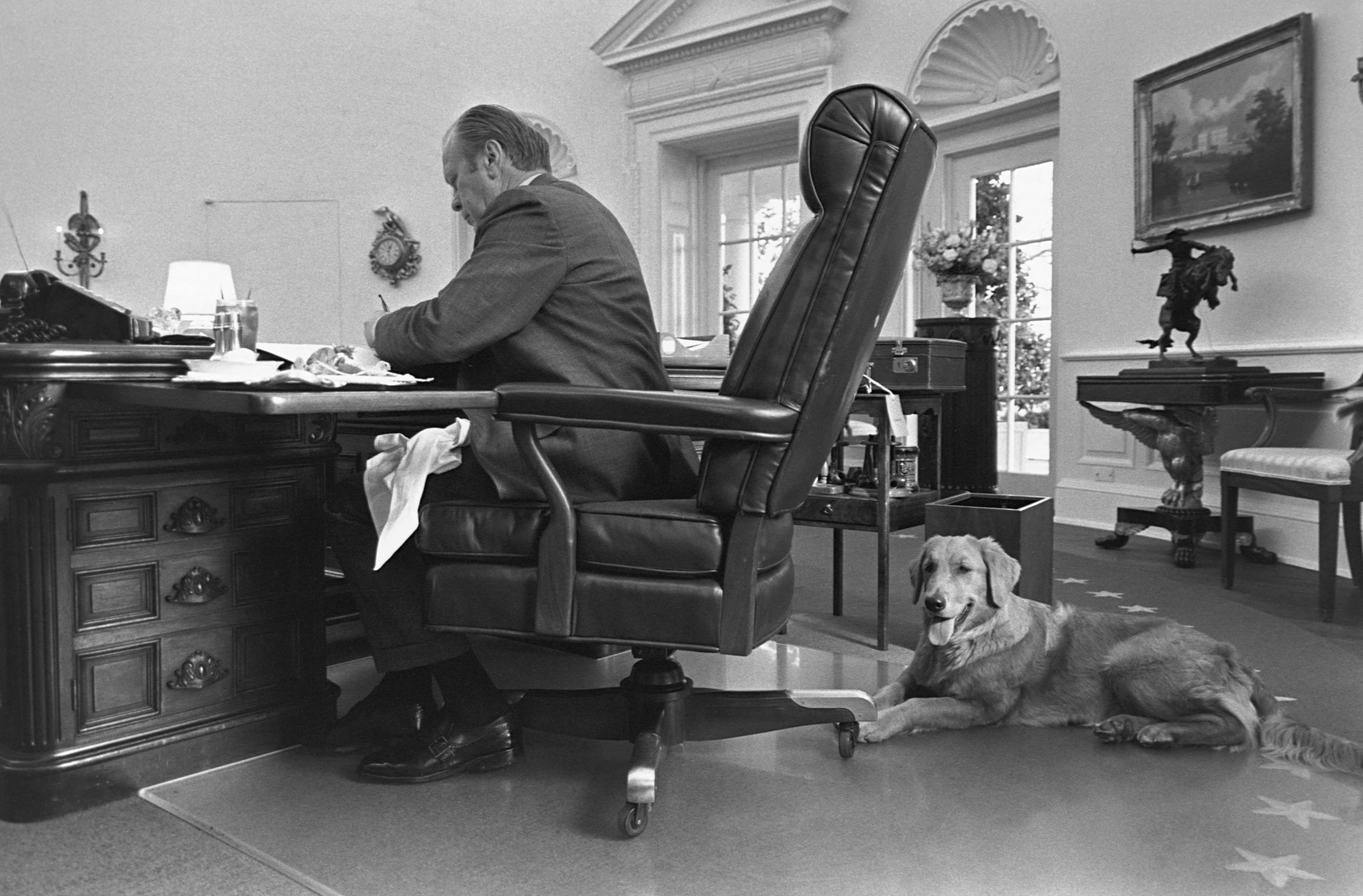
President Gerald Ford and his pet dog Liberty in the Oval Office.
President Gerald Ford and his pet Golden Retriever, Liberty, in the Oval Office. (CORBIS/Corbis via Getty Images)

Liberty was, of course, just the latest in a long line of presidential pets, but there was something distinct about the Retriever that the country latched onto over the next few decades. Ronald Reagan, whose main strength was arguably the ability to deploy metaphor and deftly construct media narratives, also acquired a Golden Retriever puppy during his successful 1980 campaign. In the following years, both the Golden and its close cousin, the Labrador Retriever, towered over the U.S. dog market — a trend that continues to this day. 

The Golden Retriever in particular cemented its status as an American icon through its domination of traditional media near the turn of the millennium. “These big blonde beauties were the most popular advertising gimmick of the ’90s,” the first chapter of “Golden Retrievers for Dummies” declares, not to mention the breed’s simultaneous domination of serialized television.

In particular, America fell for Comet, a scene-stealing Golden adopted by the Tanner family on ABC’s smash-hit sitcom, “Full House” — cementing the breed’s status as a “cultural phenomenon,” according to the American Kennel Club.

The breed was, in many ways, a mirror for the country’s aspirations. 

As the Cold War came to an end and the Soviet Union dissolved, the United States found itself all out of enemies. It was, as Francis Fukuyama famously wrote, “The End of History.” As the story goes, America’s neverending economic expansion had just begun — half the country lived in suburbs ringing major cities, and the rest weren’t far behind, it seemed.

The Golden Retriever, a quintessential family dog — obedient to a fault, great around kids and other people, active enough to require space and, often, a yard — was the perfect symbol of America’s hopes at the turn of the century: homeownership, and by extension a certain measure of affluence and security, seemed within reach for more people than ever before. Popular media, in turn, reflected this narrative right back at us.

As with all foundational myths, however, there remained a missing piece: the villain.

* * *

Any history of the American dog — of America, period — without a chapter on the pit bull would be, well, incomplete. 

As Tom Junod wrote for Esquire in 2014: “There is no other dog that figures as often in the national narrative — no other dog as vilified on the evening news, no other dog as defended on television programs, no other dog as mythologized by both its enemies and its advocates, no other dog as discriminated against, no other dog as wantonly bred, no other dog as frequently abused, no other dog as promiscuously abandoned, no other dog as likely to end up in an animal shelter, no other dog as likely to be rescued, no other dog as likely to be killed. 

“In a way, the pit bull has become the only American dog, because it is the only American dog that has become an American metaphor — and the only American dog that people bother to name. When a cocker spaniel bites, it does so as a member of its species; it is never anything but a dog. When a pit bull bites, it does so as a member of its breed. A pit bull is never anything but a pit bull.”

The central irony of the American pit bull, then, is that it is not technically a breed at all, but a constantly shifting list of “characteristics” often compiled not to classify the animals but ban them. 

According to the advocacy group DogsBite, which agitates for municipalities to ban “dangerous breeds,” more than 900 cities in the United States currently have laws on the books banning pit bulls. In most of Iowa, Missouri and Kansas it is illegal to own one, and the same is true of Miami, Ontario, Canada, and the whole United Kingdom. They are also banned in most U.S. public housing complexes and on all of the country’s military bases. A number of large insurance companies even refuse to serve owners of dogs who meet their specifications. 

Denver, which repealed its longstanding ban on pit bulls earlier this year, described them as such: “a pit bull is defined as any dog that is an American Pit Bull Terrier, American Staffordshire Terrier, Staffordshire Bull Terrier, or any dog displaying the majority of physical traits of any one (1) or more of the above breeds, or any dog exhibiting those distinguishing characteristics which substantially conform to the standards established by the American Kennel Club or United Kennel Club for any of the above breeds.”

To put a finer point on it: the pit bull’s story is, in actuality, a narrative of the American mutt. And just as the Golden Retriever had cemented itself as a symbol of the growing white middle class during the 1970s and ’80s, at the height of the American empire, the pit bull quickly became a symbol for the dark undercurrent of social ills the country just couldn’t seem to shake: poverty, drug use, gun violence, AIDS.

The pit bull, like most mutts from history, became synonymous with the inner city, and as the inner city splintered and money fled from those spaces, the pit bull came to represent all of the problems festering in the shadow of America’s big cities — and, more than anything else, the shifting demographics of those places. Recently, an entire body of scholarship has formed to probe the parallel racism and classism levied against both pit bulls and Black Americans, and especially the Black Americans who own pit bulls.

It’s a concept deeply familiar to Bronwen Dickey, the author of “Pit Bull: The Battle over an American Icon,” who told the Los Angeles Review of Books that as she set out to research the topic, she was shocked at the way people spoke about pit bulls, often using language that many would otherwise recognize as racist.

“One of the first things I noticed was how many people who were wary of pit bulls immediately pivoted to talking about ‘the kind of person who owns them,'” she said. “And they would talk about thugs and drug dealers and gangbangers. Those are the cultural associations people bring to the table when they talk about these dogs.”

It would be hard to chart the development of this image without mentioning the incessant media coverage given to pit bulls and, in particular, the scourge of dogfighting during this era. Despite scant evidence to show that the problem was as widespread as its detractors seemed to insinuate, dogfighting became to many a disgusting sign of the moral rot at the center of the capitalist project, and to others an admittedly problematic-but-nonetheless nostalgic pastime that hearkened back to the brutality of the American frontier. “I am not defending fighting dogs,” the novelist Harry Crews wrote in another piece for Esquire, but “I wonder why we can’t tell the truth about blood sports, which would go a long way to telling the truth about ourselves. We are a violent culture.” 

Starting in the 1970s, the United States also began locking up more people — disproportionately from poor and minority communities — than ever before, a trend that continues to this day despite the fact that crime began falling in the 1990s and remains at near historic lows.

The same tough-on-crime carceral strategies the United States imposed on its human population trickled down to its pets as well, with 6.5 million dogs today — higher estimates find that pit bulls make up more than 80% of that number — locked up in shelters and all too often euthanized. Statistics compiled by the ASPCA show that somewhere between 2,000 and 3,000 pit bulls are killed every day in America, a cruel mirror of the 1.8 million people currently languishing in our jails and prisons, even after COVID-19 forced authorities to clear out nearly 14% of the country’s incarcerated population last year.

* * *

It’s hard to pinpoint when exactly the campaign to rehabilitate the pit bull’s image began in earnest, but it’s safe to say that sometime in the aftermath of the 9/11 terrorist attacks, the same characteristics that once inspired fear had now, in the face of a prevailing culture that said the country was facing an existential attack on its values and way of life, become laudable national attributes. America was at war once again, and found itself on the hunt for new wartime symbols.

Long held as “vicious” or even “barbaric,” pit bulls quickly became “courageous,” a representation of valor and strength in the face of conflict for many observers, who sought out the dogs in record numbers. The detractors remained, of course, but were now met by frenzied supporters of the embattled dogs at city council meetings and community events wherever attempts to ban the animals picked up steam.

There was one news story in particular that seemed to turn the tide for the once-vilified pit bull: the 2007 saga of NFL quarterback Michael Vick and Bad Newz Kennels, the interstate dogfighting ring orchestrated by the fan-favorite southpaw and his close associates. In subsequent news coverage, the dogs — over 70 of them — were referred to by name, and described at length, using terms like “smart,” “goofy” and “people-friendly.” Letters of support for the animals poured into the Virginia court handling Vick’s case. The judge later decided to study, and ultimately spare, most of the animals. 

https://www.instagram.com/p/CG0D39VFOJB/?utm_source=ig_web_copy_link

Nearly two years later, Sweet Jasmine, a tan-colored pit bull rescued from Bad Newz, was featured on the cover of Sports Illustrated, along with a massive story checking in on the animals’ progress. Crucially, the piece afforded the dogs something that had been denied to previous generations of pit bulls: individuality.

The popularity of the pit bull only increased during the years following 2008, as the worst economic collapse since the Great Depression left many out of work and impoverished — the ’90s dream of universal homeownership collapsing under the weight of reality. Many turned to dog breeding, a legal business with relatively low overhead, as a lifeline. Pit bulls, already numerous, were particular favorites.

In turn, an entire ecosystem of reality TV emerged to satiate America’s urge to rescue and train these previously maligned creatures — with the once-floundering premium cable channel “Animal Planet” championing their cause. 

These programs included “Pit Boss,” a series that follows Luigi “Shorty” Rossi, a “little person with a big heart,” as the show’s tagline goes, who rescues pit bulls that are often bigger than him; “Pit Bulls and Parolees,” a self-explanatory series about the life-altering relationship between the recently incarcerated and their dogs; as well as the National Geographic Channel’s dog obedience show “The Dog Whisperer with Caesar Milan,” which often featured Milan’s own pit bulls, Daddy and Junior, as well as redemption narratives for other ill-behaved pit bulls.

“We don’t have a problem with the breed — we have a problem with education,” Milan writes on his website. And for the first time in a generation, it appeared people were listening.

* * *

If there’s an “it” dog of the 2020s so far, the French bulldog is certainly takes the prize.

American Kennel Club statistics show an 830% increase in new registrations for the breed over the past decade, thanks in no small part to its dominance of social media and widespread adoption by the celebrity class.

It’s difficult to talk about changing consumer tastes in post-pandemic America, however, without mentioning the basic economic realities at play: as the Millennial generation turns the corner into middle age, research from the Federal Reserve shows the cohort owns just under 5% of the country’s wealth. At the same period in their own lives, baby boomers had a whopping 21%, a financial cushion that fueled widespread homeownership and a suite of consumer goods that Millennials and Generation Z may never be able to afford. These younger generations are also urbanizing at a rapid clip, driving a nationwide trend that saw America’s urban population jump from 75% in 1990 to 82% in 2020, according to the World Bank.

Many rental units come with stipulations on the size of dog landlords will allow — if they allow one at all — and it follows that as the United States increasingly becomes a country of urban renters, the size and shape of our pets will change as well.

https://www.instagram.com/p/CO71Oc_nwB1/?utm_source=ig_web_copy_link

It’s no coincidence, either, that the digital convenience culture and just-in-time shipping that Americans have become accustomed to has also bled over into the way its people see their four-legged friends. Much ink has been spilled over the trend toward “designer dogs” like the French bulldog — small, carefully curated purebreds and cross-breeds that have been engineered to display specific traits: the low-shedding Cockapoo, hypoallergenic Labradoodles, and the miniature Australian shepherds that seem to overnight have taken over the trendiest brunch spots in every major American city.

But all of the consumer choices we’ve come to expect from every other sector of the economy in this instance have a very real cost beyond the price tag: namely, in the dogs’ health. As we continue inbreeding to select for desired traits, the resulting animals are increasingly unhealthy. 

To get a healthy French bulldog, it’s especially important to go through a good breeder — but despite humans’ best intentions, many of the physical problems that plague the breed are directly related to the appearance many owners profess to love. The flat face, wide eyes and perky ears are all contributors to the debilitating infections and respiratory issues that are hallmarks of brachycephalic — or flat-faced — breeds, and today’s Frenchies are often doomed to nerve pain and spinal problems later in life.

As the quest to create the smallest, lowest maintenance and most photogenic dog reaches its zenith, it appears all of the features we seek are least beneficial for the animals themselves.

It’s a paradox Alexandra Horowitz, a cognitive scientist and the author of Our Dogs, Ourselves, claims has its roots in our own narcissism as a species. “I think there’s a good reason to believe that one of the things we like about a shorter-nosed dog is that they more resemble a human primate face,” she said during an interview last year with the Australian broadcasting Corporation, adding: “We need to acknowledge that it’s gone too far.”

* * *

What does it mean for the United States that our culture so routinely and aggressively seeks to project its own image onto its dogs? 

As we emerge from the plague year, full of stress and plagued by social isolation, the nation’s increasingly pessimistic narrative reaching a fever pitch, it only stands to reason that we begin to look inward. Facing a deficit of social interaction and political control, Americans were bound to seek those things in other parts of their lives.

The investment firm Morgan Stanley estimates that the pet-care industry will triple in size over the next decade as pet ownership — particularly dogs — continues to expand. Real estate firms say that veterinary medicine is one of the few bright spots in their commercial market as demand for office space continues to flag. 

More people are buying pets than ever, and many of those will be expected to fit perfectly into their owners’ perfectly bottled, urban knowledge-economy lives. As a result, breeders, and not just those contending with the physical toll of French bulldog pregnancies, are having a hard time keeping up with demand for prestige breeds. 

All of this points to a looming companion animal crisis, with grifters and high-volume breeders — cue the impending moral panic over “puppy mills” — stepping up to fill the void. Organizations from the American Kennel Club to the ASPCA all advocate extensive research before picking up a new pet, especially a dog. Different breeds require different accomodations, and anyone picking up a new puppy should always perform a cursory background check of the breeder. 

Last December, in Pennsylvania, an online puppy scammer from Cameroon was arrested for catfishing lonely Americans out of thousands of dollars, promising perfectly miniature Chihuahuas and dachshunds. At his sentencing, the federal judge made a point of mentioning the Department of Justice’s zeal for punishing “criminals who seek to exploit American’s particular fondness for animals.” 

Adding particular sting to the crime, he said, was the fact that “the desire for companionship is higher than ever.”

“A terrible idea”: Why fire scientists want you to skip the fireworks this Fourth of July

The United States is hot and dry. Large portions of the West are in “exceptional drought,” the most extreme rating assigned by the U.S. Drought Monitor. States that rely on the Colorado River are preparing to ration water. And a hellish heat dome set up camp over the Pacific Northwest this week, smashing temperature records and killing hundreds. As of Wednesday, 36 uncontained large wildfires burned across the nation. The western half of the country is a giant tinderbox. The last thing anyone should be doing there is lighting a match. 

But that’s exactly what will happen this holiday weekend. Millions of Americans will celebrate Independence Day with fireworks — a classic American tradition. Those fireworks will start fires. 

Research shows that more fires are ignited on July 4 than any other day of the year. From 1992 to 2015, Americans sparked some 7,000 wildfires on Independence Day. This week, more than 130 fire scientists published an open letter calling on people to skip the fireworks this year. “We are gravely concerned about the potential for humans to accidentally start fires,” the letter reads. 

Jennifer Balch, an associate professor of geology at the University of Colorado Boulder and one of the signatories of the open letter, gets anxious when she sees fireworks for sale on the side of the road where she lives in Boulder, Colorado. “Fireworks are just a terrible idea,” she told Grist. “It’s so obvious, and yet the response is so scattered in the sense that the decision to ban them is left up to local and state-level decision-making.” 

A few places have put outright bans on fireworks in place. Colorado has a ban on all fireworks that leave the ground, but sparklers, groundspinners, and other small fireworks are permitted in some counties. Local officials in parts of Arizona, Idaho, Montana, New Mexico, North Dakota, Oregon, South Dakota, Utah, and Wyoming have considered or enacted bans this year. But the only state in the nation that has put a full ban on all consumer fireworks is Massachusetts. And enforcing those partial bans in some states requires time and resources that many local agencies don’t have. In Portland, Oregon, Portland Fire and Rescue said that it won’t be enforcing the city’s ban on fireworks unless things get really out of hand. “We don’t have the resources, Portland Police doesn’t have the resources right now,” a Fire and Rescue official told a local television station in Portland this week. 

People might not know that a firework they set off on July 4 might burn down their neighborhood on July 5. But that’s what ends up happening. Illegal Fourth of July fireworks set off hundreds of fires in California alone last year. Human activity, Balch said, is responsible for the vast majority of fires that threaten America’s homes every year — as much as 97 percent of them, according to her research. “We should be more considerate of the fact that, in the western U.S., we live in very flammable landscapes — landscapes that are getting even more flammable with climate change,” Balch said. 

Phillip Higuera, a professor of fire ecology at the University of Montana and the chief organizer of the open letter, is also filled with dread when he sees fireworks for sale in Missoula, where he lives. “To have the stage set with this drought and heat wave, it’s just kind of agonizing to see,” he said. Despite the handful of communities that have banned fireworks as the clock ticks down to July 4, Higuera thinks not enough states and municipalities are sounding the alarm. 

“It’s like watching a freight train with a lot of momentum moving down the track,” he said. “You know that there’s gonna be a lot of ignitions, and when those hit these extremely dry fuels, they’re going to be fast-moving wildfires that are going to be hard to suppress.” 

This is the first time Higuera and Balch have ever spoken out this assertively to try to head off fireworks ahead of July 4. But both said the risk was just too high this year to sit back and do nothing. “If we can get one person to not ignite a fire, then that will be great,” Higuera said.

“This is a tradition and one of the holidays we celebrate,” Balch, who enjoys fireworks as much as the next person, said. “It’s too bad it didn’t fall on January 4 instead of July 4.”

Climate change could fuel the spread of a flesh-eating parasite

Three years ago, Laura Gaither and her family spent their summer vacation in Panama City Beach, Florida. One afternoon, while rinsing sand off her feet, the 35-year-old Alabama resident felt something biting her legs and noticed tiny black bugs on her skin. Gaither brushed them away, and later, when she described the bites to local residents, they told her that she had likely been bitten by sand flies.

Three of Gaither’s five kids had been bitten, too, but she didn’t worry. The marks on their legs and arms looked like ant or mosquito bites, which can cause burning and itching, but usually subside within a week.

But about two weeks later, back at home, Gaither noticed that the bites had morphed into small open wounds. They worsened over the next couple of weeks, but when she took her children to their pediatrician, “he just chalked it up to eczema,” Gaither said. Eventually Gaither took her young daughter, whose condition was the most concerning, to the emergency room at Children’s of Alabama, where she was tested for fungal and bacterial infections. The results came back negative, and the anti-fungal and steroid topical creams the doctors prescribed proved ineffective. Meanwhile, the ulcers kept growing larger and more painful.

Gaither started doing her own research and learned about a flesh-eating disease called cutaneous leishmaniasis (pronounced leash-ma-NYE-a-sis). This skin disease is caused by more than 20 species of Leishmania parasites. It can be transmitted to humans through the bite of some sand flies after the flies themselves have been infected by animals — usually rodents in the United States — whose blood the insects feed on. Sand flies thrive in hot sandy beaches and in rural areas, and they had been particularly abundant in Florida in 2018, Gaither was told during her visit.

Leishmaniasis, Gaither learned, is common in tropical and subtropical countries like Brazil, Mexico, and India. Looking through peer-reviewed papers, she saw pictures of leishmaniasis wounds that looked a lot like her own: crater-like ulcers coated with a thick, yellowish pus.

During the visits with her children’s pediatrician and in the ER, Gaither asked her doctors about the parasite. They dismissed the possibility that the family might have contracted a tropical disease without traveling abroad, she said. “Nobody would even entertain what I was saying.” That is, until the wound on Gaither’s knee worsened and, armed with research papers, she convinced her own physician to test a biopsy for leishmaniasis. The results were inconclusive.

Fortunately, by this time the children’s wounds had begun to heal. Three months after they appeared, the ulcers completely cleared up, leaving Gaither to wonder what really caused them. While her family’s ordeal has ended, scientists say the story of leishmaniasis in the U.S. is just beginning.

Americans, it turns out, can be exposed to Leishmania parasites without leaving the country. The parasites are currently endemic in Texas and Oklahoma, and new studies suggest that they might be present in other states, including Florida. While reported cases of leishmaniasis contracted in the U.S. are currently negligible, they may soon be on the rise: As climate change pushes rodent and sand fly habitat northward, scientists caution that in the future, an increasing number of U.S. residents could be exposed to different varieties of the flesh-eating parasite.

Some strains of Leishmania parasites can be life-threatening. The one currently present in the U.S., Leishmania mexicana, induces milder symptoms and over time, can heal on its own. But if doctors fail to recognize it, or overreact to it, damages caused by wrong therapies and unnecessary toxic systemic medication can cause more harm than the disease itself.

Bridget McIlwee, an Illinois-based dermatologist, has treated patients who contracted leishmaniasis in Texas. She wants her colleagues to be more aware of the parasite’s expansion into the U.S. “It’s a pretty striking difference for a disease that we used to think of as limited to South America now extending as far north as Canada,” she said, “potentially within the next several decades.”

* * *

Every year, between 1.5 to 2 million people worldwide contract leishmaniasis, and around 70,000 die from it, mostly in poor rural areas. The most dangerous Leishmania strains, such as infantum and donovani, don’t just eat a person’s skin, they also infect the liver, spleen, and bone marrow, leading to death if not treated. Drugs like miltefosine and amphotericin B, used to cure these strains of Leishmaniasis, are expensive or toxic, and not much funding goes into researching and developing better treatments. In 2007, the World Health Organization added leishmaniasis to the list of neglected tropical diseases, which mainly affect the word’s poor and do not receive much attention.

While Leishmania parasites are present in about 90 countries, the symptoms of an infection vary by strain. The mexicana strain, typically found in Mexico and Central America, causes skin sores that can sometimes take years to heal and leave ugly scars. Others, like panamensis, mostly found in Panama and Colombia, attack the mucous membranes that line the inside of the nose and mouth, disfiguring people permanently.

Most leishmaniasis cases treated in the U.S. are linked to international travel. But there is evidence that an increasing number of people are infected in the U.S., likely by Leishmania mexicana. Between 1903 and 1996, only 27 cases of locally-acquired leishmaniasis were reported in the U.S. Then, in just 10 years between 2007 and 2017, 41 new local cases were reported.

Support Undark Magazine

Undark is a non-profit, editorially independent magazine covering the complicated and often fractious intersection of science and society. If you would like to help support our journalism, please consider making a tax-deductible donation. All proceeds go directly to Undark’s editorial fund.

But those numbers might not reflect extent of the problem, said McIlwee. Currently, Texas is the only state that requires health professionals to report leishmaniasis cases to the state’s health department. Without a federal reporting requirement, she said, it is “a little bit tough to say exactly” how many cases occur across the country each year.

While the true U.S. case count is certainly lower than in tropical regions, a 2010 study sounded an alarm. Scientists from the University of Texas at Austin and the National Autonomous University of Mexico spent hours doing fieldwork, catching sand flies and rodents in Texas and northern Mexico to pinpoint the species’ range. They then incorporated this data into computer models that map ecological niches — the highly specific environmental conditions in which these sand flies can sustain a population — and also took into account how temperatures across North America will be affected by climate change. This allowed the international team to predict the geographical expansion of sand flies and Leishmania-infected rodents.

According to the models, by 2020, the rodent-fly-parasite habitat was expected to extend to Oklahoma, Kansas, Arkansas, and Missouri. By 2080, the results showed the habitat stretching as far north as southern Canada, exposing nearly 27 million North Americans to the disease.

“Climate change has a strong link with the emergence of zoonotic disease,” said Víctor Sánchez-Cordero, a study author and an ecology professor at the National Autonomous University of Mexico. “There is the possibility that there will soon be cases of human leishmaniasis in the U.S. where before [they] did not exist.” In fact, at least one case has already been reported as far north as North Dakota.

Sahotra Sarkar, another author on the study and professor of integrative biology at the University of Texas at Austin, said that the team needs a few more years to gather the data that would confirm the accuracy of their modeling. But based on unpublished field data and citizen science reports, he believes the study’s predictions for 2020 were correct.

Climate change is probably not the only factor driving the species’ habitat expansion, said Sarkar. Human development can also play a role. When wild areas, like forests or savannas, are eliminated, the species living there will migrate. This can bring the migrating species into closer contact with people, increasing the risk for diseases to spill over into human populations.

Climate change is expanding the range of animals that carry Leishmania parasites in other countries, too. “The real spread of the disease is underestimated,” said Camila González Rosas, a biology professor at the University of the Andes in Colombia. Her own research has demonstrated that a warming climate is pushing these vector species to higher altitudes in Colombia.

Rojelio Mejia, an infectious disease physician at Baylor College of Medicine, in Houston, said that a couple of years ago he treated a patient who had traveled to Mexico’s Yucatan Peninsula. While there, the patient contracted leishmaniasis, not the familiar local strain, but braziliensis, which is dominant farther south. According to Mejia, that strain, which is even more aggressive and disfiguring than mexicana, was not supposed to be in Mexico.

“So you can just start saying, if we continue climate change, will braziliensis continue to climb up?” Mejia wonders. If the Brazilian strain does head north, it will create a more significant public health problem than the one the U.S. is currently dealing with.

* * *

In 2018, McIlwee co-authored a study that found 41 human cases of leishmaniasis contracted in the U.S. since 2007, most of them occurring in Texas. Most physicians, the paper contended, are not aware that the disease can be contracted within the country and that they only consider it as a diagnosis if a patient has traveled abroad.

“They’re not thinking about it when they’re looking at a skin lesion,” McIlwee said. Physicians have been known to mistake the wounds for symptoms of a bacterial infection; this misdiagnosis can lead to inappropriate treatments, such as a prescription for antibiotics, which may inhibit the body’s immune system, leaving the parasite to reproduce unchecked.

Over-treatment can also be a problem. “When most medical students are learning about leishmaniasis in medical textbooks, they’re seeing really impressive, ulcerated, deforming lesions,” McIlwee said. These cases sometimes require treatments that can cause significant side-effects, but Leishmania mexicana, if caught on time, can be defeated with a gentler approach.

“The cases that I saw were all very subtle. They weren’t very advanced, they didn’t have a lot of damage to the surrounding skin or anything like that. And all of them could be treated locally,” McIlwee said, recalling her days as a dermatology resident at the University of North Texas Health Science Center. There, she successfully cured a patient with an ear lesion by applying liquid nitrogen. And she’s not the only one: Dustin Wilkes, a dermatologist in Weatherford, Texas, recently used the same approach to successfully treat a patient with three leishmaniasis lesions on his left shoulder. Prior to seeing Wilkes, the 65-year-old had declined a prescription for a harsh medication from a different doctor.

For those in other countries battling more aggressive Leishmania strains, there is hope for both ancient and modern approaches. Mexican Mayan healers, who have been dealing with the illness — known locally as úlcera de los chicleros — for millennia, may have found an even less invasive way to treat the disease: an herb paste applied to the ulcer for one to two weeks. In a study published in 2018 in the Journal of Ethnopharmacology, researchers found that the plant, known as Cleoserrata serrata, mostly found in southern Mexico, significantly inhibits parasite growth.

Additionally, Abhay Satoskar, a pathology professor at the Ohio State University is working on a vaccine, which he says looks “very promising.” The vaccine is slated to begin clinical trials next year, and plans are being laid by manufacturers in India for its commercial production, Satoskar said.

While physicians and researchers grapple with the flesh-eating parasite, scientists say additional challenges are on the horizon. As climate change pushes disease-vector species north, said McIlwee, “leishmaniasis is just one of a number of different diseases that we’re going to see more of.”

* * *

Agostino Petroni is a journalist, author, and a 2021 Pulitzer Reporting Fellow. His work appears in a number of outlets, including National Geographic, BBC, and Atlas Obscura.

This story is part of the Pulitzer Center’s Connected Coastlines reporting initiative.

This article was originally published on Undark. Read the original article.

How are we supposed to celebrate July 4 after Juneteenth?

America, you can have the Fourth of July back.

Last month, President Joe Biden signed legislation designating June 19, or Juneteenth — a day commemorating the end of slavery in the United States — a federal holiday. I received the news via text from a friend: “JUNETEENTH IS OFFICIALLY A HOLIDAY!!!!”, followed by a series of emojis. I went to Twitter to see what people were saying about it and got kind of freaked out by the Super Bowl-winning level of excitement I found.

Don’t get me wrong — I think it’s a great gesture. But people were acting like the president released a reparations plan, as if the direct deposits were about to hit our accounts. I could understand the excitement if the federal government had done something meaningful like ended the war on drugs and freed the people incarcerated in federal prison for marijuana distribution while legal cannabis clinics open up all over the county. They just made a new federal holiday. Relax.

That said, the energy and meaning behind Juneteenth is special enough for me to stop celebrating July 4 — the day, the idea, the theme, the outfit choice — for good, starting this year. I’m going to call my editor and ask for some extra task I’m normally not responsible for, like filing papers in the office even though we’re still working virtually, or standing on the beltway near my house swinging a huge red sign telling people to go read Salon.

Giving up the holiday won’t be hard. I’ve never really embraced July 4 for a number of reasons, including but not limited to the following:

1. I am Black. Black people fought in the Revolutionary War for Caucasian freedom, but didn’t receive their own. Thomas Jefferson wrote in the Declaration of Independence that all men were born equal with the right to liberty while he enslaved hundreds of people of African descent. George Washington began his command of the Continental Army forbidding the recruitment of Black soldiers, an order he later had to rescind. Some enslaved soldiers who fought ended up being returned to lives of bondage after the war, and the U.S. Congress banned African Americans from military service in 1792. The irony of the founding fathers fighting for their independence while robbing others of their most basic rights shouldn’t be lost on anyone.

2.  The national anthem is awful. The lyrics to “The Star-Spangled Banner” come from a terrible piece of poetry, “Defence of Fort M’Henry,” that should have been forgotten instead of set to song. It was written by Francis Scott Key, a racist slave-owning hypocrite who took a shot at the enslaved men who fled to fight with the British in the War of 1812 in exchange for their freedom with the line, “No refuge could save the hireling and slave / From the terror of flight, or the gloom of the grave”. Every year I ask the question, “Who wouldn’t want freedom, and how could he not understand them opting out for a better life?” And even aside from the meaning, the poem itself doesn’t hold up. He’d never win a slam with that elementary rhyme. I’d like to see him sit through a critique in even the kindest MFA workshop. He’d leave the table crying. 

3. I stand with Colin Kaepernick. Watching a football game or lighting a firecracker on the Fourth is disrespectful to Colin Kaepernick. That man sacrificed his extremely lucrative NFL career in the name of justice for Black people, and I will never forget that. Last year, he denounced July 4 as a celebration of white supremacy. He’s not wrong. I think he might proudly celebrate Independence Day if Black people in America didn’t still have to worry about poor housing, poor schools, discrimination across the board, and — oh yeah — getting our heads blown off by police officers who too often get away with it, or serve only minimal jail time. 

4. And also, the uniforms are trash. The American flag makes a terrible fashion statement. I don’t wear red, white and blue star-spangled short sets, or T-shirts or socks or hats or gloves or skull caps or sneakers or the flagged-out plastic drapes that my old neighbor used to protect his Geo Metro from the sun and inclement weather. 

So here I am: too jaded to fully embrace Juneteenth but too literate to hold a warm place for Independence Day in my cold, cold heart.

I think about our conflicting celebrations of independence around this time every year. I’ve been attending Juneteenth events, functions and parties for the last five years or so, but I’ve been to Independence Day cookouts my whole life. I always eat the food on July 4 — plates of grilled lamb, barbecue chicken, deviled eggs, all the salads, carbs on carbs on carbs. But I’m not eating for me; no, I have principles and discipline. I will, however, eat for the ancestors. 

I never contribute financially or materially as that would feel too much like honoring the cause. I have to be strong. So  when I get invited, whether by family and friends or strangers from the internet, I let them know that I will be arriving with nothing but an appetite for destruction, just like the Founding Fathers. 

While I honestly do connect more with Juneteenth, I would be lying if I said the initial hype around its new federally recognized status this year didn’t make it feel a bit like a special little Independence Day for the Blacks. Hearing Nancy Pelosi and Joe Biden sing “Lift Every Voice” off-beat does not liberate anyone.

But I am a sucker for the happiness of my people. Seeing them lace themselves into full-on dashiki levels of attire they haven’t worn since Chadwick Boseman’s “Black Panther” premiere, being proud of our African heritage in the name of freedom, all of that is a win for me. And so I will not get upset at people who still choose to celebrate the July 4, because having the ability to champion what you want to champion and celebrate what you want to celebrate is what these holidays are supposed to be about. 

So if you do decide to have a big Independence Day cookout — white people, that’s what you call a barbecue — I will gladly come, eat, and even take two or three plates to go. For the ancestors, of course.

#FreeBritney! And while we’re at it, free the women of Saudi Arabia too

One week after Britney Spears sent shockwaves across the world by relaying the conditions she has lived under for the past 13 years, a Los Angeles judge has denied her request to have her father removed from her conservatorship. Despite testifying that under her father’s care, she has not been allowed to marry or make medical, professional, legal or financial decisions for herself, the courts have yet to grant Spears the freedom she is asking for.

The legal grounds for Britney’s situation came about in 2007 when her life was  spiraling out of control because of mental health issues and drug and alcohol abuse. After locking herself in a bathroom with her sons, she was placed under a 72-hour involuntary psychiatric hold. 

In January 2008, shortly after Britney’s 26th birthday, a Los Angeles judge issued an emergency order giving Britney’s father, Jamie Spears, temporary conservatorship over his daughter. Nine months later, the judge made the conservatorship permanent.

“My dad and anyone involved in this conservatorship, including my management, should be in jail,” Britney told the court on June 23 as she described how her father refused to permit her to have an IUD birth control device removed from her body.

If any woman in the world can relate to Britney Spears’ struggle to free herself from her father’s rule, it is Saudi women’s rights activist Samar Badawi. 

Samar Badawi is a leading advocate for women in Saudi Arabia to gain their fundamental rights and abolish the country’s male guardianship system (a conservatorship that restricts the rights of all Saudi women). In 2008, after Samar escaped her father’s abuse by running off to a women’s shelter, her father charged her with disobedience under the country’s male guardianship system. After Samar missed some court dates, a warrant was issued for her arrest. 

Like Britney Spears, Samar appealed to the courts to have her father removed as her guardian. Since her father had refused to allow her to marry her boyfriend, she accused her father of violating Islamic law by forcibly keeping her single. But, when she appeared for the trial in July 2010, she was taken into custody for the warrant against her. 

Human rights activists and organizations worldwide campaigned for Samar, and on Oct. 25, 2010, Gov. Khalid bin Faisal ordered her release. An uncle on her father’s side was appointed her new male guardian. 

But Samar continued to fight for women’s rights, and in July 2018, she was arrested as part of a crackdown by Saudi Arabia’s de facto ruler, Crown Prince Mohammed bin Salman (known as MBS), against women who had successfully campaigned to have the right to drive. Samar remained in prison until she was finally released last week after serving her sentence.

While for Britney, it is her father who has control over her life, in Saudi Arabia, MBS is, de facto, the ultimate conservator of all Saudi women. 

Just as Britney’s father has tried to portray himself as simply a fiercely loving, dedicated and loyal father who rescued his daughter, Saudi Arabia has engaged in a public relations campaign to brand itself as a modernizing nation in the pursuit of women’s rights. To this end, on Aug. 1, 2019, Saudi Arabia announced that it would abolish part of its male guardianship system, However, Saudi women still:

  • need a male guardian;
  • need their male guardian’s permission to marry;
  • need to present justification to a male judge in order to be granted a divorce (men are permitted to divorce without justification or a court hearing);
  • can be charged in court with disobedience to their male guardian or husband;
  • can be imprisoned in detention facilities for disobedience and, once there, must obtain the permission of their male guardian, husband or sponsor to be released;
  • face enormous discrimination regarding child custody and laws regarding unwed mothers. In court cases, a woman’s testimony is worth only half that of a man’s, and women can lose custody for not dressing modestly enough, for working full-time or for getting remarried;
  • face the constant threat of abuse and violence, while men who abuse or even kill women face little to no legal repercussions. 

Britney Spears’ case isn’t over yet, and new court rulings are expected in the coming weeks and months. Her advocates say that now, more than ever, it is critical to keep campaigning for Britney’s freedom. “This is so much bigger than just Britney,” said #FreeBritney activist Junior Olivas to Time Magazine, referring to the fact that there are about 1.5 million adults in the U.S. — mostly seniors and people with disabilities — under some form of conservatorship or guardianship. A look at Saudi Arabia’s restrictions on women shows that Britney’s case should also seen through an international lens. As we work to free Britney, we should also work to free Samar Badawi and all Saudi women. 

Southern pastors afraid to promote COVID-19 vaccines as white Evangelicals reject science: report

As formerly Confederate states struggle with low vaccination rates and as the Delta variant of coronavirus spreads across America, pastors are stuck between the science of what is best for their flocks and superstitions that their congregants believe.

“Biden administration and state officials hoped that pastors would play an outsized role in promoting Covid-19 vaccines, but many are wary of alienating their congregants and are declining requests to be more outspoken. Politico spoke with nearly a dozen pastors, many of whom observed that vaccination is too divisive to broach, especially following a year of contentious conversations over race, pandemic limits on in-person worship and mask requirements. Public health officials have hoped that more religious leaders can nudge their congregants to get Covid shots, particularly white evangelicals who are among the most resistant to vaccination,” the publication reported Saturday.

“State health officials are conducting informal focus groups and outreach to try to ease pastors’ concerns about discussing vaccination, but progress is often elusive, they said. Many pastors said they have already lost congregants to fights over coronavirus restrictions and fear risking further desertions by promoting vaccinations. Others said their congregations are so ideologically opposed to the vaccine that discussing it would not be worth the trouble,” Politico explained. “The pastors Politico spoke with are located across Virginia and Tennessee, mostly in predominantly white communities. Some in rural areas lead overwhelmingly conservative congregations while some in more suburban areas said their churches were more politically mixed. Each pastor had been vaccinated but not all were eager to discuss it with their congregations.”

Polls have shown white Evangelical Christians are among the groups most opposed to vaccination.

NIH Director Francis Collins worried about the public health implications as some Americans reject vaccines.

“It’s heartbreaking that it’s come to this over something that is potentially lifesaving and yet has been so completely colored over by political views and conspiracies that it’s impossible to have a simple loving conversation with your flock,” Collins told Politico. “That is a sad diagnosis of the illness that afflicts our country, and I’m not talking about Covid-19. I’m talking about polarization, tribalism even within what should be the loving community of a Christian church.”

Immune system mutiny: Mast cells and the mystery of long COVID

A year before the pandemic, I was diagnosed with a condition called mast cell activation syndrome (MCAS). A hallmark of the syndrome is hypersensitivities in more than one organ system: Food and other triggers can give me abdominal pain and severe diarrhea; my nose swells and I sneeze and wheeze. That sounds like allergies, but I’ve never tested positive on an allergy test.

Mast cells are among the immune system’s first line of defense. They are abundant in the parts of the body that have close contact with the outside world, including the skin, airways, and intestines. Mast cells gone wrong cause allergic symptoms, secreting histamine and giving us itchy eyes, hives, and rashes. Less well understood is their role in modulating the responses of other immune cells. Before the pandemic, researchers had suggested that mast cell dysfunction could explain severe cases of the flu — and highlighted the cells’ role in shutting down inflammation in a variety of situations. In my case, probably because of a genetic peculiarity, my mast cells overreact.

I was fairly stable on my medication, and then I became sick with Covid-19. Months after the virus had passed and I no longer had pneumonia, I was still fighting fatigue and breathlessness. My symptoms also flared up erratically. On some mornings, for example, the oatmeal I had relied on for years could cause me abdominal pain. “Once the mast cell response is turned up, it doesn’t wind down just because the infection is gone,” explained my doctor, Leo Galland, a New York internist who specializes in difficult cases.

MCAS often seems to first emerge after a virus. Could it explain any of the symptoms of the growing group of patients with long Covid? Congress has now dedicated more than a billion dollars towards research into why so many post-Covid patients — roughly a quarter, more often women — still feel ill long after their infection. In Facebook groups and elsewhere, people with plausible symptoms — for instance, severe lingering rashes and months of hives — have been trading information about remedies for the disease. Severe fatigue after exercise suggested myalgic encephalomyelitis/chronic fatigue syndrome, which some say is linked to MCAS. Others became lightheaded when they stood up, which might mean they had postural orthostatic tachycardia syndrome (POTS). Spend an hour searching online, and you’ll find papers saying POTS, too, may be a manifestation of MCAS.

But getting a workup for the syndrome can be a long ordeal. The full range of tests and treatments aren’t routinely covered by insurance, leaving some patients to pay thousands of dollars out of pocket. Before you get there, you need to find a sympathetic doctor: Researchers don’t agree on whether the illness is rare, or quite common.

I was lucky; Galland took me on in the 1980s. Long before the microbiome became a news item, he diagnosed me with intestinal dysbiosis — a disturbed gut. We don’t know why I got sick when I did, but when I showed up in Galland’s office, I was a young woman on an absurdly limited diet with a myriad of fluctuating symptoms. On a trip to Tucson, as just one example, my face and arms ballooned, and then shrank on the plane home. I had been exposed to a fungus in the desert. My grandmother commiserated; when her face swelled up, her doctors in Antwerp, in the 1930s, pulled out all of her teeth. She had no explanation.

Interestingly, disturbances in the gut may be linked to severe Covid-19, and correcting them a possible path to health for long Covid sufferers. Mast cells may have a unique role in communicating with gut bacteria. In midlife, I fit the profile for irritable bowel syndrome (IBS), the abdominal pain, often accompanied by diarrhea or constipation, that afflicts as much as 20 percent of the population, and often sets in after a virus. Desperate, in 2018, I had just completed a trial of hypnotherapy for IBS when my digestion took an embarrassing turn, with accidents in taxis, and I could no longer eat outside my home.

A new dietician, Tamara Duker Freuman, author of “The Bloated Belly Whisperer,” helped me identify the worst offenders: foods that are high in histamine, which can be found in everything from alcohol to avocados. After further testing, Galland put me on a regime: an arsenal of mast cell modulators and anti-histamines, including Pepcid, which also blocks histamine.

And I got better.

* * *

Mast cells were first named in 1878 by a German-Jewish Nobel Prize winner, Paul Ehrlich, a father of modern immunology who is most famous for discovering the cure for syphilis. At the turn of the century, scientists discovered anaphylaxis, the classic mast cell allergic reaction. The word comes from the Greek ana (against) and phylaxis (protection). The idea that an immune response could actually hurt us, rather than protect us, came as shock. Current research about the gut and immunity may change the paradigm again.

Five decades later, in 1949, scientists described a rare genetic disorder called mastocytosis, in which mast cells produce clones, building up in the skin, bones, and other organs. It wasn’t until the 1980s that researchers began to notice that mast cells could become hyper-responsive or over-activated without cloning.

On a separate track, since the 1990s, researchers have explored mast cell activity in IBS. (A clinical trial of Pepcid and Zyrtec for difficult IBS cases is currently underway at the University of Cincinnati.) Kyle Staller, director of the Gastrointestinal Motility Laboratory at Massachusetts General Hospital, now sometimes prescribes Pepcid if he sees other signs like hives, to patients who ask him to consider a histamine or MCAS issue. “I think anyone who’s been following the science closely has to start wondering, ‘How much could this be playing a role in that IBS patient who’s in front of us on a given day?'” he told me.

Competing proposals for diagnostic criteria emerged after 2010. Both proposals say that doctors should rule out other explanations for a person’s symptoms, and that symptoms should appear in a least two organ systems (in my case, it affects my gut, nose, and skin). Both proposals require lab tests — but they disagree on which tests are necessary, and on the ranges that would indicate someone has MCAS, as well as other details. Because lab results are elusive, Galland and some other doctors rely on a medical history instead.

The disagreement has led to two camps. In camp one, the condition is rare; in camp two, it occurs in up to 17 percent of the adult population. Specialists in camp one say patients are misled: “More and more patients are informed that they may have [mast cell activation syndrome] without completing a thorough medical evaluation,” an international group of 24 authors, led by Peter Valent, a hematologist and stem cell researcher at the Medical University of Vienna, wrote in April 2019 in the Journal of Allergy and Clinical Immunology.

A year later, a largely American group of 43 authors led by Lawrence Afrin, one of the earliest mast cell activation researchers, countered in the journal Diagnosis that patients are suffering and even dying from underdiagnosis. By then the pandemic had arrived, and Afrin suggested that some patients with long Covid might be experiencing MCAS.

Patients were seeing links as well. For example, the distinct POTS symptom of extreme lightheadedness, once often dismissed as a problem of anxious young women, emerged as one of the odder long Covid symptoms. POTS, which has been reported by patients who experienced Lyme and other infections, may involve histamine and several other chemicals released by mast cells. It is known to overlap with MCAS.

Last fall, when the Centers for Disease Control and Prevention reported on what it labeled multisystem inflammatory syndrome (MIS), the name rang bells: MCAS is clearly a multi-system inflammatory syndrome. Theoharis Theoharides, a professor of immunology at Tufts University who has studied mast cells for more than 40 years, wrote that MIS patients should be evaluated for MCAS.

Mariana Castells, director of the Mastocytosis Center at Brigham and Women’s Hospital in Boston, told me in an email that she’s seen no data showing that long Covid patients have the requisite diagnostic markers of MCAS.

Observers agree that the long Covid group probably includes people with different vulnerabilities. It would be marvelous indeed, if, one day, we found a single powerful concept to understand post-viral illness.

In the meantime, you might not need to fit either group’s criteria for MCAS, a difficult and chronic illness, to experience your mast cells’ betraying you sometimes. “Like many, many conditions, over time we [may] learn that there’s a spectrum of disease,” Staller said. “It’s not an all or nothing phenomenon.”

Even the group that sees MCAS as rare acknowledges the existence of a less severe form of mast cell activation that does not meet MCAS criteria. Theoharides has detailed several categories of the illness. He told me that he’d guess half of patients diagnosed with IBS might have mast cell activation of some kind.

If mast cell dysfunction is truly common, I trust the online buzz to help us find out. Crowdsourcing on patient forums is here to stay. And it’s good, after all, that sick people shared information, found support, and made long Covid a “thing” with ontological status.

Growing up, I had wondered if my grandmother’s multiple “allergies” were real. We didn’t laugh, but we didn’t exactly believe her. Then it happened to me.

* * *

Temma Ehrenfeld is a writer and ghostwriter in New York drawn to philosophy and psychiatry. Her most recent book is “Morgan: The Wizard of Kew Gardens.”

This article was originally published on Undark. Read the original article.

What do mentors and protégés owe each other?

As a fan of Chimamanda Ngozi Adichie’s novels and her TED Talk “We Should All Be Feminists,” I’ve been fascinated by the feud between the 43-year-old luminary and the 34-year-old bestselling author Akwaeke Emezi, who once studied with her. As a teacher helping younger writers publish, I was taken aback to see a literary falling-out like this unfold so publicly. It started when Emezi denounced Adichie over her comments on transgender rights, which Adichie found especially offensive since her name had been heralded in the publicity for Emezi’s debut book. I was even more stunned by the older author’s recent angry response on her website, “It Is Obscene,” in which she trashed Twitter and cancel culture, angrily taking unnamed younger writers — one read widely to be Emezi — to task, calling out the opportunism of “social-media-savvy people who are choking on sanctimony and lacking in compassion.” 

The writers have denied they were ever mentor/protégé, where the more experienced colleague served as a trusted advisor and ally. But Adichie’s description of hosting students in her home and championing their early work reminded me of my own teacher-student links. I flashed to the time my ambitious student Elena told me, “I got $500,000 for my book and sold movie rights!” 

“Wow, congratulations,” I’d said, pleased that sharing my contacts led to her debut. I’d wanted her to land a great deal — though was surprised it was ten times the amount of my last advance. In her early thirties, Elena seemed young to sell her first book; mine came out a year earlier, when I was 43. After decades of struggle, it felt miraculous to become an author. I didn’t want to resent her success. Yet I suddenly felt like a lesser version of last year’s It Girl, with her slated for stardom. 

As Elena’s novel instantly landed on bestseller lists, I bought several copies, pretending I wasn’t hurt when she ignored me at her book party, busy mingling with famous guests. A long-time writing professor, it never occurred to me that my students might use me to open doors, then surpass or diss me. Demoted from useful to usurped, I flashed to “The Tempest” and aging magician Prospero who felt betrayed when his powers and position were stolen. But this wasn’t a Shakespearean tragedy. Recalling my therapist’s warning that “feelings misinform,” I realized nothing was taken from me that I hadn’t freely given away. 

Like Adichie, I’d left home young to get my MFA. Unlike her, I didn’t find major success in my twenties. After my graduate degree at NYU, I was broke and struggling. While exalting the books of my professors, they never mentioning publication, making it seem impossible. Then a teacher referred me to a job at a prestigious magazine. My awesome female boss let me write when it was quiet, proofreading my pages. After four years, I left to be “freelance everything,” as my Midwest parents called it. 

Teaching wasn’t my Plan B, C, or D. Still, a few evening classes paid bills and fit my night-owl nature. I invented a method weaving my bookish background with hard-won publishing knowledge, revealing everything I’d done wrong and how to break into print faster, teaching the class I’d needed to take. Fellow academics questioned why I shared my agent and editors, pushing students to get paid for their pages. “Always err on the side of generosity,” advised Mom, who grew up an orphan. “Everything good you do comes back to you. But that can’t be the reason you do it.”

When I began, my Rolodex was filled with editors’ contact info. Decades later I was I posting Twitter calls for pitches in my secret Facebook group, attempting TikTok and Clubhouse to stay relevant. I’d felt useful guiding a new generation toward internships, clips, jobs and agents. Yet when so many landed book deals ahead of me, I felt like the wedding planner who couldn’t get married. I wanted to be generous, not envious or competitive. 

Not that I could compete. Talented undergrads and MFA candidates in my classes were younger, more adventurous and provocative than their straight white married monogamous middle-aged teacher. I’d already over-chronicled my stories: abusing substances, donning a black dress to wed a tall handsome scriptwriter at 35, battling infertility. Giving up on parenthood, I became a workaholic, moonlighting as a professor (like my spouse.) Exhausted from years of editing and promoting student work, I found myself resentful of the role of literary caretaker, nurturing other people’s children.  

I was sure my envy would ease once I sold my own books in my forties, mining my struggles with childlessness, sobriety and psychotherapy for a series of splashy hardcovers. But I was thrown off when a talented pupil tried to co-opt my gynecologist, shrink, and my Jungian astrologer.  “Want my husband and apartment too?” I’d joked. When she trashed me to mutual acquaintances, I felt hurt — and exploited. I assumed someone benefitting from my reputation would be more respectful of it. I needed an emergency phone shrink session to deconstruct my dejection.  

“Mentor-protégé relationships are complex, fraught with unrealistic expectations. You can’t always be the one in control and they won’t always applaud you,” explained my longtime therapist, Dr. Winters. “You’re a parental figure they idolize, then need to rebel against.” He added, “And you’re better off with lower advances.” 

“What? Why?”

“Because half a million dollars could alter your world dramatically and throw off your equilibrium,”  he said. “Seventy percent of lottery winners lose all their money. Sudden windfalls can lead to infamy and craziness. A normal paycheck is less extreme. You’ll be forced to keep teaching, which is stabilizing. Your goal isn’t to be the most famous or rich.” 

“It isn’t?” I asked. “What’s my goal again?” 

“You aspire to be healthy, balancing work and love in a long career doing good in the world.”

Sigmund Freud was the one who claimed love and work were the two life forces. Yet he never forgave his protégé Carl Jung, who was 20 years his junior. They’d met in Vienna in 1907 and had a six-year close collaboration, penning 360 letters to each other. Freud hoped Jung would succeed him as the leader of the psychoanalytic movement. Then a disagreement over scientific theories about sexuality and the unconscious tore them apart. It was a sad ending for two fellow travelers who, upon first meeting, talked nonstop for thirteen hours straight. I recognized that spark. 

Often a student’s triumphant debut gave me a vicarious blast of joy. I loved when a woman in my class made $2000 on her first essay, tweeting about my “magic publishing karma.”  

“Walking into my reading, she reached out to touch me, like the TV audience does to Oprah,” I told Dr. Winters, an addiction specialist who became my mentor. 

“If she thinks you’re Oprah, no problem. If you think you’re Oprah, big problem,” he warned.   

Oprah also had an infamous protégé fight. She hosted spiritual coach Iyanla Vanzant on her TV show 20 times until the two fell out over the direction and timing of Vanzant’s career. They were estranged for 11 years, until their 2011 televised reconciliation. An even earlier TV mentorship gone wrong involved “Tonight Show” host Johnny Carson and Joan Rivers. For two decades she was his popular guest, becoming his substitute host in 1983. When she took an offer to host a TV show from another network in 1986 without asking Carson’s permission, he felt deceived. They never spoke again. 

It’s easy to feel usurped when someone you helped surpasses you. Truman Capote befriended Harper Lee — who was two years younger — when they were growing up in Alabama. In 1959, as he researched an investigative story for The New Yorker, he hired Lee as his assistant, paying her a fee plus expenses. They travelled to Kansas and worked well together for months, with Lee doing interviews herself, contributing 150 typed pages of notes. Then Lee’s novel “To Kill a Mockingbird” came out in 1960, became a bestseller, won a Pulitzer Prize and netted an Academy Award for the film adaptation. His jealousy led to a falling out. “I was his oldest friend, and I did something Truman could not forgive: I wrote a novel that sold,” Lee wrote. When Capote’s article “In Cold Blood” was published as a book to great acclaim, she felt slighted to not be officially thanked in the acknowledgements. When he died in 1984, they’d never reconciled.

With those ugly endings in mind, I recently held my breath reading a student’s argument with me over identity politics on Facebook. Her opinion seemed inflammatory, so I unfollowed her to avoid fighting. Cara, another woman who’d studied with me, earned half a million from a top publisher for her substance abuse memoir. Though my mate had joked, “soon our students will be the only ones returning our calls,” Cara didn’t respond to several emails or acknowledge me in her book.  

Despite what I knew intellectually, I couldn’t fake how I felt inside. I confided to my Jungian astrologist how frustrated I felt by my lack of comparable stardom. He said I was a “behind-the-scenes type gal” with planets in low places. “With your chart, it’s amazing you’ve been in the spotlight at all. Helping others soar is your superpower. Keep doing it for good karma.” 

I recalled my low hanging planetal plains when Elena phoned for help plugging her second novel. After several nonfiction books, I happened to be launching my fiction debut with the same publisher. She offered a blurb. I hoped praise from a hot young hipster would make me hipper. Maybe she was belatedly thanking me for lending her an early hand.       

“I’m jealous you have so many books,” she confessed. “After my high first advance, it took me six years to get a second deal.” 

“Wasn’t yours a big bestseller?” I asked, stunned that my pangs of green might be mutual.    

“Not enough to earn royalties,” Elena said. “It’s been rough.” 

I suggested a walk-and-talk office hour, speed walking around my local park. Elena felt like a failure when the movie of her book wasn’t greenlit, she said. Not living up to the acclaim made it worse. I shared editors she could pitch pieces about her book, slipping in an admission that therapy saved me. I recommended a head doctor she saw before moving away. I added hearts to photos she posted with her new boyfriend, hoping she’d find peace. 

I finally found mine in my fifties, gratified by better reviews, crowded book launches and thoughtful interviews. Slowly, I saw the downside of instant, superficial glitz and glory, sad when two former students with big deals struggled with severe depression. Another relapsed, needing rehab. A colleague with a major advance and press was “cancelled” after controversial stories from his past arose. In the age of social media, nothing invited scrutiny and backlash as much as big payouts and press. Like many mentors, I was a bit less progressive than my acolytes. Supposedly older and wiser, I tried to sidestep disagreements and downplay estrangements. 

“Of the thousands of people who’ve taken your classes, 98 percent appreciate you,” my shrink reminded me. “Focus on that.” 

By the time Sophie, a student three decades younger, nailed an impressive contract for her debut memoir at 21, I advised she keep her day job and threw her a book party. “You accomplished what it took me twice as long to do,” I said.

“That’s because I had you,” Sophie replied, melting me. 

Since her parents (like mine) hated her confessional tone, she dedicated her book to me and “all the girls told they can’t be the heroes of their own stories,” calling me her hero.  

Over the years, being a part-time teacher morphed from a paying-the-bills gig into a calling. Without children, I wondered if it would be my legacy. Ultimately, I was thankful to balance love and a dual career where using my past mistakes to inspire those who came after me enhanced my life too, mostly out of the limelight.

Award-winning barbecue guru Steve Raichlen on summer grilling: “Less meat, more vegetables”

When it comes to the Fourth of July weekend and barbecuing, many of us try to conjure the skills of grillmasters like Steven Raichlen.  The author of the New York Times bestselling “The Barbecue Bible” cookbook series has won five James Beard Awards, been inducted into the Barbecue Hall of Fame, and is now out with a new book about barbecuing vegetables over live fire. It’s called, fittingly, “How to Grill Vegetables“.

Raichlen connected with Salon Talks recently to discuss the book and some of the misconceptions about grilling vegetables. He even touched upon the art of grilling fruit like avocados and peaches as part of main dishes, sides and desserts.  Born in Japan and raised in Maryland, grillmaster Raichlen integrates many elements of Eastern cooking into his recipes, celebrating the incredible flavors of vegetables. 

Reached at his home in Chappaquiddick, MA, and surrounded by his grill and smokehouse, Raichlen shared his reasons for writing the book.  “Grilled vegetables taste great, and if you think about it, the range of flavors and textures in the vegetable kingdom is actually much more so than the range of textures and flavors in the meat kingdom,” he said. “The difference between a smoked winter squash and a smoked summery tomato – they’re phenomenally different. Eating a largely planted-based diet is also good for you, and it’s good for the planet.”

Raichlen’s top reason, however, for focusing on vegetables versus meat? “It was a matter of self defense: my daughter is a full-bore vegetarian, my cousin is a vegetarian, and my wife is hangin’ on by a thread”, Raichlen laughed. “I’ll be honest: I am a devout carnivore, but I really adhere to the Southeast Asian model of eating, and that is, a little piece of meat, a lot of plant food and bold-flavored condiments.”

Before writing the book, Raichlen admitted, his own vegetable grilling game was pretty straightforward, but now, he’s come to appreciate the vast vegetable options available to try on the grill. Sharing a holiday weekend tip for grilling asparagus, Raichlen taught viewers to make an “asparagus raft” by laying the vegetable against several other stalks, like a river raft. Lining up four or five in a row and pinning them with a toothpick, Raichlen explained, really brings out the flavor more than the single stalk on the grill. Give it a try this weekend, to broaden your holiday barbecue flavors.

To learn more, read or watch our conversation below.

This transcript has been lightly edited for clarity and length.

So, I understand you wrote this book to celebrate the incredible flavors of vegetables, which are often maligned. So, and some of the recipes you included even contain a little bit of meat, right? So it’s not about ideology as much as great eating and great tastes. So why should more Americans be grilling their vegetables?

Well, first of all, the grilled vegetables taste great. And if you think about it, the range of flavors and textures in the vegetable kingdom is actually much more so than the range of flavors and textures and the meat kingdom, right? I mean, a steak is a steak is not a steak is not a steak, but in a way, all steaks, have a very close family resemblance. However, the difference between asparagus and zucchini, between grilled corn and portobello mushrooms, between a smoke roasted winter squash and a smoked summery tomato, they’re phenomenally different. The colors are different, tastes, the textures, the flavor, everything is different. Very, very now that’s the first reason.

The second reason is that eating plant foods, a plant-based diet or a largely plant-based diet is good for you. And it’s good for the planet. But my actual real reason for writing this book, aside from those very valid and legitimate reasons was a matter of self-defense. My daughter is a full bore vegetarian, cousin’s are vegetarian. My wife has just hanging by a thread, if I leave the house for 24 hours I’m worried she’ll be a full-time vegetarian when I come back. So it was really self-defense.

Well, that’s right and it’s a lot of estrogen in the house, it seems like. So you got to that… So you’re still the meat eater and, but they’re good with you making all this beautiful stuff for them and you still have your little corner or no?

Yeah, yeah. And I love it. Look, to be honest with you, I am an avast carnivore, but I really adhere to the Southeast Asian model of meat eating. And that is a little piece of meat, a lot of plant foods, a lot of old flavored condiments. That’s my favorite way to eat, frankly, when I cook a steak, there’s leftovers the next day for lunch.

Well and leftovers are great. You raise an interesting point that you began. It sounds like to integrate a plant-based diet more into your own because of the family you love so much. Have you actually seen the health benefits for yourself in making kind of a shift a bit?

Honestly, I’ve been a pretty healthy eater all the way along. And even as far back as a book like Barbecue Bible, the vegetable chapter in that book is an inordinately large because that is how we eat at home. What was fun in this book though, was I would say that prior to this book, my vegetable grilling was pretty straight forward. And in this book I really came to understand the breadth and versatility and depth that vegetables can bring to your grill.

And they are delicious. What would you say your favorites are? 

Oh boy. Well, that’s kind of a little bit like the favorite child question and any given day I can answer it, but probably corn. I mean, grilled corn is just fabulous. We had it for dinner last night. We turned the leftovers into a grilled corn chowder, but I love asparagus… By the way, I have a cool tip for asparagus, which I can actually show you with my hands.

Grilling one asparagus stock, right? If you multiply that times 20, that is a complicated grill setup. And the risk of losing asparagus through the bars of the grate can be daunting. However, if you take your asparagus, you line up four or five in a row and pin them crosswise with a toothpick, you make an asparagus raft. And that raft is super easy to grill, much easier to grill four or five rafts than 20 individual asparagus stalks. So the seasoning, I take a cue from Japan, where I was born, brushed the asparagus reps with Sesame oil, sprinkle with a core sea salt and pepper. Grill over a hot fire. It takes a commonplace vegetable and just transports it to the unbelievable

I’m going to try that. I’m thinking about the physics of it. And it makes so much sense. Do you have to turn them because they’re layered?

Yeah. You turn the rafts. So we’ve got a raft here. This is my fire. So it’s about three to four minutes per side, one side, turn it over three to four minutes on the other side. And by the way, any slender vegetable is great grilled in this raft fashion. Okra, that was one of the real discoveries of this book. Okra is grilled in Japan. It’s generally reviled in the United States except in Louisiana, but grilled okra is awesome. It’s not slimy, it’s crisp, it’s burden. And it looks cool too.

No, I was going to say I… first of all, I love grilled corn so much. There are actually seven grilled corn recipes in the book, and I love grilled okra so much. There are three grilled corn recipes in the book.

In the book you include a lot of vegetables, like in okra, that’s reviled here. I mean, I always thought of it as what you put in the bath when you got chicken pox. Right?

Seriously. I didn’t know that. I try and learn something new every day and I think that’s going to be the fact of the day.

And now there’s another vegetable you talk about in the book that doesn’t seem like one that most people would think of grilling, and those are avocados. And yet you talk about smoking and grilling them and using that to actually transform the taste of guacamole in a… The traditional guacamole, which can be flat. How does that work?

So well, actually, first of all, interestingly and I learned this in writing the book and avocado is not a vegetable. It is botanically, it’s a fruit, it’s a berry with one big seed, but we use it as a vegetable of course. And avocado is a great example of how grilling and smoking can take a commonplace food that we eat so often we know we don’t even think about it. And just all of a sudden make you sit up and say, wow, I’m appreciating this in a new way. So the grilled avocado split in half screaming, hot fire, you go 90 degrees then rotate 90 degrees to get a nice cross hatch of grill marks. And that cup is great for a sauce, I propose something called a [foreign language 00:11:22] , which is a Spanish, grilled vegetables and nuts sauce. You can also do a salsa.

I think I have a salsa for… It’s a pepper do. A pepper raisin and a pine nuts salsa, but it’s a great recipient, it looks fantastic. You can serve it hot. You can serve it at room temperature. It’s great. Now the avocado, that’s a simple, smoking the avocado. And when you make guacamole a with smoked avocado. For me smoke is kind of the umami of barbecue and it just adds much flavor and depth. And it just, we eat oceans of a guacamole every year, but this is what I guarantee you, when you taste it, you will sit up and take notice.

I want to try that, a hundred percent. I think a lot of people are intimidated by a grill, even though in its most basic form. It seems very simple, right? Fire cooks food. What are your top tips for grilling safely for somebody who’s new?

Well, first of all, the whole goal of this and in all of my books, the whole goal is to teach you to control the fire rather than let the fire control you. I think a lot of people just approach it, real thinking this is a wild force that somehow if I throw the food on and I kind of say a prayer and get lucky, it will come out cooked without burning. But in fact, the most useful tip for that when you’re direct grilling, cause we’ll talk about direct and indirect grilling, is to build what I call a three zone fire. So your coals are mounded thicker in the back of the grill for hot searing zone, spread out a little thinner in the middle of the grill for a cooking zone and most important. The front third of the grill is coal free.So that’s your safety zone.

If your food starts to burn, if your fire’s too hot, you simply move it to the safety zone and your beautiful. If you’re working on a gas grill, the same way you approach that is, so grill on one side, set on high grill in the middle set on medium, burner on the other side off, and the way you move, it’s very different than the way we cook indoors. We kind of lower raise and lower the heat with a turn of a knob, right? But outdoors, when we grill it’s by moving the food closer to further away from the fire. So I think those are two very good tips. One more for you. And that’s a common mistake of beginners. Always leave a third of your grill grade food free. So thinking about the guy, cause it’s usually a guy who wants to cover every square inch of his grill with food, problem with that is if you get a flare up, there’s no room to maneuver, but if you leave a third of your grill free, food free, you can always move the food around you. Have you have space to maneuver.

Are you saying that women are better at the physics of grilling? You said it’s a guy who covers the entire thing. They plan better.

I am saying that women are better at everything. Just ask my wife. Actually I think women are better grillers in a way. And we think of grilling as kind of a male dominated activity in the United States, but there are cultures in the world like Vietnam, Thailand, Serbia interestingly, and even Mexico, where a lot of the really important major award-winning grilling is done by women. So strike that misconception off the list.

I think for guys like so much of the live fire thing is tied up in this sense of machismo and everything, and I think women approach it more calmly and methodically.

So you’ve mentioned that fruit can be grilled because the avocado with a pit, obviously it’s a fruit. And you think about sometimes in salads, I think, I feel like we see grilled peaches. Is that a thing?

Yeah, grilled peaches is popular here in the vineyard. There’s a restaurant called Detant that when they’re in season, they do gold bud peaches grilled with taleggio cheese. And it’s just one of those, one plus one plus one equals about 15. That’s sort of my goal in many of the recipes in this book, many are quite simple, but I’m always looking for that sort of extraordinary arithmetic where a few simple ingredients, but the sum is much greater than the. Whole is much greater than the sum of the parts.

It is and especially when you think of the variety that you can yield from a grill, right? The variety of different kinds of foods. So you talk in the book about actually making your breakfast on the grill with an egg. How do you recommend doing that?

So, And there is a breakfast, it’s got… I think it’s called a Gaucho breakfast. So what you do first of all, you grill portabella mushrooms and they become the vessel for your egg, then there’s a really cool tool called an egg spoon. And it’s about 18 inches long. And it has a wrought iron bowl at the end into which you place, extra-virgin olive oil and you hold that over a charcoal fire or better yet a campfire. And when it’s good and hot, you crack an egg into it and you fry the egg. Now you’re literally frying the egg because this in this bowl-shaped recipient. It’s unlike a skillet, which is flat and the egg flattens out the egg is surrounded by oil spoil. So it comes out really crisp that goes in your grilled portabella mushrooms. We add chimichurri on top. And then there is grilled crumbled, Serrano ham, which is optional. If you’re a vegetarian, omit it. And it’s eggs, it’s bacon, or ham, your vegetable, bright sauce. And I guarantee you that will wake you up.

This is going to be an unpopular opinion probably, but I’ve never been a fan of mushrooms. And I really try to like them. And I thin you talk in your book about a particular way that you can make a mushroom, which has a really sort of other worldly tastes, tastes like something else. It is used a lot in, in vegan and vegetarian recipes as a meat substitute. Right?

Absolutely. It’s funny, you should say that because I kind of in a way have that same problem with mushrooms, but I think there’s a very simple way to do it. So I make something, I call umami butter. And if you’re a vegan, I guess you would do with the extra Virgin olive oil, but I take a sheet of Nori seaweed, toasted over the fire until it’s crisp, crumble it into the butter, and then maybe this garlic, or maybe the shallot or scallion and the butter and I based the mushroom and grill it over a high heat. Ideally you’re working over wood-fire or wood enhanced fire. So you get some smoke flavor in and you crisp up the edges, which gives the mushroom more interesting texture. And I think if you were to try that, you might get over your reticence about mushrooms.

I think it’s beautiful to hear how you have you integrated the Japanese culture and the food of your upbringing with a sort of Americanized take on grilling fruit, vegetables, and meat. As a kid, what is your recollection of if there was any, the balance of different cultures on the table?

So as a kid growing up, first of all, interestingly, coming back to our conversation about gender and grilling, my mother was the family grill mistress. She was very impetuous. She was a ballet dancer. So her idea of grilling, it was very meat, [trend 00:19:58] centric. She built a raging fire, often lit with and enhanced with gasoline, which is something I do not recommend. And then she’d take a really thick T-bone steak and put it over the fire. And it would come out the color of coal on the outside and the inside, the heart would still be beating, still beating. We call that Pittsburgh rare. And when you had a steak that good, that robust, that primal, you didn’t need anything else. When I was growing up, I mean, there were barely vegetables period and certainly no grilled vegetables, at least in our household.

Did they bring any of the culture from Japan? Because it sounds like you… I’ve been listening to you and you use a lot of the Japanese elements and you mentioned it earlier.

I’ve been to Japan many times. I battled the “Iron Chef” in Tokyo on Japanese television. And one, if I may say. So I would say that all of my Japanese influence has really come in my adult life from trips to Japan. But that is a superb, I love the grilling of Japan, by the way talk about a culture that reveres grilled vegetables. I think the Japanese probably have a greater breadth of grilled vegetables than any other culture. However, it’s a pretty mono dimensional way. They cook them. They don’t go in for a lot of rubs or sauces or condiments, but just the sheer variety of vegetables that are grilled in Japan. It’s astonishing.

Now I have to ask you going into a July 4th weekend, right? Big grilling weekend. You talk about the tool you need to make the egg over the grill. Do people need a lot of fancy gadgets and tools to do this well?

You really don’t. Really all you need a set of long handled spring loaded grill tongues. You need either a grill brush for… More politically correct these days they wouldn’t grill scraper to clean your grill. It helps to have a set of leather or suede gloves for handling hot materials. That’s pretty much it. You don’t need an instant meat thermometer because you don’t cook vegetables to temperature the way you do meat, a slender metal skewer is helpful because that’s how you test the doneness of a large vegetable like let’s say a acorn squash or a potato. If you can pierce it easily with a secure it’s ready for the rest of vegetables, thin vegetables like asparagus or corn, or zucchini, you’re using a visual cue. If it’s a gorgeously, dark brown it’s cooked.

Can you make me like squash?

I can. And are we talking about winter squash or summer squash?

Any squash in the family? I have tried pumpkin, yellow squash. I can’t stand zucchini unless you kill it with tomato sauce. It’s just, I don’t know that it’s maybe like most, squashes my okra. So tell me what we could do with squash that would make it more tasty. Its so bland.

Okay. Yes it is bland. Okay. So let’s start with zucchini, which problematic and also extremely abundant, especially in August. So, zucchini, two great ways to approach it. One is what I call a zucchini burnt end, where you slice the zucchini paper thin on a tool called a mandolin, and then you weave it on a skewer and you season it with, I think it’s melted butter or maybe a little garlic, maybe a little barbecue rub. But the key is you grill it over a screaming hot fire, and you char the edges because the zucchini is so thin the edges crisp rather than becoming soggy or mushy. Okay so, that is a fantastic way to do to zucchini. Now, another way, because this is a vegetable forward book, but not a strictly vegetarian book. Something I call a zucchini [foreign language 00:24:36] like the Italian roast here. It’s a zucchini split and have stuff with pepperoni and cheese wrapped in bacon, indirect grill in a super hot fire so that you crisp the bacon and the cheese melts and pepperoni goes a long way toward making anything tastes good.

Got to bring you along with two winter squash recipes. Okay. Yep. First one, acorn squash roasted on assault slab, indirect grill till they’re tender, turned over, filled with a parmesan custard. Re cooked a little woodsmoke, so you get your protein, you get your flawn, you get your vegetable. That’s really nice. And the other one butternut squash, which is easy, I suppose it’s easy to hate if you’re not a squash lover that in my book has done [foreign language 00:25:31] style with that Japanese barbecue sauce. That’s a little sweet with hoisin sauce and a little aromatic with star anise, a little salty with soy sauce. And that is a fantastic way to cook a butternut squash.

Where can people find the book is, is available everywhere. It’s “How to Grill Vegetables” by grillmaster Steven Raichlen, who has been good enough to join us today. Can people find you in person somewhere?

Well, easiest way right now is we’re coming out of COVID is by my website, which is barbecuebible.com or on television my project fire TV show airs on public television. And we’re actually just coming up on episode 12 this weekend. And finally in person in person, I just got back from it on Sunday. But once a year, I do a barbecue university to crash course on all things barbecuing and grilling at an exceedingly luxurious hotel. That’s the only way I can get my wife to come. And that takes place at the Montage Palmetto Bluff resort in Bluffton, South Carolina. We do that every year and you can find out about that on barbecuebible.com as well.

Hungry for great food writing? Sign up for our weekly newsletter — whether you’re looking for delicious new recipes, seasonal wine pairings or meaty reporting, we’ve got every appetite covered.

Our July 4th menu freshens up classics like cheeseburgers, pasta salad and the classic “flag cake”

Now that more and more families are fully (or almost fully) vaccinated, July 4th may be the first holiday in a while that sees the majority of folks getting together for outdoor gatherings and parties. To celebrate, we’ve put together a menu that takes some summer weekend classics — cheeseburgers, pasta salad, corn on the cob, popsicles and “flag cakes” — and transforms them into something that feels fresh. 

Cheeseburgers with Homemade Special Sauce 

To get things started, toss some burgers on the grill — maybe take a page from Alton Brown’s book and make them with a mixture of ground pork, ground lamb and ground turkey? Then consult this piece about which cheeses are best for burgers, based on meltability and taste (I’m partial to cheddar if I’m feeling a classic burger; brie if I want something a little fancier). 

To really round out your burger game, take a few minutes to whip up your own special sauce. This version from my condiment column Saucy trades in the typical onion powder and sweet relish for fresh minced onion and spicy relish. Swirl in a little smoked paprika and you’ve got a smoky, lightly spicy and acidic sauce that will stand up to the inherent fattiness of your burger. 

Giardiniera Pasta Salad 

Giardiniera is an Italian relish made with olive oil-bathed, pickled vegetables. It’s super popular in Chicago, where you’ll most frequently find it on Italian beef sandwiches and, occasionally, as a pizza topping. Lauren Ocello, the owner of Twiddly Bits — a Chicago jam and pickle shop — recommends using it as the base of a pasta salad. Our version uses orecchiette, pancetta and a big handful of green herbs to keep things fresh. 

Grilled Corn with Lime and Chimmichurri 

Elliot Prag, the lead instructor of the health-supportive culinary arts program at the Institute of Culinary Education, told Salon that he loves putting corn on the grill because it will infuse it with a little smokiness. 

“What you can do is peel back the husk, rub the corn with some olive oil and a squeeze of lime, and then close the husk back up and put it on the grill,” Prag says. “While I actually like raw corn, having the husk on will ensure that it gets the corn completely cooked.”

While the corn is delicious as-is at that point, I do like to pair it with a fresh chimichurri, which is a vibrant, herby sauce originated in Argentina. Recipes are often pretty loose, consisting of pulsed parsley, oregano, olive or sunflower oil, garlic and a splash of red wine vinegar. Some versions add garlic, citrus zest or minced shallots. Use whatever you have on hand for a little extra flavor. 

Spiked Seltzer Popsicles 

Why should kids have all the frozen fun during the summer? These spiked seltzer popsicles combine one of summer’s most popular beverages with fresh strawberries. This recipe makes enough for six standard-size popsicles, but can easily be doubled or tripled for a crowd. 

Red, White and Blue Fruit Pastry

I have a soft spot for those classic berry-topped “red, white and blue” cakes, but if the idea of making and decorating a multilayer cake while trying to plan the rest of a holiday weekend meal feels daunting, try my simplified version that is just as delicious. Bake a package of pre-made puff pastry until golden brown and then slather it with fluffy mascarpone icing. Decorate that with your mixed red and blue berries. 


16 chewy-crispy-buttery cookies for Fourth of July (and any other day!)

Celebrate Independence Day with the most independent Fourth of July dessert. What’s that, you ask? Cookies, of course! Cookies, unlike cakes, pies, and brownies, don’t need to be detached from a unit. Sure, you could say the same for similar dessert recipes (muffins, cupcakes, scones and friends), but they’re just not as self-sufficient as cookies, leaving you with parchment liners to dispose of or too many crumbs to contend with.

If you’re not feeling my logic, then here’s a fundamental truth: Cookies are always a good idea. Here are more than a dozen 4th of July recipes to satisfy cookie cravings of all stripes.

1. Blueberry Pecan Oat Thumbprint Cookies

If you’re going for a red, white, and blue theme on your dessert table, consider these little friends blueberry pies in cookie costumes.

2. Red Velvet Cookies

. . . followed by these, which take care of the red and the white.

3. 3-Ingredient Nutella Brownie Cookies

If you’re looking for a 30 minute affair that doesn’t taste like one, these are your guys.

4. Chocolate Peanut Butter Cookies (aka Magic Middles)

Aaaaand if you’re looking for a proper chocolatey project, these cookies are so worth the effort. Consider them an ode to America’s love for peanut butter.

5. Shauna Sever’s Chocolate Chip Cookie Brittle

Fourth of July isn’t necessarily the best time to bring out your best CC cookie, especially if your ideal is warm and gooey — it might just get stale and hard in the sun. But chocolate chip cookie brittle is a whole other story.

6. Ovenly’s Secretly Vegan Salted Chocolate Chip Cookies

But if you must serve a classic CC cookie, then this recipe will hold its chewy texture for a while, thanks to the use of oil instead of butter (that’s the “secretly vegan” part). Just make sure you leave it on the rack to cool completely before serving, as oil needs more time to redistribute through the cookie and give it good structure.

7. Coconut Chow Mein Butterscotch Cookies

The spiritual sister of Milk Bar’s beloved compost cookie, this unconventional, brown sugar-forward gem is more than just a conversation starter.

8. Vietnamese Iced Coffee Cookies

Made with three different forms of coffee, this shortbread-like cookie is a wake-you-up affair topped with a moreish condensed milk icing.

9. Sweet Tea Cookies

If you’re more of a tea person, consider this cookie-fied version of everyone’s favorite (non-alcoholic) southern beverage.

10. 3-Ingredient Oatmeal Cookies

The most difficult instruction in this super simple (and gluten-free!) recipe is ‘preheat oven’.

11. Secret Cookies

The ingredient list here doesn’t look inspiring — egg and vanilla, flour, sugar, salted butter, that’s all folks. But it is very much more than the sum of its parts. And though it may seem “holiday” in vibe, a bit of red, white, and blue sugar over the top can remedy that.

12. Homemade Samoa-Inspired Cookies

Confident bakers: You are so ready to make Samoas entirely from scratch. Crank your oven to 350°F and step up to the challenge.

13. Mini Black & White Cookies

Vanilla cake (the cake mix kind) in the shape of a cookie, plus glazes to please the indecisive — there’s so much to love about this New York deli fixture, made more snackable in this recipe.

14. Coconut PB&J Sandwich Cookies

Peanut butter and jelly sandwiches are quintessentially American, and this recipe makes it a touch more nuanced in the most delightful (and gluten-free) way.

15. Rice Cookies with Cardamom and Rose Water

You won’t find baking soda and salt in these delicate, melt-in-your-mouth cookies, as a leavener would make it too cakey and salt would make the flavors overpowering.

16. Dorie Greenspan’s 3-Ingredient Almond Crackle Cookies

Don’t be fooled by the fancy looks of this quick to make number from cookie queen Dorie Greenspan. It’s so quick that it actually does not let you dawdle, or else the dough will separate. It’s perfect for the moment you realize there aren’t enough cookies (there never are!) and need to whip up a batch ASAP.

How “Rick and Morty” and “Loki” built thoughtful altars to apathy for everything we hold dear

Between Rick Sanchez's god complex, his addiction to using his portal gun to trip through galaxies and dimensions, and his aggressive distaste for religion, "Rick and Morty" will never run out of plot. The arrogant super-genius has dragged his grandson into and out of danger in more ways than one can count, and on dozens of planets.

If Rick didn't demonstrate such naked disdain for gods, he and Tom Hiddleston's Loki may have hit it off.

We're obliged to be specific because "Loki" has established that the Asgardian trickster introduced in Marvel Cinematic Universe is one of many. In the same way that Rick, Morty and the rest of their family are one version of a unit manifesting across infinite realities, Hiddleston's Loki is a Loki, not a singular force but a type, a common noun. And as he's discovering in this series, he might not even be the best Loki.

That may be, but Loki still has much in common with The Rickest Rick, such as a serious allergy to authority and systems of control; a penchant for creating and exploiting chaos; and a certainty that he's the supreme being in any room, including ones where other versions of himself are present.  

Both shows also play with multiverses and timelines, although that's convenient happenstance; adventuring through time, space and realities is a genre staple.  Digging into each one's discrete views on the legitimacy of religion, deities and their prominence in human existence is more interesting, though, in that neither is covertly spiritual or entirely condemnatory of belief. Nor is either agnostic or atheistic, although Rick claims to be, in an early episode. (Series co-creator Dan Harmon describes him as anarchic above all, which tracks.)

Rather the best term I found to describe both "Loki" and "Rick and Morty" is apatheistic, which is more interesting. Both universes acknowledge that gods exist  – obviously, given that "Loki" is named after a Norse one – but from there, each questions how much the average person should care about that.

"Loki," being a Disney property, translates that very subtly by portraying the perils of blind faith and the resultant zealotry that can emerge from it, a theme that fits with the tenor of the current moment in America.

Viewing the nation's schism as a matter of right and left, liberal and conservative, is standard. Beneath all that, it's really a battle between a desire for giving everyone the same level of agency and access to opportunity versus a mania to consolidate that access among the few so they can impose their will and control over the many.  

Granted, Marvel's latest escapade isn't expressly about America or even Earth. It pits Hiddleston's Norse god against the Time Variance Authority, a sprawling yet surpassingly orderly cosmic bureaucracy dedicated to preserving the so-called "sacred timeline."

The whole of its workforce dedicates itself to preventing deviations from the supposed one true timeline, overseen by the all-knowing Time-Keepers, by capturing rogue beings called Variants. TVA workers believe they were made for this purpose, and don't remember any life prior to working for the organization.

But four episodes into the six-part series both our Loki and another version, Sylvie (Sophia Di Martino), threaten the organization by revealing to a few employees that their unquestioning loyalty to this seemingly right, true and omnipotent system is based on a massive deceit. And they've only scratched the surface. Whatever and whoever the Time-Keepers are, their obsession with order is outstripped by their aversion to chaos, hence their laser-focus on eliminating Lokis.

The TVA represents any oppressive, dangerous governing structure. But the serenely certain and cultish allegiance to the Time-Keepers, beings few of the worker drones ever meet but everybody accepts as all-knowing, insinuates a devotion to orthodoxy discrete from mere nationalism.

Factor in the organization's incivility towards Loki and his like, and a different subtext reveals itself. The TVA acknowledges that Asgardians like Loki and Thor are gods but demonstrates to us, and them, that they're not necessarily worthy of our kneeling.

Meanwhile, throughout Loki's interactions with the TVA Agent monitoring him, Mobius (Owen Wilson), Loki consistently questions his reverence for the Time-Keepers and his certainty that every being's actions throughout time operates on a determined path. Essentially this is the classic argument between free will and any version of an unseen, mystical plan.

Every MCU-related TV series has some type of conceptual underpinning, executed with varying degrees of success. "WandaVision" manifests grief as a fantastical, insular retreat from a painful and unacceptable reality. "The Falcon and the Winter Soldier" struggled to balance action movie adrenaline with an examination what it means to be Black in America and to dedicate oneself to fighting for justice in a country that affords your people little to none of it in return.

All can be viewed as entertaining extensions of the comic books and superhero movies from whence they came and nothing more. That's what makes "Loki" especially clever in its execution. The show's polychromatic palette, the inherent comedy of Hiddleston's trickster and the writers' ability to maintain an air of mystery – even now, with two episodes left to go, we're not entirely sure of what's going on this world – combine to fulfill everything we want in an action fantasy.

But the current of philosophical skepticism flowing beneath the main narrative indirectly evokes our culture-wide trend toward abandoning religion without entirely abandoning God. This is especially true of Christians: A Gallup poll released in March showed that among Americans polled in 2020, only 47% belonged to a house of worship. This marks the first time since Gallup began polling on this question (which was in 1937, when that number stood at 73%) that the number has fallen below 50%.

This also correlates with a 2019 Pew Research Center poll in which 65% of American adults described themselves as Christian, representing a 12% drop over the past decade, while the number of those identifying as atheist, agnostic or "nothing in particular," rose over the same period of time from 17% to 26%. Out of that 26% only 9% consider themselves atheist or agnostic. The atheists have the smaller numbers at around 4%.

Various reasons can be attributed to this shift – much of it has to do with the regressive social and cultural views espoused in conservative Christian communities.  We shouldn't downplay or discount younger generations' displeasure in the insistent structure and rule-abiding religion demands. Perhaps it's not so much that fewer people believe in God, but rather that more of us are questioning the validity and moral authority of the Christian church's hierarchy.

Again, "Loki" never takes direct aim at any specific church or dogma. Disney and Marvel are in the franchise business, which makes continuing this popular comic book character's story arc the show's one true purpose.  

"Rick and Morty," however, consistently takes potshots at Christianity and the inanity of believing in the Almighty – any version of the Almighty. To them, every god is some version of The Man – always there, eager to impose his might but generally disinterested. And if gods don't care about us, why should Rick and Morty care about them?

Season 5's second episode "Mortyplicity" illuminates this insouciance with a bright beacon by opening with, "Christian God is real. He's been asleep for thousands of years. We're gonna sneak up there and kill him." Rick (voiced by series co-creator Justin Roiland) casually explains this as he's chowing down breakfast.

Any horrified Christians who may still be reading this (God bless you!) may be relieved to know that doesn't happen. Before Rick, Morty and the rest of the Smith family can rise from the table, squid-like assassins burst into the room and murder them all.  

It turns out they're a decoy family, clones the main Rick created and stashed around the country to throw off dangerous enemies. This spins out of control, as situations are wont to do on this show, because any clone of Rick would cook up a similar strategy. Meaning, the entire episode consists of Rick, Morty, Beth, Jerry and Summer clones icing each other in ever more creative ways while skipping down a genetic tree that grows ever more gnarled, until we encounter versions that aren't even flesh and bone but sentient wooden poppets.

One of those ends up being the last one standing: Jerry. But his first act of individual freedom becomes his last, and stretches into eternity. As he's floating down he's nabbed by a family of beavers who hollow him out and make a nest of his torso. Eventually he's submerged in their river only to awaken in a post-apocalyptic, post-human wasteland populated, by nonspecific bipedal . . . cowboys.

They burn what's left of Jerry, which is his head.  But he revives one more time to find himself atop of a crucifix on which a Christ-like non-human being is nailed.

"Christianity again?" Jerry whines. "And after cowboys? You took it all the way back around?"

Yes. They took it all the way back around.

The fascinating part about "Rick and Morty" is that despite Rick's open ridicule of religion there's some truly thoughtful episodic analysis about it on Christian-themed blogs. That's probably because the show treats all so-called higher powers equally. Throughout series Rick has claimed to be a god at various points and visited societies that worship him, which he created for that very purpose. He's knocked off a Zeus. He's also impregnated a planet.

Rick is fallible too. In every way possible the show's writers remind us that although Rick's has absolute faith in his intellect, he's merely a mortal who changed the universe by inventing something grand. That makes him extraordinary, not unique and nowhere near omniscient, let alone holy.

Few would liken "Rick and Morty" to "The Simpsons" in terms of affectionate religiosity. But Rick does successfully petition the intervention of Jesus Christ in the episode "Never Ricking Morty" by invoking the Evangelical Christian version the Sinner's Prayer.

The entire episode is a metaphorical parody of storytelling structures and tropes, and Rick explains the only way to combat his enemy, the Story Lord, is to call up on The Greatest Story Ever Told. He and Morty pray, and Jesus descends from the Heavens. It's a lazy resolution to their conundrum, and Rick knows that. "Nobody ever wanted to see that s**t," he growls once they're beyond harm.

"I dunno, some people actually like that stuff. Seems kinda cynical. I just don't like taking cheap shots, you know?" Morty says.

"Cheap shots?" Rick replies. "Morty, we were literally saved by Jesus Christ. Tell me in any way how that's offensive."

He's not wrong. Neither is Morty. This is why the apatheistic approach works in a show like this, appealing to believers and non-believers at the same time by not entirely siding with one view or the other. Like the TVA in "Loki," "Rick and Morty" treats godly matters and incertitude as equal virtues, and makes pondering our relationship with worship as it relates to religions, systems or individuals, completely entertaining. 

Neither show qualifies as the greatest story ever told, but together and separately, they are among the best ones flying in this TV universe.

"Rick and Morty" airs Sundays at 11 p.m. on Adult Swim. New episodes of "Loki" drop every Wednesday on Disney+.

How Black writers and journalists have wielded punctuation in their activism

Using punctuation and capitalization as a form of protest doesn’t exactly scream radicalism.

But in debates over racial justice, punctuation can carry a lot of weight.

During the Black Lives Matter protests of 2020, mainstream news organizations grappled with whether to capitalize the first letter of “black” when referring to Black people. Of course, writing “Black” was already common practice in activist circles. Eventually The Associated Press, The New York Times, USA Today and many other outlets declared that they, too, would capitalize that first letter.

It turns out the push to capitalize “black” is only the most recent way Black writers and activists have pushed back against entrenched power through ostensibly bland elements of writing.

As I discuss in my recent book, “Jim Crow Networks: African American Periodical Cultures,” Black activism in the media can take a variety of forms – some more subtle than others.

Seemingly unimportant elements of writing have long been adapted as tools of Black activism. Much like the recent drive to capitalize “black,” activists have deployed punctuation to question the legitimacy of confessions, criticize justifications made for lynchings and highlight the undervaluing of Black expertise and knowledge.

The power of punctuation

Punctuation was developed in the 3rd century B.C. to visually separate sentences and improve comprehension. But punctuation can do more than clarify. It can extend, contradict and play with meaning.

Think of the difference between ending a sentence with an exclamation point and with an ellipsis, or the way emoticons made of repurposed punctuation can be used to denote sarcasm or add playfulness and emotion.

This makes it a useful tool for activists who seek to upend dominant narratives.

Quotation marks convey suspicion

A push to capitalize has actually happened before.

In the 1920s, influential Black intellectual W.E.B. Du Bois wrote to The New York Times and Encyclopedia Britannica to argue that the word “negro” ought to have its first letter capitalized.

A decade later, to counter racism in the white press, the Black press used quotation marks when reporting on the case of a young man named Robert Nixon, who was convicted of murder.

In 1938, the white-owned Chicago Tribune notoriously described Nixon – who would serve as the basis for protagonist Bigger Thomas in Richard Wright’s 1940 novel “Native Son” – as an “animal” whose “physical characteristics suggest an earlier link in the species.”

However, the city’s influential Black newspaper, the Chicago Defender, covered the case differently, reporting Nixon’s claim that his confession was the result of police coercion. In a 1938 article, the Defender included a subheading that declared, “Nixon Also Refutes ‘Confession’.”

These simple quotation marks signaled doubt over the legitimacy of this confession, while teaching newspaper readers to be suspicious of so-called legal facts.

As sociologist Mary Pattillo notes in her book “Black on the Block,” the Defender’s strategic use of quotation marks called into question official accounts of Nixon as a murderer. In doing so, the paper highlighted the unfair treatment of Black people by the media, police and court system.

The code of the question mark

Similarly, Black activists used question marks to criticize mainstream accounts of events during the Jim Crow era.

In her 1892 pamphlet “Southern Horrors: Lynch Law in All Its Phases,” anti-lynching activist Ida B. Wells used question marks in parentheses on four occasions to interrogate descriptions of crimes supposedly committed by Black Americans.

For example, she wrote, “So great is Southern hate and prejudice, they legally(?) hung poor little thirteen year old Mildrey Brown at Columbia, S. C., Oct. 7th, on the circumstantial evidence that she poisoned a white infant.”

She also quoted from one of her earlier newspaper editorials in which she discussed the lynchings of eight Black men by saying that, in each case, “citizens broke(?) into the penitentiary and got their man.” The question mark casts doubt on this “break-in” and suggests that the perpetrators were, in fact, aided and abetted by law enforcement in murdering these men.

These simple question marks subtly undermined a legal system that sought to cast the murders of a young girl and eight men as just responses. Wells indicted not only the legal system but also the white press, which was often an accomplice to racial violence.

Afrofuturist questions

The writer, editor and activist Pauline E. Hopkins similarly used question marks within parentheses in her early Afrofuturist novel “Of One Blood.”

The novel – which contains depictions of a leopard attack, a lost African city and a ghost – was serialized in the pages of the Colored American Magazine from 1902 to 1903. At one point, the protagonist, a Black doctor, brings a patient back to life. Yet the responses to this miracle display ambivalence:

“The scientific journals of the next month contained wonderful and wondering (?) accounts of the now celebrated case, – re-animation after seeming death.”

Much as Wells used the question mark to dismiss the official accounts of lynchings, Hopkins deploys it to undermine the scientific establishment and cast doubt on the journals for their stunned and disbelieving responses to the medical marvel.

For Hopkins, the question mark worked to demand respect for Black expertise and knowledge.

Punctuation’s possibilities

Punctuation activism can be an important companion to on-the-ground activism. It reveals language’s capacity to transform the world. At the same time, it exposes language’s often hidden role in maintaining structures of power.

Certainly, punctuation – like language overall – is typically used in less radical ways. But these examples of early 20th century Black writers, activists and journalists point to punctuation’s possibilities in questioning entrenched power structures and laying claim to alternative futures.

Eurie Dahn, Associate Professor of English, The College of Saint Rose

This article is republished from The Conversation under a Creative Commons license. Read the original article.

Using “DNA” as a metaphor? It’s in English’s DNA

Suddenly, DNA was everywhere. It was in the tech industry — a Guardian op-ed column, for instance, that said that privacy violations were “in Facebook’s DNA.” It was appearing in rap music, as when Kendrick Lamar sang on an eponymous track, “I got power, poison, pain and joy inside my DNA.” It was in politics, too: during a 2008 press conference, then-Senator Barack Obama said “trying to promote mutual understanding” is “in my DNA.” And of course, it was in marketing: in the book “The Bestseller Code,” authors Jodie Archer and Matthew L. Jockers talk about “bestselling DNA,” which they use as a synonym to “code” or a “blueprint” for writing a bestseller. 

It is rare for a word to take on a life of its own as readily as DNA, the exact structure of which was only discovered in 1953. DNA is, of course, an abbreviation for deoxyribonucleic acid, a molecule that codes genetic information in all living organisms. But in everyday language, DNA often means something intrinsic, innate, or inbuilt. Companies sometimes talk about “company DNA” instead of company culture. In a similar way, people often use it for cultural artifacts or traditions that are passed down across generations, such as the ability to prepare a certain dish.

Lawrence Brody, a geneticist and Senior Investigator for the National Institute of Health, noticed the abbreviation DNA appearing in advertising 30 years ago. In 1993, a perfume by Bijan was named DNA and included geranium, rosemary, ylang-ylang, mint and bergamot as its top notes. And phrases like “we build good cars because it’s in our DNA,” started appearing more than a decade ago.

It wasn’t the only instance of genetic terms entering the everyday lexicon. Brody noticed the phrase “it must be genetic” leaking into conversation “wherever you see some kind of conversion, of thought or traits,” as he said. (Of course, behavioral coincidences are more likely due to nurture rather than nature, as he noted.)

Brody feels genetics is misunderstood as a science, but that’s not exactly the public’s fault. One thing that grabs the public’s attention when it comes to DNA is that it is highly recognizable.

“As far as biological molecules go, DNA is one of the most elegant ones,” Brody said. “Everyone knows the double helix. It looks pretty on posters. It looks pretty on a perfume bottle.” What’s more, it is one of the few biological molecules where the structure helps us understand its function.


Want more health and science stories in your inbox? Subscribe to Salon’s weekly newsletter The Vulgar Scientist.


And Brody admits that scientists themselves have played a role in the public’s overestimation of genetics. “We teach genetics as if it is more deterministic than it really is,” he said. Moreover, Mendelian genetics — the paradigm used to teach the science in schools — is, though not entirely wrong, infinitely more complicated than we thought. This is especially true in humans.

“There are thousands and thousands of traits and practically none of them are inherited in a Mendelian fashion.,” Brody said. “And we still teach students and the public that things work the way Mendel said they did.”

At the same time, Brody does not see a big problem when people use scientific terms like DNA outside of their original meaning. “There is something useful to the analogy of DNA as a blueprint,” he said. 

Deborah Tanner, an author and linguistics professor at Georgetown University, agrees. “People borrow concepts and terms from other domains. It’s metaphoric,” she said. 

This phenomenon is known as a semantic shift. Science, of course, is not the only domain where it happens. Another example is sports — say, perhaps, when one might say “levelling the playing field” to mean creating equality for all. Likewise, the word “stress” originated in engineering.

Meanwhile, as a science, genetics is particularly salient in the public consciousness.

“My guess is DNA has become more commonly talked about now. People are getting their DNA tested, you use DNA testing to solve murder cases so it’s talked about more,” Tanner said.

Conceptually, DNA is analogized to the core of who we are as individuals and as a species. One newly-popular expression Tanner has noticed in recent years is “This is who we are,” or “this is not who I am.” Judging from the popularity of personality tests such as the enneagram or the Myers-Briggs test, and of genetic testing companies such as 23andMe, it seems like people are searching for their “authentic selves.” The DNA metaphor (or actual DNA tests) help them express that. 

But no one can stop people from attaching new meanings to old words or phrases.

“The meaning of a word is not in its dictionary definition, it’s in the way it’s being used,” said Tanner. She believes that trying to get people to stick to the dictionary definition of a word is akin to “grammar policing,” the oft-derogatory term for the type of person who punctiliously nitpicks others’ grammar and spelling mistakes. 

While using the term DNA in metaphorical ways is mostly harmless, there are some situations where it can actually be harmful — especially when it veers into biological determinism. Brody warns against equating one’s DNA with destiny, or believing it will determine one’s failure or success.

“The idea that DNA variation determines your fate is something we need to undo,” Brody said. 

And DNA-talk can veer into racist and eugenicist territory when one starts assigning value judgments to certain genotypes or declares them superior to others.

“There are no values in DNA. Even if you look at genetic ancestry and can see that people have different ancestors, and I can sequence their entire genome, there is nothing in the genome that tells me about the value of a person, or anything really,” said Brody. 

To undo that, schools need to move away from teaching Mendelian genetics to exploring the complex ways genes interact with one another and the environment. 

But at the same time, Brody admits that genetics as a science needs to ramp up their communication skills. “As a field, we really have to get better at language,” he mused.

A brief history of the American cookout

There’s something almost spiritual about watching someone cook with fire: the glowing red charcoal pulsing with energy; the slow, controlled breaths sending ash fluttering into the air. Perhaps we tend to huddle around the flames to watch — whether we know it or not, it’s an experience that tugs at our shared history. From a backyard hot dog in New Jersey, to razor-thin bulgogi in Seoul, to Jamaican jerk chicken, cooking with fire draws crowds among myriad cultures.

Jim Auchmutey, author of Smokelore, notes that grilling dates back to the Paleolithic era, when humans first cooked meat over open fire. There were no fancy rubs or sauces, no direct or indirect heat. Nonetheless, Dr. Richard Wrangham, a professor of biological anthropology at Harvard University, claims that the discovery of heating food altered the course of human development. In Catching Fire: How Cooking Made Us Human, Wrangham writes that “cooking was a great discovery not merely because it gave us better food, or even because it made us physically human. It did something even more important: it helped make our brains uniquely large, providing a dull human body with a brilliant human mind.” Before humans discovered cooking, our ancestors spent most of their time and energy chewing raw fibrous plants and vegetables. But their jaws and teeth were no match for raw meat. To make chewing easier, they used stone tools as “second teeth” to break down animal flesh. This was still a lot of work. According to Wrangham, once humans began cooking with fire, they were able to consume more calories with less time and effort, which supported the development of larger brains.

In 1492, Spanish explorers led by Christopher Columbus sailed across the open seas with hopes of grand discovery, looking for riches, spices, and a direct route to Asia. Instead, they landed in the Caribbean, where they came across an indigenous tribe known as the Taíno slow-cooking on wooden frames. It was something they had never seen before. The explorers traveled north toward the modern-day U.S., carrying with them this fascinating cooking technique, which they called “barbacoa”. Once the term and practice landed in what is now the southern U.S. and spread around the areas of Virginia, the Carolinas, Alabama, and Georgia, “barbacoa” gradually turned into “barbecue”. (The term barbacoa is of course still used in present-day Mexico, describing a style of slowly steam-roasting large cuts of meat in a large oven dug into the earth.)

It should be said that grilling and barbecuing, though the terms are often used synonymously, aren’t technically the same thing. (Just ask North Carolina Democrat Cal Cunningham, who was roasted on Twitter for incorrectly using “BBQ” during his senate race in 2020. He was not elected.) Grilling is cooking directly over a heat source, suitable for quick-cooking meats like hamburgers and hot dogs. Barbecuing is characterized by the low-and-slow process that does wonders transforming larger, tougher cuts, like ribs and pork shoulder, into pull-apart-tender meat.

The specifics and terminology might be up for debate, but it’s not really about what’s being cooked, or the best way to cook it. It’s about the experience, which, incredibly, hits each of the senses. The sight of the blaze, how it transforms ingredients from raw to charred in minutes. The feeling of its heat on your arms and face as you tend to the food. The smell of smoke, the sound of the crackling flames. And the taste — well, that’s the grand finale.

* * *

While meat is indeed cooked over fire all over the world, the outdoor cookout has certainly become an American pastime, even a patriotic custom — from the Fourth of July to Labor Day, national holidays often seem to be celebrated around the grill. The tradition is actually rooted in history, dating back to the nation’s origin story. Auchmutey notes that barbecues were organized as far back as the Revolutionary War, by American militia. Although there wasn’t a cookout at the first Independence Day celebration, it didn’t take long for barbecuing to become a holiday tradition. Robert F. Moss, author of Barbecue: The History of an American Institution, explains that cooking over smoke and flames on a regular basis took root in the American South in the beginning of the 19th century; from there, it spread like, well, fire. Barbecues were a way to gather and celebrate unified values. As Moss states, “one of the most common expressions of these values occurred on the Fourth of July, and the barbecue became the traditional way to celebrate the country’s independence and egalitarian principles.”

Enslaved African Americans played a significant role in the success and spread of barbecue throughout the U.S. According to Auchmutey, “barbecue and slavery took root in America at about the same time, and they spread across the South in tandem.” Historically, it was the enslaved that did the hard, unpaid work when it came to barbecue events. Hours of labor were spent digging trenches, chopping wood, monitoring coals, and cooking the meat. Because of this, barbecue became a major part of Black American food culture. Black Americans’ contribution to the culinary art and tradition has progressed over time, spanning generations, and is still recognized today. Dr. Jessica B. Harris, culinary historian and expert on the foodways of the African diaspora, notes that “as Black barbecue masters spread across the South and Midwest, their mop sauce evolved, and so did their marinades, rubs, and barbecue sauces.” Further, Harris notes that while African American expertise in barbecue is often acknowledged, few books on the subject have been published—until now, noting historical texts like Adrian Miller’s Black Smoke: African Americans and the United States of Barbecue and debut cookbooks from Rodney Scott and Kevin Bludso.

The concept of using barbecues as a platform to gain military support continued during the Civil War. Though the country was so divided, somehow, once the fighting ended, barbecues brought veterans from the North and South together for peaceful reunions.

War wasn’t the only business that saw the benefits of barbecue. The smoky setting was often used as a campaign device. Moss explains that during the Colonial era, this was known as “treating,” and it involved bribing voters with copious amounts of meats and booze. This was technically illegal, though generally accepted. According to Moss, this tactic “was widespread and, though practiced discreetly, became an indispensable component of an election campaign.” Even George Washington wasn’t against treating when running for the House of Burgesses in 1758.

It was Andrew Jackson who officially linked barbecues to politics. He often used barbecues as a stage to promote his policies, and hosted the first White House barbecue in 1829. Jackson eventually ended up on the grill himself, featured in an editorial cartoon roasting over a fiery pit labeled “public opinion.”

But really, isn’t any meeting with information overload always better with food? The Polk County Steak Fry (which is actually a giant cookout, so-named after a colloquialism for grilled steak) is the largest organizing event for Democrats in Iowa, and practically mandatory for those running for president. At 2019’s event, Joe Biden and Kamala Harris took turns at the grill, as did Pete Buttigieg and Senator Elizabeth Warren (even Senator Cory Booker, a vegan, flipped meatless patties). Though he wasn’t grilling at the time, it’s near impossible to forget when Senator Mitt Romney declared his “favorite meat is hot dog” (and his second favorite meat “hamburger”) at a campaign dinner in 2018, which made such an impression it swiftly became a meme—and perhaps even helped him win his senate race later that year.

Historic leaders have long sought to leverage the power of the American cookout, even after election, to continue selling optimism. George Washington was known to attend barbecue all-nighters. Ronald Reagan threw a Fourth of July cookout on the South Lawn of the White House for three years starting in 1981. In 2009, Barack Obama grilled at the White House alongside Bobby Flay. When discussing the proper way to grill a steak, Obama joked, “If you end up flipping twice, that means that you can’t really grill.”

* * *

Individually (as they technically are), grilling and barbecuing each have a history uniquely their own. Barbecuing was a centuries-old tradition, whereas what we now know as grilling took off in the 20th century. At first, grilling was reserved for campsites. At the turn of the century, the Sackett’s Camp Broiler was the outdoor gear of choice. According to a 1909 issue of The Outing Magazine, this wire contraption combined “a broiler with a level standard for coffee-pot and skillets.” Another outdoor pamphlet reported that its “legs do not lock in place, and hence are of little use on stony or mushy ground.” Certainly not the hefty grills we know today.

It was actually a camping trip hosted by Henry Ford that inspired the idea for charcoal briquettes. Around 1918, Ford purchased 313,000 acres of timberland to house production facilities for Ford Motor Company and generate lumber for the Model T; it also created a lot of wood waste — and no profit. With a little scientific help, he turned the scraps into charcoal briquettes. By the 1930s, the Ford Picnic Kit, a Model T accessory that bundled a portable grill with charcoal briquettes, was released to the public.

Remarkably, war wasn’t done shaping the American cookout quite yet. During World War II, the Army called on Coleman Company to design a compact burner for American soldiers. The 5-pound Pocket Stove was born. Postwar, there was a mass migration from cities to suburbs. Many veterans settled down with their families, replacing battle and dinner cooked on pocket stoves with white picket fences and afternoon cookouts with neighbors. Outdoor brick barbecue fireplaces and grills swiftly became prized accessories in the 1950s and 60s.

With impeccable timing, the iconic Weber grill debuted in 1951 and shot right to the top of the market. The Grilling Encyclopedia claims it’s “the world’s most popular grill.” Even Ford couldn’t beat it. Magazine ads, cookbooks, and popular television shows all colluded in the effort to sell the same wholesome story: Grilling is backyard family fun now. As Auchmutey writes, “one indication) that barbecue was going national came when it made the cover of The New Yorker in 1950.” Brands like Miller High Life and Coca-Cola took the opportunity to cash in on this new cultural trend. Cookbooks like the Better Homes & Gardens Barbecue Book and The Master Chef’s Outdoor Grill Cookbook coached users on how to host a successful grilling-centric gathering. In 1957, I Love Lucy aired the “Building a Bar-B-Q” episode on evening television. Even the music industry made its link to the American cookout. Columbia Records released a vinyl album by Peter Barclay and His Orchestra, called Barbecue (a perfect outdoor playlist).

Up until this point, America was either in a war, recovering from one, or somewhere in between. Suddenly, areas of the country took a collective deep breath: Every warm weekend, it seemed many Americans, regardless of socioeconomic status, were taking a moment to step outside, gather, and eat around an open flame. Though marketing would place focus on leisure, the sense of community present at a barbecue probably wasn’t so different from what the soldiers felt in the Revolutionary War, or even our primitive ancestors. All these years later, when the weather gets warm, we’re still doing the same thing.

Brookings report concludes: Donald Trump at “serious” risk of indictment

A blockbuster report from the Brookings Institute this week concluded that former President Donald Trump is at “serious” risk of indictment for a number of alleged crimes, including tax dodging, falsifying records and a variety of business-related fraud.

The 60-page report, released Monday, came just days before criminal indictments against Trump Organization and its longtime finance chief were unsealed Thursday. Both the company and CFO Allen Weisselberg were accused of staging a 15-year-long scheme to avoid payroll taxes for top executives through the use of off-the-books corporate benefits.

Brookings describes the report’s four authors as “experts with a broad array of backgrounds as scholars, practitioners, former prosecutors, and defense lawyers, who have served under state or federal administrations headed by leaders of both political parties, and who have substantial relevant experience with the particular investigating offices here.” They include Georgetown Law School professor and Deputy Attorney General under George H.W. Bush, Donald Ayer; former federal prosecutor Danya Perry; experienced criminal litigator John Cuti and senior Brookings fellow Norman Eisen, who served as counsel to the U.S. House Judiciary Committee during the process of President Trump’s first impeachment trial.

To reach their conclusions, the authors write that they consulted “court filings, media reports, congressional transcripts, and other sources,” which were public but had never been compiled in the same place.

In particular, the report finds that Trump’s potential criminal liability stems from alleged improperly recorded “business” expenses, including a $130,000 payout to Trump’s former personal attorney Michael Cohen, as reimbursement for a hush-money payment to adult film star Stephanie Clifford, a.k.a “Stormy Daniels.” The tax-free corporate benefits given to top Trump Organization officials also figure heavily into the analysis of the former commander-in-chief’s criminal liability, the authors conclude. 

The report identifies five areas where Trump is most at risk of prosecution:

  1. Falsifying business records
  2. Tax Fraud
  3. Insurance Fraud
  4. “Scheme to defraud”
  5. Enterprise Fraud

You can read the full report below:

Trump Report Final by Brett Bachman on Scribd

White Gen X and millennial evangelicals are losing faith in the conservative culture wars

Since the 1970s, white American evangelicals – a large subsection of Protestants who hold to a literal reading of the Bible – have often managed to get specific privileges through their political engagement primarily through supporting the Republican Party.

In the 1980s, President Ronald Reagan symbolically consolidated the alliance by bringing religious freedom and morality into public conversations that questioned the separation of church and state. In 2003, President George W. Bush signed the Partial-Birth Abortion Ban Act into law. In October 2020, President Donald Trump appointed a conservative Christian, Amy Coney Barrett, to the Supreme Court, and went on to win 80% of the white evangelical vote in the following month’s election.

Trump went so far as to appoint a faith consultant board composed of influential evangelical leaders. They included Paula White, a well-known pastor and televangelist; and James Dobson, founder of Focus on the Family, a leading organization in evangelical efforts to embed “family values” into politics. These panel members heralded gestures by Trump, such as signing the “Presidential Executive Order Promoting Free Speech and Religious Liberty,” which targeted enforcement of the Johnson Amendment, a 1954 tax law requiring houses of worship to stay out of politics in order to remain tax-exempt.

Although it’s debated what specifically constitutes an evangelical, many agree that they are conservatives who are highly motivated by culture war issues like abortion, same-sex marriage and sexuality.

But even though evangelicals are often presented as monolithic in the media, current research signals a more complex picture.

Over the past six years, I have been working with an interdisciplinary team of scholars at the American Academy of Religion to analyze generational shifts in evangelicalism and religion more broadly in the United States. We are finding that some of the younger evangelicals are openly questioning their religious and political traditions. In short, the majority of white evangelicals are aging and a portion of younger evangelicals are engaging in both religion and politics differently.

Leaving the faith versus reforming from within

My research consists of hours of participant observation within younger evangelical faith communities, along with 50 in-depth, qualitative interviews with individuals who were raised in the politically charged evangelicalism in the southeastern United States, a region dominated by evangelicals.

Taken together, this research indicates increasing disaffection among white millennial and Gen X evangelicals with the cultural and political preoccupations that have strongly motivated their parents and grandparents. There is a growing number of “Exvangelicals” who disavow their previous stances on same-sex marriage, race and sexuality.

Evangelicals, often citing the biblical text, typically maintain that marriage is between one man and one woman. Over 75% tend to worship in racially segregated congregations and favor gun rights and ownership more than other faith groups.

But my interviewees tend toward intense critiques of their previous religious tradition, as well as rejecting the evangelical faith completely.

This data parallels other scholarship unearthing racialized structures within white, American evangelicalism like the work of sociologist Robert P. Jones and religious studies scholar Anthea Butler. Likewise, historian Kristen Kobes Du Mez examines how hypermasculinity is embedded in American evangelicalism.

Expanding religion and politics

My research reveals communities of younger evangelicals who are expanding their religious boundaries and rethinking their stances on culture war issues, as well as questioning the merits of the culture war.

These younger evangelicals are trying to reform their communities from within the tradition as loyal but highly critical members. Sometimes these groups are called “emerging evangelicals” or “progressive Christians,” with some debating whether “evangelical” as a label is redeemable.

I observed several younger evangelicals working within their religious communities to encourage acceptance of those outside of the Christian tradition as co-religionists on similar faith paths. They herald interfaith interactions as positive. One interviewee proudly detailed to me how her church partnered with the local imam and Muslim community to educate each other on their religious practices and volunteered together at a local food bank. This kind of attitude typically is resisted by their older evangelical counterparts, as I learned in previous research. Many traditional evangelicals believe that their faith is the sole path to religious redemption, and interfaith cooperation might harm their followers.

Additionally, some younger evangelicals tend toward adopting spiritual resources outside of the Christian tradition. Whether incorporating meditation techniques or yoga, my interviewees highlighted the ways in which they are exploring their religious and spiritual beliefs.

This contrasts with older evangelicals who perceive their tradition as providing all necessary resources for spiritual growth and reject any outside or Eastern influences. One interviewee noted that she had to change evangelical churches after her evangelical church prohibited her from being both a church member and a local yoga instructor.

Losing interest in the culture war

Many of the younger evangelicals in my study stated that their stances on culture war issues were significantly different from the evangelical majority of the past 50 years, which aligns with the findings of a 2017 Pew Research Center poll. This survey found that younger generations of millennials are more liberal than older evangelicals on numerous political issues.

My interviewees cited an acceptance and welcoming of those who identify as LGBTQ into their communities as both members and leaders. They support and ally with the objectives of the #BlackLivesMatter movement. In sum, they are actively dismantling many of the insider/outsider distinctions established by older white evangelicals and transforming what it means to be a politically engaged evangelical in America.

Furthermore, many of the people that I spoke with cited a culture war fatigue. Some believe that evangelicalism’s multi-decade investment in campaigning for these conservative stances and alliance with the Republican Party actually harmed the evangelical tradition instead of empowering it, while others are simply trying to opt out of the culture war and focus on their faith instead.

Interviewees also told me that often their views are creating familial conflict, since their parents and grandparents cannot understand why any evangelical would not be committed to the older generations’ conservative political causes.

Political conversion

Research to date, including my own, has yet to measure how widespread these shifts of attitude and belief among young white evangelicals may be. But there is other evidence of internal unraveling.

Take a recent announcement by Beth Moore, an influential evangelical speaker and author, that she has decided to leave the Southern Baptist Convention – the largest evangelical group in the U.S. – and end her relationship with a prominent evangelical publisher.

Or consider the recent departure of pastor Russell Moore, the former president of the Ethics and Religious Liberty Commission of the Southern Baptist Convention, who resigned from his position over the denomination’s handling of racial issues. These developments indicate a growing internal struggle over who can legitimately claim authority for the evangelical tradition.

The last several decades of American politics have been dominated by culture war issues, with white evangelicals in positions of national power. But as my research is documenting, a political transformation seems to be underway. With younger, white evangelicals rethinking their alliances and continued participation in the culture wars, it is possible that conservative politicians may not be able to count on white evangelical support for much longer.

This could have broader implications for the American political landscape. Without evangelical support and influence, the issues that are often at center stage could drastically change.

Editor’s note: This article has been updated to clarify Supreme Court Justice Amy Coney Barrett’s faith as a conservative Christian and pastor Russell Moore’s title.

Terry Shoemaker, Lecturer, School of Historical, Philosophical and Religious Studies, Arizona State University

This article is republished from The Conversation under a Creative Commons license.

Fighting back against the age of manufactured ignorance: Resistance is still possible

The genocide inflicted on Native Americans, slavery, the horrors of Jim Crow, the incarceration of Japanese Americans, the rise of the carceral state, the My Lai massacre and George W. Bush’s torture chambers and black sites, among other historical events, now disappear into a disavowal of past events made even more unethical with the emergence of a right-wing political and pedagogical language of erasure. For example, the Republican Party’s attack on the teaching of “critical race theory” — labeled as “ideological or faddish” — denies both the history of racism as well as the ways in which it is enforced through policy, laws and institutions. 

For many Republicans, racial hatred takes on the ludicrous claim of protecting students from learning about the diverse ways in which racism persists in American society. For instance, Gov. Ron DeSantis of Florida stated that “There is no room in our classrooms for things like critical race theory. Teaching kids to hate their country and to hate each other is not worth one red cent of taxpayer money.” In this updated version of historical and racial cleansing, the call for racial justice is equated to a form of racial hatred, leaving intact the refusal to acknowledge, condemn and confront in the public imagination the history and tenacity of racism in American society. 

Across the globe, democratic institutions such as the independent media, schools, the legal system, certain financial institutions and higher education are under siege. The promise, if not ideals, of democracy recede as the barbarians who breathe new life into a fascist past are once again on the move, subverting language, values, courage, vision and critical consciousness. Education has increasingly become a tool of domination as right-wing pedagogical apparatuses controlled by the entrepreneurs of hate attack workers, the poor, people of color, refugees, immigrants from the south and others considered disposable. 

A Republican Party dominated by the far right believes education should function as a tool of propaganda and pedagogy of oppression, rightly named “patriotic education.” Dissent is defiled as corrupting American values and any classroom that addresses racial injustice is viewed as antithetical to “a Christian and white supremacist world where Black people ‘know their place’.” Banning instruction on “critical race theory” has become the new McCarthyism. Noam Chomsky argues that any reference to the history of slavery, systemic racism or racial injustice now replaces “Communism and Islamic terror as the plague of the modern age.” Chomsky may not have gone far enough, since GOP extremists argue that the threat of communism has simply been expanded to include CRT, Black Lives Movement and other emerging protest groups, all connected and viewed as updated forms of Marxism and part of an international communist-global conspiracy. The Red Scare is alive and well in America. 

Under the influence of a number of Republican governors in Florida, Texas and other red states, the cult of manufactured ignorance now works through schools and other disimagination machines engaged in a politics of falsehoods and erasure. DeSantis has signed into law a number of bills that require public universities to conduct “annual surveys of students and faculty to assess their personal viewpoints.” This is a form of ideological surveillance parading as educational reform. It gets worse. He has also put in place the implementation of “state-mandated curricula that would include ‘portraits in patriotism’ that celebrate the US governing model compared with those of other countries and teach that communism is ‘evil.'” James Baldwin was right in connecting the long durée of economic and racial injustice to the legitimating power of ideas and education. Baldwin wrote: “It must be remembered — it cannot be overstated — that those centuries of oppression are also a history of a system of thought.”

Right-wing attempts to demonize and discredit teaching about racism in public schools echo Donald Trump’s claim that teaching students about racism is comparable to the claim “that America is systemically evil and that the hearts of our people are full of hatred and malice [and] is at odds with” students receiving a patriotic, pro-American education” To this end, Sen. Ted Cruz of Texas has introduced the “END CRT Act,” based on an utterly false description of CRT. He writes, “By teaching that certain individuals, by virtue of inherent characteristics, are inherently flawed, critical race theory contradicts the basic principle upon which the United States was founded that all men and women are created equal.” 

Cruz and other right-wing political operatives have little or no understanding of CRT as a disciplinary field that attempts to understand how the law sanctions racial inequality through large and small aspects of structural racism. They ignore any work by prominent Black scholars, ranging from Frederick Douglass and W.E.B. Du Bois to Angela Davis and Audre Lorde. Those who attack CRT have nothing to say about its origins and the work of late Harvard professor Derrick Bell, who is credited with being the founder of critical race theory as an academic discipline. There is no room for complexity among critics of CRT, just as there is no attempt at either a critique of structural racism or the actual assumptions and complex knowledge that make up CRT’s academic body of work.

The underlying message of CRT is to dismantle forms of structural racism in order to create a more fair and just society. This idea of justice and struggle in the service of an expanded notion of democracy is precisely what Cruz, Steve Bannon and other right-wing political operatives oppose. History is too dangerous for them; critical pedagogy is a threat and justice is expendable in order to distort CRT for political purposes. It would be hard to invent this display of ignorance and crass opportunism. 

In this instance, education becomes a site of derision, an object of censorship and a way of demonizing schools and teachers willing to critically address matters of racism and racial inequality. Right-wing politicians use education and the repressive power of the law as weapons to discredit any critical approach to grappling with the history of racial injustice and white supremacy. In doing so, they attempt to undermine and discredit the critical faculties necessary for students and others to examine history as a resource to “investigate the core conflict between a nation founded on radical notions of liberty, freedom, and equality, and a nation built on slavery, exploitation, and exclusion.” The current attacks on critical race theory, if not critical thinking itself, are but one instance of the rise of apartheid pedagogy.  

The conservative wrath unleashed against critical race theory is an example of manufactured ignorance parading as a form of “patriotic pedagogy,” which in reality is central to the conservative struggle over concentrated economic and political power and control in shaping civic culture. Manufactured ignorance is crucial to upholding the poison of white supremacy. This is a form of apartheid pedagogy, which functions to whitewash history, undermine dissent and engage in the erasure of historical memory regarding the long legacy of racism in the United States. Apartheid pedagogy freezes history, turning it into a propaganda machine for the manufacture of ignorance. 

As C. Wright Mills made clear in “The Politics of Truth,” in an age when the architecture and language of the social disappears and everything is privatized and commodified, it is difficult for individuals to translate private into public issues and see themselves as part of a larger collective capable of mutual support. The erosion of public discourse and the onslaught of a culture of manufactured ignorance “allows the intrusion of criminality into politics,” as Elisabeth Young-Bruehl has put it. As Coco Das has mentioned, America has a Nazi problem that has emerged with renewed vigor, and one lesson to be learned from the current assault on democracy regards the question of what role education should play in a democracy. As Wendy Brown observes, democracy cannot exist without an educated citizenry. It “may not demand universal political participation, but it cannot survive the people’s wholesale ignorance of the forces shaping their lives and limning their future.”

Education has always been the substance of politics, but it is rarely understood as a site of struggle over agency, identities, values and the future itself. Unlike schooling, education permeates a range of corporate-controlled apparatuses that extend from the digital airways to print culture. What is different about education today is not only the variety of sites in which it takes place, but also the degree to which it has become an element of organized irresponsibility, modeled on a flight from critical thinking, self-reflection and meaningful forms of solidarity. Education now functions as part of the neoliberal machinery of depoliticization that represents an attack on the power of the civic imagination, political will and a substantive democracy. It also functions as a politics that undermines any understanding of education as a public good and pedagogy as an empowering practice that can get people to think critically about their own sense of agency in relation to knowledge, and their ability to engage in critical and collective struggle. 

Under Trumpism, education has become an animating principle of violence, revenge, resentment and victimhood as a privileged form of identity. Political illiteracy has moved from the margins to the center of power and is now a crucial project that the Republican Party wants to impose on the wider public. As the philosopher Peter Uwe Hohendahl has noted, the real danger of authoritarianism today lies “in the traces of the fascist mentality within the democratic political system.” 

This suggests reintroducing how the cultural realm and pedagogies of closure operate as an educational and political force by enacting new forms of cultural and political power. We must therefore raise questions about not only what individuals learn in a given society but what they have to unlearn, and what institutions provide the conditions to do so. Against an apartheid pedagogy of repression and conformity, there is the need for a critical pedagogical practice that values a culture of questioning, views critical agency as a condition of public life, and rejects voyeurism in favor of the search for justice within a democratic, global public sphere.

Such a pedagogy must reject the dystopian, anti-intellectual and racist vision at work under Trumpism and its underlying nativist pathologies, thrill for authoritarian violence and grotesque contempt for democracy. Against gangster capitalism and the Trumpian worldview, there is the need for educators and other cultural workers to provide a language of both criticism and hope as a condition for rethinking the possibilities of the future and the promise of global democracy itself. At the same time, it must struggle against the concentration of power in the hands of the few who now use the instruments of cultural politics to function as oppressive ideological and pedagogical tools.

This is a crucial pedagogical challenge for individuals to become critical and autonomous citizens, capable of interrogating the lies and falsehoods spread by politicians, pundits, anti-public intellectuals and social media, all while being able to imagine a future different from the present. The will to refuse the seductions of false prophets, neofascist mentalities and the lure of demagogues preaching the swindle of fulfillment cannot be separated from learning how to be self-reflective, self-determining and self-autonomous. But there is more at work here than learning how to be self-reflective — there is also learning how to turn memory into a form of collective resistance, to connect ideas to action. Learning from history is crucial in order to fight the ghosts of the past as they emerge in new forms. Vincent Brown brilliantly captures this insight in his observation:

I’m interested in looking to the past to understand the ongoing processes that have shaped our world. The predicaments in which we find ourselves derive in part from the history of colonial conquest, slavery, imperial warfare, and the inequalities that resulted. Our struggles for freedom and dignity emerge from that history. By understanding it, we might discern the scope, force, direction, and likelihood of the changes ahead — and be guided in our decisions by the example of our ancestors. Many people have the idea that the past is over because its events and its actors may be long gone. But processes of transformation — their motivating forces and legacies — are continuous; they connect the past, present, and future.

Theorists and activists as different as social critic Keeanga-Yamahtta Taylor and historian Andrew Bacevich argue that racism, militarism, white nationalism, materialism and sexism, among other social problems, can no longer be explained away through the language of neoliberal capitalism, which has become synonymous with massive inequality, staggering poverty and the looting and destruction of the public sphere and social state. Both agree that the current historical conjuncture is in the midst of a legitimation crisis that demands a new language and support for the unfolding revolts that have spread across the United States in the wake of racialized state violence. Yet rage and massive demonstrations do not fully explain the challenge of addressing the crisis of consciousness that has produced the mass following that defines Trumpism — code for an upgraded neofascist politics.

The urgency of such calls to acknowledge and support such uprisings often say too little about the need to develop forms of popular education that speak to people’s needs and promote an anti-capitalist consciousness that allows them to see the interconnections among racism, economic inequality, militarism, patriarchy and ecological destruction. Nor do they address the need to expand the public’s understanding of the social contract so that political and personal rights are joined with economic rights.

Nor do they call for a massive pedagogical campaign needed to deconstruct the regressive notions of freedom and self-interest at the heart of neoliberal ideology. The overarching crisis facing the United States is a crisis of the public and civic imagination, and this crisis, at its core, is educational. Such a crisis suggests closing the gap between educational/cultural institutions and the public by creating the ideas, narratives and pedagogical relations necessary for connecting the shaping of individual and collective consciousness to the conditions necessary for individuals to say no, to understand the causes of systemic violence and to free themselves from the social relations put in place by neoliberal capitalism. 

At issue here is the urgent need to acknowledge and think through the connections among politics and education, on the one hand, and power and agency on the other. Central to such a task is developing the intellectual and ethical capacities to address the question of what modes of address, interventions and institutions are necessary to get people to think, debate and share power while being able to imagine a future free of injustice. At the heart of such a challenge is the need to produce a public imagination that enables people to define themselves beyond the regressive neoliberal notions of a raw self-interest, market-based notions of individualism and commodified conceptions of personal happiness. This suggests reclaiming a democratic notion of the social by analyzing and legitimating the political, social and economic connections and supports that provide the conditions for enacting a sense of meaningful solidarity, community, dignity and justice. 

Politics follows culture, and culture is the bedrock for creating the habits, sensibilities, dispositions and values crucial to democracy’s survival. Democracy needs a formative culture to sustain it. Theorists such as Antonio Gramsci, John Dewey, Paulo Freire and C. Wright Mills have argued that democratic conditions do not automatically sustain themselves and that democracy’s fate largely rests in the domain of culture — a domain in which people must be educated critically in order to fight for securing freedom, equality, social justice, equal protection and human dignity. Institutions, however democratic and just, cannot exist without critically engaged citizens willing to defend them. Democracy is always unfinished, and the formative culture that sustains it must be aggressively nurtured in the systems of schooling and the broader educational culture. 

Education should be the protective site where individuals can learn to fight for the values of justice, reason and freedom while also learning how to connect personal worries with public issues. Education is always about a struggle over agency, identity, power and our hopes for the future. Critical pedagogy, in particular, should not only shift the “way people think about the moment, but potentially energize them to do something differently in that moment, and how to link [their own education] to … an active engagement of one’s critical imagination, and political activism, not in terms of electoral politics but as active engagement within the public sphere.”

If the civic fabric and the democratic political culture that sustain democracy are to survive, education must once again be linked to matters of social justice, equity, human rights, history and the public good. Education in this sense must free itself from the technocratic obsessions with a deadening instrumental rationality, a regressive emphasis on standardization, training for the workplace and the memorizing of facts. It must also educate students and others to fight against the closing down of public and higher education as critical sites of teaching and learning. To make the political more pedagogical, education must affirm in its vision and practice the interdependence of humanity and must embrace hope against a paralyzing indifference. 

Education is not just a struggle over knowledge, but also a struggle about how pedagogy is related to the power of self-definition and the acquisition of individual and social forms of agency. More specifically, education is a moral and political practice, not merely an instrumentalized practice for the production of pre-specified skills. The task of education is to encourage human agency, refresh the idea of justice in individuals and recognize that the world might be different from how it is portrayed within established relations of power. The late Roger Simon added to this vision of critical pedagogy, writing that the goal of teaching and learning must be linked to educating individuals “to take risks, to struggle with ongoing relations of power, to critically appropriate form of knowledge that exist outside of their immediate experiences and to envisage vision of a world which is ‘not-yet’ — in order to be able to alter the grounds upon which life is lived.” 

Matters of education are crucial to developing a democratic socialist vision that examines not only how neoliberal capitalism robs us of any viable sense of agency, but also what it means to think critically, exercise civic courage and define our lives outside the pernicious parameters imposed by the veneration of greed, profit, competition and capitalist exchange values. Education is a place where individuals should be able to imagine themselves as critical and politically engaged agents. In a time of tyranny, education becomes central to politics. Educators, public intellectuals, artists and other cultural workers need to make education central to social change and in doing so reclaim the role that education has historically played in developing political literacies and civic capacities, both of which are essential prerequisites for democracy. 

A primary question here concerns what education should accomplish in a democracy: How might it function as a form of provocation and challenge, rooted in a vision and pedagogical practice that takes individuals beyond the common-sense world they inhabit and empowers them to refuse the identifications imposed by others? How might critical pedagogy be used to alter the ways in which individuals relate to themselves, others and the larger world? How might the narratives educators and cultural workers use to shape their cultural work speak to people in a language in which they can recognize and realize themselves as informed and engaged citizens? 

Without a pedagogy of identification and recognition, pedagogy too easily becomes both alienating and a form of symbolic and intellectual violence. As João Biehl has argued, “subjectivity is the material of politics,” which gives credence to the question of what kind of subjectivity is possible when one’s voice is unrecognized and “no objective conditions exist for that to happen.” Without making education meaningful in order to make it critical, cultural workers run the risk of creating educational spaces where individuals have no voice and are relegated to zones of precarity and social abandonment in which they face oppressive conditions in which their own voices cannot be translated into action. 

There is more at work here than affirming the critical function of critical pedagogy that enables individuals to break the power of common sense. There is also the crucial issue of opening up the space of translation, developing modes of meaningful identification and building bridges of understanding and relevance into the pedagogical practices used in the service of social change. Matters of identity, place and worth are crucial to developing the formative cultures necessary to challenge the threats waged by authoritarian movements against the ideas of justice and democracy and the institutions that make them possible. Any pedagogy of resistance must conceptualize and enable the conditions in which people can learn the capacities, knowledge and skills that enable them to speak, write and act from a position of agency and empowerment.

Stuart Hall has rightly argued that politics must be educative, that is, it must be capable of “changing the way people see things.” Education as empowerment must be able to take on the task of shifting consciousness in order to enable individuals to narrate themselves, prevent their own erasure, address the economic, social and political conditions that shape their lives, and learn that culture is an instrument of power. For this to happen, people have to recognize something of themselves and their condition in the modes of education in which they are addressed. This is both a matter of awakening a sense of identification and a moment of recognition. Any viable notion of critical pedagogy has to be on the side of understanding, clarity, persuasion and belief. Education in this instance is a defining political fact of life because it is crucial to the struggle over critical agency, informed citizenship and a collective sense of resistance and struggle. As a political project it must press the claims for economic and social justice and strengthen the call for civic literacy and positive collective action. 

Rethinking the future suggests making critical education central to politics, functioning as a transformative force that enables people to address important social problems and the modes of resistance needed to defeat them. Such a future is impossible without a politics committed to the understanding that a substantive democracy cannot exist without informed and critically engaged citizens. James Baldwin was right in stating, at the end of his essay “Stranger in the Village,” that “People who shut their eyes to reality simply invite their own destruction and anyone who insists on remaining in a state of innocence long after that innocence is dead turns himself into a monster.” At the heart of Baldwin’s message is that the condition of a country’s morality and politics can be judged by the degree to which education becomes a central force in producing a political culture and public imagination that expands the notion of freedom, social justice and economic equality as part of the long march towards a democratic socialist future. 

At a time when the fascist ghosts of the past have once again emerged and the monsters are no longer lurking in the shadows, we must reclaim the public imagination and develop the mass educational and political movements that make such a future possible. Forces of resistance and radical collective movements are once again on the march, and it is crucial to remember that education opens up the space of translation, breaks open the boundaries of common sense and provides the bridging work between schools and the wider society, the self and others, and the public and the private.

Against the dictatorship of ignorance and the destruction of the public imagination is the need for a politics of education that interrogates the claims of democracy, fights the failures of conscience, prevents justice from going dead in ourselves and imagines the unimaginable. This is an educational politics that not only connects agency to the possibility of interpretation as intervention, but also illuminates the forces that make people unknowable, and both make visible how social agency is denied and where in time and place it is least acknowledged. 

There is also a need to develop a more comprehensive view of oppression, political struggle and ongoing efforts to align progressive movements. Such movements must be willing to embrace an alternative vision for change that includes the destruction of the ideological and structural foundations of neoliberal capitalism. At stake here is not only the recognition that capitalism and democracy are at odds with each other, but also that neoliberal capitalism has morphed into an updated form of fascist politics. In this instance, any viable notion of resistance must address specific crises ranging from mass poverty and staggering inequality to the destruction of the environment and systemic racism as strands of a larger general crisis threatening society as a whole. 

As democratic socialist congressional candidate Nina Turner makes clear, “good ideas are not enough — we need to marry our ideas to power.” Radicalizing the public imagination suggests viewing democracy as part of a project that can be both recovered and radicalized through the combined struggles for emancipation, social justice, economic equality and minority rights. Central to such a challenge would be adopting a common agenda dedicated to developing a vast educational movement in defense of public goods. Any struggle against the dictatorship of ignorance will not only have to take matters of education seriously in the effort to address the current crisis of consciousness but will also have to bring diverse movements together to build a common agenda under the rubric of creating a critically engaged populace willing to fight for a democratic socialist society. 

For any progressive movement to succeed, it must overcome its differences and be unified. That means that under the banner of democratic socialism it must connect a range of issues extending from free health care, free education and a living wage to canceling student debt, protecting workers’ rights and supporting the Green New Deal. All these issues should be fought over within a broader concern for political, personal and economic rights, which suggests defunding the military-industrial complex and increasing provisions of the welfare state. All these struggles must be connected to the larger fight for racial and economic justice, social equality and radically improving “the material conditions of working people,” as Turner says. 

Making education central to social change is fundamental for any mass movement of resistance to succeed. If popular consciousness is to be shifted, people need to learn from the trajectory of history, develop an anti-capitalist consciousness through diverse modes of institutional and popular education and rethink the politics of fundamental change. This means recognizing and convincing a larger public that only democratic socialism can provide secure jobs, protect lives, affirm the common good and establish the life-giving institutions and functions that serve basic needs and provide the conditions that ensure dignity, freedom and security for everyone. 

Ignorance has become willful, in that it is now a right-wing political project in the service of a fascist politics, manufactured and conscious in its pursuit of creating new forms of mass illiteracy. As such, it is no longer merely about the absence of knowledge but a depoliticizing project aimed at eliminating the critical faculties and modes of agency crucial to a democracy. As such, ignorance has lost its innocence and has become lethal. In doing so, it has produced a cultural apparatus that denies reason, truth and social responsibility. We need to recover and reframe the discourse and purpose of education as an empowering political project. 

Malcolm X was right to say, “Education is a passport to the future,” and he added to this insight, making the notion of education political, when he wrote: “Power in defense of freedom is greater than power on behalf of tyranny and oppression, because power, real power, comes from our conviction which produces action, uncompromising action.” 

The language of critique, compassion and hope must be collective, embracing our connections as human beings and respecting our deeply interrelated relationship to the planet. Any affirmation of the social must ensure that public services and social provisions bind us together in our humanity as human beings. Capitalism has proven that it cannot respond to either society’s most basic needs or address its most serious social problems. The pandemic has exposed neoliberal capitalism’s criminality, cruelty and inhumanity. It has become clear in the age of plagues and monsters that any successful movement for resistance must be not only for democracy and anti-capitalist; it must also be anti-fascist. We owe such a challenge to ourselves, to future generations and to the promise of a global socialist democracy waiting to be born. 

From “Sex/Life” to “Kevin,” summer TV offers creative answers to whether wives can “have it all”

“Can women have it all?”

It’s the age-old patriarchal question, never asked of men for one very simple reason. That is, men are expected to have it all, because their female partners or other women in their lives will presumably be responsible for the exhaustive behind-the-scenes labor that makes “having it all” possible. In our society, “having it all” is understood as the dream job, the loving marriage, the single-family home and beautiful kids, the car or two and perhaps the dreamy family cabin in Aspen for the holidays or the beachy timeshare in Key West for summer vacations.

From Netflix’s “Sex/Life,” to Apple TV+’s “Phyiscal,” and AMC’s “Kevin Can F**k Himself,” several of the most buzzed-about shows of this summer’s lineup grapple with unique answers to the fundamental and very much loaded question of whether a woman can have it all. These answers have ranged from adulterous to violent, and might have been unheard of even a few years ago.

But all of these shows speak to a common theme: television wives, whether on sitcoms or dramas, are refusing to continue on as wallflowers. Independence, fulfillment, joy – qualities of life that have long been understood as male birthright, yet remain ever-elusive for women — are worth risking it all for, to the protagonists of these aforementioned, women-centric summer shows.

Netflix’s raunchy “Sex/Life” revolves almost entirely around whether a woman — and in this case, a young mother of two — can have it all, and its answer is strikingly unapologetic, yet ultimately underdeveloped. Billie (Sarah Shahi) loves her kids and family more than anything, but she also misses the sexual adventures of her past, and the unshakable sexual and romantic chemistry she shared with her toxic ex Brad (Adam Demos). She misses New York City and her psychology PhD program, and her Connecticut mansion and the security of her marriage to her “nice guy,” banker husband seem stifling. 

In the season finale of “Sex/Life,” Billie goes so far as to quote Betty Friedan in a voiceover, sagely noting that women can, indeed, have it all — but scattered across different points of their life, and not at the same time. In other words, women can have passionate sex lives and adventure — just not at the same time that they have kids and a family. Billie ultimately rejects this notion in the last seconds of the finale, when she spontaneously wakes up from the montage-y dream of hard-won, familial bliss she and her husband finally seem to clinch for themselves after a season of chaos. Billie declares that she needs it all right now, and seeks a night with Brad — but not before specifying that she still chooses her family, and won’t leave them for him.

Yet, Billie’s conflict seems misrepresented as a binary choice between family life and passion — but is her family an inherently separate choice from Brad, and with him, passion and romance? Is happily divorced motherhood just not a thing in the cocooned world of “Sex/Life”? Are we to believe “having it all” can be a subdued, semi-fulfilling marriage and motherhood, with the occasional extramarital joyride? We may have to wait for a second season for these answers.

Other shows address the question of whether women of today can “have it all” with a bit more subtlety than pondering Friedan texts outright. They also challenge the idea of what “having it all” even looks like for different women. For example, in “Kevin Can F**k Himself,” for Allison (Annie Murphy), “all” is as simple as being free of Kevin (Eric Petersen), her narcissistic and emotionally abusive husband, who’s isolated and controlled her for so long that her ability to imagine and dream of a world beyond him is highly limited. By the end of the show’s first episode, when Allison learns her husband has spent all of their shared money and trapped her in their dead-end life, she becomes hellbent on freeing herself, through any means necessary.

We get a glimpse of Allison’s one fantasy in a dream sequence of her vacationing in Paris after successfully killing Kevin. Beyond this, her conception of happily ever after is simple — killing her husband, getting free, going anywhere and doing anything after that. Having it all, especially for women, is often defined and understood as enjoying romantic love, work love, and familial love — all of which are the deepest possible commitments under capitalism and patriarchy. Maybe, the writers of “Kevin Can F**k Himself” posit, the secret to “having it all” is actually total and complete detachment. Maybe it’s total indulgence of female rage, or the righting of generations of patriarchal wrongs, all wrapped up in a neat little drug deal. 

Meanwhile “Physical,” created by noted “Desperate Housewives” alum Annie Weisman, is the story of Sheila Rubin (Rose Byrne) struggling to stay afloat in 1980s San Diego, when her eccentric, academic husband decides to run for state Assembly. Fueled by her own struggles with body image, Sheila eventually launches a wildly successful exercise video empire, capitalizing on the body image struggles she shares with other ’80s housewives. 

The message here, of course, is pretty bleak, and throughout the show, there is a deep sense of self-awareness. In “Physical,” release from a strained marriage and unhappy home life requires preying on other women’s insecurities, and profiting off of patriarchy. Yes, you can have it all, or some version of it, under patriarchy — if you take it away from other women.

The pursuit of happiness for women and female characters has often been treated as if it must come at the expense of someone else’s, like a male partner’s, their children’s, or even other women’s. We rarely encounter stories of women experiencing joy without compromise, making the recent series finale of Freeform’s “The Bold Type” particularly cathartic when Sutton Brady (Meghan Fahy) reunites with Richard, the love of her life. They had separated when Sutton made it clear she didn’t want kids, but by the finale, Richard decides to choose being with her over having children. Showrunner Wendy Straker Hauser told Salon that the fullness of Sutton’s happy ending was important, to show that a woman didn’t have to lose “the love of her life by deciding she didn’t want to have kids.”

Between Billie’s quest for sexual fulfillment and freedom outside her family, and Allison’s ambitious and liberatory murder plot, the truth, which feminists have been reminding us for years, is that there’s no one way to be a happy, complete woman. There are actually about a million ways, maybe even a million-and-one — and none is inherently at odds with anyone else’s happiness.

From abortion and porn to women and race: How Southern Baptist Convention resolutions have evolved

The Southern Baptist Convention will convene its annual meeting in Nashville, Tennessee, on June 15, 2021, in what could be the most consequential such get-together in recent memory.

Just 15 years ago, the SBC boasted some 16.3 million members across the United States. However, it is hemorrhaging members. According to data released in May, Southern Baptists have lost over 2 million members since 2006, with over 400,000 defections in the last year alone.

The denomination has also been embroiled in a number of controversies in recent years. A resolution passed at the 2019 meeting condemned critical race theory, a set of ideas that view racism as structural rather than expressed through individual prejudice, prompting several prominent Black pastors to depart. And in March, Beth Moore, a very popular female Southern Baptist author and speaker, publicly announced that she was leaving the group, citing the SBC’s approval of Donald Trump and its views on gender. The widely held perception is that the SBC has lurched farther to the right over the last few years.

As a result, all eyes will be on the resolutions that are debated and subsequently passed at the annual meeting, the belief being they will give tremendous insight into the trajectory of the SBC and more generally American evangelicalism, of which Southern Baptists are the largest group.

I’m a religion data analyst who wrote a computer script to collect and organize the text of all the resolutions passed at the annual meeting data back to 1845 to see if there were any patterns. What became clear was that many of the “bread and butter” culture war issues that fueled the SBC 20 years ago – such as abortion and homosexuality – have faded and been replaced by a new set of issues that seem to be furthering the divide between conservatives and more moderate members of the Southern Baptist Convention.

Ryan Burge, Author provided

One thing to note is that for the first 100 years of the convention, which was formed in 1845, the culture wars that dominate the conversation today were largely absent. The discussion concerning race began only in the 1940s, but that quickly ebbed a decade later.

In the 1970s, the annual meeting began to turn to concerns about abortion and how that affected women in the United States. In the early years after the Roe v. Wade decision in 1973, many resolutions that discussed abortion also contained the word “women.”

But that linkage began to weaken by the late 1980s. Discussion around abortion peaked in the mid-1990s, which is right about the same time that topics concerning homosexuality were being discussed with greater frequency.

But in the last 10 years, there’s clear evidence that the classic culture war issues of abortion and homosexuality have faded. In fact, the word “homosexuality” has not appeared in a resolution since 2013. In their absence, race and gender have become much more central to the debate. Pornography – a hot resolution topic during the 1980s when the pornographic industry was experiencing a boom – no longer registers as a concern worthy of registering in a resolution.

The last meeting of the SBC occurred in 2019, and there was both a resolution on women not being included in the selective service, which would determine who would be eligible for a military draft in the U.S., and one against the teaching of critical race theory.

There’s ample reason to believe that both the role of women and race will be on the minds of the attendees next week, given the amount of media coverage to the topics in the runup to the event.

The trajectory of evangelicalism hinges in part on what resolutions get debated at the annual meeting and which ones eventually pass. Is the solution to a rapidly declining membership becoming more theologically and ideologically conservative? Or is a more inclusive SBC the remedy to this downturn?

The annual meeting might deliver a clearer picture of where members of the SBC see the future of the denomination.

Ryan Burge, Assistant Professor of Political Science, Eastern Illinois University

This article is republished from The Conversation under a Creative Commons license. Read the original article.

Feds zero in on Roger Stone’s “shady” condo purchase

Veteran Republican operative Roger Stone is yet again in the crosshairs of the Department of Justice, this time over after a questionable mortgage deal that is the centerpiece of an ongoing civil case which alleges he owes millions in back taxes.

The government’s complaint lays out a complicated scheme. It describes the condo purchase as an overt act of fraud, and claims a right to seize the property. Essentially, prosecutors say, Stone and his wife Nydia used $140,000 from a private company they already held (Drake Ventures) for a down payment on a condo,” The Daily Beast reported on Friday. “Picking up the rest of the tab—almost exactly $400,000—was a mortgage lender.” 

The lender who provided Stone the loan in question spoke to the outlet and said they had been misled, adding that they “likely wouldn’t have granted the loan if he had known the full picture.”

Former IRS criminal investigator Martin Sheil cast doubt upon the idea that any lender could overlook the Stone’s hefty legal problems, let alone miss them entirely while researching a potential deal.

“For this transaction, I’d use the term ‘shady.’ I don’t know why anybody would loan them money,” Sheil said. “The ignorance is profound, and I almost can’t believe what you’re telling me.”

A lawyer representing Stone responded to the news, arguing that “nothing whatsoever improper” occurred. Following the publication of the Beast’s story, the self-described “dirty-trickster” took aim at Roger Sollenberger, the Daily Beast reporter who penned the original piece.

“The trail of smears from the haters at the Daily Beast continue. There was nothing improper or illegal with my wife’s down payment on a small condominium where she could live if I was railroaded to prison. Now Roger Sollenberger is attacking a woman battling stage four cancer,” Stone wrote on the far-right social media site Gab. “Too many outrageous falsehoods in this piece to address here,” he added, without citing a single one of those falsehoods.

Stone didn’t return a Salon request for comment. 

It’s not a fluke: Allergy season is out of control this year

If you’ve felt like your seasonal allergies are worse this year, you’re not alone. Higher temperatures are linked with longer tree and grass pollen seasons.

According to a recent study published in the journal Scientific Reports, temperature increases in northern California are worsening pollen-related allergies, while precipitation changes are associated with more mold spores in the air.

“Climate change is really a problem for health, and we are living and breathing the effects of climate change now,” said the study’s senior author, Kari Nadeau,  professor of medicine and of pediatrics at Stanford School of Medicine.

Nadeau, according to a news release, became interested in the subject because she noticed that patients said their seasonal allergies were getting worse.

“As an allergist, it is my duty to follow the pollen counts, and I was noticing that the start date of the tree pollen season was earlier every year,” Nadeau said. “My patients were complaining, and I would say, ‘This is such a tough year,’ but then I thought, wait, I’m saying that every year.”

In the study, researchers collected data at a National Allergy Bureau–certified pollen counting station in Los Altos Hills, California. They indexed tree, grass, weed pollens and mold spores in the air weekly throughout an 18-year-period, from 2002 through 2019. In their analysis, the researchers found that the pollen season in northern California now starts earlier and ends later. Specifically, local tree pollen and mold spores grew by 0.47 and 0.51 weeks per year, each year of the study. The researchers also found links between allergen levels and environmental changes.

While the study is local to northern California, the trend tracks across the United States.

Beyond environmental changes, higher atmospheric carbon dioxide levels are believed to be connected to higher levels of pollen, too. A separate study published in 2000 found that ragweed plants , a culprit of seasonal hay fever, grew in size when they were exposed to more carbon dioxide. According to the Union of Concerned Scientists, carbon dioxide increases plant growth rate. That’s a particularly frightening prospect in the case of weeds like ragweed.

“In the fall, ragweed is a major culprit in allergies because when it’s warmer it grows longer,” Kenneth Mendez, the president and CEO of the Asthma and Allergy Foundation of America, previously told Salon. “Frost is the first thing that kills ragweed, the first frost, so the later and later you have a longer growing season the worse the allergies will be.”

In 2018, a study published in the journal PLOS ONE by researchers at the University of Washington and the University of Massachusetts at Amherst found that ragweed will expand its reach as temperatures rise. Using machine learning, researchers calculated that in roughly 35 years its ecological range will move northward, bringing hay fever to regions it has never been before. Seasonal allergies can be a trigger for asthma.

Last year, masks coincidentally provided some relief for allergy sufferers. Pollen grains range in size from 200 microns to 10 microns, and masks were able to block some of them out when people stepped outside.

As vaccination rates rise, Americans are collectively looking forward to spending this summer outside and unmasked, in contrast to last year’s dismal pandemic summer that many spent cooped up inside. Yet for more and more allergy-sufferers, seasonal allergies are putting a damper on the joy we associate with summer weather.


Want more health and science stories in your inbox? Subscribe to Salon’s weekly newsletter The Vulgar Scientist.


The next insurrection: They don’t have the votes, but they’ve got the guns

You want to know what has doomed Nancy Pelosi’s attempts to get a bipartisan agreement to investigate the violent assault on the Capitol on Jan. 6? Every time she has talked about why we need a bipartisan commission or the select committee, she said they were necessary “so nothing like this will ever happen again.” 

Republicans aren’t against investigating the Jan. 6 insurrection because they fear it will make them look bad. They’re against doing anything to make sure that such an insurrection doesn’t happen again.

The assault on the Capitol is already damaging to the Republican Party image, at least to outsiders. The Capitol was attacked by a violent mob of Trump supporters. It’s doubtful there were any Democrats among them. The assault took place immediately after a Trump rally on the Ellipse and was incited by the then-president. Several Republican members of Congress joined Trump in addressing the crowd, along with other famous party stalwarts like Rudy Giuliani. It was a Republican rally with a Republican crowd. So was the mob at the Capitol. 

Republican members of Congress know it was their supporters out there beating down the doors of the Capitol, ransacking the well of the Senate and looting congressional offices. Republicans don’t want to investigate the violence at the Capitol because they want to leave the door open for it to happen again.

Most of them come from safe seats in Republican-majority congressional districts, many of them in Republican-controlled states. Republican senators, not all of them but most, come from Republican states in the South and Midwest. But every one of them can read census numbers, and every one of them understands that their days are numbered, even in states that have been Republican strongholds for decades, like Arizona and Texas. They saw the Election Day returns which showed previously Republican suburbs falling to the Democrats all over the country. They read the depressing voting numbers for millennials and younger voters that show them strongly leaning Democratic. Even a dull, lumbering beast like the Republican Party can tell when a water hole runs dry.

They can read the polls showing how popular Democratic issues are, including improved access to health care, the pandemic rescue bill, the infrastructure bill and the American Family Plan. How many calls have you heard Republicans make lately for repealing Obamacare? How many speeches have you heard them make saying we don’t need to spend money on crumbling bridges, obsolete airports and ancient, failing mass transit like the Long Island Railroad or the Chicago Transit Authority or the Massachusetts Bay Transportation Authority? They don’t dare oppose spending that is in any way grounded in reality. All they can come up with is screaming about “socialism” and “Democratic Party wish-lists,” because their constituents drive across cracking bridges and commute on failing transit systems and pay a third of their income on rent and a third on child care and way more than they can afford on health care. 

Electorally, Republicans are hanging on by their fingernails. In 2020, in the midst of the worst pandemic since 1918, before a single American had received a life-saving vaccination, with 230,000 already dead from the coronavirus and more deaths on the way, voters turned out in record numbers. And Republicans lost. They lost the White House. They lost the House of Representatives. After a runoff election, they lost control of the Senate. They did well locally in Republican-controlled states, maintaining control of state houses and governorships, but they lost ground in the areas where the country is growing. They lost the big cities. They lost the suburbs. They lost in population centers in the South and Midwest and West. They lost in the places where people are moving, where young people are getting jobs when they graduate from college, where many seniors are choosing to retire. 

After the 2020 election, Gallup found in a December poll that 31 percent of Americans identified as Democrats, 25 percent as Republicans and 41 percent as independents. When independents were asked whether they were “Democratic leaners” or “Republican leaners,” 50 percent said they leaned Democratic, and 39 percent leaned Republican. These were not good numbers for the Republican Party. Nobody knows better than Republicans that there are fewer of them than there are of us.

You’ve heard chapter and verse from me and others about how Republicans are passing voter suppression laws to make it more difficult for Democrats to vote. They know they don’t have the votes. They don’t have them now, and they’ll have even fewer of them in the future.

That’s why they’ve started to concentrate their efforts at the state level on laws that change how votes are counted and who counts them, moving the center of power from elected officials like secretaries of state and appointed officials like election administrators to state legislatures, inherently political bodies where the counting can be managed and controlled politically.

It’s why they’re clinging to Trump’s lie that the election was stolen from him, and it’s why their own efforts to “audit” the 2020 election results in places like Arizona are so shambolic and absurd. They know that if honest assessments are done of how the election turned out in battleground states, they will come to the same conclusions that a 55-page report by the Michigan state Senate did last week: There was no election fraud in the 2020 election. None. Zero. Nada.

They’ve been downplaying the assault on the Capitol, calling it “a normal tourist visit” as Rep. Andrew Clyde of Georgia did during a hearing a few weeks ago. He is among a growing number of Republicans in Congress who are making the case that nothing really bad happened on Jan. 6, so there’s no need to investigate it. They blocked the creation of a nonpartisan 9/11 style commission to investigate the insurrection, and they’re in the process of undercutting Pelosi’s select committee by labeling it as a Democratic exercise in blame-laying. 

Furthermore, they’re absolutely right. When the select committee issues its report, it’s going to lay the blame where Republicans want it least: on Trump for inciting the riot, and on their own constituents for committing insurrection against the government. And the select committee will likely produce evidence that Republicans are not interested in seeing in the light of day: detailed accounts of the violence committed by the mob and reports of the preparations some of the mob had taken that we haven’t seen yet, such as evidence of weapons caches — and planning by some insurrectionists to use them.

Republicans don’t want a report that basically comes out and says, Here’s how close we came to a coup against our government, and here is what they are planning next. Laws that put partisan political bodies like legislatures in charge of counting votes make it much more likely that an upcoming election will end up in a political wrangle — not down in the states where the counting takes place, but in Washington.

Think about it: there were no controls whatsoever on that mob in Washington on Jan. 6. Estimates of the size of the crowd at Trump’s rally on the Ellipse ran as high as 30,000. More than 800 rioters are estimated to have broken through police barricades and entered the Capitol, with as many as 10,000 outside. They outnumbered police by the thousands.

What if that crowd had been armed? What if instead of carrying iron pipes and bear spray and flag poles they had been carrying AR-15s and pistols? What if some of them were carrying the kinds of bombs that were found outside the Democratic and Republican headquarters? Capitol police couldn’t stop them from overwhelming barricades and gaining entrance to the Capitol. Do you think they could have searched that mob for hidden weapons and bombs?

This is why Republicans don’t want to see an intensive investigation of the insurrection on Jan. 6. If an investigation proves how bad the insurrection was this time, it might predict what will be possible if a mob of 100,000 or more assault the Capitol or other governmental buildings in Washington, and what that mob might be capable of if they’re organized and armed next time.

The Republican Party has reached the point where it does not recognize the legitimacy of elections unless it wins them. Democratic political victories are per se illegitimate in Republican eyes. Republicans are lapping up their own lawlessness and ramping up the insanity. They are turning right-wing lunatics like Kyle Rittenhouse into folk heroes. He is the shooter in Kenosha, Wisconsin, who killed two people and wounded a third during Black Lives Matter protests following the police shooting of Jacob Blake. 

Republican state legislatures in Oklahoma and Iowa have passed laws granting immunity to drivers who hit protesters with their cars during demonstrations on public streets. Multiple states already have laws allowing both open and concealed carry of firearms without a license, with more such laws on the way.

These are the kinds of laws that not only allow insurrection, but encourage it. The Proud Boys and the Three Percenters and the Oath Keepers and their ilk aren’t the right’s political fringe anymore. They are the Republican base — and the Republican future. 

Leaked UN report warns of climate tipping points

A draft version of an upcoming report from the United Nations climate science advisory body, the Intergovernmental Panel on Climate Change, scheduled for release in February 2022, was leaked this week to Agence France-Presse. It illustrates the existential risks posed by climate change to life on earth — and climate tipping points loom large.

Climate tipping points are the phenomenon by which small increases in temperature can trigger self-perpetuating loops in the natural world, “tipping” them towards dramatic and widespread change after a certain temperature threshold is crossed — sometimes leading to even more emissions and warming. Examples of tipping points include the feedback between rising temperatures and permafrost melt; as the Arctic warms, frozen soils rich in organic carbon known as permafrost start to thaw, releasing the stores of ancient carbon locked inside. Other examples include the melting of the Greenland ice sheet, the collapse of coral reef ecosystems, and the potential transition of the Amazon rainforest into a more savanna-like ecosystem. The draft report from the Intergovernmental Panel on Climate Change, or IPCC, details at least 12 potential tipping points, according to Agence France-Presse.  

Previous IPCC reports have been criticized for not adequately taking tipping points into account, but they comprise an important part of the leaked draft report. “The blunter language from the IPCC this time is welcome, as people need to know what is at stake if society does not take action to immediately slash carbon emissions,” Simon Lewis, a professor of geography at University College London, told the Guardian.

The draft report says that the Earth has already warmed 1.1 degrees Celsius (2 degrees Fahrenheit). The 2015 Paris Agreement set a warming target of 1.5 degrees C (2.7 degrees F) , a goal that the last IPCC report found will require a 45 percent reduction in carbon emissions by 2030 and net-zero emissions by 2050. The leaked report paints a sobering picture of that best-case scenario. “Even at 1.5 degrees Celsius of warming, conditions will change beyond many organisms’ ability to adapt,” the leaked report says. Last month, the World Meteorological Organization estimated a 40 percent probability that average global temperature will cross that threshold for at least one year by 2026. 

The report issues a dire warning against the consequences of not acting swiftly on climate. “The worst is yet to come, affecting our children’s and grandchildren’s lives much more than our own,” the report says. “Life on Earth can recover from a drastic climate shift by evolving into new species and creating new ecosystems. Humans cannot.”

Jacquelyn Gill, paleoclimatologist at the University of Maine, told Grist earlier this year that while tipping points are scary, they don’t take away human agency over the problem of climate change. “We may not be able to predict exactly when some of these tipping points occur, but what we can do is control our actions, take ownership of our emissions,” said Gill. Social tipping points for climate action, swift changes in public opinion, technology, and policy, could work to rapidly reduce emissions and prevent the worst impacts of climate change — so long as governments get moving on their climate plans.

“We could stop global warming in a generation if we wanted to, which would mean limiting future warming to not much more than has happened already this century. We also know how.” Myles Allen, a professor of geosystem science at the University of Oxford, told the Guardian, “It’s just a matter of getting on with it.”