Spring Sale: Get 1 Year, Save 58%

Joe Biden is right about the rise in crime: Blame guns — not police or protesters — for the violence

Violent crime is on the rise and it’s making Republicans happier than a fire sale on wraparound sunglasses.

Conservatives will find any excuse to indulge in their favorite sport: racist fear-mongering. The current uptick in violent crime fulfills their desire to use police to terrorize and stigmatize people of color while spinning it as merely in the interest of “public safety.” (Which is especially rich coming from the same people who left hundreds of thousands of Americans to die of COVID-19 rather than accept emergency pandemic measures.) And boy, they’re throwing themselves into the scare tactics with a relish usually reserved for sharing grammatically confusing memes on Facebook. 

As the AP reported earlier this month, Republican politicians across the country are using rising crime rates as an excuse to pass laws aimed at suppressing Black Lives Matter protests and at protecting police budgets from re-evaluation. House Minority Leader Kevin McCarthy, R-Calif., sent a letter to Attorney General Merrick Garland on June 11 blaming crime on “radical and reckless decisions by some jurisdictions to defund their police forces,” which is, at best, a wild exaggeration of what have largely been efforts to redirect funds to crime prevention. Rep. Tom Emmer of Minnesota, the head of the National Republican Congressional Committee, falsely accused Democrats of supporting “the dangerous idea of defunding the police.” 


Want more Amanda Marcotte on politics? Subscribe to her newsletter Standing Room Only.


Right-wing pundits are even more stoked about this crime rise.

On Tuesday, in another “nuh-uh, you’re the racist!” segment, Laura Ingraham of Fox News accused Democrats of being a “pro-crime party” for the purpose of “keeping minority communities dependent and scared.” Then there is talk show host Ben Shapiro, who recently issued this face-plant of a tweet, in which he appears to have forgotten that crime, by definition, is already illegal. 

It’s not just that it’s gross, seeing all of this GOP glee in the face of murder and mayhem, it’s that it’s all based on misinformation.

Republicans want to blame Democrats for rising crime, but, in reality, they should be pointing the fingers at themselves. The reason that Americans are experiencing a bloody crime surge is because it’s way too easy for people to get guns. And the blame for that falls squarely on the shoulders of Republicans. As a carefully researched piece for the New Republic by Fordham University law professor John Pfaff shows, the evidence for the Republican contention that the uptick in violent crime is due to efforts to reassess police budgets and overly punitive justice systems is, unsurprisingly, nonsense: 

To be clear, the defenders of the status quo are mistaken. Not only have reforms been less extreme than they often claim, but the rise in homicides has occurred more or less equally in places that adopted reforms and those that rejected them. And given how few places have significantly altered their approach to crime, the homicide spike by and large took place on the status quo’s watch. Those who want policy to remain more punitive are thus arguing for more of what has mostly failed us this past year, and they are trying to blame reforms that appear to be uncorrelated with the surge.

The sociological reasons for the rise are still ambiguous, though there is little doubt that the pandemic contributed by adding economic and social stress, while also depriving young people of jobs and school opportunities that keep them out of trouble. Pfaff also suggests there may be a reason to believe that rising tensions between police and communities contribute, if only because people are unwilling to cooperate with law enforcement they see, for good reason, as oppressive. If that relationship “deteriorates significantly,” Richard Rosenfeld, a criminologist at the University of St. Louis-Missouri, told Salon’s Igor Derysh in February, “that simply widens the space for street justice to take hold.” 

This leads us to the one major contributor to rising crime that is indisputable, at least by anyone looking at the evidence in good faith: The proliferation of easily accessible guns.  

Early in the pandemic, there was a foolish run on guns by people who believe, against all evidence, that owning a gun makes you safer. (It actually raises the risk of injury or death.) More than a year into the pandemic, the fuller picture emerged and it wasn’t great. The surge of gun sales seen at the beginning of the pandemic has remained disturbingly high. A shocking share of the new gun buyers then were first-time gun owners, raising the percentage of American households with a gun from 32% in 2016 to 39% in the past year. A surge in gun purchasing usually “slows down. But this just kept going,” Dr. Garen J. Wintemute, a gun researcher at the University of California at Davis, explained to the New York Times. 

Unlike some of the more complex sociological explanations for crime, the relationship between guns and violence is straightforward: More guns equals more violent crime, especially murder. As German Lopez of Vox explained in April, “The US is an outlier on gun violence because it has way more guns than other developed nations.”

Notably, not all crime went up during the pandemic.

Overall, crime went down about 6%, due to relatively steep declines in theft, drug crimes, and other non-violent offenses. And the overall violent crime spike was only 3% compared to the 25% spike in murders, in particular. This country doesn’t have a general crime problem. It has a shooting-people problem. And the reason is Americans have too many guns, due to decades of Republicans actively working on behalf of the gun industry to make guns ridiculously easy to buy. 


Want more Amanda Marcotte on politics? Subscribe to her newsletter Standing Room Only.


The good news is that, despite conservative efforts to make this about cops or protesters or whatever other stand-in they use for race-baiting, Democrats do get that the big issue here is guns.

On Wednesday, President Joe Biden rolled out a new anti-crime initiative that is focused primarily on “the flow of firearms used to commit crimes.” A major part of the initiative will be a crackdown on legal gun sellers who are found in violation of anti-trafficking laws. On Tuesday, Attorney General Merrick Garland announced that the Department of Justice was forming “firearms trafficking strike forces” that “will investigate and disrupt the networks that channel crime guns into our communities with tragic consequences.”

These efforts are a likely reaction to major reporting from USA Today and The Trace earlier this year that found that licensed gun dealers are fueling the black market with back door, illegal gun sales. Worse, the Bureau of Alcohol, Tobacco, Firearms and Explosives has been basically looking the other way for years. Most illegal guns start off as legal guns, so closing this loophole will be helpful, especially in big, liberal cities where gun trafficking is used to get around more stringent gun control laws. 

Still, the larger problem with crime isn’t so much the black market as it is the proliferation of guns, period. The illegal trade exists only because it siphons off the legal trade. The data shows time and again that the correlation between homicide and gun ownership rates is rock solid. Since that correlation finding holds regardless of cultural differences, laws, or any other factor, it’s safe to assume the relationship is causal.

More guns = more murder. The surest way to reduce murder rates is to get guns out of people’s hands. 

If Democrats want to fight back against Republicans exploiting violent crime for the purposes of racist demagoguery, the best way is to focus on the gun safety issue. This tactic has two advantages: It’s true and it’s simple.  And it puts the blame squarely where it belongs: on Republicans who fueled America’s violent crime problem for decades by resisting any and every effort to make it harder to murder people with easily accessed firearms. 
Bamboo ballots don’t exist, manufacturer says, as Arizona auditors search for “watermarks”

On Tuesday night, CNN reporter Kyung Lah interviewed the chief executive behind the company tasked with producing the ballots for Maricopa County, Arizona, who debunked a series of baseless conspiracy theories, including claims that ballots had been imported from China and have bamboo fibers embedded in them. 

Ever since the 2020 election results in Arizona were finalized and certified, finding a narrow victory for Joe Biden, dismayed Republicans have made repeated claims of fraud, entirely free of evidence. In an apparent effort to find (or perhaps invent) such evidence, GOP state legislators launched an unofficial audit of the votes in Maricopa County, which includes Phoenix and is the state’s major population center. Reportedly, that audit — conducted by a private firm called Cyber Ninjas with no experience in elections and an evident pro-Trump bias — is finally nearing completion after weeks of hype from right-wing media. But there’s a problem: It seems the so-called auditors didn’t find much of anything. 

Jeff Ellington, CEO of Runbeck Election Services, the company that manufactured the Maricopa County ballots, told CNN he has no idea what Republican officials are looking for in his firm’s ballots, adding that he believes their snipe hunt makes no sense.  

Ellington said he tried to understand what GOP-led audit officials were hinting at. “Well, maybe there is something?” he asked rhetorically. “So we went in a room like this, and we got our flashlight, and we were shining it on the paper trying to figure out what they could possibly be looking for. We couldn’t find anything on the ballot that reflected or was a watermark or anything.” 

Ellington continued, “It’s not being disclosed what they’re looking for, what those processes are, and that’s frustrating. You’re left to speculate on what they’re doing. You’re watching the live feed on the video; you’re left to speculate as to what they’re actually trying to accomplish.”

In early May, one audit official told a reporter that the amateur sleuths had their eyes peeled for traces of bamboo fibers within certain ballots. “There’s [an] accusation that 40,000 ballots were flown in to Arizona and it was stuffed into the box, and it came from the southeast part of the world, Asia, and what they’re doing is to find out whether there’s bamboo in the paper,” John Brakey told CBS5 News political editor Dennis Welch. 

Audit officials have reportedly used ultraviolet light in an effort to detect phony ballots, perhaps reflecting an online conspiracy theory that former President Trump had somehow ordered the secret watermarking of legitimate ballots. Ellington told CNN on Tuesday that none of his company’s ballots have watermarks. 

According to a new Monmouth University poll, the Arizona audit is widely unpopular, with 57% percent of Americans surveyed agreeing that the Republican-led audit is a partisan activity designed to “undermine valid election results.”

A carbonara with its roots in queer history

It’s been far more joyful June this year than last, a much closer to normal Pride Month than last. As part of that buoyant return, a lot of us are finally going out drinking and eating again. And though you may not know his name, you should know how Billy West helped bring us together at the table.

I was utterly transfixed recently by author John Birdsall’s meticulous, moving appreciation of the Zuni Cafe founder, who died of AIDS in 1994. Birdsall, author of the James Beard biography “The Man Who Ate Too Much,” has a keen understanding of that intersection of queer culture and food culture, a space that West helped pioneer. In 1979, he opened Zuni on a bleak downtown San Francisco corner. It was three months after the murder of Harvey Milk a few blocks away. It was one year before San Franciscan Ken Horne, the first identified American AIDS patient, would be reported to the CDC.

From its earliest days, writes Birdsall, Zuni “put queerness on display to San Francisco’s political class,” and as its reputation grew, it became a space catering to “a mix of politicians in suits, opera goers in tuxedos and gowns, and out gays and lesbians in T-shirts and jeans — all served by waiters with an uninhibited queer presence… at a time when the tragedy of AIDS was intensifying the stigma around being gay.”

With its southwestern name and decor, its Californian and European-inspired cuisine and its elevated yet easy vibe, Zuni has been a mainstay of American cuisine for over four decades now. When I lived in San Francisco in my extremely broke twenties and worked in a grimy office by the strip club down the street, I walked past Zuni every day — and ventured in when I had a little money and a reason to celebrate. That it endures, after a devastating plague that has hit the most vulnerable the hardest, that has shuttered other beloved, LGBTQ+-owned restaurants, is cause for gratitude and remembrance. “Mr. West’s legacy,” writes Birdsall, “is the queering of the American restaurant.”

I miss San Francisco every day, but uniquely during Pride. So until I can get back there to visit, I’ll raise a glass with my friends on this side of the continent, and replicate a Zuni meal in my own rushed and inexpert way. The restaurant is justifiably most famed for its roast chicken bread salad, which is extraordinary, as well as its top notch burger and Caesar salad. But my increasingly insistent wanderlust makes me lately want to pull something from its current menu. And you can never go wrong with carbonara, never. Even when it doesn’t have eggs. Maybe especially when it doesn’t have eggs.

At Zuni, you can have the rustic Roman dish and with “English peas, house cured pancetta, ricotta and pecorino romano.” In my house, I swap out the peas for edamame, and the pancetta for prosciutto. At your own stove, you can dress the dish up or down to your liking, with fresh herbs or naked, with a buttery Spanish ham or the pepperoni from your child’s Lunchables. Relax, it’s pasta, it will be delicious. Just eat as you would if you were at hanging out at Zuni tonight — surrounded with friends.

***

Recipe: Summery Carbonara

Inspired by Jamie Oliver and Zuni

Makes 4 servings

Ingredients:

  • Olive oil for the pan
  • 12 – 16 ounces of spaghetti (or whatever pasta you like)
  • 4 ounces of diced prosciutto (or salty meat of your choice)
  • 1 cup of thawed, shelled edamame (or peas)
  • 8 tablespoons of ricotta cheese
  • 3 – 6 cloves of garlic, or as much as you like, sliced thinly (Well cleaned sliced leeks would also be delicious here.)
  • Black pepper
  • Pecorino Romano or other hard cheese
  • Optional: Lemon zest, torn mint leaves

Directions:

  1. Bring a large pot of salted water to a boil. Cook pasta recommended time and drain, reserving a cup or so of the cooking water.
  2. While the pasta is cooking, heat oil in a large pan over medium heat.
  3. Add garlic and sauté 2 – 3 minutes, watching carefully that it doesn’t burn. Add chopped prosciutto to the pan and fry up until just crisp.
  4. Add drained pasta to pan and toss everything together well. Add a little cooking water so it’s loose and silky.
  5. Add edamame and stir, then add a big grind of fresh pepper.
  6. Plate up the pasta and serve topped with ricotta and shavings of pecorino. Garnish with lemon zest and torn mint, if you like.

Hint: If you want the full Zuni experience, serve this with a simple dish of celery, olives and anchovies drizzled in oil.

More Quick & Dirty: 


Salon Food writes about stuff we think you’ll like. Salon has affiliate partnerships, so we may get a share of the revenue from your purchase.


How I enjoyed eating when I lost my sense of smell and taste

When I caught the coronavirus in December 2020, I was fortunate to experience only mild symptoms (which I combated with bed rest, Tylenol, and plenty of fluids). Unfortunately, by day eight, my sense of smell and taste went from normal to nothing — in a matter of hours. What was initially an inconvenience swiftly became a powerful experience that now influences the way I live and work.

I am a food stylist: On a daily basis, I source groceries, prepare recipes, and arrange food on set for magazines, websites, cookbooks, and advertising. Thankfully, the food’s appearance on camera tends to be more important than taste in this profession, but my palate is still important to my work.

I’d briefly lost some sense of taste and smell before from the flu, but this time was different. As a result of COVID, I went almost two months without any sense of taste or smell whatsoever. The first few days were shocking, but it eventually became almost ordinary, then turned into something that I wanted to learn from.

A great deal of food styling involves comparing one type or brand of products to others by studying their appearance and functionality. For example, organic and non-organic powdered sugar read differently on camera, and shredded Sargento mozzarella cheese melts differently than Kraft does. My job requires that I pick the best-looking option, but it’s impossible to completely ignore taste and smell from influencing me on some level, even subconsciously.

Blind taste tests are a favorite game of mine — this was one of the first times I was scent- and flavor-blind, too. So I decided to play with my senses and see what I could learn. My first blindfolded self-experimentation at home without taste or smell was with cocktails, oddly enough. It’s not like I was trying to drink away the virus, but after my stronger symptoms had subsided and I was no longer taking Tylenol, I thought I’d at least try to have some fun with my newfound diminished senses. I began with four mini drinks (a Manhattan, a negroni, a mezcal margarita, and straight vodka) that were labeled on the bottom and blindly shuffled. Turns out, I couldn’t taste a difference between any of the drinks, let alone figure out what any of them were. My guesses were all over the place — I thought the margarita was vodka. But the funny part is I still liked some of the drinks more than others.

When it came to food, I found myself wanting to eat crunchy, rich main dishes, but had little interest in dessert (which I usually love). Why, without smell or taste, did I not enjoy or crave certain foods or drinks, and preferred others? I have a few hypotheses.

Though my senses have returned, I still think about what I picked up when I couldn’t fully experience what I was consuming. I feel that others may be able to incorporate these observations into their own eating and drinking practice to be more conscientious eaters and drinkers — whether or not they have a sense of smell and taste to rely on.

* * *

Does mouthfeel matter?

If you scoff when you see this overused word around food, let me tell you that I, too, used to roll my eyes at it. Though it technically references the physical sensations in the mouth brought on by food or drink, mouthfeel is the term I’ve found that sommeliers use when describing wines I cannot afford. I considered any strong reaction to mouthfeel an enigma, even all but made up.

I will now humbly tell you that mouthfeel turned out to be crucial when it came to what I preferred when I could not taste. The initial experiment with alcohol taught me on a different level something I already knew — food and drink don’t always feel pleasant in my mouth. Vodka can burn and mezcal can be overwhelmingly smoky, distracting from the feel of the cocktail as it’s sipped. Foods can be too fatty, too sour, or too sweet. They hit our palates in the same area, overwhelming that spot without balance, so much so that we forget about mouthfeel altogether.

Pre-COVID, I did not notice as consciously how the flavor of a well-balanced food hits multiple parts of my mouth instead of overwhelming a specific area — I now often find myself noticing where flavors and textures are hitting my mouth. One of the best examples of a balanced mouthfeel is a high-quality milk chocolate, due to how it begins to melt in the mouth. This change in structure from solid to liquid helps different areas of the palate begin to pick up different flavors. The next time you eat a piece, think about how the chocolate feels in your mouth as it melts; and if you have a sense of taste, try to notice where the flavors of cocoa, vanilla, sugar, and salt are coming from around your tongue.

Cravings are simply what we want 

Years ago, I was told by a friend that cravings are based on nutritional needs. For example, if you were craving a glass of milk, your body needed calcium. Research, however, does not support this. In an essay on the subject, Elaine Magee, MPH, RD, notes that cravings “often have something to do with emotion and desire,” as opposed to what the body needs nutritionally.

During these COVID-consumed days, I craved heavily textured meats like chewy rib eye and tender barbecue brisket; as well as crunchy foods like potato chips, fried chicken, and french fries. While I was writing this piece, my editor wondered if my craving for tougher, crunchier foods had to do with wanting to feel my knife slicing through steak, and hear myself eating, as I couldn’t smell or taste. I believe it did. When one of our senses is impaired, we often have other ways to make up for this gap. When I was drinking a smoothie during this time, I remember thinking that if I closed my eyes, I had no way of knowing what I was consuming. This was completely different when I was eating a crispy fried chicken thigh.

Strangely, I had no interest in any form of sugar during this time, which is very rare for me. Breads, cookies, cakes, even alcohol weren’t calling to me like they had in the past. I was eating to fill myself up and satisfy the senses I had, instead of following flavor-driven desires. When my taste did return, I found myself wanting dessert again. Though now I know that my body doesn’t need (but rather my brain wants) a slice of cake when I’m craving it, it was comforting to know those signals weren’t lost forever.

Spice and heat tolerance, revisited 

I began my next test with spicy food, which I typically have a low tolerance for. Without my sense of taste, spicy food was practically the only way I could feel what I was eating. This is likely because spice isn’t actually a flavor. “The fiery heat you feel on your tongue when you eat chiles is technically not a taste, but rather, as we will see, a response to pain,” writes Nik Sharma in “The Flavor Equation.”

When I ordered Indian food, I amped up the spice level from my usual 5/10 to a 9/10. When cooking for myself, I would throw in more chiles, as well as vinegar (which is technically acid, but think of the difference between eating a chile and drinking a spoonful of hot sauce: When the spice is infused in an acidic liquid, there’s a wider-spread distribution of heat in your mouth). I could feel that the food was spicy, but my mouth wasn’t on fire like it was when I could taste everything.

Now that my taste is fully back, I have a noticeable increase in tolerance of spice and a mildly accurate way to quantify it. I’ve also learned to simply notice where the heat is hitting (or numbing) my tongue and lips or stinging my nose, whether it makes my cheeks red or my forehead sweat — these observations have led to more full and complex flavor profiles explored in my cooking.

Smell has a lot more to do with taste than you’d think 

Six weeks after I came down with the virus, my sense of taste came back. But for the two weeks following, I still couldn’t smell anything, which ultimately diminished the flavor of food. I recently read an article about the difference between drinking out of a can versus plastic versus glass. Some people report that they taste metal when drinking out of cans. This article suggests that it is in fact the smell of metal that they are picking up, not the taste.

Smell, like mouthfeel, ultimately led me to think about what exactly is a “balanced” food or drink. At this point, I feel that when we say something is balanced, it means the flavors hit our palates in multiple areas of the mouth, as well as the nose. I found this was easily exemplified through drinks, as liquid disperses itself naturally throughout the mouth, no chewing required. In fact, bartenders note that using garnishes like herbs, fruit, bitters and finishing sprays on the tops of drinks enhances the sensory experience through smell, before one even tastes the drink.

Our sense of smell highly influences our taste and is often our first introduction into food, too. (Consider a freshly baked tray of cookies, onions sizzling in oil to start a tomato sauce, or an herb-roasted chicken coming out of the oven — don’t you think of their scents first?) It’s because we use more than our mouths when we taste; neuroscientist Dana Small observed that, “to our brains, ‘taste’ is actually a fusion of a food’s taste, smell, and touch into a single sensation.” As someone constantly working with food, I used to be so solely focused on taste, thinking that smell was merely a byproduct of cooking. I’ll never take it for granted again.

Truthfully, it is an odd time to write this. I’m no longer sick, but the world is beginning the second summer with COVID-19 still very present — though I feel optimistic about the future. As vaccination rates climb, I hope the spread of the virus will decrease and eventually dry up entirely. Still, learning how to enjoy food without a sense of smell or taste (due to COVID, or other complications) is possible — I do hope that these tips can help us strive to eat and make more fully balanced meals that satisfy all of the senses.

Bombshell book allegations: Trump wished COVID upon John Bolton and tried to send patients to Gitmo

Former President Donald Trump reportedly floated the idea of sending COVID-positive Americans to Guantánamo Bay during the first months of the pandemic, thinking the detention center could serve as a quasi-quarantine to stop the spread of the virus. 

“Don’t we have an island that we own?” Trump asked during a sit-down with officials in the Situation Room back in February of last year.

“What about Guantánamo?” he asked.

“We import goods,” he continued lecturing his staff. “We are not going to import a virus!”

Trump’s aides, apparently stunned by the suggestion, quickly “scuttled” the idea over fears that the move would be met with heavy backlash. The United States operates both the Guantánamo Bay Naval Base and the controversial detention center that was first opened back in 2002 just following the September 11 attacks. Since then, roughly 780 suspected terrorists have been held at the center in extremely austere living conditions. The camp has been the subject of intense public scrutiny over the years, namely for subjecting its inmates to “enhanced interrogation techniques” – a euphemism for systematic torture. Back in 2018, Trump signed an executive order that ensured the prison would stay open, bandying the claim that “torture works,” despite longstanding evidence to the contrary.

The exchange, first broken by The Washington Post, is set to be featured in the forthcoming book, “Nightmare Scenario: Inside the Trump Administration’s Response to the Pandemic That Changed History,” by Post journalists Yasmeen Abutaleb and Damian Paletta. Abutaleb and Paletta, who interviewed 180 people for their book, including several White House senior staff members and government health officials, detail a number of chaotic episodes in which the Trump administration failed to grapple with the scope of the pandemic. 

In one instance, Trump openly talked about the coronavirus outbreak in terms of his re-election prospects.

“Testing is killing me!” Trump reportedly yelled over a phone call to the then-Health and Human Services Secretary Alex Azar back in March. “I’m going to lose the election because of testing! What idiot had the federal government do testing?” he asked, apparently forgetting or unaware that he put his son-in-law, Jared Kushner, in charge of the federal response

The book also noted that Trump repeatedly struck down the advice of his administration’s top health officials, like Robert Kadlec, the then-HHS emergency preparedness chief, and U.S. National Institute of Allergy and Infectious Diseases director Dr. Anthony Fauci. For instance, after Kadlec ordered 600 million masks to the U.S., telling Kushner they would not be arriving until June, Trump’s son-in-law reportedly threw his pen against the wall and said: “You f—ing moron. We’ll all be dead by June.”

Axios reported on an excerpt from the book that details how Trump wished death via COVID upon his former national security adviser John Bolton:

At one meeting several months [before Trump got sick], NEC director Larry Kudlow had stifled a cough. The room had frozen.. … Trump had waved his hands in front of his face, as if to jokingly ward off any flying virus particles, and then cracked a smile. “I was just kidding,” he’d said. “Larry will never get COVID. He will defeat it with his optimism.” … “John Bolton,” he had said … “Hopefully COVID takes out John.”

In another instance, Marc Short, the chief of staff to former Vice President Mike Pence, complained that the president was in fact overreacting to guidance from his health officials. Short, who was tasked with reviewing the political and economic implications of the administration’s response, reportedly pushed back on an HHS effort to distribute free masks to every American household as the pandemic was ramping up, citing fears that they looked like “underwear on your face.”

Despite the administration’s seeming dictatorial approach to the pandemic, the book ultimately notes that “no one was in charge of the response.”

“Was it Birx, the task force coordinator? Was it Pence, head of the task force? Was it Trump, the boss? Was it Kushner, running the shadow task force until he wasn’t? Was it Marc Short or Mark Meadows, often at odds, rarely in sync?” the authors ask. “Ultimately, there was no accountability, and the response was rudderless.”

How to cook seven types of seaweed

You’ve likely seen seaweed snacks in lines at the grocery store, and you’ve certainly seen seaweed wrapped around your favorite sushi or hand roll. But did you know that there are many types of seaweed? Institute of Culinary Education (ICE) Director of Nutrition Celine Beitchman says that seaweeds have been consumed since the dawn of time in one way or another and across cultures worldwide.

“We tend to associate sea vegetables with Asian foodways, but nearly every coastal community consumes them,” she says. “In the U.S., the most popular is probably the most neutral tasting. There’s no end to how you can work with these amazing foods. They can be the star of a dish, provide background notes, or add crunch, color and style to a plate.”

Olivia Roszkowski, a Health-Supportive Culinary Arts chef-instructor at ICE, says seaweed is earning street cred among the environmentally conscious for good reason. Kelp harvests are rising across America in places like Maine, Alaska, Connecticut, Rhode Island and more.

“Seaweed’s great for aquaculture and the edible kinds, known as sea vegetables, are richer in minerals than land vegetables. They contain a high concentration of amino acids, are a natural dietary source of iodine and are rich in complex carbohydrates that stabilize blood sugar,” Chef Olivia says. “Sea vegetables can also be great eco-friendly alternatives when craving fish in things like chickpea “tuna” salad, anchovy-free Caesar and black olive tapenade.”

The first rule of adding seaweed to your cooking is perhaps the most foolhardy but it is the most crucial: Don’t eat what you see on the shoreline.

“Edible seaweeds that are safe for human consumption typically come from deep or very cold water where the surf is high and contaminants rare. The fact that seaweeds can filter their environment means they are sponges for what they are soaking (e.g living) in,” Chef Celine says.

Seaweeds are available at most quality health food stores, including Whole Foods, and from online retailers, such as Thrive Market and Maine Coast Sea Vegetables.

Next, keep in mind that less is more. Seaweeds (of which there are many kinds, listed below) are vegetables of the sea. They all have different flavors and uses. Chef Olivia says to start by combining small amounts of seaweeds with your preferred produce and letting the seaweeds shine in the background.

“Keep it simple! Try placing a piece of kombu in your next pot of beans or rehydrate it, chop it up and throw some into your favorite stir fry,” she says. “My best advice is to pair it with an acid to cut through the rich, briny flavor.”

There’s so much you can do with seaweed, from gelatin substitutes to smoothie toppers and more. Here are just some of the ways you can get started.

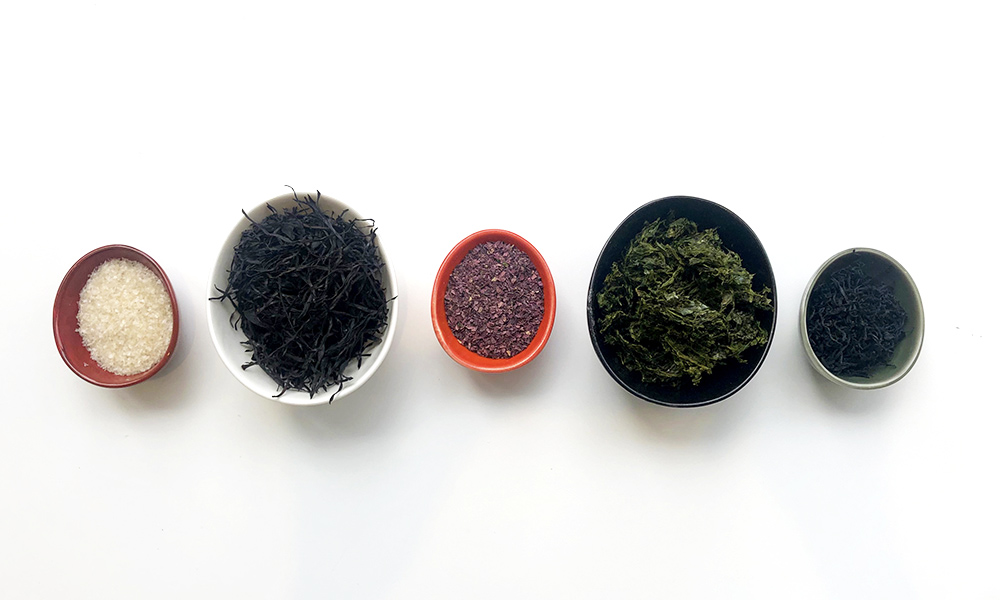
From left to right: agar, arame, dulse flakes, nori and hiziki sea vegetables. (Photo courtesy of the Institute of Culinary Education)

Agar: the plant-based gelatin wonder that can be substituted to make “Jell-o,” vanilla pastry cream, vegan chocolate pudding, mushroom pate, cauliflower terrine, frosting and more. Make sure to dissolve it in boiling liquid before using. Keep in mind that the powder form is approximately three times as dense as the flakes.

Arame: a good starter seaweed that is moderately priced and widely available in its dried form. The taste is stronger than its milder counterpart, hiziki. Soak, rinse and drain before using. Sautè it with other vegetables like carrots and onions to make kinpira or stir fry, or with kale, toasted sesame seeds and garlic for a quick side dish.

Dulse: This is great crisped in oil and topped on a sandwich as a bacon substitute, sprinkled in a cherry-pistachio granola or in a mock chickpea “tuna” salad. It’s too strong to eat on its own for most individuals but packs a great salty punch when sprinkled onto a dish.

Hiziki: best soaked, rinsed and sautéed with onions, garlic and a dash of shoyu into a staple dish from ICE’s Health-Supportive Culinary Arts curriculum called hiziki “caviar.” Hiziki has a mild taste, is highly prized and can be eaten on its own but can be expensive.

Kombu: Japanese chemists first isolated the flavor umami from this sea kelp’s glutamic acid. Kombu is a great addition to stocks, broths, beans or grains for digestibility, flavor and minerals. It’s strong on its own, so stick to one piece per pot as to not overpower.

Nori: great for sushi, or add to a plant-based Caesar dressing or olive tapenade in place of anchovies; toast and crumble over croutons, popcorn or rice; toast and crush with sesame seeds for fresh gomasio (a Japanese condiment usually made with sesame seeds and salt).

Wakame: a good introduction to seaweed, as it comes dried and can be reconstituted in water. It turns bright green and does great in cucumber salad or miso soup.

By Ashley Ross, Institute of Culinary Education Writer and Editor

Republicans can’t make it any clearer: Trump’s Big Lie must be defended at any cost — even democracy

The assault on democracy that’s taking place all around the country in various state legislatures has come boldly into focus in recent days and not a moment too soon. Democrats across the nation are begging the national government to step in and do something to protect our electoral system. And in a stunning irony, the Republican response is to use the federal government’s most undemocratic institution’s most undemocratic rule to prevent that from happening.

On Tuesday, Republicans invoked the filibuster to prevent the Senate from bringing S.1, the For the People Voting Rights Act, to the floor for debate, effectively killing the bill. West Virginia Sen. Joe Manchin had even cobbled together a compromise, giving Republicans a bunch of goodies they have wanted for a long time, including national voter ID and federal permission to purge the voter rolls, just trying to tempt them into even allowing a debate on the issue.

It did no good.

Manchin couldn’t even coax one of his “good Republicans” to vote for it. His bipartisan crusade is 0 for 0 so far. Before the vote on Tuesday, Sen. Rafael Warnock, D-Ga, described the GOP’s shamelessness perfectly:

“What could be more hypocritical and cynical than invoking minority rights in the Senate as a pretext for preventing debate about how to protect minority rights in the society?”

Mother Jones’ Ari Berman elaborates:

Congressional Democrats’ signature voting rights bill, the For the People Act, is set to be defeated on Tuesday by the very anti-democratic system it’s meant to reform.

The 50 Democratic senators who support the For the People Act (or least Sen. Joe Manchin’s compromise proposal keeping some key elements of the bill while excluding others) represent 43 million more Americans than the 50 Republican senators who oppose it, according to data compiled by Alex Tausanovitch of the Center for American Progress. Yet because of the 60-vote requirement to pass most legislation, 41 Republican senators representing just 21 percent of the country can block the bill from moving forward, even though it’s supported by 68 percent of the public, according to recent polling.

It is certainly true, as Republicans are quick to proclaim, that progressives and liberals have used the filibuster to stop GOP legislation in recent years as Mitch “Grim Reaper” McConnell, R-Ky, escalated the use of the process to an unprecedented frequency in order to entrench his minority party’s chokehold on legislation. But not since the Dixiecrats all defected to the Republican Party when they rebranded themselves as the official white supremacy party 50 years ago have Democrats used the filibuster to subvert the electoral process.

And keep in mind that McConnell was happy to change the rules when he needed to do it. His Holy Grail was packing the courts and he made sure that he was unencumbered by the filibuster when he did it. Don’t ever doubt that he would entirely eliminate it in a heartbeat if he felt he needed to.

The GOP’s overriding goal at the moment is obviously to keep as many Democrats as possible from voting and to subvert any universal commitment to the idea that the democratic process should be non-partisan. After the Republicans all voted to sustain the filibuster against S.1 on Tuesday, CNN’s Manu Raju asked McConnell, “are you okay with states like Arizona, that’s conducting it’s own audit to throw into question Joe Biden’s victory there?”

Reminiscent of his smug declaration that he would break his own rules if he had the opportunity to steal another Supreme Court seat (which he did), a dead-eyed McConnell flatly replied:

“I’m ok with the states sorting this stuff out. So, regardless of what may be happening in some states, there’s no rationale for federal intervention. They’ll figure it all out. They’ll go to court. They’ll determine whether there’s any rational basis for this. That’s not unusual in this country.”

I guess all those death threats against election officials are the sign of a healthy democracy working like clockwork. McConnell’s comments were eerily reminiscent of the old states’ rights arguments against desegregation and universal suffrage. Some things never change. This was how they “figured it out” in the states before “federal intervention” 55 years ago:

https://youtu.be/VbTyEnrHfHU

It is no coincidence that it was after the right-wing majority on the Supreme Court declared the Voting Rights Act effectively dead that states run by the white supremacist party are back to their old tricks. (Remember, one of the Big Lie’s fundamental tropes is that urban cities with large Black populations — Detroit, Milwaukee, Philadelphia, Atlanta — all cheated to deny Trump his rightful place as the president of white America.)

In the big picture, this latest assault on democracy is not only a throwback to the days of Jim Crow, although it certainly is that. In this era of disinformation and propaganda, they are also encouraging the idea that our system relies on nothing more than an exertion of power and winning by any means necessary. The vote on Tuesday shows that McConnell and his party, including the so-called “moderates” are all in on that part of the program too.

If what it takes to win means that they have to let states that are important to preserving minority power put QAnon conspiracy theorists and MAGA fanatics in charge of the electoral system, well that’s just how it has to be. Sure, these new rules and laws will eventually wend their way through Mitch McConnell’s handpicked federal judiciary. And in a few years, some of them will probably be overturned if only to keep up appearances. But expecting Supreme Court Chief Justice John Roberts, the man who wrote the despicable opinion overturning the Voting Rights Act back in 2013, to do a 180-degree shift on this issue seems highly optimistic.

There is still a way around all this, of course.

The Democrats could eliminate the filibuster and pass this bill. A couple of weeks ago I wrote about Majority Leader Chuck Schumer’s plan to hold a whole bunch of votes like this one to illustrate the folly of pursuing bipartisanship in the hopes that it will persuade the filibuster fetishists to change their minds. After Tuesday’s vote, Manchin almost said Republicans were being unreasonable (shock!) by failing to even consider his compromise, so maybe Schumer’s plan will work?

We’d better hope so. The Republicans are hard at work in the states to ensure that the Democrats are ousted from power by any means necessary. They better use it while they have it or they are going to lose it for good. 

How patent extensions keep some drug costs high

Priti Krishtel’s first case as a legal aid lawyer in India was as tragic as they come. One day in 2004, she recalls a couple walking into her office in Bengaluru with their three children. Unable to afford life-saving medicine to keep their HIV infections in check, the parents were dying of AIDS. With no other options, they wanted Krishtel to draw up guardianship transfer papers: The rambunctious siblings were to be sent to an orphanage before their parents died.

Even though drugs that could save the parents’ lives were available, the cost at the time was out of reach for the couple, who were living in poverty. Krishtel and the collective of lawyers she was working with at the time went on to handle many similar cases. By 2007, she came up with a strategy to slash the cost of HIV drugs in India: On behalf of patients’ rights groups, lawyers with the nonprofit Initiative for Medicines, Access, and Knowledge (I-MAK) she had cofounded would challenge specific patent applications on brand-name drugs, opening opportunities for generic manufacturers. Through a combination of patent expirations and legal challenges, price competition in India drove down the cost of the most common HIV therapy by more than 80 percent between 2003 and 2008.

Hoping for a repeat, in 2015 Krishtel turned the organization’s focus to the United States, where skyrocketing drug prices increasingly threaten to drag families into financial ruin. A 2019 Kaiser Family Foundation survey of more than a thousand Americans found that 29 percent did not take their medicines as prescribed at some point during the previous year because of cost; 8 percent reported that the lapse made their illness worse. The reasons for high prescription drug prices in America are complex and varied. But the patent system, Krishtel says, is one culprit.

Drug patents allow companies to recoup the costs of inventing a drug and reap rewards for innovation. For an entirely new drug, a U.S. patent enables a company to sell it exclusively for a set period of time, typically for 20 years from the date it was filed. After the patent expires, other companies are allowed to market generic versions.

But companies have been abusing the patent system to extend their market monopolies, says Krishtel. A 2018 study from I-MAK found that companies amass patents on existing drugs, blocking competition: The top 12 grossing drugs in the U.S. had an average of 71 patents granted, which almost doubled the time these drugs are protected from generic competition. Many of the granted patents are for minor tweaks, such as combining two drugs into one or altering the dosage — changes that aren’t inventive, Krishtel argues, and thus undeserving of new patents. A 2018 study by Robin Feldman, a professor at the University of California Hastings College of the Law in San Francisco, found that 78 percent of new drug patents between 2005 and 2015 were for existing drugs.

“I fiercely defend the patent system,” Feldman says. “I also am appalled when it’s misused.”

An intense debate over whether patents on SARS-CoV-2 vaccines are restricting global access has also recently erupted among members of the World Trade Organization (WTO). But even if the WTO voted to temporarily waive patent protections to enable competition, European Union representatives argue that such waivers would not ramp up supply anytime soon.

Meanwhile, Americans continue to pay the highest prices in the world for brand-name drugs. There is a chance for quick reform: President Biden has yet to name a new director of the U.S. Patent and Trademark Office, who could make it tougher to extend drug patents or easier for generic companies to challenge them.

* * *

One patent application Krishtel and I-MAK challenged was held by Illinois-based Abbott Laboratories on a formulation of its HIV drug Aluvia that does not require refrigeration — crucial in hot climates like India. At the Indian patent office in Delhi, she argued that the technique used to make the drug heat stable was not new, Abbott had merely applied the technology to its own drug. Under Indian patent law, a drug cannot be re-patented unless it is also more effective than the existing patented form.

The office refused to grant a patent. Then Krishtel and her team scored two more victories. Patents on another adult HIV drug and on a liquid formulation for children were also refused, which enabled broad access to the drugs for millions of low-income Indians — and people around the world in subsequent years because they were supplied by Indian generic manufacturers at a fraction of the brand-name cost.

The U.S. patent system, however, “doesn’t ask whether something is better,” explains Feldman. “It asks whether something is different.” Under that system, an innovation is patentable if the difference between an invention and a similar patented invention is not obvious to someone skilled in the art and if the approach is new.

By simply changing the formulation or mode of delivery — a capsule versus a tablet for example — a drug company can gain a new U.S. patent. In some cases, a mere tweak in dosage can win the drug a new patent. Many patent attorneys including Feldman argue that most such patents aren’t innovative, and that the strategy is just an effort to hold on to profits.

Steven Hadfield of Charlotte, North Carolina is both a beneficiary and a victim of such tactics. The 68-year-old was diagnosed with a rare blood cell cancer called Waldenström’s macroglobulinemia in 2014. The following year, he started taking ibrutinib, a drug manufactured and marketed as Imbruvica by Illinois-based AbbVie, after the Food and Drug Administration approved it for his particular cancer — a more effective treatment than his previous option and likely the reason he is still alive today. But the drug is not a cure; he will have to take it for the rest of his life. The cost to his insurance company: $15,000 per month.

The primary compound in ibrutinib was first patented in 2006. The company has since gained additional patents, some of which are for mere changes in dosage to treat subtypes of lymphoma. It’s a common tactic that companies use to extend patent life and protect profits, says Krishtel. Some experts say it’s debatable whether the additional patents are merited under the current patent requirements. Even with a different dosage, it would be obvious to an expert that ibrutinib would be able to treat Hadfield’s type of cancer, says Mark Ratain, an oncologist and pharmacologist at the University of Chicago, and the approach is “not novel.” To date, brand name ibrutinib is protected by 88 patents that add an additional 5 to 9 years to the manufacturers’ market monopoly.

By 2018 — five years after ibrutinib received its first approval from the FDA — its price had increased over 57 percent. In January 2020 alone, its price went up by more than 7 percent over the previous month, according to Patients for Affordable Drugs, a nonprofit advocacy organization. The extended years of monopoly will cost the health care system up to an additional $41 billion in costs, according to I-MAK.

For Hadfield and patients like him, price hikes are financially devastating. He has a $6,850 annual medical deductible and a 25 percent copay after that. His deductible is for all medical services, not just drugs, so his out-of-pocket costs have varied over the years. But assuming he applied his deductible to ibrutinib alone this year and paid 25 percent each month, Hadfield would be responsible for $38,150 of the drug’s cost. Luckily, he qualifies for an AbbVie sponsored copayment program and pays $10 at the pharmacy. But the program only subsidizes his copay at a maximum of $24,600 per year. Hadfield will still be responsible for the roughly $13,000 in remaining drug costs — almost $20,000 in out of pocket costs this year to treat his cancer alone. He suffers from diabetes and kidney disease too. (In response to a request for comment, AbbVie directed Undark to a website regarding their copayment program.)

To make ends meet, he works three jobs. His primary job is at Walmart, which provides his health insurance, and he juggles his schedule so he can work two additional jobs in the hospitality industry on weekends and during his off hours. His monthly social security check of $1,200 barely covers his rent, he says, so he must continue to work; and because he works, he doesn’t qualify for Medicare’s prescription drug coverage program. He says he lives “week to week or month to month.”

* * *

Competition could bring down prices for patients like Hadfield, but drug companies have come up with tactics to avoid it. Existing patent law allows companies to recoup research dollars and reap rewards for their innovations. Bringing a drug to market is expensive: Analysts estimate an average of about $1 billion per drug, which includes the cost of failures. Consequently, patents on new drugs award owners a period of 20 years free from market competition.

Under U.S. law, the first company to market a generic version of a brand-name drug enjoys six months of exclusive sales before another generic maker can sell their product, so the first generic may only be marginally cheaper than the brand-name version. After more generics hit the market, prices can drop up to 95 percent.

In addition to extending patents, Feldman says, the pharmaceutical industry has engaged in other anticompetitive behavior over the past decades that keep generics off the market for even longer. In her book, “Drug Wars,” Feldman documents backroom deals where brand-name companies pay generic manufacturers to delay selling their drugs in a tactic called “pay for delay.” Even a six-month delay in a generic hitting the market can mean billions of dollars in profits for the brand-name company, she explains. Companies then work out ways to share their profits in a tit-for-tat type of deal that isn’t always transparent. Such deals have drawn scrutiny from federal antitrust regulators. But the attention has only forced companies into making more complex deals that fall under the radar, says Feldman, such as a brand-name company agreeing to license, market, and sell generic company drugs in lieu of taking a cash payout — which makes anti-trust allegations difficult to prove.

In September 2020, the House Oversight Committee invited several drug company CEOs to answer questions about prices. The exchange was tense, but the CEOs did not budge from their mantra that high prices were necessary to fund innovation. At the hearing, Kåre Schultz, CEO of Teva Pharmaceutical Industries in Israel, testified that prices “must reflect the significant cost of ongoing research and development projects.” The committee also subpoenaed Richard Gonzalez, AbbVie’s CEO, for documents concerning the pricing strategy behind ibrutinib and another top selling drug, citing the company’s unwillingness to comply voluntarily with previous requests.

The idea that prices are justified by the cost of developing new drugs is not backed up with data, according to experts. In a recent opinion piece published at STAT, retired intellectual property attorney Alfred Engelberg and colleagues argued that large pharmaceutical companies did not invent most of the drugs they sell, instead acquiring many through mergers with smaller companies, or further developing drugs invented at public research institutions and funded by taxpayer dollars.

Still, the pharmaceutical industry continues to defend the existing patent system. “Our companies continuously find new diseases for which a medicine may be effective, new populations who can benefit from a medicine’s use, better ways to get a medicine to and into patients, and new ways to make a medicine,” wrote Nicole Longo, senior director of public affairs at the industry group the Pharmaceutical Research and Manufacturers of America, in an email to Undark. “As long as these new medical advances meet the statutory requirements for patentability, they rightfully deserve patent protections.”

Drug patents, however, are often revoked. Companies can challenge patents through the Patent Trial and Appeal Board (PTAB), a division of the USPTO. A 2019 study found that the PTAB narrowed or overturned patents in 51 percent of cases brought by generic drug makers since 2011.

The high number of successful challenges merely reflects how weak many patents are, says Feldman. The true number of trivial patents is much higher, she adds, and these remain unchallenged because of the high legal costs involved. Companies should pick one set of patents, she says, and “once that’s over it’s done.” No one is arguing that the pharmaceutical industry should not be rewarded for innovative drugs, she adds. But a 20-year monopoly ought to be enough for a company to recoup its costs and earn a profit on top.

* * *

In March, a group of senators led by Republican Thom Tillis of North Carolina and Democrat Chris Coons of Connecticut wrote a letter to USPTO interim director Drew Hirshfeld asking him to commission a study on the “current state of patent eligibility jurisprudence in the United States.” The senators were particularly interested in “how the current jurisprudence has adversely impacted investment and innovation in critical technologies.” They asked for their findings to be submitted no later than March of next year.

No specific bills have been made public yet and some critics worry that reforms won’t necessarily curb abuse, considering the $233 million the pharmaceutical industry spends on lobbying in an average year.

In 2017, I-MAK tried to knock down 10 patents on a hepatitis C drug, but the cases never made it to a U.S. court. “The culture was stacked against us,” Krishtel says. In the U.S., only organizations with a commercial interest are allowed to challenge a patent in court, she explains. She hopes that the new USPTO director will be open to change. “We need to educate the public and to try to get policy reform,” she says. Her experience in India and in other countries has shown how challenging weak drug patents can have an outsized effect.

The couple that came into her office in Bengaluru so many years ago almost certainly died. Krishtel does not know what happened to the children. But by helping to bring down the cost of HIV drugs in India, she knows countless other people were able to continue living. U.S. patent law reform would not only help rein in prices and widen access in America but would also have “a ripple effect” in other countries, she says.

* * *

Gunjan Sinha is a freelance science writer living in Berlin, Germany.

This article was originally published on Undark. Read the original article.

Is Rand Paul mixing up the vaccine message for COVID survivors?

Last week, Sen. Rand Paul (R-Ky.) posted a Twitter thread asserting that people who have survived a covid-19 infection were unlikely to be reinfected and have better immunity against variants than those who have been vaccinated against — but not infected by — SARS-CoV-2, the virus that causes covid.

The social media communication represented his latest salvo in the ongoing debate over whether natural immunity is equivalent or even better than vaccination.

While the science on the subject is still evolving, a look at the evidence behind Paul’s series of tweets seemed in order. After all, though almost 65% of Americans have received at least one dose of a covid vaccine, some people who have recovered from covid may not feel a need to get shot. Paul, who was the first senator to be diagnosed with the virus, is among them. Here’s a deeper look at what Paul said on Twitter, the studies he cited and how researchers characterized his comments.

Breaking Down the Twitter Thread

In his first tweet, Paul referenced a recent Cleveland Clinic study finding that among subjects who were unvaccinated but had already had covid-19, there were no re-infections in a five-month observation period: “Great news! Cleveland clinic study of 52,238 employees shows unvaccinated people who have had COVID 19 have no difference in re-infection rate than people who had COVID 19 and who took the vaccine.”

In subsequent tweets, the senator said: “The immune response to natural infection is highly likely to provide protective immunity even against the SARS-CoV-2 variants. … Thus, recovered COVID-19 patients are likely to better defend against the variants than persons who have not been infected but have been immunized with spike-containing vaccines only.” All three vaccines authorized for emergency use in the U.S. (Pfizer-BioNTech, Moderna and Johnson & Johnson) contain genetic instructions that tell our cells how to make a spike protein associated with the coronavirus. The presence of that spike protein then causes our bodies to make antibodies to protect against covid.

At the end of his final tweet, Rand then linked to a second study led by scientists at the Fred Hutchinson Cancer Research Center in Seattle to support his assertions.

Digesting the Scientific Papers

Paul referenced two scientific papers in his tweet thread — both of which are preprints, meaning they have not yet been published in scientific journals or been peer-reviewed.

One was a study from the Cleveland Clinic following four categories of health care workers: unvaccinated but previously infected; unvaccinated but not previously infected; vaccinated and previously infected; and vaccinated but not previously infected. The workers were followed for five months.

The researchers found that no one who was unvaccinated but had previously been infected with covid became infected again during the five-month study period. Infections were almost zero among those who were vaccinated, while there was a steady increase in infections among those who were unvaccinated and previously uninfected.

When asked whether he believed Paul’s tweet had interpreted his study results correctly, the study’s lead author, Dr. Nabin Shrestha, an infectious diseases specialist at Cleveland Clinic, said “it was an accurate interpretation of the study’s findings.”

However, Dr. George Rutherford, an epidemiologist at the University of California-San Francisco, wrote in an email that he would add one caveat to the wording of Paul’s tweet: “Note that in his tweet Senator Paul seems to suggest that the denominator of previously infected health care workers at the Cleveland Clinic was 52,238 — that was the total number in the whole study. There were 1,359 that were previously infected and never vaccinated, and there were no reinfections noted over a median follow up of 143 days. So, the tweet itself is accurate if read literally but the denominator is really 1,359.”

As for the other study Paul mentioned, researchers analyzed covid-19 immunity in those who had been infected with the covid virus and those who hadn’t and found that infection activated a range of immune cells and immunity lasted at least eight months.

In his last two tweets in the thread, Paul quotes directly from the study’s “discussion” section: “The immune response to natural infection is highly likely to provide protective immunity even against the SARS-CoV-2 variants. … Thus, recovered COVID-19 patients are likely to better defend against the variants than persons who have not been infected but have been immunized with spike-containing vaccines only.”

The lead study author, Kristen Cohen, a senior staff scientist in the Vaccine and Infectious Disease Division at the Fred Hutchinson Cancer Research Center in Seattle, acknowledged that Paul’s tweet was a direct quote from the study. Still, she said, in her view, the quote was taken out of context and presented to suit Paul’s objective — but does not accurately reflect the overall take-home message from the study’s findings.

That’s because, she said, Paul was quoting from the discussion section of the paper. The discussion is the final section of a scientific paper, and Cohen said its purpose here was to project what the study’s findings could imply for a broader scientific significance.

“We wrote that recovering covid patients are “likely” to better defend against variants than those who have just been immunized, but it’s not saying they do,” said Cohen. “It’s not saying they have been known to. It’s making a hypothesis or basically saying this could be the case.”

In fact, Cohen’s study did not include any subjects who had been vaccinated. The researchers were merely reasoning in the sentence Paul quoted that, based on the data showing the immune system’s broad natural response, those who recover from covid-19 and then receive a vaccine may be better protected against covid variants than those who had only vaccine-induced immunity.

“We did not intend to argue that infected people do not need to get vaccinated or that their immune responses are superior,” Cohen wrote in an email.

However, Cohen recognized the sentence was confusing when taken out of context and said she will eliminate it from the paper when it gets submitted for publication.

Cohen pointed us to another Fred Hutchinson-led study with which she was involved. It did show that people who previously had covid-19 benefited from also getting vaccinated, because there was a significant boost in immune response, especially against variants.

The Conventional Wisdom on Natural Immunity

So, what’s known from these two studies is that surviving a covid infection confers a significant amount of immunity against the virus. Other studies also support this assertion.

“Existing literature does show natural immunity provides protection against COVID-19,” said Shane Crotty, a professor at the Center for Infectious Disease and Vaccine Research at the La Jolla Institute for Immunology who has published numerous peer-reviewed studies on natural immunity against covid-19. He said such immunity particularly protects against hospitalizations and severe illness.

In Crotty’s own recent study, the largest yet to measure the molecules and cells involved in immune protection, his team found that natural immunity against covid lasted at least eight months. Based on projections, it could last up to a couple of years.

While that is good news, Crotty said, there are three points of caution.

First, though natural immunity appears to be very effective against the current dominant U.S. variant (known as alpha), it also appears weaker than vaccine immunity against some of the variants circulating, such as the delta variant, first detected in India. That means if those variants eventually become dominant in the U.S., people relying on natural immunity would be less protected than those who are vaccinated.

Second, there is a lack of data about whether natural immunity prevents asymptomatic transmission and infection. Several other studies, though, show vaccines do.

Third, Crotty said his studies have shown that levels of natural immunity can vary widely in individuals. His team even found a hundredfold difference in the number of immune cells among people.

“If you thought about the immune system as a basketball game and you thought about that as a team scoring 1 point, and another team scoring 100 points, that’s a big difference,” said Crotty. “We’re not so confident that people at the low end of immunity levels would be as protected against covid-19.”

But those who receive a vaccine shot have a much more consistent number of immune cells, since everyone receives the same dose amount, said Crotty.

With all that in mind, the Centers for Disease Control and Prevention recommends that those who previously had covid-19 should get vaccinated and receive both doses of a vaccine, whether it’s the Pfizer-BioNTech or Moderna vaccine. Fauci, the nation’s leading infectious disease expert, reiterated this message during a White House covid-19 briefing last month.

An expert helps answer the question “does sustainable fishing exist?”

Sustainable fishing has become a hot topic recently, including debates over whether or not it really exists. And while the world of seafood can seem confusing at a glance, with questions about ecolabels, fish farming and more making our buying choices seem complicated, there is sustainable fish to be found. To help us navigate these waters, we invited the Northwest Atlantic Marine Alliance, or NAMA, to chat with us on Facebook Live. You can find a summary of the conversation here, but be sure to watch the interview below to learn more.

https://www.facebook.com/watch/live/?v=281975876902188

NAMA is a grassroots organization of fishermen and women that brings the concerns of fishing communities across the country to Washington to ensure they have an advocate as lawmakers and administrators create fisheries policy and other legislation that impacts the ocean. As advocates for independent fishermen who rely on a healthy ocean, NAMA is very invested in making sure seafood is sustainably produced.

How can we define sustainable fishing?

NAMA believes sustainable fishing is appropriately scaled and has continuity within a community, never taking more fish than what the ecosystem can allow and keeping an eye towards the future. Communities that rely on fish for their food or for their income are often the best advocates for conservation, as the wellbeing of the next generation relies on maintaining the ecosystem. Tribal groups are an especially good example of how this kind of management can preserve a fishery for thousands of years.

While commercial fishing and sustainable fishing are often presented as opposites, they aren’t mutually exclusive. Commercial fishing is an important economic lifeline for many communities, and when they work to harvest fish within the boundaries of an ecosystem and keep an eye towards continuity, it can be very sustainable. Commercial fishing becomes unsustainable when it’s controlled by corporations, particularly those outside the community, because they view the fish as a resource to cash in on immediately rather than a population that’s important to preserve. This explains much of the industrially scaled, factory-style fishing that’s so destructive to the oceans.

Local control is also pivotal when it comes to how fisheries are regulated. Keeping small fishermen in business is critical to ensuring they can bring a future-focused, science-informed voice to the Regional Fishery Management Councils that set catch limits to prevent overfishing.  Overfishing isn’t the only threat facing the oceans. Climate change and habitat disruption are also serious risks to fish populations, and fishing groups like NAMA are pushing for greater consideration of these other factors in the regulatory process.

Buying sustainable seafood

Buy local

With all of this in mind, buying sustainable seafood can seem daunting. However, this doesn’t have to be the case: a few simple rules can help make sure that you’re buying the most sustainable options. For people who live near the coast, it’s often easy to buy local. Farmers’ markets and fish shops are good places to buy fish straight from the fisherman or vendors who can tell you where and when fish were caught. This lets you have more confidence that they came from a sustainably managed fishery. If you’re uncertain where to look, localcatch.org has a seafood finder tool that makes finding sustainable seafood vendors easy. Community supported fisheries, much like CSA farm shares, are another way to get a sampling of fresh, regional seafood regularly.

Buy frozen and canned

For those who are further from the coast and have trouble finding local seafood, the frozen and canned food sections can be a good place to look. In these cases, more information is always better; look for products from the US when you can and avoid those that are imported when possible, especially if it’s a farmed product. While there are a number of ecolabels that seafood companies use on their products, many are hard to verify, and none give a holistic idea of sustainability. Ultimately, if you can’t find any information on a product and where it comes from, it’s best to choose something else.

Avoid farmed shrimp and salmon

Farmed shrimp and salmon, whether sold thawed or frozen, are especially important to avoid because they come from facilities that mimic land-based factory farms and use the ocean as a dumping ground for waste. NAMA’s expertise on fish farming was critical to our FoodPrint of Farmed Seafood report, and their current work is focused in large part on curbing unsustainable aquaculture. First, they are working with a coalition of other ocean groups to prevent environmentally taxing fish farms from expanding into federal water, where they traditionally haven’t been allowed. A Florida project threatens to upend that balance, and pending legislation like the AQUAA Act would clear the way for more farms like it.

NAMA has also been very involved in the fight against genetically modified salmon, which are now being raised in land-based systems in the US after a years-long battle to get approval. The fish present an escape risk to the environment, and their approval is a worrying sign that other GM animals might not be properly investigated or regulated in the future. NAMA and its partners have been instrumental in slowing down the process and ensuring the fish can’t gain a foothold in US markets after getting guarantees from major retailers that they won’t carry the product.

“Hillbilly Elegy” author J.D. Vance complains “Gossip Girl” reboot is being ruined by “wokeness”

“Hillbilly Elegy” author J.D. Vance, who is reportedly weighing a run for the United States Senate in his home state of Ohio, focused Tuesday on the latest crisis facing the United States: the remake of the teen drama “Gossip Girl.”

Vance was angered when he learned that writer Josh Safran, who will be the showrunner for the new “Gossip Girl” that will stream on HBO Max, has reworked the wealthy Manhattan socialite characters to make them more aware of the privileged lives they lead.

“These kids wrestle with their privilege in a way the original didn’t,” Safran said this week. “In light of [Black Lives Matter], in light of Occupy Wall Street, things have shifted.”

Vance was not fond of this artistic decision, however, and railed that the teen drama was the latest work of art to fall victim to “wokeness.”

“Wokeness will make everything boring and ugly,” he wrote.

Vance’s emotional attachment to a teen drama that originally aired on The CW network inspired a wave of ridicule from Twitter followers — check out some reactions below.

Arizona Republicans finally backing away from Cyber Ninjas and its dubious election “audit”

The Republican-led Arizona election “audit,” which recently has inspired a new echo in Montana, now faces opposition from a conservative talk radio who initially backed the effort and also fresh turmoil surrounding Cyber Ninjas, the previously unknown firm hired to carry out the audit. 

With the audit entering its final days, conservative talk-show host Mike Broomhead told CNN anchor Pamela Brown over the weekend that his position on the audit had changed in recent weeks because Republicans had let the procedure become “biased” and overtly partisan in nature. 

“I just think that they lost focus on being fair and unbiased,” he stated on CNN. “I think they have allowed it to turn into a very biased audit, where they are speaking only to the people that already believed ahead of time that the election was stolen, and they haven’t really produced any evidence to the contrary.”

Broomhead had not initially argued that the election was stolen, but said he thought the audit would be a worthwhile measure to ensure confidence in the electoral process. 

“This is not about politics for me,” he told The Arizona Republic in mid-June. “It’s not about right and left. It’s about right and wrong. I’m an Arizonan, and I’m an American before I’m a Republican, but I’m proud of all three. I don’t see the direction this audit is going as doing the state of Arizona or the country any good anymore. The goal of a transparent and unbiased audit is gone. You’ve either got to fix it or end it.”

But it’s not only Broomhead who is speaking out against his fellow Republicans.

On Monday evening, Maricopa County recorder Stephen Richer, a Republican, ripped into the never-ending audit in his county, the state’s major population center. “Let’s be honest, this Arizona audit isn’t going to convince anyone outside of the crowd that already believes the election was stolen,” he told CNN host Anderson Cooper. “We think that the Arizona Senate boarded this train without knowledge of where it was going, and I don’t think it’s going to a good place.” 

While the slow-moving audit has generated intense coverage from right-wing media, no evidence has been produced that challenge the official and certified result, which was that Joe Biden won Arizona by roughly 10,500 votes.

Judges across the country have tossed out cases alleging widespread election fraud, which has not deterred Trump acolytes like former 2016 campaign head Steve Bannon from pushing for a “freight train” of nationwide Republican audits. 

While the Arizona audit is pushing onward and Trump allies pushing for audits in other states, the firm tapped to lead the audit, Cyber Ninjas — headed by fervent Trump supporter Doug Logan — is now under increased scrutiny. 

According to a CNN report last week, friends and acquaintances of Logan describe him as increasingly sounding like MyPillow CEO Mike Lindell, who has made increasingly wild allegations of a widespread voter-fraud conspiracy.  

“It’s hard to say anything bad about the guy. He’s a lovely person. He’s just nuts now,” said Tony Summerlin, who has been friends with Logan for 15 years, and said he helped him win a cybersecurity contract with the Federal Communications Commission five years ago. “It’s scary; because if someone like him can turn into this, who can’t turn into this?”

Summerlin said that in all the years he’d known Logan, before the Arizona audit, “we never, never had a single political conversation; that’s what stunned me about this. … He said, ‘there’s definitely something there.’ I said, ‘based on what?’ He said, ‘it’ll come.’ I said, ‘you sound like the My Pillow guy.'”

Another friend of Logan, who asked not to be named because she works with both Republicans and Democrats in Washington, DC, and feared blowback from being linked to him, described him as very smart, very competent in cybersecurity, and politically naïve. “Doug may not have thought it all the way through,” she said.

Cyber Ninjas now appears to be running with a skeleton staff. CNN reports that most of the company’s listed phone lines, including those supposedly dedicated to “purchasing” and “human resources,” redirect to Logan’s phone. 

Cyber Ninjas did not return Salon’s request for comment on this story.

Will someone please just tell me WTF to put in my coffee?

Recently, Twitter users turned against oat milk (proving that you really never know who will be canceled next!). Citing an almost year-old deep-dive specifically calling out the popular brand Oatly, this article calls oat milk the “new Coke,” stating the company masquerades as a so-called healthy alternative to dairy (and other nondairy) milks, but is essentially sugar water cut with oil, and a “bad” choice when it comes to creamy beverages.

The article compares Oatly’s marketing strategy — its splashiest slogan being “it’s like milk but made for humans” — to Sugar Association ads from the 1970s (“only 18 calories per teaspoon, and it’s all energy”); 1930s cigarette brands (“give your throat a break”); and Coca-Cola’s 2009 “open happiness” campaign, the article launches into a very spooky breakdown of the science behind the oat milk. Essentially, during Oatly’s oat-liquefaction process, enzymes convert oat starch to a high-glycemic-index-ranking sugar, and rapeseed, or canola, oil is used as an emulsifier. The result is Oatly’s particularly velvety texture and non-watery flavor, both of which I personally count as wins when it comes to nondairy milk.

This article (and many, many people on Twitter) apparently do not. Several hundred words later, the article comes to this conclusion: “Is Oatly designed for human consumption? Definitely. Is it healthy? Definitely not.”

Setting aside that fact that a splash of oat milk is coffee is quite different than downing a 20-ounce bottle of soda, why, I ask, in the Year of Our Lord 2021, are we still obsessed with labeling every stupid thing we put into our bodies as “healthy” or “unhealthy”? Considering there are so many foods we can get nutrients from, why do we continue to blame snacks and beverages for not being pure sources of nutritional density? And also, well, what the hell am I supposed to put in my coffee?

I won’t give you my whole spiel on how dangerous it is to prescribe virtue or vice to ingredients. (I will say it ruined my relationship with my body and with eating for about a decade.) And it’s certainly not great when a brand tries to influence people into buying their product by citing health claims, whether proven or inflated — though it should be noted that Oatly is far from the first nondairydairy, or general food brand to do this. Pair that with the environmental and labor implications made when purchasing one type or brand of milk, and it would appear that when it comes to making my morning cup of caffeine creamy, there are simply no options.

* * *

The Milks Aren’t Alright

Allow me to break down all the reasons literally no milk, from a cow or otherwise, is a perfect option.

Dairy Milk (and Half-And-Half and Cream)

Milk from cows is high in saturated fat (and that is “bad”)! Our tummies can’t digest lactose as we get older. And it may not even be that helpful when it comes to bone health after childhood.

Soy Milk

Soy milk is often sweetened, and sugar is “bad!” (And of course when it’s unsweetened, let’s be real, it doesn’t taste fantastic.) Plus, soy contains compounds that mimic estrogen, which could cause health complications.

Almond Milk

The most common emulsifier used in almond milk can irritate our gut! It’s also kind of . . . watery? Which is fine for a smoothie, but if I wanted watery coffee I’d just add, well, water.

Coconut Milk

Coconut milk is very high in saturated fat! (And that’s “bad”, remember?) It tastes best from the can (as opposed to the watered-down, stabilized versions from a carton), but gets weirdly separated when poured into a cup of hot coffee. And, oh yeah, some of those cans contain BPA, which can lead to hosts of physical complications.

Pea Milk

It’s high in protein, mostly hypoallergenic, fortified with plenty of nutrients, and creamy — but I’m just going to speak my truth: Many brands of pea milk taste like their star ingredient, with a slightly chalky aftertaste. It’s easy enough to hide in a smoothie, but in coffee? I just can’t.

Other Nut Milks

Fancy nuts like cashews, pecans, macadamias, hazelnuts, and pistachios all make pretty excellent-tasting nondairy milks. Elmhurst Milked Cashews, Walnuts, and Hazelnuts are simply the nut and water, making for a low-risk, creamy add to a cup of coffee; and Táche, which foams gloriously even with an at-home frother, is the only purely pistachio nut milk on the market (others are cut with additional nuts or seeds), but these milks tend to come with a significantly higher price tag than the rest, and in a smaller carton to boot — nuts are expensive to produce and harvest, there’s no way around it.

And Wait, There’s The Environmental Stuff, Too

While oat milk is actually quite low on the emissions, water, and land-use scale, if the oats used were treated with unsafe levels of pesticides, we have a new can of worms to open. Unsustainable farming practices from dairy to almond to soybean farmers contribute to skyrocketing methane emissions. Producers overuse water in drought-prone areas, contribute to deforestation, and deprioritize biodiversity as product demand grows. Unethical labor practices, both human and animal, continue to crop up the more these industries are looked into. Whew.

After I poured this morning’s coffee, I first decided I would drink it black, even though I had oat and almond milk, as well as cream in the fridge. Wow, do I hate black coffee. I added some oat milk. (To quote Demi, sorry, not sorry.) Then I ate breakfast, crunching on the fat flakes of sea salt I put on my eggs every day. I clicked back onto Twitter to discover people freaking out about a new study, which found that salt is apparently screwing with our immune systemsUgh.

Georgia officials collect fees from Trump’s lawyers — but who really paid for bogus suits?

Election officials in two Georgia counties have recovered legal fees stemming from former President Trump’s failed election lawsuit — but his attorney is playing coy about who really paid the bills.

Election officials in DeKalb and Cobb counties in February sought to recoup legal fees over what they described as a “meritless and legally deficient” lawsuit, which claimed, entirely without evidence, that tens of thousands of illegal voters participated in the presidential election. Trump withdrew the lawsuit a day before the hearing, the same week as the Jan. 6 assault on the U.S. Capitol.

A court was set to hear arguments over the legal fees last Friday but both counties said in filings that they had recovered the costs, according to the Atlanta Journal-Constitution.

The Cobb County Board of Elections received $15,554 to pay for its legal costs, according to a Friday court filing. DeKalb recovered $6,105 in fees, telling a judge on Monday that “plaintiffs, through counsel, have provided payment for the full amount of attorneys’ fees.”

But Trump’s lawyer in the case, Randy Evans, denied that the notoriously stingy ex-president had paid the fees, but declined to say who did.

“The two motions have been withdrawn. There was no settlement agreement,” Evans, who also represents the Trump campaign and the Georgia Republican Party, told the Journal-Constitution. “The taxpayers in DeKalb and Cobb have been fully reimbursed. There are no other details because there are no other details.”

Daniel White, an attorney for Cobb County, said the fees were paid through Evans’ firm.

“I would certainly defer to them if they want to clarify where they got the funds from,” White told the outlet.

Trump raised more than $250 million after his election loss, ostensibly to fund his legal battles. But he spent just a small fraction of those donations on actual legal costs and far more on additional fundraising and advertising. Five of his impeachment lawyers quit just a week ahead of his second Senate trial over a pay dispute, and Trump is still refusing to pay Rudy Giuliani for his tireless labors in pursuing work baseless allegations of election fraud.

Trump’s legal problems are only growing worse after Manhattan District Attorney Cy Vance convened a grand jury to hear evidence in his years-long criminal investigation into the former president himself and the Trump Organization, an investigation that has now been joined by the New York state attorney general’s office. Trump also faces a criminal probe in Georgia over his efforts to pressure Georgia Secretary of State Brad Raffensperger to “find” enough votes to overturn his election loss. He also faces multiple lawsuits, including from women who have accused him of rape or sexual assault and a lawsuit by lawmakers and the NAACP accusing him of inciting the Capitol riot.

Trump has complained that the big legal bills are “such a pain in the ass,” The Daily Beast reported last month. His legal team filed a motion in May demanding that Democratic lawmakers who sued him over the Capitol riot “should be ordered to pay President Trump’s fees and costs.”

The riot took place amid a flurry of lawsuits from Trump and his allies, all of which failed as Republicans could not produce any evidence of widespread fraud or irregularities. Some of the former president’s allies face sanctions or disciplinary action for bringing frivolous suits while others, like Giuliani and MyPillow CEO Mike Lindell, face billion-dollar lawsuits from voting technology firms they falsely accused of switching votes from Trump to President Biden.

The fact that there is no evidence to back up any of these “stolen election” claims has not stopped Trump’s supporters from continuing to use his election lies to torment election officials.

Raffensperger and his family and other election officials have faced a barrage of death threats and have even been forced to flee their homes, according to Reuters. Raffensperger’s wife Tricia told the outlet that their family was forced to go into hiding for nearly a week after intruders broke into their widowed daughter-in-law’s home, which they believe was intended to intimidate them. Tricia Raffensperger said people who identified themselves to police as members of the Oath Keepers militia had been seen outside their home that same night.

Amid the threats, Republican lawmakers in Georgia passed a bill stripping Raffensperger of many of his election powers after he stood up to Trump’s lies, potentially making it easier to overturn future elections.

Numerous other officials in Georgia, Arizona and Michigan have been deluged with death threats or have “faced protests at their homes or been followed in their cars,” according to the Reuters report, including Arizona Secretary of State Katie Hobbs and Michigan Secretary of State Jocelyn Benson as well as election administrators and volunteers. Arizona Republicans have moved to strip Hobbs of her powers as well.

Richard Barron, the Fulton County elections director, said the threats received by his office have been shared with investigators looking into Trump’s pressure on Raffensperger. Barron told Reuters that most of the workers in his office are Black, adding that “the racial slurs were disturbing and sickening.”

Other messages threatened violence and bombings, with one email sent to at least 11 counties in Georgia warning that “we’ll make the Boston bombings look like child’s play” and “bring death and destruction” until “Trump is guaranteed to be POTUS until 2024 like he should be.”

Deidre Holden, the longtime Paulding County elections director, told Reuters that her office had referred the messages to police and the FBI. “I’ve never had to deal with anything like this,” she said. “It was frightening.”

Nearly eight months after the election, a startling proportion of Americans still believe the 2020 election was tainted with fraud. About 32% of voters believe that Biden’s election was fraudulent, according to a new Monmouth poll, a rate that has remained steady since November.

“The continuing efforts to question the validity of last year’s election is deepening the partisan divide in ways that could have long-term consequences for our democracy,” said Patrick Murray, director of the Monmouth University Polling Institute, “even if most Americans don’t quite see it that way yet.”

The Jim Crow Republicans aren’t just attacking voting — they want to rewrite history

Words have actual meanings. Why do I consistently describe today’s version of the Republican Party as the “Jim Crow Republican Party”? Because that political party is now engaged in a coordinated nationwide effort to keep Black and brown people from voting.

Today’s Republican Party is attempting to end America’s multiracial democracy and replace it with a new form of American apartheid in which Black and brown people are treated as second-class citizens in their own country. These efforts to create a whites-only fake democracy involves many of the same tactics and strategies as the original Jim Crow regime. These include onerous ID requirements, voter intimidation and harassment, limiting access to polling places, claims that some votes (by white people) are more “valuable” and of “higher quality” than others, outright vote theft and vote fraud, an attempt to create one-party monopoly rule and claims that voting is something “sacred,” to be “protected” by limiting access to those deemed unworthy.

Today’s Republican Party is committed to the cause of racial authoritarianism. It is a de facto white identity organization which supports political violence and terrorism as a way of obtaining and keeping political power indefinitely.

The Jim Crow regime was much more than a set of strategies and tactics designed to deny Black people their equal political rights. It was a society-wide system that sought to undermine Black people’s humanity, dignity and self-worth. Today’s Republican Party shares that goal.

New reporting by Nick Corasaniti and Reid J. Epstein in the New York Times shows in great detail how today’s Republican Party is now applying Jim Crow tactics against African-American election officials on the state and local level:

Lonnie Hollis has been a member of the Troup County election board in West Georgia since 2013. A Democrat and one of two Black women on the board, she has advocated Sunday voting, helped voters on Election Days and pushed for a new precinct location at a Black church in a nearby town.

But this year, Ms. Hollis will be removed from the board, the result of a local election law signed by Gov. Brian Kemp, a Republican. Previously, election board members were selected by both political parties, county commissioners and the three biggest municipalities in Troup County. Now, the G.O.P.-controlled county commission has the sole authority to restructure the board and appoint all the new members.

“I speak out and I know the laws,” Ms. Hollis said in an interview. “The bottom line is they don’t like people that have some type of intelligence and know what they’re doing, because they know they can’t influence them.”

Ms. Hollis is not alone. Across Georgia, members of at least 10 county election boards have been removed, had their position eliminated or are likely to be kicked off through local ordinances or new laws passed by the state legislature. At least five are people of color and most are Democrats …

In Georgia, G.O.P. lawmakers say the new measures are meant to improve the performance of local boards, and reduce the influence of the political parties. But the laws allow Republicans to remove local officials they don’t like, and because several of them have been Black Democrats, voting rights groups fear that these are further attempts to disenfranchise voters of color.

Democrats express the entirely legitimate fear that if these bills had been in place in the immediate aftermath of the 2020 election, Donald Trump’s allies could have gone much further toward overturning the result. As the Times puts it, “They worry that proponents of Mr. Trump’s conspiracy theories will soon have much greater control over the levers of the American elections system.” 

Jena Griswold, the Democratic secretary of state in Colorado, describes this entire campaign as “a thinly veiled attempt to wrest control from officials who oversaw one of the most secure elections in our history and put it in the hands of bad actors. The risk is the destruction of democracy.”

The Jim Crow Republicans have consistently responded by claiming that they have “no racist intent” or that Democrats are the “real racists” because they believe that black people are “too stupid” to follow new rules designed to “protect” and “secure” the vote.

Other Jim Crow Republicans have claimed, contrary to all evidence, that these new anti-democracy rules somehow make it easier for Black and brown people and other targeted groups to vote. The timing of these attacks by the Jim Crow Republican Party, which began across the Southern states almost immediately after the infamous Shelby County v. Holder Supreme Court decision and accelerated after Trump’s 2020 defeat, is similarly described as a coincidence, or evidence of “paranoia” by the Democrats and “liberal activists.” 

The laziest Jim Crow Republicans and their mouthpieces (notably the professional Black conservatives) recite anachronistic talking points from the distant past, arguing that Democrats supported slavery and Jim Crow and that Republicans are the “party of Lincoln,” which is somehow meant to exculpate the post-civil rights Republican Party from all possible white supremacist or racist motivations.

Many Republican leaders and their propagandists simply choose to lie or distort the truth about their attack on Black and brown people’s voting and civil rights.

In a new essay at Mother Jones that merits extended quotation, Ari Berman locates Republican attempts to nullify the 2020 election results in Georgia relative to similar efforts during the Jim Crow regime:

There are striking similarities between the Mississippi plan of 1890 and the Georgia plan of 2021. The same pattern that existed during Reconstruction — the enfranchisement of Black voters, followed by the manipulation of election laws to throw out Black votes, culminating in laws passed to legally disenfranchise Black voters — is repeating itself today.

Trump told Georgia Secretary of State Brad Raffensperger to “find 11,780 votes” to nullify Joe Biden’s victory, and Trump’s lawyer Rudy Giuliani asked the state legislature to appoint its own presidential electors to overturn the will of the voters. When these efforts failed, Georgia Republicans rushed to change their voting laws to make it much easier for Republican candidates to find those votes in future elections — replacing extralegal attempts to rig the election with ostensibly legal ones.

The proponents of these laws have defended them in eerily similar ways. White Mississippians of the 1890s claimed there was nothing racist about their new constitution because it was intended “to correct the evil, not of Negro suffrage per se, but of ignorant and debased suffrage,” said Mississippi Democratic Sen. James Z. George. The “understanding clause” was “an enlargement of the right to vote and not a restriction upon it,” George argued, since it did not disenfranchise voters if they could sufficiently interpret the Constitution — a loophole that, in practice, existed for white people, not Black people.

Similarly, in 2021, Kemp said “there is nothing Jim Crow” about the Georgia law and argued that it “expands access to the ballot box,” pointing to a provision that requires more days of weekend voting. That won’t affect large counties in the Atlanta area that already offered multiple days of weekend voting but will create more voting opportunities for rural counties that lean Republican. Nor did Kemp mention the 16 different provisions that make it harder to vote and that target metro Atlanta counties with large Black populations.

The Jim Crow Republican Party’s campaign against democracy is obvious to those who closely follow current events — for instance, by getting information from sources outside the right-wing disinformation machine — and who have a somewhat mature understanding of American history.

But those Americans who lack that context and information are much more vulnerable to being propagandized into believing that the Jim Crow Republican Party’s attacks on Black and brown people’s civil rights has nothing to do with race and simply reflects “common sense” attempts to “protect” democracy and the vote.

This attempt at historical erasure and manipulation is one reason why the Jim Crow Republican Party and its allies on the white right have created a moral panic about critical race theory, the New York Times’ “1619 Project” and other attempts to teach complex truths about American history and questions of race as well as other challenging subjects.

By manipulating history to reshape understandings of the present, a type of vacuum or void is created. That space allows the white right and the neofascist movement to distort the reasons why Black and brown people and their allies are struggling to defend and improve American society by addressing the country’s many forms of injustice and inequality.

Ultimately, these battles over American memory and the color line are questions about truth, power, accountability, democracy, freedom and justice. In a new essay at his website, historian Timothy Snyder explains how American democracy is imperiled by the Jim Crow Republicans and their allies’ attacks on any approach to history that speaks back to power instead of serving its interests. Snyder offers these warnings:

  • Tyrants monopolize innocence for themselves and their supporters. But history challenges stories that equate power with virtue. So tyrants refer to history as “revisionist.”
  • Tyrants today oppose history by enforcing an official myth in law. Memory laws were originally meant to protect facts about minorities. Increasingly, however, they flatter the emotions of majorities.
  • In the United States, the sensitive issue is race. Some American politicians call the history of African Americans “revisionism.” They propose memory laws to protect people from feeling shame about shameful topics.
  • Memory laws are now an American reality. Idaho, Iowa, Oklahoma, Tennessee, and Texas have mandated guilt-free history in the classroom, using similar or identical phrasing.  Similar measures are under discussion in another sixteen states. Florida requires teachers to say that racism is a personal prejudice unrelated to society or law.

The studying or teaching of history is not supposed to leave us feeling validated or safe. History can be upsetting and enraging. Studying history is not a therapeutic tool meant to make you happy or proud, or to inflate your ego or that of your social group or nation. Those who approach the study of history with those motivations are looking for propaganda instead of truth about the past and its lessons for the present and future.

That outcome is of course what Jim Crow Republicans and other neofascists desire with their appeals to “patriotic education” and their attempts to censor, manipulate and otherwise distort American history and public memory such as by eliminating “inconvenient” or “divisive” facts.

As the truism warns, those who control the past control the future. In their war against American democracy, the Jim Crow Republicans and their allies and followers have taken those words as a battle cry. Unfortunately, Democrats are, as usual, being outmaneuvered. Their defeat may also mean the demise of American democracy. If that happens, how will America’s history be written by the victors?

Chuck Schumer compares Mitch McConnell to southern segregationists as GOP blocks voting rights bill

On Tuesday, following Senate Republicans’ lockstep vote to block debate on voting rights, Senate Majority Leader Chuck Schumer, D-N.Y., gave a thunderous speech comparing Republican Leader Mitch McConnell, R-Ky., to the southern segregationists who fought the 1965 Voting Rights Act.

“Republican state legislatures across the country are engaged in the most sweeping voter suppression in 80 years,” said Schumer. “Capitalizing on and catalogued by Donald Trump’s big lie. These state governments are making it harder for younger, poorer, urban and non-white Americans to vote. Earlier today, the Republican leader told reporters that, quote, ‘Regardless of what may be happening in some states, there is no rationale for federal intervention.’ The Republican leader flatly stated that no matter what the states do to undermine our democracy — voter suppression laws, phony audits, partisan takeovers of local election boards — the Senate should not act.”

“The Republican leader uses the language and the logic of the southern senators in the ’60s who defended states’ rights, and it is an indefensible position for any senator, any senator, let alone the minority leader to hold,” said Schumer. “When John Lewis was about to cross that bridge in Selma, he didn’t know what waited for him on the other side. He didn’t know how long his march would be. And his ultimate success was never guaranteed. But he started down that bridge anyway. Today, Democrats started our march to defend the voting rights of all Americans. It could be a long march, but it is one we are going to make.”

You can watch the video below via YouTube:

Allen Weisselberg isn’t the only Trump Org. executive being probed by the Manhattan DA: report

Major media outlets have been reporting extensively on the role that Allen Weisselberg, chief financial officer at the Trump Organization, plays in Manhattan District Attorney Cyrus R. Vance, Jr.’s criminal investigation of the company. But Vanity Fair’s Bess Levin, in her June 21 column, emphasizes that Weisselberg isn’t the only one in the Trump Organization who Vance’s office is taking a close look at. Vance, Levin notes, is also probing Trump Organization COO Matthew Calamari.

“As part of its criminal investigation into Donald Trump, the Manhattan District Attorney’s Office has, for many months now, been trying to get Trump Organization CFO Allen Weisselberg — who knows where all the bodies are buried and could likely put the dots together for a jury — to flip,” Levin explains. “Thus far, it doesn’t appear as if he’s done so, but the fact that Weisselberg could reportedly face charges this summer presumably ups the chances he’ll cooperate to save himself. In the meantime, though, Cyrus Vance, Jr.’s office is apparently looking into another figure who may have some extremely helpful information to share. The Wall Street Journal reports that New York prosecutors are investigating Matthew Calamari, Trump’s bodyguard turned chief operating officer, and the question of whether or not he was the recipient of ‘tax-free fringe benefits,’ as part of their probe into the company possibly giving out such perks to employees as a way to avoid paying taxes.”

Calamari hasn’t been charged with anything in connection with Vance’s investigation of the Trump Organization. Neither has Weisselberg or former President Donald Trump. But Levin notes that according to Wall Street Journal sources, prosecutors have advised both Calamari and his son, Matthew Calamari Jr., to hire lawyers — which, Levin observes, is “generally not a great sign.”

“(The older) Calamari has reportedly lived for years in an apartment at the Trump Park Avenue building on the East Side and driven a Mercedes leased through the Trump Organization,” Levin notes. “His son, Matthew Calamari, Jr., also lives in a company-owned building. Junior joined the family business in 2011 right after graduating high school and was named corporate director of security in 2017, according to a LinkedIn profile.”

Vance’s office recently convened a grand jury, which, according to Washington Post reporters Jonathan O’Connell, Shayna Jacobs, David A. Fahrenthold and Josh Dawsey, is “expected to decide whether to indict the former president, according to two people familiar with the development, and is pressing Weisselberg to provide evidence implicating Trump.”

Actress Allison Mack provided audio tape to convict NXIVM’s sex trafficking cult leader

Although Former “Smallville” actor Allison Mack did not testify in the trial of Keith Raniere, it turns out she was involved in getting the leader of the NXIVM cult sentenced. Variety reports that according to a sentencing memo prosecutors shared on Monday, Mack cooperated with prosecutors to provide an audio tape that helped convict Raniere of sex trafficking.

According to the memo, which details key lines and discussion points from the disturbing tape, Raniere and Mack discuss chilling details of a “branding” ceremony for his victims  – a practice that Mack took credit for, according to the New York Times

Raniere ask Mack, “Do you think the person who’s being branded should be completely nude and sort of held to the table like a, sort of almost like a sacrifice?” Raniere also suggests filming the ritual so that the video could be used against his victims if they tried to leave the cult. He also insisted that his victims should be the ones to “ask to be branded” and call it “an honor, or something like that,” so he couldn’t be accused of coercing them. 

Upon her arrest in 2018, Mack was charged with sex trafficking and forced labor conspiracy. She was released on bond and has been under house arrest since April 2018. In 2019 she pleaded guilty to racketeering charges, and her sentencing trial will take place on June 30. Although she faces 14 to 17.5 years behind bars, federal prosecutors are asking U.S. District Judge Nicholas G. Garaufis to give her a reduced sentence, in the same memo released on Monday. Raniere has already been convicted and sentenced to 120 years in prison. 

“Although Mack could have provided even more substantial assistance had she made the decision to cooperate earlier, Mack provided significant, detailed and highly corroborated information which assisted the government in its prosecution,” the prosecutors’ memo reads.

While Mack provided the audio tape that was crucial to prosecutors’ case against Raniere, former NXIVM member Sarah Edmondson also claims that Mack helped Raniere with recruiting women into an enclave within the group called Dominus Obsequious Sororium or DOS, and coaxing them to give nude photos and have sex with Raniere. For years, NXIVM publicly operated as a “management and leadership training program,” according to Variety, only to operate as a sex trafficking cult behind closed doors, in which Raniere exercised significant control over his victims. NXIVM recruited actors and socialites in particular, between 1998 and 2018.

Ahead of Mack’s sentencing trial next week, her lawyers are due to share their sentencing memo for her case by Friday, Variety reports

Horror flick “Karen” already causing backlash as a “Jordan Peele-knockoff” after new trailer drops

If imitation is the highest form of flattery, the forthcoming horror flick “Karen” might as well be an ode to the legendary storyteller Jordan Peele. And yet, for fans of Peele, at least, and much of the internet, the Coke Daniels-directed film is more upsetting than flattering.

Per IMDb, “Karen” is the story of “a racist, entitled white woman in the South” who “terrorizes her new Black neighbors,” which doesn’t actually sound all that fictional. Said “racist, entitled white woman” is, unsurprisingly named Karen, and played by Taryn Manning of “Orange is the New Black” fame.

Following the release of a second trailer for the movie on Monday, many are comparing the movie to Peele’s critically acclaimed horror film, “Get Out” — but not in a good way. Like “Get Out,” “Karen” is very clearly a movie about white supremacist violence targeting Black people – but it doesn’t appear to carry the same nuanced commentary and depth, simply portraying more white violence for the sake of shock and outrage. 

Similar criticisms have recently been made of Amazon’s “Them,” an anthology series that will explore the horrors of racial terrorism, and in its first season, shows repeated, graphic violence enacted upon a Black family and other Black characters for no real purpose except, presumably, to tell people that racism was and is real and bad. Of course, Black audiences and audiences of color know that, and aren’t shocked by it. It’s storytelling like this, and seemingly in “Karen,” that make clear who the target audience is based on who could actually still be shocked by racist horror.

As the internet continues its scathing critiques of “Karen,” mostly by calling it a knockoff of “Get Out,” it’s worth remembering what exactly made Peele’s 2017 movie so unique and chilling. At first, “Get Out” appears to be a movie about an interracial couple spending the weekend in the woods with white girlfriend Rose Armitage’s (Allison Williams) family. But the Armitages have another plan for Chris Washington (Daniel Kaluuya), Rose’s Black boyfriend, which is quite literally to harvest Black people’s bodies into which the Armitages will transplant their brains. 

When not done right, racial horror — a relatively new genre that “Get Out” paved the way for — can just be offensive, reducing very real traumas and ongoing white supremacist violence to tropes and shock factor, and often catering to white ignorance. What made “Get Out” special was its deeper commentary, on the insidiousness of white liberalism, the underlying racism and performativity of many liberals who might — like Rose’s father — cite their support for former President Obama to deflect from accusations of racism. In fact, it’s lines and biting moments just like Dean Armitage (Bradley Whitford) proclaiming, “I would have voted Obama for a third term,” that make the movie so haunting, because Black audiences and audiences of color who have had to quietly put up with white people’s casual racism can relate so deeply to it.

Of course, all we’ve seen of “Karen” so far are trailers, which might not be enough to gauge its full depth and story, but its name and premise alone are dubious. Last summer, when the term “Karen” became popularized as slang for white women who call the police at the sight of Black people in their neighborhoods – or Black people bird-watching in the park, or Black people hosting a barbecue – some scholars and racial justice advocates raised concerns about how reducing white women’s racism to a mere joke could be dangerous. There is, after all, a deeper, more layered history to white women wielding white femininity to harm Black people. At the height of white supremacist lynchings targeting Black people, it was white women’s supposed fear of “dangerous” Black men that frequently drove lynch mobs to kill Black men. 

Reducing “Karens” to a joke without actual insight given this very real and not-so-distant history, and the reality that even today, a white woman could call the cops and get a Black person killed, is in poor taste to say the least. And joking about “Karens” seems to lie at the heart of the forthcoming movie, “Karen.”

“Karen” is understandably causing all kinds of controversy with its first trailers, though we may not know the full story until it releases in theaters on a date that’s yet to be announced. You can watch the latest teaser trailer below.

Revisiting “The Devil Wears Prada” and the glamorization of grind culture

Ahead of the 15th anniversary of the 2006 classic “The Devil Wears Prada,” fans are revisiting and relitigating some of the film’s greatest debates and cultural moments. For instance, who was the real villain — the impossible-to-please Miranda Priestly (Meryl Streep), or notoriously unsupportive boyfriend Nate (Adrian Grenier)? 

Perhaps there’s a third option. What we should be reexamining is harm caused by the movie’s glorification of “grind culture” — in other words, making your job your life, and welcoming, arguably even fetishizing, being exploited. 

Based on Lauren Weisburger’s 2003 novel, “The Devil Wears Prada” is the story of Andy (Anne Hathaway), a newly graduated journalism student looking to make it in the editorial world, who unwittingly ends up as the junior personal assistant to the cold, demanding editor-in-chief of one of the world’s biggest fashion magazines. Slowly but surely, Andy works her way up, transforming her style, learning and internalizing the ins and outs of the fashion industry, and eventually being asked by Miranda to replace Emily (Emily Blunt) as senior personal assistant. This culminates in Andy’s delivery of perhaps the most devastatingly iconic line in cinematic history: “You’re not going to Paris.”

Throughout the film, we watch as Andy follows Miranda’s highly specific instructions for picking up her coffee, meals, dry cleaning, and a wide range of other odds and ends, with very little notice and zero room for errors. Andy also works extremely long hours, with her phone ringing nonstop, and a seemingly endless array of day-to-day fires to put out, without a free moment to breathe. All of this is presumably not just worth it but necessary for Andy to rise in the journalism world, or at the very least, make it to Fashion Week in Paris

The montages of Andy’s daily, rigorous grind are meant to appear extreme for comedic effect, yet, her life is all too familiar and probably a whole lot less funny to the unsaid numbers of young professionals toiling away to make a sub-living wage — all, presumably, for a chance at making it in their respective industries. This is often called “paying your dues,” a highly romanticized concept that tells young people to embrace workplace exploitation because there’s simply no other way, and if they follow this path, they’ll someday be the beneficiary rather than the object of exploitation. It’s just like how we tell everyday workers to support billionaires’ god-given right to hoard wealth, because if we work hard enough, someday we, too, can have yachts for our yachts.

That said, we can hardly blame “The Devil Wears Prada” for portraying and helping to glamorize “grind culture,” which existed independently of the film. At the very least, it didn’t give anyone rose-tinted glasses about working in the worlds of fashion and editorial. And unfortunately, much of the cultural pushback against workplace exploitation that especially targets young people is relatively new, extensively explored and criticized in recent books like Sarah Jaffe’s “Work Won’t Love You Back,” or Rainesford Stauffer’s “An Ordinary Age.” For years, the expectation that young workers pay their dues was widely unchallenged, and has more recently been challenged as part of a cultural sea change broadly denouncing the exploitation of workers.

More recent portrayals of the fashion and editorial industries certainly have succeeded in showing that working in this world isn’t a walk in the park, in addition to not glamorizing what it’s like to toil away for toxic bosses. While arguably a bit too optimistic, Freeform’s series “The Bold Type” could be seen as the millennial answer to “The Devil Wears Prada.” Set at the fictional “Scarlet” women’s magazine, the show follows three friends – rising journalist Jane (Katie Stevens), social media coordinator Kat (Aisha Dee) and fashionista Sutton (Meghan Fahy) – as they navigate their careers. Running the ship is  editor Jacqueline Carlisle (Melora Hardin).

One “Bold Type” storyline back in the first season attempted to realistically depict the low pay of fashion assistants when Sutton successfully gets a job offer — only to nearly have to pass it up when she sees the low salary, and must negotiate better benefits. Now in its final season, “The Bold Type” has shown how life-changing it can be to have bosses like Jacqueline Carlisle, who aren’t only supportive mentors, but also model healthy behaviors – both physical and mental – to encourage their workers to take care of themselves, and be able to bring their fullest and best selves to their work. In its most recent episode, Jacqueline has encouraged or even required Jane and Kat to take time off, while standing up to the magazine’s predominantly white, male board of directors to support her employees’ creative vision. 

Despite awareness of proper work-life balance in the younger generation of workers who have been trying to push back against the expected norms, that hasn’t stopped employers from continuing to try and exploit this grind mentality. In a recent Teen Vogue piece on the cultural requirement that young professionals “pay their dues” in their industries by accepting exploitation without complaint, Staufford wrote that young people she interviewed “talked about being mocked when they needed to take paid time off to tend to their mental health, and several disabled or chronically ill young adults mentioned being pushed out of their workplaces.

“Some teachers and caregivers said they were told the fulfillment they get from their work should be payment enough,” she continued. This concept is a focus of Jaffe’s book as well, an expansive cultural study of how our notions and expectations of our jobs have transformed through the years. Today, the expectation that workers love their jobs and have dream careers, is often weaponized to deny them fair pay and decent working conditions, because the work they do should be “payment enough.”

For all Miranda Priestly’s casual cruelty and impossible demands, her character and toxicity seem softened, even justified by the natural charisma of Meryl Streep, who could make anyone likable and dare we say, aspirational (after all, she gave us couture “Cruella”).

But 15 years on from the original release of “The Devil Wears Prada,” things are changing. Embracing exploitation is no longer a virtue. Abusive bosses aren’t doling out “tough love.” Experience doesn’t and never did pay bills. Sure, getting to Paris takes hard work — but it also takes supportive work environments, self-care, and anti-Miranda Priestlys willing to give their workers as much as they get.

For some, the embarrassment that stems from misreading social cues never ends

One of the trick-or-treaters had made too many jack-o’-lanterns. Each of her peers — the word “friends” would have been disingenuous — only carved what was needed for a silly game. Rhonda, misunderstanding and getting swept up in the artistry, carved multiple elaborate pumpkin sculptures. Overly-elaborate, in fact — and too numerous to count. She had mistaken a bit of juvenile fun for something more solemn, although she didn’t realize this until her enthusiastic rambling about Halloween history was met with awkwardness.

At that moment, Rhonda’s entire spirit seemed to retreat into itself. She suddenly saw with crystal clarity that she had screwed up. She had “outed” herself.

This is a minor scene from an obscure (and underrated) 2007 horror film called “Trick ‘r’ Treat.” I mention it here because Rhonda, played brilliantly by Samm Todd, is heavily coded to be autistic. Like many autistic characters in pop culture, she is unusually intelligent and excruciatingly awkward. However, because the character is well-written and well performed, these traits feel authentic rather than stereotypical. This is especially the case during that moment when she realizes she has embarrassed herself by breaking unspoken social rules.

If you know how to look, you can see it. The pause. The wince, figurative or literal. The palpable sense of shame, followed by pathetic efforts at damage control. By the standards of the neurotypicals — that is, people who are neither autistic nor display other neurologically diverse behavior — you have failed, and whether it’s their intention or not, they’ve let you know it.

I call that moment The Sting.

It doesn’t just happen when you’re autistic and talking about one of your obsessions, and it doesn’t just happen to those who are neurodivergent. It happens when your need for structure and boundaries compels you to behave abnormally in public, and you feel as if you’ve become a spectacle. You experience The Sting when you’re in a conversation and, forgetting to keep up with the rhythm of etiquette rules, get pegged as rude or abrasive or foolish. It strikes when you thought that people you cared about or whose respect you needed had one impression of you, and then learned that instead they actually had a very different and negative one. The Sting occurs whenever you do something that makes you different, outside of the group, and makes you fear that you will be defined by your perceived abnormality for the rest of your life.

That melange of horrible emotions, all rolled into one, is The Sting.

The Sting, by my definition, has three characteristics:

  1. It happens to a person who is neurodivergent; or, who is neurotypical but, for whatever reason, strays from neurotypical social etiquette. While neurotypical people do embarrass themselves and suffer social consequences from their mistakes and gaffes, they are not at the same systemic social disadvantage as people who are not neurotypical.
  2. The Sting involves facing some kind of social penalty — whether as large as a lost job or lover or as small as an awkward moment at a grocery store.
  3. The incident causing The Sting is directly linked to your atypical neurology. Because it is associated with your neurology, The Sting comes in large part from the trauma of remembering past incidents similar to those that the victim is currently experiencing. There may also be a sense of humiliation at having “exposed” yourself as autistic.

Autistic people like me have known The Sting for our entire lives. We have all been Rhonda in “Trick r’ Treat,” failing to properly function as a member of our social species because we speak a different neurological language and being ashamed for it. There needs to be a term for that specific type of shame.


Want more health and science stories in your inbox? Subscribe to Salon’s weekly newsletter The Vulgar Scientist.


“I have used the word ‘sting’ in my description of it before,” Dr. Tasha Oswald, who works with autistic patients and is starting an eCourse and online community in Summer 2021 to help autistic people and their loves ones. “However, I think the word ‘sting’ does not capture the depth of pain and trauma experienced by autistic people. In my 17 years of working with autistic people, the sad reality is that they are chronically invalidated by others in their life. They are invalidated and told they are ‘overly sensitive,’ ‘too emotional,’ ‘weird,’ or ‘shouldn’t act that way.’ Throughout life, their experience of the world (their reality) has often been questioned and criticized.”

This does not merely create a hostile world for people who are not neurotypical — or, for that matter, those who are neurotypical but sometimes display these non-neurotypical behaviors — it is also traumatizing.

“What makes things worse is that they are often misinterpreted,” Oswald added. “Others assume they are intentionally being a ‘jerk,’ ‘rude,’ ‘selfish’ or ‘insensitive.’ It’s very painful for an autistic person when they have good intentions but are mischaracterized. To top it off, these misunderstandings often lead to grave consequences for an autistic person, like the loss of a friendship or being ghosted and not knowing why.”

Frequently this mistreatment originates from the fact that many autistic individuals possess extensive, specialized knowledge, making them both intimidatingly intelligent and socially awkward. That in turn can cause them to struggle both socially and in the workplace — or flourish, particularly when a workplace is aware of how it can help autistic workers thrive.  

Ultranauts, a software company, is renowned for having an astonishing 75 percent of its workforce on the autism spectrum. “There is an incredible talent pool of adults on the autistic spectrum that has been overlooked for all the wrong reasons,” co-founder Rajesh Anandan, said in a BBC interview. Anandan says his company uses hiring practices and business practices that are adapted for those who are neurodivergent, and notes that such practices put his company at a competitive advantage. 

Josias Reynoso, a young man on the autism spectrum who works at MOVIA Robotics, was frequently bullied and struggled to communicate with others as a child. He was diagnosed as autistic at the age of 11. Reynoso says that volunteering to mentor to children interested in STEM subjects at a local Boys & Girls Club helped him gain self-confidence, and he fell in love with teaching and mentoring children and teens. 

Reynoso told Salon that he has some advice for neurotypicals to better understand people on the autism spectrum.

“Normies like the thought of accepting autistic people, but in practice, a shocking majority prefer to pull the trigger on judgment over establishing clarification,” Reynoso explained. He used text messaging as an analogy.

“Imagine you are sending a text to a close friend congratulating them on having a new child,” Reynoso posited. “You write ‘Congratulations on the baby. I’m so happy for you.’ with a smiling emoji at the end. Once your friend receives the text, they don’t see a smiling emoji. Some incompatibility between software replaced the smiling emoji with an eye-rolling emoji. There could undoubtedly be some form of conflict between you and maybe even some damage to a relationship over a simple misinterpretation.”

“This,” he said, “is closely analogous to the experience of an autistic individual.”

Wendy Gardner, a podcaster and a Skincare Alchemist at Glow Skincare, has Asperger’s Syndrome. Gardner says she often feels blowback from people who didn’t understand neurodiversity.

“I worked for an entertainment/ticketing company in London in the IT department back in the day when smartphones didn’t yet exist,” Gardner recalled. This was in the era when laptops needed to stay plugged in, Facebook was brand new and Blackberry phones were all the rage.

“One day all IT staff were unexpectedly given Blackberry phones,” Gardner said. “I was stunned and blurted out something like ‘Oh no, now we’re going to have to work longer now, ha ha.’ My boss didn’t think that was funny.” Gardner’s attempt to be funny by stating the obvious backfired, while her neurotypical colleagues gave the “appropriate” expressions of gratitude and enthusiasm. She later paid a price for her gaffe.

“When redundancies came round, I was the one picked,” Gardner explained. “I found the afterwork drinks too exhausting so went to as few as possible and only stayed an hour or two, not four or five. I had an hour commute so preferred to head home to get started unwinding from the stress of work. I took my work seriously. However, had I been a chatty, boozy [neurotypical] who could sling the approved comments instantly, I suspect another colleague would have been made redundant. I was the sitting duck, so to speak.”

Temple Grandin, an autism community advocate and animal behavioral specialist, told Salon over email that she is well experienced with The Sting.

“There are two problems I still have when I am following back and forth social conversations in groups with three or four people,” Grandin explained. “I often interrupt because I am not able to follow the rhythm to time my turn to talk. Another problem is often social conversations are too rapid for me to process them. My best relationships are with people where there is a shared special interest.” That is why, as a teenager, she says she developed friendships with peers who shared her passions for riding horses, working with model rockets and building electronics.

Grandin’s passions ultimately became her solution: As she told Salon, “To help me adapt to not fitting in well in purely social situations I directed my focus to my career. Having meaningful work provides purpose in my life.”

I doubt there are many (or any) autistic people who don’t have lots of stories about feeling The Sting. My most mortifying moment occurred in 2018, as I interviewed a former Israeli prime minister about his new book. As an ice-breaker, I thought it would be funny to thank the Israeli government for giving me a “free vacation,” referencing the Birthright Israel trips available to many Jewish youths throughout the world. (I had availed myself of mine years earlier when I was a recent college graduate.) He immediately told me that he was taken aback by my remarks, treating them as an insulting and disrespectful breach of etiquette. It hit me: He takes this seriously! I immediately felt awful, since I had not intended to hurt anyone or disrespect my Jewish heritage. Nevertheless I had broken a rule of etiquette. In a moment I had gone from collected professional to sputtering social clumsiness. Commence The Sting.

I write this article for no other purpose than to draw attention to the fact that The Sting exists, and that it needs to have a name. Every so often our vocabulary is not entirely adequate to the needs of a group, and I believe this is one of those situations. People who are neurodiverse need a way to describe a key aspect of our experiences. Language legitimizes, and a term takes a complicated idea and makes it easier to understand — and harder to deny.

Chef Abra Berens’ summer squash epiphany: Fall in love with the season’s underappreciated produce

The glorious, steamy heat of summertime and its abundance of peak produce always brings with it one uneasy caveat: the waves of summer squash that will inevitably overwhelm farmers’ market tables and my CSA box through Labor Day weekend. There might be no better, or more hilarious, missive on this annual edible-garden dump than in the introduction of the summer squash section of Ruffage: A Practical Guide to Vegetables,” the seminal 2019 guide to vegetable cookery by chef, author and former farmer Abra Berens.  

“Three things always come to mind when I think of zucchini,” Berens wrote. “One, the old saying that summer squash season is the only time of year when residents of small towns lock their car doors, for fear of the vegetable being left on their front seat by a gardening neighbor. Two, after receiving our first big delivery of zucchini from the farmers’ market at Zingerman’s [the Ann Arbor deli where Berens first started cooking], my good friend (and then-boss) Rodger looking at it, saying, ‘Nature’s Styrofoam,’ and walking away. Three, how when we were growing up we used those monstrously large zucchini as bats in [rotten] tomato baseball.”

When I recently caught up with Berens on the phone as she drove down a country road near Granor Farm in Three Oaks, Mich., where she is now the chef, she reflected on the conundrum that almost everyone grows summer squash yet doesn’t seem to love it.

“I don’t know that there’s a raw food ingredient that doesn’t deserve its fanfare,” Berens said. “And I do think squash plays a really nice role on a summer plate. Plus, if you just had corn and tomatoes all day long, that sort of consolidation is not good in our society or pantry.”

Berens dutifully spent an entire chapter dispensing advice on how to store and prepare everything from tender baby squashes to those tougher-skinned, mature zucchini. When I asked the longtime farmer which recipe endeared her the most to this oft-unloved summer vegetable, she shared the one that did the same for me: thinly shaving raw, young summer squash and dressing it with lots of herbs, lemon juice, parmesan and olive oil.

“This was a revelation to me as much as eating sushi for the first time,” she wrote in “Ruffage.” “Equally as implausible as it was delicious.”

Berens’ squash epiphany came while she was a young cook staring down a boatload of summer squash and an empty menu page for an underground dinner she was hosting at Bare Knuckle Farm in Northport, Mich., which she co-founded in 2009. As she desperately paged through the courgette section of Tender, British food writer Nigel Slater’s 2011 cookbook, for ideas, she found inspiration and unexpected reassurance from an old friend.

“[Slater] mentioned not knowing what to do with summer squash and talking with Skye Gyngell [the Australian chef of London’s acclaimed Spring Restaurant and Berens’s longtime mentor],” Berens recalled. “She suggested he make a raw summer squash salad. I felt like my mentor was reaching out to me through the pages. It was such a comfort.” 

That night for dinner, she served raw shaved squash in a simple dressing — “an unexpected pop of brightness well suited to a summer night.”

The tender squash snaps softly with a delicate crunch that gives way to a creamy middle punctuated with tiny seeds. Its — ahem — mildness, makes it an ideal canvas for the bright lemon, salty shaved cheese and a punchy mix of chopped herbs. (I particularly love this with a mixture of mint, basil, parsley and chives or tarragon, dill and thyme. But, as Berens points out, you can even use all parsley leaves if that’s all you have.)  

“Adding a bunch of herbs can create a diversity of flavor around things you don’t normally see and make them taste otherworldly,” Berens said. “And the squash is there like, ‘Don’t worry, I’ll dull the flavors for you!’ It may not be Lin-Manuel Miranda, but it’s in the chorus.” 

The other benefit of the herbs? They don’t change the cellular composition of the squash, unlike salt and acid, which quickly break down the cellulose in the squash, causing it to ooze liquid. This is why Berens suggests waiting until the very last minute to dress it.

OK, Abra. But what if all we can find are those big old baseball-bat zucchini with the huge seeds? Don’t worry, she has a revelation for that, too. 

“That’s when I’d marinate them, which is one of my absolute favorite ways to make summer squash,” she said.

Specifically, Berens uses the Spanish technique known as escabeche, which involves grilling, pan-frying or roasting sliced squash, then immediately tossing it in a generous amount of vinaigrette to cool. As the cells cool, they constrict, absorbing the acidity and flavor deep into their walls. 

“This technique adds such depth of flavor, and then you can keep the squash in the fridge for a few days because it’s essentially a gentle form of pickling.” 

So the next time you’re anxiously staring down a boatload of summer squash and a blank dinner menu, take a deep breath. Imagine Abra Berens reaching out through the pages of “Ruffage,” gently telling you not to walk away from Nature’s Styrofoam. Instead, slice it thin, dress it up and have a little revelation of your own.

***

Roasted Squash
Photograph by EE Berger

Recipe: Abra Berens’ Shaved Summer Squash w/ Parmesan, Lots and Lots of Herbs, and Olive Oil

Ingredients:

  • 2 summer squash (4 cups), shaved into 1/8-in.-thick slices with a mandolin or sharp knife
  • 1 cup assorted herb leaves
  • 4 ounces Parmesan, peeled into ribbons
  • 1 tsp coarse salt
  • 1/3 tsp freshly ground black pepper
  • 1/2 cup olive oi

Directions:

Toss together the squash, herbs, Parmesan, and salt and pepper with 1/4 cup of the olive oil.

Taste and adjust the seasoning, adding more olive oil as needed to make it well dressed and flavorful.

Serve within 30 minutes. If serving later, shave the zucchini in advance but dress just before serving. 

Recipe excerpted from Ruffage: A Practical Guide to Vegetables by Abra Berens, published by Chronicle Books (2019).


More by this author:

Olympian Ginny Fuchs on her quest for a gold medal while managing her OCD: It’s a “battle every day”

This July at the Tokyo Olympics, Virginia “Ginny” Fuchs will be one step closer to her dream of winning a gold medal for Team USA as a flyweight boxer. But as PBS’s four-hour series “Mysteries of Mental Illness” reveals, she’ll be competing while managing her obsessive compulsive disorder (OCD), which she was diagnosed with in eighth grade.

“I was actually in an in-patient treatment center for anorexia,” Fuchs said in an interview with Salon. “The therapist I was working with discovered the underlying cause of my anorexia, and what I was really struggling with was my OCD.”

Over the next 20 years, OCD would be a constant in Fuchs’ life, which she describes as “a battle every day.” OCD is characterized by unreasonable thoughts, fears and obsessions that lead to compulsive behaviors, and it’s estimated that 2.2 million adults or 1% of the U.S. population struggle with OCD. For Fuchs, who struggles with the fear of contamination, she has spoken about how this manifests in compulsive rituals like washing her hands in a specific pattern for a prolonged period of time, or as long as it takes to attain a specific feeling of cleanliness. Her other “rituals” include regularly washing and bleaching her shoes, or using several toothbrushes while brushing her teeth.

Ahead of the Tokyo Olympics, where Fuchs will compete in women’s boxing for the 112-pound weight category, the Olympic athlete has opened up about how her struggles with OCD coexist with her quest for athletic greatness, including in Oprah Winfrey and Prince Harry’s Apple TV+ series on mental health, “The Me You Can’t See,” which released last month, and PBS’ “Mysteries of Mental Illness,” which examines the history of our understanding of mental health in today’s context.

Since Fuchs first started boxing at LSU, everything has been leading up to her debut Olympic performance in Tokyo. She spoke to Salon about the importance of prioritizing both mental and physical health in sports, the transformative power of asking for help, and what she’s most looking forward to in her Olympic debut in a few weeks.

You’ll be participating in the Tokyo Olympics next month — how exciting! What was the process like to get here? 

For me, I’ve been trying to get to the Olympics since the 2012 London games when they first introduced women’s boxing to the Olympics. It’s been a journey, and I finally qualified for the Tokyo games after the past five years have been dedicated to getting to this moment. Pretty much just fighting, all around, all over the world, every year building my stats at 112 [112 pound category], building my ranking. There’s the Asian qualifiers, the European qualifiers, the American qualifiers, but because of COVID, our qualifiers got canceled, so they went off the rankings of the Pan-Am games in 2016, which I got silver in, and it was a top five that would qualify. 

So, that’s how I got my ticket to Tokyo. And that’s why it was important for me to have all of these fights all over the world these past five years, because of this moment, and how we never predicted COVID would happen. There’s a lot of people that won the Olympic trials that aren’t going to Tokyo because they hadn’t been on the team consistently each year, fighting around the world with the team.

When are you traveling to Tokyo? Are any friends and family going with you? Is there anything you’re looking forward to there?

Right now we leave June 30th to go to Misaki, Japan, to finish camp there with Germany, France, Japan, Ireland and Australia. And then we’ll head to the Olympic Village on July 17th. No family or friends are allowed to even be in Japan unfortunately because of COVID. The protocols are very, very tight and strict for the games, obviously, so it’s going to be a totally different Olympics than has ever been. 

I actually got to go to Rio — I didn’t compete, but I got to be there and experience it. This is going to be a much different experience. We’ll see how it goes. It’s not going to be the same. We won’t even have an audience when I fight. Things like that are going to be very different. What I’m most looking forward to: winning the gold medal. I didn’t get to fight in Rio, so I’m just excited to actually be competing in the Olympics!

You’ve talked before about your struggles with OCD, how you’ve sought therapy, and how boxing has helped you with getting out of your head. Can you tell me more about this? What is it about boxing that’s been healing or empowering for you?

I’ve done athletics all my life, as long as I could remember — I learned to swim, I was playing team sports at a young age. So, competition athletics has always been my passion. I got introduced to boxing when I was in college at LSU, by a friend who was a boxer. I actually went to LSU to run cross-country and track, but during my sophomore year I wasn’t anymore. So, I kind of wanted to get back into something involving competition. I went to a boxing gym, I just fell in love with it, and my very first coach came up to me the first day I was in the boxing gym and said, “I see a lot of potential in you, I’d love to train you, do you want to fight?” I was just like yes, let’s do this, and that’s pretty much how it started.

My goal to get to the Olympics for boxing started in 2010 when the IOC [International Olympic Committee] officially announced they were adding women’s boxing to the Olympics. Since then, that’s always been my goal, my drive and my passion, since I first stepped in the boxing gym. That passion and drive keeps me going day to day even though I struggle with my OCD every day. It’s a battle every day. Obviously some days I feel like I’m losing, some days I feel like I’m winning, getting better.

Boxing always helps keep me moving forward, keeps me not feeling like I’m going to be stuck in this OCD prison the rest of my life — at least I have boxing. There’s something stronger that can bring me out and let me have this really awesome life, where I get to travel around the world and compete at the highest level there is, and get to show the world this athletic ability I have.

How has it been dealing with your OCD this past year under such different conditions with the pandemic? 

It’s definitely been difficult, I believe it has been for all of us. But I’ve also been more comfortable going to the store, going out, because I see in the stores everyone is disinfecting everything constantly, everyone is wearing gloves. So I’m not as anxious or scared to touch things because I know they’re being cleaned constantly, and that’s pretty much how I live anyway, so I’m feeling like this COVID has brought people a bit into my world, and how I’ve been living. 

The difficult part obviously is changing a lot of routines for me, like I was living at the Olympic training center, but when quarantine happened I wasn’t even allowed to go back into my room and get my stuff. So I was kind of living like a nomad — I only had a few objects with me at the time, I was living at my friend’s house for a minute, and then we were traveling so I was living at some Airbnbs. That’s really hard for me, because it wasn’t my safe, own environment. I felt like that kind of caused me to adopt different OCD behaviors and rituals that aren’t necessarily healthy for me, like with my OCD trying to trick my brain so my anxiety would go down. 

But in the long run, these rituals keep getting added on and getting worse. It takes up my time, it takes my peace of mind, it can hurt me financially. Just the fact that everything is out of whack this past year because of COVID, everything is changing, no one knows what’s going to happen constantly — that’s been the most difficult part with COVID.

What are some of the most common misconceptions you’ve encountered about OCD?

Well a lot of people think OCD is about people being very neat, and organized, and it’s so much beyond that. Yes, mine is contamination fear, but mine is when you’re so obsessed with everything being completely clean, it can be like a hurricane as I’m trying to get things clean. 

I’m definitely not organized, I’m definitely not neat. It’s a feeling, for me — I can spend 30 minutes at the sink washing my hands, because I’m trying to attain this clean feeling, and it might take me 30 minutes to get there. Or, if I clean a counter, I might clean one spot of the counter for 30 minutes. In the process of cleaning, it can be disastrous because you’re so focused on that one spot, or so focused on some part of my body, that I’m going through all these supplies, all these paper towels, these Clorox wipes, and it becomes messy. 

I don’t think people understand that aspect of it, that OCD can trap you in this sense of focusing on this one thing instead of the bigger picture of everything being organized and neat and clean and in the right place. I think that’s the biggest misconception, and also, there’s various different forms of OCD, there’s not just one. There’s contamination, there’s fear of causing someone to die — it goes beyond just basic neat, organized stigma out there.

You talk at length about your OCD, and your boxing career, in the first episode of “Mysteries of Mental Health.” What emboldened you to share your story, both on this docuseries and elsewhere?

The biggest thing that got me to be more open about it was when I made the USA boxing team and started to travel around the world and had to be in camp for weeks and travel and compete. I was rooming with teammates, I couldn’t really hide it. I was living with that person for a month, training, eating, sleeping. And so, that kind of forced me to explain to my teammates when they’d be kind of curious why I’d do this, why I’d do that, so it made me open up to them so they could understand. 

When I saw how they reacted and wanted to learn and understand it more, it made me feel more comfortable talking about it to people, getting the word out there, helping people understand not just with OCD but mental health in general, there’s a lot of people you’ll see every day but you don’t know what they’re struggling with because you don’t necessarily see it. If you talk about it and help people understand, it can break that barrier of being “crazy” or “weird,” a title people might put on mental health.

Tennis star Naomi Osaka recently withdrew from the French Open due to her mental health struggles. You’re sharing your important story of your struggles with OCD. Why is it so important that when we talk about sports, we treat mental health as just as important as physical health?

If your mental health isn’t right, it’s all related. Your mental health is related to how your physical body responds. It’s all combined. Like for me, when I’m unstressed and life is happy and going well, my body feels better, training goes well, I don’t feel run-down. But when I’m stressed about something, my OCD flares up, and I can’t control my thoughts, I don’t get sleep, I’m not taking care of my body so I might get sick. If you don’t have a healthy mindset or mental state, it’s very hard for your body to be physically healthy, too.

In training for the Olympics, have you felt supported in terms of both your physical and mental health, throughout this process? What supports have you received? 

I definitely do feel supported. Ever since 2018, that was probably the most difficult year of my life because of my OCD, and at the end of 2018 is where I really had to be honest with myself and ask for big-time help. I had a mental breakdown and told my coaches I think I need some real help, to go back to in-patient treatment so I can continue this journey to the Olympics. And really, ever since that moment, with in-patient care, I started working with a therapist I still work with today, who is awesome and helps me. 

Everybody seeing me struggle like that because it came more to light during that time, I had my best friends, my friends at home, my parents, obviously, my coaches — they all are more understanding and see how much I struggle with it. They’re always asking me how I’m doing, looking out for me. If I’m struggling, I know I can count on them, call them, tell them I had a bad day and they can help me through it. I’m lucky to have that big support system, because I know a lot of people who struggle with mental health don’t have that. It’s very important for anybody struggling with a very debilitating disorder.

What do you hope a young athlete who hears your story, and might be struggling with OCD or another mental health condition, will take away?

Don’t be ashamed, don’t be embarrassed, don’t try to hide it. Speaking about it, letting people know what you’re struggling with, helps break that barrier so they get that you’re struggling. They might not understand what you’re struggling with, but they’ll know you’re struggling, and be there for you, instead of you feeling separated from them, and them assuming everything is just fine. It’s OK to talk about it, let people know. Asking for help is key, because I know a lot of people don’t like asking for help and might think it’s a weakness, but it’s the opposite. That’s very brave, and that’s the main message I feel people should get out of [my story]. 

“Mysteries of Mental Illness” is a four-hour docuseries airing over two nights at 9 p.m. on Tuesday and Wednesday, June 22-23 on PBS. It will be available for streaming afterward.

Butterflies are in decline — and that could have dire consequences for life on Earth

Butterflies are a symbol of beauty and metamorphosis, and one of few universally beloved insects. Indeed, few would think twice at squashing a fly or spider, yet butterflies inspire reverence. Both ancient Egyptians and Aztec believed that butterflies would greet the virtuous in the afterlife; multiple cultures around the world associated butterflies with the soul. In Western culture, they’re an eternally popular (if clichéd) tattoo decision.

So embedded are butterflies in human culture that it is hard to imagine a planet without them. Yet that seems like the kind of world that we are headed for, at least based on current ecology trends. 

“In the last 50 years, our moth and butterfly populations have declined by more than 80 percent,” writes Josef H. Reichholf, an entomologist who recently penned a book, “The Disappearance of Butterflies.” “Perhaps only older people will recall a time when meadows were filled with colorful flowers and countless butterflies fluttered above.” 

Reichholf’s recent book is a paean to these beloved insects. In it, he regards butterflies not merely as a symbol for sensuality or visual splendor, but as animals with personalities. As Reichholf explains, they experience a complicated life cycle, their bodies constantly transforming and changing, an existential ordeal likely incomprehensible to the human mind. 

They are also, Reichholf says, astonishingly sophisticated in unappreciated ways. For instance: their penchant for drugs.

“Butterflies can get drunk to some degree by sucking substances with psychopharmacological effects,” he told Salon.

I interviewed Reichholf over email about his book and the future of butterflies. As always, our interview has been condensed and edited for print. 

Can you explain the contrast between butterfly populations when you started studying them in the late 1950s]with what they are now? What have you personally observed?

Quite vividly. I remember the lots of butterflies flying over the meadows when I was walking towards the river to observe birds [at] the River Inn in southeastern Bavaria in the early 1960s. The butterflies were of all the different kinds, from swallowtails to the then-very abundant blues, not only cabbage whites as now it is the case. However, studying diversity and abundance of night-flying Lepidoptera, the “moths,” revealed the ongoing trends over the next decades.

While average species diversity decreased roughly by half in the last ten years, abundance fell to a level as low as 15 percent, compared to the numbers of the years from 1969 to 1979, at the margins of the village in the southeastern Bavarian countryside. 

Whereas this place of study borders directly the agricultural landscape, which had been exposed to extensive changes in use and input of fertilizers as well as in agrochemicals, there happened no significant changes in species diversity and abundance of Lepidoptera and other insects in the river and forest close by, where I kept running the same type of light traps in the same nights from the early 1970s onwards. And similar investigations which I made in the city of Munich in the 1980s and from 2002 to 2010 revealed no decrease despite some major fluctuations in the abundance of night-flying insects. It is important to note that now in Munich the level abundance of insects is higher than on the countryside dominated by the agricultural landscape.  

At one point you describe how purple emperors get drunk, literally, on toad poison. Can butterflies get “drunk” in the same way that we do? Why do they do this?

Not only butterflies can get drunk to some degree by sucking substances with psychopharmacological effects, but as it is well known also to beetle collectors that many beetle species can be lured with alcohol-containing saps, some of which develop naturally if sugar-containing sap ferments by virtue of microbes present in nature. A number of mammals “like” alcohol-containing fruits, and birds do that as well. They have an enzyme in their livers which enables the decomposition of the alcohol, called alcohol-dehydrogenase. 

Can you break down the life cycle of the average butterfly? Most people believe that it’s as simple as a caterpillar creating a cocoon and transforming into a butterfly, but your book complicates that a bit. 

We have to look a bit closer into the life cycles of the butterflies and moths, which are much more dominated by the needs of the caterpillars than by those of the adult flying stage. The caterpillars are the “feeding stage,” which precedes the “mating stage” of moths and butterflies when they emerge from the pupae. There are two very basic requirements of the feeding stage — namely the proper food plants, as many Lepidoptera are quite specialized in their food choice; and a favorable microclimate in their habitat, conditions of which can be very different from that officially measured at the meteorological stations.

For completing the annual cycles, the different species also must be able to survive through the winter, which may be in either stage as an egg, a caterpillar, a pupa or even as a hibernating butterfly (like the brimstone). General meteorological trends, therefore, reveal little about the weather’s real influence on the insects. 

Like so many ecological catastrophes, this one can be linked to industrial agriculture. What can we do to save them?

My studies reveal, like so many others, the overwhelming influence of agriculture on insect populations. It is better now for butterflies and moths to try to live in cities than on a countryside dominated by agriculture.

Reducing the amount of pesticides, however, as necessary and desirable as it certainly is, will not be followed closely enough to become convincing by increases of insect abundance. The predominating factor, at least here in Central Europe, is the over-fertilization of the landscape. The availability of nitrogen compounds in wide excess of the real demand favors the growth of a few plant species besides the field crops, thus reducing food plant diversity, and creating much wetter and cooler microclimates than normal for the sites due to the excessive growth of vegetation. Greatly reduced food plant diversity and too cold a microclimate are the key factors in the demise of butterflies and of most moth species and a lot of other insects, which aren’t agricultural pests.

Reducing the amount of fertilizers, therefore, would be paramount in the political strategy for more insect conservation. Our nature reserves are too small and too subject to side effects from the modern agriculture to enable thriving populations of butterflies, moths and other desirable insects.

Confronted with the fact, that more than a third of the agricultural products which people in Germany by in the supermarkets are disposed into the garbage, a lowering of the agricultural production level by some 25 per cent would not influence the food security for people, but greatly reduce the amount of fertilizers and pesticides used for maintaining the now so extremely high production level.  


Want more health and science stories in your inbox? Subscribe to Salon’s weekly newsletter The Vulgar Scientist.


What would the world be like without butterflies? Aside from being less beautiful, how it would hurt our ecosystem?

Butterflies, many moth species as well as beetles and other insects, [are enjoyed by] a lot of people. They are part of our environment and a component of its quality. Nature-loving people . . . have the right to demand the preservation of the beauty and species diversity of nature for its own sake, for us and for future generations.

Butterflies, even more than the much more numerous moths and many other insects, are active and indispensable components of natural systems, ecosystems, which provide free nature services like pollination and being food for birds. Missing them or most of them would create a dull and oppressive environment for us. Last but not least the extremely high subsidies which we are paying to agriculture from our taxes give us the right to demand a stop of this destructive process, for which there is no need but only greed in the background.