Spring Sale: Get 1 Year, Save 58%

Meghan McCain slams Biden over abortion: He will “talk to his creator” about “deep spiritual harm”

The Roman Catholic bishops of the United States voted to make a statement on the sacrament of the Eucharist on Monday, preventing President Biden from taking communion due to his stance on abortion. On Monday’s episode of ABC’s “The View,” co-host Meghan McCain applauded the move because “Abortion is a cardinal sin that can do deep spiritual harm to you.”

Biden, McCain argued, will “talk to his creator” in the end. McCain said that Biden supported the Hyde Amendment until 2019, which was first approved by Congress in the 1970s, when Biden was a freshman senator, “when he decided to run for president.” The law prohibits the use of Medicare dollars for abortions. When he was vice president, Biden used the Hyde Amendment to help get the Affordable Care Act passed. The House then approved the Hyde Amendment in 2017 to become a permanent piece of legislation, but it never passed the Senate.

“I remember when it happened having a conversation with a friend of mine who was close to him saying, ‘for me, this is a deep paradigm shift for how I view President Biden,'” said McCain.

Not everyone on the show has such a dark view of the president. Sarah Haines believes church and state should remain separate and that people should not be “politicizing” communion. 

“The sacrament is such an individual choice when you go into your church and for President Biden, who in that moment is just Joe Biden going to his church and taking in that moment to honor his beliefs, that should not be weaponized against him,” Haines said. “That should be between him, his church, and his god. And that is so personal, deeply personal.”

Haines continued to highlight the dangers of an intertwined church and state and how this should be alarming to people living in the United States. McCain said that the Catholic Church has denied and revoked a couple public officials their communion in the past, citing John F. Kennedy and Andrew Cuomo. 

“He’s walking a very fine line here and ultimately all of these issues here are literally life and death for catholics, for devout christians, and he’s going to have to talk to his creator when the time comes, as we all do, and reconcile his politics with his personal faith,” McCain said. “I believe he is doing grave spiritual harm to himself and this country.”

Pair crispy chicken cutlets with juicy cherry tomatoes in Giada’s Cacciatore-Style Chicken Milanese

Cacciatore-Style Chicken Milanese, Giada De Laurentiis’ latest recipe, is an easy-to-cook dinner that still feels special. 

“This recipe is like two classic Italian dishes in one: crispy cutlets of Chicken Milanese, and the flavorful sauce of Chicken Cacciatore,” wrote De Laurentiis of the recipe. 

She continued: “Think of this as a bright summer version of Cacciatore – fresh cherry tomatoes are the star, along with fresh mushrooms, bell pepper and onion with capers and herbs. The fresh flavor of the vegetables pairs perfectly with crispy chicken.” 

This meal is particularly weeknight-friendly because it is made using only one pan and it takes only 35 minutes to cook. It’s also good for a crowd with different dietary needs; it’s gluten-free, as the breading is made with rice flour and gluten-free panko (though it could absolutely be swapped for standard panko, too). 

https://www.instagram.com/p/CQHFElrsr1D/?utm_source=ig_web_copy_link

After seasoning and breading the chicken, the cutlets are pan-fried until they are a crisp, golden-brown. Those are then removed from the pan and set aside on a wire rack and sprinkled with a healthy amount of salt. Then comes the sauce — which is the “cacciatore” element of this dish. 

The mushrooms are cooked down until they are a deep, almost caramelized brown. Then come the onions and bell peppers which are cooked until just softened, followed by the capers, oregano, crushed red pepper flakes and tomatoes. 

The key is to make sure not to overcook the tomatoes: cook just until they start to release juices. Finally, spoon the sauce over the chicken and garnish with fresh basil leaves. 

The resulting dish is crispy, juicy and bursting with Italian flavor. For a full recipe, click here. 


The mythologizing of Jan. 6: From Fox News’ whining to Ashli Babbitt’s “martyrdom”

Tucker Carlson, whose nightly prime time show on Fox News draws millions of viewers, used his massive platform to preposterously claim he’s being silenced. This time the “silencing” was over his recent floating of a flat-out silly conspiracy theory that the FBI was behind the January 6 insurrection

“‘You can’t say that,’ they screamed, ‘that’s not allowed!'” he accused others of saying, when in reality, the tenor of the criticism was closer to “that’s utter nonsense” and “Tucker Carlson is a lying POS.” The Fox News host held out the fact-checking, mockery, and other debunking as evidence for his conspiracy theory, accusing those who insist on reality of “hyperventilating” and “being hysterical.”

Call it the Tucker Two-Step. It’s Carlson’s favorite strategy for normalizing ideas that are so fascist, ridiculous, or otherwise repulsive that even the notoriously gullible and authoritarian Fox News audience might balk.

First, Carlson does a provocative segment presenting his grotesque views, hoping to draw liberal outrage. When liberals inevitably condemn him, he follows up with a segment falsely equating criticism with censorship. He argues that the outrage is proof in itself of the validity of his claims, insisting that “they” wouldn’t be so eager to “suppress” his ideas by, uh, arguing back vigorously. 


Want more Amanda Marcotte on politics? Subscribe to her newsletter Standing Room Only.


His “liberals hate it so it must be good” logic is nonsense, of course. Otherwise, it would justify things like child molestation, slavery and genocide, all of which upset those on the left. Still, his audience is so addled by their singular desire to “trigger the liberals” that they ignore his fallacious reasoning. 

And while Carlson is the master at playing the victim, the martyrdom strategy has spread. A growing number of right-wing pundits and politicians seek to flip the reality of what happened on January 6 on its head, turning the right into the victims instead of the perpetrators. 

Over the weekend, CNN drew a great deal of condemnation on social media for an article about the death of Ashli Babbitt, who was shot by law enforcement after she entered the Capitol during the Jan. 6 riot. The article embraced a misleading “both sides” narrative, falsely equating those who want to turn Babbitt into a martyr with those who view her as a domestic terrorist, even though the video footage from the day made it quite clear Babbitt was at the front of a crowd that was attempting to run down fleeing members of Congress. As Simon Purdue from the Centre for Analysis of the Radical Right told CNN, Babbitt’s death “is going to be used for many, many years” by right-wingers as “proof that a revolution is necessary.” Unfortunately, this wisdom is buried in a sea of quotes from Babbitt’s family and friends trying to buff her image and deny the truth of why she was in the Capitol that day. 

It’s doubly unfortunate CNN chose to go the false equivalence route because there’s a deeper story here about how fascists and other authoritarians have a long history of propping up false martyrs, claiming the mantle of victimhood in order to justify their desire to victimize others and bring in new recruits. The most famous example is probably Horst Wessel, a Nazi and just generally worthless scumbag who enjoyed starting street fights with leftists in 20s-era Berlin. Wessel was killed by communists in 1930. Joseph Goebbels, then a party organizer and later Adolph Hitler’s chief propagandist, turned Wessel into a martyr whose death was leveraged as an all-purpose excuse for any Nazi actions. The story was so central to Nazi mythology that a song about Wessel was even made into an official national anthem of Nazi Germany. 

Today’s American authoritarians want to use Babbitt for the same purposes.

Rep. Paul Gosar of Arizona — who stands out as one of the most fascistic Republican congressmen, a true feat in such a highly competitive field — has been at the forefront of turning Babbitt into a Wessel figure for Trumpism. During a congressional hearing last week, Gosar spun a ridiculous lie about how a Capitol police officer was “lying in wait” for Babbitt and then “executed” her. But, once again, the video footage from that day was clear: The insurrectionists were attempting to breach a barricade that police had hastily thrown up to give members of Congress an opportunity to escape and Babbitt was shot by an officer trying to hold the crowd back. Whatever criticisms one might have about the level of force used, it is indisputable that Babbitt was shot in response to a deliberate attempt to chase down people trying to run away. 

Gosar is leaning into the same instinct that drives Confederate apologists and Holocaust deniers. It’s why conservatives are always whining about “cancel culture,” even though the evidence shows that they are the ones passing literal laws to silence teachers who wish to teach historical facts


Want more Amanda Marcotte on politics? Subscribe to her newsletter Standing Room Only.


Carlson also got in on the action, shamelessly airing a clip of Russian President Vladimir Putin lying about the “assassination of the woman who walked into Congress. Carlson said Putin was asking “fair questions,” which, of course, isn’t true. Putin is trying to deflect attention from his own habit of ordering political assassinations, which Carlson almost certainly knows. And by playing the clip, Carlson is giving the game away, exposing how he shares Putin’s authoritarian beliefs. 

On Sunday, Fox Business host Maria Bartiromo hosted Republican Sen. Ron Johnson of Wisconsin on Fox News and continued the trend with a self-pity fest that denied the Capitol riot was a serious and violent attempt at a fascist insurrection. 

“I’ve been trashed every day along the way,” Bartiromo whined, and, posing as a brave freedom fighter, declared, “Keep trashing me. I’ll keep telling the truth!”

But, of course, she is not telling the truth. She is lying, as is Johnson, and harping on how few guns were confiscated onsite in order to minimize the storming of the Capitol. Of course, that wasn’t because the insurrectionists weren’t serious, but because they were explicitly afraid that bringing illegal guns to Washington D.C. would mean getting arrested before they could attack. They (mostly) left their guns at home or in their cars as a strategic choice, meant to improve their chances of success. Bartiromo likely knows this, however, and is just lying to prop up this narrative where the insurrectionists are hero-victims instead of people who literally tried to overthrow democracy through violence. 

From spinning conspiracy theories as “forbidden knowledge” to painting the insurrectionists as martyrs instead of villains, the right has clearly settled on a playing-the-victim strategy in order to rewrite the history of January 6.

What is even more disturbing is why they’re doing this.

Justifying and minimizing the insurrection isn’t just about the past, but the future. It’s about encouraging more anti-democratic action and radicalizing more conservatives to the authoritarian cause. It’s all propaganda, to turn the events of January 6 into a more serious and long-lasting effort to end American democracy. 

Ron Johnson booed at Juneteenth celebration after initially opposing the federal holiday

Sen. Ron Johnson, R-Wisc., was greeted with boos at a Milwaukee celebration for Juneteenth, where members of the crowd swore at him and chanted: “We don’t want you here!”

The blistering backlash comes largely in response to Johnson’s initial resistance to making Juneteenth – a day that celebrates the emancipation of enslaved African Americans – a federal holiday. Initially, the Wisconsin Republican expressed opposition to a bill that would do so, arguing that it would force American taxpayers to front the cost. 

“Last year, a bill was introduced to celebrate Juneteenth by providing an additional paid holiday for 2 million federal employees at a cost of $600 million per year. They attempted to pass the bill without debate or amendment process,” Johnson said in a statement. 

Last week, however, Johnson conceded, allowing the Senate unanimously to approve the measure.

He explained his turnaround as a matter of political pragmatism. “Although I strongly support celebrating Emancipation, I objected to the cost and lack of debate. While it still seems strange that having taxpayers provide federal employees paid time off is now required to celebrate the end of slavery, it is clear that there is no appetite in Congress to further discuss the matter.”

Juneteenth was federalized by a Democratically-controlled Congress and White House just last week to commemorate the official emancipation of enslaved African Americans throughout the U.S. More specifically, it formally marks the day (June 19, 1865) on which it was announced in Galveston, Texas that all enslaved people were told they were free two years after the passage of the Emancipation Proclamation. The holiday has been celebrated in various parts of the U.S. since 1866. 

Despite his eventual support of the bill, Johnson was nonetheless met with a “chorus of boos” during a celebratory event for holiday on Saturday in Milwaukee, according to the Milwaukee Journal Sentinel. 

Johnson later responded by saying the outcry was “unusual for Wisconsin.” 

“Most people in Wisconsin say, ‘You are in our prayers; we are praying for you,'” he added. “But you got some people here that are just sort of nasty at some points […] You come down here and try to interact with people and be nice to people. But this isn’t very nice, is it?”

One member of the crowd told the Journal Sentinel that “Ron Johnson’s politics are not for us.” 

On Saturday, Johnson said that he would be dedicated to Pastor Jerome Smith, a Milwaukee pastor who started a social services program that secured jobs for hundreds of unemployed residents of Milwaukee. Smith died of coronavirus complications back in April.

twitter.com/SenRonJohnson/status/1406284291550633984


Jan 6. was the blueprint: The GOP is now planning a state by state hostile takeover

On Sunday night, CNN aired a two-hour documentary called “Assault on Democracy” chronicling the evolution of the American right’s most recent embrace of conspiracy theories and authoritarianism which led to the insurrection of January 6th. Unlike most of the recent TV examinations of this phenomenon, CNN didn’t simply go back to the day Donald Trump descended the golden escalator in Trump Tower but traced the beginning of this latest lurch into right-wing lunacy to the election of Barack Obama and the furious backlash that ensued. (The seeds obviously go back much further, but this is a logical place to begin with the Tea Party’s seamless transformation into MAGA.)

The program rightly attributes the massive growth in conspiracy theories to the rise in social media during that period and especially takes on Facebook for its algorithms that lead people deeper and deeper into insular rabbit holes. Crude profiteers such as Alex Jones and Breitbart are exposed as well as good old-fashioned talk radio and Fox News. There can be no denying the massive influence of those cynical propaganda outfits on the events that transpired over the past few years.

Perhaps the most disturbing moments in the special were the interviews with some of the MAGA faithful who were at the Capitol on January 6th, which was a trip to Bizarro World in itself. They still don’t see anything wrong with what happened and most of them, whether they are QAnon, Proud Boys, religious leaders or local politicians, are obviously 100% sincere in their belief in Donald Trump. If you didn’t think he was a cult leader before, you certainly will after hearing them talk about him. It’s downright eerie.

Recounting the events of that awful day with all the dramatic footage, some of it new, in chronological order is still as dreadful to watch as ever. And we still are missing huge pieces of what happened that day.

We know that Trump snapped at Rep. Kevin McCarthy, R-Calif., when the House minority leader asked him to call off his followers as they stormed the Capitol: “Maybe you just don’t care as much about this election as they do!” It took much cajoling to get Trump to release the tepid statements he eventually made calling for peace and telling the insurrectionist that they are very special and he loves them. But for all the detailed leaking from the Trump White House over the course of four years, this is one afternoon they’ve kept a pretty tight lid on. (It’s also clear that’s one of the main reasons the Republicans have nixed the bipartisan commission, as some people would have to go under oath and testify about all that.)

Perhaps all of this seems tedious by now. After all, we all know the story. Most of us watched it play out in real-time. But as CNN’s Brian Stelter pointed out, it’s important to keep telling it because the purveyors of lies and conspiracies keep trying to whitewash it into something completely different. He quoted this tweet:

And as I noted last week, conceding to them also means letting down our guard and failing to be prepared for Insurrection Redux. Listening to those MAGA fans in the CNN documentary was very clarifying on that point. Those who took part in the insurrection and have been charged continue to believe they did nothing wrong and are no doubt prepared to do it again. Those who helped incite the mob from their pulpits and various rally stages have absolutely no regrets. There’s no doubt that there could easily be more violence.

But just as important in continuing to tell the truth about January 6th is to continue to combat the Big Lie about the election.

The MAGA faithful have been completely brainwashed and I don’t think they’ll ever change their minds. But devious, partisan players are hard at work in the states subverting the electoral system in ways that are truly insidious. It’s so bad that I think everyone is simply obligated to continue to focus very diligently on this issue. To that end. the New York Times reported some very disturbing new details out of Georgia, where Governor Brian Kemp signed a new law that allows Republicans to remove Democrats from local election boards:

Across Georgia, members of at least 10 county election boards have been removed, had their position eliminated or are likely to be kicked off through local ordinances or new laws passed by the state legislature. At least five are people of color and most are Democrats — though some are Republicans — and they will most likely all be replaced by Republicans.

Democrats in the state rightly point out that had these laws been in effect last fall, there’s every chance that MAGA-friendly officials would have been put in charge of the election and Trump’s requests to “find” votes might very well have been successful.

It isn’t just local officials. Some states are going after statewide offices as well.

One of the more unbelievably transparent acts took place in Arizona, the epicenter of Big Lie activism, in which the Republican legislature introduced a bill that would strip the Democratic secretary of state of authority over election lawsuits. But in an act of epic chutzpah, they plan to have the law expire once she is out of office. (I assume they will reinstate it if another Democrat wins, but perhaps they feel they’ve put up enough roadblocks to ensure that never happens again). In Georgia, they’ve similarly turned the secretary of state’s office into little more than a ceremonial position with little authority.

And this one is especially concerning because it tracks with the growing belief in a crackpot legal theory that state legislatures are the one and only legitimate arbiters of elections, superseding all other elected officials and the courts:

Kansas Republicans in May overrode a veto from Gov. Laura Kelly, a Democrat, to enact laws stripping the governor of the power to modify election laws and prohibiting the secretary of state, a Republican who repeatedly vouched for the security of voting by mail, from settling election-related lawsuits without the Legislature’s consent.

It is only a matter of time before one of these states passes a law that openly allows the legislature to overturn an election — and then does it.

If you read the inane rationalizations by these Republican officials, some of whom are quoted saying they believe the Big Lie, it’s clear that the assault on democracy is actually just beginning. And it isn’t just about Donald Trump. The Republican Party realized that just a few tweaks to the election laws means they can call into question any election result they don’t like and take steps to overturn it. They are also very well aware that the specter of January 6th violence hovers still hovers over the country and they have millions of agitated Americans who are willing to believe anything. They have power and they are using it. 

Could the pandemic mark a turning point for consumers’ demand for local flour?

You’re a farmers’ market regular. You buy local produce, meat and fish, but what about flour? Whole grains and flour have long been in a hard to reach corner of the local food movement. In some cases, that’s because many local markets, even robust ones, don’t offer local grains. In others, it’s because customers don’t even know to look for local grains.

Until the early 20th century, small mills were the foundation of local food systems in the U.S. And then they weren’t. For over a century now, most of the bags of flour in the grocery store, where most people buy flour, have been indistinguishable from each other. Several factors, including improved transportation infrastructure, a centralized grain production system and a process that allowed the grain to be stored for long periods, led many small mills and farms to close. But for nearly two decades now, grassroots groups of farmers, millers and bakers have been working to build back those local grain systems and shift what we think of as flour.

“As a chef and baker who follows the rhythm of the seasons, these new, yet ancient, ingredients were impossible [for me] to ignore,” says Roxana Jullapat, co-owner of LA-based Friends and Family and the author of the new cookbook “Mother Grains: Recipes for the Grain Revolution.

Jullapat began seeing small milling operations sprout up in different regions of the country several years ago and connected with local farmers in Southern and Central California, looking for ways to bring the grains they were growing to market. She worked with local millers, including Los Angeles’ Grist & Toll, to purchase whole grains like barleysorghum and buckwheat, which she used for the cafe’s heirloom grains menu. While Jullapat and others had success finding and promoting local grains, it remained a small market, available only by buying direct from small farmers, millers and grain collectives, including Community Grains in CaliforniaGrowNYC GrainsCarolina Ground and Maine Grains.

For most shoppers, even ones who value local food, their primary flour purchase has been made at the supermarket, instead of the specialty goods store. So it’s no wonder that, as people tried to find comfort from a world turned upside down, trading work attire for flour speckled aprons, they reached for bag after bag of the industrially produced stuff, buying so much flour that supermarkets couldn’t keep it in stock. That’s when those in the know turned to local flours. Because while supermarkets sold out of industrialized flour, there was plenty available from small flour mills.

“COVID created an opportunity to get our product in front of people who discovered the joy of local flours and are now regular users,” says Amber Lambke, the founder and CEO of Maine Grains, which since 2012 has milled organic and heritage grains grown by farmers throughout Maine.

Consumers spent roughly 100% more on flour in March and April 2020 than the previous year, according to FoodDive. While the majority of this was probably all-purpose flour from the supermarket, micro mills like Maine Grains reported a shift in customers during this time. For instance, before the pandemic, about 90% of Maine Grains’ business was wholesale sales of local grains, and 10% was retail, but in 2020, they saw those numbers change to about 50-50. As we start to emerge from the pandemic into a new normal, Maine Grains is seeing wholesale sales pick up again while continuing to see online sales to individuals remain high.

What’s different about local grains?

If you’ve never had flour made from local whole grains, the first thing to know is, it’s completely different than what you’re used to. It smells different, it feels different, and it, of course, tastes different.

Standard, commercialized wheat varieties are grown and milled to be precisely the same. After harvesting, that wheat is roller-milled, which makes it shelf-stable but strips it of its nutritional components, including fibrous bran and wheat germ. Vitamins and minerals including iron, folic acid and niacin are then added to enrich the flour. At the end of the process, the flour is exactly the same bag to bag.

In contrast, small-batch flours that are stone-ground retain the germ and bran. They spoil more quickly, the flavor might be different, the gluten level might vary and the water absorption changes bag to bag.  It takes some getting used to, but for bakers like Jullapat and David Vacca, the head baker at Nana’s Bakery & Pizza, an organic bakery and pizza shop in Mystic, Connecticut, it’s worth it.

“You have to be willing to experiment and fail, but even if, say, your flatbread doesn’t come out pretty, it’s going to taste good,” Vacca says. When the bakery opened in 2020, Nana’s owners James Wayman and Aaron Laipply were determined to source grains from New England farmers, including Maine Grains.

“There’s more variety, there’s more flavors, it’s fresher,” says Wayman.

From wheat varieties like red and white emmer, spelt, and einkorn to sorghum and rye, flours made from local grains each have a distinctive flavor and aroma. Some, such as soft wheat varieties, tend to be better for pastries, while others, like a hard red winter, give bread a nutty flavor and can produce giant air bubbles in bread.

“The payback in flavor, nutrition, connection, and fun should inspire you to gradually change the way you bake,” says Jullapat. “I want to see you bake with better flour — whole grain, sustainable, artisan flour. And then, I want you to find enough reasons to do it again.”

Why don’t we see more local flour?

Infrastructure and education are the main barriers farmers and processors face.

In the early 20th century, there were thousands of small mills all around the country, but as grain farming became commodified and milling was commercialized and centralized, most of them closed down. The big players – like General Mills and Ardent Mills – control the majority of the country’s grain milling today, producing the white flour you find on supermarket shelves. In fact, only a few companies even manufacture the machinery for small mills, but they are slowly coming back. New American Stone Mills, based in Vermont, is one of the new mill manufacturers, helping to support the  regional mills in existence today. Since 2015 they’ve built more than 150 mills for a variety of customers including bakers and farmers.

“We have access to a stone mill and so we ground [the grains] ourselves, It’s really about flavor for us, grinding everyday allows us to have super fresh bread, pizzas, bagels and more,” said Nana’s Wayman, who added that if they didn’t have access to their own mill to process the grains, they wouldn’t be able to use the grains from one of the farmers they buy from, who cannot process it themselves.

The loss of grain mills is just one part of the infrastructure equation; farmers often lack the equipment and the knowledge base for harvesting grains on a smaller scale.

“We work with a couple of different farmers and one is retiring and while we have interest from a young farmer, we need more farmers,” says Elizabeth DeRuff of California’s Honoré Mill, which offers a retail flour Community Supported Agriculture program and one for churches. CSA operators like DeRuff say it’s important that more farmers learn to specialize in heirloom grains, which can be difficult to grow. “And we need more people that understand how to work with grain cleaning equipment.”

Even when the mill infrastructure is in place, farmers and millers still find themselves having to change the narrative of grain economies.

“I was fortunate to have the infrastructure in place,” says Jennifer Lapidus, the author of Southern Ground, who started the mill Carolina Ground in 2012. “But there was education that had to happen.”

While the farmers Lapidus purchased grains from had access to equipment like seed cleaners, they needed to make processing changes – like using food-grade cleaners – that would allow Lapidus to sell the flour commercially. Other farmers she worked with needed to move from commercial varieties to different heirloom grains.

“We’re not going to chase yield, we’re going to chase quality, and it also has to be worth the farmers’ time and money,” said Lapidus, explaining how important it was to work with farmers when starting Carolina Ground. “It was building relationships and saying we want this to be long term.”

Maine Grains and GrowNYC Grains, which has been working to bring local grains to the NYC market since 2004, are also working to address this.

“Our region could use more cleaning, processing, and bagging facilities to ensure smoother transition from the field to the shelf,” says Julia Raggio of GrowNYC Grains. While GrowNYC does not have any processing facilities, they focus on educating consumers and connecting farmers with millers and processors. They provide last-mile distribution of local grains wholesale to institutions around the city, such as senior centers and community-based organizations and consumers through farmers’ markets. They’re hoping that when the New York State Regional Food Hub opens, slated for late 2022, they’ll be able to expand capacity to provide large volumes of grains to commercial kitchens while continuing to educate consumers and wholesale buyers about what makes the product different.

“They [GrowNYC sales representatives] explain why the prices may be higher, or which varieties of wheat are best suited for bread baking, pie crusts, pizza dough, etc. There is a learning curve to using local grains, and to be able to have those conversions allows us to move public understanding forward.” says Raggio.

Why are local grains important?

The benefit of local grains goes beyond simply their taste. From an agricultural standpoint, local grains are an essential piece of sustainable farming systems. They help build healthy soils as growing grains can prevent soil erosion and add organic matter to soils, building their fertility. At Rooster Farm in Parkman, Maine, Sean and Sandra O’Donnell raise food, animals and grains as part of a small farm ecosystem.

They under sow their grains with clover, which fixes nitrogen back into the soil, which the grains use to boost protein in a healthy crop and grain production rotation. They also grow yellow peas which can be fed to animals or sold as human food. A rotation using grains can create healthy soil and aids a farm in being more climate change resilient. And from a diversity standpoint, using them is helping to preserve the seeds of our ancestors for future generations.

Growing the market for a more diverse range of grains beyond basic wheat extends those benefits even further: more acreage devoted to soil conservation and crops that are less vulnerable to pests and diseases.

“We must remember that no crop grows in a vacuum and the presence of each and every one has a significant effect in the ecology, economy and culture of a region,” says Jullapat.

Will the pandemic boom last?

“It was crazy,” says Johanna Davis of Songbird Farm, based in Maine, of the pandemic flour boom. In 2014, they started offering a CSA of flours, grains and dry beans grown and processed on their farm and a few other small organic farms nearby. In 2020, they sold out of their shares in two weeks; they opened up an additional 30 shares and sold out again within a couple of weeks. They’re expecting to sell out quickly again this year, and while they do offer regular retail purchases of their flours, the CSA is beneficial for them and other grain farmers and millers.

Flour CSAs function much like traditional community supported agriculture (CSA) programs that help fruit and vegetable farmers access capital before the high season starts, during what is traditionally a slow time on the farm. They let consumers help flour producers in several ways, including knowing what the demand will be and reducing some economic risk.

“I think CSAs are such an important piece because it helps everyone on the supply side know they count on the demand,” says Honoré Mills’ DeRuff. When people pay up front and commit to a certain number of farms that can create jobs and the income to purchase equipment.”

So far, all the producers we spoke with said that demand for 2021, while not as high as it was during the pandemic’s peak, is higher than it was in 2019. They’re optimistic that the pandemic may have been a turning point for consumers’ demand for local flour, with more and more people ready to reach for a bag of flour different from the last one.

“We saw this shift of people returning to the kitchen, a focus on food sovereignty which is connected to the local mill. If you can’t rely on it at the grocery store but you know it’s in your community it changes your perspective,” says Carolina Ground’s Lapidus.

And while infrastructure and education issues remain a barrier for local grain markets, there’s hope that increased consumer demand and knowledge about local grains will help drive solutions.

Why Tucker Carlson loves UFOs: Jason Colavito on the hidden links between conspiracy theories

The American people live in the same country. That does not mean they share a common reality. This inability to agree upon basic empirical facts and the nature of the truth is undermining the country’s democracy.

Moreover, a type of collective malignant narcissism, in which entire communities of people believe that their opinions supersede empirical reality and scientific fact, is undermining America’s present and future prosperity, stability and freedom, not to mention the basic health of our society.

To wit: A majority of Republicans apparently believe the Big Lie that Donald Trump won the 2020 election and that it was somehow “stolen” from him and his followers by Joe Biden and the Democrats.

Roughly 30 percent of Republicans claim to believe that Trump will be reinstated as president this year, something that is not possible under current U.S. law. In addition, 50 percent of Republican voters have convinced themselves that Donald Trump is still the “real” president.

Approximately one in four Republican voters believes in significant portions of the interlocking antisemitic conspiracy theories of the QAnon fictional universe, with its claims about a “deep state” that controls American society and the world through Satanic rituals and human sacrifice. Of course, in the QAnon universe Donald Trump is imagined as a great hero and leader who will defeat this evil plot and restore American “greatness.”

In a season of death during which the coronavirus pandemic has killed at least 600,000 Americans, a new CBS/YouGov poll shows that 29 percent of Republicans will refuse the lifesaving vaccines. They have made this decision largely because of Trump and the right-wing media’s disinformation and outright lies about the coronavirus pandemic.    

This crisis is far greater than what historian and political scientist Richard Hofstadter warned about in his seminal 1964 Harper’s essay “The Paranoid Style in American Politics.” In a moment when a proto-fascist white supremacist Republican Party is waging a war on democracy and the truth, the white right’s conspiracist thinking represents an existential threat to the safety and security of the United States.

In a recent conversation with Salon about Trump and his followers, psychiatrist Dr. Lance Dodes offered this warning:

It certainly is a public mental health emergency, and one that has occurred many times in human history. Followers adopt the belief system of a populist tyrant which becomes the new permitted reality, spreading to others who are swept up by their need to be included. That belief system, however fantastical or delusional, remains accepted truth until it is finally shown to be false. Those who have been conned into believing the tyrant’s lies find comfort in their conviction that they know the truth, enabling them to feel superior to doubters.

On Jan. 6, right-wing conspiracy theories and other delusional ideas came together in a type of synergistic disaster in the form of the Trump regime’s attempted coup and the attack on the U.S. Capitol, as a mass of white supremacists, Christian fascists, right-wing paramilitaries and QAnon believers attempted to nullify the results of the 2020 Election. These groups and ideas are not altogether distinct; there is considerable overlap of ideas and believers between them.

Those outside of the right-wing conspiracy community are likely unaware of the other fantastical beliefs and delusions that played a role in the events of Jan. 6.

Jason Colavito is a professional skeptic, researcher and author whose essays have been featured at The New Republic and Slate. He has also appeared on the History Channel and the American Heroes Channel. Colavito is the author of several books, including “The Mound Builder Myth,” “Jason and the Argonauts Through the Ages” and the forthcoming “The Legends of the Pyramids: Myths and Misconceptions about Ancient Egypt.”

In this conversation, Colavito places these “new” conspiracy theories about QAnon and the Big Lie about the 2020 election — as well as the decades-long popular obsession with UFOs — in a larger context of fear and anxiety about social change in America, arguing that a particular version of insecure white masculinity (and white supremacy more generally) is central to many of today’s most widely believed conspiracy theories.

Colavito also details how right-wing extremists are using UFOs, “ancient aliens” and other supposedly “fun” conspiracy theories to radicalize and recruit new members, and discusses how figures like Rudy Giuliani and Tucker Carlson as well as the “Stop the Steal” plotters figure in that dynamic.

At the end of this conversation, Jason Colavito shares his thoughts about the soon-to-be-released Pentagon report on UFOs — which will almost certainly not report that the Earth is being visited by extraterrestrials.

QAnon, the “Deep State,” Donald Trump’s Big Lie and now a report by the U.S. government on UFOs. How do you explain this confluence of events?

First, it’s important to understand that all these conspiracy theories are interrelated. It’s not like QAnon is completely separate from UFOs and that is completely separate from a conspiracy about Jewish bankers taking over the world — as Marjorie Taylor Greene suggested, by using “Jewish space lasers.” These conspiracies are all connected by this idea of rejected knowledge — that there is a secret body of knowledge that can tell a person how the world really works, and is being hidden away from the public by elites.

People who believe in conspiracy theories are searching for a means to understand a complex and changing world in a simple way, one that flatters their own particular prejudices, particular beliefs and feelings that they should be the ones at the center of the historical narrative.

One of the foundational issues involved in all of these conspiracy theories is white supremacy. It doesn’t always seem obvious. In many cases, some of the people who believe in one particular variety of conspiracy or another are not themselves motivated primarily by white supremacy, and may not even be aware of the connections to white supremacy. But at their core, many of these conspiracy theories revolve around ideas about the way things were in a semi-idealized past, whether that semi-idealized past was Donald Trump’s presidency, the 1950s, the 19th century or some other period. These were times when white people were at the center of the historical narrative in America and the West. In this worldview, everything was great and good and wonderful.

What we see in the United States are demographic trends which are causing a deep disconnect and deep concern among many white people who believe that they are losing economic power, losing status and losing their privileged social position. Of course this is not necessarily true in reality, because white people still control the overwhelming amount of political and economic power in the United States. However, they do see themselves as losing that power because in large measure the actual elites — the people who are running the economy, running politics and so on — have created a situation where the middle-class lifestyle of my generation’s parents and grandparents simply does not exist anymore unless you have multiple incomes and the kind of education that requires enormous amounts of debt.

There are all these different societal changes going on and conspiracy theories are a way to try to explain it that lets a person feel as though they are still in control of the narrative. When you look at conspiracy theories in the aggregate, that is the underlying motive behind all of the different expressions of weird and extreme ideas.

How do we explain these waves of conspiracy theories in a larger context?

This is something that we see in United States history over and over again. In the wake of social change people turn toward extreme ideas such as the supernatural and the paranormal and toward conspiracy theories.

Much of what we see today is very similar to what was going on in the 1950s and the 1960s. There was a confluence of paranormal and political conspiracies at the same time. The UFO panic emerged in the late 1940s through the 1960s and did not occur in isolation. It was happening at the same time that McCarthyism and the second Red Scare was burning through the country. People were seeing communists behind every bush and trying to use the power of government to destroy what they perceived to be communist infiltration of the country.

Joe McCarthy had stoked nativism, nationalism and many forms of bigotry in order to gin up a vast conspiracy theory that there was massive communist infiltration. McCarthy, incidentally, didn’t limit his hatred just to communists. He assumed that communists, being deviants, were close allies of the homosexuals and therefore he and his allies created a massive purge of gay people from government, leading to decades of oppression and some of the strictest anti-gay laws that the country has ever had. But while he’s doing this, the UFO panic is happening outside of Washington and eventually in D.C. itself.

That isn’t entirely a coincidence, because in both cases, what you’re seeing is that beneath the placid surface of what should have been the most prosperous, peaceful time in American history there is also a deep anxiety because World War II had shaken the foundations of the American Dream. While it was patched together with suburbia and sitcoms and all of those things that conservatives love to hold up as the idealized post-war world, in reality it was a Band-Aid over massive amounts of social change, particularly in terms of the role of women. Women had experienced great liberation during the war years because the men were off fighting abroad.

After the war, men tried to force women back into those pre-war gender roles. The postwar years also saw a growth in the African American civil rights movement.

This comes together with how these social tensions and changes manifest in almost a spiritual way when people look up into the sky and see saviors or demons flying in the heavens. UFOs, right from the beginning, were identified not just as space aliens. Some people thought they were angels harboring the end times of revelation. Others thought that UFOs were secret communist technology infiltrating our skies. This is an example of tensions and ideas that are percolating through politics and society being remixed in symbolic form and ascribed to a supernatural cause. What we’re seeing today, I believe, is closely related to that same process, that social tensions are driving a symbolic expression of tension as various conspiracies and supernatural occurrences.

How do we apply those questions of identity and agency to these current conspiracy theories?

It is important to recognize that many of the conspiracy theories are driven by people who are looking for ways to express control over the historical narrative. Most of what later became QAnon was already in circulation on the internet and on cable television years before it came together as a pro-Trump conspiracy theory. QAnon reaches all the way from “The Protocols of the Elders of Zion” straight through to UFO conspiracy theories, and draws in the Satanic panic and related ideas

These are narratives that we already found circulating on programs like “Ancient Aliens” or “America Unearthed” and other History Channel shows and cable TV series years before. This happened because the cable TV networks understood that their audience is primarily older and white, and in the case of the History Channel largely male, and they program towards that demographic.

To qualify my point: I do not think that cable TV networks were purposely planning to have white nationalist programming or anything like that. We are talking about TV networks staffed by hundreds of people using production companies around the world to produce content. But you have media all over the world driving toward the same ends because they’re chasing the same audience. And once you start trying to flatter your audience into thinking that they are empowered and that they are the dynamic drivers of history, you end up in the same place every time.

What did you see in the events of Jan 6. when Trump’s followers attacked the U.S. Capitol? In particular, what did you make of the “QAnon shaman,” who is a known figure in the right-wing conspiracy world.

The QAnon shaman — who goes by a couple of different names, by the way — represented not just the neo-pagan theme in the QAnon movement and the white nationalist-adjacent conspiracies, but he was appropriating, to himself, other themes and ideas as well. The QAnon shaman has a series of videos that he put up on YouTube and other video-sharing platforms prior to the Jan. 6 attack in which he talked about a vast number of bizarre conspiracy theories.

There he cites people who had appeared on the History Channel by name, discussing a conspiracy theory that was popular among the ancient aliens crowd about “the secret space program.” This is the idea that there is a secret space program in which the United States is engaged in warfare with one group of space aliens with the help of another group of space aliens. There is a spiritual component as well, which involves psychic powers.

The secret space program conspiracy theory has been circulating for years. But the QAnon shaman, in his videos, claimed to believe that he had been recruited, apparently against his will, into the secret space program because of his great psychic powers. He also claims that he was using those powers to combat space aliens on behalf of the U.S. government by traveling to another dimension.

Yes, it is easy to make fun of such claims, but such conspiracies played a role among the people at the Capitol rioting on Jan. 6. Incidentally, at least one of the Capitol rioters was wearing an “Ancient Aliens” sweatshirt with Giorgio Tsoukalos’ face on it. [Tsoukalos is a ufologist who has frequently appeared on “Ancient Aliens.”] I do not believe that was entirely a coincidence, because it is the same set of conspiracy theories about the “deep state,” space aliens, secret cults and how elites are hiding things from the public that animate both the ancient conspiracy theories and the QAnon conspiracy theories. There is significant overlap, where some QAnon beliefs are derived directly from beliefs that also appear on “Ancient Aliens.”

One of the huge failures of the mainstream news media is that they are not paying attention to what people are actually consuming. Among the most extreme fringes of American political and social life there is see a very deep and abiding interest in these conspiracy theories, and we don’t see the U.S. mainstream media engaging with that enough — especially not before the 2016 election, and not even fully until after the Jan. 6 riot.

It is easy to say we’re not going to take this seriously, but something can be both ridiculous and dangerous at the same time.

For example, QAnon is an antisemitic conspiracy theory. It is also a white male power fantasy. More generally, how are these right-wing fantasies a space for a particular type of white masculinity?

The History Channel adventure mystery shows tend to have the same aesthetic. They feature very big blocky fonts, lots of dramatic music. These shows also feature middle-aged white men in either Indiana Jones cosplay or in tactical military gear marching around, having adventures and bonding in brotherhood over historical mysteries that flatter their own prejudices, mysteries that just happened to find that white men were here before Columbus and built this country from scratch even before Native Americans had come to the Americas.

The aesthetic is laughable, but it is also one that’s desirable for a certain demographic in the United States. There is also an important overlap between these shows and their political consequences. A man named J. Hutton Pulitzer, who also goes by Jovan Pulitzer and a couple of other names, appeared on “The Curse of Oak Island” and some other ancient mystery-style shows, described as a treasure hunter, a historian and many other titles. On “Curse of Oak Island” they went looking for the Ark of the Covenant. Pulitzer’s persona at the time was “the treasure force commander,” who was supposedly leading a “crack team of historical investigators as they hunted history’s greatest artifacts.”

Where did he go next? Rudy Giuliani and the Donald Trump campaign used his ideas about ballot fraud to help create the recounts that we see in Arizona and the ongoing efforts to do the same in Georgia. In both instances, Pulitzer is being paid as a consultant to find evidence of ballot fraud through his amazing technology of looking for bamboo in the ballots to prove they came from China. This also involves looking for creases in what Pulitzer calls the “origami ballots” to “prove” that they were folded up by Asian people.

This guy went right from the History Channel straight to a Trump conspiracy world. While he might be the most direct line between History Channel conspiracies and the extreme right-wing pro-Trump community, he’s not the only one. Just the other day, Nick Pope, one of the ancient-astronauts theorists from the “Ancient Aliens” show, appeared on Rudy Giuliani’s podcast. There you have the former lawyer for Donald Trump talking UFOs with a guy from “Ancient Aliens.” Tucker Carlson was also on “Ancient Aliens” talking to Nick Pope. Carlson has UFO theorists from the History Channel on his show.

What is Tucker Carlson’s relationship to the UFO and ancient aliens conspiracy world?

In a speech that Tucker Carlson gave a while ago, he said that after the 2016 election, he was so completely dumbfounded by the unlikely probability of Donald Trump winning that he started to think that other improbable things might be true. As a result he developed an interest in UFOs and flying saucers. But in a more practical sense, Carlson has been all in on pushing flying-saucer conspiracy theories, in large measure because flying-saucer conspiracy theories have long been associated with right-wing extremism.

Now, that is not to say that everyone who is interested in UFOs and flying saucers is a right-wing conspiracy theorist — but right-wing extremist groups have made a concerted effort to infiltrate flying saucer and UFO communities in order to use that belief in conspiracy theory as a wedge issue to draw more people into that type of conspiratorial thinking.

What happens is that UFO and flying saucer beliefs become a wedge issue that draws people into more extreme beliefs, because once you feel that one conspiracy theory may be true, it becomes easier to believe that the next conspiracy theory may be true. When you see Tucker Carlson going all in on UFOs and flying saucers, he is creating a situation where people can embrace one conspiracy theory and be led to another.

How have you been processing this new hysteria about UFOs (which are now described by the U.S. government as “UAPs”) and the soon-to-be-released Pentagon report?

What we can do is emphasize what we know, what we don’t know and what needs to be investigated. Many of these videos of UFOs can be explained in conventional terms. Now, that doesn’t mean that they are necessarily conventional, but if you can explain it that way, that is a very strong indication that we shouldn’t be looking at space aliens.

In the case of claims that we have wreckage of flying saucers and other alien artifacts, you need to listen to what the experts, the involved parties, are actually saying. [Former Senate Majority Leader] Harry Reid has repeatedly said that he keeps getting misquoted. He does not in fact believe that there is any wreckage. Moreover, all of the supposed alien metal that has ever been seen in public and tested turned out not to have extraterrestrial composition. The only tests that were made publicly available indicated that the alleged alien metals were in fact industrial waste. This has happened several times over the decades, going all the way back to 1947.

What we need to do as science educators, journalists and historians is to educate the public — not necessarily on the specifics of each and every case but on the rules of evidence, the burden of proof and how experts come to an understanding of what something is or what it could be. That’s a difficult task. It’s a lot easier to say, “Could be aliens,” or “Maybe not aliens,” than to say, “There are a range of possibilities. Some are more likely than others. We base our conclusions on a preponderance of evidence and so on.” That is complicated and hard, and it does not fit in a 30-second soundbite.

The Pentagon report on UFOs is probably going to be sufficiently vague. People are going to see what they want to see in it. What do you do with that moment when you read the same report and conclude that there is no proof of alien visitations, and true believers conclude the opposite? In essence, true believers will default to the script that lack of sufficient evidence is in fact proof of the conspiracy.

I wish there were a good answer for that. But unfortunately, what you suggest is likely going to be the outcome. People will see in the report what they want to see, and it will just move on to the next stage of the conspiracy. This is what happened with all previous government reports that found no evidence of space aliens and no UFO threat. The UFO community will take that as more fuel for their belief system. They’ll look for ways to spin it into a focus for a new round of conspiracy theories, a new round of demands for disclosure and research, and a new round of accusations that the government is hiding the truth.

Perhaps the most devastating answer of all is that the government doesn’t actually have the truth, because government is made up of people, and people have many different belief systems and ideas. You will find people in government who believe that flying saucers and UFOs are alien spacecraft. You will find people in government who think that they’re Satan’s minions and could provoke the forces of hell. You will find people who believe that flying saucers are nothing but optical illusions and misidentified drones and weather phenomena. Just because the government says something does not give it the weight of holy writ. The government and its reports are the work of people, and as such are fallible.

The New York Times preview of the report’s content seems to suggest that the government will say that they don’t know in some cases — but that’s been the case for the last 70-some years. Each and every report has said that there are a number of UFO cases that cannot be explained. Being unexplained doesn’t mean they’re unexplainable, it means that we don’t have the knowledge or the information to make a determination right now, and maybe not ever.

Sometimes you have to live in the ambiguity and to understand that the preponderance of evidence is sometimes the best that we can do. Science, after all, isn’t a complete description of the entirety of existence. It is the best description we have at any one time, and sometimes you just have to live with the fact that there are going to be some things that don’t quite fit in, some things that it may take years or lifetimes to fully investigate and understand.

So far, we haven’t had any evidence that indicates space aliens. Until one of those space aliens decides to let us see a flying saucer and the aliens waving inside, we’re going to have to go with the best evidence that we have and the preponderance of evidence and what it indicates.

Fox News’ Dan Bongino claimed he was leaving Twitter to own the libs. Now he’s back

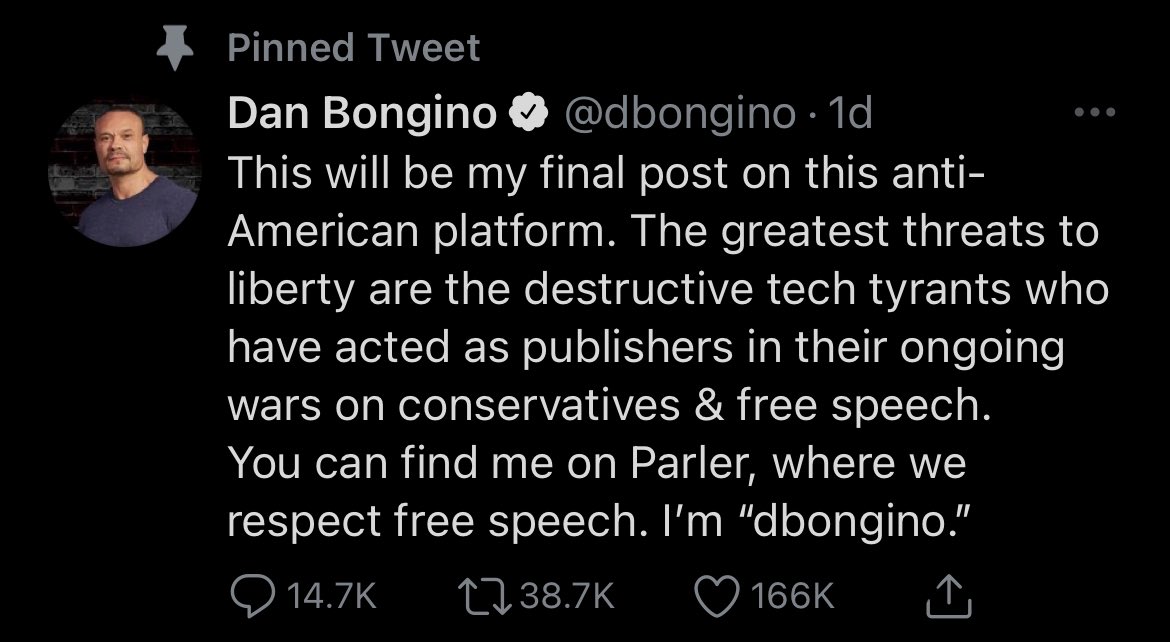
Fox News host Dan Bongino has returned to posting on Twitter after telling his supporters in January of this year that he would be leaving and never returning to the “anti-American” social platform after giving it up for Parler, the right-wing alternative where Bongino has claimed to be an investor. 

Bongino, a rising conservative media heavyweight, even told Twitter to “fuck off” while pledging he would never return to the popular social media site. “I’ll make my last post, my one final ‘Fuck you’ to Twitter — and you can print that, by the way — tomorrow,” the firebrand told The Wrap back in January.

The multiply-failed Republican congressional candidate turned Fox News host also wrote on Twitter — in a tweet that has since been deleted tweet — that his supporters should follow him to Parler. 

“This will be my final post on this anti-American platform. The greatest threats to liberty are the destructive tech tyrants who have acted as publishers,” Bongino declared. “You can find me on Parler,” he added. 

But sometime in May, only five months after declaring he was leaving Twitter for good, Bongino’s account became active again, retweeting right-wing content. In early June, Bongino suddenly started posting again, never mentioning his departure or his vows not to return.

“Lt. Gov. Mark Robinson to Appear on Unfiltered With Dan Bongino,” he tweeted on June 12 from his iPhone. 

Bongino didn’t respond to multiple Salon requests for comment on this story. 

It’s unclear exactly what prompted Bongino’s return to Twitter, but there’s plenty of speculation as to why the tough-talking former Secret Service agent has reversed field. For starters, Parler, in which Bongino claims to be an investor, is on the skids after the Jan. 6 Capitol riot, with the platform being booted from Amazon’s web services and hosting platform.

Since then, as Salon has reported, Trump supporters and MAGA loyalists have apparently started bailing out on Parler following a series of extended blackout periods. To this day the site remains extremely glitchy and it’s clear that Trump supporters or other denizens of the far right are dubious that it offers a viable platform for the future. 

Another possible reason why Bongino may have fled Parler lies in the theory that he got hustled by right-wing billionaire Rebekah Mercer and never received actual shares in the social media company, a claim made by former Parler CEO John Matze in court documents filed in March. Bongino has fervently denied Matze’s allegations, although Bongino has also publicly distanced himself from day-to-day operations at Parler. 

How the mainstream media fell for the Lafayette Square whitewash

The gassing of protesters at Washington’s Lafayette Square in June 2020, by all appearances intended to clear the area for a photo op by then-President Trump, was witnessed in person by dozens of reporters and remotely by millions of television viewers. But a review by the inspector general (IG) of the Interior Department, the parent agency of the U.S. Park Service that administers the square, ostensibly clears the Park Service of gassing the crowd to accommodate Trump.

The following headlines are typical of the major media’s reporting of the finding. USA Today says “Police did not clear protesters from Lafayette Park for Trump photo op, inspector general finds.” CNN: “Watchdog report finds Park Police did not clear racial injustice protesters from Lafayette Park for Trump’s visit to St. John’s Church last June.” ABC News: “Police did not clear Lafayette Square so Trump could hold ‘Bible’ photo op: Watchdog.” Does this mean exoneration for Trump and the agencies dealing with the incident?

No, not even close. Nor could it demonstrate much of anything, given both the predetermined scope of the report in question as well as the gradual deterioration of agency IG operations in general over the years.

As a former career staff member for Congress, I was a major institutional “customer” of IG reports. Congress created the IGs in 1978; the intention was to have an independent watchdog in each department of the executive branch to expose waste fraud, abuse, and mismanagement.

While created with good intentions, I began to sense that the IGs had gradually succumbed to bureaucratic sclerosis and capture by their own departments. They became narrowly focused on whether the subject of their investigations adhered to established processes, while ignoring questions of the competence, judgment, or honesty. In short, the watchdog seemed toothless to me.

To test my impression, I asked Brian J. O’Malley, a retired government official who had the double benefit of working both for Congress, where he was a consumer of IG material, but also in the IG office of the Transportation Department, where he helped root out the waste and contractor fraud behind Boston’s “Big Dig” tunnel project.

He noted that there is more than one category of IG report. The first is an audit conducted in accordance to Government Accountability Office (GAO) standards found in a volume called the Yellow Book. It is an extensively documented process that has cross-referenceable workpapers for every finding in the audit and those are scrutinized by an independent team of auditors for thoroughness and lack of bias. 

The second is an inspection conducted in accordance with those GAO standards found in the so-called Gray Book. It is a faster procedure, providing a snapshot of the operational condition of the reviewed agency’s status with respect to any given situation. There are work papers to validate findings but they are not as extensively scrutinized, although they are reviewed for lack of bias.

Then there is the case of the Special Review, such as that of the Lafayette incident: Review of U.S. Park Police Actions at Lafayette Park, Case No. OI-PI-20-0563-P. It is neither an audit nor an inspection. It is a review. There are no standards for reviews, no verification by an independent reviewer, and no review for bias. In fact, the review plainly states its extreme limitations. Here are some excerpts:

Our oversight obligations are focused on the DOI, and our authority to obtain documents and statements from non-DOI entities is more limited.

… [W]e interviewed more than 20 USPP and NPS officials involved in policing the protests in and around Lafayette Park on June 1, including then USPP Acting Chief of Police Gregory Monahan, the USPP incident commander, the USPP operations commander, and the USPP deputy operations commander. We also reviewed the USPP’s administrative record, emails, text messages, and video footage from observation posts.

Finally, we reviewed U.S. Department of Interior (DOI) and USPP policies and procedures, open-source videos, media articles, and congressional testimony.

Therefore, the review was only of Interior Department personnel, the department’s documents and apparently some media coverage. In a footnote in miniscule font size the review points out:

Because our review focused on the operational actions of law enforcement, we did not seek to interview protesters for this review.

The principal limitation, which was rather breathtaking, was described as follows:

Accordingly, we did not seek to interview Attorney General William Barr, White House personnel, Federal Bureau of Prisons (BOP) officers, MPD [Washington Metropolitan Police] personnel, or Secret Service personnel regarding their independent decisions that did not involve the USPP.

Despite this complete lack of information from any of the other agencies involved, the IG review stated unequivocally that there was no evidence that the Park Police cleared Lafayette Park to allow the President to survey the damage and walk to St. John’s Church. Virtually the whole review rested on the purported issue of the Park Police clearing the area to allow the contractor to install fencing.

But the Park Police would have had no idea what the other agencies were doing and what their leaders were ordering:

Finally, we found that the USPP and the Secret Service did not use a shared radio channel to communicate, that the USPP primarily conveyed information orally to assisting law enforcement entities, that an assisting law enforcement entity arrived late and may not have received a full briefing on the rules of engagement, and that several law enforcement officers could not clearly hear the incident commander’s dispersal warnings.

And another tiny footnote states that the Park Police was not even running the operation:

The USPP acting chief of police was in Lafayette Park on June 1 serving in his role as the chief of police, but he did not direct the unified command.

What is one to make of this report? O’Malley told me the following: “Like many efforts by inspectors general it seeks to deflect criticism of their own department by defining problems so that they lie outside the scope of their review. It clearly does not absolve anyone in the White House or then-Attorney General Barr from meddling in the situation as a political stunt. This report is a shameful, cover-your-ass effort to throw other agencies under the bus for all the disgraceful actions on that day. It has been exploited by the malefactors of that day to provide a fig leaf of phony exoneration.”

Despite most of the media having been bamboozled, some journalists weren’t having any of it. The Washington Post’s Philip Bump analyzed the available video of the incident, and concluded that William Barr’s talking with the site commanders on scene just prior to the clearance operation would certainly tend to discredit, if not altogether refute, the IG’s review.

CNN’s Jim Acosta, who was covering the White House at the time of the incident, was more unequivocal: “And I have to say, when I read through this report, it sounded as if this inspector general was auditioning to become the inspector general at Mar-A-Lago because this is almost a whitewash of what occurred on June First.” Inevitably, Acosta was attacked in personal terms by perennial crank Glenn Greenwald, who conveniently forgot his prior belief that civil servants were an insidious Deep State seeking to bring down Trump. Now, he accused Acosta of “maligning the reputation of a well-respected career civil servant.”

The slipshod IG review is highly significant for three reasons.

First, it is symptomatic of the systemic decline of both government capacity and government’s role as a disinterested organ of public service. This decay been going on since at least the early 1980s, but the rot accelerated with frightening speed during the Trump presidency. The disastrous response to the COVID pandemic in 2020 was a flashing red light warning us that when competence and honesty decline, and when agencies are hollowed out, people get hurt.

Second, it is a sign that the U.S. news media never learned its lesson from its four-year brush with covering an authoritarian political party in power. It seems so eager to show everyone that it is “balanced” that it cannot even take the trouble to thoroughly read a document. A similar phenomenon has just recently occurred with the lab theory of the origin of coronavirus.

There is no credible evidence that the theory is true – yet. Just as the IG report “exonerated” Trump of a photo-op stunt, the media is all but declaring that the Trump administration’s insistence that COVID came out of a Chinese lab “vindicates” them, although the administration had nearly a year to produce evidence and showed none.

Finally, we are now facing another scandal of huge proportions: the Trump administration’s seizing the metadata of journalists, Democratic members of Congress, and their families. It hardly inspires confidence that after several months in office, Attorney General Merrick Garland did not at some point hold a press conference announcing the story and vowing that the heads of those responsible would roll. Instead, the New York Times broke the news.

It is likely that after some pressure from Congress, the Department of Justice will announce that it will investigate itself. But the prospect that the department’s IG will produce a more credible report than that of the Interior Department just might be a triumph of hope over experience.

Could Trump’s war on Lisa Murkowski help turn Alaska’s Senate seat blue?

When Donald Trump endorsed right-wing extremist Kelly Tshibaka Friday as his choice for Alaska senator in 2022, most observers focused on how he was exacting vengeance on Sen. Lisa Murkowski, Tshibaka’s incumbent opponent.

But they might have missed a bigger story: Trump’s support could open a door for the Democrats to flip Alaska’s Senate seat.

Here’s the reason: Alaska will be introducing a new ranked-choice voting system in 2022, one that’s unlike any other in the nation. It provides first for a nonpartisan open primary in August from which the top four vote-getters move onto to the November general election, regardless of party affiliation.

If one of the candidates then receives more than 50 percent (+1) of the vote in that four-way race, the election is over. But here’s the innovative part: If no candidate wins the simple majority, it sets off an electronic battle for others’ second-place votes.

This is how it works: If there’s no 50 percent (+1) winner, the candidate with the fewest first-choice votes would be eliminated. People who voted for that candidate as their first choice would have their votes redistributed to the person they selected as their second choice.

If that doesn’t produce a majority winner, the process is repeated with the 3rd-place finisher having their second-place votes redistributed. At that point, whichever of the two remaining candidates has the most votes would be declared the winner, with no runoff election.

In the past traditional system, Tshibaka would have been the odds-on favorite to win a Republican primary over Murkowski and then to breeze to victory. The state Republican Party censured Murkowski in March for, among other things, voting for Trump’s second impeachment and for voting to certify President Joe Biden’s election. She’d have had no chance in a GOP primary.

But the advent of the “top four” open primary spared Murkowski of having to run one-on-one against Tshibaka among Alaska Republicans. And that changed everything.

Now, Tshibaka will likely need to face off against Murkowski, a top Democrat, and an Independent in a November 2022 general election. If she cannot win a simple majority in such a 4-way race, she’ll need to hope that some supporters of her rivals made her their second-place choice.

That’s a heavy lift. Here’s an early snapshot of the race, based on a Change Research survey of likely Alaskan voters taken less than a month ago:

  • Tshibaka: 39%
  • Al Gross: 25%
  • Murkowski 19%
  • John Howe 4%

Gross (who hasn’t announced a 2022 candidacy yet) received 41.2% of the 2020 Senate vote as the Democratic challenger, losing to Sen. Daniel Sullivan. Howe, the Alaskan Independence Party nominee, received 4.7% in that race.

Using these poll numbers as a hypothetical, Tshibaka is outpolled 48-to-39 percent by her collective rivals. And her number only goes up if supporters of the 3rd and 4th place finishers listed her as their second choice.

A big question facing Tshibaka is how many Gross, Murkowski and Howe voters would be willing to cast a second-choice vote for a homophobic extremist. And Tshibaka certainly fits that description, as reported April 27 at RawStory.com:

Tshibaka “has written in favor of the discredited “conversion therapy” and blamed homosexuality on childhood sexual abuse…A CNN KFile investigation turned up her past writings urging gay individuals to use Christianity to “work through the process of coming out of homosexuality” and denouncing the “Twilight” book and movie series as “evil.

“Some say this book is harmless, that it promotes Christian values, and that it does not promote anything wicked at all. But Satan does not usually look repulsive, horrific, and evil on the outside,” she wrote in an October 2009 blog post. “Make no mistake: ‘Twilight’ is a perfect example of how the enemy twists, perverts, and ridicules the things of God. This is his m.o. This is how he works.”

More recently, there was this from CNN in April:

“We don’t know the outcome of the 2020 election,” Tshibaka responded when asked whether she agreed with Trump that he won the 2020 election. “I still have questions, and I think millions of other Americans do too.”

None of that weirdness is likely to persuade Democrats, independents and RINOs to enter “Tshibaka” on the second-place line. And if they don’t, she’d need to figure a way to get a huge Republican-base turnout in a state known for its independence of traditional politics.

It’s uncertain how much Trump helps. He did win Alaska twice, but the 52.8% majority he won in 2020 was his fourth-lowest total among red states. That’s in part because Alaska had the nation’s highest percentage of independent votes cast for president.

That’s not an ideal setting for Trump’s demagoguery. Calling Murkowski “the failed candidate…(who) represents her state badly and her country even worse” — as he did according to Politico last month — isn’t a great strategy for recruiting second-choice votes for Tshibaka among Murkowski fans.

Nor is Trump’s promise to travel 5,000 miles to campaign against Murkowski. Nor is what he said Friday, as reported by the New York Times.

“Lisa Murkowski is bad for Alaska,” Mr. Trump said in a statement, criticizing her vote to confirm Deb Haaland as secretary of the Interior Department. “Murkowski has got to go!”

For her part, Murkowski is not to be underestimated. She has won three full Senate terms since her controversial appointment to the seat in 2002 by her father, then-Gov. Frank Murkowski. She has never won 50 percent of the vote in winning her elections, but she even succeeded as an independent when beaten in the 2010 Republican primary after a Tea Party uprising.

This time might be different. She wasn’t then facing a competitive challenger on the Democratic side like Gross, a center-right, pro-gun politically independent doctor who raised a staggering $19 million for his first electoral foray in 2020.

The Change Research poll found Murkowski with a 59-to-26 percent negative overall approval rating among Alaskans, including an astonishing 84-to-6 negative standing in her own Republican Party. It’s an uphill battle at best.

Still, if Gross doesn’t run and the Democrats don’t field a strong contender in his place, Murkowski could eke out a triumph in the end even after finishing well behind Tshibaka in the initial round. That is, if she can hold Tshibaka far enough below 50 percent in round one.

It’s a scenario anticipated by the reformers who put ranked voting on the 2020 ballot: A divisive candidate can no longer leverage a narrow primary victory to breeze to office through electoral math. And the more a candidate alienates rivals, the harder it is to grow one’s vote totals as those rivals get eliminated in the ranked-choice process.

Trump’s negative attacks could conceivably backfire and help rescue Murkowski, which would be his worst nightmare. But for now, the more plausible prospect is that Alaska could turn blue — for at least this one Senate seat — thanks to ranked voting.

Obviously, it’s far too early to know, but not too early to understand how the new process works. For a state that prides itself as America’s “last great wilderness,” the 2022 election may live up to that claim.

You can learn more about the new ballot process here and here.


“You can call it Trump discrimination”: Ex-Trump administration lawyers struggle to find jobs

In the wake of Donald Trump’s presidency, some of the lawyers who had top roles in his administration are having trouble finding a job, Bloomberg reports.

Ken Cuccinelli, who served as Deputy Secretary of Homeland Security under Trump, said that a recent job opportunity slipped through his fingers because they “decided they didn’t want Trump people.”

“It was just flat out—you can call it Trump discrimination,” he said.

Bloomberg’s John Hughes and Jasmine Han reported that other top lawyers from the Trump administration who were closely connected to his most controversial policies have struggled to find post-Trump presidency positions.

“I don’t think anyone coming out of the George W. Bush administration was told, ‘We can’t hire this person,'” Cuccinelli said. “I’m sure Jan. 6 made it that much worse than it ever would have been.”

Former Attorney General William Barr, former Acting Attorney General Jeffrey Rosen, former U.S. Trade Representative Robert Lighthizer, and former White House counsel Pat Cipollone are among those who still haven’t found full time jobs.

Read the full report over at Bloomberg.

7 people who hated Jane Austen’s “Pride and Prejudice”

It is a truth universally acknowledged that few books are as beloved as Jane Austen’s “Pride and Prejudice,” which was published on January 28, 1813. It appears on best-loved literature lists across the globe, is a fixture in high school classrooms, and has spawned a rabid fan base and countless film and television adaptations.

The story of how Miss Elizabeth Bennet’s disdain for the wealthy, prideful Fitzwilliam Darcy turned to love has never been out of print, and has sold more than 20 million copies since its first appearance more than 200 years ago. Austen’s family, however, probably didn’t see much of that success: She sold the novel’s copyright to her publisher for £110 (just over $10,000 in today’s dollars) and died just a few years later, in 1817. Though the novel was reviewed positively and was well-received by the upper classes at the time, it was no widespread sensation. It wasn’t until the 20th century that the book and its author were rediscovered and lifted to the rarefied place in the English literature pantheon they hold today.

Since then, few books have been reinvented as much and as often as “Pride and Prejudice”: In addition to the straightforward adaptations for film, television, and stage, the story has been re-set in 20th century London (“Bridget Jones’s Diary“), in Bollywood (“Bride and Prejudice”), at a Mormon university (“Pride and Prejudice: A Latter-Day Comedy”), in modern-day Israel, around New York’s rock scene, during a zombie apocalypse, and put to music (Jane Austen’s “Pride and Prejudice: A Musical“).

The story has been re-told from Darcy’s perspective (“Darcy’s Story”), shifted to America (“Darcy on the Hudson)”, and, of course, transformed into soft-core Regency-era erotica (“Pride & Prejudice: Hidden Lusts;” “Pride and Prejudice: The Wild and Wanton Edition”). It’s been expanded in hundreds of pieces of published fan fiction, from best-selling crime novelist P.D. James’ “Death Comes To Pemberley” to “Mrs. Darcy Versus the Aliens,” which is exactly what it sounds like. In 2009, Sir Elton John’s Rocket Pictures even talked about producing Pride and Predator,” a mash-up pairing Regency England with the be-mandibled aliens of the Predatormovies (regrettably, it never panned out).

But despite how beloved “Pride and Prejudice” is, there have been plenty of people who hated it. Here are seven of them.

1. Charlotte Brontë

In 1848, 31 years after Austen’s death, Charlotte Brontë picked up “Pride and Prejudice” on the recommendation of friend and literary critic George Henry Lewes. Brontë, author of the grim “romance” “Jane Eyre,” wasn’t backwards about coming forward with her criticism: “Why do you like Miss Austen so very much? I am puzzled on that point,” she wrote, explaining that she got the book after Lewes talked it up. “And what did I find? An accurate, daguerreotyped portrait of a commonplace face; a carefully-fenced, highly-cultivated garden, with neat borders and delicate flowers; but no glance of a bright, vivid physiognomy, no open country, no fresh air, no blue hill, no bonny beck. I should hardly like to live with her ladies and gentlemen in their elegant but confined houses.”

Two years later, Brontë took up the theme again, in a letter to another friend: “[A]nything like warmth or enthusiasm, anything energetic, poignant, heartfelt, is utterly out of place in commending these works: all such demonstrations the authoress would have met with a well-bred sneer, would have calmly scorned as outré or extravagant. She does her business of delineating the surface of the lives of genteel English people curiously well . . . [But] She no more, with her mind’s eye, beholds the heart of her race than each man, with bodily vision, sees the heart in his heaving breast. Jane Austen was a complete and most sensible lady, but a very incomplete and rather insensible (not senseless) woman.”

2. Winston Churchill

It’s a little too strong to say that Winston Churchill hated “Pride and Prejudice,” as Britain’s beloved Prime Minister seems to have found some comfort in the book as the Second World War ground on. But he did have some mild complaint about it: “What calm lives they had, those people! No worries about the French Revolution or the crashing struggle of the Napoleonic Wars. Only manners controlling natural passion as far as they could, together with cultural explanations of any mischances.”

3. Ralph Waldo Emerson

Ralph Waldo Emerson, having read both “Persuasion” and “Pride and Prejudice,” bemoaned the fact that all anyone in the books seemed to care about was money and marriage: “I am at a loss to understand why people hold Miss Austen’s novels at so high a rate, which seems to me vulgar in tone, sterile in artistic invention, imprisoned in the wretched conventions of English society, without genius, wit, or knowledge of the world. Never was life so pinched and so narrow . . . Suicide is more respectable.”

4. Virginia Woolf

In a 1932 letter to a friend, “Mrs. Dalloway” author Virginia Woolf had faint praise for Austen: “Whatever ‘Bloomsbury’ may think of Jane Austen, she is not by any means one of my favourites. I’d give all she ever wrote for half what the Brontës wrote — if my reason did not compel me to see that she is a magnificent artist.”

5. D.H. Lawrence

D.H. Lawrence, author of “Lady Chatterley’s Lover” (published in 1928), intensely disliked the England Jane Austen represented both in her novels and personally. In 1930, he wrote, “This again, is the tragedy of social life today. In the old England, the curious blood-connection held the classes together. The squires might be arrogant, violent, bullying and unjust, yet in some ways, they were at one with the people, part of the same blood-stream. We feel it in Defoe or Fielding. And then, in the mean Jane Austen, it is gone. Already this old maid typifies ‘personality’ instead of character, the sharp knowing in apartness instead of togetherness, and she is, to my feeling, English in the bad, mean snobbish sense of the word, just as Fielding is English in the good generous sense.”

6. Madame Anne Louise Germaine de Staël

This French-speaking Swiss writer, a great patron of the literary salon who lived contemporaneously with Jane Austen (they even died in the same year), pronounced “Pride and Prejudice” “vulgaire.”

7. Mark Twain

It was that great American man of letters, Mark Twain, who had the meanest thing to say about poor, dead Jane Austen and her books: “I often want to criticize Jane Austen, but her books madden me so that I can’t conceal my frenzy from the reader; and therefore I have to stop every time I begin. Every time I read ‘Pride and Prejudice’ I want to dig her up and beat her over the skull with her own shin bone!”

Many thanks to Gary Dexter’s fabulous “Poisoned Pens: Literary Invective from Amis to Zola” for corralling a number of these quotes.

Do you love reading? Are you eager to know incredibly interesting facts about novelists and their works? Then pick up our new book, The Curious Reader: A Literary Miscellany of Novels and Novelists, out May 25!

Why do women still get judged so harshly for having casual sex?

F. Scott Fitzgerald famously called the Roaring Twenties – which happened on the heels of the 1918 flu pandemic – “the most expensive orgy in history.”

Now, as more and more Americans are vaccinated, some are saying all the sexual energy pent up over the past year will be unleashed, with Yale sociologist Nicholas Christakis predicting a summer marked by a surge in “sexual licentiousness.”

Women, however, might face backlash for exploring their post-vaccination sexuality. In a new study, we found that women – but not men – continue to be perceived negatively for having casual sex.

This stereotype persists even as casual sex has become increasingly normalized and gender equality has risen in the U.S. and much of the Western world.

Specifically, both men and women assume that a woman who has casual sex must have low self-esteem.

But that perception isn’t based in reality. So what might be driving this unfounded stereotype?

A belief held across religious and political divides

Although the idea that women’s sexual behavior is linked to their self-esteem is a common trope in film, television and even some relationship advice sites, we documented just how entrenched this stereotype is across six experiments published in Psychological Science.

In one experiment, we asked Americans to estimate the correlation between people’s sexual behavior and their self-esteem. We described those people as being a man, woman or simply as “a person,” without providing any information about their gender. We then described that man, woman or person as having a lot of casual sex, portrayed them as being a serial monogamist or provided no information about their sexual behavior.

We found that Americans tended to associate monogamy with high self-esteem, especially for women. More striking, they associated casual sex with low self-esteem – but only for women.

This belief was surprisingly widespread, and across our studies we found that both men and women hold it.

We wondered: Was this stereotype the product of sexist beliefs? Could it be due to participants’ political ideology or their religion?

But time and again, we saw that this stereotype transcended a number of markers, including the extent to which someone held sexist beliefs, their political views and their religiosity.

What if a woman says she wants casual sex?

However, people might believe that women don’t want casual sex in the first place. For example, people might assume that women have causal sex only because they’re trying and failing to attract a long-term relationship. In fact, such beliefs do seem to influence the stereotype about women’s self-esteem.

Specifically, the more that Americans believed that women don’t actually want casual sex, the more these Americans tended to associate women’s casual sex with low self-worth.

This finding inspired another experiment. We wondered what would happen if we told participants that a woman was actually perfectly happy with her casual sexual lifestyle. Might that change their beliefs?

But even this factor didn’t seem to stop the stereotyping. Participants still saw these women as having low self-esteem. And they even perceived a woman described as having monogamous sex – but who was deeply dissatisfied with her monogamous sex life – as having higher self-esteem.

Here’s the kicker: Among our participants – the same ones who showed this stereotyping – we found virtually no association between their self-esteem and their own sexual behavior.

These findings are similar to those of psychologist David Schmitt, who conducted a survey of more than 16,000 participants drawn from all over the world, and also found little association between self-esteem and casual sex.

And in our study, it was actually the men who reported having more casual sex who also tended to have slightly lower self-esteem.

Do our Stone Age brains play a role?

So why do people hold this negative assumption about women who have casual sex – especially if it doesn’t hold water? The short answer is that we currently do not know, and associations between sex and self-esteem in the real world are complex.

Some people might wonder if the media is to blame. It’s true that women who have casual sex are sometimes portrayed as being somehow deficient. But this doesn’t tell the whole story. Even if popular media perpetuates this stereotype, it still doesn’t explain why people would feel compelled to portray women this way in the first place.

Another possible explanation is that the stereotype extends from reproductive biology, in which men have historically had more to gain from casual sex than women, who – since they risk getting pregnant – often have to bear greater costs, on average, than men.

Yet today, newer technologies – like birth control and safe, legal abortion – allow women to have casual sex without being forced to bear some of those unwanted costs. Perhaps, then, our Stone Age brains have simply not yet caught up.

Whatever the origin of this stereotype, it’s likely to foster prejudice and discrimination today. For example, people perceived to have low self-esteem are less likely to be asked out on dates or elected to political office.

This stereotype might also have led to seemingly well-intentioned – but ultimately misguided – advice directed toward girls and women about their sexual behavior. There is a cottage industry built around telling women what sort of sex not to have. (Searching for books on “friendship advice” on Amazon yields fewer than 40 results, but searching for “dating advice” returned over 2,000.)

In Western society, women are rarely disparaged for breaking glass ceilings to become leaders, professors, CEOs and astronauts.

So why do they continue to be denigrated as they become increasingly open and willing to go to bed with others at their own whim, of their own accord?

Jaimie Arona Krems, Assistant Professor of Psychology, Oklahoma State University and Michael Varnum, Associate Professor of Psychology, Arizona State University

This article is republished from The Conversation under a Creative Commons license.

My breast implants are making me sick — and I’m not alone

In November 2016, a few weeks after I had breast implant surgery, I came down with an unexpected case of thrush (an unappealing fungal infection characterized by a thick white coating on my tongue). As a Black married mother of two, even though I was still sick, I tried — but failed — to power through and take care of my kids. With intense flu-like aches, pain, and fever, it hurt to eat, drink, swallow, or even open my mouth. I couldn’t properly brush my teeth for several days.

Unfortunately, my primary care physician was on vacation. Panicked, I called the Manhattan oncologist whom I had seen a few weeks earlier. He’d been very kind to me following my DCIS breast cancer diagnosis, unilateral mastectomy and post-surgical treatment. The officer’s medical team could barely understand me when I tried to make the appointment on the phone.

“I don’t think you have thrush — didn’t I just see you a few weeks ago?” he said, trying to put me at ease as I stared at his cheerful neon tie. (I think he prided himself on his fun ties.)

It was torture opening my mouth so the doctor could diagnose me.

“Okay, that’s the worst case of thrush I’ve seen in some time,” the seasoned specialist said. He said he was putting me on antibiotics stat. I asked — or rather, wrote on a notepad, since I couldn’t speak clearly — if there could be any connection between the my immune system and the very new breast implant that was now in my body. The oncologist emphatically dismissed the notion as impossible.

Once he got the results of my lab work back, my physician said there was no evidence of anything wrong; I should bounce back in a few days. “These things sometimes happen,” he told me, smiling as he ushered me out.

While the antibiotics eventually cleared up the thrush, unfortunately I have never fully bounced back. In subsequent years since my breast implants were put in, it became even more clear that something was going on with my immune system. But none of my doctors really listened.

Although it was not formerly recognized by the medical community until recently, Breast Implant Illness (BII) has, in the past few years, finally received attention from both media and researchers. Nicole Daruda founded a Facebook’s support group, called Breast Implant Illness Healing by Nicole, in 2013; now, it boasts over 145,000 members. Daruda tentatively estimates that 50,000 women in the US have BII, although precise research-backed numbers are not readily available.

“We are overwhelmed by women trying to join the Facebook group to be educated about Breast Implant Illness,” Daruda said. She estimates that 3,000 to 5,000 women message the group’s moderators every month. To try to meet the demand, Daruda later founded a nonprofit, Healing Breast Implant Illness Society of North America.

Research is just barely starting to emerge on BII. One study, published in Annals of Plastic Surgery in 2020, followed 750 women suffering from Breast Implant Illness over a multi-year time period. Once these women surgically removed their breast implants, the vast majority reported the majority of their symptoms had significantly improved or disappeared entirely.

Awareness appears to be growing, too. A wave of celebrities are talking more openly about breast implants and their health and wellness — including Victoria Beckham, Ayesha Curry, Ashley Tisdale, Chrissy Teigen and others.

A documentary that touches on the subject of BII, “Explant,” is screening right now at the Tribeca Film Festival. The film follows Michelle Visage, one of the celebrity judges on “RuPaul’s Drag Race.” Visage, a media personality, singer, DJ and actor who was well known for her signature Double-D breasts, found that doctors didn’t take her seriously when she told the specialists her immune system was out of whack. Visage experienced chronic health issues, including Hashimoto’s disease, that she now attributes to her breast implants.


Want more health and science stories in your inbox? Subscribe to Salon’s weekly newsletter The Vulgar Scientist.


Awareness of BII is crucial given the popularity of breast implants. Since 1998, the number of breast augmentation procedures in the US has increased threefold; now, they are one of the most sought-out cosmetic procedures.

“The desire for breast augmentation seems so powerful regardless of what else is going on in the world,” said Dr. Diana Zuckerman, founder of the National Center for Health Research. “What most concerns me is how reluctant most plastic surgeons have been to make sure their patients know the risks before making a decision.”

Because breast implant technology has existed for decades, many women erroneously believe they are safe. Modern-day medical grade breast implants were pioneered in the early 1960s by a plastic surgeon duo, Drs. Frank Gerow and Thomas Cronin. Previously, doctors had used silicone material from U.S.-based company Dow Corning and injected it directly into women’s chests; in Japan and elsewhere, the results were disastrous. So, the Houston-area doctors tried a different approach: silicone-filled breast implants.

Over the years, Dow Corning’s implant products were exposed for unsafe practices, breast implants that frequently deflated, and lack of reputable clinical studies. Countless patient injury lawsuits followed. To restore confidence in breast implants, a number of research studies were later conducted. But the majority of these studies were funded by special interest groups that falsely touted a strong safety record.

Daruda saw her health decline gradually over a period of five years after she got breast implants, until she couldn’t even work. A Canadian from Vancouver Island, Daruda was often unable to do basic routine daily living activities due to a host of health issues, including kidney damage. After doing independent research and feeling dismissed by many medical professionals, Daruda decided to surgically remove her breast implants. Since then, she says she has seen significant healing. Today, Daruda’s support group and separate nonprofit both aim to provide information to women in need.

In the years after my implant, some of my symptoms mirrored women on support groups I found online, which is how I figured out I had Breast Implant Illness. While symptoms sometimes waxed and waned, I got used to experiencing a host of autoimmune and other symptoms like insomnia, brain fog, extreme breathlessness, cuts that took weeks to heal, rashes, frequent colds and much more.

But BII is no longer regarded as a myth. Many or even most doctors, including plastic surgeon Dr. Anthony Youn, believe Breast Implant Illness is real. Dr. Youn acknowledges it is a controversial topic among many of his fellow American plastic surgeons.

“If you’re happy with your breast implants and you don’t believe they are adversely affecting your health, then there is no need for treatment. If you are sick and believe your implants may be the cause, speak with your primary care physician and a board-certified plastic surgeon about whether explantation may be a possible solution for you,” Dr Youn said. “There are many causes of the symptoms of Breast Implant Illness (BII) that don’t involve breast implants, so it’s often best to rule those out first,” he continued.

In his 17 years of practice in the metro Detroit region, Dr. Youn, a member of the American Society of Plastic Surgeons and The Aesthetic Society, has performed surgery on thousands of women who elected to get breast implants. Anecdotally, he estimates the number patients who later returned to his practice stating they had Breast Implant Illness symptoms is an extremely small percentage.

Dr. Youn acknowledges the number of explant requests coming into his medical practice has grown since 2019. That year, the FDA held a series of hearings about whether there was a correlation between certain breast implants and a rare form of cancer called BIA-ALCL (breast-implant-associated anaplastic large-cell lymphoma). Dr. Youn notes that more scientific research is needed on Breast Implant Illness to better understand the condition.

And as for me: After the pandemic delayed my surgery, I’ve finally set a date with a reputable Long Island plastic surgeon to remove my breast implant. I am cautiously optimistic about healing, but realize after five years of having breast implants I may need an extended recovery. And I know my current health issues, like high blood pressure, may still need to be managed by medication even after my surgery.

Though not all women with breast implants go on to develop Breast Implant Illness, all women deserve education, informed consent, insurance coverage and most important information about potential risks. If, in 2015, there had been an FDA Breast Implant Black Box Warning (which was officially unveiled in late 2020), I honestly never would have gotten breast implants in the first place.

For a better cocktail sauce, ditch the Worcestershire and up the lemon zest

As we emerge, albeit slowly, from the confines of pandemic isolation, the food world is intently searching for the next it thing for our collective “hot vaxxed summer.” Some proposals have already hit headlines. “Espresso martinis have returned!” declared both the Washingtonian and The New York Times this past week. 

A quick scan on social media reveals that wedge salads are having an undeniable moment (enough so that I have the term “we sal” muted on Twitter for my mental health), while chilled seafood towers, bursting with almost unbelievably red lobster tails and plump oysters, loom over dining tables. 

Underlying all these proposed contenders for The Food/Drink of Summer 2021 is that when you order them, you really feel like you’re dining out. Of course you can shake up a cocktail or pile some king crab legs over ice at home — and you absolutely should — but after a year of being shut down, there’s something luxurious about eating something that feels like restaurant food. I think, too, that’s why many of these “re-emerging” dishes fall somewhere on the spectrum between classic and retro menu items. 

Put another way, I think we’re drawn to these foods right now because we’re excited to emerge, too. 

Food can be complicated for many people for many different reasons, but last year there was the additional weight of supply chain disruptions, issues of access and, on a more superficial level, the sense that it just got boring. 

We recognized this early at Salon and tried to power through with guides like Burned Out, my four-part series for folks who loved food, but were sick of cooking. At a certain point, however, trying to mix-and-match my go-to pantry staples — rice, coconut milk, chickpeas, tinned fish — in novel ways became a slog. 

I’d find myself daydreaming about a particular meal I’d had a couple years ago. I was in Washington, D.C., and had just landed a big, big assignment. To celebrate, a friend and I had reservations booked for a late dinner, but it was 4 p.m., just past the peak heat of early summer, and I wanted to treat myself early. I ended up on the patio of Hank’s Oyster Bar in Dupont Circle, where I ordered a gin and tonic (with an extra lime slice) and jumbo shrimp cocktail, served with a lemon wedge and a little ramekin of zesty cocktail sauce. 

The whole thing was really simple, but often the best things are and, unlike many of my meals in the last year, it’s memorable because it is inextricably linked to a feeling of palpable joy. I don’t try to recreate restaurant meals at home very often. Like I said, there are some things that just hit differently when you’re eating out. But I replicate this meal often — when I need a pick-me-up, when I need a simple supper, when someone I love is celebrating the joys in their own life. 

The key really is homemade cocktail sauce; it’s so simple that you really shouldn’t bother with the jarred stuff. Instead of the typical Worcestershire sauce, I really like to lean into briny and bright flavors by making a loose paste of apple cider vinegar, minced anchovies and lots of lemon zest. 

***

Recipe: The Summer’s Best Cocktail Sauce
Makes ¾ cups of sauce 

  • ½  cup ketchup
  • 3 tbsp. drained prepared horseradish
  • 1 tablespoon of lemon zest
  • 1 tablespoon of finely minced anchovies 
  • ½  tablespoon of apple cider vinegar
  • 10 drops of Tabasco 
  • Pinch of salt 

1. Combine all the ingredients in a medium bowl and mix vigorously until completely combined. Cover and place in the refrigerator until chilled. 

Read more Saucy

Packed with flavor and protein, this colorful salad is substantial enough to be a meal in itself

Packed with flavor and protein, this colorful salad is substantial enough to be a meal in itself. The added bacon is delicious, but you can eliminate it if you’re vegetarian. The salad is best when served right away, but it will keep overnight, even if it’s dressed.

***

Recipe: Spring Pea Salad

Yield: 4 to 6 servings

Ingredients:

  • 3 strips bacon, diced (optional)
  • 3 tablespoons olive oil
  • 1 tablespoon lemon juice
  • 1½ teaspoons Dijon mustard
  • 1 1/4 teaspoons honey
  • 1/2 teaspoon kosher salt
  • 1 medium garlic clove, minced
  • 2 cups frozen peas, thawed
  • 3/4 cup thinly sliced cucumbers
  • 3/4 cup thinly sliced radishes
  • 2 scallions, green parts only, sliced diagonally
  • 1/2 cup crumbled feta

Instructions:

In a large skillet over medium heat, cook bacon, stirring often, until browned and crisp, 8 to 10 minutes. Remove bacon with a slotted spoon and discard (or save) bacon grease.

In a medium jar with a tight-fitting lid, combine olive oil, lemon juice, mustard, honey, salt, and garlic. Shake well to combine.

Arrange peas, cucumbers, and radishes in a serving bowl. Top with scallions, feta, and reserved bacon bits. Drizzle with dressing and toss just before serving.

On AMC’s ambitious “Kevin Can F**k Himself,” Annie Murphy is a dutiful sitcom wife who goes rogue

The obvious and most direct inspiration for AMC’s “Kevin Can F**k Himself” is “Kevin Can Wait,” a long gone CBS half-hour starring Kevin James as a retired cop married to a woman played by Erinn Hayes. That is, until producers killed off her character between the first and second seasons. The reason, according to James, was that “we were literally just running out of ideas.”

Shocker! I mean, Hayes’ surprise firing certainly was, not the short life and creative bankruptcy “Kevin Can Wait,” the network’s attempt to recapture some of that old “King of Queens” magic. (Also, its ratings.)  But it was the way her character was knocked off that was equally infuriating and chilling. James’ comedy returned for a second season with its main character having skipped the mourning process and acknowledging his wife’s passing by pointing out a piece of junk mail with her name on it. From there, James headed back the familiar company of his previous show’s popular co-star Leah Remini.

Among the contemporaries of “King of Queens” are “Still Standing” and the one ABC hopes you’ll never forget, “According to Jim” – which slumped on for several seasons too long. All are examples of a once-popular, hacky formula: the plain and perhaps pudgy schlub and his hotter, smarter wife. The guys are dopey and relatable; their wives are responsible killjoys and, in their writers’ view, utterly disposable.

Currently this dynamic’s main representative is “Family Guy,” which should tell you something. An often-cited TV rule is that writers can get away with a lot more in animation than in live action. Nobody ever questions the resilience of Peter and Lois Griffin’s marriage despite Peter’s complete idiocy and selfishness because nothing about their world is bound to physics, common sense or reality. They are quite literally two-dimensional characters.

Whereas in “Kevin Can F**k Himself,” Annie Murphy’s challenge is to make us empathize completely with Allison McRoberts, a working-class wife whose life consists of catering to her useless and endlessly juvenile husband Kevin (Eric Petersen). When we see her she’s clearing Kevin’s dishes or putting food in front of him, or carting his laundry from one side of their cramped home to the other.

Add a laugh track and a few braying auxiliary characters, like Kevin’s dumbo best friend Neil O’Connor (Alex Bonifer) and Kevin’s good-for-nothing dad Pete (Brian Howe), and you’ve got some real must-see TV pabulum, or at best a miserable “Mare of Easttown” spinoff about a long-suffering wife.

Creator Valerie Armstrong (who previously worked on “Lodge 49”) takes these scenes and inventively has it both ways, careening Allison between dissimilar TV worlds as she hits her breaking point. In the too-bright, transparently staged multi-camera sitcom starring Kevin and his bros, she hides her rage because nobody’s watching, but she’s the star of a dour drama that captures her life in all its drudgery.

Armstrong recognizes the audience’s fatigue with this done-to-death and sexist half-hour format, and is smart to capitalize on the public’s strong affection for Murphy, who is fresh off an Emmy-winning run on “Schitt’s Creek,” to critique it.

If the actor were looking for a project that showcases her range and emotive agility, this will do it. She imitates the broad, hammy choreography of the network sitcom expertly, transitioning seamlessly between that side of Allison’s life and the one where the giggles never show up.

Murphy and the directors of photography effect these switches back and forth without warning, constantly keeping the viewer on her toes since the divide between the two is as thin as the threshold between Allison’s kitchen and her living room.

But as Allison questions how long she can keep this up – this, being her terrible marriage to a man-baby draining the life out of her – so do we.

Watching the first two episodes of “Kevin Can F**k Himself” drives home how stagnant the dumpy Mars and hausfrau Venus formula always was, and that accurate rendering soon becomes this show’s fatal flaw.

Showrunner Craig DiGregorio delineates the satirical nature of the comedy side with total clarity, but it’s still a show where the purported lead, Kevin, isn’t funny and the punchlines are forced. If you’re lampooning the worst kind of show over the course of one or two episodes it translates as parody. If you keep doing it beyond that, you’re becoming what you originally intended to parody. And few shows wear out their welcome quicker than a soulless, candy-colored yuk-fest or a drab drama permeated by sickly lighting

Petersen’s Kevin is an outstanding living cartoon of a man, but has no redeeming qualities. You won’t wonder why Allison wants him out of her life – you’ll want him gone too.

If only the gray-toned dramatic side of her existence offered respite. No such luck. Indeed, one of the most defeating parts about this show is the fact that virtually no one in Worcester, Massachusetts is on Allison’s side save for a recently returned high school friend (Raymond Lee). His life and social circle could not be more separate from hers, though. 

Allison’s next-door neighbor Patty O’Connor (Mary Hollis Inboden), Neil’s sister, is a more regular feature in her life, and she absolutely resents Allison’s ambition and hopefulness, taking pleasure in watching the illusions that help Allison cope shatter one by one. Yet Allison seeks validation from Patty time and again for reasons that aren’t immediately apparent and, at least in the four hours made available for review, insufficiently explained.

Although the concept has more appeal than the reality, there’s hope that “Kevin Can F**k Himself” could turn into a better show in the back half of its eight-episode season. Judging from the opening four hours, pulling that off would require quite a hoist. Still, Murphy’s strong performance and the solid enough premise hold the possibility of some kind of turnaround.

Whether such a rescue is possible will depend in part on whether the writers figure out that only one of the two shows we see here is worth expanding upon, and it’s not the one propped up by canned laughter.

“Kevin Can F**k Himself” premieres with two episodes at 9 p.m. Sunday on AMC.

In a California town, a recreation boom kindles wildfire anxiety

Across the U.S., vaccine vacation season has begun. In April, The Atlantic reported that Americans were "on the verge of going bonkers" with accrued paid-time off. Prices for summer airfare have risen dramatically since President Joe Biden's March 11 speech expressing optimism that the pandemic would subside in time for a proper Fourth of July bash.

In Mammoth Lakes, California, a town in the Eastern Sierra known for its skiing and outdoor recreation, tourism has been booming. The town's residents are terrified. After 2020's landscape-altering fire season, in which 4 percent of the total area of California burned, Mammoth Lakes locals are keenly aware that rises in tourism come with unique wildfire risks. There is a new and inescapable awareness that each new visitor has the capacity to light the match that starts the fire that destroys their community.

Sometimes, these ignitions are intentional; more often, they are mistakes. I have seen some. During the first of five seasons that I worked in alpine ecosystem restoration in the Eastern Sierra wilderness, I spent two weeks high on the Pacific Crest Trail north of Mammoth Lakes. Over the course of one week that summer, my team found three escaped campfires, including one just hundreds of feet from our camp that had engulfed a lodgepole pine. It took a helicopter and two days for the fire crew to tamp it down.

Like many towns across the Western U.S., Mammoth Lakes has seen a surge in outdoor recreation since the Covid-19 pandemic began. Campgrounds and short-term accommodations like AirBnb rentals closed in the Eastern Sierra with California's first round of lockdowns. People came anyway. They parked RVs in pull-outs on roadsides and in the dirt between pines. Sometimes, they left their refuse, human waste, and poorly-extinguished campfires.

Local officials were justifiably concerned. As many as nine in 10 wildfires are human-caused. Mammoth Lakes' Forest Service office is habituated to responding to these types of incidents. In a sagebrush flat outside of town, a recreational hunter fires a gun. A spark lands in the sagebrush; one-tenth of an acre burns. A heavy equipment operator ignites the underbrush. 65 acres burns. A mountain biker's pedal strikes a rock as the rider leans into a turn on a tight corner. 122 acres burns.

And the campfires. To campers, the little rock-ringed flames are indispensable, an essential iconography of outdoor recreation. But the shovel and five gallons of water, which the state fire permitting agency advises should always be kept on hand, are less frequently part of the reverie of fire-building. If a fire is not fully drowned, embers can catch in the wind. And then, what was started for smores spreads, igniting the dry brush around it. A wildfire begins.

Historically there have been vanishingly few serious wildfires around Mammoth Lakes that began with a camper striking a match. Of the county's 18 significant wildfires between 2002 and 2018, none are known to be caused by an escaped campfire, although some had inconclusive investigations. Nonetheless, campfires remain a major source of ignitions in the U.S.

Mammoth Lakes is particularly vulnerable right now. Around 44 percent of the town (as categorized by the county sheriff's regional hazard analysis) is a high wildfire severity zone. Intense fire suppression efforts across the Sierra Nevada have increased the density of understory, forest-floor vegetation that can act as a wildfire accelerant. Plus the region is experiencing massive beetle kill and drought.

"The fuel load is super-primed to carry fire, more so than it ever has been before," Janet Hatfield, a project manager at Plumas Corporation and at the Whitebark Institute of Interdisciplinary Environmental Sciences, both nonprofit environmental organizations, told me. In a region where every incident of ignition could wreak irreversible destruction, each new potential actor is a perceived threat. As of this May, firefighters at Inyo National Forest, which surrounds Mammoth Lakes, have already responded to 20 fires, mostly human-caused.

This fire anxiety is tender. Emotional recovery from last year's record-shattering fire season has barely begun. Memories still linger of the Creek Fire, the state's largest ever single-ignition burn. The cause of the Creek Fire is under investigation, but it began on a day without any lightning. Within the fire's first few hours, it infamously came to surround dozens of tourists who needed to be evacuated via helicopter dispatches. The fire's eastern edge sprinted, then crept, towards Mammoth Lakes, until finally it was separated from the town's border by only a single creek and the steep-walled canyon it ran through. The flames were so close that, in an act of desperation, employees at the Mammoth Mountain Ski Area pointed the resort's winter snow-making machines in the direction of the fire — though they ultimately were not used. In Mammoth Lakes, residents could see smoke rising from the last remnants of the Creek Fire for a third of a year, until the first big winter storm came in December.

This year, local officials are mobilizing in advance. The Eastern Sierra Dispersed Camping Collaboration (ESDCC) formed last winter to address issues related to the area's "dramatic increase in dispersed camping," which is legal on almost all National Forest land. (Near Mammoth Lakes, which faces one of the worst housing crises of any ski town in America, that surge has been driven in part by a growing number of unhoused locals, some of whom encamp on the nearby public lands.) Campfires outside of developed campgrounds are at the top of the ESDCC's list of priorities.

After months of advocacy by the ESDCC and others, three counties in California — including Mono County, home to Mammoth Lakes — preemptively issued fire restrictions that took effect on May 24 banning campfires outside of fire rings or pits at designated campgrounds. There are thousands of miles of roads to camp on, and so enforcement of the restrictions will likely be spotty at best. (A campfire started in violation of the same restrictions started a 257,314 acre fire that began in nearby Stanislaus National Forest in 2013.) But the Mammoth Lakes Police Department recently invested in an all-terrain vehicle so they could traverse the rutted and washboarded rural roads on the lookout for campers.

Will it be enough? Increasingly, the threat of wildfires has put a dampening haze over everything in Mammoth Lakes. Dave Leonard, owner of the only bookshop in town, told me his sales are slightly up since last spring, and that he expects tourism to surge again this year. But it doesn't matter, he said. "It just doesn't feel worth the risk of losing my home after an out-of-towner starts a fire."

Here, as in much of the West, burn scars pockmark the landscape and act as a constant reminder of precarity of living through rapid — and sometimes lethal — change. It has become impossible to look away.

* * *

Astra Lincoln is a graduate student at University of Victoria's School of Environmental Studies, and an essayist of the West. Previous bylines include Alpinist Magazine, Rock and Ice, and Climbing Magazine.

This article was originally published on Undark. Read the original article.

This pantry ingredient will change how you cook salmon

Every week in Genius Recipes — often with your help! — Food52 Founding Editor and lifelong Genius-hunter Kristen Miglore is unearthing recipes that will change the way you cook.

* * *

If there was a cooking trick that could, as if by waving a magic wand, make your food instantly more delicious, using one common tool and one pantry ingredient, you would want that trick, right?

Me, too — and I have good news. That trick has been sitting on one of the longest-running food blogs since the early aughts, and it’s changed how I will cook salmon and season anything that needs a boost, forever.

In 2009, the year Gourmet magazine folded and Food52 was born, Marc Matsumoto shared a post on his blog No Recipes in which he tried to recreate the pull of the Season-All blend — a mix of celery, garlic, onion, and other flavor-enhancers—his mom had used on salmon. “I really loved this stuff growing up,” he wrote. “And would even sneak into the spice cabinet on occasion and sprinkle some on my hand to eat.”

After considering a dash of MSG, he writes, “I started thinking of other ingredients that are filled with umami enhancing glutamates,” he wrote. “I remembered a few recent successes using shiitake powder in chicken sausage as well as a ragù and wondered what it would taste like encrusted on the salmon. Problem solved!” (1)

But while there are plenty of recipes out there calling for soaking dried mushrooms, or blending them into a powder with a spice grinder, or buying them pre-ground from a specialty shop (ahem), what Marc did instead took no planning, no small machine (or small machine clean-up), and, yes, no recipe. He grabbed a Microplane and grated the dried shiitake over the salmon till it looked like a fuzzy chenille blanket.

Like so many of the best Genius Recipes, I was able to try Marc’s trick immediately, with a hunk of Arctic char from the freezer and two lonely dried shiitakes I had leftover from some long-ago recipe. I was certain the mushrooms would crumble or fight against the grater, but they yielded obediently, curling away in Parmesan-like tufts.

The fish turned out delicious, but not perceptibly mushroomy, so I thought I might have just seasoned and cooked it perfectly for once. So I tried again, covering only half of the fish in shiitake fuzz. The difference was profound.

The no-shiitake half tasted perfectly fine, if a little one-note, politely asking for sauce. The shiitake half tasted like it had been made by a very intuitive and talented cook. This is the half we all deserve in our lives.

The meaty umami in mushrooms is well-known, from plenty of naturally-occurring glutamates to umami-boosting guanosine monophosphate (GMP). Combining these “is kind of like 1+1=10,” as Marc explains. Drying the mushrooms further intensifies the glutamate — by as much as 15 times(2)

With Marc’s trick, the power locked away in those dried mushrooms is accessible, obvious, immediate. After you try this magic wand on salmon, what will you use it on next?

***

Recipe: Shiitake Salmon With Crispy Skin From Marc Matsumoto

Prep time: 10 minutes
Cook time: 35 minutes
Serves: 4

Ingredients:

  • 1 1/2 pounds thick salmon fillet, or other fish like striped bass or cod (1 large fillet or four 6-ounce fillets)
  • 1 teaspoon extra-virgin olive oil
  • 2 pinches kosher salt
  • Freshly ground black pepper, to taste
  • 1 to 2 large dried shiitake mushrooms

Directions

  1. Heat the oven to 275°F. Place the salmon fillet(s) on a sheet pan. Rub the salmon all over with the oil. Sprinkle lightly with salt and pepper.
  2. Use a Microplane to finely grate the dried shiitake generously onto both sides of the salmon — it should look like a thick, fluffy blanket all over the fish. Arrange the fillet(s) on the pan skin side-down, with an inch or two between each fillet.
  3. Roast until a fork inserted in the thickest part of the salmon meets no resistance, the flesh separates easily from the skin, and is just beginning to flake when you poke into it, 10 to 35 minutes. An instant-read thermometer should read 120°F. (Don’t worry if the top of the fish has a slightly transparent look; this is the result of the low roasting temperature.) Remove the fish from the oven.
  4. Optional, but recommended: Switch the oven to broil on high. With a spatula, slide the salmon off the skin and transfer the salmon to a plate. Place the pan with the skin on a rack about 5 inches under the heating element and broil until the skin blisters and turns golden brown in spots, 1 to 2 minutes, depending on your broiler (watch carefully as it can burn quickly). 
  5. Serve warm, room temperature, or cold, tearing or crumbling the crispy salmon skin over the top.

(1) Marc also has a fantastically educational No Recipes YouTube channel, breaking down why recipes work.

(2) Hear much more on the magic (or, more accurately, science) of dried mushrooms from Marc himself in this week’s episode of The Genius Recipe Tapes. You will be ready to drop so many fun facts, now that dinner parties don’t feel quite so far away anymore.

Scientists translated a bird’s brainwaves into its song

Imagine being able to watch musical notes flying through the air as your favorite relaxing song plays gently through the breeze. In a sense, scientists are one step closer to being able to make something along those lines happen with real-life birdsongs: They can now recreate a bird’s song merely by reading its brain activity. Now, they can move toward experiments that would read a bird’s song-related neural activity in real time.

Why are scientists doing this? As University of California, San Diego (UCSD) psychology professor Timothy Gentner explained in a press release, bird brains are similar enough to human ones that their research could help people with illnesses that impair their ability to communicate.

“We are leveraging 40 years of research in birds to build a speech prosthesis for humans — a device that would not simply convert a person’s brain signals into a rudimentary set of whole words but give them the ability to make any sound, and so any word, they can imagine, freeing them to communicate whatever they wish,” Gentner said in his statement.

UCSD provided Salon with a link to a sound clip in which you can hear a recording of a zebra finch’s song, followed by the biomechanical reproduction of the same song based on a zebra finch’s brain signals.

In their paper, the authors point out that birdsongs have long been a rich ore of information about communication.

“Birdsong shares a number of unique similarities with human speech, and its study has yielded general insight into multiple mechanisms and circuits behind learning, execution, and maintenance of vocal motor skill,” the authors explain. “In addition, the biomechanics of song production bear similarity to those of humans and some nonhuman primates.”

Gentner and Vikash Gilja, another co-author of the paper, explained to Salon that although the last common ancestor between birds and humans lived more than 300 million years ago, our brains have retained important similarities.

“Neurons, the basic building blocks of brains in humans, birds, and almost every other creature with a backbone, are remarkably similar,” Gentner and Gilja told Salon by email. “The crux of the problem in both species is the same: how do we translate patterns of neural activity into patterns of sounds? But what makes birdsong such an ideal candidate for this kind of work is its functional similarity to human speech.”

And while some birds, like certain parrot species, can vocalize and communicate in complex ways such that they seem to be aware of human language, birds do not have the intellectual capacity for language — at least not in the same way that we do.

“Language allows for creation of infinite meanings from a finite set of speech sounds and words,” Gentner and Gilja explained. “Birdsong, along with all other non-human communication signals, appears to lack this capacity. The deeper relationships between music, language, and the ‘complexity’ of an acoustic signal are the topics of both ongoing research and artistic expression.”

Yet bird vocalizations are still exceedingly intricate. One study found that Eurasian jackdaws had specific calls that they would use to warn each other about humans they did not like, meaning they could not only identify specific individuals but assign sounds to refer to them. Toshitaka Suzuki and his colleagues at The Graduate University for Advanced Studies in Japan have learned from observing Japanese tits that they arrange their calls in a specific order much as humans use syntax to construct sentences.

“Syntax was considered to have uniquely evolved in humans, but our study demonstrates that it has evolved in a wild bird, too,” Suzuki told BBC Earth. “I think many basic features of language capacity are shared between humans and non-human animals, including birds.”


Want more health and science stories in your inbox? Subscribe to Salon’s weekly newsletter The Vulgar Scientist.


Humanity has long had a curious relationship with birdsong, which seems to affect human rhythms and psyches in unseen ways. Scientists have found that people find birdsongs reassuring because, thousands of years ago, our ancestors knew that the birds were singing because they felt safe — and that made it more likely that we were also safe. In addition, birdsongs are thought to serve as a natural alarm clock for humans, telling our inner uncivilized animal that the day is starting and we have work to do. The relationship between wild birds and humans is reflexive: during the COVID-19 pandemic, birds became louder and more musical as human-caused noise pollution from automobiles, mundane urban machinery and the herds of people themselves began to quiet down.

“It’s certainly an interesting observation that likely points to the behavioral flexibility of songbirds to adapt to changes in their/our acoustic environments, and how much we can learn about the intricacies of the world around us if we simply take a moment to stop and listen,” Gentner and Gilja said.

Behold! The lemoniest scones in all the land

Big Little Recipe has the smallest-possible ingredient list and big everything else: flavor, creativity, wow factor. That means five ingredients or fewer — not including water, salt, black pepper, and certain fats (like oil and butter), since we’re guessing you have those covered. Psst, did you hear we’re coming out with a cookbook? We’re coming out with a cookbook!

* * *

Odds are, if a recipe calls for lemon, the author will tell you to zest it or juice it or both. Look no further than these this creamy pasta or these speedy shrimp or this no-churn ice cream. But what about the rest of the lemon? Does it not deserve our attention, too?

It does. Just as you can eat banana peels and coffee grounds, you can eat the lemon leftovers — scraps, rejects, whatever you call them — that you’d normally toss in the trash. Don’t believe me? Just think of preserved lemons: slit, packed with salt, and cured for weeks. Or ask cookbook author Dorie Greenspan:

In “Paris Sweets,” she shared a Whole-Lemon Tart inspired by Rollet-Pradier, a pâtisserie in Paris. In the years since its publication in 2002, the recipe has soared to internet stardom, found on Smitten KitchenThe New York Times, and The Washington Post. (Our site has its own version — à la Lazy Mary.)

While the tart calls for only one lemon, “it contains every bit of that lemon except the seeds,” Greenspan writes, “so you get the powerful flavor of the zest as well as the jolting freshness of the juice and pulp.”

Today we’re applying that same smart logic to scones. Because why have lemon scones when you could have the lemoniest?

This template, spurred by another Big Little Recipe from a couple years back, is as simple as it gets: flour, baking powder, sugar, and salt, stirred together and drowned in cream. The seemingly absurd amount plays the role of liquid and fat, which eliminates the need for butter and, in turn, eliminates the usual butter pitfalls.

But before we stir the cream into the dry ingredients, we’re going to spike it. Not with lemon juice, nor lemon zest, but a whole lemon blitzed into an applesauce-like mush. Within seconds, the sloshy cream magically thickens into something that more closely resembles crème fraîche.

And we could stop there. We could. Why would we, though, when we could also reuse most of this little ingredient list for a puckery glaze? More cream, more sugar, and, yes, more lemon. Because when I said lemoniest, I meant it.

***

Recipe: Lemoniest Lemon Scones

Prep time: 15 minutes
Cook time:
Makes: 8 scones

Ingredients:

Scones

  • 2 cups (240 grams) white whole-wheat flour
  • 2 tablespoons (14 grams) confectioners’ sugar
  • 3 1/4 teaspoons (13 grams) baking powder
  • 1 teaspoon kosher salt
  • 1 large organic lemon (about 142 grams)
  • 1 1/4 cups (284 grams) cold heavy cream, plus more as needed

Glaze

  • 1 cup (114 grams) confectioners’ sugar
  • 1 large organic lemon (about 142 grams)
  • 1 tablespoon heavy cream
  • 1 pinch flaky salt (optional)

Directions:

  1. Heat the oven to 400°F. (If you have a baking stone, great — add that to the middle rack of the oven where you’ll bake your scones. If not, no worries.) Line a sheet pan with a silicone mat or parchment. 
  2. Combine the flour, sugar, baking powder, and salt in a large bowl and stir. 
  3. Thickly slice the lemon, then discard any seeds. Add the slices to a blender or food processor and blend until mushy, like applesauce. Add this lemon mush to the measuring cup with the cream and stir to combine.
  4. Add most of the lemon cream to the flour mixture and stir. Add the rest and stir again. You’re aiming for a lumpy dough that easily holds together when squeezed, with no visible dry patches. Add a little more cream if needed, 1 tablespoon at a time. 
  5. Plop the scone dough onto a lightly flour surface and use your hands to shape into a 7-inch circle (about 1 1/4 inches thick). Cut into 8 triangles. Brush the tops generously with cream. Transfer the scones to the baking sheet, evenly spaced apart. 
  6. Bake for about 20 minutes, until the bottoms are deeply golden brown and the tops are bouncy to the touch. Transfer to a wire rack and let cool until barely warm while you work on the glaze. 
  7. Preferably with a Microplane, finely grate the lemon zest into a tiny bowl or ramekin. Now halve and juice the lemon into a glass (removing any seeds if needed). Combine the confectioners’ sugar, 1 tablespoon plus 1 teaspoon of the lemon juice, and the heavy cream in a small bowl. Stir with a fork until smooth. Stir in half of the lemon zest. 
  8. When the scones are barely warm to the touch, drizzle with the glaze, then top with the remaining lemon zest and a pinch of flaky salt, if you’d like.

Maria Bartiromo erupts defending lies about Jan. 6: “Keep trashing me — I’ll keep telling the truth”

Fox News host Maria Bartiromo on Sunday defended lies about the Jan. 6 attack on the Capitol and vowed to “keep telling the truth.”

During an interview with Sen. Ron Johnson, R-Wis., Bartiromo presented a list of what she called the “biggest lies.”

The list of “lies” included right-wing talking points like “the Russia hoax,” “Hunter Biden’s laptop” and the “armed insurrection” of Jan. 6

“Armed insurrection is what Nancy Pelosi keeps calling Jan. 6, Senator,” Bartiromo told Johnson. “How many guns were actually taken up on that day since she says it was armed?”

“They always talk about thousands of armed insurrectionists,” Johnson complained. “I asked the FBI witness. Not one gun was recovered either in the Capitol or on the Capitol grounds, according to the FBI witness. So that’s just one of the latest big lies.”

Bartiromo took the opportunity to defend her show’s record on reporting the “truth.”

“I am so incredibly proud of this team on ‘Sunday Morning Futures’ and of working alongside you,” the Fox News host said. “We have been telling every story. We’ve been on the right side of it for seven years going. I’ve been trashed every day along the way.”

“Keep trashing me!” she exclaimed. “I’ll keep telling the truth.”

Earlier this year, Politifact gave Johnson a “pants on fire” rating for claiming that the attack on the capitol was not an armed insurrection.

“Police stopped only a fraction of the violent protestors Jan. 6, but we still know of guns and explosives seized in and around the Capitol. And we know rioters brought knives, brass knuckles a stun gun, and other weapons,” Politifact reported. “Just as notable, video plainly shows the mob using all manner of makeshift weapons to attack police and force their way in, including hockey sticks, flagpoles, fire extinguishers, and a police shield stolen from an officer.”

Bartiromo was also forced to air a correction after suggesting that voting machines had been used to steal the 2020 election from then-President Donald Trump.

You can watch the video below via YouTube:

The threat of extremist violence against the government is real. Will we listen?

Violence by anti-government groups is a very real danger to the United States government and to us. As a matter of fact, anti-government groups are recognized by the White House as one of the “most lethal elements of today’s domestic terrorism threat.”

Anti-government groups are what their name says they are — they are groups that oppose our government. They work to overthrow the United States government and have long threatened violence towards achieving that end. They hold paramilitary training. They accumulate weapons of war. They have demonstrated a willingness to commit violence to address real or imagined political grievances.

A new FBI report says that followers of QAnon’s anti-government conspiracy theories are particularly prone to political violence. Government reports warn that when QAnon adherents loss faith in “the plan,” they may feel obligated to commit real world violence.

Those concerns have proven to be on target. As of May 26, 2021, there have been 79 documented cases of QAnon followers committing attacks in the United States, 40 of whom took part in the Capital insurrection. In another instance, Neely Petrie-Blanchard, who is a recognized QAnon supporter, is alleged to have killed a sovereign citizen who she thought was working with the government to keep her away from her children.

Sovereign citizens — anti-government extremists — are also a cause for concern. The most extreme commit acts of domestic terrorism, often targeting law enforcement officers. (They have killed, harmed, or threatened to harm at least 94 LEOs.) And their danger extends beyond law enforcement. Sovereign citizens have committed extreme acts of violence against both government officials and the public at large. 

The sovereign citizen/anti-masker crossover, present in Canada and Australia, may be spreading to the United States. Ammon Bundy, a well-known sovereign citizen who led an armed takeover of a federal facility in 2016, has also become an outspoken anti-masker. Reports show that another armed take over is currently brewing in Klamath Falls, Oregon. Bundy’s “People’s Rights Network” has been organizing and encouraging its members to participate. Those tracking these developments have issued this warning: “The growing number of People’s Rights network members recruited, and radicalized during the pandemic, suggests that an armed occupation lead by People’s Rights network activists has the potential to be larger and more volatile than the 2016 Oregon armed standoffs at the Malheur National Wildlife Refuge and the Sugar Pine Mine.”

A related COVID-19 phenomenon involves conspiracy theorists in the UK attacking both 5G telecommunications workers and the towers themselves. The attacks stem from their false belief that electromagnetic waves, transmitted by 5G technology, cause COVID-19. Researchers have found that people with high levels of paranoia are the most likely to commit acts of violence.

An interesting connection has been made between the Capitol insurrectionists and anti-maskers through the recent indictment of former police chief Alan Hostetter on charges of conspiring with the Three Percenters to “corruptly obstruct, influence, and impede an official proceeding, to wit: the Certification of the Electoral College vote.” Hostetter is the founder of the American Phoenix Project, a nonprofit organization. The Associated Press reports, “Alan Hostetter used his tax-exempt nonprofit as a platform to oppose COVID-19 lockdown restrictions, protest that the 2020 election was stolen from former President Donald Trump and advocate for violence against political opponents, according to an eight-count indictment secured by the U.S. Justice Department.” (Read the indictment here.) He is accused of using the Phoenix Project to advocate violence against those who supported the 2020 election results, including calling for “tyrants and traitors … to be executed.”

Election officials in other states, especially Georgia, are facing similar political violence. Georgia Secretary of State Brad Raffensperger and his family were forced to go into hiding after members of the Oath Keepers, another anti-government group, were found outside their home. This same extremist group has also been accused of breaking into the home of the Raffenspergers’ widowed daughter-in-law. Members of the Oath Keepers have been indicted on federal conspiracy charges in the January 6 Capitol insurrection as well.

Lesser-known militia groups continue to emerge as threats as well. A member of The Grizzly Scouts is accused of killing two law enforcement officers as part of the “war” against the police. And, notably, men associated with the Wolverine Watchmen were charged with conspiring to kidnap Michigan Gov. Gretchen Whitmer last fall. Their alleged plot included, at one point, storming the State Capitol and hanging “treasonous” politicians. The group is accused of spending months training for the event, allegedly stockpiling weapons of war, participating in elaborate field training exercises, and practicing combat first aid in the event of being wounded in a firefight with police.

Threats of extremist violence must always be on our radar. The Biden-Harris administration recently established a new Center for Prevention Programs and Partnerships (CP3). These programs are prevention-oriented — attempting to identify early risk factors and paths to violence. January 6 showed that the threats of anti-government groups are not hollow. Their danger is real and growing.

A familiar precarity: Lessons from one woman’s immigrant story

“The pandemic has only affected me economically,” Teresa’s voice reaches me over the phone, across an unsteady signal and marked by her unmistakable cheer. 

She and I have spoken many times over the years. Our first serious conversation was in 2008, when the world settled into the Great Recession and Teresa sat at my kitchen table and spoke of her home in Honduras, of the flowing rivers, the rising crime and meager wages, of the borders she’d crossed, the child she left behind and the life she made in Houston. Over subsequent conversations, I would track her moves from housecleaner and nanny, to elder-care custodian, to waitress, her TPS-enabled shift in legal status, her children’s high school degrees, her flooded homes, her born-again faith. She would tell me of her homeland’s descent into pervasive, institutional violence, of her young niece’s asylum plea, her mother’s quiet death. Through it all, Teresa would remind me, again and again, that peace is internal, that we are, each of us, responsible for our own happiness. 

(My conversations with “Teresa” — which is not her real name — form part of a larger work that traces the broad strokes of globalization, immigration and working motherhood through the stories of several immigrant nannies.)

So on the call last November, when she described the cleaning jobs she’d lost to the pandemic and her ensuing scramble to find work at a local drive-thru, I wasn’t surprised by her bright stoicism. I’ve talked to a number of domestic workers about their pandemic experiences. All have lost jobs. All have had to choose between going without pay and risking exposure to the virus. None see the situation as the world-changing novelty that I do. “Uno se resigna a todo,” I’m told. You resign yourself to everything.

So I wasn’t surprised by Teresa’s casual acceptance. But I wanted to understand.  

“When you lose your job,” she explained, “if you’re the kind of person who has savings, you take your time and you look for a good job. But when you’re used to not having a lot, you have to reinvent yourself often. So for us, we adjust. If there’s no work, there’s no work, and you find what you can.” 

For Teresa, with contacts and papers and decades of hustle under her belt, finding a new gig at a local drive-thru didn’t take long. For others, the task of self-reinvention has proved more daunting. In a nationwide survey of household cleaners and caregivers conducted last October by the National Domestic Workers Alliance, over 90% of respondents reported losing jobs in the early months of the shutdown. By the fall, 70% were still working fewer jobs. Most offered fewer hours, many at a lower rate. The reduced income meant that over half of the women surveyed, the majority of whom were mothers and primary breadwinners in their households, could not pay monthly housing costs. This, among the lowest-paid group of workers in the U.S.

And though most of us have experienced to some degree the economic burden imposed by COVID-19, the nearly half-million noncitizen immigrants who make their living as domestic workers in this country can find themselves twice removed from the social safety net that has emerged in the wake of the pandemic. Ignored among traditional economic indicators and often distanced from the rights of citizenship, cleaners and carers whose employers can no longer afford or no longer need their services have been left to their own devices, without access to federal relief programs or unemployment benefits.

Like so many of these women, Teresa lives at the meeting place of circumstances and social identities that compound vulnerability and severely limit options. In her homeland, she shares the collective burden of regional inequality — fruit of a postcolonial legacy, neoliberal global policy and pervasive corruption and violence. In Honduras, she has been doubly barred from access to power by her social class and by her condition as a woman in a deeply misogynistic society where a culture of gender-based violence has resulted in the highest rates of femicide in the world; where, in 2019, a woman was murdered every day. In migrating north, Teresa assumed the additional identities of unauthorized immigrant and racialized other; and though she has shed the former — a freedom threatened repeatedly in the tumultuous Trump years — the latter is as indelible as her indigenous features and her thick, dark curls. 

In taking up an occupation overwhelmingly performed by foreign-born women of color, Teresa assumed yet another precarious identity. Those who clean and care in private homes, or tucked away in understaffed elderly care facilities and underfunded child care centers, assume a powerful cloak of invisibility in the world of work and money. Theirs is the “women’s work” of society. Trivialized, ridiculed and relegated to the shadows of public conversations about productive labor, economic vitality and gender equality. Erased and devalued, their livelihoods become dispensable household expenses, the first thing to go in an economic crisis. The resulting intersection yields a many-layered precarity that leaves these women with few protections and fewer choices. The consequences can be extreme. 

At 19, Teresa left behind her two-year-old son and a $20-a-week full-time job and crossed three clandestine borders — in the trunk of a car, in the scoop of a dump truck, floating on a homemade raft. Two years later, she held her breath and checked her fears for four long days while she waited for a paid coyote to deliver her child to her arms. In time, her younger sister, abandoned by a husband gone north, left her own children —a four-year-old daughter and two toddler twins — to make the same journey. Fourteen years after that, the left-behind niece followed mother and aunt in abandoning her homeland — by then ranked among the most dangerous countries in the world — and offered up a fearful plea for asylum at a border that had become a bloodied battleground of ideological warfare and children caught in the crossfires. 

And then came the rains. Teresa’s Texas house flooded three times in downpours that spilled out over acres of Houston pavement and unfettered development. Outside of insurance adjusters and FEMA promises, Teresa called upon family, church and friends to rebuild. Once, again, and then once more. 

And then came the winds. My last call with Teresa was on Nov. 4, 2020, one day after category-4 Hurricane Eta had made landfall in her hometown. “The situation over there, it’s really horrible, really ugly,” she sighed. 

She reminded me about the rivers, how her family’s home sits at a confluence of three waterways, including the great Aguán, already breaching its banks. “It hit hard where my family is, because of the rivers on both sides. The rivers carried everything away.”

Less than two weeks later, a second category-4 storm, Iota, would strike the bewildered region, breaking records and washing away homes, roads and bridges. It would take weeks for the water to recede. Schools would close, agriculture would flounder and an already stressed society would struggle to recover.

The hurricanes, the pandemic, the job loss — these are, for Teresa, the contours of a familiar precarity. She has learned to push back against the fear with meaning-making of her own. 

“Do you worry about the virus?” I had asked, thinking of the drive-thru and the teenage coworkers and steady stream of customers.

“Well,” I could hear her smile through the phone as she began her explanation, “I never believed in the pandemic, in the panic, the fear. In Honduras, a lot of people died because they were afraid of COVID. It’s what your mind makes into reality.”

Her voice lilts into a kind of reverie here, calm and once removed from the subject matter. This mystic tone is familiar to me, like her response to my condolences for her mother’s death. “Well,” she’d sighed, “death happens to us all.”

Illness, floods, violence and poverty, they’ve become for Teresa pebbles in the stream. “Me, I’ve learned how to make myself like water. Water looks for a way around things.”

There is a certain power to be had in Teresa’s stoic meaning-making. Relegated to vulnerability by the consequences of policy and ideology, she chooses to see in this precarity not injustice, not victimhood, but a kind of inevitability of circumstance. In so doing, she throws her own explanation up against familiar narratives that would justify the misfortune: public narratives that make criminals of immigrants, blame poverty on the poor and ignore the real labor of maintaining home and family. 

Teresa locates her agency in the private within, a realm of spirituality and metaphor whose meaning is hers to craft. “We’re not going to change the world if our house is in chaos,” she reminds me.

But there is a distance between the world I see and the peace Teresa feels, a span I cannot breach. To me, transforming the private within feels insufficient when those who clean our houses are three times more likely to live in poverty as other workers. Insufficient, in a world where private and public are never truly separate and individuals must depend on the structures that the collective creates. Like the Texas energy grid, for instance, the product of an extreme free-market ideology whose failure last February exposed millions of Texans to a kind of vulnerability they had never known.

Shortly after the winter storm, I sent Teresa a quick text. In Houston, hundreds of thousands had spent multiple days without heat in a record cold that froze pipes and fruit trees and fingers and toes on a long 12-degree night. Carbon monoxide poisoning, hypothermia and contaminated water met with ruined crops, empty supermarket shelves and shuttered schools in a new flavor of disaster for this flood-prone city. For many, devastation. For most, an uncomfortable few days and a catalogue of new sensations and unfamiliar midnight fears. 

“Hi Teresa, are you all OK?” I texted.

“Everything’s fine, thank God. We didn’t have electricity or water, but we had gas, that was key.” She followed with a photo of her now-grown boys piled together on a bed of cushions and blankets and family dog, “It was great not having electricity — they all wanted Mom again, ha ha ha.” 

Teresa’s gratitude is unsurprising. I, too, am grateful for the togetherness and for all the circumstances of privilege that kept my family safe. But I still carry the anxiety of those frozen hours within — the chill and the uncertainty and the eerie silence of trembling bodies in the night. The kind of uneasiness that has become a new normal in this post-pandemic order. 

Although such anxiety is privately endured, the circumstances that feed it are decidedly public. Just as the cold in my 2 a.m. bones was the direct result of a Texas political culture that balks at humanitarian restraints on a deregulated market, so Teresa’s dangerous migration and the insecurity created by pandemic-generated job loss are the direct results of policies and laws that elevate production and devalue laborers, and of rhetoric that erases the economic and social value of cleaning and caring, even as the industry draws those cleaners and carers steadily across clandestine borders.

In these COVID days, the entire world has known a new kind of insecurity. For people like Teresa, it feels familiar; for many others, it’s jarring and unsettling. To experience for the first time the constant, low-lying fear of illness or financial ruin. To know the unfamiliar dread of homelessness, of dying alone. To come to understand, in your frozen, 2 a.m. bones, that the social structures you rely on are inadequate to the task of keeping you safe. 

There is a connection between these private fears and the public world we create through policy, law and social practice. At the intersection, values are revealed: the good of the few over the well-being of all; the subjugation of the feminine for the sake of the masculine; the human cost of a cup of coffee, a cheaply produced textile, a kitchen floor scrubbed with lemon-scented cleaner. 

It’s human nature to craft meaning out of inexplicable change, to seek control over the new and unfamiliar via metaphor or faith or narrative understanding. As we move toward an uncertain future, we are charged with making sense of our own insecurity. Now, when the pandemic has exposed the falsehoods of bootstrap individualism and private health; when winter storms, wildfires and hurricanes have lifted the consequences of climate change up from indigenous fishing communities and island nations and hurled them at our feet on gale-force winds; when the lines between those who deserve and those who do not have been blurred and untraced, what meanings will we choose to make of this increasingly familiar precarity?