Spring Sale: Get 1 Year, Save 58%

“In the Heights” reclaims Latina beauty and honors its roots

It’s not every day one can get a haircut, manicure and rousing speech about overcoming imperialism in one place, but that’s precisely what “In the Heights” offers at its salon. 

Run by Daniela (Daphne Rubin-Vega) and her partner Carla (Stephanie Beatriz of “Brooklyn Nine-Nine”), the Washington Heights salon has been serving locals for over a decade, providing makeovers of the “skin-deep kind and emotional kind.” Now that the threat of gentrification has become a reality, the salon has been priced out, and it’s time to pack up and move. Daniela’s clientele, however, are reluctant to follow her all the way out to the Bronx – and after hearing one more excuse, she loses her temper.

“Our people survived slave ships! We survived Taíno genocide! We survived conquistadores and dictators! You’re telling me we can’t survive the D Train to the Grand Concourse?!”

The speech shuts everyone up immediately. Having one’s privilege pointed out can do that, but it’s not shame that Daniela wants to foster but pride. The people hailing from the Caribbean islands who predominantly live in Washington Heights have been subject to imperialism twice over: first in their homeland and now in America. It’s this layered sense of identity that often comes down to West African heritage and the Indigenous Taíno of the Caribbean and South America, whom Daniela references.

“To be honest, the salon was the area I was the most nervous about the translation to film,” Quiara Alegría Hudes told Salon on a Zoom interview. The Pulitzer Prize-winning playwright wrote the book for the Broadway musical, based on an original concept by Lin-Manuel Miranda, and also adapted and produced it for the screen. 

“Lin and I have been trying to get this movie made for a long time. It had been through a few Hollywood studios, and I could just feel this gravitational pull happening with the salon coming from executives,” she said. “It was basically like, if I didn’t really take charge, the salon ladies were gonna end up very like buxom and voluptuous, all wearing skin-tight mini dresses in four-inch stiletto heels, which is a real bastardization of reality.”

Authentic portrayals are essential to interrogating the themes of identity that play a central part of “In the Heights” – for its characters and its creators. It’s also why outlets like The Root have criticized the lack of dark-skinned Afro-Latinx characters in the main cast. And while Miranda apologized for the colorism in casting and vowed to do better, there’s still overwhelming support and goodwill for the film’s love letter to the majority Latinx neighborhood. goodwill for the film’s 

The film’s inclusion, albeit imperfect, captures a group of people onscreen in a way that’s never been seen before, especially in the summer movie market of crowd pleasers and blockbusters. Inclusion onscreen boils down to inclusion at the highest levels offscreen, and frankly, Hollywood is still failing its Latinx filmmakers. 

The ladies of the salon
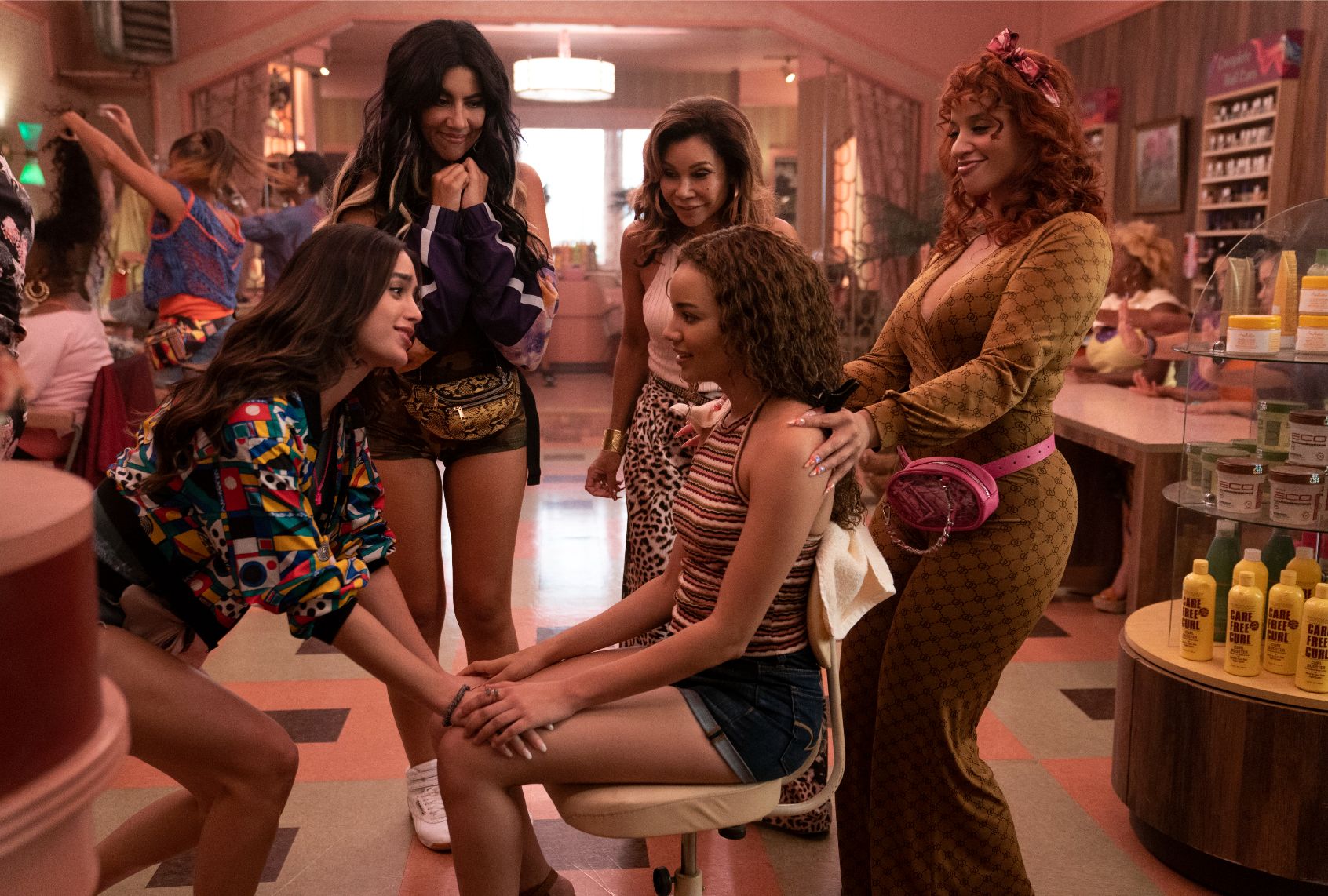

Melissa Barrera, Stephanie Beatriz, Daphne Rubin-Vega, Leslie Grace and Dascha Polanco in “In the Heights” salon from “In the Heights” (Warner Bros.)

As a producer on the film, Hudes wanted to have a say in how specific spaces, especially those dominated by women, looked.

“I just went got my hair cut in Washington Heights yesterday, from a local Dominican salon called Miss Rizos,” she said. “They’re wearing clothes that move easily that are comfortable, and they’re wearing tennis shoes because these are working women on their feet eight, nine hours a day. 

“They’re not all hourglass figures. They have different body types. It’s a much more grounded and honestly interesting approach to beauty than I think is in the popular imagination about what Latina beauty looks like. So that was where I said, ‘Can I approve every single costume that’s in the salon? I just don’t want it to become a male fantasy of what Latina beauty is.‘”

Also working at the salon with Daniela and Carla are budding fashion designer Vanessa (Melissa Barrera of “Vida”) and bombshell Cuca (“Orange Is the New Black” star Dascha Polanco). The scene were Daniela lectures her customers transitions into a tight, choreographed set piece when the neighborhood’s prodigal daughter Nina Rosario (Leslie Grace) returns from a semester at Stanford. 

“When we cast this extras for the salon, I was like, we need to make sure there’s elders in there too. It’s not just all 30-somethings. No, these are real spaces where people in the community go,” said Hudes. “I wanted to make sure it was a queer-friendly space. There’s a little boy in the salon too, because honestly, we don’t all have childcare. The kids come to the salons too and they have to hang out, so that was one detail that was really important to me to retain, to stay grounded and connected to reality.” 

As Nina is getting pampered, the women begin to gossip, leading to the song “No Me Diga.” Choreographer Christopher Scott developed a dance in which the carts with hair products are wheeled around in synchronicity, elaborate fashion nails click and clack (“It’s utterly divine,” Hudes enthuses), and the employees and clients bend and spin as they avoid obstacles.

Set decorator Andrew Baseman noted how the dance required putting the carts on casters and gluing down anything that could fall. But it was the massive amounts of beauty products that took the most research.

“The most important thing was getting the hair product right, to get the specific brands and types of things for that specific kind of hair,” he said in a phone interview. “My assistant Ashley [Wellbrock] found some salons that we could go to and pick their brains and did research. We imported some of it and we bought some from the shop that we did research at and also were able to order some wholesale. And nail polish – you know there’s hundreds of bottles of nail polish.”

Nina, una boricua


Corey Hawkins and Leslie Grace in “In the Heights” (Warner Bros.)

Actress and singer Leslie Grace, who is an Afro-Latina of Dominican ancestry, is the daughter of a salon owner, and therefore knows the importance of having just the right hair products to nurture her naturally curly hair. In the film, her Puerto Rican character’s hair goes on its own journey. When Nina returns home, she has straight hair to reflect how she tried to fit in on the West Coast at school. But after the salon, she emerges with a full, beautiful head of curls.

“Our hair designer actually storyboarded Nina’s hair beginning to end in the movie,” said Hudes. “Nina comes back from Stanford with ironed hair. As she spends a little time on the block and then goes to the salon, she returns to kind of her natural haircare routine, which is which is curly and braids.”

For some people, it may just seem like hair, but as the neighborhood’s matriarch Abuela Claudia notes in a conversation with Nina, it’s “little details that tell the world we are not invisible.”

Hudes takes that sentiment to heart, focusing on a detail so small that most people probably wouldn’t notice. Just as Nina’s hair is visual act of decolonization of Latina beauty, insisting on one specific word represented the decolonization of language and identity for Hudes.

“It’s a tiny little example,” Hudes admits. “I didn’t write the subtitles, but they sent them to me for approval. Jimmy Smits as Kevin Rosario has this line in that very emotional scene with his daughter, in which she has a change of heart and expresses to her dad what she has realized about life. He holds her head in his hands gently and tenderly and he says, ‘Tú  eres boricua.’

“The subtitle for that line was, ‘You are Puerto Rican,’ and I was like, Okay, I’m gonna get in trouble because this is me being really picky and controlling, but actually, the translation of ‘Tú  eres boricua,’ is not ‘You are Puerto Rican.’ Puerto Rico is a place and it’s the colonial name of a place. Boricua is a people, Boricua is a culture, and it means something a little different.”

This name of the people and culture goes back to the Taíno, who called the island colonized as Puerto Rico by an Indigenous name: Borikén or Boriquen. It makes sense that Kevin Rosario – and Hudes who is of Puerto Rican descent herself – would prefer to use the word “boricua” over the colonized word names, “puertorriqueña” or Puerto Rican.
 
“It’s really, it’s a claiming of something that colonization has tried to take away,” said Hudes. “So I was like, let’s make the subtitle, ‘You are boricua.’ And in that instance, if English-speaking people aren’t familiar with that word, that’s okay.”

“In the Heights” is now in theaters and on HBO Max.

Telemedicine options for abortion are here to stay

As much of the country prepares to return to some form of post-pandemic normalcy, reproductive health care providers and advocates hope we continue one vital pandemic tradition: telemedicine options for receiving and providing reproductive care from home.

Some researchers and providers have found offering medication abortion care via telehealth is crucial to bridging gaps in abortion access. Abortion medication care is safe and effective up to 10 weeks into one’s pregnancy, and providers say that having a telehealth component to abortion care may even help establish greater medical trust and comfort for patients from marginalized communities seeking care.

“I thought there could be this feeling that telehealth is less than, or substandard,” Leah Coplon, nurse midwife and clinic director at Maine Family Planning, told Salon. “I feel like there is a risk for folks who already feel marginalized by the medical community to feel like, ‘Wait, I have to meet someone over video? That doesn’t seem right.'”

But Coplon and other providers and leaders in the reproductive health space say they’ve found telemedicine abortion has been widely embraced by patients, including patients who have traditionally faced more barriers to get health care, or come from communities with mistrust toward the medical system.

“The relief I hear in patients’ voice when I say, ‘Oh no, you don’t need to come into an office, we can do this over the phone, we can mail your pills’ — it’s a huge relief to folks,” Coplon said. “In the past, having an abortion meant taking a day off work, sitting in a waiting room, finding child care, all that.”

In many states, abortion providers can offer medication abortion through a telehealth call, discussing eligiblity and concerns with the patient over the phone. Providers then can mail the abortion pills to the patient’s home or local pharmacy. Medication abortion involves two pills: mifepristone, which induces a miscarriage, and misoprostol, which induces labor to remove the fetal tissue. In April, the FDA temporarily lifted a policy that has required abortion providers to dispense abortion pills to their patients in-person at the clinic, allowing the medication to be offered via telehealth and mail during the pandemic.

America’s history of eugenics and targeting people of color for medical experimentation has fostered greater distrust of the medical system in some communities. Throughout history, people of color, people with disabilities, immigrants, and other marginalized groups have been subjected to forced sterilizations and ongoing reproductive coercion. Today, those same marginalized groups generally face higher-risk pregnancies and birth-related complications, often as a result of medical bias.

Researchers and providers say telemedicine abortion access builds trust and comfort for marginalized patients

According to experts, telemedicine reproductive health options have helped patients marginalized by the medical system feel more comfortable and at ease getting care. In some cases, it can even protect them from harm.

“It might be safer for undocumented or immigrant populations to be able to stay at home and access these services and not have to make an in-person visit,” Dr. Upadhyay, a researcher at Advancing New Standards in Reproductive Health, told Salon, of her joint research with California Latinas for Reproductive Justice around undocumented patients seeking medication abortion care with telehealth. 

Many undocumented people or folks with undocumented family members fear seeking health care of any kind if it could expose their immigration status, and often mistrust providers. Telehealth options to get abortion care from the safety of their home could be crucial, even beyond the pandemic. 

It’s not just immigrant and undocumented patients who might feel safer and more comfortable seeking abortion care from the comfort of their homes. “For some patients, telehealth might even equalize the power dynamics between a patient and physician — when a patient is at their home, they may feel more relaxed, or may be able to hold a partner’s hand,” Upadhyay said. “Patients might feel more empowered if they’re in a place they feel most comfortable having this interaction with their physician.”

Katie Quinoñez, executive director of Women’s Health Center of West Virginia, provides reproductive care in West Virginia, a state that is hostile to abortion and bans telemedicine provision of it. According to Quinoñez, not only could telemedicine abortion care help patients feel more comfortable, but it could also make them safer — specifically, from the anti-abortion protesters who routinely camp outside her clinic, which is the sole abortion-providing clinic in her state. 

“Whenever there’s the ability to provide medication abortion via telehealth, that eliminates the visit for the patient, and possible interactions with anti-abortion protesters to harass the patient and try to limit their options and choices,” she said to Salon. “To people who are marginalized, they don’t necessarily feel safe to come to the clinical setting.”

Dr. Lynda Gilliam, an OB-GYN based in Pensacola, Florida, who remotely provides birth control to patients via the telemedicine birth control platform Nurx, offered similar observations to Salon. “When a patient walks in the OB-GYN office, that can already be an intimidating place,” she said. “A lot of times, you’re just like, ‘Let me get my pills and get out of here, I don’t really want to be here.’ I’ve found I can have a better conversation with patients, often times online, because that intimidation is gone.”

Gilliam also says telemedicine options for reproductive care can help patients who face racial or other identity-based bias in the medical system feel more secure, when they’re not immediately perceived or judged by their identity. “Telehealth gives you the opportunity to allow people to have a conversation, not necessarily making any kind of biases or pre-judgments based on how someone looks or acts or what their preferences are,” she said. “Some people in the LGBTQ community may be uncomfortable going into a building, or talking to someone — for example, a trans person trying to get care with an OB-GYN. Platforms like Nurx can let them in, in an open, non-judgmental fashion, which really opens doors for people.”

Providers may benefit from telehealth options, too. “We’ve been hearing from providers that they feel like they get to know patients a bit better because they’re seeing them in their own homes, and in the context of their lives,” Dr. Upadhyay said. “Providers see patients at home with their children, or their pets, or they’ll get a better sense of the barriers that they might face.” She said one provider participating in her study recalled serving a patient who was a driver for Amazon, and was sitting in her truck during the telehealth visit to seek medication abortion.

But ultimately, according to Dr. Jamie Phifer, an abortion provider and the founder of Abortion on Demand (AOD), not all patients seeking telemedicine abortion care necessarily want a “relationship” with their provider — and that’s fine.

“AOD’s model is built to de-emphasize the clinician in the process as medication abortion is medically uncomplicated,” Phifer said in an email to Salon. AOD is the first large-scale telehealth abortion service run by a U.S.-based provider, and offers telemedicine abortion care to patients across the country in more than 20 states via its website.

“Compared to my experience in brick and mortar practices, patients seem more at ease in their own space and seeking care on their own terms,” she added. “AOD’s patients are seeing us for a single concern that is relatively brief. Relationship-building is less of a priority in most cases, which may be part of why patients seem at ease.”

Will telemedicine options for reproductive care remain necessary post-pandemic?

Researchers and providers of reproductive health emphasize that before and during the pandemic, telehealth options have allowed providers to build relationships or help people who might otherwise not be able to get abortion or birth control at all. 

“Telehealth bridges geographic disparities,” Upadhyay said.  “There are 27 abortion deserts throughout the US, so it might enhance access, especially for rural communities.” 

The term “abortion deserts” refer to cities in which people have to travel 100 miles or more to reach an abortion provider. Twenty-seven exist across the country, in every region except the Northeast. Notably, 90% of US counties lacks an abortion provider, and seven states are down to just one. 

Travel across state lines to get an abortion at a clinic, and all of the costs associated with the procedure and trip, can be highly costly — especially for patients of color. Black, Latinx and Indigenous women are among the most likely to be uninsured, have shouldered the brunt of pandemic-related job loss, and are also more likely to be in poverty.

“It can be difficult for people to travel three, four hours away from their hometown to access care,” Quinoñez said. “That predominantly impacts low-income people, rural people, people of color.” Even if a patient could otherwise afford their abortion, it’s the myriad other costs and hurdles to get to a clinic that might make getting it impossible. “They can’t always afford to find child care, they can’t always afford transportation to get to the clinic, they can’t afford to miss an entire or multiple hours of work and missed wages to get to the clinic,” she added. 

If struggles to access essential health care weaken patients’ trust in the medical system, innovative approaches to address these struggles are essential to the patient-provider relationship. 

“[Telemedicine abortion] would really strengthen a lot of that trust in that relationship, because we’re meeting the patient where they are, we’re trusting them to know what they need, trusting them to ask for that care, and they’re trusting for us to be able to provide it to them,” Quinoñez said.

“Telehealth for abortion care was ALWAYS necessary; the pandemic rather demonstrated the urgency more clearly,” Phifer said in an email to Salon. “Abortion by telehealth will remain vital post-pandemic for all the obvious reasons: lower costs, quicker access, less strain on patient resources, and frankly safety — depending on how far a patient is from the closest in person provider, it may be safer to have a telehealth abortion than to be on the interstate.”

Telemedicine reproductive care is popular — but faces challenges

Use of medication abortion care instead of in-clinic surgical care has been on the rise in recent years, with about a third of abortions in the first trimester being completed through the medication. Some reproductive care providers have reported significant increases in requests for medication abortion over surgical abortion during the pandemic. 

“We’re still finding a good 40 to 50% of patients are choosing [telemedicine abortion], even as COVID numbers are low and vaccine rates are high in Maine,” Coplon said. “All those burdens that people face trying to get an abortion — child care, time off from work, travel, gas, money, maybe even just snowstorms — they’re really taking to this model.”


Want more health and science stories in your inbox? Subscribe to Salon’s weekly newsletter The Vulgar Scientist.


Despite how medication abortion care has been approved by the FDA since 2000 and has a proven record of safety and efficacy, it has remained subject to Risk Evaluation and Mitigation Strategy (REMS), which requires patients to retrieve it from a clinic or hospital, rather than by mail or at a retail pharmacy. A lawsuit earlier in the pandemic led to REMS being lifted, only for the Supreme Court to reverse this in January

Within months of the Supreme Court ruling, the Biden administration announced it would temporarily allow telemedicine abortions during the pandemic. But with many parts of life steadily returning to normal, it’s unclear whether this will continue. And despite the temporary halt on these FDA requirements, 19 states require the clinician providing a medication abortion to be physically present when the medication is administered, prohibiting telemedicine. 

Recently, several state legislatures have passed or introduced bills to ban telemedicine options for abortion care. Other states have passed anti-abortion legislation requiring providers to give patients information about medically unproven options to “reverse” their medication abortion. “It absolutely demeans the patient-provider relationship, because we’re being required by law to read basically lies to our patients,” Quinoñez said of these policies.

And while medication abortion care is medically safe, historically, self-managed abortion through pills has sometimes led to concerning legal risks, as a result of anti-abortion politics and stigma. Because medication abortions happen through inducing a miscarriage, even natural loss of pregnancy could be criminalized if Roe v. Wade were reversed. The targeting and surveillance of disproportionately women of color for pregnancy loss, or self-induced abortions with medication, is already happening, even with Roe v. Wade intact. 

In recent years, there have been several high-profile cases in which women have been jailed or criminally charged for pregnancy loss, including Purvi Patel, an Indian-American woman, who became the first person to be sent to prison for inducing an abortion in the post-Roe era, contradictorily charged with feticide and child abuse for using medication abortion in 2013. Amber Abreu, a Latina teenager and young mother, faced felony charges for “procuring a miscarriage” for using abortion pills in 2007. 

While providers who spoke to Salon acknowledge the ongoing threat of abortion and pregnancy criminalization, they currently only provide telemedicine abortion care to patients where this option is legal.

“AOD provides only early medication abortion services in full regulatory compliance in the states we serve,” Phifer said. “We refer patients to a resources page to find other fully legal providers if they do not qualify for our service due to medical, age or location restrictions.”

Upadhyay says patients participating in her research live in states where telemedicine abortion is entirely legal. But she notes that, for those who self-manage their abortions and have concerns, “there is a hotline for legal help.” As of this month, there is also a legal defense fund.

Ultimately, Coplon says she’s careful to make it clear to her patients that she’s not trying to phase out in-person abortion care, or in-person care in general. 

“We’re very careful to lay out all the options for everybody. We don’t promote one or the other,” she said. “In different communities [telemedicine] is going to mean different things. The most important thing is we give everyone the choice to have what kind of abortion they want, where they want it, and support them.”

How oysters and seagrass could help the California coast adapt to rising seas

On a sunny afternoon in April, Katie Nichols crouched over the edges of a small oyster reef in Newport Bay, California, peering into the mud that had been exposed by the receding tide. Where all I saw was a jumble of interchangeable shell fragments, Nichols quickly spotted what she was looking for.

“There,” she said, pointing to a small, white shell. “That’s what a native looks like.”

Nichols was pointing to an Olympia oyster, the only oyster species native to the Pacific Coast of the United States. Smaller and rounder than non-native Pacific oysters, it was once abundant in the bays and estuaries of the California coast — but during the gold rush in the 1880s, the native species was overharvested, and the population collapsed. The oyster became “functionally extinct” in Southern California, according to Nichols, and today, much of the habitat where it could have settled has been degraded. 

Nichols, the marine restoration director of Orange County Coastkeeper, a nonprofit clean water organization in Southern California, is working on a project trying to resurrect the Olympia oyster — at least in Newport Bay — and is trying to understand whether the unassuming bivalve could be a key part of helping coastlines adapt to the impacts of climate change.

As the earth’s temperature warms, coastal populations around the world are wrestling with how to adapt to rising seas. In order to protect coastal development from erosion and encroaching waters, America is shielding its coasts with concrete armor — literally. Coastal armoring refers to the construction of hard structures like seawalls along coasts, and nearly 14 percent of American coastline is already armored. That portion could increase to one-third by 2100 if current rates continue.

This armor could actually be doing more harm than good. According to Molly Melius, program manager at Stanford University’s Environmental and Natural Resources Law and Policy Program, seawalls can reduce beach width, decrease sand replenishment of beaches, and also accelerate erosion at the ends of seawalls. In some cases, seawalls are inadvertently accelerating the problem they were designed to solve. Coastal armor can also degrade ecosystems that might naturally protect the shoreline from erosion. “Previously, before a lot of development, there was a lot of room for shoreline migration,” said Nichols, meaning that coastal ecosystems could migrate along with the coastline. The development of concrete structures like seawalls and other kinds of armor produces an effect called “coastal squeeze,”  meaning that these ecosystems are not able to migrate. “You can lose whole coastal habitats” this way, says Melius. 

Nichols and her team are setting out to test an alternative path to protecting coastlines — one that involves using the ecosystems that already exist or once existed along the coast, instead of squeezing them out. Nichols oversees Coastkeeper’s living shorelines program, a project in partnership with California State University, Long Beach, and California State University, Fullerton, that restores ecosystem structures like oyster beds and eelgrass meadows, which protect shorelines from waves, erosion, and sea-level rise. Nichols says the goal of living shorelines is to create organic structures to protect coasts, “instead of using boulders and rocks.”

In 2017, Coastkeeper set out to put the idea of living shorelines to the test in Upper Newport Bay. A team of volunteers and restoration workers hauled 40,000 pounds of Pacific oyster shells in biodegradable bags made of coconut husk onto the shore, to create a structure in which the larvae of native oysters could settle. The Olympia oyster population “isn’t larvae limited,” says Nichols, meaning there are more than enough oyster larvae in the water to allow oysters to repopulate under the right conditions. The problem is the lack of suitable habitat for oyster reefs to form. Bringing in oyster shells to create a habitat allows these larvae to take root on the shoreline and form a self-sustaining oyster bed.  

It’s now been four years since the restoration work in Newport Bay began, and Nichols took me to see how the shoreline has progressed. Clad in knee-high rain boots and carrying two shallow plastic crates, we approached the shoreline. “You have to take care not to disturb the sediment,” Nichols warned, setting down a plastic crate on the wet sand. Standing in the crates helps distribute weight, so we wouldn’t leave scars in the sediment as we walked across the sand.  We set down one crate after the other, cautiously leapfrogging across the shore to approach the exposed reefs. A small section of PVC pipe emerged from the reef like a sentinel, measuring how much sediment the reef traps over time. 

Oyster reefs provide a whole host of important environmental benefits — a single oyster can filter as much as 50 gallons of water a day, improving water quality, and the structure of the reef provides homes for other sea critters, including fish, crabs, and other bivalves. Reef structures also work as a natural barrier against storm surges. And most pertinent to those concerned about climate adaptation, they also help prevent the coastline from eroding. As waves and tides hit the shorelines, the structure of the oyster bed absorbs the energy from those waves and traps sediment. “Instead of just having sediment loss, you might get what we call accretion, or some buildup,” explained Nichols. Understanding just how much sediment these oyster beds accumulate is important for making decisions about land use and restoration along coastlines. “If this small, 20-meter bed is really important in slowing down erosion, and we can track that over time, that’s really good for managers and policy folks who are trying to deal with sea-level rise,” said Nichols.

Oyster beds aren’t the only thing that Coastkeeper is working on restoring. Nichols and her team have also planted meadows of eelgrass, another native California coastal species that has been almost eliminated regionally. Christine Whitcraft, a professor of biological sciences at California State University, Long Beach, has been studying eelgrass since her doctorate. “I am more well versed in seagrass than I ever thought I would be,” she quips. According to Whitcraft, up to 90 percent of seagrass meadows in California have been lost — but it’s hard to put an exact number on it, due to lack of good monitoring programs. Much like oyster reefs, eelgrass can provide vital benefits for the broader ecosystem and for people, including by providing habitats and nursery grounds for other species, improving water quality, and stabilizing sediments in their long root systems, further preventing coastal erosion. 

In addition to helping mitigate the impacts of rising seas, eelgrass provides another critical climate change function: carbon burial. Eelgrass absorbs carbon through photosynthesis, then stores it in its root structure for millennia — even after the eelgrass dies. Much like permafrost and peat, the sediments beneath eelgrass meadows are wet, cold, and low in oxygen, meaning that the carbon stored there doesn’t decompose and get released into the atmosphere. “High sediment accumulation rates and low degradation rates — that’s the magic formula” for carbon storage, says Whitcraft. For that reason, marine ecosystems that store carbon, like mangroves, salt marshes, and seagrass meadows, are much more efficient at storing carbon than a forest on a square-foot basis.

Even while they dutifully sequester away carbon and stabilize the coastline, eelgrass and oysters are themselves threatened by the impacts of rising temperatures. In addition to the effects of coastal development and water pollution, warming waters and heat waves can also lead to eelgrass and oyster mortality. “Eelgrasses are combating climate change, but at the same time climate change is impacting them in negative ways, so it’s sort of a tug and pull between the two of them,” says Whitcraft. “It’s a very interesting feedback loop.”

As a part of its research, Coastkeeper is testing out the effectiveness of restoring eelgrass and oyster beds both separately and together in test sites along the shore. Nichols says that restoring both eelgrass and oysters simultaneously will create a more complete habitat, from an ecological perspective, and the coastline can reap the benefits of each. But the project is small, for now — the extent to which it can be scaled up is still an open question. Eelgrass and oysters might not work for living shorelines projects everywhere — different regions might have different strategies or species that suit the area best, says Nichols, like marshes, dunes, or kelp. But Coastkeeper is “hoping to translate our work to useful strategies for managers in Southern California” — a proof of concept for what could one day be a larger-scale solution. 


I love being a Girl Dad

“You know what, baby?” I say to my one-year-old daughter, Cross. “Men who aren’t married don’t vote and are more likely to get gum disease because they don’t have wives who make them vote and go to the dentist.” 

Cross answers with a gleaming smile, saying, “Eat! Eat!” or “Stinky!” Or she just cackles at my nonsense, stomping both of her feet to the tune of that hysterical laugh she inherited from her mom. I’m feeding her bananas mixed with avocado — which I call avoca-da-boo-yaoooo — or I’m changing her. Either way, the conversation continues. “Trump’s election killed the post office. I swear, I mailed our next door neighbor a Christmas card and she didn’t receive it until Valentine’s Day!” 

“Stinky!” Cross laughed. 

When my wife, Caron, leaves the baby and me to our own little world, I take the opportunity to disobey the meticulous feeding, bathing, TV, and reading schedule she’s created, for no reason other than showing Cross that I’m the cool parent. Now, me being alone with the baby is new. Cross was born two months before COVID-19 shut our nation down. Caron and I both spent all of our time at home together during that first year, so she was on hand to micromanage everything. Now, as the world slowly opens up, I force her out of the house — so that she can have some well-deserved fun, yes, but more importantly, so I can establish myself as the ally, the rule breaker, the one Cross should always ask first because she will always get a “YES!” 

Don’t get it twisted, we love Caron — more than anything, we really do — but we can’t cut up as much when she is around. My wife is a lawyer, and she is really into rules, protocol, decorum, manners, structure, using a salad fork for salad, and other boring things like that. She can spend her free time googling new laws to follow, laws that aren’t even enforced. 

“Her food is separated into five color-coded containers — breakfast, lunch, a healthy snack, dinner and a lighter healthier snack,” Caron says as she gathers her things to leave the house. “Are you sure you guys are going to be OK?” 

“Yes baby, ” I say, with one of those lemon-slanging used car salesman smiles. “Don’t think about us. We’ll be OK. We’ll miss you!”             

Caron will then run off a scroll of instructions for us, including the 12 different types of grease, African oils and hand-whipped lotions that should be applied to Cross’ skin every two hours, proper methods of serving the food she prepared, and eight different outfit suggestions just in case we get the urge to go out.  

“You’re going to be late, Caron! Go!” 

This is when she hurries back over to give us both one last big kiss, and then she’s out of the door. Cross and I like to run up to the window to watch her car pull off, just to be sure she makes it out of the driveway and down the block safely. 

“You know, Cross,” I say to her. “I never figured out why you drive on a parkway and park on a driveway.” 

“Ut Ohhh!” Cross replies. “Eat! Eat!”

We don’t do anything for the first five or ten minutes after Caron leaves because she always calls to run off a few extra instructions and casually give me tips that can earn me bonus points with her, like sitting Cross on the potty or giving her extra green vegetables. 

 “You know, you should never trust a person named after a city or state. I once knew a guy named Montana who bought a round of drinks for like 10 people then went to the bathroom and never came back,” I tell Cross, digging through her food options. “So your mom wants you to eat this whipped-up spinach potato situation, but we can save that for when you guys hang out.”    

Then I’ll pull out some grapes and blueberries, build a neat pile in front of her, and together we devour them—jamming smashed piles into our talking holes. When we finish, we split a huge plate-sized chocolate chunk cookie. A quarter of that cookie probably holds enough sugar to shoot her small body through the roof, so I only give her half because I want my baby to aim for the moon. 

“Breakfast is as important as oxygen,” I tell her, breaking off pieces of the cookie for her. “Lunch is really a stupid meal. When you get older, you can skip lunch for the rest of your life. I haven’t had lunch since ’88, and I don’t miss it at all.” 

Once we’re both loaded with sugar, I blast the SONOS to the highest level and we dance off-beat to the clean versions of Tupac, H.E.R, Jay-Z, Rihanna, NBA YoungBoy, Prince, Chaka Khan, Rick James, Drake, Teyana Taylor, Aretha Franklin, Nas, and Mary J’s ” My Life.” When we wear ourselves out, I let her watch too much “Sesame Street” — so much “Sesame Street.” Hours of “Sesame Street.” Back to back episodes of Big Bird, Abby, Cookie Monster and Mr. Noodle.  

“Never, ever be like Oscar,” I tell her. “He’s a hater. He lives with trash and he stinks!” 

“Stinky!” she cries.  

“Yes, baby!” I yell back. “Oscar is stinky!” 

Cross loves that I let her binge “Sesame Street” — she even runs over and gives me big hugs in between segments before running back to the iPad to prepare for Elmo’s happy, happy dance, dance. And it is in these moments, full of the smallest but sweetest displays of appreciation, where I realize how much I love being a Girl Dad. I love it more than anything in the world. 

#GirlDad trended after the tragic death of NBA superstar Kobe Bryant and his daughter Gianna in February 2020. Friends and family took to the Internet shorty after Kobe and Gi Gi passed to celebrate how much he loved his daughters, and fans soon followed with their own. In a world where too many men spend hours gushing over their sons, Kobe made it cool to loudly and publicly uplift daughters with the same kind of praise normally distributed to boys­­. These tributes went viral. My timeline was flooded with photos from guys I didn’t even know had kids who were celebrating their daughters with the hashtag.

I am not the kind of guy to put too much energy into hypotheticals — in this case, how I might have loved and nurtured a son. What I know is I love, love, love having a daughter. 

“Hey, Cross. I love you,” I tell her after one of those big hugs. “But I don’t want you to think that I just love kids. I don’t like anyone else’s kids. You will never see me hugging another kid. I just love you.” 

After bingeing a month’s worth of “Sesame Street,” Cross and I like to spend some time throwing things from one side of the room to the other. I don’t know what she can learn from this exercise, but it feel like every baby needs to learn how to throw. Tossing Legos, Snoopy, and the American Girl doll around is also a great way to burn some time while I figure out where in the world we’re going to go now because we can’t just sit in the house. 

I look over all of the outfit options Caron has left us and choose the dress or the jumper option, but never the shoes she recommends. Caron likes to pair the baby’s outfits with plastic sandals or jellies, bite-size Birkenstocks, fuzzy Uggs, or even tiny pointy church shoes that look like they emerged from the Reconstruction era. I like to put her in the same style of shoes I have on—whatever pair of Jordans, Nike Air Max, or Barkleys I’m wearing that day. And from there, we jump in the truck and cruise up and down the small blocks that make up my city, her city­­— through downtown, past the Harbor and by the place where I met Caron and asked for her number almost a decade ago, the spot where we liked to hang when we started dating, and over to where we were married. Then I roll near the block where my dad— her granddad — grew up, not far from where my grandma used to crack crabs on her front porch. We see it all and I tell her all about her history while showing off the old homes they don’t make anymore—defining where they end and where the new ones begin—and how all of this will be different by the time she is old enough to drive.

“Are you going to drive me around when you grow up?” I ask in the rearview mirror, only to notice that our trip — along with my antics, the dancing, the talking — has put her to sleep. There’s the nap Caron scheduled.

When we get home, I quickly try to wash our day off her, give her some vegetables, and get her ready for bed so that her mother can relax once she’s home. We’ll still wait for her for the final tuck in, though.

While we wait, I read Cross a book — “Mary had a Little Glam” or “Hair Love” — and tell her, “I am so happy to be your father. And I will cherish these days and the days to come for the rest of my life, always pulling up for you for any and everything. And I don’t care if that means I have to sit my big self at a tiny table to join your tea party, or let you paint my nails during spa day, even though I hate nail polish and how it smells, or buy you a puppy and help you raise it. I will adjust to the change of you picking out my clothes and sneakers instead of me picking out yours, and that dreaded drive we will take to the movies on your first date. I’ll proudly celebrate all of your wins, while being there to coach you through all of your losses. Whatever it is, I’m there.”

I wouldn’t want to be anywhere else in the world.

And at the end of my monologue, Caron has pulled into the driveway and rushed back into the house just to finish putting Cross to bed. It’s too late, though, because the schedule she created works too well. Even when I don’t follow it, our little girl is already knocked out asleep. But I notice I’m not the only one who breaks the rules. Caron makes a little too much noise, or invents some reason to go into Cross’ room, just to wake the baby up for that last good night kiss, too. 

Lindell claims a “prophet guy” predicted he would change history before his first meeting with Trump

In a speech given at the Health and Freedom Conference in Tampa, Florida on Friday, MyPillow CEO Mike Lindell claimed it was foretold by a man he described as a “prophet guy” that he would someday change human history and the at he believes that led to his first meeting with former President Donald Trump.

According to a report from Newsweek, Lindell — who has taken the lead in trying to prove the 2020 presidential election was stolen from Trump which has also led to him facing a massive lawsuit — described being a National Prayer Breakfast where he joined in prayer with former HUD secretary Ben Carson.

In Lindell’s telling, “Divine things started happening to me . . . I was picked out of 12 people to pray with Ben Carson in a room at the National Prayer Breakfast.”

He then added, “. . . This one prophet guy, he said, ‘A couple of you in this room are going to become great friends and change — and help change the course of history,'” before elaborating and telling the audience, “Anyway, these divine appointments kept happening all the way up to where I met Donald Trump in the summer of 2016.”

Lindell also revealed that he finally got his one-on-one with the now-one term president on August 15, 2016, and that he came away believing Trump would be “the greatest president in history,” Newsweek reports.

You can read more here.


“An act of war”: How does the insurrection fit into the larger history of violence in Congress?

Asked to reflect on the events of Jan. 6 — not in his official capacity as a member of Congress but as a witness to history — Rep. Eric Swalwell, D-Calif., called out several of his Republican colleagues by name.

“I look at [Alabama Rep. Mo] Brooks and [Georgia Rep. Marjorie Taylor] Greene and [Colorado Rep. Lauren] Boebert and think that if they weren’t inside the chamber that day as members of Congress, they would have been outside the chamber that day as part of the mob,” Swalwell told Salon. 

The California Democrat is suing Brooks over a speech the Alabama Republican delivered at a “Save America Rally” before would-be insurrectionists stormed the Capitol to overturn former Vice President Joe Biden’s victory over then-President Donald Trump in the 2020 election. Brooks urged “American patriots” to “start taking down names and kicking ass.” He now features this line in advertisements for his campaign for the U.S. Senate.

Though Swalwell did not discuss the lawsuit with Salon, he made it clear that his disgust with Jan. 6 does not stem solely from the fact that Congress was prevented from overseeing the peaceful transfer of power, which was initiated by President George Washington himself.

Some of his fellow legislators actively egged on Americans who were disgruntled with the outcome of the election. Greene and Boebert, for example, linked the day to the idea of a revolution when they urged Trump sympathizers to view the Jan. 6 rally as a “1776 moment.”

Thus Swalwell did not only witness what he now refers to as “the day democracy almost died.” According to his account, he was also betrayed by his very own colleagues. Members of Congress, it seems, can also be lousy co-workers.

Perhaps the only day in American congressional history that comes remotely close to mirroring the insurrection is May 22, 1856. No one tried to overturn an election — the Capitol was actually quiet that day — but seemingly out of nowhere a 36-year-old man beat an unarmed middle-aged humanist nearly to death with a thick, gold-headed gutta-percha cane.

The assailant was Rep. Preston Brooks of South Carolina, who was angered by the criticisms lobbed by his victim, Sen. Charles Sumner of Massachusetts. Under normal circumstances, such a brutal assault on a victim who could not defend himself would have been universally condemned.

Brooks, however, was pro-slavery and had attacked Sumner in part because he opposed the “peculiar institution” and its supporters. As such, Brooks was regarded as something of a hero across much of the South for avenging the region’s honor. After learning that he had broken his cane while forcefully striking Sumner as he helplessly huddled under his desk (which was attached to the floor), sympathizers sent hundreds of replacement canes to Brooks as gifts. Some included inscriptions urging him to once again assault Sumner, who was forced to take a long absence from Congress while his health recovered.

The Civil War broke out less than five years later. More than a few historians have argued that the aforementioned acceptance of bloodshed on the floor of Congress in 1856 helped lay the foundation for pro-slavery states to reject the results of the 1860 presidential election. Until 2020 that was the only national election in which the losing side flat-out refused to accept the result; it ended in the Civil War.

To be clear, the situation is not a precise analogy to Jan. 6. There was no Big Lie about a legitimate election being stolen or a fascist demagogue who had spent years conditioning his supporters to believe that he could only lose an election through theft. However, it made the concept of accepting violence in America’s halls of power more acceptable to the public.

A line was crossed, with the gifted canes crassly symbolizing the right-wing‘s decision in that era to no longer accept the other side’s political legitimacy. The right-wing extremists and enablers who whitewash Jan. 6 or validate Trump’s false claims that he won the 2020 election are performing the modern-day equivalent of what those pro-slavery forces did when they sent canes to Brooks in 1856.

That said, the similarities between the two incidents do indeed end there.

“The violent arrack on the Capitol that took place on Jan. 6 has no parallel in American history,” Harvard Law professor Laurence Tribe told Salon by email.

After noting the Sumner attack, as well as other assaults and some duels that occurred in congressional history, Tribe described Jan. 6 as “an essentially cannibalistic and fratricidal act of sabotage.” Because the insurrection attempt was directly inspired and fomented by an incumbent president who broke Washington’s longstanding precedent by resisting the legal transfer of power, it amounted to a “violent and indeed literally deadly act of naked aggression by the executive branch against the legislative branch.”

This casts the actions of the legislators who supported the Jan. 6 insurrectionists in any way in a very different light.

“The insurrection of Jan. 6 represented nothing less than an act of war against the United States of America and its Constitution by an organized mob, many of whose members and leaders were sworn to uphold and defend that Constitution but turned on it instead,” Tribe added. “That was nothing less than treason, no less serious than the treason committed by the Confederacy. But not even the rebels who tried to destroy the Union succeeded in the symbolically unique act of marching the Confederate Flag through the Capitol. And not even the British sacking of the Capitol in 1812 represented an act of patricide by Americans against their own countrymen.”

That said, some of the other stories of congressional violence are quite colorful. Legislators, like human beings everywhere, are prone to unflattering outbursts that go beyond the bounds of bombastic braying. However, on these occasions, the near-universal reaction was disapproval (albeit sometimes mixed with amusement). Aside from the hyper partisans that one finds in every political era, the legislators who engaged in violence in the past were usually perceived as having made embarrassing spectacles of themselves — or worse.

A handful of tales fairly represent the whole. Most are cartoonish moments, where contemporary accounts reveal a few bad apples turning the rest red from blushing. These were the petty duels like those between House members Jonathan Cilley of Maine and William Graves of Kentucky in 1838 or (almost) between Galusha Grow of Pennsylvania and Lawrence Branch of North Carolina in 1859. (That latter was broken up by sensible parties at the last second.)

We can also look back at Sen. Strom Thurmond of South Carolina, a former Dixiecrat candidate for president and arch-segregationist who was notoriously belligerent in his rhetoric and personal style. Thurmond mortified his colleagues, including many who shared his racist views, when he tried to physically wrestle with Sen. Ralph Yarborough, D-Texas, to stop a vote on a civil rights bill in 1964. (That same year, Thurmond switched from being a Democrat to a Republican because of his opposition to civil rights.)

Perhaps the most iconic story of congressional violence is that of the Griswold-Lyon brawl. On one side, you had Roger Griswold, a Federalist congressman from Connecticut, who in 1798 caned one of his colleagues (apparently caning is a big thing in Congress) after the two exchanged words (and, in his victim’s case, expectorant) during a heated argument days earlier.

Though the victim defended himself with a pair of fire tongs, Griswold was the aggressor. His victim, Matthew Lyon, was a Democratic-Republican representative from Vermont who had incurred Griswold’s wrath by speaking ill of the policies and character of President John Adams and his supporters.

At the time, Adams was imprisoning those who criticized him under new laws called the Alien and Sedition Acts, which smacked of Trumpism in their anti-free speech ideology. Indeed, Adams would send Lyons himself to the clink for writing anti-Adams editorials later that year. (He subsequently became the first and thus far only congressman elected from prison.)

Importantly, Griswold’s attack on Lyon and Jan. 6 were fundamentally different because one was a violent attack by an individual while the other was a violent assault on democracy itself.

“I was on the floor and there are not many windows or vantage points outside the chamber,” Swalwell recalled of that day. “I’ll never forget the uncertainty and terror of knowing there was a violent mob seeking to stop us from doing what we were doing, who were chanting that they wanted to kill members of Congress and that they were armed in a variety of different ways.”

When he heard that pipe bombs had been discovered, Swalwell texted his wife and told her to kiss their young children.

“It was traumatizing,” Swalwell told Salon. “There was the duality of not just being a witness but of having a job to do and just being so angry that we had to leave.”

Swalwell said he agreed with the thesis of this author’s column from last week. Washington warned Americans in his Farewell Address (then a written statement later published for the public) that democracy could be destroyed by a demagogue manipulating partisanship. Now Congress faced the ultimate test when it came to opposing an anti-Washington. Swalwell remains haunted by the memory of fearing Congress might fail to do this — one of its most important jobs — in a moment of truth.

“I really hated leaving the floor,” Swalwell said. “I didn’t like being in retreat because it felt like we were surrendering. It took weeks before the guilt of leaving subsided.”

And yet Congress did its job — at least those members who did not bolster the Trump movement’s baseless claims of election fraud — and Swalwell still goes to work at the U.S. Capitol today.

Jim Acosta awards Tucker Carlson with the honor of “Bullsh*t Factory Employee of the Month”

CNN’s Jim Acosta went after the GOP’s “crackpot caucus” and Fox News on Saturday.

The host explained the right-wing conspiracy theory that it was actually the FBI that is responsible for the January 6th insurrection, not Trump and his supporters seeking to overturn the 2020 election.

“Now, you may recall I recently described Fox News as ‘The Bullsh*t Factory‘ in honor of its steady stream of bogus segments aimed at ginning up your outrage,” he said. “But Tucker has really outdone himself this week. So I’ve decided to award Tucker with distinction of ‘Bullsh*t Factory Employee of the Month.’ Congrats, Tucker, you did it. Nobody bullsh*ts like you when it comes to the insurrection as good as you.”

“Nobody does it as good as you, well, at least in the English language,” he said, playing a clip of Vladimir Putin sounding just as deranged as a Fox News host.

You can watch the video below via YouTube

Can democracy survive Amazon?: A conversation with writer Alec MacGillis

“Today, I just want to hate.” Writer Alec MacGillis quotes these bitter words from Chris MacLarion, a former union steel worker in Sparrows Point, Maryland, who watched the decades-long decline of the plant, his livelihood and his dignity. In his new book Fulfillment — Winning and Losing in a One-Click America, MacGillis examines the source of MacLarion’s anger and the price we all pay for embracing the powerful technologies of convenience and control.

MacGillis focuses on Amazon, now the largest employer in the United States and run by Jeff Bezos, the wealthiest man in the world. Fulfillment looks at how and why Amazon uses the intersecting spheres of economics and politics to its benefit while small communities, small businesses and workers bear the weight of its corporate power. The following interview with MacGillis from his home in Baltimore, Maryland, was edited for length and clarity.

* * *

Capital & Main: Two conservative writers recently praised your book, Cameron Hilditch in the National Review writing about working-class Protestants in Northern Ireland and columnist Ross Douthat in the New York Times. Why are these conservatives responding positively to your work?

Alec MacGillis: The book has definitely hit a nerve with conservatives who worry about the unraveling social fabric and downward mobility, especially among the white working class. They have concerns about all the ills that come with downward mobility where an economic plight transforms into a social plight.

When you began you intended to write about regional economic disparities, but it turned into a book mostly about Amazon and how some cities have thrived due to its presence while others have experienced steep economic decline.    

I started out writing about the incredibly unhealthy economic gap between winner-take-all cities and left behind ones. This disparity is not good for either set of places. Basically, we are watching the lifeblood and commerce being sucked out of all these different communities around the country and concentrating it in a small handful of cities that are so wealthy that they are borderline uninhabitable for most people. We have to ask what it means for our democracy to have such extraordinary concentration of corporate power and wealth.

How does Amazon approach city and state jurisdictions when deciding where to place its warehouses and data centers? What are they trying to achieve?

Amazon has a whole department devoted to trying to get tax subsidies from towns and cities. They come in and dangle the possibility of building a warehouse or data center but make very clear that they expect some kind of incentive in return. Local officials just feel this desperation for any kind of new jobs and investment so they fork over not only subsidies but also these extraordinary promises of secrecy about these deals.

They don’t even have to threaten to go to another state but merely to another town down the road.

Exactly. It’s easier in places that are more splintered in terms of their local boundaries. That’s how you get a scenario that I describe in the Columbus metro area, where you have these random exurbs negotiating against each other to get the first Amazon data centers.

What are some of the more egregious tax breaks and subsidies that you discovered cities and states have provided to Amazon? You point out that one city even agreed to make sure the warehouse was not built by union labor. 

It’s huge reductions in property tax liability and sometimes even reductions in payroll tax, and suspension of numerous fees. In Baltimore, the city agreed to pay $100,000 a year to have shuttle buses run from downtown out to the warehouse, paying to bring the workers to Amazon’s door.

In the chapter on Seattle, you describe a city initiative to tax Amazon and other high tech companies. During this campaign, “The opponents [of the tax] had revealed a strain of conservatism in the liberal Seattle electorate, a sense that government was broken and wasteful and worthy of contempt.” What did you mean? 

You had this big progressive push to pay for housing services for the homeless. The tax passes the city council with Amazon’s begrudging approval. Then Amazon turns around a day or two later after having agreed to this compromise and launches a referendum to repeal the law. Residents of Seattle are receptive to Amazon’s arguments that the government is only going to waste the money that it raises and that the local government is hapless and can’t fix the homelessness problem. It was kind of a Tea Party message. But they also tap into this notion that to the extent that this money does pay for affordable housing or shelters, “Do you really want to have that in your neighborhood?” People are ambivalent about Amazon because they have helped change the city’s character. But my gosh, the little arts and crafts bungalow that you bought for $200,000 a few years ago is now worth a million bucks because of Amazon. This resulted in the city council seeing the writing on the wall and repealing the tax themselves.

One of your chapters is called “The Crisis of Small-Town America.” A common analysis from the left goes like this: Deindustrialization leads to economic frustration and feelings of victimization. This leads to drug addiction, racism, QAnon and Donald Trump as president. Anything wrong with this way of framing the narrative?

I think that it is all tied together. First of all, the resentment that grows out of regional disparities played a huge role in the 2016 election. When you have heavily Democratic regions like greater Dayton or Southeast Ohio where you have people increasingly looking at very successful cities mostly on the coasts and saying, “There is no way in the world am I like the people there.” It’s not just about economic decline but the social atomization that comes with this new economy where you are much less likely to see each other in the course of your daily activities. It gives you a fertile ground for Trump and other kinds of toxic politics.

Bezos calls himself a libertarian, yet Amazon has built up a massive lobbying operation at every level of government. Can you describe how Amazon thrives on government contracts?

The key is the growth of their presence overall in Washington, D.C. They have managed to acquire this extraordinary soft power through Bezos buying the Washington Post and a double-wide mansion in D.C. and turning it into this VIP salon. They obtained the big CIA contract a few years ago, in the vicinity of $600 million. And they were in the running for a $10 billion contract from the Pentagon, but it went to Microsoft instead, possibly because of Trump’s aversion to Amazon. Now it’s ended up in a morass of lawsuits. This power in Washington comes at the exact moment when their biggest threat is federal intervention.

Some of our best American historians of capitalism point out that gaining access to workers and then being able to control that labor force has been a central dynamic of the economy. Controlling the workforce seems like an obsession with Amazon as well. 

You see them putting warehouses in the places that were most desperate for even low wage jobs. In Ohio, for instance, they put both of their first two warehouses on the southern and eastern parts of the Columbus beltway, the part that is most accessible to the poorest parts of Ohio. Amazon has no interest in maintaining labor long term. Their business model is based on transience and high turnover. You saw it in the union fight in Alabama where the union accused Amazon of trying to buy off discontented workers with offers of $1,000 to leave. Amazon does this all over the place. It’s a way for them to keep workers from climbing the pay scale through longevity. On the job, there is incredibly close tracking of your productivity by A.I. and algorithms that quantify your output. Workers are now standing in a fixed location as the robots bring [them] these stacks of shelves that have a given item on them. The pace is being driven by the robots demanding that [they] remove the item that we as shoppers have requested from the comfort of our homes.

In the 1930s the CIO emerged to challenge industrial capitalism. In the 1960s, students led the anti-war movement and women the women’s movement. Is there a social or political base for resistance to Amazon capitalism?

I’ve come to think of the resistance in three prongs. One is the worker prong. The Alabama attempt to organize these warehouses may well have seeded ferment elsewhere and brought a lot more scrutiny to the warehouses. Then you have the antitrust front, where I think there is real energy in Washington for possible reform. That’s the high stakes fight now, and one of the biggest questions facing Biden and the Democrats is whether they are going to take this on. Then you have the consumer strand. Will there be some sort of reckoning or pullback by consumers from the one-click approach to life that they embraced this past year? [Amazon] stock almost doubled in a year, and Jeff Bezos’ personal wealth went up by $58 billion. That was all our doing.

* * *

Copyright 2021 Capital & Main

Trump’s secretary of Commerce raked in more than $53 million while holding public office

The U.S. commerce secretary appointed by former President Donald Trump is said to have earned at least $53 million while collecting a taxpayer salary for a position that required him to work in the best interest of the public instead of focusing on his own profits.

According to HuffPost, Wilbur Ross’ earnings were a focal point of a recent complaint filed by the watchdog organization, Citizens for Responsibility and Ethics in Washington (CREW). During his four years working under the Trump administration as the head of the U.S. Commerce Department, Ross reported making “somewhere between $53 million and $127 million.”

CREW reports that the figures are based on three different yearly financial disclosures along with Ross’ final termination report which the watchdog organization obtained from the U.S. Office of Government Ethics.

Ross’ financial disclosure filings have triggered complaints about the conflict of interests between his position and profitable affiliations. The watchdog organization sounded off about Ross’ entanglements with a number of private companies while holding public office. Since the federal government only requires outside income to be reported in “broad range,” CREW also believes there is a high likelihood that Ross’ profits were “significantly more” than reported.

“Wilbur Ross reported making a minimum of $53 to $127 million in outside income during his four years as secretary of commerce for Donald Trump,” CREW said in its statement. “It is possible that he earned significantly more as he was not required to specify certain income totals over $1 million. Even in an administration characterized by corruption, Ross became notorious for mixing personal business with his government role.

The statement added, “It is impossible to know Ross’s exact income because it was reported in broad ranges, but it is clear that while running the agency in charge of promoting economic growth and regulating global trade for the United States, he made tens of millions of dollars.”

The latest complaint against Ross comes just months after the release of a report by the U.S. Commerce Department’s Inspector General’s Office. While Ross was cleared on speculation of insider trading, the report did indicate that he’d “violated the federal standard of failing to avoid the appearance of ethical and legal breaches.”

One of them has to go: The GOP or America as we know it

Texas is showing us all how the corruption that has overwhelmed the GOP has reached a crisis point, and it’s killing people.

President Dwight Eisenhower said, “If a political party does not have its foundation in the determination to advance a cause that is right and that is moral, then it is not a political party; it is merely a conspiracy to seize power.”

Sadly, Eisenhower’s Republican Party is now there: they haven’t governed to protect or help the people at the federal or state level since the Reagan Revolution. Today, instead, they simply engage in a corrupt form of political performance art while stuffing their pockets with corporate money. 

Today’s example: Greg Abbott.

Corrupt Texas Governor Greg Abbott is the poster child for corrupt Republicans’ sellout to the fossil fuel industry. And the consequence of that will almost certainly kill hundreds of Texans this summer. But Abbott really, really doesn’t want you to be thinking about that.

His latest scam to divert Texans’ attention away from this malfeasance is to proudly declare that Texas is asserting its rights under the 10th Amendment to reject oversight or even advice from the federal government.

Texas, like most red states, takes in more federal dollars then they send to Washington DC; instead of merely calling Governor Abbott “corrupt” it’s probably also time to call him a “welfare queen,” a phrase much beloved of Republicans, at least when they apply it to Black women.

But the real “welfare” that Abbott and the whole collection of corrupt Texas Republicans have been living off for decades is the cash the fossil fuel industry and the billionaires it has created pour down their throats every year by way of campaign contributions and dark money support.

For example, back in 2014 the good citizens of Denton County Texas, sick of air and water pollution from fracking, passed a ballot initiative banning it in their county by over 60%. 

Texas’ sold-out Republicans immediately responded with House Bill 40, which Governor Abbott enthusiastically signed, that “gives the state exclusive jurisdiction over oil and gas operations and prohibits local municipalities from creating ordinances that ban, limit, or regulate oil and gas operations…”

That’s the Texas Republicans’ motto: “Screw the people; we just do what’s necessary to help out the fossil fuel billionaires who own us.”

Back in 1999, then-Governor George W. Bush, himself of fossil-fuel multimillionaire, separated almost all of the Texas power grid from those of neighboring states to avoid federal oversight. He put the Electric Reliability Council of Texas (ERCOT) in charge of the largely then-privatized grid.

Bush called it, “The nation’s most extensive experiment in electrical deregulation.” 

It turned out to be an extraordinary expensive and deadly experiment, one that burdens Texas to this day.

As The Wall Street Journal noted a few months ago: “Those deregulated Texas residential consumers paid $28 billion more for their power since 2004 than they would have paid at the rates charged to the customers of the state’s traditional utilities, according to the Journal’s analysis of data from the federal Energy Information Administration.”

That money, of course, went mostly into the pockets of wealthy investors, power company CEOs, and filled the campaign coffers of Texas Republican politicians. It certainly didn’t do much to reinforce or make the state’s power generation systems or distribution grid more robust.

The result was that this past winter when climate change sent a massive cold wave down into Texas, an estimated 800 people died and the state suffered billions in property damage. 

Individual Texans and small businesses are now picking up the lion’s share of that tab, of course. It’s the Republican way, after all: privatize profits, spread them amongst corrupt Republican politicians, and stick the public with the costs.

Now NOAA is forecasting one of the hottest and driest summers in the history of Texas because of the climate crisis, and already, with temperatures this week only in the 80s and 90s, ERCOT and Abbott have had to ask Texans to keep their air conditioners set above 78 to keep the grid from failing.

Abbott — with much pomp and ceremony — issued an executive order banning private and public entities from requiring masks to protect against a deadly pandemic, but he sure seems fine telling people they can’t enjoy their air-conditioning so he can keep the fossil-fuel money flowing into Texas’ awesomely corrupt Republican Party.

The prospect of enduring brutal heat and facing the probability of massive power blackouts throughout the summer is not endearing Abbott and his Republican cronies to average Texan voters. As a result, Abbott has come up with a flurry of activity to make it look like he’s actually doing something.

As mentioned, he just declared the state “sovereign” under the 10th amendment, as if that were a thing. When he announced it on Twitter, he was buried in ridicule and questions from Texans about what this has to do with making sure their lights don’t go out this summer.  

Burrowing deeper and deeper into the warm embrace of fossil fuel billionaires, the Texas legislature just passed SB 13, which “would require the State of Texas and its entities (including state pension funds and the state’s huge K-12 school endowment) to cut ties with companies that refuse to invest in fossil fuels.”  

That’s right. If your company wants to do business with the state of Texas, or have them invest in your company’s stocks or bonds, you damn well better make sure that you’re throwing money at the fossil fuel industry or at least own a huge pile of their stock.

As Indivisible Texas notes: “SB 13 creates an intricate system of lists, reports, and oversight of companies that prefer not to transact with fossil fuel companies for whatever reason. This bill actually treats business interactions with certain business sectors in the state as it does enemies of the United States!”

Corruption like this is not a joke; it’s already cost Texas ratepayers $28 billion and 800 lives, and more is on the way. And the Texas Republican politicians’ response is just to make it harder for Texans to vote.

In state after state, Americans are seeing how the GOP has transformed itself from a legitimate political party into an arm of giant corporations and the billionaires they have created, all while rigging the system to keep themselves in office. 

In some states the GOP is mostly dancing with the fossil fuel industry that’s destroying our climate and poisoning us; in others it’s the health insurance or big drug industries they’re helping to bankrupt and addict Americans, or the student or payday loan industries that are destroying the American Dream. 

The gun industry is making billions while America experiences daily mass shootings that Republicans refuse to do anything about. 

In their wake every year are over 30,000 gun deaths, 500,000 bankruptcies because somebody in the family got sick, young people who can’t escape debt for decades if ever, and a landscape littered with destroyed lives and suicides. 

None of these things are happening in any other developed nation. But no other developed nation has a major political party that has become a serial killer of its nation’s people and governs like the Mafia.

The GOP has become, as Eisenhower warned, “merely a conspiracy to seize power.” And the tragic result is a weakened, potholed, polluted and impoverished America. 

If the party can’t reform itself, it needs to go the way of the Whigs and be put out of its misery. The American people — even voters who consider themselves Republicans — deserve better. 

This article was produced by Economy for All, a project of the Independent Media Institute.

Not all experts are ready to vaccinate kids against COVID-19

Lucien Wiggins, 12, arrived at Tufts Children’s Hospital by ambulance June 7 with chest pains, dizziness and high levels of a protein in his blood that indicated inflammation of his heart. The symptoms had begun a day earlier, the morning after his second vaccination with the Pfizer-BioNTech mRNA shot.

For Dr. Sara Ross, chief of pediatric critical care at the Boston hospital, the event confirmed a doubt she’d been nursing: Was the country pushing its luck by vaccinating children against covid at a time when the disease was relatively mild in the young — and skepticism of vaccines was frighteningly high?

“I have practiced pediatric ICU for almost 15 years and I have never taken care of a single patient with a vaccine-related complication until now,” Ross told KHN. “Our standard for safety seems to be different for all the other vaccines we expose children to.”

To be sure, cases of myocarditis like Lucien’s have been rare, and the reported side effects, though sometimes serious, generally resolve with pain relievers and, sometimes, infusions of antibodies. And a covid infection itself is far more likely than a vaccine to cause myocarditis, including in younger people.

Lucien went home, on the mend, after two days on intravenous ibuprofen in intensive care. Most of the 800 or so cases of heart problems among all ages reported to a federal vaccine safety database through May 31 followed a similar course. Yet the pattern of these cases — most occurred in young males after the second Pfizer or Moderna shot — suggested that the ailment was caused by the vaccine, rather than being coincidental.

At a time when the vaccination campaign is slowing, leading conservatives are openly spreading disinformation about vaccines, and scientists fear a possible upsurge in cases this fall or winter, side effects in young people pose a conundrum for public health officials.

On Friday, the Centers for Disease Control and Prevention’s vaccine advisory committee is set to meet to discuss the possible link and whether it merits changing its recommendations for vaccinating teenagers with the Pfizer vaccine, which the Food and Drug Administration last month authorized for children 12 and older. A similar authorization for the Moderna vaccine is pending, and both companies are conducting clinical trials that will test their vaccines on children as young as 6 months old.

At a meeting last week of an FDA advisory committee, vaccine experts suggested that the agency require the pharmaceutical companies to hold larger and longer clinical trials for the younger age groups. A few said FDA should hold off on authorizing vaccination of younger children for up to a year or two.

Interestingly, Lucien and his mother, Beth Clarke, of Rochester, New Hampshire, disagreed. Her son’s reaction was “odd,” she said, but “I’d rather him get a side effect [that doctors] can help with than get covid and possibly die. And he feels that way, which is more important. He thinks all his friends should get it.”

Data regarding covid’s impact on the young is somewhat messy, but at least 300 covid-related deaths and thousands of hospitalizations have been reported in children under 18, which makes covid’s toll as large or larger than any childhood disease for which a vaccine is currently available. The American Academy of Pediatrics wants children to receive the vaccine, assuming tests show it is safe.

But healthy people under 18 have generally not suffered major covid effects, and the number of serious cases among the young has tumbled as more adults become vaccinated. Unlike other pathogens, such as influenza, children are generally not infecting older, vulnerable adults. Under these circumstances, said Dr. Cody Meissner — who as chief of pediatric infectious diseases at Tufts consulted on Lucien’s case — the benefits of covid vaccination at this point may not outweigh the risks for children.

“We all want a pediatric vaccine, but I’m concerned about the safety issue,” Meissner told fellow advisory commission members last week. An Israeli study found a five- to 25-fold increase in the heart ailment among males ages 16-24 who were vaccinated with the Pfizer shot. Most recovered within a few weeks. Two deaths occurred in vaccinated men that don’t appear to have been linked to the vaccine.

Young people could experience long-term effects from the suspected vaccine side effect such as scarring, irregular heartbeat or even early heart failure, Meissner said, so it makes sense to wait until the gravity of the problem becomes clearer.

“Could the disease come back this fall? Sure. But the likelihood I think is pretty low. And our first mandate is do no harm,” he said.

Ross said the biggest pandemic threats to children that her ICU has witnessed are drug overdoses and mental illness brought on by the shutdown of normal life.

“Young children are not the vectors of disease, nor are they driving the spread of the epidemic,” Ross said. While eventually everyone should be vaccinated against covid, use of the vaccines should not be expanded to children without extensive safety data, she said.

The government could authorize childhood vaccination against covid without recommending it immediately, noted Dr. Eric Rubin, an advisory committee member who is editor-in-chief of the New England Journal of Medicine. “In September, when kids are back in school, people are indoors, and the vaccination rates are very low in certain parts of the country, who knows what things are going to look like? We may want this vaccine.”

Moderna and Pfizer this summer began testing their vaccines in younger kids. A Pfizer spokesperson said the company expects to give about 2,250 children ages 6 months-11 years vaccine as part of its trial; Moderna said it would vaccinate about 3,500 children in the 2-11 age range.

Some members of the FDA advisory committee proposed that up to 10,000 kids be included in each trial. But Marion Gruber, leader of the FDA’s vaccine regulatory office, pointed out that even trials that large wouldn’t necessarily detect a side effect as rare as myocarditis seems to be.

At some point, federal regulators and the public must decide how much risk they are willing to accept from vaccines versus the risk of a covid virus that continues to spread and mutate around the world, said Dr. Paul Offit, director of the Vaccine Education Center at Children’s Hospital of Philadelphia.

“We’re going to need a highly vaccinated population for years or perhaps decades,” Offit said at the meeting. “It seems hard to imagine that we won’t have to vaccinate children going forward.”

Ross argued that it makes more sense to selectively vaccinate children who are most at-risk for serious covid disease, such as those who are obese or have diabetes. Yet even to raise questions about the vaccination program can be a freighted decision, she said. While authorities have a duty to speak frankly about the safety of vaccines, there is also a responsibility not to frighten the public in a way that discourages them from seeking protection.

A 10-day pause in the Johnson & Johnson vaccination campaign in April, while authorities investigated a link to an occasionally fatal blood-clotting disorder, led to a major decline in public confidence in that vaccine, although as of late May authorities had detected only 28 cases among 8.7 million U.S. recipients of the vaccine. Because of the declining appetite for the Johnson & Johnson vaccine, millions of doses are in danger of passing their use-by date in refrigerators around the country.

Focusing too much attention on potential harms from the Pfizer and Moderna vaccines for children could have a tragic result, said Dr. Saad Omer, director of the Yale Institute for Global Health and an expert on vaccine hesitancy. “Very soon we could be in a situation where we really need to vaccinate this population, but it will be too late because you’ve already given the message that we should not be doing it,” he said.

Eventually, perhaps next year, K-12 mandates might be called for, said Dr. Sean O’Leary, a professor of pediatric infectious diseases at the University of Colorado. “There’s so much misinformation and propaganda spreading that people are reticent to go there, to further poke the hornet’s nest,” he said. But once there is robust safety data for children, “when you think about it, there’s no logical or ethical reason why you wouldn’t.”

This story was produced by KHN, which publishes California Healthline, an editorially independent service of the California Health Care Foundation.

KHN (Kaiser Health News) is a national newsroom that produces in-depth journalism about health issues. Together with Policy Analysis and Polling, KHN is one of the three major operating programs at KFF (Kaiser Family Foundation). KFF is an endowed nonprofit organization providing information on health issues to the nation.

I lost my dad in Nomadland

The last time I saw my dad, he arrived in a camper van, having driven from the northernmost coastal tip of Washington State to California to congratulate me on graduating high school. He parked the dust-covered eyesore across the street from my rented garage apartment, where it remained for a week.

“Hey, Babydoll. Look at you, almost as tall as me.” It was a name that, from anyone else, would send shivers through me but was somehow endearing from him — the only living person who knew me as an infant, my babydoll self.

With nervous laughter and averted eyes, we did not speak of the years gone by since the last time we’d seen each other. My dad hugged me, and I wondered what the neighbors thought of this ponytailed man in tattered cut-offs and a threadbare t-shirt, whose beard scratched against my cheek as I inhaled a familiar earthy mix of tobacco and Old Spice.

I’d graduated a week earlier, and he missed the ceremony, which was for the best considering my stepmom didn’t think he should have any part in celebrating my accomplishment. She had served as my primary caregiver for much of my adolescence, not him.

I moved in with her at 11, when, one year after their divorce and three after my mother lost her lightning-quick battle with cancer, my dad announced he was moving to Alaska with his new girlfriend and her kids. I begged him to leave me out of it. In particular, I meant road-tripping to No Man’s Land Alaska with his new love interest. In general, I meant his nomadic life.

In the 28 years since, my feelings about my dad vacillate between anger and pity. I’ve accepted the fact that my two sons will likely never meet their grandfather. A man I no longer know but who once snapped barrettes into my hair and taught me to love Bilbo Baggins, John Lennon, and acoustic guitar. My father is a memory I bump up against only when sorting boxes of childhood belongings — making space in the garage for my kids’ outgrown clothing or latest science fair projects. After three decades, the life I knew with my dad feels ghostlike — a forgotten place.

Then I watched “Nomadland.”

Based on Jessica Bruder’s book, the movie, directed by Chloe Zhao, won the Academy Award for best picture. Praised by critics as a portrait of modern America, it is about the lives of transient Americans who follow seasonal employment while living out of trailers, RVs and vans. The story is told through the eyes of Fern, a woman who loses her home when the gypsum plant where she and her husband work closes, turning their community in Empire, Nevada, into a ghost town.

I’m not certain my dad fits the movie’s definition of a nomad, but for as long as I can remember, he liked to keep moving. I prefer to think his constant relocating was due to circumstances rather than choice. But the moving was part of him, and for a long time, it was part of me.

Polaroids and my birth certificate tell me my first address was a cabin in Bear Valley, but I was too young to have any memory of living there. The first home I remember was in Alaska, where my parents met—my dad a crab fisherman and my mom a cannery worker. Here lies my earliest memory of my dad: Me, planted in front of the living room window in a ruffled, flannel nightgown, waiting for him to appear in the vast winter landscape. My dad, a gently swaying figure on snowshoes growing larger against the evening twilight—the contents of a snow globe coming into view.

Before I began preschool, my parents divorced, and my dad took my younger brother and me from Alaska to the San Francisco Bay Area to live with his parents. A year later, we moved into a nearby townhouse with a woman who would become my stepmother. After they married, we moved twice more within the same county before finally loading a U-haul and heading north to a shingled A-frame in the coastal mountains. I began second grade in a town known for its scenic steam train, Frontier Day celebration, and enough cannabis farming to earn a place in Northern California’s legendary Emerald Triangle.

We stayed in the A-frame long enough to form friendships, accumulate pets, and for my dad to build a wraparound deck and convert the unfinished basement into bedrooms for my brother and me—walls and ceilings lined in knotty pine. If I could claim a childhood home, this would be it.

But like all the homes that came before, it didn’t last.

When we left the A-frame, it was because my dad had been seeing a woman in town, resulting in my stepmother’s understandably quick departure. When she drove away, I chased after her car, wishing I could lasso it and go with her. But instead, my dad farmed out our dogs and moved my brother and me into his girlfriend’s two-bedroom HUD apartment with a duffle bag of belongings and her three kids we’d never met. A few months later, we moved to a pop-up camper on a clearing at the end of a mountainous dirt road, where we stayed, all seven of us, through the summer, until the rain sent my dad in search of a structure more durable than canvas and nylon.

After two more moves, my dad announced our next destination: Alaska. Worn down by my resentment and disappointment, he agreed to leave me with my stepmother, who, for reasons I’ll never fully understand, took me in. I hugged my brother goodbye in the morning fog and watched him climb onto the school bus. When the doors closed with him inside, I filled with guilt for my inability to live a rootless life.

Watching “Nomdadland,” the nomads seemed content and purposeful in their living. I questioned my memory. Where was the worry about heat, food or safety? Where were the kids who grew up with severed friendships and shame for not having a phone number or address? Life with my dad had been nomadic, but we weren’t nomads by intention or with a communal ethos; we just couldn’t make ends meet for very long in the same place.

The year I turned 15 — a malcontent at odds with my stepmom — I returned to my dad and brother in Washington State. In 12 months we bounced between apartments, motels and campgrounds. The motels were run-down but some offered free donuts and hot coffee on icy Pacific Northwest mornings. In the summer at the campground, my brother and I dragged our sleeping bags to the grassy, lake shoreline in an attempt to glimpse the northern lights.

If we didn’t think about it too much, we could almost pretend we were on vacation. On vacation, we made sense. But who wants to tell friends they live in a campground?

As a kid living a nomadic life, I had no agency. It was thrust upon me. But does anyone truly choose to be a drifter? In the film, the 2008 recession was the catalyst that sent people searching for a better life on the road. One where they lived by their own rules and could no longer be disappointed or displaced by the myth of bootstraps and the American Dream.

While Fern worked for CamperForce, Amazon’s jobs program for van-dwelling retirees, my dad lived day-to-day making rust-proof crab ring pots out of the trunk of his decrepit Dodge station wagon—quite a feat considering they required wet cement. He loaded completed orders of black PVC and green netting into the trunk and delivered them all over Puget Sound. Sometimes I tagged along, listening to him croon out the driver’s side window to classic rock, and following him to the top deck of car ferries where we’d lean on the rail in the wind and watch Whidbey Island grow nearer as my dad smoked cigarettes and recalled his days in the Bering Sea.

He stretched his arms wide when he spoke of pulling in full pots of king crabs. “Most ring pots are metal, which rusts and breaks down over time,” he explained. The irony of my dad making something lasting to fund our transient life was lost on me then.

The last evening I spent with my dad, we sat on lawn chairs under a ceiling of stars in the uncomfortable silence that always filled the space before one of us left. The next morning as we stood beside his van on the sidewalk, he studied me — glassy-eyed and sentimental — the way he did when a memory jarred loose.

“She’d be so proud of you.” I knew he meant my mother, who existed in me largely because of stories my father had shared over miles and years of driving us from one place to the next.

“Thanks, Daddy.” I leaned into his arms and let the heavy loneliness of him flow through me. When he opened the door and climbed into the driver’s seat, I knew better than to ask where he was going or when I’d see him again.

In one of “Nomadland”‘s final scenes, Fern visits a fellow wanderer, Dave, at his son’s house in a coastal California town not far from the mountains of my childhood A-frame. In a scene of domestic life that bears little resemblance to the nomadic one to which she’s grown accustomed, Fern observes Dave and his son sitting side by side at the piano, playing together in harmony. I wondered how it is possible to pick up again as if no time has passed.

If I met my dad now, as a stranger, I’d find him fascinating. A layer removed, I might understand his need to be untethered. Even in my hard-won familial life, there are moments I wonder who I’d be if I didn’t exist in reference to someone else—not a mother or a wife, but a solitary being fueled by wanderlust. Only now can I see that in the way my dad’s life made me feel unmoored; mine would make him feel caged.

For me, “Nomadland” wasn’t as much about the characters on screen as what happens off the page. I can’t watch it without seeing the story of losing someone to a nomadic life. The loved one who didn’t make it back to sit side by side at the piano or meet grandchildren; but who drove away in a van and merged onto northbound traffic, resolute in their need to keep moving.

It never occurred to me to look up our old A-frame, but during hours of mindless pandemic scrolling, I turned to Google. Relying solely on memory, I wondered if maybe I’d imagined those years of semi-stable family life. Within seconds Zillow brought up a dozen images. There were the pine trees I raced through with my brother; there was the wraparound deck my dad hammered and sanded into place; there was the lush plot of land where we grew rows of zucchini and cherry tomatoes; there was my old room exactly as I remember it — walls covered in knotty pine.

What surprised me more than how much my childhood home remained unchanged was how much my house today resembles it. Unwittingly, among redwood trees and under vaulted wood ceilings, I’ve created a home that echoes a time when, for a little while, my childhood — and my father — stood still.

Bean-to-cup: Where hot chocolate comes from

If I were to ask you to describe the physical characteristics of chocolate, chances are you might think of a dark, shiny and brittle bar that slowly melts in the mouth. Perhaps you might immediately associate its rich flavor baked into a brownie or concealed within a creamy bonbon. You wouldn’t be wrong, of course, as chocolate has found its way into countless applications — a sweet shapeshifter that pairs perfectly with our favorite flavors. That hasn’t always been the case.

For much of its history, chocolate wasn’t something we would eat out of hand or find in a dessert recipe.

The modern chocolate bar didn’t emerge until the mid-1800s, when technology and inventiveness converged. When Casparus van Houten developed the cocoa butter press in the 1820s, he was originally after the pressed solids — the cocoa butter (the fat that makes up over 50% of a cocoa bean) was merely a by-product. It would be many years before a chocolate maker (most likely the Fry family in England) would come up with the idea to add some of that extra cocoa butter back into ground cocoa beans and sugar.

At this point, chocolate began to resemble what we think of today, and its texture and flavor would evolve further as the industrial revolution continued in the decades to follow. Before that breakthrough? When one mentioned chocolate, they were really referring to a beverage. We can trace the history of chocolate back thousands of years to the Olmec, Mayan and Aztec cultures of present-day Mexico and Central America.

These early chocolate makers cultivated the cacao tree, ultimately rendering the seeds of its fruit (the bean) into a drink. What these cultures enjoyed, however, bore little resemblance to a package of Swiss Miss. For starters, it wasn’t served hot, and most likely unsweetened, rather made with water and flavored with spices and flowers, then made frothy by repeatedly pouring from one vessel into another.

The beans were of great value and a significant staple crop, though most historians suggest that this was only enjoyed by a few and not necessarily a part of the average person’s diet, rather for medicinal and ceremonial uses. Most culinary applications — even savory mole — appeared much later. After the Spanish conquered the birthplace of chocolate in the 1500s, it would undergo further changes as it made its way to European drinkers.

The first to adapt the Aztec beverage were likely the missionaries tasked with “converting” the indigenous people. By the time chocolate took hold back in Spain, it would evolve into something recognizable today — served warm, sweetened and whipped to a froth using a wooden molinillo. It remained, however, a treat for nobility, as it slowly spread throughout Europe.

This growing taste for chocolate, which would become a beverage on par with tea or coffee, also led to its cultivation in European colonies in tropical zones throughout the world. For two centuries, its popularity surged but remained something not to eat, but to drink. 

When van Houten sought to remove cocoa butter from the preparation, his goal was to make a lighter beverage, with much of its fat removed — what many at the time referred to as digestible cocoa. Soon after, digestible cocoa became increasingly accessible to a wider audience, taken in the morning or in the afternoon as a pick-me-up.

Chocolate would also be touted for various health benefits and considered a gentler alternative to its cousin, coffee. As chocolate culture progressed, it did of course find its way into bar form (and then confections and baked goods) in the mid-1800s. By the turn of the 20th century, cocoa and chocolate were firmly embedded into our daily regimen.

My own research into chocolate history has led to some interesting discoveries: colorful Victorian-era cocoa tins decorated with imagery of cacao pods and even references to “bean-to-cup,” foreshadowing the “bean-to-bar” term we now use more than 100 years later. All of this research of chocolate’s history has renewed my own interest in its drinkable form. I’ve been studying both ancient recipes and more familiar adaptations.

It’s enlightening to consider the complex journey this magical bean has made over the centuries. Below, my favorite modern recipe, inspired by Mexican-style chocolate prepared today, is deep in chocolate flavor with subtle accents of unrefined sugar, warm spices and a touch of heat from dried smoked chile.

***

Recipe: Hot Chocolate

Yields: 8 servings

Ingredients:

  • 1 quart (950 grams) whole milk
  • 1/4 cup (60 grams) heavy cream
  • 1 cup (200 grams) grated panela, piloncillo, or light brown sugar
  • 1/2 teaspoon (2 grams) salt
  • 2 sticks whole cinnamon
  • 2 pieces whole star anise
  • 1/2 teaspoon (2 grams) powdered chipotle morita, or to taste
  • 1 vanilla bean, split and scraped
  • 7 ounces (200 grams) dark chocolate, roughly chopped

Directions

  1. Combine the milk, cream, sugar, salt, spices and vanilla bean in a medium saucepan and bring to a boil over medium heat. Reduce heat to low and hold at a bare simmer, stirring occasionally, for five minutes.
  2. Whisk in the chopped chocolate and continue to simmer for an additional five minutes. Remove the vanilla bean and the whole spices. Blend well with an immersion blender to create a froth, and serve immediately.

Glitter and Cotija: The poignance of my first lunch out with my daughter

Two weeks ago I rounded a corner at the end of Bridgeport Village, an outdoor shopping center slightly south of Portland, Oregon, with my clunky Uppababy stroller. I jammed the wheel on the edge of the AT&T store, sending my 20-month-old daughter Sophie whiplashing forward for the tenth time that day. “I’m sorry, I’m sorry,” I muttered as I adjusted the wheels back onto the sidewalk. Until the past couple of COVID-easing months, the bulky pram was only used on daily walks through our rural neighborhoods, free of tight turns and narrow lanes. My child was a certified toddler, and I still couldn’t get in and out of a doorway. It was one of many skills us first-time quarantine parents have failed to master, as our worlds failed to expand out of the tiny newborn sphere. 

Around the faulty corner I found a surprise: Choza Cantina, a Mexican restaurant I’d last visited when I was still pregnant. A lunch date with a friend, one of many I tried to squeeze in before my ticking time bomb went off. I didn’t expect to see it still here, just as I didn’t expect to see anything from Before still standing. Returning to my most familiar places from the Before times was like crawling out of a fallout shelter and taking stock. So many legendary Portland establishments had vanished in the wake of the virus—the places helmed by Top Chefs and Food Network darlings, which seemed immortal in their time. I held my breath every time I Googled a favorite, steeling myself against the likely Permanently Closed listing caveat. 

Not only was Choza still in business, it was open. Patio tables lined the sidewalk, generously spaced to keep up the perception of safety. All but one, occupied by middle-aged sisters, was vacant. The most impossible idea clicked on: we could eat here. 

Sophie had technically been to a restaurant, back when she was a month old in October 2019. She was still in her sleepy newborn phase, only awake for a few precious hours a day to peek out into her new world. My husband and I had my birthday lunch at Din Tai Fung, gambling that she wouldn’t wake up before we could stuff our faces with three rounds of dumplings.  

I poked my head inside the lobby, letting the stroller idle outside the door. A year and a half after our last meal, and I wasn’t ready to take her inside. Mask restrictions had eased by decree of the CDC, but like all children under 12, Sophie wasn’t eligible to receive a vaccine. Fortunately it was a slow weekday, and a hostess gestured for us to take a seat on the patio. She’s going to get us menus, I thought, harkening back to the ancient forgotten ritual. She’ll bring us anything on them. AN-Y-THING.

I pulled the stroller up to the table, not sure exactly how we did this. Was she supposed to stay in the stroller? Sit on my lap? Was she old enough for one of the restaurant high chairs? And I realized, I didn’t know what we were supposed to do in the downtime. I hadn’t packed any toys or books or other convenient distractions. This was a bizarre unplanned outing in a year of reservations. Each incremental movement we’d made together was pre-arranged. Our trip to the zoo. Our grocery pick-up. The afternoon at the pumpkin patch. To spontaneously see a place and sit down at it was a sheer impossibility only a matter of months ago. Now that it was suddenly an option, I realized that I actually didn’t know how. 

As a quarantine parent, you spent a year frantically calculating what your child was missing out on. I mourned the loss of our weekly baby group, our errands I spent baby-wearing her in a snug carrier, and our visits to see Grandma and Grandpa. I feared that she’d never get a chance to run through a park or get sick on cake and ice cream at a birthday party. I didn’t realize the practical knowledge I was missing out on as a mom. 

The waitress returned with my giant list of tacos and cocktails, and a bowl of chips. “Do you want a high chair?” she asked, and I made my game-time decision. “No, I think the stroller’s fine.” She was cozy in her familiar seat, eyeballing the tortilla strips just shy of arm’s length. I snapped them into Goldfish-sized pieces and made one-sided conversation over the options.

“Look how sweet she is!” I heard one of the women gush to the other from 12 feet down. I felt my shoulders slack; I was fitting in. Maybe we looked like we’d done this before.

I ordered my tacos and her miniature quesadilla, and watched my daughter carefully wedge the chips into her mouth one by one, like puzzle pieces. This wasn’t what it was like eating at home. Around the kitchen table with the wedged-up high chair and dirty Goldfish cracker graveyard rug, were no serene smiles, no pomegranate margarita delivered to my palm. There was the grind of picking an acceptable option out of the fridge, the mess, the throwing, the dishes. Eating together was a chore, not a luxury. As parents, were going on two years without a break. No babysitters, no date nights, no reprieves. The idea of shifting the burden, even for one single meal, was revolutionary. Without the burden of providing, I was enjoying food with my daughter for the first time in our brief shared lives. 

“Cheese!” I said, wedging a molten, trailing slice of quesadilla from her warm plate. She repeated this one of twenty vocabulary words back, her bottom teeth flashing in a big, unbridled smile. The kind we live for. I speared bites of carne asada and carnitas on my fork for her to try, and to both our delights, she was happy to oblige. “I’ll have to make you some of my own,” I said to her in a one-sided conversation that felt strangely shared. “I’ve got a recipe for carnitas from The Grand Central Market Cookbook that’s to die for.” 

After about half an hour, she was beginning to get squirmy. I let her sit on my lap as I signed the check, a well-earned reward for her remarkable patience. I swept her crumbs into my palm and packed the spare triangles up in a box for bonus effort-free dinner. I felt like I’d just pulled off a heist.

Right before I was about to return her to the stroller to depart, the pair of sisters paused a few feet from our table, waving at Sophie with smile-eyes behind their masks. “She’s so well-behaved,” they marveled, and I felt proud enough to explode into glitter and Cotija. 

It is so beautiful to be seen with your child. For over a year she’s been a secret from the world, deprived not only of the familiar relatives doting, but of these small, fleeting, random moments of connection. Being told by the barista, the hair stylist, the other person crossing the street that damn, you did good. At giving birth, picking out a great outfit at Nordstrom Rack, just wrangling both of you out of the house to bring a modicum of cuteness to someone else’s weekday. There is little thanks at this job, and you collect that validation like coins to press between your fingers when the going, once again, gets ordinary. 

This afternoon became so much more than our first lunch out together. It was the first time we dined together for joy, and for friendship. In the wake of the pandemic we were late and stumbling and still learning how to be out in this world, but we’d figure it out. We were so, so lucky for the chance to figure it out. Kindling the lifetime ahead of us, and the thousands of ways that I will gift her my passion for food. Letting that delight reverberate out around us, making our small place in this world ever-so-slightly brighter than the way we’d found it. And through this I found myself, impossibly I would have thought, falling even more in love with her.


Make Dad a better-than-classic steak and bourbon dinner for Father’s Day

My Dad and I share an enduring love of food. A couple of times a month, my phone will “ping” — and there will be a photo of a dish that he’s screen-shotted from a local restaurant that he wants to try. (Most recently, it was a fried chicken sandwich on a brioche bun, topped with candied bacon and crisp tomato slices.) 

Dad is always the first to suggest trying a new restaurant or recipe. As I sit here typing this, we’re on a family trip, and he’s scheduled our days around dinner reservations and what time his favorite greasy-spoon opens their doors. 

His tastes veer classic — he loves a good, basic veal parmesan and a slice of simple key lime pie — but is always ready to try something outside the box. I kept him in mind as I put together this menu for a better-than-classic steak and bourbon dinner for Father’s Day. It hits a lot of the key dishes that we think of for steak dinners, like potatoes and a something akin to a gratin — but it all feels very fresh. 

Ridiculously Delicious Steak (and Steak Sauce)

As Michael La Corte wrote for Salon, “While you may have a favorite steakhouse that prepares your beef exactly how you like it, there’s no need to feel like you can’t replicate that magic without ever leaving home.” His recipe for a ridiculously easy steak keeps it simple, calling for a thick steak, flaky sea salt and a healthy amount of butter. La Corte’s steak sauce brings the flavor with shallots, red wine, beef stock and garlic. Oh, and more butter!

Grilled Potatoes with Lemon-Garlic Aioli

This isn’t so much a recipe as it is a technique that will radically alter how you eat potatoes during the summer. When speaking with Elliot Prag, the lead instructor of the health-supportive culinary arts program at the Institute of Culinary Education, he recommended parboiling red potatoes until they are just soft before slicing them in half and placing them on the grill until they get some nice, dark grill marks. For a little brightness, serve these with some lemon-garlic aioli

Cheesy Roasted Asparagus with Crispy Crunchies

This recipe by Sarah Jampel has entered the regular rotation in my home because it makes asparagus feel a little decadent — an adjective that I don’t often associate with the grassy, woody vegetable. After being browned on a sizzling sheet pan, the asparagus is showered with a grated Gruyère and sprinkled with a garlicky topping of panko and walnuts. 

Salty Coffee Ice Cream Loaf

I love this ice cream loaf recipe — written by Salon’s Mary Elizabeth Williams, who was inspired by Molly Baz — because it’s a really fun play on the concept of post-dinner coffee and dessert. And it couldn’t be simpler to put together: Mix up some coffee ice cream, salty peanuts and (if you like) a swirl of creamy peanut butter. Place it in a prepared loaf pan to re-freeze. After that, it’s time to slice and serve. 

Gold Rush Cocktail

There’s something iconic about the pairing of a good steak and a good bourbon, and the Gold Rush cocktail is a nice update on the classics. As Salon’s Erin Keane wrote in her Oracle Pour column, “The Gold Rush is like a whiskey sour, but its sweetness is more sophisticated; it’s like a Bee’s Knee, with cozy bourbon instead of bracing gin. Thanks to its basic, foolproof recipe, it invites play.” 

Read more: 

My family’s Filipino favorites revolve around meat. Then I started cooking vegetarian

I grew up in a Filipino household where meat was always on the table. Some days, we’d have inihaw na liempo, or grilled marinated pork belly; other days, it was corned beef silog — sautéed canned corned beef with garlic fried rice and egg. Every family gathering had barbecue pork and offal in skewers; lumpia, or spring rolls filled with ground pork; pancit, thin rice noodles tossed with pork and mixed vegetables; even the occasional lechon — a whole-roasted pig. Whether it was traditional Filipino food or not, meat was always there.

When I first moved out of my parents’ house, I cooked the same type of meals: perfectly fluffy white rice paired with any meat dish, and a simply prepared side of vegetables. I lived in a small studio apartment with one working burner and no oven, which meant I had to rely on my rice cooker and a convection toaster oven. But I didn’t mind it at all. I loved cooking alone, and it wasn’t too difficult to put together nourishing, no-need-to-overthink meals that reminded me of home.

A few months after moving, I met my partner, who happened to be a vegetarian. It was the first time I’d been with anyone who ate so differently from me. I’d always felt that cooking the food you grew up eating for a significant other was just as personal as taking them home to meet your parents: It’s a level of intimacy people don’t often consider until they’re living it. The more we spent time together, the more I started changing the way I cooked and ate, so my partner and I could share more.

I started buying plant-based “ground meat” to replace ground beef and chicken in my cooking. It was easy enough to find, so I figured I would just cook it the same way I prepared the animal protein. But the more I cooked with the faux-flesh, the more I realized I actually preferred eating the straight-up vegetable components of the dishes.

I also noticed that the flavors I grew up loving — the complex combination of salty, sweet, and sour — were sometimes overpowered by the distinct flavor of fake meat. It was never inedible, but it didn’t bring the same comfort and nostalgia I felt whenever I ate my mom’s cooking (or my own attempts when I first moved out). Still, I felt committed to a meatless lifestyle.

Even though many Filipino dishes have vegetables in them, they are usually accompanied by meat. In my family, legumes and tofu are used in addition to pork, beef, or chicken — rarely as a replacement. I also noticed it was difficult to find vegan or vegetarian options at Filipino restaurants. Most of the time, the only vegetarian options they’d have were desserts, so I quite literally took things into my own hands.

I began cooking my family’s timeless recipes by omitting meat and most fake meat (save for the occasional plant-based sausage) altogether, using vegetables as the main component. I’d fry, sauté, roast, sear, braise, boil, or steam, depending on what I thought was best for each ingredient. Focusing on vegetables helped me think about how I could enhance each component of my meal through different cooking methods, seasonings, and a large variety of produce. If a dish felt too simple, I’d throw in some herbs like dill and chives to make it look and taste more vibrant.

The more I cooked, the more I learned about what I was cooking. I found that the key to crispy mushrooms is waiting to season them toward the end of frying, because salt draws out moisture. I learned that using a cast-iron skillet isn’t just for steaks — it’s the perfect way to sear any vegetable you can imagine; and parboiling potatoes before roasting helps them roast faster and get crispier.

I had a newfound appreciation for vegetables. They were the highlight of every meal, and I was excited to cook with them each day. The kitchen ultimately became my playground. What used to be a boring fridge filled with my usual rotation of potatoes, carrots, and broccoli — vegetables I purchased when I went to the store without a plan — were now accompanied by various produce found in Filipino cuisine, like cabbage, bok choy, mung beans, eggplant, and bean sprouts.

I thought about other dishes my mom used to make and started introducing more vegetables and legumes into my everyday meals. Buying a bounty of seasonal produce actually made me feel closer to my roots. It reminded me of moments I spent in the kitchen helping my mom roll lumpia; accompanying her at the palengke, or market; after attending Sunday mass. Cooking felt like home again.

When I told my mom, she was ecstatic to hear I had started eating more vegetables. (I used to leave them on my plate for my dad to eat.) This has also inspired her to start cooking more vegetable dishes. She even sends me pictures of what she’s cooking, or sometimes asks me for recipe advice on how to make certain dishes vegetarian or vegan. Once, she made adobo with tofu instead of pork. She accidentally bought medium-firm tofu instead of extra firm, so she ended up coating the tofu with cornstarch and frying it before adding it to the sauce. A sincere effort on her part, but it still ended up being too soft, so I suggested that next time she try a vegetable like an eggplant — something that could hold its structure a bit better, yet still absorb the seasoning.

Now, my partner and I live together. We have a larger kitchen with a regular oven, four working burners, and a lot more room for storage (the rice cooker is still a part of the family). We look forward to grocery shopping every week, and have become the type of people who just know which vegetables look and feel the best. I no longer eat meat, but I’ll occasionally eat fish when we visit my parents. My mom will cook vegan or vegetarian versions of classic Filipino dishes, and we chat about what she substituted meat with so my partner and I can try them, too.

Though I wouldn’t have thought of the act of changing my diet as particularly significant to anyone but me, cooking vegetables has in fact brought me closer to the people I love.

***

Recipe: Vegan Lumpia Shanghai with Tofu and Vegetables

Prep time: 40 minutes
Cook time: 30 minutes
Makes: 16 lumpia

Ingredients:

  • 1 cup julienned (or shredded) carrot (about 1 large)
  • 1 cup bean sprouts (about 2 1/2 to 3 ounces)
  • 1 cup finely sliced green beans (4 1/2 ounces)
  • 1 cup extra-firm tofu, finely crumbled (about 6 ounces), plus more as needed
  • 1 medium yellow onion, coarsely chopped
  • 1/2 tablespoon kosher salt
  • 1/2 teaspoon freshly ground black pepper (optional)
  • 1 package of 8×8-inch spring roll wrappers (8 1/2-inch works as well), thawed if frozen
  • Neutral oil, for frying
  • Sweet and sour sauce or banana ketchup, for serving (optional)

Directions:

  1. In a large mixing bowl, combine the carrots, bean sprouts, green beans, tofu, and onion, then season with salt and black pepper. Using your hands, mix well to make sure everything is fully incorporated. You should have about 5 1/2 cups (or 19 ounces) of filling.
  2. Separate the spring roll wrappers from one another and prepare a cup of water for sealing each roll.
  3. To roll, lay one wrapper on a clean work surface (or cutting board) and add 2 tablespoons of the vegetable mixture about 1 1/2 inches from the bottom of the wrapper. Spread out the filling into a rectangular log about 3 to 4 inches long, making sure to leave about 1 1/2 inch on the left and right sides cleared for rolling.
  4. Fold the wrapper from the bottom up (covering all of the vegetable mixture), then fold the left and right sides over. If you notice any gaps, feel free to use some more crumbled tofu to fill it in as needed. Working bottom to top, roll until you have half an inch of the wrapper left, then dip your finger in water, run your damp finger along the exposed wrapper, then finish rolling to seal the roll. Transfer the roll to a plate, seam side down to secure the seal, and repeat until you’ve finished your vegetable mixture. At this point, you can freeze the lumpia for an hour before frying (directly from the freezer) to get them crispier, or store them for up to 2 months to cook whenever you want.
  5. Heat a 1/4-inch layer of oil in a large nonstick pan over medium-high heat.
  6. To check if your oil is hot enough, drop a small piece of wrapper and see if the oil bubbles around it — if it does, you’re good to go! 
  7. Working in batches, add about 5 or 6 rolls (make sure they’re not sticking to each other). Fry for about 2 to 3 minutes per side or until golden brown — check frequently to make sure they don’t burn.
  8. Remove the rolls to a paper-towel-lined plate or a wire rack fitted over a sheet pan to drain for 5 minutes. Serve with sweet and sour sauce or banana ketchup.

Jim Parsons and Zachary Quinto give voice to the prickly friendship of authors “Truman & Tennessee”

Truman Capote and Tennessee Williams were two of the great authors of their times. The men shared an “intellectual friendship,” which is the subject of Lisa Immordino Vreeland‘s engaging documentary, “Truman & Tennessee: An Intimate Conversation.” 

The film uses images and interview clips with the authors as well as a film clips from productions of their works to trace their careers as they run parallel and overlap. Jim Parsons voices Truman Capote and Zachary Quinto, who appeared in a Broadway production of “The Glass Menagerie,” voices Tennessee Williams. The writers’ remarks chronicle their thoughts about topics ranging from fame, life in the city, their families, their sexuality, friendships (with others and each other), happiness, and superstition.

“Truman & Tennessee” features anecdotes such as the time Capote and Gore Vidal broke into Williams’ apartment and were being interrogated by a female cop, and why Williams thinks viewers should leave the film versions of his plays before the credits. The men are candid — especially when talking about sex on television chat shows — and vulnerable. Williams’ observations about his sister Rose are especially poignant.

Parsons and Quinto capture the authors well. In a paired zoom chat, they talked about their own friendship, and what they gleaned from making “Truman & Tennessee.

The film shows how Truman and Tennessee goaded and supported each other over the course of their friendship. What observations do you have about these men and their relationship, which was at times quite bitchy?

Jim Parsons: It was complicated. And what’s funny is, I think times have changed a little bit, but I think that gay friendships that aren’t romantic friendships can be complicated in a very specific way. I hadn’t really thought of that until you asked this question, and I may be completely off-base about this. I have a lot more [gay friendships] now, Zack included, since I did “Boys in the Band” — and I am meeting these people a lot later in life than Truman and Tennessee met each other. I know that I don’t feel as competitive with each other in the same the way these men obviously felt with one another. I don’t know whether it was the homosexuality, or the fact that they were both writers. Obviously, it was a different era, maybe there was less space for them all to succeed at the same time.

Yes, I kept thinking of Edward Albee, Gore Vidal, and other playwrights and authors at the time. 

Zachary Quinto: The phrase “less space” popped to mind before Jim said it. Truman and Tennessee occupied a very specific kind of space in which they were both these incredibly flamboyant people at a time when you really only had two choices: you were either in the closet or so far at the other end of the spectrum, that there was no denying your identity. Both of these guys fall into that category. There was an edge to that at the time; they both were in relationship to, and that edge informed their relationship to one another. They were both incredibly talented in different ways. But they both had this flair that thrived on the give-and-take, the push and the pull, and the exaltation and then the undercutting. That is the beauty of their relationship and their friendship. They motivated each other and probably inspired each other more than either of them would admit.

Parsons: The output of their work, as different as their styles were, they both had a southern lyricism to what they were doing. I don’t find them competitive as far as the quality of their output, but it is definitely a specific space they were both emanating from in their own way. 

How would you describe your friendship with each other having worked together for a number of years now? Do you push and pull and inspire each other?

Quinto: The foundation is comfort with Jim. It’s reliable, it’s trustworthy. I’m inspired by him and his talents, but I think we really all feel the joy of sharing experience rather than feeling like someone else’s success diminishes the capacity for our own. That’s not something we carry with us, that was true of Tennessee and Truman. For me, it’s a very comforting friendship when we work together. I wish I saw Jim more. 

Parsons: I agree. I’ve told this story many times in our “Boys in the Band” press. We didn’t know each other extremely well before we did “Boys.” When we did our first table read of the script, and we weren’t sure who was going to do it, I contacted Zack and said it was important to me that you do this. It was a sensation I had that if Zack wasn’t playing this specific part when I was playing the other part — there was something anchoring about him in that part that I felt I needed to do the best job in the part I was going to do. That feeling has only grown the more we’ve worked together and gotten to know each other. There is comfort and inspiration, certainly, but a level of security. The strength of what he does as an artist and performer in general, gives me the room and confidence to do what I need to do on my own. 

What interests you about the writing of each of these men? Is there a particular work that speaks to you? Zack, I know you were on Broadway in “The Glass Menagerie” in the Williams role.

Quinto: I was a really big fan of Lisa’s before she reached out to ask me to step into this project. I find her a fascinating filmmaker and documentarian. She brings this incredible insight into iconic people and really humanizes them and brings an audience into their sphere of influence with an effortless intellect and emotional thread. When she reached out to me, I thought it was exciting. My connection with Tennessee was really solidified in my experience doing “The Glass Menagerie” and diving into the two incredible biographies of him, and his journals and his writing. There is just no one like him. He is a singular voice who processed his own traumas. I always felt that Tennessee was at once chasing something and running from something, all the time in his writing and his work. And playing his most autobiographical character in his most autobiographical play, I really felt connected to him and his lineage in a way that made me feel this was an organic progression. Not to mention the fact that he was so colorful and over the top and inhabited this persona that’s almost unbelievable. It was so unapologetic and unabashedly unique. The opportunity to give voice to that was also really welcome for me.

Parsons: I knew Tennessee very well from seeing and reading and watching movie versions of his plays. I had also read the John Lahr biography, which was just sensational. The only thing I knew about Capote were two films — the film version of “In Cold Blood” and the Philip Seymour Hoffman film. And I guess I knew “Breakfast at Tiffany’s,” but I didn’t connect that to Capote in my head. He was very new to me as far as his writing. I’m just now starting to read “Other Voices, Other Rooms.” I was really taken aback even within the first 10 pages. The writing is beautiful. There is a lyricism to it, but it doesn’t stop it from being specific and grabbing you with interest. But I was not only a fan of the movies Lisa had made, but also movies like that. Documentaries are my favorite types of movies to watch in general, specifically about any sort of artist, whether musicians or writers or what have you. That was the exciting thing about getting to be a part of this. I was hesitant about trying to do some kind of version of Capote’s voice. This was in the middle of the pandemic, so before I got vaccinated, this was my favorite thing I’ve done all pandemic long. It was an odd, beautiful creative outlet.

Both writers discuss fame. They don’t care what is said or thought about them. There is also a comment in the film about having a “fantasy of affirmation” — that success is a way of getting back at the schoolyard bullies. What can you say about the power of celebrity?  

Quinto: The nature of fame has changed quite a bit since their day, and not necessarily for the better. Fame is a complex construct to begin with. Now it means less in a way, right? To be famous at a certain time, like they were, required a refined skill set and a declaration of creative prowess that was substantiated by a community, and reflected in a kind of elevated work that we don’t see all the time anymore. We still see it occasionally, and there are still those of us who aspire to that. But fame has become a different thing. For me, the balance is always about being able to really live my life fully and in as integrated a way possible. I don’t like to have my personal experience defined by any kind of notoriety or celebrity status, and that’s a commitment that I made to myself early on, before I really understood what fame was. Now I just live my life and whatever people feel or think about me is none of my business. That has been a helpful reminder along the way. Jim came into people’s homes for 12 years. My [fame] comes in waves — the Trek world and the sci-fi world — but we share a fanbase. There is a different kind of accessibility that people project onto that, so he has a different experience of it than I do.

Parsons: I think both of us, and a lot of people I know, for whom the fame aspect is important to them. It was certainly important to Truman, it seems, but I don’t doubt that Tennessee enjoyed it a lot, too. I think one of the reasons is, as Zack points out, it was a different moniker then. It was a different badge to carry. It meant something different than it does now. Both of us and people we’re close with, I don’t think that — without saying you’re running from it or trying not to have it — it’s not necessarily something you are excited to have as a part of your life every day. It’s something that’s there, and for a good reason, and you’re fortunate it’s going on. But I’m not interested in throwing a Black and White Ball. It’s really not my thing. To give Truman credit, he knew how to utilize that; it gave him fuel for his fire and his output. Other than helping me keep working by just people knowing who I am, I don’t’ find [fame] overly helpful in the creative process. I think, if anything, it would only be a distraction for the most part. Which is not to complain about it or say I don’t see the good things behind it, but it’s just different. 

Yes, it has changed over time and the television talk shows where Truman and Tennessee were seen in living rooms and they are asked about their sex life! You couldn’t do that now! 

Parsons: To that point, the clips of them in their interviews in this film itself, I can’t believe the number of interviews both of these men did that allowed them to do the expansive talking and discussion of topics. We don’t have as many [outlets] that do that anymore, and, if anything, we’ve geared more and more to making a point or splash immediately. They are just so expansive in these interviews!

Are either of you superstitious like Truman and Tennessee were?

Quinto; I don’t know if I’m superstitious. Sometimes I employ magical thinking, like if I cross the street before the red light. But not really.

Parsons: I feel exactly the same. I’ve done some magical thinking, which I think is OCD to be honest, but whatever. I’m not running to go under a ladder or put a hat on a bed. Why tempt fate? I’m not saying the Scottish play in a theater. I don’t find it crippling and I wouldn’t force someone to trade hotel rooms, though. 

What about happiness, which is something discussed in the film, and described by one writer “as being like an orgasm or a sneeze?” Both writers talk about loneliness; they struggled with depression and alcoholism and self-destruction, arguably at the hands of Dr. Feelgood. What are your observations on that? I thought that was really revealing about both writers.

Parson: I agree. With the obvious part out of the way, that it’s a very different thing to be gay now than it was then, I feel afforded an opportunity for a happiness that I don’t think was as easy to obtain at that time. Deeper than that though, both of their reactions to those questions gave me pause, because it seems to me that it wasn’t just about homosexuality or even being a tortured artist but an element of just being a human being. And listening to them talk about it, and they are both so intelligent and thoughtful, I did find myself questioning how happy am I truly? I think that I am happy most of the time. I claim to be happy a lot of the time. I strive to find happiness and satisfaction in my life — especially in regard to things away from my career, because I don’t want that to be hinged upon that kind of success or work. But the mere fact that I think about this as often as I do, and that I’m striving to maintain a health and happiness says to me that it it’s a tricky business. It may be, to varying degrees, a universal, lifelong struggle of getting through — getting through, see, even that word choice! — to journey through your life in as present and happy a place as you can be. I don’t know what it is that is the gravitational pull pulling you down from constant elation, but it is real. There is always something to pull at you, and the joyful struggle is to keep going. 

Quinto: I also think that the integration of trauma and people in our lives who fell short, or disappointed us, or abandoned us for various reasons along the way is a huge key to that. I know in my own journey and experience, that has been an incredibly important part of my fulfilment — looking at those aspects of myself and not shying away from them. We also have the advantage in this day and age of living in a culture and a society in which that is not only acceptable but encouraged. That wasn’t true of the generation from which Truman and Tennessee emerged. We have more agreed upon vocabulary and social contracts for diving into our own psychodynamic experiences. I know personally that I benefited from that. I don’t know if I would have been able to overcome some of those gravitational forces if I didn’t have that. They didn’t have that in their families and in their society. What they had was a bottle, or pills, or things that were distractions, or tools of escape. I understand what that instinct is myself, and I am grateful to have been able to recognize that it is not the direction in which I want to move. They didn’t have that luxury, and it got its hooks in them and wouldn’t let them go. 

Parsons: I feel exactly the same way. When I see on the screen in the end of the film that Capote died at 59, and a lot of the footage leading up to that — you can see the wear and tear of that life. It’s like the old footage of Judy Garland. You just can’t believe she wasn’t even 50 yet when she died. It’s not just that we have better medicines and better food around us. It is, to Zack’s point, that hopefully we are learning from the footfalls in front of us of other people in trying not to do it. There is nothing that those two men are experiencing or giving themselves over to those demons that I don’t at some level identify with.

Do feel there are any contemporary writers/playwrights that arrest you in the way Truman and/or Tennessee do?

Quinto: Hmm. Interesting question. 

Parsons: First off, it’s a hard question to answer because Truman and Tennessee were icons by the time I was born. I wrestle with this just as a working artist of wanting to work with “Who’s the next . . .” you fall into it accidentally most of the time, and only 20 years later go, “Wow, what a genius . . .”

Quinto: Working with Tony Kushner. To be in the presence of someone who is that exalted in his own time and rightfully so, really transforms the theater. And to get to do the first New York revival of that play was an incredibly profound experience. I had a level of reverence for him and his work that approximated how I feel about Tennessee and Truman. But it is hard, like Jim says, to really know which reverberation will still be echoing in generations to come. To know those people and to have relationship with them, you step back from those moments and look at them from the outside and think, “I’m interacting with someone whose work will be around long after we’re all gone.” It’s humbling and beautiful. It is a real character of the city and the community of New York. 

Parsons: I re-watched “Truman & Tennessee” a couple of days ago and it hit me all over again coming out of the pandemic — that section about life in New York as a character. It just seems an eternal thing. Truman speaks my language when he says that about pavement. 

What did you come to appreciate about these writers from making the film?

Quinto: I appreciated what they were to each other, which is something that I didn’t know before I worked on this film. Catching a glimpse of their personalities through their letters and through the way they treated one another and through the way they talked to one another and about one another. There’s a kind of prickly playfulness that exists between them that captures something ephemeral and carries it through the intervening decades since they’ve been gone. I love that about it. I’m such a firm believer that we are all connected through this lineage of creativity, and when a person leaves the earth, that energy doesn’t go with them. It exists for others to step into and experience. I felt that connection to Tennessee often doing “The Glass Menagerie.” To have the opportunity to being exposed to dynamic and relationship was reaffirming of that belief. 

Parsons: I was really moved by each of their devotions to their craft in that way. By the end of the movie, both of them have parts where they are kind of saying, “This has been really hard.” Truman is very pointed about it, but Tennessee is in his own way, too; how painful it was for him to not have the critical success with his later work. But they both just kept working. It was lifeblood to them. They put so much of their spirit and their heart into the work. That’s why it stays around long after they are gone. That is where other people can take it, and interpret it, and let it live through them, and therefore, they live on. Not everyone’s capable of it, and perhaps more than that, not everyone is willing to. I think there is not even just a discipline but a sacrificial quality about both of their ways of working. There is blood in it — in the best way.

“Truman and Tennessee” is now available in select theaters and through virtual cinemas at KinoMarquee.com

10 Latin phrases people pretend to understand

Whether you’re deciphering a cryptic state seal or trying to impress your Catholic in-laws, knowing some Latin has its advantages. But the operative word here is “some.” We’ll start you off with 10 phrases that have survived the hatchet men of time (in all their pretentious glory).

1. Caveat emptor // “Let the buyer beware”

Before money-back guarantees and 20-year warranties, caveat emptor was indispensable advice for the consumer. These days, it’d be more fitting to have it tattooed on the foreheads of used-car salesmen and infomercial actors. For extra credit points, remember that caveat often makes solo appearances at cocktail parties as a fancy term for a warning or caution. Oh, and just so you know, caveat lector means “let the reader beware.”

2. Persona non grata // “An unacceptable person”

Remember your old college buddy, the one everybody called Chugger? Now picture him at a debutante ball, and you’ll start to get a sense of someone with persona non grata status. The term is most commonly used in diplomatic circles to indicate that a person is unwelcome due to ideological differences or a breach of trust. Sometimes, the tag refers to a pariah, a ne’er-do-well, a killjoy, or an interloper, but it’s always subjective. Back in 2004, Michael Moore was treated as persona non grataat the Republican National Convention. Bill O’Reilly would experience the same at Burning Man.

3. Habeas Corpus // “You shall have the body”

In a nutshell, habeas corpus is the legal principle that guarantees an inmate the right to appear before a judge in court, so it can be determined whether or not that person is being lawfully imprisoned. It’s also one of the cornerstones of the American and British legal systems. Without it, tyrannical and unjust imprisonments would be possible. In situations where national security is at risk, however, habeas corpus can be suspended.

4. Cogito ergo sum // “I think, therefore I am”

When all those spirited mental wrestling matches you have about existentialism start growing old (yeah, right!), you can always put an end to the debate with cogito ergo sum. René Descartes, the 17th-century French philosopher, coined the phrase as a means of justifying reality. According to him, nothing in life could be proven except one’s thoughts. Well, so he thought, anyway.

5. E pluribus unum // “Out of many, one”

America’s original national motto, e pluribus unum, was plagiarized from an ancient recipe for salad dressing. In the 18th century, haughty intellectuals were fond of this phrase. It was the kind of thing gentlemen’s magazines would use to describe their year-end editions. But the term made its first appearance in Virgil’s poem “Moretum” to describe salad dressing. The ingredients, he wrote, would surrender their individual aesthetic when mixed with others to form one unique, homogenous, harmonious, and tasty concoction. And while e pluribus unum continues to appear on U.S. coins, “In God We Trust” came along later (officially in 1956) to share the motto spotlight.

6. Quid pro quo // “This for that”

Given that quid pro quo refers to a deal or trade, it’s no wonder the Brits nicknamed their almighty pound the “quid.” And if you give someone some quid, you’re going to expect some quo. The phrase often lives in the courtroom, where guilt and innocence are the currency. It’s the oil that lubricates our legal system. Something of a quantified value is traded for something of equal value; elements are parted and parceled off until quid pro quo is achieved.

7. Ad hominem // “To [attack] the man”

In the world of public discourse, ad hominem is a means of attacking one’s rhetorical opponent by questioning his or her reputation or expertise rather than sticking to the issue at hand. Translation: Politicians are really good at it. People who resort to ad hominem techniques are usually derided as having a diluted argument or lack of discipline. If pressed, they’ll brandish it like a saber and refuse to get back to the heart of the matter. Who said the debate team doesn’t have sex appeal?

8. Ad majorem dei gloriam // “All for the greater glory of God”

Ad majorem dei gloriam is often shortened to AMDG. In other words, it’s the WWJD of the Jesuits, who’ve been drilling the mantra into their followers since (Saint) Ignatius of Loyola founded the Catholic Order in 1534. They believe all actions, big or small, should be done with AMDG in mind. Remind your Jesuit-educated buddies of this when they seem to be straying from the path. (Best used with a wink and a hint of irony.)

9. Memento mori // “Remember, you will die”

Carpe diem is so 20th century. If you’re going to suck the marrow out of life, trying doing it with the honest, irrefutable, and no less inspiring memento mori. You can interpret the phrase in two ways: Eat, drink, and party down. Or, less hedonistically, be good so you can get past the pearly gates. Naturally, the latter was the one preferred by the early Christian Church, which would use macabre art—including dancing skeletons and snuffed-out candles—to remind the faithful to forgo temporal pleasures in favor of eternal bliss in heaven.

10. Sui generis // “Unique and unable to classify”

Frank Zappa, the VW Beetle, cheese in a can: Sui generis refers to something that’s so new, so bizarre, or so rare that it defies categorization. Granted, labeling something sui generis is really just classifying the unclassifiable. But let’s not over-think it. Use it at a dinner party to describe Andy Kaufman, and you impress your friends. Use it too often, and you just sound pretentious.

American workers are refusing to take bad jobs — and that’s good for everyone, economists say

One of the first things President Joe Biden did after taking office was issue an executive order that defined when someone could decline a job opportunity and still continue to receive unemployment benefits. As his predecessor, Donald Trump, had not established a federal standard as to when states should protect citizens who refuse to work in unsafe conditions, Biden moved to fill the void.

The move was timely. After all, news reports are full stories of workers hesitant to move back to jobs that pay them less than what they earned from COVID-19 relief benefits; some are hesitant to face employers who might put them in physically unsafe conditions. Many media pundits, particularly on the right, saw this as an opportunity to scold such workers by seizing on a common assumption in capitalist societies: if you are offered a job and refuse to take one, you must be lazy.

Yet the reality is that workers in the COVID-19 era aren’t growing lazy. They’re growing empowered.

Take Blake Baxendell. Two months ago he mustered up the courage to leave a work environment he described as “toxic.” The workplace atmosphere fostered an “unhealthy culture” which preceded the COVID-19 pandemic but was aggravated by it.

“When the stay-at-home orders were put in place, our boss found a loophole to deem us essential when we were not,” Baxendell told Salon by email. “The company was small and only had about 12 employees, 6 per location. This created anger among the employees as we felt that our health did not matter. No one understood why we had to come into the office and risk our health.”

The boss also refused to follow guidelines from the Centers for Disease Control (CDC) and, as a result, Baxendell heard that he had been in close contact with an employee who had tested positive. Because Baxendell has an auto-immune disease, he left for the day and got a test, which thankfully came back negative.

“My boss would later make fun of me or anyone else who felt unsafe,” Baxendell said. “Eventually the entire company I worked for left. I would say COVID played a role in it, but the bigger issue was the unethical behavior coming from the leadership. This last job gave me the courage to finally do what I never thought I could do and that was to start my own company. After the experience I had with this past employer, I plan to only work for myself.”

Not all of the newly empowered COVID-era workers are employees. Some are self-employed, like Dan Chan, a magician.

“I had to give up weekends because I’m an entertainer,” Chan wrote to Salon, explaining that he felt at the mercy of his clients and suffered socially as a result.

“Before the pandemic, no one would even think of hiring a magician over Zoom — honestly even magicians didn’t think performing over Zoom would work,” Chan explained. “Magicians were all out of work and had absolutely nothing to do. At the same time corporations [that], out of necessity, needed to spice things up in their Zoom meetings took a small risk.” In other words, his clientele expanded to include “virtual” magic. 

“Some magicians began to realize that in many ways the virtual medium had its advantages and I was one of the pioneers who leaned into it,” Chan says. He compared it to street performing or shows in the Wild West: “We’d give out free samples to anyone who’d be willing to watch.”

Vanessa Rodriguez, who now works as a content writer, left her job as a medical sales representative because the pandemic helped her realize that it was taking too much out of other important areas of her life.

“The job entailed a lot of traveling and people-pleasing,” Rodriguez told Salon by email. “As a result, I was away from home a lot of times, and had to pull in late nights. As the pandemic hit, I got to work from home (a completely different industry) and I realized just how much I was missing out on — work flexibility, work-life balance, not having to act all bright and cheery even if I was not feeling it, and not having to dress up.”

She added, “It’s been a full 360 for me.”

Far from being something that federal and state governments should worry about, economists Salon spoke with say workers demanding decent treatment as a precondition to actually working is a positive social and economic development. There are multiple reasons for this; one of them is that it challenges a toxic notion about what it takes to get people to work, according to Richard Wolff, professor emeritus of Economics at the University of Massachusetts–Amherst. 


Want more health and science stories in your inbox? Subscribe to Salon’s weekly newsletter The Vulgar Scientist.


“There are lots of ways of getting people to work, if that’s what you want to do, and forcing them to do it by saying that ‘we will punish you’ is not,” Wolff explained. “There are better ways. Maybe the problem isn’t that the person is amiss, but that what you’re asking them to do is a bad fit with who they are.”

Karl Widerquist, an American political philosopher and economist at Georgetown University’s Qatar campus, told Salon that an environment in which employers feel compelled to pay their workers more and provide them with a healthy work environment ultimately benefits everyone. Universal basic income programs — or those that guarantee everyone the minimum amount of money that they’ll need to survive — can, in the long term, give citizens the ability to choose the right kind of work and help businesses find the best employees.

“You get healthier communities and healthier jobs, and basic income can help give the workers leverage to change the going wage,” Widerquist told Salon. “Firms still maximize their profits, but with all of them paying higher wages, the market adjusts and that becomes normal.”

Stephen Nuñez, a lead researcher on guaranteed income at the Jain Family Institute, did not feel that the temporary basic income provided by COVID-19 relief packages were disincentivizing work. Even if that trend does exist (and Nuñez said the data is incomplete), there are a number of possible explanations. For one thing, most people know that the current benefits are not permanent, so it would seem illogical for them to make long-term decisions based on them.

There are also still COVID-19 impediments to working.

“Because we’re in the middle of a public health emergency, things like childcare and transportation and so forth are not back to normal yet,” Nuñez explained. “It makes it very difficult for people to actually get to work.” He also noted that, because people have been able to spend money with stimulus checks, the demand side of the economy may be so strong that employers want to hire even though employees cannot work.

“They want to hire maybe more quickly than people are willing or able based off of health conditions and based off of things like childcare and other supportive services,” Nuñez told Salon.

To this, the classic conservative reply is that if we do not have everyone working in society, our civilization will collapse. Laziness is, this thinking goes, inherently evil. But at least part of that assumption is not really accurate.

“In most modern societies, roughly half of the people are in any real sense workers,” Wolff explained. “Long ago we became societies in which a huge number, often exceeding half, live off the surplus produced by the other half or whatever the proportions happen to be. The real issue in this society is not having everybody work, because that’s never been the case and it hasn’t been the case in modern society for centuries, but who amongst us is going to do the work and what exactly is going to be demanded of the people who don’t do the work.” For example, it is generally accepted for young students and the retired elderly to not work.

“We have the notion that we have to be somehow draconian in our society, because everybody has to work, as if there is really nothing but work to be done and anyone who is an adult and isn’t ‘working’ is somehow a derelict,” Wolff told Salon. “That’s kind of silly.”

What to do with garlic scapes — plus, the best recipes that use this curly plant

There’s nothing better than returning from the farmers market to transform a bunch of garlic scapes into tempura-battered appetizer — complete with a sidecar of garlic aioli. This time of year, bags filled with the serpentine stems can be found everywhere at farmers’ markets, and unlike many of the fleeting jewels of summer, garlic scapes are a bargain. 

Garlic scapes grow from hardneck garlic bulbs, and farmers trim them because they draw energy away from the forming bulbs. They taste sweet, like a chive or scallion, with a more mild — but familiar — garlicky zing. Finely sliced, scapes can be used just the same as garlic cloves, such as sautéed with vegetables, puréed into pesto and hummus, or roasted with meats and vegetables.

They also can be lightly battered and fried, which tempers their pungency, giving them almost a green bean quality, both in taste and texture. When fried, moreover, scapes become more than just a flavor enhancement — they can be the main show, too. A one-pound bag of scapes, trimmed into six-inch lengths and fried in small batches, will definitely feed a crowd.

How to store garlic scapes

Scapes couldn’t be more low-maintenance. They rarely have a speck of dirt on them, and they will keep for weeks (even months!) tucked in a bag in your vegetable drawer. Before using them, cut off the stringy, fibrous tip from the flower end, and trim off the very bottom of the stem.

How to use garlic scapes

Use scapes just as you would garlic, finely chopped (though not necessarily minced as you typically would with garlic) and sautéed in butter or olive oil. Make a summary sauté with scapes, zucchini, onions, eggplant, peppers, tomatoes—any of your favorite summer vegetables. Come Friday night, why not top a pizza with sautéed scapes and the garlicky olive oil that you sautéed them in?

You can also treat garlic scapes as you would chives or scallions — finely chop them and use as a garnish, or fold them into the batter for savory biscuits, muffins, or scones, or even whisk them into an egg scramble. 

Purée the scapes raw and add to hummus, pesto, aioli, and mayonnaise. When scapes are steamed until tender, their resemblance to green beans is striking. Season with salt, pepper, and olive oil or butter.

Because garlic scapes have a relatively short season, one of the best ways to preserve their beauty is by trimming them and pickling them with spices (mustard seeds, peppercorns, fennel seed, cumin) and a vinegar-salt-sugar mix. Ahead, we’re sharing even more ideas for cooking with garlic scapes using five of our favorite recipes.

Our favorite garlic scape recipes

Arugula and Garlic Scape Pesto

Upgrade a basic basil pesto with ½ cup of chopped garlic scapes and peppery arugula in place of the ever-popular herb. Mix the ingredients in a food processor along with the zest and juice of one lemon, Pecorino cheese, roasted almonds, and lots of good-quality extra-virgin olive oil. From here, stir it into warm pasta, use it as a dip for crudités, drizzle it over pizza, or fold it into scrambled eggs.

Tempura Garlic Scapes with Garlic Scape Aioli

Looking for a way to enjoy garlic scapes in all their glory as is? Dip them in a rich and silky tempura batter, which forms the airest, crispiest crust when deep-fried. While they’re incredible on their own, turn the volume up on the flavor one more notch with a creamy garlic scape aioli for dipping.

Garlic Scape Pesto

Looking for an even easier pesto? This four-ingredient sauce is made with the curly scapes, plus Parmesan, pine nuts, and olive oil. It’s simple as can be, but the flavor is far more intense than you’d expect (in the best way possible).

Clams Steamed with Garlic Scapes

Clams are mild-mannered, but their sea-fresh flavor is complemented with sautéed garlic scapes and a white-wine butter sauce. Serve with lots of crusty bread for sopping up every last bit of that garlicky broth.

Grilled Sausage with Potatoes and Garlic Scapes

All three ingredients here — the Italian pork sausages, fingerling potatoes, and olive oil-coated garlic scapes — are grilled until charred for one fabulously flavorful dinner that serves four. The scapes are super quick-cooking (we’re talking one minute per side), so don’t let them out of your sight. They quickly turn from brown and caramelized to burnt and inedible. This prized, piquant plant has a very short season, so it would be a travesty to accidentally burn them and have them go to waste. 

The 30 weirdest items forgotten in Ubers over the past year

According to Uber’s latest Lost & Found Index, the items most frequently forgotten by passengers are pretty much what you’d expect: phones, keys, wallets, headphones, backpacks, water bottles, and so on.

That said, not all riders are quite so predictable. Most remember to take their 22 bundt cakes with them when they exit the vehicle, but one person did not. Another passenger accidentally abandoned a catheter.

No matter what you’ve left behind, your Uber driver will help you recover it. Watch the video below to find out how, and read on for a list of 30 especially bizarre belongings Uber riders have alighted without.

1. A human tooth

“It was in my pocket,” the person reported, “and seems to have fallen out.”

2. Multiple bundt cakes and some mac & cheese

To be specific, it was “22 bundt cakes and a pan of macaroni and cheese.”

3. A bulletproof vest

The passenger listed it as an “FBI bulletproof vest.” Forgetting your life-saving gear in the back of an Uber doesn’t seem like the mark of a great FBI agent, but we’re no experts.

4. A corset

A “nude corset.” Practical, if not comfortable.

5. An ankle monitor

It was just “part of an ankle monitor.” Did this rider recently escape house arrest? We may never know.

6. A painting of Kate Middleton

Actually, it was two paintings: A “large painting of Kate Middleton and a small painting of the Grim Reaper.” What more do you need to know?

7. A dinosaur costume and a knife

The person described the items as “a green dinosaur Halloween costume and a knife that is needed for job.” Unclear what the job was, or whether the person will be doing it dressed as a green dinosaur.

8. A unicorn tail and a piñata

Perhaps the green dinosaur and the unicorn were headed to the same party.

9. An autographed image from “Beauty and the Beastl”

One unlucky Disney fan lost “a framed ‘Beauty and the Beast’ signed picture in a plastic case.”

10. A popcorn bucket from Disney World

Another Disney fan lost their popcorn bucket. “Isn’t that just trash?” you ask. Not to some — the Disney World popcorn buckets are collectibles.

11. Antique roller blades

The blades were left behind with “Christmas plates and a cookie jar.” Let’s assume there were Christmas cookies in the jar.

12. A fur cover from a knee scooter

“Cuz I broke my foot,” the passenger helpfully explained.

13. A toilet seat and a lemon-shaped welcome sign

“A toilet seat and welcome door sign shaped like a lemon with a blue ribbon on it,” the person explained. Maybe both were housewarming gifts.

14. A purple hair bonnet

It was a “lil purple hair bonnet,” to be exact.

15. Toiletries and potatoes

Someone left behind their “bath set and a sack of potatoes.”

16. A significant quantity of frozen meat

“Frozen meat, a lot of it,” the person wrote. Meat and fish products are forgotten in Ubers more often than you’d think: Other lost items included “rabbit legs,” “fresh shrimp,” one pound of smoked salmon,” “a sushi platter,” and “a cooler full of fish.”

17. Raw chicken

This meat deserves its own entry because it was left with “20 pounds of salt.” OK, Pa Ingalls.

18. A scary cane

A “black cane with a skull handle.” OK, Lucius Malfoy.

19. A catheter

We don’t have any further details for this one, which is probably for the better.

20. Lingerie (we think)

Someone left behind “special items from Victoria’s Secret.”

21. A neck brace

“My neck brace and my diary,” reported one person. Maybe the story behind the neck brace is chronicled in the diary.

22. Medical scissors

More precisely: “hospital scissors.” Sterilized thoroughly before the next procedure, we hope.

23. Fake eyelashes

“False eyelashes and dish soap.” The most iconic pairing since peanut butter and jelly.

24. An oxygen tank

The tank wasn’t alone; this rider also forgot their “headband with horns.”

25. A mannequin head

No word on whether this elicited a shriek from the Uber driver.

26. A birth certificate

It was “inside an UGG earmuff box.” Where everyone keeps their birth certificate.

27. A crystal chandelier

The Phantom of the Opera is at it again.

28. A prosthetic leg

Someone was probably not too happy about this one.

29. Edibles

The passenger reported forgetting “wine and my edibles,” no doubt disappointing whatever friends they were on their way to visit.

30. Beloved pet’s ashes

“My dog’s ashes,” the person wrote. Container unknown.

“You can’t even troll well”: Marco Rubio brutally fact-checked by Alexander Vindman’s wife

Sen. Marco Rubio, R-Fla., was hilariously shut down by the wife of retired Lt. Col. Alexander Vindman, a key witness in Trump’s first impeachment trial.

Rubio tweeted a Politico story on the White House freezing military aid to Ukraine that was labeled “nonsense” by press secretary Jen Psaki.

“Remember when freezing military aid to Ukraine was an impeachable offense?” Rubio asked.

But Rachel Vindman, co-host of The Suburban Women Problem podcast, offered a fact-check.

“Oh, no you don’t. What was impeachable was the attempted extortion,” she wrote.

“You’re so bad at this; you can’t even troll well,” she added.


Bill Barr and me: Oddly connected, but still on opposite sides of the barricades

I don’t know Bill Barr. I have never met him that I can recall. If you had told me we have more than our age in common, I would have laughed in disbelief. I know little of his personal life, but there are odd symmetries to our lives. Our paths, while not exactly intertwined, have crossed, literally and figuratively, for decades, notwithstanding our diametrically opposed political and legal views.

In addition to our age, we were in the same entering year at Columbia, and we both became lawyers. Barr’s high school picture from his senior year at Horace Mann, an elite New York City private school, offers only the slightest clue to his political future. Like my senior picture from the very serviceable public high school I attended, it shows a serious-looking young man, his head tilted slightly in the standard pose for such photographs in those days. His hair, like mine, was a bit longer than a crew cut, swept across the forehead from a side part. We were both thinner then. 

The brief bio accompanying his picture proclaims his staunch conservative political views. Mine made no such proclamation, only listed my achievements and activities. But if it had, it might have mentioned that I leaned left and found my spiritual home more in Greenwich Village than in upper-middle class Manhattan. Our religious affiliations too have an off-kilter connection. He is descended from secular Jews on one side of his family and has morphed into a conservative Catholic, while I was raised as a secular Jew in a predominantly conservative Catholic neighborhood. 

In the spring of our first year of college, Bill Barr and I participated in one of the seminal political moments of our youth — the Columbia “strike,” or “riot” (as I imagine he might put it). For me, my support of the Columbia strike, as chaotic and out-of-control as it sometimes felt, was an extension of beliefs and activities that I had been instinctively drawn to since high school. Barr was active in the Majority Coalition, the group known for ringing the occupied buildings on campus, trying to halt resupply of the occupying students, confronting us “troublemakers” where they found them. He has described his involvement, and the opportunities to confront his political opposites, with some glee in numerous interviews and articles. 

I remember members of the Majority Coalition standing around Low Library in their blazers and ties, the products of a college culture that seemed to be rooted in the past. Or so I recall. Perhaps we ran into each other at the barricades.

Now Barr is in the news again. First, it was the decision of Judge Amy Berman Jackson of the U.S. District Court for the District of Columbia in what might otherwise have been a relatively straightforward case under the Freedom of Information Act, involving the claim of privilege with certain materials prepared in connection with Barr’s now- infamous summary of the Mueller Report.

This is not the first case to arise as a result of that summary, but the decision puts in high relief the role of Barr and the Department of Justice he led in shielding Donald Trump from the consequences of his actions. Judge Jackson’s Memorandum Opinion calls into question “the accuracy of Attorney General Barr’s …representation to Congress,” describes Barr and his department as guilty of “bad faith” along with “disingenuousness [and] obfuscation” and dismisses the affidavits presented in the case as “not worthy of credence.” 

And then came the disclosure of the seizure of data from at least two Democratic members of the House of Representatives, Adam Schiff and Eric Swalwell, both of California, and apparently their staff and families, as well as phone records for journalists at a number of mainstream media outlets. The story is unfolding — the data seizure was only the beginning of the revelations — and apparently both Barr and Jeff Sessions, his predecessor, have denied knowledge of the secret subpoenas used to gain access to the records. The inspector general of the Department of Justice and Senate Democrats have promised investigations. Should we be surprised? To take Barr’s own words out of context, “No, it’s obvious.”

That was Barr’s response to Steve Inskeep of National Public Radio when asked during whether he [Barr] had any evidence of the existence of counterfeit mail-in ballots, a concern Barr voiced on a number of occasions. 

As a lawyer, I thought his answer surprising, and even more so coming from the attorney general of the United States, the nation’s top lawyer. What about evidence? Facts? The things a lawyer is expected to look at, to analyze, to use as a basis for argument. Instead, he dismissed the issue without even a half-hearted attempt to cloak the response in legal arguments. Had I mistaken the nature of the office as well as its occupant? I decided to dive deeper.

The office of the attorney general is as old as our government. It was created by Senate Bill No. 1 during the first Congress of the United States, part of the Judiciary Act of 1789. The attorney general is a member of the Cabinet, but somewhat independent of the president, at least in theory. The attorney general was originally considered a lesser role than those of the heads of other executive departments, perhaps because there was no department — the Department of Justice did not come into being until 80 years later, in 1870. 

The first attorney general, Edmund Jennings Randolph, had no clerk, no office, no assistants and no money to hire one or rent one. He was paid substantially less than his colleagues in the Cabinet. The job was intended as a part-time position. The attorney general was to maintain his private law practice — there was no “hers” until Janet Reno, some 200 years later — while serving in the role. 

For the first attorneys general, the role seemed to be a stepping-stone to more important Cabinet jobs. Randolph himself left the post to succeed Thomas Jefferson as secretary of state. Later attorneys general went on to important roles in the government, including a number who became justices, and in the case of Roger Taney, chief justice, of the Supreme Court. Barr is only the second to have served in the position twice, the first time in George H.W. Bush’s administration, and the second as successor to Jeff Sessions under Trump.

After his years at Columbia, Barr went to graduate school, then to the CIA. I had a series of odd jobs, painting houses, doing construction and working in a warehouse for a year or two, until I landed a job working in a program in Brooklyn which was more consistent with my politics and how I saw myself. Barr went to law school at night, obviously aiming for something higher, graduating in the spring of 1977. I too went to law school, and graduated in the same year, although never in my wildest imagination did I think I would actually become a lawyer. 

I did, and it turned out I am good at it. After a decade or two of berating myself for selling out, I came to terms with the contradictions and found I could live with myself for doing my job. Which I have done in all the decades since.

Barr, on the other hand, appears from all outward signs to have experienced none of the self-doubt I suffered as he went from the CIA through a series of jobs to Justice, climbing ever upward. After his first stint as attorney general, he became general counsel to Verizon and its predecessor companies, returning to Justice after Trump fired Sessions. 

At some point along the way, Barr became an adherent of a legal theory that sounds innocuous enough, the “unitary executive.” As I understand it, that theory is based on the tenet that the powers of the president expressly granted under the Constitution are absolute and cannot be limited by the courts or Congress, even in the case of alleged wrongdoing by the President and his henchmen. (Still no “her”!) 

This theory of executive power seems to have colored the legal interpretations and advice Barr has rendered throughout much of his career, although to those of us who care not to get lost in the weeds of constitutional interpretation, the unitary executive sounds an awful lot like Vladimir Putin, albeit without the shirtless bareback rides and mysterious poisoning of his political enemies.

Although Barr would undoubtedly disagree, and perhaps offer seemingly well reasoned arguments to the contrary, he has taken the theory to questionable extremes, whether intended or not, using it to justify or support, among other things, interference with prosecutions, like those of Roger Stone and Michael Flynn, investigations of perceived political enemies, the suppression of votes through limitations on mail-in ballots and similar efforts. 

Barr is not the first attorney general to stray into politics from the duties expressly laid out for the office in the Judiciary Act, or the first to execute those duties with a particular political or legal bent or bias. Eric Holder was Barack Obama’s self-described “wingman.” John Mitchell, the attorney general under Richard Nixon, went to jail for his part in the Watergate cover-up. And Bobby Kennedy, referred to by some as the “assistant president” to his brother, is alleged to have been intimately involved in political operations far beyond the attorney general’s limited statutory powers, including extra-legal activities such as attempts to overthrow Fidel Castro.

Indeed, one can trace the “undefined responsibilities” of the attorney general all the way back to the aforementioned Edmund Randolph , who in one of his first acts was directed by George Washington to survey and gauge the views of the citizens of Maryland and Delaware on Washington’s declaration of neutrality in the conflict between Britain and France.

When viewed through that lens, it may be that Barr’s actions as attorney general were not outliers but part of the duties that fell to or were assumed by the occupants of the office over the years, although they were not specifically envisioned by the founders or Congress and lie far beyond the limited authority of the statute, which is mostly to represent the United States in court and to advise other executive departments on their legal rights and obligations. 

But it was still jarring to hear the nation’s chief lawyer openly provide political cover for the president, as Barr did in releasing the purported summary of the Mueller report or opposing the use of mail-in ballots (a decision generally left to the states) on the grounds that the risk of fraud was “obvious.”

Like many others, I was taken aback — not necessarily surprised, but disconcerted — when Trump sought to have Barr and the Department of Justice represent him in the defamation lawsuit brought against him personally by E. Jean Carroll, who has claimed that Trump raped her in a department-store dressing room decades ago. There seems to be no way to contort that into an engagement representing the United States, or even the president in the execution of the duties of the office, although Barr’s Justice Department, and as most recently reported, the Justice Department now led by Merrick Garland, have asserted just that.

Notwithstanding his pre-election reservations about mail-in ballots, and notwithstanding what is reported to have been intense pressure from the White House, Barr rejected Trump’s repeated claims of widespread voter fraud, after his own department found none existed. But the damage was done, not only to Barr’s reputation, which he apparently cares little about, but to our democratic processes, to the confidence citizens may have in the government, to any claim to fairness or even-handed administration of justice. And ultimately to the idea that there is such a thing as truth.

So: Barr and me. What can I say? Not exactly strange bedfellows, but oddly connected. And still on the opposite sides of the barricades.

“Loki” and the opportunity for trans representation in Marvel

One of the first mysteries in “Loki” has been revealed . . .  but what does it all mean?

At the end of the second episode of the Disney+ detective/adventure series, the identity of the cloaked time-traveling figure who’s been wiping out Time Variant Authority (TVA) officers is revealed to be Lady Loki (Sophia Di Martino). Loki (Tom Hiddleston) had been helping the TVA hunt that person down because they were supposed to be a variant – a multiverse version of a person from a branched timeline – of himself.

Already we’ve seen other Loki variants, including a Tour de France Loki and a President Loki. But it was still a surprise to meet Lady Loki because first of all, she appears female and is also blonde, a departure from all the other dark-haired and male-presenting variants of the God of Mischief. Now viewers are debating whether Lady Loki is a female variant of Loki, an entirely separate character from Loki – like She-Hulk (soon to be played by Tatiana Maslany) is to the Hulk – or whether this character is actually another Asgardian comic book character called Enchantress.

Theories abound, as the MCU in many ways wades into uncharted territory with “Loki,” revealing the existence of a mysterious entity called the Time Keepers, as well as the Sacred Timeline upon which everything in the history of the world is predetermined, and seeming to set up for an existential conflict over whether free will even exist. But ever since the Easter egg-like confirmation that Loki is canonically gender-fluid, affirming what many Marvel comic book readers and Norse mythology followers have known for years, MCU fans have been wondering whether and how this will actually be explored in “Loki.”

Beyond the unmasking of Lady Loki, many questions about Loki’s gender identity remain unanswered as of the second episode. And while Marvel has always been happy to leave fans guessing and theorizing, actual answers about Loki’s identity are so important because of the absolute dearth of queer and particularly transgender and gender-fluid representation — not just in the MCU, as Digital Spy has highlighted, but also in superhero, science fiction and epic fantasy genres, in general. 

The episode seems to hint this show could, potentially, mark a turning point in this lack of representation, but we’re still waiting to see.

What does Lady Loki bring to the conversation on queer and trans representation? 

It is to be hoped that Lady Loki is who she appears to be – a Loki variant who shapeshifted to female and has remained in this form indefinitely — instead of separate character. Several “lady” versions of the Avengers exist in the Marvel comics, from She-Hulk, to Lady Hawkeye, to Jane Foster as Lady Thor. But there’s a key difference between a variant of the actual Loki choosing to live as a woman, and another separate character who is his female counterpart. Frankly, the latter would be disappointing.

Queer fans are the lifeblood of the MCU’s expansive and diverse fanbase, and have been waiting far too long to see themselves reflected in Marvel projects, or represented as superheroes. Without actual exploration of Loki’s fluid gender identity as a meaningful part of his story, the confirmation of his gender fluid identity isn’t actually the victory that show creators and Hiddleston himself have encouraged fans to celebrate — it would be just another Easter egg – a hollow one. 

Whether Lady Loki is onscreen proof of Loki’s gender fluidity or not, there is some hope for trans and gender fluid representation in the series, although we ultimately won’t know until the show continues to progress. One report from early last year showed Marvel Studios had released a casting call for a transgender actor to play a supporting character named Sera for this first season of “Loki,” and reportedly “with options for the second season as well,” although it’s to be confirmed whether “Loki” will even have a second season. Sera is described as a member of the Anchorites, a group of wingless male angels. 

Furthermore, last year Kevin Feige confirmed a transgender character would be coming to the MCU “very soon” — specifically, he said, “in a movie we’re shooting right now,” which fans at the time speculated to be “Eternals.” It’s confirmed at the very least that “Eternals” will portray the MCU’s first openly gay superhero, which is exciting, but isn’t the same as trans representation. In 2019’s “Spider-Man: Far From Home,” trans actor Zach Barack played one of Peter Parker’s (Tom Holland) friends, Zach, as the first out trans actor to be cast in a big-budget superhero film.

Where are all the trans characters in sci-fi?

As plenty of queer and trans writers have pointed out, the lack of representation of trans people in sci-fi and fantasy genres is baffling, considering there’s almost nothing more magical than transgender identity and existence. 

“A growing movement of trans and queer people in the U.S. engaging with paganism and magic makes sense on its face: queer and trans people are often pushed out of our communities of origin, and even the more progressive wings of Christianity are only barely starting to engage with trans issues,” Lewis Wallace wrote in Them in 2017. “Magic and witchery are easy to claim, and they are also associated with a resistance to Christian hegemony.”

While big-name superhero studios like Marvel and DC have yet to represent transgender characters and storylines, other, smaller sci-fi and fantasy franchises and stories have stepped up to the plate. “Magic” the card game features the beloved, canonically trans character Alesha. Trans author April Daniels’ book “Dreadnought” tells the story of a trans, teenage superhero named Danny Tozer, who is tasked with saving her city. Rich Larson’s book “Annex” is the coming-of-age story of a transgender girl named Violet, who’s able to escape social expectations and live as her true self following an apocalyptic alien invasion. Singaporean non-binary author Jy Yang brings to life a fantasy world where children aren’t assigned gender at birth, telling a tale rife with anti-war commentary, magic, and monsters, in their book “The Black Tides of Heaven.” 

And while not written as specifically transgender or gender fluid, older projects could be construed as such, once again letting fans head-canon as they will.

As far back as 1969, classic sci-fi author Ursula K. LeGuin published “The Left Hand of Darkness,” which explored a race of people who are by default androgynous until they are revealed to be also ambisexual, shifting genders from either male of female depending on environmental conditions. Trans artist Tuesday Smillie has based  their art on this Hugo and Nebula Award-winning novel.

Plus, on the long-running British science fiction series “Doctor Who,” it’s taken until the 13th incarnation of the Time Lord to regenerate as female with Jodie Whittaker playing the Gallifreyen. Her counterpart, a rogue Time Lord know as the Master, had also once appeared in her female form known as Missy (Michelle Gomez).

It’s clear that there’s far more to be done when it comes to trans or genderqueer pop culture visibility. The introduction of Lady Loki presents the MCU with a vital opportunity to represent genderqueer identity and experiences, and explore Loki’s gender fluidity on a deeper level. Here’s to hoping Marvel has taken the opportunity.

New episodes of “Loki” stream Wednesdays on Disney+.