Spring Sale: Get 1 Year, Save 58%

George Washington predicted Donald Trump: Why doesn’t everyone know this?

As my colleague Amanda Marcotte frequently points out, conservative ideology these days seems to boil down to little more than “owning the libs.” If you manage to achieve “triggering a lib,” maybe you get imaginary bonus points — perhaps the Star Theme from Super Mario Bros. plays in your head.

Well, I think it’s time for liberals to return the favor. We should repeatedly bring up the fact that America’s most important founding father, George Washington, warned us about the rise of Donald Trump.

No, he didn’t know the man’s name, of course — he wasn’t a time traveler or a clairvoyant — but he described Trump’s personality and actions in detail. Washington was president as the United States prepared to hold its first contested presidential election — he was elected twice without opposition — and wanted to make sure it would run smoothly. More than that, he wanted to make sure all future elections ran smoothly. So in his famous Farewell Address, he outlined what an enemy of this democratic process might look like. The “speech” was published during the 1796 election between John Adams and Thomas Jefferson, the two great rivals of early American politics.

The most relevant section of the document (most of which reads as fairly antiquated today) is pretty much a giant spoiler alert for everything Trump did to undermine the results of the 2020 election, an effort that began long before a single ballot had been cast. When you get right down to it, one of the likeliest ways for American democracy to reach its breaking point would be if a presidential candidate refused to accept the will of the people. More than two centuries before that happened, Washington foresaw exactly how it would go down.

Although the ideas were entirely Washington’s the address was largely written by Alexander Hamilton. At one point, the man on the one dollar bill warns that partisanship could lead to the rise of a dictator. Decrying the “baneful effects of the spirit of party generally,” he argued that if partisanship reaches a fever pitch, it could “gradually incline the minds of men to seek security and repose in the absolute power of an individual.”

Washington also warned that hyper-partisanship “opens the door to foreign influence and corruption, which finds a facilitated access to the government itself through the channels of party passions.” He was worried that these factors could facilitate the rise of “cunning, ambitious, and unprincipled men” who would manipulate partisan anger to “subvert the power of the people and to usurp for themselves the reins of government, destroying afterwards the very engines which have lifted them to unjust dominion.”

Does any of that sound familiar? Trump has close and somewhat mysterious ties to Vladimir Putin’s government, and former special counsel Robert Mueller’s report demonstrated that his campaign worked with individuals connected to Russia during the 2016 presidential election. When Trump abused his power in an effort to pressure Ukraine into opening an investigation into Joe Biden, Senate Republicans — intimidated by a voter base that, intoxicated by “the baneful effects of the spirit of party,” had come to value defeating Democrats over everything else — rigged his impeachment trial so that partisanship would prevail over justice.

Then Republicans did it again when, after years of conditioning his supporters to believe that any election he loses has been stolen, he became the first defeated president to refuse to accept his loss — and led an insurrection attempt as a result. (After John Tyler, who sided with the Confederacy during the Civil War, Trump became the second president to indisputably betray the Constitution.) Now Republicans have allowed Trump to transform the party in his image, not caring that he put many of their own lives in danger. They are using a Big Lie to erode democracy.

And what did Washington think the climax of all of this hyper-partisanship — as manifested in the above “hypothetical” examples — would be?

The disorders and miseries which result gradually incline the minds of men to seek security and repose in the absolute power of an individual; and sooner or later the chief of some prevailing faction, more able or more fortunate than his competitors, turns this disposition to the purposes of his own elevation, on the ruins of public liberty.

Trump is, to a T, what the Father of His Country predicted. Opponents of Trump, Trumpers and Trumpism need to bring this up waaaaaaay more often.

For what it’s worth, I was tempted to bring up two other relevant sections of Washington’s Farewell Address. One, which pertains to foreign policy, prophesied the rise of American imperialism and is interesting for that reason, but isn’t directly relevant here. The other, which denounces “all obstructions to the execution of the laws, all combinations and associations, under whatever plausible character with the real design to direct, control, counteract, or awe the regular deliberation and action of the constituted authorities,” I simply don’t support. True, that suggests Washington would clearly have disapproved of the Jan. 6 rioters and their defenders, but not necessarily for the right reason. The problem with the Capitol attack, at its core, is that it was a battle for a baseless and unjust cause. If the rioters had been fighting for human rights rather than fascism — like the civil rights protests of the 1960s, or at least a cause better than shared omnipotence with a malignant narcissist — their actions might have been theoretically defensible.

In any case, those who fight for democracy today should embrace Washington’s Farewell Address. We don’t need to pretend that Washington was an impeccable and virtuous hero, or look past his numerous flaws. But he wasn’t wrong about democracy. His greatest achievement was not defeating the British in the Revolutionary War. It was leaving office in 1797 and handing the reins to Adams, his elected successor — establishing a precedent that Adams knew he had to follow four years later, when he lost his rematch with Jefferson in the bitterly contested election of 1800. It was the precedent that every president followed until Trump lost to Biden in 2020. Washington showed that democratic government could function, for the first time in modern history, because the nation’s leaders would respect the will of the people. 

I once attended a reenactment of Adams’ inauguration as part of my journey covering Barack Obama’s second inauguration for Mic (then PolicyMic) in 2013. When the tour guide read from a contemporary account describing the tension in the room as people wondered whether Washington’s troops would arrest Adams so the first president could stay in power, it felt like a bizarre account from ancient history. Only eight years later, the very people who would claim to venerate Washington’s footsteps have made that 1797 report seem like this week’s headlines.

Washington stepping down from power was the first thing that made America great. If Republicans really want to Make America Great Again, they need to heed Washington’s message — and dump the “cunning, ambitious and unprincipled man” on whose behalf they seem willing to destroy democracy.

Most workers excluded from Biden’s new OSHA COVID-19 protections

Scientists and workers’ rights advocates were among those late Wednesday who denounced the Biden administration’s new workplace safety rules regarding the Covid-19 pandemic, which were unveiled months later than expected and which the Labor Department made enforceable only for healthcare settings—leaving grocery store employees, manufacturing workers, and others vulnerable to the continuing public health crisis, critics said.

At a Wednesday hearing of the House Education and Labor Committee, Labor Secretary Marty Walsh told lawmakers that the Occupational Safety and Health Administration’s (OSHA) final Covid-19 Emergency Temporary Standard (ETS) will apply only to healthcare workplaces, requiring those employers “to provide their workers with a safe and healthful workplace free from recognized hazards that are causing or likely to cause death or serious physical harm.”

“Except for workplace settings covered by OSHA’s ETS and mask requirements for public transportation, most employers no longer need to take steps to protect their workers from Covid-19 exposure in any workplace, or well-defined portions of a workplace, where all employees are fully vaccinated,” read OSHA’s new guidelines, updated on Thursday. 

“Employers should still take steps to protect unvaccinated or otherwise at-risk workers in their workplaces, or well-defined portions of workplaces,” the guidance says, but as HuffPost reported, this portion of the guidance is “essentially voluntary.”

Walsh told members of Congress the Labor Department “tailored a rule that reflects the reality on the ground, the success of all government vaccination efforts, plus the latest guidance from the CDC on the changing nature of the pandemic.”

“Science tells us that healthcare workers, particularly those who have come into regular contact with people either suspected of having or being treated for Covid-19, are most at risk,” said Walsh. 

“Actually, science tells us highest risk [is] in food/agriculture, manufacturing, facilities, [and] transportation/logistics,” tweeted Dr. Kirsten Bibbins-Domingo, chair of the Department of Epidemiology and Biostatistics at the University of California San Francisco.

A study done by researchers at the university earlier this year showed that line cooks, warehouse employees agriculture workers, bakers, and construction workers have the highest rates of mortality from Covid-19.

In addition to excluding many vulnerable workers from the ETS, the Biden administration released the guidance weeks after it was expected in March.

The Labor Department “missed a crucial opportunity,” said the National Council of Occupational Safety and Health, to protect workers that President Joe Biden had previously criticized former President Donald Trump for not safeguarding with an ETS.

“This is a new insult on top of the injuries, illnesses, and deaths suffered by frontline workers and their families,” said Jessica Martinez, the group’s co-director. “Vaccines have not reached all workers, and Covid-19 is not over.”

Journalist Paul Blest denounced the new guidelines as “horrible” and “embarrassing.”

Oxfam America said the “long-overdue” ETS represents “a shameful failure of leadership by an administration that was elected on a platform of standing for the needs of all working people.”

“We’ve learned over decades that employers, especially in low wage industries, rarely choose to prioritize their workers’ safety; we need government to mandate actions that safeguard lives and well-being,” said Gina Cummings, vice president of alliances, advocacy, and policy for the group. “To rely only on unenforceable guidance is almost certainly to condemn workers to face exposure to this potentially deadly virus.”

Donald Trump lost $40 million dollars on his overseas golf courses: report

According to a report from Insider, Donald Trump’s bumbling mismanagement on the financing of his Scottish golf courses likely cost the former president $40 million due to how he took out his loans.

While there have already been reports that the Trump’s golf resort properties have been money-losers for the Trump family, the new report states that he is taking an all-together different financial hit.

Insider reports that Trump properties Turnberry near Glasgow and Trump Golf Links International in Aberdeenshire are “dependent on loans from Trump and US-owned entities to stay afloat,” and that some of those loans are problematic due to currency fluctuations.

“Turnberry’s parent company Golf Recreation Scotland owes Trump, through various US-registered entities, a total of £113,425,000 (around $160,000,000), according to UK Companies House accounts filed in December.” the report states. “Trump International Golf Club Scotland Limited, which owns his Aberdeenshire course, owes Trump £44,400,049, also issued in the form of interest-free loans, according to Companies House accounts.”

“The problem is that Trump appears to have created those loans in British pound sterling — as evidenced by the fact they are all displayed as sterling loans on Companies House,” Insider’s Thomas Colson reported, adding, “Unfortunately for Trump, the British pound has declined significantly in value against the dollar in the period since Trump started issuing loans to his golf courses.”

Due to the decline in value of the British pound, Trump’s loans, when repaid, ” …to Trump in his native dollar currency, they are going to be worth considerably less than when he issued them.”

According to Stephen Clapham, an investment analyst and founder of financial website Behind the Balance Sheet, Trump has been taking a major hit dating back to last year.

“The pound was worth $1.27 made those calculations, and it has since risen to $1.42 (as of June 9), meaning some of those losses will have been mitigated — but the current figure would still represent a loss amounting to tens of millions of dollars,” the report continues. “Those losses, said Clapham, appear to have been the result of Trump’s failure to ‘hedge’ the loans he created. In simple terms, hedging is a common business practice that offsets the risk of price movements like a drop in the value of a currency by fixing the repayment rate for a loan when it is created.”

According to Clapham, “The most likely explanation is that Trump has made this loan and incurred a significant loss. It’s the simplest explanation and probably the most likely.”

The report notes that questions about the loans were not answered by Trump Org officials.

You can read more here.

Swept into a COVID hell of profits

Now that we’re all unmasking and the economy seems set to roar into the 2020s, what will we remember about how disastrously, how malignantly, the Trump administration behaved as the pandemic took hold? And will anyone be held to account for it?

The instinct to forget pandemics, as I’ve pointed out when it came to the 1918 “Spanish flu,” has historically been strong indeed. In these years, the urge to forget official malfeasance and move on has, it turns out, been at least as strong. Washington’s failure to investigate and bring to account those who led the nation and ultimately the world into the folly of the Iraq War may be the most egregious recent example of this.

In the end, that’s why I wrote my new book Virus — to memorialize a clear and accessible historical record of the deliberate and deadly decision-making that swept us all into a kind of hell. I had the urge to try to stop what happened to us from being instantly buried in the next round of daily reporting or, as appears likely now, relegated to the occasional voluminous government or foundation report on how to do things better.

In the early months of 2020, as rumors of distant death morphed into announcements of an imminent pandemic, followed by a patchwork of state and local lockdowns, most Americans were too stunned by daily events to absorb the bigger picture. Memories of those days still click by like surreal snapshots: prepper shopping, toilet-paper hoarders, forklifts moving bodies into refrigerated trucks, and a capricious leader on TV night after endless night talking about quack cureshis own ratings, and how he “liked the numbers low.” Meanwhile, he left desperate states to compete with each other for badly needed protective gear.

What looked like chaos or ad hoc decision-making by an improbably elected fraudster president was, in fact, deeply rooted in ideology; specifically, in the belief that the job of the government was neither to exercise leadership, nor activate government agencies to assist the American people. It was to promote private industry and its profits as the solution to anything and everything pandemic.

That ideology led to profiteering, politicized science, and mass death. Now, as the pandemic wanes (at least for the time being, though not necessarily for the unvaccinated) in this country, it deserves an investigation. Somewhere between almost 600,000 and more than 900,000 Americans have died so far from Covid-19, a significant number of those deaths unnecessary, as even the former administration’s medical expert, Dr Deborah Birx, has said.

The virus arrived in America after the Trump administration — steered by right-wing Heritage Foundation policy wonks and their donor-class comrades — had already laid waste to key agencies like Health and Human Services (HHS) and the Centers for Disease Control. Their instant response to the pandemic was to similarly sideline government emergency-management experts, put inexperienced 20-something volunteers in charge of finding and distributing protective gear, and circulate lists of possible suppliers — one of whom, typically enough, a Silicon Valley entrepreneur with no medical contracting experience, snagged a cool $86-million contract from the state of New York for ventilators he would never deliver.

While most of the country hunkered down in a state of stunned paralysis, a faction of Trumpworld recognized the pandemic not for what it took away — human lives and livelihoods — but for what it offered. The chaos of the moment allowed them to road-test their dream system, to prove once and for all that the forces of supply and demand, the instinct to make a buck, could do a better job managing a natural disaster than the government of the United States and its bureaucrats.

Is any of this likely to be investigated? Will anyone be held accountable for what appears to have been a response deliberately mismanaged by religious zealots and crony capitalists, crews equally cynical about expertise, science, and the government’s ability to prevent or ameliorate disaster?

What We Don’t Know About the Trump Pandemic Disaster

Here, as a start, is a rundown of where inquiries into that disaster now stand.

Buried in the alphabet soup of the Coronavirus Aid, Relief, and Economic Security, or CARES, Act is the Pandemic Response Accountability Committee (PRAC), established in March 2020 to keep track of the federal money (by now $5.5 trillion) that was to be spent on the pandemic. It’s a consortium of agency inspector generals, headed by Michael Horowitz, a career Department of Justice lawyer. His name will be familiar to anyone who followed the Trump-Russia investigations. He produced a report in 2019 that — to the dismay of Trump’s supporters — failed to conclude that the FBI had begun investigating connections between Vladimir Putin’s Russia and the Trump campaign without legal cause and as a political dirty trick. 

PRAC is authorized to conduct oversight of pandemic-related emergency spending of any sort. Its inspector generals have already issued nearly 200 pandemic-related oversight reports and charged 474 people with trying to steal more than $569 million. (Details in its quarterly reports are available online.)

While PRAC has been genuinely nonpartisan in its acts, its focus so far has been on the small fry of the pandemic era, not the truly big fish. In its most recent semi-annual report, for example, it makes clear that 55% of its charges had to do with fraud in the Paycheck Protection Program and 40% were related to fraudulent unemployment assistance claims. Among the bigger PRAC successes: charging a Texas man in a $24-million Covid-relief fraudulent loan scheme last October and seven men in another fraud scheme in which they used their ill-gotten pandemic gains to buy, among other things, a Porsche and a Lamborghini.

The CARES Act also authorized the Government Accountability Office (GAO) to monitor the federal response to the pandemic. Its most recent semi-annual report included 16 recommendations in selected public-health areas like testing, vaccines, and therapeutics, only one of which has so far been implemented. A source at the GAO told me that a report on some contracting irregularities can be expected this summer.

So far, such government self-assessments have shown little appetite for dealing with the true cronyism, profiteering, and disastrous politicization of the federal pandemic response by Trump’s minions. Among the schemes begging for a deeper look is Operation Airbridge. Led by the president’s son-in-law, Jared Kushner, it was an attempt to use federal funds to underwrite the air-shipping costs of private companies in an effort to speed the delivery of the kinds of personal protective equipment that were in such short supply last spring. That unorthodox effort included large no-bid contracts granted to a small group of private health-care companies without restrictions on pricing or even on where the desperately needed products were to be delivered.

In the spring of 2020, as hospital workers began popping up on social media and network news programs clad only in garbage bags and makeshift or reused face masks, sometimes in tears and pleading for help, the White House maintained its focus on private enterprise as the way out of the disaster. The administration called for volunteers to staff what would become another public/private bonanza, the White House Covid-19 Supply Chain Task Force, also helmed by Trump family fixer, Jared Kushner.

We don’t know what, if anything, Kushner’s group actually accomplished. The audacity of the former administration’s disregard for federal rules and regulations coupled with the scale of the no-bid contracts they issued certainly attracted political pushback at the time. Democrats and civil-society groups in Washington filed requests for more information about how such contracts had eluded federal guidelines, and where the supplies actually went.

It’s possible, however, that we may never know.

Ventilating Money

In April 2020, a group of Democratic senators led by Elizabeth Warren, citing the administration’s secrecy, opened an investigation into the operation. They sent a letter to the six Operation Airbridge beneficiary health-care giants — Cardinal Health, Concordance, Henry Schein, McKesson, Medline, and Owens & Minor — requesting explanations for reports of “political favoritism, cronyism, and price-gouging” in the ongoing supply effort. “Taxpayers have shelled out tens of millions of dollars on this secretive project and they deserve to know whether it actually helped get critical supplies to the areas most in need,” Warren said that June.

Three of the six suppliers did, in the end, give the senators copies of memorandums of agreement (MOAs) indicating that they “had complete discretion about how to distribute supplies across hotspot counties” and that “nothing in the MOAs appears to prevent a supplier from sending all of its supplies designated for hotspots to just a single customer in one of the hotspots.” The government hadn’t, in fact, put any kind of conditions on the cost for that protective equipment and the Trump Justice Department would insist that it was none of its business how suppliers arrived at the prices they charged for it.

Using taxpayer funds to grease private enrichment was, of course, a Trump family tradition, going back to the Eisenhower years when Donald’s father, Fred, fleeced the government of millions of dollars in loans aimed at housing World War II veterans. Hauled down to Capitol Hill to explain himself, the New York builder was unrepentant, arguing that a loophole in the law allowed for his private gain and, under such circumstances, only a fool would have left all that money on the table.

What, from the outside, came to look like White House inspired chaos — of which Operation Airbridge was just one example — should, in fact, be seen as a deliberate effort to disengage the federal government and leave the blame and the logistics problems to Covid-afflicted states, at the time mostly run by Democrats.

On March 24, 2020, for instance, New York Governor Andrew Cuomo begged the federal government to help get more ventilators for what was clearly going to be a surge of coronavirus patients. (New York City’s health-care system was already overwhelmed by then.) At the time, hooking patients up to ventilators seemed like the best way to go, though doctors later realized that, for many patients, the tricky disease could be foiled earlier with anticlotting and steroid medication.

“How can you have New Yorkers possibly dying because they can’t get a ventilator?” asked Cuomo. Three days later, Trump tweeted, “General Motors must… start making ventilators, now! Ford, get going on ventilators, fast!”

Yaron Oren-Pines, an electrical engineer for tech firms like Google, tweeted back at the president, “We can supply ICU ventilators, invasive and non-invasive.” Within days, he turned up on a list vetted by Kushner’s team of volunteers and, at their recommendation, officials in New York closed a deal with him.

The only problem: Oren-Pines had no ventilators and had never been in the medical supply business. When he failed to deliver on the $86 million deal, Wells Fargo frozehis account and New York canceled the order, demanding the money back, though by summer 2020, it had yet to collect a final $10 million.

The Great Forgetting?

In addition to making various large or politically well-connected health-care companies far wealthier, the administration also lavished staggering billions on a small group of Big Pharma firms for Operation Warp Speed, the project it backed to develop vaccines and medicines to treat Covid-19. Those contracts, too, were written outside normal government channels and the companies themselves were chosen by a panel of industry insiders without any oversight. Many of them stood to (and did) profit from the soaring stock prices of those firms when the news about clinical trial successes was released.

In November 2020, to launch an investigation into that situation, Senator Warren teamed up with Representative Katie Porter (D-CA) to request copies of all federal contracts for Covid-19 therapeutics and vaccines. “The American people,” they stated, “deserve to know that the federal government is using their tax dollars to develop Covid-19 medical products at the best possible price for the public — not to line the pockets of wealthy companies by cutting corners in consumer protection, pricing, and quality.”

Warren raised questions about a Department of Health and Human Services deal with Gilead Sciences for the pandemic therapeutic remdesivir (part of the “cocktail” of drugs administered to Donald Trump and other Republican insiders like Chris Christie and Rudy Giuliani when they got Covid). HHS had indeed acquired a large supply of remdesivir at an exorbitant cost to American taxpayers and Gilead itself would charge American hospitals $3,200 per treatment for it, $860 more than its price in other developed countries.

In addition to Warren, who sent a letter to the administration requesting information on HHS’s pricing negotiations with Gilead for the drug, other people also stood up. Whistleblower Dr. Rick Bright, former director of the Biomedical Advanced Research and Development Agency (BARDA), for instance, filed a whistleblower complaint alleging that Dr. Robert Kadlec, a Trump HHS political appointee, had engaged in multiple schemes to funnel contracts to politically connected companies — and that this had begun even before the pandemic was even a reality. According to Bright, Kadlec then pushed him out of the government, despite the fact that federal law officially protects whistleblowers.

In his complaint, among other things, Bright alleged that in 2017, a Kadlec friend and Big Pharma consultant pressured the agency to maintain a contract with a company owned by a friend of Jared Kushner’s, even after an independent review determined it should be cancelled. Bright testified before Congress, and the fate of his whistleblower suit remains to be litigated.

As for the rest of the inquiries, so far, money and power appear to have eluded the investigators. It’s unclear whether Senator Warren’s and Representative Porter’s requests met with any response from the former administration, or even whether they’ve continued their inquiry into Big Pharma and no-bid contracting. They have made no further announcements and neither office replied to requests for updates.

You won’t be surprised to learn, I’m sure, that the name “Jared Kushner” is so far not to be found in GAO or PRAC reports.

The best chance for public accountability — if not legal liability — might be the House of Representatives, especially its Select Subcommittee on the Coronavirus Crisis, launched in April 2020. The Trump administration blew off its subpoenas for former HHS Secretary Alex Azar and then-CDC Director Robert Redfield to testify in December 2020, and blocked documents and witnesses related to politicized data, testing, and supply shortages, among other areas of inquiry. But the subcommittee did manage to expose emails from Trump political appointees, revealing efforts to skew CDC data. It is also investigating some whopping no-bid or sole-contractor deals that the former administration cut with preferred businesses. One was a $354-million four-year contract awarded on a non-competitive basis to PHLOW, which was incorporated in January 2020 to manufacture generic medicines to fight Covid. It’s the largest contract ever awarded by BARDA and includes a 10-year option worth $812 million.

And the House has continued to seek transparency. According to a Brookings House Oversight Tracker, as of March 2021, 30% of congressional oversight letters and 40% of its hearings were related to the federal government’s pandemic response. But there are signs that the Biden administration, while more cooperative, is not eager to force agencies to comply with requests the previous administration ignored.

My sense is that the emergency created by the insurrection at the Capitol last January and the desperate need of the new Biden administration to have palpable policy achievements in order to do well in election 2022 has taken the steam out of any inclination to dig deeper into the profiteering, cronyism, political scheming, and chaos with which the Trump administration met the Covid-19 virus. It went far deeper than an article like this can possibly indicate, leaving so many hundreds of thousands of potentially unnecessary deaths in its wake.

Think of it as a memory hole, still brimming with schemes and money.

Copyright 2021 Nina Burleigh

To stay on top of important articles like these, sign up to receive the latest updates from TomDispatch.com here.

Looking for Uncle Allan: A queer odyssey

At 9 p.m. on a warm October night, the air in the darkened city below was muggy and stale. But on the George Washington Bridge, a gale was roaring straight up the Hudson River. It wasn’t much of an issue for the bikers and joggers shuttling between New York and New Jersey under a pumpkin moon, much less for the 12 lanes of angry stop-and-go traffic. But it was for anyone hoping to scatter mortal remains into the river. I had my great-uncle Allan in two plastic Red Apple Grocery bags and was a little unsure how to pitch his ashes overboard one moment without inhaling him the next.

I’d had two other encounters with lives reduced to what would fit in an urn — my father and grandmother, both drizzled on our rose bushes at a family cottage in northern Michigan. Like all “cremains,” a term the funeral industry just won’t let go of, Uncle Allan’s had more the consistency of smashed seashells than the literal ash most people expect. Still, his cremains were, in their way, different from the others. Not to reinforce invidious stereotypes, but they were, well, more colorful than any I’d seen before, an earth-toned rainbow ranging from ivory to umber, dappled here and there with astonishing flecks of creme de menthe.

* * *

I was probably 10 when I found the letter. On a rainy, boring Saturday, circa 1965, I’d settled on rooting through my father’s dresser drawers as the morning’s entertainment. I kept a sensible ear cocked for my mother’s approach. Some drawers take time to rearrange and put back. But I was well-schooled in the sneaky arts, and knew I was safe for the moment. Downstairs, I could hear Mother, for whom cleanliness beat godliness every time, vacuuming the living room.

I’d just pulled open one of the top drawers, an immensely satisfying little slot a bit bigger than a cigar box. It slid open as if greased. Inside was a hardball signed by Detroit Tigers legend Ty Cobb, which as a youngster my father had unaccountably played with till the signature all but wore off; several white hankies, no monogram; two ancient-history silver dollars; and Uncle Allan’s suicide note. 

Addressed to my parents and dated 1946, it read, “Dear Phoebe & Wally: By the time you receive the enclosed, I will have stepped out into the great unknown. I wish it might have been more, but such as it is, I hope it comes in handy. My love to you all. Uncle Allan.”

Suddenly the room was echoing like a reverb chamber. I knew without question the letter touched on something vast, even monstrous, but what it was exactly remained dim and confused. I also knew it was a discovery that would be bad, very bad, to be caught with. I was working this through when things suddenly went quiet. The vacuum had stopped, replaced with Mother’s staccato steps clicking up the stairs.

Lung-collapsing panic. Adrenalin shrieking in my ears. I spent several clammy seconds refolding the letter and reassembling the remaining contents exactly as they had been — death note at the bottom, hankies, silver dollars and baseball on top. Then I thundered down the stairs, sideswiping my astonished Mom, and out the back door to the enveloping safety of our hay barns.

And with that forgetful magic kids sometimes work on disturbing information, I scarcely thought of that letter until Christmas vacation my sophomore year in college.

Much had transpired since that rainy Saturday. I’d moved to Boston, my mother had died, and my dad had remarried a lovely woman named Trace. The three of us were at the kitchen table, part-way through one of her great pot roasts, when Uncle Allan flickered up in the conversation. Dad remarked in an offhanded way, his voice going a little basso-profundo as it usually did on entering sensitive territory, “Of course, Uncle Allan was the black sheep of the family.”

“Why?” I wanted to know, and Dad looked at me astonished, mystified how I could’ve missed the punchline after all these years. “Why,” he said, “he was a homo!”

And that is how I discovered my gay roots.

I know Uncle Allan ditched Detroit for Manhattan lights as soon as he was able, sometime around 1912, but other than that, for all intents and purposes, I know almost nothing about him. When you’re the notorious family homosexual, poor at the end to boot, nobody collects and preserves your papers and treasures. They’re scattered, auctioned off, left in boxes on the porch for the Goodwill. Unknowing fingers pop photos out of frames for resale, smudging black and white portraits on their way to the trash. My parents, as it happened, played a small but significant role in this obliteration.

Mostly what I do know are stories from the war years — we’re talking World War II here — when a then-elderly Uncle Allan would blow into our little dairy farm north of Detroit a couple times a year to drink up all my parents’ liquor rations. Most of the family wouldn’t receive him. But Mom and Dad — young and, I suppose, a little daring — did, and he’d settle in for a week at a time. He was tall and garrulous, with a full head of bright white hair and a theatrical voice and manner my grandfather always called “fruity,” but which the women adored. At the slightest prompting, Uncle Allan would act out little bits, “mere snippets,” he called them, from the classics on Broadway, shows that had debuted some 30 years before.

The biggest mistake he ever made, he said, watery blue eyes amused, was turning down director Mack Sennett when he begged Uncle Allan to come out to that little California backwater they were setting up. “What do they call it?” he’d ask to rising laughter from his audience.  “Hollywood?” Uncle Allan smiled. “But no. It wasn’t Art, you see.”

One August afternoon, my mother, ever the striving farmwife, had the wives of the local gentry, married to doctors, lawyers and auto execs, over for a luncheon. The white linen tablecloth was on the big picnic table beneath the pear trees, crowned with dainty refreshments and a homemade fruit punch.

Into which, on the sly, Uncle Allan stirred the better part of a fifth of vodka.

Exactly what followed has never been properly archived. But family legend has it that in the throes of a festive moment, Gertrude Zacharias, declaring herself “hot,” crossed the driveway to the edge of the corn field and plunged head and shoulders into the horses’ water tank. Late that evening, Uncle Allan was sleeping it off, but Mother was still grieving the unfortunate turn of events. “I don’t know, Phoebe,” Dad said. “Never did see those ladies have a better time.”

My father always maintained Uncle Allan died a couple hours before a routine gall-bladder operation, that he never even made it to the table. The nurse checked at one and he was fine. By three he was cooling. At 64, the would-be Broadway star was working nights at the Whiting Hotel in Traverse City, Michigan. His health was failing. He’d run through the last of his inheritance from his mother. He wrote the note to my parents, licked the three-cent stamp and dropped it through the slot. The letter arrived first, the hospital’s wire second.

The hospital ruled the cause of death coronary thrombosis — a blood clot in a heart vessel. How did that square with Uncle Allan’s letter? The family speculated that the gaudy rings he wore, a couple sporting enormous gemstones, may have concealed poison beneath.

Mother handed the hospital telegram to Dad that night at 10, the first time he’d been off the tractor since morning. Dad smacked his head and groaned. In those days, Traverse City was a 10-hour drive from our farm. “The corn, the corn,” he said. “When the hell am I going to get in the corn?”

“Listen to me,” Mother said, twisting her ring. “We’ve got to go. There’s no one else. He’s your uncle, for Chrissake. He left us some money.” She was standing in bra and panties, bed already turned down, watching lightning from a spring storm recede in the east. “Poor old fool,” she said, and closed the window.

* * *

Like a lot of homosexuals, I imagine, I’d always assumed I was all alone in my family. The fact that I had a gay forebear hit with stupefying force. And while at the time I corrected my father (whom I wouldn’t come out to for another 15 years) — “Jeez, Dad, they’re called ‘gay’ now, not ‘homos'” — inside, I was reeling. I wasn’t the only one. There was maybe a line of us extending who knows how far back onto the Scottish moors. In the distance, I heard bagpipes skirling.

Knowing about Uncle Allan before me has been a great comfort, balming some of the isolation that goes with being gay even in loving families. But he haunts me as well. I know that some well-intentioned sorts might suggest that identifying with a relative whose life ended badly isn’t the healthiest use of one’s free time. But I’m mesmerized by our similarities. Like myself, as soon as he could, Uncle Allan high-tailed it out of Michigan for the East Coast, and by 1925 appears in the Manhattan phone directory living, intriguingly, at the Harlem end of Riverside Drive. Like myself, he returned years later, wings clipped, to Michigan. Each of us suffered from addictive tendencies — his crippling (booze), mine not so much (marijuana). And like myself, Uncle Allan was defiantly “out” — just how early is unclear, but certainly by the 1920s, at which point most of the family reclassified him as untouchable.

I have just one picture of Uncle Allan, a sepia-toned headshot taken, I’m guessing, in his 50s at some photo studio on Tremont Street in Boston. For years I’d stashed it in an envelope in my desk, but finally bought a frame and hung him in my bedroom. He’s on the wall just beyond the foot of my four-poster bed. And that’s the problem. No matter what I do, he’s always peering out at me with those deer-in-the-headlights eyes. They beseech, but I’ll be damned if I know what they’re asking for. I realize that for months now, without thinking, I’ve been angling myself so that one of the bed’s posters blocks his gaze.

Years ago, I spent several days in Manhattan trying to nail down evidence of Uncle Allan’s alleged Broadway career. It was, in a way, I suppose, an attempt to redeem him against the family’s tut-tutting summary of his life: “Homosexual. Alcoholic. And a suicide.” Here the head invariably shook. “Such a waste.”

Looking back, I’m struck by how desperate I was to find proof that he’d actually accomplished something, to confirm that he was more than just a sad failure. It doesn’t take a therapist to point out that this had little to do with my uncle, and everything to do with me and my panicked insecurities. When I was young and still working up the courage to come out, Uncle Allan’s example was deeply distressing. In my youthful ignorance, I was terrified he represented the “typical” homosexual — a lonely alcoholic who dies by his own hand — and that prospect scared the bejesus out of me.

If Uncle Allan did have a stage career, however, it must have been under a different name, inasmuch as research in the Actors Equity archives, the Library of the Performing Arts, and the library of the celebrated Players Club in Gramercy Park turned up nothing. I still have more digging to do. It’s always possible he was mostly an extra, had a stage name I don’t know, or even, I suppose, that he performed in drag. (Now that would be great.)

Happily, my take on Uncle Allan softened with age as I got more and more comfortable with being what newspapers used to term an “avowed homosexual.” Far from being all that I dread, I now refer to him, affectionately as “my brave fool.” He seems to have been one of those hapless innocents incapable of faking it, of being anything other than what he was, even if coming out in the 1920s meant social ruin and family exile. I do not know where he found the courage; I’m quite sure I couldn’t have.

As for his Broadway myth, as I’ve gotten older I’ve come to assume he made most of it up in stories for the family, and in particular his gullible nephew, my father. One Thanksgiving in the 1930s, when Dad was in college back East, he visited Uncle Allan in Concord, Massachusetts, where he worked at a bed and breakfast. I asked if Uncle Allan owned the place. Dad wasn’t sure, but didn’t think so, adding, “He ran it with two maiden ladies.”

Lesbians.

We were talking in the kitchen, and at that revelation, everything suddenly went cloudy.  My lifelong desire for a larger gay family shifted into overdrive. They were friends from New York, I figured, who’d reached out to help one another during the great economic catastrophe. My picture of Uncle Allan had always been so solitary, so utterly alone, that I felt a great rush of gratitude that somebody might actually have looked out for him. This, of course, was all just speculation. Nonetheless, I had a dream once where I was doing the detective thing on Uncle Allan’s life and stumbled upon one of those “maiden ladies.”  She was over 100, in a Boston nursing home, and batty as an attic. But at one point she snapped into clarity: “Your uncle,” she said sternly, “was a brave man. Don’t you forget.” And with that out of the way, she sucked lips and cheeks against toothless gums and made a loud popping sound. It’s a dream I’ve never forgotten.

So at the end of the day, what if Uncle Allan made his whole show business life up? Nobody ever said public relations was a crime. At the ripe old age of 66, I’m too cozy with the terror of shrinking horizons to hold it against him. If he concocted a life to wow the folks back home, well, I find that deeply affecting.

And I remind myself that the complete man is vastly bigger than just what he did to put food on the table. Among other things, there’s the question of raw courage, where Uncle Allan  thoroughly outclasses me. I came out in the relatively tolerant 1970s. My uncle, by contrast, high-stepped out of his closet in a perilously hostile era. Living openly as a homosexual around World War I, even in New York, had to have involved a leap almost as daunting as that taken by Columbus. That my great uncle — the family sissy till I bounced along — should have had the grit and foolish heart for that sort of fight overwhelms me, and fills me with a fierce, protective pride.        

Recently, my friend Tim Retzloff, an academic who singlehandedly mapped out a great deal of Michigan’s gay history, included Uncle Allan in an oral history he was putting together. He got inspired to do a little digging, and found Uncle Allan’s death certificate, which I’d never seen. As expected, the cause of death was listed as “coronary thrombosis.” But under “Other Contributory Causes of Importance,” the document read, “Compression fracture of spine,” dated three weeks before his death at Munson Hospital.

“By the time you get this, I will have stepped out into the great unknown.”

Uncle Allan didn’t pop poison. He jumped and, tragically, didn’t even succeed at that. Still, I was confused — where did my father get the story about a benign little hospital suicide? Dad was one of the original boy scouts, and not prone to making things up or lying. Could this be an exception? Or, over the years had he conflated whatever the hospital told my mother, listed on the certificate as “Informant,” with an earlier surgery Uncle Allan actually had? Was my father running away from an ugly truth, or just unawares? I’m voting the latter.

* * *

Once I’d moved back to Detroit, I tried in earnest to find where Uncle Allan was buried. My father had always said he was in one of the cemeteries lining Detroit’s Woodward Avenue – there are three or four in a row – and I spent one afternoon when I should have been doing work for my employer, The Detroit News, stopping at each. I’d had a writing project about Uncle Allan in mind for – oh – a couple decades or so, and figured if I could just sit in front of his tombstone, it might help me get off the dime.

I struck paydirt at Green Lawn Cemetery, where the pleasant older woman with fading red hair found his record card. “Your uncle wasn’t buried,” she said, reading glasses propped at the end of her nose. “He was cremated. And,” she added, turning the card over and frowning, “his cremains were never picked up.” Where in the world are they? “Well,” she said, “in storage in our mausoleum.” I asked who was supposed to pick them up. She peered down her nose again. “A Walter Hodges.”

No, that would be Wallace Hodges – my Dad. Apparently, my parents cashed the check he sent, but didn’t bother picking Uncle Allan up. So here I was half a century later, looking to make things right by a great uncle I never knew. But things weren’t that simple. They needed a notarized letter from my mother authorizing me to reclaim him. I didn’t bother to explain that my mother was long dead, and that the letter would have to come from my stepmother. “Alright,” I said. “Anything else?” Yes. There’s a storage fee. “How much?” Sixty dollars – which didn’t seem out of line for 53 years’ accommodation.

By the time I got the notarized letter back to the cemetery, six months had passed. Now there was a new obstacle. “Oh,” said a different woman, this one more no-nonsense, more proprietary about the cremains, “we also need a copy of your father’s death certificate. With,” she added, chilly eyes drilling into mine, “the raised seal.”

More months passed before I finally hauled myself out to the county seat, paid my ten bucks, and got the paperwork. A year or more after my initial inquiry, I was back at Green Lawn with the certificate and my 60 pieces of silver. As I walked into the office, the faded redhead looked up and smiled. I presented all my evidence, which got the once-over by a series of cemetery functionaries. Finally, I won the go-ahead. I could have him. “But there’s a storage fee,” the redhead said. “Yes, I know,” I said. “Sixty dollars.”

“Oh,” she said, pursing her lips, “in January it went up. Now” – she consulted a printed handout – “it’s $360.” She smiled apologetically. My molars clenched but I wrote the damn check. Standing at the ready was a funny-looking, muscular maintenance guy with the sleeves of his white t-shirt rolled up, 1950s-style. His most notable feature was a black horse’s head tattooed on his bicep, its long, voluptuous red tongue hanging down. I asked if could accompany him to the attic. The redhead deferred to the cemetery director, she of the wintry eyes. “Absolutely not,” she said. I pushed the issue, saying I was working on a novel about this relative, and would just enjoy seeing where he’d roosted all these years, but she was shaking her head no, no, no. “If we let you in, we’d have to let everybody.” Well, I pressed, surely there can’t be that many people clamoring to see where urns have been storaged for half a century. “Oh,” she said in a superior tone, “you’d be surprised.”

When Uncle Allan arrived, he was in a little Japanese box neatly wrapped in brown paper, like a gift sent through the mail. “We’ll get a shopping bag for you to carry the cremains in,” someone said. Everything in me hoped it’d read “Green Lawn Cemetery,” but I was disappointed. I took possession and drove him home.

I’d thought a lot about what to do with Uncle Allan, and invited suggestions from friends. My friend Danny proposed discreetly depositing some of him at the Stonewall Bar, the reincarnation of the Greenwich Village dive that launched the modern gay-rights movement in 1969 when a police raid sparked a three-day riot. But it didn’t feel right — the bar’s not the original, nor even in the same location. Anyhow, that was all long after Uncle Allan. Another idea was drizzling him in front of distinguished theaters around Times Square. But the thought of New Yorkers screaming on their cellphones while grinding my uncle into the concrete didn’t feel right. So I chose the George Washington Bridge. Burial at sea — or burial at estuary, in this case — struck me as dignified. Plus, I liked the fact that the ashes would float downstream, paralleling Broadway, towards the theater district.

I’d roped Danny into this operation, not wanting to be alone, and he was thrilled because while a born-and-bred New Yorker, he’d never walked on the bridge. So we took the subway up to Washington Heights, and made our way toward the span. I can’t speak for Danny, but I was a little paranoid. Some of Danny’s friends had warned us in no uncertain terms that the bridge crawled with cops, and that in any case, dumping human remains anywhere in New York City was highly, hugely, extremely illegal. I was strategizing all sorts of alibis as we approached 179th Street: It’s dirt from my family’s farm, Officer; they’re just smashed seashells, Officer.

But once up on the great structure, luminous pearls scaling towers high above us, the candles of Oz glowing far downtown, it was hard to stay twitchy. Danny’s eyes were wide as we made our way slowly through the wind’s howl to the bridge mid-point.

Danny and I braced ourselves against the gusts, while I kept an eagle eye out for cops. Bikers whizzed by with just an annoyed glance. Danny was throwing himself into a spirited rendition of “Give My Regards to Broadway” as I tried to scoop out handfuls of my great-uncle from the two floppy plastic bags, harder than it sounds, and fling him out and down as forcefully as I could. My apprehension about the wind was on point. Midway through “Tell all the boys on 42nd Street,” part of Uncle Allan caught Danny in the eye. I had grit in my mouth.

Given the time and effort I’d put in to get to this point, you’d think I’d have whipped up something appropriately profound to say as I cast my queer forebear to the ages. But when push came to shove, all I could muster was, “God bless you, Allan. God bless you.” It took about two minutes, fistful by fistful, to fully dispose of him. If I’d expected some sort of catharsis at the end, none really materialized — just the satisfaction, perhaps, of fulfilling a pledge long delayed. I crumpled up the plastic bags, still dusty with my uncle, and Danny and I started the long walk back to Manhattan. But after a few steps, I stopped and found myself rubbing my right side. In my zeal, it seems, I’d succeeded in throwing my arm out. It was starting to ache like hell. 

Taking the leap to be my own boss — even more unapologetically Black and free

“Is now the time to do this?”

That’s what a former colleague said when I told her I was ready to leave my job.  

It was my last day of work. I was relieved and anxious all at once. I just had to wrap up some last tasks, one last meeting, and then I would be on my way. 

Saying goodbye during the pandemic is weird because there are no farewell lunches or happy hours in person, no people walking into your office to chat one last time as colleagues, no parting gifts left on your desk, no notes left on your bulletin board. It wasn’t a normal ending at all, just a lot of time to think and reflect between Zoom meetings. Instead of the usual goodbyes, I opted to have a small, light-hearted virtual gathering with my team and to send a note to our board and staff in my I’m-here-to-push-boundaries-and-make-you-uncomfortable-while-celebrating-my-Blackness way with the subject: “The Next Chapter: Unapologetically Black & Free.” It was time to go.

Instead of packing up my office, I clicked the red “x” at the left-hand corner of my Zoom, closed my laptop, and turned off my work phone for the very last time. I popped a bottle of champagne, and waited for my husband to come home so we could breathe a collective sigh of relief. But the words I wrote in my farewell note are incredibly true. I wasn’t just moving onto the next job. I was actually free. April 16 was also my last day of working for other people and the beginning of working for myself. 

In December of last year, I started to reflect on what I wanted to do with my career and it led me back to growing up in Baltimore, a Black girl with natural hair and dreams. My mom was the unsung hero of our family, making the choice to stay home to care for my brothers and me. She was my first example of what a Black woman could accomplish and I admired her sacrifice. My mom told me that early in her career, positions like secretary were the only jobs available for Black women. At one of the places she worked, she was the only Black secretary and was forced to sit at the back of the office while all the white women with the same qualifications and the same responsibilities were allowed to sit up front. Mom told me, “White folks didn’t want to see Black faces when they walked in the door.” When she would go to turn in her work, her white boss wouldn’t even look at her: “She never acknowledged me or made eye contact because she didn’t see my humanity.” 

My grandmother and other Black women in our family had little choice but to work for years cooking and cleaning for white families in Virginia. My grandmother was the best cook — she made everything from fried chicken to chocolate cake to fresh buttered rolls. As a girl, when I would visit her, I used to help her in the kitchen making dough and waiting anxiously by the oven so I could taste one of her rolls. Her kitchen was warm, quaint and inviting. You could smell whatever she cooked throughout her entire one-level house. I can still hear her singing “For Your Love” to me and asking me to get ingredients off the shelf so we could make recipes from the green book of goodness she kept in the kitchen cabinet. 

As I grew up, I often heard people tell her, “Maude, you should’ve opened up a bakery or a restaurant!” Those statements weren’t just compliments. They masked a lifetime of missed opportunities she was never given to begin with because her talents were relegated to someone else’s kitchen instead of her own. As a Black woman in the South, this was out of the realm of possibility and laced in cloaks of discrimination. 

Because the Black women in my family had such limited opportunities and experienced racism, my mom raised me to be the most ambitious, strong, confident, questioning Black girl. She clothed me in a cape of possibility that slipped through the women’s hands before me, and surrounded me with examples of Black excellence. I had Black dolls and I also had people I thought of as real-life Black superheroes, including a Black pediatrician, Dr. Lunis. Dr. Lunis was friendly, warm, honest, and he listened when I was scared. He’d tell me, “You’re gonna be OK.” I believed him because he cared. And then there was Debi Thomas, the most accomplished American figure skater in Black history. I used to sit on the edge of my parents’ bed, probably a little too close to the TV, with my feet dangling off the front of the mattress waiting for Debi to come on and perform her jumps. Debi was beautiful. Her talent was as amazing as her outfits. She confidently glided on the ice like an angel, and she was Black. 

Dr. Lunis and Debi showed me what was possible. So one day, with all my Black girl superhero-ness, I said to my parents, “I want to be a doctor and an ice-skater when I grow up!” The look on their faces felt like, “What just happened?” I could tell even as a kid they didn’t want to crush my dreams. In the gentlest manner, they tried to explain why this would not be possible: “Don’t you just want to be a doctor?” 

Throughout my career, I have taken that confident little Black girl with me, determined to get to the top of the game in whatever job I had. In high school, my first job was at the Maryland Science Center working in the interactive space exhibit. I went in early, stayed late and learned everything I could. I wanted to be the perfect employee, memorizing space facts so I didn’t need notes to help visitors. And I was rewarded — compliments from managers and colleagues, free tickets for family and friends. People really seemed to respect my work ethic. Being a “good” employee was how I approached every job since. Job after job, this behavior was rewarded with accolades. Then came the promotions and the money: I remember getting a note from a boss who said I was the best employee he had ever worked with and he hoped I would stay onboard to continue making great progress for the organization. He knew I was on track make it. 

In the months before I left my very last job, I was feeling uneasy, unmotivated, a little sad, and approaching projects in a robotic way. My check-ins became routine: “How are you? What are your wins today?” Here’s the next 50 projects coming down the pike. It felt like there was no end in sight. I was tired of being plugged into someone else’s goals. My mom often said, “Make sure you have a job lined up before you go to the next one.” This time there was no next job.

I made the decision not to take a leap of faith, but to just leap. I no longer wanted to be defined by what I did but rather who I am. What if my mom and my grandmother could have done the same? 

Once I made my decision to leave, I just wanted to move on. But older Black women wouldn’t let me. Every conversation I had with them was like a dissertation defense of how I was going to be OK. Two older Black women with whom I worked wondered why I would dare leave the system I had been able to navigate so well. One of them, clearly signaling I wasn’t in my right mind, said: “Wouldn’t you rather just stay at your job? It’s a pandemic and jobs like you have don’t come so easily. Why give it all up?” The other just simply replied to an email I sent giving her a heads up: “Good luck.” She just knew I was going to need it. 

For Black women, walking away from a job is a freefall of unknowns we imagine might destroy us and disrupt our lives. It’s the type of risk that feels impossible; the type of risk that never allowed my grandmother to own a business. That I chose potential disruption is a foreign concept when stability was the only choice for Black women who worked hard to attain it in workplaces where we weren’t respected or even allowed in the first place. 

The Black women before me couldn’t have imagined that I’d work in the administration of the nation’s first Black president. I loved serving with President and Mrs. Obama, and every day I would get reminders from family, acquaintances and friends, and former colleagues and bosses that I had truly made it. I remember my husband’s family coming to our house and being awestruck by photos on the mantel of me at the White House Holiday party with whatever celebrity I’d met, or with high-ranking cabinet officials, and even a few with the Obamas. When she saw my signed copy of “Becoming,” my husband’s cousin said, “Well, you don’t need to do anything else; my cousin knows the Obamas!”

But when the administration ended, I watched several white men who had also served with me take months-long vacations and then launch their own firms using money they had saved, were given, or had invested. I did not have that luxury. I wished I could have launched my firm then, but I was scared to death to walk from stability. I put my dream on hold, packed up my office and headed to the next job. Recently, I called a white colleague who also owns a communications firm to give him a heads-up about my intent to launch my own. Before I could get any words out, he actually said to me, “I hope you’re calling me to tell me you’re coming to take your talents to my firm.” He preferred that I work for him instead of working for myself, much like the white families my grandmother worked for preferred her to cook and clean for them.

After a long pause, I told him my news. “Actually, I’m launching my own firm.” His silence was deafening. I knew he feared my freedom. 

I told a close friend about my dream. She said, “Don’t you want to wait it out until it’s safe?”

“Safe?!” I said. “It’s never safe for a Black woman in America!”

She supported me, but wondered if America would protect me. And I sobbed after we talked. She had hit on my darkest fears — that I wouldn’t make it on my own. Deep down, I feared that I would let myself down, my mother down, my grandmother down, our ancestors down. 

Our social systems are often built to kick Black women and then designed to kick us again when we’re down. Just the thought of having to file official paperwork was overwhelming. This was all foreign. I called a friend who had also gone out on his own and I asked him what I should do. He guided me and connected me to his tax attorney. I was anxious as I set up that first call. The attorney assured me everything would be fine and he walked me through all the steps needed to start my business. I listened. I took notes. I was still scared. I had heard horror stories from other Black business owners about being in the system. 

And then one of those missteps came true. After we submitted the paperwork, we learned they left the “s” off the end of the name of my firm. It happened; I got kicked. I was in a full-blown panic. This may sound silly to some, but being a Black woman stuck in government systems means that we’re dead last on the list to get simple things like corrections done. And then the attorney called me. “We’ll get this corrected,” he said. “I know the paperwork to file.”

When all the paperwork was finally cleared and right, I had a feeling of pride and self-worth I had never felt before. I started working on my website, my logo and all the legal to-dos. And I chose incredible Black people and Black businesses to help me do it all. 

A couple of days later, I picked my mom up to take her to an appointment. My heart was beating fast. I waited until we got to the first traffic light and told her my news.

“Well, mom, I’m a business owner now. I filed paperwork the other day and it’s official.”

She seemed worried at first, and proceeded to ask me questions about the business to make sure I’d be OK. Then she said, “Well, you know what you’re doing, and I support you.”

I knew then I had made the right decision. I’m so grateful that she put Black role models in front of me, but she will always be the first. 

I announced this new venture in February on the anniversary of the day my grandmother passed, while I was still protected by the shelter of my job. There was no way to know how people would respond. Then one by one, the clients started to come. Someone even asked to work for the firm before I could officially sign my first client. My idea and my abilities were validated in a way that moved me from having a job to being a founder. I chose the title “founder” intentionally because I do not want to ascribe to mostly white norms as a CEO or a president or an executive director.

I built my own table. On April 16, I walked away from stability. I thought about my grandmother and if she were alive today, how proud she’d be. I thought about all of the people who told me it wasn’t the time, and decided it was my time. 

Today, I couldn’t be happier. I wake up every morning and want to work hard for my clients. Many of them are Black women leaders and visionaries working for justice. I see their potential. They inspire me. Sometimes our meetings are like Black girl therapy. My clients often come to me exhausted from the aggressions they’ve dealt with in a day, and before we get to work, we talk in a safe space about what it’s like to be a Black woman. Then, I gently nudge them to channel their feelings into a courageous speech or commentary or interview. A client recently thanked me for helping her find her true voice. Another client has spoken up publicly about her personal story for the first time. My first hire was a Black woman colleague that I refuse to call an “assistant” because she is powerful in her own right. And sometimes, my Black women clients are referring me to other Black women clients and we are in a world of possibility in a world that won’t see us. Together, we are walking away from white supremacist capitalism and entering into an ecosystem of our own. There is nothing like it. They are my Black superheroes now. 

Some days the work is really hard, but it is no less gratifying. At times, I am overwhelmed when all the client deadlines seem to run together or when I have to say “no” to a potential client. Sure, I may encounter tough times in this new chapter, but I would never forgive myself if I didn’t at least try. There is a chance I could lose everything. I don’t have a trust fund or a silver spoon of wealth to fall back on. My home is likely my greatest financial asset and realistically, the bank owns that. My savings could be depleted because of an emergency. Or I could hit a lull in business due to circumstances beyond my control. But honestly, I’d rather be forced to fold up my own table than leave the one someone else built. 

In the future, I never want to lose sight of the brave feeling I had when I took my first client meetings. I want to always remember the original clients who bring me joy every day. I hope that together, we can build a movement that centers our stories and our mothers and grandmothers and ancestors who couldn’t have imagined our tables. For those who worried about me in this journey, thank you for your concern. I’m still here. I’m on my own — in a freefall of my choosing, making of the world whatever I damn well please. Unapologetically a Black woman and free.  

These buttery skillet garlic pull-apart rolls are a major crowd-pleaser

These buttery skillet garlic pull-apart rolls are a major crowd-pleaser. They’re easiest to bake in a lidded charcoal or gas grill, but I have made them in a covered skillet over a fire pit. Just be sure to keep a close eye on them so the bottom doesn’t burn before they’re fully cooked. Alternatively, you could bake them in hot coals after your fire has burned down.

***

Recipe: Pull-Apart Skillet Garlic Bread

Yield: 6 to 8 servings

Ingredients:

  • 3 tablespoons salted butter
  • 3 tablespoons olive oil
  • 7 large garlic cloves, minced
  • 1/4-1/2 teaspoon chili flakes
  • 1–1 1/2 pounds prepared pizza dough
  • 1/3 cup plus 1/4 cup grated Parmesan cheese

Instructions:

Melt the butter with the olive oil in a 12-inch skillet over medium-low heat. Add garlic and chili flakes and cook until garlic is just translucent, about 1 minute. Pull the pan off the heat and cool for 10 minutes while you prepare the dough.

Dust your work surface with flour. Divide the pizza dough into four pieces, then roll each piece into a rope about 1 1/2 inches wide. Cut each rope into 2-inch lengths and roll each piece into a ball.

Sprinkle 1/3 cup grated Parmesan over the garlic butter in the skillet. Roll each ball of dough in this mixture and arrange the coated balls around the skillet. Leave room between each ball, as they will expand. Cover the pan with foil and let the balls rise for 30 minutes.

Meanwhile, prepare your grill for indirect, medium-high heat (about 400°). When the dough has risen and the grill is hot, set the skillet, covered with foil, over the cooler area of the grill. Cover and cook for 20 minutes, then remove the foil, sprinkle with the remaining 1/4 cup cheese and bake until cooked through, 5 to 10 minutes more.


More from this author: 

My favorite, simplest eggplant parm (Yep, this recipe is as easy as it gets!)

Certain ingredients will always make me feel a little self-conscious. (Whole fish, I’m looking at you. Are you overcooked or raw in the middle?) 

Eggplant used to be one of them. I attribute this to a few early experiences of cooking it to the unfortunate texture of packing peanuts, coupled with a raft of advice from various cooking media that led me to believe it was one of those dreaded finicky vegetables. Don’t even bother cooking it if you didn’t salt it first, they warned. 

The predominant theories claimed that salting would draw out excess moisture (resulting in a better final texture) and remove some bitterness. Both have since been mostly debunked, except perhaps the one that says pre-salting helps create a creamier middle when frying. 

Wait, frying? But that’s how I make eggplant parm! 

Cue the renewed self-doubt. 

Of course, when I relayed all this to my Mom, she scoffed. “You don’t need to do that with this eggplant parmesan! This recipe is as easy as it gets.” 

RELATED: My 10-year carbonara journey

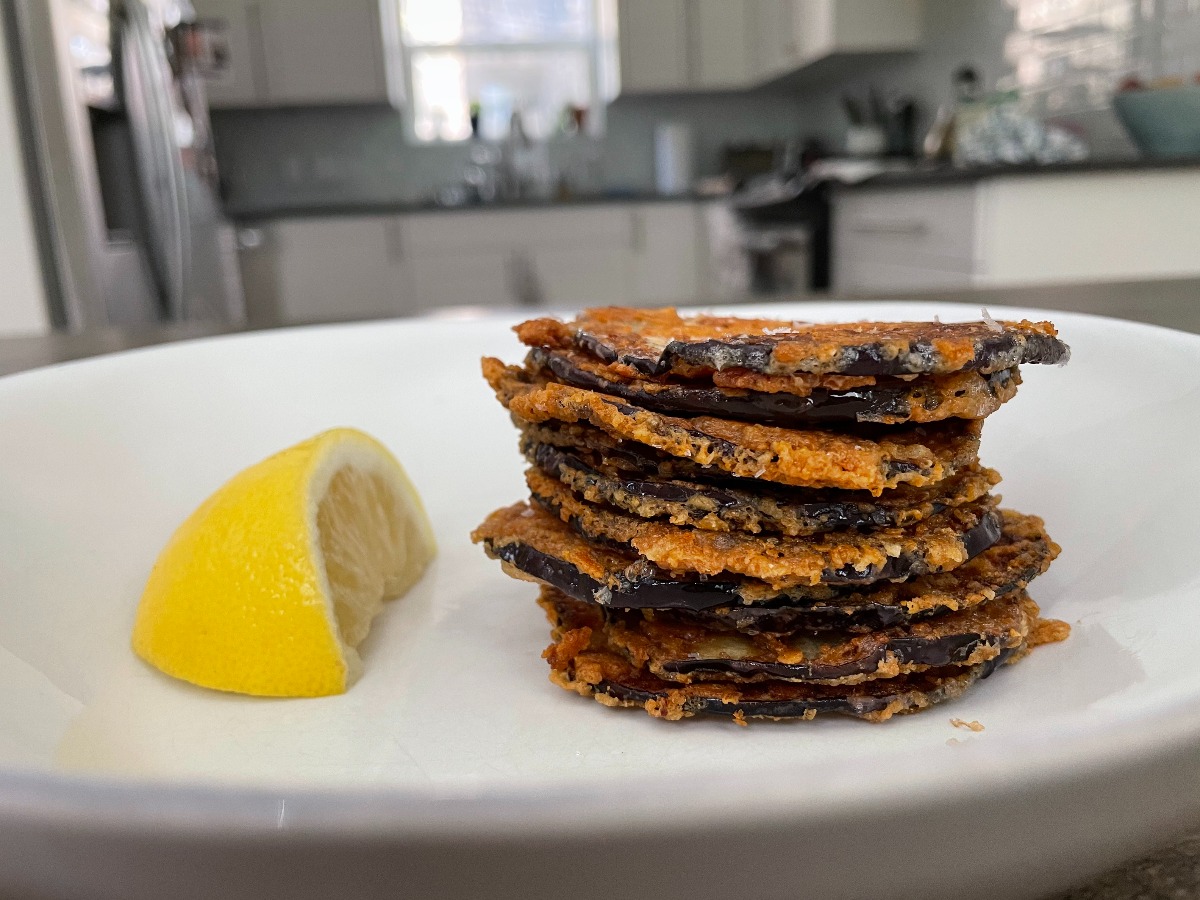
It was maybe the tenth time I’d called her asking how to make her foolproof eggplant parm, which requires zero pre-salting and comes out delicious every time. To make it, you thinly slice eggplant, dredge it in beaten eggs and grated cheese, then pan-fry it in batches until golden brown. 

“There’s egg and cheese, and the eggplant is there kind of holding everything together,” Mom said. “Just a little sponge for that nice crispy cheese and grease.” 

This non-recipe traces to an Italian immigrant and friend of my grandmother’s who worked with her at a department store in Fairfield, Conn. 

“She was a hot ticket — this cute Italian lady who liked to smoke and drink,” Mom said, as if these qualities cemented her eggplant parm prowess. (They did.) 

The method requires patience and care that you don’t overcrowd the pan, which causes the eggplant to steam. But other than that, it’s wonderfully forgiving — and versatile. I’ve used it on the abundance of zucchini and summer squash that starts overwhelming my CSA box each July. I also like to use it on young-ish sliced broccoli stems. 

Once the eggplant is fried, you can submerge the slices in marinara sauce and serve them over pasta; or pile them on a sandwich with pesto; or slice them into strips and toss them into pasta alla norma. Or you can stand at the counter, like my Dad does, sprinkling them with salt and snacking on them while they’re still warm with a glass of white wine.

All this is to say, I’ve thoroughly exorcised my eggplant demons.

***  

Danielle Norris

Recipe: Oma’s Friend’s Eggplant Parm

(As mostly dictated by my mom, Madeline Shea)

Serves 2

Ingredients:

  • 1 medium to large eggplant 
  • 2 eggs
  • 1 block of Parmigiano-Reggiano or Pecorino Romano (or a combination)
  • Olive oil, as needed

Directions: 

Cut the eggplant into very thin, probably 1/4-inch slices. This can be a nuisance because it’s hard to keep them even. The more you do it, the better you get. Stack the slices on a plate.

Crack the eggs, whisk them up and pour them into a shallow bowl. Get somebody to grind up a huge pile of parmesan or pecorino for you. (That white gold can be overpriced, and pecorino tastes good with this, anyway.) You’ll probably have to ask them to grate more at some point — this recipe needs a lot of cheese! Spread out the grated cheese in a shallow bowl, and set it next to the beaten egg to create a little assembly line.

Get a non-stick pan hot over medium heat. (Do you have a no-stick? It just comes out better.) Add a good amount of olive oil once it’s hot. 

Throw a piece of eggplant in the egg wash; really get it in there on both sides. Let some egg drip off, then submerge the eggplant in the cheese, coating both sides. Throw the eggplant in the pan, and brown it until golden brown. Then flip it, and do the same thing on the other side. Depending on how big your pan is, you can cook a bunch at a time — but don’t overcrowd them. Repeat, knowing that you’ll need to keep adding olive oil. These things really suck up oil, so don’t feel like you have to use the best-quality stuff. 

Put the browned eggplant slices on a paper towel-lined plate. After they drain a little, you can start piling them up. This is when Dad comes and puts salt on them and snacks on them. They’re really good with a little salt when they’re warm. (Note: A squeeze of lemon takes them over the top.) Or serve them with pasta and marinara sauce. 

You can also easily freeze them at this point. Get a gallon-sized freezer bag, and stack the eggplant in alternating layers with pieces of paper towel. Seal the bag, and pop them in the freezer. After 30 minutes or so, shuffle them around a bit to make sure they’re not sticking to the paper towels. To reheat, simply pan-fry them in a little oil; or arrange them in a single layer on a sheet pan fitted with a rack, and bake them in a preheated 375-degree oven until hot.

That’s it. You get it, right? It’s pretty forgiving.


More by this author:

New meatballs from Sohla! Which will you make first?

Every month, in Off-Script With Sohla, pro chef and flavor whisperer Sohla El-Waylly will introduce you to a must-know cooking technique — and then teach you how to detour toward new adventures.

* * *

I didn’t grow up with the meatballs I saw on TV. You know, the kind that are perfectly round and covered in red sauce on a plate of spaghetti. Instead, I ate charred lamb kofta with saffron rice or pollock balls stewed in a creamy korma. That’s why I think outside the beef. With my riffable technique, any minced meat or fish can transform into flavorful, tender, and moist meatballs.

The Meatball Moistmaker

The secret to better, juicier meatballs is a panade, aka a mixture of starch and liquid that gets kneaded into minced meat. No, starch isn’t added just to stretch the meat — it sneaks in moisture, too, Trojan horse–style. Make sure to mix your panade until the liquid is totally incorporated, with no dry spots. Then allow it to rest for at least 10 minutes, so the starch is fully hydrated.

Depending on the meat, I like to change it up using various combinations of liquids and starches. Start with torn bread, dried bread crumbs, or stale crackers. Then cover with milk, yogurt, or even juice. In the mood for some sweet-and-savory meatballs with tropical flair? Use Hawaiian-roll crumbs and pineapple juice! Need to add fat to lean ground chicken? Try heavy cream and buttery Ritz cracker crumbs!

What’s more: You can adjust the panade quantity to fine-tune the meatballs’ texture. If you want ultra-tender, pillowy meatballs, use more. If you like meatier, denser meatballs, use less.

Take Me To Flavortown

Sure, you could mix meat with a panade and salt and call it a day. But the bonus ingredients are where you can really play around and have fun. Do it! Have fun! Bring brightness with tender herbs (like dill or cilantro), minced ginger, ground pecorino, or grated citrus zest. Play up meaty depth with deeply caramelized vegetables, like long-cooked onions, garlic, or carrots. Add dimension with toasted and ground spices — from garam masala to Old Bay Seasoning to furikake. Whatever you pick, keep the mix-ins chopped fine, so they evenly incorporate into the meat. And be sure to cook any aromatics you’d rather not bite into raw.

Knead Like Bread Dough

Meatballs are essentially hand-formed sausages, so you want to mix enthusiastically to ensure the ingredients are emulsified. This means the mixture will hold on to moisture and fat when cooked, staying juicy as can be, without you worrying about going over a precise internal temperature.

To achieve this, knead your meatball mixture like bread dough. You can mix it by hand or using the paddle attachment on a stand mixer. The mixture might start out looking wet and loose, but it will become springy and sticky, easily holding together.

Don’t be scared to pick it up and slam it back into your bowl to knock out excess air pockets. Meatballs are the perfect dish to make when surrounded by things that are getting on your nerves.

Give It A Rest

The secret to 99% of my recipes is time. Meatballs are no different. While some people like to mix, then immediately shape and cook meatballs (and many recipes will tell you to do just that), hang on a second. Actually, hang on . . . a day.

Resting the mixture for at least 24 hours (or up to 3 days) will send your dinner to infinity and beyond! The rest allows everything to hydrate and chill out, making the mixture easier to shape and roll. The salt denatures proteins, improving tenderness. The aromatics and seasonings will meld, and the flavors will deepen. No wrong can come from a good rest for both you and your meatballs.

Brown All Around

Once that the meatballs have been panade-ed, seasoned, kneaded, rested, and formed (phew), they’re ready to cook. You did it!

The panade allows a great deal of wiggle room, so I don’t worry about overcooking them. Focus instead on getting as much deep color as possible. Whether you grill, fry, or broil them, keep cooking and turning until crusty and browned all around. That’s the final step to really taking the flavor over the edge.

Go Off-Script

Now that you’ve graduated from Meatball University, get creative and come up with your own dream meatballs. Here are a few combinations to get you started, inspired by some of my favorite dishes:

  • Shrimp Fra Diavolo: minced shrimp + Italian bread crumbs and shrimp stock panade + tomato paste + chile flakes + cooked onions, carrots, and garlic
  • Chicken Kiev: ground chicken + butter crackers and cream panade + minced garlic, parsley, and chives
  • Miso Pork: ground pork + rice cracker and dashi panade + minced scallion, ginger, miso, and soy sauce

And don’t forget to try my spiced lamb and turmeric cod meatballs, too!

“America is back” now that Biden is in charge, says French President Emmanuel Macron

French President Emmanuel Macron on Saturday declared to reporters that President Joe Biden definitely” convinced allies that “America is back” following their meeting at the Group of Seven (G7) summit.

Speaking to the press, Macron lauded Biden’s leadership as he admitted that he believes the president is prepared to resume the United States’ role as a collaborative ally on the global stage, reports The Hill.

According to Macron, Biden’s willingness to cooperate and co-exist will give leaders the ability to work toward developing effective resolutions to global obstacles such as the COVID-19 pandemic and the impacts of climate change.

“For all these issues, what we need is cooperation, and I think it’s great to have the U.S. president part of the club and willing to cooperate. And I think that what you demonstrate is that leadership is partnership,” Macron said.

Biden echoed similar sentiments as he reiterated that the United States “is back.”

“The United States, I’ve said before, we’re back, the U.S. is back,” Biden replied. “We feel very, very strongly about the cohesion of NATO and I, for one, think that the European Union is an incredibly strong and vibrant entity that has a lot to do with the ability of western Europe to not only handle its economic issues but provide the backbone and support for NATO.”

When Biden was asked whether or not he’d convinced global leaders of America’s returns, he opted not to answer the question but instead, welcomed Macron to answer the question himself.

He responded saying, “Definitely.”

Macron’s praise of Biden is a distinct contrast in comparison to his previous interactions with former President Donald Trump. Back in 2019, Macron and Trump clashed over the North Atlantic Treaty Organization (NATO) amid the former president’s “America first” policy as well as his stance on trade and other global issues.

“We never wanted to be teen heartthrobs”: A-Ha lead singer on the band’s longevity and “Take On Me”

The Norwegian pop band A-ha had a number one hit in America back in 1985 with their catchy tune, “Take On Me.” Their debut album, “Hunting High and Low,” sold 11 million copies, and the band was nominated for a Best New Artist Grammy. They never topped the heights of that breakout success in the U.S., but A-ha had more luck in Norway and the U.K. and developed a devoted international fanbase. (Coldplay is among the band’s most ardent fans). They later recorded a James Bond theme song, “The Living Daylights,” and, as many bands do, took a break, took on solo projects, and made a comeback or two.

The enjoyable documentary, “A-ha the Movie” – which received its World Premiere at the Tribeca Film Festival and is now streaming on Viaplay – recounts the experiences of keyboardist Magne Furuholmen, guitarist Pål Waktaar-Savoy, and singer Morten Harket. The film is very much like their music — frothy at first, then more serious; and, like their famous “Take On Memusic video, a bit animated. 

The film shows the band’s evolution from its early formation and struggles to its “overnight” success and the various personal and professional issues of control that threaten to break up the group. Of course, the music is what ultimately matters, and much of it is strong. For folks who only know A-ha from their hit single or debut album, “A-ha the Movie” shows that this trio is no flash in the pan and that many of their deeper cuts are well worth a listen.

Harket chatted via Zoom with Salon about his band, the new documentary, and fame

Why did A-ha agree to make this film? What motivated the band to take on this project and at this time?

I don’t feel we played much of an active part in any of that except in the making of it and being available for the interviews. It’s more the director’s take. We haven’t had a hand in how it was done. It’s his film. In that sense, we are playing a passive role. We just accepted his being around and hovering in the area every now and then for five years.

You’re performing to crowds that number 200,000 and have women mobbing you for photos and autographs everywhere you go. Can you talk about the pleasures and perils of fame and being a rock star? The film captures some of that nightmare of “living the dream.”

The best description I have on what it is like to be in that constant light, no matter where you go, is like being tugged by the shoulder. They can tug it gently, or harder, but it never goes away. It keeps tugging at you. If I did that to you, you would start to laugh, but then you would change. It would start to not just irritate you, but you would ignite like you would not expect after some time. It never goes away. You are dealing with the tug of attention that no one is asking for. No person has any concept of what this is like. There is no one who is famous that I know who actually wants any of that. But we do it because you can’t avoid it. It comes with the package. You have to accept it. There are different ways of dealing with it. One way is to confront it and jump in at the deep end and be there. In many ways that’s a healthier attitude than trying to avoid it because you can’t win. You are more in a position that you feel that you are taking charge and it’s something you decide, as opposed to it happening to you. If you are more upfront about it and confront it — not in a confrontational way — but acknowledge that it is like that. There is nowhere you can go where it’s not like that. 

Is the joy of performing the trade-off for all the attention and fame?

I don’t know that it’s a trade-off because [performing] is an honest sharing between yourself and an audience. Everyone understands what is going on there. Once you are off stage, there is no real communication. People don’t understand the other side at all. There is a huge divide that happens the minute you walk off stage. When you are on camera, you are actively addressing people because you are being interviewed, or you’re confronting a mass audience —that’s an active thing — you walk up there, and you do it. When you walk off it, in all other walks of life, you walk back to your private life. That’s not the case with fame. 

It’s also not you that they are after. You don’t ever really feel that you are connected. You become merely an object, and it is completely wiping away the subject aspect of it. This is what women feel like when they are being objectified, or being objects to men, or when you become a sexual object as opposed to a subject of some sort. It’s really the same. 

You talk candidly in the film about being very hard on yourself. You are critical on stage during a sound check as well as in the studio and even during a rehearsal. I admire your striving for perfection, but do you think that given your early success that you have to keep proving yourself. Is there a sense of imposter’s syndrome here after hitting it big?

I understand your thinking that way, but it’s not that way for me. I relate to my own critical sense, which comes from my playful side. I know what I can be, I know what is potentially there and achievable, and it is a state of being that is wonderful when you hit it. It’s right next to you all the time, but not easily accessed.  To hit that moment where something is given wings by your involvement — you become part of something of a spiritual nature. There is a relation and a connection that is wonderful. That’s what I reach for.

The other side of the coin is when you don’t hear yourself properly. If you are a gymnast, and you don’t know where the ground is, it is hard to gauge where to land. It’s the same as a singer. If you can’t hear yourself properly, your references are muddled, you become uncertain about where you are, and you have to aim for something that seems to be the best place. When you are in that state of mind, you turn on other sides of your system in order to compensate for what is lacking. To be playful at the same time and have access to what you can be is hard. It doesn’t really happen.

Likewise, I was pleased to see that A-ha really had issues with its image and wanted to shift from been teen heartthrobs to making more serious music. How much of your image did you control? The film suggests you were really at the mercy of the executives and your naivete was a factor.

We never wanted to be teen heartthrobs! These people in these positions understand the mechanisms of how things work. They let things happen and it is down to the artists to learn and position yourself where you want to be in the whirlpool of things. Naivete, certainly. We didn’t link it to the fact that the camera [creates] an image in a 1000th of a second where you are between two different expressions on your face, and it looks as if you are frozen in that expression, which is easily used to convey something that was never on your mind. That is being utilized by media all the time. It’s not you. It’s not really anyone. There are not many people in media that actively abuse these things, but you take advantage of something you see potential for that is being used for whatever it can be used for. 

The early success perhaps enabled you to take a new, more serious direction with your music at times, but it was a bit of a trap. I expect “Scoundrel Days,” your second album, was more in the spirit of the band, and it certainly showcases different songs. “October” has a jazzy lounge vibe,” and “Manhattan Skyline” is a real hybrid song. Can you talk about the band’s evolution?

Our demos point more to “Scoundrel Days”-type of music than the first album and how it turned out. The first album is not the best reflection of the band. As opposed to saying it’s a development in the band, it’s more a case of the band becoming more assertive and more heavy-handed with things and too eager to avoid certain things, which is another type of prison. You shouldn’t do something to avoid something else. You should do something because you are drawn towards it and be free to explore that. As opposed to trying to not be seen as something, which is not an honest place to be. You are leaving a product behind that is neither this nor that.

So, it took a while for us to become good, if ever. We don’t agree on all things, either. I take a slightly different view to this sort of phenomenon or these mechanisms and how they work. I find that Pål and Magne are more in tune with each other in that aspect, while I believe in who we are, and who we can be, and welcome that. In my view, the other two are more concerned with what things come across as, and for me, that becomes a hindrance to your free spirit within your music. Maybe they recognized that in themselves to a point, and maybe not at all. I feel the band is held back a little by that attitude. 

Do you have a personal favorite song, one that you felt should have been a hit, or just didn’t get the chance it deserved, maybe one that you feel is more representational of the band? 

There could be many. I don’t have a favorite song. I can lean to one song for a period, then to another. But all the songs we’ve done, we’ve had some sort of soft spot for at some point in time, or they wouldn’t be there. And there are a lot of songs in the making that have never gotten through to the point of being recorded and released. There are some cornerstones. On “Memorial Beach” there is a song that most people don’t know, “Cold as Stone,” which I like. A lot of others that are more the darker side of the band. A-ha is a dark band, really. That is where we are coming from. None of us listened to pop music growing up. We would not have listened to A-ha ourselves if we were on the street, because of the image of the band. Because of a number of things. Because of me, for one. [Laughs]

The early success was this hit single, which caught on when the MTV video came out. What do you think was the power of that song/video at the time? A happy surprise? Too much too soon?

You’re asking a lot of things at the same time! I was completely confident we’d make it on the world stage. I never doubted that, because it’s an honest, genuine piece. That has never surprised me at all. Too much too soon? Not too soon. Too much? Certainly, definitely. Our lives changed. We were hit by a bullet train. You don’t wake up soon after that. It takes a long time to get your act together. We ceased being a band the instant we made it. It took a year or two before we started to really . . . no one had any idea what it was like to be in that turmoil. There is no time to think. You just do what you have to to get through it in a way. But then we became a band later on. We’ve had decades on the road. I feel the documentary fails us a little in the second half, which [chronicles] when we got back together through to today. That is the longest period that we’ve been together, I believe. And it’s our time when we’ve done our best business and touring. We played to many more people in the second half than in the first, and success-wise, that’s a bigger achievement than making it in the first place, I would argue. 

What observations do you have about the legacy and longevity of the band? Did you ever anticipate that you would still be playing with Magne and Pål for almost 40 years!? 

I saw 30 years, for sure. I didn’t see 40. But I saw 30. I saw three albums to start with. I don’t go around seeing things, but that’s come true.

I was pleasantly surprised that the film doesn’t delve into addiction issues, or any of the typical rock star pitfalls. There were songwriting credit disputes, there was a hiatus, solo albums, there were reunions and comebacks, though . . .

That’s to be expected. What I do feel is that the focus in the second half of the film is the disagreements and problems. But one has to bear in mind that we’ve been together for all this time and we’ve chosen to get together and get back together over and over again. We have a deep respect for each other and I’m always proud and honored to be associated with them. And we all feel the same. But we are not the same, and that is part of the package. All three of us are completely necessary for the band to become A-ha. Magne is a much bigger songwriter in A-ha than he gets credit for; a good number of the riffs and hooks are from Magne. For me to get in there with songwriting, that has never happened. I do it on the side because that’s what works. I’m cool with that.


“History of the World, Part 1” turns 40, and it’s still good to be Mel Brooks

“What’s in a name?” William Shakespeare once wrote. To which comedy legend Mel Brooks might sagely reply, “It’s one of the best jokes in ‘History of the World, Part 1.'”

There is no Part 2, and no serious plans ever seem to have existed to make one, which is a shame because “History of the World, Part 1” is one of the all-time great spoof comedies. Its genius can be seen right there in its title, which playfully juxtaposes the promise of a lofty message with the grubbiness of Hollywood’s shameless sequel-baiting. Appropriately enough, “History of the World, Part 1” parodies big budget historical epics like “Spartacus” and “The Ten Commandments.” In the process, however, it also reveals a great deal of wisdom about the painful truths of history — and how we can laugh even at the roughest stuff.

As we celebrate its 40th anniversary of its release on June 12, 1981, it is useful to examine why “History of the World, Part 1” has stood the test of time.

Unraveling the timeline

Perhaps the most important comedy element of “History of the World” is that it doesn’t have a linear story. It is a series of sketches covering the Stone Age, the Old Testament, the Roman Empire, the Spanish Inquisition and the French Revolution, closing with a mock teaser trailer for the nonexistent sequel. Consequently, like the similarly intellectual sketch comedy film “Monty Python’s The Meaning of Life” (which was released only two years later), “History of the World” is freed from all narrative constraints and able to tackle its subject on a more ambitious conceptual level. While “The Meaning of Life” is about philosophy, however, “History of the World” is about history. Brooks casts his comedic eye at humanity’s past and, if the sketches are any evidence, seems to view our story as one of big guys keeping little guys down.

To quote the film’s most famous line: “It’s good to be the king.”

This is a movie where King Louis XVI (Brooks) goes clay pigeon shooting with peasants, where a man is thrown in prison for saying the lower classes “ain’t so bad” and where the Roman Senate angrily shouts “F**k the poor!” Brooks doesn’t merely lampoon economic injustices. Sexism, racism, anti-Semitism and human cruelty in general are all satirized.

The other major world leaders depicted here, aside from Louis, are the Roman Emperor Nero and the Spanish Grand Inquisitor Torquemada. If there is a running theme in Brooks’ view of major historical events (at least from Western history; non-Western history isn’t featured after the Stone Age sketches), it is that people with money and power have great lives. For people without those things — or who belong to marginalized groups in general — life stinks.

These are obvious points to some, but not all, and the genius of “History of the World” is that it manages to subtly convey Brooks’ social critiques in the packaging of a zany Borscht Belt comedy. The cast includes Brooks regulars like Madeline Kahn, Dom DeLuise, Cloris Leachman and Harvey Korman, who are joined by the criminally underrated Gregory Hines (replacing Richard Pryor). The script is stuffed to the gills with witty zingers, visual gags, puns, cheerful slapstick, silly mugging and fourth wall breaking – pretty much everything you’d expect from an American Jewish comedian mentored by the likes of Sid Caesar (who also cameos). Brooks’ comedy philosophy was to throw as much at the wall as possible and see what sticks.

“I agree with you about the vaudevillian interpretation and because of that there’s a kind of a scattershot, hit-or-miss quality to it,” Larry Charles, a comedian who wrote for “Seinfeld” and directed the first “Borat” movie (which also had a funny title: “Borat: Cultural Learnings of America for Make Benefit Glorious Nation of Kazakhstan”), told Salon. “It’s like a joke-to-laugh ratio and some of Mel Brooks’ comedies have amongst the highest percentage of joke-to-laugh ratios.” Charles expressed affection for “Part 1” and recalled many funny moments, although he felt there were other Brooks films with even higher joke-to-laugh ratios.

“The Spanish Inquisition is a great piece and I do love the King Louis XVI piece,” Charles told Salon. “‘It’s good to be the king.’ I would say those are my two favorites.”

Pushing the limits of taste

Those are among mine as well, since they contain some of Brooks’ most cheerfully vulgar gags. Brooks has never been one to shy away from vulgarity — once famously bragging that his films rise “below vulgarity” — and this perhaps partially explains “Part One”‘s lukewarm critical reception at the time it was released. Yet the lowbrow comedy can be defended on two levels. First, even when it isn’t making a larger point, it is often quite funny. Brooks’ big song-and-dance number about the Spanish Inquisition, for instance, holds up as hysterically tasteless in the tradition of Brooks’ “Springtime for Hitler” in “The Producers” even if it doesn’t have much depth. Yet some of the crass jokes educate you even as you chuckle. Take the wordplay that uses a 12-letter epithet to reference Oedipus, a character from Greek mythology; if you know the classics, you’ll get the joke.

Or look at a throwaway gag in which a Roman inventor excitedly hawks his new invention, indoor plumbing, by trying to blow people’s minds at the mere idea of something that can “pipe the s**t right out of your house!” This one always make me guffaw because it works on two levels. The joke involves toilet humor and naughty words, to be sure, but indoor plumbing truly was a revolutionary invention when it came to personal hygiene. The gag here isn’t just the use of vulgarity; it is the fact that one of the great moments of human technological progress involved something that can easily be reduced to a potty joke.

That simple joke in many ways epitomizes Brooks’ seemingly paradoxical, but nevertheless quite effective, approach to comedy: It’s smart yet silly, juvenile yet sophisticated, transgressive and edgy while being a quaint throwback to a style of comedy not seen as much in this era of realism.

Michael Price, a comedy writer known for his work on “The Simpsons” and “F is for Family,” recalled seeing “Part One” in theaters 40 years ago, when he was still a college student.

“I was a huge Mel Brooks fan, going back to seeing ‘The Producers’ when I was pretty little on TV and thinking it was funny, and then they screened it at my college and I remember just losing my mind over it how great it was,” Price recalled. “Then I saw ‘Blazing Saddles’ much later because I was too young when it came out. Then of course ‘Young Frankenstein,’ I loved them both. And then I was a huge Alfred Hitchcock fan, so I remember seeing ‘High Anxiety’ like the day it came out and loving it and really getting into it.” Like Charles, Price did not feel that “Part One” was his favorite Brooks movie — he also described it as “kind of hit or miss” — but he still has a high regard for it.

“Watching it again last night really brought back a lot of warm memories because he just filled them with all these guys and people and actresses that were really funny,” Price told Salon. “He has his regular people like Madeline Kahn — who was really super funny in it, I forgot how funny she was in it — [and] he has Cloris Leachman, who is great. He has Harvey Korman, who is so great and I wish he would have done more in terms of movies.”

Price identified many great moments from the French Revolution sketch: The pun in which Louis responds to news of the peasants revolting by saying they “stink on ice” or Leachman complaining that the peasants are so poor they can’t even afford their own language and are stuck with a “stupid accent.” He appreciated how Korman’s character was named Count de Monet, both a reference to the greed of the elites and a callback to his character from “Blazing Saddles,” who also had an easily mispronounced name.

Some of the comedy, unfortunately, has become problematic with the passage of time. In particular there are rape jokes that make you cringe instead of laugh, as well as two characters who are offensively mincing gay stereotypes. On some occasions the comedy can be defended as criticizing characters’ actions: For instance, when Louis sexually assaults a number of women, he is obviously acting the part of the lecherous heel. At the same time, it is impossible to excuse things like giving a homosexual character a name that is literally a homophobic slur. Some of his tastelessness is especially sour years later. It is a risk that all comedians run — that their work won’t age well — and in that respect there are elements of “History of the World” that remind of the Marx Brothers’ film “Duck Soup” (another classic subversive satire which had a few problematic jokes). For the most part it is brilliant, but every so often it becomes an uncomfortable product of its time.

A well-meaning mensch

Yet “History of the World” still works because for the most part it supports the underdog and has an overall tone of good-natured sweetness. As Charles explained, this is reflective of the man who made it.

“No matter what he does, no matter how savage his satire or his jokes are, there is a quality that Mel Brooks the person has and that his movies have, which is a certain amount of sweetness,” Charles explained. “His movies always have a sweetness to them because that’s who Mel is also. I think that’s kind of a very unusual quality for actors to have, for the writers to have and the filmmakers to have. And that’s something that all his movies, that’s one feeling that always exudes: There is a kind of a sense of sweetness.”

Charles also located Brooks’ humanism and comic sensibilities within the context of American Jewish comedy culture.

“He’s a working class guy,” Charles said. “He’s from the same neighborhood as Larry David [fellow “Seinfeld” scribe and “Curb Your Enthusiasm” creator] and myself. He’s a generation ahead of Larry or two generations ahead of Larry. But again: parents from Eastern Europe, comes to Brooklyn, has nothing, works his way through the Catskills kind of like an ambitious young Sammy Glick.”

This is part of the reason why, reflecting back on the 40-year anniversary of “History of the World,” I would never dream of doing to it what the world’s first art critic does to the world’s first artist in that movie: Urinate on his work. (Price identified this as one of the moments that made him laugh out loud upon re-watching the film.) Quite to the contrary: If climate change and pollution destroy the human race, and an alien civilization was to find just one work of art to understand the human condition, I can’t think of anything better than “History of the World.”

This is not being said in jest. “History of the World” captures one of the greatest joys of human existence — the ability to laugh — even as it recounts some of the most important events in our collective story. Perhaps most significantly, it chronicles the stupidity and selfishness that will have led to our downfall. Figuratively speaking, Brooks’ Louis is absolutely right about one thing:

It’s good to be the king. Anyone else? Not so much.

Revisiting the ethics of cult favorite “Kids” 26 years later through a new documentary

In 1995, Larry Clark‘s film, “Kids” became a sensation with its “authentic” depiction of teens participating in reckless behavior including drug abuse and sexual activity — not the least of which included deflowering virgins. The film was controversial both in terms of its content but also because there were accusations that screenwriter Harmony Korine and director Larry Clark were exploiting their characters and the non-professional actors playing the roles.

While “Kids” launched the careers of Chloë Sevigny and Rosario Dawson — as well as Justin Pierce, who won an Independent Spirit Award for his performance — for most of the cast, fame was fleeting. The $1,000 the teens were paid to perform was insufficient, given that the film, which had a $1.5 million budget, made more than $20 million at the box office.

Now, 26 years later, Australian filmmaker Eddie Martin reconnects with a handful of the kids from “Kids” for his documentary, “The Kids,” which is having its World Premiere at the Tribeca Film Festival. Hamilton Harris, Priscila Forsyth, Jon Abrahams, Peter Bici, and others from Larry Clark’s film recall the evolution and impact of “Kids” as well as how their lives where transformed by the experience. Harold Hunter, who was a lynchpin in the group of skaters that formed the core group of teens in the film, is specifically featured as he brought the then 19-year-old Korine into the fold. 

Martin’s documentary, itself a cautionary tale, addresses the economic inequality, drug use, homelessness, lack of a strong family, and other social issues that drove the “kids” to form an alternate family unit back in the day. “The Kids” also chronicles the casting, shooting, and release of the film and its tragic aftermath. The filmmaker spoke with Salon about his documentary.

What was your impression when you saw the film “Kids” for the first time? Was it controversial or inspiring to you? 

It was neither nor, to be honest. I too, was a skater — just on the other side of the world, so those characters were not unfamiliar to me. I thought the story was a bit cheesy, or over the top. It didn’t impact me the way that it impacted so many others. I am aware of how much the film means to a lot of people, and that it is a cult classic. I only saw it once. I could have taken it or left it.

That’s a great answer — the alternative to, “I have been obsessed with ‘Kids’ for 25 years and had to track down everyone involved!” Why did you decide all these years later to make a documentary about “Kids?

Hamilton had been wanting to tell his story for some time, apparently. He had been having conversations with people and things weren’t coming together. We had a mutual friend who is an artist, and he reached out to me, and said he had a friend who is passionate to tell his story and maybe you can help, and he connected us. I reached out and as I got to know him, we had a connection. I found his alternative narrative to the film, and his effort to honor his friends, really engaging, so I wanted to do whatever I could do to empower him to bring his story to audiences.

You spend significant time in your documentary presenting the background of Hamilton Harris, and the appeal of Harold Hunter, so viewers are very sympathetic to these “kids” who supported each other and bonded over skate culture. What observations do you have about this “functional family” that these kids created?   

We all knew New York had a wild time, but going into this, one of the things I learned in the process of making this film is how incredibly hostile the environment of New York City was in the 1970s, ’80s, bleeding into the early ’90s. These kids grew up under quite traumatic circumstances and they were forced to create their own functioning unit to survive in this incredibly hostile world, and that was working for them. When this film came along, and affected their lives positively or negatively, it essentially started to break that group up, and they fractured, and things started to change. They lost their support network.

You make very brief mention of Chloë Sevigny and Rosario Dawson in the film. While they have had successful careers, you choose not to focus on them. Were they connected with the core group during? 

Not a lot. Our story is really about the essential core group of Hamilton and his [friends] and those characters [Chloë and Rosario] were not a part of that experience. They were, obviously, involved in the making of the film, but it is my understanding that they didn’t continue a relationship with folks after the film. They were outsiders not connected with our characters’ experience. We asked them for interviews, but it didn’t come to fruition. We did reach out to Larry and Harmony.

There are questions about the teens being exploited by Clark. What are your thoughts about the content?

For us, it was really important to share the experience and let viewers make up their own minds. For each individual member of the community, they had a different experience. I don’t feel that it’s my place to comment on each — whether they felt exploited or not. 

The impression I got from your film was that they really were exploited.

They were young, and had no experience, no guidance, no mentors, no parental figures. As one character says, “They were stoned and going with the flow.” It’s an interesting space. That’s one of the things in our film — about not having guidance and mentors. When the film [“Kids”] came out, they didn’t know how to cope with the situation and had no one to help guide them and give them advise on how to navigate what happens when this comes out and get famous. That was another film that they had to deal with.

Most of the teens in “Kids” were taken advantage of it seems. That surely impacted Justin Pierce and Harold Hunter, who “became victims” after the film’s success? What are your thoughts on how this experience impacted them? 

There was a false narrative that was marketed as being true. It’s a very questionable space. This is a human story at its core, but it’s also a cautionary tale. It’s shining a light on questions of ethics and exploitation. Again, I really just want the audience to watch and make up their own minds on that. 

I applauded Highlyann, who is featured in your film and didn’t appear in “Kids.”

She made the right decision, and good for her. I think there is value in these stories, these alternate narratives, and the characters’ experiences despite the handful of successful people who made it out over the past 26 years. That was what was interesting to me and I hope translates to audiences. 

“The Kids” features a clip of Clark dodging questions during a press conference at Cannes. You indicate in the film that both Clark and Korine declined participation, did you expect them to participate?

It’s right to give everyone the opportunity to share their side of the story and to explain or understand why these choices were made. The same goes for Harmony. 

If Clark and Korine had agreed to talk, what would you have asked them? 

I would ask them to share their experiences. I may have asked them how they would respond to claims that were made by some of our characters, but it would have been more about them telling their story and sharing their side of events.

It seems many of the subjects in your documentary have survived and thrived. Yet despite the theme of these teens “wanting a better life” you don’t reveal much about where they are now, or how they got there. What decisions did you make regarding this? 

One of the core things here is about breaking cycles. If you’re born in the projects, or into poverty, or born into addiction, or domestic violence, these cycles can be incredibly hard to break out of. Despite all those challenges and all this trauma of growing up and losing friends and all the stuff they gone through, some of our heroes have managed to break those cycles and form their own functioning family units. They have kids now and are not repeating these cycles, and there is power in that. That’s inspiring — that they were able to break through and better their lives and being good mothers and fathers and provide the guidance that they didn’t have. That’s a wonderful thing to see how they evolve and change. 

Do you think a film like “Kids” could be made now? Why or why not, and what do you think it would be like?

Wow! I don’t think it could be made now. Unless it was made some in some third world country. Hopefully, through all the Weinstein drama and all that that we’ve grown in terms of ethical boundaries. I’m not sure if it should be made, but if it is, it shouldn’t be marketed as real when it’s not; the impact that had on vulnerable members of society.

OAN host’s group covers expenses for out-of-state Republicans traveling to learn from AZ audit

A fundraising group, under the direction of a One America News Network (OAN) host, is now footing the bill to cover travel expenses for out-of-state Republican legislators to tour the botched election audit currently underway in Maricopa County, Ariz.

According to Talking Points Memo, Voices and Votes is the group led by Christina Bobb, a former Trump administration official who currently works as a host for the One America News Network (OAN). Back in April, Bobb gradually became more vocal about the group’s fundraising efforts noting that it had surpassed the $150,000 milestone.

At the time, pro-Trump lawyer Lin Wood confirmed to the publication that his own group Fight Back had also contributed $50,000 to Voices and Votes. His admission came as he admitted that he had personally spent time with Doug Logan, the CEO of Cyber Ninjas, the top contractor conducting the audit. At that time, Wood claimed Logan told him he was “working on the investigation into election fraud.”

At one point, she also incorporated an on-air campaign to promote fundraising efforts for the group.

“Voice and Votes is an organization that I started, and I’m working to help other state senators get a close-up view of the Arizona audit,” Bobb said. “If you’d like to help fund other state senators to get an up-close and personal view of the Arizona audit, you can donate at VoicesandVotes.org.”

Now, those funds are being utilized to help Republican lawmakers travel to the state so they can get a firsthand experience of how the audit is being conducted which may influence future audits in similar fashion in other states.

While many Republican legislators have expressed interest in touring the audit, there are a number of reasons why there are concerns about this. The audit may not be the best reference to model after as it is being conducted by an inexperienced firm. It has also been a subject of intense scrutiny over the last several weeks.

A vaccinated person’s guide to the most concerning COVID-19 strains

Though they are technically not alive, viruses are not unlike living plants or animals. They can be bred, and they can mutate; over months and years, they evolve into new things. At some point in November 2019, there was one human on Earth who had been infected with SARS-CoV-2. Now, the virus has passed through millions of bodies, and replicated trillions of times. It is the nature of RNA viruses to change and evolve gradually — thus, the SARS-CoV-2 virus that infected patient zero has spawned numerous variants as it multiplied through the human population.

“All RNA viruses mutate over time, some more than others,” writes Robert Bollinger, a professor of Infectious Diseases at Johns Hopkins University.” For instance, flu viruses are particularly prone to mutation, which is why new strains circulate every year.

The novel coronavirus’s variants have sprung up all over the world, with some of the most prominent mutations appearing in England, South Africa, Brazil, India and California. As long as the coronavirus keeps spreading, it will keep mutating, which is why public health experts are pushing vaccination as a means to stop the spread and thus the mutations.

“One thing that has to be kept in mind is that the rest of the world is largely not immune, and the rest of the world has not really been vaccinated,” said Dr. Charles Chiu, a professor of infectious diseases at the University of California–San Francisco. “The reason why these variants emerge is because you have ongoing transmission, so until we’re able to curtail the pandemic globally, we’re going to continue to see the emergence of variants.”

The ultimate fear, then, is that one of these mutations will render one or more of the vaccines obsolete — thus launching a renewed vaccine arms race against a novel mutant strain. There’s no evidence that has happened yet; some variants seem slightly more resistant to some vaccines, but in general the vaccines seem to confer protection against most prominent strains so far.

Still, nobody knows for certain. But Monica Gandhi, infectious disease doctor and professor of medicine at the University of California–San Francisco, is optimistic that vaccines will continue to offer protection against mutant variants — mainly, because of the reason has to do with the strong immune response induced by the vaccines.

“Even if you have a variant that has 13 mutations, like the Delta variant, you’re still going to get that lineup of lots of T cells that combat some of those variants,” said Gandhi. T cells are a type of roaming white blood cell that attacks and kills pathogens they find in the bloodstreams. “I do think T cell responses from vaccines will work against” these variants, she said.

Researchers and pharmaceutical companies are thus rushing to figure out if that’s true. As more and more variants appear, studies into how vaccines work against them follow. Now, according to the Centers for Disease Control and Prevention (CDC), there are five “notable” variants circulating the United States. Here’s what each one is, and what we know about vaccine efficacy in each case. 

Variant: B.1.1.7

First identified in the United Kingdom in October 2020, the B.1.1.7 strain is said to be more deadly and more transmissible. It quickly became the most dominant strain in the UK, and is believed to be the cause of a deadly fall surge. It was first identified in the U.S. in December 2020; now, it is the most common source of new infections, according to the CDC.

How the vaccines work against it: According to data published in March 2021, overall efficacy for the AstraZeneca-Oxford COVID-19 vaccine is 61.7 percent against the B117 variant. Separate data from the Pfizer vaccine showed that it has overall 89.5 percent efficiency against the variant 14 days after the second dose. In an in vitro study, Moderna’s COVID-19 vaccine produced neutralizing antibodies against the B.1.1.7 variant, according to a Nature study published in March 2021, but there was no specific efficacy percentage provided. Efficacy for the Johnson & Johnson vaccine remains just as strong against B.1.1.7, the company has previously stated, based on data from its Phase 3 clinical trial.

Variant: B.1.351

This variant, which first emerged in Durban, South Africa in December 2020, initially alarmed scientists because the mutation of the virus happened at the SARS-CoV-2 spike protein — the little spikes that emanate from the surface of the virus like spines on a sea urchin — thus, disguising its appearance to the immune system. That was alarming to immunologists, because some vaccines work by training the immune system to recognize the Spike protein; if it is altered, some fear those vaccines may not work as well. In January 2021, health officials first detected it in the United States.

How the vaccines work against it: Unfortunately, according to a study published in the New England Journal of Medicine in May 2021, two shots of the AstraZeneca-Oxford University COVID-19 vaccine were ineffective against mild-to-moderate infections of B.1.351. According to the study, it has a 10.4% effectiveness against the variant. However, none of the people observed in the study with mild-to-moderate infections were hospitalized.

However, a separate study published in May in The New England Journal of Medicine showed that both the messenger RNA vaccines, Pfizer and Moderna, are effective against the variant based on data from Qatar. 

For the Johnson & Johnson vaccine, the single shot is reportedly 57 percent effective against the B.1.351 strain based on data from South Africa. Notably, while some people still had mild to moderate infections, nobody was hospitalized.

Variant: P.1 (also known as the “Gamma” variant)

This variant, which has three mutations to the spike protein, was initially found in travelers from Brazil who were tested during a routine screening at an airport in Japan in January 2021. This variant is believed to be the cause of a resurgence of infections in Brazil in some people who had COVID-19 antibodies, suggesting that this variant can evade natural immunity from a previous infection.

How the vaccines work against it: According to a study published by Oxford University in the journal Cell, the antibody response from the Astrazeneca vaccine in blood samples of people with the P1 variant was reduced three times — but it wasn’t as low as the efficacy against the B.1.351 variant. A paper published this week in Nature reported that those who were vaccinated with two doses of the Pfizer–BioNTech COVID-19 vaccine were able to neutralize the P1 variant.

Moderna recently released data from a phase 2 study showing that a single dose of the Moderna vaccine as a booster, in fully vaccinated people, neutralized the P1 variant.

From data collected in South Africa, where the P1 strain has been circulating, experts believe that the single-dose Johnson & Johnson shot is still effective at preventing severe outcomes from the P1 strain, while less effective at preventing mild to moderate infections.

Variants B.1.427 and B.1.429

Both of these strains were identified in California in 2021, and they seem to spread more quickly and lead to more hospitalizations, according to the CDC.

How the vaccines work against them: Unfortunately, there is little information currently about these variants and the effect of vaccines on them. The CDC states that studies suggest that the current authorized vaccines in the U.S. work on these variants, but studies are still ongoing. (This story will be updated as more information about these two variants is revealed through research.)

Variant: B.1.617.2 (known as the “Delta” variant)

According to the CDC, the Delta variant accounts for more than 6 percent of sequenced virus samples in the United States; a month ago it accounted for only slight more than 1 percent of sequenced samples. It was first detected in February 2021 in India, and has been declared a “variant of concern” by the World Health Organization. Experts believe it is more transmissible and can lead to more hospitalizations.

How the vaccines work against it: According to early data published by Public Health England (PHE), the AstraZeneca vaccine was 60 percent effective against the variant after two doses, and the Pfizer vaccine was 88 percent effective.

While there haven’t been studies on Johnson & Johnson and Moderna, there is evidence to suggest that the Moderna vaccine can neutralize the Spike protein of this variant. According to the Washington Post, Dr. Anthony Fauci said the protection from the variant with two Moderna shots is likely similar to the effectiveness of the two Pfizer shots.


Want more health and science stories in your inbox? Subscribe to Salon’s weekly newsletter The Vulgar Scientist.


7 best rosé wine brands — for all kinds of wine-lovers

In preparation for those summer days when it’s too hot to move, much less walk to the wine shop, I like to keep at least a couple bottles of vino in the fridge at all times (and maybe a few more on the bar cart, just in case). The rest of the Food52 team clearly thinks so, too. While I tend to be more of a light red fan, when the weather gets so warm you’re sweating at breakfast, a glass of rosé can be just the thing. And before you say “I don’t like rosé — it’s too sweet,” hold on a sec. Just because many rosé wine brands fall on the sweeter side doesn’t mean all rosés taste like melted watermelon Jolly Ranchers. Some are sweet, yes (and if wine that tastes like cotton candy is your thing, I wouldn’t dream of yucking your yum!), but other rosé wines have floral notes of ripe, red summer fruit yet stay dry and crisp on the palate; or they’re bubbly and tart; some are quite savory, even herbal in flavor. There’s a great rosé for any kind of wine-lover, I promise.

Of course, for some folks, the answer to “what’s the best rosé wine brand?” is “any one that’s made into frosé,” but other people have more specific bottles in mind. Here are the seven best rosé wine brands, according to team Food52.

Folk Machine Gamay Noir Rosé 2020

“Gamay grapes are typically used to make light reds, but this fresh and savory (not too sweet!) rosé is perfect for summer. Super-light, I’d be just as likely to drink this solo as I would plop it on the dinner table, whether I’m making veggie burgers, pasta, or barbecued chicken.” —Rebecca Firkser, assigning editor

Wölffer Estate No. 139 Dry Rosé Cider

“I love this Wölffer Estate rosé cider because it’s the perfect balance of dry, crisp, and fresh. It’s great for a weeknight drink, and during lockdown, it was an easy — and much cheaper — way to transport myself to the actual Wölffer Estate in the Hamptons.” —Jada Wong, market editor

Swick The Years Combined Rosé

“A highly crushable rosé from a mix of Pinot Noir, Syrah, and Malbec — it’s unfiltered and has just got a touch of funk!” —Jason LaFerrera, senior software engineer

Wölffer Estate Summer In A Bottle Rosé

“I didn’t want to seem too basic . . . but if loving this is wrong, I don’t want to be right.” —Ariel Pietrobono, senior manager, brand strategy

“This bottle just makes you happy!” —Alana Cooper, sales director

Swick Only Zuul 2020

“It’s the perfect chilled warm-weather wine. There is lychee, potpourri, roses, peach, stone fruit, and orange blossoms, making it fruity and light, without being too sweet. It is by far the most interesting rosé I have tried.” —Shannon Muldoon, director, Studio52

Meinklang Frizzante Rosé “Prosa”

“This crisp, refreshing pét-nat is like no other! The grapes are grown biodynamically and fermented only using native yeast. It’s been my to-go summer rosé for years. It has a nice acidity that makes it very juicy. The bubbles are there to help you crave one more sip, but are not as persistent as other pét-nat or bubbly wines. On top of everything, it has a very bright pink-orange hue.” —Sebastian Sardo, brand manager, pantry

Arca Nova Rosé

“So refreshing, light, drinkable, and berry-forward with a slight fizz — everyone that tries it loves it. It’s been hard to find at times, and my mom and I stalk the one wine shop in her neighborhood that has it. I have one bottle of 2018 left, and then it appears there’s a 2020 that I’ll definitely be trying! Definitely opened me up to Vinho Verde in general (a type of wine from Portugal made with young grapes). Bonus: This one’s a twist-off.” —Holly Siegel, copy lead

(Looking for another great Vinho Verde rosé if you can’t find a bottle of Arca Nova? Try Quinta da Lixa ‘Sol Real’ Vinho Verde Rosé.)

This post contains products independently chosen (and loved) by Food52 editors and writers. As an Amazon Associate and Skimlinks affiliate, Food52 earns an affiliate commission on qualifying purchases of the products we link to.

The dream of thriving in academia is still a nightmare for many Black professors

“Do the arms get any longer on this jacket?” I said. “I’m into this whole tweed, suede-on-the-elbows look. It’s real Doctor Watkins-like — even though I’m not a doctor.”

The lady at thrift store erupted in laughter. “You need a seamstress, buddy.” 

I grabbed the available jackets, gladly paid the clerk about $20 for all three, and smiled my way out of the store. I was beyond happy — I was going to start my first university teaching job, as an English and creative writer professor. Being Black and in academia has always been tricky, if not impossible. It’s like publishing and Hollywood in that respect — yet another industry that does not allow many Black people to play. I have three degrees, all from schools located in a city that is 64% Black, and can still count the number of Black professors I’ve had on one hand.

Over the last month, the outrageous treatment of Nikole Hannah-Jones by the University of North Carolina-Chapel Hill has dominated headlines after UNC buckled to conservative political pressure to deny the Pulitzer Prize-winning creator of The 1619 Project for the New York Times the tenure that traditionally accompanies her appointment as Knight Chair in Race and Investigative Journalism. Hannah-Jones, who graduated from Chapel Hill in 2003, was scheduled to start her position this year, and retained lawyers to handle her challenge to the university over its decision to offer her a five-year contract position instead.

“I had no desire to bring turmoil or a political firestorm to the university that I love,” she said in a statement. “But I am obligated to fight back against a wave of anti-democratic suppression that seeks to prohibit the free exchange of ideas, silence Black voices and chill free speech.”

The job I was shopping to outfit myself for wasn’t a tenured chair position like Hannah-Jones’, or even an assistant professor job. My role was adjunct faculty, which explains the thrift store. But I was still beyond proud to be teaching at a university. I hadn’t applied for this gig; an MFA classmate and Toni Morrison expert who became my mentor worked at this HBCU already, and she slid my CV to the department chair, who gave me an interview and then the job. The pay was $1,700 per class, per semester. And no, the year was not 1972; it was actually 2014. I was assigned to teach two classes with about 30 students in each, and semesters run about 15 weeks, which means I made about $226 a week — before taxes. 

But the low pay didn’t bother me much. I was used to being poor at the time and relying on anywhere from three to 50 odd jobs to survive — building websites for artists, shooting videos, taking pictures, substitute teaching, anything to pay the bills while I wrote. The university gig would look prestigious on my frail, almost empty resume, I thought, and be a first step toward getting a real adult job — if they actually hired me full-time, which I knew they would do. I figured I could get to know the staff, build a reputation with the student body, work extra-hard at introducing students to cool, relatable literature infused with hip hop lyrics, revamp the English department, make a name for myself around campus, and become a staple — a guy they would be crazy not to hire. That was my plan. 

“And who are you?”

A short, preppie-looking dude approached me on my first day as I ran off copies of my syllabus.

“I’m guessing the new guy, right?” he said. 

I turned around and extended my long arm in its too-short blazer sleeve for a hand shake.

“My name is D, Watkins,” I said to my new colleague. “I’ll be here this semester. Nice to meet you.” 

“So, what are you teaching?” he asked. 

“English 101 and 102,” I replied, working the copier. 

Dude let out a loud and disturbing chuckle.

“Oh my goodness,” he laughed. “Those students are always horrible — terrible! They want nothing out of life. You will have a bad day every day you see them. I have been on staff here for years, and it’s always the same. Do you know what you are getting into? Nothing but bad days.” 

I turned around and looked him in the eye. 

“Working with young students isn’t a bad day,” I said. “It’s a job, a blessing. A bad day in my world is a gun in your mouth.”

He paused. “I was just saying…”

“Don’t say anything,” I said. “There’s no need for you to address me.” I gathered my papers and stormed off toward my adjunct office. 

I wasn’t mad enough to slam the door, but I was upset­­. An idea bounced around in my head: How can a guy who is not Black hold up space teaching at a historically Black university and have the confidence to tell a young Black professor that the Black students who attend this Black school are terrible? And then I was hurt, too, by how this clownish guy spoke about his work like this job was something he settled for, when I knew so many hard-working Black academics, myself included, who would kill for a full-time job with benefits at an HBCU.

My adjunct office became the spot — the hub for my plans, the place where I would go on to cut, sketch and configure my strategy for school domination. Normally, adjuncts don’t get offices; however, the department was so small at this school the building had a whole floor of empty offices. Mine had a huge window overlooking the city. Inside was a good strong wooden desk, probably dating back to the Civil Rights era; a cozy chair that I pulled in from next door, and Wi-Fi –– all I really needed to publish my first essays and eventually complete my first book, with the cocktail of both giving me the status I would need to snatch up a full-time position. When I’d see that preppy professor in the hallway I’d walk right pass him, because he was wrong­­ about my students — they were amazing and I was really getting through to them.

During my first semester I felt things were going well, but I also noticed something kind of strange as I made my rounds on campus. I first explained it to one of my best friends from graduate school, Therman, who also had dreams of being a professor. 

“You gonna have that job at your university ready for me after I get this degree, right?” Therman asked me on one of my off days as we posted up at a campus bar, him clicking away on his laptop while nursing a vodka. “I’m gonna finish with a 3.9 bro — I’m killin’ this program.” 

I looked at Therman, who is as Black as me and from my neighborhood, and said, “You know what, I probably won’t.”

“Because even though the school is an HBCU, most of the people in my department with tenure are white,” I told him. “I might not even have a full-time job for myself.”

Historically Black Colleges and Universities are institutions established before Lyndon B. Johnson’s Civil Rights Act of 1964. Prior to the Act, Black students were not allowed to attend many white institutions, and even in those institutions that admitted Black students, their numbers were very limited. HBCUs were a place where Black students could dream, learn and graduate with the skills needed to obtain gainful employment. These institutions evolved into hubs of Black beauty, Black art and Black culture. These schools were also places where Black scholars could grow, research and teach. And now there I was, 100 years after this particular HBCU had been created, as a Black guy with my Black friend, trying to explain to him and to myself that we may never get hired at one of our HBCUs because white men at the time had flooded the department.

“Damn, bro? For real?” Therman said.

“Maybe they don’t value Black English professors or something,” I laughed. “Maybe they want English teachers to look like they are from England.”  

“Well, if anybody can flip them and make them value us, it’s you, Watkins, so have my job ready,” he replied, taking a slow sip of his drink. “I’ll be finished in two semesters.”

I kept a list in my office of things I the things I would need to do to make them value me enough to offer me a full-time position, aside from teaching and mandatory campus meetings and events: Publish a book, publish articles, and document all of the community work I was quickly becoming known for. I did all of those things during my first year at as an adjunct. I published over a dozen stories, secured two book deals, did a bunch of media around my stories, and headlined about 50 well-promoted events dealing with police brutality, systemic racism and the plight of many Black people living in the so-called post-racial America. I won multiple Best of Baltimore Awards and was named to the Baltimore Business Journal’s 40 under 40 list. I was on a roll.

I was so proud of my accomplishments I didn’t realize how sick my mentality was.

The white professors I worked with went to grad school, published in some obscure academic journals, and then received jobs at Black schools as full-time professors. My road to full employment depended on me not just being good, but being a superstar. Most of the Black professors I know today fit into that category, too. Our white counterparts can live private scholarly lives­­­. But Google Black professors and watch how many hits you get on a name: Our faces are plastered across the internet due to the number of public and community events we host and perform for, an unspoken requirement that allows the respective colleges we work for to justify our presence. 

Many of the white professors at that HBCU — who I actually did build pretty good relationships with — constantly reminded me that I was a star and told me that I would be a shoo-in for a job as soon as a position opened up. I even had a meeting with the provost who was so impressed by my writing and reputation, telling me, “You are what this school needs.” 

I didn’t let my head get big from the praise or see it as a cue to slack on my work. I published more articles, did more events, coordinated more student activities, all in preparation for my big moment, my shot at the tenure track, a chance to have the stability needed to become the writer I always wanted to be. And then it all worked out — or so I thought. I had an email from the university president. I imagined this was going to be it: He was going to promote me to a full-time tenure-track position, ask me to run the department, make my books required reading, cite my articles in campus literature, allow me to visit all of the high schools in the region to promote the university and up our enrollment, convince them this was the place where learning, connecting and celebrating Blackness was essential. It was my moment, I knew it.

But it wasn’t. The email said he had been hearing a lot of great things about me, so he looked me up, and he read an essay I published (here at Salon) called “Screw the National Anthem,” about the racist history of our national anthem and why I’ve never stood for it. (My original title was “F*** the National Anthem,” but I wasn’t allowed to use that word in the headline — to this day, I’ve never actually said the word “screw.”) The president told me in this email that he was impressed by my writing, but if I wanted to continue my adjunct career at the university, I would need to tone my rhetoric all the way down.

I laughed so hard I snorted. The fact that he called a $226-a-week, no benefits, no guaranteed future, not even a parking spot gig “a career” was hilarious. 

I didn’t tone down my rhetoric. I don’t regret publishing that essay about how toxic and racist the anthem is, two years before Kaepernick began kneeling at games. And my time at that university came to an end after that semester. I knew there was nothing there for me. The provost who saw me as the future sent her own email a few months later — not about a job, but about an unpaid parking ticket, which struck me as a task way below her pay grade. The next semester, I was offered a position at the University of Baltimore, the institution where I had earned my MFA, as a lecturer. That gig came with benefits and more pay, but neither tenure track nor parking spot. I love UB, the place where I fell in love with education as an adult. And I’m extremely proud of what I accomplished at both schools during my six-year teaching career. But would be lying if I acted like Hannah-Jones’ story isn’t scary to me. If a writer as accomplished as her can be denied tenure, then what can I expect?

I don’t know much about Hannah-Jones’ personal journey through academia­­­­ — the number of Black professors she has had, her own hunger to teach. But I’ve read her amazing work, and I imagine that teaching journalism must be very important to her. Journalists with her status — winner of three National Magazine awards, a Peabody award, two Polk awards, a Pulitzer Prize and a MacArthur “Genius” Grant — are offered the best positions at the best schools. I guarantee other institutions are making her offers in case UNC doesn’t fix its error. Which is also unfair; the 1619 Project was groundbreaking and she deserves to excel because of her work, not in spite of a controversy.

One beautiful thing to emerge out of this mess, however, is the solidarity shown by other journalists and academics is support of Hannah-Jones. More than 200 top scholars, filmmakers and public figures, including Ta-Nehisi Coates, Angela Rye, Ava DuVernay, Imani Perry and Roxane Gay, signed a statement of solidarity challenging the university’s decision to deny Hannah-Jones tenure, published in The Root. UNC’s chemistry department revealed that Lisa Jones, an associate professor at the University of Maryland’s School of Pharmacy, canceled her plans to continue her career at Chapel Hill, based on the institution’s treatment of Hannah-Jones.

“Hearing of the delay of Nikole Hannah-Jones’ tenure decision led me to reconsider whether the environment at the University of North Carolina would be conducive to the achievement of my academic aspirations, which include promoting diversity, equity, and inclusion,”  Lisa Jones said in a statement. “While I have never met Ms. Hannah-Jones, as a faculty member of color, I stand in solidarity with her and could not in good conscience accept a position at UNC.”

She might not be the last. William Sturkey, a Black tenured professor of history at UNC, says he thinks “probably 90 percent of Black and non-white faculty right now, they are probably looking at their other options,” calling that number “a conservative estimate.”

Universities should pay attention to this moment. They need us. More Black professors might start deciding they have better career options outside of institutions that don’t value us. 

Jeff Bezos’ bad week gets worse with introduction of sweeping new Big Tech antitrust legislation

Jeff Bezos’ terrible, horrible, no good, very bad week got even worse Friday, as a slate of antitrust legislation aimed at reining in the power of Big Tech was introduced in Congress to bipartisan fanfare.

It was the latest blow for Amazon’s CEO, one of the world’s richest men, who made headlines earlier in the week when details from his tax filings were shared by ProPublica, showing that he has paid little federal income taxes relative to his wealth and skirted them entirely for at least two years. He recently agreed to step down from his longtime post in July and hand over the reigns to Amazon’s head of cloud computing, Andy Jassy — celebrating his departure later that month with an exorbitantly expensive trip to space on a privately funded rocket.

Now, Bezos — along with executives at Google, Facebook, Apple, Microsoft and other large tech firms — is preparing a massive lobbying campaign to rival any in history, marshaling a veritable army of think tanks, academics, lawyers and public relations firms in an attempt to to defang the measures and maintain the top tech companies’ grip on power. 

House lawmakers introduced five distinct bills Friday, each intended to address a different issue raised in a blockbuster report released last October. The 449-page behemoth was the result of a years-long investigation by the House Judiciary Committee into anticompetitive practices in the digital marketplace.

“To put it simply, companies that once were scrappy, underdog startups that challenged the status quo have become the kinds of monopolies we last saw in the era of oil barons and railroad tycoons,” the report reads. “During the investigation, subcommittee staff found evidence of monopolization and monopoly power.”

The slate of bills would:

  1. Prevent tech giants from prioritizing their own offerings on marketplaces they operate
  2. Force companies to break off verticals that present conflicts of interest
  3. Make mergers and acquisitions more difficult to complete
  4. Substantially raise fees in order to increase funding for regulatory agencies 
  5. Require companies to share certain data with consumers and other platforms, which advocates say would even the playing field for smaller firms looking to enter a competitive market

Amazon and Apple in particular would be impacted by “The American Innovation and Choice Online Act,” sponsored by Rep. David Cicilline, D-RI, which would regulate the ability of companies which run online marketplaces to promote their own goods and services ahead of competitors. Both tech giants have encountered pushback for their marketplace policies in recent years, which leverage private data on third-party sellers to determine which products the company should develop and promote itself, eventually pushing those vendors out of the marketplace altogether.

Any changes to Amazon’s ability to promote its own product lines would represent a substantial hit to the company’s bottom line — the House report identified more than 158,000 products from dozens of different Amazon-run brands for sale on the company’s online marketplace.

Perhaps the most controversial proposal, the “Ending Platform Monopolies Act,” sponsored by “Squad” member Parmila Jayapal, D-Wash., would take this idea one step further — forcing companies to splinter over “conflicts of interest” like Amazon’s product lines and Google’s prominent placement of advertisers’ search results over other websites. Advocates have referred to the bill as “Glass Steagall for the Internet Age,” referring to the landmark 1933 law that separated commercial and investment banking.

“This is a reaction to the fact that our antitrust laws have been construed so narrowly by the Supreme Court,” Eleanor M. Fox, a professor of law at New York University, told the New York Times. “Because of this problem, it is very appropriate for Congress to be stepping in to prohibit and determine what’s bad and what’s good for markets.”

But groups like Chamber of Progress, a lobbying group which consists of Amazon and several other Big Tech firms, seized on the criticism to raise fears that the bills would “ban” certain goods and services that Amazon data shows are popular on the site, including “Amazon Basics” batteries and Amazon Prime free shipping.

“With all the challenges facing our country — pandemic recovery, crumbling infrastructure, racial equity, and climate change — it’s a bit strange that some policymakers think our biggest problem worth fixing is…Amazon Basics batteries,” wrote Adam Kovacevich, the head of Chamber of Progress, in a post Friday on the micro-blogging platform Medium.

The bills will first need to clear the Judiciary Committee before debate in the full House of Representatives begins.

In addition to a flurry of tech-related action in the lower chamber, the Senate also appears to be nearing a vote on President Joe Biden’s appointee to run a key Federal Trade Commission post overseeing U.S. antitrust laws, Lina Khan, who has been a longtime proponent of stronger enforcement against technology firms. 

It’s one of the exceedingly rare areas of bipartisanship still remaining on Capitol Hill, with a number of Republicans signing onto the push. Rep. Ken Buck, R-Colo., has emerged as one of the bills’ loudest supporters — though that support has also come alongside spurious accusations of conservative censorship on major social media platforms.

“This legislation breaks up Big Tech’s monopoly power to control what Americans see and say online and fosters an online market that encourages innovation and provides American small businesses with a fair playing field,” Buck said in a statement Friday. “Doing nothing is not an option. We just act now.”

Trump’s army of God: Doug Mastriano and the Christian nationalist attack on democracy

On May 9, the New Yorker published a feature story by Pulitzer winner Eliza Griswold about Pennsylvania state Sen. Doug Mastriano, who could well be the Republican nominee for governor next year, as a flagship example of the swelling power of Christian nationalism within today’s GOP. That’s an issue I focused on in a 2018 story largely driven by a paper called “Make America Christian Again,” co-authored by sociologist Andrew Whitehead. I described this phenomenon as “an Old Testament-based worldview fusing Christian and American identities, and sharpening the divide with those who are excluded from it,” and quoted from the paper:

Christian nationalism … draws its roots from “Old Testament” parallels between America and Israel, who was commanded to maintain cultural and blood purity, often through war, conquest, and separatism.

Despite the “Old Testament” slant, this version of Christianity has no room for Exodus 22:21: “You must not mistreat or oppress foreigners in any way. Remember, you yourselves were once foreigners in the land of Egypt,” or numerous other biblical passages — which is why Christian nationalism can’t be considered synonymous with Christianity per se. Many people in Trump’s base perceive it that way, however, as that paper first showed. And Griswold rightly chose Mastriano as a shining — and troubling — example of what that means in practice today.

First elected to the State Senate in a special election in May 2019, Mastriano has quickly gained prominence over the past year, as Griswold explains: 

[H]e has led rallies against mask mandates and other public-health protocols, which he has characterized as “the governor’s autocratic control over our lives.” He has become a leader of the Stop the Steal campaign, and claims that he spoke to Donald Trump at least fifteen times between the 2020 election and the insurrection at the Capitol, on January 6th.

Since Griswold’s story was published, Mastriano has claimed to have Trump’s endorsement for governoralong with a promise to campaign with him (though a Trump adviser has disputed this), while new evidence casts doubt on his claims of non-involvement in the Jan. 6 insurrection. On June 2, he was one of three Pennsylvania lawmakers who toured the Arizona election “audit,” calling for the Keystone State to follow suit, the latest front in Trump’s effort to delegitimize Biden’s election.

Griswold’s story is important and compelling, drawing attention to a perennially undercovered phenomenon whose importance is only growing as much of the GOP’s traditional issue package has fallen to the wayside — but certainly not its culture war component. Griswold touches base with a wide range of relevant experts, and brings much-needed attention to the under-appreciated power of Christian nationalism within today’s GOP, even as Mastriano and others involved with it disingenuously reject that identification.

But right-wing religious politics is so poorly understood by outsiders that any story will inevitably leave a lot out. Beyond that, journalists must navigate layers of deception and denial — reflected in repeated televangelist scandals, for example — that have made the religious right such a perfect epistemic fit for Trump’s gaslighting style. That fit, and what lies behind it, was highlighted by retired intelligence analyst James Scaminaci III in a 2017 essay, “Battle without Bullets: The Christian Right and Fourth Generation Warfare.” (The confusion of Christian nationalism with Christianity on the one hand and American democracy on the other reflects the main thrust of what “fourth-generation warfare” is all about, as I’ll describe below.) 

To avoid such deception, the term “Christian nationalism” could be more sharply clarified, to dispense with its adherents’ denials. The religious movement Griswold mentions — the New Apostolic Reformation — could be more clearly defined, and doing that can shed light on Christian nationalism’s lesser-known, but more nefarious fellow-traveler, Dominionism — a creed that adds two more elements: a belief in “biblical law,” as adherents define it, and the religious supremacy of their version of Christianity.

All of these are not just threats to American democracy but are also biblically questionable, to say the least, which should be a focus of primary concern to those they appeal to most strongly. At a more granular level, there’s a need to illuminate the groundwork for the emergence of figures like Mastriano that’s been laid over time — for example, through the state-level organization of Project Blitz, devoted to passing three tiers of increasingly theocratic laws. It’s also important to examine Mastriano’s Christian nationalist deceptions prior to entering politics, as well as the role of fourth-generation warfare. Let’s consider each of these in turn.

Defining Christian nationalism

Griswold summarizes Christian nationalism as “a set of beliefs … which center on the idea that God intended America to be a Christian nation, and which, when mingled with conspiracy theory and white nationalism, helped to fuel the [Jan. 6] insurrection.” She quotes the aforementioned sociologist Andrew Whitehead (Salon interview here) saying, “Violence has always been a part of Christian nationalism. It’s just that the nature of the enemy has changed.” 

She follows with five lengthy paragraphs of Mastriano’s biography before returning to a discussion of Christian nationalism by giving center stage to its gaslighting denials: 

Many white evangelicals reject the Christian-nationalist label. “Christian nationalism doesn’t exist,” Franklin Graham, the evangelical leader, told me, calling it “just another name to throw at Christians.” He added, “The left is very good at calling people names.” Mastriano also rejected the phrase, writing to me, “Is this a term you fabricated? What does it mean and where have I indicated that I am a Christian Nationalist?” 

She goes on to note that “historians and sociologists have found the term useful” and brings several expert voices to bear. But centering their denials as she does conveys a false impression that their positions possess some legitimacy. Whitehead addressed this in an email: 

Yes, Graham and Mastriano’s claim is absurd. Christian nationalism clearly exists and Americans are found all along a spectrum of how strongly they embrace it. … Survey after survey of the American public demonstrates that Christian nationalism is present within the population, and especially among white evangelical Protestants, where upwards of 80% are at least somewhat favorable of a fusion of Christianity and American national identity.

Graham and Mastriano are clearly within that 80%, and they’re more than “somewhat favorable” toward that fusion of Christian and American identity. Graham’s father, the Rev. Billy Graham, was the public face of popularizing Christian nationalism in post-World War II America, as Anthea Butler noted on his death in 2018

“Fusing Christianity and Americanism together to create a potent cocktail of Evangelical Christian Nationalism” was part of Billy Graham’s lifelong work, Butler wrote. It began with his Feb. 3, 1952 service on the Capitol steps, an AP account of which she directly quotes. That in in turn lead to the establishment of the National Day of Prayer and the prayer breakfasts run by the secretive organization described in Jeff Sharlet’s book, “The Family: The Secret Fundamentalism at the Heart of American Power.” 

As Butler went on to note, “The apple doesn’t fall far from the tree. Franklin Graham simply represents a more strident version of 1950s Billy Graham.” 

Typically, Christian nationalists have been proud to conflate their religious faith and the national identity. So why, I asked Whitehead, are they now upset about being called “Christian nationalists”? He said he had no data available to answer the question: 

My guess is that despite being proud of their Christianity and national identity, they see the clearly negative outcomes associated with embracing Christian nationalism and so they balk at being placed in that group. In one sense they want to be able to take pride in both identities, and claim this culture for Christianity, but not wrestle with the repercussions of melding those identities.

Is that a sign of insecurity, I wondered? Perhaps, Whitehead said. Or it may reflect ignorance of what the term means and why academics study it, which of course is “because it is a powerful force in our culture. … “My sense is that they generally fear anything that might make them reflect on their personal beliefs and actions and consider harm they might be doing to Christianity and democracy in the U.S.” 

This idea that Christian nationalism is actually harmful to Christianity, is a central concern of Christian critics and opponents of Christian nationalism, as seen in John Fea’s book, “Believe Me: The Evangelical Road to Donald Trump,” for example. As I explained in my review:

Fear is Fea’s central concern, and the one most directly at odds with the Bible. “The Bible teaches that Christians are to fear God — and only God,” Fea writes. “All other forms of fear reflect a lack of faith.”

An unacknowledged lack of faith may be Christian nationalism’s mortal flaw. But it’s one secular writers avoid discussing, with a knee-jerk aversion to questioning anyone’s religious faith, even when it’s bad faith shot through with obvious contradictions and manipulative or even malicious intent. Christian nationalist avoid scrutiny from their co-religionists by demonizing any secular scrutiny whatever, leaving themselves accountable to no one. Their seemingly inexplicable affinity for Donald Trump is a natural consequence.

As Whitehead’s research makes clear, Christian nationalism is very much about drawing lines of inclusion and exclusion, and defining the cultural and political landscape in their own terms. It’s only natural to ask if their denialism can be seen as a power move, meant to deny others the power of drawing contrasting distinctions.

“This makes sense to me,” Whitehead responded. “Language shapes and forms our realities and so being able to say something ‘doesn’t even exist’ allows them to shape that reality. It is similar to consistently pointing to antifa or ‘critical race theory’ as threats. It doesn’t matter so much if those terms are defined, or even exist in any substantive reality. Using them, or in the case of Christian nationalism saying it doesn’t even exist, allows them to forego any sustained interrogation of their personal actions or beliefs.”

Denialism frequently goes hand-in-hand with projection, such as Franklin Graham’s claim that “The left is very good at calling people names.” When asked about this, Whitehead said: 

Political scientist Paul Djupe shared this wonderful concept, the inverted golden rule. He finds white evangelical Protestants generally “expect from others what you would do unto them.” They assume any attempt to understand the reason why they see the world the way they do (Christian nationalism as a cultural framework) is merely to smear them in some way. Which again, isn’t true. Perhaps their fear of such an attack is because this is generally how they treat their perceived opponents.

The New Apostolic Reformation

Griswold reports on Mastriano’s involvement with events “events held by a movement called the New Apostolic Reformation,” though he denies directly working with the movement. “Many members believe that God speaks to them directly, and that they have been tasked with battling real-world demons who control global leaders,” Griswold explains. “Prominent members in the group go by the title Apostle or Prophet to hark back to early Christianity.”

This movement was named by C. Peter Wagner, its chief architect. Three of his key teachings — the “Dominion Mandate,” the “Seven Mountain Mandate” and the “Great End-Time Wealth Transferal” — are summarized by a Christian critic here. Battling demons is such a central part of the NAR worldview that it can fairly be viewed as a syncretic religion, incorporating elements of the pagan religious traditions it pretends to be fiercely battling against — in that sense, as scholars of religion might note, a replay of the Colossian syncretism

Roland Chia, a professor of Christian doctrine at Trinity Theological College, put it this way in an article titled “Paganising Christianity“: 

Perhaps one of the most disturbing aspects of NAR is their acquiescence to and legitimisation of neo-pagan and shamanistic practices such as contact with angels (or spirit guides), angel orbs, portals of glory, teleportation and ‘grave-sucking’ (the belief that one can obtain the anointing of the deceased servants of God by visiting their graves).

A precursor movement known as “Latter Rain” was declared heretical by the Assemblies of God (America’s largest Pentecostal denomination) in 1949, and related practices were again condemned in 2000. That second ban had significantly less impact, thanks to the growth of mass media, which has significantly eroded traditional church authority in favor of charismatic hucksters who spread their messages through cable TV, YouTube and other online channels, as well as live mega-events publicized to a global audience, such as the August 2011 event former Texas Gov. Rick Perry used to launch his presidential campaign. One of that event’s organizers had written that there was a “demonic structure behind the Democratic Party” — specifically, the demon Jezebel. That “demonic structure” is the reason Black people are so wedded to the Democratic Party rather than the “party of Lincoln,” she argued, ignoring the whole history of the “long Southern strategy.”

The bottom line is that the NAR is a long way from traditional Christianity. Despite some strategic backtracking, its own proponents, such as Wagner, proudly proclaim as much: NAR represents a “new wineskin” in which the pastor appoints the elders, who report to him, as opposed the “old wineskin” of mainstream Protestant denominations, in which pastors report to church elders. One can clearly criticize the NAR without “attacking Christianity,” just as it’s legitimate for believing Christians to criticize Christian nationalism as damaging to their faith by shifting focus onto divisive fights over flawed human creations. In both cases, extremists demonize secular scrutiny as a way of escaping orthodox religious scrutiny, while themselves claiming to embody true religious orthodoxy. It’s a game of spiritual three-card monte. 

The NAR’s untethering from institutional roots gives it a fluidity ideally suited to political activism, as Katherine Stewart, author of “The Power Worshippers,” told me.

The NAR has been much more explicit about its political aims than some of the more traditional or established religious right groups. The theology is very much tied to political developments in the here and now. In the Trump era, they also played a significant role in political mobilization. For a subsection of the Christian right, the NAR has functioned as a kind of Overton Window.

In her New Yorker article, Griswold wrote: “The N.A.R.’s overarching agenda — to return the United States to an idealized Christian past — is largely built upon the work of the pseudo-historian David Barton, who has advanced the idea that America was founded as a Christian nation.”

This overlooks the fact that the NAR’s agenda is global, and looks forward to a fantasy future in which the wealth of the “wicked” is magically transferred to believers. But it’s accurate enough within the framework of domestic American politics, which is Griswold’s focus. Barton, who was vice-chair of the Texas Republican Party from 1997 to 2006, has been a key figure in advancing Christian nationalist ideology, both through the GOP and through his fraudulent scholarship on America’s founding.

“Barton has been discredited by every American historian I know, including evangelical historians who teach at the most conservative Christian colleges in the country,” evangelical historian John Fea told me in 2018. But because his fake history is so politically useful, the fact that all legitimate historians reject his claims is a feature, not a bug. Stewart discussed his significance:

Even as David Barton has cultivated links with the big names in Republican politics, he has stayed close to some of the most extreme representatives of the Christian nationalist movement. He paired up with evangelists Lance Wallnau, who wrote a book comparing Donald Trump to King Cyrus, and Andrew Wommack, who has said opposition to Trump was “demonic deception” and “one of the signs of the End Times,” in the Truth & Liberty Coalition, an activist and messaging organization whose mission was described on their website as “the reformation of Nations by igniting the latent potential in the Body of Christ.” The website champions “the 7 Mountains Mandate, a powerful, transformative campaign intended to bring about social transformation,” a reference to the idea, popularized by C. Peter Wagner and others, that Christians who hold similar beliefs are to dominate seven key areas of culture and society.

Project Blitz — and an instructive precursor

Just after mentioning Barton, Griswold writes this: 

“Mastriano’s significance, alongside that of the N.A.R., is that he is attempting to create a theonomy — a system of enacting God’s law on earth,” Frederick Clarkson, a research analyst at Political Research Associates, told me. Bills that Mastriano supported in the legislature would have mandated teaching the Bible in public schools and would have made it legal for adoption agencies to discriminate against same-sex couples, among other things.

What’s left out here is that the bills in question supported are part of an organized nationwide effort known as “Project Blitz,” first uncovered by Clarkson in 2018 (Salon report here.) Barton was also a key architect, heading one of its three organizational sponsors. The bills are arranged in three tiers, with the first aimed at importing the Christian nationalist worldview (including Barton’s bogus history) into public schools and elsewhere in the public sphere, the second aimed at making government a partner in “Christianizing” America, and the third using a false narrative of religious liberty to privilege religious bigotry. As I wrote: 

Bills protecting the “right” to discriminate against the LGBTQ community are the most salient example of how Project Blitz aims to produce a radically altered “Handmaid’s Tale”-style America. But even the most innocent-seeming proposal — introducing the motto “In God We Trust” into schools — has a divisive, discriminatory, damaging impact, sharply at odds with its presentation.

As I described in a later story, Project Blitz commonly works through deceptively named “prayer caucuses,” outwardly presented as social bodies devoted to religion, faith or prayer, and not specifically pushing a religious right agenda. “By deceiving caucus members about its ultimate goals and purposes, it can then deceive others as well,” I noted. 

Clarkson has continued to research and report on Project Blitz and its broader Dominionist connections. Most recently, in late May, along with his PRA colleague Cloee Cooper, he published an article on the “convergence of far-right, anti-democratic factions In the Pacific Northwest” and its national consequences. The story focused on two former military officers with Dominionist ties, one of whom, Matt Shea, was a Washington state representative from 2009 to 2020, and was founding chairman of the Washington Legislative Prayer Caucus in 2018, a year after he was elected chair of the state legislature’s Republican caucus. 

Shea provides an instructive complement to Mastriano, whose rapid emergence in the Trump-COVID era can be challenging to comprehend, compared to Shea’s well-documented record. Clarkson writes:

In May of 2013, Shea spoke at a founding meeting of the Constitutional Sheriffs and Peace Officers Association (CSPOA) along with prominent Patriot and far-right leaders including Stewart Rhodes, the founder of the Oath Keepers

The “Constitutional Sheriffs” are a far-right organization claiming that county sheriffs have a unilateral right to decide what laws are constitutional and whether they will enforce them. Needless to say, this doctrine is entirely unsupported by the Constitution itself, in which the word “sheriff” never appears. This is simply a form of lawlessness in “law-and-order” drag. 

This lawlessness came to the fore with Shea’s involvement in the 2016 armed occupation of the Malheur National Wildlife Refuge in Oregon by right-wing activists. “For this,” Clarkson writes, “he was characterized as a domestic terrorist in a well-documented December 2019 investigation commissioned by the state House of Representatives,” which concluded that Shea presented “a present and growing threat of risk to others through political violence.” He was subsequently removed as GOP caucus chair, and didn’t seek re-election in 2020. Included in that investigation was Shea’s 2016 manifesto on the Biblical Basis for War, “which reads like a to-do list for religious civil war,” Clarkson noted, including the assertion that “Assassination to remove tyrants is just, and is not murder.” John Wilkes Booth would surely approve.

“Shea and Mastriano have had different trajectories in their respective state legislative careers,” Clarkson told me via email. “Shea launched his career in public life via leadership in Christian right organizations. Mastriano seemed to get right into it — apparently anointed by NAR leaders.

“In one sense, this is what one would expect in any movement or party,” he explained. “People will necessarily come from different places to get to where they are. The larger context is the long-term effort by the Christian right to take state legislative seats and chambers. That these politicians used their offices as launching pads for insurrection is troubling, but not really surprising.”

This leads us to the question of Mastriano’s previous history, and how it prefigures his ongoing insurrectionary activity.

Sgt. York and history: Mastriano’s academic fraud

As mentioned above, patterns of denial and obfuscation common to Christian nationalists make it difficult to get a fix on Doug Mastriano’s actual commitments and involvements. He clearly knows the strategic value of keeping his position ambiguous. In a 2016 article about Russian hybrid warfare, he wrote about how well this works for Vladimir Putin, citing Putin’s use of the “so-called ‘little green men’ who appeared in Crimea in 2014 — soldiers without national affiliation on their uniforms, who seized key places in the peninsula” as an example.

“This approach was cloaked in a veneer of ambiguity, which played upon the fears and doubts of Western political leaders,” Mastriano wrote. “The ambiguity gave Putin near complete flexibility to lower or raise Russian intervention based upon the level of Western resolve.” This is highly illuminating, since Mastriano has pursued a similar strategy of deceptively fostering and exploiting ambiguity, as Griswold’s account clearly shows. 

Before his recent rise in politics, Mastriano’s earlier history shows a clear pattern of deception, alongside his Christian nationalist beliefs. This was summarized in a March 20 story by Mark Scolforo of the AP, focused on Mastriano’s academic research into the legendary World War I Medal of Honor winner Sgt. Alvin York, who led a small group of U.S. soldiers behind German lines on Oct. 8, 1918, killing more than 20 German soldiers and capturing 132. That research earned Mastriano a doctorate in history from the University of New Brunswick, along with a book contract from the University Press of Kentucky.  But there were two major problems, as Scolforo notes: 

For more than a decade, other researchers have questioned Mastriano’s claim to have conclusively proved exactly where York was during the October 1918 battle. They argue his research is plagued with errors and that a walking trail he helped build actually takes visitors to the wrong spot.

In the past two months, University of Oklahoma history graduate student James Gregory has filed complaints with Mastriano’s publisher and with the Canadian university.

“Many of his citations are completely false and do not support his claims whatsoever,” Gregory said in a Jan. 25 email to the University Press of Kentucky, identifying footnotes with no apparent relation to their corresponding book passages.

I contacted Gregory, who told me he had cited 35 such examples in his letter to the Kentucky press. Half of those were simple transcription errors, he told Salon, but the rest were “examples of academic fraud. They are instances where Mastriano has made a claim and cited a source, yet the source does not say what he claims. He does this often. … He also likes to make claims of half-truths or make false ‘confirmations’ without any evidence.”

The most glaring false confirmation is the photo used on the cover of his book — purportedly of the German soldiers York captured on Oct. 8, 1918. That same photo appears in the National Archives catalogue, and is dated Sept. 26. Mastriano knows this, but insists that the archive records are wrong, Gregory explained, forwarding a Feb. 22, 2017, email from Mastriano complaining about records at the Army Heritage and Education Center. “I have no idea why the tag in AHEC says 26 September. It is simply wrong,” Mastriano wrote, following a description of York’s movements after the battle, which attempts to explain why that photograph was taken by a soldier from the 35th Army Division, not the 82nd, in which York served.

Mastriano’s tortured explanation conflicts with two accounts of the 35th Division’s movements that Gregory consulted.  “Honestly, Mastriano is really showing his lack of skill as a researcher,” Gregory told me, explaining that the 35th Division was roughly 33 miles away from the French village where York’s famous battle occurred on Oct. 8, 1918, and there is no plausible way that a photographer from the 35th took any photo related to anything York did. One history of the 35th, however, noted that the division had captured an estimated 450 prisoners on Sept. 26, evidence that the National Archives’ official date for the photo makes sense. 

So Mastriano put a fake photo on the cover of his supposedly legitimate historical work, and has defended it with bald-faced lies. This episode has become a major embarrassment to the University Press of Kentucky, whose director told Gregory by email, “We are reviewing all of the author’s manuscripts.” 

There’s more. “Every time Mastriano writes about York, he focuses on York’s religious convictions,” Gregory told me. “Even in the introduction of his book, Mastriano breaks into a discussion of York’s faith,” claiming that “people who have tried to attack York’s deeds are just attacking his faith and therefore those detractors are an example of cynicism in our age.”

Gregory summarized Mastriano’s pseudo-scholarly approach this way: “To question Alvin York is to question God. Therefore, anyone who speaks against York is against God and his ability to interact with our daily lives. This is the problem, as I see it, with Christian nationalism and history. Those who write about history through the lens of religion run the risk of writing in a way that creates an ultimatum: If you do not believe that God helped Alvin York, then you do not believe in God.”

Christian nationalism provides a compelling, coherent narrative for its proponents — but at the cost of ignoring, rejecting or demonizing anything that does not fit. That includes much of the Bible, as well as the Constitution. It selects the elements it wants and ignores, denies or rejects the rest. 

What is “Fourth-Generation Warfare”?

As Frederick Clarkson told me:

Shea, Mastriano and others are coming at this from a “fourth-generation warfare” perspective, seeking to delegitimize the institutions of democracy with a moral narrative that casts them as evil or occupied by evil, and presenting themselves as a moral alternative with a more compelling moral narrative. James Scaminaci is spot on that this is a core strategy of the Christian right in all of its manifestations, and is a good lens through which to view many current events.

He’s referring to Scaminaci’s essay “Battle Without Bullets: The Christian Right and Fourth Generation Warfare,” which described Donald Trump’s final campaign argument in 2016 as “a classic example of a right-wing strategy developed in the late 1980s: Fourth Generation Warfare (4GW),” which involves “going beyond the charge that one’s individual opponent is wrong or misguided, to claim that the system is illegitimate and one’s opponents have no right to power or even to exist.”  

The hard right in all its manifestations (cultural, religious, militarist, etc.) has always held that liberalism — if not democracy itself — is illegitimate. What’s new about 4GW is that it provided the right a shared model of how to systematically delegitimize an opponent. Although 4GW theory’s claims of historical accuracy have been severely criticized, it works well as an organizing mythology for its proponents.

In brief, 4GW theory holds that the three prior “generations” of modern warfare involved massed manpower, massed firepower and non-linear maneuver, but we have now reached a new phase: “4GW expands warfare beyond the physical level to include the mental and moral dimensions,” Scaminaci explained. “At the highest level of combat — moral conflict — the central objective is to undermine the legitimacy of one’s opponent and induce a population to transfer their loyalty from their government to the insurgent.” In other words, 4GW normalizes the concept that political opponents are enemy combatants, building on generations of religious conservatives demonizing liberals as evil or demonic. 

This mentality and its fruits — if not the explicit theory itself — now informs Trump and his allies’ relentless claims that the 2020 election was stolen, along with the GOP’s ongoing efforts to make it easier for them to steal the next one. When legitimate office holders use their powers illegitimately to change the system, simultaneously claiming that they’re the ones doing everything correctly, that’s 4GW at work. It’s also the logic behind the “constitutional sheriffs” movement noted above, as well as the state legislatures that tried to interfere with the 2020 election and are now trying to rig all future ones. The same applies to the “Oath Keepers,” with their selective list of which oaths they will keep and their assumption of a unilateral right to interpret their meaning and act accordingly. 

Christian nationalism helps support all of this, deploying its warped and selective version of Christian faith to attack all other Americans, not to mention other Christians. While pretending to represent the ultimate in Christian belief and American patriotism, it is really a fundamental attack on the core values of both.

“I’m a Scottish witch, I think”: Shirley Manson on the prescient lyrics in Garbage’s dark new album

Garbage debuted in 1995 with their self-titled album, which was a heady mix of meticulous electronics and propulsive rock sounds. Since then, the Shirley Manson-led band has continued to perfect this aggressive alchemy, including on their new album, “No Gods No Masters.”  

With its nods to moody synth-pop, dark post-punk and art-rock (highlighted by the sax-augmented “Anonymous XXX”), the LP captures the storminess of our times.

“No Gods No Masters” was actually nearly finished in March 2020, before the COVID-19 lockdown and last summer’s protests. However, “I wasn’t able to work in the lockdown world,” Manson says now, calling from her home in Los Angeles, where she shares that she gave her dogs some snacks right before hopping on the phone with Salon. “I’m a musician; it’s almost impossible.” 

Although she was able to tape a third season of her podcast, “The Jump with Shirley Manson,” that was about the extent of it. “I sat around in my f**king house eating and drinking and listening to music and fearing my future,” she says with a laugh. “I mean, like everybody. What a dark, weird, twisted moment in all our lives. It’s extraordinary. One thing that kept me alive was the fact that everybody else was suffering too.”

“It was such an intense time,” Manson continues, referencing the last year. “You know, we had protests here that were really intense and really moving and heartbreaking. To watch, in this day and age, people have to take the streets, to try and beg to be treated as human beings. I was so disgusted and horrified by the apathy that white people in general met these protests. I still don’t think I’ll ever get over that.”

That urgency and anger toward global inequities permeates the themes and lyrics of the album, particularly “Waiting For God,” a song that directly references racism and police killings. However, the lyrics as well were also nearly polished off before the lockdown and last summer’s protests. 

That fact led directly to Manson discussing how the album ended up sounding so of-the-time, as well as how George Clinton inspired the record.

Reading the lyrics and listening to the record, I’m floored it was finished before lockdown. It’s like you all were sages and predicting what was going to happen in 2020. It’s rather eerie.

Yeah, I mean, I’m a Scottish witch, I think. [Laughs.] The bulk of the records was written before all this s**t hit the fan. And there’s a couple of bits and bobs that got finished post-lockdown, but for the most part, the lyrics were put in place. 

It’s peculiar that they should be so prescient. And yet you’re well aware that as a traveling musician, you get to travel the world, and you start to see patterns of that stuff [happening around] the globe. That gives you a certain privileged perspective, I think.

Such were the times that I felt that it would be inauthentic for me to make a record about anything else, other than what I saw was happening, and what scared me and what repulsed me and alarmed me about the place I found myself in as a 52-year-old woman in the world trying to figure this s**t out.

I was having a conversation with someone last weekend, and we were talking about how the last four years especially brought a lot of ugly stuff to the surface that had been happening already. But it’s in your face. You could not get away from it — on so many levels. 

On every level. I think you’re right. And, you know, it’s not just America; it’s not just the United Kingdom. It’s everywhere. I mean, I was just reading up on what’s going on in Colombia today, and it’s like a basic reflection of what’s happening in the U.S. Not far off it, anyway. People in general are rebelling against these capitalist interests that have no place for the human condition, no place for human fragility. That’s what we’re all running into, I think, as global citizens. It’s really disturbing.

As a lyricist, how did you get yourself into the writing mindset for the album?

I have Rivers Cuomo to thank for the way I approached making this record. A long time ago, when I was suffering from what I thought was writer’s block, he said to me, “What are you talking about? You don’t have writer’s block. Listen to [how] you speak. All you need to do is use how you tackle a conversation and put it into a song.” 

After he said that to me, it really changed the way I wrote. And I wanted the record to reflect who I am in my private life, who I am as a real person who’s not on stage, who’s not a public figure. I realized that, as I said, it would be really inauthentic for me not to take what I was saying in private amongst my friends and around the dinner table and not put that onto the record, particularly as the times were so pressing and so alarming. 

I didn’t really have to even think about it, to be honest. It just was stuff that came out when we were writing together as a band. A lot of the words were formed in those first two weeks, and that created the template for the record. The band had to match my energy; it was sort of dictated by the subject matter that I was tackling.

And that can be so difficult, because sometimes when you sit down with a blank piece of paper and notebook, and you’re like, “Do I want to go that way?” Because it’s very daunting to be that bold, and be that vulnerable, and have a spectrum of emotions. I totally understand that.

Yeah. I mean, again, I have to credit Rivers Cuomo for saying that to me, during a writing session once. I’ve never really suffered from writer’s block since — ever. I realize, “Well, I can just say my piece.” It doesn’t have to be perfect; it doesn’t have to be universally agreed upon. It can just be my perspective. And people are free, of course, to disagree with me, or dismiss me. I just don’t fear being judged anymore. It’s not something that I worry about. And when you’re not worried, then it’s relatively easy to remain in the creative headspace.

It is true that a certain point, you just have to be like, “I can’t worry about what anyone else is going say.” You have to put yourself out there and forget that there’s other people around.

It is difficult when you feel that you are having to either represent other people or not offend other people. And I think that’s the glory of being a 54-year-old woman: All of a sudden, I really don’t give a f**k. 

It’s not my intention to hurt anyone or disrespect anyone. But I feel like I’ve earned my spot on the team, and I can say whatever the f**king hell I want to say, and not have to worry about anybody else’s concerns that are specific to them. You know, because I realize I’m an outspoken person; it’s just who I am and who I am. And I don’t want to curb that just to make somebody else feel a little more comfortable.

I’m looking forward to getting that place in my life, if I if I’m being honest. It’s freeing.

The 40s I think are difficult. You have some weird idea that you’re over the hill, and the best years of your life have gone by. I think it’s absolute nonsense, if the truth be told. There’s a reason why society doesn’t allow women to realize that, actually, the older you get, the more free, the happier you become, and the more courageous you become. And there’s so many great things that come with age, and we’re just taught to focus on the wrinkle or the strange folds above our knees. [riotous laughter]

I really want younger women to realize that there really isn’t anything to be scared of. Age is nothing but a gift really, aside, as I said, from the strange folds above the knee.

That reminds me of reading the album notes, and what you said about the song “The Creeps,” and you saying that you were at this low place, and you’re like, “Wait a second, you know, I’m coming back up, I will not be told what to do.”

I think it’s important for women to realize that — I mean, it’s important for everyone to realize that. I’m not just saying that this is a struggle for women, or non-binary folks or whomever. It hurts men too. Aging is difficult to navigate. But I really feel that the obsession with maintaining youth, and staying in a youthful mindset, can be really damaging and really limit the experiences that are open to you as a human being. That’s all.

What stood out to you then about the music that the band was putting together? 

I guess the thing that really struck me the most is that when we were writing, we went up to Palm Springs. Butch [Vig] received a brand new drum machine called the Machine, and he didn’t know how to use it. He just plugged it in, and we started writing. And because he didn’t know how to use this machine, the drum parts, the rhythm track — and I use this with the utmost respect — is really naïve-sounding, because he’s just figuring out how to use it. To me that is what makes the drums sound so tasteful. They’re really simple, and they’re not overly embellished and overly thought-out.

It sort of dictated the way everybody else approached their playing. There’s a sort of discipline in the music that you can hear. Everything very carefully placed, in a funny way. And also, because of the simplicity of the drum programming, in concept it started to take a certain New Wave approach to the music. In some ways, it’s really poppy, and then in other ways, it’s really dark. There’s a lot of the influence of Roxy Music, The Cure, Siouxsie and the Banshees, Echo and the Bunnymen. All these bands that we grew up listening and wanting to emulate — there’s ghosts of all these influences in the music.

I think the band did a f**king great job. I’m amazed, actually, that they still have this fuel and fire in them. It’s hard as you get older; it’s hard to maintain that energy. That’s something people take for granted, but it’s really hard to capture, the older and older you get it. That would be my biggest observation. [Laughs.]

You did also a lot of really interesting vocal things on this record. Did any particular preparation go into that? 

When you’ve been in a band for 25 years, you get into a lot of habits, and you can fall back on what you always do, and what you always trust. And you must constantly be pushing yourself to try different stuff and explore different areas of your abilities. Because, otherwise, what a drag, you know.

I mean, I know that a lot of artists like to just do what they do — and they do it, and they do it, and they do it until they drop. For me, that seems like a tedious bore. I feel like our lives are so short. Why not explore other aspects of the talent you’ve been given and try and make things as interesting for yourself and for the listener?

Because when you’ve been around as long as we have, we do become a bit like a familiar old shoe. And it doesn’t really necessarily matter how good your work is; it just doesn’t have the same impact as a young, new band does. And it’s just a matter of fact, for the most part, especially if you’re a female. But I think that affects all artists across the board: People become accustomed to you. They assume that you’re there and you do your work, and it doesn’t necessarily draw their attention. 

So I think as an artist, you have to, like, try and f**king change up the game to garner attention, because as a working band, that’s what you need to survive. You need people to be interested. [Laughs.] Otherwise, I’d just sit in my bedroom and sing to my dog. 

But I’m looking for connection with people. I feel like that’s the band’s purpose, in a funny way, how we connect to other humans and say, “We feel like this, do you feel this way too?” And then when somebody says, “Yeah, I feel like this,” then you don’t feel quite as frightened and alone. [Laughs.]

I like the reference that some of the podcast interviews you’ve done really sort of influenced your creative worldview. I’ve seen some amazing interviews with George Clinton especially.

He’s the greatest.

He has the best stories and he has a million of them.

And he’s got an incredible gift of recall. You would think after all his experimentations of drugs over the years and his wild living that he would be a bit of a burned-out basket case. And he’s not at all. He’s one of the most lucid, generous, kind, funny . . . I mean, I could not go on enough about what a magnificent human being he is. I was so, so blown away by spending time in this company. I’ve just got nothing but insane love him. 

And he did inspire me. Having spoken to him for a couple of hours, I went back to the studio, and the band working on a track, which turned out to be “The Men Who Rule the World.” I just had this sci-fi vision of the Mothership landing on Earth and acting like Noah’s Ark and saving all the animals and everything that’s currently under threat from climate change. All the assholes get left behind. [Laughs.] Only things of beauty and great kindness make it onto the Mothership. I’m really, really happy with that song, and I love the fact that he gave it to me. He basically sent it over the ethernet to me and my heart. [Laughs.] A gift from George Clinton.

How else has doing your podcast really shaped you as a creative person and as a musician?

I have to say it’s one of the greatest gifts that’s ever been given. I had no idea when I signed up just how much I would get out of it. I mean, it’s come at a time of my life when I really needed inspiration. I was needing faith, and I needed a transfusion of energy. Being in the presence of all these great artists who so generously gifted their time and their brilliance to me was extraordinary.

I literally would leave the studio every time as though my veins were on fire. I know that sounds really mad and dramatic. But it speaks to me on a level . . . It’s funny, as a musician, you don’t get to hang out with musicians very often — at least I don’t. And certainly over the last couple of years, I’ve been either touring and therefore I’m with my small microcosm, or I’m back home in Scotland with my family. So I don’t really get to spend too much time with artists, and they speak a certain kind of language that I yearned for. Getting to spend time with these magnificent artists and lovely human beings was just insane fuel for me. I learned so much from each and every one of them; I took something of great value away for myself. It feels such a selfish pursuit, but it’s true.


“Skater Girl” director on her Netflix skateboarding film in India that avoids white savior tropes

New to Netflix as of June 11, the uplifting international film “Skater Girl” isn’t your typical coming-of-age tale. Following the inextricably connected lives of two young women at the heart of a rising skateboarding trend in the rural Indian village of Rajasthan, the movie presents the story of a teenage girl named Prerna (Rachel Sanchita Gupta) torn between a life of tradition and quiet obedience to her parents, and Jessica (Amy Maghera), a British Indian woman who comes to Rajasthan to rediscover her true heritage. 

Jessica unexpectedly falls in love with the village children as she teaches them skateboarding and changes their lives by gifting them with skateboards of their own. But on her journey to construct the kids a skate park with her friend Erick (Jonathan Readwin), she faces a number of obstacles — not the least of which include outraged adults, incensed by her defiance of tradition. In many ways, Prerna’s struggles mirror Jessica’s — skateboarding has given Prerna her first taste of freedom, confidence and power, but her rigid and traditional father has different plans for her. 

Beautifully shot in the Indian village of Khempur, “Skater Girl” is a feel-good summer classic that is deliberate in its choice to tell an authentic story, rather than center white audiences. Director Manjari Makijany, who co-wrote the film with Vinati Makijany, brings to life the relatable yet underrepresented struggles of many audiences, including Indian Americans, Asian Americans, immigrants, children of immigrants, and anyone with complex relationships to their heritage. 

Salon talked to Makijany about her own heritage, avoiding the all-too-common trope of the white and western savior complex, the universality of chasing your dreams as a woman and more.

“Skater Girl” seems to present such an authentic glimpse into day-to-day life in this rural Indian village. Part of that probably comes from how instead of hiring extras, many people in the movie are actual villagers themselves. How did the crew build such a level of trust with the locals for this movie to be possible? 

We spent a lot of time in that village before we even began production. We were there building a skate park, and we were there for months before that, finding the place, doing research. The villagers were very familiar with us, and once the skate park was made, we were there training our actors, and the skate park was open to the community, so people were coming and skating. It was almost six to eight months we spent in that village before we even started pre-production. By then, we knew everybody and everybody knew us. So it was a very organic translation, having kids who were part of the skate park, and coming and learning skateboarding, to then be in the film.

In a previous interview you’ve done, you made really interesting points about how this movie differs from the “white savior” trope. Can you talk a bit about what your thinking or inspiration was to include characters from a western background in the story? Do you think audiences who are immigrants or children of immigrants can relate to Jessica’s story of coming back to your roots and facing tension?

I think it’s very natural — Jessica is considered an outsider even when she comes to the village. Even though she has ties to India, to the village, she’s still considered someone from the outside. I grew up in the city, and was born and raised in Mumbai, but when I got to the village, a girl asked me if I was a foreigner — she asked me if I was Australian. I’m Indian and I grew up there and we have the same skin color. So, it does run a lot deeper than we think. But once they understand what your intention is and what your ties are, you can connect better.

In terms of Jessica’s character, it was important for her to have an international background because she had to introduce skateboarding. Before, that village actually had kids make makeshift skateboards, so it found its way into the story. Translating that makeshift skateboard in the village, using that as a catalyst to introduce real skateboarding, we needed someone who was familiar with skateboarding from the west. That was important, and at the same time, not making Jessica someone who was coming to save the kids, but just facilitate the spirit they embody, and the talent they naturally have.

There’s something so universal about how sports can cut across cultural divides and unite people. But the pushback Jessica faces and her own questioning of whether she knows what’s best for the children add another layer of complexity to this story. Throughout the movie, how did you balance this duality of an outsider’s passionate idealism and optimism, with confronting harsh realities of tradition?

Some of that, we faced ourselves while constructing the skate park. I wouldn’t say there was resistance, but there was that idea of not understanding why these city girls were coming and constructing a skate park. What was the motive, what was the agenda, what did you really want? 

And it was hard to bring girls into the skate park, because the first question the villagers would ask was, “What if she breaks her bones? Who’s going to marry her?” But with the boys, it was like, “OK, yeah, he can go and hang around there, it’s fine.” All of these things we experienced firsthand made their way into the story in some form, or subtle nuance. Even like a dialogue, for example, when Jessica says, “Do I really know what’s best for them?” It was all a balance of what we were facing, while constructing the skate park, and staying authentic to where the story was set.

In the movie, we see the inclusion of important dynamics like caste, gender roles, child marriage, and there’s almost a casualness to it. In a movie that was catered to the white or western gaze, we might have seen lengthy explanations about this. Who is the audience that you created this movie for, and how did you approach that? 

You know, it was very important to not overexplain and be on your nose about these things — it was important to just present the reality of these places. There will be a few things that people in the west may not catch on, that people only in India will get, for example, the period stigma, when Prerna isn’t allowed to enter the temple. When a girl is menstruating, she’s considered impure, unhygienic, and you’re not supposed to enter a place of holy worship. That’s sort of brought about through humor in that scene, when her brother Ankush says, “Why don’t you come inside?” And she’s like, “Oh, I have stomach cramps.” 

So, these little things may not translate or some people might get it, but I left that to the audience and didn’t want to overexplain these moments, and just present a story as authentically as it can to resonate close to home when people watch it in India, and it’s refreshing for the audiences around the world when they watch it.

Jessica’s story can be highly relatable to the children of immigrants, or people who come from two cultures and might not feel fully embraced by either. How did you try to balance Jessica’s love for her heritage with her frustrations with some of the customs that she’s up against to build the skate park? 

It’s a journey of self-identity for her while she’s there to discover her family ties. That again was, Amy is a British Indian, and those are the things she goes through in her real life. When she faces, “Oh, are you Indian enough? Are you white?” It’s that sort of mixed response when you come back to India, and that’s the frustration non-residing Indians face when they come back to India — the frustration with certain things and certain traditions. It’s a very interesting journey for Jessica, because she is British Indian and we wrote that into her character so we could make it more relatable.

Jessica and Prerna come from very different backgrounds, but share a lot of similarities, including how before meeting each other, they’ve always stayed on course and done what they were supposed to. They also share deep roots in the village in their own ways. What do they bring out of each other that changes them, and makes them more rebellious? How did you work with the actors to make that show through? 

They spent a lot of time with each other, we did a lot of workshops, improvisations, and things like that, to bring that dynamic together. That’s exactly what the story subtly touches upon — that we are more similar than we are different. 

When you see Jessica speak to Prerna when they meet for the first time, the first thing in her head is, “I could be in this position.” If it wasn’t for my life changing — I don’t want to give spoilers away — but if it wasn’t for something happening in her life that changes the course of her journey, she would have been in Prerna’s place. So that connection of also when Jessica goes to the Queen, and the Queen understands Jessica’s struggle and knows and relates that to her own personal struggle — it’s a story about women across different strata of society, and of course different generations, who can relate to each other in spite of being so different, and in spite of belonging to such different classes and castes even. 

That’s why the story transcends borders and cultures, because each one of us can find ourselves in one of these characters and relate. That comes from when you watch the film and realize there are a lot more similarities than differences.

“Skater Girl” is now streaming on Netflix.

COVID truthers aren’t new: Anti-vaccination conspiracy theories go back hundreds of years

Dr. Paul Offit, a pediatrician and vaccine expert who has written extensively about the history of inoculations, is often attacked by anti-vaxxers. These conspiracy theorists sometimes claim that because Offit has financial ties to vaccine-makers (which he is open about), he is compromised, and his insistence that vaccines do not cause autism thus suspect. (Tellingly, anti-vaxxers do not apply this same standard to scrutiny of the financial ties to those in their own movement.) Offit, who openly discloses his ties and says they do not influence his views, has faced harassment and even death threats from anti-vaxxers for pushing back against their conspiracy theories. He does not stop, he says, because he believes science matters and wants to save lives.

Plus, as Offit told Salon, he knows his history. Anti-vaxxers have existed in some form for centuries; these new iterations, though different in some ways, are not terribly unique. Offit recalled to Salon how, in 1802, many people sincerely believed they would develop cow features if they took the smallpox vaccine developed by an English doctor named Edward Jenner.

“The premise was really the same as today’s premise, which is ‘Don’t make me get vaccinated and don’t make my child get vaccinated,'” Offit recalled. “It was this scary notion that Edward Jenner’s smallpox vaccine could turn you into a cow.” He noted that anti-vaccinators circulated documents that purportedly proved that those who had been inoculated developed “bovine characteristics.” (Sound familiar?)

“That was the birth of the anti-vaccine movement,” Offit recalled. “You look at that picture today and you laugh because it’s so preposterous. But frankly, the biological basis of many of the anti-vaxxers’ beliefs today are about as sensible as that.”

Of course, there are many different meanings to the term “anti-vaxxer” these days, to the point that the word has become a catch-all. There are those who erroneously believe that vaccines cause autism; those who are specifically against the COVID-19 vaccine, a group that is disproportionately Republican men; and there are the millions of people who view opposing vaccinations as part of their identity. Arguably, the term could include those who have valid reasons for concern about vaccines, such as those from disadvantaged backgrounds who have faced systemic discrimination from health care providers.


Want more health and science stories in your inbox? Subscribe to Salon’s weekly newsletter The Vulgar Scientist.


Regardless of how you define anti-vaxxer, the reality is that anti-vaccine ideas were popular long before the vaccines-cause-autism myth or the COVID-19 pandemic. In many ways, opposing vaccines is as American as apple pie.

“There were fears about vaccines from before vaccines were made,” epidemiologist Dr. René Najera wrote to Salon. As Najera noted, an early approach for fighting smallpox involved using substances from the pustules of mildly infected patients, a process known as “variolation.” Needless to say, there was a strong backlash against it.

“In the early 1700s, as some people were trying to use variolation to combat smallpox, opponents firebombed the house of one of the biggest proponents of variolation,” Najera said. 

Najera also cited the hysterical response to Jenner’s smallpox vaccine.

“People opposed them out of ignorance, misinformation, or libertarian opinions of not having anything the government mandates put into their bodies,” Najera said.

And all of this happened long before 1998, a signal year for anti-vaxxers. That’s when gastroenterologist Andrew Wakefield published a now-discredited article about the MMR vaccine, tying it to autism. Wakefield may have inadvertently inaugurated the modern anti-vaccination movement.

“There was a major vaccine scare in the 1970s when a pediatric neurologist called John Wilson went to the press to claim that the whooping cough vaccine in use at the time was causing epilepsy and intellectual disability,” immunologist Dr. David Miles told Salon by email. “It was disproved but at the time, it caused more disruption to the vaccine program than Wakefield ever did.”

Yet Wakefield was a game changer — although it was not merely his article that really rocked things.

“We need to distinguish between what the article said and what Wakefield said about the article in the press conference he gave about it,” Miles explained. “The article claimed to present a case series of 12 children who were autistic and had inflamed bowels and suggested a new condition in which the two were linked. That wasn’t particularly novel because it was already known that autistic children often have digestive problems.” The article did not include any data about the MMR vaccine, which contains three separate vaccines for measles, mumps and rubella.

Miles added that, although accounts of what Wakefield said at his press conference announcing the paper are somewhat inconsistent, it is generally agreed that he argued against using all three vaccines together.

“The Wakefield et al paper arrived at an interesting time in history,” Najera recalled. “The internet was growing. The 24-hour news cycle was growing. People like Jenny McCarthy and others were becoming ‘influencers.’ His paper only brought to the forefront fears that many parents had: that vaccines caused developmental delays. Before 1998, you didn’t have the internet as a bullhorn, or time to interview or showcase celebrities.”

Nowadays, Wakefield is still active and sowing doubts about COVID-19 vaccines. Wakefield himself was discredited, however, after it was found that he had engaged in unethical practices while performing his 1998 study and had undisclosed financial conflicts of interest. Most of Wakefield’s co-authors later withdrew their support for the study.This brings us to the present. It is hardly unusual for many members of the public to oppose vaccinations even when they are in the midst of pandemics, as evidenced by the responses to the smallpox and MMR vaccines. The backlash against the COVID-19 vaccine is slightly different, in that it is explicitly tied to the overall anti-science ideology of a popular political figure, Donald Trump; but in other ways it is consistent with American history. 

Rep. Ron Johnson suspended from YouTube for promoting Hydroxychloroquine

YouTube has suspended Sen. Ron Johnson for seven days over two videos he uploaded of hearings from the Senate Committee on Homeland Security and Governmental Affairs on early experimental treatments of COVID-19, such as hydroxychloroquine and ivermectin, Fox News reports.

“YouTube’s ongoing COVID censorship proves they have accumulated too much unaccountable power,” Johnson told Fox News.

“Big Tech and mainstream media believe they are smarter than medical doctors who have devoted their lives to science and use their skills to save lives,” he said. “They have decided there is only one medical viewpoint allowed, and it is the viewpoint dictated by government agencies. How many lives will be lost as a result? How many lives could have been saved with a free exchange of medical ideas?”

“Government-sanctioned censorship of ideas and speech should concern us all,” Johnson added.

Speaking to Fox News, a YouTube spokesperson said video removals from Johnson’s account and his subsequent suspension was due to violations of YouTube’s “medical misinformation policies.”

“We removed the video in accordance with our COVID-19 medical misinformation policies, which don’t allow content that encourages people to use Hydroxychloroquine or Ivermectin to treat or prevent the virus,” the spokesperson said.

A YouTube blog post further adds that the platform will remove content promoting the use of hydroxychloroquine and ivermectin unless there is enough countervailing context.

The news comes as conservatives tout a new study that shows Hydroxychloroquine increased the survival rate of severely ill coronavirus patients. The observational study, published by medRxiv, found that Hydroxychloroquine, along with zinc, could increase the COVID survival rate by as much as nearly 200% if given at higher doses to patients on ventilators with severe illness.

Some conservatives say the study vindicates Trump.

“How many people died bc Dr. Fauci said trust the science and Hydroxychloroquine isn’t effective?” Georgia GOP Rep. Marjorie Taylor Greene tweeted. “New study shows: Hydroxychloroquine + Azithromycin therapy at a higher dose improved survival by nearly 200% in ventilated COVID patients. Trump was right.”

The medRxiv study, however, includes a disclaimer which reads: “This article is a preprint and has not been peer-reviewed. It reports new medical research that has yet to be evaluated and so should not be used to guide clinical practice.”

To save democracy, let’s start by saving the First Amendment

American democracy is in danger, and American journalism needs to respond with more than slogans.

Editorials are a good start — and the Boston Globe has now set the bar awfully damn high.

But the mightiest weapon in the journalistic arsenal isn’t opinion columns. It’s relentless news coverage.

Journalists have the unique ability to ask questions on behalf of the public, demand answers, assess truthfulness, decry stonewalling — and do it all again the next day.

To rescue and revive democracy, news organizations don’t need to “take sides” with one party or another, and they don’t need to publish articles full of opinions.

What the top editors in our top newsroom must do, however, is set the agenda. They need to decide what is newsworthy, and then bring their resources to bear accordingly.

That’s the true power of the press.

And those editors should start with an easy one — by relentlessly covering the Justice Department’s recent outrageous seizures of reporters’ communication records. That means news stories every day until the public is able to fully understand how they were authorized and by whom, how they were allowed to proceed and what will prevent similar occurrences in the future.

Assaults on freedom of the press aren’t “inside baseball.”  These are the front lines. This is a huge story. As David Boardman, dean of the journalism school at Temple University, tweeted:

The formerly secret subpoenas were for records from reporters at the New York Times, the Washington Post and CNN, in order to identify their confidential sources. Two of the subpoenas were accompanied by outrageous gag orders. (Gag orders on news organizations!)

Their overdue public disclosure by the Justice Department in recent weeks made major headlines and spawned a number of angry opinion pieces.

But with the notable exception of the Times, there’s been relatively little news coverage since then. (On Thursday night, the Times continued its streak with a barnburner report that Trump’s DOJ had similarly subpoenaed communications records of Democrats on the House Intelligence Committee.)

What’s particularly missing — even from the Times coverage — is the application of pressure on the current Justice Department leadership to fully explain what happened, when, why and how. That should be the drumbeat, every day.

Although the various leak investigations originated during the Trump administration, they extended well into Biden’s. A huge element of this story is why those investigations weren’t immediately abandoned and condemned — and why the Justice Department under Merrick Garland won’t come clean about what happened.

Some of the opinion pieces were powerful, particularly the one from the normally invisible Washington Post publisher, Fred Ryan. He appropriately pointed out that “the Biden Justice Department not only allowed these disturbing intrusions to continue — it intensified the government’s attack on First Amendment rights before finally backing down in the face of reporting about its conduct.”

In fact, it was the Biden administration that imposed the gag order on the New York Times’s lawyer, preventing him from disclosing the government’s efforts to newsroom leaders or the four reporters whose email logs were at issue. [UPDATE June 13, 12:30 p.m.: Technically, the gag order was imposed by a federal magistrate judge, responding to an application from the Justice Department. The March gag order amended a January order that had fully gagged Google from talking to anyone about the records request. The March order allowed Google to tell the Times’s lawyer, but imposed a gag on him as well.]

“This escalation, on Biden’s watch, represents an unprecedented assault on American news organizations and their efforts to inform the public about government wrongdoing,” Ryan wrote.

The Justice Department on June 5 announced that it would no longer use subpoenas or other legal methods to obtain information from journalists about their sources, eliciting some new headlines.

But that should not have placated anyone in the news business. What it should have prompted is a slew of additional questions about how this new policy would be applied in an accountable fashion.

As Anna Diakun and Trevor Timm wrote in the Columbia Journalism Review, the new policy is “a significant improvement to the DOJ’s previous approach. Still, there are questions to be answered. When will the DOJ officially update its news-media guidelines to reflect this change? And as the Times noted, the DOJ’s statement appears to leave some ‘wiggle room’ surrounding the circumstances in which the policy applies, limiting it to when journalists are ‘doing their jobs.’ What exactly does this mean?”

Their final, critical question: Who will the Justice Department consider a member of the news media?

None of the news reports I saw about the policy shift showed anything like the appropriate skepticism. For that, you had to watch television interviews with some of the reporters who were directly targeted.

On CBS Now, for instance, Times reporter Matt Apuzzo made the crucial point that there’s no reason to take the Justice Department at its word until it fully explains itself.  “First we have to understand what happened. … How did it happen? Why did it happen?”

“This is becoming a bipartisan pattern,” Apuzzo said.

Journalism groups are justifiably concerned. Bruce D. Brown, executive director of the Reporters Committee for Freedom of the Press, said in a statement that “serious unanswered questions remain about what happened in each of these cases.”

And by coincidence, the esteemed free-press advocate Joel Simon announced this week that he will step down after 15 years as executive director of the Committee to Protect Journalists. He told the Times: “Governments are increasingly taking aggressive action toward journalists, and there are very few consequences.”

Another weird one

In addition to the three demands for records in leak investigations, we also learned in the last few days about a Biden-era demand from the FBI that deserves more coverage. The FBI issued a subpoena to USA Today, demanding it hand over identifying information about readers who had accessed a particular story online during a 35-minute window.

The request related to a Feb. 2 article about the shooting death of two FBI agents while serving a warrant in a child exploitation case in Florida. The 35-minute window in question was more than 12 hours after the shooter had killed himself inside his barricaded apartment.

The request was bizarre and inexplicable, and should have been blocked by superiors. Instead, it was only withdrawn “after investigators found the person through other means, according to a notice the Justice Department sent to USA TODAY’s attorneys Saturday.”

How could that have happened?

Questions for the New York Times and CNN, too

Some of the ideally relentless news coverage would also involve questions for the news executives who received subpoenas.

Why did New York Times lawyer David McCraw honor such an obviously absurd gag order? (The order, imposed in March, related to records that were four years old, evidently as part of a fishing expedition aimed to show that former FBI director James Comey disclosed a “secret” document that was most likely a hoax. I am not making that up.)

Why, once McCraw was allowed to discuss the request with Times publisher A.G. Sulzberger and CEO Meredith Kopit Levien, did they honor the gag order? Why didn’t they just call a press conference?

There are much tougher questions for CNN, which in its own reporting buried the fact that it caved to the Justice Department’s request for reporter Barbara Starr’s email logs for June and July 2017.

CNN lawyer David Vigilante, honoring a gag order the whole time, apparently fought the Justice Department’s request from May 2020 all the way through January of this year. He even won a court ruling that CNN shouldn’t have to turn over the logs of emails that were internal to the company.

But that, apparently, was what CNN cared about most. So six days into the Biden administration, CNN turned over a list of Starr’s external email contacts during the specified time period to the Justice Department.

CNN’s official line is that those were “essentially records that the government already had from its side of these communications.”

Sorry, that doesn’t cut it.

Transparency and accountability for everyone!