Spring Sale: Get 1 Year, Save 58%

Western fires are burning higher in the mountains at unprecedented rates

The Western U.S. appears headed for another dangerous fire season, and a new study shows that even high mountain areas once considered too wet to burn are at increasing risk as the climate warms.

Nearly two-thirds of the U.S. West is in severe to exceptional drought right now, including large parts of the Rocky Mountains, Cascades and Sierra Nevada. The situation is so severe that the Colorado River basin is on the verge of its first official water shortage declaration, and forecasts suggest another hot, dry summer is on the way.

Warm and dry conditions like these are a recipe for wildfire disaster.

In a new study published May 24, 2021, in Proceedings of the National Academy of Sciences, our team of fire and climate scientists and engineers found that forest fires are now reaching higher, normally wetter elevations. And they are burning there at rates unprecedented in recent fire history.

While some people focus on historical fire suppression and other forest management practices as reasons for the West’s worsening fire problem, these high-elevation forests have had little human intervention. The results provide a clear indication that climate change is enabling these normally wet forests to burn.

As wildfires creep higher up mountains, another tenth of the West’s forest area is now at risk, according to our study. That creates new hazards for mountain communities, with impacts on downstream water supplies and the plants and wildlife that call these forests home.

Map showing how high-elevation forest fires advanced uphill.

Forest fires advanced to higher elevations as the climate dried from 1984 to 2017. Every 200 meters equals 656 feet. Mojtaba Sadegh, CC BY-ND

Rising fire risk in the high mountains

In the new study, we analyzed records of all fires larger than 1,000 acres (405 hectares) in the mountainous regions of the contiguous Western U.S. between 1984 and 2017.

The amount of land that burned increased across all elevations during that period, but the largest increase occurred above 8,200 feet (2,500 meters). To put that elevation into perspective, Denver – the mile-high city – sits at 5,280 feet, and Aspen, Colorado, is at 8,000 feet. These high-elevation areas are largely remote mountains and forests with some small communities and ski areas.

The area burning above 8,200 feet more than tripled in 2001-2017 compared with 1984-2000.

Our results show that climate warming has diminished the high-elevation flammability barrier – the point where forests historically were too wet to burn regularly because the snow normally lingered well into summer and started falling again early in the fall. Fires advanced about 826 feet (252 meters) uphill in the Western mountains over those three decades.

The Cameron Peak Fire in Colorado in 2020 was the state’s largest fire in its history, burning over 208,000 acres (84,200 hectares) and is a prime example of a high-elevation forest fire. The fire burned in forests extending to 12,000 feet (3,650 meters) and reached the upper tree line of the Rocky Mountains.

We found that rising temperatures in the past 34 years have helped to extend the fire territory in the West to an additional 31,470 square miles (81,500 square kilometers) of high-elevation forests. That means a staggering 11% of all Western U.S. forests – an area similar in size to South Carolina – are susceptible to fire now that weren’t three decades ago.

Can’t blame fire suppression here

In lower-elevation forests, several factors contribute to fire activity, including the presence of more people in wildland areas and a history of fire suppression.

In the early 1900s, Congress commissioned the U.S. Forest Service to manage forest fires, which resulted in a focus on suppressing fires – a policy that continued through the 1970s. This caused flammable underbrush that would normally be cleared out by occasional natural blazes to accumulate. The increase in biomass in many lower elevation forests across the West has been associated with increases in high-severity fires and megafires. At the same time, climate warming has dried out forests in the Western U.S., making them more prone to large fires.

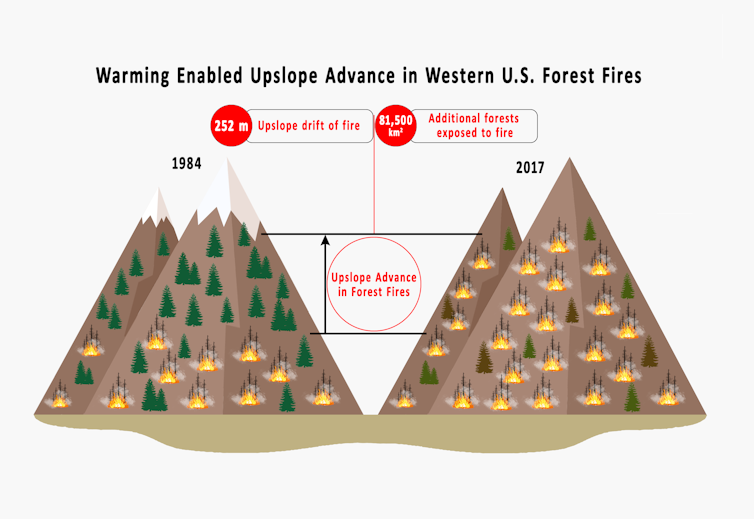
Illustration of two mountains showing fires higher, less snow and more dead trees

On average, fires have spread 826 feet (252 meters) higher into the mountains in recent decades, exposing an additional 31,400 square miles (81,500 square kilometers) of forests to fire. Mojtaba Sadegh, CC BY-ND

By focusing on high-elevation fires, in areas with little history of fire suppression, we can more clearly see the influence of climate change.

Most high-elevation forests haven’t been subjected to much fire suppression, logging or other human activities, and because trees at these high elevations are in wetter forests, they historically have long return intervals between fires, typically a century or more. Yet they experienced the highest rate of increase in fire activity in the past 34 years. We found that the increase is strongly correlated with the observed warming.

High mountain fires create new problems

High-elevation fires have implications for natural and human systems.

High mountains are natural water towers that normally provide a sustained source of water to millions of people in dry summer months in the Western U.S. The scars that wildfires leave behind – known as burn scars – affect how much snow can accumulate at high elevations. This can influence the timing, quality and quantity of water that reaches reservoirs and rivers downstream.

High-elevation fires also remove standing trees that act as anchor points that normally stabilize the snowpack, raising the risk of avalanches.

The loss of tree canopy also exposes mountain streams to the Sun, increasing water temperatures in the cold headwater streams. Increasing stream temperatures can harm fish and the larger wildlife and predators that rely on them.

Climate change is increasing fire risk in many regions across the globe, and studies show that this trend will continue as the planet warms. The increase in fires in the high mountains is another warning to the U.S. West and elsewhere of the risks ahead as the climate changes.

Mojtaba Sadegh, Assistant Professor of Civil Engineering, Boise State University; John Abatzoglou, Associate Professor of Engineering, University of California, Merced, and Mohammad Reza Alizadeh, Ph.D. Student in Engineering, McGill University

This article is republished from The Conversation under a Creative Commons license.

“People are dying, Joe”: Critics call Biden’s vaccine sharing plan “woefully inadequate”

The White House announced Thursday its plan to donate 25 million excess Covid-19 vaccine doses to other nations—a plan progressives described as an “inadequate” response to the ongoing pandemic, urging the Biden administration to invest $25 billion to ramp-up global vaccine manufacturing.

According to he Associated Press, the U.S. “aims to share 80 million doses globally by the end of June, most through COVAX,” the United Nations-backed program for global vaccine sharing. “Of the first tranche of 25 million doses, the White House said about 19 million will go to COVAX,” with the remaining 6 million directed to “U.S. allies and partners.”

“The donation of these few doses is welcome but deeply insufficient, and no substitute for a plan of scale and urgency to end the pandemic,” Peter Maybarduk, director of Public Citizen’s Access to Medicines program, said in a statement. “The U.S. needs to do more, much more.”

PrEP4All, an organization of people who have been personally affected by the HIV epidemic and are fighting for universal access to life-saving medications, reminded President Joe Biden that “people are dying.” 

While the virus has officially claimed the lives of nearly 3.7 million people worldwide so far, the World Health Organization (WHO) estimated recently that Covid-19’s true death toll is between six to eight million people. 

Despite having billions of dollars that could be used to boost vaccine manufacturing and increase the pace of inoculation worldwide, the Biden administration “has barely used any of it,” said PrEP4All.

Maybarduk concurred. “The U.S. contribution to global vaccine access has been woefully inadequate to date,” he said. “Each day of delay means more lives lost.”

Progressives praised Biden last month after he endorsed the India- and South Africa-led motion at the World Trade Organization (WTO) to suspend Big Pharma’s coronavirus-related patents for duration of the pandemic.

While Biden on Thursday reiterated his support for temporarily waiving intellectual property barriers to increase the production of tests, treatments, and vaccines, the proposal for a waiver of the WTO’s Agreement on Trade-Related Aspects of Intellectual Property Rights (TRIPS) is still being blocked by a handful of countries—mostly rich nations including Canada, the United Kingdom, and members of the European Union.

At the same time that Canada, the U.K., and the E.U. are artificially suppressing global vaccine supply by opposing the TRIPS waiver, these wealthy countries have “signed deals to get hundreds of millions of doses of Covid-19 vaccines and boosters over the next two years,” the Wall Street Journal reported Wednesday.

Impoverished nations desperately clamoring for life-saving shots, meanwhile, have been told to rely on COVAX—which depends on donations from the very same countries gobbling up enough doses to last through 2023—even though public health advocates have stressed that the U.N.-backed program is not capable of meeting global needs.

“The idea this pandemic will be dealt with by a mixture of rich country charity and corporate goodwill is such nonsense,” Nick Dearden, director of Global Justice U.K., said in response to news about the latest iteration of vaccine hoarding.

Currently, of the more than two billion shots that have been administered worldwide, just 0.3% have gone into the arms of people living in low-income countries, with people in high- and middle-income countries receiving 85% of the doses, according to the New York Times. The vaccination rates in North America (62%) and Europe (49%) are far higher than in South America (29%), Asia (24%), Oceania (13%), and Africa (2.5%).

This manifestation of global inequality, which critics have called “vaccine apartheid,” has intensified the spread of Covid-19, particularly in South Asia, Latin America, and Africa. If present trends continue, experts say, most people in the Global South won’t be vaccinated until 2024, which gives the virus more chances to mutate, endangering the lives and livelihoods of millions of people everywhere.

To avoid such a deadly delay, Maybarduk said, “the White House should quickly specify ambitious global production targets and help lead the international community in support of vaccine manufacturing.”

Applauding Biden’s decision Thursday to lift Defense Production Act ratings for several vaccines, Maybarduk said that “the Biden administration is at least stepping out of the way of global scale-up.”

“Now we need the Biden administration to use similar power to accelerate the provision of raw materials worldwide,” he added.

As Common Dreams has reported, a coalition of more than 60 progressive advocacy groups, led by Public Citizen, has called on Biden to establish a global vaccine production program to bring the Covid-19 pandemic to an end and prepare for future ones. 

Last week, Public Citizen outlined how an investment of just $25 billion dollars—around 3% of what the U.S. spends on its military each year—would be enough to set up regional manufacturing hubs to produce eight billion coronavirus vaccine doses in less than a year.

“The U.S. government,” Maybarduk said Thursday, “should invest $25 billion in urgent public vaccine manufacturing at sites worldwide to make eight billion doses of mRNA vaccine within a year’s time and share those vaccine recipes with the world.”

There is no solution to the GOP’s vaccine refusal

In the past six months, we’ve all witnessed the near-miraculous effectiveness of the vaccines against COVID-19  and President Joe Biden’s success at turning the joke of Donald Trump’s vaccine plan into a well-oiled machine. Anyone who wants the shot in the U.S. can get it. Yet, despite an initial surge of interest in vaccines in the mid-spring, there’s been a drastic drop-off in vaccination rates just ahead of Biden’s Independence Day goal for a return to summer grilling. 

“The United States is averaging fewer than 1 million shots per day, a decline of more than two-thirds from the peak of 3.4 million in April,” the Washington Post reports, noting that “[s]mall armies of health workers and volunteers often outnumber the people showing up to get shots at clinics” in more conservative areas like Utah, North Carolina and Tennessee. 

“Experts are concerned that states across the South, where vaccination rates are lagging, could face a surge in coronavirus cases over the summer,” the New York Times further reports. While many states in the Northeast have reached Biden’s 70% benchmark, the Times notes that only “about half of adults or fewer have received a dose” in 15 red states. 

As vaccine rates have been lagging, a number of reasons for what tends to be called “vaccine hesitancy” have been documented through polls and other research. Issues include a lack of access, skepticism that COVID-19 is particularly dangerous, a lack of trust in the vaccines, a belief in conspiracy theories and fear of side effects.

No doubt all these aspects are true to one extent or another, and there’s certainly evidence that some working-class people simply are struggling to find the time to get the shots and recover from them. But the glaring geographical differences give away the one deeply uncomfortable reality about what is driving much, if not most, of the discrepancies in vaccination rates: Republicans are refusing to get vaccinated out of pure spite.


Want more Amanda Marcotte on politics? Subscribe to her newsletter Standing Room Only.


Both Trump and Fox News made it clear in the early days of the pandemic that taking COVID-19 seriously is something only hated liberals would do. To show their right-wing bona fides, it was important for Republican voters to refuse to do anything that would suggest they are concerned about getting sick, which would be seen as disloyalty not only to Trump but to the right-wing cause. This is even though Trump himself got very sick from COVID-19 and then, as soon as it was available, got the vaccine. And it clearly persists, even though the political usefulness of COVID-19 denialism ended when Trump’s presidency did

As Politico’s health care reporters Dan Goldberg and Alice Miranda Ollstein wrote on Saturday, the “partisan divide in Covid-19 vaccinations is becoming starker,” as evidenced by the fact that all “but one of the 39 congressional districts where at least 60 percent of residents have received a coronavirus shot are represented by Democrats” and “Republicans represent all but two of the 30 districts where fewer than one-third of residents have received a shot.”

Another giveaway is how Republican politicians have downplayed the role tribal loyalty and COVID-19 denialism are playing in the vaccine slowdown.

On Sunday morning, Mississippi’s Gov. Tate Reeves, in full gaslighting mode to Jake Tapper of CNN, insisted that he believes “all Americans should go get vaccinated because I think it’s safe,” that that “individuals can make their own decision, Jake, as to how to protect themselves and families.”

This is, of course, full-blown nonsense. People aren’t carefully researching how best to protect themselves and their families. If that was the case, they’d be lining up for shots because — outside of a few rare cases where people are immunocompromised — the single best and safest way to protect yourself and your family is to get vaccinated. 

No, what’s actually happening in these red states is that people are putting themselves and their families at risk, deliberately. And they’re doing it because Trump spent months downplaying the threat of COVID-19 and making it a loyalty test for his people to do the same. It’s also clear that a lot of the fears of vaccine safety being offered to researchers as reasons for vaccine hesitancy are, in fact, just a cover story for the mindless tribalism of the right. 

Part of the problem is Trump’s ability to convince people to give up their own safety and security in order to prove their loyalty to him. Recall how cronies like Michael Cohen and Rudy Giuliani ended up in deep but predictable legal trouble after sticking their neck out for Trump? Hundreds of Capitol rioters are now facing fines or jail time because they stormed the Capitol for an ungrateful Trump. As hard as it is for those of us who see this comically dressed, half-literate sociopathic narcissist for who he is, there can be no doubt of the hold he has over some people. 

Still, the widespread nature of vaccine refusal in the red states suggests this is actually about much more than Trump the cult leader, especially as he himself has gotten the shot. In fact, the whole situation illustrates how certain lies take on a life of their own on the right, becoming identity markers that far outlast their political expediency. In other words, getting the vaccine would be an admission for conservatives that they were wrong about COVID-19 in the first place, and that liberals were right. And for much of red-state America, that’s apparently a far worse fate than death.


Want more Amanda Marcotte on politics? Subscribe to her newsletter Standing Room Only.


Of course, adding to the problem is that right-wing media has not abandoned the idea that there’s something “liberal” and therefore evil about admitting that medical scientists know stuff. Right-wing media figures keep bashing Dr. Anthony Fauci, the director of the National Institute of Allergy and Infectious Diseases, with increasingly convoluted conspiracy theories involving his emails that no one, right or left, can follow. Such conspiracy theories are incoherent by design. They aren’t meant to be understood, so much as to create an air of suspicion around Dr. Fauci and public health officials generally, and to reaffirm that being a true member of the conservative tribe means hating such people. 

On Fox News, the message to the audience is quite clear: Real conservatives prove themselves by rejecting the vaccine. Most recently, Tucker Carlson was on air ranting about how it’s “medical Jim Crow” to expect people to get vaccinated to protect others. Besides being language designed to minimize the seriousness of actual racism, this kind of rhetoric is also about falsely telling conservative Americans they are akin to a marginalized ethnic group. Refusing vaccination is a way to show off your tribal membership, like wearing a MAGA hat or deliberately getting an ugly haircut, except deadlier. 

Outside of mandates or raising the penalties by barring the unvaccinated from public spaces, there’s not much to be done now to change Trumper minds on vaccines. They know being unvaccinated is irrational. Being irrational is the appeal. They know how much irrationality annoys liberals. This is one of those situations where, the more that people outside of the Trump tribe push, the more the Trumpers will dig in their heels, ready to stick it to the rest of the country by acting like stubborn asses. 

The only solution may be reverse psychology.

People who want the pandemic to end need to, paradoxically, release the desire to see conservatives get vaccinated. The more zen that liberals (or people perceived to be liberals) are about vaccination rates, the less fun it is to try to piss liberals off by refusing to get the shot. Well-intentioned goals, like Biden’s 70% by July 4 deadline, end up backfiring. If Biden wants it, then conservatives will, like bratty children, refuse to do it just to stick it to him. 

The good news is that, as painful as it is for Democrats to admit, there seems to be a growing acceptance that it’s unwise to let Republican anti-vaxxers hold the rest of us hostage. Lockdowns and mask mandates are relaxing, even in blue areas, despite not meeting vaccination goals. While this is less than ideal, it’s better than the alternative: keeping those measures in place and trying to incentivize conservatives, who are motivated purely by spite and will thus continue to refuse the shot.

They aren’t getting shots in order to troll the liberals. Time to stop feeding the trolls and let them get sick if they really want to play. 

Democrats don’t have to let Manchin win: Holding Trump accountable is fulfilling the Biden agenda

Last Friday I wrote about how the Democrats plan to spend the month of June deliberately failing to pass their legislative agenda in order to demonstrate how intransigent the GOP is being with their use of the filibuster. It is reminiscent of the House plan to pass “messaging bills” in the last congress as a way of illustrating that the Senate was blocking popular legislation.

How’d that work out? 

Judging from the comments from various Democrats in this article, many in the party remain convinced that if they can show how obstructionist the Republicans are being, they can persuade the filibuster clingers in their own caucus to support some reforms that would allow the party to actually fulfill its promises. The fatal flaw in that logic is that it assumes the Democrats even have 50 votes for such a simple agenda. They, of course, do not.

This weekend, Senator Joe Manchin, D-WV, threw another bucket of ice cold water on that cunning plan with an op-ed in his local newspaper announcing that he would not vote for the big voting rights bill, the For the People Act, and reiterating his pledge that he will never vote to weaken or end the filibuster. It’s tempting to try to parse the word “weaken” to mean something other than “reform” but it’s getting a little bit ridiculous at this point. It’s pretty clear that Manchin will not touch the filibuster. And while he claims to support the less comprehensive “John Lewis Voting Rights Enhancement Act,” he also made it very clear that he believes it must be bipartisan enough to pass a 60-vote majority threshold. He seems to think there will be some Republicans on board with such legislation —which is highly unlikely — but even if there are there will not be 10, which means they will filibuster and we are back to where we started.

A few months back I wondered if Manchin wanted to be remembered as the Strom Thurmond of his time. Apparently he does.

In his new op-ed, Manchin wrote that Democrats “conveniently ignore how [the filibuster] has been critical to protecting the rights of Democrats in the past.” It’s true. It did protect the rights of white racist Southern Democrats like Strom Thurmond. Today’s Democrats aren’t conveniently ignoring that, however. He is.

Fox News host Chris Wallace grilled Manchin on Fox News Sunday and asked him why, if he really wants bipartisanship, he doesn’t keep alive the possibility that he might vote to bust the filibuster, giving the GOP incentive to actually negotiate. He asked, “by taking it off the table, haven’t you empowered Republicans to be obstructionists?” Manchin went into a song and dance about how he knows there are 6 or 7 good Republicans who want to work on a bipartisan basis —neglecting to acknowledge that without 10, the GOP will still successfully filibuster every last bill.

At this point it’s more than fair to assume that the Koch-funded efforts to pressure Manchin to oppose the For The People Act and protect the filibuster at all costs have paid off. His clumsy, illogical, fatuous rationale doesn’t pass the laugh test.

So what does all this add up to?

Well, I’m sorry to say that it looks like it adds up to the end of President Joe Biden’s first term agenda. His administration may get a puny infrastructure bill that cannibalizes most of the money from vital programs which benefit average Americans. And that’s a win-win for the GOP. There’s also a possibility that Congress may pass the Paycheck Fairness Act aimed at increasing gender pay equity and maybe one or two other smaller priorities. There will be the usual fights over the debt ceiling and the budget. But that’s probably it.

So once they get done with what Sam Seder calls the June Loserpalooza what are all these elected officials going to do with their spare time? Well, maybe it’s time for them to start taking their oversight responsibilities seriously and crank up the hearings? Investigations have apparently been happening behind the scenes, obscured by the need to foreground the legislative agenda. They now need to come up to the front.

Last Friday, the House finally got to hear from former White House Counsel Don McGahn after years of stonewalling. A transcript of the testimony will be released this week but he reportedly confirmed the details in the Mueller Report about Donald Trump asking him to obstruct justice during the Russia Investigation. Democrats missed the chance to have McGahn testify in public and provide a reminder that Trump, the once and possibly future president, behaved in office like a mafia boss instead of a president. And as this weekend’s first big rally-style speech grimly demonstrated, Trump is not going away.

Since the GOP refused to back the bipartisan January 6th Commission, the Democrats will just have to do it and the sooner they get started the better. Perhaps the Senate Judiciary Committee could hold some public hearings with testimony from former Chief of Staff Mark Meadows whom they have uncovered was in close contact with Acting Attorney General Jeffrey Rosen in the waning days of the administration pressuring him to investigate some of the most batshit crazy election conspiracy theories out there. I see no reason they couldn’t call Donald Trump himself to testify. President Gerald Ford testified before Congress about Richard Nixon’s pardon when he was still in office. Trump is a private citizen, just as Hillary Clinton was when they publicly grilled her for 11 hours in one of the 14 different Benghazi probes.

They also need a serious inquiry into what happened with the pandemic. The latest brouhaha about the Wuhan lab should certainly be explored but perhaps they might want to take a close look at Trump’s collusion with China during the first few months of the pandemic as well. Slate’s Will Saletan documented all the public evidence a few months back and it’s far more damning than people may realize. And naturally they need to look at all the malfeasance and corruption in the Trump administration’s completely inept response to the crisis.

There are a dozen other potential crimes to look at from Trump’s foreign policy dealings to the enduring mystery behind the weird, dangerous personnel moves in the intelligence and military hierarchies in the last months of the administration. And that’s just for starters.

The Big Lie is growing every day and the Democrats need to use their institutional power to contest this version of events and the entire idea that Trump had a hugely successful presidency and was cheated out of a second term. Joe Manchin and his comrades in the status quo caucus may thwart their ability to legislate needed change but he cannot stop Democrats from shining a light on what the Republicans have done. We simply can’t afford to let them sweep it under the rug this time. 

Sociologist Arlie Russell Hochschild on the Trump demographic: “Elite of the left behind”

Five months ago, supporters of Donald Trump attempted a coup to nullify the results of the 2020 presidential election, launching a lethal attack on the U.S. Capitol. Since then, the Republican Party has chosen to try to erase or rewrite the story of what happened that day, in order to conceal its culpability. Public opinion polls and other research show that the Republican Party’s war on the truth about Jan. 6 — and reality more generally — is working. A majority of Republicans actually believe that the election was “stolen”. A not insignificant number of Republicans also believe that the events of Jan. 6 either did not occur or were somehow crimes committed by antifa or Black Lives Matter activists as part of a plot to “discredit” Donald Trump.

In the months since Trump’s supporters attacked the Capitol, what have we learned about them? To this point, 510 people have been charged with crimes for their participation in the Capitol attack, and 130 of those have been charged with assaulting, or otherwise causing harm to police or employees at the Capitol. Out of those 130 defendants, 40 have been charged with using deadly or dangerous weapons or causing serious bodily harm. Several dozen of those who raided the Capitol that day have been charged with conspiracy, and three defendants have also been charged with terrorism.

At least 62 members of right-wing paramilitary organizations and street gangs were among Trump’s attack force on Jan. 6. Some of those present that day did in fact have serious plans to capture and kill Vice President Mike Pence and prominent Democrats such as House Speaker Nancy Pelosi. Many of Trump’s foot soldiers believe that they are “patriots” who were following his direct commands to overthrow the results of the 2020 election and keep him in power. Dozens of active-duty and retired military and police also participated in the attack on the Capitol.  

Right-wing propaganda media, the antisemitic QAnon conspiracy cult, and white right-wing churches and other extremist groups played an outsized role in radicalizing Trump’s supporters — which in turn led to the Capitol attack. 

Trump’s attack force was not exclusively “working class.” It also included middle- and upper-class white people from all parts of the country — not just “red states” — who have been radicalized by racist fears of somehow being “replaced” by nonwhites.

Robert Pape, a political scientist and director of the Chicago Project on Security and Threats, recently discussed the demographics of the Capitol assault in the Washington Post:

The charges have, so far, been generally in proportion to state and county populations as a whole. Only Kentucky, Maryland, Missouri and Montana appear to have sent more protesters to D.C. suspected of crimes than their populations would suggest.

Nor were these insurrectionists typically from deep-red counties. Some 52 percent are from blue counties that Biden comfortably won. But by far the most interesting characteristic common to the insurrectionists’ backgrounds has to do with changes in their local demographics: Counties with the most significant declines in the non-Hispanic White population are the most likely to produce insurrectionists who now face charges.

In an article for the Atlantic, Pape provides further context:

[T]he demographic profile of the suspected Capitol rioters is different from that of past right-wing extremists. The average age of the arrestees we studied is 40. Two-thirds are 35 or older, and 40 percent are business owners or hold white-collar jobs. Unlike the stereotypical extremist, many of the alleged participants in the Capitol riot have a lot to lose. They work as CEOs, shop owners, doctors, lawyers, IT specialists, and accountants. Strikingly, court documents indicate that only 9 percent are unemployed. Of the earlier far-right-extremist suspects we studied, 61 percent were under 35, 25 percent were unemployed, and almost none worked in white-collar occupations.

In total, Trump’s loyalists who attacked the Capitol on Jan. 6 represent a wide swath of American life. Those same people also collectively embody so much of what is broken in America.

One dominant narrative about the rise of Trumpism is that it reflects a type of “working class” revolt, in which the feeling (and the reality) of economic precarity made Trump’s fake populism seem like a viable solution to the country’s problems. But such claims often obscure as much as they reveal about the rise of American neofascism and Trump’s enduring power over his political cult members.

Research shows that the median household income of Trump’s voters is around $72,000 a year — significantly higher than the median household income in the United States as a whole. Other research shows that white supremacy, racial resentment and a desire to protect white privilege are the central or perhaps principal values and beliefs that motivate Trump’s followers.

Many members of the white upper class and rich voted for Donald Trump for reasons of personal financial self-interest (i.e., greed). Other Trumpists were attracted to his movement for ideological reasons such as a belief that America’s secular democracy should be replaced by a Christian fascist autocracy.

One of the main rebuttals against a simple claim that working-class angst and rage was the swamp that birthed Trumpism is the fact that Black and brown members of the working class (and poor) overwhelmingly rejected Trump in both 2016 and 2020.

In an attempt to better understand these complex relationships between race, class, Trumpism and the events of Jan. 6, I recently spoke with Arlie Russell Hochschild. She is a professor emerita of sociology at the University of California, Berkeley, and the author of nine books, of which the most recent is “Strangers in Their Own Land: Anger and Mourning on the American Right.”

In this conversation, Hochschild explains how a group she describes as “the elite of the left behind” are Donald Trump’s real base of support. She discusses how Trump exploited feelings of shame, failure, entitlement and fear among the white working class to win them over to his fake populist movement. Hochschild also shares her thoughts on the Jan. 6 attack, which she sees not merely as an attempt to overthrow the results of the 2020 election but an attack on the idea of democracy itself. 

Given the Age of Trump, his coup attempt and the Capitol attack, along with the myriad of other things he has wrought, how are you feeling?

I’m anxious. Was Jan. 6 a planned coup? Yes, I see it as definitely planned. But was it intended to kill people? I feel like it was a mixed event in that regard. Part of what happened that day was Donald Trump putting on a type of reality TV show. People were dressed in horns, for example. It was entertainment. The events of Jan. 6 were a type of assault — not just on people and property but on the very seriousness of democracy itself. So I had a double reaction. It was killing something, but what was it killing? It was killing a culture of faith in government and respect for civil servants.

You are absolutely right that there were mixed elements at work among Trump’s attackers. But they did have a core group of people who were screaming that they wanted to kill Mike Pence, senior Democrats and others they targeted as enemies. If Trump’s attack force had been successful and killed enough congresspeople, a quorum would have been impossible. I believe that was Trump and his co-conspirators’ plan, to create enough death and chaos to declare martial law. How did you make sense of the obvious rage shown by that mob?

The people who voted for Donald Trump did so for a variety of reasons. There were those who voted for him because of taxes or social issues, guns or being “pro-life.” Others because they liked Trump’s bravado. Some because they feel a generalized sense of decline. Some Trump people supported him because of racism. I think that the dominant group of Trump voters are people I would call “the elite of the left behind.” These are not the abject poor. However, they are not rich either.

They’re rural or small-town and white. They sense themselves as being part of a declining part of society. I believe such feelings are also global with right-wing populism, as seen in response to such issues as race and immigration. Fear and anger is displaced onto scapegoated groups.

But the group that’s doing such things here in the United States specifically are the “elite of the left behind.” Going back to 1970, there are winners and losers to globalization and the winners are generally coastal and more cosmopolitan and better educated. They can have jobs that are not as vulnerable to being automated or off-shored.

These losers from globalization consist of different kinds of people. But the people who are mobilized are the elites of that group. I remember going to a Trump rally in a bus. This was in New Orleans, with a member of the Tea Party who I had gotten to know and who I was following around for my research. On the bus, people were saying, “Oh! Look how many of us there are! We’re all for Trump!” Trump has mobilized them. He’s pulled them together. He’s gotten them to see each other.

And here is how I believe race is operative. The white Trump supporters I met actually see themselves as some type of minority group: “We’re being put down. We are being prejudiced against. They call us rednecks and hillbillies.”

The Age of Trump is a story of emotions. One of the main emotional beats is that Trumpism is a response to a declining sense of social capital on the part of his followers.  

The folks that I got to know around Lake Charles, Louisiana, go to church once or twice a week and they know each other. They are the ones who stayed. Black people have left the community. The highly educated entrepreneurs and other change-makers have left too. 

We see lots of rage on the television from these communities. But there are other emotions at play as well. We need to discuss shame. This is a group that is ashamed of itself. This is partly the fault of American Individualism. If you’re doing well, you take credit for it. If you’re failing, that’s your fault and you feel ashamed. That is connected to being part of the economy and community that is vulnerable to offshoring, which is part of a more general story of the American Rust Belt.

These people are not doing as well as their fathers, which is the classic male comparison to make in terms of the American Dream. They are supposed to be doing better than their parents did, but they are not.

In many ways the data shows that class differences cut deeper than they did 20 or 30 years ago. In 1970, if you had a B.A. or you did not, it didn’t make too much difference in terms of the likelihood that you’re married, that you’re staying married, that you’re living with the mother of your children, that you’re coaching basketball, that you’re going to church, and that you’re employed. Those things were pretty similar whether a person had a B.A. degree or not.

But now a B.A. degree has an entire biography attached to it in terms of what it means and represents. Now a person without a B.A. may have a narrative where they are living with their third partner. They lost custody of the kids. Their grandparents or parents are taking care of them.

Another version of this story sees you having a hard time kicking an addiction. You’re out of the labor force. You’re selling drugs. You’ve got a little bit of jail time. You’re ashamed. This isn’t a story just of deprivation or whining about deprivation; it is a story of loss and shame.

Many of these people I spoke to are feeling a  sense of loss. They’re feeling shame because they are not doing as good as their father and grandfather and the era they harken back to. Donald Trump has brilliantly exploited such feelings and presented himself as an answer to that shame.

Here is how Trump accomplishes it. Trump does something outrageous. For example, he says, “Mexicans are rapists.” Then the press and punditry will say, “You can’t say that! It is outrageous!” The mainstream news media shames Trump and then he rages at the shamers.

I believe that there is something cathartic there for the “elite of the left behind,” a group that is right-leaning. It is about getting rid of shame, almost like going to confession at Catholic church. Trump’s followers love him for that. They are proud to “make America great again,” and that includes “Make you and your class and your race great again” as well.

The “elite of the left behind,” as you describe them are not poor people. As we know from research Trump’s supporters have a median household income of about $73,000 a year. These are not poor people. How and why do they believe they have been “left behind”?

Among the 47 percent of people who voted for Trump, some of them are just really rich and wanted to cut their taxes more. They want to get richer. But the people that I talked to, who I consider “the elite of the left behind,” are not rich. They’re not even upper middle class. These people are middle and lower middle class.

With these intersections of whiteness, class and social capital there is also a deep anxiety that somehow they will “slip down” America’s hierarchy and be equal with or perhaps (in their minds) below Black people.

I believe that is correct. They feel very similar to how they imagine poor Black people to be, and they are afraid of that: “Now it’s our turn. This is going to happen to us.” In one of the chapters of my book, I examined the position of poor whites as being wedged between rich whites and black people. They think the only way out is to identify up to the other white people. That is the psychology at work. It happened in the plantation South and it is still here in the 21st century.

What are your thoughts about the book “Hillbilly Elegy”? I have heard many people speak about your book “Strangers in Their Own Land” with “Hillbilly Elegy” literally in the same conversation. I found the praise for “Hillbilly Elegy” very much unwarranted.

I didn’t have that response to the book. I took “Hillbilly Elegy” to be a type of fairy tale. It’s a kind of a rags-to-riches narrative. It has the structure of “I was a born of an addict, which means I was born psychologically poor, I had one dad after another.” That means there was no steady male figure in the picture. That is the “rags” part of the narrative. Then the narrative becomes “I had a steady partner who was a Supreme Court law clerk, and I will be a better person than I came from.” At its heart, “Hillbilly Elegy” really is a psychological rags-to-riches story.

There remains so much superficial writing and other coverage of and about the so-called white working class in the mainstream news media, especially among the pundit class and political reporters. To your eyes, what did they get wrong?

They’re listening through a hardened shell. It takes emotional labor to disarm your deep moral and political alarm system and permit yourself a great deal of genuine curiosity about people who you see as some type of Other. That’s hard work to do. You have to do it purposefully. That’s what I think many people can’t do. If one feels like the person in front of you would attack you under normal circumstances, it is not a natural act to open up to them.


Dan Bongino debuts new Fox News show, fails to conclusively “own the libs”

Fox News contributor and habitual carpetbagger Dan Bongino has always made a promise to his supporters: At every turn, he will work tirelessly to “own the libs.” On Saturday night, premiering his new Fox News program, he fell flat on that singular commitment. 

The right-wing media mogul opened “Unfiltered with Dan Bongino” by saying that new Fox venture will lead America into a “great awakening” of sorts. “Tonight, the great awakening is starting in America. Americans are worried about the fabric of our society being torn apart. Kids are being taught critical race theory. This is racist,” Bongino stated during his monologue. 

From that point on, it was all downhill. Bongino’s featured guests included Gov. Ron DeSantis of Florida and Federalist co-founder Sean Davis. Both guests stuck to the script: Attack the “liberal” media at all costs. At the show’s opening, Bongino promised the Fox News audience that he would ask the “ask the tough questions,” and only moments later tossed DeSantis a series of puffballs. 

“These media people, particularly the corporate, national media, they are bad actors. They’re not just a little bit liberal biased,” DeSantis claimed. “They are actively engaging in disinformation.”

One of the show’s highlights was Bongino’s puzzling claim that he seeks to “cohabitate in phobic bliss.” The newly-minted Fox News host also claimed that liberals won’t allow conservatives to physically move to echo chambers where everyone thinks alike. That hasn’t been a problem for Bongino himself, who has a track record of moving around the country to places that conform to his worldview. (He has moved quite a bit over the years, in hopes of winning a congressional seat.)  

The hour-long show concluded with Bongino reading hate mail from a series of random Twitter users in a bizarre segment where he attempted to riff on the insults being dished out online. After his show ended, Salon checked in with Bongino via email to see how he felt about his big debut. He didn’t respond.  

Maybe the biggest problem with Bongino’s premiere was that his new show lacked what he’s become known for, which is losing his cool at the drop of a hat. In shows to come, one can only hope he brings more gusto and grievance to the airwaves, which is certainly what his fans and followers supporters expect. In the words of former President Donald Trump, the show was “low energy!” 

For months, Bongino has been misleading his audience by claiming that he would be filling both the legacy and the time slot of the late talk-radio legend Rush Limbaugh. That turned out to be fake news, since we learned recentlythat Bongino hadn’t been tapped for the official Premiere Networks slot. The thrice-failed congressional candidate even had to apologize to his fans for misleading them. 

You can watch Bongino’s entire first show — if, for some reason, you so desire — below, via YouTube. 

G7 countries reach agreement to set “global minimum” tax rate for multinational corporations

Representatives from seven of the world’s wealthiest nations reached an agreement on Saturday to support a global minimum tax rate of at least 15% for multinational companies, a move aimed at curbing the use of tax havens and ending the decades-long race to the bottom on corporate taxation.

The deal struck by the U.S., Japan, Germany, France, the U.K., Italy, and Canada still faces a long road to implementation, but Saturday’s development marks substantial progress toward a global accord that could allow governments to raise revenue from corporate giants notorious for shifting operations and profits overseas to avoid taxes.

“The G7 has taken significant steps this weekend to end the existing harmful dynamic, making commitments today that provide tremendous momentum towards achieving a robust global minimum tax at a rate of at least 15%,” U.S. Treasury Secretary Janet Yellen said Saturday. “This effort is far from over, and we look forward to engaging closely with the G20 and members of the OECD Inclusive Framework process in the coming weeks to finalize an agreement on the global minimum corporate tax as soon as possible.”

While arguing that the proposed 15% global minimum tax rate is too low, economist Gabriel Zucman hailed the G7 agreement as “a game-changer because it slashes incentives for multinational firms to book profits in tax havens, thus removing incentives for tax havens to offer low tax rates.”

“In effect, this severely undermines (and ultimately destroys) the development model of tax havens,” Zucman, a professor at the University of California, Berkeley whose work has focused on tax avoidance and the use of tax havens.

Zucman explained that a 15% global minimum tax “does not mean that all countries must increase their corporate tax rate to 15%.”

“It means that multinational profits will be subject to a 15% minimum effective rate,” he continued. “Take a German multinational that books income in Ireland, taxed at an effective rate of 5%. Germany will now collect an extra 10% tax to arrive at a rate of 15%—same for profits booked by German multinationals in Bermuda, Singapore, etc. Other nations will proceed similarly.”

According to the E.U. Tax Observatory, an independent research organization, a 15% global minimum tax on multinational corporations would allow the U.K. to bring in €200 million in additional revenue per year just from BP—which, like other major oil giants, works to avoid its tax obligations in its home country by shifting profits to overseas tax havens.

Olaf Scholz, the German finance minister, said Saturday that the G7 agreement—which must ultimately be approved by the U.S. Congress and the legislatures of other nations—is “very good news for tax justice and solidarity and bad news for tax havens throughout the world.”

Tax justice campaigners, though, were highly critical of the deal, warning that its benefits would largely flow to G7 nations while leaving much of the world behind.

“The G7 has decided to finally move the international tax system into the 21st century, but only enough to shamelessly benefit just themselves,” Alex Cobham, chief executive at the Tax Justice Network, said in a statement. “The G7 finance ministers are proposing to follow OECD proposals that would ensure the G7 themselves take the lion’s share of any new tax revenues—which will in any case be limited by their lack of ambition.”

Cobham has argued that the OECD framework—which the G7 leaders praised in their communiqué—privileges countries that serve as headquarters to multinationals over countries that serve as hosts for corporate operations, meaning that rich nations will likely reap most of the benefits of an eventual minimum tax agreement.

“By settling for anything less than a 25% tax rate, the G7 is telling their citizens and the world that they’re willing to keep the race to the bottom alive and kicking,” said Cobham. “Rarely does the opportunity to better the lives of billions of people in a single stroke come by, but when history came knocking today, the leaders of the richest countries in the world turned their back on it.”

“Even the G7 and OECD recognize that the international tax rules are unfit for purpose,” Cobham continued. “The disproportionate power exercised by these rich countries’ clubs today shows that the way international tax rules are determined, too, is unfit for purpose. It is now well past time for international tax rules to be set democratically at the U.N., starting with a U.N. tax convention.”

As the Washington Post reported Saturday, the Biden administration “initially floated a 21% global minimum tax but that rate was eventually lowered to 15%.”

“The lower rate will make it easier for countries to join the accord but may reduce its effectiveness,” the Post noted. “If the U.S. [corporate tax] rate is raised to 28% but the global minimum tax is 15%, firms may still have strong incentives to move their operations overseas.”

Zucman and other experts have emphasized that the proposed 15% global minimum tax is a floor and that governments can, and should, go higher.

“Let’s be clear: nothing prevents us [from moving] quickly to 25%, Zucman said Saturday. “No need for a global agreement: the U.S. can tax its multinationals at 25%, France can do the same, etc. Tax havens cannot block a high minimum tax—because other countries can always choose to collect the taxes that tax havens choose not to collect.”

10 fun facts about “Ted Lasso”

It has been nothing but an upward journey for “Ted Lasso,” which, despite the odds, has become the crown jewel in Apple TV+’s streaming service. The series follows American football coach Ted Lasso (“Saturday Night Live” alum Jason Sudeikis), as he’s hired to manage the (fictional) AFC Richmond—despite knowing nothing about English football.

With its winning combination of heart and humor, Ted Lasso is essentially the TV equivalent of a hug. To celebrate its upcoming second season, which will debut in July, here are some facts about the show.

1. “Ted Lasso” started out as a commercial.

In what was originally meant to promote NBC’s airing of the English Premier League, the character of Ted Lasso first appeared in an NBC Sports commercial way back in 2012. The commercial followed the same premise as the show, with Sudeikis’s character instantly charming audiences. It was such a hit that NBC created another commercial featuring Ted Lasso a year later.

With some encouragement from his then-partner Olivia Wilde, Sudeikis — alongside creative partners Brendan Hunt (who plays Coach Beard in the series) and Joe Kelly — began outlining what a possible “Ted Lasso” series might look like. Yet it wasn’t until a few years later, when Sudeikis ran into “Scrubs” and “Cougar Town” showrunner Bill Lawrence, that the idea became reality.

2. “Ted Lasso” star Brett Goldstein was initially hired as just a writer.

It’s hard to imagine anyone else embodying AFC’s grumpy captain Roy Kent, but actor Brett Goldstein was initially only hired as a writer on the show. Yet in writing Kent’s character, Goldstein said he grew an attachment to the role and “just started to think I could play Roy.” On his last day in the writer’s room, Goldstein sent an audition tape to Bill Lawrence with an email saying, “If this is embarrassing you can pretend you never got this email.” Luckily the risk paid off, and Goldstein — who had a major role in Ricky Gervais’s Netflix series “Derek” — got the part shortly after.

3. Marcus Mumford of Mumford & Sons composes music for “Ted Lasso.”

Marcus Mumford, the lead singer of Mumford & Sons, met Sudeikis in 2012, when his band performed on “SNL.” The pair remained friends, which is what led Sudeikis to leave Mumford a message asking if he would want to compose music for the show. Alongside musician Tom Howe, Mumford composes the entire score for the series, including the catchy and uplifting theme song.

4. There are currently three seasons planned for “Ted Lasso.”

With the second season imminent and a third season renewal already received, it appears the “Ted Lasso” team have the show’s endgame planned. Talking on the “Scrubs” rewatch podcast “Fake Doctors, Real Friends,” Lawrence said “Ted Lasso” is “mapped out” as a “three-season show,” as “Sudeikis has a family, and likely will not want to be spending half his years an ocean apart from his kids.” While it’s sad the show will depart our screens, it’s comforting that “Everybody knows they get an end to this story in the third season.”

5. Former “Scrubs” star Zach Braff directed an episode of “Ted Lasso.”

In another example of the series attracting high-profile behind-the-scenes talent, “Scrubs” star Zach Braff directed the show’s second episode, “Biscuits.” Speaking to ET Online, Lawrence said that while Braff was visiting London, he “suckered Zach into directing an episode,” bringing the pair back together once more.

6. Those delicious biscuits that Ted Lasso is always handing out? They’re not so delicious.

You know Ted’s famous biscuits? Well, Hannah Waddingham, who plays club owner Rebecca Welton, has shattered the illusion of the delicious biscuits her character obsesses over. Talking to Critics Choice Association voters, Waddingham revealed that pretending the biscuits were delicious was “Definitely the greatest acting job in my life. Try eating a bit of dried-out sponge that’s been left in your bathroom in a tiny pink box.” Maybe the show’s production team could try using Ted’s recipe?

7. Hannah Waddingham’s iconic performance of “Frozen”‘s “Let it Go” almost didn’t happen.

It’s impossible to reference Waddingham and not mention her history as a famed West End performer, with her performing skills on full display in an incredible performance of “Let it Go” from “Frozen” in episode 7, “Make Rebecca Great Again.” Yet according to music supervisor Tony Von Pervious, Disney at first rejected the show’s application to use the song. “The catalog is very particular about uses . . . it’s kind of a fine line,” music supervisor Tony Von Pervieux told Nerdist.

The show ended up filming a back-up version, with Rebecca performing Gloria Gaynor’s “I Will Survive.” Yet after sending Disney Rebecca’s version of “Let it Go,” and seeing they weren’t “Denigrating the song in any way,” Disney reversed the denial.

8. “Ted Lasso”‘s karaoke episode is based on a true story.

With the karaoke episode being a highlight of the series in celebrating the show’s lovable ensemble, these scenes actually stem from football history. Sudeikis explained to Bustle that he took inspiration from Liverpool coach Jurgen Klopp, saying, “When I heard about him taking his squad to go do karaoke, I was like ‘Hellooo, story idea.” (Though we doubt any of the players did a “Frozen” cover that matched Waddingham’s.)

9. “Ted Lasso” has become an awards darling.

After a unanimously positive critical reception, it didn’t take long for “Ted Lasso” to start receiving awards. At the 2021 Golden Globes, the show was nominated for two awards, with Sudeikis winning for Best Actor in a Television Series Musical or Comedy. It also won three Critics Choice Awards (for Comedy Series, Best Actor, and Best Supporting Actress in a Comedy Series), a SAG Award, and is currently nominated for the prestigious Peabody Award. With season 2 on the horizon, we’re sure there are plenty more awards in store.

10. Season 2 of “Ted Lasso” will feature a new AFC Richmond member.

When Season 2 returns, viewers can expect to see a new member of the AFC Richmond squad in Sharon (Sarah Niles), the team’s new sports psychologist. In an interview with Entertainment Weekly, Niles described her character as “Straight-talking, very good at her job, very kind, and wants the best for everyone.” Yet from the season 2 trailer, it appears that she and Ted may not be on the same page when they first meet.

Here’s hoping Season 2 has plenty more heart, humor, and biscuits in store for viewers come July 23rd.

How Phil Collins became cool (no, really)

In August 2020, a YouTube video featuring Tim and Fred Williams, 21-year old twins from Gary, Indiana, went viral. In it, the two young men were listening to Phil Collins’ 1981 hit song “In The Air Tonight” for the first time, commenting as they went along. They listen intently for the first few minutes, their heads bobbing along. Then Collins’ drum fill with the famous gated-reverb starts and they are astonished. “I ain’t never seen anyone drop a beat three minutes into a song,” Fred explains. When the song concludes, Fred cries: “You killed it Phil!”

The video was viewed millions of times and shared widely on social media. In the Air Tonight immediately went to number one on U.S. college radio stations. The Guardian and The New York Times covered the video, praising not only Collins’ iconic song but celebrating his solo career as a whole. This was a marked departure from only a few years earlier, when his solo work was dismissed by critics as cultural junk left over from an unloved earlier era.

So what has changed to make Collins cool and relevant again?

To answer this question, we examined the trajectory of Collins’ solo career from 1981-2020, identifying changes in the tone and critical appraisal of Collins. There was admiration at first (1981-1991), which turned into derision (1992-2009), followed by rediscovery and an unironic sense of cool (2010-present). We analysed each phase by drawing on work in the field of cultural studies that examines how cultural producers or products become considered truly great.

The highs and lows

Following the ups and downs of Collins’ long career in music enabled us to identify a N-shaped curve of artistic trajectory, which we labelled the “Phil Collins Effect.”

The effect describes how changes in the way fans, critics and peers view an artist and interact with their work can affect the artist’s critical and commercial status. The Phil Collins Effect suggests popular artists go through a period of critical and commercial success and peer recognition, which we label “consecration.” This can be followed by a period of commercial and critical decline and rejection by new groups of peers seeking to define themselves apart from commercial success stories of the previous era such as Collins, which we label “deconsecration.” Revival, or “reconsecration” involves reappraisal and rediscovery, both by critics and often a new generation of fans and artistic peers.

In the case of Collins, the period of 1981 to 1991 was his critical and commercial golden age. Hard as it may be for some to believe, Collins’ arrival as a solo artist in 1981 with the album Face Value was celebrated by critics who not only credited him as a brilliant writer of pop songs, but lauded his material as more innovative than his band Genesis, who were by this stage viewed as prog-rock dinosaurs out of sync with the new decade.

His status was recognised with numerous awards, including six Brit Awards and seven Grammys. At this time, collaborations with Collins were highly sought after as they were sure to achieve commercial success, such as “Easy Lover” with Earth Wind and Fire’s Philip Bailey. However, it would be the reasons for Collins’ success in the 1980s, which caused critics, fans and peers to turn against him in the 1990s and 2000s.

Along with tabloid-led schadenfreude over his failing marriage, Collins was chosen by Bret Easton Ellis as representative of the worst excesses and blandness of commercial rock in the 1980s in his controversial novel “American Psycho” (where the titular character Patrick Bateman begins a killing spree with a long monologue about the merits of Collins as an artist).

In 2003, Collins’ status was subject to further ridicule when the animated series “South Park” featured him as a bitter, washed up star, whose music required taking large quantities of the ADHD drug Ritalin to appreciate.

Take a look at Phil now

While this was all going on, however, a critical appraisal also started to occur. A new generation of fans discovered his music in the 2000s, without the 1980s baggage. A new cohort of artists, ranging from indie darlings such as The 1975 to rap artists such as Kanye West openly expressed their appreciation for Collins’ genius.

As critics began to reevaluate the period between 1978 and 1982, the dark, moody hit “In the Air Tonight” was compared to the likes of Ultravox’s “Vienna” and Japan’s “Ghosts” as a risky, inventive example of experimental pop. Midway through the second decade of the 21st century, Collins’ reconsecration was complete, with him being labelled by one critic as “the godfather of popular culture.”

Other figures have experienced their own Phil Collins Effect. The late Apple CEO Steve Jobs certainly experienced a similar N-shaped trajectory in his commercial career, being feted as a Silicon Valley pioneer before being viewed as a deluded dreamer after being ousted as Apple’s CEO. His return, coupled as it was by a series of hit products (such as the iMac, iPod and iPhone), led to a re-evaluation of his beliefs about innovation and technology, in which every historic misstep was regarded as a critical experiment by a visionary always ahead of his time.

Likewise, the Trump presidency seems to have led to a shift in fortunes for the former U.S. president George “Dubya” Bush, suggesting that reconsecration may not be far away.

Andre Spicer, Professor of Organisational Behaviour, Cass Business School, City, University of London; Michael Beverland, Professor of Brand Management, University of Sussex, and Pinar Cankurtaran, Assistant professor, Delft University of Technology

This article is republished from The Conversation under a Creative Commons license.

Before the pandemic, they were introverts. Now they aspire to live more extroverted lives

Author Sarah Prince of The Elvish Trilogy has long described herself as a homebody. After all, she chose a career as a writer — not merely because she loves to write, but also because she feels comfortable living a more isolated life. 

Or so she thought.

“I never really never felt like I was missing anything by not being out in the world and meeting new people,” said Prince. “I was very happy just being at home in front of my computer and just writing all day; that’s what I like to do, that’s what I always do.”

But a few months into the pandemic, and after moving to a new city with her husband, she struggled with a feeling of loneliness she had never felt before. While it was hard to face at the time, Prince says that experiencing this loneliness made her realize something she didn’t know about herself, that she does in fact care about having a more “vibrant” social life.

“Loneliness is not an emotion that I’ve ever thought about or dealt with or experienced at all,” Prince said. “I think that the pandemic really has opened my eyes up to like this piece of my life that I never thought that I cared about, or wanted or needed, which is a social group; I’m really looking forward to when the pandemic ends getting out and meeting people and changing this aspect of my life in a more significant way.”

Prince added she’s as far on the “introvert scale” as one can go, and she doesn’t think that will change. Yet she strives to “mimic” the “extrovert way” once she re-emerges from the pandemic.

Like Prince, introverts tend to enjoy alone time. They are more aware of their thoughts, and tend to re-energize in a solitary way. Extroverts are the opposite of introverts — outgoing, enjoying spending time with other people. In pop psychology, the metaphor of a battery is often used: introverts “recharge” their batteries through solitude, and run them down through socializing; with extroverts, it’s the opposite. Psychologist Carl Jung was one of the first people to define introversion and extraversion in a psychological context. The ideas were later popularized by psychologist Hans Eysenck.

Since then, psychologists around the world have studied the variations and nuances between the two personality theories. Indeed, there have even been studies into whether or not introverts and extroverts have neurophysiological differences. Some skeptical psychologists believe that categorizing people into binary categories of introvert or extrovert is over-simplistic. Indeed, the notion that personality traits are fixed forever is changing, as new research suggests that experiences and effort can change one’s personality.

If our personalities aren’t fixed, perhaps the pandemic will lead more self-identified introverts to aspire to extroversion — or, perhaps, vice-versa.

Dr. Therese Rosenblatt, a psychologist and author of  “How Are You? Connection in a Virtual Age” said she’s never met someone who’s completely an extrovert or introvert. People, Rosenblatt explained, are usually a little bit of both, yet tilt toward one side.

“I’m an extroverted introvert, and other people are introverted extroverts,” Rosenblatt said, using herself as an example. “My patients were talking about this as well — that in the enforced isolation, a lot of people discovered that they really enjoyed it.”

“I’m not saying everybody, and I’m not saying all aspects of it, but a lot of people, myself included, enjoyed the newfound time alone with themselves,” she clarified. 

Rosenblatt agreed that she has seen some introvert-leaning clients strive to enliven their social lives once the pandemic ends.


Want more psychology and science stories in your inbox? Subscribe to Salon’s weekly newsletter The Vulgar Scientist.


“I do think that a lot of people started to recognize that they need people — you know, people who might have thought, ‘oh, socializing can sometimes be exhausting and burdensome,'” Rosenblatt said.  “I think a lot of introverts who are used to recharging on their own, by being alone, realized they need the charge of being with other people, too.”

As Rosenblatt mentioned, the reverse was also true for self-described extroverts. Before the pandemic, Cassandra Cotta was the manager of a pilates studio in New York City. She’d work usually 60 hours a week, which included teaching multiple classes a day. This by nature meant she was around hundreds of people a week. She often socialized after work, too.

“I always left my house with a giant bag, because I just didn’t know where the day was going to take me,” Cotta said. “So I had like, two changes of clothes, just ready to go wherever, and kind of crashed on friends couches whenever and really just spent as little time home as possible.”

When the pandemic hit, she experienced deep loneliness. After getting laid off from her job, she started Pilates People, and formed a virtual community of people who love pilates and were also looking to connect during the pandemic. Cotta said she’s probably the most “introverted” she’s ever been in her life, but she’s starting to notice as the country opens up again she’s socializing more. 

“I need alone time more than I’ve ever needed alone time, but I am finding that when somebody gets me out, and I’m comfortable, time will disappear — and I’m happy to go do all the other things and be around whoever for longer and longer periods of time,” Cotta said. “So I do feel like I’m starting to come out of that and go back to my older personality and my older habits. But there was definitely a shift there.”

The shift, and the pandemic, helped Cotta realize what’s important in her life.

“I’m very clear on who my people are, like the things that matter to me, and the things that I value,” Cotta said. “The things that I need and can offer are just crystal clear.”

Cotta added she’s read more books in the past year since she has when she was a kid. She prioritizes rest, eating healthily, and generally, taking better care of herself.

“Sleep and rest became more important to me,” Cotta said. “All these things that I couldn’t have in my old life, they’re now part of it. I’m holding myself to the structure that feels best for me, and then fitting everything else in around that.”

A 1930s whipping cream cake is the internet’s latest favorite recipe

Every few weeks, people on the internet obsess over a recipe, and it spreads like wildfire. The source is often social media, frequently Instagram and TikTok, but more and more, Reddit seems to be the source. For most, Reddit is a never-ending list of community-driven forums on everything from news and hobbies to fandom and Bitcoin advice. But it’s also an increasingly popular platform for recipe discovery, especially in the subreddit channel /Old_Recipes. This page, with more than 250,000 followers, has come to be a full-blown digital archive of everything from generations-old heirloom recipes to magazine clippings from decades past. It’s quickly grown to be one of the more exciting cooking resources on the internet, with an engaged community breathing new life into each recipe. Some recipes remain one-hit wonders, while others gain traction and only pick up speed from there. Recipes spanning from Murder Cookies to Armenian Perok Cake to Nana’s Devil’s Food Cake have all gone viral, well beyond Reddit. Not only do these get their 15 minutes of fame on the wider internet, they’re frequently shared on the /Old_Recipes forum months after they were originally shared. The latest recipe to go viral, a dense buttery Bundt called Whipping Cream Cake, is no exception. What is it about such a recipe that peaks the internet’s interest, rocketing many to fame, while others stay stuck in the past?

The sweet stuff

The Whipping Cream Cake first appeared on the forum in a post by user Jamie_of_house_m, who wrote that it is her go-to birthday cake. It hails from her husband’s grandmother’s cookbook, a relic from an Iowan town’s centennial anniversary in 1979. (Similar recipes date back even earlier: The YouTube channel Glen And Friends Cooking shared a video making a whipped cream cake from a North Dakota county’s community cookbook from 1936.) This cake is the epitome of the Reddit forum’s mission: uncovering the most obscure recipes that have stood the test of time, wedging their ways into our traditions, one tattered, scribbled-on notecard as a time.

Dessert certainly has something to do with the phenomenon. According to Reddit, the top five most discussed recipes in /Old_Recipes in 2020 were all sweets. A coincidence? I think not. Desserts provide comfort and joy, and signal a reason, however small, to celebrate. (Certainly feelings we all tried to find in any way we could last year.)

Simple is best

Jessie Sheehan, author of The Vintage Baker and general dessert enthusiast, posits that the easier the recipe, the more likely it is to gain traction. “In general, older recipes tended to have fewer ingredients (and certainly none that required a trip to a specialized grocery store), and fewer instructions (partly because the assumption was that the baker knew what she was doing, but also because stand mixers and food processors weren’t commonplace),” she adds.

This is certainly true of the Whipping Cream Cake, which calls for just six ingredients and features very few steps, but includes one brilliant technique that seems like a mistake at first: starting the cake in a cold oven. However, since this cake is meant to be dense, baking from cold and warming up only to a relatively low heat (325°F) ensures the cake can slowly cook all the way through, before the outside browns or burns. The bake is simple, but relies on tried-and-true techniques, resulting in a high success rate for those who make it. One emphatic review on Reddit read, “I CANNOT BAKE AND THIS TURNED OUT OK!”

https://www.instagram.com/p/CPYocEJjkCA/

What’s in a name?

Sheehan has one more theory on why some cakes go viral: “the whimsical recipe names.” In the case of a recipe like Nana’s Devil’s Food Cake, the relationship implies a level of trustworthiness and experience some cooks find missing in other recipes published online. “If you dig old-fashioned recipes, then you know those from ‘Nana’s’ kitchen are likely legit (and delish),” Sheehan says. At the end of the day, it also has to be delicious. Gaby Scelzo, the co-author of my recipe newsletter, tested the cake for a post, and found this to be the case as well. “It’s dense but bouncy; a buttery, tight-crumbed pound cake with an almost gooey bottom and a crispy, crackly exterior. This may be the best cake I’ve ever had.”

For Reddit user Jamie_of_house_m’s Whipping Cream Cake recipe, check out the original post.

* * *

Looking for more vintage recipe inspiration? Give these oldie-but-goodies a try: 

Black-Bottom Banana Dream Bars Take it from the vintage baker herself and bake up Jessie Sheehan’s delightfully gooey and delicious dream bars (think of the seven-layer bar’s modern cousin). A perfectly balanced treat, with more salt and cocoa than its retro predecessors, to counter all the sweetness.

Demon Cake The perfect spooky pairing for Murder Cookies! Just kidding. Unless you’re planning a Halloween menu, embrace this cake on its own to appreciate all its dense, spicy goodness. Beware: The intense spicing and dark molasses are not for the faint of heart (or gingerbread haters).

Grape Jelly Meatballs While its name might signal these meatballs were intended for a cocktail party in the 1960s, they are just as delicious now as they were decades ago. Grape jelly only seems weird until you consider all the other sweet sauces we love pairing with ground meat: barbecue sauce, ketchup, and teriyaki sauce, to name a few.

This post contains products independently chosen (and loved) by Food52 editors and writers. As an Amazon Associate and Skimlinks affiliate, Food52 earns an affiliate commission on qualifying purchases of the products we link to.

GOP Rep. Mo Brooks finally served court papers in Jan. 6 lawsuit after dodging private investigator

Rep. Mo Brooks, R-Ala., admitted Sunday that he was finally served court papers in a lawsuit brought by fellow Rep. Eric Swalwell, D-Calif., over his alleged role in the Jan. 6 attack on the U.S. Capitol building. 

Brooks had spent at least a week dodging a private investigator hired by Swalwell to deliver the documents, which would officially begin proceedings in the case. While on the run, he taunted Swalwell incessantly on Twitter over the California Democrat’s apparent inability to locate him. 

In another tweet Sunday, Brooks admitted that someone had finally tracked down his wife at the congressman’s family home and given her official notice of the lawsuit. Brooks also appeared to claim that in the process of delivering the court papers, the individual had trespassed on his property — while seemingly threatening to bring another lawsuit against the person.

“HORRIBLE Swalwell’s team committed a CRIME by unlawfully sneaking INTO MY HOUSE & accosting my wife!” Brooks tweeted. “Alabama Code 13A-7-2: 1st degree criminal trespass. Year in jail. $6000 fine. More to come!”

Prior to Sunday, Brooks had tagged Swalwell in at least a half-dozen mocking tweets over the last week. The staunch conservative and ally to former President Donald Trump eventually released a more formal statement on his public Facebook page calling the lawsuit “meritless” and “politically motivated.”

“I have altered my conduct not one iota since Swalwell’s politically motivated, meritless lawsuit was filed,” Brooks said. “I have made dozens of publicized public appearances since the lawsuit was filed. If Swalwell was sincere about suit service, he could have served me at any of these public events.”

The lawsuit seeks to prove Brooks’ role in inciting the mob that stormed the U.S. Capitol building on Jan. 6 to stop Congress from certifying the election victory for President Joe Biden. The Alabama congressman gave an incendiary speech at a rally in Washington on the day of the attack — just minutes before Trump.

In addition to Brooks, Swalwell also named Trump, his son Donald Trump Jr. and Rudy Giuliani as defendants in the lawsuit.

“I said goodbye like a lover”: Sending off problem foods like a New Orleans jazz funeral

As we age, indulgences of the eating and drinking variety increasingly resemble low-stakes games of Russian roulette. Take, for instance, a recent dinner date with my friend Danielle Norris, a Chicago-based sommelier and longtime wine distribution rep who recently found out she’s lactose intolerant.

“You cut the pizza,” Norris said, handing me a pair of kitchen shears then popping a couple of Lactaid with her rum cocktail. I brought the wine, for which I’d taken anticipatory antacid. This was on top of the half-dozen Pepto I’d gulped down over the course of the day for a pesky bout of hormonal diarrhea, which I’d exacerbated by insisting on coffee that morning.  

“Check this out: Most Black people are lactose intolerant,” said Norris, who is Black, as we dug into pepperoni pizza and salad dotted with blue cheese. (About three-quarters of Black Americans, in fact, lose the ability to break down the sugar in milk at some point in their lifetimes.) “I thought I dodged that bullet; I thought I was breezy.” 

As a wine rep and educator, Norris lives much of her professional life in restaurants (or did so pre-pandemic). In addition to near-daily appearances at restaurants and bars, she attends elaborate client dinners weekly — where she leads tastings or pops by for a drink and a snack to show clients love.

This suits her because she’s infectiously engaging and loves to eat and drink. But starting about two years ago, the indiscriminate indulgences suddenly came with an acutely intolerable price tag — much higher than, say, my generalized complaints of heartburn here, diarrhea there. Hers appeared in the form of pooping three times within 90 minutes of waking up and feeling no relief whatsoever.

Danielle Norris

“Everyone knows when they’re done pooping, and everyone knows when they’re not,” she said. “You want that feeling of, ‘I can clean my bottom and move on with my day.’ I did not have that. That’s what lactose intolerance is. You don’t have that confidence of, ‘I’m done.’ You’re thinking, ‘How long do I have?'”

She talked to her doctor and began eliminating ingredients; it didn’t take long to determine that the culprit was lactose. For a while, Norris queasily self-rationalized that she preferred the freewheeling approach to living, and she changed little besides slipping Lactaid into her purse before leaving the house. One day, deep into the isolating throes of COVID-era quarantine, something snapped.

“I was standing in the portal between the living and kitchen space in my apartment and dropped something to the floor. I bent over to pick it up, and I broke wind — like an audible, junior-high audiotrack fart,” she said. “Spending more time alone, you recognize what kind of roommate you are to yourself. And the fact that I couldn’t even bend over without farting, I was like, ‘I’m not being a good roommate to myself.’ I didn’t want to live with what my body was putting out anymore.”

She popped up, clapped her hands decisively and announced, “Enough!” to her two cats, Pinky and Walter, who appeared generally supportive. 

Norris has never really been a milk drinker — she’s long preferred almond milk in her coffee — but she loves cheese. She’ll tell you she’s Texan and that quesadillas are her favorite snack in the same breath, as if one implies the other. When I asked how she went about phasing out her beloved cheese — anticipating an aspirational missive on gradual elimination — her response floored me. (Though after spending some time with her as you’ve read this story thus far, I’m fairly certain it won’t surprise you.)

“I said goodbye like a lover,” she replied. 

She decided to devote an entire weekend to this lovers’ adieu (partly because she knew she’d pay for it physically), and selected two of the most decadent, cheese-rich recipes in her cooking oeuvre. First, she made ramp kimchi grilled cheese with sharp and white-horseradish cheddar on thick sourdough slices, which she smeared liberally with mayonnaise and butter. She ate it standing at the kitchen counter, “and it was the happiest I’ve ever been.”

The weekend crescendoed with Alison Roman’s baked ziti, a veritable dairy fest of fresh ricotta, stringy mozzarella, heavy cream and salty parmesan layered with pasta and garlicky tomato sauce. To complete the scene, Norris poured a generous glass of Montepulciano and queued up “Goodfellas.” 

Lactaid Pizza

Did she take any preventive Lactaid that weekend? “Hell no! I raw dogged it.” 

The more we discussed this over-the-top goodbye, the more her approach reminded me of another joyous sendoff: the New Orleans jazz funeral. In this profound yet exuberant tradition that originated among Black musicians in the Crescent City, mourners salute the passage of a departed soul with a brass-band processional down the street, beginning at the church or funeral home and ending at the cemetery. The music starts off somber but quickly turns celebratory. Passersby are encouraged to join, and everybody dances together in the street — a tangible catharsis for all that commingling joy and pain. 

“When the deceased is laid to rest — or they ‘cut the body loose’ — the mourners ‘cut loose’ as well,” wrote Eileen Southern in her 1971 book “The Music of Black Americans.”

Norris proverbially cut dairy loose with a processional of her own, honoring her favorite ingredient in all its licentious finery.  

“This was my way of honoring my romance while also saying goodbye,” she said. “I felt affirmed and satisfied. Even undertaking the labor of it, I felt honored. It was something I put a lot of intention into, and I made it my own.”

It was also shrewdly intentional from a personal-health perspective. By making both dishes the pinnacle of richness, Norris sought to recast her cheese cravings along the lines of rare, special-occasion meals like Thanksgiving rather than a convenient snack like a quesadilla. 

It’s part of a broader commitment she’s undertaken to listen to her body, which dances to an internal brass band whenever she eats clean, veg-heavy dishes like raw salmon with vegetables over rice. But she refuses to silence or even diminish her inner decadent, which is as much a part of her as her trace Texas accent. Instead, she picks her battles. 

“If I have any kind of foresight into my work week, I will eat very minimally and very clean at home and carry Lactaid in my purse,” she said. “If I’m with my homies, I’m going to eat the way I feel best. 

“But I also know I am incredibly indulgent as a person. And if I’m electing to be out with people and sharing a meal with them, I want to do it up . . . Did you want the last piece of pizza?”
 

More by this author:

Fox host Chris Wallace calls out Republicans for demonizing Dr. Fauci

Fox News host Chris Wallace on Sunday called out Republicans for demonizing Dr. Anthony Fauci without “hard evidence” that he has been wrong about the origins of the COVID-19 virus.

During a panel discussion on Fox News Sunday, Wallace suggested to former RNC Communications Director Doug Heye that Fauci had unfairly become a target of conservatives after he downplayed theories that the COVID-19 virus escaped from a Chinese lab.

“Nobody comes out of the pandemic looking particularly good,” Wallace explained. “I guess the question is why the focus on Dr. Fauci? Make the strongest case you can as to why Dr. Fauci should somehow be held accountable.”

“Well, everybody should be accountable,” Heye insisted. “There has been a politicization of everything around COVID. So everything has to be somebody else’s fault. That’s also ben weaponized.”

The former RNC official argued that Fauci deserved criticism because he has been “deified.”

“Murals and hashtags and bobbleheads,” he pointed out. “It’s going to create a backlash among people who are on the other side who want to defend President Trump, want to defend Republicans in Congress. He then becomes a very easy target because he’s seemingly everywhere. So it’s not surprising that we’d see some kind of a backlash.”

But that answer did not satisfy the Fox News host.

“You’re here as a former Republican official,” Wallace told Heye. “I guess what I don’t understand is what is it that Dr. Fauci supposedly did wrong? And particularly with regard to the origins [of COVID]. He said he believed it was more likely that it was a naturally occurring phenomenon than a lab leak. We still have no hard evidence that it was a lab leak.”

“There seems to be no hard evidence that it was used for gain of function or somehow weaponized, the virus,” the Fox News host added. “What’s the hard evidence against Fauci?”

“Well, I don’t think there is a lot of hard evidence,” Heye admitted. “I think it’s let’s ascribe blame and then find the evidence that suits our argument when we do later. Unfortunately, that’s a lot of what happens in Washington, D.C. right now.”

“And if you look at every House or Senate hearing that Dr. Fauci’s out, it becomes very contentious, very quickly, if not immediately,” Heye said. “And we know beforehand that certain senators, certain members of Congress are going to use him as a punching bag. Unfortunately, I don’t think that helps us get to the bottom of the information that we need.”

Watch the video below from Fox News Sunday.

Prep these two summer sauces for when it’s too hot to turn on the oven

We’re back this week with another Saucy Q&A, answering Salon readers’ burning condiment questions. This time, we’re focusing on summer-themed queries about making a better barbecue sauce, food safety at cookouts and what sauces to meal-prep when it’s too hot to even think about turning on the oven. If you have any condiment questions of your own, send them my way at astevens@salon.com

Confession: I’m not the kind of person who wants to make my own barbecue sauce. But is there anything that I can add, like spices or something, that makes bottled sauce better? (By the way, I don’t love mustard-based barbecue sauces, so I typically buy whatever brown, tomato-based sauce is cheapest at the store) — LeAnne

For sure. The first thing that comes to mind is tamarind paste or concentrate, which is an ingredient that gives Aaron Franklin’s famous barbecue sauce a lot of interesting dimension. 

Tamarind is a tropical fruit. The sticky pulp inside is removed and is often softened into a paste. It has the best flavor — a little sour, a little earthy and it can have an almost caramelized sugar flavor, especially as it ages. I love it; Mexican Pulparindo salted and spiced tamarind pulp candy is a road trip must-have for me. 

Most Mexican, Indian and Asian markets have tamarind concentrate, which is a powder that is reconstituted with water, on their shelves. Once prepared, that can be added, a spoonful at a time, to your barbecue sauce for a really unique tang. You can also purchase jarred tamarind paste like this product from Pure Indian Foods.

A lot of cheaper grocery store barbecue sauces can taste a little one-note (which is why you’re writing, obviously!), so go for additions that add depth without clashing with the existing flavors too much. Try other things like pomegranate molasses; a few tablespoons of brewed espresso; a spoonful of the adobo sauce from canned chipotles; a generous tablespoon of minced, pickled garlic, which you can grab from the grocery store olive bar. 

Oh, and I’d be a trash Kentuckian if I didn’t at least suggest heating your barbecue sauce in a small saucepan and adding a splash or two of bourbon. It adds a pretty great oaky flavor that just works with smoked meats. 

How long can I leave mayonnaise-based salads like pasta salad out at a cookout without it going bad? — Richard

Per the FDA, two hours is a safe cut-off for any foods that require refrigeration. Though, they caution, “one hour if the air temperature is above 90° F.” 

I’m getting to the point of the year where I don’t want to be turning on the oven if I don’t have to, so I’m doing a lot of batch cooking on the weekends. Are there a couple of condiments/sauces I could make that I can pull out of the fridge when I want them? Also, what should I be storing them in? — Jazz

Chimichurri is definitely going to be your friend during the next few months of oven-less cooking! The oil-based, herby sauce originated in Argentina. Recipes are often pretty loose, consisting of pulsed parsley, oregano, olive or sunflower oil, garlic and a splash of red wine vinegar. Some versions add garlic, citrus zest or minced shallots. 

This to say, it’s a flexible recipe that you can adapt to your personal tastes, but this version from Food52 is a good place to start. When stored in a covered container in the refrigerator, it can last up to two weeks. 

While it’s typically served with cuts of grilled meat (often beef), chimichurri is great to spoon over grain bowls, to use as a dressing for a light vegetable-packed pasta salad or to swap out for pesto in those TikTok-famous eggs. 

Romesco is also one of my favorites when it becomes unbearably hot. It’s made by pulsing roasted red peppers, tomatoes — sometimes sun-dried — almonds or pine nuts, olive oil and salt. Like chimichurri, some versions call for red wine vinegar, garlic or lemon juice. 

Mix a spoonful through pasta as a simple sauce, serve it with grilled shrimp and vegetables or just sop it up with bread as an appetizer or as dinner with a cocktail. (No judgement . . . it’s one of my standby summer suppers!) 

As for what to store them in, you can go for small, glass jars with lids. I also recently ordered a set of big plastic deli tubs from my local restaurant supply store. They’re dishwasher-safe and easy to stack in the refrigerator. As a reminder to keep things fresh, write what’s inside and the date you made it using a strip of painter’s tape and a Sharpie. 


Read More Saucy:

As “Pose” ends it reminds us that the dream New York is one rendered in color

Pose” closes its third and final season with a two-hour emotional rollercoaster of a finale, the details of which it would be cruel to spoil. But it isn’t giving away anything at all to reveal that at some point, a group of the ladies meet up for an elegant brunch.

Everybody’s got to eat. Besides, a defining aspect of this show is all the action that happens over shared family meals. Throughout its three seasons Blanca (Mj Rodriguez), Elektra (Dominique Jackson), Angel (Indya Moore) and Pray Tell (Billy Porter) hash out problems, bond, fight and reconcile around tables laden with food.

But this brunch doesn’t occur at anyone’s apartment. Instead, the girls meet at a swanky restaurant bedecked in their finery, as Elektra would say. A very New York thing to do, especially in the late ’90s when the nation was in the full swoon of “the ‘Sex and the City’ effect.”

Better to say that supposedly it was; these women aren’t having any of it. “They need to call it ‘Being White in the City,'” one says, “’cause ain’t none of them girls got a Black or Latina friend.”

“Not one,” another adds. “Not even a sidekick.”

And just like that, these Black and brown ladies order a very adult beverage that is not pink. “I refuse to let some TV show about white girls define how we eat, drink and gather as girlfriends,” a third declares. “We’ve always made our own rules, and we ain’t stopping now.”

I’m omitting attributions to maintain as much pre-finale mystery as possible; plus who says which line matters in the scene’s context. But the larger point is that these women are speaking on behalf of the millions left out of HBO’s most famous New York fantasy.

HBO Max’s recent debut of “Friends: The Reunion” reminds us that Carrie Bradshaw’s adventures weren’t alone in erasing people of color from Manhattan and the city’s other four boroughs. Nobody in the reunion addressed that all these years later, not even venturing a consolation glimpse of Aisha Tyler’s Charlie or Lauren Tom’s Julie.

To have “Pose” remind us of this on its way out is elegant shade, but it’s also an extension of its victory lap. “Pose” launched in 2018 as a sparkling, melodramatic and decidedly ecstatic show about New York’s vibrant underground ballroom scene and the queer people of color who built it. The show never allows the audience to forget the battles visited upon these characters by the AIDS crisis and bigotry against transgender people. Indeed, much of the finale’s poignancy involves protest, as Blanca joins ACT UP to push an HIV clinical trial to grant people of color equal access to lifesaving treatments.

Equaling this and often exceeding this are its frequent reminders that New York’s reputation as a mecca of fashion and art has its foundation in the LGBTQIA community and specifically, Black and Latino men and women. Television renders New York as an aspirational concept as much as a city, a place where titans like the Roys of “Succession” lord over all, but a place that’s also beacon of creativity and endless possibility.

As is often the case with the hottest trends in popular culture, BIPOC folks lit that fuse long before the Rosses and Rachels of the world caught wind of it, a message trumpeted by this show’s first season and an alarm bell ringing through its second, when Madonna’s swiped voguing from the ballroom community and did little to share the benefit of mainstreaming it.

Whenever a show like “Pose” leaves the air, part of the eulogizing involves looking at what it achieved during its run. Its central role in elevating trans visibility in media is obvious, and may the heavens rain graces upon series creator Steven Canals for spotlighting Porter, Rodriguez and Jackson in a manner befitting their talents.

Beyond these amazing accomplishments, however, are its consistent shout-outs to the magnificence of the community its represents, reminding us that New York and cities like it thrive because of its cultural quilt. It leaves us in a season that has given us Starz’s “Run the World,” a show following four ambitious 30something Black women burning up Harlem from executive producer Yvette Lee Bowser. (Bowser created “Living Single,” the Fox show that pre-dated “Friends” and, hello, followed six young Black professionals living in New York.)

Next week HBO’s “Betty” returns us to the free-spirited adventures of five women skateboarders, three of whom are Black. Soon the cinematic adaptation of Lin-Manuel Miranda’s “In the Heights” will be in theaters, a celebration of both Washington Heights’ Dominican and Latinx community and summertime bliss. And if your eyes welled up at seeing the first trailer for that film, or transcendent moments within any of these shows, that may be because they look like some version of the reality of New York that something in America’s bloodstream beckons us to partake in.

Regarding the imminent return of Carrie, Miranda and Charlotte (Samantha Who?), the “Sex and the City” revival, titled “And Just Like That,” actually features a non-white character in Che Diaz, a queer, non-binary podcaster played by “Grey’s Anatomy” star Sara Ramirez. Moreover, executive producer Michael Patrick King brought writers of color on to the show’s staff. Would all this happened solely because of public pressure and without the popularity of “Pose”? Maybe. Nevertheless, the House of Evangelista’s position on that show’s whitewashed version of Big’s city was clear long before the revival was a twinkle in anyone’s eye. 

Canals prefaced this season by making it know that he wanted his series to go out on a high note and a hopeful one. And while it’s impossible to top the show’s wedding to end all weddings between Papi and Angel, the tears these final hours coax out of us are amply earned and not necessarily touched off by sadness.

Instead it’s the many reminders that the future is still something that we’re allowed to have that turn on the waterworks, along with the gentle admonishments that it our duty to fully live regardless of whatever pandemic we’re facing, be it HIV or COVID. “The world is ours to devour,” someone says, and in that moment we see New York’s banquet is open to all.

During “Friends: The Reunion” its creators explained that the show’s universal appeal is its depiction of the time in our lives when our friends are our family. “Pose” tops that from the first episode, showing that for a subset of us, our friends are our primary loved ones, our shelter and salvation. And its family is part of a community within a larger village called New York City.

“You can’t outgrow your family,” Blanca says, because who else would hold such a truth as tightly? Only a New Yorker through and through, who sees who she wants to be in that city, makes her aspirations reality and shows all the world that the dream belongs to her, too.

The series finale of “Pose” airs Sunday, June 6 at 10 p.m. on FX.

GOP Rep. Mo Brooks taunts colleague while dodging lawsuit over role in Jan. 6 Capitol attack

Republican Congressman Mo Brooks of Alabama is now openly dodging a lawsuit over his alleged role in the Jan. 6 Capitol attack, taunting the Democratic representative who originally filed the suit online over the fact that intermediaries could not locate Brooks to serve the court papers.

Rep. Eric Swalwell, D-California, claimed in a court filing this week that the private investigator he hired to search for Brooks failed to find him — while a judge declined to enlist the help of the U.S. Marshals Service over “separation of powers concerns.”

Brooks, meanwhile, has taken to thumbing his nose at Swalwell and court officials on Twitter, posting a cheeky image Friday of himself on a Wild West-style “wanted” poster alongside pictures of himself at four public events around Alabama. “If found, please contact Eric Swalwell,” the tweet reads.

Earlier in the week, Brooks replied to a story about the lawsuit posted by CNN anchor Jim Acosta, with an image of himself in sunglasses, a baseball cap and a handwritten note that simply says, “I am not Mo.”

He’s tagged Swalwell at least a half-dozen times in other tweets this week, eventually releasing a statement on his public Facebook page calling the lawsuit “meritless” and “politically motivated. 

“I have altered my conduct not one iota since Swalwell’s politically motivated, meritless lawsuit was filed. I have made dozens of publicized public appearances since the lawsuit was filed. If Swalwell was sincere about suit service, he could have served me at any of these public events.”

The lawsuit seeks to prove Brooks’ role in inciting the mob that stormed the U.S. Capitol building on Jan. 6 to stop Congress from certifying the election victory for current President Joe Biden. The Alabama congressman gave an incendiary speech at a rally in Washington on the day of the attack, just minutes before then-President Donald Trump.

In addition to Brooks, Swalwell also named Trump, his son Donald Trump Jr. and Rudy Giuliani as defendants in the lawsuit.

On Wednesday, the California Democrat asked the judge — and was granted — 60 extra days to serve Brooks. 

Mounting pressure on China about COVID “lab leak” could backfire

President Joe Biden has ordered U.S. intelligence agencies to determine whether the covid virus, or a near ancestor, emerged from a cave, a live-animal market, a farm — or a secretive Chinese laboratory.

But it’s doubtful this probe will yield definitive insights, and it could even backfire.

Some experts hypothesize that global pressure could prompt a Chinese scientific whistleblower to come forward with evidence of a lab leak. After all, it is unlikely such an accident could have occurred without dozens of people finding out about the leak, or an ensuing cover-up.

But the growing political pressure to discover Chinese malfeasance or a lab accident at the root of the pandemic could make a definitive answer less, rather than more, likely, according to virologists and experts on U.S.-China scientific exchanges.

“We have to reduce the political tension and let the scientists do the work, not the politicians,” said Dr. Jennifer Huang Bouey, a Chinese-born Rand Corp. researcher.

Yet that seems like a pipe dream. In the United States, the lab leak theory is part of the conservative arsenal of attacks on those in science and the media who criticized President Donald Trump’s handling of the pandemic. For the ruling Chinese Communist Party, the political implications of acknowledging a lab leak and subsequent cover-up are a non-starter. It would leave China essentially responsible for starting a global pandemic that has killed 6 million and ground economies to a halt.

As Biden last week announced a 90-day review of evidence on the virus’s origin — which could involve a review of documents from U.S. agencies that helped fund Chinese viral research— Chinese officials at a World Health Organization meeting dismissed the review and withdrew a promise to cooperate with scientists examining the full slate of origin possibilities.

During its visit to China in February, a WHO investigative team received agreement from Chinese blood banks to preserve samples of donations that could indicate when and where the virus might have been circulating before it swept over the city of Wuhan in December 2019.

The team wants to go back to China, extending its investigation to markets and farms where animals like civet cats, raccoon dogs and bamboo rats — potential carriers of the virus as it leaped from bats to humans — were raised as part of a $70 billion “wildlife farming” industry. In 2003, China banned the sale of such exotic wildlife at “wet markets” — which mainly sell fish and game like live chickens — after they were implicated as the origin of the SARS epidemic, though such animals have returned to markets over the years.

Further study is impossible without Chinese cooperation, which is mired in politics, the WHO investigators say.

“We’re not following all these obvious leads now,” Dr. Marion Koopmans, a leading Dutch virologist who was part of the WHO team, said last week. “Everything is stalled.”

Her team has been criticized for caving to Chinese pressure by failing to seek a strict audit of the Wuhan Institute of Virology, the center of allegations about a lab leak. But to forcefully demand such an audit would require evidence of a leak, rather than speculation based on classified intelligence reports and theoretical gaps in data, Koopmans said. Besides, the Chinese government won’t open its books. It has closed access to the data, claiming there had been thousands of hacking attempts against the Wuhan Institute.

That awkward standoff could harm U.S.-Chinese scientific cooperation, which has gradually expanded over the past 40 years and remained strong despite Trump administration attacks. Whether a lab leak happened or not, it’s hard to see how a weakening of scientific exchanges would be a good thing for either country.

Full-tuition-paying Chinese students made up the majority of the international enrollees at U.S. colleges and universities in 2019, though Chinese interest in U.S. schools seems to be ebbing. U.S. laboratories depend on Chinese scholars, many of whom end up remaining in the United States. Scholars from the two countries co-publish scientific papers more often than any other national “dyad,” according to research by Caroline Wagner of the Ohio State University.

But those partnerships have had their hiccups, sometimes for political reasons. With AIDS and SARS, the Chinese were either reluctant to allow their scientists to release data or released counts that many Western experts doubted were accurate.

Trump curtailed scientific exchanges as early as 2017, issuing fewer visas and raising FBI vigilance of academics with ties to China. Some interagency agreements were allowed to lapse and, in 2018, a 45-member Centers for Disease Control and Prevention contingent in China was cut to 10. Trump saw this as a punishment of the Chinese, but it effectively blinded the U.S. to the goings-on in Chinese epidemiology.

Otherwise, “maybe we’d have had a quicker leg up on the outbreak,” said Ben Corb, spokesperson for the American Society for Biochemistry and Molecular Biology.

Despite his anti-China stance, Trump in 2018 renewed a landmark 1979 agreement authorizing scientific and technological cooperation among the Chinese and U.S. governments. However, that renewal document is secret — presumably, Trump was not happy to have to take the advice of his scientific advisers — and it’s impossible to come by a copy, according to Duke University business professor Denis Simon, an expert on the US-China scientific relationship.

The Biden administration is said to favor improving scientific cooperation — for example, by easing limits on visas for Chinese scholars. And while Trump clearly viewed the lab leak hypothesis as an opportunity to blame China for the administration’s misfortunate covid response — an association that tarnished the theory’s plausibility during the Trump years — Biden seems to want an answer to the question, at least in part to prevent future pandemics.

Since the turn of the century and especially since SARS, China has sent many biologists to train in the United States, and they are now leery of being seen as unreliable partners in disease investigations. The Chinese government has copied many aspects of the U.S. scientific and public health system, Bouey noted. Close collaborations and friendships have resulted. Toward the beginning of the pandemic, Dr. Anthony Fauci, the National Institutes of Health’s top infectious disease specialist, was in regular contact by email with George Gao, the Oxford- and Harvard-trained scientist who runs China’s equivalent of the CDC.

Even with Chinese government cooperation, we might never know how covid began. But if the intelligence review suggests or manages to determine that a lab leak did cause the pandemic, and China continues to stonewall, it’s hard to predict what might happen.

“I think there will be hell to pay,” said Simon. “We haven’t figured out the consequences to the answer. I’m very concerned about our ability to manage the emotions loosed if that hypothesis were to be accepted.”

This story was produced by KHN, which publishes California Healthline, an editorially independent service of the California Health Care Foundation.

“Unlikely,” but we “can’t rule it out”: scientists weigh in on the “lab leak” conspiracy

For a long time, the notion that the SARS-CoV-2 virus escaped from a Chinese laboratory was considered a fringe view. In recent weeks, however, mainstream news media outlets are reporting on this scenario as being at least a possibility. President Joe Biden himself has announced an intensified review in the origins of the virus that causes COVID-19, one that he ordered in part because of Chinese government stonewalling. Meanwhile, Dr. Anthony Fauci’s emails are being scrutinized because of correspondence with the Wuhan Institute of Virology.

In other words, what was once beyond the Overton Window is now fair game.

If the Wuhan lab leak scenario is true, the ramifications would be tremendous, and ripple across international affairs as well as the biology world. Yet few people possess the technical know-how that would allow a thorough debunking (or confirming) of such a shocking hypothesis. Indeed, when you’re dealing with something as complex and technically specific as understanding the DNA of a virus, you have to turn to experts in immunology and virology. 

So in the spirit of scientific inquiry, Salon reached out to researchers about the lab leak question; they, in turn, responded by stressing the importance of doing more science to unravel the mystery. One of the foremost rules of the scientific process is the imperative to balance an open mind with skepticism, while rigorously testing each plausible hypothesis.

With that in mind, how does the lab leak theory hold up?

“I think we can’t rule out some kind of lab accident,” Dr. Stephen Goldstein of the University of Utah told Salon. 

Goldstein said the lab leak hypothesis implied multiple unique scenarios. 

“I would split the lab leak hypothesis into two things,” he added. “One possibility that’s been raised within that hypothesis is that this is a natural virus that was brought into the lab and somebody was working with it and got infected, and that’s how it got out. And the other one that I think is very heavily pushed in the Bulletin of the Atomic Scientists article is that this virus was somehow created in a lab. I think the likelihood of that latter possibility is close to zero.”

Goldstein made it clear that he still thinks the lab leak hypothesis is unlikely. Still, he acknowledged it is within the realm of possibility that someone at the Wuhan Institute of Virology swabbed a bat for coronaviruses, brought those viruses back to the lab to be studied, and then got accidentally infected.

The same cannot be said for the idea that it was manufactured, as Dr. Susan Weiss — a University of Pennsylvania professor who has studied coronaviruses for decades — explained.

“I definitely believe it was not manmade,” the microbiologist told Salon. “I can’t prove that it didn’t quote-unquote escape from the lab, but I’m sure it was not, and this is the reason. When you manufacture a virus, first of all, you always have to start with the backbone of another virus. You can’t just say go make a virus of 30,000 nucleotides, because it wouldn’t make any sense. You couldn’t possibly design something, so you’d have to see what looks like remnants or resemblance to another known virus.”


Want more health and science stories in your inbox? Subscribe to Salon’s weekly newsletter The Vulgar Scientist.


Weiss added that it is possible to manipulate an existing virus, making changes to its genes so that it will mutate. But she noted that this new virus would, ultimately, still resemble the other viruses from which it took its pieces.

Weiss was also skeptical that the virus could have leaked from the laboratory, saying that she has met Dr. Shi Zhengli (the so-called “Batwoman”). “I just don’t think her lab would operate that way,” she said. 

She added, “I could be naive. I could be naive.”

Also, Weiss was skeptical that such a secret could have been kept so well.

“I know that China keeps things under wraps, but still they’re humans,” Weiss observed. “There are a bunch of people in that lab. I haven’t heard anything about that, anything through the coronavirus grapevine or anything like that, with any credibility.”

Salon also previously spoke with Dr. Stanley Perlman of the University of Iowa; Perlman, who has also studied coronaviruses for decades, broke down the science behind the ongoing debate. Perlman noted that the hypothesis that SARS-CoV-2 emerged naturally has attracted skepticism — in part “because it’s been very, very difficult to find these intermediate animals or that virus that is close to SARS-CoV-2.” In other words, if SARS-CoV-2 jumped from animals to humans, as many viral epidemics do, there should be a close relative virus still living in an animal somewhere.

At the same time, Perlman observed that based on his anecdotal experiences, “I think what people are saying is that first of all, the two sets of ideas are converging because almost everyone believes it’s a natural virus and that it ended up in Wuhan. I think we all agree on that, but whether it was a lab leak or occurred there by the natural route is certainly unknown.”

If it turns out that it did leak from a laboratory, of course, that would not vindicate former President Donald Trump, who has stoked anti-Asian prejudices in response to the pandemic. While Trump has long implied that the virus was China’s fault, he did so before there was any evidence — something a good scientist would never do.

“If I say something that’s not based on any evidence and it turns out to be true, am I vindicated?” Goldstein pointed out. “I mean, I guess in some sense perhaps, but I was still saying things that were based on nothing. I mean, if I haven’t looked at a weather forecast and I tell you it’s going to rain tomorrow based on nothing, and it rains, am I vindicated?”

Among all the scientists interviewed, transparency was a common theme — the notion that all parties, governments and scientific labs, have an imperative to be transparent if we are to discover the truth. Assuming they are, scientists need to follow the facts wherever they lead — not start with a predetermined conclusion and figure out how to make it work.

Is the Trump “reinstatement” fanfic actually dangerous, or just hilarious? (Spoiler: Yes)

Mike Lindell, the Minnesota pillow entrepreneur and enthusiastic promoter of election-fraud conspiracy theories, appears to see himself as a crusader for truth and justice, undaunted by the scorn and mockery of those who refuse to take him seriously. (A category that encompasses nearly everyone in politics and the media, including many allies and supporters of Donald Trump.) Nothing about Lindell’s performance seems insincere, which is one of the things that makes him stand out in a landscape of near-universal mendacity.

Lindell is probably the proximate source of the torrid fanfic fantasy that Donald Trump will somehow be returned to office in August, through some as-yet-unexplored method of undoing presidential elections because you really, really want to. (Lindell himself has already tried to kick this imaginary can down the road to September, but online true believers heard August, so August it is.) Trump reportedly likes the sound of this, and why wouldn’t he? Then again, he also liked the idea of buying Greenland, setting off nuclear bombs inside hurricanes and injecting bleach to kill the coronavirus.

It’s disheartening enough, to begin with, that this delusional scenario, evidently whispered into the morose ex-president’s ear by a pillow salesman, has produced an entire wave of news stories about what Trump thinks and why he thinks it (an especially barren field of inquiry, suggestive of Nietzsche’s maxim about staring into the abyss). I don’t really know what term to apply to New York Times reporter Maggie Haberman, who launched this idiotic meta-news cycle with a completely unsourced tweet about what Trump supposedly says or believes, but never deigned to write an actual article making this claim. “Bullshit” and “chickenshit” are two words that come to mind.

Now that various Trumpist ghouls, ranging from moonbat ex-general Michael Flynn to seemingly undead attorney Sidney Powell to the booze-addled wombat and self-professed Leninist known as Steve Bannon, have come out as maybe a little bicurious about an extra-constitutional August “reinstatement,” we face a larger problem than the sheer stupidity and hopeless Trump addiction of the mainstream media. How seriously do we have to take this? Of course an August reinstatement is preposterous, but it also seemed preposterous that Trump and his allies would seriously try to block the pro forma certification of electoral votes on Jan. 6. Is this just standard-issue Trumpian wish-casting, or an actual attempt to incite or inspire another violent uprising?

I think the only clear answer is that, as usual in TrumpWorld, there is no clear answer: The August fantasy is both fanciful and hopeful, an impossible dream that just maybe can be filled with enough hot air to become a terrifying parade float IRL. How seriously you take the threat is largely a measure of how you evaluate what is being threatened, that being our so-called democracy, which even Joe Biden and the Democrats — after years of aggressively blithe denial — have lately been forced to acknowledge isn’t working all that well.

One overlooked but important question that may shed light on this murky narrative is how and why the aforementioned Mike Lindell — who was literally 86’d from the White House in the latter days of the Trump regime, purportedly for proposing a coup attempt that was too extreme for chief of staff Mark Meadows and presidential counsel Pat Cipollone — has worked his way back toward the center of the Trumpian fantasy. On the most basic level, this isn’t mysterious: The problem with Lindell, from the point of view of blatantly cynical right-wing operatives like Meadows and Cipollone, is precisely the sincerity and earnestness I mentioned above.

Mike Lindell is a mark. Indeed, he’s a high-profile mark, a veritable whale, in one of the biggest con jobs in the long history of American right-wing grift. There’s a sucker born every minute, P.T. Barnum supposedly said, but some of them are self-made. Inner-circle Trumpian wise guys like Meadows and Cipollone surely were not averse to staging a pseudo-legalistic coup to overturn the election (as the record makes increasingly clear), but they needed to keep it somewhat within the realm of we’re-just-following-the-rules plausible deniability. More to the point, they weren’t going to entrust any aspect of planning their coup to a guy from Mankato who got rich (and, honestly, not that rich) running a BOGO pillow scam on the internet, and who they knew for certain was the object of a sustained shakedown by people a lot like them.

Exactly how many millions of Lindell’s bedding fortune have been siphoned off to Diamond & Silk, Dinesh D’Souza, “Sheriff” David Clarke and assorted other hustlers, hucksters and self-appointed geniuses from the cobwebbed sub-basement of the pundit-and-consultant class — all of them no doubt assuring him that his great moment of vindication is just over the horizon — is anyone’s guess. But if the MyPillow Guy were the tragicomic protagonist of a satirical novel by Sinclair Lewis or Jonathan Franzen — or, let’s say, a prestige Netflix series starring Joaquin Phoenix or Christian Bale — by this point in the narrative we’d understand that it wasn’t going to end well. 

As I observed in an earlier article about “Absolute Proof,” his incoherent two-hour “docu-movie” or pseudo-news broadcast or whatever it is, Lindell’s most telling delusion is the blithe salesman’s confidence that sooner or later we’ll all agree with him. He is alternately baffled and reproachful toward the media and the legal system, which have refused to engage with his elaborate and contradictory fables about the myriad ways the 2020 election was corrupted. 

That state of affairs, Lindell appears to believe, cannot last. He lost his temper with Salon reporter Zachary Petrizzo last week, but in context that felt more like earned exasperation than outright bile: He cannot understand why Zach (and every other “terrible, horrible” non-OANN journalist who ever talks to him) will not report truthfully on this world-beating story of all time, which Mike himself cannot exactly explain in linear fashion, except to insist that the truth is out there. 

Unlike the ex-president he venerates (and virtually everyone around him), Lindell strongly prefers the sunny side of the street. He does not live in a “post-truth” universe where reality is whatever the Leader says it is. He believes in the truth and knows he has seen glimpses of it, and is convinced that at the end of days it will set us all free. Ultimately, he is an optimist, even a utopian (terms that Donald Trump’s best friend, if he had one, would never apply to him). That doesn’t mean Lindell is not dangerous — quite the opposite, as the history of utopian dreams gone awry ought to make clear. But in politics it effectively renders him an outcast, not to mention an object of pity and scorn to the profoundly cynical Republican political class he is trying to infiltrate.

Consider Lindell’s latest indecipherable video collage, published on his website Frank (the one that never quite became a social media platform), which is called “Absolutely 9-0.” That refers to his oft-stated belief that once the right evidence is assembled in the right way (presumably by him), we’ll all sheepishly admit that we’ve been had and the Supreme Court will vote unanimously to overturn the 2020 election and return Donald Trump to the White House.

Don’t even bother protesting that there’s no conceivable legal or constitutional way to accomplish that. As a counterargument, that’s roughly equivalent to informing a Santa-believing eight-year-old that the physics of reindeer flight don’t make sense. Just stop and ponder the math: Lindell believes, or claims to believe, that in the near future Stephen Breyer, Elena Kagan and Sonia Sotomayor (and of course the other six justices) will accept the inexorable logic of his arguments and vote to “reinstate” the Trump regime. There will be no more partisan division or mutual recrimination. The lion will lie down with the lamb and we who were so very, very wrong about so many things will be humbled and repentant. And generously forgiven, I suspect, in Mike Lindell’s imagination.

The only conclusion I can reach here is that as Trump slips further into post-presidential isolation and weirdness — simultaneously the dominant figure in the Republican Party and Old Man Shouting at Cloud — and professional hard men like Meadows and Cipollone drift away to better-paying gigs, zealots and lunatics like Lindell and Michael Flynn (who are very different cases) have clawed their way closer to the exiled prince’s throne. 

The long-term effects of that mooncalf renaissance are impossible to gauge from here. Trump will not be returned to power in August, and any attempts to make that happen on the far-right fringe — although perhaps extremely unpleasant in the moment — will appear even more benighted and pathetic than Mike Lindell. But another seed has been planted, and whatever sprouts from it will serve to further justify the Republicans’ widespread and more or less legal campaign to subvert, undermine and reshape electoral democracy to suit their needs. Trump himself may be rendered increasingly irrelevant, or may stage a comeback even more grotesque than his initial ascension to power. That question, at least arguably, is not all that important.

Either way we have arrived at the situation predicted by sociologist C. Wright Mills more than 60 years ago, when he wrote that “men and women of the mass society,” now “driven by forces they can neither understand nor govern,” would come to feel themselves “without purpose in an epoch in which they are without power.” Mills concluded: “At the end of that road there is totalitarianism.” That’s the utopian endpoint Mike Lindell longs to wish into being.

Was Trump wearing his pants backwards during NC speech? Twitter seems to think so

For fans of Donald Trump, his Saturday night speech in North Carolina was notable as his “coming out party” as he ramps up a possible 2024 presidential bid. For critics of the ex-president it will remain memorable as a night that was filled with speculation that he was wearing his pants backwards during the speech.

On Twitter, commenters immediately began pointing out that Trump’s pants appeared to lack a fly, with some speculating that the suit pants might indeed be reversed while others wondered if they were elastic-waist pull-up pants.

You can watch video below and make up your own mind.

As for Trump, he likely won’t be pleased with the Twitter comments, a few of which you can read below:

Manchin blasts Democrats’ voting rights bill, says pursuit of bipartisanship “not naive”

Sen. Joe Manchin, D-WV, handed a double blow to progressives Sunday morning, destroying any hopes that the strident moderate might come around on filibuster reform that would allow the chamber a chance to pass the ambitious legislative agenda favored by President Joe Biden.

Manchin denied that his continued support for the filibuster was “naive” during an appearance on Fox News Sunday, at the same time he published a home-state editorial outlining his opposition to a Democratic-led voting rights bill — effectively sinking the measure.

In recent weeks Manchin has used his position as a fulcrum of power in the evenly divided Senate to chase the fading possibility of bipartisanship, even after Sen. Minority Leader Mitch McConnell said recently that he is “100 percent” focused on blocking President Joe Biden’s agenda from passing the chamber. And despite the near certainty of future obstructionism from Republicans across the aisle, Manchin made clear Sunday during a contentious exchange with Fox host Chris Wallace that he does not plan on changing course.

“You said you oppose scrapping the filibuster — The question I have is whether or not — and you say that you hope that will bring the parties together — the question I have is whether or not you’re doing it exactly the wrong way?” Wallace asked Manchin during an appearance on Fox News Sunday.

“Hear me out on this, if you were to keep the idea that maybe you would vote to kill the filibuster, wouldn’t that give Republicans an incentive to actually negotiate because old Joe Manchin is out there and who knows what he’s going to do?” Wallace continued. “By taking it off the table, haven’t you empowered Republicans to be obstructionists?”

“I don’t think so,” Manchin said. “Because we have seven brave Republicans that continue to vote for what they know is right and the facts as they see them, not worrying about the political consequences. I’m just very hopeful and I see good signs. Give us some time.”

Wallace pointed out that the filibuster was used by Republicans as recently as two weeks ago to kill a commission to investigate the Jan. 6 attack on the U.S. Capitol building — a measure Manchin supported. “Question: Aren’t you being naive about this continuing talk about bipartisan cooperation?” he asked.

“I’m not being naive,” Manchin said. “I think he’s 100 percent wrong in trying to block all the good things that we’re trying to do for America. It would be a lot better if we had participation and we’re getting participation.”

Earlier Sunday morning, The West Virginia Democrat also penned a biting critique of the For the People Act, an ambitious piece of federal legislation meant to counter a spate of extremely restrictive state-level Republican voting laws. 

In the Charleston Gazette-Mail, West Virginia’s capital city newspaper, Manchin called the effort “partisan” and decried any efforts at election reform that do not engender bipartisan support.

“I believe that partisan voting legislation will destroy the already weakening binds of our democracy,” he wrote. “Whether it is state laws that seek to needlessly restrict voting or politicians who ignore the need to secure our elections, partisan policymaking won’t instill confidence in our democracy — it will destroy it.”

Manchin instead offered his support to another bill, called the John Lewis Voting Rights Advancement Act, which would institute a federal approval process for state-level changes to election law in order to protect minority communities. As an example of the bill’s bipartisan roots, he offered up Sen. Lisa Murkowski of Alaska as a supporter — though the bill is still a far cry from the 60-vote majority needed to pass legislation under the filibuster rules Manchin continues to support.

From “Plan B” to “Grandma,” 5 abortion road trip movies that reflect our frustrating reality

Last week, Hulu’s “Plan B” became the latest movie to focus on the complex, stigmatizing and sexist barriers to reproductive care, which are especially difficult for young people. In Natalie Morales’ directorial debut, two South Dakota high school students, Sunny (Kuhoo Verma) and Lupe (Victoria Morales) have 24 hours to find emergency contraception after Sunny’s first sexual encounter. The problem is, the only pharmacist in their small hometown denies Sunny access to the pill citing the “conscience clause.”

To be clear, emergency contraception is entirely different from abortion care, preventing rather than ending a pregnancy that’s already underway. But other than that important distinction, “Plan B” continues a growing trend of movies in which seeking abortion or other reproductive care through tremendous cost, geographical and legislative barriers isn’t just a subplot — it’s the main storyline

This representation is critical to showing the exhaustive, everyday challenges for women and pregnant folks to get basic health care, and abortion patients as real people and not just political talking points. These movies, which include more recent titles like HBO Max’s “Unpregnant” (2020) and “Never Rarely Sometimes Always” (2020), crucially expose the human toll of insidious anti-abortion laws, showing the real-life impacts of being forced to carry an unwanted pregnancy, and forced to go to extreme lengths to be free, in a way that tired political debates can’t fully get across. Yet, while growth and improving representation of abortion and reproductive care in media is a victory, it’s a victory that’s hard to celebrate when the dehumanizing, real-life conditions upon which these movies are based shouldn’t exist at all.

The abortion-slash-reproductive-care-road-trip movie is still relatively new, first emerging with Paul Weitz’s “Grandma” (2015). For years, research by Advancing New Standards in Reproductive Health (ANSIRH) found abortion wasn’t even brought up or discussed as an option in TV shows or movies in which unwanted pregnancy occurred. And despite more representation of onscreen abortion in recent years, ANSIRH and We Testify, an organization that empowers young people and people of color who have had abortions to tell their stories, have pointed out, white people and teenagers are overrepresented in these stories. In real life, most people who have abortions are people of color, adults who already have kids, and folks of all ages. 

Today, in many states across the country, there are more barriers to abortion care than ever — a 2017 study found millennials are worse off than their parents when it comes to obstacles to reproductive care, with worsened pregnancy and maternal health outcomes. Ninety percent of US counties lack an abortion provider, seven states are down to just one, hundreds of state restrictions have passed in the last decade, and in 28 restrictions passed in just one week this year. All while Medicaid coverage of abortion care remains prohibited, disproportionately pushing care out of reach for poor people of color, many predatory fake clinics receive exorbitant amounts of state funding. Throughout the pandemic, during which several abortion and reproductive care roadtrip movies have released, these conditions have worsened due to COVID-related travel restrictions, clinic shutdowns, and financial barriers.

Here’s how recent additions to the reproductive-care-road-trip genre have offered their own artistic spin on these daunting realities:

1. “Grandma,” free with Amazon Prime or VOD (2015)

Weitzman’s “Grandma,” arguably the first abortion roadtrip movie, follows teenager Sage (Julia Garner) and her lesbian, artist grandma, Elle (Lily Tomlin), and their journey all over Los Angeles to try to come up with $630 for Sage’s abortion without Sage’s mother knowing. Naturally, the two face many roadblocks beyond even the significant cost of the procedure, primarily in the form of anti-abortion stigma as Elle’s ex-husband is initially willing to give Elle money until learning what it’s for.

This movie differs from more recent abortion roadtrip films, which are set in more rural states or states with more restrictions on abortion, requiring their protagonists to travel out-of-state for the procedure. In “Grandma,” the Californian grandma-granddaughter duo isn’t up against pesky parental consent laws that bar minors from having an abortion without parental permission, or lack of nearby clinics — their primary struggle is that they’re broke, and the only people who could financially help them oppose abortion. Here, of course, the movie could have shown the duo seeking help from an abortion fund, which exist solely for this purpose and help thousands of people afford abortion care each year.

“Grandma” is groundbreaking as one of the first movies to focus on abortion and the challenges to get it. But it primarily centers white women’s experience in seeking abortion care, and reinforces the stereotype of only supposedly “irresponsible” teens getting abortions. Weitzman even described Sage as ignorant and representative of the “erasure of women’s history in the minds of young people now,” despite how many of today’s young people are steadfastly politically active, and experiences like Sage’s show why they have to be.

2. “Little Woods,” Hulu (2019)

“Little Woods” tells the story of two sisters struggling financially in rural North Dakota, pushed to extremes for survival. Ollie (Tessa Thompson) and Deb (Lily James) are eventually forced to cross the border to Canada so Ollie can complete a dangerous drug pick-up to save their late mother’s house from foreclosure, and Deb can safely get an abortion. Prior to crossing the border, Deb, a single mother without health insurance, learns prenatal care alone would cost upwards of $8,000, and initially plans to have an unsafe, back-alley abortion when she learns the nearest safe abortion clinic is hundreds of miles away. 

While “Little Woods” convincingly portrays the realities of rural poverty, and the devastating impacts of clinic shutdowns and lack of nearby abortion providers, its portrayal of Deb’s abortion experience isn’t fully accurate. Specifically, travel across the border to Canada to get safe, legal abortion, as opposed to just traveling across state lines or across, doesn’t really happen. If anything, as Amy Jacobson, North Dakota State Director for Planned Parenthood of Minnesota, North Dakota, and South Dakota, told Refinery29 in 2019, the opposite is more likely to be true. “We’ve had women from Canada come to us,” Jacobson told the outlet, noting medication abortion specifically has been unavailable in Canada.

Speaking of medication abortion, lack of abortion access doesn’t always lead to dangerous and shady back-alley abortions anymore — not with medication abortion pills, which can make managing your own abortion safe and convenient. Unsafe abortions are still a reality, especially when abortion access is obstructed or banned. But medication abortion, and efforts to make it more available through telemedicine and having it shipped to your home or pharmacy, make self-managed abortion safe.

3. “Never Rarely Sometimes Always,” HBO or VOD (2020)

Pennsylvanian teenager Autumn (Sidney Flanigan) is joined by her supportive cousin Skylar (Talia Ryder) on a roadtrip to New York, where Autumn can get an abortion without needing parental consent. From greyhound buses to 2 a.m. subway rides when the girls need a place to stay overnight, the movie shows the unglamorous realities of seeking abortion care on a budget — especially as a teenager navigating a paradoxical legislative landscape that tells you you’re too immature to know you want an abortion, yet mature enough to be pregnant or become a parent.

The movie is intentionally quiet and bleak, with Autumn, its unwilling protagonist, spoken to far more than she speaks. One scene at a “crisis pregnancy center,” or an anti-abortion clinic in which people deceived into thinking the clinic offers abortion care are actually subjected to anti-abortion propaganda, is particularly grueling to endure. Staff at the fake clinic tell Autumn her fetus’s heartbeat is “the most magical sound you will ever hear,” while she quietly turns away from the ultrasound monitor, visibly uncomfortable and disturbed. Hundreds of fake clinics operate across the country, some receiving state funding, and they’ve capitalized on internet search engines to prey on pregnant people at the most vulnerable time in their lives and subject them to disinformation and shaming.

4. “Unpregnant,” HBO Max (2020)

“Never Rarely Sometimes Always” and “Unpregnant” came out within months of each other, both during a pandemic that’s made traveling great distances even more punishing. They tell a very similar story in wildly different ways, but both get the point across: Abortion is highly difficult to access, especially for minors who can’t have their parents know about their pregnancy. We rely on friendship and community to bridge these gaps. 

In sharp contrast with the solemn energy of “Never Rarely Sometimes Always,” “Unpregnant” is a cheery, chaotic and unashamed buddy comedy that takes two former best friends, Veronica (Hayley Lu Richardson) and Bailey (Barbie Ferreira), on a road trip from Missouri to New Mexico so Veronica can get an abortion without her parents’ consent. From a pawn shop to brief, inadvertent captivity in an anti-abortion couple’s home, and through car theft, familial revelations, and a blackmailing boyfriend, Veronica and Bailey’s abortion journey may not be like everyone’s, but it speaks to universal truths about how hard it is for teenagers and folks in the Midwest and South to get care. 

By injecting plenty of hilarity and lightness into the story, “Unpregnant” also contributes to alleviating persistent cultural stigma around abortion. After all, there’s no shortage of justified feelings of doom and gloom in the movement for abortion rights, in the face of near-daily restrictions and political attacks — “Unpregnant” reminds advocates and those affected by draconian abortion laws to laugh and feel some joy for once.

5. “Plan B,” Hulu (2021)

“Plan B,” again, differs from the aforementioned titles for two reasons — first, Sunny is seeking emergency contraception, not abortion, and second, its two main characters are young women of color. Of all these movies, “Plan B” is the only one that centers a person of color seeking reproductive care, despite how people of color often face greater systemic barriers to get care. 

“Plan B” is distinctly more like “Unpregnant” and “Grandma” with its buddy comedy approach. It also almost has the urgent energy of a time heist, as the teens are on a 24-hour time-crunch to get the morning after pill. The movie’s dilemma, again, arises from a conscience law that allows a sexist pharmacist to refuse Sunny the pill, and unfortunately, laws like this exist in real life and were instated on the federal level in the Trump era. These laws deliberately separate reproductive care from all other health care, and have allowed doctors to refuse to offer abortions or even information about abortion. Of course, if someone wants the “freedom” to not provide health care, they could simply choose to not become a health care provider.

Like “Unpregnant,” “Plan B” destigmatizes reproductive care with its humor. It portrays Sunny and Lupe as two relatable teens struggling to please their strict Indian and Mexican parents, and struggling to fit in at their predominantly white school. While “Plan B” descends into levels of chaos — ahem, automobile theft — reminiscent of “Unpregnant,” it’s distinct in that its protagonists’ racial identities aren’t incidental to the story, but are central to it. This is especially refreshing after years of whitewashed onscreen abortion representation.

Silicon Valley wants to “optimize” your breastmilk. Don’t fall for it

In the hours after my first child’s birth, I held him close and stared into his blinking eyes. Like many mothers, I was awash with love for him and deeply committed to doing all I could to ensure he grew up happy, healthy and strong. I knew that, in his first few years of life, an important part of keeping that commitment would be breast-feeding him.

Breastmilk, uniquely tailored to meet the exact needs of the baby that it’s made for, has long been known to provide optimal nutrition as a newborn grows into an infant and an infant grows into a toddler. With short and long-term benefits for both babies and their mothers, and the myriad ways breastfeeding aids in a baby’s development, it was the obvious choice.

What was not obvious, before I had my son, was how difficult breastfeeding can be. Within hours of giving birth I was anxious about nursing. I worried constantly about whether my son was getting enough to eat; how I would ever be able to nurse him comfortably; and how I would function if I needed to feed him around the clock for the next several years, given that I had to be back to work in just a few weeks.

Until you’ve experienced it, it is difficult to convey the terror of being solely responsible for a newborn’s sustenance and survival. Equally anxiety-inducing is the despair that sets in when you feel you don’t know what you’re doing.

But Silicon Valley has a solution, so they say. Many of today’s brand-new mothers, often fueled by the same terror and despair that I felt in the early days of motherhood, are turning to consumer products — particularly in the tech space — to help them move through the early days and weeks of mothering.

Today, new parents can track every feeding session (including details about which side and for how long the baby fed); purchase specialty kits of breastfeeding “must-haves” (which, for the most part, contain items that can be rounded up from around the house); spend several hundred dollars to find out the exact nutritional content of their breast milk; or pay a hefty price to follow programs that claim to train babies to eat and sleep on schedules that don’t respect their biological or physiological needs.

One particularly pervasive breastfeeding trend is tracking.

“I have so many mothers who are using apps to track their baby’s feedings, pump sessions, milk volume, diaper output and sleep. It can become an obsession for some,” says Amanda Howell, an International Board Certified Lactation Consultant based in North Carolina with seventeen years of experience supporting breastfeeding mothers.

While tracking a baby’s feeding habits can be useful in the first week or so of life — or until they reach their birth weight after the normal initial weight loss that comes with the transition to life outside the womb — tracking beyond that point often serves as a band-aid for parents struggling with anxiety around new parenthood.

“There’s this idea that data is tantamount,” Says Skylar Ibarra, LCSW, a licensed psychotherapist in Brea, California, who specializes in trauma and peripartum mental health. “A lot of new parents try to use data points to quell their fears around the great unknown or the inherent anxiousness that comes with having a new baby to care for.”

While tracking can serve as a band-aid for new parents’ anxiousness, purchasing goods and programs can plaster over issues caused by a lack of education and support. “Babies communicate with their caregivers in a number of ways, and we can learn to notice and understand their cues,” says Asaiah Harville, an International Board Certified Lactation Consultant and active participant in the Los Angeles County African American Infant and Maternal Mortality Prevention Initiative.


Want more health and science stories in your inbox? Subscribe to Salon’s weekly newsletter The Vulgar Scientist.


Yet when parents don’t recognize these cues, or have unrealistic expectations about infant feeding and sleep habits, they are vulnerable to marketing claims that a specific product or program will help them regain control of their life — claims that play off their insecurities.

One device encourages mothers to “be proactive and prevent low milk supply” when the perception of low milk supply presents far more of a threat to breastfeeding longevity than does actual low milk supply. Another product advertises that it will “offer suggestions for enhancing the quality of your milk” when milk quality need not be analyzed or enhanced, as it is already made to fit the needs of the infant it is produced for.

Another, a popular program for parents who prefer to pay for cry-it-out in pastel, informs moms that, if they purchase their class, they will “establish 10-12 hour nights of independent crib sleep, address night wakings and wean night feedings,” from 5 months of age. Yet it is biologically normal and healthy for babies to wake through the night to eat, and night feeding is an important way for babies to get the calories they need to grow and for mothers to get the nursing session they need to maintain a robust supply. 

As unnecessary and ineffective as they are, these apps, products and programs are popular for a reason: our society simply does not provide new mothers with what they need to be successful. They are, in essence, filling a “gap.”

Capitalism and sexism create conditions that make successful breastfeeding exceedingly difficult — and when women rightly find it incredibly difficult, asks them to buy back solutions that are, at best, a poor substitute for meaningful support.

This denial of support starts early. In the first weeks of pregnancy, when mothers begin to look for a care provider, most find that their only option is a hospital birth — even though out of hospital birth is known not merely to be safe, but to lead to the sort of birth experiences and postpartum care that pave the way for the physiologically normal establishment of breastfeeding.

Later, when women actually give birth in the hospital (often with rightful fear due to the disparities in maternal mortality) and find themselves traumatized, in pain, or separated from their baby during the important golden hour, they’re wheeled out with a single postpartum visit scheduled for six weeks after delivery.

When they take their baby home, they often won’t be able to access a lactation consultant should they have trouble or need support. And because the state and healthcare providers don’t provide education regarding normal newborn feeding and sleep behaviors, many new moms might believe their breastmilk is not enough, or that they must “train” their baby to eat and sleep on a schedule.

Days or weeks or, if they’re lucky, a couple of months later, they’ll be forced to go back to work — long before their bodies have healed and their milk supply has regulated — all because the United States is one of few countries around the world that does not mandate guaranteed paid maternity leave. New moms might struggle to pump for their baby (if they have a breast pump) or be unable to afford to take unpaid pumping breaks in a workplace climate that offers little to no protections for workers.

Of course, some women choose not to breastfeed for personal reasons. And when women have all the information, resources and support they need to make an informed decision, this decision should, obviously, be respected. Sometimes too, women feel a deep sense of guilt or shame when they introduce factory-made milk substitutes after trying, very hard, to breastfeed.

Likewise, some women simply can’t produce enough breastmilk for their baby — and they should not be shamed for this. Experts estimate (there is no hard data on this) that less than 1% of mothers will not produce enough breastmilk to fully sustain their baby.

Yet most often, women who cease breastfeeding before they intend to are victims of birth practices that interfere with the natural production of breastmilk, false narratives about supplementation, and, for whatever reason, a failure to bring the baby to the breast as often is needed to build and maintain a full milk supply. Rather than being made to feel guilty, our communities should rally for access to donor breastmilk, safe and healthy birth practices and the structural changes that need to be made to ensure that all mothers have access to all the resources, support and knowledge they need to breastfeed for as long as they wish.

In the United States nearly 1 in 5 babies receives factory made milk substitutes before their second day of life. Only 25.6% are still exclusively breastfeeding at six months.

In any case, in one of the richest countries in the world, we let our babies, and their mothers, suffer — and offer them nothing but blame and products to spend money on.

Our country, and its mothers, should not invest another dollar or minute in these band-aids. Instead, we (the collective “we,” not just mothers) should demand that our government provide real solutions that create an environment in which every mother who wants to breastfeed is able to do so.

“Every mother should have access to the support that she needs,” says Harville. “Mothers need support prenatally, during birth and during the postpartum period. They also need standardized parental leave, easy access to lactation support and laws and policies that support families and parents across the board and address disparities and inequities across society on the whole.”

We can pray that the mothers of tomorrow have what they need, while today’s mothers can take a breath and empty their shopping carts: the products they’re being sold won’t give them support. In addition to accessing support though a free breastfeeding support group like La Leche League, moms should feel confident that if they bring their baby to the breast on demand — and they’re gaining weight, meeting their milestones and getting a thumbs-up from the provider overseeing their care — they’re doing exactly what they should be doing.

“If you listen to your baby and your internal voice, you’ll have all you need,” says Howell. “When you meet your infants needs you’re teaching your child to trust you and, when you feed your baby on demand, your baby will be satiated. Having a happy baby leads to a happier mother!”

And, of course, a supportive circle helps: “Cultivating a conscious community of people who have the same parenting philosophy can make a big difference,” says Ibarra. “When people have access to the support and education they need, they are empowered to make the choices that are best for their baby.”

The baby I held in my arms and worried over nearly eight years ago went on to exclusively breastfeed for a good long while. His little brother did the same and his baby sister, born into my arms at home last summer, now spends several hours a day nursing, breaking her latch only to smile up at me or giggle as her brothers dance around her. I can only hope that one day, should she choose to have a child of her own, our society will give her the support she really needs.