Spring Sale: Get 1 Year, Save 58%

Jake Tapper on Republicans’ need for “moral clarity” and why election liars have no place on CNN

CNN’s Jake Tapper is out with another book — and it’s got nothing to do with Donald Trump.

In fact, it’s a work of fiction. Tapper’s new novel, “The Devil May Dance,” is on its face a book about politics in the early 1960’s, complete with everything iconic from that time: from the Kennedys to the Rat Pack and so much more in between. But right beneath the surface of this period novel are veiled — and not so veiled — references to today’s politics, as he explained during an appearance on “Salon Talks.” 

Tapper’s new novel, a sequel to his bestseller, “The Hellfire Club,” again features Congressman Charlie Marder and his zoologist wife, Margaret. This time the couple from New York finds themselves in Hollywood, in such unlikely places as on the set of the classic film “The Manchurian Candidate.” Charlie — who was a war hero — is a consultant, trying to help the film depict the military accurately. But his actual reasons for being there are far more complex. 

Tapper, a former Washington correspondent for Salon, explained that the deeper meaning behind the novel’s title, “The Devil May Dance,” is about the extent to which people dance with the devil in pursuit of power (the GOP’s demand of absolute loyalty to Trump comes to mind). The book, while focusing on the 1960s storyline, also raises other contemporary issues, from “catch and kill” deals designed to protect well-known people from bad press — something we all learned about during the time of Trump — to an island where older men go to have sex with younger women (à la Jeffrey Epstein’s Little St. James island) and celebrities being able to do whatever they want, in keeping with Trump’s proclaimed philosophy: “When you’re a star…You can do anything.”

Beyond the book, Tapper discussed the politics of today — especially how there needs to be “moral clarity” surrounding the Jan. 6 insurrection. Tapper noted that the efforts of some GOP members of Congress to undermine the dangers posed by the Jan. 6 attack is an “affront to the police officers” who were injured defending the Capitol that day.

You can hear my conversation with Tapper about his book, the politics of the day and much more in our “Salon Talks.”

The following conversation has been lightly edited for length and clarity.

“The Devil May Dance,” can you tell people about it? 

Sure. So the basic premise was inspired by a real story, which is, as people know, Frank Sinatra and the Rat Pack, which was Dean Martin, Sammy Davis Jr., Peter Lawford, Shirley MacLaine and a whole bunch of them. Just imagine your six favorite singer-actors today. If they were all best friends and hung out all the time and made movies together, which doesn’t happen.

They worked their hearts out and got JFK elected in a very narrow election in 1960. Then Sinatra expected that President John F. Kennedy would stay with him during some sort of California swing, so he had his estate in Rancho Mirage, which is about two hours outside L.A. and near Palm Springs. He had it built up to add rooms and phone lines and a helipad, and at the same time, Attorney General Robert Kennedy, the president’s brother, was going after organized crime. He noticed that some of the mobsters he was investigating, mostly Sam Giancana from Chicago, was a very close friend of Sinatra’s and had stayed at that same compound.

Robert Kennedy in real life had a tough choice to make. Did he offend one of the biggest stars of the day who had helped his brother get elected or does he let his brother stay at a compound in a bed where literal mobsters had slept? That’s the real story, and then the premise of my book is I just had my main characters, Charlie and Margaret, investigate to find out if Sinatra was actually mobbed up or if it was kind of just a gossip.

The title, “The Devil May Dance,” I Googled it and there’s no “Devil May Dance.” You made it up. You wrote lyrics for the song. Why did you choose to actually create your own song to build the title around, and make this great scene near the end?

It’s a great question. There are a couple reasons. First of all, because of intellectual property and copyright laws, you can only quote one line of a song in a book unless you get permission. I learned that in the first book. You try to set little mood scenes and you have a song, but the lawyers swoop in during editing and say, “you can only do one line.” And in fact, in this one, they did the same thing and they said, “Tapper, what are you doing? You’re killing me. You know you can only do one line and you have an entire Sinatra song in here.”

Two, because the theme of the book is, “What happens when you dance with the devil?” What happens when you ally yourself with somebody who is a bad person, has lower standards than you, lower ethics, lower morals? What happens to you? Whether it’s JFK with Sinatra or Sinatra with the mob, what effect does it have on you? Look at Kevin McCarthy and Donald Trump. What is the effect on Kevin McCarthy like that? You ally yourself with somebody for some reason.

What happens? What does that do to you? That was the theme that I wanted the book to be about. The first book was about what happens to you when you compromise, and how far can you go when you compromise? That was the theme of “The Hellfire Club.” This is more about dancing with the devil, and so that’s why. I also thought it’d be fun. Now I’m not a musician, so there’s no tune. I can’t sing it for you, but in any case, that’s that. That’s the idea behind it, so maybe somebody we’ll put it to music.

In the book you have Charlie, who’s a congressman, and Margaret, the wife, who’s a zoologist. There are some scenes, especially once scene that stands out where Margaret is pushing Frank Sinatra, standing up to him over and over. You made a choice to make Margaret a very strong woman, and it clearly was a choice. Why was that important to you?

Well, I’m married to a very strong woman. Charlie is a good guy and all that, but Margaret’s the stronger of the two. I wanted it to be a married couple cause I’m a happily married man, and I kind of wanted to experiment with that because I’ve never read a book where there was a married couple as the protagonist together, and it was interesting. It was important to me because I’m a feminist. I come from a family of feminists. My daughter’s named after a suffragette. It’s important to us, and also, this isn’t the reason, but women read books more than men. It’s awesome. It’s good to have strong women characters to meet the audience where they are.

You mentioned that you were happily married. How much is Charlie part of you?

I mean, that’s a moral line for me and it’s a moral line for Charlie. I felt like I would lose the audience if I had Charlie cheat on Margaret, to be honest. But by the same token, the way that both of these books have worked — this one more than the previous — is they have an adventure [together] and then they kind of have their own adventures. Now, Charlie hangs out with the Rat Pack and he is tempted. I mean, as I imagine, almost any man would be [tempted] hanging out with the Rat Pack, or any woman, to be honest. Then Margaret is seeing the darker side of Hollywood in her own adventure. I chose to have that as a moment of temptation because I thought it was important to show, and also, Charlie is drinking too much. That’s one of the themes of the book. He’s a World War II veteran. He has post-traumatic stress, even though that term didn’t even exist, and he’s self-medicating with liquor. I just thought it was important to show the temptations of that world. Again, he’s dancing with the devil.

Is this supposed to be a tale for us? Not just about the Rat Pack, not just about the Kennedys, but about today’s politics?

Yeah. It’s definitely about today’s politics, in addition to the politics back then. I mean, look, we live in 2021, which is remarkably different from even 2015 in terms of our awareness about women and young girls and exploitation. By writing about this era in Hollywood, when Tony Curtis leaves his wife, Janet Leigh for, I think a 16- or 17-year-old co-star, which happened in that year, 1961.

That was just going on all the time in Hollywood, by all of our favorite actors. It’s mentioned a lot in the book, [what happens to] young women, which becomes a metaphor, kind of, for just women and the way women are treated in Hollywood — and hopefully in an entertaining and sinister way, and not in a preachy way. I tried to talk about how Hollywood and society in general treats women, by using the motifs and the facts of what was going on in reality, and then also obviously a lot of invented stuff, too, on Tom Sawyer Island.

I want to also get your reaction to some things that are actually in the news. We just learned the Trump administration sought phone records and email records of your colleague, Barbara Starr, a CNN correspondent at the Pentagon. How concerning is this?

Yeah, I was critical of it when Obama did it in terms of subpoenaing records from the Associated Press, and it’s alarming still. I don’t even know. I think it was a Barbara Starr story about North Korea, but the degree to which our government feels like they can subpoena the records of journalists in order to find out who their sources are is terrifying and chilling. Whether it’s Trump or Obama, it is unacceptable.

I think my boss Jeff Zucker has asked the Justice Department to give them an explanation as to what happened and why. We’re told that it wasn’t the content of her conversations or emails, but just the metadata. Who called her, who she called, who emailed her, whom she emailed, etc. It’s shocking. It also tells how incompetent the government is at keeping track of who has secrets in their government.

If they want to subpoena the records of their own employees to figure out who’s talking to the press, I don’t like it, but that’s their own employees. Those are the people who have the top secret classified information and status and all that, but they have so little control or understanding of their own people, and who has the secrets, that they’re going to the people who report it. It’s incompetence and it’s very disturbing and upsetting. I don’t know if it was political people or career people, and it doesn’t really matter, it’s unacceptable and hideous.

The big story in the news now, and it keeps reappearing, is the GOP’s efforts to whitewash Jan. 6. Do you think we’re better served not engaging in that debate? 

I think that we’re in an era now where the truth and the facts are bothersome to too many Republicans, especially officials. They want to lie about it. I mean, there’s that congressman, there’s a picture of him in the house chamber terrified helping to barricade the door, and he’s the same one who referred to it, as, “you’d think it was just any other tourist day.”

It’s denialism, but it’s truly, when you think about it, an affront to the American people. That house, that Senate, that’s ours. Those are our elected representatives. We elect them. Well, maybe not me because I’m in D.C. and I don’t have representation in Congress, but you and your viewers and listeners and readers. If they are willing, these people, are willing to rewrite the attack on the people’s house, that’s un-American, undemocratic and it’s a rhetorical and philosophical attack on the American people. I haven’t booked Ron Johnson on my show in months. I haven’t booked any election liar on my shows since it began, since the election lies began.

I find it very upsetting. I’m not saying I will never have them on because I think there would be value in having Kevin McCarthy on, and challenging him on all his election lies, although I don’t think he’d ever agree to it. We in the media have a responsibility to present the facts and the truth to the American people, and that includes exercising some discretion when it comes to the sharing of lies and the amplifying of liars.

20 years ago we had 9/11. We’re almost at the anniversary. George Bush famously said two weeks afterwards to the joint session of Congress, “You’re either with us or you’re with the terrorists.” Look where the GOP is today. We had a terrorist attack and you have them literally defending the people. To me, this is beyond the scope of anything we’ve seen and truly dangerous to our Republic. How do you see it?

I mean, I see it clear-eyed in the same way that George W. Bush saw it. George W. Bush got a lot of grief for the comments, but the truth is that acts of terrorism, like what Al-Qaeda did to the United States, are stark. It does demand moral clarity, and obviously I’m not comparing what happened Jan. 6 to Al-Qaeda and 9/11, but it’s a moment of moral clarity. Now, I think one of the differences is if these people were lying to the rioters, the protestors, they in a way were victims. But not victims of the Justice Department, not victims of Congress, not victims of the media. They were victims of the liars, Trump and Kevin McCarthy and Fox, and all the others that spread the election lies.

They were victims of them. Their minds were, I don’t want to say they were brainwashed, but they were. They were fed lies that activated them and incited them, and I think it’s important that there be moral clarity about it because they obviously know. If you were outside the Capitol and you weren’t being violent, then obviously I’m not talking about you, but if you were inside the Capitol storming, acting violently, as we saw video of, then you were committing an act of domestic terrorism in the name of overturning the election.

It is an affront to the police officers who sacrificed so much that day, Capitol Hill police officers, Metropolitan Police Department officers. To pretend otherwise, I find it stunning. There’s an officer who has talked to Don Lemon a few times about what he went through that day and his horrible experiences with the D.C. Police, and he reached out to Kevin McCarthy’s office because he wanted to talk to Republican Leader McCarthy. Last time I checked, McCarthy had not returned his call. In between then and now, McCarthy did a Back The Blue cycling event. Well, you can Back The Blue, but it’s also important to reach out to police officers who want to talk to you about what happens to them while they were protecting you and your fellow members of Congress.

How concerned are you looking forward for our nation?

I know progressives will disagree with me in this, maybe not you, but other progressives will disagree: I maintain that it is important that we have a thriving, strong, fact-based Republican party. Tens of millions of Americans hold conservative views, and they deserve to have fair, competent and fact-based representation in government, at the state level, city level, federally, period. Now, again, I know there are some progressives who are like, “The whole Republican party is lousy. Who cares?” I don’t feel that way.

That said, I am very concerned. That somebody who is a very conservative Republican, like Liz Cheney, can be replaced with a far more liberal Republican, like Elise Stefanik — and not just on ideology. Cheney voted for Trump policies more than the Stefanik did, so it’s not even about Trump policies per se. The difference is that Liz Cheney is not willing to lie about the election or the insurrection and Elise Stefanik is. That’s it.

It’s very concerning to see Mitt Romney, again, a very conservative Republican on any number of issues: taxes, guns, abortion, but somebody who also says the election was not stolen. The insurrection was abhorrent, all that. He’s booed by, of all people, the Utah Republican party. It’s very disturbing and I hope it changes because, again, we need a fact-based, thriving Republican party to represent all these Americans who have these beliefs in small government, muscular foreign policy, whatever. They need to have people who are not willing to coddle election liars, insurrectionists, QAnon, etc. It’s nuts. It does disturb me, very much so.
The “grief pandemic” will torment Americans for years

Cassandra Rollins’ daughter was still conscious when the ambulance took her away.

Shalondra Rollins, 38, was struggling to breathe as covid overwhelmed her lungs. But before the doors closed, she asked for her cellphone, so she could call her family from the hospital.

It was April 7, 2020 — the last time Rollins would see her daughter or hear her voice.

The hospital rang an hour later to say she was gone. A chaplain later told Rollins that Shalondra had died on a gurney in the hallway. Rollins was left to break the news to Shalondra’s children, ages 13 and 15.

More than a year later, Rollins said, the grief is unrelenting.

Rollins has suffered panic attacks and depression that make it hard to get out of bed. She often startles when the phone rings, fearing that someone else is hurt or dead. If her other daughters don’t pick up when she calls, Rollins phones their neighbors to check on them.

“You would think that as time passes it would get better,” said Rollins, 57, of Jackson, Mississippi. “Sometimes, it is even harder. … This wound right here, time don’t heal it.”

With nearly 600,000 in the U.S. lost to covid-19 — now a leading cause of death — researchers estimate that more than 5 million Americans are in mourning, including more than 43,000 children who have lost a parent.

The pandemic — and the political battles and economic devastation that have accompanied it — have inflicted unique forms of torment on mourners, making it harder to move ahead with their lives than with a typical loss, said sociologist Holly Prigerson, co-director of the Cornell Center for Research on End-of-Life Care.

The scale and complexity of pandemic-related grief have created a public health burden that could deplete Americans’ physical and mental health for years, leading to more depression, substance misuse, suicidal thinking, sleep disturbances, heart disease, cancer, high blood pressure and impaired immune function.

“Unequivocally, grief is a public health issue,” said Prigerson, who lost her mother to covid in January. “You could call it the grief pandemic.”

Like many other mourners, Rollins has struggled with feelings of guilt, regret and helplessness — for the loss of her daughter as well as Rollins’ only son, Tyler, who died by suicide seven months earlier.

“I was there to see my mom close her eyes and leave this world,” said Rollins, who was first interviewed by KHN a year ago in a story about covid’s disproportionate effects on communities of color. “The hardest part is that my kids died alone. If it weren’t for this covid, I could have been right there with her” in the ambulance and emergency room. “I could have held her hand.”

The pandemic has prevented many families from gathering and holding funerals, even after deaths caused by conditions other than covid. Prigerson’s research shows that families of patients who die in hospital intensive care units are seven times more likely to develop post-traumatic stress disorder than loved ones of people who die in home hospice.

The polarized political climate has even pitted some family members against one another, with some insisting that the pandemic is a hoax and that loved ones must have died from influenza, rather than covid. People in grief say they’re angry at relatives, neighbors and fellow Americans who failed to take the coronavirus seriously, or who still don’t appreciate how many people have suffered.

“People holler about not being able to have a birthday party,” Rollins said. “We couldn’t even have a funeral.”

Indeed, the optimism generated by vaccines and falling infection rates has blinded many Americans to the deep sorrow and depression of those around them. Some mourners say they will continue wearing their face masks — even in places where mandates have been removed — as a memorial to those lost.

“People say, ‘I can’t wait until life gets back to normal,'” said Heidi Diaz Goff, 30, of the Los Angeles area, who lost her 72-year-old father to covid. “My life will never be normal again.”

Many of those grieving say celebrating the end of the pandemic feels not just premature, but insulting to their loved ones’ memories.

“Grief is invisible in many ways,” said Tashel Bordere, a University of Missouri assistant professor of human development and family science who studies bereavement, particularly in the Black community. “When a loss is invisible and people can’t see it, they may not say ‘I’m sorry for your loss,’ because they don’t know it’s occurred.”

Communities of color, which have experienced disproportionately higher rates of death and job loss from covid, are now carrying a heavier burden.

Black children are more likely than white children to lose a parent to covid. Even before the pandemic, the combination of higher infant and maternal mortality rates, a greater incidence of chronic disease and shorter life expectancies made Black people more likely than others to be grieving a close family member at any point in their lives.

Rollins said everyone she knows has lost someone to covid.

“You wake up every morning, and it’s another day they’re not here,” Rollins said. “You go to bed at night, and it’s the same thing.”

A Lifetime of Loss

Rollins has been battered by hardships and loss since childhood.

She was the youngest of 11 children raised in the segregated South. Rollins was 5 years old when her older sister Cora, whom she called “Coral,” was stabbed to death at a nightclub, according to news reports. Although Cora’s husband was charged with murder, he was set free after a mistrial.

Rollins gave birth to Shalondra at age 17, and the two were especially close. “We grew up together,” Rollins said.

Just a few months after Shalondra was born, Rollins’ older sister Christine was fatally shot during an argument with another woman. Rollins and her mother helped raise two of the children Christine left behind.

Heartbreak is all too common in the Black community, Bordere said. The accumulated trauma — from violence to chronic illness and racial discrimination — can have a weathering effect, making it harder for people to recover.

“It’s hard to recover from any one experience, because every day there is another loss,” Bordere said. “Grief impacts our ability to think. It impacts our energy levels. Grief doesn’t just show up in tears. It shows up in fatigue, in working less.”

Rollins hoped her children would overcome the obstacles of growing up Black in Mississippi. Shalondra earned an associate’s degree in early childhood education and loved her job as an assistant teacher to kids with special needs. Shalondra, who had been a second mother to her younger siblings, also adopted a cousin’s stepdaughter after the child’s mother died, raising the girl alongside her two children.

Rollins’ son, Tyler, enlisted in the Army after high school, hoping to follow in the footsteps of other men in the family who had military careers.

Yet the hardest losses of Rollins’ life were still to come. In 2019, Tyler killed himself at age 20, leaving behind a wife and unborn child.

“When you see two Army men walking up to your door,” Rollins said, “that’s unexplainable.”

Tyler’s daughter was born the day Shalondra died.

“They called to tell me the baby was born, and I had to tell them about Shalondra,” Rollins said. “I don’t know how to celebrate.”

Shalondra’s death from covid changed her daughters’ lives in multiple ways.

The girls lost their mother, but also the routines that might help mourners adjust to a catastrophic loss. The girls moved in with their grandmother, who lives in their school district. But they have not set foot in a classroom for more than a year, spending their days in virtual school, rather than with friends.

Shalondra’s death eroded their financial security as well, by taking away her income. Rollins, who worked as a substitute teacher before the pandemic, hasn’t had a job since local schools shut down. She owns her own home and receives unemployment insurance, she said, but money is tight.

Makalin Odie, 14, said her mother, as a teacher, would have made online learning easier. “It would be very different with my mom here.”

The girls especially miss their mom on holidays.

“My mom always loved birthdays,” said Alana Odie, 16. “I know that if my mom were here my 16th birthday would have been really special.”

Asked what she loved most about her mother, Alana replied, “I miss everything about her.”

Grief Complicated by Illness

The trauma also has taken a toll on Alana and Makalin’s health. Both teens have begun taking medications for high blood pressure. Alana has been on diabetes medication since before her mom died.

Mental and physical health problems are common after a major loss. “The mental health consequences of the pandemic are real,” Prigerson said. “There are going to be all sorts of ripple effects.”

The stress of losing a loved one to covid increases the risk for prolonged grief disorder, also known as complicated grief, which can lead to serious illness, increase the risk of domestic violence and steer marriages and relationships to fall apart, said Ashton Verdery, an associate professor of sociology and demography at Penn State.

People who lose a spouse have a roughly 30% higher risk of death over the following year, a phenomenon known as the “the widowhood effect.” Similar risks are seen in people who lose a child or sibling, Verdery said.

Grief can lead to “broken-heart syndrome,” a temporary condition in which the heart’s main pumping chamber changes shape, affecting its ability to pump blood effectively, Verdery said.

From final farewells to funerals, the pandemic has robbed mourners of nearly everything that helps people cope with catastrophic loss, while piling on additional insults, said the Rev. Alicia Parker, minister of comfort at New Covenant Church of Philadelphia.

“It may be harder for them for many years to come,” Parker said. “We don’t know the fallout yet, because we are still in the middle of it.”

Rollins said she would have liked to arrange a big funeral for Shalondra. Because of restrictions on social gatherings, the family held a small graveside service instead.

Funerals are important cultural traditions, allowing loved ones to give and receive support for a shared loss, Parker said.

“When someone dies, people bring food for you, they talk about your loved one, the pastor may come to the house,” Parker said. “People come from out of town. What happens when people can’t come to your home and people can’t support you? Calling on the phone is not the same.”

While many people are afraid to acknowledge depression, because of the stigma of mental illness, mourners know they can cry and wail at a funeral without being judged, Parker said.

“What happens in the African American house stays in the house,” Parker said. “There’s a lot of things we don’t talk about or share about.”

Funerals play an important psychological role in helping mourners process their loss, Bordere said. The ritual helps mourners move from denying that a loved one is gone to accepting “a new normal in which they will continue their life in the physical absence of the cared-about person.” In many cases, death from covid comes suddenly, depriving people of a chance to mentally prepare for loss. While some families were able to talk to loved ones through FaceTime or similar technologies, many others were unable to say goodbye.

Funerals and burial rites are especially important in the Black community and others that have been marginalized, Bordere said.

“You spare no expense at a Black funeral,” Bordere said. “The broader culture may have devalued this person, but the funeral validates this person’s worth in a society that constantly tries to dehumanize them.”

In the early days of the pandemic, funeral directors afraid of spreading the coronavirus did not allow families to provide clothing for their loved ones’ burials, Parker said. So beloved parents and grandparents were buried in whatever they died in, such as undershirts or hospital gowns.

“They bag them and double-bag them and put them in the ground,” Parker said. “It is an indignity.”

Coping With Loss

Every day, something reminds Rollins of her losses.

April brought the first anniversary of Shalondra’s death. May brought Teacher Appreciation Week.

Yet Rollins said the memory of her children keeps her going.

When she begins to cry and thinks she will never stop, one thought pulls her from the darkness: “I know they would want me to be happy. I try to live on that.”

COVID turned public health experts into celebrities. Not all of them are comfortable with the change

Dr. Monica Gandhi never wanted to be on Twitter. An infectious disease doctor and professor of medicine at the University of California–San Francisco, Gandhi told Salon that she looks forward to quitting the social media site once the COVID-19 pandemic is over. Through Twitter, she says, she has been on the receiving end of a tremendous amount of vitriol for the crime of trying to help people. Many attacks came from the political right, as ideologues have slammed her for writing papers that stressed the importance of wearing masks during the pandemic. Then, in recent months, the viciousness came almost exclusively from liberals — with Gandhi being barraged for her stances on school openings and releasing masking after being vaccinated.

All of this is occurring to someone who, by her own admission, “hates being the source of controversy.”

“The day that I close my Twitter account, I’m going to be so happy,” Gandhi said. “I think I’m going to be jumping up and down.”

Gandhi is not alone. In the past year, many public health experts who work at universities and hospitals have found themselves thrust unwittingly and uncomfortably into the public spotlight. Before 2020, few aside from public health wonks and science nerds paid attention to the worlds of epidemiology, virology and public health. Among the many ways it has changed history, COVID-19 has turned formerly mundane public health questions into hot button topics that can destroy relationships and decide elections. It is why Dr. Anthony Fauci — who has been Director of the National Institute of Allergy and Infectious Diseases since 1984 but did not become a household name until last year — can make headlines with an errant comment or email.

But while Fauci’s shove into the public eye was dramatic even by modern political standards, plenty of the nation’s lesser-known public health experts found themselves cast into similar positions — becoming pariahs, saviors, or somewhere in-between.

Dr. Alfred Sommer, dean emeritus and professor of epidemiology at Johns Hopkins Bloomberg School of Public Health, said his professional life changed precipitously after the pandemic. 

“As an epidemiologist-ophthalmologist, I’ve not generally been asked to talk about infectious pandemics in the past 20 years,” Sommer explained. “That changed in March 2020.” Sommer started receiving invitations to speak to academic ophthalmology groups specifically about the COVID-19 pandemic.

Yet as the invitations branched out, some of his inevitable interactions with non-experts made him wince.

“In an early such talk to the major donors of a major eye institute, one of the donors argued about how distancing and cancelling ball games would inconvenience him unnecessarily,” Sommer recalled. “I was speechless – for a moment – and then replied: ‘What if it is your daughter who gets infected and dies?'”

“I have no idea if he had a daughter, but that stopped the discussion,” Sommer mused.

Insensitive donors aside, Dr. Russell Medford, Chairman of the Center for Global Health Innovation and Global Health Crisis Coordination Center, experienced a similar shift in his job responsibilities.

“Public health has risen from obscurity to center stage in our national and global dialogue,” Medford explained. “It is fair to say that the public health field was ill-prepared for the politicization of public health messaging and practices.”

Indeed, Medford regrets that public health experts struggled to persuade people about scientific facts while grappling with hostile political ideologies. 

“Let us learn from this oftentimes painful experience and provide our public health experts with the tools to engage with the public and policy makers in a clear and more effective manner,” Medford continued. “This will include an understanding of the interface of public health with economics, political ideology, human behavior, health disparities, racism and climate change. Although the need is now, I suspect this transition will take years ultimately resulting in the installation of new generation of multidisciplinary public health leaders.”

Sommer was particularly and personally pained by Trump’s unsound and unscientific advice, which was parroted by many of his right-wing contemporaries.

“The way in which President Trump, who knows no science of medicine, would shout out recommendations on prime time to drink the equivalent of Clorox, which would surely kill you outright, was something out of a fantasy book . . .  and having to watch his real experts, in the corners, try and keep a straight face (and not contradict him) was painful.” 


Want more health and science stories in your inbox? Subscribe to Salon’s weekly newsletter The Vulgar Scientist.


Sommer’s experiences taught him a valuable lesson in avoiding dialogue with bad-faith actors. He described the stress of pandemic life as “the same as living in a cocoon and avoiding discussions with right-wing know-nothings operating on political instead of scientific correctness.”

But not all experts suffered the wrath of haters. Medford told Salon that he was grateful to have many positive interactions.

“This may be atypical but throughout the pandemic, when my multiple health policy, operations, technology and scientific roles and activities were discussed, I have received almost uniformly positive feedback, gratitude and support from a wide variety of people,” Medford wrote. “Where public and global health policy intersect politics and government policy, I have found a mostly receptive audience.”

Gandhi’s interactions were more mixed.

“It has brought me down in some people’s eyes,” Gandhi told Salon. “It has allowed people to say things about me that I never imagined that anyone would ever say about me. It’s been extremely difficult.”

Still, Gandhi says that her life has also improved in some ways. “In the sense that because I’m an infectious disease doctor, I have been able to deeply study this virus, and I hope contribute to the dialogue about public health messaging. . . . I think a lot of public health experts have wanted to only have one approach, that’s very fear-based, and I have tried to put together a message that tells people about the virus and how to keep safe, specifically harm reduction.”

Frank Luntz persuaded health care nonprofit to underwrite TV spots for House Republicans 

Millions of Americans have seen supposed public service announcements, or PSAs, featuring 13 Republican House members who are up for re-election in 2022, which were made at no cost to those members on the recommendation of pollster Frank Luntz and the instruction of House Minority Leader Kevin McCarthy, all while Luntz was providing below-market housing to McCarthy in the pollster’s luxurious Washington condo.

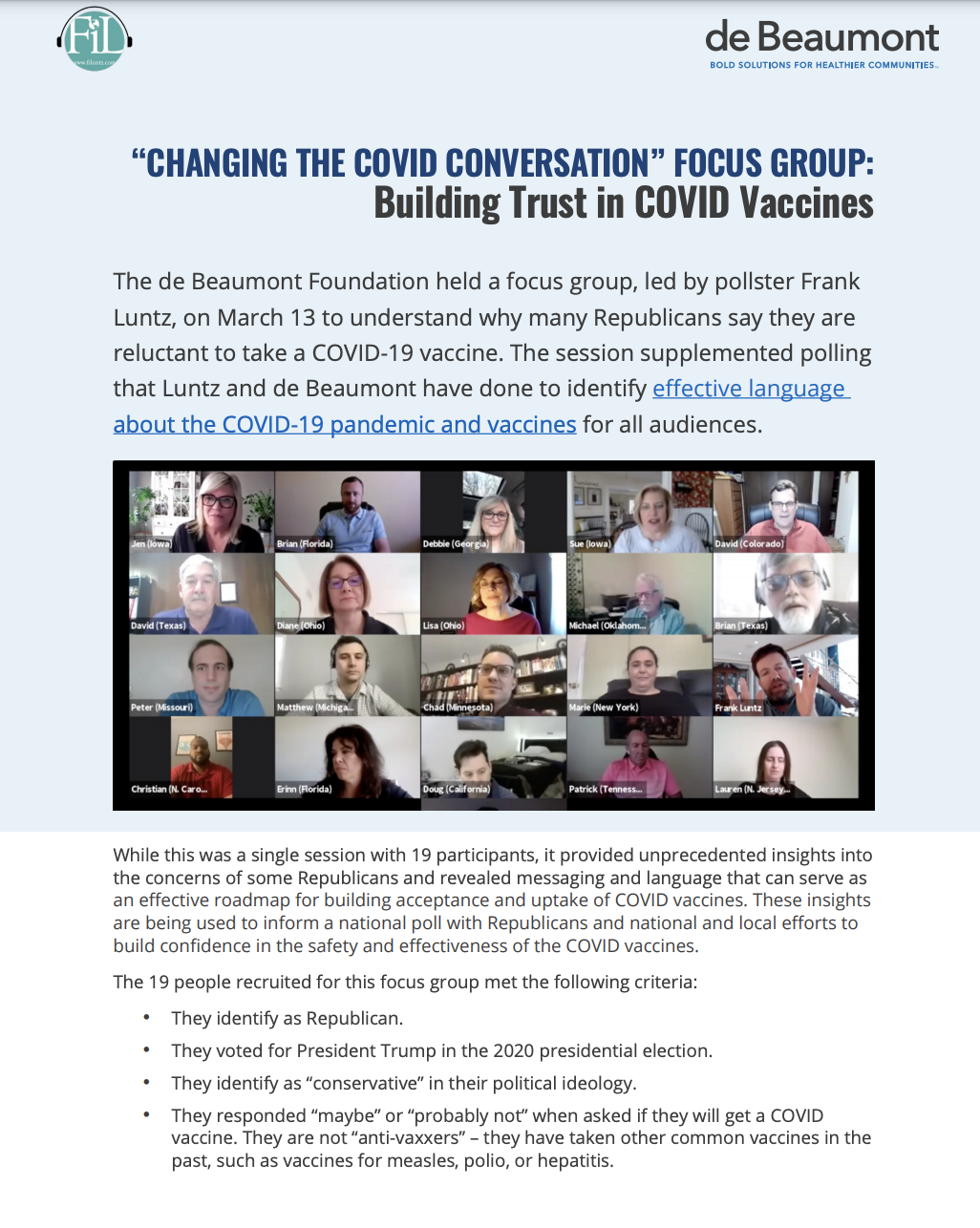
The No. 1 takeaway of Frank Luntz’s March 2021 focus group on vaccine hesitancy was that “Politicians are ineffective messengers — the mistrust of government and political leaders is significant. Participants said they would be much more receptive to their personal doctor’s recommendation over any politician or government agency, including President Trump.” 

Luntz was seemingly adamant that the nation needed to get politics out of vaccine messaging.  

Yet Luntz recommended that his nonprofit client, the de Beaumont Foundation, partner with a previously unknown political grouping called the “GOP Doctors Caucus” to produce and air ads featuring 13 of the caucus’s 18 members, ostensibly as PSAs. The caucus consists of Republican medical professionals who are also members of Congress, and by definition all up for re-election next year. The Washington Post reported, “Drawing on lessons from the focus groups and accompanying surveys; the de Beaumont Foundation worked with the GOP Doctors Caucus on a series of digital PSAs that lean on the lawmakers’ medical credentials.”

The head of the Doctors Caucus, Rep. Brad Wenstrup an Ohio podiatrist, told Medical Economics, “Frank had some sort of connection with the de Beaumont Foundation who said, ‘Let’s get the message out from a group of Republican physicians in Congress.’ They’d wanted to put together a PSA that they would produce and distribute.”

It turns out that Republican leadership, including McCarthy, who was living in Luntz’s 7,000 penthouse apartment when the focus group was held and the PSA’s were made, approached the Doctors Caucus and asked its members to be “deeply engaged” on the Luntz/de Beaumont project.

In the Medical Economics interview, Wenstrup was asked if anyone thought the PSAs were inappropriate. He said no and added that “our leadership on the Republican side came to us (the Doctors Caucus) and said I really want you all to be deeply engaged with this.”

Wenstrup added, “When we filmed it, we all filmed one for ourselves that we could push out to our districts, then we had one that combined us all and was more for a national audience.” The ads were online in April, and ABC News reported they were seen by “millions of Americans.”

Kevin McCarthy’s offices did not return a Salon request for comment on the matter. 

Here’s one thing we should be happy Trump destroyed: The “Goldwater rule” bites the dust

The role of the free press is critical in a representative democracy. It is covered in the First Amendment of the Constitution for a reason. The overarching purpose of the press is to keep in the spotlight every deliberation and decision that is made in our government. The press is the watchdog of our elected officials.

Politicians have tried to undermine the importance of the media by questioning their motives and intent. The most obviously self-serving and disingenuous case in point is Donald Trump, who spent his entire presidency trying to convince the public that the mainstream media is “the enemy of the people.” Whenever he didn’t like a story, he called it “fake news.” His purposeful and relentless effort to undermine the public’s trust in the media will be one of his worst legacies. Why? Because a free press is indispensable to democracy. We depend on it to inform, to explain, to interpret and, yes, to warn. To a large degree, that is what separates us from authoritarian regimes and “managed” pseudo-democracies. 

But the “duty to warn” should also apply to mental health experts, who should feel compelled to speak out when their expertise and experience lead them to perceive a political figure as dangerously unfit. In fact, they have a social and ethical responsibility to voice their opinions and to inform the public. 

That brings us to the “Goldwater rule,” an ethical guideline advanced by the American Psychiatric Association in 1973 that hardly anyone knew about or cared about until Donald Trump became president. The Goldwater rule states that psychiatrists should not comment about political figures because they have not interviewed them personally. (Its name refers back to Sen. Barry Goldwater, the 1964 Republican presidential nominee, who was seen by some mental health professionals at the time as unstable or dangerous.)

Almost immediately after Trump’s election in 2016, mental health professionals were faced with an ethical dilemma imposed by the Goldwater rule. How could experts speak out in their duty to warn the public when they were prohibited from doing so by an ethical restraint imposed by a major professional organization? That conundrum was compounded by the mainstream media’s collective decision to abide by the Goldwater rule — when they were under no obligation to do so — and not allow mental health experts to voice their opinions.

The Goldwater rule is outdated and antiquated, functionally obsolete. Today, mental health professionals have access to thousands of audios, videos, tweets, interviews, speeches and books from virtually all politicians, which can be studied carefully over time. Tremendous amounts of behavioral data are publicly available. As a result, expert opinions about a politician’s mental health are grounded in data and should be viewed as professional, ethical and accurate. A personal interview would certainly be helpful in many cases, but is not to be understood as comprehensive or sufficient in itself. Behavioral information over time is much more revealing, instructive and diagnostic. 

Beyond that, mental health experts do not need to be shackled. They are highly trained and possess a wealth of knowledge. They are highly ethical and will not try to discuss matters outside their area of expertise. They voice opinions that are grounded in science and data. They work hard to remain fair and balanced and have been trained to acknowledge their personal limitations. They are careful not to permit their political leanings sway their well-considered opinions. 

Mental health experts are treated much differently than experts in other medical specialties. If a politician has a heart ailment, cardiologists are encouraged to discuss the problem in the media. If a politician has arthritis, rheumatologists are invited to share their knowledge. If a politician has cancer, oncologists are summoned by the media. There is obvious precedence for the mainstream media to solicit medical experts to voice their opinions about political figures. 

The same should be true for mental health experts, given that mental health problems can be just as serious and incapacitating as the other medical issues mentioned above. They certainly have a major impact on public safety and welfare. We should not pretend that they do not exist because they make us feel uncomfortable. Nearly everyone now understands that to ignore or conceal mental health problems is only likely to make them worse.

Media professionals and mental health experts share the same fundamental mission: to serve and inform the public. They are not adversaries, and their goals are not in conflict. 

A “duty to warn” the public should be a central guiding principle for both the media and mental health experts as we strive to recover from the trauma of the Trump years. The Goldwater rule should be discarded at last — its relevance is long in the past. At least that’s one norm obliterated by Donald Trump for which we can be grateful.


What Donald Trump taught America: Democracy can die slowly, or all at once

The Age of Trump and its expanding and escalating aftershocks remains a form of cruel tutelage for the American people in how democracies die. The American people now know what a fascist assault on the world’s leading democracy looks and feels like in real time. Few people have the “opportunity” to live through such a world-historical event.

The Age of Trump involved many lessons, such as the regime’s daily assaults on truth and reality, its wanton cruelty toward nonwhite migrants and refugees, its disregard for human life, its attacks on free speech and other fundamental civil and human rights, its democide through indifference or incompetence in the face of the coronavirus pandemic, its open embrace of white supremacy, its overt corruption and its disregard for the rule of law.

There was also the cult-like behavior and worship of violence, the relentless propaganda, the deification of the Great Leader, the concerted effort to destroy the commons and social safety net, attacks on secular society and the Constitution by right-wing Christian extremists, the legitimation of right-wing terrorism and other political violence, and the continuing surrender to the plutocrats and corporate oligarchs. 

This cruel tutelage also involved exposing the American people to a sophisticated vocabulary and set of ideas for understanding the Trump regime’s assaults on democracy and civil society — and resisting them.

This included such language and ideas as “democratic backsliding,” the “authoritarian breakthrough,” the “self-coup” or “auto-coup,” “managed democracy,” “plutocratic populism,” “authoritarian capitalism,” “proto-fascism” and “herrenvolk democracy,” along with the more familiar concept of a “failing democracy”. As compared to previous decades, the concept of white supremacy was also discussed much more often (and in greater detail) by the mainstream news media.

Ultimately, for too many (white) Americans, the fundamental fact that “fascism” and “authoritarianism” were not something that could only occur “over there” in Europe or other parts of the world but were instead native to the United States (both in the form of white-on-Black chattel slavery and Jim Crow as well as the rise of Trumpism) came as a horrifying revelation for many that shattered childish psychological investments in the myth of American Exceptionalism.

The Age of Trump saw an explosion in the number of books and other popular writing on fascism and authoritarianism. If the most notable example was perhaps historian Timothy Snyder’s bestseller “On Tyranny,” there were many others. 

On a near-nightly basis, MSNBC, CNN, and other mainstream news networks featured interviews with leading experts from such fields as history, psychology, philosophy, law and the social sciences who attempted to provide greater context for the American people to properly understand the dangers of Trumpism and American neofascism.

The best of independent news media, including public television programs, print and online publications and numerous podcasts, strove to rise to the occasion, channeling the spirit of the Fourth Estate as defenders of democracy.

The Age of Trump forced another type of education on the American people, in the form of how many of the country’s and the world’s leading mental health experts, at great personal and professional risk, tried to sound the alarm about Donald Trump’s obvious mental and emotional pathologies, which constituted a public health emergency. Unfortunately, their warnings were, for the most part, not taken seriously by America’s political class.

Faith leaders such as Rev. Dr. William J. Barber II also attempted to educate the American people about the existential threat of Trumpism to the nation and its future.

Taken as a whole, these concepts, frameworks and deeds have been indispensable for making sense of Trumpism. But there is still great value to be found in speaking in the most direct, basic and granular terms about the Trump movement and what it represents.

For example, on Jan. 6 the American people watched Trump and his supporters — including much of the Republican Party — attempt a coup in order to nullify the results of the 2020 presidential election. That was the Age of Trump’s most powerful teachable moment.

What specifically happened on that day? Trump’s followers stormed the U.S. Capitol, physically attacking Capitol Police officers and other law enforcement agents who were guarding Congress. They sprayed police officers with mace and other chemicals. They used flagpoles, fire extinguishers and various other blunt or sharp objects to assault and in some cases seriously injure police officers and other law enforcement agents doing their jobs that day.

A few of Trump’s followers were armed with guns and other weapons. A cache of guns as well as bombs containing homemade napalm were discovered in a nearby vehicle. 

Some ran amok, smearing feces on the walls of Capitol corridors and urinating on the floor. Some shouted racial slurs at Black police officers. Quite a number carried and displayed white supremacist flags, militia and Christian nationalist symbols and other hate regalia.

Trump’s followers included right-wing paramilitaries who hoped to capture and execute Vice President Pence as well as prominent Democratic members of Congress who were deemed to be “traitors.” Some of Trump’s faithful erected a working gallows in the park adjacent to the Capitol complex.

What does all this mean? As a practical matter, it means the Trump-controlled Republican Party endorses right-wing terrorism and other crimes as a way of seizing and holding power. It also means that the Republican Party can be reasonably described as a white supremacist terrorist organization and crime syndicate.

Republicans have blocked the formation of an independent commission to investigate the events of Jan. 6. Why? There is little mystery: Republicans in Congress and in many states across the country have shown themselves to be guilty of conspiring with the Trump regime and its numerous efforts to overthrow the results of the 2020 presidential election.

Moreover, the Republican Party is giving permission to its followers, including right-wing paramilitaries and terrorists, to commit more acts of violence — up to and including another direct attack on centers of government — in order to overthrow election results and other democratic outcomes they do not like.

Donald Trump is no longer in office, but America’s democracy crisis is escalating rather than receding.

On Memorial Day, President Biden visited Arlington National Cemetery. During remarks honoring America’s fallen military personnel, Biden warned: “Democracy itself is in peril, here at home and around the world. What we do now — what we do now, how we honor the memory of the fallen, will determine whether or not democracy will long endure.”

On Tuesday, 100 of the leading scholars of democracy issued an emergency call to action in a letter that tries to explain the severity of America’s crisis:

We, the undersigned, are scholars of democracy who have watched the recent deterioration of U.S. elections and liberal democracy with growing alarm. Specifically, we have watched with deep concern as Republican-led state legislatures across the country have in recent months proposed or implemented what we consider radical changes to core electoral procedures in response to unproven and intentionally destructive allegations of a stolen election. Collectively, these initiatives are transforming several states into political systems that no longer meet the minimum conditions for free and fair elections. Hence, our entire democracy is now at risk. …

We urge members of Congress to do whatever is necessary — including suspending the filibuster — in order to pass national voting and election administration standards that both guarantee the vote to all Americans equally, and prevent state legislatures from manipulating the rules in order to manufacture the result they want. Our democracy is fundamentally at stake. History will judge what we do at this moment.

After four years of the Trump regime (and beyond) the American people now have personal experience with fascism. But that information does not naturally translate into knowledge.

Real knowledge describes the way a person synthesizes information and applies it in their own lives to make better decisions and develop a more sophisticated understanding of the larger world. As a whole, the American people continue to fail this test in terms of how they choose to respond to the neofascist assault on democracy and freedom.

Many Americans appear exhausted and paralyzed in response to the fact that Trumpism was not vanquished by Donald Trump’s defeat in the 2020 election.

The Age of Trump has taught the American people how cruel fascism could be if it is allowed to fully mature in the United States. But too many Americans are still choosing to shield themselves in willful ignorance. As seen in other places and at other times, such denial is not an adequate defense. Perhaps too many Americans have still not absorbed the lessons taught by Donald Trump. They are running out of time to learn them.

Understanding the shock Katie Hill ruling: She must pay outlets that published nude photos

Nearly two months after a judge dismissed former Rep. Katie Hill’s lawsuit charging the Daily Mail, Red State and Red State editor Jennifer Van Laar with distributing non-consensual porn and violating California’s “revenge porn” laws, the court is now ordering Hill to pay more than $200,000 in legal fees, including more than $100,000 to the Daily Mail, specifically. The Los Angeles County judge is also ordering Hill to pay $84,000 to Van Laar’s attorneys, among other fees.

It seems objectively shocking to many or most observers that Hill would be charged hundreds of thousands of dollars for the privilege of being victimized and publicly violated. But the judge’s ruling reflects an enormous loophole in the California “revenge porn” law that could set a dangerous precedent for many other cases and render questions of consent irrelevant if the victim is famous or a public official.

As the Los Angeles Times reports, the 2013 California law on nonconsensual porn “makes it a crime to distribute private images without the person’s permission but has exceptions, notably if such sharing is in the ‘public interest.'” That “public interest” exception was key to the ruling on Hill’s case. Exceptions like this have previously been applied to reporting on disgraced former Democratic congressman Anthony Weiner, whose illegal and disturbing sexting with minors may have played an uncomfortable role in the outcome of the 2016 election. Exposing Weiner’s unsavory private communications was legal, because it was notably relevant to his status and decision-making abilities as an elected official.

In Hill’s case, the nude photos of her published by the Daily Mail were supposedly a matter of “public interest,” the Mail argued, because they spoke to her character and qualifications as a member of Congress. As a refresher, Hill had been accused of having improper relations with a member of her congressional staff, which she denied, and also with a young female campaign staffer prior to taking office, to which Hill has admitted. 

The nude photos allegedly depict Hill being intimate with her staffer, using a then-illegal drug, and “displaying a tattoo that was controversial because it resembled a white supremacy symbol,” according to the Orange County Register. As a result, the judge ruled that the photos reflected on Hill’s “character, judgment and qualifications for her Congressional position.”

Just as driving Hill from Congress in 2019 arguably sent a dangerous message to young women who have ever taken or sent nude photos to consider that a disqualification from holding public office, this ruling on her case could set a dangerous precedent for all victims of nonconsensual pornography. As Hill’s attorney, victims’ rights lawyer Carrie Goldberg, has pointed out, “Anybody who dares enter the public eye should now have legitimate concern that old nude and sexual images can be shared widely and published by any person or media purporting to have journalistic intentions.”

Business Insider reports that Goldberg accused conservative news outlets of “trying to create case law that publishing revenge porn is protected speech,” which would be a disturbing legal precedent with potentially far-reaching consequences. It’s especially troubling that one specific passage in a California law that was clearly intended to help victims of revenge porn is now being reverse-engineered to harm them, or at least to discourage them from ever entering the public eye.

The outcome of Hill’s case is chilling because it appears to create an exception to the rule that no one should share another person’s private photos without consent, a principle that likely should not be conditional upon anything. A 2016 study published by the Data & Society Research Institute that found 10 million Americans — or one in 25 — have been victims of “revenge porn,” and that people of color, women under 30 and LGBTQ folks are all at greater risk. A 2018 study conducted in the U.K. found more than half of teenagers have friends who have shared intimate images of someone they know.

Currently, 46 states — including California, which Hill briefly represented in Congress — and Washington, D.C., have laws that explicitly prohibit revenge porn. But it’s unclear after the Hill case whether the “public interest” exceptions built into many of these statutes could render them meaningless, or easily weaponized by bad-faith abusers.

In 2019, Hill alleged that  her ex-husband had shared the photos to punish her for leaving him, and that he had been abusive for years. This points toward the obvious conclusion that the blame, shame or moral deficit when it comes to sexual cyber-crimes and exploitation, in nearly all cases, does not lie with the victim for taking or sharing photos, but with the perpetrator. Hill’s ex is hardly the only partner or former partner to use nude photos to punish, blackmail or try to coerce a victim to remain in a damaging relationship.

While what was done to Hill — and far too many other women — is often called “revenge porn,” many advocates have criticized the label as reductive, and even containing an element of blame or shame. The word “revenge” may offer implicit justification for such a violation — supposedly in retaliation for some previous wrongdoing — while “porn” implies the pictures in question are just casual, sexual content rather than a deeply traumatic violation. Hill’s case signals a need for policy changes that protect consent as unconditional, as well as new language and discourse on the issue.

Hill has since spoken out against the Los Angeles County judge’s ruling, calling it a reflection of the “broken” justice system, and stating that her fight continues, in a Wednesday tweet.

GOP Governors’ decision to nix jobless aid may cost local economies up to $12M, report finds

In addition to stripping a key lifeline from millions of jobless workers across the country, Republican governors’ plans to prematurely cut off emergency unemployment benefits could cost local economies an estimated $12 billion as previously covered individuals and families lose the extra $300 in weekly federal aid they were using to buy groceries and other necessities.

According to a report (pdf) released Wednesday by the Joint Economic Committee, a congressional panel chaired by Rep. Don Beyer (D-Va.), the decision by dozens of Republican governors to cut off the $300-per-week boost to unemployment insurance “will take over $755 million from UI beneficiaries and their families on average.”

“These numbers, while rough estimates, nonetheless probably understate the extent of the economic loss caused by this decision,” the report reads. “By ending these programs early, states are refusing billions of already appropriated federal dollars that could be spent in local groceries, restaurants, and retail shops.”

The JEC’s cost estimate does not include Maryland, which earlier this week became the 25th Republican-led state to announce it will end its participation in the $300 weekly unemployment boost—formally known as Federal Pandemic Unemployment Compensation (FPUC)—that supplemented notoriously low state benefits.

Maryland, along with 20 other GOP-led states, is also opting out of Pandemic Unemployment Assistance (PUA) and Pandemic Emergency Unemployment Compensation (PEUC), federal programs designed to provide aid to jobless gig workers and those who have exhausted their eligibility for state-level benefits. Depending on when the state submitted a notice of withdrawal to the Biden administration, the benefits will officially end between June 12 and July 13.

Originally approved in March 2020 under the CARES Act and extended in subsequent relief packages, the emergency unemployment programs aren’t set to expire nationwide until early September.

The JEC warns in its new analysis that “the earlier that states prematurely cut off FPUC, the more money their local economies stand to lose.”

“Estimates of the multiplier effect of UI find every $1 in UI generates $1.61 in local spending,” the report notes. “Based on this multiplier, localities around the country will miss out on more than $12 billion flowing back into their economies from FPUC-related spending from June 19 to September 5. This estimate does not include the amounts lost to early cancellation of PUA/PEUC, underscoring that the loss to local economies as a result of early termination will far exceed the $12 billion estimate.”

In a statement, Beyer said that the unemployment benefits approved at the start of the coronavirus pandemic last year “ensured that tens of millions of Americans were still able to put food on the table, prescriptions in the medicine cabinet, and keep the lights on during one of the worst economic recessions in our nation’s history.”

“Many of those Americans still remain deeply uncertain about their economic futures as we still remain more than eight million jobs short of where we were pre-pandemic,” Beyer added, rejecting Republican governors’ widely disputed claim that enhanced unemployment benefits are dissuading people from returning to the workforce.

“There is little evidence that enhanced UI is holding back employment,” said Beyer. “In fact, ending it could cost local economies more than $12 billion. If states proceed with their plans to end these critical programs, they will be ripping the rug out from under millions of Americans and further hindering our economic recovery.”

The National Employment Law Project and Sen. Bernie Sanders (I-Vt.) argued last month that under the specific terms of the CARES Act, the Biden administration has a legal obligation to continue providing the emergency jobless benefits regardless of Republican governors’ actions.

But administration officials have told media outlets in recent days that they believe they are powerless to stop Republican-led states from withdrawing from the aid programs, despite the devastating impact the moves could have on millions of workers and the economic recovery.

“States are canceling federal UI because of a faux panic over the rate of re-hiring—but the economy is already improving, thanks to the money injected by these programs,” Andrew Stettner, a senior fellow at the Century Foundation, argued Thursday. “There are surely going to be more ups and downs in our recovery, possibly reflected in tomorrow’s jobs report. We must recognize that this economic progress is happening in part because of—not in spite of—federal unemployment aid.”

On Thursday morning, the Department of Labor announced that 461,000 people applied for unemployment benefits last week—a pandemic low but still far above pre-crisis levels.

“Total initial claims are still 2.5 times what they were before Covid,” Heidi Shierholz of the Economic Policy Institute wrote in a series of tweets responding to the new data. “Many Republican-led states are preparing to cancel pandemic UI benefits. This will not just hurt workers who can’t find work or can’t work right now, it will hurt the economy in these states, because those benefits are supporting spending. It’s terrible economics.”

Mike Pence breaks his silence on Jan. 6 Capitol insurrection

Former Vice President Mike Pence broke his silence about the Jan. 6 Capitol attack on Thursday, revealing that he and former President Donald Trump are still at odds over the event.

Pence stunned the audience with his remarks, according to one reporter present, appearing before a Republican Party event at the DoubleTree Hotel in Manchester, New Hampshire. He has been reluctant to speak out about Jan. 6., a day on which he was pitted against the Constitution by his former running mate. Trump, having bought into and stoked debunked claims that the 2020 presidential election had been stolen by now-President Joe Biden, repeatedly pressured Pence to use the congressional counting of the Electoral College votes on Jan. 6 to overturn the result. However, Pence, like every reputable constitutional scholar, concluded that his ministerial role in the proceedings gave him no authority to change the result.

Ahead of the event, Trump gave a speech to his supporters who he had called to assemble in Washington D.C. and urged them to march toward the U.S. Capitol where Congress was gathered. Groups of his followers stormed the building and shut down the proceedings in a violent assault that left dozens of polices officers injured and several people dead. Democrats, along with more than a dozen congressional Republicans, accused Trump of inciting the violent insurrection.

Trump and the crowd’s ire had been particularly targeted at Pence. One crowd of the insurrectionists was even filmed cheering “Hang Mike Pence.”

“Jan. 6 was a dark day in the history of history of the United States’ capital,” Pence said on Thursday. “But thanks to the swift action of the U.S. Capitol Police and federal law enforcement, violence was quelled, the Capitol was secured, and that same day, we reconvened the Congress and did our duty under the Constitution and laws of the United States.”

At this point in the speech, the crowd was noticeably silent.

“You know, President Trump and I have spoken many times since we left office. And I don’t know if we’ll ever see eye to eye on that day,” he continued. “But I will always be proud of what we accomplished for the American people over the last four years.”

The crowd broke into applause. But according to Business Insider reporter Jake Lahut, those remarks changed the tone of the evening.

“There was almost a palpable shock in the room when Pence mentioned January 6th,” Lahut reported on Twitter. “The vibe has gotten much quieter since Pence brought up Jan 6th.”

Otherwise, Pence was full of praise for the former president, and he took shots at the Democrats. Even on the subject of Jan. 6, he accused Democrats of trying to use the day to “distract our attention” from the Biden administration. Though this critique rang hollow, given he both admitted to the seriousness of the violence that day and suggested that Trump was, at best, ambivalent about the attack.

Jan. 6 insurrection caused nearly $1.5 million in damages — and prosecutors want rioters to pay

The Department of Justice has determined that the January 6th insurrection resulted in approximately $1,495,326.55 in damages to the United States Capitol

“U.S. prosecutors this week put a price tag for the first time on damage to the U.S. Capitol from the Jan. 6 breach — $1.5 million so far — and are asking defendants to cover some of that in plea offers, prosecutors and defense lawyers said. The U.S. attorney’s office in Washington cited the damage estimate Wednesday in court and in plea papers filed in the case of Paul Hodgkins, 38. The Tampa crane operatorpleaded guilty to one felony count of obstructing an official proceeding of Congress and faces sentencing July 19 in Washington,” The Washington Post reported Thursday.

“Several defense attorneys said prosecutors with the U.S. attorney’s office in Washington are seeking to require restitution of $2,000 in each felony case and $500 in each misdemeanor case,” the newspaper reported. “One veteran defense attorney representing several defendants, speaking on the condition of anonymity because talks are pending, said the terms remain under negotiation. Another defense attorney speaking under the same conditions questioned whether a judge could sentence a person to pay restitution if they were not actually charged with causing damage.”

“The government will hardly reap a windfall under this approach since even if every defendant agreed to terms and pleaded guilty, the total paid would fall well below $1 million,” The Post noted. “The costs of the Capitol attack, however, go well beyond the $1.5 million estimate cited by prosecutors this week. A $1.9 billion security funding bill passed by the House included $40 million for the Architect of the Capitol for direct attack-related costs, part of more than $730 million set aside to reimburse the National Guard and other agencies for expenses in responding to rioting that authorities said contributed to five deaths, assaults on 140 police and the evacuation of a joint session of Congress.”

Politicized science drove lunar exploration — but polarized scientific views are worse than ever

Last year one of my students in a history of science class commented that “no one knows which doctors to trust because they are politicizing the pandemic, just like politicians are.” The interactions between science and politics are now so complex, so numerous and often so opaque that, as my student noted, it’s not clear anymore whom to trust.

People often assume that the objectivity of science requires it to be isolated from governmental politics. However, scientists have always gotten involved in politics as advisers and through shaping public opinion. And science itself – how scientists are funded and how they choose their research priorities – is a political affair.

The coronavirus pandemic showed both the benefits and risks of this relationship – from the controversies surrounding hydroxychloroquine to the efforts of Operation Warp Speed allowing researchers to develop vaccines in less than a year.

In this context, it is understandable that many people began to doubt whether they should trust science at all. As a historian of science, I know that the question is not whether science and politics ought to be involved – they are already. Rather, it is important for people to understand how this relationship can produce either good or bad outcomes for scientific progress and society.

The historical relationship of science and politics

Historically, political needs have acted as key scientific accelerators but have also at times stifled scientific progress.

Geopolitical objectives drive a large part of scientific research. For example, the Apollo space program from 1961 to 1972 was driven more by the competition between superpowers in the Cold War than by science. In this case, government’s funding contributed to scientific progress.

In contrast, in the early days of the Soviet Union, the government’s involvement in biology had a stifling effect on science. Trofim Lysenko was a biologist under Stalin who denounced modern genetics. As he became head of top scientific institutions, his opponents were arrested or executed. Lysenkoism – despite being dead wrong – became the accepted orthodoxy in the academies and universities of communist Europe until the mid-1960s.

As the Lysenko story demonstrates, when political powers decide the questions that scientists should work on – and, more importantly, what kind of answers science should find – it can harm both scientific progress and society.

Two political parties, two scientific realities

The relationship between science and politics has always been dynamic, but the rise of social media has changed it in an important way. Because it’s more difficult to discern between true and false content online, it’s now easier than ever before to spread politically motivated fake news.

In the U.S., social media has massively accelerated a long–growing political divide in scientific trust. Starting with Ronald Reagan, Republican leaders have turned science into a partisan field. The ideology of limited government is one of the main reasons for this attitude. Republican lawmakers often ignore environmental issues despite scientific consensus on the causes and dangerous effects these issues lead to.

President Trump brought the suspicion of science to another level by treating science as essentially just another political opinion. He argued that scientists and institutions who contradicted his views were motivated by their political agendas – and, by extension, that the science itself was false. By contrast, President Biden has put science at the top of his priorities.

As a result, the divide between scientific and anti-scientific positions – at least in the U.S. – is now often partisan. People of different political views, even when they are educated, are sometimes not able to agree on facts. For instance, among U.S. citizens with a high level of scientific knowledge, 89% of Democrats say that human activity contributes a great deal to climate change, as compared with only 17% of Republicans. Democrats are not immune to this either, as seen by the strong Democratic support for labeling genetically modified foods. This is despite scientific consensus on the safety of these foods. But overall, Republicans tend to be much more anti-science than Democrats.

The pandemic has shown the risks of this political divide. People who identify as Republican are much more likely to be resistant to mask-wearing and vaccination.

Disagreements in science are necessary for scientific progress. But if each party has its own definition of science, scientific truths become a matter of opinion rather than objective facts of how the world works.

Where is the relationship going?

Because trust in science was so degraded during Trump’s presidency, several leading peer-reviewed journals endorsed Biden as a presidential candidate. This was perhaps the first time in history that such a large number of scientific journals and magazines took clear stances for a U.S. presidential election.

The fact that the acceptance or rejection of science is increasingly determined by political affiliations threatens the autonomy of scientists. Once a theory is labeled “conservative” or “liberal” it becomes difficult for scientists to challenge it. Thus, some scientists are less prone to question hypotheses for fear of political and social pressures.

In my opinion, science cannot thrive under an administration that ignores scientific expertise as a whole; but neither can it thrive if scientists are told which political and moral values they must embrace. This could slow down or even prevent the emergence of new scientific hypotheses. Indeed, when scientists align themselves with or against political power, science can easily lose its most important asset: the ability to encourage disagreement and to raise new hypotheses that may go against common sense.

Liv Grjebine, Postdoctoral Fellow in History of Science, Harvard University

This article is republished from The Conversation under a Creative Commons license.

Fewer people are naming kids Karen, and we think we know why

The name Karen had already been making the internet rounds for a while now, mainly to be used as generic name to be uttered in exasperation, such as by a hungry shiba inu. However last year – following a recurring wave of white women calling the police on Black people for no reason beyond racism – social media quickly assigned the label “Karen” to white women who capitalize on their white women privilege to call the cops, ask to speak to the manager and like behaviors. The label has clearly stuck, because it’s affecting many American parents’ choices about what to name their children, The Huffington Post reported this week.

According to the latest numbers released by the Social Security Administration, throughout 2020, the name Karen fell 171 spots on the popularity list, from 660 to 831. On top of that, only 325 babies were named Karen last year — a whole 439 fewer than the number of babies named Karen in 2019. And as for the stereotype that “Karens” are mostly middle-aged women, Karen was the third most popular name for girls in 1965, and there were almost 33,000 newborn Karens that year.

There’s obviously no confirmed reason for the decline in popularity of the name Karen, but considering 2020 wasn’t exactly a banner year for the name, we might be able to venture a guess. 

Beyond social media, Urban Dictionary itself defines a “Karen” as a “middle-aged woman, typically blonde, who makes solutions to others’ problems an inconvenience to her although she isn’t even remotely affected.” Jumping off of this, the comedian Ziwe made a point to talk to a number of women named Karen for a cringe-worthy spot on her Showtime series:

Of course, “Karen” is also inextricably linked to white femininity and privilege, and its potentially to subject others to harm ranging from inconvenience and annoyance — especially for service workers — to literal violence, if a white woman choose to call the police. 

As of last month, Amy Cooper, the Central Park “Karen” who went viral for calling the police on a Black man for the great crime of bird-watching, is suing her former employer that fired her after the incident for “racial discrimination” against her, a white woman.

While women who embody the “Karen” model are an internet punchline at this point, scholars and thought leaders have also often pointed out the long history of white women weaponizing fear and racist safety concerns to harm and police Black men in this country. White women, white feminine identity, and the “protection” of white women played a central role in the widespread lynchings of the 19th and 20th centuries, as well as segregation later on.

So, in other words, the “Karen” label comes with a lot of baggage that many parents may understandably want their children to steer clear of. 

Helen Keller Barbie doll is newest in Mattel’s “inspiring women” line

Since its debut in 2018, Mattel’s “Inspiring Women” Barbie series has covered a dozen women trailblazers, from Rosa Parks and Susan B. Anthony to Sally Ride and Maya Angelou.

The latest is Helen Keller, who became the first deafblind person to receive a B.A. degree when she graduated from Radcliffe College in 1904. She went on to become one of the most celebrated and prolific humanitarians of the 20th century, advocating for women, workers, and other people with deafness, blindness, and deafblindness. She also helped found the American Civil Liberties Union in 1920.

Like previous Inspiring Women dolls, Keller’s Barbie features historically accurate details that reveal a little about who she was and when she lived. Using photos of Keller and other research about early 20th-century fashion, Barbie designer Carlyle Nuera developed an outfit in line with what Keller would’ve worn during her college days.

“I designed a high-neck blouse with puff sleeves, done in white cotton swiss dot trimmed in lace. I wanted something textural, something you could feel, to reference how braille is read,” Nuera explained in a news release. “For the skirt, I went with a stripe in muted colors typical of Edwardian dress.”

The National Federation of the Blind consulted on the project and even came up with the idea for Keller’s book to include a little braille. The front cover features, in braille, the abbreviation for the word braille: the letters BRL. Though the raised dots aren’t large enough to really be legible, the braille on the doll’s packaging is.

You can order the Helen Keller Barbie through Mattel’s website for $30.

This article contains affiliate links to products selected by Mental Floss editors. Mental Floss may receive a commission for purchases made through these links.

The lesson of “Six Feet Under,” 20 years later: “We’re not really as in control as we all think”

Twenty years after “Six Feet Under” premiered on HBO Rachel Griffiths hadn’t read the obituary for her character Brenda Chenowith. She never knew one existed, actually, until I read a condensed version to her during a recent phone call.

“It says, ‘Brenda Chenowith – ‘” I began, only to have Griffiths cut me off with a jokey stab at what came next, “‘Achieved nothing? F**ked everything?'”

Happily Brenda lived a better life than Griffiths, speaking to Salon from Australia, expected of her. The short version is Brenda went on to earn her PhD and became one of the most distinguished scholars in her field, writing several books about a topic near and dear to her: the role of the gifted child in family development.

“What do you know?” the self-described overachiever said, her surprise adding an amused lilt to her voice. “Here I thought she was gonna wallow in that trust fund and in her existential despair for another 50 years.”

It’s easy to understand why the details of Brenda’s later years might have escaped Griffiths if you’ve seen “Everyone’s Waiting,” hands down one of the best series finales ever made. For her and us, Brenda’s story ended flawlessly in that 2005 episode with her slumping over as her brother Billy (Jeremy Sisto) talked her to death. One could say Brenda died as she lived, since she spent too much time putting up with Billy’s logorrhea and bored easily.

Hers was one in a string of frames revealing how every major character in the show left this world, rendered in a dreamy seven-minute sequence. Where other shows exit in a fog of question marks or with the door cracked open enough to leave space for a return, “Six Feet Under” did not fade to black, but dissolved into peaceful white space and was gone. Two decades later we still love it for that reason.

When it debuted on June 3, 2001, series creator Alan Ball’s notion of setting a family drama inside a funeral home was novel for several reasons, topmost among them being the death’s constant presence in their lives. Mortality resides in the show not as mystery fodder or a device to amplify an antihero’s complexity but as a simple fact of life. Frequently it was a random visitor, sometimes showing up in clown clothing.

“It was never a ‘feel bad’ show, and I think that’s the kind of the miracle of Alan,” Griffiths explained. “He does push towards the melodrama, right, push it towards the earnest, but ends on some devastatingly funny unexpected image or moment or line.”

Season 1 also wrapped up prior to 9/11, a shock to America’s system that reminded America’s of life’s unpredictability, which gave the show extra poignance watching it in hindsight.

“So many people came up to me then and said that they started watching ‘Six Feet Under’ or were re-watching the first season, and how differently it was landing then, ” Griffiths recalled. “I feel like there was an obliviousness to how we were going about our business on Earth. I think we’d lost a degree of what one might call if it’s not kind of spiritual thinking or theological reckoning with what we were doing here . . . perhaps a sense of vulnerability, economic and now in a pandemic, a very, very, very real reckoning with our human frailty.”

“Of course, it was always there,” she continued,  “but we seemed to have a long period of where we, I think, became somewhat separated from the central notion that we were in control. And I feel like Alan was making a show going, ‘Hey, guys, we’re not really as in control as we all think.’ That really resonated for some people.”

On the show, the Fishers lived in the rooms above their funeral parlor and mortuary, but taking in and sending off bodies never grew mundane. David (Michael C. Hall) takes over the running and management of Fisher & Sons Funeral Home when Nathaniel Fisher Sr. (Richard Jenkins) is killed in the pilot. David spends the years afterward forging his identity as a gay man, a partner to his boyfriend Keith (Mathew St. Patrick) and eventually a father.

Wife and mother Ruth Fisher (Frances Conroy) hastens down her path of self-actualization in the wake of losing her husband; youngest daughter Claire (Lauren Ambrose) wrestles with where she fits in the world as she contends with her grief. Nate Fisher (Peter Krause) is the prodigal son who ran away to Seattle and never intended to back, until family obligation forces him to.

Through the Fishers we also got to know resident restorative assistant Federico Diaz (Freddy Rodriguez) and his wife Vanessa (Justina Machado), whose story evolves and deepens alongside everyone else’s.  And at the time, Federico and Vanessa represented a still-too-rare vision on TV, that of a Latin American family that was depicted as having parallel problems to everyone else, in the show and in the world. 

“Six Feet Under” racked up nine Emmys over the course of its run and yet all these years later its presence tends to be muted in discussions about the Golden Age of Television that HBO is credited with ushering into reality.

Realizing that it was on the air at the same time and on the same network as “The Sopranos,” “The Wire,” “Deadwood” and on the comedy side of the spectrum, “Sex and the City,” explains why that may be so.

In a medium that thrives on thematic imitation drawing lines to the overtly masculine themes of these dramas, and the defining femininity of “Sex and the City,” is probably simpler than mapping the road of influence that begins at “Six Feet Under.”

Wait, that’s not quite it. Maybe in our minds we perceive the progeny of shows about difficult men to be more . . .  explosive. From the genetic pool originated by “The Sopranos,” for example, leapt FX’s “The Shield” and “Rescue Me” and later, AMC’s “Breaking Bad.”

But it is visibly present in shows such as “This Is Us,” “Mad Men” and of course “Brothers and Sisters,” Griffiths’ next main cast role after putting Brenda to rest. The “Six Feet Under” writers’ room, meanwhile, graduated creatives such as Joey Soloway, who went on to make the tonally and emotionally similar “Transparent.”  Another, Craig Wright, created “Dirty Sexy Money” and the OWN drama “Greenleaf.”

Every character enjoyed their cadre of supporters, but Brenda earned a special affection by inviting us along to witness her own tunnel-crawl through self-discovery. She meets Nate at the same time we do, exiting the plane where they enjoyed each other’s company and screwing him in a utility closet minutes later.

It was supposed to be the briefest of flings, but that illicit interlude kicked off a cycle of attraction and repulsion lasting the entirety of the show’s five seasons.

Griffiths also recalls being perplexed by Brenda given how little she has in common with her character. The actor has worked constantly since winning international acclaim in “Muriel’s Wedding” and has several Emmy nominations under her belt along with an Oscar nod. Currently she’s a series regular on Amazon’s “The Wilds,” which was recently picked up for a second season.

“It was always hard for me to just understand this girl’s inability to get s**t done,” she said. “I kept trying to find jobs for her where she could actually function in the world. To me, she just seemed like an anomaly. I didn’t know many women in my life, young women, who were so talented and smart, and so trapped in their own neuroticism.”

Now, Griffiths has more sympathy for this alter ego she once inhabited. She says she knows young people dealing with chronic anxiety and depression, who excel in school only to drift rudderless in their 20s. In that respect, she wonders if Brenda was a predictor or perhaps representative of a woman we hadn’t yet seen.

Griffith explains that through her and the other women in on the show, Ball was breaking archetypes of what women are meant to look like or sound like. “You know, Nate’s the guy and she’s the girlfriend, and you use the girlfriend to explore different things about your main character,” she said. “But with all Alan’s women, he made them all 100% their own people who would intersect with other people. They were not subservient.” 

Griffiths then astutely and correctly observed that Jean Smart‘s “Mare of Easttown” character owes a debt to Ruth Fisher. Of course she does.

And it could be that we loved Brenda because she’s the ultimate insider able to maintain some distance for most of the series, or because her family’s dysfunction blended a form of ancient Greek tragedy with the exaggeration of an Aaron Spelling primetime soap. The Fishers may be quirky and difficult; the Chenowiths are borderline sociopaths. Brenda and her brother Billy were raised by mental health professionals who proudly allowed another psychiatrist to study Brenda, a kid with an I.Q. of 185, and write a book that would haunt her for the rest of her days.

Ball also wrote Brenda to be more likable than the other women Nate falls for in the series, mainly Lili Taylor’s crunchy Lisa Kimmel, and  Tina Holmes’ gentle and unexciting Maggie. And Brenda is but one example of the array of unique personalities Ball develops and complexifies over the four seasons “Six Feet Under” ran on HBO.

Through the Fishers, the Chenowiths and the array of people who passed through their lives, the show asked us to consider existential debates and conversations. There weren’t many series on the air at that point that examined our culture’s yearning for happiness and how that can differ from satisfaction, or played with the definitions of love and infidelity.

“Six Feet Under” concerned itself with issues beyond death, and we may have missed that the first time around because of the drama swirling around those larger questions. In 2021 we’re still in a pandemic, and the world’s shared mass grieving is ongoing. Sane and reasonable people would say they’ve had their fill of death and oddly enough, being in that headspace makes a person ripe for a re-watch.

It may be a series that kicked off with a major death, but it closes with a birth and that montage of endings, along with marriages, beautiful days and a cascade of life-affirming subplots. For all of us, Brenda included.

When asked what she imagined how Brenda would view our progression over the last 20 years – knowing what she knows now about her character, Griffiths was hopeful.

“From watching television, I think she would say, ‘Thank Christ we are getting closer to actually far more accurate portrayals of what women feel like in themselves, and in their bodies, and what they struggle with and, and a more inclusive notion of what woman is, you know, including non-binary trends.’ I think she would love this movement to self-definition,” the actor said.

“And television’s a lot more interesting too!” Griffiths added. “There’s a lot more good s**t on television.”

Thankfully “Six Feet Under” played a role in that.

All 63 episodes of “Six Feet Under” are streaming on HBO Max and can be purchased on digital and DVD.

Agnolotti, bucatini and the innovative new “cascatelli” — a brief history of pasta shapes

There are at least 350 shapes of pasta you can buy. Food blogger Dan Pashman apparently thought we could use one more.

Enter cascatelli – which means “waterfall” in Italian – the world’s newest pasta shape. Pashman developed the shape to hold a lot of sauce and be easily stabbed with a fork. To me, a food historian and former bistro chef, it looks like the love child of two lesser-known pastas, creste di galle and mafaldine.

While the history of this new shape has been heavily documented, including in a five-part podcast, the story behind how pasta got its shape is a bit murkier.

The noodle is born

Pasta is one of the oldest processed foods, dating back several thousand years to around 1100 B.C. For comparison, bread dates back to around 8000 B.C.

While it may seem like fighting words to an Italian, the first pasta that modern eaters would recognize probably came from China and could have been made out of a variety of starchy foods besides wheat, including rice, mung beans, tapioca and sweet potatoes. In fact, the earliest forms of pasta excavated in archaeological digs were made from millet, a grain that has been in use in East Asia much longer than rice or wheat.

Early Chinese cultures mostly grew soft wheat that was not well suited to making dried pastas, but made good fresh pasta.

More mystery surrounds which culture invented the first cut and dried noodles. Some say the Chinese; others say the Italians. The real answer is probably neither of them.

Triticum, or durum, wheat needed to make a sturdy dry pasta is Middle Eastern in origin, so it is likely that Arabs and others in the Middle East were producing and eating the earliest modern forms of dry pasta – as little balls like acini de pepe and couscous – before they became common in Italy.

These tiny forms of pasta kept well in hot climates and could be cooked using very little fuel, which was scarce in Arab dominions. Since they were dehydrated and sturdy, they were an ideal food for people traveling across the Middle East and northern Africa.

The earliest pasta shape was a simple sheet, which was treated more like bread dough. It probably didn’t have the toothsome quality – known as “al dente” – associated with Italian pasta today, and would have been similar to unleavened matzo bread with sauce on it. The first mention of boiled pasta wasn’t until the fifth century A.D., in the Jerusalem Talmud.

Most of the earliest forms of pasta that we consider to be the core of the Italian repertoire – such as vermicelli and spaghetti – were probably first developed by Arabs and didn’t appear in Italy until the ninth or 10th centuries. These noodles became widespread once durum wheat had established itself in Sicily and regional food makers learned to work with the semolina flour it produced.

Italy and an explosion of shapes

Spaghetti, which means little strings, was easy to make and dry in the climates of Southern Italy.

In Italy, these thin noodles were initially cut from sheets using knives or wire cutters. Almost all the earliest shapes were probably formed by hand, which was a tedious process, so people worked on making their production more efficient as pasta gained importance in their diets.

What really sparked the explosion of pasta shapes was the invention of the extrusion press. Versions of an extruder had been experimented with since the 1300s, but it took the revolution in mechanics of the Renaissance to allow the machines to quickly mass-produce pasta, including shapes like elbow macaroni, rigatoni and tagliatelle.

Stiff pasta doughs made from semolina could be worked in large quantities by machines in volumes not possible by manual production. These doughs were then extruded through bronze “dies” that yielded the style of pasta familiar today. Bronze was hard enough to be durable but soft enough to be easily worked using pre-Industrial Revolution technologies.

The introduction of machinery powered by steam in the 1800s during the Industrial Revolution made the process of extruding noodles even more efficient. As factory-made pasta caught on with the public, manufacturers quickly added pastas of various shapes and sizes to their repertoire. Fantastic shapes like gemmeli, radiatori, wagon wheels and stuffable shells soon crowded the shelves.

America embraces the noodle

The U.S. was slow to adopt most of the wide variety of pasta shapes common in Italy.

That’s despite the fact that Founding Father Thomas Jefferson was a major proponent of pasta and even owned a pasta maker at his home in Monticello.

The earliest Italian immigrants to America came from the northern regions of the peninsula, but their overall numbers were small. The first documented pasta factory in America was established in Brooklyn in 1848, and by the time of the Civil War, macaroni, as it was mostly called then, was fairly common on American tables. Though Italian noodles were called macaroni, they were most often some form of flat noodle, like fettuccine.

American pasta consumption began to surge following the the “Great Arrival” of nearly 4 million Italian immigrants to the U.S. from 1880 to 1920, most from Southern Italy. This is when most of the pasta dishes Americans are familiar with today – such as spaghetti and meatballs, cheesy elbow macaroni and linguine with clam sauce – became popular.

But it wasn’t until the Italian “food boom” of the 1970s and 1980s that Americans became familiar with the cornucopia of pasta shapes, sizes, sauces and fillings that were common in Italy.

Today, Americans consider pasta one of their favorite foods – which means there’s probably always room for one more type.

And perhaps, given the comforting nature of pasta, the COVID-19 pandemic was an ideal moment for Dan Pashman to introduce cascatelli. A pasta shape that holds more of the rich sauces people crave like marinara and alfredo could not have come at a more opportune time.

Jeffrey Miller, Associate Professor, Hospitality Management, Colorado State University

This article is republished from The Conversation under a Creative Commons license.

“I’m not tough”: Jennifer Jason Leigh on her career playing challenging roles nothing like herself

Jennifer Jason Leigh is a tough cookie as Darla, the sister of the title character in “Lisey’s Story,” a new AppleTV+ series written by Stephen King (adapted from his novel) and directed by Pablo Larrain (“Neruda“). 

Darla is supportive and fiercely protective of Lisey (Julianne Moore), the widow of Scott Landon (Clive Owen), a successful novelist who, as the series opens, has been dead for two years. Lisey is being threatened by an obsessed fan (Dane DeHaan). Meanwhile, Darla’s other sister, Amanda (Joan Allen), is self-harming and catatonic; she is soon hospitalized. How Darla navigates her relationships with each sibling provides Leigh with several opportunities to express Darla’s palpable emotions.

Since her breakout role in “Fast Times at Ridgemont High,” Leigh has commanded viewers’ attention with the characters she plays, from Tralala, the sex worker in “Last Exit to Brooklyn,” and Hedra Carlson, the roommate from hell in “Single White Female,” to her Dorothy Parker in “Mrs. Parker and the Vicious Circle” and her Oscar-nominated turn in “The Hateful Eight.” 

Leigh’s talent, and what makes her so captivating on screen, is her steely determination. Her Darla is no-nonsense, and a scene of her raging at the hospital staff shows the extreme frustration she feels. But she also provides moments of sarcasm and deadpan humor in the series. Leigh chatted with Salon about “Lisey’s Story” and how she is unlike most of the characters she plays. 

This is the second Stephen King adaptation you’ve done, following “Dolores Claiborne.” What appeals to you about his work in general and his characters in particular?

I think his characters are always flawed and complicated and very interesting — you are really drawn in. And the worlds are so surreal and horrific or thrilling. And he’s incredibly prolific; it just boggles the mind. I started reading his books when I was a young teen, and they had a big impact on me — as they did for so many people. It was really nice to be a part of this one because I know it’s very personal for him. He loves his stories so much. That had a certain pressure to it.

He was on set, I understand. Did you talk with him about your character?

He did talk about Darla with me. He was open and enthusiastic, and easy to talk to. And nice! I think you’re just intimidated when you meet someone that you have been reading their books and looking at the movie adaptations of their novels for most of your life.

I got the impression that Darla is jealous of her sisters. How do you see her? What do you think motivates her?

I think there are petty rivalries and jealousies with her sisters. I see Darla as — it’s a bad metaphor — when you go to a birthday store and buy balloons, she’s the rock that holds the balloons down so they don’t fly off. She doesn’t get all the attention. There is nothing magical or special or beautiful about her, but she’s not going to fly off. She’s going to keep everyone grounded as best she can because that’s her job. And along with that, does come some resentment. She’s been doing this for so long. They are not little girls anymore, but their childhood still influences who they are as women, and the ties they have to one another. 

Darla often has to deal with difficult people. You have been in the film industry for most of your life. What observations do you have about dealing with difficult people? 

Yes, we all have dealt with difficult people and you have that feeling, “life’s too short.” But the only way to get through it is to rise above. You can’t engage in a certain way because — how can you with some people? It’s just impossible, and it’s not going to get you anywhere.

The series features many scenes of what the characters call “magical surrealism.” Darla seems pretty grounded in reality. What are your thoughts about parallel or alternate worlds?

Darla doesn’t believe in any of that. I would love it to be true. I love those movies. I love science fiction and all of those theories — and perhaps it is. Do I personally think . . . nah! But what do I know? 

Darla is the practical sister. What can you say about developing your relationship with your onscreen sisters?

Pablo just made us feel like sisters right away. I don’t know exactly how he did it, but there was something about giving us the feeling that he believed in all of us and accepted all of us for who we were. He really wanted this to be so real and, without judgment, have all those different feelings at play all the time — which is what it is with sisters. There are so many deep feelings.

Pablo encourages how people are. Darla is pragmatic, but she also desperately wants to connect to her sister without all that history that’s there and some of it’s not pleasant and not good. And that lion thing that comes out when someone you care for isn’t being protected in a place you sent them for protection. All that stuff is fun to play and makes it a much richer character and experience. 

There is a line in the series, “By the work you shall know them,” referring to Scott Landon’s output. What do you think folks would know about you given the films and TV series you’ve made? 

Very little. 

You don’t think the projects you choose reflect who you are?

No, not really. I am so different than the characters I play usually. I feel like I’m straightforward, I’m introverted. I don’t like drama in my life, I like it in movies. If people are just looking at my movies, they might get a very different sense of who I am as a person. I mean, what would you say? I’m curious.

I think you’re brave and fearless because you take a lot of challenging parts. You’re fascinated by characters who are a little on the edge. In “Single White Female,” you embodied that character. Dorothy Parker was perfect casting for you. You have that acerbic wit. Tralala in “Last Exit to Brooklyn,” was a stunning performance.

I’m actually a lot closer to Lisa in “Anomalisa” though. Or Susie in “Miami Blues.” Those characters are more . . . I’m not tough at all. I’m very no-nonsense, but in real life, I’m vulnerable. I can play tough because I didn’t get to be tough. I saw a lot of tough around me. It’s fun for me to play extroverted and all these people that I’m not like in my real life. I’m observant.

You have long been an indie film darling, and have worked with some amazing filmmakers, from Robert Altman, the Coen Brothers and David Cronenberg to Todd Solondz, and Jane Campion and Charlie Kaufman. Did you work at having such a deliberate or “idiosyncratic” career? 

I think I am drawn to things that are complicated and interesting and challenging and of course, I love great directors, as all actors do. I feel really lucky that I have been able to work in the way I have and with the people I have been able to work with. 

And now Pablo Larrain . . .

Pablo is incredible and an amazing director. He’s so sensitive and deep and kind and open and yet incredibly specific. You just want to talk with him forever. You realize you are really talking to an artist and someone who cares so much, and his vision is very unique. 

Given the plot of the series, can I ask if you have any memorable encounters with fans? 

Not really. I had the weird experience of someone coming up to me saying “Hi, how are you?”  And I didn’t recognize him. And he said, “We worked together on ‘Last Exit to Brooklyn,’ I was one of the guys on the dock [one of the rapists]. That was a long night, so I didn’t remember. That was kind of awkward. And he meant it in a nice way, of course. He was acting too.

“Lisey’s Story” premieres on Friday, June 4 on Apple TV+.

“He must resign”: FBI probing Postmaster General Louis DeJoy over campaign fundraising practices

The FBI is investigating Louis DeJoy and the fundraising activity of his former company, a spokesman for the postmaster general confirmed to The Washington Post.

Employees at DeJoy’s former company New Breed Logistics told The Post last year that DeJoy had reimbursed them for donations to Republican candidates through paycheck bonuses, which would violate federal laws against straw donations. DeJoy was appointed to head the U.S. Postal Service after he raised millions for former President Donald Trump’s campaign and the Republican Party.

FBI agents have interviewed the firm’s employees in recent weeks related to the donations, according to the report. Prosecutors also issued a subpoena to DeJoy himself.

“Mr. DeJoy has learned that the Department of Justice is investigating campaign contributions made by employees who worked for him when he was in the private sector,” Mark Corallo, a spokesman for DeJoy, told The Post. “He has always been scrupulous in his adherence to the campaign contribution laws and has never knowingly violated them.”

New Breed Logistics employees told The Post last year that they had allegedly been pressured by DeJoy and his underlings to attend GOP fundraisers or donate to Republican candidates before being paid back via bonuses.

Wake County District Attorney Lorrin Freeman said in April that an investigation into the North Carolina-based company’s political activity was better left to federal investigators.

DeJoy rejected allegations that he had violated the law when he pressed by Rep. Jim Cooper, D-Tenn., at a hearing last year if he had reimbursed executives who donated to the Trump campaign.

“That’s an outrageous claim, sir, and I resent it,” he said. “The answer is no.”

House Oversight and Reform Committee Chairwoman Carolyn Maloney, D-N.Y., later launched an inquiry into DeJoy’s testimony. Maloney said at the time that DeJoy was facing “criminal exposure” stemming from the allegation “but also for lying to our committee under oath.”

Sen. John Cornyn, R-Texas, the No. 2 Republican in the Senate, also acknowledged at the time that the allegations were “potentially a criminal offense” and the “appropriate authorities need to look at it.”

DeJoy “fully cooperated with and answered the questions posed by Congress regarding these matters,” Corallo, who also served as a spokesman for Trump’s legal team in the Russia probe, told The Post.

“The same is true of the Postal Service Inspector General’s inquiry which after a thorough investigation gave Mr. DeJoy a clean bill of health on his disclosure and divestment issues,” Corallo added. “He expects nothing less in this latest matter and he intends to work with DOJ toward swiftly resolving it.”

A Post analysis of the “extensive” donations from New Breed Logistics’ employees found a “pattern” of donations in the same amount from multiple people on the same day. Between 2000 and 2014, The Post found that 124 employees had given more than $1 million total to Republican candidates, including many who had never previously made political contributions.

“He would ask employees to make contributions at the same time that he would say, ‘I’ll get it back to you down the road,'” a former employee told the outlet.

A DeJoy spokesman last year denied that he was aware that any employees had felt pressured and believed “that he has always followed campaign fundraising laws and regulations.”

But The Post also noted that the federal straw-donor law has a five-year statute of limitations, making it unlikely that DeJoy could be charged for donations made in 2014 and earlier. In 2014, New Breed Logistics was acquired by XPO Logistics. DeJoy remained at XPO as an executive until 2015 and as a member of its board of directors until 2018.

The Campaign Legal Center, an advocacy group, filed a Federal Election Commission complaint alleging that the practice of reimbursing employees for political donations continued at XPO.

“Between 2015 and 2018, during DeJoy’s tenure as XPO’s CEO and then as a board member, campaign finance records show several instances of XPO employees contributing to the same candidate or committee, during the same period of time, and often in similar amounts,” the complaint said. “DeJoy family members, including DeJoy’s college-aged children, also made contributions on the same day or in the same period as those employees.”

The complaint said that XPO employees and DeJoy family members “following this pattern together gave over $150,000 to the same candidate and committees, including [more than] $50,000 to Trump Victory,” Trump’s joint fundraising committee.

“As a company, XPO stays out of politics,” Joe Checkler, a spokesman for the company, said in a statement to The Post. “Our employees have the same right as anyone to support candidates of their choosing in their free time. Whenever our employees support political candidates, they are expected to strictly follow all applicable laws.”

Democrats have repeatedly called for DeJoy to either step down or be removed from his post, accusing the postmaster general of slowing down mail service in an attempt “sabotage” the mail voting expansion in last year’s election. They renewed calls for the postmaster general to resign on Thursday.

“Louis DeJoy was never qualified to run USPS—an agency millions depend on,” tweeted Rep. Katie Porter, D-Calif. “It is alarming that he may have undermined our democracy by illegally pressuring past employees to make political donations. He must resign.”

“Undermines press freedom”: Trump Justice Department seized phone records of NY Times journalists

The Trump Justice Department quietly seized the phone records of four New York Times journalists in 2020 as part of a leak investigation, according to a Wednesday report from the paper.

The disclosure marks the third case made public over the last month in which Trump administration officials forcibly obtained the records of journalists covering the White House to locate their sources. A Department of Justice spokesperson told The Times that “members of the news media have now been notified in every instance” of records sought by the agency over a period spanning 2019-2020, during which time several inquiries were opened. 

On May 7, The Washington Post revealed that Trump’s Justice Department had seized three of its reporters’ phone records in 2020. The department also attempted to obtain their email records at the same time, reportedly over several reports on Russia’s influence in the 2016 election. It similarly seized CNN reporter Barbara Starr’s email logs and phone records as part of an investigation into the alleged disclosure of classified information. Which story prompted the probe remains unclear.

New York Times Executive Editor Dean Baquet on Wednesday condemned the Justice Department’s actions. 

“Seizing the phone records of journalists profoundly undermines press freedom,” he said in a statement. “It threatens to silence the sources we depend on to provide the public with essential information about what the government is doing.”

“President Biden has said this sort of interference with a free press will not be tolerated in his administration,” Baquet added. “We expect the Department of Justice to explain why this action was taken and what steps are being taken to make certain it does not happen again in the future.”

The Times reporters whose phone records were seized included Matt Apuzzo, Adam Goldman, Eric Lichtblau and Michael S. Schmidt. The logs cover a period spanning Jan. 14-April 30, 2017, the outlet reported.

It is not clear why the Justice Department targeted the reporters. Based on the timeline of the investigation and the reporters involved, The Times speculated that the agency may be probing a specific article from April 2017 that explored former FBI Director James Comey’s handling of a federal investigation into Hillary Clinton’s use of a private email server during her time as secretary of state. 

The Times also noted that the April 2017 report had referenced a classified document obtained by Russian hackers, wherein a Democratic operative expressed assurance that then-Attorney General Loretta Lynch would not let the investigation go too far. 

In the wake of Wednesday’s report in The Times, Goldman revealed that the Justice Department “has now secretly seized my phone records twice.” The other instance occurred under the Obama administration, he added. 

Justice Department spokesperson Anthony Coley told The Hill that the agency had forcibly obtained the records “as part of a criminal investigation into the unauthorized disclosure of classified information,” pointing out the “journalists were neither subjects nor targets of the investigation.”

“Forthcoming annual public reports from the department covering 2019 and 2020 will indicate that members of the news media have now been notified in every instance in this period in which their records were sought or obtained in such circumstances.”

President Joe Biden has sharply rebuked the seizure of journalists’ records, last month calling them “absolutely, positively” wrong. 

“I won’t let that happen,” Biden said at the time.   

White House press secretary Jen Psaki on Friday echoed Biden’s remarks in comments to reporters. 

“This president is committed  strongly  to the rights of the freedom of press, as you have seen for decades, and to standing up for the rights of journalists,” she said. “And the Justice Department conveyed yesterday that they intend to meet with reporters to hear their concerns about recent notices.”

“And they, certainly, intend to use the ‘Holder model’ as their model — not the model of the last several years,” she added, referencing Justice Department policy during the Obama administration under then-Attorney General Eric Holder.

Following Psaki’s comments, many journalists pointed out that the Obama administration had routinely carried out leak investigations while Holder was attorney general. Though Holder later heightened the federal requirements to subpoena journalists, many argue that departmental overreach dealt lasting damage for government-press relations. 

In 2017, former Attorney General Jeff Sessions said the number of leak investigations tripled under Trump. According to The Intercept, the Trump administration referred a record number of leaks — at least 334 — for criminal investigation.

A high school valedictorian blasted Texas’ abortion ban in an off-script speech Dems are praising

In case you somehow haven’t seen it yet, a Texas high school valedictorian switched up her pre-approved remarks to her class at her graduation ceremony to speak out against the state’s six-week abortion ban, set to take effect in September pending an appeals court’s ruling. 

Paxton Smith, a newly graduated senior at Lake Highlands high school, was originally going to focus her speech on “how TV and media have shaped her worldview,” according to the Guardian. Before going off-script, the Texas teen said it felt “wrong to talk about anything but what is currently affecting me and millions of other women in this state.

“I have dreams, hopes and ambitions,” Smith said. “Every girl here does. We have spent our whole lives working towards our futures, and without our consent or input, our control over our futures has been stripped away from us.”

Smith then fearlessly made her speech personal, adding, “I am terrified that if my contraceptives fail me, that if I’m raped, then my hopes and efforts and dreams for myself will no longer be relevant. I hope you can feel how gut-wrenching it is, how dehumanizing it is, to have the autonomy over your own body taken from you.”

The abortion ban in question, which Texas Gov. Greg Abbott signed into law in May, would ban abortion care at six weeks, which is often before people know they’re pregnant and can get care. The law provides for no exceptions including incest and rape, although even bans that supposedly provide these exceptions make it exceedingly difficult to “prove.” But one of the most unique and alarming parts of the state’s new abortion law is the power it gives any citizen to sue someone who has an abortion, provided the abortion or in some way helped the patient get it.

Since video of Smith’s biting and brave remarks have been making the rounds on all social platforms, she’s received praise from politicians and leading reproductive rights advocates, with some even calling on the Texas teen to run for office someday. Former Democratic presidential nominee Hillary Clinton shared a video of Smith’s speech in a tweet, and said, “This took guts. Thank you for not staying silent, Paxton.”

Former Democratic Texas Congress member Beto O’Rourke also thanked Smith in a tweet, “for having the courage of your convictions and inspiring Texas with your refusal to accept injustice as the price of participation in civic life.”

Right now, abortion bans and restrictions like the one in Texas are sweeping the nation, with one 15-week abortion ban from Mississippi currently being considered by the Supreme Court. And while the struggle for reproductive rights is nothing new in this country, the threat to bodily autonomy has soared in recent years with surges in state-level restrictions, many of which especially target young people. 

Smith has said the viral fame of her speech has felt “weird for [her] personally,” in an interview with D Magazine, and called on people to vote and “and to stay involved in local elections because those have more power than I think the media gives them credit for.”

You can watch Paxton Smith’s remarks on the Texas abortion ban, below.

“We Are Lady Parts,” a fierce new comedy about a Muslim punk band, rocks our world

Call it luck or call it kismet, but Peacock’s debuting “We Are Lady Parts” in close proximity to kiddie punk band The Linda Lindas achieving viral exposure with their hit “Racist Sexist Boy” is a beautiful thing. In The Linda Lindas we have an L.A.-based group enjoying the kind of mass appeal punk usually doesn’t, save for a group like Green Day.

Like so many other purveyors of fast ‘n’ loud tunes, that band consists of a bunch of white dudes while The Linda Lindas are Asian and Latinx girls between the ages of 10 and 16 who write their own songs, whose singles slap hard and – as we saw in the film “Moxie” – can rip the hell out of a Bikini Kill cover. Someday the quartet may also inspire a Broadway musical; who knows? For the time being they’re winning the all-important battle of having their greatness be noticed and appreciated.

There’s nothing quite like Lady Parts either, a fictional five-woman punk band whose members are Muslim and whose manifesto, written by lead singer and guitarist Saira (Sarah Kameela Impey) is “We’re sisters who pray together, play together, speaking our truth to whoever can be asked to listen.”

Roaring alongside her are the band’s drummer Ayesha (Juliette Motamed) and the endlessly positive Bisha (Faith Omole), with manager Momtaz (Lucie Shorthouse) hustling on their behalf and flaunting her niqab like armor. 

These are highly charismatic weavers of distortion and raw power, singing out their frustrations and glorying in their outsider status which such tongue-in-cheek ditties as “Voldemort’s Alive, And He’s Under My Headscarf.”

Nida Manzoor wrote and directed this British import’s six episodes on top of co-writing all of Lady Parts’ catchy-as-hell tunes with her sister, brother and brother-in-law. It joins the excellent “Girls5eva” on Peacock, but aside from both being about the music industry the two series couldn’t differ more. Frankly this show hooked me more quickly and entirely.

Manzoor taps into a love for rock mythology and its power to bind people to music with profound reverence. Even that is outdone by the affection with which she’s written these women.

Any show like this invites the temptation to forefront its inclusive storytelling and casting. That aspect of “We Are Lady Parts” is clear and, given the dearth of shows starring and about Muslims, let alone hijab-wearing women shredding punk music with absolute tenacity, it is noteworthy.

But it’s the joy with which Manzoor designs “We Are Lady Parts” that grabs you by the shoulders and makes you appreciate its wildness, same as any other rock legend committed to film or TV. Song lyrics get into your head, like the line “broken by the empire, raised by MTV” from “Fish and Chips,” or the tune spun from a rant about a jilted crush Amina calls “Bashir with the good beard.”

Struggle is universal, and the rock version of it can be crushing or hilarious. Following the standard band origin story’s rise-fall-rise-to-the-start structure also helps in that we have a notion of where this journey is going to take us.  

Usually a bunch of skinny white guys are the heroes of this tale, but through Lady Parts we see how the making of a band transforms when its artists are shaking off pressures placed on them by culture and society.  Getting onstage comes with additional risks for marginalized women, but that’s emphasized less than punk defiance of them flexing who they are and all they can do. This band doesn’t exist in reaction to an exclusive, primarily white rock scene but for the sake of staking their own claim and singing songs for themselves and people who get them.

A key success indicator in a show like this is whether you believe these actors are actually playing the music. Everyone in Lady Parts has some musical ability. Anjana Vasan, who plays the band’s newest member Amina Hussain, is an acoustic guitar player who released a blues EP. Impey’s performance may be the most significant stretch, and perhaps that’s because of how she’s written. Impey didn’t play guitar before taking on this role, but she vibrates with the kind of kinetic fury that is this music’s essence, slicing into her guitar licks with same grudgeful brio she reserves for her day job as a halal butcher. 

Mainly and importantly, you’ll laugh along with Lady Parts as much as you relate to them. Manzoor makes Saira the earnest heart of the band, spreading the comedy among everyone else, but she never forgets that this music is about unfettered joy. Ayesha has some phenomenal material as a ride share driver who deals with nitwits by blasting them out of her car with death metal. Bisha, meanwhile, tries to sell a comic book series called “The Killing Period” about women who become homicidal during their monthly cycle. (It is not a bestseller.)

But the show’s primary comic relief comes courtesy of Amina and her affable, supportive parents. Amina is a microbiology PhD student who hides her divine guitar talent in her closet. Really. Her wardrobe’s doors are a tribute to singer-songwriters like Don McLean, something she dares not show to her peers. Her closest friend is getting married and eager to get Amina engaged, but her academic ambitions and love of music don’t make her an easy match.

Amina’s road eventually, reluctantly, leads to Lady Parts once Saira decides the band needs additional guitar muscle. Her wizard-level skills aren’t enough to score the band a gig, though. Once they do that, there’s the sizable problem of Amina’s biohazardous stage fright to deal with. She doesn’t just vomit when she gets nervous. There’s a real concern with, as she puts it, what happens “if poo comes.” Vasan’s halting, mousy demeanor complements the rest of the band’s swagger, and watching her release her inhibitions through her guitar strings is a show all its own.

Manzoor writes Amina as the narrator of “We Are Lady Parts,” and Vasan inflates her character’s nerdiness with a jaunty vigor that makes the show, especially once she befriends the comparatively feral Saira, the person who sees everything Amina is hiding and aches for her to show it off to the world. Manzoor uses Amina’s quietude as a cover for a fantastical interiority. In one moment mooning over a crush detours into a scene inspired by “Casablanca.” Later a terrible date tumbles into a humiliating game show. But her mom and dad remain gentle, amusing gems through it all. Fall in love with Lady Parts all you want but by the finale you may wish you had Amina’s parents. 

That evenness of portraiture makes “We Are Lady Parts” an anthem for taking up space in places where nobody expects you to be, and you may not even feel invited. Punk itself occupies that role in culture, to the extent that when an influencer characterizes the band’s sound as “a raucous frenzy of unskilled guitar music” it should (and does) come off like an insult.  

Nobody who watches The Linda Lindas would dare say that of them. And no one could possibly render that verdict after witnessing Lady Parts spike up Dolly Parton or Queen, especially once Amina catches its spirit.

Anyway, she provides a better description of how this music at its best makes a person feel. “It’s like Godzilla after she destroys a city, I mean, I think, after she destroys a city . . . really calm, how mindful she must feel,” she blurts, adding, “I don’t want to puke anymore, OK? I just want to play.” You’ll want that for her too, acutely enough to hope that this season receives several encores.

“We Are Lady Parts” premieres Thursday, June 3 on Peacock.

Get to know two Wagyu farmers (then make your new favorite steak salad)

Every month, Melina Hammer, Food52’s very own Hudson Valley correspondent, is serving up all the bounty that upstate New York has to offer.

* * *

When we moved to our cottage upstate a few years ago, one of the first people we met was our mail carrier, Barton Brooks. Being the outgoing type, we introduced ourselves, and have looked forward to his cheery face peeking out from the mail van ever since. Turns out, not only has Barton run the local mail route for 40 years, but he’s at the helm of a picture-book-perfect, 50-plus-acre farm just 10 minutes from our home. There, he and his wife, Rebecca, raise Wagyu cows on rolling pastures. We have sipped drinks together on their wraparound porch, taking in hummingbirds and deer in the uninterrupted sunset, plus any last antics the calves may have to share for the night.

Today, get to know Barton and Rebecca for yourself, and learn all about their serene corner of New York state. (This interview has been edited and condensed for length and clarity.)

MELINA HAMMER: Tell me your farming story.

REBECCA COLLINS BROOKS: Hilltop Farm is the home of our business, Catskill Wagyu. The farm gets its name from the high hill where most of our hay fields sit. From there, we have a panoramic view of the entire eastern Catskill range, and on the other side, the Shawangunk Ridge, known to rock climbers as “the Gunks.” We sit in the Rondout Valley near Rondout Creek, a tributary to the Hudson River, so we are also part of the Hudson Valley.

This land has been farmed by Barton’s family for three generations before him. Barton purchased it from his grandfather when he was 18. He’s the reason behind my belief that farming isn’t what someone does, it’s who someone is. Everything on this farm, he built with his own two hands — the barns, the house, the pastures. It was important to Barton that both buildings and creatures are able to be here with as little impact on nature as possible.

This is a second marriage for both of us, and the farm is working toward something new together. Barton was a traditional dairy farmer for many years, and when we first started dating, there was little time for actual dates! So we spent time in the barn doing chores, or cooked a meal together afterward, or spent time in the fields during hay season. Some of our best conversations were shouting over the noise of farm machinery.

In 2010, Barton sold his milking herd due to crashing milk prices. It was a heartbreaking decision, because he loved his cows. We continued to purchase replacement heifers for dairy, but that, too, was directly impacted by the price of milk. In the last batch of heifers we purchased, there was one beautiful girl who stepped off the delivery trailer and made us both say, “Wow!” We knew we wanted to milk cows on a smaller scale, and to maybe sell raw milk and farmstead cheese right off the farm, and she was a good reason to make our dream a reality. Her name is Brie, and I practice making cheese with her milk almost daily. This was all part of a plan to diversify, to have some value-added products, and to be able to show people what amazing food can be produced on a small farm.

MH: Why Wagyu beef?

RCB & BB: Wagyu started almost as a running joke between us. I had always wanted to taste it. I’d read that Wagyu has a high nutritional value due to a higher concentration of omega-3 and omega-6 fatty acids in the meat, and that was intriguing to us as people who love growing good food. We talked about finding a Wagyu steak somewhere, but the cost in a restaurant was just too dear, and there wasn’t any available in the stores at that time.

We practice artificial insemination on our farm because we want genetic diversity in our herd, and AI gives us great choices from that standpoint. One day, I arrived home from work, and Barton greeted me: “Becky, I have a surprise for you!” Knowing Barton, I knew there was no way it was a diamond bracelet, but I was as excited as could be when it turned out our semen dealer had been to the farm that day, and Barton had purchased three units of Wagyu semen. (Yes, there is such a thing as a semen salesman!)

We bred our cow Lil to a very famous Wagyu bull, and when we tasted the results we were hooked. We’ve always raised meat for our own consumption, but this was unlike anything we’d ever eaten. The fat was buttery, almost creamy, and the meat was so beefy and rich. We kept all of it for ourselves — it was so delicious we didn’t want to share. Based on that one animal, we knew we wanted to make this something we would sell from the farm, direct to the consumer.

We found a well-known Wagyu farm near us, and the owner was unbelievably generous with her time; farmers are for the most part really supportive of one another, and we were able to reap the benefits of that generosity. We spent a day there learning, because Wagyu is not a traditional beef breed. There are important considerations to take into account, mainly that we live in the Northeast, and Wagyu calves aren’t cold-hardy. Once we figured out a plan, we knew this was something we wanted to pursue, and it has been full-steam ahead ever since.

MH: How does raising beef fit into a sustainable farming?

RCB & BB: Many people think sustainability is solely an environmental term — and that is a huge part of it. As farmers we use natural resources to grow food for public consumption, and the worst thing we could do is damage the resources on which we rely. We are careful to replenish what we’ve taken, and to never take so much that we will harm the ecosystem in which we exist.

Economic sustainability is also critically important. Raising beef, especially this highly specialized beef, has given us a value-added product that has helped from this perspective. Farmers are intimately familiar with economics and the commodities markets. Because cows are super-digesters, they can convert otherwise inedible plant material into highly nutritious food (beef) for our community. The list of agricultural byproducts cows convert to food is long: brewers’ spent grain, wine pomace, even kelp from fish farming. Beef cows are intimately entwined with all of these other agricultural industries.

Another aspect of the sustainability model is the social part. We feed people, and we want to be able to do that in as ethical and responsible a way as possible. Our animals are raised with a purpose, and while they are in our care (from birth to death), they are raised with love and respect. Some animals are dairy steers, and they provide naturally raised food for those in the community who cannot afford to purchase it in the store. We’ve sold whole animals to our local food pantry, so nothing on this farm goes to waste, and these animals serve a truly noble purpose. We know we are raising a high-quality product that is accessible to not just those who can pay a premium, but also those who cannot afford it. So, from a sustainability perspective, we feel good about our place in the food system.

MH: And how does your food fit into the Hudson Valley landscape?

RCB & BB: The Hudson Valley is so amazingly beautiful, and as farmers we want that beauty to be more than skin-deep. We know our farm contributes to the overall environmental health of the valley, rather than act as a detriment.

Because we have cold winters, when grass doesn’t grow, we bale and store the grass hay our cows need during those months. In the spring, summer, and fall, they are on pasture, but in the winter they are in our barnyard. All the manure they produce during the winter is spread out on the fields, where it composts back into the soil. Our Wagyu do eat a small amount of grain, but we purchase this from a local source, and it doesn’t change the nutritional value of the meat. Each spring we watch our fields turn deep, rich green — there are microbes and earthworms and other organisms regenerating the soil, providing us with a continual bounty. Our undisturbed soil sequesters carbon, so this farm is actually diminishing carbon emissions, not producing them.

There are many catchphrases and buzzwords online and on social media — I try not get caught up using them too often — but the one that holds true for us, especially situated in this gorgeous place, is “from the ground up.” We believe that the beef we raise starts literally with the ground our animals walk on. If that ground isn’t healthy, if the water isn’t clean, then the grass won’t be nutritious, and the quality of our beef will show it. It’s important to us that the quality of the food we produce matches the originating pristine beauty of our landscape.

MH: It’s a tremendous amount of work to manage a farm and live other aspects of life. How do you manage to strike a balance?

RCB & BB: Farming is an enormous amount of work, which is why it’s not for everyone. Our dairy cows need to be milked twice a day, every day, without a break. Including the beef cows, we have just over 40 cows, which isn’t many compared to other farms, but it’s like having 40 children.

We spend many evenings taking walks up on our hill to look at the mountains, or sitting on our front porch overlooking the pasture and watching the antics of the calves — they can be hilariously funny. This ecosystem we’ve nurtured is our best playground, actually. We love heading into the hedgerows to pick blackcaps, from which I make jam or pie. We savor every bite. Sometimes we take day trips outside the Hudson Valley, but mostly those trips are spent looking at other farms, stopping at roadside farm stands, partaking of food produced by other farmers.

I guess this illustrates again that farming isn’t what someone does, it’s who someone is, because everything we do always seems to come back around to something farming-related. We really love growing food, for ourselves and for our community. So I guess the balance comes from little moments throughout our daily lives rather than weeklong vacations. And really, we don’t need to go anywhere when we feel that we live in the most beautiful place on earth.

MH: What else should we know about you?

RCB & BB: We love meeting people and sharing what we do with them. We love showing our farm and letting people see what sustainable farming looks like. We want to share the rich wildlife and in-your-face beauty of the land, so people understand that the reason our food tastes so good is because it was raised with care for the animals and the land they live on. We want people to know that good farming is an enormous act of love: for the land, for the people who consume the food, for the animals who provide it, and for the unique culture of farming. We feel privileged to be able to do what we do.

“Undine” is an exquisite, romantic reimagining of an underwater myth using a phallic CGI catfish

“If you leave me, I have to kill you,” Undine (Paula Beer) tell her boyfriend Johannes (Jacob Matshenz) when he is breaking up with her to be with another woman. This scene opens Christian Petzold’s exquisite romantic drama, “Undine,” a contemporary adaptation of the classic myth about “a water nymph who becomes human but is doomed to die if [her human male partner] is unfaithful to her.” 

The story, however, shifts gears after this prologue to depict the relationship that develops between Undine, an urban historian who lectures on the city’s transformation, and Christoph (Franz Rogowski), an industrial diver. However, their happiness is threatened by various twists of fate that are best left to be discovered. 

Petzold’s economical approach to this romance pulls viewers in, and he exerts absolute control over the story, which shifts between land and water, reality and fantasy, while also addressing issues of trust and truth, lies and betrayals. The story even folds in on itself as the mythological elements impact the drama.  

As with his previous features — “Barbara,” and “Phoenix,” and most notably, “Transit,” which also starred Beer and Rogowski — Petzold considers Germany’s past and shows how it influences the present. The history of his country hangs over the characters, like a shroud. The filmmaker recently spoke with Salon about what lies beneath the surface of “Undine.”

“Undine” recasts a myth in a modern-day setting. What decisions did you make in adapting the myth?  And what is the advantage of this — can we call it anachronistic — approach? You also employed this strategy in “Transit.” 

I made a decision in the ’90s to tell all these stories about nymphs and women from the perspective of the women. “Undine” was very important because it was the typical male subjectivity – the whole romantic story in Germany is from the perspective of a male subject, and it’s a beautiful girl and she’s naked coming out of the lake and joining your life. And the man threw her away. I was always interested in the Undine myth, but I want to do it in the present time, like “Transit.” We have these roots of old stories in our present time. 

The characters in “Undine” reinvent themselves to an extent, and many of your films are about identity and betrayal. Can you talk about the importance of these themes in your work? 

All stories in cinema are crime stories, and if you betray your husband, or your wife, or son, or daughter, it’s a crime story. It’s something where someone has to lie, or has a double life, or parallel life — and this is what cinema is about. It’s not about the poetry of ordinary people, but when ordinary people do something outside of their ordinary life. If someone wants to stay in a bar one hour too long, before they go home, then the story starts. It’s like the film noirs from the ’40s that I love so much. These ordinary men, like Ray Milland, do something and they are not part of society anymore. In this moment, I think they are part of the cinema. 

Likewise, your films have often featured women in Germany living in the shadow of the war, be it the Cold War in “Barbara,” or WWII in “Phoenix.” In “Undine” there are references to revival, recovery, and rebuilding, from the way Undine recovers from being dumped, to Christoph reviving Undine after a dive, to the lectures she gives at a historical association about the rebuilding of Germany in the postwar and reunification eras. What observations do you have about learning from the past? 

Berlin is like the USA — it’s very modern — and after fall of the Wall, the neoliberal, capitalistic system has oppressed Berlin. We have skyscrapers and apartments houses for rich people, and we have no space for stories and tales and myths and legends. Undine talks about this when she gives her lectures about the history of Berlin. She is also talking about her enchantment in the world, which is killed here by capitalist systems. This is the subject of all romantic stories—the enchantment of the world is killed, and the characters of all the myths and legends have to stay somewhere. She’s in an intellectual world, as a doctor of history, and can talk about the history of the city that we will miss someday.

There is a palpable sense of fatalism in your films. Your characters, even without the myth, often are doomed or fighting against the odds. I loved the line “progress is impossible,” signaling this. Are you a fatalist? 

Not a fatalist, but I’m surrounded by retro things and movies with sepia colors that are as if you are living in a nostalgic, or retro, world. The records my son and daughter are listening to sound like they are from the ’60s or ’70s. I can’t stand this anymore. I don’t want to make a retro thing.   

The romance between the leads is very palpable. A kiss Christoph gives Undine on a train platform is swoon-inducing. How did you develop the relationship between the lovers? 

After working with the actors on “Transit” for 30 days, it was sentimental, because we know we have to finish our work and “divorce.” It was a fantastic time in Marseilles. So, I improvised the story of “Undine,” and I said to Paula, “You are drowning” and Franz, “You have to wait on land — perhaps she is coming back from death.” You are going as a diver into the sea searching for love and her, and Undine, you are going from the sea to the land and searching for him. They liked it. I pretended I had a script, so I had to write it very fast. It was like the second part of “Transit” — not something to do with the political situation of exile and fascism, but about the searching for love and how we can be refugees from these patterns and structures which are weights on our shoulders. They try to be free and they try to swim and dive, not only in the water, but also their lives.

The underwater scenes are striking and have a real dreamlike feel to them. The symbolism, such as the catfish, for example, never feels heavy-handed. Can you talk about the water imageryb—bfrom the running faucet and the fish tank to the lake and pool and more?

I was a big fan of underwater scenes. I grew up in a small house with five people and one TV and it was always noisy except during the underwater scenes where we had quiet and silence. The whole family loved them. I think the actors loved underwater scenes because there was no director, and no dialogue, and no psychology. I showed the actors Jack Arnold’s “Creature from the Black Lagoon,” and one of my favorite films, Richard Fleischer’s “20,000 Leagues Under the Sea.” This is really cinema. There is just movement, no dialogue. They are like silent movies. 

Because I’m part of the Berlin school, people think we are poor, and can’t film underwater or use computers. I love to speak with CGI specialists who work with big, big productions. I think it was the first communication from poor Berlin school and rich CGI folks and think about how we can animate this catfish. I said to them, “He must look like a sad, erect cock.” That sounds dirty, but he must be male, and full of muscle, but his eyes must be sad because it’s not a good life for this catfish in the lake. Where we shot, there is a myth that the catfish is a landlord who raped and killed this young girl, and he has to stay as a catfish underwater forever. We recreated this erected, muscled cock-fish. [Laughs].

Despite some absolute realism, there is a magical realist quality to your film, which creates ambiguity and becomes open to interpretation. How do you want viewers to read your film?

I’m always thinking that it’s very cheap to make a romantic picture at a lake in a forest. But to shoot in one of these cheap apartments in Berlin as an enchanted room — this is what we have to do. It’s very cheap to film a kiss in Paris, but it’s very hard to film a kiss in the suburb of Berlin. This is what I like to do. 

“Undine” releases in select theaters and on digital and VOD on Friday, June 4.

How do we report on Trump’s dastardly schemes without amplifying his lies and incitement?

There were many things that we thought would go away when Donald Trump left office but didn’t. Somewhere near the top of the list is the interminable debate over whether ignoring him will make him disappear. There really is no answer to this question, alas. Team Ignore is right that the media fascination with Trump only helped him amplify his message and amass an army of trolls. Team Pay Attention, however, is right to note that the rise of American fascism that Trump represents is a story much bigger than Donald Trump himself, and that the only chance we have of stopping it rests on an awareness of what’s going on. 

This debate is rearing its head again because Trump, who has been banned from Facebook and Twitter, has been angling for ways to keep injecting the Big Lie — that Joe Biden stole the 2020 election — into the public discourse. In many ways, he’s succeeding. The entire Republican Party has been reorganized around the Big Lie, marshaling all its resources to cover up Trump’s attempted insurrection and pass state-level laws restricting voting, using the Big Lie as their excuse. In addition, a series of surrogates like Michael Flynn and Mike Lindell have been holding events where they stoke the base’s anger and unsubtly sow enthusiasm for another violent uprising

Clearly, however, this is not enough for Trump, since his epic narcissism demands that the media focus almost exclusively on him and his personality, not on all these other people acting on his behalf. But without Twitter, which was his favored medium for getting attention in the same way someone puking in your lap gets attention, he’s been struggling. He got Rep. Liz Cheney, R-Wyo., ousted from the GOP leadership, but it was her picture, not his, that accompanied most of the stories about it. Stories about QAnon nuttery are more likely to show the “QAnon shaman” than Trump himself. Stories about his various kooky surrogates tend to focus headlines and pictures on that motley crew, not on Trump himself. 


Want more Amanda Marcotte on politics? Subscribe to her newsletter Standing Room Only.


Despite his best efforts to control the news cycle, Trump is losing his grip. Mentions of Trump in national media coverage have dramatically fallen off. Trump’s social media mentions have gone down by 91% since January. His effort to recreate his Twitter power by starting a blog was a humiliating failure. Without Twitter forcing his lies and invective into the timeline of pundits and influencers, who would then retweet them in outrage, most of his nonsense is simply being ignored. Within less than a month, Trump gave up on his blog and shut it down

It is likely no coincidence that right around that time, stories based on claims by anonymous sources “close to Trump” (which often means Trump himself) started to tick up. It began when New York Times reporter Maggie Haberman, a longtime outlet for Trump “leaks”, tweeted that Trump has been telling people close to him that he believes he’ll reinstated as president in August. This tweet echoed a conspiracy theory from the QAnon and Q-adjacent world, and coincided with an uptick in far-right chatter about how the American right should look to Myanmar’s February military coup for inspiration. 

After Haberman’s tweet, the Washington Post strengthened this narrative with a story about how Trump is “increasingly consumed with the notion that ballot reviews pushed by his supporters around the country could prove that he won” and is peddling the idea that such “audits” — which are deliberately messy and nonsensical affairs — “could result in his return to the White House this year.” The Daily Beast confirmed that “the ex-president had begun increasingly quizzing confidants about a potential August return to power.” This reporting gave Fox News all the excuse they needed to amplify the message. Even though that came in the form of Lara Trump, his daughter-in-law, denying the reporting, the end result was another round of news stories reinforcing the basic concepts: August is the month. A violent coup. Trump’s miraculous reinstatement.

This is entirely too similar to the way Trump got the message out to his followers to stage a revolt on Jan. 6, through winking and nudging. So far, the big difference is that no exact date and location, as far as I can tell, has been established for a MAGA uprising. 

As much as liberals resist the idea that Trump has any wits at all, what he’s doing is not exactly mysterious. He wants to get this particular message out, vaguely claiming that a glorious revolution will restore him to power later this year, and he’s using the mainstream press to do it. To make things worse, he’s exploiting the liberal desire to point at him and laugh to spread the message further. Every time a liberal shares one of these stories and calls Trump and his followers “delusional” for thinking that some extra-constitutional return to power is possible, they help spread the word — while also reminding Trump supporters how “owned” liberals would be if there really were a “storm” that swept Trump back into the White House in August. 


Want more Amanda Marcotte on politics? Subscribe to her newsletter Standing Room Only.


Hence the conundrum that faces the media. On one hand, letting a wannabe fascist manipulate journalists to spread his message inciting sedition and violence seems like a huge mistake. On the other hand, it’s clearly newsworthy that a former president who already incited one insurrection is busy cooking up another one, or at least encouraging others to do so. Attention aids Trump’s strategy. But ignoring the tide of American fascism isn’t exactly a smart move, either. Arguably, the unwillingness to take such chatter seriously is one reason the Jan. 6 insurrectionists got as far as they did. Furthermore, one major reason Trump was unable to steal the 2020 election is because progressives took his efforts seriously from the beginning, inspired in large part by journalists who took the threat seriously from the beginning.

The baseline premise of journalism is simple: Tell the truth about what’s going on. So while it is absolutely nerve-wracking to see Trump use the press to communicate the when (August) and the what (another coup attempt) that he longs for to his followers, it is hard to fault the journalists involved. A former president is plotting for ways to overthrow the government! If that isn’t news, what is? 

No matter how you slice it, this conundrum is only going to get worse over the summer. Trump is reportedly bringing back his rallies, and while they’re being advertised as a “comeback” for his potential 2024 campaign, the safe bet is that the focus will largely be on 2020 and Trump’s false claims that he should be president right this minute. The rallies will be newsworthy. But it will also be true that if the press ignores the rallies, as they ignored Trump’s blog, it’ll be difficult for him to keep the incitement going. Sunlight may be the best disinfectant, but it also is the best illumination. Since ignoring Trump into oblivion does not seem possible, perhaps the best and only thing to do is to pay close attention — and prepare to keep up the resistance. 

Millions in Christian-right dark money funding counterattack on LGBTQ+ equality

Hardline Christian billionaires are pumping millions of dollars into a national push to block legislation that would make discrimination against LGBTQ+ people illegal in most contexts, in one of “the most sophisticated dark money operations” movement leaders have ever seen, according to the Daily Beast

At the center of the operation lies the National Christian Foundation (NCF), the sixth-largest charity in America, which has used its wide web of influences to lead an attack against the Equality Act, a landmark civil rights bill that passed the House in February and would impose a federal ban on most forms of discrimination on the basis of sexual orientation or gender identity. Over the past several years, the National Christian Foundation has taken in millions from wealthy people on the Christian right, including the family of former Education Secretary Betsy DeVos, the Anschutz oil network, Chick-fil-A CE) Dan Cathy and the late billionaire investment manager Foster Friess.

Since the early 1980s, around 63,000 nonprofits have received money from the NCF, which has endowed this network with over $11 billion in total. 

Back in 2019, Sludge found that from 2015 to 2017, the NCF funneled $56.1 million into various anti-LGBTQ+ and anti-Muslim groups. A 2017 Inside Philanthropy article argued that NCF “is probably the single biggest source of money fueling the pro-life and anti-LGBT movements over the past 15 years.”

NCF’s financial structure is unusual in that the organization itself doesn’t use donations to organize political advocacy campaigns. Rather, it operates as a pass-through vehicle: NCF sets up “donor-advised funds” in which donors may recommend where their money should go. NCF is not obligated to follow those recommendations, however, which allows its donors to receive tax breaks.

“The whole point of the donor-advised fund structure is that the donor can’t make the decision — that they can only suggest,” a source told the Daily Beast, “but they certainly sell it to donors as, we do what you want with this money.”

One of the largest recipients of NCF funding is the Alliance Defending Freedom (ADF), a conservative Christian advocacy group which has in the past supported the criminalization of homosexuality, advocated for state-required sterilization of transgender people and baselessly claimed that members of the LGBTQ+ community are more likely to engage in pedophilia. In 2018, NCF granted the AFD more than $6.5 million to assemble a network of 3,300 “allied attorneys,” about 300 of whom were state legislators and state attorneys general, according to a Media Matters report.

Dozens of high-up NCF members are or have been involved in various Christian-aligned foundations, such as the Jesus Fund Foundation or the Christian Heritage Foundation of Steamboat Springs, which have received funding from the NCF. LGBTQ+ leaders told the Daily Beast that these connections effectively allow donors to support the most extreme right-wing agendas without attracting public attention. 

“You’re actually funding organizations that in Europe are advocating for the forced sterilization of transgender people,” a source told the Daily Beast. “They’re doing hardcore extreme stuff, but they make it seem like it’s a bunch of soup kitchens.”

Despite the NCF’s broad influence, public sentiment around LGBTQ+ issues could prove a major obstacle to its counterattack. According to a Reuters/Ipsos poll from 2019, nearly half of all American already believe that federal law protects Americans from discrimination on the basis of sexual orientation. A Gallup poll this March found that more than two-thirds of all Americans support the Equality Act, a marked increase from about 50% in 2017.