Spring Sale: Get 1 Year, Save 58%

MAGA throwdown: Roger Stone wants to “debate” Steve Bannon as traitor to Trump movement

Longtime Donald Trump confidant Roger Stone says he wants to “debate” with former Trump adviser Steve Bannon in an apparent effort to oust Bannon from the MAGA movement.

Stone’s throwdown directed at Bannon came during a Tuesday appearance on the far-right Infowars program alongside conspiracy theorist and host Alex Jones

“Let’s be very clear. Not only did Steve Bannon steal the name of my Infowars show with the great American Owen Shroyer — The War Room — but he testified falsely at my trial against me. He was an informant for Robert Mueller,” Stone stated. “So right now, here, today, I am challenging Steve Bannon to come on Infowars and debate this; let’s have it out. Alex [Jones], you can moderate it, so it stays civil.”

Stone proceeded to taunt Bannon, who has long billed himself as willing to speak to anyone on his “War Room: Pandemic” podcast.

Stone said that Bannon “needs to answer as to why he was working with Robert Muller to destroy me and send me to prison. So there it is, the gauntlet has been laid down, big Steve. Come on, sloppy Steve. We can find you a suit and tie that is clean, I think, and you should come on Infowars and answer what I just said.” 

The self-described “dirty trickster” then addressed Bannon’s followers online who seek to troll or challenge him: “I will merely block you.” 

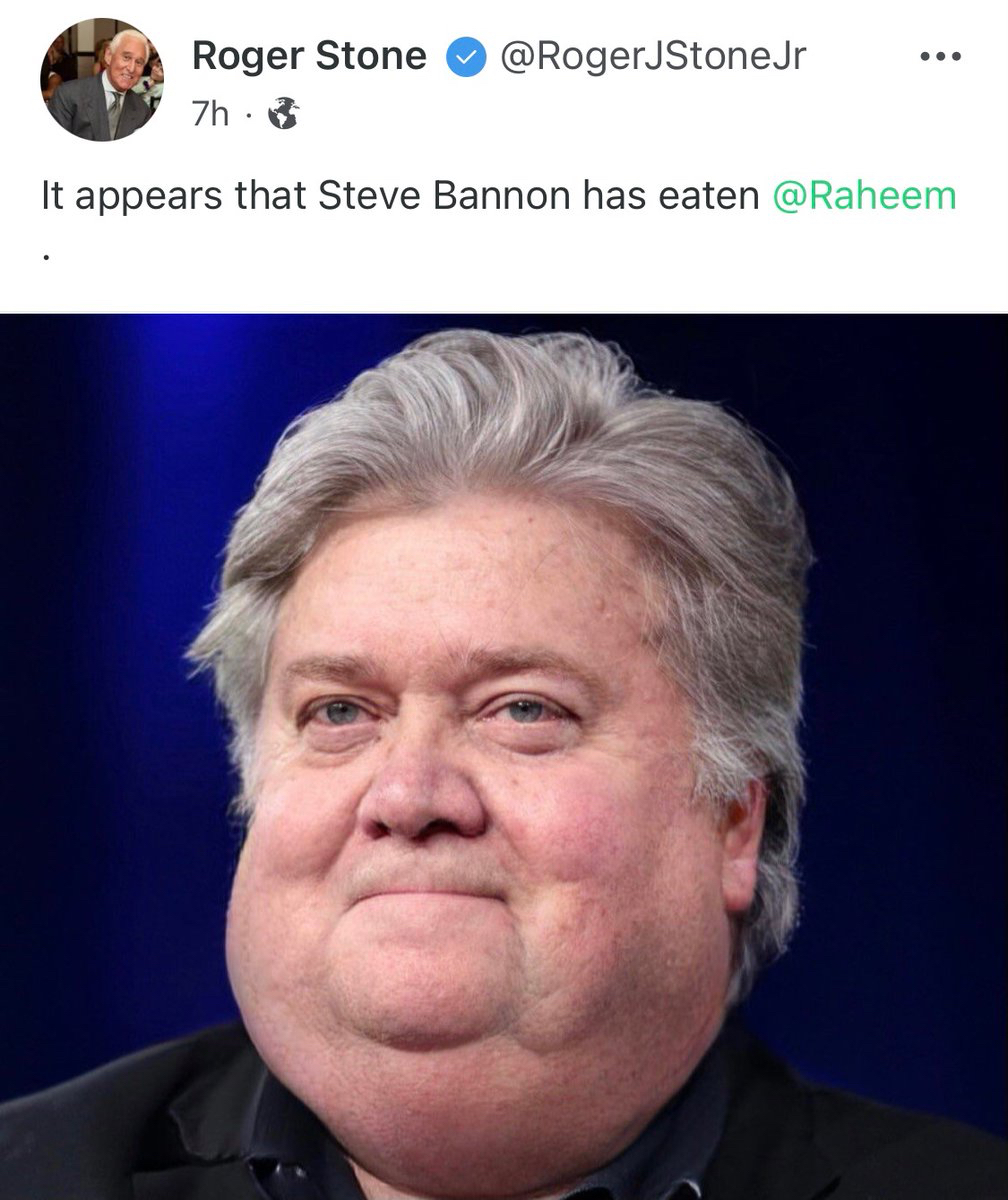
In recent weeks, Stone has taken frequent aim on the far-right social media platform Gab at both Bannon and his sidekick, former Breitbart editor Raheem Kassam. “It appears that Steve Bannon has eaten Raheem,” Stone wrote on Gab this past week. 

Numerous attempts to contact Bannon for comment were met with no response. Kassam responded to a separate Salon request for comment regarding Stone with a shrug emoji. 

Near the end of the Infowars interview with Jones, Stone stated that Bannon should not continue to be able to put himself forward as an advocate for the ‘America First’ agenda.” 

In early May, Stone recommended punching Bannon in the face for being an “informant” to Mueller during Trump’s presidency. 

“Bannon was an informant for Robert Mueller and indisputably perjured himself at my trial. He also accused Donald Trump Junior of being a Russian traitor and insisted that President Donald Trump was suffering from Alzheimer’s,” Stone wrote. “If you see this fat disheveled load of s**t, I strongly recommend that you punch him in the mouth as hard as you possibly can. Do it for America!”

The tension between the duo appears to stem from Bannon telling a federal court in 2019 that Stone “was the link between the [Trump] campaign and WikiLeaks,” according to Newsweek. “The campaign had no official access to WikiLeaks or to Julian Assange,” Bannon said in court at the time. “But Roger would be considered if we needed an access point.” 

Stone, who has also said that this Salon reporter has a punchable face, didn’t immediately return a request for comment on Thursday morning. 

You can watch the segment above, via YouTube. 

3,000 shipping containers fell into the Pacific Ocean last winter

You’re right if you think you’ve been hearing a lot about container ships lately. One off the coast of Sri Lanka that was carrying 25 tons of nitric acid and other cargo suffered an explosion after containers caught fire on May 20 and burned for more than a week, littering the beaches with plastic pollution. And in March all eyes were on the Suez Canal, where a 1,300-foot-long container ship turned sideways and gummed up international trade with a six-day-long traffic jam. Maybe you’ve also had your shoes, bike or other online purchases delayed because of backed-up ports near Los Angeles.

But less attention surrounded a spate of container-ship accidents in the Pacific Ocean this past winter. It included one of the worst shipping accidents on record, which occurred near midnight on Nov. 30 as towering waves buffeted the ONE Apus, a 1,200-foot cargo ship delivering thousands of containers full of goods from China to Los Angeles. In remote waters 1,600 miles northwest of Hawai’i, the container stack lashed to the ship’s deck collapsed, tossing more than 1,800 containers into the sea.

Some of those containers carried dangerous goods, including batteries, fireworks and liquid ethanol.

“This is a massive spill,” says oceanographer Curt Ebbesmeyer, who has tracked marine debris from container spills for over 30 years. The ONE Apus lost more containers in a single night than the shipping industry reports are lost worldwide in an entire year.

It was also only one of at least six spills since October that dumped more than 3,000 cargo containers into the Pacific Ocean along shipping routes between Asia and the United States. They include the loss of 100 containers from the ONE Aquila on Oct. 30 and 750 containers from the Maersk Essen on Jan. 16. Both ships encountered rough weather while delivering goods to the United States.

Experts say these types of spills, which tend to fly under the public’s radar, put containers into the sea that pose potential hazards to the health of the ocean and put everything from mariners to wildlife at risk.

“They’re like time capsules of everything we buy and sell, sitting in the deep sea,” says Andrew DeVogelaere, NOAA research coordinator at the Monterey Bay National Marine Sanctuary in California. Those lost containers may harm wildlife and ocean health, he says, by crushing aquatic habitats or introducing new seabed features that change biological communities or even aid the spread of invasive species. They can also release hazardous cargo such as the 6,000 pounds of sulfuric acid that went into the sea when the Maersk Shanghai lost containers off of the North Carolina coast in 2018.

Despite that potential for danger, no one is tracking the lost containers in the Pacific and opinions vary about where they will come to rest. Many are likely on the ocean floor, but an unknown number may have ruptured and disgorged their contents, which typically include many thousands of consumer items made of plastic. They could float for years in the ocean or wash ashore in Alaska, Hawai’i or other locations.

To date, the only debris known to come ashore from this winter’s accidents are giant waterlogged sacks of chia seeds, which hit Oregon beaches in December following the loss of six containers from a ship near the California coast. Federal biologists were still cleaning smelly globs of the seeds from threatened snowy plover nesting habitat in April.

The accidents come at a time when the container shipping industry we all rely on is under unprecedented strain. In April the National Retail Federation reported a 10th consecutive month of record-high imports from Asia to the U.S. West Coast, driven by skyrocketing online shopping tied to the pandemic.

It’s led to backed-up ports, delayed deliveries, and shortages of empty containers, conditions that are forecast to continue. But in a trick of the pandemic tied to both U.S. shopping patterns and Chinese factory schedules, it also put more cargo ships on the water during fall and winter, the stormiest time of year in the Pacific.

Some experts say the changes may represent a new normal for trans-Pacific container shipping. If that’s true, more spills may lie ahead — prompting calls for greater transparency and accountability from shippers.

Decades of Debris

“I’m considered persona non grata by the shipping industry,” Ebbesmeyer says when asked if he knew anything about what was aboard the ONE Apus or where it might be headed. “They blackballed me years ago. They didn’t like me shining a light in a dark place.”

That dark place is the inside of a shipping container. Back in the 1990s Ebbesmeyer began applying his oceanography skills to tracking debris from what seemed like an ever-increasing number of container accidents. One year it was 28,000 rubber bath toys shaped like ducks, beavers, turtles and frogs that spilled from a single container lost in the North Pacific. Another year it was 61,000 Nike sneakers from a handful of containers, also in the Pacific.

With a friend at the National Oceanographic and Atmospheric Administration, he calculated how far the flotsam would travel. Over close to a decade, beachcombers around the world confirmed their predictions with reports of debris from Texas to Australia to the United Kingdom.

“As an oceanographer, I want to know how the ocean works,” Ebbesmeyer says. Following the debris helped him understand ocean currents and the destination of the marine debris that even by the 1990s was on the rise. But as Ebbesmeyer’s work gained notoriety, he says the industry went mum. And what little light had been shed inside shipping containers flickered out.

But the accidents didn’t stop. In 1997 a single container lost from a ship in near England spilled 5 million Lego pieces, which still wash ashore today.

In the early 2000s, it was computer monitors landing on beaches from California to Alaska. Ebbesmeyer says the shippers seldom disclosed how many items were lost, and he suspects the same silence will surround the ONE Apus and other recent spills.

“If they’d share what’s in the containers,” he says, “we might predict where the debris will land and possibly organize a response.” Spilled goods travel the waters differently depending on their weight and materials; if the scientists know those details, they can anticipate where the products will eventually land. By tracking this trash, oceanographers could learn more about where currents and winds carry other debris, too. And, says Ebbesmeyer, it might compel shippers to help pay for cleanup, an expense coastal residents and agencies usually absorb today.

But shippers seem as tight-lipped as ever. Beyond reporting the presence of certain hazardous materials, they have not released details about the 3,000 missing containers.

Who’s Minding the Ship?

According to the industry trade group the World Shipping Council, 6,000 container ships traverse the oceans every day, moving 226 million containers annually. The ships sail a dizzying array of routes among more than 200 ports and are registered in countries around the world. But because they spend much of their time on the high seas outside any one nation’s jurisdiction, governance is a mix of regulations and voluntary best practices that don’t require tracking or recovering debris from lost containers. That only happens when losses occur in nearshore waters where the United States or another country claims jurisdiction.

“We usually read about it in the news,” says Catherine Berg, scientific support coordinator at

NOAA’s Emergency Response Division in Alaska. Berg says no formal mechanism is in place for reporting high-seas shipping container accidents like the ONE Apus to the U.S. government. And no funding exists for NOAA scientists to track the debris, although they occasionally perform informal modeling.

Officers with the U.S. Coast Guard Joint Rescue Coordination Center in Honolulu, Hawai’i, tell a similar story. They say shippers report container spills as a courtesy but that the agency lacks authority or funding to investigate, unless containers directly threaten U.S. shores. Instead, following the ONE Apus spill, the Coast Guard issued a notice to mariners about the hazard of floating containers, which some sailors call “steel icebergs” for their deceptively low profile on the water. The notice expired after a couple of weeks, with the assumption containers had sunk, ruptured or dispersed.

On the open seas, the shipping trade is primarily governed by the International Maritime Organization and other United Nations groups. Among their primary tools is the Safety of Life at Sea (SOLAS) treaty, originally signed in 1914. It was last amended in 2016 with new rules on weighing of containers, intended to lessen spills.

In 2014 the IMO also endorsed an updated code of practice for cargo ships, which addresses packing, stacking and lashing of containers. Although shippers frequently blame losses on rough weather, as happened in each of last winter’s Pacific Ocean accidents, investigation often reveals underlying problems in lashing and other practices that occur before a ship even leaves port. That happened in May 2020 when the APL England lost 43 containers near Australia, forcing popular Sydney beaches to close as authorities cleaned a debris field of appliance parts, plastic boxes and face masks.

The updated code of practice is only voluntary and does not include provisions for tracking lost containers or revealing their contents. But continued cargo accidents may be forcing a change.

In 2019, when the MSC Zoe lost 280 containers in heavy weather between Portugal and Germany, volunteers and Dutch troops spent months cleaningWadden Islands’ shores of toys, furniture and smashed televisions. Following the accident, which investigators also blamed on poor lashing, the Council of the European Union submitted a draft proposal for a new IMO rule requiring better reporting of containers lost at sea. If passed, and depending on the rule’s terms, it could one day address Ebbesmeyer’s decades-long concerns over shipper transparency.

Also following the MSC Zoe, the Dutch government commissioned a review of shipping practices and technologies that could aid in tracking containers, including equipping them with satellite tags. Echoing Ebbesmeyer’s experiences, the report said it is “hard to track down” what lies within lost containers and that improvement would require industry cooperation and investment.

Industry support may be gaining. The World Shipping Council, which has supported past amendments to SOLAS, is a cosponsor of the proposed new rule, according to the organization’s spokesperson Anna Larsson.

“We really support all and any fact-based measures to improve safety,” Larsson said in an email.

Environmental Cost

Although springtime’s calmer weather has replaced the winter storms that battered cargo ships, it’s likely whatever debris from recent spills that has not sunk to the bottom of the Pacific is still floating out there somewhere. But with so little known about the containers and their contents, it’s unclear where the debris is headed.

“Just because you don’t see it doesn’t mean it’s on the seafloor,” says Ebbesmeyer.

He gives the example of a container full of plastic telephones in the likeness of the comic-strip cat Garfield that spilled from a ship along the European coast in the 1980s. For decades, cables and shards of orange plastic mysteriously washed ashore from the phones. The mangled container that once held them was finally discovered in 2019, wedged deep in a French sea cave that’s underwater much of the year.

Thousands of other containers must lie on sea bottoms along the world’s shipping routes, says NOAA’s DeVogelaere.

In what is possibly the only study of its kind, DeVogelaere keeps his eye on a shipping container lying in 4,000 feet of water at the Monterey Bay sanctuary. It was one of 24 that toppled from a Taiwanese cargo ship in 2004 and was serendipitously discovered by one of NOAA’s remotely operated vehicles conducting unrelated research. Since 2011, DeVogelaere has monitored ecological change around the container, noting colonization by species not typically found in the immediate area. This year his team will investigate whether the container’s anti-corrosive paints, which can be toxic, may also have an ecological effect.

“We’re impacting an environment that we haven’t even begun to understand,” he says of the seafloor.

DeVogelaere’s container, which has so far remained latched shut, holds more than 1,100 steel-belted radial tires. He knows this only because it happened to land in a nearshore federal sanctuary, putting it under U.S. jurisdiction. Through a lengthy legal process, NOAA won a $3.25 million settlement from the shipper.

Such settlements take time but can occur when containers spill in nearshore waters. For instance, when the Hanjin Seattle lost 35 empty containers near Canada’s west coast in 2016, officials won a modest settlement to help pay for removal of foam insulation that littered wildlife habitat along miles of national park and First Nations beaches.

After the Svendborg Maersk lost 517 containers in the Bay of Biscay in 2014, French officials ordered the company to map sunken containers to identify commercial fishing hazards. And a settlement following the 2011 wreck of the MV Rena in New Zealand, which also caused an oil spill, included cleanup of tiny plastic beads that still wash ashore today.

Those beads, like the Legos, computer monitors and Garfield phones, hint at the unknown contribution of container spills to marine plastic pollution, which is increasingly understood to harm birds, whales, fish and other animals through both ingestion and entanglement.

Although the World Shipping Council tracks cargo accidents, which it says lose an average of 1,382 containers annually, no one knows their true ecological impact.

But Ebbesmeyer remains concerned. He likens each spill to dumping a big box store into the ocean.

“That plastic never goes away,” he says. “It drifts around in the water or flies overhead in the stomachs of seabirds. It haunts you over time.”

5 COVID-19 vaccine myths, debunked

The rush to develop, authorize, and administer an effective COVID-19 vaccine has left many people skeptical about its safety—and reluctant to get vaccinated. And there’s plenty of misinformation (and disinformation) about how the vaccines got approved, how they work, and what the risks are. Here’s the truth about five common COVID-19 vaccine myths.

1. Myth: The mRNA vaccines change your DNA.

Both the Pfizer-BioNTech and Moderna vaccines use engineered mRNA strands that enter our cells and deposit instructions for building a copycat version of the coronavirus’s spike protein. Your immune system figures out how to fight that, and then it “remembers” how to neutralize actual SARS-CoV-2 particles if you were to get infected. But your DNA is stored in the cell nucleus, and this whole process happens outside it. In other words, it’s not possible for the mRNA to breach the nuclear membrane and interfere with your DNA in any way.

2. Myth: You might catch COVID-19 by getting the vaccine.

Some vaccines—like those for measles and chickenpox—do use live, weakened viral pathogens to stimulate your immune system into learning how to fight them. But none of the three COVID-19 vaccines currently approved in the U.S. contain live coronavirus pathogens. As explained above, the two mRNA vaccines carry directions to produce a lookalike spike protein, not a real coronavirus spike protein. Johnson & Johnson’s Janssen vaccine, on the other hand, is a vector vaccine: Basically, the shot contains a harmless part of a different virus that also directs your cells to build spike proteins that mimic those from SARS-CoV-2.

The uncomfortable side effects you might experience after getting vaccinated (fever, chills, fatigue, or muscle aches) are all part of your body’s immune response to a perceived viral threat—not symptoms of COVID-19 itself.

3. Myth: Young, healthy people don’t need to get a COVID-19 vaccine.

It’s true that young people with no preexisting conditions have a better chance of surviving COVID-19 than their older, higher-risk counterparts. But as Dr. Peter Hotez and Dr. Maria Elena Bottazzi, both professors of pediatrics and molecular virology at Baylor College of Medicine, wrote for The Washington Post, being young and/or having a good immune system doesn’t automatically beget antibodies. Plenty of young, healthy people still land in the hospital with COVID-19, and even mild cases have led to “long COVID” symptoms like brain fog and loss of taste or smell that linger for months.

4. Myth: People who have already had COVID-19 don’t need to get vaccinated.

If you’ve caught and recovered from COVID-19, your immune system has already learned how to fight it and harbors antibodies that will likely prevent reinfection for a while. But we don’t know how long that natural immunity lasts—and some people have gotten infected more than once. As infectious disease expert Dr. Kristin Englund explained for the Cleveland Clinic’s Health Essentials blog, the vaccine will ensure that your immune system can fend off the virus whenever your natural immunity wanes.

5. Myth: We don’t know if the COVID-19 vaccine are safe.

While all three COVID-19 vaccines have emergency use authorization rather than full FDA approval, it’s not because the FDA is worried they’re unsafe. “Frankly, the only real difference was in length of follow-up” during their clinical trials, Dr. Paul Offit, a virology expert and member of the FDA’s Vaccines and Related Biological Products Advisory Committee, told CNN. “Typically, you like to see efficacy for a year or two years.”

In other words, the FDA normally waits to approve a vaccine until they’ve determined how long it remains effective. But considering the daily infection and death rates during the current pandemic, it would have been ill-advised to wait another year or two before distributing an effective vaccine that could help us reach herd immunity—even if we don’t yet know how long the vaccine’s full protection lasts.

But authorities didn’t cut corners when it came to determining the vaccines’ safety. Even long-term side effects of vaccines usually appear somewhere between two weeks and two months after inoculation. Trial participants were monitored for adverse effects throughout that window, and the FDA didn’t give vaccines the green light until after it had passed. “I would say, please tell me what vaccine has ever been shown to cause a long-term side effect that was not picked up in the first two months,” Offit told CNN.

Donald Trump is an idea, not a man — and that’s why his movement is so dangerous

Many Americans love to mock Donald Trump and laugh at him. They’re amused by his seeming haplessness and loss of purpose, as he wanders around Mar-a-Lago, reportedly delivering grievance-filled impromptu speeches to strangers. They guffaw at Trump’s bombastic proclamations, sent forth from Florida as though he were still president of the United States. Trump’s confidants have described him as anxious, bored and unhappy because he is no longer president and is now mostly denied the narcissistic fuel and direct adulation from his followers. In the worldview of liberal schadenfreude, a sad and bored Donald Trump is very funny.

But people also laugh out of fear and anxiety. There is also the phenomenon of hysterical laughter, when a person is so overcome by terror that they laugh uncontrollably.

It is such laughter without humor that best describes America after the Age of Trump, a people and country who still feel terrorized by Trumpism, and by what his Republican Party and fascist movement are doing to overthrow the country’s democracy.

To focus on Donald Trump the man is to fundamentally misunderstand how imperiled American society is in this moment.

Donald Trump is no longer a mere person. Indeed, to some extent the human being behind the Trump persona has become irrelevant. For his followers — and just as much for his enemies — he represents an idea, a feeling, a worldview and a movement. We call this “Trumpism”: It is a fascist and authoritarian understanding of the world, and an associated set of values and beliefs. Like other forms of fascism, it is not a coherent ideology.

It certainly has identifiable attributes: ultra-nationalism, disregard for the rule of law and human rights, an urge to erase the boundary between private and public, hypermasculinity, a worship of violence and destruction, collective pathology, hatred of the Other, a deep attraction to hierarchy and “tradition,” conspiratorial thinking, a rejection of reason, and a desire to annihilate reality and objective truth.

But Trumpism is much more than attributes and definitions: It is a way for the followers to give meaning to their lives and fill up their internal moral and intellectual emptiness. Like other forms of fascism, Trumpism offers a solution for the deep resentment its followers feel toward other individuals and groups they deem to have somehow hurt them. Such resentments are often focused on ideas such as “progress” or the “future” — in the case of Trumpism, on “political correctness” and “cancel culture” and “liberal elites” who want to tell “people like us” in the “heartland” what to do.  

The tools of normal politics in a democracy, such as campaigns and elections, voting, a belief in the inherent value of “bipartisanship” and “compromise” with the opposition, majoritarianism with respect for minority voices, pluralism and responsiveness to the public will are almost useless, if not wholly obsolete, in a battle against fascists and other political extremists.

Although Joe Biden is now president and has done an excellent job of confronting the pandemic and trying to resuscitate the economy, Trumpism still has a firm hold on tens of millions of Americans.

Moreover, powered by the January coup attempt in combination with the Big Lie about the 2020 election, it appears that the power of Trumpism is actually increasing, even if Donald Trump the person holds no formal political power. 

Trump has de facto control of the Republican Party. A large majority of Republican elected officials have pledged loyalty to him and his movement. Some Republicans have admitted to being in fear of their lives if they dissent from the doctrines of Trumpism and the Great Leader’s commands.

Long in the planning, Trumpism has now empowered the Republican Party to begin a full assault on democracy itself through a nationwide 21st-century Jim Crow campaign to stop Black and brown people (and others who support the Democratic Party) from voting.

A new public opinion poll from Reuters/Ipsos shows that 53 percent of Republicans believe that Donald Trump is the “true president,” while another recent survey by the Public Religion Research Institute (PRRI) shows that 66 percent of Republicans believe the Big Lie that the 2020 presidential election was “stolen” from Donald Trump.

A large percentage of Republicans also express support for the Jan. 6 assault on the U.S. Capitol.  

A new study from PRRI and the Interfaith Youth Core shows that 20 percent of Americans believe in the antisemitic QAnon conspiracy theory, which is integral to the far right’s Big Lie and its Orwellian strategy of attempting to rewrite reality. The same study found that 28 percent of Republicans believe in the QAnon claims about an upcoming battle, in which the secret forces of righteousness will sweep away the “evil” and corrupt Democrats and ruling elites.

Other public opinion polls and research have confirmed that the Republican Party and its followers are being increasingly radicalized into political violence and other anti-democratic behavior and values.

To this point, the Democrats and other mainstream defenders of American democracy have largely been caught flatfooted and seemingly unaware in their fight against Trumpism.

In an interview with Edward-Isaac Dovere at the Atlantic, President Biden said of Trump, “I underestimated his ability to take the big lie and turn it into something that was salable.”

Sen. Mitt Romney, who is one of the “respectable” and “traditional” Republicans that the mainstream news media loves to fawn over, recently described Trump’s power in an interview with The Hill: “He seems to have a pretty good hold on the base of our party. I think that’s unlikely to be swayed by almost anything.”

Democrats and others who remain invested in “the system,” and who value protecting existing institutions in hopes of a return to “normal,” fail to understand basic truths: They are not fighting a political movement that fits within that conceptual framework, but one that intends to destroy it. Fighting Trumpism and other forms of fascism is like grappling with a mud monster or ectoplasm, something that is both a liquid and a solid and nearly impossible to grasp firmly.

What then is to be done? Democrats and other would-be defenders of American democracy must accept that Trumpists — like others who have joined fascist and authoritarian cult movements — cannot be negotiated with. Instead, the movement to which they have pledged eternal loyalty must be revealed a futile cause and utterly destroyed.

Trump-Republicans and other rank-and-file neofascists must also have their internal belief systems broken down through a personal epiphany. The Democrats and their allies cannot directly create that outcome, but they can alter the political and material realities so that such a change in thinking is more likely to occur.

Joe Biden and other Democrats who believe in the inherent goodness of the American people must accept that many of Donald Trump’s followers are dead-enders who will never be won over. As Hillary Clinton warned in 2016, these people are true deplorables.

Ultimately, to win the battle for America’s future the Democrats must tell better stories than the fascists do. They must emphasize moral struggle, the meaning of real patriotism and the existential importance of this struggle against a party and a movement that hungers to uproot democracy and replace it with tyranny.

Cops and their allies have pushed hard for new wave of stringent anti-protest bills

Following the global wave of demonstrations after the killing of George Floyd in Minneapolis last year, Republican state legislatures mounted a counterattack, introducing a deluge of “anti-riot” bills designed to make it easier for law enforcement to clamp down on demonstrations perceived as disorderly.

According to a PEN America report from late April, Republicans have proposed at least 100 “anti-riot” bills in 33 states from last June to this March. These measures aim to address protest-related activities by greatly expanding the definition of “riot,” granting criminal immunity to drivers who hit “rioters” with their cars, suspending state benefits for those who participate in a “riot” and increasing penalties for demonstrators who block traffic. 

Over the past several months, the bills have sparked progressive pushback over the perception that they grant the police unchecked power to crack down on nonviolent protests and chill free speech rights. Indeed, reports now make clear that police organizations and their allies have played an outsized role in introducing and supporting these measures, often by advocating and lobbying for them behind the scenes. 

According to new research released this month, police officers, police unions and law enforcement lobbyists have supported one or more “anti-riot” bills in at least 14 states since last June. “Anti-riot” bills in 19 states have been sponsored by legislators with backgrounds in law enforcement. Because lobbying records are inconsistent from state to state, these figures may be underestimates. 

“Almost nobody knows right now that police are pushing for these bills,” Connor Gibson, an opposition researcher who compiled the data, told Salon in an interview. “People are not surprised that police are lobbying for bills that let police off the hook and push the blame to protesters. But I don’t think that should be the measure of why this trend is important.”

Consider H.B. 445 in Alabama, which broadens the definition of “riot” and heightens the legal penalties against protesters who block traffic. The bill, which has been indefinitely postponed, was sponsored by at least nine state lawmakers who are or were affiliated with various police departments and/or organizations. The bill’s primary sponsor, GOP Rep. Allen Treadway, is a retired Birmingham assistant police chief. Two co-sponsors, Reps. Allen Farley and Phillip Pettus, respectively served as police chief in Satsuma Police Chief and an Alabama state trooper.   

In North Carolina, a similar bill is being considered that was sponsored by a total of seven police-affiliated lawmakers. The bill’s two primary sponsors, Reps. Charles Miller and Allen McNeill, respectively served as deputy chief of the Brunswick County sheriff’s office and chief deputy of the Randolph County Sheriff’s Office.

Police culture is deeply embedded in our state legislatures,” Gibson said, observing that “many legislators have conflicts of interest when it comes to holding the police accountable.”

These bills are also heavily influenced by police organizations like Fraternal Order of Police and the Sheriffs Association, whose state chapters have lobbied for several different “anti-riot” bills throughout the country since June. 

Consider Florida’s H.B. 1, which became law in April. The comprehensive measure – which makes “aggravated rioting” a felony, denies bail to those charged of a misdemeanor during a protest and grants civil legal immunity to motorists who drive through demonstrators blocking a road — was supported by the Florida Sheriffs Association, the Florida Police Chiefs Association and Florida Smart Justice Alliance, a broad coalition of organizations focused on the state’s criminal justice and corrections system. 

Barney T. Bishop III, the CEO of Florida Smart Justice Alliance, explained his organization’s stance in an interview with Salon, disputing the notion the H.B. 1 would embolden those on the far right to retaliate against social justice protesters. 

“It’s not about emboldening anybody,” he said. “Florida is as opposed to the Proud Boys and the far-right groups as we are to the far-left groups.”

His explanation of the bill’s aims, however, suggest otherwise. “Protesters today feel that they can go anywhere they want, do anything they want — beat on cars, cuss and try to incite violence from police by screaming in their face,” Bishop added. “There are people that will incite violence. Most of the time it will be the people in the protests themselves or the people behind the protests, like George Soros and antifa and BLM.”

There is little evidence, however, that last year’s wave of social justice demonstrations after the Floyd murder was plagued by violence. According to a report last September by the Armed Conflict Location & Event Data Project (ACLED), about 95% of all demonstrations from last May to last August were peaceful. By comparison the report notes that “authorities have used force — such as firing less-lethal weapons like tear gas, rubber bullets, and pepper spray or beating demonstrators with batons — in over 54% of the demonstrations in which they have engaged.”

Nora Benavidez, director of PEN America’s U.S. Free Expression Programs, affirmed ACLED’s findings, telling Salon that the Republican-backed “anti-riot” bills “are trying to solve a problem that doesn’t exist. Legislators are predicating their bills on a circumstance that characterizes protests as somehow inherently criminal.”

As in the Florida case, a newly-enacted “anti-riot” bill in Iowa, S.F. 342, was backed by various police-affiliated organizations, including the Iowa Peace Officers Association, the Iowa State Police Association, the Iowa Fraternal Order of Police, the Iowa State Patrol Supervisors Association and the Iowa State Sheriffs’ & Deputies’ Association, according to state lobbying records

Interestingly, the Iowa Peace Officers Association and the Iowa State Sheriffs’ & Deputies’ Association were initially “undecided” on the bill after it was introduced in February. At the time, the bill simply sought to prevent police officers “from being discharged, disciplined, or threatened with discharge” if their names appeared on the “Brady list,” which tracks officers who might lack credibility in certain legal cases involving the police.

Since then the bill has morphed into full-fledged “anti-riot” legislation, which won the support of the two law enforcement associations. 

Adam Mason, state policy organizing director for the Iowa Citizens for Community Improvement Action Fund, told Salon that the Iowa bill reflects the overrepresentation of police interests in the state’s legislature.

“We absolutely believe in having a citizen legislature,” Mason said, “but that also means we need to have a diversity of opinions. That would mean having legislators from all walks of life. It seems these legislators feel like they don’t have to listen to community members because they’re coming from concentrated backgrounds in law enforcement.”

Bishop disagreed. “There’s no more conflict of interest than a doctor selected to the legislature proposing medical legislation,” he told Salon.

A major reason why “anti-riot” bills are controversial are their provisions which specifically grant civil and criminal immunity to drivers attempting to flee “riots” — especially given the violent counterattacks social justice protesters have seen in recent years. In 2017, during the “Unite the Right” rally in Charlottesville, Virginia, an alleged white supremacist rammed his car into a throng of counter-protesters, killing a woman named Heather Heyer and injuring 19 others. The driver was later convicted of first-degree murder. More recently, in February of this year, an admitted Klansmen drove his truck into a group of peaceful protesters near Richmond, Virginia, though nobody was seriously injured. 

Last year, NPR reported that there had been “at least 50 vehicle-ramming incidents since protests against police violence erupted nationwide in late May,” a marked increase from prior years. 

Gibson told Salon that the uptick in vehicle-related violence against protesters is precisely what makes the recent surge in “anti-riot” bills so concerning. “You can’t be a politician and not be aware that there is an undercurrent of informal vigilante justice,” he explained, “where the police are emboldening white supremacists to take things into their own hands.”

Most of the driver immunity provisions are predicated on two conditions: that the driver was fleeing a “riot” in order to protect themselves and that they exercised “due care” in the course of colliding with demonstrators. But the reality in court might not be so straightforward. 

Sgt. Fred Lepley, senior director of the Iowa State Police Association, which supported S.F. 342, told Salon that incidents in which protesters threaten drivers are often “difficult to comprehend” without proper context. 

Lepley said that the provisions are designed to “assist citizens that are attempting to remove themselves from a dangerous situation but find that protesters are purposely forcing their hand by standing in front of the vehicle refusing to let them leave and possibly attempting to get at the driver to do harm. In many of these cases the driver is driving very slow and the protesters intentionally get in front of the vehicle, placing themselves in harm’s way.”

Oklahoma Rep. Justin Humprey, a Republican who sponsored H.B. 1674 — which also contains a driver immunity provision — echoed Leple, saying by email that “this bill is about protecting the public” and that it “enables a person to protect their family and themselves from criminals who demonstrate intent to commit harm.”

Salon could not find evidence that recent demonstrators have deliberately impeded traffic in an effort to provoke or harm drivers. 

Other states where police organizations have actively supported “anti-riot” bills include Tennessee, Texas, Washington, Ohio, Missouri, Kentucky, Indiana, Idaho, Connecticut, Arkansas and Arizona. 

Though most of these bills have surfaced within the last couple of years, Gibson told Salon that the Republican sense of urgency for their implementation has no logical or historical basis. “Rioting was already a dangerous, illegal type of behavior,” he said, “but people still did it. These politicians are deluding themselves if they think that making rioting extra-illegal is going to change anything. They’re trying to throw peaceful protesters in jail because that is more of a thorn in their side than the riots are.”

Chuck Schumer wants to pump up Cold War with China — at the planet’s expense

Despite an existential climate crisis, Senator Chuck Schumer’s $250 billion “United States Innovation and Competition Act of 2021” takes aim at China as the most pressing national security threat. In a Cold War-style declaration, the Senate Majority Leader’s  proposed legislation reads like the last gasp of a dying empire, a plea from a panicked superpower losing its grip on global dominance.

Schumer’s laborious 1,445-page bill, the product of six Senate committees, would have the U.S. compete with China by creating tech hubs of robotics and artificial intelligence in U.S. cities, promoting school programs in STEM (science, technology, engineering and math), accelerating production of semiconductor chips and spending $600 million to ramp up U.S. military presence in the South China Sea to show China the U.S. still rules the world.

Collaborate with China to thwart climate catastrophe? That would be heresy.

In a less xenophobic United States, a more visionary blueprint would emerge for collective technological development to save our warming planet.

In a more visionary blueprint, the U.S. Congress might support or even expand on the U.S.-China climate agreement negotiated by climate envoy John Kerry prior to the Biden administration’s world Earth Day summit last April. An added section to Schumer’s marathon read might underscore the diplomatic agreement’s goals of strengthening implementation of the Paris Climate Agreement and developing long-term strategies to achieve carbon neutrality.

Instead, the bill undermines Kerry’s negotiated agreement with China, sabotaging an opportunity for the U.S. and China — countries responsible for releasing half of the world’s fossil fuel emissions — to partner on curbing emissions and sharing strategies for greening the Earth. 

A person reading this manifesto of China hate would never know that China, home to 1.4 billion people and the world’s largest exporter, owns over $1 trillion of U.S. debt that could be called in at any moment, sending demand for the U.S. dollar plummeting and slowing our economy to a crawl.

Ignoring the U.S. and China’s economic enmeshment, the bill opposes international bank loans to China for its 70-country Belt and Road Initiative to build highways, ports, railroad tunnels and other infrastructure connecting Asia with Europe and Africa; vows to weaken the influence of China and Russia at the UN; and withholds grant money to U.S. colleges and universities that partner with Chinese government-funded “Confucius Institutes” to teach Chinese language and culture.

In a throwback to McCarthyism, the bill also mandates a Comptroller report on the activities of U.S. Sister City participants who partner with countries like China that fell below a 2019 score of 45 out of a possible 100 on the Corruption Perceptions Index. This is a data tool funded by Western nations and ExxonMobil to measure transparency, accountability and integrity in government. China scored a 41, Saudi Arabia a 53.

Ironically, New York, the state Schumer represents, has several municipalities listed on Wikipedia as partnering with sister cities in China: New York City with Beijing, Mount Vernon with Yangquan, Brooklyn with Yiwu, Port Chester with Jingzhou and Rochester with Xianyang. 

Schumer’s proposed legislation, a potential bipartisan win according to the gleeful Senate leader, only references the climate crisis in the context of advancing U.S. strategic interests in Asia and the South Pacific to beat back the “Leninist model of governance — socialism with Chinese characteristics.” For example, the bill pushes for increasing Peace Corps volunteers to develop climate resiliency in Oceania, a region that includes Australia, Micronesia and Polynesia, to avoid islands throughout the South Pacific turning to China for assistance.

The U.S. Innovation and Competition Act of 2021 threatens to exacerbate the climate crisis by expanding the reach of the Pentagon, the world’s largest consumer of oil and emitter of greenhouse gases. It calls for increased forward-basing U.S. troop deployments in the South China Sea, development of more “combat credible forces,” additional shipments of missiles and other weapons to allies in the Indo-Pacific and stepped up joint U.S.-allies military exercises, a euphemism for mock nuclear strikes — all in the name of deterrence.

In addition, the bill challenges China’s long-held desire for reunification with Taiwan by prioritizing the defense of Taiwan sovereignty, an issue that once brought the U.S. to the brink of nuclear war. According to classified documents recently released by former CIA analyst Daniel Ellsberg, 1950s Pentagon planners were willing to sacrifice a million U.S. lives in a first nuclear strike on China that could have triggered Soviet retaliation. In keeping with President Biden’s record high $753 billion military budget that reflects a pivot from the Middle East to Asia, Schumer’s legislation asserts that China’s presence in the Indo-Pacific “presents a substantial and imminent risk to the security of the United States.”

While undermining the potential for U.S.-China collaboration on climate, the bill depicts China as the No. 1 global military threat — even though it is the U.S. that has over 800 overseas bases, 400 of them encircling China, compared to China’s one overseas base in Djibouti, on the Horn of Africa.

As the article “More of the same: Biden’s hybrid war against China” makes clear, it is the U.S., not China, that has engaged in combat in more than 60 countries since the late 1970s. China has not engaged in a war since Vietnam. Additionally, it is the U.S. that has 3,800 nuclear warheads, in contrast to China’s estimated 350. On the subject of nuclear weapons, the bill accuses China of violating the Nuclear Non-Proliferation Treaty in its arsenal expansion, while falsely asserting that the U.S. honors its treaty obligations to pursue disarmament. 

In reality, the United States is moving ahead, with Biden’s blessing, on a nearly $2 trillion decades-long nuclear rearmament plan. This includes replacing 400 Minuteman III ICBMs on high alert in underground silos in Montana, North Dakota, Wyoming, Nebraska and Colorado with 600 new nuclear missiles also on hair-trigger alert, and developing new nuclear warheads.

In condemnation of China’s alleged human rights abuses, including reports of forced labor and internment camps for the Muslim minority Uighurs, the bill mandates a U.S. diplomatic boycott of the 2022 Winter Olympics in Beijing and bars the use of federal funds to pay for federal government employees to attend the games.

It’s one thing to legislate a diplomatic boycott of the Olympics or, as the bill outlines, ban ByteDance’s TikTok on federal devices, but quite another to provoke a military confrontation in the South China Sea, where a U.S. warship recently sailed through the Taiwan Strait over China’s objections, putting “peace and security at risk,” in the words of the Chinese.

Before Schumer uncorks the champagne to celebrate bipartisan militarism, he and his congressional cohorts should remove from the bill the “International Security Matters” section which sets the U.S. on a war footing with China. 

Moreover, a new section should be added to cement the U.S.-China bilateral climate agreement Kerry negotiated to strengthen implementation of the Paris Accords. 

Members of Congress must demand that U.S. innovation in semiconductors, as well as Moon and Mars exploration, not ride on economic and military superiority to China. In addition, they should take a scalpel to those sections that sabotage academic, financial and Sister City partnerships that could, through people-to-people diplomacy, help save the planet from warming temperatures, rising tides, extreme weather, famine and desperate refugee migration.

QAnon grifter tells followers she can time travel — and says Trump will be “reinstated”

A QAnon adherent who claims she can time travel is whipping up her thousands of followers to carry out a plot to oust elected officials in the U.S. and replace them with QAnon followers, VICE News reports.

After months of building a network of groups in all 50 states, Terpsichore Maras-Lindeman promised her followers that “retribution” is coming for what she says was the stolen 2020 election. She also claims Donald Trump will be reinstated into office. 

While growing her subscriber base on Twitch, Maras-Lindeman, who streams under the name Tore Says, has raked in tens of thousands of dollars, even convincing her subscriber base to donate over $80,000, so she could buy a new Tesla.

“Maras-Lindeman is part of a growing ecosystem of grifters and hucksters who are leveraging the widespread belief that Trump’s election loss was somehow orchestrated by shadowy figures and companies tied to the Democrats,” VICE News reports. “This so-called ‘Big Lie’ has taken hold within the mainstream Republican Party, and fringe figures like Maras-Lindeman have succeeded in carving out a niche that’s proving to be highly lucrative.”

Read the full report at VICE News.

Dogs like watching “The Mandalorian” and “Stranger Things,” per new study

Dog owners know that nothing makes a pup happier than being with its human. Binge watching a favorite television show probably ranks high on a dog’s list of favorite activities because, it means chilling with the human on the couch. However, CBR reports that a recent experiment by Wren Kitchens found that dogs seem to have some TV shows they like more than others, and “The Mandalorian” and “Stranger Things” rank at the top of the list.

The study’s objective was to determine whether there are shows that pet owners can leave on for their four-legged friends while they’re away, and it turns out that there is a clear contrast between dramas and comedy.

For the study, four dogs were fitted with heart monitors. Dramas like “The Mandalorian” and “Stranger Things” kept dogs’ heart rates lower (and therefore kept the dogs calmer) than comedies like “The Big Bang Theory” and “Malcolm in the Middle,” the latter of which gets them riled up like you wouldn’t believe. Although “Mr. Bean” somehow ranked No. 2 after “The Mandalorian” and ahead of “Stranger Things. “(Maybe Rowan Atkinson has a doggy fan club . . . who knows?)

The results, for your edification:

Leave “The Mandalorian” on for your pup the next time you’re out

As people head back to work after being home during the pandemic, many pets are struggling with not having their people around as much as they had been. Many pet owners (myself included) leave the television on for the family pets so that the ambient noise helps them to stay calm.

It’s possible that comedies like “The Big Bang Theory” are less effective for keeping dogs calm because of their frenetic energy and the canned laughter. Dogs, like little children, love laughter. It makes them happy and excited. However, the artificial laughter on laugh tracks (or studio audiences) seems to agitate dogs and make them antsy.

If you leave the TV on for your dog, “The Mandalorian” and “Stranger Things” are two of the best options. Just make sure you program your account to keep airing episodes when one finishes, or else your TV will go silent and your four-legged friend just might eat the remote while trying to hit the “OK” button.

11 facts about Napster

Long before iTunes, Spotify, and YouTube allowed us to discover new music with a tap of a phone, there was Napster, the world’s most controversial file-sharing app.

It was the early days of the internet. Chat rooms connected strangers with cryptic screen names and the shriek of a dial-up modem was the siren’s call of the world wide web. Into this untamed landscape strode software that allowed a new generation of tech-savvy teens to download all the music they could ever want for free. It was a sensation and a scandal. The record industry would never be the same, but Napster would not survive.

Decades after its meteoric rise and spectacular fall, let’s look back at the highs and lows that defined Napster.

1. Shawn Fanning got the idea for Napster while in college.

The concept for Napster first came to 18-year-old creator Shawn Fanning while he was still enrolled at Northeastern University in Boston in 1998. He would listen to his roommate complain about the difficulties of downloading music online, and Fanning imagined the solution could be a program that allowed users to share files directly without involving a centralized file server as a middle man. Obsessed, he scribbled ideas in a notebook, which he carried everywhere. Instead of going back to college after winter break, Fanning dropped out to focus on his code.

Fanning envisioned a cataloging system that would scour a user’s hard drive for MP3 files, which could then be shared through free downloadable software. This peer-to-peer system combined the file-sharing capabilities of Microsoft Windows and the simplicity of modern search engines.

2. Shawn Fanning met Napster co-founder Sean Parker in a chat room.

Before it was a world-changing app, “Napster” was the screen name Fanning used in hacker chat rooms. The moniker came from the “nappy” texture of his hair, even though his signature look was a buzzcut topped with a baseball cap. It was under this username that Fanning met an aspiring entrepreneur named Sean Parker, one of the few who didn’t scoff at the programmer’s big idea. The two teens eventually became friends and decided to pitch Napster to venture capitalists.

Over three months, Fanning worked out code for Napster on a PC that was borrowed from his uncle’s office in Massachusetts. Meanwhile, Parker secured $50,000 from investors. The pair then hired friends from chat rooms to fill out necessary roles, and Napster officially launched on June 1, 1999.

3. Napster quickly gained millions of users.

It didn’t take long for Napster to attract users. By the fall of 1999, word of mouth helped Napster’s catalog of downloadable songs reach 4 million, with 150,000 registered users. By the summer of 2000, 20 million userswere logged on, and about 14,000 songs were being downloaded every minute. The service peaked at an estimated 80 million users and proved so popular on college campuses that some schools banned it to avoid network congestion.

4. Shawn Fanning soon made the cover of TIME magazine.

On October 2, 2000, the now 19-year-old coder was heralded as a pioneer in computing by TIME magazine. The cover story declared that Napster “already ranks among the greatest Internet applications ever, up there with e-mail and instant messaging.”

5. Napster was a dream for music lovers, but not for music sellers.

As Fanning explained to the BBC World Service, “[Napster] was something that provided a better, more reliable and fun way for people to share music and see each other’s music collection. For the first time this full history of recorded music was available online to everyone instantly.”

Record labels, on the other hand, were all in on selling CDs, and Napster was a clear and direct threat to their business. And while TIME reportedin October 2000 that CD sales were actually up, the value of the record industry plummeted in the years following Napster’s debut, dropping from $14.6 billion in sales and licensing in 1999 to $6.3 billion in 2009.

6. Metallica really, really hated Napster.

Metallica would not be the first to file a copyright lawsuit against Napster. (That came from A&M.) They wouldn’t be the only musicians to sue. (Dr. Dre did, too.) They wouldn’t even be the most powerful. (The Recording Industry Association of America represented several major media companies in a joint effort.) But the legendary heavy-metal band got the most headlines.

It all began over a leaked recording of “I Disappear,” a song that was to be featured on the “Mission Impossible 2” soundtrack. Ahead of an official release, an unfinished version of the track hit Napster and soon popped up on radio stations. The band was further infuriated when they learned their entire discography could be downloaded for free through the software. So, on April 13, 2000, they sued Napster over copyright infringement.

In the public sphere, the battle placed the ball-capped every-teen Fanning against Metallica’s outraged drummer, Lars Ulrich, and an army of lawyers. In a statement about the lawsuit, Ulrich said, “We take our craft, whether it be the music, the lyrics, or the photos and artwork, very seriously, as do most artists. It is therefore sickening to know that our art is being traded like a commodity rather than the art that it is.”

Metallica won the lawsuit but lost in the court of public opinion. Backlash was sparked by the suit, Ulrich’s remarks, and the band’s perceived attack on fans. Metallica had tracked down 335,000 Napster users who had shared their music on the application and demanded Napster ban them. Ulrich even hand-delivered the long list of names, turning up at Napster’s offices with boxes of paper printouts. Napster complied, blocking all of those accounts.

7. Other musicians were divided on Napster.

Joining Metallica among Napster’s detractors were Trent Reznor, Snoop Dogg, Eminem, and Creed frontman Scott Stapp, who argued, “My music is like my home. Napster is sneaking in the back door and robbing me blind.”

Other artists were more open to the service. Chuck D wrote an op-ed for The New York Times proclaiming, “We should think of [Napster] as a new kind of radio—a promotional tool that can help artists who don’t have the opportunity to get their music played on mainstream radio or on MTV.”

Billy Corgan of the Smashing Pumpkins saw digital music as the way of the future, saying, “There’s no stopping it. This revolution has already taken place.” On July 11, 2000, Don Henley and Alanis Morrisette supported this idea at the Senate Judiciary Committee hearing about “The Future of Digital Music.” The Canadian songstress declared, “For the majority of artists, this so-called piracy worked in the artists’ favor,” as research showed it spurred ticket sales and merch purchases.

8. Lawsuits eventually shut Napster down.

While Napster was enjoying massive popularity, it faced a wave of lawsuits that drained its coffers through legal fees and damages. The argument was essentially whether or not Napster was to blame for users sharing copyrighted materials. Napster argued they were not at fault because their servers did not host music files, as they were shared directly between user hard drives. On February 12, 2001, the federal appeals court rejected this and determined “Napster has knowledge, both actual and constructive, of direct infringement [of copyright].” The company was ordered to stop sharing any files that would infringe on copyright, which numbered in the millions. It was the beginning of the end.

In September 2001, a settlement was reached in which Napster would pay $26 million in damages to songwriters and copyright holders. The Guardian reports these results led to Napster being unable to pay its staff by May 2002. Layoffs and resignations followed. Napster as its users knew it was over.

9. Napster left its mark.

Though the record labels initially bristled at Napster, the industry eventually shifted because of it, diversifying into digital marketplaces, subscription music services, and the ability to buy a single song instead of a whole album. Looking back, some experts have argued the music industry would have been better served by embracing the lessons Napster offered.

Rolling Stone journalist Steve Knopper wrote a book on this time called Appetite For Self-Destruction: The Spectacular Crash Of The Record Industry In The Digital Age. Speaking to the BBC about his findings, he said:

“[The lawsuits were] a costly error. None of these defenses worked and record executives spent four or five crucial years losing serious business to Napster before Steve Jobs came along with the iTunes Store […] The music industry eventually figured out how to profit from these things, but it took some 10 or 15 years. That lengthy waiting period almost destroyed the business, until streaming came to the rescue years later.”

10. Both Shawn Fanning and Sean Parker left Napster (and briefly reunited in 2011).

Sean Parker was ousted from Napster in 2000 after a company e-mail was exposed in which he acknowledged users were sharing “pirated music.” This was pointedly not the impression Napster’s legal team was trying to paint in the courts, arguing the co-founders’ intentions were fair use and sharing, not piracy. Still, he rebounded by investing in emerging tech companies, like Facebook and Spotify. For better or worse, Parker’s involvement in the former made him a part of movie history. In David Fincher’s Academy Award-winning docu-drama “The Social Network,” Parker is portrayed by Justin Timberlake as a fast-talking, cocky tech-bro, who (perhaps infamously) declares, “A million dollars isn’t cool, you know what’s cool? A billion dollars.”

Following Parker’s departure and the loss of major lawsuits, Fanning left Napster by choice. He went on to found the gaming company Rupture, which he sold to Electronic Arts for $30 million in 2008. In 2011, Fanning and Parker reunited to found the group video app called Airtime. However, Airtime had a rocky launch and the reunion was short-lived. The opening event was stuffed with stars, including Jim Carrey, Alicia Keys, Julia Louis-Dreyfus, Joel McHale, Snoop Dogg, and Jimmy Fallon. Unfortunately, the service experienced a wave of technical glitches during its premiere, leading CNET reporter Greg Sandoval to lament, “To launch his new start-up, Sean Parker should have spent less of his billions on celebrity guests and more of it on fixing his technology.”

Parker relaunched Airtime in April 2016 without Fanning.

11. Napster still exists! Sort of…

Napster faced a long, hard road of lawsuits, acquisitions, and mergers to become a shadow of its former self. In June 2002, the company filed for bankruptcy and began liquidizing its assets. From there, Napster’s technology portfolio, name, and trademarks sold for $5.3 million to Roxio, a digital media company that relaunched it as “Napster 2.0.” Between 2008 and 2011, Napster changed hands in deals that had it owned by electronics seller Best Buy and the subscription digital music service Rhapsody. Then, in August 2020, the live online music company MelodyVR acquired Napster for $70 million (little more than half of what Best Buy paid).

The brand has lost its shine over the decades. The founders are long gone, as is the easy access to a treasure trove of free music. Still, Napster changed the way we purchase, share, and listen to music. The brand went on to find a second life as a subscription-based music streaming site, which—as of April 2021—was boasting 5 million users and $8 million in monthly revenue.

Sinead O’Connor details her infamous Pope photo-ripping protest and more in new bombshell memoir

Sinead O’Connor, the Irish singer-songwriter who beautifully covered Prince’s “Nothing Compares 2 U” and infamously tore a photo of Pope John Paul II on “Saturday Night Live” in 1992, is a name you probably haven’t heard in years. O’Connor’s own recollection of her life between 1992 and 2015 is fragmented and shaky following a hysterectomy and breakdown that rattled and wiped much of her memory, as she explains in her new memoir “Rememberings,” out this week.

Plenty of pop memoirs have told complex stories of lives shaken up by fame, but none are quite like “Rememberings,” because no pop artists are quite like O’Connor. She writes that the trauma and struggles that become formative to her life and career start early, enduring severe child abuse from her mother, who beat her frequently and once deliberately got into a car accident with O’Connor in the vehicle. “I couldn’t admit it was her I was angry at, so I took it out on the world,” O’Connor writes, of life after her mother’s abuse. “And burned nearly every bridge I ever crossed.”

Of popes and pop stars

In 1992, O’Connor was invited to perform on “Saturday Night Live” shortly after her meteoric rise when her cover of Prince’s “Nothing Compares 2 U” from her sophomore album “I Do Not Want What I Haven’t Got,” shot to No. 1. Of this newfound fame and success, O’Connor writes that she “cried like a child before the gates of hell.” After her performance on “SNL,” O’Connor notoriously tore the Pope’s photo, calling on audiences to “Fight the real enemy!” 

In an excerpt provided to Rolling Stone, O’Connor details her decision, citing her rage with pedophilia and child abuse scandals in the Catholic Church, and referred to the men she feared would kill her drug-dealing friend called Terry as “the real enemy.” 

When her mother died, she had taken the photo of the Pope down from her mother’s wall and carried it with her for a long time. Inspired by Bob Geldof ripping up a photo of Olivia Newton-John and John Travolta, O’Connor wanted to do the same, but just needed the right opportunity.

My intention had always been to destroy my mother’s photo of the pope. It represented lies and liars and abuse. The type of people who kept these things were devils like my mother. I never knew when or where or how I would destroy it, but destroy it I would when the right moment came. 

Finally, her chance came with her appearance on “Saturday Night Live.” In rehearsals she held up a different photo and instructed the cameraman to zoom in so that when she did the actual performance and switched, no one would be the wiser until that moment. The plan was carried out without a hitch. Afterwards, there was dead silence, and no one wanted to acknowledge her. Even her manager locked himself in his room and unplugged his phone for three days.

O’Connor’s life spirals quickly, devolving into frequent confrontations from protesters — including being egged outside of the NBC building immediately after her “SNL” performance, and protested at nearly all other public appearances, including a concert with Bob Dylan. And through it all, decades later, O’Connor has zero regrets:

Everyone wants a pop star, see? But I am a protest singer. I just had stuff to get off my chest. I had no desire for fame. . . .

A lot of people say or think that tearing up the pope’s photo derailed my career. That’s not how I feel about it. I feel that having a number-one record derailed my career and my tearing the photo put me back on the right track. I had to make my living performing live again. And that’s what I was born for. I wasn’t born to be a pop star. You have to be a good girl for that. 

Nothing compares to Prince

Other shocking tidbits from the memoir include O’Connor’s meeting with Prince, in which she writes about initially hoping they would fall in love when she visited his house, which had foil covering the windows. Not only did that not happen, but Prince yelled at her for cursing and even tried to bar her from leaving his home.

“Rememberings” jumps from the 1992 “SNL” incident to 2015, due to lapses in O’Connor’s memory. The entirety of the book recounts and unpacks her frequent struggles with mental health, including suicidal ideation, as well as her four marriages and divorces; the birth of her four children starting at age 20, when she says her label pressured her to get an abortion; her conversion to Islam; and her identification as asexual. 

Through it all, O’Connor ultimately and defiantly asserts that she has no regrets, and that “some things are worth being a pariah for.” But she also has no regrets because the things she lost were never things she even wanted.

“I understand I’ve torn up the dreams of those around me,” O’Connor writes. “But those aren’t my dreams. No one ever asked me what my dreams were; they just got mad at me for not being who they wanted me to be.”

At this time of collective reckoning for the cultural treatment of young female artists and stars like Brittney Spears, O’Connor’s memoir presents a compelling and deeply human case for reexamining our treatment of her. “Rememberings” is now available wherever you buy books.

Mj Rodriguez bids farewell to “Pose” and playing Blanca: “I don’t want to let her go”

Just as Pride Month is starting, “Pose,” the groundbreaking, award-winning series about the New York City ballroom culture in the ’80s and ’90s, is winding down after three seasons. Mj Rodriguez, who plays beloved house mother Blanca, is already up and running with a new series, but she’s not quite ready to say goodbye yet.

The actress, singer, and stage veteran appeared on “Salon Talks” recently to discuss how “bitch-ass Rona” impacted her family, what ballroom taught her about “hard love” and using her platform to “knock some sense into people.”

You can watch Rodriguez’s interview here or read a full transcript below.

The following interview has been lightly edited for length and clarity.

How are you doing, Mj, with this life-changing experience wrapping up?

Girl. I was okay in the beginning and now I’m a wreck. I’m sad that it’s coming to an end. I love that we’ve crossed all the T’s and dotted the I’s beautifully, but I’m emotional. I just like watching it. I’m like, “Blanca, baby, I just want to hold your face in my hand.” I didn’t get a chance to look at her. Now I’m looking at her and seeing her instead of seeing the person behind, which is me playing her. It’s just been beautiful seeing just all the growth of all the characters and getting to know them once again, officially. It’s a dream, but it’s sad.

What did it feel like returning to this show and these characters after you had to shut down production a year ago because of COVID?

It did. My grandmother and my aunt passed away from it during this time. When we closed down and got the notice that it was going to actually be three weeks instead of two weeks, I knew it was going to be longer. But from my grandmother passing away to us not knowing when to go out, how to go out, it was just a mixed kind of feeling.

It happened so quickly; so much growth happened. I still have a lot of my innocence, but there was some time for me to learn within this time of Rona. We went back and we were like, “Oh, okay, this is new.” And then the next day we went right back to normal. But it was alive. It was alive.

You have talked about how a lot of younger viewers don’t really know about the AIDS crisis, don’t really know how politicized it was. Now, are people approaching you and saying they get it differently now, they understand this history because they’re living their own version of it?

I receive it on the daily. Specifically the younger generation, they’re seeing how much it ties in because now they know what it’s like living in a pandemic and how it affects a whole bunch of people. A lot of kids come to me and say, “Now I understand why we need to release the stigma of HIV and AIDS, because it shouldn’t be something that’s held over your head.” And I’m living for it. I’m like, “You’re 14 and you know [how] all of this already works. Okay. We’re going to keep teaching you, come on here.” They’re learning. Also, within them learning, they still manage to be themselves. I love it.

Let’s talk about Blanca. You know how her story turns out, you know where we are at the end of it. Is it what you wanted for her? Is it different? Just this season alone, we’ve seen things that have been very surprising.

It wasn’t surprising to me. When I read the script, I saw it as fit and I loved what people will see coming. I love that people will see that not only did her children receive everything that they wanted, living a life of normalcy in a world that doesn’t necessarily beat down trans women, but also specifically for Blanca, the hopes and dreams that she’s had, they’re being achieved. She’s getting all of the love and accolades she deserves from her community. That’s what I love seeing. I’m so happy that it ended the way it did and that we tied the knots and crossed the T’s dotted those I’s the right way.

It ended the right way. I’m excited. I’m extremely emotional. I don’t want to let her go. She just started teaching me in third season. Honestly, Michaela Jaé did not pay attention. Michaela Jaé just showed up to the job and did the work because she knew what she had to do. But third season and literally two weeks ago, that’s when it hit me. That’s when it really emotionally started pulling at my heartstrings. I finally saw Blanca, and not just saw Mj on a screen, judging herself and being insecure. I got to actually watch Blanca and take myself out of the equation. And I bawled because she is such a sweetheart. I believe I’m a good person, but Blanca, she’s an angel. I just aspire to be like her. I aspire to be a leader. I want to keep things going.

This is not just a show about trans people’s struggles. This is about joy and hope. Having that within stories that are really sad and really hard, seeing that joy, seeing that love, seeing that triumph and success is ferocious and powerful.

Yes, indeed. It is. We got to see that in every single last one of these characters.

You came up a little bit in the world of ballroom. I’m wondering what that taught you about this world, these characters and the way that they interact with each other and the demands that they put on each other.

Being in the world of the balls and being in the world of ballroom, you have this automatic connection of knowing that you’re different. There’s that right there. There’s that instant connection and communication. Right there alone is the understanding. But more than anything, speaking specifically about the demands, there’s a growth that happens quickly when it comes to LGBTQ people of color. With that comes mothers and fathers and brothers and sisters and developing those relationships. The reason why those demands are so hard is because they want to see you succeed. Sometimes it may come in a form of quote, unquote, “hard love.”

I’ve received hard love too. I like calm love, but even though it may come off that way, it’s still love and they’re doing it to better you because there’s a world out there that may not even accept you. The ballroom scene is rooted in familia, it’s rooted in growth and learning and knowing what it’s like to be marginalized and have so many different types of intersectionalities. That’s what the ballroom scene did for me. It taught me. Not only did that teach me because I was going there from time to time throughout my four years before I delved into acting, but I had it from my mama too. She was a part of the scene when she was younger and she had friends who were in the scene. The ballroom scene is very powerful, especially for people of color.

We’re in this place now where there is visibility; there are mainstream TV shows that win Emmy Awards that are showing trans people of color. Yet this year more anti-trans bills have come forward into legislature than ever before. You are very motivated. You have a platform. What gets you motivated and gives you hope?

Humans. I know that sounds cheesy, but it’s humans. I pay attention to all types of humans. We have communities that we’re close to that give us titles. I mean the straight community go by heterosexual, now cis. We have the LGBTQIA community, the POC community, all different types of communities. But at the end of the day, it’s humans. I look at the actions of each and every last one of us, including myself. And I’m like, okay, so we have more in common than we think we do. That’s what gives me hope. If I finally have a platform to speak for all humans, not just one specific [group], but being intersectional, then that gives me hope to change and to possibly knock some sense into people intimidated by us or afraid of the power that we could have and how we’ll use it.

There are a lot of us out there that know how to use our power, through voice, through art, through whatever they choose to. I’m one of those people. I’m glad I can be one of the examples, amongst many like Laverne [Cox] and Trace Lysette and Alexandra Grey. These are so many trans women out there who are setting the tone for what people think and what may possibly be palatable for them. We’re changing the landscape.

It goes back to those 14-year-old kids who are learning lessons and learning their history, and creating a new truth and a new reality.

And they love it, girl. I never thought as an adult now, that 14-year-old and 15-year-old kids would be hitting me up saying, “I want you to be my auntie.” I’m like, wait, what, how? I thought your parents probably raised you not to talk to an individual like me? They go on and they have conversations with me, and I’m open to have a conversation with them. They want to know. Even though it takes a long time for change, change still happens.

Seeing that change, and seeing it happen faster than it was maybe five years ago, I’m living for it. I love that these kids are educated and they’re not afraid to protect us. If they’re in high school and they have a little crush on a trans girl or a trans guy, there’s not a problem with that. I’m glad that they’re learning this, and it’s not being seen as something that’s condemnable. I’m trying to be an example to just to show them you can be bomb and live your life.

It was just recently announced you got something pretty cool coming up on Apple TV+ with Maya Rudolph, called “Loot.” Tell me about it.

“Loot” is about this woman named Molly who recently gets divorced from her husband. She now finds space for herself and within finding space for herself, she goes back to one of these places that she owns due to her husband. She meets this woman named Sofia, who is the boss of that place. And there’s this amazing, beautiful relationship between the two, because even though Sofia is boss of this place, she still has to answer to Molly. I think there’s going to be so much fun between that dichotomy and yeah, she’s no games. She loves Molly to death, but she also knows that sometimes the whip got to be cracked.

I want to know what else you’ve got going on and you’ve got cooking. You said just in an interview you really would like to be doing some stuff that’s a little darker and a more dramatic.

I have something that’s on the horizon and I’m really excited about that’s very dark and scary. It might shock you a little bit. I’m not going to say what kind of film it is because it’ll give it all away. But yeah, I’m working with some darker things, and I’m excited for that.

“Pose” airs its series finale on Sunday, June 6 at 10 p.m. on FX. 

Weight stigma is a burden around the world — and has negative consequences everywhere

Lazy. Unmotivated. No self-discipline. No willpower.

These are just a few of the widespread stereotypes ingrained in American society about people who have a higher body weight or larger body size. Known as weight stigma, these attitudes result in many Americans being blamed, teased, bullied, mistreated and discriminated against.

There is nowhere to hide from societal weight stigma. Decades of research confirm the presence of weight stigma in workplaces, schools, health care settings, public accommodations and the mass media, as well as in close interpersonal relationships with friends and families. It’s everywhere.

I’m a psychologist and researcher at the Rudd Center for Food Policy & Obesity at the University of Connecticut. For 20 years my team has studied weight stigma. We’ve examined the origins and prevalence of weight stigma, its presence across different societal settings, the harm it causes for people’s health and strategies to tackle this problem.

We conducted a recent international study that clearly shows that weight stigma is widespread, damaging and difficult to eradicate. This societal devaluation is a real and legitimate experience for people across different countries, languages and cultures.

A persistent American bias

Among U.S. adults, weight stigma is a common experience, with as many as 40% reporting past experiences of weight-based teasing, unfair treatment and discrimination. These experiences are most prevalent for people with high body mass indexes or those with obesity and for women. For youth, body weight is one of the most prevalent reasons for teasing and bullying.

The fact that more than 40% of Americans have obesity has not softened public attitudes toward people in this group. Although societal attitudes toward other stigmatized groups have become less prejudiced in recent decades, there has been little change in weight bias. In some cases it’s worsening.

Prevailing views that people are personally responsible for their weight, despite ample scientific evidence of the complex and multifactorial causes of obesity, are one reason why weight stigma persists. This mindset is difficult to change given American culture’s celebration of thinness, negative media portrayals of people with larger bodies and a thriving diet industry. These factors reinforce the faulty premise that body weight is infinitely malleable, as does a lack of legislation to protect people from weight discrimination.

Contrary to public perceptions, weight stigma does not motivate people to lose weight. Instead it worsens health and reduces quality of life. The harmful impacts of weight stigma can be real and long-lasting. They range from emotional distress – depressive symptoms, anxiety, low self-esteem – to disordered eating, unhealthy eating behaviors, lower physical activity, weight gain, increased physiological stress and avoiding health care.

A shared struggle

Weight stigma is not unique to America. It exists around the world. However, few studies have directly compared people’s experiences of weight stigma in different countries.

In our recent study, we compared experiences of weight stigma in six nations: Australia, Canada, France, Germany, the U.K. and the U.S. These countries share similar societal values that reinforce personal blame for body weight, and do little to challenge weight-based shaming and mistreatment. The participants were 13,996 adults (around 2,000 people per country) who were actively trying to manage their weight.

The biases people encountered because of their higher weight or larger body size turned out to be remarkably consistent across the six countries, with more than half of study participants – 58% on average – experiencing weight stigma. The most common interpersonal sources of weight stigma were family members (76%-87%), classmates (72%-76%) and doctors (58%-73%). These experiences were most frequent and distressing during childhood and adolescence.

Many incorporated these stigmatizing experiences into how they felt about themselves. In this process of “weight bias internalization,” people apply negative societal stereotypes to themselves. They blame themselves for their weight and judge themselves as inferior and deserving of societal stigma.

We knew from our earlier research that weight bias internalization has harmful health implications, and this was true here as well. Across the six countries, the more that people internalized weight bias, the more they gained weight in the prior year, used food to cope with stress, avoided going to the gym, had an unhealthy body image and reported higher stress. These findings persisted regardless of people’s body size or their previous experiences of stigma.

Moreover, in all six countries people with greater internalized weight bias reported worse health-related quality of life and health care experiences. They avoided getting health care, had less frequent checkups and reported more substandard health care compared to people who had less internalization.

The unique multinational perspective of our study reveals that weight stigma is commonly experienced, often internalized and related to poor health and health care among people who are trying to manage their weight. In this sense, confronting weight stigma appears to be a collective struggle, but it’s one that people are likely grappling with on their own.

Reasons for optimism

While there is a long road ahead to eliminate weight stigma, shifts in societal attitudes are taking place. In recent years, the harms of “fat shaming” have received increased public attention, and so has the body positivity movement. Both are helping to elevate calls for efforts to stop unfair treatment based on weight.

There is also growing recognition in the medical community that action is needed. In 2020, more than 100 medical and scientific organizations across nine countries signed a joint international consensus statement and pledge to bring attention to weight stigma and its harmful impact. These medical experts aim to shift the narrative of blame and help address weight stigma in media, public attitudes and health care.

Our research shows broad and substantial public support for policies to tackle weight discrimination. In a series of national studies, we found that more than 70% of Americans support adding body weight as a protected category, alongside categories like race and age, to existing state civil rights laws. They also support new legislation to make it illegal for employers to discriminate against employees based on weight.

This would legitimize weight stigma as both a social injustice and a public health issue.

I believe broad and collective action is needed to address this problem, both in and outside the U.S. While this may sound challenging, fundamentally it is actually quite simple: it’s about respect, dignity and equal treatment for people of all body weights and sizes.

Rebecca Puhl, Professor of Human Development and Family Sciences and Deputy Director, UConn Rudd Center for Food Policy and Obesity, University of Connecticut

This article is republished from The Conversation under a Creative Commons license. Read the original article.

Senate parliamentarian’s surprise decision threatens to derail Democrats’ infrastructure plans

A new ruling by Senate Parliamentarian Elizabeth MacDonough threatens to upend Democrats’ plans to pass President Biden’s infrastructure proposals.

MacDonough quietly issued a new ruling on Friday stating that the Senate cannot use budget reconciliation, which allows the chamber to pass budgetary bills with a simple majority, twice just to avoid a filibuster, Punchbowl News first reported. The Senate also cannot revise a budget resolution without restarting the entire budget process anew, which would be immensely time-consuming and difficult. The ruling could complicate Senate Majority Leader Chuck Schumer’s efforts to avoid a Republican filibuster to advance the party’s agenda and likely means Democrats will get just one more shot at a filibuster-proof legislative package this year.

Democrats used the budget reconciliation process to pass the $1.9 trillion coronavirus relief bill in March but efforts to include a federal minimum wage increase were rejected by MacDonough, who ruled that doing so would violate the Senate’s “Byrd Rule,” which prohibits “extraneous” items from being included in legislation. Senate rules allow the budget reconciliation process to be used only once a year on the budget bill, but Schumer’s office claimed he had received a favorable ruling on a plan that would permit Democrats to use the process twice more this year — once for the next fiscal year’s budget in the fall and once to amend the existing 2021 budget — while acknowledging that “some parameters still need to be worked out.”

MacDonough’s new ruling states that Democrats cannot automatically discharge a revision to the 2021 budget resolution from the Senate Budget Committee, meaning they would need at least one Republican on the evenly split panel to back the vote.

The new guidance says that the Senate could use the reconciliation process twice for reasons beyond political expediency, such as addressing an economic downturn, explained Punchbowl News’ Jake Sherman. MacDonough cited a 1974 conference report saying that revisions to an existing budget resolution should be reserved for situations like “sharp revisions in the revenue or spending estimates or major developments in the economy,” according to Roll Call. She also cited the late Sen. Ed Muskie of Maine, a former chair of the Budget Committee, who said that revised budgets should be “the exception and not the rule” and should be reserved “to meet changed conditions, not to take account of matters which might have been considered in connection with the Budget Resolution most recently adopted by the Congress.”

“The potential for abuse was clear in 1974 and is all the more obvious now,” MacDonough wrote, adding that “overuse and over-reliance on a hyper-fast track procedure in the ordinarily deliberative Senate … will change the culture of the institution to the detriment of the committee and amendment processes and the rights of all Senators.”

Seth Hanlon, a former economic adviser in the Obama administration, said that MacDonough was “again making up new rules out of whole cloth.”

“To be clear, the parliamentarian is just making up random shit here,” wrote Jordan Weissmann, who covers economics for Slate. “None of this is remotely stated in the law.”

CNN’s Manu Raju noted that the ruling still allows Democrats to use the budget reconciliation process for the next fiscal year, which begins Oct. 1, adding that the party was “unlikely” to use the process until the fall anyway. But the ruling means that Democrats will not be able to pass Biden’s $2.3 trillion American Jobs Plan and the $1.8 trillion American Families Plan, as well as other budgetary proposals, in multiple reconciliation packages, as they had originally hoped. They could still combine the proposals into a single budget bill, but any measures not included in the 2022 bill would have to wait until the 2023 fiscal year begins in October 2022.

The ruling came as a “surprise” to Schumer, according to UPI, and infuriated some Democrats who were already frustrated with MacDonough after she nixed plans to raise the minimum wage. When a Republican Senate majority faced a parliamentarian’s ruling in 2001 that would have made it harder to pass tax cuts for the rich, they simply fired him. Some on the left have called for Democrats to similarly dismiss MacDonough and plow ahead.

“Please stop pretending like the parliamentarian ruling is something other than advisory and get on with the people’s business,” tweeted Rep. Ilhan Omar, D-Minn. “We were gifted the majority to govern, let’s govern!”

When the bison come back, will the ecosystem follow?

On a blustery October afternoon at the Wolfcrow Bison Ranch in southern Alberta, Canada, Dan Fox and his ranch hand, Man Blackplume, tried to wrestle fence panels into place despite a 60 mph wind. The next day was weaning day — and the fence needed to be rock solid so the bison calves could be separated from their mothers.

The two members of the Kainai First Nation, also known as the Blood Tribe, braced their bodies against the 12-foot-high fence panels so they could nail them to the posts, but the panels flapped in the wind like giant wooden flags. Across the pasture, 30 bison stood huddled together in the corner, unfazed by the commotion. They were part of the first bison herd to grace the Blood Reserve in 150 years, Fox says. The Kainai First Nation is one of four tribal groups within the Blackfoot Confederacy, which includes the Blackfeet Tribe in Montana.

Fox, 63, believes the animals may have helped extend his life. He experienced a cancer scare more than 20 years ago, and at the suggestion of a Blackfoot healer and naturopath, he changed his diet, replacing processed food with bison meat and other ancestral foods. His health improved, and today he says he feels better than ever. He is convinced that his family and his community will benefit, as he did, by having the buffalo back on the land and in their lives. (Bison bison is the scientific name for the animal, but buffalo is the word that most Indigenous people use.)

More importantly, he said, the bison began to teach him about his culture and what it means to be a Blackfoot. “The elders from back in the day predicted that the only way the Native people are going to start gaining ground again, their ways of life, is when the bison come back,” said Fox.

On the Blood Reserve in Alberta, Canada, Dan Fox moves hay bales outside his home to bring to his bison. Fox runs the only bison ranch on the Blood Reserve. He believes that his family and his community will benefit, as he did, by having the buffalo back on the land and in their lives.

Research suggests there were 30 million to 60 million bison in North America in the 1500s. Four hundred years later, roughly 1,000 bison remained, a result of government policies that encouraged killing off the animals, largely to help defeat Indigenous inhabitants and force them onto reservations.

Fox and Blackplume’s ancestors not only relied on bison for sustenance, but depended on the Great Plains ecosystem that the bison coevolved with. Today, that ecosystem is among the most endangered in the world: According to recent estimates, about half of the North American Great Plains region has been converted to cropland, development, or other uses — with more conversion happening every year. When the land is converted for these uses, biodiversity declines and habitats are fragmented, making the land less resilient to global forces such as a changing climate.

In the early 2000s, Fox turned a cattle ranch into a bison ranch, part of a movement across the North American West to return bison to parts of their historic range for the collective well-being of various Indigenous nations in Canada and the United States. Several tribes have started their own herds, often on ground that had previously been used for cattle grazing. But the overarching vision for many Indigenous tribes is restoring free-ranging wild herds on tribal and public lands, and in the process, protecting and enhancing the remaining grasslands where the bison once roamed. But there are social and political challenges that have long stood in the way of bringing this vision to life.

* * *

There are now roughly 500,000 bison in North America, occupying less than 1 percent of their historical range. All but a few herds, such as the Yellowstone herd, Utah’s Henry Mountains herd, and the Banff National Park herd, live within the confines of fences. Even the so-called wild herds are not welcome outside parks and protected areas. This is largely because many livestock ranchers don’t want the competition for space and grass, and are worried about the spread of brucellosis, a disease that can cause livestock, as well as deer, elk, and other wildlife, to miscarry their fetuses.

Outside of Yellowstone National Park, Native American tribes with treaty rights, including the Blackfeet Tribe in Montana and several other Northern Plains tribes, are allowed to hunt the animals as they leave the park, one way of managing the park’s bison population. Until recently, all the remaining bison were sent to slaughter. But Native American tribes and the Intertribal Buffalo Council (a federally chartered organization that represents tribal nations that want to restore bison to their reservations) are trying to change that. Instead of excess bison being sent to slaughter, they would like to see those animals restored to Native American reservations that want to start their own herds and supplement existing herds. A facility built by the Assiniboine and Sioux Tribes on the Fort Peck Reservation specifically for quarantining Yellowstone bison has been attempting to do just that. With the Fort Peck program, Yellowstone bison are trucked from the holding facility outside the park directly to the Fort Peck Reservation, where they are quarantined until they go through rigorous testing for brucellosis (which can take up to two years).

Many of the region’s Native American and non-native ranchers currently raise cattle, but over the past decade, research has pointed to bison as a more ecologically beneficial choice.

Man Blackplume, a member of the Kainai Nation, is a ranch hand on the Wolfcrow Bison Ranch. “I can’t really explain it, but I get wicked butterflies. It’s a lot fun,” Blackplume says about working with bison.

Dan Fox closes a gate after a mother bison runs through to separate the cow and calf bison. Weaning day is the one day of the year that Fox’s bison are handled on the Wolfcrow Bison Ranch.

“There are small, nuanced differences that have great implications,” said Keith Aune, a conservation biologist and former bison specialist for the Wildlife Conservation Society, a non-governmental organization headquartered at the Bronx Zoo that works to protect wildlife and wild places. One of the biggest differences is that cattle tend to stick close to water sources and roam less widely than bison. Most breeds of cattle came from Europe, where they thrived in wetter and more confined spaces. “It depends on what you want to create,” said Aune. “If you want to create a monoculture with maximum pounds of grass,” then grazing “cattle would produce that outcome.”

“But if you’re looking for complex ecosystems with resilience and the ability to survive climate change and adapt to significant dynamics schemes that are playing out in our world,” he continues, “you would not graze cattle, and certainly not only cattle.”

Another advantage bison have over cattle is their ability to adjust their metabolism to suit environmental conditions. In winter, their range is the same as in summer, but they consume fewer calories, and they can survive on much less forage during a drought year, for example.

“Having bison back on the land is such a beautiful idea,” said Colleen Gustafson, a rancher in northwest Montana and member of the Blackfeet Nation Stock Growers Association. But “the people whose backyards it affects” are “far different than those who live in town, or those whose livelihood does not depend on a rangeland and fences.”

Research suggests there were 30 million to 60 million bison in North America in the 1500s. Four hundred years later, roughly 1,000 bison remained, a result of government policies that encouraged killing off the animals, largely to help defeat Indigenous inhabitants and force them onto reservations.

Gustafson is worried about cattle ranchers who are still trying to make a living having to compete with bison and the unintended consequences, such as breaking through fences and intermingling with cattle herds, that bison sometimes bring to ranchers whose properties are adjacent to their pastures.

Even so, bison are a potent symbol for tribes across the Northern Great Plains, and some of their members are tired of others telling them what is appropriate or allowed on their ancestral lands. Bison are “an animal that used to be so free,” said Helen Augare Carlson, a member of Montana’s Blackfeet Tribe. “Cows, they’re used to being fed. They’re going to wait to be fed. And that’s how we [Native Americans] got to be. We were penned for so long,” she said. After government policies drove bison to near-extinction, Augare Carlson said her people were forced to depend on the government for food. “We didn’t go out and hunt anymore. We waited for those rations and that’s what killed us.”

Augare Carlson is referring specifically to the Starvation Winter of 1883 to 1884, when the buffalo had been almost entirely killed off, and the U.S. government did not have adequate rations or supplies to feed the Blackfeet people through frigid winter storms on the northern plains of Montana. As a result, nearly 600 Blackfeet men, women, and children — more than a sixth of the tribe’s population — died of malnutrition.

* * *

About 70 miles south of Fox’s ranch in Alberta, Augare Carlson recently sat in her home on the Blackfeet Reservation in Browning, Montana. Looking out a window across from a painted bison skull decorating her wall, she reflected on stories of her great-great-grandfather, who she said participated in his tribe’s last bison hunt in the late 1800s.

Then she recalled with a smile the day in 2016 when 88 bison arrived on the Blackfeet Reservation from Alberta’s Elk Island National Park, descendants of the same herds her great-great-grandfather had hunted.

“They’re family we haven’t seen,” she said. “This herd is for conservation and for life, and acknowledging that we all belong on the land. We both have reasons to take care of each other.”

The bison from Elk Island that today live on a former cattle ranch on the Blackfeet Reservation are part of a wider effort led in large part by the Blackfeet Tribe and Kainai Nation to restore a free-ranging herd to tribal land on the east side of Glacier National Park. This herd would be able to roam free on both tribal and public land, and cross back and forth between the U.S. and Canada. That, anyway, is the goal. For now, they live on tribal land and are managed by the Blackfeet Nation Buffalo Program, a branch of the tribe’s agriculture department that manages the herds owned by the tribe on the Blackfeet Reservation land.

The Blackfeet Nation Buffalo Program moves their herd of bison to spring pasture near East Glacier in June 2019. They use horses and four-wheelers to move the herd, and recently began offering the ride to tribal members who want to participate and experience buffalo up close.

Tribal members would be able to hunt the bison, which would keep their population in check and restore the traditional relationship between bison and hunter at the core of Blackfoot spirituality.

“When we say we’re closely related to the buffalo, it’s a keystone culturally,” said Leroy Little Bear, an elder in the Kainai First Nation and a professor emeritus of Native American studies at the University of Lethbridge. “It’s because our ceremonies, our songs, our stories — and of course sustenance is also related.”

The vision for this transboundary herd coalesced in 2014, when tribes from both sides of the border came together on Montana’s Blackfeet Reservation to sign the Buffalo Treaty. It was the first time in at least 150 years that the tribes had signed a treaty amongst themselves, said Little Bear. The result of decades-long efforts by Little Bear, the Blackfoot tribes, and the Wildlife Conservation Society, among others, the treaty recognizes the spiritual, cultural, and ecological importance of bison, and affirms the desire to restore them first to reservations, and eventually to larger tracts of public land.

“We’re looking at grasslands that have been severely damaged because of settler colonialism, where lands were taken from the Indigenous people and planted with European species, the buffalo removed and fences put in,” said Cristina Eisenberg, an Indigenous ecologist who works with the Blackfeet Tribe and Kainai Nation in their efforts to establish a free-ranging herd.

Bison on the Blackfeet Reservation are moved to winter pasture. Bison are a keystone species on the Great Plains, but also a keystone to Blackfoot culture, says Leroy Little Bear.

Because of today’s herd management on the Blackfeet Reservation, children can get close enough to touch a bison calf with their bare hands.

School children from Great Falls, Montana gather around as a Blackfeet tribal elder blesses the buffalo after it’s life has been taken. The elders call upon the buffalo “to feed our children, to feed our people.”

Young women from Great Falls and Browning, Montana pass around the heart of the buffalo that was harvested during a ceremony on the Blackfeet Reservation in October 2018.

“What buffalo do,” Eisenberg said, “is they create more resilient grasslands to climate change. They are able to continue to be beneficial to those grasslands even as the Earth gets hotter and hotter. Buffalo increase biodiversity. Biodiversity is insurance against climate change.” Not only that, but bison wallows — big open patches of dirt — bring structural diversity to the landscape, Eisenberg said, which increases resiliency.

Eisenberg, who has spent her career studying wolves and bison, applies a combination of western science and traditional ecological knowledge, a field of environmental study based on ancient Indigenous knowledge. The field is particularly important for bison restoration efforts, she said, given that the Plains Indians — a term used to describe a number of Indigenous tribes that inhabit the Great Plains of the U.S. and Canada — relied on the animal and its habitat for thousands of years.

“Bison would have historically been moving over that landscape depending on fire, depending on Native Americans, depending on predators, and depending on climate,” said Kyran Kunkel, a conservation biologist and affiliate professor at the University of Montana and a research associate with the Smithsonian Institute. Kunkel also collaborates with the American Prairie Reserve, a nonprofit group that aims to restore bison, remove fences, and piece together fragments of private and public land to restore the native prairie ecosystem.

“They were moving and creating a landscape that had great heterogeneity,” he added. “And so they were impacting grass, and vice versa, and that’s what led to the diverse ecosystems there — birds, small mammals, large mammals and insects,” he said.

“The change we see today has occurred because of what we’ve done to other species directly — not just loss of bison but predator control and management with fencing, growing hay, and manipulating pasture lands,” said Kunkel.

Along the Great Plains, the activities of bison increase the resiliency of the grassland ecosystem. “They were moving and creating a landscape that had great heterogeneity,” said conservation biologist Kyran Kunkel. “And so they were impacting grass, and vice versa, and that’s what led to the diverse ecosystems there — birds, small mammals, large mammals, and insects.”

The biggest impact that bison would have on prairie restoration, said Curtis Freese, a former biologist for the World Wildlife Fund and American Prairie Reserve, would be felt after the fences and manmade water sources were pulled out, and bison could interact with fire. Fire is a natural and essential part of the grassland ecosystem. Operating in concert with herbivore grazing, it speeds up decomposition that returns nutrients to the soil. Prior to European settlement, Indigenous tribes would intentionally set fire to the prairie, knowing that, once the grass burned, it would regenerate within several weeks, and then the bison would show up to eat the nutrient-rich grasses.

“Now you’ve got a functioning ecosystem,” said Freese, “where the dominant grazer can graze like they historically did to create the heterogeneous habitat that has been crucial to support the evolution of, in particular, grassland birds.”

Bison are also a valuable source of protein for carnivores in the wild as well as for the tribes, who also want to return bison meat to their diets. Their carcasses support swift fox, golden eagles, grizzly bears, wolves, all the way down to beetles and nematodes. “And then of course it’s like taking a bag of nitrogen fertilizer and dumping it on the ground,” said Freese.

Besides Native American efforts to restore bison, conservation groups throughout the United States have fought for a long time to return bison to parts of their native range. The American Bison Society, Boone and Crockett Club, and the New York Zoological Society have all been researching bison ecology and propagation. One of the most promising efforts is taking shape on historic bison habitat in central Montana, under the direction of the American Prairie Reserve. The nonprofit has a herd of around 810 bison on the land they have acquired thus far, but many cattle ranchers see the effort as a serious threat to their livelihoods and way of life that could further marginalize their businesses.

* * *

In Glacier County, home of the Blackfeet Reservation, ranching drives the local economy. Many ranchers — including some Native Americans — view bison as a threat, as competition for scarce resources, such as grass and water, and potential carriers of diseases deadly to cattle. Yet other ranchers are trying to regenerate the land through changing cattle grazing methods, which in some cases includes managing cattle in ways that mimic how bison historically grazed and moved across the land.

Book St. Goddard, a Blackfeet tribal member, fifth-generation rancher, and vice chair of the Blackfeet Nation Stock Growers Association, takes a firm stance on the bison issue. “They’re a pain in the ass to the people who ranch right by them,” he said. “They wipe out fences,” he added, forcing ranchers like him to bear the cost of putting them back up.

St. Goddard also questions how his tribe benefits from the herd, and worries the money spent maintaining the herd may not be recouped. He said the tribe planned to meet with the Stock Growers Association to discuss the ranchers’ concerns, but in the last year and a half, no such meeting has happened. “I think there’s got to be transparency. They need to tell people what they are planning,” St. Goddard said.

A yearling bison calf jumps out of the chutes on the Blackfeet Nation Buffalo Program’s ranch. Due to fears throughout the west about disease spread, bison have to be vaccinated and tightly managed.

Kristen Kipp Preble, a Blackfeet rancher and member of the Blackfeet Nation Stock Growers Association, sees bison as a positive influence for her culture. But like St. Goddard, she also acknowledges the struggle for land and natural resources for those in her community who ranch in one of the coldest landscapes in the West. She worries that introducing free-roaming bison herds could greatly impact ranchers’ livelihoods.

The risk that bison will spread brucellosis — the disease that causes miscarriages in livestock and which can be transmitted between the two species — also alarms many ranchers and fuels their resistance to the idea of free-roaming bison. Fencing buffalo pastures could ease some of these tensions, but Kipp Preble is also concerned about how those fences might affect the migration paths of other wildlife, such as elk, which many tribal members harvest to feed their families for an entire year.

As a result of all these pressures, Kipp Preble said, bison reintroduction “needs to be done in a way that everyone is taken care of.” That would mean better fences, greater clarity by the Blackfeet Nation Buffalo Program regarding their goals and intentions, and ensuring that cattle producers are not displaced by the bison herd.

* * *

On the Blood Reserve, Dan Fox, the Kainai bison rancher, holds a ceremony every October in which three bison are harvested to feed elders and families in the community who are in need. Elders from the community come and give their blessings and teach younger members how to harvest and butcher the meat, turning the bison into sustenance, and using all parts of the animal for other ceremonial and cultural purposes.

“If you know where you come from and have that connection, it makes you proud,” said Amanda Weaselfat, a Kainai woman who participates in Fox’s harvests each year. “To think there used to be so many of them here and they used to sustain our lives. They were our life force. For me that’s a very humbling and powerful thing.”

“Bison conservation will not succeed unless it is in collaboration with Native people and incorporates traditional ecological knowledge,” said Eisenberg.

“That empowers those communities and it honors them and helps heal some of the damage that has been done – the genocide and all of that.”

Amanda Weaselfat, a member of the Kainai Nation, drains the blood from a bison at a harvest ceremony in Alberta, Canada. The bison’s blood is used for healing, as medicinal broth, and as an offering in Blackfoot religious ceremonies.

Weaselfat has been learning this ritual for the past six years. “If you know where you come from and have that connection, it makes you proud,” said Weaselfat. “They were our life force. For me that’s a very humbling and powerful thing.”

The bison hooves are also used in Blackfoot religious ceremonies. The Blackfoot’s ability to perform their ancient ceremonies depends on the availability of bison parts. As buffalo return, so do the ceremonies that connect Blackfoot people to their ancient rituals that define who they are.

As Fox put it toward the end of weaning day, standing in the corral eyeing the calves that had been separated from their mothers, “Everything now – the restoration of bison – when you come right down to it, it’s the spiritual end of the bison that’s making a strong impact.”

In February, Fox and members of the Kainai Nation finally realized their goal returning a tribally-owned herd of bison to the Blood Reserve. The animals came from Elk Island National Park, the same genetic stock that live on the Blackfeet Reservation.

“These animals were brought back to restore a keystone part of our environment,” said Fox. “It will, in the long run, be a win-win for both people and the environment here on the Reserve.”

* * *

Louise Johns is a documentary photographer and journalist based in Montana. Her work has appeared in a variety of outlets including The New York Times, The Washington Post, High Country News, and National Geographic.

All visuals by Louise Johns for Undark.

This article was originally published on Undark. Read the original article.

Speak out: How “cultural silence” perpetuates the apathy towards and gaslighting of women’s health

At the end of April, a report showed within four days, states across the country signed 28 abortion bans and restrictions into law, putting 2021 on track to see historic high numbers of abortion restrictions. Of course, you probably wouldn’t know this unless you closely follow the social media accounts of groups like Planned Parenthood and other reproductive rights advocates. Dozens upon dozens of abortion restrictions and bans have passed in recent months, on top of the hundreds that are already on the books, and the upcoming Supreme Court case that could end legal abortion, yet it’s barely even registering as a news story.

To Maya Dusenbery, journalist and author of “Doing Harm: The Truth About How Bad Medicine and Lazy Science Leave Women Dismissed, Misdiagnosed, and Sick,” this level of cultural apathy is achingly familiar. In her 2018 book, Dusenbery writes about widespread erasure of women and pregnant people’s pain and struggles in the medical system. This has made them vulnerable to higher maternal mortality and chronic illness rates, all while they’re less likely to be diagnosed or get treatment and help than their male counterparts are. On the subject of double standards in what men and women are expected to endure, it was only a few years ago that a study of male hormonal birth control was canceled once male participants started to experience side effects that many women and pregnant-capable folks experience on the daily. 

In many ways, ignoring women’s pain in the medical system is mirrored by enduring cultural apathy and gaslighting in response to dehumanizing abortion legislation. For years, the frequent dismissal of crises surrounding abortion and reproductive health access because Roe v. Wade technically remains in place has taken us to the moment we’re in — one where almost no one outside of advocacy spaces is outraged by dozens of abortion restrictions passing within days, all while pregnancy and birth-related deaths and complications, especially for women of color, continue to soar.

Salon spoke with Dusenbery about how the consequences of this apathy, in our politics and the health system, are staggering, and how they’re interconnected.

The following interview has been lightly edited for length and clarity.

What were some of the most surprising or important revelations of your research for “Doing Harm”?

There are really these two big problems that are impacting women’s health care. One, there’s just a knowledge gap. There’s a lack of knowledge about women’s bodies, symptoms and conditions that disproportionately impact us. Secondly, there’s what I call the “trust gap,” this tendency to dismiss or normalize and psychologize women’s reports of their symptoms. This has its roots way, way, back in medical history and the concept of hysteria, but is really still alive and well today.

What was really striking was the way those two gaps are mutually reinforcing, so one feeds into another, and the less we know about women’s health and bodies, the more that medicine tries to fill in those gaps by dismissing women’s symptoms as all in their head. If we can rely on that long-standing stereotype about women, then that means we don’t actually invest in the scientific research that’s needed to really understand more about women’s bodies and health.

Do you see parallels between the lack of attention that’s paid to dangerous abortion laws, and ignoring women’s pain and conditions in the medical system? Why or why not?

Absolutely. When I first became interested in this topic, it was because I was diagnosed with an autoimmune disease, and I got really interested in learning about autoimmune diseases which disproportionately affect women. Yet, there isn’t a lot of public awareness about this epidemic of chronic illnesses, and within the medical system, a lot of autoimmune patients experience these long diagnostic delays, and are often told during that time by providers that they’re just chronic complainers, they’re just stressed, or overly concerned with their health.

When I started hearing stories like that from women, at first I thought it was part of this much broader tendency in the culture to just not grant women’s voices with the same authority we grant men’s. In a range of contexts, that’s certainly the case — there’s an additional burden on women to prove they know what they’re talking about in the workplace, or their account of the world is accurate. To some extent, that trust gap in medicine is absolutely reflective of that larger tendency to not believe women.

Another really big area where that problem arises is in the world of reproductive health, especially around abortion, in the tendency to not trust women’s own reports about when they need an abortion. We see all of these restrictions that are rooted in this very patronizing idea that women need waiting periods, or ultrasound laws, because they don’t actually grasp the decision that they’re making. 

In terms of cultural apathy, one of the parallels I really see is in the stigma around abortion, and how that’s really entangled with the silence around it. It’s hard for women to talk about their experience with having abortions because there’s the stigma, and in turn, that reinforces the stigma because people may not know that everyone loves and knows someone who’s had an abortion. That’s a big way the anti-choice movement has been able to have such success, because of the difficulty in telling these stories.

So many of the women I interviewed for the book about their experiences talked about feeling like they were dismissed, or gaslit, and it wasn’t until they started hearing the stories of other women that they put together this was a cultural problem that was really widespread. When it comes to abortion, and gender bias in medicine broadly, there’s a lot of potential power in women telling stories and breaking silence about these things. Because in both cases, that cultural silence is a big part of the problem, and one reason we don’t appreciate how these restrictions impact so many people is we’re not hearing enough about the people they’re impacting, or how much women are being gaslit and dismissed since we’re not telling those stories enough.

What are the consequences of ignoring women and pregnant people’s struggles, whether that’s ignoring political attacks on them, or medical conditions they face?

When it comes to dismissing women’s reports of their symptoms and pain, we see the consequences in the fact that women tend to have longer diagnostic delays compared to men for a wide range of conditions. For more chronic problems, that can mean months or even years of searching for what’s going on, which is stressful, costly and can impact the prognosis. And of course, for more immediately life-threatening things like heart attacks and strokes, that can be the difference between life and death.

More broadly, even for women who do get a diagnosis and don’t have those very traumatic experiences, there’s an insidious way that dismissal can make you start to second-guess yourself, start questioning your own trust in what your body is telling you, and wondering if it is just stress, or all in your head. That has really far-ranging impacts on women and undermines a lot of women’s trust in the medical system, which impacts their likelihood of seeking care when they need it, or not feeling like they can really trust the advice they get.

On the abortion front, it’s the same thing — the delays in getting an abortion due to needless restrictions can impact women’s health, finances and the entire trajectory of their lives. The famous Turnaway Study really shows how consequential the impact of being denied an abortion when you want it can be.

“Doing Harm” came out in 2018 — what’s changed and what’s stayed the same in the political landscape around women’s health and reproductive health since then?

It’s been quite a long time now, which is crazy! One of the things that feels like it’s changed since the book came out is, at the time, it didn’t really feel like there were that many people talking about gender bias in the medical system as a feminist issue. I don’t think it really was on the radar like it is now, thanks in part not just to my book but a whole slew of other books from that time, and the years since, that have documented these problems with data or memoirs that have really illustrated the consequences for individual women. It’s just something that’s talked about more, in media and social media.

The pandemic has also really been an opportunity to put a spotlight on a lot of these problems, because the last year, people have been so focused on health and the medical system in a way that’s unprecedented. We’ve been able to see things like the ways pregnant women are treated in the medical system, the way women and all patients with chronic illnesses have been dismissed. It’s also provided this opportunity to spotlight the fact diseases can affect men and women differently — so, with COVID, from the beginning it was clear there was a gender difference in who was getting severely ill, and the need to account for that in studies on treatment and during the vaccine development.

Most recently, on that front, we’re seeing reports of people with menstrual symptoms after getting the vaccine, and how that wasn’t recognized by researchers until women anecdotally started reporting these things. That’s a reminder that so consistently, women’s symptoms and side effects haven’t been front and center in researchers’ minds. So this has presented the opportunity to point out this is a bigger problem, that women have been underrepresented in a lot of research. Ultimately, all of that will hopefully be a good thing in terms of raising awareness about all these problems.

What are solutions to the dismissal of women’s experiences in the medical system? What are solutions to getting people to care about abortion bans?

In both cases, I believe in the power of women’s stories to make people aware of both the problems and the real impacts they have on individuals in an immediate and visceral way. The more we can put that human face to these abstract policy questions is key.

On the dismissal of women in medicine, a big part of the problem is doctors don’t get the feedback they need to be getting on their diagnostic errors, more so than malice or conscious sexist beliefs. A lot is, when women see a doctor or multiple doctors before being properly diagnosed, those doctors that she saw don’t get the memo about what she actually had. That helps perpetuate the problem. 

For those doctors who told her it’s just stress, or maybe you’re depressed, they don’t find out she eventually had an autoimmune disease, they’ll continue to have that stereotype about women. That’s just a reason it’s so important for us to tell those stories, broadly to our friends and social media and doctors, to say, “Hey, you dismissed me, and you were wrong.” Because I think a big part of the problem is they don’t know they got it wrong.

Trumpworld takes a hit after FEC quietly closes probe into hush money payments to Stormy Daniels

The tabloid publishing company that owns the National Enquirer will be fined $187,500 by FEC for a hush money payment to a woman with whom Donald Trump had an extramarital affair – a transaction which the FEC argues is in clear violation of campaign finance law. 

The transaction occurred back in 2016, when American Media Inc. (presently known as A360 Media LLC) transferred $150,000 to former model Karen McDougal, who in exchange for the funds, relinquished the rights to tell her story about the affair. The transaction was first made public back in 2018 amid the prosecution of ex-Trump lawyer Michael Cohen, who pleaded guilty to tax evasion and campaign finance violations.  

The FEC found that America Media chief executive, David J. Pecker, a Trump ally, “knowingly and willfully” broke campaign finance laws in conjunction with various Trump campaign officials as well as Cohen, who has for years been positioned as Trump’s right-hand man in the coverup. 

American Media has openly admitted that it routed the money to McDougal, though it disputes it broke any campaign finance laws, claiming that “payments for silence are not contributions or expenditures because silence is not a ‘thing of value,'” according to the settlement agreement. Though, back in 2018, America Media had already agreed to a non-prosecution deal in which it acknowledged that hush money was intended to influence the results of the 2016 general election.

“The available information supports the conclusion that AMI’s [American Media, Inc.’s] payment constituted an in-kind contribution to Trump and the Trump Committee,” the FEC wote in an analysis obtained by Common Cause, a government watchdog group. “AMI and Pecker appear to have violated the Act by making and consenting to making a corporate contribution in the form of a payment from AMI to McDougal. As explained below, the record indicates that there is reason to believe that this violation was knowing and willful.”

According to Common Cause, the FEC, which is led by a six-member bipartisan commission, was unable to strike an agreement on whether to advance a specific inquiry into Trump’s role in the coverup because Republican commissioners apparently blocked the endeavor and 

Paul S. Ryan, vice president of policy and litigation at Common Cause, told the Times that he felt “vindicated” by the federal fine, though there is still more work to be done. “Michael Cohen went to prison for these violations. AMI has been fined. But the former president has not yet been held accountable,” Ryan wrote. “The Department of Justice has until August to prosecute Trump for orchestrating this illegal campaign finance scheme.” 

The fine comes amid various investigations into the Trump network, one of which specifically takes aim at Trump’s hush money payments. Last week, it was reported that Manhattan District Attorney Cyrus Vance is likely considering a  indictment against Trump and several Trump Organization executives. Legal experts told Politico that attorneys are treating the Trump network as though it is a wholly “corrupt enterprise,” much like a mafia.

Arizona to go forward with executions using the same gas the Nazis used at Auschwitz

Death penalty abolitionists have expressed shock in recent days following the revelation that Arizona officials are preparing to execute death row inmates using hydrogen cyanide, the same gas with which the Nazis killed over a million people during the Holocaust under the trade name Zyklon B.

Documents obtained by The Guardian show that Arizona’s Republican-controlled Department of Corrections, Rehabilitation, and Reentry (ADCRR) has spent $2,000 to obtain the materials needed to make cyanide gas, including a brick of potassium cyanide purchased last December for $1,530, as well as sodium hydroxide pellets and sulfuric acid.

The documents also revealed that the state’s gas chamber at Arizona State Prison Complex in Florence—which was built in 1949 and hasn’t been used to kill anyone in 22 years—has been “refurbished.”

The Guardian called some of the techniques used to test the death chamber’s efficacy “astonishingly primitive,” including checking its air-tightness by lighting a candle and holding it up against a sealed door and windows.

The last Arizona gas chamber execution stands as a cautionary tale for death row inmates facing the choice of whether to die by gassing or lethal injection. In March 1999, Walter LeGrand, a German national, took 18 minutes to die as he suffered what an eyewitness described as “agonizing choking and gagging” in a cloud of cyanide vapor.

On April 6, Arizona Attorney General Mark Brnovich announced the state was ready to resume killing prisoners, and that he would ask the state Supreme Court to begin issuing execution warrants. Brnovich’s announcement came a month after ADCRR saidit had obtained a supply of the lethal injection drug pentobarbital. The Guardian reported in April that Arizona officials spent $1.5 million to acquire pentobarbital from an undisclosed source.

This single-drug execution method causes victims to endure “excruciating suffering, including sensations of drowning and suffocation,” according to anesthesiology expert Dr. Gail Van Norman. 

As Common Dreams reported at the time, the last inmate executed by lethal injection in Arizona took nearly two hours to die. Joseph Wood, who was killed in July 2014, gulped and snorted hundreds of times as 15 shots of an experimental mix of midazolam and hydromorphone coursed through his veins.

States have been accused of using condemned prisoners as human guinea pigs as they experiment with substitute lethal injection drugs amid growing refusal by companies to sell their products for use in executions. 

Wood’s botched execution prompted a temporary suspension of capital punishment in Arizona, as lawyers for condemned convicts and human rights defenders argued such killings violated the Eighth Amendment’s prohibition of cruel and unusual punishment.

According to The Guardian, officials have selected two of Arizona’s 115 death row inmates as likely candidates for killing once executions resume. Joseph Perkovich, an attorney for Frank Atwood, one of the candidates, told the paper that “neither option”—gassing or lethal injection—”is tenable.” Perkovich said a discrepancy between the potassium cyanide obtained by corrections officials and the sodium cyanide called for under state execution protocol “is not a small detail.”

“The specific compound is vitally important,” he stressed.

Anti-death penalty campaigners have sounded the alarm over Arizona’s plan to kill prisoners using the same gas with which the Nazis murdered (pdf) around 1.1 million people in extermination camps including Auschwitz. 

“This is not justice—it’s horrifying,” the ACLU tweeted. 

“You have to wonder what Arizona was thinking in believing that in 2021 it is acceptable to execute people in a gas chamber with cyanide gas,” Death Penalty Information Center (DPIC) executive director Robert Dunham told The Guardian. “Did they have anybody study the history of the Holocaust?”

Trump just canceled his blog because no one is reading it

Former President Donald Trump has self-canceled his own “From the Desk of Donald J. Trump” blog less than a month after the website launched for fervent supporters to keep track of Trump happenings. 

“The page, ‘From the Desk of Donald J. Trump,’ has been scrubbed from Trump’s website and ‘will not be returning,'” senior Trump aide Jason Miller told CNBC Wednesday morning. “It was just auxiliary to the broader efforts we have and are working on,” Miller added. 

According to CNBC, Miller didn’t elaborate at all on reasoning but additionally said in an email, “Hoping to have more information on the broader efforts soon, but I do not have a precise awareness of timing.”

A Trump confidant later told The Washington Post’s Josh Dawsey and Drew Harwell that the former president “wanted to open a new ‘platform’ and didn’t like that this platform was being mocked and had so few readers.”

Miller didn’t return a Salon request for comment on Wednesday afternoon. 

As the day progressed, Miller did respond to a question on Twitter about the blog shuttering potentially being a “precursor” to Trump joining “another social media platform,” to which the aid responded, “Yes, actually, it is. Stay tuned!” 

Trump, alongside his advisors, most notably Miller, after the president got the boot from Facebook and Twitter, have long touted and explored other social media platforms, including the likes of the right-wing platform Parler, which continues to face technical difficulties, and the even farther right-wing social site Gab, home to a cesspool of hate. 

“Upset by reports from The Washington Post and other outlets highlighting its measly readership and concerns that it could detract from a social media platform he wants to launch later this year, Trump ordered his team Tuesday to put the blog out of its misery, advisers said,” The Post noted in their report

As for who frequently linked and supplied the little traffic to the Trump blog, that was mostly the work of right-wing websites including The Gateway Pundit, Newsmax, and the right-wing news aggregator, Citizen Free Press.

The Post further reported that the Trump blog posts saw deficient engagement levels on social media over its month-long existence:

Trump’s supporters also were not racing to share the site on social media. Social engagement across the Web with Trump’s blog — a measure of the likes, reactions, comments and shares on some of the biggest social media sites, such as Facebook, Twitter, Reddit and Pinterest — peaked at 159,000 interactions on its first day, according to data from the social media analytics firm BuzzSumo.

That response rate was pitifully low by Trump standards. But even though Trump’s blogging rate actually increased in recent days, including 10 new posts last Tuesday, his blog never got anywhere near his first day’s interest level, averaging about 4,000 interactions a day, BuzzSumo data show.

Kate Winslet stopped “Mare of Easttown” from editing out her “bulgy” belly from sex scene

Following the shocking season finale of HBO’s “Mare of Easttown,” Kate Winslet, who plays the titular Mare Sheehan on the show, dropped even more revelations in an interview with the New York Times on Monday. According to Winslet, on several occasions, she fought back against director Craig Zobel and the show’s promotion team to stop them from editing her body and facial features

Winslet told the Times Zobel had told her he would cut “a bulgy bit of belly” from her sex scene with co-star Guy Pearce, to which she says she responded, “Don’t you dare!” The actress also recounts rejecting the show’s original promotion poster because it had retouched her facial features. According to Winslet, she told the team, “Guys, I know how many lines I have by the side of my eye, please put them all back.”

In her interview, Winslet acknowledged criticisms and fan reactions about her character’s unkempt and unfiltered appearance throughout the show, saying she knew fans have often asked, “Oh my God, how can she let herself look so unglamorous?” For Winslet, the answer is simple and honest — she wanted to be true to the character of Mare, a middle-aged woman facing an onslaught of personal and professional challenges, and living in a small, unglamorous Pennsylvania town. 

In the interview, Winslet described Mare as a “fully functioning, flawed woman with a body and a face that moves in a way that is synonymous with her age and her life and where she comes from.” Winslet herself is 45, and clearly not ashamed of or concerned about aging, and giving an honest and authentic performance. Refreshingly enough for the entertainment industry, for Winslet, that performance includes imagery of a real, human woman’s body that she fought for.

While Winslet’s recent interview with the Times is getting a lot of attention this week, this isn’t even the first time she’s spoken candidly about her body, and embracing it as it is. In a 2012 interview with The Sun, she explained her rationale for partaking in nude scenes over the course of her career. “I look like the people that walk down the street. I don’t have perfect boobs, I don’t have zero cellulite — of course I don’t — and I’m curvy,” she said. “If that is something that makes women feel empowered in any way, that’s great.”

Erasure of middle-aged women is a well-known problem in the entertainment industry, with a void of their stories that’s only recent begun to be filled, now with the help of Winslet’s new show. “Mare of Easttown” is the story of a female detective struggling to solve the murder of a teenage mother, all while handling many a personal problem ranging from divorce to her son’s suicide. And on top of rich and compelling storytelling, the show also makes crucial progress in centering a new, more honest kind of female protagonist.

REVEALED: Leaked messages implicate Rep. Paul Gosar in Proud Boys plot to block Biden’s Arizona win

Messages leaked to the Washington Post implicate Rep. Paul Gosar, R-AZ, in a plot to create a so-called “Brooks Brothers Riot” in his home state to block President Joe Biden’s victory.

Woodrow Johnston, the vice president of political consultancy McShane LLC, told an undercover liberal activist posing as a Trump supporter that Gosar wanted to use the far-right Proud Boys gang to disrupt the certification of the 2020 election in Arizona.

“We might need to do the same here in Nevada,” Johnston added in his message.

The protests that Johnston organized remained peaceful and did not actually disrupt vote counting.

Even so, Johnston’s boss, Rory McShane, distanced his consulting firm from efforts to organize protests against certifying the election.

“I was unaware of these texts, but I know Mr. Johnston was not working on behalf of any client or organization,” he said. “Our management team has met with Mr. Johnston. I’m confident he sees the error of what he did.”

Gosar’s office claimed that the Trump-loving Arizona congressman was not in contact with Johnston and denied coordinating any election-related protests.

The original “Brooks Brothers Riot,” which took place in Florida more than two decades ago, was organized by Republican campaign operatives who successfully disrupted the vote recount in the Miami-Dade County election office after the 2000 presidential election.

Did Kevin McCarthy pay for Frank Luntz’s 2020 focus groups for the L.A. Times?

The New York Times, The Los Angeles Times, MSNBC, CBS and VICE News/HBO have all allowed Republican pollster Frank Luntz to promote himself and his messaging to mainstream and liberal audiences while padding his own pockets. “If I want to pitch a CEO, I will make sure that I do [Megyn Kelly’s show] the night before,” Luntz said in 2015. “Because CEOs watch her show. The other show they watch is ‘CBS This Morning’ because they all like Charlie Rose. I actually time my television to correspond with my schedule.”

In an appearance on MSNBC’s “Morning Joe” this past week, Luntz and New York Times opinion page editor Patrick Healy and defended the Times’ coverage of a George Floyd-themed Luntz focus group. Luntz praised Healy while offering to host another focus group for the Times and MSNBC. It’s unclear whether the Times paid Luntz, although Healy’s comments suggest it did not, with Healy saying he had “decided to sit in on a focus group led by Frank Luntz.”

As Salon reported last week, in the six weeks leading up to the 2020 election, Luntz wrote an op-ed for the Los Angeles Times and then hosted a series of four focus groups that the newspaper live-streamed — but evidently did not pay for — following the presidential debates and town hall between Donald Trump and Joe Biden and the vice-presidential debate between Mike Pence and Kamala Harris

L.A. Times opinion page editor Sewell Chan tweeted in 2020 that no money came from the paper for the focus groups, but they clearly didn’t come without high costs. Luntz, pays participants $100 per focus group and recruited 58 participants for those four events — a starting point of $5,800 in out-of-pocket expenses. He also advertised on Facebook for at least two of the events, spending at least $1,600 on those ads. Luntz also had to screen potential participants, prepare for and run the focus groups and staff the events. (his social media director, Hetal Bhatt, is occasionally visible in the frame during several of the live-streamed event.) This raises the question: Who ultimately paid for these sessions?

The timing of payments from House Minority Leader Kevin McCarthy’s leadership PAC to Luntz’s firm suggests one possible answer. Two days before Luntz’s op-ed was published in the L.A. Times, and a week before the first focus group, Luntz’s firm, FIL, Inc., received $16,850 from McCarthy’s PAC. A few weeks after the final post-debate focus group, McCarthy’s PAC made another payment to Luntz for $21,500 — and a few weeks after that, McCarthy was living with Luntz in the latter’s penthouse condo in Washington. As the Washington Post reported in May, McCarthy’s leadership PAC was Luntz’s only federal client during the 2020 election cycle.  

According to a recent Wall Street Journal article, which prominently featured Luntz, “Focus groups require travel and hiring moderators, renting facilities and paying people to be in the focus groups. The cost runs about $5,000 to $9,000 per group.” Four focus groups at $9,000 a piece comes $36,000, a sum within striking distance of the $38,350 McCarthy’s leadership PAC paid Luntz’s company around the time of the L.A. Times focus groups.

Those four focus groups have also been featured on the Los Angeles Times’ YouTube channel, where they have been viewed more than 3 million times in total. The average cost of reaching 100,000 viewers on YouTube is around $2,000, so if Luntz had paid for ads to reach 3 million viewers, that would have cost roughly $60,000. One way to look at this situation is to propose that the L.A. Times gave Luntz the equivalent of $60,000 in free promotion. In the example discussed in the second paragraph above, a New York Times editor reports he simply “sat in” on a Luntz focus group. It would be interesting to know who Luntz’s actual client was, or if this was merely a self-promotion tactic that earned him more free media. No clear answer to that question is available at this time. 

Luntz has been censured twice by polling organizations and on numerous occasions over the last two decades, media outlets have aired Luntz focus groups, op-eds or political analysis without disclosing his concurrent work for a candidate or political party under discussion. This happened on MSNBC in 2000 and 2004, on CBS and in the New York Times in 2014, on Vice News/HBO in 2018 and most recently in the Los Angeles Times last fall.

Dealing with Manchin and Sinema: Democrats finally ditch the carrot and pick up the stick

President Joe Biden — echoing the feelings of millions of Democrats who worked their butts off to elect Democrats, only to see all hope of real progress crash on the shores of the Senate filibuster — seems like he’s had enough with the do-nothing nature of the Congress’ upper chamber. Speaking at an event marking the 100th anniversary of the Tulsa race massacre on Tuesday, Biden stated that the “sacred right” to vote “is under assault with incredible intensity like I’ve never seen.”

The president pointed out that the attacks are led by state-level Republicans across the nation who are passing draconian voting restrictions that target people of color in particular. But he also had some harsh words for Democratic Sens. Joe Manchin of West Virginia and Sen. Kyrsten Sinema of Arizona, whose support for the filibuster is preventing Senate Democrats from passing bills that would block Republican efforts to dismantle fair election systems. 

“I hear all the folks on TV saying, ‘Why didn’t Biden get this done?” the president complained, after vowing to “fight with every tool at my disposal” to pass voting rights legislation. It’s because, he argued, of “two members of the Senate who vote more with my Republican friends.”


Want more Amanda Marcotte on politics? Subscribe to her newsletter Standing Room Only.


He didn’t mention the Obstruction Twins by name, but there is little doubt that it’s Sinema and Manchin he’s speaking about, as they are the two most obstinately pro-filibuster Democrats in the Senate. Without them, Democrats simply don’t have the 51 vote majority to end the filibuster and start moving legislation like the For the People Act.

Biden’s “I’m not mad, just disappointed” tone might sound soft compared to some of the rowdier political rhetoric on social media. But by D.C. standards, where it’s de riguer to talk of other politicians as if everyone is good friends, that kind of call-out was shocking. And it definitely thrilled progressive political observers on Twitter and elsewhere who have been demanding for months that Biden and other Democratic leaders, especially Senate Majority Leader Chuck Schumer, do more to pressure Manchin and Sinema into changing their minds. 

But, as Will Bunch of the Philadelphia Inquirer pointed out, Biden resorting to this rhetoric is not, in fact, a hopeful sign.

As much as political Twitter would like to believe otherwise, shaming is not, in fact, an effective persuasion technique. (Although believe me, I get the appeal, as someone who tags both Manchin and Sinema in critical tweets all of the time.) In fact, shame is among the least effective techniques to get someone else to do what you want. Threats and public reproach appeal to the punitive impulse in American culture, but psychological research shows browbeating can backfire, causing the shamed person to dig in their heels and double down on their destructive behavior. 

No doubt Biden and Schumer, both old hands at negotiations, understand full well that carrots tend to work better than sticks, which is why the efforts to bring Sinema and Manchin on board with filibuster reform have been carrot-oriented for months. Schumer has largely avoided bringing bills to the floor and forcing a showdown over the filibuster, clearly hoping that his caucus would get in line first. And while most of the White House efforts to win Manchin and Sinema over to the cause of saving democracy have been opaque — outside of Biden giving Manchin’s wife a plum appointment to co-chair the Appalachian Regional Commission — it’s widely believed the president has been marshalling his energies towards persuading these two gently and lovingly. 

None of it has worked.

Manchin keeps foolishly insisting that enough Republicans are decent people that they can be counted on to vote for everything from infrastructure investment to a commission to investigate the January 6 insurrection. He seemed genuinely shocked that the 10 Republican votes he believed would materialize to defeat the filibuster on the January 6 commission didn’t appear, even though that was literally what most Democrats and progressive commentators told him over and over would happen. 

Sinema, on the other hand, shows troubling signs of being a troll. She gave a gleeful little curtsy when she voted down the minimum wage increase in the COVID-19 relief, but then later put out a statement claiming she supported the provision and was just making some arcane process protest. She made a point of being photographed shoving a ring that says “f*ck off” at the camera, which many took to be a sign that Sinema swiping at her progressive critics. And she didn’t even bother to show up for the vote on the January 6 commission, claiming that a “family matter” prevented her from being there


Want more Amanda Marcotte on politics? Subscribe to her newsletter Standing Room Only.


In addition to Biden’s public call-out of these two senators, there’s other forms of pressure being brought to bear. As the Washington Post reports, more Democratic politicians and progressive activists are publicly calling Manchin and Sinema out in non-Twitter environments. Schumer is also turning to the stick over the carrot. He’s been avoiding forcing votes on bills that Republicans will just filibuster anyway, but that is now changing. First, Schumer forced a vote on the January 6 commission and now has scheduled votes for democracy reform and paycheck equality. That means that Republicans will have to publicly vote to filibuster these bills, rather than privately notify Schumer of their intention to do so. Watching Republicans publicly vote to filibuster bills will, hopefully, highlight how ridiculous and childish Sinema and Manchin — and any other Democrats who are quietly supporting the filibuster — are to believe there is any possibility of “bipartisan” legislation. Believing in the Tooth Fairy, at this point, is more mature and rational. 

This turn towards public shame is a sign of Democratic desperation, no doubt. The only real hope that it works lays in the fact that Manchin and Sinema have spent months getting attention for being the holdouts. This likely means they can no longer bask in the ego boost from having the president and others cajole and plead for them to do the right thing. They don’t get to be the belles of the ball anymore, but the choice of whether to be hated villains of history is up to them. 

Will it work?

Only time will tell. But it’s a troubling sign that Democrats are at the end of the line, seemingly short on strategies to save American democracy. Everything now depends on two people, both who seem unbelievably pigheaded and egotistical, to grow up and start acting like they care about the people who got them elected. 

Tucker Carlson, echoing Oregon commissioner, compares vaccine passports to Jim Crow laws

Fox News host Tucker Carlson, a longtime purveyor of COVID-19 vaccine hesitancy, took his war to the next level and borrowed directly from Republican lawmakers across the country to do so in his Tuesday evening rant, declaring that “Medical Jim Crow has come to America.”

The right-wing pundit opened with a comparison of a pre-COVID America to a post-COVID one, arguing that prior to the pandemic, “pretty much everybody agreed that segregation was the worst thing this country ever did.”

“That was completely immoral and wrong,” he explained. “So imagine our confusion today looking out across the country. The very same people – literally the very same who just the other day said that segregation was immoral – are now enforcing segregation.”

Carlson’s diatribe comes amid the partial implementation of New York’s “vaccine passport” program, dubbed the Excelsior Pass. According to the New York Times, approximately 1.1 million Excelsior passes have been distributed to New York residents as of last week. The passes, which serve as digital proof of vaccination, are required from New Yorkers for entry into certain businesses and venues throughout the state. 

“Want to watch the NBA playoffs in person?” Carlson asked, “You had better be vaccinated to do that. Otherwise, the New York Knicks will bar you from Madison Square Garden. You can still go see a baseball game if you want to, but be warned you will be sitting in your own roped-off section, marinating in your shame with the other disobedient bad people.”

“Medical Jim Crow has come to America,” the firebrand declared conclusively. “If we still had water fountains, the unvaccinated would have separate ones.”

https://twitter.com/abughazalehkat/status/1399879877445181448

Earlier that day, the Clackamas County Board of Commissioners in Oregon voted to strip commissioner Mark Shull of his liaison duties after the right-wing elected official compared COVID-19 vaccination passports to Jim Crow laws that legalized racial segregation. 

https://twitter.com/Maggie_Vespa/status/1399545698345885696

The Twitterverse was predictably quick to pounce on Carlson for his abstruse comparison.

“What’s difference between Marjorie Taylor Greene comparing vaccine cards to yellow stars Jews were forced to wear during Holocaust and Tucker Carlson calling vaccine cards ‘Medical Jim Crow’?” political satirist Jeremy Newberger tweeted. “Better question, why do racists compare vaccines to the worst racist moments in history?”

https://twitter.com/jeremynewberger/status/1400049907046703112

The Lincoln Project, an anti-Trump GOP political committee, pointed out that Carlson appeared to catch himself before saying that segregation was in fact the “best” thing that happened to the U.S. 

https://twitter.com/ProjectLincoln/status/1400090023756713993

Back in early May, questions arose surrounding Carlson’s vaccination status, given his vast influence over a demographic which has demonstrated significant vacation hesitancy. Carlson still has yet to publicly reveal whether he has been vaccinated. 

In the past, Carlson has repeatedly bandied false claims about the dangers of getting immunized. Earlier this month, Carlson baselessly attributed thousands of American deaths to the Covid vaccine by citing numbers sourced from the Vaccine Adverse Event Reporting System (VAERS). However, the VAERS database simply records medical phenomena after patients receive the vaccine; it doesn’t not attempt to draw any connection two. 

Despite citing it in the same breath, Carlson also blamed any inaccuracies in VAERS on the Biden administration, though the database preceded Biden’s presidency.

These extra dark sheet pan brownies are perfect for ice cream sandwiches

Some people have a sweet tooth. Some have a salty one, some have a spicy one. And then there’s the bitter fandom, comprised of the folks who could eat broccoli rabe and grapefruit every day, individuals who spent their childhoods gnawing happily on unsweetened blocks of Baker’s chocolate. Bitter! The flavor group voted most popular among people who didn’t want to share anyway!

For you, my people who eat brussels sprouts even when they’re not smothered in bacon, this is your dessert. This is the darkest and deepest of brownies. It is also, just in time for ice cream sandwich season, the thinnest.

Rhoda Boone’s brilliant sheet pan brownie recipe requires no special equipment, and bakes up in just 15 minutes. In other words, why have you read this far and you aren’t making it already? Before you get to it, though, just get this clear — this is not a cookie, not a cake, not a traditional bar. It is what it says it is, a  chewy brownie that just happens to be the thickness of your phone. And because brownies lend themselves so well to adaptation, I like to make mine as intense as possible.

The incredible flavor here comes from three high voltage ingredients —  85% cocoa content chocolate, espresso powder and, for the real showstopper, black cocoa. Have you met black cocoa? It’ll change your life.

Black cocoa makes everything you make with it look incredibly dramatic and taste reminiscent of Oreos. Obviously, this means it’s one of the most heroic baking ingredients ever invented. But you can’t just go around using it willy nilly. It’s drier than other cocoas, and its flavor is hardcore, so it’s best when it buddies up with natural or Dutch cocoa. I think it does well when used in a 1/3 to 1/4 proportion of the total cocoa in a recipe. It’s hard to find in supermarkets, but easily ordered online. King Arthur’s is unbeatable.

If you like your brownies a little more low-key (and kid-friendly), just use regular cocoa, omit the espresso powder and use a lower octane chocolate. However you customize these, be warned that these are delicate, so don’t be impatient about chilling them before eating — they need to firm up. Trust me, they’re worth the wait.

***

Recipe: Darkest Dark Sheet Pan Brownies
Inspired by Rhoda Boone and David Leibovitz
Makes 12 –  16 brownies

Ingredients:

  • 1 stick of butter
  • 1 1/4 cups of sugar
  • 1/2 cup of unsweetened cocoa and 1/4 cup of black cocoa OR 3/4 of a cup of unsweetened cocoa  
  • 1 teaspoon of vanilla extract (You can mix it up and substitute the same amount of dark rum.)
  • 2 eggs
  • Generous pinch of flaky salt
  • 1/2 cup of white flour
  • 1 cup of chopped 85% dark chocolate or chocolate chips, or your own favorite chocolate (I’m obsessed with Alter Ego’s Blackout bar.) You can substitute 1 cup of chopped nuts instead.
  • Optional: 1 teaspoon of espresso powder

Directions:

  1. Preheat the oven to 325°. Line a 15″ by 10″ sheet pan with parchment paper and butter generously. If you only have a larger pan, just don’t spread the batter all the way to the edges. If you’re using a smaller one, bake an extra five minutes.
  2. In a small saucepan or microwave-safe bowl, melt your butter. You can  always go the extra mile and brown your butter.
  3. In a medium bowl, mix your sugar, cocoa, salt and vanilla, and espresso powder if using. Add melted butter and stir until smooth.
  4. Add eggs and stir, and then the flour. Finally, add your chocolate or nuts. Stir until well incorporated.
  5. Spread your batter on to your sheet pan and smooth with a knife or spatula.
  6. Bake for about 15 minutes. Do not overbake.
  7. Cool completely and chill in the fridge until firmed up.
  8. Slice into 12 to 16 pieces.

Bonus round: You can eat these exactly as is, or use the Martha Stewart technique here to make ice cream sandwiches: Cut your cooled, baked sheet brownie in half and place one half on a large piece of plastic wrap. Spread softened ice cream evenly on top, then top with the other half of the brownie. Cover completely in plastic wrap and freeze until firm. Slice and enjoy.

More Quick & Dirty: 

Salon Food writes about stuff we think you’ll like. Salon has affiliate partnerships, so we may get a share of the revenue from your purchase.