Spring Sale: Get 1 Year, Save 58%

10 TikTok recipes worth trying (trust us — we did)

2021 has been the year that TikTok took over food media. As people spent more time in the kitchen and on their phones, lockdown season one provided the ideal springboard for TikTok to catapult itself to the upper echelons of ubiquity. (Now before you go calling me a grandpa, I know the app has been around for a few years now, but it wasn’t until recently that I started to feel its effects on a seismic level.)

Around March of last year, the viral trends started to pour in. First there was dalgona coffee and pancake cereal. These kitchen adventures filled our newly found free time with brief, shareable moments of experimentation.

At the start of this year, however, is when TikTok as a birthplace for food trends truly took off. As someone who spends most of their week combing the internet for emerging food trends, TikTok became a homepage of mine. The clips run the gamut from instructional, to aspirational, shocking, surprising, funny and sometimes even creepy.

To commemorate TikTok’s indelible impact on the culture, we thought to compile some of the biggest food videos this year thus far.

1. Tortilla Hack

We started the year off strong with this one. Though a tortilla is endlessly versatile as is, this new hack revealed yet another use for the food. Think quadrants. We asked our team how they’d put their own spin on the trick that was taking over the internet.

2. Feta Pasta

Then, of course, there was feta pasta. The viral food trend to end all viral food trends. We spoke to the creator of this recipe about the strange feeling of watching a recipe catch on across the world. This recipe reached such astronomic levels of popularity that the dairy industry felt the effects of such a high demand for feta.

3. Birria Tacos

One of my personal favorites was this celebration of all things birria. The dish, which hails from the Mexican state of Jalisco, took TikTok by storm. People started sharing videos of themselves stewing meat, which personally I could watch for hours (and I have).

4. Baked Oats

Next, we tried baked oats, an easy and endlessly versatile breakfast trend that was making the rounds. Essentially, it involves blitzing oats into oat powder, mixing them with wet ingredients, dressing them up to your heart’s desire and baking. Here’s an example of something that wasn’t necessarily birthed on TikTok but benefitted from the strange fame-inducing alchemy of the platform.

5. Fake Chicken

The first time I saw this preparation for vegan chicken circulating online, I was surprised. Flour being washed? I didn’t know that was a thing. As it turns out, what was being made in most of these videos was actually just seitan! See, sometimes TikTok can teach you a thing or two.

6. Nature’s Cereal

Nature’s cereal had to be a favorite of mine. This trend—which was essentially berries in a bowl with coconut water—benefitted from a boost by the singer Lizzo who prepared the recipe and broadcast it to her millions of followers. I tried this one at home and have to admit it was pretty delicious.

7. Honeycomb Pasta

Pasta and TikTok are fast friends. Something about the carb and its endless permutations is like catnip for creators on the app. This time around they’ve positioned tube-shaped pasta tube-side up and are filling cake pans to create some type of honey-comb effect. If you ask me, a bowl of pasta with sauce will do the trick, but more power to a little creativity, I suppose.

8. Foccacia Garden

The focaccia bread art trend is the perfect epitome of style meets substance. People started using the surfaces of their focaccia as beautiful canvases and, honestly, I’m here for it. Who knew you could cull beautiful imagery from sliced vegetables? Tons of people on TikTok, apparently.

9. Pesto Eggs

While eggs are one of my breakfast (and lunch, and dinner) heroes, I’m always looking for new ways to make them sing. Cue TikTok user and registered dietician @amywillichowski, who gave us exactly this using something we always have on hand: basil pesto. Simply use the silky green sauce as the cooking fat for the eggs (they can be scrambled, or fried over easy or sunny side up—your choice), put it on a buttered piece of toast (maybe even with some Parm?), and rejoice.

10. Cloud Bread

Who knew that cornstarch, sugar, and egg whites could make bread? TikTok user @linqanaaa did—and millions of views later, now we do too. Whether this fluffy dessert is a recipe we actually keep in our repertoire is yet to be seen, but it’s certainly worth calling out for its cotton-candy appearance, pleasantly sweet flavor, and enduring internet popularity.

We’re only halfway through the year and there’s already a TikTok trend per month and then some. These, of course, are only the ones we covered on our site. Not to mention all the other recipes that took off on other media as well. One thing’s for sure, TikTok is here to stay and so is the wildly popular food video format.

Trump’s generals who remain: Why there’s reason to fear a military coup in the U.S.

Back in 2016 when Trump brought former General Michael Flynn onboard his fledgling campaign, most people outside of military and national security circles had no idea who he was. And because very few people took the Trump campaign seriously, I don’t think many cared. My first clue that we were dealing with a Strangelovian Jack D. Ripper character, however, was when Flynn appeared at the GOP convention and led the crowd in “lock her up” chants about Hillary Clinton. It was clear: He was afflicted with the right-wing disability called Fox News Brain Rot. So when Trump unexpectedly won his upset that November, one of the most unnerving of his early decisions was to make this unbalanced former general his national security adviser.

I wrote about Flynn several times in 2016, gravely concerned that such a man was being tapped for such a powerful post, noting that he was so far submerged in the right-wing fever swamp that he had practically grown gills:

Speaking to a gathering of young conservatives at Trump’s Washington hotel, Flynn said, “I was with Dinesh D’Souza last night, and the other, for the young audience here, for the young ones here, I mentioned it to a couple of you, I was also with Milo Yiannopoulos. . . . See, a lot of people in here won’t know who he is. I tag him on Twitter, you know, because he’s a phenomenal individual, and I’m mentioning him tonight because he spoke alongside of me last night to another group of folks.”

That was a week after the election. By that time, Dana Priest at the New Yorker had written a hair-raising profile of Flynn’s descent into madness at the Pentagon and everyone knew he’d had some very odd interactions with the Russian and Turkish governments. Suffice to say that Michael Flynn was nutty from the get-go and the mere fact that he was once the director of the Defense Intelligence Intelligence Agency and then became the White House National Security Adviser should make all Americans question the quality of our national security system overall.

As we all know, Trump fired Flynn in the early months of his presidency before he realized he didn’t have to play by any rules. But the reverberations of that firing led to the subsequent firing of FBI Director James Comey and eventually the Mueller investigation into Russian interference on Trump’s behalf in the 2016 election. While Flynn was indicted, pleaded guilty and then reversed his plea, he was finally pardoned by Trump. And ever since Trump’s election loss, Flynn’s been calling for the military to take control of the government in one way or another.

Recall this from December 2020?

Trump was listening to Flynn during that period, along with other crackpots in his circle who enabled his delusional belief that he could somehow overturn the election. Over the holiday weekend, Flynn upped the ante and caused quite a stir when he attended a big QAnon event in Texas and responded to a questioner asking if there’s any reason America can’t have a military coup like Myanmar by saying, “No reason. I mean, it should happen here.”

He later tried to say that the media had distorted his words and that he doesn’t think there should be a coup, which is big of him. But he’s not the only former military man in Trump’s circle suggesting such a thing.

Former Col. Douglas Macgregor, the frequent Fox News guest who Trump first nominated as Ambassador to Germany and then dispatched to the Pentagon in the waning days of the administration, recently wrote a very provocative opinion piece along the same lines. And the idea of a Myanmar-style coup has been circulating for some time in QAnon circles, as CNN’s Donie O’Sullivan has documented:

According to the NY Times’ Maggie Haberman, “Trump has been telling a number of people he’s in contact with that he expects he will get reinstated by August” and that “he is not putting out statements about the “audits” in states just for the sake of it. He’s been laser-focused on them, according to several people who’ve spoken with him (as well as WaPo reporting a few weeks ago).” And Trump and Flynn’s former lawyer, Sidney Powell, attending the same conference, said that she also expects Trump to be returned to the White House, although she didn’t specify that it would be in August:

As far as I know, this is the first case of abject fraud and obtaining a coup of the United States of America. So, it’s going to have to be dealt with. It should be that he [President Trump] can simply be reinstated, that a new inauguration day is set. (cheers) And Biden is told to move out of the White House. And President Trump should be moved back in.

There you have Powell seemingly stating that a coup already happened and that it would have to be “dealt with” which she doesn’t explain. It sounds as if both she and Trump think these “audits” happening around the country will somehow give him back the White House which is even crazier than the idea of a military coup.

Flynn’s comments caused quite a stir and for good reason. It isn’t every day that you hear a former US Army general and national security adviser calling for a military coup d’etat against his own government. But even if you add his addled suggestion to the recent letter from a bunch of retired right-wing brass calling themselves “Flag Officers 4 America” complaining that the election was fraudulent and Joe Biden is a Marxist dictator because he reversed Trump’s executive orders, their isn’t any evidence that the military is actually interested in jumping on the QAnon bandwagon.

Still, that doesn’t mean this talk isn’t dangerous.

As we saw on January 6th, there are plenty of Trump followers who are willing to commit violence on his behalf. And we have Republican politicians all over the country using this new “lost cause” myth to create a system that will essentially enable legal coups going forward. The threat is dire enough that over 100 leading experts on democratic systems issued a frantic warning that unless the federal government acts to protect the electoral system, we may just lose our democracy for good.

They write:

The playbook that the Republican Party is executing at the state and national levels is very much consistent with actions taken by illiberal, anti-democratic, anti-pluralist parties in other democracies that have slipped away from free and fair elections.”

It doesn’t take a military coup to accomplish that. All it takes is for the Republicans to continue to pass laws that allow partisan hacks to overturn elections they do not win. And they are feverishly working to make that happen all over the country. 

How many people has climate change killed already?

Every year heat kills tens of thousands of people. Their breathing grows shallow, their heart rates flutter, their muscles spasm, and then they die. Heat killed over 100,000 people in 2018, when high temperatures broiled the European Union.

new study suggests that climate change was responsible for many of those deaths. The paper, published Monday in Nature Climate Change, scrutinized summertime deaths in 43 countries between 1991 and 2018 — the largest collection of heat mortality data ever assembled.

The researchers estimate that higher temperatures driven by greenhouse gas emissions caused more than half the heat-related deaths in several countries, including Thailand, Peru and the Philippines. On average, climate change was at fault for 37 percent of heat-related deaths. The world has only warmed around 2 degrees Fahrenheit so far, but that’s already enough to kill roughly 100,000 people every year, if you apply this paper’s estimate to the entire world.

There are, however, some pretty big holes in the data for anyone trying to do that kind of extrapolation. There’s simply no data on heat-related deaths from huge swaths of the world, including major population centers in equatorial Africa, and India. “The main point of this paper is that the map is mainly empty!” wrote Friedi Otto, a climate scientist at the University of Oxford who was not involved in the study, in an email. And Otto’s own research suggests that that heat is particularly deadly in these places that don’t have sophisticated systems to record the cause of deaths.

In other words, reality could be worse than the estimates. “The countries where we do not have the necessary health data are often among the poorest and most susceptible to climate change, and, concerningly, are also the projected major hotspots of future population growth, ” according to Dann Mitchell, a climate scientist at the University of Bristol, in a piece accompanying the study.

To make their estimates, the authors analyzed 29,936,896 death records from around the world, zeroing in on the heat-related deaths. Then they did some fancy modelling to determine how much cooler it would have been if our pollution hadn’t wrapped round the planet like an overheavy comforter. And they finished it off with a little more math to estimate the number of people who would not have succumbed in that alternative (read: one without climate change) world.

These kinds of studies “are compelling for motivating the policy process because you can show there has been some number of deaths from climate change,” said Kristie Ebi, a professor of Global Health at the University of Washington.

Still, models that gin up these kinds of alternative worlds are never foolproof. Who knows what else would be different about a non-climate-changed world besides the temperatures? “There has been some acclimatization,” Ebi said. “In high-income countries there have been declining heat related deaths because of better air conditioning and better health care.”

But if you want to make the best estimate of how many heat deaths were caused by climate change, you’d use the methods in this study, Otto said. “So the numbers here are a conservative lower bound estimate of the true heat deaths due to climate change,” she said. “Heat kills, and climate change is an absolute game changer when it comes to heat, and we do not talk about this enough.”

There’s a neurological reason you say “um” when you think of a word

Eishi Asano’s latest work sheds light on those seemingly pesky words that litter our speech: uhs and ums.

As a neurologist at Wayne State University, Asano works on mapping human abilities to brain regions. One such important ability is the ability to use language. Neuroscientists have discovered that, like many little cogs in a wheel, a wide network of brain regions all work together to produce language. Certainly, the ability to communicate with others affects all aspects of life. Thus, protecting these brain regions during brain surgery is of high priority.

Asano has an opportunity few have: to study the brain in action. During a pre-surgical procedure called an electrocorticography (ECoG), an incision is made in a research participant’s skull, and electrodes are placed directly on the exposed surface of their brain. He then presents them with photographs of complex scenes and asks them to describe it.

“This one has some, uh, hippos, who are swimming in the, uh, swamp, during the summer,” a research participant in his study might say.

When they ran this study, Asano and his team were originally interested in deciphering which regions of the brain were responsible for describing what was in the picture (hippo), what they were doing (swimming), where (swamp) and when (summer). But, as his team rummaged through transcripts, what transpired between these words – the uhs – caught their attention.

Referred to as a “disfluencies” by linguists, uhs andums are often viewed as disruptions to the flow of speech. They are littered across our speech in all contexts, whether in presentations to a large audience, or in conversations with your closest pal. Estimates vary, but one research group found that such disfluencies pop up every 4.6 seconds, on average. They are equally short and overrepresented in all languages: French speakers say euh, Mandarin speakers say 那个, and ASL signers sometimes wiggle their fingers.

But while uhs and ums may seem like accidental nonsense words, disfluencies can actually provide us a rare window onto what’s going on in the brain as we speak. For example, psycholinguists (scientists who study the psychology of language) argue that disfluencies can actually convey meaning. When researchers scoured through a corpus of transcribed speech, they found that a large proportion of disfluencies arose in specific locations: before difficult-to-pronounce and difficult-to-name words, or before words that haven’t been recently discussed. In short, when we need some time to think of the next word, we make use of uhs and ums

Asano’s recent work, published in Scientific Reports, shows an example of this. Asano and his team inspected the brain activity of three adolescents that performed the scene-describing task depicted above. While three participants is a smaller sample size than is typical in neuroscience research, the technique used in this study, ECoG, provides more reliable data compared to other neuroscience methods. The fact that electrodes are placed directly on the cerebral cortex makes this technique less susceptible to “noise” in the data, such as from accidental movements by participants.

The three research participants varied in how disfluent they were, with one participant producing seven times more uhs and ums than another. Findings about brain activity, nonetheless, were consistent. “[When the participants] produced the disfluency, extensive areas of the association cortex showed activation,” Asano says. 

The association cortex is a group of areas on the surface (cortex) of the brain, which has previously been linked with language tasks that require relatively high amounts of linguistic effort. For example, these regions are highly engaged when producing words that have competing meanings. When producing the word “orange,” our brains have to suppress the sense of the word that conveys a fruit if we are thinking about the color.

These findings reiterate the idea that uhs and ums, in and of themselves, are not causing speech to be disfluent. Rather, they are behavioral markers that speakers are working hard to find the next word, Asano says. When a speech task is more difficult, the association cortex works harder. And when the association cortex works hard, we sometimes produce disfluencies to fill the space.

Every person’s brain is wired slightly differently, so having precise knowledge of the brain regions responsible for speaking, listening, and yes, even for being disfluent, is important for neurosurgeons who have to make important decisions for their patients. 

“I remove brain regions that generate seizure activity for epileptic patients,” Asano explains. “But, if you remove the wrong areas, then functionally important areas will be damaged.” Indeed, there is some evidence that when parts of the association cortex sustain damage, patients may experience difficulty organizing their speech.

So, while they moonlight as mere speech errors, uhs and ums can actually give us insight into the brain. A healthy number of disfluencies in our speech let neuroscientists, and other listeners, know that we’re experiencing a difficult speech moment — which is a perfectly acceptable sentiment to convey in many contexts. To err is human, after all.

Why the next big gardening trend is taking a cue from local biodiversity

Planting a tree and seeing it grow and thrive is one of the most long-lasting and fulfilling gardening experiences. I feel that way about the gingko in our front yard, but when it comes to wildlife value, a gingko is almost like having a plastic tree in your yard—it has zero value to the little critters that make nature work. A gingko attracts no caterpillars at all (which are essential for birds to raise their young), but a native oak, on the other hand, supports more than 550 species of caterpillars. According to Doug Tallamy, a professor of entomology and wildlife ecology at the University of Delaware and a leading voice in the movement to plant more natives, a single pair of chickadees needs 6,000 to 9,000 caterpillars to feed one clutch of young.

Unfortunately, most of the plants sold by nurseries today are not wildlife-friendly natives but introduced from Asia and Europe, often decades and centuries ago. The good news is, that over the past two decades the movement for planting natives has been gaining traction. More nurseries are offering native plants and some nurseries specialize only in natives. Home gardeners and landscape architects have become more aware that say, the Bradford pear, a very popular ornamental pear tree, might not be the best choice.

Here are the scientific reasons why native plants are decidedly better than non-natives: Natives support biodiversity and wildlife by providing food, shelter, and breeding locations. Natives are also much better adapted to the local climate and are less prone to diseases. Often, non-native plant species spread quickly and become invasive, choking out native vegetation.

Definitely do your research to find out which plants and trees are native to your area, and you’ll be doing your part to support biodiversity—no matter how small your yard or patio.

* * *

“Native” Is Defined By Location

What a native plant is depends very much on where you live. While the Eastern Redbud, the state tree of Oklahoma, has a large geographical range from Pennsylvania to Texas, other native trees are more confined to a certain region, such as the Pacific Dogwood which thrives only on the Pacific coast.

To find out what’s native in your area, seek out your local native plant nurseries, which are popping up in rapidly growing numbers. Or, enter your ZIP code in the Native Plant Finder, which will give you a long list of native plants, from flowers and grasses to trees and shrubs. Another great resource are the native plant societies found in many states; they often have Facebook groups where you can ask questions and meet a lot of highly knowledgeable native plant aficionados.

* * *

Choose Native Alternatives

When you’re out shopping for a tree—or for any other ornamental plant, for that matter—look for native alternatives.

Here’s a sample “plant this not that” list for popular trees and shrubs (and again, which alternative is best depends on your location):

* * *

Going Native Is A Process

If you take inventory of your yard, you might realize that most of your plants are introduced, non-native species. Don’t worry—no one expects you to rip out all the plants. Instead, when you replace a plant that died from old age or disease and you need to fill a bare spot, plant natives. Of course, if you’re moving into a new home and starting landscaping from scratch, planting lots of natives is easy. Aside from the beauty of the plants, you’ll be rewarded with an increased number of birds and wildlife, helping our planet be a little more in balance.

Starting with a little is better than nothing. Slowly, plant by plant, your yard or patio can become a wildlife haven—or, as Dough Tallamy calls it, a Homegrown National Park, which is also the name of his latest campaign. Here you can register your location, how many native plants you have already, and what your goal is.

Peace-washing: Is a network of major donors neutralizing activism in the peace movement?

During the four years of the Trump administration, resistance and even revolutionary talk were in the air as organizations with names like The Resistance and Our Revolution brought together liberals, Democrats of all stripes and Sandernistas, all opposed to President Donald Trump and to Trumpism in all its manifestations. 

When it came to matters of war and peace, virtually everything Trump did internationally — his fawningly friendly relations with Russian President Vladimir Putin, Chinese President Xi Jinping and North Korean leader Kim Jong-un, his Tomahawk cruise missile attacks on Syria, his coziness with Israeli Prime Minister Benjamin Netanyahu, his ordering of a drone assassination of Iranian Gen. Qasem Soleimani, his massive military budgets — was criticized mercilessly by progressives, the liberal establishment and groups in the Democratic mainstream. 

With the arrival of the Biden presidency, the dynamics have changed dramatically. Consider the liberal response to the Biden transition team floating Michèle Flournoy’s name as a potential secretary of defense. Instead of outrage at the idea of someone who had spent the previous four years helping arms contractors win business with the Trump Pentagon and who is an advocate for tough, even aggressive stances towards Russia, China and Iran, we saw an open letter of support signed by 29 key people active in the peace and arms-control arena. Signatories included Joe Cirincione, former president for 12 years of the Ploughshares Fund, along with Tom Collina, Michelle Dover and Emma Belcher of that same well-endowed grant-offering organization. They were joined by the likes of Tom Countryman and Daryl Kimball of the Arms Control Association, Rachel Bronson of the Bulletin of Atomic Scientists, Ilan Goldenberg of the Center for New American Security, Joan Rohlfing of the Nuclear Threat Initiative and others.  

The letter declared that Flournoy was “the best candidate for the job” and that her “deep understanding of nuclear weapons policy and budgets” made her “ready to address” the issues with experience “from the first day in office.”

What these individuals and organizations represent are many of the big-money “peace” funding and lobbying groups in the country — groups with access to Democratic-aligned power centers in Washington that can now, through their financial clout and their access, lure more grassroots peace activists and their less well-funded and “plugged in” organizations into supporting the Biden administration and the narrow Democratic majorities in Congress — or at least throttling their criticism.

The idea of a Flournoy nomination ultimately foundered, in large part because some bolder antiwar groups and the watchdog group Project on Government Oversight highlighted her record of hustling for arms industry pay dirt after leaving her job as undersecretary of defense for policy during Barack Obama’s first term. That’s when, after turning down an offer to work under Trump Defense Secretary James Mattis, Flournoy took a senior adviser position at the Boston Consulting Group. There she powered that firm’s arms-industry advisory business from a paltry $1 million to $32 million in less than a year. Flournoy went on to parlay her Pentagon connections into bigger money by co-founding WestExec Advisors, a “we’re-not-a-lobbying-organization, we’re-a-strategic-advisory-firm” outfit that offers national security business leaders “unrivaled … recent experience and unmatched networks in defense, foreign policy, intelligence, economics, cybersecurity, data privacy, and strategic communications.”  

An EZ-pass for Tony Blinken at State

Interestingly though, while serious opposition coalesced among anti-militarism, anti-revolving-door people and groups in the Flournoy case, her WestExec Advisors co-founder Antony Blinken, nominated as secretary of state, sailed through his nomination and hearing process. This despite Blinken’s record as an enthusiastic interventionist while serving in the Obama administration as deputy national security advisor and later as deputy secretary of state, and despite his profiting off his connections as a WestExec adviser to arms makers after leaving office.

Even though he was teamed up with Flournoy as a fellow arms-industry influence peddler at WestExec, Blinken won effusive backing for his nomination as secretary of state in an email to Council for a Livable World members authored by people like former Rep. John Tierney, CLW’s executive director, and Matt Duss, the widely praised Bernie Sanders foreign policy staffer who has publicly fawned over Blinken. Likewise Faiz Shakir, a former aide to Sen. Harry Reid and Sanders’ 2020 campaign manager, who called Blinken a “solid choice” for the State Department job.

There wasn’t the same full-court press for Blinken’s nomination that there was in the push to get Flournoy the nomination at the Pentagon, perhaps because Blinken, a close associate of Biden, was seen as having the nomination in the bag. But the strong support of both these individuals, even from people with a history of progressive foreign policy stands, is noteworthy. Significantly, much of the support for Flournoy, and some of the backing for Blinken, came from groups and individuals associated with the Peace and Security Funders Group (PSFG), either as funders, like the Ploughshares Fund, or as recipients of PSFG member funds, like the Council for a Livable World.    

We’ve seen this kind of thing before — the use of grant funding and promises of “access” to power to restrain or neutralize a militant and critical activist movement. When the environmental movement began to take off in the 1970s, it demonstrated such dynamism and massive public support that even Republican President Richard Nixon felt compelled to head off critics by establishing the Environmental Protection Agency. Corporate America, as represented by huge funding entities — many, like the various Rockefeller family funds and the Chevron Corporation, associated with the fossil fuel industry — responded by establishing in 1987 a consortium of funders called the Environmental Grantmakers Association. The EGA began meeting to decide how the major funders of environmental groups would distribute grants, and ultimately to influence the tactics and goals of environmental activist groups. 

How a funder consortium tamed the environmental movement

As Jeffrey St. Clair, editor and co-founder with the late Alexander Cockburn of Counterpunch magazine and author of the book “Been Brown So Long It Looked Like Green to Me,” puts it, “It was the power of the Environmental Grantmakers Association that made the greens easy to manipulate. It’s a phenomenon that replicates itself again and again.” 

As St. Clair suggests, it appears that the PSFG, a strikingly similar organization to the EGA, may be playing a similarly influential and even dominant role when it comes to the U.S. peace movement.

Matt Hoh is a senior fellow at the Center for International Policy. Until his resignation five years ago, he was a board member of Council for a Livable World, one of the larger national security/arms control organizations in the PSFG. Hoh says that while he has no inside information about the funding policies of the funding consortium or its members, “The assumption that the big peace and national security funding groups are taming the peace movement is a correct one.” 

He explains: “When you have a bunch of organizations in a group like that, and some of them are really mainstream vanilla like Open Society, you’re going to see the whole organization and its member groups moderate their positions and their funding policies to the lowest denominator. These big groups, especially the ones that also act as holding pens for people in the foreign policy area who have to leave government employment when a Republican administration comes in, and use them as references when looking for government jobs under a new Democratic administration like this one, don’t want to be funding groups that mount protests in House or Senate committee hearings or try to arrest [former Nixon Secretary of State] Henry Kissinger for war crimes.”  

Hoh says he recalls comments being made while he was at CLW about organizations receiving grants needing to “ease up” on their rhetoric or protest actions, but doesn’t recall that kind of conversation moving beyond CLW to the collective PSFG membership. But he also says, “I think the issue of putting pressure on activist groups has deepened over the last 10 years.” He adds, “The best evidence that there is pressure on activists to tone down is the way you’re finding so few leaders of groups that get funding from PSFG member organizations willing to speak for this article on the record.” 

As pacifist David Swanson, executive director of World Beyond War, puts it, “People in groups that get funding from these big grant-making organizations have to consider that there could be a financial price to be paid for taking a militant stand against policies of an administration like Biden’s that the big funding groups like.”  Mostly he says, the problem shows up as self-censorship, not as an actual verbal reprimand or loss of an expected grant.

“PSFG in the peace movement is like the American Petroleum Institute for oil firms”

One peace activist in a group that has taken strong stands against U.S. military actions that violate the UN Charter said: “PSFG as a trade organization of the big peace funding groups is like the American Petroleum Institute in the oil industry. If its members were private companies, some of what they do would be called antitrust violations. They can blacklist groups that don’t stick to the consensus position of supporting a Democratic administration.” A blacklist from the PSFG would be a serious threat even if it were not actually employed in practice. Merely thinking it might happen could be enough to keep most activist-driven organizations in line if they rely on grant support. 

That’s not to suggest that all the member organizations of PSFG apply that kind of pressure. Swanson notes, for example, that his own organization has received funding from the Jubitz Family Foundation, a member of PSFG. He says that foundation has never wavered in its support for World Beyond War despite his group’s uncompromising opposition to all war and military violence by the U.S. as well as other countries, and regardless of who is running things in Washington.  

One peace activist, meanwhile, complained that big funding organizations in the Funding Group like Ploughshares and Open Society create an environment where their grantees are invited into the fold as part of a community, and that community has to agree on policy. “The funders,” this activist organization leader claimed, “don’t want to support real protest. Just do old-fashioned lobbying, support the Democrats, and you’re in the group. But organize a protest and you’re out.

“They carefully regulate who gets to go on retreats, who signs group letters,” this activist continued. “It narrows and divides the inside and outside crowd.” (One example of this was support within the PSFG circle for the possible Flournoy nomination, with those who were not supportive mostly remaining silent, and opposition coming largely from outside the organization’s umbrella.)

This activist continued, “The situation with the peace movement was horrible during the Obama administration. It got better when Trump was president, although you had peace groups that actually criticized Trump for pulling troops out of Iraq and Afghanistan. How can you call that position being for peace! In any case, now with Biden as president it’s starting to get horrible with the peace movement all over again.” 

The issue of exerting control through the purse strings is reportedly at work when it comes to getting access to people in power. “If you want meetings at the White House or State Department,” reports one activist, “you’d better fall in line with the position of the Funding Group.” This source adds, “It’s so sad that time and again we see this division between groups that want to play by the rules and support the Democrats, and groups that are ready to challenge war no matter who’s in power.”

A staffer who works for one of the funder organizations in PSFG said they had not personally witnessed the group as an organization blacklisting any peace group for being critical of the current Democratic administration (or any other), but did say there were discussions among the organization’s members each year about which groups to fund. That kind of discussion, of course, as opposed to just coordinating grants to avoid duplicating grants to the same organization, can amount to just a subtler way to bring pressure by ensuring a kind of uniform policy. 

In any event, the fact that leaders of all but one funded organization reached for this story were unwilling to have their names used while speaking critically about the funding groups or their collective organization PSFG — and that was also true of leaders of groups that are outside PSFG and do not receive grants from its member funders —  demonstrates the power and influence of PSFG members and their money and connections in Washington.

Another leader of a national security-oriented group that receives funding from several members of PSFG offers another perspective, saying, “Especially in the national security space we’re in, there is a lot of careerism, with people moving in and out of government and think tanks and funding groups. And those people and groups don’t like appearing to be associated with oppositional organizations.”  

The impact of the Peace and Security Funding Group’s financial leverage over antiwar and disarmament organizations is evident. Says one peace activist, whose group is not funded by any of the group’s funding organizations, “Look at Ploughshares and Open Society. They supported Flournoy for secretary of defense when she was being touted as the likely nominee. Almost none of the grantees of those two big funders criticized her. The Quincy Institute for Responsible Statecraft said a few mild things against her. Women Cross DMZ signed a letter opposing her. Cato wrote one letter too. But none of them appears to have put any major effort into opposing her.”

The PSFG’s critics point out that its member funding organizations pretty much operate within the Beltway bubble. The development director of one group that has sought funding for peace activism work over many years told me that the analogy between the PSFG and the Environmental Grantmakers Association was “on the mark,” adding, “While mainstream environmental funders have gradually moved toward funding grassroots groups working on the frontlines to keep fossil fuels in the ground, ‘peace and security’ funders in the PSFG have not been seeding grassroots peace efforts in the same way. Their funds continue to go to the security-may-bring-some-peace (for us) revolving-door people, rather than to the activists working to actually organize for peace.”

PSFG did not respond to Salon’s request for comment. The Ploughshares Fund, asked for comment, sent this response by email: 

Our model of impact philanthropy includes, in part, tackling immediate policy opportunities through discrete campaigns, where we work with partners to develop an action plan, convene stakeholders, and support activities to achieve concrete policy outcomes. Grant recommendations, whether or not they are a part of these campaigns, are based on a variety of factors and are the result of a process that includes conversations, proposals, and other elements of due diligence. 

We value our relationships with civil society organizations. We think that collaboration among a variety of groups and individuals helps advance our vision of a world where nuclear weapons will never be used again.

From the late 1950s through the early ’70s, with the Cold War and the Indochina War both in full swing, the U.S. peace movement was nonpartisan. Most activists weren’t interested in whether the president and the Congress were in the control of Republicans or Democrats. Whether under LBJ or Richard Nixon, the movement was in the streets and militantly opposed to both parties as they enabled war to continue. The peace movement had allies in Congress that it supported and who supported the movement, but even as some of its members may have supported peace candidates like Eugene McCarthy against LBJ or George McGovern against Nixon, the antiwar movement wasn’t in the pocket of the Democratic Party. In fact, as time went on, it was the Democratic Party that found itself in the position of trying to win support from the activists. 

But we’re now in a situation where many ostensible “peace” groups seem tied to the Democratic Party while the Biden administration pursues militaristic policies towards Iran, Russia and China, and sits on its hands as Israel pounds a captive civilian population in Gaza.

There are plenty of explanations on offer for this pattern. But the role of “Big Peace” funding groups and a funding consortium like the Peace and Security Funders Group, as with the “Big Green” groups in the Environmental Grantmaking Association in earlier years, has to be seen as one of these.

Big Oil lobby fought cybersecurity regulations for years, making pipeline attack easier

The American Petroleum Institute, the top trade group for the oil and gas industry, spent years opposing federal cybersecurity regulations before the Colonial Pipeline ransomware attack and later compared the threat posed by hackers to those from government regulators who want to “shut these pipelines down.”

Colonial Pipeline, one of the largest pipelines in the country, which carries 45% of the fuel from Texas to New York, was forced to shut down after a ransomware attack by the foreign cybercriminal group known as DarkSide. Cybersecurity experts believe that Colonial lacked advanced cybersecurity defenses that can monitor networks for irregularities and detect threats like DarkSide’s infiltration tools. But Colonial is not the first pipeline affected by cyberattacks and many other pipelines in the U.S. may have similar vulnerabilities.

A ransomware attack hit an unidentified natural gas facility in 2020, forcing it to shut down for two days, according to the Department of Homeland Security. The Cybersecurity and Infrastructure Security Agency said after the attack that the owner of the facility “did not specifically consider the risk posed by cyberattacks” or prepare employees to deal with one.

Federal officials have been sounding the alarm on the lax cybersecurity measures for years. Federal Energy Regulatory Commissioners Neil Chatterjee and Richard Glick warned in a 2018 op-ed that a lack of federal cybersecurity standards left energy firms vulnerable to cyberattacks. The Government Accountability Office in 2019 found that federal cybersecurity guidelines were badly out of date and lacked preparation to respond to an attack on critical infrastructure. After the Colonial attack, the cybersecurity firm Byos estimated that “less than 25% of the U.S. oil and gas industry has adequate cybersecurity in place,” according to Bloomberg News.

One of the reasons that the federal government failed to enact regulations to protect critical infrastructure before the Colonial Pipeline attack appears to be a relentless campaign against federal regulations by the energy industry and API, which has spent more than $20 million on lobbying expenditures since 2018.

Last year, API argued that “voluntary frameworks and public-private solutions, rather than prescriptive federal regulations, offer businesses the know-how and flexibility to respond to the ever-changing security landscape.” The group says its member companies believe the private sector “should retain autonomy and the primary responsibility for protecting companies’ assets” against cyberattacks.

In the aftermath of the Colonial attack, API CEO Mike Sommers even suggested that it was just as important to protect the industry from regulators as from cyberattacks.

“We need, of course, to take care of cybersecurity, but we also need to protect existing infrastructure from attacks from regulators and government officials who want to shut these pipelines down,” he told CNN International this month. An API spokesperson told Salon Sommers was referring to lawmakers who oppose privately-funded pipelines like Keystone XL and DAPL.

API has instead pushed the federal government to grant exemptions and fuel waivers to energy companies after the Colonial attack.

A progressive watchdog group accused the group of trying to cash in on the cyberattack.

“In the wake of dangerous cyber threats, the American Petroleum Institute is apparently angrier with the government for stepping up to stop future attacks than they are with the hackers doing the attacking,” Kyle Herrig, president of the left-leaning watchdog group Accountable.US, said in a statement to Salon. “The government has an obligation to protect American interests from cyberattacks including pipelines and other infrastructure — API treating these serious threats as a cash cow to line oil industry pockets while lobbying against the government stepping up protections shows they have the wrong priorities.”

API denied that it opposes federal regulations, pointing Salon to a more recent comment welcoming the Transportation Security Agency’s (TSA) plans to roll out a new regulation requiring companies to report cyberattacks to the government and keep a dedicated cybersecurity coordinator on call.

“Our industry works continuously with policymakers to strengthen cybersecurity, which is an economy-wide issue that requires constant collaboration and information sharing between the public and private sector,” said API Manager of Operations Security and Emergency Response Suzanne Lemieux. “API is supportive of TSA’s efforts to strengthen cyber reporting and is working closely with the administration to develop incident reporting policies and procedures that best protect our critical infrastructure, including pipelines. Any regulations should enhance reciprocal information sharing and liability protections, as well as build upon our robust existing public-private coordination to streamline and elevate our efforts to protect the nation’s critical infrastructure.” 

A spokesperson for the group told Salon that it has been working to improve the industry’s pipeline security standards since before the Colonial attack.

Cybersecurity experts, however, say stronger federal regulations are necessary to protect critical infrastructure.

Mike Chapple, a cybersecurity expert at the University of Notre Dame, said in an email to Salon that defending energy infrastructure is “of the utmost national security interest,” adding that government regulation is the only suitable response. “In the absence of regulation, companies are left to their own devices to decide what level of security is appropriate and risk/benefit trade-off decisions are left in the hands of corporate executives who are focused on the firm’s bottom-line profitability,” he said.

That focus on the bottom line is a key reason why most energy firms have not invested enough in cybersecurity measures. Colonial Pipeline, for example, has distributed “nearly all its profits, sometimes more” to its owners even as its “aging pipelines have suffered a series of accidents,” Bloomberg News reported this month.

“Over the years, control of Colonial Pipeline has moved away from oil and gas companies towards private equity firms and institutional investors,” Bill Caram, the executive director of Pipeline Safety Trust, a public interest nonprofit, said in an email. “These types of investors have a history of wringing every dollar of revenue out of an asset while spending as little as possible on things like safety.”

Many companies have focused on efforts to mitigate the threat of cyberattacks, Caram said, but many others have not and don’t plan to, meaning that minimum safeguards must be in place to ensure infrastructure security and protect the environment.

“The industry has been raking in profits over the years, aided by federal subsidies,” he said. “Some operators have not been effective stewards over the critical infrastructure under their charge, diverting funds away from safety and security towards share buybacks and dividends. Taxpayers should not be expected to bail out companies for their lack of responsible asset management.”

The TSA, which the digital security of pipelines, on Thursday issued its first cybersecurity regulation for the pipeline sector. Under the new regulation, about 100 pipeline companies will be required to have a cybersecurity coordinator on call at all times and report any incidents to the Cybersecurity and Infrastructure Security Agency within 12 hours. Pipelines that fail to comply with the regulation could face escalating fines starting at $7,000, a DHS official told NBC News.

But this is just a first step and broader regulation is still needed to ensure the security of key infrastructure, said Morgan Bazilian, director of the Payne Institute for Public Policy and a professor at the Colorado School of Mines.

“Robust and transparent reporting structures, assessments, and related regulations will provide a better defense strategy,” he said in an email. “The directives now being considered by Homeland Security should likely have been in place some time ago. Such approaches need to be applied across the sector and from supply through demand.”

Chapple of Notre Dame said that other industries also had lax cybersecurity before the federal government began regulating them.

“The government has stepped in and set minimum cybersecurity requirements for many other sectors, including nuclear power, health care and financial services,” he said. “It’s time to do the same thing for oil and gas pipelines.”


Correction: This article previously incorrectly stated that API called for additional energy subsidies in the wake of the ransomware attack. An API spokesperson told Salon the group was calling for more private investment.

Deep in the Gaetz-Greenberg web: A tangled tale of money, sex and Florida Republicans

Leslie Anne Key is a fervent Donald Trump supporter who got her moment of national exposure last year when she served as a CNN panelist on Alisyn Camerota’s “Pulse of the People” series. Key is also a longtime confidante of notorious GOP operative Roger Stone and a business associate to right-wing activist Jacob Engels. She served as Trump campaign co-chair for Seminole County, Florida — where, not coincidentally, the tax collector until recently was Joel Greenberg, a longtime associate of embattled Rep. Matt Gaetz. Greenberg recently pleaded guilty to six federal charges, admitting that he knowingly paid a minor for sex. (Gaetz has not been charged with a crime and denies any wrongdoing.)

Bear with us: This web of intersecting MAGAworld Floridians is tangled indeed. Key appears to be the principal figure in an entity called MAGA Advisory Group, LLC, which received contracts from Seminole County, ordered by Greenberg, for $2,500 per month, beginning in 2017. Those contracts were for “corporate liaison” services, supposedly including event planning, community outreach, and communication support. Additional supporting documents show that Seminole County paid at least another $4,000 to MAGA Advisory in 2018, for a total of at least $29,000.

Engels, an activist and blogger who runs a website called Central Florida Post, is widely considered to be a member of the far-right Proud Boys organization. He has claimed to be an “embedded journalist,” however, and has been described as Roger Stone’s “mini-me.” Personally and through a range of dubious enterprises, including entities called CFP Media Strategies and Cloud Metrics, Engels has been involved in the campaigns of several Florida Republican candidates: Jason Brodeur, currently embroiled in a ghost candidate investigation related to his 2020 campaign; Paul Paulson, who resigned from his role as an Orange County Republican committeeman over a scam veterans charity; and former Rep. John Mica (for whom Leslie Anne Key’s son, Raleigh Kaplan, also interned). Engels also served as a spokesman for Proud Boy chairman Enrique Tarrio’s unsuccessful 2020 congressional campaign.

A company called RFT Action LLC, registered at the same Orlando address where Jacob Engels is registered to vote, was paid by Tarrio’s campaign for management services. Raleigh Kaplan, Key’s son, earned $1,700 from Paul Paulson in 2017, while Engels was paid $18,000 for “advertising.”

Matt Gaetz and Engels appear to be close, and defended him after Engels was banned by Twitter in 2019, well in advance of the platform’s banishment of Donald Trump. “It is very dangerous to have @Twitter kicking people off the platform because they don’t like their speech,” wrote Gaetz. “This is a slippery slope. #FreeJacob.” 

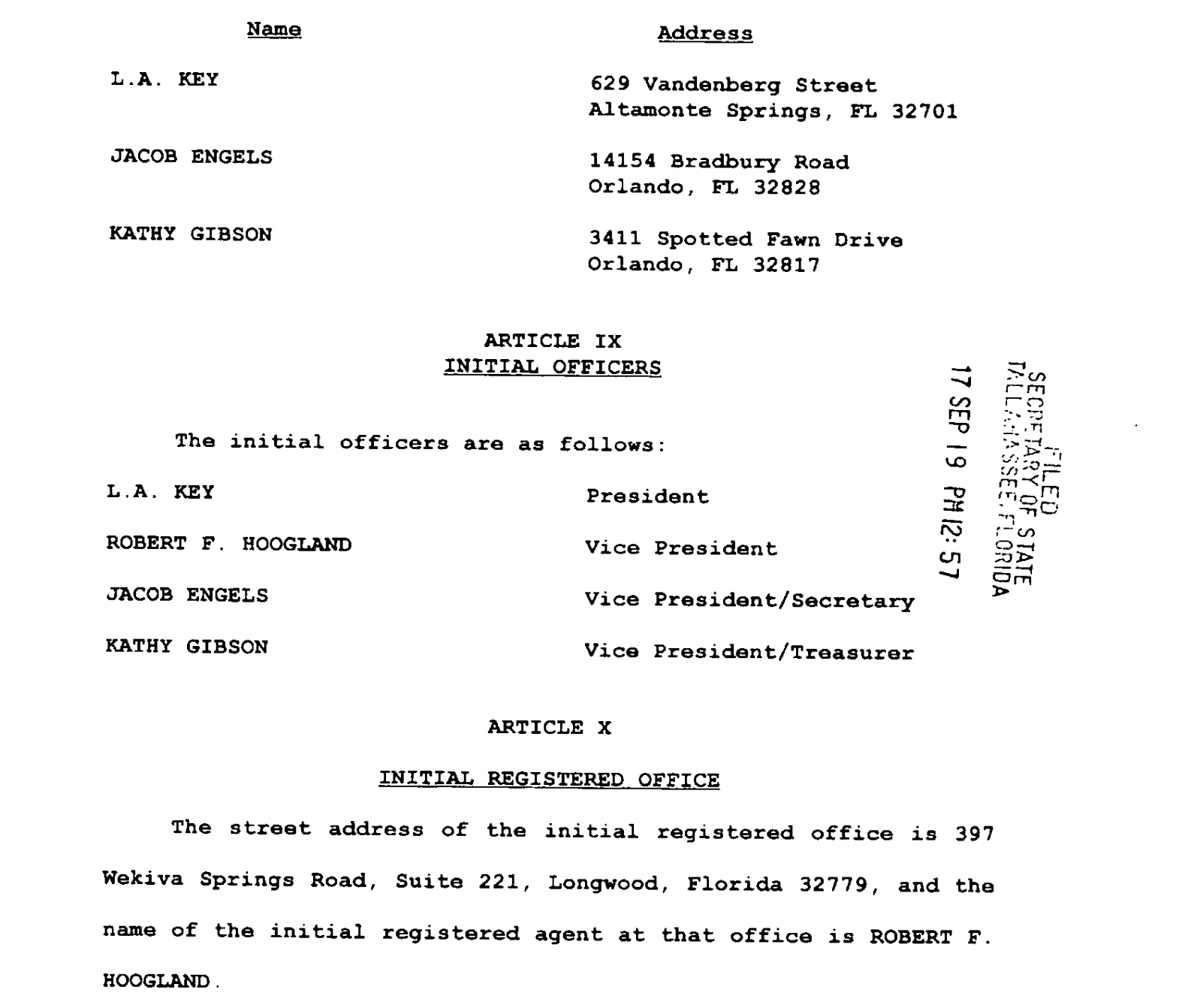
Leslie Key and Jacob Engels worked together on a short-lived nonprofit called the Florida Strong Project, whose professed aim was to “help restore and reinvigorate communities affected by Hurricane Irma. Key, Engels, and a woman named Kathy Gibson were the initial directors of the 501(c)(3), which was registered at Key’s home address in Altamonte Springs, Florida. Key’s husband, attorney Robert Hoogland, was an officer as well.

Another entity was run out of Key’s home address too: a company called RFR Action, which was paid $4,300 for photoshoots in December of 2019 by the campaign of GOP congressional candidate Richard Gobel, who was running against Rep. Stephanie Murphy, an incumbent Democrat who had defeated the above-mentioned John Mica in 2016. That same company, but with a listed address in Delaware, was paid by the campaign of DeAnna Lorraine, a California Republican congressional candidate, and QAnon supporter, during the 2020 cycle.

It’s not clear what connection may exist, if any, between Key and Engels’ nonprofit, the Florida Strong Project, and a PAC called Keep Florida Strong run by Winter Park attorney Wade Vose, who was paid $275,897 from January 2017 to July 2018 as outside counsel for the Seminole County tax collector (i.e., Joel Greenberg). Vose’s PAC appears to have made only one expenditure, paying $13,000 in 2019 to a company called Pinpoint Action that was operated by Michael Shirley, Greenberg’s former campaign consultant. A woman named Bridgette Bayley worked simultaneously as executive assistant to Jacob Engels and as an account manager for Pinpoint Action from January to June 2018.

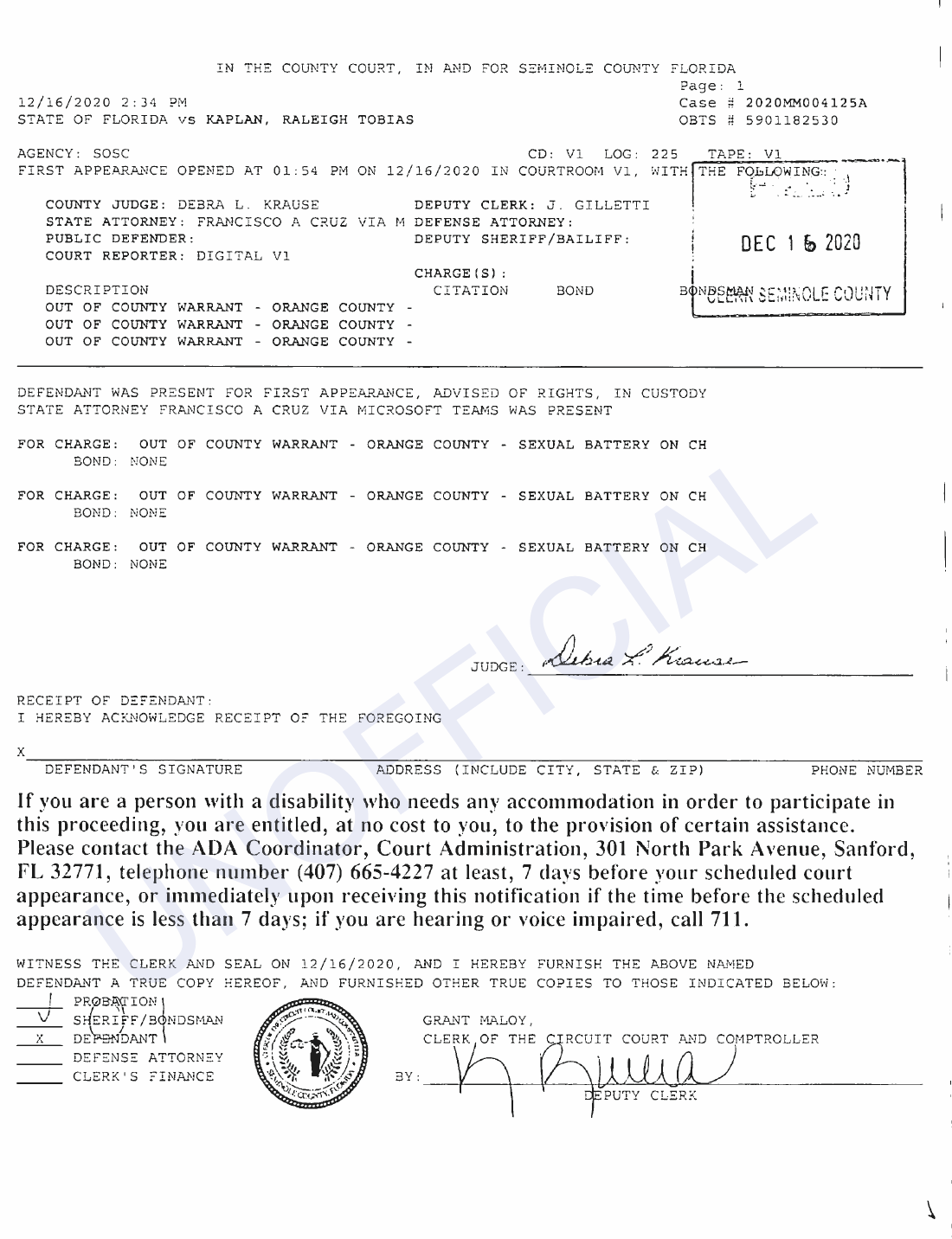
Key’s son, Raleigh Kaplan, who worked alongside Engels on at least two Republican campaigns, was arrested in December and currently faces several counts of alleged sexual battery on a child less than 12 years old. Florida prosecutors allege that he molested his relative over a period of several years. 

Kaplan was the “Young Republican Chair” of the Trump campaign in Seminole County and served as campaign manager for Abby Sanchez, who ran successfully for Seminole County School Board in 2016. Kaplan also appears to be friendly with Joel Greenberg, and follows Greenberg’s wife Abby and a former employee at Greenberg’s tax office on Facebook.

The Daily Beast reported in late April that Roger Stone attempted to aid Greenberg in seeking a pardon from former President Trump. No pardon was forthcoming, and Greenberg has since struck a plea deal with prosecutors that involved admitting to various offenses linked to sex trafficking and a promise of “substantial cooperation” in the continuing investigation. 

Dominion makes the case that MyPillow is liable for “MyPillow Guy” Mike Lindell’s election lies

Dominion Voting Systems is working to make the case that MyPillow CEO Mike Lindell is just as liable as his company is for the attacks on the 2020 election.

Business Insider reported Tuesday that Dominion explained that the two cannot be divorced from each other. Lindell is the so-called “MyPillow guy.”

“Now, MyPillow claims that ‘the MyPillow Guy’ was not speaking for MyPillow when he gave speeches at MyPillow-sponsored rallies in Washington, D.C. or when he otherwise exploited election lies to market MyPillow products—which could be purchased on MyPillow’s website using promo codes like ‘FightforTrump,’ ‘QAnon,’ ‘Q,’ and ‘Proof,'” attorneys for Dominion wrote.

MyPillow has fought the allegations by claiming that Lindell is not MyPillow. The problem, however, is that after Twitter blocked Lindell from spreading false information about the election, he used the MyPillow Twitter account to promote the debunked theories.

“The law is clear that corporations can be held liable for the defamatory statements their employees make within the scope of their employment and in furtherance of the company’s business,” Dominion’s attorneys explained. “And the Complaint plainly alleges facts from which a jury could infer that Lindell — who is to this day the president, CEO, and spokesman of MyPillow and who is widely known as ‘the MyPillow Guy’ — was acting as the company’s agent when he exploited lies about Dominion to market MyPillow products.”

Read the full report at Insider.

Liberty University in turmoil as students protest against continuing relationship with Trump: report

While Trump-supporting Jerry Falwell Jr. has been ousted by the university following a sex scandal involving a former pool attendant and Falwell’s wife, some trustees at the school are still in the Trump camp and that has some school administrators and students up in arms.

Writing, “Now, 14 years after Jerry Falwell Sr. died and nine months after Jerry Jr. was ousted in a scandal, Liberty is enmeshed in a debate that could have profound implications for the nation’s religious right,” Politico’s Maggie Severns added, “Liberty’s ultimate path will influence the greater evangelical world, which is having its own reckoning with the post-Trump Republican Party. With more than 100,000 students, Liberty has long been one of a small handful of top cultural institutions for evangelicals, its board studded with famed pastors and movement leaders. Observers believe that even a small change in direction at Liberty could signal shifting winds among one of Republicans’ most important voting blocs.”

While the university trustees are considering handing over the reins to another Falwell, Jonathan, who doesn’t have the close ties to the one-term president, some trustees are still Trump’s corner.

According to interviews with students and trustees at the school, “The members of the executive committee are all older conservatives who tend to be enthusiastic Trump supporters themselves. In Jerry Jr.’s absence, the board has made several key decisions that have served to keep Liberty aligned with the GOP, while at the same time elevating leaders who have the strong religious focus that Jerry Jr. lacked.”

“In April, the trustees replaced their acting chairman, Allen McFarland, the first Black person to serve as Liberty board chairman, who had an interest in increasing tolerance and diversity at Liberty. He was replaced with Tim Lee, a pugnacious pro-Trump pastor,” Severns explained. “But as Lee and others have taken increasing control of the school, a growing chorus of campus critics has been calling on the trustees to enact greater reforms, and they appear to be listening. A week before they took their strongest step yet to distance themselves from Jerry Jr., suing him for failing to reveal the alleged blackmail scheme, they designated Jonathan Falwell as campus pastor.”

According to one student willing to buck the trustees, secular politics need to take a backseat to religious teachings.

Matt Morris explained the school needs to be a place where, “the focus isn’t necessarily the conservative values, but more the biblical values that are part of the school.”

Morris added, “Shoving politics down people’s throats is not the way Falwell Sr. went about it.”

You can read more here.

Journalist details how Kyrsten Sinema has become a “super villain” to progressives

When centrist Democrat Kyrsten Sinema defeated Republican Martha McSally in Arizona’s 2018 U.S. Senate race, it was a political shocker — as Arizona, for decades, had been synonymous with the right-wing politics of Sen. John McCain and his predecessor, Sen. Barry Goldwater. But the fact that the 44-year-old Sinema is a Democrat doesn’t automatically make her a staunch progressive, and her relatively conservative record during her years in the U.S. Senate has sometimes been a source of frustration for the more progressive wing of her party. Journalist Amanda Becker examines Sinema’s record in a recent article published by The 19th, asking some Arizona residents what makes her tick politically.

“Sinema and West Virginia’s Joe Manchin are critical moderate votes in an evenly split Senate,” Becker explains, “and Democrats need both to pass key pieces of President Joe Biden’s agenda — including infrastructure and care packages, and a sweeping voting-rights bill for which Sinema was an original co-sponsor…. Manchin and Sinema are also the only outspoken Democratic holdouts for scrapping the filibuster, a procedural hurdle that effectively requires 60 votes to pass most pieces of major legislation.”

Not all Senate Democrats are officially on board with ending the filibuster, but practically, Manchin and Sinema are seen as its biggest defenders in the party.

One of the people quoted anonymously in Becker’s article told The 19th that Sinema “doesn’t care what” Democrats think because she “sees her voters as independents and crossovers.” And another interview told The 19th that Sinema engages in “performative bipartisanship” and “triangulates every single thing she does.”

Trish Muir, who chairs the Pima Area Labor Federation — an AFL-CIO council in Tucson — has found Sinema to be unresponsive. Muir told the 19th, “Outside of calling her general office number, I don’t know how to get ahold of this woman…. I follow her on Facebook, I follow her on Twitter, to kind of keep an eye on what’s happening — and I see a lot of her focus, and a lot of her energy, being spent on behalf of corporate interests.”

Becker notes that progressive Democratic Rep. Rashida Tlaib of Michigan has been highly critical of Sinema at times and that to some on the left, the Arizona senator has become a “super villain.” But Arizona Democrat David Lujan, according to Becker, has described Sinema as “politically astute” and said, “If she realizes that there’s just no way to compromise, I think she will consider: What are the other options to be able to get (this) done?”

Sinema recently drew anger from critics after missing last week’s vote on creating a Jan. 6 commission. The vote failed, and it would have failed even if she had been present. But while Sinema said she would have voted in favor of the bill, some felt it was negligent to be absent for a vote of historic importance — especially since she gave no excuse for missing it. She also angered the left by opposing raising the minimum wage to $15 an hour, a slight that was exacerbated by her now-infamous curtsy when voting no.

Before she was elected to the U.S. Senate, Sinema served in the U.S. House of Representatives and, before that, the Arizona State Legislature.

Sinema was known for her vehement opposition to the Iraq War during the George W. Bush years, leading some Arizona residents to think of her as a progressive. But then, some on the right were quite opposed to the U.S. invasion of Iraq, including paleoconservative Patrick Buchanan and former Rep. Ron Paul.

One of the interviewees for Becker’s article said of Sinema, “I don’t think she’s changed her views on any of the issues — I just think she has changed her approach.”

Sean Bean happy to learn how “Game of Thrones” ended: “Good for them”

Sean Bean only played Ned Stark for one season on “Game of Thrones,” but he cast a long shadow over the series. Several of his children died, but others lived to see the end of the tale, and the kingdom he ruled over in the name of the king — the North — ended up emancipating itself from the rest of Westeros.

The Times recently asked Bean if he thought the North seceding from the Seven Kingdoms reminded him of Brexit. As it ends up, the actor hadn’t seen the final season and didn’t think he was qualified to weigh in. “What happened?” he asked. The Times worried about spoiling the show for Bean in case he wanted to watch it in its entirety at some point, but he wasn’t worried about it. “I’ll have forgotten by then, go on.”

And so The Times explained what happened, detailing how Bran Stark became Lord of the Seven Six Kingdoms and Sansa Stark became Queen in the North. “So did Winterfell stay separate? Oh, good for them.”

Sean happy with what happened to Winterfell and the Stark children at the end of “Game of Thrones”

It’s always funny to hear that an actor didn’t watch the thing they were a part of, but it shouldn’t be, because it’s a job and not actually their life. Also, Bean was only on the show for one season, so it makes sense he’d check out after that; guy’s busy.

Also, good to know the man who played Ned Stark approves of what became of Ned’s children. Probably best not to bring up Robb and Rickon.

BTS, Lady Gaga and Justin Bieber erased from “Friends” reunion special in China

HBO Max’s “Friends” reunion special has finally arrived and, as expected, has given fans plenty to discuss! The long in the works special was a true treat for fans of the classic NBC comedy and it was truly chill-inducing seeing the original cast of Jennifer Aniston, Courteney Cox, Lisa Kudrow, Matt LeBlanc, David Schwimmer, and Matthew Perry back together after all these years.

Fans seem to have truly enjoyed the special with the biggest complaint among viewers being that it simply wasn’t long enough. It’s understandable to want more after waiting so many years for the reunion to become a reality, but with a runtime of 104 minutes the reunion tapped out just under two hours which is admittedly longer than we anticipated.

And no minute was wasted in the special either. HBO Max managed to pack an incredible amount of content into the Friends reunion special including cameos from several A-listers. Unfortunately, it seems those located in China have been cheated out of appearances from three of the special’s biggest names with BTS, Lady Gaga and Justin Bieber all being scrubbed from the special.

As reported by CBS News, while the “Friends” reunion special is being offered to China-based fans via a handful of unofficial streaming sites, the episode has been censored with the streamers choosing to erase all signs of BTS, Gaga and Bieber from the reunion.

Why were BTS, Lady Gaga and Justin Bieber cut from China’s “Friends” reunion special?

So why exactly have BTS, Lady Gaga and Justin Bieber been cut from China’s version of the “Friends” reunion? While no official reasoning has been provided, it is believed the trio’s presence in the special was erased due to past controversies surrounding the artists.

BTS in particular faced backlash in 2020 over comments made by one member of the group about the Korean War. At the time, the band’s leader’s remarks over South Korea’s shared “history of pain” with the U.S. caused a stir in China and even led to the loss of commercial partnerships.

While it was perceived the controversy has blown over, the decision to erase the band from the “Friends” special seems to suggest otherwise.

John Krasinski has ideas for “A Quiet Place Part III,” but he won’t direct it

After a delay of over a year, “A Quiet Place Part II” is finally out there for people to enjoy, and it’s a hit. The sequel to John Krasinski’s 2018 horror movie is as unsettling as the first, as the surviving members of the Abbott family try to make their way in a world overrun with murderous monsters sensitive to the slightest sound.

“A Quiet Place” wasn’t designed to have a sequel, but after it was a success, that was pretty much a foregone conclusion. At first, Krasinski actually turned down the offer to direct “Part II,” but came around. After all, he’d already developed ideas for “Part II “when working on “Part I,” and the same thing happened while he was directing the sequel.

“So a lot of the things I had thought were interesting to think about on ‘Part I’ ended up being in ‘Part II,'” Krasinski told The Hollywood Reporter. “And then on ‘Part II,’ I learned my lesson very quickly. Any time I had ideas like that, I wrote them down in case there ever is a ‘Part III’ or a third one. (Laughs.) So I would be able to reference some of these things if there is a ‘Part III.’ And we even went so far as to put in a couple Easter eggs, so that if I did do a third one, they would connect back to the second one.”

That said, don’t expect Krasinski to be the Kevin Feige of the Quiet Place Cinematic Universe or anything. The ship has sailed and he doesn’t plan to be on it. “Even though I’m the guy who did the first two, I won’t be the guy or girl who does the last one or the last two,” he said. “At the end of the day, this world is really fun to explore. This is an amazing sandbox to play in, and whether or not I’m the guy to do any more of them or how many more of them, I don’t know. But I know that we’re really proud of the world we created. And the fact that it’s even strong enough to have this conversation about doing more is something we’re all really proud of.”

“A Quiet Place Part II” is in theaters now.

Little-known illnesses turning up in COVID long-haulers

The day Dr. Elizabeth Dawson was diagnosed with covid-19 in October, she awoke feeling as if she had a bad hangover. Four months later she tested negative for the virus, but her symptoms have only worsened.

Dawson is among what one doctor called “waves and waves” of “long-haul” covid patients who remain sick long after retesting negative for the virus. A significant percentage are suffering from syndromes that few doctors understand or treat. In fact, a yearlong wait to see a specialist for these syndromes was common even before the ranks of patients were swelled by post-covid newcomers. For some, the consequences are life altering.

Before fall, Dawson, 44, a dermatologist from Portland, Oregon, routinely saw 25 to 30 patients a day, cared for her 3-year-old daughter and ran long distances.

Today, her heart races when she tries to stand. She has severe headaches, constant nausea and brain fog so extreme that, she said, it “feels like I have dementia.” Her fatigue is severe: “It’s as if all the energy has been sucked from my soul and my bones.” She can’t stand for more than 10 minutes without feeling dizzy.

Through her own research, Dawson recognized she had typical symptoms of postural orthostatic tachycardia syndrome, or POTS. It is a disorder of the autonomic nervous system, which controls involuntary functions such as heart rate, blood pressure and vein contractions that assist blood flow. It is a serious condition — not merely feeling lightheaded on rising suddenly, which affects many patients who have been confined to bed a long time with illnesses like covid as their nervous system readjusts to greater activity. POTS sometimes overlaps with autoimmune problems, which involve the immune system attacking healthy cells. Before covid, an estimated 3 million Americans had POTS.

Many POTS patients report it took them years to even find a diagnosis. With her own suspected diagnosis in hand, Dawson soon discovered there were no specialists in autonomic disorders in Portland — in fact, there are only 75 board-certified autonomic disorder doctors in the U.S.

Other doctors, however, have studied and treat POTS and similar syndromes. The nonprofit organization Dysautonomia International provides a list of a handful of clinics and about 150 U.S. doctors who have been recommended by patients and agreed to be on the list.

In January, Dawson called a neurologist at a Portland medical center where her father had worked and was given an appointment for September. She then called Stanford University Medical Center’s autonomic clinic in California, and again was offered an appointment nine months later.

Using contacts in the medical community, Dawson wrangled an appointment with the Portland neurologist within a week and was diagnosed with POTS and chronic fatigue syndrome (CFS). The two syndromes have overlapping symptoms, often including severe fatigue.

Dr. Peter Rowe of Johns Hopkins in Baltimore, a prominent researcher who has treated POTS and CFS patients for 25 years, said every doctor with expertise in POTS is seeing long-haul covid patients with POTS, and every long-covid patient he has seen with CFS also had POTS. He expects the lack of medical treatment to worsen.

“Decades of neglect of POTS and CFS have set us up to fail miserably,” said Rowe, one of the authors of a recent paper on CFS triggered by covid.

The prevalence of POTS was documented in an international survey of 3,762 long-covid patients, leading researchers to conclude that all covid patients who have rapid heartbeat, dizziness, brain fog or fatigue “should be screened for POTS.”

A “significant infusion of health care resources and a significant additional research investment” will be needed to address the growing caseload, the American Autonomic Society said in a recent statement.

Lauren Stiles, who founded Dysautonomia International in 2012 after being diagnosed with POTS, said patients who have suffered for decades worry about “the growth of people who need testing and treating but the lack of growth in doctors skilled in autonomic nervous system disorders.”

On the other hand, she hopes increasing awareness among physicians will at least get patients with dysautonomia diagnosed quickly, rather than years later.

Congress has allocated $1.5 billion to the National Institutes of Health over the next four years to study post-covid conditions. Requests for proposals have already been issued.

“There is hope that this miserable experience with covid will be valuable,” said Dr. David Goldstein, head of NIH’s Autonomic Medicine Section.

A unique opportunity for advances in treatment, he said, exists because researchers can study a large sample of people who got the same virus at roughly the same time, yet some recovered and some did not.

Long-term symptoms are common. A University of Washington study published in February in the Journal of the American Medical Association’s Network Open found that 27% of covid survivors ages 18-39 had persistent symptoms three to nine months after testing negative for covid. The percentage was slightly higher for middle-aged patients, and 43% for patients 65 and over.

The most common complaint: persistent fatigue. A Mayo Clinic study published last month found that 80% of long-haulers complained of fatigue and nearly half of “brain fog.” Less common symptoms are inflamed heart muscles, lung function abnormalities and acute kidney problems.

Larger studies remain to be conducted. However, “even if only a tiny percentage of the millions who contracted covid suffer long-term consequences,” said Rowe, “we’re talking a huge influx of patients, and we don’t have the clinical capacity to take care of them.”

Symptoms of autonomic dysfunction are showing up in patients who had mild, moderate or severe covid symptoms.

Yet even today, some physicians discount conditions like POTS and CFS, both much more common in women than men. With no biomarkers, these syndromes are sometimes considered psychological.

The experience of POTS patient Jaclyn Cinnamon, 31, is typical. She became ill in college 13 years ago. The Illinois resident, now on the patient advisory board of Dysautonomia International, saw dozens of doctors seeking an explanation for her racing heart, severe fatigue, frequent vomiting, fever and other symptoms. For years, without results, she saw specialists in infectious disease, cardiology, allergies, rheumatoid arthritis, endocrinology and alternative medicine — and a psychiatrist, “because some doctors clearly thought I was simply a hysterical woman.”

It took three years for her to be diagnosed with POTS. The test is simple: Patients lie down for five minutes and have their blood pressure and heart rate taken. They then either stand or are tilted to 70-80 degrees and their vital signs are retaken. The heart rate of those with POTS will increase by at least 30 beats per minute, and often as much as 120 beats per minute within 10 minutes. POTS and CFS symptoms range from mild to debilitating.

The doctor who diagnosed Cinnamon told her he didn’t have the expertise to treat POTS. Nine years after the onset of the illness, she finally received treatment that alleviated her symptoms. Although there are no federally approved drugs for POTS or CFS, experienced physicians use a variety of medicines including fludrocortisone, commonly prescribed for Addison’s disease, that can improve symptoms. Some patients are also helped by specialized physical therapy that first involves a therapist assisting with exercises while the patient is lying down, then later the use of machines that don’t require standing, such as rowing machines and recumbent exercise bicycles. Some recover over time; some do not.

Dawson said she can’t imagine the “darkness” experienced by patients who lack her access to a network of health care professionals. A retired endocrinologist urged her to have her adrenal function checked. Dawson discovered that her glands were barely producing cortisol, a hormone critical to vital body functions.

Medical progress, she added, is everyone’s best hope.

Stiles, whose organization funds research and provides physician and patient resources, is optimistic.

“Never in history has every major medical center in the world been studying the same disease at the same time with such urgency and collaboration,” she said. “I’m hoping we’ll understand covid and post-covid syndrome in record time.”

In the debate over “SIDS monitors,” evidence is thin all around

Each year in the United States, according to the Centers for Disease Control and Prevention, around 1,300 infants die from sudden infant death syndrome, or SIDS. It’s a leading cause of death for babies born without an obvious medical condition, and it is devastating in its particulars: Parents put a seemingly healthy infant down to sleep and come back to find that the baby has died. Most infants who die of SIDS are between 1 and 4 months old.

“The grief responses are especially severe,” said Richard Goldstein, a pediatrician at Boston Children’s Hospital who works with SIDS families. “They’re especially severe because it’s small, small children at a dependent age. And it’s especially severe because there’s no true explanation.”

Indeed, the causes of SIDS remain murky. In the early 1990s, researchers determined that putting infants down to sleep on their backs, rather than their sides or stomachs, lowered SIDS risk — potentially because stomach-sleeping may obstruct airflow, though the exact reasons are poorly understood. A “Back to Sleep” campaign pushed down the U.S. SIDS rate in the 1990s, but attempts to further reduce it have since stalled.

In recent years, however, some researchers and parents have hoped that increasingly sophisticated monitoring technologies might provide a crucial edge against an otherwise vexing syndrome. Monitoring sleeping infants for signs of cardiac or respiratory distress, the thinking goes, might offer warning signals for parents — and even let them intervene in the rare event that a baby begins to die.

Such hopes have helped to fuel a burgeoning market for high-tech baby monitors — often colloquially called SIDS monitors. These include devices like the Owlet Smart Sock, a Bluetooth-enabled sensor-equipped fabric sleeve, compact enough to slip over an infant’s tiny foot. When worn properly, the Utah-based health technology company suggests, the $299 garment will feed real-time data to parents’ phones on their baby’s heart rate, blood oxygen levels, and sleep patterns. Snuza, a South African company, makes a series of vital-data monitors that can clip to an infant’s diaper. Such monitors alarm when they detect a drop in a baby’s breathing or blood oxygen levels, and to date, each company has sold hundreds of thousands of units worldwide.

And yet, some scientists say, there is one thing that high-tech monitoring has not been proven to do: prevent SIDS.

While some device makers in this space traffic in SIDS information on their websites, and participate in SIDS awareness campaigns, they are careful not to market their wares as SIDS solutions — and for good reason: Many pediatrics experts argue that there’s little evidence that alarm-based monitoring wards off SIDS, and that past research has suggested that there are, in fact, no measurable warning signs that could identify an imminent case of SIDS and allow a parent to somehow intervene. Other analyses have even found some modern monitors to simply be inconsistent at monitoring anything, let alone detecting a potential onset of SIDS. These experts worry that monitors, no matter how elaborate or sophisticated, only provide parents with a false sense of security. In 2016, the American Academy of Pediatrics released official sleep safety guidelines recommending that parents “not use home cardiorespiratory monitors as a strategy to reduce the risk of SIDS.”

Supporters of these devices — as well as the monitoring companies themselves — argue that the AAP’s research is outdated, and doesn’t necessarily apply to current monitors on the market. The AAP guidelines, they point out, cite just four studies to back up their recommendation: Three from the 1980s, and a fourth published in 2001. That last analysis also specifically notes that it was “not designed to determine whether use of a monitor decreases the rate of SIDS.”

Greg Gallagher, the founder and CEO of Snuza, said the position of the AAP is out of step with technological advances that have accrued since the research AAP cites was published. “The AAP uses 35-year-old research to base their decision, or their stands, on,” Gallagher said. “A lot has changed in 35 years.”

And, both companies say that, at least so far, they have received virtually no reports of infants dying from SIDS while the monitors are in use.

But many pediatrics experts remain skeptical — particularly given that device makers like Owlet and Snuza keep their data close to the chest. And short of stronger evidence — ideally from a carefully controlled clinical trial — some pediatric experts continue to raise pointed questions about what, exactly, modern monitoring companies are selling. Ruey-Kang Chang, a pediatric cardiologist at Harbor-UCLA hospital who has published research on SIDS, said it’s clear that there is no clinical trial data or scientific evidence that shows these monitors can save babies from SIDS. Instead, he said, “I think they prey on parents’ anxiety.”

* * *

SIDS is what doctors call a diagnosis of exclusion: Coroners list it as the cause of death when a child unexpectedly dies in their sleep before reaching one year of age, and all other possibilities have been ruled out. (Another category of unexpected deaths, sometimes conflated with SIDS, is caused by accidental suffocation in the crib.)

Over the years, researchers have proposed a huge range of explanations for the sudden deaths. Theories have included undetected viral infections, magnesium deficiency, diaphragm failure, various heart defects, and abnormalities in the brainstem. Sometimes, a breakthrough will explain some subset of SIDS cases. For example, some infants who were once thought to die from SIDS are now known to have a metabolic disorder called medium-chain acyl-CoA dehydrogenase deficiency.

Epidemiologists have also identified factors that are linked to higher risk of SIDS. Babies born prematurely are at elevated risk, as may be those with a sibling who died from SIDS. And, at least in the United States, parents who are poor, who are Black or Native American, or who smoke are all likelier to lose an infant to SIDS. (There are likely multiple factors driving those racial and class disparities, and the exact causes remain unclear. Researchers have suggested that they could stem from uneven adherence to sleep guidelines, or from unequal access to medical care.)

For years, one hypothesis was that SIDS emerged from a form of sleep apnea — long pauses in breathing, of unknown origin, that sometimes proved fatal. The theory rested, in part, on a landmark 1972 study by Alfred Steinschneider, a physician-researcher in upstate New York. Over the course of several years, Steinschneider monitored the breathing of five infants, thought to be at elevated risk of SIDS, while they slept. Two of them — siblings from a family that had previously experienced unexplained deaths — showed prolonged bouts of apnea. Each died at home soon after, and Steinschneider concluded that the evidence supported the hypothesis that sleep apnea caused SIDS. He suggested physicians might monitor high-risk infants for apnea in order to detect those signs of troubled breathing, and in the decades that followed, high-risk infants were sometimes sent home with bulky cardiorespiratory monitors, which fit under the crib mattress and required parents to affix a band around the infant’s chest during sleep. The set-up was challenging for parents and often generated false alarms. But it could, at least in theory, alert parents and physicians to troubled breathing.

By the 1990s, though, support for such monitoring was foundering. Steinschneider’s seminal paper fell apart in 1994, when the mother of the two infants who were thought to have died from SIDS confessed to murdering them. (Studies suggest that a small percentage of deaths attributed to SIDS are actually infanticides.)

A major study in the 1990s, called the CHIME study, sent home monitors with more than 1,000 infants, searching for a link between disrupted breathing and SIDS risk. After sifting through data from 700,000 hours of monitoring, the team found that erratic or disrupted breathing events were common across all groups of infants, whether or not they were at high risk for SIDS. “Events previously described as ‘pathologic,'” the study concluded, are actually quite common, even in healthy term infants.”

Whatever it was that made the high-risk kids likelier to die from SIDS, the researchers argued, they did not seem to have uniquely obstructed breathing. There was “no ability to distinguish them through monitoring, to separate one group from another,” said George Lister, a professor of pediatrics at the Yale School of Medicine and an author of the CHIME study.

The CHIME study — which is cited in the most recent AAP guidelines — examined whether troubled breathing was a warning sign for SIDS. It was not designed to show whether a monitor, by alarming, would allow parents to interrupt a fatal event in progress. (Two infants died of SIDS during the CHIME study, but neither was being monitored at the time.)

Still, the evidence convinced many pediatrics experts that monitoring respiration for signs of SIDS probably wasn’t worth it. Among them was Rachel Moon, a pediatrician and SIDS expert at University of Virginia Health who oversaw the AAP guidelines. “There’s no technology that’s going to tell you if a baby’s going to die,” she said. “Because there’s no warning signs that we know of.”

One pediatrician who has continued to argue that monitoring has value is Gary Freed, who worked briefly with Steinschneider in the 1990s. Freed went on to start the apnea center at Children’s Health Care of Atlanta, which he ran for 20 years. The center would send high-risk infants home with monitors, and keep an eye on the data to look for issues that, they feared, could lead to a sudden death.

The experience convinced Freed that monitoring can help catch medical problems. Data that Freed and three colleagues published as part of a commentary in The Journal of Perinatology in 2002, summarizing results from more than 8,000 apnea center patients, suggested that babies in the program died from SIDS at lower rates than in the general population — even though they were considered high-risk. Of the five that had died from SIDS, only one was connected to the monitor at the time of death. (Freed has collaborated with Owlet on a paper but does not recall receiving compensation.)

“If a kid’s not breathing for more than 30 seconds,” Freed said, “I would like to know, if that was my kid.”

* * *

Gallagher, the founder of Snuza, is an engineer with a background in microcontrollers — simple, tiny computers used in consumer electronics and medical devices. In 2003, he began designing a small, wireless tool that could monitor an infant’s breathing and movement. His company, based in Cape Town, sold its first unit in 2007. “We have been proven, and we claim, that we are able to detect the cessation of breathing in infants,” said Gallagher. He said they have sold hundreds of thousands of units worldwide.

Snuza’s devices clip onto a baby’s diaper, or onto the waistband of pajama pants. If the company’s best-selling device does not record breathing for 15 seconds, it buzzes, attempting to wake the baby. After 5 more seconds without a breathing signal, an alarm goes off for the parents.

The Owlet Smart Sock, conceived by a group of students at Brigham Young University in Utah, is a home-based pulse oximetry monitor — a tool that uses beams of light to estimate the level of oxygen in the blood. If oxygen levels appear to drop, the sock sets off an alarm. Since shipping its first product in 2015, the company says, it has sold more than 1 million units.

Some online reviewers credit the monitors with saving their babies. “Snuza Go literally saved my baby’s life!” one review at the online retailer Amazon begins, explaining how the parents heard the alarm, found their baby unresponsive, and successfully used CPR to resuscitate her. Those kinds of stories have won over some advocates, including Karl Waddell and Alex Hamilton, who co-founded River’s Gift, an Australian nonprofit that funds SIDS research and promotes safe-sleep practices, after the sudden death of their 4-month-old son, River, in 2011.

In a Zoom interview, Waddell acknowledged that “there’s no scientific evidence to suggest and to display that an alarm-based monitor will avert a SIDS case or a sudden unexpected infant death in sleep.” But, he continued, “we strongly believe that there are instances where alarm-based monitors would have and will save the lives, just through anecdotal evidence as much as anything.”

River’s Gift retails Owlet products on its website, and Waddell has attended a gathering for SIDS parents hosted by Owlet at its Utah headquarters. River’s Gift recommends the use of monitors to parents, and Waddell said he and Hamilton used them with their second and third children.

Waddell said they’d heard of “a number of incidents” in which the alarm on a baby goes off, and “the parent or guardian has gone to their side to discover they might be blue, or they might not be breathing.”

“And then when they’re picked up or they’re prompted, they take a big deep breath,” he added. “That’s enough evidence for us.”

* * *

Leading SIDS experts, though, just aren’t convinced that such monitors work well — or that they’re even the best potential approach for using monitoring technology to reduce SIDS risk.

Some of those concerns revolve around the question of whether the monitors reliably alarm. In 2017, a study at the Children’s Hospital of Philadelphia, or CHOP, subjected the Owlet and another home-based pulse oximeter, the Baby Vida, to a round of tests. The team examined whether the devices could identify hypoxemia, or a below-average level of oxygen in the blood. The second-generation Owlet, the team found, “detected hypoxemia but performed inconsistently” compared to a hospital-grade monitor. The Baby Vida “never detected hypoxemia and also displayed falsely low pulse rates,” the team wrote.

Moon, the UVA pediatrician, cited the CHOP study in explaining the committee’s continued skepticism of such products. “We know the hospital grade monitors don’t work,” she said, “so why would we recommend something that’s worse than what the hospital grade monitors can do?”

Jordan Monroe, an Owlet co-founder and executive, said the company disputes the CHOP team’s findings, and that the researchers did not use the product as intended. Christopher Bonafide, the CHOP pediatrician who led the study, did not respond to interview requests.

Experts have also questioned whether an alarm, even if does alert parents to an emergency, would actually give parents much of a chance to resuscitate the baby. Goldstein, at Boston Children’s Hospital, acknowledged that some parents may respond to the alarm to find a baby in apparent respiratory distress. But, he continued, that’s not always the same thing as SIDS, or even necessarily life threatening.

The most promising recent research on SIDS, he said, suggests that many cases involve a neurological issue that produces “a sort of uncoupling” between the way the heart and the lungs respond to a need for oxygen. “That’s not really resuscitatable,” he said. “You don’t respond to your baby and shake them out of it. It’s a genuinely terminal event.” (Goldstein has been involved with some research on that issue at Harvard.)

Chang, the pediatric cardiologist, raised similar concerns. “When a baby stops breathing, there’s not much time to intervene,” he said, adding that even well-trained physicians struggle to resuscitate infants through CPR. Chang argues that, instead of tracking babies’ physiological signs, monitors should actually track the environment around babies, alerting parents when conditions associated with a higher risk of sudden death, such as higher temperatures or a breathing obstruction, are present. In 2015, Chang filed a patent for such a monitor, but the project stalled. As for tools like Snuza and Owlet, he said, “I doubt any of the baby monitors will work, ever, because they focus on monitoring the babies. And it’s very late when things are not going well.”

Still, companies say they have data suggesting the devices lower SIDS rates — even if, to avoid scrutiny from medical device regulators, they have to be careful how they describe it.

Monroe, the Owlet co-founder, initially declined to speak on the record about the company’s internal mortality records, citing legal concerns. Shortly before this piece went to publication, however, he sent an email offering more detail. “Although we have monitored nearly a million babies and hear from parents on a daily basis, we have not received any reports of a baby passing away while being actively monitored by the Smart Sock,” Monroe wrote. “However, just because there is an absence of reports does not necessarily mean that there has not been an incident.”

The company, he added, is “actively investigating this lack of reports and working with third-party researchers to perform scientifically sound and data-driven analyses before making any kind of claim about the life-saving potential of the Smart Sock.”

Gallagher, the Snuza founder, described similar outcomes. “Out of the 350,000 devices that we have looked at, we’ve had one reported death,” he said. “And that death, the parents were alerted, but they couldn’t resuscitate the baby.” Meanwhile, he said, Snuza has “many dozens” of testimonials from parents reporting that the product saved their babies’ lives. Given data suggesting that roughly one in 3,000 babies die from SIDS every year in the U.S., that would seem to be a promising metric.

But Moon doesn’t put much stock in the companies’ internal data. “I don’t think we can extrapolate anything from that,” she said. “I know, myself, of two babies who have died while they have had one of these monitors on, and I know this because the parents have called me to ask me about why their baby died if the monitor was on.” In both cases, she said, the monitor manufacturer claimed to have no record that the product was on at the time of death.

Moon worries that monitors will give parents a sense of invincibility, and perhaps make them more comfortable straying from safe-sleep guidelines. (Monroe, while stressing his support for safe sleep practices, was skeptical of that concern. “I put my kids in a car seat,” he said, “but that doesn’t mean I drive faster.”)

One thing the companies have not yet done is actually publish their internal data on mortality, or subject it to the rigors of peer review. Goldstein would welcome a chance to see such data. “Yeah, I mean, bring it on,” he said. “We have statistical methods that help us evaluate whether a claim or observation occurs by chance, or if they actually have enough observations to claim anything.”

One way to settle the question, experts say, would be a randomized controlled trial: Some infants get monitors, some don’t, and researchers then track whether SIDS rates are lower among monitored infants. Actually doing that research, though, could be ethically complicated and prohibitively expensive. Because SIDS is so rare, the study would likely need to enroll a huge number of families — “hundreds of thousands of babies,” Moon estimated — in order to collect enough data to discern a pattern.

* * *

For some parents, though, the question of monitors is as much about how to deal with the anxiety — and uncertainty — of parenthood as it is about the data. Goldstein works closely with parents who have lost a child to SIDS. Sometimes, if those parents go on to have another child, they find themselves unable to sleep, spending long nights watching over their baby. If a monitor “actually might let you get a few feet away from the crib and sleep,” Goldstein said, “well, that’s a different kind of an idea.” These parents, he continued, understand the monitors won’t prevent SIDS. “But they are also exhausted,” he said. “And it helps them in that way.”

In many cases, as even advocates of the technologies will acknowledge, high-tech monitors target the pocketbooks — and perhaps the anxieties — of the families least at risk. Alarm-based monitors cost hundreds of dollars. They appear to target affluent new parents, whose babies are at the lowest risk of SIDS.

“One of the issues is that the people who buy the monitors are the people who are privileged, and the people who have a lot of money,” said Moon. “And we know that the babies, at least demographically, are at high risk, have no access to these.”

When it comes to societal investments in reducing SIDS rates, Moon calls for better public health campaigns to help raise attention to common risk factors for SIDS that persist in many homes — including smoking and co-sleeping with infants. Goldstein, too, calls not for consumer-oriented solutions, but for more big-picture thinking. Even if the exact connections aren’t clear, poverty and racism and other disparities seem to inflect SIDS rates. “If I had to put my money anywhere,” he said, “that’s what I would do: I would reduce disparities, and I would increase access to medicine.”

This article was originally published on Undark. Read the original article.

NAACP president: Biden’s plan to tackle racial wealth gap must address student debt crisis

The Biden administration rolled out a plan to address America’s startling racial wealth disparities ahead of the president’s trip to Tulsa to observe the centennial of the white supremacist massacre in that city. But racial justice advocates say it’s missing a key component: student debt forgiveness.

Biden is expected to lay out his plan on Tuesday, when he will become the first president to visit Tulsa to commemorate the attack on the community of Greenwood, a prosperous neighborhood known as Black Wall Street where white people slaughtered as many as 300 and destroyed more than 1,200 homes in 1921.

“The attack on Black families and Black wealth in Greenwood persisted across generations,” Biden said in a statement on the anniversary of the attack Sunday. “The federal government must reckon with and acknowledge the role that it has played in stripping wealth and opportunity from Black communities.”

The administration said Tuesday that the plans include a Housing and Urban Development rule intended to address discriminatory housing practices and racial inequities in home appraisals, according to CNN. Biden will also announce a plan to provide $100 billion in new federal contracts for “small, disadvantaged businesses,” many of which are owned by Black people.

Biden is also expected to detail the $10 billion community revitalization fund included in his infrastructure package to help underserved communities and $15 billion in grants targeting areas with underdeveloped transportation. Biden’s American Jobs Plan also includes $31 billion to support minority-owned small businesses.

HUD Secretary Marcia Fudge last week announced a $100 million proposal to spur Black homeownership in areas that have historically rejected Black home buyers.

Black families on average have just one-tenth of the assets of typical white families, according to the Brookings Institution, in large part due to longstanding segregation and housing discrimination, since home value makes up the majority of most families’ assets.

NAACP President Derrick Johnson criticized Biden’s plans to address racial wealth disparities for not including any measures to tackle the student debt crisis.

“Until we address the student loan debt crisis, which disproportionately impacts African Americans, we can never get to the question of home ownership, therefore accumulating wealth,” Johnson told Politico.

Senate Majority Leader Chuck Schumer, D-N.Y., and progressive Democrats have pushed Biden to forgive up to $50,000 in student debt with an executive order. Biden has said he supports legislation by Congress to eliminate up to $10,000 in student debt, but pushed back on arguments that he can do so himself. The administration promised an Education Department review to determine Biden’s legal authority on the matter but months later there is no word when the review may be completed. Biden did not include student debt forgiveness in his $6 trillion budget proposal.

“While many components of President Biden’s budget appear to be encouraging, when it comes to addressing America’s racial wealth gap, it fails to address a key issue at the core of the racial wealth gap, the student loan debt crisis,” Johnson said in a statement to CNN. “Student loan debt continues to suppress the economic prosperity of Black Americans across the nation. You cannot begin to address the racial wealth gap without addressing the student loan debt crisis.”

Black students are more likely to have to borrow for college than white students, according to the Federal Reserve Bank of New York, and Black college graduates owe an average of $25,000 more in student loan debt than white graduates, according to data from the National Center for Education Statistics.

Pressed on the issue, White House deputy press secretary Karine Jean-Pierre pointed to Biden’s proposals to boost funding to historically Black colleges and universities.

“The American Families Plan, which is included in the president’s budget, includes a historic $46 billion of investments in HBCUs, tribal colleges and universities and minority-serving institutions,” she said Tuesday. “These institutions are critical to helping underrepresented students move to the top of the income ladder. President Biden is calling for a historic investment in affordability through subsidized tuition and expanding institutional grants.”

The White House also said that Biden would not support reparations for the descendants of the Tulsa massacre, which the last living survivors, along with many racial justice advocates, have called for. The city still has no official death toll from the massacre and has resumed excavation efforts to find reported mass graves. Thousands of Black residents were displaced, often to other states. But the Tulsa Race Massacre Commission, which was authorized by the Oklahoma state legislature in 1997, concluded that Black Tulsans lost the equivalent of $27 million in the attack and called for direct reparations of up to $150,000 per family. No reparations have been paid.

Viola Fletcher, 107; her brother Hughes Van Ellis, 100; and Lessie Benningfield Randle, 106, three of the remaining survivors of the massacre, are leading a lawsuit against the city, county and state of Oklahoma seeking reparations, arguing that city police and the county sheriff “deputized and armed white Tulsans to murder,” and the state National Guard “participated with this angry white mob in killing and looting and destroying the property of Black residents of Greenwood.”

All three appeared before the House Judiciary Subcommittee on the Constitution, Civil Rights and Civil Liberties earlier this month to push for federal reparations and recognition of the massacre, which has largely been scrubbed from American history books.

“I have lived through the massacre every day,”  Fletcher told lawmakers. “Our country may forget this history, but I cannot. I will not. And other survivors do not. And our descendants do not.”

“Please do not let me leave this earth without justice,” added Ellis, a World War II veteran, “like all the other massacre survivors.”

Humans are causing mass extinction at a rate not seen since the last major extinction event

Roughly 66 million years ago, an asteroid or comet struck the planet and wiped out three-quarters of every animal and plant species alive. Known as the Cretaceous–Paleogene extinction event (K–Pg), it has been immortalized in popular culture because of its association with the end of the dinosaurs’ reign on Earth.

That is why scientists are hopeful that a new study regarding the rate of extinction nowadays may hammer home the urgency of our pollution problems. In an international study led by the Justus Liebig University Giessen that included geologists, paleontologists, evolutionary biologists and many others, researchers found that in some cases, man-made factors are causing an extinction rate that surpasses that of the Cretaceous–Paleogene extinction event.

The study, which was published last month in the journal Communications Earth & Environment, closely analyzed past extinction rates for freshwater animals and plants, then used that information to extrapolate likely future extinction rates. They discovered that the average predicated rate for freshwater animals and plants today is three orders of magnitude higher than it was during the Cretaceous–Paleogene extinction event. If current trends continue unabated, one-third of all freshwater species alive today may be forever gone by 2120.

If that happens, we can expect that the damage to our freshwater ecosystem — which, inevitably, has an impact on ecosystems everywhere else on the planet — will be effectively permanent.

“Our results indicate that, unless substantial conservation effort is directed to freshwater ecosystems, the present extinction crisis will have a severe impact to freshwater biota for millions of years to come,” the authors write.

Even after the extinction event itself abated, the extinction rate remained high for 5.4 million years; the ecological recovery period required another 6.9 million years. Hence, the authors believe that our current situation might be comparable. Even if the man-made impact on life on Earth “ceases immediately, the already triggered phase of extinction might still involve several million years,” they write. 

Speaking to the Naturalis Biodiversity Center, the study’s lead author Dr. Thomas A. Neubauer explained that “losing species entails changes in species communities and, in the long run, this affects entire ecosystems. We rely on functioning freshwater environments to sustain human health, nutrition and fresh water supply.” He added that “despite our short existence on Earth, we have assured that the effects of our actions will outlast us by millions of years.”

In the study itself, the authors explained that the extinction crisis “has consequences on many levels,” noting that smaller changes compound into larger ones that eventually have devastating consequences.

“Radical changes in ecosystem functioning, in turn, may have severe implications on ecosystem services for humanity, such as food provision, disease resistance or economic benefits,” the authors write. “Thus, if we continue to lose species at the fast pace our analysis suggests, we will continue to impair ecosystem services to our own disadvantage.”

The new study is one of many red flags being thrown up by the planet about a number of pollution issues that threaten our survival. A February report by the World Wide Fund for Nature (WWF) and Global Wildlife Conservation revealed that roughly one-third of the world’s 18,075 freshwater fish species face possible extinction. The reasons for this include climate change, the introduction of invasive species, habitat destructions, pollution, and overly aggressive draining and damming. 

In September a report by the World Wildlife Fund (WWF) found that overall population sizes of “mammals, birds, amphibians, reptiles and fish” have dropped by 68 percent since 1970, indicating that the planet “is being destroyed by us at a rate unprecedented in history.” Some scholars have already coined a term, Anthropocene, to describe the geological epoch brought about by climate change and marked by the proliferation of mass extinctions. We are already in the midst of what scientists refer to as the Holocene extinction, or the sixth known mass extinction event in the Earth’s history, this one due to human activity.


Want more health and science stories in your inbox? Subscribe to Salon’s weekly newsletter The Vulgar Scientist.


Naomi Osaka stands up for all athletes by refusing to be exploited at the cost of her mental health

Tennis superstar and four-time grand slam champion Naomi Osaka on Monday announced her withdrawal from the French Open, after officials refused to allow her to skip press conferences to preserve her mental health, and fined her $15,000 for skipping a press conference. In her statement, Osaka wrote that she never meant to be a “distraction” from the tournament or the other players, and opened up even more deeply about her mental health. 

“The truth is I have suffered long bouts of depression since the US Open in 2018 and I have had a really hard time coping with that,” Osaka said. Very graciously, she added, “Though the tennis press has always been kind to me (and I wanna apologize to all the cool journalists who I may have hurt), I am not a natural public speaker and get huge waves of anxiety before I speak to the world’s media.” Specific to the French Open, Osaka wrote that she “was already feeling vulnerable and anxious so I thought it was better to exercise self-care and skip the press conferences.”

From Osaka’s initial announcement on Wednesday, May 26 that she wouldn’t conduct her press obligations, to her Monday withdrawal from the tournament, Osaka has sparked critical dialogue about mental health, exploitation of athletes, and persistent mistreatment of Black athletes across sports. Osaka’s bold assertion of her own agency is inspiring in a sports world where mostly Black athletes are routinely treated as a spectacle that fans and media are entitled to full access to, rather than human beings.

And while many of the greatest athletes in the nation have spoken out in praise of Osaka’s decision, French Open officials offered a predictably disappointing response that highlights how much work remains to be done to support athletes. French Tennis Federation president Gilles Moretton said at a Monday night press conference that he wished Osaka “the quickest possible recovery,” as if her mental health struggles are as simple as an injury that will heal shortly and naturally, and without support from institutions like the French Tennis Federation.

Osaka isn’t the first athlete to open up about how competition and sports media have impacted her mental health. But her decision to prioritize her well-being over what is, at the end of the day, a job, is a uniquely empowering move in a world where athletes — and especially Black athletes — are routinely subjected to mistreatment from institutions, media, and certainly, fanbases, especially in the age of social media. Osaka’s decision is also empowering for all people whose jobs have affected their mental health in some way in our aggressively capitalist society, reminding us that nothing is more important than our safety and wellness.

The same holiday weekend Osaka announced her withdrawal, several Black NBA players were physically attacked by disgruntled fans. In the case of Brooklyn Nets player Kyrie Irving, the young white man who threw a water bottle at Irving on Sunday night was arrested and charged with assault by the Boston Police Department. In Philadelphia, where Washington Wizards player Russell Westbrook and his team faced the Seventy-Sixers, another fan threw popcorn at Westbrook, days after another fan spit on Atlanta Hawks player Trae Young. There’s also a long history of NBA players being subjected to racist verbal assaults from fans. 

This mistreatment of basketball players by fans may seem separate from the French Open rules that pushed Osaka out of the tournament, but it’s not. Rather, it’s an extension of the same, dehumanizing sports culture that often treats disproportionately Black athletes as objects of entertainment that owe media and racist fans unlimited access to their performances.

Long before Osaka’s rise in the tennis world, powerhouse Serena Williams has faced routine racist, sexist and dehumanizing media coverage, and rulemaking that’s singled her out and needlessly policed what she could and couldn’t wear. In one particularly upsetting case, Williams was barred by the French Open from wearing a catsuit, despite how wearing pants rather than a skirt helped her health after blood clots she’d faced throughout her life resulted in dangerous complications during her pregnancy. Black women athletes’ physical and mental wellness and overall success have more often been punished and discouraged than celebrated and rewarded. The conditions that led to Osaka leaving the French Open are a part of this reality, which makes her exit on her own terms even more inspiring.

All too often, conversations about labor exploitation in sports are shut down when it’s pointed out how much high-profile professional athletes are paid. But this ignores how much predominantly white-led institutions make from mostly Black athletes’ labor, not to mention the fact that young, college athletes aren’t even paid, all while the NCAA is a billion-dollar enterprise. And it ignores another truth: Labor exploitation isn’t just about pay — it’s about the conditions to which athletes are subjected that harm their mental and physical health, that dehumanize and even endanger them. By withdrawing from the tournament, Osaka didn’t just prioritize her mental health. She refused to be used, and stood up for all athletes in the process. 

Faith in numbers: Fox News is must-watch for white evangelicals, a turnoff for atheists

Fox News possesses an “outsized influence” on the American public, especially among religious viewers.

That was the conclusion of the nonprofit Public Religion Research Institute in a report released just after the 2020 presidential election. It noted that 15% of Americans cited Fox News as the most trusted source – around the same as NBC, ABC and CBS combined, and four percentage points above rival network CNN. The survey of more than 2,500 American adults also suggested that Fox News viewers trend religious, especially among Republicans watching the show. Just 5% of Republican viewers of the channel identified as being “religiously unaffiliated” – compared to 15% of Republicans who do not watch Fox News and 25% of the wider American public.

To further explore the relationship between different faiths and the TV news they associate with as part of my research on religion data, I analyzed the result of another survey, the Cooperative Election Survey.

The annual survey, which was fielded just before the November 2020 election, with the results released in March, polled a total of 61,000 Americans over a number of topics. One question was on their news consumption habits. It asked what television news networks respondents had watched in the prior 24 hours.

Percentage of respondents who saw TV news in past 24 hours

Ryan Burge/CES

Some very interesting patterns emerged across religious traditions – and the nonreligious – and the type of media being consumed. For instance, of the the big three legacy news operations – ABC, CBS and NBC – there was no strong base of viewership in any tradition.

In most cases, about a third of people from each religious tradition said that they watched one of those legacy networks in the last 24 hours. PBS scored very low among every tradition. In most cases fewer than 15% of respondents reported watching PBS in the time frame.

However, the numbers for the three major cable news networks – CNN, Fox News and MSNBC – were much higher across the board. In eight of the 16 religious and nonreligious traditions categorized in the poll, CNN viewership was at least 50% of the sample. This was led by 71% of Hindus who watched CNN and 63% of Muslims.

The least likely group to watch CNN was clearly white evangelicals, at just 23%. In comparison, MSNBC scored lower nearly across the board. In fact, in none of the 16 classification groups was viewership of MSNBC greater than it was for CNN.

Fox News viewership was higher than that of MSNBC, but was not as widely dispersed as it is for CNN. It’s no surprise, given its reputation as a conservative news outlet, that 61% of white evangelicals say that they watch Fox News – in the last election, around 80% of white evangelicals voted for Republican candidate Donald Trump. The other three traditions where viewership was at least 50% are white Catholics, Mormons and members of the Eastern Orthodox Church. It should come as no surprise, as those are three groups that consistently vote for the Republican Party. Just 14% of atheists watched Fox, which is just about in line with the share of white evangelicals who watch MSNBC.

Fracturing right-wing media

But with the fracturing of conservative media sources seeing more competitors vying for viewers among the right, Fox News could see a drop in viewership from the religious right.

In the wake of the 2020 presidential election, Fox News viewership plunged as many Trump supporters believed that the network was not being loyal to their standard-bearer of the GOP.

Given the vast number of news options that people of faith have and the increase in political polarization in the United States, the pressure for networks to deliver the news that people want to hear will only increase as time passes.

Ryan Burge, Assistant Professor of Political Science, Eastern Illinois University

This article is republished from The Conversation under a Creative Commons license. Read the original article.

“Pregnant Girl” Nicole Lynn Lewis: Young mothers need a “village of support”

Nicole Lynn Lewis was a young girl with big dreams. The teenager’s life was far from perfect, but she was a hard working student on track to follow in her sister’s footsteps toward a college education. Then, she got pregnant — becoming a single mother with a fractious relationship with her daughter’s father. At the time, the odds were against her. Now, the author and activist can safely say she was able to overcome them. 

But Nicole doesn’t want hers to be the story of an exceptional triumph. As an activist, speaker and the founder of the nonprofit Generation Hope, she’s made it her mission to destigmatize the experience, and help other young parents achieve their own educational dreams. In her new book “Pregnant Girl: A Story of Teen Motherhood, College, and Creative a Better Future for Young Families,” she shares her incredible story of resilience and hope, but she also outlines the multiple systemic circumstances surrounding teen pregnancy, and what all of us can do to make a better future for teen moms — and their kids. Salon spoke to Nicole recently about her book, and how everybody wins when girls succeed. As always, this interview has been condensed and edited for print. 

There’s a line in the book where you say, “A college degree is not a magic wand.” Let’s talk about what a college degree is and is not.

A college degree is a game changer, for sure. You look at the economic impact of having a post-secondary credential, it’s pretty hard to dispute what that can do for an individual. In the case of young parents and student parents, for a family, not only does it create more earning power for that parent, but it sets that little one up for their own academic and career success, years in the future. The economic benefit is clear. We also know that there’s research out there around the socioeconomic benefits that come with a college degree. You’re more likely to have better health. You’re more likely to vote and be civically engaged. All of these different things really help individuals become more connected in their community, to live fuller lives.

What it doesn’t do it is erase the glaring disparities that many student parents have coming into higher ed, particularly students of color. The racial wealth gap is still going to exist for that family. If you are a black or brown student, you’re going to have to overcome some serious hurdles just to come into higher ed, never mind completing higher education. So It doesn’t erase the challenges that many face, but it is definitely game changing and can set that family up for success, and has a ripple effect for generations to come.

It’s very easy to look at one individual success story and say, “See, this person pulled themselves up by the bootstraps, why can’t everyone?” without looking at the larger systemic issues and addressing them.

I’m hoping that people don’t take that away from “Pregnant Girl” because there are so many times that I was on the edge of not being able to pay rent, not being able to afford child care. It would’ve been very easy for me to drop out of college. For the vast majority of students, those sinkholes are everywhere. There were many times where it would have turned out differently, had it not been for me getting off a waiting list for child care or finally being able to move into an apartment on campus — by the way, most campuses don’t have family housing. I hope people look at my story and say, “She was successful, but there were so many opportunities for her to fall through the cracks. How do we make sure that doesn’t happen for the vast majority of parenting college students?”

A lot of us looking from the outside in don’t necessarily see all of these other factors coming into play. Before we even get to being a parent and a college student, there is reproductive coercion and how prevalent that is. 

There are so many aspects of teen pregnancy that we just don’t talk about. Reproductive coercion is one of them, where you have a partner who is sabotaging your birth control or pressuring you to have a child, moving for the ultimate goal of controlling you. I talk about my own experience with that. I talk about our scholars at Generation Hope. Oftentimes they’re in these abusive situations as a young woman, where you have very little control over your body. That’s one aspect. Another aspect is access to birth control is even a challenge in certain communities, particularly for black and brown girls where you’re not getting the adequate and thorough information that you need to be able to make decisions about your body. I talk in the book about young women in our program who have been raped, statutory rape, molestation. That is happening in our communities every single day and contributes to higher rates of teen pregnancy.

We have this image of everything was going great in a young person’s life and they just got pregnant and then it spiraled out of control. What we really need to come to terms with is that in many cases, young people are in situations way before the pregnancy where they have very little control. They’ve experienced some incredibly traumatic things that we have to really start to address and help them and help them overcome. Those are the things that we’re not talking about in the context of teen pregnancy.

You’re really exploring this from the context of what is happening even before a pregnancy starts. And then a girl does get pregnant, and the risks of violence and abuse increase. That’s a context that needs to be discussed as well, that the risk of violence for any female, once she becomes pregnant, rises exponentially.

Correct, exactly.

Then we’re looking at issues of, of income, health insurance, stable living environment, and what happens postpartum psychologically. Being a student in general is hard. What happens when you’re at risk for postpartum depression as well?

Any mom can appreciate how stressful, difficult and sometimes isolating it can be when you bring a newborn baby home, even when you have a village of support surrounding you. The reality is that for young mothers, many of them don’t have the village of support. They don’t have basic needs, even sometimes for their little ones — diapers, formula, things that I think we often take for granted. When you come home with that baby, and you’re a young mother, you often don’t have this really strong network that can rally around you. You’ve been stigmatized and marginalized because of your pregnancy, and shamed. You’re trying to take care of the little one, be hopeful for a future that looks pretty dismal, and you often don’t have the resources that you need to even be able to provide for that baby in a way that you want to.

It’s an incredibly difficult time. I do think that there’s opportunity for mothers of any age to really rally around young mothers and young parents at this critical stage when they are more likely to experience depression and other mental health issues that can not only be damaging for them, but could be damaging for their children. Just being able to be hopeful for the next day is a challenge. never mind being able to sit back and plan for your future and say, “I want to go to college. I want to pursue a career.” It’s so hard to see a bright future for yourself, especially with everyone around you is telling you that you’re not going to be successful because you’re a young parent.

What is the broader impact when we are bringing these teen moms into academia, and then into the workforce? Who benefits from that? What changes?

We’ve all seen in this pandemic, which has disproportionately impacted black and brown women and black and brown mothers in particular, that when one community suffers that we all suffer. The pandemic has illustrated that in a really painful way for us as a country. Economic recovery can not only focus on certain groups. We need to have comprehensive supports across the board and start to include some of the populations that we’ve been historically excluding from opportunities, including opportunities to succeed in higher education.

At Generation Hope, some of our moms are incredible examples of why this is beneficial to all of us. Our moms have gone on to work as teachers in public school systems. They’re working for the Department of Defense as computer engineers. And nurses, even in the pandemic, we’ve had our scholars still in college in our program, being on the frontline in the Coronavirus battle here working directly with COVID patients. I hope people really see that there is a benefit to all of us. These are the nurses and the teachers and the doctors and the people who are protecting our country from cyber security threats.We miss out on all of that talent, we miss out on all of that expertise and skills, when we say, “No, you can’t go to college and you can’t be successful.”

How do we change that narrative, to say that a girl who quote-unquote “gets pregnant” is worthy — that she deserves this, that she is entitled to an education?

I think I’m hoping that we can change the narrative by helping people to see the inherent value in every individual and everyone. Regardless of what their decisions are, regardless of whether they experience a pregnancy or not, every young person has inherent value and incredible potential, including teen parents. Often, the pregnancy is not the first thing that’s happened to them; they have been through some really difficult traumatic things that we as a society really need to start coming to terms with and showing up for these young people. Seeing past their pregnancies and seeing the potential that they have for the future. And hoping that the book really does help people begin to think differently and say, “Let’s peel back the layers of all of the negative stereotypes and the shaming and the stigma that really serves no purpose.” When you think about it, it doesn’t produce any good in the world and it’s not preventing teen pregnancy. It’s not helping those individuals who experienced teen pregnancy and go on to parent. I hope we could move past that and start to really think more deeply about how can we show up for this population.


Want more health and parenting stories in your inbox? Subscribe to Salon’s weekly newsletter The Vulgar Scientist.


How can we show up? What can we be doing in our own families, in our own neighborhoods, in our own schools?

We’re all in a position to change that narrative and to be more supportive of young parents. I think whether it’s your church, your neighborhood, your school, your community group, you are probably connected in some way to a young person who has experienced the pregnancy and doing parenting. That’s an opportunity on a one-on-one level to reach out and to really say, “I believe in you, I want to help you. Let me work with you.” There’s an opportunity for us to say, “Hey, I want to connect with young parents and my community in any way that I can.” Oftentimes there are nonprofit organizations in your community that are helping young parents in some capacity. It might be providing diapers and baby wipes. It might be helping them with housing or getting through high school.

Looking for an organization in your community that is doing something to support students parents, and teen parents. On a higher level, on a more systemic level, what are the policies that we can all get behind that ensure that young parents are set up for success, whether it’s housing affordability, whether it’s this free college movement? There are many policies that could really make broad impacts on this population. And we as individuals have an opportunity to have influence — whether it’s at the local level or at the federal level — really doing our homework and saying, “What can I do just as a citizen to make sure that the population is successful?”

And what can we do to get involved with Generation Hope?

People can go to generationhope.org. We have all sorts of opportunities there. If you’re local, we have mentoring opportunities and you can volunteer in our childcare program. If you’re not local, we also have virtual opportunities, whether it’s tutoring or providing career readiness support to our students. There are plenty of ways for people to get involved, and we would love to have more people supporting our mission.

Ex-adviser to Roger Stone makes “hang Hillary” gesture at Q-friendly gathering

Jason Sullivan, a self-proclaimed social media expert and former associate of longtime Republican operative Roger Stone, hinted during a far-right conference over the weekend that Hillary Clinton should be hanged.

During his speech on Saturday, Sullivan called Clinton a “godawful woman who shall not be named,” then made a noose in the air around his neck, seemingly referring to the killing of Clinton. 

Upon the completion of the gesture, the crowd jeered in delight.  

Sullivan couldn’t be reached for comment by Salon. 

When contacted by Salon regarding the remarks made by Sullivan, Stone claimed on Tuesday afternoon that “Jason Sullivan is not and has never been my social media adviser,” before admitting he had hired Sullivan. 

“He was hired by my company to utilize what he claimed were proprietary programs on Twitter which in fact violated Twitter’s rules and resulted in the deletion of everyone I was following on Twitter at the time,” Stone said. “He was terminated after 30 days. I am not responsible for anything Jason Sullivan says. Report otherwise, and I’ll see you in court.” 

In a 2018 report, the Independent described Sullivan as “a social media consultant who advised Mr. [Roger] Stone on his pro-Trump political action committee during the [2016] election.” 

The Dallas event where Sullivan was speaking, dubbed the “For God & Country Patriot Roundup,” featured a cast of headliners from the right-wing fringe, including Trump’s former national security adviser, Michael Flynn, and onetime Trump lawyer Sidney Powell, who repeatedly failed to release the “Kraken” in a series of election-fraud lawsuits.

During the four-day gathering, Flynn made headlines of his own for suggesting that a military coup in the United States, might be a good idea. One attendee, referencing a recent coup in the Asian nation of Myanmar, asked Flynn, “I want to know why what happened in Myanmar can’t happen here?” The former national security adviser replied, “No reason. I mean it, it should happen here.” 

The Secret Service didn’t immediately return a Salon request for comment on Sullivan’s apparent threat to Clinton, a former secretary of state, U.S. senator and presidential candidate. 

After Texas walkout, Sanders says Senate Dems must show the “same courage” by passing voting rights

Applauding Texas Democrats for taking coordinated action to stymie a far-reaching GOP attack on voting rights, Senator Bernie Sanders on Monday said lawmakers in the U.S. Senate must show “the same courage” by passing an election reform bill that has languished in the chamber for weeks.

“Congratulations to Democrats in Texas for protecting democracy and the right to vote,” Sanders (I-Vt.) tweeted. “We must pass S. 1, the For The People Act. The future of American democracy is at stake.”

Texas is just one of many Republican-led states across the country pushing sweeping legislation to restrict voting rights in the wake of the 2020 election, with GOP lawmakers frequently parroting former President Donald Trump’s false claims about the integrity of the process and outcome.

According to a recent analysis by the Brennan Center for Justice, passage of the For the People Act would help neutralize “virtually every single one” of the hundreds of voter suppression bills that Republicans are advancing across the country.

If approved, the For the People Act (pdf) would increase ballot access nationwide by implementing automatic voter registration and other reforms, limit states’ ability to purge voters from the rolls, set up a publicly financed small-dollar donation matching system for candidates who reject high-dollar contributions, and more.

Despite the bill’s popularity among voters across the political spectrum, the For the People Act has run up against several obstacles in the U.S. Senate, including the legislative filibuster and Sen. Joe Manchin (D-W.Va.), the only Democrat in the chamber who has yet to sign on as a co-sponsor. The legislation, which the House passed in early March without a single GOP vote, is also unanimously opposed by Senate Republicans.

Shortly after the Senate GOP filibustered a bill that aimed to set up an independent commission to probe the January 6 insurrection, Senate Majority Leader Chuck Schumer (D-N.Y.) on Friday announced that the chamber will vote on the For the People Act later this month.

But Schumer did not commit to taking action to reform or scrap the Senate’s legislative filibuster, which effectively requires 60 votes to pass most bills. With the filibuster in place, the For the People Act has no chance of passage.

“Let’s be clear. If 10 Republican senators cannot even vote for a bipartisan commission to investigate the January 6th insurrection, 10 Republican senators will not vote for anything meaningful to improve the lives of the American people,” Sanders said over the weekend. “We must abolish the filibuster and act now.”

Following their walkout late Sunday—an action that stopped a Republican-authored voter suppression bill from passing before the legislative session expired—Democratic lawmakers in Texas implored members of Congress to quickly pass a voting rights expansion at the federal level to combat the GOP’s efforts to further restrict the franchise.

“State lawmakers are holding the line,” Texas state Rep. James Talarico (D-52) saidearly Monday. “Federal lawmakers need to get their shit together and pass the For The People Act.”

By refusing to name her abuser, Lady Gaga reclaims power

Since “The Me You Can’t See,” a new Apple TV+ series of intimate conversations on mental health produced by Oprah Winfrey and Prince Harry, launched earlier this month, the royal and legendary talk-show host have welcomed several high-profile guests, and even spoke on their own experiences. But one of the most memorable conversations on the show so far has been with Lady Gaga, the legendary pop artist who said she’s struggled for years with PTSD and even self-harm after being raped by a music producer at 19. Gaga also alluded to being impregnated by her rapist, and being dropped “off pregnant on the corner, at my parents’ house, because I was vomiting and sick.”

Gaga has already spoken on several occasions about being a survivor of sexual violence, and has vocally advocated for survivors for years. But her latest interview about her traumatic experience, and its long-term and nonlinear impacts on her mental health, has sparked an especially important conversation, as she firmly declined to speak on the outcome of her pregnancy, or name her abuser, stating, “I do not ever want to face that person again.”

In the era of #MeToo, a time in which the spectacle of watching celebrity survivors rise up, speak their truth, name their abuser, and at times, win some sort of accountability, has been thrilling, inspiring, empowering. But just as these famous women and survivors have the right to name and bring their abusers to justice, and share as much or as little detail as they’d like, Gaga has the right not to do so. After all, the #MeToo movement isn’t about creating spectacle for onlookers — it’s about naming the prevalence of sexual violence and abuse of power as the crisis it is, and empowering and supporting survivors on their path to healing, whatever that may look like for them.

As a survivor, Lady Gaga is powerful, like all survivors who come forward, or choose not to. And while naming, publicly facing and taking down your abuser is certainly powerful, it isn’t what makes a survivor powerful. What makes a survivor powerful is doing what they need to do for themselves, whatever that may be, and which is frankly no one’s business but their own — no matter how famous they are.

Survivors shouldn’t have to retraumatize themselves by coming forward and disclosing every detail of their lives, or endanger and potentially expose themselves to harassment, threats, or other violence, for us to know they exist and support them. In recent years, some people have misinterpreted #MeToo, or weaponized it as a means to pressure famous and private people alike to retraumatize themselves, or grant full access to their lives to people who don’t deserve it. By sharing only what she wanted to share, Gaga reclaimed power and validation not just for herself, but for all survivors who might not want to name their abuser or even come forward at all. #MeToo is about lifting them up, as well.

Today, as Gaga continues to experience PTSD and navigate the ups and downs of life after trauma, she spoke on the uniquely nonlinear nature of healing. “Even if I have six brilliant months, all it takes is getting triggered once to feel bad,” she said, speaking also on her experiences with self-harm. And while no survivor’s experience is exactly the same as another’s, what many have in common, as Gaga points out, are good days and bad days.

The inclusion of Gaga’s story and firsthand account in “The Me You Can’t See” makes for exciting and important progress in our conversations about sexual violence, and the importance of acknowledging not just the acts of violence themselves, but their long-term ramifications. It’s estimated one in five women is a victim of rape, and one in six men is a victim of some form of sexual abuse. The vast majority of assaults are unreported, with many survivors citing fear of disbelief as a key reason. And while significant cultural progress has been made in recent years to believe and support survivors, we rarely discuss acts of violence as a mental health issue, or the lasting consequences of trauma long after the act of violence is over.

“I’ve had so many MRIs and scans. They don’t find nothing, but your body remembers,” Gaga said on “The Me You Can’t See,” speaking on her diagnosis with PTSD, and the enduring pain and trauma of the abuse she experienced.

According to Gaga, for years, she struggled in private with her mental health as a result of the violence she faced. But she’s no longer “locking it away and faking it,” and is determined to “give back.”

“I’m not here to tell my story to you because I want anybody to cry for me. I’m good,” Gaga said. “But open your heart up for somebody else. Because I’m telling you, I’ve been through it and people need help. So, that’s part of my healing, being able to talk to you.”