Spring Sale: Get 1 Year, Save 58%

Proud Boy founder Gavin McInnes’ far-right media site apparently collapsing

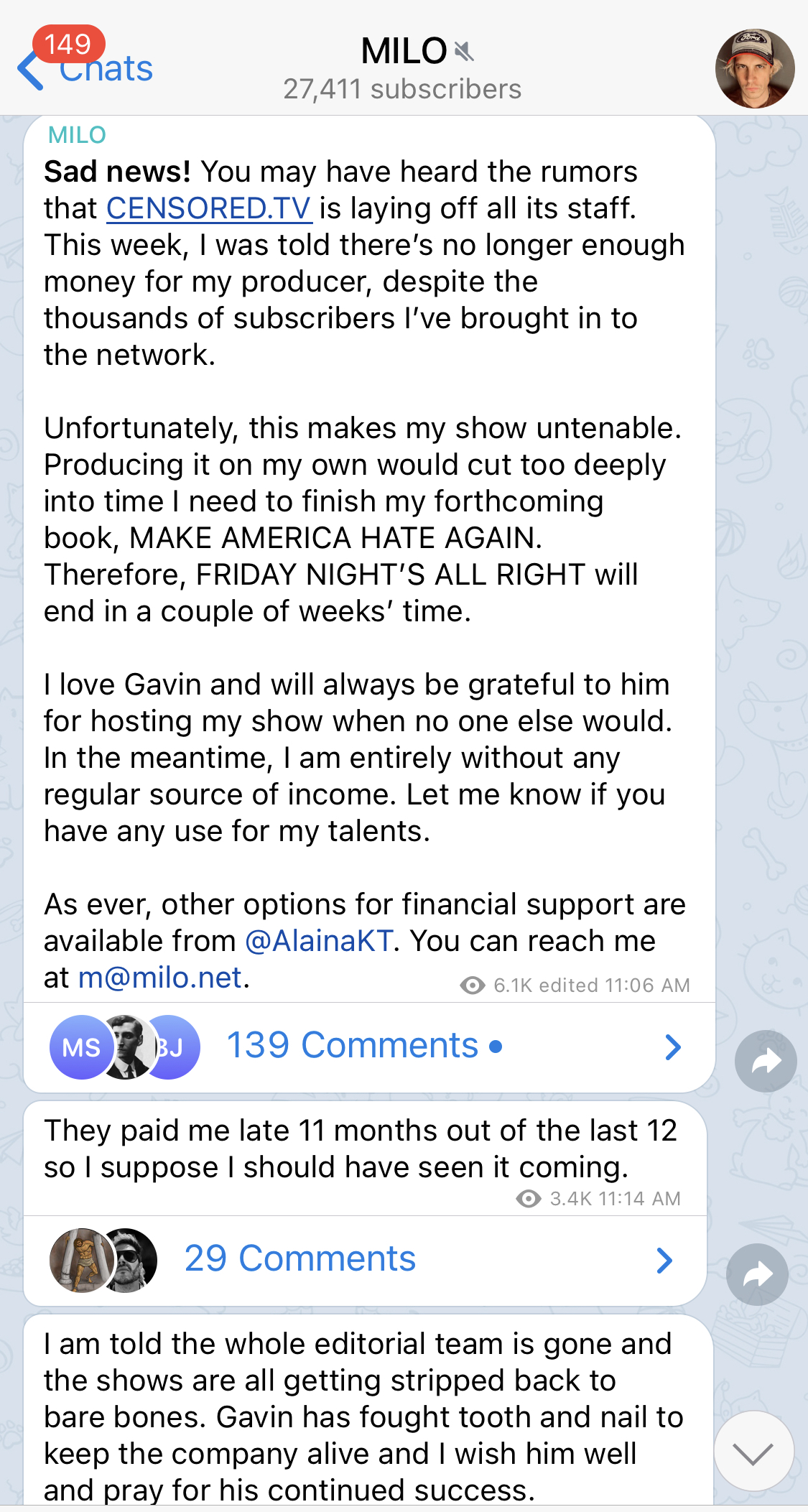
The right-wing media company Censored.TV, launched by Proud Boys founder (and VICE Media co-founder) Gavin McInnes in 2019, is “laying off all its staff,” according to one of its hosts, onetime alt-right superstar Milo Yiannopoulos. For the moment, however, the site remains live. Censored.TV website hosts content posted by various conservative personalities behind a paywall, accessible to subscribers who pay $10 a month.

It remains unclear whether the site will keep trying to produce content without paid staff or will close down. “Sad news! You may have heard the rumors that Censored.TV is laying off all its staff,” Yiannopoulos wrote on Telegram on Wednesday morning. “This week, I was told there’s no longer enough money for my producer, despite the thousands of subscribers I’ve brought into the network. I love Gavin and will always be grateful to him for hosting my show when no one else would. In the meantime, I am entirely without any regular source of income. …They paid me late 11 months out of the last 12, so I suppose I should have seen it coming.”

Yiannopoulos didn’t return Salon’s request for comment.

McInnes’ entire site will reportedly no longer have any production or editorial staff, which would seem to make producing new content problematic. “I am told the whole editorial team is gone, and the shows are all getting stripped back to bare bones,” Yiannopoulos, who now identifies as “ex-gay,” added. “Gavin has fought tooth and nail to keep the company alive, and I wish him well and pray for his continued success.” 

Yiannopoulos hosted a Friday night program on Censored.TV called “Friday Night’s All Right,” which frequently far-right ideology with absurd hijinks, such as inviting white nationalist Nicholas Fuentes on the show to pour alcohol on himself, in an apparent effort to lure subscribers. 

Other “stars” who host programming on the Censored.TV platform include right-wing hoax artist Jacob Wohl, anti-Muslim activist Laura Loomer and the anonymous online troll known as “CopperCab.” Loomer didn’t return Salon’s request for comment on the future of her respective program on the website.

In a Wednesday afternoon interview with Salon, Wohl argued that Yiannopoulos’ claims about the far-right media company lacked nuance and it was only Yiannopoulos’ staff that was laid off due to subpar program ratings. “Censored TV isn’t going anywhere,” Wohl told Salon. “None of the staff, besides the staff that worked on Milo’s show, have been, in fact, laid off or furloughed,” he added. 

Wohl further took problem with Yiannopoulos’ claims that the network didn’t pay out the far-right pundit on time for his work. “I have never had anything show up late from Censored TV,” Wohl, known for his sticky relationship with the truth, further told Salon.

Yet, there is plenty of reason to take Wohl’s claims with a grain of salt, as the duo (Yiannopoulos and Wohl) have become bitter enemies after Yiannopoulos threatened to kill Wohl associate, Jack Burkman’s dog “Jackie Jr.” over an unpaid speaking fee stemming from an appearance made at one of Wohl’s meritless press conferences. 

Late on Wednesday night, in an email to Salon, McInnes wrote, “completely false,” apparently contradicting the claims made by Yiannopoulos.

McInnes started Censored.TV shortly after his sudden departure from Glenn Beck’s The BlazeTV (Blaze Media) in December 2018, which was never clearly explained. “Blaze Media no longer has a relationship with Gavin McInnes, and per company policy, cannot comment on personnel matters,” Beck’s media group tweeted out at the time. 

While the future of McInnes’ media company hangs in the balance, the Proud Boys, the extremist men’s group he founded, has etched its name into history. “Established in the midst of the 2016 presidential election by VICE Media co-founder Gavin McInnes, the Proud Boys are self-described ‘Western chauvinists’ who adamantly deny any connection to the racist ‘alt-right,'” the Southern Poverty Law Center notes. McInnes left the Proud Boys in 2018, around the time the group began to be identified with street violence, and more than two years before it became infamous for numerous members’ involvement in the Capitol riot on Jan. 6. 

COVID-19 may increase chance of erectile dysfunction, studies say

Despite the common sense science around mask-wearing to fight spread of SARS-CoV-2, many right-wingers have rejected public health advice regarding donning a mask in public. Interestingly, at least one study last year suggested that this aversion was related to fear of emasculation.

It is ironic, then, that a growing body of evidence suggests that COVID-19 could damage one’s ability to maintain an erection.

Indeed, two recent scientific papers from different continents had similar conclusions in spotting a connection between erectile dysfunction and COVID-19. 

First, the aptly-named scientific paper “Mask up to keep it up,” which was published by the journal Andrology two months ago. Its authors predicted that there would be a correlation between COVID-19 cases and erectile dysfunction (ED) for several reasons: first, that COVID-19 damages the cardiovascular system and therefore could be linked to blood vessel diseases which result in erectile issues. Second, both ED and COVID-19 also tended to be more severe and more prevalent in men with diabetes, hypertension and obesity.


Want more health and science stories in your inbox? Subscribe to Salon’s weekly newsletter The Vulgar Scientist.


After studying Italian men who had developed SARS-CoV-2 infections, the researchers concluded that “there is preliminary evidence in a real-life population of ED as a risk factor of developing COVID-19 and possibly occurring as a consequence of COVID-19.” The researchers urged, among other things, wearing personal protective equipment like masks.

Now a new study in the “World Journal of Men’s Health” reveals that COVID-19 can remain in penile tissue long after male victims recover from the worst symptoms of their illness. When COVID-19 infections cause a blood vessel dysfunction known as endothelial dysfunction, it can damage the tissues that receive their blood supply from the malfunctioning small vessels. That, in turn, means that the penis may not be able to get erect if it has been infected with COVID-19.

Researchers from the University of Miami Miller School of Medicine say that their study found men who previously did not suffer from erectile dysfunction but developed it severely after their COVID-19 infection.

“This suggests that men who develop COVID-19 infection should be aware that erectile dysfunction could be an adverse effect of the virus, and they should go to a physician if they develop ED symptoms,” study author Ranjith Ramasamy, M.D., associate professor and director of the Miller School’s Reproductive Urology Program, told Eurekalert.

The scientists examined penile tissue from four men who suffer from ED (they were undergoing a prosthesis surgery), with two of those men having previously developed COVID-19 and two of them having no history with the virus. They found COVID-19 and signs of endothelial dysfunction in both of the men who had suffered from COVID-19 but not in those who did not. Based on that, the scientists hypothesize that men with COVID-19 could develop erectile dysfunction due to endothelial dysfunction, and that one reason could be the presence of the SARS-CoV-2 virus in the penile tissue itself. Though a small study, the findings were quite telling and fit with previous predictions.

This is not the only way in which COVID-19 damages multiple organ systems. A study last month revealed that roughly one-third of COVID-19 patients had developed either psychiatric or neurological issues, suggesting that millions of Americans could have mental health issues down the road. COVID-19 has also been linked to blood clots and other cardiovascular issues. The disease can affect the liver and the kidneys. Some COVID-19 patients suffer disabilities like losing the ability to smell, either permanently or temporarily. It can also lead to a range of persistent health issues that may ultimately kill infected individuals long after the initial symptoms wear off.

Greed, ignorance and local news: Journalists fight back against corporate ownership

At their core, our nation’s tragically fractured response to COVID and the insurrection of Jan. 6 are killer weeds sprung from the same root stock — mass ignorance which has gotten traction as the authentic local news business died, only partially replaced by unverified social media posts.

For decades now, America’s local newspapers, radio and TV stations have been gobbled up by a handful of giant corporations whose only allegiance is to their overpaid corporate officers and stockholders from nowhere in particular.

This week we got word that by a vote of 59-4, local community-based journalists who work for Gannett’s newspapers in northern New Jersey — the Record, the Herald News and the Daily Record — have voted to form a union under the NewsGuild-CWA banner.

Gannett is a massive corporation that owns one in five of America’s newspapers, and has reputation of gutting the staffs of the local newspapers it absorbs. This drill of gutting community newspapers has become a pro forma squeeze play by Wall Street and hedge fund pirates.

In their mission statement kicking off their successful union drive, the New Jersey journalists wrote that since 2016, they had seen “more than half of our colleagues lose their jobs, with cuts of over 250 people at The Record, the Daily Record and the NJ Herald.”

The pro-union journalists described how Gannett “unceremoniously laid off include a reporter nearly nine months pregnant and a 30-year-veteran reporter who was forced to take a buyout after missing a single email to opt out of the process.”

“By forming a union, we are taking a stand for respect and dignity, and greater protections against unjust terminations and reductions in force,” the union mission statement said. “We are uniting with NewsGuild members around the country in a movement to save local news and ensure a seat at the table when decisions are made that affect our paper and the news coverage we provide. There is no journalism without journalists.”

Thanks to bipartisan greed for campaign cash and the Beltway revolving door syndrome, Congress and presidents of both parties have blocked and tackled for these corporate interests through deregulation and tax policy.

As a result of draconian cost-cutting in both print and broadcast news outlets, the Pew Research Center reports that from 2008 to 2019 the nation’s local newsroom staffs were cut in half.

Where once there were local reporters covering local town halls and doing the shoe-leather work of visiting local police stations to check out the blotter each day, we too often just have local authorities using Facebook or Twitter to get out their versions of events.

Should it be left entirely to ordinary citizens like 17-year-old Darnella Frazier in Minneapolis, who stood her ground and captured the daylight murder of George Floyd, to hold local law enforcement accountable?

According to the Center for Information, Technology and Public Life at the University of North Carolina, the result of this “extinction level” threat for local newspapers is that “more than one-fourth of the country’s newspapers have disappeared, leaving residents in thousands of communities living in vast news deserts.”

As a result, according to CITAP’s analysis, 200 counties in the U.S. do not have a local newspaper, “nearly 50% of counties only have one newspaper, usually a weekly, and more than 6% of counties have no dedicated news coverage at all.” While digital startups can be valuable in themselves, they are typically “focused on population-dense communities rather than the rural areas most often abandoned by local newspapers.”

There are civic and civil defense consequences, as we saw when thousands of violent protesters — fueled by unvetted but profitable conspiracy theories — nearly upended the peaceful transition of power for the first time in our nation’s history.

“Local news outlets play an important role in informing community members about local government, elections, and other civic events,” CITAP concludes. “They also help to shape community views around common values and beliefs, creating a sense of shared purpose that can be a powerful uniting force within a town or county. Without a source for local news, community members get most of their news from social media, leaving them vulnerable to mis- and disinformation and exacerbating political polarization.

What fills in that “vacuum left by the disappearance of local news sources,” all too often, is “information sources that are incomplete” and “may be misleading or deceptive.”

The Gannett vote to unionize comes less than a month after journalists at the New York Daily News voted 55-3 to join the NewsGuild of New York.

The news was reported in New York City’s “hometown” newspaper in a story around the size of a birth announcement. But the fledging union got its two cents in. “Our newsroom overwhelmingly voted to form this union after more than a year of organizing,” the new union stated.

Tribune Publishing, another corporate behemoth, owns the Daily News.

In a poignant May 5 op-ed entitled “Please buy this newspaper: A Daily News reporter begs a local owner to rescue the tabloid from Alden Global Capital” veteran reporter Larry McShane recounted how Tribune executives had “fired half the newsroom on a single morning in 2018.”

“Tribune now plans to peddle the paper to Alden Global Capital, the notorious hedge fund known for decimating newspapers like the Denver Post before picking the bones for profit,” writes McShane, who is rooting for Baltimore hotel magnate Stewart Bainum to bring together “fellow deep pocketed investors” who can beat Alden’s $630 million offer by a May 21 deadline.

Just two weeks before Daily News journalists took their courageous step, a majority of the 650 New York Times tech workforce also voted to join the NewsGuild, which already represents 1,300 employees from the Times’ editorial and business staff.

Local journalism remains embattled. But the workers hope to save it.

Over 100 Republicans threaten to quit GOP over Trump’s party stranglehold

This week, Sen. Lindsey Graham (R-SC) said that Republicans are just going to have to suck it up that former President Donald Trump is the head of their party.

“You’re just not going to be a leader in the party if you’re anti-Trump…I think it would be a disaster for the Republican Party if we just didn’t acknowledge the fact that Donald Trump’s the most popular person in the party,” Graham said as the reason he opposes Rep. Liz Cheney (R-WY) in GOP House leadership. “The American First agenda is well-respected. If you tried to run him out of the party, he’d take half the party with him.”

Now, over 100 Republicans are proving that they’re just as valuable as Trump is. If Trump could take half of his people and walk away, these Republicans say that they can take the other half.

The New York Times reported Tuesday that officials and former officials released a letter threatening to form a third party as the GOP becomes the Trump Party.

“When in our democratic republic, forces of conspiracy, division, and despotism arise, it is the patriotic duty of citizens to act collectively in defense of liberty and justice,” says the statement that is expected to be released Thursday.

The release, however, will come a day after the House Republican Caucus is set to vote whether or not to remove Cheney.

“This is a first step,” said former Homeland Security official Miles Taylor, who helped organize the effort. Taylor became infamously known as “Anonymous,” for sounding the alarm about Trump from a national security perspective while he was still serving in the government.

“This is us saying that a group of more than 100 prominent Republicans think that the situation has gotten so dire with the Republican Party that it is now time to seriously consider whether an alternative might be the only option,” he told the Times.

Read the full report from the New York Times.

Rachel Maddow explains how Bill Barr’s corruption could end in a Trump indictment

One of the biggest revelations this month was in the court decision by federal Judge Amy Berman Jackson, who ruled that former Attorney General Bill Barr lied to Congress, the court and the country when he claimed that the Justice Department had done an investigation into whether it could charge Donald Trump. Not only was there no investigation or collaboration with deputies and prosecutors, it was Barr’s decision, followed by the falsification of documents to justify it after the fact.

Those documents are slated to become public by Monday if the new Justice Department doesn’t fight the case. That comes as Democrats got former White House Counsel Don McGahn to agree to testify about what he told special counsel Robert Mueller in the Russia investigation that resulted in so many examples of obstruction of justice in part two of Mueller’s report.

Judge Jackson “has already told us what her review of that document and of the Justice Department’s actions around that time indicate about the process that was followed in terms of deciding whether or not Trump would be criminally charged,” said Maddow. “What she’s told us already in her ruling is that the Justice Department didn’t substantively consider potential criminal charges against former President Trump, despite the evidence that was laid out against him.”

Because it wasn’t actually done by Barr, Maddow explained, “now they could” consider potential criminal charges against Trump. When Barr claimed to have done the “consideration,” Trump was the president, and due to the Justice Department Office of Legal Counsel decision, presidents can’t be indicted while in office. Trump isn’t in office anymore. That means if the Justice Department does move forward with redoing the consideration of potential criminal charges and Trump is no longer protected by the OLC decision, he could be indicted for obstruction of justice on at least the ten counts included in the Mueller report.

As the adage goes, it’s never the crime; it’s always the cover-up. In this case, for Trump, it’s both. Due to Barr’s refusal to do a legitimate job in his ongoing attempts to protect Trump, it’s coming back to haunt Trump without the benefit of protection.

See her full explainer below via MSNBC:

“Qanon Queen” image coming off “Trump Train” bus after Buckingham Palace complains

A doctored image of Britain’s Queen Elizabeth II wearing a “Make America Great Again” hat and Qanon brooch will be removed from the artwork on a pro-Trump bus following a rare official complaint from Buckingham Palace Wednesday, Salon has learned.

The vehicle, owned by a Trump supporter named Buddy Hall, was a favorite backdrop at the Florida rally held last week by Reps. Matt Gaetz and Marjorie Taylor Greene in the country’s largest retirement community, The Villages. According to a GoFundMe page for the venture, it was created as an “unofficial tour bus” for Trump’s 2020 reelection campaign.

Hall tells Salon that he had plans to re-wrap the “Trump Train” prior to the Palace’s request —  so the Queen need not worry about her image appearing alongside Pence and Trump any longer.

“Even if the Queen wrote me and said, ‘Please keep my picture on there, I love it,’ we are still taking it off,” Hall said Wednesday night. “It’s been in the designs now for two months now.”

The pro-Trump bus owner also shared with Salon that the new version of the bus will feature a “Wall of Appreciation,” which will feature the likes of Fox News host Sean Hannity, MyPillow CEO Mike Lindell, and Sen. Ted Cruz, among others. 

BuzzFeed News first reported Buckingham Palace’s official request for the image to be removed, with a spokesperson telling the outlet, “representations asking for [the photo’s] removal have been made.”

A number of prominent Republicans have posed for pictures in front of the bus — including Donald Trump, Jr. and his girlfriend, Kimberly Guilfoyle, as well as another picture Hall posted of himself and Greene.

Both Greene and Gaetz’ spokespeople laughed off the Palace’s complaints. According to BuzzFeed News: 

A spokesperson for Greene told BuzzFeed News that they were not affiliated with the bus but did not see any problem with the fact that the Queen’s image was being used. “You do know what a meme is right? Isn’t that what Buzzfeed is all about?”

“We’re sure Her Majesty has greater concerns than motor vehicle traffic in The Villages — Florida, and we were thrilled to see her government introducing voter ID laws as announced in the recent Queen’s Speech,” Gaetz PR spokesperson Harlan Hill told Salon. 

The original image of the Queen was reportedly taken by Getty Images photographer Christopher Furlong in 2011.

Trump’s former defense secretary suddenly backs away from blaming him for Capitol riot

The acting Secretary of Defense under former President Donald Trump, Christopher C. Miller, appeared to walk back his prior stance on Trump’s responsibility for the Capitol riot during a Congressional hearing Wednesday, claiming that he had in fact “reassessed” his position. 

In Miller’s written statement, which was previewed on Tuesday in the Washington Post, he said: “I stand by my prior observation that I personally believe his comments encouraged the protestors that day.” 

Miller first voiced this opinion during a March interview with VICE News, asking, “Would anybody have marched on the Capitol, and tried to overrun the Capitol, without the president’s speech? I think it’s pretty much definitive that wouldn’t have happened.” The former acting defense secretary went so far as to describe Trump’s speech and the riot as “cause-and-effect.”

But during his testimony Miller appeared far more lukewarm, claiming that he now felt differently after reading statements from D.C. Police Chief Robert Contee and receiving more information related to ongoing investigations into the riot. 

When Rep. Stephen Lynch, D-Mass., pressed Miller on whether he stood by his initial remarks, Miller said that Trump’s role “is not the unitary factor at all,” adding that “it seems clear there was an organized conspiracy with assault elements in place.” Lynch then accused Miller of contradicting his prior remarks, which laid the blame at Trump’s feet. Miller fumed at Lynch, calling his accusation “ridiculous.”

Miller also made a point of distinguishing between those who marched on the Capitol and those who violently made their way inside. “There’s a difference between marching on the Capitol and assaulting the Capitol,” Miller explained. “That’s the delineation I’m trying to make, despite the partisan attack that I just was subjected to.”

The former Trump official, however, did not delineate between the two groups during his previous interview with VICE News, and spoke of the two groups interchangeably, as The Washington Post noted in its analysis. 

A number of the participants themselves have admitted the former president’s rhetoric was a major factor in their decision to storm the Capitol — several of those charged in connection with the insurrection even told authorities directly that they felt emboldened by Trump’s comments to invade the Capitol, according to a report in The Daily Beast

Critics were also quick to point out that the idea new information about the extent of an “organized conspiracy” swayed Miller to let Trump off the hook is strange, given that evidence of planning and coordination existed as early as February — well before his interview with VICE News. For instance, the New York Times reported back in February that members of the Proud Boys, a far-right extremist group, executed “a measure of planning” that went “into disrupting the certification of the presidential vote.” Several members of the Oathkeepers, another far-right group, were charged with conspiracy in connection to the Capitol riot as well.

Watch the video of Miller testifying below via Twitter

Union leaders blast CT governor’s plan to call in National Guard over nursing home worker strike

Connecticut Gov. Ned Lamont has called up the state’s National Guard to deal with an impending strike among long-term care facility and nursing home workers — a move that was blasted by union leaders despite the administration’s insistence that the force would only be used to move at-risk residents in case of emergency. 

“I authorize you to immediately call up a sufficient force of members of the armed forces of the state to support as needed the Department of Public Health in protecting the public health and safety in response to any potential work stoppage or strike of workers at long-term care facilities or other congregate settings in the state beginning on or about May 14, 2021,” Lamont, a Democrat, wrote Monday to Major General Francis Evon, Jr., the state’s adjutant general.

Several top advisers to the governor told SEIU District 1199 leaders Tuesday that it had delivered the administration’s “best and final offer” on a contract that would avoid a planned Friday strike by roughly 4,000 workers, according to the Hartford Courant. The $280 million, two-year package would modestly raise both wages and staffing levels at the state’s nursing home facilities, but the union countered on Wednesday by saying that the two sides were “not there yet.”

The SEIU says it wants to raise wages for all employees to at least $20 — a 33 percent hike that remains a far cry from Lamont’s proposal, which would only see workers’ pay bumped to the ballpark of $16.50, according to union President Rob Baril. The employees’ rate currently hovers somewhere between $13 and $15. 

Baril panned the governor’s plan to call in the National Guard, pointing out that the money spent on contingency plans could simply be used to raise wages and invest in services for a workforce depleted by the crushing weight of a pandemic

“As the governor calls on the National Guard to support nursing homes during the strike, we call on him and his team to put those resources to better use by funding the services provided by nursing home workers,” Baril told the Courant. “The danger of the work and the low wages have created an extreme staffing crisis. This is an urgent matter of racial and economic justice.”

As the Connecticut Mirror points out, the union is technically negotiating with nursing home owners — though the Lamont administration plays a role because the state licenses facilities and the vast majority of the industry’s funding is covered through Medicaid. The employees’ previous contract expired in March.

Because the work is “essential,” workers must notify their employers well in advance of their intent to strike. Those facilities are then responsible for hiring replacement workers and having a contingency plan approved by state public health authorities. Connecticut DPH spokesperson David Dearborn told the Mirror that all of the nursing homes’ plans are currently under review — with two thirds already approved and the rest expected to get the green light before Friday.

Lamont’s communications team described the move to activate the National Guard as a last-resort precaution, with personnel only being used to move residents from facilities that fail to line up adequate replacement staffing. 

Still, many online blasted the move as a strike-breaking tactic.

“!!! The Connecticut Governor is calling in the National Guard to break a nursing home strike !!!” the Philadelphia AFL-CIO wrote on Twitter.

“Wow, literally nothing has changed since our grandparents were fighting for Unions…” another user said.

There is still time for both sides to come to an agreement. Connecticut state House speaker Matt Ritter told the Mirror that he remains bullish on the chances of a deal before Friday’s deadline, regardless of both sides’ contentious rhetoric.

“I think they’re close,” he said. “That’s how everybody negotiates now.”

“He made their lives miserable”: How the showrunner of a popular courtroom drama finally got fired

In the spring of 2020, a TV writer of color got a thrilling phone call: They’d been hired to write for season two of “All Rise.” Joining the drama about a Black woman at the heart of the justice system (Judge Lola Carmichael, played by Simone Missick) felt significant during nationwide protests over the murders of George Floyd and other Black people at the hands of police, as well as in the midst of a pandemic that highlighted racial inequities and class disparities. The call was “a shining star in a really dark hour.”

But there was a lot that the writer didn’t know about what happened in the writers room during season one.

“Working on this show was a process of discovery about what the studio knew and what the network knew,” the writer tells me. “And they didn’t tell us — not when we got the job or when we were signing the papers. It was a process of peeling back these layers, this discovery of who we were working for.”

The story of who the “All Rise” writing staff worked for — the turmoil his tenure caused among the staff, Warner Bros.’ response to it, and the showrunner’s own attempts to improve as a leader — is an object lesson at a time when the TV industry is undergoing scrutiny, thanks largely to many years’ worth of #MeToo scandals and the fact that Hollywood is finally beginning to address its history of bias and tokenism. It offers a glimpse into the real-time evolution of television at a key moment in America’s racial history: TV has long thrived on cop and courtroom shows that didn’t just frequently feature criminals of color, they also reflexively portrayed police and the criminal justice system in mostly positive light. For decades, TV has often glorified these institutions in ways that they didn’t deserve, and, even in ambitious narratives, has lent charismatic glamour to cops, lawyers, investigators and judges who broke the rules as they dished out their own brand of “justice.”

The story of “All Rise” also speaks to the industry’s attempt to not just hire voices from marginalized communities, but to its spotty track record when it comes to actually listening to them. And of course, this story says a lot about what is and isn’t considered acceptable workplace behavior in 2021 — and why the industry’s flawed systems may well need major reform.

In late March, not long after the studio learned I was reporting this story, Warner Bros. TV, which produces “All Rise,” dismissed showrunner Greg Spottiswood, affirming in a statement its commitment to “a safe, professional, respectful, and inclusive environment.” CBS, which airs “All Rise,” said in its own statement that the network was “deeply disturbed by the claims against Greg Spottiswood, particularly following previous corrective action, and we fully support the decision by Warner Bros. Television to remove him from the show.” According to the more than a dozen writers and support staffers I spoke to, the showrunner created a troubled workplace that one source said was “toxic,” exhibited troubling behavior around race and gender, and effectively drove away staffers, including a large number of people of color.

Warner Bros. conducted two inquiries into Spottiswood’s leadership, and mandated extensive coaching and training. The studio did not address specific questions about what ultimately led to Spottiswood’s firing. But part of the second investigation, which sources say began in February, a month before he was dismissed, involved a comment he allegedly made during a Zoom meeting last fall.

According to four sources who were present when the remark was made, and two others who heard about it immediately afterward, this is what allegedly occurred: A writer was in the middle of a pitch when executive producer and co-showrunner Denitria “Dee” Harris-Lawrence spoke up to say that she had received an important “All Rise” email. Harris-Lawrence, who is Black, asked a second person on the call, who is also Black, if they had received the email. The second person said they had not. Harris-Lawrence said she would forward the email to the other writer.

“Look at that,” Spottiswood allegedly said, “a monkey passing the ball to another monkey.”

According to one source in the meeting, “No one said anything. I think Dee was still reading the email. I’m not even sure whether she heard it. The other [person] was just completely frozen. And that’s when Greg said, ‘I didn’t mean it like that.'” The meeting continued for at least 30 more minutes, sources say, and no further reference was made to the remark.

That evening or the next day, one source spoke to the second African-American person in the scenario described above, who was enraged, the source said. This individual, according to the source, was also “hurt — angry hurt.”

“Frankly, when that comment happened, and then especially when there was an investigation about it, I thought, OK, so this is the headline grabber, but it doesn’t necessarily tell the whole story of why ‘All Rise’ just didn’t work as a workplace,” says a source who worked on the show. “It’s kind of like getting him on tax evasion.”

NOT A YELLER

Hollywood has been famously sluggish in taking action against problematic bosses, particularly if the person in question is a rainmaker. As a showrunner with no connection to “All Rise” puts it, “Does anyone really believe that Weinstein, Cosby, and far too many others were able to commit decades of criminal acts without the complicity and collusion of numerous high-level executives at agencies, studios, law firms, and other entities? Safe workplaces are either a priority or they are not. And in the current entertainment industry, they are still, decidedly, not.”

Attorney Mariann Wang, who has represented numerous clients bringing harassment and abuse allegations, including one who sued Harvey Weinstein, says of the recent Scott Rudin scandal, “I guarantee you that a lot of people are like, ‘Come on, everyone knows this is the only way you get things done — and so what if he had a temper?’ But they can’t say that publicly.” Wang continues: “The whole industry so plainly feeds abusive personalities. HR is often tacked on at the end as a CYA thing, when it should really be fundamental to the whole endeavor and to figuring out, How do we treat people decently? How do we ensure that people really have a place to go if they don’t feel safe?”

Spottiswood has not been accused of anything remotely like sexual assault. He’s not even a flamboyant screamer or baked-potato-thrower in the mold of Rudin. In fact, his tenure at “All Rise” is a cautionary tale precisely because descriptions of his alleged behavior, attitudes and conduct fall into subtler categories that are probably even more prevalent in the TV industry — and more likely to be enabled.

For this story, I spoke to 30 sources in all — at the show, at the network and at the studio, and I also consulted experts on the industry and experienced TV veterans who addressed the systemic issues the “All Rise” situation illuminates. Ultimately I interviewed a total of 20 people who worked directly with Spottiswood, including six individuals who were willing, despite the potential risk to their careers, to use their names when speaking about their experiences working on the show or with Spottiswood. According to most of the “All Rise” sources I spoke to, Spottiswood created a “hostile” atmosphere in dozens of quiet, confidence-shredding ways, and was regularly insensitive, arrogant and defensive in workplace conversations, including those that would necessarily take place at a show about a Black female judge.

“Greg made the choice to write a television show about people of color, and hired a room full of people of color who could have elevated and added perspective to the story he chose to tell, despite it not being his lived experience,” says Conway Preston, a white writer who worked on the first season. “And instead, he all too often denied their input and made their lives miserable every step of the way.”

“A QUALITY OF LIFE DECISION”

Spottiswood hails from Toronto and had a multi-decade career in Canada, working as an actor, a playwright, a TV writer, and sometimes a showrunner on a string of projects. He broke into American TV in a big way with “All Rise,” partly on the strength of the fact that he brought the project to the table. At a press event in 2019, he said that the original inspiration for the drama came from Steve Bogira’s “Courtroom 302,” a nonfiction book about a year in the life of a busy Chicago courtroom. Spottiswood noted then that, in the process of developing the project with “All Rise” executive producers Michael M. Robin and Leonard Goldstein, he “threw out the white male judge from the book and … created the character of Lola, and we peopled our ensemble with the people of Los Angeles.” 

From the first season, Spottiswood did assemble a team that, as the saying goes, looked like America. Apart from him, there were seven writers and a writers’ assistant on the original season one staff, three quarters of whom were people of color and three of whom were women. (IMDb.com and Wikipedia show that 57 percent of the first season’s episodes were written or co-written by writers of color, and 33 percent were written or co-written by women.)

All eight people on that original roster have since left the show.

In a statement, Warner Bros. said both the studio and Spottiswood felt strongly about having a person of color serve as a co-showrunner and executive producer. Sunil Nayar, who is South Asian, was the first to fill that role, but left, profoundly frustrated, in 2019, and was replaced by Dee Harris-Lawrence.

Shernold Edwards, a Black writer who quit midway through season one, says she had to leave in order to protect her mental health: “It was a quality of life decision. One of the most disturbing parts of it was that I had to make the decision to walk away from a nine-episode extension and the money and the credit that comes with it.”

Preston says that Edwards’s departure was brutal, in part because it came not long after Nayar’s. “Before, everyone was miserable and frustrated, but we had Sunil and Shernold,” he says. “When they left it was really disheartening, because they had given so much of themselves to protect all of us, and to protect the story and the characters. To lose them because they had been treated so poorly, it was just gut-wrenching.” 

According to multiple second-season sources, the show’s sophomore year was a rerun of season one: A mostly new staff consisting mostly of people of color was assembled, and also became disheartened by Spottiswood’s alleged mismanagement. There were additional departures despite the fact that during the COVID-19 pandemic, job insecurity in the unstable entertainment industry reached new heights. “The root of it all is that he’s disrespectful — of people’s appearances, but of their time as well,” says a second-season staffer.

This disrespect bled onto the screen, according to many sources from both seasons, who describe a showrunner so entrenched in his worldview that it was difficult to get him to consistently build responsible storytelling around life experiences that did not match his opinions and expectations as a middle-aged white man from Canada. “It was all so insidious that I think it’s hard to convey the gravity of it to people and how bad it made us all feel,” says a staffer who worked for him. “It was a lot of backhanded stuff and very polite Canadian degradation.”

OFF THE RAILS

Of course not every employee experiences the same workplace in the same way. According to an “All Rise” cast member, the situation in the writers’ room felt “zip codes away,” and the safety precautions arising from the pandemic only made that distance greater. “Oftentimes actors are handled with kid gloves, whereas maybe a first-year writer or something like that doesn’t get that same treatment. I am fully aware people can be two different ways in two different contexts. But I will just say that my interactions with Greg were always extremely positive.” The cast member says that the on-set atmosphere was “nurturing,” and expresses surprise at what’s being said about Spottiswood: “It feels kind of disorienting, and it almost feels like they’re talking about another show in terms of the allegations that have been made.” 

Spottiswood did not respond to most of the questions he was sent about the allegations in this story, and instead issued a statement, which reads in part: “I created ‘All Rise’ with the intent of amplifying the power of a Black female lead along with a diverse cast to share with viewers a new POV on a myriad of important issues that our criminal justice system is currently facing. It was essential to me that I collaborate with a diverse group of talented writers and craftspeople to ensure that ‘All Rise’ was an inclusive and representative environment and that it reflected the city it was set in. I recognize that I was not as successful as I hoped and that my communication style during the creative process sometimes was counterproductive.”

There should be, on and off TV screens, spaces in which all kinds of people can have hard conversations about race, gender and culture, as well as the room to make mistakes as they reckon with complex subjects with fraught histories. And as the “All Rise” cast member notes, “This is truly, genuinely the most diverse workplace that any of us [on set] have worked in.”

But among those cranking out scripts, what one source describes as Spottiswood’s poor management and “petulance” frequently sent the show off the rails during both seasons: “The intersection of a constant managerial shitstorm, plus a lack of perception around key issues, meant that there was often little or no time for discussions that should have occurred.” 

There is, of course, that Zoom discussion those who were present are unlikely to forget. On Nov. 9 of last year, Spottiswood is said to have made the “monkey” remark. Not everyone associated with “All Rise” was aware of it: Executive producers Robin and Goldstein, sources familiar with the situation say, did not learn of Spottiswood’s Zoom comment until I first asked them about it in March, and characterized their reactions as “horrified, shocked and appalled.”

But according to a source who was on the call, it wasn’t just the remark that was offensive and unsettling, but also the utter failure by Spottiswood to address it or apologize for it in any way — during the call, that day, or at any other time. “It was just not acknowledged, which in and of itself was jarring, aside from the words used,” this source said. “I don’t think he meant to employ the weight of that term, but he absolutely did use those words — and then no one said anything. And that to me says more about the work culture than the actual use of the term. Intention doesn’t dictate harm. You have to be able to show some level of accountability, especially in a workplace scenario where you’re in charge. You have to realize the gravity of the situation and make amends for the harm done.” 

According to three sources, “All Rise” staffers never seriously considered going to Warner Bros. Human Resources about the remark. Two of them say they worried about possible retaliation; all three say they were aware of the prolonged “climate survey” that the studio did with regard to Spottiswood’s conduct during the first season. All were aware that, for the staff, it had yielded nothing but frustration. One source says the consensus was: “Don’t bother.”

IN THE BEGINNING

Shernold Edwards first encountered Spottiswood in the mid-aughts when she was a Canadian TV executive. A few years later they crossed paths again when they were briefly on the same writing staff. That experience set off a few alarm bells, she says, but she more or less brushed them off. However, the world of Canadian scripted TV is a fairly small one, and Edwards says people she trusted told her they believed Spottiswood was sexist. Two other Canadian sources who worked with Spottiswood made similar allegations to me (one noted that she was twice offered the chance to work with him again but “declined without hesitation”). But Bernard Zukerman, a producer who hired him to run two Canadian dramas, says, “I didn’t find that at all, and I would not have stood for it.” He adds, “I liked working with Greg. He cares. He was passionate. He was responsible.”

In any case, Edwards was wary when Spottiswood approached her about working on “All Rise.” “I tried everything not to take the job, I really did,” she says.

Despite her misgivings, she watched the drama’s pilot and met with Spottiswood and executive producer Leonard Goldstein. When she factored in the show’s premise and a lead performance by Simone Missick that she greatly admired, Edwards’s resolve to steer clear of her former colleague began to crumble. “I wondered, Is it possible to do good work here? Maybe it’s possible,” she says. “And I thought maybe I knew enough about him that I could weather it for at least a season. Within two weeks I was like, I’ve made a terrible mistake. But I realized I have these younger writers who I see are starting to suffer. I was like, OK, my job here is to survive and to help them survive.”

Sunil Nayar says that, initially, he was excited to not just try to do good work, but also to share leadership of a team that would explore social issues and criminal justice. “The opportunity of a show like that is huge, especially when you think about what’s happened in the last year and a half,” he tells me. “And when I think back on that first season, I think, Boy, the right staff was there.”

“All Rise” received generally positive reviews and was successful enough to get a second season. But many sources from both seasons say that an unusual amount of chaos hampered the generation, evolution, and completion of scripts, citing Spottiswood as the cause. “In terms of organization, it was the absolute worst,” says one source. Another staffer puts it this way: “He really enjoyed holding forth, and he had weaponized the art of monologuing.” A second-season staffer concurs: “Greg needed an audience. His writers were there to be his audience.”

The end result was a show that sources say frequently fell behind. While some disorganization and difficulties are to be expected in a show’s first season — especially from a showrunner new to American TV — the same chaotic dominoes began to fall early in Season 2, according to three sources, one of whom says “we worked 24/7.” When “prep,” or pre-production, would begin on a given episode, sources say, it wasn’t unusual for production staffers to have to rely on early documents like story areas or outlines instead of scripts, a situation that many TV professionals would agree is less than ideal.

“By the time season two rolled around and WB and CBS were getting the outlines when they got them and getting the scripts when they got them, they had to know it was completely dysfunctional and poorly run,” says a source.

RED FLAGS

One “All Rise” writer, a man of color, says that — despite welcoming complicated conversations about race, representation, and gender — he was frustrated by the constant expectation that he, someone with less power and status than Spottiswood, would be available to do the heavy emotional and educational labor necessary to prop his boss up. “It’s a puzzle that I don’t ever want to be on the receiving end of again, because, yes, people should be able to make mistakes, to learn and improve,” he says. “But it’s the people downhill that are constantly asked to extend their good faith, and usually at a moment of acute crisis that affects them.”

Industry executives often claim to want inclusive staffs and respectful workplaces — and some no doubt actually do want to create those kinds of professional environments. But based on hundreds (thousands?) of conversations I’ve had over the past several years with people working at talent agencies, at production companies and on dozens of films and TV shows, it’s still common for those on the front lines to be ground down by a frequently disrespectful and even abusive system that is all too often inclined to indulge in surface change — if that. In her early days on “All Rise,” one source recalls feeling filled with a sense of possibility when she looked at the photos of the show’s cast — five of whom are people of color — hanging over the whiteboard in the writers’ room.

“It felt like the possibilities were endless in terms of the rich, culturally inclusive stories that we could tell, but the way everything was run by Greg — it was the polar opposite of that,” said this source, a woman of color. “It almost felt like an illusion — the illusion of inclusivity.”

Sources from both seasons agree that Spottiswood sometimes agreed to remove or alter story elements they found problematic or offensive. But the sheer number of times they say that they had to raise red flags became exhausting. During one lengthy conversation about a proposed storyline in which a character on the show — a Black bailiff — was stopped by the police, sources recall Spottiswood wanting the character to be dressed like a suspect the police were looking for. Multiple sources remember explaining to him, at length, that American cops randomly stop men of color, especially Black men, all the time. Sources say Spottiswood found that hard to believe.

At one stage the episode in question contained a scene in which the character spoke about the incident with Lola, the series’ lead. A man of color at “All Rise” says that he was consulted about how that conversation might go, and that his input and that of other staffers were reflected on the page. But not long after that, Spottiswood, according to two sources, removed the dialogue from the scene. “Everybody’s like, ‘Where’d that really important conversation between those two Black characters go?'” says a source. “He said, ‘I took it out because they didn’t feel real. That’s not how those two characters would talk to each other in that moment.'”

James Rogers III, a season one writers’ assistant, says Spottiswood took details from his life without consulting him or getting the full context of that personal information — and yet also relied on him to rubber-stamp ideas about the African American community. “Yeah, I was the stand-in for the Black men in America,” he says. “I think he looked at me as a Black person and thought that I could supply authenticity. But he went about it backwards. He went down the road and then looked in the rearview and said, ‘Are we still going in the right direction?’ As opposed to asking me for directions.”  

As Shernold Edwards feared before she took the “All Rise” job, Spottiswood’s treatment of both real and fictional women was, in her view, problematic. Edwards recalls arriving at the writers room one day in the middle of 2019. “Everybody was shook, and it was uncomfortable,” she says. “I saw this junior female writer, and she was up at the board, and she was pitching her heart out. And Greg was just tearing her apart, tearing everything she said apart.” Asked if he was present for the meeting in question, another staffer replies, “I do not know if I was present for the exact moment Shernold is describing, because it happened so often.”

Three female “All Rise” staffers say that, in their opinions, Spottiswood consistently favored the men on staff when it came to various work matters. “I felt he created an unhealthy environment for women, where female writers were treated like second-class citizens,” says one. According to Conway Preston, “[Spottiswood] would pitch problematic story lines for our female characters — who make up five of our seven leads — and when the female writers took issue with that, he would get very defensive. He would insist that it wasn’t a problem.”

In season one, sources say, multiple staffers — many of them women — raised concerns about how domestic violence was depicted on the show. In particular, writers counseled that it would be misleading to portray domestic violence as a one-time event, rather than a complex and often ongoing pattern. But for the majority of season one, they say Spottiswood wouldn’t budge from his position that, for one of the show’s characters, domestic violence was a one-off event. “We never were able to convince him that when you do things like that, it’s irresponsible,” says a source.

“GETTING HANDED LIFELINES”

Midway through season one, Sunil Nayar, the co-showrunner, says he increasingly felt that he wasn’t being allowed to do the job he’d been hired to do. Spottiswood, he says, turned to executive producers Robin and Goldstein instead. In an email to a Warner Bros. HR person in September 2019 — which I have reviewed — Nayar noted that his “brownness was of paramount import when cameras and reporters are around. But when they’re not present, I’ve never experienced anything like the disrespect I’ve been shown on this show.” (Sources familiar with the situation say that, as non-writing executive producers, Robin and Goldstein were not in the writers’ room, and added that they were not aware of any complaints, frustrations or issues Nayar had at that time.)

Later that fall, sources say, a female writer came onto the radar of Warner Bros. HR representatives during a meeting with some “All Rise” staffers. In this meeting, according to a knowledgeable source, an outside adviser brought in by HR told the writer that women in the workplace need to control their anger in order to be heard, and an HR person affirmed that statement. During that meeting, according to this source, an HR representative also pointed out that writing jobs in the entertainment industry are very hard to get. 

Around that time, in the fall of 2019, in a larger meeting with more “All Rise” staff and emissaries from Warner Bros. HR, one source recalls a similarly ominous vibe. He says he left the meeting feeling that what HR was trying to communicate was this: “If you want to keep making noise, we are a conglomerate, and we’ll bury you.”

Some of the turmoil in the “All Rise” writers’ room went public via a New York Times story that came out in August 2020. At that time, Warner Bros. said its inquiry had determined that there were “areas for improvement,” but that “the findings did not reveal conduct that would warrant removing series creator Greg Spottiswood from the executive producer role.”

To be clear, Warner Bros.’ response to the situation at “All Rise” is not uncommon in the industry. “This year the studio I work for made a concerted effort to educate [executive producers] and showrunners on how to be more accepting and empowering of voices of color within their ranks,” one TV veteran unconnected to “All Rise” tells me. “The webinars were actually quite thorough. As a person of color, I was really impressed. However, when it comes to outlining what is and is not acceptable in how teams are managed on a daily basis is rarely ever discussed. As long as the work is getting done and no one is complaining through official channels, no one checks up to see how the sausage is getting made. It’s only when an issue becomes a liability to the studio that they become interested. I think that studios are placing a lot of responsibility in the hands of writers and support staff to report abuse if and when they experience or witness it.”

One lower-level staffer who worked at “All Rise” says he experienced a great deal of frustration even when he did try to send up flares.

“I thought, if I’m not doing well at my job, I get fired. He was not doing well at his job and was getting handed lifelines, you know?” this source recalls of “All Rise”‘s difficult first season and the HR “climate survey” that frequently intersected with it. “Everyone was like, ‘OK, the people who could do something are siding with him.’ And no matter what we said, HR would just say, ‘That’s not actionable.’ That was the word they kept using. That’s when people began to say, ‘I’m going to leave.'”

I sent Warner Bros. TV a detailed list of questions about the allegations in this story. The studio did not address many of the specifics, but sent a statement, which reads in part: “Warner Bros. Television is committed to open communication with our cast, staff, and crew to ensure a safe, respectful, and inclusive work environment. We are saddened to learn that any colleague may have expressed unease about discussing their concerns with the studio. We always want all team members to feel supported, encouraged, and empowered to report issues as soon as they arise, so that we can review or investigate, and implement any necessary changes in a timely fashion.”  

THE MACHETE EPISODE

By November of 2019, Shernold Edwards says that she was just about ready to follow Sunil Nayar out the door. That month Edwards attended a table read of a script written by Greg Nelson, a white writer on staff and a friend of Spottiswood’s. According to multiple “All Rise” writers, some preliminary versions of the script, which sources say Spottiswood worked on with Nelson, mentioned a crime committed with a machete by members of a Latinx gang. At one point in what Nelson says was a “bootleg” draft of the script, the murder victim’s heart was cut out with a machete; two other sources say that in a later draft of the script, the mention of the heart was dropped, but a character says the gang “took turns” with a machete to kill a man.

Though the nature of the crime was altered again — it apparently became a gun homicide by the time of the table read — Edwards recalls she still found a number of aspects of the script problematic, and says lines that were in the script at a fairly late stage, in which a character called the gang members “the worst of the worst” and “vicious psychopaths,” were, in her view, “inflammatory.” For his part, Nelson notes that “in response to valuable feedback,” various aspects of the episode were made “more nuanced and rounded”: It was, in his opinion,”the normal process of writing TV — making changes as you rewrite, in response to notes, feedback and input.”

Before some changes were made, but immediately after that table read, a Latinx member of the cast came to Edwards in tears, saying she could not appear in the episode as written. Edwards outlined what occurred at the table read and her own concerns in an email to Spottiswood, Robin, and Goldstein. In the email, which I have reviewed, she also recounted a conversation that occurred afterward: “I was asked by the writer of an episode…why a character’s race or ethnicity should inform that character’s decisions and behavior. This is not the first time I’ve fielded that question this season. The fact that I’m still being asked that question tells me that there are people on the show who are incapable of writing for people of color and should not be writing for people of color. The fundamental problem with the episode is that it was [crafted] in a vacuum by two Canadian white men without consulting the one remaining Latinx writer on staff, or either of the two black writers on staff…. As written, episode 113 is racist, and offensive.” 

Not long after she sent that email, Edwards says, executive producers Robin and Goldstein met with her. According to Edwards, at the meeting they said they were “handling” the situation. “I said, ‘I haven’t seen any evidence of that,'” she says. “I got angry. I told them, ‘Now I’m angry, and I’m upset that I’m angry. I’m a Black woman who’s been put on the spot in this country, and I don’t get to be angry.'”

Sources familiar with the situation confirm that both executive producers met with Edwards near the “All Rise” set. These sources add that, according to their recollections, Spottiswood immediately did a rewrite of the script that addressed the actress’ concerns about potentially offensive material. 

That week, Edwards says, she heard that Spottiswood met with the staff when she was not present and acknowledged that he’d made mistakes. But according to colleagues Edwards says she talked to after that meeting, the showrunner also allegedly said he too was “a victim” of the latest mess. “When the writers told me that — it was in that moment I decided to quit,” she says.

Another woman of color says that she asked to be released from her contract in the middle of season one and told Spottiswood she was leaving for another writing job. But she says that she would have left even without another gig because of the atmosphere at the show. A couple days before she left, she says, Spottiswood came into her office, closed the door, and sat on her couch. She recalls that he then launched into a long anecdote about a Warner Bros. actor on a different show who had asked out of her contract and was “blacklisted,” failing to work for many years after that.

“I felt I knew why Greg was telling me this story — I felt like it was a threat,” she says. She recalls that she reacted calmly, and “once Greg saw he wasn’t going to get a rise out of me, he stood up, he smirked, and he said, ‘You should know that studios don’t like to set precedents.’ And then he turned and walked out of the room.”

“I GOT REALLY ANGRY”

According to Warner Bros., one outcome of the season one “climate survey” was that Spottiswood was given “mandatory one-on-one training and executive coaching on leadership and management.” Those sessions occurred in the first season and continued into the second.

“I came to realize that if you haven’t walked in someone else’s shoes, you cannot fully understand their feelings or perspective despite your intention of being their ally,” Spottiswood said in his statement. “Therefore, over the course of our two seasons, we invited the ACLU, Peace Over Violence, NAACP, Color of Change, Black Lives Matter, a restorative justice organization, and the Harvard Institute of Law to advise our writers room. We also had three full-time legal experts discussing and debating legal and ethical issues around almost every case.”

Sources say regardless of the various attempts at addressing the problems, the overall working environment at “All Rise” did not appreciably change. One second-season source recalls having multiple conversations with a fellow “All Rise” writer of color who wanted to leave the industry entirely because this person could not “deal with these Greg Spottiswoods.” The source told their colleague, “He is not a representation of how it should be. Do not let this man detour your career.”  

Another season two source says that Spottiswood frequently made unsettling, demoralizing comments about her appearance. During a meeting with the writing staff, she says he told her that she looked like a puppet and then “started imitating me and making really weird sounds and laughing. I was really, really uncomfortable. I did not laugh. I got really angry. Maybe these comments he makes to me, they were supposed to be jokes? Or an attempt to make a friend? But I’m like, How in the world would you think this is nice? No, no, not at all.”

One source who witnessed the puppet incident and a series of other remarks Spottiswood allegedly directed at that woman said, “I could see a change in her — a kind of shutting down.” The woman who was the target of the comments says she began putting on sweatshirts for work meetings and stopped wearing makeup: “I do not make any effort to look nice. I don’t want attention from him of any kind.”

LINGERING ISSUES

While “All Rise” is made by Warner Bros, it airs on CBS, which has a fraught history around workplace issues. After an array of stories detailing alleged sexual assault, harassment, and/or  intimidation, CBS CEO Les Moonves left the company in 2018, though he has denied any and all wrongdoing. In the past several years, CBS News personnel, as well as various executives and showrunners — among them Brad KernBob KushellJohn GlennPeter Lenkov, and, most recently, Jim Reynolds — have left in the wake of coverage about their own alleged conduct and treatment of employees.

Even so, old attitudes linger in some quarters. “There’s always an excuse for why people leave, for why they complain — they’re always the problem,” says a source at CBS. “They push back against any other narrative, which definitely helps drive people away. And then the executives congratulate themselves on how inclusive they are, and how there are no real issues.”  

Last year, CBS touted its new targets for representation of Black, Indigenous, and people of color in its writers rooms and in its development process. The writing staff of “All Rise,” in both seasons, exceeded the network’s newly stated goal of 40% BIPOC in its writers’ rooms. But, at any show or on any film set, things can go deeply awry when an inclusive staff is hired, but many (or all) of those in charge are white and not necessarily up to the task of making creative and managerial decisions with consistent fairness, equity and respect — and then are insulated from the consequences. Multiple sources pointed out that Spottiswood appeared to be surrounded by several layers of protection and empathy, things that were not consistently available — or available at all — to a number of those trying to raise concerns about his management and behavior.

“It felt like they thought everyone was expendable. The attitude, in so many ways, came off as, ‘We could just bring in another person of color who could tolerate more.’ It felt like, ‘If he didn’t say the N-word, if he didn’t do this or that, there’s nothing we can do,'” says a person of color who worked at “All Rise.” “And I was like, well, maybe just change your metric about how a toxic work environment is formed and perpetuated. It’s not just someone sexually harassing you or calling you some derogatory term — it’s all of it, everything that builds up to you feeling like you don’t belong somewhere.”

As far as what, if any, oversight CBS exercises over programs that originate from outside studios, the network appears to acknowledge that there is still work to be done. “It is a top priority for our network to work even more diligently with our production partners to ensure strong, collaborative creative cultures that align with our values for a respectful work environment that inspires everyone’s best work,” it said in its statement.

As for Spottiswood himself, he wrote, “I felt I was learning and improving, and while I’m devastated that I will not be allowed to continue with ‘All Rise,’ I hope the show continues to spread powerful messages. I’m extremely proud of the episodes that were produced during my time, and I wish everyone who remains the very best success in continuing to tell these important stories. I never meant to offend anyone and to those I have, I’m deeply sorry.”

REAL CHANGE

When Shernold Edwards quit “All Rise” at the tail end of 2019, she met with Peter Roth, then president and chief content officer of Warner Bros. Television Group, and Susan Rovner, then Warner Bros. Television’s president. Edwards says she outlined a litany of things that had gone wrong at the drama, and her notes on the meeting, which I have reviewed, state that both executives acknowledged that Spottiswood could be “condescending” and “arrogant.” “They asked if I thought his behavior was due to conscious or unconscious bias,” says Edwards. “I said, ‘I don’t know.’ I also said, ‘It doesn’t matter anymore because this is the second round of HR. We, as a staff, went to HR months ago, and we were promised that things would change, but they only got worse.'” (Through a representative, Rovner acknowledged the meeting took place, but did not recall the specifics of what was said. In her response, Rovner’s spokesperson added that the executive thought “it was a positive meeting during which she and Peter tried to convince Shernold to stay on the show.”)

The executive turnover that has affected much of the industry in recent years has also occurred at both of the companies responsible for “All Rise.” The current president and CEO of CBS Entertainment Group is George Cheeks, a Black man. And last fall Channing Dungey, a Black woman, was named chairman of the Warner Bros. Television Group. Between rising generations of writers, actors, crew members and assistants who are no longer willing to put up with the destructive old ways, a cadre of established creators and producers tired of a system that too often rewards abuse and toxicity, and a new generation taking the reins at certain media conglomerates, perhaps there is reason to hope that real change is possible. As attorney Wang puts it, “It’s true of all of the police departments when I sue them, or any large institution—it always comes from the top. If the top people really care about this and treat their underlings decently, guess what? It turns out that the head of HR also cares about it.”

Wherever they work, sources I’ve spoken to for this story and other pieces are vociferous about the need for a massive overhaul of the industry’s attitudes, as well as its HR processes. As the advocacy group Pay Up Hollywood says, “As far as all the stories that have come out about not just Scott Rudin but other abusers too — it’s as if the top layers of the industry are going through mental gymnastics right now. Because for decades, it was enough to just slander the victims to the press to get off scot-free. They’re not used to other people holding them accountable.”

One showrunner says that if things do not change—and disrespect, retribution, biases of all kinds and abuse continue to be commonplace—the “best” that can be hoped for is a scenario that sounds a lot like the dysfunctional system currently in place: “The impression I’ve gotten from a recent interaction with a studio was that they would continue to overlook abuses by the big earners, but they were being hyper-vigilant about not letting any new toxic people onboard.” This veteran adds that he recently participated in an HR investigation involving a former colleague. “I answered their questions truthfully, corroborating allegations of sexual discrimination and a retaliatory firing,” this source recalls. “This [executive producer] was not asked back for the following season — but I later found out he went on to staff on another show at the exact same studio, and that they bought a pilot from him this past season.”

To avoid exactly this kind of merry-go-round, in which consequences are transitory or non-existent, this showrunner advocates for some specific reforms: “We need an independent, industry-wide, third-party reporting system with data escrow, which would flag not only the most severe abusers but would also keep records on persistent lower-level abusers and could share this information across all employers. Unions across the entertainment industry should do more to raise issues of harassment, discrimination, and abuse in the workplace to demand safer, better conditions for all their members. But ultimately, the responsibility lies with the studios. Nothing will get better until they stop covering up the problem and start facing it honestly, for the good of both their workers and their shareholders.”

A second showrunner underscores the difficulty of bringing complaints to in-house HR reps:  “It’s hard to feel safe reporting to the very people who are trying to protect the studio’s image.” 

Pay Up Hollywood also favors an industry-wide, independent reporting system, as well independent investigations that the studios don’t control, and the dissolution of all NDAs that protect studios, abusers and even HR departments. “What so many people see, time and again, is someone who is repeatedly hired and rises through the ranks, without anyone ever talking about their patterns of unacceptable behavior, abuse and toxicity,” Pay Up Hollywood says. “With this system, there’s a paper trail that is created for the benefit of the abused, rather than for the benefit of the studio. If we could put these systems into place, it would be incredibly effective — there’s the potential of having a collective going up against an abuser, rather than individual voices. There’s protection in a group, both from the industry and from the abuser. And there’s power in that.”

FALL AND RISE

Warner Bros. has already made one concrete change at “All Rise,” which wrapped production of its second season on April 23: It made Dee Harris-Lawrence the sole showrunner. “I like Dee’s energy a lot, and she’s a very capable showrunner,” says the cast member quoted earlier. “I think the show’s in excellent hands with her. As much as Greg might have wanted to be able to pull off this show—and I think his heart was genuinely in the right place in wanting to do that—he was not the right guy for the job, for very obvious reasons. So to have Dee in that position, it just feels like a much more natural fit.”

In its statement, Warner Bros. says that the studio has “multiple resources, tools, and guidance on best practices for diversity, equity, and inclusion” that are available to all showrunners and productions; these programs include “the industry’s only multi-week course for showrunners focused on developing an equity mindset and ensuring inclusivity.”

Programs, courses and new practices can help when it comes to the many industry-wide changes that are still needed (and, as sources noted in this 2020 story on the fall of a powerful showrunner, appropriate management training for people in that position is still not prioritized or even provided by most media conglomerates). But when many gatekeepers and decision-makers within multiple powerful entities share similar backgrounds and privileged worldviews, don’t appear to think work atmospheres and dynamics like the ones outlined above are “that bad,” and often seem convinced that a few hours of executive coaching can fix deeply rooted issues like racism, toxicity, abusive narcissism and misogyny, it’s difficult to imagine how much will truly change in Hollywood, unless individuals, guilds and other formal and informal coalitions pushing for better working conditions unite to make it change.

I have written stories like this for years now, and, while I’m continually humbled and impressed by the courage of those who come forward, reporting these pieces often feels like being trapped inside a depressing version of “Groundhog Day”: Over and over, similar demoralizing, vindictive and abusive dynamics are described to me (and other reporters), powerful companies continue to wait until dozens of people have endured far too much professional and personal damage and stress before anything is done (if anything is done), and all too often, those same companies, in their statements and attitudes, appear to believe that everything is fine now that they’ve fired That One Problem Person. (Of course, if you have been around the industry for more than 10 minutes, you know that at every network, at every studio, at every big — or medium or small — media conglomerate or production, there is usually more than One Problem Person.)

As one TV veteran noted earlier, some individuals who are problematic (to say the least) are protected and enabled because they’re seen as the sources of large amounts of actual or potential revenue or of choice work opportunities. But Greg Spottiswood was largely unknown to the American television industry when “All Rise” came along — and he remained in charge for almost two years, despite the staff’s frequent interactions with HR, despite high turnover and despite negative press coverage. In my decades of reporting on the industry, the interlocking, multi-layered buffers he appeared to benefit from are not a luxury I’ve routinely seen extended toward humane, thoughtful, kind and able industry veterans, especially those from marginalized groups (who, all too often, don’t even get a shot at the top showrunner or executive jobs).

Before Spottiswood was fired, I asked many sources why they thought that he still had his job. One theory comes from Edwards, though it was echoed by others: “Greg makes a show that is very palatable for CBS and its audience, because it’s representation without authenticity. So they can look at Black and brown folks, but they don’t have to hear about our real experiences.”

And then there’s the perception that, among established people in the entertainment industry,  a certain blithe arrogance isn’t uncommon. As one former “All Rise” writer puts it, “When it comes to the studio or the network, part of all this has to be, ‘We don’t want to admit we bet on the profoundly wrong horse.'”

Chrissy Teigen apologizes for cyberbullying teen as Candace Owens pushes for Trump’s Twitter return

In 2011, Courtney Stodden made headlines when they married 50-year-old “Green Mile” actor Doug Hutchison. Stodden was 16 at the time — young enough that their mother, Krista, had to sign a document giving the couple permission to wed — but was overwhelmingly treated by the tabloid media as a punchline, instead of a child who had been groomed. 

Stodden, whom many likened to a young Anna Nicole Smith, was simultaneously derided and oversexualized for their appearance and mannerisms (including on a particularly disgusting episode of Dr. Drew Pinskey’s show “Lifechangers” during which he performed an ultrasound on their breasts to confirm they were real). 

In a recent interview with The Daily Beast, Stodden alleges that some celebrities, including model and television host Chrissy Teigen, followed suit.

Stodden, who recently identified themself as non-binary, alleged that Teigen both publicly and privately encouraged them to kill themselves. 

“[Chrissy] wouldn’t just publicly tweet about wanting me to take ‘a dirt nap’ but would privately DM me and tell me to kill myself,” Stodden said. “Things like, ‘I can’t wait for you to die.'” 

Following the publication of Stodden’s interview on May 10, Twitter users uncovered several other since-deleted public tweets allegedly sent by Teigen to the then-minor. They include messages like, “@courtneystodden i hate you,” “go. to sleep. forever,” and, “My Friday fantasy: you. dirt nap. mmmmmm baby.” 

Teigen did not address any of the specific tweets or their content, but on Wednesday afternoon, she did offer an apology via Twitter. 

“Not a lot of people are lucky enough to be held accountable for all their past bulls**t in front of the entire world,” Teigen wrote. “I’m mortified and sad at who I used to be. I was an insecure, attention seeking troll. I am ashamed and completely embarrassed at my behavior but that . . . is nothing compared to how I made Courtney feel.” 

She continued: “I have tried to connect with Courtney privately but since I publicly fueled all this, I want to also publicly apologize. I’m so sorry, Courtney. I hope you can heal now knowing how deeply sorry I am.”

However, saying sorry came a little late for some people observing. During the time between Stoddard’s interview and Teigen’s apology, a number of conservatives — led by “Daily Wire” commentator Candace Owens — used the uncovering of Teigen’s past tweets as an opportunity to petition for former president Donald Trump’s return to Twitter. 

It’s a weird turn, but not a totally unexpected one. Teigen publicly relished opportunities to get under the former president’s skin. She and her husband, singer John Legend, were outspoken critics of Trump  who, at one point, memorably tweeted about her being Legend’s “filthy mouthed wife.” 

After being name-checked by Trump, Teigen eventually found herself as the target of Trump-supporting QAnon conspiracy theorists who baselessly accused her and Legend of being pedophiles.

It makes sense, in turn, that conservatives would leap at the opportunity to put her down — even if potentially deservedly — in order to build Trump up. 

“Donald Trump was censored off the internet for writing nothing even remotely violent,” Owens tweeted on Tuesday. “Chrissy Teigen told a then-16-year-old to commit suicide, and that she couldn’t wait for her to die and is allowed to keep all of her accounts. Disgusting.” 

It’s a disingenuous sentiment. Trump frequently used Twitter as a testing ground for racist and xenophobic statements, as well as a platform to baselessly decry the outcome of the 2020 election. When combined with a Jan. 6 speech in which he told attendees of a joint session of Congress formalizing Joe Biden’s electoral victory,  “You will never take back our country with weakness,” Trump’s public messaging — both online and in-person — directly incited the Capitol insurrection. 

Twitter permanently banned Trump on Jan. 8 after Trump tweeted, “The 75,000,000 great American Patriots who voted for me, AMERICA FIRST, and MAKE AMERICA GREAT AGAIN, will have a GIANT VOICE long into the future. They will not be disrespected or treated unfairly in any way, shape or form!!!” and then “To all of those who have asked, I will not be going to the Inauguration on January 20th.”

In the face of plans for future armed attacks at the Capitol, Twitter officials stated, “Our determination is that the two Tweets above are likely to inspire others to replicate the violent acts that took place on January 6, 2021, and that there are multiple indicators that they are being received and understood as encouragement to do so.” 

Teigen herself took a short, though heavily publicized, break from Twitter in mid-March. She cited “abuse and hate” on the platform as the reasoning (and Qanon members claimed her brief departure as a victory). 

Stodden responded to news of Teigen’s social media break at the time, tweeting, “What a shame @chrissyteigen is leaving Twitter. it’s too ‘negative’ for herrrrrr #chrissyteigen #bully.” 


Antarctic ice melt poised to raise sea levels around the world — but it’s not too late to stop it

The popular perception of Antarctica is of a frigid continent, snowy and desolate in all directions, perhaps broken up by the sight of a distinguished line of waddling penguins — a place so devoid of living things that hardly seems like it would be vitally important to the preservation of life on this planet.

Yet the opposite is true; indeed, there is a vital relationship between Antarctica and life on Earth. The Antarctic ice sheet is one of two polar ice caps on the planet, and covers roughly 98 percent of the continent. If the Antarctic ice sheet begins to melt — say, because of greenhouse gasses being trapped in our atmosphere and causing global warming — it will cause our sea levels to rise. That would be devastating for anyone, human or animal, living on or near a coast.

Observation has borne out that large sections of the Antarctic ice sheet are melting. Provided that this continues apace, sea levels will rise, our coastal cities will be flooded, roughly 600 million people will be displaced and the global economy will collapse.

Now, a shocking new report in the respected scientific journal “Nature” provides more specific information about the exact nature of the threat of Antarctic ice melt. The report states that if greenhouse gases like carbon dioxide, methane, water vapor and others that trap heat continue to be released at their current levels, we can expect that the ice melt will become irreversible by 2060 and the world’s seas will effectively rise “permanently.” 


Want more health and science stories in your inbox? Subscribe to Salon’s weekly newsletter The Vulgar Scientist.


“Once you put enough heat into the climate system, you are going to lose those ice shelves, and once that is set in motion you can’t reverse it,” Robert DeConto of the University of Massachusetts, who was lead author on the study, told The Guardian. “The oceans would have to cool back down before the ice sheet could heal, which would take a very long time. On a societal timescale it would essentially be a permanent change.”

Another study co-author, Rutgers University’s Daniel Gilford, explained to SciTechDaily that “ice-sheet collapse is irreversible over thousands of years, and if the Antarctic ice sheet becomes unstable it could continue to retreat for centuries. That’s regardless of whether emissions mitigation strategies such as removing carbon dioxide from the atmosphere are employed.”

Yet scientists also note that political treaties regarding emissions may, if adhered to, be able to staunch some of the melt. Indeed, the authors calculated that if treaty signatories comply with the terms of the Paris climate agreement — which Biden had America rejoin in 2021, following Donald Trump’s decision to pull the US out of the international pact — Antarctica would only add 6 to 11 centimeters to our sea level by the end of the century, which is consistent with its current rate of ice loss.

In other words, there is a point of no return when it comes to this catastrophe, but we have not yet reached it.

“It’s really the next few decades that will determine the sea level rise from Antarctica,” De Conto told The Guardian. “These ice shelves won’t be able to just grow back.”

As the report itself explains, as long as global warming is limited to 2 degrees Celsius or less, the pace of Antarctic ice loss will be manageable. By contrast, “scenarios more consistent with current policies (allowing 3 degrees Celsius of warming) give an abrupt jump in the pace of Antarctic ice loss after around 2060, contributing about 0.5 centimetres GMSL rise per year by 2100—an order of magnitude faster than today.” The situation only gets worse when fossil fuel use is increased.

This study is only the latest in a series of red flags regarding the future of our planet. If climate change goes unchecked, experts agree that there will droughts, the disruption of food supply, a surge in extreme weather events and so much overheating that large sections of the planet will be uninhabitable. Scientists at McGill University estimated last year that they believe the threshold for dangerous global warming is likely to be reached between 2027 and 2042. 

We are already seeing widespread extinctions of species, which many scientists view as an ominous sign in terms of the planet’s health. A recent report from the World Wildlife Fund (WWF) revealed that population sizes of “mammals, birds, amphibians, reptiles and fish” are down by 68 percent since 1970, an “unprecedented” rate of decline for the wide spectrum of life that exists on this planet.

“Our planet is sending alarm signals between recent wildfiresthe COVID-19 pandemic, and other extreme weather events,” Jeff Opperman, Global Freshwater Lead Scientist at the World Wildlife Fund, told Salon by email at the time. “We’re seeing our broken relationship with nature play out in our own backyards. The steep global decline of wildlife populations is a key indicator that ecosystems are in peril.”

Editor’s note: This story was updated at 7:40pm PT to correct an inapt analogy regarding the relationship of ice melt and sea level rise.

Senate Republicans split on the future of Trump and the GOP

On Tuesday, Sen. Lindsey Graham, R-S.C., made the case for keeping the GOP close to former President Trump, arguing that it was “impossible” for the party to move on without him unless it wants to lose “half” of its base. 

“The most popular Republican in America is not Lindsey Graham. It’s not Liz Cheney. It’s Donald Trump,” said Graham in an interview with Fox News host Martha MacCallum. “He’s the most popular Republican in the country by a lot. If you try to drive him out of the Republican Party, half the people will leave.”

“People on our side of the aisle believe that Trump policies worked, they’re disappointed that he lost,” the South Carolina senator continued. “And to try and erase Donald Trump from the Republican Party is insane. And the people who try to erase him are going to wind up getting erased.”

“It doesn’t mean you can’t criticize the president. It means the Republican Party cannot go forward without President Trump being part of it,” he added.

Graham also addressed the internal GOP storm brewing over the ouster of Rep. Liz Cheney, R-Wyo., one of few House Republicans to reject Trump’s Big Lie. Cheney, who voted to impeach the former president back in January over inciting the Capitol riot, was stripped of her leadership title on Wednesday as the House Republican Conference chair. 

Graham said that leading up to her ouster, Cheney had lost the confidence of the American public. “What’s happened is that she’s trying to make the argument the Republican Party is better off without Donald Trump, that he’s disqualified from being a member of the Republican Party, that he should never be allowed to pursue office again,” the congressman argued. “I disagree with that, and I think most House Republicans disagree with that.”

“I’ve always liked Liz Cheney,” he added, “but she’s made a determination that the Republican Party can’t grow with President Trump. I’ve determined we can’t grow without him.”

Back in late April, Trump claimed in a Fox News interview that he was “very seriously” considering running for president in 2024. Trump’s bid would no doubt win the approval of a wide breadth of Republicans in Congress.

In a Wednesday interview, Sen. Bill Cassidy, R-La., who voted to convict Donald Trump of impeachment charges, told Fox News’ Brian Kilmeade that Trump is “not gonna be our nominee” in 2024, a promise Cassidy made back in February as well. 

Although Graham continues to back the president, his fealty has not always been entirely consistent. In January, Graham sharply rebuked the former president following the Capitol riot, saying that Trump “needs to understand that his actions were the problem, not the solution.”

“It breaks my heart that my friend, a president of consequence, would allow yesterday to happen and it will be a major part of his presidency,” he said at the time. “It was a self-inflicted wound.”

Graham would later vote to acquit the president during Trump’s second impeachment trial.

Marjorie Taylor Greene, asked about Liz Cheney, goes on anti-vaccine screed instead

Rep. Marjorie Taylor Greene (R-GA) on Tuesday called on President Joe Biden’s administration to “stop the vaccines” during a rant against Rep. Liz Cheney (R-WY).

Real America’s Voice host Steve Bannon asked Greene about an upcoming vote to remove Cheney from Republican leadership.

Greene argued that Republican House members should have “choices” when it comes to replacing Cheney even though former President Donald Trump has endorsed Rep. Elise Stefanik (R-NY) for the position.

“You support getting rid of Cheney?” Bannon wondered.

“I voted to remove her the first time,” Greene noted. “I would like Republican voters to be able to weigh in on who our conference chair is. I don’t know why that doesn’t happen. Shouldn’t that happen?”

“I don’t like a decision being made before that vote on who we should replace her with,” she continued. “And I believe in options. I also believe in voting records. I’m very conservative, fiscally and socially. I don’t think our conference chair should be someone that has the same voting record as Democrats. I think that we should have choices.”

Bannon pressed Greene to name her choice for GOP conference chair.

“I don’t have a name,” Greene admitted before blurting out a screed against vaccines.

“Businesses are failing,” she said. “Our border is being invaded. We have, you know, we’re sending all this money overseas for more people to invade us.”

Greene added: “We need to care about the real issues that matter. We need to stop the masks, stop the vaccines and stop COVID-19 from controlling our lives.”

Watch the video below from Real America’s Voice.

Texas judge dismisses NRA’s bankruptcy case — is this the beginning of the end?

Federal bankruptcy judge Harlin Hale dismissed the National Rifle Association’s bankruptcy petition late on Tuesday, striking a massive blow to the controversial pro-gun organization’s legal battle to crawl out of years of financial mismanagement. Hale came down hard on the NRA in the 33-page decision, describing the bankruptcy filing — which sought to relocate the group to Texas from New York, where it faces multiple legal problems — as “not having been filed in good faith.”

“There are several aspects of this case that still trouble the Court, including the manner and secrecy in which authority to file the case was obtained in the first place, the related lack of express disclosure of the intended Chapter 11 case to the board of directors and most of the elected officers, the ability of the debtor to pay its debts, and the primary legal problem of the debtor being a state regulatory action,” Hale wrote in the ruling on Tuesday. He made clear that he agreed with New York Attorney General Letitia James “that the NRA is using this bankruptcy case to address a regulatory enforcement problem, not a financial one.”

“Tuesday’s decision means the NRA will not have bankruptcy protections, which it has said are needed to protect against a ‘barrage of litigation’ the organization is facing,” CNN noted in its Tuesday report. 

The NRA initially sought Chapter 11 bankruptcy relief back in January, but the case appeared to fall apart in court, amid testimony that CEO Wayne LaPierre used luxury yachts as getaway vacation vessels following mass shootings such as the 2012 Sandy Hook massacre, when he claimed to fear for his safety. LaPierre also frustrated the judge on several occasions throughout the case with unresponsive answers.  

LaPierre’s comments following the judge’s ruling signaled that this decision comes as a major blow. “We remain an independent organization that can chart its own course, even as we remain in New York to confront our adversaries,” LaPierre wrote in a statement released to the press. “The NRA will keep fighting, as we’ve done for 150 years.”

The ideal outcome for the NRA in bankruptcy court was to restructure the financially struggling organization in Texas, largely protected from James’ lawsuit, which alleges a long pattern of negligence, mismanagement and self-dealing and could result in the NRA’s dissolution. Following Tuesday’s decision in Texas, James issued a statement reading in part: “Weeks of testimony have demonstrated that the NRA and Wayne LaPierre simply filed chapter 11 bankruptcy to avoid accountability. This trial underscored that the NRA’s fraud and abuse continued long after we filed our lawsuit. Without a doubt, the board was deceived when bankruptcy language was hidden in Mr. LaPierre’s contract earlier this year.”

“Today’s order reaffirms that the NRA does not get to dictate if and where it will answer for its actions,” James continued in her statement. “The rot runs deep, which is why we will now refocus on and continue our case in New York court. No one is above the law, not even one of the most powerful lobbying organizations in the country.”

With the petition to file Chapter 11 bankruptcy being tossed out in Dallas, the gun group will now likely have to face James in court, with a trial anticipated next year. The NRA has claimed that James views the organization as a “piggy bank,” and seeks to fuel her own political ambitions.

Gun reform advocates who have long sought investigation of the NRA’s murky financial dealings hailed Tuesday’s ruling as a victory for transparency and the rule of law.

Brady United president Kris Brown called Hale’s ruling a “historic win for the rule of law and a sure sign of defeat for the NRA and its corrupt leadership,” in a statement given to Salon. 

“The NRA’s bankruptcy was deemed to be bad faith, much like every promise and statement the organization has made for decades,” Brown wrote. “The NRA cannot escape justice. The court has ruled against the organization after weeks of damning testimony, including Executive Vice President Wayne LaPierre’s own admission that he did not inform most of his board and other top officials before initiating the bankruptcy.”  

President of Everytown for Gun Safety John Feinblatt further cheered the decision as a “huge gain for the gun safety movement.”

“Today’s disastrous decision for the NRA shows that they can’t even file for bankruptcy correctly, which doesn’t bode well for the many lawsuits and investigations they must now face,” Feinblatt wrote. “The NRA was forced to hang its dirty laundry out for the world to see and has nothing to show for it but another stack of legal bills. Their loss is a huge gain for the gun safety movement, and for the vast majority of all Americans who want stronger gun safety laws.”

Shannon Watts, the founder of Moms Demand Action, offered a succinct summary of the day’s events, observing that “the NRA is getting its clock cleaned in court.”

“The testimony, evidence, and resolution of the trial have further damaged what little is left of the NRA’s reputation, painting the clearest picture yet of a nonprofit organization that prioritized extravagant perks and insider payments to its executives at the expense of its rank-and-file members,” Watts said. “While Wayne LaPierre and NRA leadership embarrassed themselves on the stand, President Joe Biden took significant action on gun safety. And the split-screen couldn’t be more appropriate, because while the NRA is getting its clock cleaned in court, the grassroots gun safety movement is stronger than ever.”

Ellen DeGeneres says she’s ending her talk show because it’s no longer a “challenge”

Ellen DeGeneres has announced that the upcoming 19th season of her midday talk show, “The Ellen DeGeneres Show,” will be the last. In an interview with The Hollywood Reporter, DeGeneres said that this decision had been coming for a long time — and claims it wasn’t caused by the 2020 allegations of a toxic work environment that shook DeGeneres’ hyper-positive public image. 

“When you’re a creative person, you constantly need to be challenged – and as great as this show is, and as fun as it is, it’s just not a challenge anymore,” DeGeneres told the publication. 

According to DeGeneres, she was planning on stopping after the show’s 16th season, but Warner Bros. executives pushed her to sign an additional three-season contract; at the end of it, she’ll have conducted over 3,000 shows and 2,400 celebrity interviews in total. 

During that time, DeGeneres became an iconic television host, whose cheerful brand, engaging interviews and mid-segment dances earned her millions and many prestigious awards.

However, after over a decade of consistent praise, DeGeneres’ show — and DeGeneres herself — came under increased scrutiny after Buzzfeed News published an expose detailing allegations of a toxic workplace. Sources told the publication that DeGeneres’ “Be Kind” motto was a mask for long work days, racist microaggressions and demeaning behavior towards employees experiencing mental health crises or personal issues. 

They also alleged that Degeneres was completely unapproachable, and tolerated or was unaware of a culture of “bullying and being mean” behind the scenes of her show. 

“I think it is a lot of smoke and mirrors when it comes to the show’s brand,” a former employee told Buzzfeed. “They pull on people’s heartstrings; they do know that’s going to get likes and what people are going to go for, which is a positive message. But that’s not always reality.”

Another former employee continued: “Be kind to the world, not your employees.”

DeGeneres claimed she learned about these allegations through the media’s coverage of them. In September, she opened Season 18 of her show with a lengthy apology. 

“I learned that things happen here that never should have happened,” she said. “I take that very seriously. And I want to say I am so sorry to the people who were affected.” 

The show’s ratings were, in turn, affected andtumbled over the last year. However, Ellen said that the allegations and subsequent backlash did not factor into her decision to discontinue the show. 

“It was very hurtful to me,” she told The Hollywood Reporter. “I mean, very. But if I was quitting the show because of that, I wouldn’t have come back this season. So, it’s not why I’m stopping but it was hard because I was sitting at home, it was summer, and I see a story that people have to chew gum before they talk to me and I’m like, ‘Okay, this is hilarious.'” 

She continued: “Then I see another story of some other ridiculous thing and then it just didn’t stop. And I wasn’t working, so I had no platform, and I didn’t want to address it on [Twitter] and I thought if I just don’t address it, it’s going to go away because it was all so stupid.”

But it didn’t go away and DeGeneres said that she learned more through an internal investigation that took place — and which resulted in several top-level employees losing their jobs. 

“I’m not a scary person,” she said. “I’m really easy to talk to. So, we’ve all learned from things that we didn’t realize — or I didn’t realize — were happening. I just want people to trust and know that I am who I appear to be.” 

DeGeneres’ next chapter is still unclear, though she has several projects already in the works. She returned to stand-up in 2018 with her Netflix special “Relatable” and currently hosts NBC’s “Ellen’s Game of Games” and HBO Max’s “Ellen’s Next Great Designer.” She’s also interested in getting into movies. 

“If there were a great role, I’d be able to do that, which I’m not able to do now,” she said. “I’m opening up my campus in Rwanda next year and I want to be more involved with conservation and everything that matters to me as far as the environment and animals.” 

According to The Hollywood Reporter, DeGeneres informed her staff of the show’s end on May 11. She’ll discuss the news with Oprah Winfrey during DeGeneres’ May 13 show.

Read the full interview with DeGeneres.
 

Democrats refuse to take advantage of the GOP civil war. Do they care about democracy?

On the eve of her defenestration, Rep. Liz Cheney, R-Wyo., gave a fiery speech on the House floor Tuesday night about the dangers of embracing Donald Trump’s fascist coup-centric approach to politics. 

“I will not sit back and watch in silence while others lead our party down a path that abandons the rule of law and joins the former president’s crusade to undermine our democracy,” Cheney vowed, making quite clear that she is not backing down from her position of insisting on the truth, that Trump incited an insurrection and that Republicans, realizing they can’t win free and fair elections, are getting on board with the just-steal-elections plan

Despite — well, let’s face, it because — of this defense of democracy, Cheney was stripped of her leadership role by congressional Republicans on Wednesday morning. One doesn’t need to think Cheney is some kind of hero to know that the GOP purge of not just her, but of anti-insurrectionists in general, is part of a larger full-frontal attack on the ability of Americans to vote and have those votes counted. 

The Beltway press is carefully watching Republican reactions, and for good reason. The Cheney fight is a proxy for the larger GOP war on democracy, which involves passing laws to suppress votes and take over election boards in order to nullify election outcomes they don’t like. Reports of things like 100 Republican leaders threatening to leave the party give us a good idea of how committed the GOP is to ending democracy. Unfortunately, the answer appears to be that most are highly committed, with a few dissenters who are mostly on their way out anyway. 

But it’s not just Republican reactions that matter. Democratic reactions to the Cheney debacle matter as much, if not more. After all, Democrats control both chambers of Congress and the White House and, in theory anyway, have the power to stop this GOP war on democracy in its tracks.


Want more Amanda Marcotte on politics? Subscribe to her newsletter Standing Room Only.


As former Labor Secretary Robert Reich recently wrote, the For the People Act that was introduced in Congress this session would prevent most of these voting restrictions from going into law, preventing the GOP from enshrining minority party rule “for years to come.” Watching Republicans toss Cheney aside should be a signal to Democrats in Capitol Hill that the fascistic turn in the GOP is no joke, as they are literally purging members who refuse to sign onto Trump’s Big Lie. But so far, the Democratic reaction has been mostly wry amusement at watching Republicans tear each other apart.

Speaker of the House Nancy Pelosi, D-Calif., trolled Republicans with a fake “help wanted” ad asking for a “Non-Threatening Female.” But the situation doesn’t seem to be lighting any fire in Democrats to do more to pass the For the People Act and prevent Republicans from simply nullifying the concept of free and fair elections in certain battleground states. Instead, President Joe Biden is focused primarily on an infrastructure and jobs bill, holding a series of meetings to get more centrist Democrats on board with an admittedly ambitious package. And while Biden did mention democracy reform in his speech before a joint session of Congress last month, a far greater bulk of his time was spent on the importance of reinvesting in the American economy. 

Biden’s priorities make sense, from a more traditional political point of view.

The For the People Act would require a drastic change to the Senate filibuster rules to pass, but Democratic Sens. Joe Manchin of West Virginia and Kyrsten Sinema of Arizona simply refuse to give Democrats the votes they need for the rule change, a move that, as Bloomberg News recently noted, is out of line with Democratic voters: 

A poll conducted in late February by the left-leaning firm Data for Progress found that 61% of likely Arizona voters say passing major bills is a high priority and just 26% say it’s more important to preserve the Senate tradition.

The infrastructure bill, on the other hand, can pass with a simple majority vote in the Senate, which Biden reasonably believes he can wrangle. Plus, the infrastructure bill is popular, easy-to-sell legislation that can really help boost Democrats at the polls. Biden’s robust 63% approval rating is exactly the kind of polling number that should, in a healthy democracy, make Democrats feel optimistic about their electoral chances. 

The problem, of course, is we don’t have a healthy democracy. It doesn’t really matter how many people tell phone pollsters they like Biden and the Democrats if those people are prevented from voting, gerrymandered out of relevance, or forced to watch their votes get thrown in the trash by Republicans making false accusations of fraud. Passing bills that Americans like only matters if those people get to vote and have those votes counted. 


Want more Amanda Marcotte on politics? Subscribe to her newsletter Standing Room Only.


Sure, Democrats in the Senate are currently debating and marking up the For the People Act. But without ending the filibuster so there can actually be a vote on the damn bill, this is all meaningless theater — good at generating press releases but useless at actually stopping Republicans from passing state laws to destroy elections systems. 

“Not passing the bill is a conscious decision to hand political power over to a deeply dangerous and anti-Democratic Republican Party,” former Obama official Dan Pfeiffer wrote in his recent Message Box newsletter. “But as I write this, America being fucked is much more likely than H.R. 1 becoming law,” due to the unwillingness of Manchin and Sinema to accept the evidence of their own eyes that Republicans are not kidding around with this democracy-gutting business. 

No doubt, it’s hard to know the best path forward. There’s good reason to believe that the harder people press on them, the more that Manchin and Sinema dig their heels in like bratty children, ready to let Republicans destroy democracy than to admit progressives have a point. Still, zooming out to the bigger picture, it’s hard to deny that the current situation is absolutely nuts.

Just a few months ago, Trump incited an insurrection in a last-ditch attempt to steal an election after all his other coup efforts failed. But rather than admit that was a bad thing, Republicans are rallying to his side, clearly convinced of his view that democracy itself is the problem and that voters who won’t vote for them shouldn’t be allowed to vote at all. That’s a fascistic view, made all the more so because any dissent in the party is being swiftly silenced. But rather than treating this all-out GOP war on democracy as the authoritarian uprising that it is, Democrats are focused on …. an infrastructure bill.

This is the upsidedown world of American politics. Democrats want to appeal to the very voters Republicans are successfully disenfranchising in states like Florida, Georgia, and Arizona. “Whistling past a graveyard” doesn’t even start to describe the situation. No wonder Republicans are being so bold in embracing Trump’s anti-democracy agenda. They assume Democrats aren’t going to do anything to stop them — and, so far, they are right in that assumption. 

“Trump is dividing our party”: GOP’s new loyalty test sends Republicans scrambling after Cheney vote

With the GOP now having stripped Rep. Liz Cheney, R-Wyo., from her leadership role as the party’s conference chair, a growing number of Republicans are coming out of the woodworks to disavow their own party.

Over 100 Republicans are expected to pen a missive on Thursday, headlined “A Call For American Renewal,” demanding the formation of a breakaway conservative party if the existing GOP does not immediately sever ties with former President Donald Trump, Reuters first reported. “The Republican Party is broken. It’s time for a resistance of the ‘rationals’ against the ‘radicals,'” said Miles Taylor, the formerly anonymous Trump staffer who wrote a 2018 New York Times op-ed detailing the internal resistance that was supposedly mounting against Trump at the time. 

Among the signatories of the anti-Trump letter are various Republican members of Congress, ambassadors, governors, and former politicians vying for a return to a so-called “principled” Republican Party that rejects divisive rhetoric and conspiracy theories in public discourse.  

“This is us saying that a group of more than 100 prominent Republicans think that the situation has gotten so dire with the Republican Party that it is now time to seriously consider whether an alternative might be the only option,” Taylor told the New York Times. 

On Wednesday, House Republicans officially voted to remove Cheney from her leadership position over repeated repudiations of Trump for inciting the Capitol riot and spreading the Big Lie that led to the Jan 6. attack. In advance of her ouster, the Wyoming congresswoman delivered a fiery speech on the House floor, warning her colleagues of “the president’s crusade to undermine democracy.” 

“Every one of us who has sworn the oath must act to prevent the unraveling of our democracy,” she declared in her speech. “This is not about policy. This is not about partisanship. This is about our duty as Americans. Remaining silent, and ignoring the lie, emboldens the liar.”

Cheney’s removal, a move supported by House Minority Leader Kevin McCarthy, D-Calif., a loyal Trump stooge, looks to have reportedly earned McCarthy a fair bit of blowback within his own caucus.

“Kevin McCarthy has pissed off enough members of his own conference that he’s going to have to go back to his former days as a whip to try to figure out where his votes are” to become House speaker, one anonymous Republican told Politico’s Playbook. “I’d be worried if I was him.”

“He’s flip-flopped on [Jan. 6 and whether it’s] Trump’s fault, it’s not Trump’s fault,” said another. “It seems like he doesn’t have the backbone to lead. He bends to political pressure. It’s tough to do when you’re speaker. You have to lead.”

Over the past several weeks, McCarthy has worked to elevate Rep. Elise Stefanik, R-N.Y., a young Republican elected to Congress as a moderate Republican but who quickly morphed into Trumper, to replace Cheney as the party’s conference chair. Cheney’s removal, meanwhile, has prompted a variety of other high-profile Republicans to publicly speak out against their own party this week. 

On Sunday, Rep. Adam Kinzinger, R-Ill., compared the Republican Party to the Titanic. “We’re like, you know, in the middle of this slow sink,” he said. “We have a band playing on the deck telling everybody it’s fine. And meanwhile, as I’ve said, you know, Donald Trump’s running around trying to find women’s clothing and get on the first lifeboat.”  

Arkansas Gov Asa Hutchinson echoed the concern of irreparable fracture on Tuesday.

“Whenever we do not have the president in power from our party, you have divided leadership — you have many different voices,” Hutchinson noted. “And former President Trump is dividing our party, and so it’s important that we not unite with someone who is dividing our party.” 

Former GOP Senator Jeff Flake, R-Ariz., who decided to retire after becoming a vocal critic of Trump, wrote in a recent Washington Post op-ed that “there is no greater offense than honesty” in the modern Republican Party.

Perhaps that is evidenced by something of an exodus of American voters from the GOP. According to a Gallup poll from April, the GOP faces the largest party identification deficit amongst American voters in nearly a decade. While 49% of Americans identify as either Democrat of Democratic-leaning, just 40% identify as Republicans.

“Never again”: Liz Cheney vows to stop Donald Trump after House GOP boots her from leadership post

On Wednesday morning, Republicans in the House of Representatives successfully, via a voice vote, ousted fellow GOP Wyoming Rep. Liz Cheney from her post as House Republican Conference chair over her insufficient loyalty to former President Donald Trump. Her colleagues are upset that Cheney continues to speak out about the baseless claims of voter fraud pushed by Trump and his fans following the 2020 election. 

“There was no debate inside the room. It was done by voice vote. Virginia Foxx offered the resolution. [Kevin] McCarthy told conference it was time to unify. And conference kicks Cheney out of leadership. All done within 20 minutes,” CNN Chief Congressional Correspondent Manu Raju reported from Capitol Hill.

Just before being voted out, Cheney took one last opportunity to address her fellow Republican lawmakers. Cheney’s remarks made during a rather secretive closed-door meeting were quickly leaked to members of the press.

“We cannot let the former president drag us backward and make us complicit in his efforts to unravel our democracy,” Cheney stated. “Down that path lies our destruction, and potentially the destruction of our country. If you want leaders who will enable and spread his destructive lies, I’m not your person; you have plenty of others to choose from. That will be their legacy.” 

“But I promise you this, after today, I will be leading the fight to restore our party and our nation to conservative principles, to defeating socialism, to defending our republic, to making the GOP worthy again of being the party of Lincoln,” Cheney added in a last-ditch attempt to gain support behind her cause. Instead, as Politico reporter Melanie Zanona reported, Cheney was booed by her colleagues.

But the strong opposition to her remarks didn’t deter Cheney. 

“We must go forward based on truth. We cannot both embrace the big lie and the Constitution,” she defiantly told reporters after she lost the vote.

“I will do everything I can to ensure that the former president never again gets anywhere near the Oval Office. We have seen the danger that he continues to provoke with his language. We have seen his lack of commitment and dedication to the Constitution. And I think it is very important that we make sure whomever we elect is somebody who will be faithful to the Constitution,” Cheney added. 

For his part, Trump released a statement via his Save America PAC urging Republicans to remove Cheney from her post as conference chairwoman. 

“The Republicans in the House of Representatives have a great opportunity today to rid themselves of a poor leader, a major Democrat talking point, a warmonger, and a person with absolutely no personality or heart,” Trump wrote in the letter released early on Wednesday morning. 

Trump then doubled down on his attacks, viscously ripping into Cheney. 

“Liz Cheney is a bitter, horrible human being. I watched her yesterday and realized how bad she is for the Republican Party. She has no personality or anything good having to do with politics or our Country. She is a talking point for Democrats, whether that means the Border, the gas lines, inflation, or destroying our economy,” Trump wrote. “I look forward to soon watching her as a Paid Contributor on CNN or MSDNC!” 

Republicans try, but fail, to create chaos with California recall effort

On the eve of the Trump Party purge of heretic Liz Cheney, the Wyoming Republican gave a stirring speech on the House floor in which she proclaimed her unyielding fealty to the Constitution and the rule of law and declared:

Today, we face a threat America has never seen before. A former president who provoked a violent attack on this Capitol in an effort to steal the election has resumed his aggressive effort to convince Americans that the election was stolen from him. He risks inciting further violence.

That’s putting it as starkly as I’ve ever seen it and she isn’t wrong.

It’s also important to remember that it isn’t just Cheney who faces stigmatization. Republicans all over the country are purging their members who dare to speak out against Donald Trump. They are using every lever at their disposal to usurp the democratic process in order to pave the way for a Trump restoration.

This is mostly happening in red and purple states where they either dominate or at least share political power and they’re ruthlessly using it to manipulate the vote and the voting systems to tilt in their favor. But it should be noted that they are also trying to create chaos in blue states wherever they can as well. The shenanigans the Trump administration pulled with COVID supplies and testing in order to help Trump’s re-election effort are one example, but the most notable attempt post-election has come from GOP operatives trying to recall California’s Democratic governor, Gavin Newsom.

Everyone remembers that back in 2003, the Republicans succeeded in recalling Governor Gray Davis ostensibly over a hike in car registration fees (which were mandated by law.) Davis was remarkably unpopular, with a 24% approval rating just before the recall was approved. And everyone knew that a mega-movie star, Arnold Schwarzenegger, was very likely to enter the race which made the whole thing into an entertainment spectacle that a guy whose name was Gray (and had a personality to match) just wasn’t going to be able to survive.

Republican gadflies have been circulating petitions to recall Newsom practically since the moment he was inaugurated and they did the same with Jerry Brown, his predecessor who was also a Democrat. Considering the sad, moribund state of the California GOP, creating chaos is about all they are capable of. This time, with the state reeling from the pandemic, they were able to get enough signatures to qualify for the recall which may take place next fall, just one year from the regular election, which makes it even more absurd.

The petition first got traction when it was reported that Newsom had gone to dinner with health care lobbyists at a very fancy restaurant during COVID. There was some question as to whether his attendance actually circumvented the lockdown rules that were in place at the time but Newsom did apologize for failing to model good public health behavior and acknowledged that it was a mistake, which it was. The petitioners further accused him of exempting a wine property he owns with his family from the rules last summer but on closer examination, it’s clear that the rules in place at the time were according to the public health guidelines and his property was one among many in the Napa Valley that was not fully closed until the big winter spike that shut down everything in the state.

As you can see, these are Republican claims of liberal “hypocrisy” which, considering their worship of Donald Trump who was holding super-spreader rallies throughout the COVID pandemic, is fatuous nonsense but they form the basis of the recall complaints. Californians are like everyone else in the country, sick of COVID restrictions and desperate to get back to normal so it figures that more than a few people probably signed the petitions just to register their frustration.

At one point Newsom’s approval rating had dipped below 50% (a long way from the 24% Gray Davis had at the same point in the process) but it’s ticked up to 54% in the latest polls as the vaccination process has been successful and the state is looking to completely open up next month. That poll also showed that the Big Name Star the Republicans are offering up this time, Caitlyn Jenner, isn’t drawing any support despite hiring such GOP luminaries as former Trump campaign chairman Brad Parscale.

That is not to say that Newsom doesn’t have a full plate and plenty of challenges that the voters are anxious to see confronted as the crisis wanes. Much like other states, California is facing a desperate homeless crisis in the cities, a sharp rise in crime during the pandemic year, and perhaps most importantly, a terrible housing crisis that is threatening the well-being of the state.

On the other hand, Newsom has some very effective tools in his toolbox to try to go about dealing with all that.

California has a great big 75.7 billion dollar surplus. You see, unlike most states, California taxes capital gains the same as money made from wages and salaries. Surprisingly, the state’s super-wealthy people have decided to stay in the state despite being forced to share a portion of their vast wealth. Imagine that. After all, it’s not as if they can’t spare it. So Newsom announced this week that he plans to rebate 8 billion dollars to lower and middle-income Californians in the form of $600 checks which will no doubt be very welcome to the vast majority who didn’t do quite as well as the super-rich during the pandemic. (One of the most amusing ironies about that is this rebate is actually required by law as part of the Republican tax revolt of the 1970s that nearly bankrupted the state in earlier days.) He will also pay 100 percent of the back rent owed by some low-income renters and will spend $2 billion to help people pay overdue utility bills. He’s committed more billions on expanded child care subsidies and drought and wildfire mitigation and he’s asking the legislature to approve $12 billion over and above what has been budgeted for homelessness over the next two years. And that’s just for starters.

Perhaps the Republicans will be able to find enough angry voters in the state to oppose taxing the super-rich and complain about all that help for ordinary working families and people in need but I doubt it. California is the beating heart of blue America and this time the Terminator isn’t going to be on the ballot, the state isn’t in a perpetual state of crisis over funding and the California Republican Party is a joke. If Newsom survives they’ll shriek that the vote was rigged but that’s really all they’ve got. 

Pooled testing gets smarter during the pandemic

More than a year into the Covid-19 pandemic, efficient testing for the coronavirus remains relevant as variants spread and vaccinations have been slow to roll out in many parts of the world. That is why some academic groups and companies have been using a combination of math and artificial intelligence to improve pooled testing, which began as a proposal to screen the U.S. military for syphilis during World War II, and has since been used for blood donations and to conserve sometimes scarce testing supplies in HIV surveillance.

Pooled testing for Covid-19 enables such efficiency by taking the diluted samples from nasal swabs of two or more people and screening all the samples together using a single test kit. If the pool comes back negative, then every sample included in the pool can be assumed to be negative. If the pool comes back positive, the lab must usually go back and retest each sample individually to figure out who is infected.

At first glance, pooled testing seems like a no-brainer during a pandemic. Getting more tests done with fewer supplies could prove handy — for instance, at times like last January, when more than half of labs surveyed in the United States still reported testing supply shortages. Pooled testing could also make mass testing faster — China has already used it to screen millions of people during smaller Covid-19 outbreaks. But pooled testing’s efficiency drops off significantly as positivity rates rise and there are more contaminated pools.

One way around that may be to use what some researchers call smart pooled testing, which uses mathematically sophisticated techniques — sometimes augmented by artificial intelligence — to boost the efficiency of pooled testing. Many research groups around the world have published papers about how such smart pooling can identify those likely to be infected to reduce the number of positive pools and potentially even sidestep the need for retesting altogether. But most labs still don’t use pooled testing, let alone smart pooled testing.

The story is different in Israel, where several labs began using smart pooled testing based on both mathematical and AI techniques last winter. The mathematical technique was developed by Israeli researchers just several weeks after the World Health Organization declared Covid-19 a pandemic in March 2020. By spreading individual samples across multiple pools to create unique combinations, the researchers showed they could identify positive samples by simply comparing the pattern of the positive pools.

Turning that academic exercise into something that labs would adopt was another matter. “We already had proof-of-concept data that this is useful,” says Tomer Hertz, a computational immunologist at Ben-Gurion University in Israel. “But to get to a point where a lab is actually going to run what we’re doing took about nine months.”

One commercial lab operated by the biotech company Ilex Medical has since been using this combinatorial pooling approach to reduce the need for individual retesting. Two other labs operated by Clalit Health Services, Israel’s largest state-mandated health maintenance organization, are also using it together with an AI pre-screening technique that helps to prevent high-risk samples from contaminating the pools. Altogether, six robots programmed to implement the pooling strategy are helping them process up to 7,000 tests each day in Israel and more than 400,000 tests had been performed by mid-April.

Such operations could yield useful lessons for many countries — including the U.S., where some labs have used standard pooling, and Colombia, where a homegrown smart pooling effort is looking to take hold — in dealing with both Covid-19 and future pandemics.

* * *

Most labs haven’t tried standard pooled testing because of the limiting factors that can reduce pooling’s effectiveness. For example, large pool sizes can dilute the amount of virus to the point that it is undetectable. Pooled testing also becomes less efficient as the percentage of infected people in a population increases because more positive samples typically lead to more retesting. The high positivity rates across much of the country have been one reason why major American testing companies such as Quest Diagnostics have limited pooled testing.

“Every lab needs to do its own validation study for pooling because it really depends on the prevalence rate of Covid-19 in that specific region,” says Baha Abdalhamid, a physician and assistant director of the Nebraska Public Health Laboratory. In April 2020, Abdalhamid and colleagues at the University of Nebraska published the results of a proof-of-concept study in the American Journal of Clinical Pathology that showed how even a standard pooled testing approach could be cost-effective at Covid-19 positivity rates of 10 percent or less.

Some places have made standard pooled testing work. Last year, administrators at Saratoga Hospital in New York used rapid Covid-19 testing to screen everyone who was admitted to the hospital regardless of their health condition. But screening every incoming patient strained the hospital’s testing supplies at a time of nationwide shortages, so the hospital began pooling two or three samples at a time in April of last year, eventually expanding to pools of five. The hospital also relied on emergency room physicians to determine which incoming patients were more or less likely to have the disease, which helped to create pools with samples likely to test negative.

“It was very successful and it allowed us to rapidly test everyone being admitted to the hospital,” says David Mastrianni, a hematology specialist and oncologist at Saratoga Hospital. “We never would have been able to do it without the pooling.”

This worked while the Covid-19 positivity rate remained low among incoming patients. But when positivity rates began rising in the fall of 2020, Saratoga Hospital’s strategy fell apart; too many pools ended up with positive cases because physicians had relaxed their criteria for putting patient samples into pools over the summer. The hospital tightened up criteria once again and started preliminary screening with an even faster, though less accurate, form of rapid testing to help sort samples into low-risk pools for the main testing effort. Today, despite another recent uptick in the positivity rate in the community, the hospital is seeing fewer admissions, so they have dropped pre-screening and are now testing their low-risk samples in pools of two.

* * *

In comparison, the smart pooled testing strategies developed in Israel can boost efficiency in several ways. For instance, the Israeli researchers who successfully deployed smart pooling — organized under a startup called Poold Diagnostics — showed that their combinatorial approach was able to identify four people infected with Covid-19 out of a total of 384 samples, according to results published in Science Advances last summer. They did this by distributing each sample into six different pools to create 48 pools of 48 samples each. The cost of screening 384 people individually would be about $20,000 with standard testing at $50 per test; the pooled strategy cut that to approximately $2,500.

But the rate of positive Covid-19 in the broader population was just around one percent for the study, which is likely one reason why the results were so successful. The approach would still work around the “break-even point” of a positivity rate around 10 percent, says Noam Shental, a computational biologist at the Open University of Israel and cofounder of Poold Diagnostics. Any higher than that, though, and there would be too many contaminated pools for it to be cost effective.

This is where AI can seemingly squeeze out even more efficiency. Poold Diagnostics teamed up with the company Neura, which has developed an AI model to help predict and monitor the spread of Covid-19 cases. Neura uses an AI technique called machine learning to train a model on large amounts of behavioral and epidemiological data related to Covid-19 so that it can then automatically identify hidden patterns.

The data analyzed by Neura’s AI includes dozens of indicators relevant to Covid-19, such as recent travel from communities with high levels of Covid-19 and adherence to social distancing guidelines. The data, provided by Israel’s universal healthcare system, are anonymized.

The model was first created in March 2020 “and has been updating since then,” says Amit Hammer, Neura’s CEO. “And this model works at the country level and the county level, the city level, and even at the neighborhood level.”

For the smart pooled testing, Neura’s AI analyzes the anonymized data for new samples and assigns a risk score reflecting the probability that it will be positive or negative. A risk score of zero means a sample is highly likely to be negative, whereas a sample with a risk score of 100 is highly likely to be positive, Hammer explains.

The risk scores help labs understand which samples should undergo individual testing rather than pooled testing. And that keeps the pooled testing efficient even in circumstances when the positivity rate among the incoming samples may be relatively high.

When the positivity rate in Israel was around 8.6 percent in August of last year, Neura’s risk scoring approach was able to help create pools with positivity rates of two percent or less during preliminary trial runs. More recently, Neura’s approach has helped labs to screen up to 50,000 samples per day to optimize both individual testing and pooled testing. This AI screening can keep pools at about two percent positivity despite higher community positivity rates of 20 or 25 percent, Hammer says.

But Hammer cautions that, in order to maintain this efficiency, the AI models need to be updated constantly and quickly as Covid-19 prevalence changes in the populations being tested.

“The key is to have good predictor variables, like type of symptoms or exposure to other infected individuals,” says Christopher Bilder, a statistician at the University of Nebraska-Lincoln, who has studied how to optimize pooled testing but was not involved in the efforts in Israel.

* * *

In theory, any method that perfectly predicted who would test positive for Covid-19 could completely replace testing. But AI models don’t work well enough to do that, especially given the potential impact of false positives or false negatives on life-or-death health decisions. Even the best AI models must strike a balance involving the inherent tradeoff between producing either more false positives or more false negatives.

“At the beginning of the pandemic, I observed there were a lot of projects aiming at using AI for Covid-19 screening with claims of it being faster and easier than using standard testing,” says Maria Camila Escobar, a biomedical engineer at the University of the Andes in Colombia. She described the idea of an AI-only approach as “irresponsible.”

By contrast, using AI in combination with pooled testing provides a fallback in case the AI predictions are inaccurate. At worst, inaccurate AI predictions may lead to mixing more positive results in with largely negative pools, which would force labs to spend more time and resources retesting people. “Yeah, you lose a couple of tests, but you don’t lose the lives of people that you’re telling to go outside, and they actually have Covid, and your model failed,” Escobar says.

Using samples and anonymized data collected by testing centers in Bogota, Colombia’s capital city, Escobar and colleagues showed how machine learning could enable efficient smart pooling with simulated Covid-19 positivity rates of up to 25 percent, as detailed in a paper the group posted last summer, which has not yet been peer reviewed. The researchers also conducted a separate pilot study with the Covida project, a university-associated testing effort that actively screens for Covid-19 cases in Bogota. That pilot study helped save more than 2,000 test kits using pool sizes of just two samples each.

Although the work is preliminary, Covida has already received half a million dollars in funding from the Rockefeller Foundation to deploy it more broadly in Colombia. “Considering the fact that it seemed like an innovative approach to increase testing capacity and efficiency, these early results made it particularly interesting,” says Greg Kuzmak, a manager with the Health Initiative at the Rockefeller Foundation. “Because perhaps there’s some catalytic capital we could provide that would allow this to expand and scale across the city of Bogota.”

With the Rockefeller Foundation’s backing, the University of the Andes team is working with Bogota’s health department to roll out smart pooling in every official testing center in the coming weeks. By the end of this year, the team hopes to have scaled up smart pooling across the entire city, which is also responsible for much of the Covid-19 lab testing in Colombia.

The University of the Andes team initially explored more mathematically complicated pooling schemes like the Israeli group’s approach. But local labs balked at the prospect of having to rearrange their workflow, especially in the absence of equipment necessary for handling more complex testing procedures — an issue that could hinder adoption of more complex pooled testing strategies in many places around the world.

Another challenge is having access to the health and other data that AI models need for their predictions. While Poold Diagnostics has ready access to such data through its partnership with Israel’s health care system, the University of the Andes team encountered labs in Colombia that only had the relevant data stored as scanned PDF files, which made it difficult to extract and analyze the necessary information. That has delayed the smart pooling rollout until the city of Bogota completes a new digital health system that will allow testing facilities to swiftly upload the relevant information to a central online database.

* * *

As year two of the pandemic continues, Poold Diagnostics and Neura are both seeking partners and regulatory approval to expand in the U.S. and Europe, while the University of the Andes team has discussed supporting pooled testing in countries such as Gambia. But the future of smart pooling will also depend on how easily labs can adopt it without complicating existing operations.

“I don’t know if machine learning would have helped us, or could help us in the future, with our pooled strategy,” says Mastrianni at Saratoga Hospital in New York. “The mix of science, logistics, supply lines, and politics changes pretty fast and sometimes seems random.”

The simplest pooling strategies still clearly have their uses, says Moran Yassour, a computational biologist at the Hebrew University of Jerusalem. As a computer scientist, she acknowledges the allure of playing with “fancier models of pooling.” But from a practical standpoint, she says, overworked labs want consistent procedures to interpret and implement.

Without using AI or smart pooling, Yassour and her colleagues screened almost 134,000 samples using just under 18,000 pools at Hadassah Medical Center in Jerusalem over a five-month period. This used just 24 percent of the tests that would have normally been required, as detailed in a paper published recently in Science Translational Medicine.

This simple strategy created pools based on whatever samples came into the lab together at the same time to take advantage of how samples were often collected all together from people in places where clusters of Covid-19 cases had occurred. That meant positive samples often ended up together in the same few pools, rather than showing up across many pools.

Such an approach held up while positivity rates among the Israeli samples fluctuated between less than one percent and six percent. Other situations involving higher positivity rates may benefit from the smart pooling schemes. But at the very least, there seems to be a growing body of evidence suggesting more labs could benefit from dipping their toes into pooling, Yassour says.

“We’re trying to spread the word of how a very simplistic pooling scheme can go a very long way,” she adds.

This article was originally published on Undark. Read the original article.

The doctor is in, but scared to see you

On my first day of work at the hospital I just joined, the administrator of the doctors’ schedules asked me if I would be seeing patients in clinic or by telehealth. It was early January, in the midst of a Covid-19 surge. By that point, most of my colleagues had already received their first vaccine shot. I got mine that afternoon — I called it my starting bonus.

“Oh, I like to see my patients in person,” I told her. “They all need to have labs drawn anyway, and many receive blood or platelet transfusions, so they’re already here at the cancer center.”

As a specialist in leukemia, assessing blood counts in my patients is even more essential to me than most aspects of the physical exam. Laying eyes on them, seeing how my patients are functioning and caring for themselves, is equally important.

While the advantages of telehealth, including improved accessibility for patients and job satisfaction for doctors, have been touted, my experience has been different: I’ve learned that a flat-screen monitor, an image on a Zoom call, can only reveal so much about a person’s well-being — if that person can even navigate the technology hoops to make it to our appointment, which doesn’t always happen. I’ve also felt isolated from the very patients who inspire me to do my work.

“Aren’t the other doctors seeing their patients in clinic?” I asked the administrator.

She looked at me funny. “Not everyone.”

For months now, doctors have been encouraging patients to return to clinics and hospitals despite the viral pandemic to receive routine medical care, undergo cancer screening, and for cancer therapy. We have been worried about the untoward consequences of delays in diagnoses and treatment of these other serious medical conditions, and have reassured patients that they will be safe — that we won’t infect them with Covid-19.

Yet based on my conversations with nurses and physicians, many, even those already vaccinated, still fear catching the virus from the people they care for and are reluctant to leave the comfort of telehealth to see patients in person: They have developed patient hesitancy. Hospital leaders haven’t done as good a job reassuring them that they will be equally safe providing care to their patients.

Their fears are, of course, understandable. Some healthcare providers have friends in health care who have gotten critically ill with the virus, or have read the CDC analysis that reported 6 percent of adults hospitalized with Covid-19 in the U.S. worked in health care; 27 percent of them were admitted to intensive care units, and 4 percent died. Whether these health care workers contracted Covid-19 from patients or from activities outside the hospital is not known. These percentages, though, of those on the front lines of the pandemic who have fallen ill, are scary.

Others have received inconsistent advice about what personal protective equipment (PPE) will keep them safe around patients either with known Covid-19 infections, or who might be infected. Some hospitals require N-95 masks, face shields, gloves, and disposable gowns for workers providing care to patients with Covid-19 on some hospital floors, but just a single surgical mask and a face shield or goggles on others. I was offered the former to see patients in clinic at my new job, but for months was told that just a single surgical mask and no lab coat would suffice at my former hospital’s clinic.

It’s hard to know whether that advice was to the best of our knowledge at the time, or reflected insufficient quantities of appropriate PPE.

And some health care providers, themselves over the age of 65 or with medical conditions that place them at high-risk for poor outcomes with Covid-19, have decided to not roll the infection dice by seeing 20 patients a day in clinic, turning instead to telemedicine exclusively.

At my former hospital, where instructions on whether or not to work from home or provide distance health, or to be present at the hospital, amounted to a “don’t ask, don’t tell” policy, one older faculty member was terrified of catching Covid-19 and barricaded himself in his office to “see” patients in clinic or in the hospital only via his computer. At my current hospital, where working from home and telemedicine were encouraged, more doctors took advantage of that option. Now, some are reluctant to return.

I talked with one hematologist, a man in his 70s, about it recently. I asked him if he was ready to come back to clinic and to hospital rounds to see patients in person again, now that he (and all of our colleagues) had received a second vaccine shot.

“I suppose so,” he said a bit uncomfortably, and shifted in his chair. We were chatting over Zoom, and I could see some seagrass outside the window of his home behind him, with the ocean beyond that. “But you know, the vaccines aren’t 100 percent effective. And they may not work as well against the variants….” He trailed off.

It may take a bit of time, but I suspect he and my other colleagues will come around. We’re now receiving clear and consistent messaging from the CDC and other government agencies about the durable efficacy of the vaccines, leading to a relaxing of guidelines about gatherings for vaccinated people. The vaccines actually appear to work quite well against viral variants, despite the initial worry that they wouldn’t (leading some to refer to these viral mutations as “scariants.”) And we’ve all become much more adept at determining the appropriate PPE to don in hospital and clinic settings, keeping us (and our patients) truly safe.

I rejoice in seeing my own patients in person again, now that I’m vaccinated, and truly believe we aren’t in danger of infecting each other. I also think I provide better care. I suspect before long, he and my other trepidatious colleagues will, too.

* * *

Mikkael A. Sekeres is the Chief of the Division of Hematology in the Department of Medicine at the Sylvester Comprehensive Cancer Center at the University of Miami. He is the author of “When Blood Breaks Down” and a frequent contributorto the New York Times’ Well blog.

Want to confuse a shark? Use a magnet

Sharks are renowned for their razor-like teeth and keen sense of smell, which allows them to sniff out blood from far away. And while these well-adapted traits have enabled them to roam Earth’s seas for around 400 million years, the fearsome predators are not exactly known for being expert navigators akin to migratory species like birds.

Yet sharks’ reputation as navigators is about to change, as a new study finds that sharks appear to have a compass built into their head. Even more peculiarly, sharks seem to be able to sense minute changes in Earth’s magnetic field, amounting to a sort of “sixth sense” for magnetism. 

The study, published in the journal “Cell Biology,” found that sharks use the Earth’s magnetic field to navigate Earth’s oceans, a feat made easier by the fact that every spot on this planet has its own distinctive magnetic signature.

The discovery will aid marine biologists in understanding the inner working of this group of elasmobranchii, the subclass of animals that includes not only sharks but also sawfish, rays and skates.


Want more health and science stories in your inbox? Subscribe to Salon’s weekly newsletter The Vulgar Scientist.


“Sharks use map-like information from the geomagnetic field as a navigational aid,” Dr. Bryan Keller of Florida State University, told Salon by email. “This ability is useful for navigation and possibly maintaining population structure. This is important because sharks are known for undertaking long-distance migrations and this work provides clarity for how they maintain navigational success. The ability to detect and react to different components of the magnetic field is widespread amongst elasmobranchs.”

Keller added that previous researchers had found other elasmobranchii, like rays and skates, are also sensitive to magnetic fields. This is the first time, however, that scientists were able “to demonstrate that this ability allows sharks to garner map-like information from the magnetic field.”

Yet the research into precisely how sharks use Earth’s magnetic field is just getting started. Keller explained that his team would like to figure out how sharks may be able to use the magnetic field for fine-scale navigation, noting that some scientists have demonstrated that sharks are helped by their sense of smell. It will be interesting, Keller explained, to see how the magnetic field may play into it.

Indeed, just how do sharks make their magnetic maps? That, it seems, is not fully understood. 

“This is a very complex question that would benefit from additional research,” Keller told Salon. “In general, there are numerous mechanisms that allow animals to exploit map-like information from the magnetic field and these vary from taxa to taxa. Future work could expand on this question and would be very interesting.”

The study’s coauthors note that sharks in the Gulf of Mexico struggled to adjust to magnetic fields stronger than those at the site where they were captured, suggesting they may not be able to respond to the altered conditions.

“The lack of response to the northern treatment is also consistent with findings in animals with innate magnetic maps; hatchling loggerhead sea turtles (Caretta caretta) failed to orient in magnetic fields far outside of their normal migratory route, but were strongly oriented within the typical population range,” the paper explained.

If we are able to figure out more about shark populations, the information would arrive not a moment too soon. A January study in the journal “Nature” revealed that some shark populations have declined by over 70 percent since 1970. This is consistent with a September report from the World Wildlife Fund (WWF) that population sizes for “mammals, birds, amphibians, reptiles and fish” have fallen at an “unprecedented” rate of 68 percent since 1970.

Manhattan DA signaling “there’s a good likelihood of a charge” coming against Trump: Preet Bharara

In an interview with Slate legal columnist Dhalia Lithwick, former U.S. Attorney Preet Bharara claimed he is not privy to inside information into the multiple investigations launched against Donald Trump but that he does see “signals” from Manhattan District Attorney Cyrus Vance Jr. that something is coming down the pike — and it is not good for the former president.

After describing the falling out with Trump that led to his firing, Bharara claimed there is little coming out of his former home at the U.S. Attorney’s Office for the Southern District of New York about Trump that gives any indication where their case stands. But he said that the Manhattan DA’s office is another story.

“His tax returns are in the hands of Cyrus Vance Jr., the district attorney of Manhattan. They’re working to flip folks in the Trump organization. I wonder what piece of that you’re watching or are you just watching all of it? What do you expect to see in terms of accountability and having some sense that there is some closure to any of this?” Lithwick asked.

“The one that we know about most directly and most prominently is the one you mentioned, the Manhattan district attorney’s investigation into Trump’s finances and business dealings,” the attorney replied. “I don’t know because I’ve not been in the grand jury, I’ve not interviewed the witnesses. Cy Vance doesn’t call me up and tell me stuff, but there is some signaling going on.”

“Cy Vance is not running for reelection. Vance is, as they say, a lame duck. As a lame duck, he’s done certain things, including hiring an outside forensic accounting firm, which is not super unusual but it’s not that common. He’s done something else that is less common, which is hire an outside lawyer, Mark Pomerantz, who’s a very distinguished, well-respected lawyer in New York,” he elaborated. “I’m not going to put too much weight on it, but it seems like the kind of move you make when you believe that there’s going to be a charge or there’s a good likelihood of a charge, because it’s a pretty public thing to do.”

Noting that such moves likely would “alienate” some in his office, Bharara noted he feels Vance thinks it is worth it because he has a good case.

You can read more here.

Liz Cheney is an enemy of democracy — just as much as the Trumpers

By the time you read this, in all likelihood the American news media and its professional hope peddlers will have canonized Rep. Liz Cheney as an iconic defender of democracy, a role model for all time and a heroic example of someone willing to stand up for her political principles no matter the personal cost.

In a speech on the House floor Tuesday, Cheney remained defiant ahead of a near-certain vote to strip her of her position in the Republican leadership, saying, “Remaining silent and ignoring the lie emboldens the liar,” and reiterating that she would not join Donald Trump’s “crusade to undermine our democracy.” Her recent Washington Post op-ed continues to be heaped with praise. When she is voted out of the GOP House leadership, most likely on Wednesday, her elevation to civic sainthood will be all but complete.

This praise is frankly not warranted. As I have written earlier, Cheney helped create the monster of Trumpism and American neofascism. She voted in support of Donald Trump’s policies 93 percent of the time.

America’s news media remains desperate for “normalcy.” To that end it endlessly reinforces a narrative about “traditional” and “reasonable” Republicans, such as Cheney and Sen. Mitt Romney, who will somehow “save” the Republican Party (and by implication the entire country) from Trumpism. In reality, “reasonable, respectable Republican” became an oxymoron — or impossibly opposed forces, like matter and antimatter — with the birth of the Age of Trump and the devolution of the Jim Crow Republican Party.

Amid all the fawning over Cheney’s Washington Post op-ed, one of its most important passages has been largely ignored. She wrote: “There is much at stake now, including the ridiculous wokeness of our political rivals.” To complain about “wokeness” in this moment is more than a right-wing racist dog whistle. It is an air raid siren.

Republicans and the far right are using “wokeness,” the New York Times’ “1619 Project,” Black Lives Matter and “critical race theory” as empty dogmatic signifiers, onto which they project their own distorted and fundamentally dishonest meanings.

The vast majority of the bloviators, propagandists and white-grievance mongers of TrumpWorld and the MAGAverse could not possibly explain these concepts, ways of thinking or practices with any kind of clarity. But that, of course, is not the point: These buzzwords are summoned up in place of more obvious racial slurs to use against Black and brown people (and sometimes their white allies). In a previous era, Black Lives Matter activists would be slurred as “Mau Maus” or “Negro agitators.” Practitioners of “critical race theory” would be demonized as communists or anti-American traitors.

Attempting to untangle the attacks on critical race theory, David Theo Goldberg writes in the Boston Review:

What do all these attacks add up to? The exact targets of CRT’s [critical race theory] critics vary wildly, but it is obvious that most critics simply do not know what they are talking about. Instead, CRT functions for the right today primarily as an empty signifier for any talk of race and racism at all, a catch-all specter lumping together “multiculturalism,” “wokeism,” “anti-racism,” and “identity politics” — or indeed any suggestion that racial inequities in the United States are anything but fair outcomes, the result of choices made by equally positioned individuals in a free society. They are simply against any talk, discussion, mention, analysis, or intimation of race — except to say we shouldn’t talk about it. …

If we are to learn one thing from this highly orchestrated assault on CRT, it is that this alternative narrative is not a sincere expression of hope: it is a cynical ploy to keep power and privilege in the hands of those who have always held it. Meanwhile, the outcome remains what Marvin Gaye sang — to brothers and sisters, mothers and fathers — a half century ago: “there are far too many of you dying.”

With her attack on “ridiculous wokeness,” Liz Cheney makes clear that she is not in fact separating herself from today’s Republican Party, which in totality is a white identity organization. For decades it has cultivated and used racism, white supremacy and racial resentment to win elections and maintain power. Now those forces have taken it over entirely.

With that power, the Republican Party has shaped public policy to advance and protect white privilege and forms of unearned advantages for white people — especially if they are also rich. In response to the country’s changing demographics, and in fear that it can never again win free and fair elections, the Republican Party and its supporters on the white right more generally are trying to impose a new form of Jim Crow apartheid across the United States. Liz Cheney supports such policies.

In this context, Cheney’s attack on the Democratic Party for “ridiculous wokeness” reveals her hypocrisy. Yes, she is condemning Trump’s coup attempt and his followers’ attack on the Capitol. But what motivated that attack in the first place? 

What happened on Jan. 6 is best understood as an explosion of white rage directed at America’s multiracial democracy. Consider the Confederate flags, the Nazi and Klan regalia, the logos of numerous racist paramilitary organizations, the Christian nationalist symbols and the racial slurs directed at Black police officers. Nothing about that was a race-neutral performance. Trump’s goons were signaling their commitment to white power and their contempt for a country where nonwhite people have the same constitutional rights as white people. Liz Cheney rejects using violence to overthrow multiracial democracy, and that is of course preferable. But through her extensive history of support for Trump and the Republican Party’s policies, Cheney expresses full agreement with the overall goal of ending multiracial democracy.

As with the other “reasonable Republicans,” Liz Cheney’s differences with Donald Trump and the neofascist faction are issues of style, and not substance.

In a new essay for the Nation, John Nichols elaborates this theme:

Liz Cheney is not some moderate maverick Republican who is breaking with her party on policy. She is a right-wing warmonger whose crude attacks on people of color, immigrants, Muslims, and progressives carry the same venom as those of the most extreme members of her caucus — and of the 45th president, whose election in 2016 and reelection in 2020 she enthusiastically supported. …

In the run-up to the 2020 presidential campaign, when she was campaigning for Trump, Cheney decried the Democrats as “the party of anti-Semitism, the party of infanticide, the party of socialism” during a March 2019 appearance on Meet the Press, where she also claimed Democrats had “passed legislation that’s violated the First Amendment, the Second Amendment.”

After the 2020 Democratic National Convention, she announced that socialists had “a chokehold on the Democratic platform, on Joe Biden’s policies going forward.”

In a recent essay for Salon, David Masciotra echoes those observations:

[A]nyone curious to learn how that party could have become such a severe threat to the American democracy need look no further than Cheney herself, or watch any of the recent banal and servile TV interviews of George W. Bush. …

As the media and even some Democrats praise Liz Cheney for showing minimal fidelity to law and democracy, it is crucial to keep in mind that while Cheney does not represent the personality cult of Trump’s deadly narcissism, she represents the party of the Southern Strategy, the party of Iran-Contra, the party of disenfranchising Black voters, and the party of “suck on this.” 

Liz Cheney is a political snake. Americans who believe in multiracial democracy and a humane society should not trust her. When the snake turns and bites them — whether by running for president herself or pursuing power by other means — those who are praising her now will have no one to blame but themselves.