Spring Sale: Get 1 Year, Save 58%

Right-wing funders — and some liberals too! — are waging war to keep dark money secret

More than a decade ago, the U.S. Supreme Court issued its historic ruling in Citizens United v. FEC, opening the door for corporations to spend unlimited amounts of money on political causes (although not directly to political candidates). As corrosive as that decision was to democracy, it came with a slight proviso. As Justice Anthony Kennedy wrote: while “the Government may not suppress [corporate] speech altogether,” it may “regulate corporate political speech through disclaimer and disclosure requirements.” Citizens United found, in other words, that corporations could spend without limit, but government had a right to force public disclosure of that spending to the public.

Since then, it’s become abundantly clear that money in politics takes numerous forms, far beyond the obvious subterfuge of a corporation donating to a political action committee that then funds a political candidate. In the nonprofit world, big-money donors pump hundreds of millions into politically-motivated 501(c) organizations, which are not required to disclose their donors. Those groups then funnel this money into patently political ventures, even though they are technically forbidden from engaging in significant lobbying. That two-step process describes the phenomenon known as “dark money,” which allows wealthy individuals and corporations to exert enormous influence on the political system behind a veil of anonymity. 

Last year alone, more than $1 billion in dark money was spent in the 2020 election, a record high. Contrary to some people’s assumptions, “both sides” actually do it — dark money flows to and from Democrats as well as Republicans. In truth, anonymous money has been part of America’s political bloodstream for decades now, but not until relatively recently has the debate around it rose to a national level. Last month, in the first major case of its kind since Citizens United, the issue of nonprofit donor disclosure returned to the highest court in the land. 

In this case, Americans for Prosperity Foundation v. Bonta (consolidated with another, functionally identical case, Thomas More Law Center v. Bonta) the Supreme Court will decide whether political nonprofits can be compelled to disclose who their largest donors are. This case in question specifically concerns donor disclosure rules in California, but its implications are unmistakably nationwide. And while the Koch-funded Americans for Prosperity and the Christian-oriented Thomas More Center are distinctly right-wing in ideological terms, they have some surprising allies before the high court.

As things work now, the IRS annually collects from every nonprofit a form called Schedule B, which lists the personal information of each nonprofit’s largest donors. The stated legal purpose is to regulate or prevent various financial crimes like fraud and money laundering. California is unique in requiring nonprofits to submit their Schedule B forms to the state attorney general’s office — if they want to keep on raising tax-deductible donations. 

To be clear, California collects the information, but does not release it to the public. But this seemingly innocuous bureaucratic regulation has sent shockwaves throughout the conservative nonprofit world — not to mention a number of liberal-leaning or civil-libertarian nonprofits as well, including the NAACP Legal Defense and Educational Fund, the ACLU and the Human Rights Campaign. 

Broadly speaking, the strange coalition of plaintiffs in the Americans for Prosperity argue that the state’s interest in collecting Schedule B’s — which, once again, would not be made publicly accessible — does not outweigh the burden that the law would impose upon them. They further argue that this burden may be acute for nonprofits that advocate for or against controversial causes, like abortion. Furthermore, the plaintiffs have argued that if their donors are unmasked — by means of a hack or leak, for instance — these donors could be at risk of severe reprisal, causing a chilling effect on future donations.

John Bursch, vice president of appellate advocacy at Alliance Defending Freedom, a conservative-libertarian group, told Salon in an interview he sees this as “a free association problem.”

“Whether it’s a conservative organization or a liberal or progressive organization,” Bursch said, “they all recognize that publicly exposing donors to groups that engage in public advocacy risks chilling — causing people to not donate, or to donate below thresholds where they won’t appear on a Schedule B.”

Bursch currently represents the Thomas More Law Center, a Christian conservative legal nonprofit that briefly embraced Donald Trump’s efforts to overturn the presidential election and is now battling on behalf of donor privacy. He alleges that there have been several cases when donors have felt threatened because of their connections to Americans for Prosperity Foundation or Thomas More. Court documents detail purported instances of doxing, death threats and even assassination attempts. It’s worth noting that the plaintiffs also fear “economic reprisal,” such as boycotts or criticism of their businesses, activities that are clearly legal and constitutionally protected expressions of free speech.

To make their case, the plaintiffs draw upon an unlikely parallel: the Supreme Court’s seminal 1958 ruling in NAACP v. Alabama, where the justices found that Alabama officials could not force the NAACP to turn over its membership list due to the possibility of violent public retaliation against its members. 

At the time of that decision, Justice John Marshall Harlan wrote that the NAACP had made “an uncontroverted showing” that the “revelation of the identity of its rank-and-file members has exposed these members to economic reprisal, loss of employment, threat of physical coercion, and other manifestations of public hostility.” Alabama’s effort to expose NAACP members was largely understood by racial justice advocates as a clear attempt to dismantle the civil-rights group through the use of racial terror. 

Bursch acknowledged that the historical circumstances around NAACP do not resemble those of the current case, but insisted, “To think that [Thomas More] donors might not face life or death is not really accurate.”

Unsurprisingly, many critics of the corrosive force of money in politics reject any comparison between the cases. In a statement to Salon, Sen. Sheldon Whitehouse, D-R.I., drily observed “an enormous gap between the Supreme Court case cited by petitioners — a civil rights-era decision where NAACP members had reason to fear state-sanctioned bombings, assassinations and other violence — and the problem of billionaires secretly running dark-money-funded political covert ops in our country.”

Daniel Weiner, deputy director of the Brennan Center’s Election Reform Program, echoed that analysis in an interview with Salon: “I always pause at any contemporary actor analogizing themselves to the NAACP in the South in 1958. And that includes folks on the right and left. AFP, whether or not it is right on the merits, represents some of the most powerful interests in the country. This is not comparable to the NAACP in the South prior to the civil rights movement.”

There’s another important difference between the two cases: While the plaintiffs in the Americans for Prosperity case are alleging a largely hypothetical risk of reprisal, they are demanding a result that in goes further than in the NAACP decision. As Vox’s Ian Millhiser explained, “the plaintiffs insist that they are entitled to facial relief — meaning that the state’s disclosure rule must be tossed out for all nonprofits, regardless of whether donors to those nonprofits face harassment, or even if they want to keep their donations secret.” 

Weiner said that a universal ban on mandatory donor disclosures is not warranted, arguing that the plaintiffs’ case goes no further than claiming “that the law should not be applied to them. It’s hard to see how all this adds up to ‘the law is facially invalid,’ which is a really sweeping position to take in light of a couple incidents.”

Bursch responded that Americans for Prosperity “is precisely the type of case where a facial ruling would be appropriate,” saying, “It’s almost nonsensical to suggest that thousands of charities should have to individually sue California to keep their donor information confidential.”

Even though California has no plans to release “dark money” donors’ names, Bursch argues there is still likely to be a chilling effect, claiming that the state does not maintain a secure record-keeping system and leaves an “open door” for hackers. It’s true that in 2012, a Schedule B for Planned Parenthood was leaked in California, potentially revealing  hundreds of donors’ names and addresses. But such occurrences have been rare.

As mentioned above, nonprofit donor disclosure is a particularly hot topic when it comes to dark money, which typically moves through 501(c)(4) nonprofits, or “social welfare organizations,” which collect money from anonymous donors and then spend it on campaigns or candidates on said donors’ behalf.

Americans for Prosperity Foundation, however, is a (501)(c)(3), meaning that in order to preserve its tax-exempt status, it’s supposed to designate its funds for “charitable, religious, educational, scientific, literary, testing for public safety, fostering national or international amateur sports competition, and preventing cruelty to children or animals,” according to IRS rules. However, Americans for Prosperity, the group’s sister organization, is a 501(c)(4), meaning that it can more significantly engage in political advocacy and lobbying — largely in favor of reduced taxes, deregulation and other business-friendly policies — and has done so vigorously.

Bursch claimed earnestly that dark money has “nothing” to do with the current Supreme Court case, reminding this reporter that 501(c)(3) charities like AFPF are barred by federal law “from participating in any political advocacy, which is where the dark money issue arises.” Explaining the relationship between Americans for Prosperity and its affiliated foundation, he said, “My understanding is that the 501(c)(3) can’t fund the 501(c)(4). So, although they share a name and perhaps some common goals, the work they engage in is completely different. You can’t cross those lines.” 

AFP did not respond to Salon’s request to comment on its relationship with AFPF, which has been known to cross some lines. In 2010, the Democratic Congressional Campaign Committee accused AFPF of financing blatantly political commercials that criticized the Obama administration, alleging that the ads “made the Americans for Prosperity Foundation a de facto political action group in violation of the federal tax code,” according to the New York Times.

Bursch said that he believed or understood that AFP and AFPF had a “different office, different directors, different employees and different purposes.” In fact, a comparison of AFP and AFPF’s 2018 tax filings shows that a significant number of officers, directors, trustees and key employees work at both entities, including Nancy Pfotenhauer, Mark Holden, Robert Heaton, Emily Seidel, Slade O’Brien and various others.

Supplemental information on AFPF’s filings also states that “certain employees of Americans for Prosperity Foundation may perform services for Americans for Prosperity, a related organization, through a service contract between the organizations.” (This relationship also goes the other way.) AFPF is additionally listed as AFP’s “direct controlling entity,” a designation whose legal meaning is not entirely clear but certainly suggests an intimate relationship.

Not all contributors to political nonprofits count as “dark money donors,” to be sure. Some are ordinary citizens, no doubt, genuinely interested in contributing to what they believe are nonpartisan endeavors. But it’s precisely the lack of donor disclosure that makes the whole process opaque.

Rep. Hank Johnson, D-Ga., a staunch critic of money in politics, affirmed the need for more effective disclosure in light of the AFP and AFPF’s purposefully mysterious relationship. “Because we’re dealing with dark money, we don’t really know the relationship between AFPF and AFP,” he said. “When a 501(c)(3) gives money to a 501(c)(4) to engage in electioneering activities, that’s what dark money is all about.” (Salon could not find clear evidence that money has flowed from AFPF to AFP, let alone how it might have been used.)

“The Federalist Society and the Federalist Society Foundation both share the same goals and aspirations,” Johnson expressed. “People are trying to exert influence. That’s the reason why they contribute to these organizations that have a political agenda.”

Clubhouse, popular new conversation app, starts booting far-right extremists

Select members of the far right, including white nationalist Nicholas Fuentes and anti-Muslim activist Laura Loomer, have been kicked off Clubhouse, a new conversation application that has gained popularity during the coronavirus pandemic, where users can engage with each other in real time about a myriad of topics in different virtual “rooms.” 

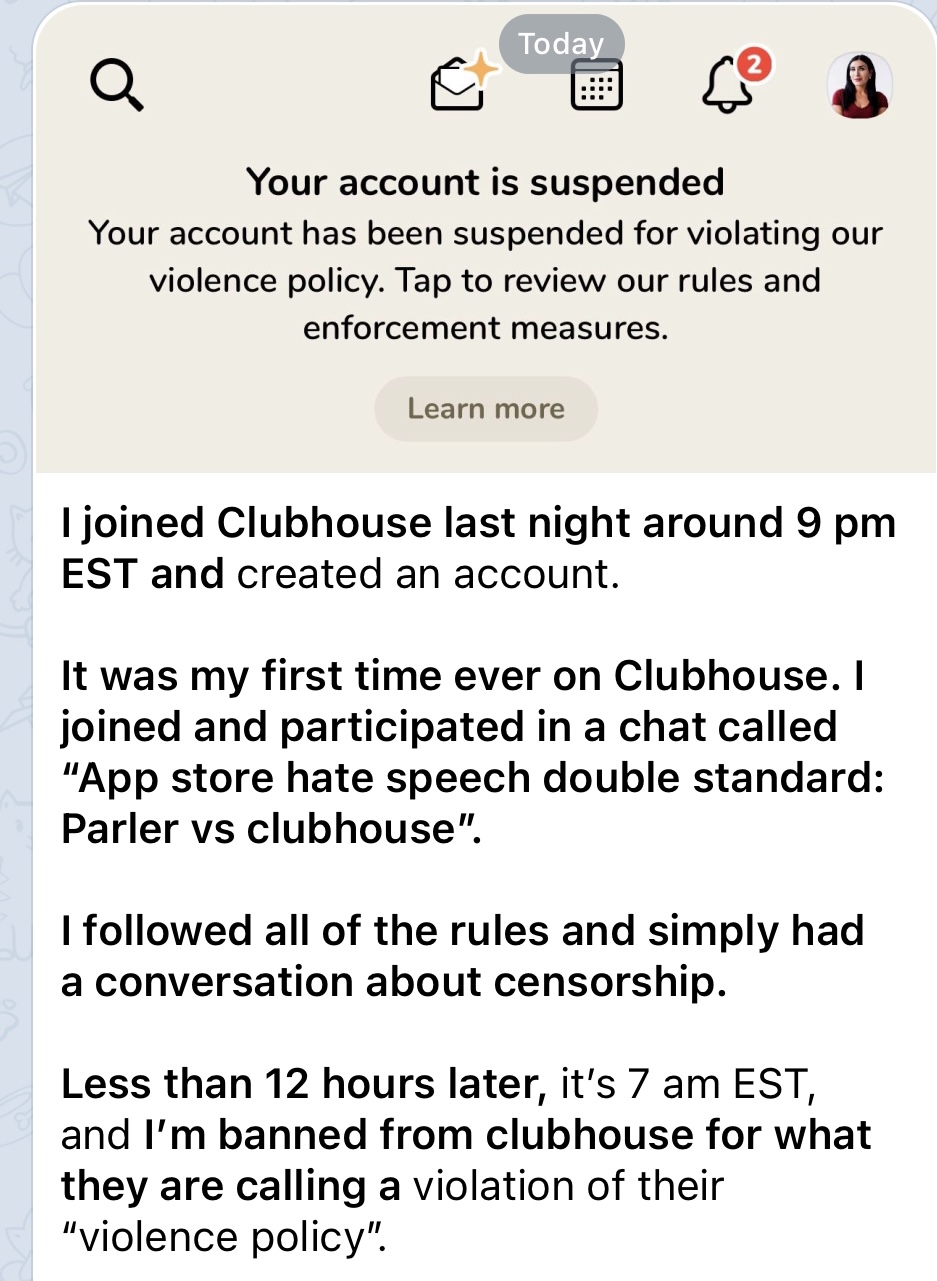
On Saturday, Loomer signed up for the platform and quickly joined a room entitled: “App Store Hate Speech Double Standard: Parler vs. Clubhouse,” moderated by PR consultant Kris Ruby.

That particular room quickly descended into chaos, with Loomer going on an anti-Muslim tirade, which apparently violates the platform’s policies. “As a Jewish woman, who was physically ejected from a moving Uber by a radical Muslim driver, on Rosh Hashanah, I value my safety, I’m pro-life, and you know I don’t think I should have to be roadkill because Uber doesn’t do background checks on their drivers,” the onetime Florida congressional candidate said. 

In November of 2017, Loomer was booted from both Uber and Lyft over posting anti-Muslim slurs aimed at drivers for both ride-sharing services. “Someone needs to create a non-Islamic form of Uber or Lyft because I never want to support another Islamic immigrant driver,” Loomer tweeted at the time.

In the early hours of Sunday morning, Loomer was permanently suspended from Clubhouse over violating the platform’s “violence policy.” Responding to the apparent ban, Loomer wrote on Telegram: “I followed all of the rules and simply had a conversation about censorship. Less than 12 hours later, it’s 7 am EST, and I’m banned from Clubhouse for what they are calling a violation of their ‘violence policy.’ Incredible.” 

“Clubhouse banned me based on accusations that I was violent even though I was only on the app for 5 hours … Clubhouse needs to be investigated and shut down for aiding and abetting Islamic terrorists,” Loomer added.

Loomer didn’t return a Salon request for comment on the matter. 

She isn’t the first far-right figure to be booted from Clubhouse; in early March, white nationalist Nicholas Fuentes joined the app only to be permanently suspended within a few hours. 

During his Clubhouse call, Fuentes, along with other members of his far-right “groyper army,” mocked the killing of George Floyd and the disability of Republican Rep. Madison Cawthorn, who uses a wheelchair after being partially paralyzed in a car accident. “We can be a little racist; we can be a little sexist,” Fuentes said on the call, apparently suggesting such attitudes are necessary to protect whiteness.  

Clubhouse also enforced a temporary ban on right-wing hoaxer Jacob Wohl, who also faces a plethora of legal difficulties. Yet many right-wing trolls, including Capitol riot organizer Ali Alexander and far-right social media star Mike Cernovich, remain active on the application. Clubhouse did not return a Salon request for comment on this story. 

As for what Clubhouse is and how it works, The New York Times offered this explanation:

A social networking app that lets people gather in audio chat rooms to discuss various topics, whether it’s sports, wellness, art or why Bitcoin is headed to $87,000. Rooms are usually divided into two groups: those who are talking and those who are listening (participants can see a list of everyone who is in a conversation, and the numbers sometimes run into the thousands). Unlike Twitter, Clubhouse is a closed, hierarchical platform: A moderator oversees discussions and has the ability to let someone chime in or to kick out the unruly. In addition to the “clubs” sorted by topic, two or more users can join together and start their own chat room.

CORRECTION: As originally published, this article inaccurately described Kris Ruby, the public relations consultant who moderated the Clubhouse room in which Laura Loomer made the comments quoted above. That passage has been corrected.

The COVID-19 vaccines will soon be available for children. Why did it take so long?

On Monday, the Food and Drug Administration (FDA) authorized use of the Pfizer-BioNTech COVID-19 vaccine for children between 12  and 15 years of age in the United States.

The authorization is a critical step in the path to end the pandemic. Yet the lengthy path to regulatory authorization for vaccinating children rankled and mystified parents who were hoping for a return to normalcy as summer approached.

Yet, as experts attest, there were legitimate clinical reasons for the delay in authorizing the vaccine for the younger set. 

For one, children have a slightly different immune system than adults — something that may be apparent in their apparent resistance to severe COVID-19 symptoms compared to the rest of the population. 

“Children have different, less experienced immune systems and they also are different sizes compared to adults,” said Dean Blumberg, associate professor of pediatrics at the University of California–Davis.  Blumberg said that because “adults generally have more severe disease than children,” vaccine-makers prioritized development of the vaccine for adults.

The FDA’s authorization is one of the final hurdles before kids within the ‘tween range can get vaccinated. The Centers for Disease Control and Prevention (CDC) is expected to OK emergency use of the vaccine before Thursday, as mass vaccination sites across the country — including in Chicago and Seattle — are already allowing parents to book appointments for their children. President Joe Biden said 20,000 pharmacies are ready to administer the vaccine to adolescents as soon as the CDC OKs it as well.


Want more health and science stories in your inbox? Subscribe to Salon’s weekly newsletter The Vulgar Scientist.


Children between the ages of 12 and 15 will receive the same Pfizer dose that adults have been administered. According to clinical trial results that were released in late March, the vaccine had 100 percent efficacy and “robust antibody responses.” Of the 2,260 enrolled children between the ages of 12 to 15, 18 cases of COVID-19 were observed in the placebo group. Blumberg called the clinical trial results “very promising.” 

It is possible that real-world studies will lower the vaccine efficacy, as no vaccine is 100 percent effective. In the clinical trials, the Pfizer vaccine also had very few side effects among trial participants that were 16 to 25 years old, meaning it is very safe. There were a few more reported fevers in children than adults: 20 percent in adolescents compared to 17 percent in the adult age group.

Children can expect “sore arms, redness at the injection site, fever, headache for a day or two, maybe some tiredness,” Blumberg said, noting that the side effects diminish after a day or two. 

The goal of the previous clinical trials was to find a balance between the correct age and dosage of the vaccine in which a strong immune response is triggered without too many side effects. Children have not been exposed to as much bacteria and disease as adults, and hence have different immune systems; this is why vaccine trials for children happen in tiered age groups.

Thus, vaccine makers only started clinical trials on children after the authorizations for adults were in place. Dosing children is also a vital point of study for immunologists, as children’s bodies may react differently.

Younger children’s “immune systems are less mature,” Blumberg said. “Their weight is dramatically different than adults — you may need to see dose adjustments of the vaccine,” he added.

“And I could see that going either way, they may need an increased dose — as we see with other vaccines, for example with whooping cough, sometimes there’s an increased dose for younger children compared to adults, or sometimes you need to reduce those just because the children are smaller on a weight basis,” Blumberg said.

Influenza vaccines are an example of a vaccine that is given at a lower dose for young children, compared to older children and adults.

Despite emergency authorization of the vaccine for children between 12 and 15, the U.S. could face resistance from those who are hesitant to vaccinate their children, as various polls have indicated many parents are reluctant to vaccinate their children right away.

Blumberg warned hesitant parents that while children are less likely to have a severe disease with COVID-19, there have been thousands that have been hospitalized due to the coronavirus and hundreds have died.

“It’s understandable that people would be hesitant early on when the vaccines were developed since they were developed with unprecedented rapidity, and they are new technology too,” he said. “But as of today more than 260 million doses have been administered in the U.S., so I would no longer consider these new vaccines anymore — we’ve got a lot of experience with these vaccines and they have been found to be safe and effective.

Blumberg added: “There’s absolutely no question that the benefits of vaccination outweigh any other risks.”

Indeed, as summer approaches, many families feel vaccinating their children will bring a sense of relief. Currently, not all schools in the U.S. have reopened; an estimated four in 10 children are still doing remote learning to stop the spread of the virus.

Editor’s note: This headline was updated on May 12 at 9:02pm PT to better reflect the semantic nuances of the FDA’s regulatory language.

“Cold-blooded fraudster”: Students for Trump founder gets 13 months in prison for posing as lawyer

The baby-faced Students for Trump founder was denounced as a “cold-blooded fraudster” by a judge before he was sentenced for posing as a lawyer.

John Lambert was sentenced to 13 months in prison for the scam targeting individuals with little experience seeking legal advice, for which he was paid at least $46,654 while delivering little of value to his victims, reported the New York Daily News.

“Mr. Lambert took his money and did nothing,” said District Court Judge Valerie Caproni about one victim, who expected help with a credit problem. “Mr. Lambert did not even have the common decency to make up an excuse and tell the victim to hire another attorney.”

The 25-year-old Lambert posed as Eric Pope, of the Manhattan-based firm Pope & Dunn, and falsely claimed to be a graduate of the New York University School of Law with a finance degree from the University of Pennsylvania, with 15 years of experience in corporate and patent law.

“I lost focus on who I was,” Lambert said in court. “My ignorance was a disrespect to the law and my country. My life will be forever marked by this poor choice at a young age.”

He and classmate Ryan Fournier founded Students for Trump, which ran a Twitter account photos of bikini-clad women and showed themselves at political events, while students in 2015 at Campbell University in North Carolina.

Fournier was listed as a co-conspirator in the fraud but reached a cooperation agreement with prosecutors in the case.


Cheney rips Trump before vote to oust her from GOP leadership: “Ignoring the lie emboldens the liar”

Rep. Liz Cheney, R-Wyo., stood on the House floor Tuesday night as her Republican colleagues were talking about “cancel culture.” Cheney began by saying that she has a unique perspective and understanding of “cancel culture” given her current situation, but she said that she wanted to speak about the American democracy.

“God has blessed America, but our freedom only survives if we protect it,” she told the chamber. “If we honor our oath, taken before God in this chamber, to support and defend the Constitution. If we recognize threats to freedom when they arise. Today, we face a threat America has never seen before. A former president who provoked a violent attack on this Capitol in an effort to steal the election has resumed his aggressive efforts to convince Americans that the election was stolen from him. He risks inciting further violence.”

She went on to say that millions of Americans have been misled by former President Donald Trump, but not saying his name.

“As he continues to undermine our democratic process, sowing seeds of doubt about whether democracy really works at all,” she continued. “I am a conservative Republican and the most conservative of conservative principles is reverence for the rule of law. The electoral college has voted. More than 60 state and federal courts, including multiple judges the former president appointed, have rejected his claims. The Trump Department of Justice investigated the former president’s claims of widespread fraud and found no evidence to support them. The election is over. That is the rule of law. That is our constitutional process.”

She explained that anyone who refuses to accept the ruling from American courts is also at war with the American Constitution.

“Our duty is clear,” she went on. “Every one of us who has sworn the oath must act to prevent the unraveling of our democracy. This is not about policy. This is not about partisanship. This is about our duty as Americans. Remaining silent and ignoring the lie emboldens the liar. I will not participate in that. I will not sit back and watch in silence while others lead our party down a path that abandons the rule of law and joins the former president’s crusade to undermine our democracy.”

She claimed that America faces challenges necessary as another communist country begins to attack the United States, specifically referencing China and not Russian hackers. Trump’s claims and attacks on the election only undermine America’s elections by giving China propaganda to trash democracy and the U.S. as a failed state.

“We must speak the truth,” she said. “Our election was not stolen and America has not failed.”

You cant watch the video below via YouTube:

Why Anna Duggar stays: “There’s a huge martyr’s mentality,” a woman who left Quiverfull says

Vyckie Garrison remembers watching Michelle Duggar, the matriarch of the then-TLC program “14 Children and Pregnant Again!” on television and feeling a twinge of envy. It was 2004, and Garrison had seven children of her own whom she was raising and homeschooling within her fundamentalist, “radically pro-life” Christian community in Nebraska. 

“I remember thinking, ‘Look at her actually doing it,'” Garrison told me in a phone call from her new apartment in Albania. “I was in awe of her. Her kids, they seemed like they were completely on-board. They have the same mentality and the same giving spirit. She was my idol. Well, not ‘idol’ because we couldn’t have idols, but, you know.” 

The Duggar family’s foray into reality television also marked many Americans’ first introduction to Quiverfull ideology, a theological movement that interprets the Old Testament Psalm, “Happy is the man that hath his quiver full of [children],” as a command to reproduce often, sans any birth control or family planning. For the record, the Duggars don’t claim to be Quiverfull, though they do reference that verse on their website in response to the question, “Why have such a large family?”

TLC positioned the Duggars, led by Michelle and husband Jim Bob, as a benign oddity, a kind of oversized “Waltons” family where episodes centered largely on pregnancy announcements, chaperoned courtships and managing a home large enough for the family. 

Over the course of a decade, the family eventually ballooned up to 19 children. There was some controversy along the way, as the Duggars actively lobbied against abortion access and for legistlation that discriminates against transgender individuals; writer Nina Burleigh described the family as “good TV. Good, sugarcoated rat poison, politically speaking.” 

But it wasn’t until 2015 that their fame bubble would finally burst, when it was revealed that the couple’s eldest son, Josh Duggar, had molested at least five girls — four of whom were his sisters — when he was 14 or 15 years old. 

TLC canceled the show and several months later, Josh was at the center of another sexual scandal. During a data breach at Ashley Madison, a website that caters to users seeking discreet affairs, it was revealed that Josh was a user of that site. He issued an apology saying that he was “the biggest hypocrite” and that he had been “viewing pornography on the Internet and this became a secret addiction and I became unfaithful to my wife.” 

Fast-forward to this year. On April 29, Josh Duggar was arrested and later released on bail after being charged in federal court with receipt and possession of child pornography, including images of minors under the age of 12. 

Josh Duggar isn’t the only evangelical Christian man to see scandal in recent years — there’s been former Liberty president Jerry Falwell Jr., evangelist Bill Gothard and megachurch pastor Dave Reynolds, to name a few — but the very public nature of his family’s life before his conviction, especially as it relates to childbearing and parenthood, makes his fall somehow more striking. 

Just a few weeks before his arrest, Josh’s wife, Anna, had announced the couple was pregnant with their seventh child. According to a news release from the U.S. Attorney’s Office, Josh could face up to 20 years in prison if convicted and Anna will be left to essentially raise their family on her own. 

It’s a stark reality, the kind unfit for even the most salacious TLC show, that spotlights the dark underbelly of patriarchal Christianity. While men are sold a promise of life where they are revered as the spiritual head of the household — a life in which their virility and manhood is unquestioned — when it comes to the Quiverfull movement, what’s in it for the women? 

* * *

Unlike Anna Duggar and many women in Quiverfull families, Vyckie Garrison was not raised in the church. 

It wasn’t until she became pregnant during a short-lived relationship with an older man who had lied about having a vasectomy, ending up in the offices of a faith-based crisis pregnancy center, that she was first introduced to some of the basic principles of “Christian family values.” 

While she waited for the results of her pregnancy test, she was shown the 1984 anti-abortion film “A Silent Scream.” When the staff returned to confirm that Garrison was pregnant, they informed her by saying, “God blessed you.” 

“I didn’t think I had any option but to be a mom, but I knew I was going to suck at it,” Garrison said. “That’s when I really started turning towards religion. I wanted a map, a guidebook, ‘Motherhood for Dummies.'” 

Garrison found it in the curriculum and radio programs of Focus on the Family, an evangelical parachurch group that rails against pre-marital sex, LGBTQ rights, divorce and abortion and promotes “the permanence of marriage” and “the value of children.” 

While homeschooling her daughter, Angel, Garrison was introduced to fundamentalist Christian women who viewed motherhood as a mission field. 

“There was a lot of talk of women being submissive and anti-birth control or, as we put it, ‘radically pro-life,'” Garrison said. “I had health complications that made [getting pregnant] a life-threatening condition, but it’s really pushed on the moms that you should be like Jesus and you are willing to sacrifice whatever it takes.” 

Garrison, who was married at this time to a man named Wesley Bennett, went on to have six more children despite the health risks because it’s what she thought the Bible called her to do. 

“The women would tell me, ‘Missionaries risk their lives every day and they do it because it’s their calling,'” she said. “‘When they get to heaven, they’ll get their martyr’s crown.’ There’s a huge martyr’s mentality.”  

Garrison embraced the lifestyle, even starting a newspaper for families that adhered to the Quiverfull philosophy. In a blog post that she’d written before becoming pregnant with her seventh child, Garrison said, “Whether a couple has a dozen children or only one, it is important to welcome them in the same spirit in which we would receive the Lord Jesus Himself.” 

However, things at home were reaching a boiling point. 

Bennett eventually became verbally abusive, “very controlling and wanted to know everyone’s thoughts.” Furthermore, Garrison was seemingly always on the verge of a complete physical and mental breakdown due to the toll a seemingly endless cycle of nursing and pregnancies was having on her body. 

“But I had that martyr’s mentality; I was going to do everything to ensure this home for my kids,” she said. “But I looked at my kids and they were not thriving. I sucked at homeschooling and they were not happy.” 

She began corresponding with her uncle, an inquisitive atheist who asked her questions about her chosen lifestyle. When Garrison realized that, other than pointing to scripture he didn’t believe in,  she didn’t have answers for why she lived how she did, something clicked. She realized that she and her children both deserved better. 

A few weeks later, she fled to Kansas City to stay with a friend; when she eventually returned after divorcing her husband, she successfully retained custody of her seven children. 

Garrison is an atheist now and lives in Albania, halfway across the world in an apartment where you can catch a glimpse of the Mediterranean Sea from the living room window. 

In the years since her “quivering days” she co-founded and maintained the blog “No Longer Quivering,” a resource for women like her who plan on leaving the movement. 

“The women, they get into it for the kids,” she said. “But that’s also why they get out.” 

* * *

In her academic essay, “Christian Patriarchy Lite: TLC’s 19 Kids and Counting,” Christy Ellen Mesaros-Winckles said that while the concept of being “barefoot and pregnant” lost overall social cachet decades ago, it’s still alive and well in the Quiverfull movement. 

And while, Mesaros-Winckles said, the theology underlying the Duggars’ beliefs was often underplayed, “conformity and a rigid male leadership hierarchy often place women in the Quiverfull movement in subservient roles.” 

According to Garrison, that’s the system in which she found herself trapped — and in which Anna Duggar, who has been conspicuously silent about her husband’s various scandals, likely feels trapped as well. 

Is she blameless? Perhaps not. But she is undoubtedly a victim of a patriarchal system designed to make women feel like they don’t have a choice to leave. 

The situation she is in is just impossible,” Garrison said. “The only way she can save herself and her children — she would just have to give up her idea of her faith.”

Trump rallies set to return any day now

Former President Donald Trump has plans to begin holding his signature political “Make America Great Again” rallies across the country, yet again, ahead of the 2022 midterm elections – and according to a top aid, they will be starting any day now. 

“Trump senior adviser Jason Miller tells Axios Trump rallies are likely to ‘start as soon as late spring or early summer.’ Miller said Trump ‘has already begun to vet and endorse candidates for 2022, with an eye toward electing not just Republican candidates, but America First Republican candidates,'” Axios co-founders Mike Allen and Jim VandeHei reported on Friday. 

Miller and a group of Trump allies didn’t return Salon’s request for comment on Trump’s rally plans. 

The news comes as two Republicans, Georgia Rep. Marjorie Taylor Greene and Florida Rep. Matt Gaetz have also taken to the campaign trail to hold “America First” rallies. The duo’s first rally kicked off this past Friday at The Villages in Florida. “The elderly crowd in The Villages, a sprawling senior community nestled among billboards for orange juice and baby alligators, came dressed in five years worth of MAGA gear, from well-worn red ‘Trump 2016’ hats to ‘The 2020 Election Was Rigged’ t-shirts. The kickoff of Gaetz and Greene’s ‘America First’ revival tour meticulously followed Trump’s rally playbook, as the largely unmasked retirees—many of whom told TIME it was their first big event since getting the coronavirus vaccine—energetically danced to ‘We are the Champions,’ shouted ‘Lock her up!’ and heckled the media in the back,” TIME political correspondent Vera Bergengruen noted from the Sunshine State on Friday. 

Trump’s allies have long encouraged the former president to start holding rallies again, following his 2020 election loss, but it appears the former president has been more concerned with floating baseless claims of widespread voter fraud.

While interviewing Trump on his podcast at the end of April, Fox News contributor and right-wing radio host Dan Bongino said: “We need a Trump rally, sir…Can you just do one for fun!? We need to feel alive again!”

Trump’s rallies ahead of his 2016 election win were a safe haven where frustrated Trump supporters, along with their cult-like leader, frequently incited violence against anyone who dared to disrupt their gatherings.

“I love the old days. You know what they used to do to guys like that when they were in a place like this? They’d be carried out on a stretcher, folks. It’s true. I’d like to punch him in the face; I’ll tell you,” Trump stated back in Nevada in February of 2016.

In light of the Jan. 6th Capitol insurrection, it remains to see what tone and tenor the former president will have live at his rallies, but there is plenty of evidence to suggest he will continue to claim the 2020 election was stolen. On Tuesday morning, Trump released a statement where he compared the 2020 election to that of a diamond heist.

“If a thief robs a jewelry store of all of its diamonds (the 2020 Presidential Election), the diamonds must be returned. The Fake News media refuses to cover the greatest Election Fraud in the history of our Country. They have lost all credibility, but ultimately, they will have no choice!” Trump declared in a statement via his Save America PAC. 

Mike Lindell’s South Dakota rally: Proud Boys, Joe Piscopo and a can’t-miss investment

MyPillow CEO Mike Lindell held his much-anticipated-by-fans “Frank Speech” rally Monday night at the Corn Palace in Mitchell, South Dakota, where there was no shortage of baseless claims about the 2020 election. The event was billed as providing a venue for Lindell to relaunch his failed social media platform Frank, but no announcement about the platform occurred. 

Before the event began, a long line of people waiting to get into the venue wrapped around the outside of the building. But once they got inside, the situation was less impressive. Only around 1,500 people tuned out for the event, which Lindell had initially boasted might draw a crowd of 30,000 supporters. (In fact, the Corn Palace’s seating capacity is just 3,200.) Even so, Business Insider’s Grace Dean noted that some attendees waited in line for seven hours before the doors opened. 

Shortly after people were seated, former “Saturday Night Live” cast member Joe Piscopo took to the stage to praise Lindell, even offering the pillow guru an original musical number. 

At one point, Piscopo’s microphone stopped working, most likely a standard technical error of the sort that bedevils performers at all levels of the entertainment ecosystem. The once-popular late-night comedian chose to blame the malfunction on Chinese interference. “We’re not racist,” Piscopo declared, apropos of nothing. “I travel around the country, and we’re a good country. They are criticizing us every which way, and tonight it stops.” While working the crowd, Piscopo spotted a fellow MAGA-friendly celebrity — a cast member of the show “Duck Dynasty.”

“My guess is half the crowd was 60 or older,” one attendee of the South Dakota rally told Salon on Monday night. “A lot of people yelled ‘No!’ when Piscopo asked if anyone got vaxxed, and the audience made the most noise when Lindell predicted Trump will be back in office [i.e., back in the White House as president of the United States] by August. They were very happy about that possibility.”  

Then the crowd heard a bit (virtually) from Donald Trump’s former HUD Secretary Ben Carson, who offered cookie-cutter conservative remarks that appeared to have little effect on the audience. “We recognize that our rights and our liberty comes from God, not from government. And that makes us very unique,” Carson said, while also offering Lindell high praise. 

Far-right radio host Eric Metaxas also spoke before Lindell, offering a hodgepodge of jokes that appeared to miss the mark with the crowd and attempting to stir up outrage about the alleged persecution of religious believers around the world. “People are being persecuted around the world because their governments don’t believe in God,” Metaxas stated. “When you push God out, freedoms go away. It’s what we’re seeing right now — it’s why we’re starting Frank Speech!”

With attendees reportedly on edge over the supposed threat that antifa might sabotage the event, Lindell, the evening’s Elvis equivalent, took to the stage, where he shared his life story but neglected to say anything about a relaunch of Frank, the supposed purpose of the event to begin with. 

Lindell spoke for around 90 minutes, sprinkling in random tangents meant to support his baseless claims of 2020 “voter fraud” and allegations that China was somehow to blame. The pillow magnate once again suggested that once the truth is known, the Supreme Court will unanimously vote to void the election results and reinstall Trump as president. (No legal or constitutional mechanism exists that could accomplish that result.)

“They will have to protect our country, and it’s going to be a 9-0 vote to pull the election down,” Lindell vowed at one point, while not discussing the non-relaunch of Frank, perhaps because it was poorly constructed using the wrong software and is never likely to work.

Before the rally, in an interview with a local right-wing talk show, Lindell said he had recently spoken to Trump, who conveyed how “proud” he is of the work Lindell is doing. 

As for other notable moments, both the self-explanatory organization “Bikers for Trump” and members of the far-right Proud Boys were in attendance. An attendee told Salon that a group of six Proud Boys “walked in and sat in the middle of the crowd, near the front.” Another attendee could also be seen in one photo wearing an anti-government “Three Percenters” patch.

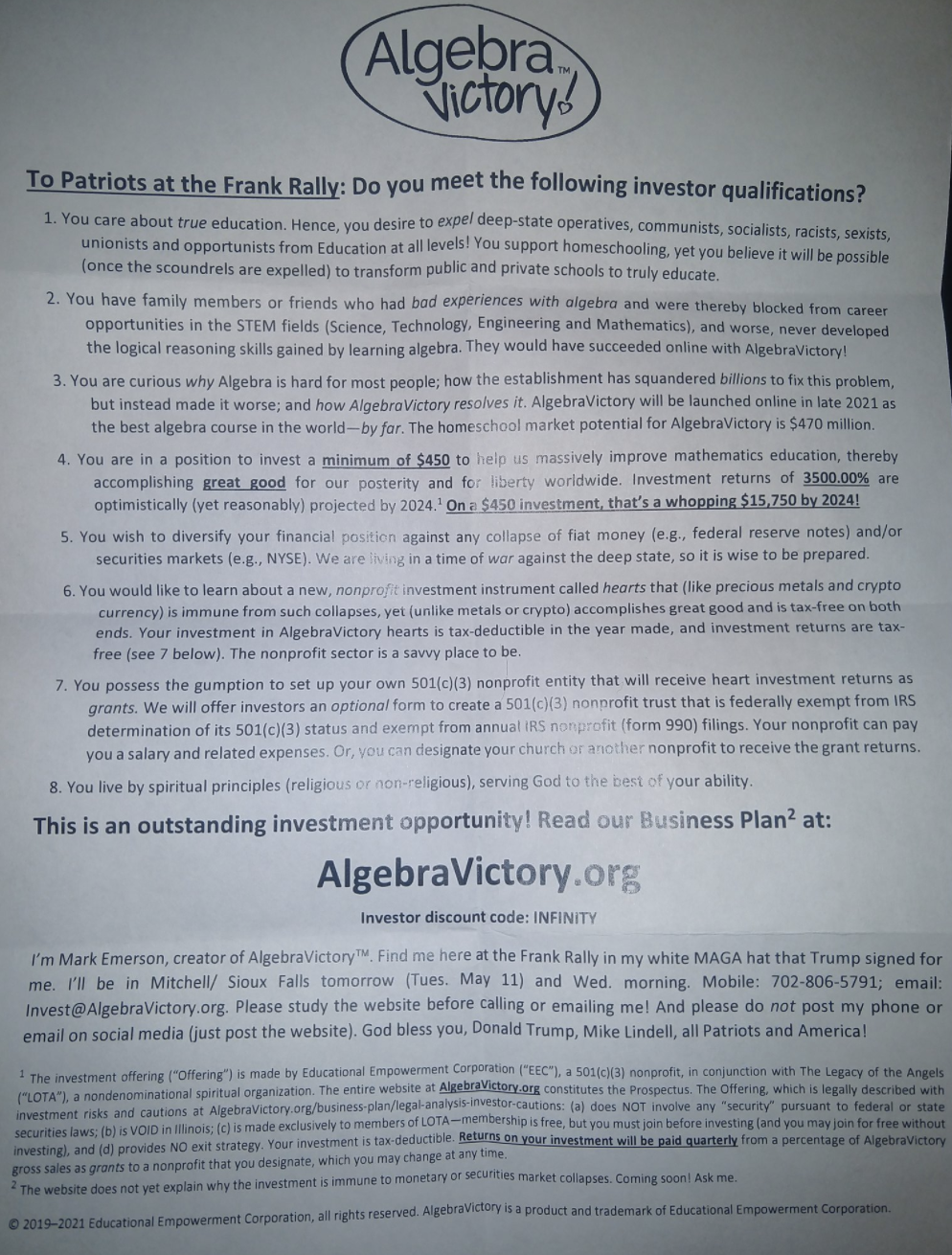
Salon also learned about an investment opportunity being pushed during the rally, which “optimistically (yet reasonably)” promised a 3,500% return. Seemingly too good to be true! The custom-made flyers touted, “We are living in a time of war against the deep state, so it is wise to be prepared,” while the investment scheme offered the opportunity to “expel deep-state operatives, communists, and socialists” from the U.S. educational system. 

Once the rally ended, representatives for Lindell encouraged attendees to take home multiple boxes of the pillow maven’s book. Apparently, Lindell was prepared to hand out 30,000-plus copies of his election fraud movies and books, but as it turns out, he literally couldn’t give them away.

“They were begging people to take boxes of books home to give to addicts so they can be entrepreneurs,” an attendee told Salon.

Lindell, who has a unique relationship with this Salon reporter, didn’t return a text or call from Salon on Tuesday morning, seeking comment for this story. 

Canceling the anti-insurrectionists in the GOP proves Republicans never cared about “free speech”

Despite all the preening about “free speech” on the right, the truth is complaints about “cancel culture” have always been code for “conservatives can say whatever terrible things they want, and liberals can shut up about it.” And while play-acting as the victims of censorship because liberals mock or criticize them, Republicans have been busy actually silencing free speech: from demanding that athletes be fired for kneeling during the national anthem to, memorably, Donald Trump ordering the tear-gassing of peaceful protesters in Lafayette Park. While conservatives whine about oppression because people call them “racist” on Twitter, they are actually using complaints about “wokeness” as an excuse for the literal government censorship of discourse that acknowledges the reality of racism, as Michelle Goldberg of the New York Times chronicled

That’s conservatism, of course: Always projecting their own sins onto their liberal opponents.

But the Republican enthusiasm for censorship has become even more pronounced in the past few weeks, as they’ve escalated the purge of any party members who refuse to sign onto the Big Lie that Joe Biden “stole” the election and that the Capitol insurrection was no big deal. 

On Monday, House Minority Leader Kevin McCarthy, R-Calif. — following in the footsteps of that other, more infamous McCarthy — escalated the blacklisting of Rep. Liz Cheney, R-Wyo., for admitting that the insurrection was a real thing that really happened because Donald Trump was really trying to steal an election that Joe Biden really won. McCarthy sent a letter to the Republican caucus declaring his intention to lead the effort to remove Cheney from her leadership position for said thought crimes and included a real howler of a closing paragraph.

“We are a big tent party,” McCarthy insisted, as they purge anyone who refuses to sign off the Big Lie. “And unlike the left, we embrace free thought and debate.”

Of course, not if you think thoughts about admitting reality or debate those who insist on fealty to a lie. 


Want more Amanda Marcotte on politics? Subscribe to her newsletter Standing Room Only.


McCarthy got ripped on Twitter, as he rightly deserved. But really, his Orwellian use of “free thought” is just more of the same from Republicans, who have continually used claims of support for “free speech” and opposition to “cancel culture” as cover for their efforts to stifle speech, protest, and debate. 

Witness, for instance, the right-wing freakout du jour, over a speech last week from Rep. Cori Bush, D-Mo., in which she used the term “birthing people.” Bush’s speech was about the lack of decent maternal care in the U.S., and drew on her own personal experiences of watching a son nearly die and almost losing another pregnancy because doctors didn’t take her health concerns seriously. But conservatives decided to harp on her word choice, accusing Bush of trying to replace the term “mother” with “birthing people.” 

But Bush did no such thing, as anyone who actually listened to her speech heard. She said, “I sit before you today as a single mom, as a nurse, as an activist, and as a Congresswoman, and I am committed to doing the absolute most to protect Black mothers. To protect Black babies. To protect Black birthing people. And to save lives.”

Emphasis mine, because Bush’s critics clearly don’t read so good. Or really, they do, but they are lying liars who are arguing in bad faith, pretending to be victims of “cancel culture” while actually launching a massive pressure campaign designed to stifle any discussion or acknowledgment of the fact that “mother” and “person who gave birth” are not neatly overlapping categories, due to practices like adoption or the existence of trans identities.

No doubt, “birthing persons” is a clunky phrase that is unlikely to take off in the common parlance. But the issue here isn’t awkward phrasing, it’s about the right trying to cancel thoughts or discussions that make them uncomfortable — and doing so, in their Orwellian way, while pretending to actually be for “free speech.” 


Want more Amanda Marcotte on politics? Subscribe to her newsletter Standing Room Only.


But this is par for the course with right wing hysterics over “cancel culture.” Scratch the surface and they are typically aimed not at expanding the discourse, but contracting it so that the only allowable ideas are those that fit comfortably into conservative orthodoxy.

The meltdown over the estate of Dr. Seuss delisting a few obscure titles for racist imagery? That’s really more about conservatives being unwilling to deal honestly with the history of racism than it is about “free speech.” The whining about Mr. Potato Head rebranding to a more gender-neutral Potato Head? That’s mostly about conservatives wanting to crush any childish experimentation with gender presentation, which is more about silencing rather than empowering free expression. 

Even some Republicans are starting to be a little uncomfortable with the contradiction between Republican claims of being for “free thought” and their actual behavior, which is about cracking down on anyone who disagrees or even just acknowledges inconvenient truths. Sen. Joni Ernst, R-Iowa, got angry over Cheney’s defenestration and told reporters, “I feel it’s okay to go ahead and express what you feel is right to express and, you know, cancel culture is cancel culture,” and complained about “those that are trying to silence others in the party.”

But this is nothing new, as demonstrated by the widespread support for Donald Trump and his lengthy efforts to stifle anti-racism protesters, whether they’re playing professional sports or just trying to avoid tear gas canisters in front of the White House. Anger over “cancel culture” was never a robust defense of free speech. As with the Republican war on democracy itself, it’s an assertion that the shrinking white conservative minority should have political and social hegemony, untouched by either progressive criticism or pushback at the ballot box.

The Cheney purge illustrates this reality perfectly. She’s being blacklisted both for saying things that make Republicans uncomfortable and for asserting that the person who won the election should be president. Republicans were never for “free speech,” and recent events just make that almost comically apparent. 

House Republican reveals that he tried to warn Kevin McCarthy before Jan. 6 riot

Anti-Trump GOP Rep. Adam Kinzinger, R-Ill., alleged on Monday that he warned House Minority Leader Kevin McCarthy, R-Calif., one of Trump’s biggest boosters, that the GOP’s rhetoric was inviting violence in advance of the Capitol riot, but McCarthy dismissed his concerns. 

“A few days before Jan 6, our GOP members had a conference call,” Kinzinger tweeted. “I told Kevin that his words and our party’s actions would lead to violence on January 6th. Kevin dismissively responded with ‘ok Adam, operator next question.’ And we got violence.”

In a National Press Club interview, Kinzinger also admitted that he considered organizing a vote of no confidence against McCarthy following the insurrection. “I actually thought the person that should have their leadership challenged was Kevin McCarthy after Jan. 6, because that’s why this all happened,” he revealed. “I was considering, you know, having a vote of no confidence against Kevin, and our feeling was no, let’s move on. We’re gonna vote to impeach the president; we need to move on,” he said. Kinzinger’s plan ultimately failed to garner enough support from his colleagues. 

The Illinois representative was among the ten House Republicans to support former President Trump’s second impeachment for inciting the Capitol riot. Just who is to blame for the riot has become a defining flash point for the Republican Party, which has demonstrated a tendency to ostracize any member who attributes the riot to Trump. 

Kinzinger also expressed regret over not pushing McCarthy’s ouster hard enough.

 “I didn’t go too far and wide with it yet, and I chatted with kind of a close group of mine,” he admitted. “And the feeling in that close group — I won’t reveal who it is — but the feeling that group was kind of, you know, we’re taking a big step, the president is going to be XYZ, and now it’s time that we have to heal as a party. I was like, ‘Well, I’m not going to do it alone. I still believe that Kevin should at least have his leadership challenged.'”

The congressman noted that the GOP began vying to remove Rep. Liz Cheney, R-Wyo., a recent Republican critic of Trump, from her position as House Republican Conference chair shortly after Trump was acquitted of his second impeachment charges.

“And then everybody went on the offense against Liz,” he recounted. “And that’s what was a brilliant strategic play, because then all of a sudden, you know, Liz is the one playing defense, for what? What was she playing defense for, for telling the truth and not ransacking the Capitol on Jan. 6? “If you think about it from the forest, it’s ludicrous that she’s having to defend herself. Like, that’s insane. But that’s where we are.”

On Sunday, Kinzinger likened the Republican Party to the Titanic amid the internal GOP push to strip Cheney of her leadership role.

“We’re like, you know, in the middle of this slow sink,” he said in a CBS interview. “We have a band playing on the deck telling everybody it’s fine. And meanwhile, as I’ve said, you know, Donald Trump’s running around trying to find women’s clothing and get on the first lifeboat.”

The representative on Sunday also bashed McCarthy for quickly changing his tune on who was to blame for the Capitol riot. Just a week after the insurrection, McCarthy initially laid the blame at Trump’s feet.

“Liz Cheney is saying exactly what Kevin McCarthy said the day of the insurrection. She’s just consistently been saying it,” Kinzinger argued. “We have so many people including our leadership in the party that have not admitted that this is what it is, which was an insurrection led by the president of the United States, well-deserving of a full accounting from Republicans.”

On Sunday, McCarthy publicly threw his support behind Elise Stefanik, R-N.Y., a young, budding Republican, to replace Cheney as the House Republican Conference chair. Stefanik, who Salon’s Heather Digby Parton noted is something of a “political shapeshifter,” was once a Republican moderate, but has since distinguished herself as one of Trump’s most pugnacious defenders.

Cicadas like to be on time. But are they getting confused by climate change?

America’s favorite teenagers are back. Brood X, a group of 17-year “magicicadas” (yes, that’s short for “magic cicadas“) have started to emerge from the soil all over the Eastern U.S., marking the beginning of a cicada season that will eventually see billions of the bugs molting, screeching for mates, and — after just a few weeks — dying, leaving their carcasses strewn across lawns and roofs from New Jersey to Illinois.  

It’s a once-every-two-decades bonanza that serves as a sometimes unwelcome reminder of the passage of time. “Periodical cicadas are the ‘bugs of history,'” said Gene Kritsky, a professor of biology at Mount St. Joseph University in Cincinnati. He would know: Kritsky is a kind of entomologist-historian, writing books and articles with such tantalizing titles as The Tears of Re: Beekeeping in Ancient Egypt or “The Insects and Arthropods of the Bible.”

Cicadas’ regular schedules, Kritsky explains, are part of their charm. If you gave birth to a child during the last emergence of Brood X, he or she is now a teenager. Whatever else is happening in the world: a pandemic, a war, a presidential election — the cicadas will come every 17 (or, for some broods, every 13) years. 

But some researchers believe that, as the world warms, those reliable schedules may be starting to shift. Cicadas are reliant on internal clocks: They spend their entire lives — up until those last few orgiastic weeks — underground, sipping nutrients from roots and counting the years until they can scuttle out of their tiny lairs. In year 17, when the ground is around 64 degrees Fahrenheit and soft from recent rain, these nymphs start to wriggle their fleshy, segmented bodies out of dime-sized holes in the ground.

Over the past several decades though, periodical cicadas have seemed to pop up earlier and earlier. Kritsky, who has combed through newspapers and diaries recording cicada emergence over the past century, says that before 1950, cicadas most often started their emergence between May 20 and 28; now they’re coming out in the month’s first couple of weeks. A preliminary analysis from Climate Central, a research and communications nonprofit, estimates that in April and May the areas of the U.S. frequented by Brood X are 8 degrees Fahrenheit hotter than they were in 1970 — and 1.1 degrees F hotter than they were when the bugs last emerged in 2004. That’s more than enough to send them scurrying out of the soil ahead of time.

As temperatures warm, cicadas may also be getting their tiny antennae crossed, miscounting the years entirely. In 2017, a group of Brood X cicadas were sighted wriggling out of the ground four years early all across the Eastern U.S., joining a whole host of broods that seem to have mis-set their internal clocks. “Broods II, III, V, X, XIII, XIV, and XIX have all spun out accelerated populations four years early,” Kritsky said. “Those broods are over more than 20 states in the Eastern U.S. — and what’s the common factor that could trigger that? Increasing temperatures.” 

Kritsky believes it could be because cicadas use fluid in trees to mark time. Under unusually warm temperatures, trees might bud and leaf early in a “false spring,” then bud and leaf again a few months later — tricking cicadas into thinking that more time has passed. 

But the connection is far from proven. “It’s hypothetical at this point,” said John Cooley, a cicada researcher at the University of Connecticut. In the era of internet crowdsourcing — enthusiastic bug hunters can download an app called “Cicada Safari” to document the molting masses — he warns that both early cicada emergence and the accelerated populations could simply be a result of more reporting. 

And that “only-emerging-every-13-to-17-years” thing also makes it hard to amass good data. “If you wanted a species to document climate change effects, periodical cicadas might not be your first choice,” said Louie Yang, a professor of entomology at the University of California, Davis. “The generation time is so outrageously long.” 

Still, cicadas may provide other ways of thinking about the rapidly warming planet. The last time Brood X emerged, in May 2004, the concentration of carbon dioxide in the atmosphere was 381 parts per million. Today, it’s around 420 parts per million and climbing. In 2038, when the children of this year’s cicadas first poke their heads out of the ground, will they be entering a world irrevocably changed by wildfire, heat waves, and spiking sea levels? Or one that is on its way back to some form of normal?

“Seventeen years is a pretty good unit,” Yang told me. Humans, he said, are famously bad at thinking about very big things (see climate change) or things that occur over a very long time period (see also: climate change). “We’re good at medium-sized objects and medium-sized time,” he explained. That makes cicadas, with their patient underground waiting and their sudden, chittering emergence, an excellent tool — a kind of yardstick that can be used to measure the future or the past. 

“In the time of two or three cicada generations, our lives are quite different — and the planet is likely to be quite different,” Yang said. “It makes you think: Are we having the kind of positive impact that we want to have by the time this next cicada brood comes out of the ground?”

Side-stepping safeguards, data journalists are doing science now

News stories are increasingly told through data. Witness the Covid-19 time series that decorate the homepages of every major news outlet; the red and blue heat maps of polling predictions that dominate the runup to elections; the splashy, interactive plots that dance across the screen.

As a statistician who handles data for a living, I welcome this change. News now speaks my favorite language, and the general public is developing a healthy appetite for data, too.

But many major news outlets are no longer just visualizing data, they are analyzing it in ever more sophisticated ways. For example, at the height of the second wave of Covid-19 cases in the United States, The New York Times ran a piece declaring that surging case numbers were not attributable to increased testing rates, despite President Trump’s claims to the contrary. The thrust of The Times’ argument was summarized by a series of plots that showed the actual rise in Covid-19 cases far outpacing what would be expected from increased testing alone. These weren’t simple visualizations; they involved assumptions and mathematical computations, and they provided the cornerstone for the article’s conclusion. The plots themselves weren’t sourced from an academic study (although the author on the byline of the piece is a computer science Ph.D. student); they were produced through “an analysis by The New York Times.”

The Times article was by no means an anomaly. News outlets have asserted, on the basis of in-house data analyses, that Covid-19 has killed nearly half a million more people than official records report; that Black and minority populations are overrepresented in the Covid-19 death toll; and that social distancing will usually outperform attempted quarantine. That last item, produced by The Washington Post and buoyed by in-house computer simulations, was the most read article in the history of the publication’s website, according to Washington Post media reporter Paul Farhi.

In my mind, a fine line has been crossed. Gone are the days when science journalism was like sports journalism, where the action was watched from the press box and simply conveyed. News outlets have stepped onto the field. They are doing the science themselves.

Of course, there’s nothing sacred about academic institutions. Even world-class scientists can make mistakes that culminate in faulty conclusions. These errors sometimes slip past the peer-review process, the main tool of quality control for scientific journals. Occasionally, even high-profile findings are retracted after being cited hundreds of times. As of this writing, more than 100 articles on Covid-19 have been retracted, according to Retraction Watch. But even in light of the imperfections of traditional research, the environment of a newsroom strikes me as a particularly dangerous place to produce science.

For one thing, the pace of production in a newsroom is blistering. During the summer of 2018, I had the opportunity to write on the science desk at Slate Magazine while pursuing my Ph.D. in applied mathematics. Four years into my graduate studies at the time, I had published one scientific article, and another was grinding its way through the peer-review process. At Slate, I published nine articles in 10 weeks, and even that was a snail’s pace relative to the professional journalists around me.

Another clear difference between newsroom science and academic science lies in the training of the people who perform it. Academic papers are typically authored by teams of career scientists and their apprentices. By contrast, although some news analyses are co-written by journalists trained in quantitative methods, many include not a single byline from a contributor with a higher degree in a scientific field.

I have no problem with research being produced faster than the clunky gears of the scientific apparatus can churn. Nor do I think that research performed by intelligent individuals outside of the scientific community is necessarily wrong. But those two ingredients, combined with the massive platform of a major news outlet, make for a potentially dangerous concoction. They create a situation where the quickest and least-vetted science also wields the megaphone.

This can be particularly problematic when newsroom research butts heads with academic research. For example, in 2016 ProPublica published an influential article claiming that a risk algorithm used to predict criminal recidivism was marred by racial bias. The piece prompted a robust academic response. Some scientists pointed out methodological shortcomings of the original ProPublica research. For instance, one study found that ProPublica made incorrect assumptions about how age was incorporated into the proprietary algorithm. When age was appropriately accounted for, the case for algorithmic racial bias dwindled. Other critiques were more subtle. For instance, researchers argued that the racial bias ProPublica identified was impossible to remove without introducing another equally pernicious type of racial bias.

Had the ProPublica investigation taken place in a traditional academic setting, there is no guarantee that all of these shortcomings would have been identified and preempted. But they likely wouldn’t have reached such a wide audience. And the ProPublica argument has stuck in the collective consciousness in a way that the scientific rebuttals — published in academic outlets with comparatively small readerships — have not. It continues to be widely cited today, both in news articles and in scholarly work.

To be sure, scientific analysis has a place in the newsroom, encouraging the public to see issues of societal importance through a scientific lens. But how can it be done at the speed that the modern news cycle requires without jeopardizing the accuracy that science demands?

There are a couple of ways to fit this square peg into the round hole. The first is to increase transparency. Science produced by news outlets should be completely reproducible. This means that an article should link to the data and code used to produce its analysis, allowing anyone to look directly under the hood. If serious errors are identified, the original article should be amended or retracted, and notice of the amendment or retraction should be visible to all future visitors of the article. The danger of speedy publication can be mitigated by speedy correction.

Efforts at reproducibility have been made by some outlets, but they have been inconsistent and often incomplete. For instance a New York Times article on “the pandemic’s hidden death toll” includes a link to the relevant dataset, but not to any of the code used to analyze it. Meanwhile, another article at the Times provides almost no documentation at all. To ProPublica’s credit, the outlet did publish extensive documentation of its methods for the 2016 recidivism investigation, allowing scientists to easily critique the work. And while ProPublica published a direct response to some of the critiques, the publication has not made any substantive changes to the original article.

Newsrooms should also implement a process of peer review. Although data stories may be fact-checked, and reporters often consult scientists for input on in-house analyses, the ultimate gatekeeper is typically the editor, who is seldom a scientist. A more rigorous peer-review process for data-driven stories would be to send the story to an appropriate outside expert for review, make adjustments to the story based on feedback until the reviewer affirms the analysis, and then name the reviewer as coauthor on the byline. That last step would both incentivize timely reviews and hold reviewers accountable for their work.

Science and journalism are kindred pursuits. Both seek to gather information, understand it, and convey its meaning to others. It makes sense that journalists would be drawn to do science, and such mergers have often resulted in truly compelling work. The ProPublica article on recidivism, despite its shortcomings, was arguably responsible for energizing an entire field of academic research and galvanizing scientists around a topic of real societal import. Similarly, The Covid Tracking Project, initiated by The Atlantic, collected national Covid-19 data that governments and researchers relied on throughout the pandemic.

Newsrooms are doing science, and I hope that trend continues. But before they shout their bold conclusions from the rooftops, they need to make sure it’s done right.

* * *

Irineo Cabreros is a statistician at the RAND Corporation, where he performs research in a wide array of public policy domains.

This article was originally published on Undark. Read the original article.

Grade inflation: Does Biden deserve an “A” from progressives? Let’s get real

It’s the job of progressive advocates and activists to tell inconvenient truths, without sugarcoating or cheerleading. To effectively confront the enormous problems facing our country and world, progressives need to soberly assess everything — good, bad and mixed.

Yet last week, the chair of the Congressional Progressive Caucus, Rep. Pramila Jayapal of Washington, made headlines when she graded President Biden’s job performance. “I give him an ‘A’ so far,” Jayapal said in an otherwise well-grounded interview with the Washington Post. She conferred the top grade on Biden even though, as she noted, “that doesn’t mean that I agree with him on every single thing.”

Overall, the policies of the Biden administration have not come close to being consistently outstanding. Awarding an “A” to Biden is flatly unwarranted.

It’s also strategically wrongheaded. If we’re going to get maximum reforms in this crucial period, President Biden needs focused pressure from progressives, not the highest possible rating.

In school, an “A” grade commonly means “excellent performance” or “outstanding achievement.” Rendering such a verdict on Biden’s presidency so far promotes a huge misconception and lowers the progressive bar.

Biden does deserve credit for some strong high-level appointments (Deb Haaland as Interior secretary jumps to mind), a number of important executive orders (many simply undoing four years of horrific Trumpism), and one crucial legislative achievement — the American Rescue Act. The proposed American Jobs Act (a small step toward a Green New Deal) and American Families Act (which includes education and anti-poverty funding) are also quite progressive.

But Biden has made several major appointments that overtly kowtowed to corporate America — for example, “Mr. Monsanto” Tom Vilsack as secretary of agriculture and former venture capitalist Gina Raimondo as commerce secretary. To mark Biden’s first 100 days, the Revolving Door Project issued an overall grade of B-minus in its report card on how Biden had done in preventing “corporate capture” of the executive branch by industries such as fossil fuels, Big Pharma and Big Tech. 

In an improvement over the Obama era, the Biden administration earned a B/B-plus in keeping Wall Streeters from dominating its economic and financial teams. On the other hand, as graded by the Revolving Door Project, Biden got a D-minus on limiting the power of the military-industrial complex over U.S. foreign policy: “We are particularly alarmed by Biden’s hiring of several alumni of the Center for a New American Security, a hawkish think tank funded by weapons manufacturers like Lockheed Martin and Northrop Grumman.” 

Much as “personnel is policy” in the executive branch, the federal budget indicates actual priorities. Biden’s budget reflects his continuing embrace of the military-industrial complex, a tight grip that squeezes many billions needed for vital social, economic and environmental programs. The administration recently disclosed its plan to increase the basic military budget to $753 billion, a $13 billion boost above the last bloated Trump budget. (All told, the annual total of U.S. military-related spending has been way above $1 trillion for years.) And Biden continues to ramp up spending for nuclear weapons, including ICBMs — which former Defense Secretary William Perry aptly says are “some of the most dangerous weapons in the world.”

Meanwhile, Biden is heightening the dangers of an unimaginably catastrophic war with Russia or China. In sharp contrast to his assertion on Feb. 4 that “diplomacy is back at the center of our foreign policy,” Biden has proceeded to undermine diplomacy with reckless rhetoric toward Russia and a confrontational approach to China. The effects have included blocking diplomatic channels and signaling military brinkmanship.

Biden won praise when he announced plans for a not-quite-total U.S. troop withdrawal from Afghanistan, but he has not committed to ending the U.S. air war there — and some forms of on-the-ground military involvement are open-ended.

Unfortunately, little attention has gone to the alarming realities of Biden’s foreign policy and inflated budget for militarism. Domestic matters are in the spotlight, where — contrary to overblown praise — the overall picture is very mixed.

While Biden has issued some executive orders improving social and regulatory policies, he has refused to issue many much-needed executive orders. Give him an “I” for incomplete, including on the issue of $1.7 trillion in student loan debt that undermines the economy and burdens 45 million debtors, especially people of color. Biden has not budged, even after non-progressive Democrats like Senate Majority Leader Chuck Schumer have pressed him to use his executive authority under existing legislation to excuse up to $50,000 in college debt per person.

On the subject of health care reform, Biden has long been held back by his allegiance to corporate power — as Rep. Jayapal knows well, since she has tenaciously led the Medicare for All battle in the House. Biden has never disavowed his appalling comment in March 2020 that he might veto Medicare for All if it somehow passed both houses of Congress. During the traumatic 14 months of the pandemic since then, while millions have lost coverage because insurance is tied to employment, Biden’s stance hardly improved. Candidate Biden had promised to lower the age of Medicare eligibility from 65 to 60, but even that meager promise has disappeared.

With wealth and income having gushed to the top in recent decades, especially during COVID, Biden is proposing some tax increases on corporations and the very wealthy — measures highly popular with voters — to pay for infrastructure and social programs. For example, Biden proposes returning the top marginal tax bracket on the richest individuals from 37 percent to merely 39.6 percent, where it was in 2017 before Trump lowered it. As a presidential candidate, Sen. Bernie Sanders campaigned on raising the top tax bracket to 52 percent, while Rep. Alexandria Ocasio-Cortez has called for raising it to 70 percent, a popular approach according to polls. To put this all in perspective: When the U.S. economy and middle class boomed during the 1950s, the top tax bracket was over 90 percent under Republican President Dwight Eisenhower. 

We have no quarrel with those who seek to inspire optimism among progressives by pointing out that their activism has already achieved some great things. But activism should be grounded in candor and realism about where we are now —  and how far we still need to go.

MSNBC host Nicolle Wallace wonders if GOP is now “the largest anti-democratic movement in the world”

MSNBC host Nicolle Wallace was once a dedicated Republican staffer to President George W. Bush. Now, she’s accusing her former allies of being an anti-democracy movement.

Speaking to former Republican Party Chairman Michael Steele, she showed an interview Fox’s Chris Wallace did with Rep. Jim Banks, R-Ind., in which the congressman hedged both that he believed Joe Biden was the lawfully elected president of the United States, but that he had concerns over the election.

“Part of me wants to ask you who’s going to tell him and the other part of me wants to ask if the Republicans now represent one of the largest, in terms of numbers, anti-democratic movements in the world,” she asked.

Steele agreed.

“There’s no doubt about that. We’re streaming headlong into that and there’s that truth about who Republicans are and how they see themselves right now,” said Steele. “You know, you’ve got the congressman talking out of both sides of his mouth. Yeah, Joe Biden was sworn in, he’s the legitimate president. Oh, but I have doubts about the election. You know, it’s just another, you know, degree of stupid that we’re asked to buy.”

He went on to say that the greatest challenge for the Republicans are going to be in battles with the press and the courts, both of whom refuse to pretend that Trump won the election.

“To Chris [Krebs’] point, how do you get the rest of the country that’s sitting there, going, oh no, no, no, Joe Biden didn’t win, because Donald Trump told us so,” he continued. “So, as long as that narrative persists, we’re going to have, as Chris rightly points out, a very difficult time holding that line on democracy because you’re going to have those folks paying and buying into this idea that what they’re seeing happen didn’t happen.”

Wallace said that she made a list of examples of Republican behavior that is opposed to American democracy.

It’s the kind of “anti-democratic conduct that presidents are warned about before they go traveling the globe and meeting foreign leaders,” Wallace continued. “And if the Republican Party, and the numbers behind it that support it, I’m guessing the Republicans will be cheered by the purge of Liz Cheney on Wednesday. How do you make democracy something that the right cares about again?”

You can watch the video below via Twitter

The “black fungus” that’s infecting COVID-19 patients in India, explained

Doctors in India who are tending to the country’s horrific COVID-19 outbreak have been advised to look out for signs of mucormycosis, also known as “black fungus,” in coronavirus patients.

Over the weekend, the Indian Council of Medical Research (ICMR) said those who are treating COVID-19 patients, diabetics and people with compromised immune systems should be on the lookout for early symptoms of mucormycosis, as a disconcerting number of people who are recovering from COVID-19 are dying of this rare but deadly fungal infection. Officials at ICMR said there was no need to panic, but that health professionals merely need to be made aware of the situation.

“There have been cases reported in several other countries — including the UK, U.S., France, Austria, Brazil and Mexico, but the volume is much bigger in India,” David Denning, a professor at Britain’s Manchester University and an expert at the Global Action Fund for Fungal Infections (GAFFI) charity, told Reuters. “And one of the reasons is lots and lots of diabetes, and lots of poorly controlled diabetes.”

The connection and association between the rare fungal infection and COVID-19 is unclear. According to Reuters, one Indian doctor said previously it was normal to have one mucormycosis patient a year; but since the COVID-19 crisis, it’s been once a week.

What is mucormycosis?

The United States Centers for Disease Control and Prevention (CDC) states that mucormycosis mainly affects people who have underlying health problems or take medicines that prevent the body’s ability to fight germs and illness. It commonly affects one’s lungs after inhaling fungal spores in the air, as the molds that cause it live throughout the environment.

Mucormycosis can also occur on the skin after a burn, cut, or other types of skin injury.

What are the symptoms?

Symptoms can include facial swelling on one side of the face, a headache, nasal or sinus congestion, black lesions on the nasal bridge or inside the mouth, or a fever. If someone has mucormycosis on their lungs, symptoms usually include a fever, cough, chest pain and shortness of breath. When someone has skin (cutaneous) mucormycosis, it can physically manifest as blisters, ulcers, and the infected area may turn black.

How deadly is it?

Mucormycosis has a mortality rate of nearly 50 percent.

Can it be treated?

Yes. Usually with a prescribed antifungal medicine. Sometimes surgery is needed to physically cut out the infected tissue.

Is this new to India?

No. As reported by The New York Times, it was present before COVID-19. However, as previously mentioned, doctors are seeing more recovered COVID-19 patients infected with it.

“We have heard that in some areas, people who are Covid-infected or recovered suffer from mucormycosis, but there is not a big outbreak of it,” Dr. V.K. Paul, who heads India’s Covid task force, said. “We are watching and monitoring.”

Is COVID-19 to blame?

Unclear. Some health officials suspect it could be the result of trying to treat hospitalized COVID-19 patients with steroids.

“You are using steroids to reduce the hyperimmune response, which is there in Covid,” said Dr. K. Srinath Reddy, who leads the Public Health Foundation of India. “But you are reducing the resistance to other infections.”

As BBC News further explained: “Steroids reduce inflammation in the lungs for COVID-19 and appear to help stop some of the damage that can happen when the body’s immune system goes into overdrive to fight off coronavirus. But they also reduce immunity and push up blood sugar levels in both diabetics and non-diabetic COVID-19 patients. It’s thought that this drop in immunity could be triggering these cases of mucormycosis.”


Want more health and science stories in your inbox? Subscribe to Salon’s weekly newsletter The Vulgar Scientist.


Austerity or stagnation? Faced with Biden’s ambitious infrastructure bill, GOP wants both

Here’s the biggest problem with Republican complaints that President Biden’s American Jobs Act puts too little money — $621 billion — into ports, roads and bridges: Their so-called alternative would spend less than half as much on those urgent needs, only $236 billion. 

So when Senate Minority Leader Mitch McConnell is asked why he opposes the act, which would fund desperately needed enhancements to the bridge which crosses the Ohio River between Kentucky and Ohio, carrying 3% of America’s GDP across it every year,  he doesn’t say his alternative would fix it — because it wouldn’t. He simply grumps that he’s not willing to raise taxes and increase the deficit to fix the bridge.

The maximum the Republicans will allow for all infrastructure projects is $600 billion — but the backlog of repairs alone of U.S. roads and bridges is $740 billion. Republicans are thus opposed, in principle, to investing the funds needed to give the U.S. world class infrastructure.

Austerity is the first principle the Republicans say they won’t yield on. And here’s the second: stagnation. Biden’s proposal contains about $600 billion to accelerate U.S. leadership in 21st-century critical technologies like broadband internet, clean energy, a modernized national grid, electric vehicles and distributed manufacturing. These technology investments can be designed to pay for themselves out of the profits they generate, if Republicans prefer it that way. For example, the fuel cost savings of electrifying new postal delivery trucks would create a hefty surplus. (In just this fashion the Obama administration’s investments in wind and solar energy and electric vehicles paid for themselves and made a profit.) So there is in fact no rational fiscal argument against profitable technology investments.

But Republicans object to the very idea of investing in U.S. technology leadership, because new technologies will displace the coal, oil and gas whose corporate producers and lobbyists currently fund the Republican Party. They are clinging to yesterday’s economy. At one recent House hearing, Rep. Cathy McMorris Rodgers, R-Wash., argued that Chinese leadership in electric cars was somehow an argument against U.S. investment in EVs. Acting as if the electric vehicle future were optional, Rodgers questioned “the security impacts of the United States trading its strategic advantage in fossil energy for more reliance on supply chains from China.”

This profound commitment to technology stagnation is the second pillar of Republican resistance to infrastructure investment. That neatly captures the American reality; a bipartisan infrastructure bill is blocked not by Biden or McConnell or Chuck Schumer’s attitude about how the Senate should work, but by the fiercely defended Republican principles of spending as little as possible and changing as little as possible. 

It’s important to understand that during the last six years Republicans could have pushed an ambitious infrastructure bill through the Senate and House, attracting Democratic support and a White House signature, and financed it with user fees, a gasoline or perhaps a carbon tax and other business-friendly revenues. They could have crafted one big enough to meet the deferred maintenance gap on roads, bridges, ports, airports, water supplies, dams and sewers; and big enough to enable the U.S. to start catching up with China on high-tech innovations like advanced batteries and electric trucks. They didn’t even offer one. 

Now that we have a Democratic version to start with, we need to ask the opposition party the following questions:

  1. How do Republicans propose to finance the $500 billion gap between their proposed infrastructure compromise and the funds needed just to repair America’s roads and bridges?
  2. What is the Republican plan to replace the thousands of miles of lead pipes and other unsafe drinking water infrastructure that is poisoning American families, also with an estimated backlog of over $500 billion? (These two items by themselves present a bare-bones need for $1 trillion.)
  3. Since we all appear to agree that broadband is important, what is their competing plan for catching the U.S. up with its “socialist” European competitors in terms of broadband access and speed? How would they pay for it?
  4. Finally, how do they propose to win the 21st-century innovation race with China and Europe for leadership in advanced technologies like wind, solar, telecommunications, distributed manufacturing and electrified transportation?

If they can’t come up with reasonable answers that go beyond polite terms for austerity and stagnation, we should recognize that allowing the Republicans to block Biden’s investment agenda means choosing a grim future for our country.

It means that in 2030 Americans will still drive dirty and expensive oil-powered cars and trucks on potholed roads across unreliable and congested bridges — vehicles other countries no longer allow to be imported and sold. American shippers will pay twice as much to get goods across the country as their Chinese competitors. Households will still endure unreliable and expensive utility bills, while wondering whether the drinking water in their taps is poisoning their children.

Even more of us will know a friend or neighbor who lost their job because the factory where they worked could no longer compete with China. American workers won’t be able to compete with Europe for the digital jobs of 2040 because their broadband access won’t be fast enough. This won’t happen because of partisanship or the filibuster, although those are major barriers. It will happen because one of our two major parties is clinging to an impoverished view of what government should do for its people and to yesterday’s fading fossil-fuel economy, which very soon will genuinely be unable to afford the investments America needs.

U.S. Olympic Committee’s controversial abuse investigator fails upward — to the federal courts

The annals of foxes guarding chicken coops reached a new pinnacle of sorts with the January appointment of Michael Henry as chief of the federal courts’ Office of Judicial Integrity. The office was established in 2019 to curb workplace sexual harassment by judges, following reports of the abusive behavior of Judge Alex Kozinski of the Ninth Circuit Court of Appeals in California (who then abruptly retired in 2017).

Henry had been chief legal officer at the U.S. Olympic Committee’s heavily hyped and dreadfully ineffective internal affairs division, the U.S. Center for SafeSport, which launched in 2017. Or was he, rather, the “director, investigations & outcomes”? The center’s personnel and their designations are not publicized at its website or elsewhere, so throughout his tenure, Henry toggled effortlessly between these two job descriptions on his LinkedIn page. As we’ll see in a threshold anecdote below, he even directed other investigators to pass him off as an office flunky when it suited what critics perceive as the main purpose of the organization — to tamp down complaints rather than to bring justice to them.

Almost everything surrounding Henry’s history speaks to the brazen mendacity of what might be called the sexual-abuse industrial complex, where legitimate claims go to die — or in legal-eagle parlance, to get “risk-mitigated.”

According to whistleblower employees at the center’s Denver headquarters, Henry was pushed out last September. He was said to retain outsize influence, however, with Heather O’Brien, the current director of legal affairs, in the processing of a backlog of hundreds of complaints of sexual abuse and harassment by coaches and other officials at the Olympic sports’ national governing bodies. In the four months between that job and his hire by the federal courts, Henry was a partner at the Pennsylvania-based consulting company TNG.

SafeSport’s 2019 nonprofit filing with the IRS showed that Henry was the organization’s highest-paid employee that year, with a salary of $148,938 and additional “bonus & incentive compensation” of $69,985. (The same filing lists $180,000 in payments to the Virginia company of SafeSport’s public relations consultant, Dan Hill, who has publicly bragged that he works pro bono.)

Among the messes Henry left behind was a cyberhack of the confidential SafeSport complaint database, which potentially exposed abuse victims not only to invasion of their privacy, but also to compounded harassment and retaliation. The hack was first reported in October by Katie Strang of The Athletic. Office insiders told me that the vulnerability of the SafeSport database was actually exposed last spring, but that CEO Ju’Riese Colon didn’t notify Congress or law enforcement until the fall. SafeSport’s computer server had been housed in an uber-secure location: the office kitchen.

In general, the public has little idea what a farce the Olympic apparatchiks’ variously packaged SafeSport™ programs have been from the start. The term was birthed at USA Swimming in 2010, after its late CEO, Chuck Wielgus, faced a backlash following his fidgety, callous performances in interviews for investigative stories about the sport’s widespread abuse problem on ABC’s “20/20” and ESPN’s “Outside the Lines.” Wielgus’ solution was to hire a former swimmer with a social worker degree, Susan Woessner, as the group’s “athlete protection officer,” later amended to “director of SafeSport.”

Deposition testimony in civil lawsuits by abuse victims has established that Woessner’s hiring changed absolutely nothing about the way the organization processed abuse complaints. Before SafeSport existed, an office secretary would pass along to Wielgus notes about allegations that had been phoned or mailed in. The CEO then decided if they rose to the level of requiring investigation by a rotating team of contract detectives (often retired FBI agents double-dipping on their government pensions). When such an investigation was completed, it was again Wielgus who decided, all by himself, whether the matter would be turned over to swimming’s National Board of Review for adjudication.

All the new “director of SafeSport” did was to serve as the new functionary who shuttled messages to the chief executive for disposition, at his sole discretion. Woessner also provided an acceptable face for USA Swimming’s presence at conferences about how to eradicate abuse in youth sports. Typically, such conferences focused on vigilance against “stranger danger,” thereby totally (and perhaps deliberately) avoiding the questions of the inherent power dynamics in relations between vulnerable underage athletes and their coaches, who knew each other well.

USA Swimming made Woessner’s hire a family package deal, also bringing her sister, Geri Woessner, into the marketing department as “business development manager.” Geri Woessner is no longer listed on the staff directory, but worked there for several years.

One of Susan Woessner’s very first swimming SafeSport investigations, in late 2010, concerned a coach from Seattle, Sean Hutchison. According to sources quoted in the Washington Post, Hutchison had begun an inappropriate relationship with swimmer Ariana Kukors at a new professional development center in Fullerton, California. Hutchison was exonerated in USA Swimming’s investigation, but he left the Fullerton post.

In 2018, in the wake of explosive public revelations about the sexual abuse crimes of USA Gymnastics doctor Larry Nassar, Kukors’ litigation against USA Swimming over Hutchison’s years of grooming and abuse of her neared a climax. Kukors’ lawyer, B. Robert Allard, presented the organization with evidence that Hutchison had also formerly had a sexual relationship with Susan Woessner, the SafeSport director, a clear — and, under the circumstances, shocking — conflict of interest that Woessner had not disclosed. Woessner resigned, saying in her resignation statement that she had “engaged in kissing on a single occasion” with Hutchison in 2007, but denying a sexual relationship. (Hutchison is believed to have fled to Brazil.)

Despite this record, the Olympic Committee has held up swimming as its model sport when it comes to grappling with abuse accusations. In 2013, Rep. George Miller, a California Democrat, announced that he would investigate USA Swimming from his position as ranking member of the House Committee on Education and the Workforce. USA Swimming managed to blunt the probe with a six-figure PR and lobbying campaign that included an “independent review” of the SafeSport program by Victor Vieth of Gundersen Health System. Vieth’s report said swimming was doing a fine job of policing itself, but did not disclose how much USA Swimming had paid Gundersen to say that.

When it came time to take the SafeSport concept sports-wide, the Olympic Committee hired as its center’s founding CEO Shellie Pfohl, who had been executive director of the President’s Council on Fitness, Sports & Nutrition under Barack Obama. Pfohl showed up for one of her maiden media appearances, on a TV news program in Denver, wearing an official U.S. Center for SafeSport pullover and armed with chirpy soundbites about how guarding against coach abuse was in no way incompatible with the quest for gold medals. She looked less like the Olympics’ top cop than a brand-extension ambassador.

* * *

Sarah Ehekircher is one of many athletes whose complaints to the SafeSport center got the Michael Henry treatment. After running away from home at age 16 in the 1980s, Ehekircher had been housed by her club swimming coach in Colorado, Scott MacFarland, who soon embarked on a morally and legally asymmetrical, years-long, on-and-off relationship with her that crossed multiple state lines. MacFarland was part of a nationwide tree of coaches, several of whom are now on the banned list for sexual abuse, who worked under Mark Schubert, head of the prominent Mission Viejo Nadadores in Southern California and later the national team coach.

After years of major media blackout, Ehekircher finally got to tell her story last year in Britain’s Guardian newspaper, under the headline “My swim coach raped me when I was 17. USA Swimming made it disappear.” Her lawsuit against USA Swimming and MacFarland is ongoing in California state court. USA Swimming says MacFarland has now retired.

Ehekircher was one of the first historical abuse survivors to turn to Chuck Wielgus’ SafeSport process in 2010, but got no satisfaction at her National Board of Review hearing and instead came out of it feeling sandbagged and re-victimized. She hoped for a better fate from the national SafeSport Center in 2018.

For their initial intake interview, the SafeSport case worker, Kathleen Smith, told Ehekircher to meet her not at the center offices but at another address in Denver. It turned out to be the office of the Zonies law firm, which was counseling the Olympic Committee.

On the eve of the interview, after business hours, Smith also advised Ehekircher in an email: “I just wanted to let you know that another member of the Response and Resolution team, Michael Henry, will be joining our meeting tomorrow. We try to have a second person whenever possible to help with note-taking and any miscellaneous things that may need to be done.”

At the interview, both Smith and her designated gopher — who was in fact the chief in-house lawyer, not just “another member” of the team — aggressively cross-examined Ehekircher about every aspect of her life from before, during and after the period of her complaint against MacFarland. They also recorded the session even though Ehekircher was not accompanied by her own legal representation. Ehekircher and her lawyer have so far not been able to get SafeSport to provide them with a copy of the audio.

Dan Hill, the U.S. Center for SafeSport’s putative pro bono PR guy, gave us this statement: “We do not comment on active matters, even when factually inaccurate information is disseminated by parties on either side. Our approach is based on best practices, which includes caring more about professional fairness and the integrity of the process, than responding to misrepresentations. We are here to serve athletes through championing respect and ending abuse in sport.”

“Is Stephen Miller still in charge?”: Biden’s first immigration court appointees are all Trump picks

Immigration advocates sounded the alarm after the Biden administration’s first list of new immigration court picks was filled entirely by judges selected under former President Donald Trump.

The Justice Department last week released a list of 17 new immigration judges, who decide whether to grant asylum claims or deport migrants. “The 17 new immigration judges referenced in the notice all received their conditional offers under the prior administration,” a DOJ spokesperson told The Hill, despite President Biden’s vow to undo his predecessor’s damage to the country’s immigration system.

Trump cut funding to the immigration courts during his four years in office and limited how much control immigration judges have over their own dockets, barring them from allowing migrants with pending cases to remain in the country indefinitely. His administration also launched an aggressive enforcement strategy at the border and reopened hundreds of thousands of low-priority cases that had been deferred under the Obama administration, resulting in a backlog of 1.3 million cases by the time Trump left office.

Nearly all the judges on the Justice Department list have backgrounds as prosecutors or as counselors at Immigration and Customs Enforcement (ICE), while nearly none have any experience defending migrants.

Immigration advocates who have long decried Trump’s assault on immigration courts questioned the new hires.

“14 of 17 newly appointed immigration judges come from prosecutorial or ICE backgrounds,” tweeted immigration lawyer Greg Siskind, who sits on the American Immigration Lawyers Association’s (AILA) board of governors. “Is Stephen Miller still in charge?”

Ben Johnson, the executive director of AILA, said the DOJ’s “bias towards hiring the same profile is obvious and extremely disappointing.”

“It is a threat to the pursuit of fairness and justice and an insult to the fundamental principles of our system of justice,” he said on Twitter.

Even former immigration judges were surprised by the hires made under new Attorney General Merrick Garland.

“This is a list I would have expected out of Bill Barr or Jeff Sessions, but they’re not the attorney general anymore. Elections are supposed to have consequences,” Paul Schmidt, the former chairman of the Board of Immigration Appeals who spent more than two decades as an immigration judge, told The Hill. “No one on that list is among the top 100 asylum authorities in the country, and that’s the kind of people they should be hiring — not prosecutorial retreads.”

The Biden administration is continuing a trend that began or accelerated under Trump, when two-thirds of the 520 seats the administration filled went to former ICE officials, according to The Hill.

“You can’t just have judges that were former prosecutors,” Peter Markowitz, a professor at the Cardozo School of Law at Yeshiva University, told The Hill. “We need former defense attorneys and other actors in the legal system represented on the bench as well.”

César Cuauhtémoc García Hernández, a professor at the University of Denver’s Sturm College of Law, agreed that “people who work as immigration lawyers and immigration defense lawyers develop a different perspective than people that work as immigration prosecutors.”

Trump’s impact on immigration courts was evident as his administration cracked down on asylum claims from those fleeing persecution and violence. The asylum rejection rate climbed from around 50% under past administrations to more than 70%.

The Justice Department has pushed back on concerns from immigration advocates alarmed that the new slate of judges would continue the trend. A DOJ spokesperson told The Hill that it “takes seriously any claims of unjustified and significant anomalies in adjudicator decision-making and takes steps to evaluate disparities” and that the department “continually evaluates its processes and procedures to ensure that immigration cases are adjudicated fairly, impartially and expeditiously and that its immigration judges uniformly interpret and administer U.S. immigration laws.”

But Schmidt argued that diversifying the court appointments would have a larger impact.

“You need to get some progressive immigration experts into the system who recognize what good asylum claims are who can establish precedent for granting cases and then move those cases through the system,” he told the outlet. “I haven’t seen much evidence to back up their initial claim they want to be fair and just to asylum seekers. It’s just Stephen Miller Lite.”

Immigration judges have warned that “the system is failing” for years. Many asylum seekers have been forced to stay at detention centers while others may spend years waiting for their cases to be adjudicated, often without legal representation. An even larger issue, however, is that immigration courts are not really courts and immigration judges are not really judges. Rather, immigration courts are part of the Justice Department, and its judges are effectively attorneys employed by the DOJ’s Executive Office for Immigration Review.

“It’s hard to imagine a more glaring conflict of interest than the nation’s top law-enforcement agency running a court system in which it regularly appears as a party,” The New York Times editorial board wrote over the weekend, noting that immigration judges “operate at the mercy of whoever is sitting in the Oval Office.”

The editorial board called on Congress to take immigration courts out of the DOJ and make them independent administrative courts similar to those that handle bankruptcy and tax issues, an idea long backed by the Federal Bar Association.

While the DOJ has asked Congress for more funding to staff the immigration courts, the Times editorial board urged the administration to tackle the massive backlog by immediately removing up to 700,000 cases involving low-level immigration violations from the docket and focusing instead on a “small number of more serious cases.”

“If there’s any silver lining here, it is to be found in Mr. Trump’s overreach,” the editorial board wrote. “The egregiousness of his administration’s approach to immigration may have accelerated efforts to solve the deeper structural rot at the core of the nation’s immigration courts.”

The Voyager 1 probe is now so far away that it can hear the background “hum” of interstellar space

The Voyager 1 spacecraft holds the record for the most distant human-made object to ever exist. Though it was launched 44 years ago and is over 14 billion miles away from Earth, this space probe continues to send critical information and data back to Earth even as it floats through the void between our solar system and the next.

What is this vast, empty void between stars like? It turns out that the galaxy has a hum, not unlike the static you might hear when you’re moving the dial between two radio stations.

On Monday, scientists published research in the journal Nature Astronomy analyzing the data that Voyager 1’s Plasma Wave System (PWS) sent back to Earth after it passed through our solar system’s theoretical border — a region of space known as the heliopause, where the effect of our sun’s solar wind on space and celestial objects is believed to end.

Notably, the PWS detected a low, unexpected emission pattering against its detector.

“It’s very faint and monotone, because it is in a narrow frequency bandwidth,” said Stella Koch Ocker, a doctoral student in the Department of Astronomy and Cornell Center for Astrophysics and Planetary Science, who is also the lead author of the study. “We’re detecting the faint, persistent hum of interstellar gas.”

In other words, the constant hum of “interstellar gas,” also known as plasma waves, lingers at our solar systems’ borders. Interstellar gas refers to the mix of radiative, gaseous matter that exists in between star systems and galaxies; it mostly consists of hydrogen and helium in various forms, including ionic, atomic, and molecular. The pitter-patter that Voyager 1 detected gives insight into how interstellar gas interacts with solar wind, along with the overall density of the heliopause region. 


Want more health and science stories in your inbox? Subscribe to Salon’s weekly newsletter The Vulgar Scientist.


“The interstellar medium is like a quiet or gentle rain,” said senior author James Cordes, an astronomy professor at Cornell University. “In the case of a solar outburst, it’s like detecting a lightning burst in a thunderstorm and then it’s back to a gentle rain.”

Voyager 1 launched in September 1977, and famously flew by Jupiter in 1979, and then Saturn in 1980. The spacecraft travelled at 38,000 miles per hour when it passed through the heliopause in August 2012. Its nuclear battery grants the craft a very long life, hence its ability to continue sending data for decades. Indeed, researchers continue to be amazed at how Voyager 1 has gleaned new details about the solar system with multiple generations of scientists and astronomers.

“Scientifically, this research is quite a feat. It’s a testament to the amazing Voyager spacecraft,” Ocker said. “It’s the engineering gift to science that keeps on giving.”

Cornell research scientist Shami Chatterjee said in a press statement that evolving knowledge of the density in interstellar space is important information to track.

“We’ve never had a chance to evaluate it. Now we know we don’t need a fortuitous event related to the sun to measure interstellar plasma,” Chatterjee said. “Regardless of what the sun is doing, Voyager is sending back detail. The craft is saying, ‘Here’s the density I’m swimming through right now. And here it is now. And here it is now. And here it is now.’ Voyager is quite distant and will be doing this continuously.

“Fact from fiction”: Fox News guest calls out network for election misinformation on live TV

Fox News personality Martha MacCallum loudly sighed on Monday when a guest reminded viewers of the lies about election fraud that the network pushed.

“I’m a big believer in celebrating diversity and actually looking at, and helping look at, people’s lived experience,” American Federation of Teachers President Randi Weingarten said.

“But, if you’re really talking about misinformation now, Martha, and I hope you are, I really would hope that Fox would really look at what happened in this election and how we can — because every social studies teacher is wrestling with this — discern fact from fiction. We have to do that as social studies teachers,” she said.

“Well, we have a president, President Biden, who was elected in 2020. I think that all of that is quite clear, so I’m not sure why you are so concerned about that part, about that particular moment in history,” MacCallum said.

You can watch the video below via Twitter:

Newsmax guest shames network to its face for “lying to viewers” about 2020 election results

David Litt, a one-time speechwriter for former President Barack Obama, appeared on Newsmax this week to discuss Tesla CEO Elon Musk’s appearance on Saturday Night Live — but immediately changed the subject to the network’s lies about the 2020 presidential election.

After Litt was asked what he thought of Musk’s performance on SNL performance over the weekend, the former Obama speechwriter immediately pivoted to attacking the network for promoting lies about Dominion Voting Systems rigging the election for President Joe Biden.

“What happened on SNL this weekend is people made stuff up and then said it on television like it’s true,” he began. “That actually happens pretty frequently on American TV. For example, in 2020 Dominion Voting Systems sued Newsmax over its false claims about election fraud. Newsmax was lying to its own viewers and Newsmax actually had to settle that lawsuit.”

The Newsmax anchor accused Litt of not responding to his question and ambushing him with a separate topic he had no interest in discussing.

“I can see why you don’t want to talk about Dominion Voting Systems!” Litt responded. “Because if you do, Newsmax could get sued and lose billions of dollars because these are lies!”

You can watch the video below via Twitter

Woody Harrelson hams it up in first trailer for “Venom: Let There Be Carnage”

“Venom: Let There Be Carnage” was originally supposed to come out in theaters way back in October of last year. But then came the pandemic, and things changed. Now, the movie is finally on the horizon, and Sony has put out a shiny new trailer showing off the next adventure of Eddie Brock (Tom Hardy) and the hungry Symbiote Venom that shares his body.

Check out the trailer below.

There’s a couple of fun things going on here. At the start of the trailer, it looks like Eddie and Venom have more or less found a way to live with each other, with the Symbiote sloppily preparing breakfast for its host and making small talk with the owner of the nearby convenience store. But the headline for the sequel is Woody Harrelson as Cletus Kasady, a serial killer who gets his own Symbiote, becoming the deranged killing machine Carnage. It’s the battle between bad-but-not-all-the-time vs straight-up evil.

Intriguingly, the trailer only says that “Venom 2” is “coming soon,” although it’s scheduled to come out on September 24, 2021. That may change again before everything is said and done.

Watch the VFX reel for “The Falcon and the Winter Soldier”

As long as we’re sort of talking about the Marvel universe (the Spider-Man spin-offs are technically their own thing, so don’t expect to see Tom Holland’s Spider-Man showing up in “Venom 2”), Marvel has released a new VFX reel for the recently wrapped “The Falcon and the Winter Soldier.” Watch it below:

You can watch “The Falcon and the Winter Soldier” on Disney+ now.

Why Tom Holland’s stunning “Umbrella” performance matters

Four years ago this weekend, Tom Holland and Zendaya appeared on “Lip Sync Battle” ahead of “Spider-Man: Far From Home” to help build hype for the movie. By the end of the show, Holland had created a viral moment that has become the stuff of legend, and it’s something that will live on for years to come. More than achieving legend status, though, is the fact that Holland channeled old Hollywood in his performance, and it’s a good thing.

Once upon a time, Hollywood stars needed to be more than actors. They needed to sing, and they needed to dance. The modern equivalent to this idea is the EGOT, namely a star who has achieved an Emmy (for television), Grammy (for music), Oscar (for film) and a Tony for theater. Unlocking EGOT status is a big thing, and it’s incredibly rare, but it’s not to say that many actors around the globe aren’t talented beyond an on-screen performance.

When Holland took the stage, he stunned everyone with his tight choreography. Sure, he was lip syncing (that was the point of the show, of course), but there is every reason to believe that he could have been singing, too.

Tom Holland channels Old Hollywood with “Umbrella”

Holland opens the number with an abbreviated rendition of the classic “Singing in the Rain” number from the movie of the same name. Like Gene Kelly, he’s in a suit and hat and he’s dancing around a lamppost. Soon, though, he dashes off stage and emerges again in a bustier and fishnet stockings, with bright red lipstick and a sparkle in his eye.

For the next two minutes and ten seconds he dazzles the crowd. A brand new oral history of the story highlights how it all came together. To put it in perspective, when one of the “Umbrella” writers was approached to use the song, he didn’t even know who Holland was. Now Holland is arguably more famous for the song than Rihanna.

As a relative unknown, many people had no idea that Holland started out in theater. He played dancer Billy Elliot as a youngster, so dancing is second nature to him. Though he’s primarily acting these days, there are lots of people who would love to see Holland make a musical because he’s just that good.

There’s a reason Hollywood made so many musicals back in the day. Not only were they popular with moviegoers, but studios could rely on any one of the actors on payroll to step in and sing and dance. (Think about Judy Garland and Debbie Reynolds)

Actors who sing and dance without training and preparation aren’t as common these days, which makes Holland’s performance even more special. No one knew how big that performance was going to be at the time. After he did the final flip, Holland was firmly cemented in the cultural zeitgeist, not as Spider-Man but as the guy who can dance his butt off and was also in Spider-Man.

As we celebrate the fourth anniversary of Holland’s “Umbrella” and look ahead, there’s every reason to hope Holland appears in a musical someday so he can showcase his diverse talents once again. Until then, we’ll continue to watch “Umbrella” every time it shows up on our timelines because it never gets old.

Bill Gates’ association with Jeffrey Epstein may have been a factor in Melinda seeking divorce

Bill Gates’ business dealings with convicted sex offender Jeffrey Epstein could have been a contributing factor to the Microsoft billionare’s divorce from his longtime wife, Melinda French Gates. 

On May 3, the couple had announced their decision to divorce after stating that their marriage was “irretrievably broken.” A reason wasn’t given, but according to a recent Wall Street Journal article, Melinda had expressed concerns about Bill’s relationship with Epstein as recently as 2019 when she met with a team of lawyers to discuss a possible divorce. 

Epstein died by suicide that same year while awaiting trial on federal sex trafficking charges. 

While a former Bill & Melinda Gates Foundation employee told the Wall Street Journal that Melinda has been uneasy about Bill’s dealings with Epstein, her concerns intensified when the New York Times published the October 2019 article “Bill Gates Met With Jeffrey Epstein Many Times, Despite His Past,” which detailed the men’s meetings together. 

While Epstein was connected with many wealthy and powerful people, “unlike many others, Mr. Gates started the relationship after Mr. Epstein was convicted of sex crimes,” the Times wrote. 

At the time, Bill told the publication, “I met him. I didn’t have any business relationship or friendship with him.” 

“Every meeting where I was with him were meetings with men,” he continued. “I was never at any parties or anything like that. He never donated any money to anything that I know about.”

Sources told the Journal that Epstein and Bill Gates first met in 2011, three years after Epstein’s 2008 plea deal in which authorities sentenced him to 13 months confinement after he had been accused of sexually abusing dozens of underage girls.

In a 350-page Justice Department report, which was obtained by The Associated Press in 2020, that deal was described as “poor judgement,” a sentiment echoed by Bill Gates, who described his own contact with Epstein as “an error in judgement.” 

However, as the Journal reported, Melinda began warning her husband about associating with Epstein as far back as 2013 and Bill’s continued dealings with Epstein proved to be “a turning point for the Gates’ relationship.” 

Their divorce has apparently been at least two years in the making, though details about the split of Gates’ combined $219 billion wealth remain murky. Under Washington state law, divorcing couples are expected to to share their assets equally, though Melinda noted in the petition for divorce that “spousal support is not needed.” 

The couple said they plan on remaining co-chairs and trustees of the $43 billion charitable Bill & Melinda Gates Foundation.