Spring Sale: Get 1 Year, Save 58%

With Showtime’s sunshiny and sharp “Ziwe,” we have an iconic talk show host in the making

You’ll know “Ziwe” star Ziwe Fumudoh has switched on if she’s in your face. That’s the signature move on her Instagram Live show, where she confronts most guests with any number of discomfiting questions like, “How many Black friends do you have?” Most of the white ones squirm and many equivocate, which is when Fumudoh moves in closer, still beaming brightly for her audience.

Contrast this with Fran Lebowitz, humorist and quintessential old school New Yorker. These days Lebowitz’s core claim to fame is being the witty friend of legends like Martin Scorsese, with her defining trait being her arch sense of remove.

She never would have appeared on Fumudoh’s Instagram show, mainly because of her widely known quirk of refusing to own a mobile phone. Regular TV talk shows, however, Lebowitz finds agreeable. Over the decades she’s appeared on many hosted by men with whom America is familiar on a first name basis – David, Conan, Seth.

Fumudoh is in hot pursuit of mononym status with Showtime’s variety-interview show “Ziwe”; although to her growing legion of fans she’s already there. This is why landing Lebowitz as the featured guest on the series opener, “White Women,” is such a masterstroke. Fumudoh’s Instagram show tagline coos, “You’d be an iconic guest,” in full awareness that most of the people she grills are up-and-comers with the occasional house fire (an Alison Roman here, a Rose McGowan there) popping up.

Whereas Lebowitz palled around with Mick Jagger and Anna Wintour, as a cultural icon does.

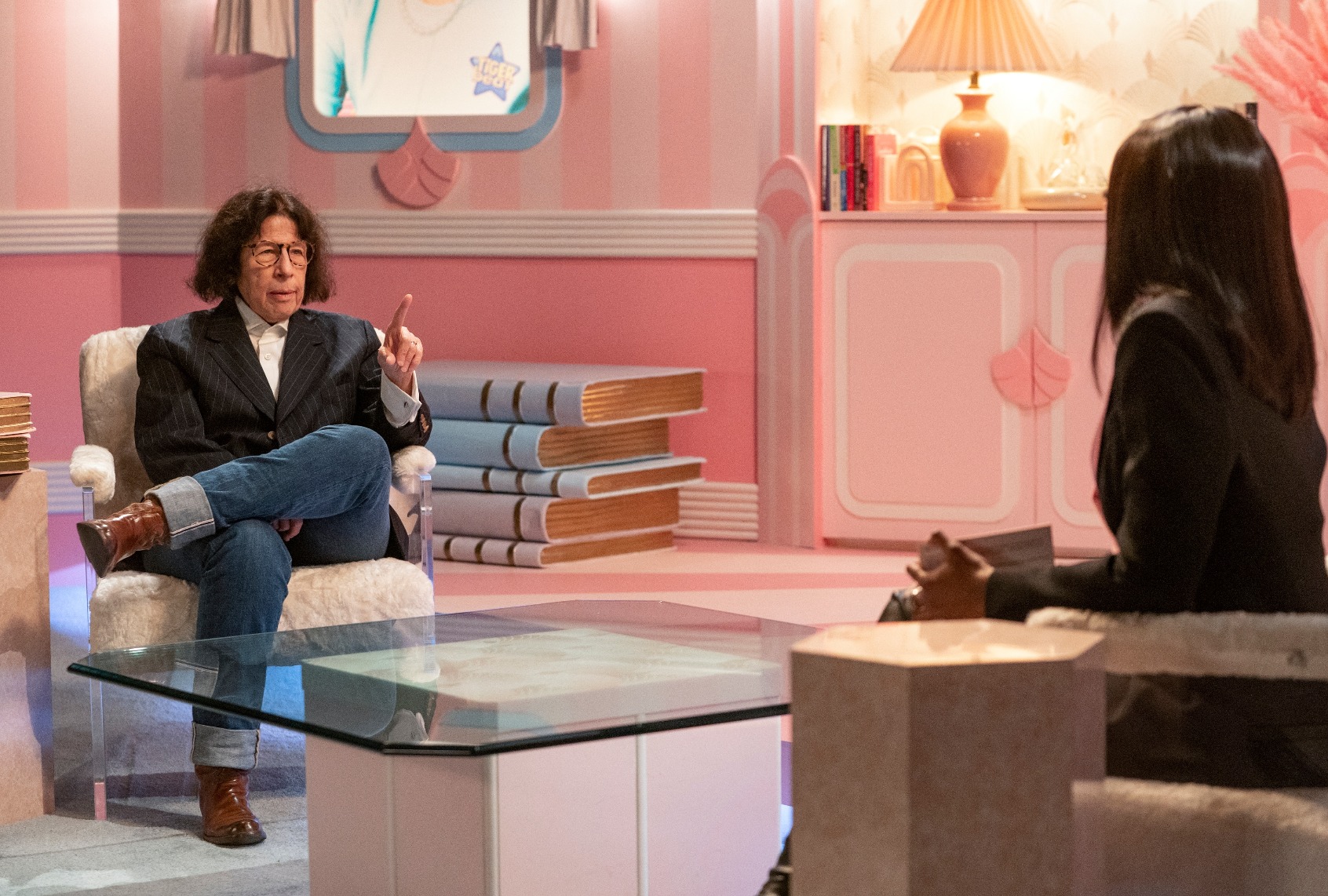
On the “Ziwe” series debut Lebowitz, identified via chyron as “Author, Public Speaker, White Woman,” sits many feet away from the host.  A pandemic-era safety precaution, surely, but do not discount the theatricality at play here. To insist upon maintaining a “that’s close enough” distance is its own type of power move, and usually Lebowitz is the one who sets that sort of yard line.

Here the author, public speaker and white woman is on Fumudoh’s glossy rose-saturated turf, where the performer goes by Ziwe and, figuratively and ever so gently, closes the distance to a disconcerting closeness.

“I’m honored that you’re doing the show,” Ziwe says as she opens their conversation, “but my question is, why did you agree to this? Do you know who I am?”

Lebowitz does not, admitting that she mainly agreed to be on the show because a production assistant hounded her to the point that it became easier to say yes. At this Ziwe gives a shout-out the persistence of women of color, which Lebowitz meets with a deadpan, “Or any persistence.”

The chyron changes in a “this just in” newsflash to read “Fran Lebowitz: All Persistence Matters.”

Lebowitz isn’t being played for a fool here. She isn’t shy about promotion or fame either, or else she wouldn’t have agreed to star a seven-part Netflix  series featuring her and Marty gabbing about New York City. One can also presume that from the moment Lebowitz stepped onto the brazenly girly “Ziwe” set, Lebowitz recognized it for the artistic put-on that it is.

But look at me, exhibiting the opposite of what “Ziwe” does, which is to decenter guests like her and obliterate the so-called fourth wall.  

On “Ziwe” the understanding is that that the conversation is less about the promoting visitor than elevating the host. Fumadoh constructs the show as both a true star-making platform and a spoof of the same. Its opening credits list her as the star, executive producer, creator, musical performer and her own consultant. She has writers, some of whom are featured in the show’s interstitial skis. The debut includes a parody of an American Girl Dolls commercial starring Jane Krakowski and Cristin Milioti.

But really, wink wink, it’s all her and she wants you to know it. Her music videos interstitials glisten with self-promotion. Her costumes are their own show. It’s all a gag, but it’s also entirely serious.

In this respect “Ziwe,” a hybrid of interview show and variety comedy, follows in the footsteps of shows like “Primetime with Jiminy Glick” and Zach Galifianakis’ “Between Two Ferns”  or “The Colbert Report,” each hosted by actors putting on outsized personas for giggles – and all of them white men.

Colbert famously created a version of himself patterned after Bill O’Reilly, a bloviating conservative with hubris oozing from his pores.  Martin Short hides inside a fat suit to become Jiminy, whose quest is to make his guests break by bombarding them with aggressively clueless questions. Galifianakis, like Colbert, presents a fictional version of himself in “Between Two Ferns,” but his alter ego is nervous, ill-prepared, pompous and intent on annoying his guests to the point of making them walk off set. Unless, of course, he encounters one who is unflappable.

But in the episode featuring Lebowitz, the best of the three made available for review, “Ziwe” elevates the jest starting by asserting herself as a Black woman leading this celebrity interview show and, related to that, making the audience know that this is her small piece of the world. The guests are there to bolster her rep, not the other way around.  

Fumudoh’s approach on “Ziwe” is as stylized as her sets and costumes, and while she positively gleams in every interaction her heightened persona is a weapon. The moving target is the question of whether her guests are in on the joke, as comedians Patti Harrison and Bowen Yang are in the “Wealth Hoarding” episode, or in Lebowitz’s case, beyond caring whether people laugh at her or with her.

She takes another approach in next week’s episode, “Beauty Standards,” where “Real Housewives of New York” star Eboni K. Williams enters wearing the aura as Ziwe’s equal, which the star does not dispel. When Ziwe asks Williams to sign a copy of her book for her, the reality star not only does precisely as Ziwe asks but shows off the Certificate of Authenticity included in her copy.

And this is a lovely bookend, if you will, to a field segment in which Ziwe visits a cosmetic surgeon to receive a consultation and he eventually suggests that her nose could look more “refined.” What he means, and shows us by way of a digitized model, is narrower. Wow, right? And Ziwe, grinning, shoots some delectable side-eye toward the audience to acknowledge that, yes, this is indeed messed up.

These excerpts exemplify the more straightforward humor that drives that second episode and “Wealth Hoarding,” two half-hours operating on the common assumption that neither Ziwe nor her guests require further introduction or explanation.

Ziwe’s encounter with Lebowitz serves another purpose entirely. “White Women” opens with Ziwe pondering aloud why 55% of white women voted for Donald Trump (whose name she bleeps) in 2020, up from 51% in 2016.

Lebowitz, who identifies as a liberal and far to the left of President Joe Biden, doesn’t answer that question with any memorable phrase. It’s better than that. When Ziwe asks Lebowitz, “What bothers you more, slow walkers or racism?” Lebowitz huffs, “That’s a real question?” before admitting that she encounters more slow walkers on a day-to-day basis.

Ziwe keeps going, “What percentage of white women do you hate?” Ziwe asks, adding, “And there is a right answer.” As expected Lebowitz says there’s no right answer, adding that she’s less concerned about race than her host, inspiring the chyron to flip to “Fran Lebowitz: Less Concerned with Race.” Some incredible comedy happens by way of those banners, which change with the flow of Lebowitz’s self-important declarations: “Fran Lebowitz: Famously Accommodating White Woman”; “Fran Lebowitz: The Great White Hope” and “White Woman Has Opinion on Obama” are some of the top hits.

Nowhere in their conversation does Lebowitz distinctly verbalize her ideas as to why white women voted for the guy who lost the 2020 election or anything about white women generally, but she doesn’t have to. By revealing her unapologetic solipsism and sharing observations that come from a place of pure egocentrism, Lebowitz acts out the answer.   

Nevertheless Ziwe’s admiration for Lebowitz is obvious, and although the host never loses control of this interview or any others in “Ziwe,” her guests don’t leave any worse for wear either. This is as true for Lebowitz as it is for a group of well-meaning regular women named Karen whom Ziwe handles gently in a segment later shown later in the same premiere. A couple of them blurt a bit of cringe, but the host steps back and lets the situation play out – and sure enough, a Karen within the group steps in and handles it.

The average Showtime viewer may not know Ziwe – yet – but they likely know her iconic guests and the merely famous ones. To see these celebrities simultaneously amused and bemused by her as she wraps uncomfortable questions in sunshine and approachable wit serves as its own endorsement for this delightfully subversive series. If they want to spend time with her regardless of how awkward the scene gets, why wouldn’t you?

“Ziwe” premieres Sunday, May 9 at 11 p.m. on Showtime.

Feminism’s legacy sees college women embracing more diverse sexuality

Most adults identify themselves as heterosexual, meaning they report being attracted to, and engaging in sex with, only members of the other sex. However, women ages 18 to 29 are increasingly rejecting exclusive heterosexuality and describing their sexual orientation in other ways. These changes in women’s sexuality are not mirrored by their male peers.

That’s the primary finding in our most recent report on nine years of surveys at the Binghamton Human Sexualities Research Lab, just published in “Sexuality in Emerging Adulthood.” Together with our Binghamton University colleagues Richard E. Mattson, Melissa Hardesty, Ann Merriwether and Maggie M. Parker, we conclude that changes in young adults’ sexual orientation are not just as a result of increased social acceptance of LGBT people – but also are related to feminism and the women’s movement.

LGBT progress

These findings align with recent polling by the Gallup Organization, which found that American adults are increasingly identifying as lesbian, gay, bisexual, transgender or more than one of those. The Gallup report attributed these changes to increasing public awareness and acceptance of people who identify as LGBT, as well as the influence of a 2015 U.S. Supreme Court case legalizing same-sex marriage nationwide. Another potential factor was proposed federal legislation banning discrimination on the basis of gender identity or sexual orientation.

But our study goes beyond those poll results, showing that young American adults are shifting away from heterosexuality not just in how they identify themselves when asked about their identities, but also how they describe whom they are attracted to and with whom they have sex. That indicates something more is happening than an increasing willingness to “come out” and identify as LGBT.

The fact that these differences are larger among women than men indicates, we believe, that feminism and the women’s movement have, in fact, begun to change female sex and gender roles.

Compulsory heterosexuality

In the early 1980s, lesbian feminist Adrienne Rich argued that what she called “compulsory heterosexuality” was the primary cause of gender inequality. She said that because social pressures and threats of violence – as well as actual violence – force heterosexuality on women, that made women dependent on and subservient to men in all areas of life, including gender roles and sexual expression.

Our research indicates that one outcome of more than a century of feminist activism and progress may be women’s increasing resistance to compulsory heterosexuality and its consequences. As a result, more women under 30 are moving away from exclusive heterosexuality than men in the same age group.

In a related development, we found that women in this age group are also reporting more open attitudes toward sex than previous generations of women. They are separating sex from traditional love relationships, describing themselves as enjoying casual sex with different partners and more likely to have sex with a person before being sure the relationship would become serious or long term. These attitudes are more akin to those of their male peers.

The shift is more pronounced among women who are moving away from exclusive heterosexuality, and less obvious among women who report they are exclusively heterosexual.

There’s much more to learn

We still have a lot of questions about these trends. We wonder how they affect the ways that these young adults engage in sex and relationships. We also don’t know how women who identify themselves as not exclusively heterosexual negotiate and navigate sexual relationships with men – or whether these trends will continue as they age.

We are also interested in why men in this age group are less likely than women to reject exclusive heterosexuality – but are more likely to report exclusive homosexuality. And we’d like to know whether, or at what point, those who are not exclusively heterosexual might come out to family and friends – and if they deal with things like anti-LGBT prejudice.

As human sexuality becomes increasingly diverse, it remains unclear whether the political and social landscape will affirm these changes or threaten those who are expressing that diversity. We are hopeful that the continued success of the LGBT and feminist movements will push society toward an affirming future.

Sean G. Massey, Associate Professor of Women, Gender and Sexuality Studies, Binghamton University, State University of New York; Mei-Hsiu Chen, Director of Statistical Consulting Services, Lecturer, Department of Mathematical Sciences, Binghamton University, State University of New York, and Sarah Young, BSW Program Director, Assistant Professor of Social Work, Binghamton University, State University of New York

This article is republished from The Conversation under a Creative Commons license.

The history of “home economics” is both surprisingly radical and conspicuously regressive

What do you picture when you hear the phrase “home economics?”  Do you think of a high school classroom full of sewing machines, pots and pans, mops and brooms — in other words, a vestige of our sexist past? If so, you’re not alone — and you’re not completely wrong.

But it turns out such a stereotype misses the big picture, one that offers valuable perspective for today’s parents. I learned this after I got my hands on a copy of “The Secret History of Home Economics: How Trailblazing Women Harnessed the Power of Home and Changed the Way We Live,” a new book by Danielle Dreilinger.

What was included in that “big picture” view, you ask? Bride schools! Practice babies! Instagram-worthy radio homemakers! You don’t have to be a history nerd to find the information Dreilinger dug up fascinating. The education journalist went deep for this one, reading high school textbooks, catalogs, condolence cards, and more. She found that the history of home ec is one of hypocrisy, racism, and exclusion — but also contains a good deal to admire as well.

“They wanted to save women from drudgery,” Dreilinger said of home economists. She notes that housework “used to be just backbreaking. . . Women’s lives were being eaten up by pumping water from wells to put on a stove that you had to feed every morning with wood or coal. It was an enormous amount of work, and it didn’t leave you any time to do anything else.”

I recently talked to Dreilinger about what home ec’s history can teach us about modern child-rearing, “adulting,” and our best shot at gender equality.

Our exchange has been edited for clarity and relative brevity.

Let’s quickly catch folks up on what home ec has meant to this country. Your mom majored in it, and then she became a little embarrassed of that. My mom was the first girl allowed to take shop class instead of home ec, and she always described it a bit like springing a trap. I realize now that both stories reflect a very post-1970 point of view. So I’d love if you’d give readers a little more context. What did you mean when you wrote, “Home economics was far more than baking lumpy blueberry muffins”?

Home economics started out as a way to systematize how you kept house so you did it as efficiently as possible. They wanted to save women from drudgery, to free them up to do other things, and then also to professionalize the home so that it could offer a career for women. In the 1920s, a woman trying to study chemistry wasn’t going to find work in a chemistry lab, but she could study how the proteins of meat coagulate in a home economics lab.

The thing that blew my mind was that home economists were the ones who originated the food groups, they came up with the federal poverty level, the consumer protection movement, even the labels on our clothes and the school lunch program.

Yeah, they were responsible for enormous advances. They were extraordinarily pervasive because after they got popular, tens of thousands of women were studying home economics in college. It was how women got into business.

There was some quote about the kitchen …

Yeah, that was Lillian Gilbreth. Her kids wrote after the fact, “If the only way to enter a man’s field was through the kitchen door, that’s the way she’d enter.”

But not all women felt the same way. I think of the “mommy wars” as a pretty recent phenomenon, but you wrote that in 1954 a group of Maryland moms complained about articles portraying homemaking—which we now call being a stay-at-home mom—as easy. They said the homemakers are the ones who “pick up the slack” for working women, watching their kids after school and running the PTA. That seemed to get at a central tension you identified between the home economists’ instruction and their example. It was almost a “do what I say not what I do” kind of thing, right?

Yeah, definitely. So most home economists through World War II were not married or didn’t have children. Married women weren’t allowed to have careers. There were rules that visibly pregnant women had to quit their teaching jobs. So what you had was a lot of women who didn’t have children working on issues about keeping a house and taking care of children.

You mentioned Lillian Gilbreth, the “Cheaper by the Dozen” matriarch in the 1920s and 30s. She had this idea that if you apply enough study you can find the “one best way” to do everything. Tell me a little bit more about that frame of mind.

They thought that taking care of children was a series of tasks. It was, “Here’s how much you should be feeding kids” and “here’s the timing of it.” What the Gilbreths’ became famous for, in the childcare realm, is just these incredibly efficient ways to run a household. Like, it was faster to button up a shirt going up and unbutton going down, or maybe it was vice versa, but Frank Gilbreth sat there with a stopwatch. They had a whole system of who could clean which parts of the house, and the littlest kids would dust the baseboards because they were close to the ground and dusting doesn’t require fine motor control.

Coming from my mindset today, I’m like, “Look at this wackadoodle family with this mindset of regimentation in the home.” But actually Eleanor Roosevelt was telling families that they needed to learn the “one best way” from home economists. It was a fairly pervasive idea it seems, epitomized by lab homes and practice babies.

So the “practice cottage” or “home management house” goes back to roughly 1900, and it looks like it was actually first done in one of the Black colleges. It was a home that home economics students would live in for, say, a quarter. It was self-managed and the students would be given a budget to feed everybody. They’d have to throw certain events to learn event management, the whole nine yards. Now, in reality, this is not what running a house looks like, right? You don’t have 11 single adult women helping you run your house, or most of us don’t.

I know I don’t. What about the babies?

Starting roughly around 1920, college educators decided, “You know what we’re missing in the home economics education experience? Child care. Well, let’s just get a baby.” And they did. They were most often borrowed from a local orphanage. So along with figuring out what people were going to have for breakfast, they had to figure out how to care for this baby.

And all the Cornell University practice babies got the last name “Domecon” short for the name of the department, Domestic Economy, right?

Yeah, so later on at Eastern Illinois University where this practice kind of went off the rails, their last name was North because the babies lived in the North practice house.

Tell us a little bit about Baby David North.

When practice babies began, people thought this was a great, scientific way to bring up a kid. Nowadays, of course, we look at it, and it just seems like the most bizarre thing, and where those wires crossed was in 1953. By then our views of parenting, what’s good for kids and the role of the mother, had changed. Administrators at the college ended up getting in a big fight, and it just totally blew up and was national news. David North was in magazines with his photo next to Desi Arnaz Jr., Lucille Ball’s son. Practice babies were out because the advice of that day focused on a stable bond between one mother and a child, and a father and a child. Which on one hand sounds right, but on the other hand, we could look back at it and see the sexism in the attitude that said, A, there’s something wrong here because there’s no man, and B, this idea that if the mother can’t be a full-time parent for years her kid’s going to be completely and forever screwed up.

And there was a second Spock-era shift toward instinct and flexibility as opposed to regimented scientific practices, yes?

Right, definitely. It no longer seemed like parenting was something that could be easily taught the same way that doing laundry can be taught. Different kids have different needs. Maybe this one needs to eat at a different time than another one.

Scheduled versus on-demand feeding is something we’re still debating today. And that reminds me of another topic that turns out to be not-so-novel. You quoted Lillian saying, “The answer to home problems is to teach men how to combine a career and a home,” and she says not to allow any member of the family to be a “parasite.” Then by the time we get to the late 40s, we have Spock telling people, “You can be a warm father and a real man at the same time.” But, “of course, I don’t mean that the father has to give just as many bottles or change just as many diapers as the mother…. He might, for example, make the formula on Sunday.” How did we get from one to the other?

These are good questions. I don’t think that there was more of an expectation that men would be participating in the 20s. I think fathers combining career and family was always an outlier. But certainly in the 20s and 30s, the material from the Bureau of Home Economics said that these were tasks that had to be done around the house and anybody could do them, and there was nothing gendered about it. There was more emphasis in those days on woman as manager of the household as opposed to her role as a mother. Then what you hear in the 50s is much more gendered, like, “Nobody can take the mother’s place in the home.”

So the “one best way” is out, but when it comes to telling women what to do—I love this quote—you wrote, “Fortunately the burgeoning field of Child Psychology roared in to fill the gap.” Tell us what you meant with that.

What happens towards the end of the 1930s is you have all of these developments in the field of child psychology. And that’s great, but what this turned into as World War II ended and the country was going through enormous economic change trying to deal with the return of men from the war, is you have this shift in what the high school girls are learning. It’s all sorts of stuff about how to have a close fulfilling emotional relationship with your family members. A lot of the home ec curriculum becomes about personal growth. It could have been this really deep way to get beyond the mechanics of sweeping. But the reality is appalling, because it’s all this ridiculous stuff about what’s the right way to be a girl and how to make boys like you.

Right, and it sounds like there’s also a shift from having defined protocols around homemaking and toward this much more amorphous and unending standard for mothers, which we know is a recipe for perfectionistic suffering.

Yeah, and the textbooks, they all talk about the husband helping, but the women still were taught to do all of the mental work. So they’d be told to get the groceries and say, “Hey Mr., would you make dinner Saturday night? We’re having chili. Here’s the recipe.” And then you have the emotional labor of trying to make people in the family happy, which, by the way, I’ve been told by mental health professionals is not actually my job. But women are taught that it’s our job to make our parents happy, our partners happy, our children happy—or create the conditions for them to succeed and be happy. And with children, you have to make sure you support them, but we can’t step in at the wrong time because then we won’t build their independence. It’s exhausting, and that is what I see in those textbooks. You can’t ever be done with trying to have a close relationship with your family.

I tend to think of Instagram and Pinterest and yearn for a bygone time when there wasn’t so much pressure on us, but it sounds like it was always there. There was always somebody telling you how to do things perfectly, including these home demonstration agents, whom you describe as a kind of proto Rachel Ray?

Women were hired to just go out into the community and have workshops for homemakers on things like slow cookers. They were very into slow cookers. The instant pot fixation is not new. You also had home economists working behind the scenes in business. The most famous one is Betty Crocker. There was a team of home economists who created Betty Crocker.

You wrote that there was no Betty! Every radio station had their own person voice Betty so some places she had a drawl and others a mid-Atlantic accent.

She was fictional from minute one. They call them live trademarks, which is kind of creepy. But these fictional characters were presented as real women. Aunt Jemima was exactly this. They would hire actresses to go to a fair, and Betty wrote responses to people who sent in letters asking for advice. Nobody ever admitted that she didn’t exist.

And then also, I think you said at one point in the 1940s there were 14 radio homemaker shows broadcast live in Shenandoah, Iowa alone?

So the radio homemakers would chit-chat about their lives, and they would bring their kids in, and they would often record from their homes. That struck me as definitely the predecessor of these influencers and women who clean on YouTube, in that their whole appeal was that they were just folks like you. But in reality they were getting paid.

And in addition to these shows and home ec classes in high school, there’s more formalized instruction in how to be a wife?

Oh yeah, the marriage courses.

And the bride schools. Tell us about those.

There were a few bride schools that were created by professional home economists in Japan to train picture brides, Japanese women who were going to be wives to white men in America. And then at the end of World War II, those bride schools had closed but the Red Cross picked it up and volunteers would train the Japanese women whom U.S. servicemen had married while serving in the Pacific. The assumption was absolute: They were going to be keeping house the American way for these American husbands. There was a real power differential. It’s pretty painful to look at today.

And then there’s also 1,200 colleges and universities by 1961 offering a marriage course where they were training American women to be American wives?

Yeah, which incidentally, how natural can this all be if it requires that much training?

Right. To a certain extent the whole book seemed to tell the story of two competing stances. On the one hand there was a college president who said, “There are not enough elements of intellectual growth in cooking or housekeeping to nourish a very serious or profound course of training for really intelligent women.”

Yeah, M. Carey Thomas of Bryn Mawr, 1901.

And then you quote others for the idea that a homemaker “need never be bored because she has plenty of opportunity for using her mental ability to the utmost.” So this question of whether stay-at-home parenthood offers enough for personal fulfillment and whether it enables women to offer enough to society is still a topic of debate. In what ways do you think the home economists made headway on it?

I think the only parts of their fight that have been won are the ones we don’t really see. Housework used to be just backbreaking. Women’s lives were being eaten up by pumping water from wells to put on a stove that you had to feed every morning with wood or coal. It was an enormous amount of work, and it didn’t leave you any time to do anything else.

But the pressure on women to maximize children’s social-emotional state is not freeing them up the way early home economists would have envisioned.

 Totally. It’s not like you can get your child-maximization work done by 10 in the morning.

There was a quote that jumped out at me from a critic who said, “Lo how the mighty have fallen” when it comes to comparing the initial vision of home ec with these sexist textbooks. Tell us a bit about your vision for the future of home ec, because I thought it was done and gone, but it sounds like that’s not the case.

Home ec is not gone. At last count, there were at least three million kids in high school taking home economics. It’s still a college major in more than 100 U.S. colleges and universities, and the thing is we don’t see it because they rebranded to names like Human Development and Family and Consumer Sciences. By the way, I have to tell you that as I’ve been talking with you, I’ve been pacing around my bedroom and looking at how dusty the floor is and thinking, “Man, I really need to sweep the floor.”

If only you had some low-to-the-ground children to do that for you.

I know. Anyway, it’s still around, and it is much more progressive than it used to be, and some make it work more than others.

There was talk of teaching students about the role of the sewing machine in capitalism?

There’s a teacher I met who had them research the politics of quilting. She was interested in teaching about e-textiles. But you have a lot of home ec classes that just teach kids how to sew and make pot holders. The class is a little bit torn today between career skills and life skills.

Right, and you make a couple persuasive arguments in that regard in the book. One was that if we don’t teach them life skills in school, it’s yet another burden that falls largely on mothers.

Yeah, and I think that’s one reason why we should care. We should care because kids really enjoy this class. It is always hands-on, project-based learning. Really good for kids who are not so successful at sitting and doing math on a worksheet. It can still help girls get into applied science. I also just think that the visibility of house work and of child care is a real problem. I wrote the conclusion of the book in June of last year as women were dropping out of the workforce to care for their kids. Could I have finished this book if I had kids? Hard to think I could have finished it on time.

I’m sorry, what did you say? I can’t hear you over my kids.

Exactly. Household labor is invisible. We don’t count it in the economy unless you’re paying somebody else to do it. I think about the arguments over this child benefit and people saying, “Are you paying people to stay home with their kids?” Well, that is work that has to be done. And if we don’t look at that, it defaults to gendered norms and then you have this situation where all of these companies are finding it extremely convenient to pretend that they can have mothers work from home, doing their jobs while their kids aren’t in school, and it just can’t be done.

And if we have 3 million out of approximately 50 million public school students in the U.S., so about 6% in home ec, largely girls, what would it look like if we had much higher than 6% and if we had equal enrollment across gender?

I think boys will learn how to do stuff around the house, that’s what I think it would look like. We would have much more equality in the knowledge of how to take care of a household. So many adults have told me, “I wish I’d taken home ec.” They say, “I wish I’d known how to budget. I wish I’d known how to get a quick healthy meal on the dinner table.” We’re just talking about adulting. Our home lives would run much more smoothly if we had more knowledge of how to take care of the household.

When I’m listening to you now, as I’m hearing about lives running smoothly and elevating the labor women do, I’m hearing echoes of the early home economists. So the bottom line I’m getting here is that the work of home ec is unfinished.

Yeah, oh absolutely. They’d be thrilled at how much of the drudgery is gone, but they would be dismayed about the fact that women still haven’t been freed up to do whatever they want to be doing.

How to transform your balcony into a garden oasis

Follow the Pattern is a brand new column from furniture maker and upholstery expert (and Home52’s Resident Design Wiz) Nicole Crowder. Nicole is here to show us how to breathe new life into old furniture, reuse and repurpose materials, take chances with color and pattern — and develop a signature aesthetic. Today, she shares her tips for transforming a balcony.

* * *

Spring has unfurled across the country, reminding us that it’s the perfect time to start cultivating our outdoor spaces: the patios and balconies that have felt so far removed through a cold, long winter. Like so many of you, I live in an apartment building in a city (luckily, one with a small patio), and find that even just adding a few chairs and plants on the patio makes all the difference. This year, I went a step further to try to create a garden-like oasis where I could feel transported every time I set foot outside. The result is an outdoor space filled with color, texture, and just the right amount of whimsy. Read on to learn how I did it.

Creating privacy shields through plants

If you live in a big city — or have neighbors with outdoor spaces close to yours — you might crave a little privacy. My favorite way to do this is by staggering plants around the perimeter of my balcony railing. Use tall plants or plants with big leaves that span out, like philodendron, palm leaf, and monstera. You can also add height by staggering your plants on stands. I love a modern plant stand like this one by Blomus.

Because I live in Minnesota, where it stays cool for longer through the year, I opted to add some artificial plants to the mix, so I don’t have to worry about them wilting or dying. I bought this hanging wisteria that I’ve strung along the balcony railing, as well as some artificial green vines that drape the frame of the balcony door. Michaels is a great source for dried and artificial hanging plants, and prices can range from $18 to $125, depending on what you pick.


Photo by Nicole Crowder

Picking the right chairs

There are infinite options for patio and balcony chairs. I think the most important thing to consider, no matter the fabric or color palette, is the materiality of the fabric and chair frame. Take the white canvas chairs I have (which sadly are no longer in production), for example: Canvas is always a great choice because it’s super easy to clean and holds up well against the elements, and the wooden frame is treated, so it’s less susceptible to rain, sleet, and sunlight.

Another thing to keep in mind when styling your balcony is the dimensions of your furniture. My chairs are wide enough to be comfortable for a sustained period, but not so wide that they took up too much space. I chose single standing chairs so I could have the flexibility to move them around.

If you prefer to create a seating zone, this sectional corner is the perfect size and shape for fitting into a corner. Or if you have the space, splash out on an entire sectional.

If you really have some outdoor space to work with, a hanging egg chair like this can help elevate your outdoor game. You can also use pouf cushions or ottomans as alternatives to chairs, which can also help maximize space and add dimension to your balcony.

Here are two other chairs I’ve got my eye on: a wicker lounge chair that I would definitely never want to get up from, and this modernist cashmere lounge chair that’s a little more of a splurge.

Adding color and texture through rugs

The other catalyst for creating this garden oasis was wanting to extend the color in my home to the outside. My first thought was to put down some Astroturf, but then I found these vibrant reversible mats made from recycled plastic (even better!). I love the idea of overlapping rugs to create a tapestry because it adds texture and opens up the space.

Tables

I wanted a round table to help break up the angular lines of the chairs, the rugs, and the balcony rails, but also be able to continue to maximize space on the balcony. And because I love having snacks and wine on the balcony, I wanted a table large enough to fit plates of food and a couple glasses of wine. I eventually found this small, round table with a quartz top and brass frame from Hobby Lobby through a seasonal sale, but also had my eye on this lovely quartz table.

Some other ideas for practical but cute tables: This fold-up and carry table acts as a picnic table, but also stores and carries your snacks and wine for easy transportation — for re-creating park picnic vibes right at home; and you can never go wrong with a classic bistro table.

Ultimately, when styling your balcony space — whether your desire is to replicate a garden oasis, a desert getaway, or a seaside vibe — the key is in creating texture by layering, layering, and more layering. Add multiple rugs, a variety of plants that love direct sunlight, colorful pillows to your chairs, and printed pouf cushions to the floor. Bring along your books and an outdoor bar cart. Flank your doorway with tall ceramic sculptures to create a sculpture garden vibe. The possibilities are as wide open as the outdoors themselves.

This post contains products independently chosen (and loved) by Food52 editors and writers. As an Amazon Associate and Skimlinks affiliate, Food52 earns a commission on qualifying purchases of the products they link to.

My time-traveling bowl of spaghetti and meat sauce

It always starts the same. I slick the bottom of my biggest enameled cast iron pot with a glug of olive oil then, thwap! I plop in a brick of fatty ground beef or pork, reveling in the crackling applause as its edges start to caramelize. I sprinkle the browned meat with salt before scooping it out and tipping in a heap of diced onions, their familiar sizzle and aroma wrapping me in a warm embrace.

From there, the meat sauce I’ve cooked faithfully throughout my adulthood can take up a hundred tiny variations before I toss it with pasta and shove comforting heaps of it in my face. Most often, it involves plenty of chopped garlic, pureed tomatoes, a handful of torn herbs, and maybe a splash of last night’s red wine.

But now that a pandemic has largely confined me within the walls of my Chicago apartment, with nary a dinner reservation or far-flung trip on the horizon, meat sauce, in its endless comfy guises, carries a weightier load — of transporting me somewhere else until I reach the bottom of the bowl.

Maybe instead I build a rich ragù from a base of minced celery, carrots, onion, and garlic and a trio of pork, beef, and lean veal. It’s tinged with wine and a wad of rust-colored tomato paste, then slowly stewed for hours until each element melds and concentrates into a burnished paste.

Thinning it with starchy pasta water and tossing a few modest spoonfuls with al dente rigatoni and a velvety drizzle of olive oil takes me to the airy, serene dining rooms of Chicago’s finer-dining Italian restaurants, where the elegant handmade pastas glisten with just enough sauce to coat each noodle.

Then again, if I spoon a thick layer of that same meaty paste over a plate of oil-glossed spaghetti noodles, I’m teleported to the candlelit dining room with frescoed walls of Italian Village, my favorite century-old, Italian-American eatery in Chicago, where I’ve ordered the same $16 spaghetti with (extra) meat sauce since age seven.

If, perhaps, I make a batch using just ground pork with its sausagey essence, and up the tomato quota, sprinkle in dried fennel, and drop in a cinnamon stick, I am suddenly whisked to a long, wood communal table opposite a bustling, pint-sized Chicago food stall called Thattu, which slings soothing curries from the south Indian state of Kerala. My spicy facsimile almost channels Thattu’s warming winter stew known as pork peralan, with hunks of tender pork in cumin-scented tomato curry—whose reddish oil slick stains my fingers as I scoop it up with lacey appam, a tangy fermented rice crepe.

From time to time, I’ll instead form the ground beef into fat meatballs studded with minced garlic and bread crumbs, and brown them before plunking them into an herby red gravy equally scented with garlic. On those special days, my meatballs and gravy take me far beyond the confines of my hometown, to the swampy Louisiana town of Westwego that dips down along the Mississippi River coastline just south of New Orleans.

There, a creaking, 74-year-old roadhouse called Mosca’s comforts me with fat Gulf oysters broiled beneath thick, golden bread crumb roofs, and piles of spaghetti with tender meatballs doused in that same garlicky red sauce. Even after I leave, I can still smell the aroma of garlic sizzling in oil, hanging thick in the humid air above Highway 90.

Rarer still, I procure a couple of pork or beef bones from the butcher and make stock to lay the foundation for the mother of all meat sauces: Bolognese. I render pancetta and fatty ground beef with mirepoix in a decadent bath of sizzling butter before adding tomato puree and a few cupfuls of my homemade stock. After hours of weakly bubbling, the mixture gets stained orange with whole milk then showered with grated Parmesan.

The buttery, rich sauce clings to the eggy pappardelle ribbons I twirl around my fork, while meanwhile I flit to lovely Bologna, in Italy’s Emilia-Romagna region. After a winter’s afternoon wending through the old town beneath its many arched porticos bathed in slanting, golden light, my companions and I stumble upon a little trattoria down a narrow street. In the slim dining room lined with shelves full of wine bottles, we pass around a shallow bowl of gramigna Bolognese, which is mostly hidden beneath an avalanche of shaved Parmesan.

* * *

Lately though, as the long sequestered weeks wear on, I’ve been longing for a return trip to a very specific meat sauce. It’s the sauce that stirred in me a lifelong appetite for this dish, which my mom made every week when I was a kid.

She always began hers the same way, too. “Start with chopped onion in butter then 80 percent ground beef,” she writes, not 30 seconds after I texted requesting the method. Her version, born in Sudbury, Massachusetts some time in the mid ’80s, always included a can of Hunt’s tomato sauce, a few teaspoons of garlic powder, and a sprinkling each of dried basil and oregano — its sweet peppery and minty notes recall the jarred Pregos and Ragús of so many American childhoods.

Midway through my first bite, I’m suddenly four years old, with sauce on my face and splattered like polka dots all over the front of my one-piece bathing suit. I’ve just taken a break from swimming in the plastic wading pool in the backyard to eat spaghetti with Mom’s meat sauce on a sagging paper plate, as the August sun dips behind the tops of the towering oak trees.

I haven’t really traveled anywhere yet, but the world feels wide open. And all the joy I need sits before me, waiting to be twirled onto my fork.

* * *

Pasta With Mom-Daughter Hybrid Meat Sauce

Prep time: 15 minutes
Cook time: 1 hour
Serves: 3

Ingredients

  • Olive oil, as needed
  • 1 pound 80% lean ground beef
  • Kosher salt and freshly ground pepper
  • 1 teaspoon dried oregano
  • 1 medium yellow onion, small diced
  • 1/2 teaspoon red pepper flakes
  • 3 fat cloves garlic, minced
  • 2 tablespoons tomato paste
  • One 28-ounce can strained or crushed tomatoes
  • 1 pound spaghetti
  • 2 teaspoons unsalted butter
  • 1/4 cup fresh basil leaves, chopped
  • 1/2 cup freshly grated Parmesan cheese

Method

  1. Heat a heavy-bottomed pot over medium-high with a few teaspoons of olive oil. When oil slides easily around the pan, plop in ground beef. Cook, breaking up the meat with a wooden spoon, until caramelized and no longer pink, 8 to 10 minutes. Turn off heat, and stir in oregano, a good pinch of salt, and a few grinds of black pepper. Transfer beef to a plate, and set aside.

  2. Wipe out any moisture from pot, turn heat back on medium, and add a few tablespoons of olive oil. Tip in the chopped onions, a large pinch of salt and the red pepper flakes; sauté, stirring occasionally until soft and translucent, about 10 minutes. Add garlic, and sauté for another minute. Add browned beef, stir in tomato paste, and cook for 2-3 minutes, until mixture turns rust-colored. Add tomatoes and another pinch of salt. Add water about 1/4 the way up the tomato can, swirl it around, and add that to the sauce, too, scraping any brown bits off the bottom with a wooden spoon. Bring heat up to medium high, cover pot and let sauce come to a boil. Turn heat down to simmering (a steady bubble), and cook, partially covered, for 30 to 45 minutes, stirring occasionally. During final minutes of cooking, swirl in butter, check seasoning, and adjust with salt and pepper.

  3. When sauce is nearly done, cook pasta in a large pot of boiling salted water, stirring occasionally, until al dente. With a measuring cup, steal 1/3 or so cup of starchy pasta water. With tongs add cooked pasta to meat sauce, tossing feverishly until well coated. Thin with pasta water if needed. Cut the heat, add half the basil and Parmesan, and toss again. Plate, and garnish with remaining basil and cheese.

Why Trump is more likely to win in the GOP than to take his followers to a new third party

Former President Donald Trump has claimed at times that he’ll start a third political party called the Patriot Party. In fact, most Americans – 62% in a recent poll – say they’d welcome the chance to vote for a third party.

In almost any other democracy, those Americans would get their wish. In the Netherlands, for instance, even a small “third” party called the Party for the Animals – composed of animal rights supporters, not dogs and cats – won 3.2% of the legislative vote in 2017 and earned five seats, out of 150, in the national legislature.

Yet in the U.S., candidates for the House of Representatives from the Libertarian Party, the most successful of U.S. minor parties, won not a single House seat in 2020, though Libertarians got over a million House votes. Neither did the Working Families Party, with 390,000 votes, or the Legalize Marijuana Now Party, whose U.S. Senate candidate from Minnesota won 185,000 votes.

Why don’t American voters have more than two viable parties to choose among in elections, when almost every other democratic nation in the world does?

Plurality rules

As I’ve found in researching political parties, the American electoral system is the primary reason why the U.S. is the sole major democracy with only two parties consistently capable of electing public officials. Votes are counted in most American elections using plurality rules, or “winner take all.” Whoever gets the most votes wins the single seat up for election.

Other democracies choose to count some or all of their votes differently. Instead of, say, California being divided into 53 U.S. House districts, each district electing one representative, the whole state could become a multi-member district, and all the voters in California would be asked to choose all 53 U.S. House members using proportional representation.

Each party would present a list of its candidates for all 53 seats, and you, as the voter, would select one of the party slates. If your party got 40% of the votes in the state, then it would elect 40% of the representatives – the first 21 candidates listed on the party’s slate. This is the system used in 21 of the 28 countries in Western Europe, including Germany and Spain.

In such a system – depending on the minimum percentage, or threshold, a party needed to win one seat – it would make sense for even a small party to run candidates for the U.S. House, reasoning that if they got just 5% of the vote, they could win 5% of the state’s U.S. House seats.

So if the Legalize Marijuana Now party won 5% of the vote in California, two or three of the party’s candidates would become House members, ready to argue in Congress for marijuana legalization. In fact, until the 1950s, several U.S. states had multi-member districts.

Under the current electoral system, however, if the Legalize Marijuana Now party gets 5% of the state’s House vote, it wins nothing. It has spent a lot of money and effort with no officeholders to show for it. This disadvantage for small parties is also built into the Electoral College, where a candidate needs a majority of electoral votes to win the presidency – and no non-major-party candidate ever has.

Parties run the show

There’s another factor working against third-party success: State legislatures make the rules about how candidates and parties get on the ballot, and state legislatures are made up almost exclusively of Republicans and Democrats. They have no desire to increase their competition.

So a minor-party candidate typically needs many more signatures on a petition to get on the ballot than major-party candidates do, and often also pays a filing fee that major party candidates don’t necessarily have to pay.

Further, although many Americans call themselves “independents,” pollsters find that most of these “independents” actually lean toward either the Democrats or the Republicans, and their voting choices are almost as intensely partisan as those who do claim a party affiliation.

Party identification is the single most important determinant of people’s voting choices; in 2020, 94% of Republicans voted for Donald Trump, and the same percentage of Democrats voted for Joe Biden.

The small number of true independents in American politics are much less likely to show interest in politics and to vote. So it would not be easy for a third party to get Americans to put aside their existing partisan allegiance.

Hard to get there from here

The idea of a “center” party has great appeal – in theory. In practice, few agree on what “centrist” means. Lots of people, when asked this question, envision a “center” party that reflects all their own views and none of the views they disagree with.

That’s where a Trump Party does have one advantage. Prospective Trump Party supporters do agree on what they stand for: Donald Trump.

Yet there’s an easier path for Trump supporters than fighting the U.S. electoral system, unfriendly ballot access rules and entrenched party identification. That’s to take over the Republican Party. In fact, they’re very close to doing so now.

Trump retains a powerful hold over the party’s policies. His adviser, Jason Miller, stated, “Trump effectively is the Republican Party.” This Trump Party is very different from Ronald Reagan’s GOP. That’s not surprising; the U.S. major parties have always been permeable and vulnerable to takeover by factions.

There are good reasons for Americans to want more major parties. It’s hard for two parties to capture the diversity of views in a nation of more than 300 million people.

But American politics would look very different if the country had a viable multi-party system, in which voters could choose from among, say, a Socialist Party, a White Supremacist Party and maybe even a Party for the Animals.

To get there, Congress and state legislatures would need to make fundamental changes in American elections, converting single-member districts with winner-take-all rules into multi-member districts with proportional representation.

Marjorie Hershey, Professor Emeritus of Political Science, Indiana University

This article is republished from The Conversation under a Creative Commons license.

Now we’re supposed to think Reagan, Bush and the Cheneys are cool? They got us here

The fate of American democracy rests in the hands of Michelle Obama, or more precisely, in her arms. Should she choose to give Donald Trump a hug, the Democratic Party — the high-salaried commentariat and the various jesters of pop culture — will ostensibly have no choice but to forgive him for his catalogue of atrocities. If Trump had even a little strategic savvy, rather than pathetically throwing inane grievances “From the Desk of Donald J. Trump,” Geocities-style, he would position himself next to the former first lady at a televised public gathering, and carefully drop a lozenge into her palm. 

Having a few slightly human exchanges with Michelle Obama, of course, worked wonders for George W. Bush. Over the past five years, the grotesquery of Bush’s presidency has undergone such a thorough rehabilitation that, according to many polls, even a majority of Democrats have a favorable view of the retired war criminal. 

Appearances with Barack Obama and Bill Clinton, along with a newly published collection of kitschy paintings of immigrants, have led far too many members of the public to swoon over Bush — the man Karl Rove saw as a safe bet because he thought Americans would prefer to “have a beer with him” as opposed to his wonky political adversaries, Al Gore and John Kerry. Those guys might want to talk about boring stuff like climate change, whereas Bush would make a few wisecracks and then tell that great story about the time he bombed, invaded and occupied a country for no good reason. “The whole thing was a lie!” he would announce as his punchline. 

At press time, no journalist has inquired of any Iraqis whether they too are moved by the exchange of Lifesavers between Bush and Michelle Obama. Needless to say, more than a million Iraqis cannot comment or leave an Amazon rating of Bush’s book, because they’re dead. Perhaps because the Iraq war is over (more or less), there’s a general feeling that the United States should “move on,” as is the country’s tendency whenever it violates international law. Forgiving and forgetting might not be so easy for those still in Iraq. Award-winning toxicologist Dr. Mozhgan Savabieasfahani reports that birth defects, premature death, mental disabilities and other forms of medical misery are common in Iraq due to the widespread contamination of the environment, largely resulting from U.S. bombs, munitions, burn pits and toxic chemicals. 

Apparently, journalists cannot discuss the Iraq war because they are too busy lionizing Rep. Liz Cheney, whose father was not only vice president to George W. Bush, but the chief architect of that war. As recently as 2015, the father-daughter duo co-wrote a psychotic foreign policy manifesto, “Exceptional: Why the World Needs a Powerful America“; in it, they chastised then-President Barack Obama, who himself bombed multiple countries with dubious reasons, for failing to “maintain American supremacy.” 

Donald Trump recently derided Liz Cheney as a “big shot warmonger.” It is painful to admit that Trump might be right about anything, and even more painful to have no choice but to take the side of the big shot warmonger. Cheney and Trump are at each others’ political throats, representing hostile factions of the Republican Party, because the congresswoman from Wyoming acknowledges the unremarkable fact that Joe Biden was the lawful and legitimate winner of the 2020 election. Cheney’s refusal to mindlessly fall into the personality cult of Trump, and parrot the Big Lie of a massive voter fraud conspiracy, has significantly shortened her political life expectancy. Her most significant break with Trump occurred when she voted for his impeachment as penalty for inciting the insurrection of Jan. 6. 

Rep. Kevin McCarthy, the House minority leader, has indicated that Cheney will lose her leadership position as House Republican Conference chair. Meanwhile, a bipartisan consensus of observers, ranging all the way from Rep. Jim Jordan to Sen. Bernie Sanders, has predicted that Cheney may not survive the 2022 midterm elections. 

One of America’s two major political parties appears to have gone full fascist — elevating the likes of Rep. Marjorie Taylor Greene, who has promoted a conspiracy theory involving Jewish-controlled space lasers, and Sen. Josh Hawley, who the New York Times reports is raking in the cash at unprecedented levels since he provided aid, comfort and support to the violent mob that stormed the U.S. Capitol with the intention of murdering elected officials and destroying our democratic system of governance. 

Cheney, who has an 80 percent rating from the Heritage Foundation, and on most issues is slightly to the right of Attila the Hun, is suddenly persona non grata, because of a range of anti-Trump offenses that includes the crime of fist-bumping with Joe Biden. 

Michael Gerson, a former speechwriter for George W. Bush, coined one of his boss’s most famous phrases in an address against affirmative action: “the soft bigotry of low expectations.” It is a rich irony that Bush now benefits from that exact form of “soft bigotry” as he is lavished with praise for not being a fascist or a nativist.

Liz Cheney’s current status in mainstream media is similar. The Republican Party has descended to such depths of cruelty and stupidity that honoring free and fair elections, and giving a polite greeting to the actual president, is enough to earn contempt.

Difficult as it is to sympathize with Cheney, who is such an extreme anti-environmentalist that she once called on the Department of Justice to investigate the National Resources Defense Council for espionage, anyone with the slightest hint of loyalty to democracy should hope that the Trumpian right’s insane campaign against her inflicts some permanent damage on the Republican Party. 

All the same, anyone curious to learn how that party could have become such a severe threat to the American democracy need look no further than Cheney herself, or watch any of the recent banal and servile TV interviews of George W. Bush.

That dark story dates back much further than Bush’s destructive tenure as president. Detailing the extent of America’s collective ability to deny, sugarcoat or forget its own atrocities would be impossible here. Gore Vidal coined the phrase “United States of Amnesia” for a reason, and joked that his biggest disagreement with legendary oral historian Studs Terkel was over that quip. (Terkel preferred to say that USA stood for “United States of Alzheimer’s.”)

Over the closing credits of Oliver Stone’s film “Nixon,” there is actual footage from the disgraced president’s funeral. The entire American political establishment sits in attention as then-President Bill Clinton pays mawkish tribute to Nixon’s “service to his country,” for which the country, Clinton explains, is forever in his debt. Other than one brief reference to the creation of the EPA, Clinton does not offer any specific examples of Nixon’s “service.” It is safe to assume that he probably didn’t mean the illegal bombing of Cambodia, the COINTELPRO persecution of antiwar and civil rights activists or the creation of the “Southern strategy.” 

If one of Trump’s most grievous attacks on American life was the overt use of racism as a campaign tactic, then the road to ruin in many ways starts with Nixon, whose own political staffers even admitted that racist appeals were their most effective means of winning votes in the South and parts of the Midwest. 

Gerald Ford has often been praised for pardoning Nixon, because allowing his predecessor to evade any serious consequences for authorizing and lying about the burglary of the Democratic Party Headquarters, was deemed the “best way to stanch the open wound of Watergate.” Commentators are still fond of tossing out the pro-pardon bromide even though Trump once again demonstrated the danger of allowing the president to remain above the law. 

If Nixon pioneered the Southern strategy, Ronald Reagan mastered it. One of Reagan’s early campaign events in 1980 took place at the Neshoba County Fair, merely seven miles from Philadelphia, Mississippi, where members of the Ku Klux Klan, with the assistance of local law enforcement, had murdered the Freedom Riders James Chaney, Andrew Goodman and Michael Schwerner in 1964. It was more a bullhorn than a “dog whistle”: Reagan discussed the importance of “states’ rights” in that speech. As president, he pumped out the “welfare queen” myth, accusing Black women in inner cities of picking up their food stamps and welfare checks while sporting mink coats and diamond rings. That racist stereotype became central to the bipartisan destruction of social programs and public goods, reinforcing the prevalent attitude among white moderates and conservatives that poor people, especially if they were Black, were freeloaders who refused to work. 

For all the ugliness of his rhetoric, Reagan’s policies were even worse. He waged a proxy war of aggression against several Latin American countries — condemned as terrorism by the World Court — and funded on-the-ground forces in Nicaragua through the illegal sale of arms to Iran. 

None of which prevented Barack Obama from repeatedly praising Reagan in speeches and interviews. Obama’s encomiums to Reagan were so effusive and consistent that Douglas Brinkley, the popular historian and editor of Reagan’s diaries, posited that Reagan was Obama’s “role model.”

It is now almost obligatory for TV pundits to break out the world’s smallest violin and wax nostalgic for the “party of Reagan” while lamenting what Republicans have become under Trump. But the party of Reagan, setting aside the public grace and everyday eloquence of the “Great Communicator,” was in many ways an early incarnation of the party of Trump. Those who fail to make the connection are being willfully ignorant. Now, it’s also true Reagan signed international nuclear treaties that Trump tried to destroy, and offered amnesty to millions of undocumented immigrants. Trump was measurably worse on several important issues, but that’s not a good reason to delude ourselves about the fundamental nature of the Republican Party, and the right-wing cultural and media movement that empowers it. 

Trump was especially destructive because he and his gaggle of ghouls actively sought to undermine important government agencies, deliberately violated democratic norms and civil liberties, and made a mockery of the rule of law. It’s impossible to imagine that if George W. Bush lost to Kerry in 2004, he would have rambled incoherently about how the election was “rigged,” or urged a violent band of fanatics to storm the Capitol and terrorize Dick Cheney. 

On the other side of the ledger, however, most people have forgotten that in 2001, the state of Florida reached a settlement with the NAACP over illegally purging Black voters from the polls prior to the 2000 presidential election. Infamously, Bush won the state by only 537 votes (even assuming that was a fair and accurate count, which it certainly wasn’t). As president, Bush oversaw the violation of millions of Americans’ civil rights after the passage of the PATRIOT Act; authorized the use of torture against “enemy combatants”; and created ICE, the barbaric agency most responsible for the Trump-era persecution and abuse of newly-arrived immigrants, including children and asylum applicants. 

Bush’s disregard for good governance reached its nadir during Hurricane Katrina. The predominantly poor and Black residents of New Orleans went five days without federal intervention. While people drowned in their homes, or lived in the filthy conditions of the Superdome, Bush told FEMA administrator Michael Brown, previously the commissioner of the International Arabian Horse Association, “Brownie, you’re doing a heckuva job.” 

Brownie now hosts a talk radio program in Denver, where he warns that the “republic is faltering” under President Biden’s leadership. In promotional press for the radio program, Brown’s colleagues actually use the “Brownie” nickname with pride and affection. Kris Olinger, who oversees radio programming for the Denver Clear Channel affiliate that airs Brown’s show, has said that Brown’s experience with Hurricane Katrina is a “definite positive” which offers him “great insight into how government works.” Brown’s FEMA tenure involved the deaths of 1,833 people during and after Katrina.

Brown’s new role as political expert is frankly no worse than CNN’s insistence on regularly featuring New York Times columnist Thomas Friedman as oracular genius and valiant defender of democracy. Arguably Donald Trump has never said anything as loathsome as Friedman’s full-throated endorsement of the 2003 invasion of Iraq, claiming it would send a clear message to “Islamic extremists”: “Which part of this sentence don’t you understand? You don’t think we care about our open society? You think this (terrorism) fantasy you have — we’re just gonna let it grow? Well, suck. on. this.”

As the media and even some Democrats praise Liz Cheney for showing minimal fidelity to law and democracy, it is crucial to keep in mind that while Cheney and does not represent the personality cult of Trump’s deadly narcissism, she represents the party of the Southern Strategy, the party of Iran-Contra, the party of disenfranchising Black voters, and the party of “suck on this.” As Salon’s Chauncey DeVega wrote in his analysis of the Cheney-Trump feud, Cheney is not a genuine believer or practitioner of democracy — she is a “friendly fascist.” 

Sen. Sheldon Whitehouse of Rhode Island, one of the country’s most intelligent public officials — and unlike Liz Cheney, an actual public servant acting in the interest of his society — has warned that the U.S. risks internal assaults worse than Jan. 6 if Congress, the Justice Department and the FBI do not investigate (and potentially prosecute) Trump administration officials for the their manipulation of science during the COVID-19 pandemic, and their role in Trump’s attempted coup-d’état. 

Referring to the Obama administration’s refusal to pursue charges against the Bush administration for the use of torture, Whitehouse recently told the New Republic, “If Obama had not [said], ‘We’re not going to look back, we’re only going to look forward,’ the Trumpsters would have been a lot less bold about doing the reckless damage that they did.”

Jim Clyburn calls out “miserable failure” Mitch McConnell in CNN interview

Speaking with “State of the Union” host Jake Tapper on Sunday morning, House Majority Whip Jim Clyburn (D-SC) ridiculed Senate Minority Leader Mitch McConnell (R-KY), saying the GOP leader is overseeing a party that has lost its way.

With the CNN host noting McConnell has admitted he will do everything he can to obstruct President Joe Biden, Clyburn jumped all over the Senate Republican’s remarks.

“What’s your take on that comment? Does that mean there’s no hope for bipartisanship in the Senate?” Tapper asked.

“No,” Clyburn shot back. “I think the Republicans are going to remember that it was Mitch McConnell who told them that his number one priority was to make sure that Barack Obama was a one-term president. Last time I checked, he was a miserable failure in 2012 and Barack Obama was a two-term president and a very successful one at that.”

“I think they are going to get the same thing here,” he continued. “Mitch McConnell has some personal animus towards Democrats that ought not to be. We are one nation under God, indivisible, with liberty and justice for all — let’s operate like that. This Republican Party is losing its way on all fronts, and Mitch McConnell is contributing to that in a big way.”

Watch below:

From extreme catfishing to wine fraud, here are 13 documentaries about con artists

Sometimes there’s nothing more satisfying to watch than a good con or, at least, watching how someone who has perpetrated one gets caught. 

In those narratives, there’s often a really appealing push-pull between admiring the artfulness of the fraudster and rooting for the investigators on their trail. It’s also a brand of true crime that’s a little lower stakes — and inherently less problematically salacious — than some of the gorier serial killer stories

RELATED: “WeWork had all the bad red flags”

If you’re fascinated by the scammers and schemers, the imposters and hoaxsters who walk among us (such as Anna Delvey as seen in “Inventing Anna”), then check out some of Salon’s favorite documentaries and docuseries about some of the most intriguing cons in recent history. From an extreme catfisher to a man who donates forged art to museums, there’s something for you. 

“Love Fraud,” Showtime 

This four-episode docuseries looks into a man who has taken catfishing to an absolutely wild extreme, resulting in a multi-state manhunt spearheaded by all the women he’s left in his wake. “Love Fraud” investigates the case of Richard Scott Smith (that’s just one of his names, by the way), a Kansas native who would try on different identities to lure new romantic partners — though just long enough to marry them and make off with their cars, credit cards and hearts. 

A number of women who were scammed by him hire Carla Campbell, a pint-sized bounty hunter with a foul mouth and quick temper, to track Smith down before he strikes again. 

“Generation Hustle,” HBO Max

“Generation Hustle” depicts the ploys of a dozen con artists and scammers – from faux Saudi princes, a German heiress and EDM kingpins. In “Hollywood Con Queen,” a con artist swindles the pocketbooks of aspiring artists, luring them across the globe with the promise of high-paying jobs. The series also highlights infamous WeWork co-founder Adam Neumann and “Soho grifter” Anna Delvey

As co-creator Angie Day told Salon, “Everyone wants to think that they’re too smart to be conned, but actually, anyone could be conned.” And that even includes the producers of “Generation Hustle,” whom almost got conned by one if its subjects.

“Sour Grapes,” Tubi 

The world of high-dollar wine is one filled with excess, tradition and gatekeepers. But in 2006, Rudy Kurniawan, a 30-something Indonesian wine collector, seemingly burst out of nowhere when an auction company broke records by selling $35 million worth of his wines.

Kurniawan soon became a wine world darling as restaurant owners, Hollywood producers and billionaire Bill Koch purchased from his collection of Burgundies. And people loved him! He was a wine genius who had always had an encouraging word (and often a spare bottle of wine) for everyone. 

However, elements of his origin story — how he accumulated his collection, how he learned about wine and how he made his money — started to unravel once a French winemaker started looking into his claims. 

In “Sour Grapes,” filmmakers Jerry Rothwell and Reuben Atlas investigate how Kurniawan pulled one of the biggest wine world scams in history. 

“Author: The JT LeRoy Story,” Amazon Prime

J.T. Leroy, an HIV-positive young prostitute from West Virginia, penned memoirs of childhood abuse under the elusive nom de plume  “Terminator” during the late ’90s. At the time, Leroy existed in a world of both mystery and celebrity, publicly schmoozing with Lou Reed and Winona Ryder while shrouded in a blonde wig, large sunglasses, and wide brimmed hat. 

But the “Terminator” turned out to be 40-year-old Laura Albert. And the woman under the wig? Albert’s sister-in-law Samantha Knoop. As Albert fabricates the persona of J.T. Leroy in an effort to cope with childhood demons involving non-consensual stays in a mental ward, Albert begins to embody Leroy, unable to separate herself from the character she created.  


Want a daily wrap-up of all the news and commentary Salon has to offer? Subscribe to our morning newsletter, Crash Course.


“The Woman Who Wasn’t There,” Amazon Prime

“The Woman Who Wasn’t There” recounts the chilling story of Tania Head, President of the World Trade Survivors’ Network. Head claimed to have survived severe injuries during the 9/11 south tower attack and the death of her fiance killed in the north tower. The group marveled at Head’s resilience as she gained increasing national prominence as the poster child for the support network. 

Until the tale began to unravel. As it turns out, the figurehead of the World Trade Survivors’ Network was not even in New York on 9/11. 

In “The Woman Who Wasn’t There,” Head recounts her own journey in unsettling detail, allowing viewers to grapple with Head’s identity and the catalyst for her damaging hoax. 

“Art and Craft,” Amazon Prime 

Mark Landis was one of America’s most prolific art forgers. For over 30 years, he conned museums by donating paintings to them that he claimed were made and signed by famous artists, but had actually been created by him.

He generally targeted smaller museums, however his habit for making copies of the same painting — sometimes up to six at a time — finally caught up to him when Matthew Leininger, a museum manager with a grudge, started tracking Landis’ movements. 

However, when the two finally came face to face, Landis wasn’t exactly the picture of the con man Leininger had painted in his mind. “Art and Craft” is a surprisingly heartwarming and humorous documentary that delves into truth, belief and mental illness. 

“FYRE: The Greatest Party that Never Happened,” Netflix 

Some of the best con stories are ones that are bolstered by schadenfreude — the kind where you’re actually kind of okay with what the scam exposed about those who were taken. Then there are the ones where you’re just dying for the con artist to get their just deserts instead. 

“Fyre,” Netflix’s documentary about the ill-fated Fyre Festival, is the best of both worlds.The Fyre Festival was billed as a luxury music experience on a private island. It was supposed to be headlined by blockbuster acts and attended by an endless stream of Instagram influencers and models. But in the hands of a cocky entrepreneur, it failed in a spectacularly public fashion, leaving said influencers stranded with nothing but some lackluster cheese sandwiches and their cell phones. 

“The Imposter,” Tubi

“The Imposter” centers on the Barclay family, whose 16-year-old son disappeared in 1994 after an innocuous basketball outing with friends. Three years later Frederic Bourdin enters the scene – dark headed, with cold brown eyes and a heavy French accent. Bourdin claims to be the missing Barclay son, crafting an elaborate narrative to work around the obvious conundrum that Bourdin looks nothing like the blond, blue-eyed Nicholas Barclay. 

From Director Bart Layton, “The Imposter” weaves through Bourdin’s outlandish claims involving criminal sexual abuse, military personnel and international trafficking. Viewers hear from Bourdin and the Barclay family members themselves as they attempt to explain how a desperate, grieving hope gave Bourdin an opening to execute his nefarious plot. 

“The Puppet Master,” Netflix

Posing as a British spy, con-man Robert Hendy-Freegard swindled one million pounds from his female victims for over a decade. Using twisted manipulation tactics, he convinced victim Sarah Smith to go undercover for 10 years in order to flee the IRA. His exploitation of Sandra Clifton is ongoing; Clifton has been missing for seven years after her teenage children uncovered her relationship with Freegard. If you’re looking to binge a machiavellian tale of deceit and greed, “The Puppet Master” will keep you on your toes. 

“Made You Look,” Netflix

“Made You Look”, directed by Barry Avrich, delves into the elaborate forgery scam that rocked the ’90s upscale art world. For more than a decade, Glafir Rosales sold Knoedler Gallery director Ann Freedman a series of iconic Jackson Pollock and Mark Rothko works on behalf of a clandestine wealthy collector.

Except . . . there was no wealthy collector. Nor Jackson Pollock and Mark Rothko pieces. Only 60 fake canvases that fetched more than $80 million by the end of the sordid ruse. The man behind the fakes? Pei-Shen Qian – Queens resident, Chinese national and math professor extraordinaire who dabbled in imitating Pollock and Rothko for fun. “Made You Look” ultimately raises the question: Is imitation a form of art itself? 

RELATED: What life in a cult was like

“The Inventor: Out for Blood in Silicon Valley,” HBO Max 

With her deep voice and collection of black turtlenecks, Elizabeth Holmes was billed as the next Steve Jobs. Her company, Theranos, gained traction when they announced the invention of miniature blood testing labs called “Edisons.” Holmes hit the covers of major magazines and managed to get glowing profiles about her purported genius — but a couple whistleblowers eventually tipped off reporters that Holmes was more interested in accolades than the scientific advancements her company was allegedly making. 

“An Honest Liar,” Amazon Prime 

This 2014 documentary is one of the oldest on this list (“Art and Craft” is from 2014, as well) and there are times that, watching it seven years later, it looks a little dated. That said, “An Honest Liar” is a splendidly meta examination of a man who used his talent for deception to build a career, who is also deeply intent on exposing the people who believes to be real fraudsters. 

“An Honest Liar” documents the life of magician and escape artist James Randi. After turning 50 — and nearly drowning during one of his escape attempts — Randi turned his attention to exposing psychics, faith healers, and con-artists, many of whom used the same sleight of hand he had mastered for his stage shows. 

The filmmakers also caught Randi and his partner of 25 years, José Alvarez, in some deception of their own, calling into question the bounds — and ultimate importance — of complete honesty. 

“The Tinder Swindler,” Netflix

Directed by Felicity Morris, “The Tinder Swindler” is the only documentary to top Netflix’s global most-watched list, touting 45.8 million hours viewed in one week. The film follows Shimon Hayut, an Israeli con-man who poses as the heir to a large jewelry fortune under the alias Simon Leviev.

As “Leviev” wines and dines his female victims, the women dole out increasingly large sums of money to rescue Leviev from enemies purportedly demanding thousands of dollars from him. Victim Cecilie Fjellhøy’s fling with Leviev, for example, left her saddled with more than £200,000 in credit card debt and clamoring for retribution. The documentary tracks the victims’ pursuit of justice as they uncover Hayut’s identity and launch a GoFundMe to repay their debts.  

More stories you might like: 


How many creepy childhood keepsakes are too many?

As far as unsolicited pics men have sent me go, this had to be the worst. On a recent Sunday afternoon, my spouse went to his mother’s home to dig out some paperwork and do a little maintenance. That’s where he was when he sent me the photograph. It was of his hand. It was cupping, by my count, over two dozen teeth. Teeth of varying sizes and shades. Canines and molars and incisors. Teeth that will haunt my nightmares henceforth.

After a little light screaming, I quickly made like Naomi Watts in “The Ring” and shared the image widely among my friend group, hoping to dispel its curse. Naturally, there was plenty of validation of my horror. But there was also a surprising amount of recognition in there. “My mom had teeth in her jewelry box. Plus some hair!” one friend texted back. Another replied, “My mom kept her collection in a pill box.”

Pause for a moment here to consider how many of our beloved moms and grandmoms across this land of ours are, this Mother’s Day, harboring entire collections of human teeth.

Clearly channeling the zeitgeist, mother-of-four Victoria Beckham revealed last week to her Instagram followers that her youngest had just had a visit from the tooth fairy, and asked, “What do all the mummies and daddies do with all the collected teeth? I’ve got an entire bucket full of all my kids’ teeth. What do we do with them?” I still don’t know what to make of it that the most harrowing phrase I have ever read — “entire bucket of full of teeth” — originated not from Stephen King but a Spice Girl. But I do have to ask, hey, fellow moms. Are you okay? 

There are, I confess, a few discarded body parts in my own private vaults. I have, in a small blue container my old dentist used to give clients for just such occasions, all four of my (gnarly, freakishly large) wisdom teeth. I have, in separate Ziploc baggies, the first two baby teeth both of my daughters lost. I have a curl of hair from my firstborn’s first haircut but my not my second’s, because younger children always get neglected like that. That, to me, feels like a sufficient amount of corporeal detritus. As far as I know, neither my mother nor grandmother ever had any secret stashes of teeth or hair. Maybe we’re just not a teeth keeping kind of clan.

Yet the urge to hang on to a piece of another person is a near universal human trait. I was raised Catholic, and growing up, there was nothing I loved like I loved like a saint’s blood liquefying on a holy day. My favorite piece in the Metropolitan Museum of Art is a magnificent reliquary containing, encased in crystal, a single tooth purported to have once resided in the mouth of Mary Magdalene. Half a world away, in Sri Lanka, the Temple of the Sacred Tooth houses an oversized relic said to be Buddha’s still-growing tooth.

Relics aren’t just for holy figures. In the Victorian era, the hair of a deceased loved one would often be fashioned into an elaborate wreath or a delicate piece of mourning jewelry. Today, there’s an entire industry devoted to turning cremation ashes into rings and pendants. Physical mementos mark more than grief, though. And who likes keepsakes more than moms? We create traditions around burying our placenta; we hold on to umbilical cord stumps. We keep buckets — or at least generous handfuls — of hair and teeth in envelopes for our adult children to one day discover when they’re just looking for the motor vehiicle registration.

The life cycle of baby teeth is an intimate, sometimes difficult process for both parents and children. In one of the most bittersweet passages of  P.L. Travers’ “Mary Poppins,” the young Banks twins are inconsolable to learn from their starling friend that they will no longer be able to converse with the birds when their teeth come in. Growing up is painful. And, as Michael Hingston wrote here a few years ago, “While there are many rites of passage in a person’s life, the loss of a baby tooth is arguably the first — and, thus, the most frightening.” You can see why we evolved ways of sweetening the experience.

“Perhaps the most widely practiced ritual, one that has been documented everywhere from Russia to New Zealand to Mexico,” Hingston writes, “involves offering the lost tooth as a sacrifice to a mouse or rat, in the hopes that the child’s adult teeth will grow in as strong and sturdy as the rodent’s.” Here in the US, the tooth taking-rodent likely served as the inspiration for the more benign countenance of the tooth fairy. But after the trade has been made, what is really supposed to happen to the loot?

A 2020 report from the survey site DentaVox found that 59% of respondents said that the best thing to do with baby teeth was “preserve them,” while only 12% fully embraced tossing them in the garbage. The majority may be on to something — those old teeth could be of practical value. “Tooth banking” to preserve stem cells extracted from dental pulp has in recent years become a growing industry. As one tooth bank says, “Baby teeth are ideal candidates for stem cell banking because they have been exposed to lower levels of environmental factors.”

But while the clinical research into the potential of dental stem cells for  fighting disease and healing injury has been intriguing, the applications are still limited. The American Academy of Pediatric Dentists simply calls tooth banking “an emerging science which may have application for oral healthcare.” 

I’m sentimental about all kinds of things regarding my family. I have a box of finger painted drawings and an entire shelf of pottery that doesn’t quite achieve Seth Rogen levels of mastery. I have ticket stubs and programs from school plays. And I will be the first to say that retrieving that first little tooth from underneath a pillow is a magical moment — albeit a challenge to find if you are not a fairy or magic rat. But I question whether, after doing this twenty times per kid, I was expected to keep a souvenir of every single experience.

Some day, decades after their final visit from the tooth fairy, I’d like to think my children may thank me for what they don’t find tucked in an envelope in a long forgotten drawer. They can look through my belongings and know that while I have always loved every bit of them, at some point even a mother should be able to admit that she doesn’t want a bucket full of baby teeth. 

Sinema slammed for taking donations from banks, debt collectors after opposing minimum wage increase

Sen. Kyrsten Sinema (D-Ariz.) is facing backlash for the campaign donations she received from banks and political action committees (PACs) working on behalf of debt collectors. The money was reportedly donated after Sinema sided with Republicans opposing the $15/hour minimum wage proposed under President Joe Biden’s American Rescue Plan.

According to the Federal Election Commission, Sinema received $4,000 in donations just three days after she voted against the minimum wage increase. Newsweek reports that Sinema’s donors include:

Wall Street investment bank Morgan Stanley donated $2,000 to Sinema. The Association of Credit and Collection Professionals (ACPAC) as well as the Commercial Law League, two PACs representing debt collectors, each donated $1,000 to Sinema.

The publication also notes that none of the donors are located in Sinema’s home state of Arizona. Stanley resides in New York. ACPAC, described as a “third-party collection agencies, law firms, asset buying companies, creditors and vendor affiliates” is located in Washington, D.C. The Commercial Law League has a location listed in Illinois.

Those three groups contributed approximately 20% of the donations Sinema received in the days following her opposing vote. The Arizona lawmaker also saw a substantial increase in donations from individual donors. Those donations totaled $26,653.58.

In wake of the latest reports, Sinema is facing deep criticism from Twitter users who are frustrated by her continued support of Republican-backed policies. In fact, she is now being categorized with Sen. Joe Manchin (R-Va.) who has also been accused of similar actions.

Amid intense scrutiny, Sinema’s office released a statement. Although she voted against the minimum wage legislation, she admitted no one should be living in poverty with full-time employment. However, the Democratic lawmaker also suggested that she voted against the bill because she believes it should be “separate from the COVID-focused reconciliation bill.”

“No person who works full time should live in poverty,” Sinema said. “Senators in both parties have shown support for raising the federal minimum wage and the Senate should hold an open debate and amendment process on raising the minimum wage, separate from the COVID-focused reconciliation bill.”

“Irrational” legal loophole lets Trump live at Mar-a-Lago and West Palm Beach neighbors aren’t happy

It doesn’t look like former President Donald Trump’s West Palm Beach neighbors will be getting rid of him anytime soon thanks to a legal loophole.

According to Palm Beach Daily News, the town attorney John Randolph determined that Trump can reside at the golf resort as long as he is classified as an employee.

The latest comes just months after West Palm Beach residents voiced their concerns about Trump living at the luxury golf club. Back in February, the former president clashed with his neighbors over a Declaration of Use agreement he signed in 1993. When the luxurious mansion was converted into a golf resort, it prohibited him from using the location as a private residence and barred him from living at the location just as a permanent resident.

Despite the agreement, Town Manager Kirk Blouin concluded that “the agreement doesn’t specifically prohibit the ex-president from residing at the club.”

Randolph also noted that the town’s zoning code does allow for the private club to provide living quarters for a “bona fide employee.”

However, the determination has not stopped opposition. With Trump being allowed to reside at Mar-a-Lago as an employee, there are now concerns about how the legal loophole could lead to the former president allowing others to do the same.

Philip Johnson, the attorney representing Preserve Palm Beach, expressed his concern about the determination.

“If officers of Mar-a-Lago LLC are permitted to reside at the club, then there’s no limitation as to how many residents will be able to live there since the club controls the number of officers,” Johnson said. “In other words, the town could not limit the number of residents. Does the council want Mar-a-Lago to be a multifamily residence?”

He added, “We feel that this issue threatens to make Mar-a-Lago into a permanent beacon for his more rabid, lawless supporters.”

Johnson also noted that “giving Trump the power to determine who does and doesn’t count as a Mar-a-Lago employee was irrational and that it would effectively permit him to create his own zoning laws.”

“Direct attack on the First Amendment”: Trump DOJ secretly obtained WaPo journalists’ phone records

Advocates for press freedom responded with outrage after the Washington Post reported Friday that former President Donald Trump’s Justice Department secretly obtained the phone records and attempted to obtain the email records of three Post journalists who covered Russia’s interference in the 2016 presidential election.

According to the newspaper, Post reporters Ellen Nakashima and Greg Miller and former Post reporter Adam Entous all received letters from the Justice Department earlier this week alerting them that “pursuant to [a] legal process” that reportedly took place in 2020, the DOJ had acquired “toll records associated with” the three journalists’ work, home, or cell phone numbers between April 15, 2017 and July 31, 2017.

“We are deeply troubled by this use of government power to seek access to the communications of journalists,” said Cameron Barr, the acting executive editor of the Post. “The Department of Justice should immediately make clear its reasons for this intrusion into the activities of reporters doing their jobs, an activity protected under the First Amendment.”

The records taken include the numbers, times, and duration of every call made to and from the targeted phones between mid-April and late July 2017, but do not include what was said, the newspaper reported. DOJ officials also obtained, but did not execute, a court order to access the reporters’ work email accounts. Those records would have indicated the dates and addresses of emails sent to and from the journalists during that three and a half month period.

“The letter does not state the purpose of the phone records seizure, but toward the end of the time period mentioned in the letters, those reporters wrote a story about classified U.S. intelligence intercepts indicating that in 2016, Sen. Jeff Sessions (R-Ala.) had discussed the Trump campaign with Sergey Kislyak, who was Russia’s ambassador to the United States,” the Post noted.

According to the Post:

Justice Department officials would not say if that reporting was the reason for the search of journalists’ phone records. Sessions subsequently became President Donald Trump’s first attorney general and was at the Justice Department when the article appeared…

It is rare for the Justice Department to use subpoenas to get records of reporters in leak investigations, and such moves must be approved by the attorney general. The letters do not say precisely when the reporters’ records were taken and reviewed, but a department spokesman said the decision to do so came in 2020, during the Trump administration. William P. Barr, who served as Trump’s attorney general for nearly all of that year, before departing Dec. 23, declined to comment.

Officials in President Joe Biden’s Justice Department, tasked with notifying the reporters about records that were obtained during the Trump administration, tried to justify the collection of journalists’ phone records, claiming that it was part of what department spokesperson Marc Raimondi called “a criminal investigation into unauthorized disclosure of classified information.”

“The targets of these investigations are not the news media recipients but rather those with access to the national defense information who provided it to the media and thus failed to protect it as lawfully required,” said Raimondi.

First Amendment advocates were highly critical of the DOJ’s decision to seize journalists’ communications records in an attempt to identify the sources of leaks, saying the practice dissuades citizens from sharing information that can help reveal the truth, hold the powerful accountable, and improve the common good.

“This never should have happened,” the American Civil Liberties Union tweeted. “When the government spies on journalists and their sources, it jeopardizes freedom of the press.”

The Post noted that “both the Trump and Obama administrations escalated efforts to stop leaks and prosecute government officials who disclose secrets to reporters.”

As the newspaper explained:

During the Obama administration, the department prosecuted nine leak cases, more than all previous administrations combined. In one case, prosecutors called a reporter a criminal “co-conspirator” and secretly went after journalists’ phone records in a bid to identify reporters’ sources. Prosecutors also sought to compel a reporter to testify and identify a source, though they ultimately backed down from that effort.

In response to criticism about such tactics, in 2015, Attorney General Eric H. Holder Jr. issued updates to the rules about media leak investigations aimed at creating new internal checks on how often and how aggressively prosecutors seek reporters’ records.

In response to Trump’s concerns, Sessions and others discussed changing the rules to seek journalists’ phone records earlier in leak investigations, but the regulations were never changed.

However, “in early August 2017—days after the time period covered by the search of the Post reporters’ phone records—Sessions held a news conference to announce an intensified effort to hunt and prosecute leakers in government,” the Post noted.

Bruce Brown, executive director of the Reporters Committee for Freedom of the Press, called on the Justice Department to explain “exactly when prosecutors seized these records, why it is only now notifying the Post, and on what basis the Justice Department decided to forgo the presumption of advance notification under its own guidelines when the investigation apparently involves reporting over three years in the past.”

Rep. Ted Lieu (D-Calif.), meanwhile, described the seizure of the three Post journalists’ phone records as “a direct attack on the First Amendment by the Trump Justice Department.”

“Anyone who was involved in this authoritarian style intimidation and is still at the Justice Department should be fired,” the lawmaker said, adding that “history… is not going to be kind to Bill Barr.”

Salesforce, Google, Facebook. How Big Tech undermines California’s public health system

SACRAMENTO, Calif. — California Gov. Gavin Newsom has embraced Silicon Valley tech companies and health care industry titans in response to the covid-19 pandemic like no other governor in America — routinely outsourcing life-or-death public health duties to his allies in the private sector.

At least 30 tech and health care companies have received lucrative, no-bid government contracts, or helped fund and carry out critical public health activities during the state’s battle against the coronavirus, a KHN analysis has found. The vast majority are Newsom supporters and donors who have contributed more than $113 million to his political campaigns and charitable causes, or to fund his policy initiatives, since his first run for statewide office in 2010.

For instance, the San Francisco-based software company Salesforce — whose CEO, Marc Benioff, is a repeat donor and is so tight with the governor that Newsom named him the godfather of his first child — helped create My Turn, California’s centralized vaccine clearinghouse, which has been unpopular among Californians seeking shots and has so far cost the state $93 million.

Verily Life Sciences, a sister company of Google, another deep-pocketed Newsom donor, received a no-bid contract in March 2020 to expand covid testing — a $72 million venture that the state later retreated on. And after Newsom handed another no-bid testing contract — now valued at $600 million — to OptumServe, its parent company, national insurance giant UnitedHealth Group dropped $100,000 into a campaign account he can tap to fight the recall effort against him.

Newsom’s unprecedented reliance on private companies — including health and technology start-ups — has come at the expense of California’s overtaxed and underfunded public health system. Current and former public health officials say Newsom has entrusted the essential work of government to private-sector health and tech allies, hurting the ability of the state and local health departments to respond to the coronavirus pandemic and prepare for future threats.

“This outsourcing is weakening us. The lack of investment in our public health system is weakening us,” said Flojaune Cofer, a former state Department of Public Health epidemiologist and senior director of policy for Public Health Advocates, which has lobbied unsuccessfully for years for more state public health dollars.

“These are companies that are profit-driven, with shareholders. They’re not accountable to the public,” Cofer said. “We can’t rely on them helicoptering in. What if next time it’s not in the interest of the business or it’s not profitable?”

Kathleen Kelly Janus, Newsom’s senior adviser on social innovation, said the governor is “very proud of our innovative public-private partnerships,” which have provided “critical support for Californians in need during this pandemic.”

State Health and Human Services Secretary Dr. Mark Ghaly echoed the praise, saying private-sector companies have filled “important” roles during an unprecedented public health crisis.

The state’s contract with OptumServe has helped dramatically lower covid test turnaround times after a troubled start. Another subsidiary of UnitedHealth Group, OptumInsight, received $41 million to help California rescue its outdated infectious disease reporting and monitoring system last year after it crashed.

“Not only are we much better equipped on all of these things than we were at the beginning, but we are also seeing some success,” Ghaly said, “whether it’s on the vaccination front, which has really picked up and put us in a place of success, or just being able to do testing at a broad scale. So, I feel like we’re in a reasonable position to continue to deal with covid.”

The federal government finances most public health activities in California and significantly boosted funding during the pandemic, but local health departments also rely on state and local money to keep their communities safe.

In his first year as governor, the year before the pandemic, Newsom denied a budget request from California’s 61 local public health departments to provide $50 million in state money per year to help rebuild core public health infrastructure — which had been decimated by decades of budget cuts — despite warnings from his own public health agency that the state wasn’t prepared for what was coming.

After the pandemic struck, Newsom and state lawmakers turned away another budget request to support the local health departments driving California’s pandemic response, this time for $150 million in additional annual infrastructure funding. Facing deficits at the time, the state couldn’t afford it, Newsom said, and federal help was on the way.

Yet covid cases continued to mount, and resources dwindled. Bare-bones staffing meant that some local health departments had to abandon fundamental public health functions, such as contact tracing, communicable disease testing and enforcement of public health orders.

“As the pandemic rages on and without additional resources, some pandemic activities previously funded with federal CARES Act resources simply cannot be sustained,” a coalition of public health officials warned in a late December letter to Newsom and legislative leaders.

Newsom has long promoted tech and private companies as a way to improve government, and has leaned on the private sector throughout his political career, dating to his time as San Francisco mayor from 2004 to 2011, when he called on corporations to contribute to his homelessness initiatives.

And since becoming governor in January 2019, he has regularly held private meetings with health and tech executives, his calendars show, including Facebook CEO Mark Zuckerberg, Google CEO Sundar Pichai and Apple CEO Tim Cook.

“We’re right next door to Silicon Valley, of course, so technology is our friend,” Newsom wrote in his 2013 book, “Citizenville,” arguing that “government needs to adapt to this new technological age.”

With California’s core public health infrastructure already gutted, Newsom funneled taxpayer money to tech and health companies during the pandemic or allowed them to help design and fund certain public health activities.

Other industries have jumped into covid response, including telecommunications and entertainment, but not to the degree of the health and technology sectors.

“It’s not the ideal situation,” said Daniel Zingale, who has steered consequential health policy decisions under three California governors, including Newsom. “What is best for Google is not necessarily best for the people of California.”

Among the corporate titans that have received government contracts to conduct core public health functions is Google’s sister company Verily.

Google and its executives have given more than $10 million to Newsom’s gubernatorial campaigns and special causes since 2010, according to state records. It has infiltrated the state’s pandemic response: The company, along with Apple, helped build a smartphone alert system called CA Notify to assist state and local health officials with contact tracing, a venture Newsom hailed as an innovative, “data-driven” approach to reducing community spread. Google, Apple and Facebook are sharing tracking data with the state to help chart the spread of covid. Google — as well as Facebook, Snapchat, TikTok, Twitter and other platforms — also contributed millions of dollars in free advertising to California, in Newsom’s name, for public health messaging.

Other companies that have received lucrative contracts to help carry out the state’s covid plans include health insurance company Blue Shield of California, which received a $15 million no-bid contract to oversee vaccine allocation and distribution, and the private consulting firm McKinsey & Co., which has received $48 million in government contracts to boost vaccinations and testing and work on genomic sequencing to help track and monitor covid variants. Together, they have given Newsom more than $20 million in campaign and charitable donations since 2010.

Private companies have also helped finance government programs and core public health functions during the pandemic — at times bypassing local public health departments — under the guise of making charitable or governmental contributions, known as “behested payments, in Newsom’s name. They have helped fund vaccination clinics, hosted public service announcements on their platforms, and paid for hotel rooms to safely shelter and quarantine homeless people.

Facebook and the Chan Zuckerberg Initiative, the philanthropic organization started by Facebook founder Mark Zuckerberg and his wife, Priscilla Chan, have been among the most generous, and have given $36.5 million to Newsom, either directly or to causes and policy initiatives on his behalf. Much of that money was spent on pandemic response efforts championed by Newsom, such as hotel rooms and child care for front-line health care workers; computers and internet access for kids learning at home; and social services for incarcerated people leaving prison because of covid outbreaks.

Facebook said it is also partnering with the state to deploy pop-up vaccination clinics in hard-hit areas like the Central Valley, Inland Empire and South Los Angeles.

In prepared statements, Google and Facebook said they threw themselves into the pandemic response because they wanted to help struggling workers and businesses in their home state, and to respond to the needs of vulnerable communities.

Venture capitalist Dr. Bob Kocher, a Newsom ally who was one of the governor’s earliest pandemic advisers, said private-sector involvement helped California tremendously.

“We’re doing really well. We got almost 20 million people vaccinated and our test positivity rate is at an all-time low,” Kocher said. “Our public health system was set up to handle small-scale outbreaks like E. coli or hepatitis. Things work better when you build coalitions that go beyond government.”

Public health leaders acknowledge that private-sector participation during an emergency can help the state respond quickly and on a large scale. But by outsourcing so much work to the private sector, they say, California has also undercut its already struggling public health system — and missed an opportunity to invest in it.

Take Verily. Newsom tapped the company to help expand testing to underserved populations, but the state chose to end its relationship with the company in January after county health departments rejected the partnership, in part because testing was not adequately reaching Black and Latino neighborhoods. In addition to requiring that residents have a car and Gmail account, Verily was seen by many local health officials as an outsider that didn’t understand the communities.

It takes years of shoe leather public health work to build trusted relationships within communities, said Dr. Noha Aboelata, founder and CEO of the Roots Community Health Center in the predominantly Black and Latino neighborhood of East Oakland.

“I think what’s not fine is when these corporations are claiming to be the center of equity, when in fact it can manifest as the opposite,” she said. “We’re in a neighborhood where people walk to our clinic, which is why when Verily testing first started and they were drive-up and you needed a Gmail account, most of our community wasn’t able to take advantage of it.”

To fill the gap, the clinic worked with Alameda County to offer old-fashioned walk-up appointments. “We’re very focused on disparities, and we’re definitely seeing the folks who are most at risk,” Aboelata said.

The state took a similar approach to vaccination. Instead of giving local health departments the funding and power to manage their own vaccination programs with community partners, it looked to the private sector again. Among the companies that received a vaccination contract is Color Health Inc., awarded $10 million to run 10 vaccine clinics across the state, among other covid-related work. Since partnering with California, Color has seen its valuation soar to $1.5 billion — helping it achieve “unicorn” start-up status.

As the state’s Silicon Valley partners rake in money, staffing at local health departments has suffered, in part because they don’t have enough funding to hire or replace workers. “It is our biggest commodity and it’s our No. 1 need,” said Kat DeBurgh, executive director of the Health Officers Association of California.

With inadequate staffing to address the pandemic, the state is falling further behind on other basic public health duties, such as updating data systems and technology — many county health departments still rely on fax machines to report lab results — and combating record-setting levels of sexually transmitted diseases such as syphilis.

“We’ve put so many resources into law enforcement and private tech companies instead of public health,” said Kiran Savage-Sangwan, executive director of the California Pan-Ethnic Health Network. “This is having a devastating impact.”

Dr. Karen Smith, former director of the state Department of Public Health, left the state in July 2019 and now is a consultant with Google Health, one of Big Tech’s forays into the business of health care.

She believes Silicon Valley can improve the state’s crumbling public health infrastructure, especially when it comes to collecting and sharing data, but it can’t be done without substantial investment from the state. “Who the heck still uses fax? Public health doesn’t have the kind of money that tech companies have,” said Smith, who said she wasn’t speaking on behalf of Google.

Without adequate funding to rebuild its infrastructure and hire permanent workers, Smith and others fear California isn’t prepared to ride out the remainder of this pandemic — let alone manage the next public health crisis.

Statewide public health advocacy groups have formed a coalition called “California Can’t Wait” to pressure state lawmakers and Newsom to put more money into the state budget for local public health departments. They’re asking for $200 million annually. Newsom will unveil his latest state budget proposal by mid-May.

“We’re in one of those change-or-die moments,” Capitol health care veteran Zingale said. “Newsom has been at the vanguard of the nation in marshaling the help of our robust technological private sector, and we’re thankful for their contributions, but change is better than charity. I don’t want to show ingratitude, but we should keep our eyes on building a better system.”

KHN data editor Elizabeth Lucas and California politics correspondent Samantha Young contributed to this report.

Methodology: How KHN compiled data about political spending and the role of technology and health care companies in California’s covid response.

Private-sector companies from Silicon Valley and the health care industry have participated in California’s public health response to covid-19 in a variety of ways, big and small. Some have received multimillion-dollar contracts from the state of California to perform testing, vaccination and other activities. Others have donated money and resources to the effort, such as free public health advertising time.

KHN identified the companies that received pandemic-related contracts or work from the state by filing Public Records Act requests with state agencies; searching other sources, including California’s “Released COVID-19 Response Contracts” page; and contacting state agencies and companies directly.

We then searched the California Fair Political Practices Commission website for tech and health care companies that didn’t receive contracts but played a role in the state’s pandemic response by donating money and resources. Through what are known as “behested payments,” these companies donated to charitable causes or Gov. Gavin Newsom’s policy initiatives on his behalf. These contributions included money to help fund and design state public health initiatives such as quarantine hotel rooms.

Based on those searches, we found at least 30 health or technology companies that have participated in the state’s pandemic response: Google and its sister company Verily Life Sciences; Salesforce; Facebook; Apple; McKinsey & Co.; OptumServe and OptumInsight — subsidiaries of national health care company UnitedHealth Group; Netflix; Pandora; Spotify; Zoom Video Communications Inc.; electric car manufacturer BYD; Bloom Energy; Color Health Inc.; DoorDash; Twitter; Amazon; Accenture; Skedulo; Primary.Health; Pfizer; HP Inc.; Microsoft; Snapchat; Blue Shield of California; Kaiser Permanente; Lenovo Inc.; YouTube; and TikTok. The Chan Zuckerberg Initiative, the philanthropic organization started by Facebook founder Mark Zuckerberg and his wife, Priscilla Chan, also participated.

We then searched the California secretary of state’s website to determine which of those companies, and their executives, gave direct political contributions to Newsom’s personal campaign accounts and a ballot measure account run by the governor called “Newsom’s Ballot Measure Committee” during his five campaigns for statewide office since 2010, plus the ongoing recall effort against him.

We found that at least 24 of the tech or health companies that participated in the state’s pandemic response, or their executives, gave direct political contributions to Newsom, made behested payments in his name or both.

This story was produced by KHN, which publishes California Healthline, an editorially independent service of the California Health Care Foundation.

Meet the brood parasites, the deadbeat mothers of the animal kingdom

I don’t have kids, but I imagine that being forced to unknowingly raise someone else’s children — either in addition to your own or after yours have been murdered — would be at the top of every parent’s list of nightmare scenarios. Perhaps the only thing more inconceivable than experiencing such a trauma is perpetrating it. Who wants to be a deadbeat parent? For that matter, who could be so heartless as to kill another parent’s young just so their own can be raised in their place?

Yet there are entire species of animals, from birds in the air and fish in the water to insects crawling on the ground, that have evolved to raise their children in precisely this manner. Known as brood parasites, these animals force other species to take care of their young. Many of them never meet their children, and their children never meet their moms. And if their unwilling hosts are lucky, some or all of the host’s own offspring will survive.

But some aren’t so fortunate.

“They’re effectively outsourcing the costs of parenthood, which I’m sure most of your readers can identify with,” Dr. Claire Spottiswoode, a professor at the University of Cape Town who studies avian (bird) brood parasites, told Salon. From an evolutionary perspective, the brood parasites are able to expend less energy raising their own young by tricking or physically forcing other animals to rear them instead. This can occur either with other animals in their own species or animals outside of it.

Brood parasites are the absentee parents of the animal world. And many of them have preferred species that they target while they do this — species they have evolved to exploit, horrifically. As Shaun Taylor, a specialist safari guide in South Africa, told Salon by email, “I have watched specific species such as the African and Red-chested Cuckoo, and they all seem to have their favorite species to use as hosts, as well as a specific environment they want their chicks to be raised in.”

He added, “Perhaps they do care, after all, just a little bit.”

This is true, and it is important to not judge animals in the way that we would humans (as you’ll see in a moment). As we celebrate Mother’s Day, let’s take a look at these animals which remind us we should be grateful for the fact that humans are culturally encouraged to be diligent parents.

“For me, this highlights a bond we as humans have with our young,” Taylor explained. “As parents, we look after our young for many years and even into adulthood. In fact, I think a human mother will never ever stop looking after her kids. It is quite endearing and a trait that makes us very unique in the world.”

Common cuckoos

Perhaps the most infamous brood parasite is the common cuckoo. Indeed, the common cuckoo is so notorious for forcing other birds to raise its young that the term “cuckold” was coined to refer to husbands of unfaithful wives.

“The common cuckoo is really fascinating because it has evolved to lay eggs that look very similar to the eggs that the host had already laid,” said Dr. Rose Thorogood, an assistant professor of behavioral ecology at the University of Helsinki who studies brood parasites (predominantly the common cuckoo, which is a brood parasite that breeds in Europe, Russia and China). “This means that it makes it very difficult for the host to detect that a cuckoo invaded its nest.”

Even worse, when the cuckoo hatches and the parent birds can presumably see what has happened, the ungrateful babies act like bullies.

“What’s really amazing is when the egg hatches, the chick looks nothing like the host’s chick,” Thorogood told Salon. “Once it hatches, it actually gets rid of all of the hosts eggs or kicks those that may have already hatched out of the nest.”

Spottiswoode made a similar observation about brood parasite birds more generally.

“What’s striking about these parasites is that they’re by definition unrelated to the parents who are raising them, which means that their sort of selfishness as a begging offspring is not tempered by any genetic interest in their parents,” Spottiswoode told Salon. “They tend to be quite selfish in their behavior as offspring because they’ve got no genetic interest in their foster siblings or in the future of the foster parents.”

Brown-headed cowbirds

Common cuckoos may be the most infamous brood parasites, but they aren’t the only ones with infamous cultural stereotypes. As Thorogood told Salon, “The brown-headed cowbird is really famous in Canada and the US and has a pretty bad reputation.”

Why? Well, like the common cuckoo, brown-headed cowbirds can be seen virtually everywhere laying their eggs in other birds’ nests. Thankfully their young are not known to directly assault their nestmates, but because they are so big the harm is often done when they more effectively compete against them for resources.

The seeming immorality of this situation occasionally prompts well-meaning humans to attempt to intervene on behalf of the cowbirds’ victims. Yet the National Audubon Society’s magazine published an entire article in 2018 about why bird-lovers should not remove cowbird eggs from their victims’ nests in a misguided attempt to do a good deed.

“The best solution is to leave cowbirds eggs alone,” Dr. Steve Rothstein, Emeritus Professor of Zoology at the University of California, Santa Barbara, told Audubon. “It’s a natural process and we shouldn’t attach human values about killing or being sneaky to the natural world.” 

The article goes on to explain how removing cowbird eggs is not only illegal; it also doesn’t really help things. Bird parents may desert their nests if they feel they have been compromised. Even those that stay may wind up being targeted by “mafia” behavior from the brown-headed cowbird mothers, who could attack them or their nests in retaliation for their eggs being taken away.

As Thorogood explained to Salon, brood parasite behavior can be found in birds all across the world. We need to keep that perspective in mind.

“You can find examples of brood parasite birds on almost every continent on the earth,” Thorogood told Salon. “The only place that we haven’t found a brood parasite bird yet is Antarctica.”

Cuckoo bees

Unlike the previous entrants, cuckoo bees are technically kleptoparasites — meaning that instead of being brood parasites whose young are fed directly by the host parents, their young will steal resources like pollen that have been collected by the host parents. When they feed on and kill the host’s larvae, they are known as “parasitoids.” 


Want more science stories in your inbox? Subscribe to Salon’s weekly newsletter The Vulgar Scientist.


A cuckoo bee’s parenting practices go something like this: First, they will find another bees’ nest. Then they will lay their eggs on the food source of that nest so that their young, which hatch early, can consume it before the actual bees that belong in that nest. Sometimes cuckoo bee mothers will kill the competing bee larvae in advance to make sure that the cuckoo’s young are fed. Other times they will leave it to their own young to take care of that gruesome task.

Life is not always easy for cuckoo bees. Cuckoo bumble bees, for instance, are “obligate brood parasites,” meaning that they are incapable of reproducing without their hosts. They also lack the biological ability to collect pollen to feed their offspring, or create wax to build their own nests. This means that, as Meredith Swett Walker explained in a 2018 article for “Entymology Today,” they have their work cut out for them.

“Cuckoo bumble bees must find a host colony of another bumble bee species, and it has to be just the right size,” Walker wrote. “Too large, and there will be too many workers defending the nest and the cuckoo will be killed. Too small and there will be too few workers to raise the cuckoo’s offspring. So, cuckoo bumblebees must be selective.”

She added that these bees also need to be able to defend themselves as they infiltrate a nest and kill a host queen, use chemicals (either their own or those from the colony) to integrate into their host colony and trick host workers into feeding their offspring. (It is unclear how exactly they do this.)

Cuckoo wasps

Like cuckoo bees, cuckoo wasps are not true brood parasites but instead engage in parasitoid behavior (killing and eating the host larvae) or kleptoparasitic behavior (when they simply steal their food sources).

These wasps have also been notoriously difficult to classify into different species because they often look so similar to each other. On at least one occasion, the way scientists determined that two insects belong to different species was by studying the pheromones that they use to communicate with each other. Insects use pheromones in the same way that human beings use language, and different species of cuckoo wasps will use different types of pheromones depending on the other insect species they wish to take advantage of.

Cuckoo catfish

The mouth-brooding African cichlid is, as the name suggests, a species of fish in which the mother carries the eggs in her mouth until they hatch. The eggs are initially fertilized are the male digs out a cave (or nest) for the female and impresses her with a dance. If the female is impressed, she will lay the eggs in the male’s nest and he will then fertilize them. After they are fertilized, they will stay in the mother’s mouth for 10 to 15 days until they are ready to hatch, and then for up to two more weeks except to let them eat.

At least, that would be their reproductive process, if not for the cuckoo catfish.

The rest of the story, as told in a 2018 article from Science Advances, should be all too familiar now. The cuckoo catfish will sneak its eggs into a cichlid’s clutch, tricking the mom into carrying the imposter eggs in its mouth. Because the cuckoo catfish eggs hatch sooner, they will eat the cichlid’s offspring, sometimes deceiving the mother into believing that the fake children are actually her own. Sometimes the cichlid will even protect the fake kids.

Some cichlids will try to avoid this fate by screening their eggs for fake ones, but in the process may mistakenly abandon their own actual eggs as well as those of the cuckoo catfish. It seems that, sometimes, you just can’t win.

Trump wouldn’t be the first ex-president to run again — but he might be the last

As I write this article, Arizona Republicans are conducting a fake audit of the 2020 election in Maricopa County, the state’s major population center. The purpose of that audit, as my colleague Amanda Marcotte accurately observes, is to satisfy Donald Trump and his supporters by doing two things. First, it applies unproved conspiracy theories to the recount process in the hope of “proving” Trump actually won the state. More importantly, it demonstrates how easy it would be for Republicans to steal elections if Trump supporters and their ilk controlled the political process.

Since the most direct way for the Trump movement to gain power would be for Trump himself to be elected again in 2024, this article will look at a phenomenon that has recurred several times in American history: a defeated ex-president running again. (Only one actually won. We’ll get to that.) Of course it’s also possible that a future Trump-style movement could be led by a pseudo-Trump suck-up like Florida Gov. Ron DeSantis, Texas Sen. Ted Cruz or Fox News host Tucker Carlson.

The fundamental difference between Trump and other ex-presidents who have considered or attempted a political comeback is the question of attitude. Prior to Trump, former presidents who tried to run again did so by appealing to democratic instincts. Sometimes their party leaders believed they were the most electable alternative. Sometimes they ran as third-party candidates to advance causes they believed were important.

Trump, by contrast, would run in 2024 based on the assumption that power is his right, and something only he (or his sycophantic followers) are allowed to hold. He has conditioned his supporters since the 2016 election cycle to believe that the only possible outcomes when he’s a candidate are that he wins the election or the election was stolen. This disturbing personality trait, which has bound many people to him through a process known as narcissistic symbiosis, is why many people (including this author) believed that Trump would try to stage a coup if he lost the 2020 election. It didn’t help that, as scientists have demonstrated, many Trump supporters are also motivated by their own insecure conception of masculinity.

Trump has already destroyed many of the precedents that would stop the rise of an authoritarian dictator. He has used fascistic tactics to create a cult of personality that his party is expected to slavishly follow, has become the first incumbent president to lose an election and refuse to accept the result and has spread a Big Lie about his defeat so that his followers will believe he has a right to be returned to power. Most significantly, he actually egged on his supporters to storm the U.S. Capitol on Jan. 6 in a futile attempt to overturn the election results.

The good news is that the Trump movement represents a minority point of view. The bad news is, that may not matter. If Trump stages a successful comeback, it won’t be viewed in normal political terms, as an ex-president losing one election and then being vindicated in another. It will be perceived as a validation of all of Trump’s fascist, dishonest behavior — and will provide him all the justification he needs to stay in power indefinitely.

Nothing like that was ever the case for any of the other ex-presidents who tried to return to power. Let me clarify that I’m including some borderline cases of ex-presidents who launched half-hearted efforts to get back in the game but never waged full campaigns, as well as those who were encourage to run again by others but chose not to. 

The first defeated ex-president to seriously consider another run was Martin Van Buren, who had been narrowly elected over William Henry Harrison in 1836, and then lost to Harrison four years later. (Harrison went on to have the shortest tenure of any president, dying of a severe infection after 31 days in office.) Because of Van Buren’s close ties to Democratic Party founder Andrew Jackson — who had chosen him as his running mate for Jackson’s second term — Van Buren was originally viewed as a leading contender for the 1844 nomination, at least until he came out against annexing Texas on the grounds that it could spark a war with Mexico (as in fact it did). Democratic slaveholders wanted to annex Texas so they could expand slavery throughout the West, so Van Buren was suddenly no longer a viable candidate. Four years later, Van Buren was nominated as a third-party candidate by the Free Soil Party, which wanted to gradually abolish slavery by prohibiting its expansion into the newly-acquired western territories. 

The next ex-president to take a shot at the White House didn’t do so for a noble cause. Millard Fillmore had been elected vice president as Zachary Taylor’s running mate in 1848, and served nearly three years as president after Taylor’s death. The Whig Party didn’t even nominate Fillmore to run for a full term in 1852, and he wound up running in 1856 as the candidate of the Know Nothing Party, which was opposed to immigration and especially the large numbers of Irish Catholics then arriving in the country. Fillmore did extremely well for a third-party candidate, winning more than 21 percent of the popular vote and Maryland’s electoral votes. Since the Whig Party had just collapsed, Fillmore had a hypothetical opportunity to turn the Know Nothings into America’s second major party but did not even come close, with the newly-formed Republicans surging onto the scene. The Know Nothings dissolved a few years later, as did any chance of Fillmore becoming president again.

For more than 20 years after Fillmore, no ex-president actively tried for a restoration. Then, in the 1880 election, a powerful faction of Republicans wanted Ulysses S. Grant to be their nominee, even though the Civil War hero had already served two terms, leaving office in 1877. Rutherford B. Hayes, the president elected in the notorious compromise of 1876, was not running again, and Republicans needed a candidate. (The 22nd Amendment had not yet been passed, so there was no legal impediment to Grant running again.) Grant had been a great general but controversial president, due to a series of scandals that beset his administration, but was still a widely beloved figure. The Republican convention was sharply divided between Grant’s supporters and his opponents. Although Grant had more delegates than any other candidate, he could not muster a majority, and delegates eventually united around a compromise candidate, James Garfield, who went on to win the election.

Twelve years later, in 1892, the above-referenced Grover Cleveland became the first and only ex-president to be elected to a second, non-consecutive term. There were a number of reasons why that worked: Democratic leaders trusted Cleveland’s conservative economic philosophy and thought he was electable, which was reasonable enough, since Cleveland actually won the popular vote in 1888, despite losing the election to Benjamin Harrison (grandson of William Henry Harrison), who had become unpopular amid an economic downturn. There were no primary elections to select a party nominee, and Cleveland was well known and well liked by leading Democrats. 

That brings us to Theodore Roosevelt, who had become president in 1901 after William McKinley’s assassination and was then elected in his own right in 1904. After leaving office in 1909, replaced by his handpicked successor, William Howard Taft, Roosevelt became dissatisfied with Taft’s leadership and the Republican Party’s direction. He first tried to wrest the Republican nomination away from Taft in 1912, and when that failed, wound up running as the nominee of the Progressive Party. Roosevelt didn’t win the election but outperformed Taft in both popular and electoral votes — his 27 percent share of the popular vote remains the largest proportion won by any third party candidate ever — and for better or worse was instrumental in the election of Woodrow Wilson.  

That was the last serious campaign mounted by a former president, nearly 110 years ago. The gradual emergence of the primary system probably has something to do with that, as does the growing cynicism among Americans about politicians perceived as “losers.” Other former presidents, including Herbert Hoover and Gerald Ford, have considered running again, but none has actually done so.

Until, perhaps Donald Trump.

No previous ex-president was anything like Trump, as is blatantly obvious. Of course they were ambitious, but none of them tried to argue that the presidency was his God-given right. None urged the kinds of party purges that Trump and his crew are leading against “disloyal” Republicans like Mitt Romney and Liz Cheney. None of them flat-out lied about the reason why they’d lost power or urged anti-democratic means in order to reclaim it.

Right now Republicans across the country are pouring millions into voting restrictions, clearly targeting Democratic voters, primarily people of color. They hope to win elections simply by preventing certain voters from exercising their constitutional rights. Even if this gambit fails in the near term, Republicans have laid the foundations for overturning unfavorable outcomes. They can simply appoint loyal Trumpers or GOP partisan to the right positions to ensure that they can win even if they lose, and then create another Big Lie to justify their behavior.

It is entirely conceivable that Trump could become the first ex-president since Cleveland to be elected to another term, given the potential effects of these voter suppression laws and the ardor of his supporters. Whether we will still have anything left that could be called a democracy, if that happens, is anyone’s guess. 

The rise of pop psychology: Can it make your life better, or is it all snake-oil?

More than 50 years ago, George Miller, president of the American Psychological Association, urged his colleagues “to give psychology away”. No, cynical reader, he was not instructing his followers to abandon the field. Rather he hoped raising the general public’s awareness of psychology would help to solve society’s problems.

In the half century following Miller’s appeal, psychologists have popularised their ideas with missionary zeal. Books written for the public are published at an accelerating rate, bolstered by countless blogs, podcasts, magazines, TED talks and videos.

The popularisation of psychology has been strikingly successful. Writing in 1995, a historian of the field argued “psychological insight is the creed of our time”.

If anything, that creed has even more true believers today. Writers in the business of dispensing psychological insight, such as Brené Brown, are hugely popular and have armies of followers.

But other writers like Jesse Singal, whose The Quick Fix was published last month, pose serious questions to popular psychology.

So will popular psychology change your life? Or does it rest on junk science and make us self-obsessed and miserable?

What is pop psychology?

Popular psychology can be defined as any attempt to present psychological ideas to a general audience. Like all fields, academic and professional psychology have their own specialist publications and jargon. Popularisation is an effort to make this knowledge accessible, palatable and usable.

There is no agreed way of classifying pop psychology, but three main genres stand out. First, there are books and media whose primary aim is to inform the public about recent developments in scientific psychology, commonly authored by academics or science journalists.

These works are similar in nature to any other kind of science communication, but with a specific focus on mind, brain and behaviour. Classics of the genre include Daniel Kahneman’s Thinking, Fast and Slow (2011), about the two fundamental modes of human cognition; Joseph LeDoux’s The Emotional Brain (1996), on the neuroscience of emotion; and Dan Ariely’s Predictably Irrational (2008), about decision biases.

The second genre is more applied. Instead of expounding on a scientific topic for the curious layperson, it offers guidance for people who want practical help with the challenges of everyday living. It is more often written by psychology practitioners than by academics and is commonly at arm’s length from research on the topic.

This genre of pop psychology includes publications that aim to make us better leaders and lovers, more capable partners and parents. They speak to those of us who want to be happier, thinner, fitter, richer, smarter, sexier or more productive.

Finally, we have a third pop psychology genre that targets people with mental health problems. Like the second genre it offers practical guidance, but rather than enhance functioning in everyday life, it endeavours to reduce suffering and dysfunction.

Whereas the second genre promises coaching without a flesh-and-blood coach, the third genre offers a form of self-administered therapy. Its consumers seek help in overcoming or coping better with their depression, anxiety or other conditions.

The blurry line between psychology and self-help

Genres two and three can be seen as part of the vast self-help industry. Serving an insatiable appetite for self-improvement, this trade is estimated to be worth US$11 billion (A$14.2 billion) annually in the USA alone.

Not all popular psychology is self-help (remember genre one), and not all self-help literature is grounded in psychology or produced by psychologists.

Dale Carnegie, of How to Win Friends and Influence People (1936), was a salesman, actor and public speaking coach with no psychology background.

His background in sales was shared by Werner Erhard, the influential founder of est. The Chicken Soup for the Soul franchise peddles inspirational stories from everyday people rather than experts and sages (and now also sells pet food).

Other self-help books sell homespun wisdom, faith-based solutions or 12-step ideas rather than psychology. Leading authors have been Christian ministers (Norman Vincent Peale’s 1952 The Power of Positive Thinking), religious educators (Stephen Covey’s 1989 The 7 Habits of Highly Effective People) and psychiatrists (M. Scott Peck’s 1978 The Road Less Travelled).

More recently Brené Brown has built a career as a popular self-help writer who does have a psychology background. In a series of best-selling books, including Dare to Lead (2018), The Gifts of Imperfection (2010) and The Power of Vulnerability (2013), Brown explores themes of courage, vulnerability and shame.

Her work emphasises the need to embrace the risk of emotional exposure and discomfort. The everyday courage required to face fears is necessary, she says, to find love, success and personal growth.

These ideas of courage and vulnerability are not unique to psychology, but they are embedded in Brown’s own qualitative research on experiences of shame in women. Her grounding of popular writing in psychological research and theory makes Brown’s work a model of contemporary pop psychology — and has netted her TED talk over 38 million views; and a Netflix special.

The case against pop psychology

It is easy to criticise and sniff at popular psychology. Self-help psychology writers in particular can rub us readers the wrong way with their simplistic claims, pat answers to difficult problems, jargon-encrusted pronouncements and relentless positivity.

Some reasons to dismiss pop psychology are good ones. It can stray far from any scientific evidence base while marketing itself as the work of a PhD-credentialed scholar, using the lustre of “science” as a lure.

Even when it is built on a foundation of research evidence, that foundation may be flimsy. As Jesse Singal shows in The Quick Fix, some of the research findings that underpin pop psychology are dubious, failing to replicate when studies were redone. Others are over-hyped: true to a degree but exaggerated in importance.

Singal’s book singles out self-esteem, power posing, grit, resilience programs and unconscious bias as ideas with a shaky research base and questionable status as pop psychological truth. In each case, popular enthusiasm has outstripped their scientific support.

Pop psychology can also be faulted for discounting the social, cultural and economic factors that constrain our lives: by focusing on the individual, pop psychology authors deflect attention and will away from the need for structural change in society.

The self-help movement’s focus on the individual may also make that individual more self-focused. British writer Will Storr’s book Selfie (2017) documents how consumption of self-help products can feed an unachievable striving for perfection.

The search for self-improvement may undermine itself.

The case for pop psychology

For all its problems, some resistance to pop psychology is unjustified. There can be an element of snobbery in imagining that it is only suited for people weaker, simpler and stupider than we are. There can also be scorn in the stereotype of the self-help addict devouring pop psychology in a desperate but vain search for happiness and success.

In fact, there is some evidence that the search may not be so vain after all. Research on bibliotherapy — the use of books to treat a mental health problem — provides some grounds for hope.

Bibliotherapy may be done individually or as part of a group. It may be directed by a professional of some kind or self-guided. It may include all manner of books, from novels to self-help manuals.

Large-scale reviews now indicate bibliotherapy can be effective in reducing symptoms of depression, anxiety and sexual dysfunctions. One recent review of research on depressed adults found its effectiveness may be long lasting.

Even unguided, self-administered bibliotherapy may be at least equally effective as standard care for people with depression. Nevertheless, it appears to be somewhat less effective than professionally guided bibliotherapy, which may not be significantly less effective than individual therapy.

Bibliotherapy seems to be a promising and economical piece of the mental health treatment puzzle, especially when self-help is not done solo. If that is true, then the rise of popular psychology has the potential to make a positive difference, as George Miller hoped.

Nick Haslam, Professor of Psychology, The University of Melbourne

This article is republished from The Conversation under a Creative Commons license. Read the original article.

The Republican rebrand, exposed

The Republican Party is trying to rebrand itself as the party of the working class.

Rubbish. Republicans can spout off all the catchy slogans about blue jeans and beer they want, but actions speak louder than words. But let’s look at what they’re actually doing.

Did they vote for the American Rescue Plan? No. Not a single Republican in Congress voted for stimulus checks and extra unemployment benefits needed by millions of American workers.

So what have they voted for? Well, every single one of them voted for Trump’s 2017 tax cut for the wealthy and corporations, of which 83 percent of the benefits go to the richest 1 percent over a decade. 

They claimed corporations would use the savings from the tax cut to invest in their workers. In reality, corporations used their tax savings to buy back shares of their own stock in order to boost share values. And some corporations then fired large portions of their workforce. Not very pro-worker, if you ask me.

Have they voted for any taxes on the wealthy? No. Quite the opposite. Republicans refuse to tax the rich. They’ve even been trying to get rid of the estate tax, which only applies to estates worth at least $11.7 million for individuals and $23.4 million for married couples. Working class my foot.

Have they backed a bill to raise the minimum wage to $15 an hour, which a majority of Americans favor? No. Republicans refuse to raise the minimum wage even though it would give 32 million workers a raise. That’s about a fifth of the entire U.S. workforce.

Do they support unions, which empower workers to get better pay and benefits? No again. To the contrary: Republicans have enacted right-to-work laws in 28 states, decimating unions’ bargaining power and enabling businesses to exploit their workers. 

And when it comes to strengthening labor laws, only five out of 211 Republicans voted for the PRO Act in the House – the toughest labor law legislation in a generation. 

How about the historic union drive at the Bessemer, Alabama Amazon warehouse, which Joe Biden and almost all Democrats have strongly backed? Just one Republican spoke out in support. All others have been dead silent.

What about backing regulations that keep workers safe? Nope. In fact, they didn’t bat an eye when Trump rolled back child labor protections, undid worker safeguards from exposure to cancerous radiation, and gutted measures that shield workers from wage theft.

Do they support overtime? No. They allowed Trump to eliminate overtime for 8 million workers, and continue to repeat the corporate lie about “job-killing regulations.”

What about expanding access to healthcare to all working people? Not a chance. Republicans at the state level have blocked Medicaid expansion and enacted Medicaid work requirements, while Republicans in Congress have tried for years to repeal the entirety of the Affordable Care Act. If they succeeded, they would have stripped healthcare away from more than 20 million working Americans.

So don’t fall for the Republican Party’s “working class” rebrand. It’s a cruel hoax. The GOP doesn’t give a fig about working people. It is, and always will be, the party of big business and billionaires.

It’s my mom’s fault I stole her letters

I stepped off the train from Toronto with only a backpack for the clothes I would need for my two-day visit and an empty suitcase for the letters I was going to steal. The hard silver case looked like an action film prop for holding bomb parts, and its clattering, bumping wheels played the sounds of my ambivalence as I made my way to the seniors’ residence.

My new routine was to call from the bus as it approached my mother’s Montreal suburb.

“Hi Mom, it’s your daughter, Michèle. I’m on my way to visit you; I’ll be there soon.”

“Oh, did I know you were coming?”

“No, I decided to surprise you.”

It worked better this way—it used to make her so anxious when she had advance notice of a visit. I no longer gave her the opportunity to beg off; she would be happy to have my company. She didn’t notice the extra luggage when I arrived. I placed my backpack and suitcase behind the couch, out of sight from her spot near the window.

We exchanged routine questions and answers until dinner time when I excused myself, as I always did, from joining her in the dining room.

“Don’t worry, I bought a sandwich on the train. I’ll be fine.”

“OK, if you’re sure,” she said as she rose from the burnt-orange couch and reached for the walker we’d convinced her to use for her own safety. She had resisted at first, but now she gratefully grasped it whenever she left the apartment, wielding it like a shield to keep away invaders of her personal space and employing it like a battering ram against the other walkers if they didn’t yield a place for her in the elevator.

As soon as I heard the elevator doors close, I pulled out the suitcase, unzipped it, and let it lie on its back, jaws open, ready to be fed.

I headed for the bedroom. During the move to the residence, my older sister had come from England to help with the front-end packing in Vancouver, my younger half-sister had overseen the unpacking of the moving truck in Montreal, and I did the final organization of the new apartment. The whole process provided each of us with an inventory-level knowledge of her possessions. The large square cardboard box of letters was right where I had placed it four years earlier. I knew she hadn’t touched it. She preferred to just close things up and never think about them again.

As I stood there, looking at the box on the shelf, I felt guilt wash over me. The debates with my two sisters over whether it was ethical to steal her letters replayed in my mind. In the end, we decided that the information in those letters belonged not only to our mother, but also to me and my older sister.

But the question of privacy continued to gnaw at me. I knew that if I had asked my mother 20 or even 10 years ago for permission to read the letters she would have said, “Are you kidding? No way. What’s in those letters is none of your business.” And so I did what I always do when faced with a conundrum: I researched. In her book “The Secret Life of Families,” Dr. Evan Imber-Black distinguished secrecy from privacy. A secret, she wrote, is information withheld that “impacts another’s life choices, decision-making capacity and well-being.” Conversely, if a piece of information is truly private, then knowing it has no impact on another’s physical or emotional health. 

This distinction helped. In my fantasy argument with my mother, I would say that her secrecy about my biological father did impact my well-being, that depriving me of my genetic heritage handicapped my ability to shape a strong identity. But I’m certain such reasoning wouldn’t have moved her any more than my older sister’s impassioned appeals throughout the years had. If she had only spoken to us freely about our father when we were younger, my desire to read her old mail decades later might never have emerged.

I pulled down the box and fed the empty suitcase. Hundreds of feather-light, blue aerograms fluttered out, dispersing their musty smells. The main area of the suitcase filled up quickly, and I was grateful that the lid was deep enough to accept the rest. When I finished, I parked the suitcase in the corner, returned the empty box to the closet shelf, and sat down on the couch to pretend my world hadn’t just changed forever.

* * *

I don’t remember the moment my sister and I were told that the man who made us breakfast every morning in Seattle, the man we called Daddy, was not our real father. Strange how one can forget such a momentous event. At some point the questions did come, but not from me. I was a baby of three months when our father died, but my sister was five—old enough, she thought, that she should remember him. But she didn’t.

Our mother refused to answer my sister’s questions about who our father was and how he had died. Instead she would cry and say, “not now” or “when you’re older,” and my sister would be sent away, crushed. And so she took up snooping. Once, when our parents were out, she went searching in the basement and found our father’s final letter to our mother. That is how, at age 14 and nine, we came to learn that our father had died by suicide.

Eventually, she placated us with a few basic biological details, hoping they would be enough to stop the questions. She had met Eliahu in Israel while attending the Hebrew University. She was barely 18 and he 13 years older. He was an opera singer, composer and photographer. She would also tell us, mostly as a warning, that he came from a generation and tradition where women were expected to take care of the house and have dinner waiting for their husbands. Living in Canada and riding the second wave of feminism in the ’60s, she came to view such ideas as repugnant and grew away from him. Their relationship ended in separation just a few months after my conception. These details allowed my sister and me to form an outline of him in our minds, but his essence and what happened remained unfilled, empty space.

Although my sister continued to snoop, she never found more of his letters. Our parents’ correspondence to each other and from family and friends remained hidden and unexamined. Our mother transported these letters from the Vancouver home she shared with Eliahu to Stanford, to three Seattle addresses, back to Vancouver and then to their final resting spot in her seniors’ residence in Montreal. Did she ever look again inside that box after 1965? My guess is no.

Our mother couldn’t face her painful past. Although she would describe herself as being depressed for most of her life, she avoided therapy as if it were a fire that would devour her, choosing instead psychiatrists who would hand over a variety of pills with promises of talk-free magic. Within two years of our biological father’s death she had remarried, and within five years had given birth to two more children. They say the best way to forget the past is to make new memories, and our mother applied herself to this objective with vigor. She succeeded. Our new family of six melded with routine, love and humor. My sister’s memories were overwritten, and the past was never spoken about.

I played the role of good child and comforting sister. I didn’t snoop, but I did eagerly gobble up each morsel of information that my sister found during her investigations, which wasn’t much. And when she needed the support that was not available from either of our parents, I gave it to her. I lived vicariously through my sister’s longing for our father, having none of my own.

Then, suddenly, it was 2018. I was officially in mid-life. My kids had left home, and I no longer worried about my career trajectory. Our cousin in Israel had recently given us mementos of our father that were unearthed in a relative’s Jerusalem apartment, and they triggered something in me that had lain dormant. For the first time, I wanted to know more about the man who had given me life, the man who I resembled. Why had our mother thought it necessary to hide him from us? What right did she have to keep us from our history? By the time I came into my own state of longing and indignation, I was decades too late. Neither my sister nor I had pursued friends or relatives for answers and, by 2018, nearly everyone in Canada and Israel who had known anything was dead. Our mother was four years into her ever-bewildering trudge through the desert of Alzheimer’s. That’s when I remembered her box of letters.

* * *

During the visit, my mother had a clear and lucid afternoon, and I thought I’d give her one last chance. I showed her a photo of my biological father smiling and crouching with his camera as if he’d just photographed something low to the ground.

“Do you know who this is?” I asked.

“My husband,” she said, looking pained.

“Will you tell me about him? You’re the last person alive who can tell me anything.”

She shook her head as tears filled her eyes. “I can’t. Another time.”

Oh no, I thought. “Another time” was her go-to avoidance phrase, and I wasn’t going to accept it on this last attempt to get through to her.

“You’ve always said that. Please don’t put me off. Won’t you tell me what you remember?”

She was crying a bit harder now. 

“I’ve forgotten all of it.”

“No, you haven’t—you’re crying for a reason.”

She broke down into sobs, her face contorting in anguish, no longer trying to hold in her emotions.

“No! I’m crying because I’ve forgotten EVERYTHING!” It was an anguished wail, one I hadn’t heard in years.

“Oh . . .” I said with a groan of understanding.

“It’s terrifying! I mean, it’s all gone. I don’t remember people’s names. I don’t remember who they are. Even someone I was married to for 20 years or . . . I don’t even know how long it was. I don’t remember.”

“Six years,” I said. I felt horrible. “That would be terrifying.” What else could I say? There was nothing more I could do. Just as I was ready to know, she was incapable of answering.

As I maneuvered the loot-filled suitcase over the cracked sidewalks toward the train back to Toronto, I felt as sorry for my mother as I did for myself. My need to assign blame was already loosening its grip. Her Alzheimer’s wasn’t her fault, and her choice not to talk to us when we needed it most had nothing to do with malice. She had sought to protect herself from blame and pain, but she also believed she was protecting her children. Assuming we wouldn’t be able to cope, she delayed revealing the truth indefinitely. Whose fault was it that our mother wasn’t strong enough to break from a family tradition of secrecy and evasion practiced by her parents, grandparents, and who knows how many generations before? The secrets weren’t the main issue. I imagined my mother saying the words lodged forever in her subconscious: “Violate my privacy if you must—just so as long as I don’t have to talk about it.”

* * *

I spent a year reading and digesting those letters from and to my father, each letter illuminating another small part of the dramatic history that had been hidden from me and my sister. I sorted, indexed, and hired translators, and for the first time, I felt the confidence of knowing who I came from and possessing a complete life narrative. Today, when I look at the man in the fuzzy photographs, I feel I know him. I know his stories. These stories tell of a talented artist, an attentive friend, a passionate husband, and—until his troubles overwhelmed him—a devoted and loving father.

 I haven’t met anyone who keeps letters for 60 years. Our mother had plenty of opportunities to destroy them with all the moves she made. But she didn’t. I believe she meant for my sister and me to have them.

So, thank you, Mom, for this belated gift, this reconfigured life of unexpected calm and clarity. I am so not sorry.

If you are in crisis, please call the National Suicide Prevention Lifeline at 800-273-8255 (TALK), or contact the Crisis Text Line by texting TALK to 741741.

Kids, your mom deserves better than brunch

Here we are, tentatively peeking our heads out for what for many of us qualifies as an actual post-vax, post-mask holiday. Maybe gathering our families together for the first time in a long time, perhaps even inside a restaurant. You say you love your mom? Then don’t you think she deserves better than brunch

I can’t believe that brunch — a concept that, like Tucker Carlson, peaked in 1997 — is still a thing. Brunch has been a bourgeois punchline forever, shorthand for a long wait for watered-down cocktails. In fact, it’s been decades since Anthony Bourdain declared brunch just a restaurant business trick to move leftovers. 

“The ‘B’ word is dreaded by all dedicated cooks,” he claimed. “We hate the smell and spatter of omelets. We despise hollandaise, home fries, those pathetic fruit garnishes, and all the other cliché accompaniments designed to induce a credulous public into paying $12.95 for two eggs.”

And yet, brunch persists. As the Washington Post observed in 2015, “Data from Google Trends show that search interest in brunch has been rising steadily since 2004 . . . Nothing, it seems, says ‘Thanks, Mom’ like a bottomless mimosa.” Though searches for “brunch” understandably bottomed out last April, as we hurtle toward Mother’s Day 2021, they’re currently even higher than they were two years ago — and spiking toward their 2016 peak. 

In recent years, brunch has enjoyed a kind of public rehabilitation. It’s perhaps the most easily Instagrammable of meals, what with its high quotient of powdered sugar on berries. Writing in the New Yorker in 2018, Sadie Stein outright asked if we were done hating brunch yet, offering a telling insight. “I find the clichés of the form reassuring,” she wrote. “I like eggs and coffee, I love a pastry basket and I enjoy the festivity of a weekend-only meal.”

Perhaps brunch endures for the same reason that Starbucks endures. It’s there, it’s fine and it doesn’t ask you to think too hard. That’s a pretty low bar to celebrate the woman who raised you, though.

I understand the logic of brunch when you’re young and a) hungover, b) waking up late with someone you’re just getting to know. Weekdays may be made for granola bars in your car, but Saturday and Sunday are made for wearing sunglasses while you order waffles and Bloody Marias and wonder why you feel like throwing up. They are for that interlude between questioning where you left your underpants and that nap that you will awaken from, confused, after it’s gotten dark out. But I ask, what part of any of this sounds like your mom?

Of course, brunch didn’t start out as America’s most staggered to meal, and the roots of its synonymity with Mother’s Day are clear. Talking to NPR in 2015, Farha Ternikar, author of “Brunch: A History,” revealed its feminist origins, explaining how it helped normalize the idea that “Americans didn’t need to have three formal meals on Sunday anymore.” For a busy homemaker, especially on church day, that was a welcome respite. And for going out on for her special day, Ternikar continued, “Mother’s Day was about really treating your mom and giving her a break from domestic chores.” It remains the busiest restaurant day of the year.

This is my biggest beef with brunch — this notion that it’s an act of benevolence to take a woman out to a restaurant on the busiest restaurant day of the year. You know what moms get plenty of all day, every day? Chaos. Noise. Meals that have gone cold. You know what maybe they don’t need? To be confined among strangers and subjected to noise, chaos and meals that have gone cold. Please, just give my table to the nice people over there who clearly forgot to wash their faces last night. I’m good.

There is, more now than ever, always the option of homemade brunch. What if mom just kicks back at home — or somebody else’s home — and is waited on by her loving family? Slightly better, sure, but it doesn’t mitigate the yawning abyss of a day with brunch plunked in the midst of it. The boredom of it. The pancakes in the middle of the day of it. The, “It’s 3 p.m., now what?” of it. The orange juice and cheap champagne of it.

I love day drinking and hash browns, too. But as an adult human who wakes up early and hungry, there’s nothing I want less these days than the mediocrity of a portmanteau meal. And it seems entirely unfair that fathers get cookouts and mothers get the gastronomic equivalent of a “Good Vibes Only” wall hanging. So in non-pandemic years, I’ve spent Mother’s Day with my family at the bowling alley at Port Authority. There, I’ve been able to drink beer, eat wings and enjoy a few uncrowded hours in the lanes with my loved ones. This year, I’m thinking pizza and a spirited game of Parcheesi. Every mom is different, so why not tell us you love us in different ways? Preferably ones that don’t involve frantic waiters . . . and aggressively garnished plates of eggs.

Make the most of spring ramps with this baked cheddar and bacon dip

Living in Kentucky, mid-April means two things: the beginning of the Derby season and, likely more excitingly for food lovers, the start of ramp season. Ramps are wild leeks that can be foraged from damp woodlands. They have a garlicky, onion flavor and enjoy something of a cult following. 

My local farmer’s market has a “ramp man” whose stall always causes a line around the block. Potential foraging locations are shared in whispers and secret group chats. (I bought mine for the season from a small farm on Etsy, which is a good move if you’re coming up short at the market.) If you happen to luck into ramps this season, you can do so much with them, from making pickles to pesto.

However, my favorite use was actually born out of an attempt to amp up spinach and artichoke dip with ramps last season. It wasn’t . . . a success. There was almost too much competing green stuff in a small kitchen ramekin. But it provided a good starting point for figuring out what flavors pair well with the pungency of ramps. 

Cream cheese is, unsurprisingly, a good choice — especially when balanced with extra-sharp white cheddar and a dollop of Greek yogurt or sour cream. Bacon doesn’t hurt, but feel free to leave it out or substitute it with crumbled hot Italian sausage. 

***

Recipe: Baked Cheddar Dip with Ramps and Bacon

Makes 1 cup of dip 

  • 1/4 cup of ramps, both the white and green portions, cleaned and minced
  • 3/4 cup of cream cheese
  • 1/4 cup of Greek yogurt or sour cream 
  • 6 strips of cooked bacon, crumbled 
  • 4 ounces of extra-sharp white cheddar, grated and separated 
  • Salt to taste 
  • Red pepper flakes to taste

1. Preheat the oven to 325 degrees. 

2. In a large bowl, combine the ramps, cream cheese, and Greek yogurt, plus 2 ounces of the grated white cheddar. Stir until completely combined. Season with salt and red pepper flakes to taste. 

3. Spread the dip into an oven-safe pan or a ramekin. Sprinkle the remaining 2 ounces of white cheddar over the dip. 

4. Bake for 15 minutes, then place the dip under the broiler until the cheese has browned — about an additional 5 minutes. 

5. Remove the dip from the oven, and allow it to cool slightly. Serve with crackers, toasted sourdough bread, warmed pita or tortilla chips. 


If you’re looking for other delicious dip recipes, check out these ones from Salon Food

The simplest-ever trick to make fluffy, puffy pancakes

Say it with me: Flat flapjacks are no fun. (Also, on a similar note, try saying this five times fast. Hello, tongue twister!) And since we all agree we want our pancakes with a little bit of, shall we say, fluff, why not make them this way?

And as you might have expected, there are more than a few ways to get us there. You may have heard of the egg white-whipping procedure, or the mayonnaise and seltzer move, or even the cottage cheese maneuver (yes, cottage cheese!). You might add mochiko to the mix for extra puff and chew, or skip the eggs entirely with an assist from frothed nondairy milk, a touch of apple cider vinegar, and pumpkin puree.

But none of these methods are as easy as the one we’re going to tell you about next. And once you try it, you’ll never go back to any of the ways above.

See those ones in the middle? That's what we want!
See those ones in the middle? That’s what we want! (Photo by James Ransom)

Here is the simplest-ever trick for fluffier pancakes and it comes from The Kitchn’s Lofty Buttermilk Pancakes by way of Genius Recipes.

In the recipe, the eggs are separated, the yolks combined with a buttermilk mixture, and the whites stirred in at end — just until a thick batter forms. This last addition of the egg whites gives the ‘cakes noticeable puff and bounce. As Kristen Miglore explains in the pancakes’ post:

To understand what that relaxed egg white was up to, I turned next to Rose Levy Beranbaum, the author of the ‘Baking Bible,’ and many more cake and pie bibles. “Adding the white at the end gives more support — this is a technique used in soufflés — adding a little of the white unwhipped at the end so that the soufflé doesn’t deflate as quickly,” she wrote back. “Whipping egg whites to soft or stiff peaks adds more air but also as the egg white cells enlarge, the membrane gets thinner and thinner and is more fragile.”

This means that we get the protein-backed lifting power of egg whites without the precariousness of deflating them (or the arm workout!) once whipped. You’ll also get to practice your egg-separating technique till the cows (er, chickens?) come home. Win-win-win.

And while The Kitchn’s recipe is terrific (and the buttermilk it calls for does help produce a super fluffy, flavorsome pancake), you can apply the egg white trick to any pancake recipe that uses eggs. Just separate your eggs, whisk the dry ingredients, add the egg yolks to the wet ingredients, combine the wet and dry together, then add the egg whites, and let it hang out for 5 minutes or so while you heat your skillet.

Say it with me: Fluffy flapjacks are fun.

Here are some recipes to start with:

In hosting “Saturday Night Live” Elon Musk pulls the supervillain ploy of taking an audience hostage

Only a true supervillain has the gall to turn live TV into a crime involving hostages. The Joker’s pulled that move a few times, as has Dr. Evil.

As Elon Musk prepares to host “Saturday Night Live” this weekend, we can at least say that he’s following in something of a grand tradition among his ilk. He’s also one-upping those other malefactors because, unlike them, he’s real.

The world learned the world’s third richest person would commandeer “Saturday Night Live” two weeks ago by way of the evildoer’s megaphone of choice, Twitter. The official “SNL” account shared a coy photo of his name written on an index cards, one of three with the other two setting the dooms date (May 8) and the other revealing the evening’s Harley Quinn, er musical guest, would be played by Miley Cyrus.

We kid, but only sort of. Indisputable is that millions of folks are indignant about Musk hosting, reportedly including several cast members who may not perform alongside him in Saturday night’s episode. Many others who haven’t watched “SNL” in years and don’t plan to break that trend are likely ticked off in principle which, OK, fair.

But the main reason “SNL” mastermind Lorne Michaels said yes to such a controversial figure hosting the late night institution is as old as the medium itself, which is to lure in the curious and halt the season’s downward rating trend. “Saturday Night Live” experienced the same boost enjoyed and suffered by the mediasphere while Donald Trump was in office, remixing itself into a balm for our misery with its weekly trolls.

No comedian enjoyed the layman’s assertion that Trump was great for comedy, but his vicious administration was a boon for “SNL”. . . and the comedown hasn’t been kind. Pulling in Musk is Michaels’ way of admitting he and the show need a taste – just a bump baby, that’s all.

While Bowen Yang and Aidy Bryant released their own dismayed social media reactions to Musk’s duh-dumb “Let’s find out just how live Saturday Night Live really is,” tweet, Michaels is probably correct to wager that they’re outnumbered by folks who share Pete Davidson’s bewilderment at not knowing why people are freaking out.

“And I’m like, the guy that makes the earth better, kind of, and makes cool things and sends people to Mars?” the comedian told Seth Meyers on a recent episode of “Late Night.”

Half of Davidson’s point likely reflects the public’s prevailing view. Ask the average person to tell you about Musk, and they’ll say he’s the guy who blessed us with Teslas, is currently worth $166 billion and wants to send humans to Mars.

Tell them that he also called concerns about the pandemic “dumb” in its earliest days and about half will reply, “Yup, they are.”

That Musk is barred from running for president is cold comfort, and he’s not running for any office now. He could in the future, but that possibility isn’t as concerning as the damage he’s doing right now in his current starring role as a planetary wealth hoarder. Musk is considered to be a union-busting, exploitative white collar goon who has enough money to influence government officials and bend policy to his will and whims.

One episode of “Saturday Night Live” won’t shift that one way or another. However, it still serves the larger purpose of polishing Musk’s celebrity value. Musk has already popped up on “Young Sheldon” and “The Big Bang Theory,” along with “Rick and Morty” all shows featuring geniuses, the last one a thoroughly damaged and possibly sociopathic one. 

These cameos are thematically understandable given Musk’s founding of SpaceX. The company recently sent four astronauts to the International Space Station by way of the SpaceX Crew Dragon capsule. Musk might not have a film to promote but that’s something he can crow about.

He’s also a proponent of Hyperloop technology, which he and other mega-gazillionaires swear will be less expensive and polluting than air travel, and much faster than traveling by train or car. It involves travelling inside floating pods sliding within giant tubes at speeds exceeding over 700 miles an hour, which doesn’t hold a hint of Bond movie nefariousness about it at all.

But these shows present him as a fictional figure, and in small doses. “South Park” and “The Simpsons” each tossed him a guest voice bone, but nothing central enough to earn more notice than a credit.

“Saturday Night Live” enables him to sell some version of himself, and whether of the parts he embodies has any basis in who is really is matter less that knowing he’ll be in millions of people’s living rooms and – ugh – bedrooms for 90 minutes. Come Sunday and the top of the week, the show’s sketches will receive wider circulation, so even if you choose not to watch it you’ll probably stumble across the episode’s most successful bits.

Americans fall all over themselves for men like Musk with or without a gig like this, but any and all airtime assists them in styling their image and whatever legend they want to spin out of it. Plus, Musk’s obscene wealth is actual as opposed to a reality show producer’s prop, and to countless millions that make him the kind of guy who must be doing something right. Laugh at his jokes, forgive his sins and accept that to make that better Earth Davidson talks about, you have to move fast and break things. If one of those things is a town, or a group of people, or a nation,  so be it.

Musk’s “SNL” hosting gig coincides with the one-year anniversary of forcing his Alameda County, California-based Tesla factory to resume production in defiance of the county government’s pandemic-related manufacturing shutdown order. (Around this same time he also received a performance-based company payout of approximately $775 million.)

He assured workers that they could take unpaid leave if they felt uncomfortable returning to the plant, and when some took him up on his offer, the company sent them termination notices.

No amount of shaming or threats of legal intervention made a difference. By December, according to county data, at least 450 Tesla workers had been infected with the novel coronavirus that causes COVID-19.

But have you seen the latest Tesla whips though?

These criticisms are based in moral and ethical concerns, and this weekend’s “Saturday Night Live” audience probably won’t be thinking about much of either. They’ll tune in to see whether Musk is funny, and he has a Twitter feed lousy with proof that he isn’t, but that doesn’t matter. Yankees owner George Steinbrenner and billionaire Steve Forbes were not known as funny men, but the writers scripted them to be. “Saturday Night Live” also made Rudy Giuliani come off as a mensch in 1997.

NBC executive Brandon Tartikoff got a spin at the hosting wheel and I’m sure he did fine job of reading lines off of a teleprompter, but who in the heck remembers?

“Saturday Night Live” writers can and will massage Musk’s persona into something palatable and they might even make cryptocurrency investors wet their pants by working a mention of Dogecoin into a skit. Celebrities love giving fans a shout-out during the monologue, and some of its investors are praying he does, supposedly jacking up its price. Doing so would place “Saturday Night Live” in the headlines for reasons other than ratings on Monday morning. Nobody should be shocked if Michaels blesses that move.

And really, this episode isn’t the democracy-ending event some are making it out to be. It will be added to lengthening list of Musk’s rehabilitating appearances, which he may build into a persona he can sell to the public or merely use to stroke his ego.

Over its many decades “Saturday Night Live” featured hosts who turned out to be not-so-great people. Less than a handful of them rose to positions where they could strangle our democracy, our environment or starve our economic system.

Musk is already there, and Michaels senses that he’s type of polarizing host worth ransoming his 46-year-old show’s audience for a week. In the short run his strategy will probably work. It may also prove to the countless people for whom “SNL” is no longer relevant, to quote another famously media-savvy archenemy, that there’s nothing more pathetic than an aging hipster.

“Saturday Night Live” airs Saturdays at 11:30 p.m. ET/ 8:30 p.m. PT on NBC.

Guitar virtuoso Pat Metheny steps away from improv on tightly plotted, inventive “Road to the Sun”

With his latest album “Road to the Sun,” guitar virtuoso Pat Metheny offers the latest chapter in an already illustrious career. With a continuity of material dating back to the mid-1970s, Metheny has compiled an unparalleled discography marked by invention, collaboration and improvisation of the highest musical order.

In keeping with his penchant for not only embracing, but seeking out change, “Road to the Sun” finds Metheny blazing new trails, even as he glances backwards at a truly remarkable career. In our recent conversation, he explained, with a sense of well-earned pride, the notion of musical profundity that typifies his work across the decades. In terms of continuity, he sees his musical progress as having “distinctly different chapters that have an ongoing collection of characters brought to life by the incredible lineup of great musicians that I’ve been able to work with over all these years.”

Never one to rest on his laurels, Metheny’s new album exists in dramatic contrast with his earlier work, where he often acted as bandleader. With the jazz-oriented Pat Metheny Group, for instance, he would often introduce material expressly designed to inspire improvisation. For “Road to the Sun,” Metheny has jettisoned this approach entirely, pointing out that the “musical destination” — as opposed to improv — “is entirely described on the page. There’s no improvising at all.”

With “Road to the Sun,” Metheny has adopted a starkly different mindset, having composed the album expressly for performance — most notably, by American guitarist Jason Vieaux and other virtuosic players. “These guys are these astonishing advanced musicians who are dealing with music in a way that requires written material exclusively,” says Metheny. “They’re not improvising musicians.”

Working with Metheny’s compositions, Vieaux doesn’t disappoint. “Road to the Sun” is a carefully plotted and highly inventive musical journey. Take the first movement of “Four Paths of Light,” for instance, a challenging guitar work with a lively and enchanting forward momentum. Or the intricate fourth movement that closes the suite with a dramatic and highly intricate flourish.

In a similar vein, Metheny composed the title suite for performance by the Los Angeles Quartet. Across six movements, “Road to the Sun” draws to a breathtaking tenderhearted conclusion, highlighting the classical guitar at its finest. In so doing, Metheny has added an impressive body of non-improvisational work to his career. For the composer, the project has afforded him with “a different kind of satisfaction of knowing that these two pieces, 100 years from now, will be able to be gleaned by musicians from the notes that are on the page, as opposed to the fairly evolved kind of improvisational skills” that were demanded by his previous work.

But “Road to the Sun” doesn’t quite end there. Metheny’s most ardent fans will delight in the final cut. Originally composed for piano by Estonian composer Arvo Pärt during the 1970s, “Für Alina” is a work of extreme complexity. For his arrangement, Metheny performs the composition on his custom-designed 42-string guitar. Working with the instrument’s capacity for unusual sustained notes and overtones, Metheny concludes the album with an extraordinary musical adventure chock-full of mystery and drama at nearly every turn.

Listen to for “Für Alina,” arranged and performed by Pat Metheny: