Spring Sale: Get 1 Year, Save 58%

6 Mexican-inspired dishes and drinks to enjoy on Cinco de Mayo

Cinco de Mayo is a traditional Mexican holiday that commemorates the Mexican army’s victory over France at the Battle of Puebla in 1862. Over time and through immigration, the celebration spread to the U.S. — in fact, it’s actually more celebrated stateside these days — and its meaning was eventually diluted into an excuse to don sombreros and drink tequila with some passing (inaccurate) reference to “Mexican Independence Day.” 

That said, there are numerous respectful ways to commemorate the holiday, which in America has largely become a celebration of Mexican and Mexican-American culture through food. Read up on the traditional food of Puebla; consider donating to organizations that offer legal aid to undocumented restaurant workers; and support Mexican-owned grocery stores to buy ingredients for your dishes at home. 

If you’re looking for some inspiration for dishes and drinks to make at home, Salon Food has you covered. From caldo tlalpeño — a hearty and spicy chicken and chickpea soup — to crunchy tacos de papa served with crisp lettuce and a mountain of queso Cotija, here’s what’s on our menu:

1. Warm up with a bowl of spicy caldo tlalpeño 

When you think of Mexican soups, black bean and tortilla soups likely come to mind, but they barely scratch the surface. As Salon’s Joseph Neese wrote, his abuela Elena — who immigrated to the U.S. from Mérida, the capital city of the Mexican state of Yucatán — made caldo tlalpeño for him as a child. 

“The hearty flavor of this chicken and vegetable dish is achieved by slow-cooking chickpeas and chipotle peppers in chicken stock,” Neese said. “The creamy and nutty taste of the chickpeas perfectly cuts the spicy and smoky flavor of the chipotle chiles, and the result is one truly bold flavor pairing.” 

The soup is cheap and easy to make for a weeknight dinner, and it is almost infinitely riffable. You can swap in squash or zucchini for the carrots or substitute vegetable broth if you want to make a vegetarian or vegan version. Don’t have queso fresco or Oaxacan cheese? Mozzarella works just fine, too. 

The only non-negotiable (in my mind, at least) is Neese’s recommendation that you serve this hot soup with an ice-cold Mexican beer. 

2. Make a perfectly balanced margarita 

The “countdown margarita” — three parts tequila, two parts orange liqueur and one part fresh lime juice — is a foolproof go-to for many bartenders. But as Salon’s Erin Keane wrote in her latest Oracle Pour column, she recently fell in love with a different formula. 

“Today, I’m a believer in the 4-3-2 margarita: same essential ingredients, with the ratio tweaked to allow more bright lime to shine through what I now feel is the right balance of tequila and sweet orange for me,” Keane said.

To add a kiss of spice, Kean also recommends upgraded from a basic salt-rimmed glass to Tajín Clásico seasoning. 

3. Or ditch the glass with these key lime pie-inspired margarita bars

“We’re all winding back the clock right now to those desserts we grew up as we search for comfort,” Buttercream Blondie pastry chef Meghan McGarry told Salon Food. “I grew up making key lime pie, but now I’m an adult, and I’ve remixed this classic dessert as an edible margarita.”

These bars are a light and lush mix between a cheesecake and a key lime pie. A golden graham cracker crust anchors the airy filling, which also includes orange liquor — just like you’d expect to find in a margarita. It’s garnished with fresh whipped cream and zest of both lime and orange for an added punch of color and flavor.

4. Serve these crunchy potato tacos from Esteban Castillo with a big pile of lettuce and queso Cotija

Esteban Castillo, the author of the best-selling cookbook “Chicano Eats: Recipes From My Mexican-American Kitchen,” said one of the things he missed most about visiting Mexico was his Mama Nina’s cooking. 

“She used to sell raspados (a shaved-ice treat made with fresh fruit syrups) and sopes on the weekends to help make ends meet,” Castillo wrote. “It took more than ten years to get back to Mexico, and during that first visit back, I noticed things hadn’t changed: She still opens up her house on the weekends to anyone who’s hungry, serving pozole, sopitos, and the crunchiest tacos de papa I’ve ever had, served with a big pile of lettuce and queso Cotija.” 

Those crispy, crunchy potato tacos — which are drizzled with a flavorful tomato and tomatillo sauce — are perfect for a small crowd. Castillo’s recipe yields a dozen, and they’re vegan-friendly, too. 

If you’re interested in learning more about Castillo’s approach to Chicano food, check out his interview with Salon’s Neese.

5. Raid your pantry to make some skillet migas

As I wrote last year, migas are a traditional Mexican — and now Tex-Mex — breakfast dish made by griddling tortilla strips in a skillet until crisp, which are then topped with a mixture of whipped eggs and scrambled. In this version, you can definitely use fresh tortillas if you have them, but (speaking from hangover experience) corn chips work just fine in a pinch. 

It’s both the ideal “clean out your pantry” dish and the perfect breakfast for dinner dish. If you want to give your at-home version a little something extra, add some chopped avocado and pan-fried chorizo. 

6. Make Mac and Queso Fundido, studded with mushrooms and chorizo

Speaking of chorizo, here’s another recipe from Esteban Castillo’s “Chicano Eats: Recipes From My Mexican-American Kitchen.” This dish is what would happen if macaroni and cheese and queso fundido had a (very beautiful) baby. The cheese sauce — which is made with sharp Colby Jack, mozzarella and parmesean cheeses — is infused with garlic, onion and paprika. The pasta is then layered with spicy chorizo and savory mushrooms.

In dark comedy “The Columnist,” a reporter finds that dealing with online trolls is literal murder

Katja Herbers (“Westworld,” “Evil”) gets a plum part as Femke Boot, the title role in the gleefully nasty revenge comedy-thriller, “The Columnist.” Boot is an author who works for a Dutch newspaper where her articles get considerable attention — just not the kind she wants. Called all kinds of vulgar names, and even prompting death threats, Femke has had it with being trolled. She soon takes matters into her own hands, hunting down her bullies, and, well, killing them. Meanwhile, Femke’s daughter Anna (Claire Porro), is speaking out about free speech at school hanging banners that read, “You can’t say ‘F*ck the King,'” to troll the conservative headmaster who repeatedly tries to curtail her efforts to express things he feels are inappropriate.

Meanwhile, Femke’s new boyfriend, Steven Dood (Bram van der Kelen) who sports a dark, gothic look with eyeliner and nail polish, is a sweet guy who cooks and cares for her and becomes insecure that she is cheating on him when she goes out on mysterious nightly excursions.

Herbers is in almost every scene in “The Columnist” and she is charming as the meek writer who can’t seem to get her book started . . . until she becomes empowered by killing. She shifts from advocating being nice about having a difference of opinion to actively silencing her detractors. It is amusing to watch her dispatch a rude neighbor, or a man who called Femke something he would never say to or about his girlfriend. She even offs a guy who wrote something horrible about her to “fit in.” 

Salon spoke with Herbers about social media, “The Columnist” and her killer performance. 

I see you tweeted, “I love how pissed off people are about our absurd horror comedy addressing misogyny & online harassment.” And, “Didn’t expect our Dutch movie ‘De Kuthoer’ which we gave the less offensive title ‘The ColUmNisT’ to trigger the fake news qanon nazis like this.” What are your thoughts on social media? Is it a necessary evil?

I think we can’t really go back. I would, if we could. There are good things about it too — during this pandemic, we’ve been able to stay connected. But there is a very dark side to it as well. I like writing a letter and making normal phone calls. But I don’t think we can go back.

I also saw someone tweeted a complaint about your acting on the show “Evil.” Do you pay any attention to such negativity? 

I haven’t read that tweet. Unlike the character in the film, I don’t really engage. I’ll read a New Yorker review by Emily Nussbaum who loves the show, or other people’s whose opinions I value. But I’m not going to read any one comment from anybody. I don’t think that’s a healthy way to be. I also don’t care enough about what one person might not like about something. There’s always something someone’s not going to like.

I like “The Columnist” for that reason. Femke is unable to deal with it. She goes to police, and they say, “Maybe just don’t read it.” She gets the flip phone and cuts the Wifi cords, and gets sucked back into it. I like that she’s such a hypocrite. She’s helping her daughter with a free speech assignment at school and she thinks that’s hugely important. But she murders people who say horrible things about her. I do understand the level of disparity, because no one is helping her.

It’s a satire. It’s a dark fairy tale. It is in no way real. Which is interesting that people get terribly upset about it. In no way does my character have the moral high ground. You judge her as much as you cheer her on. Clearly, she’s a psychopath. It’s a think piece, and as much cathartic to watch as it is troubling. Clearly the film is not saying this behavior is good. It’s taking that to the extreme. These people [Femke kills] don’t have a face, they just have these terrible words, and when she confronts them, they are lonely weird dudes. One guy offers Femke some food. He’s like, “Oh, you read that. I was proud of the way I put that.” I think it’s a timely piece, and fun film. I was really surprised by the response that one website tweeted out the poster and a link to the trailer and people went crazy. Just really crazy. We have to kill all journalists before this can happen. [Laughs] The way they responded is kind of an incredible promotion for the film — because that’s exactly what it talks about.

The film champions freedom of speech but silences dissenters. It speaks out of both sides of its mouth. How do you process the character being so hypocritical? 

I like those flawed characters who have a contradiction within themselves and are very strongly one thing while clearly doing another thing. They are fun psychological things for me to play around with. I saw her as someone who, at the beginning of the film, was at her wit’s end, and I enjoyed that I was allowed to take it to a comedic place but also keep serious. You understand why she’s doing it, but you see someone completely derailing into a psychosis. I don’t know if that kind of behavior I am portraying exists, but it doesn’t matter as you can go along for the ride. I don’t know that you can be that psychopathic and that kind of a cold-blooded murderer while having that cute home life. I didn’t model it after anyone, but from reading the script, it immediately clicked.

I like that “The Columnist” talks about not just creating a brand, but about creating a stir. What are your thoughts on “click bait” and sensationalist journalism? 

Did you see the documentary, “The Social Experiment?” It’s incredible. It made me understand a lot about social media. It was designed like slot machines — it has something built into it that makes us just want to keep on scrolling. I definitely spend too much time on my phone. I don’t do click bait but I do scroll. Sometimes a half hour is gone. I think there are very smart people behind our technology and we’re like the guinea pigs and reprogramming our brains by looking at screens and falling for cleverly-designed ways of keeping our attention there. I’ve noticed I recently got a cat, and someone is listening, because without Googling cats, I’m seeing a lot about cats.

One of Femke’s female friends says she likes her “female”-focused columns, which narrows her point of view. Do you feel that it is harder for women to be taken seriously?

Men don’t want to listen to women — and this is a huge generalization because, obviously, a lot of men are good people — but we’ve seen it in last election. People don’t want to hear Elizabeth Warren be very smart. It’s interesting that Femke’s female friend says that. That it’s not a man telling her to write about female stuff. I will say, I think my character is a mediocre writer. I never imaged her to be that good. I think that’s more fun for the story. She has left opinions, like the horrible, horrible tradition in Holland, Black Pete, that no one realized was that horrible until CNN did a piece about it. We’re no longer doing it, thank heavens, but it is our version of Santa Claus, and Black Pete hands out presents to the kids. And Femke writes against this and those people say crazy things. In Holland, Black Pete is much cooler than Santa Claus, and everyone wants to be Black Pete, but it’s white people in blackface. There are a bunch of [racists] in the countryside who will defend Black Pete up to getting violent about it because they don’t want to feel racist, but they are.  

Murder inspires her and cures her writer’s block. She shifts from wanting to be nice about having different opinions to killing her trolls. How do you justify her action?

There’s no justification. At all. If we were to justify someone who is killing a bunch of people, I don’t think that would be a good film. That’s what makes the film fun. Clearly, she is a psychopath, and she should go to jail. She is in no way good. But you do cheer her on, because everyone knows what it’s like to be trolled online and how that can feel. It’s a fantasy and a satire. The [trolls] are saying real threats. I’ve had some of that happen to me, and it’s not a good feeling. I can see how you can get scared. But lots of those things [in the film] are not real threats. It’s just written there. I don’t know that these people would act on it, which may be why Femke goes to the police. It’s hard not to look at that. Her whole moral belief system is based on let’s disagree, but still be nice. Clearly that’s not what she’s doing. [Laughs]

What can you say about filming the murder scenes in “The Columnist”? Was it fun to get revenge on men, however vicariously?

It’s the same as with sex scenes that are never romantic. It’s all very technical. We did stunt training to know how not to hurt someone. I didn’t have a stand in. The choreographies are fun.  

The murders in the film are creative. Given how people always say, “I could murder them!,” how might you want to murder someone?

I don’t want to murder anyone. Not in a million years. I have no such desire. It’s a figure of speech. Like when people say, “This is the best dinner I’ve ever had.” That’s very American to me. If a Dutch person said that, you would stop, and pause, and ask, “Is it?” Americans have a sweet way of completing someone and taking it to an extreme. I had to get used to that. Like when people say, “This is the best time they’ve ever had.” How sad has their life been?

“The Columnist” is available in virtual cinemas, on digital and on demand on Friday, May 7.

How the right-wing weaponizes “wokeness”

Right-wing operatives have recently mounted a campaign against the idea and practice of “wokeness.” The word has the pretense of a neutral reference, but is increasingly used to debase and belittle the underlying meaning of anti-racism and anti-bigotry. Similar rhetorical tactics have a long history in conservatism, as they allow the GOP to obscure policy objectives, while simultaneously evoking negative and positive emotions. Overall, the GOP benefits from imprecise language soaked with connotation. Unfortunately, journalists and some liberals keep falling for it.

In the case of “woke” and “wokeness,” conservatives are undermining a positive idea with derisive figurative language. Consider a converse example, in which the Republicans advanced an ugly principle through positive framing: waterboarding. It was described as “enhanced interrogation” by conservatives, and that was repeated by the press corps. However, if you actually describe what’s involved in waterboarding—making a person temporarily experience drowning—Americans respond with repulsion. Conservatives knew this, so they chose to be evasive. “Enhanced interrogation” is more palatable than both “torture” and “simulated drowning.”

Language can be exploited to great political effect. Words convey meaning two ways. By denotations, the actual real-world reference of a given word or phrase. And by connotations, the feelings they evoke. The GOP systematically uses language that obscures denotation and advances connotation. The case of “wokeness” is not so different from “enhanced interrogation,” but, in this case, the underlying denotation—awareness of social injustice—is good whereas the connotations are unfortunately negative. As they did with “enhanced interrogation,” conservatives are using figurative language to obscure deeper principles and create a fog of feeling, rather than reason.

The GOP’s use of such language—figurative, imprecise, but laden with connotation—gained prominence in their backlash to the civil rights movement. After a certain point, it was of little benefit to conservatives to explicitly state they were opposed to equal rights for Black Americans, so they adopted fuzzy terms. This strategy was famously outlined by the late Lee Atwater, a chief architect of modern GOP rhetoric:

You start out in 1954 by saying, ‘[n-word], [n-word], [n-word].’ By 1968 you can’t say ‘[n-word]’—that hurts you, backfires. So you say stuff like, uh, forced busing, states’ rights, and all that stuff, and you’re getting so abstract. Now, you’re talking about cutting taxes, and all these things you’re talking about are totally economic things and a byproduct of them is, blacks get hurt worse than whites. … ‘We want to cut this’ is much more abstract than even the busing thing, uh, and a hell of a lot more abstract than “[n-word], [n-word].” 

Here, Atwater specifically argued that, to advance racism, conservatives should embrace abstractions, given that racial slurs no longer confer electoral success. This tradition of linguistic manipulation continues to pervade our discourse. From “illegal alien” to “states’ rights” to “politically correct” to now “woke,” the Republicans have perfected the art of language devoid of concrete specifics, but charged with big feels. 

That language has this power presents a challenge for journalists. Reporting should be informative and neutral. Yet with increasing frequency, the press corps uncritically adopts whatever linguistic frame has currency. The result, predictably, is neither informative nor neutral. What do Republicans actually mean when they criticize “wokeness?” It’s unclear. Yet journalists repeat their rants without clarification.

Out of power, Roger Stone feebly tries to troll Biden family, promises big comeback

Notorious Republican operative Roger Stone wants payback. He’s now attempting to make President Joe Biden’s life as difficult as possible living hell by turning to what Stone knows best: half-baked evil schemes. 

In the past two weeks, the avowed “dirty trickster” has suggested that he plans to show up for Hunter Biden’s speech to a government class at Tulane University while also launching a campaign ordering his fans to send the White House adult diapers. 

“Well, he’s [Hunter Biden] just moved into a $4.5 million home in the Hollywood hills, so he seems not to be hurting for cash,” Stone told conspiracy theorist Alex Jones on Tuesday. “And, yeah, he’s going to go to Tulane in New Orleans to talk about ethics and the fake news media. They haven’t announced the date of that yet, but I’m thinking of going down and maybe taking in his lecture,” Stone added before being interrupted by Jones.  

Stone didn’t return Salon’s request for comment on Tuesday evening regarding his plans to visit Tulane and attend Huner Biden’s talk. A Tulane representative also didn’t immediately return a request for comment from Salon as to whether Stone would be allowed to attend. (Tulane is a private university, and has no obligation to allow outsiders to attend its classes.) 

According to numerous reports, in the fall semester of this year, Hunter Biden will speak to an undergraduate government class at Tulane. A university spokesperson told The Hill that the president’s son “will be a speaker for the course ‘Media Polarization and Public Policy Impacts.'” 

Stone’s recent attempts to get back at the Biden family haven’t stopped there. This past week, Stone called on his most loyal followers on Parler to send adult diapers to Biden at the White House. “President Joe Biden needs our help. Purchase these and mail them to him at 1600 Pennsylvania Ave. Washington DC. 20006, Joe can’t stop ‘running’ from either end, so in his case, he needs to wear one across his face as well as underneath his trousers. Send yours today!” Stone wrote in a Parler message. 

Stone’s supporters appeared lukewarm on the idea. “Can I really do that and not get the secret service visit because I would,” one user replied. Another Parler user wrote: “Just mail him one and donate the rest to your local nursing home. Making a run on these and creating a shortage for the folks that need them every day is a bad idea.” 

As for why Stone feels so irate at Biden and his family, the explanation may be found in the recent lawsuit filed by the Department of Justice alleging that Stone has neglected to pay nearly $2 million in federal income tax over the years. The lawsuit argues that Stone and his wife, by depositing money into a shell company called Drake Ventures, have “evaded and frustrated the IRS’s collection efforts” in an effort to “shield their personal income from enforced collection and fund a lavish lifestyle.” 

During a separate Infowars interview with Alex Jones in late April, Stone discussed the prospect that his longtime friend Donald Trump may run for president again in 2024. If the former president doesn’t hit the campaign trail, Stone said he plans on “drafting” former Trump national security adviser turned QAnon ally Michael Flynn to run instead. 

“This guy has the courage, he has the guts, he has the vision, he has the popular support,” Stone said of Flynn during the April 28 interview. 

Facebook’s Trump ban stays: Social media giant’s decision shows free speech concerns were overblown

After Donald Trump incited an insurrection on Jan. 6 that led to the trashing of the U.S. Capitol, the deaths of multiple people, and the delay — though not the cancellation he sought — of the certification of Joe Biden’s election as president, Facebook and Twitter finally banned Trump from their websites. Trump’s vitriolic and hateful posts, which often hinted at violence, had long been in violation of the terms of service for both websites, but his status as the president, and frankly the amount of traffic he generated for both sites, was enough to shield him from being banned for years. An attempted overthrow of the government finally crossed the line. Although a cynic would also note that because Trump failed, there was good reason to think his value as a revenue-generating troll was declining anyway, making it a much easier financial decision for both organizations. 

On Wednesday morning, the Facebook oversight board issued its long-awaited decision on whether or not to let Trump — who again, attempted to overthrow the U.S. government and have himself installed illegally as president — back onto the platform. In what is a sad statement on our society, there was a real question about whether or not the oversight board would give in to pressure from the Trump camp and recommend reinstating his account. But in a victory for common sense, the oversight board decided to uphold the decision to strip Trump of his ability to inject lies and incitement directly into the social media streams of the kinds of addle-brained idiots who stormed the Capitol. 

Not that this was a clean win for democracy, of course. Perish the thought!

Unfortunately, the board did demand that “Facebook review this matter to determine and justify a proportionate response that is consistent with the rules that are applied to other users of its platform,” giving the company 6 months to comply. Their reasoning is that, while Trump clearly violated Facebook’s rules “prohibiting praise or support of people engaged in violence,” the company has no policy on what constitutes a violation that results in indefinite suspension and that needs more clarity. 


Want more Amanda Marcotte on politics? Subscribe to her newsletter Standing Room Only.


Long story short: We have to worry about this in another six months. The good news, however, is that’s six more months for Trump to fade from relevance, hopefully to the point where the profit motive of letting him back on is not strong enough to overrule the bad press that Facebook would get for doing so. 

For months, Trump has been teasing the idea that he would be launching his own social media platform in response to his banning, which his flunky, Jason Miller, told the press “will be the hottest ticket in social media, it’s going to completely redefine the game.” This week, with great fanfare, the project was released. It’s a blog. Not “social media” at all. It’s just a series of short posts from Trump, tweet-style, largely focused on his two favorite topics: his belief that he is the greatest man who ever lived and his obsessive grievances against people who criticize him.

Each post has a button so that people can share it on Facebook or Twitter, an obvious attempt to skirt Trump’s ban on both platforms. But the flaw in the plan is clear. When Trump was on social media, his posts got shared widely, both by fans and enemies who were sharing in order to dunk on him. But few people are going to be interested in deliberately seeking out this separate site since monologuing from a terminal narcissist is boring. Stripped of his power to be a disruptive troll flipping over tables in mainstream spaces, Trump’s dullness becomes the most remarkable thing about him. Even Republicans — 88% of whom believe Trump should be allowed back onto Facebook — are likely going to find that they never think to visit Trump’s blog, even if it’s just a click away from their favorite social media sites. 

Trump starting this blog was a dumb move in another way: It puts to rest any notion that his “free speech” is being stripped from him in any meaningful way. Trump can clearly still express himself, insofar as whining non-stop constitutes a meaningful form of self-expression. And people can even share it! That they don’t want to now becomes Trump’s problem to solve, and he is incapable of saying things that are, on their own, interesting to share, outside of the threat they present to the health of the nation or international stability. 

Not only is Trump’s free speech still wholly intact — along with his freedom generally, another gross reminder of the injustice of our deeply unequal society — he is still managing to control the entire Republican Party, despite his social media bans. GOP leadership has largely fallen in line with the Big Lie that Biden “stole” the election, and is focused on pushing out people who speak the truth about the attempted coup. 


Want more Amanda Marcotte on politics? Subscribe to her newsletter Standing Room Only.


Still, Trump is bound to be grumpy about this. His death grip on the GOP flows from the widespread perception in party leadership that their base voters are more loyal to Trump than they are to the party. Right now, that may be true, but like cult leaders Jim Jones or David Koresh, Trump understands that keeping his hold over his followers requires constant sermonizing at them. Without his rants being dumped directly in their Facebook feeds, their attention may drift and the spell may even start to break. They’ll find some other demagogue to follow, one whose posts are easier to share on Facebook. 

Trump loved Twitter and his use of it dominated the media because most journalists are also much more engaged on Twitter than on Facebook. But the reality is that Trump voters — who are older, whiter, and less urban— are more likely to be on Facebook, driving their kids and grandkids nuts by recklessly sharing every fake news story about MS-13 and screenshot of Candace Owens they come across. Because lies and provocations tend to perform better on Facebook than boring old truths, Trump’s user engagement on that site before the ban was exponentially higher than Biden’s. Facebook started slapping “fact checks” on Trump’s lies, but that did nothing to slow down the engagement, as Trump fans simply dismiss facts as “fake news” and Trump’s detractors feel more emboldened to share his posts because of them. 

The only thing that works against the tide of incitement and lies is bans. The whole “free speech” gambit is a distraction — Trump continues to be free to lie to his heart’s content on his own website. The larger issue here is protecting democracy itself, which becomes a very dicey proposition indeed in an information ecosystem where lies spread rapidly but the truth is largely ignored because it’s not sexy enough. Trump has every right to spew his lies into the ether if he wants. But he has no right to commandeer the attention of the nation by exploiting algorithms designed to reward provocation over content that’s better for the human spirit. 

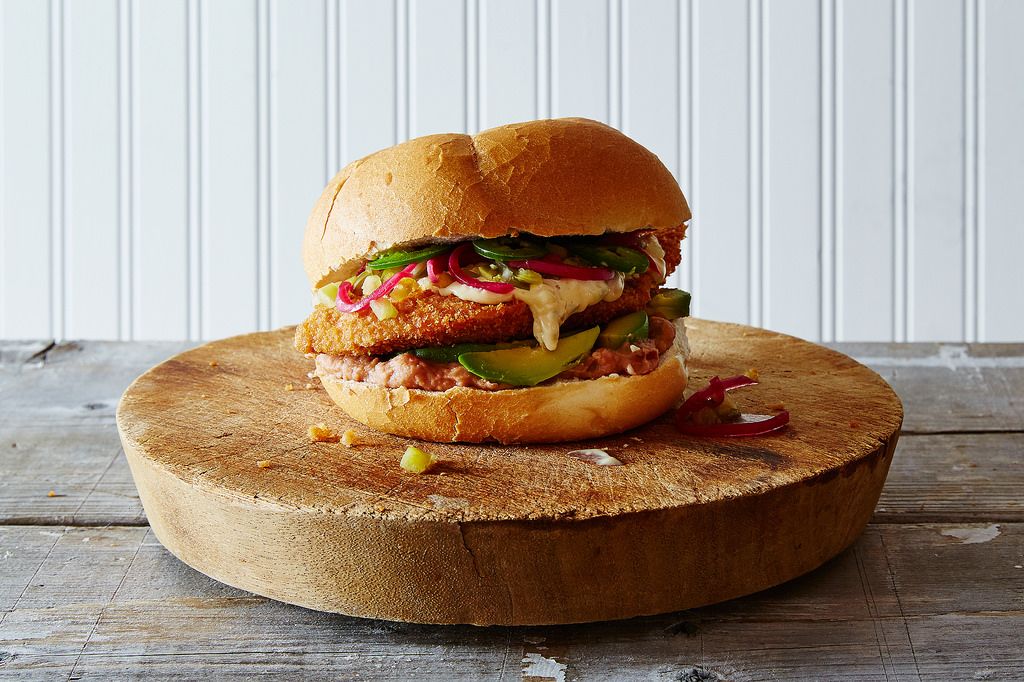
Mexico’s most popular sandwich is also the easiest make at home

On a quiet corner in the Roma neighborhood of Mexico City, the employees at Tortería Los Güeros, a torta restaurant open since 1974, are going through their opening routine. Genaro Aburto, an owner and torta maker, bends downs to drag a plastic tub into view. “Today is the day we make the pickles,” he says, nodding at the mass of mottled red and green jalapeños bobbing in water. “We’ve already got the carrots, onion, and cauliflower cooking.”

Aburto is just one among legions of torta makers in the capital, those dedicated to assembling Mexico’s most popular sandwich. Though tortas have been eaten for more than a century now, wheat consumption was, at first, fiercely resisted. When the Spanish arrived in the early 1500s carrying wheat, they found an entrenched culture of corn that had been in place for more than 2,000 years. The Spanish created smear campaigns to denigrate corn while proselytizing the purity of wheat; when the taste for bread still failed to catch on, they forced indigenous populations to grow and process it. Hundreds of years later, bread has not supplanted the corn tortilla, though it is eaten as sweet pastry in the mornings, served alongside stews for lunch, rolled into tortillas in the north, and used to sandwich cold cuts and proteins in the ubiquitous, pedestrian torta.

Photos by James Ransom

There is no single torta origin story, but many — it’s a sandwich born of street-level commerce and cultural exchange. In 1864, a “torta compuesta” was mentioned in a Pueblan newspaper; in 1899, it was referred to in a play; and by 1902, there were registered complaints against roving torta vendors, called torteros. The sandwich continued to grow in popularity throughout Mexico City during the early 20th century, taking the form of a common bolillo roll with local ingredients like roast pork, sardines, or chicken sandwiched inside. By the 1950s, tortas had become quick, inexpensive sustenance for urban workers who could no longer return home for the midday meal. In the 1970s, “tortas eléctricas” emerged to distinguish them from the cold-cut torta style. 

Today, the torta is wholly, proudly modern Mexican. The sandwich is popular and commonplace, sold at markets, bodega counters, convenience stores, and puestos, the fixed street stands scattered throughout every neighborhood. Tortas are the everyday sandwich of the populace: cheap, filling, and infinitely customizable. Striated like the preserved layers of minerals in bedrock, the combination of ingredients reflects the creativity of their maker. 

As with every national dish, regional variations have emerged, becoming emblematic sandwiches in their own right: the hulkish cemitas of Puebla; the lonches of the north; the pambazos stuffed with potato and chorizo; the French-dip-like torta ahogada, literally “drowned” in sauce. There are tortas stuffed with bacalao a la vizcaína, a Basque-style salt-cod stew enjoyed during Lent; vegan tortas hawked at punk markets; tortas lined with cochinita pibil (citrusy pit-roasted pork) and pickled red onions; and tortas piled high with chilaquiles. The varieties on offer at places dedicated to making tortas — called torterías — have also evolved: The “hawaiana” almost always features rings of canned pineapple; the “cubana” is not kin to the Cuban sandwich but rather a local invention of ham, roast pork, headcheese, two types of actual cheese, strips of hot dog, and fried breaded cutlets of beef milanesa, so named for its origins on the Calle República de Cuba in downtown Mexico City. 

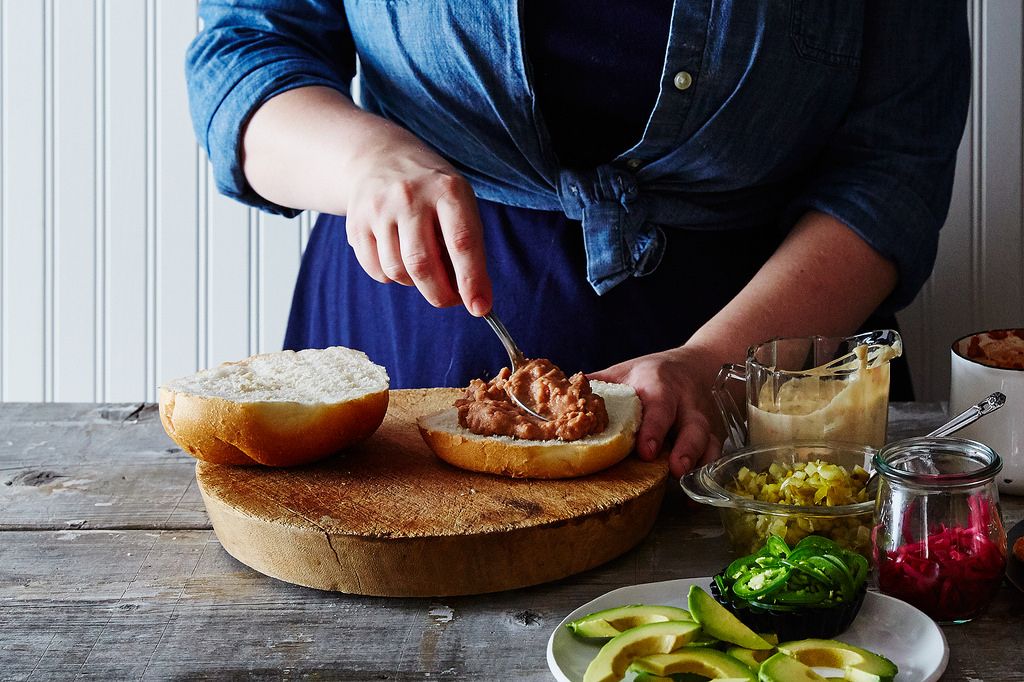
If there are so many varieties, what actually defines a torta? First, the bread: a roll made from a simple, salted wheat dough, most commonly a bolillo (also called birote or francés), which are cheap rolls with fluffy interiors and a dry, crunchy cap; or a telera roll, which is flatter, softer, and scored twice lengthwise. Fresh bread is key. Tortas are not always toasted, so bread made the day of is common practice. The accoutrements are added to the bread first: a swipe of refried beans, to add richness and moisture; mayonnaise, for the same reason; avocado, layered on in shingles; thin rings of raw white onion; tomato, counters with freshness. Lettuce is rare.

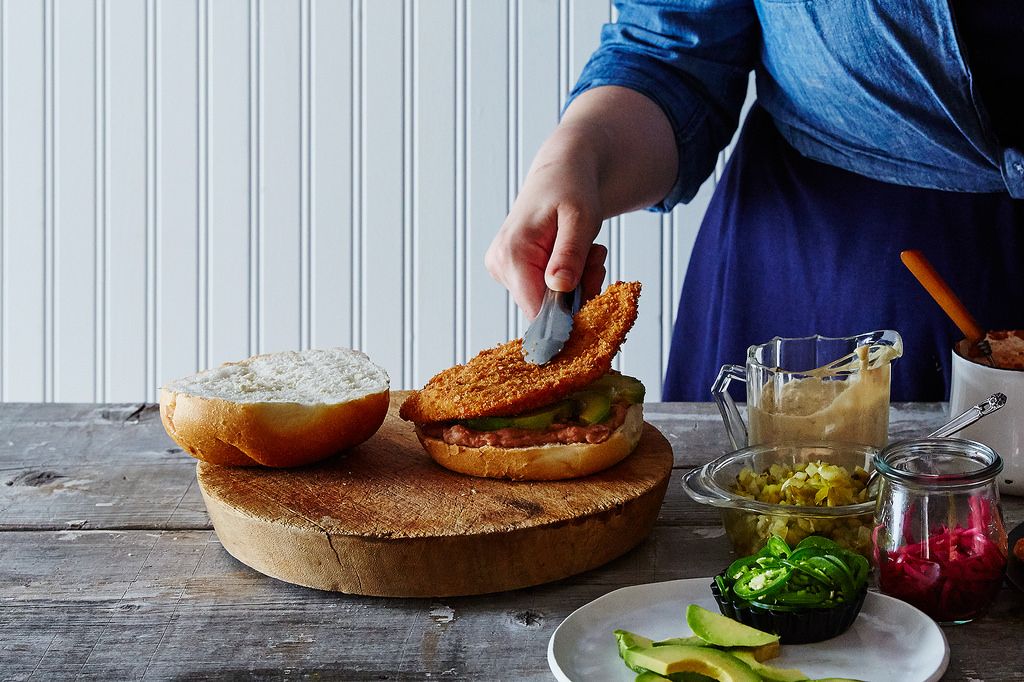
Once the vegetables and condiments have paved the way, the proteins arrive. The standard offerings include pierna (thick-cut roast pork leg ringed with scarlet marinade), turkey ham, regular ham, American cheese, queso Oaxaca, panela cheese, fried breaded cutlets of beef or chicken (chopped to bits before being added), and hot dog, more tubular baloney than snappy sausage, cut into thin strips — if you didn’t know a hot dog could be filleted, welcome to the school of the torta. Three proteins, or more, are de rigueur.  

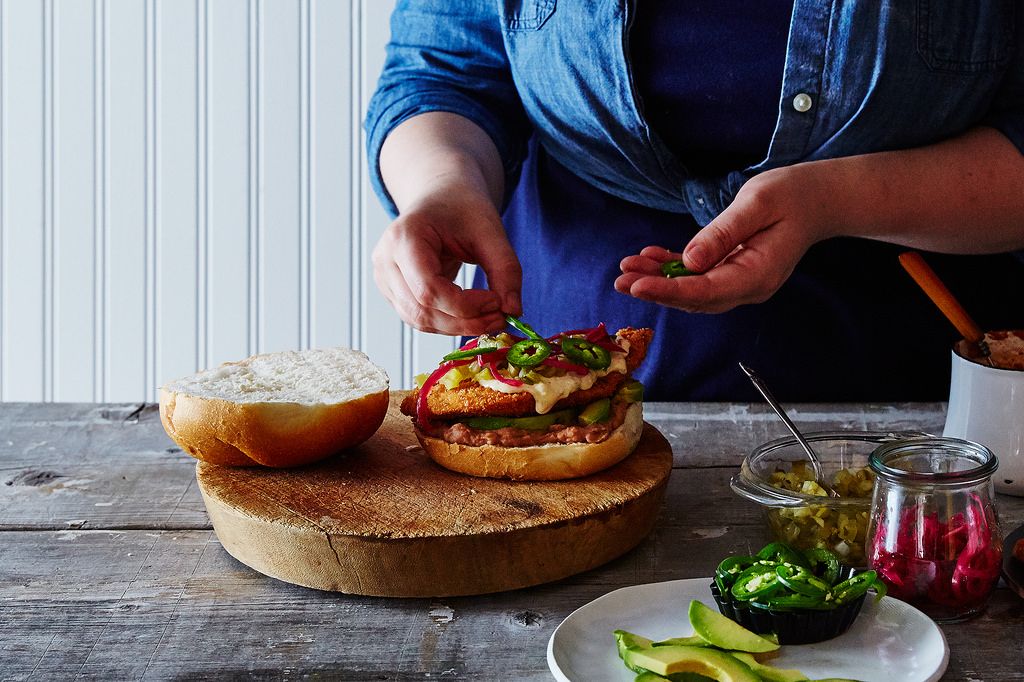
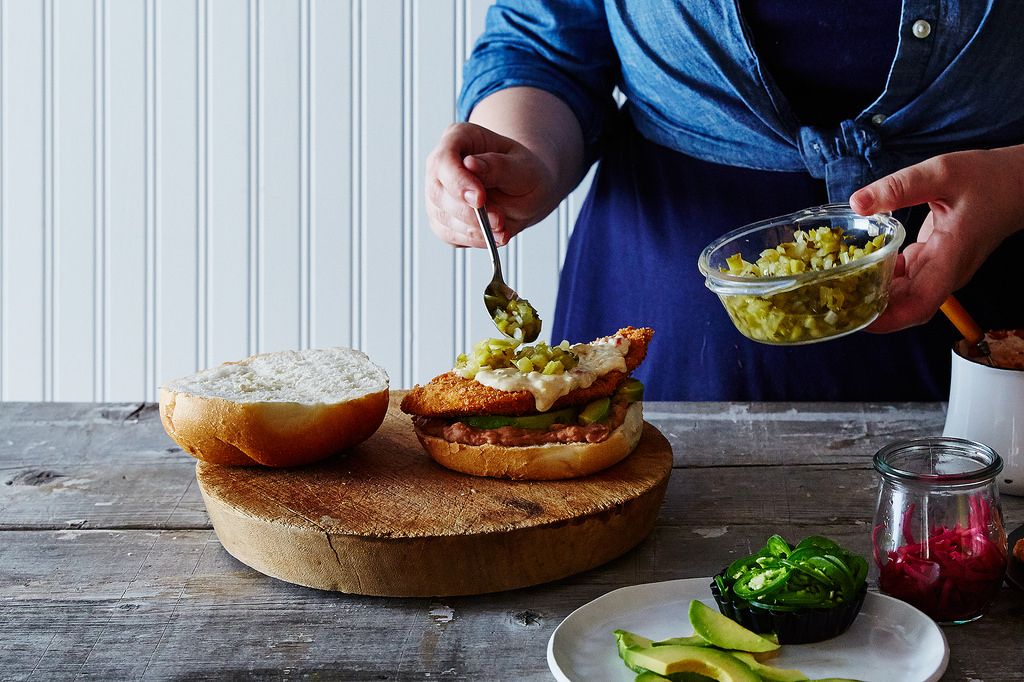
Another key element is the pickle, to cut the richness: Common picks are rajas, meanings strips of pickled jalapeño with carrot, cauliflower, and onion in tow, or chipotles en adobo, a vinegar-based marinade laced with piloncillo syrup that plumps the dried chiles. Both of these pickles can come from a can, but old-school torta joints often make their own.

The modern torta tends to showboat with macho heft, boasting of layers upon layers of ingredients; nevertheless, the more modest varieties have a quiet following as well. Restrained and slim, the bacalao torta, for example, stews the dried fish with onion and tomato, plops a few green olives into the mix, and then slap-spreads the fish paste onto the bread with none of the faffy vegetable additions necessary. In the same vein is the pierna con mole torta from Churrería El Moro, open since 1935, which piles dryish pork leg on a roll and douses it with liquid black mole. That is all. Another classic is the early-morning guajolota torta, which slips a steaming tamale from its corn husk and slides it into a bolillo—the ultimate starch-on-starch sandwich that every Chilango has eaten at least once. No sauce. No vegetables. Just corn and wheat, an edible portmanteau.

Surely, all this talk of tortas has you itching to eat one — and the best news is, you can do so quite seamlessly at home. When you set out to make your own torta, there are a few noteworthy elements to help you achieve success:

1. Fresh, cheap bread. 

Most Latin American bakeries will sell both bolillos and teleras, and every supermarket bakery will carry some type of simple, crunchy roll. The bread is key. No sourdough, naturally leavened, seeded bread here; and while there is a variety of torta served on industrial, presliced white bread, the crunchy roll is preferred. Split it open, and toast it if you like.

2. The spreads, sauces, and condiments.

Refried beans (the legume needs to be on more sandwiches — am I right?!). Mayonesa, always. Avocado also adds moisture. Whatever vegetables you have in the crisper — tomato, shredded cabbage, slivered serrano pepper. A little sliced white onion. Crushed drained pineapple from a can? Go for it. 

3. The meats.

Whatever you fancy, and multiple proteins if you have them: cold cuts, a mix of ham and turkey, scrambled egg, and so on. Got vegan chorizo? It’s easy to vegan-ify the torta. Cocktail weenies. Leftover rotisserie chicken. Tinned sardines in tomato sauce. A deep-fried chile relleno. Spam. The possibilities are endless — see below for evidence and a few more ideas.

4. The cheese. 

I would say you can leave this off (and really, you can), but cheeses of all kind are the glue to this torta: Melty cheese helps hold things together, and softer cheese can be spread or crumbled for fun textures. Don’t forget the cheese sauce I nudged you toward up above. And if you’re super queso-crazy, using lots of cheese is a great way to go the vegetarian route. Some of my suggestions aren’t super traditional but provide all the necessary, cheesy awesomeness that makes a torta great. 

  • Panela, or any of those super-firm cheeses you can grill/cook without melting (like halloumi)
  • Goat cheese
  • Cotija
  • Queso fresco
  • Jack

5. The pickles (do not forget the pickles!)

The final topping of a great torta is the pickled bits; they bring the essential spice and tang to the mix. Some recipes to start:

However you lay it on, the best tortas are those made lovingly, with care. Any torta slapped together that falls apart before it reaches your mouth is a bad torta, so build the torta with intent: spread those beans to the edge! Distribute the pickled carrots and peppers evenly. Season each layer of ingredients as you go, then slice and admire the careful striping and structural integrity of the sandwich. The key to a successful torta, according to Aburto, who has been assembling these sandwiches for 46 years, is this: “There are many factors, but first, you have to like what you are doing.” 


America’s forgotten history of supervised opioid injection

Over the past year, a Philadelphia nonprofit, Safehouse, has been making headlines with its controversial plan to open the U.S.’s first supervised injection site. The proposed facility would allow Philadelphians with opioid addiction to inject drugs like heroin under the watchful eye of nurses equipped to intervene in accidental overdoses. The clients would provide their own opioids, but the nonprofit would supply needles, provide kits to test drugs for dangerous levels of fentanyl, and connect clients to treatment services.

Supervised injection sites are similar to buprenorphine treatment programs and methadone clinics, where doctors dispense medicines to help clients stay in recovery from opioid addiction. But proponents of supervised injection say that existing programs are difficult to access and too few in number, and that there is need for alternatives. Safehouse’s backers point to strong scientific evidence that supervised injection sites — one of a broad range of strategies to mitigate the risks associated with drug use known as harm reduction — can prevent overdose deaths, slow the spread of Hepatitis C and HIV/AIDS, and connect the most vulnerable people who use drugs with rehabilitation programs and social services. Similar facilities are already proving effective in Canada and Europe. If Safehouse succeeds, it might pave the way for supervised injection sites in cities across the U.S.

But in January, the 3rd U.S. Circuit Court of Appeals blocked Safehouse’s plan, ruling that it would violate the “crackhouse statute” of the Controlled Substances Act, which makes it illegal to provide a space for people to use drugs. Former U.S. Attorney William McSwain, who helped bring the lawsuit, applauded the ruling, saying it ensures Philadelphia, the birthplace of American democracy, won’t also be known as “the birthplace of heroin injection sites.”

Read between the lines, and McSwain is clearly suggesting that Safehouse would represent an unprecedented about-face on U.S. drug policy, which for the past half century has criminalized narcotics through a $1 trillion war on drugs. But McSwain has the history all wrong. In reality, there is a well-established historical precedent of government support for supervised injection sites.

Understanding that support and how it came about requires a close look at America’s first opioid crisis, during the Gilded Age in the late 19th century. Opioid addiction had become a major public health problem. Physicians were trained in medical school to dole out opioids for even minor aches and pains, and in the Civil War’s aftermath, tens of thousands of disabled veterans got hooked on opium and morphine. Careless doctors overprescribed morphine and later heroin, escalating the problem to crisis levels in the early 1900s. Opioids were largely unregulated, and Americans bought the medicines over the counter at local pharmacies. $1.50 could buy two bottles of heroin and a syringe kit from Sears.

Desperately, doctors tried to clamp down on addiction. Reformers called for limiting the number of opioid prescriptions, the main cause of addiction. Other pioneering doctors created the earliest drug rehabs, then called “inebriety clinics.” These scattered medical reforms met with some success by the turn of the century, reducing the number of Americans addicted to prescription opioids. But the larger problem of addiction persisted. Even while opioid prescriptions trended downward overall, some doctors bucked the trend and kept prescribing huge volumes of addictive opioids.

By the 1910s, anti-drug activists became convinced that the sporadic medical reforms were not enough to tackle the addiction crisis. Instead, they urged the government to ban the sale of narcotics. In 1914, the federal government responded with the Harrison Narcotics Tax Act, which, for the first time in U.S. history, essentially banned sales of all narcotics except those prescribed as part of a bona fide medical therapy.

Many, if not most, Americans then addicted to opioids had lived relatively stable lives until the Harrison Act. Historical accounts are filled with stories of people who spent most of their lives as functional morphine users, some starting as early as age 12. Suddenly cut off from legal opioids, however, addicted Americans faced the agonizing, potentially fatal prospect of withdrawal or risked being thrown in jail for buying on the black market.

A medical therapy exemption loophole in the Harrison Act left the door open for a compassionate solution to this dilemma: a practice that became known as morphine maintenance.

In the 1910s, dozens of city and state governments across the U.S. began operating “morphine maintenance clinics,” the forerunners of modern methadone clinics and supervised injection sites. The clinics provided opioid-addicted Americans with free or discounted prescription opioids to use in plain sight, on the government’s dime. Some clinics also tried to help patients taper down dangerously high doses and even quit opioids altogether. But the primary goal then, as now, was to prevent avoidable overdose deaths and stem the flow of dangerous black-market heroin.

The first clinic opened in Jacksonville, Florida in 1912­, and dozens of clinics serving thousands of patients were in operation by the early 1920s. Morphine maintenance clinics saved lives and kept people out of jail, a boon for local communities. In its heyday, the New York City Health Department’s massive clinic treated 800 people a day who might have otherwise languished in jail cells or suffered early deaths.

In New Haven, Connecticut, a clinic opened in 1918 that was serving 91 regulars by the time it was shut down in 1920. Decades later, researchers reviewed death certificates of 40 of the clinic’s patients and found that few had died from an overdose or another clearly drug-related cause, fates that commonly befell other opioid users.

Morphine maintenance was popular and effective. But it became exclusionary as, against the backdrop of alcohol Prohibition, federal authorities shuttered clinics in the early 1920s. Increasingly, Black and poor Americans who used drugs were pathologized by doctors, labeled “junkies” and “dope fiends” by police, and formally excluded from maintenance programs. White people of means who used drugs had access to legal morphine doses, while Black, poor, and urban drug users were forced to buy opioids through the illicit market, where they got caught up in police dragnets and sensationalized in lurid news exposés.

The racist stereotyping of Black and urban drug users as criminals soon dominated media coverage, and the misleading narrative stuck. Individual doctor-patient morphine maintenance continued through the 1960s, but it eventually fell out of favor with younger physicians who, influenced by negative media coverage, frowned upon the practice.

So when critics of Safehouse assert, as former U.S. Attorney McSwain did, that history is on their side and that facilities like Safehouse run counter to “Congress’s intent to protect American neighborhoods from the scourge of concentrated drug use,” they are conveniently overlooking the government’s historical support for the forerunners of today’s supervised injection sites. They are choosing to ignore how effective those sites were at preventing accidental deaths, keeping people out of jail, and encouraging the sick to seek help.

Safehouse has vowed to appeal the Circuit Court ruling, and legislative efforts are underway to legalize supervised injection sites in multiple states, including Illinois, New Mexico, and Rhode Island. All of these proposals face steep climbs to becoming law, but as the battles play out, the largely forgotten history of early-20th century morphine maintenance clinics provides much-needed context. The fact that the government once supported facilities like Safehouse should dispel some of the myths around supervised injection and foster a more productive conversation about the public health benefits of harm reduction.

* * *

Jonathan S. Jones (@_jonathansjones) is a historian of American medicine. He is currently a postdoctoral scholar at Penn State University’s Richards Civil War Era Center, where he’s writing a book on opioid addiction in the Civil War era.

This article was originally published on Undark. Read the original article.

Why Liz Cheney angers Republicans: The GOP must keep Trump’s Big Lie alive for the next election

The biggest news in Washington continues to be Liz Cheney’s ongoing refusal to bend the knee to the former president and formally repudiate her inexplicable fealty to the truth. It’s one thing to be investigated by the FBI for paying for sex with minors or to be a blatant white supremacist — these are human foibles that can be forgiven — but to unapologetically assert that Donald Trump’s insistence that the election was stolen is a Big Lie simply cannot be tolerated.

I’ve written before that I believe regardless of whether she is truly incapable of swallowing this election nonsense, Cheney also has a strategy. There is an open “lane” for a Republican woman, especially one with a pedigree like hers, to be the tough conservative who stood up to Trump in the event the magic veil ever falls from voters’ eyes. So far that lane looks like it gets narrower every day, but kicking her out of the leadership for telling the truth in the face of massive dishonesty can only add to her heroic luster in the long haul. The worst thing that happens is she is remembered as the Margaret Chase Smith of her day, after the brave senator from Maine who denounced the Wisconsin demagogue Joseph McCarthy long before anyone else had the nerve. There are worse fates for a politician than that.

Meanwhile, the rest of the Republican establishment continues to run around in circles clucking furiously like a brood of barnyard hens, trying to keep Trump and his cultlike following happy. They appear to have decided that their voters require human sacrifices for the cause so Cheney must be thrown over the cliff. (And to think “Democrats are in disarray” used to be a perennial trope. They’re amateurs compared to the GOP.)

But when I read Salon’s Sophia Tesfaye’s piece about former House speaker Paul Ryan, who reportedly really doesn’t care for Donald Trump and his shenanigans yet remains glued to his chair in the Fox boardroom, unwilling to utter a peep about what’s going on with his party, it occurred to me that it’s giving them far too much credit to simply call them cowards. They are much more craven than that. It’s not that they are afraid of their Trump-loving constituents who are metaphorically brandishing pitchforks and torches against anyone who dare call the Big Lie a big lie. It’s that they are seeing the upside for them personally.

While Washington officials clutch their pearls about Liz Cheney’s apostasy, consider all the anti-democratic activity that’s taking place around the country which these people are either explicitly or tacitly endorsing.

 The Republican Attorney Generals Association has been in turmoil since January 6th when some members objected to the group’s sponsorship of the violent insurrection. The chairman resigned last month after being unable to handle the internal strife and is to be replaced this week by a hard-core Trump supporter who has promised to “take a blowtorch to Biden’s agenda.” In Florida, a state Trump won handily, they are nonetheless busily enacting voting restrictions which they belatedly realized might even suppress their own vote. They did it anyway. Ohio Republicans decided this week to censure Republican politicians who voted to impeach Donald Trump even though they are from other states. And the New York Times reports that the Texas GOP is now eating its own over “pandemic and voter-fraud conspiracy theories.”

But the big story is in Arizona, where the state Senate has hired an untried company led by a man with a history of floating vote fraud conspiracy theories to “audit” last November’s vote in Maricopa Country, which was won by Joe Biden. Despite the fact that the county was recounted twice by hand and found to match the machine count perfectly, Trump-supporting volunteers are laboriously examining the ballots without any proper monitoring, determined to prove that the election was stolen. The good news is that the Space Force is supposedly on alert to ensure that everything is done properly.

For his part, Trump is reportedly obsessed with this recount. He apparently believes it will prove the election there was stolen and that other states will follow. Here he is last week pontificating before his paying guests at Mar-a-lago:

What all these supposed successful “audits” would add up to is not immediately clear, but on Tuesday Trump did say, “I think people are going to be very, very happy when I make a certain announcement,” so perhaps he believes having a bunch of his loyal fanatics falsely testify that they finally “found” the votes he wanted will somehow launch him back into the White House in 2024.

According to Tierney Sneed of Talking Points Memo, the Trump team expect these audits to take place elsewhere, starting next with Georgia:

Peter Navarro, a Trump White House advisor and the author of several reports asserting mass election fraud, told OAN last week that he believed the Arizona audit could precede a similar audit in Georgia, where the scale of voter fraud was, in his universe, “much larger.” Speaking to Steve Bannon Thursday, Trump supporter Boris Epshteyn said that if the audit shows “even a small fraction” of what the former president’s devotees expect, “the freight train of audit is coming down the way. It’s on the train to Georgia.”

All of this may very well be why even the Republicans who obviously know this is nuts are all climbing on board that crazy train. If they can stage one of these “audit” pageants in a place like Georgia they might just juice their turnout for 2022 and take out newly-elected Democratic Sen. Rafael Warnock. And there are dozens of House districts where that dynamic could play itself out as well.

It isn’t new for Republicans to say that Democrats are illegitimate. They used to say that President Clinton only won with a plurality in a three-way race, so his presidency wasn’t really valid. And we all know that Trump himself pushed the grotesque Birther lie which claimed that Barack Obama wasn’t born in the U.S. and was therefore not qualified to be president. But this is taking all that to a much higher level. Republicans no doubt realize that this flurry of anti-democratic activity in the states —ostensibly on behalf of Donald Trump and his Big Lie — is really going to pay off for them.

So the House GOP’s leadership apparent decision to purge Liz Cheney from their ranks is their way of telling all these rabid Trumpist activists in the states to have at it, the GOP establishment is with them all the way. They aren’t afraid of Trump voters. They’re grateful to them.

COVID “doesn’t discriminate by age”: serious cases on the rise in younger adults

After spending much of the past year tending to elderly patients, doctors are seeing a clear demographic shift: young and middle-aged adults make up a growing share of the patients in covid-19 hospital wards.

This story also ran on NPR. It can be republished for free.

It’s both a sign of the country’s success in protecting the elderly through vaccination and an urgent reminder that younger generations will pay a heavy price if the outbreak is allowed to simmer in communities across the country.

“We’re now seeing people in their 30s, 40s and 50s — young people who are really sick,” said Dr. Vishnu Chundi, a specialist in infectious diseases and chair of the Chicago Medical Society’s covid-19 task force. “Most of them make it, but some do not. … I just lost a 32-year-old with two children, so it’s heartbreaking.”

Nationally, adults under 50 now account for the most hospitalized covid patients in the country — about 36% of all hospital admissions. Those ages 50 to 64 account for the second-highest number of hospitalizations, or about 31%. Meanwhile, hospitalizations among adults 65 and older have fallen significantly.

About 32% of the U.S. population is now fully vaccinated, but the vast majority are people older than 65 — a group that was prioritized in the initial phase of the vaccine rollout.

Although new infections are gradually declining nationwide, some regions have contended with a resurgence of the coronavirus in recent months — what some have called a “fourth wave” — propelled by the B.1.1.7 variant, first identified in the United Kingdom, which is estimated to be somewhere between 40% and 70% more contagious.

As many states ditch pandemic precautions, this more virulent strain still has ample room to spread among the younger population, which remains broadly susceptible to the disease.

The emergence of more dangerous strains of the virus in the U.S. — including variants first discovered in South Africa and Brazil — has made the vaccination effort all the more urgent.

“We are in a whole different ballgame,” said Judith Malmgren, an epidemiologist at the University of Washington.

Rising infections among young adults create a “reservoir of disease” that eventually “spills over into the rest of society” — one that has yet to reach herd immunity — and portends a broader surge in cases, she said.

Fortunately, the chance of dying of covid remains very small for people under 50, but this age group can become seriously ill or experience long-term symptoms after the initial infection. People with underlying conditions such as obesity and heart disease are also more likely to become seriously ill.

“B.1.1.7 doesn’t discriminate by age, and when it comes to young people, our messaging on this is still too soft,” Malmgren said.

Hospitals Filled With Younger, Sicker People

Across the country, the influx of younger patients with covid has startled clinicians who describe hospital beds filled with patients, many of whom appear sicker than what was seen during previous waves of the pandemic.

“A lot of them are requiring ICU care,” said Dr. Michelle Barron, head of infection prevention and control at UCHealth, one of Colorado’s large hospital systems, as compared with earlier in the pandemic.

The median age of covid patients at UCHealth hospitals has dropped by more than 10 years in the past few weeks, from 59 down to about 48 years old, Barron said.

“I think we will continue to see that, especially if there’s not a lot of vaccine uptake in these groups,” she said.

While most hospitals are far from the onslaught of illness seen during the winter, the explosion of cases in Michigan underscores the potential fallout of loosening restrictions when a large share of adults are not yet vaccinated.

There’s strong evidence that all three vaccines being used in the U.S. provide good protection against the U.K. variant.

One study suggests that the B.1.1.7 variant doesn’t lead to more severe illness, as was previously thought. However, patients infected with the variant appear more likely to have more of the virus in their bodies than those with the previously dominant strain, which may help explain why it spreads more easily.

“We think that this may be causing more of these hospitalizations in younger people,” said Dr. Rachael Lee at the University of Alabama-Birmingham hospital.

Lee’s hospital also has observed an uptick in younger patients. As in other Southern states, Alabama has a low rate of vaccine uptake.

But even in Washington state, where much of the population is opting to get the vaccine, hospitalizations have been rising steadily since early March, especially among young people. In the Seattle area, more people in their 20s are now being hospitalized for covid than people in their 70s, according to Dr. Jeff Duchin, public health chief officer for Seattle and King County.

“We don’t yet have enough younger adults vaccinated to counteract the increased ease with which the variants spread,” said Duchin at a recent press briefing.

Nationwide, about 32% of people in their 40s are fully vaccinated, compared with 27% of people in their 30s. That share drops to about 18% for 18- to 29-year-olds.

“I’m hopeful that the death curve is not going to rise as fast, but it is putting a strain on the health system,” said Dr. Nathaniel Schlicher, an emergency physician and president of the Washington State Medical Association.

Schlicher, also in his late 30s, recalls with horror two of his recent patients — close to his age and previously healthy — who were admitted with new-onset heart failure caused by covid.

“I’ve seen that up close and that’s what scares the hell out of me,” he said.

“I understand young people feeling invincible, but what I would just tell them is — don’t be afraid of dying, be afraid of heart failure, lung damage and not being able to do the things that you love to do.”

Will Younger Adults Get Vaccinated?

Doctors and public health experts hope that the troubling spike in hospitalizations among the younger demographic will be temporary — one that vaccines will soon counteract. It was only on April 19 that all adults became eligible for a covid vaccine, although they were available in some states much sooner.

But some concerning national polls indicate a sizable portion of teens and adults in their 20s and 30s don’t necessarily have plans to get vaccinated.

“We just need to make it super easy — not inconvenient in any way,” said Malmgren, the Washington epidemiologist. “We have to put our minds to it and think a little differently.”

This story is part of a partnership that includes NPR and KHN.

The five pantry essentials in my Mexican-American kitchen

Welcome to Esteban Castillo‘s pantry! In each installment of this series, a recipe developer will share with us the pantry items essential to their cooking. This month, we’re exploring five staples stocking Esteban’s Mexican-American kitchen.

One of the best pieces of advice I’ve ever received came from my mom, when she told me, “Aprende a cocinar una buena olla de frijoles y nunca tendrás hambre,” or, learn how to make a good pot of stovetop beans, and you’ll never be hungry. After she told me this, I realized frijoles de la olla, with pinto beans swimming in a broth with aromatics like onion, cilantro, and garlic, regularly kept me and my siblings fed when our parents couldn’t afford to put anything else on the table. So when I was first learning how to cook, I made sure to follow my mom’s advice: I perfected a pot of beans.

Of course, I learned to cook lots more, too. I’ve found my place in the kitchen, and realized that I enjoy creating dishes that reflect my childhood, existing in the space between two different countries. I not only like to showcase traditional Mexican dishes like birria, pozole, and mole; I also enjoy taking traditional Mexican ingredients and combining them with ingredients I grew up with in Southern California. I create fusion dishes, like cilantro pesto, or dress fries with a spicy mole and tons of shredded Oaxacan cheese for a “Chicano poutine.” My mom has been a huge inspiration for me, because when she first came to this country, she had to learn to adapt the dishes she loved with the ingredients she was able to find in the U.S. Now, whenever I’m making a dish that showcases both traditional and nontraditional ingredients, I ask myself, how would my mom approach this?

Today, my Mexican-American pantry looks very much like my mom’s, and there are five staple items that I always have on hand.

My 5 Mexican-American Pantry Essentials

1. Dried Beans

Of course, I’ll start with beans. Beans, when paired with other ingredients, like corn and chiles, form the foundation of Mexican cuisine. I like to buy dried black and pinto beans in bulk and store them in the pantry—I tend to cook a large pot of beans at the beginning of the week and keep it in the refrigerator to use over the next several days. Beans are such a versatile ingredient, especially in Mexican cuisine, and I’m able to transform stovetop beans with different preparations: frijoles refritos, or creamy refried beans; frijoles charros, also known as cowboy beans, or pintos stewed with aromatics and pork; frjioles puercos, the refried beans cooked with spicy chorizo, sweet carrots, and onions; and obviously, a simple pot of frijoles de la olla.

2. Masa Harina

Essentially a corn flour made from nixtamalized corn, masa harina is another pantry staple. For those of us who love Mexican cuisine, but don’t have a fresh-tortilla hookup, nor access to fresh corn masa, masa harina is an important ingredient to have around. With a little water and salt (plus additional flavorings like puréed greens or chiles, if desired), masa harina forms the base for homemade corn tortillas. With that same dough, I’ll make sopes, or fried masa disks with toppings; thick tortillas stuffed with different fillings, like diced potatoes with chorizo, known as gorditas; huaraches, oblong masa cakes stuffed with refried beans with toppings like shredded lettuce, carne asada, and queso cotija; and crispy meat-filled empanadas.

3. Crema Mexicana

A few of my “pantry” staples can actually be found in the fridge. Crema mexicana, or table cream, is one of my favorite items to keep in the kitchen. Rich and buttery, crema is less tangy and looser than sour cream. Crema mexicana is one of my go-to ingredients to thicken and enrich stews, or drizzle over tacos dorados, sopes, or potato-and-chorizo-filled tortas.

4. Queso Cotija

In my fridge you’ll find plenty of cheese, but my favorite is queso cotija. Queso cotija is a hard, creamy, and salted white cheese that is typically crumbled. It gives dishes from frijoles de la olla to flautas a little extra zing of flavor and richness.

5. Fresh Mexican Chorizo

Last but not least, one of the ingredients that I like to always have on hand in my refrigerator is chorizo. Mexican chorizo is a fresh pork sausage seasoned with an adobo that typically includes vinegar, a mixture of guajillo and ancho peppers, and spices like cinnamon, paprika, and clove. Chorizo is great when removed from its casing, broken up into pieces, and fried. I’ll toss it in scrambled eggs for breakfast tacos or burritos, nestle it in a skillet with diced potatoes for pambazos (telera rolls dipped in a guajillo sauce and filled with potatoes and chorizo); use it crumbled and fried as a topping for huaraches or sopes; or simply grill it in its casing to eat as a side. If you’re not able to find fresh chorizo locally, Mexican longaniza is a great substitute; it has the same flavor profile as chorizo, but is a mince, rather than ground pork sausage.

“Lied to the American public”: Rachel Maddow reveals how Donald Trump and Bill Barr just got caught

Tuesday, federal Judge Amy Berman Jackson issued a scathing order about Attorney General Bill Barr falsifying documents to cover up why the Justice Department refused to prosecute former President Donald Trump for obstruction of the Mueller investigation.

In her analysis, MSNBC host Rachel Maddow walked through the shocking decision and the extent to which it will not only open the door to reexamine the obstruction cases, but it also essentially calls Barr a bad-faith liar in federal court.

“I was having a little bit of deja vu, a little bit like being back to the battle days, with whole big sections of the judge’s ruling redacted,” said Maddow referring to Jackson’s decision. “That’s because those redacted parts of her ruling actually show what’s in this document that she just ordered the Justice Department to release. She redacted those portions of her rule, and she didn’t just go ahead and release the document today because she’s allowing a couple of weeks to allow for the possibility that the Justice Department, under new management, may appeal her ruling and still try to keep this thing under wraps.”

Calling it “a heck of a thing,” Maddow explained that the new White House has made it clear that they want to look forward, not back. At the same time, the new White House has also said that they have no intention of meddling with the Justice Department’s decisions or cases.

“Merrick Garland is the attorney general now, all new leadership at the Justice Department, all new priorities, moving forward with a million things at once, and here’s a judge saying, you know, your immediate predecessor in this job lied to me, lied to the court and lied to the American public about something as freaking serious as why the former president was not charged with crimes,” Maddow continued. “You cool with the evidence of all of that being released to the public? Because it’s coming out in two weeks unless you want to appeal my ruling.”

The question then becomes, since the former attorney general lied and falsified a paper trail to a decision not to prosecute Trump, will the new Justice Department review that case for another decision.

You can watch the video below via YouTube

Do mRNA vaccines affect my DNA?

Dear Pandemic Problems,

I have a family member who has concerns about mRNA, and if the mRNA in the vaccine can adversely affect his DNA. I don’t understand mRNA. Where can I get reliable information on this question?

Sincerely, 

Confused by mRNA

Dear Confused by mRNA,

I typically only focus on answering questions about social qualms that have come up during the pandemic — like a husband-wife rift because of one partner refuses to get vaccinated. But after reading your question, it became even more clear to me that journalists like myself, and public health experts, could do better when it comes to explaining mRNA vaccines and why they’re safe.

So many people want this pandemic to be over and won’t think twice about getting vaccinated. But there are just as many people out there who are hesitant to get inoculated. As you’ve probably already read, mass vaccination sites are starting to close across the country because the demand for the vaccine just isn’t there. This is problematic because only 30 percent of the adult population is fully vaccinated as of May 4, 2021. (At least 44 percent of the U.S. population has received the first shot of one of the two-dose vaccines.) These numbers, and the fact that vaccination rates are slowing down while less than half of the U.S. population is vaccinated, have led public health experts to wonder whether the U.S. will ever reach herd immunity.

But back to the vaccines themselves. Two of the available vaccines, the Pfizer and Moderna ones, use the mRNA vaccine technology. Both the Johnson & Johnson and AstraZeneca vaccines are viral vector vaccines, which are different.

This is all to say that if one were hesitant to get one of the COVID-19 mRNA vaccines, know this: they’re very safe, and they don’t cause mutations or affect one’s DNA.

So, how do they work?

First, let’s start with the basics: mRNA is short for messenger RNA (mRNA); RNA is short for ribonucleic acid (RNA). All known forms of life contain RNA and DNA. They’re the genetic instructions, as it were, that determine how lifeforms work and how they develop. Think of them vaguely like blueprints, but with a twist — RNA also helps synthesize proteins and move amino acids. Hence, RNA’s role falls somewhere between that of an architect and a barista doling out protein drinks.

There are physical differences between RNA and DNA, but they are beyond the scope of this short explanation. Needless to say, DNA is the “instructions” via which our genes are transferred between us and our offspring. And RNA is in charge of regulating the production of proteins in a body, and its so-called “instructions” that it gives are for cellular structure.

To be clear: RNA and DNA serve different functions, and, as the Centers for Disease Control and Prevention (CDC) explains, mRNA vaccines don’t affect or even interact with our DNA at all.

You asked: Where can I get reliable information? I would first direct you to this information published by the CDC. As the CDC explains, mRNA vaccines “teach our cells how to make a protein—or even just a piece of a protein—that triggers an immune response inside our bodies.” 

Now, onto the specifics of mRNA, or messenger RNA. Messenger RNA is a single-stranded RNA molecule that provides instructions on protein production. Due to its structure, its existence is short-lived, meaning that once the mRNA is injected in your body, it will shortly disappear once it enters a cell and instructs the cell to produce a copy of a protein called Spike.

Spike is the protein that, true to its name, appears as spikes on the exterior of the spherical coronavirus. In artists’ impressions, the sea urchin-like spikes on the virus are Spike proteins.

In other words, mRNA vaccines don’t inject our bodies with a piece of the coronavirus; instead, they give instructions on how to produce Spike. Those instructions are delivered via mRNA.

The idea is that if your immune system knows what Spike looks like, and recognizes it as an intruder, it will attack anything that contains Spike — including the novel coronavirus, in the event that it enters your body. 

In other words, the mRNA vaccine doesn’t actually inject us with a dead coronavirus, or a piece of the coronavirus hidden in a different virus (as other vaccines do). Rather, it gives us the instructions to make Spike, which our cells then do; our immune system then detects the Spike in our bloodstream and creates antibodies to fight it off and detect it in the future. 

Regarding the question of DNA: this neat little trick does not happen through manipulation of our DNA, but instead through a process of “tricking” our immune system — specifically, by introducing it to a harmless synthetic piece of the Spike protein that is built and deconstructed in our own cells, via instructions in the mRNA.

It’s true that mRNA vaccines are a relatively new technology, but as Salon has reported before, it is likely to be the vaccine of the future. That’s in part because mRNA vaccines are easier to produce within a shorter period of time, and easier to modify in the future if necessary.

While mRNA vaccine technology is “new,” it’s important to note that its development has been in the making for nearly 30 years. My colleague Matthew Rozsa interviewed Dr. Katalin Karikó, whose work laid the foundation for the COVID-19 vaccines. His interview is a great read if you’re interested in learning more about the history of mRNA vaccines, and how they’re different from other vaccines you’ve probably received in your life.

“Vaccines containing killed viruses or viral proteins will only induce antibodies,” Karikó told Salon’s Matthew Rozsa. “Meanwhile, mRNA vaccines, in addition to antibodies, also induce cellular immune response,” she added, “because the encoded viral proteins are synthesized inside the cell of the vaccinated person.”

The falsehood that the “mRNA in the vaccine can adversely affect a person’s DNA,” which is what your family member believes, isn’t true — as it’s impossible for mRNA to affect or infect a person’s DNA. This is a rumor that has been debunked by multiple scientists — just look here, here, and here.

I agree it’s complicated, Confused by mRNA. This is a new kind of a vaccine, and unless you’ve studied biology, cellular biology or biochemistry, understanding the mechanisms of it can be hard to grasp. I hope this helps, and that your family member will better understand that mRNA vaccines don’t affect a person’s DNA.

In fact, the mRNA vaccines have been revealed to be safer than the traditional vaccines, at least in the Western World. Both the Johnson & Johnson and AstraZeneca vaccines — which are not mRNA vaccines — have been beset by very rare blood clot issues that have resulted in some countries suspending their usage. The two mRNA vaccines, on the other hand, have seen no “safety signals,” as they are called, even after hundreds of millions of shots given.

Sincerely,

Pandemic Problems

“Pandemic Problems” is an advice column answering readers’ pandemic problems — sometimes with the help of moral philosophy professors and therapists — who can weigh in on how to “do the right thing.” Do you have a “pandemic problem”? Email Nicole Karlis at nkarlis@salon.com. Peace of mind and collective commiseration awaits.


Want more health and science stories in your inbox? Subscribe to Salon’s weekly newsletter The Vulgar Scientist.


Thanks to humanity, the Brazilian Amazon is now releasing more carbon dioxide than it absorbs

A recent study published in the journal “Nature Climate Change” found that the Brazilian Amazon released roughly 20 percent more carbon dioxide than it absorbed during the 2010s. More specifically, the rain forest absorbed 13.9 metric tons of carbon dioxide between 2010 and 2019 — but released 16.6 billion metric tons during that same period. (To put that in context, human fossil fuel combustion is believed to produce around 35 billion metric tons of carbon dioxide.)

The authors point to poor land management policies like forest degradation as well as deforestation as causes. Notably, deforestation of the Amazon has greatly increased during the reign of Brazilian President Jair Bolsonaro. 

But forest degradation, as the authors write, is the primary culprit in terms of making the rainforest a carbon fount. Forest degradation happens when a forest’s biological diversity and wealth is permanently diminished.

Indeed, forest degradation contributed 73% of the “gross biomass loss” of the Amazon, compared to deforestation, which contributed 27% of that loss. 

“Forest degradation has become the largest process driving carbon loss and should become a higher policy priority,” the authors write.

Rainforests have been called the “lungs” of the Earth, and play a major role in the global carbon cycle. That the Amazon rainforest would become a net emitter of carbon was not entirely surprising given trends, however.

“We half-expected it, but it is the first time that we have figures showing that the Brazilian Amazon has flipped, and is now a net emitter,” Jean-Pierre Wigneron, a co-author of the paper, told Agence France-Presse in a statement.

Wigneron added, “We don’t know at what point the changeover could become irreversible.”

Rainforests are not always carbon emitters. In 2009, scientists at the Climate Congress in Copenhagen, Denmark, warned that rising temperatures and droughts could transform tropical forests into being carbon emitters — rather than carbon sinks, as they were thought to have been previously. At the time, there was some hope that the world’s forests might rise to the occasion and sop up the excess carbon dioxide caused by human industrial activity. Now, that seems to not be the case, and the Climate Congress warning proved to be prophetic. 

This is the latest bit of bad news in a series of recent reports which raise red flags about how human industrial activity is changing the planet’s atmosphere on a mass scale. In September the World Wildlife Fund (WWF) revealed that there has been a 68 percent decline in the population sizes of “mammals, birds, amphibians, reptiles and fish” since 1970. Scientists at McGill University revealed last year that the threshold for dangerous global warming is likely to be reached between 2027 and 2042.

Similarly, the World Health Organization (WHO) estimates that roughly 250,000 people will die annually because of factors related to climate change scientists between 2030 and 2050. Finally a study published last month revealed that human beings have not significantly reduced the amount of land we inhabit over the past 12,000 years, strongly suggesting that it is poor management of resources rather than the loss of “wild” lands which is causing climate change.

President Joe Biden has attempted to address climate change by reentering the United States into the Paris climate agreement, beefing up environmental regulations and promising to reduce America’s greenhouse gas emissions by 50% to 52% below the country’s 2005 levels by no later than 2030.


Want more health and science stories in your inbox? Subscribe to Salon’s weekly newsletter The Vulgar Scientist.


Are taxes racist? Author Dorothy Brown on how the tax code makes the wealth gap worse

A typical white family has eight times the wealth of a typical Black family in the United States. Let that sink in for a long moment. The why behind that racial wealth gap has included a discussion of various factors, but until recently has overlooked one driving reason: The U.S. tax code. That’s why Dorothy Brown, a professor of law at Emory University, wrote her compelling new book, “The Whiteness of Wealth: How the Tax System Impoverishes Black Americans — and How We Can Fix It.”

The disparate impact our tax code has had on white and Black Americans has never been explored in this depth because — as Brown discussed in our recent “Salon Talks” conversation, the IRS doesn’t collect data on the race of taxpayers. As a result, Brown became a “detective,” as she put it, to uncover the real-world impact of our tax code on Americans by race.

What she discovered is jaw-dropping. Simply put, when white and Black Americans engage in the exact same thing — from marriage to homeownership to paying for college — U.S. tax policy typically provides far more advantages to whites than it does to Blacks.

For example, single wage-earning couples see a tax reduction when they get married, but couples who earn close to equal wages pay higher taxes upon tying the knot. On its face that doesn’t seem like a big deal, but guess which couples are far more likely to be two-income, equal wage earners? Black families, as Brown details — including her own parents.

Our tax code also contributes to the fact that 73% of white people are homeowners, compared to only 44% of Black people.  As Brown documents, the tax code has fostered this gap by offering tax deductions when a person sells a home for a profit, but not one if you sell for a loss. Again, that provision is neutral on its face, but in the real world, far more white homeowners see their residences appreciate in value, given that they’re likely to buy homes in white neighborhoods. In contrast, Black people purchase homes in Black or mixed neighborhoods and often don’t see a significant increase in value, or any at all — which Brown has dubbed “the appreciation gap.”

Brown, says she “veers between pessimism and optimism” as to whether the issues she has raised will be rectified. In any event, her work is a necessary first step on the road to addressing the institutional racism embedded in our tax code.

Watch the “Salon Talks” interview with Dorothy Brown here or read the transcript below, lightly edited for length and clarity.

Let’s talk about your book. For me, the takeaway is that Black and white Americans could be doing the same thing in terms of employment, schooling and home ownership, but the impact of our tax code is not equal. 

That’s exactly right. And when I decided to write about race and tax, I had no idea that the IRS did not collect or publish statistics by race. I thought this was going to be a lot easier. And 25 years later, I have the book, right? So what I had to do was become a detective of sorts. What got me started thinking about marriage for example, is I saw a Commission on Civil Rights report that had the following sentence, “Married Black wives contribute 40% of household income compared to married white wives that contribute 29%.” Anybody else reading that statistic, it means nothing to them. To me? I struggled, because to me it explained why my parents paid so much in taxes. They paid so much in taxes because they were married to each other and earned roughly equal amounts.

You lay that out in your book. So why is that?

Right, because as I like to say, taxpayers bring their racial identities onto their tax returns. So notwithstanding a race-neutral law, we live in a world with systemic racism. So let’s take jobs. We know the statistics that say Blacks don’t earn what whites do. We know the statistics that show if you are a Black college graduate, it’s harder for you to get an interview and when you do, you are targeted for lower-paying jobs. When we talk about married Black couples, it takes two owners to equal what one potential white male owner would get. So the job market and the racism in the job market impacts the level of taxes we pay, and impacts the exclusions we get. Think about employer-provided retirement accounts — those only come with the best jobs. Who is most likely to get those? And even when Black Americans get those jobs, research shows that Black college graduates are more likely to send money home to their parents and grandparents who didn’t have the same opportunities, whereas white college graduates are more likely to get money from their parents and grandparents.

So think about these two workers, one Black, one white, they’re next door to each other, or they’re next cubicle to each other, pre-pandemic, right? And they are both eligible for a retirement account. The white employee maxes out because he doesn’t have all of the burdens of his family. The Black college graduate on the other hand, sending money to their parents or grandparents, they have less available to save for retirement. If they do manage to get a retirement account and put money into it, you’re more likely to take an early withdrawal, which has significant tax penalties associated with it. So Black Americans are less likely to have jobs that come with that tax-free retirement benefit. And even when they do, they’re more likely to take money out, subjecting them to a tax penalty.

You make a point about your own parents. They’re making relatively equal incomes, which from an outside point of view, people might go, “Oh, that’s nice. Look, a man and a woman making relatively equal income.” The problem is that’s not what our tax code favors or incentivizes. Share a little bit about your own family, which I think is instructive in the bigger picture.

Yes. So my mother was a nurse, my father was a plumber and like any good daughter who has an LLM in tax, I started doing their tax returns. I would do mine and I would do theirs, and I made by myself what my parents made combined. And under our progressive tax system, I should be paying a whole lot more than they were. I wasn’t, and I couldn’t figure it out. It wasn’t that I was doing anything wrong, I know what I’m doing. What I never could figure out until I became a professor and started studying this, was they paid higher taxes because their incomes were close together. Let’s say my parents’ combined income was $70,000. Take one $70,000 wage-earner who gets married, they get a tax cut. My parents, on the other hand — they get married, and their taxes go up. So the joint return that’s so race-neutral is designed to benefit the way more white Americans do marriage than the way Black Americans do marriage.

Let’s talk about another big thing in America, which is home ownership. And as you know, in your book, 73% of white people own homes but only 44% of Black people, for various reasons. How is the tax code implicated in this?

Yes. So everybody knows about the mortgage interest deduction, but let’s start with tax subsidies for home ownership, which historically as well as today have been about helping white taxpayers because homeowners have always been disproportionately white. So the minute you have tax subsidies for home ownership, no matter what form it takes, you are helping white Americans. We know about the mortgage as a deduction, but that’s less of a big deal these days. With the Trump tax cuts and more people taking the standard deduction, only like one in 10 Americans itemize anymore. And you can’t get a mortgage as a deduction tax benefit if you don’t itemize — that’s not where the money is. The money with respect to tax subsidies for home ownership is how you can sell your home at a gain. If you’re married, you get to keep half a million dollars of gain, tax free.

However, if you sell your home at a loss, no tax deduction for you. So your listeners are saying, “Well, what’s the problem? When Black homeowners sell a home at a gain, they get tax-free gain. And that’s no problem because nobody gets a loss.” Now here’s what you learn: The market for home ownership is based on white preferences. Where is the most home ownership appreciation? In virtually all-white neighborhoods, neighborhoods with very few Black Americans. Most white homeowners live in those neighborhoods. Most Black homeowners live in racially diverse or all Black neighborhoods. Therefore, when a Black homeowner sells, they are not going to get as much gain tax-free and worse, who’s most likely to sell their home at a loss? Research shows that’s Black homeowners. So not only do we get less gain tax free, we are more likely to get a non-deductible loss.

You go through some of the factors for why homes in Black communities might be lesser valued, You had, first of all, government-approved discrimination. Then you had redlining. But there’s a third thing you bring up that the political left fails to acknowledge. Please share what they’re missing.

What a lot of the left misses is that race discrimination isn’t just historical, it’s 21st-century race discrimination based on where white homeowners choose to live. And where they choose to live is in virtually all-white neighborhoods or neighborhoods with very few Black Americans. Now, when I say this, left law professors, whoever I’m talking to, they don’t like to hear this and they often push back: “Well, Dorothy, this really isn’t because white people are racist. What white people are really concerned about is property value.” My response is, “As a Black homeowner, I don’t care whether you’re making a decision because you’re revealing you’re a racist, or you’re just acting like one. My home value is based on your decision, on who you do not want to live next to.”

Research shows videos of neighborhoods where the only thing that was changed were the actors hired to walk in the neighborhood. When it was all white, when it was all Black, and when it was 60% white and 40% Black. What did the viewers say? The white people who viewed it picked the all-white neighborhood. The Black viewers picked racially diverse or all Black neighborhoods. There was no fear of crime, it was an identical neighborhood. There was no social amenity gap, it was an identical neighborhood. So we see white Americans are comfortable in neighborhoods with no Black Americans, and that’s a choice they make when they could choose to make different choices.

The last bit here you touch on is education, and how the tax code here also causes a racial disparity. 

How we pay for college is very different for Black Americans and white Americans. Black Americans are more likely to pay for college with debt. And the statistic that depressed me the most in this book is this statistic that shows 60% of Black Americans who start college don’t graduate. So you have a significant amount of Black folks who don’t graduate, but they leave with a lot of debt. So what does our tax law do with this debt? It allows an interest deduction up to $2,500, which when you look at the average Black debt versus white debt, the $2,500 of interest is enough for the average white debt, but not the average Black debt. So we actually have tax law, once again, that is advantaging how white Americans pay for college versus how Black Americans pay for college. And the other way white Americans have college paid for them, is with parents and grandparents and gifts. Black Americans simply don’t have the wealth in their family to be able to do that.

So I’m sure people are wondering, “Well, are you saying the tax code was designed to help white people over Black people?” Is there an intent that you found?

So it’s interesting, because I get this question a lot, and I get this question from white Americans. I never get this question from Black Americans. So it’s really, really interesting. My first response is, well, look at the time when these provisions came into effect. Let’s talk about the exclusion from home ownership. That dates back to 1951. Do we need any legislative history that says we didn’t want to discriminate against Black people in 1951? No, because that was the norm. It was the law. That’s what people did. In fact, 1950 was like the first time the majority of white Americans became homeowners, and suddenly we have a provision that they can sell without paying taxes.

So a lot of these provisions date back to Jim Crow, 1951, before Brown v. Board of Education. I haven’t found a smoking gun: Blacks pay more. But if you look at the context, which is what history does, right? You look at the context within which these provisions were enacted, and it was obviously to benefit white people and not Black people. At the end of the day, whether it was intentional or not, Black Americans are paying higher taxes and we need to fix it.

What do you think about the idea of some form of reparations?

Oh, absolutely. I’ve shown how the tax code has stripped wealth from Black families by having them pay higher taxes. We need to be compensated for that. If we’re talking about cash payments, before any cash payments are made, we need to fix the system for building wealth. Because if we don’t do that, every Black person in America could get $100,000 tomorrow and in this system, before long it would wind up in white hands. So we have to fix the system for building wealth before we start talking about the specifics of reparations, but absolutely Black Americans need reparations.

Share a little bit about what suggestions you have that sort of begin to level the playing field as much as possible, without actually changing the laws?

So I urge Black Americans to be very intentional about what they do. Let’s talk especially about home ownership. So we know the research that says, if you buy in an all-white neighborhood, you’re going to make money and you’re going to make a lot of money. If you buy in an all-Black or racially diverse neighborhood, you’re not going to make as much money and you’re more likely to get a loss if you sell. So what do you do? Do you buy in the all-white neighborhood, but deal with racist neighbors? So this is the problem. One of your neighbors could call the cops on you. If you have children, you’re going to have to fight with the school administrators, who are going to tag your children as discipline problems when they’re doing exactly what their white peers are doing.

So yeah, it’s a good financial investment, but it’s a freaking hassle. So say, “No, no, no. I’m going to live around Black people. So I know I’m not going to get as much out of my house.” No. 1, do not put all your money to buy that house in the all-Black neighborhood or racially diverse neighborhood. No. 2, do not take a home equity loan. Take the money that you saved from not buying the biggest house you can afford and put it in your retirement account, put it in the stock market, put it in a child savings account. Do other things that will reap a benefit, rather than home ownership in an all-Black or racially diverse neighborhood. So it’s just being intentional.

I read an interview where you said you were recently contacted by the Biden administration about this. What can you share?

Well, first of all, we all know that the first executive order that President Biden signed talked about racial equity across the government. We also created, in that executive order, a working data group, including the Department of the Treasury, which is where the tax statistics would come from. So I believe I got the call from the Biden administration because I’ve been fairly consistently pessimistic about the personnel at Treasury assigned to get this done. They have no background on talking about raising tax. So you have this directive from the top, but the people that the Biden administration has put in Treasury are not competent, in my view, to get this done.

So I got a call, I believe, so that lines of communication were open, so I could talk about it, and I did. I shared my extreme pessimism on getting this recent tax data done. And we committed to have ongoing dialogue. So I’m actually optimistic that we might see race and tax statistics from this administration. I’m also optimistic that we might start to see race conversations around tax like we’ve never seen before. But I’m going to keep pushing from the outside. Because as I said to the person I was talking to on the phone, I believe in “Trust, but verify.” You’re talking a good game, but you got to make good or I’m just going to keep talking about it.

In your book, you talk about varying between pessimism and optimism. Where do you stand right now?

I’m in the middle. I’m a lawyer and I know talk is cheap. I know lawyers are really good at using lots of words and saying nothing. Honestly, until I see some movement from the administration, I’m more toward the pessimism side than the optimism, but the dialogue continues. I will tell you I’ve been contacted by Congress. There’s definitely reception, more reception on the part of Congress than I’ve seen from the Biden administration on race in tax. So I’m excited about that.


How not to talk about American racism: Tim Scott lures Democrats into a trap

Tim Scott is the only black Republican in the U.S. Senate. In that role, like other Black conservatives, Scott is a professional “best black friend” and human shield against accusations of racism. In so many ways, Scott and other Black conservatives fulfill many white racists’ American Dream of compliant, sycophantic, loyal and submissive Black people.

Following President Biden’s speech to Congress last Wednesday, Scott was selected to give the Republican response.

In a wide-ranging rebuttal to Biden’s discussion of race and racism, Scott offered a series of personal anecdotes:

Nowhere do we need common ground more desperately than in our discussions of race. I have experienced the pain of discrimination. I know what it feels like to be pulled over for no reason. To be followed around a store while I’m shopping. I remember, every morning, at the kitchen table, my grandfather would have the newspaper in his hands. Later, I realized he had never learned to read it. He just wanted to set the right example. I’ve also experienced a different kind of intolerance.

I get called “Uncle Tom” and the N-word — by ‘progressives’! By liberals! Just last week, a national newspaper suggested my family’s poverty was actually privilege because a relative owned land generations before my time. Believe me, I know our healing is not finished.

The climax of Scott’s rebuttal to Biden’s speech to Congress came with this proclamation: “Hear me clearly: America is not a racist country. It’s backwards to fight discrimination with different discrimination. And it’s wrong to try to use our painful past to dishonestly shut down debates in the present.”

Scott’s claims are internally incoherent. In his rebuttal as well as in others comments, Scott has repeatedly offered clear evidence that America is a “racist country.”

Scott’s real goal in his rebuttal to Biden’s speech was not to tell the truth about racism and white supremacy, but instead to repeat Republican talking points about how Democrats and liberals are the “real racists” in America. Scott says such a thing with deep commitment and a straight face, even as today’s Republican Party is trying to impose a new version of Jim Crow American apartheid on Black and brown people across the country.

Writing at Mother Jones, Nathalie Baptiste aptly describes Scott’s response:

Scott’s speech may have been chock full of GOP talking points, but there was an old favorite that wasn’t explicitly deployed but was obviously implied. In the aftermath of the Trump presidency, the coronavirus pandemic, and the racial justice protests that exploded across the country after the murder of George Floyd, America embarked on a fragile but badly needed racial reckoning. White conservatives needed someone to tell them that they weren’t racists resisting a changing world, but rather the progress on racial equality was something that was being inflicted on them. The GOP needed a Black friend. By laundering and displaying the party’s tired talking points, Sen. Scott served as just that. His speech gave white conservatives cover. After all, we all know that it’s impossible to be racist if you happen to have a Black friend.

Scott and his allies are wily. He set an obvious trap for the Democrats, one that America’s mainstream news media was eager to help facilitate. As they so often do, the Democrats blundered into it.

Answering the ludicrous question “Is America a racist country?” is now a gauntlet that the American news media is forcing prominent Democrats to run through.

In an interview that aired last Friday on NBC’s “Today” show, President Biden responded this way: 

No. I don’t think the American people are racist, but I think after 400 years, African Americans have been left in a position where they are so far behind the eight ball in terms of education and health, in terms of opportunity. I don’t think America is racist, but I think the overhang from all of the Jim Crow and before that, slavery, have had a cost and we have to deal with it.

In an appearance last Thursday on ABC’s “Good Morning America,” Vice President Kamala Harris offered this answer to the same question: “No. I don’t think America is a racist country, but we also do have to speak truth about the history of racism in our country and its existence today. I applaud the president for always having the ability and the courage, frankly, to speak the truth about it.”

On Twitter, Princeton University professor and activist Keeanga-Yamahtta Taylor highlighted the tensions and contradictions of Biden and Harris’ comments:

Democrats want it both ways … they want to curry favor with the mov’t by decrying “systemic racism” while Biden claims no one is racist and Harris says the US is not a racist country … someone smarter than me please explain how all of this can be true???

On the most basic level, “Is America a racist country?” is a dunderheaded question, one that suggests there must be a simple answer to describe a complex reality. The question is also tainted at its origins: Republicans and other members of the white right who ask such a thing are not actually committed to creating a true multiracial democracy and to defending Black and brown people’s equal human and civil rights.

“Is America a racist country?” is also an updated version of the empty patriotism embodied by such right-wing slogans and threats as “America! Love it or Leave it!” and, for that matter, “Make America Great Again.” It is also stained by a long history in which the civil rights movement and the Black Freedom Struggle (along with other pro-democracy and progressive struggles) were attacked by white conservatives as “socialist” or “communist.”

“Is America a racist country?” is just another example of the way right-wing authoritarians reject critical thinking as being somehow disloyal or unpatriotic.

For Democrats and others on the left, there is another aspect to the “racist country” trap as well. There is no answer that will satisfy those people who have already decided that you are guilty.

In that way, “Is America a racist country?” is the political equivalent of being asked in court when you stopped beating your wife.

The most important problem with “Is America a racist country?” is that the question itself is based on a malicious and grossly incorrect set of assumptions. Racism is not an opinion. It is a fact. Moreover, the fact that America is a racist society, and that racism and white supremacy negatively impact the life chances of Black and brown people, is one of the most overdetermined and repeated findings of social scientists and other experts.

One can reasonably discuss the dimensions and varieties of racism in America, and how it contours and structures American society to the benefit of white people and the disadvantage of black and brown people. One can also reasonably discuss questions of data and discover new insights from history. One can have a productive discussion about whether and how America can be redeemed from its racist origins.

But the fact and reality of racism and other systems of privilege is that such systems of power give unearned advantages to those individuals and groups defined as being “white,” as compared to nonwhites. That is a settled question.

Who is the audience for the public ritual of asking and answering this question?

Today’s Republican Party is a white supremacist organization. When Tim Scott, Donald Trump, Lindsey Graham, Ron DeSantis and other prominent Jim Crow Republicans and Trumpists offer their thoughts about racism in America, they are speaking almost exclusively to racially resentful or outright racist white people — because those people are the foundation of the contemporary Republican Party and the Trump movement.

As public opinion polls and other research shows, a high percentage of white Americans, especially white Republican voters, actually believe that “racism” against white people is as big a problem, if not bigger, than racism against Black and brown people. This same public is also being radicalized into accepting and in some cases participating in acts of white supremacist terrorism and other forms of violent extremism by Fox News and the right-wing echo chamber.

Many white Americans are also motivated by white grievance and white victimology, and by “culture war” issues more generally. “Is America a racist country?” is part of the same white right-wing fantasy world where “political correctness,” “cancel culture,” “critical race theory” and “wokeness” are all part of some Stalinist or Maoist re-education program to oppress or destroy white people. 

What matters most for the creators and directors of the “racist country” political theater is to validate white racial anxiety and the fear of being “replaced” by nonwhite people.

When Biden, Harris and other leading Democrats and voices are asked “Is America a racist country?” their intended audience is the public at large. Democrats also face a particular challenge in answering that kind of question because the Republican Party and the right-wing media have spent decades branding them as “un-American,” “anti-white” and unpatriotic.

The Democratic Party is a multiracial coalition: White Democrats are much more likely to acknowledge that racism and white supremacy are deadly realities in America than are white Republicans. As for the Democrats’ most loyal base, African-American voters, they have centuries of experience in navigating and trying to survive American racism. As a group, Black and brown people understand intimately that America is a racist country.

Nonetheless, Biden, Harris and other leading Democrats must still be careful in addressing the “racist country” attack.

Writing at the Washington Post, Karen Attiah warns that “Republican denial is a familiar story,” and goes on to address Harris’ comments:

Let’s stipulate that as a Black and South Asian woman, Harris has to perform a delicate dance as vice president. And the past few years have certainly seen the proliferation of weird word salads to avoid the word “racist” in media and politics. (Yes, “racially tinged,” “racially charged” and “implicitly biased,” I’m looking at y’all.) Harris didn’t get where she is by not knowing where our traps and tripwires lie.

Still, did she have to take a cue from Scott’s tap-dancing on race? Let me venture out on an extremely sturdy limb here: Harris absolutely knows that America remains a racist country. More than that, her denial of it is harmful.

When a Democrat is asked by a compliant member of the news media whether America is a racist country, how should they respond?

Primarily, they should avoid yes or no answers to such a silly question. A longer, better answer might be something like this: “Real patriotism means dealing with the truth and not lying to yourself or other Americans about it. I want America to be a better country. Solving the problem of racism is part of that commitment. Fighting back against racism and white supremacy is a patriotic act.”

Of course, there’s also a much shorter answer: “America elected Donald Trump.”

Conservative pens open letter asking former GOP speaker to “speak up” about “raw racism” at Fox News

Conservative columnist and Bulwark editor-in-chief Charlie Sykes has penned a letter to former Speaker Paul Ryan, who is currently on the Fox corporate board.

In the letter, posted in Politico Magazine, Sykes explains that something must be done to stop the racism and lies being spewed under the name of the conservative network.

“Unlike most of the rest of us, you are in a position to do something about it. And if you ever hope to have influence on the direction of either the network or the conservative movement, this is the moment to speak up,” wrote Sykes. He assumed Paul’s influence based on the board position but also that even former President Donald Trump tweeted about Ryan’s power at the network.

“Honestly, I don’t know if you have made an attempt to steer Fox News at all,” Sykes confessed. “Maybe you think your responsibility is merely to the corporate bottom-line. But if you have ever thought of having any influence, the recent drift of Fox News deeper into the dark waters of raw racism and disinformation, makes this question especially urgent: if not now, when?”

It’s clear that Ryan knows what Fox News host Tucker Carlson has said. Presumably, Ryan has also heard about Carlson’s impact on vaccine skepticism, which appears to have been brought about by an inability to google some of his “bad-faith questions,” according to John Oliver.

Sykes noted that Carlson has defended QAnon conspiracy theories, he’s attacked members of congress for having immigrant backgrounds and then “embraced the so-called replacement theory.”

“This is not a partisan talking point; we may now end up counting the consequences in lost human lives,” Sykes closed. “And all the while, you have stayed silent. After your interview with Cheney, CNN’s Oliver Darcy pointedly asked when you will ‘speak out about the rhetoric” that you are “quite literally profiting off of?’ Why not now? What brighter red lines could possibly be crossed? If this isn’t the moment to draw your own line, what would be? If you want to make a difference, isn’t this the moment? If you want to change your legacy, isn’t this the time?”

Read the full column at Politico.

Biden lifts refugee cap to 62,500 — but admits “sad truth” that U.S. will take in far fewer

President Biden on Monday again reversed himself on the historically low refugee admissions cap set by former President Trump, while admitting but admitted that the number of refugees the country will take in this year will fall well short of the limit.

Biden quickly began to roll back parts of Trump’s immigration policies in his first days in office, vowing to raise the refugee cap after his predecessor cut refugee admissions to historic lows. In February, his administration informed Congress that it would raise the number of refugee admissions for this fiscal year from Trump’s 15,000 cap to 62,500. But weeks turned to months and Biden in April decided to keep Trump’s refugee admissions limit, reportedly due to the “optics” stemming from the wholly unrelated rise in traffic at the U.S.-Mexico border. Biden reversed that position just hours later after widespread condemnation from Democrats and on Monday formally announced that he would raise the admissions limit after all.

“This erases the historically low number set by the previous administration of 15,000, which did not reflect America’s values as a nation that welcomes and supports refugees,” Biden said in a statement, adding, “It is important to take this action today to remove any lingering doubt in the minds of refugees around the world who have suffered so much, and who are anxiously waiting for their new lives to begin.”

Biden touted the refugee resettlement program for its “commitment to protect the most vulnerable” and vowed to “rebuild what has been broken” under the previous administration. But Biden also admitted that the U.S. will not actually admit 62,500 refugees this fiscal year.

“The sad truth is that we will not achieve 62,500 admissions this year,” the president said. “We are working quickly to undo the damage of the last four years. It will take some time, but that work is already underway. We have reopened the program to new refugees. And by changing the regional allocations last month, we have already increased the number of refugees ready for departure to the United States.”

The statement came as the U.S. is on track to admit the fewest refugees in modern history. The country has admitted just over 2,300 refugees since the fiscal year began in October. It’s unclear whether the new administration has taken any steps to address the concerns that prompted Biden to keep Trump’s limit in place just two weeks ago, even as Secretary of State Antony Blinken, reportedly pleaded for the president to raise the cap. Biden has also kept in place a Trump-era pandemic rule that allows border officials to turn away migrants without giving them a chance to apply for asylum.

Still, Biden’s turnabout announcement has been touted in the media and praised by many refugee groups.

Refugees International President Eric Schwartz called it a “proud and historic moment.” Oxfam America’s Noah Gottschalk said the move showed the Biden administration “kept its promise.”

“We clearly lost 10 weeks of momentum here due to a political miscalculation, but we are elated the White House has put the train back on the tracks,” Mark Hetfield, president and CEO of the refugee resettlement agency HIAS, told The New York Times.

Others argued that the move was more symbolic, given the delay in lifting the cap.

“The reality is that this is coming too late in the year to make a real impact,” Alex Nowrasteh, director of immigration studies at the libertarian Cato Institute, told Voice of America. “Refugee agencies are so overburdened that we’ll be lucky if one-quarter of the new 62,500 cap is filled this year.”

Nowrasteh said the refugee resettlement system does not just need to be rebuilt. There is a “need for systematic reform, expansion and privatization of the refugee system,” he said, “so that a future administration like Trump’s won’t have the ability to kill such an important program at the stroke of a pen.”

Rep. Ilhan Omar, D-Minn., who came to the country as a refugee, said Biden’s announcement was just the first step.

“We are now one step closer to welcoming Refugees, but not there yet,” she said on Twitter. “Complacency is not how we get anything done, let’s keep pushing and demanding more. The capacity is there and we must continue to create the will.”

It’s unclear how many refugees are likely to actually be admitted this year, or whether that number will surpass Trump’s previous limit. Travel preparations are being made for more than 2,000 refugees who were excluded by the Trump administration, according to the Associated Press. About 35,000 refugees have been cleared to come to the United States, while another 100,000 are still in the pipeline.

The Biden administration has been evasive on questions about the program. Officials maintained that Biden remained committed to raising the admissions limit until he decided to keep Trump’s cap in place, before quickly reversing that decision. Administration officials have argued that increased refugee admissions could “overwhelm” the Department of Health and Human Services division that is dealing with an influx of unaccompanied minors at the U.S.-Mexico border, echoing the Trump administration’s claims, according to the Times. But the same article noted that the administration has drawn complaints that it is “conflating two different immigration systems,” since Health and Human Services plays a much smaller role in refugee admissions than do the State Department and Homeland Security.  

A clear impediment to restoring the refugee resettlement program to its pre-Trump levels, when the U.S. admitted more than 84,000 refugees in 2016, is the damage done by Trump’s cuts to resettlement agencies. More than 100 offices were shuttered and many employees let go as the administration slashed resources for the program.

“The way you rebuild capacity is by setting ambitious commitments that signal to domestic and international stakeholders that U.S. leadership is back,” Nazanin Ash, the vice president for public policy and advocacy at the International Rescue Committee, told the AP.

“The new admissions ceiling reflects our core values as a welcoming nation, and finally aligns public policy with the unprecedented global need of millions forced from their home by violence, war, and persecution,” Krish O’Mara Vignarajah, president of Lutheran Immigration and Refugee Service, said in a statement.

Biden on Monday reiterated his goal to lift the admissions cap to 125,000 for the fiscal year beginning in October, but again acknowledged that the actual number of admissions may fall short of that goal.

“That goal will still be hard to hit. We might not make it the first year,” Biden said. “But we are going to use every tool available to help these fully-vetted refugees fleeing horrific conditions in their home countries. This will reassert American leadership and American values when it comes to refugee admissions.”

Josh Hawley’s “unquenchable thirst for Fox News appearances” called out by hometown newspaper

Republicans and Democrats in the U.S. Senate seldom agree on much these days, but recently, a wide range of senators voted in favor of an anti-hate crimes bill — that is, everyone except Sen. Josh Hawley of Missouri. And the Kansas City Star’s editorial board, in a scathing editorial, slams the Republican senator for his vote.

“Sen. Josh Hawley, last seen encouraging a riot at the U.S. Capitol, now thinks America is too tough on hate crimes,” the Star’s editorial board writes. “That’s the only logical conclusion one can draw from Hawley’s vote . . . against a bill designed to limit assaults and murders based on ethnic hate, including hate of Asian-Americans.”

Five U.S. senators were absent during the vote on the anti-hate crimes bill, which was introduced by Democratic Sen. Mazie Hirono of Hawaii. Of the 95 senators who did vote on the bill, 94 of them voted “yes.”

Explaining his reason for voting against the bill, Hawley said, “It’s too broad. As a former prosecutor, my view is it’s dangerous to simply give the federal government open-ended authority to define a whole new class of federal hate crime incidents.”

The Star’s editorial board takes issue with that statement, writing, “Hawley, who had just been elected Missouri’s attorney general when he started running for the U.S. Senate, is not even right about being a former prosecutor, though the AG’s office does have certain prosecutorial powers. And the law does not give the government ‘open-ended authority.’ Here’s what it says: ‘The United States condemns and denounces any and all anti-Asian and Pacific Islander sentiment in any form.’ That’s a welcome and needed response to increasing cases of violence against Asian-Americans, including a deadly shooting in Georgia.”

The Star’s editorial board argues that Hawley, with his “no” vote, was once again pandering to extremists in the Republican Party.

“Saying the measure is too broad makes no sense, except in the context of his ongoing attempts to set himself apart as the most extreme on any issue,” the Star’s editorial board says. “His unquenchable thirst for Fox News appearances and fundraising cash continues to make this country unsafe, whether it’s from a gang of rioters pushing through the Capitol’s windows or from some lone gunman feverishly surfing the internet for anti-Semitic, or anti-Asian, or anti-Black, or anti-American messages.”

It’s a pirate’s life for Taika Waititi as he brings Blackbeard to life

HBO Max has been looking for a few good pirates for its upcoming pirate series “Our Flag Means Death.” Taika Waititi has been tapped to bring infamous pirate Blackbeard to life, and honestly there isn’t a better choice out there.

Waititi, known for his time spent behind the camera and in front of it in “Thor: Ragnarok,” “The Mandalorian” and the upcoming “Thor: Love and Thunder,” will also direct the pilot episode of “Our Flag Means Death” and he’ll serve as executive producer.

Blackbeard, formerly known as aristocrat Stede Bonnet, “is a legend, a love, a fighter, a tactical genius, a poetic soul, and quite possibly insane,” according to showrunner David Jenkins. When the casting team started thinking of the perfect actor for the role, there was no doubt that Waititi was the only person for the job. “We’re thrilled beyond measure he’s decided to don the beard.”

Taika Waititi will bring Blackbeard the Pirate to life

Like Disney’s “Pirates of the Caribbean” franchise, which danced around the dark history of real-life pirates and piracy, “Our Flag Means Death” will be a period comedy. There will be six half-hour episodes that will feature Blackbeard out on his various adventures, wreaking havoc and enjoying the heck out of it.

Thanks to the lighthearted approach, “Our Flag Means Death” can embrace Waititi’s fun side and give him full creative latitude to really lean into the role, as we’ve seen with his performance in “Thor: Ragnarok.”

Blackbeard’s flamboyant nature helped him to become one of the fiercest pirates to sail the seven seas. Waititi can play him straight or play him as the eccentric genius. After all, leaving a life of privilege to become a pirate is a huge decision and seeing how his choices led him to life as a pirate would be fascinating.

There is no premiere date for “Our Flag Means Death” as of this writing.

First footage from “Eternals,” starring Richard Madden, Angelina Jolie and more

Marvel has dropped a new sizzle reel showing off all the new movies it has on the way in 2021, including “Black Widow,” “Shang-Chi and the Legend of the Ten Rings,” and perhaps most intriguingly, “Eternals.” This big-budget tentpole spectacular has a far-out sci-fi concept, an impressive cast, and is directed by Chloé Zhao, who just became the first non-white woman to win an Oscar for best director for her work on “Nomadland.”

Watch the full video below; the new “Eternals” footage starts at 2:20.

“Eternals” is about a race of alien beings — the Eternals, naturally — who have watched over the planet Earth for millennia, protecting it from their sinister counterparts the Deviants. Already in those brief shots I get the feeling the movie will be a bit more melancholy than the usual Marvel fare, and I like muted, dreamy cinematography.

“Game of Thrones” stars Richard Madden and Kit Harington reunite on “Eternals”

One of the big selling points of “Eternals” is the cast. It stars Angelina Jolie (Thena), Richard Madden (Ikaris), Kumail Nanjiani (Kingo), Salma Hayek (Ajak), Kit Harington (Dane Whitman, aka the Black Knight) and more. Who would have thought “Game of Thrones” fans would get a Robb Stark-Jon Snow reunion in a Marvel movie?

“Eternals” was originally going to come out in 2020, but was pushed back after theaters closed. The new release date is November 5, 2021. Hopefully this teaser means that Marvel will be kicking up the marketing on the movie.

Release dates for “Black Panther 2,” “Captain Marvel 2” and more

We also got firm release dates on several Marvel movies beyond this. Behold:

  • “Spider-Man: Far From Home”: December 17, 2021
  • “Doctor Stranger in the Multiverse of Madness”: March 22, 2022
  • “Thor: Love and Thunder”: May 6, 2022
  • “Black Panther: Wakanda Forever”: July 8, 2022
  • “The Marvels”: November 11, 2022
  • “Ant-Man and the Wasp: Quantumania”: February 17, 2023
  • “Guardians of the Galaxy, Vol. 3”: May 5, 2023

Marvel may have taken 2020 off, but they are back with a vengeance.


How to make a perfectly balanced margarita every time

Balance, you elusive ideal. Just imagining a life in which every part has found its rightful place, a perfect fit to create a state of equilibrium, can feel like a wild dream. What if balance isn’t a state of perfection to achieve but an active practice that demands addition and subtraction, a series of small adjustments, until the mix of sharp and soft notes, of sweet and sour, of wildness and calm, feel just right? 

Consider the margarita. Put aside what you may have encountered in the wild: the hangover-inducing sugar bomb of cheap pitchers for the table, the sickly-green plastic jug of buy-in-bulk supermarket mix. Fresh lime juice, orange liqueur, a good tequila and some ice are all you need. The key is balancing those ingredients in a ratio that works for you.

Sometimes, achieving balance requires a bit of surrender. For years, I swore by the countdown margarita: Shake three parts tequila, two parts orange liqueur and one part fresh lime juice, then serve on the rocks with salt. I found the formula beautiful in its simplicity, and I did not diverge from it.

But on a recent trip to the ocean, I relinquished my role as household bartender and gratefully accepted what came my way. And I found myself in love with a slightly different formula. Today, I’m a believer in the 4-3-2 margarita: same essential ingredients, with the ratio tweaked to allow more bright lime to shine through what I now feel is the right balance of tequila and sweet orange for me. 

Salt is a classic accompaniment to the margarita. But an easy way to inject a bit more flavor — just a kiss of spice, not enough to upset the harmony of the drink — is to substitute Tajín Clásico, a mild chile-lime salt blend that highlights the citrus of the drink while adding just a hint of warmth. 

And if this ratio doesn’t work for you? Experiment with the building blocks — a little less orange, a bit more lime — until you land on a harmonious combination of your own. 

Ingredients:

Serving size: scales up or down; 2 oz. of tequila per drink is a good guide

  • 4 parts tequila (look for 100% blue agave tequila — blanco, silver, or reposado) 
  • 3 parts Cointreau (or your preferred orange liqueur)
  • 2 parts fresh lime juice
  • 1 more lime, cut in half
  • Tajín Clásico seasoning
  • Ice (small cubes or cracked/crushed works best)

Gear:

You don’t need any specialty equipment to mix a simple cocktail. Improvise with what you have; take a hammer to a baggie of ice if you want. But here’s what I keep at hand:

Instructions:

Fill a saucer with Tajín. Take one half of your lime, and cut it in half. Next, run the wedge around the rim of each glass before dipping it into the saucer of Tajín. Then add crushed ice to each Tajín-rimmed glass.

Fill a shaker with ice. Add tequila, lime juice (fresh squeezed is best) and orange liqueur. Shake and strain into the Tajín-rimmed glasses. Add a lime wheel for an extra pop of citrus

Variations:

The margarita is infinitely versatile and rewards a sense of playfulness. You can go standard with a salted rim or try other spices like Bloody Mary blends. Swapping a mild mezcal for the tequila injects a smokiness that pairs well with the orange. Lime juice is standard, but there’s no reason why you can’t experiment with other fruit flavors. Just remember: Fresh is best. This blackberry margarita recipe from Serious Eats is a great place to start. 

More Oracle Pour:

Salon Food writes about stuff we think you’ll like. Salon has affiliate partnerships, so we may get a share of the revenue from your purchase.

Why Republicans are so determined to deny the 1619 project

Senate Majority Leader Mitch McConnell, R-Ky., argued on Monday that the year 1619, widely thought of as the year the first African slaves were trafficked to what would become the U.S., is not especially noteworthy in the arc of U.S. history. 

“I think this is about American history and the most important dates in American history,” McConnell said during an event at the University of Louisville, according to The Courier-Journal.  “And my view — and I think most Americans think — dates like 1776, the Declaration of Independence; 1787, the Constitution; 1861-1865, the Civil War, are sort of the basic tenets of American history.” The senator added: “There are a lot of exotic notions about what are the most important points in American history. I simply disagree with the notion that The New York Times laid out there that the year 1619 was one of those years.”

In 2019, The New York Times launched its seminal “1619 Project,” which traces the consequences of slavery from its inception centuries ago to its modern-day implications for Black Americans. The project sets out to “reframe American history by considering what it would mean to regard 1619 as our nation’s birth year.” Since then, conservatives have not let up their campaign to undermine the project. 

McConnell recently led a brigade of about 40 disgruntled Republicans calling on the U.S. Department of Education to cancel a federal plan that would allot grant money to schools that incorporate the New York Times’ project into their syllabus. “Americans do not need or want their tax dollars diverted from promoting the principles that unite our nation toward promoting radical ideologies meant to divide us,” the Republican cohort wrote in a missive to the department. “Americans never decided our children should be taught that our country is inherently evil.”

McConnell’s letter comes amid the broader, years-long GOP pushback against the idea that slavery and racial injustice should be acknowledged as a defining elements of American history. 

Last year, Salon reported that the White House issued an executive order banning the use of racial sensitivity training and critical race theory in federal agencies in an effort to dispute the notion the “United States is an inherently racist or evil country or that any race or ethnicity is inherently racist or evil,” as a Trump memo put. 

That same year, Sen. Tom Cotton, R-Ark., who encouraged the military to intervene in the George Floyd protests as “an overwhelming show of force,” told the Arkansas-Gazette that slavery was a “necessary evil.”

“We have to study the history of slavery and its role and impact on the development of our country, because otherwise, we can’t understand our country,” he said in an interview with paper. “As the Founding Fathers said, it was the necessary evil upon which the union was built, but the union was built in a way, as Lincoln said, to put slavery on the course to its ultimate extinction.” Cotton would later go on to defend these remarks.

Back in 2019, former House Speaker Newt Gingrich, R-Ga., who holds a Ph.D. in history, called the entire 1619 Project “a lie.”

“Look, I think slavery is a terrible thing,” he said during an interview with Fox & Friends. “I think putting slavery in context is important. We still have slavery in places around the world today, so we need to recognize this is an ongoing story. I think, certainly, if you are an African-American, slavery is at the center of what you see as the American experience.”

Right-wing outrage over critical race theory spans as far back as 2012, in fact, when Breitbart unleashed a fury over former President Barack Obama hugging Harvard professor and critical race theorist Derrick Bell. During an acrimonious interview with CNN host Soledad O’Brien, then Breitbart’s Editor-In-Chief, Joel Pollak, exclaimed that “Derrick Bell is the Jeremiah Wright of academia. He passed away last year, but during his lifetime, he developed a theory called critical race theory, which holds that the civil rights movement was a sham and that white supremacy is the order and it must be overthrown.”

“Critical race theory is all about white supremacy,” Pollack added. “Critical race theory holds that civil rights laws are ineffective, that racial equality is impossible, because the legal and Constitutional in America is white supremacist.”

Currently, most scholars define critical race theory as the academic practice of “recognizing race as a social construct embedded in many American institutions throughout history, with implications you can see today,” according to KSDK

“We need to have a critical lens to examine what it means to be a certain group of people and then to also have conversations and dialogs to flesh out what are the biases that could exist in the system so that we can actually create that platform and create the equity that we all long for,” Yin Lam Lee-Johnson, chair of the Diversity Advisory Committee at Webster University, told KSDK. 

As federal pushback against critical race theory mounts at the federal level, so too does it in state legislatures throughout the country. 

On Monday, Arkansas Gov. Asa Hutchinson signed a law prohibiting state agencies from teaching critical race theory or other “divisive” topics in sensitivity trainings.

On Tuesday, Tennessee Republicans reopened an education committee to regulate what public school teachers can cover in discussions of race and inequality, specifically taking legislative aim at the notion of systemic inequality. “We as legislators and citizens must take a stand against hucksters, charlatans and useful idiots peddling identity politics,” Ragan said in a floor speech. Republicans in other states like Idaho, Missouri, Florida, Oklahoma are leading similar efforts.

Gloria Ladson-Billings, president of the National Academy of Education, an academic research group told The Washington Post that the conservative backlash against critical race theory has a lot to do with its contradiction of America’s “narrative of progress.”

“The moment you make racism more than an isolated incident, when you begin to talk about it as systemic, as baked into the way we live our lives…people don’t like that,” Ladson-Billings said. “It runs counter to a narrative that we want to tell ourselves about who we are. We have a narrative of progress, that we’re getting better.”

A tribute to “Star Wars” badass Fennec Shand, a Force-free hero more aspirational than any princess

“Strength is a style. But this happens in acting a lot. If you pretend something over and over, sometimes it comes true.”

Long ago – or is it once upon a time? – Carrie Fisher made this observation in a Rolling Stone interview to promote “Return of the Jedi.” In that conversation Fisher discussed the appeal of “Star Wars” but also the ways in which she and her character Leia Organa were alike and decidedly dissimilar.

By this point differentiating between the two was pointless. “Star Wars” had inserted itself into an entire generation’s consciousness, and to most of the people who grew up with Leia and Luke Skywalker, Fisher and her action figure were one in the same. There’s a glory to that and a peril for an artist who doesn’t want to be pigeonholed or typecast. Remember, Fisher was 19 years old when played the space princess who could shoot a blaster and command a mission to take down a Death Star.

Contrast this with Ming-Na Wen, who plays mercenary sharpshooter Fennec Shand. Wen came to the “Star Wars” universe more than three and a half decades into a career that has more or less kept her in front of multiple generations of TV viewers and filmgoers. If you didn’t see her on NBC mid-’90s hit series “ER” odds are you might recognize her as the voice of Fa Mulan from Disney’s 1998 animated original version of  “Mulan.”

Genre-lovers who saw her in “Stargate Universe” must have been thrilled to catch her as the indomitable Agent Melinda May in “Marvel’s Agents of S.H.I.E.L.D.”

Now she’s an elite assassin co-starring in “The Mandalorian” spinoff known as “The Book of Boba Fett” as well as lending her voice to the animated version of the character in the animated “Star Wars” series “The Bad Batch,” which makes its Disney+ debut on Star Wars Day. The recent live-action remake of “Mulan” featured her in a cameo, too.

So although Leia’s immortality makes memorializing the late Fisher on May the 4th natural, the 2021 edition of Star Wars Day moves us to recognize Wen as an inspiration within the universe, especially among those of us who, yes, actually saw the films of the original “Star Wars” trilogy in theaters when they were first released.

Feminist “Star Wars” fans love our General, unsung rebels like Jyn Erso and Ahsoka Tano, the headstrong Jedi introduced as an apprentice in “The Clone Wars.” Fennec Shand, though, offers an alternate option in this universe’s power fantasy pantheon, a gun for hire with a rep placing her in the same league as Boba Fett and, as we saw through her “Mandalorian” arc, plenty of life (and near death) experience.

That could make her more relatable to women of Generation X and even older Millennials as we recover from so-called pandemic “she-cession” that saw the workplace gender gap alarmingly widen in 2020. Despite all the rah-rah empowerment messages corporate America directs toward older women in the workforce, there comes a point at which we experience firsthand how rare and challenging it is to level up to General or whatever that equivalent is in our field. For women of color, this is doubly true.

To watch Wen, a woman of certain age in notoriously ageist Hollywood, take on the role of a bonafide ass-kicker to the absolute thrill of all ages sets a goal post to struggle toward. And while Wen has been working in the industry long enough to be known for any number of parts, her “Star Wars” role puts her in the league with a too-small number of women in this universe operating outside of known support systems. You know, like the average, regular woman of Earth.

Fennec Shand is a sharpshooter who boasts that she never misses, but from what we’ve seen her skills aren’t the result of any technological enhancements. As far as we know she isn’t royalty or Force sensitive or any of the other usual reasons this universe has to explain an individual’s high-achievement and excellence, either. She had to work to get that good.

By partnering with another forgotten, left-for-dead great, Boba Fett, we may see her rep further expand.

Don’t mistake this as a means of downgrading Fisher’s legacy. She also famously defied sexism and ageism to carve out a niche as a script doctor and parlay her character’s legacy into a career that gave her, and us, many memorable roles including in “When Harry Met Sally” and her final TV credit on “Catastrophe.” She was also a child of Hollywood royalty, the daughter of actor Debbie Reynolds and pop star Eddie Fisher, giving her a leg up in that town.

Wen’s family immigrated from Hong Kong, and she worked her way up in the industry starting with her first TV appearance on “Mister Rogers’ Neighborhood,” and if you don’t love that credit you must be a soulless as a Sith. Following that she made her bones on soaps before landing a starring role in “The Joy Luck Club” and has been grinding it out ever since.

This part of her story is a common one among any number of actors. What’s unusual is for a performer like Wen to catch a second wind after contending with everything Fisher faced and racism to carve out a persona as a force to be reckoned with, within the world of the Force.

Importantly, though, none of her success simply happened. She had to reach out and ask for that cameo in 2020’s “Mulan” – it wasn’t simply offered. That’s how she’s approached every opportunity, as she recently explained to Insider.

“You just have to keep forging ahead and knocking down the barriers and not let people devalue you,” she said.  “Hold yourself up to the level that you want and feel you deserve. There’s no sense of arrogance about it. It’s just coming from a sense of strength and being able to identify yourself as someone of value and someone able to offer something and never use being short, tall, fat, skinny, young, old as an excuse not to have something happen. When you start there, that’s when things change. You have to believe it.”

Spoken like a woman who doesn’t wait for the Force to save her but understands she has to be one. Belief in universal power is great, of course, and there’s no reason to believe that princesses can’t become generals. But mercenaries don’t wait for orders to do what they need to do – not in fantasy or in reality. So if you’re going to raise a glass of blue milk to your heroes on this May the 4th don’t forget the woman wearing the mantle of the incomparable Fennec Shand. Faith is the spark that lights a rebellion, but acting on goals is what gets the job done. And Ming-Na Wen, like the mercenary we love watching her play, represents #goals.

Wen as Fennec Shand appears in “The Mandalorian” and “Star Wars: The Bad Batch,” which debuts on Tuesday, May 4 followed by new episodes every Friday starting on May 7.  “The Book of Boba Fett” is scheduled to debut in December 2021. All of these series stream on Disney+.

Paul Ryan can’t save the GOP — he is still a huge part of the problem

Republicans had a golden opportunity to finally kick Donald Trump to the curb after Jan. 6. Instead, the majority of elected Republicans, both in Congress and across the country, have stood by him. They’ve spent the last five months steamrolling over anyone who dares to speak out against him or in defense of democratic norms. Fealty to Trump has become the latest battle line in the ongoing GOP civil war. That’s how we’ve ended up with Liz Cheney criticizing the Republican Party from the left. 

“We can’t whitewash what happened on January 6 or perpetuate Trump’s big lie,” the Wyoming Republican and the No. 3 House GOP leader, said Monday at the annual retreat for the conservative American Enterprise Institute. “It is a threat to democracy. What he did on January 6 is a line that cannot be crossed.”

One of just 10 House Republicans to vote to impeach Trump in January, Cheney hasn’t let up on her continued criticism of his campaign to undermine the last election. It’s made her an apparent target of the leader of Republicans in the House, Rep. Kevin McCarthy of California. McCarthy said in a “Fox & Friends” interview on Tuesday that Cheney’s colleagues in the House have “no concern about how she voted on impeachment,” but fret about “her ability to carry out the job as conference chair, to carry out the message. 

McCarthy was caught on a hot mic telling “Fox & Friends” co-host Steve Doocey that “I think she’s got real problems.”

“I’ve had it with her,” McCarthy went on about Cheney. “You know, I’ve lost confidence.”

As another House Republican, Rep. Anthony Gonzalez of Ohio, better summed up the situation, “If a prerequisite for leading our conference is continuing to lie to our voters, then Liz is not the best fit.” Cheney’s betting on surviving this battle, even if she loses her leadership seat in the House, as Salon’s Heather Digby Parton recently explained

This week Cheney herself refused to rule out a 2024 presidential bid, and it’s obvious her strategy is to run on her new reputation as the tough conservative woman who stood up to Donald Trump. It’s not a bad plan. Cheney understands politics and realizes that her only hope for the presidency is to be the anti-Trump, in the hopes that his star fades or he decides not to run and she can emerge as the GOP standard-bearer who might be able to lure back some of those suburban women and college-educated white men who had been staunch Republicans until the Trump circus came to town. 

The problem with this bet, however, is that there are no signs the GOP has any intention of abandoning Trump, or — more importantly — abandoning their anti-democratic tendencies. 

Cheney’s father rode into office with George W. Bush after losing the popular vote. The next Republican in the White House to follow, Trump, also lost the popular vote. Neither showed humility about it and the Republicans proudly marched forward relentlessly pursuing their agendas. Biden won the most votes in history and beat Trump by seven million votes despite Republican efforts to disenfranchise and confuse voters. Still, Republicans have the nerve to cry foul and complain. By contrast, we know for a fact that Trump was calling officials in Georgia (and likely every other red state) demanding that they “find” him more votes. We literally have Trump on tape trying to commit election fraud. Lot of good it did. He’s still planning on running in 2024. And as of right now, nothing is stopping him.

Liz Cheney’s latest comments came in an off-the-record interview with former House Speaker Paul Ryan, R-Wis. Ryan, you’ll recall, now sits on the board of Fox News, where one executive told Vanity Fair in 2019, “Paul is embarrassed about Trump and now he has the power to do something about it.”

Paul Ryan may have the power to do something about it, but unlike Cheney (who at least voted to impeach Trump) he hasn’t. Instead, he’s been cashing in at the right-wing network and watched as Tucker Carlson has risen to the top spot by spewing barely diluted white nationalism. Ryan wouldn’t even say anything after Trump celebrated Mitt Romney, the man Ryan ran on a presidential ticket with a few short years back, being booed by his hometown crowd. The media-supported myth that Ryan was a serious, responsible lawmaker propped up this malevolent character for far too long. 

This is the incentive problem in the so-called conservative movement that no one seems to want to grapple with. A similar, but not identical, incentive structure led the Washington Post to host Missouri Sen. Josh Hawley for a livestream on Tuesday, where the Republican defended raising his fist in solidarity with a mob that would eventually rush the Capitol armed with weapons and in search of his colleagues. He went on to complain that he was being canceled when a Post reporter merely attempted to correct the record about his continued mischaracterization of the election in Pennsylvania, a state that was specifically targeted with misinformation by the Trump campaign. It’s why CNN’s Don Lemon hosted Pennsylvania’s former Republican senator, Rick Santorum, after the conservative pundit baselessly asserted that Native American culture is not American culture.  

Trump told conservatives that “I am your voice” in his Republican National Convention speech in 2016. He wasn’t wrong. Trump’s brand of fascist politics is merely a symptom of American conservatism. Anyone in Republican leadership could have put their foot down and said something and even done something about anything the Trump administration did. Instead, they enabled it and now want the positive press.