Spring Sale: Get 1 Year, Save 58%

The FBI is breaking into corporate computers to remove malicious code

The FBI has the authority right now to access privately owned computers without their owners’ knowledge or consent, and to delete software. It’s part of a government effort to contain the continuing attacks on corporate networks running Microsoft Exchange software, and it’s an unprecedented intrusion that’s raising legal questions about just how far the government can go.

On April 9, the United States District Court for the Southern District of Texas approved a search warrant allowing the U.S. Department of Justice to carry out the operation.

The software the FBI is deleting is malicious code installed by hackers to take control of a victim’s computer. Hackers have used the code to access vast amounts of private email messages and to launch ransomware attacks. The authority the Justice Department relied on and the way the FBI carried out the operation set important precedents. They also raise questions about the power of courts to regulate cybersecurity without the consent of the owners of the targeted computers.

As a cybersecurity scholar, I have studied this type of cybersecurity, dubbed active defense, and how the public and private sectors have relied on each other for cybersecurity for years. Public-private cooperation is critical for managing the wide range of cyber threats facing the U.S. But it poses challenges, including determining how far the government can go in the name of national security. It’s also important for Congress and the courts to oversee this balancing act.

Exchange server hack

Since at least January 2021, hacking groups have been using zero-day exploits – meaning previously unknown vulnerabilities – in Microsoft Exchange to access email accounts. The hackers used this access to insert web shells, software that allows them to remotely control the compromised systems and networks. Tens of thousands of email users and organizations have been affected. One result has been a series of ransomware attacks, which encrypt victims’ files and hold the keys to decrypt them for ransom.

On March 2, 2021, Microsoft announced that a hacking group code named Hafnium had been using multiple zero-day exploits to install web shells with unique file names and paths. This makes it challenging for administrators to remove the malicious code, even with the tools and patches Microsoft and cybersecurity firms have released to assist the victims.

The FBI is accessing hundreds of these mail servers in corporate networks. The search warrant allows the FBI to access the web shells, enter the previously discovered password for a web shell, make a copy for evidence, and then delete the web shell. The FBI, though, was not authorized to remove any other malware that hackers might have installed during the breach or otherwise access the contents of the servers.

What makes this case unique is both the scope of the FBI’s actions to remove the web shells and the unprecedented intrusion into privately owned computers without the owners’ consent. The FBI undertook the operation without consent because of the large number of unprotected systems throughout U.S. networks and the urgency of the threat.

The action demonstrates the Justice Department’s commitment to using “all of our legal tools,” Assistant Attorney General John Demers said in a statement.

The total number of compromised firms remains murky given that the figure is redacted in the court documents, but it could be as many as 68,000 Exchange servers, which would potentially affect millions of email users. New malware attacks on Microsoft Exchange servers continue to surface, and the FBI is continuing to undertake court-authorized action to remove the malicious code.

Active defense

The shift toward a more active U.S. cybersecurity strategy began under the Obama administration with the establishment of U.S. Cyber Command in 2010. The emphasis at the time remained on deterrence by denial, meaning making computers harder to hack. This includes using a layered defense, also known as defense in depth, to make it more difficult, expensive and time-consuming to break into networks.

The alternative is to go after hackers, a strategy dubbed defend forward. Since 2018, the U.S. government has ramped up defend forward, as seen in U.S. actions against Russian groups in the 2018 and 2020 election cycles in which U.S. Cyber Command personnel identified and disrupted Russian online propaganda campaigns.

The Biden administration has continued this trend, coupled with new sanctions on Russia in response to the SolarWinds espionage campaign. That attack, which the U.S. government attributes to hackers connected to Russian intelligence services, used vulnerabilities in commercial software to break into U.S. government agencies. This new FBI action similarly pushes the envelope of active defense, in this case to clean up the aftermath of domestic breaches, though without the awareness – or consent – of the affected organizations.

The law and the courts

The Computer Fraud and Abuse Act generally makes it illegal to access a computer without authorization. This law, though, does not apply to the government.

The FBI has the power to remove malicious code from private computers without permission thanks to a change in 2016 to Rule 41 of the Federal Rules of Criminal Procedure. This revision was designed in part to enable the U.S. government to more easily battle botnets and aid other cybercrime investigations in situations where the perpetrators’ locations remained unknown. It permits the FBI to access computers outside the jurisdiction of a search warrant.

This action highlights the precedent, and power, of courts becoming de facto cybersecurity regulators that can empower the Department of Justice to clean up large-scale deployments of malicious code of the kind seen in the Exchange hack. In 2017, for example, the FBI made use of the expanded Rule 41 to take down a global botnet that harvested victims information and used their computers to send spam emails.

Important legal issues remain unresolved with the FBI’s current operation. One is the question of liability. What if, for example, the privately owned computers were damaged in the FBI’s process of removing the malicious code? Another issue is how to balance private property rights against national security needs in cases like this. What is clear, though, is that under this authority the FBI could hack into computers at will, and without the need for a specific search warrant.

National security and the private sector

Rob Joyce, NSA’s cybersecurity director, said that cybersecurity is national security. This statement may seem uncontroversial. But it does portend a sea change in the government’s responsibility for cybersecurity, which has largely been left up to the private sector.

Much of U.S. critical infrastructure, which includes computer networks, is in private hands. Yet companies have not always made the necessary investments to protect their customers. This raises the question of whether there has been a market failure in cybersecurity where economic incentives haven’t been sufficient to result in adequate cyber defenses. With the FBI’s actions, the Biden administration may be implicitly acknowledging such a market failure.

Scott Shackelford, Associate Professor of Business Law and Ethics; Executive Director, Ostrom Workshop; Cybersecurity Program Chair, IU-Bloomington, Indiana University

This article is republished from The Conversation under a Creative Commons license.

Tucker Carlson calls out Kevin McCarthy for living with GOP pollster Frank Luntz

Fox News host Tucker Carlson ripped into Republican House Minority Leader Kevin McCarthy over his living arrangements with infamous GOP pollster Frank Luntz, blasting the California Republican lawmaker for the apparently close relationship with a lobbyist for “left-wing corporations.” 

“Why do Republican officials listen more carefully to Frank Luntz than they do their own voters?” the Fox host asked at one point during his opening monologue on Monday evening. Carlson further floated that Luntz lobbies on behalf of “some of the world’s most left-wing corporations.” 

The Fox News host first began on this journey to destroy Luntz, who claims to have a “personal friendship” with McCarthy, last week. “That relationship gives Luntz outsized influence over the Republican Party’s policy positions,” Carlson said on Friday. Carlson returned to the attack on Monday after he said he received a news tip about McCarthy rooming with Luntz in Washington, D.C.

“Over the weekend, we got a call from a source who said that, in fact, Frank Luntz and Kevin McCarthy are not simply friends; they’re roommates,” Carlson stated. “Kevin McCarthy lives in Luntz’s apartment in downtown Washington. That’s what we were told, and honestly, we did not believe it. The top Republican in the House lives with a Google lobbyist? Come on. Even by the sleazy and corrupt standards of politics in Washington, that didn’t seem possible. In fact, it sounded like a joke.”

The Fox News host went onto tell his viewers that following a bit of pressure, a McCarthy spokesperson would later fess up to the two living together.

“This morning, since we heard it, we called to check with Kevin McCarthy’s spokeswoman, and when we raised this, she all but chuckled at the suggestion, ‘No when he’s in Washington,’ she told us, ‘Kevin McCarthy rents hotel rooms or sleeps in his office in the Capitol. He certainly isn’t living with Frank Luntz.’ Okay, and that seemed logical to us, but we did press a little bit because we got the tip from someone reliable, and we just wanted to be sure. So the spokeswoman said she would get back to us.”

“Two hours later, we got this text. Quote: ‘Following up on our conversation from earlier today. Because of the pandemic, McCarthy has rented a room in Washington at a fair market price from Frank,'” Carlson added. 

Notably, the Monday reporting from Carlson received some recognition from those who might not endorse Carlson’s nightly far-right rhetoric. Pod Save America co-host and founder of Crooked Media Tommy Vietor tweeted, “This is actually some good reporting. It’s quite odd that @GOPLeader lives with Frank Luntz, and McCarthy’s flak trying to spin it as a covid thing makes no sense.” 

While the alleged rent agreement might be news, those who cover politics in Washington D.C. know McCarthy and Luntz are close friends. On November 14th, 2020, I snapped this photo of the House Minority leader stopping to speak with George Papadopoulos while walking around the city with Luntz.

On Tuesday morning, McCarthy confirmed he was living with Luntz and attempted to redirect Carlson’s anger on the matter.

“I didn’t know how this was controversial,” McCarthy told “Fox and Freinds” co-host Steve Doocy. “I met him [Luntz] with Newt Gingrich back when they were working on the ‘Contract for America.’ As the Democrats took over, they started changing the House around so, yeah, I rented a room from Frank for a couple of months, but I’m going back to on my couch in my office,” McCarthy stated.   

“He seems upset,” McCarthy added speaking about Tucker Carlson. “I think [Luntz] and Tucker must dislike each other – and they need to get together and solve whatever difficulties because we’ve got to make sure that we put this country back on the right track.”

With the GOP war between Carlson and Luntz becoming ever so more heated, the majority of pro-Trump pundits are taking the side of the Fox News host. “Frank Luntz has always been a democrat operative,” MAGA personality Brigitte Gabriel tweeted. Right-wing radio host Wayne Dupree wrote: “Nobody deserves this brutal OUTING more than Frank ‘Dunce’ Luntz.” 

“I just watched the full segment and wowwww…Tucker outed Frank Luntz tonight as the First Lady of the House Republicans,” former Trump lawyer Jenna Ellis remarked on Monday night. Former 2020 Trump campaign flack Steve Cortes added: “As I stated last November publicly, Frank Luntz had a weird fixation with me. I challenged him to a man-to-man debate. He p*ssed out, of course. Frank is the worst kind of grifter — and @GOPLeader has a LOT of explaining to do.” 

You can watch the entire Carlson segment below, via Fox News

Republicans go after “woke” corporations — but want to keep massive corporate tax cut

Republican lawmakers have threatened to crack down on corporate tax cuts and subsidies even as the party mounts a unified front to defend the Trump tax cuts that dramatically slashed the corporate tax rate to its lowest level in decades.

Republicans have railed against President Joe Biden’s proposed tax increases on corporations and the wealthy, repeating dubious arguments that a slight increase in the corporate tax rate would make the United States less “competitive.” But Republicans aren’t just battling the Biden administration. They’re also up against a growing majority of Americans demanding big business pay their “fair share.”

A Morning Consult poll last month found that 65% of voters, including 42% of Republicans, support a corporate tax hike to fund infrastructure investments. A Pew survey last week found that 81% of Americans are bothered that “some corporations don’t pay their fair share,” including 59% who said it bothered them “a lot.” An April Quinnipiac poll even found that voters are more likely to support Biden’s infrastructure proposal if it hikes taxes on corporations, putting Republicans who have spent decades defending corporate tax cuts in a bind.

Some Republicans have amped up their newfound anti-corporate rhetoric after former President Donald Trump spent years attacking large corporations, even as he cut their taxes from 35% to 21%. Sen. Ted Cruz, R-Texas, lashed out at “woke” corporations in a Wall Street Journal op-ed prompted by corporate criticism of a slew of Republican voter restrictions in response to Trump’s election lies. Cruz claimed he would swear off corporate PAC money and threatened — but did not actually promise — to reject future tax cuts.

“When the time comes that you need help with a tax break or a regulatory change, I hope the Democrats take your calls, because we may not,” Cruz wrote while criticizing tax breaks for companies like Coca-Cola and Boeing.

Sen. Josh Hawley, R-Mo., echoed Cruz’s call on Twitter and criticized corporate America for putting “Americans last.” After last year’s election, Hawley tweeted, “we are a working-class party now. That’s the future.”

Cruz went even further in an interview with The Hill on Friday, acknowledging his shift in response to the “rising populist movement.”

“I think the most important political change of the last decade has been a socioeconomic inversion. Historically the caricature, at least, was that Republicans were the party of the rich and Democrats were the party of the poor,” he said. “I believe that is precisely opposite to where we are today. Democrats today are the party of rich coastal elites and Republicans are the party of blue-collar workers.”

Given the overwhelming poll numbers in favor of taxing corporations, it isn’t surprising to see two presidential hopefuls try to latch on to the anti-corporate sentiment that has grown in the Trump era, although there is little evidence to back Cruz’s assessment about an “inversion” between the two parties. But their statements are ironic given that both Cruz and Hawley backed Trump’s corporate tax giveaway while their party, which has pushed to increase corporate power for decades, rejects any corporate tax increases.

“What Ted Cruz does and says are two very different things,” longtime Democratic pollster Geoff Garin told Salon, predicting that “he will continue to take the calls of corporate CEOs, and take their money too, whatever his tweets might say.”

Senate Minority Leader Mitch McConnell, R-Ky., said on Monday that there will be “none, zero” support from Republicans for Biden’s proposal. “We’re not willing to pay for it by undoing the 2017 bill,” he added, calling it the Trump era’s “most significant domestic accomplishment” even though it failed to meet any of the party’s stated goals, such as higher longterm corporate investments, increasing hiring and wages or paying for itself.

Rep. Kevin Brady, R-Texas, the author of the 2017 tax bill, vowed on Monday that “there’s going to be a real fight over these tax increases” because “we shouldn’t be funding infrastructure on the backs of American workers.”

But Brady’s party is pushing a bill that would shift the entire tax burden of infrastructure investments from corporations to workers, while Biden has so far made good on his promise not to raise taxes on households earning under $400,000 per year. Congressional estimates show that the vast majority of Americans will see a tax cut under Biden’s policies and those making less than $75,000 will, on average, owe no federal income taxes this year. Most of Biden’s proposed tax cuts target big businesses, multinational corporations and those earning over $500,000, although his proposed corporate tax increase to 28% would not even fully reverse Trump’s cut.

Republicans, who have long espoused widely-discredited claims that their tax cuts boost the middle class, have offered Biden a counterproposal, investing less than a third the amount in Biden’s plan, entirely funded by “user fees” that would primarily hit lower-income workers. Even Sen. Joe Manchin, D-W.Va., who has backed Republican efforts to reduce Biden’s proposed corporate tax hike, slammed the GOP proposal for making it “harder on the working person.”

“Hell no, don’t raise them!” Manchin told reporters last week, warning that commuters would be hit the hardest.

The Republican plan calls for about $568 billion in spending that would be paid for with fees like gas and mileage taxes, according to Sen. Mitt Romney, R-Utah.

“My own view is that the pay-for ought to come from people who are using it,” Romney told reporters last month.

But it’s unclear how much new funding the bill actually includes, as opposed to funds it seeks to reallocate from other appropriations and also unclear how much money these user fees can actually raise, Michael Graetz, a Columbia tax law professor who served as a top Treasury Department official, said in an interview with Salon. A Washington Post analysis found that the GOP plan may only include about $189 billion in actual new funding.

Graetz said he was skeptical of the Republican proposal because Republicans have opposed gas tax increases for nearly three decades.

“You have to at least question how sincere they are about user charges,” said Graetz, the author of “The Wolf at the Door: The Menace of Economic Insecurity and How to Fight It,” adding that it would take a long time to raise significant revenues from these fees and they are unlikely to raise significant amounts of money.

While user charges, like tolls to pay for bridge and highway construction, are common and sensible, infrastructure projects are “longterm investments that you can’t pay for all at once without overburdening people and then having a project that’s not completed,” Graetz explained.

“I’m not sure if this is a serious proposal,” Graetz added of the GOP plan. “Democrats are likely to oppose it because user charges will affect everyone who drives across the road or the bridge. And to the extent that it increases transportation costs on railroads or airplanes or automobiles, anyone who uses that infrastructure will pay for it. So it’s not limited to people of any particular amount of income, and they pass it on to consumers in the form of higher prices. Consumers will pay for it. The distributional aspects of Biden’s plan certainly appears to be significantly more progressive.”

It’s not clear what the extent of these user fees will be, stressed Zach Liscow, a tax policy expert at Yale Law School, and some can be used to “discourage behavior that is bad for society,” such as overly congested highways.

“However, there is little indication that Republicans intend to target problems like excessive traffic and pollution,” he told Salon. “In any case, even if user fees do target social problems, if doing so disproportionately targets the pocketbooks of lower-income families, that needs to be traded off with whatever benefits come from targeting the social problems.”

Since corporations stand to benefit the most from improved infrastructure, “it is arguably fair to tax them to pay for it,” Liscow said. “Unless the user fees target activities that are bad for society or policymakers actually want to target lower-income parties with their revenue collection, there aren’t good reasons to use user fees instead of corporate taxes to fund infrastructure.”

Biden defended his proposals on Monday, emphasizing that this spending will go toward investments in fixing bridges and roads, clean water and green energy, as well as other programs that would fund child care, free community college and aid to families.

“I think it’s about time we start giving tax breaks and tax credits to working-class families and middle-class families instead of just the very wealthy,” Biden said, adding that “trickle-down economics has never worked. For too long, we’ve added an economy that gives every break in the world to the folks who need it the least. It’s time to grow the economy from the bottom up and the middle out. … We can choose to invest in our students. We can choose an economy of rewards work, not just wealth.”

You’re just three ingredients away from the best corn on the cob — and it’s not boiled

Nothing should have to be confusing about corn.

But your mom may have told you to boil it for 10 minutes; your mother-in-law, for seven. Your dad may have let it roll on the stove until he remembered it. There’s been an age-old debate on the best way to cook corn on the cob – and, at the center, how long to boil it.

Get this: We don’t boil it at all.

Instead, we boil water on it’s own, then toss in the corn. Once the water gets back up to a boil, we simply shut off the heat. You can let the corn hang out in the pot for a few minutes, or until dinner’s ready, or until you just can’t resist the promise of its perfection.

So no need to worry about timing; no need to worry about wrinkly kernels; no need to worry about upsetting the family tradition. The best way to cook corn turns out to be the easiest.

***

Recipe: Best Ever Corn On The Cob

Serves: 4

Ingredients:

  • 4 ears shucked fresh corn
  • Butter and salt, for serving

Directions:

  1. Bring large pot of water to a boil. Add the corn. Once the water gets back up to a boil, shut off the heat.
  2. Let the corn sit the pot for a few minutes (or until dinner’s ready).
  3. Serve with butter and salt.

* * *

Craving more corn?

Corn, Bacon, and Clam Stew

A one-pot meal doesn’t have to be reserved for wintry nights to be deeply comforting. This corn, bacon, and clam stew, with bursts of sweet juiciness thanks to sungold tomatoes, actually screams “summer!” — this winning “Your Best Corn Recipe” is best served on one of those breezy, yet warm evenings, preferably.

Creamed Corn 

Shockingly, our best creamed corn recipe does not include cream (don’t worry: it does include corn!) “Fatty, grassy cream can be a bit overpowering, and corn is, in fact, plenty creamy on its own,” explains recipe developer Anna Billingskog. “The starchy, sweetly corn-y juices that usually get tossed out with the cob thicken, somewhat magically, into a luxurious ‘cream’ when heated.” How cool is that?!

Sweet Corn Butter from Whitney Wright

It’s another corn-taking-dairy’s-place recipe! “Renaissance woman Whitney Wright may have learned the sorcery of one-ingredient corn butter on the line at Per Se restaurant in New York City, but it’s all the delicious ways she uses it that are really genius,” writes Genius Recipes columnist Kristin Miglore. “Spread it on toast and biscuits as you would butter (without needing to wait for it to soften!), fold it into vegetables in place of cream, blend it into ice creams and milkshakes, and the list goes on.” Yes, please!

Corn Ice Cream 

I scream, you scream, we all scream for . . . corn ice cream? Oh yes. Food editor Emma Laperruque knows that corn and cream go together like bread and butter, so she decided to literally blend them together into a sweet and starchy ice cream base. With a hint of tang from buttermilk, corn ice cream is particularly perfect when scooped over a slice of blueberry pie.

Grilled Corn and Ranch Pizza

When grilled, recipe developer Eric Kim notes that corn “gets chewy and inexplicably sweeter,” which already sounds like the start of a dreamy summer dinner. Then comes the pizza part. As Kim notes, “the real clincher is the masochistic drizzle of ranch dressing,” which becomes the sauce for this pizza. Paired with fresh basil and plenty of mozzarella, it’s a dinner worth repeating.

Sourdough Corn Fritters

You’ll need a sourdough starter to make these corn-packed fritters (if you don’t already have one bubbling away on the counter, check out this guide — all you really need is flour, water, and time.) Paired with eggs and fresh corn kernels, Emma Laperruque notes that these “just as happy alongside a summery lunch of lettuces dressed with oil and vinegar, as they are a puddle of warm maple syrup or honey.”

Despite all the talk, COVID vaccination does not infect people with shingles

“For #Covid vaccines, shingles and even more dangerous and painful skin conditions may be the new thrombocytopenia” — Alex Berenson in a Facebook post, April 19

Posts are showing up all over social media tying covid-19 vaccinations to shingles and other painful skin disorders.

The source of one such post was Alex Berenson, an author and vaccine critic whose posts are sometimes cited for misinformation.

Berenson posted — first on Twitter, which then found its way to Facebook — a photo of a man covered in a severe rash. The man, according to the post, blamed the skin outbreak on a covid vaccination he had weeks earlier. The post also included unsubstantiated information purported to be from the man’s doctors, indicating a likely diagnosis of a type of rash usually triggered by medications or infections, such as herpes simplex. It led Berenson to draw the conclusion that “for #Covid vaccines, shingles and even more dangerous and painful skin conditions may be the new thrombocytopenia.” That is a reference to a low blood platelet condition reported among some people who experienced blood clots after getting the Johnson & Johnson vaccine.

The post was flagged as part of Facebook’s efforts to combat false news and misinformation on its news feed. (Read more about PolitiFact’s partnership with Facebook.)

Without more information, it’s impossible to know whether the picture was as described, or what might have led to the man’s condition. We reached out to Berenson by email, but he did not respond. However, in a related Twitter thread, Berenson went on to discuss a study conducted in Israel that looked at six shingles cases occurring post-vaccination in a group of about 500 people with immune disorders.

The small Israeli study drew wide attention on social media and other outlets, and currently is the most-read article in the British Medical Journal’s Rheumatology. Some outlets, including the New York Post, ran stories on its findings, often with misleading headlines.

That got us wondering: How strong is the science behind this connection?

First, a Little Background

Shingles, also called herpes zoster, occurs in people who had chickenpox, a virus that causes itchy blisters. (Shingles can be prevented by the two-dose Shingrix vaccine.)

After a person recovers from chickenpox, the varicella-zoster virus that causes it can lie dormant in the body, and then reactivate years or decades later in the form of shingles. Both are part of the herpes virus family, which includes herpes simplex Types 1 and 2.

Type 1 commonly causes “cold” sores around the mouth and lips and is spread by kissing or sharing things like toothbrushes. Type 2 can cause genital herpes, which is spread via sexual contact.

Among the things that can reactivate these dormant herpes viruses are stress, drugs that suppress the immune system or simply aging.

Now, Back to Those Social Media Posts

Neither the picture of the man with a rash or the findings of the small study in Israel prove cause and effect. In other words, just because a rash follows a vaccine by days or weeks does not mean the vaccine caused the rash.

Dr. William Schaffner, a professor in the Division of Infectious Diseases at the Vanderbilt University School of Medicine, said it’s natural for people to link events that occur within a short span of time, but he stressed it doesn’t prove causality.

“Just because B follows A doesn’t mean A causes B,” he said.

In considering whether there are links between a treatment and a side effect, researchers often follow two large groups of similar people, one group getting a particular medication or vaccine, the other not. If the vaccinated or medicated individuals experience a side effect at a greater rate than those not treated, there may be a connection.

Safety is also monitored by tracking data on reported side effects.

In the United States, the Vaccine Adverse Event Reporting System includes unverified reports from patients, doctors and others about possible illnesses or symptoms that occur following immunizations. The Centers for Disease Control and Prevention watches those reports.

“So far, the data indicates that shingles and herpes are not occurring at an increased rate in the vaccinated population,” said Schaffner, who encourages people who get a rash of any kind — or shingles — following vaccination to report it through that system.

But What About That Israeli Study?

Even its authors said it was not designed to find a cause and effect.

Instead, the study followed 491 people — all of whom were being treated for underlying autoimmune inflammatory conditions, such as rheumatoid arthritis, making them more susceptible to shingles in general.

Out of those, six women ages 36 to 61 developed shingles in the days and weeks after they received the Pfizer vaccination, for a prevalence rate of 1.2%.

The researchers noted in their article that vaccine-related reactivation of shingles has been seen with other vaccines, such as those for influenza, hepatitis A and rabies. But there were no reports of herpes-related rashes in the clinical trials for covid-19 vaccines.

In the study, most of the cases were mild, five occurred after the first dose, and all five of those women went on to have their second dose with no additional adverse effects. The researchers said their observations cannot prove causality but should prompt “further vigilance and safety monitoring of COVID-19 vaccination side effects.”

Some media outlets, including the New York Post, ran headlines such as “Herpes Infection Possibly Linked to Covid-19, Study Says.”

That’s simply “clickbait,” said Dr. Amesh Adalja, a senior scholar at the Johns Hopkins Center for Health Security.

No one is getting infected with herpes from vaccinations, he said. “What the anti-vax community is doing is giving the impression that vaccinations are giving people herpes, which is simply not true.”

Adalja objects to the headline and effort to scare people, but he also said it is plausible, if yet unproven, that vaccination could reactivate an existing herpes zoster virus.

Other types of rashes and injection-site redness have certainly been reported by people who have received a covid-19 vaccine.

Researchers at Massachusetts General Hospital, for example, reported on a group of 12 patients who had rashes that appeared four to 11 days after getting their first dose of the Moderna vaccine. Ice and antihistamines were used to treat most of the patients, half of whom experienced a rash again after the second shot.

And there have been reports on social media and in the press of people reporting similar rashes following vaccination. Still, experts say those rashes may simply be a sign that the immune system is working.

Such rashes are “pretty innocuous and easily treated,” said Adalja.

Our Ruling

An online post claims the covid-19 vaccines cause shingles or other dangerous skin conditions.

Although it contains a sliver of truth, it ignores important information. For instance, the evidence to date indicates this is an area to continue monitoring, but no direct link has been established between covid vaccination and shingles or other serious skin conditions.

The study cited was not intended to prove cause and effect, and it was looking at patients who already had suppressed immune systems that made them more likely to get shingles whether they had a vaccination or not.

We rate this statement Mostly False.

Sources:

Telephone interview with Dr. William Schaffner, professor of medicine, division of infectious diseases, Vanderbilt University School of Medicine, April 23, 2021

Telephone interview with Dr. Amesh Adalja, senior scholar at Johns Hopkins Center for Health Security, April 23, 2021

Rheumatology, “Herpes Zoster Following BNT162b2 mRNA Covid-19 Vaccination in Patients With Autoimmune Inflammatory Rheumatic Diseases: A Case Study,” April 12, 2021

The New England Journal of Medicine, “Delayed Large Local Reactions to mRNA-1273 Vaccine Against SARS-CoV-2,” April 1, 2021

PolitiFact, “A Claim Comparing Adverse Events for Covid-19, Flu Vaccines Exaggerates Raw Data,” Jan. 15, 2021

National Organization for Rare Disorders rare-disease database, “Erythema Multiforme,” accessed April 23, 2021

Mayo Clinic, “Shingles,” accessed April 23, 2021

Vanity Fair, “An Ex-New York Times Reporter Has Become the Right’s Go-To Coronavirus Skeptic,” April 10, 2020

KHN (Kaiser Health News) is a national newsroom that produces in-depth journalism about health issues. Together with Policy Analysis and Polling, KHN is one of the three major operating programs at KFF (Kaiser Family Foundation). KFF is an endowed nonprofit organization providing information on health issues to the nation.

“Long overdue”: The Senate just passed $35 billion for clean drinking water

A massive, bipartisan clean water infrastructure bill passed the Senate 89-2 on Thursday. The Drinking Water and Wastewater Infrastructure Act would create a $35 billion fund for states and tribes to improve water systems — 40 percent of which would go to underserved, rural, and tribal communities. 

The legislation would fund projects that address aging infrastructure and improve water quality, remove lead pipes from schools, and update infrastructure to be more resilient to the impacts of extreme weather and climate change. The bill, having passed the Senate, will now move to the House of Representatives. 

Such an influx in funding for America’s aging water systems is long overdue, policy experts, environmentalists, and urban planners argue. A 2018 study of 30 years of data found that in any given year, as many as 10 percent of community water systems in the United States have health-based violations, affecting up to 45 million people annually. In addition, more than 2 million Americans live without access to drinking water and sanitation services — such as safe drinking water, plumbing in the home, and wastewater removal and treatment — according to a 2019 report by the U.S. Water Alliance. Native American households are 19 times more likely to lack plumbing than white households; Black and Latino households are nearly twice as likely. Race is the strongest determinant of whether or not a household has access to water and sanitation services, the 2019 report found, the result of a history of racist policies in the planning and construction of water infrastructure.  

While federal funds for water systems were plentiful following the passage of the Safe Drinking Water Act and the Clean Water Act in the 1970s, federal investment has declined dramatically, from 63 percent of capital spending in the water sector in 1977 to just 9 percent in 2017. This has produced a towering annual investment gap — one that is estimated to grow to $434 billion nationwide by 2029, according to the American Society of Civil Engineers. 

Tribal systems have been particularly underfunded: In 2016, the Indian Health Service estimated that $2.7 billion would be required to provide access to safe and adequate water and sanitation services. Nearly half of maintenance on American water systems is done reactively, meaning after they have already failed because of deferred maintenance or investment. The American Society of Civil Engineers’ 2021 report card gave the country’s water infrastructure a C grade overall. 

“Access to clean water is a human right,” said Senator Tammy Duckworth of Illinois, who introduced the new Drinking Water and Wastewater Infrastructure Act. “Every American deserves access to clean water no matter the color of their skin or size of their income.”

Investments in water infrastructure can often be a hard sell politically. “A lot of these are invisible investments. Distribution networks are underground, people can’t really see them,” said Maura Allaire, professor of urban planning at the University of California, Irvine. “It can be really hard to invest — until a catastrophe happens.” The Biden administration is aiming to fill some of the existing gap as a part of the American Jobs Plan, which promises $111 billion for water systems. The administration praised the new act, saying in a statement that the bill “aligns with the administration’s goals to upgrade and modernize aging infrastructure.”

If approved by the House and signed into law, funding from the new bill would come in incremental increases to state water infrastructure budgets from 2022 to 2026. The bill also earmarked $50 million annually for tribal water systems and $100 million per year to remove lead drinking water pipes from schools. The bill also promotes investments in projects that would make drinking water systems resilient to extreme weather events and climate change.

Some say that while the bill is a significant step in the right direction, it may still not be enough. “This bipartisan legislation is an important first step to ensure communities impacted most by old and inadequate water infrastructure receive the investments their communities have been owed for decades,” Julian Gonzalez, legislative counsel for the environmental group Earthjustice, said in a statement. “While this legislation is a great start, it cannot be the final investment in communities that have been in peril even before the COVID-19 pandemic further devastated them.”

Eggs are found in the dairy aisle, but does that actually mean they’re dairy products?

Whether eggs are dairy almost seems like a nonissue at first thought. Eggs and dairy products have such few similarities and perform such different functions in recipes that it sounds nonsensical to conflate the two. Dairy is what gives ingredients like milk, ice cream, cheese, and yogurt a delicate, creamy sweetness that coats your mouth. Eggs are the protein-filled wunderkind of the kitchen that supplements our breakfast plates, binds together our baked goods, thickens custards, and whips up into cloudlike meringues, along with a bevy other culinary applications. Eggs are eggs; dairy is dairy. Simple as that, right?

But as any anxious person will tell you, nothing is ever that simple. Maybe you start to notice how close eggs and dairy are kept in the supermarket — it is only called the “dairy” aisle after all. So wait . . . are eggs dairy?

If you ever found yourself in a similar existential crisis in the middle of the refrigerated section, allow me to answer your questions, and put at least some of your dairy-driven anxieties to rest. (If you haven’t ever found yourself spiraling in the supermarket, that sounds very nice, but I simply cannot relate.) Before we can determine whether eggs are dairy, let’s break down both categories.

What is an egg?

The eggs we eat are laid by birds, from chickens to ducks to ostriches. Inside their delicate shells is a clear, liquidy, protein-rich outer egg white, also called albumen, surrounding a delicate yellow yolk, loaded with vitamins and healthy fats called lipids. Eggs are a complete protein, meaning that they carry all the essential amino acids our bodies require. But their proteins are also an allergy trigger: 2% of children live with egg allergies (typically due to the proteins in egg whites, though some are also allergic to the yolk as well.)

What is a dairy product?

Heathline notes that dairy products are derived from the milk of mammals, namely cows, but also goats, sheep, and buffalo, among others. Most dairy products, like milk, ice cream, and yogurt, include the presence of lactose, a naturally occurring sugar in human and cow’s milk that is often the root cause of dairy intolerance. (An estimated 75% of people worldwide lose their ability to digest milk in some capacity as they age, when their body stops producing lactase, a lactose-eating enzyme. Cheese and butter, though lower in lactose, are also considered dairy products.

OK . . . Are eggs dairy?!

Besides being two of the most prevalent food allergies, eggs and dairy have little in common beyond their anaphylactic properties. Whereas eggs are the unfertilized offspring of birds, dairy comes from the milk meant to feed the offspring of mammals.

Both eggs and dairy are considered animal products, and both are known sources of protein. While it makes sense for markets to group refrigerated goods together, proximity does not equate to similarity. MyPlate, the modern USDA food pyramid, includes eggs with other sources of proteins like meat, poultry, and legumes — independent from dairy’s space on the chart, despite its protein-bearing properties.

Keeping all this in mind, it’s safe to say that, although they are connected, eggs are not dairy products. With a clear differentiation between the two ingredients, anyone with a dairy allergy should generally be safe eating eggs, as should anyone with an egg allergy consuming dairy.

Are eggsa and dairy vegetarian? Are they vegan?

This recent article lays out the nuances of various plant-based diets, but ultimately this is how it breaks down: While vegetarians typically refrain from eating anything that costs an animal’s life to produce, many continue to eat dairy and eggs, as they don’t inherently cause harm to the animal that produced the ingredient. Vegans, however, avoid consuming any and all animal products, including eggs and dairy products.

Understandably, this can get confusing for people with dietary restrictions. Here’s what you need to know: If a product is vegetarian, it may contain eggs and dairy; if a product is vegan, it will contain neither eggs nor dairy. If a product is marked “dairy-free,” it still may contain eggs; if a product is labeled “egg-free,” it might contain dairy.

And what about products marked as “pareve”?

Some people of the Jewish faith follow the kashruth, which are the dietary laws of Judaism that denote what foods and cooking preparations are considered kosher, and dairy is a big factor. Kosher foods are often designated with an “F” for fleishig, or a meat product; “M” for milchig, or a milk product (aka a dairy product); or “P” for pareve, meaning it contains neither meat nor dairy. Foods designated pareve are considered “neutral,” and can be eaten with either meat or dairy, so pareve foods are therefore dairy-free. Eggs are considered pareve, while of course the rest of the dairy aisle, including yogurt, butter, and cheese, are milk-based products; so while something pareve is safe for those with dairy sensitivities, it may not be fit for egg-avoiders. If that doesn’t answer whether eggs are dairy well enough, nothing will.

Rachel Maddow: Why Joe Biden should stop “wasting time” trying to negotiate with Republicans

MSNBC anchor Rachel Maddow on Monday explained why Joe Biden should stop “wasting time” trying to get GOP support for his infrastructure package.

The host noted a new article titled, “McConnell Says ‘Zero’ Republicans Will Back Biden’s Infrastructure Package.”

“I don’t think there will be any Republican support — none, zero — for the $4.1 trillion grab bag which has infrastructure in it but a whole lot of other stuff,” McConnell told reporters according to the report. “We’re open to doing a roughly $600 billion package which deals with what all of us agree is infrastructure . . . If it’s going to be about infrastructure, let’s make it about infrastructure.”

The report noted “McConnell’s reference to a ‘$4.1 trillion grab bag’ would include Biden’s roughly $2 trillion infrastructure package as well as his $1.8 trillion ‘American Families Plan,’ which invests heavily in education and childcare”

Maddow gave her analysis.

“Talk about something under-covered by the beltway press. Think about the implications of this, this ought to be the cause for wall to wall coverage from for days on end. Instead, it is covered like thing McConnell said and everybody moves on and meanwhile we’re stuck with this weird common wisdom in the beltway, ll saying Biden needs to find republican votes, he needs a big bipartisan show of hands. he needs to keep meeting with republicans and talking to republicans to find something they like so he can get republican votes.”

“News flash: there won’t be any Republican votes. He doesn’t have to do any of those things,” she explained.

“The Republicans are promising, they are saying out loud and ahead of time, that no matter what is in the bill, no matter what talks happen or don’t, no matter how nicely anyone talks to them or about them, there will be zero Republican votes for what Joe Biden wants to do. Zero Republican votes promised in advance for infrastructure, for the American Families Plan, zero, none, no matter what talks happen.”

“Now we can stop wasting time wondering what you’ll do. You’ve told us in advance. It also means we don’t need to spend time trying to persuade you. This is a blessing for the Democrats,” she explained.

“Those are procedural blessings for the Democrats. Those are freeing for the Democrats in terms of how they proceed here and their ability in good conscience to preclude any involvement from Republican that’s will slow down and weaken either of those legislative proposals. They can move ahead on their own terms with just their own votes, with clarity.”

You can watch the video below via YouTube

How the novel coronavirus attacks the brain

We tend to think of COVID-19 as merely a respiratory disease, but the truth is that it can damage a number of vital systems in our body. That’s been made horrifyingly clear by the number of recovering patients who are known as “long-haulers” — people who no longer have virus in their bodies, but who have lingering long-term symptoms often unrelated to their respiratory system.

Take, for instance, people whose brains have been damaged for SARS-CoV-2, the virus that causes COVID-19.

This is the area of concern for Dr. Ricardo Costa, a postdoctoral fellow at the Louisiana State University (LSU) Health Shreveport and the first author of an upcoming study about how COVID-19 patients may experience lingering brain-related side effects after being infected. He and his colleagues delivered a presentation about their findings at the American Physiological Society annual meeting during the Experimental Biology (EB) 2021 meeting held last week.

“Our in vitro study using cell cultures suggests that astrocytes and neurons – the cells that make up most of our brain – can be infected by SARS-CoV-2, the virus that causes COVID-19,” Costa told Salon by email. “We also analyzed the resistance of each of these cell types to infection and saw that astrocytes seem to offer more resistance to infection, while neurons appear to be easily infected.”

Costa noted that, because astrocytes are usually the body’s first line of defense in the blood-brain barrier that protects our gray matter from foreign invaders, some patients exhibit no neurological systems because their astrocytes stop the pathogens. If the virus is able to get past the astrocytes, however, it will have an easier time getting to the neurons.


Want more health and science stories in your inbox? Subscribe to Salon’s weekly newsletter The Vulgar Scientist.


“There are currently two lines of though on how SARS-CoV-2 can impact the brain: either directly by viral infection or indirectly by high levels of system inflammation caused by infection elsewhere, usually in the respiratory system,” Costa explained. “We already know from other diseases that very high levels of systemic inflammation will affect the brain. Currently, there are only limited data on the viral presence in the brain and us and other groups are working on determining how the virus seems to gain entry intro the brain and which regions are affected the most.”

This is not the first study to suggest that COVID-19 may harm the brain in ways that will persist long after a patient is initially infected. A study released last month detailed how COVID-19 can affect multiple organ systems, warning health care providers “integrated multidisciplinary holistic care” will be needed for many of its victims long after the current pandemic has subsided. Similarly, The Lancet Psychiatry published an article last month in which they found that more than one-third of more than 230,000 COVID-19 patients developed lingering neurological or psychiatric issues.

“I think the main finding here is that ‘long COVID’ can affect nearly every organ system,” Dr. Ziyad Al-Aly, chief of the research and development service at the St. Louis VA Medical Center in Missouri and leader of the study, told Salon at the time. “That means it’s going to affect the brain through the brain fog and memory problems. It can result in stroke and it can affect the heart, causing acute heart failure, acute coronary disease.”

Al-Aly added that other parts of the body can also be damaged by COVID-19, from the kidneys to the liver. In addition, COVID-19 can interfere with the body’s natural ability to clot, increasing the risk of blood clots in the legs and having them travel to the lungs.

In terms of the research on COVID-19 and the brain, Costa made it clear to Salon that his team plans on continuing to work on this problem for the foreseeable future.

“The results we are reporting are the initial stage of a bigger study,” Costa said. He added that his scientists plan on learning more about how SARS-CoV-2 enters the brain by using brain organoids, or tiny 3D aggregates of neuronal cells in culture that can in certain ways represent a real human brain. They also intend to do research with mice and study brain samples from COVID-19 patients.

Don’t be fooled by Joe Biden: None of his big proposals will become reality — and he knows it

Don’t be fooled by Joe Biden. He knows his infrastructure and education bills have as much chance at becoming law as the $15 minimum wage or the $2,000 stimulus checks he promised us as a candidate. He knows his American Jobs Plan will never create “millions of good paying jobs — jobs Americans can raise their families on” any more than NAFTA, which he supported, would, as was also promised, create millions of good paying jobs. His mantra of “buy American” is worthless. He knows the vast majority of our consumer electronics, apparel, furniture and industrial supplies are made in China by workers who earn an average of one or two dollars an hour and lack unions and basic labor rights. He knows his call to lower deductibles and prescription drug costs in the Affordable Care Act will never be permitted by the corporations that profit from health care. He knows the corporate donors that fund the Democratic Party will ensure their lobbyists will continue to write the laws that guarantee they pay little or no taxes. He knows the corporate subsidies and tax incentives he proposes as a solution to the climate crisis will do nothing to halt oil and gas fracking, shut down coal-fired plants or halt the construction of new pipelines for gas-fired power plants.  His promises of reform have no more weight than those peddled by Bill Clinton and Barack Obama, who Biden slavishly served and who also promised social equality while betraying working men and women.

Biden is the epitome of the empty, amoral creature produced by our system of legalized bribery. His long political career in Congress was defined by representing the interests of big business, especially the credit card companies based in Delaware. He was nicknamed “Senator Credit Card.” He has always glibly told the public what it wants to hear and then sold them out. He was a prominent promoter and architect of a generation of federal “tough on crime” laws that helped militarize the nation’s police and more than doubled the population of the world’s largest prison system with harsh mandatory sentencing guidelines and laws that put people in prison for life for nonviolent drug crimes, even as his son struggled with addiction. He was a principal author of the Patriot Act, which began the stripping away of our most basic civil liberties. And there has never been a weapons system, or a war, he did not support.

Nothing substantial will change under Biden, despite the hyperventilating about him being the next FDR. Biden’s request for $715 billion for the Defense Department in fiscal year 2022, a $11.3 billion (1.6 percent) increase over 2021, will support the disastrous military provocations with China and Russia he embraces, the endless wars in the Middle East and the bloated defense industry. Wholesale government surveillance will not be curbed. Julian Assange will remain a target. The industries that were shipped overseas and the well-paying unionized jobs will not return. The grinding machinery of predatory capitalism, and the sadism that defines it, will poison the society as mercilessly under Biden as it did when Donald Trump was conducting his Twitter presidency.

Sadism now defines nearly every cultural, social and political experience in the United States. It is expressed in the greed of an oligarchic elite that has seen its wealth increase during the pandemic by $1.1 trillion while the country has suffered the sharpest rise in its poverty rate in more than 50 years. It is expressed in extrajudicial killings by police in cities such as Minneapolis. It is expressed in our complicity in Israel’s wholesale killing of unarmed Palestinians, the humanitarian crisis engendered by the war in Yemen and our reigns of terror in Afghanistan, Iraq and Syria. It is expressed in the torture in our prisons and black sites. It is expressed in the separation of children from their undocumented parents, where they are held as if they were dogs in a kennel.

The historian Johan Huizinga, writing about the twilight of the Middle Ages, argued that as things fall apart sadism is embraced as a way to cope with the hostility of an indifferent universe. No longer bound to a common purpose, a ruptured society retreats into the cult of the self. It celebrates, as do corporations on Wall Street or mass culture through reality television shows, the classic traits of psychopaths: superficial charm, grandiosity and self-importance; a need for constant stimulation; a penchant for lying, deception and manipulation; and the incapacity for remorse or guilt. Get what you can, as fast as you can, before someone else gets it. This is the state of nature, the “war of all against all” Thomas Hobbes saw as the consequence of social collapse, a world in which life becomes “solitary, poor, nasty, brutish, and short.” And this sadism, as Friedrich Nietzsche understood, fuels a perverted, sadistic pleasure.

The only way out for most Americans is to serve, as Biden does, the sadistic machine. The impoverishment of the working class has conditioned tens of millions of Americans to accept being recruited into the service of the militarized police that function as lethal armies of internal occupation; a military that carries out reigns of terror in foreign occupations; intelligence agencies that torture in global black sites; the government’s vast network of spying on the citizenry; the theft of personal information by credit agencies and digital media; the largest prison system in the world; an immigration service that hunts down people who have never committed a crime and separates children from their parents to pack them in warehouses; a court system that condemns the poor to decades of incarceration, often for nonviolent crimes, and denies them a jury trial; companies that carry out the dirty work of evictions, shutting off utilities, including water, collecting usurious debts that force people into bankruptcy and denying health services to those that cannot pay; banks and payday lenders that burden the destitute with predatory, high-interest loans; and a financial system designed to keep most of the country locked in a crippling debt peonage as the wealth of the oligarchic elite swells to levels unseen in American history.

These are some of the few jobs that are well compensated. They bring with them feelings of omnipotence, for the victims are largely powerless. In service to the state or corporations, employees can abuse, humiliate and even kill with impunity, as the near-daily murder of unarmed civilians by the police illustrates. This service to monolithic centers of power absolves people of moral choice. It imparts a godlike omnipotence.

We know what this sadism looks like. It looks like Derek Chauvin nonchalantly choking to death George Floyd as his police colleagues watch impassively. It looks like Andrew Brown Jr. shot five times by police in North Carolina, including once in the back of the head. It looks like Abner Louima, who had a broomstick pushed up his rectum by police in a bathroom at the 70th Precinct station house in Brooklyn, requiring three major operations to repair the internal injuries. It looks like Navy Seal Special Operations Chief Edward Gallagher randomly shooting to death unarmed civilians and using a hunting knife to repeatedly stab to death an injured, sedated 17-year-old Iraqi prisoner and then photographing himself with the corpse. It looks like Iraqi civilians, few of whom had anything to do with the insurgency, naked, bound, beaten and sexually humiliated and raped, and at times murdered, by army guards and private contractors in Abu Ghraib. Prisoners in Abu Ghraib were routinely dragged across the prison floor by a rope tied to their penises and chemical lights were used to sodomize them or snapped open so the phosphoric liquid could be poured over their naked bodies. It looks like women who are tortured, beaten, degraded and sexually violated, often by numerous men, in porn films, who are then discarded after a few weeks or months with severe trauma, along with sexually transmitted diseases and vaginal and anal tears that must be repaired surgically.

Sadistic societies condemn segments of the population — in America these are poor Black people, Muslims, the undocumented, the LGBTQ community, radical anti-capitalists, intellectuals — as human refuse. They are viewed as social contaminants. Laws, institutions and bureaucratic structures are built in sadistic societies that function, in the words of Max Weber, as an “inanimate machine.” The machine forces most people into the mass, but it allows some willing to do its dirty work to rise above the multitude. Those that carry out the sadism on behalf of the power elite fear being pushed back into the mass. For this reason, they energetically carry out the degradation, cruelty and sadism the machine demands. The more they insult, persecute, torture, humiliate and kill, the more they seem to magically widen the divide between themselves and their victims.  This is why Black police and corrections officers can be as cruel, and sometimes crueler, than their white counterparts.

The sadism eradicates, at least momentarily, the sadist’s feelings of worthlessness, vulnerability and susceptibility to pain and death. It imparts pleasure. I was beaten by Saudi military police and later by Saddam Hussein’s secret police when I was taken prisoner after the first Gulf War. The goons carrying out my beatings clearly enjoyed them. Israel’s abuse of the Palestinians, the assaults of Muslims and girls and women in India and the denigration of Muslims in the countries we occupy are part of a global breakdown that extends beyond the United States. Wilhelm Reich in “The Mass Psychology of Fascism” and Klaus Theweleit in “Male Fantasies” argue that sadism, along with a grotesque hyper-masculinity, rather than any coherent belief system, is the core of fascism, although communist regimes in China and the Soviet Union could be as murderous and sadistic as their fascist counterparts.

Jean Améry, who was in the Belgian resistance in World War II and who was captured and tortured by the Gestapo in 1943, defines sadism “as the radical negation of the other, the simultaneous denial of both the social principle and the reality principle. In the sadist’s world, torture, destruction, and death are triumphant: and such a world clearly has no hope of survival. On the contrary, he desires to transcend the world, to achieve total sovereignty by negating fellow human beings — which he sees as representing a particular kind of ‘hell.'”

Améry’s point is important. A sadistic society is about collective self-destruction. It is the apotheosis of a society deformed by overwhelming experiences of loss, alienation and stasis. The only way left to affirm yourself in failed societies is to destroy. Huizinga in his book “Waning of the Middle Ages” noted that that the dissolution of medieval society provoked “the violent tenor of life.” Today, this “violent tenor of life” drives people to carry out police murders, evictions of families, court-ordered bankruptcies, the denial of medical care to the sick, suicide bombings and mass shootings. As the sociologist Émile Durkheim understood, those who seek the annihilation of others are driven by desires for self-annihilation. Sadism imparts the rush and pleasure, often with heavy sexual overtones, which lures us towards what Sigmund Freud called the death instinct, the instinct to destroy all forms of life, including our own. When enveloped by a death-saturated world, death, ironically, is embraced as the cure.

Corporate capitalism, which has perverted the values of American society to commodify its every aspect, including human beings and the natural world, insists that the dictates of the market should govern our existence, a belief infused with sadism. It is about the pleasure derived from exploiting others, as Nietzsche wrote in “On the Genealogy of Morals”:

[T]he creditor is given a kind of pleasure as repayment and compensation — the pleasure of being allowed to discharge his power on a powerless person … the delight in “de faire le mal pour le plaisir de le faire” [doing wrong for the pleasure of it], the enjoyment of violation. This enjoyment is more highly prized the lower and baser the debtor stands in the social order, and it can easily seem to the creditor a delicious mouthful, even a foretaste of a higher rank. By means of the “punishment” of the debtor, the creditor participates in a right belonging to the masters. … The compensation thus consists of a permission for and right to cruelty.

Enron energy traders, in a dialogue that could have come from any large corporation, were caught on tape in 2000 discussing “stealing” from California, sticking it to “Grandma Millie.” Two traders, identified as Kevin and Bob, dismissed demands by California regulators for refunds because of the company’s constant price-gouging.

Kevin: So the rumor’s true? They’re fucking takin’ all the money back from you guys? All those money you guys stole from those poor grandmothers in California?

Bob: Yeah, Grandma Millie, man. But she’s the one who couldn’t figure out how to fucking vote on the butterfly ballot.

Kevin: Yeah, now she wants her fucking money back for all the power you’ve charged for fucking $250 a megawatt hour.

Bob: You know — you know — you know, Grandma Millie, she’s the one that Al Gore’s fightin’ for, you know?

Later in the same conversation, Kevin and Bob denigrate Californians.

Kevin: Oh, best thing that could happen is fucking an earthquake, let that thing float out to the Pacific and put ’em fucking candles.

Bob: I know. Those guys — just cut ’em off.

Kevin: They’re so fucked and they’re so like totally —

Bob: They are so fucked.

We will not extract ourselves from predatory capitalism and its culture of sadism with meager government handouts. We will not extract ourselves because Biden’s slick speechwriters and public relations specialists, who use polls and focus groups to feed back to us what we want to hear, can make us feel the administration is on our side. There is no goodwill in the Biden White House, the Congress, the courts, the media — which has become an echo chamber of the privileged classes — or corporate boardrooms. They are the enemy.

We will extract ourselves from this culture of sadism the way the dispossessed extracted themselves from the stranglehold of crony capitalism during the Great Depression, by organizing, protesting and disrupting the system until the ruling elites are forced to grant a measure of social and economic justice. The Bonus Army, World War I veterans who had been denied pension payments, set up huge encampments in Washington, which were violently dispersed by the army. Neighborhood groups, many of them members of the Wobblies or the Communist Party, in the 1930s physically prevented sheriff’s departments from evicting families. In 1936 and 1937, the United Auto Workers union carried out a sit-down strike inside factories that crippled General Motors, forcing the company to recognize the union, raise wages and meet union demands for job protection and safe working conditions. It was one of the most important labor victories in American history and led to the entire automobile industry in the United States becoming unionized. Farmers, forced into bankruptcy and foreclosures by the big banks and Wall Street, founded the Farmer’s Holiday Association to protest the seizure of family farms, one of the reasons bank robbers such as John Dillinger, Bonnie and Clyde and the Barker Gang were folk heroes. The farmers blocked roads and destroyed mountains of farm products, reducing supply and raising prices. The farmers, like unionized auto workers, endured widespread government surveillance and violent attacks from the FBI, company goons, hired gun thugs, militias and sheriff’s departments. But the militancy worked. The farmers forced the state to accept a de facto moratorium on farm foreclosures. Mass demonstrations outside state capitols at the same time pressured state legislatures to block the collection of overdue mortgage payments. Tenant farmers and sharecroppers in the South unionized. The Department of Labor called their collective action a “miniature civil war.” The unemployed and the hungry throughout the country squatted in vacant homes and on vacant land forming shantytowns that were known as Hoovervilles. The destitute took over public buildings and public utilities. This constant pressure, not the goodwill of FDR, created the New Deal. He and his fellow oligarchs eventually understood that if there was not reform there would be revolution, something Roosevelt acknowledged in his private correspondence.

It is not until people are reintegrated into the society, not until corporate and oligarchic control over our educational, political and media systems are removed, not until we recover the ethic of the common good, that we have any hope of rebuilding the positive social bonds that foster a healthy society. History has amply illustrated how this process works. It is a game of fear. And until we make them afraid, until a terrified Joe Biden and the oligarchs he serves look out on a sea of pitchforks, we will not blunt the culture of sadism they have engineered.

How UTIs can affect the brain

This was bad, even for her. Even with middle-stage dementia, even after a recent bout of COVID-19. The change in my mother-in-law had been abrupt and disturbing. When we’d spent Easter together, she’d struggled for the word for “oven” and couldn’t answer when I asked if she’d like a glass of milk. But she’d capably said grace, asked my daughter about her school work, and insisted on helping clear the table. By the following week, though, she’d become belligerent and paranoid. She refused to eat, refused to bathe. Her housekeeper said she was frightened of her.

And then she fell. In the emergency department, we learned she had a urinary tract infection, or UTI. We also learned that was likely the reason for the sudden personality change. The brain and the urinary tract, it turns out, are deeply connected.

I already knew how dangerous urinary tract infections can be. Just earlier this year, a beloved friend’s father, who’d also had dementia, died when a UTI turned to sepsis. The Sepsis Alliance reports that “more than half the cases of urosepsis among older adults are caused by a UTI.” 


Want more health and science stories in your inbox? Subscribe to Salon’s weekly newsletter The Vulgar Scientist.


Urinary tract infections are common among people of all ages, and — usually — easily treatable. But the elderly can be uniquely vulnerable to getting them. As was the case with my mother-in-law, they can find keeping up their hygiene more challenging. And, as a 2015 report from Biomed Research International titled why “Lower Urinary Tract Symptoms Are Associated with Increased Risk of Dementia among the Elderly” also notes, “the progressive impairment of global brain function may have a substantial influence on the micturition control.” In other words, patients may simply forget to urinate when they need to — another risk factor for UTIs.

And where there are cognitive limitations, the situation often gets worse once an infection sets in. 

“Older patients have suppressed immune systems,” explains Dr. Kecia Gaither, Director of Perinatal Services at NYC Health + Hospitals/Lincoln. “Younger patients have stronger immune systems, and unless have underlying renal or mental pathology, are able to articulate pain with urination, frequency, back pain, etc., and seek treatment.”

When dementia is present, she says, patients often “are unable to communicate effectively, drink appropriately, practice self-hygiene.” An older person with dementia has the deck stacked: they are more susceptible to getting an infection, and then limited in the ability to express what they’re feeling and take action to alleviate symptoms, creating a rapidly escalating physical and mental health crisis.

Given her condition, I could understand how my mother-in-law could get a UTI. What I could not at first grasp was why it was making her so angry and confused. “A UTI is generally a bacterial infection,” explains neuroanatomist Dr. Jill Bolte Taylor, author of the forthcoming  “Whole Brain Living: The Anatomy of Choice and the Four Characters That Drive Our Life.” “Our body recognizes that the bacteria is foreign and does not belong inside of our body, and responds to the invasive bacteria by turning on our immune system, which is how our body defends itself from something that does not belong inside of us,” Taylor says. “Our immune response is a full-body response that influences the brain, as well as every other part of the body.” 

“The brain,” she explains, “is hyper-sensitive to both bacterial infection in the central nervous system of the brain and spinal cord, as well as to the molecular byproducts of bacterial infection anywhere else in the body. We notice problems in the brain because it is easy for us to detect radical changes there in response to minor shifts in the chemistry of our body.” And we see brain changes more in older people because, Dr. Taylor says, “The older brain is more sensitive to the changes.” The dementia-afflicted brain, even more so. 

“When we’re younger the blood brain barrier is much stronger and it’s very protective, but as we age it begins to weaken,” says Aleece Fosnight, a board-certified physician assistant and Medical Advisor at Aeroflow Urology in North Carolina. “With the barrier in a weakened state, it gets easier for infections to travel to other parts of the body like the brain and cause more serious issues.”

But that doesn’t mean that UTIs can’t do a world of damage, even if you’re not eligible for Social Security. A few years ago, my daughter had an underlying one when she was hit with a case of strep throat. The infectious combination nearly killed her.

“Absolutely there are risks of UTIs affecting the cognitive functions of young people as well as the elderly,” Fosnight says.”While usually the immune system is good at protecting younger people, for those with comorbidities, like high blood pressure, diabetes or an autoimmune disease, it can be weakened and allow these issues to occur. Even for those with a healthy immune system, if treatment is put off for too long it could lead to becoming septic among other serious health issues.” Among the symptoms of sepsis from an UTI, regardless of age, are confusion and anxiety. 

For most of us who are not elderly and dealing with dementia, though, a UTI is not usually a life or death emergency. But for our elderly parents and grandparents, the situation gets more complicated.

According to a 2020 report in the Journal of the American College of Emergency Physicians, “Up to 50% of people living with dementia present to the emergency department in a given year,” and “nearly one third of people living with dementia who visit the emergency department are diagnosed with a UTI.” Yet as the authors point out, hasty diagnoses create their own potentially fatal problems, like “antibiotic‐associated morbidity (eg, such as Clostridium difficile colitis) and multidrug‐resistant bacteria.” Going to the hospital creates a whole other set of risks for worsening the problems of the vulnerable patient, even if they do have a UTI.

So what can we do to protect ourselves, and our loved ones? Prevention is challenging, but primary.  While it can be almost impossible to know how often a person with dementia is urinating or how well they’re cleaning themselves, it may be possible to gently remind them about those things. More than that, though, it’s crucial to recognize the signs, because a UTI may not manifest in them as pelvic pain or pressure. Dr. Taylor recommends that in addition to the usual symptoms, keep an eye for an uptick in for signals like “confusion, delirium, agitation, hostility.” 

Two weeks after her trip to the emergency room, my mother-in-law is still weak and still confused. She still has dementia, and that will not change. She is, however, considerably calmer, thanks to the round of antibiotics she received. She experiences her dementia in every part of her body, and every part of her body informs her dementia. Her brain and her bladder are entwined, just like all of ours are. I know now the importance of respecting the connection.

A job for the “Squad” and progressive allies: Unite to downsize Biden’s military budget

Imagine this scenario: A month before the vote on the federal budget, progressives in Congress declare, “We’ve studied President Biden’s proposed $753 billion military budget, an increase of $13 billion from Trump’s already inflated budget, and we can’t, in good conscience, support this.”

Now that would be a show-stopper, particularly if they added, “So we have decided to stand united, arm in arm, as a block of ‘no’ votes on any federal budget resolution that fails to reduce military spending by 10 to 30 percent. We stand united against a federal budget resolution that includes upwards of $30 billion for new nuclear weapons — slated to ultimately cost nearly $2 trillion. We stand united in demanding the $50 billion earmarked to maintain all 800 overseas bases, including the new one under construction on Okinawa, be reduced by at least one-third, because it’s time we scaled back on plans for global domination.”

“Ditto,” they say, “for the billions the president wants for the arms-escalating Space Force, one of Trump’s worst ideas, right up there with hydroxychloroquine to cure COVID-19. And, no, we don’t want to escalate our troop deployments for a military confrontation with China in the South China Sea. It’s time to ‘right-size’ the military budget and demilitarize our foreign policy.”  

Progressives uniting as a block to resist out-of-control military spending would be a no-nonsense exercise of raw power, reminiscent of the way the right-wing Freedom Caucus challenged the traditional Republicans in the House in 2015. Without progressives on board, President Biden might not be able to secure enough votes to pass a federal budget that would then greenlight the reconciliation process needed for his broad domestic agenda. 

For years, progressives in Congress have complained about the bloated military budget. In 2020, 93 members in the House and 23 in the Senate voted to cut the Pentagon budget by 10% and invest those funds instead in critical human needs. A House Spending Reduction Caucus, co-chaired by Reps. Barbara Lee of California and Mark Pocan of Wisconsin, emerged with 22 members on board, including all four members of the “Squad” but also quite a few more moderate or mainstream Democrats. 

We also have the Congressional Progressive Caucus, the largest in Congress, now with almost 100 members in the House and Senate. Caucus chair Rep. Pramila Jayapal, D-Wash., is all for cutting military spending. “We’re in the midst of a crisis that has left millions of families unable to afford food, rent and bills,” she told the Nation. “But at the same time, we’re dumping billions of dollars into a bloated Pentagon budget. Don’t increase defense spending. Cut it — and invest that money into our communities.”

Now is the time for these congresspeople to turn their talk into action.

Consider the context. Biden urgently wants to move forward on his American Families Plan rolled out in his recent address to Congress. The plan would tax the rich to invest $1.8 trillion over the next 10 years in universal preschool, two years of tuition-free community college, expanded health care coverage and paid family medical leave. 

In the spirit of FDR, Biden also wants to put America back to work with a $2 trillion infrastructure program that will begin to fix our decades-old broken bridges, crumbling sewer systems and rusting water pipes. This could be his legacy, a Green New Deal-lite to transition workers out of the dying fossil fuel industry. 

But Biden won’t get his infrastructure program and American Families Plan with higher taxes on the rich, almost 40% on income for corporations and those earning $400,000 or more a year, unless Congress first passes a budget resolution that includes a top line for military and non-military spending. Both the budget resolution and the reconciliation bill that would follow are filibuster-proof and only require a simple majority in the House and Senate to pass.

Easy.

Maybe not.

To flex their muscles, Republicans may refuse to vote for a budget resolution crafted by the Democratic Party that would open the door to big spending on public goods, such as pre-kindergarten and expanded health care coverage. That means Biden would need every Democrat in the House and Senate on board to approve his budget resolution for military and non-military spending. 

So how’s it looking?

In the Senate, Democrat Joe Manchin of West Virginia, a state that went for Trump over Biden more than two to one, wants to scale back Biden’s infrastructure proposal, but hasn’t sworn to vote down a budget resolution. As for Sen. Bernie Sanders, the much-loved progressive, ordinarily he might balk at a record high military budget. But if the budget resolution ushers in a reconciliation bill that lowers the age of Medicare eligibility to 60 or 55, the chair of the Senate Budget Committee might feel compelled to hold his fire.

That leaves antiwar activists wondering if Sen. Elizabeth Warren, a critic of the Pentagon budget and “nuclear modernization,” would consider stepping up as the lone holdout in the Senate, refusing to vote for a budget that includes billions for new nuclear weapons. Perhaps with a push from outraged constituents in Massachusetts, Warren could be convinced to take this bold stand. Another potential holdout could be California Sen. Dianne Feinstein, who co-chairs the Senate Appropriations Subcommittee on Energy and Water Development, the committee that oversees budgeting for nuclear weapons. In 2014, Feinstein described the U.S. nuclear arsenal program as “unnecessarily and unsustainably large.”

Over in the House, Biden needs at least 218 of the 222 Democrats to vote for the budget resolution expected to hit the floor in June or July. But what if he can’t get to 218? What if at least five members of the House voted no — or even just threatened to — because the top line for military spending was too high and the budget included new “money pit” land-based nuclear missiles to replace 450 Minuteman III ICBMs, deployed since the 1970s. 

Polls show that most Democrats oppose “nuclear modernization” — a euphemism for a plan that is anything but modern, given that 50 countries have signed onto the Treaty on the Prohibition of Nuclear Weapons, which would make nuclear weapons illegal, and the Nuclear Non-Proliferation Treaty (NPT) requires the U.S. to pursue nuclear disarmament to avoid a catastrophic accident or intentional nuclear holocaust.

Now is the time for progressive congressional luminaries such as the Squad’s Alexandria Ocasio-Cortez, Ilhan Omar, Rashida Tlaib and Ayanna Presley to unite with Congressional Progressive Caucus chair Jayapal, as well as Lee, Pocan and others in the House Spending Reduction Caucus to stand as a block against a bloated military budget.

Will they have the courage to unite behind such a cause? Would they be willing to play hardball and gum up the works on the way to Biden’s progressive domestic agenda? Odds will improve if constituents barrage them with phone calls, emails and visible protests. In a time of pandemic, it makes no sense to approve a military budget that is 90 times the budget of the Centers for Disease Control and Prevention (CDC). The billions saved from “right-sizing” the Pentagon could provide critical funds for addressing the climate crisis. Just as we support putting an end to our endless wars, we also support putting an end to our endless cycle of exponential military spending. This is the moment to demand a substantial cut in the Pentagon budget — and to defund new nuclear weapons.

Second Steele dossier references claims of the existence of more Trump “sex tapes”: report

The former British spy who wrote a salacious dossier about Donald Trump also wrote a sequel document, according to a new report.

“The former MI6 spy Christopher Steele produced a second dossier for the FBI on Donald Trump while he was in the White House, sources told The Telegraph. Mr. Steele filed a series of intelligence reports to US authorities during the Trump presidency, including information concerning alleged sexual exploits,” the British newspaper reported Monday evening.

“Mr. Steele’s continued involvement supplying intelligence to the FBI appears to give credibility to his original dossier, which sparked a special counsel investigation by prosecutor Robert Mueller into Russian interference into the 2016 US presidential elections,” the newspaper noted. “The second dossier contains raw intelligence that makes further claims of Russian meddling in the US election and also references claims regarding the existence of further sex tapes. The second dossier is reliant on separate sources to those who supplied information for the first reports.”

“The fact the FBI continued to receive intelligence from Mr. Steele, who ran MI6’s Russia desk from 2006 to 2009 before setting up Orbis, is potentially significant because it shows his work was apparently still being taken seriously after Mr. Trump took hold of the reins of power,” the newspaper explained. “The suggestion it includes further details of Mr. Trump’s sexual exploits will infuriate the former president. On Twitter, he has called the allegations a ‘pile of garbage.'”

Read the full report.


Liz Cheney: GOP should not “whitewash what happened” at Capitol riot or “perpetuate Trump’s big lie”

On Monday, CNN reported that Rep. Liz Cheney, R-Wyo., chair of the House Republican Conference and the highest-ranking House GOP official to back impeachment of former President Donald Trump, doubled down firmly on her position in a private meeting with Republicans, telling them in no uncertain terms they must reject Trump’s election lies as a party for the sake of American democracy.

“‘We can’t embrace the notion the election is stolen. It’s a poison in the bloodstream of our democracy,’ Cheney said, speaking behind closed doors at a conference in Sea Island, Ga. ‘We can’t whitewash what happened on January 6 or perpetuate Trump’s big lie. It is a threat to democracy. What he did on January 6 is a line that cannot be crossed,'” reported Jamie Gangel and Michael Warren. “Cheney made her comments, confirmed to CNN by two people in the room, during an off-the-record interview with former House Speaker Paul Ryan before a crowd of donors and scholars at the annual retreat for the American Enterprise Institute, a conservative think tank.”

This news comes shortly after Cheney took to Twitter to issue a similar warning publicly, tweeting, “The 2020 presidential election was not stolen. Anyone who claims it was is spreading THE BIG LIE, turning their back on the rule of law, and poisoning our democratic system.”

Cheney, a staunch conservative Republican on policy matters, has nonetheless clashed with her party on matters of fealty to Trump. Sources close to Republican leadership have hinted Cheney, who already survived one vote to remove her from her office earlier this year, may be ousted from her leadership role within the month over the rift.

Now Florida Republicans worry their new voting restrictions may backfire and hurt GOP turnout

Florida Republicans passed a series of voting restrictions aimed at cracking down on mail ballot access in response to false claims by former President Donald Trump and his allies, but some Republican operatives are now worried that the new measures could backfire in a state where more than a third of Republicans vote by mail.

Florida Gov. Ron DeSantis has vowed to sign Senate Bill 90, which will impose stricter ID requirements for mail ballots, restrict the use of ballot drop boxes and require voters to request ballots instead of automatically receiving them from an absentee voting list, among other provisions. But some Florida Republicans are “reacting with alarm” after the party spent decades and millions of dollars promoting mail voting, according to the Washington Post.

DeSantis and former Gov. Rick Scott, who now represents the state in the U.S. Senate, both benefited from the rise of mail voting among the party as GOP lawmakers passed laws to make it easier to cast ballots. In 2020, nearly 35% of all Republican voters submitted ballots by mail, according to the report. Democrats have worried that the bill will disproportionately affect voters of color, some Republicans are concerned the party will damage its own electoral prospects while rushing to respond to Trump’s election lies.

“Donald Trump attempted to ruin a perfectly safe and trusted method of voting,” a longtime Republican consultant told the Post. “The main law that we pass when we pass election bills in Florida is the law of unintended consequences.”

Republicans have spent decades boosting mail voting, going all the way back to 1988. GOP operatives encouraged elderly voters to cast absentee ballots and in 2002 implemented a no-excuses vote-by-mail system that allowed anyone to cast a ballot by mail, including Trump himself. Republicans later passed a law creating a mail-ballot request list, which allowed voters who request mail ballots to automatically receive them for two subsequent election cycles because the use of mail ballots had become so popular. As recently as 2018, the GOP passed a law that required a drop box at every early voting site.

“That was before their leader’s attack on mail balloting,” former Leon County Election Supervisor Ion Sancho told the Post.

The bill passed last week will prevent voters from automatically receiving mail ballots and will require any drop boxes to be staffed at all times and available only during early voting hours.

The law’s supporters dismissed concerns that the law may adversely impact Republican turnout.

“It’s not going to hurt anybody, Republicans or Democrats,” state Sen. Joe Gruters, the chairman of the Florida GOP, told the Post. “People are going to understand the changes that were made long before another election comes around. People will have a full grasp of what we’re dealing with. … My goal is to make it as easy as possible to vote and as hard as possible to cheat, period.”

Research has consistently shown that cheating or fraud in mail ballots is virtually nonexistentMultiple recounts and audits in the 2020 election found no evidence of any widespread fraud.

Gruters told the Post that his goal is to expand early in-person voting, an ironic twist given the state’s recent electoral history.

Republicans, led by Scott, cracked down on early voting after Barack Obama carried Florida in 2008, in large part due to increased early in-person voting by Black voters. The state severely limited early voting hours, a move critics said was directly aimed at shrinking Black turnout.

“Fifty-four percent of African American votes that year were cast at in-person early-voting sites,” Sancho told the Post, arguing that law was intended to “frustrate” Black voters.

But the move resulted in long lines and prompted widespread backlash that caused the legislature to reverse the restrictions.

Democrats, meanwhile, tried to promote mail voting in response to the GOP success but did not see the same results, former Obama campaign aide Steve Schale told the Post. Black voters, who make up a large proportion of the state’s Democratic base, were often distrustful of mail voting and wanted to ensure their ballots were counted. Democratic use of mail voting grew over time but Republicans still cast 1.08 million ballots by mail in 2018, compared to 1.027 million from Democrats. DeSantis and Scott both won their 2018 races by razor-thin margins.

When mail voting became a key issue amid the coronavirus pandemic last year, Trump responded by baselessly stoking fears in the voting method ahead of an election he ultimately lost by more than 7 million votes.

“It was comical to watch Trump light on fire 20 years of Republican work and tens of millions of Republican investment — literally lighting a match to it,” Schale told the Post. “Every time he sent a tweet out, I’d get a text from a Republican operative here in Florida with an eye-roll emoji.”

Republicans tried to counter Trump’s rhetoric, trying to reassure voters that the state’s system was fine with the president. Trump himself repeatedly tried to parse the difference between mail voting and absentee voting, even though there is no difference under Florida’s no-excuse system.

More than 34% of Republicans still voted by mail in 2020 but Democrats saw a much bigger increase in mail voting amid Trump’s attacks. The number of Black voters who cast mail ballots more than doubled from the 2016 election, according to Daniel Smith, an elections expert at the University of Florida.

Some Republicans “privately expressed concerns” that SB 90 would hurt GOP turnout as the bill made its way through the legislature, according to the Post. Some even suggested exempting elderly voters and military members from the provision requiring voters to request ballots each election cycle.

“Key lawmakers said, ‘You can’t do that.’ It would raise equal protection problems,” a former state party official told the outlet. “Now, you’ll have military personnel who might not think they have to request a ballot who won’t get it. And we’ve got senior voters who have health concerns or just don’t want to go out. They might not know the law has changed, and they might not get a ballot, because they’re not engaged.”

Multiple Republican operatives told the outlet that members did not publicly speak up because they feared attacks from their own party leaders or voters who have framed the issue against the backdrop of increased Democratic mail voting last year.

But Schale warned that the trend may not continue, given that two of the biggest factors driving Democrats to vote by mail were the coronavirus and Trump’s rhetoric. A paper published by Smith found that nearly one-fifth of Florida Republicans who said they would not vote by mail ended up doing so despite Trump’s attacks.

“Make no mistake: Senate Bill 90 targets newly registered and younger voters, African Americans, as well as Democrats, who disproportionately switched to requesting and voting a mail ballot in November due to health concerns,” Smith told the Post. “The GOP leadership has discounted any collateral damage, calculating that the benefit to the party outweighs any harm done to its party faithful.”

“I don’t want to be L. Ron Hubbard”: Andy Weir on writing escapism & new book “Project Hail Mary”

The Age of Trump and what it spawned is science fiction turned into horrible day-to-day reality. In this new dystopia, more than 560,000 people have died from COVID-19 in the United States, and matters are so dire in India and elsewhere that many countries remain in a state of near total lockdown to prevent spread of the coronavirus plague. 

Meanwhile, neofascists and other members of the global right are continuing their attacks on multiracial and multiethnic democracy. The United States barely survived a coup attempt and lethal attack on the Capitol by Trump’s followers. In many ways, today’s right-wing movement is a type of death cult that is eager and willing to sacrifice its own members as well as the innocent for “capitalism,” “gun rights,” and “individual liberty.” 

The surveillance society and surveillance capitalism continue to gain power. The global plutocrats are so powerful (and sociopathic as a class) that they are developing technology to leave the planet instead of committing themselves to solving humanity’s problems. 

American’s militarized police continue to abuse and kill Black and brown people, the poor, the mentally ill, and other vulnerable populations with few, if any, consequences. As for the rest – the global climate crisis continues what appears to be a near-inevitable march to doom for those humans – especially the poor – who will not be able to escape the natural disasters, new pandemics, conflicts, and other upheavals that will result.

At its core, science fiction as a genre reflects the fears, anxieties, politics, events, and mood of the present. Thus, the immediate question: What type of science fiction (and speculative fiction more broadly) will the Age of Trump and its aftermath produce?

In an effort to answer that question I recently spoke with author Andy Weir whose first best-sellling novel “The Martian” was adapted by Ridley Scott into a 2015 blockbuster feature film of the same title starring Matt Damon. Weir’s other work includes the novel “Artemis” and the beloved short story “The Egg.”

Weir’s new book is “Project Hail Mary” (May 4, Ballantine Books), in which astronaut Ryland Grace awakens on a spaceship alongside two corpses but without his memories. He learns that he’s now the only hope to save humanity and Earth itself, and thus begins his mission in the depths of space where he needs to “science” his way through challenges, plot twists . . . and realizing that he’s not entirely alone as he assumed.

In my conversation with Weir, he explains how he balances scientific fact with telling a compelling story with optimism in a desire to distract and make his readers happy. He also reflects on what it means to enjoy success while so many people are suffering from the pandemic and other miseries. 

At the end of this conversation, Weir offers a hopeful vision of space exploration and suggests that contrary to the concerns of many critics, it will not necessarily be a means for the rich and powerful to exploit the human race by exporting social inequality to the Moon, Mars or other parts of outer space.

This conversation has been edited for length and clarity.

With your new book and other work how does it feel to have success in a moment with the pandemic and so many other horrible things in the world?

There is always trouble in the world, so I’m just going to concentrate on being happy for what I’ve been lucky enough to have.

I recently spoke to a prominent author who was struggling with feeling good about his new book and trying to reconcile those emotions with the pandemic and all the troubles other people are experiencing.

I feel that there are always bad things going on in the world. If you choose to feel guilty about every good thing that happens to you then you will never feel good. Even when the world is not in the middle of a pandemic there is still a malaria pandemic in Africa for example. That is not meant to be hyperbolic or a joke. It is just a fact.

There are people dying by the many thousands from the malaria pandemic in Africa. The only difference between then and now with COVID-19 is that we here in the U.S. are experiencing some of the troubles that many other parts of the world have been experiencing as well. The difference is that it’s in front of our faces. It is maybe a sad thing to realize, but it also means that there are some 7 billion people on this planet. It is not at any point in my lifetime going to be great for everyone.

There is always going to be some type of major crisis and major sadness and significant loss of life from one thing or another going on in the world. Whether it be a health crisis or starvation or a tyrannical government or what have you, there is always going to be misery on this planet.

If you make it a rule for yourself that you’re not allowed to be happy and everyone else is, or you’re not allowed to be happy if there’s any large group of people who are downtrodden or having a miserable life, you will never be happy. Happiness will never come to you. You will never allow yourself to just be happy and grateful for the things that the world has given you.

I feel bad for all the suffering. If there’s anything I can do to stop it, let me know. But I am not going to base my whole ideology on the notion that I am going to be miserable because somewhere in the world other people are too.  

I’m not heartless. I care. But there is nothing I can do about it. Unless you want to spend your whole life crying you have to compartmentalize.

What type of science fiction writing and other works – and creative arts more generally – do you think are going to come out of this moment?

My book “Project Hail Mary” was finished before the pandemic. The story involves an alien microbe. It may seem that “Project Hail Mary” is somehow-pandemic related, but that is just pure coincidence. Moreover, this microbe does not infect humans; it infects stars in outer space.

I honestly do not know what is going to come out of this.

I do not think that there is going to be quite as much disease-related science fiction, as one might suspect. We are all going through this pandemic, and when it’s over, it will be a common experience. It is not really something we are going to enjoy reminiscing about. We will never forget the experience with the pandemic, but it is not something we are going to want to mentally relive.

My instinct is that the pandemic experience is not going to impact science fiction very much because science fiction and fantasy are on a basic level about escapism. Spend some time in the world of this book so that you can enjoy yourself away from the world that you live in. The last thing anybody wants is for a book to drag them back to the world that they live in.

What do we do with the feelings and anxieties and other emotions and experiences that are being produced by the pandemic and this crisis overall? It has to impact the creative arts.

I am sure it does impact many artists and their art and psyches. But if you are talking across the whole industry, I have no doubt it will have an effect. However, is you are asking me personally, just one person, I do not put current events or modern analogs or anything of that sort into my stories.

My stories are 100% focused on entertaining the reader with no message or moral. I’m not trying to educate you on anything or change your mind about anything. When you’re done with my book, I want you to put it on the shelf, and the only emotion I want you to have is, “That was fun!” and that’s it. Then you move on with life. I’m not so arrogant as to think that I have some duty or even the right to tell people what they should think or how to live their lives. I just want it to be fun. It’s simple. My books are simple light-hearted reading. They’re not deep. They do not have any hidden meaning. I just want you to have fun. That’s all.

Once writing is out in the world readers will create their own meaning about the work. Your readers may interpret your work in ways different than you intended. To them it may not just be “light-hearted reading.” How do you negotiate that?

That’s up to them. I can’t control the minds of my readers. If they received some type of positive messaging where none was intended, well then, I am glad.

If somebody says, “Oh, clearly from reading this book, I must kill people,” then I would be very upset, and I would proactively try to counter that. I imagine that the story of mine that hits most of what you are speaking of would be “The Egg.” It was a short story I wrote back in 2009. I have received many emails from people who had some sort of personal epiphany while reading “The Egg” and have concluded that it’s real. It is their religion now.

I always tell them, “Look, this is a story that I made up. This is fiction. I don’t think it’s true. I don’t think you should think it’s true. I just wanted to come up with a system where it turns out life was fair after all, and that’s what I came up with. I don’t believe it’s true.” I don’t want to be L. Ron Hubbard. I did not want to invent a religion. I just wanted to make an entertaining story. It’s really easy for people to fall into the trap of assuming that just because a lot of people are listening to you it then means it is your place to preach to them. I’m not the person you should take life advice from.

As a writer, what does it mean for you to tell a good story? What are your core principles?

I come from a software engineering background. For 25 years, I was a computer programmer. In my brain, I have drawn an analog between writing software and writing a book. I have a very obsessive customer-focused approach. I am absolutely focused on how the reader will feel and what the reader will think while reading the book. I want to make a fun, engaging, and interesting experience for them.

I want them to really enjoy themselves. I want them never to be bored. I have this policy where I put myself in the mindset of a reader. I reread my work and I say to myself, “Okay, let’s say I’m a reader. It’s one in the morning. I’ve been plugging along in this book. I’m really tired. I should really go to sleep. At what point do I put the book down for the night? What paragraph am I on?

“Where is it where the story dips or gets slow enough or expositional enough that I can put that book down and go to sleep for the night?” I want to find that part and get rid of it. I don’t want the reader to go to sleep at night. I want them to stay up all night, reading my book because they can’t put it down.

How do you structure your writing? What of creating a narrative and plot?

I’m a very plot-driven author. My plots are what makes my books so popular. My books are also popular because of their optimism. I do have a lot of faith in humanity. I believe that we are a very good species. I also believe that in the long run we are always making the Earth better. It might not seem that way, but if you pick any year in human history and then imagine the year 100 years prior to that, and then you are going to have to go live through one of those years, you will almost always choose the latter year.

We can agree that 2020 was horrible. But I would rather relive 2020 than live through 1920. I have this optimistic approach that people respond to.

What of the global climate emergency? That seems like an obvious counterargument.

It is not going to end life on Earth. We are doing damage to the environment, but people are acting like we’ve got 20 years before the planet cracks in half and flies off. The environmental damage is bad. This is not necessarily what I want to happen, but what I think will happen is that we are not going to be able to reverse global climate change because we do not have a global government that can tell individual countries to stop with their emissions.

What I think will happen is that we are going to deal with the crisis through amelioration. We’re going to adjust to it. We’re going to say, “Okay, ocean levels are rising. Stop issuing building permits close to the water. Oh, polar bears are dying? Okay. Let’s make a polar bear preserve. We can’t grow wheat in this area anymore even though we used to for thousands of years but now the environment has changed. Okay. Well it turns out we can grow barley, so let’s do that.”

I think that’s what’s going to happen. I am not suggesting that is the ideal solution.

I also do not believe that any policy or idea that we have for reversing or even slowing down climate change is going to be of any use or do any good until the technology develops to the point where there is a zero-emissions energy source that is cheaper than fossil fuels.

How do you balance science and storytelling? A great example of this question in practice would be the transporter in “Star Trek.” Supposedly Gene Roddenberry said something like, “We invented the transporter because I didn’t want to have to land the ship. it would be too expensive. Plus with a transporter, we can do stories that revolve around it.”

My personal choice is to go really heavy on the science. I do not break or bend the laws of physics – except for some minor violations that are not immediately obvious to people. For example, when one starts doing big things like the transporter in “Star Trek” it leads to so many questions that can cause problems with your settings and genre. Why don’t they just transport bombs onto enemy ships? That was later explained as not being possible because a ship’s shields will block a transporter. That’s fine. It makes sense. But what about where there are transporters accidents on “Star Trek” where people get duplicated? Does that mean it could be done on purpose? So then, here is one of the greatest scientists of all time. Can we then make 50 of them and get him or her to work on some problem?

When you’re coming up with some sort of fake physics for your show that is fine. But you have to be ready to answer those questions that a reader or viewer might have.

I don’t care if the science is realistic or not. I don’t care if it’s even possible. You want a faster than light drive? No problem. I have no problem with that. What I want is consistency. The technology has been established in the story. I want it to work the way you said it does all the time. Inconsistency pulls me out of a story.

What is the story you tell yourself about how you arrived at this point in your life and career?

When I was starting college at 18, I knew that I was interested in computers. But I have always wanted to be a writer as well. Should I go into literature or should I go into computer science? I thought about it for a long time. I want to be a writer, but I also wanted regular meals. Thus, my decision to go into computer science. I don’t regret it at all. I was always writing. Much of it was not very good. Once I wrote “The Martian” it became popular. The next thing I know, I was making much more money from my writing than I was from my software engineering. I never had to take that leap of faith that so many other people have done who are writers.

I was always doing the thing that made me the most money. When you say, how do you feel about that? Is this something that was just meant to be? Well, I don’t really believe in that level of fate, but in terms of my own life path, I just consider myself very lucky. When I wrote “The Martian,” I had no idea that it would have this kind of appeal. I was writing it for hardcore nerds who literally want to see the math. I still don’t 100% understand what I did right, but I’m glad it happened.

Many writers and others who are creative for a living have struggled with self-doubt and being overly critical of their own work. How have you confronted those feelings?

You are always going to have a ton of self-doubt when you are a writer and probably in lots of other creative professions as well. It’s also a matter of being really honest about your prior works. A person is not going to be an amazing and fantastic writer right out of the gate. You have to be bad at it for a while before you get good at it. We’re all bad at what we do when we first start, and there’s no shame in that. You have to learn.

What is your creative process like? And where did the idea for “Project Hail Mary” come from?

Most always, I start off by thinking of some scientific principle and that then leads to a book. For “The Martian,” I was thinking about, and not for book purposes, how are we going to put humans on Mars? I was thinking about the profile of a Mars mission, and then what the crew would do if things went wrong and how the mission would account for that and make sure people don’t die. That led to the idea of “The Martian.” For “Artemis,” I was thinking of what is humanity’s first city that’s not on Earth going to be like? I decided it would be on the Moon, and I started designing and developing the city, I made a story that took place in it.

For “Project Hail Mary” it is a little more nuanced. First off, it’s a collection of ideas that were unrelated to each other. I had the idea for a spacecraft fuel that could do mass conversion to generate light. I also had the idea of a man waking up with amnesia aboard a spaceship and the kind of the interesting science stuff he would do to even find out he is aboard a spaceship and so on. That’s another interesting idea. I also had ideas about what alien life might be like. In “Project Hail Mary” there’s “astrophage,” which is a microbe that is eating the sun.

Basically, I had a collection of ideas that started to come together really well. In a roundabout way, I went into the junkyard of my brain, picked up a bunch of stuff, and it all happened to fit together really nicely. That is where “Project Hail Mary” came from.

One of my deep anxieties is: Who owns and will own outer space? How much power will huge corporations and immensely rich individuals have over the future of the human race and space exploration and perhaps even colonization? Are my worries misplaced?

I believe that your worries are in fact misplaced. We have already seen a model of exactly what space exploration will be like. It is the ocean. From a legal point of view space really is international waters. No one can claim any territory outside of the Earth. That is because of a very strong treaty that has been abided by for decades. No one is going to own space. No one is going to own orbit. Eventually, there will be so many people on the Moon that they will be a culture and a civilization of their own. Then they would own a part of the Moon that they’re on. Other than that, I would say your fears are misplaced and you needn’t worry. As proof, I offer the Earth’s oceans. There is profit to be made off of the oceans with deep sea oil drilling. That could cause problems, but it is not. Everyone still understands that the oceans are owned by humanity collectively, so space will be no different.

How do you want the readers to feel after they finish reading “Project Hail Mary”?

I want them to feel good. I write feel-good stories with what I consider to be feel-good endings, and I want them to realize, “Oh, that’s nice.” I want the readers to wish there was more. Always leave them wanting more.

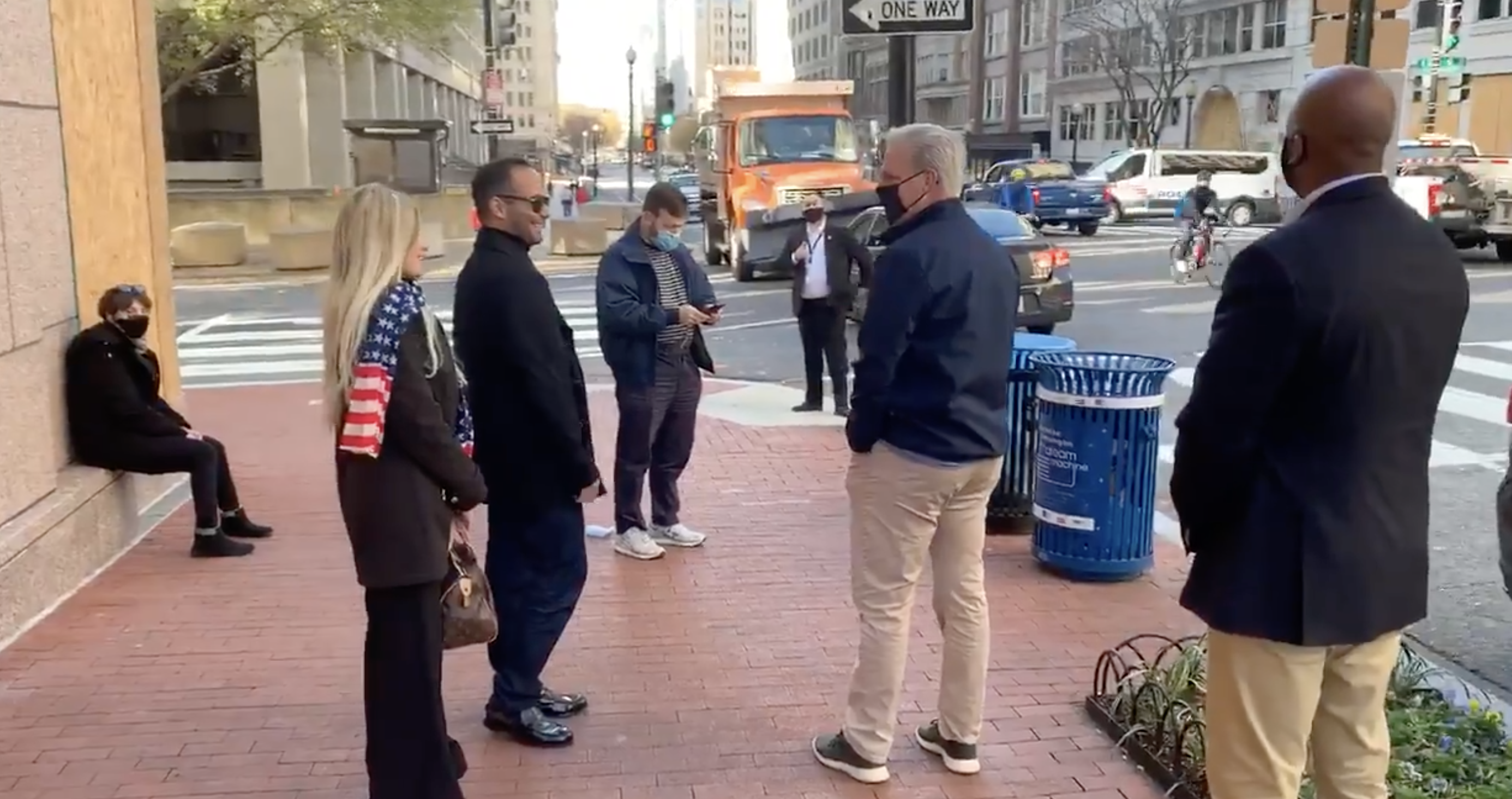
Many scientists think herd immunity may now be impossible in US. Here’s what that means

Since the beginning of the pandemic, world leaders from President Donald Trump to British Prime Minister Boris Johnson have touted “herd immunity” as the light at the end of the tunnel for the COVID-19 pandemic. The thinking goes that once an undetermined majority of the population becomes immune the SARS-CoV-2 virus (which causes COVID-19), either from vaccination or infection, the virus will no longer be able to spread uncontrollably and thus the pandemic will end.

Now, some scientists are saying that herd immunity, at least in the United States, may never be possible. As reported in a New York Times story, the reasons are compound and relate to demography, access, and vaccine hesitancy.

Indeed, although more than half of American adults have received at least one dose of a COVID-19 vaccine (which, if you are issued the Pfizer or Moderna vaccines, is only half of a vaccination), daily vaccination rates are declining. Just over 30 percent of Americans have been fully vaccinated; experts generally agree that at least 70 percent of a population needs to be immune to a given disease for herd immunity to take effect.

Likewise, the vaccine itself has become a partisan issue, thanks to the politicization of pandemic public health by both politicians and prominent right-wing media outlets like Fox News. As a result, nearly half of Republican voters told a Monmouth University poll in mid-April that they were absolutely refusing to get a vaccine. Another recent poll also found that members of specific religious groups, such as white evangelical Protestants, disproportionately say that they will not get vaccinated; the same poll found that Republicans are far more likely to not accept vaccines than Democrats or independents.

From a biology standpoint, the growth of mutant coronavirus strains, some of which may be able to resist the vaccines developed to fight the disease, stands to further exacerbate the pandemic. These strains include the highly transmissible B.1.1.7 variant, which originated in the United Kingdom and is now the main variant circulating in this country; a variant called P.1 that originated in Brazil; the B.1.351 variant, which came from South Africa; and a hybrid variant that emerged in California called B.1.429. According to the Times, experts have since revised their herd immunity threshold up to 80 percent to account for the new variants.


Want more health and science stories in your inbox? Subscribe to Salon’s weekly newsletter The Vulgar Scientist.


“Please hear me clearly: At this level of cases with variants spreading, we stand to completely lose the hard-earned ground we have gained,” Dr. Rochelle Walensky, who Biden appointed to lead the Centers for Disease Control and Prevention (CDC), warned reporters in March. She later added that she was “really worried about reports that more states are rolling back the exact public health measures we have recommended to protect people from COVID-19,” told the public that they needed to continue wearing masks and following other public health safety measures and emphasized that “ultimately, vaccination is what will bring us out of this pandemic. To get there, we need to vaccinate many more people.”

Public health experts are mostly singing that same tune two months later. Dr. Anthony Fauci, the Biden administration’s top adviser on COVID-19, told the Times that he wants to shift the public’s focus away from herd immunity and instead toward simply vaccinating as many people as possible.

“That’s why we stopped using herd immunity in the classic sense,” Fauci explained. “I’m saying: Forget that for a second. You vaccinate enough people, the infections are going to go down.”

Some experts advocate for a renewed public health focus on vaccinating the most vulnerable citizens. If that goal is achieved, COVID-19 may become a seasonal disease like influenza, one which will mostly affect people who are young and healthy. That would make the pandemic manageable in the future and allow society to gradually transition back to its pre-lockdown norms.

Experts previously told Salon that they expect for the process of returning to normal life to be a rocky one. Everything from lack of equity in vaccine distribution (not just throughout the United States but throughout the world) could impact our overall ability as a species to stomp out the pandemic. In addition, scientists agree that booster shots may become necessary to treat new mutant strains as they emerge.

Meanwhile, many COVID-19 patients have contracted long-term health problems after infection, which has become an ancillary social and public health issue in its own right. Indeed, recent studies suggest that people who survive COVID-19 may experience lingering health issues long after the disease has subsided, from circulatory system diseases to ailments of the brain.

Trump hints that Arizona “recount” might catapult him back into White House (it won’t)

Former President Donald Trump claims to believe it’s only a matter of time before he will be reinstated as commander in, chief, apparently by way of a phony “recount” in Arizona, in which a private firm hired by Republicans is trying to find a way to nullify the 2020 election results in the state.

In video footage shot last week, Trump can be heard apparently telling supporters at his Florida resort that the 2020 election results might be overturned due to the potential findings of the firm “Cyber Ninjas,” which has been enlisted by Republican leaders in the Arizona State Senate to audit the election results in Maricopa County, the state’s major population center.

“Let’s see what they find. I wouldn’t be surprised if they found thousands and thousands and thousands of votes,” Trump declared in a video that was posted to YouTube, allegedly shot last Wednesday evening. 

“After that, we’ll watch Pennsylvania, and you watch Georgia, then you’re going to watch Michigan and Wisconsin, and you’re watching New Hampshire. They found a lot of votes up in New Hampshire just now … You saw that?” Trump continued. “This was a rigged election, everybody knows it, and we’re going to be watching it very closely,” he added.

“Watch Arizona. Some very interesting things are happening in Arizona,” Trump said in the video clip, which made its way to TikTok and reportedly comes from a speech he gave at Mar-a-Lago before heading north to spend the summer months at his golf resort in New Jersey. 

One pro-Trump pundit, who works for the far-right media company Real America’s Voice and goes by “Dr. Gina” on Twitter, wrote on Monday that she met with Trump over the weekend and reports that the former president is still obsessing over his defeat in the 2020 election. “I saw 45 this weekend & he stated that he doesn’t want to talk about ’22 or ’24 until 2020 is resolved TO THE SATISFACTION OF THE AMERICAN PEOPLE!” Dr. Gina tweeted. 

With talk about the Arizona “recount” being hyped hard by right-wing media, with particular focus on the color of auditors’ shirts, other conservatives such as Cindy McCain, widow of the late Arizona Sen. John McCain, have begun to speak out about Trumpian efforts to overturn the election results. 

“This whole thing is ludicrous, quite frankly. It’s ludicrous,” McCain told CNN’s Jake Tapper on “State of the Union” Sunday morning. “And this also comes from a state party in Arizona that refused to be audited themselves on votes that were cast within their own party communications.” 

“The election is over. Biden won. I know many of them don’t like the outcome, but, you know, elections have consequences … This does not surprise me, you know, that things are just aloof and crazy out there right now with regards to the election,” McCain continued. 

On Monday morning, former Trump sent out a statement declaring that his supporters should begin calling the 2020 election results “THE BIG LIE,” attempting to hijack the phrase from those who have used it to describe Trump’s false claims of election fraud. In a callback to the pseudo-official style of his now-canceled Twitter account, Trump wrote, “The Fraudulent Presidential Election of 2020 will be, from this day forth, known as THE BIG LIE!” in a press release from his Save America PAC.

CVS and Walgreens have wasted more vaccine doses than most states combined

Two national pharmacy chains that the federal government entrusted to inoculate people against covid-19 account for the lion’s share of wasted vaccine doses, according to government data obtained by KHN.

The Centers for Disease Control and Prevention recorded 182,874 wasted doses as of late March, three months into the country’s effort to vaccinate the masses against the coronavirus. Of those, CVS was responsible for nearly half, and Walgreens for 21%, or nearly 128,500 wasted shots combined.

CDC data suggests that the companies have wasted more doses than states, U.S. territories and federal agencies combined. Pfizer’s vaccine, which in December was the first to be deployed and initially required storage at ultracold temperatures, represented nearly 60% of tossed doses.

It’s not completely clear from the CDC data why the two chains wasted so much more vaccine than states and federal agencies. Some critics have pointed to poor planning early in the rollout, when the Trump administration leaned heavily on CVS and Walgreens to vaccinate residents and staff members of long-term care facilities. In response to questions, CVS said “nearly all” of its reported vaccine waste occurred during that effort. Walgreens did not specify how many wasted doses were from the long-term care program.

One thing is clear: Months into the nation’s vaccination drive, the CDC has a limited view of how much vaccine is going to waste, where it’s wasted and who is wasting it, potentially complicating efforts to direct doses to where they are needed most. Public health experts say having a good handle on waste is crucial for detecting problems that could derail progress and risk lives.

The Pfizer-BioNTech and Moderna vaccines, which come in multidose vials, are fragile and have limited shelf lives. Overall, waste has been minuscule: As of March 30, the U.S. had delivered roughly 189.5 million vaccine doses and administered 147.6 million, including 7.7 million in long-term care facilities, according to the CDC.

Among other things, tracking wasted doses helps to identify bottlenecks where distribution adjustments might be needed, said Dr. Bruce Y. Lee, a professor of health policy and management at the City University of New York. Because the federal government is footing the bill for the country’s doses, any waste amounts to “basically throwing [taxpayer] money down the chute,” he said. CVS, Walgreens and other retailers don’t pay for the vaccine. The government provides it. And under the Medicare program, it pays providers roughly $40 for each dose administered.

Particularly early on, officials didn’t adequately assess where there would be demand and set up sites in response, Lee said — something that’s especially important when trying to jab as many people as possible as quickly as possible.

“If you think of any business, they’re going to determine where the customers are first,” he said. “It’s not just a matter of loading up vaccine and going to a place.”

KHN’s survey of vaccine waste is based on public records requests to the CDC and all 50 states, five major cities, Puerto Rico and Washington, D.C. Combined, the records document more than 200,000 wasted doses. However, the data has clear shortcomings. Data from 15 states, the District of Columbia and multiple U.S. territories are not included in the CDC’s records. And, in general, waste reporting has been inconsistent.

In addition to the CDC, 33 states and D.C. provided at least some data to KHN in response to those records requests. They reported at least 18,675 additional doses that have been wasted across 10 jurisdictions not represented in the CDC figures. They include 9,229 doses wasted in Texas as of March 26 and 2,384 in New Hampshire as of March 10.

An additional eight states told KHN of more wasted doses than they reported to the CDC.

But no city or state comes close to the waste reported by CVS and Walgreens, whose long-term care vaccination drive was criticized by some officials as slow and ineffective. Among nursing home staffers, a median of 37.5% reported they got a shot in the first month, according to a February CDC study.

“To me, this ultimately correlates with just poor planning,” said Dr. Michael Wasserman, immediate past president of the California Association of Long Term Care Medicine and a critic of the corporate effort.

Wasserman said the companies’ approach was too restrictive and their unfamiliarity with long-term facilities’ needs harmed the effort.

“CVS and Walgreens didn’t have a clue when it came to interacting with nursing homes,” he said. “Missed opportunities for vaccination in long-term care invariably results in deaths.”

A CVS spokesperson, Michael DeAngelis, in an email blamed wasted doses on “issues with transportation restrictions, limitations on redirecting unused doses, and other factors.”

“Despite the inherent challenges, our teams were able to limit waste to approximately one dose per onsite vaccination clinic,” he added.

Walgreens said its wastage amounted to less than 0.5% of vaccines the company administered through March 29, which totaled 3 million shots in long-term care facilities and 5.2 million more through the federal government’s retail pharmacy partnership.

“Our goal has always been ensuring every dose of vaccine is used,” company spokesperson Kris Lathan said in an email. Before scheduled clinics, she said, Walgreens would base doses it would need on registrations, “which minimized excess and reduced overestimations.”

CDC spokesperson Kate Fowlie said that because the retail pharmacy giants were tasked with administering a large number of doses, “a higher percentage of the overall wastage would not be unexpected, particularly in an early vaccination effort that spanned thousands of locations.” Since President Joe Biden took office in January, his administration has directed pharmacies to prioritize vaccinations for teachers and school personnel.

Overall, pharmacies accounted for almost 75% of wasted doses reported to the CDC. States and some large cities accounted for 23.3% of vaccine waste reported, and federal agencies, including the Bureau of Prisons and the Indian Health Service, for just 1.54%. The Virgin Islands — the only U.S. territory in the federal data — was 0.19%.

“Though every effort is made to reduce the volume of wastage in a vaccination program, sometimes it’s necessary to identify doses as ‘waste’ to ensure anyone wanting a vaccine can receive it, as well as to ensure patient safety and vaccine effectiveness,” Fowlie said. Even still, the CDC has provided guidance and worked with health departments to train staff members to reduce wastage, and clinic staffers should do “everything possible” to avoid wasting shots, she added.

Vaccine waste could increase in the coming weeks as officials shift tactics to inoculate harder-to-reach populations, public health experts say.

“I think we are getting to a place where, to continue to be successful with vaccination, we’re going to have to tolerate some waste,” said Dr. Marcus Plescia, chief medical officer of the Association of State and Territorial Health Officials. People unwilling to travel to a mass-vaccination site might go to a primary care physician or smaller rural pharmacy that might not be able to use every dose in an open vial, he said.

Claire Hannan, executive director of the Association of Immunization Managers, said concerns about waste should not trump getting shots into arms.

“If someone’s there, you need to vaccinate them,” she said. “In our efforts not to waste a dose, we may be missing opportunities to vaccinate because we don’t have 15 people lined up or 10 people lined up.”

CDC Numbers Don’t Match State Data

The federal government collects information about vaccine waste through federal systems called VTrckS, which manages ordering and shipments, and Tiberius, a platform run by the Department of Health and Human Services that monitors distribution. VTrckS can exchange data with state and local immunization registries that track who has received a shot, but some states rely on manual data entry, Hannan said.

The 15 states not included in the CDC’s data are Alaska, California, Colorado, Kansas, Louisiana, Maine, Maryland, Michigan, Nebraska, Nevada, New Hampshire, Ohio, Oklahoma, Oregon and Texas. The District of Columbia is also missing.

Of those jurisdictions, 11 provided data to KHN: Alaska, Colorado, Kansas, Maryland, Nebraska, Nevada, New Hampshire, Ohio, Oregon, Texas and D.C.

Most of those reported minimal waste to KHN: Colorado, Kansas, Nebraska and D.C. together registered just 1,090 wasted doses.

In others, the numbers are more significant. On March 19, the Maryland Department of Health said it knew of 3,175 wasted doses.

Texas had the most wasted doses of any state in either the CDC’s data or the data states provided to KHN. Its records showed 9,229 wasted doses as of March 26, putting it third in overall waste behind CVS and Walgreens.

Fowlie, the CDC spokesperson, said the agency is “working closely” with states that have technical issues to ensure accurate reporting.

Broken Freezers, Bent Needles, No-Shows

The reasons states gave for waste varied, from broken vials and syringes, to provider storage errors, to leftover doses from open vials that couldn’t be used.

The largest waste incidents, in which hundreds of doses were lost at a time, tended to be due to freezer malfunctions or workers leaving doses at room temperature too long.

But state records also register the little things that can go wrong.

On Dec. 16, the public health department in Gunnison County, Colorado, lost a single dose of the Pfizer vaccine when someone bumped into a table and a vial spilled. On Jan. 5, the Tri-County Health Department in Westminster, Colorado, reported that it wasted a Moderna dose because a hypodermic needle bent.

Remi Graber is a registered nurse who has vaccinated people at mass sites and community health clinics in Rhode Island. They said it’s not uncommon for a vial to have one too many or one too few doses, which can lead to a dose being counted as wasted. There are also sometimes syringe problems that result in waste.

But Graber said the biggest problem is people not showing up. Once a vial is punctured, Pfizer’s vaccine must be used within six hours. On April 1, Moderna announced that an opened vaccine vial was good for 12 hours — double what it had been previously.

“What could happen is you get people who just decide, ‘You know what? I don’t need my vaccine today. I’m not going to show up,'” they said. “Well, now we’re scrambling to find somebody to take the vaccine, because we don’t want to waste it.”

KHN (Kaiser Health News) is a national newsroom that produces in-depth journalism about health issues. Together with Policy Analysis and Polling, KHN is one of the three major operating programs at KFF (Kaiser Family Foundation). KFF is an endowed nonprofit organization providing information on health issues to the nation.

Why corporate America appears to be drifting away from the Republican Party

There’s a growing rift between corporate America and the GOP – two groups that have long been bedfellows.

The latest incident involves a restrictive voting law passed in Georgia – with dozens of other states working on their own measures meant to limit voting. Over 300 companies, CEOs and other executives signed a statement printed in The New York Times to “defend the right to vote and oppose any discriminatory legislation,” while Major League Baseball moved its All-Star Game from Atlanta to Denver.

Republicans reacted furiously and warned of retribution, including eliminating tax breaks for companies taking a stand on the issue. Texas’ governor backed out of throwing the ceremonial first pitch at the Texas Rangers’ home opener. And Senate Minority Leader Mitch McConnell bluntly warned companies to “stay out of politics” – though he later softened his tone.

Meanwhile, Democrats are trying to capitalize on the fracture.

As a management professor, I study how corporate executives’ values and political views affect the decisions they make on behalf of their companies. While I believe CEOs are partly responsible for the growing business-GOP divide, it’s not the only factor driving it.

A tight relationship loosens up

The close relationship between corporate America and the Republican Party dates back to the 1970s. Companies provided financial support to conservative war chests and in return received business-friendly policies like reduced corporate taxes and regulations.

The alliance has arguably been quite a success for Big Business. Corporate taxes as a share of U.S. gross domestic product are only about 1%, the lowest since the 1930s and down from 4.1% in 1967.

But this union has become increasingly strained in recent years over a range of social issues, particularly regarding LGBTQ rights.

For example, in 2015 many companies including Apple and Walmart denounced so-called religious freedom laws like one passed in Indiana that would allow businesses to discriminate against LGBTQ customers. The following year there was a similar corporate backlash over North Carolina’s ban on transgender individuals using public bathrooms. Boycotts by several companies, including PayPal and the NCAA, led to a partial repeal in 2017.

Companies were also vocal during former President Donald Trump’s presidency over such matters as his travel ban from Muslim-majority countries and his comments following the white supremacist rally in Charlottesville, Virginia. For some, it seemed like the role he and other Republicans played in laying the ground for the Jan. 6, 2021, insurrection at the Capitol may have been the last straw, as dozens of companies including AT&T and Marriott said they would cut off donations to the 147 Republicans who voted against certifying President Joe Biden’s election.

The push for more restrictive voter laws continues the battle over the election. Republicans in states across the country cite alleged fraud in the 2020 election – despite no evidence that any occurred – as the impetus behind their push.

Why have companies become more outspoken in recent years and willing to upset an alliance that has helped them reduce their tax bills and regulatory hurdles?

My research suggests there are three driving forces for this trend.

CEOs doing “what we think is right”

The CEO is the corporation’s top decider, which means his or her political leanings can filter into business decisions.

And in recent years, CEOs of some of the largest U.S. companies have cited their own personal values as their reason for speaking out on social issues. As Bank of America CEO Brian Moynihan told The Wall Street Journal in 2016, “Our jobs as CEOs now include driving what we think is right.”

In my own research, I’ve found a CEO’s political affiliation can affect how a company spends money. CEOs who mostly donate to Democrats tend to spend more on their employees, community activities and environmental issues, regardless of their company’s profitability. That is, they seem to believe it’s simply the right thing to do.

Republican CEOs, on the other hand, tend to tie spending on outside issues to financial performance, reflecting the notion that companies are responsible to shareholders first and foremost.

More recent research also demonstrates that liberal executives tend to pay more attention to gender diversity inside their companies and are less likely to reduce their workforce when economic conditions deteriorate, consistent with the values that liberals prioritize.

But relatively few CEOs are staunchly liberal, so the impact of the CEO on this trend may be limited. A recent study found that only about 18% of the more than 3,500 people who served as CEOs of companies in the Standard & Poor’s 1500 from 2000 to 2017 donated primarily to Democratic candidates, while 58% gave mostly to Republicans.

Growing worker activism

Employees also play an important role driving corporate activism.

Recent management research shows that companies with more liberal employees spend more resources on improving gender and race diversity and sustainability issues. Similarly, a 2019 study found that companies are more likely to concede to activists’ demands over issues like reducing carbon emissions and increasing front-line workers’ pay when they have a more liberal workforce.

Companies may be responding to research showing the benefits of listening to their employees and showing their voices matter. For example, workers tend to show more trust and commitment toward a company when they feel it shares their values, which leads to higher productivity. A 2017 survey found that 89% of employees said they’d accept a reduced salary to work at a company whose values match their own.

Other research shows engagement in social activities like protecting the environment leads to less employee turnover.

In my own research, which tracked companies’ engagement on same-sex marriage issues in the 2000s and 2010s, I found that the likelihood of CEOs speaking out on same-sex marriage significantly increased when there were more employees who donated to Democrats – which was true even when the CEO leaned conservative.

Tracking popular opinion

Public opinion is another factor likely driving the growing rift with the GOP.

Corporate executives tend to follow public sentiment, as they want to minimize the risk of losing customers for their products and services.

The debate over same-sex marriage is a good case in point. Public support for allowing gay people to marry surpassed 50% for the first time in 2011 – it’s now at 67%. Until then, very few CEOs had made a public statement on the issue, according to my same-sex marriage research. Once popular opinion hit the halfway point, however, a lot more companies – including ones led by conservative CEOs – begin speaking out in favor. Interestingly, even liberal CEOs said very little until 2011, including those who already provided employees with domestic partner benefits.

And more recently, it has become even more critical for companies to consider public sentiment when deciding whether to take a stand on a hot-button issue. That’s because their younger customers, especially millennials, increasingly say CEOs have a responsibility to speak out and they would be more likely to buy products if they do.

On the voting laws, a recent poll found that most people favor legislation that makes it easier to vote, not harder.

Who’s leaving whom

But corporate America isn’t necessarily moving away from the Republican Party and toward the Democrats.

Instead, businesses are trying to make clear that their concerns are not partisan in nature. The 100-plus companies that signed a statement supporting voter rights and against bills that would restrict access emphasized this point.

I believe a closer look at the three main factors – especially the role of workers and the public – behind the growth in corporate activism suggests something else. Companies aren’t drifting away from the Grand Old Party. Rather, the GOP seems to be doing the drifting, not only from corporate America, but the American public as well.

M. K. Chin, Assistant Professor of Management, Indiana University

This article is republished from The Conversation under a Creative Commons license.

The U.S. never had a shot at herd immunity

Herd immunity just ain’t happening, folks. Once anti-vaccine rhetoric became normal on the right, the goal of herd immunity to stop the spread of COVID-19 was doomed. 

Many folks have been saying it for a few months now, but it appears that the slower-moving medical experts in the federal government are finally admitting it. Despite half of Americans getting the shot, Apoorva Mandavilli of the New York Times writes, “vaccination rates are slipping, and there is widespread consensus among scientists and public health experts that the herd immunity threshold is not attainable — at least not in the foreseeable future, and perhaps not ever.” 

This article caused a lot of doom-saying from pandemic addicts on social media, but there’s actually good news in this. Dr. Anthony Fauci, Biden’s top advisor on the pandemic, explained that federal leaders “stopped using herd immunity in the classic sense,” and instead the focus has shifted to “vaccinate enough people, the infections are going to go down.” In other words, it’s time to stop letting anti-vaccination people hold the rest of hostage, wind down the lockdowns, and shift gears to managing COVID-19 through other strategies. 

As Mandavilli explains, there’s a lot of reasons that herd immunity is simply unachievable in the current situation, but there is no doubt that “[s]kepticism about the vaccines among many Americans” is playing a major role. She delicately avoids digging in deeper, but anyone who has been paying attention in recent months understands what this means: It’s Republicans. 


Want more Amanda Marcotte on politics? Subscribe to her newsletter Standing Room Only.


The last big poll released on this question was by Monmouth University in mid-April and the news was not good: Nearly half of Republican voters flat-out refuse to get the vaccine. That number has been steadily climbing, in response to a heavy push from Fox News to demonize the vaccine and the spread of anti-vaccination conspiracy theories on social media

To be clear, “because Fox News said so” isn’t actually enough to convince Republican voters to forgo a free, easy shot that can literally save your life. The anti-vaccination propaganda is only working because it builds on decades of right-wing propaganda that has poisoned the minds of millions of people. Nowadays, conservatives and even people who are more conservative-adjacent see hostility to scientific expertise as a virtue and reject the very idea that there is any such thing as the common good. 

There is such thing as a healthy skepticism of the experts, of course. Throughout the pandemic, for instance, many prominent academics, public health experts, and journalists have been critical of many decisions made by the Centers for Disease Control and other health officials, asking hard questions rooted in a strong understanding of science and public health care policy. But what right-wing propaganda has instilled in followers is not really skepticism, so much as a reflexive suspicion of scientific experts. 

Climate change denialism, which is widespread among Republicans, is the most obvious example. While the numbers are thankfully shrinking, for decades now, Republican voters largely bought into the ludicrous conspiracy theory that climate change was a hoax perpetrated by academics who had ulterior motives, usually of the “Marxist” variety. But the idea that a random GOP voter with a big ego knows more than the experts has become pervasive. It’s why conservatives stubbornly stick by discredited ideas like creationism or “abstinence-only education,” even though the overwhelming scientific evidence shows it’s all poppycock. 

These attitudes have leaked out beyond just the hardcore right. Now, large portions of the public that may not think of themselves as right-wingers nonetheless have adopted the idea that they, armed with a Google search engine and unearned confidence in their own opinions, know better than the experts.

Witness, for instance, the recent kerfuffle over the bafflingly popular podcast host Joe Rogan, who recently went on a rant about how “a healthy person” who is “exercising all the time” and is “young and you’re eating well” shouldn’t bother to get the vaccine because the risk of dying of COVID-19 is low. 


Want more Amanda Marcotte on politics? Subscribe to her newsletter Standing Room Only.


On its face, this was a dumb thing to say, because getting sick sucks, no matter how healthy you are generally. But when Rogan got criticized, including by Dr. Fauci, he responded in a way that was widely reported as a “backtracking.” The reality, however, is more complicated. Rogan did not actually back down from his false belief that vaccines don’t benefit healthy people. (Which they do, by keeping them from getting COVID-19.) He simply said that the “argument was you need it for other people” and “that’s a different argument.”

Rogan’s clearly sticking by his premise, that getting the vaccine is inherently a sacrifice for “healthy” people. It’s likely that a lot of his audience still imagines they belong to the category “healthy people” and that there is, for them, some conflict between what’s good for them and what’s good for the larger community. In reality, getting the shot is both good for individuals and communities, because again, getting sick sucks, no matter who you are. Rogan’s poor logic here, however, is persuasive to a lot of people because decades of right-wing propaganda has instilled this notion in millions that everything is a zero-sum game, and anything an individual does that is good for the community must inherently come at some personal price. 

This false logic, for instance, is pervasive in the debate over health care generally.

Universal health care systems in other countries have demonstrated, time and again, that individuals have a lot to gain, in terms of lowered health care costs and accessibility, from systems built around the assumption of a common good. But Republicans talk about health care in these zero-sum terms, scaring their voters into believing that more people in the system just means less health care for them. In reality, universal systems have more people paying in, streamline bureaucracies, and lower overall costs — often making it easier for any individual to get health care. 

Over the weekend, the New York Times ran another piece, about how the conservative, white communities of Appalachia have become bastions of anti-vaccine sentiment. Folks deny that it’s out of a tribalist loyalty to Donald Trump, even though he leaned hard into COVID-19 denialism. But even if it’s not that, it is because they’re largely Republican, and are plugged into long-standing right-wing tendencies to reject science and look dimly on anything perceived as the common good. Indeed, the messaging coming from government officials about the vaccine is backfiring precisely because it emphasizes community spirit and science. Instead, the folks who the Times spoke to highlighted how “me and my family can take care of ourselves.” 

The phrase “herd immunity” brings with it the concept that we are a herd. For right-wing America, however, accepting the idea that they share anything with the rest of the country — the racially diverse, progressive majority — is an anathema. They don’t want to see themselves as part of a herd that has those other people in it, even if that means rejecting the basic facts of human biology. So of course they were easy to bamboozle with anti-vaccination rhetoric. And now it’s just up to the rest of us to figure out how to deal with that. 

Republican lawmaker charged for Capitol riot in Oregon

Oregon state Rep. Mike Nearman, a Republican state legislator from Polk County, now faces criminal charges as he stands accused of purposely letting rioters breach the state Capitol last December. 

The charges include first-degree official misconduct and second-degree criminal trespass, according to court records obtained by CNN. Nearman has formally been accused of “unlawfully and knowingly perform(ing) an act which constituted an unauthorized exercise of his official duties, with intent to obtain a benefit or to harm another,” and is set to be arraigned on May 11.

Security footage shows Nearman exiting the state Capitol building on December 21 around 8:30 a.m., when his fellow colleagues were still in a floor debate regarding a state-wide COVID-19 relief package. A raucous throng of people protesting COVID restrictions can be seen just outside the chamber Nearman exits from, suggesting that the legislator deliberately granted entry to them.

Shortly after Nearman leaves, the demonstrators, some of whom brandished firearms, engaged in a physical confrontation with state police who impeded further entry into the building. Oregon State Police said that “a protester sprayed some kind of chemical irritant” at the officers, according to CNN. However, the officers eventually secured the chamber.

Outside the building, several demonstrators shattered glass doors and attacked journalists. Over 30 people unlawfully entered the vestibule, reported the New York Times.  

A complaint filed in January by Oregon state Democrats alleges that Nearman “let a group of rioters enter the Capitol, despite his knowledge that only authorized personnel are allowed in the building due to the COVID-19 pandemic.” It also called Nearman’s actions “completely unacceptable, reckless, and so severe that it will affect people’s ability to feel safe working in the Capitol or even for the legislature.”

On Friday, Oregon House Speaker Tina Kotek, a Democrat, demanded that Nearman resign, tweeting: “Rep. Nearman put every person in the Capitol in serious danger and created fear among Capitol staff and legislators.”

Oregon House Majority Leader Barbara Smith Warner echoed Kotek in January: “Rep. Mike Nearman’s actions are a stain on this state. He put the lives of staff members, legislators and Oregon State Police officers in jeopardy. He is an embarrassment to this institution. He must be held to account.”

Nearman, whose legal representation on the matter remains unclear, said in a written statement back in January: “I don’t condone violence nor participate in it. I do think that when … the Oregon Constitution says that the legislative proceedings shall be ‘open,’ it means open, and as anyone who has spent the last nine months staring at a screen doing virtual meetings will tell you, it’s not the same thing as being open.”

According to NPR, at least three of the protestors who participated in the breach of the Oregon state Capitol went on to participate in D.C.’s Capitol insurrection. 

The Oregon House Conduct Committee is set to investigate the incident and determine whether the state Republican violated workplace rules. Nearman may be expelled from the body, depending on whether the state Congress can reach bipartisan support for the effort. Nearman has since been ousted from all his committee seats, though he still appears in House floor proceedings. 

The incident is not Nearman’s first go-around with controversy. Back in October, the lawmaker sued Gov. Kate Brown in October due to the state’s COVID restrictions, according to the Times. In December, Nearman joined a dozen Oregon lawmakers who had encouraged the state attorney general to join a lawsuit looking to reverse the results of the 2020 presidential election.

How Donald Trump is helping Joe Biden build back better

People tend to think of “activists” as left-wingers who march in the streets against wars or organize rallies for civil rights and social justice. And there is a great tradition in America and around the world for such liberal activism. But it’s not just the left that has an activist tradition. The right has one too — and it’s often extremely effective.

In the post-WWII years, the right in the U.S. was focused on anti-communism and far-right groups like the John Birch Society attracted middle-class men and women to join clubs and meet to discuss how to fight the onslaught from inside their suburban cul de sacs. In the New Republic some years back, historian Rick Perlstein recounted a hilarious quote from a Dallas housewife in Time Magazine in 1961 saying, “I just don’t have time for anything. I’m fighting Communism three nights a week.” From the Goldwater campaign in 1964 on, right-wing activists focused much of their energy on getting Republicans elected to office, from school boards to the presidency, and were quite successful at it.

The right-wing grassroots has always organized itself around the idea that they are under siege and unless they pull together to defend themselves, everything they value will be destroyed. Whether it was fighting communism, secularism, terrorism, civil rights or whatever social justice movement that was supposedly threatening their way of life, the right has always been convinced that they are in imminent danger. And when they find themselves at odds with their own fellow Americans, as they so often do, this sense of victimization and martyrdom is what fuels the culture war at the heart of their complaints. As Perlstein wrote in that 2006 piece:

Conservative culture itself is radically diverse, infinitely resourceful in uniting opposites: highbrow and lowbrow; sacred and profane; sublime and, of course, ridiculous. It is the core cultural dynamic–the constant staging and re-staging of acts of “courage” in the face of liberal “marginalization”–that manages to unite all the opposites. It keeps conservatives from one another’s throats–and keeps them more or less always pulling in the same political direction.

Donald Trump, however, has upended that longstanding dynamic — and the party establishment has no idea what to do about it.

Igor Bobick of the Huffington Post recently reported that Republican officials are anxiously awaiting a resurgence of the Tea Party, which they have been expecting to reconstitute in the face of Joe Biden’s ambitious agenda. It was, after all, a smashing success back in 2009 and 2010 in opposing President Barack Obama’s health care plan. You’d certainly assume that they’d be getting the band back together. But so far, it isn’t happening. And there’s a reason for it: people like what they are seeing.

Bobic quotes deficit hawk Republican Sen. Mike Braun saying, “even my counties back in Indiana are happy, which is a very conservative area. They’re asking, ‘How can I spend $15 million in a rural county?'” Braun ruefully admits that Biden’s agenda is a smart political move and he’s right. Biden and the Democrats are betting that people are hungry for some positive government action and they are determined to deliver it.

But there’s more to it than that.

The Tea Party was a grassroots movement but it was also heavily subsidized by some of the wealthiest activists in the country. The Koch brothers’ operation and other wealthy interests spent quite a bit of money to make the Tea Party a reality because their libertarian ideology really was on the line. But when you think about it, it was a bizarre set of issues for grassroots activists who usually organize themselves around a sense of victimization. And it didn’t really fit their usual modus operandi. The “threat” was a total abstraction. How were they “victims” of other people getting health care?

Sure, the right has always opposed government programs if it would benefit those they believe don’t deserve them (and I think you know who those people might be). But the outrage against Obamacare was really all about Obama. They had to sublimate their racist backlash into something and that was on the menu but the war the Tea Party was really fighting was against the election of America’s first Black president.

Yet some Republicans in Congress are still operating under the illusion that their voters really did care about deficits and will be moved to protest despite the fact that they still adore Donald Trump, a man who didn’t care about any of that. In fact, right-wing grassroots activists are already engaged in a battle that is far more energizing and interesting to them than any of that egghead economic stuff ever was: Donald Trump’s Big Lie.

According to a new CNN poll, 70% of Republicans believe the election was stolen. And they are taking action. We all know about the flurry of restrictive voting laws that are quickly being enacted all over the country and the preposterous “audit” taking place down in Arizona by a bunch of Trump fanatics and conspiracy theorists is probably just the beginning. The explosion of GOP grassroots activity in the states isn’t just about Joe Biden or the events happening in Washington. They are also working night and day to punish Republicans who dared to disagree with Trump’s version of events and ensure that Trump will be able to win the next election.

The Washington Post took a look at some of the grassroots action taking place around the country. They interviewed one Michigan organizer who is trying to censure and remove a Republican Party executive who accepted the results of the election. She said, “I think I speak for many people in that Trump has never actually been wrong, and so we’ve learned to trust when he says something, that he’s not just going to spew something out there that’s wrong and not verified.” That sort of cultish delusion is forcing official rebukes and purges of Trump apostates all across the country.

And then this happened to Sen. Mitt Romney, R-Ut., over the weekend:

https://twitter.com/atrupar/status/1388880413226151941

The motion to censure the former GOP presidential nominee failed 711-798, which I’m sure softened the humiliating blow. But it’s bubbling up to Washington as well. The House GOP caucus thought they had successfully managed the “Liz Cheney problem” but it’s coming back. Axios reported that there may be another vote to remove her and from the behavior of the leadership, it seems as though the worm has turned, no doubt because these Representatives are getting an earful from their activist base. The party is now eating its own. 

Republicans counting on the Tea Party zombie to rise again had better come up with a Plan B. The activists the GOP in Washington wants to organize against Joe Biden’s program are already booked. They’re busy fighting other Republicans three nights a week.  

Lessons from the rise and fall of ancient cities

A city, as defined by Australian archeologist Vere Gordon Childe in the 1950s, is a densely populated settlement. It has monumental buildings. Its people create art and writing and use money and taxes. They trade across long distances, create surplus goods, and exist in a complex social hierarchy.

Every urban center, whether it existed 9,000 years ago or thrives today, has its own unique history, writes Annalee Newitz, a science, technology, and culture journalist, in “Four Lost Cities: A Secret History of the Urban Age.” Yet no matter why they form or how they flourish, all cities experience the same fate: They perish.

“It’s terrifying to realize that most of humanity lives in places that are destined to die,” Newitz writes. Some archaeologists claimed to have found so-called lost cities covered in sand or vines, a fate ripe for adventure stories and mythology. Those places, however, were more often simply abandoned: “The myth of the lost city obscures the reality of how people destroy their civilizations.”

The four ancient cities Newitz focuses on “shared a common point of failure,” they write. “Each suffered from prolonged periods of political instability coupled with environmental crisis.” Each one also offers lessons about how to live with other people, how to exist within the natural world, and how to adapt to shifting political landscapes and environmental conditions.

Newitz spotlights four places built up and deserted on different continents over millennia. They couple historical descriptions with firsthand accounts from each of these locales, often highlighting the work of anthropologists and archaeologists conducting cutting-edge research into how these ancient societies grew and withered.

Descendants of nomadic tribes lived from about 7100 to 5700 B.C. in central Turkey’s Çatalhöyük, one of the world’s first cities. Described by some archaeologists as a collection of villages, the city bustled with activity before succumbing to flooding and rising frustrations between neighbors. Entrepreneurs from a number of social classes thrived for centuries in the Roman city of Pompeii before Mount Vesuvius buried it in volcanic ash in 79 A.D. Cambodia’s Angkor (roughly 800 to 1431 A.D.), once the capital of the Khmer Empire, relied on a massive network of canals and retention ponds built by indentured servants or slaves before eventually dissolving due to conflicts with an indebted workforce and failed infrastructure. And along the Mississippi River’s floodplains, the city of Cahokia (approximately 1050 to 1350 AD) attracted people from all over the region who gathered for religious and cultural ceremonies, its populaton possibly dispering as leaders became more authoritarian and a changing climate may have caused drought and famine.

Newitz tells fascinating stories about the people in these metropolises and how researchers came to understand how they lived their lives. Many of the discoveries are a result not just of traditional archaeological investigations, but also of new technologies and analytical methods.

Female figurines that archaeologists continue to unearth in Çatalhöyük, for example, illustrate a belief system that appears to have spread across the region, and evidence of fires set over time helps demonstrate how the city changed over its nearly 1,500-year history. In Pompeii, researchers are using “big data” — the aggregation of many smaller datasets into a larger collection — to build a more complete picture of everyday life there.

Data-driven archaeology makes use of everything from markings on rock to inscriptions on paper. Analysis of wear on street stones and curbs in Pompeii can yield a wealth of information: Grooves made by thousands of vehicles moving through the streets, for example, indicate standardized spaces between carriage wheels. Cutouts on high curbs that kept pedestrians from stepping in sewage flowing through the streets show that Romans likely drove on the right side of the road. Sarah Levin-Richardson, an archaeologist at the University of Washington in Seattle, studied pornographic graffiti in Pompeii and found that a lot of it was written by women who took pride in their trade as former slaves turned sex workers.

“In a sense, data archaeology represents the democratization of history,” writes Newitz. “It’s about looking at what the masses did, and trying to reconnect their social and even psychological lives.”

In Angkor, archaeologists employ lidar, a technique that uses lasers to map geographic forms hidden in the earth. Data technology is used there, too, to analyze the lists of laborers, the majority of whom, it turns out, were women.

In Cahokia, archeologists used magnetometers — instruments used to detect variations in the Earth’s magnetic field — for “sniffing out buried structures because they can detect anomalies that can represent disturbed earth, burned objects, and metals several feet beneath the surface,” Newitz explains, helping them to better understand the mounds that once stood there.

Whenever researchers uncover something new about these cities — whether it is deeper insights into Roman sexuality in Pompeii or human sacrifice in Cahokia — their revelations are inevitably colored by what our current societies deem acceptable, says Newitz. Penis carvings, thought to bring good luck, are still kept in a “Secret Cabinet” section of the Naples Museum, though shopkeepers displayed them prominently in ancient Pompeii.

Newitz also examines how our ideas about the demise of urban places have evolved. In scientific circles, the idea that civilizations fall solely because of human interaction with the environment was waning before Jared Diamond reinvigorated the theory with his 2004 book “Collapse: How Societies Choose to Fail or Succeed.” “Diamond is right to highlight environment as a contributing factor in urban dissolution, but that’s only part of the story,” Newitz says. “Abandonment is most importantly a political process.”

City leaders or royalty often want to invest in “beautiful spectacles,” says Newitz, rather than the things people need to prosper, like functioning infrastructure and safe marketplaces. Without those things, cities are often more vulnerable to environmental catastrophes, which can lead to political unrest when homes flood or crops shrivel.

Diamond also argued that a city’s culture dies when the settlement vanishes, but Newitz cites scholars who say instead that people who migrated out of ancient cities typically brought their values, art, and technology with them and assimilated them into their new homes.

In the case of Pompeii, for example, those who survived the volcanic eruption often moved to other cities colonized by Romans. The former residents of Cahokia may have spread and formed smaller communities across the Midwest and formed smaller communities. Osage oral histories, writes Newitz, explain how migrating people stopped in Cahokia for centuries before continuing west. “Today, the Osage are one of many tribes whose culture and ideals were shaped by the people who abandoned Cahokia,” they say.

“Metropolitan areas expand and contract with waves of immigration over time,” Newitz writes. “When a city’s population breaks apart into smaller villages, that isn’t a failure. It’s simply a transformation, often based on sound survival strategies. The culture of that city lives on in the traditions of people whose ancestors lived there, many of whom will go on to build new cities in its image.”

Even though they may not last forever, successful cities need certain things to flourish: resilient infrastructure, areas accessible to the public, domestic places for everyone, social mobility, and leaders who respect the city’s laborers. In the end, Newitz concludes, “This is not such a tall order, especially when you consider that thousands of years ago, our ancestors managed to maintain healthy cities for centuries at a time.”

* * *

Susan Cosier is a Chicago-based writer who covers science and the environment. Her work has appeared in Scientific American, Science, The New York Times for Kids, The Guardian, and Audubon, among other publications.

This article was originally published on Undark. Read the original article.