Spring Sale: Get 1 Year, Save 58%

Michael Cohen says Rudy Giuliani will rat on Trump because he’s an “idiot” who “drinks too much”

Speaking to CNN this Thursday, Donald Trump’s former personal lawyer and fixer, Michael Cohen, addressed the recent raid by federal agents on the home and office of Trump lawyer Rudy Giuliani, saying that “we have no idea how expansive this investigation is ultimately going to reveal itself.”

“…because Rudy’s an idiot,” Cohen said. “And that’s the problem — Rudy drinks too much. Rudy behaves in such an erratic manner that who knows what’s on those cellphones or what’s on those computers.”

When asked if he thinks Giuliani will flip on Trump and offer information to the government, Cohen replied that there’s never really been a relationship between Giuliani and Trump in the first place, saying that they didn’t even like each other before Trump became president.

“So do I think Rudy will give up Donald in a heartbeat? Absolutely,” Cohen said.

Watch the video below via CNN:


“Stay at least 500 feet away”: Matt Gaetz mocked after sharing list of “best” high schools

Rep. Matt Gaetz (R-FL) faced scorn on Thursday after he expressed his thoughts about which high schools in Florida are “best.”

Gaetz, who is caught up in an alleged underage sex trafficking scandal, shared the news on Twitter that a high school in his district had been voted as one of the top 50 in the state.

“Congratulations @NHSEagles1 on this incredible achievement!” Gaetz wrote, adding the headline: “Niceville High School lands in U.S. News’ top 50 of Florida’s ‘best’ high schools”

Within seconds, Gaetz faced an avalanche of ridicule on Twitter.

“Are you looking for a prom date?” one person asked.

“You know you’re supposed to stay at least 500 feet away from there,” another commenter jabbed.

Read some of the responses below:

James Gunn reveals draft of “Guardians of the Galaxy Holiday Special” script

James Gunn is a master multitasker. With “The Suicide Squad” heading to theaters and HBO Max this summer, he’s already looking ahead to his next big project: “The Guardians of the Galaxy Holiday Special.” Collider reports that he teased that the first draft is in the books with a special social media post to mark the occasion.

Gunn, who is writing and directing the “Holiday Special,” teased fans on social media with a picture of the script’s cover, noting that “This is the wrapping. The present is inside.” Gunn is listed as James “Long Elf” Gunn.

When will the “Guardians of the Galaxy Holiday Special” debut?

“Guardians of the Galaxy Holiday Special” will debut between the upcoming “Thor: Love and Thunder” (in theaters May 6, 2022) and the third installment of the “Guardians of the Galaxy” franchise, due in 2023. The timing is important because the team saw some new faces at the end of “Avengers: Endgame,” so it’s safe to assume that the Guardians will play some role in the next Thor movie.

As a holiday special, it’s easy to imagine that it will arrive on Disney+ during the 2022 holiday season. In order to keep both projects on track, the “Holiday Special” and “Guardians of the Galaxy Vol. 3” will film at the same time.

It stands to reason that the “GOTG Holiday Special” will feature Peter Quinn introducing the holidays to his friends, and likely working to understand how their holiday traditions work. (Something tells me that Groot won’t like the idea of Christmas trees being cut down every year)

After spending a whole year without a new Marvel movie, it feels good to have so many Marvel movies on the way to make up for the drought. From “Black Widow” to “Eternals” to “Spider-Man: No Way Home,” there’s a lot to look forward to and a “Guardians Holiday Special” from James Gunn truly is the gift that keeps giving.

Joe Rogan walks back controversial anti-vaccine comments: “I’m not a doctor, I’m a f**king moron”

Following high-profile pushback from White House officials, popular podcast host Joe Rogan walked back a series of recent controversial anti-vaccination comments, saying that he is “not a respected source of information.” 

During a recent episode of his show, “The Joe Rogan Experience,” the host suggested that younger listeners did not need to get a COVID-19 vaccine if they were otherwise healthy.

“People say, ‘Do you think it’s safe to get vaccinated?’ I’ve said, ‘Yeah, I think, for the most part, it’s safe to get vaccinated,'” Rogan said on his podcast, which is distributed exclusively by the streaming giant Spotify. “But if you’re like 21 years old, and you say to me, ‘Should I get vaccinated?’ I’ll go, ‘No.'”

“If you’re a healthy person, and you’re exercising all the time, and you’re young and you’re eating well, I don’t think you need to worry about this.”

The comments sparked a firestorm of criticism, including from officials at the highest levels of government.

“I guess my first question would be, ‘Did Joe Rogan become a medical doctor while we weren’t looking?'” White House communications director Kate Bedingfield asked. “I’m not sure that taking scientific and medical advice from Joe Rogan is perhaps the most productive way for people to get their information.”

Even Dr. Anthony Fauci, the nation’s leading infectious disease expert, told NBC News that Rogan was talking about himself “in a vacuum” — making the point that while vaccines can protect recipients from infection, it is important to prevent the spread of the virus to vulnerable populations.

As the former “Fear Factor” host and UFC color commentator addressed the criticism Thursday on another episode of his show, reiterating that he is “not an anti-vaxx person.”

“I believe they’re safe, and I encourage many people to take them — my parents were vaccinated,” Rogan said. “Their argument was you need it for other people . . . But that’s a different argument. That’s a different conversation.”

He also deflected blame for the incident, adding that it was blown out of proportion by clickbait headlines.

“I’m not a doctor, I’m a f**king moron. I’m not a respected source of information — even for me,” he said. “But I at least try to be honest about what I’m saying.”

Rogan also told listeners that he had been scheduled to receive a dose of the Johnson & Johnson vaccine before authorities announced a pause on the company’s rollout. 

It was the latest controversy for Rogan, who signed a blockbuster $100 million deal last year with Spotify, which thrust the technology giant into the middle of a debate over its responsibility for the information — and misinformation — being distributed by one of its marquee personalities. Spotify noted in an earnings report published this week that the company’s strong growth can partially be attributed to the performance of “The Joe Rogan Experience,” according to Axios.

The company faced pushback in the past for Rogan’s interviews with the conspiracy theorist Alex Jones, as well as misinformation about West Coast wildfires. He’s also been accused of trafficking in racism, Islamophobia and anti-LGBTQ rhetoric at various moments in his podcast career.

Spotify did remove Pete Evans, another podcast host, from its platform earlier this year for “dangerous, false, deceptive, misleading content about COVID-19.”

You can watch the video below via YouTube

Harris says, “I don’t think America is a racist country,” finds backlash across political spectrum

Vice President Kamala Harris said Thursday during an appearance on “Good Morning America” that she doesn’t think “America is a racist country,” a rare statement that for a moment united the political left and right in criticism of the California Democrat. 

The remarks came following President Joe Biden’s joint address to Congress on Wednesday night, where he identified white supremacy as the foremost threat facing America today.

During the segment, GMA host George Stephanopoulos asked Harris about the GOP’s rebuttal to Biden’s speech, made by Sen. Tim Scott — in which the South Carolina senator said, “America is not a racist country.” 

Stephanopoulos used the opportunity to ask the vice president about the statement:

“Senator Tim Scott said last night that America is not a racist country. Do you agree with that, and what do you make of his warning against fighting discrimination with more discrimination?” he asked.

“Well, first of all, no, I don’t think America is a racist country,” the vice president declared. “But we also do have to speak truth about the history of racism in our country and its existence today.” 

Harris continued by thanking Biden for “always having the ability and the courage, frankly, to speak the truth about [racism in America]. He spoke what we know from the intelligence community, one of the greatest threats to our national security is domestic terrorism manifested by white supremacists.

Watch the clip below via ABC:

Both the political left and right expressed frustration over Harris’ remarks, though for seemingly very different reasons.

Filmmaker and activist Bree Newsome responded to Harris, writing on Twitter, “The establishment keeps framing racism as something in America’s past but can’t pinpoint exactly when it supposedly ended… because it never did. All this language about ‘America isn’t racist’ is to mollify white people who are offended by the topic.

“Everything in America revolves around the violence of white people & trying to prevent white people from raging again. All the language of the political establishment is loaded with this concern— ‘America isn’t a racist country.’ ‘Don’t do that b/c it will rile the Trump folks.'”

“The Black republican and the Black cop agree: America not racist!” another Twitter user wrote — referring to Harris, the former San Francisco district attorney, as a “cop.” In that position, she “oversaw 1,900 convictions for pot offenses” alone, The Mercury News previously reported. 

The political right also fumed over Harris’ appearance, taking umbrage at the “but” after her statement.

“Kamala Harris sort of agreed with Tim Scott, and then she used the word ‘but…'” right-wing radio host Wayne Dupree tweeted

The conservative media sphere also called out the perceived hypocrisy in how both messages were received.

“‘No, I don’t think America is a racist country,’ VP Harris said on Thursday morning. It’s unlikely she will face the same derision as Senator Tim Scott, nor should she,” right-wing magazine The National Review tweeted.

Ben Shapiro’s Daily Wire also weighed in with a similar statement:

“Leftists On Twitter Rip Tim Scott For Saying ‘America Is Not A Racist Country.’ Kamala Harris Now Says Same Thing, To Silence.”

“The Committed” skewers colonial fetishization, inspired by controversial coffee table book

Near the figurative and literal climax of “The Committed,” Viet Thanh Nguyen’s sequel to his Pulitzer Prize-winning novel “The Sympathizer,” a motley elite –– politicians, businessmen, a priest, and other white men privileged in the novel’s 1980s Paris –– meet at a luxurious building. With the help of cocaine and copious quantities of cash, they offer bids to enjoy the goods at hand: a Chinese-Singaporean sex worker wearing a floral skirt and a flower behind her ear like an inhabitant of Gauguin’s Tahiti; a Cambodian wearing a Vietnamese áo dài, a tailored tunic and pants set . . . but without the pants. 

The mismatch between the women and their costumes is precisely Nguyen’s point: the Western gaze exoticized and eroticized women of color in colonial times without regard for their individual identities. That phenomenon persists today with sometimes deadly consequences, as seen in the March murder of six women of Asian descent at spas in Atlanta. Police said the white shooter saw the women as “a temptation for him that he wanted to eliminate,” a phrase that succinctly captures the dually desirous and dominating attitude of the heterosexual white men portrayed by Nguyen in “The Committed.” The literary thriller, which follows an ex-double agent‘s adventures throughout Paris’s criminal underbelly, explores the double consciousness of postcolonial people and the ways they can either hurt each other or help each other gain liberation.

“Here are some of the finest girls from the whorehouses, fleshpots, and slave markets of the great Orient and Africa!” says an emcee presenting the women available to the white patrons. “Here you are the sultan, the despot, the colon, the white man exploring the dark continent with a whip in your hand. There are mysterious ladies to be conquered, from this passionate Viet Cong guerrilla in her black pajamas, fresh from the jungle, to this Palestinian freedom fighter just returned from hijacking a plane.”

While the images of the orgy are outrageous, Nguyen in fact took inspiration from historical images in a 2018 French coffee table book called “Sexe, race & colonies,” a collection of more than one thousand images of sexualized colonial subjects selected by academic researchers. At the time of its publication, the book ignited debate. While the book’s creators said the 544-page tome was meant to reveal how the colonial imagination fetishized women across multiple continents and periods, others argued that such images should be housed in academic archives rather than glossy paper, where they would be elevated to the level of art.

Perhaps the book’s market value points to the debate’s winner. The year of its publication, it retailed for €65 ($79 U.S.); today one Amazon seller asks for £2,273 ($3,170) . (To view a galley, I contacted the publisher, who directed me to lead author Pascal Blanchard. He replied, “Never !!!” but added I could likely buy a copy for €700 or $849.) A taste of what the book contains can be found on the website of its collaborators: a 1944 photograph of a “hula girl” on the lap of a sailor, a 1908 postcard of a Laotian dancer clad in just a skirt, and an 1894 poster of a Lyon expo on which looms the body of a dark-skinned woman whose breasts are strung with beads.

“It was really useful in imagining what the French colonizing imagination is like and its continuing presence in the present,” said Nguyen. “The orgy scene draws heavily on ‘Sexe, race, & colonies,’ these things that really happened in French history, and that I assume exist embedded in the French imagination.”

Nguyen’s scene illustrates the complex intersection between race, class, and gender. An Asian gang stages the orgy to collect footage to later blackmail the white patrons –– a way to seize power in a city where they are denigrated as “chinois.” This goal is made explicit throughout the novel with quotes from postcolonial theorists like Frantz Fanon, who sought to free people from colonial oppression. Yet to achieve their aims, the men exploit the sexuality of the women who work for them.

The women, however, have a victory. The morning after the orgy, the gangsters are reviewing the footage, including a few minutes when the women are by themselves, not serving either the white patrons or their Asian bosses. Nguyen relays their discussion of male genitalia in screenplay format:

VIET CONG GUERRILLA 

What about the general? I couldn’t find past his belly.

PALESTINIAN FREEDOM FIGHTER

Well, I found it, darling. It looked like raw hamburger.

In this small moment of humor, the women are transformed from physical objects into actors with a violently powerful gaze: a man’s penis is metaphorically minced. This method of seizing agency is logical in the novel’s hypermasculine economy. Outside the fictional universe of “The Committed,” however, Asian and migrant sex workers at groups such as Canada’s Butterfly and the U.S.’s Red Canary Song are organizing, both before and after the Atlanta shootings and the increased policing of Asian spas. They are writing their own lines.

“Limbo” will break your heart with the whimsical yet agonizing in-between life of refugees

There are moments of deadpan comedy and whimsy woven throughout writer/director Ben Sharrock’s outstanding drama, “Limbo,” but mostly this story about refugees on a fictional Scottish island is heartbreaking. 

The film slowly reveals itself as it depicts a handful of asylum seekers caught in between their past — and the unstable homelands they fled — and an uncertain future. The main protagonist is Omar (Amir El-Masry), a Syrian musician who cannot work while he is seeking asylum. He uses the sole pay phone to call his parents who are eking out life in Istanbul; they are worried about Omar as well as his brother, Nabil (Kais Nashif), who has remained in Syria to fight. 

Omar carries his oud with him everywhere. It is symbolic, not only of his grandfather, his homeland/heritage, and his career, but it is his baggage — an albatross — and a signifier of what he cannot leave behind. His hand is in a cast as the film opens, and there are concerns expressed that the instrument does not sound like it used to (a reference that things will never be the same as they were), and that he may not remember how to play. 

Omar lives with three other men in a shabby house that is mostly empty — as if no one wants to put down roots for fear of staying. Farhad (Vikash Bhai), is Afghani, and has been waiting 32 months for a decision on his case. He sports a mustache like his hero, Freddie Mercury, and one day brings home a chicken he stole and names it Freddie 2. The other two refugees are Abedi (Kwabena Ansah), a Ghanaian, and Wasef (Ola Orebiyi) a Nigerian. However, most people believe they are brothers. Abedi has a fantastic speech about this.

The men don’t do much. They attend awkward classes on cultural awareness led by Helga (Sidse Babett Knudsen of “Borgen“) and Boris (Kenneth Collard). They talk about their dreams — Wasef hopes to play football for Chelsea — and they wonder if they have deliberately been housed in the middle of nowhere to “break us.” As one refugee observes, they are single men, who are low priority, and past their “sell by” dates. They spend time watching “Friends,” which prompts a heated discussion between Abedi and Wasef about “taking a break” and “breaking up.” The show’s canned laughter provides an eerie soundtrack.

The world outside of the house is equally drab. “Limbo” shows a world that is vast and empty, gray-skied, and windy. Sharrock makes viewers feel the chill. He is masterful with his minimalist compositions. When the men wait for news of their status, or Omar lies on the floor of his room, or sits outside with Farhad, the despair is palpable. Omar’s trip to the supermarket is especially depressing. Hoping to pick up some sumac to make a dish that reminds him of home, he finds the only condiments are ketchup, mustard, and soy sauce. His interaction with the shopkeeper is both comic and awkward as they discuss xenophobia. (An early scene has a bunch of local youths asking Omar if he is a terrorist, among other racist stereotypes).

Sharrock maintains an offbeat, low-key tone through most of the film, but that is precisely when “Limbo” sneaks up on viewers. A scene where Omar is asked to help find some escaped animals is surreal at first, but it quickly turns serious when he makes an unpleasant discovery. And his mood is so soured by what he finds that it is powerful when he refuses help from a kind local man. 

Suddenly, Omar starts articulating his concerns about his uncertain situation, asking questions of Farhad, but also himself: Who were you before all this? Would you go back [home] if you could? And, should I have stayed? Sharrock provides such insight into his characters through their interactions — he is also aided by sly, expressive performances from Amir El-Masry and Vikash Bhai — that viewers know the answers. When Farhad responds to him it is gut-wrenching. 

This exchange is intense, and it leads to several moving scenes, one involving Omar’s call home to his mother, and the other a conversation he has with his brother Nabil. Both of these chats reveal Omar’s fears and get at the real emotions behind his character’s experiences. Sharrock and El-Masry make these cumulative moments so incredibly moving that viewers may be wiping away tears.

And this may be the real magic of “Limbo.” Sharrock approaches the refugee situation in a way that humanizes these characters who are in constant agony waiting for someone to make a determination about their lives. Omar is joyless, practically sleepwalking through life in an environment that is dismal and dreary. When Boris tells the refugees, “If you’re lucky to still be here in the winter you can see the aurora borealis,” it is indicative of the film’s cockeyed sentiment. No refugee is lucky to be stuck in this indeterminate state, but if one is so trapped, it is best to find the beauty.

“Limbo” is a poignant, affecting film about being caught in-between, and trying to make the best of it.

“Limbo” opens in select theaters on Friday, April 30.

FBI seizes phone from lawyer who helped Rudy Giuliani hunt for Biden dirt in Ukraine

The FBI executed a search warrant at the home of attorney Victoria Toensing the same day that it raided the home and office of former Trump lawyer Rudy Giuliani, according to multiple reports.

FBI agents executed the warrant Wednesday morning at Toensing’s Washington-area home, The New York Times first reported. Investigators only seized a single cell phone and did not search her home, according to Politico.

Toensing, a former federal prosecutor who along with her husband Joe diGenova served as informal legal advisers to Trump, in 2019 assisted with Giuliani’s search for dirt on then-candidate Joe Biden in Ukraine and signed on to represent Dmitry Firtash, a Ukrainian oligarch with ties to the Kremlin who is facing extradition to the United States on bribery and racketeering charges. Firtash claimed in 2019 that he paid $1.2 million to Toensing and diGenova in a scheme orchestrated by Giuliani while he was on his expedition in Ukraine, which Giuliani denied.

Toensing’s law firm claimed that she was told that she was not the target of the federal probe after the FBI seizure on Wednesday.

“Ms. Toensing is a former federal prosecutor and senior Justice Department official,” the firm said in a statement. “She has always conducted herself and her law practice according to the highest legal and ethical standards. She would have been happy to turn over any relevant documents. All they had to do was ask. Ms. Toensing was informed that she is not a target of the investigation.”

The FBI also raided the home and office of Giuliani, who has long been under investigation by federal prosecutors in Manhattan in connection to his business dealings in Ukraine. Trump appointees at the Justice Department reportedly blocked investigators from serving a search warrant multiple times last year.

Giuliani’s attorney Robert Costello told The Wall Street Journal the warrant focused on possible violations of lobbying laws. Investigators are reportedly looking at whether Giuliani violated the Foreign Agents Registration Act by lobbying the Trump administration without registering with the Justice Department while also representing the president. Investigators are also examining his role in the ouster of former Ukraine ambassador Marie Yovanovitch, who testified in the impeachment inquiry that Giuliani led a smear campaign against her because she was an obstacle in his effort to get Ukraine to announce a probe into Biden and his son Hunter.

Giuliani denied any wrongdoing. Costello said in a statement that prosecutors twice rejected his offer for Giuliani to voluntarily speak to prosecutors. He also accused the FBI of leaving behind “the only electronics that contain evidence of crimes” by Hunter Biden and accused the president’s son of failing to register as a foreign agent and other crimes, while providing no evidence. Costello also accused the FBI of a “corrupt double standard” and of ignoring “blatant crimes” by Democrats like Hillary Clinton, who was in fact extensively investigated and cleared of criminal wrongdoing by the FBI.

“It is outrageous that the Trump Derangement Syndrome has gone so far that hatred has driven this unjustified and unethical attack on the United States Attorney and Mayor who did more to reduce crime than virtually any other in American history,” the statement said. “Mr. Giuliani respects the law,  and he can demonstrate that his conduct as a lawyer and a citizen was absolutely legal and ethical.”

Daniel Goldman, who was lead counsel in the House impeachment inquiry into Trump’s hunt for Biden dirt, said he was not surprised that the FBI had targeted Toensing along with Giuliani.

“This makes sense because, during the Ukraine impeachment investigation, we obtained draft retainer agreements between a Ukrainian official and Toensing and diGenova that Giuliani brokered,” he tweeted.

Goldman’s tweet appeared to refer to a draft contract between Giuliani, Toensing, diGenova and former top Ukrainian prosecutor Yuri Lutsenko to represent him in a corruption case for $200,000 after Ukrainian authorities seized Lutsenko’s assets. Lutsenko fed Giuliani false claims about Biden, before later admitting they were untrue.

While that deal ultimately fell apart, Toensing and diGenova did sign an agreement to represent Firtash.

Firtash told the Times in 2019 that he had paid Toensing and diGenova $1.2 million to help with his legal case and got “sucked into” Giuliani’s hunt for Biden dirt. An attorney for former Giuliani associate Lev Parnas, who is charged with unrelated crimes, told the outlet that Parnas convinced Firtash to hire the pair and help with Giuliani’s effort “as part of any potential resolution to his extradition matter.” Toensing and diGenova ultimately lobbied then-Attorney General Bill Barr on Firtash’s behalf, according to the report.

Giuliani admitted in an interview with the Times that he sought information that would help Trump from Firtash’s original legal team but denied that he instructed Parnas “to do anything with Firtash.”

Toensing and diGenova also represented John Solomon, a former columnist at The Hill who helped spread Giuliani’s false claims in the media. The warrant executed at Giuliani’s home on Wednesday sought communications between the former New York mayor and Solomon, among others, according to The Wall Street Journal.

The Ukrainian escapade ultimately led to the first of two Trump impeachments, though he was ultimately acquitted. In an interview with Fox Business on Thursday, Trump said that Thursday’s raid on Giuliani was “like, so unfair” and a “double standard like I don’t think anybody’s ever seen before.”

Though Giuliani’s representatives claimed that the search was politically motivated, federal prosecutors in the Southern District of New York launched the probe while Trump was still in office and sought to serve the warrant last year, but were reportedly rebuffed by Trump appointees.

Biden told MNSBC on Thursday that he had “no idea this was underway.”

“I learned about that last night when the rest of the world learned about it, my word,” Biden said, adding, “I made a pledge I would not interfere in any way, order or try to stop any investigation the Justice Department had. … I’m not asking to be briefed. That’s the Justice Department’s independent judgment.”

When Paddington conquered Citizen Kane, a cinematic throwdown revealing our obsession with ratings

The big news out of Hollywood this week wasn’t the weird, underwatched Oscars; it was something even weirder that sounds like the result of a film-themed Mad Libs. Apparently, “Paddington 2” – based on the beloved children’s books about an adorable Peruvian, marmalade-loving bear – overtook the 1941 classic “Citizen Kane” as the most highly rated film on review-aggregator site Rotten Tomatoes.

No, this is not the end times. Sure, Orson Welles’ film about the life and death of the fictional newspaper magnate Charles Foster Kane, has long been accepted as a masterpiece for its storytelling and technical artistry. Its legacy endures even today; this year’s Oscar-nominated film “Mank” explores the development of the film’s screenplay.

So what happened?

“Citizen Kane” had proudly maintained a “100% fresh” rating on Rotten Tomatoes for quite some time. As a result, it was quite literally deemed the “best” movie, based on what critics had written. However, according to The Hollywood Reporter, an archival project that seeks out and adds older reviews to classic films was the death knell. One negative Chicago Tribune review from 1941 was exhumed, and this caused “Citizen Kane” to slip from a perfect score into a much more paltry rating of 99%.

This vacuum at the top allowed “Paddington 2” – the well loved “Paddington” sequel fearturing the voice talents of Ben Whishaw and Hugh Grant, among others – to waltz in with its 100% rating and take the crown. The bear has triumphed over the Rosebud guy.

The family-friendly “Paddington” franchise may not seem like the obvious successor for celluloid ascendancy. Though the subject matter is less self-serious (and utilizes 3-D animation), “Paddington” and its sequel found wide commercial and critical success, and are charming examples of children’s movies that sought to go beyond the standard fare of relying on licensed yellow pill-shaped characters and fart gags.

Cue the outrage from classic cinephiles, which Paddington stans have gobbled up like so much marmalade. They’ve created a maelstrom of memes, all of which feature the bear one-upping Kane in some way.

Before this (imaginary) beef causes cinema lovers to turn their ire to our furry friend, more data could provide some insight about what this actually means. Here are a few other movies that currently have a 100% rating on Rotten Tomatoes:

  • “Invader Zim: Enter the Florpus” (An “Invader Zim” spinoff)
  • “Toy Story” and its sequel (the Pixar animated classics)
  • “O.J.: Made in America” (ESPN’s documentary series about O.J Simpson)
  • “Sharkwater Extinction” (A nature documentary about sharks)

If you notice the common thread among these films – and the many others that are a part of this list – it’s that there is none. Ratings on Rotten Tomatoes are either a combination of reviews from critics, or fan-generated scores. Neither numerical figure has the space or depth for recognizing the many nuances between a foundational work of modern cinema like “Citizen Kane” and a surprisingly delightful movie like “Paddington 2” that upped the ante for a slew of lazy children’s movies.

What I propose is that we take pause from our ratings-obsessed societies to appreciate both films holistically. The practice of obsessively needing to verify and research the ratings of whichever restaurant, album, or ride share service you want to use can be equal parts useful and draining. Numbers cannot quantify everything, and approaching art with such a binary perspective is a guaranteed way to muddle the experience of enjoying something that caters to our own individual reactions and experiences as consumers of said art.

Is it hilarious that “Paddington 2” has received the credibility to be referred to as the best movie of all time? Yes. Has the legacy or impact of “Citizen Kane” suddenly been scrubbed from the last 80 years of pop culture and media studies based on one percentage point? No.

Would Charles Kane himself find the Andean bear and his antics as charming and heart-warming as the rest of us? I’m willing to bet so. Even the cold-hearted media baron’s last words revealed a warm corner of his heart for childhood nostalgia. Besides, who could resist such a polite bear?

Feds confirm they are investigating possible energy attack near White House

Federal authorities are investigating two invisible attacks that occurred on U.S. soil, including one last November near the White House, and have the hallmarks of a mysterious neurological condition known as “Havana syndrome.”

According to a CNN report, federal officials have not yet arrived at any definitive conclusions regarding the source of the attacks. Defense officials reportedly briefed lawmakers in the Senate and House Armed Services Committees last month on the most recent incidents – one of which occurred in the Ellipse, the large park just south of the White House fence, when a National Security Council official reported feeling suddenly “sickened,” according to people familiar with the matter.

Another incident occurred back in 2019 and involved a White House official who was walking her dog in a Virginia suburb just outside of Washington. The official similarly described a feeling of sudden illness.

That the most recent incident unfolded within walking distance from the White House has renewed concerns around the strange phenomenon that first made news in 2016. Back then, multiple U.S. diplomats stationed in Havana – as well as their support staff – reported “hearing strange sounds, steady pulses of pressure in their heads and a number of other bizarre physical sensations. In some cases, they “noticed a sharp deterioration in their hearing and vision,” according to CNBC. Canadian diplomats also alleged similar experiences. 

One New York Times investigation also found that a CIA official working out of Moscow fell ill with “severe vertigo in his hotel room in Moscow and later developed debilitating migraine headaches that forced him to retire.” In 2018, Americans working at the U.S. consulate in China reported symptoms that resembled those “following concussion or minor traumatic brain injury,” according to The New York Times

While the phenomenon has been with us for some years now, little is known about it. Several senior CIA officials have floated suspicions of Russia’s role in the attacks, given the country’s history using weaponry known to cause brain damage as well as its potential interest in undermining America’s relations with Beijing and Cuba, according to the Times. One former official involved in current investigations of the attacks told CNN that China is also a potential culprit. 

According to CNBC, government-affiliated physicians scanned the brains of 21 victims. However, the results “showed structural changes to the brain that had not been identified or linked to any known disorder.”

During the Trump administration, federal officials complained that defense agencies were not taking the attacks seriously enough. Chris Miller, then acting defense secretary, told CNN last week: “I knew CIA and Department of State were not taking this sh*t seriously and we wanted to shame them into it by establishing our task force.” 

In February, the State Department vowed to appoint a new senior-level advisor to oversee future cases of Havana syndrome. “This advisor will be positioned in a senior role and will report directly to the department’s senior leadership to ensure, as I said, that we continue to make significant strides to address this issue and to ensure our people are receiving the treatment they need,” a State Department spokesperson said at the time.

That same month, during his confirmation hearing in February, CIA director William Burns promised to take the attacks more seriously. “If I’m confirmed as director of CIA, I will have no higher priority than taking care of people — of colleagues and their families,” he declared. “And I do commit to you that if I’m confirmed I will make it an extraordinarily high priority to get to the bottom of who’s responsible for the attacks that you just described, and to ensure that colleagues and their families get the care that they deserve including at the National Institutes of Health and Walter Reed.”

In March, the National Academy of Sciences published a report which speculated that “directed, pulsed radiofrequency energy” was a probable culprit of the condition, according to CNN. However, the report arrived at no conclusive findings.

White House spokeswoman Karine Jean-Pierre confirmed to Reuters on Thursday that the White House is working to “evaluate any situation.”

A newbie-friendly guide to starting a vegetable garden

Jeni Afuso used to kill her houseplants. “For years, I thought I had a black thumb,” the Los Angeles-based food photographer told me over the phone. Turns out, she was wrong. Frustrated by the lack of regularity of certain kitchen staples at her market, the abundance of plastic used to wrap the ingredients she did buy on a regular basis, and the money she was spending on them, Afuso decided to start her own outdoor edible garden — previous failures be damned.

In a certain way, it’s no surprise things went better than expected. Gardening is in her blood. Her great-grandfather emigrated from Okinawa to Maui and ended up, as many Japanese immigrants did, working in the sugarcane fields. Her grandfather, who moved the whole family from Hawaii to Los Angeles in the mid-’50s, had his own gardening and landscaping business in the Valley. Her parents, though not professionals, grew food in their backyard. “I don’t remember my mom or dad ever buying green onions,” she says.


Photo by Jeni Afuso.

I first noticed Afuso’s own impressive exploits last spring, just as we began what would turn into a year-long quarantine, a time when many people stuck at home decided to try their hand at windowsill scallion-sprouting and beyond. Afuso leaned towards the “and beyond,” filling pots with fruits, vegetables, and herbs, all the while documenting what she was doing on Instagram. She inspired me to create a produce container garden in my own smaller concrete patio across the country in Brooklyn, instead of using raised beds as I’d originally planned. She also led me to buy seeds from Kitazawa, an Oakland-based company that has been selling heirloom Asian plant varieties for more than a century. Both ideas turned out to be incredibly successful.

So I turned to Afuso — not a professional, but a home gardener with a decidedly green thumb — to ask for her best edible gardening tips. These aren’t step-by-step instructions, but simply a list of things that are good to know if you’re interested in starting to grow your own food, but are feeling overwhelmed.

Don’t freak out if you haven’t started yet 

If you Google “when to start a food garden,” you’ll likely get a very specific answer based on the climate of your location. While this information is good to know, Afuso is here to tell you that “you’ll be okay if you don’t follow the calendar exactly.” While you can’t begin months after you’re supposed to, falling some weeks behind shouldn’t mean you give up. Your growing season might not be as long, especially if you’re in a colder part of the country, but a month or two of tomatoes is better than no tomatoes at all.

A container garden gives you flexibility 

While big raised beds are certainly impressive to look at, there are advantages to planting in containers. Or course, smaller pots will fit on a slim balcony or fire escape. But even if you’re lucky enough to have a lot of space, individual vessels allow you to move plants around to where they’re happiest (cucumbers and basil have different needs, you know?). This is especially helpful when you’re learning the patterns of the sun through the seasons.


Photo by Jeni Afuso.

Make sure you understand your space 

Speaking of learning the patterns of the sun, that’s something you should certainly do. “I actually took photos of my yard every two hours leading up to my first garden,” Afuso says. Whether you do that or prefer written notes, your recorded findings will come in handy at your local nursery, where professionals can recommend plants accordingly.

Start small 

“It takes time to learn,” Afuso says. Plus, setting yourself up from scratch can be expensive. Dive in with a few favorites and you’ll be more likely to succeed — and not waste money. If you end up loving the process, go bigger next year.

Buy good soil . . . 

Soil options are endless, but Afuso’s advice is simple: Buy “good” soil — aka, not the mass-produced brands from big-box hardware and gardening stores that have sticks, rocks, and other fillers in them. Yes, good soil is more expensive, but worth it. Whatever your local nursery has in stock will likely be perfectly sufficient.

Other than that, all you need is fertilizer. The type will vary depending on what you’re growing. (For example, dark leafy greens like kale and spinach want nitrogen-heavy fertilizer, whereas tomatoes prefer potassium.) A quick Google search or, again, a conversation with someone at your local nursery (are you sensing a theme here?) will lead you to the right product.

Finally, if you’re in your second year of gardening, there’s no need to purchase completely fresh soil. Use what you’ve got, but just mix in compost to revitalize it for the new season.

. . . But you don’t have to own fancy tools 

“I have a couple of shovels from Daiso,” Afuso says. “Other than that I use my ice cream spoon to scoop out seedlings, washi tape and a Sharpie to label, super cheap gardening gloves, and regular kitchen scissors.”

Support small seed companies

There are tons of fruits and vegetables to choose from when planting from seed. Afuso is partial to the aforementioned Kitazawa, but also likes Sustainable Seed Company. You can even find several options right here on Food52, including from Potting Shed Creations and The Floral Society.


Photo by Jeni Afuso.

Plant what you actually want to eat 

It may seem obvious, but the excitement of growing so! many! different! fruits! and! veggies! can obscure any instinct towards practicality. The truth is, if you never buy sweet peppers at the grocery store, you probably shouldn’t grow them. “Think about the way you cook on a regular basis,” Afuso says. “That should be your starting point.”

YouTube is your friend

When questions arise along the way, YouTube is a rabbit hole of good advice. Watching someone demonstrate a particular technique can be extremely helpful. Whether you’re wondering how to prune oregano so that it regrows, or you’ve noticed white dots on the leaves of your cucumbers, there is absolutely someone out there who will guide you.


Nigella Lawson shares her brilliant secret for better bread

Starchy water. We know by now to always save at least a ladleful of that cloudy, well-salted liquid after boiling a pot of pasta, an ingredient necessary for transforming a skillet of melted fat and beaten eggs into silky carbonara, or for seamlessly melting grated Parmesan into creamy vodka sauce so the mixture becomes a proper emulsion, nary a cheese clump in sight. And what about the water used for boiling potatoes? I’ll never forget a line in Laura Ingalls Wilder’s “The Long Winter”: “There was no milk but Ma said, ‘leave a very little of the boiling water in, and after you mash them beat them extra hard with a big spoon.’ The potatoes turned out white and fluffy.” I haven’t made mashed potatoes with milk since — just butter and starchy water.

The point is clear: Be it science or magic, that cloudy water left over from boiling pasta or potatoes holds the key to a lot of deliciousness. And where there is deliciousness, there is usually also the work of Nigella Lawson.

“In considering the elemental enjoyment of eating, I have to start with bread,” writes Nigella Lawson in her new cookbook, “Cook, Eat, Repeat.” “In life, there can be no pleasure without pain.” This observation is key (and much less intense if you’re familiar with French). One of the most popular bread recipes out there, observes Lawson, is Jim Lahey’s No-Knead Bread. With all-purpose flour (no need to buy fancy rye or spelt), instant yeast (no finicky starters required), and, well, no kneading (duh), it couldn’t be more straightforward. And no one loves straightforward, no-nonsense, they-just-work recipes more than Lawson. Which is why “Cook, Eat, Repeat” features an adaptation of Lahey’s recipe, with one major, starchy tweak. Instead of plain water in the dough mix, Lawson suggests using pasta or potato-cooking water.

“I had experimented in a much earlier book (my second, [‘How to Be a Domestic Goddess,’] published a couple of decades ago) with using potato-cooking water (which led me to try using pasta-cooking water, which also works well),” Lawson shared in an email. “But until I started using Jim Lahey’s no-knead method, I had largely forgotten about it. But I tried it again, and was bowled away about the springiness it gave to the loaf and how much longer it kept it fresh.”

Lawson likens the addition of starchy water to bread dough to tangzhong, the romanized Chinese term (roughly translating to “water roux”) for a bread-making technique similar to Japanese yudane, both of which involve a slurry or paste of cooked or heated flour and water or milk — hence the common catchall term for these loaves, milk bread. Once heated to a certain temperature (even if cooled after), flour’s starch gelatinizes, creating a fluffier, more tender bread than the average country loaf, qualities that are more typically found in enriched doughs, like brioche or challah. Lawson found that adding starchy water to raw flour in a dough mix imitates the products of this technique.

Formally, Lawson’s adaptation of Lahey’s recipe calls for 1 1/4 cups cold tap water and 1 tablespoon of lemon juice, and she explains in the recipe’s headnotes that when she first started playing around with this recipe, she began making the acidic addition to assist with the rise. However, subbing in last night’s pasta- or potato-cooking water (and reducing the amount of salt in the dough mix) cancels the need for lemon juice. And you don’t even have to think that far ahead: Just save the water post-cook — in an email, Lawson noted that “if you keep the starchy water in the fridge, it will be good for five days.”

And if you have neither starchy water nor lemon juice? Of course, Lawson has yet another solution for pillowy loaves, which you may happen to have in the back of your pantry already: instant mashed potato powder (she recommends 2 tablespoons instant mashed potatoes powder mixed in with the flour). Now that I have to try.

* * *

Try Nigella’s starchy water trick in your next loaf 

How to make a Fascinator, a minty Kentucky Derby cocktail that isn’t a julep — or made with bourbon

Consider the traditional drink: eggnog at Christmas, champagne on New Year’s Eve, mint juleps on Kentucky Derby Day. The latter might be the only day of the year in which the mint julep is encouraged — simple syrup can make bourbon, already on the sweeter side of whiskies, a bit cloying, while the mint, usually a welcome addition, somehow manages to make it worse — but the power of tradition still makes it a compulsory offering. And then there are those upholders of good taste who would never order a julep but do insist that Kentucky bourbon is the only drink that matters when gathering on this day. But what if you don’t want bourbon? What to drink instead?

Tradition can deceive us into ignoring our own preferences and bending to the will of the collective. What good does it do to uphold a tradition when it doesn’t make you feel more connected to the communal experience through time? And yet, there can be great meaning to be mined from participating in those traditions, especially where food, drink and celebrations are concerned. So here is a word I find useful when considering how to participate in traditions: Once. Therefore, drink a mint julep made with Kentucky bourbon while watching the Kentucky Derby once. Wear an outrageous hat while doing so once. Pick a horse to cheer on, whether you know anything about racing or not, once. Try it, and if it’s not for you, don’t do it again. 

With all traditions and habits, it’s helpful check in with yourself periodically: Is this still serving you? What does your heart tell you right now? What do you really want today? 

Avoiding the traditional drink doesn’t mean you can’t honor the occasion with an appropriate, festive cocktail. After all, new traditions can be made with one good pour. 

Fascinators — fanciful bits of millinery confection attached to a headband or clip — are just as traditional at the Kentucky Derby as ornately decorated large-brimmed hats. In Harry Craddock’s “The Savoy Cocktail Book,” that gold mine of classic recipes from 1930, I found a cocktail named the Fascinator, an anise-kissed riff on the martini: two parts gin, one part French vermouth and a couple of dashes of Pernod, garnished with a sprig of mint.

For this recipe, I’ve added some flourishes of my own: muddling fresh mint to fully release its springy essence; swapping the vermouth for Lillet Blanc because its fruity notes play so nicely with gin; and finishing it with a few dashes of orange bitters, which help tie it all together. 

Ingredients:

Serving size: scales up or down

  • 2 parts gin
  • 1 part Lillet Blanc
  • Pernod
  • Orange bitters
  • A handful of fresh mint, plus extra sprigs on stems for garnish

Gear:

You don’t need any specialty equipment to mix a simple cocktail. Improvise with what you have. But here’s what I keep at hand for this drink: 

Instructions:

Tuck cocktail glasses into the freezer for a quick chill while you mix this drink. In a cocktail shaker, muddle a handful of torn mint leaves with a gentle splash of Pernod. Add the ice, then gin, Lillet blanc and a few dashes of orange bitters. Shake, then strain with the fine mesh strainer — to keep all the mint leaf bits from clouding your drink — into a chilled cocktail glass. Garnish with a lavish sprig of mint. 

Variations:

Craddock’s recipe calls for French vermouth, which martini lovers might prefer. (If you’re carefully selecting good gins for your home bar, but your vermouths are an afterthought, rethink that strategy. Experiment with the good stuff, and find one you like.) Try it with Lillet Rosé for a pink twist. You can also experiment with different bitters to add subtle flourishes to this very remixable drink. 

More Oracle Pour:

Salon Food writes about stuff we think you’ll like. Salon has affiliate partnerships, so we may get a share of the revenue from your purchase.

QAnon hasn’t gone away — it’s alive and kicking in states across the country

By this point, almost everyone has heard of QAnon, the conspiracy spawned by an anonymous online poster of enigmatic prophecies. Starting with an initial promise in 2017 that Hillary Rodham Clinton would be imminently arrested, a broad group of interpreters divined a conspiracy that saw President Donald Trump’s Democratic opponents as a global cabal of Satanic pedophiles.

Perhaps the greatest success of the conspiracy is its ability to create a shared alternate reality, a reality that can dismiss everything from a decisive election to a deadly pandemic. The QAnon universe lives on – now largely through involvement in local, not national, Republican politics.

Moving on from contesting the election, the movement’s new focus is vaccines. The influence of QAnon on pandemic denialism is significant, though the spread of Q in local politics is a source of conflict in many states.

Tug of war

The conspiracy may have begun on an obscure web forum, but it is now influencing the Republican Party at all levels.

A recent Daily Kos/Civiqs poll found that 55% of Republicans believe some element of the conspiracy is true.

And in many parts of the country, QAnon supporters are winning elections. From local school boards to city councils, QAnon now has dozens of advocates at nearly every level of local government. While many of these positions hold sway far outside Washington, D.C., the breadth of this movement shows its influence is not likely to wane any time soon.

Not all Republicans are happy with this shift. In South Carolina, Indiana, Michigan and other states, Republican politics are fraught with tensions between QAnon supporters and more traditional conservatives.

For instance, in Indiana, local newspaper The Herald Bulletin published a story on March 21, 2021, headlined “Republican tug-o’-war: Factions vie for influence,” reporting that “QAnon believers … showed their support at the Indiana Statehouse in January, holding signs bearing the QAnon phrase “#WWG1WGA” for ‘Where we go one, we go all.'” Kyle Hupfer, chair of the Indiana GOP, was quoted as saying, “I don’t think QAnon is part of the Republican Party. Leaders need to lead in a fact-based, solution-oriented manner and stick to the actual facts that are proven. Not opinions and not conspiracy theories.”

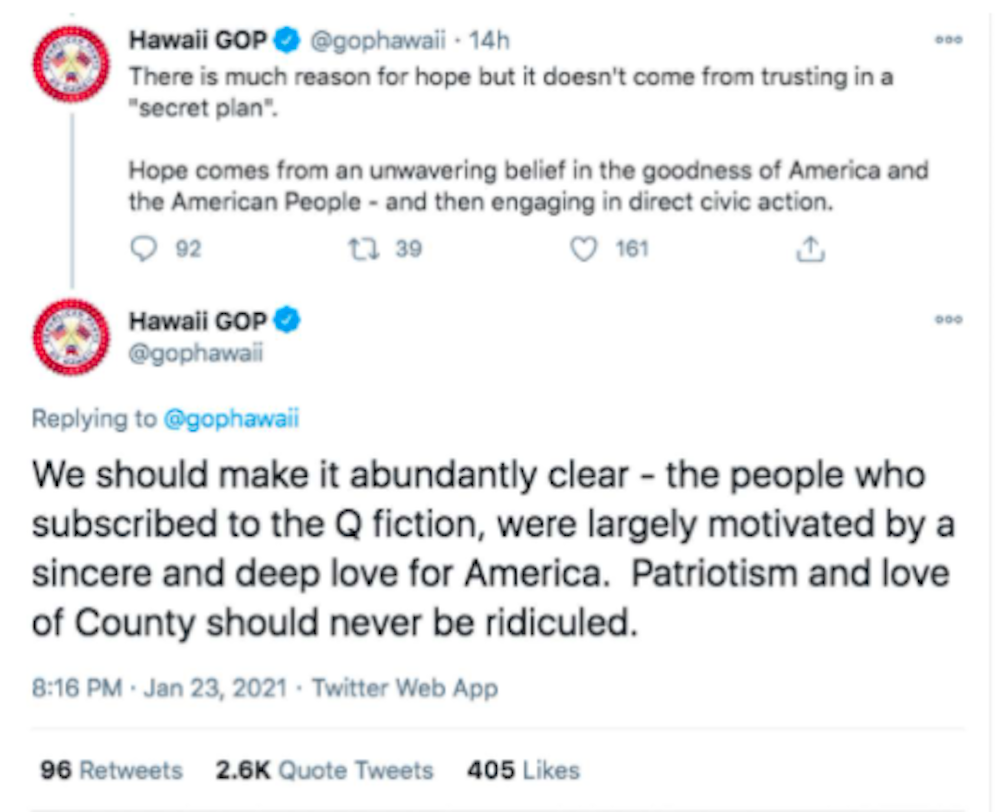
State GOP politicians have promoted QAnon in Arizona through social media posts, although one later apologized for doing so, saying, “Now I think half of them are rather nuts.” In January 2021, the Twitter account of the Republican Party of Hawaii tweeted a defense of QAnon believers. The account also defended a Holocaust denier. The official who posted the tweets was later forced to resign.

A similar confrontation has played out in Huntington Beach, California, where the appointed mayor pro tem – or vice mayor – inspired a vote of no confidence for supporting QAnon along with conspiracies against mask-wearing and vaccines.

Part of the conversation

Many QAnon proponents post-election have worked to reframe the COVID-19 vaccines not as the solution to a global pandemic but as an attempt by a cabal to control the minds of a hapless world.

Opposing mask mandates, vaccines and lockdowns have been effective campaigns for QAnon as it mobilizes anti-government sentiment common among the conservative base of the Republican Party. These efforts appear to be coalescing around bans on making vaccines mandatory.

Missouri’s Republican-led Senate recently voted to ban so-called vaccine passports, and Texas, Florida, Idaho and Utah have all passed similar legislation. Iowa Gov. Kim Reynolds is asking for similar legislation. It is unclear to what extent these bans were influenced by QAnon. But they do echo the opposition to masks and vaccines that have shaped the conspiracy.

In California, a recall campaign against Democratic Gov. Gavin Newsom has targeted his COVID-19 response. The campaign was initially organized by people affiliated with both right-wing militias and QAnon supporters.

Screenshot of two tweets from the Hawaii Republican Party, one of which expresses sympathy for QAnon believers.

These tweets in late January, one of which expressed sympathy for QAnon believers, led to the resignation of the head of the Hawaii Republican Party. Screenshot, Hawaii Free Press

Not going away

Yotam Ophir, a communications scholar at the University at Buffalo, has studied QAnon. He told me that he doesn’t “see a reason to believe the conspiracy will go away anytime soon.”

Part of this is that QAnon has deep historical roots in a variety of other conspiracies, including a centuries-old anti-Semitic conspiracy of a blood libel. The flexibility of the conspiracy has also proved resilient within a shifting political landscape.

Perhaps the biggest threat posed by QAnon is articulated by Lindsay Schubiner, a program director at the Western States Center in Portland, Oregon, which works to support democracy and challenge white nationalism.

“Bigoted conspiracy theories like QAnon have an enormous influence on the context in which local government operates,” Schubiner told me. “Democratic governance is hard to achieve if we don’t live in a shared reality, and that’s as true on the local level as it is on the national level.”

Sophie Bjork-James, Assistant Professor of the Practice in Anthropology, Vanderbilt University

This article is republished from The Conversation under a Creative Commons license.

Poll shows people of the world think U.S. significantly less awful with Trump out of office

The percentage of people with favorable views of the United States has increased in at least a dozen countries since former President Donald Trump left office, according to a new poll released Tuesday.

“President Joe Biden inherited a tarnished American image abroad when he took office on Jan. 20 following four years of President Donald Trump’s ‘America First’ foreign policies and the Jan. 6 Capitol riot that called into question the status of the world’s oldest continuous democracy,” noted Morning Consult, which conducted the survey tracking international sentiment. 

“Nearly 100 days later as the United States and the world meets a symbolic milestone of Biden’s presidency, the Oval Office’s current occupant is overseeing a sizable improvement to the American brand across many allied countries,” the pollsters added.

According to the latest surveys of adults in 14 other nations, favorable views of the U.S. have increased by an average of nine points in the wake of Trump’s departure from the White House.

U.S. popularity has improved the most in Germany, where there has been a 47-point net gain in favorability following Biden’s inauguration. Since Jan. 20, the percentage of Germans with a favorable view of the U.S. has increased from 24% to 46%, a 22-point swing. Meanwhile, 37% of Germans now hold an unfavorable view of the U.S., down 25 points from the pre-Biden mark of 62%.

Similar positive changes in foreign countries’ perceptions of the U.S. have been observed in Japan (+39), France (+37), Canada (+32), and the United Kingdom (+30), with smaller gains seen in Spain (+26), Italy (+23), Australia (+21), Mexico (+15), Brazil (+10), and Russia (+6).

Christian Welzel, a political researcher at the Center for the Study of Democracy at Leuphana University Lüneburg in Germany, attributed the boost in U.S. popularity to Biden’s return to the Paris climate agreement, even if, as progressives have pointed out, the U.S. president’s climate pledges are inadequate in light of the country’s historic responsibility for the climate emergency.

South Korea’s opinions about the U.S. have declined slightly in the Biden era, with the favorability rating of 47% remaining steady but unfavorability growing from 37% to 39%.

The largest decrease in U.S. popularity has occurred in China, which is perhaps unsurprising given Biden’s embrace of what some have called a new Cold War designed to contain China’s growing economic and military power. Before Biden’s inauguration, 21% of people in China held a favorable view of the U.S. and 65% held an unfavorable view. Since Jan. 20, favorability has shrunk to 17% while unfavorability has risen to 74%.

Notably, not a single African country was surveyed, even though people living there might have interesting things to say about a Biden administration whose stances on global public health policy and refugee admissions—which progressive critics have dubbed “America First Lite”—directly impact them.

So far, only 1.3% of Africa’s 1.3 billion people has been inoculated against Covid-19. Current projections suggest that most people living on the continent, as well as the residents of impoverished countries in Latin America and Asia, won’t receive shots until 2023 at the earliest, which is why nearly every country in the Global South supports a proposal at the World Trade Organization to suspend vaccine patents for the duration of the pandemic.

Last week, a representative from South Africa criticized rich countries, including the U.S., for siding with Big Pharma in their quest to use intellectual property rights to maintain their profitable monopoly control over vaccine production—no matter how many human beings die as a result of an artificially low supply of doses.

Although wealthy nations’ obstruction of the motion for a vaccine patent waiver is deadly, not every country victimized by the U.S.-led opposition to the proposal seems to have taken it out on Biden.

A large majority of people in India—which co-introduced the patent waiver proposal last October and is now in the midst of a hellish Covid-19 outbreak—still view the U.S. in a positive light despite Washington’s steadfast commitment to a privatized intellectual property regime.

Since Jan. 20, the percentage of people in India who hold a favorable view of the U.S. increased from 77% to 79%, while the percentage with an unfavorable view has declined from 11% to 10%.

In fact, India is the only country surveyed that has a higher opinion of the U.S. than Americans themselves. Seventy-eight percent of people in the U.S. now hold a positive view of their country, up from 73% before Biden’s inauguration. Meanwhile, the national unfavorability rating has decreased from 22% to 17% since Jan. 20.

“International opinion of the United States, in many nations, is genuinely contingent on American actions,” said David Farber, a historian at the University of Kansas. “People in many nations around the world are, I think, hopeful, that the election of Joe Biden marks a rejection of Trump’s ‘America First’ bullying and go-it-alone international policies and a return to a more collaborative, pro-democracy approach to international affairs.”

Kevin McCarthy can’t stop spreading this very debunked lie

Kevin McCarthy just can’t help himself. While Republicans have long been known to spread debunked lies to their constituents, including but not limited to Trump’s Big Lie and baselessly claiming that wearing masks inside cause cancer, the California Republican and leader of Republicans in the House of Representatives just can’t seem to give up the right-wing’s widely debunked smear about burgers. 

Appearing on Fox News with Sean Hannity on Wednesday, McCarthy reacted to President Joe Biden’s first joint speech to Congress by falsely claiming that “he’s going to control how much meat you eat.” 

It should comes as little surprise that this is a falsehood promoted by Fox News. It began on a Fox Business Network segment on Biden’s supposed plans to create strict beef rations on Americans, which has since been debunked by fact-checkers. Former Trump adviser Larry Kudlow set off the chain of lies when he attacked Biden for establishing a climate plan that will ban meat, eggs, and dairy from the American diet. 

“There will be no burgers on Fourth of July, no steaks on the barbecue,” said Kudlow.

“Americans would have to cut red meat consumption by a whopping 90%. That means only one burger a month,” said another Fox host.

“There’s a study coming out of the University of Michigan which says that to meet the Biden Green New Deal targets, America has to…stop eating poultry and fish, seafood, eggs, dairy, and animal-based fats,” a Fox host claimed this week. “Ok, got that? No burger on July 4. No steaks on the barbecue. I’m sure Middle America is just going to love that. Can you grill those Brussels sprouts?”

Almost instantly, Republican pandemonium ensued, including backlash from Texas Governor Greg Abbott and Marjorie Taylor Greene. 

Biden’s climate plans don’t include any restrictions on red meat consumption and he didn’t even mention red meat when he announced his plan to reduce U.S. greenhouse gas emissions by 50% by 2030. 

Fox News host John Roberts has since retracted his lies about the burger myth.

“On Friday, we told you about a study from the University of Michigan to give some perspective on President Biden’s ambitious climate change goals,” he said on Monday’s segment of America Reports. “That research, from 2020, found that cutting back how much red meat people eat would have a drastic impact on harmful greenhouse gas emissions.”

He continued: “The data was accurate but a graphic and the script incorrectly implied that it was part of Biden’s plan for dealing with climate change. That is not the case.”

McCarthy has yet to retract his false statement

COVID-19 can kill even months after infection, according to a new study

Experts already agree that, even after the COVID-19 pandemic itself becomes a thing of the past, it will leave those who endured lockdowns and other social restrictions with major trauma. As one psychiatrist told Salon in January, “This will take generations to get past.” People from every walk of life have suffered: Children whose important early life milestones were disrupted, adults who were thrown out of work, millions of Americans who have lost loved ones to the disease.

A new study reveals, however, that the long-term effects of COVID-19 will involve more than the repercussions from how our society changed because of the pandemic. Emerging data reveals that COVID-19 affects multiple organ systems — and, as such, even months after getting sick, people who were infected are more likely to die than individuals who were not. Just as importantly, people who were infected by SARS-CoV-2 (the virus which causes COVID-19) are likely to develop persistent health issues that will require long-term care after the pandemic has ended.

“I think the main finding here is that long COVID can affect nearly every organ system,” Ziyad Al-Aly, chief of the research and development service at the St. Louis VA Medical Center in Missouri and leader of the study, told Salon. “That means it’s going to affect the brain through the brain fog and memory problems. It can result in stroke and it can affect the heart, causing acute heart failure, acute coronary disease. It can affect the liver. It can affect the kidneys. It can affect the clotting system and increases the risk of clotting, both in the legs and also the clots traveling into the lung.”

This means that COVID-19 will likely cause long-term health issues, which will manifest themselves in a number of ways, through the foreseeable future. Al-Aly noted that the study found roughly eight excess deaths for every 1,000 individuals within the six months following an acute COVID-19 infection; in other words, an extra eight out of 1,000 people died if they had such a COVID-19 case, compared to those who did not. 

“To put it in perspective, you may think, ‘Oh, this is really small. It’s less than one percent,'” Al-Aly explained. “You have to multiply that by millions of people. And that’s really actually a substantial number.”

According to Johns Hopkins University, 149.8 million people worldwide have developed COVID-19 at the time of this writing, including 32.2 million in the United States. Within that total, 3.2 million people have died worldwide, including 574,000 in the United States.

Al-Aly also told Salon that the danger of long-term infection problems applies even for people who had COVID-19 but did not exhibit more severe symptoms.

“Even among people who did not need to be hospitalized for COVID-19, those people who had mild disease to start with and nursed their disease at home — and then had a cough and shortness of breath and maybe fever for a few days or a week or even two and then got better — even those people whose disease was not severe enough to require hospitalization are at a higher risk of consequences” down the road, Al-Aly explained. 

Another possible consequence of the pandemic is that it could lead to a resurgence in the opioid epidemic. Al-Aly noted that as people begin to show signs of depression, anxiety and other mental health issues due to SARS-CoV-2 infections, physicians may treat them with opioids, thereby exacerbating one of America’s most serious addiction problems. This is symptomatic of the larger problem: Our health care systems were not prepared for a pandemic of this magnitude, and now may be equally unprepared for long-term consequences of the disease.

“There is the statistic that more than half a million people in the U.S. died from COVID-19,” Al-Aly told Salon. “A lot of those deaths could have been avoided. We completely dropped the ball on that.”

He added that, going forward, the increase in long-term health risks means “people with long covid need integrated multidisciplinary holistic care. Health systems should quickly adapt to this reality.”

Twitter shuts down “Uncle Tim” from trending after Republican senator offers GOP response to Biden

“Uncle Tim” trended for hours on Twitter after Sen. Tim Scott of South Carolina, the only Black Republican in the Senate, opened up about his personal experience of being derided by progressives who have in the past called him an “Uncle Tom.” 

I get called Uncle Tom, and the N-word by progressives, by liberals,” Scott said during his response to President Biden’s first address to a Joint Session of Congress.

 “Hear me clearly,” he then continued, “America is not a racist country,”

“100 years ago, kids in classrooms were taught the color of their skin was their most important characteristic, and if they looked a certain way, they were inferior,” Scott said, pointing to himself on camera. “Today, kids are being taught that the color of their skin defines them again and if they look a certain way, they’re an oppressor.”

The admission, coupled with Scott’s declaration that “America is not a racist country,” drew heavy criticism from many Black commentators on Twitter, who were quick to point out that the statements appeared contradictory. 

The “Uncle Tim” trend was eventually blocked by Twitter. A spokesperson for the company told Salon that the play on “Uncle Tom” had been prevented from trending any longer: “I can confirm that we are blocking the phrase you referenced from appearing in Trends.”

The spokesperson also referred to a line from the company’s policies on Trends: “We want Trends to promote healthy conversations on Twitter. This means that at times, we may not allow or may temporarily prevent content from appearing in Trends until more context is available. This includes Trends that violate The Twitter Rules.”

Scott’s response to Biden’s speech drew myriad reactions from Democrats and Republicans alike. During his formal response on Wednesday, the congressman said that Biden “seems like a good man” but has put forth a “liberal wishlist of big government waste,” with sweeping government spending bills like the American Jobs Act and the American Families Plan.

“Just before COVID, we had the most inclusive economy in my lifetime,” he added, offering a litany of out-of-context statistics that indicate apparent economic success within minority communities. 

Scott also accused the Democrats of planning a future “power grab,” citing Biden’s infrastructure bill as well as the President’s calls to expand the Supreme Court. “Our best future won’t come from Washington schemes or socialist dreams,” he said. “It will come from you — the American people.”

Scott’s speech drew wide support from conservatives in both government and media.

Other GOP politicians and commentators focused their attention on Biden’s speech, which they argued was boring or lacked originality. Stephen Miller, Senior Advisor to former President Trump, claimed that Biden’s speech was “written in the ‘laundry list’ style — the least inspired format for a congressional address.” 

“It is striking just how tedious & unoriginal the rhetoric was in Biden’s speech,” he added. “Also, no outreach, no bipartisanship, no surprises, no warmth — a lifeless and dry address.” 

Fox News host Sean Hannity tarred Biden’s speech as “a big bore socialist speech” in which the President proposed a “multi-trillion dollar, far-left, socialist, statist, authoritarian wish list. Many on Twitter were quick to point out that Sen.Ted Cruz, R-Tex., appeared to have been dozing off during Biden’s address – or at least putting on the performance of doing so. Cruz later called the speech “boring, but radical.”

The GOP response to Biden’s speech was not, however, unilaterally negative. Fox News Chris Wallace on Wednesday threw his support behind the President’s address, calling it a “popular speech.” 

“You know, I think this is going to be a popular speech with the American people,” the newsman argued, going against the grain of his colleagues. “He offered a lot of stuff. Four trillion dollars will buy a lot of stuff, from millions of jobs to child-care to community health centers, all kinds of stuff, community colleges.”

Joe Biden turns the tables on Republicans

President Joe Biden’s plans are ambitious. I know this because every headline Thursday morning after Biden gave his first speech to a joint session of Congress said so.

“Biden Just Gave the Most Ideologically Ambitious Speech of Any Democratic President in Generations,” Politico’s wordy headline screamed. “Biden bets big,” Axios said more succinctly. “Big Government Is Back,” said the NPR headlineThe Washington Post described Biden’s “sweeping agenda” and the New York Times called it a “risky gamble.” 

Except that none of this actually feels risky. On the contrary, Biden was able to frame everything he said in convincingly reasonable tones. Put at ease by his patented “c’mon, man” approach, so far, it seems like the public can’t be bamboozled into feeling angry, scared or worried about Biden’s surprisingly progressive aspirations. Snap polls after the speech showed that 85% of viewers approved of Biden’s speech, out of a crowd that was only 54% Democratic. This comports with previous polling that shows that, while Biden’s approval numbers are stuck in the low 50s because of GOP voters who will never say they like him, an overwhelming majority like his actual policy ideas. Demonizing him as “tax-and-spend” isn’t working, because voters are increasingly keen on the idea that we should be taxing corporations and wealthy people and spending it on the programs that Biden has successfully — and correctly — identified as investments in our nation’s future: infrastructure, child care, jobs. 

“We have to prove democracy still works,” Biden said during his speech. “That our government still works – and can deliver for the people.”


Want more Amanda Marcotte on politics? Subscribe to her newsletter Standing Room Only.


It all feels so reasonable. Why shouldn’t Americans get to have democracy and get to have a functioning government, especially since we pay for it? Why shouldn’t we want, as Biden said, “the wealthiest 1% of Americans to pay their fair share”? Why shouldn’t we try to eliminate child poverty, an idea that made Republicans in the chamber so salty they refused to clap for it? Why shouldn’t the wealthiest country in the world be able to provide its citizens with the same standard of living so many other less wealthy countries do with ease? 

The thing is, these are the same exact arguments that progressives have been making for decades, and yet Republicans  — aided by a loud right-wing media, the racism of the majority of white voters, and a mainstream media addicted to false equivalencies — were successful at demonizing such reasonable points as basically communism. Why then does it seem like Republicans suddenly can’t land a glove on Biden?

Part of the credit should go to Biden himself, who is rising above what doubters like myself thought of him. He was able, as John Harwood of CNN said, to speak “in plain, non-political, non-ideological language invoking the people he wants to help.” 

But let’s face it: Republicans also did this to themselves.

For decades, Republicans have increasingly abandoned policy debate in favor of culture war antics, race-baiting and raw tribalism. From Monica Lewinsky to Barack Obama’s birth certificate, the modern GOP has turned politics into conflicts about personality and identity, not policy. Even during the height of the debate over the Affordable Care Act — the biggest policy agenda Democrats had pushed since the 1960s — the Republicans were mired in culture war theatrics. Their response was to freak out about abortion and birth control, as well as the “death panels” nonsense, which was always a barely coded conspiracy theory about Democrats taking away health care from old white people so younger, more racially diverse people could have it. They created a political environment of style over substance because, of course, they know that they can’t win debates about policy on the merits

The result is a situation where voters think Biden is more moderate than Obama was, even though the reverse is true, simply because Biden looks and sounds like more people’s idea of a moderate. Those stereotypes are racist, to be clear. As Paul Waldman of the Washington Post points out, Obama “was young, Black, cosmopolitan, hip and the hero of young people across the country,” and Biden “has always been the establishment,” a “folksy guy with a bottomless supply of bromides.”

No wonder right-wing media has, in desperation, grasped for a bizarre conspiracy theory accusing Vice President Kamala Harris of being the “real” president. They don’t know how to do oppositional politics that isn’t about base racism and sexism. But it is also an increasingly losing proposition. The forces that allowed Obama to get elected in the first place — Americans growing more relaxed about racial diversity and more urbane in general — are only growing stronger as time goes by. 

One line during Biden’s speech Wednesday night really jumped out at a number of pundits: “Trickle-down economics has never worked.” It was a notably explicit repudiation of Reaganism. But it’s also likely that large numbers of Americans, especially younger Americans, have no idea what “trickle-down economics” even is or was supposed to be. Not just because it is a failed economic theory that was always nonsense, though it is that. The phrase is more so a relic from a time when conservatives used to pretend to have serious policy ideas.


Want more Amanda Marcotte on politics? Subscribe to her newsletter Standing Room Only.


“Trickle-down economics” never made sense, but it sounded smart and gave Republicans a thing they could say to voters to explain why cutting taxes and government investment would somehow lead to prosperity. But mostly, they’ve given up even that kind of argument in favor of screeching about Dr. Seuss and “cancel culture,” hoping these tactics would distract voters from their more substantive concerns. Even when Republicans half-heartedly try to argue against Biden’s policy ideas, it’s through lame tactics like arguing over the semantics of what constitutes “infrastructure.” 

Of course, a big part of the reason that Republicans want to avoid talking policy is that, increasingly, voters can see what decades of doing things their way has done to this country.

Low taxes on corporations and rich people, coupled with low levels of government investment, did not, as promised, produce a robust economy where private interests pay for all that stuff people want and need. Instead, our roads and buildings are falling apart, health care is a nightmare, and childcare and education are unaffordable. Food is cheap, in part because it is one sector government quietly subsidizes. But as Biden pointed out in his speech last night, so many Americans are living paycheck to paycheck that the economic downturn meant “nice cars, lined up for miles, waiting for a box of food to be put in their trunk.”

Republicans are grumpy, extremely grumpy. Republican Senators watching the speech last night collectively looked like they smelled a fart, and not just because they were wearing masks. They’re mad, not just because they know he’s right. They’re mad because they know he’s popular and what he’s saying is popular. They’ll block as much of his agenda as they can and hope that voter suppression and gerrymandering do the rest. But on the merits of the argument itself? They’re toast.

It’s not because Biden is some super-politician. It’s because Republicans spent decades making politics into a reality TV show. Now that we’re facing a real crisis, the public is turning its eyes towards the comfort of a real politician who wants to do real policy. And Republicans have nothing to say in response. 

Ted Cruz visibly dozed off during Biden speech; right-wing pundit claims he was “praying”

Sen. Ted Cruz of Texas, the onetime Donald Trump foe turned MAGA loyalist, appeared to doze off during President Joe Biden’s joint speech to Congress on Wednesday night, at one point closing his eyes completely. That didn’t stop the controversial Cancún frequent-flyer senator from offering opinions on Fox News about how the president’s address missed the mark. 

Cruz was caught by a roaming camera in the House chamber during one part of the speech, closing his eyes and appearing to struggle to keep them open. Speaking about immigration reform, Biden said, “If you actually want to solve a problem, I’ve sent a bill to take a close look at it,” before a camera panned to Cruz, closing his eyes about an hour into the speech. 

Responding to the moment caught on camera, Cruz tweeted, “#BoringButRadical.” 

Following the Biden address, the Texas senator said on Fox News, “The speech by design was calm and dulcet tones. I challenge you to remember a single line from the speech. It was monotone; the chamber was nearly empty.” 

“Joe is deliberately being boring, but the substance of what he’s saying is radical,” Cruz added. 

One right-wing pundit came up with a bizarre and less-than-plausible excuse as to why Cruz had closed his eyes. “No, he was praying for America,” tweeted American Conservative Union chairman Matt Schlapp, who enjoys having lead pipes in his home and getting parking tickets to “own the libs.”

Others on Twitter shared snarky memes and edited videos of the moment. 

In other Cruz news, the Texas senator announced in a Wall Street Journal opinion piece published Wednesday evening that he will be no longer accept campaign contributions from corporate PACs due to their “woke” politics. Cruz called on his fellow GOP lawmakers to do the same. “For too long, Republicans have allowed the left and their big-business allies to attack our values with no response,” Cruz wrote. “We’ve allowed them to ship jobs overseas, attack gun rights, and destroy our energy companies. We’ve let them smear Republicans without paying any price.”

A decade after William and Kate’s royal wedding, the “anyone can be a princess” fantasy is shattered

In 2011, 11 days before Prince William and Kate Middleton were married in a Westminster Abbey ceremony that was watched all over the world, Lifetime released a movie about their romance that was, as a press release said, “shot entirely in Los Angeles and inspired by true events.” 

Perhaps unsurprisingly,”William and Kate: The Movie” was universally panned for being unrelentlessly cringey. It was filled with lines like, “I say, Wills, I am not the heir — I am just the spare,” which was delivered by Prince Harry (Justin Hanlon), and there was a surprising amount of screentime dedicated to William (Nico Evers-Swindell) staring at his phone in the rain post-temporary break up with Kate. 

None of the actors really looked like the royals they were playing, and there were some obvious continuity errors, as well, like drivers making their way down the wrong side of the road and mountain peaks making up the background shot for a scene depicting a pheasant hunt in Gloucester. 

The Guardian declared the movie “toe-curlingly, teeth-furringly, pillow-bitingly ghastly,” while the Daily Mail said that the film “takes the romance of the century and turns it into a cheap, shonky and unintentionally hilarious filmus horribilis.” 

I rewatched “William and Kate: The Movie” over the weekend in honor of the 10-year anniversary of their royal wedding on April 29. I was curious if, in the decade since it first premiered, the film could be viewed through a kind of unintentional camp lens that could render it a cult classic a la “The Room.” It cannot. “William and Kate: The Movie” is still undeniably awkward.

Though what I was most struck by wasn’t the wooden acting or the film-wide wardrobe that seemed to be composed only of beige articles of clothing. It was how hollow the premise of the movie, and much of the coverage of the courtship itself, feels in retrospect — especially following Harry and Meghan’s bombshell interview with Oprah  exposing  racism in the Palace. 

Middleton’s ascendency to royal bride was lauded as a kind of real-world fairy tale. When news of her engagement broke, British newspapers proclaimed that she would be the “first middle-class queen since Anne Boleyn.” Middleton’s parents were self-made millionaires, so “middle class” is perhaps an overstatement, but the implication that they were not “old money” held. 

As such, like in the innumerable princess fairy tales that came before it, the moral of Kate’s story as presented in both the movie and in tabloid spreads was that if you are beautiful or smart or intrinsically good enough, you’ll be swept away from mundanity into a better life. It’s a lovely fantasy, but one that conspicuously ignores the question of for whom society deems that fantasy to be out of reach. 

The writers of “William and Kate: The Movie” imbued the script with an insinuation that the royal couple was going to challenge the monarchical status quo in some way. It’s unclear how, exactly (though the writers did land on the surprisingly shady line for William: “I’m not sure we represent anything except a desperate hold on an irrelevant past”). 

This idea of young blood pushing back against or somehow otherwise reconciling with the perceived stuffiness of royal or other institutions of power is a popular narrative trope, as seen in movies like “Princess Diaries,” “What a Girl Wants” and Netflix’s “A Christmas Prince” franchise. But save a few snarky tabloid pieces that insinuated the royals found Carole Middleton, Kate’s mother, déclassé for chewing gum, there wasn’t much indication that there was too much tension associated with the union. 

Things began to shift, however, when Prince Harry and Meghan Markle began dating. As Salon’s Melanie McFarland wrote, she remembers seeing a magazine cover speculating when the couple would finally get engaged in the grocery store check-out line. The Black woman in line with her said, “You know they’re never going to let that happen, right?” she scoffed, and by “they” she meant the British Royal family. 

“I reminded her that when the British media coverage of Markle began taking on racist overtones, Kensington Palace took the unusual step of circulating an official statement that came to her defense. ‘Please,’ my line companion crowed at a fellow sistah’s naivete,” McFarland wrote. “‘That’s PR. They have to do that. But when it comes down to it, you watch — they’re never going to let that boy marry one of us.'”

The couple did end up getting engaged in 2017 and, inevitably, the Lifetime machine kicked into gear and gave the couple’s romance a similar treatment to William and Kate’s with the movie “Harry and Meghan: A Royal Romance.” However, the otherwise schlocky, feel-good romance had to contend with some of the racism that Meghan had already received at the hands of the British press. 

It opted to do so by concluding the film with a completely fabricated scene in which Queen Elizabeth (played by Maggie Sullivan) shows Harry (Murray Fraser) and Meghan (Parisa Fitz-Henley) a portrait of Queen Charlotte; Salon’s Hanh Nguyen wrote about it for IndieWire in 2018.  

“As they gaze upon it, the Queen says, ‘I’ve always loved this portrait of our ancestor Queen Charlotte because the painter Ramsay didn’t try to hide her African heritage,'” she wrote. “Off Harry’s startled look, she adds, ‘Oh yes, you’re of mixed race, Harry. So am I. Many of her portraits tried to hide that fact, but this one is most authentic, much like you.'” 

The Queen is addressing Meghan with this last statement of kind inclusivity and acceptance, but ultimately it’s as much a piece of fantasy as a fairy tale. In Meghan and Harry’s March interview with Oprah, the couple revealed that when Meghan was pregnant with their son, Archie, there were “concerns and conversations about how dark his skin might be when he’s born,” since Meghan is biracial. 

Meghan also told Oprah that the Palace tolerated the ways in which the tabloids incited racism against her. “It was bringing out a part of people that was racist in how it was charged – and that changed the threat, that changed the level of death threats, that changed everything,” she said. 

Undeterrred, Lifetime has jumped upon a new chapter in the fairy tale by expanding its franchise of films about the royals. “Harry & Meghan: Escaping the Palace” is due out this fall. 

The movie, which is still being cast, will “detail Meghan’s growing isolation and sadness, their disappointment that ‘The Firm’ was not defending them against the press’s attacks and Harry’s fear that history would repeat itself and he would not be able to protect his wife and son from the same forces that caused his mother’s untimely death.” 

I have doubts that the movie’s quality will be stellar, but news of its production drives home that, for many, the facade of the “anyone can become a princess” fantasy has been cracked. It now comes with a caveat: Perhaps anyone can be whisked into royalty, but will they be welcome once they get there?

My husband refuses to get vaccinated

Dear Pandemic Problems,

I will be completely vaccinated soon. My husband, however, is a bit of an anti-vaxxer, and has indicated he may very well decide not to get vaccinated any time in the near future.

Although in theory I completely believe in his right to do what he wants — it is his body, after all — I am upset for several reasons.

First, our children have already said they would not visit us unless we were both vaccinated — and that means we can’t see our grandchildren.

Second, I am a professional event planner and will be traveling again soon to conferences. What if I carry the virus home and he gets it? Now, the pressure is on me for him getting it.

I am beside myself. Any help would be greatly appreciated.

Sincerely,

My Husband Is a Vaccine Refuser

Dear My Husband Is a Vaccine Refuser,

I don’t mean to bring gender politics into this, but will you indulge me for a minute? You’re not the first woman to express frustration at her husband refusing to get the COVID-19 vaccine.

It’s interesting because if you look at the historically sexist memes of what a stereotypical “anti-vaxxer” looks like, you’d think it would be the other way around: husbands writing in about their light-and-love, tree-hugging wives who refuse to get vaccinated. But it turns out that men, particularly conservative men, are now the most likely culprits for being vaccine refusers, as polling data bears out.

Is it “manly” to not get vaccinated? Perhaps that’s part of it. Studies have shown that men who have traditional views on masculinity, such as valuing being “strong,” are less likely to go to the doctor for a routine exam. But I fear that men who are currently refusing to get vaccinated are getting caught up in the politics of it all, and choosing rage and fear over common sense and logic. Have you seen the misinformation Tucker Carlson is spewing on Fox News? It makes sense that 43 percent of Republicans polled that they will say no to the vaccine — compared to 5 percent of Democrats.

But let’s get back to your specific situation. You say you are “upset on all levels,” which yes, I can see why. The COVID-19 vaccine is the key to safely returning to a sense of normalcy. It’s also highly effective, safe, and is slowing down transmission rates across the country. But your husband won’t get the vaccine, you say. I’d be upset too.

I hear from you that, in some regards, you respect his decision though, or at least “believe in his right to do what he wants,” as “it is his body, after all.” Vaccine mandates are tricky in part, because it’s a conflict between personal choice and how a person’s actions affect others. But when it comes to getting vaccinated against COVID-19, a decision not to get the shot not only affects that individual refusing it, but can affect dozens, hundreds or even thousands of individuals. It’s a decision that could even lead to a person’s death. I keep thinking about what the Editorial Board at the Los Angeles Times wrote:

No one has the right to sicken anyone else or start a new spike in cases through carelessness or their own sense of ‘personal choice.’ At the same time, people who have a valid medical reason not to be vaccinated — and they are extremely few — should get a pass.

This brings me to my next point. I don’t know the specific reasons as to why your husband is refusing to get vaccinated, but unless it’s for a medical reason, I’d try to approach this in an understanding way to truly figure out why he doesn’t want to get vaccinated. This is the first bit of advice on how to talk with people who are vaccine hesitant — and note that I’m saying “vaccine hesitant” and not anti-vaxxer. There’s a difference, something I recently wrote about, and that difference matters.

Over the next few days or weeks, if you can, try to better understand the why and find effective ways to address those concerns. Dig deep: there may be some deeper trauma, something embedded in the way he relates to the world, that is the real reason he’s refusing. And remember, people can change their minds.

There are specific communication strategies for talking to the vaccine hesitant, honed by public health messaging experts. For instance, say your husband is disseminating anti-vaccine falsehoods — e.g., “Covid isn’t deadly,” “the vaccine is dangerous,” or “doctors can’t be trusted.” For those types, experts recommend to reply by explaining the facts: COVID-19 is deadly, and that vaccines are among the safest and most effective human inventions of the past two centuries. 

It saddens me that he won’t be able to see his grandchildren because he’s chosen not to get vaccinated. It makes me wonder if perhaps you even went alone to visit your grandchildren and returned with happy memories and photos (once you’re vaccinated, of course) that maybe it would motivate him to get the shot.

But I know you’re also concerned about carrying the virus home, especially once you travel for work. The jury is still technically out on whether or not not vaccinated people can carry and transmit the virus, according to the Centers for Disease Control and Prevention (CDC). However, multiple studies suggest that the vaccines do in fact reduce transmission, and many studies are underway to land on a definitive answer. A separate study published in late March in Nature Medicine found that people who had been vaccinated with the Pfizer-BioNTech vaccine and later contracted an infection had lower viral loads than unvaccinated people who got infected. Since viral load is an indicator of how infectious a person is, that also suggests that the likelihood of transmission is low.

This is all to say that I wouldn’t want you to worry about bringing the virus home and carrying that burden on top of everything else. A separate study published more recently found that even a single dose of the two-shot coronavirus vaccines cut transmission of COVID-19 within households in England by up to 50 percent. I know it’s hard to live with someone who’s refusing the vaccine, but I’m hopeful once he sees how you carry on with life and enjoy the presence of your grandchildren that he will get vaccinated too. If not, it might be time for therapy.

Good luck, My Husband Is a Vaccine Refuser. I hope this is just a bump in the road, and with enough dialogue your husband will get vaccinated and you’ll be able to live happily ever after in your post-pandemic lives.

Sincerely,

Pandemic Problems

“Pandemic Problems” is an advice column answering readers’ pandemic problems — sometimes with the help of moral philosophy professors and therapists — who can weigh in on how to “do the right thing.” Do you have a “pandemic problem”? Email Nicole Karlis at nkarlis@salon.com. Peace of mind and collective commiseration awaits.

Do kids really need to be vaccinated for COVID? Yes. no. maybe

At the end of last month, Pfizer announced plans to submit important news to federal regulators. The drugmaker had recruited over 2,000 adolescents aged 12 to 15 for a clinical trial of its Covid-19 vaccine, and the results were promising: Among the young people receiving the vaccine, there were zero reports of Covid-19. Meanwhile, 18 cases of Covid-19 occurred among those who did not receive the vaccine. 

“We share the urgency to expand the authorization of our vaccine to use in younger populations,” Pfizer chief executive Albert Bourla said in a press release accompanying the result showing 100 percent efficacy. He added that the company planned to submit its data to the United States Food and Drug administration as a proposed amendment to the Emergency Use Authorization it had already received for the vaccine’s use in adults. The goal, said Bourla, was to begin “to vaccinate this age group before the start of the next school year.”

Pfizer is not alone. Rival drugmakers Moderna and Johnson & Johnson are also testing their vaccines in teenagers, and all three companies have begun early trials in infants as young as six months old. It’s part of a groundswell of pharmaceutical science and public health messaging around what many experts view as the urgent next step in ending the Covid-19 pandemic: vaccinating adolescents and younger children. 

Voiced by some leading physicians and researchers, and amplified by a drumbeat of like-minded press coverage, the notion that the Covid-19 pandemic cannot be curbed without vaccinating children has quickly become axiomatic in parts of the public health world. “Children are the next vaccination frontier,” wrote Jeremy Faust, an emergency physician and instructor at Harvard Medical School, and Angela Rasmussen, a virologist and affiliate at the Center for Global Health Science and Security at Georgetown University, in a recent New York Times op-ed. “When it comes time to vaccinate them, the same urgency and large-scale coordination efforts driving adult vaccination must continue if we want to sustainably drive down Covid-19 cases and ultimately end the pandemic.”

But not everyone is convinced that it’s necessary to vaccinate children to reach herd immunity, which occurs when a high enough percentage of a population is immune to a pathogen, either by vaccine or previous infection, to keep viral spread under control. Just what that percentage might be for any given population is still a matter of substantial uncertainty and disagreement. Some experts, for instance, point to examples like Israel and the United Kingdom, where adult vaccination rates are high, and Covid-19 cases among unvaccinated children and adolescents are nonetheless in sharp decline. “It’s simple math,” wrote Monica Gandhi, an infectious disease physician and professor at the University of California, San Francisco, in an email to Undark. “We don’t need to vaccinate those under 11 to get to herd immunity.” 

While Gandhi and others say they might support vaccination of young children should the clinical trials prove that vaccination is safe and beneficial, these experts worry that overstating the role children play in spreading Covid-19 can have negative downstream impacts, including delaying school reopenings and overlooking populations at much greater risk from the virus, including elderly individuals in low- and middle-income countries who currently have no access to vaccines. “You need to be careful not to distort people’s perceptions,” said Gandhi.

For their part, Faust and Rasmussen suggest that comparisons across national borders are fraught, and that geographic and cultural differences matter. “It’s really difficult to compare any two countries,” said Faust. He notes, for example, that Israel has a much smaller population and a smaller landmass than the United States, which makes the logistics of widely and uniformly vaccinating the adult population less complicated. And Rasmussen noted that Israel started its vaccination campaign with a strict lockdown, and didn’t begin to open the economy again until early February. “If you get transmission way down,” she said, “then you will see less spread with fewer people immunized.”

And other experts argue that, even if serious illness from Covid-19 is unusual in children, it simply makes sense to vaccinate them anyway — assuming a vaccine is proven safe — in order to avoid rare but tragic outcomes. (According to data from the Centers for Disease Control and Prevention, more than 250 children in the U.S. have died as a result of a Covid-19 infection so far.)

Still, the myriad uncertainties may be partly why the U.K. is taking a wait-and-see approach to vaccinating children. Adam Finn, a pediatrician at the University of Bristol and a member of the U.K.’s Joint Committee on Vaccination and Immunization, said that his country is going to look at all of the data as they become available over the next weeks and months and then make a decision about whether to vaccinate children. “We need to be in a position to immunize children with these vaccines if it proves necessary to do so,” he said. But he added, “we shouldn’t do it unless we need to do it.” 

* * *

Gandhi says she is particularly excited about the trajectories of Israel and the U.K. The former has conducted the fastest vaccination campaign thus far. Since the start of the rollout in late December, approximately 60 percent of the adult population has received at least one dose of the vaccine, and cases have plummeted. The country of 9 million now reports fewer than 200 Covid cases per day. Along the way, something encouraging started happening, Gandhi says: Covid rates didn’t just decline in vaccinated adults — they also declined in individuals under 20, a largely unvaccinated population. And cases have continued to decline, even after the country opened up broad swaths of the economy in February. “I think they’re approaching herd immunity,” said Gandhi. 

Adi Niv-Yagoda, an expert in health policy and medical law at Tel Aviv University, and a member of Israel’s Ministry of Health Covid-19 Expert Advisory Panel, said that the country has been able to provide “significant protection” to high-risk groups, particularly adults over the age of 60. But he stopped short of saying they have reached herd immunity. Children make up a relatively high proportion of Israel’s population, he wrote in an email, and “as long as the group of children under the age of 16 is not vaccinated, it is difficult to talk about the herd effect in its traditional epidemiological conception.” Further, he said, now that the economy is opening up, schools have reopened completely, and the government has lifted its outdoor mask mandate it will be necessary to monitor the situation over time.

One recent study, which has not yet been peer reviewed, does lend some support to the notion that vaccinating adults is having a beneficial effect on unvaccinated children and adolescents. The researchers looked at medical data from children in more than 200 Israeli communities and found that when the vaccination rate among local adults climbed, a decline in positive cases among children followed. This relationship between adult vaccination and a drop in childhood cases “is likely to be vaccine-related” and not related to other public health measures, which can vary across geographical areas, said Fiona Russell, a pediatrician and infectious disease epidemiologist at the University of Melbourne in Australia, who leads large-scale flu vaccine impact studies in the Asia-Pacific region and was not involved in the Israel study.

Leaving young people unvaccinated over the long-term, however, is precisely what experts like Faust and Rasmussen worry about. If the U.S. does not vaccinate children, they suggest, then the virus may well find a foothold to mutate and become even more harmful. Rasmussen told Undark that kids could “become a new reservoir for the virus to circulate, because that’s what happens with viruses when you have a large population of susceptible hosts. A virus doesn’t care about anything, much less its host’s age.”

That’s why Faust says he worries that Americans will be resistant to Covid vaccines in children. Indeed, while a growing share of American adults say they plan to get a Covid-19 vaccine, a survey conducted as part of the Covid States Project, a collaboration of researchers from universities across the U.S., found that just 44 percent of mothers and 64 percent of fathers said they would be likely to vaccinate their children and adolescents. A full 43 percent of mothers under the age of 35 in the study, which has not yet been peer reviewed, said they were either extremely or somewhat unlikely to vaccinate their kids.

Still, the idea that unvaccinated children and adolescents might provide a reservoir for viral mutation is not universally accepted, even among those who otherwise support the idea of vaccinating young people. “It sounds like science fiction to me,” said Vincent Racaniello, a virologist at Columbia University. He believes children need to be immunized to provide herd immunity and to protect their health — but not to prevent variants. “Variants are going to arise, irrespective of whether kids are immunized,” he said.

Variants have grabbed the national headlines lately. Ten days ago on NBC’s Meet the Press, Michael Osterholm, a University of Minnesota epidemiologist and a member of Joe Biden’s coronavirus advisory board during the presidential transition, described the B117 variant, which is thought to have originated in the U.K. and has since entered the U.S., as more transmissible and more harmful than earlier iterations of the coronavirus. “This is almost like having a whole new pandemic descend upon us,” said Osterholm. B117 “infects kids very readily” he said, noting that his home state of Minnesota has hundreds of schools with “B117 activity.”

But Gandhi considers such claims about B117’s effects on kids to be overstated. She pointed to data from the U.S. Centers for Disease Control and Prevention showing that although American kids aged 0 to 17 are the least vaccinated age group, from February to March, increases in case and hospitalization rates were low. And several experts pointed out that the states with the highest reported number of B117 cases don’t always map neatly to the states with the highest rates of Covid cases. In the instances where B117 does overlap with a statewide infection surge, it isn’t clear that the variant actually caused the surge, said Racaniello. Michigan’s latest surge, for example, occurred after the state loosened restrictions on bars and indoor dining. “People started de-masking and going out and getting together,” said Racaniello. “B117 happened to be there, so it came along for the ride.”

Moshe Arditi, a pediatric infectious diseases expert at Cedars-Sinai Medical Center in Los Angeles acknowledged that it’s important to study and monitor the variants, “but not put headlines in The New York Times” every week to scare people. “That,” he said, “I do not understand.”

If adults are vaccinated, said Arditi, then he’s doubtful that harmful variants are going to arise from unvaccinated children. As evidence, he pointed to emerging research suggesting that one reason for kids’ relatively better outcomes is that the cells that line their nose and throat mount a more vigorous immune response that allows them to clear the virus rapidly, giving them a shorter time to transmit it. Arditi notes that he has been treating children with viruses for the last three decades, and that he believes that children need to be immunized for other reasons — to protect their health, for example, and to achieve herd immunity faster. But he doesn’t think kids’ becoming a reservoir for more dangerous variants “is something we need to worry about right now.”

Whether or not that’s true, some experts suggest that vaccinating children is still worthwhile to protect against rare but severe outcomes. In addition to the more than 250 deaths so far, children comprise 1 to 3 percent of total Covid-19 hospitalizations, according to the American Academy of Pediatrics. The CDC has also identified more than 3,000 cases of a severe condition known as multisystem inflammatory syndrome in children (MIS-C) since May 2020.

“It’s rare for children to get very sick, but some do,” said Lainie Friedman Ross, a pediatrician and professor of clinical ethics at the University of Chicago. She says the United States “probably could achieve” herd immunity without vaccinating children, “but why would we want to?” she asked. Peter Hotez, a vaccine scientist and pediatrician at Baylor College of Medicine, agrees. The risk of MIS-C alone is reason to vaccinate, he says, given that kids are vaccinated against the flu, which kills roughly 200 children in a typical year.

* * *

Not everyone views the risk-benefit calculus the same way, however. Older adults have the most to gain from being immunized and they are “probably most willing to tolerate the side effects” of the vaccine, said Vinay Prasad, a hematologist-oncologist and professor in the department of epidemiology and biostatistics at the University of California, San Francisco. It’s not yet clear whether young people will experience the same side effects as adults — which can include high fevers and other symptoms — but if they do, Prasad suggests, their families won’t be happy.

“I think parents will have a lot of questions,” he said. “It’s going to be a big dialogue whether or not parents are willing to subject their kids to that.” Prasad has argued elsewhere that an Emergency Use Authorization is not appropriate for children. Under this provision, the FDA can allow products to be used based on lower levels of evidence than traditional approvals in times of emergency. “There’s no question that Covid-19 is an emergency for adults,” he wrote in an opinion piece for Stat. “But it isn’t that for children.”

That’s roughly how Finn views the situation in the U.K. “We don’t have enough information yet to be sure as to whether we need to immunize children,” Finn said, but the bottom line is clear: “Absolutely, clearly, we should not be immunizing children against this disease unless we need to.” Not only is it an expensive and difficult undertaking, he says, “children don’t get sick very often with Covid, and so they don’t stand to benefit directly from the immunization to any great extent.”

Like Israel, the U.K. also started its vaccine rollout in December and has seen a dramatic decline in cases since its peak in January, down to roughly 3,000 a day in a country of 66 million people. The decline has coincided with the vaccine rollout. The country is currently second among the world‘s major economies in terms of percentage of the population vaccinated, with those aged 45 and over now eligible and nearly 50 percent having received at least one dose. (The U.S., by comparison, ranks 4th, with just over 35 percent of its adult population vaccinated to date.)

“We’re still in a very vulnerable situation because young adults have not been immunized,” said Finn. That population will also now be more likely to venture out as the country continues to ease lockdown restrictions.

When pressed, Gandhi acknowledged that the U.K. may not provide any clear answers until more data is available on Covid rates in children since the reopening of schools, which commenced for students at all grade levels in England on March 8, and which is happening in phases across the rest of the U.K. This data will be especially useful, she said, because primary school students in the U.K. don’t wear masks, so their experience this spring might give U.S. schools a good idea of what to expect come fall.

If case counts remain low, said Finn, more and more businesses will be permitted to reopen, with a goal of normalizing by May or June. But the precise percentage needed to achieve herd immunity – and how evenly among the population immunity must be spread in order to suppress the virus – remains to be seen, Finn said. Even if 80 percent immunity is achieved, after all, that immunity must be spread more or less evenly across a population. If it’s unevenly distributed – say 100 percent immunity in some areas, but only 60 percent in others — outbreaks would continue to spread across communities.

We’re only beginning to understand all of this, Finn said.

* * *

Given the lingering uncertainties, Gandhi suggests that overstating the importance of vaccinating children carries real risks. Sensationalized media coverage — she called it a “fear-based approach” — for example, could further delay the reopening of schools, given that many children are likely to still be unvaccinated by fall. “I think that any articles that say that you have to vaccinate young children to get to the end of our pandemic are, yes, going to keep schools closed,” she said. By one estimate, as of this week, nearly one in ten public school students in the U.S. were still attending a remote-only school.

Several experts voiced additional concerns about the ethics of vaccinating American children before adults in low- and middle-income countries, especially now amidst allegations that the United States is hoarding vaccines. “I think it would be morally wrong to vaccinate children in a nation with plummeting SARS-CoV-2 rates and plummeting hospitalizations and plummeting deaths before vaccinating 80-year-olds in countries that have current outbreaks of SARS-CoV-2,” said Prasad. “You are literally taking a product that could be used to save many lives and giving it to people who are very overwhelmingly unlikely to suffer bad outcomes.”

Hotez of Baylor University found such reasoning dubious. “Even if the U.S. donated all of its vaccines to low- and middle-income countries, it’s a drop in the bucket,” he said, estimating that this population includes 2 billion people. As he sees it, the world was more or less oblivious to the fact that the cutting-edge technologies used to develop and manufacture many of the currently available vaccines are not scalable for low- and middle-income countries. He and his colleagues are using a recombinant protein and yeast approach that has been around for 40 years that can be easily scaled up and produced at low cost.

It might be a moot point: The Trump administration’s contracts with the vaccine manufacturers reportedly include a clause limiting the use of vaccines to the United States, which has broad laws that relieve manufacturers of liabilities. Whether the Biden administration would seek to alter such agreements remains unclear.

For her part, Gandhi remains skeptical of vaccination for youngsters. Children have largely been spared the worst effects of SARS-CoV-2, she noted, and yet they have also been asked to make tremendous sacrifices in the name of community safety – disrupting in-person schooling and forgoing socialization at a time when such activities are developmentally crucial. Adults have an obligation to pay it back, she suggests, by striving for herd immunity on their own, a goal she sees as achievable with a concerted effort. “Every adult,” Gandhi said, “should take the vaccine.”

Finn, meanwhile, says that there are simply too many unknowns to definitively say yes, all children must be vaccinated in order to halt the Covid-19 pandemic, or no, herd immunity can be achieved without vaccinating kids. Under normal circumstances, he said, the U.K. would do a very detailed cost-benefit analysis before deciding how to proceed. But in the midst of a global pandemic, when the U.K. and other wealthy countries have already paid for hundreds of millions of vaccines up front, the calculation is different.

“That doesn’t mean you just use them willy-nilly,” he said. “There’s a limited supply. You have to think about how you are going to use them and who you are going to give them to.”

And no approach, he suggested, carries a guaranteed outcome.

“We may end up immunizing children, but I don’t know when, and I don’t know if we’ll ever do it,” said Finn, one of 16 members of the expert panel charged with guiding the U.K.’s vaccination efforts. “Not because somebody knows and I don’t — but because we haven’t decided.”

* * *

Sara Talpos is a senior editor at Undark and a freelance writer whose recent work has been published in Science, Mosaic, and the Kenyon Review’s special issue on science writing.

This article was originally published on Undark. Read the original article.

The good news about climate change: there’s still hope

When ecologist Craig Allen looks across the brown, grassy shrublands on the east flank of the Jemez Mountains in northern New Mexico, he feels no satisfaction that he was right.

Right that the world was warming. Right that warming would spur such large, severe fires that the forest he studied for decades would disappear. And right that increasing temperatures here—and across the globe—have made it too warm for conifer trees to regain even a toehold across many of their old landscapes.

“It’s hard not to feel…well, it has felt like failure there,” says Allen, who recently retired from the U.S. Geological Survey, and has monitored landscape change in these mountains since he was a Ph.D. student in the late 1970s. “We saw the vulnerability. But we could not act substantively enough, quickly enough to deal with it.”

Across the Earth, people are watching the impacts of climate change play out across their homelands, the places they depend upon and love. From rising seas lapping at the shores and inundating coasts to the highest mountains, where snowpacks are dwindling and glaciers receding, we are reeling from how these changes affect every aspect of our lives. In all of this, there is room for grief. These changes are dangerous and disorienting. But building new relationships with the landscapes around us will allow us to survive—and give the other species we still share this planet with the chance to thrive.

* * *

Aside from a few exceptional years, the past two decades have been marked by warmer temperatures and a severe drought that have sucked up snowpacks and streamflows around the U.S. Southwest and northern Mexico. Hand in hand with other human interventions, like fire suppression, drought and warming have made forests increasingly vulnerable to die-offs, insect outbreaks and larger, more severe wildfires.

In the late 1980s, when NASA climate scientist James Hansen testified before the U.S. Congress about the link between human-emitted greenhouse gases and warming, Allen says the impacts of climate change still seemed theoretical. But by the early 1990s, temperatures were clearly rising, and in 1998, he co-authored a paper with David Breshears, looking at how climate change would produce large shifts in forests at “unprecedented rates.”

All too quickly, Allen and his colleagues watched this play out worldwide, including in the Jemez. In 1996, the Dome Fire burned over 16,000 acres of the Santa Fe National Forest and the adjoining Bandelier National Monument. Then in 2000, a prescribed fire ran out of control in the area; the Cerro Grande Fire burned 48,000 acres. Part of the problem in the Jemez, as with millions of acres of forests across the western U.S., lies with a century of fire suppression. By not letting even naturally-ignited fires burn, we allowed our forests to become overly dense and stuffed full of downed and dead trees that now more easily fuel bigger and more catastrophic wildfires.

But warming changed the whole dynamic.

“As soon as we started to go through multiyear drying, society no longer had the capacity to suppress those fires,” Allen says. “If you get an ignition on the wrong day, just forget it.”

That’s what happened when the 2011 Las Conchas Fire ripped through the Jemez with astonishing heat and unprecedented speed. No one had seen a fire like Las Conchas. And modelers still can’t get a grip on it.

Las Conchas ignited around 1 p.m. on a sunny Sunday in late June, shooting a huge, pyrocumulus cloud above the mountains. By 3 a.m., it had burned more than 40,000 acres. In all, it devastated 156,000 acres.

In some places where the highest severity fires burned, aspen groves are replacing the scorched and root-ripped pines that have tipped and fallen. Some scattered pines do survive, but most are skeletons, creaking and whistling in the whipping wind. And within about 30,000 acres of the burn scar, there’s simply no forest. A decade after the fire, it’s dusty. And even in mid-April, the sun feels punishing. No longer a cool, moist conifer forest, this land is now wide open to the Rio Grande Valley below—and covered with tufts of deer-munched grasses, low prickly bushes and a smattering of scrubby Gambel oak.

“It hurts to see the loss of the forest in the Jemez,” says Allen. “There are always winners and losers in change, right?” he says, repeating the mantra ecologists adhere to, that change is inherent in all ecosystems at all time scales.

“There’s life up there,” Allen says. “Abundant life. But it’s not forest life.”

* * *

More than 20 years ago, aquatic ecologist Michael Bogan interned with the California Department of Fish and Wildlife in Bishop, east of the Sierra Nevadas. It was 1998, a wet year for California, and the idea of studying water in the desert lodged in his brain.

Desert streams are approachable subjects, especially compared to, say, a massive and murky system like the Mississippi River, says Bogan, now a professor at the University of Arizona’s School of Natural Resources and the Environment: “The entire world is shrunk down to the size of your living room. To understand why something is going on, why the species are there, or why they’re disappearing — you have a pretty good chance of figuring it out.”

For Bogan, studying those small systems over the past two decades has meant witnessing their decline.

When he first started visiting one of his research sites in southern Arizona, French Joe Canyon, he’d hear birds singing from the cottonwood trees as he approached. “It was so full of life all the time. I knew the invertebrates there, I knew the species,” he says. Now, it’s hard to go back. “Most of the time now, it’s dry. The birds are definitely not there, the aquatic species are not there,” he says. “And even when it does have water, it’s not the same species that were there beforehand.”

That sense of loss is magnified from knowing change isn’t just occurring at that one living room-sized place he happened to be paying attention to—but knowing that springs and streams are drying up across the entire region, the entire world.

“The scientist in me knows that stasis is a myth, right?” he says. Ten thousand years ago, for example, southern Arizona hosted a forest of Joshua trees, not saguaros. “There was almost no similarity to what you see today. So, the scientist in me knows that nothing is ever stable and things are always changing,” he says. But he still feels grief at the rapid changes we’re experiencing.

To seek out joy, he also studies ecosystems that might persist or that can respond when we make different decisions.

The Santa Cruz River in Tucson, Arizona, had been dry—thanks to rampant development and reckless groundwater pumping—for roughly a century. A few years ago, the local water utility agreed to use its treated effluent to rewater the river.

Some fish species had gone extinct, like an endemic species of pupfish. But they’ve now reintroduced the Gila topminnow and are watching greenery come back, as well as myriad species of dragonflies. Coyotes and bobcats make appearances on game cameras set up along the Santa Cruz.

“That’s a situation where it’s treated wastewater, but where you do it right, where you are purposeful about how you do it, now it does support a lot of species, it shows resilience. It was dry for 100 years, but species are back,” he says. “The birds found it again, the ducks came back, down to the snails, they came back.”

Bogan keeps coming back to the idea of resilience: “French Joe Canyon is not resilient; it’s never coming back unless we enter a new Ice Age period,” he says. “But species themselves, and some ecosystems, they can be resilient if we change our actions, if we change the way we manage our water or other resources.”

* * *

Of course, many people already know how to adapt to change: climatic changes, cultural disruptions and shifting relationships with landscapes over lifetimes and generations.

Pueblo people in the Southwest have been adapting to their landscapes since long before colonial times—and they hold within them a “genetic memory of how to have a healthy watershed,” says Julia Bernal. She works on water issues in New Mexico and is executive director of the Pueblo Action Alliance, an environmental and social justice group.

There are 19 pueblos in New Mexico. Each of these Native American tribes is different, and a distinct, sovereign nation. But they share some commonalities, including ancestry traced back to places like Chaco Canyon and Mesa Verde. Bernal is an enrolled tribal member of the Pueblo of Sandia and is also from the Pueblo of Taos and the Yuchi-Creek Nations of Oklahoma.

Since pre-colonial times, Pueblo people have been adapting to their changing climates—migrating due to an epic drought in the 1100s from Chaco Canyon, for example, to live along the Rio Grande.

Today, that river’s waters are damned, diverted and overallocated. The state’s largest river, the Rio Grande now regularly dries up each summer downstream of the city of Albuquerque. And in southern New Mexico, the river channel is dry for most of the year.

Bernal recalls a recent conversation with her dad, who told her about almost falling into the river because it overbanked so much. “That really resonated with me, because I’ve only seen it as a very narrow, channelized system because of the dam,” she says, referring to the Cochiti Dam, built upstream in the 1960s and ’70s by the U.S. Army Corps of Engineers. “I don’t think we’ll ever see the river look the same way that it did,” she says.

The alliance’s movement of reclaiming what was stolen, first by the Spanish and then by the U.S. government, involves the recognition and reclaiming of lands. And waters. “Everything that we do is … for everybody, for the health of the whole because we understand the watershed system as a whole,” she says, adding, “This isn’t about taking all of the water resources. It’s not about taking all the land and not leaving anything for anybody—that’s a capitalist and colonialist concept.”

Bernal challenges non-Indigenous people to think more deeply about what Indigenous-led movements are trying to do. And to recognize they will benefit the global majority, particularly in this climate-changed world. “Some people think ‘decolonizing’ means we go back centuries,” she says. What it really means is having choices—in terms of energy, for example—and learning how to meet the needs of the community by building an economy around particular values.

It’s sad to see changes on the landscape, she says—whether they’re due to development, oil and gas, even recreational infrastructure, or to warming and its impacts. “Unfortunately, we’re going to see more of that; it’s inevitable, and especially at this rate we’re going at right now,” she says.

Whether it’s Bernal’s father recalling the Rio Grande before Cochiti Dam, or Bogan, Allen and others monitoring ecosystems and telling the stories of changing landscapes through the data they collect, storytelling helps us remember the past, and find new ways of living with the future.

Today, when Allen goes out to the burn scars in the Jemez, he says he’s starting now to see it as “normal.” The conifer forest is gone, and it’s not coming back. And this isn’t just happening in the Southwest: Studies over the last decade show that by 2100, at least half of the Northern Hemisphere’s conifer forests will have died due to rising temperatures and the associated impacts.

“It’s a different world,” he says. “But I guess the gut punch of it wore off some time ago, and I’m now more engaged in appreciating and fostering what we have.”

Copyright 2021 Capital & Main