Spring Sale: Get 1 Year, Save 58%

Giardiniera: These olive oil-bathed, Italian pickled vegetables belong on all your spring meals

What is giardiniera? 

Giardiniera is an Italian relish made of pickled vegetables. It’s really popular in Chicago — popular enough that some jarred brands are referred to as “Chicago-style giardiniera,” which typically include pickled bell peppers, celery, carrots, cauliflower and sometimes gherkins or olives. These typically are doused in a brine made of olive oil and red or white wine vinegar, as well as some spices. 

Often, you’ll find spicy versions, which include sport peppers or chili flakes. It’s similar to muffalata, the olive tapenade used on muffuletta sandwiches. 

How do you pronounce it? 

According to Lauren Ocello, who owns the Chicago jam and pickle shop Twidley Bits, she’s heard (and will respond to) any of the many pronunciations of “giardiniera.” Some go with “jar-din-AIR.” Others pronounce the “A” on the end for “jar-din-AIR-uh.” Some hit all the vowels for “jee-ahr-din-AIR-uh.” 

“I’ve even heard ‘gar-din-AH-ruh,’ and I’m like, ‘Alright, I can work with that,'” Ocello said. 

Why should I add it to my condiment stash at home? 

I’m a self-professed giardiniera superfan. Like, you think pickled cucumbers are great? Try a puckery mix of vegetables bathed in olive oil with a light (or not so light) kick of heat. They’re so good that they can be eaten plain — and often are as part of antipasto platters.

But, as Candace Jordan — who works as the director of marketing at The Buona Companies, which owns Buona Beef — told me via Zoom, one of the most obvious places to put giardiniera is on Italian beef sandwiches, another Chicago staple. 

“Italian beef is very thin-cut top sirloin that is roasted all day in its juices with traditional Italian seasonings, tons of garlic — roasting for long periods of time, so it becomes super tender,” Jordan said. “It’s then cooled and cut very thin. Then, its own gravy can be used for dipping or poured on top so it soaks into all the French bread that it’s usually served on.” 

Their giardiniera is made with an olive oil base and has Serrano peppers, green bell peppers, celery, cauliflower, carrots and they also use green olives for a little brininess. It’s part of what makes Italian beef, well, Italian beef, Jordan said. 

“It is the crunchiness with the savoriness of the beef,” she said. “And then the crisp carrot mixture against the softness and sogginess of the bread. It gives this kind of all-encompassing, great profile to the sandwich.” 

Jordan also said that another classic, if perhaps regionally-specific, application is using giardiniera as a pizza topping. I’m partial to giardiniera and sausage; Buona sells an Italian beef and giardiniera pizza. 

Lauren Ocello from Twiddly Bits makes her own giardiniera, as well — which uses a fresh dill and coriander seed pickle brine — and, like me, is pretty liberal in her use of it. She said, “My first suggestion when people ask how would you serve this is always, ‘With a fork.'” 

According to Ocello, it makes a killer nacho topping in the place of pickled jalapeños or is a bright, fresh addition to breakfast sandwiches, since it can cut through the heaviness of eggs, bacon and cheese. 

“Also, I like blending it into homemade hummus or even just putting it on top of store-bought plain hummus to give it a little zing,” she said. 

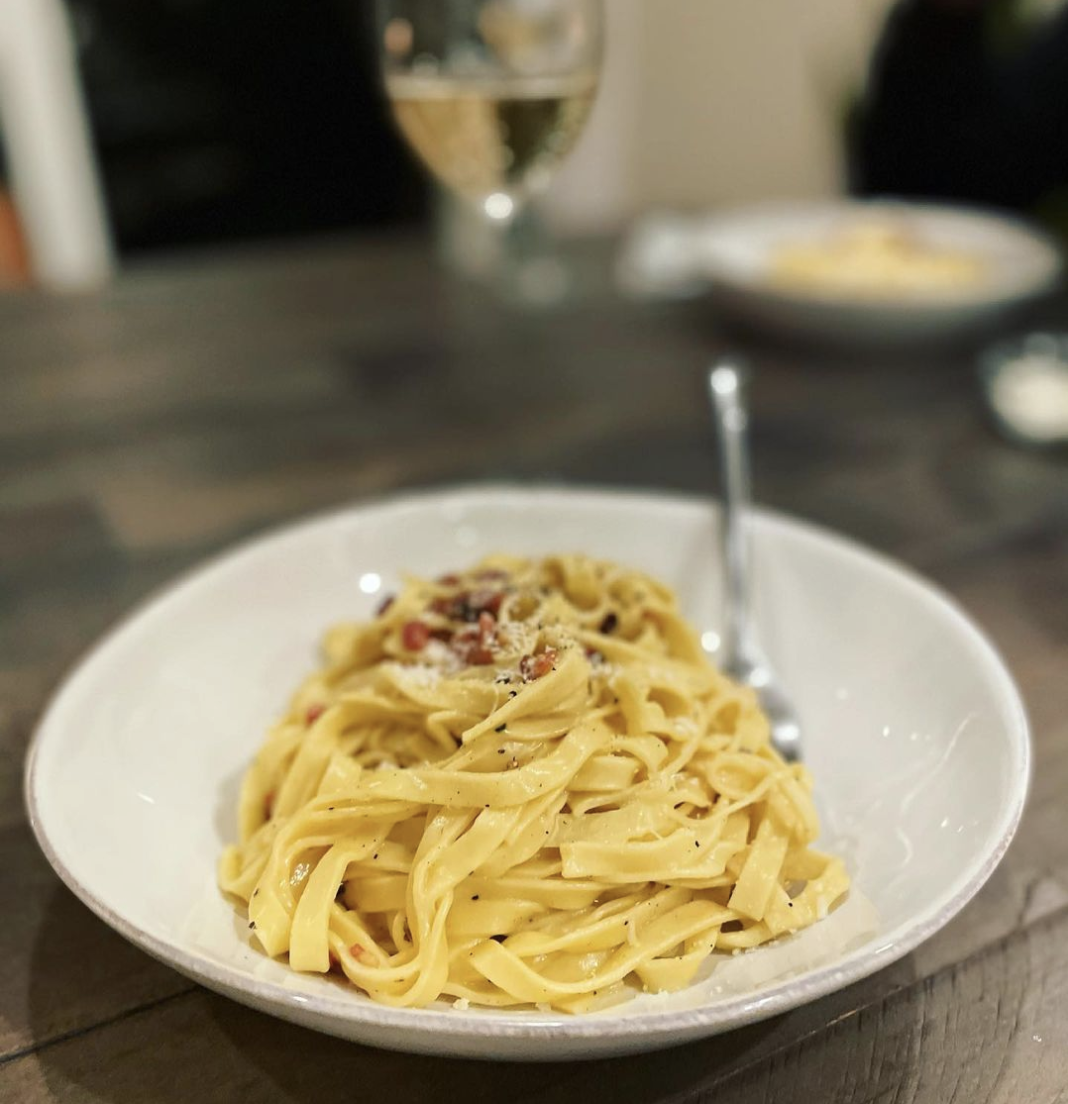
Ocello also recommended using it as a base of a simple pasta salad. It was such a good idea that after we got off the phone, I immediately raided my pantry and fridge to test a couple of versions. The recipe below is flexible; change up the pasta shape, the herbs and other additions. The only non-negotiable is the giardiniera mayonnaise dressing. 

***

Recipe: Giardiniera Pasta Salad 

Yields: 4 to 6 servings 

Ingredients: 

  • 16 ounces of orecchiette, cooked and cooled 
  • 6 ounces of pancetta, cubed 
  • 1/2 cup of mayonnaise 
  • 1/2 cup of giardiniera
  • 4 tablespoons of lemon zest
  • 2 tablespoons of lemon juice
  • 1 tablespoon of grainy mustard 
  • 1/4 Italian parsley, chopped
  • 2 scallions, thinly sliced diagonally
  • Salt and pepper to taste

Directions: 

1. In a blender or food processor, combine the mayonnaise, 1/4 cup of giardiniera, lemon juice and mustard. Blend until completely smooth. 

2. In a large bowl, combine the orecchiette, the giardiniera mayonnaise, the remaining giardiniera, pancetta, lemon zest, parsley and scallions. Season with salt and pepper to taste. 


Read more Saucy:


Combine pineapple, cannabis terpenes and ginger for a relaxing mocktail

According to Dave Whitton of Los Angeles’ Prank Bar, the anti-inflammatory mocktail is a delicious drink of refreshment. Each ingredient was carefully selected not only for its flavor but to combat everyone’s hated nemesis . . . bloating. The pineapple juice is a diuretic, and the ginger root, cayenne, and bitters help with your metabolism, digestion, and stomach issues. The terpenes help to boost mood and energy and to reduce inflammation.

***

Recipe: Anti-Inflammatory Cocktail

Makes 1 drink 

  • 2 ounces fresh pineapple juice
  • 3/4 ounce simple ginger syrup (recipe below)
  • 3/4 ounce fresh lemon juice
  • 2 drops limonene terpenes
  • 2 dashes ANGOSTURA aromatic bitters
  • 6 ounces sparkling water, or to taste
  • Cayenne pepper
  • Lemon slice, for garnish, optional

1. Combine the pineapple juice, ginger syrup, lemon juice, terpenes, and bitters in a shaker three-quarters filled with ice. 

2. Vigorously shake for about 30 seconds. Strain into a Collins glass. 

3. Top with sparkling water and garnish with a pinch of cayenne pepper and lemon slice. Serve at once.

***

Recipe: Simple Ginger Syrup

Makes 2 cups

  • 2 cups water
  • 1 cup raw organic sugar
  • 4-inch piece fresh ginger, cut crosswise into thin coins

1. Bring the water, sugar, and ginger to a boil in a medium saucepan over medium heat, stirring occasionally until the sugar has dissolved. 

2. Remove from heat, and allow the ginger to steep for 40 minutes. 

3. Strain the syrup through a fine-mesh strainer, into a clean airtight container, discarding or composting the solids. Refrigerate for up to 7 days.
 

If you like this recipe as much as we do, be sure to check out Tracey Medeiros’ “The Art of Cooking with Cannabis: CBD and THC-Infused Recipes from Across America.” 

Rand Paul claims John Lewis’s beating is proof Republican voter suppression laws can’t be racist

Sen. Rand Paul (R-KY) on Sunday suggested that new Republican voter suppression laws cannot be racist because many of the backers of Jim Crow policies were Democrats over 50 years ago.

During an interview on Fox News, host Maria Bartiromo noted that many companies had opposed voting restrictions passed by Georgia Republicans but they had not spoken out against a Democratic bill that would expand voting rights.

“I’m still having trouble fathoming the hysteria that came from Coca-Cola and Delta and Major League Baseball over the Georgia bill,” Paul explained. “We passed virtually the same bill in Kentucky. It was signed by a Democrat governor and it was lauded as actually expanding access because we expanded early voting in the same way they did in Georgia.”

Paul, however, did not address the increased barriers to absentee voting or the concern that lines at polling places will be longer in urban areas in Georgia due to the new law.

“To hear all these Democrats shouting Jim Crow, Jim Crow — do they not realize the history of the Democrat [sic] Party was Jim Crow,” he continued, “that not any god-fearing Republican voted for Jim Crow. That Jim Crow throughout the South was done by Democrat [sic] legislators, that the people who were beating up John Lewis and pummeling him on the bridge in Selma were all Democrats?”

“I, for one, am sick and tired of Democrats,” Paul said. “They need to apologize for their history. They need to apologize for foisting Jim Crow on the country. And they need to read the bill in Georgia and realize it has nothing to do with keeping people from voting.”

The Kentucky senator went on to blast corporations who opposed the Georgia law.

“Delta and Coca-Cola and Major League Baseball need to realize that about half of the country is Republicans and we’re not very happy with them right now,” he griped. “So if they don’t want Republicans at the baseball games, if they don’t want us to tune in to their baseball games on television, just keep behaving this way.”

Paul added: “People like me who love baseball don’t like being called a racist by Major League Baseball, don’t like Delta and Coca-Cola calling us that. And we’re going to object to it and going to push back. And if they continue in this direction, fine, maybe Republicans don’t have to drink Coca-Cola anymore.”

Watch the video below from Fox News.

In Netflix’s defiant “Shadow and Bone,” The Chosen One gets bent in the best way

A fantasy series like Netflix’s “Shadow and Bone” may not be critic proof, but it’s accurate to call it resistant to curmudgeonry. Defiant, even. Such is the way of franchise titles based on popular books, which is why so many studios are swooping in to claim the broadcast or film rights. Bestsellers bring along a built-in audience, and where they go others will follow.

Leigh Bardugo’s “Shadow and Bone” trilogy and its follow-up “Six of Crows” duology are no exception. In Eric Heisserer’s eight-episode adaptation for Netflix he merges the two storylines into a single tale, which can be challenging to anyone who hasn’t read the books . . . until you realize that this is another version of a perpetually appealing set-up. Translation: You’ve seen some version of this before.

“Shadow and Bone” follows Alina (Jessie Mei Li) a young cartographer who grew up in an orphanage and comes of age in a dangerous time for Ravka, the land where she was raised. 

She enlists in the army along with her childhood friend Malyen “Mal” Oretsev (Archie Renaux), an expert tracker, and believes she’s the ordinariest of the ordinary folk. Only when she’s thrust into a deadly situation does she discover she’s special — a Grisha, humans who can manipulate elements and substances.

But even among the Grisha Alina is singular, the only one of her kind in all the world: a sun summoner. This makes her insanely valuable and attractive to all kinds of people — con artists from Ketterdam, a handsome general named Kirigan (Ben Barnes) who wants to train her, assassins who see the Grisha as witches and want to kill her.

Along with all that, and in keeping with the formula, “Shadow and Bone” has a shadowy elemental force at its center called the Fold, that has no master, knows no borders and contains monsters that devour all living things. It divides one side of the land from another and although crossing it is the most efficient way to travel it also means almost certain death for anyone save for a girl who can call forth light.

Writers know this narrative as The Chosen One mythology, and we usually associate it with the likes of Harry Potter, King Arthur, Luke Skywalker, Frodo Baggins . . .  well, you get the idea.

Television and film audiences also fall for women at the center of these stories: “Buffy the Vampire Slayer, “Cursed,” “Warrior Nun” and “Hanna” are classic examples.  But Heisserer’s adaptation of “Shadow and Bone” marks a vital shift in supernatural heroines: Alina isn’t white.

Li’s Alina has been rewritten as half Shu, which describes the people of Shu Han. Where Ravka is a fictional version of Imperial Russia, Shu Han is the story’s version of China. (Li’s father is Chinese and her mother is English.) Since the original trilogy was set in Ravka, all of the characters are by default coded as white.

The TV version racebends the entire population of the Grisha army, showing us that people with special abilities come in all hues. There are Black and brown Grisha along with the white ones. This is a remarkable shift, done with Bardugo’s blessing. 

It’s also one of the highest-profile streaming titles to intentionally break free of the age-old white warrior woman mold, which is a wheel that needs to be broken. “The Witcher,” Netflix’s other popular high fantasy title, is almost entirely white save for a few Black and brown characters whose alignments aren’t necessarily heroic.


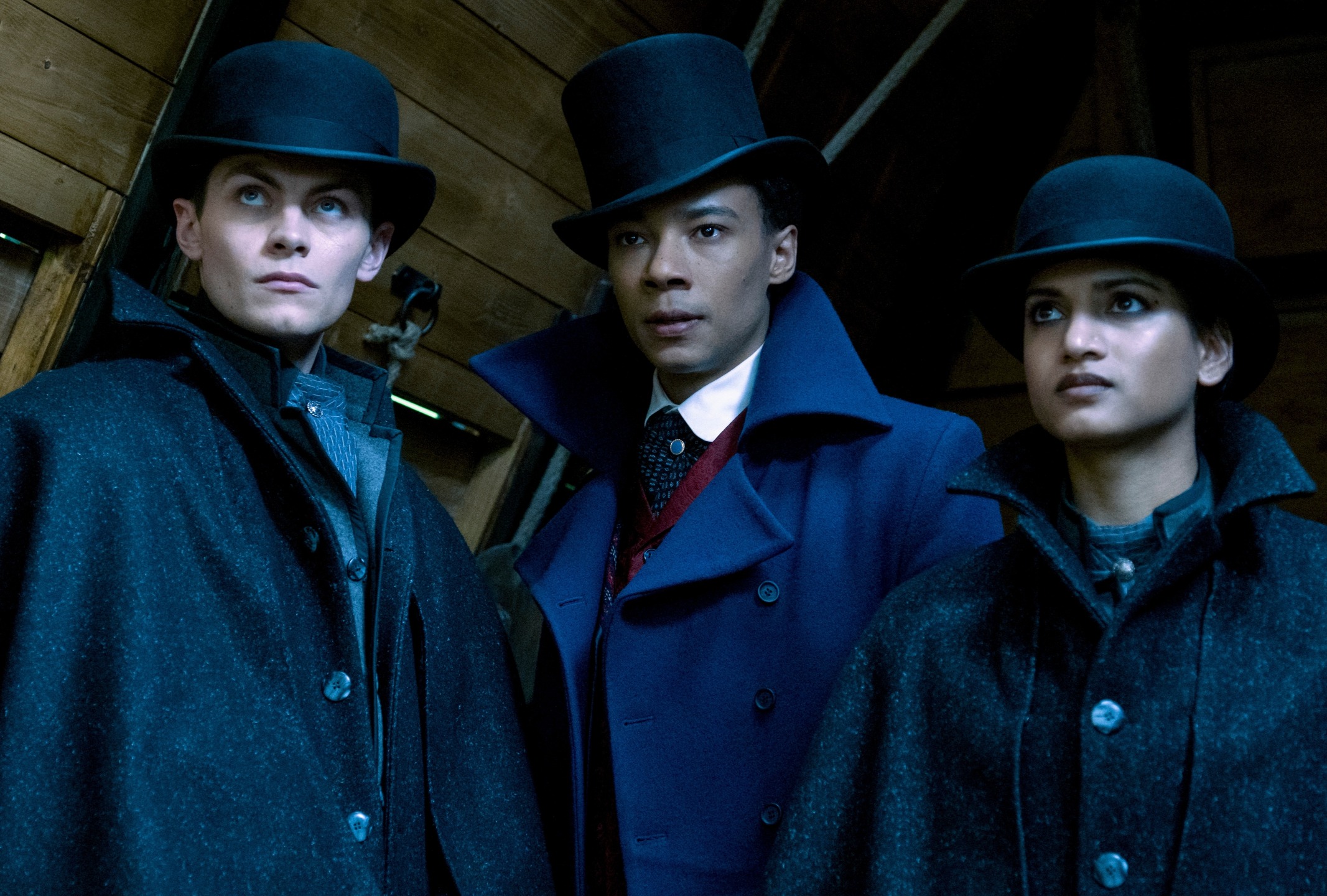
Freddie Carter, Kit Young and Amita Suman in “Shadow and Bone” (Netflix)

Moreover, in incorporating the “Six of Crows” story (which Bardugo actually did write as more inclusive), Netflix’s hybridized series gives us a band of extraordinarily talented non-magical humans who are frankly more fun than the, ahem, elemental manipulators. (The Grishaverse is careful to describe summoning talents as non-magical or a “small science.”) 

Tops among them is acrobatic knife thrower Inej Ghafa, played by Nepali actress Amita Suman, and sharpshooter Jesper Fahey, portrayed by Kit Young, a biracial Black actor. Some may look at this as counting appearances instead of measuring performances, but all of these actors enliven the script with their portrayals; Young and Suman in particular make “Shadow and Bone” worth watching. 

And seeing them onscreen in a popular work such as this is especially important. Our favorite young adult fiction and fantasy books worm into our brains deeply and early – and many of them still teach readers and dreamers that aspirational power fantasy are by default the province of whiteness. In a Los Angeles Times interview Bardugo herself admitted that being raised on European high fantasy drilled that idea into her and welcomed the opportunity to shift away from that in the TV series.

At the same time these shifts are strange to parse, since Alina slams up against bigotry — at various points rivals and snobs refer to her as a half-breed or a “rice-eater.” But the Black and brown characters move through the world without much in the way of outward trouble. One might suppose that this fantasy world is untouched by the white supremacy seen in ours as the impetus for hatred; instead the Ravkans are intolerant of Alina because she has the face of the literal enemy with whom they’re at war (echoes of the Japanese internment). Then again, this theory doesn’t quite wash either since the Ravkans also have conflict with the Fjerdans to the north, but the blond-haired, blue-eyed are not similarly shunned. Why address Alina’s race only to focus on the hatred she experiences, rather what her heritage might also bring? 

Moving past that puzzling inconsistency, Suman and Young’s characters are the non-white characters who receive the most lines, screen time and story, and exist in a rogue’s world where an assortment of blokes hustle and tangle. That’s the main reason they’re more interesting.

Mind you, connecting with “Shadow and Bone” for the most basic reasons, let alone appreciating its inclusiveness at all requires either some familiarity with the books or some willingness to settle into a grey area of not knowing all the pertinent terms, which are not provided in a handy written guide as in the books. As long as you’re entranced by the story and the CGI it probably doesn’t matter if you can’t explain the difference between say, a Fabricator, a Tailor or a Heartrender. 

A good TV series coaxes people to check out the books after watching. This time, thanks to the show’s choices, a wider range of people have a chance to picture versions of themselves within those pages where they might not have before. 

“Shadow and Bone” is currently streaming on Netflix.

Retracting publications doesn’t stop them from influencing science

What do studies on omega-3 fatty acidshydroxyethyl starch, and COVID-19 have in common? The resulting scientific papers were all retracted. 

Nevertheless, they have all been cited countless times since then. As an eraser of mistakes in scientific publishing, retraction discredits the validity of a study’s claims due to flawed methodology, biased interpretation, or even fabrication of data. Unfortunately, it seems it is not so easy to erase a published study from the collective scientific consciousness. A retracted study should be a relic belonging to the virtual museum of past science – but like zombies of the scientific publishing world, they are kept alive by continued citations. 

A study in Science analyzed the post-retraction citations of two COVID-19 papers originally published in The Lancet and in The New England Journal of MedicineAs both studies were linked to the same dubious database as the source of their raw data, their retractions were followed by a widespread media scandal.  

Despite all the attention these studies received, researchers at Science found that they have been cited more than 100 times as support for scientific findings without mentioning their retracted status. These incorrect citations showed up in even the most prominent scientific journals, such as PLOS ONE, the Proceedings of the National Academy of Sciences, and Nature Communications. Retraction does not seem to achieve its desired effect – in fact, it seems that in the long term, retraction does not have any effect on the number of citations a paper receives

Science is influential. Since it’s used to drive medical, policy, and scientific decisions, the consequences of citing retracted studies as credible science can be dire. It is essential that both authors and publishers take care to stop citing them. 

Incorrect claims, stemming from the citation of a “zombie” paper, can ripple misinformation into many more new studies. Another recent study looked at the citation patterns of a paper on the use of omega-3 supplementation for COPD patients which was retracted 11 years ago due to fraud. The authors found that 96% of papers citing the study did not mention its retracted status and 41% did so while even describing the study in detail. At this point, the spread of misinformation seems inevitable, as even the authors who take care not to cite retracted studies will trust the information and continue to cite these non-retracted papers that do cite a fraudulent study. 

Keeping flawed science alive can even be life-threatening – as in the case of the fraudulent studies of the infamous Joachim Boldt with 103 retractions tied to his name to date. He supported an intravenous therapy using hydroxyethyl starch to stabilize patients during and after surgery. In independent studies on the compound, its use was linked to higher patient mortality. Unfortunately, many of his studies are still being cited today.

As well as spreading misinformation and harming patients, flawed studies can have negative societal and policy consequences too. A recent article published in Nature Communications suggested that female mentorship in academia had detrimental effects on the careers of female mentees and attacked current diversity policies in academia. Following outrage from both scientists and the public, the study was shortly retracted. As well as erroneously equating co-authorship with mentorship, it also disregarded gender discrimination in science. However, if retraction cannot fully discredit the study as it should, the efforts to reach greater gender equality in academia will be damaged. 

The root cause of the issue is often simple – many scientists would likely admit to having at least once copied relevant citations from another paper without reading them, just out of sheer convenience. Moreover, while the retraction notice is present on the publisher’s site, it often fails to appear on other platforms, such as PubMed, making the author believe that the study is valid. 

This is a major glitch in the system. We are scientists, dedicating our whole lives to painstakingly pipetting or analyzing massive databases. We should not lack the diligence to pay attention to such an important and glaring detail like whether a paper was retracted. In each and every publication, author guidelines should include that the author is needed to check all citations for possible retractions. Today numerous citation software are available to do this with ease; such as Zoteroscite.ai, and RedacTek alert users for any retracted papers in the reference list. As well as more care from authors, preventing post-retraction citations is a responsibility of publishers too. Along with double-checking the reference list of papers to be published, they should also make sure that retraction notices appear on all platforms where the study is available. 

Meet Jane Colden, the 18th century botanist snubbed by Linnaeus

Had she not been a woman, Jane Colden would likely be one of the most famous early American botanists. But, because of her gender, she faced numerous barriers, including a lack of formal schooling and being given the cold shoulder by the foremost expert of her time. Nevertheless, Colden continued drawing and studying plants around her home in the Hudson Valley in the new New York colony, eventually discovering two entirely new species, in part thanks to her father, Dr. Cadwallader Colden.

Dr. Colden was a scientist, medical doctor, and the lieutenant governor of the New York colony. Because of this role, he was given an estate in modern-day Newburgh, New York, to work on classifying the region’s plants. In 1743, Dr. Colden published Plantae Coldenghamae, which described the plants on his land, with the help of his daughter, Jane, aged 19.  

Though Jane was interested in botany, it was difficult for women to be taxonomic botanists in the 18th century, since many women were not allowed to attend school, nor learn Latin, the official language of taxonomy. But, the history of science shows us that if women were scientists, they tended to be botanists, likely due to the medicinal properties in plants which were important for women caretakers. For example, Hatshepsut, Queen of the 18th Dynasty of Egypt, organized the Punt expedition partly to search for new medicinal plants. In the 18th century, Queen Charlotte of Great Britain and Ireland (later, the United Kingdom of Great Britain and Ireland) promoted gardening as women’s work through her time spent at Kew Gardens

For Colden, Queen Charlotte’s influence, along with her father’s teaching and Carl Linnaeus’ recently published Systema Naturae — a revolutionary book which explained how to scientifically classify plants and animals — meant that she could be a botanist. Her father was aging and expressed frustration with his task of categorizing plants, and so recruited his daughter’s help. She was happy to be included in her father’s botany projects, and she began communicating with other botanists like Alexander Garden, John Bartram, John Ellis, and Peter Collinson. During this time, botanists were often in communication with each other, sending illustrations and descriptions of plants back and forth when they found something exciting. 

Colden likely began studying and drawing plants in the late 1730s. She wrote a manuscript, comprised of over 340 ink drawings of leaves, and crafted detailed descriptions, which usually included local medicinal uses. For example, she wrote “Asclepias tuberosa [Ed: commonly, the butterfly weed] is an excellent cure for the colick. This was learn’d from a Canadian Indian…and confirmed by Dr. Pater of New England…Pedicularis canadensis is called by the country people Betony [now, called wood betony]. They make tea of the leaves and use it for fever.”

While studying plants around her family’s estate one afternoon in 1753, Colden discovered a small, pink-flowered plant in the woods and determined that it had never been scientifically described. She sent this new plant to Garden, who agreed that it was unknown to Western science (it is likely that Indigenous peoples like the Lenape — who lived in this region before it was colonized — already knew about these plants). Colden wrote to Linnaeus, as the authority on new discoveries at the time. She said she had found a new species and proposed the name “Gardenia,” after her colleague Garden. Linnaeus disagreed with Colden’s assessment, and assigned the plant to the already known Hypercium genus (commonly called St. John’s wort).

Over time, scientists found that Colden’s original assessment was correct — this small, pink-flowered plant was a new species, which was then named Triadenum (or, Marsh St. John’s wort). But, by this point, her role in its discovery had been long forgotten. In fact, contemporary scientists are still discussing the morphology and taxonomy of these two species. So, Colden was right when she said that the North American plant was not reported on in European books, given that plant does not live in Europe. Since Linnaeus did not take Colden’s suggestion for the plant, she lost the honor of naming a new discovery for a colleague — Peter Ellis named a different plant in Garden’s honor: Gardenia jasminodies, the cape jasmine or gardenia.

In 1756, Colden made another new discovery, this time a white-flowered plant which, again, she could not identify in Linnaeus’s books. She wrote about her findings in a letter to John Ellis, who proposed it as a new species to Linnaeus on Colden’s behalf. She called this new plant “Fibraurea,” though when Ellis wrote to Linnaeus, he said, “This young lady merits your esteem, and does honor your system…suppose you should call this Coldenella, or any other name that may distinguish her among your genera.” Linnaeus refused and named the plant “Helleborus” which was later renamed Coptis groenlandica (commonly called threeleaf goldthread). 

Since “Fibraurea/Helleborus” was not named for Colden, Collinson wrote to Linnaeus asking again for a plant to be named after her. But, Linnaeus again ignored this request. It was common at the time for plants to be named after their describer, and as there were many new plants being written about at the time, there was no shortage of things that needed a name. Linnaeus was very much a man of his time, however. In developing his classification system, he believed that the most natural system for grouping plants would center on the reproductive parts, as he thought God intended. So, it is unsurprising that Linnaeus did not want to formally recognize Colden, since she was a woman. 

Because Linnaeus, and others, did not acknowledge her, Colden’s work was effectively ignored. In addition to her discoveries, she developed a new method of using a rolling press with printer’s ink to take a leaf impression — a system that made recording leaves much more accurate than drawing them. While Colden thought she described two new species, others have argued that there were probably more than two. Dutch botanist John Frederik Gronovius wrote that he found at least three additional new species in her manuscript, and that she wrote on unique characteristics in even more plants which had not been written about elsewhere.

In spite of her discoveries, Colden was never recognized for her scientific work; the genus Coldenia (a flowering plant genus) was named for her father. While science historians recognize Colden’s work, there have been no notable revisions to botanical history, like revising a species’ history and naming her as its describer, and there is still no genus named for her.

Aside from some mentions in academic texts about women in science, Colden’s legacy as one of the first women botanists has been largely forgotten. Sadly, once she married in 1759, her botany work stopped, and she died in childbirth in 1766, just prior to her 42nd birthday. 

But really, what’s the right temperature for cooked chicken?

Below, we’re sharing an excerpt from the Food52 cookbook, Dynamite Chicken, to answer one of life’s most important questions: At what temperature should my cooked chicken end up, and how do I get it there?


Anybody who tells you that one part of the chicken is better than another part of the chicken is not somebody whose culinary advice you need to take too seriously. But even though it all comes from the same bird, chicken parts have different flavors and functions in recipes, and different cook times and temperatures to reach to get the best out of them. Here’s a guide to chicken cooking temps in general, a breakdown on how I like to cook separate chicken parts, and a bunch of different ways you can cook your chicken to get to the result we all want: flavorful, succulent meat.

* * *

But first, chicken safety

I’ve cooked hundreds of chickens in my life, and I have never gotten salmonella poisoning. I suspect that the biggest culprit of salmonella is cross-contamination, which happens when, for example, you cut chicken on a cutting board that you then use for something else without cleaning it first. Only cooking kills salmonella, and the government says to cook food to 165°F (75°C) to instantly pasteurize it. However, while cooking chicken breasts especially, I shoot for closer to 150°F (65°C) and try to hold it there for a couple minutes. This extra time at temp also leads to pasteurization, so your chicken breasts are safe to eat and won’t dry out or get a little tough, like at 165°F (75°C) — but more on this below.

* * *

Different cooks for different cuts

Chicken breasts are lean, texturally very consistent when cooked properly, and great for quick-cooking recipes. But they have less collagen and gelatin in them than the legs do, so if you cook them past 150°F (65°C) or so, they will release moisture and get dry and rubbery. Leave them on the bone if you want to give yourself a buffer on cook time, as this will help preserve moisture. Or cut them small and don’t worry about perfection, as they can add great texture where a tender chicken leg can get lost. I like to sauté or gently poach chicken breasts.

Chicken legs, on the other hand, excel when cooked for a long time. The fat renders out and they get that juicy, shreddable, pulled-pork appeal. Use chicken legs when a recipe tells you to put the chicken in at the beginning and the dish has a total cooking time of 40 minutes. I find drumsticks and thighs to be pretty interchangeable, as they’re both dark meat wrapped around a bone. The thigh is meatier, and the drumstick has a little more tendon action that you’ll want to remove, but that is easy to do once the drumstick is cooked.

Chicken wings are delicious! They have a high skin-to-meat ratio, which lends itself to crispy roasted or fried preparations or nice charring on the grill. And they tend to be cheap and plentiful. That said, if you buy a whole chicken to cook for a few meals, it’s probably not worth the effort of making just two Buffalo wings. Instead, you can put them in a pot with other chicken parts to make stock, and then they can become any number of things in spirit.

Now, if we’re talking about boneless, skinless chicken, breast and thigh meat are relatively interchangeable. Pounded-out, quick-cooking recipes like chicken schnitzel are great for breasts, whereas the long marinade and lengthier cook of chicken spiedies, while delicious with breasts, go even better with juicier thighs. I wouldn’t necessarily say that the thighs have more flavor, but they have a slightly gamier profile worth keeping in mind.

* * *

Chicken-cooking basics

Whole-Roasted Chicken

To roast a 3- to 4-pound (1.4 to 1.8kg) chicken, heat your oven to 400°F (200°C). Check the chicken’s cavity for any bag of neck bones and giblets that might be hanging out in there, removing it if there is one. Then, season the chicken all over with plenty of kosher salt (so the salt can really make its way into the skin and meat), rub extra-virgin olive oil or vegetable oil on the skin (add more salt if it rubs off with the oil), put the chicken in a large roasting pan or on a sheet pan, and cook it in the oven for an hour. If the skin doesn’t get dark enough while roasting, put the chicken under the broiler for a couple of minutes longer. If the chicken needs a little more than an hour to be done, give it an hour and 10 minutes and take note for next time.

All this said: I find it troublesome to gauge a whole-roasted chicken’s doneness using temperature because I have never figured out the correct place to stick a thermometer — when I put it in the breast, the thickest part of the chicken, either it will say 125°F (52°C) and the chicken is super overcooked, or it will say 175°F (80°C) and the chicken is still a little raw. And the juice thing? The juice coming out of a chicken is never clear, at 165°F (75°C) or otherwise. There is just too much biology going on in there. So I say wiggle the leg. Does it feel loose? Is the skin pulling back from the joint where the foot would have been attached? After an hour of cooking, is the skin super dark or is it still a little pale?

Once I’m ready to pull the chicken from the oven, I let it rest for 10 minutes and then slice into the thickest part — just to the side of the breastbone. If the meat is white and not pink, then we win! If it’s not, it’s rested only 10 minutes and the oven won’t take long to heat back up, so back in it goes. I realize that cookbook authors and chefs, of which I am a strange combo, are supposed to give much more precise answers than that, but I am here to tell you guys the truth. And once you get to know how long it takes to cook a 4-pound (1.8kg) chicken at 400°F (200°C) in your oven, then you won’t even need to think about thermometers or juices anymore!

Roast Chicken Parts

Roasting bone-in, skin-on chicken parts is just like roasting a whole chicken! Heat the oven to 400°F (200°C), season the parts generously with kosher salt, rub with oil, and roast. The breasts should be done in 30 minutes and the legs in 45, so pull them out accordingly — the meat should be fully white in the middle, and not even a little pink. If the parts don’t get brown on the outside, broil them for a few minutes to get extra-crispy and delightful skin.

Poached Chicken

Poaching chicken is quick and easy and leaves you with super tender meat and a little bit of flavorful stock to use for other things. Put four boneless chicken pieces (about 2 pounds, or 900g) in a pot and just barely cover them with water (about 11 ⁄ 2 quarts, or 1.4L). Add 11 ⁄ 2 teaspoons of kosher salt. Over medium-high heat, bring the water up to a light boil, turn the heat to low, and gently simmer the chicken in the broth until it is just cooked, 7 to 10 minutes. You can add onions, garlic, herbs — whatever you like — but those flavors will shine through more in the resulting broth than in the chicken itself.

Sautéed Chicken

Sautéing chicken is the fastest and arguably most delicious way to cook it, because you can get the most intense caramelization in a very short time. Simply heat a sauté pan on high heat with a little vegetable or extra-virgin olive oil until smoking, season chicken well with kosher salt, and place it in the pan, skin-side down (if working with skin-on chicken). Cook the chicken on that side without disturbing it until it is cooked almost all of the way through — 5 to 7 minutes for a boneless breast, 18 to 20 minutes for a bone-in breast, and 28 to 30 minutes for thighs or drumsticks — lowering the heat to medium after 5 to 7 minutes for the bone-in pieces. It can be tricky to tell when a bone-in chicken breast is almost cooked, so peek in between the breast and tenderloin and cook it until there’s only a little pink left. Then flip and cook it for another minute or two until there is no more pink.

Broiled Chicken

Broiling chicken is fun and exciting — you get crispy skin and tender meat in an impossibly short time. That said, it’s a pretty aggressive way to cook chicken, so I recommend you keep an eye on it because things happen pretty quickly. Season bone-in, skin-on chicken parts with kosher salt, rub the skin with vegetable or olive oil, put the pieces under the broiler, and flip them pretty regularly so that they don’t burn —  every 3 or 4 minutes. Depending on the size and thickness of your chicken, and the seriousness of your broiler, the parts should take between 8 and 12 minutes (or 25 to 30 for bigger pieces) to cook. To see if they’re cooked, check the thickest part of the meat — if it’s pink, it needs some more time, and if it’s white throughout, it’s fully cooked.

Shredded Chicken

Basically, any of the preceding cooking preparations make good chicken for shredding, but poaching and broiling are the fastest and easiest ways to get there. First, cook the chicken in any of the ways mentioned. Then, to shred, transfer the cooked chicken to a plate or cutting board and let it cool until it can be handled easily, or ideally to room temperature, 10 to 20 minutes. Use your hands to pull the meat off of the bones and then shred it into small pieces; or using two forks, hold the chicken steady with one fork and scrape the chicken off the bone with the tines of the other to shred. Save or freeze any skin, bones, fat, or cartilage for stock (unless you like those things to be in your chicken salad), and you’re ready to use the delicious shredded meat.

Mellow out with this grilled cheese made with pesto aioli and CBD-infused Herbs de Provence butter

This grilled cheese — which is from Green Goddess Cafe in Stowe, Vermont — is a nice departure from the traditional sandwich. It is the perfect sandwich for a delicious lunch or dinner. Serve alone or with a fresh green salad and a hearty soup, if desired. The CBD Herbes de Provence butter uses clarified butter (a recipe for which is located below), which must be made at least 30 minutes before, so prepare accordingly.

Recipe: Goddess Grilled Cheese with CBD Herbes de Provence Butter

Makes 1 Sandwich 

CBD Herbes de Provence Butter:

  • 2 tablespoons clarified butter, homemade or store-bought
  • 1 teaspoon Herbes de Provence
  • 20 milligrams CBD oil, preferably Sunsoil

Pesto Aioli:

  • 1 tablespoon pesto, homemade or store-bought
  • 1 tablespoon organic mayonnaise
  • Salt and freshly ground black pepper 

Goddess Green Cheese:

  • 2 tablespoons Herbes de Provence butter, divided
  • 2 slices 1/2-inch-thick Pullman or other white bread
  • 4 thin slices fresh local mozzarella cheese
  • 1/2 ripe Hass avocado, pitted, peeled, and sliced
  • 2 slices tomato, such as Roma or heirloom
  • 1/2 cup fresh local baby spinach
  • 2 tablespoons pesto aioli 

1. To make the CBD Herbes de Provence butter: In a small bowl, whisk together the clarified butter, Herbes de Provence, and CBD oil until well combined. Set aside.

2. To make the pesto aioli: In a small bowl, whisk together the pesto and mayonnaise until smooth. Adjust seasonings with salt and pepper to taste. Set aside.

3. To make the sandwich: Preheat a small skillet over medium heat. Add 1 tablespoon of the CBD Herbes de Provence butter to the preheated skillet. Spread the remaining 1 tablespoon of butter over the top side of each bread slice. When the butter melts, place 1 slice of bread, butter-side down, in skillet. 

4. Layer with 2 slices of cheese, avocado, tomato, spinach, and finally the remaining 2 slices of cheese. Spread the inside of the second slice of bread with pesto aioli and place on top, butter-side up.

5. When the cheese has melted and the underside is golden brown (about 4 minutes), use a spatula to carefully flip the sandwich over. Continue to cook, gently pressing down on the sandwich occasionally, until the second side is golden brown, about 3 minutes. 

6. Cut the sandwich in half and serve at once.

Note: You will need to clarify the butter at least 30 minutes before you intend to use it.

***

This recipe makes more clarified butter than you will need for the sandwich. The extra butter can be used for cooking eggs or whisked into a hollandaise sauce.

Recipe: Clarified Butter, the “Liquid Gold” 

Makes about 1/2 cup

Ingredients:

  • 1 stick of unsalted butter

1. Melt 1 stick of unsalted butter in a small saucepan over low heat. Simmer, do not stir, until all of the whey proteins have risen to the surface and whitened into a foam. 

2. Remove from the heat and allow to cool for about 20 minutes. 

3. Using a spoon, gently skim off the top layer of foam (known as the whey proteins) and carefully strain through a fine sieve lined with a cheesecloth and into a heatproof jar. 

4. Use at once or cover and refrigerate for several months.

Note: While making the clarified butter, be careful not to overcook or it will become bitter tasting.

If you like this recipe as much as we do, check out “The Art of Cooking with Cannabis: CBD and Thc-Infused Recipes from Across America” by Tracey Medeiros. 

Joe Manchin tells CNN host that he is “not a roadblock at all” to the Biden agenda

On Sunday morning, CNN “State of the Union” host Dana Bash confronted Sen. Joe Manchin with comments from fellow Democrats who are concerned that the West Virginia lawmaker is making their job harder by acting as a “roadblock” to President Joe Biden’s agenda and that it would hurt the party in the 2022 midterms.

“I talked to Democrats who tell me the reason President Biden’s ambitious agenda is so big and so bold is because they understand history, and history shows that the president’s party, if they have majorities in Congress as he does, often time lose that in the midterm elections, and that’s why they have a small window to get things done, they believe is possible,” Bash began. “So they believe that you’re one of the main roadblocks on getting those goals accomplished. How do you respond to that?”

“I’m not a roadblock at all,” Manchin insisted. “The best politics is good government. I can’t believe that people believe that, if you just do it my way, that will give us the momentum to get through the next election. But when you do something that everyone tags onto, and I’ve seen good things happen that people voted against it, took credit for when they went back on.”

“We won’t give this system a chance to work,” he continued. “I am not going to be part of blowing up this Senate of ours or basically this democracy of ours or the republic that we have.”

You can watch the video below via YouTube:

Gingrich claims Joe Biden is “deliberately anti-American” while ranting about “gay flag” on Fox News

Former Speaker of the House Newt Gingrich, R-Ga., on Saturday pushed conservative culture war themes during a Fox News appearance.

Gingrich argued, “every idiotic thing that the Biden administration has done in the first 100 days, you begin to realize — whether it’s threatening everybody who believes in the Second Amendment or it’s attacking everybody who believes in right to life or it is attacking people of traditional values who are appalled that this administration would fly the gay flag at American embassies all over the world — I mean, you just go down item by item, and it’s almost like they have a checklist of ‘What can we do that will really, truly, infuriate traditional Americans?'”

“And I’ve never seen anything like it. Somebody asked me this afternoon, and I told them, ‘I couldn’t imagine any administration which had been this deliberately anti-American, and it’s deliberately committed to infuriating the majority of the American people,'” Gingrich argued, despite Biden enjoying approval ratings far higher than at any point in Donald Trump’s presidency.

Tucker Carlson is “chief white power correspondent” at Fox News, Jim Acosta says

Tucker Carlson continues to receive scorching criticism for pushing racism on his Fox News show.

CNN anchor Jim Acosta, who has previously made Ku Klux Klan jokes about Carlson, covered the conservative’s latest antics on Saturday.

“It’s not just Laura Ingraham. How about Tucker Carlson, who in the wake of the Derek Chauvin verdict showed us all what’s under the hood,” Acosta said, playing a clip of the controversial Fox News personality.

“But let’s be real,” Acosta said. “Tucker Carlson’s anger was not about the actions of a police officer who murdered a man, but about the guilty verdict.”

“Or, as Carlson, Fox’s chief white power correspondent described the decision, ‘please don’t hurt us,'” Acosta explained. “Now you can call this an act or a schtick, but these big, race-baiting lies have been spreading like a cancer on the far-right.”

MSNBC anchor Joy Reid saw a clip of Acosta’s description of Carlson and noted she “can’t find the lie…”

Dead in the water: The tragic human cost of swimming’s abuse scandals

On the afternoon of June 29, 2010, a pretty 16-year-old girl drove her car to the intersection of State Highways 116 and 117 in rural central Illinois. She parked and walked straight into the path of an oncoming tractor-trailer, taking her own life.

Sarah Burt had made the National Honor Society at Metamora Township High School and been looking forward to pharmacy school. She worked as a lifeguard for the local park district. She loved giving swimming lessons to little kids.

What brought Sarah to this pass was something she, but few others, knew: Her swim coach had groomed her for years in a “relationship” that everywhere is deemed morally repugnant and in many jurisdictions is termed statutory rape. Neither the justice system nor USA Swimming, the sport’s national governing body, would ever discipline him.

A decade later, USA Swimming is the under-covered cousin of USA Gymnastics, in terms of sexual abuse scandals. With both groups on the verge of breaking the liability sound barrier in local civil courts, USA Swimming is, additionally, the target of a federal grand jury investigation

Swimming has yet to produce as powerful, timely, and full-throated a whistleblower as former gymnast Aly Raisman, who all but opined that the whole thing should be burned down. Given the political clout and economic incentives of the Olympic system, what is likelier to emerge is an abuse claims superfund, plus perhaps a rebranding of USA Swimming itself. One thing for sure is that as the anecdotes continue to dribble out, one motif takes us beyond the contemplation of mere pain and psychological damage.

If the U.S. attorney for the Southern District of New York does succeed in busting swimming, then the stated crime, insurance fraud, will be a white-collar one, out of the Al Capone prosecutor playbook. But make no mistake: this is a culture that for generations has combined enhanced athletic opportunities for young people, especially teenage girls and young women, with devaluation of their lives. Swimming’s alumni club is pockmarked not only with untold numbers of ruined young adulthoods, but also with uncounted Sarah Burts. The crimes are global in scope. All too often, death becomes them.

* * *

The Irish know a thing or two about the abuse-death continuum. And they have a special relationship with their American sporting brethren, in terms of familiarity with the phenomenon. Appropriately, the Department of Justice’s task list reflects this nexus.

Concurrent with the grand jury probe, the DOJ’s Money Laundering and Asset Recovery Section, under the direction of career prosecutor Jane Khodarkovsky, has been investigating the criminal and green card status of George Gibney, who was head coach of the 1984 and 1988 Irish Olympic swimming teams. 

At least one of Gibney’s victims committed suicide after being let down by off-and-on commitments of Ireland’s director of public prosecutions to consider reviving charges against him. Another, who has been in and out of psychiatric facilities after a number of suicide attempts, was 17 when Gibney raped and impregnated her during the Irish team’s 1991 training trip in Tampa, Florida.

Gibney may be the most notorious at-large sex criminal in sports history. He escaped his original 27-count indictment on the basis of a controversial technical procedural ruling by the Irish Supreme Court — one of whose justices, Susan Denham, was the sister of Gibney’s lawyer, Patrick Gageby. Outside of one alternative news site, Broadsheet, the Irish media apparently consider such cronyism so normal as to be unworthy of remark.

Gibney evidently made it to the United States in 1995 with the help of an Irish-American coach and one of his former assistants, Peter Banks, by then was an official of the Fort Lauderdale-based American Swimming Coaches Association, a trade group whose member services include troubleshooting visas. Banks has said publicly that he does not remember brokering a U.S. coaching job offer letter for Gibney in support of his former boss’ diversity lottery visa. A redacted form of the letter was produced by the Department of Homeland Security in 2016 during my Freedom of Information Act lawsuit for material from Gibney’s immigration records.

Gibney is now 72 years old and long out of coaching, following a misconduct allegation in the first months of his only American post in the sport, with a USA Swimming-sanctioned club in Arvada, Colorado. He lives in Altamonte Springs, Florida, north of Orlando, where he was tracked down by BBC podcaster Mark Horgan for a documentary series that began airing last year. 

One colleague of Gibney’s from the 1980s and ’90s, Frank McCann, took criminal activity beyond merely abusing young athletes and covering up for himself and others. McCann committed murder, burning down his house in Dublin with his wife and infant daughter inside, apparently to keep his wife from learning he had raped and impregnated a young swimmer with special needs. McCann now is on the brink of parole from a double-life prison sentence he began serving in 1996.

Two other Irish swimming coaches from the period were jailed for molesting child athletes, as documented in a 1998 Irish government report known as the Murphy inquiry. Yet another, Ger Doyle, was later convicted and imprisoned for similar crimes. (On the eve of Horgan’s BBC podcast series, “Where Is George Gibney?”, Doyle killed himself.)

* * *

Back in the U.S., one of the most damning death narratives was the tragic demise of Fran Crippen at the 2010 FINA Open Water championships. Crippen was 27, an adult, and this episode did not directly concern sexual abuse. But it illustrated the profoundly interlocking institutional moral bankruptcies under which abuse flourishes.

The premier open water competition was held that year in Dubai, on the coast of the United Arab Emirates. That happened because of the global business machinations of Dale Neuburger, a longstanding USA Swimming board member and its onetime president, as well as a lord of the rings at FINA, the world swimming governance group, headquartered in Switzerland.

Neuburger, who recently retired, combined his FINA vice presidency with a leading role at an Indianapolis company, TSE Consulting, where he was a partner and director. (TSE is now known as Burson Cohn & Wolfe Sports.) When there was bidding to host major aquatics events, TSE often landed consulting contracts for aspiring municipalities. Neuburger’s critics say he then exploited his FINA board position to put his thumb on the scale in favor of his clients. FSE landed six-figure coaching consultancies in foreign countries for high-profile swimming figures like Bob Bowman, the coach of Michael Phelps.

Fran Crippen came out of the swimming program at Germantown Academy, a private prep school outside Philadelphia. The coach at Germantown, Dick Shoulberg, was a revered figure in the swimming world. Serving on a USA Swimming task force studying sexual abuse policies, Shoulberg wrote in a 2003 memo: “I would hate to see our organization ever in the predicament of the current Roman Catholic Church — protecting child molesters!”

Shoulberg’s most famous swimming star was David Berkoff, a gold medalist at the 1988 Seoul Games, an inductee of the International Swimming Hall of Fame and the inventor of an underwater backstroke start called the “Berkoff Blastoff.” Often outspoken in his criticism of swimming’s abuse culture, Berkoff won election to a USA Swimming vice presidency in 2010, not long after the group’s CEO, Chuck Wielgus, embarrassed himself and the sport in defensive interviews for investigative pieces on ABC’s “20/20” and ESPN’s “Outside the Lines.” (Wielgus died in 2017.)

Once embedded on the board of directors, however, Berkoff became less outspoken. He even rationalized the organization’s actions in covering up the abusive 1980s relationship between prominent Maryland club coach Rick Curl and swimmer Kelly Davies. As an activist, Berkoff had launched accusations against swimming authorities in an email: 

Denying knowledge of Rick Curl, Mitch Ivey and others banging their swimmers! It’s a flat out lie. They knew about it because we (coaches and athletes) were all talking about it in late 1980’s and early 1990’s. I was told by several of Mitch Ivey’s swimmers that he was sleeping with Lisa Dorman in 1988. I heard the whole Suzette Moran story from Pablo Morales over a handful of beers and nearly threw up. I was told Rick Curl was molesting Kelly Davies for years starting when she was 12 by some of the Texas guys. … No one was standing up. No one was willing to take on these perverts.

But now, in response to critics, Berkoff pleaded for space to work for change from the inside. He spoke highly of both of his most important mentors: Dick Shoulberg and Joe Bernal, his coach at Harvard. Today both those men have been caught coaches in the undertow of the sport’s sexual abuse scandals. Bernal relinquished his USA Swimming club program in Dracut, Massachusetts, in 2016, following allegations that he had molested student-athletes. He is believed to have fled the country.

On Shoulberg’s part, the collapse of his reputation was largely about associations and his apparent tolerance of heinous conduct by others — “protecting child molesters,” as he put it. He is somewhat analogous to the legendary and now-disgraced late Penn State football coach Joe Paterno, who did not personally abuse anyone but crafted elaborate ways of looking the other way. Among other things, Shoulberg was affiliated with eccentric industrial heir John du Pont, who fancied himself a generous patron of various Olympic sports, including swimming, wrestling and the modern pentathlon. (Steve Carell played du Pont in the 2014 film “Foxcatcher,” which depicted his obsessive relationship with wrestler Mark Schultz, culminating in Schultz’s murder.) 

The Germantown administration forced Shoulberg into retirement in 2013 in the wake of a lawsuit by a former student-athlete detailing how Shoulberg had enabled athlete-on-athlete physical abuse along with a litany of “Lord of the Flies”-style horrors. At least twice over the years, Shoulberg kept assistants on his staff who would later be exposed as sexual abusers. (When one of them, Joe Weber, got out of prison, a YMCA in New Jersey hired him as a swim coach.)

Fran Crippen was part of the family of swimmers and boosters around Shoulberg’s program. He died, either from heat stroke or drowning after cardiac arrhythmia, in the open water championships that Dale Neuberger had steered to Dubai. The temperature in the Persian Gulf waters off Fujairah that day was 85 degrees Fahrenheit, far too warm for competitive swimming.

The following year, FINA booked its Open Water World Championships in the even more dangerous venue of Shanghai. On race day, the Yellow Sea waters off Shanghai were measured as high as 87 degrees. Three swimmers — including two reigning world champions, Alex Meyer of the U.S. and Linsy Heister of the Netherlands — refused to even start the race. More than half the field was pulled out or hospitalized. The race was moved to the early morning hours to mitigate the midday heat, but even the eventual winner, Bulgaria’s Petar Stochev, expressed dismay that the event had been allowed to go forward at all.

A prominent voice among the swimming authorities dismissing the naysayers was Flavio Bomio, an influential Swiss Olympic coach who spent much of the six-hour competition inside an air-conditioned tent. Later that year, Bomio would be imprisoned in Switzerland, for sexual abuse — of course. Across the previous three decades, it turned out, he had abused at least 30 boys between the ages of 12 and 16.

14 of the best animated shows for adults from the last decade

Over the last decade, the world of animation made specifically for adults has expanded far beyond some of the veteran series that helped pioneer the genre, like “South Park” and “Family Guy.” And while we may have nostalgia for some of these series, others have lost their initial spark — as when Salon’s Keith Spencer wrote how “The Simpsons” struggles to remain relevant due to its outdated politics.

We’ve compiled a list of some of Salon’s favorite, newer animated series for adults with the stipulation that they’re American and are less than 10 years old. Therefore, while we are huge fans of “Bob’s Burgers” and “Archer” (especially the work of the late, great Jessica Walter), they are too old to be included as they premiered in January 2011 and 2009, respectively.

This past year has been a test for our mental health, and our viewing habits have reflected that, evolving from watching zombie flicks and true crime, to quirkier or more escapist fare. TV shows, with their ongoing storylines, have also appealed to us more than movies. In particular, these animated series utilized unique elements that break from reality in such a way that help us deal with and make sense of their own. 

Some of these titles may be familiar, while newer ones are lesser known. Either way, they’re all worth honoring for their creativity and astuteness.

“Big Mouth” (Netflix)

Set in a middle school in Westchester, Andrew Goldberg, Nick Kroll, Mark Levin, and Jennifer Flackett’s “Big Mouth” perfectly captures the awkward transition from child to teenager that we’ve all tried so hard to forget. In the show, a group of pre-teens tackles puberty, their emerging sexualities, relationships, and all that good teenage stuff with the help of their “hormone monsters.” These fictional characters are intertwined with the kids’ suburban reality, and every adolescent affliction has a fantastical representation, whether that be the Shame Wizard or the Depression Kitty.

“Big Mouth” strikes the perfect balance of honest, relatable, and hilarious, and the fact that it’s animated helps us feel like we aren’t growing up all over again (thank goodness!). Although the show’s main characters are 12-13, it’s definitely targeted toward an older audience with sex jokes and explicit images out the wazoo. Whether you’re in the mood to reminisce and wish that you too had a hormone monster to blame your teenage problems on, or you just want a good laugh, “Big Mouth” is the show for you. — Mayu Evans

“BoJack Horseman” (Netflix)

BoJack Horseman, the title character, is an anthropomorphic horse with a celebrity past. While figuring out how to deal with his fading stardom, he interacts with a mix of other troubled characters (anthropomorphic animals and humans alike). BoJack is best characterized as self-hating, armed with cynical humor and self-destructive behavior, and burdened by depression and addiction. 

Raphael Bob-Waksberg’s show is an excellent example of how animation can make depression and other heavy topics easier to digest. It’s more comfortable to take on your own questions about existence when they’re processed through images of a world that don’t look like our own. The separation between the two realities creates a space that makes self-reflection more manageable. The tragic nature of the show doesn’t weigh us down the way a live-action drama might; BoJack’s non-human form breaks him from reality enough for “BoJack Horseman” to be an enjoyable and binge-able watch. — ME

“Disenchantment” (Netflix)

If you’re drawn to this show because it’s voiced by Abbi Jacobson and animated by Matt Groening, know that “Disenchantment” is NOTHING like “Broad City” or “The Simpsons.” And that’s alright! The show has many charming qualities of its own; it’s the story of cheeky Princess Bean and her two companions, an elf and a demon, as they navigate the medieval fantasy world of Dreamland.

Loaded with raunchy humor and magical creatures, “Disenchantment” deals with very relatable real-life issues such as loyalty, societal obligations, and gender roles. This show is a great one to speed through in a week or two — it’s an easy watch with a nostalgic animation style and captivating landscape. — ME

“Final Space” (Hulu)

Gary Space (Olan Rogers) is a pretty lonely guy after being sentenced to solitary confinement aboard a small spaceship as punishment for impersonating a member of the elite Infinity Guard. His only companions have been his Deep Space Insanity Avoidance Robot Companion (Fred Armisen), the ship’s AI (Tom Kenny) and a refrigerator he’s dubbed “Beth” … until he befriends a cute green blob named Mooncake (Rogers), who’s a wanted alien being pursued by the villainous Lord Commander (David Tennant) It seems that Mooncake has the power to open the gate to Final Space at the very edge of the universe. 

Shenanigans ensue as Gary, along with a ragtag group of intergalactic characters, attempts to keep Mooncake safe, evade the Lord Commander and reunite with Quinn. Now in its third season, “Final Space” starts slow and has kind of a grab-bag approach to humor, but it quickly finds its footing and serves up some really unexpected emotional gut-punches along the way. — Ashlie D. Stevens 

“The Great North” (FOX/Hulu)

Set in Alaska, “The Great North” is basically the cold-weather cousin of “Bob’s Burgers. Its creators, Wendy Molyneux and Lizzie Molyneux-Logelin, have written for “Bob’s Burgers” since 2011 and Loren Bouchard produces both shows.

It also centers on the exploits of another quirky, super loving family, the Tobins, led by single dad Beef (Nick Offerman), who’s in denial after his wife leaves him, and trying to keep his remaining family close … a little too close for some wishing to spread their wings just a bit. Teenage daughter, Judy (Jenny Slate) wants at the mall photography studio instead of on the family fishing boat, while eldest son, Wolf (Will Forte), wants to move out (and live in the cabin next door) with his fiancee, Honeybee (Dulcé Sloan). Ham Tobin (Paul Rust) is the kind of spacey, but good-hearted middle brother, while Moon (Aparna Nacherla) is the youngest. 

A consistent theme in “The Great North” is that there’s room, literally and figuratively, for your imagination to roam, which leads the Tobins into the wild situations — like capturing a moose whose gotten tangled in birthday balloons, participating in a town-wide Feast of Not People festival and setting traps for Bigfoot. Oh, and keep an eye out for Judy’s imaginary friend Alanis Morisette (voiced by the real Alanis Morisette), who appears in the glow of the Aurora Borealis to offer questionable advice about boys and puberty. — ADS

“Harley Quinn” (HBO Max)

This one will make you stop thinking of Harley Quinn as just the Joker’s girlfriend! After being left in prison for months by the Joker, Harley (Kaley Cuoco) finally realizes that he doesn’t truly love her. Free from her infatuation with the Joker (and from his patronizing attitude toward her), Harley sets off to establish herself as a villain in the city of Gotham and assembles a crew of her own. With DC characters including Poison Ivy, Clayface, and Doctor Psycho by her side, Harley opposes the Joker in a chaotic and destructive face-off that leaves Gotham in pieces.

This show, produced by Justin Halpern, Patrick Schumacker, and Dean Lorey, is much more than the story of a woman getting over her ex. “Harley Quinn” is a refreshing take on the classic relationship between Harley and the Joker, complete with dark humor, a strong female lead, and beautiful animation. — ME

“Invincible” (Amazon)

“Invincible,” the new series based on Robert Kirkman’s comic book character of the same name, poses a really big question: What is the price of having superpowers? The send-up of superhero movies and media follows Mark Grayson (voiced by Steven Yuen with some tremendously punny one-liners) who, after turning 17, begins to develop superpowers. This isn’t unexpected. His father, Nolan (J.K. Simmons), aka Omni-Man, is the most powerful superhero on the planet — and Mark wants to be just like him. 

Eager to please, Mark throws himself into training under his father’s watchful, eventually taking on the moniker Invincible. However, Nolan is keeping a huge secret, the weight of which could literally shatter the universe and change how his son sees him permanently. 

Grounding this out-of-this-world series is some tremendous voice talent that includes Sandra Oh, Mark Hamill, Seth Rogen, Gillian Jacobs, Andrew Rannells, Zazie Beetz, Walton Goggins and Jason Mantzoukas. — ADS

“Midnight Gospel” (Netflix)

For me, podcasts are best paired with a walk — visual stimulus or some sort of activity to do simultaneously is essential; otherwise, I tend to lose focus. Lucky for me shows like “The Midnight Gospel” exist. Created by Pendleton Ward of “Adventure Time” and Duncan Trussell, this animated podcast series follows Clancy (Duncan Trussell) as he travels through bizarre and beautiful universes using his multiverse simulator. Each episode is set in a different world, and each world displays different trippy landscapes where Clancy conducts his interviews. Though Clancy is seen interviewing strange and fantastical animated characters, the dialogues heard were held between real people on Trussell’s podcast “The Duncan Trussell Family Hour.” “The Midnight Gospel” has it all — engaging and fascinating visuals, apocalyptic storylines, and interviewees ranging from Drew Pinsky and Damien Echols to Caitlin Doughty. 

It’s worth mentioning and, frankly, aggravating that all of the guest stars of Season 1 are white. Hopefully, Ward and Trussell can set their animations to conversations held with a more diverse set of guests in future seasons. Nonetheless, if you’re due for a dose of colorful cartoons and witty interviews, this show is a must-watch. — ME

“Neo Yokio” (Netflix) 

The absurdist “Neo Yokio” shouldn’t make sense on paper, much less on our screens. In the backstory for this alternate timeline of New York, 19th-century magicians saved the city from demons, and thus their descendants now rule as snooty yet fabulous Magistocrats. Our privileged, pink-haired hero Kaz (Jaden Smith) has it all – a robot butler named Charles (“The Young Pope” himself Jude Law) and two wacky pals voiced by Desus and Mero. Being feckless and rich, Kaz’s main aim in life is to ascend to the top of the city’s Bachelor’s List against his nemesis Arcangelo. Oh, and this bizarre confection is all created by Vampire Weekend’s Ezra Koenig. 

The series is a delightful blend of classic anime homages, from the theatrical romance of “Sailor Moon” to the gender- and species-bending antics of “Ranma 1/2.” Throw in hip-hop earworms, Victorian-futurist high society melodrama, and a penchant for pink – and you have a unique aesthetic that leaves you as comforted as Mecha enrobed in a jaunty yet cuddly sweater. This six-episode series (with a stellar, bonus “Pink Christmas” special) pokes fun at the elite but with such warmth and off-kilter humor that one can’t help but simultaneously enjoy the escapism along with its optimism. – Hanh Nguyen

“Over the Garden Wall” (Cartoon Network)

Two half-brothers, Wirt (Elijah Wood) and Greg (Collin Dean), have a very endearing dynamic, with Greg consistently in all sorts of ridiculous and refreshingly carefree trouble and Wirt taking on the role of the worried older brother. On their journey home through a magical forest, the pair run into a cast of equally sweet and terrifying characters, from a talking bird named Beatrice to a mysterious figure called “The Beast.” Patrick McHale’s “Over the Garden Wall” has humor similar to what you might see in “Peanuts” and a unique animation style that constantly walks the tightrope between creepy and cute. Furthermore, the soundtrack is catchy and beautiful; Elijah Wood once said in a behind-the-scenes video that the show’s music would be played on a phonograph. 

This show meshes the real world and forest world in a way that prompts the question: what does the forest represent? There is certainly a lot of interpreting to be done after you inevitably finish all 10 episodes of the miniseries in one sitting. — ME

“Rick & Morty” (Hulu and HBO Max)

When you think of newer adult animated series (as we said, “The Simpsons” and “South Park” are old now), Dan Harmon and Justin Roiland’s “Rick and Morty” is usually the first to come to mind. Morty, a shy and cautious kid by nature, and his cynical genius grandfather, Rick, travel the universe, collecting near-death experiences and relationships with many zany alien characters along the way. Season 5 will be released June 20 with promises of more insane, intergalactic misadventures. 

Most episodes of “Rick and Morty” pose questions about human existence. Rick’s humor is ever dark and nihilistic, and every problem that he encounters (no matter how extreme) is met with a “Who cares?” or “It doesn’t matter.” Existentialism is a massive theme in the show and an ever-relevant problem in pandemic times. While it’s not brought up subtly, it’s an easier issue to consider for ourselves because it’s paired with impossible cross-dimensional animated fun. — ME

“Solar Opposites” (Hulu)

If you’ve ever wanted to watch something that has the same general vibe as “Rick and Morty,” sans the pervasive nihilism, “Solar Opposites” is the show for you. It opens months after Korvo (“Rick and Morty” creator Justin Roiland), a misanthropic blue alien, and his family crash landed on Earth, which Korvo describes as a “horrible home.” 

His partner, Terry (Thomas Middleditch) has adjusted just fine to life on the planet. He carries their pupa — a little blob that will someday become a sentient supercomputer —in a Babyjörn, loves trashy TV and has a rotating collection of novelty t-shirts emblazoned with phrases like “Straight Out of Anime,” “Butter Beer Inspector,” and “Bacon & Lettuce & Tomato.” While Terry and Korvo bicker about whether or not it’s time to leave the Earth, their children/replicants, Yumyulack (Sean Giambrone) and Jesse (Mary Mack), are left trying to fit in as well as they can at their local high school. 

This show has — and reliably subverts — some of the expected beats found in “fish out of water” comedies and classic family sitcoms, and is bolstered by a hefty dose of raunchy humor. — ADS

“Tuca & Bertie” (Formerly Netflix, coming to Adult Swim)

Created by Lisa Hanawalt, the animation style of “Tuca & Bertie” is like a more whimsical “BoJack Horseman,” for which Hanawalt was the show’s production designer and producer. On the show, titular bird best-friends face some of the big life changes that come in your late 20s. Effervescent Tuca (Tiffany Haddish) realizes that, after spending much of her life struggling with feelings of impermanence after her mom’s death, she needs to stop floating from gig to gig and get her s**t together. Bertie (Ali Wong) is the opposite; she’s a type-A perfectionist who is just starting to bristle at the bounds of her corporate job at Conde Nest and her warm, but kind of boring relationship with her boyfriend, Speckle (Steven Yeun), whose idea of romance is scheduled sex (every Tuesday and Thursday night at 7:45; missionary, quickie-doggie, quickie-missionary). 

It’s sharp, feminist and filled with fantastical touches, like a sexy penguin baker and a hot anthorpomorphized houseplant neighbor who is clad in cut-offs and shadowed by a small army of turtles who serve as slow-moving furntiture — and likely stash her weed in their shells. The bizarre flora and fauna world reflects just how our own can feel both fantastical and inspiring, even if we’re troubled. —ADS

“Undone” (Amazon)

Starring Rosa Salazar as Alma, Raphael Bob-Waksberg and Kate Purdy’s “Undone” explores humans’ relationship to time. Upon getting into an almost fatal car crash, Alma discovers an ability to learn about her life through visions from her father. With its use of rotoscoping, an animation style where live-action footage is traced to create a more realistic cartoon image, this show pushes the boundary between real-life representation and the imaginary world depicted by animation. While the animation technique might fool you into thinking that “Undone” mirrors reality-based dramedies, in actuality, it explores the power of visions over the actions and timelines of its characters. This show delves into the visceral and life-altering effects of tragedy and the mental transformation that follows. Additionally, “Undone” incorporates and emphasizes Alma’s mixed-race and disabled identity, as well as her history with mental illness.

The quest for a universal coronavirus vaccine

Scientists working on a vaccine for a specific virus that affects pigs may have inadvertently created a prototype for a universal coronavirus vaccine — one that protects against all coronaviruses, including SARS-CoV-2 and, theoretically, its mutations. Such a vaccine would be a boon in fighting the ever-mutating SARS-CoV-2 virus, for which some subsequent mutations have been discovered to be more resistant to the existing approved vaccines. 

Specifically, the researchers attempting to address porcine epidemic diarrhea virus (PEDV) believe they may have developed a way to someday create a universal vaccine against all coronaviruses, from SARS-CoV-2 (which causes COVID-19) to those responsible for certain types of the common cold. PEDV is also a type of coronavirus, the broad class of related RNA viruses that resemble a spherical, pointy star and whose members also include SARS-CoV-2 (the “novel coronavirus”), SARS and MERS. 

The theoretical vaccines, developed by the University of Virginia’s Steven L. Zeichner, and Virginia Tech’s Xiang-Jin Meng, could offer many advantages over existing vaccines. In addition to potentially protecting patients from all kind of coronaviruses, researchers claim that the vaccines would be cheap, easy to mass produce and likewise easy to transport and store. Perhaps most importantly, the vaccine yielded promising results in early animal testing.

Salon spoke with Zeichner by email, who emphasized that researchers have not yet experimented to determine whether the PEDV vaccine can protect against people against SARS-CoV-2. He also noted that the early vaccine trials with pigs did not cause what virologists refer to as “sterilizing immunity,” or “raise antibodies in the blood of the pigs that could completely kill the virus,” but that they were able to protect our porcine friends against clinical disease caused by PEDV. Pigs that received a control vaccine still got sick, while those which received either the SARS-CoV-2 vaccine or the PEDV one developed by the researchers either did not get sick at all or only got slightly sick.

“This was really just a first try, with some pretty arbitrarily chosen experimental parameters,” Zeichner explained. “We are working hard now to try to improve the immune responses, by testing different doses, dose schedules, routes of administration, and adjuvants to promote a better immune response. We think that with a few tweaks we should get better responses.”

One reason Zeichner and his team are hopeful about the possible broader uses of their vaccine is that it works by attacking a part of a coronavirus’ spike protein (the protein which causes those little needles to stick out from its sphere, like the spines on a sea urchin) known as the “viral fusion peptide.” A fusion peptide is essentially universal among all coronaviruses.

“We target the fusion peptide, not the entire spike protein or the receptor binding domain,” Zeichner pointed out.

While fusion peptides could hypothetically mutate and allow coronaviruses to evade vaccines, Zeichner claimed this had not been observed to date, adding that “all the SARS-CoV-2 sequenced to date share the same core fusion peptide sequence exactly, and every sequenced coronavirus has an identical 6 amino acid fusion peptide core.” This means that even coronaviruses which are only distantly related — as is the case for PEDV and SARS-CoV-2 — could be vulnerable to inoculations that focus on fusion peptides, as they share the same 13 amino acid fusion peptide core sequence.

Finally, he added that because the researchers demonstrated that the SARS-CoV-2 fusion peptide vaccine can protect pigs against disease they might develop after being infected with PEDV, their vaccine platform could alleviate concerns about another COVID-19 outbreak being caused by mutant strains. A number of variants are already in the United States, with a public health official from President Joe Biden’s administration admitting that she is concerned about a possible surge in cases for that reason.

“There would be a suggestion that since the SARS-CoV-2 fusion peptide vaccine protected against clinical disease in the pigs caused by PEDV, that the SARS-CoV-2 fusion peptide vaccine would also be able to protect people against a very wide range of SARS-CoV-2 variants, which are becoming of increasing concern,” Zeichner observed. “This is what we meant when we wrote the fusion peptide vaccine would likely be ‘evolution resistant.’ Because of the broad cross protection, a further implication might be that a fusion peptide vaccine might be able to protect against many different coronaviruses.”


Want more health and science stories in your inbox? Subscribe to Salon’s weekly newsletter The Vulgar Scientist.


Salon reached out to several experts regarding their thoughts on the new vaccine.

“An interesting approach that remains to be tested in clinical trials,” Dr. Carlos del Rio, Distinguished Professor of Medicine at Emory University School of Medicine, told Salon by email.

Dr. Irwin Redlener, leader of Columbia University’s Pandemic Response Initiative, thought that the results were promising.

“The technology they cited is legitimate and there is genuine promise in what has been reported,” Redlener told Salon by email. But he cautioned the need for subsequent studies and more science, saying that “thorough evaluation of the scientific methodology and conclusions must be done by credible, independent peers and meet the rigorous standards of appropriate journals.”

He added, “Yes we’re in a major pandemic crisis, but rushing to judgement without adhering to appropriate evaluation of studies is asking for trouble. That said, am I excited about the possibilities suggested by the press release? Of course. But I am withholding any kind of final judgement.”

Dr. William Haseltine, founder and former CEO of Human Genome Sciences and currently the chair and president of the global health think tank Access Health International, wrote to Salon that “this is not materially different from a number of efforts to produce peptide (small protein vaccines) in bacteria, yeast or other cell systems,” some of which are in more advanced clinical trial stages. When asked if he felt that the new vaccine platform could help scientists fight mutant strains of SARS-CoV-2 and other coronaviruses, he replied: “Possible but definitely not guaranteed.”

“I felt hate more than anything”: How an active duty Airman tried to start a civil war

It was 2:20 p.m. on June 6, 2020, and Steven Carrillo, a 32-year-old Air Force sergeant who belonged to the anti-government Boogaloo Bois movement, was on the run in the tiny mountain town of Ben Lomond, California.

With deputy sheriffs closing in, Carrillo texted his brother, Evan, asking him to tell his children he loved them and instructing him to give $50,000 to his fiancée. “I love you bro,” Carrillo signed off. Thinking the text message was a suicide note from a brother with a history of mental health troubles, Evan Carrillo quickly texted back: “Think about the ones you love.”

In fact, Steven Carrillo had a different objective, a goal he had written about on Facebook, discussed with other Boogaloo Bois and even scrawled out in his own blood as he hid from police that day. He wanted to incite a second Civil War in the United States by killing police officers he viewed as enforcers of a corrupt and tyrannical political order — officers he described as “domestic enemies” of the Constitution he professed to revere.

Now, as he texted with his brother and watched deputies assemble so close to him that he could hear their conversations, Carrillo sent an urgent appeal to his fellow Boogaloo Bois. “Kit up and get here,” he wrote in a WhatsApp message that prosecutors say he sent to members of a heavily armed Boogaloo militia faction he had recently joined. The police, he texted, were after him.

“Take them out when theyre coming in,” the text read, according to court documents.

Minutes later, prosecutors allege, Carrillo ambushed three deputy sheriffs, opening fire with a silenced automatic rifle and hurling a homemade pipe bomb from a concealed position on a steep embankment some 40 feet from the deputies. One deputy was shot dead, and a second was badly wounded by bomb shrapnel to his face and neck. When two California Highway Patrol officers arrived, Carrillo opened fire on them, too, police say, wounding one.

“The police are the guard dogs, ready to attack whenever the owner says, ‘Hey, sic ’em boy,'” Carrillo said in an interview, the first time he has spoken publicly since he was charged with murdering both the deputy sheriff in Ben Lomond and, a week earlier, a federal protective security officer at the Ronald V. Dellums Federal Building and U.S. Courthouse in Oakland.

When Carrillo was finally subdued on June 6, cellphone footage captured him shouting at deputies as they led him away, “This is what I came to fight — I’m sick of these goddamn police.”

For Carrillo, that final frenzied expression of rage marked the culmination of a long slide into extremism, a journey that had begun a decade earlier with his embrace of the tea party movement, libertarianism and Second Amendment gun rights, before evolving into an ever-deepening involvement with paramilitary elements of the Boogaloo Bois. The militant group is known for the distinctive Hawaiian shirts its members wear at protests, often while brandishing AR-15s and agitating for the “Boog” — the group’s shorthand for civil war.

Carrillo’s arrest was also an omen of something larger and even more ominous: the rise of a violent insurrection movement across America led by increasingly extreme and aggressive militias that seek out opportunities to confront and even attack the government. Examples of this broader insurrection abound, from October’s foiled plot to abduct Michigan Gov. Gretchen Whitmer to the leading role militia groups such as the Proud Boys and Oathkeepers played in the violent takeover of the U.S. Capitol on Jan. 6.

While militias have long been active in the United States, groups tracking extremist violence have reported notable increases in paramilitary activity over the past year, and the FBI, the Department of Homeland Security and the director of national intelligence have all issued stark warnings in recent months about an elevated threat of violence from domestic extremist groups.

ProPublica, FRONTLINE and Berkeley Journalism’s Investigative Reporting Program also uncovered new evidence that some military service members have embraced extremist ideology. The news organizations identified 15 active-duty members of the Air Force who, like Carrillo, openly promoted Boogaloo memes and messages on Facebook. On Friday, the Pentagon announced new measures to combat extremism inside the military. The Biden administration, meanwhile, is increasing funding for preventing attacks by militias, white supremacists and other anti-government groups, The New York Times reported this month.

“These groups want to be instigators, the frontline of the civil war that is going to happen in this country,” said John Bennett, who was the special agent in charge of the FBI’s San Francisco Division at the time of Carrillo’s arrest.

“The scary thing,” he added, “is a lot of people in these groups that we’re seeing now are your neighbors.”

An examination of Carrillo’s life and his path to radicalization, based on extensive interviews with him, his family, his friends and his fiancée, along with a review of hundreds of pages of court records, previously undisclosed text messages and internal militia documents, revealed startling new details about the threat posed by the Boogaloo Bois.

Experts in extremist militia groups have long regarded the Boogaloo Bois as having no real hierarchy or leadership structure. But in piecing together Carrillo’s activities and militia contacts, law enforcement officials were stunned to discover the extent of coordination, planning and communications within the group.

Not only was Carrillo in regular contact with a wide range of prominent Boogaloo Boi figures around the country, records and interviews show, but two months before his arrest Carrillo had joined up with a heavily armed, highly organized and extremely secretive Boogaloo militia group in California that called itself the “Grizzly Scouts.”

“This group was different,” Jim Hart, the sheriff of Santa Cruz County, where Ben Lomond is located, said in an interview. “There was a definite chain of command and a line of leadership within this group.”

In a federal indictment unsealed on Friday, prosecutors said Carrillo and four members of the Grizzly Scouts, including its leader, “discussed tactics involving killing of police officers and other law enforcement.” The indictment also alleges that the same four Grizzly Scouts tried to thwart a criminal investigation into their activities by destroying evidence of their communications with Carrillo and each other.

In nearly two hours of interviews conducted in Spanish and English, as well as in a letter dictated to his fiancée from Santa Rita Jail east of Oakland, Carrillo talked about the evolution of his anti-government ideology. While he would not discuss any of the criminal charges against him, Carrillo spoke at length about his continuing allegiance to the Boogaloo Bois and patiently explained how the movement’s “revolutionary thought” could offer a rationale for attacks against law enforcement officers who he or any other Boogaloo Boi thinks are violating the Constitution. “I pledged to defend the Constitution against all enemies, foreign and domestic,” he said.

Not once did Carrillo express pity or remorse over the deaths of Sgt. Damon Gutzwiller, the deputy sheriff, whose wife was pregnant with their second child, or David Patrick Underwood, the security officer at the Oakland federal building, who made a habit of donating to local baseball youth organizations.

Becoming a Boog

Born in Los Angeles in 1988, Carrillo had an early childhood marked by episodes of domestic violence. According to family members, his father, an undocumented immigrant from Mexico who worked as a tree trimmer, repeatedly assaulted his mother, who was from Burbank, California. Given up by his parents as a toddler, Carrillo and Evan, his older brother, were taken in by other members of their family, and at age 5 he was sent with his brother to a tiny rural village in Jalisco, Mexico, where they lived on their grandparents’ farm. A couple of years later, the Carrillo boys returned to California to live with their father, eventually settling in Ben Lomond, a remote two-stoplight town in the Santa Cruz Mountains. After graduating from San Lorenzo Valley High School, Carrillo said he joined the Air Force in 2009, the same year he married his childhood sweetheart. In an interview, Carrillo’s father denied the family’s allegations of domestic violence, but otherwise declined to comment. Carrillo’s mother would not speak on the record for this article.

According to Carrillo, his ideas about politics and the role of government began to take shape in the Air Force. “Before, I was confined to a little bubble,” he said in an interview, referring to his upbringing in Ben Lomond, population 7,000. Once he joined the Air Force and met others from around the world, “talking to people changed my whole views,” he said. He followed a well-worn path that began with a fierce attachment to gun rights, which in turn led him to libertarianism, and then an enthusiastic embrace of the tea party movement.

By 2012, Carrillo was a registered Republican who supported Gary Johnson, the presidential candidate of the Libertarian Party, and Ron Paul. He attended Second Amendment rallies and advocated for expanded gun rights on a Facebook page set up for a group of self-described Christian “patriots.”

In 2015, while stationed at Hill Air Force Base in Ogden, Utah, Carrillo was in a car accident that left him hospitalized with a concussion and head lacerations. Family and friends said the crash affected his mental health. “He wasn’t himself,” Evan Carrillo said in an interview. “He was usually very talkative, very social. I was the quiet one. And now it was like talking to a wall.”

At the time, Carrillo was a security forces officer in the Air Force. According to his siblings, his mental health issues were serious enough that the Air Force took Carrillo’s gun away for several months. (The Air Force said it could not immediately locate the records it needed to comment about this incident.)

He became even more withdrawn, family members said, after his wife committed suicide in 2018 shortly after he confessed to cheating on her yet again. He spoke of wanting to kill himself and started living out of a van, leaving it to his in-laws to look after his two young children. “He was just in complete disconnect of how people should live and who he was,” said his sister, Ruby.

And yet months after his wife’s suicide, Air Force records show, Carrillo was serving as an apprentice in Phoenix Raven, an elite Air Force security unit that is dispatched to protect aircraft and air crews in global hotspots. At the time, Carrillo was stationed at Travis Air Force Base in Northern California, but his apprenticeship with the Ravens also gave him special training in combat techniques, explosives and advanced firearms proficiency at Joint Base McGuire-Dix-Lakehurst near Trenton, New Jersey.

According to the Air Force, Carrillo completed the 24-day Phoenix Raven qualification course in New Jersey in late 2018, then returned to Travis Air Force Base to become “fully mission qualified as a Raven.” From July to November of 2019, Carrillo served as a Phoenix Raven Team Leader in Kuwait and other countries in the region, the Air Force said.

In an interview, Carrillo said he was introduced to the political ideology of the Boogaloo Bois through friends in the Air Force and on the internet. The 15 active-duty airmen identified by the news organizations as openly promoting Boogaloo content on Facebook worked at bases around the world, including eight who, like Carrillo, served in the Air Force security branch.

When asked about these active-duty airmen, the Air Force said in a statement that personnel who participate in extremist groups are in “direct violation” of Defense Department regulations. “Supporting extremist ideology, especially that which calls for violence or the deprivation of civil liberties of certain members of society, violates the oath every service member takes to support and defend the Constitution of the United States,” the Air Force statement said.

On Friday, Defense Secretary Lloyd Austin ordered the Pentagon to take a series of immediate steps to counter extremism in the military.

It is unclear precisely when Carrillo began associating with the Boogaloo Bois, but according to a sworn statement from an FBI agent he was in direct contact with prominent figures in the group by December 2019.

The next month, prosecutors allege, he bought a $15 device that converts AR-15 semiautomatic rifles into fully automatic machine guns, making the purchase through a website that advertised to Boogaloo Facebook groups and promised to donate some of its profits to the family of Duncan Lemp, who became a Boogaloo martyr after he was killed in a police raid. Carrillo also began incorporating popular militia memes and imagery into his Facebook posts, and was in touch online with a growing circle of Boogaloo Bois. “A lot of people in the movement knew who Steve was,” Mike Dunn, the leader of a Boogaloo faction in Virginia that calls itself the Last Sons of Liberty, said in an interview.

Carrillo’s girlfriend, Silvia Amaya, said she noticed a distinct shift in Carrillo’s behavior at around this time. He struggled with insomnia and was increasingly “shut off in his own world,” she said in an interview. He talked frequently about how “a war would start soon,” echoing the core belief of Boogaloo followers.

The Grizzly Scouts

On March 14, 2020, prosecutors allege in court filings, Carrillo received a text message from Ivan Hunter, a Boogaloo Bois leader in Texas. The message reads like an instruction to get ready for action. “Start drafting that op,” Hunter wrote to Carrillo. “The one we talked about in December. I’ma green light some shit.” In response, Carrillo wrote, “Sounds good, bro!” Soon after, Carrillo sought to join the Grizzly Scouts, a newly-formed California militia group that had proclaimed its “affinity for Hawaiian shirts,” the best-known symbol of the Boogaloo Bois, in its profile page on mymilitia.com.

The Grizzly Scouts, also known as the 1st Detachment of the 1st California Scouts, are based in Turlock, a small city about 100 miles southeast of San Francisco. According to federal prosecutors, the Grizzly Scouts had a Facebook group called “/K/alifornia Kommando” that proclaimed their desire “to gather like minded Californians who can network and establish local goon squads.” (Among the Boogaloo Bois, the word “goon” refers to a single member.)

On April 10, 2020, according to records obtained by the news organizations, a member of the Grizzly Scouts who goes by the alias BoojerBro1776 emailed Carrillo an extensive packet of application materials, 31 pages in all. (“On boarding,” read the email’s subject line.) The documents, never before publicly disclosed, are an odd blend of corporate instruction manual and chilling playbook for armed military action.

New recruits were asked to abide by a social media policy and to sign both a non-disclosure agreement and a release of liability. The application itself offered this bit of corporate boilerplate: “If this application leads to employment, I understand that false or misleading information in my application or interview may result in my release.”

At the same time, the documents make clear that the Grizzly Scouts intended to do more than simply meet up in the woods for occasional target practice. A policy on the Grizzly Scouts’ dress code begins this way: “Since the time man realized we could kill each other to gain something, men have donned uniforms and have gone to battle.” The documents, which describe the Grizzly Scouts as an “armed Constitutional militia,” go on to decree that black will be worn “while conducting covert/clandestine operations,” and stress the importance of wearing approved Grizzly Scout uniforms “to mitigate any potential battlefield confusion.”

“Our Areas of Operations can take us from the dirt to downtown in a blink of an eye,” the document states.

The documents also make clear that Carrillo’s military background, in particular his advanced combat and weapons training, provided exactly the qualities the Grizzly Scouts wanted in its recruits. The Grizzly Scouts’ members — law enforcement officials say the group had attracted 27 recruits — were given military ranks and roles based on their level of military training and prior combat experience. Some Grizzly Scouts were designated “snipers,” others were assigned to “clandestine operations,” and some were medics or drivers. Whatever their role, all were expected to maintain go kits that included “combat gauze” and both a “primary” and “secondary” weapon.

Two weeks after receiving his application materials, Carrillo joined the Grizzly Scouts for a weekend of training — or “church,” in the group’s vernacular. In keeping with the Grizzly Scouts’ desire for secrecy, Carrillo was vague with Amaya, his girlfriend, about where he had been and whom he was with. Aware of his history of cheating, Amaya imagined the worst and insisted he take her along the next time he planned to meet with his mysterious new friends. “I was very angry and jealous,” she said.

On May 9, the couple loaded their car with guns and bulletproof vests and headed toward a ranch in Mariposa County, not far from Yosemite National Park, to meet the Grizzly Scouts for another training session. Along the way they met up with Jessie Rush, the “detachment commander” of the Grizzly Scouts, whose LinkedIn profile says he is a U.S. Army veteran now employed by a private security company. Rush, also known as “Grizzly Actual,” reminded them not to take photos, but otherwise raised no objections to Amaya’s presence as the Grizzly Scouts went through various shooting drills.

Rush, one of the four Grizzly Scouts now charged with concealing evidence of their communications with Carrillo, declined to comment.

When asked in an interview about his involvement with the Grizzly Scouts, Carrillo responded evasively. “How did you figure that out?” he asked in Spanish when first pressed about his ties to the group. Later, Carrillo professed little understanding of either the aims or activities of the Grizzly Scouts. “We were just getting to know each other,” he said.

According to prosecutors, however, Carrillo held the rank of “staff sergeant” in the Grizzly Scouts, and, as with other members of the group, he was given an animal nom de guerre: “Armadillo.”

Combat Mode

George Floyd’s death in Minneapolis on May 25, 15 days after Carrillo’s last training session with the Grizzly Scouts, galvanized the Boogaloo faithful. In online postings, they spoke of Floyd’s death not only as an example of egregious police misconduct but as an opportunity to stoke chaos that could be blamed on the Black Lives Matter movement. The resulting racial unrest, they hoped, would accelerate the long-awaited “Boogaloo” — the final conflict, a second Civil War.

Two days after Floyd’s death, Carrillo’s Boogaloo friend Ivan Hunter drove from Texas to Minneapolis. Armed with an AK-47-style semiautomatic rifle, Hunter fired off 13 rounds into an abandoned Minneapolis police precinct where hundreds of protesters had gathered, prosecutors allege. Prosecutors say Hunter yelled, “Justice for Floyd!” before disappearing into the night with several other Boogaloo Bois who had come to Minneapolis to provoke civil strife. Hunter, eventually arrested in San Antonio, was charged with participating in a riot and is being held without bail; his defense lawyer declined to comment.

For Carrillo, Floyd’s death confirmed his view of the police as little more than willing instruments of a corrupt and tyrannical political order bent on destroying the Constitution. “I felt hate more than anything,” he said in an interview when asked about Floyd’s killing.

“The Boogaloo revolution is against the government,” he explained, “but the police is basically the government’s dog on a leash.”

Amaya said Floyd’s killing “unleashed the worst” in Carrillo, who in the days that followed behaved, she recalled, like a man who was preparing for battle. “It’s a great opportunity to target the specialty soup bois,” Carrillo wrote on his Facebook page on May 28, using Boogaloo slang for federal law enforcement agencies. That night he shocked Amaya by proposing marriage, presenting her with a $25 turquoise blue silicone ring and promising to replace it with a diamond ring later.

The next day, Carrillo left Amaya’s house. According to prosecutors, he picked up another Boogaloo Boi, Robert Justus Jr., and drove to downtown Oakland. It was 9:15 p.m., and crowds had gathered on Oakland’s streets to protest and mourn Floyd’s death. Meanwhile, blocks away, the two men drove a white Ford van around Oakland’s federal courthouse, where David Patrick Underwood, a federal protective security officer, staffed a two-person guard hut. Prosecutors say Carrillo was in the back seat near the sliding door, carrying a short-barreled rifle, a “ghost weapon” with no serial number, making it almost impossible to trace. According to the FBI, it was an illegal machine gun optimized to fire bursts of shots automatically, with an added silencer.

Hours before, Carrillo had posted on Facebook that if “it’s not kicking off in your hood then start it.” Now, according to prosecutors, Justus drove toward the guard hut while Carrillo slid the van’s door open and fired multiple bursts, killing Underwood and seriously wounding a second guard. “Did you see how they fucking fell?” Carrillo said as the van drove off, according to an account Justus gave investigators after turning himself in.

“In his mind, Steven was on a mission just like in the Air Force, except the enemy was the police,” Amaya said.

A lawyer for Justus, who has been charged with aiding and abetting Underwood’s murder, declined to discuss his client’s alleged involvement with the Boogaloo Bois. Instead he pointed to court filings that describe what Justus told investigators. According to those records, Justus insisted to investigators that he felt he had to participate because he was “trapped in the van.” He also claimed he told Carrillo, “I am not cool with this,” and tried to think of ways to “talk Carrillo out of his plan,” only for Carrillo to respond by pointing a rifle at him and asking if he was “a cop or a rat.”

The shooting of both guards aligned neatly with Boogaloo ideology. “Use their anger to fuel our fire,” Carrillo had written on Facebook that morning. “We have mobs of angry people to use to our advantage.” Sure enough, some conservative commentators rushed to blame Underwood’s murder on antifa and Black Lives Matter protesters.

Four hours after Underwood’s death, Carrillo received a text message from Hunter urging him to attack police buildings, court records show.

Carrillo’s response: “I did better lol.”

That weekend, when Carrillo returned to Amaya’s house, he seemed “on edge and distracted,” she recalled. He asked for a week’s leave at Travis Air Force base and sent $200 to Hunter, congratulating him for “doing good shit out there.” Most of the time, she said, Carrillo was glued to Facebook, following the news and commenting on viral videos of police clashing with protesters. “Who needs antifa to start riots when the police do it for you,” read one of his posts.

In the days after the Oakland shooting, Carrillo communicated regularly with Rush and other members of the Grizzly Scouts on a WhatsApp group they called “209 Goon HQ,” prosecutors say. (The area code for Mariposa County, home turf of the Grizzly Scouts, is 209.) Via WhatsApp, they repeatedly made references to the “Boog” and “discussed committing acts of violence against law enforcement,” prosecutors allege.

On Saturday, June 6, Carrillo drove to his father’s house in Ben Lomond. It was about 2 p.m. when Gutzwiller, a sergeant in the Santa Cruz County Sheriff’s Office, and two more deputies arrived at the property, which was guarded by a dog wearing a bulletproof vest and monitored by security cameras. They were responding to a call from a passerby who had spotted a suspicious white Ford van loaded with what appeared to be firearms and bomb-making material. When the deputies learned the van was registered to Carrillo’s father, they pulled up to his house to question him.

The deputies did not realize Carrillo was above them, perched just 40 feet away in a covered, well-concealed position up a steep embankment, aiming the same “ghost” weapon that prosecutors say he had used in Oakland.

Based on the WhatsApp text messages that prosecutors say he sent at this time, Carrillo appeared to be trying to guide his fellow Grizzly Scouts on how they could join forces with him in a coordinated attack on the law enforcement officers gathering to search for him.

“Theyre waiting for reenforcements,” he texted.

And this: “Theres inly one road in/out. Take them out when theyre coming in.”

According to police, Carrillo “sniped” Gutzwiller, killing him with a single shot to the chest. Another deputy was also shot in the chest, but was saved by his bulletproof vest.

During the mayhem and bloodshed that followed, Carrillo engaged in a running gun battle with law enforcement officers, hurling pipe bombs and hijacking vehicles. In his own blood, he scrawled “BOOG” and “I became unreasonable” and “Stop the Duopoly” — all common Boogaloo slogans — on the hood of a car he had stolen. And at some point, he sent one more WhatsApp message to his fellow Grizzly Scouts: “Dudes i offed a fed.”

For all of Carrillo’s urgent appeals for reinforcements, there is no indication any Grizzly Scout tried to come to his aid. While questioning Carrillo’s fiancée in August, Henry Montes, an investigator for the Santa Cruz County District Attorney’s Office, offered a possible explanation. Some members of the Grizzly Scouts, he said, had told investigators that Carrillo was too extreme for them. “The things that he was saying made them think he wants to kill policemen,” Montes told Amaya, according to a recording of the interview obtained by the news organizations.

“We spoke with some people who were no longer part of that group because they were afraid of Steven,” Montes said.

A Jailhouse Wedding

In interviews, Carrillo’s siblings describe a brother who suffered from years of severe mental health problems and didn’t get the support and medical treatment he needed from the Air Force. “I could see his pain,” Carrillo’s sister, Ruby, said.

Over two hours of interviews, Carrillo himself did not attribute any of his actions to mental illness. Instead, he forthrightly proclaimed his support for the Boogaloo Bois and repeatedly challenged what he views as misconceptions about the group.

“I just want to say, the Boogaloo movement, you know, there’s a lot in the paper that I feel like people don’t understand,” he said. “And that is the Boogaloo movement, it’s all inclusive. It includes everyone. It’s not a thing about race. It’s about people that love freedom, liberty, and they’re unhappy with the level of control that the government takes over our lives. So it’s just a movement, it’s a thought about freedom. It’s just a complete love for freedom.”

Meanwhile, as Carrillo sits in jail awaiting trial, his political evolution continues. In a letter he wrote to reporters in October, he referred to Joe Biden as a man who “sniffs kids,” echoing QAnon, a pro-Trump conspiracy theory that falsely accuses the Democratic Party of running a Satan-worshipping child sex-trafficking ring.

Carrillo’s defense lawyers declined to comment.

Amaya continues to stand by Carrillo. “I know him, and I think he can change,” she said.

On Christmas Day the couple exchanged vows through a video call from the Santa Rita Jail. “I love your lips, baby,” Carrillo told her.

She promised to love him “forever and always.”

A.C. Thompson contributed reporting.

* * *

ProPublica is a nonprofit newsroom that investigates abuses of power. Sign up to receive our biggest stories as soon as they’re published.

This story is part of a collaboration between ProPublicaBerkeley Journalism’s Investigative Reporting Program and FRONTLINE that includes the documentary American Insurrection, airing 10 p.m. Eastern on April 13 on PBS.

Watch the documentary.

Biden wants to fight racist exclusionary zoning laws. Will it work?

President Joe Biden’s $2.3 trillion infrastructure plan proposes awarding grants and tax credits to cities that change their “exclusionary zoning laws,” like single-family zoning laws, which restricts apartment buildings and multifamily units in areas zoned for single-family housing. Activists say the move is a start in addressing the country’s affordable housing crisis, but it could also be key to promoting racial justice and improving public health for those in lower socioeconomic brackets.

Exclusionary zoning laws refer to ordinances that have been used toe exclude certain types of land use in a city or community. For example, a law stating that only single-family homes can be built on land. Such laws have a racist history, and have contributed to the limited supply of available housing in various parts of the country.

For these reasons, and many more, organizers and experts who have studied the history of exclusionary zoning laws and the consequences that remain are cautiously optimistic as to whether such an incentive alone is enough to eliminate single-family zoning laws, and overall to create sustainable and equitable in America’s neighborhoods.

“In order to really get at the problem — I mean even if you’re not talking about building affordable housing, you’re just talking about neighborhood change — you have some really big systemic issues around the inherent and implicit bias in the under assessment and undervaluing of homes and communities of color,” said Flora Arabo, national director for state and local policy at Enterprise Community Partners. “Communities of color are chronically suffering from lower home values, and a lot of those underlying issues which are also relics of redlining and just systemic racism and housing, eventually have to be addressed.”

The Biden’s administration’s focus on exclusionary zoning laws, which have a racist history of cornering low-income families, especially families of color, to segregated neighborhoods and pricing many out of the housing market, speaks to a movement gaining momentum across the country— but it’s not necessarily favored by all Democrats. While more cities are taking a deeper look at how consequential single-family zoning laws are today, others — even those that are socially seen as “progressive” — are facing setbacks in part due to NIMBY (an acronym for the phrase “not in my back yard) attitudes. The phrase, which is believed to have first appeared in the 1970s, is used to describe people who don’t want construction that is perceived to be “undesirable” — like a jail or homeless shelter — in their neighborhood.

“Some of these [NIMBY] attitudes and [single-family zoning] policies don’t skew right or left on the political spectrum,” said Dr. Tony Iton, a lecturer of health policy and a senior vice president at The California Endowment. Iton said that even in the progressive Bay Area, there are many instances of “aggressive NIMBY-ism and thinly veiled racism, people resisting things like affordable housing — even for seniors, housing for people with mental illness, homelessness or family homelessness.”

Earlier this year, the city of Berkeley in California vowed to end single-family zoning by 2022 by passing a resolution. The attention around the effects of single-family zoning laws came after a study from the University of California–Berkeley’s Othering and Belonging Institute ranked Berkeley the eighth-highest in neighborhood segregation among nearly 100 Bay Area municipalities. The study’s co-authors said zoning laws had an “unequivocal” effect.

In Sacramento California, where 70 percent of residential neighborhoods are zoned for single-family homes (duplexes are allowed on corner lots), politicians are in the process of approving a proposal that would eliminate single-family zoning laws in the city. Minneapolis became the first city in the country to ban single-family zoning laws, which went into effect in 2020, but it also faced resistance from taxpayers.

But it’s not just a housing issue. Iton argues that exclusionary zoning laws are also a public health threat. Iton started studying how zoning laws have “profound health effects” on the people who have been forced to live in specific neighborhoods because of exclusionary zoning laws. He found in Oakland, California, a person’s zip code affects their life expectancy.

“We analyzed about 400,000 death certificates over about 50 years, and we saw these patterns that were very clear that showed up to 22 years of a life expectancy difference between certain neighborhoods in Oakland between the Oakland Hills,” Iton said. “We’ve subsequently replicated that analysis in multiple different cities around the country working with health departments around the country, something like 15 different cities, and we saw the same patterns in places like Chicago and Cleveland.”

Iton said that the neighborhoods with lowered life expectancies often lacked single-family zoning laws, and the other necessary infrastructure that contributes to a healthy neighborhood.

“And you see the absence of all kinds of other infrastructure, like parks, grocery stores, in some cases, sidewalks, and bike lanes, healthy water and issues like that compromised in some of these places” Iton said. “So it wasn’t just, you know the geography of where you live, it was also the investments that the cities and counties had made in those places over time in infrastructure.”

When Iton dug deeper, he found that in many of these cities the zoning laws replicated previous redlining laws.

“Redlining was a federally government sanctioned practice to essentially grade the quality of investment that should be offered in various different parts of communities,” Iton explained. “And those places that had the lowest life expectancy had been redlined, historically.”

Indeed, single-family zoning laws are the “natural descendant” of redlining. Iton said eliminating single-family zoning would be a “major tool” in dismantling the “Americanized apartheid” that “was designed to separate people by race and, and to some extent, by class.”

“I think we’re going to need more tools than just that tool, quite frankly,” Iton said.

Northern Ireland, born of strife 100 years ago, again erupts in political violence

Sectarian rioting has returned to the streets of Northern Ireland, just weeks shy of its 100th anniversary as a territory of the United Kingdom.

For several nights, young protesters loyal to British rule — fueled by anger over Brexit, policing and a sense of alienation from the U.K. — set fires across the capital of Belfast and clashed with police. Scores have been injured.

U.K. Prime Minister Boris Johnson, calling for calm, said “the way to resolve differences is through dialogue, not violence or criminality.”

But Northern Ireland was born of violence.

Deep divisions between two identity groups — broadly defined as Protestant and Catholic — have dominated the country since its very founding. Now, roiled anew by the impact of Brexit, Northern Ireland is seemingly moving in a darker and more dangerous direction.

Colonization of Ireland

The island of Ireland, whose northernmost part lies a mere 13 miles from Britain, has been contested territory for at least nine centuries.

Britain long gazed with colonial ambitions on its smaller Catholic neighbor. The 12th-century Anglo-Norman invasion first brought the neighboring English to Ireland.

In the late 16th century, frustrated by continuing native Irish resistance, Protestant England implemented an aggressive plan to fully colonize Ireland and stamp out Irish Catholicism. Known as “plantations,” this social engineering exercise “planted” strategic areas of Ireland with tens of thousands of English and Scottish Protestants.

Plantations offered settlers cheap woodland and bountiful fisheries. In exchange, Britain established a base loyal to the British crown, not to the Pope.

England’s most ambitious plantation strategy was carried out in Ulster, the northernmost of Ireland’s provinces. By 1630, according to the Ulster Historical Foundation, there were about 40,000 English-speaking Protestant settlers in Ulster.

Though displaced, the native Irish Catholic population of Ulster was not converted to Protestantism. Instead, two divided and antagonistic communities — each with its own culture, language, political allegiances, religious beliefs and economic histories — shared one region.

Whose Ireland is it?

Over the next two centuries, Ulster’s identity divide transformed into a political fight over the future of Ireland.

“Unionists” — most often Protestant — wanted Ireland to remain part of the United Kingdom. “Nationalists” — most often Catholic — wanted self-government for Ireland.

These fights played out in political debates, the media, sports, pubs — and, often, in street violence.

By the early 1900s, a movement of Irish independence was rising in the south of Ireland. The nationwide struggle over Irish identity only intensified the strife in Ulster.

The British government, hoping to appease nationalists in the south while protecting the interests of Ulster unionists in the north, proposed in 1920 to partition Ireland into two parts: one majority Catholic, the other Protestant-dominated — but both remaining within the United Kingdom.

Irish nationalists in the south rejected that idea and carried on with their armed campaign to separate from Britain. Eventually, in 1922, they gained independence and became the Irish Free State, today called the Republic of Ireland.

In Ulster, unionist power-holders reluctantly accepted partition as the best alternative to remaining part of Britain. In 1920, the Government of Ireland Act created Northern Ireland, the newest member of the United Kingdom.

A troubled history

In this new country, native Irish Catholics were now a minority, making up less than a third of Northern Ireland’s 1.2 million people.

Stung by partition, nationalists refused to recognize the British state. Catholic schoolteachers, supported by church leaders, refused to take state salaries.

And when Northern Ireland seated its first parliament in May 1921, nationalist politicians did not take their elected seats in the assembly. The Parliament of Northern Ireland became, essentially, Protestant — and its pro-British leaders pursued a wide variety of anti-Catholic practices, discriminating against Catholics in public housing, voting rights and hiring.

By the 1960s, Catholic nationalists in Northern Ireland were mobilizing to demand more equitable governance. In 1968, police responded violently to a peaceful march to protest inequality in the allocation of public housing in Derry, Northern Ireland’s second-largest city. In 60 seconds of unforgettable television footage, the world saw water cannons and baton-wielding officers attack defenseless marchers without restraint.

On Jan. 30, 1972, during another civil rights march in Derry, British soldiers opened fire on unarmed marchers, killing 14. This massacre, known as Bloody Sunday, marked a tipping point. A nonviolent movement for a more inclusive government morphed into a revolutionary campaign to overthrow that government and unify Ireland.

The Irish Republican Army, a nationalist paramilitary group, used bombs, targeted assassinations and ambushes to pursue independence from Britain and reunification with Ireland.

Longstanding paramilitary groups that were aligned with pro-U.K. political forces reacted in kind. Known as loyalists, these groups colluded with state security forces to defend Northern Ireland’s union with Britain.

Euphemistically known as “the troubles,” this violence claimed 3,532 lives from 1968 to 1998.

Brexit hits hard

The troubles subsided in April 1998 when the British and Irish governments, along with major political parties in Northern Ireland, signed a landmark U.S.-brokered peace accord. The Good Friday Agreement established a power-sharing arrangement between the two sides and gave the Northern Irish parliament more authority over domestic affairs.

The peace agreement made history. But Northern Ireland remained deeply fragmented by identity politics and paralyzed by dysfunctional governance, according to my research on risk and resilience in the country.

Violence has periodically flared up since.

Then, in 2020, came Brexit. Britain’s negotiated withdrawal from the European Union created a new border in the Irish Sea that economically moved Northern Ireland away from Britain and toward Ireland.

Leveraging the instability caused by Brexit, nationalists have renewed calls for a referendum on formal Irish reunification.

For unionists loyal to Britain, that represents existential threat. Young loyalists born after the height of the troubles are particularly fearful of losing a British identity that has always been theirs.

Recent spasms of street disorder suggest they will defend that identity with violence, if necessary. In some neighborhoods, nationalist youths have countered with violence of their own.

In its centenary year, Northern Ireland teeters on the edge of a painfully familiar precipice.

James Waller, Cohen Professor of Holocaust and Genocide Studies, Keene State College

This article is republished from The Conversation under a Creative Commons license.

“Trial of the Chicago 7”: A flawed film — but highly relevant to America in 2021

I haven’t seen most of the movies nominated for best picture in this year’s Oscars, so I can’t say that “The Trial of the Chicago 7” deserves to win.

What I can say is that, despite its many inaccuracies, everyone who identifies as a progressive, liberal or leftist should see Aaron Sorkin’s film about the tumultuous political year of 1968. It might be the ultimate movie about how to fight the far right — an artistic testament to pragmatism and a cry of rage in the era of Donald Trump and Derek Chauvin. Even if “The Trial of the Chicago 7” doesn’t take home best picture (or any of the other five Oscars for which it’s been nominated, it still makes required viewing for people who care about social justice issues.

To understand why, a little historical background is required.

Although the trial itself occurred from 1969 to 1970, its roots can be traced to the 1968 presidential election. President Lyndon Johnson backed out of running for another term after barely winning the New Hampshire primary and anointed Vice President Hubert Humphrey as his heir apparent. While Humphrey had risen to power as a dedicated and effective liberal — particularly on issues like civil rights — much of the left hated him because he supported Johnson’s unpopular expansion of the Vietnam War. Humphrey likely wouldn’t have won the nomination at all had Sen. Robert Kennedy not been assassinated in June, and by the time of the Democratic National Convention that summer in Chicago, anti-war protesters like Abbie Hoffman, Jerry Rubin, Tom Hayden and David Dellinger had plans to converge on the city and protest his candidacy.

They didn’t care whether their protests might help Humphrey’s Republican opponent, Richard Nixon (who won, of course). Their objective was to demonstrate that millions of Americans were fed up with the war and wanted it to end. Yet when they encountered the Chicago police, a riot broke out, with the anti-war coalition accused of inciting it. “The Trial of the Chicago 7” tells the story of this “political trial,” so dubbed because it was clear to any marginally perceptive observer at the time that the protesters were being railroaded.

This is not a perfect representation of those events. The movie is riddled with historical inaccuracies, a fact that writer-director Sorkin does not deny. Frank Kusch, a historian who teaches at the University of Saskatchewan and wrote “Battleground Chicago: The Police and the 1968 Democratic National Convention,” told Salon by email that the movie mischaracterized Hoffman “as a thoughtful, balanced, insightful pragmatist, who quotes scripture from the witness box, instead of the radical prognosticator of absurdity and irony, a colorful manifester of cultural and generational outrage.” Sorkin concocts subplots about Rubin which never happened, such as him being seduced by a female undercover cop and rescuing a fellow protester from a sexual assault. Hayden is characterized “as a fuzzy, image-protecting, cautious, centrist liberal” right up until the very end, which is flat-out untrue, and the staunchly pacifistic Dellinger is shown punching a court officer in the face, which was utterly inconceivable.

Even when the film has an opportunity to use real life for searing social commentary, it often falls short. One of the most infamous aspects of the Chicago Seven trial was the mistreatment of Bobby Seale, national chairman of the Black Panther Party (played here by Yahya Abdul-Mateen II). Seale had originally been lumped in with the seven anti-war protesters, causing them to be known as the Chicago Eight, even though he had no role in planning the anti-war demonstrations and had merely arrived in the city to speak as a last-minute replacement for Eldridge Cleaver.

When Seale’s lawyer could not attend because he was recovering from surgery and the judge refused to either delay the trial or let Seale represent himself, Seale began to speak out against the judge’s blatant violation of his rights, accusing him of racism. The judge eventually retaliated by having Seale bound, gagged and chained to a chair, with the muffled Black Panther leader desperately trying to sleep. This eventually led to a mistrial in Seale’s case which was severed from the other seven defendants and finally dropped entirely.

While these events are depicted in the movie, they only show Seale bound and gagged briefly period before a mistrial is called. “In reality, he was left in this condition for three days in court before his dramatic removal and carried from the courtroom while those in attendance yelled his name,” Kusch said. “Why this moment that requires no artistic license is absent from the film is perplexing.”

Nick Proctor, a historian at Simpson College who wrote the book “Chicago, 1968: Policy and Protest at the Democratic National Convention,” also noted that Sorkin chose to set the trial in a traditional, majestic courtroom rather than the uglier one in which it actually took place. This also was a missed artistic opportunity.

“Sorkin decided to depict the courtroom as this ‘Law & Order’-style, high-ceiling, wood-paneled majesty of American justice kind of a room,” Proctor told Salon. The trial actually took place in a courtroom designed by a modernist architect. “There were no windows. The entire ceiling was fluorescent lighting. Abbie Hoffman’s nickname for the room was the ‘neon oven.’ I think if you had sort of decided to go with historical accuracy for your set dressing, that it would have been more Kafkaesque.”

Given all of these inaccuracies (and many others I’m passing over), why do I still recommend the film? There are three reasons:

First, the parallels between the injustices perpetrated against Seale and the Chicago Seven are eerily similar to what still occurs today. African Americans continue to be systematically persecuted by our criminal justice system, with Seale’s literal shackling and silencing serving as a powerful visual metaphor. The criminal justice system is also unduly harsh on left-wing protests, with efforts to criminalize them continuing to gather steam, even as right-wing protesters like the Jan. 6 insurrectionists are handled with kid gloves. Supporters of Black Lives Matter, antifa and other left-wing protest movements must constantly forced to defend themselves from accusations of extremism and violence, while the Trump movement is depicted as relatively normal by contrast, just as Chicago Mayor Richard Daley’s all-out police assault against left-wing protesters was rarely viewed as thuggish.

Then as now, the enforcers of the law itself — the police — often sympathize with the right and despise the left. White supremacists have infiltrated much of law enforcement today, posing a serious national security threat. In 1968, police often favored the racist third-party candidate, Alabama Gov. George Wallace. This movie, in its own way, helps illustrate those points about both past and present.

Sorkin’s film also raises a provocative question about the proper role of left-wing movements in the American political process. I honestly wish this subject were more central to the film, but it’s important. When must leftists and progressives bite the bullet and vote for an unsatisfying “moderate” Democrat. in the name of preventing Republicans from being elected? Or to look at it another way, when must the left take a stand and demand that Democrats listen to them or lose their support?

There’s no question that left opposition to Humphrey’s drained support from his campaign, culminating in the “police riot” at the Chicago convention the police riot at his convention, and all the turmoil in and around the Democratic Party helped Nixon win the 1968 election. It’s a tricky subject to judge morally and strategically, even with 20/20 hindsight. On the one hand, Humphrey’s support for the catastrophic Vietnam War led to countless of Vietnamese deaths, in addition to a constantly growing American body count. While Humphrey adjusted his war policy late in the campaign, he never backed away from it entirely. For opponents of the war, with Kennedy dead and Sen. Eugene McCarthy opposed by party insiders, voting for Humphrey was too bitter a pill to swallow.

“Myself and others in SDS [the antiwar group Students for a Democratic Society] went to Chicago to convince the kids in their teens and early 20s who had been campaigning for McCarthy to give up their illusions about getting change within the system,” Michael Kazin, a history professor at Georgetown University, told Smithsonian Magazine. “At the time, we were very cynical about the Democrats. We didn’t think there was any chance that McCarthy would be nominated. We wanted to give up the illusion of change through the existing electoral system.”

At the same time, there were undeniable and important differences between Humphrey and Nixon. Humphrey was an intellectually versatile man, a policy wonk with a strong legislative record on civil rights, labor and economic justice issues. As president he hoped to continue Johnson’s successful Great Society and War on Poverty programs. He could well have been a highly successful leader who continued and consolidated the Democratic Party’s control of national politics that had begun under Franklin Roosevelt in 1932.

Nixon, by contrast, was a standard center-right Republican, a corporatist who put the business community first, even if he was nowhere near as right-wing as successors like President Ronald Reagan. Nixon also sharply curtailed legal progress in the civil rights movement, another step toward the right on a crucial issue. The difference between Humphrey and Nixon on the Vietnam War was almost meaningless, but I’d be hard pressed to argue that America wouldn’t have been better off if Humphrey had won.

We are still plagued with this dilemma. In 2020, enough leftists recognized the threat posed by Donald Trump to help elect Joe Biden despite obvious misgivings, whereas in 2016 a significant subset of progressives couldn’t stomach voting for Hillary Clinton. The question boils down to when to pick your battles — and there is no easy answer.

While the feud between Abbie Hoffman (Sacha Baron Cohen) and Tom Hayden (Eddie Redmayne) as depicted in the film isn’t accurate, the debate it reflects is the most important one in American politics today. In the movie Hoffman represents the revolutionary side, and Hayden the pragmatic one. Both need each other to succeed, because they face a greater evil, but they struggle to trust each other. It is justifiable to use artistic license to explore these themes, and here it leads to scenes with some of the smartest political dialogue I’ve ever heard in any history-based film.

This brings me to the third reason I recommend this movie: It’s so well-written. This is an example of a work of art where “history comes alive,” as the cliché goes. With Sorkin’s gripping dialogue and a top-notch cast — also including Jeremy Strong as Jerry Rubin and John Carrol Lynch as David Dellinger — “The Trial of the Chicago 7” is great fun to watch, historical accuracy or no. 

America may need a reality check on Joe Biden’s anti-China ambitions

Like his immediate predecessor, Joe Biden is committed to a distinctly anti-China global strategy and has sworn that China will not “become the leading country in the world, the wealthiest country in the world, and the most powerful country in the world … on my watch.” In the topsy-turvy universe created by the COVID-19 pandemic, it was, however, Jamie Dimon, the CEO and chairman of JP Morgan Chase, a banking giant with assets of $3.4 trillion, who spoke truth to Biden on the subject.

While predicting an immediate boom in the U.S. economy “that could easily run into 2023,” Dimon had grimmer news on the future as well. “China’s leaders believe that America is in decline,” he wrote in his annual letter to the company’s shareholders. While the U.S. had faced tough times in the past, he added, today “the Chinese see an America that is losing ground in technology, infrastructure and education — a nation torn and crippled by politics, as well as racial and income inequality — and a country unable to coordinate government policies (fiscal, monetary, industrial, regulatory) in any coherent way to accomplish national goals.” He was forthright enough to say, “Unfortunately, recently, there is a lot of truth to this.”

As for China, Dimon could also have added, its government possesses at least two powerful levers in areas where the United States is likely to prove vulnerable: dominant control of container ports worldwide and the supplies of rare earth metals critical not just to the information-technology sector but also to the production of electric and hybrid cars, jet fighters, and missile guidance systems. And that’s only a partial list of the areas where China is poised to become dominant in the foreseeable future. Here’s a likely scenario.

The digital yuan versus the (missing) digital dollar

Within the broad headline of the globe’s “second-largest economy,” China has already either surpassed the United States or is running neck-and-neck with it in certain specific sectors.

With a global smartphone market share of 20% in the second quarter of 2020, China’s Huawei Technologies topped the charts, marginally exceeding South Korea’s Samsung, and well ahead of Apple, according to the International Data Corporation. This happened despite a concerted drive by President Donald Trump’s administration to damage Huawei that culminated, in May 2020, with Washington barring companies worldwide from using U.S.-made machinery or software to design or produce chips for that company or its entities from that September on. Nonetheless, with a 47% share of China’s booming 5G smartphone market, Huawei topped the listthere while it kept up its investment in future-oriented, cutting-edge technologies and basic research to the tune of a striking $3 billion to $5 billion annually.

Broadly speaking, China continues to make impressive strides when it comes to developing its information and communications technology sector. Its Fintech (Financial Technology) report, published in October 2020, showed that an estimated 87% of Chinese consumers used fintech services. With a vast mobile-payment system that hit $29 trillion (200 trillion yuan) worth of payments in 2019, China is shaping up to become the globe’s first “cashless society” and its largest financial-technology ecosystem by the end of this decade. 

Less than 10% of Americans use mobile payments, which means a similar scenario for the United States is nowhere on the horizon. With mobile transactions in China already accounting for at least four out of every five payments and more than half the value of all non-cash retail payments, that country is poised to leave the U.S., a comparative laggard in fintech, shackled to a cash-dominated system.

In their relentless drive for innovation, the Chinese authorities started pushing the development of a digital currency in certain regions in August 2020. Their specific goals were to make daily life easier for citizens and digital payments more secure. While non-bank payment platforms like Alipay and WeChat Pay required users to link to bank accounts, a digital wallet with an e-currency deposit could be opened with a unique personal identification — a driver’s license or a mobile phone number — enabling the un-banked population of China to embrace the digital world.

As a result, the People’s Bank of China became the first major central bank to issue a virtual currency. A broader roll-out is expected for the Winter Olympics in Beijing in February 2022, which will give the digital yuan international exposure.

This has alarmed the Biden administration. Officials at the Treasury Department, the State Department, the Pentagon, and the National Security Council are frantically trying to comprehend the potential implications of a virtual yuan system. They are particularly eager to understand how it would be distributed, and whether it could be used to bypass Washington’s international sanctions as applied to Iran. What distresses some American officials and experts is the notion that someday China’s virtual yuan could replace the U.S. dollar as the world’s dominant reserve currency.

At the Federal Reserve, Chairman Jerome Powell insisted that the central bank was involved in a large-scale research and development project on a possible future digital dollar, though pointing out that such a project could only be launched via a law that would have to be passed by a deeply divided Congress. In short, irrespective of the future of China’s virtual currency, a digital dollar is not likely, not in the near future anyway.

Building infrastructure (or not)

As for recent economic history, even a cursory look at the performances of the United States and China in combating the 2008 financial meltdown tells a striking tale.

China made an indelible mark in meeting that financial challenge. Its government sharply increased its infrastructure spending, resulting in higher imports that helped counter flagging global demand. While this move increased Beijing’s debt, it also helped build a foundation to further transform the country’s economy into a productivity-led growth model. A decade after that great recession, according to the World Economic Forum’s Global Competitiveness Report, China’s infrastructure ranking jumped from 66th place to 36th place out of 152 countries.

Although infrastructure building on a large scale requires significant upfront investment, it’s guaranteed to yield productivity gains in the long run. Time and cost savings for commuters, improved market access, healthier competition, increased exchange of ideas, and enlarged innovation capacity, all aided by modern infrastructure, are a springboard for economic development.

During the decade following the 2008 crisis, the number of Chinese cities with metro services jumped from 10 to 34 and 1.1 million kilometers of highways were built, raising the total to 4.8 million kilometers. The length of its high-speed rail system shot up by 52,000 kilometers to 132,000 kilometers. Introduced on the eve of the 2008 Olympics in Beijing, it’s now by far the world’s longest system, accounting for two-thirds of the globe’s high-speed rail. Its advances in information-and computer-technology were equally impressive. On average, mobile-phone subscriptions came to exceed one per person — about the same as in the United States.

High-speed rail (of which the United States has none) reduces journey times, while linking dense urban areas with less crowded cities. In doing so, it allows for a more balanced distribution of labor and business development without sacrificing the benefits of an increasingly urbanized economy. Economies of scale in turn mean that productivity rises as rail usage increases.

Little wonder, then, that President Barack Obama and his team promoted the $787 billion American Recovery and Reinvestment Act of 2009 as an infrastructure-building program in response to the 2008 economic crisis. In reality, however, only $80 billion, a tenth of the money Congress sanctioned, would be devoted to actual infrastructure. Of that, about a third was spent on roads and bridges, improving about 67,600 kilometers of roads and 2,700 bridges. The program also included investment in modern infrastructure like smart grids and broadband development.

In 2010, Obama announced what was to be the “largest investment in infrastructure since the Interstate Highway System,” the creation of a high-speed rail network that would rival China’s. More than a decade later, the only visible progress is a much-delayed and still incomplete 275-kilometer Central Valley California line from Bakersfield to Merced. And in the Trump years, when essentially no government money went into such projects, “infrastructure week” became a standing joke. President Biden seems determined to rectify this, but how successful he’ll be with his $2 trillioninfrastructure proposal in the face of a rigidly divided Congress remains to be seen.

For its part, the Chinese government combined its program of rapid infrastructure development with upgrading of the labor force. It did so by implementing an educational system that stressed science, technology, engineering, and math, known as STEM. By achieving higher productivity in this way, the government planned to compensate for a projected shrinkage in its work force.

To promote STEM, the government issued guidelines in 2016 to create a national development strategy aimed at advancing China to the forefront of innovative countries by 2030. In February 2017, the Ministry of Education officially added STEM education to the primary-school curriculum. Since then, encouraged by official policies, schools in both the public and private sectors have implemented such programs.

In 2019, the government allocated 100% of its research funding to top universities to the ones that concentrated on STEM disciplines. By comparison, South Korea allocated 62% of such funding that way. By contrast, U.S. universities ranked in the top 100 maintained a greater balance in funding among STEM fields, humanities, and social sciences.

In October 2019, three of China’s biggest mobile-phone carriers launched advanced 5G services, giving it the world’s largest 5G mobile network. A year later, the Wall Street Journal reported that China had more 5G subscribers than the U.S., not just in total but per capita.

Given the ubiquity of smartphones, the news that America seemed to be losing the tech race to China was widely noted. Mostly ignored, however, was the extent to which the U.S. had become vulnerable to Chinese pressure in international trade.

America’s vulnerabilities

In testimony before Congress in October 2019, Carolyn Bartholomew, chairwoman of the U.S.-China Economic and Security Review Commission, revealed that at least two-thirds of the world’s top 50 maritime container ports were directly owned and managed by the Chinese or supported by that country’s investments (up from roughly 20% a decade ago). These included terminals at major American container ports in Los Angeles and Seattle. When it came to such ports, it led the world with seven of the 10 largest ones.

A year earlier, officials at the state-owned China Ocean Shipping Company, one of the globe’s largest container shipping lines, acknowledged that the company had connected its routes along what was officially called the Maritime Silk Road, linking regional markets in West Africa, Northern Europe, the Caribbean, and the U.S. to form a more comprehensive and balanced globalized trading network. “By owning and/or operating a network of logistical nodes across Asia, Europe, and Africa, China can control a significant portion of its inbound supply chain for essential commodities and outbound trade routes for its exports,” Bartholomew explained. “In the event of conflict, China could use its control over these and other ports to hinder trade access to other countries.”

In the manufacturing sector, China finds itself in a privileged position by virtue of its special mineral deposits, called rare earth elements. A group of 17 rare earth metals, including lanthanum, cerium, yttrium, europium, and gadolinium, often called “industrial gold,” are critical components of such high-technology and clean-energy products as wind turbines, solar panels, and electric cars, because of their magnetism, luminescence, and strength. They are also used in a wide variety of weapons from jet fighters to nuclear submarines.

Unsurprisingly, in recent years, there has been a rapid rise in the demand for these minerals in advanced economies. They are dispersed in low concentrations and are costly to extract from ore, an industry in which China has invested a great deal since the 1970s.

According to the U.S. Geological Survey, in 2020, China accounted for 58% of rare earth minerals production, down from around 90% four years earlier, as the United States and Australia boosted their own mining of them. Still, as of 2018, the United States imported 80.5% of its rare earth metals from China. In May of that year, the Trump administration added these to a list of minerals deemed critical to American economic and national security. And in July 2019, it declared them “essential to the national defense,” which freed up resources for the Department of Defense to take action to secure a domestic rare earth production capability.

Even if the mining of these ores increased in the U.S., refining them requires specialist technology and trained personnel as well as high upfront investment. Due to the lack of these in the U.S. so far, China continues to enjoy a near monopoly in processing the ore, with the raw material containing the prized metal mined outside China shipped to the Chinese sites. The refining process also generates large amounts of radioactive waste and pollutes the environment. As a result, developed countries usually opt for getting the refining done in emerging economies.

All in all, when you view the globe in the throes of a once-in-a-century pandemic, you find an authoritarian state, wedded to centralized planning, initiating programs with long-term benefits for its citizens and seeing them through. You also see a politically riven democratic republic operating primarily on an ad hoc basis.

The stark truth is that an American president cannot even bet on his policies, however laudable or otherwise, surviving his four-year term. Trump’s succession after the Obama era illustrated this dramatically, as has that of Trump’s successor, Biden. When judged purely on the basis of final results, centralized planning clearly beats short-term programming, even if it is viewed with a mixture of derision and condemnation by the Western governments that Biden is attempting to coopt to challenge China. The reality of our moment: that country is now rising on a distinctly wounded planet.

Copyright 2021 Dilip Hiro

“You haven’t seen anything yet” when it comes to legal troubles for Capitol riot attackers – analyst

Speaking to MSNBC’s Nicolle Wallace on Friday, former FBI official Frank Figliuzzi revealed that more is coming from the bureau as they continue the investigation on the Jan. 6 attack.

It was revealed this week that the FBI had arrested over 400 people and they expect to arrest at least another 100. They’ve had almost 250,000 tips from people like family members, significant others, former significant others and colleagues who turned them in. But according to Figliuzzi, there is still more coming.

Wallace began by asking about members of the Proud Boys who were denied bail because the judge believed that there’s a danger to the community if they were released.

“There’s a couple of interesting things that are noteworthy about this decision to not permit bail and to hold these guys in custody, and that is, first, interestingly, for anyone who claims that this judge might be politically oriented in his decision making, understand that this was a judge that was appointed by former President [Donald] Trump,” explained Figliuzzi. “Secondly, this judge had to basically differ with the lower court or other federal court judges who had previously been inclined to permit bail pending trial because he was presented with new evidence.”

The new evidence, he explained, was that the Proud Boys had no intention of stopping the attacks on communities.

“The prosecutors presented new evidence, and Nicolle, the people I’m speaking to who are in a position to know about where these investigations are headed, are using phrases with me like, you haven’t seen anything yet. There’s more coming,” he warned. “And what they’re referring to when I ask them is two things. The number of people that are about to be charged, as you have said, it’s now been conceded that it will be at least 500. But they’re also referring to the caliber and magnitude of the cases. You’re going to see more conspiracy. You’re going to see people called out as leaders. Don’t be surprised if you see this kind of cross-referencing of Proud Boys and Oath Keepers in coordination with each other. And maybe even attempts to take both of those organizations down through an enterprise theory of prosecution.”

See the full video discussion below:

Living in a country haunted by death

Fifty-four years ago, standing at the pulpit of Riverside Church in New York City, Martin Luther King, Jr., delivered his now-famous “Beyond Vietnam” sermon. For the first time in public, he expressed in vehement terms his opposition to the American war in Vietnam. He saw clearly that a foreign policy defined by aggression hurt the poor and dispossessed across the planet. But it did more than that. It also drained this country of its moral vitality and the financial resources needed to fight poverty at home. On that early spring day, exactly one year before his assassination in 1968, Dr. King warned that “a nation that continues year after year to spend more money on military defense than on programs of social uplift is approaching spiritual death,” a statement that should ring some bells in April 2021.

In his sermon, Dr. King openly wrestled with a thorny problem: how to advance nonviolent struggle among a generation of Black youth whose government had delivered little but pain and empty promises. He told the parishioners of Riverside Church that his years of work, both in the South and the North, had opened his eyes to why, as a practitioner of nonviolence, he had to speak out against violence everywhere — not just in the U.S. — if he expected people to take him at his word. As he explained that day:

“As I have walked among the desperate, rejected, and angry young men, I have told them that Molotov cocktails and rifles would not solve their problems… But they asked, and rightly so, ‘what about Vietnam?’ They asked if our own nation wasn’t using massive doses of violence to solve its problems, to bring about the changes it wanted. Their questions hit home, and I knew that I could never again raise my voice against the violence of the oppressed in the ghettos without having first spoken clearly to the greatest purveyor of violence in the world today: my own government.”

A Global Pandemic Cries Out for Global Cooperation

In 2020, the planet was swept up in a devastating pandemic. Millions died, tens of millions suffered. It was a moment, in Reverend King’s spirit, that would have been ideal for imagining new global approaches to America’s ongoing wars of the past century. It would similarly have been the perfect moment to begin imagining global cooperative approaches to public health, growing debt and desperation, and intellectual property rights. This especially given that the Covid-19 vaccines had been patented for mega-profits and were available only to some on this suffering planet of ours, a world vulnerable to a common enemy in which the fault lines in any country threaten the safety of many others.

Internationally, at the worst moment imaginable, U.S.-backed institutions like the World Bank and International Monetary Fund continued to demand billions of dollars in debt payments from impoverished countries in the Global South, only forgiving them when their governments fell into step behind the U.S. and Europe, as Sudan has recently done. Moreover, Washington had a golden opportunity when the search for a Covid-19 vaccine threatened to change patent laws and force pharmaceutical companies to work with low-income nations. Instead, the U.S. government backed exclusive deals with Big Pharma, ensuring that vaccine apartheid would become rampant in this country, as well as across the rest of the world. By late March, 90% of the nearly 400 million vaccines delivered had gone to people in wealthy or middle-income countries, with vaccine equity within those countries being a concern as well.

Another menacing development is the thematically anti-Chinese legislation being developed in Congress right now. Three weeks ago, just as the $1.9 trillion American Rescue Plan Act (ARPA) was nearly across the finish line, Senate Majority Leader Chuck Schumer was quietly laying the groundwork for another major legislative package focused on further inflaming a rising cold war with China. For Republicans, legislative action on China is in theory an absolute bullseye, but Senate Minority Leader Mitch McConnell has already made it clear that his support for Schumer’s bill will only come if it includes a large increase — once again — in “defense” spending.

The timing and tenor of this debate, steeped as it is in Sinophobia, economic brinkmanship, and military hawkishness, is more than troublesome. Just a few weeks ago, eight people, including six women of Asian descent, were gunned down in Atlanta by a man plagued by his own toxic mix of religious extremism, white supremacy, and sexism. This followed a year in which there were close to 4,000 documented anti-Asian hate incidents in this country, fueled by a president who blamed the Chinese for Covid-19 and regularly used racist nicknames for the pandemic like the “Chinese virus” and the “kung flu.”

In addition, an aggressive and potentially militarized anti-China bill is irresponsible when tens of thousands continue to contract the virus daily here at home and we are only beginning to understand the long-term economic consequences of the pandemic. At a time when there are 140 million poor or low-income people in this country, a fully revived and funded war not against China but against poverty should be seen as both a moral responsibility and a material necessity. At least now, poverty seems to be getting some attention in the pandemic era, but how sad that it took the disastrous toll of Covid-19 on American jobs, housing, and nutrition to put poverty on the national agenda. Now that it’s there, though, we can’t allow it to be sidelined by short-sighted preparations for a new cold war that could get hot.

Cruel Manipulation of the Poor

An inhumane approach to foreign policy and especially wars in distant lands was only half of the spiritual death that Dr. King warned about back in 1967: the other half was how the militarization of this society and a distortion of its moral priorities had brought war and immiseration home. That was what he meant in his sermon when spoke about the “cruel manipulation of the poor.”

In 1967, King saw how American soldiers were fighting in Vietnam “on the side of the wealthy and the secure, while we create a hell for the poor.” That hell was being created both in the Agent Orange-saturated lands of Vietnam and Laos and, in a different fashion, in so many poor and abandoned communities in the United States.

Dr. King mourned the “brutal solidarity” of disproportionately poor Black, Brown, and white Americans fighting together against the poor in Vietnam, only to return to a nation parts of which were still committed to inequality, discrimination, and racism (despite the struggle and advances of the Civil Rights movement) and remarkably blind to their suffering. In those last years of the 1960s, he watched as the promise of President Lyndon Johnson’s War on Poverty was betrayed by massive investments in what President Dwight D. Eisenhower had first dubbed a “military-industrial complex,” and in a reactionary narrative, which would only become more emboldened in the years to come, that blamed the poor for their poverty.

Sadly, the decades to follow would, in so many ways, affirm his fears. And yet — to note a spark of hope amid the pandemic gloom — the last year has finally awakened an earnest concern on the part of some in the government to revive the spiritual health of the nation by committing in significant ways to the material health of the poor.

Indeed, ARPA’s investments in poor and low-income communities should be celebrated, but the question remains: Why is the Biden administration’s Covid-19 legislation so historic and rare? Why is it so unprecedented for the U.S. to invest $1.9 trillion in our own people in a country that, in these last years, has squandered 53% of every federal discretionary dollar on the Pentagon? How is it that we’ve become so steeped in a militarized economy that we don’t bat an eye when politicians propose more funding for the military, even as they say spending on human welfare is irresponsible and unaffordable?

In the lead-up to the passage of ARPA, stalwart old guard Republicans attacked the legislation. In an op-ed for the National Review, Senator Marco Rubio denounced increased welfare spending as “not pro-family” and repeated the tired myth that welfare, by supposedly creating dependency, actually breaks up the nuclear family. So immersed was Rubio in his disdain for the poor that he punctuated his piece with this nonsensical claim: “If pulling families out of poverty were as simple as handing moms and dads a check, we would have solved poverty a long time ago.” Is it really necessary to affirm in 2021 that more money in people’s pockets actually does mean less poverty?

Meanwhile, longtime senior Democratic economic adviser and former Treasury Secretary Lawrence Summers argued that the Covid-19 bill was the “least responsible” policy in four decades. He had, of course, long been a champion of the austerity policies that helped lead to enormous increases in inequality and poverty in this country. (Many other economists dispute his claim.) It’s telling as well that members of the Biden Administration have distanced themselves from him. 

Pro-austerity and anti-poor economic policies promoted by influential figures like Rubio and Summers are, in part, what’s kept America in a spiritual death spiral since the days of Dr. King. A country now constantly haunted by death has long been consumed by violence and crisis. Sometimes, it’s the literal physical violence of another mass shooting, driven by rage, hate, and desperation, or the further militarization of the border, or the use of militarized police violence to clear the most vulnerable from homeless encampments. Other times it’s policy violence, whether involving punitive work requirements for food stamps or the refusal to expand Medicaid and make healthcare available and affordable to all. And always, in the background, as Dr. King would certainly have noted, if he were giving his sermon today, is the violence of America’s never-ending wars that have eaten so many trillion dollars and killed and displaced so many people in distant lands.

Of particular concern today is the potential death of democracy that the insurrectionof January 6th at the Capitol seemed so ominously to signal. I will never forget listening to a long-time organizer in Flint, Michigan, explain that “before they took away our water, they had to take away our democracy.”

This was true in the fight for racial justice, welfare, and decent wages during the days of Dr. King and it’s no less true in our many human rights struggles today. After all, since 2020, at least 45 states have introduced voter suppression bills, with the recent one in Georgia being only the most egregious and publicized. Such legislation is being proposed and passed by extremist politicians who understand that limiting access to the ballot through racism and a demonization of the poor is the surest way to prevent real and lasting change.

A Moral Revolution of Values

Immediately after cautioning about the spiritual death of the nation in that classic sermon of his, Dr. King made an abrupt and hopeful turn, reminding his audience that a moral revolution of values was urgently needed and that “America, the richest and most powerful nation in the world, can well lead the way in this revolution of values. There is nothing except a tragic death wish to prevent us from reordering our priorities so that the pursuit of peace will take precedence over the pursuit of war.”

As both a preacher and theologian, he was acutely aware of the story of Jesus. After all, Dr. King, like the Jesus of the Bible, knew that a transformation of society in the image of peace would involve a full-scale reordering of priorities, dependent on a willingness to reject a politics of death and embrace one of life.

For that to happen, however, society would need to be flipped right side up and that, in Jesus’s time, in Dr. King’s, or in our own, represents a herculean task, one never likely to happen based on the goodwill of those in power. It requires the collective efforts of a movement of people committed to saving the heart and soul of their society.

In this moment following Easter Sunday 2021, 53 years after the assassination of Martin Luther King, Jr., may we listen to his concerns and honor his enduring hopes by committing ourselves to building exactly such a movement here and now.

Copyright 2021 Liz Theoharis

To stay on top of important articles like these, sign up to receive the latest updates from TomDispatch.com here.

How racism found my son on Fortnite

What I love most about being a Black father is also what I love about being a Black male educator for Baltimore City Public Schools: discovering teachable moments in the face of adversity. But what I am particularly fearful of in that same duality is Black children’s inattentiveness to racism in all its ugly forms. And that alone is not fair. Especially when Black children, more than any other demographic, are currently battling the most trauma associated with a global health crisis as well as threats to their humanity, from police brutality to a slew of other modern racial injustices.

Sadly, racism doesn’t surprise me anymore. This is nothing new. And I think I speak for every Black man when I say I am tired, to the point where I’m reluctant to watch another video of yet another Black body robbed of its life. And let’s not mention the protests that follow; I’m definitely not marching in the streets with the hope of convincing lawmakers, who will never understand the trauma of my Blackness, that my Blackness matters. This what troubles me most and makes me feel hopeless on so many levels — the inability to protect your children, let alone yourself, from unforeseen racism. Police brutality this day. Being Public Enemy #1 to a health pandemic the next. And, as I learned on a recent Friday evening over dinner with my six-year-old son Waylon, there’s even racism on Fortnite. Yes, there are actual little kids who are racist on Fortnite.

Fortnite, bruh. Fortnite.

“Daddy, why don’t white people like Black people?” Waylon blurted out between chugging his carton of Yoo-Hoo and wolfing down skinny slices of cheese pizza. 

Friday is our day to kick back together and bond. It’s chat and chew night: We eat fast food, play video games and pretty much don’t leave the house. By the way, when I say “skinny slices of pizza,” I don’t mean we’re starving and I can’t afford DiGiorno or nothing like that. This is a parent hack I figured out myself to get Waylon to eat more with his fluctuating appetite. Hence, we ate thin slices of pizza. Remember the teacher who hyped that pizza party all year, only to serve students those thin appetizer-like slices of pizza? I still can’t believe teachers had the audacity to hype a pizza party all year long, only to serve you slither slices and a swig of Pepsi in a plastic cup. Talk about finesse. But those little slices keep my son eating when a regular-sized slice might not.

“No really Daddy, ’cause Eden told me that. He’s my friend on Fortnite. Bro is not an opp either, he really lit, he has all the Travis Scott skins,” Waylon ranted. He kept rambling for the next five minutes or so.

“Sh*t,” I discreetly mumbled under my breath, attempting to remember if I enabled the parental controls and age settings on his Nintendo Switch. I did. I always do. But here we are. 

“Sh*t,” a second, louder, curse slipped out when I realized my son is an actual Travis Scott fan. My G.O.A.T. Top 5, dead or alive, rank in this order: Jay- Z, Nas, Kendrick Lamar, J. Cole and Lil Wayne. I can’t believe my son idolizes Travis Scott. Where did I go wrong?

“Hey, watch your mouth, Daddy,” Waylon chided. “I’m only a child “

Fortnite is a wildly popular free third-person shooter video game. For internet babies like Waylon, Generation Alpha — kids born after 2012 — mastering the internet and related technology like Fortnite is their rite of passage. These tech-savvy children navigate technology that makes them far more advanced than children of my era. Artificial Intelligence, facial recognition, and VR stand no chance with an Internet Baby. Once they get the hang of it, it’s a wrap. What Fortnite offers to these highly advanced yet still impressionable children and teens is it allows them to bond with other children of different races and cultures while hooking them on the same poisonous pop culture we’re all exposed to, all via video game play. 

In Fortnite, a player in survival mode gathers resources, weapons and tools to create bridges and forts as a means of survival. Sorta like The Simms times Final Fantasy on steroids, and the 100-player Battle Royale is similar to a last man standing match in pro wrestling. It has a colorful cartoon scheme that is constantly updated with celebrity skins, trending themes and music. It’s addictive, and no wonder — for internet babies, Fortnite is like their Instagram newsfeed. 

“Oh really,” I replied. “Is that right.” I stole a pizza crust off his plate and tried to keep my cool. I wished I could see Eden — and his father. 

“Yeah, Eden is so cool. He wins Battle Royale mode all time,” Waylon said as he peeled the cheese off his pizza. 

Watching kids eat is like watching one of those “Dr. Pimple Popper” shows on YouTube — intriguing and pleasantly disgusting. 

“Well, what made Eden say that to you?” 

“Because. Eden is … um, never mind. I don’t think I can say that.”

“No, go ‘head,” I calmly insisted.

“Well, OK, Daddy. Eden said he’s white and that his daddy taught him that white people don’t like Black people. And one more thing, Daddy, did you know Donald Trump was the president? Eden told me that also,” Waylon went on and on. 

And instantly our living room became a boxing ring and I was Mike Tyson, the young or old version, in a twelve-round heavyweight bout. Or Malcolm X peeking through my window with the chopper. Because that’s what racism does to Black fathers. It impels you to want to fight. And it doesn’t matter against who. I knew exactly where this was going. And I knew what time it was. My time to have that talk with Waylon had arrived. 

* * *

The thing that kills me about racists is how they forget that they too are traumatized. That burden I imagine is heavy. Because to wake up every day and choose hate seems quite exhausting. Denial then becomes the only relief of that exhaustion, a shield or immunity in some way. So when I say I’m tired of racism, I actually mean it; racists will never address their racist actions until they address the hate they have for themselves. And that’s what racist white people are unwilling to do. I have enough personal trauma as a Black man; addressing a racist’s privilege and personal trauma is not on my agenda. 

“Remember what I taught you about being a Black man in America last summer? What does that make you?” I asked Waylon as we made our way to his room for bedtime. 

“A target!” my restless, tucked-in son replied. 

“Eden’s father is a bad person and is the reason why Eden says things he doesn’t understand,” I said. “I don’t want you playing with Eden anymore because I don’t ever want anyone to treat you unfairly. Do you understand?” 

“Aww man, how can I win in Battle Royale now, Daddy?”

“And besides, Eden’s dad is a traumatized racist,” I said as I piled pillows onto his bed. “Repeat after me: trau-ma-tized.”

“Daddy, can I eat my pizza cold in the morning when you wake me up?

“Goodnight, son,” I said as I turned on his nightlight.

* * *

Passive aggressive racism may be the most dangerous racism of them all. It’s the type of racism Eden’s dad taught him, which then caused Eden to proclaim it ignorantly on Fortnite.

This type of racism dresses well and hides equally better. It has sustained Fox News. It’s the racism that is heard in the ubiquitous undertones of a cowardly, fed-up white person saying “you people.” It dubbed the Blue Lives Matter moment as a counter-response after Black Lives Matter gained mass notoriety. But more than any other kind of racism, passive aggressive racism is often swept under the rug because it’s not loud and belligerent. It’s divisive, deliberate, yet subtle enough often to go unnoticed. My growing fear as a Black parent is becoming desensitized to it, then unprepared to combat this type of racism. It should not ever be taken lightly and must be confronted at a moment’s notice. My Fridays with Waylon are not only a time to unwind and bond, but also an opportunity for me to share teachable moments about the racial trauma we face.

I was not surprised that ignorant, racist language made its way to my child via Fortnite. The places where racism rears its head do not and probably won’t ever surprise me. We live in a world where cowardice uses technology to amplify its voice. The problem was not even that a young white child repeated what he had heard, because as angry as I should have been at Eden, I could never be angry at a child because I’m wise enough to know that a child’s ignorance — and in this case, his racism — is not his own, no more than it was his parents’ when they were children. Racism is a taught trait, just like any other life skill. But if anything, my problem with what my son told me is that it made me feel what I felt when I witnessed the unrest of 2020 and all its modern injustices, from the public slayings of Breonna Taylor, Ahmaud Arbery and George Floyd, to the insurgency and unrest that occurred at the U.S. Capitol in January. I felt hopeless.

What I always come back to with racism is what I attempt to teach Waylon with every life lesson, which is also what torments and baffles me most in my pursuit in addressing the effects of racial trauma in my life. The country we call home is anti-Black male. Anti-Black-maleness, if it were classified as a mental disorder, is what Eden’s father is suffering from. It’s a disorder of blindness. It induces racist white men to believe that their masculinity and all its mischief triumphs any other male of different culture or hue. It’s hereditary if untreated, too, passed along through the impressionable minds of that racist white man’s children, resulting in them spreading the same hate. My grandmother used to say that a young Black boy in America is born with two strikes against him and those strikes are being Black and being a Black boy; Black manhood and all that its masculinity encompasses deems us a target, and disposable. 

America’s unresolved trauma is located in how it attempts to shatter the egos of young Black boys, thus continuing a generation of unhealed racism. I recall Toni Morrison’s iconic 1993 interview with PBS’s Charlie Rose, when she was asked her views on the problem with whiteness and the effects of racism on white identity:

“People who practice racism are bereft, there is something distorted about the psyche.”

“The racist white person doesn’t understand that they are also a race, it’s also constructed, it’s also made.”

“If you take your race away, and there you are, all strung out. And all you got is your little self, and what is that? What are you without racism? Are you any good? Are you still strong? Are you still smart? Do you still like yourself? I mean, these are the questions.”

What Morrison was hinting at is ultimately what I think we forget in the moral condemnation of racism: The racist’s denial to confront his or her racism is a form of personal trauma. And I imagine trauma for the racist is just as layered as the one who is the target of that racism, experienced as a deeply distressing or disturbing experience that overwhelms their thoughts, emotions and/or body. Trauma affects how we feel, behave, learn and interact with others. I used to think trauma only mauled the inflicted, but it’s just as damaging to the one imposing. It is trauma that Eden’s dad deflected upon his own son, his own flesh and blood, by telling him that white people don’t like Black people. His personal trauma, the trauma I imagine he is oblivious to because it apparently continues unchecked, is now the trauma of his son, and if unresolved will be the trauma of a whole network of young Fortnite players.

But the most American thing a racist can do is ignore his privilege and his trauma. Racial trauma is deceiving like that. It’s as sneaky as the serpent in the garden, tempting an innocent Black boy playing a video game to believe he is inferior, had I not interjected. 

2021 is a year of reminded trauma. My son’s video game reminded me of mine. And I’m reminded of that every time I think about COVID-19 and all the life it has taken in this country, and how the majority of that blood belongs to my people who are disproportionately affected through poverty and the pre-existing health conditions it causes. 

Racial trauma is the uphill journey I’m climbing as a Black father, too. I know that by working through my own adversity I can maybe be of assistance to other Black fathers who are raising and loving their children while fighting a racist and corrupt child support and child custody system whose purpose is to emasculate the Black male from his role to properly provide and protect his children, but also his community, culture and identity. Racial trauma can also taint Black love. I know this all too well because I’m currently dealing with its consequences. So for me, my quality bonding time with my son — every other weekend until a racist court system grants my request for more — is sacred, because I know I’m not only up against racism but the trauma that accompanies it. 

I want to teach my son that it’s called racial trauma for a reason. It stings and it may even leave a scar. It’s daunting and discouraging. But it’s something we both will overcome, even in the face of those who espouse anti-Black male poison. But that means I have to take preventative measures against racism even in my own home, however that looks. 

An hour or so after I tucked Waylon in and turned off his lights, I finally figured out how to open the menu settings on his Nintendo Switch to report a player for using inappropriate language. Eden was blocked instantly and removed from his friends list permanently. But this is an anomaly. There’s no setting I can apply to America to protect him forever. 

Rudy Giuliani and MyPillow’s Mike Lindell win big at the Razzies, which honors the worst in film

America’s mayor now has another claim to fame. He won not just one, but two awards at the 41st Annual Razzies on Saturday. 

The Razzie Awards, held the day before the Oscars, honors the worst in cinema. Rudy Giuliani snagged the worst supporting actor award for his “hands down his pants” cameo in Sacha Baron Cohen’s “Borat Subsequent Moviefilm.”

At the time, Giuliani called the incriminating scene a “hit job.” The former NYC mayor also won a second award – for worst screen combo, alongside his pants zipper.

Another Trump supporter won the big prize however. MyPillow CEO Mike Lindell‘s conspiracy docu-movie “Absolute Proof” – which claims that a Chinese cyberattack flipped the 2020 election – took home the Golden Raspberry for the worst picture. Lindell also won for worst actor, “by a landslide.”

Salon’s Andrew O’Hehir had subjected himself to watching the incoherent film and in his review, states, “It is simultaneously so bizarre, so boring and so amateurish — without form or depth or any variation in tone, and seemingly endless — that it becomes impossible for a viewer to follow the supposed arguments that Lindell and his interlocutors are making for more than a minute or two at a stretch.”

It was a tight race this year, and until “Absolute Proof” was released, Sia’s movie “Music” might have been a shoo-in to win. Salon’s Matthew Rozsa had deemed its portrayal of a character with autism as “ableist minstrelsy.” The film, however, did win for worst director, worst actress, and worst supporting actress.

Other worst picture contenders included the softcore erotic film “365 Days,” the horror flick “Fantasy Island,” and Robert Downey Jr.’s “Dolittle.”

Besides the dubious honor, the winners also get low-demand awards statuettes that cost $4.97 apiece.

Watch the cheeky and brief awards ceremony in full below:

My 10-year carbonara journey

I’ve only been to Italy once, and I cooked only a single meal while I was there. On New Year’s Eve in Florence, my companions and I ventured to the historic, bilevel Mercato Centrale food market with a plan to make dinner in our little brick-walled apartment. 

Everything tasted annoyingly better, just like they all said it would. The purple-speckled artichokes were earthy and delicately crunchy enough to shave raw into a salad. We dressed them with spicy olive oil and the sweet, intensely perfumed juice of thick-skinned lemons. I grew surly biting into the meaty, oily Mediterranean sardines we seared with garlic and showered with olive oil-fried breadcrumbs. By the time we were tucking into the toothsome 19-minute pici pasta with fresh fennel sausage — dressed solely with chopped tomato and a few ladlesful of surreally viscous pasta water — I’d regressed to full-on insolence. 

“What’s the point of cooking pasta back home ever again?” I moaned between sips of the best brunello di montalcino I’d ever tasted, which we’d bought for maybe 20 euros at a corner store. 

Of course, I wasn’t back from the trip two days before I cooked pasta again: carbonara, to be exact, a dish that’s punctuated my weekly cooking repertoire for more than a decade. This six-ingredient pasta hails from Rome, where, incidentally, I’ve never been. But its luxurious simplicity — toothsome pasta, salty cured pork cubes, sharp grated cheese and cracked pepper bound with glistening egg sauce — has haunted me since I first tasted it at a fine-dining Italian restaurant in Chicago as a young culinary student. 

carbonara
Maggie Hennessy and her sister (Madeline Shea, left) at the Mercato Centrale in Florence. (Photo by Tom Gallagher/Eleven 9 Studio)

The first time I made carbonara, it scrambled, an occurrence that soon became so commonplace that it lost all distinction. But over time, I unriddled the method: Start with room-temperature eggs whisked together with the grated cheese, then slowly temper them with a few spoonfuls of pasta water. Choose the right pasta shape to capture that glossy sauce (ahem, bucatini!), and cook it to just al dente. Then, toss it in the warm, peppery pork fat before adding the egg mixture. To this day, nothing in my cooking life surpasses the frenzied exuberance of the method’s final 30 seconds, when each component comes together with tongs and a secular prayer. 

Because my first taste of carbonara was so cheffy, my early experiments came with absurdly high price tags as I sought those same elusive ingredients, from imported guanciale to duck eggs to $9 bucatini. Ingredient abasement is a dangerous business for home cooks; we face enough obstacles to getting dinner on the table. And while I’ll stop short of using desiccated parmesan from a can, I’ve made plenty of tasty carbonara using convenience-store bacon and eggs. 

Perhaps most excitingly, those of us long enamored with Italians’ hyper-regional approach to cooking can now replicate carbonara more authentically than ever, thanks to the resurgence of small, sustainable American farms raising heritage pigs and free-roaming chickens and cows, and the family-run dairies producing award-winning cheeses from California to Wisconsin to Vermont. I recently made a batch using all-Midwestern ingredients, except for the peppercorns: Illinois eggs, bacon from Iowa duroc pigs, Wisconsin parmesan and romano and fresh tagliatelle from my favorite Chicago pasta restaurant — which might never have sold its handmade noodles for retail if not for COVID-19. 

It was the shortest collective distance those six simple ingredients had ever traveled, yielding the best-tasting and, arguably, most Italian carbonara I’d ever made. And to think it only took 10 years. 

Of course, carbonara still likes to scramble on me from time to time just to keep me humble. Fortunately, scrambled-egg-and-bacon pasta tastes delicious, too. 

***

carbonara
Photo courtesy 
Maggie Hennessy 

If you’re able to source any of these already-glorious ingredients from small, humane producers near your home, this dish will taste even better. I like to precede this rich dish with a sharp, bright salad dressed in lemon vinaigrette. 

Recipe: Carbonara

Serves: 3 hungry people

Ingredients:

  • 1/3 lb. thick-cut pancetta, guanciale or bacon, cut in 1/2-inch dice
  • 3/4 teaspoon coarsely ground black pepper, plus more as needed
  • 1 whole egg plus 2 egg yolks, room temperature
  • 1/2 cup, plus 2 teaspoons freshly grated pecorino romano cheese
  • 1/2 cup, plus 2 teaspoons freshly grated parmesan cheese
  • 1 lb. bucatini or spaghetti

Method:

Place the pancetta or bacon in a cold, wide, heavy-bottomed pot. (I use a braising dutch oven or big cast-iron skillet.) Turn the heat to medium, and cook, stirring frequently, until it has rendered a good deal of fat and started to brown, 8 to 10 minutes. Turn off the heat, and grind in about 3/4 teaspoon coarse black pepper.

Crack the whole egg into a liquid measuring cup, and add the 2 yolks, beating together until well combined. In a small bowl, mix the grated cheeses together, and add 1 cup of the cheeses to the measuring cup. Whisk again, until the mixture is well combined. Set aside. 

Meanwhile, heat a large pot of generously salted water. (It should taste like the sea.) Add the pasta, and cook until just al dente. When you’re a minute or two shy of that point, turn the heat back on low beneath the rendered pork until it starts sizzling. 

Scoop about 1/3 cup of starchy water from the pasta pot, and reserve. Using tongs, add the cooked pasta directly to the pan with the pancetta, along with a few tablespoons of the pasta water, tossing to coat it evenly with the fat. Turn off the heat.

Note: This last part goes fast! Recruit a sous chef! 

Slowly stream the reserved pasta water into the measuring cup with the egg-and-cheese mixture, whisking furiously. (This will temper the eggs so they don’t scramble upon hitting the pasta.) Then, immediately pour the tempered egg-and-cheese sauce into the pasta, tossing frenziedly the whole time to coat each noodle in the sauce. Add a few more grinds of pepper and another sprinkling of cheese, and toss again. Taste, and adjust as needed with cheese and pepper.

Divvy up the pasta among three large shallow bowls*, top with the rest of the cheese and a fresh grinding of pepper. Serve (and eat!) immediately.   

*Chef’s Note: For this and most pasta dishes I make, I like to warm the bowls beforehand by stacking them on the back burner of the stove (behind the pasta pot, off the heat) and rotating them every few minutes the whole time I’m cooking. If your bowls are oven-safe, you can also warm them on the lowest setting for a few minutes before dinner. 


More by this author: