Spring Sale: Get 1 Year, Save 58%

Elon Musk will host “Saturday Night Live,” but viewers just want him to stay in his Tesla lane

“Saturday Night Live” fans are not shy about expressing their displeasure when it comes to an unwanted person hosting.

On Saturday afternoon, the show’s Twitter account announced its upcoming lineup by posting a photo of a bulletin board with three index cards attached. In order, the cards read, “May 8,” “Elon Musk,” and “Miley Cyrus,” indicating that the Tesla CEO would be the host, with the “Wrecking Ball” singer as musical guest.

Fans of the show rejected the news, either reacting with GIFs expressing their displeasure or suggesting that Cyrus perform double duty. And sure, the latter reaction makes some sense. Cyrus is both a musician and actress, having starred in her own Disney Channel sitcom in addition to a number of other smaller roles. She’s also performed as the musical guest six other times before. 

Of course, it’s not so much that “SNL” viewers are devoted fans of Miley Cyrus, rather that they’re Elon Musk detractors

While it’s expected that the business magnate wouldn’t be able to handle performing the sketches as a true actor would, this is not the first time “SNL” has turned to the business world. As Variety’s Cynthia Littleton reports, the show has also featured New York Yankees owner George Steinbrenner in 1990 and then-NBC programming head Brandon Tartikoff in 1983. Musk hasn’t really acted but he’s appeared as himself or a parody of himself on shows ranging from “The Big Bang Theory” to “Rick and Morty.”

No, the backlash against Musk as host is more likely because he’s the opposite of what the “Saturday Night Live” audience has come to expect after the show has slowly become more openly liberal over the past five years. While mocking politicians has always been part of its bread and butter, the skits have skewed more towards mocking right-wing politicians and personalities while promoting more liberal and inclusive viewpoints.

Musk has a reputation for profiting at the expense of others. He’s been criticized for poor treatment of employees, and his supposed environmental stance – despite his creation of the Tesla – has also been found lacking or hypocritical. He’s been characterized as the epitome of the out-of-touch privileged man who controls a significant chunk of the world’s wealth whatever the cost.

The bigger question is why “Saturday Night Live” tapped Musk as host. Most of the time when a performer is chosen, they’ve either made a big splash recently – such as when Regé-Jean Page appeared after his breakout turn in “Bridgerton” – or they have a new project to promote. 

Musk has consistently courted the media, and just this last Friday, his SpaceX travel venture launched its second operational flight of its Dragon spacecraft to the International Space Station. Some speculate that this is Musk’s bid to build his media presence in a bid for the 2024 presidency.

This is not the first time that a host received backlash. During Donald Trump’s 2016 presidential campaign, Latinx advocacy groups demonstrated to protest his appearance, specially calling out his remarks on Mexican immigration. The episode continued as planned, drawing the program’s highest ratings in almost four years.

Musk has often been compared to Trump, especially in their mutual love of using Twitter to share their every thought or to make outrageous claims.

Supermarkets dig into the challenge of food waste

The average supermarket stocks 28,112 items and much of the fresh produce, packaged meats, cartons of milk and prepared meals lining store shelves ends up in a landfill.

“The waste is really mindboggling,” admits Jennifer Molidor PhD, senior food campaigner for the Center for Biological Diversity.

To complicate matters, most supermarkets don’t track their food waste, which means there’s no clear data on how much edible food ends up in dumpsters instead of shopping carts. ReFED, a national nonprofit working to end food waste, estimated that retailers generated 10.5 million tons of food waste, sending almost one-third of wasted food to the landfill.

Despite concerns about the environmental impacts of wasted food from squandered resources required to grow, process and transport foods to the methane food waste generates in the landfill, Molidor believes waste is built into the supermarket retail strategy.

“Overstocking is business as usual,” she says. “The consumer is much more likely to buy a head of lettuce when it’s one in a pile of 20 heads of lettuce.”

Some supermarkets are stepping up to address food waste, according to the report, Slow Road to Zero. The annual report card ranking supermarkets on their path to zero waste found that Kroger, Walmart and Ahold Delhaize (a chain that includes Food Lion, Giant and Fresh Direct), earned “A” grades for food waste reduction efforts.

These grocers incorporated strategies included reporting volumes of food waste and implementing purchasing strategies such as forecasting and ordering tools to reduce food waste. All three supermarkets have also committed to achieving zero food waste by 2025.

“While [supermarkets] are not the biggest wedge in the food waste pie, it’s still significant because these retailers manage so much food,”  says Dana Gunders, executive director for ReFED. “There is a lot of effort happening in retail; [grocers] are certainly trying.”

Grocery gains (and losses)

In 2017, Kroger established a Zero Hunger/Zero Waste effort aimed at reducing food waste. Their 2020 data shows that the grocer generated 288,966 tons of food waste and diverted 44.7% from the landfill (up from 27.1% in 2017). The would-be food waste was sent to animal food operations, composting facilities and anaerobic digesters. The supermarket also partners with Feeding America to send surplus foods to food banks in local communities.

Other grocers have made lesser commitments. Albertsons and New Seasons Markets were among the grocers in Oregon, Washington and California that joined the Pacific Coast Collaborative, committing to reducing the amount of wasted food by 50% by 2030. (Kroger also signed on to the voluntary agreement but has more robust food waste reduction goals).

While some grocers have made good progress in addressing food waste, Gunders believes, “there is still a lot of food going to waste and it’s often food that could be…donated and there are solutions that could be implemented.”

A growing awareness of the impact of food waste hasn’t been enough to compel grocers like Costco, Publix and Trader Joe’s to make public commitments to food waste reduction. The markets have also failed to implement transparent data tracking or comprehensive prevention strategies. As a result, the supermarkets earned “D” grades in the Slow Road to Zero report.

Some of the food waste efforts supermarkets have implemented, including “ugly food” campaigns, which encourage shoppers to choose imperfect produce, have been unsuccessful. Research published in the Journal of Marketing found that consumers avoided so-called ugly produce and their attitudes led to increased store waste and decreased sales. Moreover, Molidor notes that recycling blemished, unsold produce into the smoothie bar or incorporating it into baked goods makes minimal impact on overall waste reduction.

Grocers that operate donation programs (also called food recovery programs) are able to divert an estimated 20% of edible foods from the landfill and donate it to food pantries and other organizations helping those dealing with food insecurity. Expectations that supermarkets will donate excess food are high with consumers calling out “bad actors” that are failing to send excess food to food pantries.

Fred Meyer, a supermarket chain based out of Portland, Oregon, owned by Kroger, made national headlines earlier this year when staff tossed food into dumpsters following a power outage. Crowds tried to rescue the foods, which the grocer deemed “unfit for consumption or donation” and police were called. The event sparked conversations about wasted food and food donations.

Possible solutions

Legislation could play a role, and already has, in reducing food waste in supermarkets.

France was a pioneer in excess food laws, enacting legislation in 2016 that banned supermarkets from throwing out edible food. It’s been suggested that the law sparked the development of “a whole ecosystem of businesses that are helping grocery stores better manage their stocks and reduce food waste.”

In the U.S., seven states, including California, Connecticut and Massachusetts, have passed bills that restrict food waste from going to the landfill.

New York state assemblyman Tom Abinanti co-sponsored the Excess Food Act. The bill, which goes into effect in June 2021, requires supermarkets with over 10,000 square feet of retail space to donate excess food to food banks, soup kitchens and other relief agencies that request donations.

“Supermarkets don’t want to sell [food] that’s close to the expiration date because customers won’t buy it,” Abinanti says. “The food is still good if it’s approaching — or even if it passes —the ‘sold by’ date [and] it can be distributed; we don’t have to worry about it spoiling.”

New technologies are also helping grocers reduce their food waste. The app Too Good To Go launched in Denmark and has been rolled out across 15 countries in Europe and the U.K. to alert customers about excess food, allow in-app purchases, at discounted prices, that are picked up in the stores before food goes to waste. Developers expect to roll out the app in the U.S. later this year.

Gunders believes these “flash sale” apps have the potential to reduce food waste. Other tools, including enhanced demand planning that use Big Data to help supermarkets predict demand and order the right amount of foods, could also cut down on wasted food.

“Retailers manage huge amounts of food and are so influential in the food system,” Gunders says. “It’s always been important to grocery stores to be good community institutions and they are starting to see [food waste reduction] more as a way to do that [but] there are opportunities for them to do more.”

For food waste reduction efforts to be successful, Molidor notes that supermarkets must first commit to achieving zero waste, set a target date and provide transparent data to consumers about their efforts. With those tools, she believes supermarkets could achieve zero food waste by 2025.

“It’s an ambitious goal,” she admits. “If Walmart, which is a massive company, can do it, other companies can do it, too.”

Vaccine-hesitant, vaccine refusers and anti-vaxxers: There’s a spectrum, and the differences matter

Each day millions of people are getting their COVID-19 vaccines. More than 40 percent of Americans have received at least one dose of the COVID-19 vaccine, and more than 25 percent of the population is fully vaccinated. Despite this progress, public officials are concerned that the country is on the precipice of a new challenge — one in which supply of the vaccine will outweigh demand for it.

Mass vaccination sites, according to The New York Times, are already closing due to a decline in demand for the vaccine. An estimated 1 in 5 American adults remain unwilling to get vaccinated, according to the Monmouth University Poll, prompting fears that vaccine hesitancy could keep the country from reaching herd immunity and truly getting the pandemic under control.

But does that mean that all the people who say that they won’t get the vaccine are “anti-vaxxers“? Not necessarily. And experts who study vaccine hesitancy and anti-vaccine organizations are sounding the alarm that there’s an important distinction between someone who’s “vaccine hesitant,” a “vaccine refuser” or an “anti-vaxxer,” especially during this critical phase of the pandemic. Lumping everyone together in the “anti-vaccine” category might deter those who are skeptics and hesitant, as opposed to those who might actually have an anti-vaccine agenda, hampering campaign efforts to get skeptics vaccinated altogether. 

“Some figures have a tendency to call people that they disagree with anti-vaxxers, which is kind of unfortunate,” David Broniatowski, an associate professor in the Department of Engineering Management and Systems Engineering at George Washington University, told Salon. “And it creates an environment in which you can’t really have the conversations with vaccine hesitant people that you need to have in order to actually change their minds.”

Broniatowski, whose research focuses on behavioral epidemiology and group-decision making, emphasized there’s a “spectrum” of vaccine hesitancy that needs to be better understood.

“Hesitancy can mean anything from ‘Yeah, I’m going to do it, but I’m a little nervous,’ to hardcore refusers who say ‘Well, I don’t think I’m ever going to do it,’ and those people, by the way, can change their minds,” Broniatowski said. “I think we have to be very careful not to demonize people with whom we disagree, even if we’re disagreeing on something as important as vaccination.”


Want more health and science stories in your inbox? Subscribe to Salon’s weekly newsletter The Vulgar Scientist.


Broniatowski said that’s not to say that individuals with an explicit anti-vaccine agenda don’t exist. But he often looks to see if a person is directly affiliated with an anti-vaxx organization before assuming they hold a deeply-entrenched belief.

“I think the most important thing is to distinguish between people and organizations,” Broniatowski said. “A person can change their mind, and an organization has a charter or a mission statement and they don’t change their minds. So you could have an anti-vaccine organization, and no matter what you do as long as the person you’re talking to is representing that organization, you’re wasting your time.”

According to The Anti-Vaxx Playbook, published by the Center for Countering Digital Hate (CCDH), there are three key messages used by anti-vaccine groups and anti-vaccine “celebrities”: 1. COVID-19 is not dangerous; 2. The vaccine is dangerous; and 3. Doctors and scientists cannot be trusted. When people on social media are explicitly pushing conspiracy theories, Broniatowski said these people likely fall into the “anti-vaxxer” category.

“A vaccine hesitant person might have heard something like that, either online or somewhere else, and they may believe it,”  Broniatowski said. “But when somebody is making that stuff up, and they’re actively producing that material as opposed to consuming it, that’s a pretty clear sign that they’re probably an anti-vaxxer, right? And they’re probably associated with an anti-vaccine organization.”

As a separate report from the CCDH found, 65 percent of anti-vaccine content on social media is linked to just 12 individual accounts, including those of Joseph Mercola, Robert F. Kennedy, Jr., and Sherri Tenpenny, the author of four books opposing vaccination and supporter of the disproved belief, based on a debunked medical journal paper that has since been formally retracted, that vaccines are linked to autism.

In response to messages being spread by anti-vaxxers on social media, the CCDH recommends focusing on the following messaging: COVID is deadly; vaccines are among the safest and most effective human inventions of the past two centuries; and doctors, scientists and public health professionals are in their chosen professions because they want to help people.

Dr. Kasisomayajula Viswanath, a professor of health communication at the Harvard T. H. Chan School of Public Health and Dana-Farber Cancer Institute (DFCI), told Salon it’s important to understand the “drivers” behind vaccine hesitancy, which will help public health officials address these concerns and hopefully get people vaccinated. For example, he said a Black American might be hesitant due to previous experiences with racism and discrimination in healthcare, and prefer to take a wait-and-see approach with the COVID-19 vaccine.

“That’s very different from a group of people who are outright refusers who say ‘No, this is my freedom,'” Viswanath said. “Personal liberty is one of the biggest drivers.”

Viswanath agreed that taking the spectrum of vaccine hesitancy seriously is “very critical” when it comes to the COVID-19 vaccines.

“What COVID-19 has done, unlike in the childhood vaccines issue, COVID-19 has pretty much upended everything we are doing in our lives,” Viswanath said. “And so there is some consideration and really this urgency in looking at the spectrum much more carefully and developing the campaigns, more than ever, because it has brought everything to a halt, so to speak.”

Prince: Why, five years after his death, the Purple One still reigns

It seems strangely characteristic of Prince that, despite passing away five years ago, it can feel as if he never left. Apart from the sheer volume of his hits on radio playlists and streaming platforms, his performances are a staple of the flow of social media content that conflates past and present.

There’s some irony in that what is probably his most widely circulated performance – close to 100 million views on one YouTube channel alone – is on someone else’s song, where he steals the show with a barnstorming guitar solo on The Beatles’ “While My Guitar Gently Weeps” at an all-star tribute to George Harrison. But the moment also perfectly encapsulates why he still seems present all these years after his death, and decades since his dominance of the upper reaches of the charts.

From his sudden appearance halfway through the song, to throwing his guitar in the air and marching off-stage imperiously at its conclusion, it’s a crystallisation of technical mastery, showmanship, supreme confidence (bordering on arrogance) and humour. Pulling grimaces, falling backwards into the security staff, he simultaneously parodies the trope of the “rock guitar hero” while providing a textbook example of it in action – antithesis and apotheosis in one.

Reinventing the music game

This capacity for seemingly winning the game while refusing to play by the rules is what has allowed his persona, as well as his music, to remain salient. For despite his jaw-dropping technique and stagecraft during acts like the Harrison tribute and his 2007 Superbowl Performance, his legacy retains an air of mystery.

This is partly a factor of his musical range, as well as his distinctiveness. From the outset, Prince was an exceptional multi-instrumentalist, capable of recording entire albums himself, and a hard taskmaster. Indeed, aged 20, on his first album he played 27 instruments and clashed with experienced production crew, his creative choices sending the album three times over its budget. His individualism was reflected in a musical output that synthesised the gamut of popular forms – funk, soul, R&B, pop – and at the height of MTV’s power he crashed into mainstream rock on his own terms.

A part of his enigma, though, also resides in his prodigious talent and remarkable work rate. Few artists have matched his ability to produce such a constant stream of releases over the course of his career (Bob Dylan is a possible exception). But what marks Prince out is that the material he made public was the tip of the iceberg. He recorded constantly, taking on all-night recording sessions after gigs, and using mini-studios installed on his tour buses. The 37 studio albums he released in his lifetime are a fraction of his work, the contents of his famed “vault” running to “thousands” of unreleased songs, according to his archivist Michael Howe, including complete albums and finished videos.

Still in control

This is the context for the forthcoming release of Prince’s Welcome 2 America album in July, originally recorded in 2010-11 and the first fully realised studio album to come out after his death. Posthumous releases are, of course, nothing new. From Buddy Holly, through Hendrix to Kurt Cobain, they’re a staple of the recording industry. There’s a wide range of types, and quality, of such releases – from works in progress finished off by collaborators to rough-and-ready demos. What distinguishes the prospect of “new” studio work from Prince is his emphasis on control over his output, and frequent capacity for shelving finished pieces. The work will be his own vision, undiluted by latter-day production decisions or guesswork.

The title track, “Welcome 2 America,” is redolent of his blend of smooth funk, angular jazz, pop vocals and a spoken word track that looks askance at his surroundings. With echoes of his 1987 state of society address, “Sign ‘O’ The Times,” it takes swipes at disposable, online culture:

information overload
Welcome 2 America
Distracted by the features of the iPhone
Go to school to become a celebrity
truth is a new minority.

Ten years on, his concerns resonate in an era of anxiety over the effects of the web on political culture.

Indeed, for all that his legacy circulates online, Prince himself was chary of the internet and had a variable and fractious relationship with it, alternatively providing exclusive online releases and withdrawing his output from Spotify (until 2017, when his music became available on most streaming services). This was all part of his lengthy battle to retain control over his music. The same struggle that saw him temporarily change his name to an unpronounceable glyph and inscribe “Slave” on his face in protest at his treatment by his label Warner in the early 1990s.

Ultimately, his steadfast refusal to compromise – even if it meant that there were some erratic releases and an awkward relationship with industry during his lifetime – lends the vast body of work in his vault an unusual authority. As well as the sense that he wasn’t finished, it’s also clear that we haven’t heard the last of him yet.

Adam Behr, Lecturer in Popular and Contemporary Music, Newcastle University

This article is republished from The Conversation under a Creative Commons license. Read the original article.

Exactly how did dinosaurs mate, anyway?

Here’s an adorable, if wholly hypothetical, thought: two dinosaurs in love. Jim Henson’s anthropomorphic sitcom “Dinosaurs” comes to mind. But what exactly would dinosaur mating look like — in the real world, not on TV? 

Obviously we will never know for sure what they did to woo each other, but science buffs did receive a clue about dinosaur mating mechanics earlier this year. In January scientists from the University of Bristol and the University of Massachusetts Amherst revealed in the journal Current Biology that they had found a dinosaur cloaca. Cloacas, for the uninitiated, are the equivalent of an anus, urethra and genitalia, found in animals like amphibians, birds and reptiles. This particular cloaca was discovered in a fossil that had preserved the skin patterns of a Psittacosaurus, a dinosaur related to the Triceratops that was roughly the size of a dog. 

Salon reached out to two of the scientists behind that study to find out what we now know, more broadly, about dinosaur reproduction.

“In terms of dinosaurs we know that they had sex as all animals have unless they are hermaphrodites, which is not the norm amongst animal with a spine,” Dr. Jakob Vinther, a paleontologist at the University of Bristol, told Salon by email. “A bigger question is how!!” He noted that birds, which are descended from dinosaurs, often lack reproductive organs like a penis and “instead have cloacas that are virtually indistinguishable between the sexes and then rub them against each other while vibrating vigorously and thereby sperm is transferred. This is so elegantly called cloacal kissing.” This is in contrast to copulatory sex, in which a male introduces sperm directly into the female’s body.


Want more health and science stories in your inbox? Subscribe to Salon’s weekly newsletter The Vulgar Scientist.


“We could tell that the cloaca had an anatomy that is suited for copulatory sex rather than cloacal kissing,” Vinther told Salon regarding the fossilized cloaca. “So far so good, but we can’t tell its sex based on the external anatomy. The penis is elegantly tucked away inside the cloaca.”

Dr. Diane Kelly, a professor of psychological and brain sciences at the University of Massachusetts Amherst who helped co-author the dinosaur cloaca paper, elaborated on what we do know for sure about dinosaur sex — and what we don’t.

“Our study of the fossilized cloaca let us make some inferences about possible Psittacoasaur social signals, which may or may not have been sexual,” said Kelly. “We just don’t know!”

What Kelly can say for sure is that dinosaurs used internal fertilization. 

“We have widespread examples of dinosaur species that laid shelled eggs — the shell is laid down inside the female reproductive tract, so fertilization also had to happen there,” Kelly explained. “There are no examples of fossilized dinosaur genitalia, but we can make some guesses about how those bits would have worked by looking at the anatomy of dinosaurs’ closest living relatives.”

Kelly said that because crocodilians and birds like ostriches and emus have sex in which males can insert their penises and turn them inside out (meaning they are eversible), “It’s a reasonable guess that dinosaurs did that as well.”

And some answers only lead to more questions. 

“Sure, they had copulatory sex, but how did a diplodocus mount another?” Vinther asked. “Could they do that at all and did they instead stand side by side and then the male had a very long and dextrous penis that could find its way? Barnacles are crustaceans, which are attached and still have copulatory sex. How do you find the most optimal mate then? Well, you have a penis that is 10-15 times longer than yourself and then you grope around until another barnacle lets you in.”

He expressed doubt as to whether dinosaurs did that, noting that “apart from in dolphins and whales, the penis in animals with a spine is typically a turgid organ or it has erectile tissues that make an organ with limited ability to feel its way without some assistance.”

Alas, according to Kelly, everything else about the mating process — including any speculative dinosaur romance — remains pretty much a mystery. 

“Mating behaviors don’t fossilize,” said Kelly. “So we don’t know anything at all about dinosaur courtship.”

Fox News guest claims the “hyper-woke” believe in “a world where Black people don’t have to do math”

John McWhorter, a professor of linguistics at Columbia University, made several baffling claims Friday evening on Fox News’ self-titled primetime show, including that “social justice” means, in part, that “Black people don’t have to do math.”

“These people I call the ‘elect,’ are pursuing social justice — They’ll say, ‘Aren’t you in favor of social justice?'” McWhorter told host Ben Domenech. “But what they mean by ‘social justice’ is a world where, for example, Black people don’t have to do math.”

“That’s not what most of us think of social justice as being,” he continued. “And so the idea is not to get a little nervous and hide in the corner when they say that you’re against social justice. Say, ‘Yes, I’m in favor of social justice, but what you mean by it is something quite different.'”

The diatribe appears to be a reference to the subject of McWhorter’s recent Substack newsletter, which carried the headline “Is it racist to expect Black kids to do math for real?” The piece focuses on an 82-page workbook published by A Pathway to Equitable Math Instruction, a group of mathematics educators, called “Dismantling Racism in Mathematics Instruction” — a workbook that is, apparently, used in one optional course available to educators in Oregon.

Among other things, conservatives took umbrage at sections that sought to reduce “the focus” on “getting the ‘right’ answer.” The document reportedly generated a debate, prompting a response from the Oregon Department of Education in defense of the curriculum:

Cultural context is helpful for all of our students in learning. Not all tools provided by A Pathway to Equitable Math Instruction may make sense for each individual school; the content is simply to generate new ideas for engagement and strategies for educators.

The course was recently canceled, though the department did not cite a reason.

Fox News has been banging the culture war drum with special vigor recently, with hosts declaring, for example, that the U.S. isn’t racist because of the election of President Barack Obama, the conviction of Derek Chauvin for the murder of George Floyd was an “attack on civilization” and “white supremacy is a hoax.

You can watch the video below via Media Matters

How to cook pork tenderloin to perfection

Reasonably priced and bearing enough meat to feed the whole family, pork tenderloin is the obvious choice for many households when planning a meaty main dish. Still, if not prepared thoughtfully, pork tenderloin can go dry and dull — not what you want after spending all that energy in the kitchen. When it comes to pork tenderloin, there are a couple tricks to achieving a moist, tender roast.

What is pork tenderloin? Is that different from pork loin?

Pork tenderloin and pork loin are not the same thing. The former (also known as pork fillet or pork tender) is long and thin, cut from the muscle running along the spine; the latter (also known as a pork center rib roast or a center-cut pork loin roast) is a heftier slab of meat with a fat cap, cut from back by the ribs (you may know it better sliced, as a pork chop). Perfect for those “I need dinner in an hour” nights, pork tenderloin cooks up tender and quickly when properly prepped.

How to cook pork tenderloin

Unlike thicker, fattier pork roasts, which can cook low and slow for hours to yield pull-apart-tender meat, leaner pork tenderloin is best cooked quickly at a high heat. Overcook it, and pork tenderloin will be chalky and chewy. To impart the most flavor, consider marinating the meat first, in addition to seasoning it well with salt and pepper. From there, you can roast, grill, or sauté the tenderloin, sliced or whole (let it reach 145°F to ensure it’s cooked through).

Porky, tender (ahem) pork tenderloin recipes

Von Diaz’s Pork Tenderloin Pernil Style

Pernil in 30 minutes?! With pork tenderloin, it’s possible. “In an ode to her mother, a working parent who always preferred her meats light and lean, Diaz seasons and marinates tenderloin like pernil, a Puerto Rican dish that’s traditionally made with pork shoulder and roasted low and slow for several hours,” notes Kristin Miglore on this Genius Recipe, adapted from Diaz’s cookbook “Coconuts & Collards.”

Spice-Crusted Pork Tenderloin with Caramelized Masala Cabbage

You probably have most, if not all, the ingredients you need for this flavor-packed pork and vegetable dinner already in the pantry. As the recipe title suggests, this dish relies heavily on dry spices. Once coated, you’ll sear the tenderloin in a skillet, then transfer it to the oven to roast for 20 minutes, before slicing it into medallions to serve with tender sautéed cabbage.

Crockpot Brown Sugar and Balsamic – Glazed Pork Tenderloin

This Crockpot pork tenderloin glazed with brown sugar and balsamic vinegar is Food52’s most popular recipe of all timeBut why? you may ask. We wondered, too: “Since its publication in 2013, this simple slow-cooker pork tenderloin with brown sugar and balsamic glaze is the most popular recipe in Food52 history,” writes Eric Kim. “Of our nearly 50,000 recipes, it’s had the most page views of all time — not to mention the glowing comments and 100-plus reviews.” Sounds like it’s worth a try, huh?

Honey Mustard Pork Tenderloin

“As I continue foraging through recipes, I’ve been focusing on meats. Honey and mustard combos specifically,” writes Food52 community member Brussels Sprouts For Breakfast. Though you’ll need to marinate the pork tenderloin for 3 hours first, once you actually get cooking, this pork can be quickly seared, then finished in the oven in just 10 minutes.

Pork Tenderloin with Kimchi and Apples

A wet brine is the simplest way to avoid drying out pork tenderloin. “While salt plus water is classic, there’s nothing stopping you from swapping in feta liquid or pickle juice or, in this case, kimchi brine,” says Food Editor Emma Laperruque. “This bonus ingredient is as bright in color as it is in flavor — equal parts spicy, salty, and funky.” Crunchy kimchi, plus sweet apple and tender pork for dinner? Yes, please!

11 courageous facts about the Freedom Riders

The Freedom Riders were a brave group of more than 400 civil rights activists, many of whom were just teenagers, who put their lives on the line to dismantle segregated busing in 1961. By doing so, they secured what historian Ray Arsenault called the civil rights movement’s “first unambiguous victory” [PDF]. To mark the 60th anniversary of their nonviolent campaign, here are some essential facts about the Freedom Riders and their mission.

1. The Freedom Riders tested states’ compliance with two Supreme Court rulings.

In the 1946 case Morgan v. Virginia, the U.S. Supreme Court declared segregation on interstate transport was unconstitutional. Another Supreme Court case, 1960’s Boynton v. Virginia, reinforced this decision. By a 7-2 margin, the justices ruled that facilities meant to serve passengers traveling across state lines, like bus station bathrooms and cafés, must be integrated. But both rulings were widely ignored below the Mason-Dixon line, prompting civil rights activists to draw attention to the states’ continuing segregation.

2. Core’s Journey of Reconciliation in 1947 was a prelude to the Freedom Rides.

When it became clear the Supreme Court’s orders weren’t being followed after the Morgan v. Virginia case, a civil rights organization called the Congress of Racial Equality (CORE) sent 16 of its members—eight Black and eight white—on southbound bus rides out of Washington, D.C. Their Journey of Reconciliation began on April 9, 1947, and protested southern states’ illegal segregation. Their itineraries ended in North Carolina, where many participants were arrested.

3. The Freedom Rides of 1961 were based on Principles of Nonviolence.

James Farmer, Jr., CORE’s co-founder and national director, organized the first Freedom Rides early in 1961. Having been a conscientious objector during World War II, “as a pacifist, I was concerned with finding nonviolent solutions to violent conflict situations domestically,” Farmer told NPR in 1985. Like the riders in 1947, the Freedom Riders of 1961 were Black and white activists who would travel on interstate buses across the South, testing the region’s compliance with the earlier court decisions. But unlike the first group, the Freedom Riders’s destinations were in the deepest parts of the Jim Crow South.

4. Through role-playing, Freedom Riders learned how to prepare for conflict.

CORE prepared riders to turn the other cheek during hostile situations with “intense role-playing sessions.” Activists would berate trainees at simulated lunch counters or bus terminals to see how they’d react and then offer feedback. According to Farmer, some of this role-playing became “all too realistic.” The sessions proved effective, and other civil rights organizations adopted similar training methods.

5. Future Congressman John Lewis was one of the original Freedom Riders in 1961.

Already a veteran of sit-ins, John Lewis was one of the first 13 activists CORE enlisted for their bus-riding campaigns in 1961. The crew was divided into two groups: one rode a Greyhound bus and the other took a Trailways bus. Both left D.C. on May 4, 1961, headed for New Orleans. Five days into the trip, Lewis and other riders were attacked by Ku Klux Klan members at a whites-only waiting room in the Rock Hill, South Carolina, Greyhound terminal. “They left us lying in a pool of blood,” Lewis told the Washington Post.

In 2009, former Klan supporter Elwin Wilson admitted he was the man who had beaten Lewis, and apologized in person to the Congressman. Lewis forgave him.

6. Martin Luther King, Jr. warned the Freedom Riders of dangers ahead.

Following the violence at Rock Hill, both bus groups proceeded to Atlanta. There they had dinner with Martin Luther King, Jr. He was asked to become a Freedom Rider himself, but declined because he was on parole. (According to Student Nonviolent Coordinating Committee co-founder and former NAACP chairman Julian Bond, his refusal caused a rift between older and younger civil rights activists.) Before the evening ended, King told a Jet reporter who was traveling with the riders, “You will never make it through Alabama.” Unfortunately, his words were prophetic.

7. In Alabama, the Klan beat the Freedom Riders with impunity.

A violent mob attacked the Greyhound group in Anniston, Alabama, on May 14, setting fire to the bus and savagely beating its passengers. The same day, another Klan-led crowd descended on the Trailways riders in Birmingham, Alabama. Eugene “Bull” Connor—a devout segregationist and the city’s public safety commissioner—struck a deal with Klan leader Bobby Shelton to intentionally keep the police away from the Trailways station for 15 minutes after the bus arrived. The Klan and its allies attacked the Freedom Riders without fear of arrest in a riot of violence.

8. The Freedom Riders completed their journey by plane.

Lewis and the rest of the original 13 Freedom Riders made it to New Orleans, but not by bus. Because of the escalating violence, Farmer halted the campaign and directed the activists to fly to their destination. By then, national news outlets had run reports and footage of the attacks on the peaceful protestors, and public opinion was turning toward them. More Freedom Riders stepped up to continue the campaign.

“We recognized that if the Freedom Ride was ended right then after all that violence, southern white racists would think they could stop a project by inflicting enough violence on it,” activist Diane Nash told History.com. Nash, then a student at Fisk University in Nashville, Tennessee, helped lead a second wave of Freedom Riders, eventually numbering in the hundreds.

9. More than 300 Freedom Riders were arrested.

Before the year was out, over 60 Freedom Rides had been organized. Participants were routinely arrested, with many landing in the Mississippi State Penitentiary, a.k.a. Parchman Farm. (Lewis was held there for 37 days.) Governor Ross Barnett instructed guards working at the facility to “break their spirits, not their bones.” In keeping with that decree, they threatened the activists by taking away necessities like mattresses and toothbrushes, but the activists used their detention to strengthen their organization and resolve.

10. The Kennedy administration finally answered the Freedom Riders’ pleas.

The federal government was slow to respond to the Freedom Riders’ campaign and the ensuing racist violence. But when Soviet newspapers started reporting on movement, Kennedy sensed that the attacks were reflecting badly on the United States’s standing in the world. Partly for this reason, Attorney General Robert F. Kennedy asked the Interstate Commerce Commission to take action. “The time has come for this commission to declare unequivocally by regulation that a Negro passenger is free to travel the length and breadth of this country in the same manner as any other passenger,” he wrote.

On September 22, 1961, the ICC ordered the full integration of all interstate buses and their terminals. That November, buses were required to post signs saying, “Seating aboard this vehicle is without regard to race, color, creed, or national origin, by order of the Interstate Commerce Commission.”

11. The Freedom Riders’ example inspired successful civil rights campaigns.

By striking a blow against segregation, the Freedom Riders demonstrated the effectiveness of nonviolent civil disobedience. From then on, nonviolence became the primary tactic for the movement in its push for voting rights, labor rights, and other causes. Moreover, they brought national and international attention to the larger struggle for civil rights, attracting new activists and organizers to the movement. And, in addition to the ICC’s order, their example helped bring about landmark legislation for equality, including the Civil Rights Act of 1964.

Matt Gaetz probe may also include alleged official corruption

As the investigation into Rep. Matt Gaetz, R-Fla., continues, federal authorities are now taking a more in-depth look at his previous trip to the Bahamas.

According to CNN, sources with knowledge of the investigation have revealed prosecutors working for the U.S. Department of Justice’s Public Integrity Section are trying to determine whether or not the Florida lawmaker “took gifts, including travel and paid escorts, in exchange for political favors.”

Investigators with the federal agency are now looking to uncover evidence of “potential public corruption.” Insiders also suggest that investigators are “scrutinizing Gaetz’s connections to medical marijuana, both in terms of legislation he’s sponsored and his connections to people involved in the industry, searching for so-called pay-to-play arrangements.”

The Florida lawmaker has a reputation for advocating for medical marijuana and has supported a number of legislative pieces in hopes of passing the measure. The publication notes that one of Gaetz’s close affiliates, Jason Pirozzolo, is a Florida doctor and founder of a medical cannabis advocacy group. In the past, he has also been described as a “marijuana investor.” According to multiple reports, Pirozzolo is said to have traveled to the Bahamas with Gaetz.

The latest news comes as Gaetz faces an ongoing investigation into his alleged involvement with a 17-year-old girl. So far, multiple women have come forward with details about his alleged drug usage and wild parties. The Florida lawmaker’s ally, former Seminole County tax collector Joel Greenberg, is also at the center of a scandal.

Last summer, Greenberg was arrested by federal investigators on charges of stalking and child sex trafficking which opened the door for an investigative probe that subsequently uncovered details about his ties to Gaetz. Greenberg is reportedly cooperating with the investigation.

As of April 24, Gaetz and Pirozzolo have not been accused of any crimes, but the investigation continues. 

House Democrat stands defiant after drawing heat for blasting Tom Cotton’s “racist trash” speech

The Democratic-led House passed a bill this week that would designate Washington, D.C. as the 51st in the union, but not before Republicans trotted out a litany of less than good faith arguments against the idea. 

House Minority Whip Steve Scalise argued against it based on D.C.’s crime rate, claiming the district “can’t perform basic governmental duties like protecting its residents from criminals,” but failing to mention that his home state, Louisana, has had one of the nation’s highest rates for over three decades. Rep. Nancy Mace, R-S.C., said in a presser that D.C. “wouldn’t even qualify as a singular Congressional district.” Of course, D.C. has a larger population than both Wyoming and Vermont. 

Speaking of Wyoming, Arkansas Republican Sen. Tom Cotton argued the sparsely populated state has “three times as many workers in mining, logging and construction, and 10 times as many workers in manufacturing. In other words, Wyoming is a well-rounded, working-class state.”

But freshman Rep. Mondaire Jones, D-N.Y., condemned such baseless objections to representation for the residents of Washington, D.C., as “racist trash” during a speech on the House floor this week.

“I had no idea there were so many syllables in the word ‘white,'” Jones said of Cotton’s argument, accusing Republicans of “racist insinuations that somehow the people of Washington, D.C. are incapable or even unworthy of our democracy.”

“One of my House Republican colleagues said that D.C. couldn’t be a state because the district doesn’t have a landfill,” Jones said. “My goodness, with all the racist trash my colleagues have brought to the debate, I can see why they’re worried about having a place to put it.”

Republican Rep. Andy Harris of Maryland then demanded that Mondaire’s “racist trash” comment be stricken from the record. But Mondaire did not back down. 

“Establishing the State of Washington, Douglass Commonwealth as the 51st state will make our Union stronger and more just,” the Office of Management and Budget (OMB) said in a statement this week. “Washington, D.C. has a robust economy, a rich culture, and a diverse population of Americans from all walks of life who are entitled to full and equal participation in our democracy.”

The bill, H.R. 51, which the White House said puts D.C. in “equal footing with the other states,” would assign 700,000 residents their own elected officials. Currently, D.C. has three electors, but it has no elected representation aside from a non-voting House Delegate –– a distinction made clearly in Article 1, Section 8 of the Constitution.

“For far too long, the more than 700,000 people of Washington, D.C. have been deprived of full representation in the U.S. Congress,” the OMB continued. “This taxation without representation and denial of self-governance is an affront to the democratic values on which our Nation was founded.”

According to The Hill, White House press secretary Jen Psaki said that President Biden backs D.C. statehood. In order for the bill to be signed into law, Democrats will have to execute a constitutional amendment, which, faced with an obstructionist Republican Party, is no small feat. At least 10 GOP senators would have to break rank in order for Democrats to secure the 60-vote margin needed to move the process forward. Last year, the House passed H.R. 51 roundly, but it died in the Republican-majority Senate. Amid intense pressure from progressives to revive the effort this year, mainstream Democrats are forging ahead with the bill. 

Republicans have just about unilaterally demurred D.C. statehood, presumably because it would enfranchise a historically blue district. D.C. has backed every Democratic presidential candidate since 1961, when the Twenty-third Amendment to the Constitution was adopted, which allotted D.C. three electors. 

Last month, for example, Rep. James Comer, R-Ky., said in a Congressional hearing that “D.C. statehood is a key part of the radical leftist agenda to reshape America, along with the Green New Deal, defunding the police and packing the U.S. Supreme Court.”

Twenty-two GOP state attorneys general penned a missive to President Biden earlier this month, expressing staunch opposition to the idea for both constitutional and policy-related reasons. “For over two centuries,” they wrote, “the District’s residents have all willingly lived there.”

Senate Minority Leader Mitch McConnell, R-Ky., argued in a Tuesday interview that D.C. statehood amounts to nothing more than a partisan power-grab by Democrats, who are trying “to be able to get what [they] want all the time.”

“These folks are not interested in compromise,” he claimed. “They’re interested in passing all of their bills to remake America in spite of the mandate that they did not get last year, as rapidly as possible. And the filibuster is what prevents that. So it looks like we’re down to two brave Democrats — Joe Manchin of West Virginia and Kyrsten Sinema of Arizona, preserving the institution.”

https://twitter.com/repmeijer/status/1385330502501117953

https://twitter.com/mikeloychik/status/1385241829566713861

Can Formula 1 racing’s biggest star send a message to MBS and the Saudi regime?

For human rights advocates who also enjoy the sport of car racing, a great opportunity awaits us. Lewis Hamilton, the only Black driver in the history of Formula 1 racing, has been bravely and consistently supporting the Black Lives Matter movement. In the wake of the protests against the murders of George Floyd and Breonna Taylor, Hamilton started to call Formula 1 out for its lack of diversity, even saying he would trade his record-tying seventh world championship for more diversity in the sport. Accused of bringing politics into the sporting world, the Mercedes team’s star refused to back down, saying that his support for Black Lives Matter was a matter of supporting basic human rights.

Hamilton describes his concern for human rights as being global, and has expressed concern about human rights violations taking place in countries to which Formula 1 travels. During the tail end of the 2020 season when an F1 race was scheduled to take place in Bahrain, Hamilton received a letter from the young son of a man facing the death penalty in Bahrain. Moved by the plea by 11-year-old Ahmed Ramadhan to “please save my father,” Hamilton replied that he “definitely won’t let it go unnoticed.” 

Hamilton had plans to address the Bahraini crown prince about Ahmed Ramadhan’s father, as well as Bahrain’s use of torture, but unfortunately he contracted COVID-19 and was unable to travel to the Gulf state for that race. Still, Hamilton promised, “When I get some time now, I will definitely try and speak to those [people] and see how I can positively impact that [race] weekend [in future].” 

Clearly, Hamilton has a deep concern for human suffering and is willing to take action. His willingness to speak out comes at an opportune time, as 2021 is the first year that Formula 1 will hold a race in Saudi Arabia. 

The UN has called the Saudi-led war in Yemen the “world’s worst humanitarian crisis.” By blockading Yemen’s main port of Hodeidah, Saudi Arabia is intentionally starving an entire population. The situation is so bad that a Yemeni child dies every 75 seconds. On top of this is an almost constant aerial bombardment. Yemen is attempting to address the COVID-19 pandemic without a functioning health care, proper sanitation or other infrastructure. 

According to four UN agencies, if Saudi Arabia does not cease its campaign, 400,000 children under the age of five could die of starvation this year. 

It isn’t just in Yemen that Saudi Arabia is causing harm. In fact, It’s bold of the Saudi government to host a Grand Prix while it’s only been three years since they first granted Saudi women the right to drive. That right came at a grave price for Saudi women. Shortly after Saudi Arabia allowed women to drive, they rounded up the very women who had campaigned for the change.

A fierce activist, Loujain Al-Hathloul was first arrested in 2014 for attempting to drive across the UAE border — where she was a licensed driver — into Saudi Arabia. The 73 days she spent in jail at that time did not deter her. In 2018, right after Saudi Arabia gave women the right to drive, they arrested Loujain again. She was held in excessive pretrial detention, tortured, threatened and eventually sentenced to almost six years in prison by a terrorism court. On Feb. 11, 2021, after 1,000 days in prison and enormous international attention to her case, Loujain was released. She remains under a five-year travel ban and is barred from leaving Saudi Arabia. 

In addition to Saudi restrictions on women’s rights, in 2018, Saudi Crown Prince Mohammed bin Salman, the nation’s de facto ruler, approved an operation to capture or kill journalist Washington Post journalist Jamal Khashoggi in the Saudi consulate in Istanbul. Saudi Arabia is also known for having one of the highest execution rates in the world. People are decapitated in public for offenses ranging from atheism to homosexuality to sorcery. Long prison terms and physical punishment are used against everyone from bloggers to lawyers who dare to question the regime’s absolute power.

When advocates to end the war in Yemen and achieve human rights inside Saudi Arabia became aware of the upcoming Formula 1 race in Saudi Arabia and Lewis Hamilton’s support for Black Lives Matter and other causes, they began calling on Hamilton to boycott the Saudi race or at least make a statement. Lifelong F1 fans and peace activists alike have signed the petition, with more than 5,000 signatures to date.

The top Formula 1 driver refusing to compete in Saudi Arabia or speaking out could go a long way toward convincing Saudi Arabia to finally adhere to human rights,” the petition reads, “This would send the message that the world is not blind to MbS trying to ‘sportswash’ his war crimes and human rights violations.” 

In addition, to the petition, a letter was sent to Hamilton from 46 human rights groups. Lina al-Hathloul, the sister of Loujain al-Hathloul, stated, “It is our sincere hope as a family that Mr. Hamilton considers the gravity of supporting a country like Saudi Arabia that imprisons and tortures its own citizens like my sister Loujain.” Dr. Aisha Jumaan, the founder of Yemen Relief and Reconstruction Foundation said, “The UN reported that 2.3 million Yemeni children under five years of age are experiencing famine. This is due to the Saudi war and blockade on Yemen. I hope that you send their agonized parents a message of solidarity by boycotting the race.” 

Those calling on Hamilton to act imagine that if he doesn’t boycott the race he might wear a T-shirt with Loujain’s face or the hashtag #FreeHumanRightsDefenders, which calls for the Saudi government to release the many journalists, dissidents and women’s right activists currently languishing in prison. Perhaps the most decorated athlete in F1 history will wear a shirt telling the world that sure, here is a race, but just a few hundred miles to the south the Saudi government is systematically starving the people of Yemen. 

If Hamilton chooses to boycott or make a statement, he would not be the first athlete or celebrity to call out a country for its human rights record. In 2017, Michael Bennett, then a star defensive end in the NFL, backed out of a scheduled trip to Israel after learning it was being organized by the Israeli government. “One of my heroes has always been Muhammad Ali,” Bennett said. “I know that Ali always stood strongly with the Palestinian people.”

In 2019, pop music superstar Nicki Minaj canceled her scheduled performance in Saudi Arabia, citing women’s rights and LGBTQ rights concerns. “After careful reflection I have decided to no longer move forward with my scheduled concert at Jeddah World Fest,” Minaj said in a statement. “While I want nothing more than to bring my show to fans in Saudi Arabia, after better educating myself on the issues, I believe it is important for me to make clear my support for the rights of women, the LGBTQ community and freedom of expression.”

A lot of people say that sports is no place for “politics.” What they usually mean is that they want to maintain their willful ignorance. Sports are a part of the larger world, not outside of it. Athletes aren’t characters in a movie. They’re real people that benefit from or are harmed by the systems that are in place. Human rights advocates and F1 fans are glad Lewis Hamilton is part of the Black Lives Matter movement. They hope he decides to extend his activism to calling out Saudi Arabia’s human rights abuses and its brutal war in Yemen.

“I was scared the entire time”: “Sasquatch” director on investigating a Big Foot murder mystery

In October 1993, three California weed farm workers were viciously murdered by Bigfoot. At least, that’s the story that David Holthouse, who was visiting a friend who worked on the farm, remembers hearing as the men who discovered the bodies frantically explained the situation to the head grower. 

Holthouse went on to become an investigative journalist largely because, as he mentions in the Duplass Bros.-produced Hulu docuseries “Sasquatch,” there’s just something about his vibe that criminals trust. They open up to him in ways that they wouldn’t typically to other reporters. Holthouse went on to write pieces about infiltrating neo-Nazi skinhead groups and spending “a week on the streets with gutter punks.” 

He forgot about that night in California until he got a text from Joshua Rofé, a documentary director with whom he was working on the 2019 docuseries “Lorena.” 

Rofé remembers typing out: “This is the craziest text I’m going to send you for the next five years. I’d like to find a murder mystery that is somehow wrapped up in the Sasquatch story and, if it exists, pursue it as the next project.” 

Holthouse wrote back almost immediately.

“I love it,” he texted. “I got one and I’ll call you in five.” 

That’s how Rofé ended up working on the three-part “Sasquatch,” which premiered on 4/20 and uses Holthouse as a lens through which to investigate what actually happened that night on the farm and why a brutal triple homicide remained unsolved 27 years later. Their search for answers leads them back to California’s Emerald Triangle where some people are eager for them to stop asking questions. 

Rofé spoke with Salon about what preceded that text he sent, getting inspiration from ’70s paranoid thrillers and why he was scared for Holthouse’s safety every single day they were shooting. 

I think, increasingly, we’re seeing documentaries — and some very good ones — that illuminate stories people think they already know, right? Like the Fyre Festival or WeWork documentaries. What was so fascinating to me about this story, however, is that it is unlike anything I have ever heard. How did you come upon it? 

So, I came upon this story while I was making “Lorena,” my previous series, which had all this incredible archival material and I did start to have this thought, “Oh, for my next project, what if I found a story you couldn’t even Google?” I thought it could be an interesting challenge and I just sort of filed it away with nothing attached to it. 

Then in February 2018, I was having dinner with my friend, Zach Cregger — he’s one of the executive producers on this — and his parting words were, “Hey, I think you should listen to this podcast I love called ‘Sasquatch Chronicles.’ You’re either going to love it or think I’m crazy for loving it. It’s about people calling up with their encounter stories.” 

And I thought he was crazy, but he said to just listen to one episode. Cut to four days later and I’d listened to 11. I was just completely taken by the visceral fear that I was [feeling] in all these stories. It didn’t matter whether I believed in Bigfoot or not, the fear was so authentic. I was so struck by it and I just did this thing in my head where I was like, “Am I going to make a Sasquatch something?”

By the end of the week, I thought that if I could find a murder mystery somehow wrapped up in a Sasquatch story that could be incredible — I could probably find a story that would really be able to capture that visceral fear that I was hearing from folks. 

So, I reached out to my friend and colleague, David Holthouse because, if you were me, if you were looking for a Sasquatch murder mystery, the only person to reach out to is David Holthouse. 

Before jumping into filming, did you watch any television series like “Finding Bigfoot” or “Expedition Bigfoot”? 

No, I’m not really interested in that stuff. What I was watching, actually — and this might sound strange — was “McCabe & Mrs. Miller,” and the reason for that was just the way Altman captured the vastness of nature and the Pacific Northwest landscape. I was watching Fincher’s “Zodiac,” which is one of my favorite movies of all time because there’s that pursuit of a puzzle. Things like “Memories of a Murder,” Bong Joon-ho’s movies, “The Parallax View.” 

You know, in many ways I think of this as a ’70s paranoid thriller. I’ve just named some of my favorite films of all time, but those were the sort of mood pieces and stories that I wanted to work from. 

On one hand, in this story, you are dealing with people who are seemingly eager to talk about this, you know, potentially mythical creature — and then on the other, you’ve got individuals involved in the cannabis underworld who weren’t as eager to be on camera, especially to talk about an unsolved triple homicide. How did you navigate that disparity to make sure the whole story was told? 

It was through working very closely with David and working very closely with my editors — Allan Duso, Morgan Hanner, Azin Samari. They’re as important as anybody who worked on this, if not more important than literally everybody who worked on this, David aside. They were constantly assessing – What are all the pieces? How do we balance all the pieces? It was a constant process to wade through those waters, while David was just discovering things in real time. 

Like you said, people from “the Sasquatch world” were very eager to talk. People from the criminal underworld were definitely not. I think all the credit for getting those people to speak is David, even people who were really elusive. He could spend eight months or a year developing a single source. He has a very specific skill set that he sort of alludes to in the second episode, where he says people from the criminal world are just so comfortable with him. 

In David’s words, he “reads as crooked to them as they do to him.” Even though David is very, very much not crooked. There’s something — a deeply entrenched poker face — about his aura. And I think it makes certain people comfortable enough to speak, especially if they know something wild and it has been burning inside of them long enough. 

So, David spoke in this documentary really eloquently about how his past experiences with trauma perhaps set him up for engaging in potentially riskier behavior to get a story. He recounted how, in his career as an investigative journalist, he’s infiltrated neo-Nazi skinhead groups, for instance. Did you fear for his safety at all while making this documentary? 

I was scared the entire time. I was in fear for his safety the entire time we were making this. I hated the shooting of this. I couldn’t wait for filming to be finished. And the truth is, we never knew when filming was going to finish because we just kept chasing the story to get that thing  — you’re not even sure what it is. 

I’ll tell you a story about this one night in particular. David was supposed to meet a source at 3 p.m. in a public place and the location kept getting changed until the meeting was pushed to about 11 p.m. Then David showed up to the location, which was this bar, and it was actually closed. But when he got there, there were about eight other people there who he did not know were going to be there. 

He then is essentially being pressured to get into a car to be driven three hours away in the middle of the night to a person who supposedly has a key piece of information. Throughout the evening, he is shooting texts whenever he could from the bathroom, just to let me know what is going on. 

Basically he said, “If I’m not out by this time, things have taken a turn for the worse.” I’m up there in Northern California, back at the hotel, just wide awake until three in the morning to tell me he’s gotten out. That text finally came, and I will say that was not an isolated incident. I feel like David’s experience making this was full of different versions of this. It was really, really scary, for sure. 

I think that despite some of the really dark subject matter here, “Sasquatch” could have veered a little cheesy if you’d done traditional re-enactments. The animation you all use to tell the story of the crime is stellar, though. Could you talk some about it? 

The animation is done by Drew Christie. We had been discussing early on how we were going to visually represent this large portion of the story from that time in ’93 when David was up there on the farm. Outside of maybe one or two photos that are in there, there’s just nothing that exists in terms of archival. 

And Mark Duplass said, “Have you thought about animation?” The truth is, I’ve never really loved animation in docs; it’s not something that ever connected with me. What’s funny is Mark even told me subsequently that he actually felt the same way, but for some reason he had this gut feeling that there’s something there. 

I’d been kind of thinking of this story, in many ways, as like a graphic novel come to life, so Mark said, “Why don’t you talk with this great animator we’ve worked with before, Drew Christie? He lives in the Pacific Northwest.” 

I had a conversation with Drew and we were going to send him a two-minute clip of David telling the story from the cabin and the only thing I told him was to think of it as a graphic novel come to life. About two weeks later, Drew sent back 90 seconds of animation to go along with David’s story and I don’t think even a frame of it changed in the finished series. He created the animated world you see and he 1000% gets the credit for that. He’s brilliant. 

What did you learn from making this series? 

I learned that when you start digging into folklore, whatever sort of fun quirkiness that was inherently a part of it at the start, when you start digging in, that will melt away pretty quickly. You’re going to find some of the darkest aspects of humanity. Folklore, at its face, can be used as escapism, then you realize, “Oh, this is a metaphor for the darkest s**t that we don’t want to face. This is how fear is wielded in the name of control.” Those are the themes that rose to the top as we went along filming for sure. 

“Sasquatch” is now streaming on Hulu.

11 facts about Jack Kirby, the artist behind the Marvel Universe

Born Jacob Kurtzberg on August 28, 1917, Jack “The King” Kirby is considered one of the most influential American comic book artists of all time. Having worked for both Marvel and DC Comics, Kirby is perhaps best known for creating or co-creating now-iconic characters such as the X-Men, the Fantastic Four, Captain America, Thor, the New Gods, Iron Man, and the Hulk. Here are 11 facts about Kirby’s life, work, and career.

1. Jack Kirby’s childhood in the Lower East Side inspired many of his characters.

Kirby grew up on Manhattan’s Lower East Side, the turf of the notorious gangster Charles “Lucky” Luciano, also known as the father of modern organized crime in the United States. Witnessing fights amongst his peers and friends, and even getting involved in some brawls himself, Kirby’s time on the streets later seeped into many of his comics. He went on to create a variety of “kid gang” characters, both heroes and villains, such as the Boy Commandos, the Newsboy Legion, and the Yancy Street Gang.

Kirby got even more personal about his upbringing with the semi-autobiographical short comic “Street Code” for the pulp magazine “Argosy.” This story deals with elements of Kirby’s rough-and-tumble early years and was a favorite among Jack and his wife Roz, who kept the story’s famous double-page spread framed on a wall in the couple’s home.

2. Jack Kirby spent his early career working at Fleischer Studios on “Popeye” cartoons

One of Kirby’s earliest jobs was working as an artist at Fleischer Studios (later acquired by Paramount) at the age of 17. He worked as an in-betweener, an artist who hand-draws transition frames between key art and poses in 2D animation, and contributed to major cartoons including “Popeye the Sailor” and “Betty Boop.”

3. Jack Kirby wrote under a variety of pseudonyms for different genres.

Although Kirby is best known for his superhero comics, he also wrote across a variety of genres under a number of different names. These pseudonyms included Fred Sande (Western, such as “Wilton of the West“), Ted Grey (humor, such as “Abdul Jones”), and Curt Davis (science fiction, such as “The Diary of Dr. Hayward“).

4. Jack Kirby helped to popularize Golden-Age romance comics.

Before he helped jumpstart the Marvel Universe, Jack Kirby was a prolific romance comic artist in the ’40s and ’50s, having co-created series like “Young Love” and “Young Romance,” which is regarded as one of the first books in the genre. These titles were overwhelmingly popular at the time, even more so than superhero books, and would routinely sell more than 1 million copies per issue.

5. Jack Kirby put a lot of himself into the Thing from the Fantastic Four.

When creating the Thing from The Fantastic Four, Jack Kirby drew upon many of his own experiences and mannerisms. For one, they both grew up Jewish on Manhattan’s Lower East Side. Kirby also talked about how he saw the Thing as a certain reflection of himself on the page, embodying Grimm’s gruff-but-lovable spirit. “If you’ll notice the way the Thing talks and acts, you’ll find that the Thing is really Jack Kirby,” Kirby once said.

Even the character’s name has a special meaning: Kirby’s father’s namewas Benjamin, while Jack’s birth name was Jacob, so when it was time to give the Thing a real name, Kirby chose Benjamin Jacob Grimm.

6. The “Kirby Krackle” became one of Jack Kirby’s signature artistic elements.

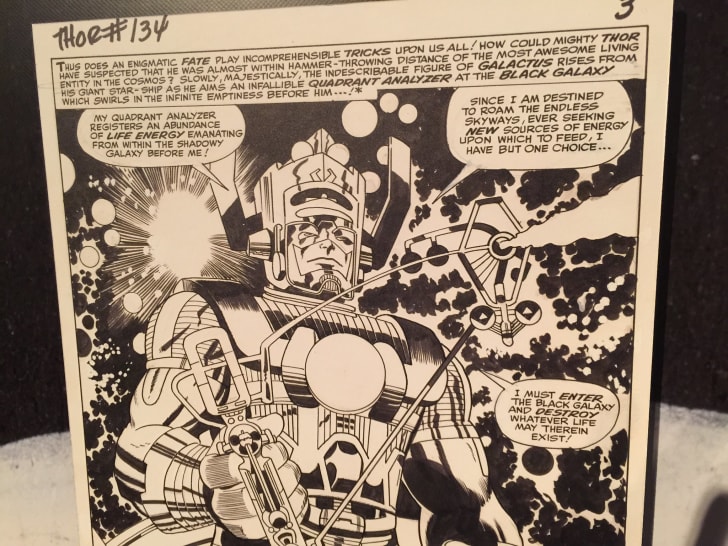
Uncolored artwork by Jack Kirby for Thor #134, featuring the “Kirby Krackle.”ACTUALITTÉ, FLICKR // CC BY-SA 2.0

In addition to taking advantage of double-page spreads and eye-popping splash pages, Kirby was known for being an innovator of many illustration techniques, including the use of collages and incredibly complex technical sci-fi drawings. However, one of his most unique artistic flourishes was the “Kirby Krackle” (or “Kirby Dots”), a stylistic convention that he used to depict high-energy phenomena such as explosions or certain cosmic elements in space.

7. Jack Kirby originally has a different name in mind for Black Panther.

Within the landscape of mid-century comics consisting primarily of white characters, Kirby championed more diverse comics with a robust representation of various races. To this end, Kirby sketched a new character named Coal Tiger, a Black superhero decked out in a colorful costume. The concept was reworked before it was ever published and eventually became Black Panther, who debuted in 1966’s “Fantastic Four” #52.

8. Other artists frequently redrew Jack Kirby’s Superman faces to make them fit DC’s “house style.”

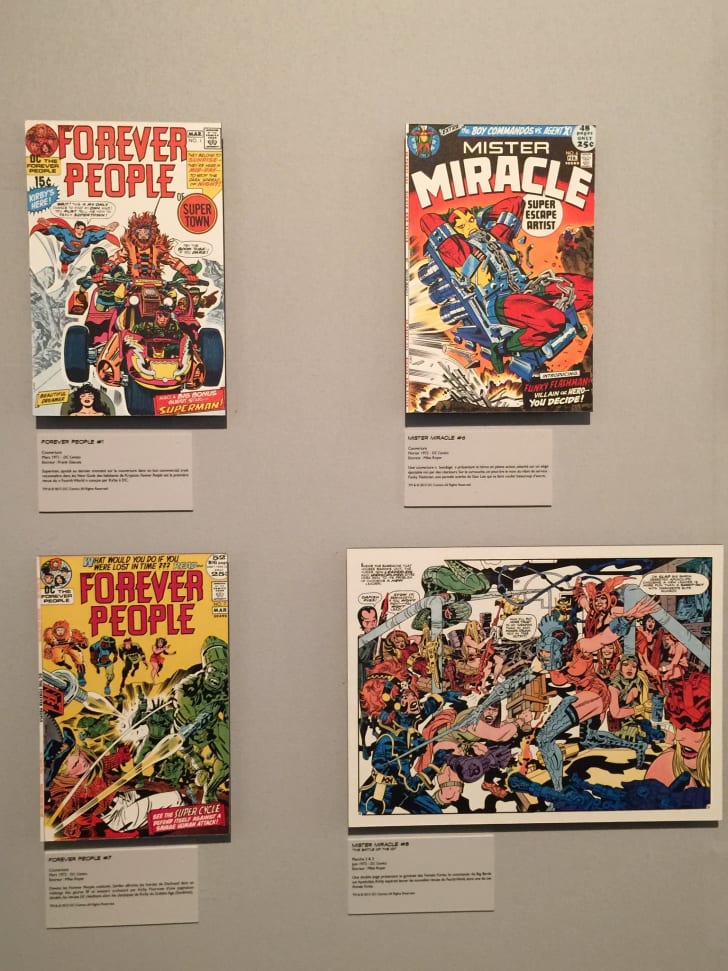
Forever People and Mister Miracle were among Jack Kirby’s creations for DC Comics.ACTUALITTÉ, FLICKR // CC BY-SA 2.0

During Kirby’s tenure at DC from 1970 to 1975, a variety of tried-and-true Superman artists, such as ’40s stalwart Al Plastino, were brought on to redraw and retouch many of the Superman and Jimmy Olsen faces that Kirby drew for his stories. Although he went along with it, Kirby apparently found it a little insulting, according to comic writer and former Kirby assistant/biographer, Mark Evanier. Despite hiring Kirby to move DC in a new direction after the legendary artist departed from rival Marvel, the company wanted Kirby’s characters to have a standardized look that fit their “official” comics style.

9. There was a short-lived “Kirbyverse” based on original Jack Kirby characters.

Published between 1993 and 1994, the “Kirbyverse” was a comics linereleased by Topps Comics that consisted of drafts of stories and previously unpublished characters that were never fully realized by Kirby. While the issues themselves used Kirby’s art on some covers, the interior art was mostly done by a number of comic veterans like Spider-Man co-creator Steve Ditko, Don Heck, and Walt Simonson, with Roy Thomas as the writer. Although what was released as part of the Kirbyverse is beloved by many Kirby fans, it never became a true commercial success.

10. Jack Kirby’s relationship with Marvel turned contentious (and eventually litigious.)

While Jack Kirby created some of the world’s most popular comic characters, it wasn’t the financial windfall you’d assume, due to Marvel’s claims that all of his work was “for hire” and thus he did not have the right to terminate the company’s copyrights. Kirby worked for decades without royaltieshealth insurance, or possession of his original art. But he was especially vocal in feeling like Stan Lee had taken more credit than he deserved when it came to who actually created the characters they collaborated on, like The Fantastic Four and X-Men. Though he had small victories before his death in 1994—he would eventually receive some, but not all, of his original art from Marvel—the larger financial benefits always eluded him.

However, in 2014, after years of cases and appeals, Kirby’s estate settled a legal dispute against Marvel out of court for an undisclosed sum, right before it reached the Supreme Court. Though Marvel still owns the characters Jack Kirby created, it’s assumed his heirs now have the financial security he had always been after.

11. Some of Jack Kirby’s previously unpublished drawings were released posthumously.

In 2006, Marvel published “Jack Kirby’s Galactic Bounty Hunters,” a six-issue miniseries based on one of Kirby’s unfinished stories and concepts. Kirby’s daughter, Lisa Kirby, was co-writer with Steve Robertson, while Mike Thibodeaux provided the art. The covers to most of the issues were all unpublished Jack Kirby originals.

In 2008, Marvel also published “Fantastic Four: The Lost Adventure,” a story built from the abandoned Jack Kirby artwork for “Fantastic Four” #103, which Lee, who wrote the comic, had rejected toward the end of their increasingly tense partnership. Though this is the first time the public saw the full issue as it was originally intended, some of the art was originally salvaged for a flashback sequence in 1971’s “Fantastic Four” #108.

From beyond the grave, Philip Roth cancels himself

It isn’t often you get to see someone reach out from the grave and do more damage to himself than he managed to do while he was alive, but novelist Philip Roth has apparently succeeded in pulling off this neat trick. On Thursday, publisher W.W. Norton announced it was halting all shipment and promotion of “Philip Roth: The Biography” following allegations that its author, Blake Bailey, had raped two women and sexually “groomed” middle-school girls as a teacher in the 1990s.

Bailey was Roth’s hand-picked biographer. Every review of the book recounts the lengthy and arduous path of Roth’s search for the “perfect” person to write his biography. He began by trying to convince two of his friends and literary soulmates, Judith Thurmond and Hermione Lee, who are well known for their literary biographies of Isak Dinesen and Virginia Woolf, respectively. When his entreaties didn’t work out, he turned to another friend, Ross Miller, an English professor at the University of Connecticut. Miller signed a contract to write a Roth biography in 2004, but it didn’t take long for the relationship between author and subject to go sour. Roth apparently thought Miller was concentrating too much on the famous author’s notoriously difficult relationships with his two ex-wives and literally fired him by fax, declaring that he was “too fucking angry” to talk to his biographer. Miller, who had never written a biography before but who was already deep into interviews with Roth’s friends and acquaintances, told friends that Roth was “surrounded by sycophants” and walked away from the project.

After briefly considering James Atlas, author of a well-received biography of Saul Bellow, Roth settled on Bailey, who had previously written biographies of John Cheever and Richard Yates. Bailey proved far more simpatico to the prickly Roth, who was famously obsessed with both his literary reputation and also with his reputation as what we might call a “ladies’ man.” 

The two “ladies” Roth was most obsessed with were his wives, Margaret Martinson, a former waitress from Chicago, and Claire Bloom, the English actress. His marriages to both women were, shall we say, tempestuous. Martinson conned him into marrying her by faking a pregnancy, buying urine from a pregnant woman and then faking an abortion — this alongside having had two actual abortions after becoming pregnant by Roth, one before the one she faked and one demanded by Roth during their marriage. He did wring some use out of his marriage to Martinson by basing the two main female characters in “Letting Go” and “When She Was Good” on her, and he eventually made use of what he and Bailey both refer to as “the urine fraud” by having the main female character in “My Life as a Man” perpetrate the same marital treachery. 

Generally, Roth’s interest in casting his ex-wives as betrayers was in “winning” wars against them that divorce could never satisfy. Bailey provides help to Roth by transforming both women into literary cannon fodder. In Bailey’s book, women in general, but the two former wives in particular, are depicted as harridans who continually make unreasonable demands on the great writer’s time. Bailey seems to be entirely in Roth’s corner when he describes the way women in his life constantly nagged him to pick up something at the grocery store or take them shopping or drop them off at the hairdressers. It seems that when women weren’t making themselves available for Roth’s horizontal gymnastics, they were of little use to him.

Roth’s relationship with actress Claire Bloom was, to put it mildly, peculiar. At one point, Bloom went to visit Roth in a psychiatric facility he had checked himself into to be treated for depression — from which he suffered throughout his life — only to end up checking herself into the same facility. But Bailey most tellingly takes Roth’s side in his description of the novelist’s relationship, if it could be called that, with Bloom’s teenage daughter, Anna. Roth is described as constantly complaining about the young girl’s weight, telling friends how fat she is. Bailey describes him as so jealous of Bloom’s relationship with her daughter that he eventually demands, in writing, that Bloom’s daughter had to go or he would. Bloom gave in, and later described Roth’s demands in a distinctly unflattering light in her own memoir, “Leaving the Doll’s House.” 

Bailey tells of Roth at one point making an aggressive sexual pass at one of Anna’s friends. When rejected, he makes insulting comments to her every time she visits Anna. Bailey describes Roth defending his behavior, quoting him saying, “What’s the point of having a pretty girl in the house if you don’t fuck her?” Bailey describes this remark as Roth’s “impulse to mock a certain kind of bourgeois piety,” which — given this week’s news of Bailey’s alleged “grooming” of teenage girls for sex and his alleged rapes — has become an aside that now appears in an entirely new light. “Bourgeois piety?” Whose bourgeois piety could he be referring to, pray tell?

Bailey’s biography of Roth, who made no secret of his sexual obsessions and did little to conceal the numerous affairs he had with women he was not married to during his lifetime, appears now as a telling document of obsessions Bailey obviously shares with his subject. Bailey takes Roth’s side throughout the book in his many contretemps, large and small, with the women in his life. Roth is described as constantly having to put up with women’s pettiness and annoying demands on his time. The women are, Bailey seems to agree, a singular threat to the great man’s genius, and when Roth is attacked by Bloom in her memoir, a threat to his literary career as well. It’s surprising, finally, that Bailey doesn’t blame Roth’s failure to receive the Nobel Prize on Claire Bloom or his extensive list of lovers. Such is the burden of greatness, Bailey seems to be saying on behalf of his subject.

Given the events of the last 48 hours in the life of Blake Bailey, he may well rue the day he ever agreed to write the biography of perhaps the most sex-obsessed man in American letters. And from the grave, Philip Roth must be ruing that he picked Bailey as the man to whom he would entrust his literary reputation. A canceled book, even one as glowingly complimentary as Bailey’s biography of Roth, will be difficult to check out of a college library if it’s not there.

The proverbial chickens have come home to the proverbial roost in the lit-world. Bailey quotes Roth as complaining that things have turned so puritanical that if you sleep with young women who are your students these days, “you go to feminist prison.”

You’re going to look good in your orange feminist prison jumpsuit, Blake my boy. It’s too bad Philip Roth left this mortal coil before his biography was published. They would have made great cellmates.

Marilyn McCoo and Billy Davis Jr. of the Fifth Dimension on reinterpreting Beatles songs for today

Grammy Award winners Marilyn McCoo and Billy Davis, Jr. joined host Kenneth Womack to talk about their new album, the British Invasion, Beatles’ lyrics and more on “Everything Fab Four,” a podcast co-produced by me and Womack, a music scholar who also writes about pop music for Salon, and distributed by Salon.

Married duo McCoo and Davis, former members of The Fifth Dimension (the legendary group behind such hits as “Up, Up and Away,” “Aquarius/Let the Sunshine In” and “Stoned Soul Picnic”) are also award-winning singer-songwriters in their own right. And they recall the Beatles landing in America just as they were starting out in their own musical careers.

“We were like, ‘what in the world?'” says McCoo of the Fab Four hitting the tarmac at JFK Airport in February of 1964, surrounded by scads of screaming teenagers. As for the music, Davis says as musicians themselves he and McCoo “listened to everybody’s stuff,” and what was “so cool” about the Beatles at that time was “they were reintroducing to the United States, music that came from the United States” — such as the blues, and “the Black artists they were tuned into” like Chuck Berry and Little Richard.

As the ’60s progressed, though, what became particularly remarkable about the Beatles to the couple were their lyrics. “You can take their music,” McCoo explains to Womack, “and you can take it in different ways, because the lyrics are so great.” And that’s exactly what she and Davis have done on their new album, “Blackbird: Lennon-McCartney Icons,” which features fresh takes on the title tune but also “Ticket to Ride” (which The Fifth Dimension had covered on their second album ever, in 1967) and “The Long and Winding Road.”

The couple uses their updates on these classics to convey what they believe is “a perfect message” for a lot of today’s human rights issues. “You think everything is moving forward,” says Davis, “and then something happens to remind us that we’re right back where we started. Not exactly where we started, but so much is still going on that’s been covered up, and now it’s being brought out.”

The video for their cover of “Blackbird” premiered here on Salon — you can read Womack’s take on their interpretation and watch the video here. 

In addition to the important messages that are front and center on “Blackbird,” there is also joy in such tunes as the cover of Paul McCartney and Wings’ 1976 hit, “Silly Love Songs.” “I like what it has to say,” remarks Davis and, in paraphrasing McCartney himself, “Love…what’s wrong with that?”

Listen to the entire conversation with Marilyn McCoo and Billy Davis, Jr. on “Everything Fab Four” and subscribe via SpotifyApple PodcastsGoogle or wherever you get your podcasts.

“Everything Fab Four” is distributed by Salon. Host Kenneth Womack is the author of a two-volume biography on Beatles producer George Martin, the bestselling book “Solid State: The Story of Abbey Road and the End of the Beatles,” and most recently “John Lennon, 1980: The Last Days in the Life.”

If only “The Falcon and the Winter Soldier” had the guts and time to “get weird” enough for TV

In “Captain America: The First Avenger” Steve Rogers’ first official job for the U.S. government was to encourage people to buy war bonds in his best can-do voice as “The Star Spangled Man with a Plan.” Steve had serum-endowed super strength, extraordinary speed, an impressive long jump and bravery to spare.

But the military had zero faith in Steve, so they put him in a USO chorus line — kind of like creating a custom sports car that’s also flight capable and then bolting it onto a carnival carousel. The only way he could become Captain America was to defy orders, throw himself behind enemy lines to save Bucky (Sebastian Stan) and show off the extent of his capabilities by punching actual Nazis

Take note that this sequence happens halfway through the movie. Not at the end, halfway.

The Falcon and the Winter Soldier” is set some eight decades after that in the Marvel Cinematic Universe’s timeline, but some things haven’t changed much. When Sam Wilson (Anthony Mackie) embarks upon his first mission as Captain America he doesn’t wait for orders or permission to wear the colors or carry the shield, because he knows they will never be given. So he steps in and does the job that needs to be done.

If you’ve been watching “The Falcon and the Winter Soldier” you may ask yourself, “To which job does this refer?” Is it claiming the title of Captain America, or standing up as a Black man in America, with all that implies and risks, to become a symbol what heroism looks like? The answer to both questions is yes.

In the finale, titled “One World, One People,” Sam and Bucky charge into the fray to rescue kidnapped members of the Global Repatriation Council from a group of super soldiers called the Flag Smashers, and we’re reminded that Sam does not have amplified powers. He has been gifted a fresh uniform from the Wakandans, complete with wings and a jet pack that lends him a strength boost when he needs it, but that’s about it. Otherwise it’s all about his skills.

That engine is very handy for battling a group of serum-jacked scrappers, but it’s also useful when he has to do that classic superhero task of stopping a large vehicle full of people from falling off of a bridge. Onlookers film it all for social media, of course, and bust out exchanges such as:

Old guy: “Hell yeah! That’s the Black Falcon right there!”

Young man: “Nah . . . that’s Captain America.”

Sam’s Captain America is very much a hero, and like Steve, he knows he has to put on a show.

If “The Falcon and the Winter Solider” were nothing but an action romp, all the slam-bam sequences exploding around Sam’s debut would have made for a decent middle-of-the-plot peak on our way to a better climax.

But six episodes is all we get of “The Falcon and the Winter Soldier,” netting us a frenetic closer overflowing with haymakers, face kicks, bip!-boom!-pow! and grunts, surprise battlefield appearances by Sharon Carter (Emily VanCamp) and disgraced former Captain John Walker (Wyatt Russell), along with one supposed revelation that anyone who can do basic math should have put together some time ago. For all of that, the hour contained very little emotional depth.

It was about what I expected; that is, it was fine. Not great but . . . fine.

If great is what you want, watch the fifth episode. Also, bear in mind that what series creator Malcolm Spellman sought to accomplish in telling Sam Wilson’s origin story and where I’m suspecting Marvel required him to land this plane were probably destined to be at odds. Sam’s journey is a poignant one, but steering it into whatever dock Marvel built for it was bound to shortchange the development and service of other themes.

For one thing, compressing the plot into six episodes limited Bucky’s storylines. Considering his prominence in several of the films, that’s excusable. Sam’s origin story is the one that needed exploring given how much of a third wheel in the Steve-Bucky dynamic he often seemed to be. Also, he’s the one destined to pick up that historically loaded hunk of vibranium, not Bucky.

Another subplot deserving more attention is Sam’s conflicted feelings about the young Flag Smasher Karli Morgenthau (Erin Kellyman), whose struggle he understands. And when they fight, he makes a point of being entirely on the defense . . . which makes her demise at the hands of a less caring person inevitable.

But if Sam had anything else to get off his chest, surely he did it in the finale. The new Captain’s debut may be recalled less for his daring and bravery than his lengthy speeches delivered in front of news cameras. Everything stops stock still for Sam to explicitly spell out precisely what the audience is supposed to take away from this story — other than the thrill of watching a Black man rise from auxiliary Avenger to the A-Team.  

Isn’t monologuing a villain thing? I digress . . .

As Sam takes members of the Global Repatriation Council to task for demonizing poor people, Mackie’s delivery is rivetng. “You have to stop calling them terrorists,” he says. “Your peacekeeping troops carrying weapons are forcing millions of people into settlements around the world, right? What do you think those people are going to call you?  These labels — terrorists, refugees, thug — they’re often used to get around the question why.”

When a powerful GRC senator informs Sam he doesn’t understand, the new Captain scoffs at him 

“I’m a Black man carrying the stars and stripes. What don’t I understand?” he asks. “Every time I pick this thing up, I know there are millions of people out there who are going to hate me for it. Even now, here, I feel it. The stares. The judgment. And there’s nothing I can do to change it. Yet I’m still here.”

Then comes the kicker, bam, straight to the chest: “No super serum. No blonde hair or blue eyes. The only power I have is that I believe we can do better. We can’t demand that people step up if we don’t meet them halfway.”

Allow me to be the first to admit that I enjoyed being pandered to in this fashion, especially at the end of this particular week. Precisely when we thought we could exhale at hearing the jury in Derek Chauvin’s trial come back with a guilty verdict on all three counts against him, we learned that Columbus, Ohio, police gunned down 16-year-old Ma’Khia Bryant. While we processed that, hundreds gathered to pay their respects at the funeral of Daunte Wright, another unarmed Black man killed by a cop. 

Hearing those words in such an exhausting atmosphere lifts the spirit. There aren’t many Black superhero shows or blockbuster movies out there, and there are even fewer that take the effort to show a figure like Sam using his pull to set the woeful history of abused and tortured Black super-soldier Isaiah Bradley right and get him his own dedication in the Smithsonian.

If Spellman and his co-writer Josef Sawyer wants to indulge in a hero’s sermon to make a point, terrific.

Through another perspective Sam’s speech is a painful reminder that his America is not our reality, not at all. His declaration may even sound like a hollow, liberal version of “America: We’re better than this!” agitprop.

Removing the emotionality from it, slathering heavily messaged dialogue between firefights and conflagrations might be OK for a big dumb action flick, but it’s simply bad TV. And committing to some version of this throughout the season shorted a number of secondary characters and defanged the season’s main adversaries. 

The Falcon and the Winter Soldier
Erin Kellyman in “The Falcon and the Winter Soldier” (Disney+/Marvel)

Kellyman is a capable performer but wasn’t afforded much of an opportunity to explore Karli’s range, and her group lacked the flavor and spark to make them a pressing menace. When Zemo’s man ended the remainder of them I was relieved that we wouldn’t be seeing them again.

Russell’s John Walker is more fearsome, but he’s also an antagonist that came to the series with an established background. Even if you aren’t familiar with his mythology, surely you know some version of guy. He’s a Fox News Nation hero. Indeed, one of Walker’s most intriguing moments in the finale wasn’t his fight scene — it really wasn’t, ouch — but the look Russell sets around Walker’s eyes and mouth as Sam talks about judgment and stares. It’s raw resentment, the kind that the right wing gorges upon.

Sure enough, in the epilogue we see Rebekah Mer—sorry, Countess Valentina Allegra de Fontaine (Julia Louis-Dreyfus, who is flawless! I have no notes!) reappear with a black super suit for John and a new moniker. 

“Things are about to get weird,” she warns. “So when they do we’re not going to need a Captain America. We’re going to need a U.S. Agent.”

Let us not forget Ms. Sharon Carter, the exiled government agent woman whose pirate country home is bedecked with stolen masterpieces and other black market goodies . . . and yet somehow, nobody bothered to connect Sharon’s wealth and pull to the biggest bad in that part of the world, the Power Broker. It’s her! Duh-doy! And now that Sam has scored a pardon for Sharon, placing her back in government and with full access to prototype weapons and state secrets . . . why, I’m sure that’ll all work out splendidly for the first Black Captain America.

As for Bucky, he managed to make his amends with Mr. Nakajima (Ken Takemoto), the man whose son he killed as the Winter Soldier, tying off that loose end. Stan made a meal out of the dramatic crumb that too-brief scene granted him; I wanted more, but I’m not sure how that would work.

Wouldn’t it be wonderful if we got to see some of that weirdness Val mentioned kick off, say, next week? 

No such luck. Whenever these adventures resume — that is, whenever the freshly announced “Captain America 4” comes out — maybe Spellman will have found the same kind of narrative balance that Sam and Bucky’s partnership achieves at the end of the show, as they enjoy a family cookout on the bayou.

Now, and satisfyingly, they’re known as “Captain America and The Winter Soldier.” If only the story hadn’t ended just as it was starting to get good.

All episodes of “The Falcon and the Winter Soldier” are streaming on Disney Plus.

The Falcon and the Winter Soldier
“The Falcon and the Winter Soldier” (Disney+/Marvel Studios)

Are mass shootings an American epidemic?

The U.S. has suffered yet another mass shooting, with a deadly attack in a FedEx facility in Indianapolis. This was the fifth mass shooting in five weeks, including a shooting at a supermarket in Boulder, Colorado that took the lives of 10 people on March 22 and just days earlier, eight people were killed in a series of shootings at spas in Atlanta, Georgia. Public outcry about gun violence, gun rights and racism and what to do about these issues is high.

As a criminal justice researcher, I study gun purchasing and mass shootings, and it’s clear to me that these events are traumatic for victims, families, communities and the nation as a whole. But despite the despair about their slightly growing frequency, they are actually uncommon incidents that account for just 0.2% of firearm deaths in the U.S. each year.

Mass shootings are rare

Killings are not the only kind of gun violence, and are in fact a relative rarity when compared with other forms of gun violence in the U.S. According to the National Crime Victimization Survey, 470,840 people were victims of crimes that involved a firearm in 2018, and 481,950 in 2019. Each person is counted separately, even if several of them were part of the same incident, and this tally does not require the gun to be fired or anyone to be killed.

When it comes to people killed by firearms, police data reported to the FBI estimates that guns were used in 10,258 of the 13,927 homicides that occurred in 2019.

That’s much higher than even the uppermost count of mass shootings in 2019, the 417 recorded by the Gun Violence Archive. That group counts all incidents in which at least four people are shot, excluding the shooter, regardless of whether the shooter is killed or injured. It also includes events that involve gang violence or armed robbery, as well as shootings that occurred in public or in private homes, as many domestic violence shootings do.

A Mother Jones magazine database that defines mass shootings more restrictively lists only 10 for 2019.

Even the FBI’s own data – which uses yet another set of criteria focused on people who continue to shoot more people over the course of an incident – records just 28 active shooter incidents in 2019.

The most recent research on frequency of mass shootings indicates they are becoming more common, though the exact number each year can vary widely.

But not all experts agree. Some argue that mass shootings have not increased and that reports of an increase are due to differences in research methods, such as determining which events are appropriate to count in the first place.

Speaking about school shootings specifically in a 2018 interview, two gun violence researchers said that those events have not become more common – but rather, people have become more aware of them.

The same may be true of mass shootings more generally. In any case, some researchers have found that mass shootings are becoming more deadly, with more victims in recent attacks.

Suicide is the leading form of gun death

In 2019, the 417 mass shootings tallied by the Gun Violence Archive resulted in 465 deaths.

By contrast, 14,414 people were killed by someone else with a gun in 2019. And 23,941 people intentionally killed themselves with a gun in 2019, according to the Centers for Disease Control and Prevention.

Every year, homicides – one person killing another – make up about 35% of gun deaths. More than 60% of gun deaths are suicides.

Mass shootings can get more attention than these other, more common, types of firearm deaths both because of human nature and the news media. People are naturally curious about violent events that appear random, with no clear explanation. Those incidents often spark fears about whether similar things could happen to them, and a resulting desire to know more in an effort to understand.

In addition, cases with higher death counts or unusual characteristics, such as a shooter manifesto or video footage, are more likely to get press attention and extended coverage.

Americans’ opinions are split on whether mass shootings are isolated incidents or part of a broader societal problem.

And Americans are divided about how to reduce their frequency. A 2017 poll found that 47% of adults believed that reducing the number of guns in the U.S. would reduce the number of mass shootings. But a follow-up question revealed that 75% of American adults believe that someone who wants to hurt or kill others will find a way to do it whether they have access to a firearm or not.

With those diverging views, it will be hard to develop solutions that will be effective nationwide. That doesn’t mean nothing will change, but it does mean the political debates will likely continue.

This is an updated version of an article originally published on March 29, 2021.

Lacey Wallace, Associate Professor of Criminal Justice, Penn State

This article is republished from The Conversation under a Creative Commons license.

Major media is taking millions from Facebook — and keeping the details secret

I understand the temptation for the leaders of news organizations to take millions of dollars of free money from Facebook — despite, or even because of, all the damage the company has done to our industry and the public discourse.

But I don’t understand the willingness of the news executives to keep it secret.

My article in the Washington Monthly on Monday revealed how, under the cover of launching a news “tab” that as far as I can tell doesn’t effectively serve any other purpose, Facebook in 2019 started delivering massive amounts of cash to the most influential news outlets in America — on the condition that they not reveal the details.

The urgent need for full disclosure of these secret agreements with Facebook is the most obvious takeaway from my research into the multimillion-dollar “Facebook News” scheme. The deals were widely hailed at the time as establishing that the social media behemoth would henceforth pay for news. But what they really demonstrated was the continued death grip Facebook has on the news industry, and the profound submissiveness of the country’s top newsroom executives.

In an effort that Damon Kiesow, a professor at the University of Missouri School of Journalism, described to me as being “flavored with a strong dose of crisis communication and regulation avoidance,” Facebook chose the New York Times, the Washington Post, the Wall Street Journal, ABC News, Bloomberg, BuzzFeed and other select outlets to be their “paid partners.”

We don’t know how much they get per year, because they agreed not to tell. A Facebook spokesperson told me a Wall Street Journal report that outlets were getting up to $3 million a year was “not too far off,” but that statement was belied by former New York Times CEO Mark Thompson, who told me the Times is getting “far, far more.”

Certain other outlets were selected by Facebook to appear in the new section, but without getting paid. As we already know, news organizations generally pay Facebook to send them traffic, not the other way around.

So the money is basically a gift to news outlets that have political clout — and accepting such a gift creates an obvious conflict of interest. The paid “partners” are effectively giving the appearance of legitimacy — indeed, of benevolence — to a company engaged in choking out the news industry even as it provides oxygen to conspiracy theories and lies. And it leaves the smaller, ethnic and local news organizations that really need the help to die.

I fully recognize that a fair and elegant solution to Facebook’s profoundly destructive influence on the free press and democracy is not something we can practically expect in the short term. So the best argument in support of the decision to take the money is: What were they supposed to do, not take the money?

But that’s no excuse for keeping it secret. Facebook’s demand for secrecy should have been publicly rejected by outraged news executives.

Going forward, news organizations should not only disclose to readers what they’re getting, and under what circumstances, but should also append public disclosures whenever they write about Facebook.

They should publicly acknowledge that taking money from Facebook creates a relationship, and they should be up front about what that relationship entails and signifies.

They should provide evidence that neither their news nor opinion sides have been compromised by those deals. I’m not saying anyone in particular has gone easy on Facebook on account of the money, but my view (and I recognize I’m a bit of an extremist here) is that the only way to show the absence of any sense of obligation is to bite the hand that feeds you — extra hard.

I wrote the article about Facebook News on a freelance assignment from the Open Markets Institute’s Center for Journalism & Liberty, as part of the group’s work to ensure that a fully independent news media survives the ravages of the Facebook and Google duopoly.

There was a lot of talk about the article at the group’s all-day conference on the future of journalism and democracy on Tuesday. Rep. David Cicilline, D-R.I., chair of the House Judiciary antitrust subcommittee, cited it as evidence of how Facebook and Google continue to “have tremendous sway over journalism with their monopoly power over digital advertising and their role as gatekeepers online.”

I discussed the article on a panel that included, among others, Ben Smith, the media columnist for the New York Times who was formerly BuzzFeed News editor-in-chief — and who, it turns out, negotiated BuzzFeed’s deal with Facebook News. (He said that discussion was “very one-sided,” with Facebook presenting a figure that was “an estimate that I believe they gave roughly off how much BuzzFeed was being consumed on Facebook, which was a lot.”)

My article called particular attention to the New York Times’ relationship with Facebook, in part because the Times’ former CEO had been so passionate and eloquent about the danger the company presented to journalism — until he took their money, that is.

I asked Smith if he agreed that the Times should at least disclose that it has a deal with Facebook when writing about the company. Smith said he had “thought about this a lot” when he was at BuzzFeed. “I would rather talk about that, although my opinion would be the same,” he said, “which is that if we are writing about Facebook … when we were writing about anything vaguely related to Facebook news initiatives, we disclose that we were taking their money, that we were in a business relationship with them.”

Smith made the point that “news media companies increasingly have financial relationships all over the map. I guess there is sort of a balance of where should you disclose it.”

But in the case of Facebook News, he said, “I don’t think it should be hidden or concealed. Certainly when you’re writing about anything related to that program, you should disclose it. Maybe you should have a page on the site where you disclose all of that stuff, actually? It’s not crazy for readers to wonder whether it affects journalism.”

Indeed, BuzzFeed did disclose (vaguely) that it received compensation from Facebook News in August 2020, in a story about Facebook’s handling of inflammatory or misleading posts from Donald Trump, and in a February story revealing New York Times columnist David Brooks’ previously undisclosed relationship with Facebook.

By contrast, there has been no similar disclosure by the New York Times, even when explicitly writing about Facebook paying Rupert Murdoch’s News Corp. for its journalism content in Australia, or about news consumption on Facebook and tweaked algorithms for news.

Richard Tofel, the president of ProPublica, tweeted that he didn’t agree with everything in my article, but said, “I do think there should be disclosure in news stories about entities with which a news org has a significant commercial link.”

Hiding is a terrible look for powerful institutions that are ostensibly devoted to holding powerful institutions accountable.

Bills targeting local officials who resisted Trump could allow GOP to “overturn election results”

Republicans in at least 14 states have introduced legislation that would seize power from election officials or limit their authority, apparently in response to unfounded attacks from former President Donald Trump and allies who sought to overturn his election loss.

Republican state legislators across the country have responded to Trump’s baseless election challenges, which were roundly rejected by dozens of judges, by rolling out more than 360 bills aimed at restricting voting access in nearly every state. But while much of the attention has focused on measures that would limit ballot access, like Georgia’s sweeping election bill, which Democrats have compared to Jim Crow-era restrictions, some of the proposals include provisions that would strip election officials of power and even impose criminal penalties for officials who defy the new restrictions.

Coverage of Georgia’s massive bill has largely focused on provisions that would restrict absentee ballot access and make it a crime to provide water or food to voters in long lines. But the bill also includes more insidious measures that could allow Republicans to give “themselves power to overturn election results,” Sylvia Albert, director of the voting and elections program at the nonpartisan voter advocacy group Common Cause, said in an interview with Salon.

For instance, the new law would allows the Republican-led state legislature to replace Georgia’s secretary of state — currently Brad Raffensperger, who pushed back on Trump’s efforts to overturn his defeat — as chair of the state elections board, and then fill a majority of the panel with their own appointees. The bill further allows the newly-appointed election board majority to suspend and temporarily replace local election officials and take over county election offices. County boards determine voter eligibility and certify election results, meaning the state board appointee would theoretically have the power to disqualify certain voters or to refuse to certify the results, according to the Lawyers’ Committee for Civil Rights Under Law. The law also bars local election officials from sending unsolicited absentee ballot applications or accepting grant money that is used by some cash-strapped counties to run elections. Voting rights advocate Stacey Abrams decried the provision as an “unprecedented power grab” intended to “alter election outcomes.”

“This bill is a tragedy for democracy, and it is built on the lie of voter fraud,” Lauren Groh Wargo, who heads the Abrams-founded voter advocacy group Fair Fight Action, said in a press call last month. “It means that radical, right-wing legislators, if they don’t like how elections are being run … can wholesale replace those election administrators and put folks from the other side of the state in charge.”

It remains to be seen how this would work in practice. Some election experts have noted that there are guardrails that could prevent officials from overturning election results. The law limits such takeovers to four counties at a time and includes measures requiring the board to show multiple violations in at least two election cycles and a process that would drag out for at least 30 days. But it would be easy for the board to find multiple violations in “any county,” argued Marilyn Marks, the executive director of the nonpartisan Coalition for Good Governance.

The law could “absolutely” be used to overturn election results, Albert said, given the repeated attempts by Trump supporters, including many Georgia Republicans and even Texas Attorney General Ken Paxton, to overturn the state’s results last year. “Politicians will look to use any avenue available to them to maintain power. Just because it might have a few steps doesn’t mean that they won’t do it or figure out ways to get around those steps.”

But it’s more likely this law would be used to “ensure that their suppression measures are successful,” Albert added. “What this is doing is saying, ‘Hey, we enacted suppressive state laws and we want to make sure no local election official actually attempts to help people overcome the burdens of those state laws.'”

Some of the provisions in the Georgia law appear directly aimed at heavily Black and Democratic Atlanta-area Fulton and DeKalb counties. Texas lawmakers have introduced their own sweeping set of proposed voting restrictions that similarly target Harris County, the state’s most populous, including the city of Houston, where Democratic officials expanded ballot access last year.

Texas Senate Bill 7 explicitly bans 24-hour early voting, drive-through voting, and the mailing of unsolicited absentee ballot applications, all of which were measures taken or attempted by Harris County officials last year. Texas House Bill 6 would make it a felony for election officials to mail pre-filled absentee ballot applications or even encourage eligible voters to cast ballots by mail or take any action to change election rules without the consent of the state’s Republican secretary of state.

While those two bills have already advanced in their respective chambers, a third proposal that is still pending would shift all power over voter registration and voter roll maintenance from county officials to the Republican secretary of state.

Republicans in Arizona also pushed a proposal that would have allowed the GOP-led legislature to overturn election results and appoint their own electors, though that effort was ultimately quashed. But the state legislature, which has introduced two dozen restrictive bills, is still looking at bills that would bar the secretary of state from sending unsolicited mail-in ballots and another proposal that would shift approval of the state’s election manual to the legislature.

“They don’t serve any purpose, except for the Legislature just trying to insert themselves into the process, create obstruction, and say that they did something in the name of election integrity without actually doing anything that does that,” Arizona Secretary of State Katie Hobbs, a Democrat, told The New York Times. “The Legislature wasn’t interested in control over elections until I got here and happened to have a ‘D’ by my name.”

Iowa Republicans have already passed a package of voting restrictions that include measures making it a felony for election officials to disobey any guidance from the Republican secretary of state and imposing $10,000 fines for any “technical infractions” of the state’s election laws. It also bars county officials from sending unsolicited absentee-ballot applications and restricts their ability to open satellite early-voting sites.

“This is a total takeover of elections by the state,” Linn County Auditor Joel Miller, who was among several local election officials in Iowa targeted by Trump and Republicans, told the Associated Press. “We did everything we could to increase participation and engagement in the democratic process, and evidently some people thought that more people participated than they wanted and they decided to put limitations on it.”

Arkansas Republicans have advanced bills that would give partisan county election boards total power over local election officials, move oversight of election law violations from county officials to the state election board, and ban officials from mailing unsolicited absentee-ballot applications. A pending proposal would also allow the state election board to take over local election offices.

Missouri lawmakers recently advanced a bill that would allow the secretary of state to audit and purge voters from any local election office’s voter rolls. The bill threatens to cut funding to noncompliant offices and restricts mail-in voting. Another pending proposal would impose misdemeanor penalties on election officials who failed to purge voters within 10 days of their death.

South Carolina Republicans have rolled out a bill that would give the state legislature more oversight over the members appointed to the state’s independent election commission.

An analysis by FiveThirtyEight identified 14 states with bills aimed at undermining election officials, including proposals to ban the mailing of unsolicited absentee-ballot applications in Michigan, Tennessee, Connecticut and South Dakota and bills restricting the mailing of absentee ballots in New Jersey, New York, Illinois and Wisconsin. 

While the measures are not expected to get far in Democratic-led states — except in Michigan where Republican state lawmakers are plotting to subvert Gov. Gretchen Whitmer’s vow to veto any voting restrictions — they are likely to advance in states where the GOP has attacked “election officials who did not support Trump’s lies,” Albert said.

Republicans have justified the proposals by arguing that election officials overreached in their efforts to expand mail-in voting amid the coronavirus pandemic and took “the law into their own hands” against the wishes of elected state lawmakers.

“It’s a bunch of BS,” Albert said in response to the Republican argument. “It is clearly an attempt to take power away not just from local election officials, but from Americans.” Republicans, she added, are effectively giving themselves “the power to eliminate democracy in elections … what they’re saying they want to do is take away the rights of Americans to elect their representatives.”

Some advocates have also warned that many of these measures are aimed at counties with quickly changing demographics after record turnout among voters of color in 2020.

“The part that I think is so concerning is the retaliation,” Myrna Pérez, director of the Voting Rights and Elections Program at the Brennan Center for Justice, told FiveThirtyEight. “Look at who on the ground would actually be impeded [by these laws]. That suggests to me a real opposition to an expanded electorate.”

Democrats have responded to the voting restrictions proposed in dozens of states by championing the For the People Act, also known as H.R. 1 and S. 1, a massive legislative package including voter protections, anti-corruption measures and other provisions. It is unlikely to pass in its current form unless Democrats can reform the filibuster and convince conservative Democrats like Sen. Joe Manchin, D-W.Va., and Kyrsten Sinema, D-Ariz., to back it. But while the bill could protect voters from some restrictions, it would do little to prevent partisan power grabs of local election powers.

That issue has been raised as the bill goes through the Senate, but “off the top of my head, I honestly don’t know what type of provision one would add to H.R. 1 that would address this,” Albert said.

Some members of the Congressional Black Caucus have urged Democrats to focus instead on passing the John Lewis Voting Rights Advancement Act, which would restore the Voting Rights Act requirement for states with a history of racial discrimination to pre-clear any electoral changes with the Justice Department, which was scrapped by the Supreme Court in 2013.

Albert argued that there may be a legitimate way to address these attacks on local authorities through pre-clearance. “A strong argument could be made that changing the power of local election officials is definitely a change to election law that would have an effect on Black and brown communities,” she said.

Albert compared the Republican push to take over local election powers to authoritarian regimes in Russia and North Korea.

“America is one of the only democracies that does not have elections run by a nonpartisan government entity,” she said. “What you’re seeing right now is the danger of politicians running elections. We should all be very much on guard.”

Tucker Carlson’s college yearbook contains apparent reference to Harvey Milk’s murderer

A freshly resurfaced 1991 Trinity College yearbook featuring Fox News superstar Tucker Carlson listed him as part of the “Dan White Society,” an organization affiliated with pushing an extreme anti-LGBTQ agenda. Another organization listed under Carlson’s name in the yearbook was the “Jesse Helms Foundation,” a reference to the arch-conservative former North Carolina senator, who for much of his career supported segregation.  

As for the “Dan White Society,” that appears to refer to the disgruntled local politician who became infamous for shooting and killing San Francisco Mayor George Moscone and Supervisor Harvey Milk — the nation’s first well-known openly gay elected official — in 1978. Carlson, who was born in San Francisco and spent his early childhood there, was nine years old at the time.

The Wrap confirmed with Trinity College, a small liberal arts school in Hartford, Connecticut, that the yearbook images reproduced in numerous social media posts this week are authentic. “While I cannot speak to the yearbook process in 1991, current practice is that only a student’s name, home state and/or country, and the student’s major are listed with their photos,” a Trinity College spokesperson told The Wrap

Trinity officials also told The Wrap that they could find no evidence suggesting that the Dan White Society was an actual organization affiliated with the college. Snopes reports it could not find evidence that the Jesse Helms Foundation was a school-endorsed group either. The organizations’ names could simply have been jokes in dubious taste. If they ever existed, they were likely unofficial or outside the college. 

Fox News didn’t return Salon’s request for comment on this story. 

During a Tuesday night segment on his show, Carlson attempted to go on defense, calling out Washington Post media reporter Erik Wemple for seeking to contact former college classmates of Carlson’s. “Jeff Bezos had one of his minions, a mentally unbalanced middle-aged man called Erik Wemple, pull out our dusty college yearbook and call around and see if we’d done anything naughty at the age of 19,” Carlson declared. 

“That sounds like fun. Let us know if you hear any good stories,” Carlson added. “But before Bezos drops any more of his billions on opposition research, he should know that it will not affect any election outcome. This is a news show, not a political campaign. No one here is running for anything or plans to.” 

Wemple declined to comment on the matter when contacted by Salon. 

How the Saudi lobby has tried to make a despotic Gulf monarchy seem all-American

Princess Reema bint Bandar al-Saud, Saudi Arabia’s ambassador to the U.S., was on the hot seat. In early March 2020, as the COVID-19 pandemic swept the world, oil prices collapsed and a price war broke out between Saudi Arabia and Russia, leaving American oil and gas companies feeling the pain. As oil prices plummeted, Republican senators from oil-producing states turned their ire directly on Saudi Arabia. Forget that civil war in Yemen — what about fossil-fuel profits here at home?

To address their concerns, Ambassador Bandar al-Saud agreed to speak with a group of them in a March 18 conference call — and found herself instantly in the firing line, as senator after senator berated her for the Kingdom’s role in slashing global oil prices. “Texas is mad,” Sen. Ted Cruz bluntly stated. As the ambassador tried to respond, Alaska Sen. Dan Sullivan retorted, “With all due respect, I don’t want to hear any talking points from you until you hear from all [of us], I think there’s 11 or 12 on the call.”

The Saudi lobby in Washington was similarly flailing in its reaction to the anger on Capitol Hill. Hogan Lovells, one of the Kingdom’s top lobbying firms in the nation’s capital, was spearheading the response, emailing staffers in the offices of more than 30 members of Congress. Its message couldn’t have been clearer: “Saudi Arabia has not, and will not, seek to intentionally damage U.S. shale oil producers.”

However, its efforts were apparently falling on deaf ears, as some of Washington’s most-lobbied policymakers remained furious at Riyadh for slashing oil prices. Even after being personally phoned four times by Hogan Lovells lobbyists between March and April, according to a Foreign Agents Registration Act (FARA) filing made by the firm, Sullivan called for the Trump administration to place tariffs on Saudi oil imports. Other Republican senators, who had previously supported billions of dollars in arms sales to the Kingdom, now threatened to upend the entire American alliance with Saudi Arabia. North Dakota Sen. Kevin Cramer, for instance, warned that the Kingdom’s “next steps will determine whether our strategic partnership is salvageable.”

That spring oil dispute was far from the first setback the Saudi lobby had faced in Washington in recent years. From the disastrous Saudi war in Yemen to the brutal murder and dismemberment of Washington Post columnist Jamal Khashoggi in the Saudi consulate in Istanbul, Congress had ample reason to turn its back on that country. Perhaps not so surprisingly, then, in a series of bipartisan bills that passed the House and the Senate, Congress sought to end America’s military involvement in the Saudi-led coalition’s brutal war in Yemen and halt arms sales to the Kingdom. Fortunately for the Saudi lobby, it had President Donald Trump, long wooed by the Kingdom’s royals in the most personal of ways, as a safety net to veto those bills and protect them from punishment for their many misdeeds.

Yet, in 2020, as the coronavirus pandemic ravaged America, it became increasingly clear that Trump’s re-election prospects were dimming and, with them, that guarantee of eternal protection.

And so, the question arose: What was an authoritarian government with oodles of lobbying money but dwindling influence in Washington to do as the prospect of a Joe Biden presidency and a Democratic Congress rose? The answer, it turned out, was to move its influence operation from the Beltway to the heartland.

The Saudis shift to the states

Since becoming ambassador in February 2019, Princess Reema found herself spending ever more time with people outside the Beltway, particularly in states that were reputed to have deep ties to Saudi Arabia. From Maine to Iowa to Alaska, the Saudi ambassador began a campaign of courting Main Street America.

In July 2020, she spoke at a virtual event hosted by the Greater Des Moines Partnership, the Des Moines International Trade Council and the Iowa Economic Development Authority. In attendance were many prominent local business leaders like Craig Hill of the Iowa Farm Bureau and Jay Byers, CEO of the Greater Des Moines Partnership. The event also included some modest star power, featuring a speech by Hall Delano Roosevelt, the grandson of President Franklin D. Roosevelt and the CEO of the U.S.-Saudi Business Council. (He would soon after publish an op-ed in a Maine newspaper urging local lobstermen to build ties with the Kingdom.)

Not surprisingly, the main focus of the ambassador’s speech was “the importance of the 75-year relationship between Saudi Arabia and the United States.” She also highlighted major changes she claimed were underway in Saudi Arabia, thanks to that country’s “Vision 2030,” a plan sponsored by Crown Prince Mohammed bin Salman, also known as MBS, the son of King Salman bin Abdulaziz al-Saud and the power behind the throne there. At least in theory, Vision 2030 was aimed at modernizing and diversifying Saudi Arabia’s oil-based economy.

Such presentations by the ambassador would soon become a pattern. She would, for instance, make a similar argument later in 2020 to Iowa’s Siouxland Chamber of Commerce’s Women Mentoring and Networking Committee.

And it wasn’t just Iowa. She began giving similar speeches across the country. In July, she spoke at a virtual event hosted by the Maine World Affairs Council. It would be attended by more than 70 members of the Maine business community and former Democratic congressman Mike Michaud. In early October, again virtually, she addressed the Wyoming Global Technology Summit and more than 80 business and political leaders. They included Gov. Mark Gordon (whom she even gifted with two pieces of art) and Cynthia Lummis, who, the next month, would be elected to the Senate. Later in October, the princess would speak to more than 50 local business leaders at the Alaska World Affairs Council.

Princess Reema’s road show would only sweep on, right past the election and inauguration of President Joe Biden. In late January, she would be at the World Affairs Council in Dallas/Fort Worth and, in March, the Houston World Affairs Council. As always, attending would be business leaders from the area, including (you won’t be surprised to learn) prominent oil executives. Whatever local issues she might focus on in such talks, the ambassador always kept the main focus on the splendors of MBS’s Vision 2030 plan and just how important it was to strengthen the decades-long relationship between the two countries.

Oh yes, and each of these events had one other thing in common: they were all organized and promoted by Saudi Arabia’s registered foreign agents.

Despite appearances, such events weren’t the product of meticulous planning by Saudi diplomats or the ambassador herself. Instead, the Saudis have done what many foreign governments do here to make their message heard. They hired lobbyists and public relations firms. In this case, one firm has largely been responsible for the way the Saudis have gotten the word out so far beyond the Beltway: the Larson Shannahan Slifka Group.

Also known as LS2, Larson Shannahan Slifka describes itself as a “bipartisan public relations, government affairs, public affairs, and marketing firm headquartered in Des Moines, Iowa.” It boasts an impressive collection of clients, including Walmart and the Ford Motor Company. Absent from its website, however, is any hint of the extraordinary amount of work it’s done to boost the Saudis nationally since signing a contract with the Kingdom in November 2019 worth $126,500 a month. In its FARA filings, that firm has reported conducting more than 1,600 political activities on behalf of the Saudis — more, that is, than all the other firms working for the Saudis combined in 2020, according to a soon-to-be-released report on the Saudi lobby from the Foreign Influence Transparency Initiative at the Center for International Policy, where we work.

Add in one more factor: unlike other firms that lobby for Saudi Arabia, LS2’s work has taken place almost exclusively outside of Washington. They’ve reached a remarkably sweeping set of state and local influencers on behalf of the Saudi royals, including small businesses, local politicians, nonprofit companies, small-town media outlets, synagogues and even high school students.

And whether any of those Americans realized it or not, they were being swept up in a campaign to give the Saudis local clout nationally and so pave the way for a Saudi public relations rehabilitation campaign in Washington itself.

Creating American grassroots for a Gulf monarchy

There’s a fairly simple pattern to the way the Saudi lobby has been wooing the states to woo Washington. First, Larson Shannahan Slifka launches a local campaign, including hundreds of calls and emails to state legislators, chambers of commerce, university professors, small businesses and just about anything or anyone you can imagine in between. Some of those ties, in turn, create opportunities for influential media moments such as, for example, when Saudi embassy spokesman Fahad Nazer — a former FARA-registered Saudi agent — conducted interviews with South Dakota Public Radio last October and “Michigan’s Big Show” this February.

Other lobbying activities have led to crucial Saudi outreach events, filling the seats (or Zoom invites) at think-tank discussions, business forums or even interfaith dialogues. For example, when Princess Reema delivered a keynote “fireside chat” at the annual Wyoming Global Technology Summit, John Temte, who leads the business network that hosts the forum, introduced the princess and moderated the question-and-answer discussion, a role likely arranged in the course of LS2’s six calls and emails to him over the preceding two weeks. Five days later, addressing the Siouxland Chamber of Commerce’s Women Mentoring and Networking Committee, the ambassador was introduced by Linda Kalin, the director of the Iowa Poison Control center, and another frequent LS2 contact. In this way, the firm effectively continues to turn local entrepreneurs and public-health officials into community ambassadors for the Kingdom.

And understand this as well: such events aren’t just a way for Saudi bureaucrats to meet local business leaders. They also provide the perfect opportunity for Saudi-backed lobbyists to begin rebuilding ties in Washington hurt by those falling oil prices, the devastating civil war in Yemen, and the killing of Khashoggi. Consider this the second part of the Kingdom’s faux-grassroots campaign and, for this, one of the Saudis’ key lobbying groups in Washington, Hogan Lovells, took over.

Its relationship with Saudi Arabia can be traced back at least to 1976 when the firm’s predecessor, Hogan and Hartson, first signed a contract with the Kingdom. Now, in addition to spinning a Saudi narrative about the disastrous war in Yemen, that firm has been working to convert LS2’s state and local efforts into political capital in Congress. Armed with glowing one-page summaries of such dialogues from Maine to Alaska, the firm has been promoting a vision of grassroots American support for the U.S.-Saudi relationship inside the Beltway. The event descriptions it sends around highlight many of the same people that Larson Shannahan Slifka had first contacted.

Its emails are tailored to each congressional office it contacts, mentioning issues and local stakeholders relevant to the intended senators and House members. For example, an email to the staff of Republican Sen. Susan Collins of Maine touted Princess Reema’s July forum at that state’s World Affairs Council, described the ambassador’s interest in a Saudi contemporary art exhibit displayed by local Bates College, and noted that former Democratic Rep. Mike Michaud attended the event. This February, after the Saudi ambassador addressed the World Affairs Council of Greater Houston, Hogan Lovells emailed Republican Sen. John Cornyn’s office to underscore her remarks on U.S.-Saudi cooperation on energy, technology, and space exploration in his home state.

While describing audiences in such local forums as responding with “overwhelmingly positive feedback” to the Kingdom’s messaging, one key fact is always omitted: that the events themselves were orchestrated by the Saudi lobby. Reading the glossy accounts of them, members of Congress and their staff normally have no idea that the meetings — and not just the press releases they’re receiving — were products of that very lobby. In other words, by omitting such details, the Saudi lobby has effectively launched an astroturfing campaign to influence Congress when it comes to future relations with the Kingdom.

The consequences

Of course, there’s nothing new about such lobbyists hired by foreign countries touting trade with the U.S., or anything necessarily unethical about promoting such ties. However, even as the Saudi lobby has eagerly peddled a rose-tinted story of the Kingdom’s increasingly diversified economy, expanding women’s rights and exciting tourism opportunities (despite the pandemic moment), policymakers and the media that cover them should remember that such a narrative is, at the very least (and to put the matter as politely as possible), incomplete.

While, in the context of Prince Mohammed’s Vision 2030 plan, selling future economic opportunities to Iowa farmers, South Dakota manufacturers and Maine lobstermen, LS2, Hogan Lovells and other such firms ignore the most crucial aspects of the U.S-Saudi relationship in the present moment: the staggering levels of U.S. arms sales to the Kingdom, the devastating war in Yemen that Prince Mohammed and crew continue to fight, the targeting of Saudi dissidents and women’s rights groups, and MBS’s complicity in the brutal murder of Khashoggi (as laid out recently in an intelligence report released by the Biden administration). These are real-world consequences of a partnership that has often escaped serious scrutiny, shielded by past presidents of both parties more concerned with protecting access to cheap oil and combating their definition of terrorism.

By enlisting trusted community members across the U.S. to help peddle the best possible version of the Kingdom, the Saudi lobby has given its brand a homegrown, American-as-apple-pie shine. At a moment when the Biden administration and Congress are weighing the future of the U.S.-Saudi partnership, the value of such an image shouldn’t be underestimated. As lawmakers look more skeptically at claims that American and Saudi security interests are still aligned, the Saudi lobby promises shared future profits in factsheets and emails that hail the historic trade ties between Michigan and Saudi Arabia or characterize the Kingdom as “South Dakota’s fastest growing export partner.”

In reality, however, even if a promised future economic boom between the two countries were to materialize, it would hardly ameliorate the Kingdom’s many negatives, from the catastrophic famine it continues to stoke in Yemen to its blatant human rights violations. Members of Congress and local public servants alike should beware. What may seem like a spreading grassroots show of support for the Kingdom could, in fact, be just another mirage in the desert.

Copyright 2021 Brian Steiner, Leila Riazi, and Ben Freeman

Donald Trump relocating to New Jersey to jumpstart fundraising efforts for 2024 campaign: report

Former President Donald Trump is headed north for the summer, and will move temporarily to his resort in Bedminster, New Jersey, according to a new report. 

Trump has spent the first few months of his post-presidency life at Mar-a-Lago, the beachside club in Palm Beach, Fla., that the New York real estate mogul has owned since 1985. But sources close to the former president told Business Insider that Trump is relocating temporarily and plans to use the move to jumpstart fundraising efforts for his 2024 campaign effort — not exactly an unexpected move for those in Trump’s orbit.

Mar-a-Lago traditionally closes for the season after Memorial Day, when the moneyed membership disperses to escape the state’s cloying summer heat — the club’s peak season usually lasts from Thanksgiving to Easter, according to the South Florida Sun Sentinel, the local newspaper that covers Palm Beach.

This doesn’t appear to be a permanent address change — Trump made that switch in advance of the election, declaring in a 2019 Declaration of Domicile, “I hereby declare that my above described residence and abode in the state of Florida constitutes my predominant and principal home and I intend to continue it permanently, as such.”

The move to Mar-a-Lago has already been a personal boom for Trump, who has raked in hundreds of thousands of dollars by hosting speeches and events for the Republican National Committee at the club — and the bonanza doesn’t appear to be ending anytime soon. 

Right-wingers of all stripes have flocked to the property in recent months, including a recent event at which Trump’s former CIA Director Mike Pompeo was spotted hobnobbing with anti-Muslim internet provacateur and former Florida congressional candidate Laura Loomer. 

This week, Sean Hannity even dropped $5.3 million on a condo just a few miles away, joining a number of other Fox News personalities who now call the wealthy enclave home.

Albuquerque refers Trump campaign’s unpaid rally bill to collection agency

The city of Albuquerque, New Mexico, has referred the Trump campaign’s unpaid rally debt to a collections agency, according to Mayor Tim Keller.

Trump left office with nearly $2 million in unpaid bills from cities that hosted his campaign rallies, including a $211,175 invoice from Albuquerque, stemming from his 2019 event in Rio Rancho.

“We decided to bill him because the costs to the city were tremendous,” Keller told The Daily Show’s Jordan Klepper this week. “They made us shut down downtown. We had to close City Hall. … In my mind, he owes us a lot more because there were about a day and a half where we couldn’t even function as a city.”

The bill includes costs for extra police protection, security measures and paid leave for city employees who were forced to stay home. But as of roughly 18 months later, Keller said that “no phone calls have been returned, so we hired a collection agency.”

“He should be getting these annoying voicemails that we get, usually from scam companies where it’s like,’You owe debts,'” Keller joked. “I think Mar-a-Lago is now getting those calls.”

Keller told local news outlet KOB-TV that the city treated the unpaid Trump invoice “like any other debt” after the city got “no response” to its requests for payment. He said that like many creditors, the city automatically refers outstanding debts to collection agencies.

The city is also working to collect the debt, sending its latest bill to Mar-a-Lago instead of to the Trump campaign office in New York.

“They are still pursuing it, as recently as this month,” city spokeswoman Lorena Sanchez told the Albuquerque Journal.

Sanchez said Trump’s debt is one of more than 2,500 that the city has referred to collections, which it typically does for invoices more than 61 to 90 days old.

Trump left office with at least $1.82 million in unpaid rally debt to 14 cities, according to a 2020 analysis by the Center for Public Integrity, including a $543,000 bill from Minneapolis for a rally in October 2019.

Minneapolis Mayor Jacob Frey, a Democrat, said the money could have helped hundreds of families amid the coronavirus pandemic and business shutdowns.

“During this crisis, that loss is even more pronounced — $150,000, for instance, could pay for emergency rental assistance for 100 Minneapolis families,” Frey told Public Integrity.

Trump also owes more than $430,000 in police bills to El Paso, Texas, stemming from a February 2019 rally, which prompted officials to charge the campaign with late fees, to no avail. Tuscon, Arizona, has also waited more than four years for the campaign to pay its $82,000 debt.

Some debts date all the way back to 2016, like a $65,000 bill from Spokane, Washington. The campaign also owes $93,000 to Battle Creek, Michigan; $47,398 to Eau Claire, Wisconsin; $33,900 to Wildwood, New Jersey; and $9,380 to Green Bay, Wisconsin, according to the report. The report did not include another $139,183 bill from Bernalillo County, New Mexico, which hosted one of Trump’s rallies in 2019, according to the Albuquerque Journal.

Most of the costs stem from the costs of additional police to provide security for Trump’s rallies.

“Is it fair to say Donald Trump has effectively defunded the police?” Klepper asked Keller.

“You could say that,” Keller replied.

The Trump campaign claimed in a statement to Public Integrity last year that it was not responsible for the costs to cities, arguing that “all billing inquiries should go to the Secret Service.” But Secret Service officials said they “receive no funding from Congress to reimburse municipal governments for the local public safety protection they request,” according to the report.

Many of the top-tier Democrats who ran for president in 2020, including Sens. Elizabeth Warren, D-Mass., and Cory Booker, D-N.J., then-Sen. Kamala Harris, D-Calif., former Rep. Beto O’Rourke, D-Texas, and former South Bend Mayor Pete Buttigieg, regularly paid their rally bills, while Sen. Bernie Sanders, I-Vt., has a “checkered history of paying such bills,” as did 2016 Democratic nominee Hillary Clinton, according to Public Integrity. President Biden’s campaign paid several localities for the costs of “event security.”

Many of the cities that hosted Trump’s rallies did not bill his campaign, according to Public Integrity, which noted that some localities have policies against such bills while others “didn’t bother because of Trump’s history of nonpayment.” In those cases, local taxpayers are forced to foot the bill.

Trump has a long history of refusing to pay his bills going back to the 1980s, when he refused to pay undocumented workers who worked on his Trump Tower project. Since then, he has stiffed hundreds of contractors and even his own lawyers, according to an investigation by USA Today.

Trump’s campaign committee still had more than $18 million in cash on hand after the 2020 election, while the joint fundraising committee that the ex-president shares with the Republican National Committee has raised hundreds of millions since mid-October, little of which went toward funding Trump’s baseless legal challenges. The campaign has been forced to refund more than 530,000 donations worth over $64 million after online donors complained about scam tactics that drained their bank accounts each month without their knowledge, The New York Times reported earlier this month.

Keller said he doesn’t expect Trump’s campaign to pay the Albuquerque bill, even though the city sent it to a collection agency.

“Given what else has happened, I mean in terms of even his own campaign owing money to donors and lots of shady stuff there, so, unfortunately, I don’t really expect us to get paid,” he told KOB-TV. “But … you know, we would do it for anyone else, so he’s no different.”

On the Iron Anniversary of “Game of Thrones,” here’s hoping Joe Biden doesn’t go Ned Stark on us

Ten years ago, and a few weeks after “Game of Thrones” premiered, the Internet in its infinite wisdom birthed the Stupid Ned Stark meme.

Such trifles usually have a limited shelf life, but not this one. Stupid Ned Stark popped up time and again, and usually after something terrible happened to one of his children or the smallfolk of Westeros. 

Eddard “Ned” Stark, in case you’ve forgotten, was the Stark paterfamilias, Lord of Winterfell and bestie of King Robert Baratheon. He joined Robert in King’s Landing to serve as his Hand following their mentor’s mysterious death. Ned was warned several times and by a number of people to trust no one. His daughter Arya overheard plans to kill him. And everybody, I mean errybody, knew Queen Cersei and her family, the Lannisters, were a ruthless, duplicitous bunch not to be tested. 

Regardless of all that when Ned discovered Cersei’s children – and Robert’s supposed heirs – were actually fathered by Cersei’s brother Jaime, Neddy believed the noble and gracious thing to do was to confront the Queen with the truth and give her the opportunity to disappear in the night.

Then he placed his trust in another man to back his play — Littlefinger, a social-climbing Small Council member, brothel owner, and grudge-holder extraordinaire. Even Littlefinger warned Ned not to trust him, which was a kindness considering that Ned married the woman for whom Littlefinger carried a torch.

True to his word, Littlefinger betrayed Ned. 

Ned Stark didn’t even last a single season of “Game of Thrones.” Imagine that. But Stupid Ned Stark resurfaced time and again as a reminder that everything that befell Westeros after he was gone could have been avoided if only the man hadn’t assumed everyone abided by the same rules and moral codes.

Plenty of folks also assert that Ned wasn’t stupid, but blinded by his sense of honor and his reliance on a system of laws and edicts that are only as durable as people deem them to be. But laws are nothing but words on paper. Flimsy, shreddable parchment. 

Ignominious endings to shows and movies have a way of mind-wiping the details that are legitimately meaningful. Regardless of your opinion on how “Game of Thrones” concluded, I’m guessing most of us had stopped contemplating what George R.R. Martin and showrunners D.B. Weiss and David Benioff were saying about the nature of power well before the eighth and final season popped off. 

Why get that deep? We had full-grown dragons burning cities and ice zombies pouring over borders. We raved over these spectacles and thought a lot more about individual characters and less about the system in which they operated. At the end of the day “Game of Thrones” is a fantasy show. Pure entertainment. 

Still, there’s a reason this epic was often invoked as a political apologue, especially in breakdowns of Beltway machinations. Cersei’s famous declaration to dear dolt Ned that “When you play the game of thrones, you win or you die; there is no middle ground” is a succinct summary of right-wing strategy.

It’s also fair warning to anyone attempting in good faith to find some non-existent middle ground and coax their adversaries to meet them there. Like, say, our current leader, President Joe Biden.

Biden’s previous White House partner Barack Obama reportedly was a “Game of Thrones” fan, but I don’t know whether it ranked among our current president’s favorite shows. Based on previous coverage he was a “Veep” follower and loved “Parks and Recreation” enough to make a cameo appearance in an episode. (In a more recent story Dr. Jill Biden, our First Lady, confessed to having watched a bit of “Tiger King.”) 

Those comedies are fitting fare for a Democrat who assured people that Republicans would be willing to work with him once we was elected. Biden likened Trumpism to a fever that would break once 45 left office. For a time he also met every act of mass violence, hate crime and even the insurrection with a declaration that “this is not who we are.”

Many people knew this was as unrealistic. Salon columnist Heather Digby Parton said as much in December:

Polling repeatedly shows that the public says it wants bipartisanship and compromise . . . But considering the scorched-earth practices of the GOP and the perennial anger among the base of the Democratic Party for its failure to “fight back,” I have long suspected that what people really mean by compromise is for the other side to give in and do it their way. Bipartisanship is just a way of describing a surrender by your political opponents, where they sign on to your ideas.  

To use a term Throneys understand, it’s calling for unity when what you really want is for the other side to “bend the knee.”

Since Biden has taken the reins he’s adopted a more realistic tone and operated with worlds’ more political savvy than old Ned, starting by pushing through the $1.9 trillion American Rescue Plan, a coronavirus relief package popular with Americans across the political spectrum, without getting a single Republican vote. He attempted to win bipartisan support, but when nobody crossed the aisle to get on the train it moved along anyway. 

He’s steamed ahead with ramping up vaccinations and lent his voice to condemning hate crimes against Asian Americans, likely strengthening the bipartisan support for the COVID-19 Hate Crimes Act that the Senate just passed. His approval rating is still above the 50% mark, and as a number of news outlets have pointed out, the right-wing media is having a hard time smearing his rep. Biden has actually achieved a few bipartisan victories.

But there are still so many ways in which his faith in bipartisanship could spear him in the thigh. The real Ned Stark tests will likely arrive in the tasks of taking on police reform and immigration-related legislation, especially related to our border policy.

Walking back his earlier pledge to raise the refugee admissions from the low 15,000 annual cap set by the previous xenophobic administration did him no favors. Although the White House changed its tune to say it would increase the cap by May 15 without specifying a number, it’s plain to see that hesitancy was informed by fears of being seen as soft on border security and migration

Biden has yet to personally address the nation about the importance of passing HR. 1, the For the People Act, and John Lewis Voting Rights Advancement Act, which would restore provisions of the Voting Rights Act that were gutted in 2013. This should be a simple action to undertake since both are countermeasures to thwart voter suppression and the disenfranchisement of marginalized communities.

With both parties hungrily gazing at midterm elections and the balance of power so precarious, don’t be surprised if the dialogue slowly changes from what must happen to increased mentions of the word “compromise.” 

This month HBO is marketing the Iron Anniversary of “Game of Thrones,” a decade since the show first introduced us to Ned Stark.  Looking back on our love affair for the show, it’s simple to revel in our early adoration for Daenerys, how much of a boy Jon Snow was back then, how tiny Arya Stark looked before she morphed from a kitten chaser into a stone cold Night King killer. But the way things are going in our realm, and considering the seemingly insurmountable partisanship wounding us, revisiting Ned’s doomed journey makes more sense.

Westeros is not a democracy. Presidents are not rulers, although try telling that to the White House’s previous occupant. But where the Stark family’s saga began contains some lessons we shouldn’t forget.

The end of April also marks Biden’s first 100 days in office. One hundred days is not a long time. Ned wasn’t in King’s Landing for very long either, and proved how quickly fortunes can reverse.

Within the same hour that Cersei uttered “you win or you die” we watched her successfully enact a coup; she finished off her husband, illegitimately place her son on the Iron Throne and had Ned branded a traitor — all after he warned her that he knew about her deceit. He tried handing her an official declaration signed by the dead king, and in full view of the court she theatrically ripped it to pieces, taunting the Lord of Winterfell for thinking paper would be a sufficient shield. Days later the smallfolk were cheering for Ned’s death.

This is what happens when honorable people believe everyone wants to govern on behalf of the people more than control and profit off of them.

Maybe enough of us didn’t understand that in 2011, finding it simpler and more fun to scoff at Stupid Ned Stark.

Looking back I, for one, don’t think Ned was stupid. Naive is a better assessment. His downfall was his insistence upon believing in a version of the world that simply wasn’t there anymore or never really existed in the first place. This is akin to the centrist’s nostalgia for past eras when Democrats and Republicans were ideological opposites who still saw one another as colleagues, not mortal enemies.

We can look at all of this and hope that our sanest elected officials will use their power to make life better for the whole realm. And we’d be wise to never forget that winter is always coming. Always.