Spring Sale: Get 1 Year, Save 58%

Why some physicists are skeptical about the muon experiment that hints at “new physics”

One of the smallest things in the universe could have just changed everything we know about it. 

On Wednesday, the U.S. Department of Energy’s Fermi National Accelerator Laboratory (Fermilab) in Illinois revealed much-anticipated results from a storied particle physics experiment known as Muon g-2. The bizarre results, which showed something quite different than what standard theories projected, shocked physicists around the world — and, if confirmed, suggest that fundamental physics theories may be wrong.

“This is our Mars rover landing moment,” Fermilab physicist Chris Polly told the New York Times of the findings. 

The data, published in the journal Physical Review Letters, showed that fundamental particles called muons behaved in a way that was not predicted by the Standard Model of particle physics. The Standard Model is a gold standard theory that explains the four known forces in the universe and all fundamental particles. The Standard Model even predicted the existence of the Higgs Boson decades before it was experimentally detected in 2012.

“This is strong evidence that the muon is sensitive to something that is not in our best theory,” Renee Fatemi, a physicist at the University of Kentucky and the simulation manager for the Muon g-2 experiment, said in a press statement.

The aforementioned particles, known as muons, acted peculiarly when exposed to a strong magnetic field at Fermilab. That odd result could be the result of a new, as-yet-undiscovered fundamental particle — which could potentially throw a wrench in everything humans know about physics.

But not all physicists buy the results. The reason has to do, in part, with a number called sigma.

Seeking sigma

In physics, as in most sciences that involve experiments, one’s experimental results are characterized by a number, sigma — a measurement of standard deviation, which relays how likely it is that said result is random chance.

Say that you penned a theory that said that coins would always come up heads, and then performed an experiment in which you flipped a coin 10 times and saw that your coin came up heads every time. It is actually possible that this could happen — in fact, about one in a thousand times, it will — but your results, though initially shocking, would not cause a rethinking of the theory of coin flipping. That’s because 10 flips is not enough trials to warrant a sigma number that would signify “true without a shred of doubt” status.  That would require a so-called 5 sigma result, which corresponds to a probability of one in 30 million that your experiment was a fluke.

The Fermilab experiment with muons was a follow-up to an experiment at Brookhaven National Laboratory in 2001, which had a significance of about 3.7 sigma. Combined with the Fermilab’s results, the standard deviation or sigma value has increased to a 4.2; 5 is the golden standard for scientists to claim a new discovery.

In other words, the Muon g-2 experiment did not reach that golden standard five-sigma bar. 

Once in a blue muon

Despite being one of twelve fundamental particles in the universe, muons are rarely seen; they have properties similar to everyday electrons, in that they hold a charge, yet their mass is far greater than their electron cousins. Muons are also extremely shortly-lived: after they are created in high-energy collisions, such as when cosmic rays strike Earth’s atmosphere, they decay in an average of 1.56 microseconds later. It is one of physics’ great mysteries that some of the universe’s fundamental particles would be so ill-equipped to survive in this universe.

Similar to its cousin the electron, muons have an internal magnetism; like any magnet, they can be manipulated and redirected in the presence of magnetic fields. Particle accelerators at Fermilab can produce muons in large quantities, which is what researchers at Fermilab did for the Muon g-2 experiment — tracked how muons interact in a particle accelerator in the presence of a strong magnetic field.

In such a magnetic field, the muon wobbles in a manner determined by an intrinsic number known as the g-factor. This number changes depending on the muon’s environment and interactions with other particles. Muon g-2 is designed to measure the muon’s g-factor to a very high precision.

What happened at the Muon g-2 experiment is, quite simply, that the expected result different from what theory dictates. The discrepancy, on paper, appears tiny. According to the Standard Model, the accepted g-factor for the muon is 2.00233183620. But the new experiment yielded results at 2.00233184122 — a difference of 0.00000000502.

That might seem small. But for a theory that has accurately predicted the properties of particles to more digits than that, this discrepancy is huge.

“This quantity we measure reflects the interactions of the muon with everything else in the universe,” Fatemi said. “But when the theorists calculate the same quantity, using all of the known forces and particles in the Standard Model, we don’t get the same answer.”

A cloud of muons, a grain of salt  

Yet despite the excitement of the Fermilab team, some physicists are cautious about the findings. 

“There is a little bit of skepticism that’s been cast on it,” Bruce Schumm, a professor of physics at the University of California–Santa Cruz, and the author of a popular book on the Standard Model, told Salon. Schumm emphasized the success of the Standard Model thus far. “When you make a measurement and you compare the expectation based on everything we know — the Standard Model —  there’s a little bit of concern that maybe that calculation wasn’t done quite right,” he noted.

Avi Loeb, former chair of the astronomy department at Harvard University, was more optimistic about the findings — but, as he noted, cautiously so.

“The measurement is intriguing, but its statistical significance of 4.2 standard deviations has not reached the gold standard in particle physics data of 5,” Loeb told Salon via email. “Also, it is unclear whether the deviation represents new physics or a theoretical miscalculation; about half a dozen groups of theorists are calculating the expected value and theoretical uncertainties cloud the significance of the discrepancy.”

Loeb added: “Over the years, many anomalies have cropped up only to disappear, leaving the Standard Model of particle physics unchanged.”

That is indeed true, and speaks to the efficacy of the Standard Model. One previous anomaly emerged in 2018, an experiment that involved binding muons to protons and then measuring the proton’s radius turned up a peculiar result about the proton. The observed width of the proton, when it was bound with a muon, appeared to be about 4 percent shorter than was expected.  Some physicists speculated that the result could be explained by “new physics” — non-spatial dimensions, new fundamental particles, or something akin. Future studies found closer-to-expected values for the proton’s width; yet those did not have the sigma values to be definitive. As of 2020, the jury is still out, but new physics seems less likely.

With regards to the Muon g-2 results, Schumm said physicists do know is that there appears to be a “new effect” with the muons at the moment. But that doesn’t mean that new particles have been discovered — yet.

“If there is a new effect then all we know is there’s probably a new particle out there to be discovered, associated with that effect,” Schumm said.

Could it still be possible that the Standard Model is wrong?

“That’s definitely an over-dramatization to say that the standard model is being threatened,” Schumm said. “The Standard Model has always, since the day it was invented, has been known to be what’s called an ‘effective theory.’ Schumm likened the Standard Model to the “tip of an iceberg,” in which the tip is observed and well-understood even if we do not know entirely what lies beneath the water. “I would bet any amount of money [the Standard Model] will never be toppled, as a representation of that tip of the iceberg,” he said.

Schumm likened this scenario to the relationship between Newton’s Laws and Einstein’s theory of relativity — noting that Albert Einstein did not throw away Newton’s laws, but built on them. In other words, if there is a new particle, it is unlikely that the Standard Model will be tossed to the side, but rather built upon.

Caution aside, if the discrepancy is confirmed by future experiments, it could not only change physics but it could further our understanding of the universe — and perhaps even explain inexplicable phenomena like dark matter, which may be related to undiscovered particles

“If the discrepancy is demonstrated by future improvements in experimental data and theoretical calculations, then the new particles that are implied may be related to the dark matter in the universe,” Loeb said. “At this time we do not know the nature of most of the matter in the universe. Knowing it would help us understand how galaxies like the Milky Way were assembled over cosmic history.”


Want more health and science stories in your inbox? Subscribe to Salon’s weekly newsletter The Vulgar Scientist.


Mike Pence caught quietly adding hate group leader to his new organization’s advisory board

Former Vice President Mike Pence launched his new organization, Advancing American Freedom, on Wednesday.

Since then, one name has quietly been added to the advisory board that was announced at launch.

Pence’s advisory board now includes Mike Farris, the president and CEO of the group Alliance Defending Freedom.

In 2016, Alliance Defending Freedom was declared a hate group by the Southern Poverty Law Center (SPLC).

“The SPLC lists ADF as a hate group because it has supported the idea that being LGBTQ+ should be a crime in the U.S. and abroad and believes that is OK to put LGBTQ+ people in prison for engaging in consensual sex,” SPLC explained. “It has also supported laws that required the forced sterilization of transgender Europeans.”

“ADF has spread lies about the LGBTQ+ community. It has, for example, linked being LGBTQ+ to pedophilia and claimed that a “homosexual agenda” will destroy society. ADF tries to couch its rhetoric in benign-sounding phrases, but the truth is that it works to dehumanize LGBTQ+ people and restrict their rights for being who they are,” SPLC explained. “The SPLC defines a hate group as an organization that, based on its official statements or principles, the statements of its leaders, or its activities, has beliefs or practices that attack or malign an entire class of people, typically for their immutable characteristics. The organizations on our hate group list vilify others because of their race, religion, ethnicity, sexual orientation or gender identity — prejudices that strike at the heart of our democratic values and fracture society along its most fragile fault lines. The FBI uses similar criteria in its definition of a hate crime.”

Other Republicans who are serving with Farris on Pence’s board include Arizona Gov. Doug Ducey, Ambassador Callista Gingrich, former Sen. Rick Santorum, Kellyanne Conway, Larry Kudlow, and actor Kirk Cameron.

The addition of Farris was reported by Nick Surgey.

It’s finally spring — and time to eat outdoors: Remember what that was like?

It’s spring on Long Island, the sun is out, the air has warmed, the trees are in bud and the waters are rippling in a gentle breeze. It’s a time, in short, when one’s thoughts turn to dining outdoors. It’s a ritual I’ve followed since I lived out here in the ’70s, when I was but a pup writer pounding away at night on High Street in Sag Harbor on my first novel. 

When the weather began to warm, as it is right now just outside my open door, I used to throw an old galvanized bucket in the back seat of my $400 1964 Cadillac convertible and drive over to a bay beach and dig in the wet sand of the low tide for steamer clams. I had a spot I used to call the “clam condo,” there were so many of the things along a short stretch of beach that separated the bay from a reedy salt marsh that held another local delicacy, the Peconic Bay oyster. 

I’d walk along the beach until I saw the tiny holes in the sand that usually indicate the presence of steamers, and then I’d use a garden trowel to get a depression started in the wet sand. I’d wait for the depression to turn itself into a hole as it began to fill with bay water, which I splashed against the sides of the hole, causing little sand-slides and exposing the steamer clams. They seemed to stand in a line, right next to each other, vertical in the sand with their necks extended upwards, creating the little holes you could see on the surface as they filtered the bay water and pushed it through their necks into the air. 

Sometimes a cloud would block the sun and it got chilly as a breeze blew across the beach from the water, but I’d keep digging, waiting for the sun to peek around the cloud and warm up my back. That was one of the things about spring clamming: Your back could be hot from the sun at the same time your legs and feet were freezing from the cold sand and lapping bay water. But the reward of spring clamming was a bucket of steamers! I’d wade into the freezing bay and rinse them a couple of times in clear water and then leave enough water in the bucket to cover them so they could flush whatever sand was left from themselves. 

And then it was home to High Street to steam them and serve to friends who I’d call to stop by while the sun was just going down and it was still warm enough to sit around outside in my tiny yard. We would dip the steamers in melted butter and savor their delicate, salty sweetness accompanied by a loaf of crunchy French bread and maybe an ice cold beer.

It’s still possible to go clamming out here, and to gather mussels along the edges of Accabonac Harbor, near where I live these days in the village of Springs. The county published a map recently marking parts of the bays which will be closed to shellfish gathering during the summer, due to pollution caused by fertilizer run-off and poorly installed or badly maintained septic systems. But everything is open right now, and the harbor will remain mostly open over the summer. I’ve located a mud flat that’s exposed at low tide for clams, and I know exactly where the mussels are, so there will be some shellfish suppers this year, for sure.

But you don’t need to live near a bay beach, or even close to one of the coasts, to take your dining outdoors as it warms up, which is especially exciting this year as we begin to ease our way into some semblance of normalcy after losing a whole summer to COVID restrictions. Even if you’re not a vaccinated geezer like me, by Memorial Day everyone will be able to get their shots and start gathering outdoors with minimal masking.

If you’re not enjoying it already, it will soon be time to round up your friends and — with a little appropriate social distancing — indulge in some fresh air feasting. It’s already getting warm enough for outdoor grilling, so throwing burgers and steaks and chicken on the fire will of course be one way to enjoy our new freedoms. But I’ve got a favorite spring and summer salad that’s perfect for outdoor dining, All it takes is a quick trip to the supermarket for any ingredients you don’t already have, and inside of an hour you can be ready to serve it to your friends in your yard or on a balcony or even on a bench in the park with a date you’re eager to impress.  

It’s a rice noodle salad with a ginger-coconut-lime dressing. We like it with cooked and peeled shrimp, cut in half down the centerline, but you can serve it with sliced steak or chicken or even flash-fried ground pork. So here it is, courtesy of a slightly modified three-year old recipe from Bon Appetit magazine: 

Rice noodles with ginger-coconut-lime dressing — and anything you want to throw in

  • 6 tablespoons of unsweetened coconut milk
  • Juice of two limes
  • 5 teaspoons fish sauce
  • 1 finely chopped shallot
  • 1 2-inch piece ginger, finely shredded on a cheese grater
  • 1 tablespoon brown sugar
  • ¼ cup vegetable oil
  • 8 ounces of rice noodles
  • 12 ounces of peeled cooked shrimp, sliced steak, cut-up cooked chicken breasts, or flash-fried ground pork
  • 1 Persian cucumber, thinly sliced
  • 2 cups washed, trimmed watercress
  • 1 cup cilantro leaves and stems
  • 1 jalapeño, Fresno, serrano or Thai chili, thinly sliced
  • ¼ cup chopped, salted cashews or peanuts

For the dressing: in a bowl, whisk together coconut milk, lime juice, fish sauce, shallot, ginger and brown sugar. Add vegetable oil, continuing to whisk until emulsified.

Cook the noodles in a pan of boiling salted water. They should be cooked beyond al dente since they are served cold. Drain and rinse under cold water, then and drain again.

In a large bowl, toss together noodles, cucumber and watercress with about three-quarters of the dressing. Add in shrimp, sliced steak, cooked chicken or flash-fried ground pork and continue to mix.

Serves two on plates topped with chilis, nuts and cilantro and drizzled with the remaining dressing.

The dressing can be made as early as one day ahead and kept in the refrigerator. Shrimp, chicken, steak or ground pork should be cooked just before serving. 

Sit back, eat heartily and enjoy the outdoors!

Cycling is ten times more important than electric cars for reaching net-zero cities

Globally, only one in 50 new cars were fully electric in 2020, and one in 14 in the UK. Sounds impressive, but even if all new cars were electric now, it would still take 15-20 years to replace the world’s fossil fuel car fleet.

The emission savings from replacing all those internal combustion engines with zero-carbon alternatives will not feed in fast enough to make the necessary difference in the time we can spare: the next five years. Tackling the climate and air pollution crises requires curbing all motorized transport, particularly private cars, as quickly as possible. Focusing solely on electric vehicles is slowing down the race to zero emissions.

This is partly because electric cars aren’t truly zero-carbon – mining the raw materials for their batteries, manufacturing them and generating the electricity they run on produces emissions.

Transport is one of the most challenging sectors to decarbonize due to its heavy fossil fuel use and reliance on carbon-intensive infrastructure – such as roads, airports and the vehicles themselves – and the way it embeds car-dependent lifestyles. One way to reduce transport emissions relatively quickly, and potentially globally, is to swap cars for cycling, e-biking and walking – active travel, as it’s called.

Active travel is cheaper, healthier, better for the environment, and no slower on congested urban streets. So how much carbon can it save on a daily basis? And what is its role in reducing emissions from transport overall?

In new research, colleagues and I reveal that people who walk or cycle have lower carbon footprints from daily travel, including in cities where lots of people are already doing this. Despite the fact that some walking and cycling happens on top of motorized journeys instead of replacing them, more people switching to active travel would equate to lower carbon emissions from transport on a daily and trip-by-trip basis.

What a difference a trip makes

We observed around 4,000 people living in London, Antwerp, Barcelona, Vienna, Orebro, Rome and Zurich. Over a two-year period, our participants completed 10,000 travel diary entries which served as records of all the trips they made each day, whether going to work by train, taking the kids to school by car or riding the bus into town. For each trip, we calculated the carbon footprint.

Strikingly, people who cycled on a daily basis had 84% lower carbon emissions from all their daily travel than those who didn’t.

We also found that the average person who shifted from car to bike for just one day a week cut their carbon footprint by 3.2kg of CO₂ – equivalent to the emissions from driving a car for 10km, eating a serving of lamb or chocolate, or sending 800 emails.

When we compared the life cycle of each travel mode, taking into account the carbon generated by making the vehicle, fuelling it and disposing of it, we found that emissions from cycling can be more than 30 times lower for each trip than driving a fossil fuel car, and about ten times lower than driving an electric one.

We also estimate that urban residents who switched from driving to cycling for just one trip per day reduced their carbon footprint by about half a ton of CO₂ over the course of a year, and save the equivalent emissions of a one-way flight from London to New York. If just one in five urban residents permanently changed their travel behavior in this way over the next few years, we estimate it would cut emissions from all car travel in Europe by about 8%.

Nearly half of the fall in daily carbon emissions during global lockdowns in 2020 came from reductions in transport emissions. The pandemic forced countries around the world to adapt to reduce the spread of the virus. In the UK, walking and cycling have been the big winners, with a 20% rise in people walking regularly, and cycling levels increasing by 9% on weekdays and 58% on weekends compared to pre-pandemic levels. This is despite cycle commuters being very likely to work from home.

Active travel has offered an alternative to cars that keeps social distancing intact. It has helped people to stay safe during the pandemic and it could help reduce emissions as confinement is eased, particularly as the high prices of some electric vehicles are likely to put many potential buyers off for now.

So the race is on. Active travel can contribute to tackling the climate emergency earlier than electric vehicles while also providing affordable, reliable, clean, healthy and congestion-busting transportation.

Christian Brand, Associate Professor in Transport, Energy & Environment, Transport Studies Unit, University of Oxford

This article is republished from The Conversation under a Creative Commons license.

Is Democrats’ voting rights bill too big and doomed to fail? Even some who support it think so

Democrats have coalesced around the For the People Act — also known as H.R. 1 — a sweeping voting rights bill that the party says is necessary to respond to a Republican onslaught of voting restrictions around the country. But years after the bill was first introduced, state election administrators worry that their concerns about “impossible” provisions and “unrealistic” timelines are still being ignored in the scramble to pass the legislation.

The massive 800-page bill includes voting rights provisions that would implement national automatic voter registration, ensure access to mail and early voting, restore voting rights to former felons and shore up election security. It also includes numerous measures to address gerrymandering, money in politics and ethical reforms. Proponents of the bill say the legislation would “stop voter suppression in its tracks.” But even some supporters of the bill are concerned that the election administration provisions buried inside the package — separate from the voting rights measures — could make the next election a “total clusterfuck,” as Jessica Huseman, editorial director at the nonprofit newsroom Votebeat, wrote in a recent Daily Beast op-ed.

“The thing that most alarms me about the bill is how unrealistic it is for election administrators, even extremely well-intentioned ones, to pass this in the timeframe and with the budget that this allows,” Huseman said in an interview with Salon.

Election administrators have quietly lobbied Congress to modify some of the requirements that they believe are “onerous or impossible to put in place by 2022,” The New York Times reported last week, after complaining that they were “simply not consulted” on provisions in the bill they worry “overreaches in some places and issues contradictory orders in others.”

“I don’t know what they were thinking, honestly,” the head of an election nonprofit told Huseman. “It’s a bad bill. The goals might be admirable, but it’s a fucking bad bill.”

Some advocates of the legislation have dismissed these concerns, arguing that the ambitious timelines are necessary to push election officials to expedite reforms.

“Voting laws do not exist for the convenience of election administrators,” prominent Democratic election attorney Marc Elias said on Twitter. “They exist to protect voters.”

Huseman said that argument is “really condescending.”

“Election administrators have been working late nights since the pandemic hit to make sure that people can vote effectively by mail. It required an incredible amount of resources and time and organization just to transition from where we were to a partial vote-by-mail system,” she said.

Democratic aides pushed back on the claim that election administrators were not consulted. The Senate Rules Committee has held hearings with secretaries of state and other stakeholders and is expected to hold additional hearings in the coming weeks, as well as behind-the-scenes conversations.

A Rules Committee spokesperson gave Salon a statement defending the work put in by two prominent Democrats, Sen. Amy Klobuchar of Minnesota and Sen. Jeff Merkley of Oregon. “As chair of the Rules Committee, Senator Klobuchar has been working with the bill’s chief author Senator Merkley as well as the Secretaries of State who are offering constructive ideas,” the spokesperson said, stressing that the drafting of the bill is an ongoing process. “We’ve engaged with state and local election officials throughout this process and have made adjustments based on their feedback and will continue to do so.”

One of the provisions cited in Huseman’s reporting, which included an “automated telephone-based system” for voter registrations, has already removed from the Senate version of the bill, for example. But while Huseman acknowledged that the problems are “absolutely not unfixable” and Senate staffers working on the bill have been “more engaged” on these issues than House staff, she said the Senate version of the House bill introduced last month “made none of the changes” election administrators have advocated.

“It seems to me that the folks who are publicly in support of this don’t really understand the impact that would have on their states,” she told Salon.

Fred Wertheimer, the president of Democracy 21, a nonpartisan nonprofit that aims to strengthen elections and is backing the For the People Act, said he expects the Senate to address the concerns raised by election administrators.

“I expect those revisions would take place,” he said in an interview. “That happens all the time. We have proposed changes at various points in these kinds of battles.”

Some election administrators have raised concerns that the early voting requirements would require a county of 2,000 residents to keep polls open up to 10 hours a day for 15 days, even in off-year primaries that may only draw a “handful” of voters, The Times reported. Some also worry that a provision requiring them to accept late-arriving mail-in ballots up to 10 days after the election and another measure giving voters up to 10 days to correct ballot mistakes would result in a 20-day lag that “threatens to cause havoc” in the election certification process.

The legislation may be too specific in imposing uniform requirements on areas that have vastly different circumstances, Tammy Patrick, a former Arizona election official who served on the Presidential Commission on Election Administration, said in an interview with Salon. Legislation requiring uniformity of voting hours may sound good on its face, she said, but it could prevent additional access opportunities like mobile voting buses or pop-up voting locations.

“The timing of things needs to be a little more flexible just across the board, because there are some places where you can do things more quickly and for longer,” said Patrick, who serves as a senior elections adviser at Democracy Fund, an independent nonpartisan group that aims to strengthen elections. Some states “literally don’t have the kind of infrastructure” needed to comply with the bill’s requirements, she said.

While some jurisdictions will likely have no problem complying with certain requirements, others may find them “incredibly problematic,” Patrick added. “I think there’s some real challenges that need to be fixed in the language itself to make sure that voters have as many options as they should, so that they have the ability to be able to vote when and where they need to or want to.”

Many of the concerns are also aimed at the timelines imposed in the bill. One provision would require states to shift redistricting to independent commissions for maps drawn this year, which officials told the Times would be “all but impossible to meet,” especially as the political battle to pass the legislation — against near-certain unanimous Republican opposition — threatens to further compress the schedule to implement the bill’s provisions if it finally is approved.

“The time pressures for getting new legislation in place for the 2022 elections are being driven by what Republicans are doing in state legislatures across the country,” Wertheimer said. “Frankly, we’re in a race to prevent what I believe are the greatest efforts of voter suppression that we have seen in legislatures since the Jim Crow era.”

One provision in the bill would require states to buy new paper-backed voting machines that are compliant with new standards approved by the tiny Election Assistance Commission by 2022. But, Huseman reported, the machines “don’t even exist yet” because the new standards were only approved in February and the certification process could take another eight to 12 months. Ryan Macias, a former EAC staffer, said that the timeline is “most likely unrealistic.” The Brennan Center for Justice at NYU Law School, a leading backer of the legislation, also called for the provision to be “eliminated or altered” while also stressing the need to make the change to paper-backed machines quickly and with a “firm deadline.”

“It blows my mind that section wasn’t fixed,” Huseman said, adding that it shows “this bill was not written in coordination with any election officials,” a point Democratic aides refuted because the guidelines were not approved until after the House bill had already passed, saying the Senate version is expected to be updated.

“Election administrators weren’t really involved in this conversation until after the bill passed the House,” Huseman said. Based on her conversations with those officials, she added, “It’s very clear that the authors of this bill have a very antagonistic view of local election administrators who would be pulling this off. There is this deep belief among a lot of the people who are writing this bill that election administrators should be seen as enemies rather than partners in  implementation. That antagonistic view, I think, has really hurt this bill.”

The bill would also require states to allow anyone who interacts with the DMV and numerous state social service agencies to automatically register to vote. This provision could pose serious challenges since some state social service agencies maintain their data on mainframes or even simple text files that are not connected to anything, Huseman said.

“It’s entirely impossible to implement automatic voter registration in the timeframe and with a budget that this bill has afforded election administrators,” she said. “AVR is not a thing that you can just do overnight. For example, a few years ago, California and Illinois, both with very Democratic-leaning legislators, passed bills that required both states to implement automatic voter registration, I think within two or three years — which is exactly what this bill would do — and both of those states still do not have functional automatic voter registration systems. I don’t really see how that serves voters.”

Other states, such as Michigan, Maryland and Washington, have been able to implement automatic voter registration quickly. The Brennan Center also notes that the AVR timeline includes a waiver provision for states that cannot meet the 2023 deadline to extend the effective date until 2025, and Congress can extend the deadline for state agencies outside the DMV beyond 2025.

Michigan Secretary of State Jocelyn Benson, a Democrat, testified to the Senate Rules Committee that “with sufficient funding, partnerships, leadership and political will, it is entirely possible to sufficiently and successfully implement” to implement the AVR provision of the bill.

Huseman argued, however, that even the 2025 deadline may be unrealistic given the “small amount of money that is afforded going forward in the bill.”

The legislation is not an appropriations bill, but it does authorize $1 billion to help states improve their voting systems in 2021 and an additional $175 million in each of the next four election cycles. It also includes another $500 million in 2021 to fund automatic voter registration. That means states are likely on the hook for a large part of the funding needed to comply with the bill, though Congress could authorize additional funds in the future.

Huseman argued that $175 million may not be enough to revamp election systems in a single state, like New York, “because New York’s technology is just absolutely terrible. I mean, in order to accommodate the things in this bill, New York would have to buy all new computers for every single social services agency in the state. it’s just a gargantuan task.”

Patrick agreed that connecting so many agencies that rely on outdated hardware will require a lot of investment in “modernization,” and that the money provided in the bill is “definitely not sufficient to do that.”

“We need to make sure that if we’re going to pass a law that talks about modernizing voter registration, we’re providing sufficient funding to some of these other agencies as well,” she said.

Huseman questioned why the bill uses the EAC, a tiny federal agency with few staffers, to distribute money among states, noting that Democratic leaders like House Speaker Nancy Pelosi, D-Calif., had recently criticized the agency.

“Pelosi’s office, all the folks that are most supporting this bill, called all four commissioners to the fucking carpet in October or November of 2019 to say that the agency was mismanaged, it was feckless, it wasn’t doing what it needed to do,” she said. “The agency has not changed. So why the bill vests so much authority in the EAC is beyond my ability to understand.”

Congress has provided federal election funding in recent years as well, but “it hasn’t necessarily been the case that all or any of that money has trickled down to the local election officials,” Patrick said. “Not only does the funding need to go to the state, but there needs to be some sort of a channel or mechanism to make sure that the boots on the ground where the election is actually being conducted, that they receive some of that funding as well.”

But Patrick predicted the EAC was a “fine” choice if it receives get additional funding to expand its staff, saying they have “done a good job with election-related grants,” an argument echoed by Democratic aides.

The Brennan Center acknowledged that the EAC has “sometimes been ineffective at meeting statutory responsibilities in the past,” but said the agency has new leadership and has shown that it can “successfully and quickly distribute funds allocated by Congress.”

Some provisions in the bill also appear contradictory. The bill requires electronic poll books — those tablets poll workers use to check in voters — to comply with new standards that do not yet exist and to be included in its definition of “voting systems.” But federal standards bar any part of voting systems from being connected to a network, whereas e-poll books are typically connected to the internet so poll workers can ensure voters do not cast ballots at multiple or incorrect locations.

“Defining them as part of voting systems would basically force them to be pointless,” Huseman said, though this problem could be addressed with a simple technical fix.

The Brennan Center argued that including e-poll books as part of voting systems is important to address security vulnerabilities, and that proposal has received bipartisan support. Thirteen states already certify e-poll books with a patchwork of varying standards and “there is no reason” the EAC should not be required to include e-poll books in federal voting systems guidelines to address the conflicting standards, the organization said.

Other provisions may prove costly to local election offices. One provision requires paper ballots to be stored for 22 months, requiring warehouses that “cost money rural counties don’t have, and take up space urban counties have run out of” without providing funding for secure storage, Huseman reported. Another provision encourages election offices to use self-sealing envelopes, which can run costs up by an additional 30% without any real justification.

Some election administrators are particularly worried about a private right of action provision that would allow voters to sue if any of the rights enshrined in the bill are violated. While private right of action is not new and has helped expand voting rights, the provision ignores that most polling locations are not operated by any government agency and could leave election administrators open to lawsuits over things they can’t control, Huseman said. If a water line breaks at a polling station located in a church, for example, voters may be forced to stand in line longer than the 35 minutes allowed in the bill.

“It’s just not a reasonable thing to sue over. Certainly no judge would hold the county responsible for not being prepared for something like that, but that doesn’t mean the county won’t have to defend themselves in court and spend thousands of dollars doing it,” Huseman said. “Counties are incredibly understaffed, they are incredibly under-resourced, most of them do not have an in-house attorney that is paid to do this stuff. I think that private right of action is great, but only when it is aimed at the institutions that are actually responsible for the harm. In this case, it holds county and state elections officials responsible for problems that they cannot foresee and that they cannot solve.”

The Brennan Center argued that while the bill’s private right of action provision is “admittedly broader than in the most recently passed election legislation, it is important to have an alternative enforcement mechanism if states refuse to implement the commonsense reforms contained in this bill and the Justice Department fails to enforce the statutory requirements.” The organization added that Congress could pare back the provision to “exclude purely administrative reforms, or a safe harbor provision can be added for jurisdictions that take reasonable efforts to comply” with the law’s requirements. 

Patrick told Salon that it is important to talk about these issues in April of 2021 rather than April of 2022, “because then we wouldn’t have enough time.”

Some aspects of the bill, she said, “could be implemented in time for the next midterm and still allow for jurisdictions to iron out the kinks as they go through their local and municipal elections in the next year. I think there is time, but it all depends on how quickly it actually gets implemented, and whether or not it allows enough flexibility for state and local officials to find out the best way to pull it off with the resources they have.”

The far right in uniform: How bad is the military’s problem with extremism?

It was around noon and I was texting a friend about who-knows-what when I added, almost as an afterthought: “tho they seem to be invading the Capitol at the mo.” I wasn’t faintly as blasé as that may sound on Jan. 6, especially when it became ever clearer who “they” were and what they were doing. Five people would die due to that assault on the Capitol building, including a police officer, and two more would commit suicide in the wake of the event. One hundred forty police would be wounded (lost eye, heart attack, cracked ribs, smashed spinal disks, concussions) and the collateral damage would be hard even to tote up.

I’m not particularly sentimental about anyone-can-grow-up-to-be-president and all that — in 2017, anyone did — but damn! This was democracy under actual, not rhetorical, attack.

As the list of people charged in connection with that insurrection rose, ways of analyzing their possible motivations grew ever more creative: at least nine of the rioters who broke into the Capitol had a history of violence against women; almost 60% had had money troubles; and above all, 50, or 14.5%, of the 356 people arrested at last count, had military connections, as did the woman killed by a policeman that day. (Veterans and active-duty personnel account for 7.5% of the U.S. population.) More than a fifth of the arrested veterans have been charged with “conspiracy.”

The need to understand why an estimated 800 people ransacked the Capitol, attacked the police, and threatened elected representatives, journalists, and the basic functioning of American democracy is both practical and emotional. Thinking that we know what motivated the rioters makes their rebellion feel a little more manageable (at least to me) and might just help prevent something like it from happening again.

Given my background — I’ve been writing about soldiers and veterans for years — my management technique has been to look at the military links to that assault.

I’m hardly alone. In one of the few times other than Veterans Day in this century when American journalists seem to have remembered that our military was crucial to our national experience, a number of them began covering that link. A regularly updated NPR list shows that almost all of those with military affiliations in the Capitol that day were veterans. Several had previously been deployed to Iraq or Afghanistan; one had worked on presidential helicopters and so (like another of the rioters) would have had a top-secret security clearance; one, who wasn’t actually at the Capitol but whom the FBI is eyeing for conspiracy charges, was on the staff of former congressman Ron Paul; and one had even been in the Peace Corps. Nearly all of them were men and nearly all were white. Two were Citadel cadets, but only two were active-duty personnel. (One of those had, in the past, come to work at a Navy yard in New Jersey decked out in a Hitler mustache and hairdo and reportedly made anti-Semitic comments daily. He got admonished for the mustache; the comments continued.)

I admit that I was surprised by all this, although I probably shouldn’t have been. After all, last year, even in the age of Trump, the FBI had opened 68 investigations into domestic extremism involving current or former members of the military.

I’m sure you won’t be surprised to hear that many of those veterans were affiliated with the far-right Proud Boys or Oath Keepers and much has been made of why such groups would want to engage people with military experience who bring with them training, skills, possible access to weaponry, and the twisted credibility of government-issued hero status. Far less was said about why people in the military might be attracted to far-right groups.

The link between extremist culture and the military

A week after the Capitol invasion, 14 Democratic senators wrote a letter calling on the Pentagon’s inspector general to investigate “white supremacy” and “extremism in the military.” The next month, a House subcommittee held a hearing under the rubric “Alarming Incidents of White Supremacy in the Military — How to Stop It?” Meanwhile, on Feb. 5, the first Black secretary of defense, Lloyd Austin, directed commanding officers at all levels to conduct a one-day stand-down before April 1 to address extremism in the military and provide training in avoiding involvement with extremist groups. At the same time, the Pentagon admitted that it didn’t have a handle on the scope of the problem or what to do about it.

The link between extremist culture and the military goes way back, as do efforts to track and deal with it. The names of the groups have changed over the years — they used to sound German, now they sound moralistic — but the problem hasn’t. For instance, in 2009, Operation Vigilant Eagle, an FBI program focused on the recruitment of veterans by white supremacist groups, came to light, and that same year a Department of Homeland Security assessment warned that “right-wing extremists will attempt to recruit and radicalize returning veterans” — returning, that is, from America’s distant, never-ending wars. Conservative politicians, media personalities and veterans’ groups found that DHS report insulting to veterans and got it withdrawn.

Keep in mind that active-duty service members are officially restricted in their political activities, so there were undoubtedly many still in uniform who didn’t show up at the Capitol but would have liked to do so. And though the Proud Boys have focused their recruiting on the military and law enforcement, it’s hardly necessary to join such loosely structured groups to support their ideology and aims. A 2019 Military Times survey, for example, found that 36% of military respondents had “witnessed examples of white supremacy and racist ideologies” in the ranks.    

Military rules tend to delineate the rights soldiers don’t have more than those they do, but Department of Defense Directive 1325.6 gives active-duty members the right to participate in political demonstrations as long as they are off base, out of uniform, within the United States, representing only themselves, and not slandering the president or high officials. However, activities like fundraising for, distributing the political material of, or wearing the totemic clothing of white supremacist and other extremist groups could indeed get you kicked out of the military, as could certain kinds of social media posts.

Rep. Jackie Speier, D-Calif., has been pushing to track the social media activities of all enlistees and the Pentagon claims that it’s looking for a “scalable way” to add that into background checks.

Members of the armed forces have a duty to report such behavior, though don’t count on that, since it’s probably seen as snitching. Commanders also have considerable leeway when it comes to how they might respond to the proscribed actions.

It goes without saying, of course, that soldiers are not supposed to engage in any kind of violence — except the violence they’re ordered to take part in as soldiers.

That’s not OK-ish

America’s military was designed to be politically neutral and has prided itself on being nondiscriminatory and merit-based, traits theoretically crucial to maintaining an all-volunteer force (though in racial terms over the years it’s been anything but, at least when it came to the high command). All branches now purport to screen for supremacist, extremist or criminal-gang involvement at the time of enlistment and military leaders, who probably don’t want troublemakers in their commands, are reportedly taking pains to confirm that such extremists will not be tolerated.

Except when they are.

The design of military justice makes it hard to track advocates of extremist violence, as there is no centralized record-keeping for such things and, often enough, such behavior is simply brushed aside.

In my own unscientific survey, I recently asked two active-duty soldiers and three Iraq War veterans if they had encountered right-wing extremism while in the service. Four initially said no — the fifth, a Black sailor, at one point had had a noose dangled in his face — but then began recounting tales of what was permitted or considered normal behavior: a U.S.-based paramedic talking about avoiding a Black neighborhood where he would encounter “animals”; a call from a friend and Stryker platoon leader in Germany who found arbeit macht frei, the slogan at the gates of the Nazi concentration camp at Auschwitz, carved into the interior of some of his unit’s vehicles; a fellow recruit at basic training revealing a giant swastika on his back. He was soon sent packing, but had made it through the enlistment process where such things are supposed to be caught. (My source thought his quick dismissal came only because his training instructor was Black. He didn’t consider such a response typical.)

Nobody I talked to was OK with any of this, but one active-duty soldier admitted, “When I was most brainwashed, I saw it as cathartic, being comfortable without having to worry about ‘cancel culture.'”

Extremism in a world of never-ending war

Organizing within the military isn’t easy. At least, it wasn’t for antiwar activists during the Vietnam and Iraq War years (as I found out when researching my book, “War Is Not a Game: The New Antiwar Soldiers and the Movement They Built“). But maybe what’s going on now among the soldiers of the far right isn’t organizing as much as a signaling or sharing of interests and affinities, particularly on the Internet. Or maybe it’s “self-radicalizing” — reading extremist material, following the websites of supremacist groups, or connecting on social media; what, in other circumstances, we might call educating yourself — which breeds sympathy, if not membership.

As separate as the military may seem from civilian culture, it’s anything but immune to the vicious discord which now plagues this country. But the military was fertile territory for right-wing sympathies long before Donald Trump became president or the Proud Boys and Oath Keepers came along. The turning of the post-Vietnam War military into an all-volunteer force only seems to have exacerbated such tendencies. As an Army captain emailed me, “The military recruits heavily from the same population that extremist organizations do — socially isolated, downwardly mobile and economically vulnerable young men.” Jonathan Hutto, a Black veteran who challenged the racism he encountered in the Navy, wrote that his shipmates didn’t need to be “inculcated with Racist-Fascist Ideology” because they had arrived primed for it by their families and communities.

A former captain in the Marines told me that veterans often find themselves battling with the VA over benefits and services they thought they’d been promised when they went to war, and that leaves them embittered against the government. Their difficulty in even talking honestly about their war experiences, not to speak of the PTSD they may be experiencing, often leaves them feeling out of sync with the country — and so they become ready recruits for extremist and white supremacist groups that offer them a sense of belonging.

Active-duty service members also often feel betrayed by recruitment promises which never pan out and multiple deployments in distant war zones which accomplish little or nothing at all. Speaking of that sense of resentment, Garett Reppenhagen, executive director of Veterans for Peace, says, “They just can’t pinpoint where it comes from. The frustration is legitimate. It’s just focused wrongly.”

Kathleen Belew, a historian much cited in the wake of the Jan. 6 insurrection, studied the appeal to veterans of white-power groups in the aftermath of the Vietnam War. In her book “Bring the War Home,” she explains how they came to see the state as the enemy and patriotism as something other than defending the nation. The parallels to today, while striking, lack one reality of this moment: Unlike in the Vietnam era, America’s wars in this century have simply never ended and so continue to produce alienated veterans.

It’s striking, after all, that the veterans who joined the Capitol insurrection weren’t exactly kids. In fact, only seven military-connected rioters arrested so far are 30 or younger.

Unlike with Vietnam (long as it was), when wars never end but continue, as if on a Möbius strip of belligerency and repetitious deployments, there is no aftermath, no recovery. People now old enough to enlist have never known a United States not at war. As a result, the pressures now at play and producing extremism in the military could be seen as related to what one veteran I interviewed termed a larger “cultural project” that, however unexamined, is aimed at creating an ever-more-militarized (which also means an ever-more-extreme) society.

Here, war is sold not just as acceptable, but as necessary to maintain the vaunted American way of life. Meanwhile, its actualities are largely cloaked from scrutiny until they shimmer into a very pricey item loved by both parties. It’s called the Pentagon budget.  

An increasingly militarized heritage

However many military-related figures broke into the Capitol on Jan. 6, what if the tendency toward violent extremism is more endemic to that military than we’d like to think? What if the very purpose of such a military creates the conditions for the racism and violence we’re now seeing? What if far-right radicals aren’t some enemy out there but a seamless outgrowth of the institution we think of as so categorically American? And if all that’s so, what have we really been thanking service members for, so devotedly all these years?

A military is, of course, innately hierarchical, authoritarian and adversarial, and war, by definition, is terror. Tenets inculcated from basic training on — venerating tradition, idealizing heroism, valuing action for action’s sake, equating masculinity with militarism and thinking of anyone who disagrees with you as potentially treasonous — are eerily similar to the ideology of far-right groups. And don’t forget this either: American wars of the past 70 years have functioned by reducing the enemy to gookssand n***ers and hajis (the last, a term of respect in Islam twisted into an epithet by American troops) — in other words, using baked-in racism to dehumanize enemies and make it easier to hate and kill them.  

Don’t misunderstand me. I’m by no means saying that everyone in the U.S. military is racist or enamored of violence, or that they condone or support racist, violent ideologies. What’s true, however, is that the military’s actions are based on dividing the world into friends and foes: the first to be protected out of all proportion to the threat, the second to be humiliated and defeated out of all proportion to the need — though, in this century, ironically enough, the defeated have turned out to be us.

Such overkill in attitude and approach naturally bleeds into society as a whole (even when its members are paying remarkably little attention to the wars being fought in distant lands). Of his country’s treatment of Palestinians, the Israeli novelist David Grossman wrote, “I could not understand how an entire nation like mine, an enlightened nation by all accounts, is able to train itself to live as a conqueror without making its own life wretched.”

Only a small crew of people in the military actually join radical right-wing groups and there’s little question that its leadership is concerned about those who do. But there is an inheritance of violence in our increasingly militarized land that ought to concern us all, too.

Copyright 2021 Nan Levinson

To stay on top of important articles like these, sign up to receive the latest updates from TomDispatch.com here.

Trump held steady among believers at the ballot — it was the nonreligious vote he lost in 2020

For all the predictions and talk of a slump in support among evangelicals, it appears Donald Trump’s election loss was not at the hands of religious voters.

As an analyst of religious data, I’ve been crunching data released in March 2021 that breaks down the 2020 U.S. presidential election results by faith. And by and large there was very little notable change in the vote choice of religious groups between 2016 and 2020 — in fact, for most faiths, support for Trump ticked up slightly. Instead, it was among those who do not identify with any religion that Trump saw a noticeable drop.

Despite exit poll data initially pointing toward a drop in white evangelical support for Trump in 2020, the latest data shows this not to be the case. The data is based on the Cooperative Election Study, which has become the gold standard for assessing vote choice because of its sample size and its ability to accurately represent the voting population of the United States.

In fact, with 80% of white evangelicals backing Trump in 2020, support actually ticked up from the 78% who voted for him four years earlier. Trump also saw two-point increases in the vote of nonwhite evangelicals, white Catholics, Black Protestants and Jews compared with four years ago.

These differences are not statistically significant, and as such it would be wrong to say it definitively shows Trump gained among religious groups. But it indicates that among the largest religious groups in the U.S., voting patterns in the November 2020 vote seemed to hold largely steady with four years earlier. Trump did not manage to win significantly larger shares, nor was winner Joe Biden able to peel away religious voters from the Trump coalition.

Losing the nonreligious

However, there are some interesting and statistically significant trends when you break down the data further. Nonwhite Catholics shifted four points toward Donald Trump. This fits with what we saw in places like the heavily Hispanic and Catholic Miami-Dade County, Florida, where Trump’s overall vote share improved from 35% to 46% between 2016 and 2020.

Trump also managed to pick up 15 percentage points among the Mormon vote. On first glance this would appear a large jump. But it makes sense when you factor in that around 15% of the Mormon vote in 2016 went to Utah native and fellow Mormon Evan McMullin, who ran in that year’s election as a third-party candidate. Without McMullin in 2020, Trump picked up Mormon voters – as did Joe Biden, who did slightly better than Hillary Clinton had among Mormons.

There is also some weak evidence that the Republican candidate picked up some support among smaller religious groups in the U.S., like Hindus and Buddhists. Trump increased his share among these two groups by four percentage points each. But it is important to note that these two groups combined constitute only about 1.5% of the American population. As such, a four-point increase translates to only a very small fraction of the overall popular vote.

What is clear is that Trump lost a good amount of ground among the religious unaffiliated. Trump’s share of the atheist vote declined from 14% in 2016 to just 11% in 2020; the decline among agnostics was slightly larger, from 23% to 18%.

Additionally, those who identify as “nothing in particular” — a group that represents 21% of the overall U.S. population — were not as supportive of Trump in his re-election bid. His vote share among this group dropped by three percentage points, while Biden’s rose by more than seven points, with the Democrat managing to win over many of the “nothing in particulars” who had backed third-party candidates in the 2016 election.

Looked at broadly, Trump did slightly better among Christians and other smaller religious groups in the U.S. but lost ground among the religiously unaffiliated. What these results cannot account for, however, is record turnout. There were nearly 22 million more votes cast in 2020 than in 2016. So while vote shares may not have changed that much, the number of votes cast helped swing the election for the Democratic candidate. A more detailed breakdown of voter turnout is due to be released in July 2021 by the team that administers the Cooperative Election Study; that will bring the picture of religion and the 2020 vote into clearer focus.

Ryan Burge, Assistant Professor of Political Science, Eastern Illinois University

This article is republished from The Conversation under a Creative Commons license.

Is political comedy dead now?

In the days following the attacks of 9/11/2001, no one wanted to laugh. Jon Stewart burst into tears as host of “The Daily Show” and Bill Maher got fired from ABC for suggesting that you could call the terrorist attackers many things, but “coward” wasn’t one of them. Then on September 18, 2001, Graydon Carter, then editor of Vanity Fair, suggested that the attacks signaled “the end of irony.”

Carter’s intervention was noteworthy, since he was the co-founder of one of the most significant U.S. satirical magazines, Spy Magazine. If one of the masters of satire thought satirical irony was dead, then, surely, we were doomed to live in an era of boorish, literal communication. 

Except Carter was wrong. As Michiko Kakutani explained in a piece for The New York Times, what Carter missed was the fact that irony always comes back, even if it is briefly held in abeyance during moments of extreme social upheaval. Sure, 9/11 led to a momentary pause in black humor, irony and cynicism, but those all-too-common forms of human expression popped back within weeks of the attack. By September 26, 2001 — a mere eight days after Carter suggested irony was dead — the satirical magazine The Onion ran the headline ”U.S. Vows to Defeat Whoever It Is We’re at War With” in a special edition called “Holy Fucking Shit: Attack on America.” Some might have bristled that the issue was an example of “too soon” dark humor, but it was clear evidence that only days after the shocking events of 9/11, American irony was alive and kicking.

This story is revealing because it reminds us that just as irony is a social constant, irony’s critics are, too. In fact, we might take as the greatest sign of irony’s social force the ironic reality that there will always be pundits out there signaling its demise. Isn’t it ironic that the proof of irony’s power is the never-ending parade of pundits suggesting it is dead?

This ironic fact was never more apparent than during the Trump years, when we kept hearing how Trump was killing comedy at the exact same time that Trump comedy was peaking. Perhaps the best example of this doublespeak was Dan Brooks’ piece for The New York Times, “How President Trump Ruined Political Comedy,” which offers a sweeping overview of a wide range of Trump comedy at the same time that it suggests that none of it matters. What Brooks hints at in his piece — and what is much more accurate — is that irony adapts with each historical transition.

Irony never dies; it just changes with the times.

Nevertheless, that truism isn’t stopping a new wave of comedy pundits from suggesting that with the election of Joe Biden, U.S. political satire is now on its way to being truly dead. Given the penchant for old man Biden jokes, such a view could be wickedly ironic, except it’s wrong.

First to come under fire was “Saturday Night Live” (SNL), which Lorraine Ali described as “remarkably weak” now that Trump was out of office. Much has been made, as well, over whether or not anyone will want to make fun of Biden. Fox News, unsurprisingly, claims that “liberal” comics are “scared” to make fun of Biden, but others have suggested that our new president will get a pass. Richard Zoglin noted that Biden has so far “been impregnable” to satire because his mannerisms and policies simply don’t give comedians much material to work with. 

But just because Biden comedy has faltered in these early days doesn’t mean it’s doomed to failure.

In fact, it makes sense that the shift to Biden from a bombastic and absurd blowhard like Trump would send comedy through an adjustment phase. That does not mean, however, that we won’t see plenty of political comedy under Biden. In fact, we can count on it for the simple reason that political comedy is a staple of American expression.

There are a number of reasons you don’t need to worry that Biden’s win means comedy’s loss.

Trump isn’t in office, but he still offers good material

When George W. Bush left office, political jokes about him quickly abated. Not so with Trump. Trump jokes have not stopped, even if they have stopped taking center stage. From Trump leaving the White House memes, to jokes over his farewell note to Biden, to jokes over the bizarre Trump statue at CPAC to political cartoons that mock Trump there are plenty of signs that Trump is still on the comedy radar. 

The good news is that he is no longer the center of comedic attention and that variety is a welcome development. In a study done by Robert Lichter, communications professor at George Mason, he found that a whopping 97 percent of the jokes Stephen Colbert and Jimmy Fallon told about the candidates in September 2020 targeted President Donald Trump.  Thankfully, Trump isn’t getting that degree of bandwidth today, allowing comedians a wider range of targets for their material. 

Trump may be gone, but he has plenty of allies still in government 

What we also have to remember is that Trump may have been the cherry on top of the absurd sundae, but he was never alone. The only reason why Trump political comedy got to take such center stage is because much of it focused on more than the man himself. The bluster, braggadocio and bullying of Trump are emblematic of a wide range of right wing politicians. When we bundle that with an aversion to the truth and the egocentric policy platform at the center of the Republican party, it is easy to see how there is no shortage of things to mock.

Think, for example, of the Ted Cruz jokes that emerged in the wake of his trip to Cancún as Texas faced a weather emergency. And who could forget the roasting Mitch McConnell got on Twitter during the second impeachment proceedings?

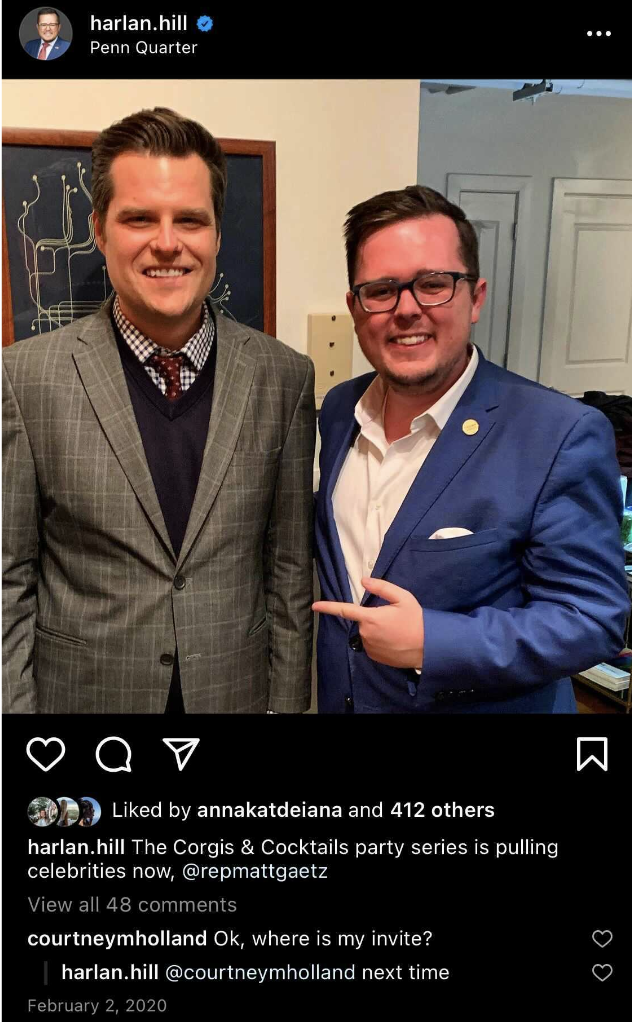
Probably one of the best recent Trump ally sources of satire has been the story of Florida Republican Rep. Matt Gaetz, a notorious supporter of the former president and who is under investigation over allegations of sex trafficking of a minor. Gaetz was often referred to as part of the “warrior class” that pledged to defend Trump, making his fall from grace even more spectacular, thereby offering satirists an irresistible target. Andy Borowitz, who has a regular column with The New Yorker, has taken to just posting his Gaetz satire straight to Facebook with mock headlines like “Gaetz Blames Liberal Media for Getting his Girlfriend Grounded,” “Gaetz Fears that if He is Arrested He Will Miss Prom” and “CDC Urge Social Distancing to Stop the Spread of Matt Gaetz.”

Comedians will eventually make fun of Biden

The sea change from Trump to Biden has clearly caught the comedians a bit off guard, but that hiccough doesn’t mean they won’t eventually find their comedic footing. It is worth remembering, too, that when Biden served as vice president under Barack Obama he was regularly roasted. In one example, a viral piece from The Onion held the headline “Shirtless Biden Washes Trans Am In White House Driveway.” It got folks so riled up that there was even an effort to try to buy Biden a Trans Am.

The easy jokes about Biden’s age, or the jabs mocking his stutter, may feel like punching down these days. And that’s all for the good, since such jokes are just mockery and not satire. Soon enough, though, comedians will find ways to satirize his policies. Remember that even Obama came under fire from comedians like Stephen Colbert, who, on “The Colbert Report” liked to target Obama’s hypocrisies. He delivered an especially scathing take-down in 2012 of Obama’s drone program, for example.

“SNL” is not a barometer for the state of political comedy today

It is worth noting that many of those who fret over the current state of political comedy may overemphasize the role of “SNL.” There is little doubt that the show plays a central and significant role in the history of U.S. satire, but it has historically had an uneven status as a source of U.S. political comedy. During the George W. Bush years, for example, “SNL” offered little in the way of biting political comedy. And, while it is true that a lot of powerful Trump material came out on Saturday nights, it is a mistake to think that if Jim Carrey’s impersonation of Biden was uninspiring that that means political comedy for the nation as a whole is in decline.

In fact, late night comedy overall is not really the source of the most innovative political satire today. For many, the real source of cutting-edge political comedy this last election cycle was TikTok. For those of us older than our teens, we may have first stumbled onto TikTok thanks to Sarah Cooper’s brilliant Trump impersonations. But Cooper is just one small example of the massive amount of political satire on the platform.

TikTok has offered a unique space for a very particular type of political comedy, one that is radically different from the style of late-night comedy. As Hannah Giorgis explains in The Atlantic, “Young people on TikTok don’t need to supplement their short videos with lengthy explanations of the sociopolitical ideas they’re poking at, nor do they justify their own antics by fitting them into an established format.”

What makes the satire on TikTok so powerful and so edgy is the fact that some miss the irony. In one example, the teenage owners of a TikTok account called POCRepublicans found themselves being criticized by both the right and the left when their videos went viral on Twitter and were interpreted un-ironically. When your satire confuses people, it can be a promising sign that it is smart, creative and subtle.

The best political comedy isn’t personality-driven anyway

One of the truisms of satire is that it isn’t interested in balance or covering “both sides” of an issue. Instead it focuses on BS, abuses of power, human folly, and hubris. This gives satirists a never-ending supply of material, regardless of who is in the White House.

If we look back on the comedy of a number of on-air satirists over the past four years, we see that there are quite a few who were never Trump-obsessed. Sure, Trump was a staple on both “The Late Show” hosted by Stephen Colbert and “Late Night” hosted by Seth Meyers, but a number of late-night comedians made a point of not letting Trump dominate their material.

Trevor Noah, host of The Daily Show, is one of the few late-night comedians to regularly satirize race relations on his show. One of his most viewed segments is “White People Unnecessarily Calling the Cops on Black People,” which has been viewed over 11 million times. Noah also likes to cover a range of topics, especially global politics, that aren’t personality-driven. In fact, only two Trump-related segments even show up in his top ten most-viewed segments.

In contrast, Trump is featured as the top-viewed segment of Samantha Bee, host of “Full Frontal.” Her Full Frontal Investigation, “Trump Can’t Read” was seen over 5 million times. Still, a number of her best segments are issue-driven, especially when she takes up gun violence or women’s rights. Her second-most viewed segment, “Sam Has Had Enough of the Thoughts and Prayers for Gun Violence,” has been seen over 3.6 million times.  

For a satirist like HBO’s John Oliver, who tends to investigate complex issues and package them in ironic comedy, the question of who occupies the White House is of even less consequence. Segments on televangelistsmultilevel marketingsex educationtobacco and FIFA are perfect examples of how his work isn’t going to change under Biden.

So, while it is true that we now have an administration in office that can speak English, name the branches of government, do basic math, and understand science, it doesn’t mean that our nation’s satirists won’t have plenty of chances to mock what they find stupid, absurd, and unjust. Biden may have a new job in the White House, but that doesn’t mean that the satirists will be out of work.  

Scientists say the technology behind COVID-19 mRNA vaccines could be adapted to an HIV vaccine

The COVID-19 pandemic has lasted only slightly more than a year; the AIDS epidemic, by contrast, now spans decades. Just as AIDS has taken more than 670,000 lives in this country, scientists have long dreamed of a day when they could inoculate the population against HIV, the virus which causes the deadly disease.

It turns out that these two pandemics may be more related than anyone realized. And incredibly, some researchers believe that the same revolutionary technology which was used to create the Pfizer and Moderna COVID-19 vaccines could be used for an HIV vaccine.

A vaccine developed by researchers at the nonprofit IAVI and Scripps Research in San Diego had a 97% success rate at stimulating production of precursor immune cells, which experts hope could eventually produce broadly neutralizing antibodies, a rare part of the immune system which have proved effective at binding to the spike proteins on HIV. (The spike proteins are the needles that stick out from the HIV’s sphere like the spines on a sea urchin.) This development could be hugely meaningful to creating an HIV vaccine.

Historically, much of the difficulty in creating an HIV vaccine stems from the fact that HIV is a retrovirus — meaning that it readily mutates to avoid being thwarted by antibodies, the proteins created by the immune system to help identify and destroy foreign threats.

Yet because the HIV virus’ spike proteins generally remain the same, even among different HIV strains, a vaccine that creates more broadly neutralizing antibodies could train them to target those needles — and in the process inoculate people against HIV.

To be clear, the technology is only in its very early stages. Researchers are still in Phase I of clinical trials (this means that they are only beginning to test their technology, and on a very small group of people, with an emphasis on making sure that everything is safe). The initial test group only included 48 healthy adults, some of whom received a placebo. The enthusiasm comes from the fact that 97% of those who did not get the placebo showed early evidence that their bodies could be able to manufacture these broad antibodies.

This is where the developments that led to the Pfizer and Moderna COVID-19 vaccines enter the picture. Unlike conventional vaccines, which train the immune system to recognize a potential threat by injecting a patient with a weakened or dead version of the antigen (the foreign body that triggers an immune response), Pfizer and Moderna developed what are known as mRNA vaccines. These vaccines use synthetic versions of mRNA, a single-stranded RNA molecule that complements one of the DNA strands in a gene. The mRNA is then modified, depending on the antigen that scientists wish to fight, and injected that into the body. It then trains the body’s cells to manufacture proteins like those found in the antigen; when the cells infected by the mRNA releases those proteins, the immune system recognizes them as threats and learns to recognize them.


Want more health and science stories in your inbox? Subscribe to Salon’s weekly newsletter The Vulgar Scientist.


The candidate HIV vaccine studied in the Phase I clinical trials was not an mRNA vaccine. IAVI and Scripps, however, are collaborating with companies like Moderna to see if they can use the mRNA vaccine technology to develop their own product more quickly and more effectively.

“mRNA vaccines could help reduce the time it takes to develop and evaluate new HIV vaccine candidates in clinical trials,” IAVI President and CEO Mark Feinberg, MD, PhD, told Salon by email. “While conventional approaches can take years to advance a promising idea in the lab into a vaccine candidate that can be tested in humans, mRNA vaccine technology can reduce that time from years to months.”

At least one prominent outside organization shares IAVI’s enthusiasm for mRNA vaccines. Mitchell Warren, the executive director of the AIDS Vaccine Advocacy Coalition (AVAC), wrote to Salon that mRNA vaccines are promising precisely because they were so effective in fighting SARS-CoV-2, the virus that causes COVID-19.

“It’s important to note that the mRNA candidates were able to move quickly into COVID-19 vaccine trials because of years of basic science research by HIV vaccine and other researchers,” Warren explained. “It, therefore, has exciting possibilities for an HIV vaccine, and it’s great to see Moderna looking at how to move an mRNA HIV vaccine into clinical research.”

Warren noted that there is a caveat. “One key question is whether there will be the political and financial support to move a mRNA-based HIV vaccine forward with the same speed the COVID-19 vaccines were moved forward.”

Of course, a huge amount of scientific and clinical work must happen before an HIV vaccine can be a reality. Vaccine development is a painstaking process, and pharmaceutical companies have to be very careful to make sure they do not create a product that accidentally hurts people.

“The results from the IAVI G001 trial are encouraging in that they validate a promising new approach to HIV vaccine design,” Feinberg told Salon. “However, much research will be needed to extend this approach so that we can achieve the goal of a broadly effective HIV vaccine. We are working with partners, including the biotechnology company Moderna, to advance research as quickly as possible.”

When asked about how optimistic he is about the HIV vaccine’s prospects, Feinberg wrote that “based on our recent results, and should future research to elicit broadly neutralizing antibodies by vaccination continue to generate positive results, we believe that it will be possible to develop an effective HIV vaccine.”

He cautioned, however, that the challenge is so complex that “we don’t foresee this goal being achieved in the near future,” although he is optimistic that “we have a promising approach to pursue and new tools that will enable us to accelerate and optimize HIV vaccine development efforts.”

Those views were echoed by Adrian B McDermott. Ph.D., chief of the Vaccine Immunology Program at the Vaccine Research Center at the National Institute of Allergy and Infectious Diseases and National Institutes of Health.

“We need to temper the enthusiasm seen with the initial results with the need for carefully controlled clinical trials and the accompanying experimental evaluations, such as G002,” McDermott told Salon by email. “We are at the start of a long journey of clinical experimental immunology that we hope will yield robust and long lasting antibody responses for HIV and after a long time yield a safe and effective HIV vaccine.”

Warren expressed similar views.

“I remain optimistic than an HIV vaccine will eventually be proven safe and effective and be rolled out to those who need it, but it’s impossible to put a time frame on that,” Warren explained. “There is one HIV vaccine (the J&J one) in efficacy studies now, with results expected in 2022, and another large proof of concept study of another candidate in the field. Everything else is further back in a pipeline that has been delayed by the absolutely necessary focus on COVID-19 and by the restraints of the pandemic on clinical and laboratory research.”

Correction: An earlier version of this article incorrectly explained the role of these developments in potentially producing broadly neutralizing antibodies. The piece has been updated to reflect that.

House Ethics Committee opens probe into Matt Gaetz and Tom Reed over sexual misconduct allegations

Florida Republican Congressman Matt Gaetz is now facing a second investigation into alleged inappropriate conduct with minors, this one launched by the House Ethics Committee on Friday afternoon.

This all stems from allegations that Gaetz partook in sex trafficking and paid a minor for sex. “The Committee is aware of public allegations that Representative Matt Gaetz may have engaged in sexual misconduct and/or illicit drug use, shared inappropriate images or videos on the House floor, misused state identification records, converted campaign funds to personal use, and/or accepted a bribe, improper gratuity, or impermissible gift, in violation of House Rules, laws, or other standards of conduct,” the House Ethics Committee wrote in a press release. “The Committee, pursuant to Committee Rule 18(a), has begun an investigation and will gather additional information regarding the allegations,” the Democrat committee chairman from Florida, Rep. Ted Deutch, and ranking Indiana Republican Rep. Jackie Walorski, further stated in the letter. 

The letter was careful to note that the investigation launched by the House committee “does not itself indicate that any violation has occurred, or reflect any judgment on behalf of the Committee.”

The news comes on the heels of Rep. Adam Kinzinger, R-Ill., calling for Gaetz’s resignation on Friday morning. “Matt Gaetz needs to resign,” he tweeted, citing a Daily Beast report that alledges the Florida congressman sent $900 through the cash application Venmo by sending the money through embattled Seminole County Tax Collector Joel Greenberg in May of 2018.

Additionally, on Friday, Gaetz hired high-profile New York lawyers Marc Mukasey, and Isabelle Kirshner as the Department of Justice looks into his actions, according to New York Daily News.   

The same committee also announced they had launched an investigation into GOP Rep. Tom Reed, over allegations of “sexual misconduct.”

In a statement the legislative body wrote: “The Committee is aware of public allegations that Representative Tom Reed may have engaged in sexual misconduct, in violation of House Rules, laws, or other standards of conduct. The Committee, pursuant to Committee Rule 18(a), has begun an investigation and will gather additional information regarding the allegations.”

The probe into the actions of Reed comes a month after a Washington Post report laid out accusations that the congressman harassed lobbyist Nicolette Davis. “A drunk congressman is rubbing my back,” The Washington Post reported Davis had texted a friend while on a congressional networking trip with the congressman in 2017. “Reed, his hand outside her blouse, briefly fumbled with her bra before unhooking it by pinching the clasp, Davis told The Post. He moved his hand to her thigh, inching upward, she said.”

Who won Meghan McCain’s vote for president? Husband reveals it wasn’t Joe Biden

To even the most casual observer, there was little reason to doubt that conservative pundit and co-host of “The View,” Meghan McCain, voted for Joe Biden in the last election. For nearly two years, the daughter of former Arizona Republican Sen. John McCain made clear that she was no fan of Donald Trump, who frequently attacked her father, even after his death, and frequently suggested that she supported Biden, a longtime Senate colleague of her father’s. According to McCain’s husband, however, she did not vote for Biden. 

In a tweet last month, Federalist publisher, and husband of McCain, Ben Domenech revealed that “My wife didn’t vote for Joe Biden.” The revelation came as part of a response to a Federalist article he shared decrying alleged bias in the media’s coverage of the border crisis under President Biden. Domenech, quoting a line from the article about a migrant girl who drowned in the Rio Grande, opined to Biden voters: “This is what you voted for.”

Hinting at previous indications that McCain voted for Biden, Salon editor Sophia Tesfaye replied to Domenech’s tweet: “reads like a subtweet to a very specific someone.” 

Domenech then responded: “My wife didn’t vote for Joe Biden, and I don’t communicate with her via tweets.”

But McCain has suggested on multiple occasions that she did in fact vote for Biden in the 2020 presidential race. 

Asked in Sep. 2019 whether she would be voting for him in the upcoming presidential election, McCain stated on a Bravo talk show, “I get asked about this all the time and I will say — and I’m just going to leave this like this — Joe Biden and I, everyone knows, are very close. And I love him dearly and I think he is a truly decent, wonderful human being that could be very healing for the country.” McCain added that Biden, who in 2018 delivered a eulogy for the late Sen. John McCain, her father, has been close with her family for some time. McCain and Biden’s friendship in office is also well-documented. 

McCain threw more support behind Biden in April 2020 on Bravo’s late-night show “Watch What Happens Live with Andy Cohen,” when she told viewers that the choice between Trump and Biden boiled down to “personal” experience.

“I keep telling everyone I promise you you will know who I’m voting for,” McCain said. “But it really shouldn’t take a rocket scientist to know there’s one man who has made pain in my life a living hell and another man who has literally shepherded me through the grief process. This really shouldn’t be rocket science for people.”

McCain added that Biden was “integral in [her] life, especially after [her] dad got sick.” The Trumps, by comparison, were “always making [her] mom cry.”

Asked who she was going to vote for a few months later in Aug. 2020, McCain was notably more guarded.

“I’m not saying who I’m voting for,” she demurred, “but I’m not voting for Trump.” McCain added that she’d wait until the debates as well as the unveiling of Biden’s running mate before making a decision.

Following President Biden’s election win in early November of last year, McCain and her mother Cindy publicly celebrated. “Only a very personal note,” the pundit tweeted, “I am relieved and look forward to having a president who respects POW’s who have been captured.” McCain was, of course, referring to when Donald Trump in 2015 disparaged her father being captured in the Vietnam War. 

twitter.com/MeghanMcCain/status/1325123592066097152

Although Domenech’s latest Twitter exchange appears to contradict Meghan McCain’s prior indications of voting for Biden, neither he nor McCain responded to Salon when asked for comment.

Tucker Carlson’s “great replacement” rant draws swift criticism: ADL calls for Fox News to fire host

Fox News host Tucker Carlson is facing another backlash, this time for endorsing the “great replacement” conspiracy theory that has been used by white supremacists. 

On Thursday, Carlson claimed that “the Democratic Party is trying to replace the current electorate” with “new people, more obedient voters from the Third World.”

He added that “the left and all the little gatekeepers on Twitter become literally hysterical if you use the term ‘replacement.'” 

“The ‘great replacement’ theory is a xenophobic and antisemitic conspiracy. Racist extremists like Tucker will only amplify it more as climate change increasingly drives dislocation and migration,” Jewish progressive group If Not Now said in a statement. “The fight for Jewish safety is the fight for migrant and climate justice.” 

Anti-Defamation League CEO Jonathan Greenblatt called on Fox News to fire Carlson for embracing antisemitism and white nationalist rhetoric.

Carlson also sparked widespread backlash for claiming white supremacy is a “hoax” just three days after the El Paso shooter killed 22 people over fears of a “Hispanic invasion”; and for warning Fox News viewers that the Black Lives Matter “mob” will “come for you.”

Among the United States’ most prominent white supremacists, Andrew Anglin has described Carlson’s show as ” basically ‘Daily Stormer: The Show’.” 

Scare goes the neighborhood in Amazon’s “Them,” where trauma porn collides with our visceral reality

The house I grew up in was a midcentury wonder unique enough to be featured in House Beautiful. My mother proudly featured that issue on our coffee table in the seating well where she entertained guests, making sure we didn’t toss it out whenever we refreshed the other magazines fanned across its polished wooden surface.

It was the only periodical granted pride of place that wasn’t Ebony, Essence, Black Enterprise or Jet, and strictly it was an evidentiary detail in a wild tale. My parents were able to purchase this architectural masterwork in the mid-1960s because the white couple who custom-ordered every detail were quite literally spooked into selling the place shortly after the last coat of paint dried.

As the legend goes, someone saw a Black woman pushing her baby in a carriage down their street, and there went the neighborhood. More accurately there went the white people, including the couple who built their House Beautiful dream home only to abandon it in the mania of white flight. What a tragedy. What idiots.

Fear makes people reckless and stupid, and people like us, the cause the fear, could only shrug and get on with our lives. The larger economic effects this racist exodus had on our area would be tangible in the 1970s and ’80s as money for public schools and other services followed the white people out to the suburbs.

Even in the face of that, my mother recalled some scenes from this time with a comedian’s gusto. One of her favorite involved a realtor cold calling and urging my mother to sell the home she’d just moved into as soon as possible, warning that the neighborhood’s property value was only going to plummet. “They” were moving in and taking over, he said, and to this my mother gleefully responded with some version of, “I told him, ‘They’ are already here!’ And I hung up.” 

“Them,” Amazon’s new horror anthology series beginning with this season’s “Covenant,” contains an analogous exchange in its finale, only the circumstances are as far from comedic as can be. The line is delivered an angry coup de grace in a 10-day war white bigoted neighbors wage upon the Emorys, a Black family recently arrived from the South.

Livia “Lucky” Emory (Deborah Ayorinde) and her husband Henry (Ashley Thomas)  simply want the same verdant lawn and quiet life for themselves and their daughters Grace Jean (Melody Hurd) and Ruby Lee (Shahadi Wright Joseph) that everyone else is enjoying. But their new neighbors never give them a moment’s peace.

This being a horror series, subtle antagonism doesn’t cut it, but the attack strategies are entirely believable if you’ve survived something like this, or if you watched “Lovecraft Country.” (Its third episode “Holy Ghost” mined similar territory.) First come the stares, the cold refusal to return friendly waves, the heinous perkiness of the neighborhood queen bee Betty Wendell (a bone-chilling Alison Pill).


Alison Pill in “Them” (Amazon)

Then comes various all-too-familiar escalations – the women in the neighborhood lining up in front of the house and blaring an assaultive cacophony of radio noise, the racist effigies strewn outside their front door and far, far worse.

As one would expect, the police refuse to help the Emorys, emboldening those with the least restraint – including the supernatural forces lurking with the walls of their new home.

It shouldn’t shock or spoil you to know that “Them” doesn’t end cleanly for anybody – not for the family, not for the neighborhood and not for the viewer. I appreciated the crisp visuals and the stylistic homage to the midcentury thriller; at one point I mused that this is what “Saw” would look like with Stanley Kubrick or Robert Aldrich directing it. Thomas, Hurd, Joseph and Ayorinde – especially Ayorinde, who morphs into a desperately haunted woman before our eyes – are excellent performers who tap deeply in the viewer’s well of empathy.

For all of these reasons, by the time “Them” was over, the 10-episode series had wrung me dry of any notion beyond simply wanting to be done with it, which is an odd place for a technically solid, artistically bold, and believably acted show to leave a viewer.

Whether you feel that way depends on how many kernels of truth and reality you recognize or acknowledge beneath the tale’s gory, hideous surface, and more explicitly, how many of them you have witnessed or experienced.

This is the puzzle and challenge “Them” presents by debuting amidst passionate debates about and refusals to accept or engage with series deemed to be trauma porn, namely the strain that’s built upon Black pain.  

Such fatigue is produced by decade of Hollywood equating the Black experience with slavery stories; Black heroism with a high tolerance of insult and beatings and beatifying Black exceptionalism by way of white hero narratives. Take in years and years of people who look like you being presented as instruments – objects – as opposed to fully realized individuals with quirks, and loves and faults, and you’d be bone-tired too.

But this partly discounts the reality that the entertainment industry’s gatekeepers have only recently broadened their financial support and promotion for movies and TV shows centered around non-white protagonists who aren’t superheroes or extraordinary professionals or historic figures or a comic’s alter-ego.

Heartened by the hard-won success and growing influence of folks like Ava DuVernay, Issa Rae, Jordan Peele and Marsai Martin, who has a firm “no Black pain” rule for every project she produces and stars in, we cry out for stories made by and about people of color.

Here is one executive produced by Lena Waithe and created by Little Marvin, who also serves as its showrunner.

We want to see projects that present non-white Americans in stories we haven’t seen a million times, that aren’t bound in some way to slavery, criminality and poverty; here is a fiction inspired by the Great Migration, a part of American history that reshaped the social structure of every major city in every region.

Here, too, is a plot that denudes the lie of white culture’s alleged celebration of the pioneer spirit and set in Compton, California, a place long associated with Los Angeles’ Black working class. “Them” depicts a 1953 version of Compton that might as well be lifted out of “Leave It to Beaver.”

The Emorys’ move from Chatham County, North Carolina to California is presented as running to a sunny new beginning and from a place poisoned by terrible memories. Lucky has endured an explicit trauma, as has Henry, a World War II veteran.

Their problems only compound from the moment they arrive, as do those of the show’s, but not for the typical reasons.

Some of the revulsion “Them” produces may be related to its veracity. Separately each character confronts situations any non-white person who infiltrates spaces long closed to them will recognize, aside from the naked insults. There are the backhanded compliments (“You’ve got a pretty face for a Black girl”); the denigrating comments masked as praise; the appalling, racist imagery dressed up in a major key and passed off as nursery rhymes.

People of color learn early to recognize these affronts and figure out a way to swallow their anger in the moment or find a way to redirect the fire of their rage in a direction that doesn’t harm anyone else or hopefully, maybe themselves. In this show, though, there is no such thing as coded speech and forbearance, and there are no microaggressions, only full-blown hostility.  

Lucky’s anger leaps out of her at regular intervals; Henry externalizes the psychological demons eating him alive where he can, and all of this happens apart and is exacerbated by the constant harassment by their white neighbors who find a way to make barbarous acts of racism a full-time job.

But isn’t trauma part and parcel of the horror experience? Certainly. Most successful horror movies also mitigate its impact by constructing a barrier of the impossible between our real and the dark fantasy within the story. This is true of the greatest horror stories that also comment on racism in America. George A. Romero’s “Night of the Living Dead” and Jordan Peele’s “Get Out” both place Black protagonists in situations where they are outnumbered and surrounded, but in Romero’s film zombies are the central evil; in “Get Out” a white family’s preternatural and nefarious secret terrorizes the unsuspecting hero.

Both of these threats are obviously fantastical while, in contrast, the extreme violence in “Them” is entirely familiar and possible. Variations of the indignities the Emorys endure have been filmed and circulate in viral videos. We read about such in alarming news stories about white people pulling guns pulled on Black folks as they’re going about their business or in reports about white mass shooters hunting Asian and Hispanic people, spurred on they their fear of otherness.

As I write this the nation is watching Derek Chauvin‘s trial and listening as witnesses describe in various ways what it was like to watch this cop crush the life out of George Floyd as they looked on, utterly helpless.

All of this happened, all of this is happening, and “Them” arrives in its wake as intentionally rendered work of fiction that doesn’t necessarily offer a place to escape to or from these daily accounts of torture. The adrenaline spikes it produces are not fleeting and may be accompanied by a nasty cortisol chaser that catches in your throat. Of course, one’s reaction all in how you look at the story and whether you recognize enough of it to be real or true enough.

Some people are going to love “Them” and some may be content to acknowledge its visceral potency while desiring to never watch it again. It may traumatize, and that doesn’t make it bad or unworthy of your attention. Think of it as a provocation. Then decide if you have the stomach to be provoked, yet again.

“Them” premieres Friday, April 9 on Amazon Prime Video.

Fox News host suggests Meghan Markle may be to blame for Prince Philip’s death

On Friday, “Fox and Friends” host Brian Kilmeade wasted no time in placing the blame of 99-year-old Prince Philip’s death on none other than Meghan Markle. 

Kilmeade seemed to indicate that Markle and her husband’s interview with Oprah Winfrey while Philip was ill, affected his recovery process which ultimately led to his death. Kilmeade said on Friday’s show: “There are reports that [Philip] was enraged after the interview and the fallout from the interview with Oprah Winfrey, so here he is trying to recover and he’s hit with that.”

He then went on to cite Piers Morgan to back up his claim that Philip’s health was hit by the Oprah interview.

“Piers Morgan was saying on his morning show, which he famously walked off of, is like ‘Really? Your grandfather is in the hospital, you know he’s not doing well, is this really the time you have to put out this interview?’ Evidently, it definitely added to his stress,” Kilmeade added. 

Morgan said in a tweet praising Prince Philip, “A truly great Briton who dedicated his life to selfless public duty & was an absolute rock of devoted support to Her Majesty, The Queen, as the longest-serving royal consort to any British sovereign. A very sad day for our country. Thank you, Sir.”

In a statement confirming his death, Buckingham Palace said: “His Royal Highness passed away peacefully this morning at Windsor Castle. The Royal Family join with people around the world in mourning his loss.”

Fox News uploaded “Fox & Friends” coverage of the prince’s death to YouTube but cut the clip just before Kilmeade’s comments.

Meet Matt Gaetz’s PR firm, run by Trump ally who bailed on promise to eat his own shoe

Embattled Rep. Matt Gaetz, R-Fla., has enlisted a small Washington public relations firm to handle a developing scandal that threatens to end his career, involving multiple allegations of sexual misconduct and possible sex trafficking. The firm in question, the Logan Circle Group, consists largely of lower-level Trump allies and is headed by Harlan Hill, a MAGA-world character who thus far has failed to keep his promise to eat his own shoe on a live stream.

On Thursday night, The Daily Beast reported that Gaetz allegedly sent $900 in payment to several young women via the cash application Venmo, by first sending the money to Seminole County Tax Collector Joel Greenberg in May 2018. The Beast further noted that Hill’s PR firm has taken up the case of cleaning up Gaetz’s mess.

A representative from Logan Circle Group offered the Beast a statement from Gaetz: “The rumors, gossip and self-serving misstatements of others will be addressed in due course by my legal team.” Then Logan Circle’s Erin Elmore, described as “a pro-Trump pundit and former contestant on ‘The Apprentice,'” told Beast reporters that a lawyer would be “closely monitoring” their coverage.

Elmore, who has appeared as a commentator on Newsmax and Fox News, is apparently spearheading the charge to defend Gaetz at the firm and has threatened legal action against various other reporters covering the scandal, according to Politico. A Fox News spokesperson told Salon that Elmore has never been an official contributor to the network, contrary to rumors floating on social media. 

Harlan Hill, the president of Logan Circle Group, has achieved minor notoriety for losing a bet but failing to honor his pledge. During an election night party on Nov. 3, Hill made a bet with The Atlantic’s McKay Coppins that if Trump lost re-election, he would eat his own shoe on a live stream. Months have passed, and the former president has exhausted all his attempts to overturn the election result, finally retreating to Mar-a-Lago. Hill has yet to fire up a live stream while chowing down on his own loafer.

Back in November of 2020, Hill called former Salon reporter Roger Sollenberger (now at the Daily Beast) “a c*nt” over Sollenberger’s fact-check of a false tweet. A month before that, Fox News announced that Hill would not be allowed to appear on the channel after he called Vice President-to-be Kamala Harris an “insufferable lying bitch.”

Hill didn’t return a request for comment from Salon for this story. Salon obtained a series of pictures posted to Hill’s Instagram page on Thursday, however, that appear to show him enjoying a visit to Donald Trump’s golf resort near Miami. 

One of Hill’s closest allies is former Breitbart editor turned Steve Bannon sidekick Raheem Kassam, whom Hill has described as “my best friend and the only person I’d trust to have my back in the trenches.” Kassam now runs a right-wing website called the National Pulse, which has been a stalwart defender of Gaetz through all the twists and turns of the scandal so far.

On Thursday night, Salon reached out to Kassam about a photo posted to his Instagram account that appeared to show him at Trump’s Florida resort alongside Hill. 

The pro-Trump pundit — who now views Fox News as an enemy — responded with a myriad of furious tweets, direct messages and notes stating he intended to contact Salon editors and sue the publication, attempted to call this reporter 12 times via his Signal number, and then sent an email asserting that his own publication would publish an article about this reporter’s lack of “credentials.” 

“In the morning, we will report that you engaged in a targeted and demonstrably false attempt at a harassment campaign against an accredited reporter,” Kassam wrote late on Thursday night. “Do you have a comment? We reached out to your colleagues, subjects, and employers and already have critical comments on the record, which allege you have no credentials as a real news reporter and should not be employed by a news outlet as a result. … You’re a fake news moron.” 

John Boehner doesn’t deserve a rehabilitation tour: Mayor of GOP’s “Crazytown” sparked rise of Trump

John Boehner is clearly worried about his legacy. The former Republican speaker of the House is on a mission to rehabilitate his image and position himself as a noble, principled conservative who is at odds with the current slate of bug-eyed Donald Trump enthusiasts and lying Dr. Seuss trolls. He’s recently published “On the House: A Washington Memoir” and is on the media circuit, both heavily promoting the book and this cockamamie notion that Trump and other trollish Republicans like Sen. Ted Cruz of Texas or Rep. Matt Gaetz of Florida represent some big departure from a more dignified conservatism that Boehner claims to represent. 

“I don’t even think I could get elected in today’s Republican Party anyway. I don’t think Ronald Reagan could either,” Boehner writes in excerpts quoted by the Washington Post. He also claims that “I’m not sure I belonged to the Republican Party [Trump] created.”

This is —and it cannot be stated firmly enough — a stinking pile of horse-generated plant fertilizer.

Ronald Reagan was a proto-Trump figure, a B-list Hollywood celebrity who got elected riding a wave of white grievance by making barely coded racist overtures. That is why people like Boehner loved Reagan so much, and why they remade the Republican Party into the perfect vehicle for Trump, a sociopathic narcissist whose racism and sexism was even less coded than the brand that Reagan was peddling. 

Boehner has been grabbing headlines lately by dunking, in often incredibly entertaining ways, on Trump and Cruz, who Boehner instructed to “go f*ck yourself” in the audio recording of the book. But as fun as all this is, no one should be fooled. Boehner is one of the main architects of the version of the GOP he dubs “Crazytown” in his book, a Republican party that is oriented around bigotry and trolling — and completely uninterested in anything resembling good governance. 


Want more Amanda Marcotte on politics? Subscribe to her newsletter Standing Room Only.


Boehner, it must be remembered, came up in Congress during the years when Newt Gingrich was the Speaker of the House, which was really the beginning of the era of Republicans focusing all their energies on trolling and hating Democrats. Boehner now is highlighting his role in trying to push Gingrich out of leadership and his supposed regrets for the role he played in impeaching Bill Clinton. In truth, however, he was a major part of the rollout for the “Contract With America,” which was really the beginning of the Republican Party as we know it now, a force that is interested more in destruction than in responsible governance.

When he was speaker during the Barack Obama presidency, Boehner fully leaned into the role as a destructive troll, ready to pander heavily to the Tea Party forces that were in a full-blown panic over the idea of a Black president and ready to do whatever it took to destroy his presidency. Under Boehner’s leadership, House Republicans developed a variety of strategies aimed at kneecapping the popular Democratic president and forcing his main legislative achievement, the Affordable Care Act, into failure. Republicans believed — and continue to believe — that the best way to win politically was to tank economic recovery and expanded health care access, and then turn around and blame the Democratic president for what they themselves did. Boehner’s main strategy was centered around tactics such as hostage-taking and brinkmanship. 

In 2011, after he took over the Speaker position, Boehner oversaw a deliberately induced debt ceiling crisis, threatening to force the U.S. into default and ongoing economic crisis if Obama didn’t agree to $4 trillion in spending cuts, with a focus on slashing at Medicare and Social Security in particular. If Boehner had succeeded, it would have destroyed the fragile economic recovery that Obama had overseen since the crash of 2008, but luckily, he overplayed his hand and largely failed to get what he wanted

Still, that didn’t stop Republicans. Under Boehner’s leadership, the GOP took another pass in 2013, engaging in more debt ceiling brinkmanship in a pathetic, failed effort to defund the Affordable Care Act. The result was a government shutdown for half of October 2013, which Boehner defended by falsely claiming that the Affordable Care Act was having “a devastating impact” on the country. In reality, as the subsequent years showed, it was only “devastating” for those who don’t like working class people having health care, but otherwise Obamacare has largely been a success. 


Want more Amanda Marcotte on politics? Subscribe to her newsletter Standing Room Only.


By indulging these kinds of antics, Boehner helped further radicalize the GOP, encouraging both Republican politicians and voters to believe that it would be better to burn the U.S. to the ground than to allow an increasingly progressive, racially diverse majority to govern.  Under Boehner’s leadership, blatant sexism, barely coded racism, and outright disinformation became central tactics in the war to gut Obama’s presidency. For instance, Boehner made defunding Planned Parenthood a centerpiece of the debt ceiling and government shutdown showdowns, exploiting misogynist resentment in order to push his agenda of slashing social spending. And Boehner happily fed the “death panels” lie, which was a myth promoted by right-wing media that suggested the government was going to start killing old white people to free up health care resources for younger, more racially diverse Americans. 

It is true that Boehner was pushed out of Congress in 2015 because he lost his appetite for using another government shutdown as leverage to take away women’s birth control pills and Pap smears. So perhaps he really does think of himself as a victim of the right wing nuts, the people whose unchecked hatred of Obama, racism, and loathing of feminism turned them into political arsonists. 

If so, Boehner is lying to himself. He is a true Dr. Frankenstein figure, taken out by the monster he helped create. For years, Boehner happily encouraged and led an increasingly paranoid, delusional right that was driven to political madness over the existence of a Black president and the social changes pointing towards a more progressive America. He let Tea Party racism flourish unchecked, viewing it as a valuable tool to garner support for his failed brinkmanship tactics. He helped pave the way for the rise of Trump, who harnessed all this white resentment and anger that Republicans cultivated under Boehner’s leadership. And this should be his legacy, not some too-little-too-late last ditch effort to make himself over into a voice of reason and common sense. 

“Matt Gaetz needs to resign,” says GOP House colleague

Rep. Adam Kinzinger, R-Ill., became the first in his party to call for the resignation of Rep. Matt Gaetz, R-Fla., who is currently steeped in a federal investigation over sex trafficking. 

“Matt Gaetz needs to resign,” Kinzinger tweeted on Thursday, linking to a Daily Beast article which details the latest bombshell developments in the story. A Department of Justice investigation, first reported by the New York Times on Mar. 30, is currently probing whether Gaetz had a sexual relationship with a 17-year-old girl and paid for her to travel with him. 

Kinzinger, a moderate Republican, has been a routine critic of his own caucus. Back in January, Kinsinger was just one of ten House Republicans who voted to impeach former President Trump over inciting the Capitol riot, a move for which the Illinois representative received scorn from his own family. In February, Kinzinger made himself an enemy of Gaetz when he launched an anti-Trump super PAC. At the time, Gaetz blasted Kinzinger, telling him to “f***ing bring it.”

Now, Kinzinger is clapping back as damning details emerge surrounding Gaetz’s possible involvement in sex trafficking a minor. 

Other Republicans meanwhile, have kept quiet, careful not to fan the flames.

House Minority Leader Rep. Kevin McCarthy said on Wednesday that the allegations made against Gaetz are “serious,” and that he plans to speak with the Florida lawmaker. The “DOJ has not told me anything,” McCarthy claimed. “If a member at my conference gets indicted, they will get removed from a committee. He says this is not true. And we have a newspaper report that says something else. We’ll find out the basis.”

Gaetz has vehemently denied all of the allegations made against him, instead alleging that he and his family are the victims of an elaborate extortion scheme carried out by a former DOJ official. This official, Gaetz claimed, shook his family down for $25 million by threatening Gaetz’s father with allegedly nonexistent photos of his son participating in “sexual orgy with underage prostitutes.” The DOJ official in question denied that this exchange ever happened and formal charges still have yet to be brought against Gaetz. 

On Thursday, the Daily Beast reported that Gaetz had made “two late-night Venmo transactions” to his friend and accused sex-trafficker Joel Greenberg for a total of $900 back in May 2018. The following morning, Greenberg made three payments via Venmo to three young women labelled “School,” “School,” and “Tuition.”

The same day, it was reported that Greenberg and his attorneys were expected to take a plea bargain, indicating that Greenberg might reveal more details about the case in exchange for a lesser sentence. According to the Daily Beast, Gaetz and Greenberg are also connected to another woman who Greenberg paid $300,000 worth of taxpayer funds via a government-issued credit card. 

Two members of Gaetz staff have reportedly resigned over the mounting evidence against their boss. The New York Times reported that Gaetz’s legislative director Devin Murphy stepped down on Thursday just days after Gaetz’s communications chief, Luke Ball, resigned as well. Murphy reportedly told his colleagues that he was interested in writing serious legislation, not working at TMZ.

GoFundMe is becoming a social safety net — an inequitable one

In the run-up to the passage of last month’s coronavirus relief bill, GoFundMe CEO Tim Cadogan repeatedly criticized Congress for not moving fast enough to provide aid to struggling Americans. Congress’ inaction, he said, was forcing people to crowdfund for basic needs like medical care, housing, and food.

While Cadogan ‘s advocacy was justified — and probably welcome to the millions of Americans who were desperate for support — it also masked an awkward truth: GoFundMe has almost certainly profited handsomely from the Covid-19 pandemic, and it will likely continue to do so as the country slogs out of its current economic slump.

To be clear, profiting from the pandemic isn’t necessarily wrong. If mask, vaccine, and ventilator manufacturers can provide necessary services at a reasonable profit, we should all be glad, as they are responding to real needs created by the pandemic. So, too, is GoFundMe, which has helped hundreds of thousands of people weather the economic storm of pandemic lockdowns. As of last August, the platform’s users had already raised $625 million for coronavirus-related crowdfunding campaigns, money that has made a real difference in people’s lives.

But, as Cadogan rightly argues, the job of providing a social safety net should fall primarily to the government. Although GoFundMe can help fill the gap, the platform “was never meant to be a source of support for basic needs,” he said.

That’s true in the narrow sense, but some self-reflection is also in order. Even before the pandemic, GoFundMe was leaning into its role as a place many Americans turned to for help with basic necessities, and the company shows no sign of stopping. As a researcher who focuses on ethical issues in the health sector, I’m deeply concerned.

Medical fundraising has long been GoFundMe’s largest category. In early 2019, it accounted for one third of all campaign donations. Last year, the platform instituted a new rent, food, and monthly bills category — a move that the company billed as a response to the economic impacts of the pandemic, but that also might be seen as a recognition of the many people who have long used GoFundMe to meet their essential needs.

The business model is almost certainly a lucrative one. Until 2017, GoFundMe levied a 5 percent fee on every donation made on its site. It has since switched to a tip-based model, but as the platform recommends 12.5 percent as the default tip amount, there’s little reason to suspect its profits have waned. And, as Cadogan acknowledges, GoFundMe has been “a lot busier” during the pandemic.

Perhaps a bigger problem, however, is that GoFundMe campaigns are highly inequitable. There is growing evidence that while the campaigns help people in genuine need, they do the most for people who are already relatively privileged. A recent analysis found that GoFundMe campaigns to cover medical expenses tend to be less successful for people of color, and Black people in particular, than they are for white people. A 2019 study, which I coauthored, looked at GoFundMe campaigns in Canada and found that a disproportionate number of them went to benefit people in areas with high incomes, high education levels, and high rates of home ownership.

In these ways, crowdfunding echoes existing social biases: It rewards people who are familiar with online technologies, who can tell a sympathetic story, and who have vast, relatively wealthy social networks. In return, crowdfunders must publicize their medical information, financial situation, and family dynamics, often accompanying their story with personal photos and videos to encourage giving.

There are fairer and less invasive ways to do charitable crowdfunding. For example, the platform Watsi partners with hospitals in low-income regions around the world to create crowdfunding campaigns for specific patients who need help paying for their medical care. The hospitals vet prospective recipients, ensuring that campaigns target those most in need. This additional layer of vetting also allows for better protection of patient privacy.

GoFundMe has embraced a similar model of charitable crowdfunding through its GoFundMe.org platform, a nonprofit arm of the company that promotes specific causes rather than individual fundraising campaigns. Most recently, these causes have included aiding small businesses, addressing food insecurity, combating anti-Asian racism, and helping people impacted by Covid-19. For the food insecurity campaign, donations are doled out, in the form of grants, to partnering organizations who then provide material support to needy individuals. For other causes, including the Covid-19 campaign, the money in many cases goes directly to individuals based on GoFundMe’s own assessment of need.


GoFundMe.org is a promising initiative that addresses equity concerns by pooling donations rather than requiring individual campaigners to go it alone. And it promotes causes that benefit groups that might be less successful in the much larger GoFundMe.com ecosystem.

But in its current form, GoFundMe.org is essentially a Band-Aid, not a cure, and serves to mask the underlying problem. To receive funds from one of the nonprofit’s causes, for example, an individual often must first create a standard fundraising campaign at GoFundMe.com and include keywords or hashtags to qualify for additional support from GoFundMe.org. Thus, even nonprofit campaigns are subject to the biases and intrusions that are part and parcel of the for-profit GoFundMe site. Moreover, by hosting many of the nonprofit campaigns on its much larger for-profit website, GoFundMe is effectively ensuring that the for-profit site remains the most visible way to support underfunded causes. This may be one reason why, as of last month, GoFundMe.org’s Covid-19 relief cause, launched in March 2020, had raised just $528,000— a tiny fraction of the $625 million that was reportedly raised through Covid-related GoFundMe campaigns in the first six months of the pandemic.

Cadogan should be commended for calling out Congress for its failures to help Americans get through this crisis. But if GoFundMe is serious when it says it does not want to be Americans’ go-to resource for essential needs, it should start to raise the profile and independence of its nonprofit arm, which has the potential to distribute funding more equitably and less invasively than its for-profit counterpart. The nonprofit arm should also distribute more of its donations — especially those for basic needs— through partnering aid organizations, instead of only to individuals who have created fundraisers at GoFundMe.com. Partnering with organizations that have experience addressing essential needs equitably would still leave plenty of space for GoFundMe’s for-profit arm to continue helping individuals fundraise for other, nonessential activities. In this way, the company could get back to its stated goal of addressing “more positive” needs, like honeymoons, youth sports, and study abroad trips, while simultaneously becoming a more powerful and equitable force for charitable giving.

* * *

Jeremy Snyder is a bioethicist and professor in the Faculty of Health Sciences at Simon Fraser University. His book “Exploiting Hope” is available from Oxford University Press.

This article was originally published on Undark. Read the original article.

Joe Manchin learned all of the wrong lessons from the Capitol riot: “Jan. 6 changed me”

Those of us who’ve been watching politics for a while knew that the 50-50 Senate was going to be a challenge for the Biden administration. Yes, it’s much, much better to have the majority and be able to set the agenda. But passing legislation with such a narrow margin is always very difficult. It’s usually worse for Democrats because the small, conservative, rural state advantage in the US Senate makes it impossible to gain a majority without at least a few right-leaning showboaters who feel the need to demonstrate their “independence” from the libs who dominate the party.

Republicans have their “moderates” too, as we know, but generally, Democrats have a much more difficult task in these situations because they are actually trying to accomplish something rather than simply confirm judges, cut taxes and pretend to repeal popular legislation over and over again. Even when Democrats hold a large majority, the conservative senators in the caucus seem to always flex their muscles and make passing popular initiatives very difficult.

When Jimmy Carter was president and had a 57 vote majority in the Senate, his signature legislation was thwarted by Democrats who watered it down to almost nothing, stymying Carter’s big initiative for the U.S. to attain energy independence. In 1993, when President Bill Clinton became the first Democratic president in 12 years, also with a 57 vote margin, the Democrats tried once again to raise taxes on the wealthy and pass a broad-based energy tax, this time in the name of “deficit reduction,” and it was fought tooth and nail by different Democrats representing the same interests. Karen Tumulty writing for the LA Times back in 1993, wrote about the reaction of two Democratic senators, Oklahoma’s David Boren and Louisiana’s John Breaux, to Clinton’s plan:

Sen. David L. Boren will happily admit to being the biggest thorn in President Clinton’s right side. “Right now,” he says, “I am perfectly at peace with my position.” By virtue of his seat on the Senate Finance Committee, the Oklahoma Democrat holds the vote that could kill Clinton’s economic program, and he believes he can use his extraordinary leverage to help redirect a presidency that has veered badly off course.

Also on the panel is Sen. John B. Breaux (D-La.), Clinton’s longtime political ally and one of the earliest backers of his presidential campaign. He, too, has served notice that he will not support the plan unless it undergoes major revisions. Both senators insisted in interviews this week that their struggle goes far beyond their objections to an energy tax that could hurt industries in their states. They see it as nothing less than a war with the left for the soul of Bill Clinton’s presidency.

Does that sound at all familiar?

Fast forward 16 years to President Barack Obama, who also enjoyed a large Democratic majority in the Senate. I’m sure we all recall the drama surrounding the passage of the Affordable Care Act. Not one Republican voted for it and the negotiations among Democrats were brutal with Senator Joe Lieberman, I-CT, successfully nixing the public option and Democratic members of the House holding up the bill over its provisions to provide abortion coverage. In the end, the Democrats passed the bill but lost 33 House Democrats and Sens. Blanche Lincoln, D-AR, Ben Nelson, D-NE and Mark Pryor, D-AR.

The point is that unless there is an emergency, “bipartisanship” on major legislation has been a pipe dream for a very long time. The political establishment harps on it like it’s the norm but with the exception of some early bipartisan victories in the Reagan era, it hasn’t been true for more than 40 years.

That brings us to Senator Joe Manchin, D-WV, the man of the hour.

Every political observer in the country has been waiting with bated breath to see which way the wind is blowing with him because he is the most conservative Democrat in the 50-50 Senate and he has made it clear that he has no compunction about dictating what the Biden administration will be allowed to accomplish legislatively. Theoretically, any senator could have this power and there have been rumblings from Arizona Senator Kyrsten Sinema and a few others, but Manchin is the man in the spotlight. Whether it’s to provide the 50th vote to reform the filibuster or provide the 50th vote to pass a bill using reconciliation, it appears that he will be the decider in this congress.

This is not good news. He recently told Arthur Delaney of the Huffington Post that he believes congressional voting reform efforts in Congress should be designed to make Trump voters happy:

“The only thing I would caution anybody and everybody about is that we had an insurrection on January 6, because of voting, right? And lack of trust in voting? We should not, at all, attempt to do anything that would create more distrust and division.”

Actually, we had an insurrection because the president propagated a Big Lie and incited his followers to storm the U.S. Capitol. I’m pretty sure that the only thing that would appease those people would be to remove Joe Biden from the White House and install Donald Trump. But Manchin, who told CNN, “January 6 changed me,” seems to think insurrectionists are simply seeking bipartisan comity:

 “So, something told me, ‘Wait a minute. Pause. Hit the pause button.’ Something’s wrong. You can’t have this many people split to where they want to go to war with each other.”

I think it’s fair to say that Manchin has somehow absorbed the circular GOP’s talking points justifying their flurry of legislation to restrict voting all over the country in order to “restore trust in the system” after Trump lied about the election being stolen from him. Can Manchin be so naive that he doesn’t know that this was on the GOP agenda long before Trump came down that escalator?

As with every Diva Democrat I mentioned in the fraught negotiations above, the big question always is, “what do they really want?” Is he posturing his mavericky independence image for the folks back home? Does he have a specific policy goal that he’s negotiating for? Is he playing some multi-dimensional game in which he is acting as though he’s demanding concessions from the Democrats but actually is forcing the GOP to demonstrate their obstruction so he can say he tried before voting with his party? Or does he believe the drivel he spouts about bipartisanship and just loves all the attention?

We really don’t know. But it’s always simplest to just take a politician at his word in cases like this and that would mean the op-ed he wrote for the Washington Post on Thursday is very bad news for the Democrats. In it, Manchin declared unequivocally:

There is no circumstance in which I will vote to eliminate or weaken the filibuster. The time has come to end these political games, and to usher a new era of bipartisanship where we find common ground on the major policy debates facing our nation.

It is very hard to see how he backs off from a Shermanesque statement like that and if he doesn’t we are looking at total gridlock for the next two years and a probable wipe-out of the Democratic majorities in 2022.

Mitch McConnell has made it clear time and again that his philosophy in opposition is to block everything and then blame the Democrats for failing to get anything done. He has not changed his mind. Sure, they will pretend they want to negotiate but there will never be 10 Republicans willing to break a filibuster to pass major legislation under a Democratic majority. It’s been completely unrealistic to expect that for the past 40 years. That Joe Machin thinks it is possible with the Trumpified GOP is downright delusional.  

Did climate change cause societies to collapse? New research upends the old story

If you’re under the impression that climate change drove ancient civilizations to their demise, you probably haven’t heard the full story. 

The ancient Maya, for example, didn’t vanish when their civilization “collapsed” around the 9th century. Though droughts certainly caused hardship, and cities were abandoned, more than 7 million Maya still live throughout Mexico and Central America. The Maya dealt with dry conditions by developing elaborate irrigation systems, capturing rainwater, and moving to wetter areas — strategies that helped communities survive waves of drought.

report recently published in the journal Nature argues that an obsession with catastrophe has driven much of the research into how societies responded to a shifting climate throughout history. That has resulted in a skewed view of the past that feeds a pessimistic view about our ability to respond to the crisis we face today. 

“It would be rare that a society as a whole just kind of collapsed in the face of climate change,” said Dagomar Degroot, an environmental historian at Georgetown University and the lead author of the paper. The typical stories of environmentally-driven collapse that you might have heard about Easter Island or the Mayan civilization? “All those stories need to be retold, absolutely,” he said. 

Painting a more complex picture of the past — one that includes stories of resilience in the face of abrupt shifts in the climate — might avoid the fatalism and despair that sets in when many people grasp the scale of the climate crisis. Degroot himself has noticed that his students were beginning to echo so-called “doomist” talking points: “Past societies have crumbled with just a little climate change, Doomists conclude — why will we be any different?” Part of the reason people study the past, Degroot said, “is because we care about the future, and about the present, for that matter.”

Of course, the idea that a changing climate can drive collapse isn’t wrong. It’s just not the whole story. “Certainly our article did not disprove that climate changes have had disastrous impacts on past societies — let alone that global warming has had, and will have, calamitous consequences for us,” Degroot wrote in a post. Even modest changes in the climate have caused problems. And today’s planetary changes are anything but modest: The world is on track to see an alarming 3.2 degrees C (5.8 degrees F) warming by the end of this century, even if countries meet their current commitments to cut greenhouse gas emissions under the Paris Agreement.

The new paper looked at ways that societies adapted to a shifting climate over the last 2,000 years. Europe and North America endured periods of moderate cooling: the Late Antique Little Ice Age around the 6th century, and the Little Ice Age from the 13th to 19th centuries. Looking at case studies from these frigid eras, the researchers concluded that many societies responded with flexibility and ingenuity. They detail examples of people moving into different regions, developing trade networks, cooperating with others, altering their diets, and finding new opportunities. 

When volcanic eruptions fueled the Late Antique Little Ice Age, for example, the Romans took advantage of a rainier Mediterranean. Settlements and market opportunities expanded as people began growing more grains and keeping more grazing animals. They built dams, channels, and pools to help farmers in more arid areas manage water, and, according to the paper, “the benefits were widespread.”

During the Little Ice Age in the 17th century, the whaling industry in Norway’s northern islands in the Arctic Ocean actually functioned more effectively during colder years. According to Degroot’s research, whalers coordinated with each other and concentrated their efforts on a limited number of days in spots where whales could be easily caught.

In what is now southeastern California, which vacillated between periods of severe drought and increased rain toward the end of the 15th century, Mojave settlements dealt with the unsteady climate by turning to regional trade. They developed new ceramic and basket-weaving techniques, trading for maize, beans, and squash produced by their southern Kwatsáan neighbors. 

If stories of adaptation are so common, why aren’t they told more often? Maybe that’s because people are more interested in understanding catastrophes and why they happened, rather than ones that … didn’t. “You can imagine if you do that over and over again, then the entire field is going to focus on disaster,” Degroot said. “And that’s exactly what has happened, I think.”

In the study, an international team of archaeologists, historians, paleoclimatologists, and other experts reviewed 168 studies published on the Little Ice Age in Europe over the past 20 years. While 77 percent of the studies emphasized catastrophe, only 10 percent focused on resilience. In this context, “resilience” refers to the ability of a group to cope with hazards, responding and reorganizing without losing their core identity.

Stories of collapse are often told as parables of what happens when humans wreck things (think Noah’s Ark). The public’s interest in environment-driven collapse picked up in 2005 with the publication of Jared Diamond’s book CollapseHow Societies Choose to Fail or Succeed. Some took issue with the interpretations in the book. Take Easter Island, or Rapa Nui, the South Pacific island settled by Polynesians known for its monoliths of heads (actually, the rest of their bodies are underground). The book popularized the idea that the population crashed because the islanders slashed and burned all the trees — a cautionary tale on the perils of destroying the environment. 

The new story about Rapa Nui is more complicated. In the article “The truth about Easter Island: a sustainable society has been falsely blamed for its own demise,” the archaeologist Catrine Jarman attributed deforestation to the tree-munching rats the Polynesians brought with them, and blames the population crash in the 19th century on slave raids and diseases introduced by European traders.

Recent research suggests that indigenous groups have been particularly good at adapting to climate changes, Degroot said, “either because they were able to migrate or because they were able to alter the distribution of resources that they relied upon.”

Even though many societies survived the pressures of the mini ice ages, Degroot found that resilience sometimes “is a product of one community having access to favorite resources, maybe over another.” The wealthy 17th-century Dutch, for example, imported grains from around the Baltic and then sold them for “lucrative profits” wherever the weather caused grain shortages in Europe. The lesson for today, Degroot said, is that “we need to think about building equality as a way of adapting to climate change.”

The report lays out best practices for researchers to follow when they study the history of climate and society, outlining ways to reduce biases and avoid the misuse of historical data. Following a more rigorous process may well end up unearthing more examples of people facing searing heat and dried-up wells, and still finding ways to survive. “We hope that this discourages the kind of doomist idea that the past tells us that we’re screwed,” Degroot said. “We might be! But the past does not tell us that.”

Is homemade nut butter worth it? (Heck yes!)

Every month, in Off-Script With Sohla, pro chef and flavor whisperer Sohla El-Waylly will introduce you to a must-know cooking technique — and then teach you how to detour it toward new adventures.

* * *

We’ve entered the golden era of nuts. Just about every one has been milked or turned into flour. And yes, there are many, many nut butters at the supermarket. But much like how you get the best out of spices by toasting and grinding your own, homemade nut butter cannot be beaten.

Just like in those spices, the aromas and flavors in nuts are volatile. Once you toast, you set off a ticking time bomb counting down to bland and, eventually, rancid nut butter. Who knows when the almonds in those grocery store jars were first toasted?

But besides getting to enjoy the most flavorful nut butter, blitzing my own gives me control. I have the power to sweeten and salt as I desire, add high-quality chocolate or freshly ground cardamom, and even recreate my favorite desserts in nut butter form. (Hello, Banana Bread Walnut Butter!)

Use this handy guide to go off-script and become your own genie, making all your nut butter wishes come true.

Toast low and slow

I have nothing against blitzing up raw nuts into creamy butter. It’s a great blank canvas for dressings, kormas, and hearty vegan stews. However, when I want a nut butter to spread on bread or fill a medjool date, I opt for a thorough toast.

By deeply toasting nuts, I end up with a richly colored and flavored butter, letting the nuts be all they can be. I like to toast low and slow — at 325°F for anywhere from 5 to 30 minutes — tossing the nuts frequently, so they heat evenly and get roasty-toasty to their core. At higher temperatures, nuts look toasted on the outside, but they’re still pale on the inside. Snap or slice a nut in half to make sure that it’s evenly browned all the way through.

If all I’ve got are pre-roasted nuts, I refresh them in the oven to wake up their flavors and warm their oils for more effortless blending. Figure 325°F for about 10 minutes. Try to avoid salted nuts, which can result in an overly salty nut butter (unless that’s what you’re going for).

Undress your nuts

Nut skins are slightly bitter and gritty, so removing them produces a silkier butter. While the nuts are still hot from the oven, gather them in a clean kitchen towel and rub off some of the skins. Hazelnuts clean up quickly, while almonds are more stubborn. I don’t worry about removing all the skins, especially those with nooks and crannies like walnuts or pecans. I just give it the old college try and rub off whatever I can.

Just keep processing

The time it takes to go from nut to butter can vary wildly. Cashews were born to butter and blitz into a smooth spread in only five minutes, while hardheaded almonds can take up to 30. The processing time also depends on the strength of your food processor and batch size. Just be patient, stopping to scrape the sides and bottom as needed. If your food processor gets overheated at any point, give it a break to cool down before continuing.

In the beginning, you might be tempted to add oil, but resist. With enough processing, any nut will transform from flour to paste to dreamy nut butter all on its own. Although I like to finish my nut butters with extra fat for flavor and texture, the timing is crucial. If you add fat too early, it lowers the mixture’s friction, thwarting our chances of smooth glory. Because of this, I always add any moist mix-in, like brown butter or milk chocolate, at the end.

Make it your own

Sit back, relax, think about where you want to go, and season your nut butter to take you there. With my Joyous Almond Butter, I travel to the ’90s when that nutty commercial was everywhere. My Banana Bread Walnut Butter sends me to my mom’s kitchen, giving me all those freshly baked feelings.

You can have a lot of fun here, so go for it:

  • Add ground spices, like nutmeg or black pepper, when you start to blitz. The processing heat will bloom the spices and draw out their aromas.
  • Team up the nuts with freeze-dried fruits, especially strawberries or apples, for peanut-butter-jelly vibes and a thicker spread.
  • Try different sweeteners, like molasses-y dark brown sugar for depth, or crunchy turbinado for sweetness and texture.
  • Make it extra indulgent by adding chocolate (chips or chopped) or cocoa powder to make your own Nutella or peanut butter and chocolate spread..
  • Finish with flavorful oils, like toasted sesame or virgin coconut oil, to amp up the flavor and give the butter a smoother texture.
  • Fold in crunchy mix-ins by hand at the end, like toasted coconut, assorted seeds, or even smoky bacon bits.

What you should know before planning a gathering

The Centers for Disease Control and Prevention (CDC) continues to emphasize the importance of the preventative measures we’ve all been taking for the past year against COVID-19. You know them well: Wear a mask, wash your hands frequently, stay at least 6 feet away from those outside your household, and avoid crowds and poorly ventilated spaces.

Every day, more Americans receive their first or second vaccine. According to the Associated Press, President Biden has announced that all American adults will be eligible to receive their first vaccine by April 19, nearly two weeks ahead of his original deadline of May 1. The U.S. is currently on schedule to reach 200 million vaccines by April 30 — Biden’s hundredth day in office.

While that’s good news overall, it doesn’t address the questions of whether and how vaccinated adults can socialize with one another. According to the CDC, if you’re fully vaccinated, meaning you received a one-dose vaccine or your second shot at least two weeks ago, you “may be able to start doing some things that you had stopped doing because of the pandemic.”

Vaccinated individuals are protected from severe illness and death related to COVID-19, and can now resume the following activities if they choose:

Gathering indoors

Being indoors together without wearing masks is now considered safe. You can socialize, eat, drink, and yes, even hug mask-free indoors with members of one other household at a time, provided nobody in question is at high risk for severe illness from COVID-19. The maximum number of people allowed differs from state to state (you can see a full list here), but the CDC continues to recommend against “medium to large-sized gatherings,” particularly in situations where social distancing is not possible.

Fully disinfecting indoor surfaces is also no longer necessary, with soap and water being a sufficient alternative. Updated information indicates the risk of contracting COVID-19 from a contaminated surface (also known as “fomite transmission) is “generally less than 1 in 10,000.” Airborne respiratory droplets continue to pose the most serious risk of transmission.

Those exposed to someone who tested positive in the past 14 days do not need to be tested or refrain from socializing. This excludes individuals who work in a group home setting or live with someone at high risk for severe illness.

It’s still strongly recommended that fully vaccinated individuals continue to practice preventative measures in public, including wearing a mask, washing hands, social distancing, and avoiding being in enclosed spaces with others.

What we don’t know

While these guidelines are informed by data sets from around the country, gray areas remain when it comes to social gatherings with other vaccinated people.

It’s not yet known, for instance, how effective the current available vaccines are against identified COVID-19 variants of concern (like the U.K., Brazilian, and South African strains). We also don’t know how long vaccines provide protection, as we head into the spring and summer holidays when people tend to gather. We’ll update this section regularly as more information becomes available.

What about travel?

“With millions of Americans getting vaccinated every day, it is important to update the public on the latest science about what fully vaccinated people can do safely, now including guidance on safe travel,” says CDC Director Dr. Rochelle Walensky. Fully vaccinated people have been cleared for travel within the U.S. at low risk, and can forgo testing and quarantine at their destination as well as on their return home. Wearing masks, social distancing, and frequent washing of hands are all still important practices to protect others.

It’s recommended that non-vaccinated or those who have received one dose of a two-dose vaccine continue to delay their travel plans indefinitely. Those who haven’t finished their course of vaccination and must travel by bus, train, or air should take steps to protect others, such as getting tested, participating in state-run contact tracing programs, maintaining six feet of space between themselves and anyone they’re not traveling with, and quarantining for a week at each destination (10 days if forgoing testing).

Travelers who aren’t fully vaccinated are also urged to consider the behavior of those they’ll encounter at their destination. According to the CDC, “. . . singing, shouting, not maintaining physical distancing, and not wearing masks consistently and correctly,” can all increase the risk of infection.

Make a plan in case someone in your traveling party becomes infected, including assessing the capacity of hospitals at your destination. Bear in mind that vaccination is just one step (though a highly effective one) toward reducing the spread of disease and keeping your friends, family, and neighbors safe and healthy.

So you want to plan a gathering. Here’s what the CDC says

Even if you are vaccinated, before planning a gathering, there are other factors to consider, from where your prospective gathering will take place, to whether others at the gathering are vaccinated. We spoke with Jasmine Reed, Centers for Disease Control and Prevention Public Affairs Specialist, for recommendations for those who are as of yet unvaccinated, partially vaccinated from a two-dose vaccine, or fully vaccinated. Note: This conversation includes links to guidelines as of April 6, 2021, and are likely subject to change.

Food52: What are your thoughts on indoor versus outdoor gatherings from a COVID-19-safety perspective for those who are not yet vaccinated?

Jasmine Reed: The CDC would recommend that unvaccinated persons consider outdoor gatherings instead of indoor gatherings. See this link for current guidance.

Say you’re considering having a gathering at a private residence with 10 people or fewer, from more than one household (number based on current New York State recommendations). In your opinion, what are the risks for unvaccinated people who gather—indoors and outdoors—with those who are not in their household?

To decrease the chance of getting and spreading COVID-19, even with a gathering of 10 people or fewer, the CDC recommends that unvaccinated people avoid gathering with people who do not live in the same household, especially in indoor settings.

For this type of gathering, what are the risks if everyone in the group is taking a two-dose vaccine, and are half-vaccinated?

People are considered fully vaccinated:

1) Two weeks after their second dose in a two-dose series, such as the Pfizer or Moderna vaccines or

2) Two weeks after a single-dose vaccine, such as Johnson & Johnson’s Janssen vaccine.

Regardless of the size of the gathering, for anyone who is undergoing the two-dose vaccination process and is half-vaccinated, the risk is still the same as a person who is as yet unvaccinated. They should continue to follow the CDC guidelines for unvaccinated people based on the definitions above. See this link.

For this type of gathering, what are the risks if one person in the group is unvaccinated, but everyone else is fully vaccinated?

The individual circumstances will dictate the level of risk. Physical distancing and wearing a mask should be practices that need to be observed by everyone during the gathering. See this link.

Do your opinions of the risks differ when considering those who have gotten a single-dose vaccine?

No, the single-dose vaccine provides similar coverage as the two-dose vaccine. See this link.

What are the risks of a comparably sized gathering among as yet unvaccinated kids and teens?

The same risks apply for unvaccinated kids and teens as for adults who have not been fully vaccinated. See this link for current guidance.

5 picnic-approved recipes

According to the CDC, you’re “less likely to be exposed to COVID-19 when you attend outdoor [versus indoor] activities.” And now that the weather is getting warmer and sunnier and prettier by the day, why not turn that lunch with loved ones into a picnic at the park? Here are some recipes that are ready to travel.

1. Gena Hamshaw’s Vegan Deli Bowls with Smashed Chickpea Salad

The smashed chickpea salad—with tahini, capers, scallions, celery, and pickles — is the star here. Team up with whatever fresh vegetables are around and some soft bread, and you’re set.

2. Japanese 7-Eleven Egg Salad Sandwich

Blitzing boiled eggs and Kewpie mayo in a food processor gives this standout egg salad — inspired by the sandwiches at 7-Elevens in Japan — a “cloudy, fluffy texture,” according to recipe developer Nikkitha Bakshani.

3. Herby Pasta Salad with Tempeh Bacon and Roasted Vegetables

After you make this highly packable pasta salad from cookbook author Jerrelle Guy, you’ll want to put savory, smoky tempeh bacon on everything. And hey, why not?

4. Easy Vegetable Nori Wraps

You could assemble these nori wraps in advance, then dive right in when you get to the park. Or pack each filling in its own container, then assemble in the sunshine as an outdoorsy activity. Either way, don’t forget your favorite dressing for dunking.

5. Roasted Eggplant Rolls

Lobster, eggplant, what’s the difference? Inspired by summery lobster rolls, this Big Little Recipe just happens to be vegetarian (and very good with a cold beer).

Carbon dioxide levels are at a 3.6 million year high

Because the COVID-19 pandemic caused a massive economic slowdown, experts had hoped that the decline in transportation and manufacturing might slow greenhouse gas emissions at least a little.

Unfortunately, a new report by the National Oceanic and Atmospheric Administration (NOAA) reveals that one of the major gases behind climate change has reached its highest level in 3.6 million years.

The NOAA reports that the average amount of carbon dioxide (CO2) in the atmosphere was 412.5 parts per million (ppm) in 2020, an increase by 2.6 ppm through the course of the year.

Climate scientists generally agree that in order for life on Earth to be minimally interrupted, Earth’s carbon dioxide levels should remain under 350 parts per million. Yet since NOAA begin recording atmospheric composition data in 1960, there has not been a year in which carbon dioxide levels in the atmosphere did not increase.

Likewise, in 2020, overall carbon dioxide emissions increased at the fifth-highest rate in the 63 years that NOAA has been recording. It was only surpassed by the rates of increase in 1987, 1998, 2015 and 2016.

A senior scientist at NOAA’s Global Monitoring Laboratory, Pieter Tans, said that if there had not been an economic slowdown, it would have been the highest increase on record. As things current stand, the carbon dioxide levels in the atmosphere are at a point comparable to the Mid-Pliocene Warm Period, when the temperature was 7 degrees hotter and the sea level was roughly 78 feet higher than today.

Another organization, Scripps Institution of Oceanography at UC San Diego, released similar results on Wednesday, announcing that carbon dioxide in the atmosphere was 417.4 ppm at their monitoring station in Hawaii. 

The NOAA also reported a “significant jump” in the atmospheric burden of methane in 2020, with the annual amount increasing by 14.7 parts per billion (ppb) in 2020. Not only is this the biggest jump since methane levels began to be systematically measured in 1983, but it is also troubling because of how effective methane is at trapping heat. Although there is much less methane than carbon dioxide in our atmosphere, it is 28 times more potent at trapping heat over the course of a century.

Still, the COVID-19 lockdowns had a minor effect on emissions.

“The estimates vary among the different groups doing these sorts of calculations, but the consensus seems to be about a 7% decrease [in greenhouse gas emissions] relative to 2019 levels,” Dr. Michael E. Mann, a distinguished professor of atmospheric science at Penn State University, wrote to Salon in December.

If climate change is not halted and/or reversed in the near future, experts agree that there will be serious and negative repercussions for all life on Earth, including humans. There will be an increase in extreme weather events like hurricanes and blizzards, an increase in the amount of wildfires and a reduction in the amount of land that can be used to produce food. All of this will lead to fierce competition for resources and mass population displacements, even as an increasing amount of the world’s surface either too hot or too dry to be inhabitable.

President Joe Biden has said that he will prioritize fighting climate change in his presidency. Shortly after taking office, he said in a statement that “environmental justice will be at the center of all we do.”

Why Noam Chomsky is surprised by Joe Biden’s presidency

Although left-wing author Noam Chomsky has often been highly critical of the Democratic Party over the years — including President Joe Biden — he was hoping for a Biden victory in the 2020 presidential election and warned that then-President Donald Trump would become even more dangerous if he won a second term. Chomsky, now 92, got his wish: Biden won, and Chomsky discussed some of the challenges of the Biden era during a March 15 interview with Alternative Radio’s David Barsamian.

The author has been promoting his new book, “Consequences of Capitalism: Manufacturing Discontent and Resistance” — which he co-wrote with University of Arizona colleague Marv Waterstone. Chomsky and Barsamian covered a lot of ground during the interview, from voting rights to Biden’s presidency to the January 6 assault on the U.S. Capitol Building.

On January 6 — when Trump had only two weeks left in the White House — a violent mob of his supporters invaded the U.S. Capitol Building in a failed attempt to stop Congress from certifying Biden’s Electoral College victory. When Barsamian asked Chomsky to discuss the events of January 6, he replied, “First of all, it was explicitly an attempt at a coup.”

Chomsky continued, “They were trying to overthrow the elected government: that’s a coup. As for those who participated, one striking feature — look at the photographs — is that few young people were involved. That’s quite unusual; political events and demonstrations are mostly young people. Here it was middle-aged and older people, and they were all enthusiastic Trump supporters. He was egging them on.”

The author warned that the fanaticism of the January 6 rioters should not be underestimated.

“They all apparently fervently believe that the election was stolen, that their country is being stolen from them by evil forces,” Chomsky told Barsamian. “Remember, almost half of Republican voters think that Trump was sent by God to save the country from evildoers ranging from Democratic pedophiles to minorities to others who are undermining and destroying their traditional Christian form of life. There were elements there from the more violent militias, such as the Proud Boys. It was a pretty violent affair. Five people were killed; it could have been much worse.”

Chomsky added that although Trump and Senate Minority Leader Mitch McConnell “personally can’t stand each other,” they “have a common interest: to ensure that the country is ungovernable — that Biden can’t achieve anything.”

At Fox News, Newsmax TV and other right-wing media outlets, it isn’t uncommon to hear centrist members of Biden’s administration described as “far-left socialists.” But to someone who really is decidedly left-wing such as Chomsky, that characterization of Biden or Vice President Kamala Harris is laughable. However, Chomsky has a generally favorable view of Biden’s two and one-half months as president.

“I must say that what Biden has done so far is a rather pleasant surprise to me,” Chomsky told Barsamian. “It’s better than I would have expected. He’s pretty sharply criticized on the left for flaws and omissions in the domestic policy; these criticisms are, in my view, correct but a little bit unfair. There’s only so much you can do when half of the Senate is — no matter what you say — is going to be 100% against it.”

Chomsky, during the interview, addressed the “major Republican assault on voting rights” and Democratic efforts to counter it via House Resolution 1, a.k.a. the For the People Act — a voting rights bill that was recently passed by the U.S. House of Representatives but now faces in a steep uphill battle in the U.S. Senate because of the filibuster. The author doubts that Democrats will be able to get rid of the filibuster. And he lamented that although Republicans are a “minority party,” they have a “structural advantage” over Democrats in elections.

Chomsky told Barsamian, “The Democratic voting base is mostly concentrated in cities. That means that a lot of the votes cast in our parliamentary system are just lost. If 80% of the votes for a candidate are cast in one place, 30% of them are essentially lost. Republican votes, by contrast, are scattered in rural counties and in small states that have representation far beyond their population. All of this gives the Republicans a structural advantage: they can win an election even if they lose the vote by 4 or 5%.”