Air Travel

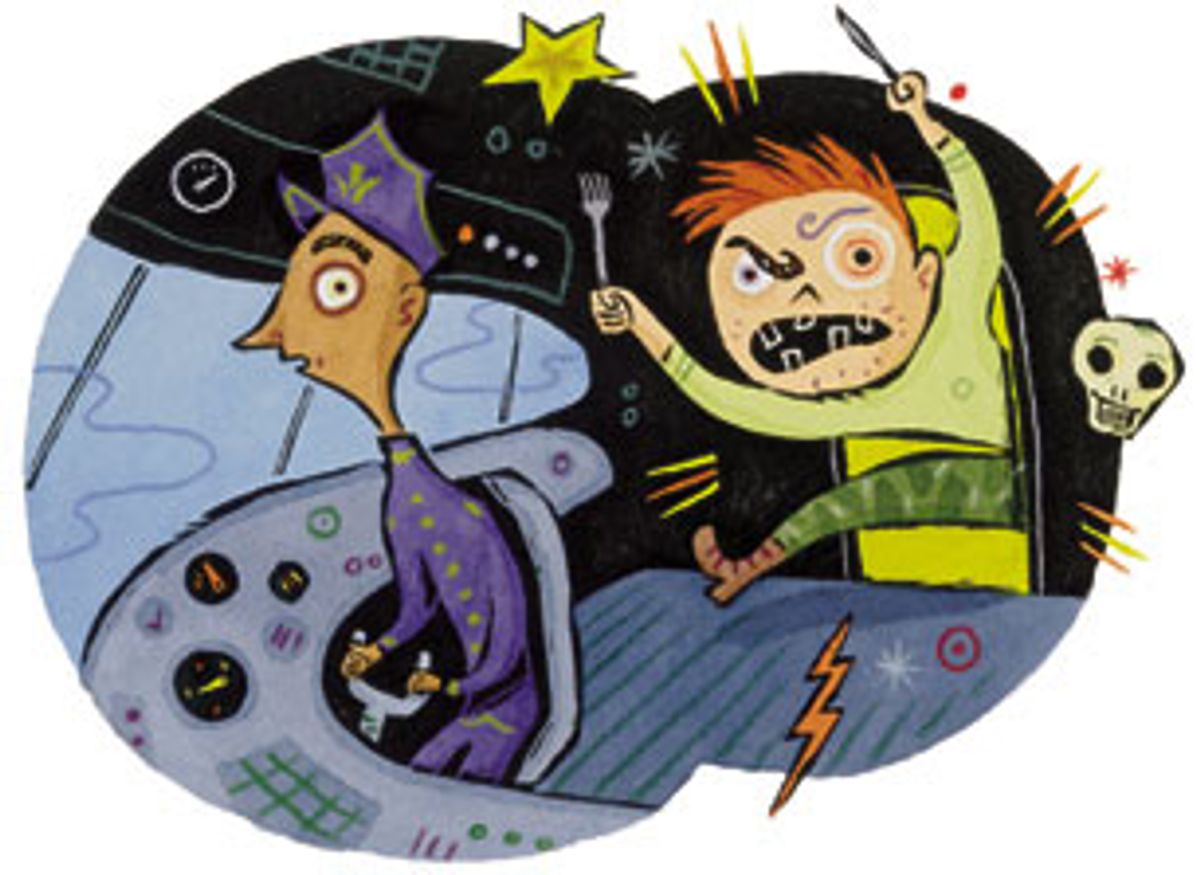
Cockpit assault

Since July 1997, over a dozen passengers have attempted to breach cockpit doors during commercial airline flights. We've been lucky so far.

  • more
    • All Share Services

Cockpit assault

On March 16, aboard Alaska Airlines flight 259 from Puerto Vallarta, Mexico, to San Francisco, a man did something that angry, frightened, deranged and intoxicated passengers are doing with alarming frequency these days: He broke through the cockpit door and attacked the pilots. Provoked (or so his attorney claims) by a bad reaction to blood-pressure medicine, Peter Bradley, 39, shouted, “I’m going to kill you,” and lunged for the controls.

Having been alerted of the impending attack, the co-pilot was armed with an ax. He fought with Bradley, suffering a cut to his hand that would require eight stitches. Struggling to fly the plane during this tight-quartered assault, the pilot made an urgent plea for help over the intercom. At least seven passengers responded. The 6-foot-2, 250-pound assailant was snatched from the cockpit, wrestled to the ground, bound hand and foot with plastic restraints and taken into custody by federal authorities upon landing in San Francisco. A potential airplane disaster was averted. But what might have happened if no one had responded to the captain’s plea? Or what if the response had been too little or too late?

Eleven days later, on March 27, an airplane cockpit was the scene of yet another in-flight battle. This time the results were even scarier. A German man broke into the flight deck during a Germania charter flight from Berlin to the Canary Islands. The man, believed by authorities to have been under the influence of alcohol, forced his way into the cockpit while the plane was over Spanish airspace. Once inside, reports say, he threatened the pilots and told them the plane was under assault by “terrorists.” He then proceeded to punch, kick and choke the 59-year-old pilot.

At some point the attacker managed to grab the controls. The aircraft veered from its flight path and lost altitude briefly, but the co-pilot managed to stabilize it. “Help, we need strong men, we need strong men!” the co-pilot reportedly announced. Four passengers from Sweden, Russia and Germany, along with flight attendants, responded to his plea and managed to subdue the attacker. A spokesman for Germania, a charter company operated by LTU, said “There was no real danger at any point for the passengers.” This statement is a crock of public-relations bullshit, pungent enough to wrinkle noses on both sides of the Atlantic. Everyone aboard the aircraft was in danger, all 143 passengers and crew. Why else would the co-pilot be screaming for help?

During the past few years, passenger attacks against flight attendants have been well documented by the media. Cabin personnel have been slammed against bulkheads, put into headlocks, punched, kicked, spat at, urinated upon, hit over the head with beer bottles and threatened with their lives. These in-flight assaults are extremely rare, yet more and more air ragers find themselves traveling to that final destination behind bars. Horrible though it may be, when a flight attendant is attacked, the safety of an aircraft and its passengers is not always at issue. When someone breaks through the cockpit door, however, when someone poses a physical threat to the only two people qualified to keep an aircraft aloft, the potential for disaster makes it everybody’s issue.

The cockpit door is the only barrier between a kamikaze passenger and an unsuspecting pilot. It is a marginal defense, built for ease of crew entry and as an emergency escape, not as a fortification against determined intruders. The Alaska Airlines ordeal prompted five popular airlines (Alaska, American, Delta, Northwest and TWA) to announce, just one week after the incident, that they are seeking ways to fortify bifold cockpit doors — standard on MD-83 aircraft — like the one Bradley was able to break through. “The one thing you can’t do is put a bank vault door on the cockpit,” said Alaska Airlines spokesman Jack Evans. “The door needs to be secure, but it also needs to be an emergency exit as well.”

Paradoxically, some international carriers allow the cockpit door to remain unlocked during a flight. Any passenger can walk right in, even those who might mistake the cockpit for the lavatory. U.S. airlines adopt a quite different policy, however. They require that the cockpit door remain locked at all times during flight, except, of course, while crew members are entering and exiting. In this respect, pilots and flight attendants carry cockpit keys as standard equipment. But in one particularly appalling incident, a cockpit key gave a deranged passenger access to the flight deck and the consequences were fatal.

On July 23, as All Nippon Airways flight 61 ascended from Tokyo’s Haneda Airport on its way to Sapporo, Yuji Nishizawa, 28, got up from his seat, pulled an 8-inch knife on a female flight attendant and forced her to unlock the cockpit door. It’s not certain how he managed to smuggle a deadly weapon through airport security. But what he did next is crystal clear. He ordered the co-pilot out of the cockpit and demanded that the pilot fly to a U.S. military base west of Tokyo. When the pilot refused, Nishizawa stabbed him in the neck and took control of the aircraft.

With the deranged man behind the yoke, the Boeing 747, packed with 503 passengers and a crew of 14, plunged to within 300 meters (984 feet) of the ground. Moments before what might have been the airline industry’s worst-ever disaster, the deposed co-pilot and an off-duty pilot stormed the cockpit, tied up the assailant and resumed control of the aircraft, which they managed to land safely in Tokyo. Despite the efforts of an onboard physician, the injured pilot bled to death.

Later, when police questioned Nishizawa about his motive, he expressed a fondness for flight simulation games, which had apparently ceased to capture his imagination. “I wanted to soar through the air,” he reportedly told police.

In the All Nippon Airways case, a hijacker forced his way past the cockpit door in a planned attack. But unplanned break-in attempts by disturbed passengers add a whole new wrinkle to the withering face of in-flight tranquillity. Since July 1997, there have been at least 14 instances where an unauthorized person attempted to breach the cockpit door during a commercial airline flight, including the two described above. Of these, eight were successful. The result: Three physical attacks on pilots (all in March), at least five flight diversions and more than two dozen pilots who were forced to shift their attention from the controls to a potentially violent intruder. Here’s how the incidents played out:

July 14, 1997: After Thomas Kasper poured hot coffee on a flight attendant (inflicting second- and third-degree burns), his traveling companion, Susan Callihan, kicked a hole in the cockpit door. Witnesses on the Continental Airlines flight from Houston to Los Angeles said Callihan then told the flight crew there were bombs and guns on the airplane, though none were found. In addition to this, Kasper nearly opened an emergency door when the plane landed. Both were arrested and convicted of interfering with a flight crew. The couple received his-and-hers prison sentences of three and two years respectively.

July 27, 1997: A woman traveling with her young son tried to enter the cockpit aboard a Northwest Airlink flight from Iowa to the Minneapolis-St.Paul airport. When the pilot closed the door, the woman — described by one passenger as a white-knuckle flier in the midst of a panic attack — became hysterical. She kicked open the cockpit door. Passengers said the pilots chose to return to Fort Dodge Regional Airport because they could no longer concentrate.

Nov. 25, 1997: As the pilots of a Cathay Pacific aircraft prepared to land in Bangkok, Thailand, a drunken Burmese passenger stormed the cockpit. He was removed by passengers and crew, handcuffed and turned over to Bangkok police upon landing. At the time of the incident, Cathay Pacific’s policy allowed cockpit doors to remain unlocked during flight. The policy, an airline spokesman claimed, facilitates better communication between pilots and cabin crew.

Dec. 16, 1997: Dean Trammel, a muscular, 200-pound college football player, suffered a “psychotic break” aboard U.S. Airways flight 38 bound for Baltimore from Los Angeles. After wandering up the aisle and claiming to be Jesus Christ, he tried to get into the cockpit. Flight attendants blocked access, but Trammel threw one of them over three rows of seats. She slammed into a bulkhead. Passengers and off-duty U.S. Airways pilots wrestled Trammel to the ground. He was tied with seat-belt extensions at his wrists, elbows, ankles, knees and legs. The plane landed with the two off-duty pilots sitting on top of him.

Sept. 23, 1998: The FBI charged Titan Tibor Sallai with intimidating a flight crew by allegedly attempting to enter the cockpit of a United Airlines jet. The plane was traveling between Las Vegas and Washington. Crew members had to use force to prevent Sallai from opening the cockpit door as well as an emergency exit door. Federal agents reported that at some point during the flight, Sallai attempted to drink contact lens cleaning fluid. The plane diverted to Denver.

Oct. 27, 1998: British rock star Ian Brown, formerly a singer with the Stone Roses, threatened to cut off the hands of a British Airways flight attendant. While the pilots attempted to land the aircraft, he hammered against the door. Brown claimed the pilot had provoked him. Lawyers have attempted to exonerate him.

April 5, 1999: An intoxicated passenger forced his way into the cockpit of an unidentified commercial jet as pilots were attempting to land at Copenhagen, Denmark’s Kastrup Airport. Once inside the cockpit, the passenger began shouting abuse at the pilots. His voice was reported to have been so loud and distracting that the crew had difficulty hearing radio directives from air-traffic control. The man was arrested upon landing.

June 6, 1999: After being denied more alcohol, Christopher Bayes fought with flight attendants and tried to storm into the cockpit, according to prosecutors at his trial. Delta Airlines Flight 64, en route to Manchester, England, from Atlanta, was forced to divert to Bangor, Maine, where Bayes was arrested. Bayes, who continues to deny his guilt, was convicted of assault and sentenced to six months in prison.

Aug. 5, 1999: Sanil Shetty Kumar, an American, was given a six-month jail sentence after trying to force his way into the cockpit on a Singapore Airlines flight from Los Angeles to Singapore via Tokyo. Kumar became intoxicated during the L.A. to Tokyo segment. After cockpit entry was thwarted by passengers and two male flight attendants, Kumar attempted to open an emergency exit door, shouting, “Tonight, everybody will die.”

Nov. 21, 1999: A Canadian Airlines jet flying to Halifax from Calgary was forced to divert to Ontario after an angry passenger walked into the cockpit. The man, who allegedly attempted to assault the pilot, had been shouting and creating a ruckus earlier. He had to be removed from the cockpit by passengers and crew members. At the time of the incident, Canadian Airlines policy allowed cockpit doors to remain unlocked except during takeoff and landing.

March 2, 2000: The FBI filed a criminal complaint against Joachim Peter Franke, a German national who tried to break into the cockpit of a Delta Airlines jet because he thought the plane was “flying too low and was in danger of crashing.” The deranged man had to be restrained after repeatedly trying to push past a flight attendant who blocked the cockpit door. The attendant yelled for help. Two passengers came to the rescue and held Franke in a seat until landing. Franke faces a fine of $10,000 and up to 20 years in prison.

March 20, 2000: An angry American woman was arrested after allegedly entering the cockpit during an America West flight from Phoenix to New York. How Denise Laverne Brown managed to breach the cockpit door is not exactly clear. But once inside, Brown allegedly attacked the co-pilot. FBI agent Doug Beldon said, “Apparently she refused to return to her seat, failed to obey the orders of the flight personnel, became angry, went into the cockpit and struck the co-pilot.” The flight diverted to Albuquerque, N.M., where the passenger was taken into custody by federal authorities.

As much a testament to the competence of airline pilots as to the swift response of dauntless passengers and cabin crew, not one of these cockpit intrusions resulted in an airplane disaster. But if attacks continue at the present rate, how long can courage and competence hold out?

At least one airline isn’t waiting to find out. More as a deterrent to hijacking than a defense against cockpit-bound passengers with fear or alcohol pumping through their veins, the government of India recently instituted a sky marshals program. As of Jan. 1, all Indian carriers are subject to random occupation by armed National Security Guard commandos. In an attempt to add an additional layer of in-flight security, flight attendants now undergo special “anti-hijacking” training. This no-nonsense approach comes after the Christmas Eve hijacking of an Indian Airlines plane that left one man dead and saw hostages held aboard the aircraft for nearly a week.

Are similar measures needed to prevent unplanned attacks like those on Alaska Airlines and Germania? Does this latest development by the Indian government signal an increase of federal marshals on U.S. carriers? Veteran fliers will remember that in 1970, following a decade in which U.S. airlines experienced dozens of airplane hijackings — many of them to Cuba — the sky marshal program was born.

These specially trained, armed agents travel on flights that have a higher-than-normal probability of being hijacked. Referred to nowadays as “federal air marshals,” they sit quietly in coach or first class, dressed in civilian clothes and are authorized to make arrests without warrants for any offense against the United States or its aircraft. The air marshal program was enabled by the Federal Aviation Act of 1958, the Anti-hijacking Act of 1947 and the International Security and Development Act of 1985.

Capt. Bob Cox is special projects officer for the national security committee of the Air Line Pilots Association, an employee labor union representing 55,000 pilots at 51 U.S. and Canadian carriers (including United, Delta, TWA, Northwest, U.S. Airways and Alaska). Cox believes that other airlines should follow the example set by Indian carriers. “The ALPA strongly endorses an increase in the use of armed federal air marshals on random domestic flights to deter or prevent violent attacks on crew members,” he says. “These are highly trained individuals with well-refined abilities to protect the cockpit and will do so at all costs.”

Not all pilots agree with such a drastic approach. Ed Horton, an international airline captain with 25 years’ experience in matters of flight security and disruptive passengers, doesn’t want the airplane cabin to turn into a battle zone. “The last thing you want is shots being fired inside an aircraft.” Horton believes the best way to stop potentially violent passengers is with well-trained eyes rather than weaponry. “All airlines need to do a better job at training crew members to recognize potentially disruptive passengers,” he says. “We need to learn more effective ways to approach them, how to diffuse the problem and how to deal with them effectively should violence erupt.”

With the possible exception of Indian Airlines and a few others, most airline companies do not properly train their flight attendants on how to handle violent passengers. Cabin crews are equipped with written, step-by-step procedures for dealing with almost every conceivable problem on a flight: seat malfunctions, broken ovens, cabin depressurization, medical emergencies, emergency evacuations and inoperative lavatories. They even receive detailed information on what steps to take should a woman give birth in flight. But there are no comprehensive procedures for suppressing a ballistic customer, no blueprint for crews to follow should they come face to face with the passenger from hell.

Left to their own devices, crew members are nevertheless quick to improvise. When Trammel attempted to break into the cockpit of the U.S. Airways jet, a quick-thinking flight attendant used a service cart to block access to the door. That stopped him long enough for passengers to help wrestle him to the ground. Flight attendant Renee Sheffer suffered serious injuries during the melee. Her husband, Mike, promptly created the Skyrage Foundation, a watchdog organization aimed at eradicating assaults against flight crews. With Sheffer at the helm, the foundation’s Web site tracks every reported instance of in-flight violence and serves as a forum for open dialogue on the subject. Sheffer believes that “anyone who attempts to, or actually enters, the cockpit and endangers the safe operation of the aircraft should have the maximum penalty imposed if convicted. (If President Clinton signs the aviation bill that the House and Senate just passed, that would mean a $25,000 fine).”

But he’d like to see the penalties become even more severe. “We should also adjust the federal sentencing guidelines to reflect the enormously serious nature of these acts, by increasing the level of offense to something similar to kidnapping or attempted murder. That way, federal judges would be able to impose serious prison terms.”

In 1994, the Federal Aviation Administration reported 121 incidents of
in-flight passenger misconduct. These incidents run the gamut, from severely
rude and obnoxious behavior — for example, a passenger verbally threatening
to punch a crew member — to outright physical assault. By 1998 the figure
had reached 283.

But because the FAA records only those incidents that airlines choose to
disclose, the total number of assaults is probably much higher. United
Airlines, for example, recorded 635 incidents of disruptive behavior in
1998. Of these, 61 were physical assaults. If one airline claims to have had
635 disruptive incidents in one year (9.6 percent of which were assaults),
and the FAA reports a grand total of only 283 occurrences on 84 U.S.
airlines during the same period, it’s safe to say that somebody is not
telling the whole story.

Perhaps in the not-too-distant future, a pleasant smile and friendly demeanor will no longer be listed in the job description for those seeking employment as a flight attendant. Instead, airlines may seek physically imposing, nightclub bouncer types who can deliver a knee to the groin or a blow to the solar plexus as effortlessly as an after-dinner cordial.

Now that older jets with three-pilot cockpits are gradually giving way to economically efficient models built with a cockpit for two, the modern-day flight crew is reduced by 33 percent. With only two pilots aboard instead of three on many flights, their safety and well-being have become more important than ever. As a result, pilots are becoming more and more reluctant to put themselves in harm’s way. “Sending a pilot into the passenger cabin to help resolve a dispute seriously diminishes the safety of the flight,” says Northwest Airlines Capt. Stephen Luckey, chairman of the ALPA’s national security committee. “This is particularly so in the event of an altercation which could result in an incapacitated pilot.”

Airline pilots must remain untouched and unencumbered behind the cockpit door. Unsound doors need to be fortified. Cabin crews need to be better trained. The federal air marshal program may need to be expanded or restructured to accommodate this new wave of nonterrorist terrorism. Until these aspects of in-flight security are properly addressed, who’s going to stop a fearless, able-bodied maniac from breaking into the cockpit and assaulting the two most important individuals on an aircraft? Fearless, able-bodied passengers and cabin crew have done so in the past, but our luck is bound to run out one of these days.

Elliott Neal Hester has been a flight attendant for 15 years. He has also written for National Geographic Traveler, Men's Fitness, Glamour, Maxim and Caribbean Travel & Life. Out of the Blue appears every other Friday. E-mail your tale of life in the sky to Hester. For more columns by Hester, visit his column archive.

Behind the underwear bomb

The latest airplane terror plot wouldn't have been foiled without airport security -- but not the kind we all know

  • more
    • All Share Services

Behind the underwear bombTravelers line up at a TSA checkpoint at Los Angeles International Airport. (Credit: Reuters/Danny Moloshok)

Another deadly plot taken down in the planning stages. This time, thanks to the work of a CIA double agent, officials were able to infiltrate a Yemen-based al-Qaida plot to destroy a U.S.-bound jetliner using a nearly undetectable underwear bomb.The moral of the story: Airport security works!Am I being facetious?  Not necessarily.  It depends on your definition of airport security.

In my mind, the key to keeping airplanes safe is, and always has been, stopping acts of sabotage while they are still in the planning stages. Here in the age of the TSA checkpoint, with its toothpaste confiscations and obsession with pointy objects, we tend not to think this way, preoccupied instead with a kind of airport Kabuki — the tedious, fanatical screening of passengers and their carry-ons. Real airport security takes place offstage, as it were. It is the job of the folks at the CIA and the FBI, working together with foreign authorities. And while TSA has an important role here too, we can do without the spectacle of airport guards rifling through innocent people’s bags in a pathological hunt for what are effectively harmless items.

The concourse checkpoint needs to be there.  Just the same, chances are good that once an adversary has made it to the airport, he or she has engineered a way to outwit the system.  And spend as we might, there will always be a way to outwit the system.  ”Even if our technology is good enough to spot it,” said California Rep. Adam Schiff, commenting on the news of the latest underwear plot, “technology is still in human hands and we are inherently fallible.”

That’s one of the smartest things I’ve heard a politician utter in some time.

Getting a handle on this takes us all the way back to Sept. 11, 2001, the day that everything, and yet really nothing, changed.  I’ve said this before, but it bears repeating: Conventional wisdom holds that the 19 hijackers exploited a weakness in airport security by smuggling box cutters onto four Boeing jetliners. But conventional wisdom is wrong. What the men actually exploited was a weakness in our mind-set — a set of presumptions based on the decades-long track record of hijackings and how they were expected to unfold. (In prior years, a hijacking meant a diversion, perhaps to Havana or Beirut, with hostage negotiations and standoffs; crews were accordingly trained in the concept of “passive resistance.”) The presence of box cutters on 9/11 was merely incidental. The men could have used almost anything — a deadly sharp can be fashioned from a broken first-class dinner plate or a ballpoint pen — particularly when coupled with the bluff of having a bomb. The success of their plan relied not on hardware but on the element of surprise. It wasn’t a failure of airport security that allowed those men to hatch their takeover scheme. It was a failure of national security — a breakdown of communication and oversight at the FBI and CIA level.

To put it succinctly: The success of the 9/11 attacks had almost nothing to do with airport security at all — a great and painful irony, of course, to any passenger forced to endure the checkpoint rigmarole in 2012.

Not that frontline guards don’t play a deterrent role.  And, in the opinions of some, the plot uncovered in Yemen underscores the value of full-body scanners — those controversial walk-through machines that allow guards to look beneath a passenger’s clothing. It’s a compelling argument, but the way in which these scanners have — and have not — been deployed is apt to make some of us cynical. For instance, the vast majority of body scanners are found at U.S. domestic airports. Overseas, where a bomb is far likelier to originate, they are rare. Is this really about safety, we wonder, or is it about billions of dollars going into the coffers of the companies contracted to build these machines?

And although the scanners are effective, where does the arms race end?  Not long ago, the idea that passengers would be marched through body scanners and photographed naked before being allowed to board an airplane, would have seemed outrageous. Yet here we are. What might be next?  The stubborn truth is, we can turn airports into fortresses if we want (in some respects we’re well along that path), yet we’ll never be entirely safe. Airport screening alone, no matter how thorough, how expensive, and how technologically advanced, will never defeat a relentless enough, resourceful enough adversary intent on downing a plane.

That isn’t capitulation, it’s reality.  And acknowledging this reality would go a long way toward warding off panic and overreaction when the next successful attack occurs.

Regrettably, too, we often forget that commercial air travel has long been a target of terrorist extremists.  The 1970s and 1980s in particular were, as I like to describe them, a Golden Age of Air Crimes, comparatively rife with bombings, hijackings and other deadly assaults against airplanes and airports. Over one five-year span between 1985 and 1989 we can count at least six high-profile terrorist attacks, including the horrific bombings of Pan Am 103 and UTA 772; the bombing of an Air India 747 over the North Atlantic that killed 329 people; and the incredible saga of TWA Flight 847.  And let’s not forget what might have been, such as the so-called “Project Bojinka,” the 1994 scheme masterminded by Ramzi Yousef (nephew of Kalid Sheikh Mohammad), in which impossible-to-detect (at the time) liquid explosives were to be used to simultaneously destroy a dozen U.S. airliners over the Pacific Ocean. Fortunately the plot unraveled and Yousef was arrested.

While we can argue, quite persuasively, that many of the current-day security measures have done little if anything to make us safer, we’ve nevertheless introduced measures that have been useful and effective, from explosives screening of checked luggage to the sorts of trans-border partnerships that broke up the most recent plot from Yemen. Whether in spite of, or because of, the attention we’ve lavished on All Things Terrorism, the past decade has seen fewer attacks against commercial air travel than any since the 1950s.What we need to remember, though, is that our success has had more to do with the security measures we don’t see than those taking place in plain view. And if our luck is to hold, we need to better rationalize and streamline our entire approach to airport security. For instance, if we’re going to have those body scanners, let’s put them where they’re needed. If this requires negotiating with foreign authorities whose airports are beyond TSA’s jurisdiction, so be it. Meanwhile, here at home, TSA’s one-size-fits-all approach, in which every single person who flies is seen as a potential threat, is simply unsustainable in a country where close to 2 million people fly daily. Things like taking snow globes from children, haggling over tiny container sizes, or confiscating a dessert fork from a uniformed, on-duty airline pilot (it happened to me) serve no useful purpose whatsoever. On the contrary, they divert valuable time and resources away from the things that could make us safer.  Let’s scale back that concourse Kabuki and retrain guards in the finer points of a more sensible, risk-based assessment of passengers and their belongings.

And lastly, if only as an aside, let’s behold for a moment the term “underwear bomb.”  That was the operative phrase in literally hundreds of articles and broadcasts over the past several days, and nowhere did it raise a snicker.  What does it say about our country, I wonder, that such a preposterous expression is instantly understood and effectively taken for granted?

Strange times indeed.

Continue Reading Close

How the rich took over airport security

Security checks were one of America's most democratic places -- until rich passengers got their own speedy lines

  • more
    • All Share Services

How the rich took over airport security (Credit: Reuters/Salon)

The other day at Bergstrom Airport in Austin, Texas, I witnessed a striking manifestation of the new American plutocracy. Along with getting a photo at the Department of Motor Vehicles and sitting in a jury pool, standing in line at airport security with a mob of other people, miserable though it is, remains one of the few examples of civic equality in our increasingly oligarchic republic. Much airport security, of course, is theater, designed to provide alibis for bureaucrats and politicians in the event of a terrorist attack. But while we can debate what a rational airport security system would look like, no rational system would discriminate among passengers on the basis of ability to pay.

That is what makes the policy of Delta Airlines so shockingly un-American.  In Austin, Delta had not one but two lines that fed into the Transportation Security Administration checkpoint area. One line was mixed race, mixed class and mixed age. The other line was usually empty. Now and then a white, middle-aged man would appear in the second line and the first line would be halted as he went directly into the TSA checkpoint.

“Who are those guys?” I asked a TSA officer, when I reached the front of the second-class citizen line.

“Delta has total control over the passenger line all the way up to here,” the officer answered. “They’ve decided to let priority passengers as well as pilots and steward staff go through ahead of others.”

“So that’s the rich white guy line?” I asked.

The TSA officer laughed. “On our side of the line, everybody is equal.”

Now I would be the first to concede that what Delta and other airlines do beyond the government security checkpoint at the gates that lead to airplanes is their business. At the moment, the model of America’s pathetic, predatory, deteriorating airline industry seems to be eking out nickels and dimes by playing crudely on the snobbery of their customers, with the use of two separate lines at the terminal gates, one for priority passengers — labelled, by various airlines, Gold, Platinum, Elite and so on.

The priority line, needless to say, goes to exactly the same door and entry ramp and does not get the “elite” to its destination one second earlier. Neither de Toqueville, who commented on the contrast between the status obsessions of Americans and their professed democratic egalitarianism, nor Veblen, who coined the term “conspicuous consumption,” would have been surprised by this method of showing off. Such silliness is a matter for satire, not lawsuits or protest marches.

But going through airline security is different. It is not a choice, like belonging to an airline’s frequent flier points club. Security screening is an onerous civic duty. Like other civic duties, it should be shared equally by rich and poor alike. Remember the motto of Jacksonian populism? “Equal rights for all, special privileges for none.”

Nearly all the airlines now allow well-heeled passengers to pay for the privilege of cutting ahead of the rest of us at the TSA checkpoint. At many airline checkpoints there are two lines. The long line looks like America; the short line is made up mostly of affluent white men.

Is this the future we Americans want: two lines at all airline security checkpoints, one for the privileged 1 percent and the other for the 99 percent, who have to stand aside to let the people with lots of money pass?  Alas, it appears that making economic apartheid formal in U.S. civil aviation is a bad idea whose time has come. The TSA is experimenting with a “precheck” program with built-in class discrimination, including the government’s crony-capitalist invitation of frequent fliers from private U.S. airline programs, but not other American citizens, to participate:

If you are a United States citizen and are currently a member of CBP’s eligible Trusted Traveler programs (Global Entry, SENTRI, NEXUS), you are automatically qualified to participate in the TSA Pre ™ pilot as long as you are flying on a participating airline at a participating airport. (If you’re a more frequent flyer with Delta or American, you must opt in to the program by responding to the communication sent to you, which is why it’s important to find that email and follow the directions in it.)

In other words, if you do not fly frequently — and most low-income and middle-income Americans cannot afford to — you would not be allowed to take part in this public government program.  In true crony capitalist fashion, the precheck program blurs the line between the government’s security function and the airlines’ purely commercial frequent flier programs.

The precheck program is advertised as an experimental program, holding out the possibility that after a period in which they are subject to more scrutiny than affluent business travelers, low-income grandmothers traveling to visit their grandchildren at last will be able to take part.  More likely, the precheck program would never be extended to the masses rather than the classes.  It would simply become another permanent perk of the elite, whose members would have no incentive to lobby for democratizing the program — rather the contrary.

But wouldn’t it help an overburdened airport security system to reduce the number of people to be rigorously screened by TSA?  Not if it means more screening for low-income grandmothers and less for frequent business travelers.  Indeed, as anti-terrorist measures, trusted traveler programs allowing affluent people who are frequent international travelers to be subjected to fewer security procedures might well backfire. Osama bin Laden and Mohamad Atta were members of the affluent social and educational elites in their countries who lived abroad and traveled frequently.

These “trusted traveler” systems will not make America safer. Their unacknowledged purpose is to create yet another area of American society that is privatized and segregated by class, to the benefit of the mostly white economic overclass.

Very well then. Why don’t we just make the new class-based discrimination official? Instead of leaving it to airlines and other corporations to construct the new apartheid piecemeal and informally, let the government issue a Premium Elite Citizen Card, valid for multiple purposes. For the right price, a price carefully calculated to be unaffordable by the majority of Americans, those willing and able to pay would be allowed to cut in line, not only at airports, but everywhere: at taxi stands, movie theaters, restaurants. All they would have to do is flash their Premium Elite Citizen Card to force the rabble to step aside and make way.  The degeneration of America’s democracy into a banana republic would be complete, once the Land of the Free became the Land of the Free Points With Membership.

Continue Reading Close

Michael Lind’s new book, "Land of Promise: An Economic History of the United States", will be published in April and can be pre-ordered at Amazon.com.

When parents drug their kids

Antihistamines can knock out even the loudest child on a plane. Is it safe -- or just bad parenting?

  • more
    • All Share Services

When parents drug their kids (Credit: Ilya Andriyanov and KAMONRAT via Shutterstock)

When I wrote last week about the 2-year-old girl who, along with her whole family, was kicked off a JetBlue flight for having a tantrum, I expected an outpouring of responses. What I hadn’t imagined was how much of it would be in favor of sedating kids as a practical means of getting them from point A to point B. “You know how I traveled with toddlers?” the stay-at-home mother of two tweeted to me. “Benadryl. Works like a charm.”

I’ll admit that I was initially stunned to see how apparently commonplace the practice is. I’d never given my two daughters Benadryl or anything else to calm them down when they were young travelers, and the thought of doing so seemed wrong to me. It would have felt like a violation of their trust, a willful introduction of something unnecessary into their bodies for my own convenience.

In fairness, though, my kids have barely ever flown, and when they have, they’ve been reasonably chill. And after getting an earful from other parents both on Twitter and via email, I began to wonder if doing something that could make a child comfortable — and one’s fellow travelers considerably less inconvenienced – was such a big deal.

“I’ve totally given Benadryl as a way to get the kids to go to sleep when they were littler,” says my friend Collette, whose sons are now tweens like mine. “I think I did it about a month ago even. I would do it on a flight if I thought it would make them less freaked out.” But, she admits, “I’ve never made it a habit.”

And my friend Ted, who has two school-age daughters, regaled me with the story of flying to Florida a few years ago, “crouched down behind the row of seats in the departure lounge, feeding my perfectly healthy kids cough syrup so they will sleep, and looking guiltily around to see if I am going to be caught. Down at the other end of the long row of benches, I catch the eye of another parent doing the same thing to her daughter. All our kids rack out and we sit and laugh about it — and other kid realities — for the whole flight.”

It’s not as if this generation’s parents invented the idea of taking the edge off for our kids. We learned from the masters – our own parents. Ted says, “My parents did the same to us when we were on long road trips. We had a VW van with the back seat removed and a platform put in covered with mattresses and sleeping bags and we drove everywhere — out to the Midwest, down to Florida, New Mexico. My mother fed the three of us cough meds as we left a few times and after that it was Pavlovian — we’d all get in the car and immediately crash. I still fall asleep if I’m not driving.” Collette says that her mother used to give her whiskey in hot milk. And Monica, a mom in the Bay Area, recalls a cross-country trip with her brothers in the ’70s, when the kids “made little beds in the back of my parent’s Buick LaSabre and slept constantly.”

“It was strange to wake up and two states had gone by, or it was afternoon and suddenly it was midnight and we were checking into a hotel,” she says. “My mom was always giving us ‘vitamins’ from a tincture. I remember us all standing in the entry of our hotel room while she gave us little drops — like little birds getting a worm. Years later my mom told me what she did. She had gone to the doctor before the trip and gotten some kind of sleep aid/tranquilizer for us.”

But nothing in life, not even relaxing, over-the-counter allergy medication, is a sure thing, recalls Melissa, a mom who learned that the hard way. “We gave our newly adopted 14-month-old a dose on a flight home from China. She wound up climbing the walls, hyper-awake and restless. Never touched the stuff again.”

And Darshak Sanghavi, a pediatrician and author of “A Map of the Child: A Pediatrician’s Tour of the Body,” says, “According to a good randomized trial of Benadryl to promote sleep in infants, the drug didn’t really work any better than a placebo. So I first tell parents that it’s not really clear that Benadryl really works like many parents might think. Second, there are occasional case reports of Benadryl poisoning. Granted, those are highly unlikely, but my opinion is that parents traveling with infants should generally stay away from trying to sedate them with Benadryl, and instead focus on comforting them with feeding during takeoff and landing (may improve ear pressure equalization). Flying with infants is almost always torture,” he admits, “and unfortunately, medicating an infant isn’t going to change that.”

Yet when you’re facing a cross-country flight and a cranky kid, sometimes you’re willing to try anything. My own former pediatrician, Brooklyn’s Dr. Philippa Gordon, advises parents to be guided by equal measures of caution and instinct. “It’s a question that toggles between the pragmatic and what we find uncomfortable,” she says. “Is it a kid who has a known disorder or you know is going to have a terrible time on a flight? Or is it really more for the control of their symptoms than the comfort of other passengers? Are you medicating them for behaving like normal, developmentally appropriate children? We shouldn’t use medications just for the comfort of adults. Remember that Benadryl is an antihistamine. I try not to use over-the-counter drugs for children and toddlers, and certainly not for unintended results.” But she adds that it’s “a judgment call,” and ultimately “a relatively benign intervention.”

But my friend Helen, an advanced practice nurse specializing in maternal addiction in Philadelphia, sees it differently. “I think putting a chemical into your child’s brain in lieu of substituting appropriate comforting parenting behaviors is shameful,” she says. “Whatever happened to games, singing, soothing? I work with addicts for a living and this is the disease to its core: Can’t cope? Head for the dope! If other people on the plane get annoyed at a fussy child, then dose THEM.”

Even those of us who’ve never sedated our kids can cop to moments when we’ve considering it. I’ve certainly enjoyed a few of my children’s drowsier afternoons after they’ve had vaccinations or medication. And my friend Ava recalls a pediatrician handing her two bottles of medicine, “with instructions to be careful to give the one at night, as it would make my 8-month-old baby sleepy,” and wondering, “Just at night? When I’ve considered the tension and fighting and probable bad mothering that took place in a carful of kids on a 12-hour road trip, I’ve wondered more than once just how bad it would have been if I’d given them that night-time cold medicine. I didn’t, but I wouldn’t judge a mother who did.”

I’m still glad I got out of my children’s meltdown years without dosing them – because that feels like the right and consistent approach for our family. I still shudder at the automatic “Haven’t you ever heard of Benadryl?” response from callous adults who think any child out in public should be silent and sleepy. There’s also a world of difference when you’re dealing with a colicky baby, a tantrum-tossing toddler or a bored kindergartner, and you need to consider your options in age-appropriate ways. But in the past few days, I’ve been reminded that parenting is very much a make-it-up-as-we-go-along adventure, and that most of us really are endeavoring to do right by our children and the innocent bystanders who have to put up with them. As my writer-friend Stella says, “There are so many things you say you’ll never do/say to your kids. But any parent will tell you that raising children is all about doing the best you can with what’s at hand. Excepting actual physical injury or emotional trauma, I would never deign to judge the parental decisions someone else makes. Parenting is hard. Full stop. And you do what you can.”

Continue Reading Close
Mary Elizabeth Williams

Mary Elizabeth Williams is a staff writer for Salon and the author of "Gimme Shelter: My Three Years Searching for the American Dream." Follow her on Twitter: @embeedub.

When a flight becomes “pre-schoolers gone wild”

A family with toddlers is ejected from a JetBlue plane -- and kicks up a storm about kids and travel

  • more
    • All Share Services

When a flight becomes (Credit: Kenneth Man via Shutterstock)

Very few venues in this world — especially ones that invlove confined spaces — are thrilled to welcome a 2-year-old. Unless you’re at a Wiggles reunion show, the most common response is a lot of rolled eyes, anticipatory grimacing and the question “Can we change our seats?” So when JetBlue staff noticed young Natalie Vieau boarding a flight from Turks and Caicos with her parents and her 3-year-old sister last month, it’s possible they were already steeling themselves for Natalie to behave exactly like, well, a 2-year-old. When young Miss Vieau complied, pitching a fit that would have made Chris Brown proud, the crew kicked her and her family off the plane. Discuss.

The problem, the family says, arose when Natalie – and apparently her sister as well — didn’t appreciate the notion of sitting still and being buckled in. Natalie wanted to fly on her mother’s lap, but federal regulations require children over the age of 2 to fly in their own seats. “We were holding them down with all of our might, seat belt on,” their mother, Dr. Colette Vieau, told a Rhode Island TV station this week. “And I said, ‘We have them seated. Can we go now?’” Instead, the pilot made the decision to ground the  family and have them escorted off the flight. They wound up having to book a hotel for the night and then find another flight home, to the tune of $2,000.

The very fact that Dr. Vieau describes the scene with the phrase having to use “all of our might” certainly suggests that little Natalie might be a handful. And her squirmtastic appearance on the “Today” show Monday doesn’t do much to suggest she’d have settled down for a peaceful ride back to Boston. So it’s unsurprising that when “Today” polled its viewers, “71 percent of more than 60,000 voters” agreed with the airline’s decision to kick the family off the flight.

Modern flying is horrible enough – on top of all the usual indignities, nobody wants to be trapped in the air with a pair of freaked-out toddlers. This mortified family, however, just wanted to get home, and they remain confused about just how quickly the incident escalated. As Dr. Vieau says, “We did what we were asked to do. We weren’t belligerent, drunk, angry or screaming. We were just having a hard time struggling with our children. Just some consideration, a little bit of humanity in the situation was really all I was looking for.”

What stories like this illustrate is how often that “little bit of humanity” goes wanting. And the predictably vocal response shows how badly we’ve all been burned by other people’s senses of entitlement. For their part, the Vieaus — with their Caribbean vacation, their plea that they’ve flown with their very young brood an impressive 15 times before, and their sob story of having to lay out two grand for an extra night on a tropical island — come off sounding exactly like the kind of spoiled, swaggering parents who make you avoid the playground. They may be lovely people whose kid had an off day – and if you’re a parent, you’ve likely seen plenty of those – but their story can’t engender too much sympathy. Too many of us have endured the nightmare of the family that just does not understand why little Finnegan’s meltdown is not what everyone in earshot signed up for. We’ve all seen preschoolers gone wild and parents who blithely stood by. When we hear a story about a toddler freaking out, we immediately think, fairly or not, “Spoiled parents, spoiled kids.”

That’s why the story is hard from the other side, too. Sometimes all a family has to do is go somewhere other than a Chuck E. Cheese to rile up a whole lot of tantrums – and not from the 2-year olds. You need only look as far as the frothing comments about “yuppie larvae” with “unbearable brats,” and observations that “kids just suck up oxygen and subway space anyways” to see that there’s a whole mess of preemptive rage toward children and families. And even if a child is tantruming up a storm, it’s still a stretch for an airline to claim, as the Vieaus assert, that she was “a risk to the safety and security of the aircraft in general.”

We all have to navigate a pretty crowded planet together. As Dr. Vieau herself admits, “I don’t know that I could blame JetBlue, to be totally fair. I just feel like it’s airplane travel today in general.” Kids don’t make it easy – they are volatile, difficult and often really annoying beings, it’s true. But they can’t stay home until they learn not to scream and poop in their pants. Sometimes they have to travel for family reasons, and frankly, they’re entitled to for recreational ones. They’re people, and as such, they can be jerks just like everybody else. A parent doesn’t always know, on the morning of a flight, whether she’s going to get Quiet Little Napping Girl or Hellspawn Baby for the day. The best all of us can do with other people’s kids is not be hostile just because they’re kids. And the best we can do as parents is to know when to exit gracefully.

Continue Reading Close
Mary Elizabeth Williams

Mary Elizabeth Williams is a staff writer for Salon and the author of "Gimme Shelter: My Three Years Searching for the American Dream." Follow her on Twitter: @embeedub.

The things I carry

All those gadgets, chargers, adapters and cords are supposed to make my life easier. I'm not so sure

  • more
    • All Share Services

The things I carry (Credit: Patrick Smith)

The scourges of modern-day air travel.

I can think of a few: TSA, delayed flights, garbage in your seat pocket. Screaming kids and misdirected luggage. “CNN Airport News.”

Or, how about the blizzard of cardboard placards that hotel chains insist on littering their rooms with? I spend a quarter of my life in hotel rooms, and I resent having to spend the first five minutes of every stay gathering up an armful of this diabolical detritus and heaving it into a corner where it belongs. Attention, innkeepers: This is fundamentally bad business. One’s first moments in a hotel room should be relaxing. The room itself should impart a sense of welcome. It shouldn’t put you to work.

And here’s another one: the ever-expanding collection of electronic cords, adapters, chargers and gadgets I’m obliged to haul around with me. You know what I’m talking about. Anybody who travels regularly knows what I’m talking about. All of this, supposedly, to keep us “connected.” To make our lives easier and more productive.

Does it?

Don’t get me wrong. Riding the subway out to Logan, I love being able to pop in my earbuds and catch a few cuts from the Wedding Present, the Jazz Butcher or the Velvet Underground. And my MacBook Air is as essential for travel as a change of socks. But there is, or was, something to be said for that unplugged, disconnected age of not so long ago. If nothing else, our carry-ons were lighter, with more room for clothes.

The photo above shows the assortment of electronic gadget and gizmos I take with me pretty much every time I hit the road, be it for work or pleasure. As recently as a decade ago I owned none of this. I didn’t even have a cellphone until 2006.

Clockwise-ish, from upper left:

– That black case contains the camera that I used to take this picture. I currently use a Panasonic DMC-LX3. It’s a decent point-and-shoot with a Leica lens and super-long battery life. (The more recent pictures in my Flickr archives were taken with this camera.) I bring it with me on most, though not all, of my layovers and holidays.

– Earbuds. I recently upgraded to a pair of Klipsch and retired this Apple set.

– 32GB flash drive. For my backup files, and for transferring to and from my “master” computer at home.

– USB connector for camera (optional).

– Ethernet cord. Useful in those (too many) hotels where Wi-Fi is weak and a wired connection runs more robustly. Hotel-supplied Ethernet cords are often broken.

– Power adapter for laptop.

– AC adapter set. Essential when traveling overseas. One problem is, if I’m assigned to reserve status I often don’t know if I’ll be heading overseas until the last minute, so I’ve always got this with me.

– iPhone 4. Product unplug: Am I the only person who despises — and I mean really despises — the iPhone’s messaging keypad? Because the special function keys — caps, space bar, backspace and return — are so close to the normal character keys, I’m constantly capitalizing, spacing and backspacing when I don’t mean to. This happens in either the vertical or horizontal layout, and it’s especially annoying for those of us with fat fingers. It takes me five attempts to complete the simplest sentence.

– USB charger for iPhone.

– USB-to-AC connector thing for iPhone (optional, but a good thing to have).

– USB-to-Ethernet adapter (see Ethernet cord above).

And, in the middle of it all, my beloved MacBook Air.

All together, we’re looking at roughly five pounds of technology that, for all intents and purposes, is mandatory carry-on. Sometimes it’s slightly less, other times slightly more. Not shown, for instance, is my Flip video camera, which I bring on longer trips. ( Flip brought you this, among other works of directorial art.)

Thus the real must-have gadget is a decent case or container in which to consolidate all of this crap. For me, most of the more wiry components above fit nicely into an old business class amenities kit, which keeps them out of the way and avoids tangles. (How frustrating is it, meanwhile, that so many electronic devices require their own proprietary charging cord or adapter? Imagine if every lamp took a different kind of light bulb.)

The amenities case, together with the laptop, camera and phone, fit snugly into either of my larger carry-ons. Now that my flight case has been retired — a milestone previously detailed here — I typically go to work with two pieces of luggage:

The first is a custom crew roll-aboard from Luggage Works. At the moment I use the 26-inch LW with the plastic frame, which is much lighter than the more popular metal frame version. To make it even lighter, I’ve retrofitted the stainless steel retractable handle with an aluminum one.

I don’t know what “custom crew” means. I just thought it sounded cool. Over 95 percent of LW users are airline crew members, but anybody can order one.

A number of my colleagues use Travelpro bags (I’ve owned a couple of Travelpros over the years), but on the whole that brand is more popular with flight attendants than with pilots.

For a long time pilots resisted using roll-aboards at all. The thinking was that rolling your belongings was, like, too effeminate for the macho pilot (take me, for example). And so pilots would hand-haul their 40-odd pounds of personal luggage and pilot gear through the airport, toning their tough-guy biceps and making many a chiropractor happy.

By the way, have you ever heard somebody refer to roll-aboard bags as “roller board” bags? I was on a plane a few weeks ago and the flight attendant made an announcement reminding people to stow their “roller boards” handle-first into the bins.

My smaller bag, hung from my roller board using a hook that I designed myself, is a $300 Tumi briefcase that I bought about six months ago and quickly learned to hate, with its useless, miniature exterior pockets that I can barely squeeze my fingers into.

I’m something of a pro when it comes to short-notice, multi-climate packing. Here’s a tip: Go with lightweight clothing. What a concept, I know, but I’m amazed by how many people travel with heavy cotton jeans — even to hot climates. I own a lot of fast-dry synthetics. They’re not stylish, but when have I ever been? On the other hand I can launder a pair of pants in the hotel room bathtub and they’re dry before morning.

- – - – - – - – - – - -

GO-AROUNDS

Re: The Funniest Thing Ever Written

Several readers emailed demanding that I immediately scan and post copies of the 1988 “Guide to Harvard University Dining Services” booklet that I wrote about last week. A great idea, but the thing is 38 double-sided pages long. Tell you what: I’ll do it, but not for free. My price is $5, sent to my PayPal account. I figure if 20 people are interested, that’s $100, which makes it worth my trouble. Once I hit a hundred bucks I’ll send scans of every page to anybody who wants to see them, or else I’ll post them somewhere on my home site. If I don’t hit the $100 mark within the next 10 days I’ll refund your donations. (I really don’t expect to bring in much beyond that, as people will be waiting for the early birds to cover the cost.)

- – - – - – - – - – - -

Join the Ask the Pilot mailing list. Keep abreast of changes, the newest articles and other info. To sign up, send a message to patricksmith@askthepilot.com with the word “subscribe” in the title.

Continue Reading Close

Page 1 of 122 in Air Travel