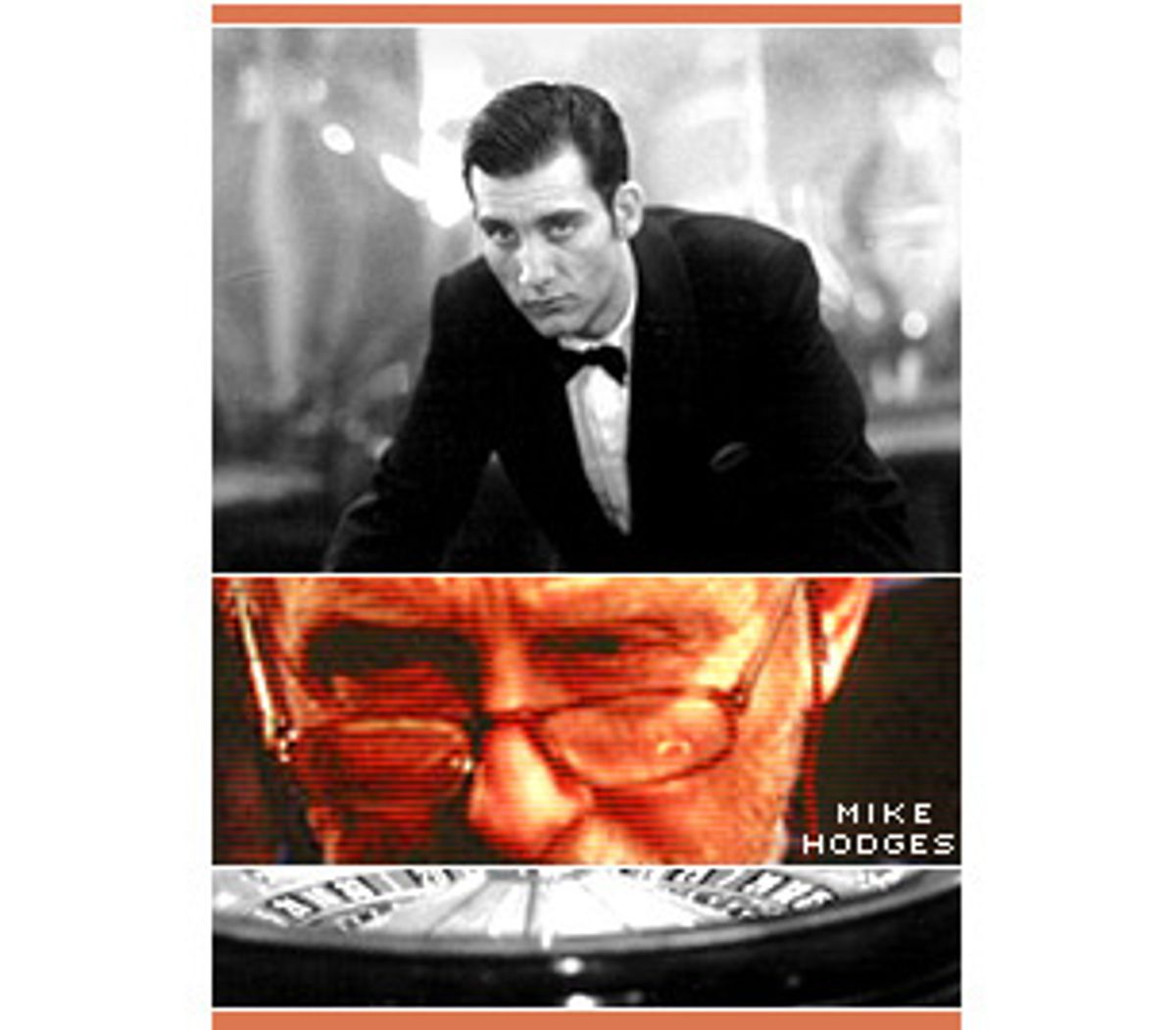
Mike Hodges, who has worked both as a writer-director (the original "Get Carter") and a director for hire ("Flash Gordon"), was so delighted to collaborate with screenwriter Paul Mayersberg on "Croupier" that he requested that the film's possessive credit read "A Mike Hodges and Paul Mayersberg Film."
Stanley Tucci, who produced and directed "Joe Gould's Secret" and stars in it as Joseph Mitchell, took the opposite tack. Although a Writers Guild arbitration awarded sole screen credit for the script to Howard A. Rodman, who adapted Mitchell's two New Yorker profiles of Joe Gould, Tucci has told interviewers (including Susan Perry of Salon) that he wrote up to 80 percent of the movie.
The masterly "Croupier" (which opens in 17 cities tomorrow) and the groping, affecting "Joe Gould's Secret" address the same galvanic issues of identity and authenticity -- and the knotty questions of honesty and exploitation that go with them -- underlying manic cult films like "Fight Club" and "Being John Malkovich."
In "Croupier," a would-be novelist in search of his metier takes on a casino job and finds that it gives him, not just a subject, but a persona closer to his true self than "struggling writer" ever was. In "Joe Gould's Secret," Mitchell, the beloved New Yorker reporter of the '40s and '50s, stumbles upon the Greenwich Village bohemian of the title -- a Harvard-educated wastrel who's either a bum of genius or just a bum -- and realizes that Gould's vain attempt to compile a vast oral history of his time echoes Mitchell's own yearnings and frustrations.
"Croupier" is a terrific movie, mixing instinct and showmanship to turn its characters and themes inside out; the less satisfying "Joe Gould's Secret" is intriguing but a bit opaque, held aloft by Ian Holm's shattering performance as Gould. Part of the reason for the difference between the two may be that the creative team behind "Croupier" resolved its own identity crises early on while the one behind "Joe Gould's Secret" didn't -- though Rodman is, by and large, happy with the movie.
To take the merrier collaboration first: Hodges, on the phone from Dorset, England, explained that he and Mayersberg were friends before "Croupier," but hadn't partnered on a movie. Mayersberg, best known for teaming up with director Nicolas Roeg on "The Man Who Fell to Earth" and "Eureka," did a full script of "Croupier" for England's Film Four before the producers signed Hodges. The director and Mayersberg then spent six to eight months on the final draft. "I liked the script," says Hodges, "because it's a miniature in a way -- but a miniature of enormous breadth."
In its sardonic, understated fashion, "Croupier" has more to say about today's existential drift than slick packages like "American Beauty," which announce their big intentions with flowery pseudo-lyric flights. Clive Owen, who combines the leading-man virility of Dylan McDermott with the fringe psychopathy of Kevin Spacey, plays a fellow without a firm core. He's a classy British slacker who learned how to be a croupier in South Africa -- which, back in London, lends him an exotic edge. You identify with him immediately: He keeps an ironic distance from hustlers and incompetents, including the publisher who wants him to write a soccer novel and the inept casino manager who lays down impossibly rigid rules. You also feel that our antihero is dangerously unmoored, and capable of sliding down, in his own inscrutable way, to the level of his surroundings.
He lives with a policewoman turned department-store detective and he views her as his conscience. But he keeps whole areas of his life from her, including his amoral aesthetic curiosity and his kinky gambling-world addiction: He loves to watch people lose. His demeanor declares that he's on top of things. Nonetheless, before long he's cheating on his girl, breaking casino rules and becoming a passive participant in an attempted stickup.
"It seemed to me," says Hodges, "that what Paul Mayersberg was trying to do was discuss the whole business of contemporary existence. I don't think there's ever been another period when people feel as much as we do that we have matters under control, with our mobile phones and Filofaxes and insurance for life, cars, buildings and pets. We try to cover every eventuality, and it gives us a completely false sense of security. In our country a croupier is a man who doesn't own much and doesn't get paid well, but when he's at his job he is someone who controls the table. And the table ends up being all that our hero can control. I know existentialists have used gambling as a metaphor for life in many ways, but it's never seemed more appropriate than it does now. It has something to do with the kind of capitalism we have now, where labor shifts around and there is no loyalty in business."
Hodges wasn't about to settle for the screenplay as written just because he adored the script and was friends with the screenwriter. At first, he didn't believe in Mayersberg's antihero as an aspiring writer. The two "really worked on that, so the writing became as important as the gambling, and Clive's character became a sort of split personality."
What Hodges calls "the journey of him finding out about himself" includes as much subtraction as addition: Our antihero jettisons false relationships and unattainable ambitions, including the attempt to write fiction. It doesn't give anything away about the thriller side of the plot to note that he emerges as a successful but strictly one-shot writer with an "insider" novel: "I, Croupier" by Anonymous. I thought the book bore an uncanny resemblance to "Primary Colors" by Anonymous. Hodges was pleased I made the connection. "In terms of selling stories, it's really gotten pretty gruesome out there, hasn't it? Whether it's a political figure or Madonna's lover it's not a pleasing sight."
Beyond bolstering the script's literary gamesmanship, Hodges refined its visual details, hoping to open it up poetically without loosening its taut structure. That sometimes meant latching on to props already there, like turning Clive's hat into a symbol of his and his girlfriend's yen for him to be a writer. (He gives it up for a croupier's tux.) At other times it meant shifting the physical layout of the action. For example, Hodges says:
Paul put Clive's apartment on the first floor. I said he's got to be in the basement, and the casino has got to be in the basement, so you never see any natural lights at all. Even when he's typing in front of the window, and it's raining, you never see the sky. And when you see him watching the guests play a tennis match at his publisher's country house, it's at night. So at the end, when he takes the grills off his basement windows I want you to think that no matter where he's ended up, he was emotionally in jail and now he's freed. Even in this devastating final spectacle of him officiating over people losing at the casino -- it's devastating, but he's laughing at it. The interesting thing about watching "Croupier" with audiences was that when I saw it with an American audience, they loved the idea of someone enjoying watching people lose. They found it terribly funny.
The production of "Croupier" was both quick and complicated -- some of its funding came from Germany, so Hodges built the casino outside D|sseldorf, and shot the film out of sequence there and in England. He also tried, as much as possible, to link the script's precise, intricate voice-over to the dialogue without stretching or shortening scenes to make everything fit -- a feat he pulled off thanks largely to Clive Owen's crack timing. The irony is that through this close collaboration with Mayersberg and Owen and a trio of amazing actresses (Gina McKee, Alex Kingston and Kate Hardie), Hodges was able to make his most effortlessly personal film.
"As I get older," says the director, now 67, "I've begun to appreciate the later films of John Huston, like 'Fat City' and 'The Dead.' There's such an amazing liquid quality about them that came from his experience as a director. He did what we all should be trying to do, which is find the best and thus the simplest way to express what we have to say."
"Joe Gould's Secret" screenwriter Rodman had the kind of relationship that Mayersberg had with Hodges -- unfortunately, not with Tucci but with Steven Soderbergh. Rodman worked with Soderbergh on two episodes of the neo-noir cable series, "Fallen Angels," and on an unproduced adaptation of the Charlie Chan novels. Rodman says, "Here's the way it is with Soderbergh: We talk and talk and talk and talk. And I go off and write something and I show it to him. And he'll say, 'This is good, this is good, this is good,' or -- rather than say, 'This is crap' -- invariably give some variation of the speech, 'Howard, you constructed a very nice watch here. On somebody else's wrist it would look perfect, but not on mine.' Working with him I've been in meetings where we talked about casting, I've attended rehearsals and been on the set, and spent time in the editing room. That's one version of how the writer-director collaboration works. A different model is the collaboration I had with Stanley Tucci, where I did my work, he thanked me for it, he did his work and shot the movie. And that may be far more 'standard.'"
In the indie world, says Rodman, "where the spirit, on a good day, is, 'Hey, let's build a treehouse' -- and nobody on 'Joe Gould's Secret' made any money -- you assume there will be this infectious collaboration among all the participants. That wasn't the case here."
The on-screen credit does read "Screenplay by Howard A. Rodman." And in Rodman's final draft (which I've read), he sets the arc of the action and homes in on the most revelatory passages of Mitchell's encounters with Gould. A writer writing about writers, Rodman also has a surer take than Tucci's on Mitchell's fascination with Joe Gould. So it's odd that Tucci would blithely tell reporters that the bulk of the script is his. But Rodman's attitude is less angry than graciously perplexed:
I can't impute motives to anybody else. But I do think a lot of what filmmaking comes down to is battling people who are in essence bean-counters for control. If you've butted heads in that way for a long enough time what you want is your vision as opposed to a diluted version of that vision. You have the ugly stupid studio saying, "It's mine," and your response is to say, "No, it's mine." Anything that would make the filmmaking seem more inclusive or collaborative can be seen to weaken your position. It's an easy thing to fall into, and it can come from the best motives. All of us can become a little thuggish when trying to protect our own material. I'll go a step further: Sometimes it's a failure not to be bit thuggish in protecting your own material -- a failure I know intimately!
In "Joe Gould's Secret," Joseph Mitchell, a superb journalist with ambitions toward high art, gets shaken by the enigma of Gould, who may be a great unpublished writer -- or not a writer at all. (Gould insists that his magnum opus is hidden on a duck farm in Long Island.) After writing his final words on Joe Gould in 1964, Mitchell never appeared in the pages of the New Yorker again, though for 32 more years he kept going to the office. (He died in 1996.) Both Gould and Mitchell are the sort of characters who hit working screenwriters in the solar plexus -- after all, they too learn that dream projects are hard to write, let alone publish, and that much of their work will never see the light of day.
Says Rodman:
Your description of Joe Gould as either a great unpublished writer or not a writer at all -- that description could apply to myself and to just about every screenwriter I know. It's the fear we live with: the black lung of our profession. Part of it is both the arrogance of "I do great work and no one knows it," and then, right underneath that is the fear of, "Maybe it's not great work -- maybe it's not even writing at all." I think what happens with screenwriters is there's this really thin membrane between self-pity and self-congratulation. You start out by saying, "Look what they did to me," and it ends up coming out "Look what they did to me."Among screenwriters I know, you do trade war stories. And you do that to ward off your own terror that what you're doing doesn't mean enough or won't be made or won't be seen or will be seen only in diluted form. In the same way that directors assert ownership of material which is more collaborative than they are sometimes aware of, I think writers get reflexively aggrieved in ways that are far more clichid than they are aware of. Because frankly, if you want your words to appear exactly as you wrote them, you shouldn't be writing screenplays.
One way Rodman has kept his sanity is to write other stuff on the side. His 1990 novel "Destiny Express" fictionalized the lives of Fritz Lang and Thea von Harbou:
When I was going through the process of editing that novel, I got a note from my publisher, Lee Goerner. He said, "Dear Howard, I was looking over the manuscript again, and I noticed on Page 37 that a child refers to his father as Dad. Given the time, the place and the mood you're trying to create, don't you think Father or Papa might be more appropriate? Why don't you think about it? Of course if I don't hear from you what you wrote stands." A sweet note, written not on business paper but on notepaper, in handwriting. I took that note and folded it in four and put it in my wallet. Whenever I would find myself in a room full of screenwriters I would, without introduction and utterly deadpan, pull this note out of my wallet and read it. And everyone in the room would be rolling on the floor and pounding the carpet. Not because the note was so extraordinary on its own terms, as a note from a publisher to a novelist. But because it was so unlike the notes that every screenwriter gets from every studio.
Rodman got to meet Mitchell during his research on "Joe Gould's Secret":
He took our family out on the Joseph Mitchell walking tour of Greenwich Village, an event I will never forget. But throughout all of our conversations there was always an elephant in the room. The elephant was the question you would ask almost any writer under the circumstances: "So what are you doing now?" I did not have anywhere near either the courage or tactlessness to ask that question.I think my view of what he did is a little more benign than the view in the film. The film says he never wrote another word. I think that's wrongheaded. I think the most we could say is that he didn't publish another word in the magazine. After all, he did write and publish the introduction to his collection, "Up in the Old Hotel" (1992). A couple of nights ago, I came across a passage in Borges that seems to me to have great application both to Gould and to Mitchell: "To compose vast books is a laborious and impoverishing madness. Far better to pretend that those books already exist." Of course that's what Borges does -- he writes book reviews of books nobody wrote.
But Mitchell, I believe, was working on that long Joycean novel he talks about in "Joe Gould's Secret," of someone from North Carolina, like himself, who comes to the city and falls in love with a woman who is the city to him. My own guess is, that's what he was working on. It's quite possible that at some point some of that writing will surface.
And what about Gould's opus? Rodman thinks that some of it might pop up someday:
[Gould] could recite it, but the process of putting it down on paper was something he could not or would not do. I wanted to figure out a way of making that interesting without condescending to him, or explaining his dilemma, or solving it -- without reducing it to sociology, and certainly not reducing it to psychology. I was far less interested in the why than in the how or maybe even the what. I didn't want to expose Joe Gould's secret, I wanted to honor it. The most elegant honoring of that kind of thing I've ever seen is a line from Don DeLillo's novel "Americana," in which he speaks of someone writing a novel with ink the same color as the paper he was writing on.
The movie makes you think that Gould's soul transmigrated to Mitchell's. Rodman's script pushes a different (and, to me, more grounded connection): "In some ways, the oral history Joe Gould didn't get on paper, Joe Mitchell did, in the books and pieces that became 'Up in the Old Hotel.' To know Mitchell even a little bit, as I did, was to know a man of tremendous and generous curiosity about how things work, how people spoke, what people's rituals were."
With decades of peerless nonfiction writing behind him, Mitchell may have succumbed to an occupational hazard far crueler to skillful writers than to mediocre ones: "Your knowledge of what good writing is becomes so honed and so acute that when you cast that eye upon your own writing it just doesn't measure up."
Despite the film's divergence from his text, Rodman admires much of "Joe Gould's Secret":
You can write stuff on paper and when an actor says it, it becomes so much better than what you wrote that it makes all the rest of it worth it. As much as I labored on the screenplay for a very long time, I would say any five minutes of what Ian Holm does in that movie is worth any five weeks of my labor on getting the right word in the right place. The screenplay was more preoccupied with the question of what Mitchell does with his knowledge [that Joe Gould has not written his oral history] when he has it -- whether he should do what a good journalist does, which is tell the truth, or do what a good human being does, which is keep his mouth shut.But one thing I liked about what Stanley did as a director is how he handled Joe Gould's problems with his father and his father's tremendous disappointment in him and the way, when his father said he was "ambisinistrous" [that he had two left hands], it was devastating to him. I tried to work that in rather awkwardly. What Stanley did, which I applaud, was have a scene with overlapping voice-overs and overlapping views of three notebooks in handwriting, all about his father. And I think that gets across the points I wanted to make in both a subtler and more powerful way than I was able to write. The scene tells you that he wasn't writing the oral history, he was writing this stuff; then later it sinks in, Oh my God, he's writing again and again about his father. Because of Stanley's use of the resources of film he came up with something more poignant than I had on the page.
Shares