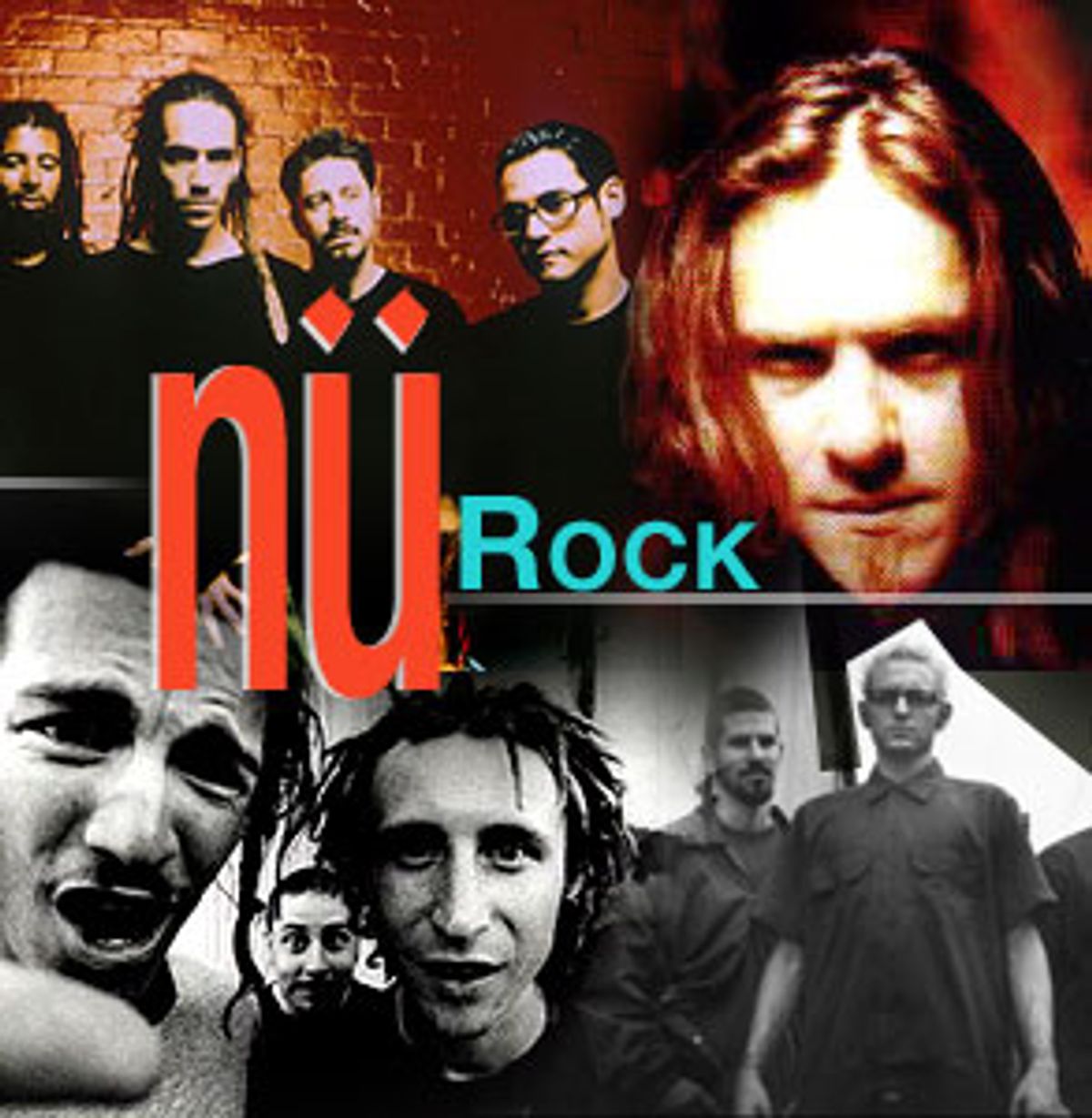
Music

Days of the N

Today's young metalheads wallow in self-pity and sound like Limp Bizkit. These kids don't need rock -- they need Paxil.

  • more
    • All Share Services

Days of the N

Keith Metzger.

Even at 16, the guy looked like middle management at Radio Shack. His hair was pederast red, his skin was albino white and punctuating the two was every nerd’s special project: My First Mustache. Keith, with whom I shared third period art class, was a very nice guy, but he was also the kind of guy who might have been too nice. He might have married the first girl he slept with. He might have taken the fall for getting caught with a sheet of acid in college. But all this niceness, this middle-class low expectation, is tempered by one thing in my remembrance of him:

Keith Metzger was a full-on metalhead.

A hesher. A dude. A burnout. And he was the first smart metalhead I ever met. He was the first among us to eschew the brainy Rush for being something not very metal at all, and also the first to embrace the signpost of grunge in Soundgarden. (This was in the very late 1980s.) And even still, even after he had started to notice girls — or, scratch that, notice something and turn ambiguously sexual — he still loved Iron Maiden. At the end of each school day, like some weird Mister Rogers in reverse, he would hang up the jacket and tie our school required and put on his oversize acid-washed denim jacket, meticulously arranged with buttons of his favorite bands, and emblazoned on the back with a lurid, full-size patch of a Maiden album cover.

We let him run with it. Most of us in third period art, by then having moved on to more adult tastes in postmodern sensations like the Smiths or the Inspiral Carpets, secretly thought Keith’s obsessions were beneath him — kid stuff. But we also knew that there was no rule that said he couldn’t indulge, either. One of the things the Jesuits tried to hammer into our heads day after day was tolerance, and in this rare instance of teenage civility, we practiced what they preached. He was not punched in the nuts; he was not Maced with shaving cream.

Thinking back on it now, I finally see what Keith saw in metal, what it had to offer him: drama and escape, the promise of unreality, of black-and-white good and evil and all the simplicity of human motivation that childhood seems to promise and never delivers. There were true bombast and emotion in the metal Keith listened to, his Walkman blaring it as he set up lighting rigs for the school’s upcoming production of “Brigadoon.” Keith’s metal was of the Dennis DeYoung Styx variety — a little Dungeons & Dragons, a little glam rock and also a little … Fosse. He wanted what everyone wanted out of music back then: escape from the mundane fates he secretly knew would one day befall each and every one of us.

And, yes, back then, in the late ’80s, metal was strictly for nerds or trash, and often did the twain meet, and to paraphrase Spinal Tap, oh, how they danced. This was before nü metal, before the mooks took over with a thunderous cry of “Nerds!!!” and threw the Keith Metzgers of the world, the Dave Mustaines, the Rush fans out of the game, against the wall and into the nearest Creed or Matchbox 20 show.

- – - – - – - – - – - – - – - – -

Since its inception, metal has maintained an uncomfortable coexistence of mooks and nerds. Even way back in the early ’70s, when rock critic Lester Bangs coined the term to describe bands like Black Sabbath, there had always been an audience overlap between people who liked scumbag bands because they themselves were scumbags and people who liked scumbag bands because they offered the same comic-book elements of fantasy and escape that prog-rock bands like Yes did. Basically, if you were a white male disenchanted — or, conversely, enchanted but didn’t want to figure out why — with the pansification of rock, with glam-era David Bowie on one end of the spectrum and sweet baby James Taylor on the other, metal had lots to offer.

As the ’70s morphed into the ’80s, though, metal eventually embraced a sort of sublimated pansy element to its pantheon of disguise, and this is what we called the era of the hair band. Hair bands — the most notorious of which were Ratt and Poison and, the big daddy of them all, Guns N’ Roses — copped a look and sound from glam, but swore the makeup was only there because it got them more pussy. True metalheads saw right through this, though, and this is where the metal underground started in earnest, giving way to the atomic splits and microgenre branding that now characterizes almost every form of popular (and nonpopular) music today.

Death metal. Speed metal. Christian metal. All of these, each one a punk rock unto itself, were formed in reaction against something that was going on in the broader pop world of metal proper during the ’80s. And with the push-and-pull broadening of metal’s horizons, other elements were brought into the mix: punk, post-punk, hip-hop, goth, industrial and so on. All of this got to the point where, if you wanted to speak to the metal masses, if you wanted to make true metal for the people, your language had to speak to all these factions.

The first results of this was a band like Metallica, who worked their way from indie obscurity to become both the thinking man’s metal band and music to date-rape and burn stuff to. It’s easy to forget now, what with drummer Lars Ulrich turning himself into the ultimate cyber-narc with his cred-stripping Napster debacle, but Metallica really are the U2 of metal; they’ve seen it all, done it all and probably ruined themselves twice. Remove Metallica another rock generation or two, add the “renaissance metal” feel that was the rhetoric of grunge and you’ve got the first wave of nü metal: Rage Against the Machine, Korn, Limp Bizkit.

First, a qualifier: What is nü metal? In reality, nü metal barely exists — in fact, nothingness is a popular theme among nü metal bands. Not to put too fine a point on it, but if it chug-a-chugs with the big hairy guitars, makes a stop-starty sound over and over, yarls or does the ninth-grade Satan death scream (alternating with busting a Caucasoid rhyme from time to time) and has some wack DJ scratching and interjecting his best Chuck D “Yyyeah!” every so often, it’s probably nü metal.

For some time after Kurt Cobain and before the Wu-Tang Clan, the metal world woke up with a massive headache from the sickly-sweet pop tendencies of grunge and realized that right under their noses, directly in their bright blue-light ray, not men but total fucking pussies were in their domain. And what’s more, dude, Judas Priest frontman Rob Halford was a fuckin’ homo!

No more.

Enter nü metal, that genre of bands who have distilled their shared history and now wide-ranging influences into a white-hot form that doubles as aggravated assault, intent on expressing one emotion: anger.

But at what?

Honestly, dude? It’s totally obvious: yer fucken mom and dad. Or so it seems. What else could incite the blinding rage about … well, nothing that so informs the nü-est of nü metal?

And so, to prove my hypothesis — that the whole world has gone c-r-a-z-y that this shit is actually in the mainstream now — I did what no one in America over 13 years of age has the patience (or time) to do: I sat down for a good hard listen to the country’s most popular nü metal albums, poring over the cover art, getting that nasty headphone sweat over my ears and, perhaps most important, perusing the lyric sheets.

Boy, is my sense of irony tired.

In the absence of Nirvana — and just about every other good band that, for one reason or another, imploded and failed to produce decent singles during the latter half of the ’90s — nü metal has done well with the seemingly always-fledgling modern rock radio format. This, in a lot of cases, might cause some of the bands mentioned here to be identified as the new sound of what was called alternative music.

But make no mistake: There is nothing alternative about it. You can’t swing a dead freshman these days without running into this sub-Bizkit band or that one. In fact, the influence of Limp Bizkit throughout just about all of modern rock these days is nothing short of epidemic; it’s not even worth quibbling over what exactly lead singer Fred Durst and the boys are angry about. Take one listen to their last record, one look at MTV News, and it’s obvious what’s pissing off Durst: playa-hatas, charges of inciting riots, attorney bills and bitchy pop starlets. In so many ways, Durst is not a whit different from Puffy Combs.

What’s far more interesting — and telling about what makes these bands resonate with the kids — is looking into what the lesser bands are on about, what’s propelling these more or less anonymous working bands, each one more angsty than the other, onto the charts for their brief spell.

- – - – - – - – - – - – - – - – -

What would my high school friend Keith make of the fact that the umlaut in nü was not in tribute to the glammy days of metal yore but, of all things, irony? (Irony had not played too well in metal prior to, say, 1998, unless it was the punk-metal Anthrax.) What would he make of the fact that Durst, definitively the biggest star in the nü metal world, tried to rap?

And what about all the anger? Could Keith’s well-adjusted — if admittedly somewhat closeted — mind have handled that? Who or what can incite such anger? Beyond that, if kids today are supposed to be so smart and media-savvy, why can’t they see through all this showbiz rage and know that they’re being played by bad poets, overweight DJs and clueless hessians? As the Minutemen, an angular punk band that very well may have made the world ready for Primus, a zany, thrashing funk band that arguably could have paved the way for the Bizkit, would have asked, What makes a man start fires?

When it comes to cover art, the influence of the movie “Se7en” on nü metal cannot be underestimated; so much of the imagery — be it CD packaging or videos or promotional material — depicts a rustic world of science and higher learning gone horribly awry. Using calm colors and clinical typefaces, the imagery of nü metal tells us that there’s a new face to the rock gore endemic to metal since its birth; where Gene Simmons of Kiss once spit blood and fire, nü metal swells and hemorrhages internally, trading the horror movie for the museum of medical oddities, where alien emotion matches up perfectly with alien body parts.

So much of nü metal all but quotes the greats of goth and industrial, and it doesn’t even know it. That deep, dark, satanic yarl? We used to call that Scraping Foetus Off the Wheel. The dust-blown trench coat pose with the imposing guitar arpeggiation? The Mission UK.

Also, there are very few proper nouns in the lyrics. Nü metal avoids specifics like a politician who knows he’s not saying anything anyway; why indict someone who might be listening? Time was, metal lyrics were divided into two distinct camps: Comic Book Blood ‘n’ Guts (images of hell, war, apocalypse and so on) or Comic Book Goodtime Poo-Say (Motley Crüe, Poison et al.).

In nü metal, it’s all he said, she said, you, me and, ad infinitum, I. It’s not a far cry from the singer/songwriter histrionics of the ’70s, only all the other cultural signifiers try to point out what big balls this stuff has. If you’re not convinced that this is the case, well, you’re on to something.

“Why does it feel like night today?
Something in here’s not right today
Why am I so uptight today? Paranoia’s all I got left”

This is not the text of a rejected ad for Prozac or Ativan; instead, this is how the debut album by Southern California quartet Linkin Park begins. On paper, these words seem earnest, dejected and desperate; on record, the overall attempt is to make them sear with blame. On paper, it sounds like the first day at a community college poetry workshop; on record, there’s bloody spit shooting out with the words, a lunging forward of the torso, a complete bodily manifestation of disgust and rage, catharsis and breakdown.

At the same time, something in the delivery is just a little too WWF, a little too hot rod. You get the sense that the whole thing is all for show.

And that would make Linkin Park emblematic of nü metal bands everywhere — they’re a bunch of kids looking for a pass because they’re screwed up, trying to trade in dysfunction for cool points. They’re the sound of the Ritalin generation, all Eminem cadences laid over soaring choruses and hackneyed scratching; it’s all so derivative, so by numbers, so strangely — underneath it all — eager to please that, like so many other times during my days spent listening to nü metal records, I feel ill at ease. Not because I was being rocked out of my skull but because — there’s no nice way to say this — I’m embarrassed for them.

I’m not sure what this music is, but it’s pretty fair to say that it’s not rock ‘n’ roll. I mean, insofar as rock ‘n’ roll is a pose, maybe it is that, but nothing else. The horrible truth about nü metal is that it’s all a pose. It’s like watching a 9-year-old smoking a cigarette: awful, but so stupid you can only hope he learns something from it.

Things don’t get any better with the single off their album — at No. 5 on the Billboard modern rock chart after 27 weeks. (The album is platinum.) “One Step Closer” would have you believe, with its refrain of “one step closer to the edge and I’m about to break,” that it’s some nod to Grandmaster Flash’s “The Message,” some paean to a modern world where people no longer count.

Wrong. Scratch the surface, and the song depicts the same kind of garden-variety high school psychodrama you usually get from a good episode of “Boston Public”: “I find the answers aren’t so clear/Wish I could find a way to disappear.” To hear Linkin Park tell it, these boys don’t need to rock — they need some Paxil.

Papa Roach, a Northern California band that has been around in some incarnation since 1993 and whose 15 minutes seem to be up — a consequence of their overtly pretty-boy looks, perhaps, and the instant MTV overexposure that such a thing can cause — struck a pose even more vulnerable than Linkin Park’s camp-counselor-friendly antics. In “Broken Home,” we find our hero going through the darkest hours of his parent’s divorce: “I’m stuck in between my parents/I wish I had someone to talk to.” What follows is some major riffage, followed by a curdling scream of “Bro-Kan-Hohm!”

It’s hard to tell if Papa Roach are masters at trivializing what’s easily one of the hardest things a kid can ever face, or if they just happen to be great at pastiche, at playing for cheap sentiment. Either way, as the song plays out, you can almost see the e-mails scroll across the bottom of the “Total Request Live” screen: “Carson, what’s up? This is Scott from Champaign, what up dawg?!!! Can you play Papa Roach’s ‘Broken Home’? My parents fight and stuff, and like, Papa Roach are off the heezy. Thanx!”

I said it before, I’ll say it again: I’m not sure what this is, but it’s not rock ‘n’ roll.

Record companies have found a way to make the nü metal bands — save for a handful of industry-committed titans like Bizkit — as faceless and replaceable as they have made the hip-hop artists; if you don’t believe me, in six months check for most of the names mentioned in this piece in cutout bins everywhere: Disturbed, Papa Roach and so on. To say nothing of the likes of Crazy Town, Incubus or Staind.

But if nü metal takes so many cues from hip-hop, hasn’t anyone in its camp noticed how much the mainstream has squashed the life out of hip-hop? Hasn’t anyone noticed how replaceable St. Louis rapper Nelly is? What makes these nü bands think that the same won’t be true for them? Certainly no prevailing sense of originality; nü metal bands revel in their uniform sound and look (one interchangeable white boy in dreads or white G, one classic pot-smoking hessian, one S/M — or Manson — freak and the fat “ethnic” DJ). To most kids, one group is as good as the other.

The bands don’t seem to get it, because a grandstanding pose that passes for something extreme or rebellious is still lingua franca for these bands. Check out this gem, from Fear Factory’s “Shock”:

“I will be the power urge
Shock to the system
Electrified, amplified
Shock to the system.”

Dude, I got a shocker for you: You are the system. And you’re as expected as rain. At this point, in a mass landscape of boy bands and pop stars, a hibernating underground that seems to at long last know better than to play the Man’s game and significant exceptions like the post-grunge Creed, the milky Matchbox 20 and stalwarts like U2, nü metal bands are the only thing passing for mainstream rock music today.

But the record business is playing these kids instead of demo tapes. As Fear Factory would say, “Deeper into this abyss/Weighted down and sinking fast.” They probably didn’t have the music industry in mind, but it works. They’re screwed.

Where my man Keith relished the fantasy that metal once provided, Fear Factory and their kin make a huuuuge deal out of shouting over and over again, “This Is Reality!” — in much the same way that my other man, Beavis, revealed to the world a few years back that he was Cornholio. Both claims have equal reservoirs of believability.

Here’s another shocker: Women fare as well in nü metal as they do in its metal antecedents and gangsta rap. Which is to say, not very well at all. For all its props to hip-hop, the boyz of the nü don’t give love to the ladies at all. Even where a guy like Tupac Shakur would try to make restitution for all his years of “bitch” this and “ho” that by making a nice song about his mama every once in a while, women are portrayed in nü metal as alternately “insane,” “fucked up” or some other such nonsense. Everybody’s doing it for the nookie, which, in the music of the Bizkit and their acolytes, appears to be little more than a strangely disembodied box to be displayed and humiliated at every opportunity.

That’s why Kittie — a quartet of ladies just out of their teens who pummel and scrape with the best of them — makes my heart soar with glee. On their debut “Spit,” the band brings a feminine touch to the mook revolution, and far from pansying it up with melody and harmony, the gals instead take their flair for drama and make something distinctly darker. (If only because the ninth-grade Satan death scream coming from a pretty girl — shades of Linda Blair abound in the music of Kittie — is that much scarier.)

Kittie, when it all comes down, are incredibly close to being a proper goth band. The dyed hair, the lipstick, the paleness — each member looks like a different side of the actress Fairuza Balk — will take you right back to that band you saw open for goth band Sisters of Mercy back in ’88, right before you went preppy.

Still, even the ladies can’t help using the nü as an airing ground for their most pedestrian residual adolescent angst, something that’s seemingly beneath their abilities. Songs like “Do You Think I’m a Whore” and their single from a few months back, “Brackish,” revel in a confounding game of low self-esteem, blame throwing and empty profanity that seems to be part and parcel of nü metal. The only thing separating Kittie from those girls that television host Maury Povich is always sending to boot camp is a record contract.

Disturbed, a Chicago quartet, is one of the newer entries on the mook mosh pile, and we can tell the band is serious because the singer is bald. These guys mean business. On “Voices” — a single that just dropped off the modern rock Top 20 chart — the boys squeeze sub-Metallica riffage into a funky little package that’d make the Red Hot Chili Peppers seem puny. “So, what’s up … I’m gonna make you do some freaky shit now/Insane, you’re gonna die when you listen to me” is how my favorite part goes, and it’d be — hey! — disturbing if it, like, made any sense at all. By and large, the syntax of nü metal is a mess.

With song after song about uncertainty and confusion, after a while it becomes pretty clear that this isn’t rock music, this is pantywaist bullshit about some dude’s feelings. Was this really what Woodstock 99 was about? The confusion over how to be a man, over how to act in a schizoid society?

Puh-leeze.

In so much of nü metal, there’s a nasal whine that on first listen seems to hark back to our most wonderful exemplars of insurgency down through the rock age: Bob Dylan, Johnny Rotten, Hank Williams Sr. But where these guys had something of a real bite back there where the nasal drip does ever flow, when Fred Durst does it, it’s a minstrelsy of sorts: He’s dying to create the old rock drama, the kind that really did make you wanna break stuff, instead of just a mutually agreed-upon soundtrack to break stuff to.

But here’s the rub: It’s not their fault. Can you really blame nü metal bands for cluelessly pumping up a rage that has no center? Can you truly fault them for living entirely without reference points? I don’t know.

The guys in Papa Roach or Linkin Park grew up in a time when — we must admit this now, as hard as it might be — rock was groping around for a new relevance, and only finding it intermittently. Instead, it usually found gimmicks, and that’s why Durst is famously as schooled in the work of Madonna and “Licensed to Ill”-era Beastie Boys as he is in the Red Hot Chili Peppers and Poison. The poor sonuvabitch, like the rest of his generation, had to take it where he could get it.

But I do know this: We should not blame Marilyn Manson for nü metal, nor should we poke the finger at the Beasties, Rage, the Peppers, NIN or even the Wu. Instead, maybe we should blame Glenn Frey, as well as every other piece-of-shit rock star who disappointed these kids in the ’80s when they were so desperately needed. Because of such an oversight, all these kids make the music such a broken house of blues might dictate: confused, enraged and laden with a self-pity that, if you’re not careful, you just might mistake for sincerity.

These kids aren’t just faking the funk; they’re faking the rock. And it’s hard to tell which is worse.

Joey Sweeney is a contributing editor at Philadelphia Weekly.

Trust me on this: David Bowie’s “Hunky Dory”

The Old 97's singer credits Bowie's brilliant "Hunky Dory" for rescuing his adolescence and inspiring his career

  • more
    • All Share Services

Trust me on this: David Bowie's (Credit: Benjamin Wheelock)
This is the second story in the Trust Me On This series, which runs through Father's Day. You can read the other entries here.

Dear Kiddos,

Hey, you turkeys. Listen up. I need you to listen for five minutes. I’m going to impart a little wisdom. You can take it or leave it. For what it’s worth, I’d rather you took it.

The advice is this: David Bowie’s “Hunky Dory” is a perfect album, and, since perfect albums are a rare commodity, it is worthy of deep and repeated listenings.

I’m listening to “Hunky Dory” as I write this. How many times have I listened to this, my favorite record? Like a million? And it never gets old.

I discovered “Hunky Dory” by accident. I was a sad, lonely little kid. Eleven years old and obsessed with Joan Jett, another artist I imagine you kids would enjoy. Back then, the radio was still a real thing that people listened to, believed in and learned from. I stayed up past my bedtime one Saturday night during the Christmas holiday to listen to a weekly show called “The King Biscuit Flower Hour” featuring a concert by my secret girlfriend, Joan Jett. At the end of the set, she played a cover of a song that would forever change the course of my budding musical tastes, “Rebel Rebel.” As it turned out, “Rebel Rebel” would never be one of my favorite Bowie tunes, but I could detect, within its lyric, a narrative voice to which I could relate. Like really relate.

I was a latchkey kid, a thing that no longer exists. Both of my parents worked, so every weekday after school, I had a few hours wherein I could do whatever the heck I wanted. What I usually wanted to do was go to Half Price Books & Records. The next Monday, released from the grim confines of Armstrong Elementary, I walked to Half Price where I found exactly one David Bowie album. I brought home “Hunky Dory,” marveling at its weird, androgynous cover. In those pre-Internet days, one was always left with questions. Is that David Bowie on the album cover? Is that person a guy or a lady? Is it a painting or some sort of artsy photo? Is this even rock ‘n’ roll, or is it some other kind of music, the name of which has been kept a secret from me?

It was just that, some other, new kind of music. New to me, anyway. This album, recorded when I had been less than a year old, opened doors for me. And I thought I caught a glimpse of my own future. My family’s house on Gillon Avenue was empty when the needle dropped on Side A. “Changes,” turned up to top volume, was my anthem from the first line of the first verse. “Still don’t know what I was waiting for,” indeed. This was what I had been waiting for. Putting up with all the cruel dullards in my grade school, all the teachers and coaches, all the stupid kids and mean adults, had been almost unbearable. Suddenly, I wasn’t alone.

“Hunky Dory” is not a kids’ record, but there is certainly a preponderance of imagery relating to childhood. “Changes” speaks of “these children that you spit on.” “Oh You Pretty Things” has the song’s object driving his “mama and papa insane.” In “Kooks,” the singer begs his own kid to stay, reassuring the lucky little guy that “we believe in you.” At the time, I needed to hear that sentiment.  I went back to it over and over again throughout the difficult years of adolescence. David Bowie was not my dad, but he was there in a pinch.

As the album goes on, it gets weirder. And deeper. And darker. “Quicksand” offers up an epic take on the human experience, turning on a phrase that would echo dangerously throughout those most perilous years of my youth, “knowledge comes with death’s release.” I didn’t understand, but I did understand, if you catch my drift. These were meditations on the difficulty of everyday life, and the insane nature of our very existence. Heavy, beautiful stuff.

Antidotes appear in the record’s latter portion. “Happiness is happening/dragons have been bled … fear’s just in your head,” Bowie proclaims in the goofy-but-right-on “Fill Your Heart.” Then he proceeds to introduce the listener to Andy Warhol and Bob Dylan. And then comes “Queen Bitch,” wherein we meet Bowie’s longtime foil, the most underrated guitarist in rock history, Mick Ronson. The riff in “Queen Bitch” hints at what is to come on Bowie’s next LP, “The Rise and Fall of Ziggy Stardust and the Spiders From Mars,” Bowie’s breakthrough album, but “Hunky Dory” is still pre-fame Bowie at his folkie best.

Finally, he leaves us with the epic poem that is “Bewlay Brothers.” As an 11-year-old, I played it repeatedly in an attempt to decipher this song’s meaning. I wrote out the lyrics in my journal, hoping to make sense of them. To no avail. I did know that something had gone horribly wrong, there was madness and sadness, and then the record was over. Just like that.

Again and again, I listened. Memorized. Marveled. Sang along. When I could take it no longer, I found a guitar teacher and learned how to do these things myself. Well, not exactly these things, but my own version thereof. My early songs were such a pale imitation of early-’70s Bowie, that I could have been sued — had anyone ever heard my early songs. It’s quite possible that I spent the whole of my teenage years singing with an English accent. As they say, mistakes were made.

I never got over Bowie. Especially “Hunky Dory.” Many of his other records have remained favorites: “Low,” “Ziggy Stardust,” “Station to Station.” But “Hunky Dory” was my first love. I caught a lot of grief for my borderline-obsessive Bowie fandom. Kids at school used it as ammunition in their attacks on my masculinity. Did I care? Sure. Did I care enough to throw Bowie under the bus and pretend to withdraw my admiration for this artist who set me on the path I knew I was destined to follow? Hell no. David Bowie was and is my hero.

Listen, kids: I want you to hear “Hunky Dory” because I think you will love it. Like I said, it’s a perfect record, and how often do those come along? But the real reason I want you to listen to “Hunky Dory” is because, in its 11 tracks, you will find the clues that will lead you to an understanding of me, your dad. You’ll see signposts pointing the way to the path I chose in life.

Making music for a living isn’t easy. Many things about it are tough as hell: The touring and its requisite absences; the self-absorption; the occasional financial insecurity; the mood swings one attributes to the “artistic personality.” This life, however, is what I was made for. This calling is the only one I’ve ever known. I’m not curing cancer or solving the global hunger crisis. I’m making music. But there is a certain hazy nobility in that vocation. Somewhere, an 11-year-old kid may be putting on an album of mine and discovering that the universe isn’t a meaningless jumble of coincidences, that there is purpose to be found in these three-minute constructions of music and lyrics. Some small but elegant meaning.

Heck, before you guys came along, that was all I had. The great thing is that now I have everything.

Continue Reading Close

Rhett Miller is the lead singer of the Old 97s. His latest solo album, "The Dreamer," will be released on June 5.

Illustrating the ’60s music revolution

How one book captured the spirit and art of the cultural transformation -- as it was happening

  • more
    • All Share Services

Illustrating the '60s music revolution
This article originally appeared on Imprint.

Imprint“When did music become so important?” That’s Don Draper from last week’s “Mad Men,” set in 1966. Later in the episode he turns off “Tomorrow Never Knows,” from the Beatles album “Revolver,” and walks out of the room.

art: Rick Griffin

There’s something happening here, but you don’t know what it is — do you, Mr. Draper? One year later, Rolling Stone magazine will make its debut, followed soon by “Rock and Other Four Letter Words.”

“Rock,” a 250-plus-page Bantam paperback, was published in January 1968 and subtitled “Music of the Electric Generation.” It was one of the first books of its kind, chronicling a cultural revolution that was still in the midst of its own creation. Crammed with black-and-white portraits of bands and musicians, it’s part oral history, part visual LSD trip. One of its fold-out spreads has an intricate, circuitlike diagram that connects over a hundred names, from the Butterfield Blues Band, the Beach Boys, and the Byrds to Busby Berkeley, Brubeck and Bach.

The editor-designer was a writer named J Marks. The photographer for most of the images was Linda Eastman, who went on to work for Rolling Stone and — oh, yes — marry Paul McCartney.

By the sheer force of its graphic presentation, ”Rock and Other Four Letter Words” conveys the mid-1960s music scene’s spirit, vitality and relevance.


Continue Reading Close

Protest music’s odd conservative turn

A 100-track, four-CD Occupy collection assembles generations of icons. So why does it sound shapeless and safe?

  • more
    • All Share Services

Protest music's odd conservative turn

“In this hour of the ever-changing season, may our tears not douse the fire in our hearts.”

That’s a guy named Michael Pless singing “Something’s Got to Give.” Even without hearing the song, you can surely imagine the essential elements: Plaintive acoustic strumming, an earnest vocal, and an air of polite outrage to match the stilted syntax and hoary platitudes. Welcome to “Occupy This Album,” the collection of protest-minded songs released by Occupy Wall Street. Sprawling across four CDs and a slew of bonus digital tracks, this behemoth set includes 100 (why not 99?) new and previously released tracks from artists representing a range of generations, genres, backgrounds, settings, and styles. Folkies join hands with rappers; ominous post-rock marches alongside peppy radio pop. There’s spoken-word poetry, tribal percussion, earnest singer-songwriter fare. Even a bit of jazz.

Especially with Occupy reaching a crossroads in summer 2012 — a time when it needs to reassess its ideals, its accomplishments, its methods and its artifacts — “Occupy This Album” plays like a state-of-the-field survey of the protest song. From Jeff Mangum covering the Minutemen to the anonymous drum circles that soundtracked the demonstrations in real time, music has been a constant presence in the movement, although it’s not quite clear what role it has played. The new album portrays a movement with a broad scope and an admirably varied constituency, but the same criticisms that have been leveled against Occupy can also be applied to “Occupy This Album:” There is general unease but no clear direction forward. There is outrage but no plan. There is deep feeling but no clear message.

Ostensibly, there should be something on “Occupy This Album” for everyone to love, but that also means there is more than enough here for everyone to hate. It’s an unwieldy tracklist, almost daring you play it front to back. Of course, it’s pointless to review a 100-track release the same way you would approach a studio album, where functionality and some sense of logical progression are crucial. But there’s no consistent development of political or musical ideas weaving these songs together, nothing to link them or to justify this particular sequencing. As a result, “Occupy This Album” cannot make a statement as an album. In one sense, this release mirrors the leaderless ethos of the movement, which stridently preserves the democracy of the demonstrations. While that idea has certainly energized the Occupy protest, it makes for an amorphous blob of music and a messy, often frustrating listening experience.

But they mean well, right? It’s a charity album after all, with each disc sold separately and with all proceeds benefiting Occupy directly. You’d probably be better off contributing directly to the cause and just making your own mix of politically minded music. You might even have some of these songs in your iTunes already, although why you’d want to include Lucinda Williams’ drippy “Blessed” or Mogwai’s interchangeable “Earth Division” is beyond me.

The music that actually is new — that purports to find direct inspiration in either the righteousness of the demonstrators or the plight of the 99 percent — is generally unimaginative, hokey, disappointingly safe. Most of these artists address these economic issues either through narrative or through high-minded rhetoric. The latter produces the most lackluster results: Jackson Browne’s “Which Side Are You On?” which he has been touting for several months now, turns out to be political white noise, a gentle fist bump to the like-minded that barely puts across either side of the debate. At least it’s better than My Pet Dragon’s epiphany on “Love Anthem”: “Only love can save us now.” To their credit, they sing it like they might actually believe it.

The storytellers have more success, if only because they’re willing to entertain a bit more grit, a bit less blind hope. Featuring Joan Baez and Steve Earle, James McMurtry’s “We Can’t Make It Here” sounds downright curmudgeonly as it surveys the state of the working class in an economy that regularly sends its manufacturing jobs overseas. The song, however, goes a bit overboard when the trio decry litterbugs and graffiti artists.

One of the true standouts among these 100 tracks is Richard Barone’s ditty “Can I Sleep on Your Futon?” about a veteran-turned-singer who couch-surfs from one generous soul to the next. The verses are specific and soulful, as through he’s derived them explicitly from lived experience, and in that regard, the song could function as commentary on the music biz. But Barone stumbles over that massively awkward chorus, “Can I sleep on your futon?” It’s hard to imagine a crowd of protesters singing along.

If there is one overarching theme here, it is, vaguely, “history.” The past informs and even defines this music. Even the very idea of this type of compilations seems like a throwback to the CD’s heyday in the 1990s, when seemingly every charity, from NARAL to the Red Hot Organization, had its own release. It’s an impression reinforced by much of the music, especially hip-hop tracks by Born I Music and George Martinez & the Global Block Collective, whose lyrics and beats sound like they were scavenged from 1994. (For a better example of how hip-hop can address political themes, check out Killer Mike’s new track “Reagan.”)

Of course, there is a lot of folk music on “Occupy This Album.” That style has proved one of the most politicized musical forms of the 20th century, as lefties in the 1930s and 1940s adopted labor songs as battle cries. Clean-scrubbed, buttoned-up folkies like the Kingston Trio had some chart success in the 1950s, but they were quickly rendered obsolete by the Village bohemians reimagining the music as a vehicle for countercultural sentiments. That’s the model so many Occupyers are reverently appropriating, never suspecting that it might not be a natural fit for 21st-century dissent. The folk revivalists of the 1960s drew from the past as well, but took pains to update the music to the times: The mere fact that Dylan wrote new songs in this old style was revolutionary, alienating an older generation of folkie purists.

“Occupy This Album” obviously represents a counterculture, but too many of the artists are too caught up in role playing the past, which seems like an especially boomer enterprise. Michael Moore (yes, that Michael Moore) performs the most chipper version of “The Times They Are A-Changin’” imaginable, one that seems wholly unaware of the gritty realities of 2012, much less of 1964. (The less said about his skiffle version of the song, a hidden track on disc four, the better.) Perhaps the one artist who understands how to plumb history for present-day relevance is Loudon Wainwright III, whose wry “The Panic Is On” updates an 80-year-old tune originally penned by Hezekiah Jenkins (the cover originally appeared on Wainwright’s album “Ten Songs for the New Depression”). It’s an unusual artifact from the early 1930s, but there’s a sneaky observation about class disparity that sounds more disgusted and potent than anything else on the album.

Perhaps the worst thing that can be said about “Occupy This Album” is that the music is deeply conservative. There are so few moments that grab your attention or make you see the world differently. When Occupy already seems to be in danger of losing momentum, it’s hard to say whether the movement has failed to inspire these artists or the artists have failed to document the movement.

Continue Reading Close

Donna Summer: Disco diva and rocker

If you only knew the singing sensation by her 1970s smashes, you barely knew her at all

  • more
    • All Share Services

Donna Summer: Disco diva and rocker

There is so much about Donna Summer that we didn’t know… and not just the cancer that took her life. Let’s start with her relationship to rock. Summer is quite understandably known as a disco singer, and quite rightly so. It was disco that made her, and she, as perhaps disco’s highest profile performer, who helped to shape the genre. But like a number of other disco artists — Nile Rodgers and Bernard Edwards of Chic, the vocal trio Labelle and Chaka Khan all come to mind — Donna Summer was also a rocker. Yes, she grew up singing gospel, but she began her professional career as a ’60s rocker. She would describe this as her Janis Joplin phase, and she did indeed sing in a group that performed at the Psychedelic Supermarket — Boston’s version of Bill Graham’s Fillmore. She then went on to play a hippie in the Munich production of the rock musical “Hair,” and sported an enormous Afro inspired in large part by her hero, the black radical activist, Angela Davis. Although the disco music that she made with producers Giorgio Moroder and Pete Bellotte, and engineer Harold Faltermeyer provoked a fierce backlash from some aficionados of rock, this was a foursome that, as critic Dave Mash pointed out, functioned as a rock band, one in which Summer played a pivotal role as singer and songwriter. And then there is her singing. Listen to her hit “Hot Stuff,” and tell me that Summer could not sing rock.

Summer, who was strikingly beautiful, made some very steamy — some would say X-rated — music, most memorably with her first hit, 1975’s “Love to Love You Baby.” With Summer’s groans, moans and gasps powering the track, it broke new ground in its sexual explicitness. Promoted by her record company in explicitly sexual terms, and giving performances that made Tina Turner’s look tame, Summer soon found herself tagged the “Linda Lovelace of pop music.” She had seen this coming. In fact, she had not wanted to be the singer on that track, and agreed only to record the demo, and only then in a blackened studio where she sang, imagining that she was Marilyn Monroe giving herself over to orgasmic ecstasy. After producer Moroder convinced her to let him use her vocal, her record label president, seeing its bedroom potential, demanded a long-playing version that left the media debating whether the singer came 22 or 23 times. Rock critic Robert Christgau poked fun at the record with a review that consisted of three questions, “Did you come yet? Huh? Did you come yet?” Other reviews were more disparaging. But “Love to Love You Baby,” like much of her music, put female desire front and center in a way that it wasn’t in most rock music. Indeed, Summer’s music is inseparable from second-wave feminism’s emphasis on women’s sexual empowerment.

There is so much to say about Summer, who could have been a full-fledged personality had she not been pigeon-holed and dismissed as a disco tart. I was once on a radio program with her and, believe me, she was nobody’s fool. She described the “star-making machinery” as well as anyone. After she had already became famous she told Rolling Stone that her career sometimes felt like “this monstrous, monstrous force, this whole production of people and props that you’re responsible for, by audiences and everything that rules you until you take it upon yourself to be a machine… And at some point a machine breaks down.” Fame, she observed, diminished her, making her feel like nothing so much as a “commodity.” After falling into a debilitating depression and attempting suicide, she took control of her life again through Christianity.

In a way, I think one hears Summer confront her own commodification on her marvelous record “Bad Girls.” Although the music in the final, released version suggests otherwise, Summer isn’t celebrating prostitution on “Bad Girls.” Rather, she is confronting what she shares with those streetwalkers. “Now, you and me are just the same,” she sings.  And if Summer sounds unusually exuberant as she yells out to a john, “Hey, mista, have you got a dime?” perhaps it’s because Summer understood what it meant to be made into a commodity and reduced to a seductive whisper. Tellingly, in a television interview some years later, Summer noted that “Bad Girls” marked the moment when she stopped being an object and became a subject. Let’s hope that in her death she inspires more writing that fully acknowledges the intelligent subjecthood of this disco diva and kick-ass rock and roller.

Continue Reading Close

Alice Echols, a professor of English, and the Barbra Streisand Chair of Contemporary Gender Studies at the University of Southern California, is the author of four books, including "“Hot Stuff: Disco and the Remaking of American Culture."

Donna Summer, Queen of Disco, dies at 63

The "Last Dance" singer passed away after a battle with cancer

  • more
    • All Share Services

Donna Summer, Queen of Disco, dies at 63

NEW YORK (AP) — Disco queen Donna Summer, whose pulsing anthems such as “Last Dance,” ”Love to Love You Baby” and “Bad Girls” became the soundtrack for a glittery age of sex, drugs, dance and flashy clothes, has died. She was 63.

Her family released a statement Thursday saying Summer died and that they “are at peace celebrating her extraordinary life and her continue legacy.”

Summer gained prominence during the disco era of the 1970s, and released a number of albums that have reach gold or platinum status, including the multiplatinum “Bad Girls” and “On the Radio, Volume I & II.” Her No. 1 Billboard Hot 100 hits include “Hot Stuff” and “MacArthur Park.”

Her sound was a mix of genres, and helped her earn Grammy Awards in the dance, rock, R&B and inspirational categories.

She released her last album, “Crayons,” in 2008. She also performed on “American Idol” that year with its top female contestants.

Page 1 of 284 in Music