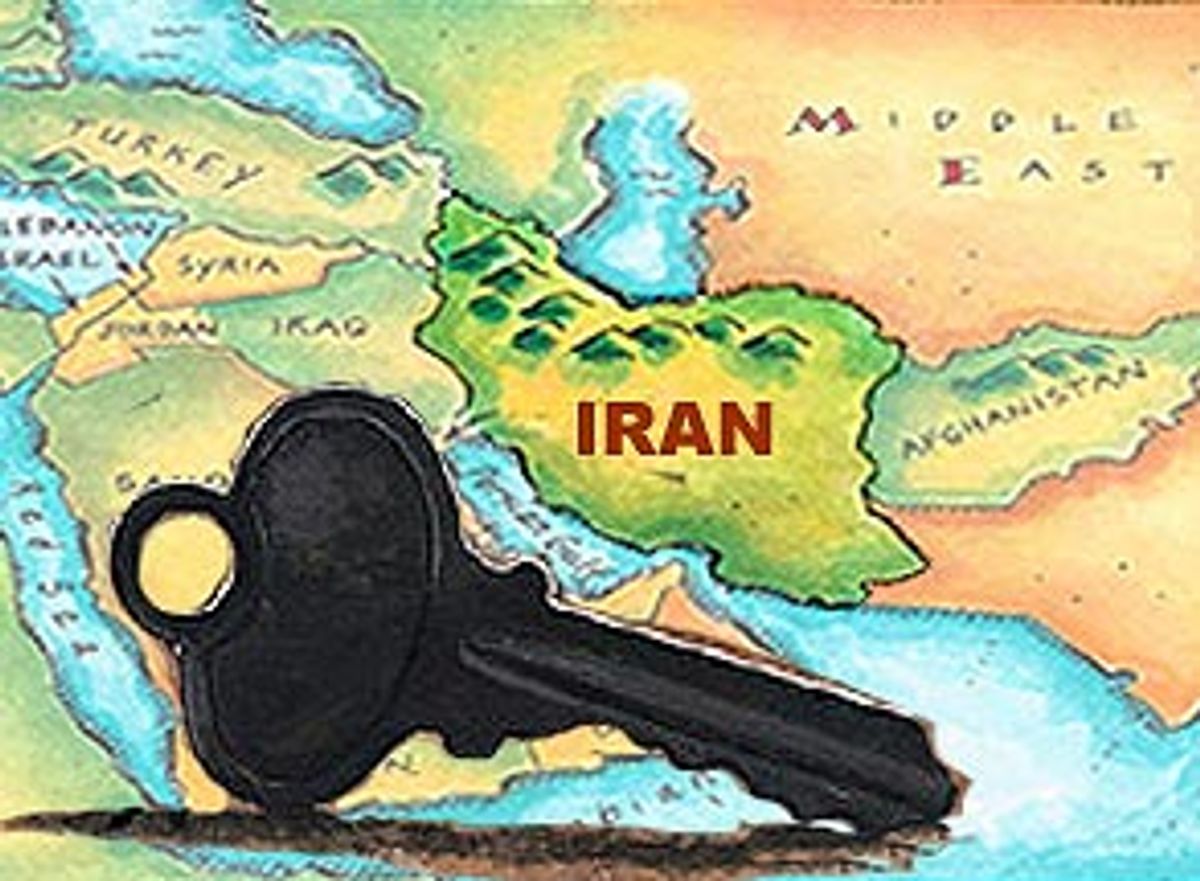
Iran

The Iran card?

The complex nation whose leader once called America "the Great Satan" -- and whose people cheer our soccer teams -- may play an increasingly important role in American strategic planning.

  • more
    • All Share Services

Topics: ,

The Iran card?

As the United States struggles to put together a coalition against world terrorism, it is being forced to take a crash course in the topsy-turvy politics of the Middle East, where yesterday’s enemies may be tomorrow’s friends. And one of the most intriguing players — and a potential U.S. strategic partner — is a state that just a few years ago was one of America’s most implacable enemies: Iran.

In an act reflecting a convergence of U.S.-Iranian interests — not the first such overlap in recent years — the Iranian government gave tacit support to the United States’ efforts to target Osama bin Laden, whom the Bush administration has described as the prime suspect in the Sept. 11 attacks on the World Trade Center. President Mohammad Khatami has reportedly signaled to the U.S. that his government would not oppose military strikes against specific targets in Afghanistan.

Iran’s support for U.S. action is highly qualified. But the fact that it signed on at all to Bush’s campaign against terrorism opens the possibility of a thaw between the two nations.

Mention Iran to the average American and what comes to mind is the grim face of the Ayatollah Khomeini denouncing America as “the Great Satan” and the humiliating, 444-day national ordeal that ensued after Islamic revolutionaries stormed the U.S. Embassy in Tehran. But the image of Iran as the ultimate anti-American Islamic state is misleading. Times have changed. Iran is by no means a free and open society, but it has made significant strides toward democracy. It has a relatively large and comparatively Westernized middle class and a complicated political situation that includes a strong moderate faction as well as fundamentalist clerics. Iran is not an Arab state: About half of Iranians are Persians, ethnically distinct from Arabs and heirs to a great ancient empire. This distinction cannot be ignored when assessing Iran’s political and cultural realities.

And it is strategically vital. Slightly larger than Alaska, it is the largest Middle Eastern country after the vast, empty Saudi Arabia, bordering Iraq, Turkey, Azerbaijan, Turkmenistan, Afghanistan and Pakistan. It fronts the Caspian Sea and the Caucasus and has the longest coastline on the Persian Gulf of any nation. It is the third biggest oil exporter in the world, after Saudi Arabia and Norway. At 66 million, its population — mostly under 30 — puts it in Egypt and Turkey’s class as a regional heavyweight.

The United States and Iran have not had diplomatic relations since 1979, and relations between the two nations remain chilly. But some experts argue that in the current crisis, America can no longer afford not to cultivate Iran. In their view, shared interests could pave the way to cooperation now and improved relations in the future.

Graham Fuller, former vice chairman of the National Intelligence Council, a U.S. government think tank, says that there’s an “inexorable pressure” on the United States and Iran to reach rapprochement. “Washington now understands that the costs of not dealing with the most powerful power in the region are too expensive,” says Fuller. Pointing out that embracing Iran could help erase the perception that the U.S. is antagonistic to the Muslim world, where U.S. policies have invariably collided with Islamic groups, Fuller says, “At some point, it behooves us to get along with some Islamist regimes that are moving towards fairly moderate policies.”

How rapid is that movement? “Iran probably has made more progress towards democratization in the past five years than any other country in the Middle East,” Fuller says. Noting that Iran is probably the most liberal and stable Islamic state in the world, Fuller says, “One of its signal features is its diversity — violent and peaceful, democratic and autocratic, modernist and traditional.” He cites “ideas developing in Iran about relationships between Islam and democracy and secularism” as examples of “fresh thinking that’s not coming from elsewhere.” These new ideas could be crucial in the future, Fuller believes.

Iran is clearly key to maintaining the balance of power both in the Middle East and central Asia. America and Iran come down on the same side of the key issues: containing Iraq, stabilizing Afghanistan, stopping the flow of drugs from Afghanistan and keeping the Persian Gulf open to oil shipments.

The terrorist attacks brought those shared interests into greater relief. Within days of the attacks, Iran sealed its 562-mile border with Afghanistan, fearing a mass exodus from Afghanistan into Iran. While clearly taken in self-interest, Iran’s move may make it harder for supporters of Osama bin Laden to escape Afghanistan.

Iran, like Russia, has long been a supporter of the Afghan resistance movement and would be happy to see the Taliban fall. In 1999, Iran almost went to war against the ruling Afghan religious party when Taliban forces killed eight Iranian diplomats and a journalist after capturing a Shiite town in southwestern Afghanistan. (Iran is a Shiite nation; the Taliban are an extreme fundamentalist Sunni sect.)

“To the Iranians, the Taliban is by far a graver threat than the United States,” says Robin Wright, author of “The Last Great Revolution: Turmoil and Transformation in Iran” (2000). “They really worry about the Taliban. They think they’re barbarians because of the way they treat women, among other things. When you get the leadership to talk about how dangerous the Taliban is, then you know it permeates society.”

But shared interests only go so far. While President Khatami was telling the U.S. that it would not oppose targeted strikes into Afghanistan, the nation’s religious head and supreme leader was blasting America. In a speech on Iranian national television Wednesday, Ayatollah Ali Hoseini-Khamenei said the United States was “not sincere enough to lead an international move against terrorism,” citing U.S. support for Israel as a key obstacle to Iranian participation in the U.S-led coalition now being assembled. He said Iran would offer “no help … in an attack on suffering, neighboring, Muslim Afghanistan.” Khamenei indicated that Iran is likely to oppose a U.S. ground war in Afghanistan.

Iran has strategic fears that will limit its role in any action against Afghanistan. “Iranians would like to see a change of regime in Kabul, but there are other concerns,” says Shaul Bakash, professor of history at George Mason University and a specialist on modern Iranian politics. “The prospect of U.S. troops in Pakistan, Afghanistan and possibly the central Asian republics feeds Iran’s perennial fears of encirclement.”

Nor does Iran plan to share intelligence with the U.S. “It seems that the expectation that Iran would join or cooperate or share intelligence with the United States even is not going to happen now,” Bakash says. “In his speech the leader specifically said they won’t share intelligence. That’s significant.”

The U.S. still has major differences with Iran, as well. The Iranian government continues to call for the destruction of the state of Israel. And Iran remains on the State Department’s list of states that sponsor terrorism, thanks largely to its sponsorship of Hezbollah, a Lebanese-based Shiite group that led the successful war against Israel’s 18-year occupation of southern Lebanon. Among its numerous violent acts, including bombings and the taking of hostages, Hezbollah bombed the Marine barracks in Beirut in 1983, killing 241 Americans, as part of its campaign to drive the U.S. out of Lebanon. Whether Hezbollah at this point should still be considered a terrorist, or merely militant, organization is a point of controversy: the Christian editor of Lebanon’s leading newspaper has declared that it should not, arguing that it is now a legitimate political party and social welfare network that is an integral part of Lebanese society.

Fuller acknowledges that Iran continues to support Hezbollah and smaller terrorist groups, but says that Hezbollah has moved away from terrorism since it drove the U.S. and Israel out of Lebanon. “They haven’t really been engaged in terror attacks in six or seven years, while they’ve become fully integrated into the Lebanese government,” says Fuller. “So yes, Iran still supports them, along with Syria, but is that going to be determinative in our diplomacy? We have to decide whether America’s geopolitical interests are larger.”

The United States imposed sanctions against Iran in 1996 when Iran attempted to acquire biological, chemical and nuclear weapons. In the words of the Iran-Libya Sanctions Act, “The efforts of the Government of Iran to acquire weapons of mass destruction and the means to deliver them and its support of acts of international terrorism endanger the national security and foreign policy interests of the United States and those countries with which the United States shares common strategic and foreign policy objectives.” Iran is one of several nations, including India and Pakistan, that have been sanctioned by the United States for acquiring or attempting to acquire such weapons. (Sanctions against India and Pakistan were lifted after the terror attacks, to reward them for joining the anti-terror coalition.)

If the sanctions have been the greatest obstacle to improved U.S.-Iran relations, the looming clash between the West and Islam has the potential push the two nations even further apart. Despite President Bush’s assurances that the U.S.’s fight is not with Islam but with terrorists, the perceived need to uphold Muslim brotherhood — or at least political and strategic brotherhood — may drive Khamenei and the religious hardliners who run Iran away from possible detente.

“The Iranian leader has posited himself as the spokesman for Muslim interests, so it’s difficult for him to just stand aside,” Bakash says. “He fancies himself as a leader for Muslims worldwide. He believes he speaks to issues that resonate with Muslims. That helps explain the very unyielding stand Iran has taken against the existence of the state of Israel. If Iran continues to take the stand it has against U.S. military action in Afghanistan, and the United States makes good on its position that you’re either with us or against us, relations between the U.S. and Iran could even deteriorate as a result of this crisis.”

In the face of Bush’s declaration that countries must choose sides between America and terrorists, Iran defiantly continues to walk a third path — as it has over much of the last 20 years. “It is not that anyone who is with you is against terrorism and those who are against you are for it,” Khamenei said in response to Bush’s ultimatum. “We are neither with you nor with the terrorists.”

The United States and Iran have a 50-year history of mistrust, going back to a U.S.-backed coup that toppled Prime Minister Muhammad Mussadegh in 1953. As usual in the region, the main issue was oil.

Mussadegh was a charismatic nationalist who led a popular movement to nationalize the British-owned Anglo-Iranian Oil Company. He grew so popular that Shah Reza Pahlavi was forced to appoint him prime minister in 1951. The growing rift between the Shah and Mussadegh climaxed in 1953, when Mussadegh forced the Shah from the throne. A week later, revolts sponsored by the CIA and British intelligence successfully reinstated the Shah, and Iran remained a dictatorship until the 1979 revolution. The rule of the Shah and his dreaded secret police, Savak, was harsh.

In “The Last Great Revolution,” Wright argues that the Iranian Revolution was not so much a religious as a political revolution which aimed, like the French or Russian revolutions before it, at expanding freedom.

“Iran’s revolution was always a part of the broader global expansion of democracy,” she says. “Iranians twice before in the 20th century had tried evolutionary political tactics to end a monarchy dating back two and a half millennia. They turned to revolution in 1979 out of frustration. The revolution was hijacked by the clerics. But at the end of the day Iranians are still searching for some system that allows them that freedom but is compatible with an Islamic culture.”

But also like the French and Russian Revolutions, Wright argues, the early years of the Iranian Revolution were frenzied and often out of control. That frenzy often took the form of anti-American zeal. Indeed, the relationship between Iran and the United States was among the many casualties of the revolution. Relations between the two countries hit a new low when Iranian militants seized the U.S. Embassy in Tehran in 1979 and held 52 people hostage for over a year. The hostages were released on Jan. 20, 1981, hours after Jimmy Carter’s term officially ended and new U.S. President Ronald Reagan had been sworn in.

In 1983, the Iranian-backed group Hezbollah was linked to the bombing of the U.S. Embassy in Beirut, which killed 63 people, and the bombing of the Marine barracks at Beirut International Airport, which killed 241 U.S. military personnel. Over the next decade, more than 100 people were taken hostage in the Middle East, many of them by Iranian allies. As a response to the new Iranian threat, the United States backed Iraq’s secular government, headed by Saddam Hussein, in its bloody eight-year war with Iran.

But by the late ’80s, relations had improved. Iran accepted the terms of a cease-fire negotiated by the United Nations, and used its leverage to help secure the release of Western hostages in Lebanon. Tehran “made overtures to Western capitals,” according to Wright, and ended a period of relative isolation by bolstering trade. “The revolutionary fervor,” she writes, “looked as though it was about to break.”

Around that time, American foreign policy in the Middle East changed dramatically as well. In 1991, Iraq invaded Kuwait and suddenly became America’s new Public Enemy No. 1. An informal, uneasy alliance began with Iran. While Iran did not object to the U.S. and its allies’ presence in the Gulf War, it did not offer troops or explicit support to the Gulf War effort.

“There certainly was a coincidence of interests during the Gulf War,” says Bakash. “Though they did not join actively, they didn’t mind seeing Saddam Hussein get clobbered. They were very firm in declaring the occupation of Kuwait unacceptable.”

The balance of power shift in the Gulf had moved the United States uneasily closer to Iran.

Meanwhile, what Wright calls the “Second Republic” phase of the revolution began. The Ayatollah Khomeini, the revolution’s charismatic leader who had returned from abroad after the Shah’s ouster, died in 1989. In the wake of his death, a movement for political and social reform developed strength. This started with the election of President Ali Akbar Hashemi Rafsanjani, who embraced more assistance from and contacts with the West, and culminated in the election of reformer Ali Mohammed Khatami-Ardakani as president in 1997.

Since Khatami’s election, hopes for reestablishing a diplomatic relationship with Iran have swelled. Soon after his election Khatami made waves in an interview with CNN, when he said that he “respected” the United States and advocated “dialogue and understanding between two nations, especially between their scholars and thinkers.” Soon after, limited cultural exchanges between Iran and the U.S. began.

Despite this détente, however, throughout Khatami’s first term as president it was clear that the opponents of reform remained strong. Khatami and the moderates had little control over the military and intelligence services, which assassinated some opposition figures and closed many reformist publications. “We were all hopeful that Khatami would do something,” says Wright. “But we’ve all found that he’s not the person who’s going to make the transition. He hasn’t had the willingness or ability to overcome the hard-liners. A lot of people are disappointed.”

Still, the rough path toward a renewed diplomatic relationship continued. In March 2000 Secretary of State Madeleine Albright extended an olive branch of sorts. She acknowledged America’s role in overthrowing Mossadegh in 1953 and supporting the Shah, who “brutally repressed political dissent.” And she slammed America’s “shortsighted” support of Iraq during its war with Iran in the 1980s.

“As in any diverse society, there are many currents swirling about in Iran,” Albright said. “Some are driving the country forward; others are holding it back. The question both countries now face is whether to allow the past to freeze the future; or to find a way to plant the seeds of a new relationship that will enable us to harvest shared advantages in years to come, not more tragedies.”

But neither the United States nor Iran has reached internal consensus on how and if negotiations over renewing diplomatic relations should continue. Khatami’s recent reelection in June 2001, with an even greater majority of reformer victories in the parliament, has sparked even more debate over whether the time is ripe to intensify the relationship. Some members of Congress, including Ohio Republican Robert Ney, have signaled a desire to move toward reestablishing diplomatic ties with Iran.

But some in the United States believe that Iran still isn’t ready. James Phillips, research fellow for Middle Eastern affairs at the Heritage Foundation, says that there’s a “perception in the West that things are going great, the reformers are winning elections and making the right diplomatic noises. But real power is still in the hands of Khamenei.” Phillips says hard-liners like Khamenei still have the potential to eradicate the reformers’ gains over the past decade simply because they retain the most levers of power.

“Until Iran’s internal politics are resolved it’s dangerous to reach out to moderates,” Phillips says. “It’s counterintuitive, but a hard-line U.S. policy strengthens the moderates because it allows them to improve their grip on power by pointing to the continued bad management of everything else by the hard-liners. Renewed diplomatic relationships between the U.S. and Iran now could end up strengthening the hard-liners’ hand.”

But others articulate a different vision of the United States’ interests and Iran’s prognosis.

The National Intelligence Council’s Fuller, while acknowledging that serious roadblocks remain, thinks that at this moment “there are some good reasons to hasten the solution.” As for the argument that the hard-liners in Iran might twist a renewed diplomatic relationship with the U.S. to their advantage, Fuller says they’re eventually doomed anyway: “Time is clearly on the side of the reformers. Most of the hard-liners know that the end is coming.”

But is Iran too unstable? “I would not call it an unstable state,” Fuller replies. “There haven’t been any coups nor any un-democratic changes in government since 1979. If you say that they have a divided government, then welcome to the world — there are all kinds of divided governments around the world.”

One reason for optimism about a détente with Iran is the changing attitude of its people. While the leadership remains divided, there’s strong evidence of popular support for renewing ties with America. Recent cultural exchanges like soccer games and wrestling matches between Iran and the U.S. were sold out, and the Americans were cheered in both victory and defeat.

Nor are the people enamored of religious rule. Phillips says that the combination of economic depression and widely perceived mismanagement by the mullahs (the Shiite clerics who run the country, via their control of the judiciary and the military) have even alienated key allies in the revolution. “Even the urban poor, who supported Khomeini’s revolution, are becoming fed up because the mullahs control everything and have done such a horrible job. There’s a population explosion, job and housing shortages, declining living standards and more. The mullahs were temporarily rescued by the rise in oil prices, but they can’t depend on that forever.”

A key reason for the declining popularity of the mullahs is the fact that the majority of Iranians are now under 30 years old, while the older mullahs are often perceived as out of touch. “It’s often said that the mullahs are making Iran a nation of atheists, because they’re subverting the authority of Islam,” says Phillips. “For example, the mullahs always use the Shah’s behavior before the revolution or the United States’ behavior in the same period of how bad they are. But the examples are no longer effective because the young don’t know the Shah or the United States.”

And if they do know about the United States, Iranians don’t necessarily see it as the Great Satan. Western reporters in Iran have frequently noted the predominance of satellite dishes in Tehran, and the inroads of the global consumer culture: name brands everywhere and American sport jerseys on the streets.

But Michael Jordan T-shirts and reruns of “Dynasty” may not be enough to bridge the gaps between the two nations. “The obstacles are pretty formidable,” says Bakash. “My impression was that the Bush administration was eager to be able to relax sanctions and open up a dialogue with Iran. But there have been moments like this before, and they have fallen apart.

“There are people in Iran and the U.S. who would like to break this deadlock. But I also think there are real obstacles. Sanctions, Hezbollah and the peace process [between Israel and the Palestinians] are the big issues. If you listen to the speeches [Ayatollah Khamenei] has made over the years, he sees a lot of negatives, and few positives, to normalizing relations. The leader himself is not persuaded.”

The major immediate practical obstacle, says Bakash, are sanctions. “One of Iran’s conditions is the lifting of sanctions. I think the Iranians have said so implicitly in the past, and more directly recently, that relations or negotiations are not conceivable under the gun of sanctions.”

Regardless of the immediate future of U.S.-Iran relations, Robin Wright believes that in the long run, Iran and its yet-unfinished revolution may point toward a possible Third Way for Islamic societies — a welcome possibility since Sept. 11. “Iran may be the trendsetter,” she says. “Here’s an Islamic country where you have women who are vice presidents and members of parliament. This is where women can be nobody and run for office. And that’s sometimes in spite of the clerics’ wishes. The fundamental question Iran is dealing with is, ‘Do you make it more of a republic than an Islamic system?’ It’s a microcosm for what’s going on in other parts of the Islamic world. Everything you see is related to this challenge to modernize, and how to come to grips with individual freedom in a system with a religion that literally translates as ‘submission.’ The Western world is now democratized. So now we have to deal with the Islamic world. Iran created a model. Not one that’s going to be emulated, but it opens up the debate for future Islamic revolutions.”

Continue Reading Close

Max Garrone is Salon's Vice President for Operations.

Anthony York is Salon's Washington correspondent.

Obama’s Iran charade

The shrill, militaristic Manichean worldview that brought us the Iraq war is gone -- except when it comes to Iran

  • more
    • All Share Services

Topics: ,

Obama's Iran charadeThe main reactor at the Bushehr nuclear facility in Iran. (Credit: Reuters/Raheb Homavandi)

The nuclear summit that concluded last week between Iran and six world powers was a ridiculous charade. The Obama administration never intended it to succeed. Its sole purpose was to placate hawks in U.S. Congress, ensure that Democratic donors keep writing checks during election season, and buy another month of time during which Israeli Prime Minister Benjamin Netanyahu will not be able to bomb Iran. In the meantime, American drivers can sit back and enjoy more $4-per-gallon gas.

The talks failed because the U.S. and the rest of the P5+1 (Russia, China, Britain, France and Germany) refused to take yes for an answer. The key issue on the table was Iran’s accumulation of uranium enriched to 20 percent – not a high enough level to make a nuclear weapon, but close enough that it would be much easier for Tehran to do so. Iran made it clear that it was prepared to stop enriching to 20 percent and to even ship its stockpile of enriched uranium out of the country, if the U.S. and the other powers agreed to relax the draconian sanctions they have imposed on the country.

This deal would have been a major diplomatic breakthrough. It would have greatly reduced Iran’s capacity to develop a nuclear weapon, defused tensions in the region, calmed the oil markets, driven prices at the pump down and made it impossible for Netanyahu to attack Iran. In a presidential campaign as tight as this one, a significant drop in gas prices could be the difference between Obama being reelected and Romney defeating him. So why didn’t the Obama administration take the deal?

The ostensible reason, piously mouthed by Secretary of State Hillary Clinton, is that the U.S. believes that the upcoming, even harsher round of sanctions on Tehran will generate even further concessions. According to this line of reasoning, Iran only came to the bargaining table because of sanctions, and more sanctions will produce better results.

But this justification is transparently false. First, Iran has made it clear again and again that it will never allow itself to be seen as folding under U.S. pressure. It is prepared to negotiate, but successful diplomacy requires not just sticks but carrots. The carrot the P5+1 offered at Baghdad was ridiculous: If the Iranians agreed to suspend 20 percent enrichment, what they would receive in return was not a reduction in sanctions, but rather spare aircraft parts. For Tehran, accepting this deal would have been tantamount to surrendering. As Iranian analyst Hasan Abadini said, “Giving up 20 percent enrichment levels in return for plane spare parts is a joke.” These are not arcane diplomatic mysteries. As Iran expert Gary Sick pointed out in an interview on NPR, what it will take to reach a resolution of this issue is clearly understood by all the players involved. It is no more possible that the Iranians would have taken that deal than that the Palestinians would agree to establish their state in Jordan.

Second, Clinton’s argument that the Iranians will make more concessions begs the question: what concessions? The only remaining significant concession Iran could make would be to agree to give up enriching uranium altogether – and it has made it clear that it is never going to give up that right, which it is guaranteed as a signatory of the Non-Proliferation Agreement. In an interview with Washington Post columnist David Ignatius, former Iranian negotiator Seyed Hossein Mousavian made it clear that Iran would be prepared to give up 20 percent enrichment if its rights to enrich uranium were recognized.

All of this makes clear that the U.S. knew going into the negotiations that they were not going to succeed. The entire process was an elaborate ritual whose dual purpose was to inoculate President Obama against charges that he was “soft on Tehran” and to make it impossible for Netanyahu to go postal.

In fact, despite the conventional wisdom, it is extremely unlikely that the far-right Israeli leader will attack Iran. His constant threats to do so were the reason that Congress imposed the latest round of sanctions, against the Obama administration’s wishes. But despite Congress’s lockstep support for Netanyahu and anything he decides to do, up to and including an attack on Iran, it would be far too risky for Netanyahu to actually do it. The American people, unlike their bought-off, coerced and/or ideologically myopic political representatives, are sick of Middle East wars. Many, including increasing numbers of American Jews, are growing weary of Israeli intransigence and extremism. They’re also broke. An Israeli attack on Iran would draw in the U.S. and plunge the world into a depression – and the American people would hold Israel to account. Netanyahu may, as the former head of Israel’s spy service said, be “messianic,” but even he knows better than to jeopardize his country’s relationship with America. However, in order to manipulate America, it is essential that he constantly give the impression that he is about to attack Iran.

The Obama administration probably knows that Netanyahu is bluffing. But it has to play out this farce to placate Congress, keep pro-Israel Democrats writing checks, remove a Romney attack line and generally appear tough on Iran.

The irony is that the U.S. and Israel are always claiming that Iran uses negotiations over its nuclear program to play for time while it works feverishly to develop a bomb. But playing for time is precisely what the U.S. just did.

Obama is trying to run out the clock on Iran before the November election. He adroitly stalled the nuke-Iran hysteria that built up during the AIPAC conference in March, but he did so at a price, painting himself into a corner with tough rhetoric denying that containment of a nuclear Iran was an option and threatening to use military force. The negotiations in Baghdad had to fail in order for him to maintain that posture.

His strategy may work. He may stumble over the finish line in November, still dragging out negotiations. And he may overcome the serious headwind of high gas prices and beat Romney. But there is nothing good to be said about his weak and pandering approach. It will not stop the Iranian nuclear program, it is causing the Iranian people to suffer, and it hurts the average U.S. citizen. At bottom, it is an approach predicated not on achieving real progress in dealing with the Tehran regime but on overthrowing it. As such, it is antithetical to Obama’s proclaimed desire to reach out to Iran and to reset America’s relationship with the Middle East. In the long run, he will have to decide whether he really wants to continue a brinkmanship game that locks the U.S. into the self-defeating Middle East policies it pursued during the Bush years.

For the truth is that Obama’s Iran policy represents the last vestige of Bush-era neoconservative extremism. The moralistic, shrill, militaristic Manichean worldview that brought us the “Axis of Evil” and the Iraq war is gone – except when it comes to Iran.

Obama’s schizoid foreign policy – extreme and ideological on Iran, pragmatic and flexible everywhere else — was brought into sharp relief this week. Even as the Baghdad summit broke down, events elsewhere in the Middle East and South Asia demonstrated the utter failure of Bush’s approach – and provided a cautionary warning to Obama of the follies of continuing it with Iran.

Start with Iraq, where Bush’s nine-year-long military adventure is coming to an inglorious end. That unprovoked invasion was supposed to bring an end to an evil regime and transform the Middle East – the same reasons neocons now give for attacking Iran. It left an ethnically fractured, horribly wounded land in the grip of a strongman that is just now emerging from a nightmarish civil war and is still plagued by sectarian violence and terrorism. Our moral responsibility predates the war: America’s crippling pre-war sanctions devastated Iraq’s entire society, and they were one of the reasons why it was so difficult to rebuild it. Congressional proponents of sanctions against Iran should take note.

Then there’s Afghanistan, where after 11 agonizing years we have essentially given up. Afghanistan has proven beyond the shadow of a doubt that even a superpower cannot always succeed in imposing its will, that cultural and anthropological differences are critical, and that trying to combine nation building and counterinsurgency in one of the most backward and impoverished places on Earth is a recipe for disaster. The best we can hope for now is that not too many more U.S. troops are shot dead by the Afghans they are training – and that the Taliban does not roll into Kabul the moment we roll out.

Next there’s Syria, where an appalling regime is locked in a brutal struggle with a murky opposition and where all the options are so bad that we have no choice but to remain on the sidelines.

Finally, there’s Egypt, where a nascent democracy is fighting to be born. Everything about this inspiring, painful and threatened revolution, culminating in this week’s elections, was generated by the Egyptian people themselves. America had nothing to do with it. Contrary to claims made by Bush apologists, the appalling example of Iraq was actually a disincentive to throw off Mubarak’s tyranny. As for the rise of the Muslim Brotherhood, that dire event so feared by neoconservatives and Islamophobes, they may turn out to be the stable, conservative, don’t-rock-the-boat party.

The lessons these different situations hold for our dealings with Iran are very simple. First, we have far less ability to control what happens in the Middle East than we think. In Iraq and Afghanistan, we tried to impose our will directly and failed. In the other two, we either do not have the ability to intervene (Egypt) or the risks of doing so would be too high (Syria). Second, none of these situations are susceptible to the kind of good-and-evil moralizing that characterized Bush’s approach to the Middle East. Individually they are incredibly complex, and as a whole they are even more complex. There is no simple way to approach any of them. Basing our policy toward them on a Manichaean, good guys vs. bad guys worldview is self-defeating. Bashir Assad is a bad guy, but if we sided with the rebels, we could unleash a civil war even more catastrophic than the one going on now. Some of the Salafis in Egypt may be planning to ban beer and abrogate the Camp David treaty, but if we tried to prevent them from taking power, we would be thwarting the will of those Egyptian people who want those outcomes. Nouri al-Maliki may be a sectarian thug, but the alternative could be worse. Hamid Karzai may be a corrupt, drug-addled charlatan, but he’s the guy who’s there.

And so on, down the list, from Pakistan to Hamas to Netanyahu to Libya. The real world, as opposed to the black-and-white world of the neocons, is all about complexity, grey areas, compromises, diplomacy, flexibility. It’s about accepting that America will have to deal with regimes that do not toe our line. It’s about realizing that our soft power is more effective than our military power. It’s about putting down the Big Stick and trying to actually listen to what the people in the region are saying. It’s the opposite of the Bush Doctrine.

Obama knows this, but the dead hand of neoconservative ideology still drives his Iran policy. Until he shakes it off and accepts that Iran is a regional power and must be dealt with realistically, even though it does not always share our interests, his Middle East policy will continue to resemble that of his predecessor.

Continue Reading Close

Gary Kamiya is a Salon contributing writer.

Energy wars heat up

From Africa to South America, conflicts over waning resources are becoming more tense -- and dangerous

  • more
    • All Share Services

Topics: , , ,

Energy wars heat upA member of the military stands guard near pump stations before a ceremony in which oil operations at Heglig oilfield will resume in Heglig, Sudan, May 2, 2012. (Credit: Reuters/Mohamed Nureldin Abdallah)
This piece originally appeared on TomDispatch.

Conflict and intrigue over valuable energy supplies have been features of the international landscape for a long time.  Major wars over oil have been fought every decade or so since World War I, and smaller engagements have erupted every few years; a flare-up or two in 2012, then, would be part of the normal scheme of things.  Instead, what we are now seeing is a whole cluster of oil-related clashes stretching across the globe, involving a dozen or so countries, with more popping up all the time.  Consider these flash-points as signals that we are entering an era of intensified conflict over energy.

From the Atlantic to the Pacific, Argentina to the Philippines, here are the six areas of conflict — all tied to energy supplies — that have made news in just the first few months of 2012:

* A brewing war between Sudan and South Sudan: On April 10th, forces from the newly independent state of South Sudan occupied the oil center of Heglig, a town granted to Sudan as part of a peace settlement that allowed the southerners to secede in 2011.  The northerners, based in Khartoum, then mobilized their own forces and drove the South Sudanese out of Heglig.  Fighting has since erupted all along the contested border between the two countries, accompanied by air strikes on towns in South Sudan.  Although the fighting has not yet reached the level of a full-scale war, international efforts to negotiate a cease-fire and a peaceful resolution to the dispute have yet to meet with success.

This conflict is being fueled by many factors, including economic disparities between the two Sudans and an abiding animosity between the southerners (who are mostly black Africans and Christians or animists) and the northerners (mostly Arabs and Muslims).  But oil — and the revenues produced by oil — remains at the heart of the matter.  When Sudan was divided in 2011, the most prolific oil fields wound up in the south, while the only pipeline capable of transporting the south’s oil to international markets (and thus generating revenue) remained in the hands of the northerners.  They have been demanding exceptionally high “transit fees” — $32-$36 per barrel compared to the common rate of $1 per barrel — for the privilege of bringing the South’s oil to market.  When the southerners refused to accept such rates, the northerners confiscated money they had already collected from the south’s oil exports, its only significant source of funds.  In response, the southerners stopped producing oil altogether and, it appears, launched their military action against the north.  The situation remains explosive.

* Naval clash in the South China Sea: On April 7th, a Philippine naval warship, the 378-foot Gregorio del Pilar, arrived at Scarborough Shoal, a small island in the South China Sea, and detained eight Chinese fishing boats anchored there, accusing them of illegal fishing activities in Filipino sovereign waters.  China promptly sent two naval vessels of its own to the area, claiming that the Gregorio del Pilar was harassing Chinese ships in Chinese, not Filipino waters.  The fishing boats were eventually allowed to depart without further incident and tensions have eased somewhat.  However, neither side has displayed any inclination to surrender its claim to the island, and both sides continue to deploy warships in the contested area.

As in Sudan, multiple factors are driving this clash, but energy is the dominant motive.  The South China Sea is thought to harbor large deposits of oil and natural gas, and all the countries that encircle it, including China and the Philippines, want to exploit these reserves.  Manila claims a 200-nautical mile “exclusive economic zone” stretching into the South China Sea from its western shores, an area it calls the West Philippine Sea; Filipino companies say they have found large natural gas reserves in this area and have announced plans to begin exploiting them.  Claiming the many small islands that dot the South China Sea (including Scarborough Shoal) as its own, Beijing has asserted sovereignty over the entire region, including the waters claimed by Manila; it, too, has announced plans to drill in the area.  Despite years of talks, no solution has yet been found to the dispute and further clashes are likely.

* Egypt cuts off the natural gas flow to Israel: On April 22nd, the Egyptian General Petroleum Corporation and Egyptian Natural Gas Holding Company informed Israeli energy officials that they were “terminating the gas and purchase agreement” under which Egypt had been supplying gas to Israel.  This followed months of demonstrations in Cairo by the youthful protestors who succeeded in deposing autocrat Hosni Mubarak and are now seeking a more independent Egyptian foreign policy — one less beholden to the United States and Israel.  It also followed scores of attacks on the pipelines carrying the gas across the Negev Desert to Israel, which the Egyptian military has seemed powerless to prevent.

Ostensibly, the decision was taken in response to a dispute over Israeli payments for Egyptian gas, but all parties involved have interpreted it as part of a drive by Egypt’s new government to demonstrate greater distance from the ousted Mubarak regime and his (U.S.-encouraged) policy of cooperation with Israel.  The Egyptian-Israeli gas link was one of the most significant outcomes of the 1979 peace treaty between the two countries, and its annulment clearly signals a period of greater discord; it may also cause energy shortages in Israel, especially during peak summer demand periods.  On a larger scale, the cutoff suggests a new inclination to use energy (or its denial) as a form of political warfare and coercion.

* Argentina seizes YPF: On April 16th, Argentina’s president, Cristina Fernández de Kirchner, announced that her government would seize a majority stake in YPF, the nation’s largest oil company.  Under President Kirchner’s plans, which she detailed on national television, the government would take a 51% controlling stake in YPF, which is now majority-owned by Spain’s largest corporation, the energy firm Repsol YPF.  The seizure of its Argentinean subsidiary is seen in Madrid (and other European capitals) as a major threat that must now be combated.  Spain’s foreign minister, José Manuel García Margallo, said that Kirchner’s move “broke the climate of cordiality and friendship that presided over relations between Spain and Argentina.”  Several days later, in what is reported to be only the first of several retaliatory steps, Spain announced that it would stop importing biofuels from Argentina, its principal supplier — a trade worth nearly $1 billion a year to the Argentineans.
As in the other conflicts, this clash is driven by many urges, including a powerful strain of nationalism stretching back to the Peronist era, along with Kirchner’s apparent desire to boost her standing in the polls.  Just as important, however, is Argentina’s urge to derive greater economic and political benefit from its energy reserves, which include the world’s third-largest deposits of shale gas.  While long-term rival Brazil is gaining immense power and prestige from the development of its offshore “pre-salt” petroleum reserves, Argentina has seen its energy production languish.  Repsol may not be to blame for this, but many Argentineans evidently believe that, with YPF under government control, it will now be possible to accelerate development of the country’s energy endowment, possibly in collaboration with a more aggressive foreign partner like BP or ExxonMobil.

* Argentina re-ignites the Falklands crisis: At an April 15th-16th Summit of the Americas in Cartagena, Colombia — the one at which U.S. Secret Service agents were caught fraternizing with prostitutes — Argentina sought fresh hemispheric condemnation of Britain’s continued occupation of the Falkland Islands (called Las Malvinas by the Argentineans).  It won strong support from every country present save (predictably) Canada and the United States.  Argentina, which says the islands are part of its sovereign territory, has been raising this issue ever since it lost a war over the Falklands in 1982, but has recently stepped up its campaign on several fronts — denouncing London in numerous international venues and preventing British cruise ships that visit the Falklands from docking in Argentinean harbors.  The British have responded by beefing up their military forces in the region and warning the Argentineans to avoid any rash moves.

When Argentina and the U.K. fought their war over the Falklands, little was at stake save national pride, the stature of the country’s respective leaders (Prime Minister Margaret Thatcher vs. an unpopular military junta), and a few sparsely populated islands.  Since then, the stakes have risen immeasurably as a result of recent seismic surveys of the waters surrounding the islands that indicated the existence of massive deposits of oil and natural gas.  Several UK-based energy firms, including Desire Petroleum and Rockhopper Exploration, have begun off-shore drilling in the area and have reported promising discoveries.  Desperate to duplicate Brazil’s success in the development of offshore oil and gas, Argentina claims the discoveries lie in its sovereign territory and that the drilling there is illegal; the British, of course, insist that it’s their territory.  No one knows how this simmering potential crisis will unfold, but a replay of the 1982 war — this time over energy — is hardly out of the question.

* U.S. forces mobilize for war with Iran: Throughout the winter and early spring, it appeared that an armed clash of some sort pitting Iran against Israel and/or the United States was almost inevitable.  Neither side seemed prepared to back down on key demands, especially on Iran’s nuclear program, and any talk of a compromise solution was deemed unrealistic.  Today, however, the risk of war has diminished somewhat — at least through this election year in the U.S. — as talks have finally gotten under way between the major powers and Iran, and as both have adopted (slightly) more accommodating stances.  In addition, U.S. officials have been tamping down war talk and figures in the Israeli military and intelligence communities have spoken out against rash military actions.  However, the Iranians continue to enrich uranium, and leaders on all sides say they are fully prepared to employ force if the peace talks fail.

For the Iranians, this means blocking the Strait of Hormuz, the narrow channel through which one-third of the world’s tradable oil passes every day.  The U.S., for its part, has insisted that it will keep the Strait open and, if necessary, eliminate Iranian nuclear capabilities.  Whether to intimidate Iran, prepare for the real thing, or possibly both, the U.S. has been building up its military capabilities in the Persian Gulf area, deploying two aircraft carrier battle groups in the neighborhood along with an assortment of air and amphibious-assault capabilities.

One can debate the extent to which Washington’s long-running feud with Iran is driven by oil, but there is no question that the current crisis bears heavily on global oil supply prospects, both through Iran’s threats to close the Strait of Hormuz in retaliation for forthcoming sanctions on Iranian oil exports, and the likelihood that any air strikes on Iranian nuclear facilities will lead to the same thing.  Either way, the U.S. military would undoubtedly assume the lead role in destroying Iranian military capabilities and restoring oil traffic through the Strait of Hormuz. This is the energy-driven crisis that just won’t go away.

How Energy Drives the World

All of these disputes have one thing in common: the conviction of ruling elites around the world that the possession of energy assets — especially oil and gas deposits — is essential to prop up national wealth, power, and prestige.

This is hardly a new phenomenon.  Early in the last century, Winston Churchill was perhaps the first prominent leader to appreciate the strategic importance of oil.  As First Lord of the Admiralty, he converted British warships from coal to oil and then persuaded the cabinet to nationalize the Anglo-Persian Oil Company, the forerunner of British Petroleum (now BP).  The pursuit of energy supplies for both industry and war-fighting played a major role in the diplomacy of the period between the World Wars, as well as in the strategic planning of the Axis powers during World War II.  It also explains America’s long-term drive to remain the dominant power in the Persian Gulf that culminated in the first Gulf War of 1990-91 and its inevitable sequel, the 2003 invasion of Iraq.

The years since World War II have seen a variety of changes in the energy industry, including a shift in many areas from private to state ownership of oil and natural gas reserves.  By and large, however, the industry has been able to deliver ever-increasing quantities of fuel to satisfy the ever-growing needs of a globalizing economy and an expanding, rapidly urbanizing world population.  So long as supplies were abundant and prices remained relatively affordable, energy consumers around the world, including most governments, were largely content with the existing system of collaboration among private and state-owned energy leviathans.

But that energy equation is changing ominously as the challenge of fueling the planet grows more difficult.  Many of the giant oil and gas fields that quenched the world’s energy thirst in years past are being depleted at a rapid pace.  The new fields being brought on line to take their place are, on average, smaller and harder to exploit.  Many of the most promising new sources of energy — like Brazil’s “pre-salt” petroleum reserves deep beneath the Atlantic Ocean, Canadian tar sands, and American shale gas — require the utilization of sophisticated and costly technologies.  Though global energy supplies are continuing to grow, they are doing so at a slower pace than in the past and are continually falling short of demand.  All this adds to the upward pressure on prices, causing anxiety among countries lacking adequate domestic reserves (and joy among those with an abundance).

The world has long been bifurcated between energy-surplus and energy-deficit states, with the former deriving enormous political and economic advantages from their privileged condition and the latter struggling mightily to escape their subordinate position.  Now, that bifurcation is looking more like a chasm.  In such a global environment, friction and conflict over oil and gas reserves — leading to energy conflicts of all sorts — is only likely to increase.

Looking, again, at April’s six energy disputes, one can see clear evidence of these underlying forces in every case.  South Sudan is desperate to sell its oil in order to acquire the income needed to kick-start its economy; Sudan, on the other hand, resents the loss of oil revenues it controlled when the nation was still united, and appears no less determined to keep as much of the South’s oil money as it can for itself.  China and the Philippines both want the right to develop oil and gas reserves in the South China Sea, and even if the deposits around Scarborough Shoal prove meager, China is unwilling to back down in any localized dispute that might undermine its claim to sovereignty over the entire region.

Egypt, although not a major energy producer, clearly seeks to employ its oil and gas supplies for maximum political and economic advantage — an approach sure to be copied by other small and mid-sized suppliers.  Israel, heavily dependent on imports for its energy, must now turn elsewhere for vital supplies or accelerate the development of disputed, newly discovered offshore gas fields, a move that could provoke fresh conflict with Lebanon, which says they lie in its own territorial waters.  And Argentina, jealous of Brazil’s growing clout, appears determined to extract greater advantage from its own energy resources, even if this means inflaming tensions with Spain and Great Britain.

And these are just some of the countries involved in significant disputes over energy.  Any clash with Iran — whatever the motivation — is bound to jeopardize the petroleum supply of every oil-importing country, sparking a major international crisis with unforeseeable consequences.  China’s determination to control its offshore hydrocarbon reserves has pushed it into conflict with other countries with offshore claims in the South China Sea, and into a similar dispute with Japan in the East China Sea.  Energy-related disputes of this sort can also be found in the Caspian Sea and in globally warming, increasingly ice-free Arctic regions.

The seeds of energy conflicts and war sprouting in so many places simultaneously suggest that we are entering a new period in which key state actors will be more inclined to employ force — or the threat of force — to gain control over valuable deposits of oil and natural gas.  In other words, we’re now on a planet heading into energy overdrive.

To stay on top of important articles like these, sign up to receive the latest updates from TomDispatch.com here.

Continue Reading Close

NYPD must spy on all Muslims to protect us from Iranian photographers

New York City's own constitutionally iffy intelligence agency justifies itself with fear-mongering

  • more
    • All Share Services

Topics: , , , ,

NYPD must spy on all Muslims to protect us from Iranian photographersRay Kelly (Credit: Reuters/Brendan McDermid)

The NYPD is less a “police department” than a secretive and unaccountable international intelligence-gathering organization with a large minority-frisking division and the firepower of a mid-sized army. Lately they have been facing a bit of criticism for their style of intelligence-gathering, which seems to be done with more gusto than concern for civil liberties or… accuracy. Sometimes the NYPD’s muscular-but-stupid approach to spying gets them in trouble with the FBI. And when the organization that fights terror by recruiting shady weirdos to try to trick random Muslims into saying “jihad” into tape recorders says your practices are counterproductive and out of line, they are probably pretty counterproductive and out of line.

But the NYPD’s “covertly follow every single Muslim in the tri-state area” approach to counter-terrorism has its defenders. Like Mayor Michael Bloomberg, who believes Americans Muslims have the right to worship wherever they see fit so long as they don’t pay any attention to the unmarked vans parked across the street.

And the department argues that it is allowed to carry out surveillance wherever it chooses, because there’s no law against just going around looking at things and taking some pictures, right? No, of course not, unless you look sort of Middle Eastern.

The NYPD earlier this week announced that they had totally caught some people who were almost definitely probably Iranian spies. These spies were caught red-handed spying all over the place!

Authorities have interviewed at least 13 people since 2005 with ties to Iran’s government who were seen taking pictures of New York City landmarks, a senior New York Police Department official said Wednesday.

The NYPD’s Mitchell Silber told Congress that Hezbollah and Iran definitely want to blow up New York, and the proof is three incidents of people “associated with the Iranian government” getting caught photographing things, in New York. (I am not much of a terrorist, but if you want pictures of New York City landmarks in order to figure out how best to blow them up why not try Flickr? There are hundreds of thousands of photos of every landmark in the city already online!)

While other so-called intelligence experts say ” there are no known or specific threats indicating Iranian plans to attack inside the U.S.,” Long Island-based Islamaphobe Republican Congressman Peter King and documented supporter of terrorism wants us all to be on high alert, because Hezbollah is everywhere:

Opening the hearing, King said, “We have a duty to prepare for the worst,” warning there may be hundreds of Hezbollah operatives in the United States, including 84 Iranian diplomats at the United Nations and in Washington who, “it must be presumed, are intelligence officers.”

Stop telling the NYPD not to spy on all the Muslims, everywhere! If they don’t keep tabs on all of them, the Iranians will get us!

Continue Reading Close
Alex Pareene

Alex Pareene writes about politics for Salon and is the author of "The Rude Guide to Mitt." Email him at apareene@salon.com and follow him on Twitter @pareene

Former Bush official warns against Iran attack

National Security Council advisor and Iraq hawk Stephen Hadley counsels diplomacy, not war

  • more
    • All Share Services

Topics:

Former Bush official warns against Iran attackStephen Hadley (Credit: AP/Alex Brandon)

Another voice against war in Iran is heard and from perhaps an unexpected source. Former Bush administration National Security Advisor Stephen J. Hadley warned against an attack on the Islamic Republic yesterday. “If something needs to be done, it is not military action,” said Hadley. “There’s a wide spectrum between sheer diplomacy and military action.”

Hadley was an early and enthusiastic functionary in the war against Iraq. During the George H. W. Bush administration, he was a Pentagon aide to uber-hawk Paul Wolfowitz, and later served as a senior foreign policy advisor to George W. Bush’s presidential campaign. Hadley was instrumental in allowing the “Yellowcake Forgery” fabrication into Bush’s 2003 State of the Union address, a mistake for which he reportedly offered to resign. Taking over as national security advisor in 2005 from Condoleezza Rice, he was known for being on the relatively moderate spectrum of the Bush administration (well, at least when compared to Cheney and Rumsfeld). Upon leaving office, he formed a consulting shop with Rice, and he recently co-wrote a piece calling for negotiations with the Taliban.

Hadley was speaking at a panel at the University of Maryland, alongside former Carter administration National Security Advisor Zbigniew Brzezinski. Brzezinski went further, saying that even if Iran did obtain nuclear weapons, it could be contained. According to Brzezinski, who was the top policymaker during the time of the Iran revolution and hostage crisis in 1979 and 1980, a nuclear Iran is something the world can live with. “Deterrence needs to be given a chance to work,” he said. “The Iranians are devious, but they are not suicidal.”

The panel was moderated by Shibley Telhami, a veteran pollster and scholar on the Middle East. Telhami released a poll finding that only one in four Americans favor Israel conducting a military strike against Iran’s nuclear program. Close to 70 percent favor the U.S. and other major powers continuing to pursue negotiations with Iran, a position that is supported by majorities of Republicans (58 percent), Democrats (79 percent) and Independents (67 percent). The poll, conducted by the Program on International Policy Attitudes, found only 14 percent of respondents said the U.S. should encourage Israel to strike Iran’s program. Steven Kull, director of PIPA, said, “One of the reasons Americans are so cool toward the idea of Israel attacking Iran’s nuclear program is that most believe that it is not likely to produce much benefit.”

Brzezinski agreed heartily. “We have no idea how such a war would end,” he said. “Iran has military capabilities, it could retaliate by destabilizing Iraq.”

Hadley was much more worried about the consequences of a nuclear Iran. “Iran is different than North Korea, which is more inward-directed,” he said. “I worry that they would be more ambitious in support of terrorism and that other countries” in the region would also want nuclear weapons. Still, Hadley believes that the Obama administration has been pursuing the right approach with Iran, focusing on sanctions instead of opting for military action. Even if covert action or taking other approaches to delaying Iran’s nuclear weapons program only worked for two or three years, that would be worth it, he said.

“The Iranian public is watching what is going on in Egypt, Tunisia and Libya,” he said. Delaying a military strike may offer a chance for something to change in Iran, either through diplomacy or through the leadership’s reconsideration of its foreign-affairs approach. He believes Iran’s recent agreement to nuclear talks came as a result of increasing pressure on the regime.

Brzezinski is worried about a situation whereby Iran is forced to choose between a humiliating retreat and crippling sanctions. Such an ultimatum offers no chance for the regime to take a face-saving retreat, similar to how the Soviet Union was granted concessions in return for removing its missiles from Cuba during the 1962 Cuban Missile Crisis. “The Israelis have been predicting since 1994 every year that Iran will have nuclear weapons the next year,” he said. While the United States has a rightful moral obligation toward Israel, Brzezinski said, offering it protection under America’s nuclear umbrella and resolving the Israeli-Palestinian conflict are the best way to integrate it permanently into the international community.

In contrast to some top Republicans, Hadley said that America should engage with Islamist and Muslim political parties that have gained power in Egypt and elsewhere. “Just because they have the word ‘Islamic’ or ‘Muslim’ in the name — we should be pushing them to pursue pluralism,” he said.

Hadley’s comments are a marker of how top Bush administration official have been chastened by the Iraq disaster. With the important exception of Cheney and Rumsfeld, all seem to admit that the war did not go as planned — to the extent that it was planned). One of the few good things to come out of the Iraq war is that it has cautioned American leaders against starting another.

Continue Reading Close

Jordan Michael Smith writes about U.S. foreign policy for Salon. He has written for the New York Times, Boston Globe and Washington Post.

What Iran’s election results mean

The growing divide between the president and the Supreme Leader could be good news for the West

  • more
    • All Share Services

Topics: ,

What Iran's election results mean In front of a portrait of late Iranian leader Ayatollah Khomeini, former President Akbar Hashemi Rafsanjani casts his ballot for the parliamentary elections at a polling station in Tehran, Iran, Friday, March 2, 2012 (Credit: AP Photo/ISNA, Ruhollah Vahdati)
This article originally appeared on GlobalPost.

BOSTON — It was no coincidence last week when Iran’s Supreme Religious leader, Ayatollah Ali Khamenei, praised a 64 percent turnout for parliamentary elections at home as well as President Barack Obama’s words that dampened talk of war against Iran. The elections gave him a commanding authority at home and a freer hand to deal with foreign threats.

Global Post

In a rhetorical style that was less hostile than usual, Ayatollah Khamenei hailed Obama’s comments as “good words” and called them “an exit from delusion.” Meanwhile, his nuclear negotiator, Ali Asghar Soltanieh, resumed talks in Vienna over Iran’s controversial nuclear program with five western powers including China for the first time in more than a year. He called the talks “a new chapter.”

Both seemed to be efforts to divert threats at a time when hawks in Israel are beating the drums of war and calling for a military strike as soon as spring to stop Iran from making a nuclear bomb. Sanctions are crippling Iran’s economy and the value of its currency, the rial, has plunged since fall to half against the U.S. dollar.  

It is too early to take Ayatollah Khamenei’s comments as an overture to the West. “I think we have to wait and see if anything will come out of the nuclear talks,” said Mehdi Khalaji, a senior fellow at the Washington Institute for Near East Policy. “So far he just seemed glad that war is not imminent.”

The victory of Ayatollah Khamenei’s supporters in the March 2 elections has, at least symbolically, solidified his authority. According to official figures, his supporters won 75 percent of the seats. The fate of the remaining 65 seats in the 290-member assembly will be decided in run-off elections.

The fact that supporters of President Mahmoud Ahmadinejad won only 2 seats, compared to 70 percent of the seats in 2008, is being interpreted as nothing but a clear victory for Ayatollah Khamenei.

Ayatollah Khamenei, who has the final word on state matters, has made Ahmadinejad a target after he challenged his authority. The president tried to reopen relations with the United States, despite opposition from the supreme leader, believing that rapprochement with the West would be popular with Iranian electorate. He appointed his supporters to key ministries that had been historically controlled by the supreme leader. Ayatollah Khamenei lashed back late last year and publically embarrassed the president by reappointing the Intelligence Minister whom Ahmadinejad had fired.

The elections were not only about sidelining Ahmadinejad, but also restoring the prestige and an image of strength to the supreme leader. In the days before the election, Ayatollah Khamenei was concerned only with turn out. The elections were the first since the 2009 presidential race that triggered massive anti-regime protests. Khamenei had gone to extreme lengths to support Ahmadinejad against pro-reform forces that demanded more political and social openness.

Before the vote this month, Ayatollah Khamenei urged people to vote in large numbers to “smack the face” of the enemies, a reference to Israel and the United States. His supporters equated low turnout with an invitation for a military strike, because a low turnout would project an image of weakness at a time when the country had come under increasing threats.

The opposition movement that drew hundreds of thousands into the streets boycotted the election and urged its supporters to stay away from the polls. Their candidates were banned from running and their leaders have been under house arrest for the past year.

No independent reporting confirmed the 64 percent turnout. The regime boasted that it was an “epic victory,” compared to 57 percent that voted in parliamentary votes in 2008. Foreign reporters were not allowed to roam freely and were bused to specific polling stations where they were greeted with enthusiastic voters.

Apathy among the large middle-class generated almost no citizen journalism except for calls from Iran to a call-in program on BBC Persian Service that was beamed into Iran on satellite. Callers said the polling places in Tehran and large cities were deserted.

The contrasting numbers that the government released in the early hours of the count failed to convince people it was different from the 2009 election that was widely viewed as fraudulent. One government official put the turnout at 34 percent while the Interior Minister, Mostafa Najar, said it was 64 percent. Eventually, the Interior Ministry, which was counting the votes, deleted the turnout figure all together from its website. The semi-official news agency, Mehr, even reported the total number of votes as being higher than the number of eligible voters in a small city of Ilam.

Although there were no immediate claims of irregularities, it was Ahmadinejad’s younger sister, Parvin Ahmadinejad, who vowed this time that she would make formal complaints of fraud in her hometown of Garmsar where she lost to a rival candidate.

As for Ahmadinejad, he will become the first president next week in the Islamic regime to be summoned before parliament to answer MP’s questions over alleged mismanagement. The move has been seen as an effort to curb his power. In another blow, the Guardian Council, a watchdog body close to Ayatollah Khamenei, blocked the president from setting up a committee responsible for supervising the implementation of the constitution. The committee would have given Ahmadinejad more leverage to ensure that, as president, he was given all the power the constitution granted him.

Continue Reading Close

Nazila Fathi reported out of Iran for nearly two decades, most recently for The New York Times. In 2009, following the elections, she was forced to leave the country because of government threats against her. She was a Nieman Fellow at Harvard in 2010 and is currently a fellow at the Shorenstein Center on Press, Politics and Public Policy at the Harvard Kennedy School.

Page 1 of 91 in Iran