Star Wars

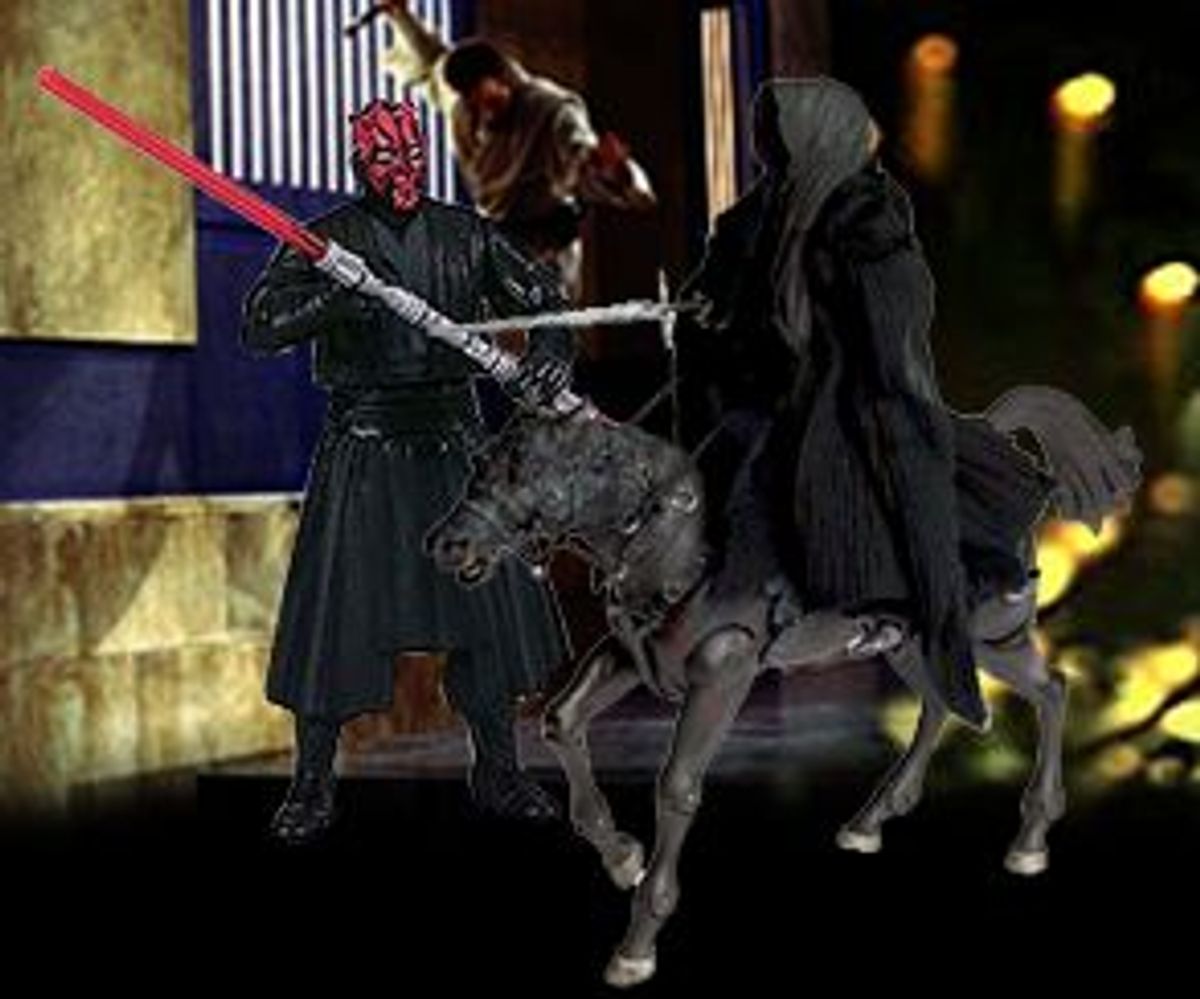
“Lord of the Rings” vs. “Star Wars”

Peter Jackson's glorified video trivia game doesn't hold up to the grandly human epic that defined a generation.

  • more
    • All Share Services

A lot can happen in 25 years, and in the high-flying, high-budgeted realm of action moviemaking, a lot has. So much, in fact, that the seminal movie of a generation, “Star Wars,” really does seem like it came out a long, long time ago, from a galaxy far, far away. Yet the 1977 icon, still one of the top 10 earning films ever, continues to be revered by its fans as one of the all-time greats.

Enter Peter Jackson’s “Lord of the Rings: The Fellowship of the Ring,” hyped as the “Star Wars” for a new generation, complete with two more films in the can and action figures already on the racks. The movie’s rocket start at the box office — $205 million after 19 days and more than $350 million worldwide — is fueled by a massive fan base for J.R.R. Tolkien’s 20th century “Lord of the Rings” books. The numbers coincide with critical acclaim: The CGI-loaded fantasy is everything that makes a contemporary Hollywood action film notable. It has an epic story, it’s visually stunning and it has a transporting imagination behind it that gives the action life. The first installment of the three-part series remains faithful to the spirit of Tolkien’s novel. By and large, even the fanatics seem pleased.

“LOTR” and “Star Wars” share a long list of structural and thematic similarities. They’re both mythical creature fantasies hellbent on rescuing good from the clutches of evil. Both feature circumstantial heroes who make Oz-like journeys and come of age in the process.

There are also dozens of superficial similarities. Both movies feature mentors who duel bad guys atop narrow passageways, as well as secondary villains — Darth Vader and Saruman the White, both deserters to the dark side, both fond of telekinetic violence — who provide the more visible nemesis. Along the way, both heroes encounter women in white gowns, cynical older-brother types, sidekicks playing for laughs and faceless cannon fodder (Storm Troopers and orcs). Both make use of mystical languages, mystical spiritual beliefs and pivotal scenes in bars and in watery mucky-mucks (compare the swamp at the gates of Moria with the garbage chute in the Death Star).

And both have monstrous, devoted followings. Even beyond the genre they share, these likenesses are hardly coincidence. George Lucas’ campy space western, made with $11 million, borrowed as liberally from Tolkien’s fantastic world as it did from Buck Rogers, the knights of the Round Table, Saturday afternoon cliffhangers, the “Wizard of Oz,” images of World War II dogfight combat, fairy tales and classic myth. At the same time, by beating “LOTR” to the screen, “Star Wars,” along with music videos, arcade games, “Star Trek,” Bruce Lee and legions of kung fu movies, “Alien/Aliens,” “Jurassic Park,” “Braveheart,” “Sleepy Hollow” and “Gladiator,” contributes to the inevitable been-there, done-that aspect of Jackson’s oeuvre.

Commercially, “LOTR” may not best the $925 million raked in by “Star Wars Episode I: The Phantom Menace,” the No. 2 earner of all time. But with high-flying effects technology and generations of book fans, “LOTR” could top sixth-ranked “Star Wars,” which grossed $461 million domestically and $798 million worldwide, and has just been surpassed by “Harry Potter and the Sorcerer’s Stone.”

Of course all these stats and dollar figures only tell one side of the story — and it’s a less compelling tale. Box office receipts are merely votes in a popularity contest, and the fact that drivel like “Independence Day” outgrosses the original “Star Wars” may not prove anything at all. A movie’s ability to entertain, engage or enlighten us, and its significance to the culture at large, aren’t things we can judge until after we’ve bought the ticket and contributed to the box office figures. And those figures can’t help us assess what’s in our hearts: Does “Lord of the Rings” hold up against “Star Wars?” Which is the better film, and why?

Far simpler than Tolkien’s intricately crafted Middle-earth, the universe of “Star Wars” is more similar to our own. Fittingly, “Star Wars” is the more human of the two movies, infusing each major character with thematic clarity befitting flesh-and-blood action heroes. Recall Luke Skywalker’s impatient dreamer, Obi-Wan Kenobi’s involved and steady-handed mentor, Leia’s spunky rebel princess, Han Solo’s self-serving cynic, and remember that all four undergo individual transformation: Luke learns to use the Force, Obi-Wan sacrifices himself for the rebel cause, Leia thaws and Han learns to care about others. Lucas even delineates the Laurel-and-Hardy-esque droids: C3PO as the talkative killjoy, R2D2 the headstrong one, with a child’s prankster sensibility. Undoubtedly, the dynamism of Lucas’ pop icons have formed many a case study for Scriptwriting 101.

Accordingly, the “Star Wars” universe is merely a setting for what is ultimately a highly compelling, if not entirely original, story. “Star Wars” makes use of technical-sounding jargon to give itself a sci-fi feel, but it’s clear at all times that any vernacular is subordinate to the needs of pure entertainment: plot, character, story arc, dramatic tension. For example, Luke’s Uncle Owen bickers about the capabilities of various droids, but the point is not to flaunt nonsensical vernacular but rather to illuminate the humor in the haggling rug-merchant tactics of a pushy little Jawa.

Indeed, humor runs throughout “Star Wars,” whose adventure-tale earnestness nevertheless refuses to take itself too seriously, squeezing jokes out of every “uh-oh” moment. When Luke and Leia nearly run headlong into the Death Star’s gaping cavity, the moment isn’t simply glossed over: It’s acknowledged by Luke’s understatement (“I think we took a wrong turn”), and Mark Hamill’s subtle gift for physical comedy. And in truly brilliant moments of character-driven funniness, Han Solo — hard-bitten space swashbuckler with a gooey, “aw, shucks” middle — shoots everything he finds threatening: his would-be bounty hunter (“sorry for the mess”), the creature in the garbage chute, the Death Star control panel.

“Star Wars” is only a movie, and it never loses sight of that. It doesn’t aim higher, and doesn’t have to. As a result, “Star Wars” refrains from pretending its heroes are anything other than flawed humans — and we love them for it. And yet, Lucas’ movie doesn’t shy away from displaying the gritty reality of human struggle: In a throwaway reference to the inferiority of droids (“We don’t serve their kind here”), Lucas allows dribbles of nasty things like prejudice to seep into his world. Nor does being on the same side guarantee people will get along: Darth Vader comes close to strangling a few generals, and as for Luke, his rivalry with Han is the kind you’d expect from the idealistic kid brother.

Incurably down-to-earth, “Star Wars” gives a guided tour of evil’s consequences, with a tailor-made John Williams score. Good guys do die: The very first scene sees all rebel fighters killed close-up. Then, in one chillingly evocative stroke, Vader obliterates Alderaan, Leia’s home planet, into a hailstorm of rocks and dust. Both acts help define a real evil, make it more tangible.

And the movie does something not often seen in contemporary action movies: It shows restraint. There are no slow-motion shots. Instead, Lucas, who grew up on pulpy cliffhangers, makes clever use of suspenseful cutting that defers to the audience’s imagination. Nothing is shown of what that floating ball of truth serum does to Leia, exactly, and there is a pregnant pause after the Sand Person raises his spiked baseball bat high over a fallen Luke, before you see he’s fainted.

In “Star Wars,” humanity is the point. In “LOTR,” with fans and followers in the tens of millions, Tolkien’s world is the point. And clearly, this emphasis on alternate worlds is better equipped to feed today’s appetite for sheer spectacle (see a long list of cinematic disposables, starting not least with “The Phantom Menace”).

Fanatics in any realm are difficult to satisfy, but Tolkien’s are the type who engage in prolonged, heated debate over authenticity, all the way down to the technical accuracy of props. (An unauthorized photograph of a spiked wheel taken on set created a global rift among faithful readers before the film came out.) Just in making the movie, Jackson shouldered enormous challenges safeguarding it against similar nitpicking.

So meticulous is Tolkien’s Middle-earth, with its genealogy charts and linguistic consistency, and so loyal Jackson and his crew to its detail, “LOTR” becomes a sort of glorified video trivia game, with dense graphics and a relentless pace.

But there’s a price for detail. For one thing, “LOTR’s” characters are uneven. Take Gandalf. One moment he’s a reassuring wizard, the next he’s shoving the young hobbit Frodo squarely out Bag End’s plump little door with nothing but a tense, hasty goodbye. Strider, one of the two men in the fellowship, is drawn with equivalent blotchiness: This gentle figure of incorruptible royalty makes his entrance on the screen as a noisome, pushy bully. You could make the case that his introduction allows a Prince Hal-like transformation, but at Jackson’s rushed pace it plays more like a quick suspense device that cheapens the character.

That kind of horse-trading is the movie’s chief weakness. “LOTR’s” characters are to its plot as rapids are to a raft: They move the story along. Everyone knows the next plot point will bring the next visual extravaganza, and the filmmakers seemingly did not have the patience, or the interest, in slowing down the visual progress.

Certainly, as the escape from humanity Tolkien intended, Middle Earth operates by its own rules. But as human entertainment, the film would be meaningless without the emotion that comes from human truth — the kind of emotion that a couple of Enya songs on the soundtrack cannot deliver. “LOTR” harbors some real emotion, but comparatively speaking it is presumptuous and finite.

As the reluctant hero, the worried, one-dimensional Frodo Baggins comes up short against Luke Skywalker, a young, impatient man with a sense of loyalty that tempers his desire for adventure, and it’s not something one can summarily blame on Elijah Wood’s wrinkled forehead. At first, Frodo takes the ring just to follow Gandalf’s orders. Later, when he meets the council, his offer to carry the ring to Mordor plays at best like a simple act of bravery, or at worst an impulsive decision that runs against his initial reluctance. But having made the offer, not until the very end of the film does he actually stop trying to give the ring away, and even then he seems far from convinced.

As for the other members of the Fellowship, film audiences aren’t given enough information for their sense of instant duty to be compelling. Whence comes hobbit buddy Sam Gamgee’s unswerving dedication to Frodo? Certainly not from the cowardice he showed under a furious Gandalf (again, this seems like comedy at the expense of character). And the loyalty of the two other undifferentiated hobbit sidekicks seems even more unlikely. Pointing to the book doesn’t work: Jackson very clearly wants his movie to stand alone.

Both “Star Wars” and “LOTR” have weird, racist undertones: For example, black is always bad. But superficially, Middle-earth appears to be a haven from discrimination. (Although there are certainly what passes for racial stereotypes, with greedy dwarves and flawed humans and stately, noble elves.) This smacks of pretense: Hobbits are addressed merrily throughout as “Halflings.” Likewise, there is little infighting on the same side of the conflict — everyone seems to know the human warrior Boromir is a potential bad seed (in his Hamlet-esque torture chamber, Sean Bean’s ambiguity is beautifully played), but no one confronts him about it, or even keeps him under any sort of special Ring Thief alert.

The insufficient development of emotions and character handicaps the movie’s ability to make us laugh. Like Gandalf’s fireworks, brief moments of shallow, situational humor dissolve swiftly into the night, subsumed by biblical solemnity: “The time of Elves is over,” “The race of men is weak” and “There is evil there that does not sleep.” Jackson could have at least tried to elicit laughter from moments of bizarre incongruity: For example, elf queen Galadriel’s know-it-all reply to Lord Celeborn when he demanded to know where Gandalf was. But they go untouched. In a moment of direct comparison with “Star Wars,” when Frodo and associates stop short of a precipice, the moment passes with neither comment nor the clever wringing of comedy from cliché.

And realism? “LOTR’s” odds step straight out of a Hong Kong karate movie. Nine warriors fighting armies of orcs and other unattractive horrors suffer but two casualties, and both die emphatically with deliberation — with three arrows in his chest, Boromir pulls a great Eveready bunny act — again, the moment calls for not even a snicker. (Whether attributable to logic or frugality with extras, Lucas dispatched his Storm Troopers in a trickle.) That’s not “LOTR’s” only suspension of logic: Apparently, when Hobbits turn invisible, you can hear their footsteps on concrete but not through dry foliage. And it is surprisingly easy to distract a ring wraith from his immortal duty with a piece of food thrown desperately from a makeshift hiding place.

True, some of this depends on what you want from the movies. Standards have changed — our 21st-century expectations define “show” to mean “show everything.” And here, digital tricks stand in for old-fashioned imagination; we see a schlocky image of a talking eye slit rather than visualize our own image of something far more evil.

That image is hardly the only thing getting in the way of the story. “LOTR” is an epic; it’s as macrocosmic as “Star Wars” (a fairy tale intimately involved with its good guys) is microcosmic. And the existence of a well-read, well-loved book handicaps “LOTR.” The book is a vehicle that allows shortcuts: Although Jackson compacts “The Hobbit” admirably in a few fact-bulging minutes for those who haven’t read it, the missing background nevertheless leaves fundamental loopholes. For example, who are these wizards and why do they care? Where does Frodo go when he puts the ring on? How is it that Cate Blanchett can read everyone’s mind? And what makes an orc inherently bad, aside from the fact that it’s ugly?

Obviously, making a movie out of a novel is not a cut-and-paste operation. Although a flawed film, “The English Patient” proved that the best adaptations are willing to murder characters and subplots as readily as they dismiss the internal wanderings of a novel. The visual translation of a thick volume into mere hours takes merciless loyalty to the new form, at a potential sacrifice to the old. In other words, had Jackson been more generous with his creative machete, he might have rivaled the book with a translation that truly stands on its own, rather than resorting to inevitable reference to the volumed set.

The verdict? “LOTR” isn’t a bad movie, but its wide acclaim shows just how much our story standards have declined, even as our visual standards have skyrocketed. Maybe filmmakers could learn an ironic lesson from “Star Wars.” Even though that film was a pioneer in both sound and visual technology, its relative restraint, compared with today’s Hollywood offerings, brings to mind the wisdom of an aged Jedi Knight. Today’s studios need to “switch off their targeting computers,” aka their fancy technology, in order to “feel the force” in moviemaking.

After all, this force requires nothing more than navigation, guided by the instinct of all we collectively know about life.

Jean Tang is a New York writer.

Trust me on this: “Star Wars”

A New York Mets all-star explains how he plans to pass the power of the Force on to his son. First in a new series

  • more
    • All Share Services

Trust me on this: (Credit: Shutterstock/Salon)
As told to David Daley

I saw “Star Wars” on VHS originally when I was 6. I was just captivated. I would come home every day after school, and before I would do my homework, I would pop it in and watch it, because I was largely alone. Both my parents worked. I remember the play button being green, the pause button was red, and the way the top would pop up and you’d slide the tape in and clank it down. And I remember knowing every line.

As I grew, I began to see “Star Wars” as a metaphor for so much – whether it was the natural depravity of man, or the redemption of man, or the relationship between a father and a son in Luke Skywalker and Darth Vader. That relationship can be broken and redeemed over the course of the trilogy. I really related and connected with it, and it encapsulated a lot of what I want to teach my children – people make mistakes, and they can ultimately be redeemed, even if those mistakes seem egregious, you know, in Darth Vader’s case. That there is a choice to be made between what side you choose in life. Our faith is a big part of our family, so the Force has special meaning for me. There’s just so many things that I think my son would get, that I hope my son would get.

Eli is 5 now, and we’ve watched the first one, but I want it to be a rite of passage – and I want to make sure that I watch it with him. So every year, it’s the next one. He’ll look forward for a whole year to his 6th birthday and “The Empire Strikes Back.” When he turns 7, we’ll watch “Return of the Jedi.” And then we’ll probably start them over. Those first three films were just so pure. (I won’t show him the other ones until later. This is about the three that I grew up with.)

My dog was named Luke Skywalker. Even now when I come out to pitch, they play the “Imperial March.” So I have had some good times with it. The thing that resonates with me, that I want my son or my daughters to cling to, is just that quintessential human emotion of hope that runs through every episode. In fact, I think the title of the very first one is “A New Hope.” I want to be able to communicate that to my son – the essence of what hope is and how you see it played out in the movies. But there’s so much more there. It sets the stage for great conversation. It’s very relatable. Hey, remember when Luke was tempted by the dark side in “Star Wars”? Well, you know — it happens. Here are some ways to deal with it. So it’s perfect.

My favorite is “The Empire Strikes Back,” when Luke finds out who his father really is, and is destroyed by it, just utterly dejected. But his whole being is not destroyed – there’s still hope. That scene: I know there’s still good in you. There’s good in you. I sense it. And, of course, as a kid I remember liking all the fights and the spaceships — all that just makes your imagination go.

When you’re young and in the moment, you’re captivated by the pure entertainment value. I wanted to be Luke Skywalker. I wanted a Princess Leia on my side. But as I grew, I saw it through a different lens. You see so many movies, and you might take something from one, but most you just forget about. What’s neat about “Star Wars,” the trilogy, is that I’ve reflected on that hundreds and hundreds of times, especially since growing into an adult and thinking about life lessons that are relatable and why people develop the way they do. It certainly motivated me to think beyond the box.

My girls are 10 and 8, and they’ve both seen the trilogy. Sometimes I feel like a professor teaching the same class. What’s great now is that we own them, of course. We have them all in HD — we’re not watching them on a scratchy, grainy VHS like I had to all those years ago.

Continue Reading Close

R.A. Dickey is a starting pitcher for the New York Mets and author of the memoir "Wherever I Wind Up: My Quest for Truth, Authenticity and the Perfect Knuckleball"

“Star Wars” like you’ve never seen it before

A new spin on a beloved classic finds its way onto YouTube -- and reminds us of the power of the Internet VIDEO

  • more
    • All Share Services

There are a few great universal truths. People love “Star Wars.” People love making videos. (Just ask the Star Wars Kid.) When in 2009, Vimeo developer Casey Pugh challenged fans to “remake ‘Star Wars: A New Hope’ into a fan film, 15 seconds at a time,” he got an outpouring of beautiful animated sequences, stop-motion extravaganzas, and a lot of people in their living rooms, wearing hoodies. So many hoodies. The final product became “Star Wars Uncut,” an addictively compelling low-fi reimagining of the classic that went on to win  a 2010 Emmy for interactive media, besting websites for “Glee” and “Dexter.”

Now, a year and a half after its Emmy win, “Star Wars Uncut” is getting yet another wave of glory. On Jan. 18, a “Director’s Cut” of “hand-picked scenes from the entire StarWarsUncut.com collection” was uploaded onto YouTube, the entire movie rolled into one gloriously weird, 473-scene work that spans from a Twitter update of “A long time ago, in a galaxy far, far away” to a closing credits sequence with more names on it than a Korean cartoon. In other words, it’s the “Star Wars” you always dreamed of – one featuring your childhood action figures, several bottles of Jim Beam, flying bow ties, and a box of ferrets. If you don’t have two hours to blow watching the whole kaboodle, check out the Star Wars Uncut site, where you can access individual scenes, along with their originals from the film. Fair warning: Once you find Chewbacca’s character page, you’re in for no less a time suck.

In a world where messing around with copyrighted material could, as Andrew Leonard explained recently, “get an entire website shut down,” a treasure like “Star Wars Uncut” — as well as other crowd-sourced gems like the Grammy-nominated Johnny Cash Project — might well become extinct. Fortunately, back in 2010, “Uncut’s” creator Pugh told the New York Times that the notoriously touchy Lucasfilm had given its support to the project from its earliest days. Though he’s bound by a nondisclosure agreement, Pugh affirmed that “Lucasfilm isn’t out to make money on this, and neither am I.”

The lavish attention and effort so many individuals poured into a silly labor of love to one of the most lucrative films of all time speaks of great purity. They did it for no money. For no great glory. Just for the fun of doing something, sharing it with others, and seeing what they came up with as well. For the pleasure of putting a personal stamp on Princess Leia’s eye rolls and Han Solo’s winks. The end result is both insanely cute (that toddler with the Cinnabon hat at the eight minute mark will just about kill you dead) and often, oddly touching. Because within the rousing, rebellious spirit of “Star Wars” the Internet has found yet another way to celebrate the giddy, ragtag joy of collaboration.


Continue Reading Close
Mary Elizabeth Williams

Mary Elizabeth Williams is a staff writer for Salon and the author of "Gimme Shelter: My Three Years Searching for the American Dream." Follow her on Twitter: @embeedub.

What Occupy can learn from the Hunger Games

A leaderless political movement still trying to find its place might look to heroes of dystopian fiction for ideas

  • more
    • All Share Services

What Occupy can learn from the Hunger Games (Credit: AP)

“YOU CAN’T EVICT AN IDEA,” proclaim the banners fronting an otherwise dull building in east London, owned by banking giant UBS but inhabited and decorated by squatters from the Occupy movement. They’ve adapted the phrase from Alan Moore and David Lloyd’s graphic novel “V for Vendetta,” in which the titular terrorist explains his seeming immortality to a detective who has just shot him: “Ideas are bulletproof.” A poster of V’s trademark Guy Fawkes mask smiles eerily at all who walk into the foyer of 8 Sun Street, now dubbed “The Bank of Ideas” and used as a community center. The caption underneath reads, “We are the 99%, and so are you.”

It’s fitting that the Occupy movement should have drawn inspiration from dystopian fiction, an increasingly popular genre for teenagers and young adults in particular. If, as Time magazine suggests, the person of the year was the Protester, the publishing phenomenon was the Dystopia — the story of the dissenter in a repressive society who becomes a revolutionary. The new wave was led by two trilogies, both published from 2008-10: Suzanne Collins’ “Hunger Games” (whose big-budget Hollywood adaptation kicks off in March) and Patrick Ness’ “Chaos Walking” (now being adapted by Lionsgate). Scores of other books and series are now rising in their wake. “V for Vendetta,” from 1988, is an important antecedent, telling the tale of Evey, an adolescent girl in a run-down future London who, indoctrinated by the self-styled freedom fighter V, becomes a thorn in the side of a fascist state. Toward the end of the 2006 film adaptation, hordes of the working class – the 99 percent, if you will – don the Fawkes masks themselves and, led by Evey, stand firm against their oppressors.

Since the film’s release, replicas of these masks have been manufactured widely, and Occupy protesters in the U.S. and the U.K. have often worn them (as have members of the hackers collective Anonymous), both to disguise their faces and show solidarity. But the film is an odd, Hollywood-ized work that the iconoclastic Moore has typically dismissed. In contrast, his book is philosophically more complex than is often acknowledged. Unlike propaganda, literature is difficult to adopt as a template by movements of any stripe, and such is the case with “V for Vendetta.” V is, despite his protestations, is more than just an embodied idea: He’s an ideology, and this makes him dangerous to both the ruling elite and his own followers. And if there’s anything we can learn from dystopian literature, including the work of Collins and Ness, it’s that ideologies can, and should, be evicted.

*

There’s no necessary cause-and-effect relationship between world events and publishing phenomena, but there can certainly be a resonance. Suzanne Collins has said that “The Hunger Games” was inspired in part by coverage of the war in Iraq — and  yet it raises issues of economic inequality, misinformation and corporate greed that are even more relevant now. Collins’ heroine, Katniss Everdeen, is an independent and even ornery 16-year-old who saves her younger sister by volunteering for, and then winning, a telecasted fight-to-the-death competition. Though her feats of derring-do have elements of escapist fantasy, her ultimate goal isn’t to win the Games, but to avoid exploitation: She wants to circumvent the rules and figure out a way to shut down the games for good. Just as Collins and other writers of young-adult  dystopias cleave to the Romantic nostalgia for childhood freedom, they’re raising the stakes of the coming-of-age novel’s traditional struggles with the pressures of growing up and the need to integrate with society. In these dystopias, integration means the death of freedom and imagination, and subjugation to a way of thinking that curbs creativity and stresses survival of the least scrupulous.

The societies depicted in these novels generally fall into one of two broad categories. In the first, as in “Hunger Games,” Ally Condie’s “Matched” (2010-12) and Veronica Roth’s “Divergent” (2011), they’re dystopias masquerading as utopias, where everyone is supposedly provided for through work assignments that keep the plebs docile and benefit the ruling elite. In the second, as in “Chaos Walking” and Jeff Hirsch’s Collins-blurbed “The Eleventh Plague” (2011), they’re post-apocalyptic settlements where the physically strongest and best-organized have taken power and bent all to their will.

All of these books feature adolescent protagonists of generally unimposing physical stature who, at a crucial point in their lives (usually an adult-initiation process of some kind), reject the limited choices they’re offered and learn self-sufficiency instead. They pull together support from other outsider teens and some adults (especially lapsed countercultural hippie-types who remember pre-dystopian life), and make difficult decisions that open the door to a new and better way of life. Thus, they avert catastrophe and avoid the trap of the minimum-wage, dead-end job – or its near-future equivalent.

The formula for self-sufficiency is a familiar one: The protagonists need to rough it, to live for a time off the land as early colonists did, escaping the dystopias’ infantilizing control and surveillance. This connects them with nature both literally and symbolically, putting them in touch with their inner noble savages. From the start of “The Hunger Games,” Katniss hunts with a bow and arrow in the forbidden wild; later, she becomes known as the Mockingjay, after a species of bird who lives there. In “Crossed,” the sequel to Ally Condie’s “Matched,” the protagonist, having lived all her life in suburbia so sanitized it makes Disneyland look like Bangkok, bolts to a Grand Canyon-like back country to join her dark, brooding outsider boyfriend (the opposite of her society’s chosen match for her, who is of course blonde – even in the future, love triangles will keep young hearts aflutter). There, she learns personal independence through physical effort.

But they’re not quite noble savages, because they’re self-aware. In the wild, they find misfits who safeguard learning, hoarding the books and lore that the dystopias have repressed. The Occupy movement often casts itself in a similar light, as its members “rough it” in parks in the middle of cities as if keeping alive a more earthy, simple, honest way of living; their library tents symbolize their devotion to learning from the past as they forge a better way for the future. Indeed, the library is a synecdoche for the movement itself: in Toronto, protesters chained themselves to theirs as it was about to be removed as part of the camp’s eviction; at Occupy Wall Street, the demolishing of the library has been viewed as a repressive dystopian act.

In the wilderness, the dystopian protagonists also encounter rebels – and not necessarily the same people who read books. Unlike in escapist fantasies such as “Star Wars,” where the rebels unambiguously deserve our support as they fight an evil empire with the light side of the force, the rebels in YA dystopias can be as dangerous as those in power. Often the two are mirror images of one another, led by charismatic but delusional figures who seek to wrest power for themselves by violent means and view the teenage heroes as vehicles for them to do so. In “The Hunger Games,” Katniss becomes an icon for the rebels in the legendary District 13 but ultimately distrusts their humorless and pathologically driven leader, Alma Coin; in “Chaos Walking,” Viola (Todd’s girlfriend and female counterpart) falls in with The Answer, a group of terrorists who are healers by profession but are just as adept at setting off bombs, and wouldn’t blink at blowing her up if it achieved their own ends.

The heroes are called upon to navigate between dystopian rulers and rebel would-be-dystopian-rulers; as champions of democracy, they pull together disparate disenfranchised groups in ragtag bands that become as strong as the sum of their parts. In doing so, they demonstrate the power of not being “confined to one way of thinking,” – a phrase used by the mother of the heroine in the pointedly-titled “Divergent,” shortly before she’s violently killed by a zombified soldier. Homogenization is the enemy – which is why it’s odd to find so many Occupy-movement protesters wearing the V mask.

Like the new YA dystopias, Moore and Lloyd’s “V for Vendetta” highlights problems with rebels who have the same aptitude for violence, disregard for collateral damage and distrust of nuanced world-views as the dystopias they fight. V is a vigilante revolutionary for whom any ends justify his means. He takes Evey under his wing as he attacks members of London’s ruling elite, and when she balks at killing people, he then “kidnaps” her and, in disguise as a police officer, tortures her, effectively breaking her down to nothing and then building her back up again in his own revolutionary image. This is the ur-terrorist narrative, which upholds the belief that each person must be shattered and remade to serve a purpose, in order that the same may be done to civilization itself. It’s the strategy employed, in “Chaos Walking,” by the dystopian Mayor Prentiss as well as the opponent he brands a “terrorist,” the bombing-happy healer Mistress Coyle. But neither can ultimately control the book’s dual protagonists, Todd and Viola, whereas in the even darker “V for Vendetta,” Evey becomes V’s disciple, blowing up 10 Downing Street and offering the citizens of London a choice between “lives of your own and a return to chains” – apparently she has read her Rousseau. The bloodthirsty version of freedom she offers them is more savage than noble, and itself suggests another form of imprisonment. The book ends not with the triumphant Evey but rather with the consistently questioning Inspector Finch, who wanders off alone outside London, into darkness and the unknown, rather than choosing one of two unattractive sides.

Finch refuses to let others think for him. He, not Evey, is the analogue to Todd and Viola in “Chaos Walking,” whose strategy of avoiding violence unites their people as well as other species on the planet. In “The Hunger Games,” Katniss ultimately undermines the regimes of both President Snow and Alma Coin, throwing her society into disarray but perhaps helping to usher in what one character calls “the evolution of the human race.” In “Divergent,” where a future society is split up into factions based on personality traits, Tris grows up as Abnegation (forsaking herself), undergoes initiation as Dauntless (having no fear), and saves both factions from destruction by a third (Erudite) by being divergent – rejecting received and rigid modes of behavior and thought. In “The Eleventh Plague,” in the post-apocalyptic aftermath of biological warfare with China, orphaned and distrustful teenager Stephen and his bad-seed Chinese-American girlfriend Jenny secure help from people that their town elders had thought were plotting their destruction. Ironically, in action-packed, plot-driven novels filled with violence, these novels interrogate the practice of using violence (and sometimes torture) as a solution to political and social problems.

Stories of people who are trampled on by competing ideologies and broken by enforced scarcity are certainly apt at a time when the U.S. political system is regularly brought to a standstill by politicians unwaveringly devoted to ideologies, the European Union threatens to disintegrate due to its members’ conflicting demands, divisions between the rich and the poor are ever-increasing, and those with the power to help offer rhetoric instead. The Occupy movement, as a loosely affiliated band of concerned people – Marxists, anarchists, environmentalists, survivalists, and more – has on the whole avoided ideology and embraced diversity and democracy. Some would say its lack of specific goals has undermined it, but the adoption of a V-style oppositional stance surely wouldn’t help. Occupy has done much to cast the U.S. and U.K. as dystopias, as pictures of police in riot gear confronting protestors have proliferated in the media; nonetheless, it needn’t cast itself as the kind of rebel movement that uses repressive strategies similar to those of the ruling elite.

Propped against a wall inside the Bank of Ideas is a placard that reads, “’1984′ was not supposed to be an instruction manual.” Nor, indeed, is “V for Vendetta,” and neither are “The Hunger Games” or “Chaos Walking.” The new YA dystopian novels are thoughtful books, but they don’t offer solutions or blueprints – they merely suggest ways of combating stifling political ideologies. They’re full of different voices, or what literary theorist Mikhail Bakhtin, writing in – and against – Soviet Russia, called “polyphony”: the opposite of propaganda, and the enemy of ideology. Where they resonate with the Occupy movement, it’s in the protagonists’ determination to recalibrate the world around us in creative ways: seeing a bank as an educational institution, a tent as a library, a movement as a gathering of people asking questions, and encouraging ways of thinking by which solutions could be found.

While you can’t – and perhaps shouldn’t – evict an idea, it’s best, as the U.K. singer Nicolette has said, and as these dystopias suggest, to let no one live rent-free in your head.

Continue Reading Close

Today’s must-see viral videos

Watch: James Spader's first promo for "The Office," a "Star Wars" porn parody that's funny, and Lopez's monologue

  • more
    • All Share Services

Today's must-see viral videosA porn parody that's more parody than porn?

1. Paul Rudd is your bad marketing idea man:

Even though “My Idiot Brother” looks kind of terrible, I will watch Paul Rudd do basically anything.

Sorry America, the Rudd backlash hasn’t begun in my heart quite yet.

2. Chris Crocker needs your money for a documentary:

Come on, you guys remember Chris Crocker right?  He’s the “Leave Britney alone!” guy.  Anyway, here’s his Kickstarter project for a feature film.

Dig deep into your wallets, folks! This man’s story needs to be told!

3. George Lopez “jokes” about being canceled (clip starts at 1:30 mark):

Ha … ha? Racism!

Actually, I’m starting to realize why his show got canned. But I’ll watch his final show tonight out of respect, anyway.

4. James Spader will rule “The Office”:

And he’ll be the new star of the show, as this promo suggests

Unfortunately, the clip actually tells us nothing about the character we haven’t already seen, but hey, I could watch it 100 times and it will still be better than half of last season.

5. Safe-for-work “Star Wars” porn parody:

This looks amazing. Why is it funny? I thought “parody” was just another word for “We’re making this beloved show or movie into a porno.”

How they ever found a kid who looks that much like Mark Hamill is beyond me. Two tickets, please!

Continue Reading Close

Drew Grant is a staff writer for Salon. Follow her on Twitter at @videodrew.

“Star Wars” with street cred

Slide show: We talk to artist Nicholas Hyde about George Lucas' influence on contemporary graphics culture

  • more
    • All Share Services

Is there a law on the Internet that says that for every original idea, someone has probably done a “Star Wars” parody of it? There should be. For a story that’s been around for over 30 years, the iconic characters of George Lucas’ films always find ways to appear in the most unlikely of places: in musicals, riding bikes, even in rap music.

Nicholas Hyde is one of the many devoted “Star War” fans who have updated the iconography of his childhood. A  32-year-old artist living in Oregon, Hyde’s prints give those famous “Star Wars” figures some modern street cred: Using crisp outlines and dark shadows, Hyde fashions  portraits of Yoda playing at the turntables, or Boba Fett with an old-school jukebox. It’s like something Kevin Smith might have come up with if he made art instead of movies.

“The inspiration behind my art came mostly from old ’90s skateboard graphics,” Hyde tells me over email. “I loved how they were very iconic and simple, yet made a statement. Evan Hecox and Jim Phillips are some of my favorite artists. The ‘Star Wars’ characters came from the love of the whole story line of the movies when I was a kid. Still to this day, it’s epic.”

“I would describe my work as a mashup … a little bit hood adventure and a little bit space adventure. My first piece was OG1 Kenobi, I think I just watched ‘CB4‘ with Chris Rock and it just kind of clicked. My favorite piece is Darth Fader, though; just the thought of him in party mode and trying to control the galaxy is hilarious to me. “

When asked if he was worried that George Lucas might come after him for copyright infringement, Hyde replied, “I would hope that if my art ever gets in front of G.L., that he would get a laugh out of it. I sold a piece to Mark Zuckerberg’s sister, Arielle. She thought they were funny and that is kind of what I’m aiming for.” 

You can purchase Hyde’s prints of “Star Wars” and other classic movie characters here, here or here.

View the slide show

Continue Reading Close

Drew Grant is a staff writer for Salon. Follow her on Twitter at @videodrew.

Page 1 of 16 in Star Wars