World Cup

The greatest show on earth

It's World Cup time again -- when more than a billion people will be enthralled not just by the joy of victory and agony of defeat, but also by the mystery and despair that is championship soccer.

  • more
    • All Share Services

Topics:

The greatest show on earth

Soccer is in crisis. Soccer is the unchallenged titan of sports, standing astride the globe like a colossus in shorts and shinguards.

On the eve of the 2002 World Cup in Korea and Japan — and even the positioning of the two countries’ names has been a negotiated issue in what may be the tensest international sporting event since the 1936 Berlin Olympics — both statements are true. You could argue, in fact, that both statements are always true. World soccer occurs on such a big stage, amid such high drama, that it contains a kind of yin and yang, an ethic of creation and destruction. Soccer is so far ahead of every other sport in its global reach and dominance that it has to be its own worst enemy. Its guiding philosophy is more a creed of mystery and despair than of hope and victory, which may be the profoundest reason why Americans haven’t much taken to it. (As a German coach once put it, the ball is round and the game lasts 90 minutes. Everything else is theory.) If all that makes soccer sound more like a religion than a game, well, it is a kind of religion, one practiced by all races on all continents (again, excepting those agnostic Americans).

The game itself is maddening and frustrating at least as often as it is enthralling; its ebb and flow can bog down into World War I trench warfare, an orgy of egregious hacking and theatrical diving, the kind of tactical defensive play British announcers call “cynical.” Soccer bashers who don’t understand the game may believe that fans actually like tedious 0-0 draws, but the opposite is true. There will be at least half a dozen endlessly dull matches in the 2002 World Cup — which kicks off Friday morning, when defending champion France plays Senegal in Seoul — that will leave fans, watching at peculiar hours around the globe, pounding their floors in rage and bitterness and vowing to swear off this hopeless team and this dismal game once and for all. Fans also know, of course, that you never know. Out of nothingness, out of the most boring game possible, lightning can strike.

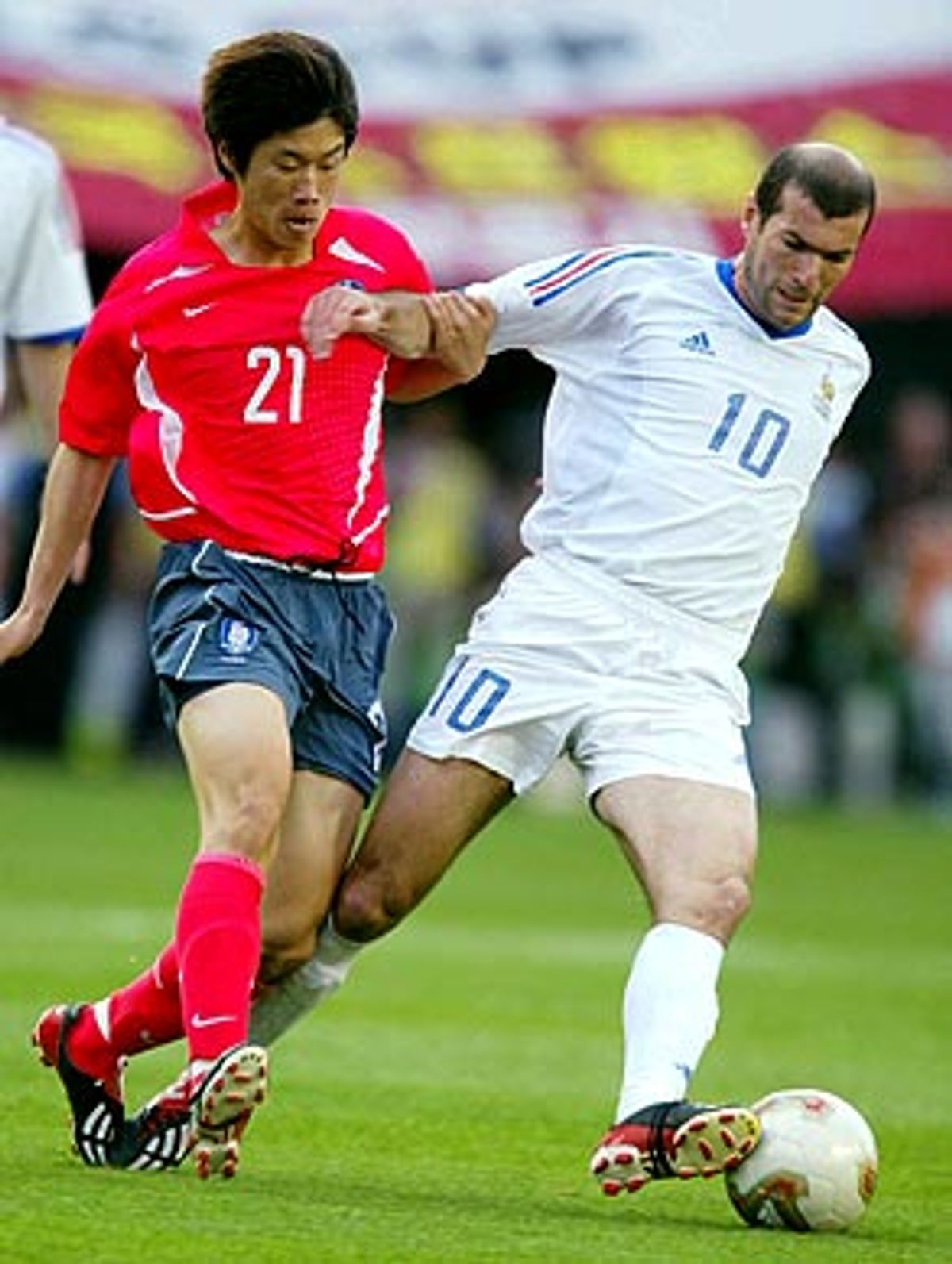
With a single, searing volley from the top of the penalty box, French midfielder Zinédine Zidane, probably the best player in the world, turned this year’s European club championship game (between his team, Real Madrid, and Germany’s Bayer Leverkusen) from a mediocre match into a classic. Big games can be legendary thrillers, like the 1982 World Cup semifinal between France and West Germany (arguably the greatest game ever played), or duds, like the goalless final between Brazil and Italy at the Rose Bowl in 1994.

Soccer runs true to form most of the time, which makes its upsets — France’s improbable domination of mighty Brazil in the 1998 final, sending Paris into a delirium unmatched since the Liberation — or its flagrant outrages, like Diego Maradona’s “hand of God” goal against England in 1986, seem like the workings of irresistible fate. Yes, even 0-0 draws can be exciting, nerve-racking, action-packed affairs, although there’s no point trying to convince non-fans of this.

Splitting the World Cup tournament between two East Asian countries that aren’t exactly bosom buddies — and that are multiple time zones removed from the soccer heartlands of Europe and Latin America — was strictly a marketing notion, and perhaps not the brightest one ever conceived. But soccer will survive even this and thrive. FIFA, the sport’s international governing body, seems to be enmeshed in a deepening corruption scandal. Professional soccer in South America is in ruins, and every pro league in the world — with the partial exceptions of the star-packed leagues in England and Spain — is facing serious difficulties on and off the field. (U.S. sports fans should take a hard look at the current state of baseball, basketball and hockey before they start feeling superior.) As usual, the standard of officiating is under attack and mavericks are calling for NFL-style video replay on goal-line decisions or for the abolition of the near-metaphysical offside rule.

(For non-soccer fans, the offside rule — there’s a less mysterious version of it in hockey — prohibits an offensive player from running past the last defensive player until the moment the ball is passed forward. Its purpose is to prevent teams from simply trying to outrun the defense and punt the ball downfield. It is difficult for the officials to call because at the moment the ball is played forward, the offensive player is often almost exactly even with the defensive player and a considerable distance away from the passer.)

All that is background noise, the ambient Sturm und Drang that the soccer world seems to require when staging its monthlong quadrennial championship spectacle, the granddaddy of all media sports events. (No, Americans, nothing else comes even close: not the Super Bowl, not the World Series, not the Olympics.) Somewhere around a billion people will watch the World Cup final broadcast live from Yokohama on June 30, and if they have to skip work or get up early or stay up late, they will.

Americans mostly won’t watch it at all, of course, but I don’t propose to write another of those angst-ridden pieces about why we ignore the world’s game and what that says about our national soul. Salon columnist Allen Barra recently wandered into this issue and wound up, like most other American sportswriters, unintentionally insulting the planet as a whole and demonstrating his soccer illiteracy in support of a valid, if obvious, argument: Soccer will never be as big here as it is elsewhere. (I don’t know Barra and we don’t work in the same office, but I consider him an astute, acerbic observer of baseball, basketball and other sports.)

Perhaps Barra’s suggestion that other countries might like baseball or NFL-style football better than soccer if they could afford to play them was meant to be facetious; it was certainly hilarious. Then there was his claim that top-level soccer talent does not vary widely. Why then do a handful of nations like Argentina, Brazil, Italy and France dominate the international game, while the same club teams (Manchester United, Real Madrid, Bayern Munich) win European championships year after year? This is what comes from basing one’s opinions on a vague impression: I mean, Shawn Bradley must be a better basketball player than Shaquille O’Neal since he’s taller, right?

Still, Barra and other soccer detractors have a point. There’s no Euro-style soccer culture in the United States, and there probably never will be. Soccer’s future in the U.S. is as a widespread participatory sport that is very slowly gaining purchase as a niche spectator sport, thanks in equal parts to continuing immigration and the spread of soccer-mom culture in the ‘burbs. Regardless of whether Major League Soccer, the troubled if decently competitive men’s pro league, manages to survive, the game will most likely hold on to its spot in the sports hierarchy, somewhere a little south of hockey but north of lacrosse or arena football.

Despite its financial problems and microscopic TV ratings, MLS has given borderline young American players the chance to improve and has deepened and broadened the U.S. talent pool. It’s no stretch to say that the United States has arrived in international men’s soccer — as a consistent, hard-working and mediocre team that tends to collapse in crunch time. (Of course, as the defending world champions, the United States is already one of the dominant forces in women’s soccer. The next women’s World Cup will be held in 2003.)

The American men’s team might fit somewhere in the top 20 national teams in the world, but definitely not in the top 10. Despite the embarrassing last-place finish in France ’98 — where the United States lost to Germany, Iran and Yugoslavia, scoring exactly one goal in the process — it’s important to realize that the team has now qualified for four consecutive World Cups. That’s not an insignificant achievement. Much better teams from such soccer-mad nations as England, France, Ireland, Portugal, Spain, the Netherlands, Chile and Colombia cannot make the same claim.

The good news about the U.S. team that flew to Korea last week is that it’s by far the best we’ve ever fielded. We have two world-class goalkeepers, Kasey Keller and Brad Friedel, who both play at the top level in England and would start for most nations in the world. (Unfortunately, U.S. coach Bruce Arena can start only one at a time.) Midfielders Claudio Reyna and Eddie Lewis, along with defender Gregg Berhalter, also ply their trade in England. So does forward Joe-Max Moore, who may not even start. Defenders Tony Sanneh, Frankie Hejduk and Steve Cherundolo play in Germany; defender David Regis in France, midfielder Earnie Stewart in Holland.

None of those guys is the best player on the team: Midfielder-forward Clint Mathis, of the MLS MetroStars, may be the showboat attacker American soccer fans have longed for. With his talent, swagger and fearlessness, Mathis could become the first Yank goal-scoring star for a top club in Europe (where he’ll undoubtedly end up after the tournament concludes). And there are younger players on the U.S. squad, like speed-burning forwards Landon Donovan and DaMarcus Beasley, whose upside may be even bigger than Mathis’.

OK, now the bad news: The best-ever American team still might not be good enough to escape the first round. (If the United States didn’t quite deserve its dismal fate in ’98, its fluke victory over Colombia and second-round appearance at USA ’94 was even more of an aberration.) The 32 World Cup teams are divided into eight groups of four teams for round-robin play; the top two teams in each group after those three games advance to the round of 16. Coach Arena’s squad was drawn into a tough opening group with Portugal, one of the hottest teams in Europe and a dark-horse contender to win the cup; co-host South Korea, whose rabid fans will view the U.S. game as their Olympics and Super Bowl rolled into one; and Poland, exactly the kind of bruising, physical team that gives the Americans problems.

What targets can the Yanks set for themselves? Fans with some sense of reality and perspective, I think, will have to be content with precisely the kind of wussy-face moral victories that make most American sports fans contemptuous of soccer in the first place. Advancing to the second round of 16 will require a minor miracle, probably at least a win and a draw in those three matches. Winning a game — any game — would be impressive. Seriously, though, playing respectably this time around might have to be enough: getting a draw or two, scoring three or four goals, keeping the talented Portuguese squad from running up the score.

Furthermore, American exceptionalism aside, there’s no shame in that; most of the 31 other qualifiers are in the same position. Uruguay, South Africa, Saudi Arabia and Belgium, like the United States, are basically Morehead State in the NCAA tournament: They’re all hoping to play well, catch a break somewhere along the line, and give the home fans something to cheer about. Their chances of hoisting the cup in Yokohama on June 30 are near zero, and they know it.

Somebody will raise the chalice, of course, and if it isn’t one of the soccer world’s aforementioned big four nations, it’ll be a major upset. Most of the talk has been about Argentina and France, which might suit the previously glamorous Brazilians and Italians just fine — who knows how they’ll react to an underdog role? (Brazil, the four-time champion and a perennial favorite, was plagued by scandal, infighting and injury during the qualifying rounds and barely squeaked into the tournament. A recent New York Times story even suggested that the soccer-crazed Brazilian public has largely turned its back on this year’s squad.)

If one of the top four slips up, a handful of talented dark-horse teams — principally England, Germany, Portugal and Spain — are waiting to pounce. In fact, the quarterfinal brackets suggest a possible Spain-Portugal matchup, the result of which might affect the economy and culture of the Iberian peninsula for decades.

Then there are the rank outsiders, one of whom might sneak through to the semifinals the way Croatia did after ousting Germany in ’98. Unpredictable, underachieving Nigeria? The impressive new generation from Ireland? The Indomitable Lions of Cameroon? The wily veterans from Russia? Nope, sorry, not this time.

Traditionally, European teams win the cup when the tournament is held in Europe, and Latin American teams win when it’s held in the Americas. So who wins the first-ever Asian installment? Not South Korea, Japan or China, although you shouldn’t be shocked if the latter two teams find a way to sneak into the second round.

It’s always boring to pick the defending champion, but if the unstoppable Zidane recovers from his thigh injury to play at full strength in the second round and thereafter, I’m not sure anybody can beat the French combination of talent and experience. Still, they’ll be tested: The tourney’s later brackets suggest that France may face Brazil in the quarterfinals and Argentina in the semis, so victory won’t come cheap.

The modest surprise will be Spain: That talented group of perennial underachievers will make its mark by winning that crackling quarterfinal against Portugal, surprising Italy in the semis, and losing a tightly contested battle to the French on the last Sunday in June.

Then again, a Salon colleague who knows at least as much about the game as I do claims that injury-plagued Germany will find a surprise path to the final, beating Croatia in the quarters and Portugal in the semis to find themselves facing Brazil in Yokohama. Of course, he’s German. Still, even after imagining his heroes getting that far, he thinks Brazil will beat them. Like all true soccer fans, he’s a dreamer who knows that fate, in the end, is a cruel mistress.

Continue Reading Close

Furious gay rights groups condemn FIFA chief Sepp Blatter

Activists say his joke about gays refraining from sex in Qatar during 2022 World Cup isn't a laughing matter

  • more
    • All Share Services

Topics: ,

A leading international gay rights group demanded Tuesday that FIFA make an official apology following President Sepp Blatter’s comment about homosexual sports fans traveling to Qatar for the 2022 World Cup.

Blatter, head of world football’s governing body, said Monday in an apparently lighthearted remark that gay fans “should refrain from any sexual activities” during the tournament in Qatar, where homosexual behavior is illegal.

Juris Lavrikovs, communications director for the European branch of the International Lesbian, Gay, Bisexual, Trans and Intersex Association, said the comments were “very unfortunate and have left people deeply offended.”

“I think they should come out with a strong statement and not just wash it away and hide behind it with some wishy-washy comments,” Lavrikovs told The Associated Press. “We are talking about a very basic human right that is being violated.”

Blatter, speaking in South Africa on Monday at the launch of a post-2010 World Cup legacy project, was asked if he could foresee any cultural problems with the tournament being held in Qatar.

“I’d say they (gay fans) should refrain from any sexual activities,” he said, smiling.

Lavrikovs noted the situation “is not a joke.”

“This is a matter of life and death to people,” Lavrikovs said. “Qatar and more than 70 other countries in the world still criminalize individuals for homosexual relationships, and some countries even punish them by death sentence.

“It’s disappointing to see that an organization that is promoting the game, which in its statutes condemns discrimination of any kind, is coming out with comments like this.”

Qatar beat Australia, Japan, South Korea and the United States in the FIFA vote on Dec. 2.

Since FIFA made what is widely regarded as a surprise decision, concerns have been raised about Qatar’s hosting such a major tournament while it has stringent laws that are seen by many to violate basic human rights.

“Sepp Blatter jokes about the risk to gay visitors in 2022, but Qatar’s anti-gay policies are no laughing matter,” British human rights campaigner Peter Tatchell said.

Also condemning Blatter was John Amaechi, a former NBA player from Britain who revealed in 2007 that he was gay.

“The statements and the position adopted by Sepp Blatter and FIFA regarding LGBT (Lesbian, Bisexual, Gay and Transgender) fans who would pay the enormous ticket and travel prices to attend the World Cup in 2022 should have been wholly unacceptable a decade ago,” Amaechi said on his website.

“Instead, with little more than an afterthought, FIFA has endorsed the marginalization of LGBT people around the world,” he added.

Amaechi also demanded an apology from FIFA and urged other associations to distance themselves from Blatter’s comments.

“Anything less than a full reversal of his position is unacceptable,” he said.

Continue Reading Close

Mike Allen’s World Cup outrage: FIFA is anti-American!

Politico's "Playbook" author doesn't want a World Cup played in terrorist-coddling Qatar

  • more
    • All Share Services

Topics: , , ,

Mike Allen's World Cup outrage: FIFA is anti-American!Qataris react in a car, after the announcement that Qatar will host the soccer World Cup in 2022, in Doha, Thursday, Dec. 2, 2010. (AP Photo/Osama Faisal)(Credit: AP)

Politico’s Mike Allen is outraged that FIFA didn’t pick America to host the 2022 World Cup! It is his “top story” in this morning’s “Playbook,” his daily newsletter of birthday greetings to people you don’t know and links to news articles from yesterday. (The top story comes after a line about someone’s birthday, a recap of yesterday’s “D.C.’s Funniest Celebrity” contest, and two news stories from yesterday about Michael Steele and online poker.)

The worst part is, not only was America snubbed, but terrorists won. The 2022 World Cup will be held in Qatar, a tiny Persian Gulf state. Behold the wrath of Mike Allen:

TOP STORY – “Russia and Qatar take World Cup to new lands” – Reuters/Zurich: “FIFA gave its ultimate recognition to emerging markets on Thursday by awarding the 2018 and 2022 editions of the prestigious and lucrative World Cup soccer finals to Russia and Qatar, both new hosts. Russia won the right to put on the 2018 World Cup, the first time it will have been staged in Eastern Europe after 10 editions in the western half of the continent. Qatar, which has never qualified for the World Cup finals, will stage the 2022 tournament, a first both for the Middle East and for an Arab country. It will also be the smallest nation ever to host the World Cup.” http://reut.rs/hz0k7t

–The U.S. inexplicably lost to Qatar, which is two-faced in the war on terror and full of radical sympathizers. A Ben Smith reader points out a WikiCable “in which Mossad chief Meir Dagan briefed Bush homeland security aide Frances Fragos Townsend: Dagan characterized Qatar as ‘a real problem.’” http://politi.co/f0kcmq

–International Herald Tribune p. 1: “FIFA tilts soccer’s future toward the East.”

–Brits push for FIFA reform – BBC: “England 2018 bid chief executive Andy Anson has warned his country against bidding for the World Cup again until Fifa reforms its voting process.” http://bit.ly/gyKAhC

PLAYBOOK FACTS OF LIFE: These obviously absurd choices are the product of a corrupt process that includes no accountability. These organizations (FIFA, IOC, etc.) are Eurocentric, if not blatantly anti-American. As a wise young friend e-mails, “These bids are like a modern day ‘Concert of Europe.’ And we certainly aren’t Prince Metternich, despite what we may think.”

Lots of people consider Qatar a poor choice for the World Cup, but not because it’s not America. Or because they are secretly pro-terrorist! Or because Mossad said something bad about them in a secret cable! It’s considered a poor choice because it is a tiny nation with no soccer team of its own. Also it’s a desert with high summer temperatures and they pump absurd amounts of CO2 into the atmosphere. And it’s full of foreign-born indentured servants with very few rights. And you’re not allowed to drink booze in public. But “being two-faced in the War on Terror” is pretty far down the list of reasons why this might be a bad idea.

Also, FIFA is a Zurich-based international organization, so calling it “anti-American” is pretty much a non sequitur. As for “Eurocentric,” much of Europe is very disappointed in FIFA for awarding a World Cup to Qatar. (Qatar is not in Europe.) And Russia, despite its own problems, is not an “obviously absurd choice,” because it’s a massive world power that loves soccer. Also, your “wise young friend” sounds insufferable.

The other nations bidding for 2022 were the U.S., Australia, Japan or South Korea. All would’ve been fine choices, though the fact that Japan and South Korea co-hosted it in 2002 probably disqualified them, and the U.S., unlike the rest of those nations, is not a country that cares about soccer. So if Mike Allen could put aside the jingoism and Islamophobia for a moment, he would perhaps see that he should really be outraged on behalf of Australia, which has never hosted a World Cup and which put together what was, by most accounts, a pretty good bid.

[Via Peter Feld]

Continue Reading Close
Alex Pareene

Alex Pareene writes about politics for Salon and is the author of "The Rude Guide to Mitt." Email him at apareene@salon.com and follow him on Twitter @pareene

Qatar to host World Cup in 2022

Minutes earlier, it was also announced that Russia would be the site of the 2018 tournament

  • more
    • All Share Services

Topics: ,

Qatar was selected as host of the 2022 World Cup, beating out a bid by the United States to bring soccer’s showcase back to America for the first time since 1994.

FIFA’s executive committee choose Qatar over the U.S., Australia, Japan and South Korea in a secret vote Thursday.

Minutes earlier, Russia was announced as host of the 2018 tournament. It was chosen over England and joint bids by Spain-Portugal and Netherlands-Belgium.

THIS IS A BREAKING NEWS UPDATE. Check back soon for further information. AP’s earlier story is below.

ZURICH (AP) — Russia will host the 2018 World Cup.

It was chosen Thursday by FIFA’s executive committee over England and joint bids by Spain-Portugal and Netherlands-Belgium.

Russia won despite the absence of Prime Minister Vladimir Putin in Zurich. At the last minute, he declined to make a final pitch for his country.

The 2022 host was to be announced minutes later. The U.S. was competing with Australia, Japan, Qatar and South Korea.

Paul the World Cup-predicting octopus dies

Creature gained fame this summer by accurately predicting the outcomes of Germany's seven games

  • more
    • All Share Services

Topics:

Paul the Octopus, the tentacled tipster who fascinated football fans by correctly predicting results at this year’s World Cup, died Tuesday.

Paul had reached the octopus old age of 2 1/2 years and died in his tank on Tuesday morning in an aquarium in the western German city of Oberhausen, spokeswoman Ariane Vieregge said.

Paul seemed to be in good shape when he was checked late Monday, but he did not make it through the night. He died of natural causes, Vieregge added.

After rising to global prominence during the World Cup in South Africa in June and July, Paul retired from the predictions business after the final between Spain and the Netherlands — the result of which he also forecast correctly — and returned to his prime role of making children happy.

The invertebrate was stepping “back from the official oracle business,” Tanja Munzig, a spokeswoman for the Sea Life aquarium in Oberhausen, told AP Television News at the time.

“He won’t give any more oracle predictions — either in football, nor in politics, lifestyle or economy,” she said. “Paul will get back to his former job, namely making children laugh.”

Paul correctly predicted the outcomes of all seven of Germany’s World Cup games. He made his predictions by opening the lid of one of two clear plastic boxes, each containing a mussel and bearing a team flag.

After his World Cup soothsaying skills were revealed, the English-born Paul was appointed an ambassador to England’s bid to host the 2018 World Cup. He had English roots, having been hatched at Weymouth Sea Life Center on England’s south coast in 2008.

Imitators sprang up all over the world, including Mani the Parakeet in Singapore and Lorenzo the Parrot in Hannover, Germany.

The latest was a saltwater crocodile named Dirty Harry, who predicted Spain’s World Cup final win and called the result of Australia’s general election by snatching a chicken carcass dangling beneath a caricature of Prime Minister Julia Gillard.

Paul became so popular in Spain that a northwestern Spanish town tried to borrow him.

In response to hundreds of requests to bring Paul to Spain, the Madrid Zoo asked Sea Life if it would be willing to make a deal to bring him in as a tribute to the Spanish team’s victory, either temporarily or for good. But the German aquarium turned down that offer, too.

Paul also had an agent and his name was used to help endangered turtles on the Greek island of Zakynthos.

——

David Rising in Berlin contributed to this report.

Continue Reading Close

FIFA suspends officials in World Cup bribery probe

Amos Adamu and Reynald Temarii allegedly offered to sell their votes for funding toward soccer projects

  • more
    • All Share Services

Topics:

Two FIFA executive committee members and four lower-ranked officials were provisionally suspended Wednesday in a World Cup vote-selling scandal.

Executive committee members Amos Adamu of Nigeria and Reynald Temarii from Tahiti are barred from all soccer-related duty until the probe ends, said Claudio Sulser, chairman of FIFA’s ethics committee.

Four other lower-ranked officials — Slim Aloulou, Amadou Diakite, Ahongalu Fusimalohi and Ismael Bhamjee — also have been suspended while FIFA investigates whether they breached bidding rules.

The soccer world governing body’s ethics committee also will investigate whether two countries bidding for either the 2018 and 2022 World Cups engaged in collusion.

“Today is a sad day for football and for FIFA,” Sulser said.

FIFA’s ruling executive will select the two World Cup hosts in a Dec. 2 secret ballot in Zurich. The 2018 tournament bidders are England, Russia and joint bids by Belgium-Holland and Spain-Portugal.

FIFA launched investigations after British newspaper The Sunday Times alleged Adamu and Temarii offered to sell their votes for funding toward soccer projects.

Amadu was filmed requesting $800,000 to build four artificial soccer fields in Nigeria, and for the money to be paid to him directly.

“The decision to provisionally suspend these officials is fully justified and should not be put in question,” Sulser said. “The evidence that has been presented to us today has led us to take this provisional measure, as we considered that the conditions were definitely met to take this decision and we deem that it is crucial to protect the integrity of the 2018 and 2022 FIFA World Cup bidding process.

“We are determined to have zero tolerance for any breach of the code of ethics.”

Countries bidding for the 2022 hosting rights are the United States and four Asian confederation countries, Australia, Japan, Qatar and South Korea.

FIFA barred bidders from making agreements with other candidates, and insisted they must act with “integrity, responsibility, trustworthiness and fairness.” FIFA secretary general Jerome Valcke issued a reminder of the rules last month after rumors of vote-swapping deals being struck.

The Sunday Times allegations kicked off a dramatic week as FIFA seeks to maintain the integrity of the bid process.

Temarii, the Oceania Football Confederation president, met FIFA president Sepp Blatter on Sunday and asked to clear his name before the ethics committee.

The 43-year-old former professional player was filmed asking for $2.3 million to fund a soccer academy in Auckland, New Zealand.

“I’m confident about my integrity, but I made a mistake by talking in that way,” Temarii told The Associated Press on Sunday.

The newspaper also quoted Temarii saying backers of two other unidentified bidders offered $10 million to $12 million to Oceania.

FIFA does not have power to fire members of the 24-strong executive because they are elected by their continental bodies.

However, its code of ethics for officials says those who “severely fail to fulfill, or inadequately exercise, their duties and responsibilities, particularly in financial matters, are no longer eligible and shall be removed from office.”

Adamu’s four-year term ends at the Confederation of African Football’s congress on Feb. 23 in Khartoum, Sudan. The 57-year-old former physical education teacher joined FIFA’s executive in 2006, succeeding Ismail Bhamjee from Botswana, who resigned after a ticket scalping scandal at the World Cup in Germany.

Temarii, who has led 11-nation Oceania since 2004, is scheduled for re-election at a Jan. 21-23 congress on his home island.

Continue Reading Close

Page 1 of 14 in World Cup