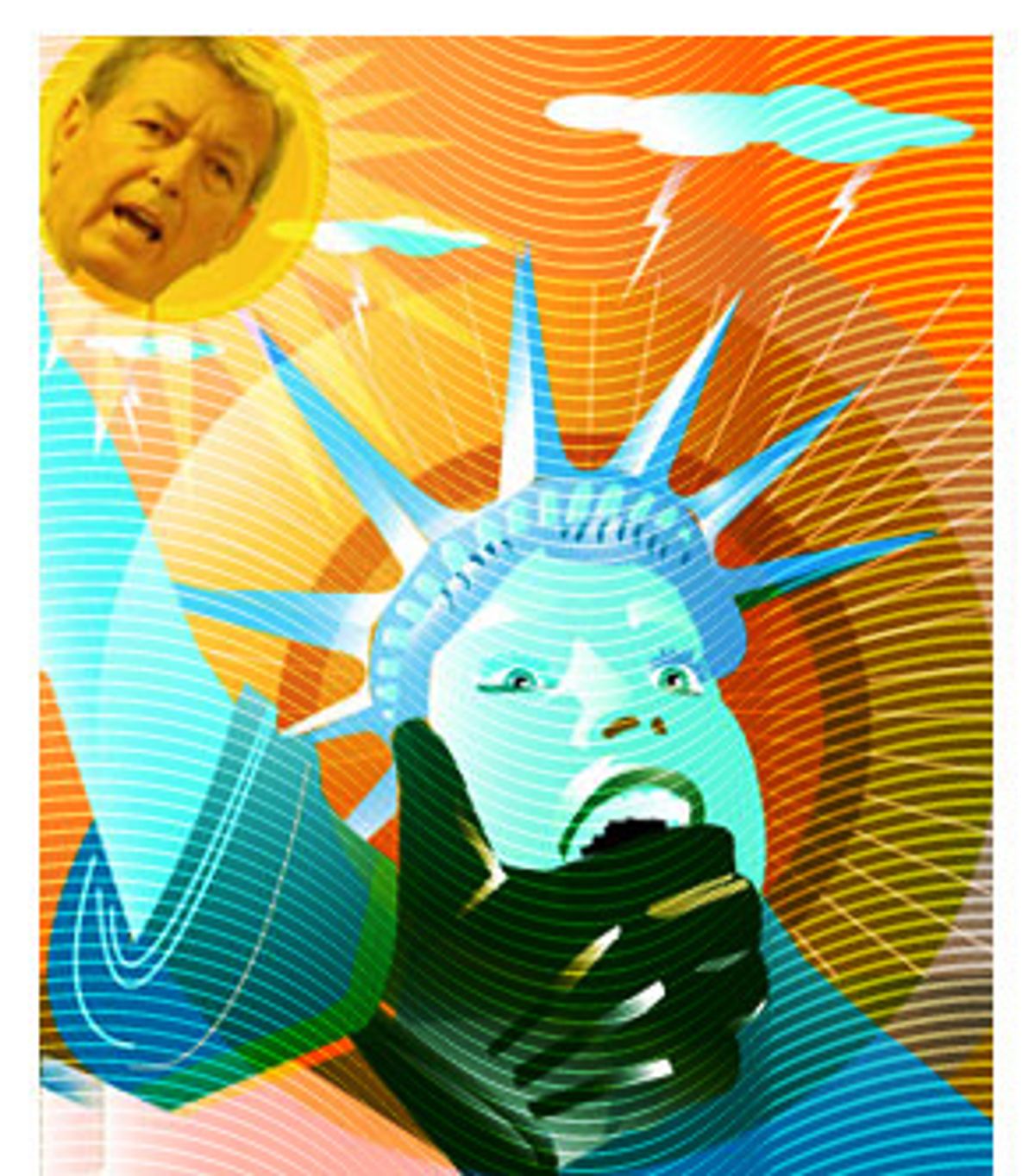
Tom Ridge

“Shut your mouth”

As radio giants censor antiwar musicians, TV networks bully pro-peace actors, and Attorney General John Ashcroft prepares a new assault on civil liberties, a climate of intimidation creeps over America.

As the United States marches toward Baghdad and braces for terrorist reprisals back home, Attorney General John Ashcroft may see in America’s orange-alert fears and us-against-them attitude a target of opportunity he cannot resist. The man who pushed the USA PATRIOT Act through a terrified Congress in the days after Sept. 11, 2001, may be planning a new assault on civil liberties in the wake of the war on Iraq.

In February, the Center for Public Integrity uncovered a confidential Justice Department draft of the Domestic Security Enhancement Act of 2003. The legislation picks up where the PATRIOT Act left off — more wiretaps and secret searches, government access to credit reports and other personal records, a database of DNA samples, and provisions allowing the attorney general to revoke the U.S. citizenship of anyone who provides assistance to a group the government considers a “terrorist” organization.

The draft drew a barrage of criticism from across the political spectrum. The Lawyers Committee for Human Rights called it a “Department of Justice wish list” that would “endanger core civil liberties,” while William Safire denounced it as both an “assault” and an “abomination.”

Although the 120-page draft had the detailed look of a proposal ready for congressional consideration, the Justice Department quickly downplayed it as merely the brainstorming of low-level staff. When pressed about the proposed security measure at a Senate Judiciary Committee hearing earlier this month, Ashcroft devolved into an odd exploration of the self-referential passive voice: There was nothing to discuss with the Senate, the attorney general said, because “no final discussion has been made with the attorney general.”

But that was early March — before U.S. armed forces moved into Iraq, before intelligence officials declared additional terrorist attacks a “near certainty,” before a recent round of court decisions signaled increased judicial acceptance of the administration’s war on terror, and before a smattering of news reports showed signs that Americans may be adopting for themselves the with-us-or-against-us approach the administration has taken with foreign countries and internal dissenters alike.

It is a target-rich environment for Ashcroft now, and civil libertarians fear that he may be ready to fire soon. Last week, a remarkable alliance of more than 65 advocacy groups — ranging from the American Civil Liberties Union and the NAACP to the American Conservative Union and the Gun Owners of America — took the unusual step of writing to Congress to oppose legislation that has not yet been introduced. The theory: If they wait until the moment of crisis when Ashcroft unveils what they’re calling PATRIOT Act II, it will already be too late.

“Last time around, the attorney general announced that he was sending up a bill and that he expected Congress to enact it within three days,” the ACLU’s Timothy Edgar said of Ashcroft’s post-9/11 push for the first PATRIOT Act in an interview with Salon. “They ended up taking six weeks, but they still didn’t have a single hearing, and members were unable to obtain a complete text of the legislation even after they voted on it.”

Edgar said he hopes the groups’ preemptive strike will put Congress on notice of the “broad and deep concern” about PATRIOT II, and that Congress will have the courage to question the need for the new law enforcement powers in it. But in the climate of intolerance, intimidation and fear now swirling around the war on terror, he also knows that this may be wishful thinking.

The drumbeat began just days after Sept. 11, when George W. Bush told the nations of the world: “Either you are with us, or you are with the terrorists.” It grew louder — and closer to home — when Ari Fleischer warned that “all Americans” should “watch what they say,” and then again when Attorney General Ashcroft said that those who complained of lost liberties during the war on terror “aid terrorists” by giving “ammunition to America’s enemies and pause to America’s friends.”

As Osama bin Laden slipped away and the war on terror slid into the war on Iraq, the president began to beat the drum so persistently that it was hard to hear anything else. He dismissed worldwide antiwar protests as something akin to “focus groups,” he refused to acknowledge that the leaders of other nations honestly disagreed with him about the best way to disarm Iraq, and he signaled contempt for a reporter who asked about the costs — both financial and human — of the war he seemed so determined to fight. As if serving as a poster boy for political intolerance wasn’t enough, Bush even went so far as to hint that American citizens might take it upon themselves to punish immigrants from countries that failed to fall in line with his plan to rid the world of Saddam Hussein. As Paul Krugman reported in the New York Times, when Bush was asked whether the United States would retaliate against Mexico for failing to support the drive for war, he said that the U.S. government probably wouldn’t, then volunteered that there was already a “backlash against the French, not stirred up by anyone except the people.”

In Washington and beyond, the president’s supporters have heard the drums and begun to dance to the tune. When Senate Minority Leader Tom Daschle expressed sadness that Bush’s failure to find a diplomatic solution was finally leading to war, House Speaker Dennis Hastert said Daschle had come “mighty close” to giving “comfort” to the enemy. House Majority Leader Tom DeLay, R-Texas, more bluntly told the South Dakota Democrat to shut his mouth. “Fermez la bouche, Monsieur Daschle!” he snapped, equating Daschle’s criticism with France’s efforts to block a war resolution in the United Nations. When an attorney named Stephen Downs wore an antiwar T-shirt to a suburban New York mall, the mall’s owners had him arrested. And when a 16-year-old kid named Felix Fanaselle failed to stand when a flag-waving Lee Greenwood song blasted over the loudspeakers at a Houston rodeo, he was spat upon, assaulted and told to “go back to Iraq.” Never mind that Fanaselle is an American citizen of Italian and Mexican descent — you’re either with us or you’re with the terrorists.

That with-us-or-against-us message may be starting to take root in the entertainment industry as well. According to Matt Drudge, CBS warned musicians not to speak out against the war during the Grammy Awards last month. Last week, radio and concert giant Clear Channel barred protest groups from distributing literature at an Ani DiFranco concert in New Jersey — and threatened to pull the plug on DiFranco or anyone else who made antiwar comments from the stage. Sean Penn has filed suit against director Steven Bing, claiming that he lost a role for speaking out against the war. And Martin Sheen, whose real-life politics put him to the left of the president he plays on TV, says that NBC executives have expressed their discomfort about his public antiwar stand. A story on the Oscars in the New York Times this week hinted at the possibility that outspoken war critics may find themselves blacklisted in Hollywood.

Tamara Saviano learned something about that this month. A producer for the Great American Country music video channel, Saviano was flipping through her personal e-mail account at home one night when she came across a message from Charlie “The Devil Went Down to Georgia” Daniels. It was an open letter to Hollywood — all of those “pitiful, hypocritical, idiotic, spoiled mugwumps” who had raised their voices against the impending war on Iraq. Echoing the words of the president, Daniels argued that “the war against Saddam Hussein is the war on terrorism,” that America is in “imminent danger,” that “you’re either for her or against her” and that there is “no middle ground.”

Saviano responded — again, on her private e-mail account — with a message in which she called Daniels’ screed “anti-American.” Daniels’ publicist complained to GAC, and the next morning Saviano was fired.

“I’m a little too young to remember McCarthyism, but I’ve got the feeling that it might be happening again,” Saviano told Salon. “I wonder where it came from, this idea that anybody who wants to question this administration or debate things publicly is labeled unpatriotic?”

Steven Shapiro is a spokesman for GAC’s parent company, Jones Media Networks. Saviano wasn’t fired for expressing her political views, he said, but rather for suggesting a boycott of Charlie Daniels’ music and concerts while failing to make it sufficiently clear that she wasn’t speaking for GAC.

Jones Media Networks also owns a number of country music radio stations. Did on-air personalities at any of those stations join in the nationwide calls to boycott the Dixie Chicks after one of the Chicks told a London concert crowd that they were “ashamed” of President Bush? “That’s a good question,” Shapiro said. He said he’d look into it and call back when he knew more. He never did.

It is easy to write off these isolated incidents as blips on the radar of war — the misguided patriotism of random rednecks or the private-citizen equivalents of the House Republicans’ efforts to obliterate all things French from their gastronomical vocabulary. The victims survive and get on with their lives. The mall owner eventually dropped the charges against Stephen Downs, Felix Fanaselle wasn’t seriously injured in the rumble at the rodeo, and although Tamara Saviano figures she’ll always be a “pariah” in Nashville, she’s already at work on a new project publishing the written works of American roots artists. Someday soon, the world may even be safe for French fries again.

But what will be lost in the meantime? Will the climate of fear and intimidation that gives rise to the isolated incidents of intolerance also pave the way for more widespread and long-lasting limitations on civil liberties?

It already has.

As war began last week, the Lawyers Committee for Human Rights issued a new report on the changes in law and government policy since Sept. 11. The report, a six-month follow-up to one the committee released on the first anniversary of the terrorist attacks, documents the ongoing erosion of “basic human rights protections in the United States, including fundamental guarantees central to our constitutional system.”

Any such report must begin with the USA PATRIOT Act itself, which Congress adopted and Bush signed less than two months after Sept. 11. The act handed sweeping new powers to law enforcement, the military and U.S. intelligence agencies, and it blurred the traditionally clear lines that divided them. Among other things, it granted federal law enforcement officers broad authority to use wiretaps and other forms of electronic surveillance; it expanded the circumstances under which the FBI could conduct searches under the forgiving rules of the Foreign Intelligence Surveillance Act rather than under the stricter tests of the Fourth Amendment; and it gave the president the power to confiscate property of those believed to be attacking the United States.

Scattered voices of dissent raised concerns that these new powers might be abused. A year and a half later, it is hard to know whether the critics were right. By and large, the Justice Department has refused to provide Congress with information about its use of the PATRIOT Act tools. What is clear, however, is that Justice Department officials and FBI agents have dramatically increased their use of secret searches and other clandestine techniques since the PATRIOT Act was passed.

The Washington Post reported Monday that Ashcroft has authorized more than 170 secret searches and/or wiretaps — more than three times the total authorized over the past 23 years by all other attorneys general combined. Meanwhile, the Post reported, FBI field offices have issued scores of so-called national security letters, a PATRIOT Act tool that requires businesses to provide the FBI with information about an individual’s finances, telephone calls, e-mail messages and the like — all without a warrant and all without prior court approval.

A few weeks after he signed the PATRIOT Act, Bush took matters a step further when he signed an executive order requiring that noncitizens suspected of participating in or supporting acts of terrorism be detained by the military and tried by military tribunals rather than in federal courts. At about the same time, the Justice Department took the position that it was entitled to eavesdrop on the conversations between inmates and their lawyers in order to protect against future acts of terrorism.

Of course, not all civil liberties received such cavalier treatment. Although the PATRIOT Act allows the FBI to obtain records showing what books you purchased at the local bookstore or checked out from the library — a suspect’s reading habits might suggest an unsettling interest in the architecture of tall buildings — Ashcroft has insisted that the FBI cannot review the records of gun-purchase background checks in the course of a terror investigation.

As the initial sense of panic cooled in the months after Sept. 11, federal courts began to stand up against some of the incursions on the civil liberties of terror-related suspects. Georgetown University law professor David Cole initially saw that as a hopeful sign; in an article he wrote for the Nation last summer, he suggested that the shock of 9/11 had “given way to a renewed interest for the rule of law.”

It didn’t last. This week, the Supreme Court refused to hear a case in which the American Civil Liberties Union challenged the Justice Department’s use of wiretaps and other forms of surveillance authorized by the Foreign Intelligence Surveillance Act in domestic criminal prosecutions.

Earlier this month, the U.S. Court of Appeals for the D.C. Circuit held that more than 600 detainees in U.S. military custody at Guantánamo Bay have no right to challenge their confinement in U.S. courts. So long as the detainees are noncitizens who were captured outside the United States during some sort of military operation and are now being held outside the United States, the courts of the United States “are not open to them.” Although the Guantánamo Bay Naval Base where the detainees are being held is inarguably controlled by the U.S. military, the court held that it was outside the reach of the federal courts because the United States merely leases the land from Cuba.

In the open-ended war on terror — with its infinitely flexible definitions of “enemy” and “field of battle” — the decision puts incredible power in the hands of the U.S military. Under the ruling, U.S. Special Forces could secretly kidnap, say, a British editorial writer who opposes the war on Iraq. And so long as they took him to someplace like Guantánamo — rather than to a military prison in the United States itself — they could keep him there forever if they wished. A U.S. court could do absolutely nothing about it.

Cole finds the decision shocking — and yet not. “If you look at history,” he says, “courts in times of crisis defer to the executive.” Although Cole says such wartime decisions frequently include “rules” that prevent abuses of civil liberties once the war is over, the potentially unending nature of the war on terror may undercut any such protections.

And in the meantime, allowing the administration to have its way now may embolden Ashcroft and others to seek new tools for the war on terror — even if those tools come at the expense of civil liberties that would otherwise be held sacrosanct.

Such may be the case with the Domestic Security Enhancement Act. Like the PATRIOT Act, PATRIOT II is a collection of provisions that touch upon virtually every aspect of law enforcement in the United States and abroad. Among other things, it would:

  • Cancel judicial consent decrees that prevent local police departments from spying on civil rights groups and other organizations that might once have been deemed subversive.

  • Require anyone suspected of participating in terrorist activities and any noncitizens suspected of supporting “terrorist” groups to submit a DNA sample for inclusion in a “Terrorist Identification Database.”

  • Allow the attorney general to revoke the U.S. citizenship of anyone who provides assistance to any group the government considers to be a “terrorist” organization. Once the individual’s citizenship is revoked, the attorney general would then be free to deport him — or to hold him indefinitely in government custody.

    Although PATRIOT Act I and many of the other more publicized efforts in the war on terror have focused on the rights of foreigners and of aliens living in the United States, the Domestic Security Enhancement Act aims much more squarely — and broadly — at the rights of U.S. citizens. Cole and others believe that this shift of focus may finally cause Congress to put on the brakes. Indeed, when reliable administration supporters like Bill O’Reilly and the American Conservative Union raise serious concerns about a proposal, as they have with PATRIOT Act II, there may be hope that Justice Department officials will exercise some restraint in what they propose, or at least that Congress will be emboldened to ask hard questions before giving in.

    There have been some civil liberties victories in recent months, particularly where the executive branch has reached for powers that would intrude on the privacy rights of individual Americans. Ashcroft last year asked Congress for authority to launch Operation TIPS — a program that would have turned the nation’s letter carriers and meter-readers into junior spies — but Congress turned him down.

    Earlier this month, the Senate Commerce Committee approved a measure that will require Tom Ridge to report to Congress on the civil-liberties impacts of CAPS II, a government computer program designed to assign terrorist risk levels to everyone who boards a commercial airliner.

    And last month, Congress placed a hold on any funding for the Total Information Awareness program, a Defense Department plan to build a massive database on U.S. citizens based on everything from their credit card statements and medical records to the words they type into Internet search engines. Perhaps members of Congress found the privacy intrusions too much to stomach, or maybe they just couldn’t believe that the administration was really suggesting that the Defense Department’s John Poindexter — the former Reagan National Security Advisor who lied to Congress about the Iran-Contra affair — should actually be the man who is trusted with the private information of every American citizen. Either way, they found the temerity to say no to the program.

    But with the troops on the battlefield in Iraq and the fear of terrorist reprisals back home, it is hard to believe Congress will hold off the administration forever. If U.S. soldiers are killed in substantial numbers or if terrorists strike at U.S. targets, members of Congress will feel the need to stand with the troops, with the president, and with “us” instead of “them.” That may mean standing with John Ashcroft as well.

    “The real danger to our liberty comes from politicians wanting to look like they are doing something in a time of crisis,” said the ACLU’s Edgar. “Unfortunately, it’s inevitable that there will be politicians, including politicians in the Justice Department, who aren’t really looking to make us safer but to take advantage of the situation.”

  • Tim Grieve is a senior writer and the author of Salon's War Room blog.

    Ridge walks back terror alert politicization claim

    The former Homeland Security chief now says he wasn't pressured to raise the alert level for political reasons

    In his new book, former Homeland Security chief Tom Ridge seemed to indicate that he felt others in the Bush administration wanted him to raise the terror alert level to help President Bush’s 2004 re-election campaign. Since that news confirmed many critics’ suspicions, the revelation — even late as it was — was big news. But now Ridge is disavowing it, at least to a point.

    “I was never pressured,” Ridge said in an interview with USA Today. And in an appearance on “Good Morning America,” the former Pennsylvania governor says people “are hyperventilating” about the assertion in his book, saying, “A consensus was reached. We didn’t go up. The process worked.”

    As the Associated Press notes, though, Ridge “did not take back the statement in his new book … that he wrorried at the time that politics was a consideration in discussions among high-level officials about whether to raise the color-coded terror alert.”

    Update: At Time’s Swampland blog, my former colleague Michael Scherer has a smart take on all of this; he writes that Ridge didn’t truly say what the media says he did, and so he’s not really backpedaling.

    Continue Reading Close

    Alex Koppelman is a staff writer for Salon.

    The media can’t handle the truth

    Media sheep facing truth-hungry Internet wolves

    In this March 12, 2002 file photo, Homeland Security Director Tom Ridge unveils a color-coded terrorism warning system in Washington. The Homeland Security Department says it will review the multicolored terror alert system that was created after the Sept. 11, 2001 attacks.

    So yet another Bush administration Cabinet-level official has petitioned to get his conscience and reputation back. This time, it’s Tom Ridge, former secretary of Homeland Security. The one-time Pennsylvania governor admits in a new book that he felt political pressure from the White House to issue bogus terror alerts before the 2004 presidential election.

    Big surprise, right? By 2004, anybody who didn’t grasp that crying wolf was the Bush/Cheney administration’s basic game plan was probably also astonished last January when the “Texas cowboy” who’s never been seen on a horse chose a Dallas mansion over his beloved ranch. Golly, who’s doing all that brush-cutting?

    Indeed, the most fascinating aspect of the Ridge revelations has been a flame war that’s broken out between establishment Washington pundits and less-reverent bloggers. The Atlantic’s Marc Ambinder started it by observing in smug inside-the-Beltway fashion that he and like-minded colleagues were actually right to be wrong about fake terror warnings.

    People who smelled a rat, see, “based their assumption on gut hatred for President Bush, and not on any evaluation of the raw intelligence.” Whereas, sober-sided thinkers like him credited the Bush administration’s good intentions.

    Confronted with ample contemporaneous evidence of Bush administration flimflams by Salon’s Glenn Greenwald and the scholarly Marcy Wheeler of Firedoglake.com, Ambinder apologized for the “gut hatred” part. But he alibied: “Information asymmetry is always going to exist, and, living as we do in a democratic system, most journalists are going to give the government the benefit of some doubt, even having learned lessons about giving the government that benefit.”

    Yeah, sure. Purely with regard to terrorism and national security, by 2004, Bush/Cheney had already gotten caught deceiving the public about having “no warning” before the 9/11 attacks, not to mention about Saddam Hussein’s nonexistent weapons of mass destruction. If skepticism was still inappropriate, would it ever be warranted?

    Yet people who found the timing of terror alerts suspect, such as then-Democratic presidential candidate Howard Dean, were dismissed as crackpots.

    It was much the same after former Secretary of State Colin Powell confessed misgivings about his 2003 U.N. speech that stampeded the United States into an ill-advised war in Iraq. How could any serious American journalist possibly have seen that coming? Or, as your humble, obedient servant here wrote at the time, “War fever, catch it.”

    This column summarized “mainstream” opinion on Feb. 12, 2003: “The allegedly ‘liberal’ Washington Post responded editorially with a one-word headline, ‘Irrefutable.’ Columnist Mary McGrory announced that despite being almost a pacifist … ‘I’m Persuaded,’ mostly by what she described as Powell’s unimpeachable integrity. Joining the stampede was New York Times columnist Bill Keller, who noted that ‘The I-Can’t-Believe-I’m-a-Hawk Club includes op-ed regulars at this newspaper and the Washington Post, the editors of the New Yorker, the New Republic and Slate, columnists in Time and Newsweek.”

    And yet it was all rubbish, exactly as some of us raised on intelligence hoaxes suspected. Evidence of what I called “chicanery and fraud” in the U.S. case against Iraq was obvious to anybody unafraid to see it.

    But here’s the big thing about “mainstream” journalism and what Ambinder calls “information asymmetry.” Upton Sinclair said it best: “It is difficult to get a man to understand something when his salary depends upon his not understanding it.”

    Furthermore, the safest place during a stampede is the middle of the herd. Establishment journalists with mortgages, car payments and children in private schools saw what happened to the Dixie Chicks. Why couldn’t it happen to them? (The job I got fired from that month wasn’t paying my bills.) The United States had been attacked. Feelings ran high, especially in New York and Washington.

    What did it matter if we killed the wrong Arabs, so long as Arabs were being killed? In Thomas Friedman’s immortal words, “We hit Iraq because we could. That’s the real truth.”

    Under oath to a Senate committee, Condi Rice told a barefaced whopper about the Aug. 6, 2001, CIA terrorism briefing that Bush blew off. Media insiders pretended not to notice. Bush made a slapstick skit of searching under his Oval Office desk for Iraqi WMDs. The press laughed on cue. He claimed that Saddam Hussein forced him to invade Iraq by expelling U.N. arms inspectors. (In reality, Bush made them leave.) Pundits praised his charm.

    Long under siege for “liberal bias,” media careerists now find themselves confronted with people they see as passionate amateurs. True, fearless scrappers like my friend Joe Conason have always been around, and somebody like Paul Krugman — a world-class economist who doesn’t care what, say, MSNBC’s Chris Matthews thinks of him — can be very annoying.

    But what’s really driving these jokers up the wall is economic and intellectual competition from the Internet: people with first-class minds and a passion for truth that some of them can barely remember.

    © 2009 Gene Lyons. Distributed by Newspaper Enterprise Association

    Continue Reading Close

    Arkansas Times columnist Gene Lyons is a National Magazine Award winner and co-author of "The Hunting of the President" (St. Martin's Press, 2000). You can e-mail Lyons at eugenelyons2@yahoo.com.

    Ridge: Bush administration wanted terror politicized

    The former Homeland Security head says he got pressure to raise the alert level before the 2004 election

    Former Homeland Security head Tom Ridge appears to have confirmed what many already believed: The Bush administration wanted to use the terror alert level system for political gain.

    Ridge, who was also the governor of Pennsylvania, has a new book coming out at the beginning of next month. U.S. News & World Report’s Paul Bedard reports on some details from the book:

    Ridge was never invited to sit in on National Security Council meetings; was “blindsided” by the FBI in morning Oval Office meetings because the agency withheld critical information from him; found his urgings to block Michael Brown from being named head of the emergency agency blamed for the Hurricane Katrina disaster ignored; and was pushed to raise the security alert on the eve of President Bush’s re-election, something he saw as politically motivated and worth resigning over.

    Update: Via Marc Ambinder, the Pittsburgh Post-Gazette has more information on what concerned Ridge:

    Mr. Ridge is adamant in rejecting the contentions of Bush administration critics that the often-derided color-coded warning system he helped devise was manipulated for political ends. He depicts an atmosphere, however, in which the motives of some senior officials and Cabinet colleagues sometimes left lingering questions on that score.

    The most dramatic example — and one that Mr. Ridge said would help him confirm his previous plans to leave his post — came on the eve of the 2004 election between Mr. Bush and Sen. John Kerry.

    Osama bin Laden had released a videotape with one more ominous sounding but unspecific threat against the United States. Neither Mr. Ridge nor any of the department’s security experts thought the message warranted any change in the nation’s alert status … But that view met resistance in a tense conference call with members of the intelligence community and several other Cabinet officers including Attorney General John Ashcroft and Defense Secretary Donald Rumsfeld.

    “A vigorous, some might say dramatic, discussion ensured. Ashcroft strongly urged an increase in the threat level and was supported by Rumsfeld.”

    Noting the correlation found between increases in the threat level and the president’s approval rating, Mr. Ridge writes, “I wondered, ‘Is this about security or politics?’ “

    The dispute remained open at the end of the call. Mr. Ridge’s aides carried the word to the White House staff that the threat escalation would court accusations of politicizing national security. Mr. Ridge’s view finally prevailed.

    “I believe our strong interventions had pulled the ‘go-up’ advocates back from the brink,” Mr. Ridge writes. “But I consider the episode to be not only a dramatic moment in Washington’s recent history, but another illustration of the intersection of politics, fear, credibility and security.”

    Continue Reading Close

    Alex Koppelman is a staff writer for Salon.

    Fringe leftist losers: wrong even when they’re right

    Evidence was abundant that Bush was manipulating terror alerts for political gain. Why didn't journalists see it?

    (Updated belowUpdate IIUpdate III - Update IVUpdate VUpdate VI)

    “There is danger from all men. The only maxim of a free government ought to be to trust no man living with power to endanger the public liberty” – John Adams, Journal, 1772.

    “All men having power ought to be distrusted to a certain degree” – James Madison, speech at the Constitutional Convention, July 11, 1787.

    “All governments lie” – journalist I.F. Stone, addressing journalism students on the one truth they’d be well-advised always to recall.

    “Information asymmetry is always going to exist, and, living as we do in a Democratic [sic] system, most journalists are going to give the government the benefit of some doubt, even having learned lessons about giving the government that benefit” — The Atlantic‘s Marc Ambinder, today, reacting to Tom Ridge’s confession that the Bush administration heightened terror alerts for political gain, and justifying why journalists such as himself “were very skeptical when anti-Bush liberals insisted that what Ridge now says is true, was true.”

    ________________________________

    That little progression of thought explains much about our political and media culture.  Marcy Wheeler dissects and eviscerates Ambinder’s remarkable reaction to the Ridge revelation (Ambinder has now retracted some (though not all) of his more irresponsible assertions).  But Ambinder’s comments reveal a couple of other points worth highlighting.

    Just as is still commonly said about opponents of the Iraq War (even though they were right, they were still wrong and unSerious because their motives were bad), Ambinder acknowledges that Bush critics were right that the terror alerts were being manipulated for political ends (he has no choice but to acknowledge that now that Ridge admits it), but still says journalists like himself were right to scorn such critics “because these folks based their assumption on gut hatred for President Bush, and not on any evaluation of the raw intelligence.”  As always:  even when the dirty leftist hippies are proven right, they’re still Shrill, unSerious Losers who every decent person and “journalist” scorns.

    Ambinder’s belief that there is nothing other than blind “Bush hatred” that could have justified such a belief — and his accompanying self-defense that journalists like him had no way of knowing any of this — is patently false.  Here is a 2006 Time column by Josh Marshall that details the ample empirical evidence suggesting that “that the Bush Administration orchestrates its terror alerts and arrests to goose the GOP’s poll numbers.”  And here is an exhaustive and lengthy (17 minutes) segment from Keith Olbermann early last year that “weaves from each revelation of an intelligence failure or a Democratic political victory to an almost immediate orange alert or ‘new threat’ from al Qaeda.”  Olbermann’s conclusion after examining all the evidence:  ”what we were told about terror, and not told, for security reasons, has overlapped considerably with what we were told about terror, and not told, for political reasons” (Olbermann had been raising the same suspicion for many years).

    The reason journalists such as Ambinder saw no such evidence wasn’t because it didn’t exist.  It existed in abundance; you had to suffer from some form of moral, intellectual or emotional blindness not to see it.  It’s because they didn’t want to see it, because — as Ambinder said — they trusted the Bush administration as good and decent people who might err but would never do anything truly dishonest.  It’s because only loser Leftist ideologues distrusted Bush officials and the overriding goal of establishment journalists is to prove that they are not like them, that they’re much more Serious and responsible and thus would never attribute bad motives to government leaders such as those who ran the Bush administration. 

    That’s the same reason most establishment journalists instinctively oppose investigations of Bush officials:  the people who rule over their Washington court may make mistakes, but they never do anything dishonest or criminal.  They certainly don’t blatantly lie.  These journalists are the anti-I.F. Stones.  And that’s why political leaders know they can get away with blatant lying and lawbreaking.  Why is that, Marc Ambinder?  Because “most journalists are going to give the government the benefit of some doubt, even having learned lessons about giving the government that benefit.”

    About Ridge’s revelations, Atrios today observes:

    Sometimes it’s a bit hard to remember just how nutty the world was in those post-9/11 days. Suggesting that Bush was using the terror alert for political purposes would have made you a crazy person, the mere suggestion of it would’ve put you outside the bounds of acceptable discourse.

    Indeed, so strong was the stigma against those who said such things that Josh Marhsall felt compelled to insert this qualifier into the first paragraph of his column:  ”Now, I’m a respectable columnist. I don’t want to draw rolled eyes. But think about it.”  And in 2004, after Howard Dean argued that the Bush administration was raising the terrorist alerts for political purposes, John Kerry proved his Seriousness by attacking Dean for making such an irresponsible claim:

    Kerry was campaigning Monday in Grand Rapids, Mich., where he dismissed suggestions that a decision to raise the terror alert level was politically motivated. . . .

    Kerry dismissed former Vermont Gov. Howard Dean’s comment that raising the terror level might be politically motivated.

    “I don’t care what he said. I haven’t suggested that and I won’t suggest that,” Kerry said. “I do not hold that opinion. I don’t believe that.”

    That was because, as Atrios suggested, anyone like Dean who uttered such a suggestion was demonized as being among “the less stable among us,” as right-wing war reporter Michael Totten put it in 2004, who proudly noted that “Kerry dismissed Dean’s ravings the way a picnicker treats a fly buzzing around his barbecued chicken.”  An incredulous Chris Matthews interviewed Dean in 2004 about his accusations and could barely refrain from mocking Dean in every question:

    MATTHEWS: But what you’re saying here, Governor, is that there’s a political brain somewhere in the administration which directs people like Tom Ridge and people like Ashcroft to exploit whatever info they have got to try to make it easier on the president for reelection, that someone is directing this timing? . . .

    MATTHEWS:  Are you saying that there’s a political mind behind that, that is stirring these things up in a time the Democrats are trying to get some lift?

    DEAN: We don’t know that, Chris, but what we do know is there’s a very disturbing pattern of…

    MATTHEWS: Right, well, you sound like you’re… You do sound, Governor, like you do know. You’re not — you’re acting like you are just speculating here out loud, when in fact you’re — it’s almost like push-polling. You’re saying, “Could it be?” rather than just, “I’m thinking about these things” . . .

    MATTHEWS: But is there any evidence that the administration is timing these releases of information to benefit themselves politically? Is there any evidence of that?

    And an August, 2004 USA Today Editorial decried those, such as Dean, who were irresponsible enough to suggest such a thing:

    Former presidential candidate Howard Dean said Sunday, without offering evidence, that terror warnings crop up whenever President Bush needs a boost. That statement follows the premise of Michael Moore’s incendiary film Fahrenheit 9/11: that the alerts are used to keep the public in fear for political benefit.

    It is the most serious of allegations — that the nation’s leaders would selfishly manipulate the gravest threat we face.

    While no one should be naive enough to think that the White House — or John Kerry’s campaign — doesn’t discuss the politics of terrorism, any evidence of terror alerts called for political advantage is lacking.

    And just to demonstrate how deceitful were the people who were running our government, here’s what The New York Times reported in the wake of Dean’s accusation:

    Speaking to factory workers and invited supporters at a lawn and garden equipment manufacturer in Lee’s Summit, Mo., Mr. Cheney lashed out at those who have implied that the terror alerts were at all politically motivated, specifically citing former Gov. Howard Dean of Vermont, an unsuccessful candidate this year for the Democratic presidential nomination.

    “There has been some commentary from some of our critics – Howard Dean comes to mind – saying somehow this is being hyped for political reasons, that the data we collected here, the casing reports that provided the information on the prospective attacks is old data, i.e., four, five years old,” he said. “That just tells me Howard Dean doesn’t know anything about how things operate.”

    Even the very same Tom Ridge, in 2004, lambasted those who made such a suggestion

    The AP also reports that Homeland Security Secretary Tom Ridge “spent a second day Wednesday defending the warnings, which came on the heels of the Democratic National Convention and drew attention from the presidential campaign of nominee John Kerry. ‘I categorically state that the none of the terror threats are politically motivated,’ Mr. Ridge said.” Ridge also granted an extensive interview to CNN’s Newsnight With Aaron Brown, in which he addressed the charges that the Administration was playing politics, saying, “I regret that there’s an inference that this kind of public revelation of information is. . .political. It clearly was not and it never will be.”

    But that is how our political culture works.  Throughout the Bush years, those who said demonstrably true things were continuously dismissed as fringe, conspiracy-driven leftist-losers:   those who questioned whether Saddam really had WMDs; those who argued that the invasion of Iraq would lead to long-term military bases in that country; those who worried that warrantless eavesdropping and Patriot Act powers would lead to abuses; those who opposed the war in Afghanistan on the ground that it would be drag on for years with no resolution, etc. etc. 

    Having been proven right about all of those things hasn’t changed perceptions any at all.  As Ambinder’s comments today reflect, the paramount unchangeable Beltway Truth is that those who distrust government claims are unSerious Fringe Leftist Losers.  Even when they turn out to be right, they’re still that.   And no matter how many times journalists like Ambinder are proven wrong in “giv[ing] the government the benefit of some doubt, even having learned lessons about giving the government that benefit,” they still continue to do it and believe it is the right and responsible thing to do.  

    Powerful political leaders are, as Jay Rosen often puts it, the ruling priests in the journalists’ church of Savviness.  Trusting the politically powerful is the establishment religion and carrying forth their message is the prime function of establishment journalists (note how Newsweek‘s Jonathan Alter, just two months ago, argued that the ”public option” was crucial but then, like so many liberal pundits eager to maintain and build close relations with the White House, got dutifully on board with the White House message, by completely and shamelessly changing course the minute the White House did).  Distrusting the statements and actions of government leaders was once the central value of our political system and of basic journalism.  But now, especially in the eyes of establishment journalists, it is the hallmark of the unSerious, fringe, leftist loser, no matter how many times it is proven right.


    UPDATE: In comments, Gator90 sums it all up:

    The Maturation Cycle of Bush Administration Scandals

    1. Crazy, hysterical, paranoid accusation by wild-eyed, partisan, left-wing loonies.

    2. Old news

    What’s most amazing is that even when we reach Step 2, Step 1 still applies in full force.


    UPDATE II: As he so often does, Tom Tomorrow, all the way back in 2005, perfectly captured the syndrome illustrated here (and which Gator90 described) — click on image to enlarge:


    UPDATE III: As Hume’s Ghost noted on his blog back when it happened, Tom Ridge — in early, 2005, shortly after he resigned — strongly suggested that the terror alerts were raised for political reasons having nothing to do with legitimate security needs:

    The Bush administration periodically put the USA on high alert for terrorist attacks even though then-Homeland Security chief Tom Ridge argued there was only flimsy evidence to justify raising the threat level, Ridge now says. . . .

    Ridge, who resigned Feb. 1, said Tuesday that he often disagreed with administration officials who wanted to elevate the threat level to orange, or “high” risk of terrorist attack, but was overruled. . . .

    “More often than not we were the least inclined to raise it,” Ridge told reporters. “Sometimes we disagreed with the intelligence assessment. Sometimes we thought even if the intelligence was good, you don’t necessarily put the country on (alert). … There were times when some people were really aggressive about raising it, and we said, ‘For that?’ “

    That apparently wasn’t enough to make Ambinder and other journalists wonder why the official responsible for the alerts would have been “aggressively pressured” to raise it even in the face of “flimsy evidence” that there was a threat to justify that (we had no idea until today that this happened!).  Real Journalists knew that the officials exerting that pressure had Good Reasons for wanting the alerts raised even if those journalists — or, for that matter, even Homeland Security Secretary Ridge — didn’t know what those reasons were.  Real Journalists just assume those officials had good reasons because they’re trustworthy and entitled to the benefit of the doubt.  Only irresponsible Far Leftists hysteric conspiracy-theorists with gut hatred for George Bush would entertain suspicions that something nefarious might motivate those decisions.


    UPDATE IV: Ambinder now has a separate post apologizing for his use of the phrase “gut hatred.”  Whenever someone clearly apologizes for something that way, they deserve credit, but that offending phrase was only a small part of what I (and, I believe, Marcy Wheeler) were criticizing.  Far more significant is Ambinder’s belief that journalists can and should vest the pronouncements of political leaders with faith and trust rather than the skepticism that should be at the heart of all political journalism (notably, Ambinder lauded the “skepticism” which journalists harbored for “activists’ conclusions” critical of the Bush administration while defending the trust journalists place in the claims of Bush officials themselves — a truly bizarre way for a journalist to look at things, if you think about it).  That mentality is far more consequential than Ambinder’s careless public unleashing of standard Beltway journalist slurs against Bush critics.


    UPDATE V:  There’s one other point made by Atrios about the Ridge confession (he was a veritable font of wisdom today) that I want to highlight:

    And just so it’s clear: using the threat of terrorism to try to achieve political goals is, you know, what terrorists do.

    No observation will cause one to be ejected from acceptable mainstream company more immediately than pointing out that what the U.S. Government is doing is “terrorism” by definition.  Ask Noam Chomsky about that, if you can find him.  That’s because using Terrorist threats (or civilian-destroying violence) for political gain, or to keep a population in fear, is something that only other people do — but never the United States — even when it’s as plain as day (as it is here) that the U.S. Government is doing exactly that.


    UPDATE VI:  Tucker Carlson — at the height of the August, 2004, controversy triggered by Howard Dean’s accusation that the Bush administration manipulated terror alerts for political gain — labeled those who believed the alerts were being exploited for political purposes as “insane conspiracy nuts” and said: “what they really need is psychological help, obviously.”  Separately, Carlson said that Dean had gone “berserk” and demanded that the Kerry campaign repudiate Howard Dean for suggesting that this was the case.  I’ve emailed Carlson and asked him:

    In light of Tom Ridge’s belief that this is exactly what happened — that, as the official responsible for assessing terrorist threats, he was pressured to raise the terrorist threat alert in order to benefit Bush’s re-election campaign (something he also strongly suggested in 2005 after he resigned) — do you still believe that?  Or do you merely now believe Ridge to be one of the berserk, insane conspiracy nuts in need of psychological help?

    I’ll post any reply I receive.

    Continue Reading Close
    Glenn Greenwald

    Follow Glenn Greenwald on Twitter: @ggreenwald.

    Ridge won’t run against Specter

    The former Pennsylvania governor has decided not to jump in the race, leaving the Republican field open for a conservative favorite.

    Pennsylvania Sen. Arlen Specter’s life just got a little easier.

    After the senator’s decision to switch parties and become a Democrat, Republicans were pushing former Gov. Tom Ridge to run against him in 2010, and according to early polling, Ridge would have proven a formidable opponent. But on Thursday, Ridge announced that he’s decided against throwing his hat in the ring.

    Ridge’s decision means that former Rep Pat Toomey, R-Pa., a conservative favorite whose entry in to the Republican primary was the key in driving Specter to the Democratic Party, might not face a seriouis opponent in his quest for his party’s nomination. That’s good news for conservatives, but probably bad news for the GOP generally.

    Though Toomey would almost certainly have beaten Specter in a primary, polls show him trailing badly in the general. There’s still plenty of time for him to make up that difference, of course, but Pennsylvania has gotten bluer and bluer in recent years, and it will be very hard for a virtually unknown conservative to beat a moderate who also has the advantage of incumbency.

    Continue Reading Close

    Alex Koppelman is a staff writer for Salon.

    Page 1 of 5 in Tom Ridge