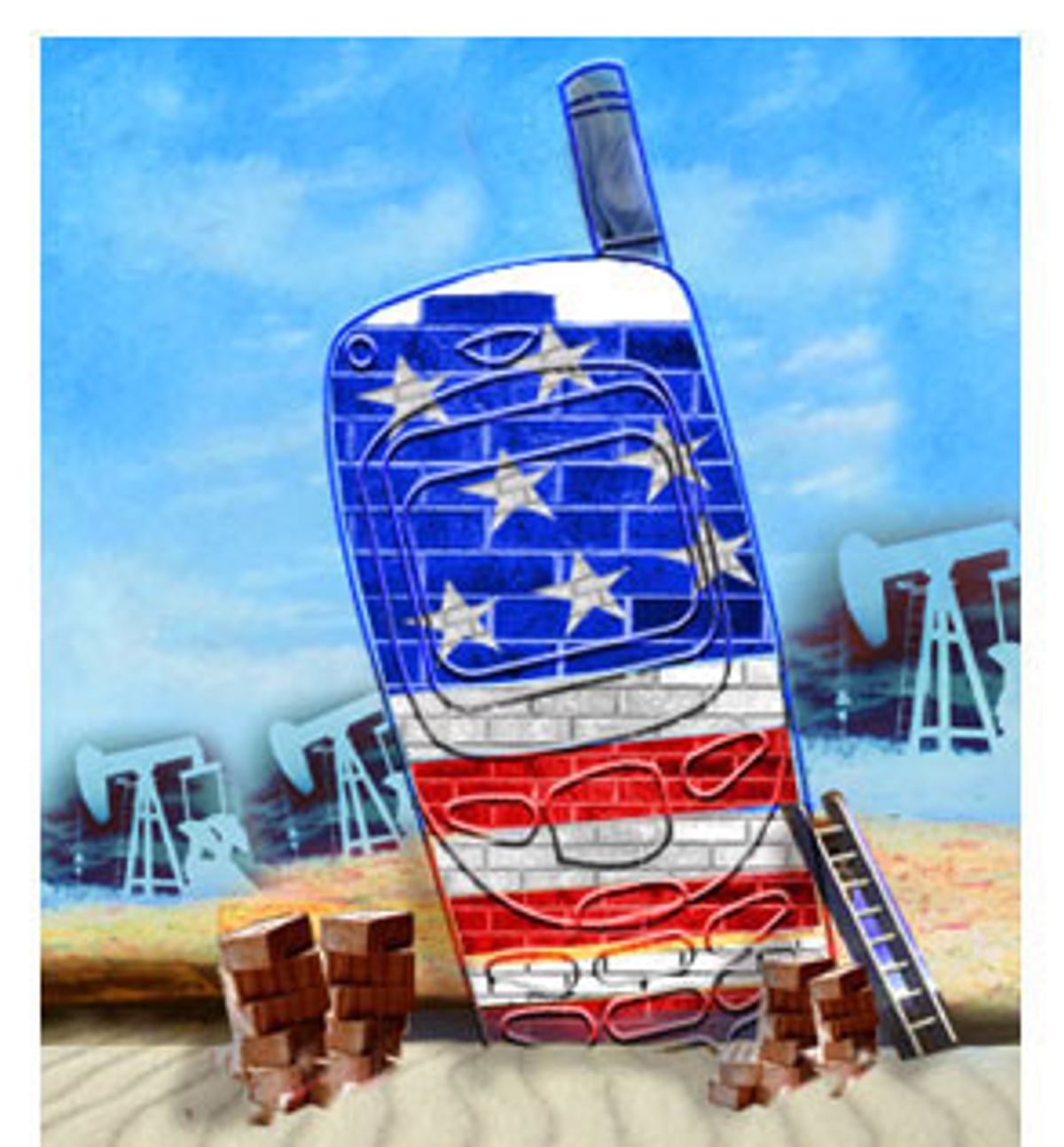
It's the latest question about Iraq, debated from myriad war blogs to the pages of Friday's Wall Street Journal: When Saddam Hussein is toppled, what kind of cellular phone system should Iraq have?
Maybe that's not ultimately as important as such questions as whether preemptive wars are morally justifiable or if there will be a "domino democracy" chain reaction in the Mideast unleashed by regime change. But it's a good sign of what one of the biggest postwar battles will be fought over: Who gets to rebuild Iraq, and how?
On Wednesday, Darrel Issa, a Republican congressman from Southern California, sent a letter to Defense Secretary Donald Rumsfeld asking him to make sure that the U.S. builds a CDMA cell system in Iraq -- the same system that's used in America, and one developed by Qualcomm, which happens to be one of Issa's most generous donors. The Defense Department had apparently been thinking of setting up a GSM system in Iraq, but Issa warned Rumsfeld that such a system, which is the standard in Europe, and elsewhere in the Mideast, would benefit "French and European sources, not U.S. patent holders." On Thursday, Issa introduced a bill that would make his policy recommendations law. There are no official co-sponsors, but under the headline "Parlez-vous frangais?" on his Web site, a statement says that many lawmakers have already expressed their support for an American cellphone system in Iraq.
It's not clear if members of Congress -- many of whom, remember, were for telecom deregulation in the U.S. -- will want to mandate the cellphone standard of postwar Iraq. But even if Issa's bill isn't passed into law, its broad policy goal -- putting American firms at the front of the line in a Saddam-free Iraq -- already seems to be the Bush administration's attitude.
Of the $75 billion in war-related money the White House has requested from Congress to cover the costs of war in Iraq, $3.5 billion is set aside for reconstruction and relief in Iraq. In the months ahead, as the specific needs of postwar Iraq become clearer, American companies are expected to get most, if not all, of the lucrative contracts provided by the new money. Already, there has been domestic and international criticism of the manner in which the money has been handed out. Before the war began, the United States Agency for International Development invited a few well-connected companies -- including Kellogg, Brown & Root, a subsidiary of Halliburton, the oil-services firm that Vice President Dick Cheney used to run -- to bid on a massive infrastructure-rebuilding contract for Iraq. A USAID officer told Newsweek on Friday that Halliburton was not likely to be awarded that deal. On Tuesday, the Army Corps of Engineers announced that, without soliciting bids from any other firms, it had selected KBR to manage the oil-well firefighting effort in Iraq.
Thanks to strong British lobbying, some U.K. businesses may get in on these deal as well, according to news reports. But if you have eyes on the money-prize in Iraq, it's now a terrible time to be a businessperson based in France, Russia or Germany, the three nations that put up the highest diplomatic hurdles to the war in Iraq. Up until the war, firms in these countries enjoyed -- as many conservatives are fond of mentioning -- substantial dealings with Saddam Hussein's government. But the White House's America-first policy for reconstruction work, not to mention congressional efforts like Issa's, may be an unwelcome sign of things to come.
How will these firms deal with American money and might in Iraq? Their initial efforts will likely be in the realm of international diplomacy. Companies in Russia and France are said to be pushing their governments to demand a powerful role for the United Nations in postwar Iraq in order to level the business playing field there. Diplomats on the U.N. Security Council spent much of the war's first week debating the future of the oil-for-food program, which, until it was suspended before the war began, had allowed Saddam Hussein to sell billions of dollars of oil each year in return for humanitarian aid. After several closed-door meetings, the diplomats seem to have agreed to start shipping about $10 billion of food aid to Iraq, but they put off the touchy question of whether the U.S. and U.K., as the occupiers of Iraq, would have the power to invalidate existing contracts made with Saddam.
The U.S. line on the issue of who gets to decide which companies make money in "free Iraq" -- to use the term already in vogue among some conservatives -- is that Iraqis themselves will have the power to choose. And if the new Iraqi government is nicest to the Americans, and wants to tear up Saddam's contracts, proponents of the war argue that it will be no surprise. "I think you can bet on it that the government of Iraq after Saddam will remember who wanted the dictator gone and who opposed it," says Radek Sikorski, a former deputy foreign minister of Poland and now a resident fellow at the American Enterprise Institute, a conservative think tank in Washington.
But for some time before a freely elected Iraqi government is set up, the U.S. has plans to install an American military-civilian government in Iraq, and it's in that time that the Europeans could get sidelined. As Secretary of State Colin Powell told a congressional panel on Wednesday, "We didn't take on this huge burden with our coalition partners not to be able to have a significant, dominating control over how it unfolds."
Part of Saddam Hussein's strategy for survival was to be very generous to those countries that showed little interest in toppling his regime. In 2000, the Central Intelligence Agency compiled a report that concluded that Iraq handed out significantly more contracts under the oil-for-food program to countries that called for a loosening of sanctions against Iraq than to those who advocated strong sanctions. "Over the life of the program, Baghdad has awarded one-third of the contracts to France, Russia and China," the CIA said in the secret document, according to a New York Times report at the time. After the Gulf War, the United States -- which has long called for strong sanctions against Iraq and, even under President Clinton, made it clear that "regime change" is its goal -- did not do much business with Iraq.
Saddam's shrewdness paid off; whatever other calculations entered into their opposition to war, certainly some part of the French, Russian and Chinese position, just like the American position, had to do with a simple economics. In addition to contracts to provide a broad range of approved supplies under the oil-for-food program -- contracts estimated at hundreds of millions of dollars -- French and Russian firms had signed or negotiated many billion-dollar deals in Iraq's oil industry.
In 1997, Lukoil, Russia's largest oil company, signed a huge oil deal with Saddam -- estimates on the size of the contract range from $3 billion to $20 billion -- to develop Iraq's West Qurna oil field. Sanctions prevented the company from working on the project, and as war drew near and it appeared that Lukoil might lose out, the company began pursuing American guarantees to keep its oil rights in Iraq after Saddam. Those moves prompted Saddam's fury, and in December, Iraq threw Lukoil off the contract and asked Russia to choose another firm to replace it. Now, many small Russian oil firms feel a sense of entitlement to the West Qurna field -- and there's also a worry, it seems, that the entitlement will go unfulfilled.
"The Americans haven't gone into this war intending to share with anyone. It's a war trophy," Nikolai Tokarev, the chief of Zarubezhneft, Russia's state oil company, told a Russian paper recently, according to wire-service translations. "We're clearly going to have to cut our losses on anything we have there and anything we could have had."
Russian officials are more optimistic about their chances in Iraq. "We are currently working on the immediate return of Russian firms, which have interests in Iraq, to the country as soon as peace is restored," Igor Yusufov, the country's energy minister, told the Russian press on Thursday. And Igor Ivanov, Russia's foreign minister, recently said in a speech that "We will have to defend our interests so that the contracts which were signed under Saddam Hussein are not annulled as lacking legal force and to make sure the Iraqi debt owed us is respected." Ivanov added that "Iraq does not need democracy brought on the wings of Tomahawks."
France has fewer existing oil contracts with Iraq, and French businesses seem less combative than the Russians about opportunities in postwar Iraq. Shortly after the war began, French President Jacques Chirac did threaten to veto any U.N. resolution that would "legitimize the military intervention" and "give the belligerents the powers to administer Iraq." But TotalFinaElf, a French company that is one of the world's largest oil firms, says that it is not gravely worried about who runs Iraq after the war -- the company thinks it will still have a part to play.
Paul Floren, a spokesman for the firm at its headquarters in Paris, said, "I think that the feeling out there is -- well, there are risks of what have you, of politics, but we're not a political company, we're a business. We try to stay out of politics, and we hope we're judged on the record of our company and the skill of our engineers." TotalFinaElf has a long history in Iraq; one of its first big oil finds, in 1927, was near Kirkuk, in the Kurdish northern region of Iraq, and it had major interests in the country until the late 1970s, Floren said. But although it's been widely reported that TotalFinaElf has signed major contracts with Saddam and could lose a great deal if his government falls, Floren said, "you can't believe everything you read." He concedes that "between 1991 and 1997 we had a country representative there who negotiated contracts," but he says that those contracts were never signed, and they're essentially dead.
Floren sought to quash the idea that his company would face any hardship at all in postwar Iraq. He said that major oil development there would only occur in several years' time, after a stable government had been in place -- so he didn't worry about being slighted by a short-term American regime. But more than that, Floren -- who speaks English without any hint of a French accent -- said there's nothing really intrinsically French about his company, which has thousands of employees stationed all over the world. "We're headquartered in France and historically we're a French company, but we're really a multinational, and you can tell from my accent that I'm hardly French myself," he said. "We're not any more French than Royal Dutch Shell is a company based in the Netherlands."
He added that if his company gets any work, all the money from such a deal would definitely not flow directly to Paris. "The way the oil industry is structured, it's rare that any major oil company works alone on any field. We always work in consortiums, we always are with our partners -- ExxonMobil, Shell, B.P., ConocoPhillips, Texaco ... Any field development will be spread out, and will be worth billions and billions and billions and billions."
A key unanswered question in determining whether French and Russian firms get a piece of postwar Iraq is how receptive the Iraqis are to the countries that tried to prevent war. Many pro-war Americans assume that, once Saddam falls, Iraqis will greet American soldiers with unabashed enthusiasm, and will perhaps want to oust European interests from their country.
"The French company Total has signed a $40 billion oil deal with the Iraqis. Paris is, therefore, anxious to preserve that. But many Iraqis say the contract is unfair and one-sided. They want it to be renegotiated in favor of Iraq," Richard Perle, one of the most passionate proponents of war in Iraq, said recently in an interview with the National Review. "But that is not an issue for us. It is the future Iraqi government that would decide what do with the country's oil and other resources. There is no reason why France, which has a long presence in Iraq, should be excluded from normal and mutually beneficial deals." On Thursday, amid questions of his own business interests in pushing for war, Perle suddenly announced that he was stepping down as chairman of the Defense Policy Board, an influential group of foreign-policy experts that advises the Pentagon.
At least so far in the war, though, there have been few scenes of freed Iraqis dancing in the streets. And if it does indeed turn out that Iraqis are less than pleased with their American "liberators," will they not feel some satisfaction in making it very difficult for American business in Iraq?
"I don't see how American executives can work when their lives will be at risk," one French Finance Ministry official recently told Reuters. "There will be such hatred toward Americans."
Shares