Crime

The myth of media violence

Contrary to the moralistic claims of Hillary Clinton and others, bloody video games and movies are not a major cause of crime. But they are a powerful drug we don't understand.

  • more
    • All Share Services

The myth of media violence

Kids these days! They’re all wasting their spare hours, or so we’re told, with immoral trash like “Grand Theft Auto,” the now-notorious series of slickly decorated and powerfully addictive video games. As Sen. Hillary Clinton explained last week at a forum hosted by the Kaiser Family Foundation, “They’re playing a game that encourages them to have sex with prostitutes and then murder them.”

Fans of “GTA” claim this is a typical non-gamer’s misinterpretation — it might be possible to kill hookers in the game, but it won’t necessarily help you win — but let’s let that go. There’s no doubt that “GTA” allows you, for example, to play the role of an ex-con trying to take over a vice-addled city by gunning down drug lords, cops, low-flying aircraft and pretty much everything and everybody else. These games revel in their pseudo-noir amorality, and they’re basically designed to be loathed by parents, school principals and tweedy psychologists.

Clinton’s attack on the latest manifestation of the Media Demon — you know, the evil force within video games, action movies, rap songs, comic books, dime novels, Judas Priest records played backward and, I don’t know, Javanese puppet theater and cave hieroglyphics — is a depressingly familiar ploy in American politics. When you can’t make any progress against genuine social problems, or, like Sen. Clinton, you seem religiously committed to triangulating every issue and halving the distance between yourself and Jerry Falwell, you go after the people who sell fantasy to teenagers.

What might be most interesting about this latest vapidity, in fact, is what Clinton didn’t say. Five years ago, in the wake of the Columbine massacre, we were told that there was no serious debate about whether media violence contributed to teenage crime in the real world. A clear link had been established, the case was closed, and the only question was what we were going to do about it. By contrast, Clinton’s comments were surprisingly mild and almost entirely subjective. She called violent and debauched entertainment a “silent epidemic,” essentially arguing that it has effects, but we don’t quite know what they are.

Over the long haul, Clinton said, violent media might teach kids “that it’s OK to dis people because they’re women or they’re a different color or they’re from a different place.” Perhaps more to the point, she added: “Parents worry their children will not grow up with the same values they did because of the overwhelming presence of the media.” That was it — no claims that we were breeding a nation of perverts and murderers, and no mention of all the supposed science indicating a link between simulated mayhem and the real thing. Playing “GTA” and watching Internet porn might lead your kids to “dis” somebody, or to grow up with different values from yours (or anyway to make you concerned that they might). Katy bar the door!

As dopey as Clinton’s remarks are, I don’t mean to ridicule parents and educators for their legitimate concerns. Of course I’m not certain that violent movies and games (or, for that matter, dumb-ass sitcoms and vapid reality shows) are harmless. My own kids are still too young for this question to matter much, but of course I hold onto the naive hope that they’ll spend their formative years hiking the Appalachians and reading about the Byzantine Empire, rather than vegetating in media sludge. But it’s long past time to face the fact that while it’s legitimate not to like violent media, or to believe it’s psychologically deadening in various ways, the case that it directly leads to real-life violence has pretty much collapsed.

Hillary Clinton’s equivocation may be something of a compulsive family trait, but it also reflects how muddy this issue has become since the summer of 2000, when the American Medical Association, the American Psychiatric Association, the American Academy of Child and Adolescent Psychiatry and several other professional busybody organizations issued a joint statement proclaiming that “well over 1,000 studies” had shown a direct connection between media violence and “juvenile aggression.” In 2002, Harvard psychologist Steven Pinker wrote that it had become an article of faith “among conservative politicians and liberal health professionals alike … that violence in the media is a major cause of American violent crime.”

Actually, there never was any such consensus in the academic fields of psychology, criminology or media studies. And there weren’t well over a thousand studies of media violence either — that was one of the many myths and legends that sprung up around this question. In the years since then the mavericks have been increasingly heard from. Even in the theatrical United States Senate hearings convened a few days after the Columbine shootings in 1999, MIT professor Henry Jenkins observed that the idea that violent entertainment had consistent and predictable effects on viewers was “inadequate and simplistic,” adding almost poetically that most young people don’t absorb entertainment passively, but rather move “nomadically across the media landscape, cobbling together a personal mythology of symbols and stories taken from many different places.”

Jenkins was a lonely voice at the time, but more recently the edifice of mainstream certainty has begun to crumble. Psychologists like Pinker, Jonathan Freedman, Jonathan Kellerman and Melanie Moore have counterattacked against their own establishment, arguing that media-violence research to date has been flawed and inconclusive at best, and a grant-funding scam at worst. Some have gone further, suggesting that violent entertainment provides a valuable fantasy outlet for the inevitable rage of childhood and adolescence, and probably helps more children than it hurts. In the teeth of the 1999 hurricane, media scholar Jib Fowles published “The Case for Television Violence,” a dense, dry and devastating dissection that surely counts as one of the most important books about American culture to appear in the last decade. (It’s only available from Sage, a small educational publisher, in a paperback edition that costs more than $30 — which may tell you something about the mainstream viability of Fowles’ message.)

After being eviscerated by Pulitzer-winning journalist Richard Rhodes in his prodigious online article “The Media Violence Myth,” even the researcher largely responsible for the exaggerated sense of social consensus on the issue has partially and reluctantly backtracked. In 1986, University of Michigan psychologist L. Rowell Huesmann presented the Senate Judiciary Committee with a dramatic bar graph purporting to show that boys who watched violent TV at age 8 were exceptionally likely to have been convicted of serious crimes by age 30.

The ripple effect of this presentation was tremendous; more than any other single event, it fueled the impression among critics of violent media that they had a scientific case. Huesmann did not admit for many years, until cornered by Rhodes, that the total number of boys he had identified in a Columbia County, N.Y., study who had watched violent TV and then became violent criminals was three. A trio of thugs in the boondocks had watched shoot’em-ups as 8-year-olds, and it somehow became a significant statistical finding.

In their lengthy and confusing response to Rhodes’ article, Huesmann and his colleague Leonard Eron defend their view that media violence is harmful, arguing that several other studies support theirs. (This is perfectly true. As Fowles’ book rigorously demonstrates, the problem with media-violence research as a field is that it reveals no consistent pattern of results, and people on any side of the issue can cherry-pick the studies they like and ignore the others.) In a mixture of brazen overstatement and social-science weasel words, they proclaim that the case “implicating media violence as a risk factor for violent behavior” is as strong as the link between smoking and cancer.

Then comes the bombshell. Near the end of their defense, but before a bizarre personal attack on Rhodes (for being a harsh critic of books he doesn’t like, and for taking testosterone supplements), Huesmann and Eron write: “Nowhere have we ever indicated that media violence is the only or even a major cause of violence among youth.” I had to read this three times to grasp it: These guys, whose quasi-bogus research subjected us all to a thousand preachy Oprah shows and Joe Lieberman speeches, now say that media violence is not a major cause of real-life youth violence. Instead, it’s a marginal “risk factor,” responsible for no more than 10 percent of the crime rate. (By contrast, Dave Grossman, the retired Marine colonel who is one of the nation’s leading anti-media evangelists, claims that media violence is responsible for at least half of all violent crime.)

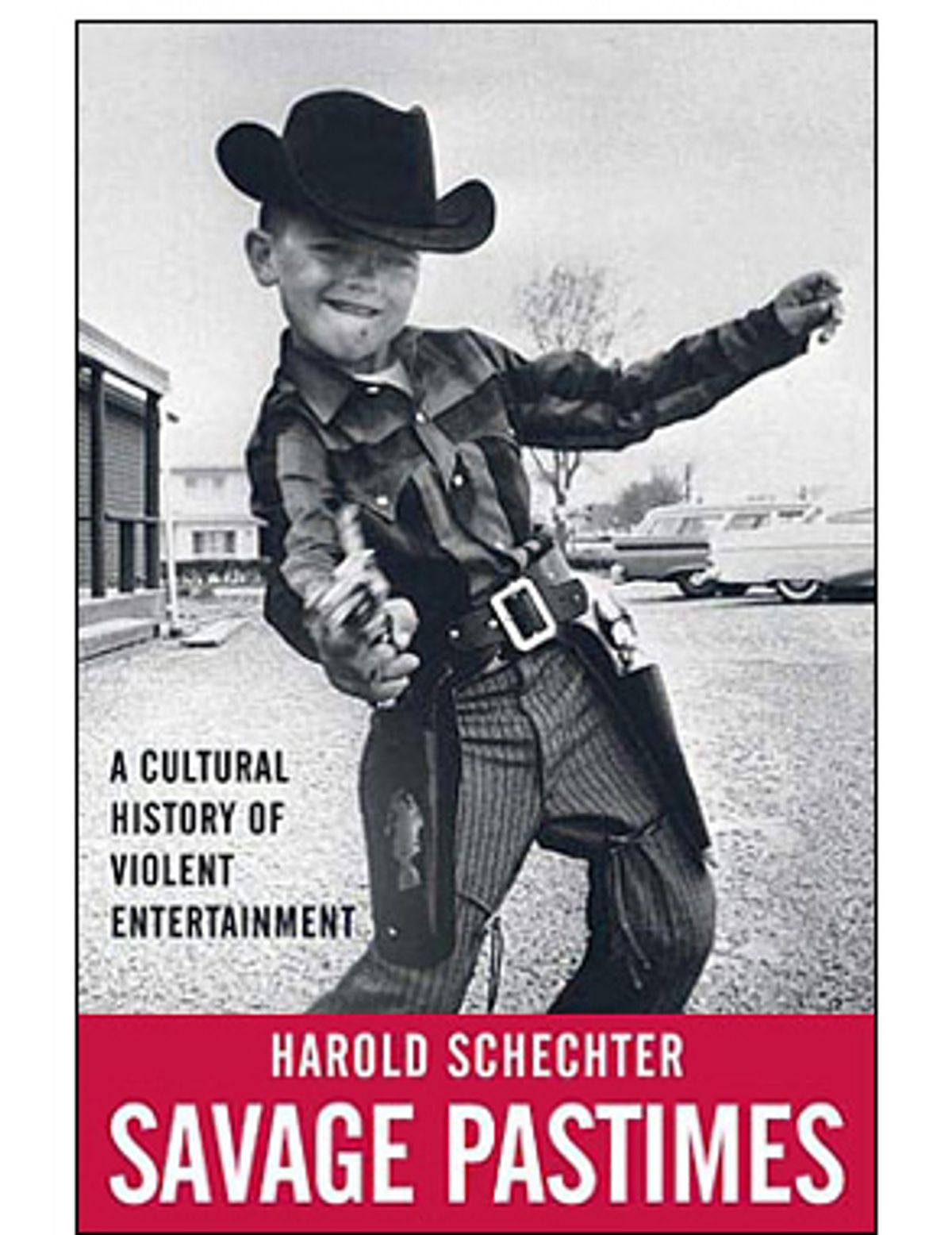
We’ve also heard from criminologists, lawyers and literary scholars as the tide of counterarguments has swelled. The latest of these last is Harold Schechter, a professor at Queens College in New York whose new book, “Savage Pastimes,” provides an eye-opening survey of gruesome entertainment throughout the history of Western civilization. Schechter’s main point concerns what scholars call the “periodicity” of campaigns like Sen. Clinton’s latest screed. Every time a technological shift occurs (such as from books to movies, radio to TV, movies to video games), he argues, it produces a new medium for gruesome entertainment aimed at adolescent audiences, and produces a renewed outrage among the self-appointed guardians of civilization.

One remarkable example, not cited by Schecter: In 1948, there was an enormous uproar in Canada over a meaningless killing committed by two boys, ages 13 and 11. Pretending to be highwaymen, they hid near a road with a stolen rifle and shot at a passing car, killing a passenger. When it was revealed that they were avid readers of crime comic books, the anti-comics movement swelled. This story bears an uncanny similarity to a recent case, examined in Salon, in which two boys ages 15 and 13 stole their father’s rifle, hid near a highway and shot at a passing car, killing a passenger. The youths defended themselves on the grounds that playing “Grand Theft Auto” made them do it.

The Jeremiahs who condemn violent entertainment, whether crime comics or “Grand Theft Auto,” also invariably lament the passage of a golden age, generally contemporaneous with their own childhoods, when entertainment was healthful and wholesome, suitable for infants and grannies alike. I don’t mean to impugn Granny, who may have a healthy appetite for phony bloodshed, but these moral guardians’ sunny views of the past either reflect fuzzy memories or whopping hypocrisy.

Schechter offers an amusing catalog of the outrageous bloodshed and mayhem found in popular entertainment since time immemorial, from the classics (as he observes, the onstage blinding of Gloucester in “King Lear” — “out, vile jelly” — is one of the most traumatic acts of violence in any medium) to the pornographic sadism of Grand-Guignol theater, the lurid sensationalism of turn-of-the-century “penny papers” and the ugly misogyny of Mickey Spillane’s best-selling pulp novels. Undoubtedly Hillary Clinton would prefer that today’s kids read books instead of playing “GTA,” and Schechter might suggest “Seth Jones: or, The Captives of the Frontier,” a wilderness adventure that was one of the best-selling kids’ books of the 19th century. In one scene, the hero comes upon the corpse of a man who has been tied to a tree by Indians and burned to death:

“Every vestige of the flesh was burned off to the knees, and the bones, white and glistening, dangled to the crisp and blackened members above! The hands, tied behind, had passed through the fire unscathed, but every other part of the body was literally roasted!” Seth is greatly relieved, however, to discover that the victim was not a white man. As Schechter says, it’s impossible to imagine anyone publishing this as kiddie lit today, both for its gore quotient and its casual racism.

In another dime novel of the period, a rattling Western adventure called “Deadwood Dick on Deck,” Schechter reports that more than 100 people are killed in the first two chapters, a figure that fans of “Resident Evil” and “Doom” can only view with awe and veneration. Then there’s the gruesome “comic” yarn Schechter digs up from 1839, in which that authentic American hero, Davy Crockett, engages in a “scentiforous fight” with an individual referred to as “a pesky great bull nigger” (and also as “Blackey,” “Mr. Nig” and “snow-ball”). Crockett ends the battle by gouging out one of his adversary’s eyes, feeling “the bottom of the socket with end of my thum.”

Schechter knows what you’re thinking: At least those kids were reading, and as reprehensible by our standards as those books may have been, there’s really no comparison between the printed page and the “hyperkinetic visuals of movies and computer games.” The only answer to this is maybe and maybe not; critics of pop culture always assume that new technologies have rendered kids incapable of telling the difference between reality and fantasy, and so far they’ve always been wrong. Schechter writes that for children who had never seen a movie or a video game, “the printed page was a PlayStation, and penny dreadfuls were state-of-the-art escapism, capable of eliciting a shudder or thrill every bit as intense as the kind induced by today’s high-tech entertainment.” The relativist position that each generation is equally affected by the media available to it is supported by ample historical evidence, from the way that the audiences at early film screenings rose in panic when on-screen trains bore down upon them to the wildly Dionysian effect of that hypersexual, morals-corroding music, swing.

If Sen. Clinton might prefer an outdoor family activity in the sunny American heartland, there’s always the example of Owensboro, Ky., where on Aug. 14, 1936, some 20,000 citizens of all ages crowded into the courthouse square. It was a “jolly holiday,” according to newspaper reports. Hot dogs, popcorn and soft drinks were sold, and there was a mixture of cheers and catcalls — but no general disorder, as the local paper angrily insisted — when sheriff’s deputies brought a man named Rainey Bethea out to the scaffold, where he was hanged.

The Bethea execution, with its clear subtext of white supremacy (Bethea was a black man convicted of raping a white woman, and the crowd of onlookers was entirely white, except for the undertakers commissioned to retrieve his body), caused a national scandal, and pretty much brought an end to one of the Western world’s most enduring entertainment traditions. In medieval and early modern Europe, public executions were major carnival attractions, and high-profile criminals were dispatched with loving sadism and a truly diabolical degree of invention.

Schechter cites the infamous opening pages of Michel Foucault’s “Discipline and Punish,” which recount the horrible tortures inflicted in 1757 on Robert François Damiens, the attempted assassin of Louis XV. In 1305 in London, Scottish rebel William Wallace was hanged and revived, castrated and disemboweled while still alive, and finally decapitated and dismembered, with the pieces coated in boiling tar and strung up in various public places. (When Mel Gibson played Wallace in “Braveheart,” we saw none of that.) Sometimes it’s the little things that tell the story: During the Reign of Terror in revolutionary France, children were given 2-foot-tall toy guillotines they could use to behead birds and mice.

Schechter doesn’t bring up the Bethea execution to paint white Kentuckians of the Depression as depraved rubes; his point is that we actually have come a long way in seven decades. We’re free to regard violent movies and video games as loathsome, but we also have to admit they reflect at least a partially successful sublimation of what William James called “our aboriginal capacity for murderous excitement.” Few of us are eager for the return of public executions (except perhaps the programming executives at Fox) and no real cops or prostitutes were harmed during the creation of “Grand Theft Auto.” Although a few juveniles charged with murder, or their victims’ families, have argued that video games were responsible for murder, kids who play video-game shooters aren’t outside gunning down the neighbors, possibly because that would mean getting off their butts and leaving behind the overlit universe of their TV or computer screen.

As Schechter says, there are two linked assumptions that underpin all the hysteria about purported media-influenced violence in the last 20 years, if not longer. Assumption No. 1 is that we live in an especially violent time in human history, surrounded by serial killers, hardened teenage “superpredators,” genocidal atrocities and all sorts of amoral mayhem. Assumption No. 2 is that our popular entertainment is far more violent than the entertainment of the past, and presents that violence in more graphic and bloodthirsty detail. For critics of media violence, from the Clintons to Dave Grossman to the leadership of the child-psychiatry establishment, these assumptions go essentially unchallenged, and the conclusion they draw is that there is a causal or perhaps circular relationship between these “facts”: Media violence breeds real violence, which leads to ever more imaginative media violence, and so on.

A longtime crime buff who has written several books about notorious murderers, Schechter mounts an impressive case in “Savage Pastimes” that, if anything, our pop culture is less bloody-minded than that of the past. Anyone who looks back at the 1950s, when Schechter himself was a child, and remembers only “Leave It to Beaver” and Pat Boone needs to read his discourse on the hugely popular “Davy Crockett” miniseries of 1954, “whose level of carnage,” he writes, “remains unsurpassed in the history of televised children’s entertainment.” This series, with its barrage of “shootings, stabbings, scalpings, stranglings,” was broadcast on Wednesday nights at 7:30 p.m., and presented as the acme of wholesome family fare.

In fact, as Schechter demonstrates, ’50s TV was profoundly rooted in guns and gunfire, to a degree that would provoke widespread outrage today. But there are factors he doesn’t consider, or considers only in passing, that fuel people’s perceptions that the past was less violent, both in real and symbolic terms. Those ’50s TV shows were mostly westerns, of course, which meant that they presented themselves as instructive fables of American history in its most masculine, individualistic form. They were racially and politically uncomplicated; “Gunsmoke” and “Bonanza” developed a social conscience in the ’60s, but the white screen cowboys of the ’50s were heroes, and the whites, Indians and Mexicans around them were clearly divided into good guys and bad.

In other words, while “Davy Crockett” and “Have Gun Will Travel” and “The Rifleman” were loaded with violence, it was mostly reassuring violence, presented without splatter and without moral consequences. The graphic media violence of our age, whether in “Taxi Driver” or “Reservoir Dogs” or “CSI” or “Grand Theft Auto,” is deliberately unsettling, meant to fill viewers with dread and remind them that life is an uncertain, morally murky affair. This might put us closer to the murder-obsessed Victorian age than to the scrubbed ’50s, and in examining both eras it’s important to remember that this message can be delivered badly or well, used for a cheap roller-coaster effect or a tremendous “King Lear” catharsis. (It’s also worth pointing out that Jib Fowles disagrees with Schecter, arguing, “It does appear that television violence has been slowly growing in volume and intensity since 1950.”)

But if Assumption No. 2 looks questionable, Assumption No. 1 is just flat-out false. As Fowles painstakingly details in “The Case for Television Violence,” violence has clearly been decreasing in the Western world for the last 500 years; as far as we can tell from uneven record-keeping, the murder rate in medieval Europe was several times higher than it is today, even in relatively violent societies like the U.S. While the 20th century has seen some spikes in violent crime — correlating less to the arrival of television than to the proportion of young men in the population — the downward trend since about 1980 has reinforced the general tendency. As Rhodes puts it, “We live in one of the least violent eras in peacetime human history.”

Again, there are some complicating ambiguities here, although they don’t make the absolute numbers look any different. If you’re convinced that we live amid a psychotic crime wave, well, blame the media. Murder has become an increasingly rare crime, and most of it is pretty unglamorous — poor people, many of them black and brown, killing each other in petty disputes over love affairs or insultingly small amounts of money. But whenever something truly ghoulish happens — a serial killer hacks up some white girls or a mom drowns her kids in the tub — we’re exposed to so many pseudo-news stories and movies of the week that it seems as if society is totally out of its gourd and such things are happening every day.

I don’t think there’s any question that the sense of dislocation this produces, while unmeasurable by social science, can be profound. We know this as the “mean world” syndrome, and it’s the reason why, for instance, my wife’s 90-something grandparents not only don’t go outside after dark, but also refuse to answer the phone. (Apparently the depraved criminals roaming the suburban streets can teleport themselves through the phone lines.) Our obsession with violent crime may indeed be at an all-time high, even as crime itself keeps becoming rarer. Perhaps TV has made us so frightened that we’ve mostly stopped killing each other.

There’s far more that one could and perhaps should say about the essentially adolescent character of our civilization, fatally torn between the impulses of Eros and Thanatos. But the point I’m struggling toward is that while you can’t prove that media violence doesn’t lead to real violence — and only an idiot would assert that no one has ever been inspired to commit a crime by a book or movie or video game — our definitions of “media” and “violence” may need some rethinking. And as a general proposition, the simplistic consensus of a few years ago stands on exceedingly shaky ground. “This whole episode of studying television violence,” as Fowles told Rhodes in 2000, “is going to be seen by history as a travesty. It’s going to be used in classes as an example of how social science can just go totally awry.”

Most likely it will be seen in the same way that we now see psychologist Frederic Wertham’s infamous ’50s campaign against horror comics — as an understandable, if in retrospect laughable, response to the unknown. Wertham interviewed juvenile offenders and found that most of them read comic books; ergo, comics led to juvenile crime. There was widespread panic about juvenile delinquency in that decade (which actually saw record lows in crime of all kinds), and he had found an appropriately disreputable scapegoat. While Wertham focused his ire on the gore-drenched horror comics, with their rotting zombies and sadistic scientists, he also wrote that Wonder Woman was a lesbian, Batman and Robin were a man-boy couple and Superman was a fascist. (So he got those right, at least.)

Attorney and author Marjorie Heins has pointed out that the conflict between pop culture and its critics is literally as old as Western civilization: Plato thought that unsavory art should be censored, while Aristotle argued that violent and upsetting drama had a cathartic effect, and helped purge the undesirable emotions of spectators. Jib Fowles suggests that these periodic culture wars are mostly a way of displacing anxieties about class, race and gender, as well as, most obviously, a proxy war between middle-aged adults and the succeeding generations whose culture they can’t quite understand.

Perhaps the most sensible words on this subject that I’ve discovered come from comics author Gerard Jones, in a 2000 Mother Jones article that became, in part, the basis for his book “Killing Monsters.” “I’m not going to argue that violent entertainment is harmless,” he wrote. “I am going to argue that it’s helped hundreds of people for every one it’s hurt, and that it can help far more if we learn to use it well. I am going to argue that our fear of ‘youth violence’ isn’t well-founded on reality, and that the fear can do more harm than the reality. We act as though our highest priority is to prevent our children from growing up into murderous thugs — but modern kids are far more likely to grow up too passive, too distrustful of themselves, too easily manipulated.”

That expresses, I suspect, exactly what many parents of more or less my generation feel about their kids and the media. To be fair, I also think it’s a more honest, less red-state-coded version of what Hillary Clinton was trying to say. We know that the media stew most of us marinate in is tremendously powerful, but we don’t understand its power, so we fear it. Furthermore, even if violent entertainment has always been with us, as Harold Schechter argues, it’s supposed to scare us, because it calls up emotions and impulses we don’t usually want to think about, because it summons demons from below our conscious minds and before our approved history. That’s its job.

Ultimately, we can’t protect our kids from being frightened or unsettled by things they will inevitably encounter, whether while reading Dostoevsky or playing the latest zombie-splattering incarnation of “Resident Evil.” We can’t stop them from forging their own culture out of fragments and shards they collect along the way, a culture specifically intended to confuse and alienate us. But I think Jones is right: Most of us don’t have to worry about breeding little homicidal maniacs. What’s far more plausible, and more dangerous, is that we’ll raise a pack of sedentary, cynical little button-pushing consumption monsters who never go outside. Now that’s scary.

Why Etan Patz still haunts us

Three decades after his disappearance, as the case is finally solved, a missing child remains our worst nightmare

  • more
    • All Share Services

Why Etan Patz still haunts us (Credit: Reuters/NYPD)

It was 33 years ago today that Etan Patz left his home in New York’s SoHo neighborhood to walk to his school bus. He was never seen again, and was declared dead in 2001. Two years ago, his case was reopened. And on Thursday, with little physical evidence to corroborate, police commissioner Ray Kelly announced that Pedro Hernandez had confessed and was being charged with the child’s murder.

There were other stories of children who’d gone missing before Etan Patz. Sometimes even sensational cases. But this one was different. He wasn’t a famous person’s son, like Charles Augustus Lindbergh Jr. He was just a kid doing what kids did back then. Roaming freely on his street. And unlike the nearly 30 children who disappeared and were murdered during the same period in Atlanta, Patz had a father who is a photographer. Overnight, New York City was plastered with images of his sweet-faced little boy under the chilling word “Missing.” Eventually that face became the first to appear on a milk carton.

Two years later, when 6-year-old Adam Walsh was abducted and murdered in Florida, it seemed that children were disappearing everywhere. And with them, childhood itself. Walsh’s father, John Walsh, went on to found the Adam Walsh Child Resource Center, which eventually paved the way for – and merged with — the National Center for Missing and Exploited Children. And he became the host of a show on the fledgling Fox network, a show dedicated to tracking down fugitives and closing unsolved cases. “America’s Most Wanted” would go on to become the network’s longest-running series.

In the years since Etan Patz never made it to school, we’ve endured other nightmarish tales of abduction and murder, like that of Polly Klaas, Leiby Kletzky and most recently Sierra LaMar. And surprising recoveries, like those of Jaycee Dugard and Elizabeth Smart. And through it all, the “parents’ worst nightmare” story has proven itself a reliably sensational basis for the evening news or Nancy Grace’s entire career. The truth is that a stranger abducting a child, horrifying as it is to consider, is a very rare event. But it taps into our absolute most primal dread — the wolf at the door, coming not for you but for a vulnerable child. Your child.

I was 13 when Etan Patz disappeared, little more than a child myself. I’d been walking to school unaccompanied since second grade.  I played in the streets with my friends during afternoons and summertimes, with a total, mindless freedom I can’t give my own children. Not that I really think somebody’s going to snatch them up, but that fear is always there, lurking. It’s a possibility that never once crossed my mind as a child, nor, do I imagine, my mother’s.

Hernandez’ arrest seems to promise a closure to his story, even though Patz’s own family have long believed another man, Jose Antonio Ramos, actually killed him. There’s the hope of answers, of justice. But there’s no real closure when a child is murdered. There’s no closure when his body is never found.

As my children grow, their borders expand. I let them go, exploring their own limits, as healthy, self-reliant children must. But I think about the face on the milk carton. I don’t know any mother who doesn’t. I instinctively hold my breath a little in the moments before my children come through the door after school, and I hug them tightly when they come home, safe and sound. And on this National Missing Children’s Day, I remember the little boy who didn’t.

Continue Reading Close
Mary Elizabeth Williams

Mary Elizabeth Williams is a staff writer for Salon and the author of "Gimme Shelter: My Three Years Searching for the American Dream." Follow her on Twitter: @embeedub.

Innocent, but broke

Glen Chapman was exonerated from death row in 2008. Why hasn't he received the $750K he deserves in compensation?

  • more
    • All Share Services

Innocent, but brokeGlenn Edward Chapman

Glen Edward Chapman, or “Ed,” was exonerated in 2008 after spending 15 years on death row for crimes he did not commit. Though North Carolina is one of the 27 states with statutes that provide some level of compensation for the wrongfully convicted, the state continues to refuse Chapman any compensation for the loss of his freedom, reputation, family, friends and much more.

Chapman was sentenced to death in 1994 at the age of 26 for the murders of Betty Jean Ramseur and Tenene Yvette Conley in Hickory, N.C. After more than a decade of court appeals, Superior Court Judge Robert C. Ervin ordered a new trial based on revelations that detectives “lost, misplaced or destroyed” several pieces of evidence that pointed to another suspect. It was also discovered that lead investigator Dennis Rhoney lied on the witness stand at Chapman’s original trial. Shortly thereafter, the district attorney dismissed all charges against Chapman due to lack of sufficient evidence leading to his exoneration in 2008.

Chapman is just one of a growing number of wrongfully convicted inmates who have been cleared thanks to criminal justice reforms and new DNA testing laws put in place over the last decade. But oftentimes the hardship doesn’t end there.

In 2007, the New York Times interviewed 137 former prisoners exonerated by modern DNA testing methods and found that half were “struggling — drifting from job to job, dependent on others for housing or battling deep emotional scars. More than two dozen ended up back in prison or addicted to drugs or alcohol.”

According to a 2009 report by the Innocence Project, an organization devoted to exonerating the wrongfully convicted, an astounding 40 percent of people exonerated by DNA testing have received zero compensation, due in part to the 23 states around the country that do not offer assistance to the wrongfully convicted. That leaves exonerees like Alan Northrop, who lost 17 years behind bars in the state of Washington, with little to no help in rebuilding their lives.

Even in states that do offer compensation, the amount is often woefully inadequate in helping exonerees reestablish themselves, though compensation varies by state ranging from $20,000 in New Hampshire regardless of the years spent behind bars to $80,000 per year of wrongful imprisonment in Texas.

Most state compensation statutes, however, include conditions for eligibility. Last year, Texas refused to compensate Anthony Graves the $1.4 million he would have received for the 18 years he spent on death row because the judge did not include the words “actual innocence” on the document ordering his release. Texas reversed its decision only after nationwide media attention led to a massive public outcry.

In North Carolina, the exonerated are eligible to receive $50,000 for each year of wrongful imprisonment capping out at $750,000 but only if they are granted a pardon of innocence by the governor who is not required to give a reason for her decision. Chapman filed a pardon request in 2009 but a decision has yet to be made. The office of North Carolina Gov. Bev Perdue did not respond to a request for comment.

Chapman’s experience is consistent with statistics from the Innocence Project that show it takes an average of three years to secure compensation. Meanwhile, the wrongfully imprisoned face an uphill battle almost immediately upon release, starting with where they will sleep that night and how they will get their next meal. Only 10 states even offer the kinds of services — housing, transportation, education, healthcare, job placement, etc. — crucial to helping exonerees transition back into society as free citizens.

Chapman was not notified he was going to be released until the day he was freed. On April 2, 2008, a guard told him to “Pack up” and 10 minutes later he was out the door.  No one asked if he had a ride or a place to stay.

Luckily he had help from Pamela Laughon, a college professor and chairwoman of the psychology department at the University of North Carolina, who spent eight years working on Chapman’s appeal as a court-appointed investigator. The two immediately clicked when they met and have been inseparable since.

Laughon told Salon she was shocked her client was released with just 10 minutes’ notice and no ride or money. “Years ago they used to let them out with at least a bus ticket,” she says. Nevertheless, the two had already decided that if and when Chapman was released he would live with Laughon until he got on his feet.

That meant Chapman would have to move to Asheville, N.C., which worked out for the best because he did not want to return to Hickory. “When I go back to Hickory the hair on my neck stands up,” says Chapman. The town reminds him of the trauma from his trial when family members testified against him and the time he spent incarcerated instead of watching his two young sons grow up.

Laughon was happy to help. “I had lawyers calling me from all over the state asking me if I was nuts. I spent eight years trying to get this man released. There was no way I was going to drop him off at a homeless shelter or the projects where he grew up,” she told Salon.

With Laughon’s assistance, Chapman set up a checking account, got a driver’s license for the first time, found housing, learned how to use a cellphone and more.

She helped him manage his finances, which quickly dwindled given that he hadn’t received an income in 15 years. Over a decade in prison led him to mishandle the money he did have because, Chapman says, “I was so unused to having things that I wanted to buy everything. I went shopping crazy.” It was moments like this that having Laughon’s support was crucial to Chapman’s ability to readjust to society as a free man.

Laughon also went on job interviews with him to help explain his background to prospective employers. “I’m a college professor and chair of a department, so I have some cred,” she says. “He’s a black guy in the south. If he told an employer ‘by the way I was wrongfully convicted and spent the last 15 years on death row,’ people would look at him like he was crazy and laugh.”

With help from one of Laughon’s students, Chapman found a job at a hotel a few weeks after his release. Four years later, he still works there, which he says is the longest he’s ever held a job.

Still, life is a struggle. Laughon argues that Chapman needs the compensation because, “He’s stuck in minimum wage, being paid the lowest legal amounts you can pay a human being.”

The pardon of innocence pending before Gov. Perdue is important to Chapman not just for the compensation but also because it would be an official declaration of innocence. Laughon calls his current predicament “a no man’s land between not being guilty or innocent.”

Rev. Dr. T. Anthony Spearman, a pastor in Hickory and third vice president of the North Carolina NAACP, points out that without an official declaration of innocence, “His family is still at odds with him, not knowing whether he’s a criminal or not. The stigma of being a felon is still on him.”

Spearman went on to compare wrongful conviction to a crime in and of itself. “To be incarcerated, locked up for 15 years wrongfully, is to me a criminal act and the state needs to make up for that,” he told Salon. “The government needs to go head over heals to make sure these men receive apologies and make sure that they can get on with their lives meaning compensation, education, whatever they need to survive.”

Jean Parks, an active member of Murder Victims’ Families for Reconciliation (her sister was murdered) and People of Faith Against the Death Penalty in Asheville, agrees that Chapman needs be pardoned but feels that monetary compensation for the wrongfully convicted does not go far enough. “Money should be a part of it to help cover for lost wages and lost opportunities but the state’s response should go beyond that,” says Parks. “It should include an official apology and some social services to help the person get reacclimated to society, find a job, and reestablish oneself as a productive member of the community.”

Laughon argues that states should provide a “life coach” to do for the exonerated what she did for Chapman, which she describes as “somebody that’s going to navigate all the many day-to-day things like managing a bank account, how paychecks will be taxed, and the other kinds of life skills you and I do second nature.” She believes her experience with Chapman serves as a successful case study of the “life coach” approach.

In the meantime, Chapman has an interview with the clemency office on May 30, a signal that Gov. Perdue will likely come to a decision soon. He is determined to stay positive no matter what the outcome and insists he has no bitterness toward the people who put him on death row. “I can forgive. That doesn’t mean I have to forget,” says Chapman.

He upholds that principle by traveling across the state when he can to speak about his exoneration and bring awareness to the flaws in the criminal justice system. He admits he was not aware of the death penalty before his conviction but “now that I do know, I’m going to do everything I can to put an end to it.”

Since his exoneration, Chapman has written a book called “Life After Death Row.” His next book, “Within These Walls,” will be released later this year and includes his diary entries from death row. He says, “It’s going to be a tear-jerker.” Chapman will also be featured in an upcoming episode of B.E.T.’s “Vindicated,” a documentary-style television show that tells the stories of exonerated prisoners.

If he receives compensation, Chapman hopes to open a bed and breakfast. He also dreams of one day opening a shelter for at-risk women.

Chapman acknowledges that none of this would be possible without someone like Laughon in his life. “When I first met Pam it was like meeting an old friend for the first time. To this day, she’s like my big sister,” he says. “She’s been there for me from start to finish. I don’t think I would have made it without her.”

Continue Reading Close

“People Who Eat Darkness”: The disappearing blonde

A true crime story set in Tokyo illuminates the complicated truths behind media cliches

  • more
    • All Share Services

Joji Obara and Lucie Blackman (Credit: Estate of Lucie Jane Blackman)

Lucie Blackman, 21, went out for the afternoon in 2000, phoning her roommate and best friend Louise to arrange a meeting later that night. Lucie never showed up, and within a few days she’d become one of those vanished blondes whose fates fuel headlines and hours of speculative media coverage. She was British, a former flight attendant, and she and Louise were living in Tokyo. They were also bar hostesses, a profession with a very specific meaning in Japan, difficult to explain to foreigners and not entirely clear to the Japanese themselves. Lucie both did and didn’t match the classic Missing Blonde profile, and for a while the mystery of what happened to her threatened to lapse into permanent obscurity.

One thing made a difference: The actions of Lucie’s father, Tim Blackman, who arrived in Tokyo to join his other daughter, Sophie, in publicizing the search and prodding the police. Richard Lloyd Parry, Tokyo bureau chief for the Times of London, covered the case as it unfolded, first over the course of several months while Lucie’s whereabouts and abductor remained unknown, and finally for the six years it took to try the man accused of killing her, Joji Obara. The book Parry wrote about the case, “People Who Eat Darkness,” is an exceptionally perceptive and nuanced look at a terrible crime, one that put nations, institutions and family members at odds, and often into bitter and toxic conflict.

Unlike Truman Capote, author of “In Cold Blood,” the most celebrated true crime narrative of all, Parry is in essence a reporter; this is no “nonfiction novel.” But like Capote, he’s less interested in dishing the eerie or lurid details than he is in exploring the penumbra of the crime, the complex factors that fed into it and the unpredictable effects it had on an ever-spreading network of people. The true crime genre has a (mostly well-earned) reputation for trashiness, but it fascinates for legitimate reasons, as well. Transgression, justice and punishment speak to the very heart of what a society is, how it holds its people together and how they decide who lies beyond the pale.

Because Lucie Blackman was a foreigner, and one employed in an industry that the Japanese view as disreputable, the Tokyo police were inclined to dismiss her disappearance. Bar hostesses get paid to talk to and flirt with customers, and they are expected to go on (paid) dinner dates with them outside the clubs where they work, but it’s an arrangement that usually stops short of actual sex. Nevertheless, the Japanese think of most foreign hostesses as irresponsible, drug-loving backpackers who might well run off without telling anyone or get mixed up with dangerous people. Whether or not a Westerner would call what bar hostesses do a part of the sex industry, for the Japanese, these women belong to that category of “bad” girl who can expect little help or concern from authorities should she get into serious trouble.

Crime is not what it was in Capote’s day. In addition to finding and building a case against the perpetrator — jobs for law enforcement authorities — there’s handling the media, a task usually left to the victim and his or her relatives. Lucie’s father proved, initially at least, to be a master at this. Tim could detach himself emotionally from the horror of his situation and strategize. He was able to capitalize on a G-8 summit meeting being held in Japan around the same time Lucie vanished and parlay it into the intervention of British Prime Minister Tony Blair. Blair publicly asked Japan’s prime minister to front-burner the investigation, and met with Tim and his younger daughter Sophie while he was in Tokyo.

The police, who had been dragging their heels on Lucie’s disappearance, found this development (which made perfect sense in the political context of Britain) flabbergasting. Still, it worked: Lucie, who might have been written off as one of those “disposable” women of dubious virtue, was conclusively cast as an innocent girl, “naive perhaps, out of her depth,” but an adventurous daughter rather than a reckless slut. Tim was driving the narrative, as an electoral campaign manager might put it, and he was good at it. He liked talking to the press, even the tabloid press, and they liked him.

But if Tim was good at telling Lucie’s story, he was less successful at telling his own. Some of the most penetrating passages in “People Who Eat Darkness” concern what Parry refers to as the “script” expected from bereaved parents. Years later, Parry covered a press conference given by the father of another murdered girl and recognized in him “everything the world expected of a man in his situation: broken, helpless, turned inside out by loss.”

Tim, however, was composed, which aroused a formless popular suspicion regarding his sincerity. In similar cases, this uneasiness frequently takes the form of outside observers suddenly deciding that the parents might be implicated in their child’s disappearance or death. Tim, halfway around the world when Lucie vanished, was immune to that, but when he quarreled with the rich businessman funding the private search for his daughter, accusations of self-interest and even exploitation surfaced.

Lucie’s mother, Jane, on the other hand, behaved exactly as a grief-stricken mother is supposed to. In some respects, the truth about her parents’ failed marriage is as unknowable as the events of Lucie’s final hours. Unamicably divorced, Tim and Jane avoided even being in the same room together throughout the crisis. Was Jane, who seems to fall for every kind of supernatural hokum that crosses her path, pathologically vindictive, or was Tim as big a shit as she claimed? Just when you think you’ve made up your mind on that question, a new development comes along to knock you into the other camp.

As for the perpetrator himself, he remains something of a cipher to Parry, who was never able to interview him. Obsessively camera shy, Obara deftly avoided being properly photographed even after his arrest. He was clearly demented, as a long, self-justifying self-published book (disguised as the work of concerned supporters) amply demonstrates. Resolutely confident and unrepentant, Obara was also utterly unlike the vast majority of Japanese criminal defendants. (Parry explains that the justice system there depends almost completely on the ability of police investigators to shame suspects into confessing.) They simply didn’t know what to do with him. The Japanese blamed Obara’s recalcitrant behavior on his Korean ethnicity.

The Blackmans and Obara, Western-style players, descended on a criminal justice system unprepared to cope with them. “The inadequacy of its police force is one of the mysterious taboos of Japanese society,” Parry writes, “a subject that the media and politicians strain to avoid confronting, or even acknowledging.” The blunders of the police were many, but they could also be dogged investigators. Their real problem, according to Parry, is that they are good at dealing with “conventional Japanese criminals,” but when faced with the unexpected, they’re “sclerotic, unimaginative, prejudiced and procedure-bound.”

Obara behaved like a British or American criminal — taking charge of his defense, actively contesting the prosecutors, formulating a counternarrative to account for Lucie’s death. Watching how Japanese institutions responded to him, as well as to the Blackmans’ efforts to influence the investigation, proves fascinating. Since true crime, at its best, serves as a window on what a society cares about — how it constitutes not only what’s right and wrong but what’s sympathetic, reasonable, acceptable and important — the Obara trial was a most illuminating culture clash.

Parry doesn’t, however, forget what lies at the root of this drama: the death of a young woman who, whatever her doubts or flaws, had every reason to hope for a wonderful life. As the investigation would eventually reveal, this tragedy was eminently preventable. The people who tried to tip off the police about Obara were dismissed as not worth listening to. Let’s hope they’re not the only ones to learn from that mistake.

Continue Reading Close
Laura Miller

Laura Miller is a senior writer for Salon. She is the author of "The Magician's Book: A Skeptic's Adventures in Narnia" and has a Web site, magiciansbook.com.

Alleged gunman’s GOP pal

Updated: The neo-Nazi who allegedly killed five people was once praised as a "true patriot" by Russell Pearce

  • more
    • All Share Services

Alleged gunman's GOP palA police officer walks with a man who said he had a child inside of the home where five people were shot Wednesday, May 2, 2012 in Gilbert, Ariz. (Credit: AP Photo/Matt York)

[UPDATE BELOW]

Less than a month after Russell Pearce crowed at a Gilbert, Ariz., Tea Party meeting that Republican presidential candidate Mitt Romney’s “immigration policy is identical to mine” — a brash claim that Republican operatives scrambled to explain — the self-proclaimed Tea Party president and architect of Arizona’s punitive immigration law might now be scrambling himself. Pearce has previously praised J.T. Ready, the alleged gunman in Wednesday’s  tragic killing of five people in the same Phoenix suburb.

In 2006, Pearce told an interviewer on a video that emerged last year that he also considered Ready to be a “true patriot, to the real purpose, the limited purpose, to the Republican platform that we have.”

According to news reports, Wednesday’s victims included Ready’s apparent girlfriend, two others adults and a child, along with Ready’s apparent suicide, and was most likely connected to a domestic dispute.

While Ready, a neo-Nazi activist, might have made more headlines for his “U.S. Border Guard” and defiantly white supremacist tirades against immigrants from Mexico, his shadowy connections to Pearce and others in Arizona’s extremist political circles remain troubling.  Earlier this spring, Ready had announced his intention to run for sheriff of Pinal County, on the outskirts of Phoenix.

Ready possessed an undeniable showmanship and proclivity for attracting media attention to Arizona’s immigration crisis.  He had been court-martialed twice from the military, yet still managed to invoke the veteran tag until he was stripped of his role as master of ceremonies for a Veteran’s Day parade in Mesa. That didn’t stop Ready from making a failed bid for the Mesa City Council, or gaining a spot as a precinct committeeman for the Republican Party in 2008.

Thanks to Phoenix New Times’ Stephen Lemons’ indefatigable muckraking over several years, we know how Ready involved himself with the National Socialist Movement and nativist border groups while maintaining a relationship with Pearce. In fact, Pearce had taken part in Ready’s baptism in the Mormon Church and ordained him as an elder in the Melchizedek priesthood.

Despite the mounting evidence, Pearce denied association with Ready and emailed Lemons in response to the “true patriot” video in the winter of 2011: “No one could have known or guessed he would later become involved with radical hate groups.”

However, the Anti-Defamation League in Phoenix had already warned Pearce about Ready’s Nazi activities in 2006. A year later, local media began to report on Ready’s white supremacist affiliations after a legislative hearing. At an anti-immigrant rally in Phoenix in the summer of 2007, Pearce had watched admiringly as Ready wooed the crowd.

In the end, it was Ready who felt betrayed by Pearce’s political maneuvers.  “He’s supposed to be a lawman,” Ready charged in a taped interview with Phoenix videographer Dennis Gilman, after Pearce closed the door on their relationship due to all of the media attention, “but he has a pattern of criminality.”

“He is the worst kind of racist,” Ready referred to Pearce in a New Times interview in the fall of 2010. “One who will do anything to achieve power, then trample on our rights like a tyrant when he gets that power.

Ready added, “I christen him Grand Wizard of the AZ Senate!”

Ready’s connections are not just limited to Pearce. State legislator Sylvia Allen introduced a bill this spring for Arizona to fund and arm its own border militia, which was arguably modeled on Ready’s controversial militia antics that won national media-coverage.

As national debate raged over SB 1070 in the summer of 2010, Ready announced his militia initiative on his “white supremacist New Saxon site, inviting participants to “bring plenty of firearms and ammo.” Ready admonished: “Camouflage or earth tone clothing [is] preferred…Bandanas, balaclavas, or other identity concealing items are permissible and encouraged.” He declared: “This is the Minuteman Project on steroids! THE INVASION STOPS HERE!”

Two weeks ago, armed apparent militia activists in camouflage ambushed and killed two undocumented migrants in an incident that remains unsolved.

Regardless of any connection he may have had to that attack, Ready has brought another bitter chapter of death to the border state’s headlines.

Update: Russell Pearce has released a statement regarding his relationship with Ready. “I knew JT Ready, I did, as did many of us who have been involved in Mesa politics for a long time. When we first met JT he was fresh out of the Marine Corp and seemed like a decent person,” it reads, in part. “ At some point in time darkness took his life over, his heart changed, and he began to associate with the more despicable groups in society. They were intolerant and hateful and like so many who knew him from before, I was upset and disappointed at the choices he was making. I worked with others to have him removed from his local position within our Republican Party because there has never been and will never be any room in our Party or our lives for those preaching hatred.”

Continue Reading Close

Jeff Biggers, the author most recently of "Reckoning at Eagle Creek: The Secret Legacy of Coal in the Heartland," is currently at work on a new book on Arizona politics and history.

Is this man a terrorist?

Francis Grady is accused of trying to burn down an abortion clinic, but the feds haven't charged him with terrorism

  • more
    • All Share Services

Is this man a terrorist?Francis Grady (Credit: Outagamie County Sheriff's Dept.)

On Tuesday, 50-year-old Francis Grady pleaded not guilty to trying to burn down a Planned Parenthood in Grand Chute, Wis., on April 1. Earlier this month, however, during his first court appearance, Grady sang a different tune, telling the U.S. district judge he did it because “they’re killing babies there.”

An open and shut case of domestic terrorism for the state, it would seem. But curiously Grady is not facing any domestic terrorism charges, once again raising the question of whether the FBI and U.S. Attorneys’ Offices apply terrorism laws equally when prosecuting ideologically motivated crimes. While Islamists and animal rights and environmental activists regularly spend years behind bars under terrorism sentences, antiabortion criminals are seldom punished as severely. Grady, it would seem, is the latest antiabortion activist accused of a crime that would be harshly punished if, say, he had done it in the name of Allah or Mother Earth.

According to U.S. code, domestic terrorism occurs when the act is “dangerous to human life” and is “a violation of the criminal laws of the United States or of any State” and “appear[s] to be intended … to intimidate or coerce a civilian population.” When discussing Grady in a press release, FBI Special Agent in Charge Teresa Carson’s comments suggest Grady’s alleged actions were indeed terrorism: “The FBI will always investigate and bring to justice anyone who resorts to violence as a means to harm, intimidate or prevent the public’s right to access reproductive health services.” The key word there is “intimidate,” which is one of the core characteristics of any terrorist act. Yet Grady has only been charged with arson and “intentionally damaging the property of a facility that provides reproductive health services.”

Erin Miller, project manager of the Global Terrorism Database, tells Salon that Grady’s attempted arson of the Planned Parenthood, especially in light of his comments to the investigating FBI agent, was clearly an act of domestic terrorism. According to the criminal complaint issued by the FBI, Grady told the agent he “lit up the clinic,” while making clear “he is pro-life, believes in God and disapproves of the activities taking place at the clinic.”

Assistant United States Attorney William Roach, whose office is prosecuting the case, says Grady’s alleged attack did not rise to the level of domestic terrorism, primarily because Grady torched an unoccupied room in an empty building. Also, he says it’s not his responsibility to determine Grady’s motivation for the alleged attack, which he says will come out in front of the jury. “Domestic terrorism is a term of art,” he explains. And regardless of whether you consider Grady’s alleged actions domestic terrorism, according to Roach, he is facing serious charges that could lead to five to 20 years behind bars.

The choice not to charge Grady as a terrorist, however, shows a clear double-standard, according to critics — one that suggests terrorist crimes only occur when they are the product of alien ideologies that make mainstream Americans uncomfortable. This in turn provides public support, or at least indifference, for using controversial counterterrorism techniques — such as agent provocateurs, limitless surveillance without a criminal predicate, and harsh sentences — to launch fishing expeditions and to win lengthy prison sentences for individuals who never harmed or killed anyone and never intended too.

“Ultimately the facts will emerge in the court of public law, not public opinion,” says Alejandro Beutel, government and policy analyst for the Muslim Public Affairs Council. “Nevertheless, as a community that is frequently under the public microscope and subject to broad-brushed surveillance over national security issues, we continue to be closely monitoring this incident and how it is treated by public officials and reporting outlets.”

Journalist Will Potter, the author of “Green Is the New Red,” which explores how the war on terrorism has been used to stifle dissent and label nonviolent civil disobedience as terrorism, says the perfect illustration of this double standard is the case of Eric McDavid. McDavid was labeled an “eco-terrorist” by the FBI and sentenced to nearly 20 years in federal prison in May 2008 after the judge applied a terrorism enhancement to his sentence. McDavid was convicted of conspiring to destroy the Nimbus Dam and other targets with two co-conspirators. His defense attorney, however, argues he was entrapped by an FBI informant that he had developed a crush on.

During the trial, jurors were told that “Anna,” the ringleader of the group McDavid belonged to, was not a government agent, thereby precluding them from considering entrapment a legitimate defense for McDavid. After the trial, two jurors wrote letters to the judge expressing outrage when they learned Anna was indeed a government agent.

“My opinion of the case is that the FBI agents were an ‘embarrassment’ by their lack of knowledge of FBI procedures and the way they handled the investigation, specifically by allowing this case to develop the way it did using Anna and providing all of the essential tools for the group; the cabin, the money, the idea, the books, everything, and by letting Anna ‘string Eric along’ when she should have terminated the relationship clearly with him; that the main witness ‘Anna’ was not a credible witness at all,” wrote juror Diane Bennett. Later on in the same letter, Bennett added, “we would have found that he was entrapped” if the jurors knew Anna was a government agent.

Mike German, a former undercover FBI agent and now senior policy counsel at the American Civil Liberties Union, notes that there is no way the FBI would use such aggressive tactics to catch antiabortion extremists, even though they present a violent domestic terrorism threat. Usually, tactics such as these are used almost exclusively against Muslim-Americans. “[The ACLU has] evidence that the FBI has sent informants with criminal records into Muslim religious communities, not with a specific focus on particular suspects but rather to spy broadly on the community,” German explains. “If the government was doing the same thing in Christian churches, I think there would be a broader concern about that tactic.” (German was clear to note that this doesn’t mean such FBI tactics need to be used against right-wing groups and antiabortion groups out of some misplaced sense of fairness. Rather, these counterterrorism techniques need to be used selectively and only when the FBI has a specific target and a reasonable basis for suspicion.)

Outside of a notion of equal protection under the law, there are legitimate public safety concerns raised by misdiagnosing where the real domestic terrorism threat lies, says German. Often times, the FBI categorizes instances of vandalism, such as activists breaking windows and spray-painting “Animal Liberation Front” or “Earth Liberation Front” on things, as terrorist acts when more violent instances of right-wing or antiabortion terrorism do not get reflected in the official statistics.

“Within the last 10 years, the FBI has repeatedly said that the environmental terrorism is the No. 1 domestic threat,” he says.  “If you look at the numbers they count, it excludes similar conduct that wasn’t charged to terrorism on the right-wing side.”

German also notes that the FBI has been criticized in the past by its own inspector general for not keeping accurate terrorism-related statistics. “Congress and the Department management also use terrorism-related statistics to make operational and funding decisions for Department counterterrorism activities, and to support the Department’s annual budget requests,” the Department of Justice’s Office of the Inspector General stated in a February 2007 report. “For these and other reasons, it is essential that the Department report accurate terrorism-related statistics.”

That, however, isn’t happening. And by misrepresenting where the true terrorist threat resides in the United States, warns German, the FBI is putting its thumb on the scale and raising legitimate questions as to whether the FBI invests its counterterrorism resources properly. The Grady case only amplifies these concerns.

Continue Reading Close

Matthew Harwood is a journalist based in Alexandria, Va. His work has appeared in the Columbia Journalism Review, the Guardian, Reason, Truthout, and the Washington Monthly. Follow him on Twitter @mharwood31

Page 1 of 94 in Crime