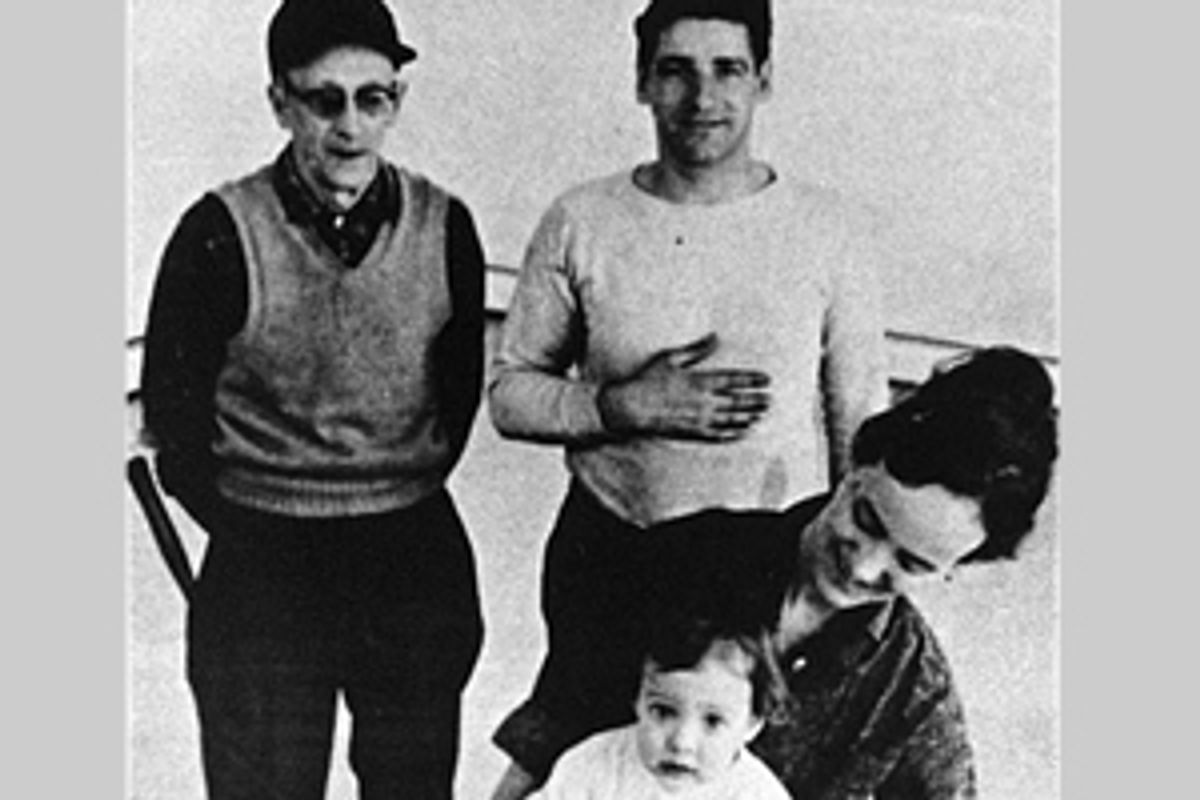
Sebastian Junger has a thing for the unknowable. Yes, he also has a personal connection to the infamous Boston Strangler murders of the early 1960s -- at the tender age of 1, he was photographed in his mother's arms beside the man who later confessed to the killings. But just as his bestselling true-adventure/tragedy "The Perfect Storm" led him to imagine events known only to the dead, so in his new book, "A Death in Belmont," Junger finds himself speculating about an unsolvable mystery: who really killed Bessie Goldberg in 1963.
Goldberg, a housewife in her 60s, lived about a mile away from the Jungers in Belmont, a "placid little suburb of Boston." Her husband, Israel, came home one afternoon in March to find his wife lying dead on the living room floor, strangled with one of her own stockings, her underwear exposed and torn. A medical examiner later concluded that she'd been raped. Her murder resembled the nine unsolved Boston Strangler killings, and when the police arrested Roy Smith, a housecleaner who had been sent by an employment agency to the Goldberg home earlier that day, they briefly thought they had the Strangler. They soon learned that Smith had been in prison when the initial stranglings took place, serving time for second-degree assault and assorted weapons charges.
Smith was convicted of murdering Goldberg in 1963 and sentenced to life. Two years later, Albert DeSalvo, a man about to go on trial for a string of rapes in Cambridge, confessed to being the Boston Strangler. DeSalvo had done some work on the Junger family home, building a studio addition out back for Sebastian's artist mother under the loose supervision of an older man. The Jungers were told that the serial killer who ultimately murdered 13 women and terrorized the greater Boston area for two years had spent many hours working right next to the house where Ellen Junger had cared for her infant son. This, understandably, sent a chill up the family's collective spine.
A Junger family legend formed around DeSalvo and their neighbor. "The story about Bessie Goldberg that I heard from my parents was that a nice old lady had been killed down the street and an innocent black man went to prison for the crime. Meanwhile -- unknown to anyone -- a violent psychopath named Al was working alone at our house all day and probably committed the murder." It's a good story, and it even comes with a great picture, the snapshot taken of the infant Junger, his mother, DeSalvo and DeSalvo's boss just as the studio was completed. By eerie coincidence, one of DeSalvo's large and famously powerful hands is situated "at the exact center of the photograph, as if it were the true subject around which the rest of us have been arranged." Naturally, the adult Junger, now a famous journalist, saw in all this the premise for a book.
But here's the rub: As almost any journalist -- not to mention fibbing memoirists like James Frey -- will tell you, most of the time real life stubbornly refuses to shape itself to the contours of a good story. A good story describes not only what happened, but also why, and in those rare cases when people agree on the former, they tend to quarrel about the latter. Even if no one contests that the crew of the Andrea Gail drowned in the Halloween storm of 1991, two men who weren't on the boat, and who come off as the bad guys in "The Perfect Storm," complain about inaccuracies in Junger's book. This time around, the author took the precaution of running "A Death in Belmont" past a battery of experts and hired a professional fact-checker to scrutinize the manuscript.
Nevertheless, Bessie Goldberg's daughter, Leah, has protested Junger's reconsideration of her mother's murder and has posted denunciations of "A Death in Belmont" on the sites of online booksellers. Junger's investment of time and money in scrutinizing the book has served him well -- Leah Goldberg's itemized complaints don't add up to much more than differences in interpretation. The "facts" she accuses him of omitting are included in the book -- Junger just doesn't consider them as damning as she does. Goldberg firmly believes that Roy Smith killed her mother, and Junger thinks it's possible that he did not. But after three years of studying the case, Junger is not entirely sure about anything.
Fair enough, but there's a big difference between a shipwreck and a murder. Whether or not the Andrea Gail ought to have been out on the open seas that day is ultimately an interesting side issue in Junger's thrilling, awe-inspiring tale of puny human beings fighting for survival against one of the worst storms in the history of the eastern seaboard. With a murder, who did it, who's to blame, is the big question; it's what really matters, the heart of the thing.
We know that nature at its most destructive is inhuman, something we can't control and can understand only imperfectly. We can be reasonably comfortable reading Junger's version of the Andrea Gail's final hours even when we know it's only an educated guess. But murder is another kind of story. It's the quintessence of human malevolence, and most of us consider ourselves experts on that particular subject. When an unsolved murder or missing-person case grabs the headlines, people who know nothing more about the crime than they read in news reports are often remarkably confident in their opinion of who did it.
Murder is also an entertainment mainstay, from paperback mysteries and thrillers to our nightly diet of cop shows. In the past three decades or so, serial killers (extremely rare in real life), have become the favorite villains of such stories. At any moment of the day -- provided you have cable TV -- you can watch a noble (if haunted) sleuth track down the most ingenious, demented and sadistic of murderers. It's no wonder, then, that we tend to believe that all murders, even the most seemingly senseless and bizarre, are solvable.
And to a degree, we're right about that. As Junger points out, most murderers do get caught, largely because most murderers, like most other criminals, are not that smart. Their motives are obvious, and they leave plenty of evidence behind them. But whoever killed -- and in some cases raped -- the 13 Boston Strangler victims was not stupid and, in an age before DNA testing, left no significant physical evidence behind.
Complicating Junger's investigation of DeSalvo's possible guilt in the Goldberg murder is a maze of other possibilities -- that DeSalvo didn't commit any of the Boston Strangler murders, that not all of the 13 women were killed by the same man, and so on. A few years after providing investigators with detailed descriptions of the murders, DeSalvo recanted his confession. He claimed that, facing a life sentence for the rapes he'd committed in Cambridge, he confessed in order to get psychiatric treatment and to parlay the infamy of the Boston Strangler into book and movie deals to support his wife and children. DeSalvo was never tried for the murders, and neither was anyone else. And if DeSalvo didn't kill all 13 of the Boston Strangler victims, somebody got off scot-free.
Junger has issued a statement expressing sympathy for Leah Goldberg's suffering and acknowledging "her right to an opinion about the book and the trial on which it is based," but he's not retracting anything in "A Death in Belmont." Goldberg has accused Junger of not wanting to let "facts" get in the way of a "good story," but the same could be said of Goldberg herself and of other family members of murder victims who become vehemently wedded to the idea that whoever the police have arrested for the crime must be guilty.
Survivors want someone to blame, someone to punish, and the comfort of knowing that justice has been done in the name of their loved ones. It must be awful to have a journalist come along 40 years later, suggesting that what they really got was none of these things, that the real murderer escaped judgment, and that (in the case of Bessie Goldberg) racism played some part in the conviction of an innocent man for the crime. But just because it upsets a murder victim's family members to see such a possibility considered doesn't mean that the possibility itself is invalid. Survivors are interested parties, after all, like the prosecution and defense attorneys -- and just as invested in their own favored story.
It's to Junger's credit that while he, like everyone else concerned with Bessie Goldberg's murder, wants and needs the story to come to a satisfying conclusion, he isn't going to fake it. "One of the conceits of my profession," he writes, "is that it can discover the truth; it can pry open the world in all its complexity and contradiction and find out exactly what happened in a certain place on certain day." This, he would discover, would not be the case with "A Death in Belmont": "As I did my research I came to understand that not only was this story far messier than the one I'd grown up with, but that I would never know for sure what had actually happened in the Goldberg house that day."
Roy Smith, he discovered, was a difficult man to champion. "Smith was a criminal," Junger admits. "He thought in criminal ways, he devised criminal solutions for ordinary problems, he went straight to the very criminal role that any racist cop or witness or juror would hope to see him in." The story was not turning out the way Junger's family had chosen to tell it. "Eventually I resigned myself to the idea that I was probably writing about a man who had committed a savage, unforgivable crime."
What caused Junger's judgment of Smith to turn again was a closer consideration of the accused man's conduct. The most damaging evidence against Smith -- how much money he had on him when he walked into the Goldberg house and what time he left -- came from Smith himself. He could easily have lied about either detail to cover his tracks, but he didn't. (In fact, Smith, who seems to have had a drinking problem, misreported some information during his interrogation that only incriminated him further until witnesses contradicted it.) He didn't try to leave town or hide out after supposedly committing a very serious crime. A Boston homicide prosecutor who, at Junger's request, reviewed the transcript of Smith's interrogation told the author, "if someone was to present these police reports to me, I'm not sure I'd even authorize the police to make an arrest."
Junger was further persuaded by Smith's behavior in prison after his conviction. He became a model inmate and eventually had his sentence commuted, although he died of cancer before he could be freed. Yet even before a parole board, Smith, who was desperate to get out and reconcile with his family, refused to express repentance because that would entail admitting that he'd killed Goldberg. "Why," Junger asks, "would someone as morally bankrupt as a rapist and murderer not fake his remorse and get out of prison early?"
Smith had no history of sexual violence, while DeSalvo had a string of rapes and "lewd behavior" charges to his name. (Early on, DeSalvo became adept at talking his way into women's apartments, pretending to be a modeling scout and offering to take their measurements.) DeSalvo might not have been the Boston Strangler, or he might have only killed some of the women who were labeled Strangler victims. But Bessie Goldberg's murder had a lot in common with a certain subset of the Strangler killings. Those crimes suggest an unusual, "very specific sexual compulsion, because few robbers or murderers -- in fact, not even that many rapists --rape the elderly."
All of this, though, amounts to speculating about how certain kinds of people are likely to behave in certain situations: a guilty man would lie or run, a serial killer sticks to one type of victim; the residents of a white suburb would notice a black man on the street but not perhaps a white man in work clothes; a man who'd raped and molested several women without otherwise injuring them is a more likely suspect in a rape-murder than an occasionally violent petty criminal; a black man who grew up in lynching-plagued, Jim Crow Mississippi would have learned to have as little to do with white women as possible. Maybe, but if there's anything more unpredictable than the weather, it's how human beings will respond to extreme situations and to their own unfathomable impulses.
So, while a more definite ending would make for a good story, Junger refuses to come to any conclusion about Bessie Goldberg's murder. "If I was to say something meaningful in this story," he writes, "I would have to do it without discovering the truth. But maybe the truth isn't even the most interesting thing about some stories, I thought; maybe the most interesting thing about some stories is all the things that could be true. And maybe it's in the pursuit of those things that you understand the world in its deepest, most profound sense."
Not very convincing, is it? A true-crime yarn that never settles on a criminal, a murder mystery that remains unsolved -- these don't conform to anyone's idea of "interesting." This isn't the kind of story we expect to be told, not the kind of story we want. Which is probably the best reason to believe that it's the truth.
Shares