World Cup

Score one for the Yanks

Yes, the USA team went down in ignominy at the World Cup. But guess what? World soccer fans were loving us in Germany.

  • more
    • All Share Services

Score one for the Yanks

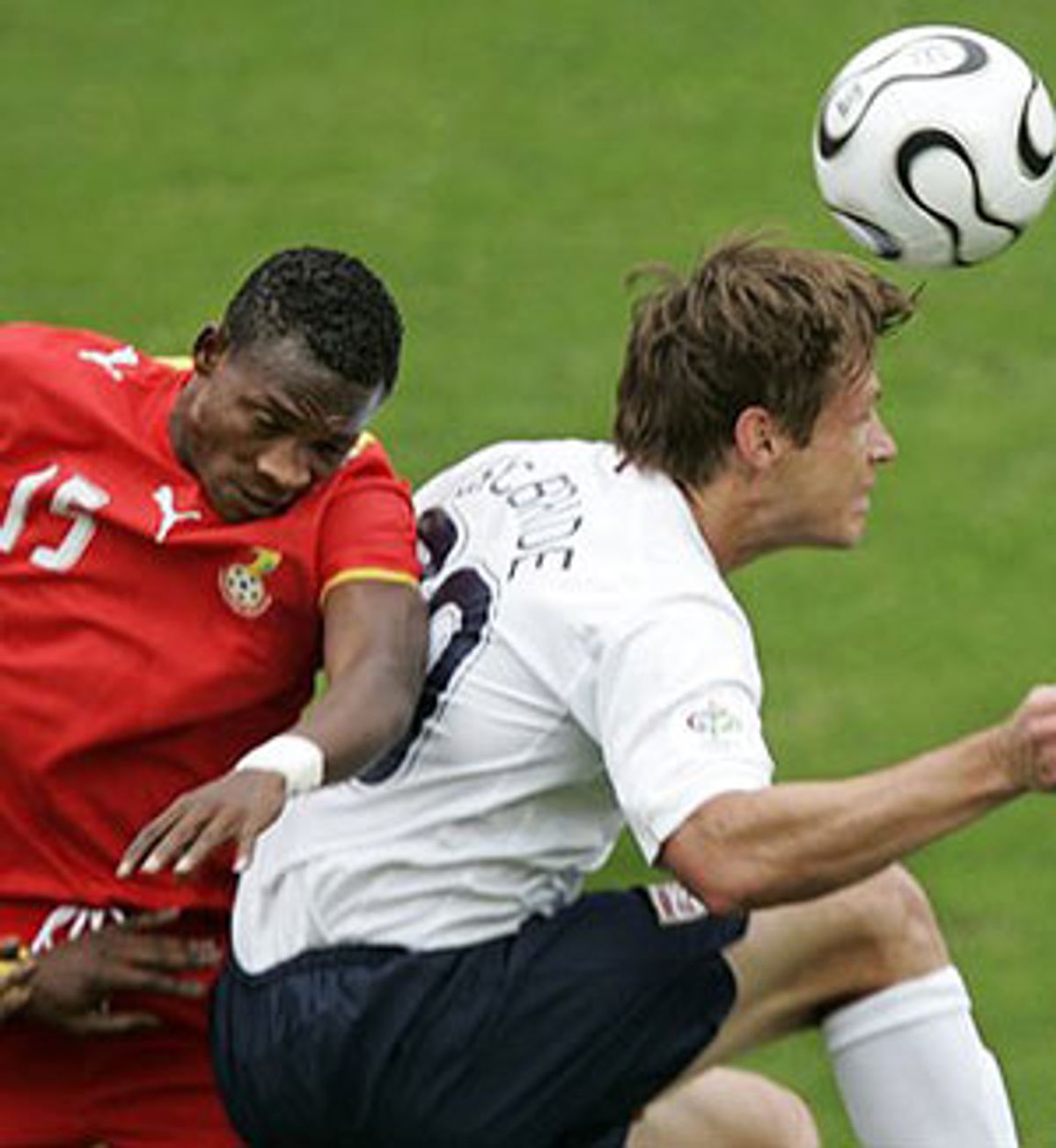
From where I was sitting in the epicenter of the Ghana-fan section, three seats away from drums that never ceased beating, American defender Oguchi Onyewu’s foul didn’t look like much of one. Indeed, my neighbor to the left seemed as puzzled as I was. But referee Markus Merk (now the most famous retired dentist in the world) was certain Onyewu had fouled Ghana forward Razak Pimpong from behind, and awarded a penalty kick to Ghana. Ecstasy broke out around me as midfielder Stephen Appiah fired home the shot that would send the West Africans into the next round and send the United States packing.

There was no ill will in either direction, though, not from Americans who felt they had been robbed, nor from triumphant Ghanaians gloating over their toppling of a superpower. A political superpower, that is. Despite its corniness, the motto for the 2006 World Cup — “a time to make friends” — was alive and well in Section 1b of the Nuremburg Frankenstadion on Thursday. I felt it throughout Germany in all the bars, trains and super-populated public viewing spaces I visited during the first two weeks of the world’s most popular sporting event.

Despite the disappointment, all was not lost for the Americans in Germany. Large contingents of fans from Virginia, California, Pennsylvania and Texas — no doubt inspired by midfielder, neophyte rapper and Texan Clint Dempsey (aka “Deuce”) — traveled to Nuremburg in support of their team. (No slight to residents of other states; these were the only contingents I could identify.) Allow me to pause for a minute to underline the importance of the words “their team.” Perhaps for the first time at a World Cup not played in the States, Americans were out in full, spirited and gregarious force. Even four Brits — two from Leicester City and two from Nottingham, diehard soccer fans because only the brave admit supporting those sides — told me they were impressed by the Yanks. America, the world’s football fans are proud of you!

Save the self-congratulatory pats on the back, though. There are four long years to consider this quick (and unnecessary) exit from the World Cup. Obviously there is still a long way to go in both footballing prowess and fan support, but that’s taking nothing away from the great turnout by Americans, who seemed to just about outnumber the Ghana supporters in the Frankenstadion. Sitting in the Ghana section, however, it was hard not to switch allegiances. Chants of “U-S-A!” are little match for rhythmic drumming, ultra-charismatic fan support and what I’m pretty sure was some low-grade marijuana, brought out just as the final five minutes of injury time was announced to the crowd.

Despondency looks the same whether it’s caked in red, white and blue makeup or worn as a frown by a tiny blond 10-year-old American girl who sits across from you on the train ride back from the stadium. The news that Italy had beaten the Czech Republic was more salt rubbed into the fresh wound. Had the U.S. managed to win, it would have been its flags waving on the long walk past the old Zeppelinfeld — the massive meadow surrounded by rows of columns facing a large tribune constructed from plans drawn by Nazi architect Albert Speer. It didn’t help that on this day, the Ghana side seemed eminently beatable. But baby steps, America, baby steps.

While culture critics feasted on the fascinating contradictions in Germany, there was some great football played in the first round of games, and highlights of public spectatorship were many. I spent the tournament’s first, absurdly sunny Saturday afternoon at an outdoor bar/club/lounge/pool/wonderland called, rather inexplicably, Platoon, replete with a massive screen and two-tiered stands to boot in (east) Berlin’s young and artsy Mitte district. The very fact that such a venue exists, and in total dedication to extracting maximum pleasure from a few football matches, is a testament to how saturated the country is in all things Weltmeisterschaft.

While not surprising, it is impressive to note that nary an advertisement on TV, in a magazine or newspaper, on a bus or on the metro does not have something to do with football. Halftime at matches is torturously rote: 15 minutes of what I’m convinced are the same commercials broadcast in exactly the same order. Even late-night television ads for phone sex lines feature pouting frauleins clad, momentarily, in full team kits, cavorting between studiobound goalposts, all the while daring you to, ahem, “score.” But, football fanatic that I am, and lascivious or not, such excess feels like paradise.

And paradise apparently serves grilled chicken Caesar salads and Alsterwasser (a mixture of lager and lemonade that, despite how that may sound, is perfectly refreshing on a hot afternoon) with a view of Hamburg’s famous harbor. Accuse me of Monday-morning quarterbacking (or centerbacking, as the case may be), but I wasn’t expecting the U.S. to upset the Czechs as easily as they did the Portuguese in their first match at the 2002 World Cup. The Czechs were the strongest team at the 2004 European Tournament until their captain, Pavel Nedved (whom many have rightly noted is a dead ringer for a “Roadhouse”-era Patrick Swayze), fell to injury. To shield myself from possible shame, I wanted to watch the match in as comfortable a public setting as possible — to ensconce myself in comfort to make the inevitable jibes and catcalls directed at yours truly less hurtful. Enter the phenomenon of the German beach club.

Often miles away from an open body of water, consisting of a boatload of sand dropped in the middle of open space in the middle of a city, beach clubs have become quite the rage in Germany. Uniting the beach and football is nothing new — just ask the Brazilians — but for the neutral spectator, the idea is tinged with genius. No doubt we have some Bauhaus-influenced brilliant mind to thank for this blessing. And though it pained me to see the U.S. so thoroughly beaten by the irresistible Czech attack, I cannot deny that the blow wasn’t cushioned by a comfortable deck chair and a cold Beck’s.

The other side of paradise can be found at Hamburg’s Fan Fest, held in a massive open field called Heilingengeistfeld, capable of hosting upward of 50,000 people, all in the shadow of an equally massive flak bunker, which, after the Second World War, was scheduled for demolition; it survived all attempts at its destruction. How’s that for German engineering? Four public seater stands (and one private one) face a gigantic LED flat screen, while smaller concourses snake around behind the stands, featuring tents dedicated to the cuisines of each of the 32 nations represented in the tournament. This is the province of both the diehard fan and the dilettante, equally welcoming to families and fanatics alike.

One of the things you notice very quickly about the World Cup’s propensity to bring people together from various countries who might never cross paths is that the smallest measures of shared cultural understanding can make for fast friends. In the wake of Iran’s 3-1 loss to Mexico, it’s entirely fine for the German Fan Fest emcee to sing “La Cucaracha” in Spanish and both Mexican and Iranian fans alike will dance around in a huge conga line, loving every second. Perhaps I’m discounting alcohol as a contributing factor, but I do think that soccer has a lot to do with it.

“Vaya Con Dios” sang the Argentine to a clutch of Serbian (or Montenegrin) fans as they walked down the pedestrian-only concourse leading from the Gelsenkirchen Hauptbanhof (train station). It was a fitting, and perhaps necessary, blessing given what was to transpire between the footballing representatives of these two (recently three) countries later in the day.

I took a 5:40 a.m. train from Hamburg to Gelsenkirchen, a ride besmirched not merely by drunken German fans who boarded in Bremen (how they were drunk by 6:40 a.m. I’ve no idea) but also by the weather. A smattering of rain dampened the journey, but let up by the time I heard that sweet Argentine serenade. Skies remained gray, but the mood in the streets and subways was spirited. It looked to be a grim day for football, yet in the minutes before the gates to the Arena auf Schalke were unlocked — and the cynical will not believe this — a chasm of bright blue and sunshine broke through the clouds directly over the stadium. It appeared that God had, once again, a hand in matters concerning Argentine football.

Wearing large, dark sunglasses, I felt free to gawk at the spectacle before me. You could lose yourself in color: Serbian navy blue, the albiceleste of the Argentines. Four inexplicable Poles wore their country’s red as if merely to complete the spectrum.

Beyond my comprehension, the doors opened three hours before game time. And despite plenty of evidence to the contrary — namely, the throngs of people entering on all sides of me — I couldn’t help feeling special, as if World Cup president Sepp Blatter had an eye out for me. To be seated alone in the giant stadium could be described as peaceful if not for the German pop blasting over the loudspeaker.

The game, alas, was over before it began. Maxi Rodriguez scored in the fifth minute as the Argentines pinged the ball about with single touches, between and behind the vaunted Serbian defense. But even so fluid an attack could not prepare the crowd for what will be regarded as “the Goal.” I’m almost certain countless babies were conceived in the moments after Esteban Cambiasso expertly finished Hernan Crespo’s cheeky back-heeled pass into the top left half of the net. It’s the kind of goal that creates football fans for life.

There were four more Argentina goals, one scored by budding genius Lionel Messi. Messi, who could be the best player at this tournament, is a stoop-shouldered kid with tousled hair who shuffles his weight gently, but perceptibly, from foot to foot, as if the tag of “the new Maradona” didn’t weigh a thing. Of course, he takes off like a shot when he wants to, and was too much for the Serbs, assisting a goal and scoring one in just 15 minutes of play.

A game like this makes everyone smile, even those humbled in defeat, as I witnessed after the match, watching the Netherlands-Ivory Coast match with five smiling Serbs in a crowded bar. But really, what else can you do but smile when you lose by a touchdown in American football? A Scotsman and an Englishman squeezed between us and we were able to share predictions for next year’s English premiership. They then told me about trying to buy scalped tickets from a “tout,” going to the ATM to withdraw the money for the tickets and returning only to find the tout in handcuffs, pressed chest-first onto a German police van.

Looking back on my first two weeks at the World Cup, I continually smile at how easy it has been to start conversations with strangers from not-so-strange lands. Granted, it helps to be able to say the name Bastian Schweinsteiger (a young, talented German midfielder) with the verve and excitement of a 12-year-old. But you have to credit soccer — like no other sport in the world — for the goodwill. Sure, there’s an aw-shucks quality to it, but then again, Americans are supposed to be good at this sort of thing. Now all we need is a domineering defensive center-mid and we’re back in business.

Furious gay rights groups condemn FIFA chief Sepp Blatter

Activists say his joke about gays refraining from sex in Qatar during 2022 World Cup isn't a laughing matter

  • more
    • All Share Services

A leading international gay rights group demanded Tuesday that FIFA make an official apology following President Sepp Blatter’s comment about homosexual sports fans traveling to Qatar for the 2022 World Cup.

Blatter, head of world football’s governing body, said Monday in an apparently lighthearted remark that gay fans “should refrain from any sexual activities” during the tournament in Qatar, where homosexual behavior is illegal.

Juris Lavrikovs, communications director for the European branch of the International Lesbian, Gay, Bisexual, Trans and Intersex Association, said the comments were “very unfortunate and have left people deeply offended.”

“I think they should come out with a strong statement and not just wash it away and hide behind it with some wishy-washy comments,” Lavrikovs told The Associated Press. “We are talking about a very basic human right that is being violated.”

Blatter, speaking in South Africa on Monday at the launch of a post-2010 World Cup legacy project, was asked if he could foresee any cultural problems with the tournament being held in Qatar.

“I’d say they (gay fans) should refrain from any sexual activities,” he said, smiling.

Lavrikovs noted the situation “is not a joke.”

“This is a matter of life and death to people,” Lavrikovs said. “Qatar and more than 70 other countries in the world still criminalize individuals for homosexual relationships, and some countries even punish them by death sentence.

“It’s disappointing to see that an organization that is promoting the game, which in its statutes condemns discrimination of any kind, is coming out with comments like this.”

Qatar beat Australia, Japan, South Korea and the United States in the FIFA vote on Dec. 2.

Since FIFA made what is widely regarded as a surprise decision, concerns have been raised about Qatar’s hosting such a major tournament while it has stringent laws that are seen by many to violate basic human rights.

“Sepp Blatter jokes about the risk to gay visitors in 2022, but Qatar’s anti-gay policies are no laughing matter,” British human rights campaigner Peter Tatchell said.

Also condemning Blatter was John Amaechi, a former NBA player from Britain who revealed in 2007 that he was gay.

“The statements and the position adopted by Sepp Blatter and FIFA regarding LGBT (Lesbian, Bisexual, Gay and Transgender) fans who would pay the enormous ticket and travel prices to attend the World Cup in 2022 should have been wholly unacceptable a decade ago,” Amaechi said on his website.

“Instead, with little more than an afterthought, FIFA has endorsed the marginalization of LGBT people around the world,” he added.

Amaechi also demanded an apology from FIFA and urged other associations to distance themselves from Blatter’s comments.

“Anything less than a full reversal of his position is unacceptable,” he said.

Continue Reading Close

Mike Allen’s World Cup outrage: FIFA is anti-American!

Politico's "Playbook" author doesn't want a World Cup played in terrorist-coddling Qatar

  • more
    • All Share Services

Mike Allen's World Cup outrage: FIFA is anti-American!Qataris react in a car, after the announcement that Qatar will host the soccer World Cup in 2022, in Doha, Thursday, Dec. 2, 2010. (AP Photo/Osama Faisal)(Credit: AP)

Politico’s Mike Allen is outraged that FIFA didn’t pick America to host the 2022 World Cup! It is his “top story” in this morning’s “Playbook,” his daily newsletter of birthday greetings to people you don’t know and links to news articles from yesterday. (The top story comes after a line about someone’s birthday, a recap of yesterday’s “D.C.’s Funniest Celebrity” contest, and two news stories from yesterday about Michael Steele and online poker.)

The worst part is, not only was America snubbed, but terrorists won. The 2022 World Cup will be held in Qatar, a tiny Persian Gulf state. Behold the wrath of Mike Allen:

TOP STORY – “Russia and Qatar take World Cup to new lands” – Reuters/Zurich: “FIFA gave its ultimate recognition to emerging markets on Thursday by awarding the 2018 and 2022 editions of the prestigious and lucrative World Cup soccer finals to Russia and Qatar, both new hosts. Russia won the right to put on the 2018 World Cup, the first time it will have been staged in Eastern Europe after 10 editions in the western half of the continent. Qatar, which has never qualified for the World Cup finals, will stage the 2022 tournament, a first both for the Middle East and for an Arab country. It will also be the smallest nation ever to host the World Cup.” http://reut.rs/hz0k7t

–The U.S. inexplicably lost to Qatar, which is two-faced in the war on terror and full of radical sympathizers. A Ben Smith reader points out a WikiCable “in which Mossad chief Meir Dagan briefed Bush homeland security aide Frances Fragos Townsend: Dagan characterized Qatar as ‘a real problem.’” http://politi.co/f0kcmq

–International Herald Tribune p. 1: “FIFA tilts soccer’s future toward the East.”

–Brits push for FIFA reform – BBC: “England 2018 bid chief executive Andy Anson has warned his country against bidding for the World Cup again until Fifa reforms its voting process.” http://bit.ly/gyKAhC

PLAYBOOK FACTS OF LIFE: These obviously absurd choices are the product of a corrupt process that includes no accountability. These organizations (FIFA, IOC, etc.) are Eurocentric, if not blatantly anti-American. As a wise young friend e-mails, “These bids are like a modern day ‘Concert of Europe.’ And we certainly aren’t Prince Metternich, despite what we may think.”

Lots of people consider Qatar a poor choice for the World Cup, but not because it’s not America. Or because they are secretly pro-terrorist! Or because Mossad said something bad about them in a secret cable! It’s considered a poor choice because it is a tiny nation with no soccer team of its own. Also it’s a desert with high summer temperatures and they pump absurd amounts of CO2 into the atmosphere. And it’s full of foreign-born indentured servants with very few rights. And you’re not allowed to drink booze in public. But “being two-faced in the War on Terror” is pretty far down the list of reasons why this might be a bad idea.

Also, FIFA is a Zurich-based international organization, so calling it “anti-American” is pretty much a non sequitur. As for “Eurocentric,” much of Europe is very disappointed in FIFA for awarding a World Cup to Qatar. (Qatar is not in Europe.) And Russia, despite its own problems, is not an “obviously absurd choice,” because it’s a massive world power that loves soccer. Also, your “wise young friend” sounds insufferable.

The other nations bidding for 2022 were the U.S., Australia, Japan or South Korea. All would’ve been fine choices, though the fact that Japan and South Korea co-hosted it in 2002 probably disqualified them, and the U.S., unlike the rest of those nations, is not a country that cares about soccer. So if Mike Allen could put aside the jingoism and Islamophobia for a moment, he would perhaps see that he should really be outraged on behalf of Australia, which has never hosted a World Cup and which put together what was, by most accounts, a pretty good bid.

[Via Peter Feld]

Continue Reading Close
Alex Pareene

Alex Pareene writes about politics for Salon and is the author of "The Rude Guide to Mitt." Email him at apareene@salon.com and follow him on Twitter @pareene

Qatar to host World Cup in 2022

Minutes earlier, it was also announced that Russia would be the site of the 2018 tournament

  • more
    • All Share Services

Qatar was selected as host of the 2022 World Cup, beating out a bid by the United States to bring soccer’s showcase back to America for the first time since 1994.

FIFA’s executive committee choose Qatar over the U.S., Australia, Japan and South Korea in a secret vote Thursday.

Minutes earlier, Russia was announced as host of the 2018 tournament. It was chosen over England and joint bids by Spain-Portugal and Netherlands-Belgium.

THIS IS A BREAKING NEWS UPDATE. Check back soon for further information. AP’s earlier story is below.

ZURICH (AP) — Russia will host the 2018 World Cup.

It was chosen Thursday by FIFA’s executive committee over England and joint bids by Spain-Portugal and Netherlands-Belgium.

Russia won despite the absence of Prime Minister Vladimir Putin in Zurich. At the last minute, he declined to make a final pitch for his country.

The 2022 host was to be announced minutes later. The U.S. was competing with Australia, Japan, Qatar and South Korea.

Paul the World Cup-predicting octopus dies

Creature gained fame this summer by accurately predicting the outcomes of Germany's seven games

  • more
    • All Share Services

Paul the Octopus, the tentacled tipster who fascinated football fans by correctly predicting results at this year’s World Cup, died Tuesday.

Paul had reached the octopus old age of 2 1/2 years and died in his tank on Tuesday morning in an aquarium in the western German city of Oberhausen, spokeswoman Ariane Vieregge said.

Paul seemed to be in good shape when he was checked late Monday, but he did not make it through the night. He died of natural causes, Vieregge added.

After rising to global prominence during the World Cup in South Africa in June and July, Paul retired from the predictions business after the final between Spain and the Netherlands — the result of which he also forecast correctly — and returned to his prime role of making children happy.

The invertebrate was stepping “back from the official oracle business,” Tanja Munzig, a spokeswoman for the Sea Life aquarium in Oberhausen, told AP Television News at the time.

“He won’t give any more oracle predictions — either in football, nor in politics, lifestyle or economy,” she said. “Paul will get back to his former job, namely making children laugh.”

Paul correctly predicted the outcomes of all seven of Germany’s World Cup games. He made his predictions by opening the lid of one of two clear plastic boxes, each containing a mussel and bearing a team flag.

After his World Cup soothsaying skills were revealed, the English-born Paul was appointed an ambassador to England’s bid to host the 2018 World Cup. He had English roots, having been hatched at Weymouth Sea Life Center on England’s south coast in 2008.

Imitators sprang up all over the world, including Mani the Parakeet in Singapore and Lorenzo the Parrot in Hannover, Germany.

The latest was a saltwater crocodile named Dirty Harry, who predicted Spain’s World Cup final win and called the result of Australia’s general election by snatching a chicken carcass dangling beneath a caricature of Prime Minister Julia Gillard.

Paul became so popular in Spain that a northwestern Spanish town tried to borrow him.

In response to hundreds of requests to bring Paul to Spain, the Madrid Zoo asked Sea Life if it would be willing to make a deal to bring him in as a tribute to the Spanish team’s victory, either temporarily or for good. But the German aquarium turned down that offer, too.

Paul also had an agent and his name was used to help endangered turtles on the Greek island of Zakynthos.

——

David Rising in Berlin contributed to this report.

Continue Reading Close

FIFA suspends officials in World Cup bribery probe

Amos Adamu and Reynald Temarii allegedly offered to sell their votes for funding toward soccer projects

  • more
    • All Share Services

Two FIFA executive committee members and four lower-ranked officials were provisionally suspended Wednesday in a World Cup vote-selling scandal.

Executive committee members Amos Adamu of Nigeria and Reynald Temarii from Tahiti are barred from all soccer-related duty until the probe ends, said Claudio Sulser, chairman of FIFA’s ethics committee.

Four other lower-ranked officials — Slim Aloulou, Amadou Diakite, Ahongalu Fusimalohi and Ismael Bhamjee — also have been suspended while FIFA investigates whether they breached bidding rules.

The soccer world governing body’s ethics committee also will investigate whether two countries bidding for either the 2018 and 2022 World Cups engaged in collusion.

“Today is a sad day for football and for FIFA,” Sulser said.

FIFA’s ruling executive will select the two World Cup hosts in a Dec. 2 secret ballot in Zurich. The 2018 tournament bidders are England, Russia and joint bids by Belgium-Holland and Spain-Portugal.

FIFA launched investigations after British newspaper The Sunday Times alleged Adamu and Temarii offered to sell their votes for funding toward soccer projects.

Amadu was filmed requesting $800,000 to build four artificial soccer fields in Nigeria, and for the money to be paid to him directly.

“The decision to provisionally suspend these officials is fully justified and should not be put in question,” Sulser said. “The evidence that has been presented to us today has led us to take this provisional measure, as we considered that the conditions were definitely met to take this decision and we deem that it is crucial to protect the integrity of the 2018 and 2022 FIFA World Cup bidding process.

“We are determined to have zero tolerance for any breach of the code of ethics.”

Countries bidding for the 2022 hosting rights are the United States and four Asian confederation countries, Australia, Japan, Qatar and South Korea.

FIFA barred bidders from making agreements with other candidates, and insisted they must act with “integrity, responsibility, trustworthiness and fairness.” FIFA secretary general Jerome Valcke issued a reminder of the rules last month after rumors of vote-swapping deals being struck.

The Sunday Times allegations kicked off a dramatic week as FIFA seeks to maintain the integrity of the bid process.

Temarii, the Oceania Football Confederation president, met FIFA president Sepp Blatter on Sunday and asked to clear his name before the ethics committee.

The 43-year-old former professional player was filmed asking for $2.3 million to fund a soccer academy in Auckland, New Zealand.

“I’m confident about my integrity, but I made a mistake by talking in that way,” Temarii told The Associated Press on Sunday.

The newspaper also quoted Temarii saying backers of two other unidentified bidders offered $10 million to $12 million to Oceania.

FIFA does not have power to fire members of the 24-strong executive because they are elected by their continental bodies.

However, its code of ethics for officials says those who “severely fail to fulfill, or inadequately exercise, their duties and responsibilities, particularly in financial matters, are no longer eligible and shall be removed from office.”

Adamu’s four-year term ends at the Confederation of African Football’s congress on Feb. 23 in Khartoum, Sudan. The 57-year-old former physical education teacher joined FIFA’s executive in 2006, succeeding Ismail Bhamjee from Botswana, who resigned after a ticket scalping scandal at the World Cup in Germany.

Temarii, who has led 11-nation Oceania since 2004, is scheduled for re-election at a Jan. 21-23 congress on his home island.

Continue Reading Close

Page 1 of 14 in World Cup