2008 Elections

How Obama learned to be a natural

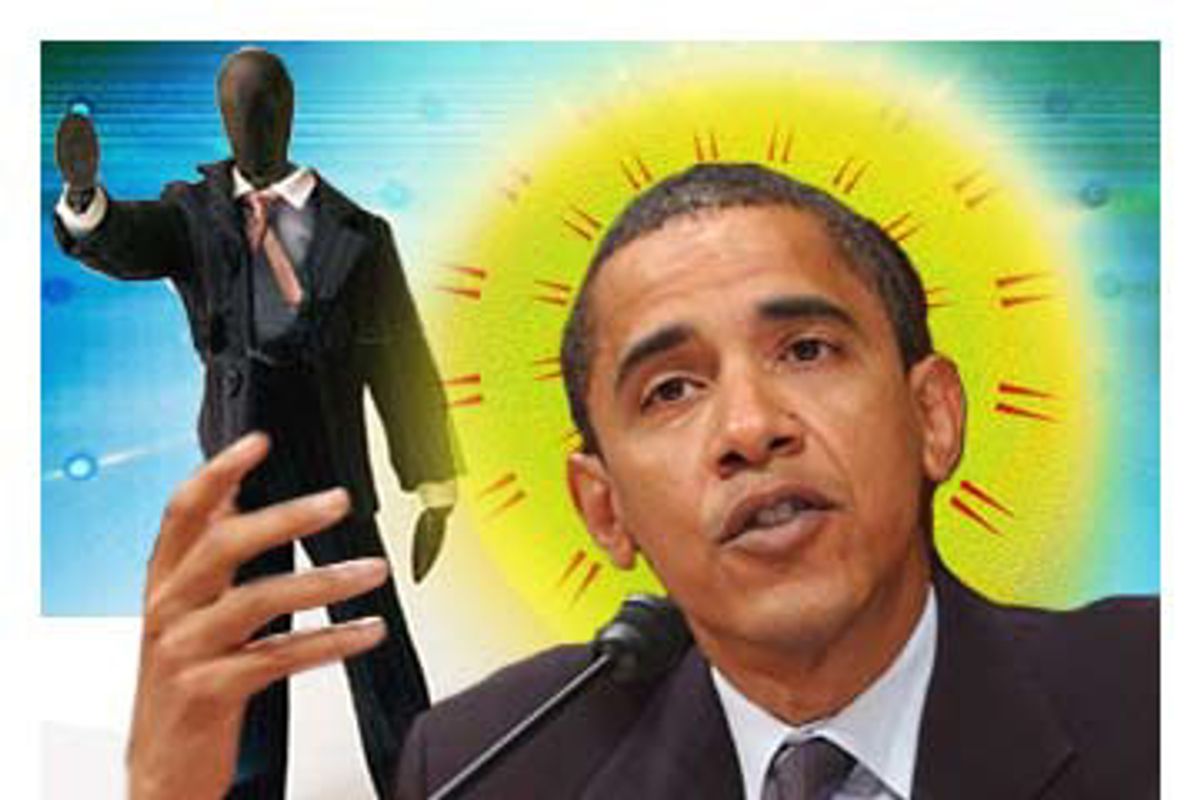
Today he drips with charisma and inspires fawning admiration from all quarters. But Obama began his journey as a smug young man with little political future.

When reporters go one on one with Barack Obama, they end up writing things they’ll regret in the morning papers. It’s a phenomenon called “drinking the Obama juice.” One besotted scribe called him “tall, fresh and elegant.” And the august Atlantic Monthly mooned about Obama’s “charisma, intelligence and ambition, tempered by a self-deprecating wit,” titling its article “The Natural.”

OK, Obama is tall (6 feet 2 inches), intelligent (Harvard Law, two bestselling books), and damn, he’s ambitious (running for president after two years in Congress). But he’s no natural.

As a correspondent for the Chicago Reader, I covered Obama’s 2000 campaign to unseat Bobby Rush, the ex-Black Panther who’s been a Democratic congressman from Chicago’s South Side since 1993. It’s the only election Obama has ever lost. As even one of his admirers put it, “He was a stiff.” You think John Kerry looked wooden and condescending on the campaign trail? You should have seen this kid Obama. He was the elitist Ivy League Democrat to top them all. Only after losing that race, in humiliating fashion, did he develop the voice, the style, the track record and the agenda that have made him a celebrity senator, and a Next President.

I got my first sight of Obama early that winter, at a church in the South Side’s Bronzeville neighborhood. It was a Saturday afternoon — as a greenhorn challenger, Obama wasn’t getting the Sunday pulpit invitations — and maybe a dozen people were scattered in the worn pews. Obama was a mere two-term state senator, and this was half a decade before “-mania” was added to his name. Weak December light strained through the stained glass. Obama wore a suit and tie — he hadn’t yet pioneered high-fashioned, open-necked campaign casual — and, posing uncomfortably before the baptismal, tried to relax the crowd with self-deprecating wit.

“The first thing people ask me is, ‘How did you get that name, Obama,’ although they don’t always pronounce it right. Some people say ‘Alabama,’ some people say ‘Yo Mama.’ I got my name from Kenya, which is where my father’s from, and I got my accent from Kansas, which is where my mother’s from.”

At the time, Obama was teaching constitutional law at the University of Chicago, and this was the sort of awkward, beginning-of-the-semester joke you hear from a professor trying too hard to prove a sense of humor. If anyone caught that Obama was trying to connect himself both to the birthplace of civil rights and a time-honored black party joke, they didn’t laugh or nod. He went on to give a speech attacking Rush as “reactive.” Afterwards, when I polled his listeners, one told me Obama represented a new generation of black leadership, which is the wrong way to sell yourself in a primary election dominated by senior citizens. Another was a hip-hop poet. He handed me a business card with a photo of himself wearing clown makeup.

Every account of that campaign points out that Obama was tagged as “not black enough” for the South Side. State Sen. Donne Trotter, the third wheel in the primary, told me then, with a sneer, that “Barack is viewed in part to be the white man in blackface in our community.” Black nationalists grumbled about an “Obama project,” led by the candidate’s political godfather, former Clinton White House counsel Abner Mikva. But no one appreciates how hard the man tried to earn his ghetto pass. At a rally for South Side teachers, held in a dim, tiny nightclub called Honeysuckle’s, Obama lashed out at the critics who were calling him too bright and too white.

“When Congressman Rush and his allies attack me for going to Harvard and teaching at the University of Chicago, they’re sending a signal to black kids that if you’re well-educated, somehow you’re not ‘keeping it real.’”

The air quotes hung over the silent gathering.

Wherever Obama went, he talked like a poli-sci thesis. Here’s how he bragged on himself back then, as I reported in the Reader: “My experience of being able to walk into a public housing development and turn around and walk into a corporate boardroom and communicate effectively in either venue means I’m more likely to build the kinds of coalitions and craft the sort of message that appeals to a broad range of people.”

Obama just couldn’t — or wouldn’t — loosen up. The dignified demeanor that had won him a state Senate seat in the university community of Hyde Park did not translate to the district’s inner-city precincts. His internal rhythm was set to “Pomp and Circumstance.” “Arrogant,” scoffed a South Side radio host. Even his body language signaled he was slumming. During a debate with Trotter, in the dank basement of a park field house, he sat with his lanky legs crossed, chin cocked at a heroic angle. He wasn’t even trying to conceal his impatience with a mere state Senate peer, or with this grungy necessity of campaigning. Trotter, who embodied bourgeois black Chicago, from his bow ties to his soul food lunches to the smooth jazz oozing from the speakers of his Jeep, hunched over his microphone, taking digs at his increasing irritated rival. When he finally needled Obama for failing to pass a child-support bill, the calm dissolved.

“Senator, that’s a distortion!” Obama snapped. His baritone went full fathom five, but he never unbent from his patrician pose.

Obama may have been testy because he did have a reputation as an ineffectual legislator — for many of the same reasons he was tanking as a campaigner. Some of his colleagues saw him as a self-righteous goo-goo who thought he was too cool for the chamber and who disdained the hard work of digging up votes.

“Barack is a very intelligent man,” Rich Miller, publisher of Capitol Fax, a statehouse news service, told me in 2000. “He hasn’t had a lot of success here, and it could be because he places himself above everybody. He likes people to know he went to Harvard.”

Obama had been a golden boy for so long: embraced by the Ivy League, profiled in the New York Times, published by Times Books. At 38, it gnawed at him that others his age were already moving up the political ladder. U.S. Sen. Peter Fitzgerald, whose seat Obama now holds, was only a year older. But for the first time in Obama’s life, his ambitions were blocked. The world was pushing back. His impatience showed in condescension to his surroundings.

Back in 2000, when I interviewed Obama in his cubicle-size office at a downtown law firm, he started the meeting by checking his watch. Then he dissed his congressional district, half-joking that he was more committed to the South Side than his opponents, because, number one, he’d moved there from Hawaii, and number two, he could have been raking it in on Wall Street.

“I really have to want to live here,” he said. “I’m like a salmon swimming upstream on the South Side of Chicago. At every juncture of my life, I could have taken the path of least resistance but much higher pay. Being the president of the Harvard Law Review is a big deal. The typical path for someone like myself is to clerk for the Supreme Court, and then basically you have your pick of any law firm in the country.”

Didn’t the people appreciate the sacrifices he’d made? To grind out a voter registration drive when he could have been earning $200K a year at a white-shoe firm? They didn’t. On Primary Day, Obama received 31 percent of the vote. He didn’t lose because he was “too white.” He lost because he was a presumptuous young man challenging a popular incumbent. If anything, his whiteness spared him a bigger beating. He ran strongly in Beverly, an enclave of Irish cops who had never forgiven Rush for his Black Panther past.

Trotter, who is plenty black, got 7 percent. In fact, Obama may be lucky he didn’t win. It’s harder to get to the U.S. Senate — or the cover of Men’s Vogue, or the drawing rooms of Manhattan donors — from a black-majority district.

Obama returned to Springfield a loser. The week of his defeat, he sat down to his regular poker game at the home of state Sen. Terry Link, a fellow Democrat from the Chicago suburbs. The same words were on the lips of every pol at that table: I told you so. Obama didn’t need to hear it. He knew he’d blundered.

“He made a lot of mistakes, and he learned,” Link says now. “He forgot who he was. That he’s Barack. He tried to sell to a crowd who wasn’t buying.”

Around that time, Obama also had a soul-searching drink with Miller, the Capitol Fax publisher. He was upset about the way Miller had characterized him, but “he took that criticism the right way,” Miller remembers six years later, “and he could have taken it the wrong way.”

“A lot of politicians, they know that they’re smart,” Miller says. “They know that they’re capable. It messes with their minds. Politics is not a game of qualifications. It’s a game of winning. That congressional campaign really showed that to him.”

On the state Senate floor, Miller saw a more focused, more collegial Obama, who began to take his work — and his fellow legislators — seriously. Using his experience in constitutional law, he passed legislation to curtail racially motivated traffic stops and to require police to videotape murder confessions. He sponsored legislation that added 20,000 children to the state’s health insurance program.

“I just can’t emphasize enough how much this guy became respected, and how transformative it was,” Miller says. “By 2004, he just had this aura about him.”

Even black legislators, who had resented Obama in his early years, were won over. He earned the respect of Trotter, who watched his fellow senator mature from a résumé in search of an office to an effective legislator. Trotter was so impressed, he now sits on Obama’s presidential exploratory committee.

“I wouldn’t say losing humbled him,” Trotter says, swatting away a term used by many of his white colleagues. “Barack is a competitor, and being a competitor, you don’t like to lose. When he came back, he really immersed himself in the process. He learned he had to get an agenda, to get issues he felt passionately about. He also learned some of those ‘get-along’ qualities you need to get a bill passed. He has proven himself to me that he can take advice. He’s not a one-man operation.”

I’d thought Obama had campaigned like an ass, but I expected him to run for the U.S. Senate. And I expected him to win. His white upbringing would appeal to suburbanites, while South Siders might figure that Obama was as black a senator as they were going to get, after the Carol Moseley Braun debacle. His braininess, his haughtiness, his sense of entitlement — they could only be pluses in a Senate campaign. They don’t call that place Ego Mountain for nothing.

In 2004, I went down to his Michigan Avenue campaign office to interview him for the Reader. His press secretary had already scolded me for the “negative” quotes in my last article. I was expecting another preening, insecure performance. But Obama charmed me right away. He did it to dozens of reporters that year. “Good to see you again,” he intoned, casually, gliding across the room like Fred Astaire playing Abe Lincoln. He had doffed his suit coat for shirtsleeves.

We went into his office, where, sitting under a giant photo of Muhammad Ali knocking out Sonny Liston, Obama tried out some lines he would use at the Democratic National Convention.

“There is a tradition of politics that says we are all connected,” he said. “If there is a child on the South Side who cannot read, it makes a difference in my life, even if it’s not my child. If there’s an Arab-American family who’s being rounded up by John Ashcroft without benefit of due process, that threatens my civil liberties. Black folks, white folks, gay, straight, Asian — the reason we can share this space is that we have a mutual regard. That’s what this country’s about: e pluribus unum. Out of many, one.”

That was the mission statement of 21st-century Obama. As a black candidate, he’d been too inhibited, too embarrassed, to force out phrases like “our community.” Finally, he was comfortable in his own skin, now that he’d accepted that the skin was half-white. Obama wasn’t born to be a voice of black empowerment, like Rush or Jesse Jackson. It’s not just a racial thing. It’s generational, too. Confrontational ’60s-style politics are not his bag. But as a multicultural politician, trying to find the unified theory of ethnic politics, he was rolling like Tiger Woods at the Masters. The aloofness was gone as well. Very intently, he laid out his plan for a federal Children’s Health Insurance Program.

“I think it’d be a good opportunity to lay the groundwork toward expanding health care to all the uninsured,” he said.

Obama was no longer selling himself. Now, he had a legislative goal and a strategy for making it happen. Or maybe, because he knew I was one of his skeptics, he was selling me on the idea that he wasn’t selling himself. In the words of an old police reporter, Obama makes grease look gritty. Just as he was looking two moves ahead, politically, I’m sure he was two moves ahead of my expectations. It was working. I was impressed that he finally believed in something. He was a big-government liberal, no weaseling about it.

“How would you have voted on the Iraq war resolution?” I asked.

“I would have voted no.” And then, with a simplicity that his old self might have thought simple-minded, he said, “I’m not opposed to all wars. I’m opposed to dumb wars.”

Then I asked him about his race against Bobby Rush.

“I got a good spanking,” he said, evenly. “I think that was youthful impatience on my part. I knew I was going to lose on Election Day. I was standing outside a polling place, and old ladies kept coming up to me and saying, ‘You seem like a nice young man, but Bobby hasn’t done anything wrong.’”

Later, when I called his office for follow-up questions, Obama jumped on the line and drilled me with more details of his healthcare plan. He also repeated his “E Pluribus Unum” speech, tweaking a few words. He was proud of that one.

A few weeks after that, I heard him speak at a North Side organic restaurant known for its liberal politics. The Heartland Café had welcomed Harold Washington during his run for mayor, and now it welcomed this new South Side phenom. Obama climbed up on the bandstand and filled that dining room with the same energy he’d project across the Fleet Center: “If there is a child on the South Side who cannot read … If there is an Arab-American family who’s being rounded up by John Ashcroft!” I was startled. The pedantic lecturer had been retired. Now, Obama was a fight announcer, a preacher and a motivational speaker, all on the same platform. Full of conviction, he drove his words into our ears like a carpenter pounding nails. The white folks loved him because he was liberal. The black folks loved him because, as one said to me, “We need someone who can reach beyond the race. He can go to Washington and talk their language.”

That wasn’t the Obama I’d known. But it was the Obama America came to know. I was sold. I voted for him twice that year. That July, the Democrats made him the keynote speaker at their convention. It was partly a defensive move against a rumored candidacy by ex-Chicago Bears coach Mike Ditka. Obama delivered a maiden speech to rival that of Hubert Humphrey in 1948, or William Jennings Bryan in 1896.

Terry Link believes that losing that congressional race liberated Obama to be the real Obama — the bright young charmer Link had met as a fellow freshman in Springfield.

“When he ran for the Senate, he was so comfortable,” Link says. “It’s like speaking from your heart, against speaking from notes. I thought, ‘This is the one I knew. It’s Barack again.’” Trotter saw a different dynamic: “He grew up around whites, so he’s very comfortable in those venues. That was obvious when he went over to [the South Side Irish enclave of] Beverly. His comfort zone was in those circles. That is who he is. This is the face of his grandparents.”

So what do you make of a campaigner whose persona changed so drastically in four years? That he’s finally learned to be himself, or that he’s putting on an act? He’s doing both. All great politicians are also great performers. Obama has been called the Democrats’ Ronald Reagan because he has the personality to sell the public on programs it might reject on their merits. (In Reagan’s case, it was supply-side economics. In Obama’s, it would be national healthcare.) They’re alike in another way. Reagan was a washed-up thesp, doing Vegas and General Electric ads, until he was cast as governor of California, then president. Obama has also grown into the character he was born to play: the great uniter who can bring together old and young, black and white, Democrat and Republican. So far, he’s playing it brilliantly. Even his comic timing has improved — he’s got his new audiences laughing at the same old Alabama/Yo Mama joke. And Bobby Rush has backed him for president.

Some of us, though, are still trying to figure out how he got to be Elvis, Lord Byron and Bobby Kennedy, all in the same dark suit.

“Charisma is in the eye of the beholder,” says Donne Trotter. Much as he admires Obama, he’s not going to drink The Juice over a community organizer from his old neighborhood. “I can’t define him as being this charismatic guy. He’s no Svengali or Jim Jones. Certainly, he has learned, though. He’s a very fast learner.”

This story has been corrected since it was originally posted.

Nicolle Wallace’s Palin lesson: Make better stunt Veep picks

A running mate should be prepared, and maybe not about to be indicted (according to rumors)

Nicolle Wallace (Credit: ABC)

“Game Change” is a movie about how longtime Republican Party communications hack Nicolle Wallace and longtime Republican Party campaign hack Steve Schmidt actually have souls, and brains, and hence feel quite bad for accidentally being responsible for the creation of Sarah Palin, national monster. (Neither felt any qualms about working to get the most irresponsible warmonger currently serving in the Senate elected president, but Sarah Palin was nuts!)

So Wallace, following a 92nd Street Y panel last night, said this:

“There will be pressure to elevate a woman but there will be an equal amount of pressure to pick someone who is prepared,” Wallace said.

And then she said this:

Wallace flagged one female official in particular who she thinks would be a good choice this year.

“Nikki Haley — she’s great,” she said. “She’s the most effective surrogate Romney has.”

If the Sarah Palin problem was a problem of preparation and vetting, Haley … might present some issues? Specifically an odd and mostly unsubstantiated sex scandal and also these rumors that she might at any moment be indicted on tax charges. The tax thing might be bullshit and the affair story was the product of a self-promoting creep but they’re “out there,” as they say.

More important, Haley has been governor of South Carolina since January of 2011. As in very slightly longer than one year. And slightly less time being a governor than Sarah Palin had in 2008. It’s almost as if Wallace is making a pick not based on the principle of Who Would Be Best For the Nation but on demographics and optics?

Wallace also apparently suggested Carly Fiorina, which, lol. Romney/Ex-CEO who famously received a giant golden parachute when she was forced out of her company 2012, everyone! Just the ticket for the new economy.

Continue Reading Close
Alex Pareene

Alex Pareene writes about politics for Salon and is the author of "The Rude Guide to Mitt." Email him at apareene@salon.com and follow him on Twitter @pareene

Sarah Palin’s Hollywood ending

HBO's "Game Change" presents Palin as simply a bumbling Tina Fey -- and misses the real story of the 2008 campaign

Julianne Moore as Sarah Palin in HBO's "Game Change" (Credit: HBO Films)

HBO’s “Game Change,” airing this Saturday, is not actually an adaption of the book “Game Change,” by Mark Halperin and John Heilemann. It is “Sarah Palin Goes Rogue,” the movie, with a couple of anecdotes borrowed from the notoriously gossipy account of the 2008 election as a whole. (Or, arguably, it’s an adaptation of Scott Conroy and Shushannah Walshe’s “Sarah From Alaska.”)

That is sort of a shame. The Palin thing is the most heavily over-covered story line of the entire 2008 campaign, so focusing on it might be totally logical from a marketing perspective, but it’s unfortunate from an artistic one. The film re-creates various moments of YouTube campaign ephemera very well — remember when that old white lady called Obama an Arab and McCain looked uncomfortable? When it takes us behind closed doors, it’s to witness scenes any moderately close observer of the election and its aftermath could’ve dreamed up him- or herself. It might have been fun to see a TV movie about the Democratic primary fight; the personality clashes of the disastrous Clinton campaign would have made for entertaining television, and Mark Penn is surely a creature crying out for a grotesque Emmy-winning portrayal by, say, Paul Giamatti.

Instead, McCain has won the nomination three-and-a-half minutes into the film. Soon we’re watching Julianne Moore watch Tina Fey on TV. You remember the “SNL” sketches making fun of Palin, right? In case you don’t, “Game Change” airs lengthy chunks from most of them. It also has tons of actual footage from CNN and MSNBC and Fox News, and it re-creates debates and speeches and the Couric interview and the Charlie Gibson interview and a bunch of other things you saw either live or on YouTube when they happened.

Moore’s performance is not just fair but maybe even flattering. (For one thing, she doesn’t hit those flat upper Midwest vowels as gratingly as the real Palin.) Woody Harrelson plays strategist Steve Schmidt — the film’s protagonist — as a grizzled, “too old for this shit” campaign veteran called back to the trail against his better judgment. Jamey Sheridan is given barely anything to do as Mark Salter, McCain’s “conscience.” Salter, the primary author of his “Maverick” mythos, is limited, after the Palin selection, to making a hilariously over-telegraphed face of concern as everyone else in the war room applauds her first speech.

But the film is about Schmidt and Nicolle Wallace because they were pretty clearly Halperin and Heilemann’s primary sources, and we watch them become horrified by the depths of Sarah Palin’s ignorance at exactly the same time as everyone else in America became horrified by her ignorance.

Because it’s Hollywood, there’s very little politics in the film’s depiction of politics. Policies are simply things for Sarah Palin to write on note cards and not memorize. Operatives confidently declare, in faux Sorkin-ese patter, that if this or that meaningless decision is made, it means “we’ll lose by five.”

There is a sheen of faux cynicism (McCain swears like a sailor!) but it masks complete naiveté: Everyone is basically honorable and decent. Nicolle Wallace — a member of the Bush administration communications team — is sincerely alarmed at the prospect of someone as dangerously ignorant as Sarah Palin in the White House. On election night, she breaks down in tears as she admits to Schmidt that … she didn’t vote. They embrace.

The film subscribes to the simplest theory of Sarah Palin: That she is childlike, vain and incredibly ignorant but also an essentially decent person and wonderful mother. The moments that come closest to “unfair” — Sarah Palin doesn’t know that the head of Great Britain’s government is the prime minister, not the queen — are basically plausible. This isn’t Andrew Sullivan’s conniving, dangerous pathological liar. It’s an overwhelmed working mother whose most unhinged moments are explained by a crash diet. Her convention speech is largely stripped of its snarling attack lines, imagining a world in which it appealed to “the base” because of Palin’s heartfelt commitment to special-needs children and not because she was very good at saying mean things about Obama. (The film actually repeats the bullshit story that her teleprompter broke midway through, and she kept going.) Even when the film has her take a major heel turn — “if I am single-handedly carrying this campaign, I am gonna do what I want!” — after “winning” her debate with Joe Biden (played by video footage of Joe Biden), she is still basically an innocent seduced by the adoration of riled-up crowds and national attention. (Todd Palin barely does anything.)

The constant use of actual news footage adds a bit of verisimilitude but also constantly raises the question of why this lightly fictionalized version of the election actually needs to exist. “Game Change” is not really for serious political junkies, who remember all the stuff that did happen and will scoff at the stuff that didn’t. (At one point, John McCain answers his ringing iPhone in the middle of the night. He used a BlackBerry, HBO.) But if casually politically involved people want to see their assumptions about Sarah Palin reinforced, well, there are still those “SNL” sketches.

In the end, the Republican operatives who foisted Sarah Palin on an unprepared nation are rightly horrified that they created a monster, but at no point does anyone act concerned that their actual candidate was himself an angry, warmongering old crank with extremely fungible principles. Sure, Sarah Palin didn’t know what the Fed did. Do we have any proof John McCain knew what it should’ve done? Maybe everyone actually was totally unfair to poor Sarah Palin.

Continue Reading Close
Alex Pareene

Alex Pareene writes about politics for Salon and is the author of "The Rude Guide to Mitt." Email him at apareene@salon.com and follow him on Twitter @pareene

Baseless Condi Rice speculation making a comeback

Updated: To celebrate its return, a brief history of this variety of pundit fantasy writing

Condoleezza Rice (Credit: Reuters)

[UPDATED BELOW] Joseph Curl, former White House correspondent for the Washington Times, is bringing me back to the good old days of 2006 in his latest opinion column for the conservative paper. It’s a breathless report that Condoleezza Rice will seek the vice presidency, and it’s a classic of the genre.

Any amateur can speculate that Chris Christie will enter the presidential race, or posit a Mike Bloomberg third-party run, or imagine Hillary Clinton launching a primary challenge against Barack Obama. After all, those three have actually won elections and expressed political ambitions. It takes a real pro to decide to build buzz around someone who not only hasn’t ever run for anything, but who’s never expressed a desire to run for anything.

Rice, the national security advisor in George W. Bush’s first presidential term and secretary of state in his second, is currently a professor at Stanford with the requisite right-wing think tank fellowship. She has not said or done anything “political” in years. But Curl has been hearing things!

America’s first black female secretary of state is quietly positioning herself to be the top choice of the eventual Republican presidential nominee, ready to deliver bona fide foreign-policy credentials lacking among the candidates. The 56-year-old has recently raised her profile, releasing her memoir in November and embarking on a monthlong book tour.

After 2 1/2 years as a professor at Stanford, Miss Rice is reportedly getting “antsy” to get back into the political game. “She’s ready to go,” said one top source.

Oh, a month-long tour in support of her book about her time in the Bush administration! She must be running for vice president, along with Donald Rumsfeld and Dick Cheney and Scott McClellan and George W. Bush.

There’s more. (And not just the part where Curl calls Rice “a spicy Rice dish” and waxes fetishistic about “her guns” being “a match for those of our first lady Michelle Obama.”)

Plus, her selection would be a giant chess move to counter the expected replacement of Vice President Joseph R. Biden with Secretary of State Hillary Rodham Clinton. Sure, the White House denies and denies, but that should really make any political watcher more suspicious. One White House insider even told me that the position swap was the only reason Mrs. Clinton joined the administration in the first place.

Curl has so many inside scoops packed into this column! I had no idea that our first presidential running mate swap since Ford’s 1976 campaign was basically a foregone conclusion and not just a weird Beltway journalist fantasy! But yes, I can see why the still  un-chosen GOP candidate would definitely be looking pretty closely at Rice — who’s been strongly making the case for her selection by not explicitly denying interest in the position — in case Obama replaces Biden with Clinton, which he will surely do.

The column gets worse (“Funny thing is, she is, unlike Barack Obama, an ‘American black’”) but that’s not really important. What’s important is exploring how someone like Condoleezza Rice ends up a perennial name on the fantasy ticket list.

Rice has been a subject of these columns since 2005, when she became Bush’s second secretary of state, and the White House tasked communications operative Jim Wilkinson — previously known best for inventing the false story of Jessica Lynch* — with getting Rice (and her boss) some much-needed positive press. Wilkinson did his job beautifully (remember when Rice’s knee-high boots were a topic of actual serious news coverage for weeks?) and Rice began receiving the “rock star” treatment.

In the Washington Post, Glenn Kessler, author of the 2007 Rice bio “The Confidante,” summarized the exact moment of the birth of the presidential speculation:

In March 2005, before Rice sat for an interview with the Washington Times, Wilkinson slipped a note to the editorial page editor, Tony Blankley, suggesting that she be asked whether she would consider running for president. It was an audacious proposal — she had been secretary for only six weeks — but such speculation would bolster Rice’s image as a leader. (Wilkinson and Blankley said they do not recall the incident, but others present said they saw Wilkinson’s note.)

Oh, the Washington Times.

Shortly thereafter, Dick Morris wrote a book claiming — nay, insisting — that 2008 would be “Condi vs. Hillary.”

As Iraq descended into a violent civil war in 2006, Rice-for-president buzz bizarrely grew. There was enough of a false grass-roots movement for a paint-by-numbers AP trend piece with a silly nickname and everything. Tim Russert asked her point blank. As always, she said no in no uncertain terms.

Then, of course, everyone began to speculate that she’d be McCain’s running mate. Robert Novak claimed as much on Fox. Dan Senor said she was pushing for the pick on some Sunday show. Hendrik Hertzberg wrote a Talk of the Town piece on the subject! McCain and Rice both finally denied “reports” that she was angling for the spot on the ticket.

Now, I guess, it’s time to start up the rumor mill anew.

But before you put pen to paper on that column about how a Gingrich-Rice ticket would surely win moderate women in Ohio, consider this: In addition to the fact that she’s always denied wanting the job, and in addition to the fact that she was an unmitigated failure in the Bush administration, downplaying terrorism as a priority prior to 9/11 and selling the public on the Iraq invasion with untruths, Condi Rice is pro-choice.

*Update: Jon Krakauer recently rescinded his claim that Wilkinson, then a communications aide to General Tommy Franks, was responsible for the initial false Washington Post report on Lynch’s apparent heroics before her capture. Though Wilkinson was obviously involved in the PR campaign surrounding Lynch’s rescue and return to the U.S., he apparently isn’t responsible for falsifying her actions or leaking that false story to the press.

Continue Reading Close
Alex Pareene

Alex Pareene writes about politics for Salon and is the author of "The Rude Guide to Mitt." Email him at apareene@salon.com and follow him on Twitter @pareene

Breitbart shock: Obama was in same place at same time as New Black Panthers

Right-wingers once again try to connect the president to a fringe group of laughable conservative boogeymen

Members of the New Black Panther Party, including, Divine Allah, left, arrive for funeral services for 13-year-old shooting victim, Tamrah Leonard, at the Friendship Baptist Church in Trenton, N.J., Saturday, June 13, 2009. (Credit: AP/Mike Derer)

Andrew Breitbart’s loud, dumb BigGovernment site has a loud, dumb story about how Barack Obama “appeared and marched with the New Black Panther Party in 2007.” The occasion was the 42nd anniversary of the march from Selma, Alabama, and in addition to Barack Obama, Hillary Clinton and Al Sharpton were also there, along with dozens of civil rights era luminaries and thousands of other people because it was a massive annual celebration and not actually an Obama campaign event.

The New Black Panther Party is a cartoonish fringe group of a couple guys who play “’60s radical” dress-up and say mean things about whitey for Fox cameras in order to scare old white people. They have been explicitly rejected by the old Black Panther Party. For some reason, various conservatives have dedicated themselves to proving that this weird, marginal group of Nation of Islam cast-offs is somehow supported by or deeply connected to the Democratic Party and the Obama administration in particular, because, you know, Eric Holder and Barack Obama, those are two guys who very obviously share the values of extremist anti-white proponents of racial separation.

So Breitbart “proves” something or other about the essential anti-white racistness of the Obama campaign by noting that members of the inane New Black Panther Party were spotted by cameras near Obama, at various times, and also NBPP head Malik Zulu Shabazz spoke at the event.

(Brietbart goes on to publish two pictures of the event despite the photographer withholding permission, because “The First Amendment allows photographs of such enormous public importance to see the light of day.” Good luck with that argument in court?)

Andrew C. McCarthy gleefully endorses Breitbart’s story in a breathless post at the National Review’s The Corner:

This is a shocking story, and a breathtaking indictment of the mainstream media which went out of its way to avoid vetting Obama as a candidate — and to make sure anyone who tried to do due diligence got no sunshine. A candidate who chose to appeared in the company of, say, the KKK, would have provoked relentlessly hostile media coverage and, in short order, have been marginalized as disqualified to hold responsible elective office.

If only the media had reported that some fringe weirdos also participated in this event that both Democratic candidates and thousands of other people participated in, and then the fringe weirdos sort of followed Obama around for a while. That would’ve opened America’s eyes! (I mean the media besides NPR, which did report that the NBPP was there.)

Here’s the bit of this sad, desperate reach that is the saddest and most desperate: “Andrew further reminds us that, in March 2008, the Obama campaign website posted an endorsement of Obama by the New Black Panther Party.” Whoa, did they really? Shocking if true! It is, of course, not true. It was a user-generated blog post on the Obama campaign site that the campaign removed as soon as they became aware of its existence. Because websites do not “post” things to themselves, generally, McCarthy’s statement can’t even be charitably described as technically accurate. It’s just a lie.

A random stupid incorrect Breitbart smear is worth paying attention to only to the extent that the smear threatens to bubble up to the more reputable conservative press, or Fox, or Republican elected officials. The McCarthy endorsement means keep an eye on this one!

Continue Reading Close
Alex Pareene

Alex Pareene writes about politics for Salon and is the author of "The Rude Guide to Mitt." Email him at apareene@salon.com and follow him on Twitter @pareene

Palins give free publicity to book bashing Palins

Joe McGinniss' "The Rogue" gets a big marketing boost from its subject's classic (and predictable) overreaction

Sarah Palin

Here, according to the National Enquirer, are the shocking revelations in Joe McGinniss’ new book about Sarah Palin, “The Rogue”:

  • She has done drugs.
  • She had sex with a basketball player before she married Todd.
  • She is mean and petty.
  • She is a bad mother.
  • She had an affair after she married Todd.

There is also, obviously, some stuff about Trig’s birth, but I have not yet read the book, so I couldn’t tell you how far down the rabbit hole that goes.

Here’s my reaction to those revelations: Sarah Palin is a person! She’s done drugs and pissed people off and slept with people, like 90 percent of American humans. If Sarah Palin was smart she’d dismiss the book with a chuckle, say nobody’s perfect, laugh off the “gossip,” and move on.

Sarah Palin might not be smart.

The Palins always prefer grand self-pitying martyrdom to quiet dignity, of course, which is why picking on them can be so profitable: They will always respond, and always help you drum up more publicity for your Palin-attacking venture. Instead of depriving the book of oxygen, they launched a multimedia attack on Joe McGinniss before he’d finished the first draft, and what they accomplished was … giving him more material and ensuring that even more breathless anticipation awaited the book’s release.

Now that the book’s rollout is underway, the Palins might as well get paid for their marketing efforts. Todd Palin angrily denounced it, again accusing McGinniss of having a “creepy obsession” with Sarah Palin. Oooh, it’s so creeeepy to write an unauthorized biography of a prominent public figure, right?

How bad did the Palins allowed themselves to be trolled? Sarah Palin’s people released a statement on behalf of Brad Hanson, Todd Palin’s former business partner, with whom Sarah Palin is alleged to have carried on an extramarital affair, some years back. The statement is a blanket denial, but what does having the supposed beau directly address the press accomplish, exactly? It just drives more interest in the book’s salacious, shocking revelations about the secret life of Sarah Palin. This guy, of all guys, should be kept out of it.

I am sure that Todd and everyone else is very personally pissed off that McGinniss went to Wasilla, talked to a bunch of people who hate them, and published a book full of stories about how bad and awful they are, but blowing up publicly just sends the message that there’s stuff in the book worth getting worked up about.

Continue Reading Close
Alex Pareene

Alex Pareene writes about politics for Salon and is the author of "The Rude Guide to Mitt." Email him at apareene@salon.com and follow him on Twitter @pareene

Page 1 of 602 in 2008 Elections