John Edwards

Get Rielle

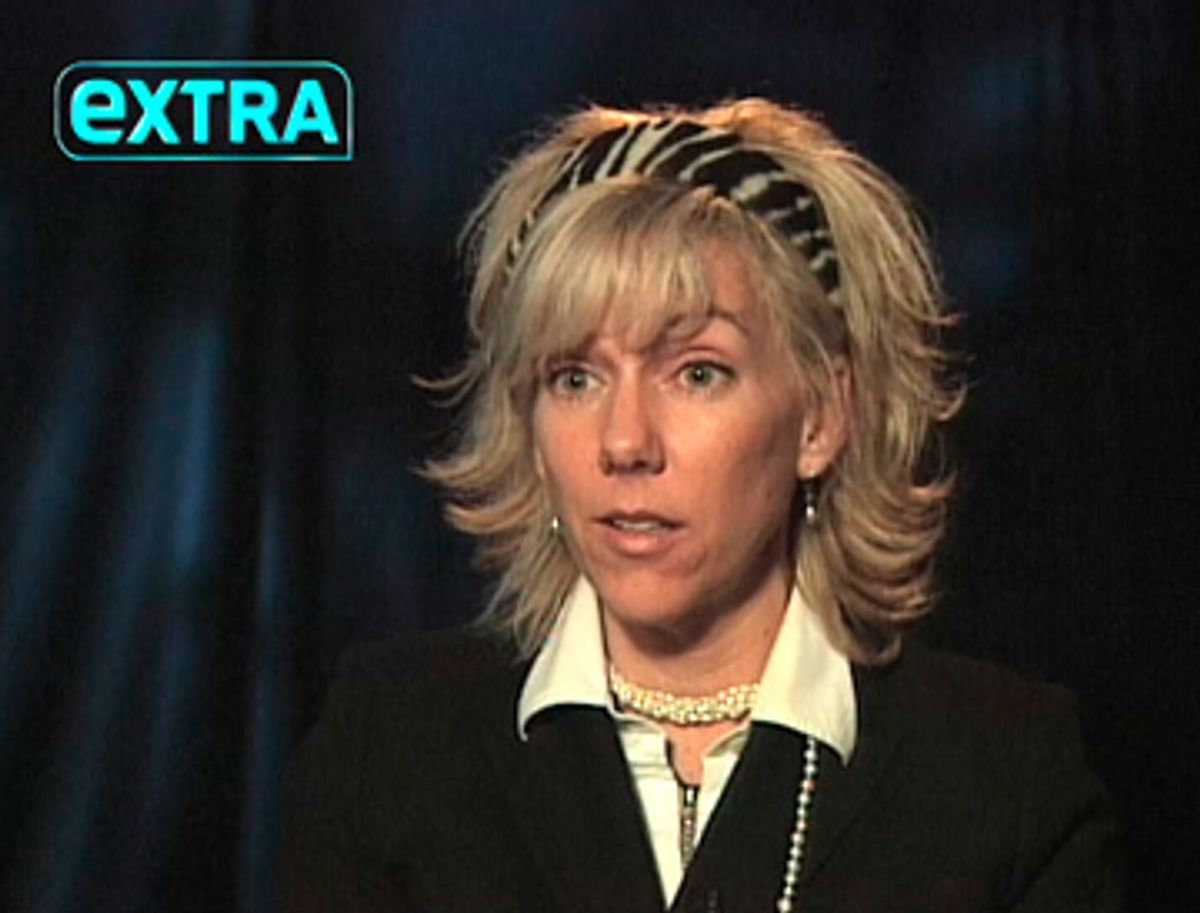
The life of John Edwards flame Rielle Hunter has been a novel, literally, with Bolivian marching powder, movie scripts called "It's All About Uranus" and electrocuted horses.

  • more
    • All Share Services

Topics:

Get Rielle

Before John Edwards’ mistress was a journalistic curiosity, she was a literary inspiration. Rielle Hunter was the model for the drug-addled Alison Poole, a vapid and endearing Manhattan party girl who appeared in at least three novels by two of the bright lights on the ’80s literary scene, Jay McInerney and Bret Easton Ellis.

We can only guess what attracted Edwards to Hunter. He told Bob Woodruff in the now famous ABC interview that he shared the details of the affair with his wife, Elizabeth, and that was all he was saying. By the time Edwards met Hunter in 2006, she had put down the coke spoon and picked up “The Power of Now,” a self-help book by Eckhart Tolle. She had remade herself into a New Age guru and was on a mission to help “people wake up in their lives.” Whatever the reason for it, the attraction between the well-coiffed Southern politician and the once wild New York party girl has granted added intrigue to this year’s political sex scandal.

McInerney, made famous by “Bright Lights, Big City,” his highly entertaining descent into the dark side of yuppiedom, briefly dated Hunter in the ’80s. He has said he was so “intrigued and appalled” by the hedonistic Hunter and her friends that they became the raw material for his 1988 novel, “Story of My Life.” At the time, Hunter was an aspiring Manhattan actress, who ran with a crowd as devoted to cocaine as art. She made the rounds with Ellis and partied with artists Keith Haring and Jean-Michel Basquiat.

“I still remember the first time I saw her,” Pigeon O’Brien, a friend of Hunter’s in New York, told Salon. “I was going to a party. As I approached, the doors of this 1920s building burst open. [Hunter] and Jay were laughing hysterically and collapsed on the sidewalk together. They looked like Scott and Zelda to me.” In fact, like one of F. Scott Fitzgerald’s famous characters, Hunter was hiding her own dark family secret.

Hunter, whose given name was Lisa Druck, was born in Fort Lauderdale, Fla., in 1964. Her father, James Druck, was a wealthy attorney, who ABC News reported flew his own plane and owned a horse farm called Eagle Crest in Ocala, Fla. In her youth, according to ESPN, Hunter loved riding and competed in shows across the state on her favorite horse, Henry the Hawk.

But after James Druck got into financial trouble, he allegedly hired a man named Tommy “The Sandman” Burns in 1982 to electrocute Henry the Hawk, so Druck could collect a $150,000 life insurance policy he had taken out on the horse.

In a 1992 story in Sports Illustrated, Burns claimed Druck showed him the technique: slice an extension cord into strands, attach alligator clips to the exposed end of each strand, stick the alligator clips on the horse’s ear and rectum and then plug the extension cord into a wall socket. Burns went on to execute a number of horses this way as part of insurance scams for other wealthy equestrians.

“You better get out of the way,” Burns told Sports Illustrated. “They go down immediately. One horse dropped so fast in the stall, he must have broken his neck when he hit the floor. It’s a sick thing, I know, but it was quick and it was painless.”

Burns was among a group of 35 people who were arrested and convicted in the ’90s of crimes related to the killings. After Henry the Hawk’s death, Hunter reportedly completed high school in Florida and then studied for less than two years at the University of Tampa, before dropping out.

At some point in the ’80s, Hunter made her way to New York to pursue acting and fell in with McInerney’s social circle. O’Brien described Hunter, who was still going by the name Lisa Druck, as “intense” and a “firecracker.” “She was kind of a little unsophisticated,” O’Brien said. “She was like a horse just getting its legs. She had this great intellect but hadn’t yet harnessed or focused it.” In a 2005 discussion between Hunter and McInerney in the now defunct Breathe Magazine, McInerney recalled meeting Hunter at Nell’s, a famous New York club. She disputes that they met there, but confesses that “so much of ["Story of My Life"] was real.”

“For me you’re a little bit frozen in time, a little bit Alison Poole, the 21-year-old party girl in that book who runs around New York going to night clubs, doing drugs, and abusing credit cards,” McInerney told Hunter. “And I’m sure that your life wasn’t that simple or that extreme or that wasteable.” Via a publicist, McInerney declined to be interviewed.

In “Story of My Life,” Poole is exactly how McInerney describes her. She is a jaded aspiring actress who lives off an allowance from her rich father, while flitting between clubs, coke and acting classes. “Men. I’ve never met any,” she laments. “They’re all boys. I wish I didn’t want them so much. I’ve had a few dreams about making it with girls, but it’s kind of like — sure I’d love to visit Norway sometime.”

In one scene, Poole scams $1,000 from a Wall Street type with whom she had an affair — who gave her a sexually transmitted disease — by claiming she is pregnant by him and needs money for an abortion. Later, Poole falls in love with a commodities trader with a thing for Shakespeare, but ultimately they betray each other. Poole is not totally unredeemed. She has a blunt, unflinching honesty that McInerney told Hunter in the Breathe interview he drew directly from her.

The novel also echoes Hunter’s past and, in some eerie ways, the Edwards affair. In the final chapter, Poole reveals that her father may have killed her prize horse, Dangerous Dan, by poisoning him. And like the current scandal, Poole finds out she is pregnant, but there are two separate men that could be the father. The type of man Poole is attracted to seems strikingly like Edwards. “I like straight guys, I’d never go out with anybody who’s as irresponsible as me,” she says. “Most of the guys I know have really high powered jobs and make up for lost time when they’re not in the office. The Berserk After Work Club. I seem to attract them in a big way, all these boys in Paul Stuart suits with six-figure salaries and hellfire on a dimmer switch in their eyes.”

Alison Poole makes return appearances in Bret Easton Ellis’ “American Psycho” and “Glamorama” reprising the same Manhattan siren who captivates men and repels women. In one scene in “American Psycho,” a woman snipes about Alison, “If you had an American Express card she’d give you a blow job.”

Ready for something new, Hunter left New York for Los Angeles to escape the drugs and pursue her acting career. In 1991, she married attorney Alexander M. Hunter III, whose father was the prosecutor in the JonBenet Ramsey case, and the couple lived in Beverly Hills.

Ensconced in the movie industry, Hunter assumed a new role for herself. She legally dropped Lisa Druck for Rielle Hunter and penned scripts for TV and movies with oddball titles such as “Jupiter Where Are You?” “Shit Happens: The Never Ending Search for the Perfect Diaper,” and the seemingly porn-ready “It’s All About Uranus.” None of these treatments appears to have made it into production. Nor did a later idea to create a television series about women who have affairs with men to help them get out of loveless marriages. Hunter’s marriage was equally a flop. She divorced Alexander in 1999.

In 2000, Hunter shot her only film credit, a short comedy called “Billy Bob and Them,” which she wrote, produced, acted in and directed. The film’s cinematographer, George Mooradian, told Fox News that the movie, which was shot in Hunter’s home, had little plot and featured New Age-style altars, temples and crystals. Mooradian’s agent said he was not giving further interviews.

“She definitely had some connection to the Dalai Lama and Richard Gere, and there was an offer to meet the Dalai Lama,” Mooradian has said. With her move to California, Hunter had discovered a new high in New Age spirituality. In Breathe Magazine, she described a dramatic encounter with a healer, who cleared her “energy field,” snuffing out her desire for drugs and alcohol. “I became sober overnight,” she told McInerney. “And then I became a spiritual seeker — addicted to higher consciousness, addicted to enlightenment.”

Hunter pursued spirituality with the same abandon that she had once pursued drugs. On her Web site, Hunter wrote she spent “thousands and thousands” of dollars on gurus. At one point, she hocked a rare statue of one of her favorites — Baba Muktananda — to raise money for a retreat. Hunter said at the 2004 retreat she had a spiritual breakthrough, or, as she later put it: “Shift happens.”

In 2005, Hunter and her friend O’Brien crossed paths again. “The first thing she said to me was, ‘I am awake,’” O’Brien told Salon. “She said she had achieved some higher level of consciousness.”

Hunter set up a nonprofit foundation called Being Is Free to spread her spiritual ideas. The foundation’s Web site has been scrubbed from the Internet, although parts of it have been preserved at Deceiver.com. Salon contacted the foundation’s directors by e-mail and phone, but they did not respond to inquiries. On the site, Hunter effuses about her spiritual journey, Prada backpacks and her relationships, exhibiting the sense of humor of the old party girl: “I’ve come to realize through a lot of experience that men are in fact good for a couple of things. Three things to be specific. Penetration, moving heavy objects and causing enlightenment.”

Just as she met McInerney, Hunter, in 2006, met Edwards in a New York bar. While he may have been smitten with her in the obvious ways, she was on a messianic mission. Jonathan Darman, a Newsweek reporter, who befriended Hunter while he was covering Edwards, wrote that Edwards was Hunter’s latest enlightenment project. “Edwards, she said, was an old soul who had barely tapped into any of his potential.” He had the power to “change the world.” If Edwards could only tap into his heart more, Hunter believed he could be a leader on par with Gandhi or Martin Luther King Jr.

Hunter set up a video production company and received $100,000 from Edwards’ campaign to film a series of short Web films about him. The candid movies were supposed to present John Edwards uncut — a loose, spontaneous version of the candidate. In the first “Webisode,” Edwards jokes and lounges on a plane as he prepares a speech. “I’ve come to the personal conclusion that I actually want the country to see who I am, who I really am,” Edwards said. “But I don’t know what the result of that will be.”

Hunter, who once sought the media spotlight like a moth does a flame, has fluttered into the shadows since the scandal broke. Her phone number is unlisted and e-mail sent to her personal address bounces back.

Continue Reading Close

Justin Jouvenal is an editorial fellow at Salon and a graduate student in journalism at New York University.

Justice for John Edwards

I worked for him briefly -- and the FBI asked me about his case. Why I'm glad he's not going to jail

  • more
    • All Share Services

Topics:

Justice for John EdwardsJohn Edwards (Credit: AP/Chuck Burton)

Few things are more disconcerting than answering your door wearing shorts and a tank top and finding be-suited FBI agents sticking badges in your face and asking to speak to you about a former, remarkably brief job you held three years prior. As soon as the agents dropped the name “John Edwards,” I figured that no matter what this was about, I might as well let them in and be as cooperative as possible. After a few questions about my two weeks on the campaign, it became obvious to everyone in the room that they were wasting their time with me because I had literally no information whatsoever about the campaign’s finances, much less any potential financial irregularities, leaving me nearly apologizing to them as I let them out of the apartment 10 minutes later. All I could do after such a weird event was to hop on chat to tell a friend, “Huh, I think maybe John Edwards is in trouble for campaign finance law violations.”

It all seemed very serious to me at the time, which is why I was astonished when the charges finally emerged. It seemed that federal prosecutors desperately wanted to find a way to legally punish Edwards for adultery, and their only hope of doing that was to reclassify hush money paid by private Edwards supporters directly to Rielle Hunter and Andrew Young as a campaign contributions, even though the money didn’t go to the campaign and “hush money for mistresses” has never before been treated like a traditional campaign expense. Luckily, the jury seems to have seen through the ruse, finding Edwards not guilty of one charge, and drawing a mistrial on the rest.

With the news of Karl Rove crowing about how he intends to spend $1 billion in untraceable funds to beat Obama in 2012, it looks particularly ridiculous for the government to waste resources on a showboat prosecution. Even the conservative news magazine National Review had to denounce the prosecution as a waste. John Edwards has been disgraced, humiliated and run out of politics. Bringing the full force of the law down on him on top of it all just seems greedy.

It’s become customary in politically obsessed circles for observers to preen about how they knew that Edwards was bad news all along. His lawyerly ways! His sentimental stories about growing up working class! His hair! How could his silly supporters not see him for the philandering phony he so clearly was?

Of course, a quick perusal of the John Edwards of 2007 demonstrates that this sort of hindsight owes more to revisionist wishful thinking than a correct assessment of the evidence at the time. Back then, the other potential Democratic nominees, Hillary Clinton and Barack Obama, were widely and correctly perceived as timid centrists who had a knee-jerk tendency to run from conflict the second conservatives ruffled their feathers. Edwards, on the other hand, spoke convincingly of how change couldn’t come from  “negotiation and compromise,” arguing that the idea that corporate interests would voluntarily give away their power is “a fantasy.” Long before the economic crash and Occupy Wall Street forced major Democratic politicians to address the question of growing inequality, Edwards’s famous “two Americas” rhetoric helped force the issue onto the table. Occupy boiled it down to the 1 Percent vs. the 99 Percent, but back in 2007, Edwards was taking cracks at “the very rich vs. everyone else.”

In the rush of headlines about Edwards’s despicable sexual behavior, what’s forgotten is how much his campaign haunted the primary contest between Clinton and Obama long after he dropped out. An early push in the campaign season from Edwards on healthcare reform set the tone for the rest of the election season on this issue. Edwards put out a plan for healthcare reform before the other candidates, forcing the other candidates to release competing plans that were likelier farther to the left than they were comfortable promising. It’s arguable that without the primary season pressure from the Edwards campaign, the initial gambit of the Democrats in the healthcare reform battle — one that included a public option — wouldn’t have been as strong, which would have meant an even weaker bill than the one that eventually was pushed past conservative Democratic opposition.

Because of this, no one was hurt worse by the revelation that Edwards was cheating on his well-loved wife than his most ardent supporters. If he’d been outed sooner, he would have destroyed not just his own candidacy but all the hard work in getting income inequality and progressive health care reform into the 2008 campaign. For those who take those issues very seriously, this felt less like a boneheaded mistake and more like a betrayal.

But being weak-willed and disappointing your supporters can’t be treated like a crime, or else most of D.C. should be yanked from their cocktail parties and tossed into the clink. Even those who’ll never be able to forgive Edwards for nearly destroying his legacy should be grateful for the good sense shown by the jury today. Let’s hope the Justice Department takes their lead and lets this one go.

Continue Reading Close

Amanda Marcotte is a Brooklyn-based freelance writer and journalist. She's published two books and blogs regularly at Pandagon, RH Reality Check and Slate's Double X.

Mistrial for John Edwards

The former candidate will walk free after the jury deadlocked on five charges and found him not guilty of another

  • more
    • All Share Services

Topics:

Mistrial for John EdwardsJohn Edwards (Credit: AP)

John Edwards was found not guilty on one count today in his corruption trial in North Carolina, but the jury was deadlocked on the remaining five. The judge declared a mistrial on the outstanding charges, suggesting the saga may be far from over.

Edwards, the former senator and presidential candidate, is charged with violating federal election laws while trying to cover up an extramarital affair and love child in 2008. The six counts are related to improper use of campaign donations and accepting illegal campaign contributions. He faced a maximum of 30 years in prison and $1.5 million in fines if convicted on all counts.

Count three, the only one the jury ruled on, alleged that Edwards received excessive campaign donations from billionaire Bunny Mellon. Edwards will walk away as a free man.

The news of the verdict was bungled when, in a highly unusual move, the jury announced they had reached a verdict on the one count, which was misunderstood as a verdict on all counts. The initial announcement unleashed a tide of breaking news alerts and blaring chyrons on cable news outlets, only for it to be revealed minutes later that the jury was actually deadlocked on most of the counts and had only reached a verdict on one out of six. The jury had deliberated for eight days without a verdict in the case that experts had said would be difficult for the federal government to prove.

Continue Reading Close

Alex Seitz-Wald is Salon's political reporter. Email him at aseitz-wald@salon.com, and follow him on Twitter @aseitzwald.

FEC says Edwards should repay $2M in federal money

Election commission orders disgraced Democratic politician to reimburse government for ill-gotten campaign funds

  • more
    • All Share Services

Topics: ,

FEC says Edwards should repay $2M in federal moneyFILE - In this March 22, 2007, file photo Democratic presidential hopeful John Edwards listens to his wife Elizabeth, not shown, talk to media about her recurrence of cancer during a news conference in Chapel Hill, N.C. The legal case against two-time presidential candidate focuses on where to draw the line between the public and private in a politician's life. The central dispute over Edwards' indictment on felony charges is whether money, spent by two supporters to keep his mistress in hiding, were campaign contributions or private gifts from friends. (AP Photo/Gerry Broome, File)(Credit: AP)

The Federal Election Commission said Thursday that former North Carolina Sen. John Edwards’ 2008 presidential campaign should repay the U.S. Treasury more than $2 million.

The commission voted 6-0 to order the repayment after conducting an audit of the campaign.

A telephone call by AP to Edwards’ attorneys seeking comment was not immediately returned. Edwards’ attorneys have said the Democrat’s campaign doesn’t owe anything.

Federal auditors said the campaign understated its cash on hand and overstated its expenses, including money spent to wind down the campaign. Auditors also found that the campaign failed to itemize more than $4 million in loan repayments.

Such audits are required by law for federal campaigns that accept public financing, several of the commissioners noted.

“It is not at all unusual for a campaign to have a discrepancy,” said Ellen Weintraub, a commissioner. “It’s just a math problem and that’s how the math worked out.”

Federal auditors said about $2 million of the amount to be repayed was due to federal matching funds the Edwards campaign received but did not deserve. Auditors said the repayment also should include $141,808 in uncashed checks the campaign issued to donors that were never cashed, according to the audit.

The campaign got nearly $13 million in matching funds after it was approved by the Federal Election Commission in December 2007. Edwards dropped out of the race Jan. 30, 2008.

The Federal Election Commission’s ruling is the latest problem for Edwards, who was indicted last month on federal charges that he accepted illegal campaign contributions to hide an affair during his unsuccessful 2008 White House bid. Edwards, who was the 2004 vice presidential nominee, has pleaded not guilty to six felony charges that include allegations he filed false campaign reports to cover up the payments.

The Edwards campaign has continued to spend down its cash. It had about $2.6 million in cash on hand on June 30 after spending $183,000 during the previous three months.

Continue Reading Close

John Edwards asks judge for delay in sex tape case

Rielle Hunter claims a former Edwards aide took sensitive materials from her; hearing is scheduled for Thursday

  • more
    • All Share Services

Topics:

John Edwards asks judge for delay in sex tape caseFILE - In this March 22, 2007, file photo Democratic presidential hopeful John Edwards listens to his wife Elizabeth, not shown, talk to media about her recurrence of cancer during a news conference in Chapel Hill, N.C. The legal case against two-time presidential candidate focuses on where to draw the line between the public and private in a politician's life. The central dispute over Edwards' indictment on felony charges is whether money, spent by two supporters to keep his mistress in hiding, were campaign contributions or private gifts from friends. (AP Photo/Gerry Broome, File)(Credit: AP)

A judge in North Carolina will hear arguments over whether former presidential candidate John Edwards should have to testify this month in a case involving a purported sex tape.

The hearing is scheduled to take place Thursday in Raleigh.

Edwards filed a motion last week asking that his scheduled June 20 deposition be postponed. He’s being called to testify in a lawsuit filed by his former mistress, Rielle Hunter. Hunter claims a former Edwards campaign aide took sensitive materials from her, including a reputed sex tape showing Edwards. She wants the items returned.

The former senator says his deposition should wait until the resolution of federal criminal charges against him. Earlier this month, Edwards was indicted on charges of violating campaign finance laws. He’s pleaded not guilty.

John Edwards’ creepy mug shot

The disgraced senator flashes an unnerving grin -- just like Tom DeLay

  • more
    • All Share Services

Topics: , ,

John Edwards' creepy mug shotEdwards sports a cold, dead smile in his mugshot

If the pictures of Anthony Weiner and (allegedly) a sunbathing Newt Gingrich weren’t too much for you, here’s another unsettling image: CNN’s Ed Hornick has posted John Edwards’ mug shot. Edwards, who faces felony charges for allegedly using over $1 million of campaign cash to hide his extramarital affair and child, went for the unnerving smile with accompanying cold, dead eyes for his photo:

The image is reminiscent of Tom DeLay from the Republican former House majority leader’s mug shot. (DeLay was ultimately convicted on conspiracy and money-laundering charges.)

We wonder whether the smiles here are meant to convey confidence or an image of innocence. If so, neither man succeeded.

Natasha Lennard covers the Occupy movement for Salon. A British-born, Brooklyn-based journalist, she has been covering Occupy Wall Street since before the first sleeping bag was unrolled in Zuccotti Park. One of the first journalists arrested at an Occupy action, she has managed to enrage Andrew Breitbart, Rush Limbaugh and Glenn Beck. You can follow her on Twitter (@natashalennard), and email her any Occupy updates/videos/ideas to natasha.lennard@gmail.com

Page 1 of 52 in John Edwards