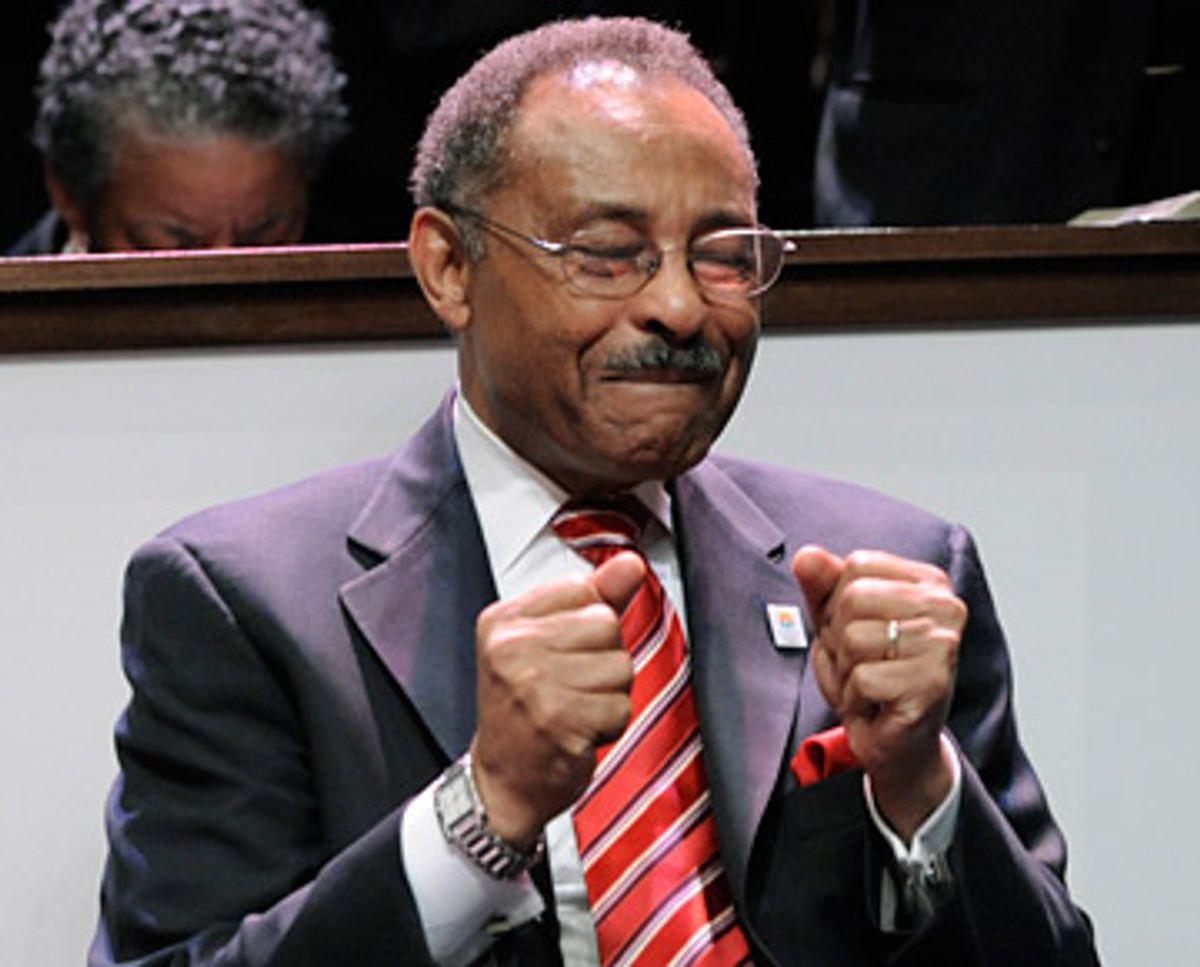
Salon does its best to figure out the state of the fight between Senate Democrats and Rod Blagojevich's pick to join them.

AP Photo/Paul Beaty
Roland Burris, Illinois Gov. Rod Blagojevich’s designate to fill Barack Obama’s Senate seat, reacts to a speech by Rep. Bobby Rush, D-Ill., at the New Covenant Baptist Church during a rally in Chicago Sunday.
Since Illinois left our universe for somewhere more surreal about a month ago, it’s gotten a little difficult to keep abreast of political twists and turns in the Land of Blago. If wondering whether we can expect a Sen. Roland Burris has left you hopelessly confused, you’re not alone. Here, then, is an update, so you too can speak expertly about the situation.
As of the end of last week, things were at a standoff. Burris was saying he’d be a senator, while the Democrats already in the Senate were saying he wouldn’t, and were warning that if Burris were to show up, they might enlist the sergeant-at-arms to keep him out of the chamber. That’s a scene nobody wants to see: Burris ends up looking illegitimate, and after getting compared (no matter how unfairly) to Bull Connor, do the Democrats really want to use a police officer to keep the Senate’s black population at zero?
The pseudo-senator-designate is getting on a plane to D.C. today, but he told the Chicago Tribune that he was “not going to create a scene in Washington.” So, for now, the Burris-gets-cuffed-in-the-rotunda scenario is looking unlikely, especially because the secretary of the Senate has now rejected Rod Blagojevich’s letter of appointment, which was missing a signature from Illinois Secretary of State Jesse White, who last week refused to sign it. Burris is hoping the Illinois Supreme Court will order White to reconsider; without that signature, he can only sort of claim to have been appointed.
Sunday, Burris attended a send-off rally with ministers and local black leaders at New Covenant Church on Chicago’s South Side, where Rep. Bobby Rush called the Senate “the last bastion of plantation politics.” Meanwhile, Majority Leader Harry Reid seemed to soften his position, saying on “Meet the Press,” “I’m an old trial lawyer. There’s always room to negotiate.” Reid may feel more vulnerable to charges of racism than he originally might have been, as allegations have emerged that he pushed Blagojevich to appoint either Tammy Duckworth or Lisa Madigan over African-American options Jesse Jackson Jr., Danny Davis and Emil Jones.
It’s still unclear whether Reid was deliberately opening the door to Burris or not. His deputy, Illinois’ Dick Durbin, said yesterday that there are no plans to seat Burris provisionally. However, Democratic leaders do plan to meet with him on Wednesday.
If the Senate does try to keep Burris out, we can expect a lawsuit, Burris lawyer Timothy Wright says. And, though there’s precedent (Powell v. McCormack) for forcing Congress to seat a duly elected member with dubious ethics, the meaning of that case for this situation is debated.
Writing at Slate, professors Akhil Reed Amar and Josh Chafetz say that a simple majority in the Senate has the power to reject Burris. Because the Constitution makes the Senate “the Judge of the Elections, Returns, and Qualifications of its own members,” appointments fall under its jurisdiction just as much as elections. The spirit of Powell, write Amar and Chafetz, is that the people’s unambiguous choice ought to be respected, but if no such will has been expressed, the Senate gets to exercise its authority; as with impeachment, senators don’t need a criminal conviction to judge someone unsuitable for office.
But, law professor Eugene Volokh writes on his blog, Powell makes clear that the judgment of suitability for office is an exclusively objective question. The Senate, he writes, has the power to reject someone who has been legally compromised, is not a citizen, or is not old enough. “But if the argument is simply that Blagojevich is generally a criminal, and not that the appointment of Burris was done criminally, I don’t see how that can fit within the Senate’s power.”
We’ll be keeping an eye on developments, naturally, and doing our best to discern and relay what they mean.
Now Mitt’s refusing to debate
The calculation – and risk – behind his apparent decision to boycott the final pre-Super Tuesday debate
Republican presidential candidate, former Massachusetts Gov. Mitt Romney (Credit: AP)
(Updated)
Word is now breaking that Mitt Romney has decided not to participate in a long-scheduled debate on March 1, just days before the critical Super Tuesday primaries. Romney’s campaign has yet to confirm the news, but a spokesman for the Georgia Republican Party — which along with CNN is sponsoring the debate — is saying that “word was passed along to CNN this morning” by the campaign, while CBS News and National Journal report that Romney is blaming a scheduling conflict.
Assuming the reports are true, that’s a transparently lame excuse. Even if Romney has other events planned for the same night, he has two weeks to shuffle his schedule around. Besides, the GOP debates have been must-see events that have attracted massive audiences; the entire political world essentially shuts down when they take place. What could Romney possibly have scheduled that would keep him from attending?
Clearly, this is about Romney not wanting to take part — which, in and of itself, is hardly surprising. Debates can be tense and unpredictable and Romney comes to all of them with a target on his back. And in Rick Santorum, he now faces a main rival who is actually pretty good at them. Santorum knows exactly where Romney’s weaknesses are and exactly how to attack him. This is a threat that Romney didn’t have to worry much about with Rick Perry (who struggled to formulate complete thoughts on his feet), Herman Cain (who literally had nothing to say besides “9-9-9″) and Newt Gingrich, who melted down when Romney turned up the heat in two Florida debates last month. So from Romney’s standpoint, it would be ideal not to have to worry about any debate slip-ups and to focus on using his huge financial advantage to destroy Santorum with negative ads.
The problem is that skipping debates is something that confident, inevitable front-runners do — not front-runners who are so wounded that they might not even be front-runners anymore. With his poll numbers crashing and Santorum surging, Romney’s debate boycott looks awful, a reeling candidate who’s afraid to face his opponents. And it plays right into Santorum’s efforts to paint Romney as a candidate who has nothing to offer besides a deep bankroll and negative ads. This gives Santorum a valuable talking point for the days ahead — one that will become even more potent if he’s able to knock off Romney in Michigan on Feb. 28.
The funny thing is that Romney is actually pretty good at debates. Yes, he’s had a few slip-ups and he’s benefited from feeble opposition, but chances are he’d do just fine on March 1 — just as he’ll probably survive next week’s debate in Arizona, assuming he doesn’t back out of that too. In other words, he may get more grief now for skipping a debate than he’d get from his opponents if he actually showed up at it.
Update: Romney’s campaign has now confirmed that he won’t be at the March 1 debate:
“Gov. Romney will be spending a lot of time campaigning in Georgia and Ohio ahead of Super Tuesday,” spokeswoman Andrea Saul said in a statement. “With eight other states voting on March 6, we will be campaigning in other parts of the country and unable to schedule the CNN Georgia debate. We have participated in 20 debates, including eight from CNN.”
Mitt’s ticking Maine time bomb?
One tiny Down East county could cause some serious trouble this weekend
Republican presidential candidate, former Massachusetts Gov. Mitt Romney (Credit: AP)
The timing couldn’t have been worse for Mitt Romney when the Iowa Republican Party retracted its declaration that he’d won the state’s caucuses and instead awarded the win to Rick Santorum on Jan. 19. The reversal came just two days before the South Carolina primary, as Romney’s once commanding lead in the state was melting away and Newt Gingrich was overtaking him in the polls. The news, which nullified Romney’s impressive-sounding distinction as the only modern GOP candidate to win both Iowa and New Hampshire, meshed perfectly with the idea that he was melting down (even if it did nothing immediate to boost Santorum).
And now there’s a possibility that something similar could play out in the near future, this time thanks to the ineptitude of the Maine Republican Party.
The state GOP had given local communities a one-week window from Feb. 4-11 to hold caucuses, with the statewide tally announced last Saturday night. At that point, Romney was declared the winner by 194 votes (or a 3 percent margin) over Ron Paul. But there was a catch. Several communities had flouted the state party’s edict and held or scheduled caucuses outside of the designated window, while one county — Washington — had been forced by threats of inclement weather to postpone caucuses that were originally scheduled for Feb. 11 by a week.
At first, this didn’t seem like too big of a problem. Not counting votes from places that willfully ignored the window seemed reasonable enough; if they’d wanted to be part of the statewide tally, they could have followed the rules. And while Washington County did attempt to follow the rules, it seemed unlikely that the results from caucuses there would, when they were finally announced, alter the statewide outcome, given how low turnout in the county was for the ’08 caucuses and how poorly Paul did back then (eight votes).
But since last Saturday, some major errors in the state GOP’s official tally have come to light. As the Bangor Daily News reported this week:
However, a review of the town-by-town results released Saturday by the Maine GOP suggests that some communities that had caucused prior to Feb. 11 were not counted. Nearly all Waldo County towns held caucuses on Feb. 4 but those towns were blank in the results released by the state party. Additionally, Waterville held its caucuses ahead of time but were not included in the results.
Waldo County GOP Chairman Raymond St. Onge said the results were sent to the state party on Tuesday, Feb. 7. He said those results probably would not have changed the outcome but was disheartened the votes were not included.
St. Onge said he spoke to party officials late Tuesday about why Waldo County’s results were omitted.
“They said it was a clerical error,” St. Onge said. “I’m going to believe them because there were other errors that occurred. I don’t think it was intentional because our results wouldn’t have changed the winner.”
While St. Onge, the Waldo County chairman, says the omitted results wouldn’t have changed the statewide outcome, they could have cut into Romney’s margin. The same is true for Waterville, a city of about 17,000 people (10th largest in the state) in Kennebec County. There are other potential issues too. But so far, the state GOP is refusing to address the complaints or to alter its declaration of a 194-vote Romney victory.
But the questions may not go away. Washington County’s caucuses will be held this Saturday, and media outlets will surely be watching the results closely. It’s true that Paul fared poorly there in ’08, but he clearly has more support now; the question is whether he’s gained enough ground to beat Romney, and if he can do so by a margin big enough to cast new doubt on the statewide totals. The more Paul cuts into Romney’s lead on Saturday, the more pressure there will be for the state party to review the previous results.
The wild card in all of this is turnout on Saturday. Because it was so low statewide — just over 5,000 — a big spike in interest in Washington County could have a real impact. As Bill Nemitz of the Portland Press-Herald said on Rachel Maddow’s show last night, “the amount of attention focused on Washington County is unprecedented and their turnout on Saturday might eclipse the turnout from the rest of the state this past weekend.”
If Romney’s victory is ultimately overturned, timing will be key. Currently, the state GOP isn’t scheduled to meet until March, the Saturday after Super Tuesday. Depending on how the GOP race is progressing, having his Maine win tossed out then could be a serious blow to Romney — or it might not matter at all, if he’s coming off a series of big victories. But the timeline might also speed up. If (and it’s a very big if) Paul scores an emphatic victory in Washington County this weekend, it will be a lot tougher for the state Republican Party to run out the clock on this one.
The anti-Santorum onslaught begins
Will he be any more capable of fending off Mitt’s attacks than Newt was?
VIDEO
We’ve known it was coming from the moment Rick Santorum scored his surprise three-state sweep last week, and now it’s here: The first anti-Santorum attack ad from Restore Our Future, the Mitt Romney-aligned super PAC:
The spot is apparently running in Michigan (where the latest polls all show Santorum ahead of Romney), Ohio (where a poll today puts Santorum ahead by seven points), and Arizona (where Romney seems to be in better shape). Presumably, the number of attacks ads like this and the frequency with which they air in these states will increase in the days ahead.
This, of course, is the formula that Romney relied on to undermine Newt Gingrich when the former House speaker emerged as his chief rival in the run-up to last month’s Florida primary. In a way, Santorum is in basically the same position Gingrich was then, frantically playing financial and organizational catch-up after a breakthrough victory. So Gingrich’s Florida futility seems telling: Even with a major boost in fund-raising and a $5 million check from Sheldon Adelson, he was still outspent by Romney by an estimated $12 million on ads in Florida.
Now it’s Santorum’s turn to face this kind of disparity. Money has been flowing into his campaign like never before this past week and he’s found his own super PAC benefactor, but there’s just no way he and his allies will even come close to matching what the Romney forces will be able to spend in Michigan, Ohio and any other state they deem crucial to their strategy. What’s worse, the Wall Street Journal reported today that Adelson, who’s been sending signals behind the scenes that he wants to stay loyal to Gingrich but also wants to help Romney, may have found a way to reconcile his inner-conflict — funding ads that are ostensibly aimed at helping Gingrich but that actually do Romney a big favor by bashing Santorum.
If there’s a ray of hope for Santorum, it can be found in the content of Restore Our Future’s new attack ad, which blasts Santorum for votes as a senator to raise the debt ceiling and allow convicted felons to vote and for earmark requests. What’s striking is how little the Romney forces have to work with; after all, you can always find something to put in a 30-second attack ad, but the material being used here has an obscure/random feel to it. Santorum, with his generally consistent conservatism and lack of serious personal baggage, just doesn’t isn’t the same ripe target as Gingrich. When the Romney campaign needed to attack him, the ads literally wrote themselves:
So it’s fair to wonder how much punch the anti-Santorum ads will pack. Plus, Santorum — again, unlike Gingrich — is actually a generally competent candidate running a generally competent campaign. Which means his side wasted no time mounting a response to the Romney blitz:
Santorum doesn’t have the money to saturate the airwaves with ads like this. But his real aim may be to them to generate viral and free media attention and to convince influential conservatives around the country to rally to his defense and push the Mitt-as-bully narrative.
Chris Christie’s gay marriage headache
What’s good for his 2016 dreams could complicate his ability to survive 2013
Chris Christie (Credit: AP/Mel Evans)
There are two elections on the horizon that Chris Christie has a particular interest in. The first is in New Jersey next year, when he’ll seek a second term as governor. The second is in 2016, when he’ll make a logical presidential candidate — if he wins reelection in ’13 and if the Republican nomination is open. (For now, at least, let’s leave aside the idea that Christie might serve as his party’s vice presidential candidate this year.)
This makes the debate over gay marriage in the Garden State, where the Democratic-controlled Senate approved marriage equality legislation yesterday, a problem for him.
On the one hand, support for gay marriage among New Jersey voters is solid — 52 percent favored it and 42 percent opposed it in one recent poll, while another pegged the margin at 48-37. Among independents, support is even higher. And the trajectory seems clear: Just five years ago, those overall numbers were reversed when the topic was polled. Given how rare Republican victories in New Jersey are (Christie’s 2009 win marked just the fifth statewide triumph for the GOP in 37 years, and only the second that was won by more than a point), Christie has to be very careful as he approaches his reelection race. He doesn’t have much margin for error when it comes to alienating swing voters — one of the reasons he was so colorful and adamant in denying interest in the presidential race last year — and swing voters in New Jersey are generally fine with gay marriage.
But Republican voters nationally are not, and it will be a long time before they are (if they ever are). So if he wants to preserve his viability for ’16, Christie cannot be known as the New Jersey governor who enacted same-sex marriage. But he also can’t position himself as a hard-line, stop-at-nothing-to-derail-it opponent of it; to do so would reek of the cultural conservatism that has made most national Republicans unmarketable in New Jersey and endanger Christie’s reelection prospects. And if he gets the boot in ’13, it could sink whatever ’16 ambitions he has.
Christie’s workaround has been to oppose gay marriage while calling for a public referendum. This has elicited howls from gay marriage supporters, who argue that minority group rights should never be put to a vote, but it has aligned him with a clear majority of voters, who say they like the referendum idea. Of course, a referendum campaign would be long, messy and divisive. And anyway, Democrats in the Legislature have the votes to make sure one never takes place.
But yesterday’s state Senate vote offered another potential way out for Christie: a legislative override. Twenty-four of the chamber’s 40 members — including two Republicans — voted for gay marriage, a surprise result and a significant increase from the last such vote in 2010. It would only take three more votes to reach the number needed to override Christie’s veto. In the Assembly, where the bill will now head, Democrats enjoy a 47-33 majority, with 54 votes needed to override a veto.
The Republican Party in New Jersey has its very conservative pockets, but the cultural moderation of Clifford Case, Tom Kean and Christie Whitman is still prevalent too. There probably are a handful of GOP senators and a scattering of Assembly members who are personally OK with gay marriage and who could survive politically if they voted for it. This presents a Machiavellian possibility for Christie: Wink at them, continue voicing his opposition, then throw up his hands as the Legislature overrides him and takes the issue off the table. As Josh Benson of Capital New York theorizes:
That would be a slap in Christie’s face, for sure. But it’s not clear that it would hurt. After all, if Christie vetoes same-sex-marriage legislation and gets overridden, he’ll be able to tell conservatives one day, when he’s asking for their support, that at least he tried to keep the liberals in check.
The Legislature has until the end of its current term to override Christie — meaning nearly two years. So don’t expect an override any time soon. But if popular support keeps growing and Christie finds himself staring at a difficult reelection race in ’13, it might start to make sense.
Why everyone is still writing off Santorum
He’s taken the lead in three national polls, but there are four reasons why it might not last
Rick Santorum (Credit: AP/Elaine Thompson)
Rick Santorum has won four of the first nine Republican nominating contests, leads in three of the four most recent national polls, and has even pulled ahead of Mitt Romney in Michigan, Romney’s native state. In so doing, he’s turned what was supposed to be an easy month for Romney into a nightmare and drawn fresh attention to the party base’s reluctance to get behind the former Massachusetts governor.
But the political world seems to be taking this all in stride. Sure, the newest poll numbers are dominating headlines, but the tone of the coverage suggests that Romney is still seen as the most likely nominee — by far. For all of his woes, Romney is still given a 75 percent chance of winning the nomination by Intrade, with Santorum at just 16 percent. Four factors seem to be driving this conventional wisdom:
1. We’ve been here before: This is the most obvious reason, and it’s been the defining story of the GOP race. One after another, we’ve seen Romney opponents suddenly rise from the back of the pack, vie with him for the lead, promise to unite the Mitt-phobic right, and then … flame out. Significantly, Romney has never experienced the kind of crash that any of these challengers have; he’s had trouble opening up a wide lead in national surveys, but he also seems incapable of falling much below 25 percent. So far, whenever they’ve been forced to focus, Republican voters have ultimately judged Romney’s opponents more unacceptable than him. And when he has scored primary victories, he’s seen his national numbers climb near 40 percent. He’s almost broken away from the pack, in other words. So if past is prologue, Santorum’s surge will prove fleeting, Romney will steady his ship, and we’ll soon be back to talking about Romney’s inevitability. And even if we then go through this cycle again, there’ll still be reason it will end the way it always does, with Romney on top.
2. Money: Romney’s campaign has more of it, and so does the super PAC that’s aligned with him. A lot more of it. Restore our Future, the pro-Romney group, has now committed about $700,000 for television ads in Michigan through early next week, according to the New York Times. A lot more will undoubtedly come after that, since Michigan doesn’t vote until February 28. Restore our Future is also investing in several southern states and in Ohio, where primaries will be held on March 6. Santorum just can’t compete with this. Sure, he’s been on a fund-raising tear since his three-state sweep last week and he has a super-wealthy ally bankrolling a friendly super PAC. But this is similar to what happened to Newt Gingrich a few weeks ago, when a South Carolina victory flooded his campaign with money and prompted Sheldon Adleson to write another $5 million check — and it still wasn’t nearly enough to compete with Romney in Florida.
3. Vicious attacks: They’ve become Romney’s trademark and they go hand-in-hand with his massive bankroll, which can be spent on devastating negative ads as needed. Twice now, Romney and his super PAC have used this technique to combat Gingrich, once in Iowa back in December and again in Florida. And they’re still not letting up on the former House speaker; many of the ads now airing in Michigan are aimed at him. It may be that the Romney forces simply haven’t had time to create anti-Santorum spots yet; or maybe they just want to make sure Gingrich really is marginalized once and for all. Either way, it’s hard to believe that similar attacks against Santorum — who amassed ridiculous popularity in Colorado, Minnesota and Missouri by staying out of the Newt/Mitt sniping — aren’t coming. Romney has already begun trashing the former Pennsylvania senator in speeches and public events. And he’s generally been effective at dismantling his opponents in debates, something he’ll have an opportunity to do with Santorum next week.
4. Endorsements: As Jonathan Bernstein has been pointing out, Santorum’s breakthrough last week — like his breakthrough in Iowa back on January 3 — has not resulted in a flood of endorsements from prominent conservatives, or even a trickle. Especially given the financial disparities at work, it’s critical for Santorum to have loud, influential Republican opinion-shapers making his case and defending him against Romney’s attacks. One of the reasons Gingrich was hurt so badly by Romney’s Florida assault was that GOP elites mostly sat on their hands; they were secretly (or not so secretly) happy to see a candidate they saw as unelectable and unreliable cut down to size. The lack of support for Santorum now suggests that may hold similar reservations about him.
Of course, as I wrote last week, there’s one key difference between Santorum and the others who’ve vied with Romney for the lead this year: He’s a genuinely competent candidate. Not dazzling, but competent. He’s in line with the party base on just about every key issue, doesn’t have much personal baggage, can think on his feet in debates, and deliver a solid stump speech. This is more than can be said for Gingrich, Rick Perry and Herman Cain. This may be Santorum’s best hope: that the desire of the party base to nominate someone other than Romney is so strong that this basic competency is enough to overcome all of the advantages that Romney still enjoys.
Page 1 of 2638 in War Room

The next generation of color geniuses
I found my orgasm
A witty, tragic series concludes
Pick of the week: Escape from Putin’s cult
What are Republicans thinking?
Freedom of religion is freedom from religion
Reality, exploded
Now Mitt’s refusing to debate
Hollywood’s real-life night at the museum
Mitt’s ticking Maine time bomb? 

