
Nutrition
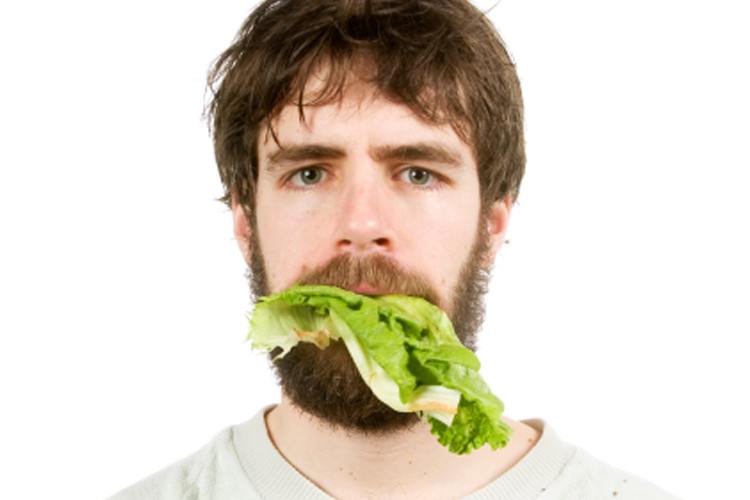
Forget vegan, he’s a “hegan”
The Boston Globe coins a ridiculous new term for manly men who don't mind eating their veggies
Not to be outdone by the New York Times Style section’s seemingly inexhaustible capacity for coining ridiculous words (see blipster, recessionista), the Boston Globe has a trend piece today that contains one of the most entertaining food-related neologisms in recent memory. In the article, the Globe’s Kathleen Pierce writes about the supposed hot new trend of the male vegan — men who refuse to eat meat and animal products and yet somehow manage to hold on to their masculinity. And because male vegan is far too unwieldy, she’s invented a new word: hegan.
What is a hegan, you might ask? They are, Pierce claims, “the new face of veganism”: “Men in their 40s and 50s embracing a restrictive lifestyle to look better, rectify a gluttonous past, or cheat death. They are hegans. They are healthy. And they are here to stay.” Hegans aren’t interested in the principles of veganism, or saving their environment, or wearing extravagantly colored vegan tunics — they’re just interested in living longer. (Men quoted in the piece tout veganism’s supposed ability to prevent cancer, diabetes and heart disease.)
And no, these are not the effete, flouncing vegans of yore — they are cops, and firefighters, and, most manly of all, men who skate on ponds. Case in point: Joe McCain, a mid-40s Somerville police detective whose weight problems — he once loved pizza, steak and fried foods — led him to “cut meat, dairy, eggs, chicken and fish from his diet and [add] power vinyasa yoga, which helped him shed 60 pounds in eight months.” Or what Pierce calls “the ultimate hegan,” Rip Esselstyn, a veteran Texas firefighter who convinced his department to shun animal protein — and turned his idea into a diet book called “The Engine 2 Diet.”
Unfortunately, Pierce admits, there are “no hard numbers on how many hegans exist.” This is unfortunate, because when promoting arbitrary trends, it’s often useful to have hard figures. (The entire trend piece, as it turns out, is based on anecdotal interviews with male vegans or vegan establishment owners.) Of course, that doesn’t mean that male vegans aren’t really on the increase — the growth of yoga culture and Michael Pollan-esque food politics have doubtless made it more and more acceptable for men to make educated eating choices, and statistics have shown that even if men aren’t going vegan, they’re spending more time in the kitchen.
And of course, it makes sense for the Globe to be inventing ridiculous new terms. People talk about it, blog about it, and if the newspaper is lucky, even begin using it in everyday speech. And, all things said, the succinct catchiness of the word is almost enough to forgive the weaknesses of the article. I can already hear vegan hipsters in Williamsburg and Silver Lake ironically referring to themselves as “hegans” — which, put in the manliest way possible, is actually kind of fabulous.
Thomas Rogers is Salon's Arts Editor. More Thomas Rogers.
What corporations don’t want you to know
Disclosure regulations don't ban products, they just inform consumers. So why do companies fight them so hard?
(Credit: AP/M. Spencer Green) Last month, Gallup reported that despite economic crises brought on by financial deregulation, far more Americans still worry that there will be too much regulation rather than not enough. No doubt, the survey results reflect the triumph of conservative “free-market” rhetoric in equating regulation with job loss in the American psyche. That’s a victory of ideology over economic reality, because, as Businessweek recently noted, regulations are hardly job killers. Instead, the magazine points out, they typically “wind up creating about as many jobs as they kill.” In the process, they also mitigate major social problems, as Coca-Cola and Pepsi just proved.
Continue Reading Close
David Sirota is a best-selling author of the new book "Back to Our Future: How the 1980s Explain the World We Live In Now." He hosts the morning show on AM760 in Colorado. E-mail him at ds@davidsirota.com, follow him on Twitter @davidsirota or visit his website at www.davidsirota.com. More David Sirota.
The triumph of Jamie Oliver’s “nemesis”
The culinary crusader barged into West Virginia for a reality show. Now his on-screen rival is making her own magic
Alice Gue (center) and Jamie Oliver (right) It was all I could do not to scarf the entire stromboli, neatly packaged for me in a Styrofoam clamshell, while in the car. The dough was soft. The balance of ham and mozzarella, just right. And so, only about half was left when I parked on Third Avenue, the main drag in Huntington, West Virginia, and offered a bite to some friends.
“Wow. That’s great,” said one.
“Yeah, where’d you get that?” asked another.
“You’ll never believe it,” I told them. “This is school lunch.”
Continue Reading CloseThe right’s weird Michelle Obama problem
They hate her because she ate a hamburger even though she wants children to be healthy
Two separate Drudge Report headlines, from July 11 and July 12 It was just stupid when the Washington Post’s 44 blog (“Politics and Policy”) “reported” that Michelle Obama ate a hamburger. (Or, as Ta-Nehisi Coates said, it was “the dumbest story ever written in all of human history.” He’s not wrong!) After the right-wing blogs all picked it up, as they were always going to because of their seething, inexplicable hatred for the first lady, though, it became something darker than stupid.
Continue Reading Close
Alex Pareene writes about politics for Salon and is the author of "The Rude Guide to Mitt." Email him at apareene@salon.com and follow him on Twitter @pareene More Alex Pareene.
Beck site: Huckabee does literally want the government to take candy from babies
Another round in the fight over the former governor's supposed "progressive" tendencies
Glenn Beck and Mike Huckabee Outgoing Fox host Glenn Beck recently attacked ongoing Fox host Mike Huckabee for supporting first lady Michelle Obama’s anti-childhood obesity campaign (fighting childhood obesity is an attack on our fundamental right to feed children garbage). Huckabee, Beck argued, is a “progressive,” and progressives, in Beck’s world, are the intellectual descendants of the Nazis themselves.
Huck struck back with an entertaining, unedited blog post calling Beck a conspiracy theorist looking for “boogey men” that “he and only he can see.” “The First Lady’s approach is about personal responsibility,” Huckabee wrote, “not the government literally taking candy from a baby’s mouth.”
Continue Reading Close
Alex Pareene writes about politics for Salon and is the author of "The Rude Guide to Mitt." Email him at apareene@salon.com and follow him on Twitter @pareene More Alex Pareene.
Is the rise of food prices all bad?
Outrage abounds over a report that companies are shrinking portions but not prices, but it might be good for us
(Credit: Willie B.thomas) Slayers of elitists and other warriors of the downtrodden: Look! I bare my throat to you, fleshy and fat and ripe for the kill. But before you draw your blade, let’s talk about this for a minute. Is the increasing cost of food in America an entirely bad thing?
A recent report in the New York Times announced that American grocery store “shoppers are paying the same amount, but getting less,” and proceeded to quote a woman whose three-box pasta dinner for her large family didn’t quite satisfy. She only later realized it was because those boxes now contain 13.5 ounces of noodles, not 16.
Continue Reading CloseFrancis Lam is Features Editor at Gilt Taste, provides color commentary for the Cooking Channel show Food(ography), and tweets at @francis_lam. More Francis Lam.
Page 1 of 8 in Nutrition
