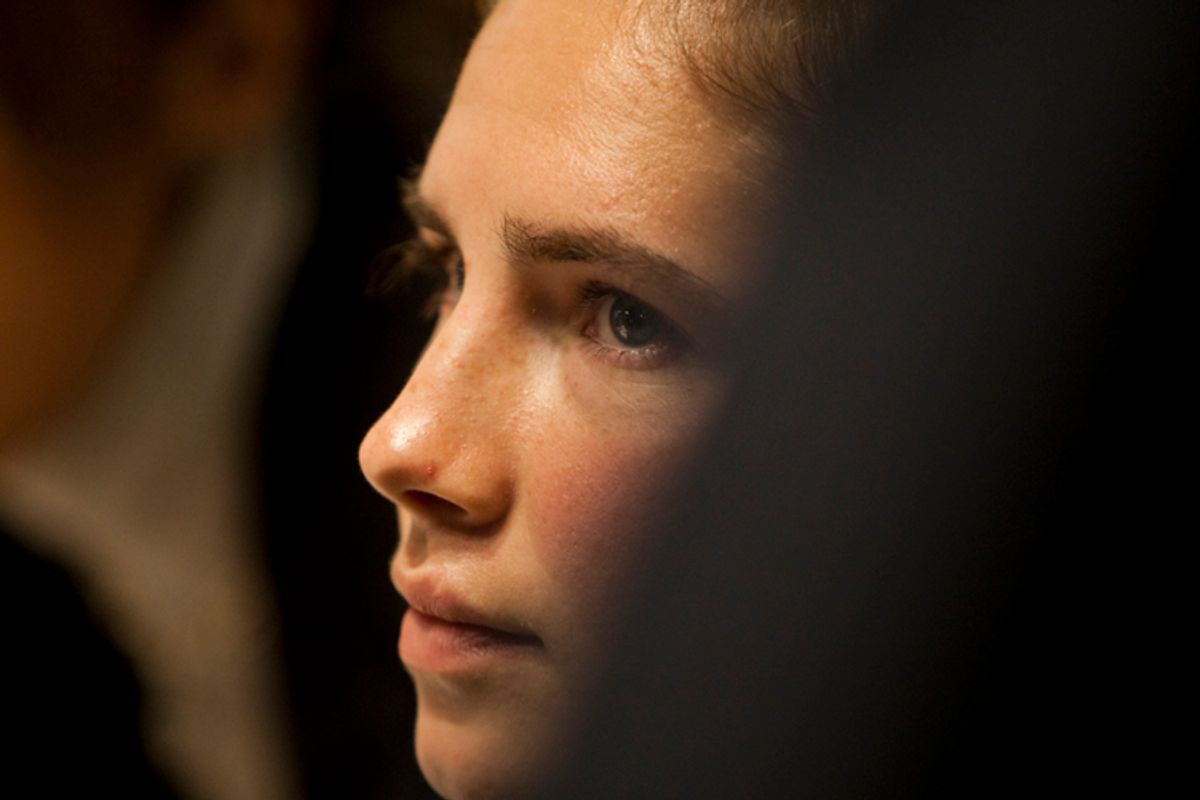
I was a reckless girl.
On my high school senior trip to Orlando, Fla., I snuck into a bar and flirted with a 23-year-old blond professional golfer. When he invited me back to his room, I went without pause. A virgin, it never occurred to me that this might be a bad idea. I'd broken up with my high school boyfriend the summer before, and since then had kissed plenty of boys on beaches and in convertibles, behind the shopping mall and in basement rec rooms. The golfer had more than kissing in mind, however. I drank the Michelob he offered me. I kissed with abandon. But when he took my hand and pressed it against his hard-on, I headed out the door.
"Cockteaser!" he yelled. "Bitch!"
I did not learn my lesson. Over the next few years, I drank too much and did risky things too often, things I hope my own daughter never does. I got in cars and beds with strangers. I traveled. A lot. In Brazil I met a man who said simple words like "bikini" and "Nivea" in such a way that I went to a voodoo ceremony on a beach with him, never pausing to consider the consequences. At one point, everyone got naked and ran into the dark ocean, chanting. I was terrified. And thrilled. In Lisbon, I met a stranger in a cafe, got into his car, and stayed with him for the next 24 hours, drinking wine and eating tiny clams. I went to his apartment, no one knowing where I was or with whom. In Cairo, in London, in Mykonos, a different version of the same thing. I saw it all as an adventure. It never occurred to me that harm might come to me. Or maybe it did occur to me, and that added to the excitement.
For most of the time, I was a good girl. But spirited. Straight A student. Yearbook editor. Student body treasurer. A sorority girl who often had a handsome boyfriend from a good family who dreamed of being a lawyer or a politician. I danced at proms, my slender black-gowned body held at a prim distance from his tuxedoed one. I ate dinner at country clubs with boys' parents. I wrote thank you notes in purple ink. My forays into danger were interludes in a fairly ordinary life. But just as for the most part I was drawn to smart, quiet boys who wore khakis and polo shirts, who played tennis and liked to jitterbug, I also found myself drawn to sexy guys with something dark lurking behind their eyes. Looking back, I see that those guys and my attraction to them were fueled by being far from home, where I knew no one. There, I could do things, try things, unnoticed. I was a good girl with enough of a wild streak to make foolish decisions. I would walk off with a stranger. I would disappear into his arms, into the night, into uncertainty. And no one would ever know.
------
One morning I picked up the newspaper and read the headline: "Who is Amanda?" The story was about a grisly murder whose details are now familiar: On Nov. 2, 2007, police found the body of 21-year-old Meredith Kercher lying partially clothed under a duvet in her bedroom in Perugia, Italy, with blood on the floor, bed and walls. Her body had 40 bruises and scratches, plus knife wounds on the neck and hands, and evidence of sexual assault later thought to be drug-fueled. The crime was shocking, but perhaps even more surprising was the woman accused (and eventually found guilty along with two men, including her Italian boyfriend of two weeks): 20-year-old University of Washington exchange student Amanda Knox, whose case has reopened this week in Italy. Although she was originally sentenced to 26 years, the prosecution is now going for life.
The Amanda Knox case grabbed me, and I began to follow it almost obsessively. "Foxy Knoxy," as the tabloids loved to call her, was characterized as both a pot-smoking, sex-crazed girl gone wild and a hardworking college student who saved her own money to study abroad. On the Amanda Knox Defense Fund website, she smiles out at me in her bright blue graduation cap and gown, clutching a bouquet of flowers still wrapped in cellophane. Her middle school science teacher recalls her love for bunnies and her big smile. "Our school gives out only one award each year, and it is to the graduating 8th grader who has most exemplified the qualities of community-building and citizenship," she writes. "Amanda was deservedly the very first student to receive this award." Beside testimonials from relatives and friends are photos of Amanda walking hand in hand with a small boy, playing the guitar with another. They are a sharp contrast to the drunken Amanda who appears on her MySpace page. But this dichotomy is exactly what intrigues me. Of course, Amanda is both of these young women: a good student, a good friend; a college girl who likes to party with her friends. In other words, a good girl very much like me.
In the past, I had shown only passing interest in sensational murder cases, but none had felt so strangely personal. Unlike Natalee Halloway, I was not a girl who would vacation in Aruba. Unlike Chandra Levy, I was never a striver on Capitol Hill. But to live in Italy? To date foreign, exotic men? To be both a good girl and a reckless one? The beautiful young faces of Amanda Knox and Meredith Kercher haunted me.
Two other faces haunted me too, and herein lies perhaps the thing that propelled my fascination with this case even further. In April of 2002, my 5-year-old daughter Grace died suddenly from a virulent form of strep. Although the circumstances of my loss are different from those of these mothers, what is the same is the powerlessness of that loss, the depth and strength of it. What I understand is how tragedy can rip apart your life, how it can leave a hole that seems impossible to repair. As a mother who has lost a daughter, I grieve for Meredith Kercher's mother. But I grieve for Amanda Knox's too. I have another daughter now, and I do not want her to throw herself into the path of danger, even as I stand by all the daring and naive indulgences in my past. In this particular tragedy, I am both mother and daughter, in a way. The mother who has lost her child, the daughter who traveled far from home, believing nothing truly dark could ever touch her.
Eventually, I found I was not alone in my obsession with the case. The night of the guilty verdict for Amanda Knox, I was at dinner with four women friends, all of us over 40, all of us mothers who had enjoyed youthful adventures in Europe. We ordered our chardonnay, and the conversation about the case began.
"I spent my junior year in college in Italy," Elizabeth says. She sounds almost guilty. "Poor kid."
"Yeah," Maggie tells her, "but you didn't murder anybody."
Elizabeth looks surprised. "Neither did Amanda Knox," she says with certainty.
The case itself has always been riddled with these contradictions, and picking sides has never been easy. Even in this most recent trial, in which the prosecution hopes to extend her 26-year sentence to a life sentence, a new witness has emerged placing Knox away from the scene of the crime. But we talk about the case as mothers, not lawyers. Divided over Knox's guilt or innocence, we ignore the DNA and the fibers and the facts of the crime, instead only speaking to the way the case feeds something in each of us. What if our daughter was one of those girls? Is it possible? We know the answer is yes. And then the other realization: What if it had been us? We were foolish and naive and young. We had close calls and bad drugs and roommates who disappeared for a night with dubious strangers. But nothing bad really ever happened to young pretty girls who were basically good girls, did it? For us, that door always eventually opened and that roommate always returned, a little hung over or weary or in love. But just as we shaped the story we might have to tell the police or her unaware mother, she came home. As you grow older, you realize that not every girl is so lucky. And I believe luck has a lot to do with it.
For each of us sitting in this fancy Manhattan restaurant, sipping good wine, toasting all the successes we've had and the good choices we've made, toasting all of the things that made it possible for us to be sitting here, each of us made bad choices not so long ago. They are not adventures we would take back, but I shudder to think of them now. We fell for the wrong man. We took that extra drink. We turned our back, if ever so briefly, on what our own mothers had taught us was right and good and moral. We looked at danger, and smiling, we said yes.
Ann Hood's new novel, "The Red Thread," will be published this week by W. W. Norton.
Shares