
Crime
Does the Casey Anthony verdict end the story?
After three years, a sensational trial comes to a conclusion -- but the lurid fascination is hard to let go
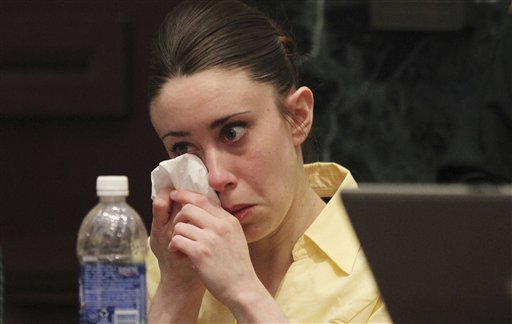
Casey Anthony reacts while listening to the defense's closing arguments in her murder trial in Orlando, Fla., Sunday, July 3, 2011. Anthony has pleaded not guilty to first-degree murder in the death of her daughter, Caylee, and could face the death penalty, if convicted of that charge. (AP Photo/Red Huber, Pool)(Credit: AP) Not guilty. A Florida jury has found Casey Anthony not guilty of murder one, not guilty of aggravated child abuse, and not guilty of manslaughter regarding the death of her child. Does this mean the story that’s riveted national attention and dominated the evening news is at last at an end? Not so fast.
As she stood in court Tuesday afternoon, a somber, buttoned-down Anthony went from frightened-looking to stunned to tearful as the jury foreman read off the charges against her – and systemically exonerated her of all but four counts of providing false information to law enforcement. Though she could face the maximum four-year sentence for her crime, Anthony, who has been behind bars for nearly three years, could be released as early as today.
Even in a world of interminable wars and collapsing economies, news reporting will always be ruled by scandal and drama. Yet nothing this year – not even Joplin tornadoes or the stunning recent reversals in the Dominique Strauss-Kahn case – has consumed the mediasphere like the trial of Casey Anthony. The cable news networks have gone bonkers for the case, feeding a seemingly unquenchable public desire for blow-by-blow details of a story that for many seems too gruesome to imagine, let alone follow.
It was back in July 2008 that 2-year-old Caylee Marie Anthony was reported missing by her grandmother, who acknowledged at the time the child had not been seen in over a month. From the beginning, her 25-year-old mother, Casey, came under scrutiny for her erratic behavior and conflicting-to-flat-out-false accounts of what happened to her daughter. A frantic public search ensued, until the child’s decomposed remains were found in December, with duct tape on her little skull. The case was ruled a homicide, and since then, Casey Anthony has been the prime suspect in her child’s death.
As a mom with two young daughters myself, I’ve gone conspicuously out of my way to avoid the Casey Anthony saga these past three years. And with no desire to follow the story and no cable TV, you’d think it’d be easy. But the case is so pervasive, escaping it has been like trying to get around pollen in the springtime. It’s there in every newsfeed, every teaser for the 10 o’clock news, blaring out from the front page of newspaper and tabloid magazines.
I get it, I really do. I’ve avoided it for exactly the same reasons others devour it — its sheer, unfathomable awfulness. When faced with the unthinkable, it’s human nature to try to understand it, to flail around for answers as to how it could happen.
The Casey Anthony saga is such a headline-grabber in part because it’s a nightmarish tale of a lost child. Whether the story is about a toddler like Caylee, a child like the long missing, then recovered, Jaycee Dugard, or still unaccounted-for students Lauren Spierer or Natalee Holloway, the fear that someone could take a child, could harm her, shakes us to the core. If you’re a parent, it’s the familiar terror that briefly seizes you every time you lose track of your baby for a split second on the playground, or you send your teenager off into the night on her own.
But far more shocking than even a missing child is the story of the bad mother. There is no force in the universe with the same primal pull as mother. Mother, who grows her child in her body, who feeds her and rocks her and sings her back to sleep when the bad dreams attack. Mother, the first person in the world she learns to love, the one she trusts instinctively. A story that challenges all those notions we take for granted chafes aggressively against our ideals, not just as parents but also as sons and daughters ourselves. It flies in the face of our accepted notions of women as less violent, mothers especially. There’s no one more vulnerable than a child, and there’ s no greater betrayal than something terrible happening to her at the hands of the woman who gave birth to her. It’s why stories like Susan Smith’s and Lashanda Armstrong’s – women who, driven by their own unimaginable demons to take their children’s lives — make for round-the-clock news. It’s the ultimate sin.
Ultimately, even in a case that had conflicting narratives, chloroform, duct tape and a defendant the prosecution presented as a wildly unsympathetic parent, the jury decided there was reasonable doubt as to who was responsible for the death of Caylee Anthony. But in the eyes of the public that turned a Florida courtroom into a media spectacle, the idea that it could have been Casey Anthony won’t go away with a three-syllable verdict. The story will remain haunting long after the defendant is once again a free woman. Because long before she was a murder suspect, Casey Anthony was a little girl’s mother.
Mary Elizabeth Williams is a staff writer for Salon and the author of "Gimme Shelter: My Three Years Searching for the American Dream." Follow her on Twitter: @embeedub. More Mary Elizabeth Williams.
Why Etan Patz still haunts us
Three decades after his disappearance, as the case is finally solved, a missing child remains our worst nightmare
(Credit: Reuters/NYPD) It was 33 years ago today that Etan Patz left his home in New York’s SoHo neighborhood to walk to his school bus. He was never seen again, and was declared dead in 2001. Two years ago, his case was reopened. And on Thursday, with little physical evidence to corroborate, police commissioner Ray Kelly announced that Pedro Hernandez had confessed and was being charged with the child’s murder.
Continue Reading Close
Mary Elizabeth Williams is a staff writer for Salon and the author of "Gimme Shelter: My Three Years Searching for the American Dream." Follow her on Twitter: @embeedub. More Mary Elizabeth Williams.
Innocent, but broke
Glen Chapman was exonerated from death row in 2008. Why hasn't he received the $750K he deserves in compensation?
Glenn Edward Chapman Glen Edward Chapman, or “Ed,” was exonerated in 2008 after spending 15 years on death row for crimes he did not commit. Though North Carolina is one of the 27 states with statutes that provide some level of compensation for the wrongfully convicted, the state continues to refuse Chapman any compensation for the loss of his freedom, reputation, family, friends and much more.
Chapman was sentenced to death in 1994 at the age of 26 for the murders of Betty Jean Ramseur and Tenene Yvette Conley in Hickory, N.C. After more than a decade of court appeals, Superior Court Judge Robert C. Ervin ordered a new trial based on revelations that detectives “lost, misplaced or destroyed” several pieces of evidence that pointed to another suspect. It was also discovered that lead investigator Dennis Rhoney lied on the witness stand at Chapman’s original trial. Shortly thereafter, the district attorney dismissed all charges against Chapman due to lack of sufficient evidence leading to his exoneration in 2008.
Continue Reading Close“People Who Eat Darkness”: The disappearing blonde
A true crime story set in Tokyo illuminates the complicated truths behind media cliches
Joji Obara and Lucie Blackman (Credit: Estate of Lucie Jane Blackman) Lucie Blackman, 21, went out for the afternoon in 2000, phoning her roommate and best friend Louise to arrange a meeting later that night. Lucie never showed up, and within a few days she’d become one of those vanished blondes whose fates fuel headlines and hours of speculative media coverage. She was British, a former flight attendant, and she and Louise were living in Tokyo. They were also bar hostesses, a profession with a very specific meaning in Japan, difficult to explain to foreigners and not entirely clear to the Japanese themselves. Lucie both did and didn’t match the classic Missing Blonde profile, and for a while the mystery of what happened to her threatened to lapse into permanent obscurity.
Continue Reading Close
Laura Miller is a senior writer for Salon. She is the author of "The Magician's Book: A Skeptic's Adventures in Narnia" and has a Web site, magiciansbook.com. More Laura Miller.
Alleged gunman’s GOP pal
Updated: The neo-Nazi who allegedly killed five people was once praised as a "true patriot" by Russell Pearce
A police officer walks with a man who said he had a child inside of the home where five people were shot Wednesday, May 2, 2012 in Gilbert, Ariz. (Credit: AP Photo/Matt York) [UPDATE BELOW]
Less than a month after Russell Pearce crowed at a Gilbert, Ariz., Tea Party meeting that Republican presidential candidate Mitt Romney’s “immigration policy is identical to mine” — a brash claim that Republican operatives scrambled to explain — the self-proclaimed Tea Party president and architect of Arizona’s punitive immigration law might now be scrambling himself. Pearce has previously praised J.T. Ready, the alleged gunman in Wednesday’s tragic killing of five people in the same Phoenix suburb.
Continue Reading CloseJeff Biggers, the author most recently of "Reckoning at Eagle Creek: The Secret Legacy of Coal in the Heartland," is currently at work on a new book on Arizona politics and history. More Jeff Biggers.
Is this man a terrorist?
Francis Grady is accused of trying to burn down an abortion clinic, but the feds haven't charged him with terrorism
Francis Grady (Credit: Outagamie County Sheriff's Dept.) On Tuesday, 50-year-old Francis Grady pleaded not guilty to trying to burn down a Planned Parenthood in Grand Chute, Wis., on April 1. Earlier this month, however, during his first court appearance, Grady sang a different tune, telling the U.S. district judge he did it because “they’re killing babies there.”
An open and shut case of domestic terrorism for the state, it would seem. But curiously Grady is not facing any domestic terrorism charges, once again raising the question of whether the FBI and U.S. Attorneys’ Offices apply terrorism laws equally when prosecuting ideologically motivated crimes. While Islamists and animal rights and environmental activists regularly spend years behind bars under terrorism sentences, antiabortion criminals are seldom punished as severely. Grady, it would seem, is the latest antiabortion activist accused of a crime that would be harshly punished if, say, he had done it in the name of Allah or Mother Earth.
Continue Reading CloseMatthew Harwood is a journalist based in Alexandria, Va. His work has appeared in the Columbia Journalism Review, the Guardian, Reason, Truthout, and the Washington Monthly. Follow him on Twitter @mharwood31 More Matthew Harwood.
Page 1 of 94 in Crime