
Movies
“The Bride Wore Black”: Truffaut’s delicious homage to Hitchcock
Jeanne Moreau plays the ultimate femme fatale in a summery, deceptive fable of a woman's murderous revenge
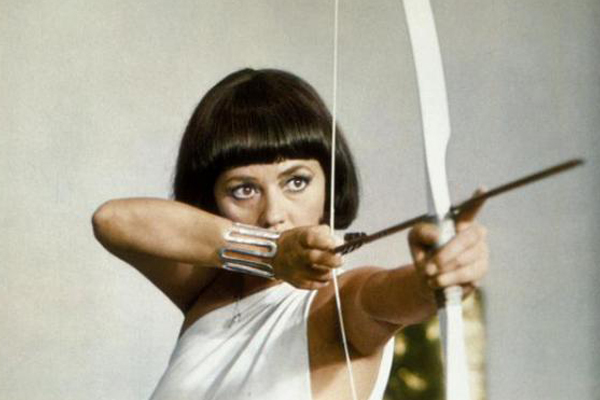
Jeanne Moreau in "The Bride Wore Black" What begins as a French cinephile’s almost obsessive tribute to Alfred Hitchcock becomes progressively weirder, wittier and more Continental in François Truffaut’s 1968 “The Bride Wore Black,” which begins a New York run this week and will then play in many other cities. Truffaut is sometimes viewed as a relative lightweight among the company of big-name ’60s and ’70s European directors, and there’s no doubt his work is uneven. But I find myself appreciating his double-edged, seductive films more and more on repeat viewings. With its summery, Mediterranean surface, Jeanne Moreau as the ultimate femme fatale heroine and a knife-twisting tale of murderous revenge and unexpected romance, “The Bride Wore Black” is well worth rediscovering.
The first thing we see in “The Bride Wore Black” is a printing press churning out black-and-white images of a topless Moreau, but that’s one of several misdirections in this movie, since the story is almost entirely chaste, and the color photography of famed cinematographer Raoul Coutard (who shot Godard’s “Breathless,” Truffaut’s “Jules and Jim” and numerous other New Wave classics) is brilliant. With a deliberately obtrusive Bernard Herrmann score and its roots in a novel by Cornell Woolrich (whose short story “It Had to Be Murder” was the basis for “Rear Window”), “The Bride Wore Black” is more like a Hitchcock movie than some of Hitchcock’s actual movies, at least at first.
Moreau plays a woman named Julie Kohler, who leaves home after a failed suicide attempt and begins hunting down a list of apparently unconnected men, whom she has never met. To a consummate lady-killer on the Riviera, she appears as a potential conquest in a white evening gown; to a lonely, middle-aged bachelor, she’s the fairy princess he’s been waiting for; to a bourgeois politician (the outrageously young Michael Lonsdale), she’s his young son’s schoolteacher. Julie’s plot is ridiculous, and the tragedy she’s avenging is even more so, but as in many Hitchcock pictures, those things are excuses for a cinematic exploration of the war between the sexes that is ambiguous, more than a little mean-spirited and ultimately surprising.
“The Bride Wore Black” is now playing at Film Forum in New York. It opens Nov. 25 at Northwest Film Forum in Seattle and Dec. 9 at Pacific Cinémathèque in Vancouver, Canada. Also coming soon to Berkeley, Calif., Huntington, N.Y., St. Louis, Milwaukee, Pleasantville, N.Y., and Houston. Check website for details.
Blockbuster fatigue? A summer alt-movie guide
Summer movies beyond Batman, from male strippers to a Depression neo-noir to Matthew McConaughey's big comeback
From top: stills from "Beasts of the Southern Wild," "Take This Waltz" and "Lawless" It may feel to you as if the summer moviegoing season has only just begun and many months of popcorn-munching delight lie ahead. That’s both true and not true. There’s a degree of pseudo-Calvinist predestination about the whole thing this year that’s unusual even by the standards of Hollywood, where conventional wisdom and guesswork-in-advance count for actual knowledge.
I mean, nobody knows for sure how much money the 1980s big-hair musical “Rock of Ages” will gross or whether “The Dark Knight Rises” will beat out “The Avengers” as the top box-office hit of the year. (My answers: Not enough to be a huge hit, and no.) But pretty much any idiot with a computer — me, for instance — can look at the calendar and figure out what the biggest hits of the summer will be. As I just mentioned, the summer’s No. 1 movie, in all probability, has already been released. (I’ll save the trollery about how it wasn’t really all that great for some other time.) After we get through “Prometheus” and “Abraham Lincoln: Vampire Hunter” in June, followed by “The Amazing Spider-Man” and “The Dark Knight Rises” in July, well, that’s pretty much it. I exaggerate, but only a little — these days, blockbuster season commences in early May and is over by the end of July, with August reserved as usual for offbeat genre movies, the fourth chapters of trilogies, and the continuing careers of Sylvester Stallone and Jackie Chan. (In other words, the good stuff.)
Continue Reading CloseThe kids are all wrong
Nightmare children populate the dark, dreary and near-perfect "The Bad Seed" and "We Need to Talk About Kevin"
The best movies act as a kind of amber, trapping the life of their times. Sometimes, you get jewels, other times you get, well, amber.
It was hard to read anything about “We Need to Talk About Kevin” without some reference to its distinguished antecedents in the “there’s something about that boy, June” school of demon child cinema. “The Omen,” “Rosemary’s Baby” and “Problem Child” all got their time on deck, but one film in particular gets mentioned, for it invented this entire genre. And that film is Mervyn LeRoy’s 1956 epic “The Bad Seed.” This is one of those movies embedded in our consciousness that perhaps should stay embedded and not actually be pried loose.
Continue Reading ClosePick of the week: Haunting, gorgeous “Oslo, August 31st”
Pick of the week: "Oslo, August 31st" is a wrenching voyage of discovery in Norway's suddenly trendy capital
“Oslo, August 31st” is, as the title suggests, an evocation of one day in the Norwegian capital, as experienced by a troubled young man who’s facing the end of summer and the end of his youth. It’s a marvelously constructed personal journey, both wrenching and bittersweet, whose emotional ripple effects stay with you for days and weeks afterward. While much of international art cinema can seem overly talky or conceptually alien to American viewers, this second feature film from Norwegian director Joachim Trier is a dynamic, even breathtaking visual experience without much dialogue or any philosophical heavy lifting, following the bony, handsome, exceedingly vulnerable Anders (Anders Danielsen Lie) through coffee shops, nightclubs and bodies of water, en route to an ambiguous final destination.
Continue Reading Close“Moonrise Kingdom”: Wes Anderson’s mid-’60s love story
Bruce Willis and Ed Norton are at their best in the rapturous summer fantasy "Moonrise Kingdom"
Tilda Swinton, Bruce Willis and Edward Norton in "Moonrise Kingdom" All the details of Wes Anderson’s rapturous and hilarious mid-1960s New England summer romance “Moonrise Kingdom,” taken one at a time, are plausible. Indeed they are more than plausible; they’re perfect, from the fitted uniforms and yellow canvas tents of the troop of “Khaki Scouts” headed by cigarette-smoking Edward Norton to the achingly picturesque island home where the brood of children belonging to Bill Murray and Frances McDormand sit around listening to the Leonard Bernstein recording of “A Young Person’s Guide to the Orchestra.” (I’m not going to bother questioning whether that record existed in 1965; some production intern probably spent half a day tracking down its history.)
Continue Reading CloseMovie assailant punches a kid, becomes a folk hero
A 10-year-old gets punched in the face for being too noisy at "Titanic" -- and the Internet applauds the beating
(Credit: iStockphoto/IBushuev) It’s a general rule of thumb that a grown man doesn’t get a lot of support for knocking out a 10-year-old child’s teeth. But Yong Hyun Kim has won himself a few fans lately for doing just that.
Back on April 11, the 21-year-old Washington state man settled in with his girlfriend to enjoy “Titanic” in 3D — right in front of a boy known only in police documents as KJJ. What ensued led to a night in jail and a charge of second-degree assault.
Continue Reading Close
Mary Elizabeth Williams is a staff writer for Salon and the author of "Gimme Shelter: My Three Years Searching for the American Dream." Follow her on Twitter: @embeedub. More Mary Elizabeth Williams.
Page 1 of 708 in Movies