
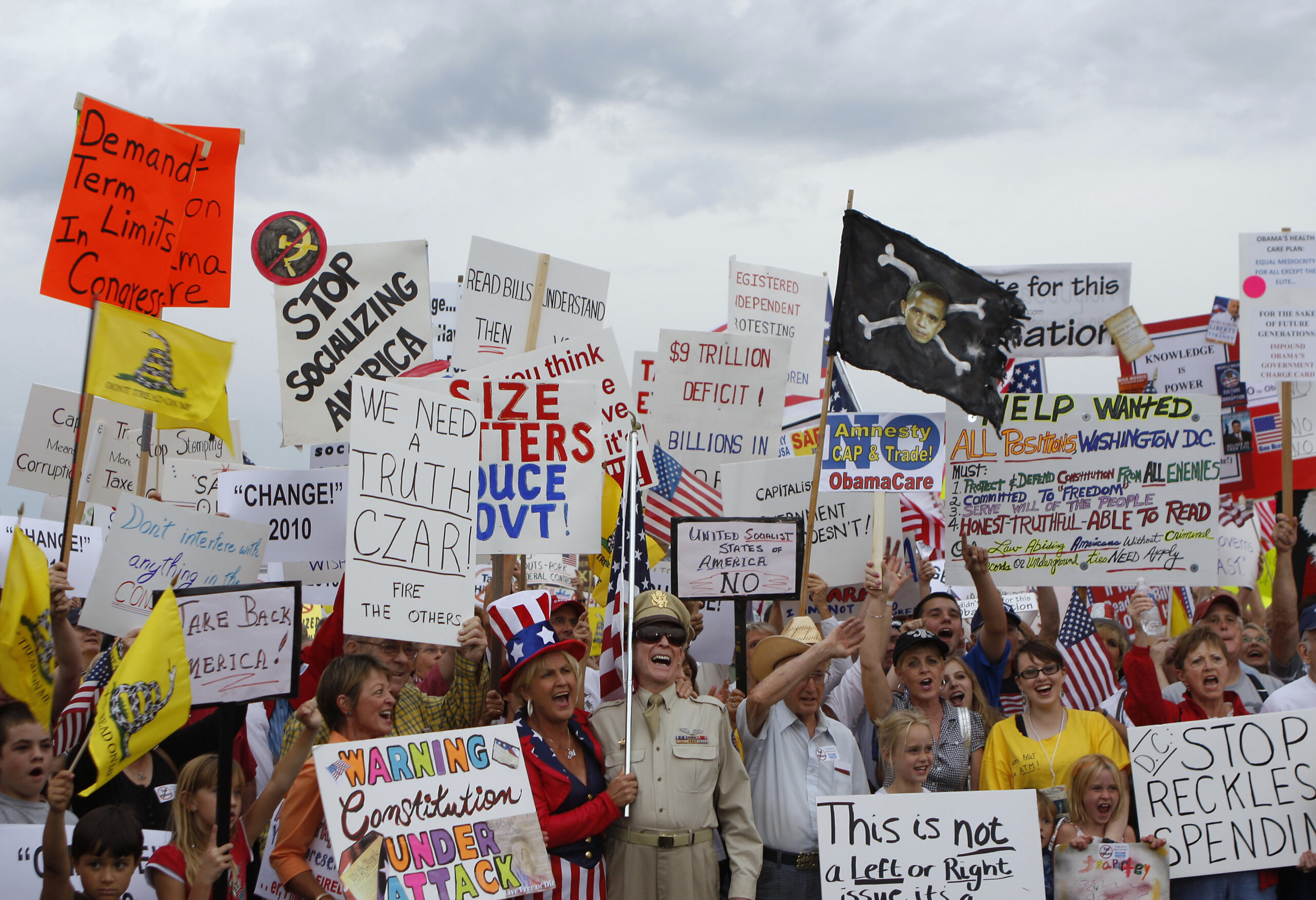

The Democratic and Republican leaders of the congressional supercommittee will apparently admit today that they’ve failed to produce a long-term deficit reduction plan. That it’s come to this is less a surprise than it is the latest and most emphatic evidence that real, meaningful compromise in the 112th Congress is essentially impossible.
This is primarily a function of the direction the conservative movement chose to take when Barack Obama was elected president three years ago. As they seem to whenever Democrats gain control of the executive branch, conservative leaders and activists instinctively framed Obama’s presidency as a threat to the basic nature of America and fought virtually all of his policies with unrelentingly alarmist rhetoric. At the same time, they concluded that Obama only won in 2008 because George W. Bush and other top national Republicans had spent the better part of a decade pursuing a bastardized, government-friendly brand of conservatism.
Thus did conservatives in 2009 launch a war on two fronts, one against Obama and the other against the forces within the Republican Party that they believed had enabled Obama’s rise. They even embraced a catchy name for their campaign: the Tea Party. And for 2009 and 2010, they had it easy. Democrats owned the White House and massive congressional majorities, and economic anxiety was steadily rising. When it comes to mass opinion, there isn’t much room for collective memory or foresight, so it was hardly surprising that swing voters flocked to the GOP in the 2010 midterm elections. The Republican Party was the frustrated voter’s protest vehicle.
In reality, though, the most significant political development of 2010 came well before the November election, when the right’s intraparty purity crusade powered one ideological true believer after another to victory in GOP primary races. Some of these results attracted national attention, like when Christine O’Donnell knocked off long-serving Delaware Rep. Mike Castle or when South Carolina Rep. Bob Inglis lost his bid for re-nomination by 42 points. But many of them occurred under the radar, in little-watched open primaries for safe House seats or in down-ballot contests at the statewide level. The result was that Republicans across the country fielded perhaps the most absolutist collection of conservative candidates ever in the fall of 2010 — and thanks to the party’s protest vehicle status, many of them slipped into office.
This is why genuine compromise has pretty much been out of the question on Capitol Hill. When the 112th Congress convened in January, political scientist Alan Abramowitz estimated that of the 242 Republican members of the House only three could be accurately described as moderates:
The 112th House is likely to be a good deal more conservative than the Newt Gingrich-led House of 1995-97. In the Gingrich House, moderate Republicans actually outnumbered very conservative Republicans by a wide margin. In the 112th House, however, very conservative Republicans will greatly outnumber moderate Republicans. Whereas moderate Republicans held the balance of power in the Gingrich House, they will have almost no influence in the 112th House. As a result, pressure on the House leadership to pursue a hard-line conservative agenda is likely to be much stronger in the new House than it was in the Gingrich House and opportunities to reach bipartisan agreements with the president are likely to be much more limited if not nonexistent.
There was another factor, too. Any Republican member of Congress who might be open to the idea of compromise would have to weigh it against the lesson that the Tea Party movement delivered loud and clear during the 2010 primary season: If we think you’ve sold us out, we’ll kick you out.
These basic realities — the presence of so many true believers and the threat of a primary challenge for any non-true believers — have largely dictated the actions of the Republican-controlled House in 2011. It’s why the party’s leaders insisted on putting Rep. Paul Ryan’s politically poisonous Medicare overhaul plan up for a vote, even though it had zero chance of making it through the Senate and into law. Speaker John Boehner and his team understood how critical it was to show good faith with the purity-obsessed Tea Party crowd. It’s why the GOP House has forced several budget stand-offs with Obama, bringing the government to the brink of a shutdown several times and leading to a the lowering of the country’s credit rating. And it’s why Boehner, who initially seemed to recognize what a good deal Obama’s “grand bargain” would be for Republicans, ended up walking away at the last minute this summer, as it became clear he’d face an intraparty revolt if he went any further.
It was the collapse of those talks that led to the creation of the supercommittee. But the basic reality hasn’t changed these past three months. The right is as intent as ever to guard against a sellout of conservative principles by their elected leaders. There was talk of a breakthrough these past few weeks when some congressional Republicans suddenly expressed support for a deficit reduction plan with about $250 billion in new revenues, but this wasn’t as momentous as it sounded — not with the same Republicans insisting that a permanent extension of the Bush tax cuts, a significant cut in the top individual tax rate, and deep reductions in the social safety net all be included in any deal. And not with six dozen House conservatives immediately branding even this very, very modest concession “irresponsible and dangerous.”
There is still, as of this writing, a very remote chance that there’ll be some sort of last-minute supercommittee agreement. But even if there is, it will amount to what TPM’s Brian Beutler calls “a trivial package of cuts” — not, in other words, a meaningful compromise that will reduce the deficit in a major way. There is also some suspense now over whether Congress will allow the “trigger” that was designed to spur the committee to act — automatic Defense cuts to go into effect in January 2013 — will actually be pulled.
But the idea that the supercommittee would produce a sweeping deficit reduction plan with authentic compromise from both sides would have required, among other things, that the Bush tax be left to disappear at the end of 2012, when they are currently scheduled to expire. But any agreement to do that is an absolute non-starter for the Obama-era GOP. Which means the stakes for the 2012 election have been clarified further by the supercommittee’s failure.
