
Proof that the Tea Party and GOP base are the same thing

Even a GOP pollster admits that Tea Partiers are "conservative Republicans who watch Fox"

Topics: Tea Parties, War Room, Republican Party,

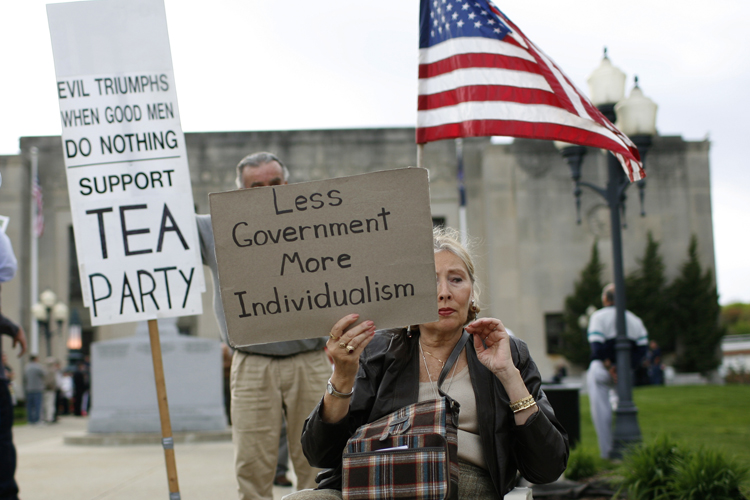
Proof that the Tea Party and GOP base are the same thingA woman holds a sign at a tax day rally by Tea Party activists in the New York City suburb of New City, New York, April 15, 2010. April 15 is the deadline for filing tax returns in the U.S. REUTERS/Mike Segar (UNITED STATES - Tags: BUSINESS POLITICS) (Credit: © Mike Segar / Reuters)

At its heart, I’ve been arguing, the Tea Party movement is an utterly predictable consequence of the 2006 and 2008 elections, which put Democrats in charge of the White House and both chambers of Congress. When it’s locked out of power in Washington, the conservative Republican base tends to adopt a siege mentality, treating Democratic leaders as illegitimate and borderline treasonous and trafficking in irrational hysteria and conspiracy theories.

This is the exact phenomenon we witnessed back in 1993 and 1994, the last time before now that Democrats enjoyed a monopoly on power. Just like Barack Obama today, the right convinced itself that Bill Clinton was a far-left, anti-American usurper. They demanded — and got — the same blanket opposition from Republicans in Congress to his agenda, and used the same overheated rhetoric to describe his programs. Everything that’s been said and shouted about “ObamaCare” was said and shouted about Clinton’s healthcare plan in 1993 and ’94. And they were just as personally vicious: Remember the howls when Clinton had the audacity to mark Memorial Day 1993 at the Vietnam Veterans Memorial? Or the videotapes that circulated accusing him of orchestrating the murder of Vince Foster? Or Jesse Helms warning that, if Clinton went to North Carolina, he’d “better watch out … He’d better have a bodyguard.”

The main difference between then and now, I’ve been saying, is that the GOP base’s backlash didn’t have a catchy name when Clinton was president. But today, it does: the Tea Party.

And now there’s even more proof that the terms “Tea Party movement” and “Republican Party base” are interchangeable. A new poll conducted for NBC News and the Wall Street Journal finds that 27 percent of voters describe themselves as Tea Party supporters. And what do we know about the people that make up that 27 percent? Here’s how NBC’s First Read put it:

These folks, it turns out, are more conservative and bigger watchers of FOX News than your typical Republican. Per [Bill] McInturff, Tea Party members are simply re-branded conservative GOP primary voters — not something completely new. “These are conservative Republicans who watch FOX, and who are very ticked off,” he said.

Bill McInturff, by the way, is a longtime Republican pollster. Nor is this the first time the demographic similarities between the Tea Party movement and the GOP base have been documented; we’ve written about it here before.

But it’s impossible to emphasize this crossover enough, given how willing the media has been to treat the Tea Party movement as some unique, nonpartisan uprising of the middle class against Obama’s governing vision. In reality, it’s just the modern (i.e., post-Rockefeller/Eastern Establishment era) Republican base doing what it always does when Democrats run the show in Washington.

We also saw this in the late 1970s, the last time before Clinton came to office that Democrats controlled everything in Washington. Just like today, the GOP base rallied behind a series of far-right candidates in the 1978 midterm elections, even targeting Republican officeholders deemed insufficiently conservative. Today we have Marco Rubio running Charlie Crist out of the GOP; in ’78 we had Jeffrey Bell pushing Sen. Clifford Case aside. (It’s true that the GOP base is more upset with its own party establishment today than it was in ’93 and ’94, but it’s undeniable that Obama’s election, like Clinton’s in 1992, is what’s driving the anger.)

There’s plenty of middle-class anxiety in America today — plenty of people who feel let down by, disappointed in, and enraged at their leaders. But that doesn’t make them part of the Tea Party.

Continue Reading Close
Steve Kornacki

Steve Kornacki writes about politics for Salon. Reach him by email at SKornacki@salon.com and follow him on Twitter @SteveKornacki

Next Article

Featured Slide Shows

What To Read Awards: Top 10 Books of 2012 slide show

close X
  • Share on Twitter
  • Share on Facebook
  • Thumbnails
  • Fullscreen
  • 1 of 10
  • 10. "The Guardians" by Sarah Manguso: "Though Sarah Manguso’s 'The Guardians' is specifically about losing a dear friend to suicide, she pries open her intelligent heart to describe our strange, sad modern lives. I think about the small resonating moments of Manguso’s narrative every day." -- M. Rebekah Otto, The Rumpus

  • 9. "Beautiful Ruins" by Jess Walter: "'Beautiful Ruins' leads my list because it's set on the coast of Italy in 1962 and Richard Burton makes an entirely convincing cameo appearance. What more could you want?" -- Maureen Corrigan, NPR's "Fresh Air"

  • 8. "Arcadia" by Lauren Groff: "'Arcadia' captures our painful nostalgia for an idyllic past we never really had." -- Ron Charles, Washington Post

  • 7. "Gone Girl" by Gillian Flynn: "When a young wife disappears on the morning of her fifth wedding anniversary, her husband becomes the automatic suspect in this compulsively readable thriller, which is as rich with sardonic humor and social satire as it is unexpected plot twists." -- Marjorie Kehe, Christian Science Monitor

  • 6. "How Should a Person Be" by Sheila Heti: "There was a reason this book was so talked about, and it’s because Heti has tapped into something great." -- Jason Diamond, Vol. 1 Brooklyn

  • 4. TIE "NW" by Zadie Smith and "Far From the Tree" by Andrew Solomon: "Zadie Smith’s 'NW' is going to enter the canon for the sheer audacity of the book’s project." -- Roxane Gay, New York Times "'Far From the Tree' by Andrew Solomon is, to my mind, a life-changing book, one that's capable of overturning long-standing ideas of identity, family and love." -- Laura Miller, Salon

  • 3. "Billy Lynn's Long Halftime Walk" by Ben Fountain: "'Billy Lynn's Long Halftime Walk' says a lot about where we are today," says Marjorie Kehe of the Christian Science Monitor. "Pretty much the whole point of that novel," adds Time's Lev Grossman.

  • 2. "Bring Up the Bodies" by Hilary Mantel: "Even more accomplished than the preceding novel in this sequence, 'Wolf Hall,' Mantel's new installment in the fictionalized life of Thomas Cromwell -- master secretary and chief fixer to Henry VIII -- is a high-wire act, a feat of novelistic derring-do." -- Laura Miller, Salon

  • 1. "Behind the Beautiful Forevers" by Katherine Boo: "Like the most remarkable literary nonfiction, it reads with the bite of a novel and opens up a corner of the world that most of us know absolutely nothing about. It stuck with me all year." -- Eric Banks, president of the National Book Critics Circle

  • Recent Slide Shows

  • Share on Twitter
  • Share on Facebook
  • Thumbnails
  • Fullscreen
  • 1 of 10

More Related Stories

Comments

49 Comments

Comment Preview

Your name will appear as username ( profile | log out )

You may use these HTML tags and attributes: <a href=""> <b> <em> <strong> <i> <blockquote>