
Keystone XL pipeline
Obama punts the Keystone pipeline
Facing a Republican-imposed deadline, he rejects approval -- for now
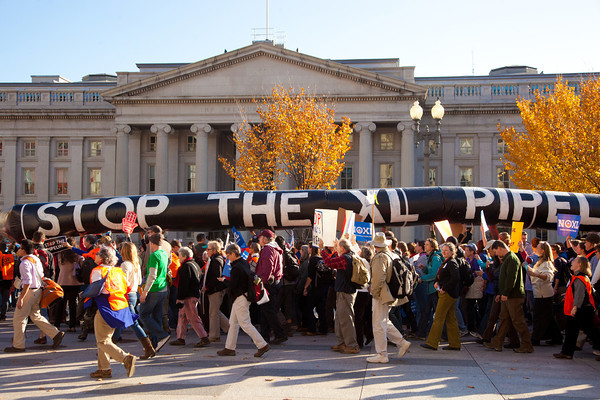
Protesters marched against the Keystone XL pipeline in Washington last November. (Credit: Jeff Malet/MaletPhoto.com) Dead or alive, the Keystone XL pipeline now runs through the heartland of American politics.
The Obama administration announced today that it has rejected the proposed 1,700-mile pipeline that would link the tar sands of Alberta, where crude oil is extracted, with U.S. refineries along the Gulf. Republicans are promising to step up their efforts to build the pipeline, which was largely unknown to the public just six months ago.
The decision isn’t exactly a surprise. Obama has repeatedly made clear that he would not approve any attempts to force the pipeline through without an adequate environmental review. The State Department had also stated that it would not approve the pipeline if the time frame for the review was rushed, warning in December that the deadline imposed by Congress would “compromise the process.” Nevertheless, House Republicans inserted a provision into the payroll bill passed last month requiring the administration to reach a decision on the pipeline by Feb. 21.
This rejection does not kill the pipeline. According to the Washington Post, the administration will allow TransCanada to propose an alternative route through Nebraska that avoids the sensitive Ogallala aquifer. Nebraska and TransCanada have already reached a tentative agreement to reroute the pipeline, so it seems likely that the corporation will proceed with this option.
Republicans in Congress have already begun to explore ways of advancing the pipeline even in the case of an Obama rejection. Sen. John Hoeven of North Dakota is reportedly drafting legislation that would allow Congress to approve the provision without presidential approval.
Still, environmentalists greeted the news with cautious celebration, cheering the decision while recognizing that the fight isn’t over. In a message to supporters, Bill McKibben praised the president for standing up to Big Oil, and called the decision a “victory for Americans who testified in record numbers” while acknowledging that “the fossil fuel lobby won’t give up easily.” Indeed, the fact that the pipeline was debated at all is due to pressure from McKibben’s army of activists. Last August, shortly after sit-ins against the pipeline began, a former State Department official said approval was “likely.”
House Speaker John Boehner, on the other hand, insisted the president should approve the project, noting that it would “create 100,000 new jobs” — a statistic taken from a widely quoted but oft-criticized study conducted by TransCanada. (Independent analysis by Cornell University suggests the pipeline would create between 2,500 and 4,650 temporary construction jobs, while the State Department projects 5,000-6,000.) Boehner went on to say that Obama was seeking to delay the Keystone project “until it’s convenient for him to make a decision,” asking, “Where are the jobs?”
Boehner’s statement reflected attempts by Republicans to spin the Keystone decision as a capitulation to “radical environmentalists.” Democrats, on the other hand, will try to place blame with the Republican House, arguing that they invited the pipeline’s demise by including the Keystone provision in an unrelated bill despite warnings that it would be rejected.
The oil industry has indicated that it will try to make the pipeline into an election year issue. The president of the American Petroleum Institute, the industry’s top lobbying group, warned two weeks ago that “Anything less than approval or acquiescence in allowing the pipeline to go forward would be inconsistent with the vast majority of Americans.”
David Roberts at Grist points out that Republicans will try to paint Obama as “a job-killing pinko who hates energy,” no matter what he does with regard to Keystone.
Alyssa Battistoni writes about the environment and politics from Seattle. More Alyssa Battistoni.
The truth about Keystone
Focus on the pipeline distracts from the real question: Whether we should be using tar sands oil in the first place
The Syncrude tar sands mine north of Fort McMurray, Alberta. (Credit: Reuters/Todd Korol) When President Obama announced his support for the southern half of TransCanada’s Keystone XL pipeline last week in Cushing, Okla., it was a blow to the environmental groups that had worked to stop the pipeline from going forward and succeeded in delaying approval of its northern half. In particular, Obama’s statement that his administration had already approved “enough new oil and gas pipelines to encircle the earth” seemed intended to remind anti-pipeline campaigners that Keystone XL is just one of many pipelines with the potential to transport Canadian tar sands oil to the United States, and TransCanada just one of many players in the energy game.
Continue Reading CloseAlyssa Battistoni writes about the environment and politics from Seattle. More Alyssa Battistoni.
Keystone pipeline will spill, study predicts
It's a matter of when, not if, say Cornell economists
Members of the "chain gang" assemble a pipeline near Burlington, Ill. (Credit: AP) Republicans have sought to frame the Keystone XL pipeline as a job-creating project being thwarted by “radical environmentalists.” Is it? A new Cornell University study claims that the pipeline could actually have a negative impact on the economies of the states it would pass through.
“In the national debate, job creation has been set alongside environmental concerns in a rigid either-or fashion,” says Sean Sweeney, one of the study’s authors, “But oil spills also kill jobs, they consume resources, they have an impact on health, and can also lead to a lower quality of life.”
Continue Reading CloseAlyssa Battistoni writes about the environment and politics from Seattle. More Alyssa Battistoni.
Surprise: Bush backs Keystone pipeline
As the GOP gets desperate to blame higher gas prices on Obama, their role as the Gas and Oil Party becomes clearer VIDEO
Former president George W. Bush (Credit: AP/Tony Gutierrez) Unemployment is down, consumer confidence is up, the GOP is waging a crazy, unpopular jihad against contraception, and its presidential candidates get less popular as the primary season continues. So blaming President Obama for rising gas prices has become the party’s new strategy.
The problem is, there’s nothing any president can do to make gas prices go down, and Mitt Romney, at least, admitted as much on Fox today. That won’t stop him and his rivals from dishonestly insisting the president is to blame. They continue to insist that the president’s refusal to drill for oil on every square inch of land or sea that may harbor it, and to green light the environmentally disastrous and economically questionable Keystone XL pipeline, is to blame for the pain at the pump.
Continue Reading CloseJoan Walsh is Salon's editor at large. More Joan Walsh.
Pipeline foes beat back bogus gas price claims
Two Capitol Hill victories show environmentalists' strength -- but they may be temporary
The Keystone Oil Pipeline is pictured under construction in North Dakota (Credit: © Handout . / Reuters) Ever since President Obama delayed the decision to grant TransCanada a permit to build the Keystone XL pipeline pending further environmental review back in January, Republicans have been cooking up various schemes to force the project’s approval. A few weeks ago, Republican leaders stuck Keystone mandates into both the House and Senate drafts of the transportation bill. In response, anti-pipeline activists kicked into high gear and mobilized supporters to send over 800,000 messages to their representatives within 24 hours, and the president threatened to veto any bill containing a Keystone rider.
Continue Reading CloseAlyssa Battistoni writes about the environment and politics from Seattle. More Alyssa Battistoni.
Trench warfare rages over Keystone pipeline
The GOP tries every which way to undo the Greens' modest victory
Protestors outside the White House demand a stop to the Keystone XL tar sands oil pipeline. (Credit: AP/Evan Vucci) When the Obama administration announced last month that the Keystone pipeline project would be delayed pending a more thorough environmental review of its impacts, Keystone’s opponents celebrated, but warned that the fight was far from over. Sure enough, pipeline politics remain front-and-center as those in favor of the pipeline seek to circumvent the longer review process while its opponents struggle to fend off attacks on their tenuous victory. The past few weeks have seen a burst of legislative maneuvering as Republicans seek a way to rubber-stamp the pipeline without the president’s approval.
Continue Reading CloseAlyssa Battistoni writes about the environment and politics from Seattle. More Alyssa Battistoni.
Page 1 of 3 in Keystone XL pipeline