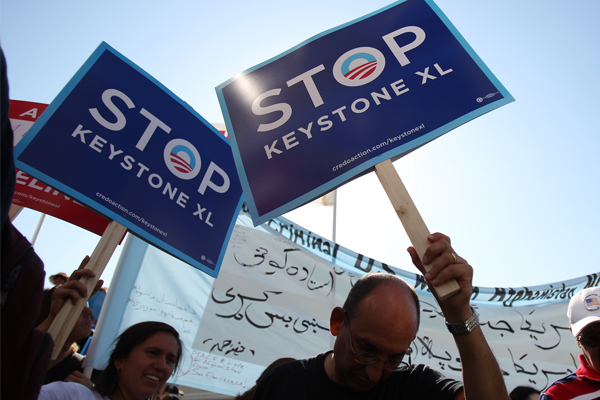

Keystone XL pipeline

Keystone pipeline as GOP poison pill

Desperate Republican seeks to link pipeline approval to the payroll tax cut extension

  • more
    • All Share Services

Keystone pipeline as GOP poison pill Pipeline politics(Credit: Reuters/Stephen Lam)

Ever since the Obama administration announced it would delay its final decision on the controversial Keystone XL pipeline until 2013, Republicans in Congress have been plotting ways to get around the lengthier review process ordered by the president, which would include a rigorous assessment of health and environmental impacts by the State Department.

Last Wednesday, a group of Republican senators, including Nebraska Sen. Mike Johanns, co-sponsored a bill that would fast-track the pipeline, requiring President Obama to issue a decision on the pipeline within the next 60 days and precluding a more in-depth review of its impacts. Now, Nebraska Rep. Lee Terry, with support from House Speaker John Boehner, is seeking to attach a provision that would force a quick decision on the pipeline to a bill designed to extend unemployment benefits and payroll tax cuts, which are currently set to expire Jan. 1 of next year.

The proposal to extend unemployment benefits and the payroll tax cut has divided the Republican Party, with some arguing that the measures are too costly and will create little economic benefit, while others are reluctant to oppose measures that would provide relief to tens of millions of American workers. Sensing advantage, President Obama and the Democrats are pressing hard for approval of the extension of the benefits and the payroll tax cut.

Boehner recently described his payroll tax proposal as turning “chicken shit into chicken salad,” indicating that he’s going to make Democrats pay for any legislative victory. He knows that a bill proposing to hasten the Keystone review process would never make it through Congress on its own, and is hoping to keep the pipeline’s adversaries from scuttling the proposal by attaching the quick review to popular legislation that Democrats are determined to pass.

Terry’s proposal would transfer decision-making authority from the State Department to the Federal Energy Regulatory Commission (FERC) and would require FERC to issue a ruling on the pipeline almost immediately, within 30 days of receiving a permit application — despite the fact that, as George Zornick points out, “FERC has not been involved in the Keystone process whatsoever,” and has no prior experience with similar projects.

Environmental groups claim the strategy is simply an attempt to evade a public debate about the pipeline: Environmental leader Bill McKibben described the negotiations as going on “behind closed doors in money-filled rooms.” Kim Huynh, a dirty fuels campaigner at Friends of the Earth, called the House GOP strategy an attempt to slip the Keystone decision “under the radar of the U.S. public, limiting the ability for real debate.”

While Huynh called the bill a “really long shot” for congressional approval, Friends of the Earth and other environmental groups have mobilized to block it with a petition signed by a hundred thousand people asking Senate Majority leader Harry Reid and House Minority Leader Nancy Pelosi not to give in to Republican pressure. Becky Bond, the political director of CREDO Action,  which organized the petition, said that the group is only asking that Democrats stick to their guns, saying that people are “sick of being thrown under the bus to appease Republicans” in what she described as a “game of chicken” between the two parties.

In an open letter to Reid, a group of five Democratic senators, including Bernie Sanders, I-Vt., Sheldon Whitehouse, D-R.I., Patrick Leahy, D-Vt., Ron Wyden, D-Ore., and Frank Lautenberg, D-N.J., called the attempt to seek legislative go-ahead for the pipeline “completely inappropriate,” warning that removing the State Department from the process of making decisions about cross-border projects would “set a troubling precedent.” After meeting with Canadian Prime Minister Stephen Harper on Wednesday afternoon, Obama said, “Any effort to try to tie Keystone to the payroll tax cut, I will reject.”

Still, while this particular attempt to get the Keystone pipeline approved is unlikely to succeed, it is only one of several environment-related riders the GOP is seeking to sneak into various pieces of upcoming spending legislation, including proposals that would block the EPA from regulating agricultural runoff and limiting toxic air pollution from cement kilns.

Alyssa Battistoni writes about the environment and politics from Seattle.

The truth about Keystone

Focus on the pipeline distracts from the real question: Whether we should be using tar sands oil in the first place

  • more
    • All Share Services

The truth about KeystoneThe Syncrude tar sands mine north of Fort McMurray, Alberta. (Credit: Reuters/Todd Korol)

When President Obama announced his support for the southern half of TransCanada’s Keystone XL pipeline last week in Cushing, Okla., it was a blow to the environmental groups that had worked to stop the pipeline from going forward and succeeded in delaying approval of its northern half. In particular, Obama’s statement that his administration had already approved “enough new oil and gas pipelines to encircle the earth” seemed intended to remind anti-pipeline campaigners that Keystone XL is just one of many pipelines with the potential to transport Canadian tar sands oil to the United States, and TransCanada just one of many players in the energy game.

Cushing was a particularly appropriate setting to convey that message: It’s the crossroads for much of the nation’s oil and gas infrastructure, and inadequate pipeline capacity has made the town a bottleneck for fossil fuels, particularly with the recent influx of oil coming from Alberta. At any given time, between 30 and 40 million gallons of oil sit there, awaiting transport to Midwestern or Gulf Coast refineries. This means that the chunk of the pipeline that connects Cushing’s surplus to refineries along the Gulf Coast — the chunk of the project that’s moving forward — is the one that TransCanada really cares about in the short term.

Other companies aren’t waiting around to see what happens with Keystone XL either: Enbridge, a Canadian energy company, has already purchased a stake in a pipeline that currently transports crude from the Gulf Coast to Cushing, with the intention of reversing the pipeline’s flow in order to carry tar sands oil south from Alberta. In conjunction with Houston-based company Enterprise, Enbridge is also planning to construct a new pipeline that would expand an existing route to bring tar sands oil to the Gulf; because the new pipeline would not cross international borders, it would not require State Department review. Those two projects combined would add the capacity to transport 850,000 barrels of tar sands oil each day by 2014, according to Enbridge’s CEO; by comparison, Keystone XL would transport around 700,000 barrels daily.

And there are plenty of other ways to get tar sands oil into the country: Other pipelines in the extensive network of fossil fuel infrastructure built to transport regular crude could begin carrying tar sands oil instead, while existing tar sands pipelines could ramp up the amount of oil they transport. Tar sands oil could also be transported by rail, though it’s less economical to do so; nevertheless, Canadian railroads have long been eyeing the fuel, and a report commissioned by the U.S. State Department estimated that railroads could transport up to 1.25 million barrels per day. In short, Obama’s announcement was a reminder that delaying, or even derailing, Keystone XL is a temporary victory, and one more important in symbolism than substance.

Pipeline protesters know this: As Bill McKibben, one of the most prominent leaders of the anti-Keystone movement, told Joe Nocera, “Keystone, by itself, won’t make or break the environment.” On the other hand, nor will it create jobs, reduce our reliance on foreign oil, or affect gas prices. In sum, the pipeline itself will have remarkably little effect on any of the issues it’s come to symbolize. Nocera and others have used that fact to argue that we might as well just go ahead and build it — that is, to shut down the debate over Keystone XL and tar sands instead of opening it up.

But anti-Keystone forces have always been upfront about the fact that they see the battle over the pipeline as a political one. McKibben has repeatedly described the pipeline protests as the start of a broader fight against climate change, and as a means to galvanize a public conversation about climate change, fossil fuels and carbon emissions — topics that American politicians have for the most part tried desperately to avoid.

Lately, though, that conversation doesn’t seem to be happening. Instead, as Lisa Song of Inside Climate News argues, “climate change has taken a back seat in the debate” in recent weeks. Meanwhile, conservative groups continue to press any chance to blame President Obama for lackluster job creation and high gas prices, however unrelated those issues are to the pipeline. If Keystone XL matters at all, it’s for the questions it raises about the impacts of different energy sources, and the types of energy we should be prioritizing. When tar sands oil, rather than just Keystone XL, is the issue, a different range of options opens up.

A growing body of evidence suggests that tar sands oil is a different type of fuel than regular crude, and that we should treat it as such. From a purely physical standpoint, tar sands oil is a different beast: It’s transported in the form of diluted bitumen, which is heavier and more corrosive than regular crude. A recent study reviewing the existing evidence suggests that bitumen spills are more likely, more damaging and more difficult to clean up than conventional crude oil. While estimates vary as to the precise climate impact — the EU says tar sands result in 22 percent more emissions than conventional oil, while a study in Nature estimates a 15 percent greater impact and an EPA analysis puts it as high as 82 percent — it’s generally acknowledged that the process of extracting and processing tar sands oil is an energy- and emissions-intensive one.

The question of whether tar sands oil should be classified differently from regular crude has already generated controversy in the European Union, which has been debating a proposal to label tar sands oil as highly polluting. Fearing that such a classification would doom tar sands oil in European countries that are trying to meet carbon reduction targets and tarnish the fuel’s reputation elsewhere, Canada has lobbied heavily against the proposal, and even threatened to take the matter up with the World Trade Organization should it pass. A vote last month failed to reach a conclusion, and the issue is still up for debate.

While the political calculus is obviously different in the U.S., where an entire political party is determined to ignore the scientific consensus around climate change, some states and regions are trying to look at fuel sources more systematically. As part of its state-level climate policy, California’s Air Resource Board has issued a low-carbon fuel standard, which would require fuel producers to reduce greenhouse gas emissions across the full extraction-to-combustion life cycle. The oil industry has brought a legal challenge against the regulation, which it claims discriminates against out-of-state fuel sources. If the court rules that California can implement the low-carbon fuel standard, though, it could spark a wave of similar efforts. In particular, the New England and mid-Atlantic states that make up the Regional Greenhouse Gas Initiative may follow suit — though that initiative is also under siege, particularly as Enbridge and other pipeline companies explore options for increasing the flow of tar sands oil to Northeastern states.

In any case, a more comprehensive consideration of tar sands oil and other fossil fuels is in danger of getting lost amid the seemingly endless cycle of political maneuvering over the physical pipeline itself. The fact that Keystone’s fate is up for debate at all is remarkable, considering that it was considered a done deal. But if environmentalists are to avoid getting bogged down in the never-ending battle over a single piece of the nation’s gigantic energy infrastructure, they need to start turning an impressive feat of political mobilization into the promised conversation about tar sands oil and fossil fuels before they lose momentum entirely.

Continue Reading Close

Alyssa Battistoni writes about the environment and politics from Seattle.

Keystone pipeline will spill, study predicts

It's a matter of when, not if, say Cornell economists

  • more
    • All Share Services

Keystone pipeline will spill, study predictsMembers of the "chain gang" assemble a pipeline near Burlington, Ill. (Credit: AP)

Republicans have sought to frame the Keystone XL pipeline as a job-creating project being thwarted by “radical environmentalists.” Is it? A new Cornell University study claims that the pipeline could actually have a negative impact on the economies of the states it would pass through.

“In the national debate, job creation has been set alongside environmental concerns in a rigid either-or fashion,” says Sean Sweeney, one of the study’s authors, “But oil spills also kill jobs, they consume resources, they have an impact on health, and can also lead to a lower quality of life.”

The range of estimates of jobs vary widely. TransCanada claims the pipeline will create 20,000 jobs. A State Department report estimates that only 20 permanent operating jobs would be created in the six states along the pipeline route. By comparison, those same states are home to robust agricultural, ranching and tourist industries that are dependent on water and vulnerable to environmental contamination. Across the six states agriculture employs 571,000 workers and tourism 780,000; the total revenue from those sectors, respectively, is $76.3 billion and $67 billion.

Sludge not crude

Tar sands oil — known in energy circles as diluted bitumen — may be more damaging to environments and communities than regular crude. Said Sweeney, “Diluted bitumen is an irregular substance — it runs thick and thin, hot and cold. It’s basically a sludge, not like regular crude — it behaves differently.” Tar sands also seem more likely to spill than conventional crude: The spill rate for diluted bitumen in the northern Midwest between 2007-2010 was three times the national average for conventional oil. This may be because the heavy, corrosive material puts greater stress on pipelines.

The already existing Keystone I pipeline, which runs 2,100 miles from Alberta to Illinois, began operating in 2010; in the two years since, 35 spills have occurred. In the pipeline’s first year of operation alone, its spill rate was 100 times TransCanada’s projection. All told the amount of tar sands oil being transported through the United States has more than tripled in the past decade to 600,000 barrels in 2010. Keystone XL, if built, would add another 830,000 barrels per day.

John Stansbury, a professor of civil engineering at the University of Nebraska, analyzed spill data from the Keystone I pipeline to estimate that 91 spills would occur over the course of 50 years of Keystone XL’s operation — close to two spills each year.  In a worst-case scenario, he says, a spill could contaminate 4.9 billion gallons of groundwater in Nebraska’s Sand Hills with benzene, a known carcinogen.

The threat the pipeline poses to Nebraska’s Ogallala Aquifer, which provides 30 percent of the irrigation water in the U.S., has been much-discussed, but the pipeline would also cross another 1,747 bodies of water, including the Yellowstone and Missouri Rivers and the Carrizo-Wilcox aquifer, the third largest aquifer in Texas.

If Keystone were to leak — or worse, rupture — the consequences could be serious. In July 2010, a pipeline operated by the company Enbridge ruptured — the company has never explained why — spilling 1 million gallons of tar sands oil into Michigan’s Kalamazoo River. The oil drifted 40 miles upstream, causing 145 reported instances of illness and health problems for people living in the riverside community of Marshall, Mich. Marshall residents living within 200 feet of the river were eligible for a buyout program; about 130 people sold their houses to Enbridge, leaving some areas uninhabited.

The Kalamazoo cleanup has cost $725 million so far — twice as much as Enbridge estimated — and the river remains closed to fishing, hunting and other recreational activities over a year and a half after the spill occurred. Officials in the Calhoun County Health Department have said some bitumen will likely remain in the river “indefinitely.” Sweeney points out that the rural areas along pipeline routes are unprepared to cope with spills.  “They had to bring someone in from the Gulf to deal with Kalamazoo,” he explained.

While the Kalamazoo spill was the biggest-ever tar sands spill, pipeline spills occur with startling frequency. In 2011 alone, there were 600 reported pipeline incidents. TransCanada’s website argues that “if they do occur, pipeline leaks are small,” yet pipeline spills caused 17 deaths and 68 injuries, and over $335 million in property damage. In 2010, when the Kalamazoo spill occurred, the damages from pipeline spills topped $1 billion. While pipeline spills don’t get the attention of disasters like the Exxon-Valdez and BP, they point to a familiar pattern of underestimating risk and underpreparing for disaster.

TransCanada insists that it will comply with all federal regulations, and construct and operate Keystone XL “to the highest industry standards.” Danielle Droitsch, an attorney with the National Resources Defense Council, argues that we don’t know enough about diluted bitumen to be able to transport it safely. “We’re building these pipelines as if they were conventional oil pipelines,” she said. “We don’t have any special regulations in place to deal with the fact that these are tar sands pipelines and they are very different. Until we have a new regulatory system in place there are no safety measures proposed that would make this pipeline safer.”

And in the meantime? “There’s no question this pipeline will spill — it’s a question of when.”

Continue Reading Close

Alyssa Battistoni writes about the environment and politics from Seattle.

Surprise: Bush backs Keystone pipeline

As the GOP gets desperate to blame higher gas prices on Obama, their role as the Gas and Oil Party becomes clearer VIDEO

  • more
    • All Share Services

Surprise: Bush backs Keystone pipeline Former president George W. Bush (Credit: AP/Tony Gutierrez)

Unemployment is down, consumer confidence is up, the GOP is waging a crazy, unpopular jihad against contraception, and its presidential candidates get less popular as the primary season continues. So blaming President Obama for rising gas prices has become the party’s new strategy.

The problem is, there’s nothing any president can do to make gas prices go down, and Mitt Romney, at least, admitted as much on Fox today. That won’t stop him and his rivals from dishonestly insisting the president is to blame. They continue to insist that the president’s refusal to drill for oil on every square inch of land or sea that may harbor it, and to green light the environmentally disastrous and economically questionable Keystone XL pipeline, is to blame for the pain at the pump.

Former President George W. Bush even made a rare jump back into American politics this week, telling the American Fuel & Petrochemical Manufacturers conference that building the Keystone XL pipeline is a “no brainer.” He should know.

OK, that’s mean. Bush has a brain, he just doesn’t use it very often – and when he does, it’s on behalf of his wealthy oil and gas cronies. The rhetoric around Keystone, and the president’s political problems with rising gasoline prices, is getting sillier by the hour. Bush says Keystone will create jobs, while conservative scold Charles Krauthammer says it will bring down gas prices, when in fact it will do neither.

One of the best kept secrets in American politics seems to be the fact that the oil the pipeline will carry from Alberta, Canada, to Port Arthur, Texas, is intended for sale in Asia, mostly China. TransCanada Corp. wants to take advantage of a foreign-trade zone in the Texas Gulf Coast area that will allow tax-free transactions. “That foreign-trade zone is what made me suspicious of what the real agenda was for this oil,” Rep. Ed Markey told Newsweek’s Eleanor Clift. When Markey tried to require that oil carried through the U.S. by TransCanada be sold within the U.S., Republicans blocked him, arguing that the market for oil is global.

And they’re right – which is why neither Keystone nor any of the GOP’s other “drill, baby, drill” solutions will have much impact on rising gas prices.

But Bush’s endorsement of Keystone should remind voters what the Republican gas-price crusade is really about: The GOP is the Gas and Oil Party, and the party’s leaders will use any excuse to push the industry’s agenda.

The GOP is facing a slew of inconvenient truths as it blames rising gas prices on the president. First, domestic production of oil and gas has never been higher. It’s jumped 50 percent since 2006. Yet prices in that period have continued to rise. Then there’s the fact that even if we opened up all the areas that are closed to drilling, we wouldn’t see the results until 2030.

And while we’d produce another half-million gallons of oil a day if we drilled every drillable inch, the world currently consumes 90 million gallons of oil a day. The best estimates say that might bring down the cost by 3 cents a gallon – a savings that could never offset the health and safety risks of opening off-limits areas to drilling.

It’s not even clear that rising gas prices are to blame for the president’s recent rocky ride in opinion polls. Gas prices have been climbing since December, and Obama’s approval numbers have mostly been rising since then. They apparently dipped last week in some polls, but now they’re up again. Whatever is going on, it’s simplistic – and wishful thinking for the GOP — to say it’s all about high gas prices.

It’s true that various polls say voters blame the president for higher gas prices, and that they’d like him to approve the Keystone XL pipeline despite its irrelevance to domestic gas supplies. For the most part, the president’s strategy has been to talk honestly with voters about what’s behind rising prices, and about how little he can do about it. Obama tends to give voters credit for more intelligence than pundits do; he gave a complicated speech about race, you might remember, when even his advisers said it was a mistake. He’s trusting that voters will get the issue’s complexity.

On the other hand, on Friday the White House announced the president is going to the site where domestic construction of the segment of Keystone that’s been approved will begin – to transport oil drilled in Oklahoma to be refined in Texas. That portion of the pipeline has its own environmental risks, and again, there’s no guarantee oil drilled or refined in the U.S. will benefit American consumers. “Solomon proposed splitting the baby – Obama always actually tries to do it,” Keystone opponent Bill McKibben tweeted on Friday afternoon. It remains possible that Obama will give up on his talk-sense strategy on energy and cave to Keystone XL’s backers.

But it’s clear that Keystone’s backers control the GOP. As good as they have it under Obama, with record profits and record production levels, they were happier under Bush, who came from their industry. They’ll do whatever they can to get Obama out of the White House – whatever he does about Keystone. Let’s hope the president remembers that as his enemies beat the Keystone drum.

I talked about the GOP’s desperate gas-price strategy on MSNBC’s “Hardball” today, with Republican strategist John Feehery:

Visit msnbc.com for breaking news, world news, and news about the economy


Continue Reading Close
Joan Walsh

Joan Walsh is Salon's editor at large.

Pipeline foes beat back bogus gas price claims

Two Capitol Hill victories show environmentalists' strength -- but they may be temporary

  • more
    • All Share Services

Pipeline foes beat back bogus gas price claimsThe Keystone Oil Pipeline is pictured under construction in North Dakota (Credit: © Handout . / Reuters)

Ever since President Obama delayed the decision to grant TransCanada a permit to build the Keystone XL pipeline pending further environmental review back in January, Republicans have been cooking up various schemes to force the project’s approval. A few weeks ago, Republican leaders stuck Keystone mandates into both the House and Senate drafts of the transportation bill. In response, anti-pipeline activists kicked into high gear and mobilized supporters to send over 800,000 messages to their representatives within 24 hours, and the president threatened to veto any bill containing a Keystone rider.

The House’s transportation bill is on the rocks, but the Senate’s version is moving along, and the pro-Keystone amendment sponsored by John Hoeven, R-N.D., went up for a vote yesterday. The Hoeven amendment would have bypassed the need for presidential approval, using Congress’ constitutional power to regulate international commerce to skip the review process and green-light the pipeline immediately. The amendment failed in a close vote Thursday afternoon: a majority of senators, including 11 Democrats, voted in favor, but the 56 votes it garnered were just shy of the 60 needed to pass.

Another amendment to the transportation bill, sponsored by Ron Wyden, D-Ore., would have approved Keystone on the conditions that it be built with materials manufactured in the United States and that the oil transported by the pipeline be used within the U.S. rather than exported abroad — requirements that many observers speculated would have effectively served to kill the project. That bill failed 34-64, with Republican naysayers joined by a handful of New England Democrats who oppose the pipeline on grounds of its climate impact.

All in all, the day’s votes constituted a narrow victory for anti-Keystone forces, and it may be short-lived: Republicans are already saying they’ll put the pipeline back in the transportation bill when the differences between the Senate and House versions are hammered out in committee. Still, it’s another remarkable victory for a campaign that seemed futile to most experts at the outset, particularly considering the wealth and power of the industry it’s fighting. Indeed, the 56 senators who voted for the pipeline have received approximately 500 percent more in donations from the oil and gas industry than the 44 who voted against, according to data provided by the Dirty Energy Money website. The American Petroleum Institute was so sure of victory that they mistakenly sent out a victorious press release just moments after the amendment failed.

The inflated claims about job creation that littered media accounts in the early days of the Keystone campaign have been mercifully debunked, to the point where even TransCanada has backed down from its early claims that the pipeline would create hundreds of thousands of jobs. Yet Republicans have continued to beat the lifeless job-creation horse: Dick Lugar, R-Ind., for example, claimed that the project would create jobs “almost immediately.”

In the face of rising gas prices, Republicans are also now turning their focus to the energy aspects of the debate, arguing that Keystone will lower fuel prices: Lugar said that “Americans are screaming for more affordable oil supplies,” while Hoeven claimed the pipeline will “help control fuel prices at the pump and reduce our reliance on Middle East oil.” Some Democrats are joining the chorus: Claire McCaskill, D-Mo., defended her support for the pipeline by saying “people care very much about the price of gas.”

Indeed, they do, but Keystone will have little to do with that price. While there’s some disagreement among energy experts over what precisely the impact of the pipeline on gas prices would be, nearly all agree that it would be insignificant. And by decreasing the surplus of Canadian oil in the Midwest, the pipeline could raise even gas prices throughout that region. As Philip Verleger, head of the energy consulting firm P.K. Verleger LLC, told Bloomberg News, “The Canadian plan was to use their market power to raise prices in the United States and get more money from consumers.

But even Verleger thinks Keystone would only raise the price of gas by a few cents per gallon. As Frances Beinecke of the Natural Resources Defense Council points out, the idea that importing more oil from Canada will lower fuel prices is patently false: Over the past decade, the amount of oil we buy from Canada has increased by 50 percent, but gas prices have nearly tripled. And implications that the pipeline would alleviate the pressure of current gas prices are simply disingenuous: Even if the Senate voted to approve the pipeline immediately, it wouldn’t go into operation until 2014.

Keystone XL would also have little to no impact on “dependence on foreign oil” or any of the other boogeymen frequently trotted out by those urging its construction: As the State Department wrote in January in the report accompanying its recommendation that the president delay the decision, “denying the permit at this time is unlikely to have a substantial impact on U.S. employment, economic activity, trade, energy security, or foreign policy over the longer term.”

In any case, TransCanada isn’t waiting around for Congress: they’re already making plans to start construction on the southern half of the pipeline, which would run from Cushing, Okla. — the terminus of many existing pipelines from Canada, and currently a congestion point in the oil transportation system — and through Texas to refineries along the Gulf Coast. Obama isn’t fighting them on this one: Rather, White House spokesman Jay Carney spoke favorably of TransCanada’s plan, and said the administration would “take every step possible to expedite the necessary federal permits.” The company is also in the midst of revising the pipeline’s route through Nebraska to avoid the Ogallala Aquifer, and has said that it will release its updated plans to the public shortly before applying again for approval. But the residents of the states impacted by Keystone’s southern stretch may not be much more amenable than Nebraskans: Many Texans have already voiced concerns about the potential impacts of the pipeline on their land, including Julia Trigg Crawford, who’s in a court battle with TransCanada over the use of eminent domain.

Anti-Keystone forces aren’t resting easy, either: Earlier this week, several dozen Lakota protesters temporarily blocked two trucks from passing through their reservation in Wanblee, S.D., on their way to a tar sands field in Canada, resulting in five arrests. Said Debra White Plume, a Lakota grass-roots leader who was arrested during the protest, “Our Lakota people oppose this pipeline because of the potential contamination of the surface water and of the Ogallala aquifer.”

Rest assured — or dismayed — that we haven’t seen the last of this debate. As long as Americans are worried about jobs and energy prices, Republicans will keep trying to hammer the president with Keystone, regardless of its negligible impact on either.

Continue Reading Close

Alyssa Battistoni writes about the environment and politics from Seattle.

Trench warfare rages over Keystone pipeline

The GOP tries every which way to undo the Greens' modest victory

  • more
    • All Share Services

Trench warfare rages over Keystone pipelineProtestors outside the White House demand a stop to the Keystone XL tar sands oil pipeline. (Credit: AP/Evan Vucci)

When the Obama administration announced last month that the Keystone pipeline project would be delayed pending a more thorough environmental review of its impacts, Keystone’s opponents celebrated, but warned that the fight was far from over. Sure enough, pipeline politics remain front-and-center as those in favor of the pipeline seek to circumvent the longer review process while its opponents struggle to fend off attacks on their tenuous victory. The past few weeks have seen a burst of legislative maneuvering as Republicans seek a way to rubber-stamp the pipeline without the president’s approval.

The maneuvering is intense because the struggle over the 1,600-mile proposed pipeline has become a proxy battle in a larger war over climate change, corporate influence and the legacy of the Obama administration. Both sides agree that the fate of Keystone XL will influence more than just whether oil is transported from the tar sands of central Canada to the United States. It will signal whether the U.S. is moving away from the carbon-fueled economy or embracing it anew.

The Republicans are attacking from several directions. A House bill introduced by Rep. Lee Terry, R-Neb., in December would require the Federal Energy Regulatory Commission to issue a permit within 30 days of receiving an application, essentially removing the Interior Department and Army Corps of Engineers from the oversight process, exempting the pipeline from several state and federal environmental regulations, and eliminating any discretionary review process.

The House Energy and Commerce Committee approved the bill on Feb. 7, while killing Democratic amendments to prevent Keystone oil from being exported after processing, to block TransCanada from using eminent domain to seize private land, and to certify TransCanada’s claims that most of the steel used in building the pipeline would be manufactured in the United States. Republican leaders have also indicated that they’re considering inserting the bill’s language into other legislation in a replay of December’s payroll-tax-bill shenanigans.

Another bill, sponsored by Rep. Connie Mack, R-Fla., would allow Congress to approve the pipeline without presidential review by invoking Congress’s constitutional authority to regulate international commerce; Sens. David Vitter, R-La., Dick Lugar, R-Ind., and John Hoeven, R-N.D., co-sponsored a companion bill in the Senate. And today, Republican leaders added a provision to the same effect to a transportation funding bill that may go up for a vote as soon as Tuesday. In response, anti-Keystone activists are seeking to imitate the success of last month’s anti-SOPA online activism, aiming to inundate senators with a stated goal of half a million emails within 24 hours to demonstrate that opposition to the pipeline remains strong.

The Keystone provision is unlikely to pass the Senate, let alone get a signature from President Obama. But if the past few weeks are any indication, we haven’t seen the last of the pro-pipeline legislation by a long shot. Mitch McConnell gave the game away in a statement to the conservative publication Human Events, saying, “The only way we’re going to get the Keystone pipeline started is to defeat Barack Obama.”

The party’s aim is to make the pipeline’s rejection a symbol of Obama’s alleged failure to stimulate the economy, and more generally, to paint a portrait of the president as a weak leader more concerned with appeasing “special interest groups” than with taking decisive action. Said Mack at a recent press conference, “The president has decided he’s not going to lead on this issue … so we need to get him out of the way,” while Lugar declared, “The president has failed to lead.”

But pipeline protesters counter that Obama’s decision on Keystone represented a courageous refusal to give in to pressure from fossil fuel lobbyists: MoveOn.org called it a “bold stand against the power of the oil industry,” while Bill McKibben said he “did the brave thing” in standing up to the American Petroleum Institute. While the issue is frequently portrayed as one that could divide key factions of Obama’s base, with labor unions in favor of the pipeline and environmentalists against, several major unions have come out in support of the administration’s decision to delay the pipeline, calling efforts to speed up the review the “cynical move” of a “do-nothing Republican Congress” and stating, “President Obama has acted wisely.”

A report released by the State Department investigator general last week also raised concerns about several aspects of the original environmental review. The report found that the original review failed to consider conflicts of interest: One of TransCanada’s lobbyists, Paul Elliott, is a former aide to Secretary of State Clinton, and the third-party contractor selected to conduct the review had prior financial relationships with TransCanada.

Moreover, the State Department neglected to address several regulations and had insufficient expertise to adequately consider issues like the pipeline’s potential impact on endangered species. The findings bolster environmental groups’ claims that the pipeline serves the interests of the oil industry, which is among the Republican Party’s top donors, and TransCanada, whose spending on lobbying has tripled in the past year to $1.73 million, $1.33 million of which went to Elliott for pipeline-related expenditures.

And it’s not just American politics that have been shaken up by the controversy over Keystone. After the delay was announced, Canadian Prime Minister Stephen Harper said he would begin looking into alternative markets for the country’s natural resources, and during a recent visit to Beijing, “pledged closer trade ties with China.” That, in turn, has sparked a wave of concern about the specter of “foreign oil” back in the U.S., although most of the oil transported by the pipeline would ultimately be exported rather than used to supply the country’s energy needs. Rep. Edward Markey, D-Mass., argues that Keystone would make the U.S. into “a middleman between Alberta and Asia” while doing nothing to reduce the country’s reliance on foreign oil.

Going forward, the coalition of activists opposed to the pipeline plans to deliver the signatures they’ve gathered over the past 24 hours to senators today, as Congress starts to consider the transportation bill. Majority Leader Harry Reid has indicated that a Keystone rider will kill that bill—and in any case, few Democrats support the House version, which Transportation Secretary Ray LaHood said ”takes us back to the dark ages.” Even if this attempt to fast-track the pipeline fails, though, there are plenty of other pro-Keystone bills in the works, and the GOP may try to insert a similar provision into the next payroll tax cut extension.

Either way, expect to hear more about Keystone over the next few months, as it’s clear that both sides want to keep the issue in the news.  The ultimate outcome will likely depend on whether the public sees Keystone as a jobs issue or an environmental one, and indeed, some polls suggest that Americans are more receptive to environmental arguments than Republicans seem to think. In fact, Democratic leaders—some of whom support Keystone, and most of whom have tried to hedge their bets—may be a tougher sell.

Continue Reading Close

Alyssa Battistoni writes about the environment and politics from Seattle.

Page 1 of 3 in Keystone XL pipeline