

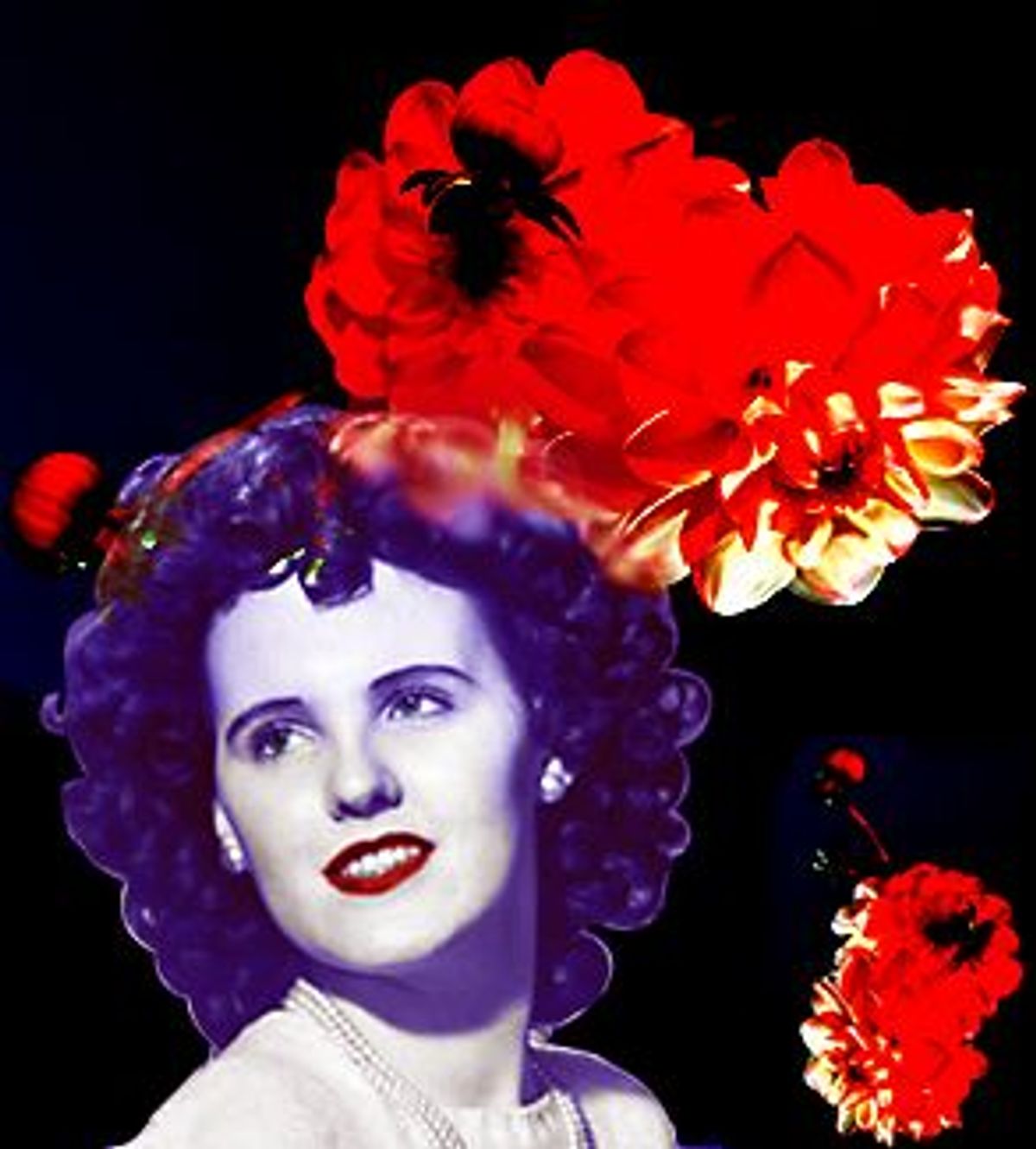
Childhood Shadows: The Hidden Story of the Black Dahlia Murder
By Mary Pacios
1stBooks Library, 314 pages
Mary Pacios is no writer. She's not a detective, either, but she was driven to become both by what she calls the "lies" surrounding the murder of her childhood friend, Elizabeth Short, aka the Black Dahlia, one of the sexiest victims never to leave Hollywood alive. The two saw 25-cent flicks and drank malteds together during World War II in Medford, Mass.
Pacios was 12 years old when her friend's body was discovered on Jan. 15, 1947, in Tinseltown, where the 22-year-old Short had gone to fulfill her dream of becoming an actress. Short had rope burns on her wrists, cigarettes burned into her breasts, her head had been beaten in and her mouth had been cut from cheek to cheek. The killer then had bisected her body just above the navel and left the two halves in a vacant lot.
Many people still know about the Black Dahlia (so-called because of Short's pale white skin, red red lips and the black bouffant hairstyle that framed her face). There are books and movies, a computer role-playing game and several Web sites devoted to a murder that remains unsolved. Probably the most famous version of the killing is in James Ellroy's 1984 novel "The Black Dahlia."
It's that fictionalization that Pacios, 66, says motivated her to snoop and write. An artist for most of her life, Pacios had painted Short, but not written about her. It wasn't until 1987 that she was inspired to correct certain "misperceptions" -- that Short was a victim no one would miss, a Hollywood whore who got what she deserved.
The most compelling parts of "Childhood Shadows" are interviews with old-time newspaper reporters and Pacios' own family. It may be Pacios' non-writer instincts that let her concentrate on the context of the murder rather than just the gruesome details.
That's not to say she doesn't get into those, too. Pacios, like many of us, is fascinated by what was done to Short's body. She chimes in with her own suspect, too: Orson Welles. That's right. She believes the actor-director had a kind of mental illness called diphasic personality that channeled creative frustration into aggression.
Her evidence includes strange incidents taken out of Welles biographies. And, most compelling for her, photos of a carnival funhouse set for "The Lady From Shanghai" designed and constructed by Welles. Unused in the movie, it was decorated with female body parts, a mannequin face mutilated like Short's and a woman's body cut in half.
Although she used to live in the San Francisco Bay Area -- where Elizabeth "Bette" Short is buried -- Pacios now lives in Wyoming. She returned to San Francisco recently for a mini book tour before heading off to Denver in September for Bouchercon 2000, the 31st World Mystery Convention, where she'll sit on a panel called "Fact, Fiction and Fictionalization."
I attended her reading at a San Francisco bookstore. Her friends there seemed a little preoccupied with my presence, mostly, I think, because she's already been attacked by some reporters for maligning Welles. Dressed in a dark blouse and brown leather pants, Pacios seemed comfortable in her new role as writer and read thoughtfully, her East Coast accent tweaking slightly in my West Coast ears.
You said that part of sitting on this mystery writers panel is that you wanted to help draw the line between fact and fiction, and you said true crime is supposed to do a service. What did you mean by that?
Shed light. OK, the panel is "Fact, Fiction and Fictionalization." And I feel, either do fact or do fiction, and if you're going to fictionalize, you muddy, you throw the crime back into darkness. Whereas, if you take a true crime like the Black Dahlia, and you really try to be honest about the time, try to reveal the time, try to say what's going on -- be factual.
Facts can be more compelling than what anyone could possibly dream up, I believe. But when you fictionalize, you're distorting. It's your fantasies. Why not just do fiction? Just make up a crime. Just do outright fiction if you want to fantasize. Do you see my intentions? Do one or the other. Don't fictionalize a real crime, and that's my big beef with Ellroy. He caused a lot of hurt, harm for the [Short] family.
Because his ideas are the ones that people think about now?
Yeah, they think about that. Plus, he smeared the family. They were at one time thinking of suing him because of the way he portrayed Elizabeth Short as a runaway, and she wasn't. She came from a nice family.
What is the appeal of this case, 53 years later?
I think that it's unsolved, and that the victim is very mysterious. She was a loner. And in her day, 1947, the propaganda had already started to get women back in the home. Times were changing. All the GIs had come back, and I'm not answering your question. But I have this thought: At the time of her murder, I feel she was used as an example of what happens to a woman who does not go back into the home. She was trying to lead the same life she led during the war. She did not change, and I think it was the fact that she really was beautiful and that she was secretive. And it was a heinous crime. You had all the elements, and it was sensationalized in all the press.
Do you think the Hollywood aspect of it has much to do with it beyond it being an "unrealized dream" kind of thing?
Yeah. The fact of where she was murdered and the unrealized dream is part of Hollywood. I still don't know. I think people who are reading my book and responding, it's because they feel the injustice of what was done to her and they feel, in a sense, like victims.
Because everyone's a potential victim?
Yeah, yeah.
Because if it's random, essentially random, everyone's a potential ...
Everyone's a potential [victim]. It could happen to them.
That's kind of a dark thing to think about.
Yeah, well. Murder is more in our conscious minds. In the '40s, during Elizabeth Short's time, Bette's time, women wouldn't think much about walking down a street, a well-traveled street.
Nowadays, though ...
It's different, much different. Well, in Wyoming, they still don't lock their doors.
It was a different time. I think another thing with her murder, it shattered complacency, an optimism. You know the assassination of Kennedy shook up the country. The president being assassinated. Well, her murder, to a lesser degree, shook up your beliefs. And I think, in a sense, that's why she was so badly smeared. Do you understand what I mean?
It shook up people's beliefs. How does that lead to smearing?
To smearing because it shook up their beliefs that everything was fine. We were after the war. We're getting things gearing up. We're going back to normalcy again. Things are going to be normal again. And then this woman is horrendously murdered. So there had to be a reason why she was murdered. Do you get what I mean?
I understand what you're saying now. That maybe it's not OK to be a beautiful woman, trying to be an aspiring actress?
Yeah, that there had to be something wrong with her. You have to realize: She grew up during World War II. She went from 16 to 22. And all her young adult years, it was when women were very independent. It wasn't affirmative action. It was women doing the jobs because men were off, gone, getting killed, fighting. And the abrupt change to get things back to normal, and then this [murder] shakes your faith.
What was more important to you, solving the crime or saying good things about her?
Well, the most important thing was in bringing her to life as a person. I don't want to say "good" because I have been accused of whitewashing. But I feel I've been very honest. You know, I say things that people told me. I'm very accurate. The guys who talked to me, who dated her and stuff. I'm very open. But I think I've had this thing in my mind of wanting to bring her back to life. That's what the book does for me. You know the movie "Back to the Future"? I love that film. Because he changed it; he changed it.
And I think somewhere as a kid I had this fantasy that I'd be at the Biltmore [the hotel where Short was last seen, several days before her body was found]. And I'd save her from death. And so it's some weird thing. The way people are relating to the chapters where I talk about growing up in the '30s and the '40s -- for me, that's rewarding. Who killed her? That was never important to me. That was sort of ... getting into the suspects was something that was part of the story. But it wasn't the motivating factor.
I wanted to ask you about some of the details in the book. If you could explain to me, what a signature killing is.
Murder is not the object in a signature killing. It's control, and it's control of the body. And the signature is what the killer does after the murder, usually. It's the compulsion the killer has to fulfill. The murder is just a means for him to get control over the victim so he can do what he [wants]. That's a signature killing.
How much of what was done to Elizabeth Short was done after she was killed?
Most of it. Most of it. Yeah, the only thing -- the slashes to the mouth were done before.
And her head, she was killed by the blows to the head?
Yeah, I suspect she was unconscious even when that was done. You know, people have these fantasies. But I suspect that she was unconscious, pretty much.
Do they know how she was cut in half? Because that's a lot, to cut through someone's back and spine.
No, they don't. You know, a very, very sharp knife. With a person with a steady hand.
Do you remember the moment when you first considered Orson Welles as a suspect? When you got that feeling in your head, that creeping sensation of being on to something, as they say? What was that moment?
Well, I'd get it and then I'd suppress it, you know?
What do you mean, you'd "get it"? Take me back a little bit to explain.
Well, see, his name came up a few times. It was just sort of curiosity. So see when I came across Welles having a magic act [As part of the act, Welles would create the illusion of cutting a woman in half] in the '40s, it just sort of piqued my curiosity and when I saw the scenes cut from "The Lady From Shanghai" ...
What led you to look at those scenes, though?
I have to think a little bit. Oh, I know now, what got me, what really got me is when I talked to the waitress, I was put on to this waitress at Breneman's.
Which was the diner where Short and Welles might have met, right?
Yup, she was a very well-respected businesswoman in L.A., and Breneman's was this restaurant. She described [how] there were the booths, the curved booths with the leather chairs, and Elizabeth Short used to come in, Beth Short would come in, and I asked her when it was. And she said, "Well, it was about the time Orson Welles was making 'The Lady From Shanghai.'" And his name, you know, and the magic act, this stuff, and it just made me curious.
And so then I came across the crazyhouse sets. And then I looked at the movie "Lady From Shanghai," and they weren't there. The crazyhouse sets were cut. Except there's one little cropped image. So it was not looking at him, it was just his name kept cropping up. And then when I saw [the photograph of] Welles and the other guy with the mannequin's head. And then of course I had to find out when these were done. They were done before the murder. Three months before the murder.
What if you're totally wrong and evidence is unearthed three weeks from now that shows that it was Red Manley (the last person who saw Short alive) after all, or something like that? Is it worth it? I mean, Welles was a pretty famous guy. And a lot of people really respect and admire him. Is it worth it to do that to his memory? Even though he's dead.
Well, the whole thing is, nobody cared about her memory. You know? Nobody cared. And I feel, I agonized over it. I feel these are facts. Everything is factual. People can draw their own conclusions.
You talk about his violence; many actors have rages. Sean Penn punching out a photographer. Johnny Depp trashing a hotel room. It's a big leap to go from ...
Has Johnny Depp ever stabbed another actor while onstage? I mean, you have actresses claiming [Welles] tried to rape them. He paid off on a rape charge. But it doesn't matter who you are. Was Johnny Depp right in trashing a room?
I think this gives me a question: In the guise of being creative, does it give someone the right to be sadistic towards other actors? The people they're directing? The gophers, the grips? Take Charlie Chaplin, for example. He was a creative genius. There's nothing about violence with that guy. I guess I do get a little bit appalled at the arrogance in people thinking that because I'm creative I can do whatever I want. There's a difference between being creative and being destructive.
Shares