
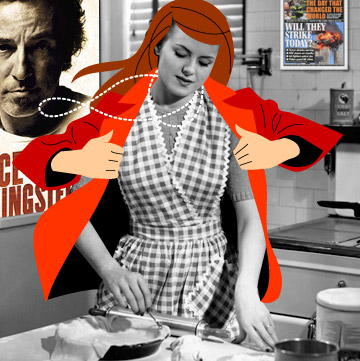

It may be pop culture heresy to rope together Susan Faludi‘s new book, “The Terror Dream,” and Bruce Springsteen‘s new album, “Magic,” both released this week. Faludi, author of 1991’s “Backlash,” is a diligent chronicler of the country’s gender problems. Springsteen is a swaggering blue-collar cult hero whose critical thinking about American culture has made him an international rock star. Yet there is a neat perfection in the pairing of these two uniquely American storytellers, as if Mars and Venus had conveniently weighed in simultaneously, after six years of consideration, on what exactly has unfolded in this country, with which they are each so critically obsessed, in the wake of the terrorist attacks of Sept. 11, 2001.
Springsteen, of course, has already made one contribution to the national artistic accounting of 9/11 with “The Rising,” his 2002 album that Faludi might crankily write off (as she does movies like “United 93” and “World Trade Center”) as a piece of art that “seemed to have no purpose but to repeat what we already knew.” On it, Springsteen gave voice to those whose lives had been damaged by 9/11: a firefighter who died, one who survived, widows both American and Arab. Five years later, he and Faludi are on related missions: to step back from the firsthand experience of events and attempt to pick out the patterns in all that’s gone down since.
Faludi is characteristically grim in her reading of the country’s tea leaves; she is unsurprised to report that the cultural signifiers are, as always, oppressive. Springsteen’s music has always been buoyed by American symbolism; he’s never been shocked by its misuse, but on this record, his grief and anger over its twisted meanings are palpable. Both “The Terror Dream” and “Magic” employ images of surrealist dread to describe the post-9/11 manipulation — by media and politicians — that has left us warped and brainwashed, and both deploy terrifying visions to make their points. On the title track and throughout his record, Springsteen describes the creepy carnival tricksterism of the Bush administration and the sinuous ways it has distorted his vision of America, while Faludi sees a vast national conspiracy to put women back in the kitchen and alpha males like John Wayne (or perhaps Bruce Springsteen) back in their lost positions of power.
Before she can pursue the big picture, Faludi must start where everyone else in America did: her personal experience of Sept. 11. There is her prophetic dream on the night of Sept. 10, in which she is shot while on a plane, a bullet lodged in her throat; she wakes only to discover that the world is under attack. Before the end of the day she has received the phone call that provides her book with its foundation myth: A reporter asks for her reaction to the tragedies, crowing to Faludi, “Well, this sure pushes feminism off the map!”
Not 24 hours out, and Faludi has been handed the key to how this plot will unfold: To her mind, Sept. 11 will give the nation, uneasy with the strides made by women in the decades leading up to the attacks, an excuse to stuff them back into traditional boxes. That first gleeful caller is soon joined by others, all anxious to know how quickly women will abandon their corner offices and get back to tweaking their meatloaf recipes.
Apparently, Faludi has spent the past six years writing down the license plate number of every drive-by offense against gender parity, and the first two-thirds of “The Terror Dream” is her obsessive catalog — a simply staggering one.
There are the media stories promoting a never-realized post-9/11 baby boom and the “return of the cowboy/superhero” trend pieces. Here are the fawning portrayals of the macho Bush administration (she’s looking at you, Graydon Carter), the newscasters heralding the death of the “girly-man,” the breezily patronizing “We’re at War, Sweetheart” headlines.
You’d almost forgotten the feeling of impotence provoked by 9/11? Faludi hasn’t. Here’s her recounting of the people lined up at the blood banks with no one to give blood to, the police faking “live saves” to cheer up rescue dogs on the pile, because even the canines were depressed. There’s the adoration of the firefighters and of the “Let’s Roll!” male heroes of Flight 93 — remembered always for their college sports achievements and their regular-guy toughness — while the stewardesses who boiled water to throw on the terrorists were written out of the myth.
Just when you think there can’t be more, Faludi concludes Chapter 3 by asking, “If women were ineligible for hero status, for what would they be celebrated?” Well, see Chapter 4: “Perfect Virgins of Grief.” From here on out you’ll find the victimization of Jessica Lynch, and the tale of how widows — especially stay-at-home-mom widows, and especially widows who were pregnant — became the golden geese of the morning shows. She recalls articles about how lonely all those haughty, self-satisfied single career women were now that we’d been attacked by terrorists and they had no one to snuggle up with at night; the Bush administration’s phony interest in women’s rights in the Middle East; makeup tips on how to look like a pale, pure angel; the decrease in female bylines; the nesting obsession.
All the most shoot-yourself-now memories of 2001 (and 2002 and 2003 and 2004 …) collected in one long slog through the jingoism and overreaching proclamations made by anyone with a voice box. Each chapter makes you want to bang your head against the wall harder in the hopes that you may lose consciousness and forget all this stuff again.
It’s a complaint that has been lodged against Faludi before: that she’s a cherry-picker, rounding up the juiciest anecdotes that suit her argument and leaving the rest to languish. On the other hand: What a bumper crop of cherries! Like the MensAction.com blog entry about how “the phallic symbol of America has been cut off … and at its base was a large smoldering vagina, the true symbol of the American culture.” Oh. My. God. How about Frank McCourt’s turgid ode to firemen: “They man a hose that could be a wild animal … They hack and smash and isolate and drown that other wild animal, the old god fire.”
Faludi faithfully records the outrageous assaults against female critics like Susan Sontag, Arundhati Roy, Barbara Kingsolver and Katha Pollitt, who dared to consider America’s role in the attacks or express ambivalence about the ensuing patriotism. “Pollitt, honey, it’s time to take your brain to the dry cleaners,” went one headline, while the New York Post’s Rod Dreher expressed his wish to “walk barefoot on broken glass across the Brooklyn Bridge, up to that despicable woman’s [Sontag’s] apartment, grab her by the neck, [and] drag her down to ground zero.”
She more than makes her point: 9/11 unleashed a torrent of pent-up rage against women and feminism. Kingsolver tells Faludi that while the accusations hurled at her and her peers were meant to be infantilizing and patronizing, “if we were so silly and moronic, why was it so important to bring us up and attack us again and again and again? The response was not the response you would expect toward a child. It was more like we were witches.” Post-feminist women had become scary, and the fury directed at them was symptomatic not simply of relief at returning them to the domestic sphere, but of the fear that they might not be willingly contained.
This collection of media moments is an invaluable document. And yet. One can’t help thinking that, as in an ugly fight between lovers, some of the things that were said in the heat of the moment — about the goodness of Rudy Giuliani; about how the attacks were retribution against the pagans, abortionists, feminists and gays; about “the end of irony” — are better left unpacked, because if we dredged them up again, we might never get past them.
And yet, I want to thank Faludi for going to the library while the rest of us gave in to baser instincts, drank a six-pack and passed out. I want to thank her for adding it all up and making shape and sense out of six years of history. When she writes about how the attacks provoked “the denigration of capable women, the magnification of manly men, the heightened call for domesticity, the search for and sanctification of helpless girls,” it’s almost a relief: Of course! I knew there had to be an explanation! This must also have led to the fetishization of parenting, the mommy wars, the obsession with celebrity baby bumps, and stupidly expensive baby strollers! Wheee! Thank you, Susan Faludi, for drawing the map!
Except that she hasn’t. She doesn’t really get to any of those things. In fact, while she has pulled through a critical thread, “The Terror Dream” does not show the full tapestry of post-9/11 gender relations.
There are oddly blank spaces in her argument. In her estimable effort to diagnose the toxicity of attitudes toward women, she eliminates events that do not fit her argument, and thus fails to tell the whole story. In the discussion of the big-dicked alpha-male Bush administration, why doesn’t Faludi examine the roles of Karen Hughes and Condoleezza Rice and Harriet Miers? Hughes is brought up when she quits to spend more time with her family — a move that supports Faludi’s argument and merits consideration. But why not complicate the issue by exploring why, exactly, the Mr. Guns Blazing president has put more women in positions of power than any chief executive before him? Faludi’s argument is strong enough to withstand complexity. That she rarely acknowledges it only serves to weaken her claims.
Faludi devotes part of the book to tallying the diminished number of female bylines in papers, the paltry number of girl guests on TV. She’s not the first to do this, and she’s not wrong. “The silencing of women took place largely in silence,” she writes dramatically at the conclusion of her passage on the media.
Eh. Sure. For a while. But in the years Faludi is describing, Jill Abramson ascended to the top of the New York Times masthead and Katie Couric took over the nightly news, albeit to ill effect. Why not explore the unearthing of feminism as a beat by young women like Ariel Levy at New York magazine, Sheelah Kolhatkar, formerly of the New York Observer, by Meghan O’Rourke at Slate, Jessica Valenti at Feministing, and by several of us here at Salon? Levy is mentioned in “The Terror Dream,” but only as a cog in New York magazine’s dastardly scheme to tell free-loving New York women they should be getting married; Faludi does not credit her for writing one of the better-received feminist books of the past decade, “Female Chauvinist Pigs.” What about Linda Hirshman’s “Get to Work” or Leslie Bennetts’ “The Feminine Mistake”? It’s not as though these women are working in echo chambers: Levy was on “Oprah”; she, Valenti and Linda Hirshman have all appeared on “Stephen Colbert” … To talk about feminism! … On television!
None of these developments make Faludi’s argument less true: There was, and is, a paucity of women in major newspapers, magazines and political blogs, and on the talk shows. But it is possible to make that point while also acknowledging a simultaneous increase of women, besides Faludi, who are rattling the chains and getting heard.
Can a book that alleges that the United States reembraced a John Wayne model of male leadership post-9/11 really only contain three references to the woman who may be the first major-party female candidate for president? What about the first female president of Harvard, the first female speaker of the House?
The first two-thirds of “The Terror Dream” offers a compendium of the offenses against gender civility without extending itself to contemplate how they have evolved and what they have come to mean now, in 2007. Faludi lays it all out, gets the reader good and riled, and then … nothing.
That’s because she is far less interested in the present or the future than she is in the past. Her real thesis (more complicated than “9/11 pushed us back into traditional roles”) is laid out in the preface, but does not get fully realized until the book’s bizarre structure becomes apparent. Her central idea is that Ernst Haeckel’s hypothesis that “ontogeny recapitulates phylogeny” — or, as Faludi translates for us, that the development of an embryo repeats in compressed form the evolutionary stages of its species — can be applied to American history.
Faludi wants to show how “the way we act, say, in response to a crisis can recapitulate in quick time the centuries-long evolution of our character as a society and of the mythologies we live by.” But because Faludi does the recapitulation part — the reactions to Sept. 11 — before she gets to the evolution part more than halfway through the book, her point gets muddied, and readers may wonder, upon beginning the final section, whether they walked into a graduate thesis on America’s founding conflicts.
It’s a pity, because this last section — the phylogeny — is brilliant and exhilarating. Faludi examines with great gusto the popular captivity narratives of 18th and 19th century America, including those of Mary Rowlandson and Cynthia Ann Parker. The stories themselves are fascinating, like that of Hannah Duston, captured in 1697 by Abenaki Indians, five days after having given birth to her 12th child. Before her captors could take her to Canada, Duston took a hatchet to them (two men, two women, six children) and escaped, only to return to collect their scalps. This bravery earned her the attention of that famously easygoing Massachusetts Bay preacher Cotton Mather, who was concerned that nice, passive women might get the wrong idea about their own self-sufficiency from Duston’s story.
Faludi’s point is that our behaviors in the wake of the supposedly unprecedented terrorist attacks on Sept. 11 were in fact practically written into our national DNA. “Our foundational drama as a society was apposite, a profound exposure to just such assaults, murderous homeland incursions by dark-skinned, non-Christian combatants under the flag of no recognized nation,” she writes. “September 11 was aimed at our cultural solar plexus precisely because it was an ‘unthinkable’ occurrence for a nation that once could think of little else. It was not, in fact, an inconceivable event; it was the characteristic and formative American ordeal, the primal injury of which we could not speak, the shard of memory stuck in our throats. Our ancestors had already found a war on terror, a very long war, and we have lived with its scars ever since.”
This argument is fluid and thrilling to read. It just should have been its own book, perhaps with Faludi’s collected contemporary gripes appended as evidence of how in the narratives of the country’s founding we can find the dental records of nearly every one of our modern impulses to contain femininity.
Faludi leaves us with a list of kidnappings and witch hunts that provide a fascinating tableau against which we are free to measure — without much direct guidance from her — our modern gender impulses. But again, the book feels unfinished, the work of connecting the dots left to the reader; Faludi has laid down a good strong drumbeat, but little melody to carry us through.
Which brings us back to Bruce Springsteen, whose album catalogs the very stuff that “The Terror Dream” is concerned with: Here is the cowboy George Bush, showing up ’round sundown on Election Day, “boot heels clicking like the barrel of a pistol spinning round” in “Livin’ in the Future.” There is the image of perfect, angelic femininity in a barmaid ’round whose hair the sun lifts a halo. Where Faludi has prophetic nightmares, Springsteen imagines, in the title track, a world in which bodies hang from trees in a tableau of post-Katrina racial horror.
I’m not sure that one line from Springsteen’s song “Devil’s Arcade” wasn’t actually written by Faludi: “You said heroes are needed, so heroes get made,” and that the two of them aren’t making identical points about the manipulative power of terror when Springsteen’s magician in “Magic” evilly cajoles, “Leave everything you know/ Carry only what you fear.”
In Faludi’s concluding chapter, “What If?” she takes a stab at hope, wondering, “What if the nation had responded to 9/11 differently? What if we hadn’t retreated into platitudes and compensatory fictions? What if we had taken the attack as an occasion to ‘confront the truth’?” Or, as Springsteen puts it in “Livin’ in the Future,” a song in which he retroactively reimagines Election Day: “Don’t worry, darlin’, now baby don’t you fret/ We’re livin’ in the future and none of this has happened yet.”
Both Faludi and Springsteen have always specialized in seeing the personal in the political and vice versa. Faludi tends to see dysfunction, in ways that have been exceedingly useful in the past, as they are here. Her failure this time is in her refusal to acknowledge the upside. Springsteen, of course, has always been a hope peddler, if not an optimist. Laced throughout both these texts are frustration, bewilderment, a desire to shake the country by its shoulders. With Faludi, the sense is that none of this comes as a surprise, she is just Charlie Brown kicking the football, only to have it yanked out from under her by a country that is still, yup, sexist. So it was written by Cotton Mather, so it will be post 9/11.
For Springsteen, the realization that “this is what will be” is both more startling and more painful. He is, like Walt Whitman before him, pained at the vision of his beloved nation torn asunder.
Both writers are furious. And I sort of want to tell them: Have a little faith. But maybe this is a moment in which there is little to believe in, and a lot to fear.
