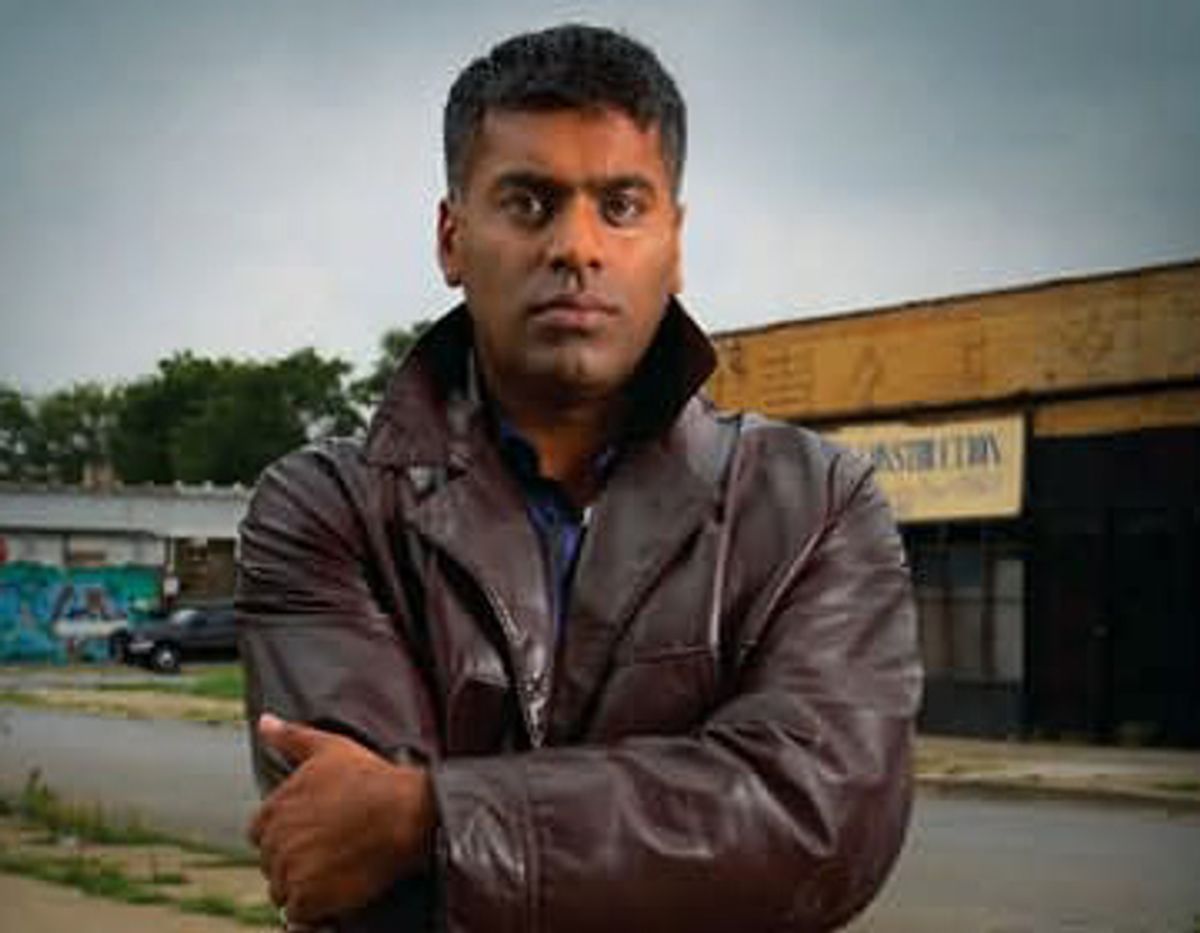
When Sudhir Venkatesh first ventured into the Lake Park housing project in Chicago, it was 1989, he was a sociology grad student at the University of Chicago, and he was wearing a tie-dyed T-shirt and a ponytail. A few years later, Henry Cisneros, secretary of housing and urban development for the Clinton administration, would call Chicago's projects "without question, the worst public housing in America today." A Grateful Dead fan prone to speaking in "spiritually laden language, mostly about the power of road trips," Venkatesh made an unlikely candidate for the task that brought him to Lake Park: Asking the residents such penetrating questions as "How does it feel to be black and poor?" What happened after he walked through the doors was even more unlikely. He wound up sticking around for seven more years.
"Gang Leader for a Day: A Rogue Sociologist Takes to the Streets" is Venkatesh's account of the time he spent hanging out at Chicago's Robert Taylor Homes, the largest housing project in the U.S. and home to some 30,000 people (the size, the author notes, of a small city). His Virgil on this journey was a man called J.T., a middle manager of sorts in a gang called the Black Kings, who controlled three buildings at Robert Taylor. The two men, not far apart in age, first met during Venkatesh's fateful visit to Lake Park; J.T. had been detailed there by his superiors with orders to "increase productivity" in the local franchise. He did such a good job that the gang's leadership -- known as "the board of directors" -- sent him over to Robert Taylor, a plum assignment. By then, J.T. had Venkatesh in tow, convinced that the college student was planning to write his biography.
J.T. was mistaken about that, as he seldom was about anything else, and Venkatesh refrained from enlightening the gangster until he left for a fellowship at Harvard in 2006. Their long association -- Venkatesh calls J.T. "the most formidable person in my life, for a long time to come" -- eventually resulted in a dissertation on the underground economy of the urban poor (which would in turn become a 2006 book titled "Off the Books").
"Gang Leader for a Day" is no doubt much closer to what J.T. expected, although Venkatesh takes care to demonstrate his independence from his former guide. This new book offers an exceptionally intimate, sometimes revelatory view of life in the projects, but it's also the story of an extraordinary relationship, one that Venkatesh puzzles over to this day. "It would be hard to call us friends," he writes in conclusion. "But he was obviously a huge part of my life."
The charismatic J.T. gave Venkatesh entree into much (but not all) of an urban gang's daily activities during the tail end of the crack epidemic of the 1980s. In time, J.T. worked his way into the upper ranks of the Black Kings and managed to insert Venkatesh into several "board" get-togethers, introducing him as the gang's "director of communications," and giving the grad student the chance to marvel at how closely the organization mimicked "the structure of just about any other business in America." As it turned out, Venkatesh was more of a confidant and a sounding board than a spokesman, a representative of mainstream culture that various gang members and project residents could instruct (and lecture) on the nitty-gritty of ghetto life. Venkatesh is by all accounts a gifted listener, and in the Robert Taylor Homes he met a lot of people who welcomed the chance to finally have their say.
"Although there was a great deal of social science literature on gangs," Venkatesh writes of the years when he first went into the projects, "very few researchers had written about the actual business dealings of the gang, and even fewer had first-hand access to a gang's leadership." Eventually, he even managed to secure the account books for J.T.'s franchise. Yet, strangely enough, his professors often pressed him to spend less time with the Black Kings. Venkatesh's advisor, eminent sociologist William Julius Wilson, wanted him to write "the definitive report on everyday life in high-rise housing projects," and another teacher urged him to "try to better understand how women managed households, secured services from the CHA [Chicago Housing Authority], and otherwise help families get by."
For sociologists who sympathize with the urban poor, it probably made more sense to concentrate on the honest citizens just trying to get by under the deplorable conditions in public housing. Sociologists supply the data and theories that policymakers use to design government initiatives, like the welfare reforms or antigang sweeps that went down while Venkatesh was hanging out at Robert Taylor. Anyone who wanted to help the project residents would prefer to keep the focus on women, children and working people who had nothing to do with drugs or violence -- on the theory that the government should be nurturing positive developments, like midnight basketball leagues, and not simply equating the inner city with crime.
But as "Gang Leader for a Day" abundantly demonstrates, it was often impossible to separate necessities like feeding children and getting rid of abusive husbands and boyfriends from the activities of the Black Kings. The gang had wrapped its tendrils around every aspect of life in the Robert Taylor Homes, and Venkatesh discovered more than a few startling examples of strange bedfellows during his time there.
When a gang associate threw a party and left a mess in a common room, when an aspiring model was badly beaten by the man who fancied himself her manager, when the door fell off one family's apartment in the middle of winter, when kids needed school supplies or when someone tried to rip off the neighborhood handyman, the residents of Robert Taylor could turn to two sources for help: the Black Kings and a stout, arthritic, middle-aged woman known as Ms. Bailey.
Venkatesh soon learned that Ms. Bailey, the elected president of the tenants organization, was a "power broker" on a par with J.T. She had many connections at the notoriously corrupt Chicago Housing Authority and could make life easier (or more difficult) for anyone in the building -- including the gang members, who sold drugs in her lobby. As a result, when that common room needed cleaning, Ms. Bailey could demand that the Black Kings send over a few foot soldiers to do the dirty work.
Ms. Bailey also convened informal resident "militias" to deal with emergencies, like the man who beat up the aspiring model. J.T. wasn't happy about that; he preferred that residents view the Black Kings as the go-to source for all their security needs. Still, there wasn't much he could do about it, not without seriously disrupting the smoothly run drug business that was the real source of the Black Kings' power. Ms. Bailey extracted regular donations from the gang, spending the money on after-school parties for kids and other projects. She was formidable. "I do not want to be dealing with her when she's pissed," Venkatesh overheard T-Bone, one of J.T.'s lieutenants, say of Ms. Bailey. "Not me."
Venkatesh was also witness to a negotiation with a local preacher, who allowed the gang to use his church as a meeting place in exchange for a sizable "donation." When a drive-by shooting aimed at the Black Kings by another gang resulted in the death of a little girl, he sat in on a largely pointless community meeting (an "exercise in chaos") at which the police offered residents little more than "platitudes." Then, later that night, he attended a secret meeting with local clergymen, tenant leaders, a police officer and both gang leaders, at which a truce between the two sides was brokered.
He went to workshops offered by community-based organizations (or CBOs) intended "to persuade young gang members to reject the thug life and choose a more productive path," only to learn that gang leaders donated money to those organizations and required their junior members to attend. (J.T. mandated that his employees finish high school and stay off drugs as well.) One major CBO push involved a voter registration drive. "You will register to vote today," the outreach worked explained to the assembled Black Kings, "but then you must all go out and register the people in your buildings. And when elections come around, we'll tell you who to vote for and you'll tell them. That's an important duty you have when you belong to this organization."
Venkatesh hastens to explain that the gang leaders' motives in these cases "were by no means purely altruistic or educational: they knew that if their rank-and-file members had good relationships with local residents, the locals were less likely to call the police and disrupt the drug trade." Furthermore, the voting drives, combined with hefty donations, enabled them to buy off public officials. "$10,000 gets you an alderman for a year," J.T. explained to Venkatesh. "An alderman can take the heat off of us. An alderman can keep the police away." The gang could also use its pull with an alderman to keep low-level city officials from shaking down the "hustlers" -- a term encompassing anyone working off the books, from independent car repairmen and carpenters to prostitutes. The gang, naturally, charged the hustlers a "tax" for this service and for other forms of protection.
"Them niggers are wearing me out," one of the more energetic hustlers told Venkatesh when asked about the Black Kings. J.T. had this man beaten up for refusing to relocate his car-repair operation because the gang wanted to use the space for a basketball game. "But I ain't going to be the one to say nothing," the man went on, "because they keep things safe around here." Another hustler, pointing out the difference between Robert Taylor and the California suburb where Venkatesh grew up, asks, "When you got a problem, I bet you call the police, right? Well, we call the Kings. I call T-bone because I don't have anyone else to call ... Every hustler tries to have someone who offers them protection. I don't care if you're selling socks or selling your ass. You need someone to back you up."
Again and again, the people Venkatesh talks to explain that police and emergency medical personnel "don't come" when project residents call them about such "minor" matters as robberies and domestic violence. The Black Kings, by contrast, could sometimes even get stolen property back. None of Robert Taylor residents really liked the gang, but it evolved to serve a purpose: As is often the case when civil order breaks down -- whether it happens in Afghanistan, Somalia or the South Side of Chicago -- strongmen emerge to provide security, at a cost. On the other hand, at least the residents of Robert Taylor knew exactly what they were getting for their "taxes." Furthermore, J.T. wasn't the only one to levy such taxes; despite her efforts to pass herself off as a disinterested benefactor, Ms. Bailey, too, demanded a piece of any action that went down in her building.
Venkatesh soon realized that what he saw of J.T.'s work (or, for that matter, of Ms. Bailey's) had been "edited." Nevertheless, he was still present for several violent episodes, most of them beatings administered to anyone in the gang hierarchy who got out of line. When J.T. offered to let Venkatesh be "gang leader for a day" (hence, the book's title), the exercise was effectively meaningless because the grad student refused to get involved in any violence; the doling out of "mouthshots" and other, harsher penalties was a key part of J.T.'s job. "They need to see that you are the boss, which means that you hand out the beating," he explained in exasperation. "You have to make sure that they understand that they can't be stealing! Nigger, they need to fear you." Behind all J.T's talk of the Black Kings' role as a "community organization" lurked the stark fact that his authority was founded in the threat of violence.
"Gang Leader for a Day" illustrates a handy contemporary maxim: As soon as people start using the word "community," you can be pretty sure they're trying to put something over on you. In time, Venkatesh became just as disillusioned with Ms. Bailey, the neighborhood clergy, the director of the local Boys and Girls Clubs (inventor of the much-celebrated midnight basketball leagues of the 1990s) and the cops -- the ones with the "real power" in the ghetto, and in a few cases all too prone to abusing it. Everyone he met was jostling for influence, offering protection or resources, and distributing both to whoever had the most to offer them in return.
What the budding sociologist found, in the end, was not the depraved chaos that the political right imagines ghetto life to be, nor the left's tragic melodrama of a powerless, victimized population terrorized by its most hopeless members. (J.T., a gifted manager by Venkatesh's account, went to college on an athletic scholarship and gave up a job selling office supplies when he realized that white employees were receiving preferential treatment.) What he did find was an economy, and a rough social order that the residents had assembled out of the broken pieces left to them by society at large. Without meaningful police services, they cobbled together a security force of sorts. Without much in the way of social services, they figured out how to extract some of what they needed from the main economic engine in their environment: the gang. Within the borders of a major American city, they lived in the equivalent of a corrupt third-world nation.
At times, the creativity and ingenuity of the people Venkatesh meets are impressive, but they were still spent in getting what most of their fellow citizens take nearly for granted: a roof over their heads, food for their kids, protection from thieves and brutes. The Robert Taylor Homes have since been torn down, J.T. left the gang to manage a dry-cleaning business, and Venkatesh moved on to Harvard and to see his work featured in the bestselling book "Freakonomics." (He's currently writing a blog that gathers real-life gangsters' responses to the television series "The Wire.")
He writes that few of today's gangs are as extensive, stable and well organized as the Black Kings once were, and by the time you get to the end of "Gang Leader for a Day," it's hard not to wonder if that's such a good thing. Criminals though they were, the job they did wasn't always as dirty. And somebody's got to do it.
Shares