

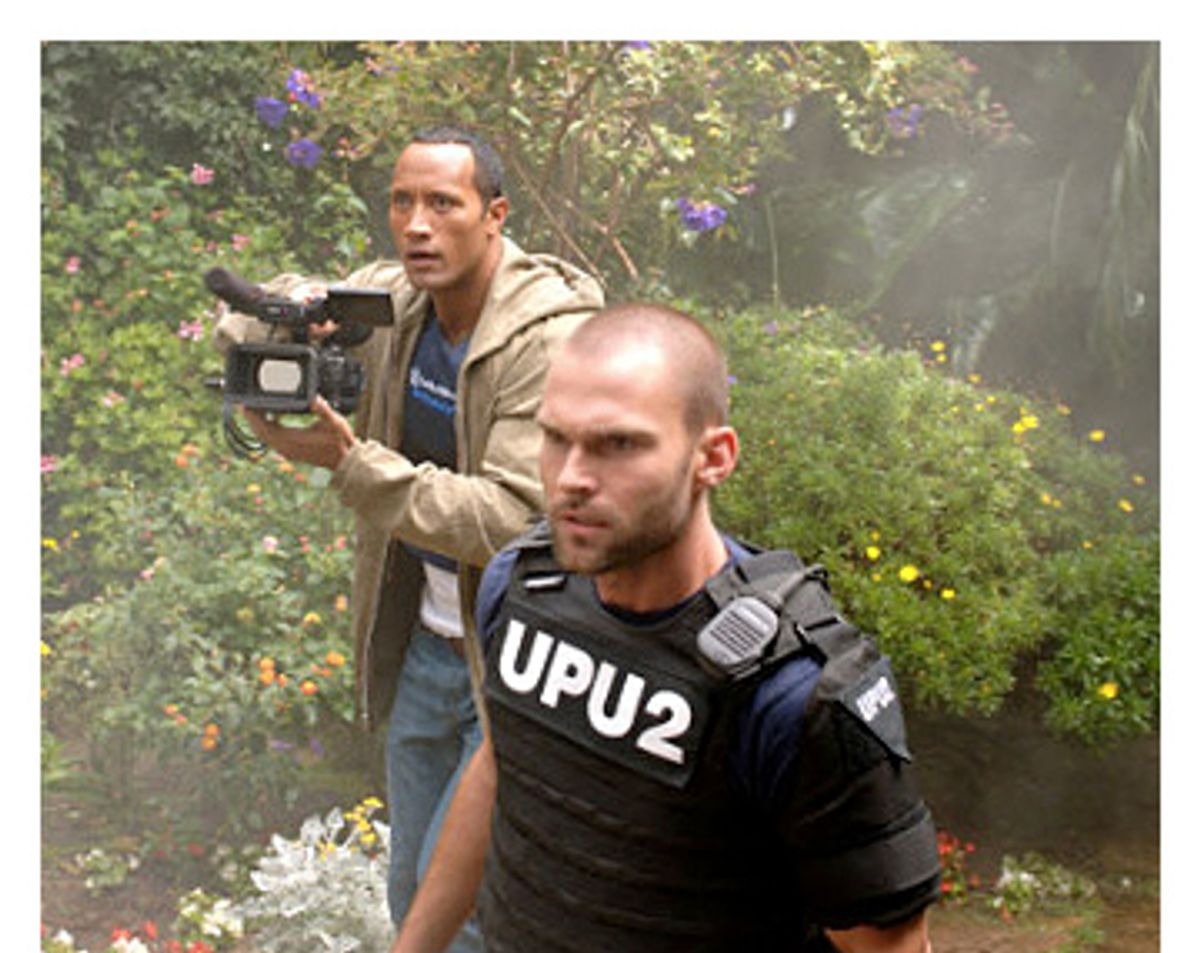
It's OK to be confused by Richard Kelly's "Southland Tales."
For half of Kelly's epic film about the end of the world, characters are quoting T.S. Eliot or the Book of Revelation. Its plot hinges on a barely explained back story involving rifts in the fourth dimension. For some reason, Wallace Shawn is dressed like a new-wave Japanese pimp. By the time the film reaches its climax -- which somehow manages to combine modern dance, a floating ice cream truck and the resurrection of Christ -- all semblance of logic has long since evaporated.
Although Kelly's first film, "Donnie Darko," was an obtuse cult hit about time travel and an apocalyptic rabbit, few people could have anticipated a follow-up as thoroughly baffling as "Southland Tales." When it premiered in its original three-hour form at Cannes, last year, the response was acidic. One critic wondered if Kelly had ever met another human being. Roger Ebert called it "the most disastrous Cannes press screening since, yes, 'The Brown Bunny.'" But despite the reaction, Kelly managed to secure a distribution deal and, on Nov. 14, released a shortened version of the film in U.S. theaters. As a tie-in, Kelly has also produced three graphic novels ("Two Roads Diverge," "Fingerprints" and "The Mechanicals" -- now available as "Southland Tales: The Prequel Saga") that explain the film's back story.
The theatrical cut of "Southland Tales" has been extensively reedited -- a subplot has been excised, additional special effects shots have been inserted, a new explanatory sequence opens the movie -- and critics have been considerably kinder to it. As Andrew O'Hehir put it, the recut film "transcends its adolescent awkwardness and approaches being magnificent." But even with the changes, the film is still almost impossible to understand, a trait that probably hasn't helped its box office. It's too bad, because "Southland Tales" is one of the more interesting and ambitious American films in recent memory.
In the hopes of helping you make sense of the movie, we've decided to unravel "Southland Tales" as we've done for "Mulholland Drive," "The Wire" and, of course, "Donnie Darko." If you haven't seen the movie and don't want to have it -- or the graphic novels -- spoiled, you should stop reading this right now. Using the graphic novels, the Book of Revelation, friends and whatever else we could find, we've pieced together everything you need to know (or at least everything we've been able to figure out) about "Southland Tales."
We'll begin with a recap of the film. If you'd like to skip directly to our question-and-answer section, click here.
"Southland Tales" opens on July 4, 2005, in Abilene, Texas. Kids are shooting home video of their Independence Day barbecue. Suddenly, a bright light appears through windows and a mushroom cloud rises in the distance: Abilene has been nuked. We zoom out to a satellite view, revealing that another nuclear bomb has been detonated in El Paso.
What follows is a hyperkinetic Fox News-style summary of the following three years in the "Southland Tales'" alternate universe: After the nuclear attacks in Texas, the United States reinstates the draft, and by October 2005, war (sponsored by Hustler and Bud Light) breaks out with Iran, Syria, Afghanistan, North Korea and Iraq -- where Pilot Abilene, the film's narrator, is injured in a friendly-fire accident. A blockade in the Strait of Hormuz impedes the flow of oil to the United States, causing an increased demand for alternative fuel sources.
As a result of the attacks, Republicans win the November 2006 elections by a landslide (290 Republicans and 145 Democrats in the House) and they beef up the Patriot Act -- creating USIDent, a think tank that monitors, among other things, the Internet. Liberal extremist cells start to emerge, including a group called the Neo-Marxists. The 2008 election, which is being fought between Clinton-Lieberman (Democrats) and Eliot-Frost (Republicans), hinges on the electoral votes of the state of California.
In June 2008, Boxer Santaros (Dwayne "The Rock" Johnson), an action movie star with ties to the Republican Party, disappears. Three days later, he is discovered in the desert near Lake Mead.
The movie begins in earnest when Boxer wakes up on a beach near the Santa Monica pier. Above him, Pilot Abilene (Justin Timberlake) sits in a gun turret and recites from the Book of Revelation, Robert Frost's poem "The Two Roads" and an inverted version of T.S. Eliot's "Hollow Men."
"This is the way the world ends,
This is the way the world ends,
This is the way the world ends,
Not with a whimper, but with a bang."
The first chapter in the film ("IV: Temptation Waits") begins.
Nana Mae Frost (Miranda Richardson), the wife of Republican candidate Bobby Frost, inaugurates the Los Angeles USIDent headquarters. She cuts the ribbon as USIDent employees -- dressed in windbreakers -- applaud. Elsewhere, in a luxurious apartment, Boxer crawls into bed with Krysta Now (Sarah Michelle Gellar), a former porn star with a reality television show. Together the two have written a screenplay, called "The Power," that tells the story of the end of the world.
We quickly learn that the United States is running low on gas and has cut a deal with a "renegade scientist" named Baron Von Westphalen (Wallace Shawn) and his company, Treer. The Baron has built an enormous machine off the coast of California that generates an electromagnetic energy field called fluid karma. Surrounded by his entourage, which includes Serpentine (Bai Ling); the Baron's mother, Dr. Inga Von Westphalen (Marion Card); Dr. Katarina Kuntzler (Zelda Rubinstein) and Dr. Soberin Exx (Curtis Armstrong) -- all dressed like a Cirque du Soleil troupe -- the Baron explains how fluid karma works: by "quantum entanglement."
At a beachside restaurant, Krysta Now meets Cyndi Pinziki (Nora Dunn), a porn producer with ties to the Neo-Marxist movement, to discuss Krysta's marketing plan. In addition to her reality show, Krysta has launched an energy drink and recorded a hit single called "Teen Horniness Is Not a Crime." When Krysta mentions that she is sleeping with Boxer Santaros, Cyndi decides to use this information to blackmail Boxer's father-in-law: Republican candidate Bobby Frost.
Back at USIDent headquarters, we learn that Boxer was kidnapped at a charity scavenger hunt several days earlier, and a charred body, presumed to be his, has been found in the desert near Lake Mead.
Zora Carmichaels (Cheri Oteri), a member of the Neo-Marxist movement, buys blank bullets from Walter Mung (Christopher Lambert) in an ice cream truck filled with weapons. At their Venice Beach headquarters, we meet the rest of the Neo-Marxists, including Veronica "Dream" Mung (Amy Poehler) and Dion Element (Wood Harris). Elsewhere in the building, Ronald Taverner (Seann William Scott) is in the bathroom, looking at his reflection. As he waves at himself in the mirror, he notices that his reflection's movements don't match his own.
Roland Taverner, his (alleged) twin -- a racist cop -- is sitting unconscious in the main room, having been kidnapped and drugged by the Neo-Marxists. As part of his participation in the Neo-Marxists' plot, Ronald must pretend to be his brother Roland and accompany Boxer during his movie research. With the help of Dion and Dream, Roland will then help stage a double murder that, caught on tape, will incriminate Boxer and destroy the Republican campaign.
When Ronald arrives at the home of Fortunio Balducci (Will Sasso), a movie producer, to meet Boxer and Krysta, Boxer explains that he and Krysta have written a screenplay called "The Power," about a "paranoid schizophrenic cop" named Jericho Cane.
Ronald agrees to take Boxer for a ride-along so he can research his role. As they drive, Boxer continues to talk about his screenplay, explaining a subplot involving a miracle baby that doesn't produce bowel movements. Taverner reveals that he hasn't produced a bowel movement in six days.
Unfortunately for the Neo-Marxists, their operative in USIDent, Kenny Chan, has been compromised. His colleague, Starla Von Luft (Michelle Durrett), has planted a bug on his jacket and is leading the police forces to their hideout. Meanwhile, using a sex tape given to her by Krysta Now, Cyndi Pinziki is blackmailing Frost for money and demanding the passage of Proposition 69 (a bill that restricts USIDent's powers). The police break into Neo-Marxist headquarters and kill Kenny Chan. Roland manages to escape, climb onto the roof, and fall into a dumpster.
Boxer and Ronald have stopped for some lunch. During their discussion, they learn that Ronald has been dreaming of Boxer. While Ronald is briefly distracted, Boxer is beckoned over by Serpentine, who has been hovering nearby. He follows her to the back of a bookstore, where the rest of the baron's entourage is waiting. They claim to have read his screenplay. According to Serpentine, "The future is just as [he] imagined."
The second section of the film ("V: Memory Gospel") begins.
Starla Von Luft, the double-crossing USIDent employee, is reading a copy of "The Power" at work. Starla is in love with Boxer and, in a fit of delusion, has assumed the role of Dr. Muriel Fox, a character from the screenplay.
Back in Venice Beach, Boxer and Roland pull up in front of a house while Dion and Dream pretend to fight inside. According to their plan, Boxer is to videotape their faked murder. But, unexpectedly, police officer Bart Buchman (Jon Lovitz) pulls up and shoots both of them for real. Boxer and Roland run out in a panic.
Boxer receives a phone call from Starla Von Luft -- who is still under the impression that she is Dr. Muriel Fox -- and tells him to call Vaughn Smallhouse, one of Frost's assistants. Vaughn sends a car to pick up Boxer and bring him back to the Frost mansion.
Ronald Taverner, meanwhile, has picked up Zora and Bing Zinneman, a new member of the Neo-Marxists. Bing is freaked out by the murders, and decides that he no longer wants to be part of the group. Zora abruptly pushes Ronald from the car, and runs over Bing.
Back in the dumpster, Roland Taverner wakes up as his hands begins to glow. He climbs out and walks up to the nearby ice cream truck. Walter Mung recognizes him and quickly sedates him with an injection of fluid karma.
Boxer walks up to the Frost mansion, where his wife, Madeline Frost (Mandy Moore), and the Frost team are waiting for him. Although he recognizes Madeline as his wife, she remains unimpressed and demands to know why he disappeared.
Zora Carmichaels and Bart Buchman return to the Neo-Marxist headquarters, where we learn that the two are lovers and have planned the murder of Dion and Dream. Krysta is brought to the Frost mansion, where she is confronted by Madeline. The Baron admits that he has been paying Krysta to deceive Boxer, but also mentions that Madeline is pregnant with the child of Brandt Huntington (Joe Campana), one of her father's assistants.
Once Krysta departs, Boxer receives a phone call from Starla instructing him to go to the Santa Monica pier. Boxer gets into a convertible and drives off. The Baron phones Simon Theory (Kevin Smith), an old bearded man, and instructs him to "remove the body from Utopia Three."
Through voiceover, we learn that Pilot Abilene was injected with fluid karma in Iraq, as part of an experiment by the Baron, and in his quest for global domination, the Baron has negotiated an agreement with the prime minister of Japan, Hideo Takahashi, for fluid karma. As part of the deal, the Baron has Serpentine cut off the prime minister's left hand.
Meanwhile, Martin Kefauver (Lou Pucci), a young man dressed in hip-hop gear, meets Pilot Abilene at the "Fire" Arcade, where he exchanges pot for fluid karma. Abilene injects himself with fluid karma, collapses, and, in a dream sequence, dances a routine to the Killers' "All The Things You've Done," while nurses twirl around him.
The final chapter of the film ("VI: Wave of Mutilation") begins.
We learn that July 4 will be the launch date for the new Treer mega-zeppelin (the "Jenny Von Westphalen"). Krysta Now stops by Zora's place to buy some drugs, when she notices the tape of Dream and Dion's murder on a chair. Thinking it's her sex tape with Boxer, she takes it with her.
Ronald walks up to Martin Kefauver's Hummer, which is parked near the ocean. Martin has just learned that he's been drafted to go to Iraq and is about to shoot himself in the head. Ronald persuades him not to commit suicide, and the two decide to go to Mexico. Cindy meets Vaughn Smallhouse at a restaurant and gives him a copy of the sex tape. When Vaughn threatens her, she tells him that she has multiple copies, then Tasers him in the balls.
Boxer appears at the Santa Monica pier to meet Starla Von Luft. She tells him that he must board the mega-zeppelin and what he is looking for is in the Baron's private chamber. Then she pulls out her gun and threatens to kill herself unless she can give Boxer a blowjob. Pilot Abilene, who has been watching the scene from his gun turret, shoots and kills Starla.
Krysta has decided to make her sex tape public by placing it into a Neo-Marxist drop box. She is pursued by Zora and Bart, who have discovered that Krysta has taken Dion and Dream's murder tape by mistake. Nana Mae Frost is also monitoring the entire situation from USIDent. When a confrontation erupts near the Neo-Marxist drop box, Zora and Bart are both killed by a soldier.
Boxer meets Fortunio on the beach after his rendezvous with Starla. It turns out that Fortunio has been on the Baron's payroll all along. Fortunio's goons inject Boxer with fluid karma and load him into an ambulance. He wakes up in a bed in his apartment in Treer Plaza. Madeline walks in and tells him that he has been speaking in his sleep. He says, "It all ends tonight."
The mega-zeppelin launch is at hand. Neo-Marxist cells have begun to converge on central Los Angeles. Violence has erupted throughout the city. As the party in the Mega-Zeppelin kicks off, Boxer heads upstairs to the Baron's secret chamber.
Once there, Boxer meets Simon Theory, one of the Baron's employees. He learns that "The Power" is correct: As a result of the Baron's Utopia projects, the world is coming to an end and the Earth's rotation is slowing down. This has opened up a rift in the space-time continuum on the outskirts of Lake Mead.
When he first discovered the rift, we learn, the Baron decided that the first human to travel through the rift would be a movie star and that movie star would be Boxer Santaros. He had Roland Taverner kidnap Boxer and drive him through the rift. As a result, Boxer was duplicated. One copy of Boxer traveled 69 minutes back in time, while the other copy was killed by an explosive charge in the car. Ronald and Roland Taverner, furthermore, are not twins, but copies of the same person. If the two Taverners were to touch, Theory warns, the fourth dimension would collapse onto itself and the world would come to an end.
Ronald and Martin Kefauver pull up to the Rove Credit Union where Kefauver tries to withdraw his savings. He learns that his account has been blocked, so Kefauver and Ronald use the Hummer to rip the ATM from the wall.
Unfortunately, Kefauver and Ronald's Hummer soon collides with the ice cream truck carrying Roland. Both vehicles come to a rest in the middle of a shootout and Walter Mung is killed. In the midst of the action, Ronald is shot in the eye but survives. Roland runs to meet him inside the ice cream truck. Their hands begin to glow. As they hold hands, the truck begins to float into the sky with Martin Kefauver on board.
Fortunio and his buddies break into USIDent, killing all of the employees, including Nana Mae Frost. On the mega-zeppelin, Krysta Now performs a dance number. Boxer joins her on the stage, followed by Madeline. The three perform an abstract dance. It is suddenly interrupted when Boxer pulls out a gun and threatens to kill himself unless everybody evacuates the mega-zeppelin.
Outside, the ice cream truck levitates upward. Martin climbs on top of the truck and launches a missile at the mega-zeppelin. Just before it hits, Boxer extends his arms, and his tattoo of Jesus begins to bleed in the nape of his neck. The mega-zeppelin explodes, and its pieces scatter across L.A.
Inside the levitating ice cream truck, the two Taverners continue to hold hands. One Taverner repeats, "friendly fire," while the other says, "I forgive you." On the soundtrack, Pilot Abilene says, "Revelation 21: And God wiped away the tears from his eyes so the new Messiah could see into the new Jerusalem, his name was Officer Roland Taverner from Hermosa Beach, California. He is a pimp and pimps don't commit suicide."
Taverner's eyes fade to gray.
Is it just me, or did that make no sense?
No, it's not just you. But, then again, you probably shouldn't try to interpret "Southland Tales" too literally. It's filled with so many references and so much self-conscious irony that it's nearly impossible to make sense of it all. And then you would miss all the jokes and stop enjoying the dance sequences. It does get easier to understand, though, if you've read the Book of Revelation.
The book of what?
The Book of Revelation is the last book in the New Testament. It foretells the end of the world and the Second Coming of Christ (Pilot Abilene keeps reading it on the soundtrack). Kelly has said in interviews that the film was partially made in response to the rise of apocalyptic evangelism in the United States. For "Southland Tales," he loosely adapted the plot of the Book of Revelation and set it in an alternate version of the present day.
The Book of Revelation, or the Revelation of John, was written by an unknown person in the first century. It's not exactly easy to follow, and its meaning is still heavily debated, but if you read it as a prophecy, this is one way of interpreting it:
In the future, the world will be a miserable place filled with war, famine and disease. Eventually, the Antichrist will show up and take over the world. Among his accomplices will be a "false prophet" -- a deceitful ruler. The false prophet and the Antichrist will create a dominating world system. Then, two "witnesses" will appear. They will start speaking out against the Antichrist and begin overthrowing the evil empire. Lots of scary apocalyptic stuff will happen (judgment, plagues and the like), before Jesus Christ will ride in on a white horse and establish the new kingdom of God.
Although it's part of a different section in the book, Revelation also refers to the Whore of Babylon -- dressed in scarlet and covered in gold -- as a symbol of Babylon's corruption.
If "Southland Tales" is a semi-straightforward reinterpretation of the Book of Revelation, then Baron Von Westphalen is the Antichrist, Sen. Bobby Frost is probably his false prophet, Krysta Now is the Whore of Babylon, the two witnesses are probably Boxer Santaros and Roland Taverner, the white horse is the levitating ice cream truck, and Christ is Ronald and Roland Taverner.
Background newscasts in "Southland Tales" are also constantly referring to earthquakes, wild fires and "red tides." These are all references to the seven plagues that precede the destruction of Babylon.
So the parallels with the Bible are kind of buried. But they're in there.
What's the deal with this screenplay-within-the-movie that all the characters keep referring to?
Ah, yes. "The Power."
According to the "Prequel Saga," "The Power" was written entirely by Krysta Now, who is apparently psychic. She became psychic when a plane she was on -- United 23 -- flew through the rift in space-time above Lake Mead. As Treer employees were interviewing the plane's passengers, they noticed that she was the only passenger who didn't suffer from amnesia and that she could see into the future. They decided to take advantage of her powers. Dr. Severin Exx read Krysta the Book of Revelation while she was under hypnosis. He then asked her to forecast the last three days on Earth, and she made her prediction in the form of a screenplay: "The Power." Most of the screenplay is included in the "Prequel Saga."
So "The Power" is an adaptation of the Book of Revelation, written by a character in a movie called "Southland Tales" that is itself an adaptation of a screenplay based on the Book of Revelation?
That's it.
How meta. What happens in the screenplay?
"The Power" is a pretty hilarious piece of work. It has a similar plot to "Southland Tales," but with different characters and more gratuitous product placement. Its story overlaps with the movie, so it explains some of the back story.
It tells the story of Jericho Cane, a renegade Los Angeles police officer (and Boxer Santaros doppelgänger), who teams up with Dr. Muriel Fox, a psychic stripper (and Krysta Now doppelgänger), to protect a baby named Caleb. The reasons for this are never really explained, but Caleb is the child of Tawna and Rick McBride, a couple in Palmdale, Calif. Caleb does not produce bowel movements, but when he farts, the Earth shakes.
Muriel and Jericho take the child after its parents are killed, and, under Muriel's guidance, drive to a farmhouse, where they are met by Serpentine, the Baron's mistress. Serpentine explains that the world is coming to an end; the rotation of the Earth is slowing at a rate of .000000006 miles per hour every day. The baby, she explains, is the Messiah, and Jericho is his guardian. As part of his job, Jericho must tattoo a symbol from every world religion onto his body and, when the Messiah reaches maturity, the "winning" religion's symbol will bleed snake blood.
The screenplay ends at a McDonald's restaurant, when Caleb starts belching noxious gas and launching fireballs. The restaurant starts floating into space. Cane loses consciousness. The world ends.
Is the screenplay important for understanding the movie?
Not really, but it explains why the tattoo of Jesus on the back of Boxer's neck starts bleeding at the end of the film. This means that Christianity has won the "contest" for Earth and is the one true faith.
Why does the movie start with Boxer Santaros asleep on a beach? And why is he having an affair with Krysta Now?
Three days before the movie starts, Krysta Now was vacationing on a houseboat on Lake Mead with Ronald Taverner, Tab Taverner (Ronald's father) and Fortunio Balducci. After losing a game of cards, Fortunio needed to make his way back into California, and Krysta offered to set him up with a visa. On his way to meet Krysta, Fortunio discovered Boxer Santaros in the desert, stricken with amnesia.
When Boxer and Fortunio met up with Krysta, she recognized Boxer and managed to convince him that she was an actress researching a role in his new movie, "The Power." Also, they had sex. Then, after several detours, Krysta and Boxer made their way to Los Angeles, where Boxer went on a nighttime stroll on the beach, injected himself with fluid karma and passed out. That's why he wakes up on the beach at the start of the movie.
How did the Taverners end up with the Neo-Marxists in Venice Beach?
Several days before the movie starts, on the same houseboat on Lake Mead, Tab Taverner, Ronald/Roland's father, told Ronald -- who has amnesia -- that he must kidnap his brother in order to protect him. Roland, a Hermosa Beach police officer, had gotten involved in a "deep conspiracy" and would be in danger if anybody found out that he was alive. Presumably, Tab was afraid that the Baron's people would find out that Roland had survived the trip through the time rift. Tab wanted Ronald to help the Neo-Marxists destroy USIDent, so he entrusted Roland and Ronald to Zora Carmichaels, who then drove them to Venice Beach.
What do all the characters in the film keep on quoting from?
Much of Pilot Abilene's voiceover consists of direct quotations from the Book of Revelation. The other main reference points are T.S. Eliot's "Hollow Man" ("This is the way the world ends/ Not with a bang but with a whimper") and Robert Frost's "The Two Roads" ("Two roads diverged in a wood, and I-/ I took the one less traveled by").
The first time Fortunio appears in the film, he quotes Karl Marx ("Anyone who knows anything of history knows that great social changes are impossible without feminine upheaval"), and several characters quote the song "Three Days" by Jane's Addiction ("We saw the shadows of the morning light/ The shadows of the evening sun/ Until the shadows and the light were one"). The film also evokes Kurt Vonnegut's sci-fi absurdism, Philip K. Dick's philosophical approach to time travel, and Thomas Pynchon's sprawling narratives.
What about movies?
The film that is most obviously referenced is "Kiss Me Deadly," a 1955 film noir about a private detective who uncovers a plot to detonate a nuclear device. The movie plays in the background in several scenes, and in the "Prequel Saga," Krysta tells Boxer it is his favorite movie. As in "Southland Tales," a character in "Kiss Me Deadly" picks up a stranger in the desert, and one of the main characters in the film is named after a poet. The name of Dr. Severin Exx is a reference to the name of an evil doctor in the movie "Kiss Me Deadly," and Boxer Santaros' convertible is the same car driven by Ralph Meeker in the 1955 film.
"Southland Tales" also borrows from "Repo Man," which ends with a flying car. Singer Rebekah Del Rio, who (as herself) performs the "Star Spangled Banner" onboard the mega-zeppelin, is also featured in David Lynch's "Mulholland Drive." Jericho Cane is the name of Arnold Schwarzenegger's character in "End of Days."
What's the deal with the Treer company, and why are there all these references to Karl Marx?
The Treer company is a German defense contractor that employs Dr. Inga Von Westphalen, a zeppelin designer and the Baron's mother. In the "Southland Tales" universe, when war broke out following the nuclear attacks in Texas, Treer was contracted to build several mega-zeppelins to ferry troops and equipment across the world. Kelly has said that this idea was inspired by a real U.S. Army project.
In the universe of the film, Dr. Inga Von Westphalen is also the granddaughter of Jenny Von Westphalen, Karl Marx's wife. The name Treer is a reference to Trier, Marx's birthplace. All of these references to Marxism aren't entirely unconnected to the film's biblical references. The Book of Revelation and Marxism have been connected by academics -- both advocate the overthrow of tyranny. In fact, Marx was indirectly influenced by the Book of Revelation in his writing. If you replace the Antichrist with the bourgeoisie, and the kingdom of God with a communist utopia, you've got the same basic narrative.
Does "Southland Tales: The Prequel Saga" explain what this fluid karma stuff is?
Fluid karma is an "organic compound" that the Treer company discovered while drilling off the coast of Israel. It exists under the Earth's mantle, circles the world like a "serpent," and, as the movie explains, is being used by the Baron to power his Utopia energy plants.
Then why do people keep on injecting it into their neck?
It also works as a drug. As the movie suggests, the Baron conducted secret experiments, headed by Simon Theory, with soldiers in Iraq. The project was named "Serpentine Dream Theory." When scientists injected fluid karma into the soldiers, they became telepathic and could see into the past and, eventually, the future.
Two of the solders that participated in the experiment were Roland Taverner and Pilot Abilene. Before being drafted, Pilot Abilene was also a movie star. He played a character named "Donnie" in a movie with Boxer Santaros (in an obvious allusion to "Donnie Darko"). Shortly after they received their first injection of fluid karma, however, Taverner and Abilene were sent on a mission to Fallujah, and Taverner accidentally injured Abilene with a grenade -- disfiguring him. That's why Taverner always feels so guilty.
Why did Roland Taverner end up driving Boxer Santaros through the space-time rift?
After Roland Taverner came back from Iraq, he got a job as a police officer in Hermosa Beach, thanks to his father. For reasons that never become entirely clear, he was hired by the Baron to kidnap Boxer Santaros from a charity scavenger hunt and drive him to Lake Mead.
Then what?
When Boxer and Taverner went through the space-time rift, they traveled 69 minutes back in time -- creating duplicate versions of themselves. But once they went through the rift, the car's self-destruct mechanism was activated, killing the copy of Boxer that did not travel back in time.
Why did both Taverners survive?
No idea. It never becomes clear what exactly happened in the desert. We may have to wait for the DVD commentary to figure that one out.
What exactly happens at the end of the movie?
Again, we're not entirely sure. But if "Southland Tales" follows the same logic as "Donnie Darko," as laid out in that film's DVD extras, when the fourth dimension is corrupted, it causes the creation of two parallel universes: the Tangent Universe and the Primary Universe.
The Tangent Universe is an alternate reality to our own. You could argue that all of "Southland Tales" occurs in the Tangent Universe -- hence the film's alternate history of the past three years, and its weird mishmash of pop culture. In "Donnie Darko," the world ends when the Tangent Universe collapses, which may also be what happens at the end of "Southland Tales." Why that happens when the Taverners touch, only Richard Kelly knows.
Shares