

As a movie hero, Joan of Arc has it all over Jesus. Where Christ always
seems to invite wan piety, Joan provokes unashamed, enthusiastic love, and
it's not hard to see why. Christ's passive acceptance of suffering is a lot
less appealing (and a lot less dramatic) than Joan's courage and
rebelliousness. You don't have to believe she was a divine messenger to be
amazed by her victories, but if you don't accept Christ as the son of God,
what you're left with is pretty masochistic.
In movies alone, Joan has been the subject of Victor Fleming's 1948 film
with Ingrid Bergman, who also starred in Roberto Rossellini's unwatchable 1954 film
of Arthur Honegger's oratorio "Joan of Arc at the Stake"; Otto
Preminger's 1957 version of George Bernard Shaw's "Saint Joan," which
marked the debut of Jean Seberg; Robert Bresson's 1962 "The Trial of
Joan of Arc"; Jacques Rivette's 1994 "Jeanne la Pucelle," starring Sandrine
Bonnaire; and the greatest of all Joan films, Carl Dreyer's 1928 silent
"The Passion of Joan of Arc," a movie of almost unbearable emotional and
physical intensity. It was certainly too much for Maria Falconetti, who
played Joan -- it was her first film and she was so drained by the experience
she never acted again. (I sympathize. I mean no disparagement to say that
Dreyer's is a great film that I have absolutely no desire to see again.)
For all the reasons Joan has inspired artists, writers, musicians and
filmmakers, none is perhaps as unusual as that of Luc Besson, the French
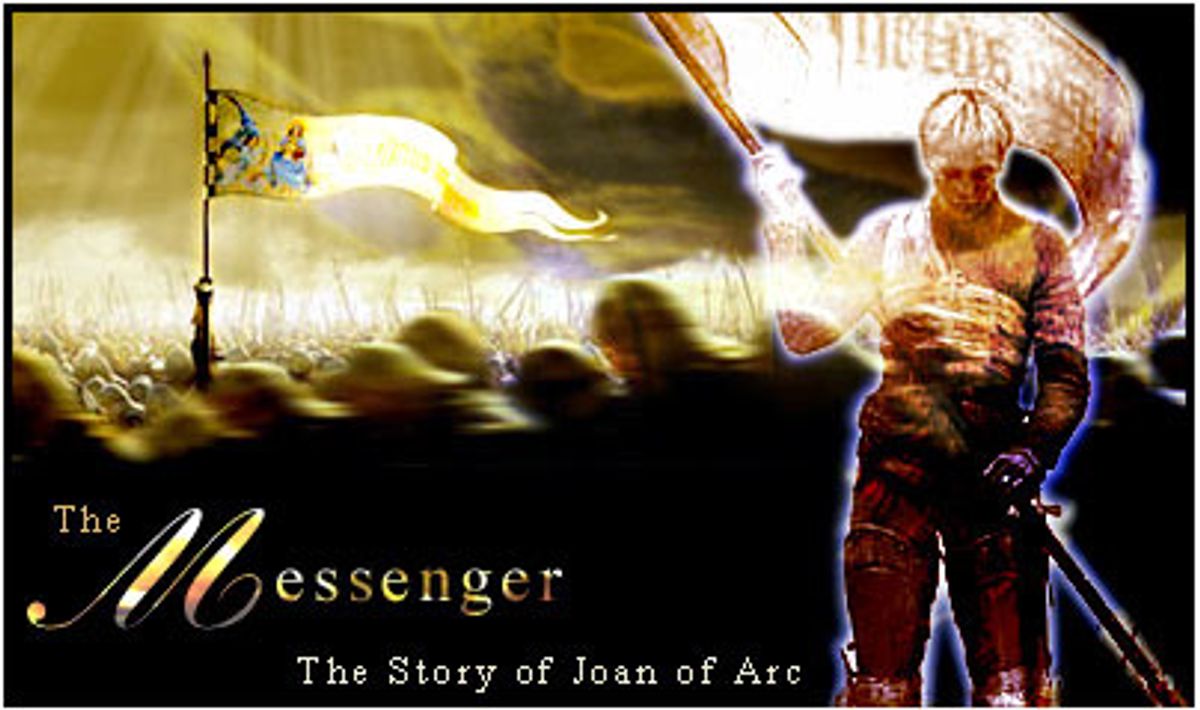
director of the new international production "The Messenger: The Story of
Joan of Arc."
For Besson, Joan's story is an excuse to play with a whole
new set of toys. He got to play with spaceships in "The Fifth Element,"
big guns and explosions in "La Femme Nikita" and "The Professional,"
various undersea geegaws in "The Big Blue," even the Paris Metro in
"Subway." In "The Messenger," Besson lets loose with catapults and flaming
arrows, boiling oil and swords, galloping horses and clanking armor, and a
whole assortment of evil spiked thingies that are smashed -- at regular
intervals -- into various heads and chests and limbs.
You want the brutality of war? How's this for an opening: After seeing a pack of wolves
rip the entrails out of war dead, the terrorized child Joan hides in the
closet watching while a soldier impales her older sister on his sword and
then rapes her corpse. Just so we don't miss the point that the soldiers
are, you know, barbarians, a pair sit in the background watching the assault
as they gnaw meat from a stew they've poured over the family dining table.
(That's a very French definition of barbarism: "Sacri bleu! Zey waste zee
sauce!")
Which isn't to suggest that Besson forgets this is a spiritual story. Au
contraire, mon frere. The neat thing is, Joan's visions allow him to play
with a whole other set of gadgets. His camera and lenses and editing
machine and sound effects team work overtime, producing blinding flashes of
light and solarized color, tilted angles and speeded-up motion,
disorienting shock cuts, even the sight of a sickly looking Christ whose
appearances are heralded by backwards tapes that make him seem less the son
of God than of George Martin.
I've never left a Luc Besson movie not thinking that the guy has
Froot Loops for brains, but at least in his last picture, "The Fifth
Element," they rattled around amusingly. Instead of Besson's usual empty
image-mongering, that movie showed some genuine zip and invention. Besson's
vision of a future metropolis where the streets were stacked on top of one
another was the opposite of all the glum dystopias that sprang from "Blade
Runner." This city, where taxis zoomed between buildings and you could get
lunch from a floating Thai restaurant that came straight to your apartment
window, made the future seem like it might be a hell of a lot of fun, or at
least the craziest mall ever built. Another thing the movie had going for
it was a crazily amusing Milla Jovovich in punk-red hair and
Gaultier-designed surgical bandages as the alien wild child Leeloo,
cackling and growling and spouting some sort of intergalactic gibberish
while she chowed down on roast chicken.
Jovovich married Besson after that film and it was then announced she would star in his Joan of Arc project.
(There seems to be some dispute about whose idea "The Messenger" was;
reportedly Besson was at one time set to produce Kathryn Bigelow's Joan of
Arc film, which was to star Clare Danes.) But "The Messenger" doesn't feel like a love poem to
Jovovich (the couple has since separated), or to Joan of Arc, or to anything except his own
status as France's biggest commercial filmmaker.
Besson is very shrewdly
linking his box-office clout to the adoration of France's national heroine.
Which would be fine if his approach weren't entirely self-serving.
"The Messenger" is a truly vulgar movie (and I've never described any film
with that word), not just because Besson has taken on Joan's story with no
feelings of reverence or awe or even much sympathy for her, but because her
story is reduced to an excuse for him to parade himself as Luc Besson, Epic
Filmmaker.
But as filmmakers with aspirations to the epic go, Besson is a runt. The
battle scenes are chaotic and noisy, with the camera whipping here and
there or plunged so close to the action that fake blood periodically
splatters the lens. These sequences are put together with so little basic
grasp of cinematic grammar that you can barely tell what's happening, who's
who, or where anyone is in physical relation to anyone else. (The one
exception is a throwaway shot -- a blessed moment of stillness -- of Joan
standing motionless in the midst of her soldiers rushing to battle.)
Some filmmakers set out to awe you; Besson sets out to assault you. His
wide-screen freneticism bangs you over the head while Eric Serra's score
sounds as if it were already inside your skull and were pounding its way
out note by overwrought note.
Part of the confusion is surely due to Besson's decision to shoot almost
the entire movie -- dialogue scenes as well as battle scenes -- in
close-up. The actors are so close to the lens they appear to be looming over
the first 20 rows of the theater. That is, I'm sure, no sin to such
practiced scenery chewers as John Malkovich (the blandest of scenery
chewers) as Charles VII, the dauphin Joan fights to make king, looking as
if God's will were a distraction from the important business of cleaning
his fingernails; Faye Dunaway, as Charles' mother-in-law Yolande, wearing
what appears to be a large brioche on her head; or Dustin Hoffman, in black
cloak, beard and a tone that might be described as stentorian Yiddish, in a
role credited as "Joan's Conscience," perhaps because the filmmakers were
embarrassed to list him as what he's playing: "God." A pity Hoffman felt no
embarrassment about taking the part.
Jovovich's face seems all mismatches -- a long, slender nose, full
lips, high cheekbones -- that combine to make a stunning whole. She's a
ravishing camera subject, and with her cropped hair and armor, and those
intense green eyes, she's a captivating image of Joan. But this
role is a killer, demanding almost impossible (and contradictory) reserves
of strength, delicacy and fervor that have to remain clear-headed, and
suffering that cannot be self-righteous. It's no shame to Jovovich to say
she's not up to it. And it's hard to lay much of the blame on her when
Besson, who appears to regard guiding actors as the least of his chores,
has directed her to keep her eyes and nostrils flaring for the entire
performance. She seems so petrified that at first she can barely get out
her lines; it's simply impossible to imagine this girl inspiring the type
of confidence soldiers need to go into battle.
Besson hasn't helped Jovovich by suggesting that Joan betrayed God by
killing in order to free France. If you're not comfortable with making a
film about the glory of war, you should probably stay away from the story
of Joan of Arc (although there is no historical record of Joan killing
anyone, and there are many accounts of her sparing the lives of prisoners). This sop
to contemporary sensibilities makes nonsense of both Joan's motivation and
her devoutness -- her willingness to do what God required of her.
Besson is quoted in the press material as saying, "If she wanted to be a good
Christian, a good person ... even if her motivation was good, to have her
country free, it was wrong to participate in the massacres. Thou shalt not
kill -- that's a commandment." How dare Besson get on his moral high horse
when he's the one who's reveled in the gore and bloodshed of battle for two
hours and 21 minutes; after inventing the brutal
rape-murder of Joan's sister; and, when the story stopped providing battle
sequences, tossing in a scene of Joan being kicked bloody by her guards? He
may not be the first of Joan's judges, but he is by far the most lame-brained.
Luckily, we don't have to settle for Besson's version. "Jeanne la Pucelle
(Joan the Maid)," the legendary French director Jacques Rivette's two-part
1994 film, has finally been released in this country on video in the
version Rivette himself prepared for the film's British release. (It runs
just under four hours; the French version runs just under six.)
There's always a risk of appearing snobbish when you use an art-house film
to berate a big commercial release. And, speaking realistically, "Jeanne la
Pucelle" is not a film that you can imagine ever attracting a large
audience. It's long, demanding, austere and far, far from flawless. But Rivette, one of the Cahiers du Cinema critics who spearheaded the
French New Wave, is also a giant among living filmmakers. And I can't help
feeling that there's something a little obscene when a director of his
stature makes an epic film that doesn't get even a small American release,
while an utterly meretricious film on the same subject gets international
distribution by virtue of its being partly funded by an American studio and cast with American stars. After watching Besson bungle scene after scene,
the unadorned way in which Rivette handled the same moments came into my
head until his movie began to seem like an emotional and stylistic rebuke
to Besson's excesses.
To explain what Rivette does in the two halves of "Jeanne la Pucelle," "1.
The Battles" and "2. The Prisons," I need to describe a little of how he
works. Though Rivette loves narrative and is obsessed with the way in which
stories figure in our lives, it can sometimes seem that very little happens
in his movies. The easiest explanation for their usual three- and four-hour
length is that Rivette is expanding the compressed time in which movies
typically occur to something like real time, allowing us to live with the
characters, to be fully conscious of the moments that, in real life, we
allow to pass by. For me, no director has succeeded in putting as much of
life on screen -- perhaps not its dramas, but its textures, gravity, lightness and the inconsequentiality that the day-to-day comprises.
In a superbly articulate piece in Sight and Sound about Rivette's latest film,
"Secret Defense," critic Jonathan Romney describes a sequence that
follows Sandrine Bonnaire as she takes a train to another city to kill a
man by commenting, "Just watching her in transit we feel the weight of
everything she experiences." He could be talking about Bonnaire's Jeanne.
Rivette's focus on specifics, his decision to stick closely to the
historical record and the constraints imposed on him by making a film of
this scale with a minuscule budget all combine to give "Jeanne la Pucelle"
an irreducible actuality. Rivette's film feels as if we are seeing
something that actually happened, less "history" than events that occurred
in the course of real lives.
Shooting (I assume) on location in actual castles and cathedrals, and in parts of the French countryside that,
500 years later, remain unspoiled enough to pass for the 15th
century, Rivette pares the film down to essentials. The effect is simple,
unadorned, at times even static (particularly when Rivette, usually during
scenes at the royal court, arranges his actors in stage-like tableaux).
Finally, the effect is like reading the description Joan gave of her life
at her trial ("Unique among the world's biographies," Mark Twain said,
because it is "the only one which comes to us from the witness stand.")
What moves you is that something so simple and plain could add up to
something so profound. Rivette has no time for the folderol that clutters
up the Besson film: The way he loads each scene with period costuming,
weaponry or decoration; the disastrous idiocy of attempting to film Joan's
visions as if they were LSD trips (how do you film a vision sent by
God?). Rivette allows nothing to get in the way of the events themselves,
and his bare-bones approach works wonders. That Jeanne's army seems to
consist of only 20 or so men really does make her victories seem like a
miracle.
Bonnaire styles her acting to suit Rivette's approach. With her
hard, sullen little face, she has sometimes seemed inexpressive, and it
would be easy to make that mistake here. There's no charm, no charisma in
her Jeanne. But charm and charisma would be absolutely extraneous to a
young peasant girl who believes she has been charged by God and must
convince men far more powerful than she is to believe it, too.
Bonnaire's extraordinarily disciplined performance is motivated by the
force of Jeanne's contained determination. And because she never loses her
conviction that she has been chosen to save France, the contrasting moments
stand out in stark relief. Bonnaire conveys a radiant gratitude when she
drops to her knees before Charles, moments after he has been crowned king,
and proclaims that God's will has been carried out. But her best moment may
be the one in which she comprehends fully what the cost of carrying out
God's will may be, opening her mouth in silent shock -- half pain, half
martyred ecstasy -- as she is wounded for the first time.
"Jeanne le Pucelle" contains none of the sunny playfulness that
characterize Rivette's "Celine and Julie Go Boating" or "Haut/bas/fragile,"
his most accessible films. It may be too rarefied, even too cerebral a pleasure
to ever appeal to moviegoers unfamiliar with his style; Rivette may be
the least known great filmmaker outside France, though he doesn't even
attract large audiences there. But the film's resolute plainness honors
the spirit of its subject and allows for Joan's sanctity without becoming
hamstrung by reverence.
At 70, Rivette still seems like one of the most
contemporary filmmakers working. "Each new work," writes Jonathan Romney,
"has the freshness and discomfort of a first-time director facing the same
problems of how to invent a cinematic fiction and see it through to a
finished (but always raw, unpolished) product." That's the description of a
filmmaker particularly suited to liberate history from the mustiness of
information and the aggrandizement of myth. Rivette's Jeanne is
flesh and blood before she's a saint. That's why her victory is a marvel,
and it's why her fate scorches us as well.
Shares