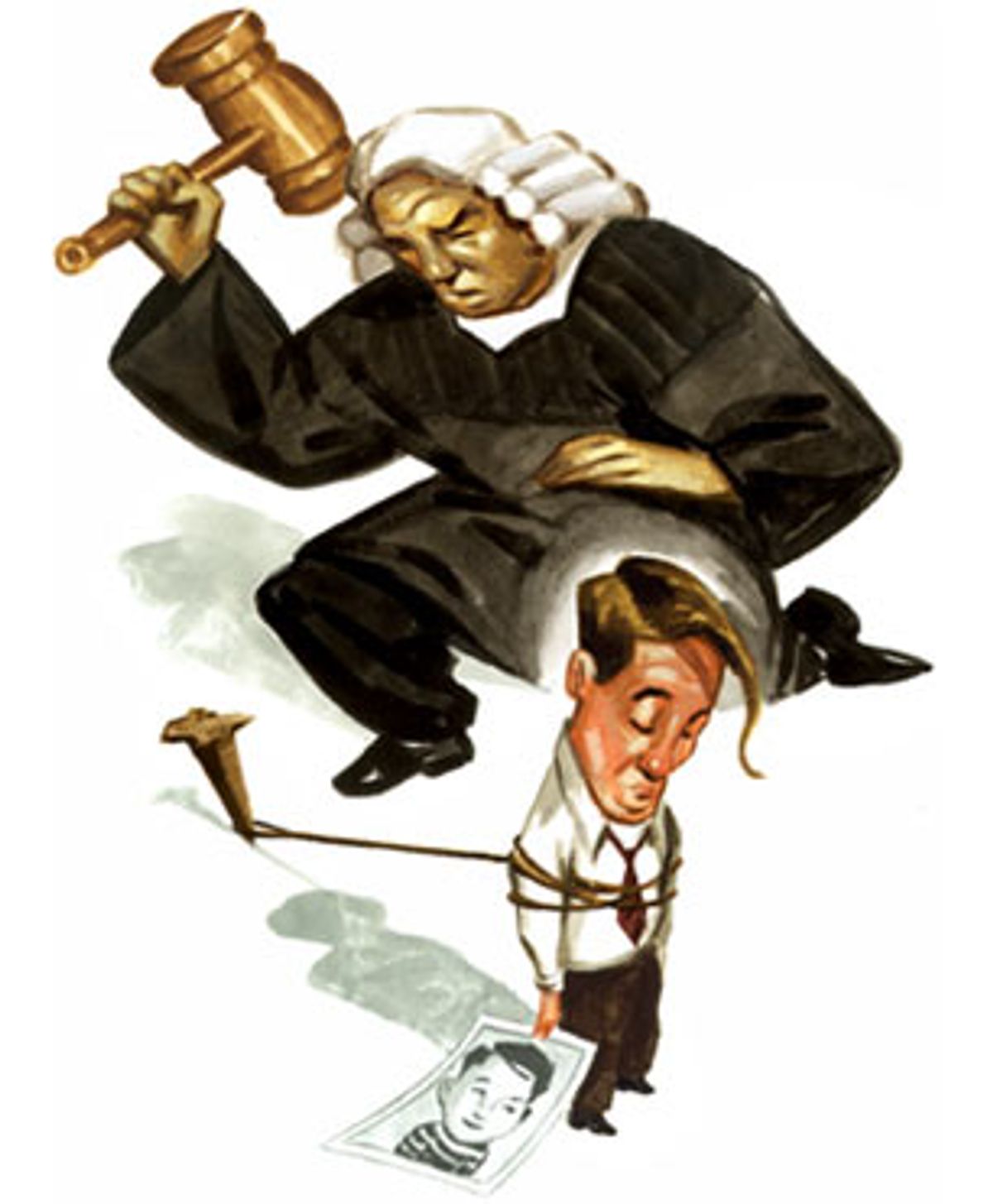
One day three years ago, Harry Stewart, a lay minister in Weymouth,
Mass., and a divorced father of two, was bringing his 5-year-old
son back from a scheduled visit. He walked the boy to the front door of
the mother's apartment building and opened the door to let him in.
For this offense, 44-year-old Stewart is now serving a six-month sentence in
the Norfolk House of Correction.
Stewart was convicted in June of violating a restraining order that
prohibited him from exiting his car near his ex-wife's home. He got a
suspended sentence conditional on completing a batterers treatment
program, in which participants must sign a statement taking responsibility
for their violence.
That was something Stewart refused to do. He has never been charged with spousal assault and insists that the only violence in his marriage was by his ex-wife against him. (While his former wife told reporters that Stewart was dangerously unstable, her examples -- that he had watched "prison movies" with his 8- and 6-year-old sons and promised to send them some live caterpillars to grow into butterflies -- seem shocking only in their innocuousness.) On Aug. 18, he appeared in Quincy District Court and again declared that he was not a batterer and would not enroll in any program that required him to admit to being one. Stewart was ordered to start serving his jail term immediately.
The Stewart case has become a rallying point for fathers' rights activists,
some of whom picketed the courthouse that day. For years, fathers groups
have argued that orders of protection, intended as a shield for victims of
domestic violence, often are misused by unscrupulous pseudo-victims and
overzealous courts. Their claims are now getting some attention, with
Massachusetts as the epicenter of what is (depending on whom you listen to)
either an attempt by angry men to roll back women's gains or a civil rights
battle for our times.
In May, the Judiciary Committee of the Massachusetts legislature held a hearing on the abuse of domestic restraining orders. In September, six divorced men, along with the statewide Fatherhood Coalition, filed a federal lawsuit alleging gender bias and violations of constitutional rights by domestic relations courts, with a special emphasis on restraining orders.
To battered women's advocates, and to feminists such as Boston Globe
columnist Eileen McNamara, gripes about the restraining-order system are
merely an anti-female backlash. At times, some men in the fathers groups
can indeed lapse into angry rhetoric that smacks of hostility to women. But
it is equally true that many women's advocates (who, unlike the divorced
dads, have a good deal of influence in the legal system) seem to have a
"women good, men bad" mentality that colors their view of family conflict.
What's more, the grievances of the fathers' rights activists have support from
unexpected quarters, such as Elaine Epstein, former president of the
Massachusetts Women's Bar Association. In 1993 Epstein, then head of the
Massachusetts Bar Association, wrote a column in the association newsletter titled "Speaking the Unspeakable," which charged that the "frenzy surrounding domestic violence" had paralyzed good judgment.
"The facts have become irrelevant," she wrote. "Everyone knows that restraining orders and orders to vacate are granted to virtually all who apply, lest anyone be blamed for an unfortunate result ... In many [divorce] cases, allegations of abuse are now used for tactical advantage."
Sheara Friend, a Needham attorney who testified before the Massachusetts
Legislature in May, concurs. "I don't think there's a lawyer in
domestic relations in this state who doesn't feel there has been abuse of
restraining orders," she says. "It's not politically correct -- lawyers
don't want to be pegged as being anti-abused women, but privately they agree."
There are stories of attorneys explicitly offering to have restraining orders dropped in exchange for financial concessions. Friend says that this has happened to her on two occasions; but she believes that more discreet negotiations are actually far more common.
Even feminist activists are willing to allow that restraining orders can be
misused as a "coercive tool" -- by men. In 1995, in Somerville, Mass.,
Stephen Gruning broke into the apartment of his ex-girlfriend, Rhonda
Stuart, and went on a shooting rampage, wounding her and killing her brother and her new boyfriend. When press reports revealed that Gruning had earlier obtained two temporary restraining orders against Stuart, women's advocates were quick to point out that such orders were very easy to get, "regardless of the facts."
In the 1970s and '80s, growing public awareness of domestic violence spurred laws such as the 1978 Abuse Prevention Act in Massachusetts, which made restraining orders (usually prohibiting any contact with the complainant) easily available against current or former spouses or cohabitants. More recently, many states have moved to strengthen this legislation, extending eligibility to people who had dated but not lived together, and introducing tough measures against violators.
In Massachusetts, as in most other states, a temporary no-contact order can
be issued ex parte -- without the defendant being present or notified, let
alone informed of the specific charges -- and solely on the word of the
complainant. "I think judges grant the restraining orders without asking too
many questions," said former state Rep. Barbara Gray, an original sponsor of the Abuse Prevention Act, in a 1995 interview.
Gray, who is now retired, rather nonchalantly allowed that the system could be manipulated, but she felt that nothing could be done differently without endangering women: "You [would be] saying to a judge: On an emergency basis, you have to look at this woman and see whether you think she's telling the truth."
True or false, the charges can be surprisingly trivial. A 1995 study by the
Massachusetts courts showed that fewer than half of all restraining orders
involved even an allegation of physical abuse. Epstein recalls "affidavits which just said that someone was in fear, or there had been an argument or yelling, but not even a threat."
While the Massachusetts Supreme Judicial Court ruled in 1990 that a simple claim of fear was not a sufficient basis for a restraining order -- and set a threshold of "reasonable" fear of "imminent serious physical harm" -- courts routinely ignore this standard.
Once a temporary order is granted, a hearing must be held within 10 days to determine whether it should be vacated or extended for a year. That's when the defendant gets a chance to defend himself -- in theory. The hearing, however, is usually limited to a he said/she said exchange in which, many lawyers say, the defendant is given little credit. (Of course, the accused is not always a he; about 18 percent of restraining orders issued in the state last year were granted to men.) The normal rules of evidence do not apply; hearsay is commonly allowed, while exculpatory evidence can be kept out.
A defendant who insists on a full evidentiary hearing can be forced to wait for months. In one case, the transcript shows, the judge denied an attorney's request to call witnesses who would dispute the complainant's story, saying, "I don't need a full-scale hearing ... I don't care about that." The judge also declared that the issue was not even "who's telling the truth," only whether he felt the woman was genuinely fearful.
While a restraining order is a civil remedy, its target is subject to
criminal sanctions -- up to two and a half years of imprisonment -- for conduct
that is not only normally legal but quite benign, like getting out of the car
and holding the door for a child. (This includes contact that is clearly
accidental, or even initiated by the purported victim: Even if you came over to
the house at your ex-spouse's invitation, you don't have a legal excuse.)
Stewart has several other charges pending, mainly for failing to stay
confined to his vehicle: for picking up the children on foot when his car had
broken down, and for exiting his car during visitation exchanges, once when his
son needed help with a package and another time when one of the boys
stumbled and fell while running toward the car.
In 1994, in a somewhat similar case, Sal D'Amico, a father of three, was
arrested and ordered into a batterers program because he got out of his car to pet the family dogs while picking up his kids for a visit. Five months
later, he was fined nearly $600 for returning a telephone call from his son.
(Like Stewart, D'Amico has never been criminally charged with assaulting his wife, whose claims of ongoing violent abuse were uncorroborated by any evidence.)
And those men are the lucky ones: Other fathers have been denied
all contact with their children, or allowed to see them only in a supervised
visitation center -- where, adding insult to injury, they must pay for the
privilege.
In one of attorney Friend's recent cases, a woman claimed to be frightened by her ex-husband's search for real estate in the same town where she was moving with her children; the father, who previously had extensive visitation, was barred from all contact with the kids, even by telephone, for three weeks.
Boston-area therapist and hospital staff psychologist Abigail Maxton has a
client who was not allowed to see his two children for about nine months
after his ex-wife alleged, in the middle of divorce proceedings, that he had
physically abused her and the children. ("The investigation consisted of a
Department of Social Services worker talking to the wife and then talking to
a neighbor who confirmed that she had heard loud voices," says Maxton.) The client could have only supervised visitation for the next two years, until the social worker who monitored the visits finally gave him a clean bill of health.
The situation in Massachusetts is not unique. In a 1996 column in Family
Advocate, the journal of the family law section of the American Bar
Association, Connecticut attorney Arnold Rutkin charged that many judges in his state approach protection orders as "a rubber-stamping exercise" and that the due process hearings held later "are usually a sham."
In Missouri, a survey of attorneys and judges for the Task Force on Gender and Justice in the early 1990s found many complaints that the "adult abuse" law was resulting in blatant disregard for due process and was commonly misused for "litigation strategy" and "harassment."
In New Jersey, appellate judges have expressed concern about frivolous
restraining orders based on claims of verbal abuse: a man calling his estranged wife to tell her he would take "drastic measures" if she didn't pay
the household bills -- by which he meant having the phone disconnected -- or a husband repeatedly saying to his wife that he no longer loved her and was going to get a divorce. After several such orders were overturned on appeal four years ago, the number of restraining orders issued statewide dropped by about 20 percent.
This trend, however, is likely to be reversed; the state Supreme Court overturned one of those appellate rulings in 1998, in Cesare vs. Cesare, and gave the trial courts broader latitude to rely on the complainant's subjective perception of a threat.
There also is some evidence to support the claims of fathers groups that
courts show little regard for the civil rights of defendants when allegations
of domestic abuse are involved. At a 1995 seminar for municipal judges,
Judge Richard Russell of Ocean City, N.J., was caught on tape giving
some startling advice.
"Your job is not to become concerned about the constitutional rights of
the man that you're violating as you grant a restraining order," he said. "Throw him out on the street, give him the clothes on his back and tell him, see ya around ...The woman needs this protection because the statute granted her that protection ... They have declared domestic violence to be an evil in our society. So we don't have to worry about the rights."
Judge Russell's comments, printed in the New Jersey Law Journal, earned him a mild chiding from the Administrative Office of the Courts. By contrast, in Maine two years ago, Judge Alexander MacNichol was denied reappointment by Gov. Angus King after battered women's advocates complained that he was insensitive to women applying for restraining orders -- despite the lack of any evidence that his alleged insensitivity had put anybody in harm's way. Many court employees, male and female, who supported the judge said that he simply listened to both sides of the story.
But that is exactly what many battered women's advocates believe the courts shouldn't do. Some of them are quite candid about it.
In February, in the wake of several domestic murders in the Seattle area, two officials of the Washington State Coalition Against Domestic Violence wrote an article in the Seattle Times urging judges "to believe every woman who expresses fear of an intimate partner" and to deny accused men all contact with their children. (The advocates also tend to embrace extremely broad and vague definitions of abuse that have also found their way into official domestic violence intervention programs -- not only physical assaults but verbal putdowns, "criticizing you for small things," "making you feel bad about yourself," "threatening to leave," even "denying you sex.")
The notion of women falsely crying abuse is anathema to domestic violence
activists; for many feminists, talk about spiteful, manipulative ex-wives
sets off a misogyny alarm. Yet to recognize that such acts are possible, one
need not see women as uniquely vindictive or devious, only as human. The
advantages of a restraining order to the complainant -- exclusive possession
of the home (with the alleged abuser often required to continue paying the
rent or mortgage), temporary and probably permanent sole custody of the
children -- can be tempting. So can, let's face it, the opportunity to make your ex very miserable.
Indeed, while fathers' rights activists undoubtedly have a point when they
say that men claiming to be victims of domestic abuse are generally viewed
with far more skepticism, it's certainly not just women who have taken
advantage of the system.
One of the witnesses testifying at the recent legislative hearing in Massachusetts was Myra Dunne, a nurse who was thrown out of her house on her husband's complaint during divorce proceedings. One New Jersey woman was hit with a restraining order because she vocally disapproved of her estranged husband's cohabitation with a girlfriend. She violated the order by berating him during a visitation exchange for bringing "that slut" to a birthday party for one of the children, and was sentenced to six months probation and community service.
Those who pooh-pooh claims of widespread restraining-order abuse are fond of citing an analysis of public records in Massachusetts showing that 54 percent of men named in domestic restraining orders in 1992-93 had a history of drug or alcohol offenses, 48 percent had been charged with a violent crime (though not necessarily convicted) and one in four had been in jail or on probation before the order was granted.
Yet these numbers hardly refute claims that the targets are frequently non-abusive men. It is entirely possible for most of the defendants to be a bad lot and for a sizable minority to be wrongly accused.
Friend believes that 40 to 50 percent of restraining orders are strategic ploys. This rather inflammatory estimate is echoed by Dorothy Wright, a New Jersey lawyer and a former board member of a battered women's shelter. Supporters of the law insist that at most 4 or 5 percent may be obtained under false pretenses. But even that adds up to more than 1,500 a year in Massachusetts alone. That's hardly a trifle when it's a question of people being kicked out of their homes, cut off from their children, sometimes jailed and effectively branded as criminals without the safeguards of a criminal trial.
Public officials typically brush off concerns about the misuse of restraining
orders by saying that protecting women must be the top priority. "Given the
number of women killed in domestic abuse cases, we have a crisis on our
hands,'' Jean Haertl, executive director of the Governor's Commission on
Domestic Violence, told the Boston Herald recently.
The specter of mortal danger hovers over the debate on restraining orders, often making rational discussion impossible. It's hard not to seem callous if you question whether an average of 20 women slain annually by husbands, ex-husbands and boyfriends in Massachusetts, which has a population of over 6 million, amounts to an emergency that warrants the suspension of civil rights (any more than the nearly 200 non-domestic homicides that take place in the state every year).
"How you balance [due process] with a real victim's need for protection is a tough issue," says Friend, whose clientele has included abused women and men as well as disenfranchised parents. Even when there has been no physical violence and there are no overt threats, she says, a woman's fear can be based on real but subtle danger signals. Or it can be a paranoid response to media sensationalism that makes it look like slaughtering the wife and the kids is a fairly typical male response to divorce. Or it can be a convenient "abuse excuse." Without mind-reading, it is often impossible for the courts to make those distinctions. But the "better safe than sorry" approach can turn into something disturbingly akin to presumption of guilt.
The tension between preventing future harm to victims and protecting the rights of the accused is a notoriously thorny problem. Some of the same dilemmas are posed by recent measures against sex offenders who have completed their sentence -- though they, at least, have been actually convicted of a crime.
But do the tough restraining-order policies help victims? A man who is ready to kill a woman and either take his own life or face a murder rap surely won't be deterred by a charge of violating a court order. Virtually all the research -- and, most recently, two studies included in the 1996 book "Do Arrests and Restraining Orders Work?" edited by University of Massachusetts-Lowell criminologists Carl and Eve Buzawa -- concludes that the orders have little if any protective effect, except perhaps for women who were not severely victimized in the first place. If so, peddling these orders to people in real danger is like giving cancer patients a drug that cures the common cold.
University of Rhode Island sociologist Richard Gelles, a leading authority on domestic violence, also cautions that the more the legal system is bogged down in trivial pursuits, the less likely it is to single out the serious cases that do require urgent intervention.
Nor is there any evidence that an effort to curb frivolous restraining orders
will endanger lives. When the courts in New Jersey began to issue fewer
restraining orders as a result of appellate rulings that tightened the
definition of domestic violence (excluding verbal abuse without persistent
harassment or threats), an outcry from battered women's advocates was quick to follow -- but a rise in the domestic homicide rate was not.
Nevertheless, at least for now, efforts to reform restraining-order legislation in ways that would provide more protection for defendants are given little chance to succeed. Perhaps because the war on domestic violence is a more politically correct cause than the war on crime, the plight of people abused by restraining orders has not attracted the sympathy one can usually expect for casualties of prosecutorial and judicial zeal. The American Civil Liberties Union has stayed mum on the subject. Until recently, the media has ignored it as well, and remains uneasy with it. The issue largely continues to be seen (despite a growing number of women on the receiving end of restraining orders) in terms of men trying to snatch back the power newly gained by women.
Perhaps, for this attitude to change, we would have to start seeing women and men as truly equal. Then we would recognize that women, no less than men, are capable of abusing the power they're given, and that the protection of women does not justify the surrender of civil rights any more than the protection of men.
Then we might even recognize that the sympathy due a woman who lives in fear of her abusive ex-husband should also be extended to the father who can be hauled off to jail if he makes a phone call to wish his daughter a happy birthday.
Shares