

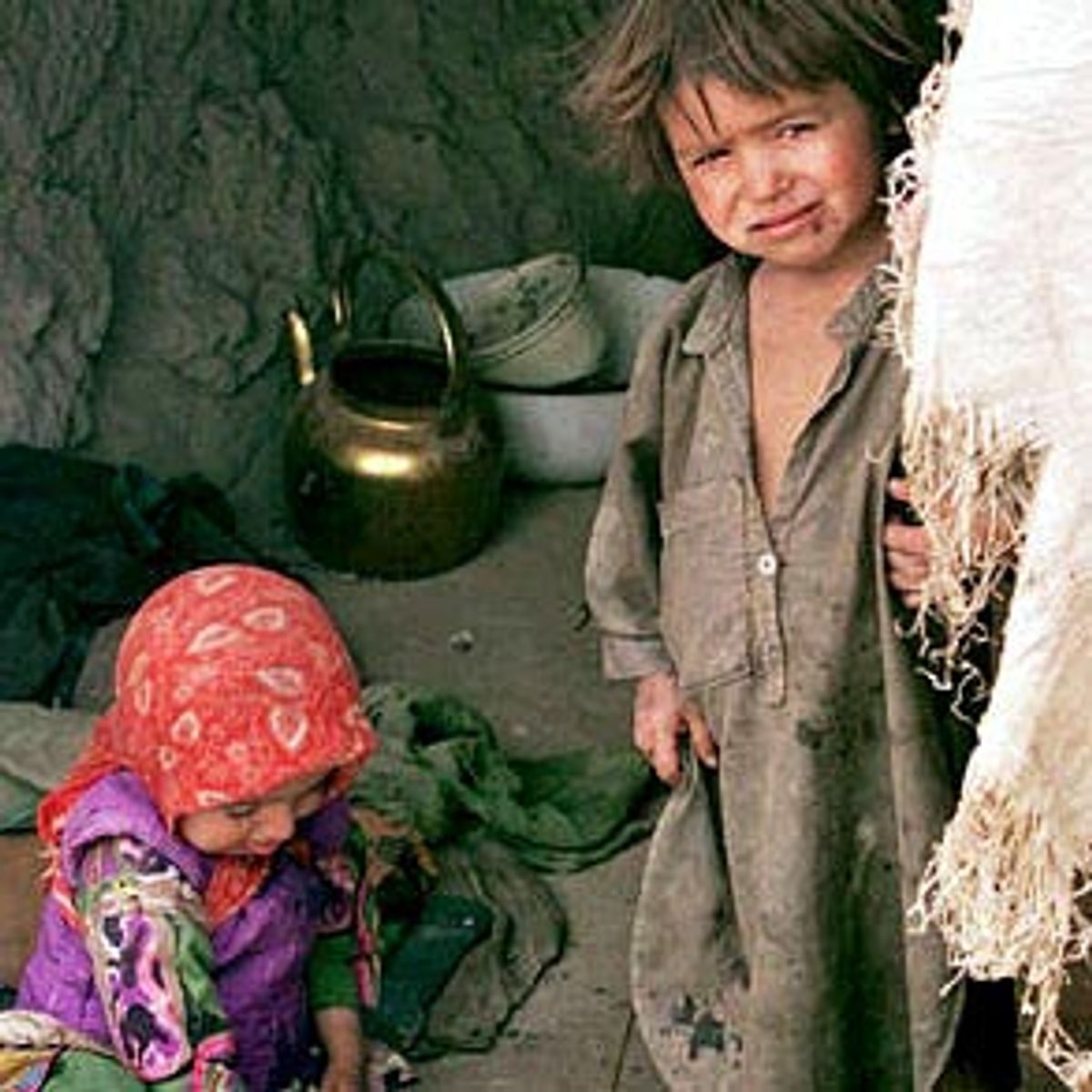
When President Bush asked kids across America to each donate a dollar for the impoverished children of Afghanistan last week, it was a sweet -- if mildly propagandistic -- gesture. It also was a reiteration of a message that has accompanied his most aggressive promises to bomb the Taliban into submission: Our war is not with the Afghan people; in fact, we want to help alleviate their suffering. And to prove the U.S. government's commitment to civilians caught in the violence, Bush has earmarked $320 million in aid for the people of Afghanistan, and dropped in nearly 275,000 meals to the country.
"The evildoers have struck our nation, but out of evil comes good," Bush told military personnel in a speech at Travis Air Force Base on Wednesday. "We are a good, kindhearted, decent people, and we're showing the world just that in our compassion and our resolve."
But the simultaneous campaigns of war and relief create a simplistic, and erroneous, impression of the impact the U.S. can hope to have in Afghanistan, particularly when it comes to living conditions and human rights, contends Dr. Lynn Amowitz, the Fireman Health and Human Rights Fellow for the organization Physicians for Human Rights. Amowitz, who studied Afghanistan during the last 18 months, says that country's gravest ills may be due in part to the Taliban, but the roots of the problems extend far deeper than a change of government or airdropped rations could quickly remedy. Meanwhile, she says, every day that the U.S. drops bombs on Afghanistan, a dire situation becomes much worse -- despite any consolation offered by pamphlets and peanut butter.
When Amowitz first left for Afghanistan last spring, she set out to determine the full extent of the health and human rights crisis there, particularly as regards the nation's women. In May, after more than a year of study and several trips to the country, Amowitz released a comprehensive report detailing the extent to which the Taliban was responsible for the suffering of Afghan women. With Afghan issues still largely below American radar, the document received very little attention at the time.
Then, after Sept. 11, "all of the sudden, Afghanistan was interesting," says Amowitz, who in the weeks since the attacks has been fielding phone calls from news organizations across the country.
Amowitz's report, "Women's Health and Human Rights in Afghanistan," pinpoints the full extent of the Afghanistan crisis in almost 100 pages filled with grim statistics. The report details the country's general health disaster, but Amowitz's particular concern is the unique situation of women under the Taliban, who are forbidden to work, get an education or appear in public without wearing a burqa and being accompanied by a male escort. Amowitz looked at the physical and mental effects of these restrictions. As a result, she unearthed some unexpected trends, such as a nationwide concern over women's rights, and the extent to which Afghan women actually support seemingly oppressive dress codes.
To obtain her data, Amowitz and a staff of local Afghan surveyors interviewed 746 men and women over the course of three months. Although researchers involved in a previous Physicians for Human Rights study had interviewed women who lived in Kabul, the new study targeted a more diverse group: Afghans who lived in Taliban and non-Taliban regions, refugees in Pakistan who had fled the Taliban and refugees returning to Afghanistan who had never lived under Taliban rule.
"This is the problem with Afghanistan -- you can't go to one place and generalize to the entire country; it is so diverse, the people are diverse, the traditions are diverse, the ethnicities are diverse," contends Amowitz. "Each group has their own tradition and culture. To say that one group represents the rest is absolutely impossible."
Whether rural or urban, male or female, Taliban-controlled or not, the Afghans that Amowitz surveyed all agreed on the bleakness of their situation. Only 17 percent of all Afghans in rural areas, and 38 percent in urban areas, have access to safe water; no wonder, then, that 42 percent of all deaths in Afghanistan are due to diarrhea. Fifty-two percent of all children under age 5 suffer from malnutrition.
Women and girls in Afghanistan suffered the most. Because girls are forbidden to go to school, for example, they miss out on critical landmine awareness programs, putting them at risk for injury by the country's millions of landmines (males, however, still account for a majority of all landmine injuries, since they move about more freely). And women who are sick often can't even go to the doctor, since 21 percent of all women in Afghanistan and 64 percent of the female refugees in Pakistan have no access to healthcare at all -- either they can't afford it, don't have the required male escort to take them to a clinic or simply don't have a female doctor they can visit.
"The problem is that time is of the essence there," Amowitz says. "If you don't educate women, and if you require that women see women doctors, at some point there will be a huge void of physicians to treat women."
Since 1987, Physicians for Human Rights has been sending doctors to Third World countries to document health issues through the filter of human rights; the two, they say, are inextricably tied. In Afghanistan, Amowitz links women's human rights with the general well-being of the entire country. For example, widows who have no man to feed them and who cannot work are not only impoverished and unhealthy themselves, but usually have children who also are starving. Says Amowitz: "In traditional societies where women are still the caretakers of the household, it's a hardship on the family if the women is not either physically and mentally well."
But Amowitz also found some encouraging news. Women's access to healthcare has marginally improved during the last year, thanks mostly to the diligence of the nonprofit organizations and international aid groups that have dispensed food, medicine and shelter there. (Other groups have opened special bakeries for war widows, feeding the 20 percent of the female population that is forbidden to work and has no male support.) In fact, 70 percent of the country's healthcare system is now dependent on international aid -- meaning that 7.5 million people rely entirely on the beneficence of the global community.
The flip side of that news, though, is the hard truth of life after Sept. 11: Those international aid organizations have left Afghanistan, having been either forced to flee for their own safety or ejected by the Taliban. And even with the good intentions of the U.S. government, the promised millions in aid has so far consisted of little more than 275,000 airdropped meals of beans, rice and peanut butter, most of which appears to be going into the mouths of Taliban soldiers.
Only a few aid groups have managed to get supplies in to Afghanistan by truck, and those supplies also have fallen victim to the war: On Monday, the U.S. accidentally bombed a Red Cross building, destroying two depots full of wheat and other humanitarian aid, and on Tuesday the Taliban seized an additional 7,000 tons of U.N. food (roughly half of the available supplies for all of Afghanistan).
"I fail to see how this attacks the problem of feeding 7.5 million people for any sustained period of time," Amowitz says, and she's not alone in her concern: On Monday, the BBC reported that Unicef officials have predicted 100,000 Afghan children could die this winter unless food reaches them in the next month.
"It's pretty easy to see that without international aid, you've now got 7.5 million Afghans at critical risk for death -- by starvation or by exposure," Amowitz says. "It's a catastrophe that no one is able to understand or see. Without the international aid community in there, the longer this happens, the worse it's going to be."
But even if the women of Afghanistan don't starve to death in the upcoming months, there's a good chance they may kill themselves. According to Amowitz's report, 70 percent of women living under the Taliban had symptoms of depression, and 18 percent of all women in Taliban areas had attempted suicide, along with 9 percent in non-Taliban areas. ("That number is probably higher," Amowitz says, "because I can only talk to the people who survived, not those who didn't make it.")
But, she adds, the Taliban isn't entirely at fault here: Only 30 percent of these suicidal women blamed Taliban policies for their depression -- the truth is that the country's problems run far deeper than the edicts of its fundamentalist regime, Amowitz says.
"This is where you have to take the whole context of Afghanistan," she explains. "Twenty years of war, devastating poverty, a new drought. You've lost your livestock and you can't work, you've lost family members in the civil war. And then finally these people come in to power and they take away all your rights as a human being. That's probably enough to push you over the edge, and say, 'I've had enough, I want to end it all.'"
Amowitz was surprised to discover that many women outside Kabul didn't mind being wearing the burqa. Some 90 percent of the women who don't live under Taliban control still choose to wear the burqa, reports Amowitz, an indication that what urban, educated women in Kabul may find oppressive, others simply find traditional. Indeed, 82 percent of all of the women surveyed didn't consider it very important whether they were persecuted because they didn't wear the appropriate clothing. This could be because they weren't being persecuted, however -- only two of the women Amowitz spoke with had ever been punished for what they were wearing, despite highly publicized beatings over dress code violations in Kabul, documented by RAWA.
"That's not necessarily representative of what is going on everywhere in Afghanistan, and doesn't represent what goes on every day," says Amowitz. "If you talk to aid organizations that have been in the area for years and years, they will tell you that [physical abuse by the Taliban] is not as frequent as it would appear on TV." In fact, she contends that most such behavior happened in 1998 and 1999, and then only in the large cities like Kabul.
And although Taliban policies are extraordinarily oppressive, the Taliban turns a blind eye to its own edicts in some parts of the country. "The Taliban is not one group, it is a group of a lot of people with a lot of different ideas. There are moderate, liberal, severe and fanatical Taliban," says Amowitz. "In some areas the Taliban [avert] their eyes to women having education, and there are classes that occur; a lot of nongovernmental organizations run schools, and healthcare is not a problem. It depends on where you are in the country."
Still, more than 90 percent of both women and men interviewed by Amowitz in Afghanistan said they believe in women's rights -- specifically equal access to education, work, freedom of expression and representation in the government. Only half of those surveyed believe in strict dress codes for women. Furthermore, 80 percent of those surveyed felt that the teachings of Islam aren't inherently restrictive of women's rights. This, says Amowitz, was the most encouraging news yet, proving that the Taliban's attitude towards women isn't representative of the male population at large, nor of the version of Islam that the Taliban invokes. And a vast majority responded that these issues -- healthcare, education, freedom of expression, government representation and the right to work -- belonged in any future peace talks.
At the moment, though, human rights activists and doctors have few solutions for the humanitarian crisis taking place in Afghanistan. Amowitz contends that food should be brought in by truck wherever possible, and borders should be opened so that starving refugees have some kind of safe haven ("If aid organizations can't get in," she says, "the civilians should be able to get out.")
In the long term, she adds, if and when the Taliban is removed from power, Afghanistan's problem is even more daunting: Not only do women need to have their human rights returned to them by a benevolent government, but the entire country needs food, clean water, sanitation, hospitals, police stations, buildings and infrastructure. Afghanistan, says Amowitz, will need to be rebuilt from scratch.
For her own part, Amowitz climbed back on a plane on Monday and plans to quietly slip over the border into the northern part of Afghanistan, to catalogue the toll that the war is taking. "It's not clear what I will do there -- I need to do a lot of interviews and figure out what we can add to the situation, human rights-wise," she explains. In the meantime, she says, "I hope that our study shows that the Afghans have been victims for 23 years, and that victimizing them even further is unconscionable."
Shares