

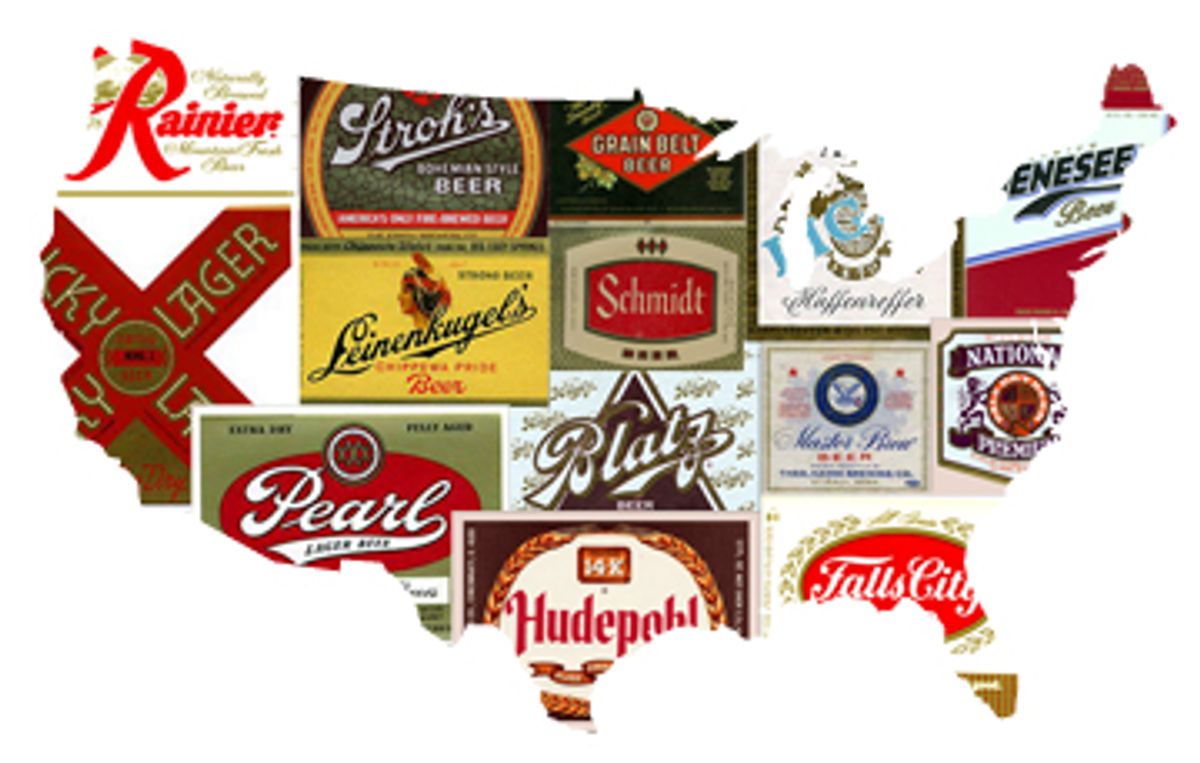
First they came for Olympia, and I said nothing. Then they came for Old Style, and still I said nothing, because I live 1,000 miles away and Old Style sucks anyway. Then they came for Ballantine, and -- ooh, is that a micro-brewed hefeweizen?
While Budweiser and Miller and Coors were taking over America's supermarket cases by going Lite, meaning that starting in the '70s they dreamed up various watered-down versions of their already insubstantial brews, the Pabst Brewing Co. stayed true to itself. Pabst stuck stubbornly to its retro recipe, its retro label, its retro everything -- and slipped to fifth place among American brewers. But with the sale of Anheuser-Busch to the Belgian combine InBev, Pabst is now the largest American-owned brewer. And in part, that's because during all those years in the lite-beer wilderness, it pursued its own very different winning strategy, either by stealth or by accident.
First slowly, and then boldly, with the 1999 purchase of Stroh's and its associated brands, Pabst sucked up many of the best-known old-school mediocre beers in America. If your dad liked a beer, and was on a budget, chances are that his swill-of-choice is now owned by Pabst. As the (somewhat random and incomplete) list below shows, there are other ways for America's venerable cheap beers to survive in a world that seems increasingly divided between corporate behemoths and twee craft brews.
One is simply to endure, à la Genesee, the other is to don craft-brew camo, à la Matt's. But about half of the most famous cheap beers in America now live on as regional variations on Pabst. -- Mark Schone
EAST COAST
Brand: Haffenreffer Private Stock
AKA: Headwrecker, P-Stock.
Hometown: Boston
Found in: Every state from Maine to Florida, rap lyrics. Biggie Smalls name-checks Private Stock in the song "Juicy."
Distinguishing characteristics: Rebus puzzles on the bottle caps (see Lucky Lager, below), strength and size (a 64-ounce container has been discontinued). Haffenreffer was promoted with the tag lines "The malt liquor with the imported taste" and "Nobody does it bigger." One of these two statements is true.
Vital signs: Once brewed by Falstaff, now a Pabst-owned product.
Brand: Narragansett
AKA: Gansett
Hometown: Cranston, R.I.
Found in: New England
Distinguishing characteristics: Popular among Red Sox fans, the beer's memorable slogan was, "Hi neighbor, have a 'Gansett!"
Vital signs: Falstaff purchased Narragansett and sibling Haffenreffer in 1981. The Narragansett brand name became the property of Pabst but was purchased by some Rhode Islanders in 2005, who began distributing a relaunched Narragansett, contract-brewed by High Falls Brewing Co. in Rochester, N.Y., the company that makes Genesee (see Genesee Cream Ale, below).
Brand: Schaefer
Hometown: New York
Found in: The entire Eastern time zone, and Puerto Rico.
Distinguishing characteristics: Skinny white and gold can. "Schaefer is the one beer to have/ When you're having more than one."
Vital signs: Purchased by Stroh's in 1981, which was subsequently bought out by Pabst in 1999.
Brand: Utica Club
Hometown: Utica, N.Y.
Found in: Upstate New York
Distinguishing characteristics: Once upon a time, it wasn't just locals who drank Utica Club. On television commercials seen throughout the Northeast, comedian Jonathan Winters did the voices of the beer's talking-beer-stein mascots Schultz and Dooley, whose many arguments were ended by drinking, which isn't really the way it works in the real world. The Matt Brewing Co. was also responsible for a couple of malt liquors named after either gladiators or condoms, Maximus Regular and Maximus Super, and something called the Matt's Beer Ball. A round brown plastic ball full of beer that was something less than a keg and something less than cold, even when refrigerated, the disposable Beer Ball, which required no keg deposit, was a dormitory favorite.
Vital signs: Utica Club is still available in upstate New York. But the Matt Brewing Co. has reinvented itself as a regional craft brewer, producing the well-regarded Saranac family of beers.
Brand: Genesee Cream Ale
AKA: Genny Cream Ale, Green Death (see also Rainier, below)
Hometown: Rochester, N.Y.
Found in: A 500-mile radius of Rochester
Distinguishing characteristics: Creamy white head. Of foam.
Vital signs: Winner of two consecutive gold medals at the Great American Beer Festival, Genesee is still made at the High Falls Brewing Co. (formerly Genesee Brewing Company), the seventh-largest American brewer. Genesee also makes a J.W. Dundee line of beers that includes a popular honey brown lager.
Brand: National Bohemian
AKA: Natty Boh
Hometown: Baltimore
Found in: Pennsylvania to Virginia
Distinguishing characteristics: Natty Boh's mascot, a cartooned gent with a bushy stache and one eye and a top hat, has become a civic icon in Baltimore. It's a matter of local pride to love the beer as much as the mascot, or try to, despite a taste as skanky as one of John Waters' early films.
Vital signs: National Bohemian hasn't been brewed in Baltimore in decades. Yet another Pabst brand.
Brand: Yuengling
AKA: Vitamin Y
Hometown: Pottsville, Pa.
Found in: Ten states -- Pennsylvania, New Jersey, New York, Delaware, Maryland, Washington, D.C., Virginia, North Carolina, Florida, South Carolina and Alabama
Distinguishing characteristics: "America's Oldest Brewery" (founded 1829) churns out a crisp lager with a bit more bite than your average blue-collar beer.
Vital signs: The sixth-largest commercial brewer in America is still owned by a guy named Yuengling, an Anglicization of Jüngling. (Brewery founder David Jüngling immigrated from Germany in 1823 and started his company in 1829.) Yuengling is our choice to become the next great American beer.
Brand: Iron City
Hometown: Pittsburgh
Found in: Local stores, and online.
Distinguishing characteristics: Iron City, first brewed in 1861, was blue-collar Pittsburgh's beer of choice during its heyday as America's steel town. It also became America's third-largest brewer when 21 local brewers merged into one company under the Pittsburgh Brewing Co. umbrella in 1899. Iron City clung tightly to a regional identity, becoming one of the first beers to use scenes and motifs from local sports teams in its packaging. It survived the '70s pogrom against local brands by successfully emulating the favorite strategy of national beer makers: just add water (though there's an internal contradiction to a beer called Iron City Light).
Vital signs: They don't make much steel anymore in Pittsburgh, and they don't make much Iron City either. The Pittsburgh Brewing Co. declared Chapter 11 in 2005. Iron City beer and the other core brands are on life support, while all the subsidiary brands purchased from Midwestern brewers (see Falls City, below) are comatose. New owners from Connecticut are still producing Iron City for the local market, but will only ship about 250,000 barrels in 2008, below their goal of 327,000.
MIDWEST
Brand: Stroh's
Hometown: Detroit
Found in: Michigan and the Midwest
Distinguishing characteristics: Stroh's, first brewed in Detroit in 1850, became America's only "fire-brewed" beer 50 years later. Beer ads from the 1980s, when Stroh's had expanded into much of the Midwest and Northeast, made a big deal about this "fire brewing," in which actual flames lick the copper brewing kettles and somehow make the beer taste better. But Stroh's real distinguishing characteristic might be that it made Pabst in its current corporate incarnation possible. Stroh's absorbed regional brands and lite beers and expanded quickly in the '70s and '80s -- perhaps too quickly. The debt from acquiring the Schlitz brands in an acrimonious takeover -- $500 million -- nearly sank the company. By 1999, however, the company had rebounded and swollen to 30 brands, many of them musty regional labels that hadn't been able to keep up with the Buds and Millers, i.e., cheap beers. In 1999, Miller and Pabst bought out the Stroh's catalog. Miller got Mickey's Malt Liquor, the barrel-green, slosh-prone Big Mouths of infamy. Pabst got most everything else, including the original Stroh's brand.
Vital signs: Pabst.
Brand: Hudepohl
Hometown: Cincinnati
Found in: From Ohio to Tennessee
Distinguishing characteristics: The German Catholic principality of Cincinnati was once a brewing center to rival Milwaukee and St. Louis, and Hudepohl was the best-selling local brand.
Vital signs: Like virtually all other local brands in the Greater Cincinnati and Kentucky area -- Wiedemann, Schoenling, Burger and so on -- Hudepohl, which limped into the new millennium, is now a memory.
Brand: Falls City
Hometown: Louisville, Ky.
Found in: Indiana, Kentucky, Tennessee
Distinguishing characteristics: Falls City introduced the Sta-Tab in 1975, a pull-top that stayed attached to the can when the beer was opened, an innovation soon adopted by virtually all canned beverages. In 1977, it launched Billy Beer, a short-lived brew capitalizing on the redneck celebrity of President Jimmy Carter's brother Billy.
Vital signs: Comatose, if not dead. Falls City sold out to Heileman of Wisconsin and was then passed to Evansville Brewing Co. and finally Pittsburgh Brewing Co., which, because of recent financial troubles, has been unable to continue brewing and shipping a number of brands once popular in the Cincinnati, Indiana and Kentucky markets, including Wiedemann and Sterling.
Brand: Old Style
Hometown: LaCrosse, Wis., and Chicago
Found in: Chicago, Wisconsin and neighboring states.
Distinguishing characteristics: Old Style is a homer. A sponsor of Chicago Cubs baseball for nearly 60 years and sold by vendors at Wrigley Field, it wraps itself in the banner of Chicago and the Cubs and insists to the point of boorishness on regional identity. As the brand's Web site boasts, Old Style has a "clean refreshing taste that goes down easy and makes the perfect complement to a Wisconsin brat or a Chicago-style pizza!"
Vital signs: Despite its enthusiastically provincial identity, Old Style is actual just one of many beers brewed by a national combine. The G. Heileman Brewing Co., brewer of Old Style, became a wholly owned subsidiary of Stroh's in 1996 and of Pabst in 1999. But it really is a hometown beer. After moving from Milwaukee to Texas, Pabst Brewing is now based in suburban Chicago.
Brand: Red, White and Blue
Hometown: Milwaukee
Found in: The halls of memory
Distinguishing characteristics: Though they long ago lost this status in the minds of most middle- and upper-middle-class consumers, Miller, Budweiser and Coors -- the domestic beers that now, in their regular and lead-free "lite" versions, dominate the market -- are "premium" beers, according to the industry definition. And most of the big-time premium brews used to have downscale, disreputable, cheap and fun siblings known as "budget" brands. They were the round-the-way beers you went home with at the end of the night, if the night went on too long. Red, White and Blue was to Pabst what Old Mil was to Schlitz, what the Beast was to Miller.
Vital signs: The Red, White and Blue waves no more. Pabst makes two dozen types of beer but no longer sells its own original budget brand.
Brand: Old Milwaukee
AKA: Old Mil
Hometown: Ummm . . .
Found in: Everywhere
Distinguishing characteristics: The budget version of Schlitz was created in 1955 and is perhaps best known for the Swedish bikini team, a short-lived marketing ploy from 1991. The concept was large-breasted blond women who bring beer to thirsty schlubs. Stroh's, the owner of Old Milwaukee at the time, managed to get sued by its own female employees before the ad campaign was killed.
Vital signs: Resting comfortably in the carbonated embrace of Pabst.
Brand: Blatz
Hometown: Milwaukee
Found in: Midwest
Distinguishing characteristics: Blatz was the first of Milwaukee's old Big Four brewers -- Schlitz, Miller, Pabst and Blatz -- to go national, and the first to stumble. The company was absorbed by Pabst in 1959.
Vital signs: Pabst sold Blatz to Heileman Brewing in 1969. Stroh's bought Heileman in 1996, and three years later Pabst bought Stroh's, meaning Blatz became a Pabst brand for the second time after a 30-year interruption.
Brand: Milwaukee's Best
AKA: The Beast, Milwaukee's Worst
Hometown: Duh
Found in: Any 7/11.
Distinguishing characteristics: The budget version of Miller, it might be the king of cheap beers by market share. It has calved both Light and Ice versions, so that it might be still more omnipresent.
Vital signs: As recently as 1995 the three-headed Beast accounted for 2.5 percent of beer sales in the U.S.
Brand: Schlitz
AKA: Shitz
Hometown: Milwaukee
Found in: Once, everywhere. In 1902, Schlitz surpassed Pabst, selling over a million barrels of the stuff to become the biggest brewery in the world. In 1976, Schlitz was still the second most popular brand of beer in America. After labor troubles, a disastrous formula change, the usual 20th century travails of any traditional American brew not named Miller, Coors or Bud, it nearly died. It is now produced in limited quantities.
Distinguishing characteristics: Cheap! "The beer that made Milwaukee famous." "When you’re out of Schlitz, you’re out of beer." The first brewery to introduce a bottle made of brown glass, which helps prevent light from spoiling the fizzy, hoppy, beery liquid inside. Fate: Yup, Pabst bought it. In 2007, Schlitz returned to its original formula in hopes of recapturing past glory in Schlitz Classic!
Brand: Hamm's
Hometown: St. Paul, Minn.
Found in: Antique stores
Distinguishing characteristics: Its classic jingle was like Walt Whitman's song of my souse: "From the land of sky blue waters/ From the land of pines' lofty balsams/ Comes the beer refreshing/ Hamm's the beer refreshing." The beer's mascot was less poetic but more famous -- a cartoon bear (referenced in country singer David Frizzell's "I'm Gonna Hire a Wino").
Vital signs: Owned by Miller, future bleak.
Brand: Grain Belt
Hometown: Minneapolis
Found in: Minnesota
Distinguishing characteristics: A once-robust brand that ate the Storz breweries of Nebraska and the Hauenstein Brewery of New Ulm, Minn., Grain Belt got the ritual beating administered to all regional beers by the Big Beers in the '70s and '80s. Heileman bought out the brand in 1976 and moved production from Minneapolis to neighboring St. Paul, where Grain Belt was brewed alongside its erstwhile crosstown rival and fellow victim of the national brands, Schmidt. Production later moved to Wisconsin and Grain Belt looked like it was circling the drain.
Vital signs: A large sign with the words "Grain Belt" on it still stands on an island in the Mississippi River near downtown Minneapolis, though it no longer flashes the letters of the beer's name in sequence. Grain Belt still stands as well. After many wobbly years and some near-death experiences, it was purchased by the New Ulm-based August Schell Brewery in 2002. Grain Belt Premium, one of the two Grain Belt brands, has developed some Pabst-like cachet with younger drinkers and is now Schell's top seller.
Brand: Falstaff
Hometown: St. Louis
Found in: Books, movies, songs -- but not refrigerators.
Distinguishing characteristics: But for circumstance, and a lack of ruthlessness, the name Griesedieck could have become as much of a household word as Anheuser-Busch. Falstaff was once the biggest beer in the beer town of St. Louis, and the third largest in the U.S., with breweries throughout the country. But Anheuser-Busch had the St. Louis Cardinals, and aggressive distribution plans. Meanwhile, Falstaff's acquisition of other brands like Narragansett was unsuccessful, and its purchase by rapacious beer magnate Paul Kalmanovitz in 1975 was calamitous. By 1977 Falstaff had only one brewery in its hometown of St. Louis, down from three, and by 1985 only one plant left in the nation in Fort Wayne. That brewery closed three years later.
Vital signs: The storied Falstaff brand, most recently referenced in Sheryl Crow's 1997 song "A Change Would Do You Good," ceased production in 2005.
Brand: Stag
Hometown: Belleville, Ill., best known for Jimmy Connors, Uncle Tupelo and white flight from East St. Louis just down the hill
Found in: Missouri, Illinois, Arkansas
Distinguishing characteristics: Antlers on the logo. A gold can. Surviving.
Vital signs: It survived in the shadow of Bud where Falstaff could not, but the price of survival was becoming one of the many host organisms for, yes, Pabst.
TEXAS
Brand: Shiner
Hometown: Shiner, Texas
Found in: 41 states
Distinguishing characteristics: An orange label with the picture of a ram's head, a reminder to Texans everywhere that sometimes, four beers doesn't make you drunk so much as bloated and sleepy.
Vital signs: First created at the Spoetzl Brewery in the tiny town of Shiner, Texas, and later sold to a brewery in San Antonio (which vastly widened its distribution), Shiner is as fierce a symbol of Central Texas pride as cowboy boots and a 10-gallon. (Even though yuppies in khakis drink it, too.) Branching out from its popular "Bock," Shiner introduced Shiner Blonde, Shiner Hefeweizen and, more recently, Shiner Spezial Leicht, which is German for, "Enough already."
Brand: Lone Star
Aliases: The Star, the National Beer of Texas
Hometown: San Antonio
Found in: Texas, Oklahoma, Arkansas, and on Willie Nelson's tour bus. It is sold as a specialty in bars on the coasts, where expat Texans enjoy it ironically and/or nostalgically.
Distinguishing characteristics: An unmistakable logo, which replicates the state flag with its central star and thick red-white-and-blue stripes; the promotional sign is still a favorite in dive bars and honky-tonks alike. Lone Star has enjoyed a long association with Texas musicians and was name-dropped several times in the title track of Red Steagall's 1976 album "Lone Star Beer and Bob Wills Music."
Vital signs: First sold to Olympia Brewing Co. in 1976, Lone Star was eventually absorbed by Pabst. Go figure.
Brand: Pearl
Hometown: San Antonio
Found in: Texas. Less available than Lone Star outside the state because its name doesn't say "Texas" to expats and wannabes.
Distinguishing characteristics: Pearl came in squat grenade bottles and, like many regional beers, featured rebus puzzles on the inside of the cap. Pearl Light, at a slimming 68 calories, had the distinction of being one of the least caloric beers on the market in the weight-conscious 1980s.
Vital signs: Yet again, owned by Pabst. In fact, the Pabst Brewing C. is really the Pearl Brewing Co. The Pearl Brewing Co. purchased Pabst in 1985, moving the corporate headquarters to Texas but taking the Milwaukee firm's name as its own.
WEST COAST
Brand: Olympia
AKA: Oly
Hometown: Tumwater, Wash.
Found in: The West
Distinguishing characteristics: Of the formidable troika of beers that once did battle with each other in the Northwest -- Olympia, Rainier and Henry Weinhard's -- before being battered into submission by the national brands, Oly ("It's the water!") was the brew that made the most serious bid to go national. It bought Hamm's and Lone Star. In the 1980s, however, as an adman recounts here, it simultaneously repackaged itself as a lighter beer and started brewing a richer, more sophisticated taste, of the sort that would be popular in the present era of the microbrew. But that era had not dawned, and confused consumers rejected the new brew. Olympia sold out to Heileman.
Vital signs: As is so often the case, being acquired by Heileman in the 1980s means being owned by Pabst in 2008.
Brand: Rainier Ale
AKA: Vitamin R, the Green Death (See Genesee, above)
Hometown: Seattle, Wash.
Found in: Throughout the West
Distinguishing characteristics: Launched in the 1880s, revived after Prohibition by the father-and-son team of Fritz and Emil Sick, Rainier was famous in its native Northwest for its green bottle and its affordability.
Vital signs: Rainier once ruled Seattle and battled Olympia, Lucky and Blitz for budget-beer dominance in the West. Seattle is now the land of coffee and microbrews. Rainier is now a Pabst brand brewed in California.
Brand: Henry Weinhard's
AKA: Henry's, Hank's
Hometown: Portland, Ore.
Found in: Oregon
Distinguishing characteristics: In Portland, the venerable Henry's was once as constant as the rain. Portland is now the capital of microbrews, but before the microbrews, there was the surprisingly good Hank's, in its brown bottle, and its budget brother, the felicitously named Blitz. The 1863 red brick brewery in what was then an industrial warehouse district filled the surrounding blocks, and sometimes half the city, with a sweet hoppy smell. Portland natives like to believe that Henry Weinhard's helped launch the microbrew craze, since it was proof a local product could be better than Bud. In 1999 Miller bought Blitz-Weinhard and shut down the brewery.
Vital signs: Now that there are more than 30 beers brewed in Portland, Henry Weinhard's has too much company. The brewery is closed, but the brand lives on. It is owned by Miller and has been brewed under contract since 2003 by Full Sail, an employee-owned craft brewer in Hood River, Ore.
Brand: Lucky Lager
Hometown: San Francisco
Found in: California and the West
Distinguishing characteristics: Formerly, 11-ounce bottles with rebus puzzles in the caps. Once a dominant cut-rate brand in California, it sometimes popped up in movies as an anti-glamour signifier. Boozin' Coach Buttermaker handed out the stubby brown Lucky bottles to his Little League baseball team at end of the 1976 film "Bad News Bears."
Vital signs: Now owned by Labatt's of Canada and widely available north of the border, but seen less often in the United States.
Shares